EP2596090B1 - A biodegradable concentrated neutral detergent composition - Google Patents
A biodegradable concentrated neutral detergent composition Download PDFInfo
- Publication number
- EP2596090B1 EP2596090B1 EP11809974.6A EP11809974A EP2596090B1 EP 2596090 B1 EP2596090 B1 EP 2596090B1 EP 11809974 A EP11809974 A EP 11809974A EP 2596090 B1 EP2596090 B1 EP 2596090B1
- Authority
- EP
- European Patent Office
- Prior art keywords
- detergent composition
- amount
- acid
- neutral detergent
- concentrated neutral
- Prior art date
- Legal status (The legal status is an assumption and is not a legal conclusion. Google has not performed a legal analysis and makes no representation as to the accuracy of the status listed.)
- Active
Links
Classifications
-
- C—CHEMISTRY; METALLURGY
- C23—COATING METALLIC MATERIAL; COATING MATERIAL WITH METALLIC MATERIAL; CHEMICAL SURFACE TREATMENT; DIFFUSION TREATMENT OF METALLIC MATERIAL; COATING BY VACUUM EVAPORATION, BY SPUTTERING, BY ION IMPLANTATION OR BY CHEMICAL VAPOUR DEPOSITION, IN GENERAL; INHIBITING CORROSION OF METALLIC MATERIAL OR INCRUSTATION IN GENERAL
- C23G—CLEANING OR DE-GREASING OF METALLIC MATERIAL BY CHEMICAL METHODS OTHER THAN ELECTROLYSIS
- C23G1/00—Cleaning or pickling metallic material with solutions or molten salts
- C23G1/24—Cleaning or pickling metallic material with solutions or molten salts with neutral solutions
-
- C—CHEMISTRY; METALLURGY
- C11—ANIMAL OR VEGETABLE OILS, FATS, FATTY SUBSTANCES OR WAXES; FATTY ACIDS THEREFROM; DETERGENTS; CANDLES
- C11D—DETERGENT COMPOSITIONS; USE OF SINGLE SUBSTANCES AS DETERGENTS; SOAP OR SOAP-MAKING; RESIN SOAPS; RECOVERY OF GLYCEROL
- C11D1/00—Detergent compositions based essentially on surface-active compounds; Use of these compounds as a detergent
- C11D1/66—Non-ionic compounds
- C11D1/72—Ethers of polyoxyalkylene glycols
-
- C—CHEMISTRY; METALLURGY
- C11—ANIMAL OR VEGETABLE OILS, FATS, FATTY SUBSTANCES OR WAXES; FATTY ACIDS THEREFROM; DETERGENTS; CANDLES
- C11D—DETERGENT COMPOSITIONS; USE OF SINGLE SUBSTANCES AS DETERGENTS; SOAP OR SOAP-MAKING; RESIN SOAPS; RECOVERY OF GLYCEROL
- C11D1/00—Detergent compositions based essentially on surface-active compounds; Use of these compounds as a detergent
- C11D1/66—Non-ionic compounds
- C11D1/72—Ethers of polyoxyalkylene glycols
- C11D1/721—End blocked ethers
-
- C—CHEMISTRY; METALLURGY
- C11—ANIMAL OR VEGETABLE OILS, FATS, FATTY SUBSTANCES OR WAXES; FATTY ACIDS THEREFROM; DETERGENTS; CANDLES
- C11D—DETERGENT COMPOSITIONS; USE OF SINGLE SUBSTANCES AS DETERGENTS; SOAP OR SOAP-MAKING; RESIN SOAPS; RECOVERY OF GLYCEROL
- C11D1/00—Detergent compositions based essentially on surface-active compounds; Use of these compounds as a detergent
- C11D1/66—Non-ionic compounds
- C11D1/722—Ethers of polyoxyalkylene glycols having mixed oxyalkylene groups; Polyalkoxylated fatty alcohols or polyalkoxylated alkylaryl alcohols with mixed oxyalkylele groups
-
- C—CHEMISTRY; METALLURGY
- C11—ANIMAL OR VEGETABLE OILS, FATS, FATTY SUBSTANCES OR WAXES; FATTY ACIDS THEREFROM; DETERGENTS; CANDLES
- C11D—DETERGENT COMPOSITIONS; USE OF SINGLE SUBSTANCES AS DETERGENTS; SOAP OR SOAP-MAKING; RESIN SOAPS; RECOVERY OF GLYCEROL
- C11D1/00—Detergent compositions based essentially on surface-active compounds; Use of these compounds as a detergent
- C11D1/66—Non-ionic compounds
- C11D1/75—Amino oxides
-
- C—CHEMISTRY; METALLURGY
- C11—ANIMAL OR VEGETABLE OILS, FATS, FATTY SUBSTANCES OR WAXES; FATTY ACIDS THEREFROM; DETERGENTS; CANDLES
- C11D—DETERGENT COMPOSITIONS; USE OF SINGLE SUBSTANCES AS DETERGENTS; SOAP OR SOAP-MAKING; RESIN SOAPS; RECOVERY OF GLYCEROL
- C11D1/00—Detergent compositions based essentially on surface-active compounds; Use of these compounds as a detergent
- C11D1/66—Non-ionic compounds
- C11D1/825—Mixtures of compounds all of which are non-ionic
-
- C—CHEMISTRY; METALLURGY
- C11—ANIMAL OR VEGETABLE OILS, FATS, FATTY SUBSTANCES OR WAXES; FATTY ACIDS THEREFROM; DETERGENTS; CANDLES
- C11D—DETERGENT COMPOSITIONS; USE OF SINGLE SUBSTANCES AS DETERGENTS; SOAP OR SOAP-MAKING; RESIN SOAPS; RECOVERY OF GLYCEROL
- C11D3/00—Other compounding ingredients of detergent compositions covered in group C11D1/00
- C11D3/0005—Other compounding ingredients characterised by their effect
- C11D3/0073—Anticorrosion compositions
-
- C—CHEMISTRY; METALLURGY
- C11—ANIMAL OR VEGETABLE OILS, FATS, FATTY SUBSTANCES OR WAXES; FATTY ACIDS THEREFROM; DETERGENTS; CANDLES
- C11D—DETERGENT COMPOSITIONS; USE OF SINGLE SUBSTANCES AS DETERGENTS; SOAP OR SOAP-MAKING; RESIN SOAPS; RECOVERY OF GLYCEROL
- C11D3/00—Other compounding ingredients of detergent compositions covered in group C11D1/00
- C11D3/16—Organic compounds
- C11D3/20—Organic compounds containing oxygen
-
- C—CHEMISTRY; METALLURGY
- C11—ANIMAL OR VEGETABLE OILS, FATS, FATTY SUBSTANCES OR WAXES; FATTY ACIDS THEREFROM; DETERGENTS; CANDLES
- C11D—DETERGENT COMPOSITIONS; USE OF SINGLE SUBSTANCES AS DETERGENTS; SOAP OR SOAP-MAKING; RESIN SOAPS; RECOVERY OF GLYCEROL
- C11D3/00—Other compounding ingredients of detergent compositions covered in group C11D1/00
- C11D3/16—Organic compounds
- C11D3/20—Organic compounds containing oxygen
- C11D3/2075—Carboxylic acids-salts thereof
-
- C—CHEMISTRY; METALLURGY
- C11—ANIMAL OR VEGETABLE OILS, FATS, FATTY SUBSTANCES OR WAXES; FATTY ACIDS THEREFROM; DETERGENTS; CANDLES
- C11D—DETERGENT COMPOSITIONS; USE OF SINGLE SUBSTANCES AS DETERGENTS; SOAP OR SOAP-MAKING; RESIN SOAPS; RECOVERY OF GLYCEROL
- C11D3/00—Other compounding ingredients of detergent compositions covered in group C11D1/00
- C11D3/16—Organic compounds
- C11D3/26—Organic compounds containing nitrogen
-
- C—CHEMISTRY; METALLURGY
- C11—ANIMAL OR VEGETABLE OILS, FATS, FATTY SUBSTANCES OR WAXES; FATTY ACIDS THEREFROM; DETERGENTS; CANDLES
- C11D—DETERGENT COMPOSITIONS; USE OF SINGLE SUBSTANCES AS DETERGENTS; SOAP OR SOAP-MAKING; RESIN SOAPS; RECOVERY OF GLYCEROL
- C11D3/00—Other compounding ingredients of detergent compositions covered in group C11D1/00
- C11D3/16—Organic compounds
- C11D3/26—Organic compounds containing nitrogen
- C11D3/28—Heterocyclic compounds containing nitrogen in the ring
-
- C—CHEMISTRY; METALLURGY
- C11—ANIMAL OR VEGETABLE OILS, FATS, FATTY SUBSTANCES OR WAXES; FATTY ACIDS THEREFROM; DETERGENTS; CANDLES
- C11D—DETERGENT COMPOSITIONS; USE OF SINGLE SUBSTANCES AS DETERGENTS; SOAP OR SOAP-MAKING; RESIN SOAPS; RECOVERY OF GLYCEROL
- C11D3/00—Other compounding ingredients of detergent compositions covered in group C11D1/00
- C11D3/16—Organic compounds
- C11D3/26—Organic compounds containing nitrogen
- C11D3/33—Amino carboxylic acids
-
- C—CHEMISTRY; METALLURGY
- C11—ANIMAL OR VEGETABLE OILS, FATS, FATTY SUBSTANCES OR WAXES; FATTY ACIDS THEREFROM; DETERGENTS; CANDLES
- C11D—DETERGENT COMPOSITIONS; USE OF SINGLE SUBSTANCES AS DETERGENTS; SOAP OR SOAP-MAKING; RESIN SOAPS; RECOVERY OF GLYCEROL
- C11D3/00—Other compounding ingredients of detergent compositions covered in group C11D1/00
- C11D3/16—Organic compounds
- C11D3/36—Organic compounds containing phosphorus
- C11D3/364—Organic compounds containing phosphorus containing nitrogen
-
- C—CHEMISTRY; METALLURGY
- C23—COATING METALLIC MATERIAL; COATING MATERIAL WITH METALLIC MATERIAL; CHEMICAL SURFACE TREATMENT; DIFFUSION TREATMENT OF METALLIC MATERIAL; COATING BY VACUUM EVAPORATION, BY SPUTTERING, BY ION IMPLANTATION OR BY CHEMICAL VAPOUR DEPOSITION, IN GENERAL; INHIBITING CORROSION OF METALLIC MATERIAL OR INCRUSTATION IN GENERAL
- C23G—CLEANING OR DE-GREASING OF METALLIC MATERIAL BY CHEMICAL METHODS OTHER THAN ELECTROLYSIS
- C23G1/00—Cleaning or pickling metallic material with solutions or molten salts
- C23G1/24—Cleaning or pickling metallic material with solutions or molten salts with neutral solutions
- C23G1/26—Cleaning or pickling metallic material with solutions or molten salts with neutral solutions using inhibitors
Definitions
- the invention relates to a biodegradable concentrated neutral liquid detergent composition that is very effective in cleaning metals, preventing discoloration or staining thereof, and protecting them from corrosion.
- the detergent composition is free of silicates and is well suited for soft metals such as copper, aluminum, or brass which are more difficult to clean and protect than harder metals such as iron and steel.
- the concentrated composition comprises a proper selection of ingredients and selective amounts thereof including various classes of biodegradable compounds such as chelants, corrosion inhibitors, sequestrants, hydrotropes, and surfactants.
- compositions of the invention include: a surfactant having an HLB value from 1 to 10; and a compound of formula (I): where; x is an integer from 2 to 6, y is an integer from 0 to 5, R is a bond or (C 1 -C 4 )alkylene, R 1 is a hydrogen, halo, aryl, (C 1 -C 4 )alkyl, heteroaryl, cycloalkyl, or heterocycyl, and R 2 is independently selected from hydrogen, halo, (C 1 -C 4 )alkyl, (C 1 -C 4 )alkoxy, (C 2 -C 4 ) alkenylene.
- a surfactant having an HLB value from 1 to 10
- U.S. Patent 6,686,325 relates to an alkaline sensitive metal cleaning composition.
- the alkaline sensitive metal cleaning composition contains an alkaline concentrate and a corrosion inhibitor concentrate.
- the alkaline concentrate includes a source of alkalinity in an amount sufficient to provide a use solution having a pH of at least 10.0, and a first chelant component that exhibits soil removal properties when used at a pH of at least 10.0.
- the corrosion inhibitor concentrate includes a corrosion inhibitor component for reducing corrosion of alkaline sensitive metals when used in a use solution having a pH of at least 10.0, a second chelant component for stabilizing the corrosion inhibitor in the corrosion inhibitor concentrate when the corrosion inhibitor concentrate is provided at a pH that is less than 8.0, and a surfactant component for providing cleaning properties when used at a pH of at least 10.0.
- U.S. Publication 2008/0108539 relates to corrosion inhibitor systems, in particular to cleaning and corrosion inhibiting compositions for surfaces of aluminum or colored metals and alloys thereof under alkaline conditions, especially in the food and pharmaceutical industries.
- the cleaning and corrosion inhibiting compositions comprise as a corrosion inhibitor at least one alkyleneoxy alkylphosphate di- or triester having the general formula as set forth therein.
- U.S. Publication 2008/0221006 relates to an aqueous, alkaline cleaning composition
- a biodegradable surfactant system further comprising one or more surfactants, one or more hydrotropes, and a UV-analyzable surfactant, and a biodegradable chelating agent.
- WO 2009/125335 relates to a substantially nonaqueous concentrated composition
- a substantially nonaqueous concentrated composition comprising an amine oxide surfactant, a watersoluble solvent, a source of alkalinity, a chelating agent and a hydrotrope wherein the concentrate composition is useful in preparing a water soluble solution.
- the composition may optionally include any one or combination of a nonionic surfactant, anionic surfactant, a corrosion inhibitor, dye, perfume, or preservative.
- a biodegradable concentrated neutral liquid detergent composition is disclosed that is effective in cleaning metals such as surgical instruments and soft metals such as copper, aluminum, etc., and also protects against corrosion thereof.
- the detergent is very effective in hard water environments that contain high amounts of calcium and magnesium ions.
- Other advantages include exceptional stability such as good shelf life, and that the detergent composition is highly concentrated and can be highly diluted.
- the detergent composition generally comprises various selected amounts of different components such as various chelates, various corrosion inhibitors, an alkaline source, at least one sequestrant, at least one hydrotrope, and various surfactants to obtain the above indicated advantages.
- a concentrated neutral detergent composition comprises: a surfactant system comprising one or more nonionic surfactants, said nonionic surfactants comprising a primary or a secondary alcohol ethoxylate, an alcohol alkoxylate other than said ethoxylate, an aromatic ethoxylate, a modified ethoxylate, or a block polymer of propylene oxide and ethylene oxide, one or more hydrotropes , said hydrotrope comprising octyldimethylamine oxide, disodium 2-ethylhexyliminoproprionate or an alkylglycoside; a hard water scale control system comprising one or more chelants, and optionally one or more sequestrants; a buffer system comprising one or more buffers, wherein said one or more buffers comprise one or more alcohol amines; a corrosion inhibitor system comprising one or more corrosion inhibitors, wherein said corrosion inhibitors comprise an amine, amidazole, diazole, triazole, carboxylic acid
- the biodegradable neutral detergent compositions of the present invention are effective in hard water in that they prevent scale formation by utilizing a scale control system comprising chelants and optional sequestrants.
- Chelants are a type of a coordination compound in which a central metal ion such as calcium or magnesium is attached by coordinate links to two or more non-metal atoms in the same molecule, called ligands. By combining with the calcium or magnesium cations, they prevent the same from interacting with carbonate anions and thus prevent scale formation. They also prevent metals such as zinc, iron, or copper from depositing on a metal substrate where they can cause staining or corrosion.
- the term "active amount” means the amount of the specified chemical component such as the chelant, the corrosion inhibitor, or the surfactant per se.
- the remaining amount in the component will be the carrier that can either be an oil, a water, or some other diluent.
- the 100 wt.% of the biodegradable concentrated neutral detergent composition of the present invention contains the various components, e.g. chelants, and corrosion inhibitors per se., with the remaining being an amount of water any carrier of the various components to form the 100 wt.% composition.
- Suitable chelant systems generally include organic acids such as methyl glycine diacetic acid or a salt thereof such as trisodium methyl glycine diacetate (Trilon M), iminodisuccinic acid or a salt thereof such as tetrasodium iminodisuccinate (Baypure CX 100/34 or Baypure CX100 Solid G), and [S,S]-ethylenediamine-N,N'-disuccinic acid (Natrlquest A65 or Natrlquest E30). Desirably, a blend of two or more chelants are utilized in the present invention such as tetrasodium iminodisuccinate and trisodium methyl glycine diacetate .
- organic acids such as methyl glycine diacetic acid or a salt thereof such as trisodium methyl glycine diacetate (Trilon M), iminodisuccinic acid or a salt thereof such as tetraso
- the total active amount of the one or more chelants utilized is from 0.5 to 7 wt.% or 9 wt.%, desirably from 1.0 to 5 wt.%, and preferably from 1.5 to 3 wt.% based upon the total weight of the concentrated neutral detergent composition
- a preferred chelant system contains trisodium methyl glycine diacetate , and other similar chelants, in active amounts of from 0.20 to 3 wt.%, desirably from 0.4 to 2 wt.%, and preferably from 0.6 to 1.6 wt.% whereas tetrasodium iminodisuccinate and other similar chelants are contained in an active amount of from 0.2 to 4 wt.%, desirably from 0.4 to 3 wt.%, and preferably from 0.7 to 1.5 wt.% based upon the total weight of the biodegradable concentrated neutral detergent composition.
- These chelants have been found to be very stable in neutral solutions, are biodegradable, and are readily soluble in water.
- the utilization of one or more optional sequestrants also serve to prevent scale formation caused by hard water.
- the sequestrants are highly effective scale as well as corrosion inhibitors and thus generally far less than stoichiometric concentrations are needed to control scale formation, even in highly-saturated hard water.
- They interact with small calcium and magnesium carbonate particles and prevent them from aggregating into a hard scale deposit. The particles repel each other and remain suspended in water or form loose aggregates that settle and can be readily rinsed away.
- Effective amounts of one or more active sequestrants are from 0.1 to 3 or 5 wt.% or 6 wt.%, desirably from 0.2 to 2 wt.%, and preferably from 0.25 to 1 wt.% based upon the total weight of the biodegradable concentrated neutral detergent composition.
- Suitable sequestrants include aminotrimethylene phosphonic acid, hexamethylenediaminetetra (methylenephosphonic acid) hexapotassium salt, and sodium carboxylmethyl inulin desirably with carboxylate substitution degrees (DS) of about 2.5.
- sequestrants such as sodium polyaspartate (Baypure DS100), polyacrylic acid, GLDA (glutamic acid, N,N-diacetic acid, and tetrasodium salt (Dissolvine GL-45-S). That is, the present invention is essentially free of these compounds and if utilized, the amount thereof is very small, that is generally less than 0.25 wt.% desirably less than 0.075 wt.% and preferably less than 0.05 wt.% based upon the total weight of the biodegradable concentrated neutral detergent composition.
- An important aspect of the present invention is to utilize a corrosion inhibitor system containing one or more corrosion inhibitors Z as defined in claim 1 to protect metals such as copper, brass, aluminum, and anodized aluminum that are susceptible to damage from detergents as well as water such as hard water.
- Corrosion inhibitors that generally protect copper and brass are generally nitrogen containing organic compounds such as amines, amidazoles, diazoles, triazoles, carboxylic acids, and betaines (e.g. octyl betaine).
- Examples of such compounds include azoles such as mercaptobenzothiazole, aromatic triazoles and their salts such as benzotriazole, tolyltriazole, and sodium tolyltriazole, undecanedioic acid (Irgacor DC 11), dodecanedioic acid (Irgacor DC 12), ethanol 2,2'-[[methyl-1H-benzotriazole-1-yl)methyl]imino]bis-(Irgamet 42), 6,6',6"-(1,3,5-triazine-2,4,6-triyltriimino) tris(hexanoic acid) (Irgacor L190), phosphonobutane tricarboxylic acid (Bayhibit AMR) and didecyl dimethyl ammonium bicarbonate/carbonate (CarboShield 1000).
- azoles such as mercaptobenzothiazole, aromatic triazoles and their salts such as benzotriazole,
- Desired corrosion inhibitor systems include as one component either sodium tolyltriazole, sodium benzotriazole, or 2,2'-[[methyl-1H-benzotriazole-1-yl)methyl]imino]bis-generally for yellow metals (copper, brass, etc.) and as the other component generally for aluminum 6,6',6"-(1,3,5-triazine-2,4,6-triyltriimino) tris(hexanoic acid) , or didecyl dimethyl ammonium bicarbonate/carbonate.
- a highly preferred corrosion inhibitor combination of the present invention is 6,6',6"-(1,3,5-triazine-2,4,6-triyltriimino) tris(hexanoic acid), and sodium tolyltriazole, with phosphonobutane tricarboxylic acid.
- the active amount of the one or more corrosion inhibitors is from 1.0 to 13 wt.% or 15 wt.%, desirably from 1.5 to 10 wt.%, and preferably from 1.75 to 5 wt.% based upon the total weight of the biodegradable concentrated neutral detergent composition.
- the active amount of the preferred sodium tolyltriazole is generally from 0.1 to 3 wt.%, desirably from 0.15 to 2 wt.%, and preferably from 0.2 to 0.8 wt.% based upon the total weight of the biodegradable concentrated neutral detergent composition.
- the active amount of the preferred melamine trishexonoic acid generally ranges from 1.0 to 8 wt.%, desirably from 1.5 to 5 wt.%, and preferably from 1.75 to 4.5 wt.% based upon the total weight of the biodegradable concentrated neutral detergent composition.
- a buffer system as defined in claim 1 to maintain the desired neutral pH of the concentrated detergent composition.
- a proper pH is important with regard to the physical stability and compatibility of the detergent composition with various metals.
- Suitable buffer compounds include alkaline or amine sources that can also function to solubilize corrosion inhibitors such as melamine trishexanoic acid.
- Suitable buffers also include various alcohol amines such as ethanolamine or triethanolamine (TEA), and small amounts of hydroxides such as potassium hydroxide and sodium hydroxide.
- An effective amount of the buffer is utilized to maintain a neutral pH, from 5.5 to 8.5 and preferably from 6 to 8.
- the active amounts of the one or more buffers will vary with the type of the compound but ranges from 0.5 to 6 wt.% or 8 wt.%, desirably from 1 to 4.5 wt.%, and preferably from 1.5 to 3 wt.% based upon the total weight of the biodegradable concentrated neutral detergent composition. Strong acids such as sulfuric acid and nitric acid are avoided because they can create unwanted effects on metallic instrument surfaces. Thus, the present invention is generally free of such acids meaning that if they are utilized, the amount thereof is generally less than 1 wt.%, desirably less than 0.5 wt.%, and preferably nil, that is none.
- Hard water refers to water that contains high amounts of mineral therein such as calcium and magnesium ions, silica compounds, iron, and other minerals. "Hard” water is defined herein as water that contains about 120 ppm or greater of CaCO 3 and “exceptionally hard” water means that it contains about 300 ppm or greater of CaCO 3 . Hard water is undesirable since it results in scale, that is a hard, adherent mineral composition such as calcium, magnesium, etc, that generally exists in a crystalline form and forms a deposit on metal.
- the hard water scale control system of chelants and sequestrants of the present invention effectively control hard water scale formation when used at dilution ratios of 3.70 cc (0.125 ounce) to 14.8 cc (0.5 ounce) of the concentrated neutral detergent composition per 3.785 liters (gallon) of water. It has been found that the utilization of both the chelant and sequestrant components can yield a synergistic result that prevents hard water scale formation to a greater degree than would be possible using only one or the other component, especially at neutral pH as chelants and sequestrants are typically more effective at higher pH.
- end use dilution amounts range from 2.96 cc (0.1 oz) to 59.15 cc (2.0 oz), and desirably from 3.25 cc (0.11 oz) to 29.57 cc (1.0 oz) of concentrated neutral detergent composition per gallon (3,78 l) of water.
- the remainder of the biodegradable concentrated neutral detergent composition is essentially various surfactants.
- Nonionic, anionic, and amphoteric surfactant systems can be utilized with nonionic surfactants are essential. Since nonionic surfactants may require a coupler to remain in solution with the electrolyte levels associated with the chelants, sequestrants, corrosion inhibitors, and buffers, hydrotropes such as amine oxides, proprionates, and glucosides, are utilized.
- the total amount of the one or more and preferably a plurality of surfactants ranges from 1 to 25 wt.% or 30 wt.%, desirably from 2 to 15 wt.%, and preferably from 7 to 12 wt.%, based upon the total weight of the biodegradable concentrated neutral detergent composition.
- nonionic surfactants that are generally known to the art and to the literature include various linear ethoxylates such as primary or secondary alcohol ethoxylates, other alcohol alkoxylates, aromatic ethoxylates, modified ethoxylates, and blends thereof.
- linear ethoxylates such as primary or secondary alcohol ethoxylates, other alcohol alkoxylates, aromatic ethoxylates, modified ethoxylates, and blends thereof.
- Preferable examples include but are not limited to, C 8 -C 18 alcohol ethoxylates with less than 12 moles of ethylene oxide (EO).
- Typical examples are commercially available under the trade names: Triton DF 20, Triton X114, Tergitol 15-S-3, Tergitol 15-S-5, Tomadol 91-2.5, Tomadol 91-8, Tomadol 1-3, Berol 508, Berol 505, Berol 260, Berol 840, Berol DGR81, Berol LFG61, Ethylan HB4, Neodol 91-2.5, Neodol 91-5, Neodol 1-2.5, Neodol 1-5, Deionic LF-EP-25, and DeTerge CS45LF.
- Tergitols and Tritons are commercially available from Dow; Berols and Ethylans are commercially available from Akzo Nobel, see U.S. Patent 6,846,793 , Neodols are commercially available from Shell Chemical Company; and Delonics and DeTerges are commercially available from DeForest Chemical Company.
- Surfactants useful in the invention must be biodegradable.
- Preferred nonionic surfactants include Berol 505, a primary alcohol ethoxylate, and Berol LFG61, a blend of alcohol ethoxylate and alkylglucoside, both of which provide good wetting, detergency, and low, unstable foam characteristics.
- nonionic surfactants include Tomadol 91-8, a linear primary alcohol ethoxylate with 8 moles of ethoxylation, and Ethlyan HB4, an aromatic ethoxylate. Both of these provide excellent wetting and soil emulsification/solublization (particularly fat) and have low, unstable foam characteristics.
- the above one or more nonionic linear or aromatic ethoxylate types of surfactants can be utilized in amounts of from 1 to 12 wt.%, desirably from 2 to 10 wt.%, and preferably from 3 to 7 wt.% based upon the total weight of the biodegradable concentrated neutral detergent composition.
- Highly desired nonionic surfactants also include biodegradable block polymers of propylene oxide and ethylene oxide.
- An example of a preferred block copolymer is Meroxapol 252 or Tergitol L-64. These block copolymers are generally biodegradable, and provide good oil emulsification and defoaming.
- the amount of these types of nonionic block copolymers, independently, is generally from 0.25 to 4 wt%, desirably from 0.4 to 3 wt.%, and desirably from 0.6 to 2 wt.% based upon the total weight of the biodegradable concentrated neutral detergent composition.
- hydrotropes are octyldimethylamine oxide, disodium 2-ethylhexyliminoproprionate, and alkylpolyglucosides.
- the amount of one or more hydrotropes is from 0.5 to 6 wt.%, desirably from 0.5 to 5 wt.% and preferably from 1.0 to 4 wt.% based upon the total weight of the biodegradable concentrated neutral detergent composition.
- compositions of the present invention have been found to provide unexpected results with regard to the physical stability of the composition, cleaning of various metals, and providing corrosion protection, even in hard water environments so that scale formation is prevented.
- Compositions have been found particularly suitable for application to soft metals, i.e. articles containing copper, brass, aluminum, and aluminum alloys.
- Particular uses of the compositions of the present invention include cleaning medical and surgical instruments as well as washing equipment therefor.
- An important component of the biodegradable concentrated neutral detergent composition of the present invention is water which is utilized in amounts so that the various weight percents of the composition add up to 100%. While the amount of water can broadly range from 46 to 94 wt.%, it generally ranges from 60 to 90 wt.% and desirably from 70 to 85 wt.% based upon the total amount of the biodegradable concentrated neutral detergent composition.
- the water is deionized or soft water meaning it contains less than 50 ppm of hardness (calcium and magnesium).
- the concentrated neutral detergent composition can also contain various additives in various amounts that are in addition to the above-noted amounts, i.e. 100 wt.% of the biodegradable concentrated neutral detergent composition.
- additives include preservatives, fragrances, or dyes.
- the amounts of such additives are generally small, such as from 0.01 to 1 or 3 parts by weight based upon 100 total parts by weight of the neutral detergent composition.
- additives include iodopropynyl butyl carbamate, a fungicide, and DMDM hydantoin, a preservative.
- biodegradable concentrated neutral detergent compositions of the present invention are essentially free of various non-biodegradable corrosion inhibitors such as silicates, phosphates, molybdates, as well as magnesium and zinc metals or ions that are often utilized as corrosion inhibitors that render them unsuitable for specific applications such as cleaning ophthalmic instruments or in high temperature applications.
- corrosion inhibitors include potassium silicate, trisodium phosphate, bimetallic phosphates, and zinc molybdate.
- the amount of any such silicates, phosphates, molybdates, magnesium and zinc inhibitors, individually, is generally less than 3 parts by weight, desirably less than 1 part by weight and preferably less than 0.003 parts by weight or no parts by weight for every 100 parts by weight of the concentrated neutral detergent composition.
- silicone surfactants used as defoamers such as dimethylpolysiloxane. That is, the present invention is essentially free thereof meaning that any amount used is generally less than 3 parts by weight, desirably less than 1 part by weight, and preferably no parts by weight of such silicone surfactants for every 100 parts by weight of the biodegradable concentrated neutral detergent composition of the present invention.
- a desired preparation of the biodegradable concentrated neutral detergent composition involves ensuring that any solid components are fully dissolved prior to the addition of the surfactant components.
Landscapes
- Chemical & Material Sciences (AREA)
- Engineering & Computer Science (AREA)
- Organic Chemistry (AREA)
- Chemical Kinetics & Catalysis (AREA)
- Oil, Petroleum & Natural Gas (AREA)
- Life Sciences & Earth Sciences (AREA)
- Wood Science & Technology (AREA)
- General Chemical & Material Sciences (AREA)
- Materials Engineering (AREA)
- Mechanical Engineering (AREA)
- Metallurgy (AREA)
- Health & Medical Sciences (AREA)
- Emergency Medicine (AREA)
- Detergent Compositions (AREA)
Description
- The invention relates to a biodegradable concentrated neutral liquid detergent composition that is very effective in cleaning metals, preventing discoloration or staining thereof, and protecting them from corrosion. The detergent composition is free of silicates and is well suited for soft metals such as copper, aluminum, or brass which are more difficult to clean and protect than harder metals such as iron and steel. The concentrated composition comprises a proper selection of ingredients and selective amounts thereof including various classes of biodegradable compounds such as chelants, corrosion inhibitors, sequestrants, hydrotropes, and surfactants.
- Many surgical instrument cleaning chemistries contain corrosion inhibitor ingredients and chelating agents to help mitigate the damaging effects of water on surgical instrumentation and washing equipment.
- Control of corrosion in surgical instruments and utensil processing is critical in maintaining the safe and effective operation of said devices. Many instruments and utensils contain soft metals such as copper, brass, aluminum and anodized aluminum. These soft metals are very susceptible to damage from both the detergents and the water in which they are processed. Typically neutral cleaning chemistries are used to process these metals. The neutral chemistries often contain silicate corrosion inhibitors that render them unusable for specific applications. They can also contain non-environmentally friendly corrosion inhibitors that create disposal concerns.
- Heretofore, scale control has been achieved by using either a chelant or a scale inhibitor. Chelants such as EDTA (ethylene diamine tetraacetic acid), NTA (nitrilotriacetic acid), phosphates, and phosphonates inhibit calcium and magnesium scale by chemically binding to the calcium or magnesium ions in a one to one molar ratio. EDTA, NTA, and many other traditional chelants and scale inhibitors are not environmentally friendly. Additionally, the usage levels in concentrated detergents are generally 10% or greater, increasing their negative impact. Scale inhibitors such as polyacrylic acid inhibit the crystal structure of calcium carbonate, preventing the calcium carbonate salts from aggregating into particles large enough to precipitate.
-
U.S. Patent No. 6,846,793 relates to compositions of the invention include: a surfactant having an HLB value from 1 to 10; and a compound of formula (I):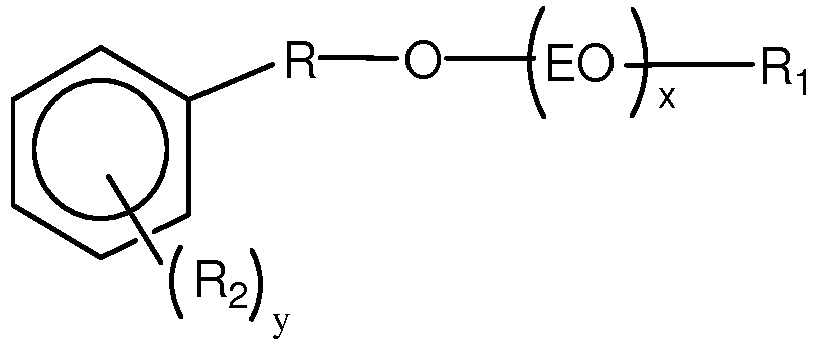
-
U.S. Patent 6,686,325 relates to an alkaline sensitive metal cleaning composition. The alkaline sensitive metal cleaning composition contains an alkaline concentrate and a corrosion inhibitor concentrate. The alkaline concentrate includes a source of alkalinity in an amount sufficient to provide a use solution having a pH of at least 10.0, and a first chelant component that exhibits soil removal properties when used at a pH of at least 10.0. The corrosion inhibitor concentrate includes a corrosion inhibitor component for reducing corrosion of alkaline sensitive metals when used in a use solution having a pH of at least 10.0, a second chelant component for stabilizing the corrosion inhibitor in the corrosion inhibitor concentrate when the corrosion inhibitor concentrate is provided at a pH that is less than 8.0, and a surfactant component for providing cleaning properties when used at a pH of at least 10.0. -
U.S. Patents 7,597,766 ,7,642,224 , and7,648,583 relate to an aqueous, concentrated neutral detergent composition for use in cleaning medical instruments and metal components (parts, tools, utensils, vessels, equipment, and surfaces) having scale control and corrosion inhibition properties when diluted to 1/40 ounce per gallon to 1/10 ounce per gallon in potable water. In addition, the concentrate may be applied directly to metal surfaces, such as stainless steel, to remove rust and other stains, without causing any additional corrosion or other damage to the metal surface. -
U.S. Publication 2008/0108539 relates to corrosion inhibitor systems, in particular to cleaning and corrosion inhibiting compositions for surfaces of aluminum or colored metals and alloys thereof under alkaline conditions, especially in the food and pharmaceutical industries. The cleaning and corrosion inhibiting compositions comprise as a corrosion inhibitor at least one alkyleneoxy alkylphosphate di- or triester having the general formula as set forth therein. -
U.S. Publication 2008/0221006 relates to an aqueous, alkaline cleaning composition comprising a source of alkalinity, a biodegradable surfactant system further comprising one or more surfactants, one or more hydrotropes, and a UV-analyzable surfactant, and a biodegradable chelating agent. -
U.S. Publication 2009/0298738 relates to an alkaline concentrated detergent composition for use in cleaning hard surfaces, medical instruments and other metal components (parts, tools, utensils, vessels, equipment) having cleaning efficacy at much lower alkali content than traditional alkaline cleaners and enhanced scale control properties even when diluted to 1/40 ounce per gallon to 1/10 ounce per gallon in potable water and even in exceptionally hard water. -
WO 2009/125335 relates to a substantially nonaqueous concentrated composition comprising an amine oxide surfactant, a watersoluble solvent, a source of alkalinity, a chelating agent and a hydrotrope wherein the concentrate composition is useful in preparing a water soluble solution. The composition may optionally include any one or combination of a nonionic surfactant, anionic surfactant, a corrosion inhibitor, dye, perfume, or preservative. -
WO 2009/125336 relates to a substantially nonaqueous solid concentrated composition comprising an amine oxide surfactant, an alkali metal hydroxide, a secondary source of alkalinity, a chelating agent, a nonionic surfactant, and a hardening agent wherein the concentrated composition is useful in preparing an aqueous solution. The composition may optionally include any one or combination of an anionic surfactant, a corrosion inhibitor, dye, perfume, or preservative. The ultra-concentrated composition of the invention is suited for solid deliveries.DE100 30 946 A1 describes a disinfection system for medical instruments. - A biodegradable concentrated neutral liquid detergent composition is disclosed that is effective in cleaning metals such as surgical instruments and soft metals such as copper, aluminum, etc., and also protects against corrosion thereof. The detergent is very effective in hard water environments that contain high amounts of calcium and magnesium ions. Other advantages include exceptional stability such as good shelf life, and that the detergent composition is highly concentrated and can be highly diluted. The detergent composition generally comprises various selected amounts of different components such as various chelates, various corrosion inhibitors, an alkaline source, at least one sequestrant, at least one hydrotrope, and various surfactants to obtain the above indicated advantages.
- In one aspect of the invention, a concentrated neutral detergent composition comprises: a surfactant system comprising one or more nonionic surfactants, said nonionic surfactants comprising a primary or a secondary alcohol ethoxylate, an alcohol alkoxylate other than said ethoxylate, an aromatic ethoxylate, a modified ethoxylate, or a block polymer of propylene oxide and ethylene oxide, one or more hydrotropes , said hydrotrope comprising octyldimethylamine oxide, disodium 2-ethylhexyliminoproprionate or an alkylglycoside; a hard water scale control system comprising one or more chelants, and optionally one or more sequestrants; a buffer system comprising one or more buffers, wherein said one or more buffers comprise one or more alcohol amines; a corrosion inhibitor system comprising one or more corrosion inhibitors, wherein said corrosion inhibitors comprise an amine, amidazole, diazole, triazole, carboxylic acid, or a betaine, or any combination thereof; water; said neutral detergent composition having a pH of from 5.5 to 8.5, wherein the amount of said surfactant system is from 1 to 30 wt.%; wherein the amount of said hydrotropes is from 0.5 to 6 wt.%; wherein the amount of said one or more chelants is from 0.5 to 9 wt.%; wherein the amount of said one or more buffers is from 0.5 to 8 wt.%; wherein the amount of said one or more corrosion inhibitors is from 1 to 15 wt.%; and wherein any carriers of said systems and water is the difference to constitute 100 wt.% of said concentrated neutral detergent composition;wherein said composition contains less than 3 parts by weight per 100 parts by weight of said composition of a silicate, a phosphate, a molybdate, magnesium, and zinc metal or ions, or any combination thereof; and wherein said composition contains less than 3 parts by weight per 100 parts by weight of said composition of a silicone surfactant.
- A further aspect of the invention comprises a process for making the biodegradable concentrated neutral detergent composition according to the present invention, comprising the steps of: adding and mixing one or more chelants; one or more optional sequestrants; one or more corrosion inhibitors; one or more buffers to provide a pH of at least 5.5; one or more nonionic surfactants including at least one hydrotrope; and water.
- The biodegradable neutral detergent compositions of the present invention are effective in hard water in that they prevent scale formation by utilizing a scale control system comprising chelants and optional sequestrants. Chelants are a type of a coordination compound in which a central metal ion such as calcium or magnesium is attached by coordinate links to two or more non-metal atoms in the same molecule, called ligands. By combining with the calcium or magnesium cations, they prevent the same from interacting with carbonate anions and thus prevent scale formation. They also prevent metals such as zinc, iron, or copper from depositing on a metal substrate where they can cause staining or corrosion.
- As utilized throughout this entire disclosure, the term "active amount" means the amount of the specified chemical component such as the chelant, the corrosion inhibitor, or the surfactant per se. The remaining amount in the component will be the carrier that can either be an oil, a water, or some other diluent. Thus, the 100 wt.% of the biodegradable concentrated neutral detergent composition of the present invention contains the various components, e.g. chelants, and corrosion inhibitors per se., with the remaining being an amount of water any carrier of the various components to form the 100 wt.% composition.
- Suitable chelant systems generally include organic acids such as methyl glycine diacetic acid or a salt thereof such as trisodium methyl glycine diacetate (Trilon M), iminodisuccinic acid or a salt thereof such as tetrasodium iminodisuccinate (Baypure CX 100/34 or Baypure CX100 Solid G), and [S,S]-ethylenediamine-N,N'-disuccinic acid (Natrlquest A65 or Natrlquest E30). Desirably, a blend of two or more chelants are utilized in the present invention such as tetrasodium iminodisuccinate and trisodium methyl glycine diacetate . The total active amount of the one or more chelants utilized is from 0.5 to 7 wt.% or 9 wt.%, desirably from 1.0 to 5 wt.%, and preferably from 1.5 to 3 wt.% based upon the total weight of the concentrated neutral detergent composition
- A preferred chelant system contains trisodium methyl glycine diacetate , and other similar chelants, in active amounts of from 0.20 to 3 wt.%, desirably from 0.4 to 2 wt.%, and preferably from 0.6 to 1.6 wt.% whereas tetrasodium iminodisuccinate and other similar chelants are contained in an active amount of from 0.2 to 4 wt.%, desirably from 0.4 to 3 wt.%, and preferably from 0.7 to 1.5 wt.% based upon the total weight of the biodegradable concentrated neutral detergent composition. These chelants have been found to be very stable in neutral solutions, are biodegradable, and are readily soluble in water.
- The utilization of one or more optional sequestrants also serve to prevent scale formation caused by hard water. The sequestrants are highly effective scale as well as corrosion inhibitors and thus generally far less than stoichiometric concentrations are needed to control scale formation, even in highly-saturated hard water. Rather than to prevent the formation of calcium or magnesium carbonate, they interact with small calcium and magnesium carbonate particles and prevent them from aggregating into a hard scale deposit. The particles repel each other and remain suspended in water or form loose aggregates that settle and can be readily rinsed away. Effective amounts of one or more active sequestrants are from 0.1 to 3 or 5 wt.% or 6 wt.%, desirably from 0.2 to 2 wt.%, and preferably from 0.25 to 1 wt.% based upon the total weight of the biodegradable concentrated neutral detergent composition. Suitable sequestrants include aminotrimethylene phosphonic acid, hexamethylenediaminetetra (methylenephosphonic acid) hexapotassium salt, and sodium carboxylmethyl inulin desirably with carboxylate substitution degrees (DS) of about 2.5. Not all sequestrants have been found to be useful in the present invention such as sodium polyaspartate (Baypure DS100), polyacrylic acid, GLDA (glutamic acid, N,N-diacetic acid, and tetrasodium salt (Dissolvine GL-45-S). That is, the present invention is essentially free of these compounds and if utilized, the amount thereof is very small, that is generally less than 0.25 wt.% desirably less than 0.075 wt.% and preferably less than 0.05 wt.% based upon the total weight of the biodegradable concentrated neutral detergent composition.
- An important aspect of the present invention is to utilize a corrosion inhibitor system containing one or more corrosion inhibitors Z as defined in claim 1 to protect metals such as copper, brass, aluminum, and anodized aluminum that are susceptible to damage from detergents as well as water such as hard water. Corrosion inhibitors that generally protect copper and brass are generally nitrogen containing organic compounds such as amines, amidazoles, diazoles, triazoles, carboxylic acids, and betaines (e.g. octyl betaine). Examples of such compounds include azoles such as mercaptobenzothiazole, aromatic triazoles and their salts such as benzotriazole, tolyltriazole, and sodium tolyltriazole, undecanedioic acid (Irgacor DC 11), dodecanedioic acid (Irgacor DC 12), ethanol 2,2'-[[methyl-1H-benzotriazole-1-yl)methyl]imino]bis-(Irgamet 42), 6,6',6"-(1,3,5-triazine-2,4,6-triyltriimino) tris(hexanoic acid) (Irgacor L190), phosphonobutane tricarboxylic acid (Bayhibit AMR) and didecyl dimethyl ammonium bicarbonate/carbonate (CarboShield 1000). Desired corrosion inhibitor systems include as one component either sodium tolyltriazole, sodium benzotriazole, or 2,2'-[[methyl-1H-benzotriazole-1-yl)methyl]imino]bis-generally for yellow metals (copper, brass, etc.) and as the other component generally for aluminum 6,6',6"-(1,3,5-triazine-2,4,6-triyltriimino) tris(hexanoic acid) , or didecyl dimethyl ammonium bicarbonate/carbonate. A highly preferred corrosion inhibitor combination of the present invention is 6,6',6"-(1,3,5-triazine-2,4,6-triyltriimino) tris(hexanoic acid), and sodium tolyltriazole, with phosphonobutane tricarboxylic acid.
- The active amount of the one or more corrosion inhibitors is from 1.0 to 13 wt.% or 15 wt.%, desirably from 1.5 to 10 wt.%, and preferably from 1.75 to 5 wt.% based upon the total weight of the biodegradable concentrated neutral detergent composition. The active amount of the preferred sodium tolyltriazole is generally from 0.1 to 3 wt.%, desirably from 0.15 to 2 wt.%, and preferably from 0.2 to 0.8 wt.% based upon the total weight of the biodegradable concentrated neutral detergent composition. The active amount of the preferred melamine trishexonoic acid generally ranges from 1.0 to 8 wt.%, desirably from 1.5 to 5 wt.%, and preferably from 1.75 to 4.5 wt.% based upon the total weight of the biodegradable concentrated neutral detergent composition.
- Another important aspect of the present invention is to utilize a buffer system as defined in claim 1 to maintain the desired neutral pH of the concentrated detergent composition. A proper pH is important with regard to the physical stability and compatibility of the detergent composition with various metals. Suitable buffer compounds include alkaline or amine sources that can also function to solubilize corrosion inhibitors such as melamine trishexanoic acid. Suitable buffers also include various alcohol amines such as ethanolamine or triethanolamine (TEA), and small amounts of hydroxides such as potassium hydroxide and sodium hydroxide.. An effective amount of the buffer is utilized to maintain a neutral pH, from 5.5 to 8.5 and preferably from 6 to 8. The active amounts of the one or more buffers will vary with the type of the compound but ranges from 0.5 to 6 wt.% or 8 wt.%, desirably from 1 to 4.5 wt.%, and preferably from 1.5 to 3 wt.% based upon the total weight of the biodegradable concentrated neutral detergent composition. Strong acids such as sulfuric acid and nitric acid are avoided because they can create unwanted effects on metallic instrument surfaces. Thus, the present invention is generally free of such acids meaning that if they are utilized, the amount thereof is generally less than 1 wt.%, desirably less than 0.5 wt.%, and preferably nil, that is none.
- Hard water refers to water that contains high amounts of mineral therein such as calcium and magnesium ions, silica compounds, iron, and other minerals. "Hard" water is defined herein as water that contains about 120 ppm or greater of CaCO3 and "exceptionally hard" water means that it contains about 300 ppm or greater of CaCO3. Hard water is undesirable since it results in scale, that is a hard, adherent mineral composition such as calcium, magnesium, etc, that generally exists in a crystalline form and forms a deposit on metal. It has been found that the hard water scale control system of chelants and sequestrants of the present invention effectively control hard water scale formation when used at dilution ratios of 3.70 cc (0.125 ounce) to 14.8 cc (0.5 ounce) of the concentrated neutral detergent composition per 3.785 liters (gallon) of water. It has been found that the utilization of both the chelant and sequestrant components can yield a synergistic result that prevents hard water scale formation to a greater degree than would be possible using only one or the other component, especially at neutral pH as chelants and sequestrants are typically more effective at higher pH. Other end use dilution amounts range from 2.96 cc (0.1 oz) to 59.15 cc (2.0 oz), and desirably from 3.25 cc (0.11 oz) to 29.57 cc (1.0 oz) of concentrated neutral detergent composition per gallon (3,78 l) of water.
- The remainder of the biodegradable concentrated neutral detergent composition is essentially various surfactants. Nonionic, anionic, and amphoteric surfactant systems can be utilized with nonionic surfactants are essential. Since nonionic surfactants may require a coupler to remain in solution with the electrolyte levels associated with the chelants, sequestrants, corrosion inhibitors, and buffers, hydrotropes such as amine oxides, proprionates, and glucosides, are utilized.
- Generally, a large number of different combinations of the various surfactants can be utilized in the present invention to help with soil removal as well as aiding in solubilization of the various chelants, corrosion inhibitors, sequestrants, and alkaline sources. Generally, the total amount of the one or more and preferably a plurality of surfactants ranges from 1 to 25 wt.% or 30 wt.%, desirably from 2 to 15 wt.%, and preferably from 7 to 12 wt.%, based upon the total weight of the biodegradable concentrated neutral detergent composition.
- Types of nonionic surfactants that are generally known to the art and to the literature include various linear ethoxylates such as primary or secondary alcohol ethoxylates, other alcohol alkoxylates, aromatic ethoxylates, modified ethoxylates, and blends thereof. Preferable examples include but are not limited to, C8-C18 alcohol ethoxylates with less than 12 moles of ethylene oxide (EO). Typical examples are commercially available under the trade names: Triton DF 20, Triton X114, Tergitol 15-S-3, Tergitol 15-S-5, Tomadol 91-2.5, Tomadol 91-8, Tomadol 1-3, Berol 508, Berol 505, Berol 260, Berol 840, Berol DGR81, Berol LFG61, Ethylan HB4, Neodol 91-2.5, Neodol 91-5, Neodol 1-2.5, Neodol 1-5, Deionic LF-EP-25, and DeTerge CS45LF. Tergitols and Tritons are commercially available from Dow; Berols and Ethylans are commercially available from Akzo Nobel, see
U.S. Patent 6,846,793 , Neodols are commercially available from Shell Chemical Company; and Delonics and DeTerges are commercially available from DeForest Chemical Company. Surfactants useful in the invention must be biodegradable. Preferred nonionic surfactants include Berol 505, a primary alcohol ethoxylate, and Berol LFG61, a blend of alcohol ethoxylate and alkylglucoside, both of which provide good wetting, detergency, and low, unstable foam characteristics. The most preferred nonionic surfactants include Tomadol 91-8, a linear primary alcohol ethoxylate with 8 moles of ethoxylation, and Ethlyan HB4, an aromatic ethoxylate. Both of these provide excellent wetting and soil emulsification/solublization (particularly fat) and have low, unstable foam characteristics. The above one or more nonionic linear or aromatic ethoxylate types of surfactants, independently, can be utilized in amounts of from 1 to 12 wt.%, desirably from 2 to 10 wt.%, and preferably from 3 to 7 wt.% based upon the total weight of the biodegradable concentrated neutral detergent composition. - Highly desired nonionic surfactants also include biodegradable block polymers of propylene oxide and ethylene oxide. An example of a preferred block copolymer is Meroxapol 252 or Tergitol L-64. These block copolymers are generally biodegradable, and provide good oil emulsification and defoaming. The amount of these types of nonionic block copolymers, independently, is generally from 0.25 to 4 wt%, desirably from 0.4 to 3 wt.%, and desirably from 0.6 to 2 wt.% based upon the total weight of the biodegradable concentrated neutral detergent composition.
- Another important component of the overall surfactant system is the utilization of a coupler or hydrotrope. The hydrotropes are octyldimethylamine oxide, disodium 2-ethylhexyliminoproprionate, and alkylpolyglucosides. The amount of one or more hydrotropes, independently, is from 0.5 to 6 wt.%, desirably from 0.5 to 5 wt.% and preferably from 1.0 to 4 wt.% based upon the total weight of the biodegradable concentrated neutral detergent composition.
- The biodegradable concentrated neutral detergent compositions of the present invention have been found to provide unexpected results with regard to the physical stability of the composition, cleaning of various metals, and providing corrosion protection, even in hard water environments so that scale formation is prevented. Compositions have been found particularly suitable for application to soft metals, i.e. articles containing copper, brass, aluminum, and aluminum alloys. Particular uses of the compositions of the present invention include cleaning medical and surgical instruments as well as washing equipment therefor.
- An important component of the biodegradable concentrated neutral detergent composition of the present invention is water which is utilized in amounts so that the various weight percents of the composition add up to 100%. While the amount of water can broadly range from 46 to 94 wt.%, it generally ranges from 60 to 90 wt.% and desirably from 70 to 85 wt.% based upon the total amount of the biodegradable concentrated neutral detergent composition. The water is deionized or soft water meaning it contains less than 50 ppm of hardness (calcium and magnesium).
- The concentrated neutral detergent composition can also contain various additives in various amounts that are in addition to the above-noted amounts, i.e. 100 wt.% of the biodegradable concentrated neutral detergent composition. Examples of such additives include preservatives, fragrances, or dyes. The amounts of such additives are generally small, such as from 0.01 to 1 or 3 parts by weight based upon 100 total parts by weight of the neutral detergent composition. Examples of additives include iodopropynyl butyl carbamate, a fungicide, and DMDM hydantoin, a preservative.
- An important aspect of the present invention is that the biodegradable concentrated neutral detergent compositions of the present invention are essentially free of various non-biodegradable corrosion inhibitors such as silicates, phosphates, molybdates, as well as magnesium and zinc metals or ions that are often utilized as corrosion inhibitors that render them unsuitable for specific applications such as cleaning ophthalmic instruments or in high temperature applications. Examples of corrosion inhibitors that are avoided include potassium silicate, trisodium phosphate, bimetallic phosphates, and zinc molybdate. By the term "essentially free of" is meant that the amount of any such silicates, phosphates, molybdates, magnesium and zinc inhibitors, individually, is generally less than 3 parts by weight, desirably less than 1 part by weight and preferably less than 0.003 parts by weight or no parts by weight for every 100 parts by weight of the concentrated neutral detergent composition.
- Other compounds that are avoided by the present invention include various silicone surfactants used as defoamers such as dimethylpolysiloxane. That is, the present invention is essentially free thereof meaning that any amount used is generally less than 3 parts by weight, desirably less than 1 part by weight, and preferably no parts by weight of such silicone surfactants for every 100 parts by weight of the biodegradable concentrated neutral detergent composition of the present invention.
- The invention would be better understood by reference to the following examples which serve to illustrate but not to limit the invention.
- While the order of adding the various components and mixing can generally be in any order and typically does not impact the final product stability, a desired preparation of the biodegradable concentrated neutral detergent composition involves ensuring that any solid components are fully dissolved prior to the addition of the surfactant components.
- Specific recipes or formulations of biodegradable concentrated neutral detergent compositions of the present invention are set forth in Table 1 in Examples A through J. The formulations are prepared in a manner as set forth hereinabove and are tested with regard to aluminum compatibility and scale control. Values of percent calcium above 50% at 1/8 ounce (3,54 g) of concentrated detergent composition of the present invention diluted in one gallon (3,78 l) of water is considered to be very good. Examples H and I are reference examples.
Table 1 Trade Name Material Function A B C D E F G H I J Triethanolamine (99% Active) Triethanolamine Buffer 2.250% 2.000% 2.400% 2.000% 2.360% 2.000% 2.560% 1.120% 1.780% 2.450% Irgacor L 190 (50% Active) 6,6',6"-(1,3,5-Triazine-2,4,6-triyltriimino)tris(hexanoic acid) Corosion Inhibitor 5.000% (2.500%) 5.000% (2.500%) 4.500% (2.250%) 4.500% (2.250%) 4.500% (2.250%) 4.500% (2.250%) 4.500% (2.250%) 4.000% (2.000%) 4.000% (2.000%) 4.500% (2.250%) Cobratec TT-50S (50% Active) Sodium Tolyltriazole Corrosion Inhibitor 0.500% (0.250%) 0.500% (0.250%) 0.500% (0.250%) 0.500% (0.250%) 0.500% (0.250%) 0.500% (0.250%) 0.500% (0.250%) 0.500% (0.250%) Baypure CX 100 (78% Active) Tetrasodium Iminodisuccinate Chelant 1.000% (0.780%) 1.500% (1.170%) 1.560% (1.217%) 1.560% (1.217%) 1.560% (1.217%) 1.560% (1.217%) 1.560% (1.217%) 3.000% (2.340%) 1.560% (1.217%) Trilon M (40% Active) Methyglycine Diacetic acid, trisodium salt Chelant 1.500% (0.600%) 2.000% (0.800%) 2.000% (0.800%) 2.000% (0.800%) 2.000% (0.800%) 2.000% (0.800%) 2.000% (0.800%) 4.000% (1.600%) 2.000% (0.800%) Irgamet 42 (78% Active) Ethanol, 2,2'-[[(methyl-1H-benzotriazole-1-yl)methyl]imino]bis- Corrosion Inhibitor 2.000% (1.560%) Glycacil-L (10% Active) Iodopropynylbutylcarbamate (IPBC) Preservative 0.050% 0.050% 0.050% 0.050% 0.050% 0.050% Dantoguard Plus DMDM Hydantoin + IPBC Preservative 0.160% Bayhibit AM (50% Active) Phosphonobutane tricarboxylic acid Corrosion Inhibitor 0.100% (0.050%) 1.000% (0.500%) 1.000% (0.500%) 0.500% (0.250%) 1.000% (0.500%) 1.000% (0.500%) 0.500% (0.250%) 1.000% (0.500%) Citric Acid (100% Active) Citric Acid Buffer 0.300% 0.020% 0.200% 0.400% Dequest 2054 (35% Active) Hexamethylenediamine tetra(methylene phosphonic acid) hexapotassium salt (HDTMP) Sequestrant 2.000% (0.700%) Dequest SPE 15625 (20% Active) Sodium Carboxymethyl Inulin Sequestrant 1.000% (0.20%) Ethylan HB4 (100%) Aromatic Ethoxylate Nonionic Surfactant 3.000% 2.000% Meroxapol 252 (100% Active) Polyoxypropylene-polyoxyethylene Block Copolymer Surfactant 0.750% 1.500% 1.500% 0.200% 1.000% Tergitol L-64 (100% Active) Polyether polyol Surfactant 3.000% Mackamine C-8 (40% Active) Octyldimethylamine oxide Hydrotrope 3.000% 3.000% 5.180% 3.000% Mackam BW 139 (50% Active) octyl Betaine Surfactant 5.000% 3.000% Mackam ODP 45-M (45% Active) Disodium 2-Ethylhexyliminodipropionate Hydrotrope 1.000% 1.000% Rhodapon OLS (33% Active) Sodium Octyl Sulfate Surfactant 4.000% Tomadol 91-8 (100% Active) C9-11 Pareth-8 Surfactant 9.000% 4.500% 3.000% Berol LFG 61 (95% Active) Proprietary Alkyglycoside / Alcohol Ethoxylate Blend Hydrotrope/ Surfactant 5.000% 10.000% 10.000% 3.500% 10.000% Berol 505 (100% Active) Proprietary Alcohol Ethoxylates Surfactant 5.000% Soft Water Q.S. Q.S. Q.S. Q.S. Q.S. Q.S. Q.S. Q.S. Q.S. Q.S. OZ/Gal (7.48 g/l) 1oz 1oz 1oz 1oz 1oz 1oz 1oz 1oz 1oz 1oz Mpy's -0.06 0.18 0.30 0.18 0.24 0.24 -0.06 0.84 0.96 0.12 Aluminum Compatibility Observations Slight Discolor Slight Discolor Slight Discolor Slight Discolor Slight Discolor Dark Discolor Dark Discolor slight brown discolor slight grayish-brown discolor extremely slight discolor Scale Control Product A B C D E F G H I J (% Calcium) 1/2 oz (14.17 g) 97.82% 100.00% 100.00% 99.51% 100.00% 96.64% 100.00% 100.00% 100.00% 100.00% 1/8 oz (3.54 g) 59.87% 60.36% 100.00% 100.00% 100.00% 99.27% 100.00% 58.29% 98.88% 98.97% - As apparent from the above data, generally only slight discoloration was obtained with regard to an aluminum substrate and the values of scale control are good, generally well in excess of 95% for most formulations. Another advantage of the present invention is that all the above formulations are readily biodegradable.
- While in accordance with the patent statutes, the best mode and preferred embodiment have been set forth, the scope of the invention is not limited thereto, but rather by the scope of the attached claims.
Claims (12)
- A concentrated neutral biodegradable detergent composition comprising:a surfactant system comprising one or more nonionic surfactants, said nonionic surfactants comprising a primary or a secondary alcohol ethoxylate, an alcohol alkoxylate other than said ethoxylate, an aromatic ethoxylate, a modified ethoxylate, or a block polymer of propylene oxide and ethylene oxide;one or more hydrotropes, said hydrotrope comprising octyldimethylamine oxide, disodium 2-ethylhexyliminoproprionate or an alkylglycoside;a hard water scale control system comprising one or more chelants;a buffer system comprising one or more buffers wherein said one or more buffers comprise one or more alcohol amines;a corrosion inhibitor system comprising one or more corrosion inhibitors, wherein said corrosion inhibitors comprise an amine, amidazole, diazole, triazole, carboxylic acid, or a betaine, or any combination thereof;water;said neutral detergent composition having a pH of from 5.5 to 8.5, wherein the amount of said surfactant system is from 1 to 30 wt.%; wherein the amount of said hydrotropes is from 0.5 to 6 wt.%; wherein the amount of said one or more chelants is from 0.5 to 9 wt.%; wherein the amount of said one or more buffers is from 0.5 to 8 wt.%; wherein the amount of said one or more corrosion inhibitors is from 1 to 15 wt.%; and wherein any carriers of said systems and water is the difference to constitute 100 wt.% of said concentrated neutral detergent composition;wherein said composition contains less than 3 parts by weight per 100 parts by weight of said composition of a silicate, a phosphate, a molybdate, magnesium, and zinc metal or ions, or any combination thereof; andwherein said composition contains less than 3 parts by weight per 100 parts by weight of said composition of a silicone surfactant.
- The concentrated neutral biodegradable detergent composition of claim 1, wherein said hydrotrope comprises octyldimethylamine oxide, or an alkylglycoside.
- The concentrated neutral biodegradable detergent composition of claim 1 or 2, wherein said chelant comprises methyl glycine diacetic acid, trisodium methyl glycine diacetate, iminodisuccinic acid, tetrasodium iminodisuccinate, or [S,S]-ethylenediamine-N,N'-disuccinic acid, or any combination thereof.
- The concentrated neutral biodegradable detergent composition of any one of claims 1-3, wherein wherein said corrosion inhibitor comprises mercaptobenzothiazole, benzotriazole, tolyltriazole, sodium tolyltriazole, undecanedioic acid, phosphonobutane tricarboxylic acid, dodecanedioic acid, ethanol-2,2'-[[methyl-1H-benzotriazole-1-yl)methyl]imino]bis, 6,6',6"-(1,3,5-triazine-2,4,6-triyltriimino) tris(hexanoic acid), didecyl dimethyl ammonium bicarbonate/carbonate, or sodium benzotriazole, or any combination thereof, and wherein the amount of said one or more corrosion inhibitors is from 1.5 wt.% to 10 wt.% based upon the total weight of said concentrated neutral detergent composition; wherein said concentrated neutral detergent composition contains less than 0.25 wt.% of sodium polyaspartate, polyacrylic acid, glutamic acid, N,N-diacetic acid, and tetrasodium salt based upon the total weight of said concentrated neutral detergent; wherein the amount of said nonionic surfactant is from 2 to 15 wt.% based upon the total weight of said concentrated neutral detergent composition, wherein said chelant comprises trisodium methyl glycine diacetate, or tetrasodium iminodisuccinate, or both; wherein the amount of said chelant is from 1.0 to 5 wt.% based on the total weight of said concentrated neutral detergent composition; and wherein said pH of said concentrated neutral detergent composition is from 6.0 to 8.0.
- The concentrated neutral biodegradable detergent composition of claims 1, 2, 3 and 4, wherein said corrosion inhibitor is sodium tolyltriazole 6,6',6"-(1,3,5-triazine-2,4,6-triyltriimino) tris(hexanoic acid) in an amount of from 0.1 wt.% to 3.0 wt.%, or phosphonobutane tricarboxylic acid in an amount of from 1.5 wt.% to 5 wt.% based upon the total weight of said concentrated neutral detergent composition, wherein said buffer comprises ethanolamine, triethanolamine, or any combination thereof and wherein the amount of said buffers is from 0.5 to 4.5 wt.%; wherein the amount of said hydrotrope is from 1.0 to 4 wt.% based on the total weigh of said concentrated neutral detergent composition, wherein said nonionic surfactant is said primary alcohol ethoxylate, said aromatic ethoxylate, or said block copolymer of propylene oxide and ethylene oxide, or any combination thereof.
- A process for making a biodegradable concentrated neutral detergent composition, comprising the steps of:adding and mixingone or more chelants;one or more corrosion inhibitors, wherein said corrosion inhibitors comprise an amine, amidazole, diazole, triazole, carboxylic acid, or a betaine, or any combination thereof;one or more buffers to provide a pH of from 5.5 to 8.5, wherein said one or more buffers comprise one or more alcohol amines;one or more nonionic surfactants, wherein said nonionic surfactants comprise a primary or a secondary alcohol ethoxylate, an alcohol alkoxylate other than said ethoxylate, and aromatic ethoxylate, a modified ethoxylate, or a block polymer of propylene oxide and ethylene oxide;one or more hydrotropes, wherein said hydrotropes comprise octyldimethylamine oxide, or an alkylglycoside;water;wherein the amount of said one or more chelants is from 0.5 to 9 wt.%; wherein the amount of said one or more buffers is from 0.5 to 8 wt.%; wherein the amount of said one or more corrosion inhibitors is from 1 to 15 wt.%; wherein the amount of said one or more nonionic surfactants is from 1.0 to 15 wt.%; and wherein the amount of said hydrotropes is from 0.5 to 6 wt.%; and wherein the amount of said water and any carriers is the difference to constitute 100 wt.% of said biodegradable concentrated neutral detergent composition;wherein said composition contains less than 3 parts by weight per 100 parts by weight of said composition of a silicate, a phosphate, a molybdate, magnesium, and zinc metal or ions, k or any combination thereof; andwherein said composition contains less than 3 parts by weight per 100 parts by weight of said composition of a silicone surfactant.
- The process of claim 6, wherein said chelant comprises methyl glycine diacetic acid, trisodium methyl glycine diacetate, iminodisuccinic acid, tetrasodium iminodisuccinate, or [S,S]-ethylenediamine-N,N'-disuccinic acid, or any combination thereof.
- The process of claims 6, and 7, wherein said corrosion inhibitor comprises mercaptobenzothiazole, benzotriazole, tolyltriazole, sodium tolyltriazole, undecanedioic acid, phosphonobutane tricarboxylic acid, dodecanedioic acid, ethanol-2,2'-[[methyl-1H-benzotriazole-1-yl)methyl]imino]bis, 6,6',6"-(1,3,5-triazine-2,4,6-triyltriimino) tris(hexanoic acid), didecyl dimethyl ammonium bicarbonate/carbonate, or sodium benzotriazole, or any combination thereof, and wherein the amount of said one or more corrosion inhibitors is from 1.5 wt.% to 10 wt.% based upon the total weight of said concentrated neutral detergent composition; wherein said concentrated neutral detergent composition contains less than 0.25 wt% of sodium polyaspartate, polyacrylic acid, glutamic acid, N,N-diacetric acid, and tetrasodium salt based upn the total weight of said concentrated neural detergent; wherein the amount of said nonionic surfactant is from 2 to 15 wt.% based upon the total weight of said concentrated neutral detergent composition; wherein said chelant comprises trisodium methyl glycine diacetate, or tetrasodium iminodisuccinate, or both; wherein the amount of said chelant is from 1 to 5 wt.% based on the total weight of said concentrated neutral detergent composition; wherein the amount of said hydrotrope is from 1.0 to 4 wt.% based on the total weight of said concentrated neutral detergent composition; and wherein said pH of said concentrated neutral detergent composition is from 6 to 8.
- The process of claims 6, 7, and 8, , wherein said corrosion inhibitor is sodium tolyltriazole 6,6',6"-(1,3,5-triazine-2,4,6-triyltriimino) tris(hexanoic acid) in an amount of from 0.1 wt.% to 3.0 wt.%, or phosphonobutane tricarboxylic acid in an amount of from 1.5 wt.% to 5 wt.% based upon the total weight of said concentrated neutral detergent composition; wherein said buffer comprises ethanolamine, triethanolamine, or any combination thereof, and wherein the amount of said buffers is from 0.5 to 4.5 wt.%; and wherein said nonionic surfactant is said primary alcohol ethoxylate, said aromatic ethoxylate, or said block copolymer of propylene oxide and ethylene oxide, or any combination thereof.
- A diluted neutral detergent composition, comprising the composition of claim 1, and additional water.
- A diluted neutral detergent composition, comprising from 2.96 cc (0.1 oz) to 59.15 cc (2.0 oz) of the composition of claim 3, per 3.785 liters (gallon) of water.
- A diluted neutral detergent composition, comprising from 3.70 cc (0.125 oz) to 14.8 cc (0.5 oz) of the composition of claim 5, per 3.785 liters (gallon) of water.
Applications Claiming Priority (3)
| Application Number | Priority Date | Filing Date | Title |
|---|---|---|---|
| US40017510P | 2010-07-23 | 2010-07-23 | |
| US13/135,218 US8921295B2 (en) | 2010-07-23 | 2011-06-29 | Biodegradable concentrated neutral detergent composition |
| PCT/US2011/001291 WO2012011954A1 (en) | 2010-07-23 | 2011-07-21 | A biodegradable concentrated neutral detergent composition |
Publications (3)
| Publication Number | Publication Date |
|---|---|
| EP2596090A1 EP2596090A1 (en) | 2013-05-29 |
| EP2596090A4 EP2596090A4 (en) | 2016-04-13 |
| EP2596090B1 true EP2596090B1 (en) | 2018-09-19 |
Family
ID=45494109
Family Applications (1)
| Application Number | Title | Priority Date | Filing Date |
|---|---|---|---|
| EP11809974.6A Active EP2596090B1 (en) | 2010-07-23 | 2011-07-21 | A biodegradable concentrated neutral detergent composition |
Country Status (9)
| Country | Link |
|---|---|
| US (1) | US8921295B2 (en) |
| EP (1) | EP2596090B1 (en) |
| JP (1) | JP5796070B2 (en) |
| CN (1) | CN103119145B (en) |
| AU (1) | AU2011280188B2 (en) |
| CA (1) | CA2806156C (en) |
| ES (1) | ES2699738T3 (en) |
| MX (1) | MX2013000863A (en) |
| WO (1) | WO2012011954A1 (en) |
Families Citing this family (30)
| Publication number | Priority date | Publication date | Assignee | Title |
|---|---|---|---|---|
| ES2537892T3 (en) * | 2011-06-29 | 2015-06-15 | General Electric Company | Sterilizing and pasteurizing solutions without molybdates |
| CN103370445B (en) * | 2011-11-14 | 2015-12-09 | 广州天至环保科技有限公司 | A kind of aqueous phase hole sealing agent and using method thereof strengthening the anti-oxidant and corrosion resistance nature of PCB coating |
| US9133417B2 (en) * | 2012-03-23 | 2015-09-15 | The Procter & Gamble Company | Liquid cleaning and disinfecting compositions comprising an assymetrically branched amine oxide |
| US9650205B2 (en) * | 2013-06-14 | 2017-05-16 | S. C. Johnson & Son, Inc. | Chelating system for a polymer lined steel container |
| HUE033059T2 (en) * | 2014-01-30 | 2017-11-28 | Archroma France Sas | Aqueous composition comprising a polyvalent metal complexed by carbonate and carboxylic acid ligands, and use thereof |
| US9234164B2 (en) * | 2014-02-11 | 2016-01-12 | Gregory E Robinson | Graffiti remover comprising a solvent mixture of propylene carbonate and soy methyl ester |
| GB2535131B (en) * | 2014-10-06 | 2022-05-04 | Nch Corp | pH neutral deruster composition |
| EP3144373B1 (en) * | 2015-09-16 | 2018-12-26 | Kolb Distribution Ltd. | Neutral aqueous cleaning composition |
| CN105483732A (en) * | 2015-12-09 | 2016-04-13 | 武汉创新特科技有限公司 | Gold surface cleaning agent and preparation method thereof |
| MX2018007252A (en) * | 2015-12-17 | 2018-09-28 | Proklean Tech Pvt Ltd | Biodegradable detergent composition. |
| EP3478771B1 (en) | 2016-07-04 | 2020-08-05 | Diversey, Inc. | Method and composition for a stable oil-in-water emulsion for aesthetic improvement of food and beverage containers |
| CN107641808A (en) * | 2016-07-21 | 2018-01-30 | 北京洁航箭达环保科技有限公司 | A kind of aluminium Special cleaning brightener and preparation method thereof |
| EP3500657A1 (en) * | 2016-08-16 | 2019-06-26 | Diversey, Inc. | A composition for aesthetic improvement of food and beverage containers and methods thereof |
| CN106521530B (en) * | 2016-12-07 | 2019-05-03 | 江西瑞思博化工有限公司 | High-efficiency wax removal water for metal workpieces and preparation method thereof |
| CN107338117A (en) * | 2017-07-24 | 2017-11-10 | 江苏新瑞贝科技股份有限公司 | A kind of food apparatus foam sterilizing detergent for cleaning and preparation method thereof |
| CN110914476A (en) * | 2017-08-03 | 2020-03-24 | 日华化学株式会社 | Detergent composition for metal |
| CN109695039A (en) * | 2017-10-22 | 2019-04-30 | 麦达可尔(烟台)科技有限公司 | A kind of aluminium Special cleaning brightener and preparation method thereof |
| EP3489336B1 (en) * | 2017-11-27 | 2020-05-13 | The Procter & Gamble Company | Liquid hand dishwashing detergent composition |
| EP3489335B1 (en) * | 2017-11-27 | 2020-08-19 | The Procter & Gamble Company | Liquid hand dishwashing detergent composition |
| EP3502222B1 (en) * | 2017-11-27 | 2020-05-13 | The Procter & Gamble Company | Liquid hand dishwashing detergent composition |
| EP3762477B1 (en) | 2018-03-08 | 2024-02-07 | Ecolab USA Inc. | Solid enzymatic detergent compositions and methods of use and manufacture |
| CN108587818B (en) * | 2018-05-30 | 2020-07-07 | 广州原野化妆品有限公司 | Peony seed oil antibacterial skin care soap and preparation method thereof |
| JP6682593B2 (en) * | 2018-09-27 | 2020-04-15 | 株式会社Adeka | Concentrated liquid detergent composition for automatic dishwasher and method for washing dishes with automatic dishwasher |
| DE102018131883A1 (en) * | 2018-12-12 | 2020-06-18 | Henkel Ag & Co. Kgaa | Detergent or cleaning agent containing iminodisuccinate and / or iminotrisuccinate |
| CN110478131B (en) * | 2019-08-05 | 2022-01-11 | 思必康(厦门)新材料有限公司 | Gauze with pH response color change, preparation method thereof and application of gauze |
| WO2021067407A1 (en) | 2019-09-30 | 2021-04-08 | Ecolab Usa Inc. | Stabilized enzymatic detergent compositions |
| CN110952082B (en) * | 2019-12-25 | 2022-01-04 | 廊坊师范学院 | Preparation method of chromium-free passivation film for hot-dip galvanizing |
| US12351775B2 (en) | 2021-05-14 | 2025-07-08 | Ecolab Usa Inc. | Neutralizing instrument reprocessing |
| WO2023004106A1 (en) * | 2021-07-23 | 2023-01-26 | Ascend Performance Materials Operations Llc | Aqueous solutions containing amino carboxylic acid chelators |
| CN115893607A (en) * | 2021-08-11 | 2023-04-04 | 北京百龙腾(武汉)科贸有限公司 | PH neutral constant-temperature water bath additive for biochemical analyzer and preparation method thereof |
Family Cites Families (89)
| Publication number | Priority date | Publication date | Assignee | Title |
|---|---|---|---|---|
| US3785841A (en) | 1969-02-10 | 1974-01-15 | W Beard | Wax composition |
| US4517023A (en) | 1982-12-29 | 1985-05-14 | Gaf Corporation | Rust removal process using removable coatings of maleic acid copolymers |
| USH468H (en) | 1985-11-22 | 1988-05-03 | A. E. Staley Manufacturing Company | Alkaline hard-surface cleaners containing alkyl glycosides |
| US4935065A (en) | 1986-08-22 | 1990-06-19 | Ecolab Inc. | Phosphate-free alkaline detergent for cleaning-in-place of food processing equipment |
| US5342450A (en) | 1989-01-26 | 1994-08-30 | Kay Chemical Company | Use of noncorrosive chemical composition for the removal of soils originating from an animal or vegetable source from a stainless steel surface |
| FR2667220B1 (en) | 1990-09-28 | 1997-01-17 | Peters Sa | COMPOSITION OF CLEANING-DECONTAMINATING AGENT, PARTICULARLY FOR SURGICAL INSTRUMENTS. |
| US5279799A (en) | 1990-10-23 | 1994-01-18 | Hamo Ag | Apparatus for cleaning and testing endoscopes |
| DE69218411T2 (en) | 1991-01-24 | 1997-08-28 | Monsanto Co | FORMULATIONS OF GLYPHOSATES |
| EP0511456A1 (en) | 1991-04-30 | 1992-11-04 | The Procter & Gamble Company | Liquid detergents with aromatic borate ester to inhibit proteolytic enzyme |
| JPH05279700A (en) | 1992-04-02 | 1993-10-26 | Shin Etsu Chem Co Ltd | Detergent composition |
| US5215676A (en) | 1992-09-14 | 1993-06-01 | Stone John A | Rust and stain removal composition |
| US5378372A (en) | 1993-06-09 | 1995-01-03 | Betz Laboratories, Inc. | Control of scale formation in aqueous systems |
| GB9322806D0 (en) | 1993-11-05 | 1993-12-22 | Dow Europ Sa | Aqueous alkaline composition |
| NL9302163A (en) | 1993-12-10 | 1995-07-03 | Univ Delft Tech | Carboxymethylated oligo and polysaccharides as crystallization inhibitors. |
| US7037884B2 (en) | 1994-02-23 | 2006-05-02 | Ecolab Inc. | Alkaline cleaners based on alcohol ethoxy carboxylates |
| WO1995023202A1 (en) | 1994-02-23 | 1995-08-31 | Ecolab Inc. | Alkaline cleaners based on alcohol ethoxy carboxylates |
| US5647995A (en) | 1994-04-29 | 1997-07-15 | Nalco Chemical Company | Method for the control of calcium carbonate scale using compounds prepared from acetylenic compounds and inorganic phosphite salts and their derivatives |
| JP3478870B2 (en) * | 1994-07-01 | 2003-12-15 | 朝日化学工業株式会社 | Cleaning composition for removing phosphate film from high strength steel |
| JPH0812944A (en) | 1994-07-04 | 1996-01-16 | Shinnakamura Kagaku Kogyo Kk | Carboxylated rosin ester and its production |
| JP3590897B2 (en) | 1995-10-25 | 2004-11-17 | 第一工業製薬株式会社 | Metal cleaning composition and metal cleaning agent obtained by diluting the same with water |
| US5665688A (en) | 1996-01-23 | 1997-09-09 | Olin Microelectronics Chemicals, Inc. | Photoresist stripping composition |
| US5786320A (en) | 1996-02-01 | 1998-07-28 | Henkel Corporation | Process for preparing solid cast detergent products |
| EP0892848B1 (en) | 1996-04-09 | 2002-12-18 | JohnsonDiversey, Inc. | Anti-etch bottle washing solution |
| CZ368598A3 (en) | 1996-05-15 | 1999-05-12 | The Procter & Gamble Company | A method for producing a basic bleaching agent comprising chlorine and bromine compounds |
| US5837667A (en) | 1996-06-19 | 1998-11-17 | Stabley; Garth E. | Environmentally safe detergent composition and method of use |
| US20040134873A1 (en) | 1996-07-25 | 2004-07-15 | Li Yao | Abrasive-free chemical mechanical polishing composition and polishing process containing same |
| WO1998005749A1 (en) | 1996-08-07 | 1998-02-12 | The Procter & Gamble Company | Detergent compositions containing dianionic esters |
| WO1998005742A1 (en) | 1996-08-07 | 1998-02-12 | The Procter & Gamble Company | Liquid cleaning compositions containing dianionic esters |
| US6247478B1 (en) | 1996-11-15 | 2001-06-19 | Ecolab Inc. | Cleaning method for polyethylene terephthalate containers |
| JP2001507066A (en) | 1996-12-20 | 2001-05-29 | ザ、プロクター、エンド、ギャンブル、カンパニー | Dishwashing detergent composition containing alkanolamine |
| US6210600B1 (en) | 1996-12-23 | 2001-04-03 | Lever Brothers Company, Division Of Conopco, Inc. | Rinse aid compositions containing scale inhibiting polymers |
| ES2201264T3 (en) | 1997-04-30 | 2004-03-16 | THE PROCTER & GAMBLE COMPANY | COMPOSITIONS ACID TO ELIMINATE CAL CALTRAS. |
| US5858305A (en) | 1997-06-25 | 1999-01-12 | Steris Corporation | Apparatus and method for sterilizing medical devices |
| US5929008A (en) | 1997-09-29 | 1999-07-27 | The Procter & Gamble Company | Liquid automatic dishwashing compositions providing high pH wash solutions |
| SE510989C2 (en) | 1997-10-29 | 1999-07-19 | Akzo Nobel Nv | Highly alkaline compositions containing a hexyl glycoside as a hydrotrope |
| US6333299B1 (en) | 1997-10-31 | 2001-12-25 | The Procter & Gamble Co. | Liquid acidic limescale removal composition packaged in a spray-type dispenser |
| US6471728B2 (en) | 1998-05-15 | 2002-10-29 | Ecolab Incorporated | Removal of blood stains |
| US6034046A (en) | 1999-03-26 | 2000-03-07 | Colgate Palmolive Company | All purpose liquid bathroom cleaning compositions |
| US6248704B1 (en) | 1999-05-03 | 2001-06-19 | Ekc Technology, Inc. | Compositions for cleaning organic and plasma etched residues for semiconductors devices |
| US6232280B1 (en) | 1999-05-12 | 2001-05-15 | Steris Corporation | Cleaning product with analyzable and stable surfactant |
| US6425959B1 (en) * | 1999-06-24 | 2002-07-30 | Ecolab Inc. | Detergent compositions for the removal of complex organic or greasy soils |
| CN1408036A (en) | 1999-10-22 | 2003-04-02 | 宝洁公司 | Shoe bags for use in laundering processes |
| DE19959311A1 (en) | 1999-12-09 | 2001-08-23 | Henkel Ecolab Gmbh & Co Ohg | Defoamer preparation and its use |
| DE10028998A1 (en) * | 2000-02-17 | 2001-08-23 | Bode Chemie Gmbh & Co Kg | Cleaning and disinfection systems for medical instruments |
| DE10010420A1 (en) | 2000-03-03 | 2001-09-13 | Goldschmidt Ag Th | New ethylhexyl polyglucoside with a high degree of polymerization, useful as an emulsfier in industrial surface cleaner concentrates based on concentrated alkali |
| US6635702B1 (en) | 2000-04-11 | 2003-10-21 | Noveon Ip Holdings Corp. | Stable aqueous surfactant compositions |
| EP1167500A1 (en) * | 2000-06-29 | 2002-01-02 | The Procter & Gamble Company | Process of cleaning a hard surface |
| US6673760B1 (en) | 2000-06-29 | 2004-01-06 | Ecolab Inc. | Rinse agent composition and method for rinsing a substrate surface |
| US7456140B2 (en) | 2000-07-10 | 2008-11-25 | Ekc Technology, Inc. | Compositions for cleaning organic and plasma etched residues for semiconductor devices |
| JP2002102886A (en) | 2000-10-02 | 2002-04-09 | Sakai Chem Ind Co Ltd | Scale inhibitor and scale preventing method |
| US20020068454A1 (en) | 2000-12-01 | 2002-06-06 | Applied Materials, Inc. | Method and composition for the removal of residual materials during substrate planarization |
| DE10062056A1 (en) | 2000-12-15 | 2002-07-04 | Henkel Ecolab Gmbh & Co Ohg | Process for cleaning ion-exchange plastic resins |
| US6632291B2 (en) | 2001-03-23 | 2003-10-14 | Ecolab Inc. | Methods and compositions for cleaning, rinsing, and antimicrobial treatment of medical equipment |
| JP4138493B2 (en) | 2001-04-25 | 2008-08-27 | アムテック株式会社 | Rust removal composition and rust removal method using the same |
| GB0112343D0 (en) | 2001-05-21 | 2001-07-11 | Norske Stats Oljeselskap | Well treatment |
| US6537960B1 (en) | 2001-08-27 | 2003-03-25 | Ecolab Inc. | Surfactant blend for use in highly alkaline compositions |
| US6686325B2 (en) | 2002-03-15 | 2004-02-03 | Ecolab Inc. | Alkaline sensitive metal cleaning composition, method for cleaning an alkaline sensitive metal surface, and washing facility |
| US8668779B2 (en) | 2002-04-30 | 2014-03-11 | Nalco Company | Method of simultaneously cleaning and disinfecting industrial water systems |
| US7419945B2 (en) | 2002-06-07 | 2008-09-02 | Mallinckrodt Baker, Inc. | Microelectronic cleaning compositions containing oxidizers and organic solvents |
| US6767881B1 (en) | 2003-03-19 | 2004-07-27 | Ecolab, Inc. | Cleaning concentrate |
| US7252096B2 (en) | 2003-04-08 | 2007-08-07 | Nalco Company | Methods of simultaneously cleaning and disinfecting industrial water systems |
| US7135448B2 (en) | 2003-07-02 | 2006-11-14 | Ecolab Inc. | Warewashing composition for use in automatic dishwashing machines, comprising a mixture of aluminum and zinc ions |
| US7196044B2 (en) * | 2003-07-02 | 2007-03-27 | Ecolab, Inc. | Warewashing composition for use in automatic dishwashing machines, comprising a zinc ion and aluminum ion corrosion inhibitor |
| US7498295B2 (en) | 2004-02-12 | 2009-03-03 | Air Liquide Electronics U.S. Lp | Alkaline chemistry for post-CMP cleaning comprising tetra alkyl ammonium hydroxide |
| EP1580302A1 (en) | 2004-03-23 | 2005-09-28 | JohnsonDiversey Inc. | Composition and process for cleaning and corrosion inhibition of surfaces of aluminum or colored metals and alloys thereof under alkaline conditions |
| US7144513B2 (en) | 2004-05-06 | 2006-12-05 | Nestec S.A. | Water treatment method in high cycle dispensing systems for scale control |
| US20050277564A1 (en) | 2004-06-15 | 2005-12-15 | Heise Karl A | Method of formulating a cleaning composition for use in cleaning surfaces |
| US8431517B2 (en) | 2004-09-28 | 2013-04-30 | The Procter & Gamble Company | Surface corrosion protection detergent compositions containing polyvalent metal compounds and high levels of low foaming, nonionic surfactants |
| US8304378B2 (en) | 2004-11-05 | 2012-11-06 | Diversey, Inc. | Cleaning and disinfectant compositions |
| US20070110792A9 (en) | 2005-01-03 | 2007-05-17 | L'oreal | Cosmetic or dermatological article comprising a medium that is soluble in water |
| EP1883863B1 (en) | 2005-05-06 | 2014-01-22 | Avantor Performance Materials, Inc. | Compositions for the removal of post-etch and ashed photoresist residues and bulk photoresist |
| DE102005041708A1 (en) | 2005-09-02 | 2007-03-08 | Henkel Kgaa | cleaning supplies |
| US7470653B2 (en) | 2006-04-07 | 2008-12-30 | Colgate-Palmolive Company | Liquid cleaning composition comprising an anionic/betaine surfactant mixture having low viscosity |
| US20080108537A1 (en) | 2006-11-03 | 2008-05-08 | Rees Wayne M | Corrosion inhibitor system for mildly acidic to ph neutral halogen bleach-containing cleaning compositions |
| US8220548B2 (en) | 2007-01-12 | 2012-07-17 | Halliburton Energy Services Inc. | Surfactant wash treatment fluids and associated methods |
| WO2008084227A1 (en) | 2007-01-12 | 2008-07-17 | Halliburton Energy Services, Inc. | Surfactant wash treatment fluids and associated methods |
| US7838485B2 (en) | 2007-03-08 | 2010-11-23 | American Sterilizer Company | Biodegradable alkaline disinfectant cleaner with analyzable surfactant |
| KR101409085B1 (en) | 2007-03-16 | 2014-06-17 | 미츠비시 가스 가가쿠 가부시키가이샤 | Cleaning composition and process for producing semiconductor device |
| US20080234162A1 (en) | 2007-03-21 | 2008-09-25 | General Chemical Performance Products Llc | Semiconductor etch residue remover and cleansing compositions |
| US7597766B2 (en) | 2007-08-03 | 2009-10-06 | American Sterilizer Company | Biodegradable detergent concentrate for medical instruments and equipment |
| EP2025282B1 (en) | 2007-08-16 | 2011-04-20 | FUJIFILM Corporation | Endoscope reprocessor |
| US20090120457A1 (en) | 2007-11-09 | 2009-05-14 | Surface Chemistry Discoveries, Inc. | Compositions and method for removing coatings and preparation of surfaces for use in metal finishing, and manufacturing of electronic and microelectronic devices |
| US8198228B2 (en) | 2008-01-04 | 2012-06-12 | Ecolab Usa Inc. | Solidification matrix using an aminocarboxylate |
| ITPD20080066A1 (en) | 2008-02-26 | 2009-08-27 | Mondial S N C | "DISINFECTANT AND COLD STERILIZING SOLUTION" |
| EP2274410A4 (en) | 2008-04-07 | 2012-05-09 | Ecolab Inc | ULTRA-CONCENTRATED SOLID DEGREASING COMPOSITION |
| JP5561914B2 (en) | 2008-05-16 | 2014-07-30 | 関東化学株式会社 | Semiconductor substrate cleaning liquid composition |
| US7902137B2 (en) | 2008-05-30 | 2011-03-08 | American Sterilizer Company | Biodegradable scale control composition for use in highly concentrated alkaline hard surface detergents |
| BRPI0917805A2 (en) | 2008-08-14 | 2016-03-01 | Melaleuca Inc | ultra-concentrated liquid laundry detergent |
| US7855171B2 (en) * | 2008-10-16 | 2010-12-21 | Trahan David O | Method and composition to remove iron and iron sulfide compounds from pipeline networks |
-
2011
- 2011-06-29 US US13/135,218 patent/US8921295B2/en active Active
- 2011-07-21 EP EP11809974.6A patent/EP2596090B1/en active Active
- 2011-07-21 AU AU2011280188A patent/AU2011280188B2/en active Active
- 2011-07-21 JP JP2013521761A patent/JP5796070B2/en active Active
- 2011-07-21 MX MX2013000863A patent/MX2013000863A/en active IP Right Grant
- 2011-07-21 CA CA2806156A patent/CA2806156C/en active Active
- 2011-07-21 CN CN201180046116.3A patent/CN103119145B/en active Active
- 2011-07-21 ES ES11809974T patent/ES2699738T3/en active Active
- 2011-07-21 WO PCT/US2011/001291 patent/WO2012011954A1/en not_active Ceased
Non-Patent Citations (1)
| Title |
|---|
| None * |
Also Published As
| Publication number | Publication date |
|---|---|
| JP5796070B2 (en) | 2015-10-21 |
| EP2596090A1 (en) | 2013-05-29 |
| AU2011280188A1 (en) | 2013-02-21 |
| MX2013000863A (en) | 2013-06-28 |
| US8921295B2 (en) | 2014-12-30 |
| WO2012011954A1 (en) | 2012-01-26 |
| CA2806156C (en) | 2015-06-02 |
| US20120021963A1 (en) | 2012-01-26 |
| CA2806156A1 (en) | 2012-01-26 |
| CN103119145A (en) | 2013-05-22 |
| AU2011280188B2 (en) | 2014-04-10 |
| ES2699738T3 (en) | 2019-02-12 |
| EP2596090A4 (en) | 2016-04-13 |
| JP2013532751A (en) | 2013-08-19 |
| CN103119145B (en) | 2014-10-29 |
Similar Documents
| Publication | Publication Date | Title |
|---|---|---|
| US8921295B2 (en) | Biodegradable concentrated neutral detergent composition | |
| EP2297290B1 (en) | Biodegradable scale control composition for use in highly concentrated alkaline detergents | |
| CA2458510C (en) | Surfactant blend for use in highly alkaline compositions | |
| EP2179017B1 (en) | Biodegradable detergent concentrate for medical instruments and equipment | |
| JP2008530279A5 (en) | ||
| JP2002508794A (en) | Low foaming detergent | |
| JP2009263560A (en) | Liquid cleanser composition | |
| DE102007003885A1 (en) | Use of a builder system comprising alkali metal tripolyphosphate and iminodisuccinic acid to produce automatic dishwasher formulations | |
| JP2018044092A (en) | Detergent composition for automatic washing machines | |
| JP6035447B1 (en) | Cleaning composition for automatic cleaning machine | |
| US6194373B1 (en) | Liquid detergent composition | |
| WO2020185320A1 (en) | Liquid product for stainless-steel corrosion remediation | |
| US20230033363A1 (en) | Aqueous solutions containing amino carboxylic acid chelators | |
| EP4735569A1 (en) | Alkyl sulfonic acid compositions comprising solvent useful in descaling applications | |
| WO2025006868A2 (en) | Alkyl sulfonic acid compositions useful in descaling applications | |
| MXPA99010620A (en) | Low-foam detergent |
Legal Events
| Date | Code | Title | Description |
|---|---|---|---|
| PUAI | Public reference made under article 153(3) epc to a published international application that has entered the european phase |
Free format text: ORIGINAL CODE: 0009012 |
|
| 17P | Request for examination filed |
Effective date: 20130222 |
|
| AK | Designated contracting states |
Kind code of ref document: A1 Designated state(s): AL AT BE BG CH CY CZ DE DK EE ES FI FR GB GR HR HU IE IS IT LI LT LU LV MC MK MT NL NO PL PT RO RS SE SI SK SM TR |
|
| DAX | Request for extension of the european patent (deleted) | ||
| REG | Reference to a national code |
Ref country code: DE Ref legal event code: R079 Ref document number: 602011052239 Country of ref document: DE Free format text: PREVIOUS MAIN CLASS: C11D0003020000 Ipc: C11D0003280000 |
|
| RA4 | Supplementary search report drawn up and despatched (corrected) |
Effective date: 20160314 |
|
| RIC1 | Information provided on ipc code assigned before grant |
Ipc: C23G 1/24 20060101ALI20160308BHEP Ipc: C23G 1/26 20060101ALI20160308BHEP Ipc: C11D 3/33 20060101ALI20160308BHEP Ipc: C11D 3/36 20060101ALI20160308BHEP Ipc: C11D 3/28 20060101AFI20160308BHEP |
|
| STAA | Information on the status of an ep patent application or granted ep patent |
Free format text: STATUS: EXAMINATION IS IN PROGRESS |
|
| 17Q | First examination report despatched |
Effective date: 20170731 |
|
| 17Q | First examination report despatched |
Effective date: 20170919 |
|
| R17C | First examination report despatched (corrected) |
Effective date: 20170731 |
|
| GRAP | Despatch of communication of intention to grant a patent |
Free format text: ORIGINAL CODE: EPIDOSNIGR1 |
|
| STAA | Information on the status of an ep patent application or granted ep patent |
Free format text: STATUS: GRANT OF PATENT IS INTENDED |
|
| INTG | Intention to grant announced |
Effective date: 20180713 |
|
| GRAS | Grant fee paid |
Free format text: ORIGINAL CODE: EPIDOSNIGR3 |
|
| GRAA | (expected) grant |
Free format text: ORIGINAL CODE: 0009210 |
|
| STAA | Information on the status of an ep patent application or granted ep patent |
Free format text: STATUS: THE PATENT HAS BEEN GRANTED |
|
| AK | Designated contracting states |
Kind code of ref document: B1 Designated state(s): AL AT BE BG CH CY CZ DE DK EE ES FI FR GB GR HR HU IE IS IT LI LT LU LV MC MK MT NL NO PL PT RO RS SE SI SK SM TR |
|
| REG | Reference to a national code |
Ref country code: GB Ref legal event code: FG4D |
|
| REG | Reference to a national code |
Ref country code: CH Ref legal event code: EP |
|
| REG | Reference to a national code |
Ref country code: AT Ref legal event code: REF Ref document number: 1043272 Country of ref document: AT Kind code of ref document: T Effective date: 20181015 |
|
| REG | Reference to a national code |
Ref country code: IE Ref legal event code: FG4D |
|
| REG | Reference to a national code |
Ref country code: DE Ref legal event code: R096 Ref document number: 602011052239 Country of ref document: DE |
|
| REG | Reference to a national code |
Ref country code: NL Ref legal event code: MP Effective date: 20180919 |
|
| PG25 | Lapsed in a contracting state [announced via postgrant information from national office to epo] |
Ref country code: FI Free format text: LAPSE BECAUSE OF FAILURE TO SUBMIT A TRANSLATION OF THE DESCRIPTION OR TO PAY THE FEE WITHIN THE PRESCRIBED TIME-LIMIT Effective date: 20180919 Ref country code: RS Free format text: LAPSE BECAUSE OF FAILURE TO SUBMIT A TRANSLATION OF THE DESCRIPTION OR TO PAY THE FEE WITHIN THE PRESCRIBED TIME-LIMIT Effective date: 20180919 Ref country code: GR Free format text: LAPSE BECAUSE OF FAILURE TO SUBMIT A TRANSLATION OF THE DESCRIPTION OR TO PAY THE FEE WITHIN THE PRESCRIBED TIME-LIMIT Effective date: 20181220 Ref country code: LT Free format text: LAPSE BECAUSE OF FAILURE TO SUBMIT A TRANSLATION OF THE DESCRIPTION OR TO PAY THE FEE WITHIN THE PRESCRIBED TIME-LIMIT Effective date: 20180919 Ref country code: SE Free format text: LAPSE BECAUSE OF FAILURE TO SUBMIT A TRANSLATION OF THE DESCRIPTION OR TO PAY THE FEE WITHIN THE PRESCRIBED TIME-LIMIT Effective date: 20180919 Ref country code: NO Free format text: LAPSE BECAUSE OF FAILURE TO SUBMIT A TRANSLATION OF THE DESCRIPTION OR TO PAY THE FEE WITHIN THE PRESCRIBED TIME-LIMIT Effective date: 20181219 Ref country code: BG Free format text: LAPSE BECAUSE OF FAILURE TO SUBMIT A TRANSLATION OF THE DESCRIPTION OR TO PAY THE FEE WITHIN THE PRESCRIBED TIME-LIMIT Effective date: 20181219 |
|
| REG | Reference to a national code |
Ref country code: LT Ref legal event code: MG4D |
|
| REG | Reference to a national code |
Ref country code: ES Ref legal event code: FG2A Ref document number: 2699738 Country of ref document: ES Kind code of ref document: T3 Effective date: 20190212 |
|
| PG25 | Lapsed in a contracting state [announced via postgrant information from national office to epo] |
Ref country code: HR Free format text: LAPSE BECAUSE OF FAILURE TO SUBMIT A TRANSLATION OF THE DESCRIPTION OR TO PAY THE FEE WITHIN THE PRESCRIBED TIME-LIMIT Effective date: 20180919 Ref country code: LV Free format text: LAPSE BECAUSE OF FAILURE TO SUBMIT A TRANSLATION OF THE DESCRIPTION OR TO PAY THE FEE WITHIN THE PRESCRIBED TIME-LIMIT Effective date: 20180919 Ref country code: AL Free format text: LAPSE BECAUSE OF FAILURE TO SUBMIT A TRANSLATION OF THE DESCRIPTION OR TO PAY THE FEE WITHIN THE PRESCRIBED TIME-LIMIT Effective date: 20180919 |
|
| REG | Reference to a national code |
Ref country code: AT Ref legal event code: MK05 Ref document number: 1043272 Country of ref document: AT Kind code of ref document: T Effective date: 20180919 |
|
| PG25 | Lapsed in a contracting state [announced via postgrant information from national office to epo] |
Ref country code: CZ Free format text: LAPSE BECAUSE OF FAILURE TO SUBMIT A TRANSLATION OF THE DESCRIPTION OR TO PAY THE FEE WITHIN THE PRESCRIBED TIME-LIMIT Effective date: 20180919 Ref country code: NL Free format text: LAPSE BECAUSE OF FAILURE TO SUBMIT A TRANSLATION OF THE DESCRIPTION OR TO PAY THE FEE WITHIN THE PRESCRIBED TIME-LIMIT Effective date: 20180919 Ref country code: RO Free format text: LAPSE BECAUSE OF FAILURE TO SUBMIT A TRANSLATION OF THE DESCRIPTION OR TO PAY THE FEE WITHIN THE PRESCRIBED TIME-LIMIT Effective date: 20180919 Ref country code: PL Free format text: LAPSE BECAUSE OF FAILURE TO SUBMIT A TRANSLATION OF THE DESCRIPTION OR TO PAY THE FEE WITHIN THE PRESCRIBED TIME-LIMIT Effective date: 20180919 Ref country code: EE Free format text: LAPSE BECAUSE OF FAILURE TO SUBMIT A TRANSLATION OF THE DESCRIPTION OR TO PAY THE FEE WITHIN THE PRESCRIBED TIME-LIMIT Effective date: 20180919 Ref country code: AT Free format text: LAPSE BECAUSE OF FAILURE TO SUBMIT A TRANSLATION OF THE DESCRIPTION OR TO PAY THE FEE WITHIN THE PRESCRIBED TIME-LIMIT Effective date: 20180919 Ref country code: IS Free format text: LAPSE BECAUSE OF FAILURE TO SUBMIT A TRANSLATION OF THE DESCRIPTION OR TO PAY THE FEE WITHIN THE PRESCRIBED TIME-LIMIT Effective date: 20190119 |
|
| PG25 | Lapsed in a contracting state [announced via postgrant information from national office to epo] |
Ref country code: SK Free format text: LAPSE BECAUSE OF FAILURE TO SUBMIT A TRANSLATION OF THE DESCRIPTION OR TO PAY THE FEE WITHIN THE PRESCRIBED TIME-LIMIT Effective date: 20180919 Ref country code: PT Free format text: LAPSE BECAUSE OF FAILURE TO SUBMIT A TRANSLATION OF THE DESCRIPTION OR TO PAY THE FEE WITHIN THE PRESCRIBED TIME-LIMIT Effective date: 20190119 Ref country code: SM Free format text: LAPSE BECAUSE OF FAILURE TO SUBMIT A TRANSLATION OF THE DESCRIPTION OR TO PAY THE FEE WITHIN THE PRESCRIBED TIME-LIMIT Effective date: 20180919 |
|
| REG | Reference to a national code |
Ref country code: DE Ref legal event code: R097 Ref document number: 602011052239 Country of ref document: DE |
|
| PLBE | No opposition filed within time limit |
Free format text: ORIGINAL CODE: 0009261 |
|
| STAA | Information on the status of an ep patent application or granted ep patent |
Free format text: STATUS: NO OPPOSITION FILED WITHIN TIME LIMIT |
|
| PG25 | Lapsed in a contracting state [announced via postgrant information from national office to epo] |
Ref country code: DK Free format text: LAPSE BECAUSE OF FAILURE TO SUBMIT A TRANSLATION OF THE DESCRIPTION OR TO PAY THE FEE WITHIN THE PRESCRIBED TIME-LIMIT Effective date: 20180919 |
|
| 26N | No opposition filed |
Effective date: 20190620 |
|
| PG25 | Lapsed in a contracting state [announced via postgrant information from national office to epo] |
Ref country code: SI Free format text: LAPSE BECAUSE OF FAILURE TO SUBMIT A TRANSLATION OF THE DESCRIPTION OR TO PAY THE FEE WITHIN THE PRESCRIBED TIME-LIMIT Effective date: 20180919 |
|
| PG25 | Lapsed in a contracting state [announced via postgrant information from national office to epo] |
Ref country code: MC Free format text: LAPSE BECAUSE OF FAILURE TO SUBMIT A TRANSLATION OF THE DESCRIPTION OR TO PAY THE FEE WITHIN THE PRESCRIBED TIME-LIMIT Effective date: 20180919 |
|
| REG | Reference to a national code |
Ref country code: CH Ref legal event code: PL |
|
| PG25 | Lapsed in a contracting state [announced via postgrant information from national office to epo] |
Ref country code: TR Free format text: LAPSE BECAUSE OF FAILURE TO SUBMIT A TRANSLATION OF THE DESCRIPTION OR TO PAY THE FEE WITHIN THE PRESCRIBED TIME-LIMIT Effective date: 20180919 |
|
| REG | Reference to a national code |
Ref country code: BE Ref legal event code: MM Effective date: 20190731 |
|
| PG25 | Lapsed in a contracting state [announced via postgrant information from national office to epo] |
Ref country code: LU Free format text: LAPSE BECAUSE OF NON-PAYMENT OF DUE FEES Effective date: 20190721 Ref country code: BE Free format text: LAPSE BECAUSE OF NON-PAYMENT OF DUE FEES Effective date: 20190731 Ref country code: LI Free format text: LAPSE BECAUSE OF NON-PAYMENT OF DUE FEES Effective date: 20190731 Ref country code: CH Free format text: LAPSE BECAUSE OF NON-PAYMENT OF DUE FEES Effective date: 20190731 |
|
| PG25 | Lapsed in a contracting state [announced via postgrant information from national office to epo] |
Ref country code: IE Free format text: LAPSE BECAUSE OF NON-PAYMENT OF DUE FEES Effective date: 20190721 |
|
| PG25 | Lapsed in a contracting state [announced via postgrant information from national office to epo] |
Ref country code: CY Free format text: LAPSE BECAUSE OF FAILURE TO SUBMIT A TRANSLATION OF THE DESCRIPTION OR TO PAY THE FEE WITHIN THE PRESCRIBED TIME-LIMIT Effective date: 20180919 |
|
| PG25 | Lapsed in a contracting state [announced via postgrant information from national office to epo] |
Ref country code: HU Free format text: LAPSE BECAUSE OF FAILURE TO SUBMIT A TRANSLATION OF THE DESCRIPTION OR TO PAY THE FEE WITHIN THE PRESCRIBED TIME-LIMIT; INVALID AB INITIO Effective date: 20110721 Ref country code: MT Free format text: LAPSE BECAUSE OF FAILURE TO SUBMIT A TRANSLATION OF THE DESCRIPTION OR TO PAY THE FEE WITHIN THE PRESCRIBED TIME-LIMIT Effective date: 20180919 |
|
| PG25 | Lapsed in a contracting state [announced via postgrant information from national office to epo] |
Ref country code: MK Free format text: LAPSE BECAUSE OF FAILURE TO SUBMIT A TRANSLATION OF THE DESCRIPTION OR TO PAY THE FEE WITHIN THE PRESCRIBED TIME-LIMIT Effective date: 20180919 |
|
| P01 | Opt-out of the competence of the unified patent court (upc) registered |
Effective date: 20230513 |
|
| PGFP | Annual fee paid to national office [announced via postgrant information from national office to epo] |
Ref country code: ES Payment date: 20250801 Year of fee payment: 15 |
|
| PGFP | Annual fee paid to national office [announced via postgrant information from national office to epo] |
Ref country code: DE Payment date: 20250729 Year of fee payment: 15 |
|
| PGFP | Annual fee paid to national office [announced via postgrant information from national office to epo] |
Ref country code: IT Payment date: 20250721 Year of fee payment: 15 |
|
| PGFP | Annual fee paid to national office [announced via postgrant information from national office to epo] |
Ref country code: GB Payment date: 20250728 Year of fee payment: 15 |
|
| PGFP | Annual fee paid to national office [announced via postgrant information from national office to epo] |
Ref country code: FR Payment date: 20250725 Year of fee payment: 15 |