EP2595477B1 - Verfahren und vorrichtung zur anlockung von blutsaugenden gliederfüssern - Google Patents
Verfahren und vorrichtung zur anlockung von blutsaugenden gliederfüssern Download PDFInfo
- Publication number
- EP2595477B1 EP2595477B1 EP12706813.8A EP12706813A EP2595477B1 EP 2595477 B1 EP2595477 B1 EP 2595477B1 EP 12706813 A EP12706813 A EP 12706813A EP 2595477 B1 EP2595477 B1 EP 2595477B1
- Authority
- EP
- European Patent Office
- Prior art keywords
- oxidation process
- partial oxidation
- organic substance
- catalyst
- oxidation
- Prior art date
- Legal status (The legal status is an assumption and is not a legal conclusion. Google has not performed a legal analysis and makes no representation as to the accuracy of the status listed.)
- Active
Links
Images



Classifications
-
- A—HUMAN NECESSITIES
- A01—AGRICULTURE; FORESTRY; ANIMAL HUSBANDRY; HUNTING; TRAPPING; FISHING
- A01N—PRESERVATION OF BODIES OF HUMANS OR ANIMALS OR PLANTS OR PARTS THEREOF; BIOCIDES, e.g. AS DISINFECTANTS, AS PESTICIDES OR AS HERBICIDES; PEST REPELLANTS OR ATTRACTANTS; PLANT GROWTH REGULATORS
- A01N59/00—Biocides, pest repellants or attractants, or plant growth regulators containing elements or inorganic compounds
- A01N59/04—Carbon disulfide; Carbon monoxide; Carbon dioxide
-
- A—HUMAN NECESSITIES
- A01—AGRICULTURE; FORESTRY; ANIMAL HUSBANDRY; HUNTING; TRAPPING; FISHING
- A01M—CATCHING, TRAPPING OR SCARING OF ANIMALS; APPARATUS FOR THE DESTRUCTION OF NOXIOUS ANIMALS OR NOXIOUS PLANTS
- A01M1/00—Stationary means for catching or killing insects
- A01M1/02—Stationary means for catching or killing insects with devices or substances, e.g. food, pheronones attracting the insects
- A01M1/023—Attracting insects by the simulation of a living being, i.e. emission of carbon dioxide, heat, sound waves or vibrations
-
- A—HUMAN NECESSITIES
- A01—AGRICULTURE; FORESTRY; ANIMAL HUSBANDRY; HUNTING; TRAPPING; FISHING
- A01M—CATCHING, TRAPPING OR SCARING OF ANIMALS; APPARATUS FOR THE DESTRUCTION OF NOXIOUS ANIMALS OR NOXIOUS PLANTS
- A01M1/00—Stationary means for catching or killing insects
- A01M1/06—Catching insects by using a suction effect
-
- C—CHEMISTRY; METALLURGY
- C01—INORGANIC CHEMISTRY
- C01B—NON-METALLIC ELEMENTS; COMPOUNDS THEREOF; METALLOIDS OR COMPOUNDS THEREOF NOT COVERED BY SUBCLASS C01C
- C01B32/00—Carbon; Compounds thereof
- C01B32/50—Carbon dioxide
Definitions
- Blood-sucking arthropods especially insects and arachnids
- have hitherto especially in the tropics and subtropics, but also in the temperate latitudes, endangered the health of the people residing there, as they can transmit diseases.
- the arthropods are lured onto surfaces or in structures that hold them with adhesive surfaces or provided with contact poisons or with pathogens for the target organisms to infect the target organisms, their species-specific sexual partners or their offspring by suitable attractants and surfaces thus destroying.
- the target organisms could be lured away and / or trapped by their hosts, at least temporarily, thereby allowing for at least temporary protection.
- WO 98/1774 A1 an insect trap that uses carbon dioxide and / or other gaseous attractants to attract and trap the insects in a bag.
- the carbon dioxide is fed directly to the trap in gaseous form.
- the document WO 2004/071189 A1 describes a mosquito trap in which CO 2 is produced by combustion of propane, gasoline or kerosene.
- the combustion of propane to produce CO 2 as attractant is unfavorable in several respects.
- the combustion takes place by means of an open flame at high temperatures (of over 1000 ° C).
- pollutants are produced during combustion.
- the CO 2 produced by the combustion is therefore cleaned with a downstream catalyst. This catalyst can become soiled or aged in use, so that the luring effect of the trap can decrease dramatically over time and the trap or at least the catalyst must be replaced.
- the object of the invention is to provide a method and a device for attracting insects, in which simply, safely and efficiently a CO 2 -containing attractant mixture is produced.
- the method and the device should not have the above-mentioned disadvantages of known insect traps.
- the invention relates to a method for attracting blood-sucking arthropods, in particular of insects and arachnids, wherein the arthropods are attracted in particular with CO 2 .
- the arthropods can in this case in a safety gear, in particular an insect trap, caught and detained and / or killed.
- To produce the CO 2 at least one liquid or solid organic substance implemented in an oxidation process.
- organic substance is to be understood as meaning an organic compound or a mixture of organic compounds.
- the substance is at least partially completely and at least partially partially reacted in an oxidation process.
- at least one additional partial oxidation product is formed.
- this partial oxidation product enhances the attractant effect of the attractant mixture.
- the heat generated during the oxidation process also provides another positive factor for attracting insects or the like. According to an embodiment described below, the heat may also be diverted and used elsewhere.
- the oxidation process of the conversion of the organic substance is a catalytic oxidation process.
- the at least one liquid or solid organic substance is evaporated before the, in particular catalytic, oxidation process and mixed with air to form a reaction gas mixture.
- the amount of additional air can be adjusted or regulated in particular so that the oxygen content is insufficient to completely oxidize the entire fuel to CO 2 . Instead, the amount of additional air can be adjusted to produce particularly attractive oxidation product / partial oxidation product mixtures. A targeted control of the combustion is thus possible by a targeted adjustment of the mixing ratio of fuel and oxygen.
- a regulation of the combustion process can also take place via an adjustment of the reaction temperature.
- the fuel is preheated to obtain desired ratios of oxidation products and partial oxidation product (s) in the combustion product.
- a targeted cooling can be used advantageously.
- the reaction temperature can also be influenced by design measures, for example by different degrees of insulation of different areas of the device. Further possibilities known to the person skilled in the art for targeted regulation of the combustion process are likewise to be covered by the invention.
- a noble metal supported catalyst is used as the catalyst.
- the noble metal of the catalyst is selected from a group consisting of Pd, Pt, Ru, Ag, Au, Rh or a mixture of at least two of these metals.
- the support material is an inorganic material, preferably with oxidic or spinel structure, in particular Al 2 O 3 , SiO 2 , Al 2 O 3 -SiO 2 , TiO 2 , ZrO 2 , a rare earth oxide, Fe 2 O 3 , a zeolite, a molecular sieve or a hydrotalcite.
- the combustion of the at least one liquid or solid organic substance can be specifically regulated, for example with the aid of a control unit, so that certain partial oxidation products are produced in a defined ratio to the CO 2 .
- the reaction conditions - ie the reaction temperature and / or the amount of available oxygen, etc. - for the conversion of ethanol can be chosen such that defined amounts of ethanal, acetic acid, ethyl acetate and / or diethyl ether, for example in each case between 0.1 ppm and 10%. , preferably between 0.1 ppm and 5%, are produced and released together with the CO 2 .
- a control unit may be provided which, for example, with a chemical sensor for analyzing the composition of the oxidation and partial oxidation products and with a means for regulating the air supply or the reaction temperature o.ä. connected is.
- the desired composition of combustion products can be entered into the control unit, for example.
- the control unit regulates the air supply and / or the reaction temperature, etc., according to adjust the amount of oxidation and partial oxidation products accordingly.
- a particular advantage of the catalytic process is that no combustion has to be carried out with an open flame.
- the process can be carried out at temperatures well below the Combustion temperature of the liquid or solid organic substance used. This reduces the risk of fire and increases safety for the user.
- the heat produced during the conversion can be used in accordance with a further embodiment in order to generate electrical voltage and at least partially drive the associated safety gear.
- at least one Seebeck element can be used to at least partially secure the operation of the electrical components of the device for carrying out the described method and / or the safety gear connected to it.
- the liquid or solid organic substance used to produce the CO 2 is selected from a group consisting of alcohols, ketones, aldehydes, hydrocarbons, olefins, ethers, carboxylic esters, fats or oils.
- alcohols especially methanol, ethanol or methylated spirits are used.
- the process thus produces carbon dioxide as a product of total oxidation.
- a proportion of partially oxidized product / partially oxidized products is produced, which also act as attractant (s) for blood-sucking insects and increase the attractiveness of carbon dioxide.
- the invention further relates to a device for generating CO 2 for attracting blood-sucking arthropods.
- This device is suitable, for example, for use in combination with a catching device for insects, blood-sucking arthropods, etc.
- the device comprises a storage device and an evaporation module for the at least one liquid or solid organic reaction substance.
- the device has a reactor module for the oxidation and / or partial oxidation of the at least one liquid or solid organic substance.
- the reactor module can have means for regulating the oxidation and partial oxidation process and a control unit for regulating the oxidation and / or partial oxidation process.
- defined reaction conditions in the reactor module are adjustable, so that the amount of resulting partial oxidation product (s) can be adjusted in a targeted manner.
- the device comprises a controllable air supply or the like, with which the oxygen supply can be regulated in a controlled manner and thus the amount and / or composition of the at least one resulting partial oxidation product can be adjusted.
- the resulting partial oxidation products eg aldehydes, ketones, Carboxylic acids, esters, ethers etc. are admixed in small amounts with the resulting CO 2 stream, which increases the attractiveness of the device.
- heating and / or cooling elements can be provided which serve to set the reaction temperature, to pre-temper the reaction substance, etc.
- the apparatus may further comprise in its reactor module a catalyst for the controlled catalytic oxidation and partial oxidation of the at least one liquid or solid organic substance.
- a catalytic oxidation or partial oxidation In the catalytic conversion of the fuel CO 2 and at least a partial oxidation product is preferably produced by a catalytic oxidation or partial oxidation. In this case, preferably no combustion takes place with an open flame. In particular, so that the formation of soot or similar components can be avoided, which damage the catalyst or mosquitoes or the like. can deter. Since the device does not require an open flame, it is possible to make the device smaller, whereby it can also be produced more cheaply.
- CO 2 -containing attractant mixtures can thus be produced simply, quickly and cost-effectively, which show a higher attractiveness for blood-sucking arthropods than pure CO 2 .
- mosquitoes or similar show. a higher orientation to the CO 2 - containing attractant mixture.
- FIG. 1 shows a first embodiment of a device 1 a for the preparation of a CO 2 - containing attractant mixture for attracting blood-sucking arthropods 2.
- the attractant mixture is prepared in particular by catalytic oxidation and partial oxidation.
- the device 1 a comprises a storage unit 10 for the liquid or solid organic substance 11 to be oxidized.
- a controllable or fixed air flow 12 is produced, which is mixed with the substance 11 in a suitable evaporator module 14 and then fed as the first gas mixture 15 to a reactor module 16 becomes.
- the reactor module 16 comprises a catalyst bed 20 and a heating element 18 for setting the necessary start temperature for the catalytic full and partial oxidation of the reaction substance 11.
- a flame arrestor 50 In the reactor module 16 is still a flame arrestor 50. This is used as a protective device, if the first gas mixture 15 in the Reactor chamber 16, for example due to overheating of the catalyst should ignite accidentally. The flame arrester 50 then prevents the flame of the first fuel-air gas mixture 15 resulting from a malfunction from entering the evaporator module 14.
- the device 1a can be a regulating device 22, in particular a controllable and / or permanently adjustable air supply or the like.
- a controllable and / or permanently adjustable air supply or the like include, with which the reaction conditions can be adjusted specifically, so that defined amounts of CO 2 and desired partial oxidation products P can be produced.
- the supply air 24 is mixed with the first gas mixture 15 of vaporized substance 11 and air 12 in front of the reactor module 16 to the for the catalytic conversion optimal ratio of organic matter 11 and adjust oxygen.
- the second gas mixture 25 of vaporized substance 11 and air 12 or supply air 24 flows through the flashback arrester 50 and then the catalyst bed 20 in which the catalytic oxidation reaction starts by heating by a suitable heat source, in particular by a heating element 18 or after autocatalytic ignition.
- a suitable heat source in particular by a heating element 18 or after autocatalytic ignition.
- the volume flow through the catalyst bed is between 50 ml / min and about 800 ml / min.
- the volume flow depends in particular on the amount of CO 2 that is to be produced. Other components that influence the volume flow and can be adjusted accordingly are the type of fuel used and the amount of additional air.
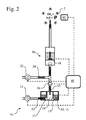
- FIG. 2 shows a first embodiment of a device 1 a according to the invention according to FIG. 1
- the control regulates, for example, the air supply 22 of the feed air 24 mixed with the first gas mixture 15. It can furthermore be provided that the controller 80 regulates the heating element 18 and thus the reaction temperature in the reactor module 16, which also regulates the amount of partial oxidation can.
- FIG. 2 further shows an optional controllable air supply 21, via which the amount of air 12, which is supplied to the evaporator module 14, can be adjusted selectively via the controller 80.
- controllable or controllable means 13 can be provided in the evaporation module 14, which control the release of fuel 11 into the evaporation module 14. Behind the evaporation module 14 and before admixing supply air 24 can also a valve 26 may be arranged to adjust the amount of first gas mixture 15 which is forwarded to the reactor module 16 per unit time.
- a chemical sensor 85 is shown. This determines the composition of the oxidation and partial oxidation products (CO 2 and X) and is via the controller 80 with one of the described means 21, 22 for regulating the air supply or a means 13, 26 for adjusting the first gas mixture 15 or a means 18 to Adjustment of the reaction temperature or similar connected.
- the desired composition of combustion products - ie CO 2 , H 2 O and partial oxidation product (s) P - can be entered into the control unit 80, for example.
- the control unit 80 regulates the air supply 21, 22 and / or the reaction temperature 18, etc., accordingly, in order to adjust the composition of attractant mixture accordingly.
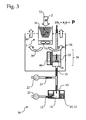
- FIG. 3 shows a second embodiment of a device 1 b for the preparation of a CO 2 - containing attractant mixture for attracting bloodsucking arthropods 2. This is directly combined with a device 3 for catching or temporarily holding the lured arthropods 2.
- the CO 2 producing device 1 b is arranged next to the safety gear 3, that the oxidation products CO 2 , H 2 O and the at least one partial oxidation product P are released in the vicinity of a suction device 30, through which the lured arthropods 2 sucked by an intake 32 and be held in a suitable catching device 34.
- Other non-exclusive possibilities known to those skilled in the art include, for example, attracting the arthropods 2 to adhesive surfaces, surfaces or labyrinths provided with contact poisons or organisms pathogenic to the arthropods 2 or their offspring.
- the reactor module 16 can be mounted so that it heats, for example, the outflowing from the trap 3 air flow 36 and / or emits heat radiation, which is additionally attractive for blood-sucking arthropods 2.
- the heat produced by the reactor module 16 can be used, for example, to generate an electrical voltage through the use of one or more Seebeck elements 40, which controls the operation of the electrical components at least partially secure the device 1 b and / or associated with its catching device 3.
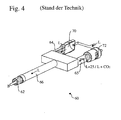
- FIG. 4 shows an olfactometer 60 for measuring the attractiveness of an attractant or attractant mixture according to the known prior art. Olfactometer tests are particularly useful during product development to quickly and cost-effectively filter out the most promising substances from a range of interesting attractants of attractants or foils.
- the olfactometer 60 has the shape of a "Y”. A cage of stingy female mosquitoes is connected to the air-cooled tube system of the olfactometer 60 at the lower end 62 of the "Y”. The two arms 64 and 65 of the "Y” each contain the control chamber 70 and the test chamber 72. Both chambers 70, 72 are each traversed by air L, which is then brought together in the base leg 66 of the "Y".
- test mosquitoes can fly in the direction of movement B in the olfactometer 60 and decide between the test chamber 72 with stimulating air and the control chamber 70 with clean air.
- the olfactometer 60 is traversed in the direction opposite to the direction of movement B of the mosquitoes with air L, which entrains the attractant from the test chamber 72.
- the activation of the test mosquitoes By this one understands an undirected departure with stimulation, in particular this corresponds to the percentage of mosquitoes, which fly into the Olfaktometer 60 at all.
- the orientation By counting the mosquitoes in the test chamber 72, one also determines the orientation, i. the percentage of mosquitoes that have flown specifically to the test stimulus.
- an olfactometer 60 can be used to test potentially repelling substances. These are e.g. applied to filter paper and held together with a human finger in the apparatus. As a comparison, the human finger alone is tested. The reduction of the attractiveness of the finger during the sweat tests gives information about the repelling potential of the test substance. Attractive fragrance stimuli are e.g. in the form of dispensers or with the help of compressed air at certain flow rates introduced into the apparatus and also compared with tests of a human finger to obtain clues to the attracting potential for mosquitoes.
- pure CO 2 is introduced into the test chamber 72 in a control test series.
- the oxidation / partial oxidation products CO 2 and P from the inventive device 1 are introduced into the test chamber 72 and compared the results of the two series of experiments.
- FIGS. 5 to 7 compare the attractiveness of pure CO 2 with the attractiveness of the attractant mixture of a device according to the invention.
- the attractiveness of different concentrations A 0 , B 0 , C 0 were at pure CO 2 with the attractiveness of different attractant mixtures A 1 , B 1 , C 1 in Olfaktometer 60 (see. FIG. 4 ) compared.
- the respective selected test conditions are listed in tabular form:
- test A 1 During the combustion of 100 ml of saturated air with 100 ml of additional air (test A 1 ), 25 ml of CO 2 are formed by complete oxidation.
- test A 1 directly using 25 ml of CO 2 gas, a comparable activation of X A0 and X A1 of about 84% and 82.4% of the number n of mosquitoes used results.
- A0 Y and Y A1 of about 50% and 47.1% of the number n used to mosquitoes.
- test series B If one compares the results in test series B, then the following picture results: During the combustion of 200ml ethanol saturated air with 100ml additional air (test B 1 ) develops less than 50ml CO 2 , since the oxygen content is not enough for a complete oxidation and thus also Partial oxidation products are formed. In comparison with the control B 0 , where directly 50 ml of CO 2 - gas were used, there is a comparable activation X B0 and X B1 of about 81.5% of the number n of mosquitoes used.
- the orientation Y B1 of the attractant mixture is significantly increased in the oxidation / partial oxidation according to the invention, in particular the orientation Y B1 is about 65%, while the orientation Y B0 in the control group is about 50%. This corresponds to an increase in the attractiveness with respect to the orientation Y by about 30%.
- test B 1 When 300 ml of ethanol saturated air are burned with 200 ml of additional air (test B 1 ), less than 75 ml of CO 2 are produced , since the oxygen content is not sufficient for complete oxidation and thus also Partial oxidation products are formed.
- test B 1 directly using 75 ml of CO 2 gas, the result is an improved activation X B1 of approx. 88% compared to the activation X B0 of the control group of approx. 81.5%. This corresponds to an increase in attractiveness with regard to activation X by about 9%.
- the orientation Y B1 is clear In particular, the orientation Y B1 is about 60%, while the orientation Y B0 of the control group was about 43%. This corresponds to an increase in the attractiveness with regard to the orientation Y by about 40%.
- FIGS. 8 and 9 compare the attractiveness of the attractant mixture with different admixture of air.
- V 100ml ethanol saturated air + 100ml extra air 25 ml CO 2 ⁇ complete oxidation
- P 1 100ml ethanol saturated air + 75ml extra air ⁇ 25 ml CO 2 ⁇ contains partial oxidation products
- P 2 100ml ethanol saturated air + 50ml extra air ⁇ 25 ml CO 2 ⁇ contains partial oxidation products
- FIG. 8 shows parallel experiments of a control group V with complete oxidation of the ethanol to 25 ml CO 2 in the device according to the invention and a test group P1 with oxidation and partial oxidation of the ethanol in the device according to the invention.
- These experiments confirm the results of series C of experiments FIG. 5 and show an improved activation X P1 of about 93% compared to Xv of about 89% in the control group V. This corresponds to an increase in the attractiveness with respect to the activation X by about 5%.
- FIG. 9 shows parallel experiments of a control group V with complete oxidation of the ethanol to 25 ml CO 2 and a test group P2 with oxidation and Partial oxidation of the ethanol in the device according to the invention, wherein the amount of additional air in comparison to those in FIG. 8 was further reduced so that more partial oxidation products are formed.
- an improved activation X P1 of about 93% compared to Xv of about 81%. This corresponds to an increase in attractiveness with regard to activation X by about 15%.
Landscapes
- Life Sciences & Earth Sciences (AREA)
- Pest Control & Pesticides (AREA)
- Chemical & Material Sciences (AREA)
- Engineering & Computer Science (AREA)
- Wood Science & Technology (AREA)
- Zoology (AREA)
- Environmental Sciences (AREA)
- Insects & Arthropods (AREA)
- Inorganic Chemistry (AREA)
- Organic Chemistry (AREA)
- Plant Pathology (AREA)
- Agronomy & Crop Science (AREA)
- Health & Medical Sciences (AREA)
- Dentistry (AREA)
- General Health & Medical Sciences (AREA)
- Chemical Kinetics & Catalysis (AREA)
- Agricultural Chemicals And Associated Chemicals (AREA)
- Catching Or Destruction (AREA)
- Catalysts (AREA)
Description
- Blutsaugende Gliederfüßer, insbesondere Insekten und Spinnentiere, sind bisher besonders in den Tropen und Subtropen, aber auch in den gemäßigten Breiten, eine Gefahr für die Gesundheit der sich dort aufhaltenden Menschen, da sie Krankheiten übertragen können. Gegen viele dieser Krankheiten gibt es weder Impfstoffe noch spezifische Therapien, so dass der Prävention durch Bekämpfung der Überträger eine besondere Bedeutung zukommt.
- Bisher werden bei der Bekämpfung vor allem unspezifische Insektizide verwendet. Bei bestimmten Arten können auch die Brutstätten gesucht und zerstört werden. Dem persönlichen Schutz dienen weiterhin Schreckstoffe, Insektizidverdampfer und, insbesondere bei nachtaktiven blutsaugenden Gliederfüßern, Bettnetze zum Schutz vor Stichen. Auch Fanggeräte, die blutsaugende Insekten anlocken und abfangen oder abtöten, werden zur Bekämpfung eingesetzt.
- Um die Wirksamkeit solcher Fallen zu steigern, werden physikalische und chemische Lockreize eingesetzt. Weiterhin ist denkbar, dass durch geeignete Lockmittel die Gliederfüßer auf Oberflächen oder in Strukturen gelockt werden, die sie mit Klebeflächen festhalten oder die mit Kontaktgiften oder mit für die Zielorganismen pathogenen Erregern versehen wurden, um die Zielorganismen, ihre arteigenen Geschlechtspartner oder ihre Nachkommen zu infizieren und somit zu zerstören.
- Mit geeigneten und starken Lockmitteln könnten die Zielorganismen zumindest zeitweise auch von ihren Wirten weggelockt und / oder gefangen werden, wodurch ein zumindest vorübergehender Schutz ermöglicht werden kann.
- Beispielsweise beschreibt die
WO 9811774 A1 - Das Dokument
WO 2004/071189 A1 beschreibt eine Mückenfalle, bei der CO2 durch Verbrennung vom Propan, Benzin oder Kerosin erzeugt wird. Die Verbrennung von Propan zur Erzeugung von CO2 als Lockstoff ist in mehrfacher Hinsicht unvorteilhaft. Die Verbrennung erfolgt mittels einer offenen Flamme bei hohen Temperaturen (von über 1000°C). Je nach Qualität und Reinheit des verwendeten Propangases entstehen bei der Verbrennung Schmutzstoffe. Das durch die Verbrennung erzeugte CO2 wird deswegen mit einem nachgeschalteten Katalysator gereinigt. Dieser Katalysator kann bei der Verwendung verschmutzen bzw. altern, so dass die Lockwirkung der Falle im Laufe der Zeit dramatisch nachlassen kann und die Falle bzw. zumindest der Katalysator ausgetauscht werden muss. - Aufgabe der Erfindung ist, ein Verfahren und eine Vorrichtung zum Anlocken von Insekten bereit zu stellen, bei der einfach, sicher und effizient ein CO2- haltiges Lockmittelgemisch erzeugt wird. Das Verfahren und die Vorrichtung sollen hierbei die o.g. Nachteile bekannter Insektenfallen nicht aufweisen.
- Die obige Aufgabe wird durch ein Verfahren und eine Vorrichtung gelöst, die die Merkmale in den Patentansprüchen 1 und 9 umfassen. Weitere vorteilhafte Ausgestaltungen werden durch die Unteransprüche beschrieben.
- Die Erfindung betrifft ein Verfahren zum Anlocken von blutsaugenden Gliederfüßern, insbesondere von Insekten und Spinnentieren, wobei die Gliederfüßer insbesondere mit CO2 angelockt werden. Die Gliederfüßer können hierbei in einer Fangvorrichtung, insbesondere einer Insektenfalle, gefangen und festgehalten und / oder getötet werden. Zur Herstellung des CO2 wird mindestens eine flüssige oder feste organische Substanz in einem Oxidationsprozess umgesetzt. Insbesondere ist unter organischer Substanz eine organische Verbindung oder ein Gemisch aus organischen Verbindungen zu verstehen.
- Erfindungsgemäß wird die Substanz in einem Oxidationsprozess zumindest teilweise vollständig und zumindest teilweise partiell umgesetzt. Dabei entsteht neben CO2, H2O und Wärme mindestens ein weiteres Teiloxidationsprodukt. Dieses Teiloxidationsprodukt bewirkt insbesondere eine Verstärkung der anlockenden Wirkung des Lockstoffgemisches. Auch die bei dem Oxidationsprozess entstehende Wärme stellt einen weiteren positiven Faktor für das Anlocken der Insekten o.ä. dar. Gemäß einer unten beschriebenen Ausführungsform kann die Wärme auch abgezweigt und anderweitig verwendet werden.
- Insbesondere handelt es sich bei dem Oxidationsprozess der Umsetzung der organischen Substanz um einen katalytischen Oxidationsprozess.
- Gemäß einer bevorzugten Ausführungsform wird die mindestens eine flüssige oder feste organische Substanz vor dem, insbesondere katalytischen, Oxidationsprozess verdampft und mit Luft zu einem Reaktions- Gasgemisch vermischt. Die Menge an zusätzlicher Luft kann hierbei insbesondere so eingestellt bzw. reguliert werden, dass der Sauerstoffgehalt nicht ausreicht, um die gesamte Brennsubstanz vollständig zu CO2 zu oxidieren. Stattdessen kann die Menge an zusätzlicher Luft so eingestellt werden, dass besonders attraktive Oxidationsprodukt / Teiloxidationsprodukt- Gemische entstehen. Eine gezielte Steuerung der Verbrennung ist also durch eine gezielte Einstellung des Mischungsverhältnisses von Brennsubstanz und Sauerstoff möglich.
- Alternativ kann eine Regulierung des Verbrennungsprozesses auch über eine Einstellung der Reaktionstemperatur erfolgen. Beispielsweise kann es vorteilhaft sein, dass die Brennsubstanz vorgeheizt wird, um gewünschte Verhältnisse an Oxidationsprodukten und Teiloxidationsprodukt(en) im Verbrennungsprodukt zu erhalten. Ebenso kann eine gezielte Kühlung vorteilhaft eingesetzt werden. Die Reaktionstemperatur kann auch über konstruktive Maßnahmen beeinflusst werden, beispielsweise durch unterschiedlich gute Isolierung verschiedener Bereiche der Vorrichtung. Weitere dem Fachmann bekannte Möglichkeiten zur gezielten Regulierung des Verbrennungsprozesses sollen ebenfalls von der Erfindung umfasst werden.
- Erfolgt die Oxidation und Teiloxidation durch katalytische Verbrennung, dann wird als Katalysator vorzugsweise ein Edelmetallträgerkatalysator verwendet. Das Edelmetall des Katalysators wird aus einer Gruppe, die aus Pd, Pt, Ru, Ag, Au, Rh oder einem Gemisch aus mindestens zwei dieser Metalle besteht, ausgewählt. Das Trägermaterial ist ein anorganisches Material vorzugsweise mit oxidischer oder Spinell-Struktur, insbesondere Al2O3, SiO2, Al2O3-SiO2, TiO2, ZrO2, ein Seltenerdoxid, Fe2O3, ein Zeolith, ein Molekularsiebe oder ein Hydrotcalcit.
- Weiterhin ist die Verwendung anderer geeigneter Katalysatoren, insbesondere von Halbedelmetallträgerkatalysatoren mit Cu, oder Übergangsmetallträgerkatalysatoren mit Mn o.ä., Mischmetallträgerkatalysatoren, oder Katalysatoren mit anderen vorzugsweise korrosionsbeständigen Metallen wie beispielsweise Ti etc. möglich.
- Die Verbrennung der mindestens einen flüssigen oder festen organischen Substanz kann beispielsweise mit Hilfe einer Steuerungseinheit gezielt reguliert werden, so dass bestimmte Teiloxidationsprodukte in einem definierten Verhältnis zum CO2 entstehen. Beispielsweise können die Reaktionsbedingungen - d.h. die Reaktionstemperatur und / oder die Menge an verfügbarem Sauerstoff etc.- für die Umsetzung von Ethanol so gewählt werden, dass definierte Mengen an Ethanal, Essigsäure, Essigsäureethylester und/ oder Diethylether, beispielsweise jeweils zwischen 0.1 ppm und 10%, vorzugsweise zwischen 0.1 ppm und 5%, entstehen und zusammen mit dem CO2 abgegeben werden. Hierfür kann eine Steuerungseinheit vorgesehen sein, die beispielsweise mit einem chemischen Sensor zur Analyse der Zusammensetzung der Oxidations- und Teiloxidationsprodukte und mit einem Mittel zur Regulierung der Luftzufuhr oder der Reaktionstemperatur o.ä. verbunden ist. Die gewünschte Zusammensetzung an Verbrennungsprodukten kann beispielsweise in die Steuerungseinheit eingegeben werden. Aufgrund der sensorisch ermittelten chemischen Daten reguliert die Steuerungseinheit die Luftzufuhr und / oder die Reaktionstemperatur etc. entsprechend nach, um die Menge an Oxidations- und Teiloxidationsprodukten entsprechend einzustellen.
- Ein besonderer Vorteil des katalytischen Verfahrens besteht darin, dass keine Verbrennung bei offener Flamme durchgeführt werden muss. Somit kann das Verfahren bei Temperaturen durchgeführt werden, die deutlich unterhalb der Verbrennungstemperatur der verwendeten flüssigen oder festen organischen Substanz liegen. Dies vermindert die Brandgefahr und erhöht die Sicherheit für den Benutzer.
- Die bei der Umsetzung entstehende Wärme kann gemäß einer weiteren Ausführungsform verwendet werden, um elektrische Spannung zu generieren und die zugeordnete Fangvorrichtung zumindest teilweise anzutreiben. Beispielsweise kann mindestens ein Seebeck- Element eingesetzt werden, um den Betrieb der elektrischen Bauteile der Vorrichtung zur Durchführung des beschriebenen Verfahrens und/ oder der mit ihr verbundenen Fangvorrichtung zumindest teilweise zu sichern.
- Die zur Herstellung des CO2 verwendete flüssige oder feste organische Substanz wird aus einer Gruppe bestehend aus Alkoholen, Ketonen, Aldehyden, Kohlenwasserstoffen, Olefinen, Ethern, Carbonsäureestern, Fetten oder Ölen ausgewählt. Vorzugsweise werden Alkohole, insbesondere Methanol, Ethanol oder Brennspiritus, verwendet.
- Mit dem Verfahren wird also Kohlendioxid als Produkt der Totaloxidation hergestellt. Parallel dazu wird gezielt ein Anteil an partialoxidiertem Produkt / partialoxidierten Produkten hergestellt, welche ebenfalls als Lockstoff(e) für blutsaugende Insekten wirken und die Attraktivität des Kohlendioxids steigern.
- Die Erfindung betrifft weiterhin eine Vorrichtung zur Erzeugung von CO2 zum Anlocken von blutsaugenden Gliederfüßern. Diese Vorrichtung eignet sich beispielsweise zur Verwendung in Kombination mit einer Fangvorrichtung für Insekten, blutsaugende Gliederfüßer etc. Die Vorrichtung umfasst eine Speichervorrichtung und ein Verdampfungsmodul für die mindestens eine flüssige oder feste organische Reaktionssubstanz. Erfindungsgemäß weist die Vorrichtung ein Reaktormodul für die Oxidation und/ oder Teiloxidation der mindestens einen flüssigen oder festen organischen Substanz auf. Weiterhin kann das Reaktormodul Mittel zur Regulation des Oxidations- und Teiloxidationsprozesses und eine Steuerungseinheit zur Regulation des Oxidations- und/ oder Teiloxidationsprozesses aufweisen. Insbesondere sind im Reaktormodul definierte Reaktionsbedingungen einstellbar, so dass die Menge an entstehendem Partialoxidationsprodukt(en) gezielt eingestellt werden kann. Beispielsweise umfasst die Vorrichtung eine regelbare Luftzufuhr o.ä., mit der die Sauerstoffzufuhr gezielt reguliert und somit die Menge und / oder Zusammensetzung von dem mindestens einem entstehenden Partialoxidationsprodukt eingestellt werden kann. Die entstehenden Partialoxidationsprodukte z.B. Aldehyde, Ketone, Carbonsäuren, Ester, Ether etc. sind dem entstehenden CO2- Strom in geringen Anteilen beigemischt, wodurch die Lockwirkung der Vorrichtung erhöht wird. Weiterhin oder alternativ können Heiz- und / oder Kühlelemente vorgesehen sein, die dazu dienen, die Reaktionstemperatur einzustellen, die Reaktionssubstanz vorzutemperieren etc.
- Die Vorrichtung kann weiterhin in ihrem Reaktormodul einen Katalysator für die gesteuerte katalytische Oxidation und Teiloxidation der mindestens einen flüssigen oder festen organischen Substanz umfassen.
- Die Vorteile des Verfahrens und der Vorrichtung gegenüber den herkömmlich bekannten Methoden und Vorrichtungen zur Herstellung von Kohlendioxid insbesondere im Zusammenhang mit Fangvorrichtungen bestehen hauptsächlich in einer wesentlichen Vereinfachung des technischen Ablaufs des Oxidationsprozesses. Durch die Verwendung einer organischen Reaktionssubstanz in flüssigem oder festem Aggregatzustand anstelle von beispielsweise Propangas o.ä. kann die Sicherheit der Vorrichtung für den Benutzer wesentlich erhöht werden. Ein einfacherer und gefahrloser dezentraler Einsatz der Vorrichtung ist möglich. Erforderliche organische Medien können problemlos ohne die Verwendung von Druckgasflaschen verwendet werden, wodurch die Lagerung des Brennstoffs vereinfacht ist. Das ist als Vorteil insbesondere für den Einsatz in infrastrukturarmen ländlichen Gebieten zu sehen. Ein weiterer Vorteil der Vorrichtung und des Verfahrens besteht darin, dass geringere Mengen an organischer Reaktionssubstanz benötigt werden, um vergleichbare Anlockungsergebnisse zu erzielen. Dadurch ist es möglich, die gesamte Vorrichtung kleiner und leichter auszuführen, wodurch sie für den Benutzer einfacher zu transportieren ist.
- Bei der katalytischen Umsetzung der Brennsubstanz wird CO2 und mindestens ein Teiloxidationsprodukt vorzugsweise durch eine katalytische Oxidation bzw. Teiloxidation erzeugt. Dabei erfolgt vorzugsweise keine Verbrennung mit offener Flamme. Insbesondere kann damit die Bildung von Ruß oder ähnlichen Bestandteilen vermieden werden, die den Katalysator schädigen oder Stechmücken o.ä. abschrecken können. Da die Vorrichtung keine offene Flamme benötigt, ist es möglich, die Vorrichtung kleiner zu gestalten, wodurch sie zudem kostengünstiger hergestellt werden kann.
- Mit der erfindungsgemäßen Vorrichtung und dem erfindungsgemäßen Verfahren können somit einfach, schnell und kostengünstig CO2- haltige Lockstoffgemische erzeugt werden, die eine höhere Attraktivität für blutsaugende Gliederfüßer als reines CO2 zeigen. Insbesondere zeigen Stechmücken o.ä. eine höhere Orientierung zu dem CO2- haltigen Lockstoffgemisch.
- Weiterhin ist es auf diese Weise einfach möglich, Lockstoffgemische zu erzeugen, die besonders attraktiv für bestimmte Arten von blutsaugenden Gliederfüßern sind. Dies erlaubt ein gezieltes Anlocken bestimmter Arten. Dies kann beispielsweise vorteilhaft für Forschungszwecke eingesetzt werden.
- Im Folgenden sollen Ausführungsbeispiele die Erfindung und ihre Vorteile anhand der beigefügten Figuren näher erläutern. Die Größenverhältnisse der einzelnen Elemente zueinander in den Figuren entsprechen nicht immer den realen Größenverhältnissen, da einige Formen vereinfacht und andere Formen zur besseren Veranschaulichung vergrößert im Verhältnis zu anderen Elementen dargestellt sind.
-
Figur 1 zeigt eine erste Ausführungsform einer erfindungsgemäßen Vorrichtung zur Herstellung von CO2 zum Anlocken von blutsaugenden Gliederfüßern. -
Figur 2 zeigt eine erste Ausführungsform einer erfindungsgemäßen Vorrichtung gemäßFigur 1 mit Steuerung. -
Figur 3 zeigt eine zweite Ausführungsform einer Vorrichtung zur Herstellung von CO2 zum Anlocken und Fangen von blutsaugenden Gliederfüßern. -
Figur 4 zeigt ein Olfaktometer zur Messung der Attraktivität eines Lockstoffes / Lockstoffgemisches (Stand der Technik). -
Figur 5 bis Figur 7 vergleichen die Attraktivität von reinem CO2 mit der Attraktivität des mit einer erfindungsgemäßen Vorrichtung hergestellten Lockstoffgemisches. -
Figuren 8 und 9 vergleichen die Attraktivität des mit einer erfindungsgemäßen Vorrichtung hergestellten Lockstoffgemisches bei unterschiedlicher Zumischung von Luft. - Für gleiche oder gleich wirkende Elemente der Erfindung werden identische Bezugszeichen verwendet. Ferner werden der Übersicht halber nur Bezugszeichen in den einzelnen Figuren dargestellt, die für die Beschreibung der jeweiligen Figur erforderlich sind. Die dargestellten Ausführungsformen stellen lediglich Beispiele dar, wie die erfindungsgemäße Vorrichtung oder das erfindungsgemäße Verfahren ausgestaltet sein können und stellen keine abschließende Begrenzung dar.
-
Figur 1 zeigt eine erste Ausführungsform einer Vorrichtung 1 a zur Herstellung eines CO2- haltigen Lockstoffgemisches zum Anlocken von blutsaugenden Gliederfüßern 2. Das Lockstoffgemisch wird insbesondere durch katalytische Oxidation und Teiloxidation hergestellt. Die Vorrichtung 1 a umfasst eine Speichereinheit 10 für die zu oxidierende flüssige oder feste organische Substanz 11. Zuerst wird ein regelbarer oder festeingestellter Luftstrom 12 produziert, der in einem geeigneten Verdampfermodul 14 mit der Substanz 11 versetzt und dann als erstes Gasgemisch 15 einem Reaktormodul 16 zugeleitet wird. - Das Reaktormodul 16 umfasst ein Katalysatorbett 20 und ein Heizelement 18 zur Einstellung der notwendigen Starttemperatur für die katalytische Voll- und Teiloxidation der Reaktionssubstanz 11. Im Reaktormodul 16 befindet sich weiterhin eine Flammenrückschlagsicherung 50. Diese dient als Schutzvorrichtung, falls sich das erste Gasgemisch 15 in der Reaktorkammer 16, beispielsweise aufgrund einer Überhitzung des Katalysators, ungewollt entzünden sollte. Die Flammenrückschlagsicherung 50 verhindert dann, dass die in Folge einer Fehlfunktion entstandenen Flamme des ersten Brennstoff- Luft- Gasgemisches 15 in das Verdampfermodul 14 eindringt.
- Weiterhin kann die Vorrichtung 1 a eine Regulierungsvorrichtung 22, insbesondere eine regelbare und/ oder fest einstellbare Luftzufuhr o.ä. umfassen, mit der die Reaktionsbedingungen gezielt eingestellt werden können, so dass definierte Mengen an CO2 und gewünschten Teiloxidationsprodukten P hergestellt werden können. Vorzugsweise wird die Zuluft 24 dem ersten Gasgemisch 15 aus verdampfter Substanz 11 und Luft 12 vor dem Reaktormodul 16 beigemischt, um das für die katalytische Umsetzung optimale Verhältnis von organischer Substanz 11 und Sauerstoff einzustellen.
- Das zweite Gasgemisch 25 aus verdampfter Substanz 11 und Luft 12 bzw. Zuluft 24 durchströmt die Flammenrückschlagsicherung 50 und anschließend das Katalysatorbett 20, in dem durch das Erhitzen durch eine passende Wärmequelle, insbesondere durch ein Heizelement 18 oder nach autokatalytischer Zündung die katalytische Oxidationsreaktion startet. Insbesondere beträgt der Volumenstrom durch das Katalysatorbett zwischen 50ml/min und ca. 800ml/min. Der Volumenstrom hängt insbesondere von der Menge CO2 ab, die produziert werden soll. Weitere Komponenten, die den Volumenstrom beeinflussen und entsprechend eingestellt werden können, sind die Art des verwendeten Brennstoffs und die Menge an Zusatzluft.
- Bei der Oxidationsreaktion entstehen CO2, H2O und Wärme sowie gegebenenfalls Partialoxidationsprodukte X. Diese werden von der Vorrichtung 1 a abgegeben und bewirken das Anlocken der Gliederfüßer 2. Durch die Partialoxidationsprodukte P verbessert sich die anlockende Wirkung der Vorrichtung 1 a. Die Lockstoffwirkung ist gegenüber herkömmlichen Vorrichtungen, die CO2 abgeben, um bis zu 50% oder mehr erhöht, insbesondere findet man eine Erhöhung der anziehenden Wirkung des Oxidationsprodukt- und Teiloxidationsprodukt-Gemisches von bis zu 60% gegenüber einer vollständigen Verbrennung eines Brennstoffes. Mit der erfindungsgemäßen Vorrichtung konnte beispielsweise eine Verdreifachung der Fangrate erzielt werden.
-
Figur 2 zeigt eine erste Ausführungsform einer erfindungsgemäßen Vorrichtung 1 a gemäßFigur 1 mit Steuerung 80. Die Steuerung reguliert beispielsweise die Luftzufuhr 22 der dem ersten Gasgemisch 15 zugemischten Zuluft 24. Weiterhin kann vorgesehen sein, dass die Steuerung 80 das Heizelement 18 und somit die Reaktionstemperatur im Reaktormodul 16 reguliert, wodurch ebenfalls die Menge an partieller Oxidation reguliert werden kann.Figur 2 zeigt weiterhin eine optionale regelbare Luftzufuhr 21, über die die Menge an Luft 12, die dem Verdampfermodul 14 zugeführt wird, gezielt über die Steuerung 80 eingestellt werden kann. Zudem können regulierbare bzw. steuerbare Mittel 13 im Verdampfungsmodul 14 vorgesehen werden, die die Freisetzung von Brennsubstanz 11 in das Verdampfungsmodul 14 kontrollieren. Hinter dem Verdampfungsmodul 14 und vor dem Zumischen von Zuluft 24 kann zudem ein Ventil 26 angeordnet sein, dass die Menge an erstem Gasgemisch 15 einstellt, die pro Zeiteinheit an das Reaktormodul16 weitergeleitet wird. - Weiterhin ist ein chemischer Sensor 85 dargestellt. Dieser ermittelt die Zusammensetzung der Oxidations- und Teiloxidationsprodukte (CO2 und X) und ist über die Steuerung 80 mit einem der beschriebenen Mittel 21, 22 zur Regulierung der Luftzufuhr oder einem Mittel 13, 26 zur Einstellung des ersten Gasgemisches 15 oder einem Mittel 18 zur Einstellung der Reaktionstemperatur o.ä. verbunden. Die gewünschte Zusammensetzung an Verbrennungsprodukten -d.h. CO2, H2O sowie Partialoxidationsprodukt(e) P - kann beispielsweise in die Steuerungseinheit 80 eingegeben werden. Aufgrund der sensorisch ermittelten chemischen Daten reguliert die Steuerungseinheit 80 die Luftzufuhr 21, 22 und / oder die Reaktionstemperatur 18 etc. entsprechend nach, um die Zusammensetzung an Lockstoffgemisch entsprechend einzustellen.
-
Figur 3 zeigt eine zweite Ausführungsform einer Vorrichtung 1 b zur Herstellung eines CO2- haltigen Lockstoffgemisches zum Anlocken von blutsaugenden Gliederfüßern 2. Diese ist direkt mit einer Vorrichtung 3 zum Fangen oder zeitweisen Festhalten der angelockten Gliederfüßer 2 kombiniert. - Die CO2 herstellende Vorrichtung 1 b ist so neben der Fangvorrichtung 3 angeordnet, dass die Oxidationsprodukte CO2, H2O und das mindestens eine Teiloxidationsprodukt P in der Nähe einer Einsaugvorrichtung 30 freigesetzt werden, durch die die angelockten Gliederfüßer 2 durch einen Einsaugstrom 32 eingesogen und in einer geeigneten Auffangvorrichtung 34 festgehalten werden. Weitere dem Fachmann bekannte, nicht ausschließliche Möglichkeiten bestehen beispielsweise in dem Anlocken der Gliederfüßer 2 auf Klebeflächen, auf Oberflächen oder in Labyrinthen, die mit Kontaktgiften oder Organismen versehen sind, die für die Gliederfüßer 2 oder ihre Nachkommen pathogen sind.
- Das Reaktormodul 16 kann dabei so angebracht sein, dass es beispielsweise den aus der Falle 3 ausströmenden Luftstrom 36 erwärmt und/ oder Wärmestrahlung abgibt, was für blutsaugende Gliederfüßer 2 zusätzlich attraktiv ist.
- Die durch das Reaktormodul 16 produzierte Wärme kann beispielsweise genutzt werden, um durch den Einsatz von einem oder mehreren Seebeck- Elementen 40 eine elektrische Spannung zu generieren, die den Betrieb der elektrischen Bauteile der Vorrichtung 1 b und/ oder der mit ihr verbundenen Fangvorrichtung 3 zumindest teilweise sichern.
-
Figur 4 zeigt ein Olfaktometer 60 zur Messung der Attraktivität eines Lockstoffes oder Lockstoffgemisches gemäß dem bekannten Stand der Technik. Olfaktometertests sind besonders während der Produktentwicklung geeignet, um aus einer Reihe interessanter Lock- oder Schreckstoffkandidaten schnell und kostengünstig die vielversprechendsten Substanzen herauszufiltern. Das Olfaktometer 60 weist insbesondere die Form eines "Y" auf. Ein Käfig mit stechfreudigen Mückenweibchen wird am unteren Ende 62 des "Y" an das klimatisierte Röhrensystem des Olfaktometers 60 angeschlossen. Die beiden Arme 64 und 65 des "Y" enthalten jeweils die Kontrollkammer 70 und die Testkammer 72. Beide Kammern 70, 72 werden jeweils durch Luft L durchströmt, die anschließend in dem Basisschenkel 66 des "Y" zusammengeführt wird. Während der Reizgabe können die Testmücken in Bewegungsrichtung B in das die Olfaktometer 60 einfliegen und sich zwischen der Testkammer 72 mit Reizluft und der Kontrollkammer 70 mit Reinluft entscheiden. Das Olfaktometer 60 wird in der zur Bewegungsrichtung B der Mücken entgegengesetzten Richtung mit Luft L durchströmt, die den Lockstoff aus der Testkammer 72 mitreißt. - Zum einen ermittelt man die Aktivierung der Testmücken. Darunter versteht man ein ungerichtetes Losfliegen bei Reizgabe, insbesondere entspricht dies dem Prozentsatz an Mücken, die überhaupt in das Olfaktometer 60 einfliegen. Durch Auszählen der Mücken in der Testkammer 72 ermittelt man weiterhin die Orientierung, d.h. den Prozentsatz an Mücken, die gezielt zum Testreiz hingeflogen sind.
- Ein Olfaktometer 60 kann beispielsweise verwendet werden, um potentiell repellierende Substanzen zu testen. Diese werden z.B. auf Filterpapier aufgebracht und zusammen mit einem menschlichen Finger in die Apparatur gehalten. Als Vergleich wird der menschliche Finger alleine getestet. Die Reduktion der Attraktivität des Fingers während der Schreckstofftests gibt Aufschluss über das repellierende Potential der Testsubstanz. Attraktive Duftreize werden z.B. in Form von Dispensern oder mit Hilfe von Druckluft mit bestimmten Durchflussraten in die Apparatur eingeleitet und ebenfalls mit Tests eines menschlichen Fingers verglichen, um Hinweise auf das anlockende Potential für Stechmücken zu erhalten.
- Im vorliegenden Fall wird beispielsweise in einer Kontrollversuchsreihe reines CO2 in die Testkammer 72 eingeleitet. Parallel dazu werden in einem weiteren Olfaktometer 60 die Oxidations- /Teiloxidationsprodukte CO2 und P aus der erfindungsgemäßen Vorrichtung 1 (vgl.
Figuren 1 bis 3 ) in die Testkammer 72 eingeleitet und die Ergebnisse der beiden Versuchsreihen miteinander verglichen. -
Figuren 5 bis 7 vergleichen die Attraktivität von reinem CO2 mit der Attraktivität des Lockstoffgemisches einer erfindungsgemäßen Vorrichtung. Bei diesen Versuchen wurden die Attraktivität von unterschiedlichen Konzentrationen A0, B0, C0 an reinem CO2 mit der Attraktivität von unterschiedlichen Lockstoffgemischen A1, B1, C1 im Olfaktometer 60 (vgl.Figur 4 ) verglichen. Die jeweilig gewählten Versuchsbedingungen sind tabellarisch aufgelistet:
- Insbesondere wurden für die Versuchsreihen A1, B1, C1 unterschiedliche Mengen an mit Ethanol gesättigter Luft und zusätzlicher Luft in einer erfindungsgemäßen Vorrichtung 1 verbrannt. Je nachdem, wie viel zusätzliche Luft verwendet wird, kann gezielt eine vollständige Oxidation (Versuch A1) oder gezielt eine partielle Oxidation (Versuche B1, C1) eingestellt werden.
- Vergleicht man die Kontroll- Versuchsreihen A0, B0, C0 miteinander (vgl. auch
Figur 6 ), bei denen jeweils reines CO2 als Lockmittel verwendet wird, so findet man jeweils eine ungerichtete Aktivierung XA0, XBo und XC0 von ca. 83% (XA0: 84%; XB0: 81,5%; und XC0: 82,4%) der verwendeten Anzahl n an Mückenweibchen und ein gerichtete Orientierung YA0, YBo und YC0 von ca. 50% (YA0: 50%; YB0: 52,1%; und Yco: 43,7%), unabhängig von der verwendeten CO2- Konzentration. D.h. die Anwesenheit von CO2 dient als deutlicher Lockstoff, wobei die Konzentration keinen spürbaren Einfluss zeigt. - Vergleicht man die Ergebnisse in Versuchsreihe A, dann ergibt sich folgendes Bild: Bei der Verbrennung von 100ml Ethanol gesättigter Luft mit 100ml zusätzlicher Luft (Versuch A1) entstehen durch vollständige Oxidation 25ml CO2. Beim Vergleich mit der Kontroll- Versuchsreihe A0, wobei direkt 25ml CO2- Gas eingesetzt werden, ergibt sich eine vergleichbare Aktivierung XA0 und XA1 von ca. 84% und 82,4% der eingesetzten Anzahl n an Mücken. Weiterhin ergibt sich eine vergleichbare Orientierung YA0 und YA1 von ca. 50% und 47,1% der eingesetzten Anzahl n an Mücken. Bei vollständiger Oxidation des Brennstoffs Ethanol ergibt sich somit für das Lockstoffgemisch aus der erfindungsgemäßen Vorrichtung eine Attraktivität, die der Attraktivität von Fallen entspricht, bei denen direkt CO2 verwendet wird.
- Vergleicht man die Ergebnisse in Versuchsreihe B, dann ergibt sich folgendes Bild: Bei der Verbrennung von 200ml Ethanol gesättigter Luft mit 100ml zusätzlicher Luft (Versuch B1) entstehen weniger als 50ml CO2, da der Sauerstoffgehalt nicht für eine vollständige Oxidation ausreicht und somit auch Teiloxidationsprodukte entstehen. Beim Vergleich mit der Kontrolle B0, wobei direkt 50ml CO2- Gas eingesetzt wurden, ergibt sich eine vergleichbare Aktivierung XB0 und XB1 von ca. 81,5% der eingesetzten Anzahl n an Mücken. Jedoch ist die Orientierung YB1 des Lockstoffgemisches bei der erfindungsgemäßen Oxidation / Teiloxidation deutlich erhöht, insbesondere liegt die Orientierung YB1 bei ca. 65%, während die Orientierung YB0 in der Kontrollgruppe bei ca. 50% liegt. Dies entspricht einer Steigerung der Attraktivität in Bezug auf die Orientierung Y um ca. 30%.
- Vergleicht man die Ergebnisse in Versuchsreihe C, dann ergibt sich folgendes Bild: Bei der Verbrennung von 300ml Ethanol gesättigter Luft mit 200ml zusätzlicher Luft (Versuch B1) entstehen weniger als 75ml CO2, da der Sauerstoffgehalt nicht für eine vollständige Oxidation ausreicht und somit auch Teiloxidationsprodukte entstehen. Beim Vergleich mit der Kontrolle Co, wobei direkt 75ml CO2- Gas eingesetzt wurden, ergibt sich eine verbesserte Aktivierung XB1 von ca. 88% gegenüber der Aktivierung XB0 der Kontrollgruppe von ca. 81,5%. Dies entspricht einer Steigerung der Attraktivität in Bezug auf die Aktivierung X um ca. 9%. Weiterhin ist die Orientierung YB1 deutlich erhöht, insbesondere liegt die Orientierung YB1 bei ca. 60%, während die Orientierung YB0 der Kontrollgruppe bei ca. 43% lag. Dies entspricht einer Steigerung der Attraktivität in Bezug auf die Orientierung Y um ca. 40%.
- Vergleicht man weiterhin die Ergebnisse der Versuchsreihen A1, B1, C1 miteinander (vgl.
Figur 7 ), bei denen jeweils unterschiedliche Lockstoffgemische aus Ethanol gesättigter Luft und zusätzlicher Luft mittels einer erfindungsgemäßen Vorrichtung hergestellt werden, dann ergibt sich, dass durch gezielte Einstellung der Menge an Teiloxidation durch Regulierung der zusätzlichen Luftzufuhr zum einen die Aktivierung und / oder die Orientierung der Mücken verbessert werden kann. Beide Faktoren sind Indikatoren für eine bessere Lockstoffwirkung des Verbrennungsproduktes. -
Figuren 8 und 9 vergleichen die Attraktivität des Lockstoffgemisches bei unterschiedlicher Zumischung von Luft.V 100ml Ethanol gesättigte Luft + 100ml zusätzliche Luft = 25 ml CO2 → vollständige Oxidation P1 100ml Ethanol gesättigte Luft + 75ml zusätzliche Luft < 25 ml CO2 → enthält Teiloxidationsprodukte P2 100ml Ethanol gesättigte Luft + 50ml zusätzliche Luft < 25 ml CO2 → enthält Teiloxidationsprodukte -
Figur 8 zeigt Parallel- Versuche einer Kontrollgruppe V mit vollständiger Oxidation des Ethanols zu 25 ml CO2 in der erfindungsgemäßen Vorrichtung und einer Testgruppe P1 mit Oxidation und Teiloxidaton des Ethanols in der erfindungsgemäßen Vorrichtung. Diese Versuche bestätigen wiederum die Ergebnisse der Versuchsreihe C ausFigur 5 und zeigen eine verbesserte Aktivierung XP1 von ca. 93% gegenüber Xv von ca. 89% in der Kontrollgruppe V. Dies entspricht einer Steigerung der Attraktivität in Bezug auf die Aktivierung X um ca. 5%. Weiterhin findet man eine verbesserte Orientierung der Mücken YP1 von ca. 65% gegenüber Yv von ca. 48%. Dies entspricht einer Steigerung der Attraktivität in Bezug auf die Orientierung Y um ca. 35%. -
Figur 9 zeigt Parallel- Versuche einer Kontrollgruppe V mit vollständiger Oxidation des Ethanol zu 25 ml CO2 und einer Testgruppe P2 mit Oxidation und Teiloxidaton des Ethanol in der erfindungsgemäßen Vorrichtung, wobei die Menge an zusätzlicher Luft im Vergleich zu den inFigur 8 dargestellten Versuchsergebnissen weiter reduziert wurde, so dass noch mehr Teiloxidationsprodukte entstehen. Auch hierbei zeigen sich eine verbesserte Aktivierung XP1 von ca. 93% gegenüber Xv von ca. 81%. Dies entspricht einer Steigerung der Attraktivität in Bezug auf die Aktivierung X um ca. 15%. Weiterhin findet man eine verbesserte Orientierung der Mücken YP2 von ca. 60% gegenüber Yv von ca. 37%. Dies entspricht einer Steigerung der Attraktivität in Bezug auf die Orientierung Y um ca. 62%. - Die in den
Figuren 8 und 9 dargestellten Ergebnisse verdeutlichen noch einmal, dass über eine gezielte Steuerung der Oxidation und Teiloxidation eine Verbesserung der Attraktivität, insbesondere eine Verbesserung der Orientierung Y bewirkt werden kann. - Die Erfindung wurde unter Bezugnahme auf eine bevorzugte Ausführungsform beschrieben. Es ist jedoch für einen Fachmann vorstellbar, dass Abwandlungen oder Änderungen der Erfindung gemacht werden können, ohne dabei den Schutzbereich der nachstehenden Ansprüche zu verlassen.
-
- 1a/ 1b
- Vorrichtung zur Herstellung von CO2
- 2
- blutsaugende Gliederfüßer
- 3
- Fangvorrichtung
- 10
- Speichereinheit
- 11
- organische Substanz
- 12
- Luftstrom
- 13
- regulierende Mittel
- 14
- Verdampfungsmodul
- 15
- erstes Gasgemisch
- 16
- Reaktormodul
- 18
- Heizelement
- 20
- Katalysatorbett
- 21
- erste Regulierungsvorrichtung
- 22
- zweite Regulierungsvorrichtung
- 24
- Zuluft
- 25
- zweites Gasgemisch
- 26
- Ventil
- 30
- Einsaugvorrichtung
- 32
- Einsaugstrom
- 34
- Auffangvorrichtung
- 36
- ausströmender Luftstrom
- 40
- Seebeck- Element
- 50
- Flammenrückschlagsicherung
- 60
- Olfaktometer
- 62
- unteres Ende
- 64
- Arm
- 65
- Arm
- 66
- Basisschenkel
- 70
- Kontrollkammer
- 72
- Testkammer
- 80
- Steuerung
- 85
- Sensor
- B
- Bewegungsrichtung
- L
- Luft
- n
- Anzahl
- P
- Teiloxidationsprodukt
- X
- Aktivierung
- Y
- Orientierung
Claims (15)
- Verfahren zur Herstellung von CO2 zum Anlocken von blutsaugenden Gliederfüßern (2), dadurch gekennzeichnet, dass mindestens eine flüssige oder feste organische Substanz (11) in einem Oxidationsprozess gezielt teilweise vollständig und teilweise partiell umgesetzt wird, so dass neben CO2, H2O und Wärme mindestens ein weiteres Teiloxidationsprodukt (P) entsteht, wobei die organische Substanz (11) aus einer Gruppe bestehen aus Alkoholen, Ketonen, Aldehyden, Kohlenwasserstoffen, Olefinen, Ethern, Carbonsäureestern, Fetten oder Ölen ausgewählt wird.
- Verfahren nach Anspruch 1, wobei der Oxidationsprozess ein katalytischer Oxidationsprozess ist.
- Verfahren nach Anspruch 1, wobei die Oxidation und die Teiloxidation über Mittel (13, 18, 21, 22, 26) zur Regulierung des Oxidations- und Teiloxidationsprozesses und eine Steuerungseinheit (80) reguliert werden, so dass mindestens ein Teiloxidationsprodukt (P) in einem definierten Verhältnis zum CO2 entsteht, insbesondere wobei zwischen 0,1 ppm und 10% Teiloxidationsprodukt (P) entsteht.
- Verfahren nach Anspruch 1 oder 2, wobei die Oxidation und die Teiloxidation von Ethanol über Mittel (13, 18, 21, 22, 26) zur Regulierung des Oxidations- und Teiloxidationsprozesses und eine Steuerungseinheit (80) reguliert werden, so dass definierte Mengen an Ethanal, Essigsäure, Essigsäureethylester und/ oder Diethylether in einem definierten Verhältnis insbesondere zwischen 0,1 ppm und 10%, entstehen.
- Verfahren nach einem der Ansprüche 2 bis 3, wobei* eine gewünschte Zusammensetzung von CO2 und Teiloxidationsprodukt (P) in die Steuerungseinheit (80) eingegeben wird;* eine chemische Analyse der Zusammensetzung aus CO2 und Teiloxidationsprodukt (P) oder Teiloxidationsprodukten durchgeführt wird und* Mittel (13, 18, 21, 22, 26) zur Regulierung durch die Steuerungseinheit eingestellt werden.
- Verfahren nach einem der voranstehenden Ansprüche, wobei die Reaktionsbedingungen für den Oxidationsprozess eingestellt werden, indem die Reaktionstemperatur und / oder der verfügbare Sauerstoff und / oder die Menge an verfügbarer Brennsubstanz (11) gezielt reguliert und/ oder eingestellt wird.
- Verfahren nach einem der Ansprüche 2 bis 6, wobei die mindestens eine flüssige oder feste organische Substanz (11) vor dem katalytischen Oxidations- und Teiloxidationsprozess verdampft und in einem definierten Verhältnis mit Luft (12) vermischt wird und wobei der katalytische Oxidations- und Teiloxidationsprozess durch einen Edelmetallträgerkatalysator (20), einen Halbedelmetallträgerkatalysator, einen Übergangsmetallträgerkatalysator, einen Mischmetallträgerkatalysator oder einen Katalysator mit mindestens einem anderen vorzugsweise korrosionsbeständigen Metall katalysiert wird.
- Verfahren nach einem der voranstehenden Ansprüche, wobei das Verfahren bei einer Temperatur durchgeführt wird, die kleiner ist als die Verbrennungstemperatur der verwendeten flüssigen oder festen organischen Substanz (11) bei Verbrennung derselben mit offener Flamme und wobei die mindestens eine flüssige oder feste organische Substanz aus einer Gruppe bestehend aus Alkoholen, Ketonen, Aldehyden, Kohlenwasserstoffen, Olefinen, Ethern, Carbonsäureestern, Fetten oder Ölen ausgewählt wird, insbesondere Alkohole, insbesondere Methanol oder Ethanol.
- Verfahren nach einem der voranstehenden Ansprüche, wobei die blutsaugenden Gliederfüßer (2) in einer Fangvorrichtung (3) gefangen und festgehalten und / oder getötet werden.
- Vorrichtung (1 a, 1 b) zur Erzeugung von CO2, wobei die Vorrichtung (1 a, 1 b) eine Speichervorrichtung (10) für mindestens eine flüssige oder feste organisches Substanz (11) und ein Verdampfungsmodul (14) für die flüssige oder feste organisches Substanz (11) umfasst, dadurch gekennzeichnet, dass die Vorrichtung (1 a, 1 b) ein Reaktormodul (16) für die gesteuerte Oxidation und Teiloxidation der mindestens einen flüssigen oder festen organischen Substanz (11), eine Steuerungseinheit (80) und Mittel (13, 18, 21, 22, 26) zur Regulierung des Oxidations- und Teiloxidationsprozesses umfasst, wobei die Mittel (13, 18, 21, 22, 26) zur Regulierung des Oxidations- und Teiloxidationsprozesses über die Steuerungseinheit (80) regulierbar sind, so dass im Reaktormodul (16) definierte Reaktionsbedingungen zur gezielten Steuerung des Oxidations- und Teiloxidationsprozesses einstellbar sind und wobei die organische Substanz (11) aus einer Gruppe bestehen aus Alkoholen, Ketonen, Aldehyden, Kohlenwasserstoffen, Olefinen, Ethern, Carbonsäureestern, Fetten oder Ölen ausgewählt wird.
- Vorrichtung (1a, 1 b) nach Anspruch 10, wobei die Mittel zur Regulierung des Oxidations- und Teiloxidationsprozesses Mittel (18) zur Einstellung der Reaktionstemperatur und / oder Mittel (21, 22) zur Regulierung der Luftzufuhr sind.
- Vorrichtung (1 a, 1 b) Anspruch 11, wobei die Vorrichtung (1 a, 1 b) einen chemischen Sensor (85) zur Analyse der Zusammensetzung der Oxidations- und Teiloxidationsprodukte (P) umfasst und wobei die Mittel (13, 18, 21, 22, 26) zur Regulation des Oxidations- und Teiloxidationsprozesses anhand der sensorisch ermittelten Daten durch die Steuerungseinheit (80) einstellbar sind.
- Vorrichtung (1a, 1b) einem der Ansprüche 10 bis 12, wobei das Reaktormodul (16) einen Katalysator (20) für die gesteuerte katalytische Oxidation und Teiloxidation der mindestens einen flüssigen oder festen organischen Substanz (11) umfasst, wobei der Katalysator (20) ein Edelmetallträgerkatalysator, ein Halbedelmetallträgerkatalysator, ein Übergangsmetallträgerkatalysator, ein Mischmetallträgerkatalysator oder ein Katalysator mit mindestens einem anderen vorzugsweise korrosionsbeständigen Metall ist und wobei das Metall des Katalysators (20) ausgewählt wird aus einer Gruppe, die aus Pd, Pt, Ru, Ag, Au, Rh, Cu, Mn oder einem Gemisch aus mindestens zwei dieser Metalle besteht und wobei das Trägermaterial ein anorganische Träger, vorzugsweise aus einem Material mit oxidischer oder Spinell- Struktur, ist.
- Vorrichtung (1a, 1b) nach einem der Ansprüche 10 bis 13, wobei das Reaktormodul (16) ein Heizelement (18) und / oder eine Flammenrückschlagsicherung (50) umfasst.
- Vorrichtung (1a, 1b) nach einem der Ansprüche 10 bis 14, wobei der Vorrichtung (1 a, 1 b) eine Fangvorrichtung (3) zum Anlocken und Fangen von blutsaugenden Gliederfüßern (2) zugeordnet ist und / oder wobei die Vorrichtung (1 a, 1 b) ein Seebeck- Element (40) zur Generierung von elektrischer Spannung umfasst, mit der die Vorrichtung (1 a, 1 b) und / oder die Fangvorrichtung (3) zumindest teilweise antreibbar sind.
Applications Claiming Priority (2)
| Application Number | Priority Date | Filing Date | Title |
|---|---|---|---|
| DE102011012472A DE102011012472A1 (de) | 2011-02-25 | 2011-02-25 | Verfahren und Vorrichtung zur Anlockung von blutsaugenden Gliederfüßern |
| PCT/EP2012/053169 WO2012113910A1 (de) | 2011-02-25 | 2012-02-24 | Verfahren und vorrichtung zur anlockung von blutsaugenden gliederfüssern |
Publications (2)
| Publication Number | Publication Date |
|---|---|
| EP2595477A1 EP2595477A1 (de) | 2013-05-29 |
| EP2595477B1 true EP2595477B1 (de) | 2014-09-03 |
Family
ID=45787186
Family Applications (1)
| Application Number | Title | Priority Date | Filing Date |
|---|---|---|---|
| EP12706813.8A Active EP2595477B1 (de) | 2011-02-25 | 2012-02-24 | Verfahren und vorrichtung zur anlockung von blutsaugenden gliederfüssern |
Country Status (4)
| Country | Link |
|---|---|
| US (1) | US9192165B2 (de) |
| EP (1) | EP2595477B1 (de) |
| DE (1) | DE102011012472A1 (de) |
| WO (1) | WO2012113910A1 (de) |
Families Citing this family (10)
| Publication number | Priority date | Publication date | Assignee | Title |
|---|---|---|---|---|
| FR3006855B1 (fr) * | 2013-06-17 | 2016-01-22 | Hbmdistrib | Procede de capture de moustiques par production de dioxyde de carbone a partir de l'aire ambiant |
| FR3031875B1 (fr) * | 2015-01-23 | 2017-09-15 | Hbmdistribution | Piege a moustiques complexe pour espaces exterieurs |
| US10729115B2 (en) * | 2017-05-15 | 2020-08-04 | Tugbug Llc | Bedbug trap with carbon dioxide generator |
| US20200352152A1 (en) * | 2017-05-15 | 2020-11-12 | Paul Stevens | Bedbug Trap With Carbon Dioxide Generator |
| CN110537534A (zh) * | 2019-08-16 | 2019-12-06 | 佛山市格林盈璐电器科技有限公司 | 一种诱捕式灭蚊器 |
| US11490609B2 (en) * | 2020-06-25 | 2022-11-08 | Satish K. CHerukumalli | Mosquito identification classification trap and method to use |
| WO2022136743A1 (fr) | 2020-12-23 | 2022-06-30 | Ab7 Innovation S.A.S.U | Dispositif d'aide a la capture de moustiques |
| JP7772543B2 (ja) * | 2021-10-06 | 2025-11-18 | アース製薬株式会社 | 蚊類誘引方法、蚊類誘引ガス及び蚊類誘引捕獲装置 |
| UA130774C2 (uk) * | 2023-02-20 | 2026-05-13 | Анастасія Романівна Романова | Пристрій для принаджування та збору комах |
| FR3163282B1 (fr) * | 2024-06-12 | 2026-05-08 | Cadvision | Système de production d’un flux maitrisé d’air et Système de capture d’insectes comprenant un tel système de production |
Citations (1)
| Publication number | Priority date | Publication date | Assignee | Title |
|---|---|---|---|---|
| WO2011144889A1 (en) * | 2010-05-17 | 2011-11-24 | Midmos Solutions Limited | A contact trap |
Family Cites Families (6)
| Publication number | Priority date | Publication date | Assignee | Title |
|---|---|---|---|---|
| US5145825A (en) * | 1991-04-08 | 1992-09-08 | Engelhard Corporation | Oxidation catalyst resistant to sulfation |
| US6145243A (en) * | 1996-09-17 | 2000-11-14 | American Biophysics Corporation | Method and device producing CO2 gas for trapping insects |
| US6286249B1 (en) | 1996-09-17 | 2001-09-11 | American Biophysics Corp. | Counterflow insect trap |
| US6779296B1 (en) | 2003-02-07 | 2004-08-24 | The Coleman Company, Inc. | Mosquito trapping apparatus utilizing cooled carbon dioxide |
| US7281351B2 (en) * | 2004-03-19 | 2007-10-16 | Woodstream Corporation | Device for trapping flying insects |
| US8007753B2 (en) * | 2005-04-15 | 2011-08-30 | Bantix Worldwide Pty Ltd. | Catalytic oxidation of hydrocarbon gas |
-
2011
- 2011-02-25 DE DE102011012472A patent/DE102011012472A1/de not_active Ceased
-
2012
- 2012-02-24 EP EP12706813.8A patent/EP2595477B1/de active Active
- 2012-02-24 WO PCT/EP2012/053169 patent/WO2012113910A1/de not_active Ceased
- 2012-02-24 US US14/001,286 patent/US9192165B2/en active Active
Patent Citations (1)
| Publication number | Priority date | Publication date | Assignee | Title |
|---|---|---|---|---|
| WO2011144889A1 (en) * | 2010-05-17 | 2011-11-24 | Midmos Solutions Limited | A contact trap |
Also Published As
| Publication number | Publication date |
|---|---|
| DE102011012472A1 (de) | 2012-08-30 |
| US9192165B2 (en) | 2015-11-24 |
| WO2012113910A1 (de) | 2012-08-30 |
| EP2595477A1 (de) | 2013-05-29 |
| US20140322360A1 (en) | 2014-10-30 |
Similar Documents
| Publication | Publication Date | Title |
|---|---|---|
| WO2012113910A1 (de) | Verfahren und vorrichtung zur anlockung von blutsaugenden gliederfüssern | |
| DE69918405T2 (de) | Verfahren und vorrichtung zur erzeugung von co2 gas zum fangen von insekten | |
| DE69920057T2 (de) | Vorrichtung zum Dispersieren einer flÜchtigen Zusammensetzung | |
| DE60211538T2 (de) | System zum fangen von fluginsekten | |
| DE60117648T2 (de) | Mobiler Verbrennungsverdampfer für Verdampfung von Insektiziden oder Duftstoffen mit niedrigem Dampfdruck und Brennstoffnachfüllung für diesen Verdampfer | |
| EP1213958A2 (de) | Fluginsekten-fanggerät | |
| DE69511708T2 (de) | Verbesserung an oder in bezug auf insekten-repellents | |
| DE60219370T2 (de) | Verfahren zum desinfizieren, erfrischen und parfümieren von luft mit ätherischen ölen und/oder deren wirkstoffen | |
| Beier | Intimität und Immunität | |
| EP1909568A2 (de) | Stoffgemisch zur behandlung von wirbellosen und wirbeltieren bei tierischem schädlingsbefall | |
| Horn | Anerkennung und Freiheit: Subjekttheoretische Grundlagen einer Theorie demokratischer Sittlichkeit/Recognition and Freedom: Revaluing the Subject-Theoretical Roots of Democratic Ethical Life | |
| Mittermeier | Posttraumatische Belastungsstörung bei Angehörigen nach Miterleben einer frustranen Reanimation | |
| Michael et al. | Konfrontationsverfahren | |
| DE3538814C2 (de) | ||
| Jakob | Drogenbezogene Gesundheitsfürsorge in Haft: Bedarf und Angebot-Stärken und Schwächen | |
| Malá | Die Filmrezension als" Fundgrube" für die Verbalisierung von Emotionen. | |
| DE102005056795A1 (de) | Pflanzenschutzmittel und deren Verwendung bei der Abwehr von Schädlingen | |
| EP3908131B1 (de) | Vorrichtung und verfahren zum extrahieren und aspirieren von wirkstoffen, insbesondere aus der cannabispflanze | |
| DE202018006168U1 (de) | Vorrichtung zur schnellen und effektiven Vernichtung von Ungeziefer | |
| Paar | On the History of Austrian Wine Law from 1907 to 1985 | |
| DE708509C (de) | Verfahren zur Bekaempfung von Fliegen, Stechmuecken und aehnlichen Insekten | |
| DE202008006795U1 (de) | Biozide Mikroemulsion | |
| Jannasch et al. | XII. Literatur. | |
| Gagne et al. | Patterns of host tree visitation by Scolytus quadrispinosus (Coleoptera: Scolytidae) | |
| Semsey et al. | Value transmission practice and its success within the Regnum Marianum Catholic community |
Legal Events
| Date | Code | Title | Description |
|---|---|---|---|
| PUAI | Public reference made under article 153(3) epc to a published international application that has entered the european phase |
Free format text: ORIGINAL CODE: 0009012 |
|
| 17P | Request for examination filed |
Effective date: 20130219 |
|
| AK | Designated contracting states |
Kind code of ref document: A1 Designated state(s): AL AT BE BG CH CY CZ DE DK EE ES FI FR GB GR HR HU IE IS IT LI LT LU LV MC MK MT NL NO PL PT RO RS SE SI SK SM TR |
|
| RIN1 | Information on inventor provided before grant (corrected) |
Inventor name: ECKELT, REINHARD Inventor name: HOANG, DANG-LANH Inventor name: KANT, MICHAEL Inventor name: KOECKRITZ, ANGELA Inventor name: ROSE, ANDREAS |
|
| GRAP | Despatch of communication of intention to grant a patent |
Free format text: ORIGINAL CODE: EPIDOSNIGR1 |
|
| RIC1 | Information provided on ipc code assigned before grant |
Ipc: A01M 1/02 20060101AFI20140331BHEP Ipc: A01M 1/06 20060101ALI20140331BHEP Ipc: C01B 31/20 20060101ALI20140331BHEP |
|
| DAX | Request for extension of the european patent (deleted) | ||
| INTG | Intention to grant announced |
Effective date: 20140416 |
|
| GRAS | Grant fee paid |
Free format text: ORIGINAL CODE: EPIDOSNIGR3 |
|
| GRAA | (expected) grant |
Free format text: ORIGINAL CODE: 0009210 |
|
| AK | Designated contracting states |
Kind code of ref document: B1 Designated state(s): AL AT BE BG CH CY CZ DE DK EE ES FI FR GB GR HR HU IE IS IT LI LT LU LV MC MK MT NL NO PL PT RO RS SE SI SK SM TR |
|
| REG | Reference to a national code |
Ref country code: GB Ref legal event code: FG4D Free format text: NOT ENGLISH |
|
| REG | Reference to a national code |
Ref country code: CH Ref legal event code: EP Ref country code: AT Ref legal event code: REF Ref document number: 685060 Country of ref document: AT Kind code of ref document: T Effective date: 20140915 |
|
| REG | Reference to a national code |
Ref country code: IE Ref legal event code: FG4D Free format text: LANGUAGE OF EP DOCUMENT: GERMAN |
|
| REG | Reference to a national code |
Ref country code: DE Ref legal event code: R096 Ref document number: 502012001202 Country of ref document: DE Effective date: 20141016 |
|
| REG | Reference to a national code |
Ref country code: SE Ref legal event code: TRGR |
|
| PG25 | Lapsed in a contracting state [announced via postgrant information from national office to epo] |
Ref country code: LT Free format text: LAPSE BECAUSE OF FAILURE TO SUBMIT A TRANSLATION OF THE DESCRIPTION OR TO PAY THE FEE WITHIN THE PRESCRIBED TIME-LIMIT Effective date: 20140903 Ref country code: FI Free format text: LAPSE BECAUSE OF FAILURE TO SUBMIT A TRANSLATION OF THE DESCRIPTION OR TO PAY THE FEE WITHIN THE PRESCRIBED TIME-LIMIT Effective date: 20140903 Ref country code: NO Free format text: LAPSE BECAUSE OF FAILURE TO SUBMIT A TRANSLATION OF THE DESCRIPTION OR TO PAY THE FEE WITHIN THE PRESCRIBED TIME-LIMIT Effective date: 20141203 Ref country code: ES Free format text: LAPSE BECAUSE OF FAILURE TO SUBMIT A TRANSLATION OF THE DESCRIPTION OR TO PAY THE FEE WITHIN THE PRESCRIBED TIME-LIMIT Effective date: 20140903 Ref country code: GR Free format text: LAPSE BECAUSE OF FAILURE TO SUBMIT A TRANSLATION OF THE DESCRIPTION OR TO PAY THE FEE WITHIN THE PRESCRIBED TIME-LIMIT Effective date: 20141204 |
|
| REG | Reference to a national code |
Ref country code: NL Ref legal event code: VDEP Effective date: 20140903 |
|
| REG | Reference to a national code |
Ref country code: LT Ref legal event code: MG4D |
|
| PG25 | Lapsed in a contracting state [announced via postgrant information from national office to epo] |
Ref country code: CY Free format text: LAPSE BECAUSE OF FAILURE TO SUBMIT A TRANSLATION OF THE DESCRIPTION OR TO PAY THE FEE WITHIN THE PRESCRIBED TIME-LIMIT Effective date: 20140903 Ref country code: RS Free format text: LAPSE BECAUSE OF FAILURE TO SUBMIT A TRANSLATION OF THE DESCRIPTION OR TO PAY THE FEE WITHIN THE PRESCRIBED TIME-LIMIT Effective date: 20140903 Ref country code: LV Free format text: LAPSE BECAUSE OF FAILURE TO SUBMIT A TRANSLATION OF THE DESCRIPTION OR TO PAY THE FEE WITHIN THE PRESCRIBED TIME-LIMIT Effective date: 20140903 Ref country code: HR Free format text: LAPSE BECAUSE OF FAILURE TO SUBMIT A TRANSLATION OF THE DESCRIPTION OR TO PAY THE FEE WITHIN THE PRESCRIBED TIME-LIMIT Effective date: 20140903 |
|
| PG25 | Lapsed in a contracting state [announced via postgrant information from national office to epo] |
Ref country code: NL Free format text: LAPSE BECAUSE OF FAILURE TO SUBMIT A TRANSLATION OF THE DESCRIPTION OR TO PAY THE FEE WITHIN THE PRESCRIBED TIME-LIMIT Effective date: 20140903 |
|
| PG25 | Lapsed in a contracting state [announced via postgrant information from national office to epo] |
Ref country code: EE Free format text: LAPSE BECAUSE OF FAILURE TO SUBMIT A TRANSLATION OF THE DESCRIPTION OR TO PAY THE FEE WITHIN THE PRESCRIBED TIME-LIMIT Effective date: 20140903 Ref country code: SK Free format text: LAPSE BECAUSE OF FAILURE TO SUBMIT A TRANSLATION OF THE DESCRIPTION OR TO PAY THE FEE WITHIN THE PRESCRIBED TIME-LIMIT Effective date: 20140903 Ref country code: PT Free format text: LAPSE BECAUSE OF FAILURE TO SUBMIT A TRANSLATION OF THE DESCRIPTION OR TO PAY THE FEE WITHIN THE PRESCRIBED TIME-LIMIT Effective date: 20150105 Ref country code: IS Free format text: LAPSE BECAUSE OF FAILURE TO SUBMIT A TRANSLATION OF THE DESCRIPTION OR TO PAY THE FEE WITHIN THE PRESCRIBED TIME-LIMIT Effective date: 20150103 Ref country code: RO Free format text: LAPSE BECAUSE OF FAILURE TO SUBMIT A TRANSLATION OF THE DESCRIPTION OR TO PAY THE FEE WITHIN THE PRESCRIBED TIME-LIMIT Effective date: 20140903 Ref country code: CZ Free format text: LAPSE BECAUSE OF FAILURE TO SUBMIT A TRANSLATION OF THE DESCRIPTION OR TO PAY THE FEE WITHIN THE PRESCRIBED TIME-LIMIT Effective date: 20140903 |
|
| PG25 | Lapsed in a contracting state [announced via postgrant information from national office to epo] |
Ref country code: PL Free format text: LAPSE BECAUSE OF FAILURE TO SUBMIT A TRANSLATION OF THE DESCRIPTION OR TO PAY THE FEE WITHIN THE PRESCRIBED TIME-LIMIT Effective date: 20140903 |
|
| REG | Reference to a national code |
Ref country code: DE Ref legal event code: R097 Ref document number: 502012001202 Country of ref document: DE |
|
| PG25 | Lapsed in a contracting state [announced via postgrant information from national office to epo] |
Ref country code: BE Free format text: LAPSE BECAUSE OF NON-PAYMENT OF DUE FEES Effective date: 20150228 |
|
| PLBE | No opposition filed within time limit |
Free format text: ORIGINAL CODE: 0009261 |
|
| STAA | Information on the status of an ep patent application or granted ep patent |
Free format text: STATUS: NO OPPOSITION FILED WITHIN TIME LIMIT |
|
| PG25 | Lapsed in a contracting state [announced via postgrant information from national office to epo] |
Ref country code: DK Free format text: LAPSE BECAUSE OF FAILURE TO SUBMIT A TRANSLATION OF THE DESCRIPTION OR TO PAY THE FEE WITHIN THE PRESCRIBED TIME-LIMIT Effective date: 20140903 |
|
| 26N | No opposition filed |
Effective date: 20150604 |
|
| PG25 | Lapsed in a contracting state [announced via postgrant information from national office to epo] |
Ref country code: IT Free format text: LAPSE BECAUSE OF FAILURE TO SUBMIT A TRANSLATION OF THE DESCRIPTION OR TO PAY THE FEE WITHIN THE PRESCRIBED TIME-LIMIT Effective date: 20140903 |
|
| PG25 | Lapsed in a contracting state [announced via postgrant information from national office to epo] |
Ref country code: LU Free format text: LAPSE BECAUSE OF FAILURE TO SUBMIT A TRANSLATION OF THE DESCRIPTION OR TO PAY THE FEE WITHIN THE PRESCRIBED TIME-LIMIT Effective date: 20150224 |
|
| REG | Reference to a national code |
Ref country code: CH Ref legal event code: PL |
|
| PG25 | Lapsed in a contracting state [announced via postgrant information from national office to epo] |
Ref country code: CH Free format text: LAPSE BECAUSE OF NON-PAYMENT OF DUE FEES Effective date: 20150228 Ref country code: LI Free format text: LAPSE BECAUSE OF NON-PAYMENT OF DUE FEES Effective date: 20150228 Ref country code: MC Free format text: LAPSE BECAUSE OF FAILURE TO SUBMIT A TRANSLATION OF THE DESCRIPTION OR TO PAY THE FEE WITHIN THE PRESCRIBED TIME-LIMIT Effective date: 20140903 |
|
| REG | Reference to a national code |
Ref country code: IE Ref legal event code: MM4A |
|
| REG | Reference to a national code |
Ref country code: FR Ref legal event code: ST Effective date: 20151030 |
|
| PG25 | Lapsed in a contracting state [announced via postgrant information from national office to epo] |
Ref country code: SI Free format text: LAPSE BECAUSE OF FAILURE TO SUBMIT A TRANSLATION OF THE DESCRIPTION OR TO PAY THE FEE WITHIN THE PRESCRIBED TIME-LIMIT Effective date: 20140903 |
|
| PG25 | Lapsed in a contracting state [announced via postgrant information from national office to epo] |
Ref country code: IE Free format text: LAPSE BECAUSE OF NON-PAYMENT OF DUE FEES Effective date: 20150224 |
|
| PG25 | Lapsed in a contracting state [announced via postgrant information from national office to epo] |
Ref country code: FR Free format text: LAPSE BECAUSE OF NON-PAYMENT OF DUE FEES Effective date: 20150302 |
|
| GBPC | Gb: european patent ceased through non-payment of renewal fee |
Effective date: 20160224 |
|
| PG25 | Lapsed in a contracting state [announced via postgrant information from national office to epo] |
Ref country code: MT Free format text: LAPSE BECAUSE OF FAILURE TO SUBMIT A TRANSLATION OF THE DESCRIPTION OR TO PAY THE FEE WITHIN THE PRESCRIBED TIME-LIMIT Effective date: 20140903 |
|
| PG25 | Lapsed in a contracting state [announced via postgrant information from national office to epo] |
Ref country code: GB Free format text: LAPSE BECAUSE OF NON-PAYMENT OF DUE FEES Effective date: 20160224 |
|
| PG25 | Lapsed in a contracting state [announced via postgrant information from national office to epo] |
Ref country code: BG Free format text: LAPSE BECAUSE OF FAILURE TO SUBMIT A TRANSLATION OF THE DESCRIPTION OR TO PAY THE FEE WITHIN THE PRESCRIBED TIME-LIMIT Effective date: 20140903 Ref country code: SM Free format text: LAPSE BECAUSE OF FAILURE TO SUBMIT A TRANSLATION OF THE DESCRIPTION OR TO PAY THE FEE WITHIN THE PRESCRIBED TIME-LIMIT Effective date: 20140903 Ref country code: HU Free format text: LAPSE BECAUSE OF FAILURE TO SUBMIT A TRANSLATION OF THE DESCRIPTION OR TO PAY THE FEE WITHIN THE PRESCRIBED TIME-LIMIT; INVALID AB INITIO Effective date: 20120224 |
|
| PG25 | Lapsed in a contracting state [announced via postgrant information from national office to epo] |
Ref country code: TR Free format text: LAPSE BECAUSE OF FAILURE TO SUBMIT A TRANSLATION OF THE DESCRIPTION OR TO PAY THE FEE WITHIN THE PRESCRIBED TIME-LIMIT Effective date: 20140903 |
|
| REG | Reference to a national code |
Ref country code: AT Ref legal event code: MM01 Ref document number: 685060 Country of ref document: AT Kind code of ref document: T Effective date: 20170224 |
|
| PG25 | Lapsed in a contracting state [announced via postgrant information from national office to epo] |
Ref country code: AT Free format text: LAPSE BECAUSE OF NON-PAYMENT OF DUE FEES Effective date: 20170224 |
|
| PG25 | Lapsed in a contracting state [announced via postgrant information from national office to epo] |
Ref country code: MK Free format text: LAPSE BECAUSE OF FAILURE TO SUBMIT A TRANSLATION OF THE DESCRIPTION OR TO PAY THE FEE WITHIN THE PRESCRIBED TIME-LIMIT Effective date: 20140903 |
|
| PG25 | Lapsed in a contracting state [announced via postgrant information from national office to epo] |
Ref country code: AL Free format text: LAPSE BECAUSE OF FAILURE TO SUBMIT A TRANSLATION OF THE DESCRIPTION OR TO PAY THE FEE WITHIN THE PRESCRIBED TIME-LIMIT Effective date: 20140903 |
|
| P01 | Opt-out of the competence of the unified patent court (upc) registered |
Effective date: 20231110 |
|
| REG | Reference to a national code |
Ref country code: DE Ref legal event code: R082 Ref document number: 502012001202 Country of ref document: DE Representative=s name: BENNINGER, JOHANNES, DIPL.-ING., DE |
|
| PGFP | Annual fee paid to national office [announced via postgrant information from national office to epo] |
Ref country code: SE Payment date: 20260218 Year of fee payment: 15 |
|
| PGFP | Annual fee paid to national office [announced via postgrant information from national office to epo] |
Ref country code: DE Payment date: 20260218 Year of fee payment: 15 |