EP2594650A2 - Verbesserungen zur forensischen Erkennung - Google Patents
Verbesserungen zur forensischen Erkennung Download PDFInfo
- Publication number
- EP2594650A2 EP2594650A2 EP12188582.6A EP12188582A EP2594650A2 EP 2594650 A2 EP2594650 A2 EP 2594650A2 EP 12188582 A EP12188582 A EP 12188582A EP 2594650 A2 EP2594650 A2 EP 2594650A2
- Authority
- EP
- European Patent Office
- Prior art keywords
- tcta
- cttt
- tctg
- tca
- tccata
- Prior art date
- Legal status (The legal status is an assumption and is not a legal conclusion. Google has not performed a legal analysis and makes no representation as to the accuracy of the status listed.)
- Granted
Links
- AWXGSYPUMWKTBR-UHFFFAOYSA-N 4-carbazol-9-yl-n,n-bis(4-carbazol-9-ylphenyl)aniline Chemical compound C12=CC=CC=C2C2=CC=CC=C2N1C1=CC=C(N(C=2C=CC(=CC=2)N2C3=CC=CC=C3C3=CC=CC=C32)C=2C=CC(=CC=2)N2C3=CC=CC=C3C3=CC=CC=C32)C=C1 AWXGSYPUMWKTBR-UHFFFAOYSA-N 0.000 claims abstract description 453
- 101000837344 Homo sapiens T-cell leukemia translocation-altered gene protein Proteins 0.000 claims abstract description 453
- 102100028692 T-cell leukemia translocation-altered gene protein Human genes 0.000 claims abstract description 453
- 108700028369 Alleles Proteins 0.000 claims abstract description 160
- 239000000203 mixture Substances 0.000 claims abstract description 60
- 239000000523 sample Substances 0.000 claims description 29
- 238000000034 method Methods 0.000 claims description 23
- BCOSEZGCLGPUSL-UHFFFAOYSA-N 2,3,3-trichloroprop-2-enoyl chloride Chemical compound ClC(Cl)=C(Cl)C(Cl)=O BCOSEZGCLGPUSL-UHFFFAOYSA-N 0.000 claims description 21
- 238000004458 analytical method Methods 0.000 claims description 11
- YRIZYWQGELRKNT-UHFFFAOYSA-N 1,3,5-trichloro-1,3,5-triazinane-2,4,6-trione Chemical compound ClN1C(=O)N(Cl)C(=O)N(Cl)C1=O YRIZYWQGELRKNT-UHFFFAOYSA-N 0.000 claims description 10
- FSNCEEGOMTYXKY-JTQLQIEISA-N Lycoperodine 1 Natural products N1C2=CC=CC=C2C2=C1CN[C@H](C(=O)O)C2 FSNCEEGOMTYXKY-JTQLQIEISA-N 0.000 claims description 10
- 102000007325 Amelogenin Human genes 0.000 claims description 8
- 108010007570 Amelogenin Proteins 0.000 claims description 8
- 230000035935 pregnancy Effects 0.000 claims description 3
- 239000000470 constituent Substances 0.000 claims description 2
- 238000003752 polymerase chain reaction Methods 0.000 claims description 2
- 239000013074 reference sample Substances 0.000 claims description 2
- 108020004414 DNA Proteins 0.000 description 16
- 239000013615 primer Substances 0.000 description 15
- 238000001962 electrophoresis Methods 0.000 description 10
- 108091092878 Microsatellite Proteins 0.000 description 8
- BZTDTCNHAFUJOG-UHFFFAOYSA-N 6-carboxyfluorescein Chemical compound C12=CC=C(O)C=C2OC2=CC(O)=CC=C2C11OC(=O)C2=CC=C(C(=O)O)C=C21 BZTDTCNHAFUJOG-UHFFFAOYSA-N 0.000 description 4
- 150000001875 compounds Chemical group 0.000 description 3
- 108010006785 Taq Polymerase Proteins 0.000 description 2
- 230000003321 amplification Effects 0.000 description 2
- 210000001124 body fluid Anatomy 0.000 description 2
- 239000000872 buffer Substances 0.000 description 2
- 230000037430 deletion Effects 0.000 description 2
- 238000012217 deletion Methods 0.000 description 2
- 238000003199 nucleic acid amplification method Methods 0.000 description 2
- BAAVRTJSLCSMNM-CMOCDZPBSA-N (2s)-2-[[(2s)-2-[[(2s)-2-[[(2s)-2-amino-3-(4-hydroxyphenyl)propanoyl]amino]-4-carboxybutanoyl]amino]-3-(4-hydroxyphenyl)propanoyl]amino]pentanedioic acid Chemical compound C([C@H](N)C(=O)N[C@@H](CCC(O)=O)C(=O)N[C@@H](CC=1C=CC(O)=CC=1)C(=O)N[C@@H](CCC(O)=O)C(O)=O)C1=CC=C(O)C=C1 BAAVRTJSLCSMNM-CMOCDZPBSA-N 0.000 description 1
- 108020005065 3' Flanking Region Proteins 0.000 description 1
- 239000003155 DNA primer Substances 0.000 description 1
- 238000001712 DNA sequencing Methods 0.000 description 1
- 108010014303 DNA-directed DNA polymerase Proteins 0.000 description 1
- 102000016928 DNA-directed DNA polymerase Human genes 0.000 description 1
- 101000619542 Homo sapiens E3 ubiquitin-protein ligase parkin Proteins 0.000 description 1
- 238000012408 PCR amplification Methods 0.000 description 1
- 241000288906 Primates Species 0.000 description 1
- 108091081062 Repeated sequence (DNA) Proteins 0.000 description 1
- 238000012300 Sequence Analysis Methods 0.000 description 1
- 208000003028 Stuttering Diseases 0.000 description 1
- 241000589500 Thermus aquaticus Species 0.000 description 1
- 239000007983 Tris buffer Substances 0.000 description 1
- 239000008280 blood Substances 0.000 description 1
- 210000004369 blood Anatomy 0.000 description 1
- 239000013068 control sample Substances 0.000 description 1
- SPTYHKZRPFATHJ-HYZXJONISA-N dT6 Chemical compound O=C1NC(=O)C(C)=CN1[C@@H]1O[C@H](COP(O)(=O)O[C@@H]2[C@H](O[C@H](C2)N2C(NC(=O)C(C)=C2)=O)COP(O)(=O)O[C@@H]2[C@H](O[C@H](C2)N2C(NC(=O)C(C)=C2)=O)COP(O)(=O)O[C@@H]2[C@H](O[C@H](C2)N2C(NC(=O)C(C)=C2)=O)COP(O)(=O)O[C@@H]2[C@H](O[C@H](C2)N2C(NC(=O)C(C)=C2)=O)COP(O)(=O)O[C@@H]2[C@H](O[C@H](C2)N2C(NC(=O)C(C)=C2)=O)CO)[C@@H](O)C1 SPTYHKZRPFATHJ-HYZXJONISA-N 0.000 description 1
- 239000005547 deoxyribonucleotide Substances 0.000 description 1
- 125000002637 deoxyribonucleotide group Chemical group 0.000 description 1
- 210000004209 hair Anatomy 0.000 description 1
- 238000009396 hybridization Methods 0.000 description 1
- 125000002887 hydroxy group Chemical group [H]O* 0.000 description 1
- 229910001425 magnesium ion Inorganic materials 0.000 description 1
- 239000003550 marker Substances 0.000 description 1
- 230000001404 mediated effect Effects 0.000 description 1
- 230000035772 mutation Effects 0.000 description 1
- 108020004707 nucleic acids Proteins 0.000 description 1
- 150000007523 nucleic acids Chemical class 0.000 description 1
- 102000039446 nucleic acids Human genes 0.000 description 1
- 239000002773 nucleotide Substances 0.000 description 1
- 230000005257 nucleotidylation Effects 0.000 description 1
- 102000045222 parkin Human genes 0.000 description 1
- 239000002987 primer (paints) Substances 0.000 description 1
- 210000003491 skin Anatomy 0.000 description 1
- 150000003544 thiamines Chemical class 0.000 description 1
- 230000007704 transition Effects 0.000 description 1
- LENZDBCJOHFCAS-UHFFFAOYSA-N tris Chemical compound OCC(N)(CO)CO LENZDBCJOHFCAS-UHFFFAOYSA-N 0.000 description 1
- 108010032276 tyrosyl-glutamyl-tyrosyl-glutamic acid Proteins 0.000 description 1
Images




Classifications
-
- C—CHEMISTRY; METALLURGY
- C07—ORGANIC CHEMISTRY
- C07H—SUGARS; DERIVATIVES THEREOF; NUCLEOSIDES; NUCLEOTIDES; NUCLEIC ACIDS
- C07H21/00—Compounds containing two or more mononucleotide units having separate phosphate or polyphosphate groups linked by saccharide radicals of nucleoside groups, e.g. nucleic acids
- C07H21/04—Compounds containing two or more mononucleotide units having separate phosphate or polyphosphate groups linked by saccharide radicals of nucleoside groups, e.g. nucleic acids with deoxyribosyl as saccharide radical
-
- C—CHEMISTRY; METALLURGY
- C12—BIOCHEMISTRY; BEER; SPIRITS; WINE; VINEGAR; MICROBIOLOGY; ENZYMOLOGY; MUTATION OR GENETIC ENGINEERING
- C12Q—MEASURING OR TESTING PROCESSES INVOLVING ENZYMES, NUCLEIC ACIDS OR MICROORGANISMS; COMPOSITIONS OR TEST PAPERS THEREFOR; PROCESSES OF PREPARING SUCH COMPOSITIONS; CONDITION-RESPONSIVE CONTROL IN MICROBIOLOGICAL OR ENZYMOLOGICAL PROCESSES
- C12Q1/00—Measuring or testing processes involving enzymes, nucleic acids or microorganisms; Compositions therefor; Processes of preparing such compositions
- C12Q1/68—Measuring or testing processes involving enzymes, nucleic acids or microorganisms; Compositions therefor; Processes of preparing such compositions involving nucleic acids
- C12Q1/6813—Hybridisation assays
- C12Q1/6827—Hybridisation assays for detection of mutation or polymorphism
-
- C—CHEMISTRY; METALLURGY
- C12—BIOCHEMISTRY; BEER; SPIRITS; WINE; VINEGAR; MICROBIOLOGY; ENZYMOLOGY; MUTATION OR GENETIC ENGINEERING
- C12Q—MEASURING OR TESTING PROCESSES INVOLVING ENZYMES, NUCLEIC ACIDS OR MICROORGANISMS; COMPOSITIONS OR TEST PAPERS THEREFOR; PROCESSES OF PREPARING SUCH COMPOSITIONS; CONDITION-RESPONSIVE CONTROL IN MICROBIOLOGICAL OR ENZYMOLOGICAL PROCESSES
- C12Q1/00—Measuring or testing processes involving enzymes, nucleic acids or microorganisms; Compositions therefor; Processes of preparing such compositions
- C12Q1/68—Measuring or testing processes involving enzymes, nucleic acids or microorganisms; Compositions therefor; Processes of preparing such compositions involving nucleic acids
- C12Q1/6876—Nucleic acid products used in the analysis of nucleic acids, e.g. primers or probes
-
- C—CHEMISTRY; METALLURGY
- C12—BIOCHEMISTRY; BEER; SPIRITS; WINE; VINEGAR; MICROBIOLOGY; ENZYMOLOGY; MUTATION OR GENETIC ENGINEERING
- C12Q—MEASURING OR TESTING PROCESSES INVOLVING ENZYMES, NUCLEIC ACIDS OR MICROORGANISMS; COMPOSITIONS OR TEST PAPERS THEREFOR; PROCESSES OF PREPARING SUCH COMPOSITIONS; CONDITION-RESPONSIVE CONTROL IN MICROBIOLOGICAL OR ENZYMOLOGICAL PROCESSES
- C12Q1/00—Measuring or testing processes involving enzymes, nucleic acids or microorganisms; Compositions therefor; Processes of preparing such compositions
- C12Q1/68—Measuring or testing processes involving enzymes, nucleic acids or microorganisms; Compositions therefor; Processes of preparing such compositions involving nucleic acids
- C12Q1/6876—Nucleic acid products used in the analysis of nucleic acids, e.g. primers or probes
- C12Q1/6881—Nucleic acid products used in the analysis of nucleic acids, e.g. primers or probes for tissue or cell typing, e.g. human leukocyte antigen [HLA] probes
-
- C—CHEMISTRY; METALLURGY
- C12—BIOCHEMISTRY; BEER; SPIRITS; WINE; VINEGAR; MICROBIOLOGY; ENZYMOLOGY; MUTATION OR GENETIC ENGINEERING
- C12Q—MEASURING OR TESTING PROCESSES INVOLVING ENZYMES, NUCLEIC ACIDS OR MICROORGANISMS; COMPOSITIONS OR TEST PAPERS THEREFOR; PROCESSES OF PREPARING SUCH COMPOSITIONS; CONDITION-RESPONSIVE CONTROL IN MICROBIOLOGICAL OR ENZYMOLOGICAL PROCESSES
- C12Q1/00—Measuring or testing processes involving enzymes, nucleic acids or microorganisms; Compositions therefor; Processes of preparing such compositions
- C12Q1/68—Measuring or testing processes involving enzymes, nucleic acids or microorganisms; Compositions therefor; Processes of preparing such compositions involving nucleic acids
- C12Q1/6876—Nucleic acid products used in the analysis of nucleic acids, e.g. primers or probes
- C12Q1/6888—Nucleic acid products used in the analysis of nucleic acids, e.g. primers or probes for detection or identification of organisms
-
- C—CHEMISTRY; METALLURGY
- C12—BIOCHEMISTRY; BEER; SPIRITS; WINE; VINEGAR; MICROBIOLOGY; ENZYMOLOGY; MUTATION OR GENETIC ENGINEERING
- C12Q—MEASURING OR TESTING PROCESSES INVOLVING ENZYMES, NUCLEIC ACIDS OR MICROORGANISMS; COMPOSITIONS OR TEST PAPERS THEREFOR; PROCESSES OF PREPARING SUCH COMPOSITIONS; CONDITION-RESPONSIVE CONTROL IN MICROBIOLOGICAL OR ENZYMOLOGICAL PROCESSES
- C12Q2600/00—Oligonucleotides characterized by their use
- C12Q2600/156—Polymorphic or mutational markers
-
- C—CHEMISTRY; METALLURGY
- C12—BIOCHEMISTRY; BEER; SPIRITS; WINE; VINEGAR; MICROBIOLOGY; ENZYMOLOGY; MUTATION OR GENETIC ENGINEERING
- C12Q—MEASURING OR TESTING PROCESSES INVOLVING ENZYMES, NUCLEIC ACIDS OR MICROORGANISMS; COMPOSITIONS OR TEST PAPERS THEREFOR; PROCESSES OF PREPARING SUCH COMPOSITIONS; CONDITION-RESPONSIVE CONTROL IN MICROBIOLOGICAL OR ENZYMOLOGICAL PROCESSES
- C12Q2600/00—Oligonucleotides characterized by their use
- C12Q2600/172—Haplotypes
Definitions
- the present invention is concerned with improvements in and relating to forensic identification, particularly where based on DNA profiling.
- DNA profiling offers a versatile identification technique for a wide variety of applications including, anthropological, paternity and other forensic environments. The use of such profiling is significant in determining links, or their absence, between samples. Such samples might include those taken from known individuals and/or those taken from the scene of or linked to a crime.
- STR short tandem repeats
- micro satellite loci DNA profiling based on the use of short tandem repeats (STR) or micro satellite loci is used in such applications.
- STR's are a class of polymorphic markers which consist of simple tandomly repeated sequences of between 1 and 6 base pairs in length. STR's in the non-coding part of the genome are generally considered.
- DNA profiling systems exist, including single locus analysis and multiple locus analysis where a number of STR loci are simultaneously amplified.
- allelic ladder provides a reference point and allows correspondence of alleles to be identified clearly.
- the present invention provides new alleles and new ladders incorporating them for a variety of loci.
- the present invention offers an improved range and coverage of markers as a result.
- the ladders include a number of rare alleles offering improved identification of the alleles in an unknown sample.
- an allelic ladder mixture comprising one or more of the following allelic ladders :-
- the mixture includes allelic ladders for a plurality of loci. It is particularly preferred that the mixture include allelic ladders for at least four loci. Preferably the mixture includes allelic ladders for a plurality of loci selected from HUMVWFA31/A, HUMTHO1, D8S1179, HUMFIBRA/FGA, D21S11 and D 18S51. Preferably the mixture includes allelic ladders for at least four of these loci. In its most preferred form the mixture includes allelic ladders for all of these loci.
- the mixture includes an amelogenin sex test.
- one or more of the allelic ladders in the mixture includes at least 7 alleles and more preferably at least 12 alleles.
- a plurality, and particularly all, the allelic ladders of the mixture include at least 8 and more preferably at least 10 alleles.
- the HUMVWFA31/A allelic ladder includes at least 9, more preferably 11 and ideally 12 alleles; the HUMTHO1 allelic ladder includes at least 7, more preferably 9 and ideally 10 alleles; the D8S1179 allelic ladder includes at least 9, more preferably 12 and ideally 13 alleles; the HUMFIBRA/FGA allelic ladder includes at least 18, more preferably 26 and ideally 28 alleles or is present as HUMFIBRA/FGA/LW and HUMFIBRA/FGA/HW with the HUMFIBRA/FGA/LW ladder including at least 16 more preferably 18 and ideally 20 alleles, the HUMFIBRA/FGA/HW ladder including at least 6, more preferably at leats 7 and ideally 8 alleles; the D21S11 allelic ladder includes at least 14, more preferably 16 and ideally 17 alleles; and the D 18S51 ladder includes at least 15, more preferably 19 and
- one or more of the allelic ladders in the mixture comprises at least 4 pairs of alleles 4 base pairs from each other. More preferably at least 10 pairs, and ideally at least 12 pairs of alleles are so provided.
- one or more or all the allelic ladders, if present in the mixture may be provided such that: the HUMVWFA31/A allelic ladder includes at least 7, more preferably 10 and ideally 11 pairs of alleles 4 base pairs from each other; the HUMTHO1 allelic ladder includes at least 5, more preferably 6 and ideally 7 pairs of alleles 4 base pairs from each other; the D8S1179 allelic ladder includes at least 8, more preferably 11 and ideally 12 pairs of alleles 4 base pairs from each other; the HUMFIBRA/FGA allelic ladder includes at least 17, more preferably 20 and ideally 23 pairs of alleles 4 base pairs from each other; the D21S11 allelic ladder includes at least 3 and ideally 4 pairs of alleles 4 base pairs from each other; and the D18S51 ladder includes at
- the allele sequences have at least 85% homogeneity with the listed sequences. More preferable levels of even 90% or at least 95% may be provided. Ideally the exact sequences listed are included within the alleles. In their most preferred form the alleles consist of the listed sequences.
- the alleles may further include flanking sequences, ie. between the primer and STR.
- the HUMVWFA31/A ladder includes alleles ranging from 130, more preferably 126 and ideally 122 base pairs upwards and/or from 166 base pairs downwards.
- the HUMTHO1 ladder includes alleles ranging from 150 base pairs upwards and/or 189 base pairs downwards.
- the D8S1179 ladder includes alleles ranging from 157 base pairs upwards and/or 201, and more preferably 205 base pairs downwards.
- the HUMFIBRA/FGA ladder includes alleles ranging from 173 base pairs upwards and/or 298, more preferably 302 and ideally 310 base pairs downwards.
- the D21S11 ladder includes alleles ranging from 203 base pairs upwards and/or 255 or more preferably 259 base pairs downwards.
- the D18S51 ladder includes alleles ranging from 270 or more preferably 266 base pairs upwards and/or 326 or 330 or 334 or 338 or even 342 downwards.
- an allelic ladder mixture comprising an allelic ladder for one or more of the following loci, with lowest molecular weight allele and/or uppermost molecular weight allele as follows :- Locus Low MW allele High MW allele a) HUMVWFA31/A 10 21 b) HUMTH01 4 13.3 c) D8S1179 7 19 d) HUMFIBRA/FGA 16.1 50.2 e) D21S11 53 81 f) D18S51 8 27
- one or more of the loci ladders have both the upper and lower limits specified.
- Preferably all the loci ladders have the full ranges listed.
- the mixture includes allelic ladders for a plurality ofloci. It is particularly preferred that the mixture include allelic ladders for at least four loci. Preferably the mixture includes allelic ladders for a plurality of loci selected from HUMVWFA31/A, HUMTHO1, D8S1179, HUMFIBRA/FGA, D21 S 11 and D 18S51. Preferably the mixture includes allelic ladders for at least four of these loci. In its most preferred form the mixture includes allelic ladders for all of these loci.
- intervals of alleles in the ladders and/or number of alleles in the ladders may be as specified in the first aspect of the invention. This aspect may include any of the other features specified elsewhere in the application.
- the ladder mixtures of the first and/or second aspect of the invention may further include one or more of PARR buffer, primer(s), or Taq polymerase.
- allelic ladder mixture may possess other features specified in the first or second aspects of the invention or elsewhere in this application.
- the DNA sample is one or more of a sample taken from the scene of a crime, a sample associated with the scene of a crime, a sample obtained from a suspect, a sample obtained from a human under consideration (for instance for paternity or maternity analysis) or a reference sample.
- the sample may be in the form of blood, hair, skin or bodily fluid.
- the sample is amplified using a polymerase chain reaction.
- primers for one or more of loci HUMVWFA31/A, HUMTHO1, D8S1179, HUMFIBRA/FGA, D21S11 or D18S51 are employed.
- the primers may be dye or otherwise labelled.
- the alleles are provided purified from alleles other than those of HUMVWFA31/A, HUMTH01, D8S 1179, HUMFIBRA/FGA, D21511, D18551 or AMG loci.
- a fifth aspect of the invention we provide the use of an allelic ladder according to the first aspect of the invention and/or an allele according to the fourth aspect of the invention for comparison with a DNA analysis result.
- the analysis may be a DNA profile of a sample.
- the profile may be based on analysis of one or more loci, in particular including one or more of HUMVWFA31/A, HUMTHO1, D8S1179, HUMFIBRA/FGA,D21S11,D18S51 or AMG.
- the sample may be from the scene of a crime, associated with the scene of a crime or comprise a bodily fluid sample.
- the sample may be used to compare two or more individuals, or samples arising therefrom, for instance in paternity and/or maternity analysis.
- a sixth aspect of the invention we provide a method of producing an allelic ladder or mixture thereof by subjecting the ladders of the first, second or fourth aspects of the invention to PCR.
- An allelic ladder mixture illustrative of the present invention is provided for loci HUMTHO1, D21 S 11, D8S1179, HUMVWFA31/A, HUMFIBRA/FGA and amelogenin sex test.
- the loci nomenclature is standard, corresponding to that used in the GENEBANK database.
- the ladder mixture includes a significant number of alleles for each locus so as to provide a base line for comparison across a wide range.
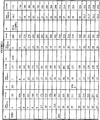
- the loci, allelic designation and base pair sizes for the mixture are shown in Figure 1 .
- the nomenclature for the loci is discussed in Gill et al. 1996 Int. Journal Leg. Med. 10914-22 .
- allelic ladder mixture was presented in PARR buffer (containing Tris and 1.5mM Mg ions at pH8.0) obtained from Cambio, primers obtained from Oswell and Taq polymerase from Perkin Elmer.
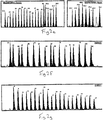
- Electrophoretograms for the allelic ladders are shown in Figures 2a to 2g with the allelic number designations shown.
- Figures 3a to 3f show the sequences for the alleles identified in Figures 2a to 2g .
- the allelic ladder mixture discussed above was produced according to the following techniques. Buccal swabs and/or bloodstains were used as the sample sources. The genomic DNA was extracted using the chelex procedure described by Walsh et al. 1991 Bio. Techniques 191-98 .
- the recovered DNA was quantified by dot hybridisation using a higher primate specific probe, as disclosed in Walsh et al. 1992 Nucleic Acids Res. 20 5061-5065 .
- the singleplexs produced in this way were analysed on an Applied Biosystems 377 automated sequencer to confirm the sequences.
- the sequences obtained from the profiling system are one base longer than those determined form the DNA sequencing technique initially discussed above. This is due to the ability of DNA polymerase from Thermus aquaticus to catalyse a non-template mediated addition of a deoxyribonucleotide to the 3' hydroxyl of PCR products. This is generally known as the "n+1" product and can be generated in preference to the "n” product. The results reported here, however, refer to the "n” product rather than the "n+1" product for which the labelled primer PCR conditions have been optimised to produce.
- the single ladders produced in this way were then mixed together to give the cocktail discussed above.
- the proportions of each ladder used are controlled to give balanced peak areas.
- the cocktail was then validated using Applied Biosystems 373A and Applied Biosystems 377 automated sequencers with Genescan and Genotyper software.
- Allelic ladders according to the invention can be prepared by applying PCR amplification techniques to a pre-existing sample of the allelic ladder mixture.
- allelic ladders can be constructed from the sequence information provided herein.
- the new ladders disclosed above significantly extends the range of alleles which can be identified in any DNA profiling system.
- the allelic ladder mixture is used as a control sample alongside samples from known or unknown individuals which are then segregated according to size in a gel. Alleles in the sample under test can be designated by the known alleles in the control if they are within 0.5 bases of one another. Alleles falling outside this range are estimated based on their position relative to the ladder.
- the ladder range for each locus defined by the extreme low molecular weight and extreme high molecular weight alleles are :- Locus Low MW allele High MW allele HUMVWFA31/A 10 21 HUMTH01 4 13.3 D8S1179 7 19 HUMFIBRA/FGA 16.1 50.2 D21S11 53 81 D18S51 8 27
- allelic ladders also enables the identification of certain rare and hence highly discriminatory alleles, in DNA profiling thus increasing the profiling systems power.
- the primers used for this locus were labelled with 6-FAM.
- Particular alleles provided by the present invention include 4, 9.3, 10 and 13.3.
- the 9.3 and 13.3 alleles were found to have a deletion of a thiamine nucleotide at either the last base of the 4th repeat unit or the first base of the 5th repeat unit.
- the 13.3 allele notably possesses a non-consensus tetranucleotide (TCGT) at the 13th repeat.
- TCGT non-consensus tetranucleotide
- the primers for this locus were also labelled with 6-FAM.
- the allele range extends from 53 to 81 and significantly includes alleles 53, 56, 57, 79 and 81.
- the polymorphic region of the D21S11 alleles is relatively complex in structure and is based around the tetranucleotide TCTR, where R is A or G (following the ambiguity codes of the Nomenclature Committee of the International Union of Biochemistry), as well as containing invariant hexa-, tri- and di-nucleotides.
- Both allele 54 and allele 56 deviate from this general structure in that they possess a deletion of a 14 base pair TA(TCTA) 3 unit immediately prior to the invariant TCA tetranucleotide.
- the ladder extends to 20 distinct alleles with particularly significant alleles at 8, 9, 23, 24, 25, 26 and 27.
- the polymorphic region is based around a simple tetranucleotide repeat motif (AGAA) n , where n is 8 to 27.
- the primers used for this locus were labelled with TET.
- the ladder extends from alleles 7 to 19, based on 13 separate alleles. Significant alleles include 7, 15, 18 and 19.
- Different generalised structures were observed between the upper and lower molecular weight ends of the ladder. In the lower molecular weight area, 161 to 177 base pairs, a simple repeat region based on the tetranucleotide TCTA exists. In the higher weight region, 181 to 201 base pairs, a compound repeat region composed of the tetranucleotide TCTR was found.
- HEX labelled primers were used for this locus.
- the ladder covers alleles between 10 and 21, based on 12 alleles in total. Noteworthy alleles 10, 11 and 12 are included.
- the polymorphic unit is generally composed of a compound repeat following the pattern (TCTR) n . For the 13 and 14 alleles a non-consensus TCCA tetranucleotide at the 10th and 11th repeats was found.
- This locus also employed HEX labelled primers. As mentioned above this ladder was constructed in two separate components. A low molecular weight and high molecular weight mix was used to produce the overall ladder. The low molecular weight mix ranges from allele 16.1 to 34.2 and the high molecular weight mix from allele 42.2 to 50.2.
- the low MW mix includes significant alleles 16.1,28,30,30.2,31.2,32.2,33.2 and 34.2.
- the high MW mix includes noteworthy alleles 42.2, 43.2, 44.2, 45.2, 47.2, 48.2 and 50.2.
- the HUMFIBRA/FGA alleles have a polymorphic unit based around the compound repeat YYBY, with the alleles in the upper part of the weight range being more complex in structure than those in the lower part.
- allele 16.1 has a T nucleotide addition in the repeat region and allele 27 has a C to T transition in the 19th repeat unit (CTTT to CCTT).
- CTTT to CCTT C to T transition in the 19th repeat unit
- the upper MW allele range includes a stutter peak which is 4 base pairs smaller than the 50.2 allele. This artifact corresponds to allele 49.2 which has not currently been determined.
- TTTC 16.1 (TTTC) 3 TTTT TTCT (CTTT) 5 T (CTTT) 3 CTCC (TTCC) 2 27 (TTTC) 3 TTTT TTCT (CTTT) 13 CCTT (CTTT) 5 CTCC (TTCC) 2 30 (TTTC) 3 TTTT TTCT (CTTT) 16 CCTT (CTTT) 5 CTCC (TTCC) 2 31.2 (TTTC) 4 TTTT TT (CTTT) 15 (CTTC) 3 (CTTT) 3 CTCC (TTCC) 4 32.2 (TTTT) 4 TTTT TT (CTTT) 16 (CTTC) 3 (CTTT) 3 CTCC (TTCC) 4 33.2 (TTTC) 4 TTTT TT (CTTT) 17 (CTTC) 3 (CTTT) 3 CTCC (TTCC) 4 42.2 (TTTC) 4 TTTT TT (CTTT) 8 (CTGT) 4 (CTTT) 13 (CTTC) 4 (CTTT) 3 CTCC (TTCC) 4 43.2 (TTTC) 4 TTTT
Landscapes
- Chemical & Material Sciences (AREA)
- Life Sciences & Earth Sciences (AREA)
- Organic Chemistry (AREA)
- Proteomics, Peptides & Aminoacids (AREA)
- Health & Medical Sciences (AREA)
- Engineering & Computer Science (AREA)
- Zoology (AREA)
- Analytical Chemistry (AREA)
- Wood Science & Technology (AREA)
- Biochemistry (AREA)
- Molecular Biology (AREA)
- Immunology (AREA)
- Biotechnology (AREA)
- Genetics & Genomics (AREA)
- General Health & Medical Sciences (AREA)
- General Engineering & Computer Science (AREA)
- Bioinformatics & Cheminformatics (AREA)
- Biophysics (AREA)
- Physics & Mathematics (AREA)
- Microbiology (AREA)
- Cell Biology (AREA)
- Measuring Or Testing Involving Enzymes Or Micro-Organisms (AREA)
- Medicines That Contain Protein Lipid Enzymes And Other Medicines (AREA)
- Micro-Organisms Or Cultivation Processes Thereof (AREA)
- Other Investigation Or Analysis Of Materials By Electrical Means (AREA)
- Investigating Or Analysing Materials By Optical Means (AREA)
- Investigating, Analyzing Materials By Fluorescence Or Luminescence (AREA)
- Detergent Compositions (AREA)
Applications Claiming Priority (3)
| Application Number | Priority Date | Filing Date | Title |
|---|---|---|---|
| GBGB9713597.4A GB9713597D0 (en) | 1997-06-28 | 1997-06-28 | Improvements in and relating to forensic identification |
| EP98305120A EP0887426B2 (de) | 1997-06-28 | 1998-06-29 | Verbesserungen der forensischen Erkennung |
| EP06022099.3A EP1754794B1 (de) | 1997-06-28 | 1998-06-29 | Verbesserungen zur forensischen Erkennung |
Related Parent Applications (4)
| Application Number | Title | Priority Date | Filing Date |
|---|---|---|---|
| EP98305120A Division EP0887426B2 (de) | 1997-06-28 | 1998-06-29 | Verbesserungen der forensischen Erkennung |
| EP06022099.3A Division EP1754794B1 (de) | 1997-06-28 | 1998-06-29 | Verbesserungen zur forensischen Erkennung |
| EP98305120.2 Division | 1998-06-29 | ||
| EP06022099.3 Division | 2006-10-21 |
Publications (3)
| Publication Number | Publication Date |
|---|---|
| EP2594650A2 true EP2594650A2 (de) | 2013-05-22 |
| EP2594650A3 EP2594650A3 (de) | 2013-10-16 |
| EP2594650B1 EP2594650B1 (de) | 2014-08-27 |
Family
ID=10815013
Family Applications (6)
| Application Number | Title | Priority Date | Filing Date |
|---|---|---|---|
| EP12188582.6A Expired - Lifetime EP2594650B1 (de) | 1997-06-28 | 1998-06-29 | Verbesserungen zur forensischen Erkennung |
| EP06022099.3A Expired - Lifetime EP1754794B1 (de) | 1997-06-28 | 1998-06-29 | Verbesserungen zur forensischen Erkennung |
| EP07003709A Withdrawn EP1803827A3 (de) | 1997-06-28 | 1998-06-29 | Verbesserungen bei und in Zusammenhang mit forensischer Identifizierung |
| EP98305120A Expired - Lifetime EP0887426B2 (de) | 1997-06-28 | 1998-06-29 | Verbesserungen der forensischen Erkennung |
| EP06022098A Withdrawn EP1754793A3 (de) | 1997-06-28 | 1998-06-29 | Verbesserungen zur forensischen Erkennung |
| EP07003707A Withdrawn EP1803826A3 (de) | 1997-06-28 | 1998-06-29 | Verbesserungen bei und in Zusammenhang mit forensischer Identifizierung |
Family Applications After (5)
| Application Number | Title | Priority Date | Filing Date |
|---|---|---|---|
| EP06022099.3A Expired - Lifetime EP1754794B1 (de) | 1997-06-28 | 1998-06-29 | Verbesserungen zur forensischen Erkennung |
| EP07003709A Withdrawn EP1803827A3 (de) | 1997-06-28 | 1998-06-29 | Verbesserungen bei und in Zusammenhang mit forensischer Identifizierung |
| EP98305120A Expired - Lifetime EP0887426B2 (de) | 1997-06-28 | 1998-06-29 | Verbesserungen der forensischen Erkennung |
| EP06022098A Withdrawn EP1754793A3 (de) | 1997-06-28 | 1998-06-29 | Verbesserungen zur forensischen Erkennung |
| EP07003707A Withdrawn EP1803826A3 (de) | 1997-06-28 | 1998-06-29 | Verbesserungen bei und in Zusammenhang mit forensischer Identifizierung |
Country Status (10)
| Country | Link |
|---|---|
| US (7) | US7087380B2 (de) |
| EP (6) | EP2594650B1 (de) |
| AT (1) | ATE347614T1 (de) |
| AU (1) | AU7324098A (de) |
| CA (1) | CA2236364A1 (de) |
| DE (1) | DE69836573D1 (de) |
| DK (1) | DK1754794T3 (de) |
| GB (1) | GB9713597D0 (de) |
| NZ (1) | NZ330828A (de) |
| ZA (1) | ZA985663B (de) |
Families Citing this family (40)
| Publication number | Priority date | Publication date | Assignee | Title |
|---|---|---|---|---|
| GB9713597D0 (en) | 1997-06-28 | 1997-09-03 | Sec Dep Of The Home Department | Improvements in and relating to forensic identification |
| US20100268658A1 (en) * | 2001-05-14 | 2010-10-21 | Prolacta Bioscience | Method for collecting, testing and distributing milk |
| US20020182243A1 (en) * | 2001-05-14 | 2002-12-05 | Medo Elena Maria | Method of producing nutritional products from human milk tissue and compositions thereof |
| AU2003300963A1 (en) | 2002-12-13 | 2004-07-09 | Gene Codes Forensics, Inc. | Method for profiling and identifying persons by using data samples |
| CN102759466A (zh) | 2004-09-15 | 2012-10-31 | 英特基因有限公司 | 微流体装置 |
| EP1926834A4 (de) | 2005-09-20 | 2009-04-22 | Prolacta Bioscience Inc | Verfahren zum testen von milch |
| WO2008030631A2 (en) | 2006-02-03 | 2008-03-13 | Microchip Biotechnologies, Inc. | Microfluidic devices |
| US20080194414A1 (en) * | 2006-04-24 | 2008-08-14 | Albert Thomas J | Enrichment and sequence analysis of genomic regions |
| CN105123950A (zh) * | 2006-11-29 | 2015-12-09 | 普罗莱克塔生物科学公司 | 人乳组合物及其制备和使用方法 |
| CN101631469B (zh) * | 2006-12-08 | 2014-04-02 | 普罗莱克塔生物科学公司 | 人类脂质组合物及其制备和使用方法 |
| KR20100028526A (ko) | 2007-02-05 | 2010-03-12 | 마이크로칩 바이오테크놀로지스, 인크. | 마이크로유체 및 나노유체 장치, 시스템 및 응용 |
| WO2009042728A1 (en) * | 2007-09-24 | 2009-04-02 | Allelogic Biosciences Corporation | Detection and /or quantification of nucleic acids |
| WO2009108260A2 (en) * | 2008-01-22 | 2009-09-03 | Microchip Biotechnologies, Inc. | Universal sample preparation system and use in an integrated analysis system |
| GB0811796D0 (en) | 2008-06-27 | 2008-07-30 | Forensic Science Service Ltd | Improvements in and relating to analysis |
| JP2012510476A (ja) | 2008-12-02 | 2012-05-10 | プロラクタ バイオサイエンス,インコーポレイテッド | ヒト乳透過組成物ならびにその製造および使用方法 |
| EP2384429A1 (de) | 2008-12-31 | 2011-11-09 | Integenx Inc. | Instrument mit mikrofluidischem chip |
| US8769689B2 (en) | 2009-04-24 | 2014-07-01 | Hb Gary, Inc. | Digital DNA sequence |
| EP2438154A1 (de) | 2009-06-02 | 2012-04-11 | Integenx Inc. | Fluidische vorrichtung mit membranventilen |
| AU2010256429B2 (en) | 2009-06-05 | 2015-09-17 | Integenx Inc. | Universal sample preparation system and use in an integrated analysis system |
| US8484152B2 (en) * | 2009-06-26 | 2013-07-09 | Hbgary, Inc. | Fuzzy hash algorithm |
| EP2504433B1 (de) * | 2009-11-25 | 2014-10-29 | Life Technologies Corporation | Allelleiter-loci |
| US8584703B2 (en) | 2009-12-01 | 2013-11-19 | Integenx Inc. | Device with diaphragm valve |
| US8512538B2 (en) | 2010-05-28 | 2013-08-20 | Integenx Inc. | Capillary electrophoresis device |
| EP2606154B1 (de) | 2010-08-20 | 2019-09-25 | Integenx Inc. | Integriertes analysesystem |
| EP2606242B1 (de) | 2010-08-20 | 2026-04-01 | Integenx Inc. | Mikrofluidikvorrichtungen mit mechanisch abgedichteten membranventilen |
| WO2012091717A1 (en) * | 2010-12-30 | 2012-07-05 | Analogic Corporation | Identifying and/or correcting an allelic ladder signal for dna analysis |
| PL2739157T3 (pl) | 2011-08-03 | 2018-03-30 | Prolacta Bioscience, Inc. | Mikrofiltracja ludzkiego mleka dla redukcji zanieczyszczenia bakteryjnego |
| GB201116131D0 (en) * | 2011-09-19 | 2011-11-02 | Epistem Ltd | Probe |
| US20150136604A1 (en) | 2011-10-21 | 2015-05-21 | Integenx Inc. | Sample preparation, processing and analysis systems |
| US10865440B2 (en) | 2011-10-21 | 2020-12-15 | IntegenX, Inc. | Sample preparation, processing and analysis systems |
| JP6853665B2 (ja) | 2013-03-13 | 2021-03-31 | プロラクタ バイオサイエンス,インコーポレイテッド | 高脂質ヒト乳製品 |
| US9556482B2 (en) | 2013-07-03 | 2017-01-31 | The United States Of America, As Represented By The Secretary Of Commerce | Mouse cell line authentication |
| CN105873681B (zh) | 2013-11-18 | 2019-10-11 | 尹特根埃克斯有限公司 | 用于样本分析的卡盒和仪器 |
| US10208332B2 (en) | 2014-05-21 | 2019-02-19 | Integenx Inc. | Fluidic cartridge with valve mechanism |
| WO2015189336A1 (en) | 2014-06-11 | 2015-12-17 | Samplix S.A.R.L. | Nucleotide sequence exclusion enrichment by droplet sorting (needls) |
| WO2016065073A1 (en) | 2014-10-22 | 2016-04-28 | Integenx Inc. | Systems and methods for sample preparation, processing and analysis |
| US10577643B2 (en) | 2015-10-07 | 2020-03-03 | Illumina, Inc. | Off-target capture reduction in sequencing techniques |
| US11344041B2 (en) | 2015-12-30 | 2022-05-31 | Prolacta Bioscience, Inc. | Human milk products useful in pre- and post-operative care |
| MX2022002949A (es) | 2019-09-24 | 2022-04-06 | Prolacta Bioscience Inc | Composiciones y metodos para el tratamiento de enfermedades inflamatorias e inmunes. |
| US12462562B2 (en) | 2022-12-23 | 2025-11-04 | Andy Tsz Kwan CHAN | Multipurpose visual and auditory intelligent observer system |
Family Cites Families (7)
| Publication number | Priority date | Publication date | Assignee | Title |
|---|---|---|---|---|
| DE3834636A1 (de) | 1988-10-11 | 1990-04-19 | Max Planck Gesellschaft | Verfahren zur analyse von laengenpolymorphismen in dna-bereichen |
| US5364759B2 (en) | 1991-01-31 | 1999-07-20 | Baylor College Medicine | Dna typing with short tandem repeat polymorphisms and identification of polymorphic short tandem repeats |
| US5599666A (en) * | 1994-03-28 | 1997-02-04 | Promega Corporation | Allelic ladders for short tandem repeat loci |
| US7008771B1 (en) | 1994-09-30 | 2006-03-07 | Promega Corporation | Multiplex amplification of short tandem repeat loci |
| US5688642A (en) * | 1994-12-01 | 1997-11-18 | The United States Of America As Represented By The Secretary Of The Navy | Selective attachment of nucleic acid molecules to patterned self-assembled surfaces |
| US6156512A (en) | 1996-05-23 | 2000-12-05 | Promega Corp | Allelic ladders for short tandem repeat loci |
| GB9713597D0 (en) * | 1997-06-28 | 1997-09-03 | Sec Dep Of The Home Department | Improvements in and relating to forensic identification |
-
1997
- 1997-06-28 GB GBGB9713597.4A patent/GB9713597D0/en active Pending
-
1998
- 1998-06-29 ZA ZA9805663A patent/ZA985663B/xx unknown
- 1998-06-29 NZ NZ330828A patent/NZ330828A/xx not_active IP Right Cessation
- 1998-06-29 AU AU73240/98A patent/AU7324098A/en not_active Abandoned
- 1998-06-29 EP EP12188582.6A patent/EP2594650B1/de not_active Expired - Lifetime
- 1998-06-29 AT AT98305120T patent/ATE347614T1/de not_active IP Right Cessation
- 1998-06-29 DE DE69836573T patent/DE69836573D1/de not_active Expired - Lifetime
- 1998-06-29 EP EP06022099.3A patent/EP1754794B1/de not_active Expired - Lifetime
- 1998-06-29 EP EP07003709A patent/EP1803827A3/de not_active Withdrawn
- 1998-06-29 EP EP98305120A patent/EP0887426B2/de not_active Expired - Lifetime
- 1998-06-29 EP EP06022098A patent/EP1754793A3/de not_active Withdrawn
- 1998-06-29 CA CA002236364A patent/CA2236364A1/en not_active Abandoned
- 1998-06-29 EP EP07003707A patent/EP1803826A3/de not_active Withdrawn
- 1998-06-29 DK DK06022099.3T patent/DK1754794T3/da active
-
2001
- 2001-07-20 US US09/910,183 patent/US7087380B2/en not_active Expired - Lifetime
-
2005
- 2005-10-04 US US11/244,331 patent/US20060029975A1/en not_active Abandoned
-
2007
- 2007-06-21 US US11/821,259 patent/US7645580B2/en not_active Expired - Fee Related
-
2009
- 2009-12-07 US US12/632,608 patent/US20100330559A1/en not_active Abandoned
-
2011
- 2011-04-18 US US13/089,099 patent/US20110269128A1/en not_active Abandoned
- 2011-12-19 US US13/330,581 patent/US8399191B2/en not_active Expired - Fee Related
-
2013
- 2013-02-07 US US13/761,648 patent/US8940484B2/en not_active Expired - Fee Related
Non-Patent Citations (8)
| Title |
|---|
| BARBER ET AL., INT. JOURNAL LEG. MED., vol. 108, 1996, pages 180 - 185 |
| BARBER; PARKIN, INT. JOURNAL LEG. MED., vol. 109, 1996, pages 62 - 65 |
| GILL ET AL., INT. JOURNAL LEG. MED., 1996, pages 10914 - 22 |
| HAEMOGENETICS, INT. JOURNAL LEG. MED., vol. 107, 1994, pages 159 - 160 |
| OLDROYD ET AL., ELECTROPHORESIS, vol. 16, 1995, pages 334 - 337 |
| URQUHART ET AL., BIO TECHNIQUES, vol. 18, 1995, pages 116 - 121 |
| WALSH ET AL., BIO. TECHNIQUES, vol. 1, 1991, pages 91 - 98 |
| WALSH ET AL., NUCLEIC ACIDS RES., vol. 20, 1992, pages 5061 - 5065 |
Also Published As
Similar Documents
| Publication | Publication Date | Title |
|---|---|---|
| EP1754794B1 (de) | Verbesserungen zur forensischen Erkennung | |
| US5721100A (en) | Three highly informative microsatellite repeat polymorphic DNA markers | |
| Richardson et al. | Hybridization of microsatellites to RAPD: a new source of polymorphic markers | |
| Sajantila et al. | The polymerase chain reaction and post-mortem forensic identity testing: application of amplified D1S80 and HLA-DQα loci to the identification of fire victims | |
| CA2251793A1 (en) | Multiplex amplification of short tandem repeat loci | |
| Lareu et al. | A highly variable STR at the D12S391 locus | |
| Dubovsky et al. | Sets of short tandem repeat polymorphisms for efficient linkage screening of the human genome | |
| WO1997039138B1 (en) | Multiplex amplification of short tandem repeat loci | |
| Lareu et al. | Sequence variation of a hypervariable short tandem repeat at the D1S1656 locus | |
| Gomolka et al. | Selected di-and tetranucleotide microsatellites from chromosomes 7, 12, 14, and Y in various Eurasian populations | |
| EP1021559B1 (de) | Verfahren und reagentiensatz zur amplifizierung, sequenzierung und typisierung von hla i genen | |
| Puers et al. | Allelic ladder characterization of the short tandem repeat polymorphism located in the 5′ flanking region to the human coagulation factor XIII A subunit gene | |
| Barber et al. | Structural variation of novel alleles at the Hum vWA and Hum FES/FPS short tandem repeat loci | |
| KR100552684B1 (ko) | 인간 mody 1, 4, 5, 6 및 7 유전자 증폭용 다중pcr 프라이머 세트 | |
| Feichtlbauer-Huber et al. | Reference-strand-mediated conformation analysis of MHC alleles: a new method for high-resolution typing of the Ovar-DQB genes. | |
| Margolis-Nunno et al. | A new allele of the short tandem repeat (STR) locus, CSF1PO | |
| AU2003200444B2 (en) | Improvements in and relating to forensic identification | |
| Klintschar et al. | Genetic variation and sequence studies of a highly variable short tandem repeat at the D17S976 locus: Received: 7 October 1997/Received in revised form: 7 May 1998 | |
| Bellas et al. | Minisatellite variant repeat coding using a semiautomatic system | |
| WO1997020949A1 (en) | An improved method for dye-terminator (cycle) sequencing | |
| Pöltl et al. | The short tandem repeat loci hTPO, THO1 and FGA | |
| US20020037502A1 (en) | Method for sequencing of nucleic acid polymers | |
| KR20220152605A (ko) | 한우의 육량 관련 adh1c 유전자의 유전형 결정용 프라이머 세트 및 이의 용도 | |
| Miścicka-Śliwka et al. | Allele Frequencies of D1S80, LDLR, GYPA, D7S8, GC, HBGG and SE 33 in Polish Population Sample |
Legal Events
| Date | Code | Title | Description |
|---|---|---|---|
| PUAI | Public reference made under article 153(3) epc to a published international application that has entered the european phase |
Free format text: ORIGINAL CODE: 0009012 |
|
| AC | Divisional application: reference to earlier application |
Ref document number: 0887426 Country of ref document: EP Kind code of ref document: P Ref document number: 1754794 Country of ref document: EP Kind code of ref document: P |
|
| AK | Designated contracting states |
Kind code of ref document: A2 Designated state(s): AT BE CH CY DE DK ES FI FR GB GR IE IT LI LU MC NL PT SE |
|
| RIC1 | Information provided on ipc code assigned before grant |
Ipc: C12Q 1/68 20060101AFI20130514BHEP |
|
| PUAL | Search report despatched |
Free format text: ORIGINAL CODE: 0009013 |
|
| RIC1 | Information provided on ipc code assigned before grant |
Ipc: C12Q 1/68 20060101AFI20130904BHEP |
|
| AK | Designated contracting states |
Kind code of ref document: A3 Designated state(s): AT BE CH CY DE DK ES FI FR GB GR IE IT LI LU MC NL PT SE |
|
| RIC1 | Information provided on ipc code assigned before grant |
Ipc: C12Q 1/68 20060101AFI20130910BHEP |
|
| 17P | Request for examination filed |
Effective date: 20131220 |
|
| RBV | Designated contracting states (corrected) |
Designated state(s): AT BE CH CY DE DK ES FI FR GB GR IE IT LI LU MC NL PT SE |
|
| 17Q | First examination report despatched |
Effective date: 20140210 |
|
| GRAP | Despatch of communication of intention to grant a patent |
Free format text: ORIGINAL CODE: EPIDOSNIGR1 |
|
| INTG | Intention to grant announced |
Effective date: 20140515 |
|
| GRAS | Grant fee paid |
Free format text: ORIGINAL CODE: EPIDOSNIGR3 |
|
| GRAA | (expected) grant |
Free format text: ORIGINAL CODE: 0009210 |
|
| AC | Divisional application: reference to earlier application |
Ref document number: 1754794 Country of ref document: EP Kind code of ref document: P Ref document number: 0887426 Country of ref document: EP Kind code of ref document: P |
|
| AK | Designated contracting states |
Kind code of ref document: B1 Designated state(s): AT BE CH CY DE DK ES FI FR GB GR IE IT LI LU MC NL PT SE |
|
| REG | Reference to a national code |
Ref country code: GB Ref legal event code: FG4D |
|
| REG | Reference to a national code |
Ref country code: CH Ref legal event code: EP |
|
| REG | Reference to a national code |
Ref country code: AT Ref legal event code: REF Ref document number: 684584 Country of ref document: AT Kind code of ref document: T Effective date: 20140915 |
|
| REG | Reference to a national code |
Ref country code: IE Ref legal event code: FG4D |
|
| REG | Reference to a national code |
Ref country code: DE Ref legal event code: R096 Ref document number: 69843294 Country of ref document: DE Effective date: 20141009 |
|
| REG | Reference to a national code |
Ref country code: AT Ref legal event code: MK05 Ref document number: 684584 Country of ref document: AT Kind code of ref document: T Effective date: 20140827 |
|
| REG | Reference to a national code |
Ref country code: NL Ref legal event code: VDEP Effective date: 20140827 |
|
| PG25 | Lapsed in a contracting state [announced via postgrant information from national office to epo] |
Ref country code: ES Free format text: LAPSE BECAUSE OF FAILURE TO SUBMIT A TRANSLATION OF THE DESCRIPTION OR TO PAY THE FEE WITHIN THE PRESCRIBED TIME-LIMIT Effective date: 20140827 Ref country code: GR Free format text: LAPSE BECAUSE OF FAILURE TO SUBMIT A TRANSLATION OF THE DESCRIPTION OR TO PAY THE FEE WITHIN THE PRESCRIBED TIME-LIMIT Effective date: 20141128 Ref country code: PT Free format text: LAPSE BECAUSE OF FAILURE TO SUBMIT A TRANSLATION OF THE DESCRIPTION OR TO PAY THE FEE WITHIN THE PRESCRIBED TIME-LIMIT Effective date: 20141229 Ref country code: SE Free format text: LAPSE BECAUSE OF FAILURE TO SUBMIT A TRANSLATION OF THE DESCRIPTION OR TO PAY THE FEE WITHIN THE PRESCRIBED TIME-LIMIT Effective date: 20140827 Ref country code: FI Free format text: LAPSE BECAUSE OF FAILURE TO SUBMIT A TRANSLATION OF THE DESCRIPTION OR TO PAY THE FEE WITHIN THE PRESCRIBED TIME-LIMIT Effective date: 20140827 |
|
| PG25 | Lapsed in a contracting state [announced via postgrant information from national office to epo] |
Ref country code: CY Free format text: LAPSE BECAUSE OF FAILURE TO SUBMIT A TRANSLATION OF THE DESCRIPTION OR TO PAY THE FEE WITHIN THE PRESCRIBED TIME-LIMIT Effective date: 20140827 Ref country code: AT Free format text: LAPSE BECAUSE OF FAILURE TO SUBMIT A TRANSLATION OF THE DESCRIPTION OR TO PAY THE FEE WITHIN THE PRESCRIBED TIME-LIMIT Effective date: 20140827 |
|
| PG25 | Lapsed in a contracting state [announced via postgrant information from national office to epo] |
Ref country code: NL Free format text: LAPSE BECAUSE OF FAILURE TO SUBMIT A TRANSLATION OF THE DESCRIPTION OR TO PAY THE FEE WITHIN THE PRESCRIBED TIME-LIMIT Effective date: 20140827 |
|
| PG25 | Lapsed in a contracting state [announced via postgrant information from national office to epo] |
Ref country code: DK Free format text: LAPSE BECAUSE OF FAILURE TO SUBMIT A TRANSLATION OF THE DESCRIPTION OR TO PAY THE FEE WITHIN THE PRESCRIBED TIME-LIMIT Effective date: 20140827 |
|
| REG | Reference to a national code |
Ref country code: DE Ref legal event code: R097 Ref document number: 69843294 Country of ref document: DE |
|
| REG | Reference to a national code |
Ref country code: FR Ref legal event code: PLFP Year of fee payment: 18 |
|
| PLBE | No opposition filed within time limit |
Free format text: ORIGINAL CODE: 0009261 |
|
| STAA | Information on the status of an ep patent application or granted ep patent |
Free format text: STATUS: NO OPPOSITION FILED WITHIN TIME LIMIT |
|
| 26N | No opposition filed |
Effective date: 20150528 |
|
| PG25 | Lapsed in a contracting state [announced via postgrant information from national office to epo] |
Ref country code: MC Free format text: LAPSE BECAUSE OF FAILURE TO SUBMIT A TRANSLATION OF THE DESCRIPTION OR TO PAY THE FEE WITHIN THE PRESCRIBED TIME-LIMIT Effective date: 20140827 |
|
| PG25 | Lapsed in a contracting state [announced via postgrant information from national office to epo] |
Ref country code: LU Free format text: LAPSE BECAUSE OF FAILURE TO SUBMIT A TRANSLATION OF THE DESCRIPTION OR TO PAY THE FEE WITHIN THE PRESCRIBED TIME-LIMIT Effective date: 20150629 |
|
| REG | Reference to a national code |
Ref country code: IE Ref legal event code: MM4A |
|
| PG25 | Lapsed in a contracting state [announced via postgrant information from national office to epo] |
Ref country code: IE Free format text: LAPSE BECAUSE OF NON-PAYMENT OF DUE FEES Effective date: 20150629 |
|
| REG | Reference to a national code |
Ref country code: FR Ref legal event code: PLFP Year of fee payment: 19 |
|
| PG25 | Lapsed in a contracting state [announced via postgrant information from national office to epo] |
Ref country code: BE Free format text: LAPSE BECAUSE OF FAILURE TO SUBMIT A TRANSLATION OF THE DESCRIPTION OR TO PAY THE FEE WITHIN THE PRESCRIBED TIME-LIMIT Effective date: 20140827 |
|
| REG | Reference to a national code |
Ref country code: FR Ref legal event code: PLFP Year of fee payment: 20 |
|
| PGFP | Annual fee paid to national office [announced via postgrant information from national office to epo] |
Ref country code: FR Payment date: 20170621 Year of fee payment: 20 Ref country code: GB Payment date: 20170620 Year of fee payment: 20 Ref country code: DE Payment date: 20170621 Year of fee payment: 20 Ref country code: CH Payment date: 20170620 Year of fee payment: 20 |
|
| PGFP | Annual fee paid to national office [announced via postgrant information from national office to epo] |
Ref country code: IT Payment date: 20170622 Year of fee payment: 20 |
|
| REG | Reference to a national code |
Ref country code: DE Ref legal event code: R071 Ref document number: 69843294 Country of ref document: DE |
|
| REG | Reference to a national code |
Ref country code: CH Ref legal event code: PL |
|
| REG | Reference to a national code |
Ref country code: GB Ref legal event code: PE20 Expiry date: 20180628 |
|
| PG25 | Lapsed in a contracting state [announced via postgrant information from national office to epo] |
Ref country code: GB Free format text: LAPSE BECAUSE OF EXPIRATION OF PROTECTION Effective date: 20180628 |