EP2586880A1 - Procédé de traitement thermique de pièces micromécaniques horlogères - Google Patents
Procédé de traitement thermique de pièces micromécaniques horlogères Download PDFInfo
- Publication number
- EP2586880A1 EP2586880A1 EP12180554.3A EP12180554A EP2586880A1 EP 2586880 A1 EP2586880 A1 EP 2586880A1 EP 12180554 A EP12180554 A EP 12180554A EP 2586880 A1 EP2586880 A1 EP 2586880A1
- Authority
- EP
- European Patent Office
- Prior art keywords
- component
- locally
- micromechanical
- watchmaking
- hardness
- Prior art date
- Legal status (The legal status is an assumption and is not a legal conclusion. Google has not performed a legal analysis and makes no representation as to the accuracy of the status listed.)
- Granted
Links
Images
Classifications
-
- C—CHEMISTRY; METALLURGY
- C21—METALLURGY OF IRON
- C21D—MODIFYING THE PHYSICAL STRUCTURE OF FERROUS METALS; GENERAL DEVICES FOR HEAT TREATMENT OF FERROUS OR NON-FERROUS METALS OR ALLOYS; MAKING METAL MALLEABLE, e.g. BY DECARBURISATION OR TEMPERING
- C21D1/00—General methods or devices for heat treatment, e.g. annealing, hardening, quenching or tempering
- C21D1/06—Surface hardening
-
- C—CHEMISTRY; METALLURGY
- C21—METALLURGY OF IRON
- C21D—MODIFYING THE PHYSICAL STRUCTURE OF FERROUS METALS; GENERAL DEVICES FOR HEAT TREATMENT OF FERROUS OR NON-FERROUS METALS OR ALLOYS; MAKING METAL MALLEABLE, e.g. BY DECARBURISATION OR TEMPERING
- C21D9/00—Heat treatment, e.g. annealing, hardening, quenching or tempering, adapted for particular articles; Furnaces therefor
- C21D9/0068—Heat treatment, e.g. annealing, hardening, quenching or tempering, adapted for particular articles; Furnaces therefor for particular articles not mentioned below
-
- C—CHEMISTRY; METALLURGY
- C21—METALLURGY OF IRON
- C21D—MODIFYING THE PHYSICAL STRUCTURE OF FERROUS METALS; GENERAL DEVICES FOR HEAT TREATMENT OF FERROUS OR NON-FERROUS METALS OR ALLOYS; MAKING METAL MALLEABLE, e.g. BY DECARBURISATION OR TEMPERING
- C21D9/00—Heat treatment, e.g. annealing, hardening, quenching or tempering, adapted for particular articles; Furnaces therefor
- C21D9/32—Heat treatment, e.g. annealing, hardening, quenching or tempering, adapted for particular articles; Furnaces therefor for gear wheels, worm wheels, or the like
-
- G—PHYSICS
- G04—HOROLOGY
- G04B—MECHANICALLY-DRIVEN CLOCKS OR WATCHES; MECHANICAL PARTS OF CLOCKS OR WATCHES IN GENERAL; TIME PIECES USING THE POSITION OF THE SUN, MOON OR STARS
- G04B13/00—Gearwork
- G04B13/02—Wheels; Pinions; Spindles; Pivots
-
- G—PHYSICS
- G04—HOROLOGY
- G04D—APPARATUS OR TOOLS SPECIALLY DESIGNED FOR MAKING OR MAINTAINING CLOCKS OR WATCHES
- G04D3/00—Watchmakers' or watch-repairers' machines or tools for working materials
- G04D3/0074—Watchmakers' or watch-repairers' machines or tools for working materials for treatment of the material, e.g. surface treatment
- G04D3/0079—Watchmakers' or watch-repairers' machines or tools for working materials for treatment of the material, e.g. surface treatment for gearwork components
- G04D3/0082—Watchmakers' or watch-repairers' machines or tools for working materials for treatment of the material, e.g. surface treatment for gearwork components for gear wheels or gears
-
- C—CHEMISTRY; METALLURGY
- C21—METALLURGY OF IRON
- C21D—MODIFYING THE PHYSICAL STRUCTURE OF FERROUS METALS; GENERAL DEVICES FOR HEAT TREATMENT OF FERROUS OR NON-FERROUS METALS OR ALLOYS; MAKING METAL MALLEABLE, e.g. BY DECARBURISATION OR TEMPERING
- C21D1/00—General methods or devices for heat treatment, e.g. annealing, hardening, quenching or tempering
- C21D1/06—Surface hardening
- C21D1/08—Surface hardening with flames
-
- C—CHEMISTRY; METALLURGY
- C21—METALLURGY OF IRON
- C21D—MODIFYING THE PHYSICAL STRUCTURE OF FERROUS METALS; GENERAL DEVICES FOR HEAT TREATMENT OF FERROUS OR NON-FERROUS METALS OR ALLOYS; MAKING METAL MALLEABLE, e.g. BY DECARBURISATION OR TEMPERING
- C21D1/00—General methods or devices for heat treatment, e.g. annealing, hardening, quenching or tempering
- C21D1/06—Surface hardening
- C21D1/09—Surface hardening by direct application of electrical or wave energy; by particle radiation
-
- C—CHEMISTRY; METALLURGY
- C21—METALLURGY OF IRON
- C21D—MODIFYING THE PHYSICAL STRUCTURE OF FERROUS METALS; GENERAL DEVICES FOR HEAT TREATMENT OF FERROUS OR NON-FERROUS METALS OR ALLOYS; MAKING METAL MALLEABLE, e.g. BY DECARBURISATION OR TEMPERING
- C21D1/00—General methods or devices for heat treatment, e.g. annealing, hardening, quenching or tempering
- C21D1/06—Surface hardening
- C21D1/09—Surface hardening by direct application of electrical or wave energy; by particle radiation
- C21D1/10—Surface hardening by direct application of electrical or wave energy; by particle radiation by electric induction
-
- Y—GENERAL TAGGING OF NEW TECHNOLOGICAL DEVELOPMENTS; GENERAL TAGGING OF CROSS-SECTIONAL TECHNOLOGIES SPANNING OVER SEVERAL SECTIONS OF THE IPC; TECHNICAL SUBJECTS COVERED BY FORMER USPC CROSS-REFERENCE ART COLLECTIONS [XRACs] AND DIGESTS
- Y02—TECHNOLOGIES OR APPLICATIONS FOR MITIGATION OR ADAPTATION AGAINST CLIMATE CHANGE
- Y02P—CLIMATE CHANGE MITIGATION TECHNOLOGIES IN THE PRODUCTION OR PROCESSING OF GOODS
- Y02P10/00—Technologies related to metal processing
- Y02P10/25—Process efficiency
Definitions
- the present invention relates to a method of heat treatment of micromechanical watch parts. More specifically, the invention relates to a heat treatment process for the purpose of locally modifying certain physical properties of watch micromechanical parts such as toothed wheels.
- LIGA comes from German. It is an abbreviation for "Lithography, Galvanoformung, Abformung” which represent the different stages of this process. Briefly summarized, the LIGA process used in the horological field consists of UV irradiating through a photolithography mask a photosensitive resin deposited on a conductive substrate. After developing the resin, we proceed to a electroplating galvanization step during which metal is deposited in the microstructures previously developed in the photosensitive resin layer and whose contours correspond to the shapes of the desired parts. The last step is to remove the remaining photosensitive resin layer and to individualize the components thus obtained.
- the material used In the field of watchmaking, it is now several years since we are interested in the LIGA process. However, as will be understood from the above, one of the constraints on the LIGA process is that the material used must be electrolessly deposited. In the field of watchmaking, the first material used was nickel. This material has the advantage of being able to be used in the context of the LIGA process. It nevertheless has the disadvantage of being magnetic in the amorphous state, which makes it difficult to use for horological applications.
- the Applicant is currently interested in watchmaking micromechanical parts obtained by means of the LIGA process using a nickel and phosphorus alloy containing 12% by weight of phosphorus and which will be referred to as NiP12 alloy.
- NiP12 alloy has the great advantage of being non-magnetic in the amorphous state.
- the hardness of the parts made of NiP12 alloy by the LIGA process is average, of the order of 590 Hv. Wear problems directly related to this relatively low hardness appear under certain conditions on such watch micromechanical parts.
- the Applicant sought to increase the hardness of the gear teeth obtained by the LIGA process.
- a known technique in the field of the manufacture of massive mechanical parts for example for the aeronautic or automotive industry is to locally heat the teeth of the gears.
- the localized heating, for example by means of a laser beam of massive parts has the effect of increasing the hardness of the heated zones, this heating is accompanied by a weakening of the areas thus treated.
- the thermal inertia of these parts is such that only the directly heated surfaces undergo a phase transformation, the phase of the majority of the part retaining its intrinsic characteristics.
- the present invention therefore aims to overcome the drawbacks mentioned above by providing a method of heat treatment micromechanical watch parts for locally changing the physical properties of these parts without affecting their phase in the untreated parts.
- the present invention relates to a method of heat treatment of a watchmaking micromechanical component from the LIGA process and having a very low thermal inertia, this method comprising the step of locally heating a zone of the micromechanical watch component to increasing the hardness by local modification of the phase, the component being heated for a sufficiently short period of time so that only the locally heated zone is affected by the heat treatment, the component phase remaining unchanged in its untreated parts.
- the method according to the invention makes it possible to modify in a very localized way the hardness of the watchmaking micromechanical components by local modification of the phase of the heated zone, without this modification of the physical properties affecting the phase of the component in its untreated part.
- the invention thus makes it possible, for example, to increase in a very localized way the hardness of a micromechanical watchmaker component without as much affect the phase of this component in its untreated part.
- This point is very critical because it is known that if a heat treatment has the effect of hardening the heated zone of the component, the corollary of such treatment is to make the heated zone more fragile. It is therefore essential to heat only the area of the component whose hardness is to be increased so as not to weaken the component as a whole.
- the Applicant has subjected the teeth of a gear made by electroplating NiP12 according to the LIGA method to a point source of heat, for example of the laser type.
- the Applicant has found that subject to locally heating the teeth of the gear for a short period of time, it is possible to substantially increase the hardness of these teeth without affecting the phase of the gear in its untreated part. This result is all the more remarkable as it is easily understood that the thermal inertia of such a gear is low in view of its dimensions and the high temperatures reached by the laser beam.
- the method according to the invention is applicable to any type of micromechanical watchmaking part resulting from the LIGA process and made of a material chosen from the group formed by nickel and alloys of nickel and phosphorus, of tungsten or and micromechanical watchmaking parts derived from conventional processes and made of quenching-processable materials such as carbon steels or structurally hardened alloys such as copper / beryllium alloys.
- a laser beam is used, an induction heating system, a micro-torch functioning, for example, according to the principle of hydrolysis and recombination of the hydrogen and oxygen components of the water or any other system that makes it possible to apply very high energy density locally to locally harden the component.
- a small element such as a previously heated rod with the part to be treated, or by radiation by bringing such a previously heated element to the vicinity of the area to be treated.
- micromechanical watchmaker to change the hardness of the heated area.
- micromechanical component watchmaker means any type of piece such as gear, gear or other used in a watch movement and obtained either by conventional methods of shaping materials that can undergo a quenching treatment, or by the LIGA process . It has indeed been found, in some aging tests, that nickel / phosphorus components with 12% by weight of phosphorus obtained by the LIGA process showed abnormally rapid wear. To solve this problem, it has been contemplated to cure such components as gears in regions where they are in contact with adjacent components. Nevertheless, the only known technique for increasing the hardness of mechanical components is to heat these components locally.
- this phase transformation is accompanied by an increase in the hardness of the heated zones by a factor of approximately 2.
- This last indication also makes it possible to understand that it is not conceivable that the hardness of the gear increases in such proportions throughout the volume of the part, otherwise such parts could no longer be mounted according to traditional techniques. of hunting by risk of breaking them.
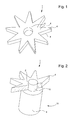
- the figure 1 is a top view of a watch component made by electroplating NiP12 according to the LIGA method.
- the watch component is a wheel.
- this wheel comprises a hub 2 from which radially extends a plurality of teeth 4 regularly spaced.
- This wheel 1 comprises an upper face 6 and a lower face 8.
- the hardness of amorphous NiP12 after LIGA process but before heat treatment is 590 Hv +/- 30 Hv. It can be seen that the hardness of the hub 2 of the wheel 1 after heat treatment according to the invention is between 605 and 613 Hv depending on the part under consideration and according to whether the measurement has been made on the upper face or on the lower face of the part. . It is therefore clear from the foregoing results that the hardness of the hub 2 of the wheel 1 is not affected by the heat treatment to which the teeth 4 of the wheel 1 are subjected.
- the hardness of a tooth 4 after its end has been thermally treated by means of a laser beam is included, according to the room considered and according to whether the measurement was performed on the upper face or the lower face of the tooth 4, between 996 and 1020 Hv, which represents an increase in the hardness of the end of the tooth of the order of 50% relative to the hardness of the amorphous material directly from the LIGA process and not heat treated.
- the hardness of the heat-treated zones increases in a ratio of about 50% with respect to the NiP12 material in the amorphous phase obtained directly by the LIGA process. It will be noted that the change of structure of the NiP12 material from an amorphous state after electrodeposition to a state in which it undergoes a phase separation with precipitation of the nickel and phosphorus components in the form of nickel and Ni 3 P is observed from 200 ° vs.
- the inventive merit of the plaintiff is to have been able to go against prejudices of the state of the art. Indeed, it is known that to increase the hardness of the functional areas of massive parts, these areas can be heated. Nevertheless, the heating is accompanied by embrittlement and magnetization of the heated areas. In the case of massive pieces, however, this is not problematic because the piece in its volume is not affected. It is quite different with micromechanical watchmaking components whose dimensions and mass are low and which one could think that they would be affected by the heat treatment even in their untreated parts. On the contrary, the applicant has succeeded in demonstrating that not only localized heating of the functional areas of a watch component such as a wheel was possible, but that such heating was accompanied only by hardening of the heated zones. while the component kept its primitive phase in its untreated zones.
- the result of the invention is a watch component whose functional areas are hardened and therefore more resistant with a hub which remains ductile and which can therefore be assembled by driving according to traditional techniques.
- FIG. figure 2 For the implementation of the method according to the invention, it is advantageous to use a setting 10 as illustrated in FIG. figure 2 .
- This posage 10 is in the form of a stepped cylinder with a first portion 12 whose outer diameter substantially corresponds to the inner diameter of the hub 2 of the wheel 1, and with a second portion 14 whose outer diameter is greater than that of the first portion 12 so that the wheel 1 can bear.
- a pose plays a role in the successful implementation of the method according to the invention.
- the toothed wheel 1 illustrated in FIG. figure 2 the dimensions of the teeth 4 are small compared to those of the hub 2 of the wheel 1, so that the hub 2 of the wheel 1 acts as a heat sink and this heat diffuses in the setting 10.
- the The temperature of the hub 2 of the wheel 1 never reaches values that would cause a phase transformation and a concomitant increase in its hardness.
Landscapes
- Chemical & Material Sciences (AREA)
- Engineering & Computer Science (AREA)
- Physics & Mathematics (AREA)
- Thermal Sciences (AREA)
- Crystallography & Structural Chemistry (AREA)
- Mechanical Engineering (AREA)
- Materials Engineering (AREA)
- Metallurgy (AREA)
- Organic Chemistry (AREA)
- General Physics & Mathematics (AREA)
- Heat Treatment Of Articles (AREA)
Abstract
Description
- La présente invention concerne un procédé de traitement thermique de pièces micromécaniques horlogères. Plus précisément, l'invention concerne un procédé de traitement thermique ayant pour but de modifier localement certaines propriétés physiques de pièces de micromécanique horlogère telles que des roues dentées.
- On cherche parfois, pour répondre à des besoins spécifiques, à modifier localement les propriétés physiques telles que la dureté, le magnétisme ou bien encore la ductilité de pièces micromécaniques horlogères. Ceci est notamment le cas dans le cadre du procédé LIGA qui est un procédé de plus en plus couramment employé dans le domaine de la construction horlogère. Ce procédé permet en effet de fabriquer en série des pièces de micromécanique avec une précision tout à fait remarquable et avec une enveloppe de coût qui reste compatible avec les exigences de la fabrication industrielle. Cependant, comme on le verra en détail ci-après, les pièces de micromécanique horlogère obtenues au moyen du procédé LIGA présentent parfois des problèmes de résistance à l'usure que l'on cherche à corriger.
- L'acronyme "LIGA" provient de l'allemand. C'est une abréviation pour "Lithographie, Galvanoformung, Abformung" qui représentent les différentes étapes de ce procédé. Succinctement résumé, le procédé LIGA utilisé dans le domaine horloger consiste à insoler aux UV à travers un masque de photolithographie une résine photosensible déposée sur un substrat conducteur. Après développement de la résine, on procède à une étape de galvanisation par électrodéposition au cours de laquelle du métal est déposé dans les microstructures développées précédemment dans la couche de résine photosensible et dont les contours correspondent aux formes des pièces recherchées. La dernière étape consiste à éliminer la couche de résine photosensible restante et à individualiser les composants ainsi obtenus.
- Dans le domaine de l'horlogerie, cela fait maintenant plusieurs années que l'on s'intéresse au procédé LIGA. Cependant, comme on l'aura compris de ce qui précède, l'une des contraintes qui pèse sur le procédé LIGA est que le matériau utilisé doit pouvoir être déposé par électrolyse. Dans le domaine de l'horlogerie, le premier matériau utilisé a été le nickel. Ce matériau présente l'avantage de pouvoir être mis en oeuvre dans le cadre du procédé LIGA. Il présente néanmoins l'inconvénient d'être magnétique à l'état amorphe, ce qui le rend difficilement utilisable pour des applications horlogères.
- La demanderesse s'intéresse actuellement à des pièces de micromécanique horlogère obtenues au moyen du procédé LIGA à l'aide d'un alliage de nickel et de phosphore contenant 12% en poids de phosphore et que l'on appellera par la suite alliage NiP12. Cet alliage NiP12 présente le grand intérêt d'être amagnétique à l'état amorphe. Par contre, la dureté des pièces réalisées en alliage NiP12 par le procédé LIGA est moyenne, de l'ordre de 590 Hv. Des problèmes d'usure directement liés à cette dureté relativement faible apparaissent dans certaines conditions sur de telles pièces de micromécanique horlogère.
- Face à ce problème d'usure, la demanderesse a cherché à accroître la dureté des dents des engrenages obtenus par le procédé LIGA. Une technique connue dans le domaine de la fabrication de pièces mécaniques massives par exemple pour l'industrie aéronautique ou automobile consiste à chauffer localement les dents des engrenages. On sait néanmoins que si le chauffage localisé, par exemple au moyen d'un faisceau laser, de pièces massives a pour effet d'augmenter la dureté des zones chauffées, cet échauffement s'accompagne d'une fragilisation des zones ainsi traitées. Néanmoins, dans le domaine de la fabrication de pièces mécaniques massives, l'inertie thermique de ces pièces est telle que seules les surfaces directement chauffées subissent une transformation de phase, la phase de la majorité de la pièce conservant ses caractéristiques intrinsèques.
- Il n'en va pas du tout de même dans le domaine de la construction horlogère où les pièces présentent couramment des épaisseurs de l'ordre de quelques dizaines à quelques centaines de microns et où les dimensions excèdent rarement le millimètre.
- La présente invention a donc pour but de pallier les inconvénients mentionnés ci-dessus en procurant un procédé de traitement thermique de pièces micromécaniques horlogères permettant de modifier localement les propriétés physiques de ces pièces sans pour autant affecter leur phase dans les parties non traitées.
- A cet effet, la présente invention concerne un procédé de traitement thermique d'un composant micromécanique horloger issu du procédé LIGA et présentant une inertie thermique très faible, ce procédé comprenant l'étape qui consiste à chauffer localement une zone du composant micromécanique horloger pour en augmenter la dureté par modification locale de la phase, le composant étant chauffé durant un laps de temps suffisamment court pour que seule la zone chauffée localement soit affectée par le traitement thermique, la phase du composant restant inchangée dans ses parties non traitées.
- Grâce à ces caractéristiques, le procédé selon l'invention permet de modifier de manière très localisée la dureté des composants micromécaniques horlogers par modification locale de la phase de la zone chauffée, sans que cette modification des propriétés physiques n'affecte la phase du composant dans sa partie non traitée.
- L'invention permet ainsi, par exemple, d'augmenter de manière très localisée la dureté d'un composant micromécanique horloger sans pour autant affecter la phase de ce composant dans sa partie non traitée. Ce point est très critique car l'on sait que si un traitement thermique a pour effet de durcir la zone chauffée du composant, le corolaire d'un tel traitement est de rendre la zone chauffée plus fragile. Il est par conséquent essentiel de ne chauffer que la zone du composant dont on souhaite augmenter la dureté afin de ne pas fragiliser le composant dans son ensemble.
- S'étant assigné cet objectif, la demanderesse a soumis les dents d'un engrenage réalisé par électrodéposition de NiP12 selon le procédé LIGA à une source de chaleur ponctuelle par exemple du type laser.
- A sa grande surprise, la demanderesse a constaté que sous réserve d'échauffer localement les dents de l'engrenage pendant un laps de temps court, il est possible d'accroître sensiblement la dureté de ces dents sans pour autant affecter la phase de l'engrenage dans sa partie non traitée. Ce résultat est d'autant plus remarquable que l'on comprend aisément que l'inertie thermique d'un tel engrenage est faible au regard de ses dimensions et des températures élevées atteintes par le faisceau laser.
- Ce résultat est confirmé par une analyse cristallographique d'un engrenage qui permet d'observer la transformation de phase induite par le chauffage. En effet, dans les zones chauffées de l'engrenage qui est initialement à l'état amorphe, les composants nickel et phosphore subissent une séparation de phase et précipitent sous la forme de nickel et de Ni3P. De même, la dureté des zones chauffées de l'engrenage augmente de l'ordre de 50% par rapport à la dureté intrinsèque de l'alliage NiP12, tandis que la dureté de l'engrenage dans sa partie non traitée ne varie pratiquement pas. Enfin, on observe une légère magnétisation des zones chauffées de l'engrenage, sans que cela soit pour autant préjudiciable au bon fonctionnement du mécanisme horloger dans lequel l'engrenage est intégré.
- Selon une caractéristique complémentaire, le procédé selon l'invention s'applique à tout type de pièce micromécanique horlogère issue du procédé LIGA et réalisée en un matériau choisi dans le groupe formé par les nickels et les alliages de nickel et de phosphore, de tungstène ou de fer, ainsi qu'à des pièces micromécaniques horlogères issues de procédés conventionnels et réalisées dans des matériaux pouvant subir un traitement de trempe comme les aciers au carbone ou les alliages à durcissement structural tels que les alliages cuivre/béryllium.
- Selon une autre caractéristique de l'invention, on utilise un faisceau laser, un système de chauffage par induction, un micro-chalumeau fonctionnant, par exemple, suivant le principe de l'hydrolyse et de la recombinaison des composants hydrogène et oxygène de l'eau ou tout autre système permettant d'appliquer très localement une haute densité d'énergie pour durcir localement le composant. A titre d'exemple, on peut également envisager de chauffer localement le composant soit par contact d'un petit élément tel qu'une tige préalablement chauffée avec la partie à traiter, soit par rayonnement en amenant un tel élément préalablement chauffé au voisinage de la zone à traiter.
- D'autres caractéristiques et avantages de la présente invention ressortiront plus clairement de la description détaillée qui suit d'un mode de mise en oeuvre du procédé selon l'invention, cet exemple étant donné à titre purement illustratif et non limitatif seulement en liaison avec le dessin annexé sur lequel:
- la
figure 1 est une vue en perspective d'un composant horloger réalisé par électrodéposition de NiP12 selon le procédé LIGA, et - la
figure 2 est une vue en perspective du composant horloger de lafigure 1 monté sur un posage pour la mise en oeuvre du procédé de l'invention. - La présente invention procède de l'idée générale inventive qui consiste à chauffer brièvement et de manière très localisée un composant micromécanique horloger afin de modifier la dureté de la zone chauffée. Par composant micromécanique horloger, on entend tout type de pièce telle qu'engrenage, roue dentée ou autre utilisée dans un mouvement horloger et obtenue soit par des procédés conventionnels de mise en forme de matériaux pouvant subir un traitement de trempe, soit par le procédé LIGA. On s'est en effet rendu compte, lors de certains tests de vieillissement, que des composants en nickel/phosphore à 12% en poids de phosphore obtenus par le procédé LIGA présentaient une usure anormalement rapide. Pour résoudre ce problème, il a été envisagé de durcir ces composants tels que des engrenages dans les régions où ceux-ci sont en contact avec des composants adjacents. Néanmoins, la seule technique connue pour augmenter la dureté de composants mécaniques consiste à chauffer localement ces composants. Or, le chauffage de tels composants, s'il permet d'augmenter leur dureté, s'accompagne en même temps d'une fragilisation des zones chauffées. Cette technique est utilisée avec succès pour des pièces massives destinées par exemple à l'aéronautique ou à l'automobile. En effet, étant donné leurs dimensions, de telles pièces massives présentent une inertie thermique suffisamment élevée pour que seules les zones chauffées soient affectées par le traitement thermique, la phase de la pièce dans sa partie non traitée restant inchangée. Il n'en va par contre pas de même dans le domaine de l'horlogerie où les composants sont de très petites dimensions et présentent une inertie thermique très faible. Malgré tout, la demanderesse, allant à l'encontre de ces préjugés, s'est rendu compte qu'en chauffant de manière très localisée et pendant un laps de temps très court des composants micromécaniques horlogers, il était possible d'augmenter la dureté des zones chauffées sans affecter la phase des composants horlogers dans leur partie no ntraitée et donc leur tenue mécanique. Dans le cas particulier d'une roue dentée réalisée en un alliage de nickel et de phosphore à 12% en poids de phosphore, la demanderesse s'est aperçue qu'un chauffage localisé en bout des dents de l'engrenage s'accompagnait d'une transformation de phases. En effet, l'alliage qui est initialement à l'état amorphe, subit une séparation de phase avec précipitation des composants nickel et phosphore sous la forme de nickel et de Ni3P. Parallèlement, cette transformation de phases s'accompagne d'une augmentation de la dureté des zones chauffées d'un facteur 2 environ. Cette dernière indication permet également de comprendre qu'il n'est pas envisageable que la dureté de l'engrenage augmente dans de telles proportions dans tout le volume de la pièce, faute de quoi de telles pièces ne pourraient plus être montées selon les techniques traditionnelles de chassage par risque de les casser. Enfin, on observe une légère magnétisation des zones fonctionnelles localement chauffées des composants, sans que cela atteigne pour autant des valeurs préjudiciables.
- La
figure 1 est une vue de dessus d'un composant horloger réalisé par électrodéposition de NiP12 selon le procédé LIGA. Dans l'exemple illustré, le composant horloger est une roue. Désignée dans son ensemble par la référence numérique générale 1, cette roue comprend un moyeu 2 à partir duquel s'étend radialement une pluralité de dents 4 régulièrement espacées. Cette roue 1 comprend une face supérieure 6 et une face inférieure 8. - Le tableau ci-dessous résume les mesures de dureté Vickers effectuées en différents points de la roue 1 illustrée à la
figure 1 . Ces mesures de dureté ont été effectuées sur les faces supérieure 6 et inférieure 8 de deux pièces différentes mais de géométries identiques obtenues par électrodéposition de NiP12 selon le même procédé LIGA.Pièce 1 Pièce 2 Point de mesure Dessus Dessous Dessus Dessous Dent 4 1020 998 996 1010 Moyeu 2 613 607 605 607 - La dureté du NiP12 amorphe après procédé LIGA mais avant traitement thermique est de 590 Hv +/- 30 Hv. On constate que la dureté du moyeu 2 de la roue 1 après traitement thermique selon l'invention est comprise entre 605 et 613 Hv selon la pièce considérée et selon que la mesure ait été effectuée sur la face supérieure ou sur la face inférieure de la pièce. On comprend donc, au vu des résultats qui précèdent, que la dureté du moyeu 2 de la roue 1 n'est nullement affectée par le traitement thermique auquel sont soumises les dents 4 de la roue 1. Par contre, la dureté d'une dent 4 après que son extrémité ait été traitée thermiquement au moyen d'un faisceau laser est comprise, selon la pièce considérée et selon que la mesure ait été effectuée sur la face supérieure ou la face inférieure de la dent 4, entre 996 et 1020 Hv, ce qui représente une augmentation de la dureté de l'extrémité de la dent de l'ordre de 50% par rapport à la dureté du matériau amorphe directement issu du procédé LIGA et non traité thermiquement.
- On constate donc, au vu de ce qui précède, que la dureté des zones traitées thermiquement augmente dans un rapport compris de l'ordre de 50% par rapport au matériau NiP12 en phase amorphe obtenu directement par le procédé LIGA. On notera que le changement de structure du matériau NiP12 d'un état amorphe après électrodéposition à un état dans lequel il subit une séparation de phase avec précipitation des composants nickel et phosphore sous la forme de nickel et de Ni3P est observé dès 200 °C.
- Il va de soi que la présente invention n'est pas limitée au mode de mise en oeuvre qui vient d'être décrit et que diverses modifications et variantes simples peuvent être envisagées par l'homme du métier sans sortir du cadre des revendications annexées à la présente demande de brevet. En particulier, on peut imaginer de chauffer les composants tels que des roues par induction. Dans ce cas, on utilise un anneau posé sur la roue et dont le diamètre correspond au diamètre extérieur de la roue, puis on fait circuler un courant alternatif dans l'anneau.
- Le mérite inventif de la demanderesse est d'avoir été capable d'aller à l'encontre des préjugés de l'état de la technique. En effet, il est connu que pour accroître la dureté des zones fonctionnelles de pièces massives, on peut chauffer ces zones. Néanmoins, le chauffage s'accompagne d'une fragilisation et d'une magnétisation des zones chauffées. Dans le cas de pièces massives, cela n'est toutefois pas problématique car la pièce dans son volume n'est pas affectée. Il en va tout autrement avec des composants micromécaniques horlogers dont les dimensions et la masse sont faibles et dont on pouvait donc penser qu'ils seraient affectés par le traitement thermique même dans leurs parties non traitées. Bien au contraire, la demanderesse a réussi à démontrer que non seulement un chauffage localisé des zones fonctionnelles d'un composant horloger tel qu'une roue était possible, mais encore qu'un tel chauffage s'accompagnait uniquement d'un durcissement des zones chauffées, tandis que le composant conservait sa phase primitive dans ses zones non traitées. Le résultat de l'invention est un composant horloger dont les zones fonctionnelles sont durcies et donc plus résistantes avec un moyeu qui reste ductile et qui peut donc être assemblé par chassage selon les techniques traditionnelles.
- Bien évidemment, on comprendra qu'en fonction des besoins spécifiques, on peut chercher à modifier d'autres propriétés physiques des composants horlogers. C'est ainsi que l'on peut, par exemple, vouloir rendre un composant localement magnétique, ou bien modifier la ductilité d'un tel composant, soit dans le sens d'un accroissement, soit dans le sens d'une diminution. Il faut en effet bien comprendre que l'apport inventif de l'invention ne se résume pas simplement à une augmentation localisée de la dureté de composants micromécaniques horlogers, mais que cet apport concerne très généralement la modification localisée et contrôlée par traitement thermique des propriétés physiques de tels composants.
- Pour la mise en oeuvre du procédé selon l'invention, on peut avantageusement utiliser un posage 10 tel qu'illustré à la
figure 2 . Ce posage 10 se présente sous la forme d'un cylindre étagé avec une première portion 12 dont le diamètre extérieur correspond sensiblement au diamètre intérieur du moyeu 2 de la roue 1, et avec une seconde portion 14 dont le diamètre extérieur est supérieur à celui de la première portion 12 de façon que la roue 1 puisse prendre appui. De l'avis de la demanderesse, un tel posage 10 joue un rôle dans la réussite de la mise en oeuvre du procédé selon l'invention. En effet, dans le cas de la roue dentée 1 illustrée à lafigure 2 , les dimensions des dents 4 sont faibles par rapport à celles du moyeu 2 de la roue 1, de sorte que le moyeu 2 de la roue 1 joue le rôle de puits de chaleur et que cette chaleur diffuse dans le posage 10. Ainsi, la température du moyeu 2 de la roue 1 n'atteint jamais des valeurs qui provoqueraient une transformation de phase et une augmentation concomitante de sa dureté.
Claims (5)
- Procédé de traitement thermique d'un composant micromécanique horloger issu du procédé LIGA et présentant une inertie thermique très faible, ce procédé comprenant l'étape qui consiste à chauffer localement une zone du composant micromécanique horloger pour en augmenter la dureté par modification locale de la phase, le composant étant chauffé durant un laps de temps suffisamment court pour que seule la zone chauffée localement soit affectée par le traitement thermique, la phase du composant restant inchangée dans ses parties non traitées.
- Procédé selon la revendication 1, caractérisé en ce que, pour durcir localement le composant, on utilise un faisceau laser, un système de chauffage par induction, un micro-chalumeau ou bien un élément préalablement chauffé qui chauffe localement le composant soit par contact direct, soit par rayonnement.
- Procédé selon l'une quelconque des revendications 1 ou 2, caractérisé en ce que le procédé s'applique à tout type de pièce micromécanique horlogère issue du procédé LIGA et réalisée en un matériau choisi dans le groupe formé par les nickels et les alliages de nickel et de phosphore, de tungstène ou de fer, ainsi qu'à des pièces micromécaniques horlogères issues de procédés conventionnels et réalisées dans des matériaux pouvant subir un traitement de trempe comme les aciers au carbone ou les alliages à durcissement structural tels que les alliages cuivre/béryllium.
- Procédé selon l'une quelconque des revendications 1 à 3, caractérisé en ce que la zone du composant qui doit être chauffée localement est portée à une température d'au moins 200° C.
- Procédé selon l'une quelconque des revendications 1 à 4, caractérisé en ce que, pour la mise en oeuvre du procédé, le composant micromécanique horloger est posé sur un posage (10) dans lequel la chaleur induite par le chauffage diffuse.
Priority Applications (1)
| Application Number | Priority Date | Filing Date | Title |
|---|---|---|---|
| EP12180554.3A EP2586880B1 (fr) | 2011-10-27 | 2012-08-15 | Procédé de traitement thermique de pièces micromécaniques horlogères |
Applications Claiming Priority (2)
| Application Number | Priority Date | Filing Date | Title |
|---|---|---|---|
| EP11186833.7A EP2586879A1 (fr) | 2011-10-27 | 2011-10-27 | Procédé de traitement thermique de pièces micromécaniques horlogères |
| EP12180554.3A EP2586880B1 (fr) | 2011-10-27 | 2012-08-15 | Procédé de traitement thermique de pièces micromécaniques horlogères |
Publications (2)
| Publication Number | Publication Date |
|---|---|
| EP2586880A1 true EP2586880A1 (fr) | 2013-05-01 |
| EP2586880B1 EP2586880B1 (fr) | 2014-04-23 |
Family
ID=46640609
Family Applications (2)
| Application Number | Title | Priority Date | Filing Date |
|---|---|---|---|
| EP11186833.7A Withdrawn EP2586879A1 (fr) | 2011-10-27 | 2011-10-27 | Procédé de traitement thermique de pièces micromécaniques horlogères |
| EP12180554.3A Active EP2586880B1 (fr) | 2011-10-27 | 2012-08-15 | Procédé de traitement thermique de pièces micromécaniques horlogères |
Family Applications Before (1)
| Application Number | Title | Priority Date | Filing Date |
|---|---|---|---|
| EP11186833.7A Withdrawn EP2586879A1 (fr) | 2011-10-27 | 2011-10-27 | Procédé de traitement thermique de pièces micromécaniques horlogères |
Country Status (5)
| Country | Link |
|---|---|
| US (1) | US9359652B2 (fr) |
| EP (2) | EP2586879A1 (fr) |
| JP (1) | JP5632893B2 (fr) |
| CN (1) | CN103088189B (fr) |
| RU (1) | RU2012145861A (fr) |
Cited By (1)
| Publication number | Priority date | Publication date | Assignee | Title |
|---|---|---|---|---|
| EP3862819A1 (fr) * | 2020-02-04 | 2021-08-11 | Rolex Sa | Procédé de traitement thermique d'un composant horloger |
Families Citing this family (8)
| Publication number | Priority date | Publication date | Assignee | Title |
|---|---|---|---|---|
| EP3009896B1 (fr) * | 2014-10-17 | 2020-03-11 | Nivarox-FAR S.A. | Pièce monobloc en métal électroformé |
| EP4166695A1 (fr) * | 2015-12-18 | 2023-04-19 | Rolex Sa | Procédé de fabrication d'un composant horloger |
| KR102081191B1 (ko) * | 2016-06-24 | 2020-02-26 | 에이피시스템 주식회사 | 전주도금법을 이용한 미세 금속 마스크 제조방법 |
| BE1027475B1 (fr) * | 2020-01-22 | 2021-02-26 | Laser Eng Applications | Procédé de traitement thermique en volume et système associé |
| EP3968095B1 (fr) * | 2020-09-15 | 2026-02-18 | ETA SA Manufacture Horlogère Suisse | Procédé de fabrication d'un composant de micromécanique, notamment d'un mobile d'horlogerie, avec surface de contact optimisee |
| EP3968096B1 (fr) * | 2020-09-15 | 2026-04-01 | ETA SA Manufacture Horlogère Suisse | Composant de micromécanique, notamment un mobile d horlogerie, notamment un mobile d' échappement, avec surface de contact optimisée |
| JP7684137B2 (ja) * | 2021-08-05 | 2025-05-27 | セイコーウオッチ株式会社 | 部品、部品を有する時計用ムーブメント、時計用ムーブメントを有する時計、および部品の製造方法 |
| JP7586149B2 (ja) * | 2022-08-09 | 2024-11-19 | カシオ計算機株式会社 | 外装部材、電子時計及び外装部材の製造方法 |
Citations (7)
| Publication number | Priority date | Publication date | Assignee | Title |
|---|---|---|---|---|
| JPS586930A (ja) * | 1981-07-03 | 1983-01-14 | Seiko Epson Corp | 時計部品の製造方法 |
| JPS5858271A (ja) * | 1981-10-02 | 1983-04-06 | Seiko Instr & Electronics Ltd | 時計部品の製造方法 |
| EP0147190B1 (fr) * | 1983-12-21 | 1988-03-02 | The Garrett Corporation | Procédé et dispositif pour le durcissement d'engrenages par laser |
| DD300306A7 (de) * | 1989-07-10 | 1992-06-04 | Ruhla Uhren Veb K | Verfahren zur partiellen Wärmebehandlung von metallischen Kleinteilen |
| EP1186683A1 (fr) * | 2000-09-04 | 2002-03-13 | Cafi Centre d'Analyses par Faisceau Ionique | Procédé de durcissement de la surface d'un substrat |
| EP1595972A1 (fr) * | 2004-05-10 | 2005-11-16 | Precision Engineering AG | Procédé de traitement des corps métalliques, particulièrement des composants pour montres |
| EP1835339A1 (fr) * | 2006-03-15 | 2007-09-19 | Doniar S.A. | Procédé de fabrication par technologie de type liga d'une structure métallique monocouche ou multicouche, et structure obtenue |
Family Cites Families (11)
| Publication number | Priority date | Publication date | Assignee | Title |
|---|---|---|---|---|
| DD200206A1 (de) * | 1981-09-09 | 1983-03-30 | Kurt Koerber | Verfahren zur senkung des dampfverbrauches |
| CH673555B5 (fr) | 1988-04-19 | 1990-09-28 | Rolex Montres | |
| IL128261A0 (en) * | 1999-01-27 | 1999-11-30 | Disc O Tech Medical Tech Ltd | Expandable element |
| RU2371290C2 (ru) * | 2004-06-08 | 2009-10-27 | Таг Хойер Са | Способ изготовления микро- и наномеханических компонентов, содержащий этап абляции с помощью фемтолазера |
| EP1804195A1 (fr) | 2005-12-29 | 2007-07-04 | Montres Breguet S.A. | Procédé de marquage codé d'un produit de petite taille, et produit marqué obtenu selon ledit procédé |
| EP1843225B1 (fr) * | 2006-04-07 | 2009-07-15 | ETA SA Manufacture Horlogère Suisse | Mécanisme inverseur pour entraînement rotatif unidirectionnel d'un mobile |
| CH705276B1 (fr) * | 2007-12-28 | 2013-01-31 | Chopard Technologies Sa | Organe d'entraînement et de transmission pour un échappement à ancre, plateau et échappement en étant équipés, et pièce d'horlogerie les comportant. |
| EP2112565B1 (fr) * | 2008-04-21 | 2010-10-20 | Rolex Sa | Pièce de micromécanique avec ouverture pour fixation sur un axe |
| EP2264553B1 (fr) * | 2009-06-19 | 2016-10-26 | Nivarox-FAR S.A. | Ressort thermocompensé et son procédé de fabrication |
| EP2413202B1 (fr) * | 2010-07-30 | 2017-11-15 | ETA SA Manufacture Horlogère Suisse | Procédé d'amélioration de tenue à l'usure et aux chocs d'un composant de mouvement d'horlogerie. Ancre pour mouvement d'horlogerie résistante à l'usure et aux chocs |
| CN102181620A (zh) * | 2011-05-06 | 2011-09-14 | 山西北方惠丰机电有限公司 | 一种带孔的层叠零件热处理方法 |
-
2011
- 2011-10-27 EP EP11186833.7A patent/EP2586879A1/fr not_active Withdrawn
-
2012
- 2012-08-15 EP EP12180554.3A patent/EP2586880B1/fr active Active
- 2012-10-23 US US13/657,997 patent/US9359652B2/en active Active
- 2012-10-26 RU RU2012145861/02A patent/RU2012145861A/ru not_active Application Discontinuation
- 2012-10-26 JP JP2012236336A patent/JP5632893B2/ja active Active
- 2012-10-26 CN CN201210417736.XA patent/CN103088189B/zh active Active
Patent Citations (7)
| Publication number | Priority date | Publication date | Assignee | Title |
|---|---|---|---|---|
| JPS586930A (ja) * | 1981-07-03 | 1983-01-14 | Seiko Epson Corp | 時計部品の製造方法 |
| JPS5858271A (ja) * | 1981-10-02 | 1983-04-06 | Seiko Instr & Electronics Ltd | 時計部品の製造方法 |
| EP0147190B1 (fr) * | 1983-12-21 | 1988-03-02 | The Garrett Corporation | Procédé et dispositif pour le durcissement d'engrenages par laser |
| DD300306A7 (de) * | 1989-07-10 | 1992-06-04 | Ruhla Uhren Veb K | Verfahren zur partiellen Wärmebehandlung von metallischen Kleinteilen |
| EP1186683A1 (fr) * | 2000-09-04 | 2002-03-13 | Cafi Centre d'Analyses par Faisceau Ionique | Procédé de durcissement de la surface d'un substrat |
| EP1595972A1 (fr) * | 2004-05-10 | 2005-11-16 | Precision Engineering AG | Procédé de traitement des corps métalliques, particulièrement des composants pour montres |
| EP1835339A1 (fr) * | 2006-03-15 | 2007-09-19 | Doniar S.A. | Procédé de fabrication par technologie de type liga d'une structure métallique monocouche ou multicouche, et structure obtenue |
Non-Patent Citations (1)
| Title |
|---|
| PRASAD S V ET AL: "LIGA Microsystems: Surface Interactions, Tribology, and Coatings", JOURNAL OF MANUFACTURING PROCESSES, SOCIETY OF MANUFACTURING ENGINEERS, DEARBORN, MI, US, vol. 6, no. 1, 1 January 2004 (2004-01-01), pages 107 - 116, XP025410215, ISSN: 1526-6125, [retrieved on 20040101], DOI: 10.1016/S1526-6125(04)70064-X * |
Cited By (2)
| Publication number | Priority date | Publication date | Assignee | Title |
|---|---|---|---|---|
| EP3862819A1 (fr) * | 2020-02-04 | 2021-08-11 | Rolex Sa | Procédé de traitement thermique d'un composant horloger |
| US12006556B2 (en) | 2020-02-04 | 2024-06-11 | Rolex Sa | Method for heat treating a horological component |
Also Published As
| Publication number | Publication date |
|---|---|
| HK1180733A1 (zh) | 2013-10-25 |
| CN103088189B (zh) | 2015-11-25 |
| JP2013096009A (ja) | 2013-05-20 |
| CN103088189A (zh) | 2013-05-08 |
| EP2586879A1 (fr) | 2013-05-01 |
| US9359652B2 (en) | 2016-06-07 |
| US20130105454A1 (en) | 2013-05-02 |
| EP2586880B1 (fr) | 2014-04-23 |
| JP5632893B2 (ja) | 2014-11-26 |
| RU2012145861A (ru) | 2014-05-10 |
Similar Documents
| Publication | Publication Date | Title |
|---|---|---|
| EP2586880B1 (fr) | Procédé de traitement thermique de pièces micromécaniques horlogères | |
| EP2757423B1 (fr) | Pièce pour mouvement d'horlogerie | |
| EP2757424B1 (fr) | Pièce pour mouvement d'horlogerie | |
| EP3273303B1 (fr) | Pièce pour mouvement d'horlogerie | |
| EP3273306B1 (fr) | Pièce pour mouvement d'horlogerie | |
| CH707504A2 (fr) | Axe de pivotement en métal pour mouvement horloger et procédé de fabrication d'un tel axe. | |
| FR3032723A1 (fr) | Procede de fabrication d'une piece en acier faiblement allie nitrure | |
| CH716669A1 (fr) | Procédé de fabrication d'un arbre de pivotement de balancier. | |
| TWI707985B (zh) | 單件式組件、具有此單件式組件的時計及製造單件式組件的方法 | |
| CH712719A2 (fr) | Composant horloger pour mouvement d'horlogerie. | |
| EP3339968B1 (fr) | Pièce pour mouvement d'horlogerie | |
| EP3273304B1 (fr) | Pièce pour mouvement d'horlogerie | |
| WO2022223478A1 (fr) | Procede de fabrication d'un axe de pivotement horloger et axe de pivotement horloger obtenu par ledit procede | |
| EP3273305B1 (fr) | Pièce pour mouvement d'horlogerie | |
| CH705667A2 (fr) | Procédé de traitement thermique de pièces micromécaniques horlogères. | |
| CH718939B1 (fr) | Axe de pivotement pour un composant pivotant d'un mouvement horloger. | |
| CH712718A2 (fr) | Axe de pivotement pour mouvement d'horlogerie. | |
| EP4327164A1 (fr) | Composant horloger et procede de fabrication d'un tel composant horloger | |
| EP3800511B1 (fr) | Axe de pivotement d'un organe réglant | |
| CH707505B1 (fr) | Axe de pivotement en métal pour mouvement horloger et procédé de fabrication d'un tel axe. | |
| CH706654A2 (fr) | Ressort-moteur pour une pièce d'horlogerie. | |
| CH718550A2 (fr) | Axe de pivotement horloger et procédé de fabrication d'un tel axe de pivotement horloger. | |
| CH716664A2 (fr) | Composant horloger amagnétique et dur, notamment axe de pivotement d'un organe réglant. | |
| CH712720A2 (fr) | Axe de pivotement pour mouvement horloger. | |
| CH722184A2 (fr) | Axe de pivotement amagnétique pour mouvement horloger, et procédé de traitement thermique |
Legal Events
| Date | Code | Title | Description |
|---|---|---|---|
| PUAI | Public reference made under article 153(3) epc to a published international application that has entered the european phase |
Free format text: ORIGINAL CODE: 0009012 |
|
| AK | Designated contracting states |
Kind code of ref document: A1 Designated state(s): AL AT BE BG CH CY CZ DE DK EE ES FI FR GB GR HR HU IE IS IT LI LT LU LV MC MK MT NL NO PL PT RO RS SE SI SK SM TR |
|
| AX | Request for extension of the european patent |
Extension state: BA ME |
|
| 17P | Request for examination filed |
Effective date: 20131104 |
|
| RBV | Designated contracting states (corrected) |
Designated state(s): AL AT BE BG CH CY CZ DE DK EE ES FI FR GB GR HR HU IE IS IT LI LT LU LV MC MK MT NL NO PL PT RO RS SE SI SK SM TR |
|
| GRAP | Despatch of communication of intention to grant a patent |
Free format text: ORIGINAL CODE: EPIDOSNIGR1 |
|
| INTG | Intention to grant announced |
Effective date: 20140107 |
|
| GRAS | Grant fee paid |
Free format text: ORIGINAL CODE: EPIDOSNIGR3 |
|
| GRAA | (expected) grant |
Free format text: ORIGINAL CODE: 0009210 |
|
| AK | Designated contracting states |
Kind code of ref document: B1 Designated state(s): AL AT BE BG CH CY CZ DE DK EE ES FI FR GB GR HR HU IE IS IT LI LT LU LV MC MK MT NL NO PL PT RO RS SE SI SK SM TR |
|
| REG | Reference to a national code |
Ref country code: GB Ref legal event code: FG4D Free format text: NOT ENGLISH |
|
| REG | Reference to a national code |
Ref country code: CH Ref legal event code: EP |
|
| REG | Reference to a national code |
Ref country code: AT Ref legal event code: REF Ref document number: 663928 Country of ref document: AT Kind code of ref document: T Effective date: 20140515 |
|
| REG | Reference to a national code |
Ref country code: IE Ref legal event code: FG4D Free format text: LANGUAGE OF EP DOCUMENT: FRENCH |
|
| REG | Reference to a national code |
Ref country code: DE Ref legal event code: R096 Ref document number: 602012001480 Country of ref document: DE Effective date: 20140605 |
|
| REG | Reference to a national code |
Ref country code: CH Ref legal event code: NV Representative=s name: ICB INGENIEURS CONSEILS EN BREVETS SA, CH |
|
| REG | Reference to a national code |
Ref country code: AT Ref legal event code: MK05 Ref document number: 663928 Country of ref document: AT Kind code of ref document: T Effective date: 20140423 |
|
| REG | Reference to a national code |
Ref country code: NL Ref legal event code: VDEP Effective date: 20140423 |
|
| REG | Reference to a national code |
Ref country code: LT Ref legal event code: MG4D |
|
| PG25 | Lapsed in a contracting state [announced via postgrant information from national office to epo] |
Ref country code: IS Free format text: LAPSE BECAUSE OF FAILURE TO SUBMIT A TRANSLATION OF THE DESCRIPTION OR TO PAY THE FEE WITHIN THE PRESCRIBED TIME-LIMIT Effective date: 20140823 Ref country code: FI Free format text: LAPSE BECAUSE OF FAILURE TO SUBMIT A TRANSLATION OF THE DESCRIPTION OR TO PAY THE FEE WITHIN THE PRESCRIBED TIME-LIMIT Effective date: 20140423 Ref country code: GR Free format text: LAPSE BECAUSE OF FAILURE TO SUBMIT A TRANSLATION OF THE DESCRIPTION OR TO PAY THE FEE WITHIN THE PRESCRIBED TIME-LIMIT Effective date: 20140724 Ref country code: CY Free format text: LAPSE BECAUSE OF FAILURE TO SUBMIT A TRANSLATION OF THE DESCRIPTION OR TO PAY THE FEE WITHIN THE PRESCRIBED TIME-LIMIT Effective date: 20140423 Ref country code: NO Free format text: LAPSE BECAUSE OF FAILURE TO SUBMIT A TRANSLATION OF THE DESCRIPTION OR TO PAY THE FEE WITHIN THE PRESCRIBED TIME-LIMIT Effective date: 20140723 Ref country code: NL Free format text: LAPSE BECAUSE OF FAILURE TO SUBMIT A TRANSLATION OF THE DESCRIPTION OR TO PAY THE FEE WITHIN THE PRESCRIBED TIME-LIMIT Effective date: 20140423 Ref country code: BG Free format text: LAPSE BECAUSE OF FAILURE TO SUBMIT A TRANSLATION OF THE DESCRIPTION OR TO PAY THE FEE WITHIN THE PRESCRIBED TIME-LIMIT Effective date: 20140723 Ref country code: LT Free format text: LAPSE BECAUSE OF FAILURE TO SUBMIT A TRANSLATION OF THE DESCRIPTION OR TO PAY THE FEE WITHIN THE PRESCRIBED TIME-LIMIT Effective date: 20140423 |
|
| PG25 | Lapsed in a contracting state [announced via postgrant information from national office to epo] |
Ref country code: LV Free format text: LAPSE BECAUSE OF FAILURE TO SUBMIT A TRANSLATION OF THE DESCRIPTION OR TO PAY THE FEE WITHIN THE PRESCRIBED TIME-LIMIT Effective date: 20140423 Ref country code: SE Free format text: LAPSE BECAUSE OF FAILURE TO SUBMIT A TRANSLATION OF THE DESCRIPTION OR TO PAY THE FEE WITHIN THE PRESCRIBED TIME-LIMIT Effective date: 20140423 Ref country code: HR Free format text: LAPSE BECAUSE OF FAILURE TO SUBMIT A TRANSLATION OF THE DESCRIPTION OR TO PAY THE FEE WITHIN THE PRESCRIBED TIME-LIMIT Effective date: 20140423 Ref country code: AT Free format text: LAPSE BECAUSE OF FAILURE TO SUBMIT A TRANSLATION OF THE DESCRIPTION OR TO PAY THE FEE WITHIN THE PRESCRIBED TIME-LIMIT Effective date: 20140423 Ref country code: PL Free format text: LAPSE BECAUSE OF FAILURE TO SUBMIT A TRANSLATION OF THE DESCRIPTION OR TO PAY THE FEE WITHIN THE PRESCRIBED TIME-LIMIT Effective date: 20140423 Ref country code: ES Free format text: LAPSE BECAUSE OF FAILURE TO SUBMIT A TRANSLATION OF THE DESCRIPTION OR TO PAY THE FEE WITHIN THE PRESCRIBED TIME-LIMIT Effective date: 20140423 Ref country code: RS Free format text: LAPSE BECAUSE OF FAILURE TO SUBMIT A TRANSLATION OF THE DESCRIPTION OR TO PAY THE FEE WITHIN THE PRESCRIBED TIME-LIMIT Effective date: 20140423 |
|
| PG25 | Lapsed in a contracting state [announced via postgrant information from national office to epo] |
Ref country code: PT Free format text: LAPSE BECAUSE OF FAILURE TO SUBMIT A TRANSLATION OF THE DESCRIPTION OR TO PAY THE FEE WITHIN THE PRESCRIBED TIME-LIMIT Effective date: 20140825 |
|
| REG | Reference to a national code |
Ref country code: DE Ref legal event code: R097 Ref document number: 602012001480 Country of ref document: DE |
|
| PG25 | Lapsed in a contracting state [announced via postgrant information from national office to epo] |
Ref country code: RO Free format text: LAPSE BECAUSE OF FAILURE TO SUBMIT A TRANSLATION OF THE DESCRIPTION OR TO PAY THE FEE WITHIN THE PRESCRIBED TIME-LIMIT Effective date: 20140423 Ref country code: DK Free format text: LAPSE BECAUSE OF FAILURE TO SUBMIT A TRANSLATION OF THE DESCRIPTION OR TO PAY THE FEE WITHIN THE PRESCRIBED TIME-LIMIT Effective date: 20140423 Ref country code: EE Free format text: LAPSE BECAUSE OF FAILURE TO SUBMIT A TRANSLATION OF THE DESCRIPTION OR TO PAY THE FEE WITHIN THE PRESCRIBED TIME-LIMIT Effective date: 20140423 Ref country code: CZ Free format text: LAPSE BECAUSE OF FAILURE TO SUBMIT A TRANSLATION OF THE DESCRIPTION OR TO PAY THE FEE WITHIN THE PRESCRIBED TIME-LIMIT Effective date: 20140423 Ref country code: SK Free format text: LAPSE BECAUSE OF FAILURE TO SUBMIT A TRANSLATION OF THE DESCRIPTION OR TO PAY THE FEE WITHIN THE PRESCRIBED TIME-LIMIT Effective date: 20140423 |
|
| PLBE | No opposition filed within time limit |
Free format text: ORIGINAL CODE: 0009261 |
|
| STAA | Information on the status of an ep patent application or granted ep patent |
Free format text: STATUS: NO OPPOSITION FILED WITHIN TIME LIMIT |
|
| PG25 | Lapsed in a contracting state [announced via postgrant information from national office to epo] |
Ref country code: IT Free format text: LAPSE BECAUSE OF FAILURE TO SUBMIT A TRANSLATION OF THE DESCRIPTION OR TO PAY THE FEE WITHIN THE PRESCRIBED TIME-LIMIT Effective date: 20140423 Ref country code: LU Free format text: LAPSE BECAUSE OF FAILURE TO SUBMIT A TRANSLATION OF THE DESCRIPTION OR TO PAY THE FEE WITHIN THE PRESCRIBED TIME-LIMIT Effective date: 20140815 Ref country code: MC Free format text: LAPSE BECAUSE OF FAILURE TO SUBMIT A TRANSLATION OF THE DESCRIPTION OR TO PAY THE FEE WITHIN THE PRESCRIBED TIME-LIMIT Effective date: 20140423 |
|
| 26N | No opposition filed |
Effective date: 20150126 |
|
| PG25 | Lapsed in a contracting state [announced via postgrant information from national office to epo] |
Ref country code: BE Free format text: LAPSE BECAUSE OF NON-PAYMENT OF DUE FEES Effective date: 20140831 |
|
| REG | Reference to a national code |
Ref country code: DE Ref legal event code: R097 Ref document number: 602012001480 Country of ref document: DE Effective date: 20150126 |
|
| REG | Reference to a national code |
Ref country code: IE Ref legal event code: MM4A |
|
| PG25 | Lapsed in a contracting state [announced via postgrant information from national office to epo] |
Ref country code: SI Free format text: LAPSE BECAUSE OF FAILURE TO SUBMIT A TRANSLATION OF THE DESCRIPTION OR TO PAY THE FEE WITHIN THE PRESCRIBED TIME-LIMIT Effective date: 20140423 |
|
| PG25 | Lapsed in a contracting state [announced via postgrant information from national office to epo] |
Ref country code: IE Free format text: LAPSE BECAUSE OF NON-PAYMENT OF DUE FEES Effective date: 20140815 |
|
| PG25 | Lapsed in a contracting state [announced via postgrant information from national office to epo] |
Ref country code: SM Free format text: LAPSE BECAUSE OF FAILURE TO SUBMIT A TRANSLATION OF THE DESCRIPTION OR TO PAY THE FEE WITHIN THE PRESCRIBED TIME-LIMIT Effective date: 20140423 |
|
| PG25 | Lapsed in a contracting state [announced via postgrant information from national office to epo] |
Ref country code: MT Free format text: LAPSE BECAUSE OF FAILURE TO SUBMIT A TRANSLATION OF THE DESCRIPTION OR TO PAY THE FEE WITHIN THE PRESCRIBED TIME-LIMIT Effective date: 20140423 |
|
| REG | Reference to a national code |
Ref country code: FR Ref legal event code: PLFP Year of fee payment: 5 |
|
| PG25 | Lapsed in a contracting state [announced via postgrant information from national office to epo] |
Ref country code: TR Free format text: LAPSE BECAUSE OF FAILURE TO SUBMIT A TRANSLATION OF THE DESCRIPTION OR TO PAY THE FEE WITHIN THE PRESCRIBED TIME-LIMIT Effective date: 20140423 Ref country code: HU Free format text: LAPSE BECAUSE OF FAILURE TO SUBMIT A TRANSLATION OF THE DESCRIPTION OR TO PAY THE FEE WITHIN THE PRESCRIBED TIME-LIMIT; INVALID AB INITIO Effective date: 20120815 |
|
| REG | Reference to a national code |
Ref country code: FR Ref legal event code: PLFP Year of fee payment: 6 |
|
| PG25 | Lapsed in a contracting state [announced via postgrant information from national office to epo] |
Ref country code: MK Free format text: LAPSE BECAUSE OF FAILURE TO SUBMIT A TRANSLATION OF THE DESCRIPTION OR TO PAY THE FEE WITHIN THE PRESCRIBED TIME-LIMIT Effective date: 20140423 |
|
| REG | Reference to a national code |
Ref country code: FR Ref legal event code: PLFP Year of fee payment: 7 |
|
| PG25 | Lapsed in a contracting state [announced via postgrant information from national office to epo] |
Ref country code: AL Free format text: LAPSE BECAUSE OF FAILURE TO SUBMIT A TRANSLATION OF THE DESCRIPTION OR TO PAY THE FEE WITHIN THE PRESCRIBED TIME-LIMIT Effective date: 20140423 |
|
| P01 | Opt-out of the competence of the unified patent court (upc) registered |
Effective date: 20230611 |
|
| PGFP | Annual fee paid to national office [announced via postgrant information from national office to epo] |
Ref country code: DE Payment date: 20250724 Year of fee payment: 14 |
|
| PGFP | Annual fee paid to national office [announced via postgrant information from national office to epo] |
Ref country code: GB Payment date: 20250725 Year of fee payment: 14 |
|
| PGFP | Annual fee paid to national office [announced via postgrant information from national office to epo] |
Ref country code: FR Payment date: 20250725 Year of fee payment: 14 |
|
| PGFP | Annual fee paid to national office [announced via postgrant information from national office to epo] |
Ref country code: CH Payment date: 20250901 Year of fee payment: 14 |