EP2584560B1 - Kodierverfahren und kodiervorrichtung - Google Patents
Kodierverfahren und kodiervorrichtung Download PDFInfo
- Publication number
- EP2584560B1 EP2584560B1 EP11866414.3A EP11866414A EP2584560B1 EP 2584560 B1 EP2584560 B1 EP 2584560B1 EP 11866414 A EP11866414 A EP 11866414A EP 2584560 B1 EP2584560 B1 EP 2584560B1
- Authority
- EP
- European Patent Office
- Prior art keywords
- frequency band
- band signal
- signal
- class
- frequency
- Prior art date
- Legal status (The legal status is an assumption and is not a legal conclusion. Google has not performed a legal analysis and makes no representation as to the accuracy of the status listed.)
- Active
Links
Images


Classifications
-
- G—PHYSICS
- G10—MUSICAL INSTRUMENTS; ACOUSTICS
- G10L—SPEECH ANALYSIS TECHNIQUES OR SPEECH SYNTHESIS; SPEECH RECOGNITION; SPEECH OR VOICE PROCESSING TECHNIQUES; SPEECH OR AUDIO CODING OR DECODING
- G10L19/00—Speech or audio signals analysis-synthesis techniques for redundancy reduction, e.g. in vocoders; Coding or decoding of speech or audio signals, using source filter models or psychoacoustic analysis
- G10L19/04—Speech or audio signals analysis-synthesis techniques for redundancy reduction, e.g. in vocoders; Coding or decoding of speech or audio signals, using source filter models or psychoacoustic analysis using predictive techniques
- G10L19/16—Vocoder architecture
- G10L19/18—Vocoders using multiple modes
-
- G—PHYSICS
- G10—MUSICAL INSTRUMENTS; ACOUSTICS
- G10L—SPEECH ANALYSIS TECHNIQUES OR SPEECH SYNTHESIS; SPEECH RECOGNITION; SPEECH OR VOICE PROCESSING TECHNIQUES; SPEECH OR AUDIO CODING OR DECODING
- G10L19/00—Speech or audio signals analysis-synthesis techniques for redundancy reduction, e.g. in vocoders; Coding or decoding of speech or audio signals, using source filter models or psychoacoustic analysis
- G10L19/04—Speech or audio signals analysis-synthesis techniques for redundancy reduction, e.g. in vocoders; Coding or decoding of speech or audio signals, using source filter models or psychoacoustic analysis using predictive techniques
- G10L19/26—Pre-filtering or post-filtering
- G10L19/265—Pre-filtering, e.g. high frequency emphasis prior to encoding
-
- G—PHYSICS
- G10—MUSICAL INSTRUMENTS; ACOUSTICS
- G10L—SPEECH ANALYSIS TECHNIQUES OR SPEECH SYNTHESIS; SPEECH RECOGNITION; SPEECH OR VOICE PROCESSING TECHNIQUES; SPEECH OR AUDIO CODING OR DECODING
- G10L19/00—Speech or audio signals analysis-synthesis techniques for redundancy reduction, e.g. in vocoders; Coding or decoding of speech or audio signals, using source filter models or psychoacoustic analysis
- G10L19/008—Multichannel audio signal coding or decoding using interchannel correlation to reduce redundancy, e.g. joint-stereo, intensity-coding or matrixing
-
- G—PHYSICS
- G10—MUSICAL INSTRUMENTS; ACOUSTICS
- G10L—SPEECH ANALYSIS TECHNIQUES OR SPEECH SYNTHESIS; SPEECH RECOGNITION; SPEECH OR VOICE PROCESSING TECHNIQUES; SPEECH OR AUDIO CODING OR DECODING
- G10L19/00—Speech or audio signals analysis-synthesis techniques for redundancy reduction, e.g. in vocoders; Coding or decoding of speech or audio signals, using source filter models or psychoacoustic analysis
- G10L19/04—Speech or audio signals analysis-synthesis techniques for redundancy reduction, e.g. in vocoders; Coding or decoding of speech or audio signals, using source filter models or psychoacoustic analysis using predictive techniques
- G10L19/16—Vocoder architecture
- G10L19/18—Vocoders using multiple modes
- G10L19/20—Vocoders using multiple modes using sound class specific coding, hybrid encoders or object based coding
-
- G—PHYSICS
- G10—MUSICAL INSTRUMENTS; ACOUSTICS
- G10L—SPEECH ANALYSIS TECHNIQUES OR SPEECH SYNTHESIS; SPEECH RECOGNITION; SPEECH OR VOICE PROCESSING TECHNIQUES; SPEECH OR AUDIO CODING OR DECODING
- G10L19/00—Speech or audio signals analysis-synthesis techniques for redundancy reduction, e.g. in vocoders; Coding or decoding of speech or audio signals, using source filter models or psychoacoustic analysis
- G10L19/02—Speech or audio signals analysis-synthesis techniques for redundancy reduction, e.g. in vocoders; Coding or decoding of speech or audio signals, using source filter models or psychoacoustic analysis using spectral analysis, e.g. transform vocoders or subband vocoders
- G10L19/0204—Speech or audio signals analysis-synthesis techniques for redundancy reduction, e.g. in vocoders; Coding or decoding of speech or audio signals, using source filter models or psychoacoustic analysis using spectral analysis, e.g. transform vocoders or subband vocoders using subband decomposition
-
- G—PHYSICS
- G10—MUSICAL INSTRUMENTS; ACOUSTICS
- G10L—SPEECH ANALYSIS TECHNIQUES OR SPEECH SYNTHESIS; SPEECH RECOGNITION; SPEECH OR VOICE PROCESSING TECHNIQUES; SPEECH OR AUDIO CODING OR DECODING
- G10L21/00—Speech or voice signal processing techniques to produce another audible or non-audible signal, e.g. visual or tactile, in order to modify its quality or its intelligibility
- G10L21/02—Speech enhancement, e.g. noise reduction or echo cancellation
- G10L21/038—Speech enhancement, e.g. noise reduction or echo cancellation using band spreading techniques
- G10L21/0388—Details of processing therefor
Definitions
- the present invention relates to the field of voice and audio technologies, and in particular, to encoding methods and devices.
- a bandwidth expansion technology already emerges, that is, a high-frequency band signal is encoded using a small number of bits so as to expand a frequency band range of a voice/audio signal.
- the bandwidth expansion technology has developed fast in recent years and has been commercially applied in some encoders and decoders.
- An exemplary bandwidth expansion approach is for example disclosed in US 2005/0004793 A1 .
- the bandwidth expansion technology adopted currently is basically a multi-mode bandwidth expansion technology, where according to signal characteristics of a high-frequency band signal in an input signal, a signal class of the high-frequency band signal is determined, and different encoding and decoding algorithms are adopted for different signal classes. According to signal characteristics of high-frequency band signals, the high-frequency band signals are classified into four classes: a transient (Transient) class, a harmonic class (Harmonic), a noise (Noise) class and a normal (Normal) class.
- Transient Transient
- Harmonic Harmonic
- Noise noise
- Normal normal
- a specific classification process includes: dividing a high-frequency band time-domain signal of a certain frame into several sub-frames, obtaining a time-domain envelope of each sub-frame, and when energy of a certain sub-frame is greater than a certain number of times of energy of a previous sub-frame and the energy of the sub-frame is greater than a certain number of times of average energy of all sub-frames in the whole frame, determining that the high-frequency band signal of the frame is of the transient class; if the frame is not of the transient class, dividing a high-frequency band frequency-domain signal of the frame into several sub-bands, obtaining a peak-to-average ratio of each sub-band, where the peak-to-average ratio is a ratio of peak energy or amplitude of the sub-band to average energy or amplitude of the sub-band, and when the number of sub-bands having a peak-to-average ratio greater than a threshold is greater than a certain number, determining that the high-frequency band signal of the frame is of
- the prior art has the following disadvantages.
- an encoding method relating to audio or voice processing includes:
- an encoding device relating to audio or voice processing includes:
- a high-frequency band signal or a to-be-encoded characteristic parameter of the high-frequency band signal is attenuated according to an energy attenuation value of a low-frequency band signal of a current frame, and an attenuation result is encoded and sent to a decoder, so that energy of the high-frequency band signal obtained by the decoder by decoding is attenuated accordingly, thereby achieving a better effect after the high-frequency band signal is combined with the low-frequency band signal.
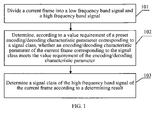
- an example not comprising all features necessary to implement the present invention provides a signal classification method, where the method specifically includes:
- the low-frequency band signal and the high-frequency band signal are relative concepts, and generally, a current frame is divided by a quadrature mirror filter (Quadrature Mirror Filter, QMF from the center frequency of the current frame into a low-frequency band signal and a high-frequency band signal.
- a quadrature mirror filter Quadrature Mirror Filter, QMF from the center frequency of the current frame into a low-frequency band signal and a high-frequency band signal.
- the present invention is not limited thereto, and the current frame may also be divided from other frequencies into a low-frequency band signal and a high-frequency band signal in other processing manners.
- the signal class corresponding to the encoding/decoding characteristic parameter is a signal class having encoding/decoding characteristics represented by the encoding/decoding characteristic parameter.
- the preset encoding/decoding characteristic parameter corresponding to the signal class includes at least one of: an encoding/decoding characteristic parameter corresponding to a noise class, an encoding/decoding characteristic parameter corresponding to a predicted class, and an encoding/decoding characteristic parameter corresponding to a harmonic class.
- the encoding/decoding characteristic parameter corresponding to the noise class is one of: a correlation parameter between an amplitude of a low-frequency band frequency-domain signal and an amplitude of a high-frequency band frequency-domain signal, and a correlation parameter between energy of the low-frequency band frequency-domain signal and energy of the high-frequency band frequency-domain signal; where, the encoding/decoding characteristic parameter corresponding to the noise class is not limited to the correlation parameter between the amplitude (or energy) of the low-frequency band frequency-domain signal and the amplitude (or energy) of the high-frequency band frequency-domain signal, but may be correlation parameters between other feature values of the low-frequency band frequency-domain signal and other feature values of the high-frequency band frequency-domain signal, which does not influence the implementation of the present invention.
- this step is specifically: determining whether the correlation parameter between the amplitude of the low-frequency band frequency-domain signal and the amplitude of the high-frequency band frequency-domain signal of the current frame meets a value requirement of a preset correlation parameter between the amplitude of the low-frequency band frequency-domain signal and the amplitude of the high-frequency band frequency-domain signal; when the encoding/decoding characteristic parameter corresponding to the noise class is the correlation parameter between the energy of the low-frequency band frequency-domain signal and the energy of the high-frequency band frequency-domain signal, this step is specifically: determining whether the correlation parameter between the energy of the low-frequency band frequency-domain signal and the energy of the high-frequency band frequency-domain signal of the current frame meets a value requirement of a preset correlation parameter between the energy of the low-frequency band frequency-domain signal and the energy
- the value requirement of the preset encoding/decoding characteristic parameter corresponding to the noise class may specifically be greater than a certain threshold, or within a value range.
- the value requirement of the correlation parameter between the amplitude of the low-frequency band frequency-domain signal and the amplitude of the high-frequency band frequency-domain signal and the value requirement of the correlation parameter between the energy of the low-frequency band frequency-domain signal and the energy of the high-frequency band frequency-domain signal may be the same or different.
- the encoding/decoding characteristic parameter corresponding to the predicted class is one of: a correlation parameter between a frequency-domain coefficient of the low-frequency band signal and a frequency-domain coefficient of the high-frequency band signal, a correlation parameter between an absolute value of the frequency-domain coefficient of the low-frequency band signal and an absolute value of the frequency-domain coefficient of the high-frequency band signal, a correlation parameter between a frequency-domain coefficient of a low frequency excitation spectrum and a frequency-domain coefficient of a high frequency excitation spectrum, and a correlation parameter between an absolute value of the frequency-domain coefficient of the low frequency excitation spectrum and an absolute value of the frequency-domain coefficient of the high frequency excitation spectrum.
- the encoding/decoding characteristic parameter corresponding to the predicted class is not limited to the above correlation parameters, but may be correlation parameters between other feature values of the low-frequency band signal and other feature values of the high-frequency band signal, or correlation parameters between other feature values of the low-frequency band excitation spectrum and other feature values of the high frequency excitation spectrum, which does not influence the implementation of the present invention.
- this step is specifically: determining whether the correlation parameter between the frequency-domain coefficient of the low-frequency band signal and the frequency-domain coefficient of the high-frequency band signal of the current frame meets a value requirement of a preset correlation parameter between the frequency-domain coefficient of the low-frequency band signal and the frequency-domain coefficient of the high-frequency band signal.
- this step is specifically: determining whether the correlation parameter between the absolute value of the frequency-domain coefficient of the low-frequency band signal and the absolute value of the frequency-domain coefficient of the high-frequency band signal of the current frame meets a value requirement of a preset correlation parameter between the absolute value of the frequency-domain coefficient of the low-frequency band signal and the absolute value of the frequency-domain coefficient of the high-frequency band signal.
- this step is specifically: determining whether the correlation parameter between the frequency-domain coefficient of the low frequency excitation spectrum and the frequency-domain coefficient of the high frequency excitation spectrum of the current frame meets a value requirement of a preset correlation parameter between the frequency-domain coefficient of the low frequency excitation spectrum and the frequency-domain coefficient of the high frequency excitation spectrum.
- this step is specifically: determining whether the correlation parameter between the absolute value of the frequency-domain coefficient of the low-frequency band excitation spectrum and the absolute value of the frequency-domain coefficient of the high-frequency band excitation spectrum meets a value requirement of a preset correlation parameter between the absolute value of the frequency-domain coefficient of the low-frequency band excitation spectrum and the absolute value of the frequency-domain coefficient of the high-frequency band excitation spectrum.
- the value requirement of the preset encoding/decoding characteristic parameter corresponding to the predicted class may specifically be greater than a certain threshold, or within a value range.
- the value requirement of the correlation parameter between the frequency-domain coefficient of the low-frequency band signal and the frequency-domain coefficient of the high-frequency band signal, the value requirement of the correlation parameter between the absolute value of the frequency-domain coefficient of the low-frequency band signal and the absolute value of the frequency-domain coefficient of the high-frequency band signal, the value requirement of the correlation parameter between the frequency-domain coeffcient of the low-frequency band excitation spectrum and the frequency-domain coefficient of the high-frequency band excitation spectrum, and the value requirement of the correlation parameter between the absolute value of the frequency-domain coefficient of the low-frequency band excitation spectrum and the absolute value of the frequency-domain coefficient of the high-frequency band excitation spectrum may be the same or different, which does not influence the implementation of the present invention.
- the encoding/decoding characteristic parameter corresponding to the harmonic class is one of: a correlation parameter between a frequency-domain coefficient of the low-frequency band signal and a frequency-domain coefficient of the high-frequency band signal, a correlation parameter between an absolute value of the frequency-domain coefficient of the low-frequency band signal and an absolute value of the frequency-domain coefficient of the high-frequency band signal, a correlation parameter between a frequency-domain coefficient of a low-frequency band excitation spectrum and a frequency-domain coefficient of a high-frequency band excitation spectrum, and a correlation parameter between an absolute value of the frequency-domain coefficient of the low-frequency band excitation spectrum and an absolute value of the frequency-domain coefficient of the high-frequency band excitation spectrum, and the relevant description is the same as that of the value requirement of the encoding/decoding characteristic parameter corresponding to the predicted class, so the details will not be described herein again.
- the signal class in the preset encoding/decoding characteristic parameter corresponding to the signal class is not limited to the above classes, but encoding/decoding characteristic parameters corresponding to other signal classes may also be preset, which does not influence the implementation of the present invention.
- the signal class of the high-frequency band signal of the current frame is the noise class.
- the number of sub-bands having a peak-to-average ratio smaller than a second threshold is greater than a second predetermined number, and a value of the encoding/decoding characteristic parameter of the current frame corresponding to the noise class meets the value requirement of the preset encoding/decoding characteristic parameter corresponding to the noise class, it is determined that the signal class of the high-frequency band signal of the current frame is the noise class.
- the preset encoding/decoding characteristic parameter corresponding to the signal class includes the encoding/decoding characteristic parameter corresponding to the predicted class, or the encoding/decoding characteristic parameter corresponding to the harmonic class
- the encoding/decoding characteristic parameter of the current frame corresponding to the predicted class meets the value requirement of the preset encoding/decoding characteristic parameter corresponding to the predicted class, it is determined that the signal class of the high-frequency band signal of the current frame is the predicted class.
- the encoding/decoding characteristic parameter of the current frame corresponding to the harmonic class meets a value requirement of a preset encoding/decoding characteristic parameter corresponding to the harmonic class, it is determined that the signal class of the high-frequency band signal of the current frame is the harmonic class.
- the number of sub-bands having a peak-to-average ratio greater than a first threshold is greater than a first predetermined number, and the encoding/decoding characteristic parameter of the current frame corresponding to the harmonic class meets the value requirement of the preset encoding/decoding characteristic parameter corresponding to the harmonic class, it is determined that the signal class of the high-frequency band signal of the current frame is the harmonic class; or, when the number of sub-bands having a peak-to-average ratio greater than the first threshold is not greater than the first predetermined number, and the encoding/decoding characteristic parameter of the current frame corresponding to the predicted class meets the value requirement of the preset encoding/decoding characteristic parameter corresponding to the predicted class, it is determined that the signal class of the high-frequency band signal of the current frame is the predicted class; or, alternatively, when the number of sub-bands having a peak-to-average ratio greater than the first threshold is not greater than the first predetermined number, the number of sub-bands having a peak-to
- the preset encoding/decoding characteristic parameter corresponding to the signal class includes the encoding/decoding characteristic parameter corresponding to the predicted class, and the encoding/decoding characteristic parameter corresponding to the harmonic class
- the number of sub-bands having a peak-to-average ratio greater than the first threshold is greater than the first predetermined number
- the encoding/decoding characteristic parameter of the current frame corresponding to the harmonic class meets the value requirement of the preset encoding/decoding characteristic parameter corresponding to the harmonic class
- the signal class of the high-frequency band signal of the current frame is the harmonic class
- the number of sub-bands having a peak-to-average ratio greater than the first threshold is not greater than the first predetermined number
- the number of sub-bands having a peak-to-average ratio smaller than the second threshold is not greater than the second predetermined number
- the encoding/decoding characteristic parameter of the current frame corresponding to the predicted class meets the value requirement of the preset encoding/decoding characteristic parameter corresponding
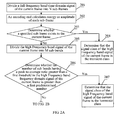
- a full-frequency time-domain signal of the current frame is divided into N sub-frames, and when energy of one sub-frame is greater than a certain number of times of energy of a previous sub-frame of the sub-frame, it is determined that the signal class of the high-frequency band signal of the current frame is a transient class.
- the present invention during signal classification, it is determined according to a value requirement of a preset encoding/decoding characteristic parameter corresponding to a signal class, whether a value of an encoding/decoding characteristic parameter of a current frame meets the value requirement of the encoding/decoding characteristic parameter, so as to determine whether a signal class of a high-frequency band signal of the current frame is the signal class corresponding to the encoding/decoding characteristic parameter, and in this way, encoding/decoding characteristics of different signal classes are taken into consideration during signal classification, thereby making the signal classification more accurate.
- energy of a certain sub-frame in the current frame in the encoder is R cur
- energy of a previous sub-frame of the sub-frame is E prev
- a predetermined number of times is preset at the encoding section and is assumed to be a, and generally, a>5; if E cur > a ⁇ E prev , the sub-frame is the specified sub-frame.
- the encoder determines that the signal class of the high-frequency band signal of the current frame is the transient class, and the process is ended.
- one sub-frame includes a high-frequency band part and a low-frequency band part, and generally energy of the low-frequency band part is greater than that of the high-frequency band part
- energy of the high-frequency band part of the sub-frame 1 is 1
- energy of the high-frequency band part of the sub-frame 2 is 6
- energy of the low-frequency band part of the sub-frame 1 is 100
- energy of the low-frequency band part of the sub-frame 2 is 100
- energy of the sub-frame 1 is 101
- energy of the sub-frame 2 is 106; assuming that a predetermined number of times is 5, by adopting the solution of step 203, the energy of the sub-frame 2 is not greater than the predetermined number of times of the energy of the sub-frame 1, and therefore, the sub-frame 2 is not the specified sub-frame.
- a solution in the prior art is to determine whether the specified sub-frame exists in the high-frequency band signal of the current frame, and according to the solution in the prior art, the high-frequency band energy of the sub-frame 2 is greater than the predetermined number of times of the high-frequency band energy of the sub-frame 1, and therefore, the sub-frame 2 is the specified sub-frame.
- the technical solution of determining whether the data frame is of the transient class according to the example not comprising all features necessary to implement the present invention provides a more accurate signal classification result.
- the encoder divides a high-frequency band frequency-domain signal of the current frame into M sub-bands.
- the encoder Before step 205, the encoder needs to divide the current frame into a low-frequency band signal and a high-frequency band signal.
- the encoder determines whether the number of sub-bands having a peak-to-average ratio greater than a first threshold in the high-frequency band frequency-domain signal of the current frame is greater than a first predetermined number, and if yes, perform step 207; if not, perform step 208.
- the encoder determines that the signal class of the high-frequency band signal of the current frame is the harmonic class, and the process is ended.
- the encoder determines whether the number of sub-bands having a peak-to-average ratio smaller than a second threshold in the high-frequency band frequency-domain signal of the current frame is greater than a second predetermined number, and if yes, perform step 209; if not, perform step 211.
- the first predetermined number and the second predetermined number are empirical values obtained through experience, and may be the same or different.
- the encoder obtains a correlation parameter between energy or amplitude of the high-frequency band frequency-domain signal and energy or amplitude of the low-frequency band frequency-domain signal of the current frame, and determines whether a value of the correlation parameter between the energy or amplitude of the high-frequency band frequency-domain signal and the energy or amplitude of the low-frequency band frequency-domain signal of the current frame is greater than a predetermined energy threshold or amplitude threshold, and if yes, perform step 210; if not, perform step 211.
- the specific process of obtaining the value the correlation parameter between the energy or amplitude of the high-frequency band frequency-domain signal and the energy or amplitude of the low-frequency band frequency-domain signal of the current frame includes, but is not limited to, the following two manners.
- the encoder obtains values of correlation parameters between energy or amplitude of sub-bands of the high-frequency band signal and energy or amplitude of sub-bands of the low-frequency band signal respectively corresponding to the sub-bands, calculates a mean of the obtained values of the correlation parameters, and uses the mean as the value of the correlation parameter between the energy or amplitude of the high-frequency band frequency-domain signal and the energy or amplitude of the low-frequency band frequency-domain signal of the current frame.
- the encoder and the decoder already predetermine a mapping relationship between a certain sub-band of the high-frequency band signal and a certain sub-band of the low-frequency band signal, and accordingly, the encoder determines, according to the mapping relationship, a value of a correlation parameter between energy or amplitude of a certain sub-band of the high-frequency band signal and a sub-band of the low-frequency band signal corresponding to the sub-band, calculates by analogy values of correlation parameters between energy or amplitude of sub-bands of the high frequency band and energy or amplitude of corresponding sub-bands of the low frequency band, and then obtains a mean of the calculated values of the correlation parameters, so as to obtain the value of the correlation parameter between the energy or amplitude of the high-frequency band frequency-domain signal and the energy or amplitude of the low-frequency band frequency-domain signal.
- the encoder may specifically obtain values of correlation parameters between energy or amplitude of sub-bands of the high-frequency band signal and energy or amplitude of sub-bands of the low-frequency band signal respectively corresponding to the sub-bands, according to ratios of energy or amplitude of sub-bands of the high-frequency band signal to energy or amplitude of sub-bands of the low-frequency band signal respectively corresponding to the sub-bands, and generally, if the ratio is close to 1, it indicates a strong correlation between the two, and the value of the correlation parameter is large, otherwise, it indicates a weak correlation between the two, and the value of the correlation parameter is small; or, may calculate the values of the correlation parameters according to absolute values of differences between energy or amplitude of sub-bands of the high-frequency band signal and energy or amplitude of sub-bands of the low-frequency band signal respectively corresponding to the sub-bands, and generally, if the absolute value is small, it indicates a strong correlation between the two, and the value of the correlation parameter is large
- the encoder respectively determines a sub-band of the low-frequency band signal that is most correlated to energy or amplitude of each sub-band of the high-frequency band signal, obtains a value of a correlation parameter between energy or amplitude of each sub-band of the high-frequency band signal and energy or amplitude of the determined most correlated sub-band of the low-frequency band signal, calculates a mean of the obtained values of the correlation parameters, and uses the mean as the value of the correlation parameter between the energy or amplitude of the high-frequency band frequency-domain signal and the energy or amplitude of the low-frequency band frequency-domain signal of the current frame.
- the high-frequency band signal includes 10 sub-bands
- the low-frequency band signal includes 10 sub-bands
- a sub-band that is most correlated to energy or amplitude of the first sub-band of the high frequency band is searched from sub-bands of the low-frequency band signal, and a value of a correlation parameter between the two sub-bands is obtained
- a sub-band that is most correlated to energy or amplitude of the second sub-band of the high frequency band is searched from the sub-bands of the low frequency band, and a value of a correlation parameter between the two sub-bands is obtained
- 10 correlation parameter values are obtained by analogy, and a mean of the 10 correlation parameters is calculated and used as the value of the correlation parameter between the energy or amplitude of the high-frequency band frequency-domain signal and the energy or amplitude of the low-frequency band frequency-domain signal.
- the specific manner of obtaining the values of the correlation parameters between the energy or amplitude of the sub-bands of the high-frequency band signal and the energy or amplitude of the most correlated sub-bands of the low-frequency band signal is similar to the first manner, so the details will not be described herein again.
- the number of sub-bands may be 1 or more, and when the number of sub-band is 1, the value of the correlation parameter is directly calculated for the whole frequency band.
- the encoder determines that the signal class of the high-frequency band signal of the current frame is the noise class, and the process is ended.
- the encoder obtains a value of a correlation parameter between a frequency-domain coefficient of a high-frequency band excitation spectrum and a frequency-domain coefficient of a low-frequency band excitation spectrum of the current frame, and determines whether the value of the correlation parameter between the frequency-domain coefficient of the high-frequency band excitation spectrum and the frequency-domain coefficient of the low-frequency band excitation spectrum is greater than a certain predetermined threshold, and if yes, perform step 212; if not, perform step 213.
- the value of the correlation parameter between the frequency-domain coefficient of the high-frequency band excitation spectrum and the frequency-domain coefficient of the low-frequency band excitation spectrum of the current frame may be obtained by using a normalized cross-correlation algorithm.
- the value of the correlation parameter between the frequency-domain coefficient of the high-frequency band excitation spectrum and the frequency-domain coefficient of the low-frequency band excitation spectrum of the current frame may be obtained in the following manner: the encoder respectively determines a sub-band of the low-frequency band signal that is most correlated to a frequency-domain coefficient of an excitation spectrum of each sub-band of the high-frequency band signal of the current frame; obtains a value of a correlation parameter between the frequency-domain coefficient of the excitation spectrum of each sub-band of the high-frequency band signal and an frequency-domain coefficient of an excitation spectrum of the determined most correlated sub-band of the low-frequency band signal, and calculates a mean of the obtained values of the correlation parameters, so as to obtain the value of the correlation parameter between the frequency-domain coefficient of the high-frequency band excitation spectrum and the frequency-domain coefficient of the low-frequency band excitation spectrum of the current frame.
- the high-frequency band excitation spectrum includes 2 sub-bands
- the low-frequency band excitation spectrum includes 5 sub-bands
- each sub-band of the high frequency band includes 20 frequency-domain coefficients
- each sub-band of the low frequency band includes 40 frequency-domain coefficients.
- normalized correlation parameter values of 1st-20th frequency-domain coefficients, 2nd-21st frequency-domain coefficients, 3rd-22nd frequency-domain coefficients, ..., and 21st-40th frequency-domain coefficients in 40 frequency-domain coefficients of each sub-band of the low-frequency band signal and 20 frequency-domain coefficients of the first sub-band of the high frequency band are determined, and a maximum value among the determined normalized correlation parameter values is obtained; likewise, normalized correlation parameter values of the 1st-20th frequency-domain coefficients, 2nd-21st frequency-domain coefficients, 3rd-22nd frequency-domain coefficients, ..., and 21st-40th frequency-domain coefficients in the 40 frequency-domain coefficients of each sub-band of the low-frequency band signal and 20 frequency-domain coefficients of the second sub-band of the high frequency band are determined, and a maximum value among the determined normalized correlation parameter values is obtained; a mean of the two maximum values is calculated, so as to obtain the value of the correlation parameter between the frequency-domain
- a i and b i are respectively a certain frequency-domain coefficient in a sub-band of the low-frequency band signal and a certain frequency-domain coefficient of a sub-band of the high-frequency band signal, for example, when normalized correlation parameter values of 2nd-21st frequency-domain coefficients of a certain sub-band of the low-frequency band signal and 20 frequency-domain coefficients of the high-frequency band signal are calculated, a 1 is the 2nd frequency-domain coefficient of a certain sub-band of the low-frequency band signal, a 2 is the 3rd frequency-domain coefficient of the sub-band, a 20 is the 21st frequency-domain coefficient of the sub-band, and b 1 to b 20 are 20 frequency-domain coefficients in a certain sub-band of the high-frequency band signal.
- the encoder in this step may also obtain a value of a correlation parameter between an absolute value of the frequency-domain coefficient of the high-frequency band excitation spectrum and an absolute value of the frequency-domain coefficient of the low-frequency band excitation spectrum of the current frame, and determine whether the value of the correlation parameter between the absolute value of the frequency-domain coefficient of the high-frequency band excitation spectrum and the absolute value of the frequency-domain coefficient of the low-frequency band excitation spectrum is greater than a certain threshold, and if yes, perform step 212; if not, perform step 213.
- the encoder determines that the signal class of the high-frequency band signal of the current frame is the predicted class, and the process is ended.
- the encoder determines that the signal class of the high-frequency band signal of the current frame is the normal class.
- step 206-step 211 may be performed first, and when step 211 is performed, if the determining result is yes, step 212 is performed, and if the determining result is not, step 201-204 is performed, where when the determining result of step 203 is yes, it is determined that the signal class of the high-frequency band signal of the current frame is the transient class, and when the determining result of step 203 is not, it is determined that the signal class of the high-frequency band signal of the current frame is the normal class.
- encoding/decoding characteristics of the high-frequency band signal of the current frame are taken into consideration, so that when energy or amplitude of the high-frequency band frequency-domain signal and energy or amplitude of the low-frequency band frequency-domain signal of the current frame are strongly correlated, the high-frequency band signal is classified into the noise class; when the frequency-domain coefficient of the high-frequency band excitation spectrum and the frequency-domain coefficient of the low-frequency band excitation spectrum of the current frame are strongly correlated, the high-frequency band signal is classified into the predicted class, thereby making the signal classification more accurate, while in the prior art, the class is determined only according to the peak-to-average ratio, and encoding/decoding characteristics of the signal class are not taken into consideration, and therefore, data frames having encoding/decoding characteristics of the noise class may be classified into the normal class, resulting in an inaccurate classification result; further, when it is determined whether the high-frequency band signal of the current frame is of the transient class,
- the signal classification is more accurate, the encoding/decoding performance is improved when the same number of bits is used, for example, it is determined by the signal classification method in the prior art that the signal class of the high-frequency band signal of a certain frame is the normal class, while it is determined by the signal classification method provided in the present application that the signal class of the high-frequency band signal of the frame is the noise class, and if the encoder and the decoder predetermine a mapping relationship between a certain sub-band of the high-frequency band signal and a certain sub-band of the low-frequency band signal, the encoder only needs to send a ratio of energy or amplitude of the sub-band of the high-frequency band signal to energy or amplitude of the sub-band of the low-frequency band signal, and does not need to transmit other information, thereby reducing the number of bits.
- the encoder may obtain a value of a correlation parameter between a frequency-domain coefficient of the high-frequency band signal of the current frame and a frequency-domain coefficient of the low-frequency band signal, and determine whether the value of the correlation parameter between the frequency-domain coefficient of the high-frequency band signal and the frequency-domain coefficient of the low-frequency band signal is greater than a certain threshold, and if yes, perform step 212; if not, perform step 213.
- the value of the correlation parameter between the frequency-domain coefficient of the high-frequency band signal and the frequency-domain coefficient of the low-frequency band signal of the current frame may be obtained in the following manner: the encoder respectively determines a sub-band of the low-frequency band signal that is most correlated to a frequency-domain coefficient of each sub-band of the high-frequency band signal of the current frame; obtains a value of a correlation parameter between the frequency-domain coefficient of each sub-band of the high-frequency band signal and the frequency-domain coefficient of the determined sub-band of the low-frequency band signal that is most correlated to the sub-band, calculates a mean of the obtained values of the correlation parameters, and uses the mean as the value of the correlation parameter between the frequency-domain coefficient of the high-frequency band signal and the frequency-domain coefficient of the low-frequency band signal of the current frame.
- the encoder may obtain a value of a correlation parameter between an absolute value of the frequency-domain coefficient of the high-frequency band signal and an absolute value of the frequency-domain coefficient of the low-frequency band signal of the current frame, and determine whether the value of the correlation parameter between the absolute value of the frequency-domain coefficient of the high-frequency band signal and the absolute value of the frequency-domain coefficient of the low-frequency band signal is greater than a certain threshold, and if yes, perform step 212; if not, perform step 213.
- the signal class of the high-frequency band signal of the current frame is the noise class.
- the value of the encoding/decoding characteristic parameter of the current frame corresponding to the harmonic class meets the value requirement of the preset encoding/decoding characteristic parameter corresponding to the harmonic class (that is, the correlation parameter between the frequency-domain coefficient of the low-frequency band signal and the frequency-domain coefficient of the high-frequency band signal, or, the correlation parameter between the absolute value of the frequency-domain coefficient of the low-frequency band signal and the absolute value of the frequency-domain coefficient of the high-frequency band signal, or, the correlation parameter between the frequency-domain coefficient of the low-frequency band excitation spectrum and the frequency-domain coefficient of the high-frequency band excitation spectrum, or, the correlation parameter between the absolute value of the frequency-domain coefficient of the low-frequency band excitation spectrum and the absolute value of the frequency-domain coefficient of the high-frequency band excitation spectrum meets the preset value requirement), it is determined that the signal class of the high-frequency band signal of the current frame is
- the value of the encoding/decoding characteristic parameter of the current frame corresponding to the predicted class meets the value requirement of the preset encoding/decoding characteristic parameter corresponding to the predicted class (that is, the correlation parameter between the frequency-domain coefficient of the low-frequency band signal and the frequency-domain coefficient of the high-frequency band signal, or, the correlation parameter between the absolute value of the frequency-domain coefficient of the low-frequency band signal and the absolute value of the frequency-domain coefficient of the high-frequency band signal, or, the correlation parameter between the frequency-domain coefficient of the low-frequency band excitation spectrum and the frequency-domain coefficient of the high-frequency band excitation spectrum, or, the correlation parameter between the absolute value of the frequency-domain coefficient of the low-frequency band excitation spectrum and the absolute value of the frequency-domain coefficient of the frequency-domain coefficient of the
- the value requirement of the encoding/decoding characteristic parameter corresponding to the harmonic class and the value requirement of the encoding/decoding characteristic parameter corresponding to the predicted class may be the same or different, which does not influence the implementation of the present invention.
- an example not comprising all features necessary to implement the present invention provides a signal classification device, where the device specifically includes:
- the preset encoding/decoding characteristic parameter corresponding to the signal class includes an encoding/decoding characteristic parameter corresponding to a noise class, where the encoding/decoding characteristic parameter corresponding to the noise class is one of a correlation parameter between an amplitude of a low-frequency band frequency-domain signal and an amplitude of a high-frequency band frequency-domain signal, and a correlation parameter between energy of the low-frequency band frequency-domain signal and energy of the high-frequency band frequency-domain signal.
- the signal classification device may further include: a second peak-to-average ratio judgment unit 40, configured to determine whether the number of sub-bands having a peak-to-average ratio smaller than a second threshold in the high-frequency band signal of the current frame is greater than a second predetermined number; and the determination unit includes: a noise class determining unit 31, configured to determine that the signal class of the high-frequency band signal of the current frame is the noise class, when the number of sub-bands having a peak-to-average ratio smaller than the second threshold is greater than the second predetermined number, and a value of the encoding/decoding characteristic parameter of the current frame corresponding to the noise class meets the value requirement of the preset encoding/decoding characteristic parameter corresponding to the noise class.
- a second peak-to-average ratio judgment unit 40 configured to determine whether the number of sub-bands having a peak-to-average ratio smaller than a second threshold in the high-frequency band signal of the current frame is greater than a second predetermined number
- the determination unit includes: a noise class
- the signal classification device may not include the second peak-to-average ratio judgment unit 40, and other devices or chips are used to determine whether the number of sub-bands having a peak-to-average ratio smaller than the second threshold in the high-frequency band signal of the current frame is greater than the second predetermined number, and notify the signal classification device of the determining result.
- the preset encoding/decoding characteristic parameter corresponding to the signal class includes an encoding/decoding characteristic parameter corresponding to a predicted class, or an encoding/decoding characteristic parameter corresponding to a harmonic class, where the corresponding description of the encoding/decoding characteristic parameter corresponding to the predicted class and the encoding/decoding characteristic parameter corresponding to the harmonic class is the same as that in the method embodiment, so the details will not be described herein again.
- the signal classification device may further include: a first peak-to-average ratio judgment unit 50, configured to determine whether the number of sub-bands having a peak-to-average ratio greater than a first threshold in the high-frequency band signal of the current frame is greater than a first predetermined number; and when the preset encoding/decoding characteristic parameter corresponding to the signal class includes the encoding/decoding characteristic parameter corresponding to the harmonic class, the determination unit includes: a harmonic class determining unit 32, configured to determine that the signal class of the high-frequency band signal of the current frame is the harmonic class, when the number of sub-bands having a peak-to-average ratio greater than the first threshold is greater than the first predetermined number, and a value of the encoding/decoding characteristic parameter of the current frame corresponding to the harmonic class meets the value requirement of the preset encoding/decoding characteristic parameter corresponding to the harmonic class.
- a first peak-to-average ratio judgment unit 50 configured to determine whether the number of sub-bands having a peak-to-average ratio greater
- the determination unit includes: a predicted class determining unit 33, configured to determine that the signal class of the high-frequency band signal of the current frame is the predicted class, when the number of sub-bands having a peak-to-average ratio greater than the first threshold is not greater than the first predetermined number, and a value of the encoding/decoding characteristic parameter of the current frame corresponding to the predicted class meets the value requirement of the preset encoding/decoding characteristic parameter corresponding to the predicted class.
- the signal classification device may not include the first peak-to-average ratio judgment unit 50, and other devices or chips are used to determine whether the number of sub-bands having a peak-to-average ratio greater than the first threshold in the high-frequency band signal of the current frame is greater than the first predetermined number, and notify the signal classification device of the determining result.
- the predicted class determining unit is specifically configured to determine that the signal class of the high-frequency band signal of the current frame is the predicted class, when the number of sub-bands having a peak-to-average ratio smaller than the second threshold is not greater than the second predetermined number, the number of sub-bands having a peak-to-average ratio greater than the first threshold is not greater than the first predetermined number, and a value of the encoding/decoding characteristic parameter of the current frame corresponding to the predicted class meets the value requirement of the preset encoding/decoding characteristic parameter corresponding to the predicted class.
- the signal classification device may further include: a second peak-to-average ratio judgment unit 40, configured to determine whether the number of sub-bands having a peak-to-average ratio smaller than a second threshold in the high-frequency band signal of the current frame is greater than a second predetermined number.
- a second peak-to-average ratio judgment unit 40 configured to determine whether the number of sub-bands having a peak-to-average ratio smaller than a second threshold in the high-frequency band signal of the current frame is greater than a second predetermined number.
- the preset encoding/decoding characteristic parameter corresponding to the signal class includes an encoding/decoding characteristic parameter corresponding to a predicted class, and an encoding/decoding characteristic parameter corresponding to a harmonic class, where the corresponding description of the encoding/decoding characteristic parameter corresponding to the predicted class and the encoding/decoding characteristic parameter corresponding to the harmonic class is the same as that in the method embodiment, so the details are not described herein again.
- the signal classification device may further include: a second peak-to-average ratio judgment unit 40, configured to determine whether the number of sub-bands having a peak-to-average ratio smaller than a second threshold in the high-frequency band signal of the current frame is greater than a second predetermined number, and a first peak-to-average ratio judgment unit 50, configured to determine whether the number of sub-bands having a peak-to-average ratio greater than a first threshold in the high-frequency band signal of the current frame is greater than a first predetermined number; and the determination unit includes: a harmonic class determining unit 32, configured to determine that the signal class of the high-frequency band signal of the current frame is the harmonic class, when the number of sub-bands having a peak-to-average ratio greater than the first threshold is greater than the first predetermined number, and a value of the encoding/decoding characteristic parameter of the current frame corresponding to the harmonic class meets the value requirement of the preset encoding/decoding characteristic parameter corresponding to the harmonic class; and a predicted class
- the determination unit 30 may only include any one or two units in specific implementations.
- the device further includes:
- the signal class of the current frame is the signal class corresponding to the encoding/decoding characteristic parameter by determining whether the value of the encoding/decoding characteristic parameter of the current frame meets the preset requirement, and in this way, encoding/decoding characteristics of different signal classes are taken into consideration during signal classification, thereby making the signal classification more accurate. Further, because the signal classification for a data frame is more accurate, the number of bits transmitted after the data frame is encoded is reduced.
- the encoder and the decoder predetermine a mapping relationship between a certain sub-band of the high-frequency band signal and a certain sub-band of the low-frequency band signal, the encoder only needs to send a ratio of the frequency-domain envelope of the sub-band of the high-frequency band signal to the frequency-domain envelope of the sub-band of the low-frequency band signal, and does not need to send information related to excitation spectrums, thereby reducing the number of bits.
- the signal classification device may be located at the system side, for example, within a base station, and may specifically be a chip or a software module within the base station. Alternatively, the signal classification device may be located at the terminal side, and may specifically be a chip or a software module.
- CELP Code Excited Linear Prediction, code excited linear prediction
- ACELP Algebraic Code Excited Linear Prediction, algebraic code excited linear prediction
- QCELP Quantcomm Code Excited Linear Prediction
- RCELP Relaxed code excited linear prediction
- the existing algorithm for encoding/decoding the high-frequency band signal does not attenuate energy of the high-frequency band signal; however, if the energy of the high-frequency band signal is not attenuated, sometimes the signal obtained by the decoder by decoding is unpleasant to hear; therefore, to solve the above technical problem, the following embodiments of the present invention provide encoding methods and encoding devices and the following examples provide decoding methods and decoding devices, to attenuate the energy of the high-frequency band signal accordingly.
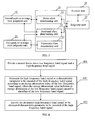
- an embodiment of the present invention provides an encoding method, which mainly includes:
- the embodiment of the present invention is implemented by an encoder.
- the low-frequency band signal and the high-frequency band signal are relative concepts, and generally, an input signal is divided by a QMF filter from the center frequency of the input signal into a low-frequency band signal and a high-frequency band signal by a QMF filter.
- the present invention is not limited thereto, and the input signal may also be divided from other frequencies into a low-frequency band signal and a high-frequency band signal in other processing manners.
- the method further includes: determining a signal class of the high-frequency band signal of the current frame, where the signal class may be specifically determined by using a signal class determining method provided in the prior art, or the signal class determining method provided in the above embodiments of the present invention, which does not influence the implementation of the present invention.
- the high-frequency band signal of the current frame may be a high-frequency band time-domain signal of the current frame or a high-frequency band frequency-domain signal of the current frame;
- the to-be-encoded characteristic parameter of the high-frequency band signal of the current frame may be an energy to-be-encoded characteristic parameter of the high-frequency band signal, and may specifically be a to-be-encoded time domain envelope or a to-be-encoded frequency domain envelope of the high-frequency band signal of the current frame.
- the high-frequency band signal or the to-be-encoded characteristic parameter of the high-frequency band signal may specifically be attenuated according to the energy attenuation value and the signal class of the high-frequency band signal of the current frame.
- the encoder may attenuate high-frequency band signals of all signal classes or to-be-encoded characteristic parameters of the high-frequency band signals; however, because signal classes of the current frame are different, the attenuated high-frequency band signal of the current frame or the attenuated to-be-encoded characteristic parameters of the high-frequency band signal of the current frame may also be different. For details, refer to the description of the embodiment shown in FIG. 5 . In still another implementation, only signals of several classes are attenuated, or only signals of a certain class are attenuated, which does not influence the implementation of the present invention.
- the signal class of the high-frequency band signal of the current frame may include a noise class, a predicted class, a transient class, a harmonic class and a normal class; in another specific implementation, the signal class of the high-frequency band signal of the current frame may include the noise class, the predicted class, the transient class, the harmonic class, a fricative class and a voiced class.
- the difference between the signal classes in the two specific implementations lies in that, in the latter on, the normal class is divided into the fricative class and the voiced class.
- the encoder encodes the low-frequency band signal of the current frame and locally decodes a result of encoding the low-frequency band signal; and uses a ratio of energy of the low-frequency band signal to energy of a signal obtained by the local decoding as the energy attenuation value.
- the energy attenuation value determined in this manner is the most accurate.
- the energy attenuation value is preset at the encoder, and the energy attenuation value is obtained according to ratios of energy of multiple low-frequency band signals of the same-class frame to energy of signals obtained by decoding results of encoding the low-frequency band signals of the same-class frame, which may specifically be: obtaining a value by training according to the ratios by using an LBG algorithm, and using the value as the energy attenuation value, where the same-class frame is a data frame of the same signal class as the high-frequency band signal of the current frame.
- a corresponding energy attenuation value may be preset for all the signal classes, or a corresponding energy attenuation value may be preset only for signal classes requiring attenuation. For example, in a specific implementation, if only signals of a fricative class need to be attenuated, it only needs to preset an energy attenuation value of the signals of the fricative class.
- the encoder in the embodiment of the present invention attenuates the high-frequency band signal or the to-be-encoded characteristic parameter of the high-frequency band signal according to the energy attenuation value of the low-frequency band signal of the current frame, and encodes and sends the attenuation result to a decoder, so that energy of the high-frequency band signal obtained by the decoder by decoding is attenuated accordingly; in this way, the high-frequency band signal is pleasant to ears of the user after being combined with the low-frequency band signal, thereby improving user experience.
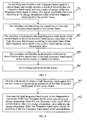
- the encoder encodes the low-frequency band signal of the current frame and locally decodes a result of encoding the low-frequency band signal; and uses a ratio of energy of the low-frequency band signal to energy of a signal obtained by the local decoding as the energy attenuation value of the low-frequency band signal of the current frame.
- the encoder determines a signal class of the high-frequency band signal of the current frame.
- the signal class may be specifically determined by using a signal class determining method provided in the prior art, or the signal class determining method provided in the above examples.
- the encoder attenuates the high-frequency band signal of the current frame or the to-be-encoded characteristic parameter of the high-frequency band signal according to the signal class of the high-frequency band signal of the current frame and the energy attenuation value.
- the encoder uses the energy attenuation value to attenuate the energy of the high-frequency band signal; however, for different signal classes, different processing manners are used. Specifically, when the class of the high-frequency band signal of the current frame is the transient class, the high-frequency band time-domain signal or the to-be-encoded time domain envelope of the high-frequency band signal is attenuated according to the energy attenuation value; when the class of the high-frequency band signal of the current frame is the fricative class, the harmonic class or the normal class, the high-frequency band frequency-domain signal or the to-be-encoded frequency domain envelope of the high-frequency band signal is attenuated according to the energy attenuation value.
- the encoder encodes an attenuation result and an identification of the signal class of the high-frequency band signal of the current frame, to obtain a bit stream.
- the encoder sends the bit stream.
- the encoder in the embodiment of the present invention attenuates the high-frequency band signal of the current frame or the to-be-encoded characteristic parameter of the high-frequency band signal according to the energy attenuation value of the low-frequency band signal of the current frame, and encodes and sends the attenuation result to the decoder, so that energy of the high-frequency band signal obtained by the decoder by decoding is attenuated accordingly; in this way, the high-frequency band signal is pleasant to ears of the user after being combined with the low-frequency band signal, thereby improving user experience.
- a data frame of a specific class may be attenuated, for example, when the encoder uses the CELP algorithm to encode a low-frequency band signal of a certain data frame, if the high-frequency band signal of the data frame is of the transient class, the low-frequency band signal of the data frame generally has sub-frames where an energy jump occurs, and it is generally considered that the low-frequency band signal of the data frame is also of the transient class.
- the CELP algorithm attenuates greatly the low-frequency band signal of the transient class, and attenuates slightly low-frequency band signals of other classes, and in such case, the attenuation of low-frequency band signals of other classes may be ignored, and only the attenuation of the low-frequency band signal of the transient class is taken into consideration, and in that case, only when the high-frequency band signal of the current frame is of the transient class, the high-frequency band time-domain signal of the current frame or the to-be-encoded time domain envelope of the high-frequency band signal is attenuated, that is, the high-frequency band time-domain signal of the current frame or the to-be-encoded time domain envelope of the high-frequency band signal is attenuated.
- the high-frequency band signal of the transient class needs to be attenuated, but also the high-frequency band signal of the fricative class needs to be attenuated.
- the normal class may be further divided into the fricative class and the voiced class, when the encoder encodes the low-frequency band signal of the voiced class by using the CELP algorithm, the encoding causes small energy attenuation, and when the encoder encodes the low-frequency band signal of the fricative class, the encoding causes great energy attenuation.
- the encoder needs to attenuate the high-frequency band frequency-domain signal of the fricative class or the to-be-encoded frequency domain envelope of the high-frequency band signal of the fricative class, that is, the high-frequency band frequency-domain signal of the fricative class or the to-be-encoded frequency domain envelope of the high-frequency band signal of the fricative class is attenuated.
- the energy attenuation value of the low-frequency band signal of the current frame used by the encoder in the above embodiment is: a ratio of energy of the low-frequency band signal of the current frame to energy of a signal obtained by locally decoding a result of encoding, by the encoder, encoding the low frequency band signal.
- different energy attenuation values may be obtained by training by using the LBG algorithm, and then the obtained energy attenuation values are preset at the encoder and the decoder, for example, when the signal class of the high-frequency band signal includes the noise class, the predicted class, the transient class, the harmonic class and the normal class, one energy attenuation value is obtained for the noise class by training, one energy attenuation value is obtained for the predicted class by training, one energy attenuation value is obtained for the transient class by training, and one energy attenuation value is obtained for the normal class by training.
- the specific manner of obtaining one energy attenuation value corresponding to a certain signal class by training may be: obtaining ratios of energy of multiple low-frequency band signals of the signal class to energy of signals obtained by decoding, by the decoder, results of encoding the corresponding low-frequency band signals, obtaining one value by training according to the obtained ratios by using the LBG algorithm, and using the value as the energy attenuation value corresponding to the signal class.
- energy attenuation values are obtained for the fricative class and the voiced class by training by using the LBG algorithm and preset at the encoder and the decoder.
- an example provides a decoding method, which includes:
- the example is implemented by a decoder.
- the high-frequency band signal of the current frame may be a high-frequency band time-domain signal of the current frame or a high-frequency band frequency-domain signal of the current frame; the characteristic parameter of the high-frequency band signal of the current frame may be a time-domain envelope or a frequency-domain envelope of the high-frequency band signal of the current frame.
- the high-frequency band signal or the characteristic parameter of the high-frequency band signal may be specifically attenuated according to the energy attenuation value of the low-frequency band signal of the current frame and the signal class of the high-frequency band signal of the current frame.
- the decoder may attenuate the high-frequency band signals of all signal classes or characteristic parameters of the high-frequency band signals; however, because signal classes of the current frame are different, the attenuated high-frequency band signal of the current frame or the attenuated characteristic parameters of the high-frequency band signal of the current frame may also be different. For details, refer to the description of the example shown in FIG. 7 . In still another implementation, only signals of several classes are attenuated, or only signals of a certain class are attenuated, which does not influence the implementation of the present example.
- Obtaining of the energy attenuation value of the low-frequency band signal of the current frame includes, but is not limited to, the following two manners.
- the decoder parses the bit stream sent by the encoder to obtain the energy attenuation value, that is, the energy attenuation value of the low-frequency band signal of the current frame is obtained by the encoder and sent to the decoder, and specifically, the encoder may use a ratio of energy of the low-frequency band signal of the current frame to energy of a signal obtained by locally decoding a result of encoding, by the encoder, the low-frequency band signal of the current frame as the energy attenuation value.
- the energy attenuation value of the low-frequency band signal of the current frame is preset at the decoder, and the energy attenuation value is obtained according to ratios of energy of multiple low-frequency band signals of the same-class frame to energy of signals obtained by decoding results of encoding the low-frequency band signals of the same-class frame, which may specifically be: obtaining a value by training according to the ratios by using an LBG algorithm, and using the value as the energy attenuation value, where the same-class frame is a data frame of the same signal class as the high-frequency band signal of the current frame.
- the decoder in the present example attenuates, according to the energy attenuation value of the low-frequency band signal of the current frame, the high-frequency band signal or the characteristic parameter of the high-frequency band signal obtained by decoding, so that the finally obtained high-frequency band signal is pleasant to ears of the user after being combined with the low-frequency band signal, thereby improving user experience.
- the decoder receives a bit stream sent by the encoder, where the bit stream includes a result of encoding the high-frequency band signal, an energy attenuation value of the low-frequency band signal of the current frame, and an identification of the signal class of the high-frequency band signal of the current frame.
- the decoder decodes the bit stream to obtain the energy attenuation value of the low-frequency band signal of the current frame, the signal class of the high-frequency band signal of the current frame, and the high-frequency band signal of the current frame or a characteristic parameter of the high-frequency band signal of the current frame.
- the decoder attenuates the high-frequency band signal of the current frame or the characteristic parameter of the high-frequency band signal of the current frame according to the energy attenuation value of the low-frequency band signal of the current frame and the signal class of the high-frequency band signal of the current frame.
- the decoder uses the energy attenuation value of the low-frequency band signal of the current frame to attenuate the energy of the high-frequency band signal; however, for different signal classes, different processing manners are used.
- the class of the high-frequency band signal of the current frame is the transient class
- the high-frequency band time-domain signal or the time-domain envelope of the high-frequency band signal is attenuated according to the energy attenuation value of the low-frequency band signal of the current frame
- the class of the high-frequency band signal of the current frame is the fricative class, the harmonic class or the normal class
- the high-frequency band frequency-domain signal or the frequency-domain envelope of the high-frequency band signal is attenuated according to the energy attenuation value of the low-frequency band signal of the current frame.
- the decoder in the present example attenuates the high-frequency band signal of the current frame or the characteristic parameter of the high-frequency band signal obtained by decoding, so that the finally obtained high-frequency band signal is pleasant to ears of the user after being combined with the low-frequency band signal, thereby improving user experience.
- the decoder may only attenuate signals of a specific class, for example, only when the high-frequency band signal of the current frame is of the transient class, the decoder attenuates the high-frequency band time-domain signal of the current frame or the time-domain envelope of the high-frequency band signal, that is, the high-frequency band time-domain signal of the current frame or the time-domain envelope of the high-frequency band signal is attenuated.
- the decoder obtains the high-frequency band signal of the fricative class by decoding, and then attenuates the high-frequency band signal of the fricative class, that is, the high-frequency band signal of the fricative class is attenuated.
- the decoder may obtain a frequency-domain envelope of the high-frequency band signal of the fricative class by decoding, and then attenuate the frequency-domain envelope of the high-frequency band signal of the fricative class, that is, the frequency-domain envelope of the high-frequency band signal of the fricative class is attenuated.
- the energy attenuation value of the low-frequency band signal of the current frame is sent by the encoder to the decoder, and alternatively, in another specific implementation, the energy attenuation value may be preset at the decoder, that is, different energy attenuation values may be obtained for different signal classes by training by using the LBG algorithm, and then the obtained energy attenuation values are preset at the encoder and the decoder.
- the specific implementation is similar to the description of the foregoing corresponding part, so the details will not be described herein again.
- an embodiment of the present invention provides an encoding device, which includes:
- the encoding device further includes: a signal class determining unit 400, configured to determine the signal class of the high-frequency band signal of the current frame; at this time, the correction unit 200 is configured to attenuate the high-frequency band signal or the to-be-encoded characteristic parameter of the high-frequency band signal according to the energy attenuation value and the signal class of the high-frequency band signal.
- a signal class determining unit 400 configured to determine the signal class of the high-frequency band signal of the current frame
- the correction unit 200 is configured to attenuate the high-frequency band signal or the to-be-encoded characteristic parameter of the high-frequency band signal according to the energy attenuation value and the signal class of the high-frequency band signal.
- the correction unit 200 is specifically configured to attenuate a high-frequency band time-domain signal or a to-be-encoded time domain envelope of the high-frequency band signal according to the energy attenuation value, when the class of the high-frequency band signal is a transient class; and/or, the correction unit 200 is specifically configured to attenuate a high-frequency band frequency-domain signal or a to-be-encoded frequency domain envelope of the high-frequency band signal according to the energy attenuation value, when the class of the high-frequency band signal is a fricative class, a harmonic class or a normal class.
- the encoding device may further include an energy attenuation value obtaining unit 500, configured to encode the low-frequency band signal and locally decoding a result of encoding the low-frequency band signal; and use a ratio of energy of the low-frequency band signal to energy of a signal obtained by the local decoding as the energy attenuation value; or, an energy attenuation value setting unit 600, configured to set the energy attenuation value of the current frame, where the energy attenuation value is obtained according to ratios of energy of multiple low-frequency band signals of the same-class frame to energy of signals obtained by decoding results of encoding the low-frequency band signals of the same-class frame, where the same-class frame is a data frame of the same signal class as the high-frequency band signal of the current frame.
- an energy attenuation value obtaining unit 500 configured to encode the low-frequency band signal and locally decoding a result of encoding the low-frequency band signal
- the encoding may include the energy attenuation value obtaining unit 500 only but not include the energy attenuation value setting unit 600, or include the energy attenuation value setting unit 600 only but not include the energy attenuation value obtaining unit 500 in practical use.
- the encoding device in the embodiment of the present invention attenuates the high-frequency band signal or the characteristic parameter to be decoded of the high-frequency band signal according to the energy attenuation value of the low-frequency band signal of the current frame, and encodes and sends the attenuation result to the decoder, so that energy of the high-frequency band signal obtained by the decoder by decoding is attenuated accordingly; in this way, the high-frequency band signal is pleasant to ears of the user after being combined with the low-frequency band signal, thereby improving user experience.
- an example provides a decoding device, which includes:
- the decoding unit 700 is further configured to decode the bit stream to obtain the signal class of the high-frequency band signal of the current frame; and the correction unit 800 is specifically configured to attenuate the high-frequency band signal or the characteristic parameter of the high-frequency band signal according to the energy attenuation value and the signal class of the high-frequency band signal of the current frame.
- the correction unit 800 is specifically configured to attenuate a high-frequency band time-domain signal or a time-domain envelope of the high-frequency band signal according to the energy attenuation value, when the class of the high-frequency band signal of the current frame is a transient class; and/or, the correction unit is specifically configured to attenuate a high-frequency band frequency-domain signal or a frequency-domain envelope of the high-frequency band signal according to the energy attenuation value, when the class of the high-frequency band signal of the current frame is a fricative class, a harmonic class or a normal class.
- the decoding unit 700 is further configured to decode the energy attenuation value from the bit stream, where the energy attenuation value indicates: a ratio of energy of the low-frequency band signal of the current frame to energy of a signal obtained by locally decoding a result of encoding, by an encoder, the low-frequency band signal of the current frame.
- the decoding device further includes: an energy attenuation value setting unit 900, configured to set the energy attenuation value of the current frame, where the energy attenuation value is obtained according to a ratio of energy of a low-frequency band signal of a same-class frame to energy of a signal obtained by decoding a result of encoding the low-frequency band signal of the same-class frame, where the same-class frame is a data frame of the same signal class as the high-frequency band signal of the current frame.
- an energy attenuation value setting unit 900 configured to set the energy attenuation value of the current frame, where the energy attenuation value is obtained according to a ratio of energy of a low-frequency band signal of a same-class frame to energy of a signal obtained by decoding a result of encoding the low-frequency band signal of the same-class frame, where the same-class frame is a data frame of the same signal class as the high-frequency band signal of the current frame.
- the decoding device in the present example attenuates, according to the energy attenuation value of the low-frequency band signal of the current frame, the high-frequency band signal or the characteristic parameter of the high-frequency band signal obtained by decoding, so that the finally obtained high-frequency band signal is pleasant to ears of the user after being combined with the low-frequency band signal, thereby improving user experience.
- the program may be stored in a computer readable storage medium such as a read-only memory, a magnetic disk or an optical disk.
Landscapes
- Engineering & Computer Science (AREA)
- Physics & Mathematics (AREA)
- Computational Linguistics (AREA)
- Signal Processing (AREA)
- Health & Medical Sciences (AREA)
- Audiology, Speech & Language Pathology (AREA)
- Human Computer Interaction (AREA)
- Acoustics & Sound (AREA)
- Multimedia (AREA)
- Mathematical Physics (AREA)
- Compression, Expansion, Code Conversion, And Decoders (AREA)
Claims (10)
- Kodierverfahren zur Audio- oder Sprachverarbeitung, umfassend:Teilen (401) eines aktuellen Rahmens in ein Niederfrequenzbandsignal und ein Hochfrequenzbandsignal;Dämpfen (402) des Hochfrequenzbandsignals oder eines zu kodierenden charakteristischen Parameters des Hochfrequenzbandsignals gemäß einem Energiedämpfungswert des Niederfrequenzbandsignals, wobei der Energiedämpfungswert Energiedämpfung des Niederfrequenzbandsignals anzeigt, die durch Kodieren des Niederfrequenzbandsignals hervorgerufen wird; undKodieren (403) des gedämpften Hochfrequenzbandsignals oder des gedämpften zu kodierenden charakteristischen Parameters des Hochfrequenzbandsignals.
- Verfahren gemäß Anspruch 1, wobei
das Verfahren ferner umfasst: Bestimmen einer Signalklasse des Hochfrequenzbandsignals; und
der Schritt des Dämpfens (402) des Hochfrequenzbandsignals oder des zu kodierenden charakteristischen Parameters des Hochfrequenzbandsignals gemäß dem Energiedämpfungswert des Niedeifrequenzbandsignals umfasst:Dämpfen des Hochfrequenzbandsignals oder des zu kodierenden charakteristischen Parameters des Hochfrequenzbandsignals gemäß dem Energiedämpfungswert und der Signalklasse des Hochfrequenzbandsignals. - Verfahren gemäß Anspruch 2, wobei
der Schritt des Dämpfens (402) des Hochfrequenzbandsignals oder des zu kodierenden charakteristischen Parameters des Hochfrequenzbandsignals gemäß dem Energiedämpfungswert und der Signalklasse des Hochfrequenzbandsignals umfasst:wenn die Signalklasse des Hochfrequenzbandsignals eine Transientenklasse ist, Dämpfen eines Hochfrequenzband-Zeitdomänensignals oder einer zu kodierenden Zeitdomänen-Einhüllenden des Hochfrequenzbandsignals gemäß dem Energiedämpfungswert;und/oder,wenn die Signalklasse des Hochfrequenzbandsignals eine Frikativklasse, eine Harmonische-Klasse oder eine Normalklasse ist, Dämpfen eines Hochfrequenzband-Frequenzdomänensignals oder einer zu kodierenden Frequenzdomänen-Einhüllenden des Hochfrequenzbandsignals gemäß dem Energiedämpfungswert. - Verfahren gemäß Anspruch 1, wobei
das Verfahren ferner umfasst:Kodieren (501) des Niedeifrequenzbandsignals und lokales Dekodieren eines Ergebnisses des Kodierens des Niederfrequenzbandsignals sowie Heranziehen (501) eines Verhältnisses der Energie des Niedeifrequenzbandsignals zur Energie eines Signals, das sich durch das lokale Dekodieren als der Energiedämpfungswert ergibt. - Verfahren gemäß Anspruch 1, wobei
der Energiedämpfungswert ein voreingestellter Wert ist, und der Energiedämpfungswert sich ergibt aus den Verhältnissen der Energie einer Mehrzahl von Niederfrequenzbandsignalen eines gleichklassigen Rahmens zur Energie von Signalen, die sich aus dem Dekodieren von Kodierergebnissen der Niederfrequenzbandsignale des gleichklassigen Rahmens ergeben, wobei der gleichklassige Rahmen ein Datenrahmen derselben Signalklasse wie das Hochfrequenzbandsignal des aktuellen Rahmens ist. - Kodiervorrichtung zur Audio- oder Sprachverarbeitung, umfassend:eine Teilungseinheit (100), die konfiguriert ist, um einen aktuellen Rahmen in ein Niederfrequenzbandsignal und ein Hochfrequenzbandsignal zu teilen;eine Korrektureinheit (200), die konfiguriert ist, um das Hochfrequenzbandsignal oder einen zu kodierenden charakteristischen Parameter des Hochfrequenzbandsignals gemäß einem Energiedämpfungswert des Niederfrequenzbandsignals zu dämpfen, wobei der Energiedämpfungswert Energiedämpfung des Niedeifrequenzbandsignals anzeigt, die durch Kodieren des Niederfrequenzbandsignals des aktuellen Rahmens hervorgerufen wird; undeine Kodiereinheit (300), die konfiguriert ist, um das gedämpfte Hochfrequenzbandsignal oder den gedämpften zu kodierenden charakteristischen Parameter des Hochfrequenzbandsignals zu kodieren.
- Vorrichtung gemäß Anspruch 6, ferner umfassend:eine Signalklasse-Bestimmungseinheit, die konfiguriert ist, um eine Signalklasse des Hochfrequenzbandsignals zu bestimmen; wobeidie Korrektureinheit (200) konfiguriert ist, um das Hochfrequenzbandsignal oder den zu kodierenden charakteristischen Parameter des Hochfrequenzbandsignals gemäß dem Energiedämpfungswert und der Signalklasse des Hochfrequenzbandsignals zu dämpfen.
- Vorrichtung gemäß Anspruch 7, wobei
die Korrektureinheit (200) konfiguriert ist, um ein Hochfrequenzband-Zeitdomänensignal oder eine zu kodierende Zeitdomänen-Einhüllende des Hochfrequenzbandsignals gemäß dem Energiedämpfungswert zu dämpfen, wenn die Signalklasse des Hochfrequenzbandsignals eine Transientenklasse ist;
und/oder,
die Korrektureinheit (200) konfiguriert ist, um ein Hochfrequenzband-Frequenzdomänensignal oder eine zu kodierende Frequenzdomänen-Einhüllende des Hochfrequenzbandsignals gemäß dem Energiedämpfungswert zu dämpfen, wenn die Signalklasse des Hochfrequenzbandsignals eine Frikativklasse, eine Harmonische-Klasse oder eine Normalklasse ist. - Vorrichtung gemäß Anspruch 6, wobei
eine Energiedämpfungswert-Beschaffungseinheit (500) konfiguriert ist, um das Niederfrequenzbandsignal zu kodieren und ein Ergebnis des Kodierens des Niederfrequenzbandsignals lokal zu dekodieren und ein Verhältnis der Energie des Niederfrequenzbandsignals zur Energie eines Signals, das sich durch das lokale Dekodieren ergibt, als den Energiedämpfungswert zu verwenden. - Vorrichtung gemäß Anspruch 6, ferner umfassend,
eine Energiedämpfungswert-Einstelleinheit (600), die konfiguriert ist, um den Energiedämpfungswert einzustellen, wobei der Energiedämpfungswert sich ergibt aus Verhältnissen der Energie einer Mehrzahl von Niederfrequenzbandsignalen eines gleichklassigen Rahmens zur Energie von Signalen, die sich aus dem Dekodieren der Ergebnisse des Kodierens der Niederfrequenzbandsignale des gleichklassigen Rahmens ergeben, wobei der gleichklassige Rahmen ein Datenrahmen derselben Signalklasse wie das Hochfrequenzbandsignal des aktuellen Rahmens ist.
Applications Claiming Priority (2)
| Application Number | Priority Date | Filing Date | Title |
|---|---|---|---|
| CN201110138461.1A CN102800317B (zh) | 2011-05-25 | 2011-05-25 | 信号分类方法及设备、编解码方法及设备 |
| PCT/CN2011/081114 WO2012159412A1 (zh) | 2011-05-25 | 2011-10-21 | 信号分类方法及设备、编解码方法及设备 |
Related Child Applications (1)
| Application Number | Title | Priority Date | Filing Date |
|---|---|---|---|
| EP14175171 Division-Into | 2014-07-01 |
Publications (3)
| Publication Number | Publication Date |
|---|---|
| EP2584560A1 EP2584560A1 (de) | 2013-04-24 |
| EP2584560A4 EP2584560A4 (de) | 2013-08-21 |
| EP2584560B1 true EP2584560B1 (de) | 2014-12-10 |
Family
ID=47199408
Family Applications (1)
| Application Number | Title | Priority Date | Filing Date |
|---|---|---|---|
| EP11866414.3A Active EP2584560B1 (de) | 2011-05-25 | 2011-10-21 | Kodierverfahren und kodiervorrichtung |
Country Status (7)
| Country | Link |
|---|---|
| US (2) | US8600765B2 (de) |
| EP (1) | EP2584560B1 (de) |
| JP (7) | JP6018090B2 (de) |
| KR (1) | KR101540371B1 (de) |
| CN (1) | CN102800317B (de) |
| ES (1) | ES2531575T3 (de) |
| WO (1) | WO2012159412A1 (de) |
Families Citing this family (22)
| Publication number | Priority date | Publication date | Assignee | Title |
|---|---|---|---|---|
| CN102800317B (zh) * | 2011-05-25 | 2014-09-17 | 华为技术有限公司 | 信号分类方法及设备、编解码方法及设备 |
| CN103928029B (zh) | 2013-01-11 | 2017-02-08 | 华为技术有限公司 | 音频信号编码和解码方法、音频信号编码和解码装置 |
| CN103971693B (zh) * | 2013-01-29 | 2017-02-22 | 华为技术有限公司 | 高频带信号的预测方法、编/解码设备 |
| EP2987250B1 (de) | 2013-04-17 | 2019-07-24 | CommScope Technologies LLC | Teilbandextraktion aus signalen in einem frequenzbereich |
| BR122020016403B1 (pt) * | 2013-06-11 | 2022-09-06 | Fraunhofer-Gesellschaft zur Förderung der angewandten Forschung e.V | Aparelho de decodificação de sinal de áudio, aparelho de codificação de sinal de áudio, método de decodificação de sinal de áudio e método de codificação de sinal de áudio |
| US8755514B1 (en) | 2013-09-16 | 2014-06-17 | The United States Of America As Represented By The Secretary Of The Army | Dual-tone multi-frequency signal classification |
| CN104517610B (zh) * | 2013-09-26 | 2018-03-06 | 华为技术有限公司 | 频带扩展的方法及装置 |
| US9384746B2 (en) * | 2013-10-14 | 2016-07-05 | Qualcomm Incorporated | Systems and methods of energy-scaled signal processing |
| CN103714822B (zh) * | 2013-12-27 | 2017-01-11 | 广州华多网络科技有限公司 | 基于silk编解码器的子带编解码方法及装置 |
| CN110808056B (zh) | 2014-03-14 | 2023-10-17 | 瑞典爱立信有限公司 | 音频编码方法和装置 |
| CN111710342B (zh) * | 2014-03-31 | 2024-04-16 | 弗朗霍弗应用研究促进协会 | 编码装置、解码装置、编码方法、解码方法及程序 |
| CN105225671B (zh) | 2014-06-26 | 2016-10-26 | 华为技术有限公司 | 编解码方法、装置及系统 |
| EP2963648A1 (de) | 2014-07-01 | 2016-01-06 | Fraunhofer-Gesellschaft zur Förderung der angewandten Forschung e.V. | Audioprozessor und Verfahren zur Verarbeitung eines Audiosignals mit vertikaler Phasenkorrektur |
| EP3796314B1 (de) * | 2014-07-28 | 2021-12-22 | Nippon Telegraph And Telephone Corporation | Kodierung eines tonsignals |
| US10049684B2 (en) * | 2015-04-05 | 2018-08-14 | Qualcomm Incorporated | Audio bandwidth selection |
| CN107731238B (zh) | 2016-08-10 | 2021-07-16 | 华为技术有限公司 | 多声道信号的编码方法和编码器 |
| EP3288031A1 (de) * | 2016-08-23 | 2018-02-28 | Fraunhofer-Gesellschaft zur Förderung der angewandten Forschung e.V. | Vorrichtung und verfahren zur codierung eines audiosignals mit einem kompensationswert |
| US11417345B2 (en) * | 2018-01-17 | 2022-08-16 | Nippon Telegraph And Telephone Corporation | Encoding apparatus, decoding apparatus, fricative sound judgment apparatus, and methods and programs therefor |
| US10978083B1 (en) * | 2019-11-13 | 2021-04-13 | Shure Acquisition Holdings, Inc. | Time domain spectral bandwidth replication |
| CN113539281B (zh) * | 2020-04-21 | 2024-09-06 | 华为技术有限公司 | 音频信号编码方法和装置 |
| WO2021258350A1 (zh) * | 2020-06-24 | 2021-12-30 | 华为技术有限公司 | 一种音频信号处理方法和装置 |
| CN112530454B (zh) * | 2020-11-30 | 2024-07-23 | 厦门亿联网络技术股份有限公司 | 一种窄带语音信号检测方法、装置、系统和可读存储介质 |
Family Cites Families (49)
| Publication number | Priority date | Publication date | Assignee | Title |
|---|---|---|---|---|
| US5018200A (en) * | 1988-09-21 | 1991-05-21 | Nec Corporation | Communication system capable of improving a speech quality by classifying speech signals |
| JP3321971B2 (ja) * | 1994-03-10 | 2002-09-09 | ソニー株式会社 | 音声信号処理方法 |
| US5937377A (en) * | 1997-02-19 | 1999-08-10 | Sony Corporation | Method and apparatus for utilizing noise reducer to implement voice gain control and equalization |
| EP0878790A1 (de) * | 1997-05-15 | 1998-11-18 | Hewlett-Packard Company | Sprachkodiersystem und Verfahren |
| US6453285B1 (en) * | 1998-08-21 | 2002-09-17 | Polycom, Inc. | Speech activity detector for use in noise reduction system, and methods therefor |
| US6959274B1 (en) * | 1999-09-22 | 2005-10-25 | Mindspeed Technologies, Inc. | Fixed rate speech compression system and method |
| US6978236B1 (en) * | 1999-10-01 | 2005-12-20 | Coding Technologies Ab | Efficient spectral envelope coding using variable time/frequency resolution and time/frequency switching |
| US6615169B1 (en) * | 2000-10-18 | 2003-09-02 | Nokia Corporation | High frequency enhancement layer coding in wideband speech codec |
| US6895375B2 (en) * | 2001-10-04 | 2005-05-17 | At&T Corp. | System for bandwidth extension of Narrow-band speech |
| US6988066B2 (en) * | 2001-10-04 | 2006-01-17 | At&T Corp. | Method of bandwidth extension for narrow-band speech |
| JP3785363B2 (ja) | 2001-12-27 | 2006-06-14 | 松下電器産業株式会社 | 音声信号符号化装置、音声信号復号装置及び音声信号符号化方法 |
| JP4272897B2 (ja) * | 2002-01-30 | 2009-06-03 | パナソニック株式会社 | 符号化装置、復号化装置およびその方法 |
| TW594674B (en) * | 2003-03-14 | 2004-06-21 | Mediatek Inc | Encoder and a encoding method capable of detecting audio signal transient |
| WO2004093494A1 (en) * | 2003-04-17 | 2004-10-28 | Koninklijke Philips Electronics N.V. | Audio signal generation |
| US20050004793A1 (en) * | 2003-07-03 | 2005-01-06 | Pasi Ojala | Signal adaptation for higher band coding in a codec utilizing band split coding |
| JP5013863B2 (ja) * | 2004-05-19 | 2012-08-29 | パナソニック株式会社 | 符号化装置、復号化装置、通信端末装置、基地局装置、符号化方法及び復号化方法 |
| JP4168976B2 (ja) * | 2004-05-28 | 2008-10-22 | ソニー株式会社 | オーディオ信号符号化装置及び方法 |
| JP4789430B2 (ja) * | 2004-06-25 | 2011-10-12 | パナソニック株式会社 | 音声符号化装置、音声復号化装置、およびこれらの方法 |
| CN100592389C (zh) * | 2008-01-18 | 2010-02-24 | 华为技术有限公司 | 合成滤波器状态更新方法及装置 |
| JP4821131B2 (ja) * | 2005-02-22 | 2011-11-24 | 沖電気工業株式会社 | 音声帯域拡張装置 |
| US7715573B1 (en) * | 2005-02-28 | 2010-05-11 | Texas Instruments Incorporated | Audio bandwidth expansion |
| SI1875463T1 (sl) * | 2005-04-22 | 2019-02-28 | Qualcomm Incorporated | Sistemi, postopki in naprava za glajenje faktorja ojačenja |
| FR2897733A1 (fr) * | 2006-02-20 | 2007-08-24 | France Telecom | Procede de discrimination et d'attenuation fiabilisees des echos d'un signal numerique dans un decodeur et dispositif correspondant |
| JP4335245B2 (ja) * | 2006-03-31 | 2009-09-30 | 株式会社エヌ・ティ・ティ・ドコモ | 量子化装置、逆量子化装置、音声音響符号化装置、音声音響復号装置、量子化方法、および逆量子化方法 |
| US20070299655A1 (en) * | 2006-06-22 | 2007-12-27 | Nokia Corporation | Method, Apparatus and Computer Program Product for Providing Low Frequency Expansion of Speech |
| US8532984B2 (en) * | 2006-07-31 | 2013-09-10 | Qualcomm Incorporated | Systems, methods, and apparatus for wideband encoding and decoding of active frames |
| US8260609B2 (en) * | 2006-07-31 | 2012-09-04 | Qualcomm Incorporated | Systems, methods, and apparatus for wideband encoding and decoding of inactive frames |
| JP4757158B2 (ja) * | 2006-09-20 | 2011-08-24 | 富士通株式会社 | 音信号処理方法、音信号処理装置及びコンピュータプログラム |
| JP4396683B2 (ja) * | 2006-10-02 | 2010-01-13 | カシオ計算機株式会社 | 音声符号化装置、音声符号化方法、及び、プログラム |
| US7877253B2 (en) * | 2006-10-06 | 2011-01-25 | Qualcomm Incorporated | Systems, methods, and apparatus for frame erasure recovery |
| US8041578B2 (en) * | 2006-10-18 | 2011-10-18 | Fraunhofer-Gesellschaft Zur Foerderung Der Angewandten Forschung E.V. | Encoding an information signal |
| JP5103880B2 (ja) * | 2006-11-24 | 2012-12-19 | 富士通株式会社 | 復号化装置および復号化方法 |
| JP4871894B2 (ja) * | 2007-03-02 | 2012-02-08 | パナソニック株式会社 | 符号化装置、復号装置、符号化方法および復号方法 |
| JP4984983B2 (ja) * | 2007-03-09 | 2012-07-25 | 富士通株式会社 | 符号化装置および符号化方法 |
| US9653088B2 (en) * | 2007-06-13 | 2017-05-16 | Qualcomm Incorporated | Systems, methods, and apparatus for signal encoding using pitch-regularizing and non-pitch-regularizing coding |
| WO2008151408A1 (en) * | 2007-06-14 | 2008-12-18 | Voiceage Corporation | Device and method for frame erasure concealment in a pcm codec interoperable with the itu-t recommendation g.711 |
| MX2010001394A (es) * | 2007-08-27 | 2010-03-10 | Ericsson Telefon Ab L M | Frecuencia de transicion adaptiva entre llenado de ruido y extension de anchura de banda. |
| EP2186087B1 (de) * | 2007-08-27 | 2011-11-30 | Telefonaktiebolaget L M Ericsson (PUBL) | Verbesserte transformationskodierung von sprach- und audiosignalen |
| BRPI0818927A2 (pt) * | 2007-11-02 | 2015-06-16 | Huawei Tech Co Ltd | Método e aparelho para a decodificação de áudio |
| CN102789782B (zh) * | 2008-03-04 | 2015-10-14 | 弗劳恩霍夫应用研究促进协会 | 对输入数据流进行混合以及从中产生输出数据流 |
| CN101630509B (zh) * | 2008-07-14 | 2012-04-18 | 华为技术有限公司 | 一种编解码方法、装置及系统 |
| CN101751925B (zh) * | 2008-12-10 | 2011-12-21 | 华为技术有限公司 | 一种语音解码方法及装置 |
| CN101751926B (zh) * | 2008-12-10 | 2012-07-04 | 华为技术有限公司 | 信号编码、解码方法及装置、编解码系统 |
| CN101763856B (zh) * | 2008-12-23 | 2011-11-02 | 华为技术有限公司 | 信号分类处理方法、分类处理装置及编码系统 |
| CN101770775B (zh) * | 2008-12-31 | 2011-06-22 | 华为技术有限公司 | 信号处理方法及装置 |
| UA101291C2 (ru) * | 2009-12-16 | 2013-03-11 | Долби Интернешнл Аб | Сводка параметров последовательности бит sbr |
| US8600737B2 (en) * | 2010-06-01 | 2013-12-03 | Qualcomm Incorporated | Systems, methods, apparatus, and computer program products for wideband speech coding |
| WO2011156905A2 (en) * | 2010-06-17 | 2011-12-22 | Voiceage Corporation | Multi-rate algebraic vector quantization with supplemental coding of missing spectrum sub-bands |
| CN102800317B (zh) * | 2011-05-25 | 2014-09-17 | 华为技术有限公司 | 信号分类方法及设备、编解码方法及设备 |
-
2011
- 2011-05-25 CN CN201110138461.1A patent/CN102800317B/zh active Active
- 2011-10-21 ES ES11866414.3T patent/ES2531575T3/es active Active
- 2011-10-21 EP EP11866414.3A patent/EP2584560B1/de active Active
- 2011-10-21 WO PCT/CN2011/081114 patent/WO2012159412A1/zh not_active Ceased
- 2011-10-21 KR KR1020137020752A patent/KR101540371B1/ko active Active
- 2011-10-21 JP JP2013554779A patent/JP6018090B2/ja active Active
-
2012
- 2012-12-27 US US13/728,201 patent/US8600765B2/en active Active
-
2013
- 2013-10-18 US US14/057,924 patent/US20140046672A1/en not_active Abandoned
-
2015
- 2015-09-07 JP JP2015175650A patent/JP6185530B2/ja active Active
-
2017
- 2017-07-27 JP JP2017145282A patent/JP6558745B2/ja active Active
-
2019
- 2019-01-21 JP JP2019007742A patent/JP6820360B2/ja active Active
-
2021
- 2021-01-04 JP JP2021000129A patent/JP7177185B2/ja active Active
-
2022
- 2022-11-10 JP JP2022180559A patent/JP7807360B2/ja active Active
-
2024
- 2024-10-10 JP JP2024177907A patent/JP2025016508A/ja active Pending
Also Published As
| Publication number | Publication date |
|---|---|
| JP2017191341A (ja) | 2017-10-19 |
| KR101540371B1 (ko) | 2015-08-06 |
| EP2584560A4 (de) | 2013-08-21 |
| CN102800317A (zh) | 2012-11-28 |
| US8600765B2 (en) | 2013-12-03 |
| US20140046672A1 (en) | 2014-02-13 |
| JP2016027411A (ja) | 2016-02-18 |
| ES2531575T3 (es) | 2015-03-17 |
| JP2021060618A (ja) | 2021-04-15 |
| KR20130116917A (ko) | 2013-10-24 |
| JP6185530B2 (ja) | 2017-08-23 |
| JP7177185B2 (ja) | 2022-11-22 |
| EP2584560A1 (de) | 2013-04-24 |
| JP6820360B2 (ja) | 2021-01-27 |
| JP7807360B2 (ja) | 2026-01-27 |
| WO2012159412A1 (zh) | 2012-11-29 |
| JP2025016508A (ja) | 2025-02-04 |
| JP2019074762A (ja) | 2019-05-16 |
| JP6018090B2 (ja) | 2016-11-02 |
| CN102800317B (zh) | 2014-09-17 |
| JP6558745B2 (ja) | 2019-08-14 |
| US20130117029A1 (en) | 2013-05-09 |
| JP2014507688A (ja) | 2014-03-27 |
| JP2023022073A (ja) | 2023-02-14 |
Similar Documents
| Publication | Publication Date | Title |
|---|---|---|
| EP2584560B1 (de) | Kodierverfahren und kodiervorrichtung | |
| EP4191583B1 (de) | Verfahren und vorrichtung zur codierung von transienten sprach- oder audio-signalen, sowie computer-lesbares speichermedium | |
| EP1953736A1 (de) | Stereo-codierungseinrichtung und stereosignal-prädiktionsverfahren | |
| US9779749B2 (en) | Audio signal coding method and apparatus | |
| EP3109861A1 (de) | Signalklassifizierungsverfahren und -vorrichtung und audiocodierungsverfahren und vorrichtung damit | |
| EP2647974A1 (de) | Audiokodierverfahren und -vorrichtung | |
| EP2988445B1 (de) | Verfahren zur verarbeitung unterbrochener rahmen und decodierer | |
| US9123329B2 (en) | Method and apparatus for generating sideband residual signal | |
| CN103474064A (zh) | 信号分类方法及设备、编解码方法及设备 | |
| HK40126983A (en) | Transient signal encoding method and device, decoding method and device, and processing system | |
| HK40106334A (en) | Method for processing lost frame, and decoder |
Legal Events
| Date | Code | Title | Description |
|---|---|---|---|
| PUAI | Public reference made under article 153(3) epc to a published international application that has entered the european phase |
Free format text: ORIGINAL CODE: 0009012 |
|
| 17P | Request for examination filed |
Effective date: 20121220 |
|
| AK | Designated contracting states |
Kind code of ref document: A1 Designated state(s): AL AT BE BG CH CY CZ DE DK EE ES FI FR GB GR HR HU IE IS IT LI LT LU LV MC MK MT NL NO PL PT RO RS SE SI SK SM TR |
|
| A4 | Supplementary search report drawn up and despatched |
Effective date: 20130723 |
|
| RIC1 | Information provided on ipc code assigned before grant |
Ipc: G10L 19/00 20130101AFI20130717BHEP Ipc: G10L 21/0388 20130101ALI20130717BHEP Ipc: G10L 19/20 20130101ALI20130717BHEP |
|
| REG | Reference to a national code |
Ref country code: DE Ref legal event code: R079 Ref document number: 602011012216 Country of ref document: DE Free format text: PREVIOUS MAIN CLASS: G10L0019000000 Ipc: G10L0019200000 |
|
| GRAP | Despatch of communication of intention to grant a patent |
Free format text: ORIGINAL CODE: EPIDOSNIGR1 |
|
| RIC1 | Information provided on ipc code assigned before grant |
Ipc: G10L 19/20 20130101AFI20140416BHEP Ipc: G10L 19/02 20130101ALN20140416BHEP Ipc: G10L 21/0388 20130101ALN20140416BHEP |
|
| DAX | Request for extension of the european patent (deleted) | ||
| INTG | Intention to grant announced |
Effective date: 20140513 |
|
| GRAS | Grant fee paid |
Free format text: ORIGINAL CODE: EPIDOSNIGR3 |
|
| GRAA | (expected) grant |
Free format text: ORIGINAL CODE: 0009210 |
|
| AK | Designated contracting states |
Kind code of ref document: B1 Designated state(s): AL AT BE BG CH CY CZ DE DK EE ES FI FR GB GR HR HU IE IS IT LI LT LU LV MC MK MT NL NO PL PT RO RS SE SI SK SM TR |
|
| REG | Reference to a national code |
Ref country code: GB Ref legal event code: FG4D |
|
| REG | Reference to a national code |
Ref country code: CH Ref legal event code: EP |
|
| REG | Reference to a national code |
Ref country code: IE Ref legal event code: FG4D |
|
| REG | Reference to a national code |
Ref country code: AT Ref legal event code: REF Ref document number: 700997 Country of ref document: AT Kind code of ref document: T Effective date: 20150115 |
|
| REG | Reference to a national code |
Ref country code: DE Ref legal event code: R096 Ref document number: 602011012216 Country of ref document: DE Effective date: 20150122 |
|
| REG | Reference to a national code |
Ref country code: RO Ref legal event code: EPE |
|
| REG | Reference to a national code |
Ref country code: NL Ref legal event code: T3 |
|
| REG | Reference to a national code |
Ref country code: SE Ref legal event code: TRGR Ref country code: ES Ref legal event code: FG2A Ref document number: 2531575 Country of ref document: ES Kind code of ref document: T3 Effective date: 20150317 |
|
| REG | Reference to a national code |
Ref country code: AT Ref legal event code: MK05 Ref document number: 700997 Country of ref document: AT Kind code of ref document: T Effective date: 20141210 |
|
| PG25 | Lapsed in a contracting state [announced via postgrant information from national office to epo] |
Ref country code: LT Free format text: LAPSE BECAUSE OF FAILURE TO SUBMIT A TRANSLATION OF THE DESCRIPTION OR TO PAY THE FEE WITHIN THE PRESCRIBED TIME-LIMIT Effective date: 20141210 Ref country code: NO Free format text: LAPSE BECAUSE OF FAILURE TO SUBMIT A TRANSLATION OF THE DESCRIPTION OR TO PAY THE FEE WITHIN THE PRESCRIBED TIME-LIMIT Effective date: 20150310 |
|
| REG | Reference to a national code |
Ref country code: LT Ref legal event code: MG4D |
|
| PG25 | Lapsed in a contracting state [announced via postgrant information from national office to epo] |
Ref country code: AT Free format text: LAPSE BECAUSE OF FAILURE TO SUBMIT A TRANSLATION OF THE DESCRIPTION OR TO PAY THE FEE WITHIN THE PRESCRIBED TIME-LIMIT Effective date: 20141210 Ref country code: GR Free format text: LAPSE BECAUSE OF FAILURE TO SUBMIT A TRANSLATION OF THE DESCRIPTION OR TO PAY THE FEE WITHIN THE PRESCRIBED TIME-LIMIT Effective date: 20150311 Ref country code: RS Free format text: LAPSE BECAUSE OF FAILURE TO SUBMIT A TRANSLATION OF THE DESCRIPTION OR TO PAY THE FEE WITHIN THE PRESCRIBED TIME-LIMIT Effective date: 20141210 Ref country code: HR Free format text: LAPSE BECAUSE OF FAILURE TO SUBMIT A TRANSLATION OF THE DESCRIPTION OR TO PAY THE FEE WITHIN THE PRESCRIBED TIME-LIMIT Effective date: 20141210 Ref country code: LV Free format text: LAPSE BECAUSE OF FAILURE TO SUBMIT A TRANSLATION OF THE DESCRIPTION OR TO PAY THE FEE WITHIN THE PRESCRIBED TIME-LIMIT Effective date: 20141210 |
|
| PG25 | Lapsed in a contracting state [announced via postgrant information from national office to epo] |
Ref country code: CZ Free format text: LAPSE BECAUSE OF FAILURE TO SUBMIT A TRANSLATION OF THE DESCRIPTION OR TO PAY THE FEE WITHIN THE PRESCRIBED TIME-LIMIT Effective date: 20141210 Ref country code: EE Free format text: LAPSE BECAUSE OF FAILURE TO SUBMIT A TRANSLATION OF THE DESCRIPTION OR TO PAY THE FEE WITHIN THE PRESCRIBED TIME-LIMIT Effective date: 20141210 Ref country code: SK Free format text: LAPSE BECAUSE OF FAILURE TO SUBMIT A TRANSLATION OF THE DESCRIPTION OR TO PAY THE FEE WITHIN THE PRESCRIBED TIME-LIMIT Effective date: 20141210 Ref country code: PT Free format text: LAPSE BECAUSE OF FAILURE TO SUBMIT A TRANSLATION OF THE DESCRIPTION OR TO PAY THE FEE WITHIN THE PRESCRIBED TIME-LIMIT Effective date: 20150410 |
|
| PG25 | Lapsed in a contracting state [announced via postgrant information from national office to epo] |
Ref country code: IS Free format text: LAPSE BECAUSE OF FAILURE TO SUBMIT A TRANSLATION OF THE DESCRIPTION OR TO PAY THE FEE WITHIN THE PRESCRIBED TIME-LIMIT Effective date: 20150410 Ref country code: PL Free format text: LAPSE BECAUSE OF FAILURE TO SUBMIT A TRANSLATION OF THE DESCRIPTION OR TO PAY THE FEE WITHIN THE PRESCRIBED TIME-LIMIT Effective date: 20141210 |
|
| REG | Reference to a national code |
Ref country code: DE Ref legal event code: R097 Ref document number: 602011012216 Country of ref document: DE |
|
| PLBE | No opposition filed within time limit |
Free format text: ORIGINAL CODE: 0009261 |
|
| STAA | Information on the status of an ep patent application or granted ep patent |
Free format text: STATUS: NO OPPOSITION FILED WITHIN TIME LIMIT |
|
| PG25 | Lapsed in a contracting state [announced via postgrant information from national office to epo] |
Ref country code: DK Free format text: LAPSE BECAUSE OF FAILURE TO SUBMIT A TRANSLATION OF THE DESCRIPTION OR TO PAY THE FEE WITHIN THE PRESCRIBED TIME-LIMIT Effective date: 20141210 |
|
| 26N | No opposition filed |
Effective date: 20150911 |
|
| PG25 | Lapsed in a contracting state [announced via postgrant information from national office to epo] |
Ref country code: SI Free format text: LAPSE BECAUSE OF FAILURE TO SUBMIT A TRANSLATION OF THE DESCRIPTION OR TO PAY THE FEE WITHIN THE PRESCRIBED TIME-LIMIT Effective date: 20141210 |
|
| PG25 | Lapsed in a contracting state [announced via postgrant information from national office to epo] |
Ref country code: LU Free format text: LAPSE BECAUSE OF FAILURE TO SUBMIT A TRANSLATION OF THE DESCRIPTION OR TO PAY THE FEE WITHIN THE PRESCRIBED TIME-LIMIT Effective date: 20151021 |
|
| REG | Reference to a national code |
Ref country code: CH Ref legal event code: PL |
|
| PG25 | Lapsed in a contracting state [announced via postgrant information from national office to epo] |
Ref country code: MC Free format text: LAPSE BECAUSE OF FAILURE TO SUBMIT A TRANSLATION OF THE DESCRIPTION OR TO PAY THE FEE WITHIN THE PRESCRIBED TIME-LIMIT Effective date: 20141210 |
|
| REG | Reference to a national code |
Ref country code: IE Ref legal event code: MM4A |
|
| PG25 | Lapsed in a contracting state [announced via postgrant information from national office to epo] |
Ref country code: LI Free format text: LAPSE BECAUSE OF NON-PAYMENT OF DUE FEES Effective date: 20151031 Ref country code: CH Free format text: LAPSE BECAUSE OF NON-PAYMENT OF DUE FEES Effective date: 20151031 |
|
| REG | Reference to a national code |
Ref country code: FR Ref legal event code: PLFP Year of fee payment: 6 |
|
| PG25 | Lapsed in a contracting state [announced via postgrant information from national office to epo] |
Ref country code: IE Free format text: LAPSE BECAUSE OF NON-PAYMENT OF DUE FEES Effective date: 20151021 |
|
| PG25 | Lapsed in a contracting state [announced via postgrant information from national office to epo] |
Ref country code: HU Free format text: LAPSE BECAUSE OF FAILURE TO SUBMIT A TRANSLATION OF THE DESCRIPTION OR TO PAY THE FEE WITHIN THE PRESCRIBED TIME-LIMIT; INVALID AB INITIO Effective date: 20111021 Ref country code: BG Free format text: LAPSE BECAUSE OF FAILURE TO SUBMIT A TRANSLATION OF THE DESCRIPTION OR TO PAY THE FEE WITHIN THE PRESCRIBED TIME-LIMIT Effective date: 20141210 Ref country code: SM Free format text: LAPSE BECAUSE OF FAILURE TO SUBMIT A TRANSLATION OF THE DESCRIPTION OR TO PAY THE FEE WITHIN THE PRESCRIBED TIME-LIMIT Effective date: 20141210 |
|
| PG25 | Lapsed in a contracting state [announced via postgrant information from national office to epo] |
Ref country code: CY Free format text: LAPSE BECAUSE OF FAILURE TO SUBMIT A TRANSLATION OF THE DESCRIPTION OR TO PAY THE FEE WITHIN THE PRESCRIBED TIME-LIMIT Effective date: 20141210 |
|
| PG25 | Lapsed in a contracting state [announced via postgrant information from national office to epo] |
Ref country code: MT Free format text: LAPSE BECAUSE OF FAILURE TO SUBMIT A TRANSLATION OF THE DESCRIPTION OR TO PAY THE FEE WITHIN THE PRESCRIBED TIME-LIMIT Effective date: 20141210 |
|
| REG | Reference to a national code |
Ref country code: FR Ref legal event code: PLFP Year of fee payment: 7 |
|
| PG25 | Lapsed in a contracting state [announced via postgrant information from national office to epo] |
Ref country code: MK Free format text: LAPSE BECAUSE OF FAILURE TO SUBMIT A TRANSLATION OF THE DESCRIPTION OR TO PAY THE FEE WITHIN THE PRESCRIBED TIME-LIMIT Effective date: 20141210 Ref country code: TR Free format text: LAPSE BECAUSE OF FAILURE TO SUBMIT A TRANSLATION OF THE DESCRIPTION OR TO PAY THE FEE WITHIN THE PRESCRIBED TIME-LIMIT Effective date: 20141210 |
|
| REG | Reference to a national code |
Ref country code: FR Ref legal event code: PLFP Year of fee payment: 8 |
|
| PG25 | Lapsed in a contracting state [announced via postgrant information from national office to epo] |
Ref country code: AL Free format text: LAPSE BECAUSE OF FAILURE TO SUBMIT A TRANSLATION OF THE DESCRIPTION OR TO PAY THE FEE WITHIN THE PRESCRIBED TIME-LIMIT Effective date: 20141210 |
|
| P01 | Opt-out of the competence of the unified patent court (upc) registered |
Effective date: 20230524 |
|
| PGFP | Annual fee paid to national office [announced via postgrant information from national office to epo] |
Ref country code: NL Payment date: 20250912 Year of fee payment: 15 Ref country code: IT Payment date: 20250922 Year of fee payment: 15 |
|
| PGFP | Annual fee paid to national office [announced via postgrant information from national office to epo] |
Ref country code: GB Payment date: 20250904 Year of fee payment: 15 Ref country code: BE Payment date: 20250917 Year of fee payment: 15 |
|
| PGFP | Annual fee paid to national office [announced via postgrant information from national office to epo] |
Ref country code: FR Payment date: 20250908 Year of fee payment: 15 |
|
| PGFP | Annual fee paid to national office [announced via postgrant information from national office to epo] |
Ref country code: SE Payment date: 20250910 Year of fee payment: 15 |
|
| PGFP | Annual fee paid to national office [announced via postgrant information from national office to epo] |
Ref country code: RO Payment date: 20250929 Year of fee payment: 15 |
|
| PGFP | Annual fee paid to national office [announced via postgrant information from national office to epo] |
Ref country code: DE Payment date: 20250902 Year of fee payment: 15 |
|
| PGFP | Annual fee paid to national office [announced via postgrant information from national office to epo] |
Ref country code: FI Payment date: 20251014 Year of fee payment: 15 |
|
| PGFP | Annual fee paid to national office [announced via postgrant information from national office to epo] |
Ref country code: ES Payment date: 20251104 Year of fee payment: 15 |