EP2583957A1 - Lineare Butene aus Isobutanol - Google Patents
Lineare Butene aus Isobutanol Download PDFInfo
- Publication number
- EP2583957A1 EP2583957A1 EP11185644.9A EP11185644A EP2583957A1 EP 2583957 A1 EP2583957 A1 EP 2583957A1 EP 11185644 A EP11185644 A EP 11185644A EP 2583957 A1 EP2583957 A1 EP 2583957A1
- Authority
- EP
- European Patent Office
- Prior art keywords
- catalyst
- isobutanol
- reactor
- surface area
- sio
- Prior art date
- Legal status (The legal status is an assumption and is not a legal conclusion. Google has not performed a legal analysis and makes no representation as to the accuracy of the status listed.)
- Withdrawn
Links
- ZXEKIIBDNHEJCQ-UHFFFAOYSA-N isobutanol Chemical compound CC(C)CO ZXEKIIBDNHEJCQ-UHFFFAOYSA-N 0.000 title claims abstract description 70
- VXNZUUAINFGPBY-UHFFFAOYSA-N 1-Butene Chemical compound CCC=C VXNZUUAINFGPBY-UHFFFAOYSA-N 0.000 title claims abstract description 25
- IAQRGUVFOMOMEM-UHFFFAOYSA-N butene Natural products CC=CC IAQRGUVFOMOMEM-UHFFFAOYSA-N 0.000 title description 2
- 239000003054 catalyst Substances 0.000 claims abstract description 45
- GWEVSGVZZGPLCZ-UHFFFAOYSA-N Titan oxide Chemical compound O=[Ti]=O GWEVSGVZZGPLCZ-UHFFFAOYSA-N 0.000 claims abstract description 8
- 238000000034 method Methods 0.000 claims description 24
- 229910004298 SiO 2 Inorganic materials 0.000 claims description 15
- 229910010413 TiO 2 Inorganic materials 0.000 claims description 15
- 229910001220 stainless steel Inorganic materials 0.000 claims description 12
- 239000010935 stainless steel Substances 0.000 claims description 12
- 229910018072 Al 2 O 3 Inorganic materials 0.000 claims description 10
- 230000018044 dehydration Effects 0.000 claims description 7
- 238000006297 dehydration reaction Methods 0.000 claims description 7
- 229910000831 Steel Inorganic materials 0.000 claims description 6
- 239000010959 steel Substances 0.000 claims description 6
- 230000000813 microbial effect Effects 0.000 claims description 4
- 239000007858 starting material Substances 0.000 claims description 4
- VYPSYNLAJGMNEJ-UHFFFAOYSA-N Silicium dioxide Chemical compound O=[Si]=O VYPSYNLAJGMNEJ-UHFFFAOYSA-N 0.000 abstract 2
- TWNQGVIAIRXVLR-UHFFFAOYSA-N oxo(oxoalumanyloxy)alumane Chemical compound O=[Al]O[Al]=O TWNQGVIAIRXVLR-UHFFFAOYSA-N 0.000 abstract 1
- 235000012239 silicon dioxide Nutrition 0.000 abstract 1
- 239000000377 silicon dioxide Substances 0.000 abstract 1
- 239000004408 titanium dioxide Substances 0.000 abstract 1
- VQTUBCCKSQIDNK-UHFFFAOYSA-N Isobutene Chemical compound CC(C)=C VQTUBCCKSQIDNK-UHFFFAOYSA-N 0.000 description 25
- 238000006243 chemical reaction Methods 0.000 description 24
- XLYOFNOQVPJJNP-UHFFFAOYSA-N water Substances O XLYOFNOQVPJJNP-UHFFFAOYSA-N 0.000 description 15
- 125000000383 tetramethylene group Chemical group [H]C([H])([*:1])C([H])([H])C([H])([H])C([H])([H])[*:2] 0.000 description 10
- 239000007789 gas Substances 0.000 description 9
- BTANRVKWQNVYAZ-UHFFFAOYSA-N butan-2-ol Chemical compound CCC(C)O BTANRVKWQNVYAZ-UHFFFAOYSA-N 0.000 description 8
- 239000000203 mixture Substances 0.000 description 7
- QAOWNCQODCNURD-UHFFFAOYSA-N Sulfuric acid Chemical compound OS(O)(=O)=O QAOWNCQODCNURD-UHFFFAOYSA-N 0.000 description 6
- PHTQWCKDNZKARW-UHFFFAOYSA-N isoamylol Chemical compound CC(C)CCO PHTQWCKDNZKARW-UHFFFAOYSA-N 0.000 description 6
- 239000000047 product Substances 0.000 description 5
- PNEYBMLMFCGWSK-UHFFFAOYSA-N Alumina Chemical compound [O-2].[O-2].[O-2].[Al+3].[Al+3] PNEYBMLMFCGWSK-UHFFFAOYSA-N 0.000 description 4
- IJGRMHOSHXDMSA-UHFFFAOYSA-N Atomic nitrogen Chemical compound N#N IJGRMHOSHXDMSA-UHFFFAOYSA-N 0.000 description 4
- LFKIGTZUWPXSIH-UHFFFAOYSA-N but-1-ene;2-methylprop-1-ene Chemical class CCC=C.CC(C)=C LFKIGTZUWPXSIH-UHFFFAOYSA-N 0.000 description 4
- 238000010276 construction Methods 0.000 description 4
- 238000002474 experimental method Methods 0.000 description 4
- 238000010438 heat treatment Methods 0.000 description 4
- 239000002994 raw material Substances 0.000 description 4
- 238000005070 sampling Methods 0.000 description 4
- 239000000126 substance Substances 0.000 description 4
- 230000015572 biosynthetic process Effects 0.000 description 3
- 238000000926 separation method Methods 0.000 description 3
- KAKZBPTYRLMSJV-UHFFFAOYSA-N Butadiene Chemical compound C=CC=C KAKZBPTYRLMSJV-UHFFFAOYSA-N 0.000 description 2
- VEXZGXHMUGYJMC-UHFFFAOYSA-N Hydrochloric acid Chemical compound Cl VEXZGXHMUGYJMC-UHFFFAOYSA-N 0.000 description 2
- BZLVMXJERCGZMT-UHFFFAOYSA-N Methyl tert-butyl ether Chemical compound COC(C)(C)C BZLVMXJERCGZMT-UHFFFAOYSA-N 0.000 description 2
- NBIIXXVUZAFLBC-UHFFFAOYSA-N Phosphoric acid Chemical compound OP(O)(O)=O NBIIXXVUZAFLBC-UHFFFAOYSA-N 0.000 description 2
- 230000002378 acidificating effect Effects 0.000 description 2
- 238000006555 catalytic reaction Methods 0.000 description 2
- 238000009833 condensation Methods 0.000 description 2
- 230000005494 condensation Effects 0.000 description 2
- 238000004868 gas analysis Methods 0.000 description 2
- 239000007788 liquid Substances 0.000 description 2
- 239000007791 liquid phase Substances 0.000 description 2
- 230000007774 longterm Effects 0.000 description 2
- VNWKTOKETHGBQD-UHFFFAOYSA-N methane Chemical compound C VNWKTOKETHGBQD-UHFFFAOYSA-N 0.000 description 2
- 229910052757 nitrogen Inorganic materials 0.000 description 2
- 239000012071 phase Substances 0.000 description 2
- 239000004033 plastic Substances 0.000 description 2
- 229920003023 plastic Polymers 0.000 description 2
- 239000012495 reaction gas Substances 0.000 description 2
- 238000003786 synthesis reaction Methods 0.000 description 2
- LFQSCWFLJHTTHZ-UHFFFAOYSA-N Ethanol Chemical compound CCO LFQSCWFLJHTTHZ-UHFFFAOYSA-N 0.000 description 1
- 229920000557 Nafion® Polymers 0.000 description 1
- 239000002253 acid Substances 0.000 description 1
- 150000007513 acids Chemical class 0.000 description 1
- 239000000654 additive Substances 0.000 description 1
- 229910000147 aluminium phosphate Inorganic materials 0.000 description 1
- 238000004458 analytical method Methods 0.000 description 1
- 230000003851 biochemical process Effects 0.000 description 1
- 239000006227 byproduct Substances 0.000 description 1
- 229920001429 chelating resin Polymers 0.000 description 1
- 239000007795 chemical reaction product Substances 0.000 description 1
- 238000005352 clarification Methods 0.000 description 1
- 239000003245 coal Substances 0.000 description 1
- 230000000052 comparative effect Effects 0.000 description 1
- 150000001875 compounds Chemical class 0.000 description 1
- 239000010779 crude oil Substances 0.000 description 1
- AQEFLFZSWDEAIP-UHFFFAOYSA-N di-tert-butyl ether Chemical class CC(C)(C)OC(C)(C)C AQEFLFZSWDEAIP-UHFFFAOYSA-N 0.000 description 1
- 238000004821 distillation Methods 0.000 description 1
- 238000011049 filling Methods 0.000 description 1
- 239000000446 fuel Substances 0.000 description 1
- 239000002816 fuel additive Substances 0.000 description 1
- 238000004817 gas chromatography Methods 0.000 description 1
- 239000011491 glass wool Substances 0.000 description 1
- 238000002347 injection Methods 0.000 description 1
- 239000007924 injection Substances 0.000 description 1
- FBAFATDZDUQKNH-UHFFFAOYSA-M iron chloride Chemical compound [Cl-].[Fe] FBAFATDZDUQKNH-UHFFFAOYSA-M 0.000 description 1
- 238000004519 manufacturing process Methods 0.000 description 1
- 238000000465 moulding Methods 0.000 description 1
- 229930014626 natural product Natural products 0.000 description 1
- 230000003647 oxidation Effects 0.000 description 1
- 238000007254 oxidation reaction Methods 0.000 description 1
- 238000002360 preparation method Methods 0.000 description 1
- 230000002441 reversible effect Effects 0.000 description 1
- 239000007787 solid Substances 0.000 description 1
- 239000011949 solid catalyst Substances 0.000 description 1
- 239000000243 solution Substances 0.000 description 1
- 239000002904 solvent Substances 0.000 description 1
- 238000001179 sorption measurement Methods 0.000 description 1
- IAQRGUVFOMOMEM-ONEGZZNKSA-N trans-but-2-ene Chemical compound C\C=C\C IAQRGUVFOMOMEM-ONEGZZNKSA-N 0.000 description 1
- CMPGARWFYBADJI-UHFFFAOYSA-L tungstic acid Chemical compound O[W](O)(=O)=O CMPGARWFYBADJI-UHFFFAOYSA-L 0.000 description 1
- 238000005303 weighing Methods 0.000 description 1
- 150000003754 zirconium Chemical class 0.000 description 1
Images

Classifications
-
- C—CHEMISTRY; METALLURGY
- C07—ORGANIC CHEMISTRY
- C07C—ACYCLIC OR CARBOCYCLIC COMPOUNDS
- C07C1/00—Preparation of hydrocarbons from one or more compounds, none of them being a hydrocarbon
- C07C1/20—Preparation of hydrocarbons from one or more compounds, none of them being a hydrocarbon starting from organic compounds containing only oxygen atoms as heteroatoms
- C07C1/24—Preparation of hydrocarbons from one or more compounds, none of them being a hydrocarbon starting from organic compounds containing only oxygen atoms as heteroatoms by elimination of water
-
- B—PERFORMING OPERATIONS; TRANSPORTING
- B01—PHYSICAL OR CHEMICAL PROCESSES OR APPARATUS IN GENERAL
- B01J—CHEMICAL OR PHYSICAL PROCESSES, e.g. CATALYSIS OR COLLOID CHEMISTRY; THEIR RELEVANT APPARATUS
- B01J21/00—Catalysts comprising the elements, oxides, or hydroxides of magnesium, boron, aluminium, carbon, silicon, titanium, zirconium, or hafnium
- B01J21/06—Silicon, titanium, zirconium or hafnium; Oxides or hydroxides thereof
- B01J21/063—Titanium; Oxides or hydroxides thereof
-
- B—PERFORMING OPERATIONS; TRANSPORTING
- B01—PHYSICAL OR CHEMICAL PROCESSES OR APPARATUS IN GENERAL
- B01J—CHEMICAL OR PHYSICAL PROCESSES, e.g. CATALYSIS OR COLLOID CHEMISTRY; THEIR RELEVANT APPARATUS
- B01J21/00—Catalysts comprising the elements, oxides, or hydroxides of magnesium, boron, aluminium, carbon, silicon, titanium, zirconium, or hafnium
- B01J21/12—Silica and alumina
-
- B—PERFORMING OPERATIONS; TRANSPORTING
- B01—PHYSICAL OR CHEMICAL PROCESSES OR APPARATUS IN GENERAL
- B01J—CHEMICAL OR PHYSICAL PROCESSES, e.g. CATALYSIS OR COLLOID CHEMISTRY; THEIR RELEVANT APPARATUS
- B01J35/00—Catalysts, in general, characterised by their form or physical properties
- B01J35/60—Catalysts, in general, characterised by their form or physical properties characterised by their surface properties or porosity
- B01J35/61—Surface area
- B01J35/612—Surface area less than 10 m2/g
-
- B—PERFORMING OPERATIONS; TRANSPORTING
- B01—PHYSICAL OR CHEMICAL PROCESSES OR APPARATUS IN GENERAL
- B01J—CHEMICAL OR PHYSICAL PROCESSES, e.g. CATALYSIS OR COLLOID CHEMISTRY; THEIR RELEVANT APPARATUS
- B01J35/00—Catalysts, in general, characterised by their form or physical properties
- B01J35/60—Catalysts, in general, characterised by their form or physical properties characterised by their surface properties or porosity
- B01J35/61—Surface area
- B01J35/613—10-100 m2/g
-
- B—PERFORMING OPERATIONS; TRANSPORTING
- B01—PHYSICAL OR CHEMICAL PROCESSES OR APPARATUS IN GENERAL
- B01J—CHEMICAL OR PHYSICAL PROCESSES, e.g. CATALYSIS OR COLLOID CHEMISTRY; THEIR RELEVANT APPARATUS
- B01J35/00—Catalysts, in general, characterised by their form or physical properties
- B01J35/60—Catalysts, in general, characterised by their form or physical properties characterised by their surface properties or porosity
- B01J35/61—Surface area
- B01J35/615—100-500 m2/g
-
- B—PERFORMING OPERATIONS; TRANSPORTING
- B01—PHYSICAL OR CHEMICAL PROCESSES OR APPARATUS IN GENERAL
- B01J—CHEMICAL OR PHYSICAL PROCESSES, e.g. CATALYSIS OR COLLOID CHEMISTRY; THEIR RELEVANT APPARATUS
- B01J8/00—Chemical or physical processes in general, conducted in the presence of fluids and solid particles; Apparatus for such processes
- B01J8/02—Chemical or physical processes in general, conducted in the presence of fluids and solid particles; Apparatus for such processes with stationary particles, e.g. in fixed beds
- B01J8/06—Chemical or physical processes in general, conducted in the presence of fluids and solid particles; Apparatus for such processes with stationary particles, e.g. in fixed beds in tube reactors; the solid particles being arranged in tubes
- B01J8/062—Chemical or physical processes in general, conducted in the presence of fluids and solid particles; Apparatus for such processes with stationary particles, e.g. in fixed beds in tube reactors; the solid particles being arranged in tubes being installed in a furnace
-
- B—PERFORMING OPERATIONS; TRANSPORTING
- B01—PHYSICAL OR CHEMICAL PROCESSES OR APPARATUS IN GENERAL
- B01J—CHEMICAL OR PHYSICAL PROCESSES, e.g. CATALYSIS OR COLLOID CHEMISTRY; THEIR RELEVANT APPARATUS
- B01J8/00—Chemical or physical processes in general, conducted in the presence of fluids and solid particles; Apparatus for such processes
- B01J8/02—Chemical or physical processes in general, conducted in the presence of fluids and solid particles; Apparatus for such processes with stationary particles, e.g. in fixed beds
- B01J8/06—Chemical or physical processes in general, conducted in the presence of fluids and solid particles; Apparatus for such processes with stationary particles, e.g. in fixed beds in tube reactors; the solid particles being arranged in tubes
- B01J8/067—Heating or cooling the reactor
-
- B—PERFORMING OPERATIONS; TRANSPORTING
- B01—PHYSICAL OR CHEMICAL PROCESSES OR APPARATUS IN GENERAL
- B01J—CHEMICAL OR PHYSICAL PROCESSES, e.g. CATALYSIS OR COLLOID CHEMISTRY; THEIR RELEVANT APPARATUS
- B01J2208/00—Processes carried out in the presence of solid particles; Reactors therefor
- B01J2208/00008—Controlling the process
- B01J2208/00017—Controlling the temperature
- B01J2208/00389—Controlling the temperature using electric heating or cooling elements
- B01J2208/00415—Controlling the temperature using electric heating or cooling elements electric resistance heaters
-
- B—PERFORMING OPERATIONS; TRANSPORTING
- B01—PHYSICAL OR CHEMICAL PROCESSES OR APPARATUS IN GENERAL
- B01J—CHEMICAL OR PHYSICAL PROCESSES, e.g. CATALYSIS OR COLLOID CHEMISTRY; THEIR RELEVANT APPARATUS
- B01J2208/00—Processes carried out in the presence of solid particles; Reactors therefor
- B01J2208/00008—Controlling the process
- B01J2208/00017—Controlling the temperature
- B01J2208/00522—Controlling the temperature using inert heat absorbing solids outside the bed
-
- C—CHEMISTRY; METALLURGY
- C07—ORGANIC CHEMISTRY
- C07C—ACYCLIC OR CARBOCYCLIC COMPOUNDS
- C07C2521/00—Catalysts comprising the elements, oxides or hydroxides of magnesium, boron, aluminium, carbon, silicon, titanium, zirconium or hafnium
- C07C2521/06—Silicon, titanium, zirconium or hafnium; Oxides or hydroxides thereof
-
- C—CHEMISTRY; METALLURGY
- C07—ORGANIC CHEMISTRY
- C07C—ACYCLIC OR CARBOCYCLIC COMPOUNDS
- C07C2521/00—Catalysts comprising the elements, oxides or hydroxides of magnesium, boron, aluminium, carbon, silicon, titanium, zirconium or hafnium
- C07C2521/12—Silica and alumina
Definitions
- the present invention relates to the preparation of linear butenes from isobutanol, which was preferably obtained microbially and / or fermentatively from renewable raw materials.
- Linear butenes for the purposes of the present invention are preferably butene-1 and butene-2 (of the latter both the trans and the cis form), more preferably butene-1.
- Isobutanol is one of the chemical compounds that can be produced by targeted biochemical processes from natural products and that attract the interest of the chemical industry due to their C4 base body. Isobutanol can be dehydrated to produce isobutene, which is an important building block for the synthesis of solvents and fuel additives such as methyl t-butyl ether (MTBE) and is also an important raw material in the plastics industry. There is also a great deal of interest in linear butenes, since these can be used directly in the polymerisation processes of the plastics industry as well as, for example, by partial oxidation, to convert butadiene into the important raw material.
- MTBE methyl t-butyl ether
- the object of the present invention was therefore, starting from preferably fermentatively or microbially recovered isobutanol to develop a catalyst which provides linear butenes, in particular butene-1, over a long period in economic quantities.
- Solution to the problem and object of the present invention is a process for the dehydration of isobutanol to linear n-butenes, characterized in that as a catalyst in a fixed bed TiO 2 with a high BET surface area> 10m 2 / g or Al 2 O 3 / SiO 2 are used.
- the BET surface area of the TiO 2 catalyst is preferably from 20 to 400 m 2 / g, particularly preferably from 40 to 200 m 2 / g, very particularly preferably from 140 to 160 m 2 / g.
- the BET surface area of the catalyst Al 2 O 3 / SiO 2 to be used in an alternative embodiment is preferably 0.1 to 100m 2 / g.
- the BET surface area values in the context of the present invention are to be determined by adsorption in nitrogen according to DIN 66131.
- the starting material is isobutanol, preferably from microbial and / or fermentative processes, as used, for example, in US Pat WO 2009 / 086423A2 ; WO 2010 / 151832A1 . WO 2010 / 151525A1 . US 2010 / 0216958A1 . US 2007 / 0092957A1 or DE 10 2008 010 121 A1 described used.
- Example 1 An obtained from fermentative or microbial production process isobutanol which can be used for the inventive use, is according to US 2010 / 0216958A1
- Example 1 preferably contains a mixture of substances containing 98-99.9% by weight of isobutanol and 2-1.1% by weight of water, preferably 98.5-99.9% by weight of isobutanol and 1.5-0.1% by weight .-% Water.
- 3-methyl-1-butanol may also be present in the substance mixture to be used according to the invention at from 0.5 to 1.5% by weight.
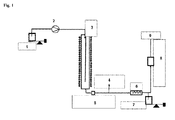
- the fixed bed to be used according to the invention is preferably part of a tube bundle reactor or tubular reactor, which in turn preferably is part of an apparatus shown in FIG Fig. 1 , is.
- the fixed-bed tube reactor to be used according to the invention is preferably a tube-bundle reactor or tube reactor made of steel or stainless steel.
- the catalyst is a fixed bed in a reaction tube or in a bundle of reaction tubes.
- the reaction tubes are usually indirectly heated by heating the space surrounding the reaction tubes by burning a gas, such as methane. It is advantageous to apply this indirect form of heating only to the first about 20 to 30% of the length of the fixed bed and to heat the remaining bed length by the released in the context of indirect heating radiant heat to the required reaction temperature. Other types of heating are known in the art.
- Typical reaction tube inside diameters are 2 to 15 cm.
- a typical tube bundle reactor comprises about 300 to 1000 reaction tubes. Such reactors are state of the art and are manufactured, for example, at MAN DWE GmbH in Deggendorf, Germany. These have a (noble) steel hole bottom. on which the bed is added with catalyst. According to the invention, the reactor is preferably operated at a pressure of 1 to 300 bar, more preferably at 1 to 100 bar, most preferably at 1 to 10 bar, more preferably at 1 to 6 bar and most preferably at 3 to 6 bar operated.
- the dehydration of the isobutanol in the gas phase in the fixed bed is carried out under conditions which are generally known for this reaction.
- temperatures in the range of about 200 to 500 ° C, preferably 250 to 400 ° C.
- TiO 2 is used with above-described BET surface area as a catalyst in a fixed bed.
- Al 2 O 3 / SiO 2 having the above-described BET surface area and having a content of SiO 2 in the range from 0.1 to 80% by weight is used as the catalyst in the fixed bed.
- TiO 2 is used with the BET surface area described above.
- the catalyst used is TiO 2 having the above-indicated BET surface values of the anatase type.
- the catalyst geometry is preferably spherical or cylindrical, hollow or solid.
- the process according to the invention can be operated continuously or batchwise. It is preferably operated continuously.
- the product mixture can be separated into its individual components, as described, for example, in US Pat DE 10 2005 062 700 A1 is described.
- the by-product isobutene is converted by means of acidic catalysts with an alcohol to tert-butyl ethers and separated from the linear butenes before the latter are finally worked up by distillation.
- the work in the context of the present invention were carried out in a laboratory apparatus according to Fig. 1 and carried out with a laboratory tubular reactor with a stainless steel tube of a length of about 1000 mm and a tube cross section of 20mm.
- the stainless steel tube had a stainless steel bottom hole.
- stainless steel balls were first filled, preferably with 2-3 mm diameter, as a placeholder.
- the catalyst was filled, which consisted of moldings, preferably extrudates or balls in about 3mm in length or diameter, to reduce the pressure loss across the pipe.
- On the catalyst bed were finally small rolls of wire mesh, preferably with a diameter and a length of the rolls of about 5 mm, to the top of the reactor tube 3 in Fig.1 filled.
- the fixed-bed reactor was installed in an oven, which electrically heats the reactor tube over the length of the frit (stainless steel perforated bottom) to the reactor tube's top edge.
- the reactor tube was operated at a pressure of 1 to 6.5 bar (a), preferably at 3 to 5 bar (a). This could be ensured by installing a pressure-maintaining valve 5 in FIG Fig.1 at the hot reactor outlet. Thereafter, the still hot reaction gas was removed and directly in a gas chromatograph 4 in Fig.1 analyzed. Sampling took place via heated capillary lines.
- the separation of the components was carried out by gas chromatography and flame ionization.
- the apparatus according to Fig.1 also contained an isobutanol reservoir 1 on a balance, a pump 2 in Fig.1 for dosing isobutanol in the fixed bed reactor 3 in Fig.1 , a cooler 6 in Fig.1 for water condensation, a balance 7 in Fig.1 for weighing the reaction water, a sample cylinder 8 in Fig.1 for sampling for off-line gas analysis and outlet 9 in Fig.1 from the apparatus to the trigger.
- Bar (a) or bara means for the purposes of the present invention the "absolute pressure" which results from 1 bar atmospheric pressure plus corresponding overpressure. See also http://de.wikipedia.org/wikiBar_ (unit).
- the educt used was isobutanol prepared on the basis of crude oil containing> 95% by weight of isobutanol.
- thermocouples By incorporating five thermocouples into the axis of the tube, the internal temperature above and below the catalyst bed and at the beginning, in the middle and at the end of the bed could be measured.
- the reactor tube was operated, for example, at atmospheric pressure, under a pressure of 5 bara or under pressure at 6.5 bara. This was ensured by installing a valve that was electrically controlled via the internal pressure at the hot reactor outlet.
- the still hot reaction gas was taken from the pressureless gas phase directly behind this valve and analyzed directly in a gas chromatograph.
- an Agilent GC 7890 with GICU valve (gas injection valve) from JAS with a heated 250 ⁇ l sample loop was used for the analysis. Sampling took place via heated capillary tubes made of stainless steel.
- Fig. 2 shows the proportion of the sum of the n-butenes (GC surface percentages, determined as described in the experimental part) in the reaction product without taking into account the water contents of the resulting from the inventive process n-butene from isobutanol in the long-term test with a TiO 2 catalyst of St. Gobain NorPro (Type XT25376).
- the experimental procedure corresponded to the structure of Example 1, the pressure was, however, left unchanged in the reactor tube at 6.5 bar and only the temperature varied once.
- Fig. 2 thus represents the results of Example 3 graphically.
- XT25376 from St-Gobain-NorPro, TiO 2 with a BET surface area of about 140 m 2 / g and anatase type
- Al 2 O 3 / SiO 2 mixed oxide which consists of 24.3% by weight of Al 2 O 3 and 74.2% by weight of SiO 2 and had a BET surface area of 434 m 2 / g ( Manufacturer: St-Gobain NorPro, test number 2006120085 DMS 2010 - 0380)
- n-butenes increases with increasing pressure, so that can be prepared by the process according to the invention - as needed - isobutene and / or n-butene.
- the components can then be separated from each other, such as in DE 10 2005 062 700 A1 described.
- thermocouples were mounted, which measures the temperature in the catalyst zone.
- the reactor was electrically heated under nitrogen such that the highest temperature was 350 ° C.
- Isobutanol was then added in liquid form from above, which vaporized in the first zone and met in gaseous form and preheated to about 350 ° C. on the catalyst bed.
- the amounts added are given in the following tables.
- a pressure-maintaining valve was used to regulate the pressure which builds up in the reactor as a result of the reaction.
- the reactions were investigated at normal pressure and at 5 bara. For this purpose, samples were taken from the expanded product gas atmosphere via heated lines and examined with regard to the gaseous components.
- the ratio of isobutene to n-butenes was determined by an area% method, the total conversion based on the unreacted organic components in the gas and the liquid phase.
- the total conversion to iso- and n-butenes was well over 95% ⁇ b> ⁇ u> Table 1 ⁇ / u> ⁇ /b> Temp throughput print Isobutene n-butenes [° C] [g / h] [bara] [area%] [area%] 350 8.8 5 63.45 29.91 350 9.5 1 68.03 25.92 350 9.5 1 67.66 25.76 350 9.5 5 63.49 28.78 350 9.5 5 64.00 29.35
- Example 1 In a construction as described in Example 1, instead of the anatase-type XT25376, a rutile type TiO 2 (XT90045 from St-Gobain NorPro) having a BET surface area of ⁇ 3 m 2 / g was incorporated. A total of 147.7 g of catalyst was used for a catalyst bed of 52 cm.
- XT90045 from St-Gobain NorPro
- Example 1 a catalyst of St-Gobain-NorPro, type: XT 25376 of TiO 2 with a BET surface area of about 140 m 2 / g and of the anatase type. Filling of the reactor as in Example 1. The reactor was operated continuously at a pressure of 6.5 bara.
- Example 1 In a construction as described in Example 1, instead of the XT25376, an Al 2 O 3 / SiO 2 mixed oxide consisting of 24.3% by weight Al 2 O 3 and 74.2% by weight SiO 2 and a BET surface area of 434 m 2 / g possessed (manufacturer: St-Gobain NorPro, test number 2006120085, DMS 2010 - 0380) used. A total of 60.6 g of catalyst was used for a catalyst bed of 54 cm.
- Table 3 plots the results for this catalyst.
- the information on the conversion here refers to the water of reaction obtained.
- Example 1 In a construction as described in Example 1, instead of the XT25376, a TiO 2 type ST61120 from St-Gobain NorPro with a BET surface area of 156 m 2 / g was installed. A total of 83.7 g of catalyst was used for a catalyst bed of 51 cm.
- Table 4 plots the results for this catalyst.
- the information on the conversion here refers to the water of reaction obtained.
Landscapes
- Chemical & Material Sciences (AREA)
- Organic Chemistry (AREA)
- Chemical Kinetics & Catalysis (AREA)
- Engineering & Computer Science (AREA)
- Materials Engineering (AREA)
- Organic Low-Molecular-Weight Compounds And Preparation Thereof (AREA)
- Catalysts (AREA)
- Preparation Of Compounds By Using Micro-Organisms (AREA)
Abstract
Die vorliegende Erfindung betrifft die Herstellung linearer Butene aus Isobutanol, das bevorzugt mikrobiell und/oder fermentativ aus nachwachsenden Rohstoffen gewonnen wurde.
Description
- Die vorliegende Erfindung betrifft die Herstellung linearer Butene aus Isobutanol, das bevorzugt mikrobiell und/oder fermentativ aus nachwachsenden Rohstoffen gewonnen wurde.
- Lineare Butene im Sinne der vorliegenden Erfindung sind bevorzugt Buten-1 und Buten-2 (von letzterem sowohl die trans- wie auch die cis-Form), insbesondere bevorzugt Buten-1.
- Isobutanol gehört zu den chemischen Verbindungen, die sich durch gezielte biochemische Prozesse aus Naturprodukten herstellen lassen und die aufgrund ihres C4-Grundkörpers das Interesse der chemischen Industrie auf sich ziehen. Aus Isobutanol lässt sich durch Dehydratisierung Isobuten herstellen, das einen wichtigen Baustein für die Synthese von Lösungsmitteln und für Kraftstoffadditive wie zum Beispiel Methyl-t-butylether (MTBE) darstellt und bei dem es sich außerdem um einen wichtigen Rohstoff in der Kunststoffindustrie handelt. Sehr großes Interesse herrscht zusätzlich an linearen Butenen, da sich diese sowohl direkt in den Polymerisationsprozessen der Kunststoffindustrie einsetzen lassen, als auch, zum Beispiel durch eine partielle Oxidation, in den wichtigen Rohstoff Butadien überführen lassen.
- Aus
GB 576 480 - Auch die Dehydratisierung von Isobutanol zu einem Isobuten / n-Buten Gemisch durch Säuren (Schwefelsäure-/Phosphorsäuregemisch) in flüssiger Phase ist schon lange bekannt, wobei der Anteil der linearen Butene sehr unterschiedlich war und beispielsweise bis zu 66 % betrug (Canadian Journal of Chemistry (1970), 48(22), 3545-8). Die gesamte Ausbeute gasförmiger Produkte mit 15-45 % in diesen Beispielen war allerdings für eine wirtschaftliche Umsetzung viel zu gering.
- Um die Reaktion technisch besser umsetzen zu können, wurden Versuche unternommen, Schwefelsäure auf Träger wie zum Beispiel γ-Aluminiumoxid aufzuziehen und mit diesen die Umsetzung in einem Festbettreaktor durchzuführen. So wird beispielsweise in Applied Catalysis, A.: General (2001, 214(2), 251-257) beschrieben, dass sich bei der Dehydratisierung von Isobutanol das Isomerenverhältnis zu Gunsten der linearen Butene verschiebt, wenn die Temperatur auf über 400°C angehoben wird. Dort werden Selektivitäten von 53,4 % n-Butene zu 40 % iso-Buten (bei 400°C) und 44,7 % n-Butene zu 39,8 % iso-Buten (470°C) gefunden. Zum einen wurde jedoch bei sehr hohen Temperaturen gearbeitet, die nur wenig wirtschaftlich sind. Zum anderen wurde das Isobutanol, bevor es in den eigentlichen Reaktor dosiert wurde, durch Glaswolle geleitet, die mit rund 300°C bereits sehr heiß war. Nach den im Rahmen der vorliegenden Erfindung gefundenen Erfahrungen hat aber SiO2 selber bereits einen großen Einfluss auf die Selektivität der Dehydratisierung.
- Die Reaktion von Isobutanol zu Isobuten an festen Katalysatoren ohne weitere Zusätze wurde bereits mehrfach beschrieben. So wird zum Beispiel in
DD 245866 US 20100216958A ). Technische Ausführungen hierzu werden ebenfalls beschrieben (Proceedings - Annual International Pittsburgh Coal Conference (1993), 10th, 1196-9). - All diese Verfahren verwenden Isobutanol als Edukt, das nicht durch bevorzugt mikrobielle oder fermentative Prozesse gewonnen wurde oder bedienen sich zumeist der flüssigen Katalyse.
- Schließlich wurde in
WO 2008/016428 A2 undWO 2008/066581 A1 der Einfluss verschiedenster saurer Katalysatoren auf die Reaktion von 2-Butanol zu Butenen untersucht. Dabei kamen als Katalysator Schwefelsäure, Wolframsäure, sulfatiertes Zirkonium, Amberlyst®15, 13 % Nafion®/SiO2, CBV3020 E oder H-Mordenite zum Einsatz. 2-Butanol ist aber nicht der bevorzugte Einsatzstoff, da aus ihm nicht auch Isobuten gewonnen werden kann. - Aus Top. Catal. (2010) 53:1224 - 1230 ist die Dehydratisierung von fermentativ gewonnenem Isobutanol mittels eines Katalysators BASF AL3996, einem Aluminiumoxid mit einer BET-Oberfläche von 200 m2/g, bekannt. Das Hauptprodukt ist hier jedoch Isobuten als Rohstoff für synthetische Kraftstoffe. Lineare Butene fallen dabei insbesondere bei niedrigen Temperaturen nur in geringem Maße an.
- Aufgabe der vorliegenden Erfindung war es daher, ausgehend von bevorzugt fermentativ oder mikrobiell gewonnenem Isobutanol einen Katalysator zu entwickeln, der lineare Butene, insbesondere Buten-1, über einen langen Zeitraum in wirtschaftlichen Mengen liefert.
- Lösung der Aufgabe und Gegenstand der vorliegenden Erfindung ist ein Verfahren zur Dehydratisierung von Isobutanol zu linearen n-Butenen, dadurch gekennzeichnet, dass als Katalysator in einem Festbett TiO2 mit einer hohen BET-Oberfläche > 10m2/g oder Al2O3/SiO2 eingesetzt werden. Bevorzugt beträgt die BET-Oberfläche des TiO2-Katalysators 20 bis 400 m2/g, besonders bevorzugt 40 bis 200 m2/g, ganz besonders bevorzugt 140 bis 160 m2/g. Bevorzugt beträgt die BET-Oberfläche des in einer alternativen Ausführungsform einzusetzenden Katalysators Al2O3/SiO2 0,1 bis 100m2/g. Die BET-Oberflächen-Werte im Rahmen der vorliegenden Erfindung sind zu bestimmen durch Adsorption in Stickstoff nach DIN 66131.
- Zur Klarstellung sei angemerkt, dass vom Rahmen der Erfindung alle aufgeführten, allgemeinen oder in Vorzugsbereichen genannten Definitionen und Parameter in beliebigen Kombinationen umfasst sind.
- Als Edukt wird Isobutanol, bevorzugt aus mikrobiellen und/oder fermentativen Prozessen, wie sie beispielsweise in
WO 2009/086423A2 ;WO 2010/151832A1 ,WO 2010/151525A1 ,US 2010/0216958A1 ,US 2007/0092957A1 oderDE 10 2008 010 121 A1 beschrieben werden, eingesetzt. Ein aus fermentativem oder mikrobiellem Herstellprozess gewonnenes Isobutanol das für den erfindungsgemäßen Einsatz verwendet werden kann, ist gemäßUS 2010/0216958A1 Beispiel 1 bevorzugt ein Stoffgemisch enthaltend 98 - 99,9 Gew.-% Isobutanol und 2 - 0,1 Gew.-% Wasser, bevorzugt 98,5 - 99,9 Gew.-% Isobutanol und 1,5 - 0,1 Gew.-% Wasser. In einer besonders bevorzugten Ausführungsform kann im erfindungsgemäß einzusetzenden Stoffgemisch neben Isobutanol und Wasser noch 3-Methyl-1-butanol zu 0,5 bis 1,5 Gew.-% enthalten sein. Daraus ergeben sich Stoffgemische enthaltend 98 - 99,8 Gew.-% Isobutanol, 0,1 - 1,9 Gew.-% 3-Methyl-1-butanol und 0,1 - 1,9 Gew.-% Wasser, bevorzugt 98,5 - 99,8 Gew.-% Isobutanol, 0,1 - 1,75 Gew.-% 3-Methyl-1-butanol und 0,1 - 1,75 Gew.-% Wasser. - Das erfindungsgemäß einzusetzende Festbett ist bevorzugt Teil eines Rohrbündelreaktors oder Röhrenreaktors, der wiederum bevorzugt Bestandteil einer Apparatur, dargestellt in
Fig. 1 , ist. Der erfindungsgemäß einzusetzende Festbettrohrreaktor ist bevorzugt ein Rohrbündelreaktor oder Röhrenreaktor aus Stahl oder Edelstahl. Bei diesen Reaktoren befindet sich der Katalysator als Festbett in einem Reaktionsrohr oder in einem Bündel von Reaktionsrohren. Die Reaktionsrohre werden üblicherweise dadurch indirekt beheizt, indem der die Reaktionsrohre umgebende Raum durch Verbrennen eines Gases, beispielsweise Methan, beheizt wird. Günstig ist es dabei, diese indirekte Form der Aufheizung lediglich auf die ersten ca 20 bis 30% der Länge der Festbettschüttung anzuwenden und die verbleibende Schüttungslänge durch die im Rahmen der indirekten Aufheizung freigesetzte Strahlungswärme auf die erforderliche Reaktionstemperatur aufzuheizen. Weitere Arten der Beheizung sind dem Fachmann bekannt. Übliche Reaktionsrohr-Innendurchmesser betragen 2 bis 15cm. Ein typischer Rohrbündelreaktor umfasst ca. 300 bis 1000 Reaktionsrohre. Derartige Reaktoren sind Stand der Technik und werden beispielsweise bei der MAN DWE GmbH in Deggendorf, Deutschland gefertigt. Diese weisen einen (Edel-) stahllochboden. auf, worauf die Schüttung mit Katalysator gegeben wird. Erfindungsgemäß wird der Reaktor bevorzugt bei einem Druck von 1 bis 300 bar, besonders bevorzugt bei 1 bis 100 bar, ganz besonders bevorzugt bei 1 bis 10 bar, insbesondere bevorzugt bei 1 bis 6 bar und insbesondere ganz besonders bevorzugt bei 3 bis 6 bar betrieben. - Die Dehydratisierung des Isobutanols in der Gasphase im Festbett wird bei Bedingungen durchgeführt, die für diese Reaktion im Allgemeinen bekannt sind. Dazu verwendet man bevorzugt Temperaturen im Bereich von etwa 200 bis 500°C, vorzugsweise 250 bis 400°C. Erfindungsgemäß wird TiO2 mit oben beschriebener BET-Oberfläache als Katalysator im Festbett eingesetzt. Erfindungsgemäß wird in einer bevorzugten Ausführungsform Al2O3/SiO2 mit oben beschriebener BET-Oberfläche und mit einem Gehalt an SiO2 im Bereich von 0,1 bis 80 Gew.-% als Katalysator im Festbett eingesetzt. Insbesondere bevorzugt wird TiO2 mit der oben beschriebenen BET-Oberfläche eingesetzt. Insbesondere ganz besonders bevorzugt wird als Katalysator TiO2 mit den oben angegebenen BET-Oberflächen-Werten vom Typ Anatas eingesetzt. Die Katalysatorgeometrie ist bevorzugt kugelförmig oder zylindrisch, hohl oder voll.
- Das erfindungsgemäße Verfahren kann kontinuierlich oder diskontinuierlich betrieben werden. Bevorzugt wird es kontinuierlich betrieben.
- Technisch kann das Produktgemisch in seine einzelnen Komponenten aufgetrennt werden, wie es zum Beispiel in
DE 10 2005 062 700 A1 beschrieben wird. Dabei wird beispielsweise das Nebenprodukt Isobuten mittels saurer Katalysatoren mit einem Alkohol zu tert.-Butylethern umgesetzt und von den linearen Butenen abgetrennt bevor Letztere schließlich destillativ aufgearbeitet werden. - Die Arbeiten im Rahmen der vorliegenden Erfindung wurden in einer Laborapparatur gemäß
Fig. 1 und mit einem Labor-Rohrreaktor mit einem Edelstahlrohr einer Länge von ca. 1000 mm und einem Rohrquerschnit von 20mm durchgeführt. Das Edelstahlrohr wies einen Edelstahllochboden auf. In das Stahlrohr wurden zunächst Edelstahlkugeln, bevorzugt mit 2-3 mm Durchmesser, als Platzhalter eingefüllt. Auf diese Schüttung wurde der Katalysator gefüllt, der aus Formkörpern, bevorzugt aus Extrudaten oder Kugeln in von etwa 3mm Länge bzw. Durchmesser, bestand, um den Druckverlust über das Rohr zu verringern. Auf das Katalysatorbett wurden schließlich kleine Rollen von Drahtgewebe, bevorzugt mit einem Durchmesser und einer Länge der Rollen von ca. 5 mm, bis zur Oberkante des Reaktorrohres 3 inFig.1 eingefüllt. Der Festbettreaktor wurde in einen Ofen eingebaut, der das Reaktorrohr auf der Länge von Fritte (Edelstahllochboden) bis Reaktorrohroberkante elektrisch beheizt. Durch Einbau von fünf Thermoelementen in die Achse des Rohres konnte die Innentemperatur oberhalb und unterhalb der Katalysatorschüttung sowie am Anfang, in der Mitte und am Ende des Bettes gemessen werden. Das Reaktorrohr wurde bei einem Druck von 1 bis 6,5 bar(a), bevorzugt bei 3 bis 5 bar(a), betrieben. Sichergestellt werden konnte dies durch Einbau eines elektrisch über den Innendruck geregelten Druckhalteventils 5 inFig.1 am heißen Reaktorausgang. Danach wurde das noch heiße Reaktionsgas entnommen und direkt in einem Gaschromatographen 4 inFig.1 analysiert. Die Probennahme erfolgte über beheizte Kapillarleitungen. Die Trennung der Komponenten erfolgte gaschromatographisch und mittels Flammenionisation. Die Apparatur gemäßFig.1 enthielt ferner ein Isobutanol-Vorlagegefäss 1 auf einer Waage, eine Pumpe 2 inFig.1 zur Dosierung von Isobutanol in den Festbettreaktor 3 inFig.1 , einen Kühler 6 inFig.1 zur Wasserkondensation, eine Waage 7 inFig.1 zum Auswiegen des Reaktionswassers, einen Probenzylinder 8 inFig.1 zur Probenentnahme für die Offline-Gasanalytik und den Auslaß 9 inFig.1 aus der Apparatur zum Abzug. Bar(a) oder bara bedeutet im Sinne der vorliegenden Erfindung der "absolute Druck" der sich aus 1 bar Atmosphärendruck plus entsprechendem Überdruck ergibt. Siehe hierzu auch http://de.wikipedia.org/wikiBar_(Einheit). - Als Edukt wurde Isobutanol, hergestellt auf Basis von Rohöl verwendet, das >95 Gew.-% Isobutanol enthielt, eingesetzt.
- Die folgenden Beispiele sollen die Erfindung exemplarisch beschreiben, ohne sie einzuschränken.
- Zum Vergleich wird ein ähnliches Verfahren vorgestellt, wobei als Katalysator Aluminiumoxid eingesetzt wurde.
- In ein Rohr aus Edelstahl mit einer Länge von ca. 1000 mm und mit einem Edelstahllochboden wurden ca. 210 mm Stahlkugeln (ca. 2-3 mm Durchmesser) eingefüllt. Auf diese Schüttung wurde der Katalysator gefüllt, der aus Formkörpern (zum Beispiel Extrudate mit ca. 3mm Länge und Dicke oder Kugeln von einem Duchmesser von ca. 3 mm) bestand, um den Druckverlust über das Rohr zu verringern. Auf das Katalysatorbett wurden nun kleine Rollen von feinem Drahtgewebe (Durchmesser und Länge der Rollen liegt bei ca. 5 mm) bis zur Oberkante des Reaktorrohres eingefüllt. Der Reaktor wurde in einen Ofen eingebaut, der das Reaktorrohr auf der Länge von Fritte bis Reaktorrohroberkante elektrisch beheizte. Durch Einbau von fünf Thermoelementen in die Achse des Rohres konnte die Innentemperatur oberhalb und unterhalb der Katalysatorschüttung sowie am Anfang, in der Mitte und am Ende des Bettes gemessen werden. Das Reaktorrohr wurde zum Beispiel bei Normaldruck, unter einem Druck von 5 bara oder unter Druck bei 6,5 bara betrieben. Sichergestellt wurde dies durch Einbau eines elektrisch über den Innendruck geregelten Ventils am heißen Reaktorausgang. Es wurde das noch heiße Reaktionsgas aus der drucklosen Gasphase direkt hinter diesem Ventil entnommen und direkt in einem Gaschromatographen analysiert. Für diese Analysen wurde ein Agilent GC 7890 mit GICU-Ventil (Gasinjektionsventil) der Firma JAS mit einer beheizten 250µl Probenschleife zur Analytik verwendet. Die Probennahme erfolgte über beheizte Kapillarleitungen aus Edelstahl. Die Trennung der Komponenten erfolgte auf einer Varian CP-Wax 52CB (25m * 0,25mm * 0,2µm), wobei der unpolare Leichtsiederanteil mittels eines Dean-Switches auf eine Agilent HP-AL/KCL (30m * 0,250mm * 5,00µm) zur Isomerentrennung umgeleitet wurde und mittels Flammenionisation detektiert wurde. Die übrigen Komponenten auf der CP-Wax wurden parallel am Flammenionisationsdetektor und am Wärmeleitfähigkeitsdetektor (für das Wasser) detektiert.
- Eine für das Verfahren erforderliche Apparatur ist in
Fig. 1 dargestellt. InFig. 1 bedeuten: - 1 = Isobutanol-Vorlagegefäß auf einer Waage
- 2 = Pumpe zur Dosierung von Isobutanol in Reaktor 3
- 3 = Festbettreaktor aus Edelstahl (1.4571) mit einem Innendurchmesser von ca. 18 mm
- 4 = Online Gaschromatograph
- 5 = Druckhalteventil
- 6 = Kühler zur Wasserkondensation
- 7 = Reaktionswasser (wird ausgewogen)
- 8 = Probenzylinder zur Probenentnahme für die Offline-Gasanalytik
- 9 = Auslaß zum Abzug
-
Fig. 2 zeigt den Anteil der Summe der n-Butene (GC-Flächenprozente, ermittelt wie im experimentellen Teil beschrieben) im Reaktionsprodukt ohne Berücksichtigung der Wasseranteile des gemäß des erfindungsgemäßen Verfahrens entstandenen n-Butens aus Isobutanol im Langzeittest mit einem TiO2-Katalysator von St.-Gobain NorPro (Typ XT25376). Die Versuchsdurchführung entsprach dabei im Aufbau dem Beispiel 1, der Druck wurde allerdings im Reaktorrohr unverändert bei 6,5 bar absolut belassen und nur die Temperatur einmal variiert.Fig. 2 stellt damit die Ergebnisse aus Beispiel 3 graphisch dar. - XT25376 von St-Gobain-NorPro, TiO2 mit einer BET-Oberfläche von ca. 140 m2/g und im Anatas-Typ
- Al2O3/SiO2 -Mischoxid, das zu 24,3 Gew.-% aus Al2O3 und zu 74,2 Gew.-% aus SiO2 besteht und eine BET-Oberfläche von 434 m2/g besaß (Hersteller: St-Gobain NorPro, Versuchnummer 2006120085 DMS 2010 - 0380)
- ST61120 von St-Gobain NorPro, TiO2 mit einer BET-Oberfläche von 156 m2/g (CAS 13463-67-7)
- Es zeigt sich, dass der Gehalt an n-Butenen mit steigendem Druck zunimmt, so dass nach dem erfindungsgemäßen Verfahren - je nach Bedarf - Isobuten und/oder n-Buten hergestellt werden kann. Technisch können die Komponenten dann voneinander getrennt werden , wie zum Beispiel in
DE 10 2005 062 700 A1 beschrieben. - In einem Aufbau wie in
Fig. 1 beschrieben wurde das Reaktorrohr in folgender Reihenfolge schichtweise befüllt: - 1. 50 ml (21 cm) Edelstahlkugeln 1.4571, 3mm Durchmesser
- 2. 93,7 g Katalysator XT25367 von St. Gobain-NorPro (ergab eine Schütthöhe von 52cm)
- 3. Stahlsiebringe mit einem Durchmesser von ca. 5 mm und einer Höhe von ebenfalls ca. 5 mm bis zur Oberkante des Reaktors.
- In der Schüttung waren Thermoelemente angebracht, die die Temperatur in der Katalysatorzone mißt. Der Reaktor wurde unter Stickstoff dergestalt elektrisch aufgeheizt, so daß die höchste Temperatur bei 350°C lag. Dann wurde von oben Isobutanol flüssig zudosiert, das in der ersten Zone verdampfte und gasförmig und auf ca. 350°C vorgeheizt auf die Katalysatorschüttung traf. Die zudosierten Mengen sind in den folgenden Tabellen angegeben. Über ein Druckhalteventil konnte der Druck, der sich durch die Umsetzung im Reaktor aufbaut, reguliert werden. Es wurden die Umsetzungen bei Normaldruck und bei 5 bara untersucht. Hierzu wurden aus der entspannten Produktgasatmosphäre über beheizte Leitungen Proben gezogen und diese hinsichtlich der gasförmigen Komponenten hin untersucht. Das Verhältnis Isobuten zu n-Butenen wurde durch eine Flächen-% Methode ermittelt, der Gesamtumsatz anhand der nicht umgesetzten organischen Bestandteile in der Gas- und der Flüssigphase ermittelt. Der Gesamtumsatz zu iso- und n-Butenen lag bei deutlich über 95%
Tabelle 1 Temp Durchsatz Druck Iso-Buten n-Butene [°C] [g/h] [bara] [area %] [area %] 350 8,8 5 63,45 29,91 350 9,5 1 68,03 25,92 350 9,5 1 67,66 25,76 350 9,5 5 63,49 28,78 350 9,5 5 64.00 29,35 - Tabelle 1 zeigt die Abhängigkeit des n-Buten zu Isobuten Verhältnisses als Funktion des Druckes bei Verwendung eines TiO2-Katalysator XT 25376 von St. Gobain-NorPro unter Verwendung von 93,7g Katalysator (=Schütthöhe des Katalysatorbetts von 52 cm) in einem Aufbau wie in
Fig. 1 beschrieben. Des weiteren ist in Tabelle 1 zu erkennen, daß die Druckabhängigkeit der n-Buten-Bildung unter diesen Bedingungen reversibel ist. - In einem wie in Beispiel 1 beschriebenen Aufbau wurde anstelle des XT25376 vom Anatas-Typ ein TiO2 vom Rutil-Typ (XT90045 von St-Gobain NorPro) mit einer BET-Oberfläche von <3 m2/g eingebaut. Es wurden für eine Katalysatorschüttung von 52 cm insgesamt 147,7g Katalysator eingesetzt.
- Es wurden bei einem Durchsatz von 7,7 g/h unter einem Druck von 5 bara bei 350°C insgesamt 151,1g Isobutanol aufgegeben, die bei einem Umsatz von ca. 91% ein Leichtsiedergemisch mit einem Anteil von 77,7 % Isobuten und 21,5 % als Summe der n-Butene ergaben.
- Eingesetzt wurde wie in Beispiel 1 ein Katalysator von St-Gobain-NorPro, Typ: XT 25376 aus TiO2 mit einer BET-Oberfläche von ca. 140 m2/g und vom Anatas-Typ. Füllung des Reaktors wie in Beispiel 1. Der Reaktor wurde durchgehend bei einem Druck von 6,5 bara betrieben.
- In das auf ca. 350°C resp. 375°C erhitzte Reaktorrohr (jeweilige Einstellung siehe Tabelle 2) wurde mit einer Rate von ca. 9 g/h kontinuierlich Isobutanol gepumpt. Nach einem Druckaufbau auf 6,5 bara wurde kontinuierlich Produkt abgenommen. Die Ergebnisse dieses Versuchs sind in Tabelle 2 dargestellt. Jeder der Versuchspunkte zeigt einen Umsatz von >98% bezogen auf das eingesetzte Isobutanol.
Tabelle 2 Tage nach Versuchsbeginn Temp. Durchsatz iso-Buten n-Butene [°C] [g/h] [area%] [area%] 1 350 9,5 64,46 29,77 2 350 8,5 64,1 30,62 3 350 8,8 64,06 30,62 4 350 8,8 64,06 30,62 5 350 19,8 64,82 30,37 8 350 3,73 61,15 29,55 9 375 9,1 59 29,3 10 375 9,1 58,62 29,95 11 375 9 59,15 30,56 12 375 9,1 58,78 30,97 15 375 9,1 58,09 31,54 16 375 9 58,27 31,86 17 375 9 58,03 31,95 18 375 9,1 58,04 32,11 19 375 9,1 57,93 32,2 22 375 9,1 57,88 32,54 23 375 9,1 57,84 32,6 24 375 9,1 57,69 32,52 25 375 9 57,07 32,85 26 375 9,1 57,49 32,88 29 375 9,1 57,25 33,06 30 375 9 57,33 33,05 31 375 9,1 57,42 33,13 32 375 9 56,58 33,27 33 375 8,9 57,39 33,11 36 375 9,1 57,91 32,76 37 375 8,8 57,81 32,81 - In einem wie in Beispiel 1 beschriebenen Aufbau wurde anstelle des XT25376 ein Al2O3/SiO2 - Mischoxid, das zu 24,3 Gew.-% aus Al2O3 und zu 74,2 Gew.-% aus SiO2 besteht und eine BET-Oberfläche von 434 m2/g besaß (Hersteller: St-Gobain NorPro, Versuchsnummer 2006120085, DMS 2010 - 0380) eingesetzt. Es wurden für eine Katalysatorschüttung von 54 cm insgesamt 60,6g Katalysator eingesetzt.
- In Tabelle 3 sind die Ergebnisse für diesen Katalysator aufgetragen. Die Angaben zum Umsatz beziehen sich hier auf die erhaltenen Reaktionswassermengen.
Tabelle 3 Temp. Durchsatz Durchsatz Umsatz iso-Buten n-Butene Wasser [°C] [g/h] [g] [%] [area%] [area%] [g] 350 10,3 49,9 ∼100 8,62 20,3 14,1 320 10,3 199,8 90,93 41,6 31,4 44,2 290 10,3 178,1 97,83 57,9 31,7 42,6 260 10,4 712,5 98,17 59,4 30,8 171 230 10,5 204,6 82,92 51,4 27,8 43,6 - In einem wie in Beispiel 1 beschriebenen Aufbau wurde anstelle des XT25376 ein TiO2 Typ ST61120 von St-Gobain NorPro mit einer BET-Oberfläche von 156 m2/g eingebaut. Es wurden für eine Katalysatorschüttung von 51cm insgesamt 83,7g Katalysator eingesetzt.
- In Tabelle 4 sind die Ergebnisse für diesen Katalysator aufgetragen. Die Angaben zum Umsatz beziehen sich hier auf die erhaltenen Reaktionswassermengen.
Tabelle 4 Temp. Durchsatz Durchsatz Umsatz iso-Buten n-Butene Wasser [°C] [g/h] [g] [%] [area%] [area%] [g] 350 8,6 41,6 ∼100 55,4 26,5 11,1 320 8,6 165,3 84,54 63,9 29,9 34 290 8,6 148 43,51 69,7 25,7 16,8
Claims (12)
- Verfahren zur Dehydratisierung von Isobutanol zu linearen n-Butenen, dadurch gekennzeichnet, dass als Katalysator in einem Festbett TiO2 mit einer BET-Oberfläche > 10m2/g oder ein Al2O3/SiO2 eingesetzt werden.
- Verfahren gemäß Anspruch 1, dadurch gekennzeichnet, dass als Katalysator TiO2 mit einer BET-Oberfläche> 10m2/g, bevorzugt 20 bis 400 m2/g, eingesetzt wird.
- Verfahren gemäß Anspruch 1, dadurch gekennzeichnet, dass als Katalysator Al2O3/SiO2 mit einer BET-Oberfläche 0,1 bis 100m2/g eingesetzt wird.
- Verfahren gemäß Anspruch 3, dadurch gekennzeichnet, dass als Katalysator Al2O3/SiO2 mit einem Gehalt an SiO2 im Bereich von 0,1 bis 80 Gew.-% eingesetzt wird.
- Verfahren gemäß Anspruch 2, dadurch gekennzeichnet, dass als Katalysator TiO2 vom Typ Anatas eingesetzt wird.
- Verfahren gemäß der Ansprüche 1 bis 5, dadurch gekennzeichnet, dass das Festbett Teil eines Rohrbündelreaktors oder Röhrenreaktors ist.
- Verfahren gemäß Anspruch 6, dadurch gekennzeichnet, dass der Reaktor aus Stahl oder Edelstahl ist.
- Verfahren gemäß einem der Ansprüche 1 bis 7, dadurch gekennzeichnet, dass dieses bei Temperaturen im Bereich von etwa 200 bis 500°C, vorzugsweise 250 bis 400°C durchgeführt wird.
- Verfahren gemäß der Ansprüche 1 bis 8, dadurch gekennzeichnet, dass der Reaktor bei einem Druck von 1 bis 300 bar betrieben wird.
- Verfahren gemäß der Ansprüche 1 bis 9, dadurch gekennzeichnet, dass als Edukt Isobutanol aus mikrobiellen und/oder fermentativen Prozessen eingesetzt wird.
- Verfahren gemäß der Ansprüche 1 bis 10, dadurch gekennzeichnet, dass als n-Buten Buten-1 gewonnen wird.
- Verfahren gemäß einem der Ansprüche 1 bis 11, dadurch gekennzeichnet, dass dieses kontinuierlich betrieben wird.
Priority Applications (5)
| Application Number | Priority Date | Filing Date | Title |
|---|---|---|---|
| EP11185644.9A EP2583957A1 (de) | 2011-10-18 | 2011-10-18 | Lineare Butene aus Isobutanol |
| US14/352,068 US20140303419A1 (en) | 2011-10-18 | 2012-10-17 | Linear butenes from isobutanol |
| BR112014009051A BR112014009051A2 (pt) | 2011-10-18 | 2012-10-17 | método para a desidratação de isobutanol para formar n-butenos lineares, uso de uma pressão mais elevada, e método para aumentar a seletividade nos lados dos n-butenos lineares |
| PCT/EP2012/070584 WO2013057145A1 (de) | 2011-10-18 | 2012-10-17 | Lineare butene aus isobutanol |
| CN201280051512.XA CN103889937A (zh) | 2011-10-18 | 2012-10-17 | 来自异丁醇的直链丁烯 |
Applications Claiming Priority (1)
| Application Number | Priority Date | Filing Date | Title |
|---|---|---|---|
| EP11185644.9A EP2583957A1 (de) | 2011-10-18 | 2011-10-18 | Lineare Butene aus Isobutanol |
Publications (1)
| Publication Number | Publication Date |
|---|---|
| EP2583957A1 true EP2583957A1 (de) | 2013-04-24 |
Family
ID=47071257
Family Applications (1)
| Application Number | Title | Priority Date | Filing Date |
|---|---|---|---|
| EP11185644.9A Withdrawn EP2583957A1 (de) | 2011-10-18 | 2011-10-18 | Lineare Butene aus Isobutanol |
Country Status (5)
| Country | Link |
|---|---|
| US (1) | US20140303419A1 (de) |
| EP (1) | EP2583957A1 (de) |
| CN (1) | CN103889937A (de) |
| BR (1) | BR112014009051A2 (de) |
| WO (1) | WO2013057145A1 (de) |
Cited By (2)
| Publication number | Priority date | Publication date | Assignee | Title |
|---|---|---|---|---|
| DE102013113719A1 (de) | 2013-12-09 | 2015-06-11 | Oxea Gmbh | Verfahren zur Herstellung von Pentanderivaten und Derivaten α,β-ungesättigter Decenale |
| DE102013113724A1 (de) | 2013-12-09 | 2015-06-11 | Oxea Gmbh | Verfahren zur Herstellung von Pentanderivaten und Derivaten alpha, beta-ungesättigter Decenale aus Propylen |
Families Citing this family (1)
| Publication number | Priority date | Publication date | Assignee | Title |
|---|---|---|---|---|
| US10464860B2 (en) | 2014-05-07 | 2019-11-05 | Mitsubishi Chemical Corporation | Method for producing isobutylene from isobutanol |
Citations (13)
| Publication number | Priority date | Publication date | Assignee | Title |
|---|---|---|---|---|
| GB576480A (en) | 1942-10-31 | 1946-04-05 | Universal Oil Prod Co | Process for producing olefinic hydrocarbons |
| DD245866A1 (de) | 1986-01-22 | 1987-05-20 | Leuna Werke Veb | Verfahren zur herstellung von c tief 2- bis c tief 4-olefinen |
| DE19913839A1 (de) * | 1999-03-26 | 2000-09-28 | Metallgesellschaft Ag | Formkörper aus Titandioxid, Verfahren zu deren Herstellung und deren Verwendung |
| US20070092957A1 (en) | 2005-10-26 | 2007-04-26 | Donaldson Gail K | Fermentive production of four carbon alcohols |
| DE102005062700A1 (de) | 2005-12-28 | 2007-07-05 | Oxeno Olefinchemie Gmbh | Verfahren zur Herstellung von 1-Buten aus technischen Mischungen von C4-Kohlenwasserstoffen |
| WO2008016428A2 (en) | 2006-06-16 | 2008-02-07 | E. I. Du Pont De Nemours And Company | Process for making butenes from dry isobutanol |
| WO2008066581A1 (en) | 2006-12-01 | 2008-06-05 | E. I. Du Pont De Nemours And Company | Process for making butenes from aqueous 2-butanol |
| WO2009086423A2 (en) | 2007-12-23 | 2009-07-09 | Gevo, Inc. | Yeast organism producing isobutanol at a high yield |
| DE102008010121A1 (de) | 2008-02-20 | 2009-09-03 | Butalco Gmbh | Fermentative Produktion von Isobutanol mit Hefe |
| US20100216958A1 (en) | 2009-02-24 | 2010-08-26 | Peters Matthew W | Methods of Preparing Renewable Butadiene and Renewable Isoprene |
| WO2010151832A1 (en) | 2009-06-26 | 2010-12-29 | Gevo, Inc. | Recovery of higher alcohols from dilute aqueous solutions |
| WO2010151525A1 (en) | 2009-06-22 | 2010-12-29 | Gevo, Inc. | Yeast organisms for the production of isobutanol |
| WO2011113834A1 (en) * | 2010-03-15 | 2011-09-22 | Total Petrochemicals Research Feluy | Simultaneous dehydration and skeletal isomerisation of isobutanol on acid catalysts |
Family Cites Families (4)
| Publication number | Priority date | Publication date | Assignee | Title |
|---|---|---|---|---|
| GB1541928A (en) * | 1975-12-23 | 1979-03-14 | Sakai Chemical Industry Co | Production of shaped catalysts or carriers comprising titanium oxide |
| US5162283A (en) * | 1991-01-22 | 1992-11-10 | Mobil Oil Corporation | Highly porous amorphous titania and titania/silica phases |
| MX2009010181A (es) | 2007-03-22 | 2009-12-04 | Novartis Ag | Antigenos c5 y usos de los mismos. |
| CN101939277A (zh) * | 2008-02-07 | 2011-01-05 | 道达尔石油化学产品研究弗吕公司 | 醇在结晶硅酸盐上的脱水 |
-
2011
- 2011-10-18 EP EP11185644.9A patent/EP2583957A1/de not_active Withdrawn
-
2012
- 2012-10-17 BR BR112014009051A patent/BR112014009051A2/pt not_active Application Discontinuation
- 2012-10-17 US US14/352,068 patent/US20140303419A1/en not_active Abandoned
- 2012-10-17 CN CN201280051512.XA patent/CN103889937A/zh active Pending
- 2012-10-17 WO PCT/EP2012/070584 patent/WO2013057145A1/de not_active Ceased
Patent Citations (13)
| Publication number | Priority date | Publication date | Assignee | Title |
|---|---|---|---|---|
| GB576480A (en) | 1942-10-31 | 1946-04-05 | Universal Oil Prod Co | Process for producing olefinic hydrocarbons |
| DD245866A1 (de) | 1986-01-22 | 1987-05-20 | Leuna Werke Veb | Verfahren zur herstellung von c tief 2- bis c tief 4-olefinen |
| DE19913839A1 (de) * | 1999-03-26 | 2000-09-28 | Metallgesellschaft Ag | Formkörper aus Titandioxid, Verfahren zu deren Herstellung und deren Verwendung |
| US20070092957A1 (en) | 2005-10-26 | 2007-04-26 | Donaldson Gail K | Fermentive production of four carbon alcohols |
| DE102005062700A1 (de) | 2005-12-28 | 2007-07-05 | Oxeno Olefinchemie Gmbh | Verfahren zur Herstellung von 1-Buten aus technischen Mischungen von C4-Kohlenwasserstoffen |
| WO2008016428A2 (en) | 2006-06-16 | 2008-02-07 | E. I. Du Pont De Nemours And Company | Process for making butenes from dry isobutanol |
| WO2008066581A1 (en) | 2006-12-01 | 2008-06-05 | E. I. Du Pont De Nemours And Company | Process for making butenes from aqueous 2-butanol |
| WO2009086423A2 (en) | 2007-12-23 | 2009-07-09 | Gevo, Inc. | Yeast organism producing isobutanol at a high yield |
| DE102008010121A1 (de) | 2008-02-20 | 2009-09-03 | Butalco Gmbh | Fermentative Produktion von Isobutanol mit Hefe |
| US20100216958A1 (en) | 2009-02-24 | 2010-08-26 | Peters Matthew W | Methods of Preparing Renewable Butadiene and Renewable Isoprene |
| WO2010151525A1 (en) | 2009-06-22 | 2010-12-29 | Gevo, Inc. | Yeast organisms for the production of isobutanol |
| WO2010151832A1 (en) | 2009-06-26 | 2010-12-29 | Gevo, Inc. | Recovery of higher alcohols from dilute aqueous solutions |
| WO2011113834A1 (en) * | 2010-03-15 | 2011-09-22 | Total Petrochemicals Research Feluy | Simultaneous dehydration and skeletal isomerisation of isobutanol on acid catalysts |
Non-Patent Citations (5)
| Title |
|---|
| APPLIED CATALYSIS, A.: GENERAL, vol. 214, no. 2, 2001, pages 251 - 257 |
| AUS TOP. CATAL., vol. 53, 2010, pages 1224 - 1230 |
| CANADIAN JOURNAL OF CHEMISTRY, vol. 48, no. 22, 1970, pages 3545 - 8 |
| PROCEEDINGS - ANNUAL INTERNATIONAL PITTSBURGH COAL CONFERENCE, vol. LOTH, 1993, pages 1196 - 9 |
| WILLIAMS C ET AL: "Mechanistic studies of the catalytic dehydration of isobutyl alcohol on NaH-ZSM-5", JOURNAL OF THE CHEMICAL SOCIETY. FARADAY TRANSACTIONS, ROYAL SOCIETY OF CHEMISTRY, CAMBRIDGE, GB, vol. 86, no. 20, 1 January 1990 (1990-01-01), pages 3473 - 3485, XP009093514, ISSN: 0956-5000, DOI: 10.1039/FT9908603473 * |
Cited By (2)
| Publication number | Priority date | Publication date | Assignee | Title |
|---|---|---|---|---|
| DE102013113719A1 (de) | 2013-12-09 | 2015-06-11 | Oxea Gmbh | Verfahren zur Herstellung von Pentanderivaten und Derivaten α,β-ungesättigter Decenale |
| DE102013113724A1 (de) | 2013-12-09 | 2015-06-11 | Oxea Gmbh | Verfahren zur Herstellung von Pentanderivaten und Derivaten alpha, beta-ungesättigter Decenale aus Propylen |
Also Published As
| Publication number | Publication date |
|---|---|
| WO2013057145A1 (de) | 2013-04-25 |
| CN103889937A (zh) | 2014-06-25 |
| US20140303419A1 (en) | 2014-10-09 |
| BR112014009051A2 (pt) | 2017-05-09 |
Similar Documents
| Publication | Publication Date | Title |
|---|---|---|
| EP2114564B1 (de) | Verfahren zur regenerierung eines katalysators für die dehydratisierung von glycerin | |
| EP2488478B1 (de) | Verfahren zur herstellung von decanolen durch hydrierung von decenalen | |
| KR102646549B1 (ko) | 알데히드로부터 알콜을 수득하는 방법 | |
| EP3492445A1 (de) | Verfahren zur gewinnung von alkoholen aus aldehyden | |
| DE2058478C3 (de) | Verfahren zur Herstellung von Isoalkenen | |
| EP2751062B1 (de) | Verfahren zur acetoxylierung von olefinen in der gasphase | |
| EP0776879A1 (de) | Verfahren zur Herstellung von Enolethern | |
| EP2285488B1 (de) | Verfahren zur herstellung von gesättigten ethern durch hydrierung ungesättigter ether | |
| WO2011000695A2 (de) | Verfahren zur regeneration eines katalysators | |
| EP2723704B1 (de) | Verfahren zur herstellung von 2-ethylheptansäure | |
| WO2013057145A1 (de) | Lineare butene aus isobutanol | |
| DE102013009323A1 (de) | Gemische enthaltend tertiäre Isononansäuren ausgehend von 2-Ethylhexanol, Verfahren zu ihrer Herstellung sowie die Herstellung von Folgeprodukten | |
| DE2064097A1 (de) | Verfahren zur Herstellung von Brenzcatechin und dessen Monoäthern | |
| EP2869920A1 (de) | Katalysator und verfahren zur entfernung von sauerstoff aus kohlenwasserstoffströmen | |
| EP1294667A1 (de) | Verfahren zur herstellung von aldehyden | |
| CN108117473B (zh) | 一种2-戊醇脱水生产戊烯的方法 | |
| DE102007011847A1 (de) | Verfahren zur Herstellung von Essig- und Ameisensäure durch Gasphasenoxidation von Ethanol | |
| DE2917779B1 (de) | Verfahren zur Herstellung von 2,3-Dimethylbuten-2 | |
| EP3931175B1 (de) | Verfahren zur aufarbeitung von benzolpolycarbonsäureestern und deren verwendung zur herstellung von cyclohexanpolycarbonsäureestern | |
| DE2031900C3 (de) | Verfahren zur Herstellung von Isopren | |
| DE3139708C2 (de) | Verfahren zur Herstellung von Acetaldehyd | |
| EP0266510A2 (de) | Verfahren zur Herstellung von Methylcyclopropylketon aus Cyclopropancarbonsäure oder ihren Derivaten | |
| EP1889825A1 (de) | Verfahren zur Herstellung von 1,2-Propandiol | |
| WO2014037192A1 (de) | Methanolbehandlung von alumosilicat-haltigen atae-spaltkatalysatoren | |
| DE10159834A1 (de) | Verfahren zur Herstellung von gesättigten Carbonsäuren mit ein bis vier C-Atomen durch Gasphasenoxidation von 2-Butanon |
Legal Events
| Date | Code | Title | Description |
|---|---|---|---|
| PUAI | Public reference made under article 153(3) epc to a published international application that has entered the european phase |
Free format text: ORIGINAL CODE: 0009012 |
|
| AK | Designated contracting states |
Kind code of ref document: A1 Designated state(s): AL AT BE BG CH CY CZ DE DK EE ES FI FR GB GR HR HU IE IS IT LI LT LU LV MC MK MT NL NO PL PT RO RS SE SI SK SM TR |
|
| AX | Request for extension of the european patent |
Extension state: BA ME |
|
| RAP1 | Party data changed (applicant data changed or rights of an application transferred) |
Owner name: LANXESS DEUTSCHLAND GMBH |
|
| STAA | Information on the status of an ep patent application or granted ep patent |
Free format text: STATUS: THE APPLICATION IS DEEMED TO BE WITHDRAWN |
|
| 18D | Application deemed to be withdrawn |
Effective date: 20131025 |