EP2582004A1 - Stromumrichtersystem für mobile Vorrichtungen - Google Patents
Stromumrichtersystem für mobile Vorrichtungen Download PDFInfo
- Publication number
- EP2582004A1 EP2582004A1 EP11184881.8A EP11184881A EP2582004A1 EP 2582004 A1 EP2582004 A1 EP 2582004A1 EP 11184881 A EP11184881 A EP 11184881A EP 2582004 A1 EP2582004 A1 EP 2582004A1
- Authority
- EP
- European Patent Office
- Prior art keywords
- buck
- power
- battery
- capacitor
- terminal
- Prior art date
- Legal status (The legal status is an assumption and is not a legal conclusion. Google has not performed a legal analysis and makes no representation as to the accuracy of the status listed.)
- Granted
Links
Images



Classifications
-
- H—ELECTRICITY
- H03—ELECTRONIC CIRCUITRY
- H03F—AMPLIFIERS
- H03F1/00—Details of amplifiers with only discharge tubes, only semiconductor devices or only unspecified devices as amplifying elements
- H03F1/02—Modifications of amplifiers to raise the efficiency, e.g. gliding Class A stages, use of an auxiliary oscillation
- H03F1/0205—Modifications of amplifiers to raise the efficiency, e.g. gliding Class A stages, use of an auxiliary oscillation in transistor amplifiers
- H03F1/0211—Modifications of amplifiers to raise the efficiency, e.g. gliding Class A stages, use of an auxiliary oscillation in transistor amplifiers with control of the supply voltage or current
-
- H—ELECTRICITY
- H02—GENERATION; CONVERSION OR DISTRIBUTION OF ELECTRIC POWER
- H02J—CIRCUIT ARRANGEMENTS OR SYSTEMS FOR SUPPLYING OR DISTRIBUTING ELECTRIC POWER; SYSTEMS FOR STORING ELECTRIC ENERGY
- H02J7/00—Circuit arrangements for charging or depolarising batteries or for supplying loads from batteries
- H02J7/34—Parallel operation in networks using both storage and other DC sources, e.g. providing buffering
- H02J7/345—Parallel operation in networks using both storage and other DC sources, e.g. providing buffering using capacitors as storage or buffering devices
-
- H—ELECTRICITY
- H02—GENERATION; CONVERSION OR DISTRIBUTION OF ELECTRIC POWER
- H02M—APPARATUS FOR CONVERSION BETWEEN AC AND AC, BETWEEN AC AND DC, OR BETWEEN DC AND DC, AND FOR USE WITH MAINS OR SIMILAR POWER SUPPLY SYSTEMS; CONVERSION OF DC OR AC INPUT POWER INTO SURGE OUTPUT POWER; CONTROL OR REGULATION THEREOF
- H02M3/00—Conversion of DC power input into DC power output
- H02M3/02—Conversion of DC power input into DC power output without intermediate conversion into AC
- H02M3/04—Conversion of DC power input into DC power output without intermediate conversion into AC by static converters
- H02M3/10—Conversion of DC power input into DC power output without intermediate conversion into AC by static converters using discharge tubes with control electrode or semiconductor devices with control electrode
- H02M3/145—Conversion of DC power input into DC power output without intermediate conversion into AC by static converters using discharge tubes with control electrode or semiconductor devices with control electrode using devices of a triode or transistor type requiring continuous application of a control signal
- H02M3/155—Conversion of DC power input into DC power output without intermediate conversion into AC by static converters using discharge tubes with control electrode or semiconductor devices with control electrode using devices of a triode or transistor type requiring continuous application of a control signal using semiconductor devices only
- H02M3/156—Conversion of DC power input into DC power output without intermediate conversion into AC by static converters using discharge tubes with control electrode or semiconductor devices with control electrode using devices of a triode or transistor type requiring continuous application of a control signal using semiconductor devices only with automatic control of output voltage or current, e.g. switching regulators
- H02M3/158—Conversion of DC power input into DC power output without intermediate conversion into AC by static converters using discharge tubes with control electrode or semiconductor devices with control electrode using devices of a triode or transistor type requiring continuous application of a control signal using semiconductor devices only with automatic control of output voltage or current, e.g. switching regulators including plural semiconductor devices as final control devices for a single load
- H02M3/1582—Buck-boost converters
-
- H—ELECTRICITY
- H02—GENERATION; CONVERSION OR DISTRIBUTION OF ELECTRIC POWER
- H02J—CIRCUIT ARRANGEMENTS OR SYSTEMS FOR SUPPLYING OR DISTRIBUTING ELECTRIC POWER; SYSTEMS FOR STORING ELECTRIC ENERGY
- H02J2207/00—Indexing scheme relating to details of circuit arrangements for charging or depolarising batteries or for supplying loads from batteries
- H02J2207/20—Charging or discharging characterised by the power electronics converter
-
- H—ELECTRICITY
- H02—GENERATION; CONVERSION OR DISTRIBUTION OF ELECTRIC POWER
- H02M—APPARATUS FOR CONVERSION BETWEEN AC AND AC, BETWEEN AC AND DC, OR BETWEEN DC AND DC, AND FOR USE WITH MAINS OR SIMILAR POWER SUPPLY SYSTEMS; CONVERSION OF DC OR AC INPUT POWER INTO SURGE OUTPUT POWER; CONTROL OR REGULATION THEREOF
- H02M1/00—Details of apparatus for conversion
- H02M1/0067—Converter structures employing plural converter units, other than for parallel operation of the units on a single load
- H02M1/007—Plural converter units in cascade
Definitions
- the present document relates generally to power regulation. More particularly, the present document relates to power conversion using circuit configurations and converters such as buck-boost converters.
- Mobile electronic devices such as personal digital assistants (PDAs), portable computers or handheld mobile phones sized or shaped to be held or carried in a human hand (such as smart phones or cellular phones), typically include a power pack that enables the mobile devices to be readily portable.
- a typical power pack may include one or more rechargeable batteries. Efficient use of power may enable the mobile electronic devices to operate for longer periods of time between recharging. Further, different electronic components in a mobile electronic device may utilize different levels of voltage or current.
- the disclosure below proposes techniques whereby voltages or currents from a power supply or power pack may be efficiently utilized to generate different voltage levels for various electronic components in a portable electronic device.
- the power pack may be represented as—and will be referred to for purposes of simplicity as—one or more batteries.
- a power supply/power pack for a mobile electronic device can supply power at a plurality of regulated voltages or currents to electronic components, and have the voltages or currents supplied in an efficient manner.
- a power converter system/circuit separates at least one load from the battery and other components (i.e., other loads) of the mobile device in order to attempt to overcome the effects of ESR and reduce the impact of one load upon another.
- the embodiments include a bias and driving scheme that is intended to improve performance, for example, by isolating a load, such as a power amplifier, from the battery, while still providing sufficient power.
- a power converter system for managing power between a power supply and a load, the system comprising: a first buck-boost circuit connected to the power supply; and an energy storage element, which will be illustrated as a capacitor, connected between the buck-boost circuit and the load.
- an energy storage element which will be illustrated as a capacitor, connected between the buck-boost circuit and the load.
- two elements are "connected" in the sense of being electrically connected, such that a current from one may flow to the other. Electrically connected elements need not be proximate to one another, nor do they need to be physically or directly connected to one another. For example, two elements may be connected if current can flow from one to the other via an intermediate element, such as a resistor or diode.
- a power converter system for managing power between a power supply and a load, the system comprising: a first buck-boost circuit having an input and an output, the input of the first buck-boost circuit connected to a positive terminal of the power supply, the output connected to the load; and a capacitor having a first terminal and a second terminal, the first terminal connected to the output of the first buck-boost circuit and the second terminal connected to a circuit ground.
- the system may include a second buck-boost circuit connected between the capacitor and the load.
- the second buck-boost circuit may have an input and an output wherein the input of the second buck-boost circuit is connected to the output of the first buck-boost circuit and the first terminal of the capacitor, and the output of the second buck-boost circuit is connected to the load.
- the system may further include a bypass of the first buck-boost circuit connecting the power supply to the output of the second buck-boost circuit or the load.
- the bypass may include a switching element that can be conductive or nonconductive, wherein the switching element comprises a first terminal and a second terminal, wherein the first terminal of the switching element is connected to the positive terminal of the battery and the second terminal of the switching element is connected to the output of the second buck-boost circuit.
- the bypass may be configured to be conductive when the power source is below a threshold voltage.
- the threshold voltage may be fixed (e.g.., approximately 3.8 V) or may vary as a function of any number of factors.
- the power converter system will be placed between a power source such as a battery and a pulsed load such as a power amplifier.
- the capacitor may be a supercapacitor.
- the supercapacitor may have capacitance in the range of at least approximately 5 mF or alternatively at least approximately 200 mF or, in another case, of between approximately 200 mF to 500 mF.
- the capacitor may comprise two or more capacitors of any capacitance, such as two or more capacitors (not necessarily supercapacitors) connected in parallel.
- a power converter system for managing power between a power supply and a load, the system comprising: a boost circuit connected to the power supply; a buck circuit connected to the load; and a capacitor provided between the boost circuit and the buck circuit.
- the power converter system may include: a boost circuit having an input and an output, the input connected to a positive terminal of the power supply; a buck circuit having an input and an output, the input connected to the boost circuit and the output of the buck circuit connected to the load; and a capacitor having a first terminal and a second terminal, the first terminal connected to the boost circuit and the buck circuit between the boost circuit and the buck circuit and the second terminal of the capacitor connected to a circuit ground.
- the capacitor may have a capacitance of between approximately 200nF and 500nF.
- Embodiments of the power converter system described herein may be particularly useful in mobile devices, such as smart phones, cellular phones, media players and the like. Some embodiments may address the challenges identified above.
- a portable or mobile electronic device typically includes one or more batteries that supply power to all of the electronic components in the mobile electronic device. Because of the complexity of the circuitry of many mobile electronic devices, supplying power may entail a number of challenges. For example, not all components in the mobile electronic device necessarily use the same levels of voltage or current. Further, the voltages or currents for some components ordinarily ought to be regulated so that the voltage or current stays substantially constant. Also, various activities and functions of the circuitry can affect the voltage or current levels, and the effects can be transient or for a relatively long-term. It is also a general goal to supply power efficiently so that the mobile electronic device may be used for longer time intervals without recharging or replacing the batteries. Another challenge is that many portable or mobile electronic device, are, as a matter of convenience, small (and often handheld), and therefore considerations of size and weight are often important.
- An example of a challenge is the effect upon supplied power that may be caused by placing a large load on the battery.
- the voltage supplied to various loads including, for example, one or more power amplifiers (PAs), can be adversely affected by the battery's equivalent series resistance (ESR), which is generally an indication of inefficiency and waste of power.
- ESR equivalent series resistance
- a battery may operate below its efficiency, such that the voltage to the loads may drop below preferred or specified operating levels for those particular loads. When more current is drawn for more loads, the voltage drop may increase even further.
- the PA typically specifies a minimum voltage to operate (e.g. 3.4V) and a large voltage drop or droop can impact the PA.
- the impact on the PA means in impact upon device functionality.
- an impact on the PA may mean a reduction in talk time.
- the ESR effect of the battery may cause the battery terminal voltage to be less than the cell voltage. The higher the current drawn from the system (other loads) and PA, the less voltage is left on the terminal. In some cases, the battery capacity may not be fully utilized. In particular, there are situations where the ESR of the battery may prevent the whole capacity of the battery from being available for use.
- the present disclosure provides embodiments of power converter systems and methods including circuitry to electrically isolate a load from a power source such as a battery.
- isolating a load entails making the process of supplying power to that load less sensitive to power usages by other elements, and causing the supplying of power to that load to have less effect upon those other elements.
- a buck-boost converter is connected to the power source and is used to charge a capacitor or supercapacitor in order to provide an appropriate voltage to a load such as a power amplifier (PA).
- PA power amplifier
- the buck-boost converter (called a charger in this case) acts as a buffer between the supercapacitor and the battery.
- the supercapacitor can then provide an input to a second buck-boost converter, which may provide a further DC-DC conversion, to supply the load with power.
- a second buck-boost converter which may provide a further DC-DC conversion
- the buck-boost circuit may be referred to as a "converter”, “charger” and “switcher” in order to indicate the intended functionality but the circuit will be as known to one of skill in the art.
- the buck, boost or buck-boost circuits may be of any configuration, and may use any kinds or any numbers of switching elements.
- the load is typically described as a power amplifier; however, it will be understood that the embodiments may be used to isolate other voltage sensitive loads or components. It will further be understood that although a battery is referred to in the figures, the battery may be any appropriate power source and may include multiple batteries or fuel cells or combinations thereof.
- a simplified back view of a mobile electronic device in this example, a mobile communication device such as a cellular telephone or a smart phone capable of voice and data communications—is shown.
- the mobile communication device (10) has a body (12), which is shown without a back panel.
- the mobile communication device includes a processor (18) and a battery (20).
- the processor (18) may control most or all of the operations of the device (10), and may comprise one element or several elements.
- the processor (18) may control one or more switching elements as described below; the switching elements may also be controlled by other controlling elements.
- the battery (20) may or may not be removable and may or may not be rechargeable.
- the mobile communication device may further include a SIM card or SD card holder (22).
- the mobile communication device (10) includes various other parts, which are not shown in FIG. 1 .
- Examples of other typical components are a display, which consumes power when presenting information to a user, and a camera, which may consume power when generating a flash or taking a photograph.
- battery (20) may operate as a power supply for all of the electronic components in the mobile communication device (10).
- Mobile communication device (10) may send or receive messages via any of several wireless communication networks, such as a Global System for Mobile Communications (GSM) network or a Wideband Code Division Multiple Access (WCDMA) network.
- GSM Global System for Mobile Communications
- WCDMA Wideband Code Division Multiple Access
- Fig. 2 illustrates a conventional battery ESR effect (without the effect of the power management system, which will be described in more detail below) where the battery voltage is 4.2 V, ESR of the battery is 0.2 ohm and is modeled as a resistor.
- the transmission current available to the load in question, that is, the radio PA is 1.7 A.
- the ESR of the battery can reduce battery capacity.
- the PA is often not the only electrical load that demands, and to which the battery will supply, power.
- the voltage drop sometimes referred to as a "voltage droop" may be even larger. The impact of voltage drop can impact the ability to adequately power the PA, resulting in less talk time as battery capacity available to the PA may be less than required for transmission.
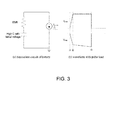
- Fig. 3A shows an equivalent circuit of the battery in which a resistor in series with a high-capacitance capacitor simulates the battery (again, without the effect of the power management system), and Fig. 3B shows a waveform of the battery voltage under a current pulse, modeled as a constant current element.
- a current pulse is applied to (or demanded from) the battery, the voltage drop caused by battery ESR is in phase with the current pulse, corresponding to the time from t1 to t2.
- the pulse current then discharges the battery capacitance and causes the voltage drop as shown from t2 to t3.
- the voltage drop caused by the ESR may be dominant and a drop caused by the capacitance discharged may be negligible.
- the amount of voltage drop during the capacitance discharging could be comparable with the ESR effect.
- This kind of drop may be dominant at low temperatures where the capacitance of the battery can be reduced.
- the power demands of various electronic components, acting in combination with the ESR and other factors can adversely affect power supplies to loads, and in particular, can adversely affect the power supplied to a PA..
- a power converter system (100) includes a buck-boost converter (102), sometimes referred to as a buck-boost switcher, located between a power source, such as a battery (104), and a load, such as a PA (106).
- a power source such as a battery (104)
- a load such as a PA (106).
- the positive terminal of the battery (104) is connected to an input of the converter (102), and the output of the converter is connected to the load PA (106).
- the buck-boost switcher (102) is can improve the conversion efficiency compared to linear conversion (as was illustrated above).
- the effective battery voltage may be (for example) 3.86 V, and the voltage required to deliver the maximum power to the PA may be (for example) about 3.4 V.
- the converter (102) works as a buck converter.
- a pass-through or bypass function may be activated.
- the PA (106) is supplied by the battery (104) through a fully turned on MOSFET (not shown) that effectively by-passes the converter (102).
- the buck-boost converter (102) may vary the output voltage to meet the requirement of the load.
- This approach can, to some degree, adjust the output voltage according to the demand of the PA (106) or other loads. Also, this approach may improve overall efficiency, although there is a potential for reduced efficiency under some conditions. Also, the ripple of a switched converter may be problematic for some loads.
- FIG. 5 another example circuit combines the buck-boost converter (102) of Fig. 4 with an energy storage element, illustrated as a capacitor (108), connected between the buck boost converter (102) and the PA (106).
- an energy storage element illustrated as a capacitor (108)
- the positive terminal of the battery (104) is connected to an input of the converter (102), and the output of the converter is connected to the load PA (106).
- the connection of the capacitor is not in series such that substantially all current from the output of the converter (102) is directed to the capacitor (108); rather, as depicted in Fig. 5 , a first terminal of the capacitor is electrically connected to the output of the converter (102) and a second terminal of the capacitor is connected to another electrical node, such as circuit ground.
- Circuit ground which is generally a reference node against which other voltages are relative, may be, but is not necessarily, Earth potential.
- one terminal of the capacitor (102) is connected to the output of the converter (102) and the other terminal of the capacitor (102) is connected to circuit ground, recognizing that "connected to circuit ground” may mean, but does not necessarily mean, connected directly to circuit ground.
- the capacitor is a supercapacitor (or "supercap”) in the range of approximately 200 mF-500 mF.
- a supercapacitor may realize a potential benefit of high capacitance with a modest size and weight.
- the capacitor (106) tends to resist voltage changes at the output of the converter (102), and the capacitor (108) and converter (102) may cooperate to supply current to the PA load (106).
- the capacitor (108) helps buffer the load, PA (106), from the power source, battery (104).
- a PA transmission may have less impact on other circuits (not shown) that are also powered by the battery (104).
- a switched converter itself may include a high-capacitance capacitor or a supercap, but for purposes of illustration and explanation, the capacitor (108) is depicted as a separate component.
- the supercapacitor (108) can handle a large portion of the PA current.
- the buck-boost converter (102) functions as a current source that helps supply current during the PA transmission (resulting in less voltage drop on the supercapacitor), and that charges the supercapacitor (108) during non-transmission periods.
- FIG. 6 shows simplified current waveforms on PA (106), buck-boost converter (102), supercap (108) and battery (104).
- a current level of the buck-boost converter (102) is selected so that the buck-boost converter (102) is able to charge the supercapacitor (108) during non-transmission periods before the next PA transmission. In this example 500 mA is selected.
- the buck-boost converter (102) supplies the current for the PA (106) so that current drawn from the supercapacitor (108) drops to 1.5 A.
- the buck-boost converter (102) charges the supercapacitor (108).
- the current reflected to the battery (104) is larger than the output current and is estimated at 550 mA, if 90% efficiency is used. It will be understood that this simple example shows the full recharging of the supercapacitor but it will be understood that the recharge will be based on time between transmits and the like.
- the battery current is buffered and averaged out by the buck-boost converter (102) and supercapacitor (108), which may result in flat battery discharge current instead of high pulse current in the system.
- the ESR of the battery should have less impact on the system and, accordingly, the battery life can be extended. Also, a larger amount of battery capacity may be used.
- buck-boost converter (102) At 500 mA current level, it is possible to utilize a buck-boost converter (102) with 90% to 94% efficiency because efficiency is higher at lower current levels. Also the size of the buck-boost converter (102) may be designed to be small, for example, about 1.96 mm by 1.48 mm. An inductor used in this circuit could also be small and is intended to be squeezed into, for example, a 2 mm by 2 mm package. Miniaturization may be beneficial for small mobile electronic devices in general, and handheld devices in particular.
- Two battery discharge cases were tested in a battery test machine.
- One case simulated a standard GSM discharge pulse with (2 A)(0.6 mS) + (0.1 A) (4 mS) on a conventional system.
- the other case simulated a power converter system including a buck-boost switcher and supercap (as in Fig. 5 ) with (0.6 A)(2.4 mS) + (0.1 A)(2.2 mS).
- Total energy taken from the battery was about the same.
- the cut off voltage for the conventional system was 3.3 V, but was 3 V for the power converter system. The result is approximately 7 minutes battery life saving, which may amount to approximately 4% ⁇ 5% of total talk time.
- this simulation assumed a battery that operated in a voltage range of 3.5 V or more, and for batteries that use reduced voltage ranges (such as voltages around 2.5 V), this system may provide an even greater increase in talk time.
- a PA may be biased at higher voltages than discussed previously. It has been suggested, for example that a PA biased at 5 V can significantly increase the PA efficiency.
- the concepts described herein are adaptable not only to systems with power supplies with different voltage ranges, but also to systems that have loads that have different demands. Further, the concepts may be capable of handling large and rapidly changing voltage levels.
- One potential drawback is that having a capacitor at the load side (depicted in Fig. 5 as the capacitor (108) and PA (106) sharing a node) may prevent fast transition of supply voltage to the load. In other words, if the voltage demands of the PA (106) change, the capacitor (108) may resist that change.
- Fig. 7 shows another embodiment of a power converter system (200).
- This system may be useful for, e.g., 2G and 3G PA (sometimes called hybrid PAs) or other loads.
- This embodiment may enable more rapid changes in the voltage supplied to the PA load (206).
- a power source is shown as a battery (204) and a load is shown as a power amplifier (PA) (206).
- the positive terminal of the battery (204) is connected to an input of a buck-boost charger (210) (described below) and the output of the charger (210) is connected to the input of a buck-boost converter (202).
- the output of the buck-boost converter (202) is connected to the load PA (206).
- One terminal of the capacitor (206) is connected to the output of the buck-boost charger (210) and the input of the buck-boost converter (202), and the other terminal of the capacitor (208) is connected to circuit ground.
- the buck-boost converter (202) can improve rapid transition of voltages supplied to the PA load (206).
- a buck-boost charger (210) acts as a current source to buffer the PA (206) current so that the current at the battery (204) may remain roughly constant with a lower current level.
- a high ripple voltage may be noticed at the input of the buck-boost converter (202).
- the capacitor (208), which resists voltages changes, may reduce this ripple.
- the buck-boost converter (202) may be designed to handle this high ripple by using a feed forward loop in the design. With this feature, the capacitor (208) capacitance can be decreased to a 5 mF to 10 mF level. The physical size of the capacitor (208) can thereby be smaller. Also the ESR of the capacitor (208) may be of lesser concern in the system (200) of Fig. 7 , which may allow the capacitor to be further reduced in size.
- Fig. 8 shows additional detail of an illustrative circuit based on the block diagram shown in FIG. 7 .
- a battery (304) is connected to a buck-boost charger (310) that is connected with a capacitor (308) and a buck-boost converter (302).
- the buck-boost converter (302) is connected to the load, that is, power amplifier (306).
- the buck-boost charger (310) When the buck-boost charger (310) is operating in boost mode, the buck-boost charger (310) operates to supply an average current substantially equal to the average current required for the operation of the hybrid PA (306).
- the buck-boost converter (302) may run from the battery (304) directly, through a bypass (312), using transistor Q1 as the high side field effect transistor (FET), when the battery (304) voltage is sufficiently high for the buck-boost converter (302) to maintain an output voltage sufficient to power the hybrid PA (306).
- Bypass 312 includes a switching element that has one terminal connected to the positive terminal of the battery (304) and another terminal connected to the output of the buck-boost converter (302) and to the load PA (306).
- the transistor Q1 is an example of a controllable switching element that can enable or disable the bypass by allowing current to conduct or not.
- the transistor Q1 can be turned on (made conductive) or off (made non-conductive), thereby enabling or disabling bypass (312), under the control of a component such as processor (18).
- the power converter system (300) may adapt to allow the buck-boost converter (302) to be supplied through the buck-boost charger (310). Having the buck-boost converter (302) supplied from the buck boost charger (310), the capacitor (308), or both may allow for higher voltage to be supplied.
- this power supply option may reduce the overall efficiency, delivering further power in this manner may enable higher output power to be delivered to the hybrid PA (306) even with a low-voltage battery source.
- Fig. 8 illustrates a power converter system (300) that may be suitable for use with a hybrid PA used for both WCDMA and GSM technologies.
- Fig. 9 and Fig. 10 show the current and voltage waveforms of the power converter system with 1 slot and 4 slot transmitting.
- the PA Vcc (supply) voltage is 5 V with 1.5 A current draw
- buck-boost charger voltage is set at 4.2 V
- battery voltage is 3.8 V
- 90% efficiency is used for both charger and converter.
- the capacitor's parameters were set at 10 mF capacitance and 150 m ohm for ESR.
- the buck-boost charger provides a bypass function that may increase total efficiency as the buck-boost converter is working in buck mode.
- the buck-boost converter may have a substantially constant ratio between input and output.
- the circuit has a very high efficiency. Current stress on both the buck-boost charger and converter can be distributed.
- Fig. 11 compares the battery currents between different driving schemes described above. It can be seen that the current on the battery side for buck-boost charger and converter approach is much smaller than the buck-boost converter approach.
- FIG. 12 A further embodiment is shown in Fig. 12 , in which the boost mode is separated from the buck mode.
- a power converter system (400) is shown being powered by a battery (404) to supply power to a load, that is, a PA (406).
- a boost converter (420) is configured to supply a very high voltage, for example, in the range of 100-200 V at a constant current to a capacitor (424).
- An input of the boost converter (420) is connected to the battery (404) and the output of the boost converter (420) is connected to a first terminal of the capacitor (424).
- a second terminal of the capacitor (424) is connected to a circuit ground (as described above).
- a capacitor approximately in the range of 200 nF-500 nF may be used (such capacitors are not conventionally referred to as supercaps).
- Such capacitors have a physical size of approximately 5 mm by 3 mm. This is in comparison to supercapacitors of the type mentioned above that can be in the range of 20 mm by 20 mm.
- the high voltage is then provided to a buck converter (422), that is, the output of the boost converter (420) and the first terminal of the capacitor (420) are connected to an input of the buck converter (422).
- An output of the buck converter (422) is connected to the PA (406) to supply the appropriate voltage to the PA (406).
- the capacitor (424) provides the stored voltage to handle transmit peaks.
- Implementation of one or more embodiments may realize one or more advantages, some of which have been discussed already.
- the embodiments, although useful for mobile communication devices, may have applicability to other devices as well, and may be flexibly adapted to meet a range of applications with a range of currents or voltages.
- Embodiments of the disclosure or elements thereof can be represented as a computer program product stored in a machine-readable medium (also referred to as a computer-readable medium, a processor-readable medium, or a computer usable medium having a computer-readable program code embodied therein).
- the machine-readable medium can be any suitable tangible, non-transitory medium, including magnetic, optical, or electrical storage medium including a diskette, compact disk read only memory (CD-ROM), memory device (volatile or nonvolatile), or similar storage mechanism.
- the machine-readable medium can contain various sets of instructions, code sequences, configuration information, or other data, which, when executed, cause a processor to perform steps in a method according to an embodiment of the disclosure.
Landscapes
- Engineering & Computer Science (AREA)
- Power Engineering (AREA)
- Dc-Dc Converters (AREA)
- Charge And Discharge Circuits For Batteries Or The Like (AREA)
- Secondary Cells (AREA)
Priority Applications (2)
| Application Number | Priority Date | Filing Date | Title |
|---|---|---|---|
| EP11184881.8A EP2582004B1 (de) | 2011-10-12 | 2011-10-12 | Stromumrichtersystem für mobile Vorrichtungen |
| CA2792216A CA2792216C (en) | 2011-10-12 | 2012-10-12 | Power converter system for mobile devices |
Applications Claiming Priority (1)
| Application Number | Priority Date | Filing Date | Title |
|---|---|---|---|
| EP11184881.8A EP2582004B1 (de) | 2011-10-12 | 2011-10-12 | Stromumrichtersystem für mobile Vorrichtungen |
Publications (2)
| Publication Number | Publication Date |
|---|---|
| EP2582004A1 true EP2582004A1 (de) | 2013-04-17 |
| EP2582004B1 EP2582004B1 (de) | 2017-12-06 |
Family
ID=44772940
Family Applications (1)
| Application Number | Title | Priority Date | Filing Date |
|---|---|---|---|
| EP11184881.8A Active EP2582004B1 (de) | 2011-10-12 | 2011-10-12 | Stromumrichtersystem für mobile Vorrichtungen |
Country Status (2)
| Country | Link |
|---|---|
| EP (1) | EP2582004B1 (de) |
| CA (1) | CA2792216C (de) |
Cited By (4)
| Publication number | Priority date | Publication date | Assignee | Title |
|---|---|---|---|---|
| EP2869428A1 (de) * | 2013-11-04 | 2015-05-06 | Soil Scout Oy | Leistungswandler mit leistungsoptimiertem Ausgang |
| CN107919713A (zh) * | 2017-12-27 | 2018-04-17 | 西安安森智能仪器股份有限公司 | 一种无线适配器供电电路及其供电方法 |
| CN114342253A (zh) * | 2019-09-04 | 2022-04-12 | 珍尼雷克公司 | 使用受限制电源的音频放大器 |
| EP4020756A1 (de) * | 2020-12-22 | 2022-06-29 | Nxp B.V. | Leistungsverwaltung für anwendungen mit hohen spitzenversorgungsströmen im arbeitszyklus |
Citations (5)
| Publication number | Priority date | Publication date | Assignee | Title |
|---|---|---|---|---|
| JP2000060115A (ja) * | 1998-08-17 | 2000-02-25 | Nec Corp | 昇降圧チョッパ方式dc−dcコンバータ回路 |
| EP1366948A1 (de) * | 2002-05-30 | 2003-12-03 | Nec Tokin Corporation | Hybrid-Netzteil |
| EP1381135A1 (de) * | 2001-04-17 | 2004-01-14 | Matsushita Electric Industrial Co., Ltd. | Batteriebetriebenes elektronisches gerät und mobilkommunikationsvorrichtung |
| WO2006081613A1 (en) * | 2005-02-02 | 2006-08-10 | Cap-Xx Limited | A power supply |
| US20060221516A1 (en) * | 2005-04-04 | 2006-10-05 | Zaher Daboussi | Energy storage apparatus and related method |
-
2011
- 2011-10-12 EP EP11184881.8A patent/EP2582004B1/de active Active
-
2012
- 2012-10-12 CA CA2792216A patent/CA2792216C/en active Active
Patent Citations (5)
| Publication number | Priority date | Publication date | Assignee | Title |
|---|---|---|---|---|
| JP2000060115A (ja) * | 1998-08-17 | 2000-02-25 | Nec Corp | 昇降圧チョッパ方式dc−dcコンバータ回路 |
| EP1381135A1 (de) * | 2001-04-17 | 2004-01-14 | Matsushita Electric Industrial Co., Ltd. | Batteriebetriebenes elektronisches gerät und mobilkommunikationsvorrichtung |
| EP1366948A1 (de) * | 2002-05-30 | 2003-12-03 | Nec Tokin Corporation | Hybrid-Netzteil |
| WO2006081613A1 (en) * | 2005-02-02 | 2006-08-10 | Cap-Xx Limited | A power supply |
| US20060221516A1 (en) * | 2005-04-04 | 2006-10-05 | Zaher Daboussi | Energy storage apparatus and related method |
Cited By (6)
| Publication number | Priority date | Publication date | Assignee | Title |
|---|---|---|---|---|
| EP2869428A1 (de) * | 2013-11-04 | 2015-05-06 | Soil Scout Oy | Leistungswandler mit leistungsoptimiertem Ausgang |
| CN107919713A (zh) * | 2017-12-27 | 2018-04-17 | 西安安森智能仪器股份有限公司 | 一种无线适配器供电电路及其供电方法 |
| CN114342253A (zh) * | 2019-09-04 | 2022-04-12 | 珍尼雷克公司 | 使用受限制电源的音频放大器 |
| US11923810B2 (en) | 2019-09-04 | 2024-03-05 | Genelec Oy | Audio amplifier for use with a limited power source |
| EP4020756A1 (de) * | 2020-12-22 | 2022-06-29 | Nxp B.V. | Leistungsverwaltung für anwendungen mit hohen spitzenversorgungsströmen im arbeitszyklus |
| US11557910B2 (en) | 2020-12-22 | 2023-01-17 | Nxp B.V. | Power management for applications having duty-cycled high peak supply currents |
Also Published As
| Publication number | Publication date |
|---|---|
| CA2792216A1 (en) | 2013-04-12 |
| CA2792216C (en) | 2015-07-14 |
| EP2582004B1 (de) | 2017-12-06 |
Similar Documents
| Publication | Publication Date | Title |
|---|---|---|
| US8981749B2 (en) | Power converter system for mobile devices | |
| US11670947B2 (en) | Battery management circuit, device to be charged, and power management method | |
| US20080100143A1 (en) | Power management system with charger/boost controller | |
| US20230268763A1 (en) | Managing power in a portable device comprising multiple batteries | |
| US11128152B2 (en) | Systems and methods for adaptive fast-charging for mobile devices and devices having sporadic power-source connection | |
| CN101682199B (zh) | 用于在便携电信设备中使用的配电电路 | |
| US20220337078A1 (en) | Battery management circuit for a mobile device | |
| US20030164644A1 (en) | Power circuit and method for controlling same | |
| JP2008529177A (ja) | 電源装置 | |
| US12081119B2 (en) | PFM mode operation of switched capacitor converters | |
| CN1741345B (zh) | 电源管理系统 | |
| CA2792216C (en) | Power converter system for mobile devices | |
| CN104158241A (zh) | 一种充电控制方法、装置及一种pos终端 | |
| US9350167B2 (en) | Electronic device, power supply control chip and power supply control method | |
| CN101120618A (zh) | 电源 | |
| US20140077776A1 (en) | Voltage regulator | |
| CN113013956B (zh) | 充放电电路和电子设备 | |
| EP4228120A1 (de) | Stromversorgungssystem, ladeverfahren und entladeverfahren | |
| EP2462651A1 (de) | Batteriepackung mit integrierten gleichspannungswandlern | |
| CN201222649Y (zh) | 一种可充电池的过放电保护电路 | |
| US20170077720A1 (en) | Systems and methods for adaptive fast-charging for mobile devices and devices having sporadic power-source connection | |
| CN103532212B (zh) | 一种充电管理电路及移动电源 | |
| JP2010207013A (ja) | 電源回路および携帯電話端末 | |
| CN203607908U (zh) | 一种充电管理电路及移动电源 | |
| KR100990671B1 (ko) | Tta 표준 충전기용 승압 젠더 |
Legal Events
| Date | Code | Title | Description |
|---|---|---|---|
| PUAI | Public reference made under article 153(3) epc to a published international application that has entered the european phase |
Free format text: ORIGINAL CODE: 0009012 |
|
| 17P | Request for examination filed |
Effective date: 20111012 |
|
| AK | Designated contracting states |
Kind code of ref document: A1 Designated state(s): AL AT BE BG CH CY CZ DE DK EE ES FI FR GB GR HR HU IE IS IT LI LT LU LV MC MK MT NL NO PL PT RO RS SE SI SK SM TR |
|
| AX | Request for extension of the european patent |
Extension state: BA ME |
|
| RAP1 | Party data changed (applicant data changed or rights of an application transferred) |
Owner name: BLACKBERRY LIMITED |
|
| RAP1 | Party data changed (applicant data changed or rights of an application transferred) |
Owner name: BLACKBERRY LIMITED |
|
| 17Q | First examination report despatched |
Effective date: 20151109 |
|
| REG | Reference to a national code |
Ref country code: DE Ref legal event code: R079 Ref document number: 602011043917 Country of ref document: DE Free format text: PREVIOUS MAIN CLASS: H02J0007000000 Ipc: H03F0001020000 |
|
| GRAP | Despatch of communication of intention to grant a patent |
Free format text: ORIGINAL CODE: EPIDOSNIGR1 |
|
| STAA | Information on the status of an ep patent application or granted ep patent |
Free format text: STATUS: GRANT OF PATENT IS INTENDED |
|
| RIC1 | Information provided on ipc code assigned before grant |
Ipc: H02J 7/34 20060101ALI20170502BHEP Ipc: H03F 1/02 20060101AFI20170502BHEP Ipc: H02M 1/00 20070101ALN20170502BHEP Ipc: H02M 3/158 20060101ALI20170502BHEP Ipc: H02J 7/00 20060101ALI20170502BHEP |
|
| INTG | Intention to grant announced |
Effective date: 20170522 |
|
| GRAS | Grant fee paid |
Free format text: ORIGINAL CODE: EPIDOSNIGR3 |
|
| GRAA | (expected) grant |
Free format text: ORIGINAL CODE: 0009210 |
|
| STAA | Information on the status of an ep patent application or granted ep patent |
Free format text: STATUS: THE PATENT HAS BEEN GRANTED |
|
| AK | Designated contracting states |
Kind code of ref document: B1 Designated state(s): AL AT BE BG CH CY CZ DE DK EE ES FI FR GB GR HR HU IE IS IT LI LT LU LV MC MK MT NL NO PL PT RO RS SE SI SK SM TR |
|
| REG | Reference to a national code |
Ref country code: GB Ref legal event code: FG4D |
|
| REG | Reference to a national code |
Ref country code: AT Ref legal event code: REF Ref document number: 953243 Country of ref document: AT Kind code of ref document: T Effective date: 20171215 Ref country code: CH Ref legal event code: EP |
|
| REG | Reference to a national code |
Ref country code: IE Ref legal event code: FG4D |
|
| REG | Reference to a national code |
Ref country code: DE Ref legal event code: R096 Ref document number: 602011043917 Country of ref document: DE |
|
| REG | Reference to a national code |
Ref country code: NL Ref legal event code: MP Effective date: 20171206 |
|
| REG | Reference to a national code |
Ref country code: LT Ref legal event code: MG4D |
|
| PG25 | Lapsed in a contracting state [announced via postgrant information from national office to epo] |
Ref country code: ES Free format text: LAPSE BECAUSE OF FAILURE TO SUBMIT A TRANSLATION OF THE DESCRIPTION OR TO PAY THE FEE WITHIN THE PRESCRIBED TIME-LIMIT Effective date: 20171206 Ref country code: LT Free format text: LAPSE BECAUSE OF FAILURE TO SUBMIT A TRANSLATION OF THE DESCRIPTION OR TO PAY THE FEE WITHIN THE PRESCRIBED TIME-LIMIT Effective date: 20171206 Ref country code: SE Free format text: LAPSE BECAUSE OF FAILURE TO SUBMIT A TRANSLATION OF THE DESCRIPTION OR TO PAY THE FEE WITHIN THE PRESCRIBED TIME-LIMIT Effective date: 20171206 Ref country code: FI Free format text: LAPSE BECAUSE OF FAILURE TO SUBMIT A TRANSLATION OF THE DESCRIPTION OR TO PAY THE FEE WITHIN THE PRESCRIBED TIME-LIMIT Effective date: 20171206 Ref country code: NO Free format text: LAPSE BECAUSE OF FAILURE TO SUBMIT A TRANSLATION OF THE DESCRIPTION OR TO PAY THE FEE WITHIN THE PRESCRIBED TIME-LIMIT Effective date: 20180306 |
|
| REG | Reference to a national code |
Ref country code: AT Ref legal event code: MK05 Ref document number: 953243 Country of ref document: AT Kind code of ref document: T Effective date: 20171206 |
|
| PG25 | Lapsed in a contracting state [announced via postgrant information from national office to epo] |
Ref country code: GR Free format text: LAPSE BECAUSE OF FAILURE TO SUBMIT A TRANSLATION OF THE DESCRIPTION OR TO PAY THE FEE WITHIN THE PRESCRIBED TIME-LIMIT Effective date: 20180307 Ref country code: BG Free format text: LAPSE BECAUSE OF FAILURE TO SUBMIT A TRANSLATION OF THE DESCRIPTION OR TO PAY THE FEE WITHIN THE PRESCRIBED TIME-LIMIT Effective date: 20180306 Ref country code: LV Free format text: LAPSE BECAUSE OF FAILURE TO SUBMIT A TRANSLATION OF THE DESCRIPTION OR TO PAY THE FEE WITHIN THE PRESCRIBED TIME-LIMIT Effective date: 20171206 Ref country code: HR Free format text: LAPSE BECAUSE OF FAILURE TO SUBMIT A TRANSLATION OF THE DESCRIPTION OR TO PAY THE FEE WITHIN THE PRESCRIBED TIME-LIMIT Effective date: 20171206 Ref country code: RS Free format text: LAPSE BECAUSE OF FAILURE TO SUBMIT A TRANSLATION OF THE DESCRIPTION OR TO PAY THE FEE WITHIN THE PRESCRIBED TIME-LIMIT Effective date: 20171206 |
|
| PG25 | Lapsed in a contracting state [announced via postgrant information from national office to epo] |
Ref country code: NL Free format text: LAPSE BECAUSE OF FAILURE TO SUBMIT A TRANSLATION OF THE DESCRIPTION OR TO PAY THE FEE WITHIN THE PRESCRIBED TIME-LIMIT Effective date: 20171206 |
|
| PG25 | Lapsed in a contracting state [announced via postgrant information from national office to epo] |
Ref country code: SK Free format text: LAPSE BECAUSE OF FAILURE TO SUBMIT A TRANSLATION OF THE DESCRIPTION OR TO PAY THE FEE WITHIN THE PRESCRIBED TIME-LIMIT Effective date: 20171206 Ref country code: EE Free format text: LAPSE BECAUSE OF FAILURE TO SUBMIT A TRANSLATION OF THE DESCRIPTION OR TO PAY THE FEE WITHIN THE PRESCRIBED TIME-LIMIT Effective date: 20171206 Ref country code: CZ Free format text: LAPSE BECAUSE OF FAILURE TO SUBMIT A TRANSLATION OF THE DESCRIPTION OR TO PAY THE FEE WITHIN THE PRESCRIBED TIME-LIMIT Effective date: 20171206 |
|
| PG25 | Lapsed in a contracting state [announced via postgrant information from national office to epo] |
Ref country code: SM Free format text: LAPSE BECAUSE OF FAILURE TO SUBMIT A TRANSLATION OF THE DESCRIPTION OR TO PAY THE FEE WITHIN THE PRESCRIBED TIME-LIMIT Effective date: 20171206 Ref country code: PL Free format text: LAPSE BECAUSE OF FAILURE TO SUBMIT A TRANSLATION OF THE DESCRIPTION OR TO PAY THE FEE WITHIN THE PRESCRIBED TIME-LIMIT Effective date: 20171206 Ref country code: AT Free format text: LAPSE BECAUSE OF FAILURE TO SUBMIT A TRANSLATION OF THE DESCRIPTION OR TO PAY THE FEE WITHIN THE PRESCRIBED TIME-LIMIT Effective date: 20171206 Ref country code: RO Free format text: LAPSE BECAUSE OF FAILURE TO SUBMIT A TRANSLATION OF THE DESCRIPTION OR TO PAY THE FEE WITHIN THE PRESCRIBED TIME-LIMIT Effective date: 20171206 Ref country code: IT Free format text: LAPSE BECAUSE OF FAILURE TO SUBMIT A TRANSLATION OF THE DESCRIPTION OR TO PAY THE FEE WITHIN THE PRESCRIBED TIME-LIMIT Effective date: 20171206 |
|
| REG | Reference to a national code |
Ref country code: DE Ref legal event code: R097 Ref document number: 602011043917 Country of ref document: DE |
|
| PLBE | No opposition filed within time limit |
Free format text: ORIGINAL CODE: 0009261 |
|
| STAA | Information on the status of an ep patent application or granted ep patent |
Free format text: STATUS: NO OPPOSITION FILED WITHIN TIME LIMIT |
|
| REG | Reference to a national code |
Ref country code: FR Ref legal event code: PLFP Year of fee payment: 8 |
|
| 26N | No opposition filed |
Effective date: 20180907 |
|
| PG25 | Lapsed in a contracting state [announced via postgrant information from national office to epo] |
Ref country code: SI Free format text: LAPSE BECAUSE OF FAILURE TO SUBMIT A TRANSLATION OF THE DESCRIPTION OR TO PAY THE FEE WITHIN THE PRESCRIBED TIME-LIMIT Effective date: 20171206 Ref country code: DK Free format text: LAPSE BECAUSE OF FAILURE TO SUBMIT A TRANSLATION OF THE DESCRIPTION OR TO PAY THE FEE WITHIN THE PRESCRIBED TIME-LIMIT Effective date: 20171206 |
|
| REG | Reference to a national code |
Ref country code: CH Ref legal event code: PL |
|
| REG | Reference to a national code |
Ref country code: BE Ref legal event code: MM Effective date: 20181031 |
|
| PG25 | Lapsed in a contracting state [announced via postgrant information from national office to epo] |
Ref country code: LU Free format text: LAPSE BECAUSE OF NON-PAYMENT OF DUE FEES Effective date: 20181012 Ref country code: MC Free format text: LAPSE BECAUSE OF FAILURE TO SUBMIT A TRANSLATION OF THE DESCRIPTION OR TO PAY THE FEE WITHIN THE PRESCRIBED TIME-LIMIT Effective date: 20171206 |
|
| REG | Reference to a national code |
Ref country code: IE Ref legal event code: MM4A |
|
| PG25 | Lapsed in a contracting state [announced via postgrant information from national office to epo] |
Ref country code: LI Free format text: LAPSE BECAUSE OF NON-PAYMENT OF DUE FEES Effective date: 20181031 Ref country code: CH Free format text: LAPSE BECAUSE OF NON-PAYMENT OF DUE FEES Effective date: 20181031 Ref country code: BE Free format text: LAPSE BECAUSE OF NON-PAYMENT OF DUE FEES Effective date: 20181031 |
|
| PG25 | Lapsed in a contracting state [announced via postgrant information from national office to epo] |
Ref country code: IE Free format text: LAPSE BECAUSE OF NON-PAYMENT OF DUE FEES Effective date: 20181012 |
|
| PG25 | Lapsed in a contracting state [announced via postgrant information from national office to epo] |
Ref country code: MT Free format text: LAPSE BECAUSE OF NON-PAYMENT OF DUE FEES Effective date: 20181012 |
|
| PG25 | Lapsed in a contracting state [announced via postgrant information from national office to epo] |
Ref country code: TR Free format text: LAPSE BECAUSE OF FAILURE TO SUBMIT A TRANSLATION OF THE DESCRIPTION OR TO PAY THE FEE WITHIN THE PRESCRIBED TIME-LIMIT Effective date: 20171206 |
|
| PG25 | Lapsed in a contracting state [announced via postgrant information from national office to epo] |
Ref country code: PT Free format text: LAPSE BECAUSE OF FAILURE TO SUBMIT A TRANSLATION OF THE DESCRIPTION OR TO PAY THE FEE WITHIN THE PRESCRIBED TIME-LIMIT Effective date: 20171206 |
|
| PG25 | Lapsed in a contracting state [announced via postgrant information from national office to epo] |
Ref country code: CY Free format text: LAPSE BECAUSE OF FAILURE TO SUBMIT A TRANSLATION OF THE DESCRIPTION OR TO PAY THE FEE WITHIN THE PRESCRIBED TIME-LIMIT Effective date: 20171206 Ref country code: MK Free format text: LAPSE BECAUSE OF NON-PAYMENT OF DUE FEES Effective date: 20171206 Ref country code: HU Free format text: LAPSE BECAUSE OF FAILURE TO SUBMIT A TRANSLATION OF THE DESCRIPTION OR TO PAY THE FEE WITHIN THE PRESCRIBED TIME-LIMIT; INVALID AB INITIO Effective date: 20111012 |
|
| PG25 | Lapsed in a contracting state [announced via postgrant information from national office to epo] |
Ref country code: AL Free format text: LAPSE BECAUSE OF FAILURE TO SUBMIT A TRANSLATION OF THE DESCRIPTION OR TO PAY THE FEE WITHIN THE PRESCRIBED TIME-LIMIT Effective date: 20171206 Ref country code: IS Free format text: LAPSE BECAUSE OF FAILURE TO SUBMIT A TRANSLATION OF THE DESCRIPTION OR TO PAY THE FEE WITHIN THE PRESCRIBED TIME-LIMIT Effective date: 20180406 |
|
| REG | Reference to a national code |
Ref country code: DE Ref legal event code: R082 Ref document number: 602011043917 Country of ref document: DE Ref country code: DE Ref legal event code: R081 Ref document number: 602011043917 Country of ref document: DE Owner name: MALIKIE INNOVATIONS LTD., IE Free format text: FORMER OWNER: BLACKBERRY LIMITED, WATERLOO, ONTARIO, CA |
|
| REG | Reference to a national code |
Ref country code: GB Ref legal event code: 732E Free format text: REGISTERED BETWEEN 20240620 AND 20240627 |
|
| PGFP | Annual fee paid to national office [announced via postgrant information from national office to epo] |
Ref country code: DE Payment date: 20251028 Year of fee payment: 15 |
|
| PGFP | Annual fee paid to national office [announced via postgrant information from national office to epo] |
Ref country code: GB Payment date: 20251023 Year of fee payment: 15 |
|
| PGFP | Annual fee paid to national office [announced via postgrant information from national office to epo] |
Ref country code: FR Payment date: 20251027 Year of fee payment: 15 |