EP2581341B1 - Herstellungsverfahren für aktivierten Nanokohlenstoff und für Nanoverbundstoff mit dem aktivierten Nanokohlenstoff - Google Patents
Herstellungsverfahren für aktivierten Nanokohlenstoff und für Nanoverbundstoff mit dem aktivierten Nanokohlenstoff Download PDFInfo
- Publication number
- EP2581341B1 EP2581341B1 EP11184615.0A EP11184615A EP2581341B1 EP 2581341 B1 EP2581341 B1 EP 2581341B1 EP 11184615 A EP11184615 A EP 11184615A EP 2581341 B1 EP2581341 B1 EP 2581341B1
- Authority
- EP
- European Patent Office
- Prior art keywords
- waste material
- food waste
- activated
- nano
- polymer
- Prior art date
- Legal status (The legal status is an assumption and is not a legal conclusion. Google has not performed a legal analysis and makes no representation as to the accuracy of the status listed.)
- Not-in-force
Links
Images

Classifications
-
- C—CHEMISTRY; METALLURGY
- C01—INORGANIC CHEMISTRY
- C01B—NON-METALLIC ELEMENTS; COMPOUNDS THEREOF; METALLOIDS OR COMPOUNDS THEREOF NOT COVERED BY SUBCLASS C01C
- C01B32/00—Carbon; Compounds thereof
- C01B32/30—Active carbon
- C01B32/312—Preparation
- C01B32/336—Preparation characterised by gaseous activating agents
-
- B—PERFORMING OPERATIONS; TRANSPORTING
- B82—NANOTECHNOLOGY
- B82Y—SPECIFIC USES OR APPLICATIONS OF NANOSTRUCTURES; MEASUREMENT OR ANALYSIS OF NANOSTRUCTURES; MANUFACTURE OR TREATMENT OF NANOSTRUCTURES
- B82Y30/00—Nanotechnology for materials or surface science, e.g. nanocomposites
-
- C—CHEMISTRY; METALLURGY
- C01—INORGANIC CHEMISTRY
- C01B—NON-METALLIC ELEMENTS; COMPOUNDS THEREOF; METALLOIDS OR COMPOUNDS THEREOF NOT COVERED BY SUBCLASS C01C
- C01B32/00—Carbon; Compounds thereof
- C01B32/30—Active carbon
- C01B32/312—Preparation
- C01B32/342—Preparation characterised by non-gaseous activating agents
-
- C—CHEMISTRY; METALLURGY
- C01—INORGANIC CHEMISTRY
- C01B—NON-METALLIC ELEMENTS; COMPOUNDS THEREOF; METALLOIDS OR COMPOUNDS THEREOF NOT COVERED BY SUBCLASS C01C
- C01B32/00—Carbon; Compounds thereof
- C01B32/30—Active carbon
- C01B32/354—After-treatment
- C01B32/384—Granulation
-
- C—CHEMISTRY; METALLURGY
- C01—INORGANIC CHEMISTRY
- C01P—INDEXING SCHEME RELATING TO STRUCTURAL AND PHYSICAL ASPECTS OF SOLID INORGANIC COMPOUNDS
- C01P2004/00—Particle morphology
- C01P2004/60—Particles characterised by their size
- C01P2004/64—Nanometer sized, i.e. from 1-100 nanometer
-
- Y—GENERAL TAGGING OF NEW TECHNOLOGICAL DEVELOPMENTS; GENERAL TAGGING OF CROSS-SECTIONAL TECHNOLOGIES SPANNING OVER SEVERAL SECTIONS OF THE IPC; TECHNICAL SUBJECTS COVERED BY FORMER USPC CROSS-REFERENCE ART COLLECTIONS [XRACs] AND DIGESTS
- Y10—TECHNICAL SUBJECTS COVERED BY FORMER USPC
- Y10S—TECHNICAL SUBJECTS COVERED BY FORMER USPC CROSS-REFERENCE ART COLLECTIONS [XRACs] AND DIGESTS
- Y10S977/00—Nanotechnology
- Y10S977/70—Nanostructure
- Y10S977/788—Of specified organic or carbon-based composition
- Y10S977/795—Composed of biological material
-
- Y—GENERAL TAGGING OF NEW TECHNOLOGICAL DEVELOPMENTS; GENERAL TAGGING OF CROSS-SECTIONAL TECHNOLOGIES SPANNING OVER SEVERAL SECTIONS OF THE IPC; TECHNICAL SUBJECTS COVERED BY FORMER USPC CROSS-REFERENCE ART COLLECTIONS [XRACs] AND DIGESTS
- Y10—TECHNICAL SUBJECTS COVERED BY FORMER USPC
- Y10T—TECHNICAL SUBJECTS COVERED BY FORMER US CLASSIFICATION
- Y10T428/00—Stock material or miscellaneous articles
- Y10T428/25—Web or sheet containing structurally defined element or component and including a second component containing structurally defined particles
-
- Y—GENERAL TAGGING OF NEW TECHNOLOGICAL DEVELOPMENTS; GENERAL TAGGING OF CROSS-SECTIONAL TECHNOLOGIES SPANNING OVER SEVERAL SECTIONS OF THE IPC; TECHNICAL SUBJECTS COVERED BY FORMER USPC CROSS-REFERENCE ART COLLECTIONS [XRACs] AND DIGESTS
- Y10—TECHNICAL SUBJECTS COVERED BY FORMER USPC
- Y10T—TECHNICAL SUBJECTS COVERED BY FORMER US CLASSIFICATION
- Y10T428/00—Stock material or miscellaneous articles
- Y10T428/29—Coated or structually defined flake, particle, cell, strand, strand portion, rod, filament, macroscopic fiber or mass thereof
- Y10T428/2982—Particulate matter [e.g., sphere, flake, etc.]
-
- Y—GENERAL TAGGING OF NEW TECHNOLOGICAL DEVELOPMENTS; GENERAL TAGGING OF CROSS-SECTIONAL TECHNOLOGIES SPANNING OVER SEVERAL SECTIONS OF THE IPC; TECHNICAL SUBJECTS COVERED BY FORMER USPC CROSS-REFERENCE ART COLLECTIONS [XRACs] AND DIGESTS
- Y10—TECHNICAL SUBJECTS COVERED BY FORMER USPC
- Y10T—TECHNICAL SUBJECTS COVERED BY FORMER US CLASSIFICATION
- Y10T428/00—Stock material or miscellaneous articles
- Y10T428/29—Coated or structually defined flake, particle, cell, strand, strand portion, rod, filament, macroscopic fiber or mass thereof
- Y10T428/2982—Particulate matter [e.g., sphere, flake, etc.]
- Y10T428/2991—Coated
Definitions
- the present invention relates to a method for preparing activated nano carbon from a food waste material and a method for preparing a nano polymer composite containing the activated nano carbon.
- nano carbon materials like carbon nano tubes or fullerene, have quicken interest of scientists from academia as well as from industry due to the numerous potential applications in fields of nano electronics, photovoltaic devices, superconductors, electrochemical capacitors, sensors and nano composites.
- a simple approach to fabricate graphitic carbon nano capsules, tungsten carbide and tungsten carbide/graphitic carbon composites by using the renewable biopolymer chitosan as carbon source was proposed.
- activated carbon is widely industrially used due to its excellent adsorption capability. This characteristic can be attributed to its porosity and high specific surface area. The feasibility to use several low cost adsorbants from agricultural and industrial waste was explored.
- activated carbon can be prepared by pyrolysis of lignocellulosic materials like wood, peach and olive stones, coconut, almond or pecan shells and other agricultural by products.
- date pits have received much less consideration as a source for the preparation of activated carbon.
- the world annual production of dates was about 3.4 million tons in 1990. Since the date pits represent about 10% of the date's weight, their utilization as a substrate for the preparation of activated carbon retrieves high economical potential.
- N.M. Haimour et. al. Waste Management, 2006, 26, 651-660 discloses a method for preparing activated carbon from date pits by activation with phosphoric acid and subsequent thermal treatment.
- the activated carbon prepared this way exhibits particles sizes in a range from 0.4 to 1.2 mm.
- polymer nano composites are in the limelight as new interesting materials because of the unique properties synergetically derived from their nano scale structure. These materials can exhibit enhanced physical, mechanical, thermal, electrical, magnetic or optical properties compared to the respective neat polymers. These benefits can already be achieved by mixing small amounts of nano material with the polymer.
- a wide range of reinforcing agents, such as calcium carbonate, mica, glass fiber, silica, clay or carbon nanotubes were used for the preparation of polymer nano composites.
- a method for preparing a polymer nano composite shall be provided, wherein the nano carbon is used to enhance the polymer material properties.
- the first object is achieved by a method for preparing activated nano carbon from food waste material comprising the steps:
- the food waste material is date pits, coconut shells, almont shells, olive stones and/or pecan shells, preferably date pits.
- the food waste material is washed with deionized water and substantially dried before step (a).
- the impregnating agent is at least one acid and/or base.
- the impregnating agent is sulfuric acid, phosphoric acid, caustic potassium or zinc chloride.
- the activation gas is carbon dioxide, helium, oxygen, argon, and/or nitrogen.
- the activation gas is carbon dioxide.
- activating is carried out in a tubular reactor.
- the reactor used in the present invention is preferably a tubular reactor placed vertically inside a heating furnace.
- the length and the diameter are fixed in order to achieve uniform heat flow inside the column.
- the tubular reactor does not have in the method of the present invention to be operated under high pressure.
- activating is carried out under normal pressure.
- cryo-grinding is carried in a ball mill in a temperature range from 0 to -100°C, preferably -20 to -50°C.
- the activated powder obtained in step (c) is washed with 0.1 N diluted HCl and water until the pH is substantially neutral, and/or chloride ions are substantially removed, prior to step (d).
- the duration of the activation in step (c) is in a range from 1 to 5 h, preferably 2 to 5 h.
- the second object is achieved by a method for preparing a nano polymer composite, wherein the activated nano carbon prepared according to this invention and at least one polymer are blended, wherein the blending is carried out by melt blending, and the amount of nano carbon is less than 5% by weight with regard to the amount of polymer.
- the polymer is a polyolefin, a polycarbonate, a polyester and/or an epoxy resin, preferably high density polyethylene (HDPE).
- HDPE high density polyethylene
- activated nano carbon can be prepared from food waste material after crushing and sieving, impregnating with an impregnating agent and activating by pyrolysis in the presence of an activation gas by diligent mechanical grinding at low temperatures using a ball mill, so called cryogenic grinding or cryo-grinding.
- the method provides a cheap and easy pathway to achive nano carbon material as well as activated carbon with a high specific surface from wood waste material.
- huge amounts of zero cost date seeds are thrown away each year especially in Saudi Arabia. Therefore, the method of the present invention can be utilized to manufacture nano carbon in an inexpensive way and to prepare polymer composites from this material.
- the inventors of the present application have surprisingly found that the nano carbon prepared according to the present invention can be successfully used to produce polymer nano composites with enhanced material properties as increased tensile strength or dynamic moduli compared to the neat polymer.
- Nano carbon in terms of the present invention means carbon materials exhibiting diameter in a range from 10-100 nm.
- washing steps using water or watery solutions include a subsequent drying step which is accomplished at a temperature from 100-120°C.
- a subsequent drying step which is accomplished at a temperature from 100-120°C.
- polymer nano composites are not limited to the utilization of a polyolefin as polymer component. Other polymers are conceivable.
- the activated nano carbon prepared according to the present invention features a uniform particle size distribution.
- step (a) of the method for preparing activated nanocarbon the maximum mesh size which shall be used is 500 microns. A lower mesh size will yield activated nano carbon of higher quality but will lower the amount of product.
- the cryo-grinding step combines the benefits of cryogenic temperatures and the conventional mechanical milling process.
- the extremely low grinding temperature suppresses recovery and recrystallization and leads to finer grain structures and more rapid grain refinement. It is also less energy consuming and the size of the grinded particles is to control.
- Ball size, rotational grinding speed, ball to powder ratio (by weight) and the temperature are important parameters by controlling the particle size and particle size distribution.
- a temperature of the cryo-grinding step is from -50°C to -20°C.
- Date pits were washed with deionized water to remove darts and impurities and afterwards dried at 100°C in an oven overnight to facilitate subsequent crushing and grinding.
- the obtained date pit powder was sieved through a 500 microns siever.
- the sieved date pit powder was impregnated by exposing to sulfuric acid. The resulting slurry was left at room temperature overnight. After filtering, the residue was washed several times with deionized water till pH was neutral and afterwards dried at 120°C in an oven overnight.
- the impregnated date pit powder was activated in a tubular reactor at 700°C under carbon dioxide atmosphere for 3h. Afterwards the activated date pit powder was washed with 0.1 N dil. HCl and several times with deionized water till pH was neutral and substantially all chloride ions were removed. The suspension was decantated and the activated date pit powder dried at 110°C in an oven overnight. Activated carbon was achieved in a yield of 25.5 wt.-% related to the weight of date pits.
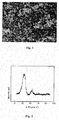
- the SEM image ( Fig. 1 ) of activated carbon exhibits an amorphous structure with particle diameters from 1-10 ⁇ m.
- the activated carbon prepared according to Example 1 was cryo-grinded for 100 h in a temperature range from -20°C to -50°C in a planetary ball mill Fritsch Pulverisette 6 with tools made of zirconia.
- the activated carbon was ground in a vial with milling balls featuring diameters of 10 and 15 mm.
- the ball to powder ratio was 20:1 in weight and the milling intensity was 250 rpm.
- Activated nano carbon featuring particular sizes in a range from 10-100 nm was obtained this way.
- Elemental analysis of the activated nano carbon was performed using LECO CHNS-932 equipment by sample combustion in oxygen excess.
- Table 2 Elemental analysis of the cryo-grinded activated nano carbon sample Sample C(%) H(%) N(%) Nano Carbon 75.32 3.75 1.64
- the assignment of the various crystalline phases was based on the JPDS powder diffraction file cards.
- the powder X-ray diffraction profiles are displayed in Figure 2 . They show two broad diffraction lines characteristic for amorphous carbons. In an attempt to identify the presence of graphite-like structures these profiles were compared with that of the JCPDS data bases. This comparison revealed that a minor proportion of graphite structures is present in both samples (card 01-075-1621).
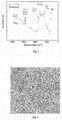
- the infrared spectra of activated nano carbon were recorded after degassing at 400 °C under He flow for times between 1 and 25 min.
- In the C-H stretching region it exhibit the infrared modes for both aromatic (about 3060 cm -1 ) and aliphatic (2926 and 2863 cm -1 ) groups.
- Peak intensities were estimated by calculating the integral of each peak after subtracting an S-shaped background and fitting the experimental peak to a combination of LorentzianlGaussian lines of variable proportions. Atomic surface contents were estimated from the areas of the peaks, corrected using the corresponding sensitivity factors. This analysis shows only C1s and O1s peaks together with corresponding Auger lines.
- the C1s peak was satisfactorily deconvoluted in three components at 284.9, 286.2 and 288.2 eV, which are assigned to C-C, C-O and COO groups, respectively.
- Fig 4 shows the TEM image of the cryo-grinded carbon prepred as described in Example 2 Table 3: Binding energies (eV) of core-levels and O/C surface atomic ratios of activated nano carbon sample Sample C1s O1s O/C at Cryo- grinded sample 284.9 (59) 531.5 (38) 0.167 286.2 (31) 533.3 (62) 288.2 (10)
- the particle size of the nano carbon obtained is in the range of 10 - 100 nm.
- HDPE high density polyethylene
- melt index of 30 g/10 min, density of 0.954 g/cm 3 and tensile strength at yield of 1200 MPa was used for the preparation of polymer nano composite together with the activated nano carbon prepared according to Example 2.
- An injection moulding machine (Asian Plastic Machinery Co., Double Toggle IM Machine, Super Master Series SM 120) was used to mold ASTM standard samples.
- Table 4 List of the polymer nano composite samples prepared Sample name HDPE -54 % % of cryo-grinded carbon % of cryo-grinded carbon CB-0 100 0 0 CB-1 98 2 0 CB-2 98 0 2
- Sample CB-1 relates to a composite prepared by utilizing the nano carbon of the present invention.
- sample CB-2 nano carbon from a commercial source was used.
- Table 5 Details of injection molding condition Injection molding conditions Temperature profile (°C) Cool time (sec) Water circulation temperature (°C) Die Zone Zone III Zone II Feed Zone 15 10-11 210 230 220 160
- Figure 5 illustrates the dynamic modulus curves of neat HDPE and HDPE nano composites prepared according to Example 3.
- Figure 6 shows DSC thermograms of neat HDPE (CB-0) and HDPE nano composites (CB-1 and CB-2) prepared according to Example 3.
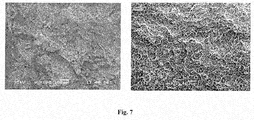
- Figure 7 shows SEM images of tensile fractured samples of the HDPE nano composite prepared according to Example 3 showing the dispersion of the activated nano carbon in the polymer matrix.
Landscapes
- Chemical & Material Sciences (AREA)
- Organic Chemistry (AREA)
- Engineering & Computer Science (AREA)
- Inorganic Chemistry (AREA)
- Nanotechnology (AREA)
- Condensed Matter Physics & Semiconductors (AREA)
- Composite Materials (AREA)
- General Physics & Mathematics (AREA)
- Materials Engineering (AREA)
- Crystallography & Structural Chemistry (AREA)
- Physics & Mathematics (AREA)
- Carbon And Carbon Compounds (AREA)
- Compositions Of Macromolecular Compounds (AREA)
- Processing Of Solid Wastes (AREA)
Claims (12)
- Verfahren zum Herstellen von aktiviertem Nanokohlenstoff aus Nahrungsmittelabfallmaterial, umfassend die Schritte:(a) Zerkleinern des Nahrungsmittelabfallmaterials und Sieben durch ein Sieb von 500 Mikrometern, um ein Nahrungsmittelabfallmaterialpulver zu erhalten;(b) Imprägnieren des Nahrungsmittelabfallmaterialpulvers mit einem Imprägnierungsmittel;(c) Aktivieren des imprägnierten Nahrungsmittelabfallmaterialpulvers, das in Schritt (b) erhalten wird, in der Gegenwart eines Aktivierungsgases bei einer Temperatur von 500 bis 800 °C;(d) Cryo-Mahlen des aktivierten Nahrungsmittelabfallmaterialpulvers, das in Schritt (c) erhalten wird, um in einem aktivierten Nanokohlenstoff mit einer Teilchengröße von 10 bis 100 nm zu resultieren.
- Verfahren nach Anspruch 1, wobei das Nahrungsmittelabfallmaterial Dattelkerne, Kokosnussschalen, Mandelschalen, Olivenkerne und/oder Pecanschalen, bevorzugt Dattelkerne, ist.
- Verfahren nach Anspruch 1 oder 2, wobei das Nahrungsmittelabfallmaterial mit deionisiertem Wasser gewaschen und im Wesentlichen vor Schritt (a) getrocknet wird.
- Verfahren nach einem der vorangehenden Ansprüche, wobei das Imprägnierungsmittel wenigstens eine Säure und/oder Base ist, bevorzugt Schwefelsäure, Phosphorsäure, Kaliumhydroxid oder Zinkchlorid.
- Verfahren nach einem der vorangehenden Ansprüche, wobei das Aktivierungsgas Kohlendioxid, Helium, Sauerstoff, Argon und/oder Stickstoff ist, bevorzugt Kohlendioxid.
- Verfahren nach einem der vorangehenden Ansprüche, wobei das Aktivieren durchgeführt wird in einem Röhrenreaktor unter Normaldruck.
- Verfahren nach einem der vorangehenden Ansprüche, wobei das Cryo-Mahlen durchgeführt wird in einer Kugelmühle in einem Temperaturbereich von -100 bis 0°C, bevorzugt -20 bis -50°C.
- Verfahren nach einem der vorangehenden Ansprüche, wobei das aktivierte Pulver, das in Schritt (c) erhalten wird, mit 0,1 N verdünnter HCl und Wasser gewaschen wird, bis der pH-Wert im Wesentlichen neutral ist und/oder die Chlorid-Ionen im Wesentlichen vor Schritt (d) entfernt sind.
- Verfahren nach einem der vorangehenden Ansprüche, wobei die Dauer der Aktivierung in Schritt (c) in einem Bereich von 1 bis 5 Stunden, bevorzugt 2 bis 5 Stunden, liegt.
- Verfahren nach einem der vorangehenden Ansprüche, wobei nach dem Imprägnieren das Nahrungsmittelabfallmaterialpulver mehrere Male mit deionisiertem Wasser gewaschen wird, bis der pH-Wert im Wesentlichen neutral ist.
- Verfahren zum Herstellen eines Nanopolymerverbunds, wobei der aktivierte Nanokohlenstoff, der gemäß einem der vorangehenden Ansprüche hergestellt wird, und wenigstens ein Polymer gemischt werden, wobei das Mischen durchgeführt wird durch Schmelzmischen und die Menge an Nanokohlenstoff weniger als 5 Gewichtsprozent in Bezug auf die Menge des Polymers ist.
- Verfahren zum Herstellen eines Polymernanoverbunds nach Anspruch 11, wobei das Polymer ein Polyoleim, ein Polycarbonat, ein Polyester und/oder ein Epoxidharz ist, bevorzugt Polyethylen hoher Dichte (HDPE).
Priority Applications (3)
| Application Number | Priority Date | Filing Date | Title |
|---|---|---|---|
| EP11184615.0A EP2581341B1 (de) | 2011-10-11 | 2011-10-11 | Herstellungsverfahren für aktivierten Nanokohlenstoff und für Nanoverbundstoff mit dem aktivierten Nanokohlenstoff |
| US13/616,372 US9028964B2 (en) | 2011-10-11 | 2012-09-14 | Activated nano carbon and nano composite containing activated nano carbon, as well as methods for their preparation |
| SA112330917A SA112330917B1 (ar) | 2011-10-11 | 2012-10-10 | كربون نانو منشط وتركيبة نانو تحتوي كربون النانو المنشط، وطرق لتحضيره |
Applications Claiming Priority (1)
| Application Number | Priority Date | Filing Date | Title |
|---|---|---|---|
| EP11184615.0A EP2581341B1 (de) | 2011-10-11 | 2011-10-11 | Herstellungsverfahren für aktivierten Nanokohlenstoff und für Nanoverbundstoff mit dem aktivierten Nanokohlenstoff |
Publications (2)
| Publication Number | Publication Date |
|---|---|
| EP2581341A1 EP2581341A1 (de) | 2013-04-17 |
| EP2581341B1 true EP2581341B1 (de) | 2016-05-25 |
Family
ID=45033696
Family Applications (1)
| Application Number | Title | Priority Date | Filing Date |
|---|---|---|---|
| EP11184615.0A Not-in-force EP2581341B1 (de) | 2011-10-11 | 2011-10-11 | Herstellungsverfahren für aktivierten Nanokohlenstoff und für Nanoverbundstoff mit dem aktivierten Nanokohlenstoff |
Country Status (3)
| Country | Link |
|---|---|
| US (1) | US9028964B2 (de) |
| EP (1) | EP2581341B1 (de) |
| SA (1) | SA112330917B1 (de) |
Families Citing this family (11)
| Publication number | Priority date | Publication date | Assignee | Title |
|---|---|---|---|---|
| US9108186B2 (en) * | 2013-01-25 | 2015-08-18 | Cabot Corporation | Phosphoric acid treatment of carbonaceous material prior to activation |
| CN103332690A (zh) * | 2013-07-12 | 2013-10-02 | 天津城市建设学院 | 用于废水处理的餐饮垃圾废渣活性炭及其制备方法 |
| US9347216B2 (en) * | 2013-11-21 | 2016-05-24 | United Arab Emirates University | Thermal insulation material |
| US8992670B1 (en) * | 2014-03-14 | 2015-03-31 | King Fahd University Of Petroleum And Minerals | Use of granular activated carbon (GAC) produced from date palm pits for the removal of gas phase volatile organic compound (VOC) benzene as a model VOC pollutant from continuous flow gas streams |
| CN104084128B (zh) * | 2014-07-22 | 2016-08-17 | 天津城建大学 | 用于废水处理的利用餐厨垃圾废渣改性污泥活性炭 |
| US9833735B2 (en) * | 2015-03-24 | 2017-12-05 | King Fahd University Of Petroleum And Minerals | Method for removal of sulfur-based gas |
| NO343769B1 (en) * | 2017-04-06 | 2019-06-03 | Ipr Holding As | Method for producing activated carbon |
| US10365242B2 (en) | 2017-10-04 | 2019-07-30 | King Fahd University Of Petroleum And Minerals | Electrochemical cell for detecting hydroquinone |
| US10600583B1 (en) | 2018-08-30 | 2020-03-24 | King Saud University | Method of making a porous nitrogen-doped carbon electrode from biomass |
| CN110357093B (zh) * | 2019-07-03 | 2021-05-11 | 赣南医学院 | 油茶壳活性炭及其制备方法和应用和净水器 |
| CN117446858B (zh) * | 2023-10-25 | 2025-12-26 | 吕梁学院 | 一种低温球磨斜方晶型纳米三氧化二锑制备方法 |
Family Cites Families (4)
| Publication number | Priority date | Publication date | Assignee | Title |
|---|---|---|---|---|
| AU2003282456A1 (en) * | 2002-12-03 | 2004-06-23 | Dong-Gak Choi | Apparatus for food waste treatment |
| US7407121B2 (en) * | 2004-12-28 | 2008-08-05 | Kerns Kevin C | Method and process for providing a controlled batch of micrometer-sized or nanometer-sized coal material |
| RU2472702C2 (ru) * | 2007-02-14 | 2013-01-20 | Университи оф Кентукки Ресеарч Фоундатион Инк. | Способы формирования активированного углерода |
| CN101891188B (zh) * | 2010-03-22 | 2012-06-27 | 中国科学院等离子体物理研究所 | 一种利用蓝藻藻渣制备纳米活性碳球的方法 |
-
2011
- 2011-10-11 EP EP11184615.0A patent/EP2581341B1/de not_active Not-in-force
-
2012
- 2012-09-14 US US13/616,372 patent/US9028964B2/en not_active Expired - Fee Related
- 2012-10-10 SA SA112330917A patent/SA112330917B1/ar unknown
Non-Patent Citations (1)
| Title |
|---|
| FOUAD H ET AL: "Characterization and processing of High Density Polyethylene/carbon nano-composites", MATERIALS AND DESIGN, LONDON, GB, vol. 32, no. 4, 27 November 2010 (2010-11-27), pages 1974 - 1980, XP028132430, ISSN: 0261-3069, [retrieved on 20101203], DOI: 10.1016/J.MATDES.2010.11.066 * |
Also Published As
| Publication number | Publication date |
|---|---|
| SA112330917B1 (ar) | 2015-07-07 |
| US9028964B2 (en) | 2015-05-12 |
| EP2581341A1 (de) | 2013-04-17 |
| US20130089738A1 (en) | 2013-04-11 |
Similar Documents
| Publication | Publication Date | Title |
|---|---|---|
| US9028964B2 (en) | Activated nano carbon and nano composite containing activated nano carbon, as well as methods for their preparation | |
| Trivedi et al. | Characterization of physicochemical and thermal properties of biofield treated ethyl cellulose and methyl cellulose | |
| Qian et al. | Electrochemical surface modification of polyacrylonitrile-based ultrahigh modulus carbon fibers and its effect on the interfacial properties of UHMCF/EP composites | |
| EP3957664B1 (de) | Wärmebehandelte polymerpulver | |
| Baek et al. | Covalent modification of vapour-grown carbon nanofibers via direct Friedel–Crafts acylation in polyphosphoric acid | |
| Taer et al. | Single step carbonization-activation of durian shells for producing activated carbon monolith electrodes | |
| Rashidian et al. | Synthesis and characterization of bacterial cellulose/graphene oxide nano‐biocomposites | |
| EP2783824B1 (de) | Verfahren zur Rückgewinnung von Kohlenstofffasern aus kohlenstofffaserhaltigen Kunststoffen | |
| Vidakis et al. | Biochar filler in MEX and VPP additive manufacturing: characterization and reinforcement effects in polylactic acid and standard grade resin matrices | |
| US20170283909A1 (en) | Titanium-based compositions, methods of manufacture and uses thereof | |
| EP3162761B1 (de) | Poröses kohlenstoffmaterial | |
| Mandala et al. | Development and characterization of groundnut shell‐derived biocarbon‐reinforced polylactic acid composite filaments for FDM | |
| Manaf et al. | Catalyst-free synthesis of carbon nanospheres for potential biomedical applications: waste to wealth approach | |
| Angin et al. | Thermal and electrical behaviors of activated carbon-filled PLA/PP hybrid biocomposites | |
| KR102011690B1 (ko) | 풀러린의 제조방법 | |
| Do et al. | Preparation of spherical nanocellulose from Gai bamboo and mechanical properties of chitosan/nanocellulose composite | |
| Sikhosana et al. | The influence of cellulose content on the morphology, thermal, and mechanical properties of poly (lactic acid)/Eucomis autumnalis cellulose biocomposites | |
| KR102073155B1 (ko) | 메조카본 마이크로비드의 개질을 이용한 바인더리스 탄소블록의 제조 방법 | |
| Alarifi | Fabrication and characterization of Neem leaves waste material reinforced composites | |
| US8414861B2 (en) | Carbonized cellulose material having graphite nanolayer and synthesis method thereof | |
| KR102715827B1 (ko) | 커피찌꺼기를 이용한 카본 소재의 제조방법 | |
| JP2003086469A (ja) | 電気二重層キャパシタの電極用活性炭の製造に用いられる炭素化物 | |
| Yin et al. | Hazelnut shell carbon filled polylactic acid composite filaments for 3D printing photothermal structures | |
| KR101689334B1 (ko) | 트리형 구조를 갖는 고전도성 탄소나노튜브 필러의 제조방법 | |
| KR102429719B1 (ko) | 환원 탄소 나노 입자 및 이의 제조 방법 |
Legal Events
| Date | Code | Title | Description |
|---|---|---|---|
| PUAI | Public reference made under article 153(3) epc to a published international application that has entered the european phase |
Free format text: ORIGINAL CODE: 0009012 |
|
| 17P | Request for examination filed |
Effective date: 20120621 |
|
| AK | Designated contracting states |
Kind code of ref document: A1 Designated state(s): AL AT BE BG CH CY CZ DE DK EE ES FI FR GB GR HR HU IE IS IT LI LT LU LV MC MK MT NL NO PL PT RO RS SE SI SK SM TR |
|
| AX | Request for extension of the european patent |
Extension state: BA ME |
|
| 17Q | First examination report despatched |
Effective date: 20131209 |
|
| GRAP | Despatch of communication of intention to grant a patent |
Free format text: ORIGINAL CODE: EPIDOSNIGR1 |
|
| RIC1 | Information provided on ipc code assigned before grant |
Ipc: C01B 31/14 20060101ALI20160201BHEP Ipc: C01B 31/12 20060101ALI20160201BHEP Ipc: C01B 31/10 20060101AFI20160201BHEP Ipc: B82Y 30/00 20110101ALI20160201BHEP |
|
| INTG | Intention to grant announced |
Effective date: 20160309 |
|
| GRAS | Grant fee paid |
Free format text: ORIGINAL CODE: EPIDOSNIGR3 |
|
| GRAA | (expected) grant |
Free format text: ORIGINAL CODE: 0009210 |
|
| AK | Designated contracting states |
Kind code of ref document: B1 Designated state(s): AL AT BE BG CH CY CZ DE DK EE ES FI FR GB GR HR HU IE IS IT LI LT LU LV MC MK MT NL NO PL PT RO RS SE SI SK SM TR |
|
| REG | Reference to a national code |
Ref country code: GB Ref legal event code: FG4D |
|
| REG | Reference to a national code |
Ref country code: CH Ref legal event code: EP |
|
| REG | Reference to a national code |
Ref country code: IE Ref legal event code: FG4D Ref country code: AT Ref legal event code: REF Ref document number: 802154 Country of ref document: AT Kind code of ref document: T Effective date: 20160615 |
|
| REG | Reference to a national code |
Ref country code: DE Ref legal event code: R096 Ref document number: 602011026854 Country of ref document: DE |
|
| REG | Reference to a national code |
Ref country code: FR Ref legal event code: PLFP Year of fee payment: 6 |
|
| REG | Reference to a national code |
Ref country code: LT Ref legal event code: MG4D |
|
| REG | Reference to a national code |
Ref country code: NL Ref legal event code: MP Effective date: 20160525 |
|
| PG25 | Lapsed in a contracting state [announced via postgrant information from national office to epo] |
Ref country code: FI Free format text: LAPSE BECAUSE OF FAILURE TO SUBMIT A TRANSLATION OF THE DESCRIPTION OR TO PAY THE FEE WITHIN THE PRESCRIBED TIME-LIMIT Effective date: 20160525 Ref country code: NL Free format text: LAPSE BECAUSE OF FAILURE TO SUBMIT A TRANSLATION OF THE DESCRIPTION OR TO PAY THE FEE WITHIN THE PRESCRIBED TIME-LIMIT Effective date: 20160525 Ref country code: NO Free format text: LAPSE BECAUSE OF FAILURE TO SUBMIT A TRANSLATION OF THE DESCRIPTION OR TO PAY THE FEE WITHIN THE PRESCRIBED TIME-LIMIT Effective date: 20160825 Ref country code: LT Free format text: LAPSE BECAUSE OF FAILURE TO SUBMIT A TRANSLATION OF THE DESCRIPTION OR TO PAY THE FEE WITHIN THE PRESCRIBED TIME-LIMIT Effective date: 20160525 |
|
| REG | Reference to a national code |
Ref country code: AT Ref legal event code: MK05 Ref document number: 802154 Country of ref document: AT Kind code of ref document: T Effective date: 20160525 |
|
| REG | Reference to a national code |
Ref country code: DE Ref legal event code: R079 Ref document number: 602011026854 Country of ref document: DE Free format text: PREVIOUS MAIN CLASS: C01B0031100000 Ipc: C01B0032336000 |
|
| PG25 | Lapsed in a contracting state [announced via postgrant information from national office to epo] |
Ref country code: SE Free format text: LAPSE BECAUSE OF FAILURE TO SUBMIT A TRANSLATION OF THE DESCRIPTION OR TO PAY THE FEE WITHIN THE PRESCRIBED TIME-LIMIT Effective date: 20160525 Ref country code: PT Free format text: LAPSE BECAUSE OF FAILURE TO SUBMIT A TRANSLATION OF THE DESCRIPTION OR TO PAY THE FEE WITHIN THE PRESCRIBED TIME-LIMIT Effective date: 20160926 Ref country code: ES Free format text: LAPSE BECAUSE OF FAILURE TO SUBMIT A TRANSLATION OF THE DESCRIPTION OR TO PAY THE FEE WITHIN THE PRESCRIBED TIME-LIMIT Effective date: 20160525 Ref country code: LV Free format text: LAPSE BECAUSE OF FAILURE TO SUBMIT A TRANSLATION OF THE DESCRIPTION OR TO PAY THE FEE WITHIN THE PRESCRIBED TIME-LIMIT Effective date: 20160525 Ref country code: RS Free format text: LAPSE BECAUSE OF FAILURE TO SUBMIT A TRANSLATION OF THE DESCRIPTION OR TO PAY THE FEE WITHIN THE PRESCRIBED TIME-LIMIT Effective date: 20160525 Ref country code: HR Free format text: LAPSE BECAUSE OF FAILURE TO SUBMIT A TRANSLATION OF THE DESCRIPTION OR TO PAY THE FEE WITHIN THE PRESCRIBED TIME-LIMIT Effective date: 20160525 Ref country code: GR Free format text: LAPSE BECAUSE OF FAILURE TO SUBMIT A TRANSLATION OF THE DESCRIPTION OR TO PAY THE FEE WITHIN THE PRESCRIBED TIME-LIMIT Effective date: 20160826 |
|
| PG25 | Lapsed in a contracting state [announced via postgrant information from national office to epo] |
Ref country code: IT Free format text: LAPSE BECAUSE OF FAILURE TO SUBMIT A TRANSLATION OF THE DESCRIPTION OR TO PAY THE FEE WITHIN THE PRESCRIBED TIME-LIMIT Effective date: 20160525 |
|
| PG25 | Lapsed in a contracting state [announced via postgrant information from national office to epo] |
Ref country code: DK Free format text: LAPSE BECAUSE OF FAILURE TO SUBMIT A TRANSLATION OF THE DESCRIPTION OR TO PAY THE FEE WITHIN THE PRESCRIBED TIME-LIMIT Effective date: 20160525 Ref country code: EE Free format text: LAPSE BECAUSE OF FAILURE TO SUBMIT A TRANSLATION OF THE DESCRIPTION OR TO PAY THE FEE WITHIN THE PRESCRIBED TIME-LIMIT Effective date: 20160525 Ref country code: CZ Free format text: LAPSE BECAUSE OF FAILURE TO SUBMIT A TRANSLATION OF THE DESCRIPTION OR TO PAY THE FEE WITHIN THE PRESCRIBED TIME-LIMIT Effective date: 20160525 Ref country code: SK Free format text: LAPSE BECAUSE OF FAILURE TO SUBMIT A TRANSLATION OF THE DESCRIPTION OR TO PAY THE FEE WITHIN THE PRESCRIBED TIME-LIMIT Effective date: 20160525 Ref country code: RO Free format text: LAPSE BECAUSE OF FAILURE TO SUBMIT A TRANSLATION OF THE DESCRIPTION OR TO PAY THE FEE WITHIN THE PRESCRIBED TIME-LIMIT Effective date: 20160525 |
|
| PG25 | Lapsed in a contracting state [announced via postgrant information from national office to epo] |
Ref country code: AT Free format text: LAPSE BECAUSE OF FAILURE TO SUBMIT A TRANSLATION OF THE DESCRIPTION OR TO PAY THE FEE WITHIN THE PRESCRIBED TIME-LIMIT Effective date: 20160525 Ref country code: SM Free format text: LAPSE BECAUSE OF FAILURE TO SUBMIT A TRANSLATION OF THE DESCRIPTION OR TO PAY THE FEE WITHIN THE PRESCRIBED TIME-LIMIT Effective date: 20160525 Ref country code: PL Free format text: LAPSE BECAUSE OF FAILURE TO SUBMIT A TRANSLATION OF THE DESCRIPTION OR TO PAY THE FEE WITHIN THE PRESCRIBED TIME-LIMIT Effective date: 20160525 Ref country code: BE Free format text: LAPSE BECAUSE OF FAILURE TO SUBMIT A TRANSLATION OF THE DESCRIPTION OR TO PAY THE FEE WITHIN THE PRESCRIBED TIME-LIMIT Effective date: 20160525 |
|
| REG | Reference to a national code |
Ref country code: DE Ref legal event code: R097 Ref document number: 602011026854 Country of ref document: DE |
|
| PLBE | No opposition filed within time limit |
Free format text: ORIGINAL CODE: 0009261 |
|
| STAA | Information on the status of an ep patent application or granted ep patent |
Free format text: STATUS: NO OPPOSITION FILED WITHIN TIME LIMIT |
|
| 26N | No opposition filed |
Effective date: 20170228 |
|
| PG25 | Lapsed in a contracting state [announced via postgrant information from national office to epo] |
Ref country code: SI Free format text: LAPSE BECAUSE OF FAILURE TO SUBMIT A TRANSLATION OF THE DESCRIPTION OR TO PAY THE FEE WITHIN THE PRESCRIBED TIME-LIMIT Effective date: 20160525 |
|
| REG | Reference to a national code |
Ref country code: CH Ref legal event code: PL |
|
| REG | Reference to a national code |
Ref country code: IE Ref legal event code: MM4A |
|
| PG25 | Lapsed in a contracting state [announced via postgrant information from national office to epo] |
Ref country code: CH Free format text: LAPSE BECAUSE OF NON-PAYMENT OF DUE FEES Effective date: 20161031 Ref country code: LI Free format text: LAPSE BECAUSE OF NON-PAYMENT OF DUE FEES Effective date: 20161031 |
|
| PG25 | Lapsed in a contracting state [announced via postgrant information from national office to epo] |
Ref country code: LU Free format text: LAPSE BECAUSE OF NON-PAYMENT OF DUE FEES Effective date: 20161011 |
|
| PG25 | Lapsed in a contracting state [announced via postgrant information from national office to epo] |
Ref country code: IE Free format text: LAPSE BECAUSE OF NON-PAYMENT OF DUE FEES Effective date: 20161011 |
|
| REG | Reference to a national code |
Ref country code: FR Ref legal event code: PLFP Year of fee payment: 7 |
|
| PG25 | Lapsed in a contracting state [announced via postgrant information from national office to epo] |
Ref country code: HU Free format text: LAPSE BECAUSE OF FAILURE TO SUBMIT A TRANSLATION OF THE DESCRIPTION OR TO PAY THE FEE WITHIN THE PRESCRIBED TIME-LIMIT; INVALID AB INITIO Effective date: 20111011 Ref country code: CY Free format text: LAPSE BECAUSE OF FAILURE TO SUBMIT A TRANSLATION OF THE DESCRIPTION OR TO PAY THE FEE WITHIN THE PRESCRIBED TIME-LIMIT Effective date: 20160525 |
|
| PG25 | Lapsed in a contracting state [announced via postgrant information from national office to epo] |
Ref country code: MC Free format text: LAPSE BECAUSE OF FAILURE TO SUBMIT A TRANSLATION OF THE DESCRIPTION OR TO PAY THE FEE WITHIN THE PRESCRIBED TIME-LIMIT Effective date: 20160525 Ref country code: TR Free format text: LAPSE BECAUSE OF FAILURE TO SUBMIT A TRANSLATION OF THE DESCRIPTION OR TO PAY THE FEE WITHIN THE PRESCRIBED TIME-LIMIT Effective date: 20160525 Ref country code: IS Free format text: LAPSE BECAUSE OF FAILURE TO SUBMIT A TRANSLATION OF THE DESCRIPTION OR TO PAY THE FEE WITHIN THE PRESCRIBED TIME-LIMIT Effective date: 20160525 Ref country code: MK Free format text: LAPSE BECAUSE OF FAILURE TO SUBMIT A TRANSLATION OF THE DESCRIPTION OR TO PAY THE FEE WITHIN THE PRESCRIBED TIME-LIMIT Effective date: 20160525 Ref country code: MT Free format text: LAPSE BECAUSE OF NON-PAYMENT OF DUE FEES Effective date: 20161031 |
|
| PG25 | Lapsed in a contracting state [announced via postgrant information from national office to epo] |
Ref country code: BG Free format text: LAPSE BECAUSE OF FAILURE TO SUBMIT A TRANSLATION OF THE DESCRIPTION OR TO PAY THE FEE WITHIN THE PRESCRIBED TIME-LIMIT Effective date: 20160525 |
|
| PG25 | Lapsed in a contracting state [announced via postgrant information from national office to epo] |
Ref country code: AL Free format text: LAPSE BECAUSE OF FAILURE TO SUBMIT A TRANSLATION OF THE DESCRIPTION OR TO PAY THE FEE WITHIN THE PRESCRIBED TIME-LIMIT Effective date: 20160525 |
|
| PGFP | Annual fee paid to national office [announced via postgrant information from national office to epo] |
Ref country code: DE Payment date: 20201030 Year of fee payment: 10 Ref country code: FR Payment date: 20201020 Year of fee payment: 10 Ref country code: GB Payment date: 20201022 Year of fee payment: 10 |
|
| REG | Reference to a national code |
Ref country code: DE Ref legal event code: R119 Ref document number: 602011026854 Country of ref document: DE |
|
| GBPC | Gb: european patent ceased through non-payment of renewal fee |
Effective date: 20211011 |
|
| PG25 | Lapsed in a contracting state [announced via postgrant information from national office to epo] |
Ref country code: GB Free format text: LAPSE BECAUSE OF NON-PAYMENT OF DUE FEES Effective date: 20211011 Ref country code: DE Free format text: LAPSE BECAUSE OF NON-PAYMENT OF DUE FEES Effective date: 20220503 |
|
| PG25 | Lapsed in a contracting state [announced via postgrant information from national office to epo] |
Ref country code: FR Free format text: LAPSE BECAUSE OF NON-PAYMENT OF DUE FEES Effective date: 20211031 |