EP2570400A1 - Method for producing -sialon, -sialon, and product using same - Google Patents
Method for producing -sialon, -sialon, and product using same Download PDFInfo
- Publication number
- EP2570400A1 EP2570400A1 EP11780485A EP11780485A EP2570400A1 EP 2570400 A1 EP2570400 A1 EP 2570400A1 EP 11780485 A EP11780485 A EP 11780485A EP 11780485 A EP11780485 A EP 11780485A EP 2570400 A1 EP2570400 A1 EP 2570400A1
- Authority
- EP
- European Patent Office
- Prior art keywords
- sialon
- vessels
- starting materials
- boron nitride
- powder
- Prior art date
- Legal status (The legal status is an assumption and is not a legal conclusion. Google has not performed a legal analysis and makes no representation as to the accuracy of the status listed.)
- Granted
Links
Images


Classifications
-
- C—CHEMISTRY; METALLURGY
- C04—CEMENTS; CONCRETE; ARTIFICIAL STONE; CERAMICS; REFRACTORIES
- C04B—LIME, MAGNESIA; SLAG; CEMENTS; COMPOSITIONS THEREOF, e.g. MORTARS, CONCRETE OR LIKE BUILDING MATERIALS; ARTIFICIAL STONE; CERAMICS; REFRACTORIES; TREATMENT OF NATURAL STONE
- C04B35/00—Shaped ceramic products characterised by their composition; Ceramics compositions; Processing powders of inorganic compounds preparatory to the manufacturing of ceramic products
- C04B35/515—Shaped ceramic products characterised by their composition; Ceramics compositions; Processing powders of inorganic compounds preparatory to the manufacturing of ceramic products based on non-oxide ceramics
- C04B35/58—Shaped ceramic products characterised by their composition; Ceramics compositions; Processing powders of inorganic compounds preparatory to the manufacturing of ceramic products based on non-oxide ceramics based on borides, nitrides, i.e. nitrides, oxynitrides, carbonitrides or oxycarbonitrides or silicides
- C04B35/597—Shaped ceramic products characterised by their composition; Ceramics compositions; Processing powders of inorganic compounds preparatory to the manufacturing of ceramic products based on non-oxide ceramics based on borides, nitrides, i.e. nitrides, oxynitrides, carbonitrides or oxycarbonitrides or silicides based on silicon oxynitride, e.g. SIALONS
-
- C—CHEMISTRY; METALLURGY
- C09—DYES; PAINTS; POLISHES; NATURAL RESINS; ADHESIVES; COMPOSITIONS NOT OTHERWISE PROVIDED FOR; APPLICATIONS OF MATERIALS NOT OTHERWISE PROVIDED FOR
- C09K—MATERIALS FOR MISCELLANEOUS APPLICATIONS, NOT PROVIDED FOR ELSEWHERE
- C09K11/00—Luminescent materials, e.g. electroluminescent or chemiluminescent
- C09K11/08—Luminescent materials, e.g. electroluminescent or chemiluminescent containing inorganic luminescent materials
- C09K11/77—Luminescent materials, e.g. electroluminescent or chemiluminescent containing inorganic luminescent materials containing rare earth metals
- C09K11/7728—Luminescent materials, e.g. electroluminescent or chemiluminescent containing inorganic luminescent materials containing rare earth metals containing europium
- C09K11/7729—Chalcogenides
-
- C—CHEMISTRY; METALLURGY
- C01—INORGANIC CHEMISTRY
- C01B—NON-METALLIC ELEMENTS; COMPOUNDS THEREOF; METALLOIDS OR COMPOUNDS THEREOF NOT COVERED BY SUBCLASS C01C
- C01B21/00—Nitrogen; Compounds thereof
- C01B21/082—Compounds containing nitrogen and non-metals and optionally metals
-
- C—CHEMISTRY; METALLURGY
- C04—CEMENTS; CONCRETE; ARTIFICIAL STONE; CERAMICS; REFRACTORIES
- C04B—LIME, MAGNESIA; SLAG; CEMENTS; COMPOSITIONS THEREOF, e.g. MORTARS, CONCRETE OR LIKE BUILDING MATERIALS; ARTIFICIAL STONE; CERAMICS; REFRACTORIES; TREATMENT OF NATURAL STONE
- C04B35/00—Shaped ceramic products characterised by their composition; Ceramics compositions; Processing powders of inorganic compounds preparatory to the manufacturing of ceramic products
- C04B35/622—Forming processes; Processing powders of inorganic compounds preparatory to the manufacturing of ceramic products
- C04B35/626—Preparing or treating the powders individually or as batches ; preparing or treating macroscopic reinforcing agents for ceramic products, e.g. fibres; mechanical aspects section B
- C04B35/62605—Treating the starting powders individually or as mixtures
- C04B35/6261—Milling
- C04B35/6262—Milling of calcined, sintered clinker or ceramics
-
- C—CHEMISTRY; METALLURGY
- C04—CEMENTS; CONCRETE; ARTIFICIAL STONE; CERAMICS; REFRACTORIES
- C04B—LIME, MAGNESIA; SLAG; CEMENTS; COMPOSITIONS THEREOF, e.g. MORTARS, CONCRETE OR LIKE BUILDING MATERIALS; ARTIFICIAL STONE; CERAMICS; REFRACTORIES; TREATMENT OF NATURAL STONE
- C04B35/00—Shaped ceramic products characterised by their composition; Ceramics compositions; Processing powders of inorganic compounds preparatory to the manufacturing of ceramic products
- C04B35/622—Forming processes; Processing powders of inorganic compounds preparatory to the manufacturing of ceramic products
- C04B35/626—Preparing or treating the powders individually or as batches ; preparing or treating macroscopic reinforcing agents for ceramic products, e.g. fibres; mechanical aspects section B
- C04B35/62605—Treating the starting powders individually or as mixtures
- C04B35/62645—Thermal treatment of powders or mixtures thereof other than sintering
- C04B35/6268—Thermal treatment of powders or mixtures thereof other than sintering characterised by the applied pressure or type of atmosphere, e.g. in vacuum, hydrogen or a specific oxygen pressure
-
- C—CHEMISTRY; METALLURGY
- C04—CEMENTS; CONCRETE; ARTIFICIAL STONE; CERAMICS; REFRACTORIES
- C04B—LIME, MAGNESIA; SLAG; CEMENTS; COMPOSITIONS THEREOF, e.g. MORTARS, CONCRETE OR LIKE BUILDING MATERIALS; ARTIFICIAL STONE; CERAMICS; REFRACTORIES; TREATMENT OF NATURAL STONE
- C04B35/00—Shaped ceramic products characterised by their composition; Ceramics compositions; Processing powders of inorganic compounds preparatory to the manufacturing of ceramic products
- C04B35/622—Forming processes; Processing powders of inorganic compounds preparatory to the manufacturing of ceramic products
- C04B35/64—Burning or sintering processes
-
- C—CHEMISTRY; METALLURGY
- C09—DYES; PAINTS; POLISHES; NATURAL RESINS; ADHESIVES; COMPOSITIONS NOT OTHERWISE PROVIDED FOR; APPLICATIONS OF MATERIALS NOT OTHERWISE PROVIDED FOR
- C09K—MATERIALS FOR MISCELLANEOUS APPLICATIONS, NOT PROVIDED FOR ELSEWHERE
- C09K11/00—Luminescent materials, e.g. electroluminescent or chemiluminescent
- C09K11/08—Luminescent materials, e.g. electroluminescent or chemiluminescent containing inorganic luminescent materials
-
- C—CHEMISTRY; METALLURGY
- C09—DYES; PAINTS; POLISHES; NATURAL RESINS; ADHESIVES; COMPOSITIONS NOT OTHERWISE PROVIDED FOR; APPLICATIONS OF MATERIALS NOT OTHERWISE PROVIDED FOR
- C09K—MATERIALS FOR MISCELLANEOUS APPLICATIONS, NOT PROVIDED FOR ELSEWHERE
- C09K11/00—Luminescent materials, e.g. electroluminescent or chemiluminescent
- C09K11/08—Luminescent materials, e.g. electroluminescent or chemiluminescent containing inorganic luminescent materials
- C09K11/0883—Arsenides; Nitrides; Phosphides
-
- C—CHEMISTRY; METALLURGY
- C09—DYES; PAINTS; POLISHES; NATURAL RESINS; ADHESIVES; COMPOSITIONS NOT OTHERWISE PROVIDED FOR; APPLICATIONS OF MATERIALS NOT OTHERWISE PROVIDED FOR
- C09K—MATERIALS FOR MISCELLANEOUS APPLICATIONS, NOT PROVIDED FOR ELSEWHERE
- C09K11/00—Luminescent materials, e.g. electroluminescent or chemiluminescent
- C09K11/08—Luminescent materials, e.g. electroluminescent or chemiluminescent containing inorganic luminescent materials
- C09K11/77—Luminescent materials, e.g. electroluminescent or chemiluminescent containing inorganic luminescent materials containing rare earth metals
- C09K11/7728—Luminescent materials, e.g. electroluminescent or chemiluminescent containing inorganic luminescent materials containing rare earth metals containing europium
- C09K11/77348—Silicon Aluminium Nitrides or Silicon Aluminium Oxynitrides
-
- H—ELECTRICITY
- H05—ELECTRIC TECHNIQUES NOT OTHERWISE PROVIDED FOR
- H05B—ELECTRIC HEATING; ELECTRIC LIGHT SOURCES NOT OTHERWISE PROVIDED FOR; CIRCUIT ARRANGEMENTS FOR ELECTRIC LIGHT SOURCES, IN GENERAL
- H05B33/00—Electroluminescent light sources
- H05B33/12—Light sources with substantially two-dimensional [2D] radiating surfaces
- H05B33/14—Light sources with substantially two-dimensional [2D] radiating surfaces characterised by the chemical or physical composition or the arrangement of the electroluminescent material, or by the simultaneous addition of the electroluminescent material in or onto the light source
-
- C—CHEMISTRY; METALLURGY
- C04—CEMENTS; CONCRETE; ARTIFICIAL STONE; CERAMICS; REFRACTORIES
- C04B—LIME, MAGNESIA; SLAG; CEMENTS; COMPOSITIONS THEREOF, e.g. MORTARS, CONCRETE OR LIKE BUILDING MATERIALS; ARTIFICIAL STONE; CERAMICS; REFRACTORIES; TREATMENT OF NATURAL STONE
- C04B2235/00—Aspects relating to ceramic starting mixtures or sintered ceramic products
- C04B2235/02—Composition of constituents of the starting material or of secondary phases of the final product
- C04B2235/30—Constituents and secondary phases not being of a fibrous nature
- C04B2235/32—Metal oxides, mixed metal oxides, or oxide-forming salts thereof, e.g. carbonates, nitrates, (oxy)hydroxides, chlorides
- C04B2235/3217—Aluminum oxide or oxide forming salts thereof, e.g. bauxite, alpha-alumina
-
- C—CHEMISTRY; METALLURGY
- C04—CEMENTS; CONCRETE; ARTIFICIAL STONE; CERAMICS; REFRACTORIES
- C04B—LIME, MAGNESIA; SLAG; CEMENTS; COMPOSITIONS THEREOF, e.g. MORTARS, CONCRETE OR LIKE BUILDING MATERIALS; ARTIFICIAL STONE; CERAMICS; REFRACTORIES; TREATMENT OF NATURAL STONE
- C04B2235/00—Aspects relating to ceramic starting mixtures or sintered ceramic products
- C04B2235/02—Composition of constituents of the starting material or of secondary phases of the final product
- C04B2235/30—Constituents and secondary phases not being of a fibrous nature
- C04B2235/32—Metal oxides, mixed metal oxides, or oxide-forming salts thereof, e.g. carbonates, nitrates, (oxy)hydroxides, chlorides
- C04B2235/3224—Rare earth oxide or oxide forming salts thereof, e.g. scandium oxide
-
- C—CHEMISTRY; METALLURGY
- C04—CEMENTS; CONCRETE; ARTIFICIAL STONE; CERAMICS; REFRACTORIES
- C04B—LIME, MAGNESIA; SLAG; CEMENTS; COMPOSITIONS THEREOF, e.g. MORTARS, CONCRETE OR LIKE BUILDING MATERIALS; ARTIFICIAL STONE; CERAMICS; REFRACTORIES; TREATMENT OF NATURAL STONE
- C04B2235/00—Aspects relating to ceramic starting mixtures or sintered ceramic products
- C04B2235/02—Composition of constituents of the starting material or of secondary phases of the final product
- C04B2235/30—Constituents and secondary phases not being of a fibrous nature
- C04B2235/34—Non-metal oxides, non-metal mixed oxides, or salts thereof that form the non-metal oxides upon heating, e.g. carbonates, nitrates, (oxy)hydroxides, chlorides
- C04B2235/3418—Silicon oxide, silicic acids or oxide forming salts thereof, e.g. silica sol, fused silica, silica fume, cristobalite, quartz or flint
-
- C—CHEMISTRY; METALLURGY
- C04—CEMENTS; CONCRETE; ARTIFICIAL STONE; CERAMICS; REFRACTORIES
- C04B—LIME, MAGNESIA; SLAG; CEMENTS; COMPOSITIONS THEREOF, e.g. MORTARS, CONCRETE OR LIKE BUILDING MATERIALS; ARTIFICIAL STONE; CERAMICS; REFRACTORIES; TREATMENT OF NATURAL STONE
- C04B2235/00—Aspects relating to ceramic starting mixtures or sintered ceramic products
- C04B2235/02—Composition of constituents of the starting material or of secondary phases of the final product
- C04B2235/30—Constituents and secondary phases not being of a fibrous nature
- C04B2235/38—Non-oxide ceramic constituents or additives
- C04B2235/3852—Nitrides, e.g. oxynitrides, carbonitrides, oxycarbonitrides, lithium nitride, magnesium nitride
- C04B2235/3865—Aluminium nitrides
-
- C—CHEMISTRY; METALLURGY
- C04—CEMENTS; CONCRETE; ARTIFICIAL STONE; CERAMICS; REFRACTORIES
- C04B—LIME, MAGNESIA; SLAG; CEMENTS; COMPOSITIONS THEREOF, e.g. MORTARS, CONCRETE OR LIKE BUILDING MATERIALS; ARTIFICIAL STONE; CERAMICS; REFRACTORIES; TREATMENT OF NATURAL STONE
- C04B2235/00—Aspects relating to ceramic starting mixtures or sintered ceramic products
- C04B2235/02—Composition of constituents of the starting material or of secondary phases of the final product
- C04B2235/30—Constituents and secondary phases not being of a fibrous nature
- C04B2235/38—Non-oxide ceramic constituents or additives
- C04B2235/3852—Nitrides, e.g. oxynitrides, carbonitrides, oxycarbonitrides, lithium nitride, magnesium nitride
- C04B2235/3873—Silicon nitrides, e.g. silicon carbonitride, silicon oxynitride
- C04B2235/3878—Alpha silicon nitrides
-
- C—CHEMISTRY; METALLURGY
- C04—CEMENTS; CONCRETE; ARTIFICIAL STONE; CERAMICS; REFRACTORIES
- C04B—LIME, MAGNESIA; SLAG; CEMENTS; COMPOSITIONS THEREOF, e.g. MORTARS, CONCRETE OR LIKE BUILDING MATERIALS; ARTIFICIAL STONE; CERAMICS; REFRACTORIES; TREATMENT OF NATURAL STONE
- C04B2235/00—Aspects relating to ceramic starting mixtures or sintered ceramic products
- C04B2235/02—Composition of constituents of the starting material or of secondary phases of the final product
- C04B2235/30—Constituents and secondary phases not being of a fibrous nature
- C04B2235/38—Non-oxide ceramic constituents or additives
- C04B2235/3895—Non-oxides with a defined oxygen content, e.g. SiOC, TiON
-
- C—CHEMISTRY; METALLURGY
- C04—CEMENTS; CONCRETE; ARTIFICIAL STONE; CERAMICS; REFRACTORIES
- C04B—LIME, MAGNESIA; SLAG; CEMENTS; COMPOSITIONS THEREOF, e.g. MORTARS, CONCRETE OR LIKE BUILDING MATERIALS; ARTIFICIAL STONE; CERAMICS; REFRACTORIES; TREATMENT OF NATURAL STONE
- C04B2235/00—Aspects relating to ceramic starting mixtures or sintered ceramic products
- C04B2235/02—Composition of constituents of the starting material or of secondary phases of the final product
- C04B2235/30—Constituents and secondary phases not being of a fibrous nature
- C04B2235/42—Non metallic elements added as constituents or additives, e.g. sulfur, phosphor, selenium or tellurium
- C04B2235/422—Carbon
-
- C—CHEMISTRY; METALLURGY
- C04—CEMENTS; CONCRETE; ARTIFICIAL STONE; CERAMICS; REFRACTORIES
- C04B—LIME, MAGNESIA; SLAG; CEMENTS; COMPOSITIONS THEREOF, e.g. MORTARS, CONCRETE OR LIKE BUILDING MATERIALS; ARTIFICIAL STONE; CERAMICS; REFRACTORIES; TREATMENT OF NATURAL STONE
- C04B2235/00—Aspects relating to ceramic starting mixtures or sintered ceramic products
- C04B2235/65—Aspects relating to heat treatments of ceramic bodies such as green ceramics or pre-sintered ceramics, e.g. burning, sintering or melting processes
- C04B2235/658—Atmosphere during thermal treatment
-
- C—CHEMISTRY; METALLURGY
- C04—CEMENTS; CONCRETE; ARTIFICIAL STONE; CERAMICS; REFRACTORIES
- C04B—LIME, MAGNESIA; SLAG; CEMENTS; COMPOSITIONS THEREOF, e.g. MORTARS, CONCRETE OR LIKE BUILDING MATERIALS; ARTIFICIAL STONE; CERAMICS; REFRACTORIES; TREATMENT OF NATURAL STONE
- C04B2235/00—Aspects relating to ceramic starting mixtures or sintered ceramic products
- C04B2235/65—Aspects relating to heat treatments of ceramic bodies such as green ceramics or pre-sintered ceramics, e.g. burning, sintering or melting processes
- C04B2235/658—Atmosphere during thermal treatment
- C04B2235/6587—Influencing the atmosphere by vaporising a solid material, e.g. by using a burying of sacrificial powder
-
- C—CHEMISTRY; METALLURGY
- C04—CEMENTS; CONCRETE; ARTIFICIAL STONE; CERAMICS; REFRACTORIES
- C04B—LIME, MAGNESIA; SLAG; CEMENTS; COMPOSITIONS THEREOF, e.g. MORTARS, CONCRETE OR LIKE BUILDING MATERIALS; ARTIFICIAL STONE; CERAMICS; REFRACTORIES; TREATMENT OF NATURAL STONE
- C04B2235/00—Aspects relating to ceramic starting mixtures or sintered ceramic products
- C04B2235/70—Aspects relating to sintered or melt-casted ceramic products
- C04B2235/72—Products characterised by the absence or the low content of specific components, e.g. alkali metal free alumina ceramics
- C04B2235/721—Carbon content
-
- C—CHEMISTRY; METALLURGY
- C04—CEMENTS; CONCRETE; ARTIFICIAL STONE; CERAMICS; REFRACTORIES
- C04B—LIME, MAGNESIA; SLAG; CEMENTS; COMPOSITIONS THEREOF, e.g. MORTARS, CONCRETE OR LIKE BUILDING MATERIALS; ARTIFICIAL STONE; CERAMICS; REFRACTORIES; TREATMENT OF NATURAL STONE
- C04B2235/00—Aspects relating to ceramic starting mixtures or sintered ceramic products
- C04B2235/70—Aspects relating to sintered or melt-casted ceramic products
- C04B2235/74—Physical characteristics
- C04B2235/76—Crystal structural characteristics, e.g. symmetry
- C04B2235/767—Hexagonal symmetry, e.g. beta-Si3N4, beta-Sialon, alpha-SiC or hexa-ferrites
-
- C—CHEMISTRY; METALLURGY
- C04—CEMENTS; CONCRETE; ARTIFICIAL STONE; CERAMICS; REFRACTORIES
- C04B—LIME, MAGNESIA; SLAG; CEMENTS; COMPOSITIONS THEREOF, e.g. MORTARS, CONCRETE OR LIKE BUILDING MATERIALS; ARTIFICIAL STONE; CERAMICS; REFRACTORIES; TREATMENT OF NATURAL STONE
- C04B2235/00—Aspects relating to ceramic starting mixtures or sintered ceramic products
- C04B2235/70—Aspects relating to sintered or melt-casted ceramic products
- C04B2235/74—Physical characteristics
- C04B2235/77—Density
-
- C—CHEMISTRY; METALLURGY
- C04—CEMENTS; CONCRETE; ARTIFICIAL STONE; CERAMICS; REFRACTORIES
- C04B—LIME, MAGNESIA; SLAG; CEMENTS; COMPOSITIONS THEREOF, e.g. MORTARS, CONCRETE OR LIKE BUILDING MATERIALS; ARTIFICIAL STONE; CERAMICS; REFRACTORIES; TREATMENT OF NATURAL STONE
- C04B2235/00—Aspects relating to ceramic starting mixtures or sintered ceramic products
- C04B2235/70—Aspects relating to sintered or melt-casted ceramic products
- C04B2235/96—Properties of ceramic products, e.g. mechanical properties such as strength, toughness, wear resistance
- C04B2235/9646—Optical properties
-
- H—ELECTRICITY
- H10—SEMICONDUCTOR DEVICES; ELECTRIC SOLID-STATE DEVICES NOT OTHERWISE PROVIDED FOR
- H10H—INORGANIC LIGHT-EMITTING SEMICONDUCTOR DEVICES HAVING POTENTIAL BARRIERS
- H10H20/00—Individual inorganic light-emitting semiconductor devices having potential barriers, e.g. light-emitting diodes [LED]
- H10H20/80—Constructional details
- H10H20/85—Packages
- H10H20/851—Wavelength conversion means
- H10H20/8511—Wavelength conversion means characterised by their material, e.g. binder
- H10H20/8512—Wavelength conversion materials
Definitions
- the present invention relates to ( ⁇ -SiAlON, a method of producing the ⁇ -SiAlON, a phosphor using the ⁇ -SiAlON, and a light-emitting apparatus using the phosphor.
- ⁇ -SiAlON phosphor As a phosphor for light-emitting devices(LED), ⁇ -SiAlON phosphor is known.
- the ⁇ -SiAlON phosphor is produced by filling a vessel made of boron nitride with starting materials, namely a mixture of, silicon nitride, aluminum nitride, at least one compound selected from aluminum oxide and silicon oxide, and optically active element compound as typified by europium oxide and cerium oxide, and subjecting the materials to sintering process where sintering is performed at temperatures ranging from 1820°C to 2200°C.
- Patent Literature 1 As a technique of improving luminescence intensity of ⁇ -SiAlON phosphor, subjecting sintered and crashed materials obtained by sintering process to acid treatment is known (Patent Literature 1).
- Patent Literature 1 JP 2005-255885 A
- ⁇ -SiAlON is mass-produced by sintering a plurality of boron nitride vessels containing starting materials in a sintering furnace simultaneously.
- ⁇ -SiAlON that does not have intended luminescence intensity might be produced in the plurality of boron nitride vessels unless temperature conditions, etc. within the sintering furnace are controlled, and consequently luminescence intensity becomes non-uniform.
- the objectives of the present invention include providing a method of producing ⁇ -SiAlON having improved quality, and decreasing the amount of carbon contained in the ⁇ -SiAlON, thereby providing ⁇ -SiAlON having high luminescence intensity.
- Another objective of the present invention is to provide a high-quality phosphor using the ⁇ -SiAlON, and yet another objective is to provide a high-intensity light-emitting apparatus using the phosphor.
- the method of producing ⁇ -SiAlON of the present invention has a sintering process, in which ⁇ -SiAlON starting materials, namely a mixture of silicon nitride, aluminum nitride, at least one compound selected from aluminum oxide and silicon oxide, and optically active element compound, are sintered at temperatures ranging from 1820°C to 2200°C.
- ⁇ -SiAlON starting materials namely a mixture of silicon nitride, aluminum nitride, at least one compound selected from aluminum oxide and silicon oxide, and optically active element compound
- the ⁇ -SiAlON starting materials packed in a plurality of boron nitride vessels are placed in a graphite box to allow the starting materials to easily come in contact with nitrogen gas, and sintering is performed in nitrogen atmosphere.
- Another configuration of the method of producing ⁇ -SiAlON of the present invention has a sintering process, in which ⁇ -SiAlON starting materials, namely a mixture of silicon nitride, aluminum nitride, at least one compound selected from aluminum oxide and silicon oxide, and optically active element compound, are sintered at temperatures ranging from 1820°C to 2200°C.
- ⁇ -SiAlON starting materials namely a mixture of silicon nitride, aluminum nitride, at least one compound selected from aluminum oxide and silicon oxide, and optically active element compound
- the ⁇ -SiAlON starting materials packed in a plurality of boron nitride vessels are placed in a graphite box to allow the starting materials to easily come in contact with nitrogen gas, and sintering is performed in nitrogen atmosphere with the top part of the graphite box opened.
- the optically active element compound be europium oxide.
- the ⁇ -SiAlON of the present invention is represented by a general formula Si 6-z Al z O z N 8-z , contains Eu, and its carbon concentration is 200 ppm or lower. More preferably, the carbon concentration is 150 ppm or lower.
- Another invention is a phosphor using this ⁇ -SiAlON.
- Yet another invention is a light-emitting apparatus having the phosphor using the ⁇ -SiAlON and a luminescent light source.
- ⁇ -SiAlON of the present invention high-quality ⁇ -SiAlON having high luminescence intensity can be produced at high productivity.
- the ⁇ -SiAlON of the present invention is excited in a wide wavelength range from ultraviolet light to visible light, and is excellent as a high-efficiency green light-emitting phosphor having dominant wavelength falling within the range from 520 nm to 550 nm. Consequently, it is applicable favorably to various light-emitting devices, light-emitting apparatuses using ultraviolet LED or blue LED as a light source, in particular.
- the light-emitting apparatus of the present invention experiences little reduction in brightness even if it is used at high temperatures, and has long service life.
- the method of producing ⁇ -SiAlON of the present invention has a sintering process, in which ⁇ -SiAlON starting materials, namely a mixture of silicon nitride, aluminum nitride, optically active element compound, and at least one of compound selected from aluminum oxide and silicon oxide, are sintered at temperatures ranging from 1820°C to 2200°C, and wherein a plurality of boron nitride vessels are placed in a graphite box to allow the ⁇ -SiAlON starting materials packed in the plurality of boron nitride vessels to easily come in contact with nitrogen gas, and that sintering is performed in nitrogen atmosphere with the top part of the graphite box opened.
- ⁇ -SiAlON starting materials namely a mixture of silicon nitride, aluminum nitride, optically active element compound, and at least one of compound selected from aluminum oxide and silicon oxide
- the boron nitride vessels used for the sintering process may take any shape, from cube and cuboid to cylindrical form, but to ensure uniform thermal propagation, cylindrical or spherical shape is desirable, and with stability taken into consideration, cylindrical shape is preferable. It is desirable that the size of the vessel falls within a range where uniform thermal propagation is ensured. In the case of cylindrical shape, its internal diameter desirably falls within the range from 5 cm to 8 cm and the height of the inner wall falls within a range from 5 cm to 8 cm.
- the graphite box is in a shape of a box made of graphite plate, has a size capable of housing a plurality of boron nitride vessels, and has an opening at the top.
- the size of the graphite box is, in the case of box shape, is 51 cm deep, 31 cm wide, and 20 cm high in internal dimensions, for example. Since the top part of the graphite box is opened, the ⁇ -SiAlON starting materials packed in the plurality of boron nitride vessels remain in a state where contact with nitrogen gas is facilitated, and are sintered in nitrogen atmosphere. The concentration of carbon contained in the ⁇ -SiAlON produced is low, and ⁇ -SiAlON having high luminescence intensity can be obtained.
- ⁇ -SiAlON starting materials are placed in a graphite box to allow the starting materials to easily come in contact with nitrogen gas
- ⁇ -SiAlON starting materials are placed in a graphite box to allow the starting materials to easily come in contact with nitrogen gas
- the total volume of the starting material powder can be calculated from the total weight of the starting material powder and the density of the ⁇ -SiAlON (3.2 g/cm 3 ).
- pressure of nitrogen gas in the sintering process be increased in the producing atmosphere. By increasing the pressure of nitrogen, disposition of the starting materials during the sintering process can be stabilized.
- the content of carbon in the ⁇ -SiAlON produced under the above conditions becomes 200 ppm or lower, and the luminescence intensity becomes equivalent to or higher than that of commercially available YAG: Ce (Kasei Optonix, YAG:Ce [grade name: P46Y3]).
- the ⁇ -SiAlON having undergone the sintering process be subjected to reheating process performed in argon atmosphere at atmospheric pressure at temperatures ranging from 1450°C to 1600°C.
- the ⁇ -SiAlON having undergone the sintering process or reheating process be subjected to acid treatment.
- the acid treatment in the present invention means to allow the ⁇ -SiAlON to disperse in an acid solution, agitate the solution for several minutes to several hours to cause reaction to occur, and then wash the ⁇ -SiAlON with water.
- the acids used for acid treatment include one or more types of acids selected from hydrofluoric acid, sulfuric acid, phosphoric acid, hydrochloric acid, and nitric acid.
- the ⁇ -SiAlON of the present invention has ⁇ -SiAlON host crystal represented by general formula Si 6-z Al z O z N 8-z , with one or more elements selected from Eu, Mn, Sm, and Ce contained in it as luminescent center.
- the one containing Eu is desirable because excitation occurs in a wide wavelength range from ultraviolet to visible light.
- the carbon concentration of the ⁇ -SiAlON of the present invention measured by the infrared absorption method is 200 ppm or lower. If the amount of carbon contained in the ⁇ -SiAlON is large, decrease in luminescence intensity occurs, thereby inhibiting absorption of light into Eu 2+ , the luminescent center. Namely, the ⁇ -SiAlON having carbon concentration of 200 ppm or lower has high luminescence intensity. More preferable carbon concentration is 150 ppm or lower.
- the lattice constant of the ⁇ -SiAlON of the present invention depends largely on z value, namely the number of substitution of Si-N coupling by Al-O coupling. In other words, it is desirable that lattice constant "a” fall within the range from 0.7605 nm to 0.7620 nm, and lattice constant "c" fall within the range from 0.2908 nm to 0.2920 nm.
- the ranges of lattice constants "a” and "c" shown above are desirable because the amount of Eu necessary for ensuring sufficient brightness can be contained easily.
- the Eu content of the ⁇ -SiAlON of the present invention falls within a range allowing sufficient luminescent brightness to be obtained.
- the light-emitting apparatus of the present invention includes a phosphor produced by the ⁇ -SiAlON described above and a luminescent light source. Using this light-emitting apparatus, light is irradiated to the ⁇ -SiAlON, with ultraviolet light or visible light having wavelengths ranging from 350 nm to 500 nm used as an excitation source. By irradiation, the ⁇ -SiAlON emits high-intensity light having its peak in wavelength falling within the range from 520 nm to 550 nm, allowing the light-emitting apparatus of the present invention to have high luminescence intensity.
- ultraviolet LED blue LED, fluorescent lamp, or combination of those can be used.
- the luminescent color can be made to be white or colors having other wavelengths.
- the ⁇ -SiAlON of the present invention is low in decrease in brightness at high temperatures, the light-emitting apparatus using the same is also low in decrease in brightness and deviation in chromaticity, and degradation does not occur even at high temperatures. Furthermore, since it has excellent long-term stability in oxidizing atmosphere and hydric environment, the state of high brightness is extended.
- ⁇ -silicon nitride powder (Denki Kagaku Kogyo Kabushiki Kaisha, grade NP-400, oxygen content: 0.96 mass%), aluminum nitride powder (Tokuyama Corporation, grade F, oxygen content: 0.9 mass%), aluminum oxide powder (Taimei Chemicals Co., Ltd., grade TM-DAR), and europium oxide powder (Shin-Etsu Chemical Co., Ltd., grade RU) were mixed in percentage of 95.4%, 3.1%, 0.7%, and 0.8% by mass respectively to obtain 1 kg of starting material mixture.
- the starting material mixture was agitated for 30 minutes in dry state using a V-type mixer, and the total amount of the mixture was then made to pass through a 150 ⁇ m nylon sieve to obtain starting material powder for synthesizing a phosphor.
- each of the starting material powder obtained as described above was packed in each of nine lidded cylindrical boron nitride vessels (Denki Kagaku Kogyo Kabushiki Kaisha, grade N-1) having internal diameter of 8 cm and height of 8 cm, and the vessels were placed in a graphite box with top lid having internal dimensions of 51 cm x 31 cm and the height of 20 cm along its internal wall (starting material filling rate: 0.9%).
- Heat treatment was conducted at 2000°C for 10 hours in a carbon heater electric furnace in 0.9 MPa pressurized nitrogen atmosphere, and the obtained powder was then cooled down gradually to room temperature.
- the sintered body obtained was a loosely coagulated mass, which was crashed lightly by human hands wearing clean rubber gloves.
- the lightly crashed sintered materials were made to pass through a 150 ⁇ m sieve to obtain 45 g of synthesized powder.
- the starting material filling rate is a value obtained by dividing the total volume of starting material powder of 2,880 cm 3 by internal volume of the top-lidded graphite box of 31,620 cm 3 (51 cm x 31 cm x 20 cm), and the total volume of the starting material powder is a value obtained by dividing the total weight of the starting material powder of 900 g (9 vessels x weight of starting material powder per vessel of 100 g) by the density of ⁇ -SiAlON (3.2 g/cm 3 ).
- the top lid of the graphite box was opened, and treatment was performed using the same number of vessels, sintering process and conditions as experiment 2 to obtain phosphor powder.
- the luminescence intensity of the fluorescent powder in experiments 1 to 4 and comparative example 1 was measured using spectrofluoro-photometer (Hitachi High-Technologies Corporation, F4500). Table 1 shows the measurement result.
- the luminescence intensity of the phosphor was calculated by the following operation.
- the phosphor powder was placed in a 10 mm x 10 mm x 45 mm quartz cell having two transparent sides, tapping was performed 50 times. The cell orientation was changed by 180 degrees, and then tapping was performed 50 times again.
- the cell containing the phosphor powder was mounted to a cell folder installed within the sample chamber of the above device. Into this cell, monochromatic light dispersed from a luminescent light source (Xe lamp) to have a given wavelength was introduced. Light was irradiated to the phosphor sample with this monochromatic light used as an excitation source, and the luminescence intensity of the sample was measured using the spectrophotometer.
- Xe lamp luminescent light source
- Luminescence intensity was represented by relative peak intensity (%), with the luminescence intensity of YAG:Ce (Kasei Optonix, P46Y3) regarded as 100%.
- the concentration of carbon in starting material powder mixture and the fluorescent powder in experiments 1 to 4 and comparative example 1 were measured using a carbon analyzer (LECO Japan Corporation, IR-412).
- the carbon concentration of the phosphor was assessed as follows: 0.1 g of phosphor powder and 1.0 g of copper powder were placed in an alumina crucible, which was mounted to a sample stage. Radio-frequency wave was irradiated to this cell to melt the phosphor. In oxidizing atmosphere, the gas discharged from the phosphor was measured by the infrared absorption method. Table 2 shows the measurement result.
- Table 2 indicates that the concentration of carbon in the starting material powder mixture decreases if heat treatment is conducted at 2000°C for 10 hours in pressurized nitrogen atmosphere of 0.9 MPa using a carbon heater electric furnace. Decrease in carbon concentration varied depending on the number of vessels and starting material powder filling rate. As the starting material filling rate decreased, the carbon concentration was lower. In particular, if the starting material filling rate was 2% or lower, the carbon concentration was 200 ppm or lower, which is favorable. In addition, when the vessels are disposed in two top and bottom rows, it is desirable that the vessels are disposed along the wall of the graphite box. Furthermore, when sintering was performed in a state where the lid of the graphite box that housed the boron nitride vessels containing starting material powder for Eu-containing ⁇ -SiAlON was opened, the carbon content decreased.
- FIG. 1 shows the relation between luminescence intensity and carbon concentrations.
- Table 1, Table 2, and FIG. 1 show that by decreasing concentration of carbon contained in the synthesized powder, luminescence intensity increased. When carbon concentration was 200 ppm or lower, luminescence intensity was higher than that of YAG:Ce.
- the synthesized powder obtained in experiment 1 was crashed using an ultrasonic jet crasher (Nippon Pneumatic Mfg. Co., Ltd., PJM-80SP) to obtain powder.
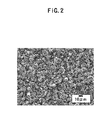
- FIG. 2 shows a scanning electron microscopic image (SEM image) of the powder obtained by crashing. Particle diameter of the powder obtained by crashing was controlled by adjusting the rate of supplying the sample to the crashing chamber of the crasher and the crashing air pressure.
- the powder having undergone heat treatment was treated in 1:1 mixed acid solution made up of 50% hydrofluoric acid and 70% nitric acid solutions.
- the suspension liquid changed color during treatment from deep green to bright green. Then washing with water and drying were performed to obtain ⁇ -SiAlON powder.
- the obtained ⁇ -SiAlON powder was subjected to fine powder removal process by the wet sedimentation method.
- the solution was placed in a vessel, made to stand still, and the supernatant was removed. The above operations were repeated until the supernatant became transparent.
- the precipitate was then filtered, washed thoroughly with water to remove the dispersing agent, and dried to obtain ⁇ -SiAlON powder from which fine powder had been removed (experiment 5).
- the synthesized powder in comparative example 1 was treated following the same treatment process and satisfying the same conditions as in experiment 5 to obtain ⁇ -SiAlON powder.
- the producing method including crashing process, heat treatment process, acid treatment process, and classification process, ⁇ -SiAlON powder was produced (comparative example 2).
- Table 3 shows the result of measurement of luminescence intensity of the ⁇ -SiAlON in experiments 5 and 6 and comparative example 2. The measurement was performed using the same method as example 1.
- FIG. 3 shows the relation between luminescence intensity and carbon concentrations in experiments 5 and 6 and comparative example 2.
- Table 3 and FIG. 3 show that the tendency observed after the sintering process was also confirmed even if crashing process, heat treatment process, acid treatment process, and classification process were performed, and that sufficient luminescence intensity was not obtained unless the condition that the carbon concentration after the sintering process was 200 ppm or lower was satisfied.
Landscapes
- Chemical & Material Sciences (AREA)
- Engineering & Computer Science (AREA)
- Organic Chemistry (AREA)
- Ceramic Engineering (AREA)
- Materials Engineering (AREA)
- Manufacturing & Machinery (AREA)
- Inorganic Chemistry (AREA)
- Structural Engineering (AREA)
- Physics & Mathematics (AREA)
- Thermal Sciences (AREA)
- Luminescent Compositions (AREA)
- Ceramic Products (AREA)
Abstract
Description
- The present invention relates to (β-SiAlON, a method of producing the β-SiAlON, a phosphor using the β-SiAlON, and a light-emitting apparatus using the phosphor.
- As a phosphor for light-emitting devices(LED), β-SiAlON phosphor is known. The β-SiAlON phosphor is produced by filling a vessel made of boron nitride with starting materials, namely a mixture of, silicon nitride, aluminum nitride, at least one compound selected from aluminum oxide and silicon oxide, and optically active element compound as typified by europium oxide and cerium oxide, and subjecting the materials to sintering process where sintering is performed at temperatures ranging from 1820°C to 2200°C.
- As a technique of improving luminescence intensity of β-SiAlON phosphor, subjecting sintered and crashed materials obtained by sintering process to acid treatment is known (Patent Literature 1).
- Patent Literature 1:
JP 2005-255885 A - β-SiAlON is mass-produced by sintering a plurality of boron nitride vessels containing starting materials in a sintering furnace simultaneously. However, when β-SiAlON is mass-produced, β-SiAlON that does not have intended luminescence intensity might be produced in the plurality of boron nitride vessels unless temperature conditions, etc. within the sintering furnace are controlled, and consequently luminescence intensity becomes non-uniform.
- Finding that the concentration of carbon contained in β-SiAlON affects luminescence intensity, the inventors achieved the present invention.
- The objectives of the present invention include providing a method of producing β-SiAlON having improved quality, and decreasing the amount of carbon contained in the β-SiAlON, thereby providing β-SiAlON having high luminescence intensity. Another objective of the present invention is to provide a high-quality phosphor using the β-SiAlON, and yet another objective is to provide a high-intensity light-emitting apparatus using the phosphor.
- The method of producing β-SiAlON of the present invention has a sintering process, in which β-SiAlON starting materials, namely a mixture of silicon nitride, aluminum nitride, at least one compound selected from aluminum oxide and silicon oxide, and optically active element compound, are sintered at temperatures ranging from 1820°C to 2200°C. In this sintering process, the β-SiAlON starting materials packed in a plurality of boron nitride vessels are placed in a graphite box to allow the starting materials to easily come in contact with nitrogen gas, and sintering is performed in nitrogen atmosphere.
- Another configuration of the method of producing β-SiAlON of the present invention has a sintering process, in which β-SiAlON starting materials, namely a mixture of silicon nitride, aluminum nitride, at least one compound selected from aluminum oxide and silicon oxide, and optically active element compound, are sintered at temperatures ranging from 1820°C to 2200°C. In this sintering process, the β-SiAlON starting materials packed in a plurality of boron nitride vessels are placed in a graphite box to allow the starting materials to easily come in contact with nitrogen gas, and sintering is performed in nitrogen atmosphere with the top part of the graphite box opened.
- In the method of producing β-SiAlON of the present invention described above, it is desirable that the optically active element compound be europium oxide.
- The β-SiAlON of the present invention is represented by a general formula Si6-zAlzOzN8-z, contains Eu, and its carbon concentration is 200 ppm or lower. More preferably, the carbon concentration is 150 ppm or lower.
- Another invention is a phosphor using this β-SiAlON.
- Yet another invention is a light-emitting apparatus having the phosphor using the β-SiAlON and a luminescent light source.
- According to the method of producing β-SiAlON of the present invention, high-quality β-SiAlON having high luminescence intensity can be produced at high productivity.
- The β-SiAlON of the present invention is excited in a wide wavelength range from ultraviolet light to visible light, and is excellent as a high-efficiency green light-emitting phosphor having dominant wavelength falling within the range from 520 nm to 550 nm. Consequently, it is applicable favorably to various light-emitting devices, light-emitting apparatuses using ultraviolet LED or blue LED as a light source, in particular.
- Since the β-SiAlON has high luminescence intensity, the light-emitting apparatus of the present invention experiences little reduction in brightness even if it is used at high temperatures, and has long service life.
-
-
FIG. 1 is a chart showing the relation between carbon concentrations and luminescence intensity of the powder phosphor obtained in example 1 of the present invention. -
FIG. 2 is a chart showing a scanning electron microscopic image (SEM image) of the powder phosphor in example 2. -
FIG. 3 is a chart showing the relation between carbon concentrations and luminescence intensity of the powder phosphor obtained in example 2. - The embodiment of the present invention will hereinafter be described in detail.
- The method of producing β-SiAlON of the present invention has a sintering process, in which β-SiAlON starting materials, namely a mixture of silicon nitride, aluminum nitride, optically active element compound, and at least one of compound selected from aluminum oxide and silicon oxide, are sintered at temperatures ranging from 1820°C to 2200°C, and wherein a plurality of boron nitride vessels are placed in a graphite box to allow the β-SiAlON starting materials packed in the plurality of boron nitride vessels to easily come in contact with nitrogen gas, and that sintering is performed in nitrogen atmosphere with the top part of the graphite box opened.
- The boron nitride vessels used for the sintering process may take any shape, from cube and cuboid to cylindrical form, but to ensure uniform thermal propagation, cylindrical or spherical shape is desirable, and with stability taken into consideration, cylindrical shape is preferable. It is desirable that the size of the vessel falls within a range where uniform thermal propagation is ensured. In the case of cylindrical shape, its internal diameter desirably falls within the range from 5 cm to 8 cm and the height of the inner wall falls within a range from 5 cm to 8 cm.
- The graphite box is in a shape of a box made of graphite plate, has a size capable of housing a plurality of boron nitride vessels, and has an opening at the top. The size of the graphite box is, in the case of box shape, is 51 cm deep, 31 cm wide, and 20 cm high in internal dimensions, for example. Since the top part of the graphite box is opened, the β-SiAlON starting materials packed in the plurality of boron nitride vessels remain in a state where contact with nitrogen gas is facilitated, and are sintered in nitrogen atmosphere. The concentration of carbon contained in the β-SiAlON produced is low, and β-SiAlON having high luminescence intensity can be obtained.
- In the present invention, β-SiAlON starting materials are placed in a graphite box to allow the starting materials to easily come in contact with nitrogen gas" is defined as adopting at least one means from the following three means: placing the boron nitride vessels along the wall of the graphite box; placing the boron nitride vessels in a row without stacking them on top of each other; and allowing the starting material powder filling rate, which is the ratio of total volume of the starting material powder to the internal volume of the graphite box, to be 2% or lower. The total volume of the starting material powder can be calculated from the total weight of the starting material powder and the density of the β-SiAlON (3.2 g/cm3).
- It is desirable that pressure of nitrogen gas in the sintering process be increased in the producing atmosphere. By increasing the pressure of nitrogen, disposition of the starting materials during the sintering process can be stabilized.
- The content of carbon in the β-SiAlON produced under the above conditions becomes 200 ppm or lower, and the luminescence intensity becomes equivalent to or higher than that of commercially available YAG: Ce (Kasei Optonix, YAG:Ce [grade name: P46Y3]).
- In the present invention, it is desirable that the β-SiAlON having undergone the sintering process be subjected to reheating process performed in argon atmosphere at atmospheric pressure at temperatures ranging from 1450°C to 1600°C.
- In the present invention, it is desirable that the β-SiAlON having undergone the sintering process or reheating process be subjected to acid treatment. The acid treatment in the present invention means to allow the β-SiAlON to disperse in an acid solution, agitate the solution for several minutes to several hours to cause reaction to occur, and then wash the β-SiAlON with water. By performing acid treatment, the luminescence inhibitor that appeared as a result of change caused by heating is removed by dissolving, and consequently fluorescence property can be improved. The acids used for acid treatment include one or more types of acids selected from hydrofluoric acid, sulfuric acid, phosphoric acid, hydrochloric acid, and nitric acid.
- The β-SiAlON of the present invention has β-SiAlON host crystal represented by general formula Si6-zAlzOzN8-z, with one or more elements selected from Eu, Mn, Sm, and Ce contained in it as luminescent center. In particular, the one containing Eu is desirable because excitation occurs in a wide wavelength range from ultraviolet to visible light.
- The carbon concentration of the β-SiAlON of the present invention measured by the infrared absorption method is 200 ppm or lower. If the amount of carbon contained in the β-SiAlON is large, decrease in luminescence intensity occurs, thereby inhibiting absorption of light into Eu2+, the luminescent center. Namely, the β-SiAlON having carbon concentration of 200 ppm or lower has high luminescence intensity. More preferable carbon concentration is 150 ppm or lower.
- The lattice constant of the β-SiAlON of the present invention depends largely on z value, namely the number of substitution of Si-N coupling by Al-O coupling. In other words, it is desirable that lattice constant "a" fall within the range from 0.7605 nm to 0.7620 nm, and lattice constant "c" fall within the range from 0.2908 nm to 0.2920 nm. The larger the size of crystal lattice of the β-SiAlON, the larger the amount of Eu contained. In particular, the ranges of lattice constants "a" and "c" shown above are desirable because the amount of Eu necessary for ensuring sufficient brightness can be contained easily.
- It is only necessary that the Eu content of the β-SiAlON of the present invention falls within a range allowing sufficient luminescent brightness to be obtained. A range from 0.1 mass% to 3 mass%, for example, is desirable.
- The light-emitting apparatus of the present invention includes a phosphor produced by the β-SiAlON described above and a luminescent light source. Using this light-emitting apparatus, light is irradiated to the β-SiAlON, with ultraviolet light or visible light having wavelengths ranging from 350 nm to 500 nm used as an excitation source. By irradiation, the β-SiAlON emits high-intensity light having its peak in wavelength falling within the range from 520 nm to 550 nm, allowing the light-emitting apparatus of the present invention to have high luminescence intensity. As the excitation source of the light-emitting apparatus, ultraviolet LED, blue LED, fluorescent lamp, or combination of those can be used. Furthermore, by combining the β-SiAlON phosphor with red light-emitting phosphor or blue light-emitting phosphor, the luminescent color can be made to be white or colors having other wavelengths.
- Since the β-SiAlON of the present invention is low in decrease in brightness at high temperatures, the light-emitting apparatus using the same is also low in decrease in brightness and deviation in chromaticity, and degradation does not occur even at high temperatures. Furthermore, since it has excellent long-term stability in oxidizing atmosphere and hydric environment, the state of high brightness is extended.
- The present invention will hereinafter be described further in detail by referring to examples.
- α-silicon nitride powder (Denki Kagaku Kogyo Kabushiki Kaisha, grade NP-400, oxygen content: 0.96 mass%), aluminum nitride powder (Tokuyama Corporation, grade F, oxygen content: 0.9 mass%), aluminum oxide powder (Taimei Chemicals Co., Ltd., grade TM-DAR), and europium oxide powder (Shin-Etsu Chemical Co., Ltd., grade RU) were mixed in percentage of 95.4%, 3.1%, 0.7%, and 0.8% by mass respectively to obtain 1 kg of starting material mixture.
- The starting material mixture was agitated for 30 minutes in dry state using a V-type mixer, and the total amount of the mixture was then made to pass through a 150µm nylon sieve to obtain starting material powder for synthesizing a phosphor.
- 100 g each of the starting material powder obtained as described above was packed in each of nine lidded cylindrical boron nitride vessels (Denki Kagaku Kogyo Kabushiki Kaisha, grade N-1) having internal diameter of 8 cm and height of 8 cm, and the vessels were placed in a graphite box with top lid having internal dimensions of 51 cm x 31 cm and the height of 20 cm along its internal wall (starting material filling rate: 0.9%). Heat treatment was conducted at 2000°C for 10 hours in a carbon heater electric furnace in 0.9 MPa pressurized nitrogen atmosphere, and the obtained powder was then cooled down gradually to room temperature. The sintered body obtained was a loosely coagulated mass, which was crashed lightly by human hands wearing clean rubber gloves. The lightly crashed sintered materials were made to pass through a 150µm sieve to obtain 45 g of synthesized powder.
- The starting material filling rate is a value obtained by dividing the total volume of starting material powder of 2,880 cm3 by internal volume of the top-lidded graphite box of 31,620 cm3 (51 cm x 31 cm x 20 cm), and the total volume of the starting material powder is a value obtained by dividing the total weight of the starting material powder of 900 g (9 vessels x weight of starting material powder per vessel of 100 g) by the density of β-SiAlON (3.2 g/cm3). The starting material filling rate is specifically calculated by the following formula:

- Fourteen cylindrical boron nitride vessels containing starting materials were disposed in three 5-vessel rows, of which one row had four vessels only (starting material filling rate = 1.4%). Treatment was performed under the same sintering process conditions as experiment 1 except for the above to obtain phosphor powder.
- The top lid of the graphite box was opened, and treatment was performed using the same number of vessels, sintering process and conditions as
experiment 2 to obtain phosphor powder. - Nineteen cylindrical boron nitride vessels containing starting materials were used, and three 5-vessel rows were disposed within a graphite box (starting material filling rate = 1.9%), four more vessels were placed on the upper stage along the wall of the graphite box, and treatment was performed under the same sintering process conditions as experiment 1 to obtain phosphor powder.
- Thirty cylindrical boron nitride vessels containing starting materials were disposed within a graphite box in two rows at top and at bottom, with each row containing three 5-vessel rows (starting material filling rate = 3.0%), and treatment was performed following the same treatment process and satisfying the same sintering process conditions as experiment 1 to obtain phosphor powder.
- The luminescence intensity of the fluorescent powder in experiments 1 to 4 and comparative example 1 was measured using spectrofluoro-photometer (Hitachi High-Technologies Corporation, F4500). Table 1 shows the measurement result.
-
Table 1 Number of vessels (pcs.) Lid of graphite box Luminescence intensity (%) Experiment 1 9 Closed 145 Experiment 214 Closed 120 Experiment 3 14 Open 133 Experiment 4 19 Closed 109 Com. Ex. 1 30 Closed 92 - The luminescence intensity of the phosphor was calculated by the following operation.
The phosphor powder was placed in a 10 mm x 10 mm x 45 mm quartz cell having two transparent sides, tapping was performed 50 times. The cell orientation was changed by 180 degrees, and then tapping was performed 50 times again. The cell containing the phosphor powder was mounted to a cell folder installed within the sample chamber of the above device. Into this cell, monochromatic light dispersed from a luminescent light source (Xe lamp) to have a given wavelength was introduced. Light was irradiated to the phosphor sample with this monochromatic light used as an excitation source, and the luminescence intensity of the sample was measured using the spectrophotometer.
Blue light having wavelength of 455 nm was used in this example as the monochromatic light.
Luminescence intensity was represented by relative peak intensity (%), with the luminescence intensity of YAG:Ce (Kasei Optonix, P46Y3) regarded as 100%. - The concentration of carbon in starting material powder mixture and the fluorescent powder in experiments 1 to 4 and comparative example 1 were measured using a carbon analyzer (LECO Japan Corporation, IR-412). The carbon concentration of the phosphor was assessed as follows: 0.1 g of phosphor powder and 1.0 g of copper powder were placed in an alumina crucible, which was mounted to a sample stage. Radio-frequency wave was irradiated to this cell to melt the phosphor. In oxidizing atmosphere, the gas discharged from the phosphor was measured by the infrared absorption method. Table 2 shows the measurement result.
-
Table 2 Number of vessels (pcs.) Lid of graphite box Starting material power filling rate (%) Carbon concentration (ppm) Starting material powder mixture --- --- --- 800 Experiment 1 9 Closed 0.9 110 Experiment 214 Closed 1.4 150 Experiment 3 14 Open 1.4 120 Experiment 4 19 Closed 1.9 180 Com. Ex.1 30 Closed 3.0 350 - Table 2 indicates that the concentration of carbon in the starting material powder mixture decreases if heat treatment is conducted at 2000°C for 10 hours in pressurized nitrogen atmosphere of 0.9 MPa using a carbon heater electric furnace. Decrease in carbon concentration varied depending on the number of vessels and starting material powder filling rate.
As the starting material filling rate decreased, the the carbon concentration was lower. In particular, if the starting material filling rate was 2% or lower, the carbon concentration was 200 ppm or lower, which is favorable.
In addition, when the vessels are disposed in two top and bottom rows, it is desirable that the vessels are disposed along the wall of the graphite box.
Furthermore, when sintering was performed in a state where the lid of the graphite box that housed the boron nitride vessels containing starting material powder for Eu-containing β-SiAlON was opened, the carbon content decreased. -
FIG. 1 shows the relation between luminescence intensity and carbon concentrations.
Table 1, Table 2, andFIG. 1 show that by decreasing concentration of carbon contained in the synthesized powder, luminescence intensity increased. When carbon concentration was 200 ppm or lower, luminescence intensity was higher than that of YAG:Ce. - The synthesized powder obtained in experiment 1 was crashed using an ultrasonic jet crasher (Nippon Pneumatic Mfg. Co., Ltd., PJM-80SP) to obtain powder.
FIG. 2 shows a scanning electron microscopic image (SEM image) of the powder obtained by crashing. Particle diameter of the powder obtained by crashing was controlled by adjusting the rate of supplying the sample to the crashing chamber of the crasher and the crashing air pressure. - 15 g of powder obtained by crashing was packed in a lidded cylindrical boron nitride vessel having diameter of 40 mm and height of 45 mm (Denki Kagaku Kogyo Kabushiki Kaisha, grade N-1), and heat treatment was performed at 1450°C for 8 hours in argon atmosphere at atmospheric pressure using a carbon heater electric furnace. The obtained powder showed no contraction resulting from annealing, had almost the same properties as those confirmed before heating, and all of the powder passed a 45µm sieve.
- The powder having undergone heat treatment was treated in 1:1 mixed acid solution made up of 50% hydrofluoric acid and 70% nitric acid solutions. The suspension liquid changed color during treatment from deep green to bright green. Then washing with water and drying were performed to obtain β-SiAlON powder.
- The obtained β-SiAlON powder was subjected to fine powder removal process by the wet sedimentation method. In addition, after dispersing the phosphor powder in a solution to which hexameta sodium phosphate had been added as a dispersing agent, the solution was placed in a vessel, made to stand still, and the supernatant was removed. The above operations were repeated until the supernatant became transparent. The precipitate was then filtered, washed thoroughly with water to remove the dispersing agent, and dried to obtain β-SiAlON powder from which fine powder had been removed (experiment 5).
- The synthesized powder in
experiment 2 was treated following the same treatment process and satisfying the same conditions as in experiment 5 to obtain β-SiAlON powder (experiment 6). - The synthesized powder in comparative example 1 was treated following the same treatment process and satisfying the same conditions as in experiment 5 to obtain β-SiAlON powder. By the producing method including crashing process, heat treatment process, acid treatment process, and classification process, β-SiAlON powder was produced (comparative example 2).
- Table 3 shows the result of measurement of luminescence intensity of the β-SiAlON in experiments 5 and 6 and comparative example 2. The measurement was performed using the same method as example 1.
-
Table 3 Number of vessels (pcs.) Lid of graphite box Luminescence intensity (%) Experiment 5 9 Closed 238 Experiment 6 14 Closed 229 Com. Ex. 2 30 Closed 195 -
FIG. 3 shows the relation between luminescence intensity and carbon concentrations in experiments 5 and 6 and comparative example 2. - Table 3 and
FIG. 3 show that the tendency observed after the sintering process was also confirmed even if crashing process, heat treatment process, acid treatment process, and classification process were performed, and that sufficient luminescence intensity was not obtained unless the condition that the carbon concentration after the sintering process was 200 ppm or lower was satisfied.
Claims (7)
- A method of producing β-SiAlON, comprising a sintering process, in which β-SiAlON starting materials, a mixture of silicon nitride, aluminum nitride, optically active elemental compound, and at least one compound selected from aluminum oxide and silicon oxide, are sintered at temperatures ranging from 1820°C to 2200°C, wherein a plurality of boron nitride vessels are placed in a graphite box to allow the β-SiAlON starting materials packed in the plurality of boron nitride vessels to easily come in contact with nitrogen gas, and that sintering is performed in nitrogen atmosphere.
- A method of producing β-SiAlON, comprising a sintering process, in which β-SiAlON starting materials, a mixture of silicon nitride, aluminum nitride, optically active elemental compound, and at least one compound selected from aluminum oxide and silicon oxide, are sintered at temperatures ranging from 1820°C to 2200°C, wherein a plurality of boron nitride vessels are placed in a graphite box to allow the β-SiAlON starting materials packed in the plurality of boron nitride vessels to easily come in contact with nitrogen gas, and that sintering is performed in nitrogen atmosphere with the top part of the graphite box opened.
- The method of producing β-SiAlON as set forth in claim 1 or 2, wherein the total volume of the β-SiAlON starting materials packed in the plurality of boron nitride vessels accounts for 2% of the internal volume of the graphite box.
- The method of producing β-SiAlON as set forth in claim 1 or 2, wherein the optically active element compound is europium oxide.
- Eu-containing β-SiAlON represented by general formula Si6-zAlzOzN8-z, characterized in that its carbon concentration is 200 ppm or lower.
- A phosphor using the β-SiAlON as set forth in claim 5.
- A light-emitting apparatus having the phosphor as set forth in claim 6 and a luminescent light source.
Applications Claiming Priority (2)
| Application Number | Priority Date | Filing Date | Title |
|---|---|---|---|
| JP2010110865 | 2010-05-13 | ||
| PCT/JP2011/059858 WO2011142228A1 (en) | 2010-05-13 | 2011-04-21 | METHOD FOR PRODUCING β-SIALON, β-SIALON, AND PRODUCT USING SAME |
Publications (3)
| Publication Number | Publication Date |
|---|---|
| EP2570400A1 true EP2570400A1 (en) | 2013-03-20 |
| EP2570400A4 EP2570400A4 (en) | 2014-01-08 |
| EP2570400B1 EP2570400B1 (en) | 2015-10-07 |
Family
ID=44914284
Family Applications (1)
| Application Number | Title | Priority Date | Filing Date |
|---|---|---|---|
| EP11780485.6A Not-in-force EP2570400B1 (en) | 2010-05-13 | 2011-04-21 | Method for producing beta-sialon |
Country Status (7)
| Country | Link |
|---|---|
| US (1) | US8926864B2 (en) |
| EP (1) | EP2570400B1 (en) |
| JP (1) | JP5852564B2 (en) |
| KR (1) | KR101450991B1 (en) |
| CN (1) | CN102939273A (en) |
| TW (1) | TWI438261B (en) |
| WO (1) | WO2011142228A1 (en) |
Families Citing this family (14)
| Publication number | Priority date | Publication date | Assignee | Title |
|---|---|---|---|---|
| KR101215342B1 (en) * | 2010-09-20 | 2012-12-26 | 삼성전자주식회사 | SiAlON PHOSPHOR, METHOD FOR PREPARING THE SAME AND LIGHT EMITTING DEVICE PACKAGE USING THE SiAlON PHOSPHOR |
| JP5919014B2 (en) * | 2012-02-09 | 2016-05-18 | デンカ株式会社 | Phosphor and light emitting device |
| JP5886070B2 (en) * | 2012-02-09 | 2016-03-16 | デンカ株式会社 | Phosphor and light emitting device |
| JP2013163736A (en) * | 2012-02-09 | 2013-08-22 | Denki Kagaku Kogyo Kk | Phosphor and light-emitting device |
| JP5919015B2 (en) * | 2012-02-09 | 2016-05-18 | デンカ株式会社 | Phosphor and light emitting device |
| CN106753346B (en) * | 2015-11-24 | 2019-05-31 | 有研稀土新材料股份有限公司 | Nitrogen oxides fluorophor and its luminescent device |
| CN105331361B (en) * | 2015-12-03 | 2017-09-19 | 河北利福光电技术有限公司 | A kind of β SiAlON: Eu2+Green emitting phosphor and its synthetic method |
| CN105295908B (en) * | 2015-12-03 | 2017-06-16 | 河北利福光电技术有限公司 | A kind of β SiAlON:Eu2+Green emitting phosphor and preparation method thereof |
| CN109073801A (en) * | 2016-04-25 | 2018-12-21 | 日本特殊陶业株式会社 | Wavelength converting member, manufacturing method thereof, and light emitting device |
| US10399906B2 (en) * | 2016-09-20 | 2019-09-03 | Ngk Insulators, Ltd. | Sialon sintered body, method for producing the same, composite substrate, and electronic device |
| US10941078B2 (en) * | 2017-07-27 | 2021-03-09 | Osram Opto Semiconductors Gmbh | β-SiAlON wavelength converters and methods of making the same |
| CN109896862A (en) * | 2019-02-27 | 2019-06-18 | 广东工业大学 | A kind of β-SiAlON ceramics of complicated shape and preparation method thereof |
| US11479463B2 (en) | 2019-08-02 | 2022-10-25 | King Fahd University Of Petroleum And Minerals | Method of forming a βSiAlON by spark plasma sintering |
| KR102826414B1 (en) * | 2021-03-31 | 2025-06-30 | 덴카 주식회사 | Europium-revived β-type sialon phosphor and luminescent device |
Family Cites Families (13)
| Publication number | Priority date | Publication date | Assignee | Title |
|---|---|---|---|---|
| JP5016187B2 (en) * | 2004-07-14 | 2012-09-05 | Dowaエレクトロニクス株式会社 | Nitride phosphor, method for producing nitride phosphor, light source and LED using the nitride phosphor |
| JP3921545B2 (en) * | 2004-03-12 | 2007-05-30 | 独立行政法人物質・材料研究機構 | Phosphor and production method thereof |
| JP4210761B2 (en) | 2004-03-12 | 2009-01-21 | 独立行政法人物質・材料研究機構 | Phosphor and production method thereof |
| CN1260179C (en) * | 2004-07-01 | 2006-06-21 | 北京科技大学 | Process for synthesizing high purity sialon material by coal-series kaolin |
| JP5013374B2 (en) * | 2005-03-22 | 2012-08-29 | 独立行政法人物質・材料研究機構 | Phosphor, method for producing the same, and light emitting device |
| KR101241488B1 (en) * | 2005-04-01 | 2013-03-08 | 미쓰비시 가가꾸 가부시키가이샤 | Alloy powder for aw material of inorganic functional material and phosphor |
| CN101175834B (en) * | 2005-05-12 | 2011-03-30 | 独立行政法人物质·材料研究机构 | β-Sialon Ceramic Phosphor |
| JP2007091960A (en) * | 2005-09-30 | 2007-04-12 | Nitto Denko Corp | Resin composition for sealing optical semiconductor element and optical semiconductor device obtained using the same |
| JP4956732B2 (en) * | 2006-05-18 | 2012-06-20 | Dowaエレクトロニクス株式会社 | Phosphors and color display devices for electron beam excitation |
| JP5378644B2 (en) * | 2006-09-29 | 2013-12-25 | Dowaホールディングス株式会社 | Method for producing nitride phosphor or oxynitride phosphor |
| JP5135812B2 (en) * | 2007-02-05 | 2013-02-06 | 憲一 町田 | Phosphor based on nitride or oxynitride, method for producing the same, phosphor-containing composition using the same, light emitting device, lighting device, and image display device |
| JP2008274254A (en) * | 2007-03-30 | 2008-11-13 | Mitsubishi Chemicals Corp | Phosphor and production method therefor, phosphor-containing composition, light emitting device, image display device and lighting device |
| JP4879950B2 (en) * | 2008-10-29 | 2012-02-22 | シャープ株式会社 | Method for manufacturing phosphor |
-
2011
- 2011-04-21 CN CN201180023906XA patent/CN102939273A/en active Pending
- 2011-04-21 EP EP11780485.6A patent/EP2570400B1/en not_active Not-in-force
- 2011-04-21 WO PCT/JP2011/059858 patent/WO2011142228A1/en not_active Ceased
- 2011-04-21 KR KR1020127030865A patent/KR101450991B1/en active Active
- 2011-04-21 JP JP2012514750A patent/JP5852564B2/en active Active
- 2011-04-21 US US13/697,556 patent/US8926864B2/en active Active
- 2011-05-12 TW TW100116605A patent/TWI438261B/en not_active IP Right Cessation
Also Published As
| Publication number | Publication date |
|---|---|
| JP5852564B2 (en) | 2016-02-03 |
| TWI438261B (en) | 2014-05-21 |
| CN102939273A (en) | 2013-02-20 |
| TW201144409A (en) | 2011-12-16 |
| KR101450991B1 (en) | 2014-10-15 |
| EP2570400A4 (en) | 2014-01-08 |
| US20130106277A1 (en) | 2013-05-02 |
| JPWO2011142228A1 (en) | 2013-07-22 |
| EP2570400B1 (en) | 2015-10-07 |
| KR20130026446A (en) | 2013-03-13 |
| US8926864B2 (en) | 2015-01-06 |
| WO2011142228A1 (en) | 2011-11-17 |
Similar Documents
| Publication | Publication Date | Title |
|---|---|---|
| EP2570400B1 (en) | Method for producing beta-sialon | |
| EP2093272B1 (en) | Fluorescent substance and production method thereof, and light emitting device | |
| KR101251138B1 (en) | Β-sialon phosphor, use thereof and method for producing same | |
| KR101740756B1 (en) | Process for producing -sialon fluorescent material | |
| EP2623580B1 (en) | Process for production of beta-sialon | |
| KR101848556B1 (en) | Nitride phosphor and production process thereof, and light emitting device | |
| KR20140054306A (en) | Oxynitride fluorescent substance powder, silicon nitride powder for manufacturing same, and method for manufacturing same | |
| EP3135746A1 (en) | Nitride fluorescent material, method for producing the same, and light emitting device | |
| KR102832653B1 (en) | Phosphor powders and luminescent devices | |
| JP7766176B2 (en) | Phosphor powder, method for manufacturing phosphor powder, and light-emitting device | |
| CN106978166B (en) | Red phosphor and light-emitting device | |
| JP6372368B2 (en) | Phosphor, light emitting device, lighting device, and image display device | |
| JP7507018B2 (en) | Method for manufacturing β-type sialon phosphor, method for manufacturing wavelength conversion member, and method for manufacturing light emitting device | |
| JP2013237713A (en) | β TYPE SIALON, LIGHT-EMITTING DEVICE, AND METHOD OF MANUFACTURING β TYPE SIALON | |
| US20210207026A1 (en) | Red phosphor and light emitting device | |
| JP2024129351A (en) | Manufacturing method of phosphor powder | |
| JP2024175935A (en) | Manufacturing method of phosphor powder | |
| JP2023166646A (en) | europium-activated β-type sialon phosphor |
Legal Events
| Date | Code | Title | Description |
|---|---|---|---|
| PUAI | Public reference made under article 153(3) epc to a published international application that has entered the european phase |
Free format text: ORIGINAL CODE: 0009012 |
|
| 17P | Request for examination filed |
Effective date: 20121119 |
|
| AK | Designated contracting states |
Kind code of ref document: A1 Designated state(s): AL AT BE BG CH CY CZ DE DK EE ES FI FR GB GR HR HU IE IS IT LI LT LU LV MC MK MT NL NO PL PT RO RS SE SI SK SM TR |
|
| DAX | Request for extension of the european patent (deleted) | ||
| A4 | Supplementary search report drawn up and despatched |
Effective date: 20131206 |
|
| RIC1 | Information provided on ipc code assigned before grant |
Ipc: C01B 21/082 20060101ALI20131202BHEP Ipc: C04B 35/597 20060101ALI20131202BHEP Ipc: H01L 33/50 20100101ALI20131202BHEP Ipc: C09K 11/59 20060101ALI20131202BHEP Ipc: C09K 11/08 20060101ALI20131202BHEP Ipc: C04B 35/599 20060101AFI20131202BHEP Ipc: C09K 11/64 20060101ALI20131202BHEP |
|
| RIC1 | Information provided on ipc code assigned before grant |
Ipc: C09K 11/08 20060101ALI20140721BHEP Ipc: H01L 33/50 20100101ALI20140721BHEP Ipc: C01B 21/082 20060101ALI20140721BHEP Ipc: C09K 11/64 20060101ALI20140721BHEP Ipc: C04B 35/597 20060101ALI20140721BHEP Ipc: C09K 11/59 20060101ALI20140721BHEP Ipc: C04B 35/599 20060101AFI20140721BHEP |
|
| GRAP | Despatch of communication of intention to grant a patent |
Free format text: ORIGINAL CODE: EPIDOSNIGR1 |
|
| INTG | Intention to grant announced |
Effective date: 20141002 |
|
| GRAJ | Information related to disapproval of communication of intention to grant by the applicant or resumption of examination proceedings by the epo deleted |
Free format text: ORIGINAL CODE: EPIDOSDIGR1 |
|
| GRAP | Despatch of communication of intention to grant a patent |
Free format text: ORIGINAL CODE: EPIDOSNIGR1 |
|
| INTG | Intention to grant announced |
Effective date: 20141126 |
|
| GRAP | Despatch of communication of intention to grant a patent |
Free format text: ORIGINAL CODE: EPIDOSNIGR1 |
|
| INTG | Intention to grant announced |
Effective date: 20150428 |
|
| GRAS | Grant fee paid |
Free format text: ORIGINAL CODE: EPIDOSNIGR3 |
|
| GRAA | (expected) grant |
Free format text: ORIGINAL CODE: 0009210 |
|
| AK | Designated contracting states |
Kind code of ref document: B1 Designated state(s): AL AT BE BG CH CY CZ DE DK EE ES FI FR GB GR HR HU IE IS IT LI LT LU LV MC MK MT NL NO PL PT RO RS SE SI SK SM TR |
|
| REG | Reference to a national code |
Ref country code: GB Ref legal event code: FG4D |
|
| REG | Reference to a national code |
Ref country code: AT Ref legal event code: REF Ref document number: 753641 Country of ref document: AT Kind code of ref document: T Effective date: 20151015 Ref country code: CH Ref legal event code: EP |
|
| REG | Reference to a national code |
Ref country code: IE Ref legal event code: FG4D |
|
| REG | Reference to a national code |
Ref country code: DE Ref legal event code: R096 Ref document number: 602011020390 Country of ref document: DE |
|
| REG | Reference to a national code |
Ref country code: DE Ref legal event code: R082 Ref document number: 602011020390 Country of ref document: DE Representative=s name: GULDE & PARTNER PATENT- UND RECHTSANWALTSKANZL, DE Ref country code: DE Ref legal event code: R081 Ref document number: 602011020390 Country of ref document: DE Owner name: DENKA COMPANY LIMITED, JP Free format text: FORMER OWNER: DENKI KAGAKU KOGYO KABUSHIKI KAISHA, TOKYO, JP |
|
| RAP2 | Party data changed (patent owner data changed or rights of a patent transferred) |
Owner name: DENKA COMPANY LIMITED |
|
| REG | Reference to a national code |
Ref country code: AT Ref legal event code: MK05 Ref document number: 753641 Country of ref document: AT Kind code of ref document: T Effective date: 20151007 |
|
| REG | Reference to a national code |
Ref country code: LT Ref legal event code: MG4D |
|
| REG | Reference to a national code |
Ref country code: NL Ref legal event code: FP |
|
| PG25 | Lapsed in a contracting state [announced via postgrant information from national office to epo] |
Ref country code: IS Free format text: LAPSE BECAUSE OF FAILURE TO SUBMIT A TRANSLATION OF THE DESCRIPTION OR TO PAY THE FEE WITHIN THE PRESCRIBED TIME-LIMIT Effective date: 20160207 Ref country code: ES Free format text: LAPSE BECAUSE OF FAILURE TO SUBMIT A TRANSLATION OF THE DESCRIPTION OR TO PAY THE FEE WITHIN THE PRESCRIBED TIME-LIMIT Effective date: 20151007 Ref country code: LT Free format text: LAPSE BECAUSE OF FAILURE TO SUBMIT A TRANSLATION OF THE DESCRIPTION OR TO PAY THE FEE WITHIN THE PRESCRIBED TIME-LIMIT Effective date: 20151007 Ref country code: IT Free format text: LAPSE BECAUSE OF FAILURE TO SUBMIT A TRANSLATION OF THE DESCRIPTION OR TO PAY THE FEE WITHIN THE PRESCRIBED TIME-LIMIT Effective date: 20151007 Ref country code: NO Free format text: LAPSE BECAUSE OF FAILURE TO SUBMIT A TRANSLATION OF THE DESCRIPTION OR TO PAY THE FEE WITHIN THE PRESCRIBED TIME-LIMIT Effective date: 20160107 Ref country code: HR Free format text: LAPSE BECAUSE OF FAILURE TO SUBMIT A TRANSLATION OF THE DESCRIPTION OR TO PAY THE FEE WITHIN THE PRESCRIBED TIME-LIMIT Effective date: 20151007 |
|
| PG25 | Lapsed in a contracting state [announced via postgrant information from national office to epo] |
Ref country code: PL Free format text: LAPSE BECAUSE OF FAILURE TO SUBMIT A TRANSLATION OF THE DESCRIPTION OR TO PAY THE FEE WITHIN THE PRESCRIBED TIME-LIMIT Effective date: 20151007 Ref country code: FI Free format text: LAPSE BECAUSE OF FAILURE TO SUBMIT A TRANSLATION OF THE DESCRIPTION OR TO PAY THE FEE WITHIN THE PRESCRIBED TIME-LIMIT Effective date: 20151007 Ref country code: GR Free format text: LAPSE BECAUSE OF FAILURE TO SUBMIT A TRANSLATION OF THE DESCRIPTION OR TO PAY THE FEE WITHIN THE PRESCRIBED TIME-LIMIT Effective date: 20160108 Ref country code: AT Free format text: LAPSE BECAUSE OF FAILURE TO SUBMIT A TRANSLATION OF THE DESCRIPTION OR TO PAY THE FEE WITHIN THE PRESCRIBED TIME-LIMIT Effective date: 20151007 Ref country code: RS Free format text: LAPSE BECAUSE OF FAILURE TO SUBMIT A TRANSLATION OF THE DESCRIPTION OR TO PAY THE FEE WITHIN THE PRESCRIBED TIME-LIMIT Effective date: 20151007 Ref country code: LV Free format text: LAPSE BECAUSE OF FAILURE TO SUBMIT A TRANSLATION OF THE DESCRIPTION OR TO PAY THE FEE WITHIN THE PRESCRIBED TIME-LIMIT Effective date: 20151007 Ref country code: PT Free format text: LAPSE BECAUSE OF FAILURE TO SUBMIT A TRANSLATION OF THE DESCRIPTION OR TO PAY THE FEE WITHIN THE PRESCRIBED TIME-LIMIT Effective date: 20160208 Ref country code: SE Free format text: LAPSE BECAUSE OF FAILURE TO SUBMIT A TRANSLATION OF THE DESCRIPTION OR TO PAY THE FEE WITHIN THE PRESCRIBED TIME-LIMIT Effective date: 20151007 |
|
| REG | Reference to a national code |
Ref country code: NL Ref legal event code: HC Owner name: DENKA COMPANY LIMITED; JP Free format text: DETAILS ASSIGNMENT: VERANDERING VAN EIGENAAR(S), VERANDERING VAN NAAM VAN DE EIGENAAR(S); FORMER OWNER NAME: DENKI KAGAKU KOGYO KABUSHIKI KAISHA Effective date: 20160111 |
|
| REG | Reference to a national code |
Ref country code: DE Ref legal event code: R097 Ref document number: 602011020390 Country of ref document: DE |
|
| PG25 | Lapsed in a contracting state [announced via postgrant information from national office to epo] |
Ref country code: CZ Free format text: LAPSE BECAUSE OF FAILURE TO SUBMIT A TRANSLATION OF THE DESCRIPTION OR TO PAY THE FEE WITHIN THE PRESCRIBED TIME-LIMIT Effective date: 20151007 |
|
| PLBE | No opposition filed within time limit |
Free format text: ORIGINAL CODE: 0009261 |
|
| STAA | Information on the status of an ep patent application or granted ep patent |
Free format text: STATUS: NO OPPOSITION FILED WITHIN TIME LIMIT |
|
| PG25 | Lapsed in a contracting state [announced via postgrant information from national office to epo] |
Ref country code: EE Free format text: LAPSE BECAUSE OF FAILURE TO SUBMIT A TRANSLATION OF THE DESCRIPTION OR TO PAY THE FEE WITHIN THE PRESCRIBED TIME-LIMIT Effective date: 20151007 Ref country code: DK Free format text: LAPSE BECAUSE OF FAILURE TO SUBMIT A TRANSLATION OF THE DESCRIPTION OR TO PAY THE FEE WITHIN THE PRESCRIBED TIME-LIMIT Effective date: 20151007 Ref country code: RO Free format text: LAPSE BECAUSE OF FAILURE TO SUBMIT A TRANSLATION OF THE DESCRIPTION OR TO PAY THE FEE WITHIN THE PRESCRIBED TIME-LIMIT Effective date: 20151007 Ref country code: SM Free format text: LAPSE BECAUSE OF FAILURE TO SUBMIT A TRANSLATION OF THE DESCRIPTION OR TO PAY THE FEE WITHIN THE PRESCRIBED TIME-LIMIT Effective date: 20151007 Ref country code: BE Free format text: LAPSE BECAUSE OF NON-PAYMENT OF DUE FEES Effective date: 20160430 Ref country code: SK Free format text: LAPSE BECAUSE OF FAILURE TO SUBMIT A TRANSLATION OF THE DESCRIPTION OR TO PAY THE FEE WITHIN THE PRESCRIBED TIME-LIMIT Effective date: 20151007 |
|
| 26N | No opposition filed |
Effective date: 20160708 |
|
| PG25 | Lapsed in a contracting state [announced via postgrant information from national office to epo] |
Ref country code: SI Free format text: LAPSE BECAUSE OF FAILURE TO SUBMIT A TRANSLATION OF THE DESCRIPTION OR TO PAY THE FEE WITHIN THE PRESCRIBED TIME-LIMIT Effective date: 20151007 |
|
| REG | Reference to a national code |
Ref country code: CH Ref legal event code: PL |
|
| GBPC | Gb: european patent ceased through non-payment of renewal fee |
Effective date: 20160421 |
|
| PG25 | Lapsed in a contracting state [announced via postgrant information from national office to epo] |
Ref country code: LU Free format text: LAPSE BECAUSE OF FAILURE TO SUBMIT A TRANSLATION OF THE DESCRIPTION OR TO PAY THE FEE WITHIN THE PRESCRIBED TIME-LIMIT Effective date: 20160421 Ref country code: BE Free format text: LAPSE BECAUSE OF FAILURE TO SUBMIT A TRANSLATION OF THE DESCRIPTION OR TO PAY THE FEE WITHIN THE PRESCRIBED TIME-LIMIT Effective date: 20151007 |
|
| REG | Reference to a national code |
Ref country code: IE Ref legal event code: MM4A |
|
| REG | Reference to a national code |
Ref country code: FR Ref legal event code: ST Effective date: 20161230 |
|
| PG25 | Lapsed in a contracting state [announced via postgrant information from national office to epo] |
Ref country code: FR Free format text: LAPSE BECAUSE OF NON-PAYMENT OF DUE FEES Effective date: 20160502 Ref country code: CH Free format text: LAPSE BECAUSE OF NON-PAYMENT OF DUE FEES Effective date: 20160430 Ref country code: GB Free format text: LAPSE BECAUSE OF NON-PAYMENT OF DUE FEES Effective date: 20160421 Ref country code: LI Free format text: LAPSE BECAUSE OF NON-PAYMENT OF DUE FEES Effective date: 20160430 |
|
| PG25 | Lapsed in a contracting state [announced via postgrant information from national office to epo] |
Ref country code: IE Free format text: LAPSE BECAUSE OF NON-PAYMENT OF DUE FEES Effective date: 20160421 |
|
| PG25 | Lapsed in a contracting state [announced via postgrant information from national office to epo] |
Ref country code: CY Free format text: LAPSE BECAUSE OF FAILURE TO SUBMIT A TRANSLATION OF THE DESCRIPTION OR TO PAY THE FEE WITHIN THE PRESCRIBED TIME-LIMIT Effective date: 20151007 Ref country code: HU Free format text: LAPSE BECAUSE OF FAILURE TO SUBMIT A TRANSLATION OF THE DESCRIPTION OR TO PAY THE FEE WITHIN THE PRESCRIBED TIME-LIMIT; INVALID AB INITIO Effective date: 20110421 |
|
| PG25 | Lapsed in a contracting state [announced via postgrant information from national office to epo] |
Ref country code: MC Free format text: LAPSE BECAUSE OF FAILURE TO SUBMIT A TRANSLATION OF THE DESCRIPTION OR TO PAY THE FEE WITHIN THE PRESCRIBED TIME-LIMIT Effective date: 20151007 Ref country code: MT Free format text: LAPSE BECAUSE OF NON-PAYMENT OF DUE FEES Effective date: 20160430 Ref country code: MK Free format text: LAPSE BECAUSE OF FAILURE TO SUBMIT A TRANSLATION OF THE DESCRIPTION OR TO PAY THE FEE WITHIN THE PRESCRIBED TIME-LIMIT Effective date: 20151007 Ref country code: TR Free format text: LAPSE BECAUSE OF FAILURE TO SUBMIT A TRANSLATION OF THE DESCRIPTION OR TO PAY THE FEE WITHIN THE PRESCRIBED TIME-LIMIT Effective date: 20151007 |
|
| PG25 | Lapsed in a contracting state [announced via postgrant information from national office to epo] |
Ref country code: BG Free format text: LAPSE BECAUSE OF FAILURE TO SUBMIT A TRANSLATION OF THE DESCRIPTION OR TO PAY THE FEE WITHIN THE PRESCRIBED TIME-LIMIT Effective date: 20151007 |
|
| PG25 | Lapsed in a contracting state [announced via postgrant information from national office to epo] |
Ref country code: AL Free format text: LAPSE BECAUSE OF FAILURE TO SUBMIT A TRANSLATION OF THE DESCRIPTION OR TO PAY THE FEE WITHIN THE PRESCRIBED TIME-LIMIT Effective date: 20151007 |
|
| PGFP | Annual fee paid to national office [announced via postgrant information from national office to epo] |
Ref country code: NL Payment date: 20200312 Year of fee payment: 10 |
|
| REG | Reference to a national code |
Ref country code: NL Ref legal event code: MM Effective date: 20210501 |
|
| PG25 | Lapsed in a contracting state [announced via postgrant information from national office to epo] |
Ref country code: NL Free format text: LAPSE BECAUSE OF NON-PAYMENT OF DUE FEES Effective date: 20210501 |
|
| P01 | Opt-out of the competence of the unified patent court (upc) registered |
Effective date: 20230512 |
|
| PGFP | Annual fee paid to national office [announced via postgrant information from national office to epo] |
Ref country code: DE Payment date: 20240227 Year of fee payment: 14 |
|
| REG | Reference to a national code |
Ref country code: DE Ref legal event code: R119 Ref document number: 602011020390 Country of ref document: DE |
|
| PG25 | Lapsed in a contracting state [announced via postgrant information from national office to epo] |
Ref country code: DE Free format text: LAPSE BECAUSE OF NON-PAYMENT OF DUE FEES Effective date: 20251104 |