EP2570248A1 - Vulkanisierform für Fahrzeugreifen und Fahrzeugluftreifen, welche mit einer vorgenannten Vulkanisierform heizgepresst ist - Google Patents
Vulkanisierform für Fahrzeugreifen und Fahrzeugluftreifen, welche mit einer vorgenannten Vulkanisierform heizgepresst ist Download PDFInfo
- Publication number
- EP2570248A1 EP2570248A1 EP12179460A EP12179460A EP2570248A1 EP 2570248 A1 EP2570248 A1 EP 2570248A1 EP 12179460 A EP12179460 A EP 12179460A EP 12179460 A EP12179460 A EP 12179460A EP 2570248 A1 EP2570248 A1 EP 2570248A1
- Authority
- EP
- European Patent Office
- Prior art keywords
- mold
- web
- tread
- vehicle tire
- venting means
- Prior art date
- Legal status (The legal status is an assumption and is not a legal conclusion. Google has not performed a legal analysis and makes no representation as to the accuracy of the status listed.)
- Granted
Links
- 238000004073 vulcanization Methods 0.000 title claims description 8
- 238000013022 venting Methods 0.000 claims description 31
- 238000000465 moulding Methods 0.000 claims description 6
- 238000007731 hot pressing Methods 0.000 claims description 4
- 238000007493 shaping process Methods 0.000 claims description 2
- 239000000463 material Substances 0.000 description 3
- 238000000034 method Methods 0.000 description 3
- 238000003825 pressing Methods 0.000 description 3
- 238000009423 ventilation Methods 0.000 description 3
- 230000002411 adverse Effects 0.000 description 2
- 239000003795 chemical substances by application Substances 0.000 description 2
- 238000003475 lamination Methods 0.000 description 2
- 238000009825 accumulation Methods 0.000 description 1
- 238000006243 chemical reaction Methods 0.000 description 1
- 238000004132 cross linking Methods 0.000 description 1
- 230000007547 defect Effects 0.000 description 1
- 238000004049 embossing Methods 0.000 description 1
- 238000009434 installation Methods 0.000 description 1
- 238000004519 manufacturing process Methods 0.000 description 1
- 230000013011 mating Effects 0.000 description 1
- 239000002184 metal Substances 0.000 description 1
- 230000000149 penetrating effect Effects 0.000 description 1
- 230000008674 spewing Effects 0.000 description 1
- 238000009966 trimming Methods 0.000 description 1
Images


Classifications
-
- B—PERFORMING OPERATIONS; TRANSPORTING
- B29—WORKING OF PLASTICS; WORKING OF SUBSTANCES IN A PLASTIC STATE IN GENERAL
- B29D—PRODUCING PARTICULAR ARTICLES FROM PLASTICS OR FROM SUBSTANCES IN A PLASTIC STATE
- B29D30/00—Producing pneumatic or solid tyres or parts thereof
- B29D30/06—Pneumatic tyres or parts thereof (e.g. produced by casting, moulding, compression moulding, injection moulding, centrifugal casting)
- B29D30/0601—Vulcanising tyres; Vulcanising presses for tyres
- B29D30/0606—Vulcanising moulds not integral with vulcanising presses
-
- B—PERFORMING OPERATIONS; TRANSPORTING
- B29—WORKING OF PLASTICS; WORKING OF SUBSTANCES IN A PLASTIC STATE IN GENERAL
- B29C—SHAPING OR JOINING OF PLASTICS; SHAPING OF MATERIAL IN A PLASTIC STATE, NOT OTHERWISE PROVIDED FOR; AFTER-TREATMENT OF THE SHAPED PRODUCTS, e.g. REPAIRING
- B29C33/00—Moulds or cores; Details thereof or accessories therefor
- B29C33/10—Moulds or cores; Details thereof or accessories therefor with incorporated venting means
-
- B—PERFORMING OPERATIONS; TRANSPORTING
- B29—WORKING OF PLASTICS; WORKING OF SUBSTANCES IN A PLASTIC STATE IN GENERAL
- B29D—PRODUCING PARTICULAR ARTICLES FROM PLASTICS OR FROM SUBSTANCES IN A PLASTIC STATE
- B29D30/00—Producing pneumatic or solid tyres or parts thereof
- B29D30/06—Pneumatic tyres or parts thereof (e.g. produced by casting, moulding, compression moulding, injection moulding, centrifugal casting)
- B29D30/0601—Vulcanising tyres; Vulcanising presses for tyres
- B29D30/0606—Vulcanising moulds not integral with vulcanising presses
- B29D2030/0607—Constructional features of the moulds
- B29D2030/0617—Venting devices, e.g. vent plugs or inserts
Definitions
- the invention relates to a Vulkanisierform for vehicle tires, which consists of mold segments with inside molding surfaces for shaping the earliestsprupenden vehicle tire, wherein the mold segments have cylindrical venting means, which communicate with the atmosphere and through which air from the mold cavity of the Vulkanisierform through the mold segment through to the outside can be diverted and wherein the tread of the vehicle tire forming molding surfaces of the molding segments raised webs with web edges, wherein the webs emboss the grooves of the vehicle tire tread and limit the raised profile elements of the vehicle tire tread.
- the invention also relates to a pneumatic vehicle tire which is heat-pressed with an aforementioned vulcanizing mold.
- a Eurovent has, in a specific embodiment, a sleeve made of metal, in which, to seal off the mold cavity, a valve disk which can be closed against the force of a spring is arranged on a shaft which closes off the end of the sleeve in the plane of the mold surface.
- valve disc of the Eurovent leaves a plate-like impression on the tread.
- the plate-shaped impression is a stamped into the tread structure, more rarely a plate-shaped raised structure. Whether the impression is raised or recessed on the tread depends on how the Eurovent is built into the vulcanization mold. Due to the plate-shaped impressions, the contact surface of the tread is reduced, which adversely affects the driving characteristics of the vehicle tire, in particular on the ice performance in winter tires.
- the vulcanized with this Vulkanisierform vehicle tire should have little or no caused by the venting marks on its tread.
- This object is achieved in relation to the vulcanization mold by at least one venting means being arranged within a web of the mold segment such that it opens into the mold cavity in the region of a web flank of this web.
- the vulcanizing mold has at least one venting means, which opens into the mold cavity at a web flank and which does not open into the mold cavity in the area of the jacket-shaped surface forming the contact surface.
- a conditional on the venting agent impression such as a shoot or a plate-shaped imprint on the contact surface of the tread of the hot-pressing vehicle tire is avoided.
- the vehicle tire that is hot-pressed with this vulcanization mold has a larger tread contact area.
- venting means opens into the mold cavity in the lower third of the web flank. It has been shown that in this area forms an air accumulation during molding of the tire, so that this accumulated air can be removed particularly effectively.
- “Lower third of the web flank” means the portion of the web flank, which faces the web bottom of the mold surface and occupies one third of the length of the web flank.
- venting means opens into the web such that its longitudinal axis encloses an angle between 40 ° and 70 °, preferably between 45 ° and 60 °, with the radial direction of the vulcanizing mold.
- the venting means does not collide with the lamination sheets embedded in the mold surface, which form the sipes of the tire.
- the object of the invention is achieved with respect to the vehicle tire by being heat-pressed with a Vulkanisierform invention.
- An impression caused by the venting means such as a spewing or a plate-shaped impression on the contact surface of the tread of the hot-pressing vehicle tire are avoided.
- the vehicle tire has a larger tread contact area.
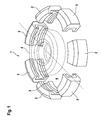
- Fig.1 is a simplified schematic representation of a segmented Vulkanisierform 1 for vehicle tires having a plurality of mating to a circumferentially closed form mold segments 2 shown.
- the mold segments 2 are radially movable and form radially inside a mold cavity 6. A radial direction is shown by the dashed line.
- the mold segments 2 have on the inside forming surfaces 3.
- the forming surfaces 3 form the tread pattern of the vehicle tire and have raised ridges with ridge flanks (not shown), the ridges embossing the grooves of the vehicle tire tread and limiting the raised tread elements of the vehicle tire tread.
- the mold segments 2 further comprise cylindrical venting means 5 (not shown) communicating with the atmosphere and through which gas can be discharged outwardly from the mold cavity 6 of the vulcanizing mold 1 through the mold segment 2.
- the Fig. 2 shows a three-dimensional view of a profile element 7 of a vehicle tire according to the prior art.
- the profile element 7 is a profile block, which is bounded by four profile block edges 8.
- the profile element 7 also has sipes 9, which typically characterize the tread pattern of a winter tire.
- On the tread contact surface 10 are impressions 11 of vent means 5, here the plate-shaped valve marks of Eurovents arranged. These impressions 11, which are raised or lowered with respect to the tread contact surface, depending on the installation of the venting means into the vulcanizing mold, are rarely in alignment therewith, disadvantageously reducing the tread contact area of the vehicle tire.
- the Fig. 3 shows a three-dimensional view of a profile element 7 of a vehicle tire, which has been hot-pressed with a Vulkanisierform invention.
- the profile element 7 of Fig. 3 differs from the profile element 7 of Fig. 2 in that the impressions 11 of the venting means are not arranged on the tread contact surface 10 but in the region of the profile block flank 8. As a result, a maximum-sized tread contact surface 10 is advantageously obtained.
- the prints 11 are shoots of cylindrical ventilation channels and no plate-shaped impressions of a Eurovent, as in Fig. 2 ,
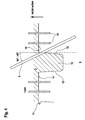
- the Fig. 4 shows a section of a radial section through a mold segment 2 of a Vulkanisierform invention in the region of its mold surface 3.
- the mold surface 3 has a raised web 12 with ridge flanks 13.
- the web flanks 13 open radially outward in the land bottom 14.
- the web 12 defines a groove of the vehicle tire tread and limits the raised profile element (not shown) of the vehicle tire tread.
- lamellar plates 15 are embedded, which form the sipes 9 of tropiczupressenden vehicle tire.
- the venting means 5 (shown here by a drill which drills the channel of the venting means) is arranged within a web 12 in such a way that it opens into the mold cavity 6 in the region of a web flank 13 of this web 12.
- the venting means 5 opens in the lower third of the web flank 13 in the mold cavity 6.
- the venting means opens into the web, that its longitudinal axis forms an angle between 60 ° and 65 ° with the radial direction of the Vulkanisierform.
Landscapes
- Engineering & Computer Science (AREA)
- Mechanical Engineering (AREA)
- Moulds For Moulding Plastics Or The Like (AREA)
- Heating, Cooling, Or Curing Plastics Or The Like In General (AREA)
Abstract
Description
- Die Erfindung betrifft eine Vulkanisierform für Fahrzeugreifen, welche aus Formsegmenten mit innenseitigen Formflächen zur Formgebung des heizzupressenden Fahrzeugreifens besteht, wobei die Formsegmente zylindrische Entlüftungsmittel aufweisen, welche mit der Atmosphäre in Verbindung stehen und durch welche Luft aus dem Formenhohlraum der Vulkanisierform durch das Formsegment hindurch nach außen ausleitbar ist und wobei die das Laufflächenprofil des Fahrzeugreifens formenden Formflächen der Formsegmente erhabene Stege mit Stegflanken aufweisen, wobei die Stege die Nuten des Fahrzeugreifen-Laufstreifens prägen sowie die erhabenen Profilelemente des Fahrzeugreifen-Laufstreifens begrenzen. Die Erfindung betrifft ebenfalls einen Fahrzeugluftreifen, welcher mit einer vorgenannten Vulkanisierform heizgepresst ist.
- Es ist bekannt, zylindrische Entlüftungsmittel in Vulkanisierformen vorzusehen, um die beim Heizpressvorgang des Reifenrohlings zwischen dem Reifenrohling und den Formflächen verbleibende Luft während des Pressvorganges des Reifenrohlings an die Formflächen aus dem Formenhohlraum abführen zu können. Es sollen unerwünschte Fehlstellen in Form von Unebenheiten an der Oberfläche des Reifens vermieden werden. Während des Heizpressvorganges bekommt der Reifenrohling seine endgültige Kontur und wird durch Kautschukvemetzungsreaktionen in seinen gummielastischen Zustand überführt.
- Es ist bekannt, dass beim Ausvulkanisieren des Fahrzeugluftreifens Kautschukmaterial in als Entlüftungsmittel dienende zylindrische Entlüftungskanäle gepresst bzw. gesogen werden kann. Die dadurch entstehenden unerwünschten Austriebe bleiben auf dem fertigen Fahrzeugluftreifen erhalten und müssen vor dessen Verwendung mit eigens dafür vorgesehenen Maschinen entfernt werden. Dieses sogenannte "Trimmen" führt zu einer Verlängerung und Verteuerung des Herstellungsprozesses des Fahrzeugluftreifens. Werden diese Austriebe nicht entfernt, so ist unter Umständen die Kontaktfläche des Laufstreifens verringert, was sich nachteilig auf die Fahreigenschaften des Fahrzeugreifens auswirkt.
- Es ist ebenfalls bekannt, in der Formfläche der Vulkanisierform mündende zylindrische Entlüftungskanäle durch gebohrte Ausnehmungen zu bilden, in welche verschließbare Entlüftungsventile eingesetzt sind. Als verschließbare Entlüftungsventile finden beispielsweise sogenannte "Eurovents", wie in der
DE 195 43 276 A1 offenbart, Verwendung. Ein Eurovent weist in einer bestimmten Ausführungsform eine aus Metall gefertigte Hülse auf, in welcher zur Abdichtung des Formenhohlraums ein entgegen der Kraft einer Feder verschließbarer Ventilteller an einem Schaft angeordnet ist, welcher das Hülsenende in der Ebene der Formfläche verschließt. Dieses Ventil vermeidet die Austriebe, da der Ventilteller das Entlüftungsmittel in etwa mit der Formfläche fluchtend verschließt und kaum Kautschukmaterial in den Entlüftungskanal eindringen kann, jedoch kann das Eurovent durch das dennoch eindringende Kautschukmaterial verkleben und nur beschränkt einsetzbar sein. Nachteilig ist jedoch, dass der Ventilteller des Eurovents einen tellerartigen Abdruck auf dem Laufstreifen hinterlässt. Zumeist ist der tellerförmige Abdruck eine in den Laufstreifen eingeprägte Struktur, seltener eine tellerförmige erhabene Struktur. Ob der Abdruck erhaben oder vertieft am Laufstreifen ausgebildet ist, hängt davon ab, wie das Eurovent in die Vulkanisierform eingebaut ist. Durch die tellerförmigen Abdrücke ist die Kontaktfläche des Laufstreifens verringert, was sich nachteilig auf die Fahreigenschaften des Fahrzeugreifens, insbesondere auf die Eisperformance bei Winterreifen, auswirkt. - Da zur Gewährung einer ausreichenden Entlüftung einer Vulkanisierform, insbesondere auch in Nischen des Reifenprofils, eine Vielzahl solcher Entlüftungskanäle, üblicherweise 500 bis 6000, pro Vulkanisierform vorgesehen werden müssen, sind eine Vielzahl an Abdrücken auf der Laufstreifenoberfläche erhalten und die Kontaktfläche des Reifens zur Fahrbahn ist dadurch nachteilig verkleinert.
- Es ist die Aufgabe der vorliegenden Erfindung, eine alternative Vulkanisierform für Fahrzeugreifen mit Entlüftungsmitteln bereitzustellen, mit der der Laufstreifen eines Fahrzeugreifens mit nur wenigen oder keinen durch Entlüftungsmittel bedingte Abdrücke vulkanisierbar ist. Zudem soll der mit dieser Vulkanisierform vulkanisierte Fahrzeugreifen nur wenige oder keine durch die Entlüftungsmittel bedingte Abdrücke auf seinem Laufstreifen aufweisen.
- Diese Aufgabe wird in Bezug auf die Vulkanisierform gelöst, indem zumindest ein Entlüftungsmittel derart innerhalb eines Steges des Formsegmentes angeordnet ist, dass dieses im Bereich einer Stegflanke dieses Steges in den Formenhohlraum mündet.
- Erfindungsgemäß weist die Vulkanisierform zumindest ein Entlüftungsmittel auf, welches an einer Stegflanke in den Formenhohlraum mündet und welches nicht im Bereich der mantelförmigen und die Kontaktfläche bildenden Oberfläche des Laufstreifens in den Formenhohlraum mündet. Somit ist ein durch das Entlüftungsmittel bedingter Abdruck wie ein Austrieb oder eine tellerförmiger Abdruck auf der Kontaktfläche des Laufstreifens des heizzupressenden Fahrzeugreifens vermieden. Der mit dieser Vulkanisierform heizzupressende Fahrzeugreifen weist eine größere Laufstreifenkontaktfläche auf.
- Vorteilhaft ist es, wenn das Entlüftungsmittel im unteren Drittel der Stegflanke in den Formenhohlraum mündet. Es hat sich gezeigt, dass sich in diesem Bereich beim Einformen des Reifen eine Luftansammlung bildet, so dass diese angesammelte Luft besonders effektiv abgeführt werden kann.
- "Unteres Drittel der Stegflanke" meint den Abschnitt der Stegflanke, welcher dem Steggrund der Formfläche zugewandt ist und der ein Drittel der Länge der Stegflanke einnimmt.
- Zweckmäßig ist es, wenn das Entlüftungsmittel derart in den Steg mündet, dass dessen Längsachse einen Winkel zwischen 40° und 70°, vorzugsweise zwischen 45° und 60° mit der radialen Richtung der Vulkanisierform einschließt. Somit ist beispielsweise bei einer Winterreifenform gewährleistet, dass das Entlüftungsmittel nicht mit den in die Formfläche eingelassenen Lamellenblechen kollidiert, welche die Feineinschnitte des Reifens formen.
- Vorteilhaft ist es, wenn zwei Entlüftungsmittel, welche innerhalb desselben Steges angeordnet sind und an gegenüberliegenden Flanken dieses Steges in den Formenhohlraum münden, einander kreuzen. Hierdurch ist die Abführbarkeit der Luft durch das Formsegment weiter verbessert.
- Die Aufgabe der Erfindung wird in Bezug auf den Fahrzeugreifen gelöst, indem dieser mit einer erfindungsgemäßen Vulkanisierform heizgepresst ist. Ein durch das Entlüftungsmittel bedingter Abdruck wie ein Austrieb oder ein tellerförmiger Abdruck auf der Kontaktfläche des Laufstreifens des heizzupressenden Fahrzeugreifens sind vermieden. Der Fahrzeugreifen weist eine größere Laufstreifenkontaktfläche auf.
- Weitere Merkmale, Vorteile und Einzelheiten der Erfindung werden anhand der Zeichnungen, die schematische Ausführungsbeispiele darstellen, näher erläutert. Es zeigen die:
- Fig. 1
- eine segmentierte Vulkanisierform mit Formsegmenten für Fahrzeugreifen;
- Fig. 2
- eine dreidimensionale Ansicht eines Profilelementes eines Fahrzeugreifens gemäß dem Stand der Technik;
- Fig. 3
- eine dreidimensionale Ansicht eines Profilelementes eines Fahrzeugreifens, welcher mit einer erfindungsgemäßen Vulkanisierform heizgepresst ist;
- Fig. 4
- einen Ausschnitt eines Radialschnittes durch ein Formsegment einer erfindungsgemäßen Vulkanisierform.
- In der
Fig.1 ist eine vereinfachte schematische Darstellung einer segmentierten Vulkanisierform 1 für Fahrzeugreifen mit mehreren, zu einer umfangsmäßig geschlossenen Form zusammenfügbaren Formsegmenten 2 dargestellt. Die Formsegmente 2 sind radial verfahrbar und bilden radial innen einen Formenhohlraum 6. Eins radiale Richtung ist durch die strichpunktierte Linie dargestellt. Die Formsegmente 2 weisen innenseitig Formflächen 3 auf. Die Formflächen 3 formen das Laufflächenprofil des Fahrzeugreifens und weisen erhabene Stege mit Stegflanken (nicht dargestellt) auf, wobei die Stege die Nuten des Fahrzeugreifen-Laufstreifens prägen sowie die erhabenen Profilelemente des Fahrzeugreifen-Laufstreifens begrenzen. Die Formsegmente 2 weisen weiterhin zylindrische Entlüftungsmittel 5 (nicht dargestellt) auf, welche mit der Atmosphäre in Verbindung stehen und durch welche Gas aus dem Formenhohlraum 6 der Vulkanisierform 1 durch das Formsegment 2 hindurch nach außen ausleitbar ist. - Die
Fig. 2 zeigt eine dreidimensionale Ansicht eines Profilelementes 7 eines Fahrzeugreifens gemäß dem Stand der Technik. Das Profilelement 7 ist ein Profilblock, welcher durch vier Profilblockflanken 8 begrenzt ist. Das Profilelement 7 weist weiterhin Feineinschnitte 9 auf, die typischerweise das Laufstreifenprofil eines Winterreifens charakterisieren. Auf der Laufstreifenkontaktfläche 10 sind Abdrücke 11 von Entlüftungsmitteln 5, hier die tellerförmigen Ventilabdrücke von Eurovents, angeordnet. Diese Abdrücke 11, welche je nach Einbau des Entlüftungsmittels in die Vulkanisierform erhaben oder erniedrigt in Bezug auf die Laufstreifenkontaktfläche, selten mit dieser fluchtend, angeordnet sind, verkleinern nachteilig die Laufstreifenkontaktfläche des Fahrzeugreifens. - Die
Fig. 3 zeigt eine dreidimensionale Ansicht eines Profilelementes 7 eines Fahrzeugreifens, welcher mit einer erfindungsgemäßen Vulkanisierform heizgepresst worden ist. Das Profilelement 7 derFig. 3 unterscheidet sich vom Profilelement 7 derFig. 2 darin, dass die Abdrücke 11 der Entlüftungsmittel nicht auf der Laufstreifenkontaktfläche 10, sondern im Bereich der Profilblockflanke 8 angeordnet sind. Hierdurch ist vorteilhaft eine maximalgroße Laufstreifenkontaktfläche 10 erhalten. Die Abdrücke 11 sind Austriebe von zylindrischen Entlüftungskanälen und keine tellerförmigen Abdrücke eines Eurovents, wie inFig. 2 . - Die
Fig. 4 zeigt einen Ausschnitt eines Radialschnittes durch ein Formsegment 2 einer erfindungsgemäßen Vulkanisierform im Bereich seiner Formfläche 3. Die Formfläche 3 weist einen erhabenen Steg 12 mit Stegflanken 13 auf. Die Stegflanken 13 münden nach radial außen in dem Steggrund 14. Der Steg 12 prägt eine Nut des Fahrzeugreifen-Laufstreifens und begrenzt das erhabene Profilelement (nicht dargestellt) des Fahrzeugreifen-Laufstreifens. In den Steggrund 14 sind Lamellenbleche 15 eingelassen, welche die Feineinschnitte 9 des heizzupressenden Fahrzeugreifens formen. Das Entlüftungsmittel 5 (hier durch einen Bohrer dargestellt, der den Kanal des Entlüftungsmittels bohrt) ist derart innerhalb eines Steges 12 angeordnet, dass dieses im Bereich einer Stegflanke 13 dieses Steges 12 in den Formenhohlraum 6 mündet. Das Entlüftungsmittel 5 mündet im unteren Drittel der Stegflanke 13 in den Formenhohlraum 6. Dabei mündet das Entlüftungsmittel derart in den Steg, dass dessen Längsachse einen Winkel zwischen 60° und 65° mit der radialen Richtung der Vulkanisierform einschließt. Hierdurch ist erreicht, dass der Abdruck des Entlüftungsmittels im Bereich der Stegflanke angeordnet ist und dass die Laufstreifenkontaktfläche des heizzupressenden Reifens frei von Abdrücken von Entlüftungsmitteln ist. -
- 1
- Vulkanisierform
- 2
- Formsegment
- 3
- Formfläche
- 4
- Reifen
- 5
- Entlüftungsmittel
- 6
- Formenhohlraum
- 7
- Profilelement
- 8
- Profilblockkante
- 9
- Feineinschnitt
- 10
- Laufstreifenkontaktfläche
- 11
- Abdruck
- 12
- Steg
- 13
- Stegflanke
- 14
- Steggrund
- 15
- Lamellenblech
Claims (5)
- Vulkanisierform (1) für Fahrzeugreifen, welche aus Formsegmenten (2) mit innenseitigen Formflächen (3) zur Formgebung des heizzupressenden Fahrzeugreifens besteht, wobei die Formsegmente (2) zylindrische Entlüftungsmittel (5) aufweisen, welche mit der Atmosphäre in Verbindung stehen und durch welche Luft aus dem Formenhohlraum (6) der Vulkanisierform (1) durch das Formsegment (2) hindurch nach außen ausleitbar ist und wobei die das Laufflächenprofil des Fahrzeugreifens formenden Formflächen (3) der Formsegmente (2) erhabene Stege (12) mit Stegflanken (13) aufweisen, wobei die Stege (12) die Nuten des Fahrzeugreifen-Laufstreifens prägen sowie die erhabenen Profilelemente (7) des Fahrzeugreifen-Laufstreifens begrenzen,
dadurch gekennzeichnet, dass
zumindest ein Entlüftungsmittel (5) derart innerhalb eines Steges (12) angeordnet ist, dass dieses im Bereich einer Stegflanke (13) dieses Steges (12) in den Formenhohlraum (6) mündet. - Vulkanisierform (1) nach Anspruch 1, dadurch gekennzeichnet, dass das Entlüftungsmittel (5) im unteren Drittel der Stegflanke (13) in den Formenhohlraum (6) mündet.
- Vulkanisierform (1) nach Anspruch 1 oder 2, dadurch gekennzeichnet, dass das Entlüftungsmittel (5) derart in den Steg (12) mündet, dass dessen Längsachse einen Winkel zwischen 40° und 70°, vorzugsweise zwischen 45° und 60° mit der radialen Richtung der Vulkanisierform (1) einschließt.
- Vulkanisierform (1) nach Anspruch 3, dadurch gekennzeichnet, dass zwei Entlüftungsmittel (5), welche innerhalb desselben Steges (12) angeordnet sind und an gegenüberliegenden Flanken (13) dieses Steges (12) in den Formenhohlraum (6) münden, einander kreuzen.
- Fahrzeugreifen, dadurch gekennzeichnet, dass dieser mit einer Vulkanisierform (1) nach einem oder mehreren der Ansprüche 1 - 4 heizgepresst ist.
Applications Claiming Priority (1)
| Application Number | Priority Date | Filing Date | Title |
|---|---|---|---|
| DE201110053663 DE102011053663A1 (de) | 2011-09-16 | 2011-09-16 | Vulkanisierform für Fahrzeugreifen und Fahrzeugluftreifen, welcher mit einer vorgenannten Vulkanisierform heizgepresst ist |
Publications (2)
| Publication Number | Publication Date |
|---|---|
| EP2570248A1 true EP2570248A1 (de) | 2013-03-20 |
| EP2570248B1 EP2570248B1 (de) | 2014-07-16 |
Family
ID=46963381
Family Applications (1)
| Application Number | Title | Priority Date | Filing Date |
|---|---|---|---|
| EP20120179460 Not-in-force EP2570248B1 (de) | 2011-09-16 | 2012-08-07 | Vulkanisierform für Fahrzeugreifen |
Country Status (2)
| Country | Link |
|---|---|
| EP (1) | EP2570248B1 (de) |
| DE (1) | DE102011053663A1 (de) |
Citations (5)
| Publication number | Priority date | Publication date | Assignee | Title |
|---|---|---|---|---|
| EP0396060A2 (de) * | 1989-05-02 | 1990-11-07 | A-Z Formen- und Maschinenbau GmbH | Entlüftete Reifenform |
| DE19543276C1 (de) | 1995-11-20 | 1997-02-06 | Continental Ag | Reifenvulkanisationsform mit Entlüftung |
| JP2005028590A (ja) * | 2003-07-07 | 2005-02-03 | Yokohama Rubber Co Ltd:The | タイヤ成形用金型及びそのタイヤ成形用金型を用いて製造したタイヤ |
| JP2005324510A (ja) * | 2004-05-17 | 2005-11-24 | Yokohama Rubber Co Ltd:The | タイヤ加硫成形用金型 |
| JP2009137090A (ja) * | 2007-12-05 | 2009-06-25 | Bridgestone Corp | タイヤ加硫成形用金型 |
-
2011
- 2011-09-16 DE DE201110053663 patent/DE102011053663A1/de not_active Withdrawn
-
2012
- 2012-08-07 EP EP20120179460 patent/EP2570248B1/de not_active Not-in-force
Patent Citations (5)
| Publication number | Priority date | Publication date | Assignee | Title |
|---|---|---|---|---|
| EP0396060A2 (de) * | 1989-05-02 | 1990-11-07 | A-Z Formen- und Maschinenbau GmbH | Entlüftete Reifenform |
| DE19543276C1 (de) | 1995-11-20 | 1997-02-06 | Continental Ag | Reifenvulkanisationsform mit Entlüftung |
| JP2005028590A (ja) * | 2003-07-07 | 2005-02-03 | Yokohama Rubber Co Ltd:The | タイヤ成形用金型及びそのタイヤ成形用金型を用いて製造したタイヤ |
| JP2005324510A (ja) * | 2004-05-17 | 2005-11-24 | Yokohama Rubber Co Ltd:The | タイヤ加硫成形用金型 |
| JP2009137090A (ja) * | 2007-12-05 | 2009-06-25 | Bridgestone Corp | タイヤ加硫成形用金型 |
Also Published As
| Publication number | Publication date |
|---|---|
| DE102011053663A1 (de) | 2013-03-21 |
| EP2570248B1 (de) | 2014-07-16 |
Similar Documents
| Publication | Publication Date | Title |
|---|---|---|
| DE19543276C1 (de) | Reifenvulkanisationsform mit Entlüftung | |
| EP2987630B1 (de) | Verfahren zur herstellung einer vulkanisierform für fahrzeugreifen und vulkanisierform für fahrzeugreifen | |
| EP2095931B1 (de) | Vorrichtung zum Vulkanisieren von Fahrzeugreifen mit einer Vulkanisationsform | |
| EP2689920B1 (de) | Verfahren und Vorrichtung zur Unterstützung des Entformens eines vulkanisierten Fahrzeugluftreifens | |
| EP3321077B1 (de) | Vulkanisationsform und fahrzeugluftreifen | |
| DE102012104500B4 (de) | Vulkanisierform für Fahrzeugreifen | |
| DE102016215732B4 (de) | Vulkanisierform für Fahrzeugreifen und Fahrzeugreifen als Solcher | |
| EP3077186B1 (de) | Vulkanisierform für winter- und allwetter-fahrzeugreifen und verfahren zur herstellung der vulkanisierform | |
| EP3321078B1 (de) | Vulkanisationsform und fahrzeugluftreifen | |
| EP2570248B1 (de) | Vulkanisierform für Fahrzeugreifen | |
| EP2719524B1 (de) | Vulkanisierform zum vulkansieren von fahrzeugreifen | |
| EP4103394B1 (de) | Verfahren zur herstellung eines formsegmentes einer vulkanisationsform, formsegment und vulkanisationsform | |
| DE102013108384A1 (de) | Vulkanisierform für Fahrzeugreifen und Fahrzeugreifen, welcher mit einer vorgenannten Vulkanisierform heizgepresst ist | |
| DE102009026293A1 (de) | Vulkanisierform zum Vulkanisieren von Fahrzeugreifen | |
| EP2090422B1 (de) | Reifenvulkanisierform | |
| EP2353886B1 (de) | Laufstreifenprofil eines Fahrzeugsreifens | |
| DE102018213083A1 (de) | Reifenvulkanisierform und Fahrzeugluftreifen | |
| EP2821213B1 (de) | Reifenheizform | |
| EP3055143B1 (de) | Fahrzeugluftreifen | |
| DE102018203053A1 (de) | Vulkanisationsform | |
| DE102011055662A1 (de) | Vulkanisierform für Fahrzeugreifen | |
| DE3709427A1 (de) | Fahrzeugluftreifen | |
| DE102024203192A1 (de) | Profilierter Fahrzeugreifen | |
| DE102019206790A1 (de) | Formsegment, Vulkanisationsform und Fahrzeugluftreifen | |
| DE102019210938A1 (de) | Formelement, Formsegment und Reifenvulkanisationsform |
Legal Events
| Date | Code | Title | Description |
|---|---|---|---|
| PUAI | Public reference made under article 153(3) epc to a published international application that has entered the european phase |
Free format text: ORIGINAL CODE: 0009012 |
|
| AK | Designated contracting states |
Kind code of ref document: A1 Designated state(s): AL AT BE BG CH CY CZ DE DK EE ES FI FR GB GR HR HU IE IS IT LI LT LU LV MC MK MT NL NO PL PT RO RS SE SI SK SM TR |
|
| AX | Request for extension of the european patent |
Extension state: BA ME |
|
| 17P | Request for examination filed |
Effective date: 20130920 |
|
| RBV | Designated contracting states (corrected) |
Designated state(s): AL AT BE BG CH CY CZ DE DK EE ES FI FR GB GR HR HU IE IS IT LI LT LU LV MC MK MT NL NO PL PT RO RS SE SI SK SM TR |
|
| GRAP | Despatch of communication of intention to grant a patent |
Free format text: ORIGINAL CODE: EPIDOSNIGR1 |
|
| INTG | Intention to grant announced |
Effective date: 20140321 |
|
| GRAS | Grant fee paid |
Free format text: ORIGINAL CODE: EPIDOSNIGR3 |
|
| GRAA | (expected) grant |
Free format text: ORIGINAL CODE: 0009210 |
|
| AK | Designated contracting states |
Kind code of ref document: B1 Designated state(s): AL AT BE BG CH CY CZ DE DK EE ES FI FR GB GR HR HU IE IS IT LI LT LU LV MC MK MT NL NO PL PT RO RS SE SI SK SM TR |
|
| REG | Reference to a national code |
Ref country code: GB Ref legal event code: FG4D Free format text: NOT ENGLISH |
|
| REG | Reference to a national code |
Ref country code: CH Ref legal event code: EP |
|
| REG | Reference to a national code |
Ref country code: IE Ref legal event code: FG4D Free format text: LANGUAGE OF EP DOCUMENT: GERMAN |
|
| REG | Reference to a national code |
Ref country code: AT Ref legal event code: REF Ref document number: 677321 Country of ref document: AT Kind code of ref document: T Effective date: 20140815 |
|
| REG | Reference to a national code |
Ref country code: DE Ref legal event code: R096 Ref document number: 502012001006 Country of ref document: DE Effective date: 20140828 |
|
| REG | Reference to a national code |
Ref country code: NL Ref legal event code: VDEP Effective date: 20140716 |
|
| REG | Reference to a national code |
Ref country code: LT Ref legal event code: MG4D |
|
| PG25 | Lapsed in a contracting state [announced via postgrant information from national office to epo] |
Ref country code: NO Free format text: LAPSE BECAUSE OF FAILURE TO SUBMIT A TRANSLATION OF THE DESCRIPTION OR TO PAY THE FEE WITHIN THE PRESCRIBED TIME-LIMIT Effective date: 20141016 Ref country code: SE Free format text: LAPSE BECAUSE OF FAILURE TO SUBMIT A TRANSLATION OF THE DESCRIPTION OR TO PAY THE FEE WITHIN THE PRESCRIBED TIME-LIMIT Effective date: 20140716 Ref country code: PT Free format text: LAPSE BECAUSE OF FAILURE TO SUBMIT A TRANSLATION OF THE DESCRIPTION OR TO PAY THE FEE WITHIN THE PRESCRIBED TIME-LIMIT Effective date: 20141117 Ref country code: BG Free format text: LAPSE BECAUSE OF FAILURE TO SUBMIT A TRANSLATION OF THE DESCRIPTION OR TO PAY THE FEE WITHIN THE PRESCRIBED TIME-LIMIT Effective date: 20141016 Ref country code: GR Free format text: LAPSE BECAUSE OF FAILURE TO SUBMIT A TRANSLATION OF THE DESCRIPTION OR TO PAY THE FEE WITHIN THE PRESCRIBED TIME-LIMIT Effective date: 20141017 Ref country code: LT Free format text: LAPSE BECAUSE OF FAILURE TO SUBMIT A TRANSLATION OF THE DESCRIPTION OR TO PAY THE FEE WITHIN THE PRESCRIBED TIME-LIMIT Effective date: 20140716 Ref country code: ES Free format text: LAPSE BECAUSE OF FAILURE TO SUBMIT A TRANSLATION OF THE DESCRIPTION OR TO PAY THE FEE WITHIN THE PRESCRIBED TIME-LIMIT Effective date: 20140716 Ref country code: FI Free format text: LAPSE BECAUSE OF FAILURE TO SUBMIT A TRANSLATION OF THE DESCRIPTION OR TO PAY THE FEE WITHIN THE PRESCRIBED TIME-LIMIT Effective date: 20140716 |
|
| PG25 | Lapsed in a contracting state [announced via postgrant information from national office to epo] |
Ref country code: NL Free format text: LAPSE BECAUSE OF FAILURE TO SUBMIT A TRANSLATION OF THE DESCRIPTION OR TO PAY THE FEE WITHIN THE PRESCRIBED TIME-LIMIT Effective date: 20140716 Ref country code: CY Free format text: LAPSE BECAUSE OF FAILURE TO SUBMIT A TRANSLATION OF THE DESCRIPTION OR TO PAY THE FEE WITHIN THE PRESCRIBED TIME-LIMIT Effective date: 20140716 Ref country code: LV Free format text: LAPSE BECAUSE OF FAILURE TO SUBMIT A TRANSLATION OF THE DESCRIPTION OR TO PAY THE FEE WITHIN THE PRESCRIBED TIME-LIMIT Effective date: 20140716 Ref country code: IS Free format text: LAPSE BECAUSE OF FAILURE TO SUBMIT A TRANSLATION OF THE DESCRIPTION OR TO PAY THE FEE WITHIN THE PRESCRIBED TIME-LIMIT Effective date: 20141116 Ref country code: PL Free format text: LAPSE BECAUSE OF FAILURE TO SUBMIT A TRANSLATION OF THE DESCRIPTION OR TO PAY THE FEE WITHIN THE PRESCRIBED TIME-LIMIT Effective date: 20140716 Ref country code: RS Free format text: LAPSE BECAUSE OF FAILURE TO SUBMIT A TRANSLATION OF THE DESCRIPTION OR TO PAY THE FEE WITHIN THE PRESCRIBED TIME-LIMIT Effective date: 20140716 |
|
| REG | Reference to a national code |
Ref country code: DE Ref legal event code: R097 Ref document number: 502012001006 Country of ref document: DE |
|
| PG25 | Lapsed in a contracting state [announced via postgrant information from national office to epo] |
Ref country code: CZ Free format text: LAPSE BECAUSE OF FAILURE TO SUBMIT A TRANSLATION OF THE DESCRIPTION OR TO PAY THE FEE WITHIN THE PRESCRIBED TIME-LIMIT Effective date: 20140716 Ref country code: MC Free format text: LAPSE BECAUSE OF FAILURE TO SUBMIT A TRANSLATION OF THE DESCRIPTION OR TO PAY THE FEE WITHIN THE PRESCRIBED TIME-LIMIT Effective date: 20140716 Ref country code: SK Free format text: LAPSE BECAUSE OF FAILURE TO SUBMIT A TRANSLATION OF THE DESCRIPTION OR TO PAY THE FEE WITHIN THE PRESCRIBED TIME-LIMIT Effective date: 20140716 Ref country code: BE Free format text: LAPSE BECAUSE OF NON-PAYMENT OF DUE FEES Effective date: 20140831 Ref country code: DK Free format text: LAPSE BECAUSE OF FAILURE TO SUBMIT A TRANSLATION OF THE DESCRIPTION OR TO PAY THE FEE WITHIN THE PRESCRIBED TIME-LIMIT Effective date: 20140716 Ref country code: RO Free format text: LAPSE BECAUSE OF FAILURE TO SUBMIT A TRANSLATION OF THE DESCRIPTION OR TO PAY THE FEE WITHIN THE PRESCRIBED TIME-LIMIT Effective date: 20140716 Ref country code: EE Free format text: LAPSE BECAUSE OF FAILURE TO SUBMIT A TRANSLATION OF THE DESCRIPTION OR TO PAY THE FEE WITHIN THE PRESCRIBED TIME-LIMIT Effective date: 20140716 |
|
| REG | Reference to a national code |
Ref country code: IE Ref legal event code: MM4A |
|
| PLBE | No opposition filed within time limit |
Free format text: ORIGINAL CODE: 0009261 |
|
| STAA | Information on the status of an ep patent application or granted ep patent |
Free format text: STATUS: NO OPPOSITION FILED WITHIN TIME LIMIT |
|
| 26N | No opposition filed |
Effective date: 20150417 |
|
| REG | Reference to a national code |
Ref country code: FR Ref legal event code: PLFP Year of fee payment: 4 |
|
| PG25 | Lapsed in a contracting state [announced via postgrant information from national office to epo] |
Ref country code: IE Free format text: LAPSE BECAUSE OF NON-PAYMENT OF DUE FEES Effective date: 20140807 |
|
| PG25 | Lapsed in a contracting state [announced via postgrant information from national office to epo] |
Ref country code: SI Free format text: LAPSE BECAUSE OF FAILURE TO SUBMIT A TRANSLATION OF THE DESCRIPTION OR TO PAY THE FEE WITHIN THE PRESCRIBED TIME-LIMIT Effective date: 20140716 |
|
| REG | Reference to a national code |
Ref country code: CH Ref legal event code: PL |
|
| PG25 | Lapsed in a contracting state [announced via postgrant information from national office to epo] |
Ref country code: LI Free format text: LAPSE BECAUSE OF NON-PAYMENT OF DUE FEES Effective date: 20150831 Ref country code: CH Free format text: LAPSE BECAUSE OF NON-PAYMENT OF DUE FEES Effective date: 20150831 |
|
| PG25 | Lapsed in a contracting state [announced via postgrant information from national office to epo] |
Ref country code: SM Free format text: LAPSE BECAUSE OF FAILURE TO SUBMIT A TRANSLATION OF THE DESCRIPTION OR TO PAY THE FEE WITHIN THE PRESCRIBED TIME-LIMIT Effective date: 20140716 |
|
| PG25 | Lapsed in a contracting state [announced via postgrant information from national office to epo] |
Ref country code: MT Free format text: LAPSE BECAUSE OF FAILURE TO SUBMIT A TRANSLATION OF THE DESCRIPTION OR TO PAY THE FEE WITHIN THE PRESCRIBED TIME-LIMIT Effective date: 20140716 |
|
| PG25 | Lapsed in a contracting state [announced via postgrant information from national office to epo] |
Ref country code: TR Free format text: LAPSE BECAUSE OF FAILURE TO SUBMIT A TRANSLATION OF THE DESCRIPTION OR TO PAY THE FEE WITHIN THE PRESCRIBED TIME-LIMIT Effective date: 20140716 Ref country code: LU Free format text: LAPSE BECAUSE OF NON-PAYMENT OF DUE FEES Effective date: 20140807 Ref country code: HR Free format text: LAPSE BECAUSE OF FAILURE TO SUBMIT A TRANSLATION OF THE DESCRIPTION OR TO PAY THE FEE WITHIN THE PRESCRIBED TIME-LIMIT Effective date: 20140716 Ref country code: HU Free format text: LAPSE BECAUSE OF FAILURE TO SUBMIT A TRANSLATION OF THE DESCRIPTION OR TO PAY THE FEE WITHIN THE PRESCRIBED TIME-LIMIT; INVALID AB INITIO Effective date: 20120807 |
|
| REG | Reference to a national code |
Ref country code: FR Ref legal event code: PLFP Year of fee payment: 5 |
|
| GBPC | Gb: european patent ceased through non-payment of renewal fee |
Effective date: 20160807 |
|
| PG25 | Lapsed in a contracting state [announced via postgrant information from national office to epo] |
Ref country code: GB Free format text: LAPSE BECAUSE OF NON-PAYMENT OF DUE FEES Effective date: 20160807 |
|
| REG | Reference to a national code |
Ref country code: FR Ref legal event code: PLFP Year of fee payment: 6 |
|
| PG25 | Lapsed in a contracting state [announced via postgrant information from national office to epo] |
Ref country code: MK Free format text: LAPSE BECAUSE OF FAILURE TO SUBMIT A TRANSLATION OF THE DESCRIPTION OR TO PAY THE FEE WITHIN THE PRESCRIBED TIME-LIMIT Effective date: 20140716 |
|
| REG | Reference to a national code |
Ref country code: FR Ref legal event code: PLFP Year of fee payment: 7 |
|
| REG | Reference to a national code |
Ref country code: AT Ref legal event code: MM01 Ref document number: 677321 Country of ref document: AT Kind code of ref document: T Effective date: 20170807 |
|
| PG25 | Lapsed in a contracting state [announced via postgrant information from national office to epo] |
Ref country code: AL Free format text: LAPSE BECAUSE OF FAILURE TO SUBMIT A TRANSLATION OF THE DESCRIPTION OR TO PAY THE FEE WITHIN THE PRESCRIBED TIME-LIMIT Effective date: 20140716 |
|
| PGFP | Annual fee paid to national office [announced via postgrant information from national office to epo] |
Ref country code: IT Payment date: 20180830 Year of fee payment: 7 Ref country code: FR Payment date: 20180827 Year of fee payment: 7 Ref country code: DE Payment date: 20180831 Year of fee payment: 7 |
|
| PG25 | Lapsed in a contracting state [announced via postgrant information from national office to epo] |
Ref country code: AT Free format text: LAPSE BECAUSE OF NON-PAYMENT OF DUE FEES Effective date: 20170807 |
|
| REG | Reference to a national code |
Ref country code: DE Ref legal event code: R119 Ref document number: 502012001006 Country of ref document: DE |
|
| PG25 | Lapsed in a contracting state [announced via postgrant information from national office to epo] |
Ref country code: DE Free format text: LAPSE BECAUSE OF NON-PAYMENT OF DUE FEES Effective date: 20200303 Ref country code: FR Free format text: LAPSE BECAUSE OF NON-PAYMENT OF DUE FEES Effective date: 20190831 |
|
| PG25 | Lapsed in a contracting state [announced via postgrant information from national office to epo] |
Ref country code: IT Free format text: LAPSE BECAUSE OF NON-PAYMENT OF DUE FEES Effective date: 20190807 |