EP2566950B1 - Verfahren und vorrichtung zur steuerung einer zellexpansionsvorrichtung - Google Patents
Verfahren und vorrichtung zur steuerung einer zellexpansionsvorrichtung Download PDFInfo
- Publication number
- EP2566950B1 EP2566950B1 EP11720647.4A EP11720647A EP2566950B1 EP 2566950 B1 EP2566950 B1 EP 2566950B1 EP 11720647 A EP11720647 A EP 11720647A EP 2566950 B1 EP2566950 B1 EP 2566950B1
- Authority
- EP
- European Patent Office
- Prior art keywords
- rate
- fluid
- cellular growth
- growth area
- change
- Prior art date
- Legal status (The legal status is an assumption and is not a legal conclusion. Google has not performed a legal analysis and makes no representation as to the accuracy of the status listed.)
- Active
Links
Images




Classifications
-
- C—CHEMISTRY; METALLURGY
- C12—BIOCHEMISTRY; BEER; SPIRITS; WINE; VINEGAR; MICROBIOLOGY; ENZYMOLOGY; MUTATION OR GENETIC ENGINEERING
- C12M—APPARATUS FOR ENZYMOLOGY OR MICROBIOLOGY; APPARATUS FOR CULTURING MICROORGANISMS FOR PRODUCING BIOMASS, FOR GROWING CELLS OR FOR OBTAINING FERMENTATION OR METABOLIC PRODUCTS, i.e. BIOREACTORS OR FERMENTERS
- C12M41/00—Means for regulation, monitoring, measurement or control, e.g. flow regulation
- C12M41/30—Means for regulation, monitoring, measurement or control, e.g. flow regulation of concentration
- C12M41/32—Means for regulation, monitoring, measurement or control, e.g. flow regulation of concentration of substances in solution
Definitions
- the present invention is directed toward a method and apparatus for controlling an apparatus for cell expansion.
- the cell expansion apparatus or bioreactor system comprises a closed loop cell expansion region where selected cells grow and multiply and a nutrient supply region that provides oxygen and nutrients to sustain the growing cells. The two regions are separated by a membrane.
- the present apparatus and method controls the bioreactor system by determining volume and rate of cell growth in the cell expansion region by monitoring the rate of nutrient use and the rate of change of the rate of nutrient use in the nutrient supply region.
- Stem cells can be expanded from a few donor cells in a cell expansion apparatus. The resulting multiplied cells can be used to repair or replace damaged or defective tissues. Stem cells have broad clinical applications for a wide range of diseases. Recent advances in the area of regenerative medicine have demonstrated that stem cells have unique properties such as high proliferation rates and self-renewal capacity, ability to maintain an unspecialized cellular state, and the ability to differentiate into specialized cells under particular conditions.
- bioreactor systems play an important role in providing optimized environments for cell expansion.
- the bioreactor provides efficient nutrient supply to the cells and removal of metabolites, as well as furnishing a physiochemical environment conducive to cell growth.
- foreign cells such as airborne pathogens, must be excluded from the cell-growth areas of the bioreactor.
- Apparatus and methods for hermetically sampling expanding cellular material from cell-growth areas of a bioreactor, without environmental contamination such as the apparatus and method of US Application No.
- the present apparatus and method controls a bioreactor system by determining volume and rate of cell growth in the cell expansion region by monitoring the rate of nutrient use and the rate of change of the rate of nutrient use in the nutrient supply region. Rate of lactate creation and rate of change of rate of lactate creation may be used instead of or in conjunction with nutrient change.
- An in-line biosensor continuously senses conditions in selected lines, such as a waste line, to determine outflow conditions. In-flow conditions may be determined from pre-determined fluid concentrations and operation of pumps and valves. Preferably, out flow conditions are held relatively constant with regard to nutrient or lactate levels by feedback from a sensor in an outflow path through a computer controller, which adjusts the operation of pumps controlling in-flow.
- the pump rate or rates will have a changing speed and acceleration proportional to expected changes in nutrient level or lactate level, in the absence of added fluid.
- the speed and acceleration of the pump or pumps can be used as a surrogate for changes in the cell population in the bioreactor system.
- the number of cells in the bioreactor system can be derived from the speed of the pumps.
- the time needed to achieve growth to a selected number of cells may be calculated from the acceleration of the pumps.
- the bioreactor system comprises a disposable apparatus for cell expansion, having at least one bioreactor.
- the bioreactor has a cellular growth area and a nutrient supply area, the cellular growth area being separated from the supply area by a membrane.
- the membrane inhibits migration of cells from the cellular growth area to the supply area and permits migration of certain chemical compounds from the cellular growth area to the supply area and of certain other chemical compounds from the supply area to the cellular growth area.
- At least one oxygenator is in fluid communication with the supply area, and a plurality of bags is in fluid communication with the cellular growth area, the bags providing fluids to the cellular growth area.
- a fluid recirculation path is in fluid communication with the cellular growth area.
- Another aspect of the invention comprises a method of expanding cellular matter, the method comprising providing at least one bioreactor, the bioreactor having a cellular growth area and a supply area, and the cellular growth area being separated from the supply area by a membrane, the membrane being adapted to inhibit migration of cells from said cellular growth area to said supply area and to permit migration of certain chemical compounds from said cellular growth area to said supply area and of certain other chemical compounds from said supply area to said cellular growth area.
- the method further comprises conducting a fluid containing cellular matter into the cellular growth area; providing oxygenated fluid to said supply area to maintain conditions conducive for cell growth in said cellular growth area; monitoring inflow and outflow conditions; determining rates of change (first derivative) for selected conditions and calculating cell numbers therefrom; determining a rate of change of a rate of change (second derivative) for the selected conditions and calculating a predicted process time; and terminating the growth process when adequate cell numbers have been produced.
- the method for controlling a cell expansion apparatus may comprise conducting a fluid containing cellular matter into a cellular growth area; providing fluid to said cellular growth area to maintain conditions conducive for cell growth in said cellular growth area; monitoring inflow fluid conditions to the cellular growth area; monitoring fluid conditions in said cellular growth area; determining rates of change for at least one selected condition and calculating cell numbers therefrom; determining a rate of change of a rate of change for the at least one selected condition and calculating a predicted process time; and terminating the growth process when adequate cell numbers have been produced.
- the method may also comprise monitoring a pump rate for providing fluid to the cellular growth area to measure a glucose level or a lactate level.
- the glucose level or the lactate level may be measured in a waste line.
- the glucose level or the lactate level may be maintained at a substantially constant level by controlling the rate fluid is provided to the cellular growth area.
- the rate fluid is provided to the cellular growth area may be controlled by controlling the speed of at least one pump.
- the rate of change of the rate of change may comprise determining the acceleration of the at least one pump.
- a bioreactor system 10 comprises a cell expansion module 12 coupled to an intracorporeal (IC) media bag 22 for replenishing fluids and an oxygenator 14 coupled to an extracorporeal (EC) media bag 16 for providing oxygen and removing waste.
- IC intracorporeal
- EC extracorporeal
- the cell expansion module 12, or bioreactor may be comprised of semi-permeable hollow fibers or flat sheet membranes enclosed in a housing. If hollow fibers are used, the fibers may be made of a biocompatible polymeric material such as Polyamix, which is a blend of polyamide, polyarylethersulfone and polyvinylpyrrolidone. Depending upon the type of cells to be expanded in the bioreactor, the fibers may or may not be treated with a substance to enhance cell growth and/or adherence to the membrane. The fibers may be held in place within the housing with polyethylene potting.
- the bioreactor housing has at least four openings into the interior of the housing. Two open into the intra-capillary or IC space, fluidly connecting to the interior of the hollow fibers, and two open into the extracapillary or EC space, fluidly connecting to the space surrounding the hollow fibers.
- Cells may be grown in the IC space.
- the IC space with its minimum volume reduces the quantity of expensive media and expensive cytokines/growth factors required.
- the semi-permeable membrane allows transfer of metabolic components, waste and gases between the EC and IC compartments.
- the molecular transfer characteristics of the hollow fibers are chosen to minimize loss of expensive reagents from the IC side, while allowing metabolic waste products to diffuse through the membrane into the EC side to be removed.
- the EC space carries nutrients to the cells in the IC space, removes waste byproducts and maintains gas balance.
- the bioreactor may be attached to the rest of the disposable set with connectors made of polyurethane (Tygothane C-210-A).
- the oxygenator 14 used may be any commercially available oxygenator.
- One possible oxygenator is manufactured by Gambro GmbH, Hechingen, Germany.
- the oxygenator may have a fiber count of 1820, an internal fiber diameter of 280 ⁇ m, an outer fiber diameter of 386 ⁇ m and an intercapillary fluid volume of 16 mL.
- the hollow fibers of the oxygenator are enclosed in a housing having four port openings.
- Inlet 20 and outlet 46 ports are fluidly connected to the interior (intercapillary or IC space) of the hollow fibers.
- Another set of inlet 48 and outlet 50 ports are fluidly connected to the space surrounding the hollow fibers (extracapillary or EC space).
- an EC inlet line 18 is connected to deliver either fresh media from the EC media bag 16 or recirculated EC media to the oxygenator 14.
- the EC line 18 delivers oxygenated EC media to the EC inlet port 42 on the bioreactor 12.
- a line 52 to a source of gas 54 gas line.
- the EC outlet port 50 is open to the atmosphere, with a 0.22 ⁇ in-line filter 56 to prevent microbes from entering and contaminating the closed system.
- An EC media bag 16 which contains the media, which will flow through the EC side of the bioreactor, may be connected via a portion of flexible tubing (the EC inlet line) 18 to the IC inlet port 20 of the oxygenator 14.
- the EC inlet line 18 brings fresh EC media to the oxygenator 14 to be oxygenated.
- the EC inlet line 18 may be made of polyvinyl chloride with fluorinated ethylene propylene (PVC/FEP (sold as Tygon SE-200)).
- An IC media bag 22 that contains the media that will flow through the IC side of the bioreactor may be connected via a portion of flexible tubing (the IC inlet line) 24 to the IC inlet port 26 of the bioreactor 12.
- the IC inlet line 24 brings fresh IC media to the IC side of the bioreactor.
- the IC inlet line 24 may also be made of PVC/FEP.
- a vent bag 28 may be connected to the disposable set via flexible tubing 27 to collect any air initially in the system, before the system is filled with media and cells.
- a cell input bag 30 contains the cells to be added to the bioreactor 12.
- the cell input bag 30 is connected to the IC inlet line 24, which delivers cells into the lumen of the hollow fibers via cell input line 29.
- the cells When the cells are ready to be harvested, they are flushed out of the IC outlet port 34 of bioreactor 12 through cell harvest line 31 and into a cell harvest bag 32.
- the disposable tubing set also may include a length of tubing which acts as an IC circulation loop 36.
- the IC media flows out of the bioreactor 12 from the IC outlet port 34 through tubing loop 36 and back into the bioreactor through the IC inlet port 26.
- This loop 36 is used to recirculate the IC media though the hollow fibers. It may also be used to flush the cells out of the hollow fibers and reseed/redistribute them throughout the hollow fibers for further growth.
- the IC recirculation loop 36 may contain a sample tube 38, for example, an additional length of tubing.
- This additional tubing enables small pieces of the tubing to be sterilely removed from the disposable set and the media inside tested for markers of cellular metabolism such as pH, glucose, lactate, electrolytes, oxygen and carbon dioxide content.
- the sample tubing 38 may be made of SANIPURETM tubing (SEBS).
- SEBS SANIPURETM tubing
- the sample tube 38 may be solvent bonded into the IC loop 36 using cyclohexanone.
- An EC recirculation loop 40 allows the media on the EC side of the bioreactor to be recirculated.
- the EC recirculation loop 40 allows EC media to flow out of the bioreactor from the EC outlet port 42 back into the bioreactor through the EC inlet port 44. This loop may be used to recirculate the EC media that surrounds the hollow fibers.
- IC and EC media containing metabolic breakdown products from cell growth are removed from the system via tubing 58 into a waste bag 60.
- the tubing set may engage three or more pump loops that correspond to the location of peristaltic pumps on the cell expansion apparatus.
- the tubing set may have five pump loops, corresponding to pumps P1-P5 on the apparatus.
- the pump loops may be made of polyurethane (PU (available as Tygothane C-210A)).
- a cassette for organizing the tubing lines and which may also contain tubing loops for the peristaltic pumps may also be included as part of the disposable. Additional tubing lines (see 62) can be added as needed to enable specific applications such as reseeding/redistributing cells in the bioreactor.
- manually operated clamps 64, 66 may be provided in order to control the passage of fluid through the disposable 10.
- microprocessor-controlled pinch valves 68, 70, 72, 74, 76, 80, 82 may be coupled to selected tubes of the disposable.
- Microprocessor-controlled pinch valves are available on blood processing devices such as the TRIMA ® apheresis machine, available commercially from the assignee of this invention.
- a TRIMA ® apheresis machine may be modified to accept the disposable 10 by removing a centrifuge ordinarily mounted within the TRIMA ® apheresis machine and placing the bioreactor and oxygenator within the machine as an incubator 81.
- Temperature sensors 86, 88, 90 and pressure sensors 92, 94, and 96 can be connected to selected tubes of the disposable 10 and placed in electrical communication with a microprocessor. It is to be understood that pumps, temperature sensors, pressure sensors and pinch valves are preferably connected to the disposable set only temporarily by contact. Manual clamps, on the other hand, are usually mounted on their respective tubes and may be delivered with the disposable.
- extracorporeal media is flowed throughout the apparatus 10, including all connecting tubes, first and second drip chambers 98, 100, the oxygenator 14 and the bioreactor 12.
- Pumps P1, P2, P3 and P4, controlled by the incubator 18 may be selectively activated to force fluid into sections of the disposable apparatus to prime the apparatus.
- intercellular media and cells for example mesenchymal stem cells may be added from bags 22, 30 through the first drip chamber 98 and conducted into a cell expansion area of the bioreactor 14 and related tubing including recirculation path 36 and sample means 38.
- the hermetically sealed condition of the apparatus 10 is maintained by providing a vent bag 28 coupled to the first drip chamber 98 to accommodate variations in flow from the EC media bag 16, the IC media bag 22 and the cell input bag 30.
- extra corporeal fluid passes through the oxygenator 14 where the fluid is infused with gas into a supply area of the bioreactor 12.
- the supply area is separated from the cell expansion area by a membrane that allows oxygen and other desirable chemical components to pass into the cell expansion area and allows waste products of the cell expansion process to pass by osmosis out of the cell expansion area while preventing cellular matter from crossing the membrane.
- the status of the fluid flowing through the supply area of the bioreactor is monitored by temperature sensor 88 and pressure sensor 94 as well as temperature sensor 90, which monitors the temperature of the fluid entering the oxygenator 14.
- An appropriate gas such as oxygen, or a gas mixture is conducted through the oxygenator 14 at a pressure monitored by sensor 96.
- the gas is preferably medical grade and is also isolated from ambient air by 0.22 micron filters 56, 57.
- the characteristics of the extracorporeal fluid can also be checked by withdrawing fluid samples through sample ports S1 and S2 on the inflow and outflow lines of the bioreactor.
- the sample ports have internal filters that allow fluid to be extracted by cellular sized particles from passing into or out of the apparatus 10.
- the pumps are preferably peristaltic pumps. In addition to the manual clamps and automatically controlled valves, the pumps also act as valves, preventing flow of fluid past the pump when the pump is not actively driven. Therefore, when pump P1 is not in operation and valves 76, 78 are closed, a recirculation loop is formed through the bioreactor 12 and pump P4. Conditions in this recirculation loop, where cells are growing, are monitored with temperature sensor 86 and pressure sensor 92 and by taking fluid samples through a sample port S3. The fluid extracted through the sample port S3, as explained above, does not contain cells or particles of cellular size. It is important to be able to monitor the progress of cellular growth over time without compromising the hermetically sealed conditions of the apparatus 10. Once the desired cell concentrations have been obtained, the contents of the bioreactor 12 can be harvested into the cell harvest bag 32.
- some amount of fluid is typically removed from the fluid circulation paths (the IC and/or EC circuit) at various times throughout the cell expansion cycle and analyzed for the amount of metabolites and other by-products of cell growth in the fluids.
- the fluid removed from the fluid flow circuits may be run through any commercially available blood gas analyzer (the blood gas analyzer used in this instance was a Siemens 800 series) to measure the amounts of metabolites contained in the fluid. Using a blood gas analyzer, the concentration of lactate (or glucose) is measured in mM/L. Other methods of measurement such as direct chemistry may also be used.
- Metabolites may also be measured using a biosensor. Any commercially available biosensor may be used. If the biosensor is sterile, or is made of a material which may be sterilized with ethylene oxide or gamma irradiation, it may be fluidly connected directly into the fluid lines (in-line). If the biosensor is not able to be sterilized, it may be indirectly connected into the fluid lines via a sterile barrier filter. Glucose and lactate molecules are small enough that they diffuse equally across the membrane, and are in equilibrium. Therefore, accurate measurements can be taken by any means on either the IC or EC side, or in waste line 58. Fluid may be removed from the IC loop 202 through sampling port 216 or sample coil 218 and/or from the EC loop 204 through sample port 230.
- the present apparatus and method controls a bioreactor system by determining volume and rate of cell growth in the cell expansion region by monitoring the rate of nutrient use, such as glucose, and the rate of change of the rate of nutrient use in the nutrient supply region. Rate of lactate creation and rate of change of rate of lactate creation may be used instead of or in conjunction with nutrient change.
- An in-line biosensor 102 may continuously sense conditions in selected lines, such as the waste line 58, to determine outflow conditions.
- a suitable sensor for detecting glucose or lactate concentration is available from Jobst Technologies GmbH, Freiburg, Germany. Either a glucose sensor or a lactate sensor or both could be used.
- In-flow conditions for glucose concentrations and volumes may be determined from pre-determined fluid concentrations and operation of pump P5 and valve 72.
- a digital computer 104 is receives data from the sensor 102 and controls valves and pumps thereby regulating the addition of fluids into and out of the bioreactor.
- the digital computer 104 may include memory, at least one processor, and a user interface for receiving instructions from a user via a user input device (mouse, keyboard, keypad, touch screen, optical sensor or verbal command).
- the digital computer 104 comprises a CES controller interface for relaying information to and from elements such as sensors (pressure, temperature, and biosensor) and for instructing various mechanical systems such as the pumps and valves.
- the digital computer 104 may be in communication with additional sensors for monitoring other aspects of the apparatus, such as whether one or more fluid bags are low and/or empty.
- Programming utilized by the digital computer 104 may comprise, by way of example and not limitation, software or firmware.
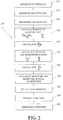
- FIG. 2 represents an algorithm 110 for controlling the bioreactor system 10, and, in particular, for predicting a time for process completion from the rate of change of the rate of change of a selected parameter (the second derivative or acceleration), such as glucose level or lactate level or pump speeds.
- a selected parameter such as glucose level or lactate level or pump speeds.
- Change of glucose in the system may be determined by measuring 112 the volume of solution delivered to the system from the IC media bag 22 or the EC media bag 16.
- the volume of solution delivered to the system may be determined from the revolutions of a peristaltic pump coupled to an inflow line containing glucose solution.
- the contents of the media bags 16, 22 should have a known concentration of glucose solution.
- one or more sensors could be provided to detect the glucose concentration at the media bags.
- Glucose removed from the system may be measured 114 by sensing both glucose concentration and fluid volume of fluids being removed to the waste bag 60 past sensor 102.
- Lactate levels may also be measured 116, either in conjunction with the measurement of glucose levels, or as an alternative. Since lactate is a product of the cells in the system, the initial condition is that there should be essentially no lactate in the system. Like glucose, lactate removed from the system may be determined by sensing both lactate concentration and fluid volume of fluids being removed to the waste bag 60 past sensor 102. Multiple measurements correlated with the timer allow both the rate of change of lactate concentration (first derivative or "velocity" of change) 122 and the rate of change of the velocity of change (second derivative of "acceleration" of change) 124 to be calculated.
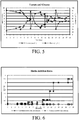
- FIG. 3 illustrates two curves 134, 140.
- a smooth, continuously rising curve 134 represents increasing lactate level with increasing time at the waste line output sensor 102 or elsewhere within the system, if there were no additional fluid added or removed from the system.
- concentration of lactate would be expected to rise from an initial condition 136 (low or near zero lactate) as a function of the increased number of cells and accumulation of lactate in the system.
- the rate of change of the rate of change (acceleration or d 2 L/dt 2 ) of the lactate level is proportional to the duration of the process until a desired number of cells will have been grown. This can be used to predict an end time for the process on an on-going, updated basis, thereby reducing the need for continuous monitoring of the system by a human operator.
- the fluid addition line 140 which is directly related to the speed of the pump P5
- a similar process may be employed with respect to the glucose level, as illustrated in FIG. 4 . In this case, a smooth, continuously falling curve 156 represents decreasing glucose level with increasing time.
- the concentration of glucose will fall from an initial condition 158 as a function of the increased number of cells and consumption of glucose in the system.
- the glucose will eventually be completely consumed.
- the bioreactor system 10 does add nutrients and remove waste.
- the actual concentration of glucose in the system 10 is illustrated by dashed line 160.
- the rate of media addition or the pump speed is represented by rising line 162, which is congruent with line 140 of FIG. 3 .
- the rate of media addition 162 (which is directly proportional to the pump speed), when the glucose level is held constant, is inversely proportional to the expected glucose level if no media were added.
- both dG/dt and d 2 G/dt 2 can be calculated from the measurements described above and from the action of the pump or pumps adding fluid to the system.
- Rate of change of the glucose level (dG/dt) is inversely proportional to the number of cells in the system 10.
- the rate of change of the rate of change (acceleration or d 2 G/dt 2 ) of the glucose level is inversely proportional to the duration of the process until a desired number of cells will have been grown. This can be also be used to predict an end time for the process on an on-going, updated basis, thereby reducing the need for continuous monitoring of the system by a human operator.
- the continuous addition of new solution to the system is also shown in the schematic 150 of FIG. 7 .
- the level of lactate at the waste bag 60 would preferably be substantially constant. Deviations would be corrected 166 by the controller or digital computer 104 increasing or decreasing the rate of a pump P5 coupled to the IC media bag 22 or the EC media bag 16 through valves 72, 70, respectively. Once again, the amount of fluid added during the procedure will rise exponentially, preferably continuously.
- the speed at which fluid is added and the acceleration of fluid addition can be known from the speed and acceleration of the pump or pumps. Either lactate level or glucose level or both could be measured 114, 116 and corrections 166 made in the pump speed, such as acceleration, to maintain the lactate and glucose levels at relatively constant levels.
- a smoothed curve representing the speed of the pump or pumps may be calculated 168 and a curve representing the acceleration of the speed of the pump or pumps can be calculated 170 and used to further calculate 128 the number of cells in the bioreactor (from the speed of the pump or pumps) and to predict 130 the time at which the desired number of cells will be grown (from the acceleration of the pump or pumps).
- an initial aliquot of about 20 million mesenchymal stem cells was loaded in a cell expansion system. After a five and a half day growth period, about 184 million cells were harvested. Table 1 records lactate and glucose levels and use over the growth period. Table 2.
- the lactose level was held relatively constant with values throughout the growth period between 1.5 mmol/L and 5 mmol/L.
- the glucose level was held relatively constant, falling between about 92 mg/dL and 62 mg/dL.
- the rates of lactate generation and glucose consumption, illustrated in FIG. 9 showed a similar, increasing trend, to which a curve could be fitted and rate of generation/consumption and acceleration of generation/consumption could be calculated. As described above, this information could be used to estimate the number of cells in the system (from the rate of consumption) and the time needed to grow a desired number of cells (from the acceleration).
- the rate of fluid addition which is known from the pump rates, shows a similar, geometrically increasing shape.
- the magnitude of the curve at a selected time is proportional to the speed to the pumps, and the slope of the curve is proportional to the acceleration of the pumps. Consequently, the number of cells in the system at a given time can be derived from the speed of the pumps. The time needed for the growth of a selected number of cells can be derived from the acceleration of the pumps.
- the system would be able to display these values to an operator either continuously or at discrete intervals. This allows improved monitoring of the system and improved prediction of the time when the cells should be harvested.
Landscapes
- Chemical & Material Sciences (AREA)
- Organic Chemistry (AREA)
- Health & Medical Sciences (AREA)
- Life Sciences & Earth Sciences (AREA)
- Engineering & Computer Science (AREA)
- Bioinformatics & Cheminformatics (AREA)
- Zoology (AREA)
- Wood Science & Technology (AREA)
- Microbiology (AREA)
- Sustainable Development (AREA)
- Biotechnology (AREA)
- Biomedical Technology (AREA)
- Biochemistry (AREA)
- General Engineering & Computer Science (AREA)
- General Health & Medical Sciences (AREA)
- Genetics & Genomics (AREA)
- Analytical Chemistry (AREA)
- Apparatus Associated With Microorganisms And Enzymes (AREA)
Claims (15)
- Verfahren für ein Steuern einer Zellexpansionsvorrichtung, das Verfahren umfassend:Leiten eines Fluids, das Zellmaterie enthält, in ein Zellwachstumsgebiet;Bereitstellen von Fluid an das Zellwachstumsgebiet, um Bedingungen aufrechtzuerhalten, die für ein Zellwachstum in dem Zellwachstumsgebiet förderlich sind;Überwachen von Zuflussfluidbedingungen zu dem Zellwachstumsgebiet;Überwachen von Fluidbedingungen, die Bedingungen umfassend mindestens eines von Nährstoffpegeln oder Lactatpegeln in dem Zellwachstumsgebiet;Bestimmen von Änderungsraten für mindestens einen des Nährstoffpegels oder des Lactatpegels und daraus Berechnen von Zellanzahlen;Bestimmen einer Änderungsrate einer Änderungsrate für den mindestens einen Pegel und Berechnen einer voraussichtlichen Prozesszeit; undBeenden des Wachstumsprozesses, wenn geeignete Zellanzahlen hergestellt wurden.
- Verfahren nach Anspruch 1, wobei die Zuflussbedingung eine Pumprate für ein Bereitstellen von Fluid zu dem Zellwachstumsgebiet ist.
- Verfahren nach Anspruch 1, wobei der Schritt des Überwachens von Fluidbedingungen in dem Zellwachstumsgebiet ein Messen eines Glukosepegels umfasst.
- Verfahren nach Anspruch 1 oder 3, wobei der Pegel in einer Abflussleitung gemessen wird.
- Verfahren nach Anspruch 1 oder 3, wobei der Pegel durch ein Steuern der Rate, mit der dem Zellenwachstumsgebiet Fluid bereitgestellt wird, auf einem im Wesentlichen konstanten Pegel gehalten wird.
- Verfahren nach Anspruch 5, wobei die Rate, mit der dem Zellwachstumsgebiet Fluid bereitgestellt wird, durch ein Steuern der Geschwindigkeit von mindestens einer Pumpe gesteuert wird.
- Verfahren nach Anspruch 6, wobei der Schritt zu einem Bestimmen der Änderungsrate von der Änderungsrate ein Bestimmen der Beschleunigung der mindestens einen Pumpe umfasst.
- Zellexpansionsvorrichtung, die Vorrichtung umfassend
mindestens einen Bioreaktor, wobei der Bioreaktor ein Zellwachstumsgebiet und ein Zuführungsgebiet hat, wobei das Zellwachstumsgebiet durch eine Membran von dem Zuführungsgebiet getrennt ist,Mittel für ein Bereitstellen von Fluid zu dem Zellwachstumsgebiet, um Bedingungen aufrechtzuerhalten, die für ein Zellwachstum in dem Zellwachstumsgebiet förderlich sind;Mittel für ein Überwachen von Zuflussfluidbedingungen zu dem Zellwachstumsgebiet;Mittel für ein Überwachen von Fluidbedingungen in dem Zellwachstumsgebiet, die Bedingungen umfassend mindestens einen von Nährstoffpegeln oder Lactatpegeln;Mittel für ein Bestimmen von Änderungsraten für mindestens einen des Nährstoffpegels oder Lactatpegels und daraus Berechnen von Zellanzahlen; undMittel für ein Bestimmen einer Änderungsrate von einer Änderungsrate für den mindestens einen Pegel und Berechnen einer voraussichtlichen Prozesszeit. - Vorrichtung nach Anspruch 8, ferner umfassend mindestens eine Pumpe und wobei die überwachte Zuflussfluidbedingung eine Pumprate ist.
- Vorrichtung nach Anspruch 8, wobei die Mittel für ein Überwachen von Bedingungen in dem Zellwachstumsgebiet einen Glukosesensor umfassen.
- Vorrichtung nach Anspruch 8, wobei die Mittel für ein Überwachen von Bedingungen in dem Zellwachstumsgebiet einen Lactatsensor umfassen.
- Vorrichtung nach Anspruch 10 oder 11, wobei der Sensor an eine Abflussleitung gekoppelt ist.
- Vorrichtung nach Anspruch 10 oder 11, ferner umfassend Mittel für ein Aufrechterhalten des Pegels auf einem im Wesentlichen konstanten Pegel durch ein Steuern der Rate, mit der das Fluid zu dem Zellwachstumsgebiet bereitgestellt wird.
- Vorrichtung nach Anspruch 13, wobei die Mittel für ein Aufrechterhalten des Pegels Mittel für ein Steuern der Geschwindigkeit der mindestens einen Pumpe umfassen.
- Vorrichtung nach Anspruch 14, wobei die Mittel für ein Bestimmen der Änderungsrate von der Änderungsrate Mittel für ein Bestimmen der Beschleunigung der mindestens einen Pumpe umfassen.
Applications Claiming Priority (2)
| Application Number | Priority Date | Filing Date | Title |
|---|---|---|---|
| US33124910P | 2010-05-04 | 2010-05-04 | |
| PCT/US2011/034764 WO2011139957A1 (en) | 2010-05-04 | 2011-05-02 | Method and apparatus for controlling a cell expansion apparatus |
Publications (2)
| Publication Number | Publication Date |
|---|---|
| EP2566950A1 EP2566950A1 (de) | 2013-03-13 |
| EP2566950B1 true EP2566950B1 (de) | 2017-09-06 |
Family
ID=44281027
Family Applications (1)
| Application Number | Title | Priority Date | Filing Date |
|---|---|---|---|
| EP11720647.4A Active EP2566950B1 (de) | 2010-05-04 | 2011-05-02 | Verfahren und vorrichtung zur steuerung einer zellexpansionsvorrichtung |
Country Status (3)
| Country | Link |
|---|---|
| US (1) | US20110275056A1 (de) |
| EP (1) | EP2566950B1 (de) |
| WO (1) | WO2011139957A1 (de) |
Families Citing this family (7)
| Publication number | Priority date | Publication date | Assignee | Title |
|---|---|---|---|---|
| BE1024733B1 (fr) | 2016-11-09 | 2018-06-14 | Univercells Sa | Matrice de croissance cellulaire |
| CN110168067A (zh) * | 2017-01-20 | 2019-08-23 | 富士胶片株式会社 | 细胞培养装置及细胞培养方法 |
| AU2018386438B2 (en) | 2017-12-20 | 2024-11-14 | Univercells Technologies S.A. | Bioreactor and related methods |
| US20200248124A1 (en) | 2019-02-05 | 2020-08-06 | Corning Incorporated | Methods of culturing cells on woven cell culture substrates and bioreactors using the same |
| GB2622972B (en) * | 2019-06-17 | 2024-09-18 | Deka Products Lp | System and method for cell and tissue preparation |
| US11118151B2 (en) | 2019-11-05 | 2021-09-14 | Corning Incorporated | Fixed bed bioreactor and methods of using the same |
| JP7818539B2 (ja) * | 2021-02-02 | 2026-02-20 | テルモ株式会社 | サンプリング方法 |
Family Cites Families (4)
| Publication number | Priority date | Publication date | Assignee | Title |
|---|---|---|---|---|
| US2101308A (en) | 1932-02-23 | 1937-12-07 | Union Oil Co | Process for producing lubricating oils |
| US6077708A (en) * | 1997-07-18 | 2000-06-20 | Collins; Paul C. | Method of determining progenitor cell content of a hematopoietic cell culture |
| US20090104653A1 (en) * | 2007-10-23 | 2009-04-23 | Finesse Solutions, Llc. | Bio-process model predictions from optical loss measurements |
| WO2010019439A2 (en) * | 2008-08-12 | 2010-02-18 | Caridianbct, Inc. | A predictor of when to harvest cells grown in a bioreactor |
-
2011
- 2011-05-02 EP EP11720647.4A patent/EP2566950B1/de active Active
- 2011-05-02 US US13/098,705 patent/US20110275056A1/en not_active Abandoned
- 2011-05-02 WO PCT/US2011/034764 patent/WO2011139957A1/en not_active Ceased
Non-Patent Citations (1)
| Title |
|---|
| None * |
Also Published As
| Publication number | Publication date |
|---|---|
| EP2566950A1 (de) | 2013-03-13 |
| US20110275056A1 (en) | 2011-11-10 |
| WO2011139957A1 (en) | 2011-11-10 |
Similar Documents
| Publication | Publication Date | Title |
|---|---|---|
| US20110275056A1 (en) | Method and Apparatus for Controlling a Cell Expansion Apparatus | |
| AU2008223280B2 (en) | Disposable tubing set for use with a cell expansion apparatus and method for sterile sampling | |
| JP5416772B2 (ja) | バイオリアクター内で増殖した細胞を採取する時の予測器 | |
| US9175259B2 (en) | Method of loading and distributing cells in a bioreactor of a cell expansion system | |
| US20080227190A1 (en) | Cell Expansion Apparatus with Plate Bioreactor | |
| US12116559B2 (en) | Method of manufacturing a recombinant polypeptide | |
| CA1270455A (en) | Apparatus and method for culturing cells, removing waste and concentrating product | |
| EP2566951B1 (de) | Verfahren zur neuaussaat von in einem hohlfaser-bioreaktorsystem gezüchteten adhärenten zellen | |
| EP2027247A2 (de) | Ausserkapilläres fluidzirkulationssystem und verfahren für eine zellkulturvorrichtung | |
| EP3722435B1 (de) | Festbettbioreaktor mit konstantflusspumpen-/-rohrleitungssystem | |
| KR20220130743A (ko) | 생물반응기를 제어하는 장치 및 방법 |
Legal Events
| Date | Code | Title | Description |
|---|---|---|---|
| PUAI | Public reference made under article 153(3) epc to a published international application that has entered the european phase |
Free format text: ORIGINAL CODE: 0009012 |
|
| 17P | Request for examination filed |
Effective date: 20121122 |
|
| AK | Designated contracting states |
Kind code of ref document: A1 Designated state(s): AL AT BE BG CH CY CZ DE DK EE ES FI FR GB GR HR HU IE IS IT LI LT LU LV MC MK MT NL NO PL PT RO RS SE SI SK SM TR |
|
| DAX | Request for extension of the european patent (deleted) | ||
| GRAP | Despatch of communication of intention to grant a patent |
Free format text: ORIGINAL CODE: EPIDOSNIGR1 |
|
| STAA | Information on the status of an ep patent application or granted ep patent |
Free format text: STATUS: GRANT OF PATENT IS INTENDED |
|
| INTG | Intention to grant announced |
Effective date: 20170410 |
|
| RIN1 | Information on inventor provided before grant (corrected) |
Inventor name: ANTWILER, GLEN DELBERT |
|
| GRAS | Grant fee paid |
Free format text: ORIGINAL CODE: EPIDOSNIGR3 |
|
| GRAA | (expected) grant |
Free format text: ORIGINAL CODE: 0009210 |
|
| STAA | Information on the status of an ep patent application or granted ep patent |
Free format text: STATUS: THE PATENT HAS BEEN GRANTED |
|
| AK | Designated contracting states |
Kind code of ref document: B1 Designated state(s): AL AT BE BG CH CY CZ DE DK EE ES FI FR GB GR HR HU IE IS IT LI LT LU LV MC MK MT NL NO PL PT RO RS SE SI SK SM TR |
|
| REG | Reference to a national code |
Ref country code: GB Ref legal event code: FG4D |
|
| REG | Reference to a national code |
Ref country code: AT Ref legal event code: REF Ref document number: 925940 Country of ref document: AT Kind code of ref document: T Effective date: 20170915 Ref country code: CH Ref legal event code: EP |
|
| REG | Reference to a national code |
Ref country code: IE Ref legal event code: FG4D |
|
| REG | Reference to a national code |
Ref country code: DE Ref legal event code: R096 Ref document number: 602011041286 Country of ref document: DE |
|
| REG | Reference to a national code |
Ref country code: NL Ref legal event code: MP Effective date: 20170906 |
|
| REG | Reference to a national code |
Ref country code: LT Ref legal event code: MG4D |
|
| PG25 | Lapsed in a contracting state [announced via postgrant information from national office to epo] |
Ref country code: LT Free format text: LAPSE BECAUSE OF FAILURE TO SUBMIT A TRANSLATION OF THE DESCRIPTION OR TO PAY THE FEE WITHIN THE PRESCRIBED TIME-LIMIT Effective date: 20170906 Ref country code: SE Free format text: LAPSE BECAUSE OF FAILURE TO SUBMIT A TRANSLATION OF THE DESCRIPTION OR TO PAY THE FEE WITHIN THE PRESCRIBED TIME-LIMIT Effective date: 20170906 Ref country code: NO Free format text: LAPSE BECAUSE OF FAILURE TO SUBMIT A TRANSLATION OF THE DESCRIPTION OR TO PAY THE FEE WITHIN THE PRESCRIBED TIME-LIMIT Effective date: 20171206 Ref country code: HR Free format text: LAPSE BECAUSE OF FAILURE TO SUBMIT A TRANSLATION OF THE DESCRIPTION OR TO PAY THE FEE WITHIN THE PRESCRIBED TIME-LIMIT Effective date: 20170906 Ref country code: FI Free format text: LAPSE BECAUSE OF FAILURE TO SUBMIT A TRANSLATION OF THE DESCRIPTION OR TO PAY THE FEE WITHIN THE PRESCRIBED TIME-LIMIT Effective date: 20170906 |
|
| REG | Reference to a national code |
Ref country code: AT Ref legal event code: MK05 Ref document number: 925940 Country of ref document: AT Kind code of ref document: T Effective date: 20170906 |
|
| PG25 | Lapsed in a contracting state [announced via postgrant information from national office to epo] |
Ref country code: LV Free format text: LAPSE BECAUSE OF FAILURE TO SUBMIT A TRANSLATION OF THE DESCRIPTION OR TO PAY THE FEE WITHIN THE PRESCRIBED TIME-LIMIT Effective date: 20170906 Ref country code: ES Free format text: LAPSE BECAUSE OF FAILURE TO SUBMIT A TRANSLATION OF THE DESCRIPTION OR TO PAY THE FEE WITHIN THE PRESCRIBED TIME-LIMIT Effective date: 20170906 Ref country code: RS Free format text: LAPSE BECAUSE OF FAILURE TO SUBMIT A TRANSLATION OF THE DESCRIPTION OR TO PAY THE FEE WITHIN THE PRESCRIBED TIME-LIMIT Effective date: 20170906 Ref country code: GR Free format text: LAPSE BECAUSE OF FAILURE TO SUBMIT A TRANSLATION OF THE DESCRIPTION OR TO PAY THE FEE WITHIN THE PRESCRIBED TIME-LIMIT Effective date: 20171207 Ref country code: BG Free format text: LAPSE BECAUSE OF FAILURE TO SUBMIT A TRANSLATION OF THE DESCRIPTION OR TO PAY THE FEE WITHIN THE PRESCRIBED TIME-LIMIT Effective date: 20171206 |
|
| PG25 | Lapsed in a contracting state [announced via postgrant information from national office to epo] |
Ref country code: NL Free format text: LAPSE BECAUSE OF FAILURE TO SUBMIT A TRANSLATION OF THE DESCRIPTION OR TO PAY THE FEE WITHIN THE PRESCRIBED TIME-LIMIT Effective date: 20170906 |
|
| REG | Reference to a national code |
Ref country code: FR Ref legal event code: PLFP Year of fee payment: 8 |
|
| PG25 | Lapsed in a contracting state [announced via postgrant information from national office to epo] |
Ref country code: PL Free format text: LAPSE BECAUSE OF FAILURE TO SUBMIT A TRANSLATION OF THE DESCRIPTION OR TO PAY THE FEE WITHIN THE PRESCRIBED TIME-LIMIT Effective date: 20170906 Ref country code: RO Free format text: LAPSE BECAUSE OF FAILURE TO SUBMIT A TRANSLATION OF THE DESCRIPTION OR TO PAY THE FEE WITHIN THE PRESCRIBED TIME-LIMIT Effective date: 20170906 Ref country code: CZ Free format text: LAPSE BECAUSE OF FAILURE TO SUBMIT A TRANSLATION OF THE DESCRIPTION OR TO PAY THE FEE WITHIN THE PRESCRIBED TIME-LIMIT Effective date: 20170906 |
|
| PG25 | Lapsed in a contracting state [announced via postgrant information from national office to epo] |
Ref country code: SK Free format text: LAPSE BECAUSE OF FAILURE TO SUBMIT A TRANSLATION OF THE DESCRIPTION OR TO PAY THE FEE WITHIN THE PRESCRIBED TIME-LIMIT Effective date: 20170906 Ref country code: SM Free format text: LAPSE BECAUSE OF FAILURE TO SUBMIT A TRANSLATION OF THE DESCRIPTION OR TO PAY THE FEE WITHIN THE PRESCRIBED TIME-LIMIT Effective date: 20170906 Ref country code: AT Free format text: LAPSE BECAUSE OF FAILURE TO SUBMIT A TRANSLATION OF THE DESCRIPTION OR TO PAY THE FEE WITHIN THE PRESCRIBED TIME-LIMIT Effective date: 20170906 Ref country code: IT Free format text: LAPSE BECAUSE OF FAILURE TO SUBMIT A TRANSLATION OF THE DESCRIPTION OR TO PAY THE FEE WITHIN THE PRESCRIBED TIME-LIMIT Effective date: 20170906 Ref country code: EE Free format text: LAPSE BECAUSE OF FAILURE TO SUBMIT A TRANSLATION OF THE DESCRIPTION OR TO PAY THE FEE WITHIN THE PRESCRIBED TIME-LIMIT Effective date: 20170906 Ref country code: IS Free format text: LAPSE BECAUSE OF FAILURE TO SUBMIT A TRANSLATION OF THE DESCRIPTION OR TO PAY THE FEE WITHIN THE PRESCRIBED TIME-LIMIT Effective date: 20180106 |
|
| REG | Reference to a national code |
Ref country code: DE Ref legal event code: R097 Ref document number: 602011041286 Country of ref document: DE |
|
| PLBE | No opposition filed within time limit |
Free format text: ORIGINAL CODE: 0009261 |
|
| STAA | Information on the status of an ep patent application or granted ep patent |
Free format text: STATUS: NO OPPOSITION FILED WITHIN TIME LIMIT |
|
| PG25 | Lapsed in a contracting state [announced via postgrant information from national office to epo] |
Ref country code: DK Free format text: LAPSE BECAUSE OF FAILURE TO SUBMIT A TRANSLATION OF THE DESCRIPTION OR TO PAY THE FEE WITHIN THE PRESCRIBED TIME-LIMIT Effective date: 20170906 |
|
| 26N | No opposition filed |
Effective date: 20180607 |
|
| PG25 | Lapsed in a contracting state [announced via postgrant information from national office to epo] |
Ref country code: SI Free format text: LAPSE BECAUSE OF FAILURE TO SUBMIT A TRANSLATION OF THE DESCRIPTION OR TO PAY THE FEE WITHIN THE PRESCRIBED TIME-LIMIT Effective date: 20170906 |
|
| REG | Reference to a national code |
Ref country code: CH Ref legal event code: PL |
|
| REG | Reference to a national code |
Ref country code: BE Ref legal event code: MM Effective date: 20180531 |
|
| PG25 | Lapsed in a contracting state [announced via postgrant information from national office to epo] |
Ref country code: MC Free format text: LAPSE BECAUSE OF FAILURE TO SUBMIT A TRANSLATION OF THE DESCRIPTION OR TO PAY THE FEE WITHIN THE PRESCRIBED TIME-LIMIT Effective date: 20170906 |
|
| REG | Reference to a national code |
Ref country code: IE Ref legal event code: MM4A |
|
| PG25 | Lapsed in a contracting state [announced via postgrant information from national office to epo] |
Ref country code: CH Free format text: LAPSE BECAUSE OF NON-PAYMENT OF DUE FEES Effective date: 20180531 Ref country code: LI Free format text: LAPSE BECAUSE OF NON-PAYMENT OF DUE FEES Effective date: 20180531 |
|
| PG25 | Lapsed in a contracting state [announced via postgrant information from national office to epo] |
Ref country code: LU Free format text: LAPSE BECAUSE OF NON-PAYMENT OF DUE FEES Effective date: 20180502 |
|
| PG25 | Lapsed in a contracting state [announced via postgrant information from national office to epo] |
Ref country code: IE Free format text: LAPSE BECAUSE OF NON-PAYMENT OF DUE FEES Effective date: 20180502 |
|
| PG25 | Lapsed in a contracting state [announced via postgrant information from national office to epo] |
Ref country code: BE Free format text: LAPSE BECAUSE OF NON-PAYMENT OF DUE FEES Effective date: 20180531 |
|
| PG25 | Lapsed in a contracting state [announced via postgrant information from national office to epo] |
Ref country code: MT Free format text: LAPSE BECAUSE OF NON-PAYMENT OF DUE FEES Effective date: 20180502 |
|
| PG25 | Lapsed in a contracting state [announced via postgrant information from national office to epo] |
Ref country code: TR Free format text: LAPSE BECAUSE OF FAILURE TO SUBMIT A TRANSLATION OF THE DESCRIPTION OR TO PAY THE FEE WITHIN THE PRESCRIBED TIME-LIMIT Effective date: 20170906 |
|
| PG25 | Lapsed in a contracting state [announced via postgrant information from national office to epo] |
Ref country code: HU Free format text: LAPSE BECAUSE OF FAILURE TO SUBMIT A TRANSLATION OF THE DESCRIPTION OR TO PAY THE FEE WITHIN THE PRESCRIBED TIME-LIMIT; INVALID AB INITIO Effective date: 20110502 Ref country code: PT Free format text: LAPSE BECAUSE OF FAILURE TO SUBMIT A TRANSLATION OF THE DESCRIPTION OR TO PAY THE FEE WITHIN THE PRESCRIBED TIME-LIMIT Effective date: 20170906 |
|
| PG25 | Lapsed in a contracting state [announced via postgrant information from national office to epo] |
Ref country code: MK Free format text: LAPSE BECAUSE OF NON-PAYMENT OF DUE FEES Effective date: 20170906 Ref country code: CY Free format text: LAPSE BECAUSE OF FAILURE TO SUBMIT A TRANSLATION OF THE DESCRIPTION OR TO PAY THE FEE WITHIN THE PRESCRIBED TIME-LIMIT Effective date: 20170906 |
|
| PG25 | Lapsed in a contracting state [announced via postgrant information from national office to epo] |
Ref country code: AL Free format text: LAPSE BECAUSE OF FAILURE TO SUBMIT A TRANSLATION OF THE DESCRIPTION OR TO PAY THE FEE WITHIN THE PRESCRIBED TIME-LIMIT Effective date: 20170906 |
|
| PGFP | Annual fee paid to national office [announced via postgrant information from national office to epo] |
Ref country code: DE Payment date: 20250529 Year of fee payment: 15 |
|
| PGFP | Annual fee paid to national office [announced via postgrant information from national office to epo] |
Ref country code: GB Payment date: 20250527 Year of fee payment: 15 |
|
| PGFP | Annual fee paid to national office [announced via postgrant information from national office to epo] |
Ref country code: FR Payment date: 20250526 Year of fee payment: 15 |