EP2560924B1 - Sludge treatment system and method - Google Patents
Sludge treatment system and method Download PDFInfo
- Publication number
- EP2560924B1 EP2560924B1 EP11723125.8A EP11723125A EP2560924B1 EP 2560924 B1 EP2560924 B1 EP 2560924B1 EP 11723125 A EP11723125 A EP 11723125A EP 2560924 B1 EP2560924 B1 EP 2560924B1
- Authority
- EP
- European Patent Office
- Prior art keywords
- outlet
- extrudable
- passage
- extruded
- conveyor
- Prior art date
- Legal status (The legal status is an assumption and is not a legal conclusion. Google has not performed a legal analysis and makes no representation as to the accuracy of the status listed.)
- Not-in-force
Links
- 239000010802 sludge Substances 0.000 title claims description 17
- 238000000034 method Methods 0.000 title claims description 16
- 239000000463 material Substances 0.000 claims description 33
- 230000007246 mechanism Effects 0.000 claims description 9
- 239000004927 clay Substances 0.000 claims description 7
- 229910000831 Steel Inorganic materials 0.000 claims description 6
- 239000010959 steel Substances 0.000 claims description 6
- 238000011144 upstream manufacturing Methods 0.000 claims description 4
- 230000005484 gravity Effects 0.000 claims description 3
- 239000010865 sewage Substances 0.000 description 10
- 239000002699 waste material Substances 0.000 description 5
- 239000007787 solid Substances 0.000 description 4
- 238000010586 diagram Methods 0.000 description 3
- 230000000712 assembly Effects 0.000 description 2
- 238000000429 assembly Methods 0.000 description 2
- 238000002485 combustion reaction Methods 0.000 description 2
- 238000001035 drying Methods 0.000 description 2
- 239000011521 glass Substances 0.000 description 2
- 229910052500 inorganic mineral Inorganic materials 0.000 description 2
- 239000011707 mineral Substances 0.000 description 2
- 238000009395 breeding Methods 0.000 description 1
- 230000001488 breeding effect Effects 0.000 description 1
- 238000006073 displacement reaction Methods 0.000 description 1
- 230000005611 electricity Effects 0.000 description 1
- 239000004744 fabric Substances 0.000 description 1
- 239000007788 liquid Substances 0.000 description 1
- 239000004033 plastic Substances 0.000 description 1
- 229920003023 plastic Polymers 0.000 description 1
- 239000002023 wood Substances 0.000 description 1
Images



Classifications
-
- C—CHEMISTRY; METALLURGY
- C02—TREATMENT OF WATER, WASTE WATER, SEWAGE, OR SLUDGE
- C02F—TREATMENT OF WATER, WASTE WATER, SEWAGE, OR SLUDGE
- C02F11/00—Treatment of sludge; Devices therefor
- C02F11/12—Treatment of sludge; Devices therefor by de-watering, drying or thickening
- C02F11/121—Treatment of sludge; Devices therefor by de-watering, drying or thickening by mechanical de-watering
- C02F11/122—Treatment of sludge; Devices therefor by de-watering, drying or thickening by mechanical de-watering using filter presses
-
- C—CHEMISTRY; METALLURGY
- C02—TREATMENT OF WATER, WASTE WATER, SEWAGE, OR SLUDGE
- C02F—TREATMENT OF WATER, WASTE WATER, SEWAGE, OR SLUDGE
- C02F11/00—Treatment of sludge; Devices therefor
- C02F11/18—Treatment of sludge; Devices therefor by thermal conditioning
Definitions
- This invention relates to an input material treatment apparatus and an associated method and more particularly to a sludge treatment apparatus or plant, and associated method.
- septic tanks or even more primitive pits or other receiving mechanisms, are used as lavatories, to collect waste.
- Sewage removal service providers intermittently empty the tanks and remove, by means of road-going tankers, the sewage and deposit same in a designated desolate area.
- the sewage is often accompanied by other waste disposables such as fabrics, plastics, glass, wood, steel and other debris called detritus.
- the deposited sewage and detritus form a body which is exposed to the elements, and which body may become relatively solid towards a top surface region thereof and which may be more liquidus towards the bottom thereof. This body of sewage does not degrade properly or fast enough, and often is a source or breeding ground for health threatening organisms.
- apparatus for treating a body of an input material comprising an extrudable part and a non-extrudable part, the apparatus comprising:
- the apparatus may comprise a mechanism cooperating with the passage for directing the extruded part to the first outlet and the non-extrudable part to the second outlet.
- the material may be a sludge, clay or the like and the extruded part may comprise elongate flexible bodies.
- the sludge may comprise 10 to 60% solids.
- the apparatus may be used to treat a sludge in the form of sewage and the sewage may comprise 10 to 50% solids.
- the apparatus comprises first means for receiving the extruded part cooperating with the first outlet and second means for receiving the non-extrudable part cooperating with the second outlet.
- the extruder arrangement and the first receiving means may be movable relative to one another.
- the extruder arrangement may be stationary and the first receiving means may comprise a sieve.
- the sieve may form part of a conveyor.
- the extruder arrangement may be mounted above the conveyor and the extruded part may be deposited through the first outlet and under the influence gravity onto the conveyor.
- the conveyor may comprise a perforated belt, preferable a perforated steel belt.
- the conveyor may be endless and may comprise a first linear run or part extending between a first end thereof below the first outlet and a second end thereof remote from the first end, and a return run or part.
- the extruder arrangement may comprise an input material receiving part, which may be in the form of a hopper.
- the extruder may comprise a material feeding device, such as a vaned screw or auger, at least partially located in a perforated region of the extruder assembly body, to cooperate with the perforated region.
- a material feeding device such as a vaned screw or auger
- the extruder assembly body may comprise a sleeve comprising a sidewall and at least part of the sidewall may be perforated to provide the perforated region and first outlet.
- the sleeve may comprise a tail-piece downstream of the perforated region and defining the second outlet at a distal end thereof.
- the directing mechanism may comprise a normally closed, but openable door between the perforated region and the tailpiece.
- the door may be biased by a biasing mechanism, for example by a spring, towards a normally closed position.
- the sleeve may be elongate having a diameter of between 50 and 500mm and the perforations in the side wall of the sleeve may have a diameter of between 1 and 20mm.
- the feeding device may have a main axis and the main axis may extend parallel to a main axis of the conveyor.
- the tail-piece may curve or extend away from the main axis of the feeding means, so that the non-extrudable part of the input material may be deposited through the second outlet transversely away from the first means for receiving the extruded part.
- the main axis of the feeding device may be transverse to the main axis of the conveyor. More particularly, in some embodiments, the main axis of the feeding device may be perpendicular to the main axis of the conveyor.
- the extruding arrangement may comprise at least two similar extruding assemblies.
- the assemblies may be mounted parallel to one another.
- the apparatus may comprise a first path for hot air extending above the first part of the conveyor.
- the apparatus may comprise a second path for hot air extending below the first part of the conveyor.
- the first and/or second paths may extend between a respective inlet for hot air towards the second or remote end of the first part of the conveyor and an outlet for hot air towards the first end of the first part of the conveyor.
- Also included within the scope of the present invention is a method of treating a body of an input material comprising an extrudable part comprising a sludge or clay and a non-extrudable part, the method comprising the steps of:
- the method may comprise the further step of conveying the extruded part in a first direction and exposing the extruded part to heat, to dry the extruded part.
- the heat may be provided by hot air derived from a power source, such as an internal combustion engine.
- the extruded part may be exposed to hot air from underneath.
- the extruded part may be exposed to hot air from above.
- the hot air may be caused to flow past the extruded part in a second direction, which is opposite to the first direction.
- the method may also comprise the step conveying the non-extrudable part for further processing.
- a system for treating a body of an input material comprising an extrudable part, such as a sludge or clay and a non-extrudable part, is generally designated by the reference numeral 10 in figure 1 .
- the input material is a sludge in the form of sewage, which comprises an extrudable part comprising 10%-50% solids and foreign non-extrudable matter or detritus, such as rags, stones, glass etc.
- the system comprises a first stage 10.1 and a second stage 10.2.
- apparatus 12 for treating a sludge forms part of the first stage 10.1.
- the second stage 10.2 is described in the specification of South African Patent 2009/02227 , the contents of which is incorporated herein and which stage will not be described in detail hereinafter.
- the apparatus 12 comprises an extruding arrangement 14 comprising at least one extruding assembly 14.1, 14.2 for extruding the input sewage 16.
- Each extruding assembly 14.1 comprises a body 18 defining a passage 20 for the input material and an extruder 22,24 for converting the extrudable part of the input material into an extruded part 26.1 to 26.n (shown in figure 4 ).
- the extruder is located downstream of an inlet 28 for the input material to the passage 20 and upstream from a first outlet 30 from the passage for the extruded part and a second outlet 32 from the passage for the non-extrudable part of the input material.
- a mechanism 34 (best shown in figure 6 ) cooperates with the passage 20 to direct the extruded part to the first outlet 30 and the non-extrudable part to the second outlet 32.
- the conveyor 36 comprises an endless perforated steel belt having a substantially horizontal first section 36.1 and a vertically spaced return section 36.2.
- the first section extends between a first end 38.1 underneath the extruding arrangement 14 and a second end 38.2 remote therefrom.
- the first section has a first face 36.11 facing upwardly and towards the extruding arrangement 14 and an opposite second face 36.12.
- a first path 39 for hot air is defined by a duct or hood 40 above the first face 36.11.
- the path 39 communicates with the first face 36.11 and extends from an inlet 42 for hot air towards the second end 38.2 of the first section 36.1 of the conveyor 36 to an exit 44 for hot air towards the first end 36.1 of the first section.
- a second path 46 for hot air is defined by ducting 48 underneath the second face 36.12.
- the ducting 48 comprises an inlet 50 for hot air towards the second end 38.2 and at least one, but preferably a plurality of linearly distributed outlets 52.1 to 52.n provided by liquid sumps 54.1 to 54.n located underneath the second face 36.12 of the first section 36.1 of the conveyor 36.
- first part 36.1 of the conveyor 36 there is provided above first part 36.1 of the conveyor 36 the first path 39 for hot air extending from inlet 42 to outlet 44.
- the second path 46 is provided below the first part 36.1 of the conveyor 36 and extends from inlet 50 via ducting 48, outlets 52.1 to 52.n and at least part of the first path 39, to the outlet 44.
- the extruding arrangement 14 comprises an input material receiving part in the form of a hopper 56 defining the inlet 28 and at least one extruding assembly 14.1 and 14.2.
- Each extruding assembly 14.1 comprises a material feeding or displacement device such as a vaned screw conveyor or auger 22, preferably without a centre shaft or axle located in the passage 20.
- the auger 22 has a main axis 58.
- the passage defining body 18 comprises a sleeve having a sidewall 60 with a perforated region 24 having a length l (as shown in figures 3 and 4 ) forming part of the extruder and serving as the first outlet 30 intermediate the inlet 28 and the second outlet 32.
- the sleeve 18 comprises a tail piece 62 downstream of the perforated region 24 and which, at a distal end thereof defines the second outlet 32.
- the aforementioned directing mechanism 34 is best shown in figure 6 and is mounted in the passage 20 downstream of the first outlet 30.
- the mechanism comprises a normally closed door 64 hinged to the body 18 and located in the passage 20 to close the passage downstream of the first outlet 30 and upstream from the second outlet 32.
- the door 64 is biased towards the normally closed position by a biasing device, such as a spring 66, for example.
- the extruding arrangement 14 and conveyor 36 are arranged such that the main axis 58 of the auger is parallel with a main axis of the first part 36.1 of the conveyor.
- the tail-piece 62 may comprise an elbow or be otherwise curved to extend away from the main axis 58, so that the second outlet 32 is in communication with a second receiving means 68 transversely spaced from the conveyor 36.
- a power source such as an internal combustion engine 70 for parts of the system 10.
- Such parts may include drive wheels 72 for the endless conveyor 36 and the augers 22.
- the engine may also drive a generator 74 for generating electricity for driving electrical parts or components of the system 10.
- Such parts may include infra-red sources 76 forming part of the second stage 10.2.
- an exhaust system (not shown) of the engine 70 is connectable to the inlet 50 of the ducting 48 providing the aforementioned second path 46 for hot air, so that hot air delivered by the exhaust system, typically at about 450°C, is ducted along the second path 46.
- the hot air from the engine 70 is connected as aforesaid.
- the endless conveyor 36 is caused to move in a clock-wise direction A and the augers 22 are driven to rotate about their main axes 58.
- the sludge 16 to be treated is received at hopper 56 into the system 10, and more particularly into the apparatus 12 of the first stage 10.1.
- the sludge is extruded by the extruder arrangement 14 into a plurality of elongate flexible bodies 26.1 to 26.n shown in figure 4 .
- the extruded elongate bodies 26.1 to 26.n are deposited under the influence of gravity on the first face 36.11 of the first part 36.1 of the conveyor 36.
- the deposited bodies form a vented mass on the conveyor and a resulting enlarged surface area of the mass (as opposed to that of the original sludge body) is exposed to the hot air moving along the first and second paths, to dry the mass.
- the mass is conveyed as shown at B towards the second or remote end 38.2 of the first part 36.1. At the second end, the at least partially dried mass drops and disintegrates into cakes which are received in a receptacle 78.
- the cakes are conveyed to the second stage 10.2 for further drying in the second stage.
- the dried material is made available at an output 80 of the system.
- the non-extrudable part of the input material is fed by the auger 22 towards the door 64. Pressure and a force exerted by this material as it builds up over time, causes the door to open against its bias and trailing non-extrudable material forces leading non-extrudable material along the tail piece 62 and out through the second outlet 32.
- the extruded part and non-extrudable parts are hence automatically separated and the second receiving means 68 adjacent the second outlet 32 may be configured to convey the non-extrudable part to waste, alternatively for further processing.
- FIG 7 there is shown a self-explanatory diagram of a second embodiment of the system 10 wherein at least some of the additional drying means 76 of the aforementioned second stage 10.2 are incorporated in the first stage, so that a single conveyor 36 may be used.
- the extruding arrangement and method according to the invention may be used to separate a non-extrudable part of any suitable input material from an extrudable part thereof.
- the input material may be a mineral carrying clay or the like, and in such applications, the extruded clay may be conveyed to waste and the non-extrudable minerals may be conveyed from the second outlet 32 for further processing.
Landscapes
- Engineering & Computer Science (AREA)
- Mechanical Engineering (AREA)
- Life Sciences & Earth Sciences (AREA)
- Hydrology & Water Resources (AREA)
- Environmental & Geological Engineering (AREA)
- Water Supply & Treatment (AREA)
- Chemical & Material Sciences (AREA)
- Organic Chemistry (AREA)
- Treatment Of Sludge (AREA)
Description
- This invention relates to an input material treatment apparatus and an associated method and more particularly to a sludge treatment apparatus or plant, and associated method.
- In some human settlements, mainly informal settlements in rural areas, modern sewage systems comprising sewers are not yet available. In these settlements, septic tanks, or even more primitive pits or other receiving mechanisms, are used as lavatories, to collect waste. Sewage removal service providers intermittently empty the tanks and remove, by means of road-going tankers, the sewage and deposit same in a designated desolate area. The sewage is often accompanied by other waste disposables such as fabrics, plastics, glass, wood, steel and other debris called detritus. The deposited sewage and detritus form a body which is exposed to the elements, and which body may become relatively solid towards a top surface region thereof and which may be more liquidus towards the bottom thereof. This body of sewage does not degrade properly or fast enough, and often is a source or breeding ground for health threatening organisms.
- The available apparatus for and methods of separating oversized materials from sludge or clay-like waste are also not always satisfactory in some applications.
- Accordingly, it is an object of the present invention to provide an apparatus and an associated method with which the applicant believes the aforementioned disadvantages may at least be alleviated or which may provide a useful alternative for the known systems or plants and associated methods.
- According to the invention there is provided apparatus for treating a body of an input material comprising an extrudable part and a non-extrudable part, the apparatus comprising:
- at least one extruding assembly comprising a body defining a passage for the input material and an extruder for converting the extrudable part of the input material into an extruded part; and
- the extruder being located downstream of an inlet for the input material to the passage and upstream from a first outlet from the passage for the extruded part and a second outlet from the passage for a non-extrudable part of the input material.
- The apparatus may comprise a mechanism cooperating with the passage for directing the extruded part to the first outlet and the non-extrudable part to the second outlet.
- The material may be a sludge, clay or the like and the extruded part may comprise elongate flexible bodies.
- In the case of a sludge, the sludge may comprise 10 to 60% solids. In one preferred application, the apparatus may be used to treat a sludge in the form of sewage and the sewage may comprise 10 to 50% solids.
- The apparatus comprises first means for receiving the extruded part cooperating with the first outlet and second means for receiving the non-extrudable part cooperating with the second outlet.
- The extruder arrangement and the first receiving means may be movable relative to one another.
- In one embodiment of the apparatus, the extruder arrangement may be stationary and the first receiving means may comprise a sieve. The sieve may form part of a conveyor. The extruder arrangement may be mounted above the conveyor and the extruded part may be deposited through the first outlet and under the influence gravity onto the conveyor.
- The conveyor may comprise a perforated belt, preferable a perforated steel belt. The conveyor may be endless and may comprise a first linear run or part extending between a first end thereof below the first outlet and a second end thereof remote from the first end, and a return run or part.
- The extruder arrangement may comprise an input material receiving part, which may be in the form of a hopper.
- The extruder may comprise a material feeding device, such as a vaned screw or auger, at least partially located in a perforated region of the extruder assembly body, to cooperate with the perforated region.
- The extruder assembly body may comprise a sleeve comprising a sidewall and at least part of the sidewall may be perforated to provide the perforated region and first outlet.
- The sleeve may comprise a tail-piece downstream of the perforated region and defining the second outlet at a distal end thereof. The directing mechanism may comprise a normally closed, but openable door between the perforated region and the tailpiece.
- The door may be biased by a biasing mechanism, for example by a spring, towards a normally closed position.
- The sleeve may be elongate having a diameter of between 50 and 500mm and the perforations in the side wall of the sleeve may have a diameter of between 1 and 20mm.
- The feeding device may have a main axis and the main axis may extend parallel to a main axis of the conveyor. In these embodiments the tail-piece may curve or extend away from the main axis of the feeding means, so that the non-extrudable part of the input material may be deposited through the second outlet transversely away from the first means for receiving the extruded part.
- In other embodiments, the main axis of the feeding device may be transverse to the main axis of the conveyor. More particularly, in some embodiments, the main axis of the feeding device may be perpendicular to the main axis of the conveyor.
- The extruding arrangement may comprise at least two similar extruding assemblies. The assemblies may be mounted parallel to one another.
- The apparatus may comprise a first path for hot air extending above the first part of the conveyor.
- The apparatus may comprise a second path for hot air extending below the first part of the conveyor.
- The first and/or second paths may extend between a respective inlet for hot air towards the second or remote end of the first part of the conveyor and an outlet for hot air towards the first end of the first part of the conveyor.
- Also included within the scope of the present invention is a method of treating a body of an input material comprising an extrudable part comprising a sludge or clay and a non-extrudable part, the method comprising the steps of:
- extruding the extrudable part and presenting the extruded part at a first outlet;
- whilst extruding, separating the non-extrudable part from the extrudable part; and
- making the non-extrudable part available.
- The method may comprise the further step of conveying the extruded part in a first direction and exposing the extruded part to heat, to dry the extruded part.
- The heat may be provided by hot air derived from a power source, such as an internal combustion engine.
- The extruded part may be exposed to hot air from underneath.
- Alternatively or in addition, the extruded part may be exposed to hot air from above.
- The hot air may be caused to flow past the extruded part in a second direction, which is opposite to the first direction.
- Alternatively or in addition, the method may also comprise the step conveying the non-extrudable part for further processing.
- The invention will now further be described, by way of example only, with reference to the accompanying diagrams wherein:
- figure 1
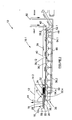
- is a side elevation of a sludge treating system;
- figure 2
- is a similar view of a first stage of the system in
figure 1 ; - figure 3
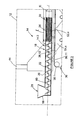
- is a more detailed side view of an extruding arrangement and a conveyor of the system;
- figure 4
- is a still more detailed side view of the extruding arrangement and conveyor;
- figure 5
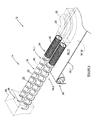
- is a perspective view of an alternative embodiment of the extruding arrangement;
- figure 6
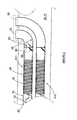
- is a partial plan view of the alternative embodiment; and
- figure 7
- is a diagrammatic side elevation of another embodiment of the system.
- A system for treating a body of an input material comprising an extrudable part, such as a sludge or clay and a non-extrudable part, is generally designated by the
reference numeral 10 infigure 1 . - In the embodiments hereinafter described by way of non-limiting examples, the input material is a sludge in the form of sewage, which comprises an extrudable part comprising 10%-50% solids and foreign non-extrudable matter or detritus, such as rags, stones, glass etc.
- In the embodiment of
figure 1 , the system comprises a first stage 10.1 and a second stage 10.2. In this embodiment,apparatus 12 for treating a sludge forms part of the first stage 10.1. The second stage 10.2 is described in the specification of South African Patent2009/02227 - Referring to
figures 1 ,2 ,5 and6 , theapparatus 12 comprises an extrudingarrangement 14 comprising at least one extruding assembly 14.1, 14.2 for extruding theinput sewage 16. Each extruding assembly 14.1 comprises abody 18 defining apassage 20 for the input material and anextruder figure 4 ). The extruder is located downstream of aninlet 28 for the input material to thepassage 20 and upstream from afirst outlet 30 from the passage for the extruded part and asecond outlet 32 from the passage for the non-extrudable part of the input material. A mechanism 34 (best shown infigure 6 ) cooperates with thepassage 20 to direct the extruded part to thefirst outlet 30 and the non-extrudable part to thesecond outlet 32. - First means for receiving the extruded part 26.1 to 26.n, in this example embodiment in the form of a
conveyor 36, is provided in cooperating relationship with thefirst outlet 30. Theconveyor 36 comprises an endless perforated steel belt having a substantially horizontal first section 36.1 and a vertically spaced return section 36.2. The first section extends between a first end 38.1 underneath the extrudingarrangement 14 and a second end 38.2 remote therefrom. The first section has a first face 36.11 facing upwardly and towards the extrudingarrangement 14 and an opposite second face 36.12. - A
first path 39 for hot air is defined by a duct orhood 40 above the first face 36.11. Thepath 39 communicates with the first face 36.11 and extends from aninlet 42 for hot air towards the second end 38.2 of the first section 36.1 of theconveyor 36 to anexit 44 for hot air towards the first end 36.1 of the first section. - A
second path 46 for hot air is defined by ducting 48 underneath the second face 36.12. Theducting 48 comprises aninlet 50 for hot air towards the second end 38.2 and at least one, but preferably a plurality of linearly distributed outlets 52.1 to 52.n provided by liquid sumps 54.1 to 54.n located underneath the second face 36.12 of the first section 36.1 of theconveyor 36. - Hence, and as best shown in
figure 2 , there is provided above first part 36.1 of theconveyor 36 thefirst path 39 for hot air extending frominlet 42 tooutlet 44. Thesecond path 46 is provided below the first part 36.1 of theconveyor 36 and extends frominlet 50 viaducting 48, outlets 52.1 to 52.n and at least part of thefirst path 39, to theoutlet 44. - Referring to
figures 3 ,5 and6 , the extrudingarrangement 14 comprises an input material receiving part in the form of ahopper 56 defining theinlet 28 and at least one extruding assembly 14.1 and 14.2. Each extruding assembly 14.1 comprises a material feeding or displacement device such as a vaned screw conveyor orauger 22, preferably without a centre shaft or axle located in thepassage 20. Theauger 22 has a main axis 58. In the embodiment shown, thepassage defining body 18 comprises a sleeve having asidewall 60 with aperforated region 24 having a length l (as shown infigures 3 and4 ) forming part of the extruder and serving as thefirst outlet 30 intermediate theinlet 28 and thesecond outlet 32. Unexpectedly, good results were obtained when the auger terminates at about halfway through the length of the perforatedregion 24. Thesleeve 18 comprises atail piece 62 downstream of the perforatedregion 24 and which, at a distal end thereof defines thesecond outlet 32. - The
aforementioned directing mechanism 34 is best shown infigure 6 and is mounted in thepassage 20 downstream of thefirst outlet 30. The mechanism comprises a normally closeddoor 64 hinged to thebody 18 and located in thepassage 20 to close the passage downstream of thefirst outlet 30 and upstream from thesecond outlet 32. Thedoor 64 is biased towards the normally closed position by a biasing device, such as aspring 66, for example. - In this example embodiment, the extruding
arrangement 14 andconveyor 36 are arranged such that the main axis 58 of the auger is parallel with a main axis of the first part 36.1 of the conveyor. Further, in this example embodiment, the tail-piece 62 may comprise an elbow or be otherwise curved to extend away from the main axis 58, so that thesecond outlet 32 is in communication with a second receiving means 68 transversely spaced from theconveyor 36. - Referring to
figure 1 , there may be provided a power source, such as aninternal combustion engine 70 for parts of thesystem 10. Such parts may include drivewheels 72 for theendless conveyor 36 and theaugers 22. The engine may also drive agenerator 74 for generating electricity for driving electrical parts or components of thesystem 10. Such parts may include infra-red sources 76 forming part of the second stage 10.2. - As shown in
figure 2 , an exhaust system (not shown) of theengine 70 is connectable to theinlet 50 of theducting 48 providing the aforementionedsecond path 46 for hot air, so that hot air delivered by the exhaust system, typically at about 450°C, is ducted along thesecond path 46. Hot air, typically at about 70°C, obtained from a heat exchange system, such as a radiator (not shown) for the engine, is connected toinlet 42 offirst path 39. - In use, the hot air from the
engine 70 is connected as aforesaid. Theendless conveyor 36 is caused to move in a clock-wise direction A and theaugers 22 are driven to rotate about their main axes 58. Thesludge 16 to be treated is received athopper 56 into thesystem 10, and more particularly into theapparatus 12 of the first stage 10.1. The sludge is extruded by theextruder arrangement 14 into a plurality of elongate flexible bodies 26.1 to 26.n shown infigure 4 . The extruded elongate bodies 26.1 to 26.n are deposited under the influence of gravity on the first face 36.11 of the first part 36.1 of theconveyor 36. The deposited bodies form a vented mass on the conveyor and a resulting enlarged surface area of the mass (as opposed to that of the original sludge body) is exposed to the hot air moving along the first and second paths, to dry the mass. The mass is conveyed as shown at B towards the second or remote end 38.2 of the first part 36.1. At the second end, the at least partially dried mass drops and disintegrates into cakes which are received in areceptacle 78. - From the receptacle, the cakes are conveyed to the second stage 10.2 for further drying in the second stage. The dried material is made available at an
output 80 of the system. - The non-extrudable part of the input material is fed by the
auger 22 towards thedoor 64. Pressure and a force exerted by this material as it builds up over time, causes the door to open against its bias and trailing non-extrudable material forces leading non-extrudable material along thetail piece 62 and out through thesecond outlet 32. The extruded part and non-extrudable parts are hence automatically separated and the second receiving means 68 adjacent thesecond outlet 32 may be configured to convey the non-extrudable part to waste, alternatively for further processing. - In
figure 7 there is shown a self-explanatory diagram of a second embodiment of thesystem 10 wherein at least some of the additional drying means 76 of the aforementioned second stage 10.2 are incorporated in the first stage, so that asingle conveyor 36 may be used. - It will be appreciated that there are many variations in detail on the system, apparatus and method according to the invention without departing from the scope of the appended claims. More particularly, the extruding arrangement and method according to the invention may be used to separate a non-extrudable part of any suitable input material from an extrudable part thereof. The input material may be a mineral carrying clay or the like, and in such applications, the extruded clay may be conveyed to waste and the non-extrudable minerals may be conveyed from the
second outlet 32 for further processing.
Claims (15)
- Apparatus for treating a body of an input material comprising an extrudable part comprising a sludge or clay and a non-extrudable part, the apparatus comprising:- at least one extruding assembly comprising a body defining a passage for the input material and an extruder for converting the extrudable part into an extruded part;- the extruder being located downstream of an inlet for the input material to the passage and upstream from a first outlet from the passage for the extruded part which first outlet is defined in a sidewall of the passage and a second outlet from the passage for the non-extrudable part which second outlet is downstream from the first outlet; and
means for receiving the extruded part which means comprises a conveyor in cooperating relationship with the first outlet for conveying the extruded part. - Apparatus as claimed in claim 1 comprising a mechanism cooperating with the passage for directing the extruded part to the first outlet and the non-extrudable part to the second outlet.
- Apparatus as claimed in claim 1 or claim 2 comprising means for receiving the non-extrudable part cooperating with the second outlet.
- Apparatus as claimed in any one of claims 1 to 3 wherein the extruder arrangement is mounted above the conveyor and wherein the extruded part is deposited through the first outlet and under the influence gravity onto the conveyor.
- Apparatus as claimed in any one of claims 1 to 4 wherein the conveyor comprises an endless perforated steel belt having a first part for receiving the extruded part and a return part.
- Apparatus as claimed in any one of the preceding claims wherein the extruder comprises a material feeding device which is at least partially located in a perforated region of the body of the extruder assembly to cooperate with the perforated region.
- Apparatus as claimed in claim 6 wherein the body of the extruder assembly comprises a sleeve comprising a sidewall and wherein at least part of the sidewall is perforated to provide the perforated region, which forms the first outlet.
- Apparatus as claimed in claim 7 wherein the sleeve comprises a tail-piece downstream of the perforated region and defining the second outlet.
- Apparatus as claimed in claim 8 wherein the directing mechanism comprises a normally closed, but openable door between the perforated region and the second outlet.
- Apparatus as claimed in claim 9 wherein the door is normally biased by biasing means towards a closed position.
- Apparatus as claimed in any one of claims 5 to 10 comprising a first path for hot air extending above the first part of the endless perforated steel belt.
- Apparatus as claimed in any one of claims 5 to 11 comprising a second path for hot air extending below the first part of the endless perforated steel belt.
- A method of treating a body of an input material comprising an extrudable part comprising a sludge or clay and a non-extrudable part, the method comprising the steps of:- moving the input material along a passage;- extruding the extrudable part and presenting the extruded part through a first outlet from the passage which is defined in a sidewall of the passage;- whilst extruding, separating the non-extrudable part from the extrudable part; and- making the non-extrudable part available downstream of the first outlet.
- A method as claimed in claim 13 comprising the step of conveying the extruded part in a first direction and exposing the extruded part to heat, to dry the extruded part,
and optionally wherein the heat is provided from at least one of a first side of the extruded part and an opposite side of the extruded part and wherein the hot air is caused to flow past the extruded part in a second direction, which is opposite to the first direction. - A method as claimed in claim 13 comprising the step of conveying the non-extrudable part for further processing.
Applications Claiming Priority (2)
| Application Number | Priority Date | Filing Date | Title |
|---|---|---|---|
| ZA201002800 | 2010-04-21 | ||
| PCT/IB2011/051749 WO2011132170A2 (en) | 2010-04-21 | 2011-04-21 | Sludge treatment system and method |
Publications (2)
| Publication Number | Publication Date |
|---|---|
| EP2560924A2 EP2560924A2 (en) | 2013-02-27 |
| EP2560924B1 true EP2560924B1 (en) | 2015-01-28 |
Family
ID=44626652
Family Applications (1)
| Application Number | Title | Priority Date | Filing Date |
|---|---|---|---|
| EP11723125.8A Not-in-force EP2560924B1 (en) | 2010-04-21 | 2011-04-21 | Sludge treatment system and method |
Country Status (6)
| Country | Link |
|---|---|
| US (1) | US20130200010A1 (en) |
| EP (1) | EP2560924B1 (en) |
| CN (1) | CN103168007B (en) |
| BR (1) | BR112012026902A2 (en) |
| WO (1) | WO2011132170A2 (en) |
| ZA (1) | ZA201207845B (en) |
Family Cites Families (10)
| Publication number | Priority date | Publication date | Assignee | Title |
|---|---|---|---|---|
| KR950006364B1 (en) * | 1993-03-13 | 1995-06-14 | 대한중석주식회사 | Insert tip |
| FI953157A7 (en) * | 1995-06-26 | 1996-12-27 | Esko Torkkeli | Environmental sludge treatment method |
| KR20010034447A (en) * | 1998-12-02 | 2001-04-25 | 카타베 토요카츄 | Screw drum type filtration device |
| JP3792108B2 (en) * | 2000-07-18 | 2006-07-05 | 新日本製鐵株式会社 | Sludge concentration dewatering equipment |
| CN1693242A (en) * | 2005-05-12 | 2005-11-09 | 万若(北京)环境工程技术有限公司 | Process for treating sludge by dewatering and stabilizing |
| KR200396875Y1 (en) * | 2005-07-14 | 2005-09-27 | (주)에이알케이 | Dewatering device for sludge |
| ZA200902272B (en) | 2006-10-13 | 2010-03-31 | Exxaro Resources Ltd | Microwave treatment of bulk particulate material |
| CN101148309A (en) * | 2007-09-03 | 2008-03-26 | 张锦华 | Belt-type sludge drier |
| KR20090080813A (en) * | 2008-01-22 | 2009-07-27 | 장진수 | Drying equipment for sludge treatment |
| CN101628780B (en) * | 2009-08-07 | 2011-05-04 | 镇江同盛环保设备工程有限公司 | Sludge drying system and sludge drying process |
-
2011
- 2011-04-21 CN CN201180027273.XA patent/CN103168007B/en not_active Expired - Fee Related
- 2011-04-21 WO PCT/IB2011/051749 patent/WO2011132170A2/en not_active Ceased
- 2011-04-21 EP EP11723125.8A patent/EP2560924B1/en not_active Not-in-force
- 2011-04-21 BR BR112012026902A patent/BR112012026902A2/en not_active IP Right Cessation
- 2011-04-21 US US13/642,188 patent/US20130200010A1/en not_active Abandoned
-
2012
- 2012-10-18 ZA ZA2012/07845A patent/ZA201207845B/en unknown
Also Published As
| Publication number | Publication date |
|---|---|
| CN103168007B (en) | 2014-12-03 |
| US20130200010A1 (en) | 2013-08-08 |
| WO2011132170A2 (en) | 2011-10-27 |
| EP2560924A2 (en) | 2013-02-27 |
| WO2011132170A3 (en) | 2012-01-05 |
| BR112012026902A2 (en) | 2016-07-12 |
| CN103168007A (en) | 2013-06-19 |
| ZA201207845B (en) | 2013-06-26 |
Similar Documents
| Publication | Publication Date | Title |
|---|---|---|
| CN101632996B (en) | Food waste pretreatment process | |
| RS51914B (en) | WASTE BIOMASS TREATMENT DEVICE | |
| CA2654753C (en) | Apparatus for separating the organic membrane portion and the mineral portion of broken egg shells | |
| CN104889144B (en) | The processing equipment of kitchen garbage | |
| US20150237684A1 (en) | Microwave-based material processing systems and methods | |
| NL9102066A (en) | METHOD AND APPARATUS FOR CONCENTRATING AND DEODORIZING WASTE WASTE. | |
| NZ212471A (en) | Separating liquid from fibres of plant material by multi-stage screw pressing | |
| US20190225524A1 (en) | Waste water solids separator system and method | |
| KR19980034514A (en) | Organic and inorganic sludge drying method and apparatus | |
| KR101090021B1 (en) | Starfish Crushing and Drying Equipment | |
| US20130200010A1 (en) | Sludge treatment system and method | |
| CN102659258B (en) | Treatment method of kitchen slops and treatment device | |
| RU71658U1 (en) | TECHNOLOGICAL SYSTEM FOR THE PROCESSING OF OIL-CONTAINING PRODUCTION WASTE | |
| RU2130002C1 (en) | Plant for processing organic-origin wastes into organomineral fertilizers | |
| CN1377302A (en) | garbage disposal system | |
| EP1013350A2 (en) | Method for treating municipal organic waste and plant for carrying out the method | |
| KR20010027616A (en) | process device and method of food waste | |
| HRP20110260A2 (en) | Process and plant for municipal solid waste separation | |
| ITTO20090445A1 (en) | DEVICE AND PROCEDURE FOR THE TREATMENT OF ORGANIC LIQUIDS, PARTICULARLY LIQUAM OF ZOOTECHNICAL ORIGIN | |
| RU2161004C1 (en) | Method and line for primary preparing of licorice as licorice raw material | |
| KR200246042Y1 (en) | Food Garbage Disposal Equipment | |
| KR100761299B1 (en) | Wastewater Treatment System Generated During Food Waste Disposal | |
| KR20080036207A (en) | Device for transporting rich material | |
| CN206750862U (en) | Rubbish pretreatment workshop plate feeds machine | |
| CN217190182U (en) | Solid waste treatment and recovery device |
Legal Events
| Date | Code | Title | Description |
|---|---|---|---|
| PUAI | Public reference made under article 153(3) epc to a published international application that has entered the european phase |
Free format text: ORIGINAL CODE: 0009012 |
|
| 17P | Request for examination filed |
Effective date: 20121024 |
|
| AK | Designated contracting states |
Kind code of ref document: A2 Designated state(s): AL AT BE BG CH CY CZ DE DK EE ES FI FR GB GR HR HU IE IS IT LI LT LU LV MC MK MT NL NO PL PT RO RS SE SI SK SM TR |
|
| DAX | Request for extension of the european patent (deleted) | ||
| GRAP | Despatch of communication of intention to grant a patent |
Free format text: ORIGINAL CODE: EPIDOSNIGR1 |
|
| INTG | Intention to grant announced |
Effective date: 20140825 |
|
| GRAS | Grant fee paid |
Free format text: ORIGINAL CODE: EPIDOSNIGR3 |
|
| GRAA | (expected) grant |
Free format text: ORIGINAL CODE: 0009210 |
|
| AK | Designated contracting states |
Kind code of ref document: B1 Designated state(s): AL AT BE BG CH CY CZ DE DK EE ES FI FR GB GR HR HU IE IS IT LI LT LU LV MC MK MT NL NO PL PT RO RS SE SI SK SM TR |
|
| REG | Reference to a national code |
Ref country code: GB Ref legal event code: FG4D |
|
| REG | Reference to a national code |
Ref country code: CH Ref legal event code: EP |
|
| REG | Reference to a national code |
Ref country code: IE Ref legal event code: FG4D |
|
| REG | Reference to a national code |
Ref country code: AT Ref legal event code: REF Ref document number: 708163 Country of ref document: AT Kind code of ref document: T Effective date: 20150315 |
|
| REG | Reference to a national code |
Ref country code: DE Ref legal event code: R096 Ref document number: 602011013529 Country of ref document: DE Effective date: 20150319 |
|
| REG | Reference to a national code |
Ref country code: AT Ref legal event code: MK05 Ref document number: 708163 Country of ref document: AT Kind code of ref document: T Effective date: 20150128 |
|
| REG | Reference to a national code |
Ref country code: NL Ref legal event code: VDEP Effective date: 20150128 |
|
| REG | Reference to a national code |
Ref country code: LT Ref legal event code: MG4D |
|
| PG25 | Lapsed in a contracting state [announced via postgrant information from national office to epo] |
Ref country code: FI Free format text: LAPSE BECAUSE OF FAILURE TO SUBMIT A TRANSLATION OF THE DESCRIPTION OR TO PAY THE FEE WITHIN THE PRESCRIBED TIME-LIMIT Effective date: 20150128 Ref country code: SE Free format text: LAPSE BECAUSE OF FAILURE TO SUBMIT A TRANSLATION OF THE DESCRIPTION OR TO PAY THE FEE WITHIN THE PRESCRIBED TIME-LIMIT Effective date: 20150128 Ref country code: NO Free format text: LAPSE BECAUSE OF FAILURE TO SUBMIT A TRANSLATION OF THE DESCRIPTION OR TO PAY THE FEE WITHIN THE PRESCRIBED TIME-LIMIT Effective date: 20150428 Ref country code: LT Free format text: LAPSE BECAUSE OF FAILURE TO SUBMIT A TRANSLATION OF THE DESCRIPTION OR TO PAY THE FEE WITHIN THE PRESCRIBED TIME-LIMIT Effective date: 20150128 Ref country code: HR Free format text: LAPSE BECAUSE OF FAILURE TO SUBMIT A TRANSLATION OF THE DESCRIPTION OR TO PAY THE FEE WITHIN THE PRESCRIBED TIME-LIMIT Effective date: 20150128 Ref country code: BG Free format text: LAPSE BECAUSE OF FAILURE TO SUBMIT A TRANSLATION OF THE DESCRIPTION OR TO PAY THE FEE WITHIN THE PRESCRIBED TIME-LIMIT Effective date: 20150428 Ref country code: ES Free format text: LAPSE BECAUSE OF FAILURE TO SUBMIT A TRANSLATION OF THE DESCRIPTION OR TO PAY THE FEE WITHIN THE PRESCRIBED TIME-LIMIT Effective date: 20150128 |
|
| PG25 | Lapsed in a contracting state [announced via postgrant information from national office to epo] |
Ref country code: RS Free format text: LAPSE BECAUSE OF FAILURE TO SUBMIT A TRANSLATION OF THE DESCRIPTION OR TO PAY THE FEE WITHIN THE PRESCRIBED TIME-LIMIT Effective date: 20150128 Ref country code: AT Free format text: LAPSE BECAUSE OF FAILURE TO SUBMIT A TRANSLATION OF THE DESCRIPTION OR TO PAY THE FEE WITHIN THE PRESCRIBED TIME-LIMIT Effective date: 20150128 Ref country code: IS Free format text: LAPSE BECAUSE OF FAILURE TO SUBMIT A TRANSLATION OF THE DESCRIPTION OR TO PAY THE FEE WITHIN THE PRESCRIBED TIME-LIMIT Effective date: 20150528 Ref country code: GR Free format text: LAPSE BECAUSE OF FAILURE TO SUBMIT A TRANSLATION OF THE DESCRIPTION OR TO PAY THE FEE WITHIN THE PRESCRIBED TIME-LIMIT Effective date: 20150429 Ref country code: LV Free format text: LAPSE BECAUSE OF FAILURE TO SUBMIT A TRANSLATION OF THE DESCRIPTION OR TO PAY THE FEE WITHIN THE PRESCRIBED TIME-LIMIT Effective date: 20150128 Ref country code: PL Free format text: LAPSE BECAUSE OF FAILURE TO SUBMIT A TRANSLATION OF THE DESCRIPTION OR TO PAY THE FEE WITHIN THE PRESCRIBED TIME-LIMIT Effective date: 20150128 Ref country code: NL Free format text: LAPSE BECAUSE OF FAILURE TO SUBMIT A TRANSLATION OF THE DESCRIPTION OR TO PAY THE FEE WITHIN THE PRESCRIBED TIME-LIMIT Effective date: 20150128 |
|
| REG | Reference to a national code |
Ref country code: DE Ref legal event code: R097 Ref document number: 602011013529 Country of ref document: DE |
|
| PG25 | Lapsed in a contracting state [announced via postgrant information from national office to epo] |
Ref country code: SK Free format text: LAPSE BECAUSE OF FAILURE TO SUBMIT A TRANSLATION OF THE DESCRIPTION OR TO PAY THE FEE WITHIN THE PRESCRIBED TIME-LIMIT Effective date: 20150128 Ref country code: EE Free format text: LAPSE BECAUSE OF FAILURE TO SUBMIT A TRANSLATION OF THE DESCRIPTION OR TO PAY THE FEE WITHIN THE PRESCRIBED TIME-LIMIT Effective date: 20150128 Ref country code: RO Free format text: LAPSE BECAUSE OF FAILURE TO SUBMIT A TRANSLATION OF THE DESCRIPTION OR TO PAY THE FEE WITHIN THE PRESCRIBED TIME-LIMIT Effective date: 20150128 Ref country code: DK Free format text: LAPSE BECAUSE OF FAILURE TO SUBMIT A TRANSLATION OF THE DESCRIPTION OR TO PAY THE FEE WITHIN THE PRESCRIBED TIME-LIMIT Effective date: 20150128 Ref country code: CZ Free format text: LAPSE BECAUSE OF FAILURE TO SUBMIT A TRANSLATION OF THE DESCRIPTION OR TO PAY THE FEE WITHIN THE PRESCRIBED TIME-LIMIT Effective date: 20150128 |
|
| REG | Reference to a national code |
Ref country code: DE Ref legal event code: R119 Ref document number: 602011013529 Country of ref document: DE |
|
| PG25 | Lapsed in a contracting state [announced via postgrant information from national office to epo] |
Ref country code: LU Free format text: LAPSE BECAUSE OF FAILURE TO SUBMIT A TRANSLATION OF THE DESCRIPTION OR TO PAY THE FEE WITHIN THE PRESCRIBED TIME-LIMIT Effective date: 20150421 Ref country code: MC Free format text: LAPSE BECAUSE OF FAILURE TO SUBMIT A TRANSLATION OF THE DESCRIPTION OR TO PAY THE FEE WITHIN THE PRESCRIBED TIME-LIMIT Effective date: 20150128 |
|
| REG | Reference to a national code |
Ref country code: CH Ref legal event code: PL |
|
| PLBE | No opposition filed within time limit |
Free format text: ORIGINAL CODE: 0009261 |
|
| STAA | Information on the status of an ep patent application or granted ep patent |
Free format text: STATUS: NO OPPOSITION FILED WITHIN TIME LIMIT |
|
| GBPC | Gb: european patent ceased through non-payment of renewal fee |
Effective date: 20150428 |
|
| PG25 | Lapsed in a contracting state [announced via postgrant information from national office to epo] |
Ref country code: IT Free format text: LAPSE BECAUSE OF FAILURE TO SUBMIT A TRANSLATION OF THE DESCRIPTION OR TO PAY THE FEE WITHIN THE PRESCRIBED TIME-LIMIT Effective date: 20150128 |
|
| 26N | No opposition filed |
Effective date: 20151029 |
|
| REG | Reference to a national code |
Ref country code: IE Ref legal event code: MM4A |
|
| PG25 | Lapsed in a contracting state [announced via postgrant information from national office to epo] |
Ref country code: DE Free format text: LAPSE BECAUSE OF NON-PAYMENT OF DUE FEES Effective date: 20151103 Ref country code: LI Free format text: LAPSE BECAUSE OF NON-PAYMENT OF DUE FEES Effective date: 20150430 Ref country code: CH Free format text: LAPSE BECAUSE OF NON-PAYMENT OF DUE FEES Effective date: 20150430 Ref country code: GB Free format text: LAPSE BECAUSE OF NON-PAYMENT OF DUE FEES Effective date: 20150428 |
|
| REG | Reference to a national code |
Ref country code: FR Ref legal event code: ST Effective date: 20151231 |
|
| PG25 | Lapsed in a contracting state [announced via postgrant information from national office to epo] |
Ref country code: SI Free format text: LAPSE BECAUSE OF FAILURE TO SUBMIT A TRANSLATION OF THE DESCRIPTION OR TO PAY THE FEE WITHIN THE PRESCRIBED TIME-LIMIT Effective date: 20150128 Ref country code: FR Free format text: LAPSE BECAUSE OF NON-PAYMENT OF DUE FEES Effective date: 20150430 |
|
| PG25 | Lapsed in a contracting state [announced via postgrant information from national office to epo] |
Ref country code: IE Free format text: LAPSE BECAUSE OF NON-PAYMENT OF DUE FEES Effective date: 20150421 |
|
| PG25 | Lapsed in a contracting state [announced via postgrant information from national office to epo] |
Ref country code: BE Free format text: LAPSE BECAUSE OF FAILURE TO SUBMIT A TRANSLATION OF THE DESCRIPTION OR TO PAY THE FEE WITHIN THE PRESCRIBED TIME-LIMIT Effective date: 20150128 |
|
| PG25 | Lapsed in a contracting state [announced via postgrant information from national office to epo] |
Ref country code: MT Free format text: LAPSE BECAUSE OF FAILURE TO SUBMIT A TRANSLATION OF THE DESCRIPTION OR TO PAY THE FEE WITHIN THE PRESCRIBED TIME-LIMIT Effective date: 20150128 |
|
| PG25 | Lapsed in a contracting state [announced via postgrant information from national office to epo] |
Ref country code: HU Free format text: LAPSE BECAUSE OF FAILURE TO SUBMIT A TRANSLATION OF THE DESCRIPTION OR TO PAY THE FEE WITHIN THE PRESCRIBED TIME-LIMIT; INVALID AB INITIO Effective date: 20110421 Ref country code: SM Free format text: LAPSE BECAUSE OF FAILURE TO SUBMIT A TRANSLATION OF THE DESCRIPTION OR TO PAY THE FEE WITHIN THE PRESCRIBED TIME-LIMIT Effective date: 20150128 |
|
| PG25 | Lapsed in a contracting state [announced via postgrant information from national office to epo] |
Ref country code: CY Free format text: LAPSE BECAUSE OF FAILURE TO SUBMIT A TRANSLATION OF THE DESCRIPTION OR TO PAY THE FEE WITHIN THE PRESCRIBED TIME-LIMIT Effective date: 20150128 |
|
| PG25 | Lapsed in a contracting state [announced via postgrant information from national office to epo] |
Ref country code: PT Free format text: LAPSE BECAUSE OF FAILURE TO SUBMIT A TRANSLATION OF THE DESCRIPTION OR TO PAY THE FEE WITHIN THE PRESCRIBED TIME-LIMIT Effective date: 20150528 |
|
| PG25 | Lapsed in a contracting state [announced via postgrant information from national office to epo] |
Ref country code: TR Free format text: LAPSE BECAUSE OF FAILURE TO SUBMIT A TRANSLATION OF THE DESCRIPTION OR TO PAY THE FEE WITHIN THE PRESCRIBED TIME-LIMIT Effective date: 20150128 |
|
| PG25 | Lapsed in a contracting state [announced via postgrant information from national office to epo] |
Ref country code: MK Free format text: LAPSE BECAUSE OF FAILURE TO SUBMIT A TRANSLATION OF THE DESCRIPTION OR TO PAY THE FEE WITHIN THE PRESCRIBED TIME-LIMIT Effective date: 20150128 |
|
| PG25 | Lapsed in a contracting state [announced via postgrant information from national office to epo] |
Ref country code: AL Free format text: LAPSE BECAUSE OF FAILURE TO SUBMIT A TRANSLATION OF THE DESCRIPTION OR TO PAY THE FEE WITHIN THE PRESCRIBED TIME-LIMIT Effective date: 20150128 |