EP2557227A1 - Method and arrangement in a drying section of a paper machine for drying a paper web - Google Patents
Method and arrangement in a drying section of a paper machine for drying a paper web Download PDFInfo
- Publication number
- EP2557227A1 EP2557227A1 EP12179767A EP12179767A EP2557227A1 EP 2557227 A1 EP2557227 A1 EP 2557227A1 EP 12179767 A EP12179767 A EP 12179767A EP 12179767 A EP12179767 A EP 12179767A EP 2557227 A1 EP2557227 A1 EP 2557227A1
- Authority
- EP
- European Patent Office
- Prior art keywords
- air
- drying
- paper web
- temperature
- support fabric
- Prior art date
- Legal status (The legal status is an assumption and is not a legal conclusion. Google has not performed a legal analysis and makes no representation as to the accuracy of the status listed.)
- Granted
Links
Images
Classifications
-
- D—TEXTILES; PAPER
- D21—PAPER-MAKING; PRODUCTION OF CELLULOSE
- D21F—PAPER-MAKING MACHINES; METHODS OF PRODUCING PAPER THEREON
- D21F5/00—Dryer section of machines for making continuous webs of paper
- D21F5/02—Drying on cylinders
- D21F5/04—Drying on cylinders on two or more drying cylinders
- D21F5/042—Drying on cylinders on two or more drying cylinders in combination with suction or blowing devices
- D21F5/044—Drying on cylinders on two or more drying cylinders in combination with suction or blowing devices using air hoods over the cylinders
-
- D—TEXTILES; PAPER
- D21—PAPER-MAKING; PRODUCTION OF CELLULOSE
- D21F—PAPER-MAKING MACHINES; METHODS OF PRODUCING PAPER THEREON
- D21F5/00—Dryer section of machines for making continuous webs of paper
- D21F5/18—Drying webs by hot air
Definitions
- the invention relates to a method and arrangement in a drying section of a paper machine for drying a paper web according to the preambles of the enclosed independent claims.
- the moving paper web is formed on a moving support fabric, i.e. a wire.
- the paper web is dried gradually while it is transported through the paper machine, the drying mainly occurring in the drying section of the paper machine.
- the purpose of the drying section is to remove water from the paper web by evaporation.
- the paper web to be dried is conveyed over heated drying cylinders.
- the evaporation power of the drying cylinders is restricted by the wire on them, which prevents water vapour from passing through it.
- Blow drying can also be used for drying a paper web, where hot air is blown with high speed toward the paper web. Heating of the blowing air requires heating apparatuses in connection with the blowing hood and a thick insulation to the surface of the device, so that heat is not unnecessarily wasted. Such apparatuses are structurally complex and heavy and have high costs.
- the paper web is dried with at least one dryer unit, in which
- a typical arrangement according to the invention in a drying section of a paper machine for drying a paper web comprises at least one dryer unit, which comprises
- a paper machine can mean different paper machines, and also board machines and other corresponding machines.
- the method and arrangement according to the invention enable cooling and ventilation of the support fabric i.e. the wire at the same time as the paper web formed on the support fabric is conveyed over a high temperature drying cylinder.
- the contact drying of a normally sized drying cylinder and thus paper web can be improved by arranging the temperature of the drying cylinder to be high and by combining thereto blowing with a significantly lower temperature.
- the removal of water from the support fabric can also be improved and the support fabric does not restrict the evaporation effect of the drying cylinder.
- the paper web is dried in the drying section of a paper machine with at least one dryer unit, in which a high temperature drying cylinder is combined in the same drying step with air blowing, so that the temperature of the air to be blown is significantly lower than the surface temperature of the drying cylinder.
- the drying of the paper web can be significantly improved with the aid of blowing arranged in the dryer unit, even if the blowing does not with regards to the drying of the paper web substantially bring more heat to the unit.
- at least one drying cylinder is placed under a blowing hood.
- Such an arrangement is especially suited for high temperature cylinders, the surface temperature of which is so high that its drying effect is not hampered by the blowing of cooler air.
- the blowing of cool air lowers the temperature of the support fabric i.e. wire in contact with the paper web, whereby the wire is simultaneously ventilated and the removal of water is improved, which further enables additional evaporation of water from the paper web.
- the temperature difference between the paper web and the cylinder surface can be kept high and thus the drying speed of the paper web can also be improved.
- a high temperature cylinder in this application means a heated drying cylinder, the temperature of the surface of which is at least about 130 °C.
- the temperature of the surface of the drying cylinder is typically 130-200 °C, even more typically 140-180 °C, and most typically about 160 °C.
- the above-described high temperature cylinder can also be called a high power cylinder.
- the paper web is formed on a support fabric, which support fabric presses the paper web against the surface of the drying cylinder.
- the first surface of the support fabric is against the second surface of the paper web to be dried and the first surface of the paper web settles against the surface of the drying cylinder.
- On the second side of the support fabric is arranged air blowing, whereby air is blown toward the second surface of the support fabric, which is not in contact with the paper web, substantially at the same time as the paper web is conveyed over the active drying surface of the drying cylinder.
- the temperature of the air to be blown toward the support fabric is at the most about 70 °C, i.e. significantly lower than the surface temperature of the drying cylinder.
- the temperature of the air to be blown is typically 0-60 °C, and even more typically 15-50 °C, sometimes 15-30 °C.
- the air to be blown toward the support fabric is not separately heated, i.e. the blowing air is substantially unheated air.
- air from the machine room is used as blowing air, the temperature of which air is suitable for providing the so-called cool blow according to the invention.
- the blowing air can however be cooled, because the cooler the air that is blown toward the support fabric i.e. wire, the better the wire can be cooled and ventilated, and thus the drying of the paper can be improved.
- outdoor air can be used as blowing air.
- the temperature of the air to be blown must however be at least 0 °C, so when the outdoor air is cooler, or otherwise in order to prevent condensation occurring in the channel system, air heating means must be added to the arrangement before the air is blown toward the paper web.
- a sufficiently low moisture of the blowing air is desired, so that more water is not brought into the support fabric with the blowing air.
- the absolute moisture of the blowing air is under 50 g H 2 O/kg of dry air.
- moisture does thus typically not need to be removed from the machine room air used as blowing air before it is led to be used as blowing air.
- the machine room air can thus be led directly to the blowing means, without it passing through drying devices.
- the arrangement according to the invention can comprise means for removing moisture and/or impurities from the blowing air, for example when outdoor air is used as blowing air.
- a blowing hood is advantageously used for blowing air, which blowing hood comprises a blowing surface made up of blowing means, which blowing surface has blow openings, from which the air to be blown is led toward the surface of the support fabric.
- a blowing hood is advantageously a nozzle hood.
- the blowing hood usually also comprises air removal means for removing air from the dryer unit.
- the air removal means can, for example, be suction openings arranged in the blowing surface, through which openings air is suctioned away from the dryer unit.
- the blowing hood is in one advantageous embodiment of the invention arranged above the drying cylinder to substantially surround the active drying surface of the drying cylinder, i.e. the surface, in the area of which the paper web is by its second surface substantially in contact with the surface of the drying cylinder.
- the blowing can however also have been arranged in connection with the active drying surface of the drying cylinder in some other way.
- the blowing air is led close to the surface of the paper to be dried, typically to a distance of about 10-50 mm from the surface of the paper web.
- the cool blow according to the invention both cools the wire and condensates water evaporating from the web therein, whereby the volume of the vapour as water drops to a fraction.
- the moisture can be sucked into the blowing hood with the aid of water removal means and removed through a ventilation system.
- the apparatus required by the method according to the invention is structurally simple and has a low cost, because it does in a preferred embodiment of the invention not need heating of the blowing air or thereto related devices and thus a thick insulation on the surface of the device.
- the air used for blowing does not have to be separately cooled, but the air from the machine room is in itself cool enough.
- the structure of the blowing hood remains simple, because the arrangement according to the invention only needs means for leading the machine room air into the blowing means. Additionally the method and arrangement according to the invention improve the drying of the paper web when using drying cylinders of conventional size. Typically the diameter of the drying cylinders according to the invention is at the most 2000 mm.
- cooling for the blowing air can however be added to the apparatus.
- means for cooling the air to be blown have been arranged in the arrangement.
- the arrangement according to the invention additionally has at least one set of heating means for the drying cylinders, which are arranged to heat the cylinder surface with a heating medium, such as vapour, condensed vapour or overheated vapour, hot air or hot oil.
- a heating medium such as vapour, condensed vapour or overheated vapour, hot air or hot oil.
- the surface of the drying cylinder preferably has no openings.
- the dryer unit according to the invention has in an embodiment been equipped with measuring means for measuring the temperature of the blowing air and the surface of the drying cylinder, and adjustment means for adjusting the temperature of the surface of the drying cylinder and/or adjusting the temperature of the blowing air, so that the difference in temperature between the cylinder surface and the air to be blown can be kept as desired and within predetermined limits regarding the effective drying of the paper web.
- the arrangement comprises adjustment means for adjusting the temperature of the surface of the drying cylinder, because in a typical solution according to the invention no means are arranged in connection with the blowing means for heating and/or cooling the air.
- the temperature of the surface of the drying cylinder can be adjusted for example by changing the pressure of the vapour fed into the cylinder.
- the drying of the paper web can be improved, when at least one arrangement according to the invention is arranged in the drying section of the paper machine.
- the drying section of the paper machine can in the travel direction of the paper web also comprise other heated cylinder groups before the arrangement and/or after the arrangement according to the invention.
- the dryer unit of the arrangement according to the invention is in the travel direction of the paper web arranged in the beginning or beginning end of the drying section of the paper machine.
- the dryer unit or dryer units according to the invention are arranged to be first in the drying section of the paper machine, or so that more than half of the other drying cylinders are arranged after the dryer unit according to the invention.
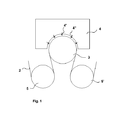
- Figure 1 shows an arrangement according to the invention, which comprises a high temperature drying cylinder 3 and a blowing hood 4.
- the paper web is conveyed over a hot cylinder surface as supported by a support fabric 2 at the same time as air is blown onto the second surface of the support fabric 2 via blow openings 4', 4" in the blowing hood 4.
- the drying section of a paper machine comprises at least one above-described arrangement for drying a paper web.
- the blowing hood 4 can also be arranged in connection with several drying cylinders, such as for example in connection with the lower cylinders 5, 5' shown in the figure.
- the blowing hood 4 is arranged at a distance from the support fabric in the area of the main active drying surface of the drying cylinder.
- the temperature of the support fabric can be lowered, whereby the wire can be ventilated and additional evaporation is made possible.
Landscapes
- Paper (AREA)
- Drying Of Solid Materials (AREA)
Abstract
Description
- The invention relates to a method and arrangement in a drying section of a paper machine for drying a paper web according to the preambles of the enclosed independent claims.
- Usually in a paper or board machine the moving paper web is formed on a moving support fabric, i.e. a wire. The paper web is dried gradually while it is transported through the paper machine, the drying mainly occurring in the drying section of the paper machine. The purpose of the drying section is to remove water from the paper web by evaporation.
- In the drying section of the paper machine the paper web to be dried is conveyed over heated drying cylinders. The evaporation power of the drying cylinders is restricted by the wire on them, which prevents water vapour from passing through it.
- Additionally when using cylinder surfaces with an especially high temperature for drying the paper web, a problem is formed regarding the temperature durability of the edges of the support fabric pressing the paper web against the cylinder surface. The edges of the support fabric, which are outside the paper web, are easily overheated, which causes weakening in the state of the edges of the support fabric, and thus the operating life of the support fabric is shortened.
- Blow drying can also be used for drying a paper web, where hot air is blown with high speed toward the paper web. Heating of the blowing air requires heating apparatuses in connection with the blowing hood and a thick insulation to the surface of the device, so that heat is not unnecessarily wasted. Such apparatuses are structurally complex and heavy and have high costs.
- It is an object of the present invention to reduce or even totally eliminate the above-mentioned problems appearing in the prior art.
- It is an object of the present invention to present a method and arrangement for drying a paper web, which makes possible improving of the operation of the drying section of the paper machine and more efficient drying of the paper web by improving the cooling of the support fabric and the removal of water.
- In order to realise the objects presented above the invention is characterised by what is presented in the characterising parts of the independent claims.
- The other, dependent claims present some preferred embodiments of the invention.
- In a typical method according to the invention for drying a paper web, the paper web is dried with at least one dryer unit, in which
- the paper web to be dried is conveyed as supported by a support fabric over a surface of a heated drying cylinder, whereby one surface of the paper web is against a first surface of the support fabric, and
- air is blown toward a second surface of the support fabric,
- A typical arrangement according to the invention in a drying section of a paper machine for drying a paper web comprises at least one dryer unit, which comprises
- a heated drying cylinder, over which the paper web to be dried is conveyed as supported by a support fabric, whereby one surface of the paper web is against a first surface of the support fabric,
- blowing means, which are arranged to blow air toward a second surface of the support fabric, and
- at least one heating means of a drying cylinder, which heating means is arranged to heat the surface of the drying cylinder to a temperature of 130-200 °C, and in which arrangement the blowing means are arranged to blow air, the temperature of which is at the most about 70 °C.
- The embodiments and advantages presented in this application relate, where applicable, to both the method and the arrangement in a drying section of a paper machine according to the invention, even if this is not always specifically mentioned.
- In this text a paper machine can mean different paper machines, and also board machines and other corresponding machines.
- The method and arrangement according to the invention enable cooling and ventilation of the support fabric i.e. the wire at the same time as the paper web formed on the support fabric is conveyed over a high temperature drying cylinder. In the solution according to the invention it has been discovered that the contact drying of a normally sized drying cylinder and thus paper web can be improved by arranging the temperature of the drying cylinder to be high and by combining thereto blowing with a significantly lower temperature. Thus the removal of water from the support fabric can also be improved and the support fabric does not restrict the evaporation effect of the drying cylinder.
- In the method according to the invention the paper web is dried in the drying section of a paper machine with at least one dryer unit, in which a high temperature drying cylinder is combined in the same drying step with air blowing, so that the temperature of the air to be blown is significantly lower than the surface temperature of the drying cylinder.
- With the method and arrangement according to the invention the drying of the paper web can be significantly improved with the aid of blowing arranged in the dryer unit, even if the blowing does not with regards to the drying of the paper web substantially bring more heat to the unit. In the arrangement according to the invention at least one drying cylinder is placed under a blowing hood. Such an arrangement is especially suited for high temperature cylinders, the surface temperature of which is so high that its drying effect is not hampered by the blowing of cooler air. The blowing of cool air lowers the temperature of the support fabric i.e. wire in contact with the paper web, whereby the wire is simultaneously ventilated and the removal of water is improved, which further enables additional evaporation of water from the paper web.
- Additionally with the method according to the invention the temperature difference between the paper web and the cylinder surface can be kept high and thus the drying speed of the paper web can also be improved.
- A high temperature cylinder in this application means a heated drying cylinder, the temperature of the surface of which is at least about 130 °C. The temperature of the surface of the drying cylinder is typically 130-200 °C, even more typically 140-180 °C, and most typically about 160 °C. The above-described high temperature cylinder can also be called a high power cylinder.
- In the method according to the invention the paper web is formed on a support fabric, which support fabric presses the paper web against the surface of the drying cylinder. Thus the first surface of the support fabric is against the second surface of the paper web to be dried and the first surface of the paper web settles against the surface of the drying cylinder. On the second side of the support fabric is arranged air blowing, whereby air is blown toward the second surface of the support fabric, which is not in contact with the paper web, substantially at the same time as the paper web is conveyed over the active drying surface of the drying cylinder.
- In the method according to the invention the temperature of the air to be blown toward the support fabric is at the most about 70 °C, i.e. significantly lower than the surface temperature of the drying cylinder. The temperature of the air to be blown is typically 0-60 °C, and even more typically 15-50 °C, sometimes 15-30 °C.
- In a preferred embodiment of the method according to the invention the air to be blown toward the support fabric is not separately heated, i.e. the blowing air is substantially unheated air.
- In a preferred embodiment of the invention air from the machine room is used as blowing air, the temperature of which air is suitable for providing the so-called cool blow according to the invention. In an embodiment of the method according to the invention the blowing air can however be cooled, because the cooler the air that is blown toward the support fabric i.e. wire, the better the wire can be cooled and ventilated, and thus the drying of the paper can be improved.
- In an embodiment of the method and arrangement according to the invention outdoor air can be used as blowing air. The temperature of the air to be blown must however be at least 0 °C, so when the outdoor air is cooler, or otherwise in order to prevent condensation occurring in the channel system, air heating means must be added to the arrangement before the air is blown toward the paper web.
- In the method according to the invention a sufficiently low moisture of the blowing air is desired, so that more water is not brought into the support fabric with the blowing air. Typically the absolute moisture of the blowing air is under 50 g H2O/kg of dry air.
- When using air from the machine room as the blowing air, its relative moisture is usually sufficiently low. In the solution according to the invention moisture does thus typically not need to be removed from the machine room air used as blowing air before it is led to be used as blowing air. The machine room air can thus be led directly to the blowing means, without it passing through drying devices.
- When using air from the machine room as blowing air, impurities do also typically not need to be separately removed therefrom. The machine room air can thus be led directly to the blowing means, without it passing through cleaning devices.
- When necessary the arrangement according to the invention can comprise means for removing moisture and/or impurities from the blowing air, for example when outdoor air is used as blowing air.
- In the method according to the invention a blowing hood is advantageously used for blowing air, which blowing hood comprises a blowing surface made up of blowing means, which blowing surface has blow openings, from which the air to be blown is led toward the surface of the support fabric. Such a blowing hood is advantageously a nozzle hood. The blowing hood usually also comprises air removal means for removing air from the dryer unit. The air removal means can, for example, be suction openings arranged in the blowing surface, through which openings air is suctioned away from the dryer unit.
- In the dryer unit according to the invention the blowing hood is in one advantageous embodiment of the invention arranged above the drying cylinder to substantially surround the active drying surface of the drying cylinder, i.e. the surface, in the area of which the paper web is by its second surface substantially in contact with the surface of the drying cylinder. The blowing can however also have been arranged in connection with the active drying surface of the drying cylinder in some other way. The blowing air is led close to the surface of the paper to be dried, typically to a distance of about 10-50 mm from the surface of the paper web.
- The cool blow according to the invention both cools the wire and condensates water evaporating from the web therein, whereby the volume of the vapour as water drops to a fraction. The moisture can be sucked into the blowing hood with the aid of water removal means and removed through a ventilation system.
- With the method according to the invention, where air which is cooler than the surface temperature of the drying cylinder is blown toward the support fabric, the overheating of the edges of the support fabric can be prevented in connection with high temperature drying cylinders.
- The apparatus required by the method according to the invention is structurally simple and has a low cost, because it does in a preferred embodiment of the invention not need heating of the blowing air or thereto related devices and thus a thick insulation on the surface of the device. In an embodiment of the invention the air used for blowing does not have to be separately cooled, but the air from the machine room is in itself cool enough.
- Thus the structure of the blowing hood remains simple, because the arrangement according to the invention only needs means for leading the machine room air into the blowing means. Additionally the method and arrangement according to the invention improve the drying of the paper web when using drying cylinders of conventional size. Typically the diameter of the drying cylinders according to the invention is at the most 2000 mm.
- In another embodiment of the invention cooling for the blowing air can however be added to the apparatus. Thus means for cooling the air to be blown have been arranged in the arrangement.
- The arrangement according to the invention additionally has at least one set of heating means for the drying cylinders, which are arranged to heat the cylinder surface with a heating medium, such as vapour, condensed vapour or overheated vapour, hot air or hot oil. The surface of the drying cylinder preferably has no openings.
- The dryer unit according to the invention has in an embodiment been equipped with measuring means for measuring the temperature of the blowing air and the surface of the drying cylinder, and adjustment means for adjusting the temperature of the surface of the drying cylinder and/or adjusting the temperature of the blowing air, so that the difference in temperature between the cylinder surface and the air to be blown can be kept as desired and within predetermined limits regarding the effective drying of the paper web. Typically the arrangement comprises adjustment means for adjusting the temperature of the surface of the drying cylinder, because in a typical solution according to the invention no means are arranged in connection with the blowing means for heating and/or cooling the air. The temperature of the surface of the drying cylinder can be adjusted for example by changing the pressure of the vapour fed into the cylinder.
- The drying of the paper web can be improved, when at least one arrangement according to the invention is arranged in the drying section of the paper machine. The drying section of the paper machine can in the travel direction of the paper web also comprise other heated cylinder groups before the arrangement and/or after the arrangement according to the invention. In a preferred embodiment of the invention the dryer unit of the arrangement according to the invention is in the travel direction of the paper web arranged in the beginning or beginning end of the drying section of the paper machine. Typically the dryer unit or dryer units according to the invention are arranged to be first in the drying section of the paper machine, or so that more than half of the other drying cylinders are arranged after the dryer unit according to the invention.
- In the following, the invention is described in more detail with reference to the appended drawing 1, which shows a principled view of the arrangement according to the invention.
-
Figure 1 shows an arrangement according to the invention, which comprises a hightemperature drying cylinder 3 and ablowing hood 4. The paper web is conveyed over a hot cylinder surface as supported by asupport fabric 2 at the same time as air is blown onto the second surface of thesupport fabric 2 viablow openings 4', 4" in theblowing hood 4. - The drying section of a paper machine according to the invention comprises at least one above-described arrangement for drying a paper web. The blowing
hood 4 can also be arranged in connection with several drying cylinders, such as for example in connection with thelower cylinders 5, 5' shown in the figure. - As is shown in
Figure 1 , the blowinghood 4 is arranged at a distance from the support fabric in the area of the main active drying surface of the drying cylinder. When blowing cool air via the nozzles in thehood 4 toward the surface of the support fabric, the temperature of the support fabric can be lowered, whereby the wire can be ventilated and additional evaporation is made possible. - The invention is not intended to be limited to the above-presented exemplary embodiments, but the intention is to apply the invention widely within the inventive idea defined by the claims defined below.
Claims (14)
- A method for drying a paper web, in which method the paper web is dried with at least one dryer unit, in which- the paper web to be dried is conveyed as supported by a support fabric over a surface of a heated drying cylinder, whereby one surface of the paper web is against a first surface of the support fabric, and- air is blown toward a second surface of the support fabric,
characterised in that the surface of the drying cylinder is heated to a temperature of 130-200 °C and the temperature of the air to be blown is at the most about 70 °C. - The method according to claim 1, characterised in that the temperature of the air to be blown toward the second surface of the support fabric is 0-60 °C.
- The method according to claim 1 or 2, characterised in that the temperature of the air to be blown toward the second surface of the support fabric is 15-30 °C.
- The method according to any of the preceding claims, characterised in that the air to be blown toward the support fabric is air from the machine room.
- The method according to any of the preceding claims, characterised in that the air to be blown toward the second surface of the support fabric is unheated.
- The method according to any of the preceding claims, characterised in that the air to be blown is cooled before it is led toward the support fabric.
- The method according to any of the preceding claims, characterised in that the temperature of the surface of the drying cylinder is 140-180 °C.
- An arrangement in a drying section of a paper machine for drying a paper web, which arrangement comprises at least- a heated drying cylinder, over which the paper web to be dried is conveyed as supported by a support fabric, whereby one surface of the paper web is against a first surface of the support fabric, and- blowing means, which are arranged to blow air toward a second surface of the support fabric,
characterised in that the arrangement further comprises at least one heating means of a drying cylinder, which heating means is arranged to heat the surface of the drying cylinder to a temperature of 130-200 °C, and that the blowing means are arranged to blow air, the temperature of which is at the most about 70 °C. - The arrangement according to claim 8, characterised in that the blowing means are arranged to blow air, the temperature of which is 0-60 °C, typically 15-30 °C.
- The arrangement according to claim 8 or 9, characterised in that the arrangement comprises means for leading air from the machine room into the blowing means.
- The arrangement according to any of the preceding claims 8-10, characterised in that the arrangement comprises means for cooling the air to be blown.
- The arrangement according to any of the preceding claims 8-11, characterised in that the heating means of the drying cylinder are arranged to heat the surface of the drying cylinder to a temperature of 140-180 °C.
- The arrangement according to any of the preceding claims 8-12, characterised in that the arrangement comprises measuring means for measuring the temperature of the air to be blown and the surface of the cylinder, and adjustment means for adjusting the temperature of the cylinder surface.
- The arrangement according to any of the preceding claims 8-13, characterised in that the arrangement is arranged in the travel direction of the paper web in the beginning or beginning end of the drying section of the paper machine.
Applications Claiming Priority (1)
| Application Number | Priority Date | Filing Date | Title |
|---|---|---|---|
| FI20115789A FI124588B (en) | 2011-08-09 | 2011-08-09 | Method and apparatus in dryer section of paper machine for drying a paper web |
Publications (2)
| Publication Number | Publication Date |
|---|---|
| EP2557227A1 true EP2557227A1 (en) | 2013-02-13 |
| EP2557227B1 EP2557227B1 (en) | 2016-05-25 |
Family
ID=44515423
Family Applications (1)
| Application Number | Title | Priority Date | Filing Date |
|---|---|---|---|
| EP12179767.4A Active EP2557227B1 (en) | 2011-08-09 | 2012-08-09 | Method and arrangement in a drying section of a paper machine for drying a paper web |
Country Status (2)
| Country | Link |
|---|---|
| EP (1) | EP2557227B1 (en) |
| FI (1) | FI124588B (en) |
Citations (3)
| Publication number | Priority date | Publication date | Assignee | Title |
|---|---|---|---|---|
| DE19619531A1 (en) * | 1996-05-15 | 1997-11-20 | Voith Sulzer Papiermasch Gmbh | Cylinder drying section of a paper or paper board machine |
| DE19723163A1 (en) * | 1997-06-03 | 1998-12-10 | Voith Sulzer Papiermasch Gmbh | Dryer section |
| WO1999018287A1 (en) * | 1997-10-03 | 1999-04-15 | Valmet Corporation | Method and device in the dryer section of a paper/board machine |
-
2011
- 2011-08-09 FI FI20115789A patent/FI124588B/en active IP Right Grant
-
2012
- 2012-08-09 EP EP12179767.4A patent/EP2557227B1/en active Active
Patent Citations (3)
| Publication number | Priority date | Publication date | Assignee | Title |
|---|---|---|---|---|
| DE19619531A1 (en) * | 1996-05-15 | 1997-11-20 | Voith Sulzer Papiermasch Gmbh | Cylinder drying section of a paper or paper board machine |
| DE19723163A1 (en) * | 1997-06-03 | 1998-12-10 | Voith Sulzer Papiermasch Gmbh | Dryer section |
| WO1999018287A1 (en) * | 1997-10-03 | 1999-04-15 | Valmet Corporation | Method and device in the dryer section of a paper/board machine |
Also Published As
| Publication number | Publication date |
|---|---|
| FI20115789A0 (en) | 2011-08-09 |
| EP2557227B1 (en) | 2016-05-25 |
| FI124588B (en) | 2014-10-31 |
| FI20115789L (en) | 2013-02-10 |
Similar Documents
| Publication | Publication Date | Title |
|---|---|---|
| US9702084B2 (en) | Process and a machine for making a tissue paper web | |
| FI88630B (en) | FOERFARANDE OCH ANORDNING FOER ATT EFFEKTIVERA FUNKTIONEN AV ETT YANKEEPRESSPARTI I EN MJUKPAPPERSMASKIN | |
| FI95939C (en) | Procedure for smoothing a paper web | |
| US8506662B2 (en) | Proactive steam and mist removal system | |
| CN204894762U (en) | Printing machine drying device | |
| SE461992B (en) | PROCEDURE FOR DRYING A PAPER COAT OR LIKE | |
| EP2557227B1 (en) | Method and arrangement in a drying section of a paper machine for drying a paper web | |
| EP2573261B1 (en) | Drying arrangement and method for drying a moving web | |
| US6769198B2 (en) | Conditioning device to change the moisture content of printing stock | |
| KR101212465B1 (en) | Pulp molding machine with cooling plate | |
| EP1102889B1 (en) | Method and device for drying of a coated web | |
| CA2206382C (en) | Curl and profile correction with high velocity hoods | |
| FI124766B (en) | A method for mastering the bead of a fiber web and a drying portion of a fiber web machine | |
| NO178202B (en) | Method and apparatus for glossing a paper or cardboard web | |
| EP2300662B1 (en) | Method for reducing runnability problems caused by gas flows in an impingement dryer for a fibre web and an impingement dryer | |
| CN1930343B (en) | Arrangement in a paper machine | |
| US20150218755A1 (en) | Method and apparatus for improving efficiency of Uhle Boxes in the process of paper production by applying a homogeneous mixture of superheated humid air | |
| EP2723941B1 (en) | Method and arrangement for improving energy efficiency of a drying section of a paper machine or the like | |
| SE510992C2 (en) | Method and apparatus for heating a fibrous web | |
| CN213727523U (en) | High ration coated paper drying equipment | |
| JP2005299074A (en) | Paper making machine | |
| EP2957846B1 (en) | Apparatus for cooling ceramic products | |
| FI118389B (en) | A treatment procedure for a fiber web | |
| CN104859295A (en) | Air flow type energy-saving drying box |
Legal Events
| Date | Code | Title | Description |
|---|---|---|---|
| PUAI | Public reference made under article 153(3) epc to a published international application that has entered the european phase |
Free format text: ORIGINAL CODE: 0009012 |
|
| AK | Designated contracting states |
Kind code of ref document: A1 Designated state(s): AL AT BE BG CH CY CZ DE DK EE ES FI FR GB GR HR HU IE IS IT LI LT LU LV MC MK MT NL NO PL PT RO RS SE SI SK SM TR |
|
| AX | Request for extension of the european patent |
Extension state: BA ME |
|
| 17P | Request for examination filed |
Effective date: 20130605 |
|
| RBV | Designated contracting states (corrected) |
Designated state(s): AL AT BE BG CH CY CZ DE DK EE ES FI FR GB GR HR HU IE IS IT LI LT LU LV MC MK MT NL NO PL PT RO RS SE SI SK SM TR |
|
| RAP1 | Party data changed (applicant data changed or rights of an application transferred) |
Owner name: VALMET TECHNOLOGIES, INC. |
|
| 17Q | First examination report despatched |
Effective date: 20150219 |
|
| GRAP | Despatch of communication of intention to grant a patent |
Free format text: ORIGINAL CODE: EPIDOSNIGR1 |
|
| INTG | Intention to grant announced |
Effective date: 20160112 |
|
| GRAS | Grant fee paid |
Free format text: ORIGINAL CODE: EPIDOSNIGR3 |
|
| GRAA | (expected) grant |
Free format text: ORIGINAL CODE: 0009210 |
|
| AK | Designated contracting states |
Kind code of ref document: B1 Designated state(s): AL AT BE BG CH CY CZ DE DK EE ES FI FR GB GR HR HU IE IS IT LI LT LU LV MC MK MT NL NO PL PT RO RS SE SI SK SM TR |
|
| REG | Reference to a national code |
Ref country code: GB Ref legal event code: FG4D |
|
| REG | Reference to a national code |
Ref country code: CH Ref legal event code: EP |
|
| REG | Reference to a national code |
Ref country code: IE Ref legal event code: FG4D Ref country code: AT Ref legal event code: REF Ref document number: 802435 Country of ref document: AT Kind code of ref document: T Effective date: 20160615 |
|
| REG | Reference to a national code |
Ref country code: DE Ref legal event code: R096 Ref document number: 602012018890 Country of ref document: DE |
|
| REG | Reference to a national code |
Ref country code: LT Ref legal event code: MG4D |
|
| REG | Reference to a national code |
Ref country code: NL Ref legal event code: MP Effective date: 20160525 |
|
| PG25 | Lapsed in a contracting state [announced via postgrant information from national office to epo] |
Ref country code: NL Free format text: LAPSE BECAUSE OF FAILURE TO SUBMIT A TRANSLATION OF THE DESCRIPTION OR TO PAY THE FEE WITHIN THE PRESCRIBED TIME-LIMIT Effective date: 20160525 Ref country code: LT Free format text: LAPSE BECAUSE OF FAILURE TO SUBMIT A TRANSLATION OF THE DESCRIPTION OR TO PAY THE FEE WITHIN THE PRESCRIBED TIME-LIMIT Effective date: 20160525 Ref country code: FI Free format text: LAPSE BECAUSE OF FAILURE TO SUBMIT A TRANSLATION OF THE DESCRIPTION OR TO PAY THE FEE WITHIN THE PRESCRIBED TIME-LIMIT Effective date: 20160525 Ref country code: NO Free format text: LAPSE BECAUSE OF FAILURE TO SUBMIT A TRANSLATION OF THE DESCRIPTION OR TO PAY THE FEE WITHIN THE PRESCRIBED TIME-LIMIT Effective date: 20160825 |
|
| PG25 | Lapsed in a contracting state [announced via postgrant information from national office to epo] |
Ref country code: PT Free format text: LAPSE BECAUSE OF FAILURE TO SUBMIT A TRANSLATION OF THE DESCRIPTION OR TO PAY THE FEE WITHIN THE PRESCRIBED TIME-LIMIT Effective date: 20160926 Ref country code: RS Free format text: LAPSE BECAUSE OF FAILURE TO SUBMIT A TRANSLATION OF THE DESCRIPTION OR TO PAY THE FEE WITHIN THE PRESCRIBED TIME-LIMIT Effective date: 20160525 Ref country code: LV Free format text: LAPSE BECAUSE OF FAILURE TO SUBMIT A TRANSLATION OF THE DESCRIPTION OR TO PAY THE FEE WITHIN THE PRESCRIBED TIME-LIMIT Effective date: 20160525 Ref country code: SE Free format text: LAPSE BECAUSE OF FAILURE TO SUBMIT A TRANSLATION OF THE DESCRIPTION OR TO PAY THE FEE WITHIN THE PRESCRIBED TIME-LIMIT Effective date: 20160525 Ref country code: ES Free format text: LAPSE BECAUSE OF FAILURE TO SUBMIT A TRANSLATION OF THE DESCRIPTION OR TO PAY THE FEE WITHIN THE PRESCRIBED TIME-LIMIT Effective date: 20160525 Ref country code: GR Free format text: LAPSE BECAUSE OF FAILURE TO SUBMIT A TRANSLATION OF THE DESCRIPTION OR TO PAY THE FEE WITHIN THE PRESCRIBED TIME-LIMIT Effective date: 20160826 |
|
| PG25 | Lapsed in a contracting state [announced via postgrant information from national office to epo] |
Ref country code: BE Free format text: LAPSE BECAUSE OF NON-PAYMENT OF DUE FEES Effective date: 20160831 Ref country code: IT Free format text: LAPSE BECAUSE OF FAILURE TO SUBMIT A TRANSLATION OF THE DESCRIPTION OR TO PAY THE FEE WITHIN THE PRESCRIBED TIME-LIMIT Effective date: 20160525 |
|
| PG25 | Lapsed in a contracting state [announced via postgrant information from national office to epo] |
Ref country code: CZ Free format text: LAPSE BECAUSE OF FAILURE TO SUBMIT A TRANSLATION OF THE DESCRIPTION OR TO PAY THE FEE WITHIN THE PRESCRIBED TIME-LIMIT Effective date: 20160525 Ref country code: RO Free format text: LAPSE BECAUSE OF FAILURE TO SUBMIT A TRANSLATION OF THE DESCRIPTION OR TO PAY THE FEE WITHIN THE PRESCRIBED TIME-LIMIT Effective date: 20160525 Ref country code: EE Free format text: LAPSE BECAUSE OF FAILURE TO SUBMIT A TRANSLATION OF THE DESCRIPTION OR TO PAY THE FEE WITHIN THE PRESCRIBED TIME-LIMIT Effective date: 20160525 Ref country code: DK Free format text: LAPSE BECAUSE OF FAILURE TO SUBMIT A TRANSLATION OF THE DESCRIPTION OR TO PAY THE FEE WITHIN THE PRESCRIBED TIME-LIMIT Effective date: 20160525 Ref country code: SK Free format text: LAPSE BECAUSE OF FAILURE TO SUBMIT A TRANSLATION OF THE DESCRIPTION OR TO PAY THE FEE WITHIN THE PRESCRIBED TIME-LIMIT Effective date: 20160525 |
|
| PG25 | Lapsed in a contracting state [announced via postgrant information from national office to epo] |
Ref country code: PL Free format text: LAPSE BECAUSE OF FAILURE TO SUBMIT A TRANSLATION OF THE DESCRIPTION OR TO PAY THE FEE WITHIN THE PRESCRIBED TIME-LIMIT Effective date: 20160525 Ref country code: SM Free format text: LAPSE BECAUSE OF FAILURE TO SUBMIT A TRANSLATION OF THE DESCRIPTION OR TO PAY THE FEE WITHIN THE PRESCRIBED TIME-LIMIT Effective date: 20160525 Ref country code: BE Free format text: LAPSE BECAUSE OF FAILURE TO SUBMIT A TRANSLATION OF THE DESCRIPTION OR TO PAY THE FEE WITHIN THE PRESCRIBED TIME-LIMIT Effective date: 20160525 |
|
| REG | Reference to a national code |
Ref country code: DE Ref legal event code: R097 Ref document number: 602012018890 Country of ref document: DE |
|
| PG25 | Lapsed in a contracting state [announced via postgrant information from national office to epo] |
Ref country code: MC Free format text: LAPSE BECAUSE OF FAILURE TO SUBMIT A TRANSLATION OF THE DESCRIPTION OR TO PAY THE FEE WITHIN THE PRESCRIBED TIME-LIMIT Effective date: 20160525 |
|
| PLBE | No opposition filed within time limit |
Free format text: ORIGINAL CODE: 0009261 |
|
| REG | Reference to a national code |
Ref country code: CH Ref legal event code: PL |
|
| STAA | Information on the status of an ep patent application or granted ep patent |
Free format text: STATUS: NO OPPOSITION FILED WITHIN TIME LIMIT |
|
| GBPC | Gb: european patent ceased through non-payment of renewal fee |
Effective date: 20160825 |
|
| PG25 | Lapsed in a contracting state [announced via postgrant information from national office to epo] |
Ref country code: LI Free format text: LAPSE BECAUSE OF NON-PAYMENT OF DUE FEES Effective date: 20160831 Ref country code: CH Free format text: LAPSE BECAUSE OF NON-PAYMENT OF DUE FEES Effective date: 20160831 |
|
| 26N | No opposition filed |
Effective date: 20170228 |
|
| REG | Reference to a national code |
Ref country code: FR Ref legal event code: ST Effective date: 20170428 |
|
| PG25 | Lapsed in a contracting state [announced via postgrant information from national office to epo] |
Ref country code: SI Free format text: LAPSE BECAUSE OF FAILURE TO SUBMIT A TRANSLATION OF THE DESCRIPTION OR TO PAY THE FEE WITHIN THE PRESCRIBED TIME-LIMIT Effective date: 20160525 |
|
| REG | Reference to a national code |
Ref country code: IE Ref legal event code: MM4A |
|
| PG25 | Lapsed in a contracting state [announced via postgrant information from national office to epo] |
Ref country code: IE Free format text: LAPSE BECAUSE OF NON-PAYMENT OF DUE FEES Effective date: 20160809 Ref country code: GB Free format text: LAPSE BECAUSE OF NON-PAYMENT OF DUE FEES Effective date: 20160825 Ref country code: FR Free format text: LAPSE BECAUSE OF NON-PAYMENT OF DUE FEES Effective date: 20160831 |
|
| PG25 | Lapsed in a contracting state [announced via postgrant information from national office to epo] |
Ref country code: LU Free format text: LAPSE BECAUSE OF NON-PAYMENT OF DUE FEES Effective date: 20160809 |
|
| REG | Reference to a national code |
Ref country code: AT Ref legal event code: UEP Ref document number: 802435 Country of ref document: AT Kind code of ref document: T Effective date: 20160525 |
|
| PG25 | Lapsed in a contracting state [announced via postgrant information from national office to epo] |
Ref country code: CY Free format text: LAPSE BECAUSE OF FAILURE TO SUBMIT A TRANSLATION OF THE DESCRIPTION OR TO PAY THE FEE WITHIN THE PRESCRIBED TIME-LIMIT Effective date: 20160525 Ref country code: HU Free format text: LAPSE BECAUSE OF FAILURE TO SUBMIT A TRANSLATION OF THE DESCRIPTION OR TO PAY THE FEE WITHIN THE PRESCRIBED TIME-LIMIT; INVALID AB INITIO Effective date: 20120809 |
|
| PG25 | Lapsed in a contracting state [announced via postgrant information from national office to epo] |
Ref country code: HR Free format text: LAPSE BECAUSE OF FAILURE TO SUBMIT A TRANSLATION OF THE DESCRIPTION OR TO PAY THE FEE WITHIN THE PRESCRIBED TIME-LIMIT Effective date: 20160525 Ref country code: MK Free format text: LAPSE BECAUSE OF FAILURE TO SUBMIT A TRANSLATION OF THE DESCRIPTION OR TO PAY THE FEE WITHIN THE PRESCRIBED TIME-LIMIT Effective date: 20160525 Ref country code: MT Free format text: LAPSE BECAUSE OF NON-PAYMENT OF DUE FEES Effective date: 20160831 Ref country code: TR Free format text: LAPSE BECAUSE OF FAILURE TO SUBMIT A TRANSLATION OF THE DESCRIPTION OR TO PAY THE FEE WITHIN THE PRESCRIBED TIME-LIMIT Effective date: 20160525 Ref country code: IS Free format text: LAPSE BECAUSE OF FAILURE TO SUBMIT A TRANSLATION OF THE DESCRIPTION OR TO PAY THE FEE WITHIN THE PRESCRIBED TIME-LIMIT Effective date: 20160525 |
|
| PG25 | Lapsed in a contracting state [announced via postgrant information from national office to epo] |
Ref country code: BG Free format text: LAPSE BECAUSE OF FAILURE TO SUBMIT A TRANSLATION OF THE DESCRIPTION OR TO PAY THE FEE WITHIN THE PRESCRIBED TIME-LIMIT Effective date: 20160525 |
|
| PG25 | Lapsed in a contracting state [announced via postgrant information from national office to epo] |
Ref country code: AL Free format text: LAPSE BECAUSE OF FAILURE TO SUBMIT A TRANSLATION OF THE DESCRIPTION OR TO PAY THE FEE WITHIN THE PRESCRIBED TIME-LIMIT Effective date: 20160525 |
|
| PGFP | Annual fee paid to national office [announced via postgrant information from national office to epo] |
Ref country code: DE Payment date: 20250820 Year of fee payment: 14 |
|
| PGFP | Annual fee paid to national office [announced via postgrant information from national office to epo] |
Ref country code: AT Payment date: 20250821 Year of fee payment: 14 |