EP2555625B1 - Process for preparing benzoxaboroles - Google Patents
Process for preparing benzoxaboroles Download PDFInfo
- Publication number
- EP2555625B1 EP2555625B1 EP11766638.8A EP11766638A EP2555625B1 EP 2555625 B1 EP2555625 B1 EP 2555625B1 EP 11766638 A EP11766638 A EP 11766638A EP 2555625 B1 EP2555625 B1 EP 2555625B1
- Authority
- EP
- European Patent Office
- Prior art keywords
- compound
- formula
- alkyl
- salt
- reagent
- Prior art date
- Legal status (The legal status is an assumption and is not a legal conclusion. Google has not performed a legal analysis and makes no representation as to the accuracy of the status listed.)
- Active
Links
- 0 CC(C)(*)CC(C)(C)COc1c(B(O)O[C@@]2CN(*)*)c2ccc1 Chemical compound CC(C)(*)CC(C)(C)COc1c(B(O)O[C@@]2CN(*)*)c2ccc1 0.000 description 7
Classifications
-
- C—CHEMISTRY; METALLURGY
- C07—ORGANIC CHEMISTRY
- C07B—GENERAL METHODS OF ORGANIC CHEMISTRY; APPARATUS THEREFOR
- C07B31/00—Reduction in general
-
- C—CHEMISTRY; METALLURGY
- C07—ORGANIC CHEMISTRY
- C07F—ACYCLIC, CARBOCYCLIC OR HETEROCYCLIC COMPOUNDS CONTAINING ELEMENTS OTHER THAN CARBON, HYDROGEN, HALOGEN, OXYGEN, NITROGEN, SULFUR, SELENIUM OR TELLURIUM
- C07F5/00—Compounds containing elements of Groups 3 or 13 of the Periodic Table
- C07F5/02—Boron compounds
- C07F5/025—Boronic and borinic acid compounds
-
- A—HUMAN NECESSITIES
- A61—MEDICAL OR VETERINARY SCIENCE; HYGIENE
- A61P—SPECIFIC THERAPEUTIC ACTIVITY OF CHEMICAL COMPOUNDS OR MEDICINAL PREPARATIONS
- A61P31/00—Antiinfectives, i.e. antibiotics, antiseptics, chemotherapeutics
- A61P31/04—Antibacterial agents
-
- A—HUMAN NECESSITIES
- A61—MEDICAL OR VETERINARY SCIENCE; HYGIENE
- A61P—SPECIFIC THERAPEUTIC ACTIVITY OF CHEMICAL COMPOUNDS OR MEDICINAL PREPARATIONS
- A61P31/00—Antiinfectives, i.e. antibiotics, antiseptics, chemotherapeutics
- A61P31/10—Antimycotics
-
- C—CHEMISTRY; METALLURGY
- C07—ORGANIC CHEMISTRY
- C07F—ACYCLIC, CARBOCYCLIC OR HETEROCYCLIC COMPOUNDS CONTAINING ELEMENTS OTHER THAN CARBON, HYDROGEN, HALOGEN, OXYGEN, NITROGEN, SULFUR, SELENIUM OR TELLURIUM
- C07F5/00—Compounds containing elements of Groups 3 or 13 of the Periodic Table
- C07F5/02—Boron compounds
-
- C—CHEMISTRY; METALLURGY
- C07—ORGANIC CHEMISTRY
- C07F—ACYCLIC, CARBOCYCLIC OR HETEROCYCLIC COMPOUNDS CONTAINING ELEMENTS OTHER THAN CARBON, HYDROGEN, HALOGEN, OXYGEN, NITROGEN, SULFUR, SELENIUM OR TELLURIUM
- C07F5/00—Compounds containing elements of Groups 3 or 13 of the Periodic Table
- C07F5/02—Boron compounds
- C07F5/04—Esters of boric acids
-
- Y—GENERAL TAGGING OF NEW TECHNOLOGICAL DEVELOPMENTS; GENERAL TAGGING OF CROSS-SECTIONAL TECHNOLOGIES SPANNING OVER SEVERAL SECTIONS OF THE IPC; TECHNICAL SUBJECTS COVERED BY FORMER USPC CROSS-REFERENCE ART COLLECTIONS [XRACs] AND DIGESTS
- Y02—TECHNOLOGIES OR APPLICATIONS FOR MITIGATION OR ADAPTATION AGAINST CLIMATE CHANGE
- Y02P—CLIMATE CHANGE MITIGATION TECHNOLOGIES IN THE PRODUCTION OR PROCESSING OF GOODS
- Y02P20/00—Technologies relating to chemical industry
- Y02P20/50—Improvements relating to the production of bulk chemicals
- Y02P20/55—Design of synthesis routes, e.g. reducing the use of auxiliary or protecting groups
Definitions
- the present invention relates to benzoxaboroles and methods for their preparation.
- the hydrochloride salt of (35)-3-(aminomethyl)-7-[(3-hydroxypropyl)oxy]-2,1-benzoxaborol-1(3H)-ol, disclosed in U.S. Pat. App. No. 12/142,692 , now U.S. Patent No. 7,816,344 is characterized by the following formula: along with other pharmaceutically acceptable salts.
- These salts, as well as their corresponding conjugate free base have shown promise as an antibacterial agent, especially against Gram negative pathogens. It would therefore be advantageous to discover alternative ways of preparing this agent and its salts.
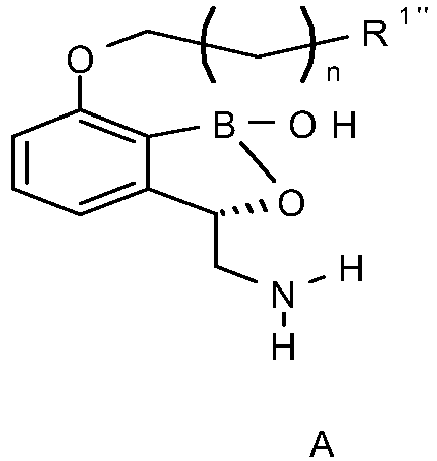
- the present invention is a compound characterized by formula 6 and also a process comprising deprotecting a compound of formula 6: or a pharmaceutically acceptable salt thereof; under deprotecting conditions to form a compound of formula A: or a pharmaceutically acceptable salt thereof; where R is H or OR 1 ; R 1 and each R 1' are each protecting groups; R 1" is H or OH; and n is 0, 1, 2, 3, 4 or 5.
- the present invention is a process comprising the steps of
- the present invention is a process comprising the steps of:
- the present invention is a compound characterized by the following formula 6a: or a pharmaceutically acceptable salt thereof, where R 1" is H or OH; and R 1' is a protecting group.
- the present invention is a process comprising deprotecting a compound of formula 6: or a pharmaceutically acceptable salt thereof; under deprotecting conditions to form a compound of formula A: or a pharmaceutically acceptable salt thereof; where R is H or OR 1 ; R 1 and each R 1' are protecting groups; R 1" is H or OH; and n is 0, 1, 2, 3, 4, or 5.
- R 1 protecting groups include -CH(R a )-phenyl-(R b ) x , trialkylsilyl, tetrahydropyranyl, -CH 2 OCH 3 , or -CH 2 OCH 2 CH 2 OCH 3 groups, where R a is H, C 1 -alkyl, C 2 -alkyl, C 3 -alkyl, C 4 -alkyl or phenyl; each R b is independently C 1 -alkyloxy, C 2 -alkyloxy, C 3 -alkyloxy, C 4 -alkyloxy; or C 1 -alkyl, C 2 -alkyl, C 3 -alkyl, C 4 -alkyl; and x is 0, 1, or 2.
- R 1 is benzyl.
- C 1 -C 4 -alkyl refers to C 1 -alkyl, C 2 -alkyl, C 3 -alkyl, C 4 -alkyl, e.g. methyl, ethyl, n -propyl, isopropyl, n -butyl, sec -butyl, and t -butyl.
- C 1 -C 4 -alkoxy refers to C 1 -alkyloxy, C 2 -alkyloxy, C 3 -alkyloxy, C 4 -alkyloxy e.g.
- C 1 -C 6 -alkyl refers to C 1 -alkyl, C 2 -alkyl, C 3 -alkyl, C 4 -alkyl, C 5 -alkyl, C 6 -alkyl.
- R 1' protecting groups include -CH(R b )-phenyl-(R c ) y ; examples of such groups include benzyl, 1-phenylethyl, 2-methoxybenzyl, 3-methoxybenzyl, 4-methoxybenzyl, 2,4-dimethoxybenzyl, and diphenylmethyl groups; in another aspect, each R 1' is benzyl.
- Suitable deprotection methods include metal catalyzed hydrogenation, catalytic transfer hydrogenation, or acid cleavage.
- R 1' is benzyl
- preferred deprotection reagents include H 2 over Pd/C, H 2 over Pt/C, H 2 over palladium hydroxide, or ammonium formate and Pd/C.
- n is 0, 1, 2 or 3; preferably, n is 2.
- a pharmaceutically acceptable salt refers to an acid addition salt.
- suitable acid addition salts are inorganic acid salts and organic salts;
- suitable inorganic salts include hydrochloric, hydrobromic, phosphoric, metaphosphoric, nitric, and sulfuric acid salts;
- suitable organic acid salts include tartaric, acetic, trifluoroacetic, citric, malic, lactic, fumaric, benzoic, formic, propionic, glycolic, gluconic, maleic, succinic, methanesulfonic, ethanesulfonic, stearic, benzenesulfonic, bromobenzenesulfonic, and p -toluenesulfonic acid salts.
- the pharmaceutically acceptable salt of A is preferably an HCl salt.
- the compound of formula 6 is reduced in the presence of HCl to form the hydrochloride salt of the compound of formula A.
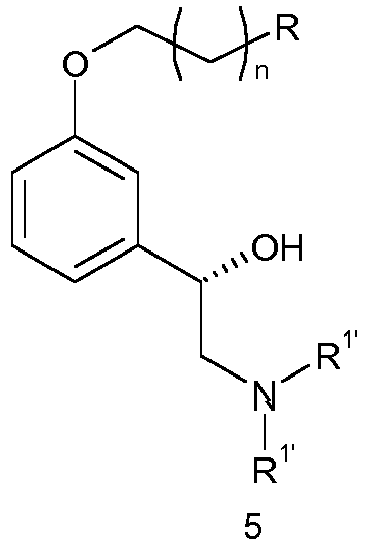
- the compound of formula 6 is prepared by contacting a compound of formula 5: or a salt thereof with a borylating reagent in the presence of an alkyllithium such as n -BuLi, n -hexyllithium, or sec -BuLi.
- a borylating reagent such as n -BuLi, n -hexyllithium, or sec -BuLi.
- Each R 2 is independently C 1 -alkyl, C 2 -alkyl, C 3 -alkyl, C 4 -alkyl, C 5 -alkyl, C 6 -alkyl and each R 3 is C 1 -alkyl, C 2 -alkyl, C 3 -alkyl, C 4 -alkyl, C 5 -alkyl, C 6 -alkyl.
- each R 2 is the same alkyl group; alternatively, the R 2 groups, together with the oxygen atoms to which they are attached form a 5- or 6-membered ring, which may be optionally fused to an aryl ring.
- borylating reagents examples include isopropylpinacolborate, 2-(methoxy)-1,3,2-benzodioxaborole, and tri-C 1 -borates, tri-C 2 -borates and tri-C 3 -borates such as triisopropyl borate and trimethyl borate.
- the borylating reagent is isopropylpinacolborate or trimethyl borate.
- the compound of formula 5 or a salt thereof can be prepared by contacting under basic conditions R 1' X with a compound of formula 4: or a salt thereof, wherein X is a suitable leaving group such as a Br, Cl, I, tosyl, or triflyl group.
- Suitable bases include carbonates such as sodium potassium, and cesium carbonates, or hydroxides such as tetrabutylammonium hydroxide.
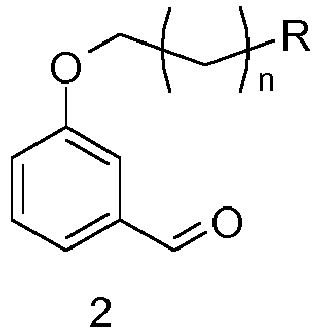
- the compound of formula 4 or a salt thereof can be prepared by contacting a compound of formula 2: with nitromethane in the presence of a chiral reagent, to form a compound of formula 3: then reducing the nitro group to an amine group.
- Suitable chiral reagents include 1,7,7-trimethyl-N-(pyridin-2-ylmethyl)bicyclo[2.2.1]heptan-2-amine di-hydrochloride; (4S)-4-ethyl-2- ⁇ 1-ethyl-1-[(4S)-4-(1-methylethyl)-4,5-dihydro-1,3-oxazol-2-yl]propyl ⁇ -4,5-dihydro-1,3-oxazole; (S)-4-(tert-butyl)-2-(2-((S)-4-methyl-4,5-dihydrooxazol-2-yl)propan-2-yl)-4,5-dihydrooxazole; or N1,N2-bis[(1R,2R,4R)-1,7,7-trimethylbicyclo[2.2.1]hept-2-yl]-1,2-ethanediamine in the presence of a suitable catalyst such as Co(OAc) 2 , Cu(OAc)
- Suitable nitro-reducing agents include Pd/C, Pt/C or a mixture thereof, in the presence of hydrogen.
- the compound of formula 2 is conveniently prepared by reaction of R 1 (CH 2 ) 3 -X with 3-hydroxybenzaldehyde in the presence of a suitable base, examples of which include hydroxide and carbonate bases.
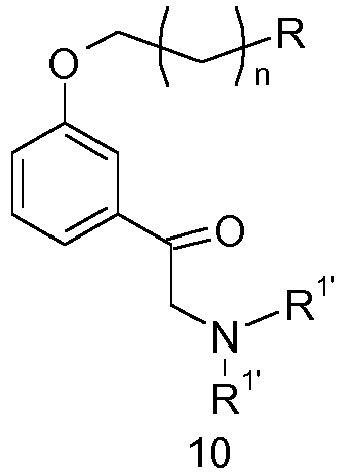
- the compound of formula 5 or a salt thereof can be prepared by enantioselective reduction of a compound of formula 10: or a salt thereof.
- Examples of an enantioselective reduction reagents include H 2 and ruthenium-, rhodium- or iridium-based catalyst such as ( S )-2-[( S P )-2-(diphenylphosphino)ferrocenyl]-4-isopropyl-2-oxazoline triphenylphosphine ruthenium(II) dichloride complex (also known as Naud catalyst); (R)-BINAP-Ru-(R,R)-(+)-DPEN Cl (also known as Noyori catalyst), or oxazaborolidine-catalyzed borane reduction.
- ruthenium-, rhodium- or iridium-based catalyst such as ( S )-2-[( S P )-2-(diphenylphosphino)ferrocenyl]-4-isopropyl-2-oxazoline triphenylphosphine ruthenium(II) dichloride complex (also
- the compound of formula 10 or a salt thereof can be prepared by contacting HN(R 1' ) 2 with a compound of formula 9:
- the compound of formula 9 can be prepared by bromination of a compound of formula 8:
- Suitable brominating reagents include Br 2 in dichloromethane, NBS, and tetra- n- butylammonium tribromide.
- Compound 8 is prepared by contacting 3-hydroxyacetophenone with X(CH 2 ) 3 -R 1 and a suitable base, examples of which include hydroxide and carbonate bases.
- R 1 R 1' , and X are not limited to the groups specifically disclosed, nor are the processes limited to the disclosed catalysts, bases, reducing agents, and enantioselective reagents.
- 3-hydroxybenzaldehyde (compound 1) is contacted with XCH 2 (CH 2 ) n CH 2 R in the presence of a suitable base under conditions sufficient to form compound 2.
- Compound 2 is converted to the corresponding (1S)-2-nitro-1-phenylethanol (compound 3) using nitromethane and a suitable chiral reagent such as 1,7,7-trimethyl-N-(pyridin-2-ylmethyl)bicyclo[2.2.1]heptan-2-amine di-hydrochloride; (4S)-4-ethyl-2- ⁇ 1-ethyl-1-[(4S)-4-(1-methylethyl)-4,5-dihydro-1,3-oxazol-2-yl]propyl ⁇ -4,5-dihydro-1,3-oxazole; (S)-4-(tert-butyl)-2-(2-((S)-4-methyl-4,5-dihydrooxazol-2-yl)propan-2-yl)-4,5-dihydrooxazole; or N1,N2-bis[(1R,2R,4R)-1,7,7-trimethylbicyclo[2.2.1]hept-2
- Compound 5 or a salt thereof is borylated with a suitable borylating reagent in the presence of a strong base such as n -BuLi, n -hexyllithium, or sec-BuLi to form Compound 6.
- a strong base such as n -BuLi, n -hexyllithium, or sec-BuLi
- This intermediate is deprotected to form the aminomethyl benzoxaborole, preferably (3 S )-3-(aminomethyl)-7-[(3-hydroxypropyl)oxy]-2,1-benzoxaborol-1(3 H )-ol.
- This product is advantageously isolated as a hydrochloride salt, and can be further purified by way of recrystallization.
- 3-hydroxyacetophenone (compound 7) is contacted with XCH 2 (CH 2 ) n CH 2 -R in the presence of a suitable base under conditions sufficient to form compound 8.
- Bromination with a suitable brominating reagent results in the formation of the bromoketone (compound 9), which in turn is contacted with HN(R 1' ) 2 under conditions sufficient to form the protected amine (compound 10).
- Compound 10 or a salt thereof is enantioselectively reduced to the corresponding (1S)-2-amino-1-phenylethanol (Compound 5) under enantioselective reductions conditions.
- reaction temperature was maintained at -30°C for 24 - 48 h.
- trifluoroacetic acid (952 mg) was charged to the reaction, and the contents were transferred to a separate reactor containing a room temperature solution of 1 N HCl (75 mL) and t -butyl methyl ether (TBME, 150 mL).
- TBME t -butyl methyl ether
- the layers were allowed to separate and the aqueous phase removed.
- the organic phase was then washed with water (75 mL) and the aqueous phase removed.
- the solution of product in TBME was then filtered through a pad of silica gel (15 g) which was rinsed with TBME.
- the product was stored cold as a solution in TBME, to be swapped to ethanol prior to the subsequent hydrogenation step.
- Powdered potassium carbonate (12.8 g) was charged to a 250-mL reactor, followed by the ethanolic solution of (1 S )-2-amino-1-[3-( ⁇ 3-[(phenylmethyl)oxy]propyl ⁇ oxy)phenyl]ethanol (12.7 g in 100 mL). Additional ethanol was charged into the slurry (40 mL). Benzyl bromide (15.9 g) was charged to the reactor, and the slurry was stirred at 20-25 °C for 18 h - 24 h, after which time, the solids were filtered and washed with ethanol (50 mL). The filtrate was diluted with water (50 mL) then heated to 50 °C.
- the mixture was then cooled to -20 to -40 °C whereupon 1.0 equiv of n BuLi (14.8 mL) was added at such a rate to maintain the temperature to below -20 °C.
- n BuLi (14.8 mL) was added at such a rate to maintain the temperature to below -20 °C.
- the temperature was adjusted to -30 to -40 °C and n BuLi (43 mL) was added as quickly as possible ( ⁇ 10 minutes) while still keeping the temperature below -20 °C during addition.
- the temperature was adjusted to -20 to -25 °C and stirred for 1 hr.
- the mixture was cooled to -75 to -80 °C and an aliquot was quenched directly into CD 3 OD.
- Powdered potassium carbonate (12.8 g) was charged to a 250-mL reactor, followed by the ethanolic solution of (1 S )-2-amino-1-[3-( ⁇ 3-[(phenylmethyl)oxy]propyl ⁇ oxy)phenyl]ethanol (12.7 g in 100 mL). Additional ethanol was charged into the slurry (40 mL). Benzyl bromide (15.9 g) was charged to the reactor, and the slurry was stirred at 20-25 °C for 18 h - 24 h, after which time, the solids were filtered and washed with ethanol (50 mL). The filtrate was diluted with water (50 mL) then heated to 50 °C.
- the mixture was then cooled to -20 to -40 °C whereupon 1.0 equiv of n BuLi (14.8 mL) was added at such a rate to maintain the temperature to below -20 °C.
- n BuLi (14.8 mL) was added at such a rate to maintain the temperature to below -20 °C.
- the temperature was adjusted to -30 to -40 °C and n BuLi (43 mL) was added as quickly as possible ( ⁇ 10 minutes) while still keeping the temperature below -20 °C during addition.
- the temperature was adjusted to -20 to -25 °C and stirred for 1 hr.
- the mixture was cooled to -75 to -80 °C and an aliquot was quenched directly into CD 3 OD.
- the reaction was then diluted with 10 mL of TBME, then 5 mL of saturated NaHCO 3 solution was added. After vigorously stirring for about 30 min, the organic layer was washed with 5 mL of 0.1 M NaH 2 PO 4 , then 5 mL of saturated NaHCO 3 . The organic layer was then dried over Na 2 SO 4 and concentrated.
Landscapes
- Chemical & Material Sciences (AREA)
- Organic Chemistry (AREA)
- Health & Medical Sciences (AREA)
- Chemical Kinetics & Catalysis (AREA)
- Life Sciences & Earth Sciences (AREA)
- General Chemical & Material Sciences (AREA)
- Medicinal Chemistry (AREA)
- Nuclear Medicine, Radiotherapy & Molecular Imaging (AREA)
- Communicable Diseases (AREA)
- Pharmacology & Pharmacy (AREA)
- Oncology (AREA)
- Animal Behavior & Ethology (AREA)
- General Health & Medical Sciences (AREA)
- Public Health (AREA)
- Veterinary Medicine (AREA)
- Heterocyclic Carbon Compounds Containing A Hetero Ring Having Nitrogen And Oxygen As The Only Ring Hetero Atoms (AREA)
- Organic Low-Molecular-Weight Compounds And Preparation Thereof (AREA)
- Pharmaceuticals Containing Other Organic And Inorganic Compounds (AREA)
Description
- The present invention relates to benzoxaboroles and methods for their preparation. The hydrochloride salt of (35)-3-(aminomethyl)-7-[(3-hydroxypropyl)oxy]-2,1-benzoxaborol-1(3H)-ol, disclosed in
U.S. Pat. App. No. 12/142,692 , nowU.S. Patent No. 7,816,344 , is characterized by the following formula:
- In one aspect, the present invention is a compound characterized by formula 6 and also a process comprising deprotecting a compound of formula 6:

under deprotecting conditions to form a compound of formula A:
where R is H or OR1; R1 and each R1' are each protecting groups; R1" is H or OH; and n is 0, 1, 2, 3, 4 or 5. - In a second aspect, the present invention is a process comprising the steps of
- a) contacting a compound of formula 2:


- b) reducing the compound of formula 3 to form a compound of formula 4:

- c) contacting the compound of formula 4 or a salt thereof with R1 X with a base to form a compound of
formula 5:
- d) contacting the compound of formula 5 or a salt thereof with a borylating reagent characterized by the following formula:


where each R2 is independently C1-alkyl, C2-alkyl, C3-alkyl, C4-alkyl, C5-alkyl, C6-alkyl, or together with the oxygen atoms to which they are attached form a 5- or 6-membered ring; and R3 is C1-alkyl, C2-alkyl, C3-alkyl, C4-alkyl, C5-alkyl, C6-alkyl; and - e) deprotecting the compound of formula 6 or a pharmaceutically acceptable salt thereof to form a compound of formula A or a pharmaceutically acceptable salt thereof:
- In another aspect the present invention is a process comprising the steps of:
- a) brominating a compound of formula 8:


- b) contacting the compound of formula 9 with HN(R1')2 to form a compound of formula 10:
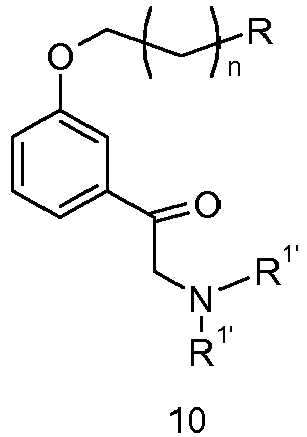
where each R1' is a protecting group; - c) enantioselectively reducing the compound of formula 10 to form a compound of formula 5:
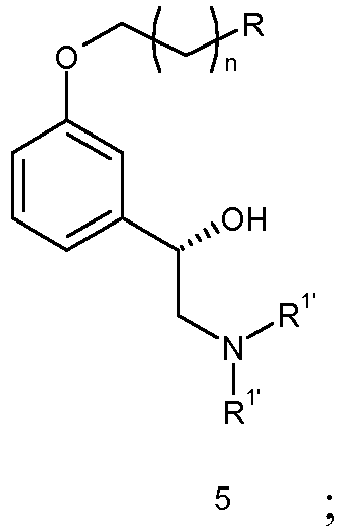
- d) contacting the compound of formula 5 or a salt thereof with a borylating reagent
characterized by the following formula:
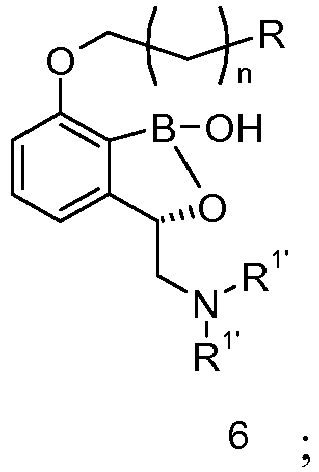
where each R2 is independently C1-C6-alkyl, or together with the oxygen atoms to which they are attached form [as above] a 5- or 6-membered ring; and R3 is C1-C6-alkyl; and - e) deprotecting the compound of formula 6 or a pharmaceutically acceptable salt thereof to form a compound of formula A or a pharmaceutically acceptable salt thereof:

- In another aspect, the present invention is a compound characterized by the following formula 6a:

where R1" is H or OH; and R1' is a protecting group. - In a first aspect, the present invention is a process comprising deprotecting a compound of formula 6:
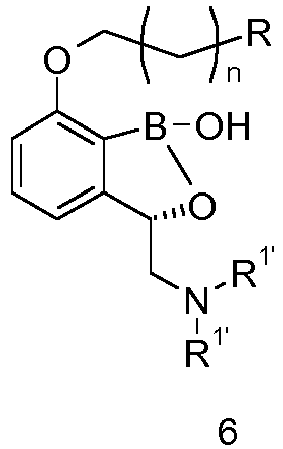
under deprotecting conditions to form a compound of formula A:
where R is H or OR1; R1 and each R1' are protecting groups; R1" is H or OH; and n is 0, 1, 2, 3, 4, or 5. - Examples of suitable R1 protecting groups include -CH(Ra)-phenyl-(Rb)x, trialkylsilyl, tetrahydropyranyl, -CH2OCH3, or -CH2OCH2CH2OCH3 groups, where Ra is H, C1-alkyl, C2-alkyl, C3-alkyl, C4-alkyl or phenyl; each Rb is independently C1-alkyloxy, C2-alkyloxy, C3-alkyloxy, C4-alkyloxy; or C1-alkyl, C2-alkyl, C3-alkyl, C4-alkyl; and x is 0, 1, or 2. In an embodiment, R1 is benzyl.
C1-C4-alkyl refers to C1-alkyl, C2-alkyl, C3-alkyl, C4-alkyl, e.g. methyl, ethyl, n-propyl, isopropyl, n-butyl, sec-butyl, and t-butyl. Similarly, C1-C4-alkoxy refers to C1-alkyloxy, C2-alkyloxy, C3-alkyloxy, C4-alkyloxy e.g. methoxy, ethoxy, n-propoxy, isopropoxy, n-butoxy, sec-butoxy, and t-butoxy. C1-C6-alkyl refers to C1-alkyl, C2-alkyl, C3-alkyl, C4-alkyl, C5-alkyl, C6-alkyl. - Examples of suitable R1' protecting groups include -CH(Rb)-phenyl-(Rc)y; examples of such groups include benzyl, 1-phenylethyl, 2-methoxybenzyl, 3-methoxybenzyl, 4-methoxybenzyl, 2,4-dimethoxybenzyl, and diphenylmethyl groups; in another aspect, each R1' is benzyl.
- Suitable deprotection methods include metal catalyzed hydrogenation, catalytic transfer hydrogenation, or acid cleavage. Where R1' is benzyl, preferred deprotection reagents include H2 over Pd/C, H2 over Pt/C, H2 over palladium hydroxide, or ammonium formate and Pd/C.
- In an embodiment, n is 0, 1, 2 or 3; preferably, n is 2.
As used herein, "a pharmaceutically acceptable salt" refers to an acid addition salt. Examples of suitable acid addition salts are inorganic acid salts and organic salts; Examples of suitable inorganic salts include hydrochloric, hydrobromic, phosphoric, metaphosphoric, nitric, and sulfuric acid salts; examples of suitable organic acid salts include tartaric, acetic, trifluoroacetic, citric, malic, lactic, fumaric, benzoic, formic, propionic, glycolic, gluconic, maleic, succinic, methanesulfonic, ethanesulfonic, stearic, benzenesulfonic, bromobenzenesulfonic, and p-toluenesulfonic acid salts. The pharmaceutically acceptable salt of A is preferably an HCl salt. - In another embodiment, the compound of formula 6 is reduced in the presence of HCl to form the hydrochloride salt of the compound of formula A.
- In another embodiment of the present invention, the compound of formula 6 is prepared by contacting a compound of formula 5:

- The borylating reagent is characterized by the following formula:

- Each R2 is independently C1-alkyl, C2-alkyl, C3-alkyl, C4-alkyl, C5-alkyl, C6-alkyl and each R3 is C1-alkyl, C2-alkyl, C3-alkyl, C4-alkyl, C5-alkyl, C6-alkyl. Preferably, each R2 is the same alkyl group; alternatively, the R2 groups, together with the oxygen atoms to which they are attached form a 5- or 6-membered ring, which may be optionally fused to an aryl ring. Examples of suitable borylating reagents include isopropylpinacolborate, 2-(methoxy)-1,3,2-benzodioxaborole, and tri-C1-borates, tri-C2-borates and tri-C3-borates such as triisopropyl borate and trimethyl borate. In an embodiment, the borylating reagent is isopropylpinacolborate or trimethyl borate.
- The compound of formula 5 or a salt thereof can be prepared by contacting under basic conditions R1'X with a compound of formula 4:

wherein X is a suitable leaving group such as a Br, Cl, I, tosyl, or triflyl group. Suitable bases include carbonates such as sodium potassium, and cesium carbonates, or hydroxides such as tetrabutylammonium hydroxide. - The compound of formula 4 or a salt thereof can be prepared by contacting a compound of formula 2:
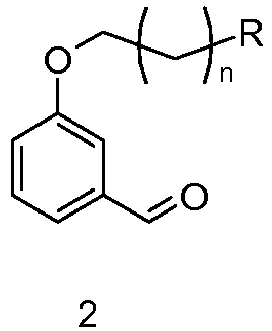

- Examples of suitable chiral reagents include 1,7,7-trimethyl-N-(pyridin-2-ylmethyl)bicyclo[2.2.1]heptan-2-amine di-hydrochloride; (4S)-4-ethyl-2-{1-ethyl-1-[(4S)-4-(1-methylethyl)-4,5-dihydro-1,3-oxazol-2-yl]propyl}-4,5-dihydro-1,3-oxazole; (S)-4-(tert-butyl)-2-(2-((S)-4-methyl-4,5-dihydrooxazol-2-yl)propan-2-yl)-4,5-dihydrooxazole; or N1,N2-bis[(1R,2R,4R)-1,7,7-trimethylbicyclo[2.2.1]hept-2-yl]-1,2-ethanediamine in the presence of a suitable catalyst such as Co(OAc)2, Cu(OAc)2, CuCl2, Zn(OTf)2., or Zn(Et)2.
- Examples of suitable nitro-reducing agents would include Pd/C, Pt/C or a mixture thereof, in the presence of hydrogen.
- The compound of formula 2 is conveniently prepared by reaction of R1(CH2)3-X with 3-hydroxybenzaldehyde in the presence of a suitable base, examples of which include hydroxide and carbonate bases.
- Alternatively, the compound of formula 5 or a salt thereof can be prepared by enantioselective reduction of a compound of formula 10:

- Examples of an enantioselective reduction reagents include H2 and ruthenium-, rhodium- or iridium-based catalyst such as (S)-2-[(S P)-2-(diphenylphosphino)ferrocenyl]-4-isopropyl-2-oxazoline triphenylphosphine ruthenium(II) dichloride complex (also known as Naud catalyst); (R)-BINAP-Ru-(R,R)-(+)-DPEN Cl (also known as Noyori catalyst), or oxazaborolidine-catalyzed borane reduction.
- The compound of formula 10 or a salt thereof can be prepared by contacting HN(R1')2 with a compound of formula 9:
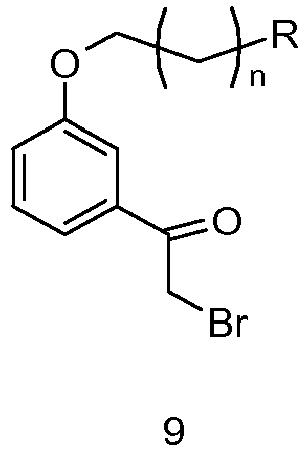
- The compound of formula 9 can be prepared by bromination of a compound of formula 8:

- Suitable brominating reagents include Br2 in dichloromethane, NBS, and tetra-n-butylammonium tribromide.
- Compound 8 is prepared by contacting 3-hydroxyacetophenone with X(CH2)3-R1 and a suitable base, examples of which include hydroxide and carbonate bases.
- The following schemes generally illustrate the processes of the present invention. R1 R1', and X are not limited to the groups specifically disclosed, nor are the processes limited to the disclosed catalysts, bases, reducing agents, and enantioselective reagents.

- In accordance with Scheme 1, 3-hydroxybenzaldehyde (compound 1) is contacted with XCH2(CH2)nCH2R in the presence of a suitable base under conditions sufficient to form compound 2.
- Compound 2 is converted to the corresponding (1S)-2-nitro-1-phenylethanol (compound 3) using nitromethane and a suitable chiral reagent such as 1,7,7-trimethyl-N-(pyridin-2-ylmethyl)bicyclo[2.2.1]heptan-2-amine di-hydrochloride; (4S)-4-ethyl-2-{1-ethyl-1-[(4S)-4-(1-methylethyl)-4,5-dihydro-1,3-oxazol-2-yl]propyl}-4,5-dihydro-1,3-oxazole; (S)-4-(tert-butyl)-2-(2-((S)-4-methyl-4,5-dihydrooxazol-2-yl)propan-2-yl)-4,5-dihydrooxazole; or N1,N2-bis[(1R,2R,4R)-1,7,7-trimethylbicyclo[2.2.1]hept-2-yl]-1,2-ethanediamine in the presence of a suitable catalyst such as Cu(OAc)2. Compound 3 is then converted to the corresponding primary amine (compound 4) then protected with R1'X to form compound 5; this intermediate may be isolated as the free base or as a salt, preferably the hydrochloride salt.
- Compound 5 or a salt thereof is borylated with a suitable borylating reagent in the presence of a strong base such as n-BuLi, n-hexyllithium, or sec-BuLi to form Compound 6. This intermediate is deprotected to form the aminomethyl benzoxaborole, preferably (3S)-3-(aminomethyl)-7-[(3-hydroxypropyl)oxy]-2,1-benzoxaborol-1(3H)-ol. This product is advantageously isolated as a hydrochloride salt, and can be further purified by way of recrystallization.

- In accordance with Scheme 2, 3-hydroxyacetophenone (compound 7) is contacted with XCH2(CH2)nCH2-R in the presence of a suitable base under conditions sufficient to form compound 8. Bromination with a suitable brominating reagent results in the formation of the bromoketone (compound 9), which in turn is contacted with HN(R1')2 under conditions sufficient to form the protected amine (compound 10).
- Compound 10 or a salt thereof is enantioselectively reduced to the corresponding (1S)-2-amino-1-phenylethanol (Compound 5) under enantioselective reductions conditions.
- Compound 5 or a salt thereof is then borylated and deprotected as described in Scheme 1 to form the aminomethyl benzoxaborole, preferably (3S)-3-(aminomethyl)-7-[(3-hydroxypropyl)oxy]-2,1-benzoxaborol-1(3H)-ol, preferably as the hydrochloride salt.
- The following examples are illustrative of the process of the present invention and are not intended to limit the scope of the invention.
-

- To a 3-L reaction vessel was charged and stirred cesium carbonate (209.6 g), 3-hydroxybenzaldehyde (67.6 g), dimethylformamide (DMF, 250 mL) and 3-bromopropyl phenylmethyl ether (113.4 g) at ambient temperature for ∼18 h. Water (567 mL) was added followed by tert-butyl methyl ether (907 mL). The bottom aqueous layer was separated and the organic layer washed with 1N sodium hydroxide (2 x 567 mL) and water (1 x 567 mL). The organic solution was concentrated to a minimum after which ethanol (200 proof, 907 mL) was added and the solution concentrated to a minimum and filtered though a 1-µm filter. 1B. Preparation of (1S)-2-Nitro-1-[3-({3-[(phenylmethyl)oxy]propyl}oxy)phenyl]ethanol

- Copper (II) acetate and camphoraminomethylpyridine bis-HCl salt (504 mg) were charged to a reactor, followed by ethanol (60 mL) and diisopropylethylamine (1.16 mL). The contents were stirred for 1 h at room temperature, at which time a solution of 3-({3-[(phenylmethyl)oxy]propyl}oxy)benzaldehyde in ethanol (15 g in 15 mL) was charged. The reaction mixture was cooled to -30°C to -40°C, whereupon nitromethane (33.9 g) was added slowly to the reaction, maintaining a temperature below -30°C, followed by diisopropylethylamine (359 mg). The reaction temperature was maintained at -30°C for 24 - 48 h. When the reaction was complete, trifluoroacetic acid (952 mg) was charged to the reaction, and the contents were transferred to a separate reactor containing a room temperature solution of 1 N HCl (75 mL) and t-butyl methyl ether (TBME, 150 mL). After the addition was complete, the layers were allowed to separate and the aqueous phase removed. The organic phase was then washed with water (75 mL) and the aqueous phase removed. The solution of product in TBME was then filtered through a pad of silica gel (15 g) which was rinsed with TBME. The product was stored cold as a solution in TBME, to be swapped to ethanol prior to the subsequent hydrogenation step.
-

- The (1S)-2-nitro-1-[3-({3-[(phenylmethyl)oxy]propyl}oxy)phenyl]ethanol in ethanol solution (8 g in 160 mL) was hydrogenated using a Pd (4%) /Pt(1%)/C catalyst (1.6 g). Upon consumption of the starting material and the hydroxylamine intermediate, the reaction product in ethanol was filtered.
-
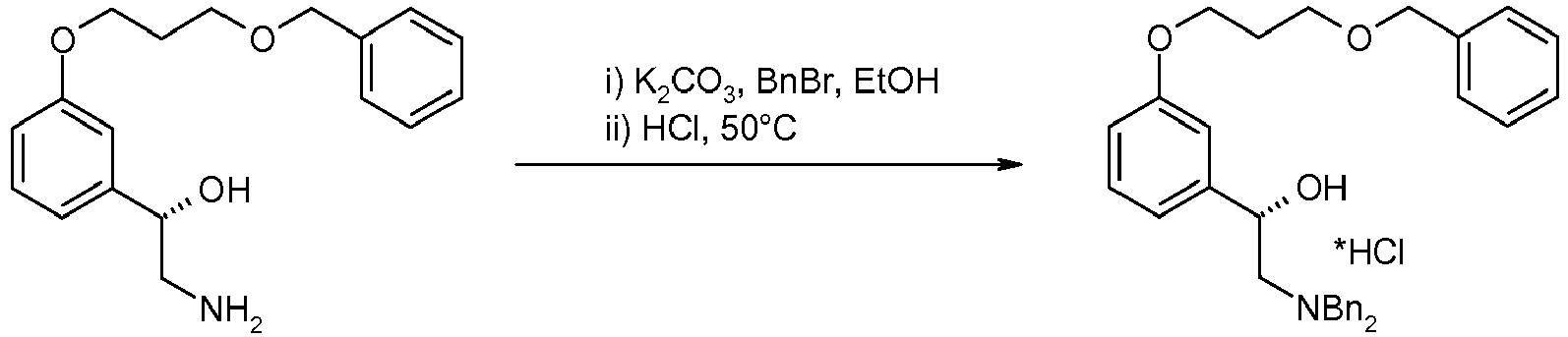
- Powdered potassium carbonate (12.8 g) was charged to a 250-mL reactor, followed by the ethanolic solution of (1S)-2-amino-1-[3-({3-[(phenylmethyl)oxy]propyl}oxy)phenyl]ethanol (12.7 g in 100 mL). Additional ethanol was charged into the slurry (40 mL). Benzyl bromide (15.9 g) was charged to the reactor, and the slurry was stirred at 20-25 °C for 18 h - 24 h, after which time, the solids were filtered and washed with ethanol (50 mL). The filtrate was diluted with water (50 mL) then heated to 50 °C. Concentrated HCl (3.52 mL) was charged to the reactor resulting the precipitation of the HCl salt of the product. At the onset of precipitation, the slurry was held at 50 °C for 30 min, then cooled to 0 °C and held at 0 °C for an additional 30 min. The product was filtered and washed with a 0 °C solution of 20 % aqueous ethanol (∼ 60 mL).
-
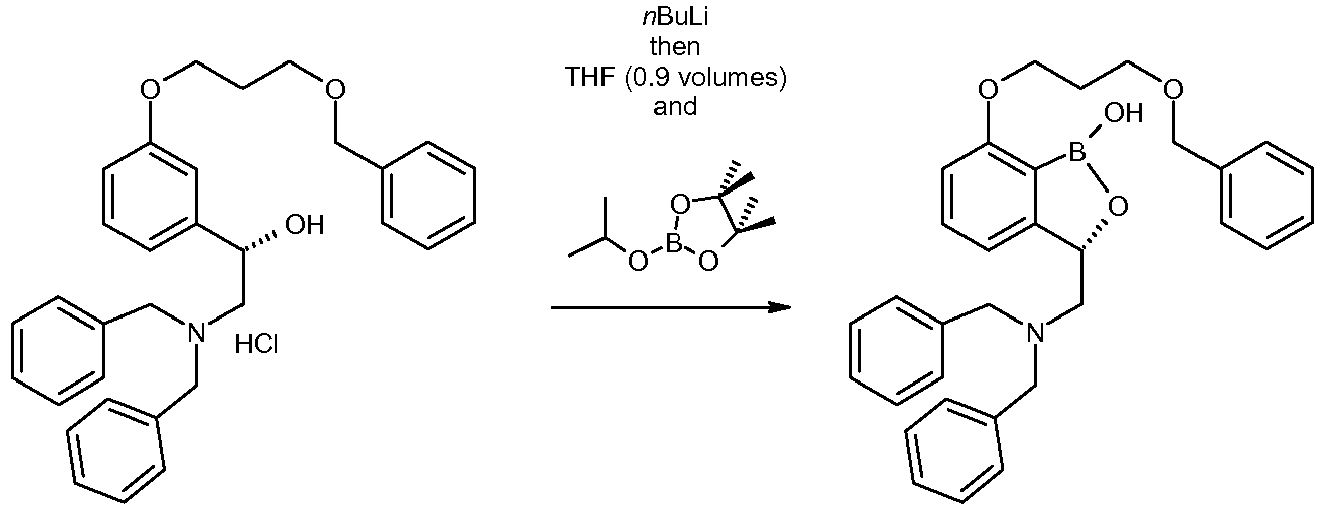
- (1S)-2-[Bis(phenylmethyl)amino]-1-[3-({3-[(phenylmethyl)oxy]propyl}oxy)phenyl]ethanol hydrochloride (20 g) and toluene (160 mL) were charged into the 250-mL reactor. The contents were mixed thoroughly for about 5 min after which the mixture was degassed by placing the reactor under vacuum and backfilling with nitrogen; and repeating two times. The suspension was heated to 50 - 55 °C, at which time nBuLi (16.3 mL, 2.6 M) was added over about 1 h with vigorous mixing. The mixture was then stirred for about 1 h at 50-55 °C, at which time the starting material was observed to be consumed. The mixture was then cooled to -20 to -40 °C whereupon 1.0 equiv of nBuLi (14.8 mL) was added at such a rate to maintain the temperature to below -20 °C. Upon completion of addition, the temperature was adjusted to -30 to -40 °C and nBuLi (43 mL) was added as quickly as possible (< 10 minutes) while still keeping the temperature below -20 °C during addition. The temperature was adjusted to -20 to -25 °C and stirred for 1 hr. The mixture was cooled to -75 to -80 °C and an aliquot was quenched directly into CD3OD. Once complete deuterium incorporation was observed, evidenced by LCMS, THF (18 mL) was added directly followed by rapid addition of the borate (36 mL). The mixture was warmed to 15-25 °C over 30 min to 1 h, 5% aq. NaHCO3 (200 mL) was then added and the mixture was stirred vigorously for ∼ 15 min. The resulting suspension was filtered and the cake rinsed with at least 30 mL of TBME. The filtrate was allowed to separate and the organic layer was then washed three or four times with water (100 mL), allowing the last wash at least 1 h to settle. The organic layer was concentrated to about 40 mL.
-

- To a solution of (3S)-3-(aminomethyl)-7-[(3-hydroxypropyl)oxy]-2,1-benzoxaborol-1(3H)-ol hydrochloride in toluene (∼46 mL) was added methanol (200 mL), 1 N HCl in water (42.5 mL), and 5% Pd/C catalyst (2 g, 11 wt%). The resulting mixture was treated with hydrogen gas at 100 psig and 50°C. Upon consumption of the mono N-benzyl amine intermediate, the reaction solution was filtered through a filtering aid, followed by a 1 µm filtration. The filtered solution of crude product was then distilled, 2-propanol added (200 mL), then distilled again to minimum stirrable volume. This concentrated solution was allowed to crystallize at room temperature, then filtered and washed with 2-propanol. 1H NMR: (d4-methanol, 400.13 MHz) d (ppm) 7.48 (t, J = 7.81 Hz, 1 H), 7.01 (d, J = 7.58 Hz, 1 H), 6.93 (d, J = 8.21 Hz, 1 H), 5.37 (dd, J = 2.76, 8.77 Hz, 1 H), 4.18 (t, J = 6.11 Hz, 2 H), 3.78 (t, J = 5.47 Hz, 2 H), 3.59 (dd, J = 2.87, 13.29 Hz, 1 H), 2.92 (dd, J = 8.86, 13.29 Hz, 1 H), 2.00 (m, J = 6.13 Hz, 2 H). The accurate mass of the protonated molecule of [M + H]+ was measured at m/z 238.1247 using positive ion electrospray ionization. The calculated mass of this ion is at m/z 238.1251. Chiral purity was found to be 99.9% using chiral HPLC .
-

- To a 3-L reaction vessel was charged and stirred potassium carbonate (152 g), 3-hydroxybenzaldehyde (67.6 g), dimethylformamide (DMF, 250 mL) and 3-chloropropyl phenylmethyl ether (96.4g) at 90 °C for ∼18 h. Water (567 mL) was added followed by tert-butyl methyl ether (907 mL). The bottom aqueous layer was separated and the organic layer washed with 1N sodium hydroxide (2 x 567 mL) and water (1 x 567 mL). The organic solution was concentrated to a minimum after which ethanol (200 proof, 907 mL) was added and the solution concentrated to a minimum and filtered though a 1-µm filter. 2B. Preparation of (1S)-2-Nitro-1-[3-({3-[(phenylmethyl)oxy]propyl}oxy)phenyl]ethanol

- Copper (II) acetate monohydrate (3.70 g, 0.05 eq) and bis-camphorethylenediamine (N1,N2-bis[(1R,2R,4R)-1,7,7-trimethylbicyclo[2.2.1]hept-2-yl]-1,2-ethanediamine) (7.38 g, 0.06 eq) were charged to a reactor, followed by ethanol (200 mL, 2 vol). The contents were heated to 50-60 °C for ∼1h or until all solids dissolved, then cooled to room temperature and stirred, at which time a solution of 3-({3-[(phenylmethyl)oxy]propyl}oxy)benzaldehyde in ethanol (100 g, 1 eq in 50 mL, 0.5 vol) was charged. The reaction mixture was cooled to -10°C to -20°C, whereupon nitromethane (112.7 g, 5 eq) was added slowly to the reaction, maintaining a temperature below -10°C, followed by diisopropylethylamine (1.94 mL, 1.44 g, 0.03 eq). The reaction temperature was maintained at -10°C for ∼22 -30h. When the reaction was complete, a room temperature solution of 1 N HCl (250 mL, 2.5 vol) and t-butyl methyl ether (TBME, 500 mL, 5 vol) were charged to the reaction vessel. Following the addition, the contents were stirred for ∼ 5 minutes and brought to 20 °C (∼ room temperature), and then the layers were allowed to separate and the aqueous phase removed. The organic phase was then washed 2x with water (250 mL, 2.5 vol) and each time the aqueous phase removed. TBME was then distilled off and replaced with absolute ethanol.
-

- The (16)-2-nitro-1-[3-({3-[(phenylmethyl)oxy]propyl}oxy)phenyl]ethanol in ethanol solution (8 g in 160 mL) was hydrogenated using a Pd (4%) /Pt(1%)/C catalyst (1.6 g). Upon consumption of the starting material and the hydroxylamine intermediate, the reaction product in ethanol was filtered.
-

- Powdered potassium carbonate (12.8 g) was charged to a 250-mL reactor, followed by the ethanolic solution of (1S)-2-amino-1-[3-({3-[(phenylmethyl)oxy]propyl}oxy)phenyl]ethanol (12.7 g in 100 mL). Additional ethanol was charged into the slurry (40 mL). Benzyl bromide (15.9 g) was charged to the reactor, and the slurry was stirred at 20-25 °C for 18 h - 24 h, after which time, the solids were filtered and washed with ethanol (50 mL). The filtrate was diluted with water (50 mL) then heated to 50 °C. Concentrated HCl (3.52 mL) was charged to the reactor resulting the precipitation of the HCl salt of the product. At the onset of precipitation, the slurry was held at 50 °C for 30 min, then cooled to 0 °C and held at 0 °C for an additional 30 min. The product was filtered and washed with a 0 °C solution of 20 % aqueous ethanol (∼ 60 mL).
-
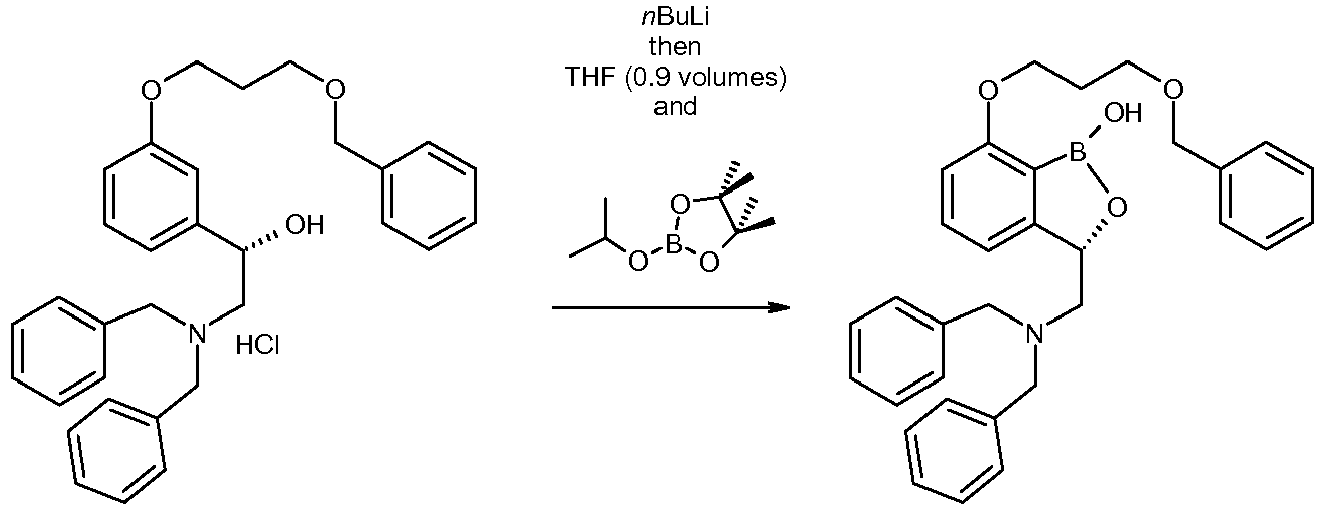
- (1S)-2-[Bis(phenylmethyl)amino]-1-[3-({3-[(phenylmethyl)oxy]propyl}oxy)phenyl]ethanol hydrochloride (20 g) and toluene (160 mL) were charged into the 250-mL reactor. The contents were mixed thoroughly for about 5 min after which the mixture was degassed by placing the reactor under vacuum and backfilling with nitrogen; and repeating two times. The suspension was heated to 50 - 55 °C, at which time nBuLi (16.3 mL, 2.6 M) was added over about 1 h with vigorous mixing. The mixture was then stirred for about 1 h at 50-55 °C, at which time the starting material was observed to be consumed. The mixture was then cooled to -20 to -40 °C whereupon 1.0 equiv of nBuLi (14.8 mL) was added at such a rate to maintain the temperature to below -20 °C. Upon completion of addition, the temperature was adjusted to -30 to -40 °C and nBuLi (43 mL) was added as quickly as possible (< 10 minutes) while still keeping the temperature below -20 °C during addition. The temperature was adjusted to -20 to -25 °C and stirred for 1 hr. The mixture was cooled to -75 to -80 °C and an aliquot was quenched directly into CD3OD. Once complete deuterium incorporation was observed, evidenced by LCMS, THF (18 mL) was added directly followed by rapid addition of the borate (36 mL). The mixture was warmed to 15-25 °C over 30 min to 1 h, 5% aq. NaHCO3 (200 mL) was then added and the mixture was stirred vigorously for ∼ 15 min. The resulting suspension was filtered and the cake rinsed with at least 30 mL of TBME. The filtrate was allowed to separate and the organic layer was then washed three or four times with water (100 mL), allowing the last wash at least 1 h to settle. The organic layer was concentrated to about 40 mL.
-

- To a solution of (3S)-3-(aminomethyl)-7-[(3-hydroxypropyl)oxy]-2,1-benzoxaborol-1(3H)-ol hydrochloride in toluene (∼46 mL) was added methanol (200 mL), 1 N HCl in water (42.5 mL), and 5% Pd/C catalyst (2 g, 11 wt%). The resulting mixture was treated with hydrogen gas at 100 psig and 50°C. Upon consumption of the mono N-benzyl amine intermediate, the reaction solution was filtered through a filtering aid, followed by a 1 µm filtration. The filtered solution of crude product was then distilled, 2-propanol added (200 mL), then distilled again to minimum stirrable volume. This concentrated solution was allowed to crystallize at room temperature, then filtered and washed with 2-propanol. 1H NMR: (d4-methanol, 400.13 MHz) d (ppm) 7.48 (t, J = 7.81 Hz, 1 H), 7.01 (d, J = 7.58 Hz, 1 H), 6.93 (d, J = 8.21 Hz, 1 H), 5.37 (dd, J = 2.76, 8.77 Hz, 1 H), 4.18 (t, J = 6.11 Hz, 2 H), 3.78 (t, J = 5.47 Hz, 2 H), 3.59 (dd, J = 2.87, 13.29 Hz, 1 H), 2.92 (dd, J = 8.86, 13.29 Hz, 1 H), 2.00 (m, J = 6.13 Hz, 2 H). The accurate mass of the protonated molecule of [M + H]+ was measured at m/z 238.1247 using positive ion electrospray ionization. The calculated mass of this ion is at m/z 238.1251. Chiral purity was found to be 99.9% using chiral HPLC.
-
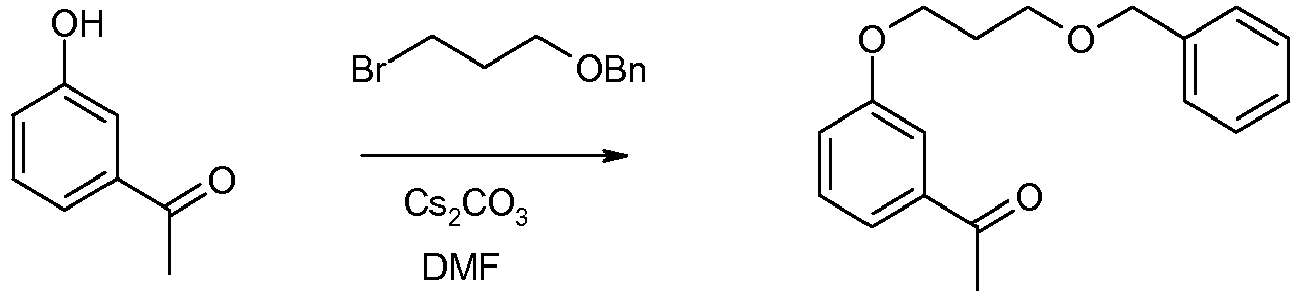
- To a solution of 3-hydroxyacetophenone (5.5 g) in dimethylformamide (18 mL) was added 3-bromopropyl phenylmethyl ether (9.25 g) at ambient temperature followed by cesium carbonate (17 g). The suspension was stirred for 24 h and water was added followed by ethyl acetate. The organic layer was separated and the aqueous layer extracted with ethyl acetate. The organic layers were combined and washed twice with 2 N sodium hydroxide, four times with brine, and concentrated in vacuo to an oil to give the title compound. 3B. Preparation of 2-Bromo-1-[3-({3-[(phenylmethyl)oxy]propyl}oxy)phenyl]ethanone

- To a solution of 1-[3-({3-[(phenylmethyl)oxy]propyl}oxy)phenyl]ethanone (10.59 g) in tetrahydrofuran (50 mL) was added methanol (50 mL) and a solution of tetrabutylammonium tribromide (16 g) in tetrahydrofuran (50 mL). The reaction was stirred at ambient temperature for 45 min at which time tetrabutylammonium tribromide (0.89 g) was added, followed by further addition of 0.6 g. 10% aqueous sodium thiosulfate was added to the reaction and the mixture was concentrated in vacuo to a minimum volume. Ethyl acetate was added and the resultant organic solution was washed with aqueous sodium thiosulfate, saturated sodium bicarbonate and brine and concentrated to an oil to afford the title compound.
-

- To a mixture of 2-bromo-1-[3-({3-[(phenylmethyl)oxy]propyl}oxy)phenyl]ethanone (13.17 g), dibenzylamine (6.4 g) and dichloromethane (25 mL) was added a solution of sodium carbonate (7.6 g) in water (50 mL). The reaction mixture was stirred at ambient temperature overnight. The organic layer was separated and concentrated to a minimum and tert-butyl methyl ether was added. The organic layer was washed with dilute acetic acid (4 times) and 0.1 N sodium hydroxide once and brine once. The organic solution was concentrated to dryness. The oil was washed with methanol and purified by chromatography to give the title compound.
-

- A mixture of 2-[bis(phenylmethyl)amino]-1-[3-({3[(phenylmethyl)oxy]propyl}oxy)phenyl]-ethanone, catalyst SK-N003-2z (Naud catalyst, 47 mg) and 1M sodium hydroxide (2.085 mL) in tetrahydrofuran (10 mL) was set under hydrogen at 150 psi for 4 h. The reaction mixture was then filtered through silica gel. The crude filtrate was purified by chromatography eluting with tert-butyl methyl ether- hexane (0-60%) to yield the desired product as a yellow oil.
-

- To a solution of (1S)-2-[bis(phenylmethyl)amino]-1-[3-({3-[(phenylmethyl)oxy]propyl}oxy)phenyl]ethanol (240 mg, 0.50 mmol) in 5 mL of toluene at - 20 °C was added 1.75 mmol of nBuLi in hexane (2.59 M, 0.67 mL) over about 5 minutes. The mixture was then stirred for 2 h and then quenched with freshly distilled trimethylborate (0.28 mL, 259 mg, 2.5 mmol). The cold bath was removed and the mixture warmed to room temperature. The reaction was then diluted with 10 mL of TBME, then 5 mL of saturated NaHCO3 solution was added. After vigorously stirring for about 30 min, the organic layer was washed with 5 mL of 0.1 M NaH2PO4, then 5 mL of saturated NaHCO3. The organic layer was then dried over Na2SO4 and concentrated.
Claims (21)
- A process comprising contacting a compound of formula 6:

with a deprotecting reagent to form a compound of formula A: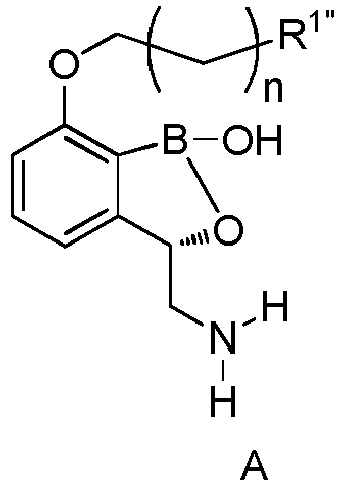
where R is H or OR1; R1 and each R1' are each independently protecting groups; R1" is H or OH; and n is 0, 1, 2, 3, 4 or 5. - The process of Claim 1 wherein
R is OR1;
R1 is -CH(Ra)-phenyl-(Rb)x, trialkylsilyl, tetrahydropyranyl, -CH2OCH3,
or -CH2OCH2CH2OCH3 groups, where Ra is H or methyl; Rb is methoxy or C1-alkyl, C2-alkyl, or C3-alkyl; and x is 0, 1 or 2; and
each R1' is independently -CH(Rc)-phenyl-(Rd)y, where Rc is H or methyl, each Rd is independently methoxy or C1-alkyl, C2-alkyl, or C3-alkyl; n is 0, 1, 2 or 3, and y is 0, 1 or 2. - The process of Claim 1 wherein R is OR1; R1 and each R1' are benzyl groups; the deprotecting reagent is a reducing reagent; n is 1; and the compound of formula 6 is reduced in the presence of HCl to form the hydrochloride salt of the compound of formula A.
- The process of Claim 3 wherein the deprotecting reagent is Pd/C or Pt/C in the presence of H2 or a mixture thereof, H2 over palladium hydroxide, or catalytic transfer hydrogenating reagent conditions.
- The process of any of Claims 1 to 4 wherein the compound of formula 6 is prepared by contacting a compound of formula 5:

- The process of Claim 5 wherein the borylating reagent is isopropylpinacolborate, or a tri-C1-borate, tri-C2-borate or tri-C3-borate; n is 0 to 3; and the alkyl lithium reagent is n-BuLi, n-hexyllithium, or sec-BuLi.
- The process of either Claim 5 or 6 wherein the borylating reagent is isopropylpinacolborate or trimethyl borate; n is 2 and the alkyl lithium reagent is n-BuLi.
- The process of Claim 5 wherein the compound of formula 5 or a salt thereof is prepared either by enantioselective reduction of a compound of formula 10
or by contacting under basic conditions R1'X with a compound of formula 4: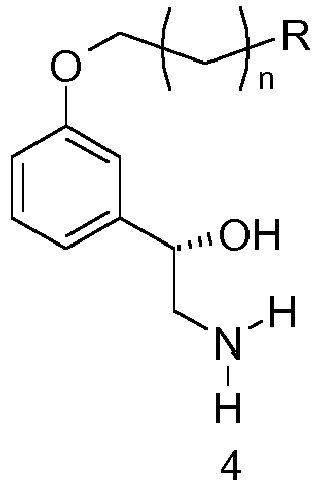
where X is a leaving group. - The process of Claim 8 wherein the compound of formula 5 or a salt thereof is prepared using H2 and Naud catalyst or H2 and Noyori catalyst; and n is 2.
- The process of Claim 8 wherein the compound of formula 5 or a salt thereof is prepared by contacting the compound of formula 4 or a salt thereof with benzyl bromide in the presence of a carbonate or a hydroxide.
- The process of Claim 10 wherein the compound of formula 4 or a salt thereof is prepared by contacting formula 2 :


- The process of Claim 11 wherein the chiral reagent is 1,7,7-trimethyl-N-(pyridin-2-ylmethyl)bicyclo[2.2.1]heptan-2-amine di-hydrochloride; (4S)-4-ethyl-2-{1-ethyl-1-[(4S)-4-(1-methylethyl)-4,5-dihydro-1,3-oxazol-2-yl]propyl}-4,5-dihydro-1,3-oxazole; (S)-4-(tert-butyl)-2-(2-((S)-4-methyl-4,5-dihydrooxazol-2-yl)propan-2-yl)-4,5-dihydrooxazole; or N1,N2-bis[(1R,2R,4R)-1,7,7-trimethylbicyclo[2.2.1]hept-2-yl]-1,2-ethanediamine and Cu(OAc)2; and n is 2.
- The process of Claim 8 wherein the compound of formula 10 or a salt thereof is prepared by contacting HN(R1')2 with a base and a compound of formula 9:

- The process of Claim 13 wherein the compound of formula 9 is prepared by bromination of a compound of formula 8:

- A process comprising the steps of:a) contacting a compound of formula 2:
 b) reducing the compound of formula 3 to form a compound of formula 4:
 c) contacting the compound of formula 4 or a salt thereof with R1'X with a base to form a compound of formula 5:
wherein R1' is a protecting group and X is a leaving group;d) contacting the compound of formula 5 or a salt thereof with a borylating reagent characterized by the following formula:

where each R2 is independently C1-alkyl, C2-alkyl, C3-alkyl, C4-alkyl, C5-alkyl, C6-alkyl, or together with the oxygen atoms to which they are attached form a 5- or 6-membered ring; and R3 is C1-alkyl, C2-alkyl, C3-alkyl, C4-alkyl, C5-alkyl, C6-alkyl; ande) contacting the compound of formula 6 or a pharmaceutically acceptable salt thereof with a deprotecting reagent to form a compound of formula A or a pharmaceutically acceptable salt thereof:
- The process of Claim 15 wherein:R1 and each R1' are benzyl groups;n is 2;the chiral reagent is Cu(OAc)2 and 1,7,7-trimethyl-N-(pyridin-2-ylmethyl)bicyclo[2.2.1]heptan-2-amine di-hydrochloride; (4S)-4-ethyl-2-{1-ethyl-1-[(4S)-4-(1-methylethyl)-4,5-dihydro-1,3-oxazol-2-yl]propyl}-4,5-dihydro-1,3-oxazole; (S)-4-(tert-butyl)-2-(2-((S)-4-methyl-4,5-dihydrooxazol-2-yl)propan-2-yl)-4,5-dihydrooxazole; orNI,N2-bis[(IR,2R,4R)-1,7,7-trimethylbicyclo[2.2.1]hept-2-yl]-1,2-ethanediamine;X is a leaving group selected from Br, Cl, I, tosyl or triflyl;the borylating reagent is isopropylpinacolborate or trimethylborate; andthe deprotecting agent is hydrogenation in the presence of a Pd/C catalyst, Pt/C catalyst or a mixture of Pd/C + Pt/C catalysts.
- A process comprising the steps of:a) brominating a compound of formula 8:

 b) contacting the compound of formula 9 with HN(R1')2 to form a compound of formula 10: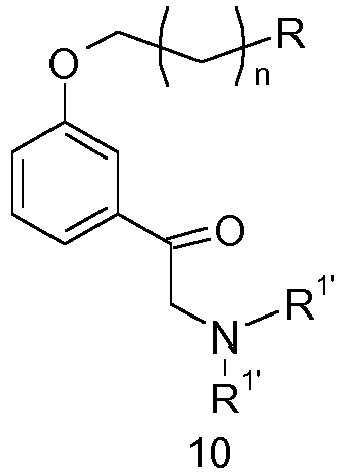
where each R1' is a protecting group;c) enantioselectively reducing the compound of formula 10 or a salt thereof to form a compound of formula 5: d) contacting the compound of formula 5 or a salt thereof with a borylating reagent characterized by the following formula:

where each R2 is independently C1-alkyl, C2-alkyl, C3-alkyl, C4-alkyl, C5-alkyl, C6-alkyl, or together with the oxygen atoms to which they are attached form a 5- or 6-membered ring; and R3 is C1-alkyl, C2-alkyl, C3-alkyl, C4-alkyl, C5-alkyl, C6-alkyl; ande) contacting the compound of formula 6 or a pharmaceutically acceptable salt thereof with a deprotecting reagent to form a compound of formula A or a pharmaceutically acceptable salt thereof:
- A compound of formula 6a:

- The compound according to claim 18, wherein R1" is H or OH; and R1' is a protecting group, and n is 0, 1, 3, 4 or 5.
- The compound of Claim 18 wherein R1' is benzyl, 1-phenylethyl, 2-methoxybenzyl, 3-methoxybenzyl, 4-methoxybenzyl, 2,4-dimethoxybenzyl, or diphenylmethyl; R1" is OH; and n is 0, 1, 2 or 3.
- A compound of formula 6:

Applications Claiming Priority (2)
| Application Number | Priority Date | Filing Date | Title |
|---|---|---|---|
| US32164210P | 2010-04-07 | 2010-04-07 | |
| PCT/US2011/031384 WO2011127143A1 (en) | 2010-04-07 | 2011-04-06 | Process for preparing benzoxaboroles |
Publications (3)
| Publication Number | Publication Date |
|---|---|
| EP2555625A1 EP2555625A1 (en) | 2013-02-13 |
| EP2555625A4 EP2555625A4 (en) | 2014-10-15 |
| EP2555625B1 true EP2555625B1 (en) | 2018-11-14 |
Family
ID=44763260
Family Applications (1)
| Application Number | Title | Priority Date | Filing Date |
|---|---|---|---|
| EP11766638.8A Active EP2555625B1 (en) | 2010-04-07 | 2011-04-06 | Process for preparing benzoxaboroles |
Country Status (17)
| Country | Link |
|---|---|
| US (2) | US9243003B2 (en) |
| EP (1) | EP2555625B1 (en) |
| JP (1) | JP5603998B2 (en) |
| KR (1) | KR101508562B1 (en) |
| CN (1) | CN102821609B (en) |
| AR (1) | AR080834A1 (en) |
| AU (1) | AU2011237681B2 (en) |
| BR (1) | BR112012024682B1 (en) |
| CA (1) | CA2794684C (en) |
| EA (1) | EA021532B1 (en) |
| ES (1) | ES2710105T3 (en) |
| IL (1) | IL222103A (en) |
| MX (1) | MX352607B (en) |
| SG (1) | SG184268A1 (en) |
| TW (1) | TWI503324B (en) |
| WO (1) | WO2011127143A1 (en) |
| ZA (1) | ZA201207386B (en) |
Families Citing this family (10)
| Publication number | Priority date | Publication date | Assignee | Title |
|---|---|---|---|---|
| US7767657B2 (en) | 2005-02-16 | 2010-08-03 | Anacor Pharmaceuticals, Inc. | Boron-containing small molecules |
| AP4039A (en) | 2009-08-14 | 2017-02-28 | Daitao Chen | Boron-containing small molecules as antiprotozoal agents |
| WO2011094450A1 (en) | 2010-01-27 | 2011-08-04 | Anacor Pharmaceuticals, Inc | Boron-containing small molecules |
| US8530452B2 (en) | 2011-12-22 | 2013-09-10 | Micurx Pharmaceuticals, Inc. | Tricyclic boron compounds for antimicrobial therapy |
| AP2015008638A0 (en) | 2013-02-01 | 2015-08-31 | Anacor Pharmaceuticals Inc | Boron-containing small molecules as antiprotozoal agents |
| JP6360549B2 (en) * | 2013-03-15 | 2018-07-18 | ユニベーション・テクノロジーズ・エルエルシー | Tridentate nitrogen-based ligands for olefin polymerization catalysts |
| KR101636431B1 (en) | 2013-07-30 | 2016-07-05 | 동아에스티 주식회사 | Tricyclic benzoxaborole compound, process preparing thereof and use thereof |
| CN105492388B (en) | 2013-08-09 | 2018-12-21 | 葛兰素史克知识产权第二有限公司 | Tricyclic benzoxaborole compounds and uses thereof |
| EA038093B1 (en) * | 2013-12-20 | 2021-07-05 | Глаксосмитклайн Интеллекчуал Проперти (№2) Лимитед | METHOD OF TREATING A DISEASE CAUSED BY A MYCOBACTERIUM TUBERCULOSIS COMPLEX INFECTION USING (S)-(3-CHLORO-7,8-DIHYDRO-2H-1,6,9-TRIOXA-9a-BORABENZO[cd]AZULEN-2-YL)METHANAMINE OR A PHARMACEUTICALLY ACCEPTABLE SALT THEREOF |
| MA41495A (en) | 2015-02-12 | 2017-12-19 | Anacor Pharmaceuticals Inc | BENZOXABOROLE COMPOUNDS AND THEIR USES |
Family Cites Families (5)
| Publication number | Priority date | Publication date | Assignee | Title |
|---|---|---|---|---|
| AU4967997A (en) * | 1996-12-02 | 1998-06-29 | Chisso Corporation | Optically active nitro alcohol derivatives, optically active amino alcohol derivates, and process for preparing the same |
| CA2507908A1 (en) * | 2002-12-02 | 2004-06-17 | Solvias Ag | Catalytic hydrogeneration of carbon-heteroatom double bonds |
| WO2006096131A1 (en) * | 2005-03-08 | 2006-09-14 | Agency For Science, Technology And Research | Chiral bisoxazoline catalysts |
| KR100848491B1 (en) | 2007-01-16 | 2008-07-28 | 영진약품공업주식회사 | 2-thiazolidine derivatives having a betaamino group, pharmaceutically acceptable salts thereof and preparation method thereof |
| JO3396B1 (en) * | 2007-06-20 | 2019-10-20 | Anacor Pharmaceuticals Inc | Boron-containing small molecules |
-
2011
- 2011-04-06 JP JP2013503880A patent/JP5603998B2/en active Active
- 2011-04-06 EA EA201290872A patent/EA021532B1/en not_active IP Right Cessation
- 2011-04-06 AR ARP110101147A patent/AR080834A1/en active IP Right Grant
- 2011-04-06 WO PCT/US2011/031384 patent/WO2011127143A1/en not_active Ceased
- 2011-04-06 ES ES11766638T patent/ES2710105T3/en active Active
- 2011-04-06 CN CN201180018031.4A patent/CN102821609B/en active Active
- 2011-04-06 BR BR112012024682-8A patent/BR112012024682B1/en active IP Right Grant
- 2011-04-06 US US13/639,594 patent/US9243003B2/en active Active
- 2011-04-06 TW TW100111877A patent/TWI503324B/en active
- 2011-04-06 MX MX2012011632A patent/MX352607B/en active IP Right Grant
- 2011-04-06 EP EP11766638.8A patent/EP2555625B1/en active Active
- 2011-04-06 KR KR1020127029254A patent/KR101508562B1/en active Active
- 2011-04-06 SG SG2012071296A patent/SG184268A1/en unknown
- 2011-04-06 CA CA2794684A patent/CA2794684C/en active Active
- 2011-04-06 AU AU2011237681A patent/AU2011237681B2/en active Active
-
2012
- 2012-09-24 IL IL222103A patent/IL222103A/en active IP Right Grant
- 2012-10-02 ZA ZA2012/07386A patent/ZA201207386B/en unknown
-
2015
- 2015-12-15 US US14/969,467 patent/US20160168168A1/en not_active Abandoned
Non-Patent Citations (1)
| Title |
|---|
| None * |
Also Published As
| Publication number | Publication date |
|---|---|
| TWI503324B (en) | 2015-10-11 |
| CA2794684C (en) | 2018-04-24 |
| CA2794684A1 (en) | 2011-10-13 |
| US20130035501A1 (en) | 2013-02-07 |
| ES2710105T3 (en) | 2019-04-23 |
| CN102821609A (en) | 2012-12-12 |
| KR101508562B1 (en) | 2015-04-07 |
| US9243003B2 (en) | 2016-01-26 |
| AU2011237681A1 (en) | 2012-11-29 |
| BR112012024682B1 (en) | 2021-06-08 |
| JP5603998B2 (en) | 2014-10-08 |
| AU2011237681B2 (en) | 2015-01-22 |
| KR20130006506A (en) | 2013-01-16 |
| BR112012024682A2 (en) | 2020-07-28 |
| WO2011127143A1 (en) | 2011-10-13 |
| US20160168168A1 (en) | 2016-06-16 |
| ZA201207386B (en) | 2014-03-26 |
| MX352607B (en) | 2017-11-30 |
| EP2555625A4 (en) | 2014-10-15 |
| SG184268A1 (en) | 2012-10-30 |
| EP2555625A1 (en) | 2013-02-13 |
| EA201290872A1 (en) | 2013-04-30 |
| IL222103A (en) | 2016-12-29 |
| MX2012011632A (en) | 2013-02-27 |
| JP2013523826A (en) | 2013-06-17 |
| EA021532B1 (en) | 2015-07-30 |
| TW201202257A (en) | 2012-01-16 |
| AR080834A1 (en) | 2012-05-09 |
| CN102821609B (en) | 2015-03-25 |
Similar Documents
| Publication | Publication Date | Title |
|---|---|---|
| CA2794684C (en) | Process for preparing benzoxaboroles | |
| EP3847157B1 (en) | Process for the preparation of methyl 6-(2,4-dichlorophenyl)-5-[4-[(3s)-1-(3-fluoropropyl)pyrrolidin-3-yl]oxyphenyl]-8,9-dihydro-7h-benzo[7]annulene-2-carboxylate and a salt thereof | |
| CA3083433C (en) | Methods and intermediates for preparing pharmaceutical agents | |
| JP5604424B2 (en) | Method for the preparation of proapoptotic agent ABT-263 | |
| EP2079706B1 (en) | Method for preparing medetomidine and its salts | |
| US7799930B2 (en) | 1-alkyl-3-aminoindazoles | |
| CA2299447C (en) | Procedure for obtaining the enantiomers of cyzolirtine | |
| KR20150020214A (en) | Process for making hydroxylated cyclopentylpyrimidine compounds | |
| EP3197875B1 (en) | Processes for preparing (cyclopentyl[d]pyrimidin-4-yl)piperazine compounds | |
| CN107286070A (en) | Synthetic method and intermediate of (R)-2-(2,5-difluorophenyl)pyrrolidine | |
| CA2804889A1 (en) | Synthesis of cyclopentaquinazolines | |
| CN100457723C (en) | Process for preparing 2- (substituted phenyl) -2-hydroxy-ethyl carbamates | |
| WO2024015861A1 (en) | Methods of preparation of heterocyclic compounds | |
| KR20220048950A (en) | Method of preparing intermediate for synthesizing sphingosine-1-phosphate receptor agonist | |
| Komatsuzaki et al. | An Anion Receptor Based on Poly-Substituted Cobalticinium Complexes. | |
| WO2006064340A2 (en) | Process for the preparation of n-acyl beta-aminoaldehydes | |
| JP2005306804A (en) | Process for producing optically active 3-quinuclidinol | |
| WO2001002371A1 (en) | Optically active piperazine compounds, intermediates for the preparation of the same and processes for the preparation of both | |
| WO2025245089A1 (en) | Processes for preparing tetralin compounds |
Legal Events
| Date | Code | Title | Description |
|---|---|---|---|
| PUAI | Public reference made under article 153(3) epc to a published international application that has entered the european phase |
Free format text: ORIGINAL CODE: 0009012 |
|
| 17P | Request for examination filed |
Effective date: 20121030 |
|
| AK | Designated contracting states |
Kind code of ref document: A1 Designated state(s): AL AT BE BG CH CY CZ DE DK EE ES FI FR GB GR HR HU IE IS IT LI LT LU LV MC MK MT NL NO PL PT RO RS SE SI SK SM TR |
|
| AX | Request for extension of the european patent |
Extension state: BA ME |
|
| RAP1 | Party data changed (applicant data changed or rights of an application transferred) |
Owner name: GLAXOSMITHKLINE LLC |
|
| A4 | Supplementary search report drawn up and despatched |
Effective date: 20140917 |
|
| RIC1 | Information provided on ipc code assigned before grant |
Ipc: C07F 5/02 20060101ALI20140911BHEP Ipc: A01N 55/08 20060101AFI20140911BHEP Ipc: A61K 31/69 20060101ALI20140911BHEP |
|
| RAP1 | Party data changed (applicant data changed or rights of an application transferred) |
Owner name: GLAXOSMITHKLINE LLC |
|
| 17Q | First examination report despatched |
Effective date: 20160816 |
|
| STAA | Information on the status of an ep patent application or granted ep patent |
Free format text: STATUS: EXAMINATION IS IN PROGRESS |
|
| RAP1 | Party data changed (applicant data changed or rights of an application transferred) |
Owner name: GLAXOSMITHKLINE LLC |
|
| REG | Reference to a national code |
Ref country code: DE Ref legal event code: R079 Ref document number: 602011053891 Country of ref document: DE Free format text: PREVIOUS MAIN CLASS: A01N0055080000 Ipc: C07F0005040000 |
|
| GRAP | Despatch of communication of intention to grant a patent |
Free format text: ORIGINAL CODE: EPIDOSNIGR1 |
|
| STAA | Information on the status of an ep patent application or granted ep patent |
Free format text: STATUS: GRANT OF PATENT IS INTENDED |
|
| RIC1 | Information provided on ipc code assigned before grant |
Ipc: C07F 5/02 20060101ALI20180511BHEP Ipc: C07F 5/04 20060101AFI20180511BHEP |
|
| INTG | Intention to grant announced |
Effective date: 20180608 |
|
| RIN1 | Information on inventor provided before grant (corrected) |
Inventor name: ZAJAC, MATTHEW, ALLEN Inventor name: CONDE, JOSE, J. Inventor name: KOWALSKI, ANTHONY, JOHN |
|
| GRAS | Grant fee paid |
Free format text: ORIGINAL CODE: EPIDOSNIGR3 |
|
| GRAA | (expected) grant |
Free format text: ORIGINAL CODE: 0009210 |
|
| STAA | Information on the status of an ep patent application or granted ep patent |
Free format text: STATUS: THE PATENT HAS BEEN GRANTED |
|
| AK | Designated contracting states |
Kind code of ref document: B1 Designated state(s): AL AT BE BG CH CY CZ DE DK EE ES FI FR GB GR HR HU IE IS IT LI LT LU LV MC MK MT NL NO PL PT RO RS SE SI SK SM TR |
|
| AX | Request for extension of the european patent |
Extension state: BA ME |
|
| REG | Reference to a national code |
Ref country code: GB Ref legal event code: FG4D |
|
| REG | Reference to a national code |
Ref country code: CH Ref legal event code: EP Ref country code: AT Ref legal event code: REF Ref document number: 1064658 Country of ref document: AT Kind code of ref document: T Effective date: 20181115 |
|
| REG | Reference to a national code |
Ref country code: DE Ref legal event code: R096 Ref document number: 602011053891 Country of ref document: DE |
|
| REG | Reference to a national code |
Ref country code: IE Ref legal event code: FG4D |
|
| REG | Reference to a national code |
Ref country code: NL Ref legal event code: MP Effective date: 20181114 |
|
| REG | Reference to a national code |
Ref country code: LT Ref legal event code: MG4D |
|
| REG | Reference to a national code |
Ref country code: AT Ref legal event code: MK05 Ref document number: 1064658 Country of ref document: AT Kind code of ref document: T Effective date: 20181114 |
|
| REG | Reference to a national code |
Ref country code: ES Ref legal event code: FG2A Ref document number: 2710105 Country of ref document: ES Kind code of ref document: T3 Effective date: 20190423 |
|
| PG25 | Lapsed in a contracting state [announced via postgrant information from national office to epo] |
Ref country code: IS Free format text: LAPSE BECAUSE OF FAILURE TO SUBMIT A TRANSLATION OF THE DESCRIPTION OR TO PAY THE FEE WITHIN THE PRESCRIBED TIME-LIMIT Effective date: 20190314 Ref country code: FI Free format text: LAPSE BECAUSE OF FAILURE TO SUBMIT A TRANSLATION OF THE DESCRIPTION OR TO PAY THE FEE WITHIN THE PRESCRIBED TIME-LIMIT Effective date: 20181114 Ref country code: HR Free format text: LAPSE BECAUSE OF FAILURE TO SUBMIT A TRANSLATION OF THE DESCRIPTION OR TO PAY THE FEE WITHIN THE PRESCRIBED TIME-LIMIT Effective date: 20181114 Ref country code: AT Free format text: LAPSE BECAUSE OF FAILURE TO SUBMIT A TRANSLATION OF THE DESCRIPTION OR TO PAY THE FEE WITHIN THE PRESCRIBED TIME-LIMIT Effective date: 20181114 Ref country code: NO Free format text: LAPSE BECAUSE OF FAILURE TO SUBMIT A TRANSLATION OF THE DESCRIPTION OR TO PAY THE FEE WITHIN THE PRESCRIBED TIME-LIMIT Effective date: 20190214 Ref country code: LV Free format text: LAPSE BECAUSE OF FAILURE TO SUBMIT A TRANSLATION OF THE DESCRIPTION OR TO PAY THE FEE WITHIN THE PRESCRIBED TIME-LIMIT Effective date: 20181114 Ref country code: LT Free format text: LAPSE BECAUSE OF FAILURE TO SUBMIT A TRANSLATION OF THE DESCRIPTION OR TO PAY THE FEE WITHIN THE PRESCRIBED TIME-LIMIT Effective date: 20181114 Ref country code: BG Free format text: LAPSE BECAUSE OF FAILURE TO SUBMIT A TRANSLATION OF THE DESCRIPTION OR TO PAY THE FEE WITHIN THE PRESCRIBED TIME-LIMIT Effective date: 20190214 |
|
| PG25 | Lapsed in a contracting state [announced via postgrant information from national office to epo] |
Ref country code: AL Free format text: LAPSE BECAUSE OF FAILURE TO SUBMIT A TRANSLATION OF THE DESCRIPTION OR TO PAY THE FEE WITHIN THE PRESCRIBED TIME-LIMIT Effective date: 20181114 Ref country code: PT Free format text: LAPSE BECAUSE OF FAILURE TO SUBMIT A TRANSLATION OF THE DESCRIPTION OR TO PAY THE FEE WITHIN THE PRESCRIBED TIME-LIMIT Effective date: 20190314 Ref country code: SE Free format text: LAPSE BECAUSE OF FAILURE TO SUBMIT A TRANSLATION OF THE DESCRIPTION OR TO PAY THE FEE WITHIN THE PRESCRIBED TIME-LIMIT Effective date: 20181114 Ref country code: NL Free format text: LAPSE BECAUSE OF FAILURE TO SUBMIT A TRANSLATION OF THE DESCRIPTION OR TO PAY THE FEE WITHIN THE PRESCRIBED TIME-LIMIT Effective date: 20181114 Ref country code: GR Free format text: LAPSE BECAUSE OF FAILURE TO SUBMIT A TRANSLATION OF THE DESCRIPTION OR TO PAY THE FEE WITHIN THE PRESCRIBED TIME-LIMIT Effective date: 20190215 Ref country code: RS Free format text: LAPSE BECAUSE OF FAILURE TO SUBMIT A TRANSLATION OF THE DESCRIPTION OR TO PAY THE FEE WITHIN THE PRESCRIBED TIME-LIMIT Effective date: 20181114 |
|
| PG25 | Lapsed in a contracting state [announced via postgrant information from national office to epo] |
Ref country code: CZ Free format text: LAPSE BECAUSE OF FAILURE TO SUBMIT A TRANSLATION OF THE DESCRIPTION OR TO PAY THE FEE WITHIN THE PRESCRIBED TIME-LIMIT Effective date: 20181114 Ref country code: PL Free format text: LAPSE BECAUSE OF FAILURE TO SUBMIT A TRANSLATION OF THE DESCRIPTION OR TO PAY THE FEE WITHIN THE PRESCRIBED TIME-LIMIT Effective date: 20181114 Ref country code: DK Free format text: LAPSE BECAUSE OF FAILURE TO SUBMIT A TRANSLATION OF THE DESCRIPTION OR TO PAY THE FEE WITHIN THE PRESCRIBED TIME-LIMIT Effective date: 20181114 |
|
| REG | Reference to a national code |
Ref country code: DE Ref legal event code: R097 Ref document number: 602011053891 Country of ref document: DE |
|
| PG25 | Lapsed in a contracting state [announced via postgrant information from national office to epo] |
Ref country code: EE Free format text: LAPSE BECAUSE OF FAILURE TO SUBMIT A TRANSLATION OF THE DESCRIPTION OR TO PAY THE FEE WITHIN THE PRESCRIBED TIME-LIMIT Effective date: 20181114 Ref country code: SM Free format text: LAPSE BECAUSE OF FAILURE TO SUBMIT A TRANSLATION OF THE DESCRIPTION OR TO PAY THE FEE WITHIN THE PRESCRIBED TIME-LIMIT Effective date: 20181114 Ref country code: RO Free format text: LAPSE BECAUSE OF FAILURE TO SUBMIT A TRANSLATION OF THE DESCRIPTION OR TO PAY THE FEE WITHIN THE PRESCRIBED TIME-LIMIT Effective date: 20181114 Ref country code: SK Free format text: LAPSE BECAUSE OF FAILURE TO SUBMIT A TRANSLATION OF THE DESCRIPTION OR TO PAY THE FEE WITHIN THE PRESCRIBED TIME-LIMIT Effective date: 20181114 |
|
| PLBE | No opposition filed within time limit |
Free format text: ORIGINAL CODE: 0009261 |
|
| STAA | Information on the status of an ep patent application or granted ep patent |
Free format text: STATUS: NO OPPOSITION FILED WITHIN TIME LIMIT |
|
| 26N | No opposition filed |
Effective date: 20190815 |
|
| PG25 | Lapsed in a contracting state [announced via postgrant information from national office to epo] |
Ref country code: SI Free format text: LAPSE BECAUSE OF FAILURE TO SUBMIT A TRANSLATION OF THE DESCRIPTION OR TO PAY THE FEE WITHIN THE PRESCRIBED TIME-LIMIT Effective date: 20181114 |
|
| REG | Reference to a national code |
Ref country code: CH Ref legal event code: PL |
|
| REG | Reference to a national code |
Ref country code: BE Ref legal event code: MM Effective date: 20190430 |
|
| PG25 | Lapsed in a contracting state [announced via postgrant information from national office to epo] |
Ref country code: MC Free format text: LAPSE BECAUSE OF FAILURE TO SUBMIT A TRANSLATION OF THE DESCRIPTION OR TO PAY THE FEE WITHIN THE PRESCRIBED TIME-LIMIT Effective date: 20181114 Ref country code: LU Free format text: LAPSE BECAUSE OF NON-PAYMENT OF DUE FEES Effective date: 20190406 |
|
| PG25 | Lapsed in a contracting state [announced via postgrant information from national office to epo] |
Ref country code: CH Free format text: LAPSE BECAUSE OF NON-PAYMENT OF DUE FEES Effective date: 20190430 Ref country code: LI Free format text: LAPSE BECAUSE OF NON-PAYMENT OF DUE FEES Effective date: 20190430 |
|
| PG25 | Lapsed in a contracting state [announced via postgrant information from national office to epo] |
Ref country code: BE Free format text: LAPSE BECAUSE OF NON-PAYMENT OF DUE FEES Effective date: 20190430 |
|
| PG25 | Lapsed in a contracting state [announced via postgrant information from national office to epo] |
Ref country code: TR Free format text: LAPSE BECAUSE OF FAILURE TO SUBMIT A TRANSLATION OF THE DESCRIPTION OR TO PAY THE FEE WITHIN THE PRESCRIBED TIME-LIMIT Effective date: 20181114 |
|
| PG25 | Lapsed in a contracting state [announced via postgrant information from national office to epo] |
Ref country code: IE Free format text: LAPSE BECAUSE OF NON-PAYMENT OF DUE FEES Effective date: 20190406 |
|
| PG25 | Lapsed in a contracting state [announced via postgrant information from national office to epo] |
Ref country code: CY Free format text: LAPSE BECAUSE OF FAILURE TO SUBMIT A TRANSLATION OF THE DESCRIPTION OR TO PAY THE FEE WITHIN THE PRESCRIBED TIME-LIMIT Effective date: 20181114 |
|
| PG25 | Lapsed in a contracting state [announced via postgrant information from national office to epo] |
Ref country code: MT Free format text: LAPSE BECAUSE OF FAILURE TO SUBMIT A TRANSLATION OF THE DESCRIPTION OR TO PAY THE FEE WITHIN THE PRESCRIBED TIME-LIMIT Effective date: 20181114 Ref country code: HU Free format text: LAPSE BECAUSE OF FAILURE TO SUBMIT A TRANSLATION OF THE DESCRIPTION OR TO PAY THE FEE WITHIN THE PRESCRIBED TIME-LIMIT; INVALID AB INITIO Effective date: 20110406 |
|
| PG25 | Lapsed in a contracting state [announced via postgrant information from national office to epo] |
Ref country code: MK Free format text: LAPSE BECAUSE OF FAILURE TO SUBMIT A TRANSLATION OF THE DESCRIPTION OR TO PAY THE FEE WITHIN THE PRESCRIBED TIME-LIMIT Effective date: 20181114 |
|
| PGFP | Annual fee paid to national office [announced via postgrant information from national office to epo] |
Ref country code: DE Payment date: 20250319 Year of fee payment: 15 |
|
| PGFP | Annual fee paid to national office [announced via postgrant information from national office to epo] |
Ref country code: ES Payment date: 20250502 Year of fee payment: 15 |
|
| PGFP | Annual fee paid to national office [announced via postgrant information from national office to epo] |
Ref country code: GB Payment date: 20260319 Year of fee payment: 16 |
|
| PGFP | Annual fee paid to national office [announced via postgrant information from national office to epo] |
Ref country code: IT Payment date: 20260319 Year of fee payment: 16 |
|
| PGFP | Annual fee paid to national office [announced via postgrant information from national office to epo] |
Ref country code: FR Payment date: 20260320 Year of fee payment: 16 |