EP2553926B1 - Procede de codage et de reconstruction d'un bloc d'une sequence d'images en utilisant un dictionnaire d'atomes structures et un dictionnaire de patches associes - Google Patents
Procede de codage et de reconstruction d'un bloc d'une sequence d'images en utilisant un dictionnaire d'atomes structures et un dictionnaire de patches associes Download PDFInfo
- Publication number
- EP2553926B1 EP2553926B1 EP11710208.7A EP11710208A EP2553926B1 EP 2553926 B1 EP2553926 B1 EP 2553926B1 EP 11710208 A EP11710208 A EP 11710208A EP 2553926 B1 EP2553926 B1 EP 2553926B1
- Authority
- EP
- European Patent Office
- Prior art keywords
- atom
- vector
- atoms
- dictionary
- residue
- Prior art date
- Legal status (The legal status is an assumption and is not a legal conclusion. Google has not performed a legal analysis and makes no representation as to the accuracy of the status listed.)
- Not-in-force
Links
Images




Classifications
-
- H—ELECTRICITY
- H04—ELECTRIC COMMUNICATION TECHNIQUE
- H04N—PICTORIAL COMMUNICATION, e.g. TELEVISION
- H04N19/00—Methods or arrangements for coding, decoding, compressing or decompressing digital video signals
- H04N19/10—Methods or arrangements for coding, decoding, compressing or decompressing digital video signals using adaptive coding
- H04N19/169—Methods or arrangements for coding, decoding, compressing or decompressing digital video signals using adaptive coding characterised by the coding unit, i.e. the structural portion or semantic portion of the video signal being the object or the subject of the adaptive coding
- H04N19/17—Methods or arrangements for coding, decoding, compressing or decompressing digital video signals using adaptive coding characterised by the coding unit, i.e. the structural portion or semantic portion of the video signal being the object or the subject of the adaptive coding the unit being an image region, e.g. an object
- H04N19/176—Methods or arrangements for coding, decoding, compressing or decompressing digital video signals using adaptive coding characterised by the coding unit, i.e. the structural portion or semantic portion of the video signal being the object or the subject of the adaptive coding the unit being an image region, e.g. an object the region being a block, e.g. a macroblock
-
- G—PHYSICS
- G06—COMPUTING OR CALCULATING; COUNTING
- G06T—IMAGE DATA PROCESSING OR GENERATION, IN GENERAL
- G06T9/00—Image coding
- G06T9/004—Predictors, e.g. intraframe, interframe coding
-
- G—PHYSICS
- G06—COMPUTING OR CALCULATING; COUNTING
- G06T—IMAGE DATA PROCESSING OR GENERATION, IN GENERAL
- G06T9/00—Image coding
-
- H—ELECTRICITY
- H04—ELECTRIC COMMUNICATION TECHNIQUE
- H04N—PICTORIAL COMMUNICATION, e.g. TELEVISION
- H04N19/00—Methods or arrangements for coding, decoding, compressing or decompressing digital video signals
- H04N19/10—Methods or arrangements for coding, decoding, compressing or decompressing digital video signals using adaptive coding
- H04N19/102—Methods or arrangements for coding, decoding, compressing or decompressing digital video signals using adaptive coding characterised by the element, parameter or selection affected or controlled by the adaptive coding
- H04N19/103—Selection of coding mode or of prediction mode
- H04N19/105—Selection of the reference unit for prediction within a chosen coding or prediction mode, e.g. adaptive choice of position and number of pixels used for prediction
-
- H—ELECTRICITY
- H04—ELECTRIC COMMUNICATION TECHNIQUE
- H04N—PICTORIAL COMMUNICATION, e.g. TELEVISION
- H04N19/00—Methods or arrangements for coding, decoding, compressing or decompressing digital video signals
- H04N19/50—Methods or arrangements for coding, decoding, compressing or decompressing digital video signals using predictive coding
- H04N19/503—Methods or arrangements for coding, decoding, compressing or decompressing digital video signals using predictive coding involving temporal prediction
- H04N19/51—Motion estimation or motion compensation
-
- H—ELECTRICITY
- H04—ELECTRIC COMMUNICATION TECHNIQUE
- H04N—PICTORIAL COMMUNICATION, e.g. TELEVISION
- H04N19/00—Methods or arrangements for coding, decoding, compressing or decompressing digital video signals
- H04N19/50—Methods or arrangements for coding, decoding, compressing or decompressing digital video signals using predictive coding
- H04N19/593—Methods or arrangements for coding, decoding, compressing or decompressing digital video signals using predictive coding involving spatial prediction techniques
-
- H—ELECTRICITY
- H04—ELECTRIC COMMUNICATION TECHNIQUE
- H04N—PICTORIAL COMMUNICATION, e.g. TELEVISION
- H04N19/00—Methods or arrangements for coding, decoding, compressing or decompressing digital video signals
- H04N19/90—Methods or arrangements for coding, decoding, compressing or decompressing digital video signals using coding techniques not provided for in groups H04N19/10-H04N19/85, e.g. fractals
- H04N19/97—Matching pursuit coding
Definitions
- the invention relates to the general domain of image coding.
- the invention relates to a method for coding a block of a sequence of images and a corresponding method for reconstructing such a block.
- the residue block Br is determined by extracting from the current block Bc, the prediction block Bp.
- the residue block is coded in a stream F.
- This step of coding generally comprises, the transformation of the residue block into a block of coefficients, the quantizing of these coefficients and their entropy coding in a stream F.
- the atomic decomposition comprises the selection, in an iterative way, of atoms in a dictionary of atoms.
- the dictionary comprises atoms called analytical or theoretical atoms, i.e. corresponding to basic functions of a transform, for example DCT (Discrete Cosine Transform) or DFT (Discrete Fourier Transform).
- DCT Discrete Cosine Transform
- DFT Discrete Fourier Transform
- the relevance of the prediction block i.e. its fidelity to the current block, depends strongly on the atoms present in the dictionary.
- these textured atoms form the 8 last columns of the dictionary of atoms. They are for example extracted from natural or synthesis images.
- the purpose of the invention is to overcome at least one of the disadvantages of the prior art.
- the invention relates to a method for coding a current block of a sequence of images according to the appended claims.
- the coding method according to the invention enables a great number of atoms to be tested due to the use of patches. These patches enable, for a first selected textured atom, to test numerous re-phased atoms with respect to this textured atom due particularly to the step of phase correlation.
- the patches of the second dictionary are of circular symmetry.
- the patches of the second dictionary have a form that depends on their content.
- the second dictionary comprises at least two patches of different sizes.
- the step of extraction comprises the extraction of the N parts most correlated with the residue vector, each part extracted forming a re-phased atom and the step of selection comprises the selection, from among the first atom and the re-phased atoms, of the atom most correlated with the current residue vector.
- the invention also relates to a method for reconstruction of a current block of a sequence of images in the form of a stream according to the appended claims.
- the patches of the second dictionary are of circular symmetry.
- the patches of the second dictionary have a form that depends on their content.
- the second dictionary comprises at least two patches of different sizes.
- the step of extraction comprises the extraction of the N parts most correlated with the residue vector, each part extracted forming a re-phased atom and the step of selection comprises the selection, from among the first atom and the re-phased atoms, of the atom most correlated with the current residue vector.
- An image comprises pixels or image points with each of which is associated at least one item of image data.
- An item of image data is for example an item of luminance data or an item of chrominance data.
- the term "residue” designates the data obtained after extraction of other data.
- the extraction is generally a subtraction of prediction pixels from source pixels.
- the extraction is more general and comprises notably a weighted subtraction.
- reconstructs designates data (for example pixels, blocks) obtained after merging of residues with prediction data.
- the merge is generally a sum of residue prediction pixels. However, the merging is more general and comprises notably the weighted sum.
- a reconstructed block is a block of reconstructed pixels.
- the method for coding according to the invention is based on a method for atomic decomposition.
- Various methods exist enabling an atomic decomposition to be obtained from a signal Y.
- Matching pursuit one of the most well known is identified under the term "matching pursuit”. Note that variants of "matching pursuit” can be used such as “orthogonal matching pursuit” or "Global Matched Filter”.
- Y be a source vector of dimensions N and A a matrix of dimensions N ⁇ M with M >> N.
- the columns a j of A are the atoms, analytical or textured, of a dictionary that are used to represent the source vector Y .
- N(.) is for example the squared norm L2.
- N(.) can be a norm other than the norm L2.
- the method of "Matching Pursuit” enables such a sub-optimal, i.e. non-exact solution to be obtained, using an iterative method.
- the method generates at each iteration k, a representation X k , dimension vector M, having a number of non-null coefficients that increases in general (except if the same atom is selected during several iterations) at each new iteration k.
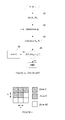
- the MP method is described in detail in reference to figure 3 .
- the known data are the source signal Y, the dictionary A and the threshold p.
- the data X 0 and R 0 are initialised, where R 0 is an initial vector of residual error or residue vector.
- R 0 0
- the vector X k and the residue vector R k are updated.
- step 26 there is a check to see if the stopping criterion is satisfied. If N ( Y - AX k ) ⁇ ⁇ then the procedure is terminated if not k is incremented by 1 during a step 28 and the procedure resumes at step 22.
- the final vector AX K is an approximation of the source signal Y, where K is the index of the last iteration.
- FIG 4 blocks of pixels of size nxn are shown.
- the integer “n” can take different values such as for example 4, 8, 16, etc.
- the greyed block (zone P) represents the current block to be predicted
- the hatched block (zone C) represents the causal zone
- the white zone (zone NC) represents the non-causal zone.
- the causal zone comprises pixels coded and reconstructed previous to the coding of the current block.
- the definition of the causal zone depends on the order of coding of blocks in the image.
- the blocks are assumed to be coded according to a standard coding order known as "raster scan". The invention is however in no way limited to this coding order.
- the vector Y is thus a vector of size 9n 2 x1.
- the atomic decomposition is applied to a vector Yc comprising the image data associated with the pixels of zone C, possibly to image data associated with the pixels of the zone, for example by a preliminary prediction step.
- the image data of other pixels of the zone L are not known and are considered as null.
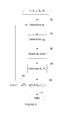
- Figure 5 shows a method for atomic decomposition refined according to the invention.
- the atomic decomposition method refined according to the invention uses two dictionaries.
- the first dictionary A comprises the analytical and/or textured atoms typically used by MP type methods.
- the analytical atoms are two-dimensional base functions of the same size as the zone L (3 n ⁇ 3 n ) , and that are assumed to have correct properties for the decomposition of a signal into elementary signals.
- the kernel of usual transforms such as the DCT (Discrete Cosine Transform) or the DFT (Discrete Fourier Transform) is used to define the analytical atoms. In these specific cases, a frequency decomposition of the signal is operated.
- DCT Discrete Cosine Transform
- DFT Discrete Fourier Transform
- the dictionary A is completed by textured atoms of the same size as the analytical atoms.
- the dictionary A must comprise at minimum 9 n 2 atoms to represent the zone L.
- the atoms are vectored.
- the dictionary A is constituted of a minimum of 9 n 2 columns each of which represents an analytical or textured atom, of size 9 n 2 ⁇ 1.
- A designates both the dictionary and the corresponding matrix.
- DCT and DFT atoms are not a limitation.
- the dictionary can be enriched from any base functions able to represent any pattern type in an image (Gabor atoms, anisotropic atoms, etc.)
- the number of atoms or again, the number of columns in the matrix A has as a minimum value, the size of the vectored zone L (i.e. 9 n 2 ) but does not have a theoretical maximum value. The more the quantity of atoms is great, the more chance there is of recovering the signal.
- the second dictionary is formed of patches that are bigger than the atoms of the first dictionary. These patches like the textured atoms come from natural images. More specifically, with each textured atom of the first dictionary or with each textured atom of a part only of the first dictionary is associated a patch of the second dictionary.
- the patches of the second dictionary are for example extracted from natural or synthetic images.
- the patches can be of rectangular form. According to a variant, the form of the patch depends on the content. For example, if the patch comprises essentially vertical structures, it will be rectangular preferably wider than it is high. In the contrary case, i.e. if it comprises essentially horizontal structures, it will be rectangular preferably higher than it is wide. Likewise, the patches can be of circular symmetry.
- the textured atoms of the first dictionary are obtained by extracting a textured atom from each patch of the second dictionary, for example the textured atom is centred in the patch.
- the size of patches of the second dictionary can also vary from one patch to another. However the fact that the textured atom is centred in the patch has no mandatory character.
- the invention is in no way limited by the way in which the textured atoms are generated from patches, or by the way the patches are determined from natural images.
- the method for atomic decomposition according to the invention is an iterative method.
- a first atom a j k is selected in the first dictionary of atoms for example according to step 22 of the MP method.
- the method continues to step 34.
- the atom a j k is an analytical atom or a textured atom to which no patch corresponds, then the method continues to step 38.
- a j k is the atom most strongly correlated with the current residue vector R k- 1 , for example that for which the scalar product
- a second atom p j k is determined from the second dictionary. This step is shown in detail by figure 6 .
- the residue vector R k-1 used to determine a j k is correlated, by phase correlation, with the patch P j k of the second dictionary that corresponds to a j k .
- the phase correlation provides here a displacement (dx, dy) between the residue R k-1 and the content of the patch P j k . This displacement determines the position of a new atom of the same size as the atoms of the first dictionary.
- the part of the patch most correlated in terms of phase correlation with the residue vector R k-1 is extracted from the patch. This extracted part is called the re-phased atom and noted as p i k .
- the phase correlation provides N displacements (dx, dy) between the residue R k-1 and the content of the patch P j k . These N displacements indicate the position of N parts of the patch most correlated in the sense of phase correlation with the residue vector R k-1 . These N parts are then extracted from the patch, each part extracted forming a re-phased atom.
- the residue for the phase correlation can displace in a circular way over the patch set.
- the atom most correlated with R k-1 is selected from among a j k and p j k , and possibly from a j k and the N atoms re-phased when several re-phased atoms are extracted in step 342.
- are compared. If c_phase > c_max, then the second atom p i k is selected if not the first atom a j k is selected.
- the atom selected is the atom most correlated R k-1 , to the sense of the scalar product between the atom in question and R k-1 .
- the vector X k and the residue vector R k are updated according to the atom selected.
- when p i k is selected and the coefficient x j k of the vector X k is calculated according to the following formula x j k
- A' comprises the atoms of the first dictionary and possibly atoms selected from the second dictionary.
- the final vector A'X K is an approximation of the source signal Y where K is the index of the last iteration
- the method for refined atomic decomposition described in reference to figures 5 and 6 is used to code a current block.
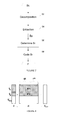
- the method for coding according to the invention is described in reference to figure 7 .
- an atomic decomposition is applied as described in reference to figure 5 on a vector Yp of size 4n 2 x1 comprising as data the values of pixels of the observation zone, i.e. of neighbouring blocks (zone C in figure 4 ).
- an atomic decomposition is applied on a vector Ycp of size 5n 2 x1 comprising as data the image data of pixels of the observation zone, i.e. of neighbouring blocks (zone C in figure 3 ) and the pixels of an initial prediction block Bp0 that has replaced the data of the current block to be predicted (zone P in figure 4 ).
- the data of other neighbouring blocks of the current block not previously reconstructed are null.
- the initial prediction block is for example determined by a standard temporal prediction according to a standard block matching method.
- the invention is in no way limited by the definition of the observation zone.
- the case of an atomic decomposition of the vector Yp is considered in the knowledge that the same decomposition can be applied to the vector Ycp. It is this observation vector Yp that is the prediction support useful to the MP method.
- the matrix A is modified by removing its lines corresponding to all the pixels outside the zone C. In fact, all these pixels are unknown and have a value of zero.
- a matrix is thus obtained, noted as A c , compacted in the sense of the height, of size 4 n 2 ⁇ 9 n 2 .
- the steps 32 to 40 described in reference to figure 5 are thus applied iteratively in order to determine X opt with as observation data the vector Yp.
- the method stops as soon as the stopping criterion N ⁇ Y c - A c ⁇ ⁇ X k ⁇ ⁇ is verified:
- X opt X K , K being the index of the last iteration and
- A' c comprises the atoms of the first dictionary possibly atoms selected from the second dictionary compacted in the sense of the height.
- the final vector ⁇ A'X opt is an approximation of the vector Y corresponding to the zone L.
- the vector ⁇ p of size n 2 that corresponds to the zone P is extracted from ⁇ as shown in figure 8 .
- the data ⁇ p extracted are reorganised (inverse operation to the vectoring operations) in block form.
- the reorganised data represent the new prediction block Bp of the current block.
- the residue block Br is determined by extracting from the current block Bc, the prediction block Bp.
- the residue block is coded.
- This coding step generally comprises, the transformation of the residue block into a block of coefficients, the quantizing of these coefficients and their entropy coding in a stream F. According to a variant, it can comprise the quantizing of residues and their entropy coding in a stream F.
- the set of sequences X k determined during the iterations are stored in the memory.
- Ap and Yp are shown in figure 8 .
- This variant enables X opt to be determined as being the best representation of the zone P that does not necessarily correspond to the best representation on the zone C.
- the data A p X k opt are reorganised (inverse operation to the vectoring operations) in block form.
- the reorganised data represent the new prediction block Bp of the current block.
- the coefficient k opt is also coded in the stream F. In fact, the data of the vector Y P are unknown to the decoder.
- Figure 9 diagrammatically shows a method for reconstruction of a current block according to the invention
- a residue block Br is decoded for the current block. For example, a part of the stream F is decoded into coefficients. The coefficients are de-quantized then if necessary transformed by an inverse transform to that used by the coding method in step 58. A residue block is thus obtained.
- the inverse transformation step is omitted notably if no transformation step has been applied on the coder side in step 58.
- the vector ⁇ p of size n 2 that corresponds to the zone P is extracted from ⁇ as shown in figure 8 .
- the data ⁇ p extracted are reorganised (inverse operation to the vectoring operations) in block form.
- the reorganised data represent the new prediction block Bp of the current block.
- the current block Bc is reconstructed by merging the prediction block Bp determined in step 64 and the residue block decoded in step 60, for example by addition pixel by pixel.
- Figure 10 diagrammatically shows a coding device 12.
- the coding device 12 receives at input an image or images.
- the coding device 12 is able to implement the coding method according to the invention described in reference to figure 7 .
- Each image is divided into blocks of pixels with each of which is associated at least one item of image data.
- the coding device 12 notably implements a coding with temporal prediction. Only the modules of the coding device 12 relating to the coding by temporal prediction or INTER coding are shown in figure 10 . Other modules known by those skilled in the art of video coders are not shown (for example selection of the coding mode, spatial prediction).
- the coding device 12 notably comprises a calculation module 1200 able to extract, for example by subtraction pixel by pixel, from a current block Bc a prediction block Bp to generate a residue block Br.
- the calculation module 1200 is able to implement step 56 of the coding method according to the invention. It further comprises a module 1202 able to transform then quantize the residue block Br into quantized data.
- the transform T is for example a Discrete Cosine Transform (DCT).
- the coding device 12 also comprises an entropy coding module 1204 able to code the quantized data into a stream F. It also comprises a module 1206 performing the inverse operation of the module 1202.
- the module 1206 carries out an inverse quantization Q -1 followed by an inverse transformation T -1 .
- the module 1206 is connected to a calculation module 1208 capable of merging, for example by addition pixel by pixel, the block of data from the module 1206 and the prediction block Bp to generate a reconstructed block that
- a prediction module 1216 determines a prediction block.
- the prediction module 1216 is able to implement steps 52 and 54 of the coding method according to the invention.
- Step 58 of the coding method is implemented in the modules 1202 and 1204.
- FIG 11 diagrammatically shows a decoding device 13.
- the decoding device 13 receives at input a stream F representative of an image.
- the stream F is for example transmitted by a coding device 12 via a channel.
- the decoding device 13 is able to implement the decoding method according to the invention described in reference to figure 9 .
- the decoding device 13 comprises an entropy decoding module 1300 able to generate decoded data.
- the decoded data are then transmitted to a module 1302 able to carry out an inverse quantization followed by an inverse transform.
- the module 1302 is identical to the module 1206 of the coding device 12 having generated the stream F.
- the module 1302 is connected to a calculation module 1304 able to merge, for example by addition pixel by pixel, the block from the module 1302 and a prediction block BP to generate a reconstructed current block Bc that is stored in a memory 1306.
- the calculation module 1304 is able to implement step 66 of the reconstruction method.
- the decoding device 13 comprises a prediction module 1308.
- the prediction module 1308 determines a prediction block Bp from data already reconstructed stored in the memory 1306.
- the prediction module 1308 is able to implement steps 62 and 64 of the reconstruction method according to the invention. Step 60 of the reconstruction method is implemented in the modules 1300 and 1302.
- the form of the causal zone can vary as shown in figure 12 .
- the causal zone taken into account is hatched.
- the invention is in no way limited to these forms of causal zones that are only shown as an illustrative example.
- the blocks are of any size.
- the causal zone can be in any position with respect to the prediction block, in the sense that the method according to the invention is independent of the scanning order of blocks in the image.
- the form and size of patches can vary.
- the second dictionary can contain fewer patches than there are textured atoms in the first dictionary.
Landscapes
- Engineering & Computer Science (AREA)
- Multimedia (AREA)
- Signal Processing (AREA)
- Physics & Mathematics (AREA)
- General Physics & Mathematics (AREA)
- Theoretical Computer Science (AREA)
- Compression Or Coding Systems Of Tv Signals (AREA)
- Image Processing (AREA)
Applications Claiming Priority (2)
| Application Number | Priority Date | Filing Date | Title |
|---|---|---|---|
| FR1052517A FR2958489A1 (fr) | 2010-04-02 | 2010-04-02 | Procede de codage et procede de reconstruction d'un bloc d'une sequence d'images |
| PCT/EP2011/054682 WO2011120894A1 (en) | 2010-04-02 | 2011-03-28 | Method for coding and method for reconstruction of a block of an image sequence |
Publications (2)
| Publication Number | Publication Date |
|---|---|
| EP2553926A1 EP2553926A1 (en) | 2013-02-06 |
| EP2553926B1 true EP2553926B1 (en) | 2015-02-25 |
Family
ID=42937143
Family Applications (1)
| Application Number | Title | Priority Date | Filing Date |
|---|---|---|---|
| EP11710208.7A Not-in-force EP2553926B1 (en) | 2010-04-02 | 2011-03-28 | Procede de codage et de reconstruction d'un bloc d'une sequence d'images en utilisant un dictionnaire d'atomes structures et un dictionnaire de patches associes |
Country Status (8)
| Country | Link |
|---|---|
| US (1) | US8755618B2 (enExample) |
| EP (1) | EP2553926B1 (enExample) |
| JP (1) | JP5799080B2 (enExample) |
| KR (1) | KR101822677B1 (enExample) |
| CN (1) | CN102918838B (enExample) |
| BR (1) | BR112012025175A2 (enExample) |
| FR (1) | FR2958489A1 (enExample) |
| WO (1) | WO2011120894A1 (enExample) |
Families Citing this family (6)
| Publication number | Priority date | Publication date | Assignee | Title |
|---|---|---|---|---|
| FR2958489A1 (fr) * | 2010-04-02 | 2011-10-07 | Thomson Licensing | Procede de codage et procede de reconstruction d'un bloc d'une sequence d'images |
| US9547915B2 (en) * | 2013-03-19 | 2017-01-17 | Thomson Licensing | Inter-image prediction method and device and corresponding coding method and apparatus |
| US9042468B2 (en) * | 2013-06-27 | 2015-05-26 | Intel Mobile Communications GmbH | Channel estimation technique |
| WO2017183479A1 (ja) | 2016-04-22 | 2017-10-26 | ソニー株式会社 | 符号化装置及び符号化方法、並びに、復号装置及び復号方法 |
| FR3066873A1 (fr) * | 2017-05-29 | 2018-11-30 | Orange | Procedes et dispositifs de codage et de decodage d'un flux de donnees representatif d'au moins une image |
| CN113139918B (zh) * | 2021-04-23 | 2023-11-10 | 大连大学 | 一种基于决策灰狼优化字典学习的图像重构方法 |
Family Cites Families (5)
| Publication number | Priority date | Publication date | Assignee | Title |
|---|---|---|---|---|
| US5581638A (en) * | 1993-07-26 | 1996-12-03 | E-Systems, Inc. | Method for autonomous image registration |
| US7187730B1 (en) * | 2001-03-21 | 2007-03-06 | Marvell International Ltd. | Method and apparatus for predicting CCK subsymbols |
| US8000392B1 (en) * | 2004-02-27 | 2011-08-16 | Vbrick Systems, Inc. | Phase correlation based motion estimation in hybrid video compression |
| US8184200B1 (en) * | 2008-04-22 | 2012-05-22 | Marvell International Ltd. | Picture rate conversion system for high definition video |
| FR2958489A1 (fr) * | 2010-04-02 | 2011-10-07 | Thomson Licensing | Procede de codage et procede de reconstruction d'un bloc d'une sequence d'images |
-
2010
- 2010-04-02 FR FR1052517A patent/FR2958489A1/fr not_active Withdrawn
-
2011
- 2011-03-28 WO PCT/EP2011/054682 patent/WO2011120894A1/en not_active Ceased
- 2011-03-28 BR BR112012025175A patent/BR112012025175A2/pt active Search and Examination
- 2011-03-28 EP EP11710208.7A patent/EP2553926B1/en not_active Not-in-force
- 2011-03-28 US US13/638,625 patent/US8755618B2/en not_active Expired - Fee Related
- 2011-03-28 KR KR1020127028762A patent/KR101822677B1/ko not_active Expired - Fee Related
- 2011-03-28 JP JP2013501777A patent/JP5799080B2/ja not_active Expired - Fee Related
- 2011-03-28 CN CN201180026637.2A patent/CN102918838B/zh not_active Expired - Fee Related
Also Published As
| Publication number | Publication date |
|---|---|
| CN102918838A (zh) | 2013-02-06 |
| US8755618B2 (en) | 2014-06-17 |
| EP2553926A1 (en) | 2013-02-06 |
| US20130136372A1 (en) | 2013-05-30 |
| CN102918838B (zh) | 2015-09-30 |
| KR20130024909A (ko) | 2013-03-08 |
| FR2958489A1 (fr) | 2011-10-07 |
| JP5799080B2 (ja) | 2015-10-21 |
| JP2013524597A (ja) | 2013-06-17 |
| BR112012025175A2 (pt) | 2016-06-21 |
| WO2011120894A1 (en) | 2011-10-06 |
| KR101822677B1 (ko) | 2018-03-08 |
Similar Documents
| Publication | Publication Date | Title |
|---|---|---|
| US7848584B2 (en) | Reduced dimension wavelet matching pursuits coding and decoding | |
| US8023747B2 (en) | Method and apparatus for a natural image model based approach to image/splicing/tampering detection | |
| US8755618B2 (en) | Method for coding and method for reconstruction of a block of an image sequence and corresponding devices | |
| US8805106B2 (en) | System and method for compressing and decompressing images and video | |
| EP4052214A1 (en) | Deep loop filter by temporal deformable convolution | |
| US20070065034A1 (en) | Wavelet matching pursuits coding and decoding | |
| US20030128760A1 (en) | Wavelet domain half-pixel motion compensation | |
| US20150296207A1 (en) | Method and Apparatus for Comparing Two Blocks of Pixels | |
| EP2587803A1 (en) | Methods for coding and reconstructing a pixel block and corresponding devices. | |
| JP5931747B2 (ja) | 画像シーケンスのブロックの符号化および復元の方法 | |
| US10805638B2 (en) | Method for coding a digital image, decoding method, devices, terminal equipment and related computer programs | |
| CN108182712B (zh) | 图像处理方法、装置及系统 | |
| US8422799B1 (en) | Complex image compression | |
| US20130195181A1 (en) | Methods for coding and decoding | |
| US20190289303A1 (en) | Image and video processing apparatuses and methods | |
| Ahanonu et al. | Lossless Multi-component Image Compression Based on Integer Wavelet Coefficient Prediction using Convolutional Neural Networks | |
| JP7453561B2 (ja) | 画像符号化方法、画像復号方法、画像符号化装置、画像復号装置、及びプログラム | |
| EP2571271B1 (en) | Method for coding and reconstructing a pixel block and corresponding devices | |
| JP2019057225A (ja) | 階調補完装置及びプログラム | |
| Liu et al. | Decomposed soft compression for remote sensing image | |
| CN114359418B (zh) | 图像处理方法、装置、电子设备及存储介质 | |
| Singh et al. | Comparative studies of various techniques for image compression algorithm | |
| KR20240027510A (ko) | Ai에 기반한 영상 부호화 장치 및 영상 복호화 장치, 및 이들에 의한 영상의 부호화 및 복호화 방법 | |
| Fryza | Introduction to implementation of real time video compression method | |
| RU2614576C1 (ru) | Способ кодирования изображений на основе нелинейной формирующей системы |
Legal Events
| Date | Code | Title | Description |
|---|---|---|---|
| PUAI | Public reference made under article 153(3) epc to a published international application that has entered the european phase |
Free format text: ORIGINAL CODE: 0009012 |
|
| 17P | Request for examination filed |
Effective date: 20121022 |
|
| AK | Designated contracting states |
Kind code of ref document: A1 Designated state(s): AL AT BE BG CH CY CZ DE DK EE ES FI FR GB GR HR HU IE IS IT LI LT LU LV MC MK MT NL NO PL PT RO RS SE SI SK SM TR |
|
| RIN1 | Information on inventor provided before grant (corrected) |
Inventor name: FRANCOIS, EDOUARD Inventor name: CHERIGUI, SAFA Inventor name: VIERON, JEROME Inventor name: THOREAU, DOMINIQUE Inventor name: MARTIN, AURELIE |
|
| DAX | Request for extension of the european patent (deleted) | ||
| REG | Reference to a national code |
Ref country code: DE Ref legal event code: R079 Ref document number: 602011013974 Country of ref document: DE Free format text: PREVIOUS MAIN CLASS: H04N0007260000 Ipc: H04N0019000000 |
|
| GRAP | Despatch of communication of intention to grant a patent |
Free format text: ORIGINAL CODE: EPIDOSNIGR1 |
|
| RIC1 | Information provided on ipc code assigned before grant |
Ipc: H04N 19/593 20140101ALI20140815BHEP Ipc: H04N 19/00 20140101AFI20140815BHEP Ipc: H04N 19/97 20140101ALI20140815BHEP Ipc: H04N 19/176 20140101ALI20140815BHEP |
|
| INTG | Intention to grant announced |
Effective date: 20140911 |
|
| GRAS | Grant fee paid |
Free format text: ORIGINAL CODE: EPIDOSNIGR3 |
|
| GRAA | (expected) grant |
Free format text: ORIGINAL CODE: 0009210 |
|
| AK | Designated contracting states |
Kind code of ref document: B1 Designated state(s): AL AT BE BG CH CY CZ DE DK EE ES FI FR GB GR HR HU IE IS IT LI LT LU LV MC MK MT NL NO PL PT RO RS SE SI SK SM TR |
|
| REG | Reference to a national code |
Ref country code: GB Ref legal event code: FG4D |
|
| REG | Reference to a national code |
Ref country code: CH Ref legal event code: EP |
|
| REG | Reference to a national code |
Ref country code: DE Ref legal event code: R084 Ref document number: 602011013974 Country of ref document: DE |
|
| REG | Reference to a national code |
Ref country code: IE Ref legal event code: FG4D |
|
| REG | Reference to a national code |
Ref country code: DE Ref legal event code: R096 Ref document number: 602011013974 Country of ref document: DE Effective date: 20150409 |
|
| REG | Reference to a national code |
Ref country code: AT Ref legal event code: REF Ref document number: 712861 Country of ref document: AT Kind code of ref document: T Effective date: 20150415 |
|
| REG | Reference to a national code |
Ref country code: DE Ref legal event code: R084 Ref document number: 602011013974 Country of ref document: DE Effective date: 20150228 |
|
| REG | Reference to a national code |
Ref country code: NL Ref legal event code: VDEP Effective date: 20150225 |
|
| REG | Reference to a national code |
Ref country code: AT Ref legal event code: MK05 Ref document number: 712861 Country of ref document: AT Kind code of ref document: T Effective date: 20150225 |
|
| REG | Reference to a national code |
Ref country code: LT Ref legal event code: MG4D |
|
| PG25 | Lapsed in a contracting state [announced via postgrant information from national office to epo] |
Ref country code: LT Free format text: LAPSE BECAUSE OF FAILURE TO SUBMIT A TRANSLATION OF THE DESCRIPTION OR TO PAY THE FEE WITHIN THE PRESCRIBED TIME-LIMIT Effective date: 20150225 Ref country code: FI Free format text: LAPSE BECAUSE OF FAILURE TO SUBMIT A TRANSLATION OF THE DESCRIPTION OR TO PAY THE FEE WITHIN THE PRESCRIBED TIME-LIMIT Effective date: 20150225 Ref country code: NO Free format text: LAPSE BECAUSE OF FAILURE TO SUBMIT A TRANSLATION OF THE DESCRIPTION OR TO PAY THE FEE WITHIN THE PRESCRIBED TIME-LIMIT Effective date: 20150525 Ref country code: HR Free format text: LAPSE BECAUSE OF FAILURE TO SUBMIT A TRANSLATION OF THE DESCRIPTION OR TO PAY THE FEE WITHIN THE PRESCRIBED TIME-LIMIT Effective date: 20150225 Ref country code: SE Free format text: LAPSE BECAUSE OF FAILURE TO SUBMIT A TRANSLATION OF THE DESCRIPTION OR TO PAY THE FEE WITHIN THE PRESCRIBED TIME-LIMIT Effective date: 20150225 Ref country code: ES Free format text: LAPSE BECAUSE OF FAILURE TO SUBMIT A TRANSLATION OF THE DESCRIPTION OR TO PAY THE FEE WITHIN THE PRESCRIBED TIME-LIMIT Effective date: 20150225 |
|
| PG25 | Lapsed in a contracting state [announced via postgrant information from national office to epo] |
Ref country code: IS Free format text: LAPSE BECAUSE OF FAILURE TO SUBMIT A TRANSLATION OF THE DESCRIPTION OR TO PAY THE FEE WITHIN THE PRESCRIBED TIME-LIMIT Effective date: 20150625 Ref country code: AT Free format text: LAPSE BECAUSE OF FAILURE TO SUBMIT A TRANSLATION OF THE DESCRIPTION OR TO PAY THE FEE WITHIN THE PRESCRIBED TIME-LIMIT Effective date: 20150225 Ref country code: LV Free format text: LAPSE BECAUSE OF FAILURE TO SUBMIT A TRANSLATION OF THE DESCRIPTION OR TO PAY THE FEE WITHIN THE PRESCRIBED TIME-LIMIT Effective date: 20150225 Ref country code: GR Free format text: LAPSE BECAUSE OF FAILURE TO SUBMIT A TRANSLATION OF THE DESCRIPTION OR TO PAY THE FEE WITHIN THE PRESCRIBED TIME-LIMIT Effective date: 20150526 Ref country code: RS Free format text: LAPSE BECAUSE OF FAILURE TO SUBMIT A TRANSLATION OF THE DESCRIPTION OR TO PAY THE FEE WITHIN THE PRESCRIBED TIME-LIMIT Effective date: 20150225 |
|
| PG25 | Lapsed in a contracting state [announced via postgrant information from national office to epo] |
Ref country code: NL Free format text: LAPSE BECAUSE OF FAILURE TO SUBMIT A TRANSLATION OF THE DESCRIPTION OR TO PAY THE FEE WITHIN THE PRESCRIBED TIME-LIMIT Effective date: 20150225 |
|
| PG25 | Lapsed in a contracting state [announced via postgrant information from national office to epo] |
Ref country code: DK Free format text: LAPSE BECAUSE OF FAILURE TO SUBMIT A TRANSLATION OF THE DESCRIPTION OR TO PAY THE FEE WITHIN THE PRESCRIBED TIME-LIMIT Effective date: 20150225 Ref country code: CZ Free format text: LAPSE BECAUSE OF FAILURE TO SUBMIT A TRANSLATION OF THE DESCRIPTION OR TO PAY THE FEE WITHIN THE PRESCRIBED TIME-LIMIT Effective date: 20150225 Ref country code: EE Free format text: LAPSE BECAUSE OF FAILURE TO SUBMIT A TRANSLATION OF THE DESCRIPTION OR TO PAY THE FEE WITHIN THE PRESCRIBED TIME-LIMIT Effective date: 20150225 Ref country code: RO Free format text: LAPSE BECAUSE OF FAILURE TO SUBMIT A TRANSLATION OF THE DESCRIPTION OR TO PAY THE FEE WITHIN THE PRESCRIBED TIME-LIMIT Effective date: 20150225 Ref country code: SK Free format text: LAPSE BECAUSE OF FAILURE TO SUBMIT A TRANSLATION OF THE DESCRIPTION OR TO PAY THE FEE WITHIN THE PRESCRIBED TIME-LIMIT Effective date: 20150225 |
|
| REG | Reference to a national code |
Ref country code: CH Ref legal event code: PL |
|
| REG | Reference to a national code |
Ref country code: DE Ref legal event code: R097 Ref document number: 602011013974 Country of ref document: DE |
|
| PG25 | Lapsed in a contracting state [announced via postgrant information from national office to epo] |
Ref country code: MC Free format text: LAPSE BECAUSE OF FAILURE TO SUBMIT A TRANSLATION OF THE DESCRIPTION OR TO PAY THE FEE WITHIN THE PRESCRIBED TIME-LIMIT Effective date: 20150225 Ref country code: PL Free format text: LAPSE BECAUSE OF FAILURE TO SUBMIT A TRANSLATION OF THE DESCRIPTION OR TO PAY THE FEE WITHIN THE PRESCRIBED TIME-LIMIT Effective date: 20150225 |
|
| PG25 | Lapsed in a contracting state [announced via postgrant information from national office to epo] |
Ref country code: IT Free format text: LAPSE BECAUSE OF FAILURE TO SUBMIT A TRANSLATION OF THE DESCRIPTION OR TO PAY THE FEE WITHIN THE PRESCRIBED TIME-LIMIT Effective date: 20150225 |
|
| PLBE | No opposition filed within time limit |
Free format text: ORIGINAL CODE: 0009261 |
|
| STAA | Information on the status of an ep patent application or granted ep patent |
Free format text: STATUS: NO OPPOSITION FILED WITHIN TIME LIMIT |
|
| REG | Reference to a national code |
Ref country code: IE Ref legal event code: MM4A |
|
| GBPC | Gb: european patent ceased through non-payment of renewal fee |
Effective date: 20150525 |
|
| PG25 | Lapsed in a contracting state [announced via postgrant information from national office to epo] |
Ref country code: CH Free format text: LAPSE BECAUSE OF NON-PAYMENT OF DUE FEES Effective date: 20150331 Ref country code: LI Free format text: LAPSE BECAUSE OF NON-PAYMENT OF DUE FEES Effective date: 20150331 Ref country code: IE Free format text: LAPSE BECAUSE OF NON-PAYMENT OF DUE FEES Effective date: 20150328 |
|
| 26N | No opposition filed |
Effective date: 20151126 |
|
| PG25 | Lapsed in a contracting state [announced via postgrant information from national office to epo] |
Ref country code: SI Free format text: LAPSE BECAUSE OF FAILURE TO SUBMIT A TRANSLATION OF THE DESCRIPTION OR TO PAY THE FEE WITHIN THE PRESCRIBED TIME-LIMIT Effective date: 20150225 |
|
| REG | Reference to a national code |
Ref country code: FR Ref legal event code: PLFP Year of fee payment: 6 |
|
| PG25 | Lapsed in a contracting state [announced via postgrant information from national office to epo] |
Ref country code: GB Free format text: LAPSE BECAUSE OF NON-PAYMENT OF DUE FEES Effective date: 20150525 |
|
| PG25 | Lapsed in a contracting state [announced via postgrant information from national office to epo] |
Ref country code: BE Free format text: LAPSE BECAUSE OF FAILURE TO SUBMIT A TRANSLATION OF THE DESCRIPTION OR TO PAY THE FEE WITHIN THE PRESCRIBED TIME-LIMIT Effective date: 20150225 |
|
| PG25 | Lapsed in a contracting state [announced via postgrant information from national office to epo] |
Ref country code: MT Free format text: LAPSE BECAUSE OF FAILURE TO SUBMIT A TRANSLATION OF THE DESCRIPTION OR TO PAY THE FEE WITHIN THE PRESCRIBED TIME-LIMIT Effective date: 20150225 |
|
| REG | Reference to a national code |
Ref country code: FR Ref legal event code: PLFP Year of fee payment: 7 |
|
| PG25 | Lapsed in a contracting state [announced via postgrant information from national office to epo] |
Ref country code: BG Free format text: LAPSE BECAUSE OF FAILURE TO SUBMIT A TRANSLATION OF THE DESCRIPTION OR TO PAY THE FEE WITHIN THE PRESCRIBED TIME-LIMIT Effective date: 20150225 Ref country code: HU Free format text: LAPSE BECAUSE OF FAILURE TO SUBMIT A TRANSLATION OF THE DESCRIPTION OR TO PAY THE FEE WITHIN THE PRESCRIBED TIME-LIMIT; INVALID AB INITIO Effective date: 20110328 Ref country code: SM Free format text: LAPSE BECAUSE OF FAILURE TO SUBMIT A TRANSLATION OF THE DESCRIPTION OR TO PAY THE FEE WITHIN THE PRESCRIBED TIME-LIMIT Effective date: 20150225 |
|
| PG25 | Lapsed in a contracting state [announced via postgrant information from national office to epo] |
Ref country code: CY Free format text: LAPSE BECAUSE OF FAILURE TO SUBMIT A TRANSLATION OF THE DESCRIPTION OR TO PAY THE FEE WITHIN THE PRESCRIBED TIME-LIMIT Effective date: 20150225 |
|
| PG25 | Lapsed in a contracting state [announced via postgrant information from national office to epo] |
Ref country code: PT Free format text: LAPSE BECAUSE OF FAILURE TO SUBMIT A TRANSLATION OF THE DESCRIPTION OR TO PAY THE FEE WITHIN THE PRESCRIBED TIME-LIMIT Effective date: 20150625 |
|
| REG | Reference to a national code |
Ref country code: DE Ref legal event code: R082 Ref document number: 602011013974 Country of ref document: DE Representative=s name: DEHNS, DE Ref country code: DE Ref legal event code: R082 Ref document number: 602011013974 Country of ref document: DE Representative=s name: DEHNS PATENT AND TRADEMARK ATTORNEYS, DE Ref country code: DE Ref legal event code: R082 Ref document number: 602011013974 Country of ref document: DE Representative=s name: HOFSTETTER, SCHURACK & PARTNER PATENT- UND REC, DE |
|
| PG25 | Lapsed in a contracting state [announced via postgrant information from national office to epo] |
Ref country code: TR Free format text: LAPSE BECAUSE OF FAILURE TO SUBMIT A TRANSLATION OF THE DESCRIPTION OR TO PAY THE FEE WITHIN THE PRESCRIBED TIME-LIMIT Effective date: 20150225 |
|
| PG25 | Lapsed in a contracting state [announced via postgrant information from national office to epo] |
Ref country code: LU Free format text: LAPSE BECAUSE OF NON-PAYMENT OF DUE FEES Effective date: 20150328 |
|
| REG | Reference to a national code |
Ref country code: FR Ref legal event code: PLFP Year of fee payment: 8 |
|
| PG25 | Lapsed in a contracting state [announced via postgrant information from national office to epo] |
Ref country code: MK Free format text: LAPSE BECAUSE OF FAILURE TO SUBMIT A TRANSLATION OF THE DESCRIPTION OR TO PAY THE FEE WITHIN THE PRESCRIBED TIME-LIMIT Effective date: 20150225 |
|
| REG | Reference to a national code |
Ref country code: FR Ref legal event code: TP Owner name: THOMSON LICENSING DTV, FR Effective date: 20180830 |
|
| PG25 | Lapsed in a contracting state [announced via postgrant information from national office to epo] |
Ref country code: AL Free format text: LAPSE BECAUSE OF FAILURE TO SUBMIT A TRANSLATION OF THE DESCRIPTION OR TO PAY THE FEE WITHIN THE PRESCRIBED TIME-LIMIT Effective date: 20150225 |
|
| REG | Reference to a national code |
Ref country code: DE Ref legal event code: R082 Ref document number: 602011013974 Country of ref document: DE Representative=s name: DEHNS, DE Ref country code: DE Ref legal event code: R081 Ref document number: 602011013974 Country of ref document: DE Owner name: INTERDIGITAL MADISON PATENT HOLDINGS, FR Free format text: FORMER OWNER: THOMSON LICENSING, ISSY-LES-MOULINEAUX, FR Ref country code: DE Ref legal event code: R082 Ref document number: 602011013974 Country of ref document: DE Representative=s name: DEHNS PATENT AND TRADEMARK ATTORNEYS, DE |
|
| PGFP | Annual fee paid to national office [announced via postgrant information from national office to epo] |
Ref country code: FR Payment date: 20230323 Year of fee payment: 13 |
|
| PGFP | Annual fee paid to national office [announced via postgrant information from national office to epo] |
Ref country code: DE Payment date: 20230328 Year of fee payment: 13 |
|
| P01 | Opt-out of the competence of the unified patent court (upc) registered |
Effective date: 20230514 |
|
| REG | Reference to a national code |
Ref country code: DE Ref legal event code: R119 Ref document number: 602011013974 Country of ref document: DE |
|
| PG25 | Lapsed in a contracting state [announced via postgrant information from national office to epo] |
Ref country code: DE Free format text: LAPSE BECAUSE OF NON-PAYMENT OF DUE FEES Effective date: 20241001 |
|
| PG25 | Lapsed in a contracting state [announced via postgrant information from national office to epo] |
Ref country code: FR Free format text: LAPSE BECAUSE OF NON-PAYMENT OF DUE FEES Effective date: 20240331 |
|
| PG25 | Lapsed in a contracting state [announced via postgrant information from national office to epo] |
Ref country code: FR Free format text: LAPSE BECAUSE OF NON-PAYMENT OF DUE FEES Effective date: 20240331 Ref country code: DE Free format text: LAPSE BECAUSE OF NON-PAYMENT OF DUE FEES Effective date: 20241001 |