EP2552915B1 - Compounds for the treatment of hiv - Google Patents
Compounds for the treatment of hiv Download PDFInfo
- Publication number
- EP2552915B1 EP2552915B1 EP11761876.9A EP11761876A EP2552915B1 EP 2552915 B1 EP2552915 B1 EP 2552915B1 EP 11761876 A EP11761876 A EP 11761876A EP 2552915 B1 EP2552915 B1 EP 2552915B1
- Authority
- EP
- European Patent Office
- Prior art keywords
- substituted
- unsubstituted
- group
- coti
- compound
- Prior art date
- Legal status (The legal status is an assumption and is not a legal conclusion. Google has not performed a legal analysis and makes no representation as to the accuracy of the status listed.)
- Not-in-force
Links
- 150000001875 compounds Chemical class 0.000 title claims description 207
- 125000003118 aryl group Chemical group 0.000 claims description 81
- 125000001183 hydrocarbyl group Chemical group 0.000 claims description 79
- 125000001072 heteroaryl group Chemical group 0.000 claims description 66
- 125000000217 alkyl group Chemical group 0.000 claims description 57
- 125000000623 heterocyclic group Chemical group 0.000 claims description 55
- 125000002837 carbocyclic group Chemical group 0.000 claims description 53
- 125000002924 primary amino group Chemical group [H]N([H])* 0.000 claims description 49
- 125000002887 hydroxy group Chemical group [H]O* 0.000 claims description 48
- -1 hydroxy, oxo, mercapto Chemical class 0.000 claims description 41
- 150000003839 salts Chemical class 0.000 claims description 41
- 229910052760 oxygen Inorganic materials 0.000 claims description 40
- 229910052717 sulfur Inorganic materials 0.000 claims description 36
- 230000003287 optical effect Effects 0.000 claims description 34
- 239000012453 solvate Substances 0.000 claims description 34
- 125000002877 alkyl aryl group Chemical group 0.000 claims description 24
- 125000003545 alkoxy group Chemical group 0.000 claims description 17
- 125000001797 benzyl group Chemical group [H]C1=C([H])C([H])=C(C([H])=C1[H])C([H])([H])* 0.000 claims description 17
- 125000003342 alkenyl group Chemical group 0.000 claims description 15
- 125000003282 alkyl amino group Chemical group 0.000 claims description 15
- 125000003710 aryl alkyl group Chemical group 0.000 claims description 15
- 125000001188 haloalkyl group Chemical group 0.000 claims description 15
- 241000124008 Mammalia Species 0.000 claims description 14
- 125000000304 alkynyl group Chemical group 0.000 claims description 13
- 125000002915 carbonyl group Chemical group [*:2]C([*:1])=O 0.000 claims description 13
- 125000005213 alkyl heteroaryl group Chemical group 0.000 claims description 11
- 239000003937 drug carrier Substances 0.000 claims description 11
- 125000004414 alkyl thio group Chemical group 0.000 claims description 9
- 239000003085 diluting agent Substances 0.000 claims description 9
- 125000002768 hydroxyalkyl group Chemical group 0.000 claims description 9
- 125000001424 substituent group Chemical group 0.000 claims description 9
- 125000004448 alkyl carbonyl group Chemical group 0.000 claims description 8
- 125000000753 cycloalkyl group Chemical group 0.000 claims description 8
- 125000004104 aryloxy group Chemical group 0.000 claims description 7
- 125000005129 aryl carbonyl group Chemical group 0.000 claims description 6
- 230000036436 anti-hiv Effects 0.000 claims description 5
- 125000004663 dialkyl amino group Chemical group 0.000 claims description 5
- 229920001774 Perfluoroether Polymers 0.000 claims description 4
- 125000004453 alkoxycarbonyl group Chemical group 0.000 claims description 4
- 125000004457 alkyl amino carbonyl group Chemical group 0.000 claims description 4
- 125000004390 alkyl sulfonyl group Chemical group 0.000 claims description 4
- 125000003368 amide group Chemical group 0.000 claims description 4
- 125000005161 aryl oxy carbonyl group Chemical group 0.000 claims description 4
- 125000004391 aryl sulfonyl group Chemical group 0.000 claims description 4
- 125000004473 dialkylaminocarbonyl group Chemical group 0.000 claims description 4
- 125000004475 heteroaralkyl group Chemical group 0.000 claims description 4
- 125000005553 heteroaryloxy group Chemical group 0.000 claims description 4
- 125000005010 perfluoroalkyl group Chemical group 0.000 claims description 4
- 238000009118 salvage therapy Methods 0.000 claims description 4
- 125000001475 halogen functional group Chemical group 0.000 claims 8
- XEKOWRVHYACXOJ-UHFFFAOYSA-N Ethyl acetate Chemical compound CCOC(C)=O XEKOWRVHYACXOJ-UHFFFAOYSA-N 0.000 description 76
- OKKJLVBELUTLKV-UHFFFAOYSA-N Methanol Chemical compound OC OKKJLVBELUTLKV-UHFFFAOYSA-N 0.000 description 69
- 125000005843 halogen group Chemical group 0.000 description 65
- YMWUJEATGCHHMB-UHFFFAOYSA-N Dichloromethane Chemical compound ClCCl YMWUJEATGCHHMB-UHFFFAOYSA-N 0.000 description 62
- 239000000047 product Substances 0.000 description 60
- 125000004432 carbon atom Chemical group C* 0.000 description 49
- 230000015572 biosynthetic process Effects 0.000 description 45
- 238000003786 synthesis reaction Methods 0.000 description 44
- 230000000694 effects Effects 0.000 description 41
- YXFVVABEGXRONW-UHFFFAOYSA-N Toluene Chemical compound CC1=CC=CC=C1 YXFVVABEGXRONW-UHFFFAOYSA-N 0.000 description 39
- ZMANZCXQSJIPKH-UHFFFAOYSA-N Triethylamine Chemical compound CCN(CC)CC ZMANZCXQSJIPKH-UHFFFAOYSA-N 0.000 description 38
- 239000000203 mixture Substances 0.000 description 34
- 235000019439 ethyl acetate Nutrition 0.000 description 33
- 238000000034 method Methods 0.000 description 30
- 125000004093 cyano group Chemical group *C#N 0.000 description 29
- 108700020129 Human immunodeficiency virus 1 p31 integrase Proteins 0.000 description 27
- 239000007787 solid Substances 0.000 description 27
- 239000000243 solution Substances 0.000 description 26
- 241000725303 Human immunodeficiency virus Species 0.000 description 24
- PXIPVTKHYLBLMZ-UHFFFAOYSA-N Sodium azide Chemical compound [Na+].[N-]=[N+]=[N-] PXIPVTKHYLBLMZ-UHFFFAOYSA-N 0.000 description 22
- RTZKZFJDLAIYFH-UHFFFAOYSA-N Diethyl ether Chemical compound CCOCC RTZKZFJDLAIYFH-UHFFFAOYSA-N 0.000 description 21
- RIOQSEWOXXDEQQ-UHFFFAOYSA-N triphenylphosphine Chemical compound C1=CC=CC=C1P(C=1C=CC=CC=1)C1=CC=CC=C1 RIOQSEWOXXDEQQ-UHFFFAOYSA-N 0.000 description 20
- 238000005160 1H NMR spectroscopy Methods 0.000 description 19
- 239000003814 drug Substances 0.000 description 19
- IAZDPXIOMUYVGZ-UHFFFAOYSA-N Dimethylsulphoxide Chemical compound CS(C)=O IAZDPXIOMUYVGZ-UHFFFAOYSA-N 0.000 description 18
- VLKZOEOYAKHREP-UHFFFAOYSA-N n-Hexane Chemical compound CCCCCC VLKZOEOYAKHREP-UHFFFAOYSA-N 0.000 description 18
- 238000003756 stirring Methods 0.000 description 18
- VZGDMQKNWNREIO-UHFFFAOYSA-N tetrachloromethane Chemical compound ClC(Cl)(Cl)Cl VZGDMQKNWNREIO-UHFFFAOYSA-N 0.000 description 18
- 208000030507 AIDS Diseases 0.000 description 17
- LFQSCWFLJHTTHZ-UHFFFAOYSA-N Ethanol Chemical compound CCO LFQSCWFLJHTTHZ-UHFFFAOYSA-N 0.000 description 17
- VYPSYNLAJGMNEJ-UHFFFAOYSA-N Silicium dioxide Chemical compound O=[Si]=O VYPSYNLAJGMNEJ-UHFFFAOYSA-N 0.000 description 17
- 108010002459 HIV Integrase Proteins 0.000 description 16
- WQDUMFSSJAZKTM-UHFFFAOYSA-N Sodium methoxide Chemical compound [Na+].[O-]C WQDUMFSSJAZKTM-UHFFFAOYSA-N 0.000 description 16
- 125000004429 atom Chemical group 0.000 description 16
- 229940079593 drug Drugs 0.000 description 16
- 239000011541 reaction mixture Substances 0.000 description 16
- 238000012360 testing method Methods 0.000 description 16
- FYSNRJHAOHDILO-UHFFFAOYSA-N thionyl chloride Chemical compound ClS(Cl)=O FYSNRJHAOHDILO-UHFFFAOYSA-N 0.000 description 16
- HEMHJVSKTPXQMS-UHFFFAOYSA-M Sodium hydroxide Chemical compound [OH-].[Na+] HEMHJVSKTPXQMS-UHFFFAOYSA-M 0.000 description 15
- QVGXLLKOCUKJST-UHFFFAOYSA-N atomic oxygen Chemical group [O] QVGXLLKOCUKJST-UHFFFAOYSA-N 0.000 description 15
- 239000001301 oxygen Substances 0.000 description 15
- 239000007858 starting material Substances 0.000 description 15
- MZJLACAIIDLPNQ-UHFFFAOYSA-N 6-[5-[(4-fluorophenyl)methyl]-1,3,4-oxadiazol-2-yl]-3-methyl-5-phenylmethoxypyrimidin-4-one Chemical compound C=1C=CC=CC=1COC=1C(=O)N(C)C=NC=1C(O1)=NN=C1CC1=CC=C(F)C=C1 MZJLACAIIDLPNQ-UHFFFAOYSA-N 0.000 description 14
- 239000007832 Na2SO4 Substances 0.000 description 14
- PMZURENOXWZQFD-UHFFFAOYSA-L Sodium Sulfate Chemical compound [Na+].[Na+].[O-]S([O-])(=O)=O PMZURENOXWZQFD-UHFFFAOYSA-L 0.000 description 14
- 125000001997 phenyl group Chemical group [H]C1=C([H])C([H])=C(*)C([H])=C1[H] 0.000 description 14
- 229910052938 sodium sulfate Inorganic materials 0.000 description 14
- 102100034343 Integrase Human genes 0.000 description 13
- 108010061833 Integrases Proteins 0.000 description 13
- 238000005481 NMR spectroscopy Methods 0.000 description 13
- 238000006243 chemical reaction Methods 0.000 description 13
- 239000000741 silica gel Substances 0.000 description 13
- 229910002027 silica gel Inorganic materials 0.000 description 13
- 239000000725 suspension Substances 0.000 description 13
- UIIMBOGNXHQVGW-UHFFFAOYSA-M Sodium bicarbonate Chemical compound [Na+].OC([O-])=O UIIMBOGNXHQVGW-UHFFFAOYSA-M 0.000 description 12
- 125000000449 nitro group Chemical group [O-][N+](*)=O 0.000 description 12
- KDLHZDBZIXYQEI-UHFFFAOYSA-N palladium Substances [Pd] KDLHZDBZIXYQEI-UHFFFAOYSA-N 0.000 description 12
- PFBNINAURUGQRR-UHFFFAOYSA-N 2-(4-fluorophenyl)acetohydrazide Chemical compound NNC(=O)CC1=CC=C(F)C=C1 PFBNINAURUGQRR-UHFFFAOYSA-N 0.000 description 11
- NGNBDVOYPDDBFK-UHFFFAOYSA-N 2-[2,4-di(pentan-2-yl)phenoxy]acetyl chloride Chemical compound CCCC(C)C1=CC=C(OCC(Cl)=O)C(C(C)CCC)=C1 NGNBDVOYPDDBFK-UHFFFAOYSA-N 0.000 description 11
- YHPUKWSIJCYFLM-UHFFFAOYSA-N 2-o-tert-butyl 1-o-methyl oxalate Chemical compound COC(=O)C(=O)OC(C)(C)C YHPUKWSIJCYFLM-UHFFFAOYSA-N 0.000 description 11
- 125000005037 alkyl phenyl group Chemical group 0.000 description 11
- 239000012267 brine Substances 0.000 description 11
- 238000004587 chromatography analysis Methods 0.000 description 11
- QNEIZSSWCVSZOS-UHFFFAOYSA-N methyl 2-phenylmethoxyacetate Chemical compound COC(=O)COCC1=CC=CC=C1 QNEIZSSWCVSZOS-UHFFFAOYSA-N 0.000 description 11
- HPALAKNZSZLMCH-UHFFFAOYSA-M sodium;chloride;hydrate Chemical compound O.[Na+].[Cl-] HPALAKNZSZLMCH-UHFFFAOYSA-M 0.000 description 11
- XLYOFNOQVPJJNP-UHFFFAOYSA-N water Substances O XLYOFNOQVPJJNP-UHFFFAOYSA-N 0.000 description 11
- MUJSIUGJQBJJGO-UHFFFAOYSA-N 1-methyl-6-oxo-5-phenylmethoxypyrimidine-4-carboxylic acid Chemical compound O=C1N(C)C=NC(C(O)=O)=C1OCC1=CC=CC=C1 MUJSIUGJQBJJGO-UHFFFAOYSA-N 0.000 description 10
- WEVYAHXRMPXWCK-UHFFFAOYSA-N Acetonitrile Chemical compound CC#N WEVYAHXRMPXWCK-UHFFFAOYSA-N 0.000 description 10
- JUJWROOIHBZHMG-UHFFFAOYSA-N Pyridine Chemical compound C1=CC=NC=C1 JUJWROOIHBZHMG-UHFFFAOYSA-N 0.000 description 10
- DKGAVHZHDRPRBM-UHFFFAOYSA-N Tert-Butanol Chemical compound CC(C)(C)O DKGAVHZHDRPRBM-UHFFFAOYSA-N 0.000 description 10
- 238000003556 assay Methods 0.000 description 10
- 239000003795 chemical substances by application Substances 0.000 description 9
- CFHGBZLNZZVTAY-UHFFFAOYSA-N lawesson's reagent Chemical compound C1=CC(OC)=CC=C1P1(=S)SP(=S)(C=2C=CC(OC)=CC=2)S1 CFHGBZLNZZVTAY-UHFFFAOYSA-N 0.000 description 9
- VNWKTOKETHGBQD-UHFFFAOYSA-N methane Natural products C VNWKTOKETHGBQD-UHFFFAOYSA-N 0.000 description 9
- 239000012047 saturated solution Substances 0.000 description 9
- ZAEUMMRLGAMWKE-UHFFFAOYSA-N [dimethyl-(trimethylsilyloxyamino)silyl]methane Chemical compound C[Si](C)(C)NO[Si](C)(C)C ZAEUMMRLGAMWKE-UHFFFAOYSA-N 0.000 description 8
- 150000001412 amines Chemical class 0.000 description 8
- NMVVJCLUYUWBSZ-UHFFFAOYSA-N aminomethylideneazanium;chloride Chemical compound Cl.NC=N NMVVJCLUYUWBSZ-UHFFFAOYSA-N 0.000 description 8
- 125000005842 heteroatom Chemical group 0.000 description 8
- 150000002466 imines Chemical class 0.000 description 8
- 239000003921 oil Substances 0.000 description 8
- 235000019198 oils Nutrition 0.000 description 8
- 239000012074 organic phase Substances 0.000 description 8
- 238000000746 purification Methods 0.000 description 8
- 238000010992 reflux Methods 0.000 description 8
- MUIYWCQMFOAORR-UHFFFAOYSA-N tert-butyl 4-oxo-5-phenylmethoxy-1h-pyrimidine-6-carboxylate Chemical compound N1=CNC(=O)C(OCC=2C=CC=CC=2)=C1C(=O)OC(C)(C)C MUIYWCQMFOAORR-UHFFFAOYSA-N 0.000 description 8
- ASOQFOGGRQMLJO-UHFFFAOYSA-N 4-o-tert-butyl 1-o-methyl 3-hydroxy-2-phenylmethoxybut-2-enedioate Chemical compound CC(C)(C)OC(=O)C(O)=C(C(=O)OC)OCC1=CC=CC=C1 ASOQFOGGRQMLJO-UHFFFAOYSA-N 0.000 description 7
- 208000031886 HIV Infections Diseases 0.000 description 7
- 208000037357 HIV infectious disease Diseases 0.000 description 7
- BZLVMXJERCGZMT-UHFFFAOYSA-N Methyl tert-butyl ether Chemical compound COC(C)(C)C BZLVMXJERCGZMT-UHFFFAOYSA-N 0.000 description 7
- 239000002585 base Substances 0.000 description 7
- 210000003169 central nervous system Anatomy 0.000 description 7
- 125000000392 cycloalkenyl group Chemical group 0.000 description 7
- 208000033519 human immunodeficiency virus infectious disease Diseases 0.000 description 7
- 229910052739 hydrogen Inorganic materials 0.000 description 7
- 239000001257 hydrogen Substances 0.000 description 7
- 238000000338 in vitro Methods 0.000 description 7
- 239000003112 inhibitor Substances 0.000 description 7
- 239000008194 pharmaceutical composition Substances 0.000 description 7
- 239000000843 powder Substances 0.000 description 7
- 238000002360 preparation method Methods 0.000 description 7
- 239000000758 substrate Substances 0.000 description 7
- 230000001225 therapeutic effect Effects 0.000 description 7
- SIOJFYRPBYGHOO-UHFFFAOYSA-N 2-(4-fluorophenyl)acetyl chloride Chemical compound FC1=CC=C(CC(Cl)=O)C=C1 SIOJFYRPBYGHOO-UHFFFAOYSA-N 0.000 description 6
- YZTINHOULDNBAM-UHFFFAOYSA-N 6-[5-[(4-fluorophenyl)methyl]-1,3,4-oxadiazol-2-yl]-3-methyl-5-phenylmethoxypyrimidine-4-thione Chemical compound C=1C=CC=CC=1COC=1C(=S)N(C)C=NC=1C(O1)=NN=C1CC1=CC=C(F)C=C1 YZTINHOULDNBAM-UHFFFAOYSA-N 0.000 description 6
- QTBSBXVTEAMEQO-UHFFFAOYSA-N Acetic acid Chemical compound CC(O)=O QTBSBXVTEAMEQO-UHFFFAOYSA-N 0.000 description 6
- NLXLAEXVIDQMFP-UHFFFAOYSA-N Ammonia chloride Chemical class [NH4+].[Cl-] NLXLAEXVIDQMFP-UHFFFAOYSA-N 0.000 description 6
- AVXURJPOCDRRFD-UHFFFAOYSA-N Hydroxylamine Chemical compound ON AVXURJPOCDRRFD-UHFFFAOYSA-N 0.000 description 6
- IMNFDUFMRHMDMM-UHFFFAOYSA-N N-Heptane Chemical compound CCCCCCC IMNFDUFMRHMDMM-UHFFFAOYSA-N 0.000 description 6
- 229910017912 NH2OH Inorganic materials 0.000 description 6
- 229910006124 SOCl2 Inorganic materials 0.000 description 6
- HEDRZPFGACZZDS-MICDWDOJSA-N Trichloro(2H)methane Chemical compound [2H]C(Cl)(Cl)Cl HEDRZPFGACZZDS-MICDWDOJSA-N 0.000 description 6
- 239000002253 acid Substances 0.000 description 6
- 125000000278 alkyl amino alkyl group Chemical group 0.000 description 6
- 125000003277 amino group Chemical group 0.000 description 6
- 125000004103 aminoalkyl group Chemical group 0.000 description 6
- 239000008346 aqueous phase Substances 0.000 description 6
- 125000005018 aryl alkenyl group Chemical group 0.000 description 6
- 239000012141 concentrate Substances 0.000 description 6
- 235000008504 concentrate Nutrition 0.000 description 6
- IKDUDTNKRLTJSI-UHFFFAOYSA-N hydrazine monohydrate Substances O.NN IKDUDTNKRLTJSI-UHFFFAOYSA-N 0.000 description 6
- 229920006395 saturated elastomer Polymers 0.000 description 6
- 229910000030 sodium bicarbonate Inorganic materials 0.000 description 6
- NEXGOAKQHVOYKT-UHFFFAOYSA-N tert-butyl 1-methyl-6-oxo-5-phenylmethoxypyrimidine-4-carboxylate Chemical compound O=C1N(C)C=NC(C(=O)OC(C)(C)C)=C1OCC1=CC=CC=C1 NEXGOAKQHVOYKT-UHFFFAOYSA-N 0.000 description 6
- 231100000419 toxicity Toxicity 0.000 description 6
- 230000001988 toxicity Effects 0.000 description 6
- PNHBRYIAJCYNDA-VQCQRNETSA-N (4r)-6-[2-[2-ethyl-4-(4-fluorophenyl)-6-phenylpyridin-3-yl]ethyl]-4-hydroxyoxan-2-one Chemical compound C([C@H](O)C1)C(=O)OC1CCC=1C(CC)=NC(C=2C=CC=CC=2)=CC=1C1=CC=C(F)C=C1 PNHBRYIAJCYNDA-VQCQRNETSA-N 0.000 description 5
- RYHBNJHYFVUHQT-UHFFFAOYSA-N 1,4-Dioxane Chemical compound C1COCCO1 RYHBNJHYFVUHQT-UHFFFAOYSA-N 0.000 description 5
- NINIDFKCEFEMDL-UHFFFAOYSA-N Sulfur Chemical group [S] NINIDFKCEFEMDL-UHFFFAOYSA-N 0.000 description 5
- 239000003443 antiviral agent Substances 0.000 description 5
- 125000005015 aryl alkynyl group Chemical group 0.000 description 5
- 125000001246 bromo group Chemical group Br* 0.000 description 5
- 239000011203 carbon fibre reinforced carbon Substances 0.000 description 5
- 125000003178 carboxy group Chemical group [H]OC(*)=O 0.000 description 5
- 125000001309 chloro group Chemical group Cl* 0.000 description 5
- 229940125872 compound 4d Drugs 0.000 description 5
- 239000003480 eluent Substances 0.000 description 5
- 125000001153 fluoro group Chemical group F* 0.000 description 5
- 125000004438 haloalkoxy group Chemical group 0.000 description 5
- 230000002401 inhibitory effect Effects 0.000 description 5
- 230000005764 inhibitory process Effects 0.000 description 5
- 230000035699 permeability Effects 0.000 description 5
- UMJSCPRVCHMLSP-UHFFFAOYSA-N pyridine Natural products COC1=CC=CN=C1 UMJSCPRVCHMLSP-UHFFFAOYSA-N 0.000 description 5
- 239000002904 solvent Substances 0.000 description 5
- 239000011593 sulfur Substances 0.000 description 5
- QISAUDWTBBNJIR-UHFFFAOYSA-N 2-phenylmethoxyacetyl chloride Chemical compound ClC(=O)COCC1=CC=CC=C1 QISAUDWTBBNJIR-UHFFFAOYSA-N 0.000 description 4
- 125000004176 4-fluorobenzyl group Chemical group [H]C1=C([H])C(=C([H])C([H])=C1F)C([H])([H])* 0.000 description 4
- UJVYMTXHSYBNHH-UHFFFAOYSA-N 6-[5-[(4-fluorophenyl)methyl]-1,3,4-oxadiazol-2-yl]-5-hydroxy-3-methylpyrimidin-4-one Chemical compound O=C1N(C)C=NC(C=2OC(CC=3C=CC(F)=CC=3)=NN=2)=C1O UJVYMTXHSYBNHH-UHFFFAOYSA-N 0.000 description 4
- HEDRZPFGACZZDS-UHFFFAOYSA-N Chloroform Chemical compound ClC(Cl)Cl HEDRZPFGACZZDS-UHFFFAOYSA-N 0.000 description 4
- 108010078851 HIV Reverse Transcriptase Proteins 0.000 description 4
- WTDHULULXKLSOZ-UHFFFAOYSA-N Hydroxylamine hydrochloride Chemical compound Cl.ON WTDHULULXKLSOZ-UHFFFAOYSA-N 0.000 description 4
- 229940125907 SJ995973 Drugs 0.000 description 4
- 241000700605 Viruses Species 0.000 description 4
- 238000002835 absorbance Methods 0.000 description 4
- 229940121357 antivirals Drugs 0.000 description 4
- 125000001691 aryl alkyl amino group Chemical group 0.000 description 4
- 125000004659 aryl alkyl thio group Chemical group 0.000 description 4
- 125000001769 aryl amino group Chemical group 0.000 description 4
- 125000005110 aryl thio group Chemical group 0.000 description 4
- 230000008499 blood brain barrier function Effects 0.000 description 4
- 230000037396 body weight Effects 0.000 description 4
- 239000012043 crude product Substances 0.000 description 4
- VAYGXNSJCAHWJZ-UHFFFAOYSA-N dimethyl sulfate Chemical compound COS(=O)(=O)OC VAYGXNSJCAHWJZ-UHFFFAOYSA-N 0.000 description 4
- VMWJHHAOVXQCLE-UHFFFAOYSA-N ethyl 2-(4-fluorophenyl)acetate Chemical compound CCOC(=O)CC1=CC=C(F)C=C1 VMWJHHAOVXQCLE-UHFFFAOYSA-N 0.000 description 4
- GWNFQAKCJYEJEW-UHFFFAOYSA-N ethyl 3-[8-[[4-methyl-5-[(3-methyl-4-oxophthalazin-1-yl)methyl]-1,2,4-triazol-3-yl]sulfanyl]octanoylamino]benzoate Chemical compound CCOC(=O)C1=CC(NC(=O)CCCCCCCSC2=NN=C(CC3=NN(C)C(=O)C4=CC=CC=C34)N2C)=CC=C1 GWNFQAKCJYEJEW-UHFFFAOYSA-N 0.000 description 4
- 239000000284 extract Substances 0.000 description 4
- 125000005241 heteroarylamino group Chemical group 0.000 description 4
- 125000002346 iodo group Chemical group I* 0.000 description 4
- XZMHJYWMCRQSSI-UHFFFAOYSA-N n-[5-[2-(3-acetylanilino)-1,3-thiazol-4-yl]-4-methyl-1,3-thiazol-2-yl]benzamide Chemical compound CC(=O)C1=CC=CC(NC=2SC=C(N=2)C2=C(N=C(NC(=O)C=3C=CC=CC=3)S2)C)=C1 XZMHJYWMCRQSSI-UHFFFAOYSA-N 0.000 description 4
- 231100000252 nontoxic Toxicity 0.000 description 4
- 230000003000 nontoxic effect Effects 0.000 description 4
- 239000002777 nucleoside Substances 0.000 description 4
- 150000003833 nucleoside derivatives Chemical class 0.000 description 4
- 125000003367 polycyclic group Chemical group 0.000 description 4
- 238000010791 quenching Methods 0.000 description 4
- 238000001953 recrystallisation Methods 0.000 description 4
- 239000003419 rna directed dna polymerase inhibitor Substances 0.000 description 4
- 239000000126 substance Substances 0.000 description 4
- 206010047302 ventricular tachycardia Diseases 0.000 description 4
- NWZSZGALRFJKBT-KNIFDHDWSA-N (2s)-2,6-diaminohexanoic acid;(2s)-2-hydroxybutanedioic acid Chemical compound OC(=O)[C@@H](O)CC(O)=O.NCCCC[C@H](N)C(O)=O NWZSZGALRFJKBT-KNIFDHDWSA-N 0.000 description 3
- 0 *[C@]1c(nc(*)c(*)c2*)c2N(*)N=C1* Chemical compound *[C@]1c(nc(*)c(*)c2*)c2N(*)N=C1* 0.000 description 3
- WGFNXGPBPIJYLI-UHFFFAOYSA-N 2,6-difluoro-3-[(3-fluorophenyl)sulfonylamino]-n-(3-methoxy-1h-pyrazolo[3,4-b]pyridin-5-yl)benzamide Chemical compound C1=C2C(OC)=NNC2=NC=C1NC(=O)C(C=1F)=C(F)C=CC=1NS(=O)(=O)C1=CC=CC(F)=C1 WGFNXGPBPIJYLI-UHFFFAOYSA-N 0.000 description 3
- MANJIGKYCYWWBD-UHFFFAOYSA-N 2-chloro-2-oxoacetic acid Chemical compound OC(=O)C(Cl)=O MANJIGKYCYWWBD-UHFFFAOYSA-N 0.000 description 3
- ZLOUVDBGUCDTQG-UHFFFAOYSA-N 4-[5-[(4-fluorophenyl)methyl]-1,3,4-oxadiazol-2-yl]-6-hydroxyimino-1-methylpyrimidin-5-ol Chemical compound ON=C1N(C)C=NC(C=2OC(CC=3C=CC(F)=CC=3)=NN=2)=C1O ZLOUVDBGUCDTQG-UHFFFAOYSA-N 0.000 description 3
- DQAZPZIYEOGZAF-UHFFFAOYSA-N 4-ethyl-n-[4-(3-ethynylanilino)-7-methoxyquinazolin-6-yl]piperazine-1-carboxamide Chemical compound C1CN(CC)CCN1C(=O)NC(C(=CC1=NC=N2)OC)=CC1=C2NC1=CC=CC(C#C)=C1 DQAZPZIYEOGZAF-UHFFFAOYSA-N 0.000 description 3
- RSIWALKZYXPAGW-NSHDSACASA-N 6-(3-fluorophenyl)-3-methyl-7-[(1s)-1-(7h-purin-6-ylamino)ethyl]-[1,3]thiazolo[3,2-a]pyrimidin-5-one Chemical compound C=1([C@@H](NC=2C=3N=CNC=3N=CN=2)C)N=C2SC=C(C)N2C(=O)C=1C1=CC=CC(F)=C1 RSIWALKZYXPAGW-NSHDSACASA-N 0.000 description 3
- 102000004506 Blood Proteins Human genes 0.000 description 3
- 108010017384 Blood Proteins Proteins 0.000 description 3
- UFHFLCQGNIYNRP-UHFFFAOYSA-N Hydrogen Chemical compound [H][H] UFHFLCQGNIYNRP-UHFFFAOYSA-N 0.000 description 3
- QZWSCFKZYXCYQL-UHFFFAOYSA-N N-[6-[5-[(4-fluorophenyl)methyl]-1,3,4-oxadiazol-2-yl]-3-methyl-5-phenylmethoxypyrimidin-4-ylidene]hydroxylamine Chemical compound C=1C=CC=CC=1COC=1C(=NO)N(C)C=NC=1C(O1)=NN=C1CC1=CC=C(F)C=C1 QZWSCFKZYXCYQL-UHFFFAOYSA-N 0.000 description 3
- QOVYHDHLFPKQQG-NDEPHWFRSA-N N[C@@H](CCC(=O)N1CCC(CC1)NC1=C2C=CC=CC2=NC(NCC2=CN(CCCNCCCNC3CCCCC3)N=N2)=N1)C(O)=O Chemical compound N[C@@H](CCC(=O)N1CCC(CC1)NC1=C2C=CC=CC2=NC(NCC2=CN(CCCNCCCNC3CCCCC3)N=N2)=N1)C(O)=O QOVYHDHLFPKQQG-NDEPHWFRSA-N 0.000 description 3
- RWRDLPDLKQPQOW-UHFFFAOYSA-N Pyrrolidine Chemical compound C1CCNC1 RWRDLPDLKQPQOW-UHFFFAOYSA-N 0.000 description 3
- 238000010521 absorption reaction Methods 0.000 description 3
- 230000009471 action Effects 0.000 description 3
- 239000002259 anti human immunodeficiency virus agent Substances 0.000 description 3
- 229940124411 anti-hiv antiviral agent Drugs 0.000 description 3
- 229960005475 antiinfective agent Drugs 0.000 description 3
- 210000001218 blood-brain barrier Anatomy 0.000 description 3
- 150000001723 carbon free-radicals Chemical class 0.000 description 3
- 210000004027 cell Anatomy 0.000 description 3
- 238000004440 column chromatography Methods 0.000 description 3
- 238000006264 debenzylation reaction Methods 0.000 description 3
- 230000003247 decreasing effect Effects 0.000 description 3
- 238000011161 development Methods 0.000 description 3
- UAOMVDZJSHZZME-UHFFFAOYSA-N diisopropylamine Chemical compound CC(C)NC(C)C UAOMVDZJSHZZME-UHFFFAOYSA-N 0.000 description 3
- 239000000539 dimer Substances 0.000 description 3
- 239000004030 hiv protease inhibitor Substances 0.000 description 3
- RAXXELZNTBOGNW-UHFFFAOYSA-N imidazole Natural products C1=CNC=N1 RAXXELZNTBOGNW-UHFFFAOYSA-N 0.000 description 3
- 239000002955 immunomodulating agent Substances 0.000 description 3
- 229940121354 immunomodulator Drugs 0.000 description 3
- 208000015181 infectious disease Diseases 0.000 description 3
- 239000002850 integrase inhibitor Substances 0.000 description 3
- 229940124524 integrase inhibitor Drugs 0.000 description 3
- 230000010354 integration Effects 0.000 description 3
- 150000002576 ketones Chemical class 0.000 description 3
- 150000002611 lead compounds Chemical class 0.000 description 3
- 238000012417 linear regression Methods 0.000 description 3
- 238000004949 mass spectrometry Methods 0.000 description 3
- 230000002503 metabolic effect Effects 0.000 description 3
- 150000004702 methyl esters Chemical class 0.000 description 3
- 150000007522 mineralic acids Chemical class 0.000 description 3
- TVUUYBPWWIZCRF-UHFFFAOYSA-N n'-[2-(4-fluorophenyl)acetyl]-1-methyl-6-oxo-5-phenylmethoxypyrimidine-4-carbohydrazide Chemical compound C=1C=CC=CC=1COC=1C(=O)N(C)C=NC=1C(=O)NNC(=O)CC1=CC=C(F)C=C1 TVUUYBPWWIZCRF-UHFFFAOYSA-N 0.000 description 3
- 229910052757 nitrogen Inorganic materials 0.000 description 3
- 150000007524 organic acids Chemical class 0.000 description 3
- 125000004430 oxygen atom Chemical group O* 0.000 description 3
- 239000013641 positive control Substances 0.000 description 3
- LPNYRYFBWFDTMA-UHFFFAOYSA-N potassium tert-butoxide Chemical compound [K+].CC(C)(C)[O-] LPNYRYFBWFDTMA-UHFFFAOYSA-N 0.000 description 3
- 239000002244 precipitate Substances 0.000 description 3
- 230000002829 reductive effect Effects 0.000 description 3
- 230000004044 response Effects 0.000 description 3
- 229910052711 selenium Inorganic materials 0.000 description 3
- 125000004434 sulfur atom Chemical group 0.000 description 3
- 125000000999 tert-butyl group Chemical group [H]C([H])([H])C(*)(C([H])([H])[H])C([H])([H])[H] 0.000 description 3
- 229930195735 unsaturated hydrocarbon Natural products 0.000 description 3
- 229960002555 zidovudine Drugs 0.000 description 3
- HBOMLICNUCNMMY-XLPZGREQSA-N zidovudine Chemical compound O=C1NC(=O)C(C)=CN1[C@@H]1O[C@H](CO)[C@@H](N=[N+]=[N-])C1 HBOMLICNUCNMMY-XLPZGREQSA-N 0.000 description 3
- KBPLFHHGFOOTCA-UHFFFAOYSA-N 1-Octanol Chemical compound CCCCCCCCO KBPLFHHGFOOTCA-UHFFFAOYSA-N 0.000 description 2
- FCEHBMOGCRZNNI-UHFFFAOYSA-N 1-benzothiophene Chemical compound C1=CC=C2SC=CC2=C1 FCEHBMOGCRZNNI-UHFFFAOYSA-N 0.000 description 2
- MGKPFALCNDRSQD-UHFFFAOYSA-N 2-(4-fluorophenyl)acetic acid Chemical compound OC(=O)CC1=CC=C(F)C=C1 MGKPFALCNDRSQD-UHFFFAOYSA-N 0.000 description 2
- MCSXGCZMEPXKIW-UHFFFAOYSA-N 3-hydroxy-4-[(4-methyl-2-nitrophenyl)diazenyl]-N-(3-nitrophenyl)naphthalene-2-carboxamide Chemical compound Cc1ccc(N=Nc2c(O)c(cc3ccccc23)C(=O)Nc2cccc(c2)[N+]([O-])=O)c(c1)[N+]([O-])=O MCSXGCZMEPXKIW-UHFFFAOYSA-N 0.000 description 2
- 101100261173 Arabidopsis thaliana TPS7 gene Proteins 0.000 description 2
- IJGRMHOSHXDMSA-UHFFFAOYSA-N Atomic nitrogen Chemical compound N#N IJGRMHOSHXDMSA-UHFFFAOYSA-N 0.000 description 2
- OKTJSMMVPCPJKN-UHFFFAOYSA-N Carbon Chemical compound [C] OKTJSMMVPCPJKN-UHFFFAOYSA-N 0.000 description 2
- YLQBMQCUIZJEEH-UHFFFAOYSA-N Furan Chemical compound C=1C=COC=1 YLQBMQCUIZJEEH-UHFFFAOYSA-N 0.000 description 2
- WQZGKKKJIJFFOK-GASJEMHNSA-N Glucose Natural products OC[C@H]1OC(O)[C@H](O)[C@@H](O)[C@@H]1O WQZGKKKJIJFFOK-GASJEMHNSA-N 0.000 description 2
- 229940099797 HIV integrase inhibitor Drugs 0.000 description 2
- 241000282412 Homo Species 0.000 description 2
- SIKJAQJRHWYJAI-UHFFFAOYSA-N Indole Chemical compound C1=CC=C2NC=CC2=C1 SIKJAQJRHWYJAI-UHFFFAOYSA-N 0.000 description 2
- 241001465754 Metazoa Species 0.000 description 2
- YNAVUWVOSKDBBP-UHFFFAOYSA-N Morpholine Chemical compound C1COCCN1 YNAVUWVOSKDBBP-UHFFFAOYSA-N 0.000 description 2
- JGFZNNIVVJXRND-UHFFFAOYSA-N N,N-Diisopropylethylamine (DIPEA) Chemical compound CCN(C(C)C)C(C)C JGFZNNIVVJXRND-UHFFFAOYSA-N 0.000 description 2
- 235000019502 Orange oil Nutrition 0.000 description 2
- GLUUGHFHXGJENI-UHFFFAOYSA-N Piperazine Chemical compound C1CNCCN1 GLUUGHFHXGJENI-UHFFFAOYSA-N 0.000 description 2
- NQRYJNQNLNOLGT-UHFFFAOYSA-N Piperidine Chemical compound C1CCNCC1 NQRYJNQNLNOLGT-UHFFFAOYSA-N 0.000 description 2
- KYQCOXFCLRTKLS-UHFFFAOYSA-N Pyrazine Chemical compound C1=CN=CC=N1 KYQCOXFCLRTKLS-UHFFFAOYSA-N 0.000 description 2
- KAESVJOAVNADME-UHFFFAOYSA-N Pyrrole Chemical compound C=1C=CNC=1 KAESVJOAVNADME-UHFFFAOYSA-N 0.000 description 2
- SMWDFEZZVXVKRB-UHFFFAOYSA-N Quinoline Chemical compound N1=CC=CC2=CC=CC=C21 SMWDFEZZVXVKRB-UHFFFAOYSA-N 0.000 description 2
- 241000700159 Rattus Species 0.000 description 2
- FAPWRFPIFSIZLT-UHFFFAOYSA-M Sodium chloride Chemical compound [Na+].[Cl-] FAPWRFPIFSIZLT-UHFFFAOYSA-M 0.000 description 2
- 238000000692 Student's t-test Methods 0.000 description 2
- QAOWNCQODCNURD-UHFFFAOYSA-N Sulfuric acid Chemical compound OS(O)(=O)=O QAOWNCQODCNURD-UHFFFAOYSA-N 0.000 description 2
- 239000012317 TBTU Substances 0.000 description 2
- YTPLMLYBLZKORZ-UHFFFAOYSA-N Thiophene Chemical compound C=1C=CSC=1 YTPLMLYBLZKORZ-UHFFFAOYSA-N 0.000 description 2
- GLQOALGKMKUSBF-UHFFFAOYSA-N [amino(diphenyl)silyl]benzene Chemical compound C=1C=CC=CC=1[Si](C=1C=CC=CC=1)(N)C1=CC=CC=C1 GLQOALGKMKUSBF-UHFFFAOYSA-N 0.000 description 2
- CLZISMQKJZCZDN-UHFFFAOYSA-N [benzotriazol-1-yloxy(dimethylamino)methylidene]-dimethylazanium Chemical compound C1=CC=C2N(OC(N(C)C)=[N+](C)C)N=NC2=C1 CLZISMQKJZCZDN-UHFFFAOYSA-N 0.000 description 2
- 239000004480 active ingredient Substances 0.000 description 2
- 239000002671 adjuvant Substances 0.000 description 2
- 238000004458 analytical method Methods 0.000 description 2
- 230000002924 anti-infective effect Effects 0.000 description 2
- 230000000840 anti-viral effect Effects 0.000 description 2
- 238000003149 assay kit Methods 0.000 description 2
- 230000008901 benefit Effects 0.000 description 2
- IOJUPLGTWVMSFF-UHFFFAOYSA-N benzothiazole Chemical compound C1=CC=C2SC=NC2=C1 IOJUPLGTWVMSFF-UHFFFAOYSA-N 0.000 description 2
- 239000006227 byproduct Substances 0.000 description 2
- 238000004364 calculation method Methods 0.000 description 2
- 239000002775 capsule Substances 0.000 description 2
- 239000012230 colorless oil Substances 0.000 description 2
- 230000000052 comparative effect Effects 0.000 description 2
- 230000008878 coupling Effects 0.000 description 2
- 238000010168 coupling process Methods 0.000 description 2
- 238000005859 coupling reaction Methods 0.000 description 2
- 125000004122 cyclic group Chemical group 0.000 description 2
- 125000006254 cycloalkyl carbonyl group Chemical group 0.000 description 2
- 230000034994 death Effects 0.000 description 2
- 238000013461 design Methods 0.000 description 2
- 125000004982 dihaloalkyl group Chemical group 0.000 description 2
- ZUOUZKKEUPVFJK-UHFFFAOYSA-N diphenyl Chemical compound C1=CC=CC=C1C1=CC=CC=C1 ZUOUZKKEUPVFJK-UHFFFAOYSA-N 0.000 description 2
- 238000005516 engineering process Methods 0.000 description 2
- 125000004494 ethyl ester group Chemical group 0.000 description 2
- 238000001704 evaporation Methods 0.000 description 2
- 230000008020 evaporation Effects 0.000 description 2
- 239000000706 filtrate Substances 0.000 description 2
- 230000006870 function Effects 0.000 description 2
- 239000008103 glucose Substances 0.000 description 2
- 125000006517 heterocyclyl carbonyl group Chemical group 0.000 description 2
- 125000004415 heterocyclylalkyl group Chemical group 0.000 description 2
- 239000003084 hiv integrase inhibitor Substances 0.000 description 2
- 238000000099 in vitro assay Methods 0.000 description 2
- 239000004615 ingredient Substances 0.000 description 2
- 238000007918 intramuscular administration Methods 0.000 description 2
- 238000001990 intravenous administration Methods 0.000 description 2
- AWJUIBRHMBBTKR-UHFFFAOYSA-N isoquinoline Chemical compound C1=NC=CC2=CC=CC=C21 AWJUIBRHMBBTKR-UHFFFAOYSA-N 0.000 description 2
- 238000010801 machine learning Methods 0.000 description 2
- 238000005259 measurement Methods 0.000 description 2
- 125000002496 methyl group Chemical group [H]C([H])([H])* 0.000 description 2
- 238000012986 modification Methods 0.000 description 2
- 230000004048 modification Effects 0.000 description 2
- 125000002950 monocyclic group Chemical group 0.000 description 2
- 125000006682 monohaloalkyl group Chemical group 0.000 description 2
- 239000012452 mother liquor Substances 0.000 description 2
- 239000013642 negative control Substances 0.000 description 2
- 125000004433 nitrogen atom Chemical group N* 0.000 description 2
- 239000010502 orange oil Substances 0.000 description 2
- 235000005985 organic acids Nutrition 0.000 description 2
- 229910052763 palladium Inorganic materials 0.000 description 2
- 239000012071 phase Substances 0.000 description 2
- 125000006684 polyhaloalkyl group Polymers 0.000 description 2
- 238000001556 precipitation Methods 0.000 description 2
- 229940002612 prodrug Drugs 0.000 description 2
- 239000000651 prodrug Substances 0.000 description 2
- 125000004368 propenyl group Chemical group C(=CC)* 0.000 description 2
- XSCHRSMBECNVNS-UHFFFAOYSA-N quinoxaline Chemical compound N1=CC=NC2=CC=CC=C21 XSCHRSMBECNVNS-UHFFFAOYSA-N 0.000 description 2
- 230000009467 reduction Effects 0.000 description 2
- 230000010076 replication Effects 0.000 description 2
- 230000001177 retroviral effect Effects 0.000 description 2
- 238000000926 separation method Methods 0.000 description 2
- 239000000377 silicon dioxide Substances 0.000 description 2
- 125000003003 spiro group Chemical group 0.000 description 2
- 238000006467 substitution reaction Methods 0.000 description 2
- 239000001117 sulphuric acid Substances 0.000 description 2
- 235000011149 sulphuric acid Nutrition 0.000 description 2
- 239000003826 tablet Substances 0.000 description 2
- 229940124597 therapeutic agent Drugs 0.000 description 2
- VXUYXOFXAQZZMF-UHFFFAOYSA-N titanium(IV) isopropoxide Chemical compound CC(C)O[Ti](OC(C)C)(OC(C)C)OC(C)C VXUYXOFXAQZZMF-UHFFFAOYSA-N 0.000 description 2
- YWWDBCBWQNCYNR-UHFFFAOYSA-N trimethylphosphine Chemical compound CP(C)C YWWDBCBWQNCYNR-UHFFFAOYSA-N 0.000 description 2
- 238000001665 trituration Methods 0.000 description 2
- 229960005486 vaccine Drugs 0.000 description 2
- 239000003981 vehicle Substances 0.000 description 2
- 230000003612 virological effect Effects 0.000 description 2
- IIFVWLUQBAIPMJ-UHFFFAOYSA-N (4-fluorophenyl)methanamine Chemical compound NCC1=CC=C(F)C=C1 IIFVWLUQBAIPMJ-UHFFFAOYSA-N 0.000 description 1
- JYEUMXHLPRZUAT-UHFFFAOYSA-N 1,2,3-triazine Chemical compound C1=CN=NN=C1 JYEUMXHLPRZUAT-UHFFFAOYSA-N 0.000 description 1
- LEEANUDEDHYDTG-UHFFFAOYSA-N 1,2-dimethoxypropane Chemical compound COCC(C)OC LEEANUDEDHYDTG-UHFFFAOYSA-N 0.000 description 1
- LMDZBCPBFSXMTL-UHFFFAOYSA-N 1-Ethyl-3-(3-dimethylaminopropyl)carbodiimide Substances CCN=C=NCCCN(C)C LMDZBCPBFSXMTL-UHFFFAOYSA-N 0.000 description 1
- 238000001644 13C nuclear magnetic resonance spectroscopy Methods 0.000 description 1
- HYZJCKYKOHLVJF-UHFFFAOYSA-N 1H-benzimidazole Chemical compound C1=CC=C2NC=NC2=C1 HYZJCKYKOHLVJF-UHFFFAOYSA-N 0.000 description 1
- VCUXVXLUOHDHKK-UHFFFAOYSA-N 2-(2-aminopyrimidin-4-yl)-4-(2-chloro-4-methoxyphenyl)-1,3-thiazole-5-carboxamide Chemical compound ClC1=CC(OC)=CC=C1C1=C(C(N)=O)SC(C=2N=C(N)N=CC=2)=N1 VCUXVXLUOHDHKK-UHFFFAOYSA-N 0.000 description 1
- 125000005273 2-acetoxybenzoic acid group Chemical group 0.000 description 1
- 125000000022 2-aminoethyl group Chemical group [H]C([*])([H])C([H])([H])N([H])[H] 0.000 description 1
- 125000003903 2-propenyl group Chemical group [H]C([*])([H])C([H])=C([H])[H] 0.000 description 1
- 125000001494 2-propynyl group Chemical group [H]C#CC([H])([H])* 0.000 description 1
- FPQQSJJWHUJYPU-UHFFFAOYSA-N 3-(dimethylamino)propyliminomethylidene-ethylazanium;chloride Chemical compound Cl.CCN=C=NCCCN(C)C FPQQSJJWHUJYPU-UHFFFAOYSA-N 0.000 description 1
- JVQIKJMSUIMUDI-UHFFFAOYSA-N 3-pyrroline Chemical compound C1NCC=C1 JVQIKJMSUIMUDI-UHFFFAOYSA-N 0.000 description 1
- ZCYVEMRRCGMTRW-UHFFFAOYSA-N 7553-56-2 Chemical group [I] ZCYVEMRRCGMTRW-UHFFFAOYSA-N 0.000 description 1
- 230000035502 ADME Effects 0.000 description 1
- 239000005995 Aluminium silicate Substances 0.000 description 1
- AXRYRYVKAWYZBR-UHFFFAOYSA-N Atazanavir Natural products C=1C=C(C=2N=CC=CC=2)C=CC=1CN(NC(=O)C(NC(=O)OC)C(C)(C)C)CC(O)C(NC(=O)C(NC(=O)OC)C(C)(C)C)CC1=CC=CC=C1 AXRYRYVKAWYZBR-UHFFFAOYSA-N 0.000 description 1
- 108010019625 Atazanavir Sulfate Proteins 0.000 description 1
- WKBOTKDWSSQWDR-UHFFFAOYSA-N Bromine atom Chemical compound [Br] WKBOTKDWSSQWDR-UHFFFAOYSA-N 0.000 description 1
- COVZYZSDYWQREU-UHFFFAOYSA-N Busulfan Chemical compound CS(=O)(=O)OCCCCOS(C)(=O)=O COVZYZSDYWQREU-UHFFFAOYSA-N 0.000 description 1
- OVRFHKWFMGUJFC-UHFFFAOYSA-N CN(C=NC(C(NCc(cc1)ccc1F)=O)=C1O)C1=O Chemical compound CN(C=NC(C(NCc(cc1)ccc1F)=O)=C1O)C1=O OVRFHKWFMGUJFC-UHFFFAOYSA-N 0.000 description 1
- NUNVOBHUSWWJHO-JXAWBTAJSA-N CN(C=NC(c1nnc(Cc(cc2)ccc2F)[o]1)=C1O)/C1=N\C#N Chemical compound CN(C=NC(c1nnc(Cc(cc2)ccc2F)[o]1)=C1O)/C1=N\C#N NUNVOBHUSWWJHO-JXAWBTAJSA-N 0.000 description 1
- CSPSTZRDBIHKMN-HAHDFKILSA-N CN(c1cccnc11)N=C(c2nnc(Cc(cc3)ccc3F)[o]2)/C1=N\O Chemical compound CN(c1cccnc11)N=C(c2nnc(Cc(cc3)ccc3F)[o]2)/C1=N\O CSPSTZRDBIHKMN-HAHDFKILSA-N 0.000 description 1
- QAGYKUNXZHXKMR-UHFFFAOYSA-N CPD000469186 Natural products CC1=C(O)C=CC=C1C(=O)NC(C(O)CN1C(CC2CCCCC2C1)C(=O)NC(C)(C)C)CSC1=CC=CC=C1 QAGYKUNXZHXKMR-UHFFFAOYSA-N 0.000 description 1
- GAWIXWVDTYZWAW-UHFFFAOYSA-N C[CH]O Chemical group C[CH]O GAWIXWVDTYZWAW-UHFFFAOYSA-N 0.000 description 1
- 239000004215 Carbon black (E152) Substances 0.000 description 1
- 108091006146 Channels Proteins 0.000 description 1
- ZAMOUSCENKQFHK-UHFFFAOYSA-N Chlorine atom Chemical compound [Cl] ZAMOUSCENKQFHK-UHFFFAOYSA-N 0.000 description 1
- 229940126062 Compound A Drugs 0.000 description 1
- XPOQHMRABVBWPR-UHFFFAOYSA-N Efavirenz Natural products O1C(=O)NC2=CC=C(Cl)C=C2C1(C(F)(F)F)C#CC1CC1 XPOQHMRABVBWPR-UHFFFAOYSA-N 0.000 description 1
- 102000004190 Enzymes Human genes 0.000 description 1
- 108090000790 Enzymes Proteins 0.000 description 1
- OTMSDBZUPAUEDD-UHFFFAOYSA-N Ethane Chemical compound CC OTMSDBZUPAUEDD-UHFFFAOYSA-N 0.000 description 1
- PXGOKWXKJXAPGV-UHFFFAOYSA-N Fluorine Chemical compound FF PXGOKWXKJXAPGV-UHFFFAOYSA-N 0.000 description 1
- NLDMNSXOCDLTTB-UHFFFAOYSA-N Heterophylliin A Natural products O1C2COC(=O)C3=CC(O)=C(O)C(O)=C3C3=C(O)C(O)=C(O)C=C3C(=O)OC2C(OC(=O)C=2C=C(O)C(O)=C(O)C=2)C(O)C1OC(=O)C1=CC(O)=C(O)C(O)=C1 NLDMNSXOCDLTTB-UHFFFAOYSA-N 0.000 description 1
- WRYCSMQKUKOKBP-UHFFFAOYSA-N Imidazolidine Chemical compound C1CNCN1 WRYCSMQKUKOKBP-UHFFFAOYSA-N 0.000 description 1
- KJHKTHWMRKYKJE-SUGCFTRWSA-N Kaletra Chemical compound N1([C@@H](C(C)C)C(=O)N[C@H](C[C@H](O)[C@H](CC=2C=CC=CC=2)NC(=O)COC=2C(=CC=CC=2C)C)CC=2C=CC=CC=2)CCCNC1=O KJHKTHWMRKYKJE-SUGCFTRWSA-N 0.000 description 1
- 241000713666 Lentivirus Species 0.000 description 1
- UAGJVSRUFNSIHR-UHFFFAOYSA-N Methyl levulinate Chemical compound COC(=O)CCC(C)=O UAGJVSRUFNSIHR-UHFFFAOYSA-N 0.000 description 1
- 108091034117 Oligonucleotide Proteins 0.000 description 1
- ZCQWOFVYLHDMMC-UHFFFAOYSA-N Oxazole Chemical compound C1=COC=N1 ZCQWOFVYLHDMMC-UHFFFAOYSA-N 0.000 description 1
- 102000003992 Peroxidases Human genes 0.000 description 1
- PCNDJXKNXGMECE-UHFFFAOYSA-N Phenazine Natural products C1=CC=CC2=NC3=CC=CC=C3N=C21 PCNDJXKNXGMECE-UHFFFAOYSA-N 0.000 description 1
- WTKZEGDFNFYCGP-UHFFFAOYSA-N Pyrazole Chemical compound C=1C=NNC=1 WTKZEGDFNFYCGP-UHFFFAOYSA-N 0.000 description 1
- CZPWVGJYEJSRLH-UHFFFAOYSA-N Pyrimidine Chemical compound C1=CN=CN=C1 CZPWVGJYEJSRLH-UHFFFAOYSA-N 0.000 description 1
- 241000712907 Retroviridae Species 0.000 description 1
- NCDNCNXCDXHOMX-UHFFFAOYSA-N Ritonavir Natural products C=1C=CC=CC=1CC(NC(=O)OCC=1SC=NC=1)C(O)CC(CC=1C=CC=CC=1)NC(=O)C(C(C)C)NC(=O)N(C)CC1=CSC(C(C)C)=N1 NCDNCNXCDXHOMX-UHFFFAOYSA-N 0.000 description 1
- 229910006074 SO2NH2 Inorganic materials 0.000 description 1
- 229920002472 Starch Polymers 0.000 description 1
- 108010090804 Streptavidin Proteins 0.000 description 1
- FZWLAAWBMGSTSO-UHFFFAOYSA-N Thiazole Chemical compound C1=CSC=N1 FZWLAAWBMGSTSO-UHFFFAOYSA-N 0.000 description 1
- 229960004748 abacavir Drugs 0.000 description 1
- MCGSCOLBFJQGHM-SCZZXKLOSA-N abacavir Chemical compound C=12N=CN([C@H]3C=C[C@@H](CO)C3)C2=NC(N)=NC=1NC1CC1 MCGSCOLBFJQGHM-SCZZXKLOSA-N 0.000 description 1
- 231100000230 acceptable toxicity Toxicity 0.000 description 1
- 230000002378 acidificating effect Effects 0.000 description 1
- 150000007513 acids Chemical class 0.000 description 1
- 239000008186 active pharmaceutical agent Substances 0.000 description 1
- 239000013543 active substance Substances 0.000 description 1
- 230000006978 adaptation Effects 0.000 description 1
- 150000001298 alcohols Chemical class 0.000 description 1
- 230000004075 alteration Effects 0.000 description 1
- 229940037003 alum Drugs 0.000 description 1
- 235000012211 aluminium silicate Nutrition 0.000 description 1
- 125000004202 aminomethyl group Chemical group [H]N([H])C([H])([H])* 0.000 description 1
- 125000005428 anthryl group Chemical group [H]C1=C([H])C([H])=C2C([H])=C3C(*)=C([H])C([H])=C([H])C3=C([H])C2=C1[H] 0.000 description 1
- 239000004599 antimicrobial Substances 0.000 description 1
- 229960003277 atazanavir Drugs 0.000 description 1
- AXRYRYVKAWYZBR-GASGPIRDSA-N atazanavir Chemical compound C([C@H](NC(=O)[C@@H](NC(=O)OC)C(C)(C)C)[C@@H](O)CN(CC=1C=CC(=CC=1)C=1N=CC=CC=1)NC(=O)[C@@H](NC(=O)OC)C(C)(C)C)C1=CC=CC=C1 AXRYRYVKAWYZBR-GASGPIRDSA-N 0.000 description 1
- 239000012298 atmosphere Substances 0.000 description 1
- 150000007514 bases Chemical class 0.000 description 1
- RFRXIWQYSOIBDI-UHFFFAOYSA-N benzarone Chemical compound CCC=1OC2=CC=CC=C2C=1C(=O)C1=CC=C(O)C=C1 RFRXIWQYSOIBDI-UHFFFAOYSA-N 0.000 description 1
- WPYMKLBDIGXBTP-UHFFFAOYSA-N benzoic acid group Chemical group C(C1=CC=CC=C1)(=O)O WPYMKLBDIGXBTP-UHFFFAOYSA-N 0.000 description 1
- WQZGKKKJIJFFOK-VFUOTHLCSA-N beta-D-glucose Chemical compound OC[C@H]1O[C@@H](O)[C@H](O)[C@@H](O)[C@@H]1O WQZGKKKJIJFFOK-VFUOTHLCSA-N 0.000 description 1
- 125000002527 bicyclic carbocyclic group Chemical group 0.000 description 1
- 125000002618 bicyclic heterocycle group Chemical group 0.000 description 1
- 239000011230 binding agent Substances 0.000 description 1
- 230000005540 biological transmission Effects 0.000 description 1
- 229960000074 biopharmaceutical Drugs 0.000 description 1
- 239000004305 biphenyl Substances 0.000 description 1
- 235000010290 biphenyl Nutrition 0.000 description 1
- 230000000903 blocking effect Effects 0.000 description 1
- 239000008280 blood Substances 0.000 description 1
- 210000004369 blood Anatomy 0.000 description 1
- 210000001124 body fluid Anatomy 0.000 description 1
- 239000010839 body fluid Substances 0.000 description 1
- GDTBXPJZTBHREO-UHFFFAOYSA-N bromine Substances BrBr GDTBXPJZTBHREO-UHFFFAOYSA-N 0.000 description 1
- 229910052794 bromium Inorganic materials 0.000 description 1
- 239000000872 buffer Substances 0.000 description 1
- 125000004369 butenyl group Chemical group C(=CCC)* 0.000 description 1
- 125000000480 butynyl group Chemical group [*]C#CC([H])([H])C([H])([H])[H] 0.000 description 1
- 125000003917 carbamoyl group Chemical group [H]N([H])C(*)=O 0.000 description 1
- 229910052799 carbon Inorganic materials 0.000 description 1
- 150000001722 carbon compounds Chemical class 0.000 description 1
- 125000004181 carboxyalkyl group Chemical group 0.000 description 1
- 150000001732 carboxylic acid derivatives Chemical class 0.000 description 1
- 230000000747 cardiac effect Effects 0.000 description 1
- 230000003833 cell viability Effects 0.000 description 1
- 210000004671 cell-free system Anatomy 0.000 description 1
- 230000001413 cellular effect Effects 0.000 description 1
- 210000003756 cervix mucus Anatomy 0.000 description 1
- SFZULDYEOVSIKM-UHFFFAOYSA-N chembl321317 Chemical class C1=CC(C(=N)NO)=CC=C1C1=CC=C(C=2C=CC(=CC=2)C(=N)NO)O1 SFZULDYEOVSIKM-UHFFFAOYSA-N 0.000 description 1
- 239000000460 chlorine Substances 0.000 description 1
- 229910052801 chlorine Inorganic materials 0.000 description 1
- 125000004218 chloromethyl group Chemical group [H]C([H])(Cl)* 0.000 description 1
- 238000005094 computer simulation Methods 0.000 description 1
- 239000000356 contaminant Substances 0.000 description 1
- 238000011109 contamination Methods 0.000 description 1
- 238000001816 cooling Methods 0.000 description 1
- 230000001186 cumulative effect Effects 0.000 description 1
- 125000000596 cyclohexenyl group Chemical group C1(=CCCCC1)* 0.000 description 1
- 125000000113 cyclohexyl group Chemical group [H]C1([H])C([H])([H])C([H])([H])C([H])(*)C([H])([H])C1([H])[H] 0.000 description 1
- 125000000058 cyclopentadienyl group Chemical group C1(=CC=CC1)* 0.000 description 1
- 125000002433 cyclopentenyl group Chemical group C1(=CCCC1)* 0.000 description 1
- 125000001511 cyclopentyl group Chemical group [H]C1([H])C([H])([H])C([H])([H])C([H])(*)C1([H])[H] 0.000 description 1
- 125000001559 cyclopropyl group Chemical group [H]C1([H])C([H])([H])C1([H])* 0.000 description 1
- 230000006378 damage Effects 0.000 description 1
- 238000007405 data analysis Methods 0.000 description 1
- 230000007850 degeneration Effects 0.000 description 1
- 125000006003 dichloroethyl group Chemical group 0.000 description 1
- 125000004774 dichlorofluoromethyl group Chemical group FC(Cl)(Cl)* 0.000 description 1
- 125000004772 dichloromethyl group Chemical group [H]C(Cl)(Cl)* 0.000 description 1
- 235000005911 diet Nutrition 0.000 description 1
- 230000037213 diet Effects 0.000 description 1
- 125000006001 difluoroethyl group Chemical group 0.000 description 1
- 125000001028 difluoromethyl group Chemical group [H]C(F)(F)* 0.000 description 1
- 229940043279 diisopropylamine Drugs 0.000 description 1
- 125000005982 diphenylmethyl group Chemical group [H]C1=C([H])C([H])=C(C([H])=C1[H])C([H])(*)C1=C([H])C([H])=C([H])C([H])=C1[H] 0.000 description 1
- 201000010099 disease Diseases 0.000 description 1
- 208000037265 diseases, disorders, signs and symptoms Diseases 0.000 description 1
- 231100000673 dose–response relationship Toxicity 0.000 description 1
- 239000000890 drug combination Substances 0.000 description 1
- 238000007876 drug discovery Methods 0.000 description 1
- 229960003804 efavirenz Drugs 0.000 description 1
- XPOQHMRABVBWPR-ZDUSSCGKSA-N efavirenz Chemical compound C([C@]1(C2=CC(Cl)=CC=C2NC(=O)O1)C(F)(F)F)#CC1CC1 XPOQHMRABVBWPR-ZDUSSCGKSA-N 0.000 description 1
- ZSWFCLXCOIISFI-UHFFFAOYSA-N endo-cyclopentadiene Natural products C1C=CC=C1 ZSWFCLXCOIISFI-UHFFFAOYSA-N 0.000 description 1
- 150000002085 enols Chemical class 0.000 description 1
- 150000002148 esters Chemical class 0.000 description 1
- 125000001495 ethyl group Chemical group [H]C([H])([H])C([H])([H])* 0.000 description 1
- 230000029142 excretion Effects 0.000 description 1
- 238000002474 experimental method Methods 0.000 description 1
- 238000001914 filtration Methods 0.000 description 1
- 238000003818 flash chromatography Methods 0.000 description 1
- 239000011737 fluorine Substances 0.000 description 1
- 229910052731 fluorine Inorganic materials 0.000 description 1
- 125000004785 fluoromethoxy group Chemical group [H]C([H])(F)O* 0.000 description 1
- 125000004216 fluoromethyl group Chemical group [H]C([H])(F)* 0.000 description 1
- 239000006260 foam Substances 0.000 description 1
- 238000009472 formulation Methods 0.000 description 1
- 239000012634 fragment Substances 0.000 description 1
- 239000012458 free base Substances 0.000 description 1
- 150000002334 glycols Chemical class 0.000 description 1
- 229910052736 halogen Inorganic materials 0.000 description 1
- 150000002367 halogens Chemical class 0.000 description 1
- 230000036541 health Effects 0.000 description 1
- 230000002440 hepatic effect Effects 0.000 description 1
- 231100000304 hepatotoxicity Toxicity 0.000 description 1
- 125000006343 heptafluoro propyl group Chemical group 0.000 description 1
- VHHHONWQHHHLTI-UHFFFAOYSA-N hexachloroethane Chemical compound ClC(Cl)(Cl)C(Cl)(Cl)Cl VHHHONWQHHHLTI-UHFFFAOYSA-N 0.000 description 1
- 125000004051 hexyl group Chemical group [H]C([H])([H])C([H])([H])C([H])([H])C([H])([H])C([H])([H])C([H])([H])* 0.000 description 1
- BHEPBYXIRTUNPN-UHFFFAOYSA-N hydridophosphorus(.) (triplet) Chemical compound [PH] BHEPBYXIRTUNPN-UHFFFAOYSA-N 0.000 description 1
- 229930195733 hydrocarbon Natural products 0.000 description 1
- 150000002430 hydrocarbons Chemical group 0.000 description 1
- 238000005984 hydrogenation reaction Methods 0.000 description 1
- NPZTUJOABDZTLV-UHFFFAOYSA-N hydroxybenzotriazole Substances O=C1C=CC=C2NNN=C12 NPZTUJOABDZTLV-UHFFFAOYSA-N 0.000 description 1
- UWYVPFMHMJIBHE-OWOJBTEDSA-N hydroxymaleic acid group Chemical group O/C(/C(=O)O)=C/C(=O)O UWYVPFMHMJIBHE-OWOJBTEDSA-N 0.000 description 1
- 125000004029 hydroxymethyl group Chemical group [H]OC([H])([H])* 0.000 description 1
- 210000000987 immune system Anatomy 0.000 description 1
- 239000012535 impurity Substances 0.000 description 1
- 238000000126 in silico method Methods 0.000 description 1
- 125000003392 indanyl group Chemical group C1(CCC2=CC=CC=C12)* 0.000 description 1
- 229960001936 indinavir Drugs 0.000 description 1
- CBVCZFGXHXORBI-PXQQMZJSSA-N indinavir Chemical compound C([C@H](N(CC1)C[C@@H](O)C[C@@H](CC=2C=CC=CC=2)C(=O)N[C@H]2C3=CC=CC=C3C[C@H]2O)C(=O)NC(C)(C)C)N1CC1=CC=CN=C1 CBVCZFGXHXORBI-PXQQMZJSSA-N 0.000 description 1
- PZOUSPYUWWUPPK-UHFFFAOYSA-N indole Natural products CC1=CC=CC2=C1C=CN2 PZOUSPYUWWUPPK-UHFFFAOYSA-N 0.000 description 1
- RKJUIXBNRJVNHR-UHFFFAOYSA-N indolenine Natural products C1=CC=C2CC=NC2=C1 RKJUIXBNRJVNHR-UHFFFAOYSA-N 0.000 description 1
- 230000002458 infectious effect Effects 0.000 description 1
- 238000001802 infusion Methods 0.000 description 1
- 238000002347 injection Methods 0.000 description 1
- 239000007924 injection Substances 0.000 description 1
- 150000007529 inorganic bases Chemical class 0.000 description 1
- 238000007912 intraperitoneal administration Methods 0.000 description 1
- INQOMBQAUSQDDS-UHFFFAOYSA-N iodomethane Chemical compound IC INQOMBQAUSQDDS-UHFFFAOYSA-N 0.000 description 1
- 238000004255 ion exchange chromatography Methods 0.000 description 1
- 125000000959 isobutyl group Chemical group [H]C([H])([H])C([H])(C([H])([H])[H])C([H])([H])* 0.000 description 1
- 125000001972 isopentyl group Chemical group [H]C([H])([H])C([H])(C([H])([H])[H])C([H])([H])C([H])([H])* 0.000 description 1
- 125000001449 isopropyl group Chemical group [H]C([H])([H])C([H])(*)C([H])([H])[H] 0.000 description 1
- ZLTPDFXIESTBQG-UHFFFAOYSA-N isothiazole Chemical compound C=1C=NSC=1 ZLTPDFXIESTBQG-UHFFFAOYSA-N 0.000 description 1
- CTAPFRYPJLPFDF-UHFFFAOYSA-N isoxazole Chemical compound C=1C=NOC=1 CTAPFRYPJLPFDF-UHFFFAOYSA-N 0.000 description 1
- NLYAJNPCOHFWQQ-UHFFFAOYSA-N kaolin Chemical compound O.O.O=[Al]O[Si](=O)O[Si](=O)O[Al]=O NLYAJNPCOHFWQQ-UHFFFAOYSA-N 0.000 description 1
- 229960001627 lamivudine Drugs 0.000 description 1
- JTEGQNOMFQHVDC-NKWVEPMBSA-N lamivudine Chemical compound O=C1N=C(N)C=CN1[C@H]1O[C@@H](CO)SC1 JTEGQNOMFQHVDC-NKWVEPMBSA-N 0.000 description 1
- 231100001231 less toxic Toxicity 0.000 description 1
- 231100000518 lethal Toxicity 0.000 description 1
- 230000001665 lethal effect Effects 0.000 description 1
- 239000007788 liquid Substances 0.000 description 1
- DLEDOFVPSDKWEF-UHFFFAOYSA-N lithium butane Chemical compound [Li+].CCC[CH2-] DLEDOFVPSDKWEF-UHFFFAOYSA-N 0.000 description 1
- POYLONJDIWUFHZ-UHFFFAOYSA-M lithium;3-fluoropyridine-2-carboxylate Chemical compound [Li+].[O-]C(=O)C1=NC=CC=C1F POYLONJDIWUFHZ-UHFFFAOYSA-M 0.000 description 1
- 230000007056 liver toxicity Effects 0.000 description 1
- 238000011551 log transformation method Methods 0.000 description 1
- 229960004525 lopinavir Drugs 0.000 description 1
- 239000000314 lubricant Substances 0.000 description 1
- BRMYZIKAHFEUFJ-UHFFFAOYSA-L mercury diacetate Chemical compound CC(=O)O[Hg]OC(C)=O BRMYZIKAHFEUFJ-UHFFFAOYSA-L 0.000 description 1
- 125000000956 methoxy group Chemical group [H]C([H])([H])O* 0.000 description 1
- ZXUQEPZWVQIOJE-UHFFFAOYSA-N methyl 2-chloro-2-oxoacetate Chemical compound COC(=O)C(Cl)=O ZXUQEPZWVQIOJE-UHFFFAOYSA-N 0.000 description 1
- 125000002816 methylsulfanyl group Chemical group [H]C([H])([H])S[*] 0.000 description 1
- 125000001620 monocyclic carbocycle group Chemical group 0.000 description 1
- 125000002911 monocyclic heterocycle group Chemical group 0.000 description 1
- 230000004682 mucosal barrier function Effects 0.000 description 1
- MZRVEZGGRBJDDB-UHFFFAOYSA-N n-Butyllithium Substances [Li]CCCC MZRVEZGGRBJDDB-UHFFFAOYSA-N 0.000 description 1
- SYSQUGFVNFXIIT-UHFFFAOYSA-N n-[4-(1,3-benzoxazol-2-yl)phenyl]-4-nitrobenzenesulfonamide Chemical class C1=CC([N+](=O)[O-])=CC=C1S(=O)(=O)NC1=CC=C(C=2OC3=CC=CC=C3N=2)C=C1 SYSQUGFVNFXIIT-UHFFFAOYSA-N 0.000 description 1
- 125000004108 n-butyl group Chemical group [H]C([H])([H])C([H])([H])C([H])([H])C([H])([H])* 0.000 description 1
- 125000004123 n-propyl group Chemical group [H]C([H])([H])C([H])([H])C([H])([H])* 0.000 description 1
- RTVQMLSVBBTEGJ-UHFFFAOYSA-N n-pyrimidin-4-ylhydroxylamine Chemical compound ON=C1C=CN=CN1 RTVQMLSVBBTEGJ-UHFFFAOYSA-N 0.000 description 1
- 125000001624 naphthyl group Chemical group 0.000 description 1
- 229960000884 nelfinavir Drugs 0.000 description 1
- QAGYKUNXZHXKMR-HKWSIXNMSA-N nelfinavir Chemical compound CC1=C(O)C=CC=C1C(=O)N[C@H]([C@H](O)CN1[C@@H](C[C@@H]2CCCC[C@@H]2C1)C(=O)NC(C)(C)C)CSC1=CC=CC=C1 QAGYKUNXZHXKMR-HKWSIXNMSA-N 0.000 description 1
- NQDJXKOVJZTUJA-UHFFFAOYSA-N nevirapine Chemical compound C12=NC=CC=C2C(=O)NC=2C(C)=CC=NC=2N1C1CC1 NQDJXKOVJZTUJA-UHFFFAOYSA-N 0.000 description 1
- JRZJOMJEPLMPRA-UHFFFAOYSA-N olefin Natural products CCCCCCCC=C JRZJOMJEPLMPRA-UHFFFAOYSA-N 0.000 description 1
- 238000005457 optimization Methods 0.000 description 1
- 210000000056 organ Anatomy 0.000 description 1
- 150000007530 organic bases Chemical class 0.000 description 1
- WCPAKWJPBJAGKN-UHFFFAOYSA-N oxadiazole Chemical compound C1=CON=N1 WCPAKWJPBJAGKN-UHFFFAOYSA-N 0.000 description 1
- 230000035515 penetration Effects 0.000 description 1
- 125000006340 pentafluoro ethyl group Chemical group FC(F)(F)C(F)(F)* 0.000 description 1
- 125000001147 pentyl group Chemical group C(CCCC)* 0.000 description 1
- 238000003359 percent control normalization Methods 0.000 description 1
- 210000001428 peripheral nervous system Anatomy 0.000 description 1
- 108040007629 peroxidase activity proteins Proteins 0.000 description 1
- 239000008177 pharmaceutical agent Substances 0.000 description 1
- 125000005561 phenanthryl group Chemical group 0.000 description 1
- 125000000951 phenoxy group Chemical group [H]C1=C([H])C([H])=C(O*)C([H])=C1[H] 0.000 description 1
- WLJVXDMOQOGPHL-UHFFFAOYSA-N phenylacetic acid Chemical compound OC(=O)CC1=CC=CC=C1 WLJVXDMOQOGPHL-UHFFFAOYSA-N 0.000 description 1
- 125000000286 phenylethyl group Chemical group [H]C1=C([H])C([H])=C(C([H])=C1[H])C([H])([H])C([H])([H])* 0.000 description 1
- 125000003356 phenylsulfanyl group Chemical group [*]SC1=C([H])C([H])=C([H])C([H])=C1[H] 0.000 description 1
- 230000000704 physical effect Effects 0.000 description 1
- 239000006187 pill Substances 0.000 description 1
- 210000002826 placenta Anatomy 0.000 description 1
- 230000003389 potentiating effect Effects 0.000 description 1
- 238000012910 preclinical development Methods 0.000 description 1
- 239000002243 precursor Substances 0.000 description 1
- 230000000750 progressive effect Effects 0.000 description 1
- 102000004169 proteins and genes Human genes 0.000 description 1
- 108090000623 proteins and genes Proteins 0.000 description 1
- 239000012264 purified product Substances 0.000 description 1
- USPWKWBDZOARPV-UHFFFAOYSA-N pyrazolidine Chemical compound C1CNNC1 USPWKWBDZOARPV-UHFFFAOYSA-N 0.000 description 1
- PBMFSQRYOILNGV-UHFFFAOYSA-N pyridazine Chemical compound C1=CC=NN=C1 PBMFSQRYOILNGV-UHFFFAOYSA-N 0.000 description 1
- JWVCLYRUEFBMGU-UHFFFAOYSA-N quinazoline Chemical compound N1=CN=CC2=CC=CC=C21 JWVCLYRUEFBMGU-UHFFFAOYSA-N 0.000 description 1
- 230000002441 reversible effect Effects 0.000 description 1
- 230000033764 rhythmic process Effects 0.000 description 1
- 229960000311 ritonavir Drugs 0.000 description 1
- NCDNCNXCDXHOMX-XGKFQTDJSA-N ritonavir Chemical compound N([C@@H](C(C)C)C(=O)N[C@H](C[C@H](O)[C@H](CC=1C=CC=CC=1)NC(=O)OCC=1SC=NC=1)CC=1C=CC=CC=1)C(=O)N(C)CC1=CSC(C(C)C)=N1 NCDNCNXCDXHOMX-XGKFQTDJSA-N 0.000 description 1
- 229960001852 saquinavir Drugs 0.000 description 1
- QWAXKHKRTORLEM-UGJKXSETSA-N saquinavir Chemical compound C([C@@H]([C@H](O)CN1C[C@H]2CCCC[C@H]2C[C@H]1C(=O)NC(C)(C)C)NC(=O)[C@H](CC(N)=O)NC(=O)C=1N=C2C=CC=CC2=CC=1)C1=CC=CC=C1 QWAXKHKRTORLEM-UGJKXSETSA-N 0.000 description 1
- 125000002914 sec-butyl group Chemical group [H]C([H])([H])C([H])([H])C([H])(*)C([H])([H])[H] 0.000 description 1
- 210000000582 semen Anatomy 0.000 description 1
- 230000001568 sexual effect Effects 0.000 description 1
- 239000011780 sodium chloride Substances 0.000 description 1
- 239000012439 solid excipient Substances 0.000 description 1
- 239000007921 spray Substances 0.000 description 1
- 235000019698 starch Nutrition 0.000 description 1
- 238000007619 statistical method Methods 0.000 description 1
- 239000008223 sterile water Substances 0.000 description 1
- 239000012089 stop solution Substances 0.000 description 1
- 238000007920 subcutaneous administration Methods 0.000 description 1
- 239000007929 subcutaneous injection Substances 0.000 description 1
- 238000010254 subcutaneous injection Methods 0.000 description 1
- 125000003107 substituted aryl group Chemical group 0.000 description 1
- 235000000346 sugar Nutrition 0.000 description 1
- 150000008163 sugars Chemical class 0.000 description 1
- 125000000446 sulfanediyl group Chemical group *S* 0.000 description 1
- 208000011580 syndromic disease Diseases 0.000 description 1
- 235000020357 syrup Nutrition 0.000 description 1
- 239000006188 syrup Substances 0.000 description 1
- 238000012353 t test Methods 0.000 description 1
- LMBFAGIMSUYTBN-MPZNNTNKSA-N teixobactin Chemical compound C([C@H](C(=O)N[C@@H]([C@@H](C)CC)C(=O)N[C@@H](CO)C(=O)N[C@H](CCC(N)=O)C(=O)N[C@H]([C@@H](C)CC)C(=O)N[C@@H]([C@@H](C)CC)C(=O)N[C@@H](CO)C(=O)N[C@H]1C(N[C@@H](C)C(=O)N[C@@H](C[C@@H]2NC(=N)NC2)C(=O)N[C@H](C(=O)O[C@H]1C)[C@@H](C)CC)=O)NC)C1=CC=CC=C1 LMBFAGIMSUYTBN-MPZNNTNKSA-N 0.000 description 1
- 229960004556 tenofovir Drugs 0.000 description 1
- VCMJCVGFSROFHV-WZGZYPNHSA-N tenofovir disoproxil fumarate Chemical compound OC(=O)\C=C\C(O)=O.N1=CN=C2N(C[C@@H](C)OCP(=O)(OCOC(=O)OC(C)C)OCOC(=O)OC(C)C)C=NC2=C1N VCMJCVGFSROFHV-WZGZYPNHSA-N 0.000 description 1
- 125000004213 tert-butoxy group Chemical group [H]C([H])([H])C(O*)(C([H])([H])[H])C([H])([H])[H] 0.000 description 1
- WMOVHXAZOJBABW-UHFFFAOYSA-N tert-butyl acetate Chemical compound CC(=O)OC(C)(C)C WMOVHXAZOJBABW-UHFFFAOYSA-N 0.000 description 1
- DKACXUFSLUYRFU-UHFFFAOYSA-N tert-butyl n-aminocarbamate Chemical compound CC(C)(C)OC(=O)NN DKACXUFSLUYRFU-UHFFFAOYSA-N 0.000 description 1
- NYBWUHOMYZZKOR-UHFFFAOYSA-N tes-adt Chemical class C1=C2C(C#C[Si](CC)(CC)CC)=C(C=C3C(SC=C3)=C3)C3=C(C#C[Si](CC)(CC)CC)C2=CC2=C1SC=C2 NYBWUHOMYZZKOR-UHFFFAOYSA-N 0.000 description 1
- 125000001712 tetrahydronaphthyl group Chemical group C1(CCCC2=CC=CC=C12)* 0.000 description 1
- 238000002560 therapeutic procedure Methods 0.000 description 1
- BRNULMACUQOKMR-UHFFFAOYSA-N thiomorpholine Chemical compound C1CSCCN1 BRNULMACUQOKMR-UHFFFAOYSA-N 0.000 description 1
- 229930192474 thiophene Natural products 0.000 description 1
- 231100000331 toxic Toxicity 0.000 description 1
- 230000002588 toxic effect Effects 0.000 description 1
- 231100000440 toxicity profile Toxicity 0.000 description 1
- 150000003852 triazoles Chemical class 0.000 description 1
- 125000003866 trichloromethyl group Chemical group ClC(Cl)(Cl)* 0.000 description 1
- 125000002023 trifluoromethyl group Chemical group FC(F)(F)* 0.000 description 1
- 241001430294 unidentified retrovirus Species 0.000 description 1
- 230000002861 ventricular Effects 0.000 description 1
- 125000000391 vinyl group Chemical group [H]C([*])=C([H])[H] 0.000 description 1
- 238000010792 warming Methods 0.000 description 1
Classifications
-
- C—CHEMISTRY; METALLURGY
- C07—ORGANIC CHEMISTRY
- C07D—HETEROCYCLIC COMPOUNDS
- C07D471/00—Heterocyclic compounds containing nitrogen atoms as the only ring hetero atoms in the condensed system, at least one ring being a six-membered ring with one nitrogen atom, not provided for by groups C07D451/00 - C07D463/00
- C07D471/02—Heterocyclic compounds containing nitrogen atoms as the only ring hetero atoms in the condensed system, at least one ring being a six-membered ring with one nitrogen atom, not provided for by groups C07D451/00 - C07D463/00 in which the condensed system contains two hetero rings
- C07D471/04—Ortho-condensed systems
-
- A—HUMAN NECESSITIES
- A61—MEDICAL OR VETERINARY SCIENCE; HYGIENE
- A61P—SPECIFIC THERAPEUTIC ACTIVITY OF CHEMICAL COMPOUNDS OR MEDICINAL PREPARATIONS
- A61P31/00—Antiinfectives, i.e. antibiotics, antiseptics, chemotherapeutics
- A61P31/12—Antivirals
- A61P31/14—Antivirals for RNA viruses
- A61P31/18—Antivirals for RNA viruses for HIV
-
- C—CHEMISTRY; METALLURGY
- C07—ORGANIC CHEMISTRY
- C07D—HETEROCYCLIC COMPOUNDS
- C07D239/00—Heterocyclic compounds containing 1,3-diazine or hydrogenated 1,3-diazine rings
- C07D239/02—Heterocyclic compounds containing 1,3-diazine or hydrogenated 1,3-diazine rings not condensed with other rings
- C07D239/24—Heterocyclic compounds containing 1,3-diazine or hydrogenated 1,3-diazine rings not condensed with other rings having three or more double bonds between ring members or between ring members and non-ring members
- C07D239/28—Heterocyclic compounds containing 1,3-diazine or hydrogenated 1,3-diazine rings not condensed with other rings having three or more double bonds between ring members or between ring members and non-ring members with hetero atoms or with carbon atoms having three bonds to hetero atoms with at the most one bond to halogen, directly attached to ring carbon atoms
- C07D239/32—One oxygen, sulfur or nitrogen atom
- C07D239/34—One oxygen atom
- C07D239/36—One oxygen atom as doubly bound oxygen atom or as unsubstituted hydroxy radical
-
- C—CHEMISTRY; METALLURGY
- C07—ORGANIC CHEMISTRY
- C07D—HETEROCYCLIC COMPOUNDS
- C07D239/00—Heterocyclic compounds containing 1,3-diazine or hydrogenated 1,3-diazine rings
- C07D239/02—Heterocyclic compounds containing 1,3-diazine or hydrogenated 1,3-diazine rings not condensed with other rings
- C07D239/24—Heterocyclic compounds containing 1,3-diazine or hydrogenated 1,3-diazine rings not condensed with other rings having three or more double bonds between ring members or between ring members and non-ring members
- C07D239/28—Heterocyclic compounds containing 1,3-diazine or hydrogenated 1,3-diazine rings not condensed with other rings having three or more double bonds between ring members or between ring members and non-ring members with hetero atoms or with carbon atoms having three bonds to hetero atoms with at the most one bond to halogen, directly attached to ring carbon atoms
- C07D239/32—One oxygen, sulfur or nitrogen atom
- C07D239/38—One sulfur atom
- C07D239/40—One sulfur atom as doubly bound sulfur atom or as unsubstituted mercapto radical
-
- C—CHEMISTRY; METALLURGY
- C07—ORGANIC CHEMISTRY
- C07D—HETEROCYCLIC COMPOUNDS
- C07D239/00—Heterocyclic compounds containing 1,3-diazine or hydrogenated 1,3-diazine rings
- C07D239/02—Heterocyclic compounds containing 1,3-diazine or hydrogenated 1,3-diazine rings not condensed with other rings
- C07D239/24—Heterocyclic compounds containing 1,3-diazine or hydrogenated 1,3-diazine rings not condensed with other rings having three or more double bonds between ring members or between ring members and non-ring members
- C07D239/28—Heterocyclic compounds containing 1,3-diazine or hydrogenated 1,3-diazine rings not condensed with other rings having three or more double bonds between ring members or between ring members and non-ring members with hetero atoms or with carbon atoms having three bonds to hetero atoms with at the most one bond to halogen, directly attached to ring carbon atoms
- C07D239/32—One oxygen, sulfur or nitrogen atom
- C07D239/42—One nitrogen atom
-
- C—CHEMISTRY; METALLURGY
- C07—ORGANIC CHEMISTRY
- C07D—HETEROCYCLIC COMPOUNDS
- C07D239/00—Heterocyclic compounds containing 1,3-diazine or hydrogenated 1,3-diazine rings
- C07D239/02—Heterocyclic compounds containing 1,3-diazine or hydrogenated 1,3-diazine rings not condensed with other rings
- C07D239/24—Heterocyclic compounds containing 1,3-diazine or hydrogenated 1,3-diazine rings not condensed with other rings having three or more double bonds between ring members or between ring members and non-ring members
- C07D239/28—Heterocyclic compounds containing 1,3-diazine or hydrogenated 1,3-diazine rings not condensed with other rings having three or more double bonds between ring members or between ring members and non-ring members with hetero atoms or with carbon atoms having three bonds to hetero atoms with at the most one bond to halogen, directly attached to ring carbon atoms
- C07D239/46—Two or more oxygen, sulphur or nitrogen atoms
- C07D239/47—One nitrogen atom and one oxygen or sulfur atom, e.g. cytosine
-
- C—CHEMISTRY; METALLURGY
- C07—ORGANIC CHEMISTRY
- C07D—HETEROCYCLIC COMPOUNDS
- C07D239/00—Heterocyclic compounds containing 1,3-diazine or hydrogenated 1,3-diazine rings
- C07D239/02—Heterocyclic compounds containing 1,3-diazine or hydrogenated 1,3-diazine rings not condensed with other rings
- C07D239/24—Heterocyclic compounds containing 1,3-diazine or hydrogenated 1,3-diazine rings not condensed with other rings having three or more double bonds between ring members or between ring members and non-ring members
- C07D239/28—Heterocyclic compounds containing 1,3-diazine or hydrogenated 1,3-diazine rings not condensed with other rings having three or more double bonds between ring members or between ring members and non-ring members with hetero atoms or with carbon atoms having three bonds to hetero atoms with at the most one bond to halogen, directly attached to ring carbon atoms
- C07D239/46—Two or more oxygen, sulphur or nitrogen atoms
- C07D239/52—Two oxygen atoms
- C07D239/54—Two oxygen atoms as doubly bound oxygen atoms or as unsubstituted hydroxy radicals
- C07D239/545—Two oxygen atoms as doubly bound oxygen atoms or as unsubstituted hydroxy radicals with other hetero atoms or with carbon atoms having three bonds to hetero atoms with at the most one bond to halogen, directly attached to ring carbon atoms
- C07D239/557—Two oxygen atoms as doubly bound oxygen atoms or as unsubstituted hydroxy radicals with other hetero atoms or with carbon atoms having three bonds to hetero atoms with at the most one bond to halogen, directly attached to ring carbon atoms with carbon atoms having three bonds to hetero atoms with at the most one bond to halogen, directly attached to ring carbon atoms, e.g. orotic acid
-
- C—CHEMISTRY; METALLURGY
- C07—ORGANIC CHEMISTRY
- C07D—HETEROCYCLIC COMPOUNDS
- C07D239/00—Heterocyclic compounds containing 1,3-diazine or hydrogenated 1,3-diazine rings
- C07D239/02—Heterocyclic compounds containing 1,3-diazine or hydrogenated 1,3-diazine rings not condensed with other rings
- C07D239/24—Heterocyclic compounds containing 1,3-diazine or hydrogenated 1,3-diazine rings not condensed with other rings having three or more double bonds between ring members or between ring members and non-ring members
- C07D239/28—Heterocyclic compounds containing 1,3-diazine or hydrogenated 1,3-diazine rings not condensed with other rings having three or more double bonds between ring members or between ring members and non-ring members with hetero atoms or with carbon atoms having three bonds to hetero atoms with at the most one bond to halogen, directly attached to ring carbon atoms
- C07D239/46—Two or more oxygen, sulphur or nitrogen atoms
- C07D239/56—One oxygen atom and one sulfur atom
-
- C—CHEMISTRY; METALLURGY
- C07—ORGANIC CHEMISTRY
- C07D—HETEROCYCLIC COMPOUNDS
- C07D413/00—Heterocyclic compounds containing two or more hetero rings, at least one ring having nitrogen and oxygen atoms as the only ring hetero atoms
- C07D413/02—Heterocyclic compounds containing two or more hetero rings, at least one ring having nitrogen and oxygen atoms as the only ring hetero atoms containing two hetero rings
- C07D413/04—Heterocyclic compounds containing two or more hetero rings, at least one ring having nitrogen and oxygen atoms as the only ring hetero atoms containing two hetero rings directly linked by a ring-member-to-ring-member bond
-
- C—CHEMISTRY; METALLURGY
- C07—ORGANIC CHEMISTRY
- C07D—HETEROCYCLIC COMPOUNDS
- C07D487/00—Heterocyclic compounds containing nitrogen atoms as the only ring hetero atoms in the condensed system, not provided for by groups C07D451/00 - C07D477/00
- C07D487/02—Heterocyclic compounds containing nitrogen atoms as the only ring hetero atoms in the condensed system, not provided for by groups C07D451/00 - C07D477/00 in which the condensed system contains two hetero rings
- C07D487/04—Ortho-condensed systems
Definitions
- the present invention relates generally to therapeutic compounds and compositions, which can be used for the treatment of HIV.
- HIV Human immunodeficiency viruses
- lentiviruses from the family of retroviridae. Transmission is initiated by the passage of HIV across the mucosal barrier of sexual organs or placenta when exposed to infectious body fluids such as semen, vaginal secretions, or blood.
- HIV particularly the strains known as HIV type-1 (HIV-1) and type-2 (HIV-2) viruses
- HIV type-1 HIV-1
- HIV-2 HIV-2
- HIV-1 HIV type-1
- HIV-2 HIV-2
- retrovirus replication is the action of integrase, a viral enzyme that inserts the viral genome into the DNA of the mammal cell. Since integration is a vital step in retroviral replication, blocking it can halt further spread of the virus.
- Toxicity or undesirable side effects of the common drugs for treating HIV infection e.g., AZT or HIV protease inhibitors
- AZT or HIV protease inhibitors are incompatible with their antiviral activity when used at an effective pharmaceutical concentration.
- a compound of Formula I a pharmaceutically-acceptable salt, hydrate, solvate, tautomer, optical isomer, E-isomer, Z-isomer, or combination thereof;
- R 1 , R 2 , R 3 , and R 4 are each independently selected from H, halo, hydroxyl, cyano, substituted or unsubstituted alkyl, substituted or unsubstituted alkenyl, substituted or unsubstituted alkynyl, substituted or unsubstituted haloalkyl, substituted or unsubstituted hydroxyalkyl, substituted or unsubstituted alkoxy, a substituted or unsubstituted heterocyclic group, a substituted or unsubstituted aromatic group, a substituted or unsubstituted heteroaromatic group, carboxyl, alkylcarbonyl, arylcarbonyl, cycloalkylcarbonyl, heterocyclylcarbonyl, amino, aminoalkyl, alkylaminoalkyl, heterocyclylalkyl, aralkyl, arylalkenyl, arylalkynyl, al
- R 1 , R 2 , R 3 , and R 4 are each independently selected from H or substituted or unsubstituted alkyl.
- Y is selected from H, a substituted or unsubstituted hydrocarbon group, a substituted or unsubstituted heterogeneous group, a substituted or unsubstituted aromatic group, or a substituted or unsubstituted heteroaromatic group.
- the substituted or unsubstituted hydrocarbon group is selected from a substituted or unsubstituted alkyl group.
- the substituted or unsubstituted alkyl group is a substituted or unsubstituted alkylaryl or a substituted or unsubstituted alkylheteroaryl.
- the substituted or unsubstituted alkylaryl is a substituted or unsubstituted alkylphenyl, wherein the phenyl group is substituted with a halo group.
- R 6 is selected from a substituted or unsubstituted alkyl group.
- R 6 is H.
- R 1 , R 2 , R 3 , and R 4 are each independently selected from a substituted or unsubstituted alkylaryl.
- the substituted or unsubstituted alkylaryl is a substituted or unsubstituted alkylphenyl, wherein the phenyl group is substituted with a halo group.
- the compound is selected from: a pharmaceutically-acceptable salt, hydrate, solvate, tautomer, optical isomer, E-isomer, Z-isomer, or combination thereof.
- the substituted or unsubstituted alkylaryl is a substituted or unsubstituted alkylphenyl, wherein the phenyl group is substituted with a halo group.
- the halo group is selected from bromo, chloro, fluoro or iodo.
- the compound is selected from: a pharmaceutically-acceptable salt, hydrate, solvate, tautomer, optical isomer, E-isomer, Z-isomer, or combination thereof.
- X is selected from Se, N-OH, NH, or N-CN; and R 5 is selected from H, a substituted or unsubstituted hydrocarbon group, a substituted or unsubstituted heterogeneous group, a substituted or unsubstituted aromatic group, or a substituted or unsubstituted heteroaromatic group.
- R 5 is selected from a substituted or unsubstituted aromatic group, or a substituted or unsubstituted heteroaromatic group.
- R 5 is a substituted or unsubstituted heteroaromatic group.
- R 5 is wherein Z and A are each independently selected from CR 9 or N, and R 8 and R 9 are each independently selected from H, halo, hydroxyl, amino, a substituted or unsubstituted hydrocarbon group, a substituted or unsubstituted heterogeneous group, a substituted or unsubstituted carbocyclic group, a substituted or unsubstituted heterocyclic group, a substituted or unsubstituted aromatic group, or a substituted or unsubstituted heteroaromatic group.
- X is O or S and R 5 is the wherein Z and A are each independently selected from CR 9 or N, and R 8 and R 9 are each independently selected from H, halo, hydroxyl, amino, a substituted or unsubstituted hydrocarbon group, a substituted or unsubstituted heterogeneous group, a substituted or unsubstituted carbocyclic group, a substituted or unsubstituted heterocyclic group, a substituted or unsubstituted aromatic group, or a substituted or unsubstituted heteroaromatic group.
- at least one of Z and A is N. In another embodiment, both Z and A are N.
- R 8 is a substituted or unsubstituted hydrocarbon group. In another embodiment, R 8 is selected from a substituted or unsubstituted alkyl group. In another embodiment, the substituted or unsubstituted alkyl group is a substituted or unsubstituted alkylaryl or a substituted or unsubstituted alkylheteroaryl. In another embodiment, the substituted or unsubstituted alkylaryl is a substituted or unsubstituted alkylphenyl, wherein the phenyl group is substituted with a halo group. In another embodiment, the halo group is selected from bromo, chloro, fluoro or iodo.
- the compound is selected from: and/or a pharmaceutically-acceptable salt, hydrate, solvate, tautomer, optical isomer, E-isomer, Z-isomer, or combination thereof.
- a pharmaceutical composition comprising the compound above, a pharmaceutically-acceptable salt, hydrate, solvate, tautomer, optical isomer, E-isomer, Z-isomer, or combination thereof, optionally with a pharmaceutically acceptable carrier or diluent.
- the pharmaceutical composition in combination with at least one other anti-HIV agent.
- the compound above a pharmaceutically-acceptable salt, hydrate, solvate, tautomer, optical isomer, E-isomer, Z-isomer, or combination thereof, optionally with a pharmaceutically acceptable carrier or diluent, for use in the treatment of HIV in a mammal, wherein the compound is present in an anti-HIV effective treatment amount.
- the compound above a pharmaceutically-acceptable salt, hydrate, solvate, tautomer, optical isomer, E-isomer, Z-isomer, or combination thereof, optionally with a pharmaceutically acceptable carrier or diluent, for use in salvage therapy in the treatment of HIV in a mammal, wherein the compound is present in an anti-HIV effective treatment amount.
- the mammal may be human.
- the use may further comprise use of at least one other anti-HIV agent in combination and/or in alternation with the compound.
- the present invention is directed to new compounds, compositions comprising such compounds, a method of administration thereof, and use thereof to treat HIV.
- the compounds of this invention may function as inhibitors of HIV integrase.
- terapéuticaally effective amount means that amount of active compound or pharmaceutical agent that elicits the biological or medicinal response in a tissue, system, animal or human that is being sought by a researcher, veterinarian, medical doctor or other clinician.
- the compounds of the present invention may have asymmetric centers, chiral axes, and chiral planes (as described, for example, in: E. L. Eliel and S. H. Wilen, Stereo-chemistry of Carbon Compounds, John Wiley & Sons, New York, 1994, pages 1119-1190 ), and occur as racemates, racemic mixtures, and as individual diastereomers, with all possible isomers and mixtures thereof, including optical isomers, E isomers, and Z isomers, being included in the present invention.
- the compounds disclosed herein may exist as tautomers and both tautomeric forms are intended to be encompassed by the scope of the invention, even though only one tautomeric structure may be depicted.
- alkyl group is used, either alone or within other terms such as “haloalkyl group” and “alkylamino group”, it encompasses linear or branched carbon radicals having, for example, one to twenty carbon atoms or, in specific embodiments, one to twelve carbon atoms.
- alkyl groups are "lower alkyl” groups having one to six carbon atoms. Examples of such groups include, but are not limited thereto, methyl, ethyl, n-propyl, isopropyl, n-butyl, isobutyl, sec-butyl, tert-butyl, pentyl, iso-amyl, hexyl and the like.
- lower alkyl groups have one to four carbon atoms.
- alkenyl group encompasses linear or branched carbon radicals having at least one carbon-carbon double bond.
- alkenyl group can encompass conjugated and non-conjugated carbon-carbon double bonds or combinations thereof.
- An alkenyl group for example and without being limited thereto, can encompass two to twenty carbon atoms or, in a particular embodiment, two to twelve carbon atoms.
- alkenyl groups are "lower alkenyl” groups having two to four carbon atoms. Examples of alkenyl groups include, but are not limited thereto, ethenyl, propenyl, allyl, propenyl, butenyl and 4-methylbutenyl.
- alkenyl group and “lower alkenyl group” encompass groups having "cis” and "trans” orientations, or alternatively, "E” and "Z” orientations.
- alkynyl group denotes linear or branched carbon radicals having at least one carbon-carbon triple bond.
- alkynyl group can encompass conjugated and non-conjugated carbon-carbon triple bonds or combinations thereof.
- Alkynyl group for example and without being limited thereto, can encompass two to twenty carbon atoms or, in a particular embodiment, two to twelve carbon atoms.
- alkynyl groups are "lower alkynyl” groups having two to ten carbon atoms. Some examples are lower alkynyl groups having two to four carbon atoms. Examples of such groups include propargyl, butynyl, and the like.
- halo means halogens such as fluorine, chlorine, bromine or iodine atoms.
- haloalkyl group encompasses groups wherein any one or more of the alkyl carbon atoms is substituted with halo as defined above. Specifically encompassed are monohaloalkyl, dihaloalkyl and polyhaloalkyl groups including perhaloalkyl.
- a monohaloalkyl group for one example, may have either an iodo, bromo, chloro or fluoro atom within the group.
- Dihalo and polyhaloalkyl groups may have two or more of the same halo atoms or a combination of different halo groups.
- “Lower haloalkyl group” encompasses groups having 1- 6 carbon atoms.
- lower haloalkyl groups have one to three carbon atoms.
- haloalkyl groups include fluoromethyl, difluoromethyl, trifluoromethyl, chloromethyl, dichloromethyl, trichloromethyl, pentafluoroethyl, heptafluoropropyl, difluorochloromethyl, dichlorofluoromethyl, difluoroethyl, difluoropropyl, dichloroethyl and dichloropropyl.
- hydroxyalkyl group encompasses linear or branched alkyl groups having, for example and without being limited thereto, one to ten carbon atoms, any one of which may be substituted with one or more hydroxyl groups.
- hydroxyalkyl groups are "lower hydroxyalkyl” groups having one to six carbon atoms and one or more hydroxyl groups. Examples of such groups include hydroxymethyl, hydroxyethyl, hydroxypropyl, hydroxybutyl and hydroxyhexyl.
- alkoxy group encompasses linear or branched oxy-containing groups each having alkyl portions of, for example and without being limited thereto, one to ten carbon atoms.
- alkoxy groups are "lower alkoxy” groups having one to six carbon atoms. Examples of such groups include methoxy, ethoxy, propoxy, butoxy and tert-butoxy.
- lower alkoxy groups have one to three carbon atoms.
- the "alkoxy” groups may be further substituted with one or more halo atoms, such as fluoro, chloro or bromo, to provide "haloalkoxy" groups.
- lower haloalkoxy groups have one to three carbon atoms. Examples of such groups include fluoromethoxy, chloromethoxy, trifluoromethoxy, trifluoroethoxy, fluoroethoxy, and fluoropropoxy.
- aromatic group or "aryl group” means an aromatic group having one or more rings wherein such rings may be attached together in a pendent manner or may be fused.
- an aromatic group is one, two or three rings.
- Monocyclic aromatic groups may contain 4 to 10 carbon atoms, typically 4 to 7 carbon atoms, and more typically 4 to 6 carbon atoms in the ring.
- Typical polycyclic aromatic groups have two or three rings.
- Polycyclic aromatic groups having two rings typically have 8 to 12 carbon atoms, preferably 8 to 10 carbon atoms in the rings.
- aromatic groups include, but are not limited to, phenyl, naphthyl, tetrahydronaphthyl, indanyl, biphenyl, phenanthryl, anthryl or acenaphthyl.
- heteroatom means an atom other than carbon. Typically, heteroatoms are selected from the group consisting of sulfur, phosphorous, nitrogen and oxygen atoms. Groups containing more than one heteroatom may contain different heteroatoms.
- heteroaryl group means an aromatic group having one or more rings wherein such rings may be attached together in a pendent manner or may be fused, wherein the aromatic group has at least one heteroatom.
- Monocyclic heteroaromatic groups may contain 4 to 10 member atoms, typically 4 to 7 member atoms, and more typically 4 to 6 member atoms in the ring.
- Typical polycyclic heteroaromatic groups have two or three rings.
- Polycyclic aromatic groups having two rings typically have 8 to 12 member atoms, more typically 8 to 10 member atoms in the rings.
- heteroaromatic groups include, but are not limited thereto, pyrrole, imidazole, thiazole, oxazole, furan, thiophene, triazole, pyrazole, isoxazole, isothiazole, pyridine, pyrazine, pyridazine, pyrimidine, triazine, indole, benzofuran, benzothiophene, benzimidazole, benzthiazole, quinoline, isoquinoline, quinazoline, quinoxaline and the like.
- Carbocyclic group means a saturated or unsaturated carbocyclic hydrocarbon ring.
- Carbocyclic groups are not aromatic.
- Carbocyclic groups are monocyclic or polycyclic.
- Polycyclic carbocyclic groups can be fused, spiro, or bridged ring systems.
- Monocyclic carbocyclic groups may contain 4 to 10 carbon atoms, typically 4 to 7 carbon atoms, and more typically 5 to 6 carbon atoms in the ring.
- Bicyclic carbocyclic groups may contain 8 to 12 carbon atoms, typically 9 to 10 carbon atoms in the rings.
- heterocyclic group means a saturated or unsaturated ring structure containing carbon atoms and 1 or more heteroatoms in the ring.
- Heterocyclic groups are not aromatic.
- Heterocyclic groups are monocyclic or polycyclic.
- Polycyclic heterocyclic groups can be fused, spiro, or bridged ring systems.
- Monocyclic heterocyclic groups may contain 4 to 10 member atoms (i.e., including both carbon atoms and at least 1 heteroatom), typically 4 to 7, and more typically 5 to 6 in the ring.
- Bicyclic heterocyclic groups may contain 8 to 18 member atoms, typically 9 or 10 member atoms in the rings.
- heterocyclic groups include, by way of example, pyrrolidine, imidazolidine, pyrazolidine, piperidine, 1,4-dioxane, morpholine, thiomorpholine, piperazine, 3-pyrroline and the like.
- heterogeneous group means a saturated or unsaturated chain of non-hydrogen member atoms comprising carbon atoms and at least one heteroatom. Heterogeneous groups typically have 1 to 25 member atoms. More typically, the chain contains 1 to 12 member atoms, 1 to 10, and most typically 1 to 6. The chain may be linear or branched. Typical branched heterogeneous groups have one or two branches, more typically one branch. Typically, heterogeneous groups are saturated. Unsaturated heterogeneous groups may have one or more double bonds, one or more triple bonds, or both. Typical unsaturated heterogeneous groups have one or two double bonds or one triple bond. More typically, the unsaturated heterogeneous group has one double bond.
- hydrocarbon group or “hydrocarbyl group” means a chain of 1 to 25 carbon atoms, typically 1 to 12 carbon atoms, more typically 1 to 10 carbon atoms, and most typically 1 to 8 carbon atoms. Hydrocarbon groups may have a linear or branched chain structure. Typical hydrocarbon groups have one or two branches, typically one branch. Typically, hydrocarbon groups are saturated. Unsaturated hydrocarbon groups may have one or more double bonds, one or more triple bonds, or combinations thereof. Typical unsaturated hydrocarbon groups have one or two double bonds or one triple bond; more typically unsaturated hydrocarbon groups have one double bond.
- alkylcarbonyl group denotes carbonyl groups which have been substituted with an alkyl group.
- lower alkylcarbonyl group has lower alkyl group as described above attached to a carbonyl group.
- aminoalkyl group encompasses linear or branched alkyl groups having one to ten carbon atoms any one of which may be substituted with one or more amino groups.
- the aminoalkyl groups are "lower aminoalkyl” groups having one to six carbon atoms and one or more amino groups. Examples of such groups include aminomethyl, aminoethyl, aminopropyl, aminobutyl and aminohexyl.
- alkylaminoalkyl group encompasses aminoalkyl groups having the nitrogen atom independently substituted with an alkyl group.
- the alkylaminoalkyl groups are "loweralkylaminoalkyl” groups having alkyl groups of one to six carbon atoms.
- the lower alkylaminoalkyl groups have alkyl groups of one to three carbon atoms.
- Suitable alkylaminoalkyl groups may be mono or dialkyl substituted, such as N-methylaminomethyl, N, N-dimethyl-aminoethyl, N, N-diethylaminomethyl and the like.
- aralkyl group encompasses aryl-substituted alkyl groups.
- the aralkyl groups are "lower aralkyl” groups having aryl groups attached to alkyl groups having one to six carbon atoms.
- the lower aralkyl groups phenyl is attached to alkyl portions having one to three carbon atoms. Examples of such groups include benzyl, diphenylmethyl and phenylethyl.
- the aryl in said aralkyl may be additionally substituted with halo, alkyl, alkoxy, haloalkyl and haloalkoxy.
- arylalkenyl group encompasses aryl-substituted alkenyl groups.
- the arylalkenyl groups are "lower arylalkenyl” groups having aryl groups attached to alkenyl groups having two to six carbon atoms. Examples of such groups include phenylethenyl.
- the aryl in said arylalkenyl may be additionally substituted with halo, alkyl, alkoxy, haloalkyl and haloalkoxy.
- arylalkynyl group encompasses aryl-substituted alkynyl groups.
- arylalkynyl groups are "lower arylalkynyl” groups having aryl groups attached to alkynyl groups having two to six carbon atoms. Examples of such groups include phenylethynyl.
- the aryl in said aralkyl may be additionally substituted with halo, alkyl, alkoxy, haloalkyl and haloalkoxy.
- benzyl and phenylmethyl are interchangeable.
- alkylthio group encompasses groups containing a linear or branched alkyl group, of one to ten carbon atoms, attached to a divalent sulfur atom. In certain embodiments, the lower alkylthio groups have one to three carbon atoms.
- An example of “alkylthio” is methylthio, (CH 3 S-).
- alkylamino group denotes amino groups which have been substituted with one alkyl group and with two alkyl groups, including terms “N-alkylamino” and "N,N-dialkylamino".
- alkylamino groups are "lower alkylamino” groups having one or two alkyl groups of one to six carbon atoms, attached to a nitrogen atom. In other embodiments, lower alkylamino groups have one to three carbon atoms.
- Suitable "alkylamino" groups may be mono or dialkylamino such as N-methylamino, N-ethylamino, N,N-dimethylamino, N,N-diethylamino and the like.
- arylamino group denotes amino groups which have been substituted with one or two aryl groups, such as N-phenylamino.
- the "arylamino” groups may be further substituted on the aryl ring portion of the group.
- heteroarylamino denotes amino groups which have been substituted with one or two heteroaryl groups, such as N-thienylamino.
- heteroarylamino groups may be further substituted on the heteroaryl ring portion of the group.
- aralkylamino group denotes amino groups which have been substituted with one or two aralkyl groups. In other embodiments, there are phenyl-C 1 -C 3 -alkylamino groups, such as N-benzylamino. The “aralkylamino” groups may be further substituted on the aryl ring portion of the group.
- alkylaminoalkylamino group denotes alkylamino groups which have been substituted with one or two alkylamino groups. In embodiments, there are C 1 -C 3 -alkylamino- C 1 -C 3 -alkylamino groups.
- arylthio group encompasses aryl groups of six to ten carbon atoms, attached to a divalent sulfur atom.
- An example of “arylthio” is phenylthio.
- aralkylthio group encompasses aralkyl groups as described above, attached to a divalent sulfur atom. In certain embodiments there are phenyl- C 1 -C 3 -alkylthio groups.
- An example of "aralkylthio” is benzylthio.
- aryloxy group encompasses optionally substituted aryl groups, as defined above, attached to an oxygen atom. Examples of such groups include phenoxy.
- aralkoxy group encompasses oxy-containing aralkyl groups attached through an oxygen atom to other groups.
- aralkoxy groups are "lower aralkoxy” groups having optionally substituted phenyl groups attached to lower alkoxy group as described above.
- cycloalkyl group includes saturated carbocyclic groups.
- cycloalkyl groups include C 3 -C 6 rings.
- cycloalkenyl group includes carbocyclic groups that have one or more carbon-carbon double bonds; conjugated or non-conjugated, or a combination thereof.
- Cycloalkenyl and “cycloalkyldienyl” compounds are included in the term “cycloalkenyl”.
- cycloalkenyl groups include C 3 -C 6 rings. Examples include cyclopentenyl, cyclopentadienyl, cyclohexenyl and cycloheptadienyl.
- the "cycloalkenyl” group may have 1 to 3 substituents such as lower alkyl, hydroxyl, halo, haloalkyl, nitro, cyano, alkoxy, lower alkylamino, and the like.
- suitable substituent refers to a chemically and pharmaceutically acceptable group, i.e., a moiety that does not negate the therapeutic activity of the inventive compounds.
- fused means in which two or more carbons/member atoms are common to two adjoining rings, e.g., the rings are “fused rings”.
- the pharmaceutically acceptable salts of the compounds of this invention include the conventional non-toxic salts of the compounds of this invention as formed, e.g., from non-toxic inorganic or organic acids.
- such conventional non-toxic salts include those derived from inorganic acids such as hydrochloric, hydrobromic, sulfuric, sulfamic, phosphoric, nitric and the like; and the salts prepared from organic acids such as acetic, propionic, succinic, glycolic, stearic, lactic, malic, tartaric, citric, ascorbic, pamoic, maleic, hydroxymaleic, phenylacetic, glutamic, benzoic, salicylic, sulfanilic, 2-acetoxy-benzoic, fumaric, toluenesulfonic, methanesulfonic, ethane disulfonic, oxalic, isethionic, trifluoroacetic and the like.
- the pharmaceutically acceptable salts of the compounds of this invention can be synthesized from the compounds of this invention which contain a basic or acidic moiety by conventional chemical methods.
- the salts of the basic compounds are prepared either by ion exchange chromatography or by reacting the free base with stoichiometric amounts or with an excess of the desired salt-forming inorganic or organic acid in a suitable solvent or various combinations of solvents.
- the salts of the acidic compounds are formed by reactions with the appropriate inorganic or organic base.
- the present invention includes pharmaceutically acceptable salts, solvates and prodrugs of the compounds of the invention and mixtures thereof.
- a compound of the invention is represented by a compound of Formula I:
- both Z and A are N and R 8 is a substituted or unsubstituted hydrocarbon group.
- R 8 is selected from a substituted or unsubstituted alkyl group, such as a substituted or unsubstituted alkylaryl or a substituted or unsubstituted alkylheteroaryl.
- the substituted or unsubstituted alkylaryl is a substituted or unsubstituted alkylphenyl, wherein the phenyl group is substituted with a halo group such as a 4-fluorobenzyl group.
- R 1 , R 2 , R 3 , and R 4 may be specifically H or substituted or unsubstituted alkyl groups.
- R 6 and R 7 are each independently selected from a substituted or unsubstituted alkyl group.
- the substituted or unsubstituted alkyl group may be a substituted or unsubstituted alkylaryl or a substituted or unsubstituted alkylheteroaryl. More specifically, the substituted or unsubstituted alkylaryl is a substituted or unsubstituted alkylphenyl, wherein the phenyl group is substituted with a halo group such as a 4-fluorobenzyl group.
- R 1 , R 2 , R 3 , and R 4 may be specifically H or substituted or unsubstituted alkyl groups.
- Specific embodiments include, without being limited thereto, compounds such as: a pharmaceutically-acceptable salt, hydrate, solvate, tautomer, optical isomer, E-isomer, Z-isomer, or combination thereof.
- R 6 is selected from a substituted or unsubstituted alkyl group. In yet another embodiment, R 6 is H. In another embodiment, R 1 , R 2 , R 3 , and R 4 are each independently selected from a substituted or unsubstituted alkylaryl. In another embodiment, the substituted or unsubstituted alkylaryl is a substituted or unsubstituted alkylphenyl, wherein the phenyl group is substituted with a halo group.
- the compound is selected from: and/or a pharmaceutically-acceptable salt, hydrate, solvate, tautomer, optical isomer, E-isomer, Z-isomer, or combination thereof.
- R 6 and R 7 are each independently selected from a substituted or unsubstituted alkyl group.
- the substituted or unsubstituted alkyl group may be a substituted or unsubstituted alkylaryl or a substituted or unsubstituted alkylheteroaryl. More specifically, the substituted or unsubstituted alkylaryl is a substituted or unsubstituted alkylphenyl, wherein the phenyl group is substituted with a halo group such as a 4-fluorobenzyl group.
- R 1 and R 2 may be specifically H or substituted or unsubstituted alkyl groups.
- both Z and A are N and R 4 is a substituted or unsubstituted hydrocarbon group.
- R 4 is selected from a substituted or unsubstituted alkyl group, such as a substituted or unsubstituted alkylaryl or a substituted or unsubstituted alkylheteroaryl.
- the substituted or unsubstituted alkylaryl is a substituted or unsubstituted alkylphenyl, wherein the phenyl group is substituted with a halo group such as a 4-fluorobenzyl group.
- R 1 and R 2 may be specifically H or substituted or unsubstituted alkyl groups.
- Specific embodiments include, without being limited thereto, compounds such as: and/or a pharmaceutically-acceptable salt, hydrate, solvate, tautomer, optical isomer, E-isomer, Z-isomer, or combination thereof.
- the compounds of this invention may be prepared by employing reactions and standard manipulations that are known in the literature or exemplified herein.
- the compounds of the present invention are useful in the treatment of HIV. Certain compounds of the present invention may exhibit reduced toxicity as compared with conventionally administered agents.
- the uses described herein can be specifically directed to inhibiting HIV integrase in a mammal in need thereof. Such uses may prevent, treat or delay the onset of AIDS in a mammal in need thereof.
- the present invention also includes a compound of the present invention described herein, a pharmaceutically-acceptable salt, hydrate, solvate, tautomer, optical isomer, E-isomer, Z-isomer, or combination thereof for use in: inhibiting HIV integrase, preventing or treating infection by HIV, or preventing, treating or delaying the onset of AIDS.
- a composition can comprise the compound(s) of the present invention described herein, a pharmaceutically-acceptable salt, hydrate, solvate, tautomer, optical isomer, E-isomer, Z-isomer, or combination thereof, optionally in combination with a pharmaceutically acceptable carrier or diluent.
- the compounds of this invention may be administered, for example, to mammals, typically humans, either alone or, in combination with pharmaceutically acceptable carriers or diluents, optionally with known adjuvants, such as alum, in a pharmaceutical composition, according to standard pharmaceutical practice.
- the compounds can be administered orally or parenterally, including the intravenous, intramuscular, intraperitoneal, and subcutaneous routes of administration.
- administration means introducing the compound or a prodrug of the compound into the system of the mammal in need of treatment.
- the compounds of the present invention can be administered by any means that produces contact of the active agent with the agent's site of action. They can be administered by any conventional means available for use in conjunction with pharmaceuticals, either as individual therapeutic agents or in a combination of therapeutic agents. They can be administered alone, but typically are administered with a pharmaceutical carrier selected on the basis of the chosen route of administration and standard pharmaceutical practice.
- the compounds of the invention can, for example, be administered orally, parenterally (including subcutaneous injections, intravenous, intramuscular, intrasternal injection or infusion techniques), by inhalation spray, or rectally, in the form of a unit dosage of a pharmaceutical composition containing an effective amount of the compound and conventional non-toxic pharmaceutically-acceptable carriers, adjuvants and vehicles.
- Liquid preparations suitable for oral administration e.g., suspensions, syrups, elixirs and the like
- Solid preparations suitable for oral administration can be prepared according to techniques known in the art and can employ such solid excipients as starches, sugars, kaolin, lubricants, binders, disintegrating agents and the like.
- Parenteral compositions can be prepared according to techniques known in the art and typically employ sterile water as a carrier and optionally other ingredients, such as a solubility aid.
- Injectable solutions can be prepared according to methods known in the art wherein the carrier comprises a saline solution, a glucose solution or a solution containing a mixture of saline and glucose. Further description of methods suitable for use in preparing pharmaceutical compositions of the present invention and of ingredients suitable for use in said compositions is provided in Remington's Pharmaceutical Sciences, 18th edition, edited by A. R. Gennaro, Mack Publishing Co., 1990 .
- the compounds of this invention can be administered orally in a dosage range of 0.001 to 1000 mg/kg of mammal (e.g., human) body weight per day in a single dose or in divided doses.
- mammal e.g., human
- One preferred dosage range is 0.01 to 500 mg/kg body weight per day orally in a single dose or in divided doses.
- Another preferred dosage range is 0.1 to 100 mg/kg body weight per day orally in single or divided doses.
- the compositions can be provided in the form of tablets or capsules containing 1.0 to 500 milligrams of the active ingredient, particularly 1, 5, 10, 15, 20, 25, 50, 75, 100, 150, 200, 250, 300, 400, and 500 milligrams of the active ingredient for the symptomatic adjustment of the dosage to the patient to be treated.
- the specific dose level and frequency of dosage for any particular patient may be varied and will depend upon a variety of factors including the activity of the specific compound employed, the metabolic stability and length of action of that compound, the age, body weight, general health, sex, diet, mode and time of administration, rate of excretion, drug combination, the severity of the particular condition, and the host undergoing therapy.
- the compounds of the present invention may be used with one or more agents useful in the treatment of HIV infection or AIDS.
- the compounds of the present invention can be HIV integrase inhibitors, such compounds are also useful in salvage therapy for patients whose virus has mutated and acquired resistance to other drugs. Such inhibitors target a distinct step in the retroviral life cycle and therefore, may be taken in combination with other types of HIV drugs to minimize adaptation by the virus.
- the compounds of this invention may be effectively administered, whether at periods of pre-exposure and/or post-exposure, in combination with effective amounts of one or more HIV/AIDS antivirals, immunomodulators, antiinfectives, or vaccines useful for treating HIV infection or AIDS, such as those disclosed in Table 1 of International Patent Application No. WO 01/38332 or in the Table in International Patent Application WO 02/30930 .
- HIV/AIDS antivirals for use in combination with the compounds of the present invention include, for example, HIV protease inhibitors (e.g., indinavir, atazanavir, lopinavir optionally with ritonavir, saquinavir, or nelfinavir), nucleoside HIV reverse transcriptase inhibitors (e.g., abacavir, lamivudine (3TC), zidovudine (AZT), or tenofovir), and non-nucleoside HIV reverse transcriptase inhibitors (e.g., efavirenz or nevirapine).
- HIV protease inhibitors e.g., indinavir, atazanavir, lopinavir optionally with ritonavir, saquinavir, or nelfinavir
- nucleoside HIV reverse transcriptase inhibitors e.g., abacavir, lamivudine (3TC), zi
- compositions comprising an effective amount of a compound of the present invention described herein and a pharmaceutically acceptable carrier and/or diluent.
- the composition may further comprise an effective amount of an HIV infection/AIDS treatment agent selected from the group consisting of HIV/AIDS antiviral agents, immunomodulators, and anti-infective agents.
- the HIV infection/AIDS treatment agent is an antiviral selected from the group consisting of HIV protease inhibitors, non-nucleoside HIV reverse transcriptase inhibitors, and nucleoside HIV reverse transcriptase inhibitors.
- the HIV infection/AIDS treatment agent and the compound of the present invention can each be employed in an amount that renders the combination effective for inhibiting HIV integrase, for treating or preventing infection by HIV, or for preventing, treating or delaying the onset of AIDS.
- the compound of the present invention described herein a pharmaceutically-acceptable salt, hydrate, solvate, tautomer, optical isomer, E-isomer, Z-isomer, or combination thereof, optionally with a pharmaceutically acceptable carrier or diluent, for use in the treatment of HIV in a mammal, wherein the compound is present in an anti-HIV effective treatment amount.
- the compound of the present invention described herein a pharmaceutically-acceptable salt, hydrate, solvate, tautomer, optical isomer, E-isomer, Z-isomer, or combination thereof, optionally with a pharmaceutically acceptable carrier or diluent, for use in salvage therapy in the treatment of HIV in a mammal, wherein the compound is present in an anti-HIV effective treatment amount.
- a pharmaceutically-acceptable salt, hydrate, solvate, tautomer, optical isomer, E-isomer, Z-isomer, or combination thereof the mammal is typically a human. If the compound of the present invention described herein, a pharmaceutically-acceptable salt, hydrate, solvate, tautomer, optical isomer, E-isomer, Z-isomer, or combination thereof is co-administered with at least one other anti-HIV agent, this can be done in combination and/or in alternation with the compound.
- Example 1 not an example of the claimed invention
- t-BuOH 1 HNMR conforms 1.5 eq. Pyridine 8 ml TBME 0° to rt 20 h 20 g chlorooxoacetate 1.5 eq. t-BuOH 22.7 g (87% yield) 1.5 eq. Pyridine 1 HNMR conforms 160 ml TBME 0° to rt 20 h 40 g chlorooxoacetate 1.5 eq. t-BuOH 41.5 g (79.3% yield) 1.5 eq. Pyridine 1 HNMR conforms 8 ml TBME 0° to rt 20 h
- (4-Fluoro-phenyl)-acetyl chloride was readily prepared from the corresponding acid by refluxing the acid in thionyl chloride for 1 h. However, the acid chloride was too reactive. Addition of hydrazine hydrate to a solution of the acid chloride gave only the dimer. Reverse addition of acid chloride to hydrazine hydrate at 0 °C gave the desired hydrazide with some dimer. The acid chloride was then transformed to the corresponding ethyl ester. Reaction of the ethyl ester with 2 equiv. of hydrazine hydrate in refluxing EtOH gave cleanly the (4-Fluoro-phenyl)-acetic acid hydrazide in 76% yield. The results are summarized below.
- the carboxylic acid was transformed to the corresponding acid chloride by refluxing the latter in thionyl chloride. Reaction of the acid chloride with (4-fluoro-phenyl)-acetic acid hydrazide gave almost quantitatively the desired bishydrazide.
- Isolated Product 1 100 mg 5-Benzyloxy-1-methyl-6-oxo-1,6-dihydro-pyrimidine-4-carboxylic acid, 2 ml SOCl 2 Reflux 1 h, concentrated under vacuum, used as is. 160 mg isolated, NMR MS conformed. 2. 63.8 mg (4-Fluorophenyl)-acetic acid hydrazide (1.0 equiv.), 72 mg Et 3 N (2.0 equiv.) Add acid chloride solution in CH 2 Cl 2 (1 ml) to a suspension of hydrazide in CH 2 Cl 2 (1 ml), at 0 °. Stir at rt for1 h. 160 mg isolated, NMR MS conformed 1.
- MS: m/z 408 (M+1) ⁇ 20 mg of pure product 400 mg 5-benzyloxy-6-[5-(4-fluorobenzyl)-[1,3,4]oxadiazol-2-yl]-3-methyl-3H-pyrimidine-4-thione (pure) 2.0 mL N,O-bis(trimethylsilyl)hydroxylamine (10 equiv.) 20 ml dioxane, 3h rt Small amount of expected product.
- MS: m/z 408 (M+1) ⁇ 10 mg of pure product 400 mg Hg(Oac)2 1.4 equiv.
- Synthesis of the compound of COTI-HIV28233 was conducted according to the following synthetic methodology. Synthesis of the common intermediate 4c is as described above with respect to Example 2.
- Synthesis of the compound of COTI-HIV28236-SA can be conducted according to the following synthetic methodology:
- Synthesis of the compound of COTI-HIV28236-SeA can be conducted according to the following synthetic methodology:
- CHEMSAS ® is a robust proprietary computational platform for accelerated drug discovery, optimization and lead selection based upon a unique combination of traditional and modern pharmacology principles, statistical modeling and machine learning technologies.
- a hybrid machine learning technology that may be used to: find, profile and optimize new targeted lead compounds; find novel uses for known compounds; and, solve problems with existing or potential drugs.
- first a therapeutic target was selected, in this case HIV and more particularly the critical enzyme HIV integrase.
- the second step involved the design of a candidate molecule library containing thousands of potential compounds through the assembly of privileged molecular fragments.
- the candidate library was profiled and optimized using a combination of validated computational models and traditional expert medicinal chemistry.
- the CHEMSAS ® platform developed about 315 molecular descriptors for each candidate therapeutic compound. For example, molecular properties relating to a candidate compound's therapeutic efficacy, expected human toxicity, oral absorption, cumulative cellular resistance and/or kinetics were assessed. In some instances, comparative properties relating to commercially relevant benchmark compounds were also assessed.
- Potential lead compounds were then selected from the candidate library using a proprietary decision making tool designed to identify candidates with the optimal physical chemical properties, efficacy, ADME/Toxicity profile, etc. according to a pre-determined set of design criteria. The lead compounds selected from the candidate library were then synthesized for further pre-clinical development.
- the properties of certain compounds according to the present invention are shown below. Some of the predicted properties are validated by the experimental data provided herein, while other properties have been validated elsewhere during the development of other clinical candidates.
- the CHEMSAS ® platform therefore provides a means of determining, predicting and/or testing the properties of a compound, particularly when used to determine the properties of compounds according to the present invention.
- the CHEMSAS ® platform is also particularly useful in comparing the properties of compounds according to the invention with prior art compounds on a relative basis in silico.
- Tables 1A and 1 B shows that the compounds are all "drug-like" with good drug like physical properties.
- Table 1A MolID Formula MolWt ALogP HBndAcc COTI-HIV1oxo C17H12FN5O2 337.31 2.45 7 COTI-HIV1thio C17H12FN5OS 353.38 3.35 6 COTI-HIV1Se C17H12FN5OSe 400.27 2.48 6 COTI-HIV1 imine C17H13FN6O 336.33 2.51 7 COTI-HIV1Oxime C17H13FN6O2 352.33 2.54 8 COTI-HIV2oxo C16H13FN4O2 312.30 1.98 6 COTI-HIV28236-SA C16H13FN4OS 328.37 2.88 5 COTI-HIV28236-SeA C16H13FN4OSe 375.26 2.00 5 COTI-HIV2imine C16H14FN5O 311.32 2.03 6 COTI-
- MolWt stands for Molecular Weight measured in Daltons and is a size descriptor; ALogP is calculated lipophilicity/solubility estimates; HBndDon stands for Hydrogen Bond Donor and refers to the number of atoms able to donate electrons to potentially form Hydrogen bonds; HBndAcc stands for Hydrogen Bond Acceptor and refers to the number of atoms able to accept electrons to potentially form Hydrogen bonds; TPSA stands for Topological Polar Surface Area and is a measure of Molecular Surface Charge/Polarity; and RotBnds stands for Rotatable Bonds which is a count of freely rotatable single bonds in the molecule.
- Table 2 shows that all of the compounds are expected to have acceptable solubility values for drug-like compounds.
- Table 2A MolID Formula LogD(pH 7.4) LogSw COTI-HIV1oxo C17H12FN5O2 2.52 -3.94 COTI-HIV1thio C17H12FN5OS 2.60 -4.35 COTI-HIV1Se C17H12FN5OSe 2.15 -4.22 COTI-HIV1imine C17H13FN6O 1.79 -3.89 COTI-HIV1Oxime C17H13FN6O2 2.03 -3.94 COTI-HIV2oxo C16H13FN4O2 2.66 -3.46 COTI-HIV28236-SA C16H13FN4OS 2.87 -3.65 COTI-HIV28236-SeA C16H13FN4OSe 1.97 -3.55 COTI-HIV2imine C16H14FN5O 2.00 -3.52 COTI-HIV28236 C16
- LogSw is the logarithm of the calculated solubility in pure water usually measured at 25°C.
- Prob_LoglC50 ⁇ -6 meaning a value that is greater than 0.70, preferably greater than 0.80, more preferably greater than 0.90
- Prob_LogIC50 ⁇ -7 represents the probability that the IC50 is less than or equal to 100 nM.
- Insilico comparative data is also shown for compounds described in PCT Publication No. WO2003/062204 : Compound A; PCT Publication No. WO 2004/101512 : Compound B; and LaquinimodTM.
- Prob_LogIC50 ⁇ -7 is the probability that the IC50 value of the compound (i.e. the amount required to reduce the initial concentration by 50%) will be less than 10 -7 (i.e. less than or equal to 100 nM activity against the chosen target).
- Predicted values of greater than 0.7 P_ indicate that the drug is likely to pass the blood brain barrier and enter the central nervous system (CNS).
- Table 4A MolID Formula P_OrlAvail>30% P_Clr ⁇ 30m1/min/kg COTI-HIV1 oxo C17H12FN5O2 0.970 0.961 COTI-HIV1 thio C17H12FN5OS 0.954 0.925 COTI-HIV1 Se C17H12FN5OSe 0.980 0.906 COTI-HIV1 imine C17H13FN6O 0.970 0.934 COTI-HIV1Oxime C17H13FN6O2 0.933 0.917 COTI-HIV2oxo C16H13FN4O2 0.971 0.981 COTI-H IV28236-SA C16H13FN4OS 0.968 0.980 COTI-H IV28236-SeA C16H13FN4OSe 0.975 0.980 COTI-HIV2imine C
- P_BBBPenetration is an estimate of the probability that the drug will penetrate the blood brain barrier and enter the central nervous system (CNS).
- CNS central nervous system
- Table 6 Probability of Toxicity
- the low values provided in Table 6 for HepToxProb show that none of the compounds are expected to cause any Hepatic Toxicity.
- the compounds with a low AcuteLD50(oral) are potentially more toxic than those with a high AcuteLD50(oral). It takes more of a compound with a high AcuteLD50(oral) to cause death in 50% of the rats to which it is administered, therefore such compounds are less toxic than those with a low AcuteLD50(oral).
- Compounds with an LD50 of greater than 500 mg/kg are predicted to have acceptable toxicity for further development.
- HepToxProb is the average calculated probability from an ensemble of models that the drug in question will cause any liver toxicity.
- Table 7 Animal and Human Toxicity Predictions The expected maximum recommended therapeutic daily dose in humans is provided in the column labeled hMRTD and is measured in mg/kg/d.
- hERG(IC50>10umol) is the probability that the IC50 value (i.e. the amount required to produce a 50% decrease in initial concentration) for hERG will be greater than 10 umol. A high value indicates that it is likely that the compound will have little hERG channel activity. All of the compounds met the acceptance criterion of the probability being greater than 0.70.
- a high predicted hERG IC50 value is associated with a low probability of ventricular tachycardia (VentTach).
- MolID Formula hMRTD (mg/kg/day)
- VentTach hERG (IC50>10umol)
- COTI-HIV1oxo C17H12FN5O2 1.29 0.018 0.934
- COTI-HIV1thio C17H12FN5OS 0.87 0.469 0.907 COTI-HIV1Se C17H12FN5OSe 1.23 0.526 0.771 COTI-HIV1 imine C17H13FN6O 1.18 0.008 0.835 COTI-HIV1Oxime C17H13FN6O2 1.64 0.012 0.814 COTI-HIV2oxo C16H13FN4O2 1.85 0.013 0.988 COTI-H IV28236-SA C16H13FN4OS 2.46 0.086 0.932 COTI-H IV28236-SeA C
- hERG(IC50>10umol) is the probability that the IC50 value (i.e. the amount required to produce a 50% decrease in initial concentration) for hERG will be greater than 10 umol. A high value indicates that it is likely that the compound will have little activity against hERG.
- Table 8 Predicted Bio-pharmaceutical Classification (BCS) Table 8 shows the predicted BCS for all of the structures. Referring to the Legend below, the probability of belonging to a given BCS class is provided. The majority of the compounds are predicted to be in Class 2. This implies that the compounds are predicted to have good permeability and low solubility and provides guidance for formulation and further development.
- P_Class 2 is the probability that the compound would be in BCS Class 2 and have a low solubility and a high permeability.
- P_Class 3 is the probability that the compound would be in BCS Class 3 and have a high solubility and a low permeability.
- P_Class 4 is the probability that the compound would be in BCS Class 4 and have a low solubility and a low permeability.
- Example 7 HIV Integrase Assay in vitro - not an example of the claimed invention
- COTI-HIV1Doxo a COTI-HIV1 Ketone Derivative
- This compound is a precursor to all of the COTI-HIV1D- structures.
- the structure of COTI-HIV1 Doxo is shown below:
- HIV Integrase Assay System (XpressBio Life Science Products; Thurmont, Maryland, www.expressbio.com) was used.
- double-stranded HIV-1 donor substrate (the U5 long terminal repeat) was immobilized in 96-well plates.
- Recombinant HIV-1 integrase protein was added, along with an oligonucleotide target substrate.
- the integrase cleaves the donor substrate and integrates it into the target substrate, which is now in solution phase - the integrated product (the amount is indicative of integrase activity) was detected using an antibody specific for the recombinant target/donor sequence.
- Inhibitors added along with the donor substrate reduced the amount of product.
- the degree of inhibition by the compound at each concentration tested was determined and, if sufficient inhibition was achieved, an IC50 of the inhibitor was determined.
- the capacity of a compound known to inhibit HIV integrase activity (NaN3) was assessed as a positive control. All assessed inhibitions were compared to controls treated with vehicle only (compounds dissolved in 100% DMSO, then diluted in buffer to a maximum DMSO concentration of 0.1% DMSO). Concentrations of DMSO up to 5% have no significant effect on HIV integrase activity.
- An advantage of the assay is that the capacity of a test compound to directly inhibit HIV integrase can be determined, without complications arising from the effects of the test compound on cell viability that are a complicating factor when testing effects on integration in living cells. However, it should be kept in mind that indirect HIV integrase inhibition (which might possibly occur in living cells) will not be detected.
- COTI-HIV1 Doxo appears to be an effective inhibitor of HIV-1 integrase in vitro with capacity to significantly reduce HIV-1 integrase activity at a nanomolar (100 nM) concentration. Complete inhibition of integrase activity was not observed, indicating that increasing COTI-HIV1 Doxo concentrations did not reduce integrase function in a linear fashion. In fact, 50% reduction in HIV-1 integrase activity was not achieved until the compound concentrations were in the 10 ⁇ M range. Finally, very low concentrations of COTI-HIV-1 ketone derivative (1 nM) slightly but significantly enhanced HIV-1 integrase activity. It did so in a reproducible fashion, in 3 independent experiments. This is consistent with the computational predictions provided for Prob_LogIC50 ⁇ -6 in Table 3, above.
- Example 8 HIV-1 Integrase Assay of COTI-HIV-1, COTI-HIV28233, and COTI-HIV28236
- COTI-HIV-1 COTI-HIV1DOxime
- COTI-HIV28233 COTI-HIV1oxime
- COTI-HIV282366 to inhibit HIV-1 integrase in a cell-free/in-vitro assay system.
- COTI-HIV-1 COTI-HIV28233 COTI-HIV28236 Formula: C 14 H 12 FN 5 O 3
- COTI-HIV-1 8mg; MW:317.27; Lot # JFM-16-177-FIN
- COTI-HIV28233 8mg; Lot # ND10/CO04164D
- COTI-HIV28236 20mg; MW:327.31; Lot # ND10/CO04139I
- Test Samples Integrase only negative control; No integrase negative control; Sodium azide positive control: a known HIV-1 integrase inhibitor; COTI-HIV-1 (100.000 ⁇ M, 10.000 ⁇ M, 1.000 ⁇ M, 0.100 ⁇ M, 0.010 ⁇ M, 0.001 ⁇ M); COTI-HIV28233 (100.000 ⁇ M, 10.000 ⁇ M, 1.000 ⁇ M, 0.100 ⁇ M, 0.010 ⁇ M, 0.001 ⁇ M); COTI-HIV28236 (100.000 ⁇ M, 10.000 ⁇ M, 1.000 ⁇ M, 0.100 ⁇ M, 0.010 ⁇ M, 0.001 ⁇ M)
- HIV-1 integrase assay kit procedure The effect of each compound on HIV integrase activity was assayed using the "HIV-1 Integrase Assay Kit” version 2.0, catalogue number EZ-1700 obtained from XpressBio Life Science Products. Immediately prior to the start of the assay, both compounds were dissolved in dimethyl sulfoxide (DMSO) and used immediately in the HIV integration assay. The assay was performed according to the instructions listed by the manufacturer (XpressBio Life Science Products, Maryland, USA). In brief, the required streptavidin-coated strip wells were coated with DS oligo and placed overnight at 4°C. The plates were then incubated with integrase and followed by the addition of test articles at the desired concentration.
- DMSO dimethyl sulfoxide
- the plates were developed using the supplied HRP antibody and TMB peroxidase substrate as per the manufacturer's instructions. The reactions were stopped with TMB stop solution and immediately read ( ⁇ 10 min) using a VICTOR XXX. The absorbance of each well was read at 450 nm for 0.5 sec. All measurements were performed in triplicate. Sodium azide, a known HIV-1 integrase inhibitor, was used as a positive control for inhibiting HIV integrase activity and was found to effectively decrease HIV-1 integrase activity in vitro, indicating the reliability of the assay.
- Figure 2D and 2E show the results of the sodium azide control, which was run in parallel with the test samples.
- the percent control activity was 100% and with increasing concentration of sodium azide, the percent control activity decreased, reaching 0% activity with 10% sodium azide.
- the calculated IC 50 for both sodium azide controls were similar, 0.12% and 0.14%.
- the data obtained from all test compounds did not form a full sigmoidal curve reaching 0% control activity ( Figure 2). Because the top and the bottom plateaus can be defined by solid control data (eg. sodium azide), the data was fitted to a normalized model in order to calculate the IC 50 . This model assumes that the dose response curve has a standard slope, equal to a Hill slope of -1.0.
- COTI-HIV-1, COTI-HIV28233 and COTI-HIV28236 were 58.7 ⁇ M, 23.9 ⁇ M and 14.0 ⁇ M (Table 9).
- COTI-HIV-1 and COTI-HIV28236 both significantly inhibited HIV-1 integrase at all concentrations tested (P ⁇ 0.03 and P ⁇ 0.02 t-test, respectively).
- Table 9 Summary of the IC50 values for COTI - HIV - 1 , COTI-HIV28233 and COTI-HIV28236 Test Sample IC50 ( ⁇ M) COTI-HIV-1 58.7 COTI-H IV28233 23.9 COTI-H IV28236 14.0
- COTI-HIV-1, COTI-HIV28233 and COTI-HIV28236 appear to be effective inhibitors of HIV-1 integrase in vitro with capacity to significantly reduce HIV-1 integrase activity.
- COTI-HIV-1 and COTI-HIV28236 were found to significantly inhibit HIV-1 integrase activity in vitro at all concentrations tested, with the lowest concentration being 1 nM.
- COTI-HIV28233 was found to modestly inhibit HIV-1 integrase activity at low concentrations, but to significantly reduce activity in the range of 100 ⁇ M. The lack of attaining statistical significance at lower concentrations of COTI-HIV28233 can likely be attributed to higher standard deviations in the values obtained.
Landscapes
- Organic Chemistry (AREA)
- Chemical & Material Sciences (AREA)
- Health & Medical Sciences (AREA)
- Life Sciences & Earth Sciences (AREA)
- Virology (AREA)
- General Chemical & Material Sciences (AREA)
- Nuclear Medicine, Radiotherapy & Molecular Imaging (AREA)
- Oncology (AREA)
- Molecular Biology (AREA)
- Chemical Kinetics & Catalysis (AREA)
- Tropical Medicine & Parasitology (AREA)
- Medicinal Chemistry (AREA)
- Communicable Diseases (AREA)
- AIDS & HIV (AREA)
- Pharmacology & Pharmacy (AREA)
- Animal Behavior & Ethology (AREA)
- General Health & Medical Sciences (AREA)
- Public Health (AREA)
- Veterinary Medicine (AREA)
- Pharmaceuticals Containing Other Organic And Inorganic Compounds (AREA)
- Medicines That Contain Protein Lipid Enzymes And Other Medicines (AREA)
Description
- The present invention relates generally to therapeutic compounds and compositions, which can be used for the treatment of HIV.
- Human immunodeficiency viruses (HIV) are lentiviruses from the family of retroviridae. Transmission is initiated by the passage of HIV across the mucosal barrier of sexual organs or placenta when exposed to infectious body fluids such as semen, vaginal secretions, or blood.
- HIV, particularly the strains known as HIV type-1 (HIV-1) and type-2 (HIV-2) viruses, is the etiological agent of the complex disease that includes progressive destruction of the immune system AIDS (acquired immune deficiency syndrome) and degeneration of the central and peripheral nervous system. A common feature of retrovirus replication is the action of integrase, a viral enzyme that inserts the viral genome into the DNA of the mammal cell. Since integration is a vital step in retroviral replication, blocking it can halt further spread of the virus.
- Toxicity or undesirable side effects of the common drugs for treating HIV infection, e.g., AZT or HIV protease inhibitors, are incompatible with their antiviral activity when used at an effective pharmaceutical concentration. Thus, there is still a need in the art for alternative compounds for treating HIV.
- In an aspect, there is provided a compound of Formula I:

- X is selected from Se, N-OH, NH, NO2, CN, N-CN, N=O, O or S, wherein:
- when X is Se, N-OH, NH, or N-CN, is a double bond, and

- R1, R2, R3, R4 and R5 are each independently selected from H, halo, hydroxyl, amino, a substituted or unsubstituted hydrocarbon group, a substituted or unsubstituted heterogeneous group, a substituted or unsubstituted carbocyclic group, a substituted or unsubstituted heterocyclic group, a substituted or unsubstituted aromatic group, or a substituted or unsubstituted heteroaromatic group;
- when X is Se, N-OH, NH, or N-CN,
- when X is selected from NO2, CN or N=O, is a single bond, and
- R1, R2, R3, R4 and R5 are each independently selected from H, halo, hydroxyl, amino, a substituted or unsubstituted hydrocarbon group, a substituted or unsubstituted heterogeneous group, a substituted or unsubstituted carbocyclic group, a substituted or unsubstituted heterocyclic group, a substituted or unsubstituted aromatic group, or a substituted or unsubstituted heteroaromatic group; and
- when X is O or S, is a double bond,
- R1, R2, R3, and R4 are each independently selected from H, halo, hydroxyl, amino, a substituted or unsubstituted hydrocarbon group, a substituted or unsubstituted heterogeneous group, a substituted or unsubstituted carbocyclic group, a substituted or unsubstituted heterocyclic group, a substituted or unsubstituted aromatic group, or a substituted or unsubstituted heteroaromatic group, and
- R5 is -(C=O)NR6R7 or

- wherein Z and A are each independently selected from CR9 or N, and R8 and R9 are each independently selected from H, halo, hydroxyl, amino, a substituted or unsubstituted hydrocarbon group, a substituted or unsubstituted heterogeneous group, a substituted or unsubstituted carbocyclic group, a substituted or unsubstituted heterocyclic group, a substituted or unsubstituted aromatic group, or a substituted or unsubstituted heteroaromatic group; and
- wherein the or each substituent is selected from cycloalkyl, heterocyclyl, hydroxyalkyl, benzyl, carbonyl, halo, haloalkyl, perfluoroalkyl, perfluoroalkoxy, alkyl, alkenyl, alkynyl, hydroxy, oxo, mercapto, alkylthio, alkoxy, aryl or heteroaryl, aryloxy or heteroaryloxy, aralkyl or heteroaralkyl, aralkoxy or heteroaralkoxy, HO--(C=O)--, amido, amino, alkyl- and dialkylamino, cyano, nitro, carbamoyl, alkylcarbonyl, alkoxycarbonyl, alkylaminocarbonyl, dialkylaminocarbonyl, arylcarbonyl, aryloxycarbonyl, alkylsulfonyl, and arylsulfonyl.
- In an embodiment, R1, R2, R3, and R4 are each independently selected from H, halo, hydroxyl, cyano, substituted or unsubstituted alkyl, substituted or unsubstituted alkenyl, substituted or unsubstituted alkynyl, substituted or unsubstituted haloalkyl, substituted or unsubstituted hydroxyalkyl, substituted or unsubstituted alkoxy, a substituted or unsubstituted heterocyclic group, a substituted or unsubstituted aromatic group, a substituted or unsubstituted heteroaromatic group, carboxyl, alkylcarbonyl, arylcarbonyl, cycloalkylcarbonyl, heterocyclylcarbonyl, amino, aminoalkyl, alkylaminoalkyl, heterocyclylalkyl, aralkyl, arylalkenyl, arylalkynyl, alkylthio, alkylamino, arylamino, heteroarylamino, aralkylamino, alkylaminoalkylamino, arylthio, aralkylthio, aryloxy, aralkoxy, heterocyclylalkoxy, heterocyclyloxyalkyl, cycloalkyl, and cycloalkenyl.
- In a further embodiment, R1, R2, R3, and R4 are each independently selected from H or substituted or unsubstituted alkyl. In another embodiment, X is selected from Se, N-OH, NH, NO2, CN, N-CN, or N=O; and R5 is selected from H, a substituted or unsubstituted hydrocarbon group, a substituted or unsubstituted heterogeneous group, a substituted or unsubstituted aromatic group, or a substituted or unsubstituted heteroaromatic group. In yet another embodiment, R5 is -(C=O)Y and Y is selected from H, halo, hydroxyl, amino, a substituted or unsubstituted hydrocarbon group, a substituted or unsubstituted heterogeneous group, a substituted or unsubstituted carbocyclic group, a substituted or unsubstituted heterocyclic group, a substituted or unsubstituted aromatic group, or a substituted or unsubstituted heteroaromatic group. In still another embodiment, Y is selected from H, a substituted or unsubstituted hydrocarbon group, a substituted or unsubstituted heterogeneous group, a substituted or unsubstituted aromatic group, or a substituted or unsubstituted heteroaromatic group. In another embodiment, the -(C=O)Y is
-(C=O)NR6R7 and R6 and R7 are each independently selected from H or the substituted or unsubstituted hydrocarbon group. In another embodiment, the substituted or unsubstituted hydrocarbon group is selected from a substituted or unsubstituted alkyl group. In another embodiment, the substituted or unsubstituted alkyl group is a substituted or unsubstituted alkylaryl or a substituted or unsubstituted alkylheteroaryl. In another embodiment, the substituted or unsubstituted alkylaryl is a substituted or unsubstituted alkylphenyl, wherein the phenyl group is substituted with a halo group. - In a further embodiment, R5 is -(C=O)OR6 and R6 is selected from H or a substituted or unsubstituted hydrocarbon group. In another embodiment, R6 is selected from a substituted or unsubstituted alkyl group. In yet another embodiment, R6 is H. In another embodiment, R1, R2, R3, and R4 are each independently selected from a substituted or unsubstituted alkylaryl. In another embodiment, the substituted or unsubstituted alkylaryl is a substituted or unsubstituted alkylphenyl, wherein the phenyl group is substituted with a halo group. In another embodiment, the compound is selected from:

- In another embodiment, X is selected from Se, N-OH, NH, or N=O. In another embodiment, X is O or S; and R6 and R7 are each independently selected from H or the substituted or unsubstituted hydrocarbon group. In another embodiment, the substituted or unsubstituted hydrocarbon group is selected from a substituted or unsubstituted alkyl group. In yet another embodiment, the substituted or unsubstituted alkyl group is a substituted or unsubstituted alkylaryl or a substituted or unsubstituted alkylheteroaryl. In another embodiment, the substituted or unsubstituted alkylaryl is a substituted or unsubstituted alkylphenyl, wherein the phenyl group is substituted with a halo group. In another embodiment, the halo group is selected from bromo, chloro, fluoro or iodo.
- In another embodiment, the compound is selected from:


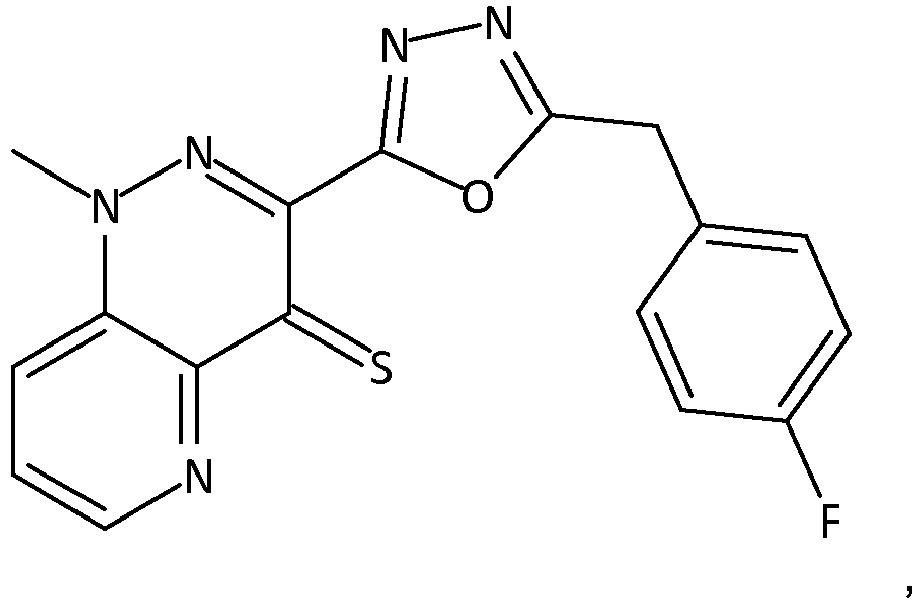

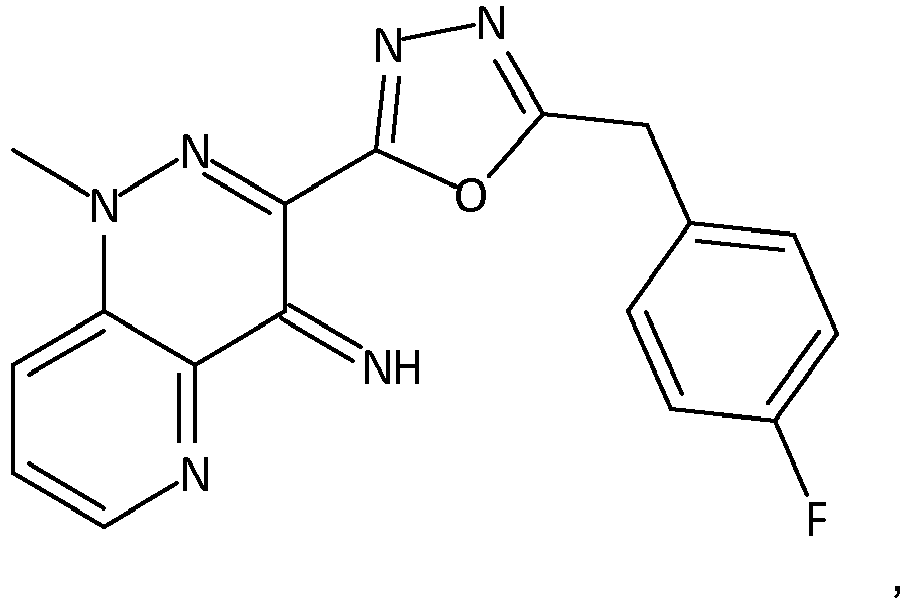


- In another embodiment, X is selected from Se, N-OH, NH, or N-CN; and R5 is selected from H, a substituted or unsubstituted hydrocarbon group, a substituted or unsubstituted heterogeneous group, a substituted or unsubstituted aromatic group, or a substituted or unsubstituted heteroaromatic group. In another embodiment, R5 is selected from a substituted or unsubstituted aromatic group, or a substituted or unsubstituted heteroaromatic group. In another embodiment, R5 is a substituted or unsubstituted heteroaromatic group. In another embodiment, R5 is


- In yet another embodiment, the compound is selected from:

- There is also disclosed herein, but which does not form part of the claimed invention, a compound of Formula II:

- and/or a pharmaceutically-acceptable salt, hydrate, solvate, tautomer, optical isomer, E-isomer, Z-isomer, or combination thereof;
- X is selected from Se, N-OH, NH, NO2, CN, N-CN, N=O, O or S, wherein:
- when X is Se, N-OH, NH, N-CN, or S, is a double bond, and
- R1, R2, and R3 are each independently selected from H, halo, hydroxyl, amino, a substituted or unsubstituted hydrocarbon group, a substituted or unsubstituted heterogeneous group, a substituted or unsubstituted carbocyclic group, a substituted or unsubstituted heterocyclic group, a substituted or unsubstituted aromatic group, or a substituted or unsubstituted heteroaromatic group;
- when X is Se, N-OH, NH, N-CN,
- when X is selected from NO2, CN or N=O, is a single bond, and
- R1, R2, and R3 are each independently selected from H, halo, hydroxyl, amino, a substituted or unsubstituted hydrocarbon group, a substituted or unsubstituted heterogeneous group, a substituted or unsubstituted carbocyclic group, a substituted or unsubstituted heterocyclic group, a substituted or unsubstituted aromatic group, or a substituted or unsubstituted heteroaromatic group; and
- when X is O, is a double bond,
- R1 and R2 are each independently selected from H, halo, hydroxyl, amino, a substituted or unsubstituted hydrocarbon group, a substituted or unsubstituted heterogeneous group, a substituted or unsubstituted carbocyclic group, a substituted or unsubstituted heterocyclic group, a substituted or unsubstituted aromatic group, or a substituted or unsubstituted heteroaromatic group, and
- R3 is

- R1 and R2 may each independently be selected from H, halo, hydroxyl, cyano, substituted or unsubstituted alkyl, substituted or unsubstituted alkenyl, substituted or unsubstituted alkynyl, substituted or unsubstituted haloalkyl, substituted or unsubstituted hydroxyalkyl, substituted or unsubstituted alkoxy, a substituted or unsubstituted heterocyclic group, a substituted or unsubstituted aromatic group, a substituted or unsubstituted heteroaromatic group, carboxyl, alkylcarbonyl, arylcarbonyl, cycloalkylcarbonyl, heterocyclylcarbonyl, amino, aminoalkyl, alkylaminoalkyl, heterocyclylalkyl, aralkyl, arylalkenyl, arylalkynyl, alkylthio, alkylamino, arylamino, heteroarylamino, aralkylamino, alkylaminoalkylamino, arylthio, aralkylthio, aryloxy, aralkoxy, heterocyclylalkoxy, heterocyclyloxyalkyl, cycloalkyl, and cycloalkenyl. R1 and R2 may each independently be selected from H or substituted or unsubstituted alkyl. X may be selected from Se, N-OH, NH, NO2, CN, N-CN, N=O, or S; and R3 is selected from H, a substituted or unsubstituted hydrocarbon group, a substituted or unsubstituted heterogeneous group, a substituted or unsubstituted aromatic group, or a substituted or unsubstituted heteroaromatic group. R3 may be selected from a substituted or unsubstituted aromatic group, or a substituted or unsubstituted heteroaromatic group. R3 may be a substituted or unsubstituted heteroaromatic group. R3 may be


- In another aspect, wherein the compound above is an HIV integrase inhibitor.
- In another aspect, there is provided a pharmaceutical composition comprising the compound above, a pharmaceutically-acceptable salt, hydrate, solvate, tautomer, optical isomer, E-isomer, Z-isomer, or combination thereof, optionally with a pharmaceutically acceptable carrier or diluent. In another aspect, there is provided the pharmaceutical composition in combination with at least one other anti-HIV agent.
- In another aspect, there is provided the compound above, a pharmaceutically-acceptable salt, hydrate, solvate, tautomer, optical isomer, E-isomer, Z-isomer, or combination thereof, optionally with a pharmaceutically acceptable carrier or diluent, for use in the treatment of HIV in a mammal, wherein the compound is present in an anti-HIV effective treatment amount.
- In another aspect, there is provided the compound above, a pharmaceutically-acceptable salt, hydrate, solvate, tautomer, optical isomer, E-isomer, Z-isomer, or combination thereof, optionally with a pharmaceutically acceptable carrier or diluent, for use in salvage therapy in the treatment of HIV in a mammal, wherein the compound is present in an anti-HIV effective treatment amount.
- The mammal may be human. The use may further comprise use of at least one other anti-HIV agent in combination and/or in alternation with the compound.
- There is also disclosed herein, but which does not form part of the claimed invention, a method for making the compound of Formula III:

- X is selected from Se, N-OH, NH, NO2, CN, N-CN, N=O, O or S, wherein:
- when X is selected from Se, N-OH, NH, N-CN, O or S, is a double bond,
- when X is selected from NO2, CN or N=O, is a single bond,
- R1, R2, R3, and R4 are each independently selected from H, halo, hydroxyl, amino, a substituted or unsubstituted hydrocarbon group, a substituted or unsubstituted heterogeneous group, a substituted or unsubstituted carbocyclic group, a substituted or unsubstituted heterocyclic group, a substituted or unsubstituted aromatic group, or a substituted or unsubstituted heteroaromatic group, and
- Z and A are each independently selected from CR9 or N, and R8 and R9 are each independently selected from H, halo, hydroxyl, amino, a substituted or unsubstituted hydrocarbon group, a substituted or unsubstituted heterogeneous group, a substituted or unsubstituted carbocyclic group, a substituted or unsubstituted heterocyclic group, a substituted or unsubstituted aromatic group, or a substituted or unsubstituted heteroaromatic group,
- when X is selected from Se, N-OH, NH, N-CN, O or S,
- wherein the method comprises:
- a) reacting a compound of Formula VII with an amine of NH2AHC(O)R8 to form an intermediate of Formula VIII:

- b) reacting the intermediate of Formula VIII with base to yield Formula III, whereby X is oxygen;
- c) reacting Formula III, whereby X is oxygen, under conditions to replace the oxygen of the carbonyl group with any X group defined herein to form the compounds of Formula III. Step c) may comprise reacting Formula III, whereby X is oxygen, with NH2OH to form the compound of Formula III, wherein X is N-OH.
- a) reacting a compound of Formula VII with an amine of NH2AHC(O)R8 to form an intermediate of Formula VIII:
- There is also disclosed herein, but which does not form part of the claimed invention, a method for making the compound of Formula IV:

- X is selected from Se, N-OH, NH, NO2, CN, N-CN, N=O, O or S, wherein:
- when X is Se, N-OH, NH, or N-CN, is a double bond,
- when X is selected from NO2, CN or N=O, is a single bond,
- when X is O or S, is a double bond,
- R1, R2, R3, and R4 are each independently selected from H, halo, hydroxyl, amino, a substituted or unsubstituted hydrocarbon group, a substituted or unsubstituted heterogeneous group, a substituted or unsubstituted carbocyclic group, a substituted or unsubstituted heterocyclic group, a substituted or unsubstituted aromatic group, or a substituted or unsubstituted heteroaromatic group, and
- wherein R6 and R7 are each independently selected from H, halo, hydroxyl, amino, a substituted or unsubstituted hydrocarbon group, a substituted or unsubstituted heterogeneous group, a substituted or unsubstituted carbocyclic group, a substituted or unsubstituted heterocyclic group, a substituted or unsubstituted aromatic group, or a substituted or unsubstituted heteroaromatic group,
- when X is Se, N-OH, NH, or N-CN,
- wherein the method comprises:
- a) reacting a compound of Formula VII with an amine of NHR6R7 to form an intermediate of Formula IX:
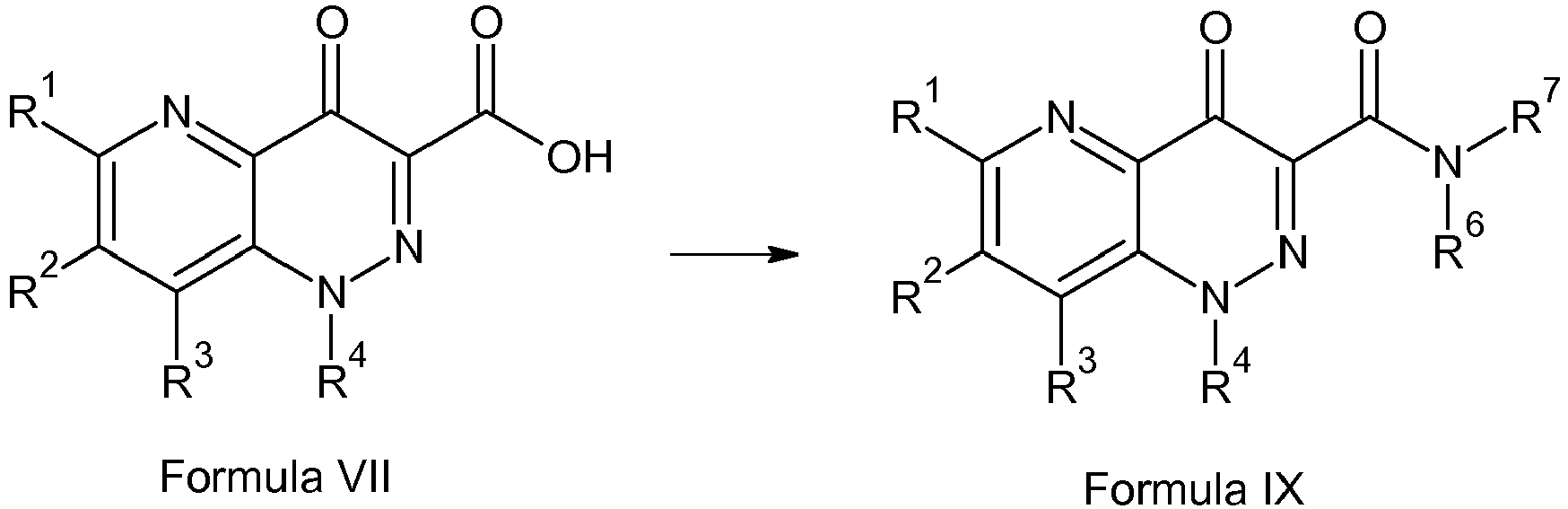
- b) reacting the intermediate of Formula IX under conditions to replace the oxygen of the carbonyl group in the ring with any X group defined herein to form the compound of Formula IV. Step b) may comprise reacting Formula IX with NH2OH to form the compound of Formula IV, wherein X is N-OH.
- a) reacting a compound of Formula VII with an amine of NHR6R7 to form an intermediate of Formula IX:
- There is also disclosed herein, but which does not form part of the claimed invention, a method for making the compound of Formula V:

- X is selected from Se, N-OH, NH, NO2, CN, N-CN, N=O, O or S, wherein:
- when X is Se, N-OH, NH, N-CN, or S, is a double bond, and
- when X is selected from NO2, CN or N=O, is a single bond,
- when X is Se, N-OH, NH, N-CN, or S,
- R1 and R2 are each independently selected from H, halo, hydroxyl, amino, a substituted or unsubstituted hydrocarbon group, a substituted or unsubstituted heterogeneous group, a substituted or unsubstituted carbocyclic group, a substituted or unsubstituted heterocyclic group, a substituted or unsubstituted aromatic group, or a substituted or unsubstituted heteroaromatic group; and
- wherein R6 and R7 are each independently selected from H, halo, hydroxyl, amino, a substituted or unsubstituted hydrocarbon group, a substituted or unsubstituted heterogeneous group, a substituted or unsubstituted carbocyclic group, a substituted or unsubstituted heterocyclic group, a substituted or unsubstituted aromatic group, or a substituted or unsubstituted heteroaromatic group,
- wherein the method comprises:
- a) reacting a compound of Formula XII with an amine of NHR6R7 to form an intermediate of Formula XIII:

- b) reacting the intermediate of Formula XIII under conditions to replace the oxygen of the carbonyl group in the ring with any X group defined herein to form the compound of Formula V. Step b) may comprise reacting Formula XIII with NH2OH to form the compound of Formula V, wherein X is N-OH.
- a) reacting a compound of Formula XII with an amine of NHR6R7 to form an intermediate of Formula XIII:
- There is also disclosed herein, but which does not form part of the claimed invention, a method for making the compound of Formula VI:

- and/or a pharmaceutically-acceptable salt, hydrate, solvate, tautomer, optical isomer, E-isomer, Z-isomer, or combination thereof;
- X is N-OH and is a double bond,
- R1 and R2 are each independently selected from H, halo, hydroxyl, amino, a substituted or unsubstituted hydrocarbon group, a substituted or unsubstituted heterogeneous group, a substituted or unsubstituted carbocyclic group, a substituted or unsubstituted heterocyclic group, a substituted or unsubstituted aromatic group, or a substituted or unsubstituted heteroaromatic group; and wherein Z and A are each independently selected from CR10 or N, and R4 and R10 are each independently selected from H, halo, hydroxyl, amino, a substituted or unsubstituted hydrocarbon group, a substituted or unsubstituted heterogeneous group, a substituted or unsubstituted carbocyclic group, a substituted or unsubstituted heterocyclic group, a substituted or unsubstituted aromatic group, or a substituted or unsubstituted heteroaromatic group, wherein the method comprises:
- a) reacting a compound of Formula X, whereby R is a benzyl group, with an amine of NH2AHC(O)R4 to form an intermediate of Formula XI:

- b) reacting the intermediate of Formula XI with base to yield Formula VI, whereby X is oxygen;
- c) reacting Formula VI, whereby X is oxygen, with Lawesson's reagent, to yield Formula VI, whereby X is sulfur;
- d) reacting Formula VI, whereby X is sulfur and R is a benzyl group, with NH2OCH2Ar, to yield Formula VI, whereby X is N-O-CH2Ar; and
- e) reducing Formula VI, whereby X is N-O-CH2Ar, to yield Formula VI, whereby X is N-OH and R is a H.
- a) reacting a compound of Formula X, whereby R is a benzyl group, with an amine of NH2AHC(O)R4 to form an intermediate of Formula XI:
- Other features and advantages of the present invention will become apparent from the following detailed description. It should be understood, however, that the detailed description and the specific examples while indicating embodiments of the invention are given by way of illustration only, since various changes and modifications within the scope of the invention as defined by the appended claims will become apparent to those skilled in the art from the detailed description.
- Certain embodiments of the present invention will now be described more fully with reference to the accompanying drawings:
- Figure 1 shows a graph of the effect of COTI-HIV1Doxo in an HIV-1 integrase assay; and
- Figure 2 shows plots of the log-transformation of drug concentrations and best-fit curve for COTI-HIV-1 (A) (not an example of the present invention), COTI-HIV28233 (B), COTI-HIV28236 (C), and two sodium azide controls (D & E) to allow calculation of IC50 using non-linear regression.
- The present invention is directed to new compounds, compositions comprising such compounds, a method of administration thereof, and use thereof to treat HIV. The compounds of this invention may function as inhibitors of HIV integrase.
- When describing the compounds, compositions, methods and uses of this invention, the following terms have the following meanings unless otherwise indicated.
- The term "therapeutically effective amount" as used herein means that amount of active compound or pharmaceutical agent that elicits the biological or medicinal response in a tissue, system, animal or human that is being sought by a researcher, veterinarian, medical doctor or other clinician.
- The compounds of the present invention may have asymmetric centers, chiral axes, and chiral planes (as described, for example, in: E. L. Eliel and S. H. Wilen, Stereo-chemistry of Carbon Compounds, John Wiley & Sons, New York, 1994, pages 1119-1190), and occur as racemates, racemic mixtures, and as individual diastereomers, with all possible isomers and mixtures thereof, including optical isomers, E isomers, and Z isomers, being included in the present invention. In addition, the compounds disclosed herein may exist as tautomers and both tautomeric forms are intended to be encompassed by the scope of the invention, even though only one tautomeric structure may be depicted.
- Generally, reference to a certain element such as hydrogen or H is meant to, if appropriate, include all isotopes of that element.
- Where the term "alkyl group" is used, either alone or within other terms such as "haloalkyl group" and "alkylamino group", it encompasses linear or branched carbon radicals having, for example, one to twenty carbon atoms or, in specific embodiments, one to twelve carbon atoms. In other embodiments, alkyl groups are "lower alkyl" groups having one to six carbon atoms. Examples of such groups include, but are not limited thereto, methyl, ethyl, n-propyl, isopropyl, n-butyl, isobutyl, sec-butyl, tert-butyl, pentyl, iso-amyl, hexyl and the like. In more specific embodiments, lower alkyl groups have one to four carbon atoms.
- The term "alkenyl group" encompasses linear or branched carbon radicals having at least one carbon-carbon double bond. The term "alkenyl group" can encompass conjugated and non-conjugated carbon-carbon double bonds or combinations thereof. An alkenyl group, for example and without being limited thereto, can encompass two to twenty carbon atoms or, in a particular embodiment, two to twelve carbon atoms. In embodiments, alkenyl groups are "lower alkenyl" groups having two to four carbon atoms. Examples of alkenyl groups include, but are not limited thereto, ethenyl, propenyl, allyl, propenyl, butenyl and 4-methylbutenyl. The terms "alkenyl group" and "lower alkenyl group", encompass groups having "cis" and "trans" orientations, or alternatively, "E" and "Z" orientations.
- The term "alkynyl group" denotes linear or branched carbon radicals having at least one carbon-carbon triple bond. The term "alkynyl group" can encompass conjugated and non-conjugated carbon-carbon triple bonds or combinations thereof. Alkynyl group, for example and without being limited thereto, can encompass two to twenty carbon atoms or, in a particular embodiment, two to twelve carbon atoms. In embodiments, alkynyl groups are "lower alkynyl" groups having two to ten carbon atoms. Some examples are lower alkynyl groups having two to four carbon atoms. Examples of such groups include propargyl, butynyl, and the like.
- The term "halo" means halogens such as fluorine, chlorine, bromine or iodine atoms.
- The term "haloalkyl group" encompasses groups wherein any one or more of the alkyl carbon atoms is substituted with halo as defined above. Specifically encompassed are monohaloalkyl, dihaloalkyl and polyhaloalkyl groups including perhaloalkyl. A monohaloalkyl group, for one example, may have either an iodo, bromo, chloro or fluoro atom within the group. Dihalo and polyhaloalkyl groups may have two or more of the same halo atoms or a combination of different halo groups. "Lower haloalkyl group" encompasses groups having 1- 6 carbon atoms. In some embodiments, lower haloalkyl groups have one to three carbon atoms. Examples of haloalkyl groups include fluoromethyl, difluoromethyl, trifluoromethyl, chloromethyl, dichloromethyl, trichloromethyl, pentafluoroethyl, heptafluoropropyl, difluorochloromethyl, dichlorofluoromethyl, difluoroethyl, difluoropropyl, dichloroethyl and dichloropropyl.
- The term "hydroxyalkyl group" encompasses linear or branched alkyl groups having, for example and without being limited thereto, one to ten carbon atoms, any one of which may be substituted with one or more hydroxyl groups. In embodiments, hydroxyalkyl groups are "lower hydroxyalkyl" groups having one to six carbon atoms and one or more hydroxyl groups. Examples of such groups include hydroxymethyl, hydroxyethyl, hydroxypropyl, hydroxybutyl and hydroxyhexyl.
- The term "alkoxy group" encompasses linear or branched oxy-containing groups each having alkyl portions of, for example and without being limited thereto, one to ten carbon atoms. In embodiments, alkoxy groups are "lower alkoxy" groups having one to six carbon atoms. Examples of such groups include methoxy, ethoxy, propoxy, butoxy and tert-butoxy. In certain embodiments, lower alkoxy groups have one to three carbon atoms. The "alkoxy" groups may be further substituted with one or more halo atoms, such as fluoro, chloro or bromo, to provide "haloalkoxy" groups. In other embodiments, lower haloalkoxy groups have one to three carbon atoms. Examples of such groups include fluoromethoxy, chloromethoxy, trifluoromethoxy, trifluoroethoxy, fluoroethoxy, and fluoropropoxy.
- The term "aromatic group" or "aryl group" means an aromatic group having one or more rings wherein such rings may be attached together in a pendent manner or may be fused. In particular embodiments, an aromatic group is one, two or three rings. Monocyclic aromatic groups may contain 4 to 10 carbon atoms, typically 4 to 7 carbon atoms, and more typically 4 to 6 carbon atoms in the ring. Typical polycyclic aromatic groups have two or three rings. Polycyclic aromatic groups having two rings typically have 8 to 12 carbon atoms, preferably 8 to 10 carbon atoms in the rings. Examples of aromatic groups include, but are not limited to, phenyl, naphthyl, tetrahydronaphthyl, indanyl, biphenyl, phenanthryl, anthryl or acenaphthyl.
- The term "heteroatom" means an atom other than carbon. Typically, heteroatoms are selected from the group consisting of sulfur, phosphorous, nitrogen and oxygen atoms. Groups containing more than one heteroatom may contain different heteroatoms.
- The term "heteroaromatic group" or "heteroaryl group" means an aromatic group having one or more rings wherein such rings may be attached together in a pendent manner or may be fused, wherein the aromatic group has at least one heteroatom. Monocyclic heteroaromatic groups may contain 4 to 10 member atoms, typically 4 to 7 member atoms, and more typically 4 to 6 member atoms in the ring. Typical polycyclic heteroaromatic groups have two or three rings. Polycyclic aromatic groups having two rings typically have 8 to 12 member atoms, more typically 8 to 10 member atoms in the rings. Examples of heteroaromatic groups include, but are not limited thereto, pyrrole, imidazole, thiazole, oxazole, furan, thiophene, triazole, pyrazole, isoxazole, isothiazole, pyridine, pyrazine, pyridazine, pyrimidine, triazine, indole, benzofuran, benzothiophene, benzimidazole, benzthiazole, quinoline, isoquinoline, quinazoline, quinoxaline and the like.
- The term "carbocyclic group" means a saturated or unsaturated carbocyclic hydrocarbon ring. Carbocyclic groups are not aromatic. Carbocyclic groups are monocyclic or polycyclic. Polycyclic carbocyclic groups can be fused, spiro, or bridged ring systems. Monocyclic carbocyclic groups may contain 4 to 10 carbon atoms, typically 4 to 7 carbon atoms, and more typically 5 to 6 carbon atoms in the ring. Bicyclic carbocyclic groups may contain 8 to 12 carbon atoms, typically 9 to 10 carbon atoms in the rings.
- The term "heterocyclic group" means a saturated or unsaturated ring structure containing carbon atoms and 1 or more heteroatoms in the ring. Heterocyclic groups are not aromatic. Heterocyclic groups are monocyclic or polycyclic. Polycyclic heterocyclic groups can be fused, spiro, or bridged ring systems. Monocyclic heterocyclic groups may contain 4 to 10 member atoms (i.e., including both carbon atoms and at least 1 heteroatom), typically 4 to 7, and more typically 5 to 6 in the ring. Bicyclic heterocyclic groups may contain 8 to 18 member atoms, typically 9 or 10 member atoms in the rings. Representative heterocyclic groups include, by way of example, pyrrolidine, imidazolidine, pyrazolidine, piperidine, 1,4-dioxane, morpholine, thiomorpholine, piperazine, 3-pyrroline and the like.
- The term "heterogeneous group" means a saturated or unsaturated chain of non-hydrogen member atoms comprising carbon atoms and at least one heteroatom. Heterogeneous groups typically have 1 to 25 member atoms. More typically, the chain contains 1 to 12 member atoms, 1 to 10, and most typically 1 to 6. The chain may be linear or branched. Typical branched heterogeneous groups have one or two branches, more typically one branch. Typically, heterogeneous groups are saturated. Unsaturated heterogeneous groups may have one or more double bonds, one or more triple bonds, or both. Typical unsaturated heterogeneous groups have one or two double bonds or one triple bond. More typically, the unsaturated heterogeneous group has one double bond.
- The term "hydrocarbon group" or "hydrocarbyl group" means a chain of 1 to 25 carbon atoms, typically 1 to 12 carbon atoms, more typically 1 to 10 carbon atoms, and most typically 1 to 8 carbon atoms. Hydrocarbon groups may have a linear or branched chain structure. Typical hydrocarbon groups have one or two branches, typically one branch. Typically, hydrocarbon groups are saturated. Unsaturated hydrocarbon groups may have one or more double bonds, one or more triple bonds, or combinations thereof. Typical unsaturated hydrocarbon groups have one or two double bonds or one triple bond; more typically unsaturated hydrocarbon groups have one double bond.
- When the term "unsaturated" is used in conjunction with any group, the group may be fully unsaturated or partially unsaturated. However, when the term "unsaturated" is used in conjunction with a specific group defined herein, the term maintains the limitations of that specific group. For example, an unsaturated "carbocyclic group", based on the limitations of the "carbocyclic group" as defined herein, does not encompass an aromatic group.
- The terms "carboxy group" or "carboxyl group", whether used alone or with other terms, such as "carboxyalkyl group", denotes -(C=O)-O-.
- The term "carbonyl group", whether used alone or with other terms, such as "aminocarbonyl group", denotes -(C=O)-.
- The terms "alkylcarbonyl group" denotes carbonyl groups which have been substituted with an alkyl group. In certain embodiments, "lower alkylcarbonyl group" has lower alkyl group as described above attached to a carbonyl group.
- The term "aminoalkyl group" encompasses linear or branched alkyl groups having one to ten carbon atoms any one of which may be substituted with one or more amino groups. In some embodiments, the aminoalkyl groups are "lower aminoalkyl" groups having one to six carbon atoms and one or more amino groups. Examples of such groups include aminomethyl, aminoethyl, aminopropyl, aminobutyl and aminohexyl.
- The term "alkylaminoalkyl group" encompasses aminoalkyl groups having the nitrogen atom independently substituted with an alkyl group. In certain embodiments, the alkylaminoalkyl groups are "loweralkylaminoalkyl" groups having alkyl groups of one to six carbon atoms. In other embodiments, the lower alkylaminoalkyl groups have alkyl groups of one to three carbon atoms. Suitable alkylaminoalkyl groups may be mono or dialkyl substituted, such as N-methylaminomethyl, N, N-dimethyl-aminoethyl, N, N-diethylaminomethyl and the like.
- The term "aralkyl group" encompasses aryl-substituted alkyl groups. In embodiments, the aralkyl groups are "lower aralkyl" groups having aryl groups attached to alkyl groups having one to six carbon atoms. In other embodiments, the lower aralkyl groups phenyl is attached to alkyl portions having one to three carbon atoms. Examples of such groups include benzyl, diphenylmethyl and phenylethyl. The aryl in said aralkyl may be additionally substituted with halo, alkyl, alkoxy, haloalkyl and haloalkoxy.
- The term "arylalkenyl group" encompasses aryl-substituted alkenyl groups. In embodiments, the arylalkenyl groups are "lower arylalkenyl" groups having aryl groups attached to alkenyl groups having two to six carbon atoms. Examples of such groups include phenylethenyl. The aryl in said arylalkenyl may be additionally substituted with halo, alkyl, alkoxy, haloalkyl and haloalkoxy.
- The term "arylalkynyl group" encompasses aryl-substituted alkynyl groups. In embodiments, arylalkynyl groups are "lower arylalkynyl" groups having aryl groups attached to alkynyl groups having two to six carbon atoms. Examples of such groups include phenylethynyl. The aryl in said aralkyl may be additionally substituted with halo, alkyl, alkoxy, haloalkyl and haloalkoxy. The terms benzyl and phenylmethyl are interchangeable.
- The term "alkylthio group" encompasses groups containing a linear or branched alkyl group, of one to ten carbon atoms, attached to a divalent sulfur atom. In certain embodiments, the lower alkylthio groups have one to three carbon atoms. An example of "alkylthio" is methylthio, (CH3S-).
- The term "alkylamino group" denotes amino groups which have been substituted with one alkyl group and with two alkyl groups, including terms "N-alkylamino" and "N,N-dialkylamino". In embodiments, alkylamino groups are "lower alkylamino" groups having one or two alkyl groups of one to six carbon atoms, attached to a nitrogen atom. In other embodiments, lower alkylamino groups have one to three carbon atoms. Suitable "alkylamino" groups may be mono or dialkylamino such as N-methylamino, N-ethylamino, N,N-dimethylamino, N,N-diethylamino and the like.
- The term "arylamino group" denotes amino groups which have been substituted with one or two aryl groups, such as N-phenylamino. The "arylamino" groups may be further substituted on the aryl ring portion of the group.
- The term "heteroarylamino" denotes amino groups which have been substituted with one or two heteroaryl groups, such as N-thienylamino. The "heteroarylamino" groups may be further substituted on the heteroaryl ring portion of the group.
- The term "aralkylamino group" denotes amino groups which have been substituted with one or two aralkyl groups. In other embodiments, there are phenyl-C1-C3-alkylamino groups, such as N-benzylamino. The "aralkylamino" groups may be further substituted on the aryl ring portion of the group.
- The term "alkylaminoalkylamino group" denotes alkylamino groups which have been substituted with one or two alkylamino groups. In embodiments, there are C1-C3-alkylamino- C1-C3-alkylamino groups.
- The term "arylthio group" encompasses aryl groups of six to ten carbon atoms, attached to a divalent sulfur atom. An example of "arylthio" is phenylthio. The term "aralkylthio group" encompasses aralkyl groups as described above, attached to a divalent sulfur atom. In certain embodiments there are phenyl- C1-C3-alkylthio groups. An example of "aralkylthio" is benzylthio.
- The term "aryloxy group" encompasses optionally substituted aryl groups, as defined above, attached to an oxygen atom. Examples of such groups include phenoxy.
- The term "aralkoxy group" encompasses oxy-containing aralkyl groups attached through an oxygen atom to other groups. In certain embodiments, aralkoxy groups are "lower aralkoxy" groups having optionally substituted phenyl groups attached to lower alkoxy group as described above.
- The term "cycloalkyl group" includes saturated carbocyclic groups. In certain embodiments, cycloalkyl groups include C3-C6 rings. In embodiments, there are compounds that include, cyclopentyl, cyclopropyl, and cyclohexyl.
- The term "cycloalkenyl group" includes carbocyclic groups that have one or more carbon-carbon double bonds; conjugated or non-conjugated, or a combination thereof. "Cycloalkenyl" and "cycloalkyldienyl" compounds are included in the term "cycloalkenyl". In certain embodiments, cycloalkenyl groups include C3-C6 rings. Examples include cyclopentenyl, cyclopentadienyl, cyclohexenyl and cycloheptadienyl. The "cycloalkenyl" group may have 1 to 3 substituents such as lower alkyl, hydroxyl, halo, haloalkyl, nitro, cyano, alkoxy, lower alkylamino, and the like.
- The term "suitable substituent", "substituent" or "substituted" used in conjunction with the groups described herein refers to a chemically and pharmaceutically acceptable group, i.e., a moiety that does not negate the therapeutic activity of the inventive compounds. It is understood that substituents and substitution patterns on the compounds of the invention are selected from cycloalkyl, heterocyclyl, hydroxyalkyl, benzyl, carbonyl, halo, haloalkyl, perfluoroalkyl, perfluoroalkoxy, alkyl, alkenyl, alkynyl, hydroxy, oxo, mercapto, alkylthio, alkoxy, aryl or heteroaryl, aryloxy or heteroaryloxy, aralkyl or heteroaralkyl, aralkoxy or heteroaralkoxy, HO--(C=O)--, amido, amino, alkyl- and dialkylamino, cyano, nitro, carbamoyl, alkylcarbonyl, alkoxycarbonyl, alkylaminocarbonyl, dialkylaminocarbonyl, arylcarbonyl, aryloxycarbonyl, alkylsulfonyl, and arylsulfonyl, and may be selected by one of ordinary skill in the art to provide compounds that are chemically stable and that can be readily synthesized by techniques known in the art, as well as those methods set forth below. If a substituent is itself substituted with more than one group, it is understood that these multiple groups may be on the same carbon/member atom or on different carbons/member atoms, as long as a stable structure results. As noted above, the substituents are selected from cycloalkyl, heterocyclyl, hydroxyalkyl, benzyl, carbonyl, halo, haloalkyl, perfluoroalkyl, perfluoroalkoxy, alkyl, alkenyl, alkynyl, hydroxy, oxo, mercapto, alkylthio, alkoxy, aryl or heteroaryl, aryloxy or heteroaryloxy, aralkyl or heteroaralkyl, aralkoxy or heteroaralkoxy, HO--(C=O)--, amido, amino, alkyl-and dialkylamino, cyano, nitro, carbamoyl, alkylcarbonyl, alkoxycarbonyl, alkylaminocarbonyl, dialkylaminocarbonyl, arylcarbonyl, aryloxycarbonyl, alkylsulfonyl, and arylsulfonyl. Typical substituents include aromatic groups, substituted aromatic groups, hydrocarbon groups including alkyl groups such as methyl groups, substituted hydrocarbon groups such as benzyl, and heterogeneous groups including alkoxy groups such as methoxy groups.
- The term "fused" means in which two or more carbons/member atoms are common to two adjoining rings, e.g., the rings are "fused rings".
- The pharmaceutically acceptable salts of the compounds of this invention include the conventional non-toxic salts of the compounds of this invention as formed, e.g., from non-toxic inorganic or organic acids. For example, such conventional non-toxic salts include those derived from inorganic acids such as hydrochloric, hydrobromic, sulfuric, sulfamic, phosphoric, nitric and the like; and the salts prepared from organic acids such as acetic, propionic, succinic, glycolic, stearic, lactic, malic, tartaric, citric, ascorbic, pamoic, maleic, hydroxymaleic, phenylacetic, glutamic, benzoic, salicylic, sulfanilic, 2-acetoxy-benzoic, fumaric, toluenesulfonic, methanesulfonic, ethane disulfonic, oxalic, isethionic, trifluoroacetic and the like.
- The pharmaceutically acceptable salts of the compounds of this invention can be synthesized from the compounds of this invention which contain a basic or acidic moiety by conventional chemical methods. Generally, the salts of the basic compounds are prepared either by ion exchange chromatography or by reacting the free base with stoichiometric amounts or with an excess of the desired salt-forming inorganic or organic acid in a suitable solvent or various combinations of solvents. Similarly, the salts of the acidic compounds are formed by reactions with the appropriate inorganic or organic base.
- The present invention includes pharmaceutically acceptable salts, solvates and prodrugs of the compounds of the invention and mixtures thereof.
- The terms "comprising", "having" and "including", and various endings thereof, are meant to be open ended, including the indicated component but not excluding other elements.
- A compound of the invention is represented by a compound of Formula I:

- a pharmaceutically-acceptable salt, hydrate, solvate, tautomer, optical isomer, E-isomer, Z-isomer, or combination thereof;
- X is selected from Se, N-OH, NH, NO2, CN, N-CN, N=O, O or S, wherein:
- when X is Se, N-OH, NH, or N-CN, is a double bond, and
- R1, R2, R3, R4 and R5 are each independently selected from H, halo, hydroxyl, amino, a substituted or unsubstituted hydrocarbon group, a substituted or unsubstituted heterogeneous group, a substituted or unsubstituted carbocyclic group, a substituted or unsubstituted heterocyclic group, a substituted or unsubstituted aromatic group, or a substituted or unsubstituted heteroaromatic group;
- when X is selected from NO2, CN or N=O, is a single bond, and
- R1, R2, R3, R4 and R5 are each independently selected from H, halo, hydroxyl, amino, a substituted or unsubstituted hydrocarbon group, a substituted or unsubstituted heterogeneous group, a substituted or unsubstituted carbocyclic group, a substituted or unsubstituted heterocyclic group, a substituted or unsubstituted aromatic group, or a substituted or unsubstituted heteroaromatic group; and
- when X is O or S, is a double bond,
- R1, R2, R3, and R4 are each independently selected from H, halo, hydroxyl, amino, a substituted or unsubstituted hydrocarbon group, a substituted or unsubstituted heterogeneous group, a substituted or unsubstituted carbocyclic group, a substituted or unsubstituted heterocyclic group, a substituted or unsubstituted aromatic group, or a substituted or unsubstituted heteroaromatic group, and
- R5 is -(C=O)NR6R7 or

- wherein Z and A are each independently selected from CR9 or N, and R8 and R9 are each independently selected from H, halo, hydroxyl, amino, a substituted or unsubstituted hydrocarbon group, a substituted or unsubstituted heterogeneous group, a substituted or unsubstituted carbocyclic group, a substituted or unsubstituted heterocyclic group, a substituted or unsubstituted aromatic group, or a substituted or unsubstituted heteroaromatic group.
- when X is Se, N-OH, NH, or N-CN,
- In one embodiment, there is provided a compound represented by a compound of Formula III:

- a pharmaceutically-acceptable salt, hydrate, solvate, tautomer, optical isomer, E-isomer, Z-isomer, or combination thereof;
- X is selected from Se, N-OH, NH, NO2, CN, N-CN, N=O, O or S, wherein:
- when X is selected from Se, N-OH, NH, N-CN, O or S, is a double bond,
- when X is selected from NO2, CN or N=O, is a single bond,
- R1, R2, R3, and R4 are each independently selected from H, halo, hydroxyl, amino, a substituted or unsubstituted hydrocarbon group, a substituted or unsubstituted heterogeneous group, a substituted or unsubstituted carbocyclic group, a substituted or unsubstituted heterocyclic group, a substituted or unsubstituted aromatic group, or a substituted or unsubstituted heteroaromatic group, and
- Z and A are each independently selected from CR9 or N, and R8 and R9 are each independently selected from H, halo, hydroxyl, amino, a substituted or unsubstituted hydrocarbon group, a substituted or unsubstituted heterogeneous group, a substituted or unsubstituted carbocyclic group, a substituted or unsubstituted heterocyclic group, a substituted or unsubstituted aromatic group, or a substituted or unsubstituted heteroaromatic group.
- when X is selected from Se, N-OH, NH, N-CN, O or S,
- In another embodiment, both Z and A are N and R8 is a substituted or unsubstituted hydrocarbon group. In a more specific embodiment, R8 is selected from a substituted or unsubstituted alkyl group, such as a substituted or unsubstituted alkylaryl or a substituted or unsubstituted alkylheteroaryl. More specifically, the substituted or unsubstituted alkylaryl is a substituted or unsubstituted alkylphenyl, wherein the phenyl group is substituted with a halo group such as a 4-fluorobenzyl group. R1, R2, R3, and R4 may be specifically H or substituted or unsubstituted alkyl groups.
- In a further embodiment, there is provided a compound represented by a compound of Formula IV:

- a pharmaceutically-acceptable salt, hydrate, solvate, tautomer, optical isomer, E-isomer, Z-isomer, or combination thereof;
- X is selected from Se, N-OH, NH, NO2, CN, N-CN, N=O, O or S, wherein:
- when X is Se, N-OH, NH, or N-CN, is a double bond,
- when X is selected from NO2, CN or N=O, is a single bond,
- when X is O or S, is a double bond,
- when X is Se, N-OH, NH, or N-CN,
- R1, R2, R3, and R4 are each independently selected from H, halo, hydroxyl, amino, a substituted or unsubstituted hydrocarbon group, a substituted or unsubstituted heterogeneous group, a substituted or unsubstituted carbocyclic group, a substituted or unsubstituted heterocyclic group, a substituted or unsubstituted aromatic group, or a substituted or unsubstituted heteroaromatic group, and
- wherein R6 and R7 are each independently selected from H, halo, hydroxyl, amino, a substituted or unsubstituted hydrocarbon group, a substituted or unsubstituted heterogeneous group, a substituted or unsubstituted carbocyclic group, a substituted or unsubstituted heterocyclic group, a substituted or unsubstituted aromatic group, or a substituted or unsubstituted heteroaromatic group.
- In another embodiment, R6 and R7 are each independently selected from a substituted or unsubstituted alkyl group. The substituted or unsubstituted alkyl group may be a substituted or unsubstituted alkylaryl or a substituted or unsubstituted alkylheteroaryl. More specifically, the substituted or unsubstituted alkylaryl is a substituted or unsubstituted alkylphenyl, wherein the phenyl group is substituted with a halo group such as a 4-fluorobenzyl group. R1, R2, R3, and R4 may be specifically H or substituted or unsubstituted alkyl groups.
- Specific embodiments include, without being limited thereto, compounds such as:


- In a further embodiment, there is provided a compound represented by a compound of Formula IVA:

- a pharmaceutically-acceptable salt, hydrate, solvate, tautomer, optical isomer, E-isomer, Z-isomer, or combination thereof;
- X is selected from Se, N-OH, NH, NO2, CN, N-CN, N=O, O or S, wherein:
- when X is Se, N-OH, NH, or N-CN, is a double bond,
- when X is selected from NO2, CN or N=O, is a single bond,
- when X is O or S, is a double bond,
- R1, R2, R3, and R4 are each independently selected from H, halo, hydroxyl, amino, a substituted or unsubstituted hydrocarbon group, a substituted or unsubstituted heterogeneous group, a substituted or unsubstituted carbocyclic group, a substituted or unsubstituted heterocyclic group, a substituted or unsubstituted aromatic group, or a substituted or unsubstituted heteroaromatic group, and
- wherein R6 is selected from H, halo, a substituted or unsubstituted hydrocarbon group, a substituted or unsubstituted heterogeneous group, a substituted or unsubstituted carbocyclic group, a substituted or unsubstituted heterocyclic group, a substituted or unsubstituted aromatic group, or a substituted or unsubstituted heteroaromatic group.
- when X is Se, N-OH, NH, or N-CN,
- In another embodiment, R6 is selected from a substituted or unsubstituted alkyl group. In yet another embodiment, R6 is H. In another embodiment, R1, R2, R3, and R4 are each independently selected from a substituted or unsubstituted alkylaryl. In another embodiment, the substituted or unsubstituted alkylaryl is a substituted or unsubstituted alkylphenyl, wherein the phenyl group is substituted with a halo group.
- In a further embodiment, the compound is selected from:

- There is also herein disclosed, but which does not form part of the claimed invention, a compound represented by a compound of Formula V:

- and/or a pharmaceutically-acceptable salt, hydrate, solvate, tautomer, optical isomer, E-isomer, Z-isomer, or combination thereof;
- X is selected from Se, N-OH, NH, NO2, CN, N-CN, N=O, O or S, wherein:
- when X is Se, N-OH, NH, N-CN, or S, is a double bond, and
- when X is selected from NO2, CN or N=O, is a single bond,
- when X is Se, N-OH, NH, N-CN, or S,
- R1 and R2 are each independently selected from H, halo, hydroxyl, amino, a substituted or unsubstituted hydrocarbon group, a substituted or unsubstituted heterogeneous group, a substituted or unsubstituted carbocyclic group, a substituted or unsubstituted heterocyclic group, a substituted or unsubstituted aromatic group, or a substituted or unsubstituted heteroaromatic group; and
- wherein R6 and R7 are each independently selected from H, halo, hydroxyl, amino, a substituted or unsubstituted hydrocarbon group, a substituted or unsubstituted heterogeneous group, a substituted or unsubstituted carbocyclic group, a substituted or unsubstituted heterocyclic group, a substituted or unsubstituted aromatic group, or a substituted or unsubstituted heteroaromatic group.
- In another embodiment, R6 and R7 are each independently selected from a substituted or unsubstituted alkyl group. The substituted or unsubstituted alkyl group may be a substituted or unsubstituted alkylaryl or a substituted or unsubstituted alkylheteroaryl. More specifically, the substituted or unsubstituted alkylaryl is a substituted or unsubstituted alkylphenyl, wherein the phenyl group is substituted with a halo group such as a 4-fluorobenzyl group. R1 and R2 may be specifically H or substituted or unsubstituted alkyl groups.
- There is also disclosed herein, but which does not form part of the claimed invention, a compound of Formula VI:
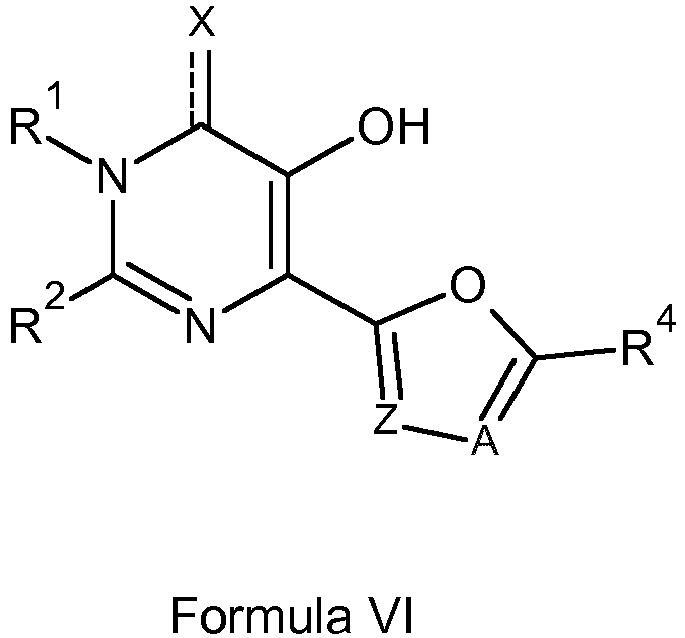
- and/or a pharmaceutically-acceptable salt, hydrate, solvate, tautomer, optical isomer, E-isomer, Z-isomer, or combination thereof;
- X is selected from Se, N-OH, NH, NO2, CN, N-CN, N=O, O or S, wherein:
- when X is Se, N-OH, NH, N-CN, O or S, is a double bond,
- when X is selected from NO2, CN or N=O, is a single bond,
- when X is Se, N-OH, NH, N-CN, O or S,
- R1 and R2 are each independently selected from H, halo, hydroxyl, amino, a substituted or unsubstituted hydrocarbon group, a substituted or unsubstituted heterogeneous group, a substituted or unsubstituted carbocyclic group, a substituted or unsubstituted heterocyclic group, a substituted or unsubstituted aromatic group, or a substituted or unsubstituted heteroaromatic group; and
- wherein Z and A are each independently selected from CR10 or N, and R4 and R10 are each independently selected from H, halo, hydroxyl, amino, a substituted or unsubstituted hydrocarbon group, a substituted or unsubstituted heterogeneous group, a substituted or unsubstituted carbocyclic group, a substituted or unsubstituted heterocyclic group, a substituted or unsubstituted aromatic group, or a substituted or unsubstituted heteroaromatic group.
- In another embodiment, both Z and A are N and R4 is a substituted or unsubstituted hydrocarbon group. In a more specific embodiment, R4 is selected from a substituted or unsubstituted alkyl group, such as a substituted or unsubstituted alkylaryl or a substituted or unsubstituted alkylheteroaryl. More specifically, the substituted or unsubstituted alkylaryl is a substituted or unsubstituted alkylphenyl, wherein the phenyl group is substituted with a halo group such as a 4-fluorobenzyl group. R1 and R2 may be specifically H or substituted or unsubstituted alkyl groups.
- Specific embodiments include, without being limited thereto, compounds such as:


- The compounds of this invention may be prepared by employing reactions and standard manipulations that are known in the literature or exemplified herein.
- The compounds of Formula III described herein can be prepared as follows:
- a) reacting a compound of Formula VII with an amine of NH2AHC(O)R8 to form an intermediate of Formula VIII:

- b) reacting the intermediate of Formula VIII with base to yield Formula III, whereby X is oxygen;
- c) reacting Formula III, whereby X is oxygen, with NH2OH (or under conditions to replace the oxygen of the carbonyl group in the ring with any X group mentioned herein (e.g. Se, S, etc.)) to form the compounds of Formula III.
- The compounds of Formula IV described herein can be prepared as follows:
- a) reacting a compound of Formula VII with an amine of NHR6R7 to form an intermediate of Formula IX:

- b) reacting the intermediate of Formula IX with NH2OH (or under conditions to replace the oxygen of the carbonyl group in the ring with any X group mentioned herein (e.g. Se, S, etc.)) to form the compound of Formula IV.
- The compounds of Formula V described herein can be prepared as follows:
- a) reacting a compound of Formula XII with an amine of NHR6R7 to form an intermediate of Formula XIII:

- b) reacting the intermediate of Formula XIII with NH2OH (or under conditions to replace the oxygen of the carbonyl group in the ring with any X group mentioned herein (e.g. Se, S, etc.)) to form the compound of Formula V.
- The compounds of Formula VI described herein can be prepared as follows:
- a) reacting a compound of Formula X (R is a benzyl group) with an amine of NH2AHC(O)R4 to form an intermediate of Formula XI:

- b) reacting the intermediate of Formula XI with base to yield Formula VI, whereby X is oxygen and R is a benzyl group;
- c) reacting Formula VI, whereby X is oxygen and R is a benzyl group, with Lawesson's reagent, to yield Formula VI, whereby X is sulfur and R is a benzyl group;
- d) reacting Formula VI, whereby X is sulfur and R is a benzyl group, with NH2OCH2Ar, to yield Formula VI, whereby X is N-O-CH2Ar and R is a benzyl group; and
- e) reacting Formula VI, whereby X is N-O-CH2Ar and R is a benzyl group, with H2/Pd, to yield Formula VI, whereby X is N-O-H and R is a H.
- The compounds of the present invention are useful in the treatment of HIV. Certain compounds of the present invention may exhibit reduced toxicity as compared with conventionally administered agents.
- The uses described herein can be specifically directed to inhibiting HIV integrase in a mammal in need thereof. Such uses may prevent, treat or delay the onset of AIDS in a mammal in need thereof. The present invention also includes a compound of the present invention described herein, a pharmaceutically-acceptable salt, hydrate, solvate, tautomer, optical isomer, E-isomer, Z-isomer, or combination thereof for use in: inhibiting HIV integrase, preventing or treating infection by HIV, or preventing, treating or delaying the onset of AIDS.
- A composition can comprise the compound(s) of the present invention described herein, a pharmaceutically-acceptable salt, hydrate, solvate, tautomer, optical isomer, E-isomer, Z-isomer, or combination thereof, optionally in combination with a pharmaceutically acceptable carrier or diluent. The compounds of this invention may be administered, for example, to mammals, typically humans, either alone or, in combination with pharmaceutically acceptable carriers or diluents, optionally with known adjuvants, such as alum, in a pharmaceutical composition, according to standard pharmaceutical practice. The compounds can be administered orally or parenterally, including the intravenous, intramuscular, intraperitoneal, and subcutaneous routes of administration.
- The term "administration" (e.g., "administering" a compound) in reference to a compound of the invention means introducing the compound or a prodrug of the compound into the system of the mammal in need of treatment. For the purpose of inhibiting HIV integrase, preventing or treating HIV infection or preventing, treating or delaying the onset of AIDS, the compounds of the present invention can be administered by any means that produces contact of the active agent with the agent's site of action. They can be administered by any conventional means available for use in conjunction with pharmaceuticals, either as individual therapeutic agents or in a combination of therapeutic agents. They can be administered alone, but typically are administered with a pharmaceutical carrier selected on the basis of the chosen route of administration and standard pharmaceutical practice. The compounds of the invention can, for example, be administered orally, parenterally (including subcutaneous injections, intravenous, intramuscular, intrasternal injection or infusion techniques), by inhalation spray, or rectally, in the form of a unit dosage of a pharmaceutical composition containing an effective amount of the compound and conventional non-toxic pharmaceutically-acceptable carriers, adjuvants and vehicles. Liquid preparations suitable for oral administration (e.g., suspensions, syrups, elixirs and the like) can be prepared according to techniques known in the art and can employ any of the usual media such as water, glycols, oils, alcohols and the like. Solid preparations suitable for oral administration (e.g., powders, pills, capsules and tablets) can be prepared according to techniques known in the art and can employ such solid excipients as starches, sugars, kaolin, lubricants, binders, disintegrating agents and the like. Parenteral compositions can be prepared according to techniques known in the art and typically employ sterile water as a carrier and optionally other ingredients, such as a solubility aid. Injectable solutions can be prepared according to methods known in the art wherein the carrier comprises a saline solution, a glucose solution or a solution containing a mixture of saline and glucose. Further description of methods suitable for use in preparing pharmaceutical compositions of the present invention and of ingredients suitable for use in said compositions is provided in Remington's Pharmaceutical Sciences, 18th edition, edited by A. R. Gennaro, Mack Publishing Co., 1990.
- The compounds of this invention can be administered orally in a dosage range of 0.001 to 1000 mg/kg of mammal (e.g., human) body weight per day in a single dose or in divided doses. One preferred dosage range is 0.01 to 500 mg/kg body weight per day orally in a single dose or in divided doses. Another preferred dosage range is 0.1 to 100 mg/kg body weight per day orally in single or divided doses. For oral administration, the compositions can be provided in the form of tablets or capsules containing 1.0 to 500 milligrams of the active ingredient, particularly 1, 5, 10, 15, 20, 25, 50, 75, 100, 150, 200, 250, 300, 400, and 500 milligrams of the active ingredient for the symptomatic adjustment of the dosage to the patient to be treated. The specific dose level and frequency of dosage for any particular patient may be varied and will depend upon a variety of factors including the activity of the specific compound employed, the metabolic stability and length of action of that compound, the age, body weight, general health, sex, diet, mode and time of administration, rate of excretion, drug combination, the severity of the particular condition, and the host undergoing therapy.
- The compounds of the present invention may be used with one or more agents useful in the treatment of HIV infection or AIDS. As the compounds of the present invention can be HIV integrase inhibitors, such compounds are also useful in salvage therapy for patients whose virus has mutated and acquired resistance to other drugs. Such inhibitors target a distinct step in the retroviral life cycle and therefore, may be taken in combination with other types of HIV drugs to minimize adaptation by the virus.
- For example, the compounds of this invention may be effectively administered, whether at periods of pre-exposure and/or post-exposure, in combination with effective amounts of one or more HIV/AIDS antivirals, immunomodulators, antiinfectives, or vaccines useful for treating HIV infection or AIDS, such as those disclosed in Table 1 of International Patent Application No.
WO 01/38332 WO 02/30930 - Other embodiments of the present invention include a pharmaceutical composition comprising an effective amount of a compound of the present invention described herein and a pharmaceutically acceptable carrier and/or diluent. The composition may further comprise an effective amount of an HIV infection/AIDS treatment agent selected from the group consisting of HIV/AIDS antiviral agents, immunomodulators, and anti-infective agents. The HIV infection/AIDS treatment agent is an antiviral selected from the group consisting of HIV protease inhibitors, non-nucleoside HIV reverse transcriptase inhibitors, and nucleoside HIV reverse transcriptase inhibitors. The HIV infection/AIDS treatment agent and the compound of the present invention can each be employed in an amount that renders the combination effective for inhibiting HIV integrase, for treating or preventing infection by HIV, or for preventing, treating or delaying the onset of AIDS.
- In other embodiments, there is provided the compound of the present invention described herein, a pharmaceutically-acceptable salt, hydrate, solvate, tautomer, optical isomer, E-isomer, Z-isomer, or combination thereof, optionally with a pharmaceutically acceptable carrier or diluent, for use in the treatment of HIV in a mammal, wherein the compound is present in an anti-HIV effective treatment amount. There is also provided the compound of the present invention described herein, a pharmaceutically-acceptable salt, hydrate, solvate, tautomer, optical isomer, E-isomer, Z-isomer, or combination thereof, optionally with a pharmaceutically acceptable carrier or diluent, for use in salvage therapy in the treatment of HIV in a mammal, wherein the compound is present in an anti-HIV effective treatment amount.
- With respect to the uses of the compound of the present invention described herein, a pharmaceutically-acceptable salt, hydrate, solvate, tautomer, optical isomer, E-isomer, Z-isomer, or combination thereof, the mammal is typically a human. If the compound of the present invention described herein, a pharmaceutically-acceptable salt, hydrate, solvate, tautomer, optical isomer, E-isomer, Z-isomer, or combination thereof is co-administered with at least one other anti-HIV agent, this can be done in combination and/or in alternation with the compound.
- When introducing elements disclosed herein, the articles "a", "an", "the", and "said" are intended to mean that there are one or more of the elements.
- The above disclosure generally describes the present invention. A more complete understanding can be obtained by reference to the following specific Examples. These Examples are described solely for purposes of illustration and are not intended to limit the scope of the invention. Changes in form and substitution of equivalents are contemplated as circumstances may suggest or render expedient. Although specific terms have been employed herein, such terms are intended in a descriptive sense and not for purposes of limitation.
-

-

- To a solution of methyl chlorooxoacetate in TBME (1 mmol/ml) was added at 0 - 5 °C tert-butanol (1.5 equiv.), followed by dropwise addition of pyridine (1.5 equiv.). The resulting mixture was stirred at room temperature for 20 h. Water (15 vol.) was added, the mixture was extracted with TBME twice. The combined organic extracts were washed with brine, dried over anhydrous Na2SO4 and concentrated under vacuum to give a colorless oil.
Synthesis of Oxalic acid tert-butyl ester methyl ester Starting material Conditions Isolated Product 1 g chlorooxoacetate 1.5 eq. t-BuOH 1HNMR conforms 1.5 eq. Pyridine 8 ml TBME 0° to rt 20 h 20 g chlorooxoacetate 1.5 eq. t-BuOH 22.7 g (87% yield) 1.5 eq. Pyridine 1HNMR conforms 160 ml TBME 0° to rt 20 h 40 g chlorooxoacetate 1.5 eq. t-BuOH 41.5 g (79.3% yield) 1.5 eq. Pyridine 1HNMR conforms 8 ml TBME 0° to rt 20 h - Benzyloxyacetyl chloride was added slowly to 10 vol of MeOH at 0 - 5 °C. The mixture was stirred at room temperature for 20 h. MeOH was removed under vacuum to give quantitatively the desired product.
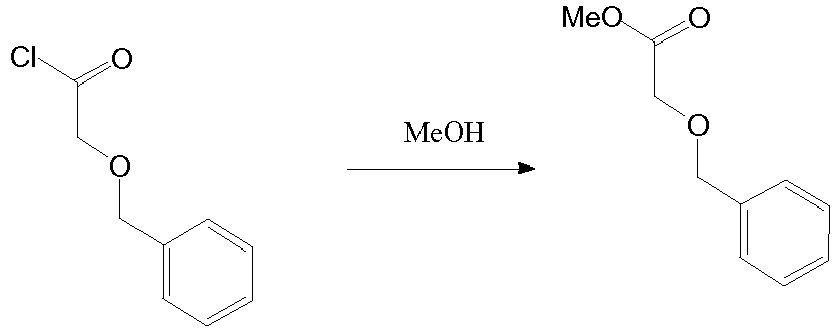
Synthesis of Benzyloxy-acetic acid methyl ester Starting material Conditions Isolated Product 1 g 10 ml MeOH 0.98 g (100%) Benzyloxyacetyl chloride 1HNMR conforms 20 g 200 ml MeOH 19.5 g (100% yield) Benzyloxyacetyl chloride 1HNMR conforms 25 g 10 ml MeOH 24.5 g (100%) benzyloxyacetyl chlorid 1HNMR conforms -

- Following the procedure described in
U.S. Patent Publication No. 2005/0090668 , a mixture of benzyloxy-acetic acid methyl ester (1 equiv.) and oxalic acid tert-butyl ester methyl ester (1.5 equiv.) in THF (12 vol.) was treated with 1.5 equiv. of LDA (prepared freshly from diisopropyl amine and n-BuLi in THF) at -78 °C for 1 h. The mixture was then warmed to room temperature for 1 h and quenched with cold HCl (1 N, 11 vol.). The mixture was extracted with EtOAc (3 x 12 vol.), the organic extracts were washed with brine, dried over anhydrous Na2SO4 and concentrated to an oil. Chromatography of the crude product on silica gel (eluted with 15-60% EtOAc/Hexane) gave 78% of the coupled product as a colorless oil. As described in the patent, the 1HNMR is complex due to multiple enol tautomers and enol olefin configurations. TLC of the purified product showed a single spot. The results are summarized in the following table.Coupling of Oxalic acid tert-butyl ester methyl ester and Benzyloxyacetic acid methyl ester Starting material Conditions Isolated Product 0.9 g Benzyloxyacetic acid methyl ester 1.5 eq. LDA Crude yield 1.35 g (87%) 12 vol THF TLC 1 major spot 1.2 g Oxalic acid tert-butyl ester methyl ester -78°C 1 h to rt 1 h Used in the next step without purification 1.8 g Benzyloxyacetic acid methyl ester 1.5 eq. LDA Chromatographed on silica gel 12 vol THF 2.4 g (78% yield) 2.4 g Oxalic acid tert-butyl ester methyl ester -78°C 1 h to rt 1 h TLC 1 single spot 14.2 g Benzyloxyacetic acid methyl ester 1.5 eq. LDA Crude yield 23.8 g (98%) 12 vol THF TLC 1 major spot 18.9 g Oxalic acid tert-butyl ester methyl ester -78°C 1h to rt 1 h 3.3 g used in the next step without purification. 20.5 g Chromatographed on silica gel to give 16 g product 14.2 g Benzyloxyacetic acid methyl ester 1.5 eq. LDA 10 g of 2-Benzyloxy-3-hydroxy-but-2- 12 vol THF enedioic acid 4-tert-butyl ester 1-methyl 18.9 g Oxalic acid tert-butyl ester methyl ester -78°C 1h to rt 1 h ester isolated after chromatography 12 g Benzyloxyacetic acid methyl ester 1.5 eq. LDA Chromatographed on silica gel 12 vol THF 14 g (68.3% yield) 16 g Oxalic acid tert-butyl ester methyl ester -78°C 1h to rt 1 h TLC 1 single spot 12 g Benzyloxyacetic acid methyl ester 1.5 eq. LDA Chromatographed on silica gel 12 vol THF 14.5 g (70.7% yield) 16 g Oxalic acid tert-butyl ester methyl ester -78°C 1h to rt 1 h TLC 1 single spot -

- Initial exploratory work on the synthesis of 5-Benzyloxy-6-oxo-1,6-dihydro-pyrimidine-4-carboxylic acid tert-butyl ester was performed on the crude coupled product with potassium t-butoxide as base using the procedure described in
U.S. Patent Publication No. 2005/0090668 . A mixture of the coupled product (1 equiv.) and formamidine HCl (1.5 equiv.) in MeOH (10 vol.) was treated with 4.5 equiv. of t-BuOK (1 M in t-BuOH) at 0 °C. The resulting mixture was stirred at room temperature for 20 h, saturated NH4Cl was added, the mixture was extracted with EtOAc. The combined organic extracts were washed with brine, dried and concentrated to give a beige solid. Chromatography of the crude product gave 30% yield of a white solid. 1HNMR conforms except for small amount of unknown contaminant. Mass spec: m/z = 247, 303, 605 corresponds to (M-tBu)+1, M+1 and 2M+1. The reaction was repeated in larger scale with NaOMe as base to give 30% yield of the desired product and 4% of the corresponding methyl ester. Subsequently, the yield was improved to 65.4% using NaOMe as base. The results are summarized in the following table.Synthesis of 5-Benzyloxy-6-oxo-1,6-dihydro-pyrimidine-4-carboxylic acid tert-butyl ester Starting material Conditions Isolated Product 885 mg 2-Benzyloxy-3-hydroxy-but-2-enedioic acid 4-tert-butyl ester 1-methyl ester 12.75 ml t-BuOK (1M) Chromatographed 250 mg (30%) 8 ml MeOH 1HNMR conforms 0°C 0.25h to rt 20 h Mass spec: 342 mg formamidine HCl m/z = 247 (M-tBu)+1, 303 (M+1) and 605 (2M+1) 1.78 g 2-Benzyloxy-3-hydroxy-but-2-enedioic acid 4-tert-butyl ester 1-methyl ester 3.97 ml NaOMe (25% w/w) Chromatographed 517 mg (30%) 6 ml MeOH 1HNMR conforms 0°C 0.25h to rt 20 h 58 mg (4%) of the methyl ester also isolated 511.8 mg formamidine HCl 3.3 g crude 2-Benzyloxy-3-hydroxy-but-2-enedioic acid 4-tert-butyl ester 1-methyl ester 7.4 ml NaOMe (25% w/w) Quench with 1 N HCl, product precipitate and filtered. Filtrate extracted with EtOAc and chromatographed. Combined product swish with 20% EtOAc and filtered to give 527 mg methyl ester 12 ml MeOH 0°C 0.25h to rt 60 h 962 mg formamidine HCl 16 g purified 2-Benzyloxy-3-hydroxy-but-2-enedioic acid 4-tert-butyl ester 1-methyl ester 35 ml NaOMe (25% w/w) Quench with 1 N HCl, extracted with EtOAc. Concentrate to a solid, swished with 40% EtOAc and filtered: 6.45 g. 60 ml MeOH 0°C 0.25h to rt 17 h 5.02 g formamidine HCl Filtrate concentrated and chromatographed to give 2.57 g t-Bu ester and 0.73 g mixture of t-Bu and Me ester. 8.4 g 2-Benzyloxy-3-hydroxy-but-2-enedioic acid 4-tert-butyl ester 1-methyl ester 18.7 ml NaOMe (25% w/w) 5 g of 5-Benzyloxy-6-oxo-1,6-dihydro-pyrimidine-4-carboxylic acid tert-butyl ester isolated plus 3.3 g ML 32 ml MeOH 0°C 0.25h to rt 17 h 2.92 g formamidine HCl 14 g purified 2-Benzyloxy-3-hydroxy-but-2-enedioic acid 4-tert-butyl ester 1-methyl ester 32 ml NaOMe (25% w/w) Quench with 1 N HCl, extracted with EtOAc. Concentrate to a solid, swished with 40% EtOAc and filtered: 7.75 g. 60 ml MeOH 0°C 0.25h to rt 17 h 4.4 g formamidine HCl 56.3% yield + M.L. 14.3 g purified 2-Benzyloxy-3-hydroxy-but-2-enedioic acid 4-tert-butyl ester 1-methyl ester 32 ml NaOMe (25% w/w) Quench with 1 N HCl, extracted with EtOAc. Concentrate to a solid, swished with 40% EtOAc and filtered: 9.0 g. 60 ml MeOH 0°C 0.25h to rt 17 h 4.4 g formamidine HCl 65.4% yield + M.L. -

- Using a procedure described in
U.S. Patent Publication No. 2005/0090668 , a solution of 5-benzyloxy-6-oxo-1,6-dihydro-pyrimidine-4-carboxylic acid tert-butyl ester was first treated with NaH (1.3 equiv.) in DMF followed by the addition of dimethylsulfate (1.3 equiv.) to give mainly the desired product after 2 h at room temperature. The reaction mixture was quenched with cold HCl (1 N, 30 vol.) and extracted with EtOAc (3x30 vol.). The combined organic extracts were washed with dilute HCl and brine, dried and concentrated to an oil. Chromatography of the crude product (eluted with 40-60% EtOAc/hexane) gave 88% yield of the N-methylated compound (Synthon A).Synthesis of 5-Benzyloxy-1-methyl-6-oxo-1,6-dihydro-pyrimidine-4-carboxylic acid tert-butyl ester Starting material Conditions Isolated Product 151 mg 5-benzyloxy-6-oxo-1,6-dihydro-pyrimidine-4-carboxylic acid tert-butyl ester 82 mg Me2SO4 26 mg NaH (60% in oil) TLC showed one major product. Crude1HNMR conforms. Crude yield 173 mg 2 ml DMF 0°C 0.25h to rt 1.5 h 273 mg 5-benzyloxy-6-oxo-1,6-dihydro-pyrimidine-4-carboxylic acid tert-butyl ester 148 mg Me2SO4 47 mg NaH (60% in oil) Crude product combined with product above and chromatographed to give 392 mg (88%) yield of desired product. 1HNMR conforms 4 ml DMF 0°C 0.25h to rt 2 h 3.03 g 5-benzyloxy-6-oxo-1,6-dihydro-pyrimidine-4-carboxylic acid tert-butyl ester 1.64 g Me2SO4 520 mg NaH (60% in oil) Chromatography gave 2.15 g Synthon A (64.7%) 30 ml DMF 0°C 0.25h to rt 1.5 h - Synthon A was reacted with 1 equiv. of 1 N sodium hydroxide to yield the 5-benzyloxy-1-methyl-6-oxo-1,6-dihydro-pyrimidine-4-carboxylic acid.
Synthesis of 5-Benzyloxy-1-methyl-6-oxo-1,6-dihydro-pyrimidine-4-carboxylic acid Starting material Conditions Isolated Product 50 mg of 5-Benzyloxy-1-methyl-6-oxo-1,6-dihydro-pyrimidine-4-carboxylic acid tert-butyl ester 1 equiv. NaOH (1N), 5-Benzyloxy-1-methyl-6-oxo-1,6-dihydro-pyrimidine-4-carboxylic acid isolated 10 v EtOH 25 °C for 20 h 1.7 g of 5-Benzyloxy-1-methyl-6-oxo-1,6-dihydro-pyrimidine-4-carboxylic acid tert-butyl ester 1 equiv. NaOH (1 N), 1.34 g of 5-Benzyloxy-1-methyl-6-oxo-1,6-dihydro-pyrimidine-4-carboxylic acid isolated 10 v EtOH 25 °C for 20 h 4.8 g of 5-Benzyloxy-1-methyl-6-oxo-1,6-dihydro-pyrimidine-4-carboxylic acid tert-butyl ester 1 equiv. NaOH (1 N), 3.38 g of 5-Benzyloxy-1-methyl-6-oxo-1,6-dihydro-pyrimidine-4-carboxylic acid isolated 10 v ETOH 25 °C for 20 h 85.6% yield. 8.3 g of 5-Benzyloxy-1-methyl-6-oxo-1,6-dihydro-pyrimidine-4-carboxylic acid tert-butyl ester 1 equiv. NaOH (1 N), 6.7 g of 5-Benzyloxy-1-methyl-6-oxo-1,6-dihydro-pyrimidine-4-carboxylic acid isolated 10 v EtOH 25 °C for 20 h 98.2% yield. -
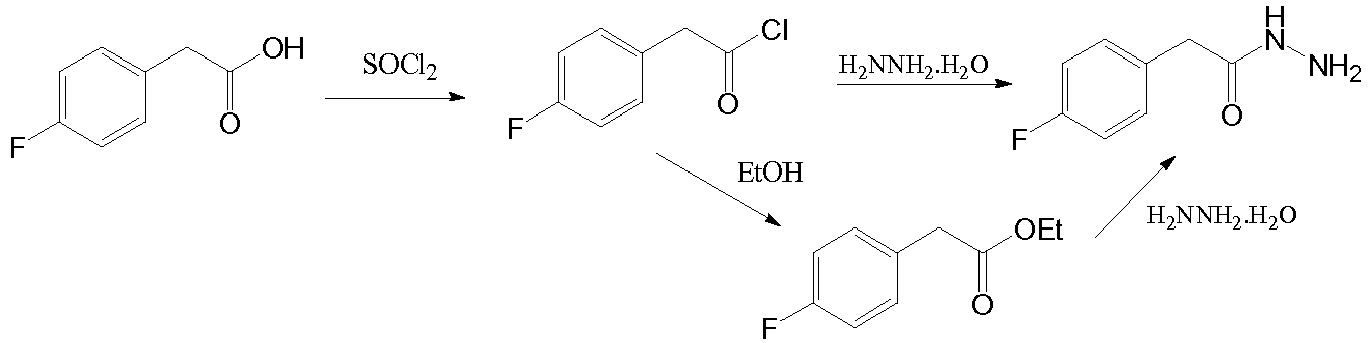
- (4-Fluoro-phenyl)-acetyl chloride was readily prepared from the corresponding acid by refluxing the acid in thionyl chloride for 1 h. However, the acid chloride was too reactive. Addition of hydrazine hydrate to a solution of the acid chloride gave only the dimer. Reverse addition of acid chloride to hydrazine hydrate at 0 °C gave the desired hydrazide with some dimer. The acid chloride was then transformed to the corresponding ethyl ester. Reaction of the ethyl ester with 2 equiv. of hydrazine hydrate in refluxing EtOH gave cleanly the (4-Fluoro-phenyl)-acetic acid hydrazide in 76% yield. The results are summarized below.
-
Starting material Conditions Isolated Product 2.5 g (4-Fluorophenyl)-acetic acid 6 ml SOCl2 80 °C for 1 h, evaporate to dryness 2.78 g of (4-Fluoro-phenyl)-acetyl chloride isolated 172 mg of (4-Fluorophenyl)-acetyl chloride Acid chloride added to H2NNH2.H2O in 5 ml CH2Cl2 at 0 °C. Stir at 0 °C for 1 h, 20 °C for 0.5 h 114 mg (4-Fluoro-phenyl)-acetic acid hydrazide isolated plus 37 mg dimer 2.4 g of (4-Fluorophenyl)-acetyl chloride 10 ml EtOH 20 °C for 1 h 2.55 g (4-Fluoro-phenyl)-acetic acid ethyl ester 2.55 g (4-Fluorophenyl)-acetic acid ethyl ester 2 equiv. of H2NNH2.H2O, 4 v EtOH, stir at 85 °C for 5 h 1.8 g (4-Fluoro-phenyl)-acetic acid hydrazide isolated 10 g (4-Fluorophenyl)-acetic acid 18 ml SOCl2 80 °C for 1 h, evaporate to dryness 11.88 g of (4-Fluoro-phenyl)-acetyl chloride isolated 11.88 g of (4-Fluorophenyl)-acetyl chloride 50 ml EtOH 20 °C for 1 h 11.3 g (4-Fluoro-phenyl)-acetic acid ethyl ester CKL-3-44 11 g (4-Fluoro-phenyl)-acetic acid ethyl ester 2 equiv. of H2NNH2.H2O.4v EtOH, stir at 85 °C for 5 h 9.2 g (4-Fluoro-phenyl)-acetic acid hydrazide isolated - The carboxylic acid was transformed to the corresponding acid chloride by refluxing the latter in thionyl chloride. Reaction of the acid chloride with (4-fluoro-phenyl)-acetic acid hydrazide gave almost quantitatively the desired bishydrazide.

-
Starting material Conditions Isolated Product 1. 100 mg 5-Benzyloxy-1-methyl-6-oxo-1,6-dihydro-pyrimidine-4-carboxylic acid, 2 ml SOCl2 Reflux 1 h, concentrated under vacuum, used as is. 160 mg isolated, NMR MS conformed. 2. 63.8 mg (4-Fluorophenyl)-acetic acid hydrazide (1.0 equiv.), 72 mg Et3N (2.0 equiv.) Add acid chloride solution in CH2Cl2 (1 ml) to a suspension of hydrazide in CH2Cl2 (1 ml), at 0 °. Stir at rt for1 h. 160 mg isolated, NMR MS conformed 1. 1.15 g 5-Benzyloxy-1-methyl-6-oxo-1,6-dihydro-pyrimidine-4-carboxylic acid, 10 ml SOCl2 Reflux 1 h, concentrated under vacuum, used as is. 2. 742 mg (4-Fluorophenyl)-acetic acid hydrazide (1.0 equiv.), 892 mg Et3N (2.0 equiv.) Add acid chloride solution in CH2Cl2 (10 ml) to a suspension of hydrazide in CH2Cl2 (10 ml), at 0 °. Stir at rt for1 h. 1.8 g isolated (99%), NMR conformed. 1. 3.3 g 5-Benzyloxy-1-methyl-6-oxo-1,6-dihydro-pyrimidine-4-carboxylic acid, 30 ml SOCl2 Reflux 1 h, concentrated under vacuum, used as is. 4.97 g isolated Add acid chloride solution in CH2Cl2 (10 ml) to a suspension of hydrazide in CH2Cl2 (10 ml), at 0 °. Stir at rt for over night. yield 95.6% 2. 2.13 g (4-Fluorophenyl)-acetic acid hydrazide (1.0 equiv.), 3.5 mL Et3N (2.0 equiv.) NMR conformed. 1. 6.7 g 5-Benzyloxy-1-methyl-6-oxo-1,6-dihydro-pyrimidine-4-carboxylic acid , 30 ml SOCl2 Reflux 1 h, concentrated under vacuum, used as is. 9.44 g isolated yield 89.3% Add acid chloride solution in CH2Cl2 (10 ml) to a suspension of hydrazide in CH2Cl2 (10 ml), at 0 °. Stir at rt for over night. NMR conformed. 2. 4.33 g (4-Fluorophenyl)-acetic acid hydrazide (1.0 equiv.), 3.5 mL Et3N (2.0 equiv.) -
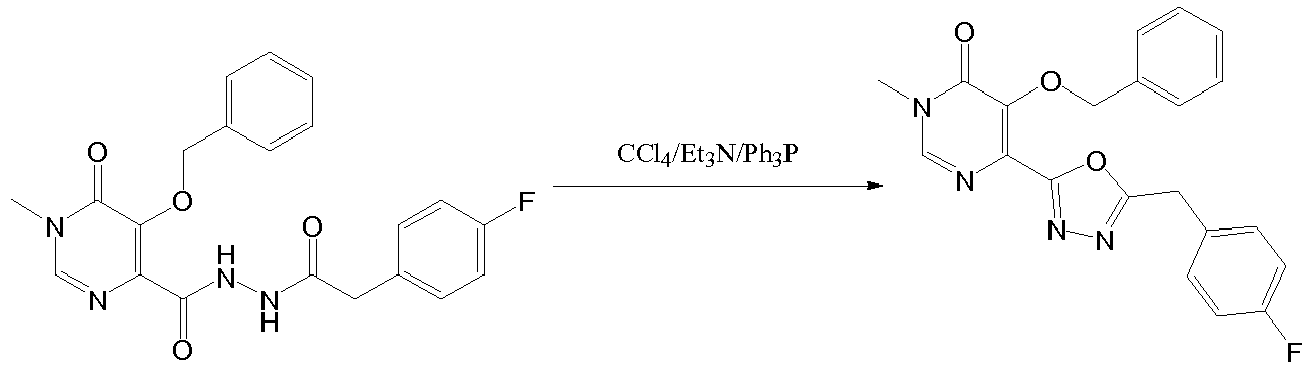
- Following the procedure described in European Patent No.
1698628 , 5-benzyloxy-1-methyl-6-oxo-1,6-dihydro-pyrimidine-4-carboxylic acid N'-[2-(4-fluoro-phenyl)-acetyl]-hydrazide was treated with CCl4 (7 equiv.), Ph3P (3 equiv.) and Et3N (3 equiv.) in CH3CN (10 vol) at room temperature for 1.5 h. TLC showed only one product formed. The reaction mixture was diluted with EtOAc, washed with aqueous NaHCO3 and brine, dried and concentrated to give a crude solid. For the 1.8 g scale reaction, chromatography (4 columns) plus recrystallization twice was needed to isolate the desired product without Ph3P=O contamination. NMR and MS confirmed the structure.Starting material Conditions Isolated Product 160 mg bis hydrazide Ph3P was added to a suspension of bis hydrazide, CCl4 and Et3N at rt. Stir for 1 h at rt. 40 mg of cyclised oxadiazole contaminated by Ph3P isolated after chromatography (eluted with 100% EtOAc). NMR, MS conformed. 0.262 ml CCl4 (7 eq.) 0.164 mL Et3N (3 eq.) 306 mg Ph3P (3 eq.) 1.8 g bis hydrazide 3 ml Ph3P was added to a suspension of bis hydrazide, CCl4 and Et3N at rt. Stir for 1.5 h at rt. First column chromatography gave 1.91 g of desired product contaminated by small amount of Ph3P=O and 3.5 g of Ph3P=O containing small amount of product. The Ph3P=O fraction was repurified by chromatography to give more desired product. All the impure fractions were combined and chromatographed, the product isolated was first crystallized from EtOAc and then recrystallization in toluene gave a combined yield of 1.3 g (75%) of product. CCl4 (7 eq.) 1.8 mL Et3N ( 3 eq.) 3.45 g Ph3P (3 eq.) 4.95 g bis hydrazide Ph3P was added to a suspension of bis hydrazide, CCl4 and Et3N at rt. Stir over night at rt. First column chromatography gave 1.6 g of desired product contaminated by small amount of Ph3P=O and 5.2g of desired product with Ph3P=O. 8.13 ml CCl4 (7 eq.) 5.04 mL Et3N ( 3 eq.) 9.49 g Ph3P (3 eq.) Recrystallisation of 1.6 g with toluene gives 1.3 g of pure product. 9.4 g bis hydrazide Ph3P was added to a suspension of bis hydrazide, CCl4 and Et3N at rt. Stir over night at rt. First column chromatography gave 5.0g of desired product contaminated by small amount of Ph3P=O and 7.5g of desired product with Ph3P=O. 8.13 ml CCl4 (7 eq.) 5.04 mL Et3N ( 3 eq.) 9.49 g Ph3P (3 eq.) Recrystallisation of 5.0q with toluene gives 4.1 g of pure product. - 5-Benzyloxy-6-[5-(4-fluoro-benzyl)-[1,3,4]oxadiazol-2-yl]-3-methyl-3H-pyrimidin-4-one was treated with 0.62 equiv of Lawesson's reagent at 80-85 °C in toluene for 5-7 h. TLC showed one major product formation with some substrate still present. Chromatography (eluted with 70%-90% EtOAc/hexane) gave ∼50% yield of the title compound.
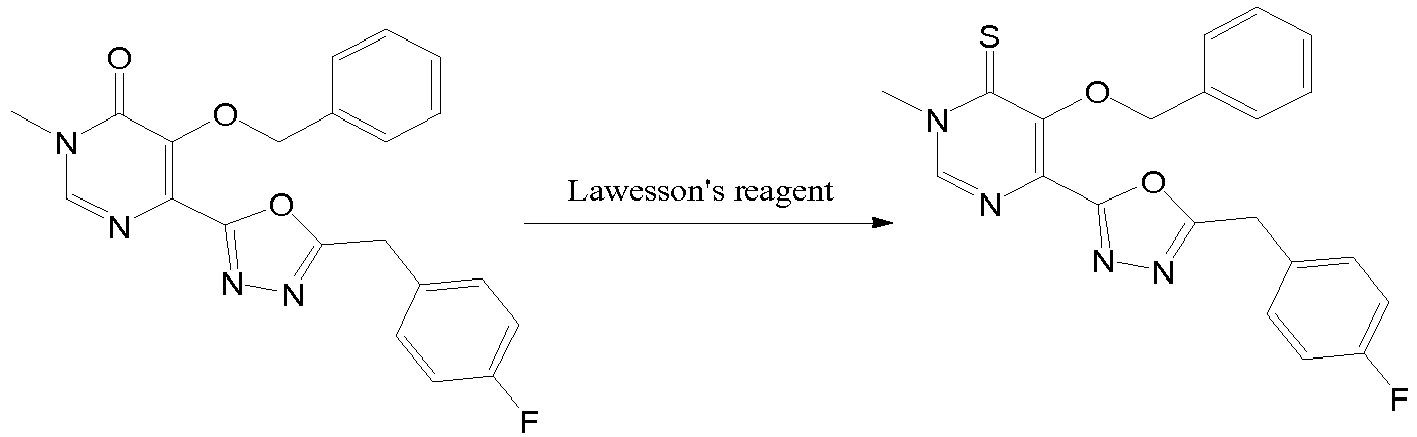
Starting material Conditions Isolated Product 100 mg 5-Benzyloxy-6-[5-(4-fluoro-benzyl)-[1,3,4]oxadiazol-2-yl]-3-methyl-3H-pyrimidin-4-one 63 mg Lawesson's reagent (0.62 eq.) 3 ml toluene, 80-85 °C for 5 h 50 mg of a yellow powder. NMR, MS conformed. 392 mg 5-Benzyloxy-6-[5-(4-fluoro-benzyl)-[1,3,4]oxadiazol-2-yl]-3-methyl-3H-pyrimidin-4-one 63 mg Lawesson's reagent (0.62 eq.) 3 ml toluene, 80-85 °C for 5 h 50 mg of a yellow powder. NMR, MS conformed. 350 mg 5-Benzyloxy-6-[5-(4-fluoro-benzyl)-[1,3,4]oxadiazol-2-yl]-3-methyl-3H-pyrimidin-4-one 233 mg Lawesson's reagent (0.65 eq.) 10 ml toluene, 80-85 °C for 7 h 269 mg (74%) of a yellow powder 190 mg 5-Benzyloxy-6-[5-(4-fluoro-benzyl)-[1,3,4]oxadiazol-2-yl]-3-methyl-3H-pyrimidin-4-one 126 mg Lawesson's reagent (0.65 eq.) 6 ml toluene, 80-85 °C for 14 h 150 mg (76%) of a yellow powder. NMR, MS conformed. 2.0g 5-Benzyloxy-6-[5-(4-fluorobenzyl)-[1,3,4]oxadiazol-2-yl]-3-methyl-3H-pyrimidin-4-one 1.28 g Lawesson's reagent (0.62 eq.) 55 ml toluene, 80-85 °C for 8 h, r.t. for 16 hrs. 1.2 g (57.7%) of a yellow powder. NMR, MS conformed. 3.75g 5-Benzyloxy-6-[5-(4-fluoro-benzyl)-[1,3,4]oxadiazol-2-yl]-3-methyl-3H-pyrimidin-4-one 2.51 g Lawesson's reagent (0.62 eq.) 94 ml toluene, 80-85 °C for 8 h, r.t. for 16 hrs. 2.75 g (70.5%) of a yellow powder. NMR, MS conformed. -

- Reaction of 5-Benzyloxy-6-[5-(4-fluoro-benzyl)-[1,3,4]oxadiazol-2-yl]-3-methyl-3H-pyrimidine-4-thione with N, O-bis(trimethylsilyl)hydroxylamine in the presence of Hg(OAc)2 , the desired amidoxime derivative was isolated as a mixture of syn- and anti-isomers. Mass spec: m/z=408 (M+1) conforms to structure expected.
Starting material Conditions Isolated Product 50 mg 5-benzyloxy-6-[5-(4-fluoro-benzyl)-2.5 [1,3,4]oxadiazol-2-yl]-3-methyl-3H-pyrimidine-4-thione (75% pure) 83 mg N,O-bis(trimethylsilyl)hydroxylamine (5 equiv.) 40 mg Hg(Oac)2 1.4 equiv. ml dioxane, 4h rt Small amount of expected product as mixture of isomers. MS: m/z = 408 (M+1) 400 mg 5-benzyloxy-6-[5-(4-fluorobenzyl)-[1,3,4]oxadiazol-2-yl]-3-methyl-3H-pyrimidine-4-thione (pure) 1.05 mL N,O-bis(trimethylsilyl)hydroxylamine (5 equiv.) 400 mg Hg(Oac)2 1.4 equiv. 20 ml dioxane, 3h rt Small amount of expected product. MS: m/z = 408 (M+1) ∼20 mg of pure product 400 mg 5-benzyloxy-6-[5-(4-fluorobenzyl)-[1,3,4]oxadiazol-2-yl]-3-methyl-3H-pyrimidine-4-thione (pure) 2.0 mL N,O-bis(trimethylsilyl)hydroxylamine (10 equiv.) 20 ml dioxane, 3h rt Small amount of expected product. MS: m/z = 408 (M+1) ∼10 mg of pure product 400 mg Hg(Oac)2 1.4 equiv. 200 mg 5-benzyloxy-6-[5-(4-fluorobenzyl)-[1,3,4]oxadiazol-2-yl]-3-methyl-3H-pyrimidine-4-thione (pure) 0.5 mL N,O-bis(trimethylsilyl)hydroxylamine (5 equiv.) 200 mg Hg(Oac)2 1.4 equiv. 20 ml toluene, 2h, 90°C. same TLC n/a 200 mg 5-benzyloxy-6-[5-(4-fluorobenzyl)-[1,3,4]oxadiazol-2-yl]-3-methyl-3H-pyrimidine-4-thione (pure) 0.5 mL N,O-bis(trimethylsilyl)hydroxylamine (5 equiv.) 200 mg Hg(Oac)2 1.4 equiv. 20 ml THF, 2h, r.t. same TLC Purification of above and this one give ∼50 mg of good product. 2.48 g 5-benzyloxy-6-[5-(4-fluoro-benzyl)-125 [1,3,4]oxadiazol-2-yl]-3-methyl-3H-pyrimidine-4-thione (pure) 6.48 mL N,O-bis(trimethylsilyl)hydroxylamine (5 equiv.) 2.66 g Hg(Oac)2 1.4 equiv. ml Dioxane, 1h, r.t. same TLC Purification by silica gives 190 mg of desire product. (7.66% yield). - 5-Benzyloxy-6-[5-(4-fluoro-benzyl)-[1,3,4]oxadiazol-2-yl]-3-methyl-3H-pyrimidin-4-one oxime was hydrogenated at 1 atmosphere of hydrogen in the presence of equal weight of 10% Pd/C to give 68% yield of 6-[5-(4-fluorobenzyl)-[1,3,4]oxadiazol-2-yl]-5-hydroxy-3-methyl-3H-pyrimidin-4-one oxime (COTI-HIV-1 DOxime or, also referred to as COTI-HIV-1). Results are summarized below.

Synthesis of 6-[5-(4-fluoro-benzyl)-[1,3,4]oxadiazol-2-yl]-5-hydroxy-3-methyl-3H-pyrimidin-4-one oxime (COTI-HIV-1DOxime) Starting material Conditions Isolated Product ∼ 50 to 100 mg of 5-Benzyloxy-6-[5-(4-fluoro-benzyl)-[1,3,4]oxadiazol-2-yl]-3-methyl-3H-1 pyrimidin-4-one oxime (+/- pure) 25 ml THF, rt 28 mg COTI-HIV-1 + by-product atm of H2. 56 mg of +/- pure COTI-HIV-1 DOxime and by product 100% w/w Pd/C 10% and 50% water. 190 mg of 5-Benzyloxy-6-[5-(4-fluoro-benzyl)-[1,3,4]oxadiazol-2-yl]-3-methyl-3H-pyrimidin-4-one oxime (pure) 100% w/w Pd/C 10% and 50% water. 25 ml THF, rt 1 atm of H2. The crude is purifying by silica with the above products to give 100 mg (68%) of pure desire product. (M/Z = 318) NMR 1 H conform -

-

- Reaction of 5-benzyloxy-6-[5-(4-fluoro-benzyl)-[1,3,4]oxadiazol-2-yl]-3-methyl-3H-pyrimidin-4-one and a 1:1 mixture of TFA/CH2Cl2 gave the debenzylated product in reasonable yield. Results are summarized below.
Preparation of 6-[5-(4-Fluoro-benzyl)-[1,3,4]oxadiazol-2-yl)-5-hydroxy-3-methyl-3H-pyrimidin-4-one Starting material Conditions Isolated Product 24 mg 5-benzyloxy-6-[5-(4-fluoro-benzyl)-[1,3,4]oxadiazol-2-yl]-3-methyl-3H-pyrimidin-4-one 0.3 ml CH2Cl2 , 0.3 ml TFA, 20 h, rt. Concentrate under vacuum, swished with 20% EtOAc/hexane Beige solid, 1HNMR and MS conformed to expected product 109 mg 5-benzyloxy-6-[5-(4-fluoro-benzyl)-[1,3,4]oxadiazol-2-yl]-3-methyl-3H-pyrimidin-4-one 1 ml CH2Cl2 , 1 ml TFA, 48 h, rt. 65 mg beige solid (77%), 1HNMR conformed. Concentrate under vacuum, co-distill with EtOAc/heptane, swished with 30% EtOAc/hexane 100 mg 5-benzyloxy-6-[5-(4-fluoro-benzyl)-[1,3,4]oxadiazol-2-yl]-3-methyl-3H-pyrimidin-4-one 1 ml CH2Cl2 , 1 ml TFA, 48 h, rt. 69 mg beige solid, 1HNMR showed an unknown impurity. Re-purify by swishing in 4 ml pure EtOAc for 20 h to give 56 mg of pure product. 1HNMR conformed. Concentrate under vacuum, co-distill with EtOAc/heptane, swished with 30% EtOAc/hexane for 20 h -

- Hydrogenation of 5-Benzyloxy-6-[5-(4-fluoro-benzyl)-[1,3,4]oxadiazol-2-yl]-3-methyl-3H-pyrimidin-4-one in THF with 25% w/w of 10% Pd/C gave 67.5% of the desired product. Results are shown below.
Preparation of 6-[5-(4-Fluoro-benzyl)-[1,3,4]oxadiazol-2-yl]-5-hydroxy-3-methyl-3H-pyrimidin-4-one by palladium catalyzed debenzylation Starting material Conditions Isolated Product 1.0 g of 5-Benzyloxy-6-[5-(4-fluoro-benzyl)-[1,3,4]oxadiazol-2-yl]-3-methyl-3H-pyrimidin-4-one 250 mg mg 10% Pd/C 200 ml THF, r.t. 1 atm 0.52 g of pure product (67.5%) 30 mins 0.35g of +/- pure product. - Synthesis of the compound of the following formula:

-

- To a suspension of lithium 3-fluoropyridine-2-carboxylate (10.1 g ; 69 mmol ; 1 eq.) in methanol (170 mL) were successively added 1,2-dimethoxypropane (17.0 mL ; 138 mmol ; 2 eq.) and concentrated sulphuric acid (18.0 mL ; 345 mmol ; 5 eq.). The reaction mixture became homogeneous and turned yellow after addition of sulphuric acid. The mixture was then heated at reflux for 20 hours. After cooling down to room temperature, the solvent was removed under vacuum. The oily residue was slowly poured into a mixture of ethyl acetate (200 mL) and a saturated solution of NaHCO3 (400 mL). At the end of the addition, the aqueous layer was again saturated by addition of solid NaHCO3. The layers were then separated and the aqueous phase was extracted with ethyl acetate (2 x 200 mL). The combined organic phases were dried over Na2SO4, filtered and evaporated to dryness to afford compound 63 as a light yellow solid (9.5 g ; yield = 89%).
- To a solution of LDA (1.8M in THF/heptane ; 72.0 mL ; 129 mmol ; 2.1 eq.) in THF (60 mL) at -78°C was added tert-butylacetate (20.0 mL ; 148 mmol ; 2.4 eq.). The deep red solution was stirred at -78°C for 45 minutes and maintained at that temperature during the slow addition of a solution of compound 63 (9.5 g ; 62 mmol ; 1 eq.) in THF (60 mL). The reaction mixture was then stirred for an additional 2 hours and quenched at -78°C by addition of MTBE (150 mL) and water/acetic acid (1:1 ; 150 mL). After warming up to room temperature, the layers were separated and the aqueous phase was extracted with MTBE (2 x 100 mL). The combined organic phases were washed with water (300 mL) and brine (300 mL), dried over Na2SO4, filtered and evaporated to dryness to afford compound 66 as an yellow oil (16.2 g ; contaminated with 8.5% w/w of acetic acid ; yield = 100%).
- To a solution of crude compound 66 (16.2 g ; 62 mmol ; 1 eq.) in acetonitrile (190 mL) at 0°C was successively added triethylamine (14.6 mL ; 112 mmol ; 1.8 eq.) and ABSA (16.3 g ; 68 mmol ; 1.1 eq.). At the end of the addition, the reaction mixture was allowed to warm up to room temperature. A white solid precipitated progressively from the orange solution. After 18 hours, the reaction mixture was filtered on a Büchner funnel. The white cake was washed with ethyl acetate (450 mL). The mother liquor was decanted and the layers were separated. The organic phase was washed with a saturated solution of NH4Cl (400 mL) and brine (400 mL), dried over Na2SO4, filtered and evaporated to dryness. The orange oily residue was triturated in diethyl ether. After filtration of the brown solid, the evaporation of the mother liquor afforded compound 67 as an orange oil (18.9 g contaminated with 9% w/w of p-AcHN-Ph-SO2NH2, yield = 100%).
- To a solution of crude compound 67 (18.9 g ; 62 mmol ; 1 eq.) in THF (125 mL) at room temperature was slowly added trimethylphosphine (1 M/THF ; 68.0 mL ; 68 mmol ; 1.1 eq.). At the end of the addition, the reaction mixture was stirred for 15 minutes and quenched by addition of water (11.0 mL ; 616 mmol ; 10 eq.). The mixture was stirred for an additional 15 minutes prior to the addition of silica gel (45 g). The solvent was then evaporated under vacuum and the residue, which was adsorbed on silica gel, was purified by flash chromatography on silica gel (eluent: dichloromethane/methanol, 100/0 to 96/4) to afford compound 68 as an orange oil (15.7 g ; yield = 96%).
- To a solution of compound 68 (15.7 g ; 59 mmol ; 1 eq.) in acetonitrile (300 mL) at room temperature were successively added DBU (18.5 mL ; 124 mmol ; 2.1 eq.) and methyl iodide (3.8 mL ; 62 mmol ; 1.05 eq.). The reaction mixture became deep red. After stirring for 18 hours at room temperature, the reaction was quenched by addition of a saturated solution of NH4Cl (500 mL). The resulting mixture was extracted with dichloromethane (3 x 500 mL) and the combined organic phases were washed with brine (1 L), dried over Na2SO4, filtered and evaporated to dryness. The purification of the residue by chromatography on silica gel (eluent: dichloromethane/methanol, 100/0 to 90/10) afforded two fractions containing compound 4d. After evaporation to dryness, the first one was triturated in diethyl ether to afford a first batch of pure compound 4d as a pale orange solid (2.6 g ; yield = 17%). The second one was dissolved in dichloromethane (500 mL) and the resulting solution was washed with a saturated solution of NH4Cl (2 x 500 mL), dried over Na2SO4, filtered and evaporated to dryness to afford a second batch of pure compound 4d as a pale orange solid (3.1 g ; yield = 20%). The two batches were combined (yield = 37%).
- To a solution of compound 4d (3.1 g ; 12 mmol ; 1 eq.) in dichloromethane (110 mL) at room temperature was added trifuoroacetic acid (12.0 mL ; 157 mmol ; 13.3 eq.). The reaction mixture turned brown. After stirring at room temperature for 18 hours, the reaction mixture was diluted by addition of diethyl ether (150 mL). The solvent were then removed under vacuum. The beige residue was triturated in diethyl ether to afford compound 4c as a beige solid (2.4 g ; yield = 100%). 1H NMR (DMSO, ppm): 4.29 (s, 3H); 8.02 (m, 1 H); 8.52 (m, 1 H); 9.01 (m, 1 H); and 14.32 (m, COOH).
-

- To a solution of compound 4c (907 mg ; 4.4 mmol ; 1 eq.) in DMSO (6 mL) at room temperature was successively added triethylamine (2.4 mL ; 17.6 mmol ; 4 eq.), para-fluorobenzylamine (610 pL ; 5.3 mmol ; 1.2 eq.) and TBTU (1.70 g ; 5.3 mmol ; 1.2 eq.). After stirring the mixture at room temperature for 16 hours, the reaction was quenched by addition of a saturated solution of NH4Cl (50 mL). The aqueous phase was then extracted with dichloromethane (5 x 100 mL). The combined organic phases were combined, dried over Na2SO4, filtered and evaporated to dryness. The residue was dissolved in ethyl acetate (100 mL) and the solution was washed with water (100 mL), brine (100 mL), dried over Na2SO4, filtered and evaporated to dryness. The residue was then triturated in diethyl ether to afford compound 76 as an yellow solid (480 mg ; yield = 35%). All aqueous layers were then combined and extracted with chloroform (3 x 250 mL). The combined chloroform phases were dried over Na2SO4, filtered and evaporated to dryness in the presence of silica gel (3 g). The purification by chromatography on silica gel (eluent: dichloromethane/methanol, 98/2 to 90/10) afforded compound 76 as an yellow solid (454 mg ; yield = 33%). The two batches were combined (yield = 68%).
- To a suspension of compound 76 (228 mg ; 73 µmol; 1 eq.) in toluene (3.7 mL) at room temperature was added hydroxylamine hydrochloride (76 mg ; 1.10 mmol ; 1.5 eq.) and titanium (IV) isopropoxide (330 µL; 1.10 mmol ; 1.5 eq.). The reaction mixture was refluxed for 72 hours and evaporated to dryness. The red residue is dissolved in a mixture of a saturated solution of NaHCO3/ethyl acetate/methanol (5:5:1 ; 55 mL). After separation of the layers, the aqueous phase was extracted with ethyl acetate (3 x 50 mL). The combined organic phases were washed with brine (100 mL), dried over Na2SO4, filtered and evaporated to dryness. The purification of the residue on silica gel (eluent: dichloromethane/methanol, 100/0 to 98/2) followed by a trituration in methanol afforded compound COTI-HIV28236 as a yellow solid (42 mg ; yield = 17%). 1H NMR (CDCl3, ppm): 3.82 (s, 3H); 4.61 (s, 2H); 6.99 (m, 2H); 7.34 (m, 1 H); 7.44 (m, 1 H), 7.55 (m, 1 H), 8.24 (m, 1 H), 9.82 (m, 1 H) and 15.71 (m, NOH). 13C NMR (CDCl3, ppm): 42.3, 43.3, 115.3, 115.6, 121.4, 127.5, 129.7, 129.8, 134.3, 135.8, 138.1, 138.7, 139.7, 160.9, 161.6, and 163.4. MS (ES + IC): m/z (M+H) +328.
- Synthesis of the compound of the following formula:

- Synthesis of the compound of COTI-HIV28233 was conducted according to the following synthetic methodology. Synthesis of the common intermediate 4c is as described above with respect to Example 2.
-

- To a solution of compound 77 (5.0 g ; 33 mmol ; 1 eq.) in dichloromethane (100 mL) at room temperature was successively added triethylamine (13.0 mL ; 100 mmol ; 3 eq.), tert-butylcarbazate (4.8 g ; 36 mmol ; 1.1 eq.), EDCI (6.9 g ; 36 mmol ; 1.1 eq.) and HOBt (445 mg ; 3.3 mmol ; 0.1 eq.). After stirring the mixture for 18 hours at room temperature, the reaction was quenched by addition of a saturated solution of NH4Cl (200 mL). The layers were separated and the aqueous phase was extracted with dichloromethane (3 x 200mL). The combined organic phases were dried over Na2SO4, filtered and evaporated to dryness to afford compound 78 as a colourless oil (9.1 g ; yield = 100%).
- To a solution of compound 78 (9.1 g ; 33 mmol ; 1 eq.) in dichloromethane (300 mL) at room temperature was slowly added trifuoroacetic acid (33.0 mL ; 434 mmol ; 13.2 eq.). The reaction mixture turned light brown. After stirring for 3 hours, the reaction mixture was evaporated to dryness. The colourless residue was dissolved in ethyl acetate (400 mL) and the solution was washed with a saturated solution of NaHCO3 (3 x 500 mL), dried over Na2SO4, filtered and evaporated to dryness. The resulting white foam was triturated in diethyl ether to afford compound 79 as a white solid (3.2 g ; yield = 57%).
- To a solution of compound 4c (1.5 g ; 7.3 mmol ; 1 eq.) in DMSO (11 mL) at room temperature was successively added triethylamine (3.8 mL ; 29 mmol ; 4 eq.), compound 79 (1.5 g ; 8.8 mmol ; 1.2 eq.) and TBTU (2.8 g ; 8.8 mmol ; 1.2 eq.). The reaction mixture became homogeneous for a few minutes prior to the precipitation of a solid. After stirring for 16 hours at room temperature, the precipitate was filtered on a Büchner funnel. The cake was washed with ethyl acetate and dried to afford compound 80 as a yellow solid (1.7 g ; yield = 64%).
- To a suspension of compound 80 (1.7 g ; 4.7 mmol ; 1 eq.) in acetonitrile (33 mL) at room temperature was successively added N,N-diisopropylethylamine (4.7 mL ; 28.2 mmol ; 6 eq.), triphenylphosphine (2.2 g ; 8.5 mmol ; 1.8 eq.) and hexachloroethane (1.7 g ; 7.0 mmol ; 1.5 eq.). The reaction mixture became homogeneous for few minutes prior to the precipitation of a solid. After stirring for 16 hours at room temperature, the precipitate was filtered on a Büchner funnel. The cake was washed with diethyl ether to afford compound 81 as a beige solid (1.1 g ; yield = 71%).
- To a suspension of compound 81 (236 mg ; 700 µmol ; 1 eq.) in toluene (3.5 mL) at room temperature was added hydroxylamine hydrochloride (73 mg ; 1.05 mmol ; 1.5 eq.) and titanium (IV) isopropoxide (310 µL ; 1.10 mmol ; 1.5 eq.). The reaction mixture was refluxed for 18 hours and evaporated to dryness. The red residue was dissolved in a mixture of a saturated solution of NaHCO3/ethyl acetate/methanol (5:5:1 ; 55 mL). After separation of the layers, the aqueous phase was extracted with ethyl acetate (3 x 50 mL). The combined organic phases were washed with brine (100 mL), dried over Na2SO4, filtered and evaporated to dryness. The purification of the residue on silica gel (eluent: dichloromethane/methanol, 100/0 to 98/2) followed by a trituration in methanol afforded compound COTI-HIV28233 as an yellow solid (39 mg ; yield = 16%). 1H NMR (CDCl3, ppm): 3.71 (s, 3H); 4.27 (s, 2H); 7.00 (m, 2H); 7.35 (m, 3H); 7.52 (m, 1 H), 8.22 (m, 1 H), 15.23 (m, NOH). MS (ES + IC): m/z (M+H) +353.
- Synthesis of the compound of COTI-HIV28236-SA can be conducted according to the following synthetic methodology:

- Synthesis of the compound of COTI-HIV28236-SeA can be conducted according to the following synthetic methodology:

- A computational assessment of the properties of compounds according to the present invention was performed using the CHEMSAS® computational platform. CHEMSAS® is a robust proprietary computational platform for accelerated drug discovery, optimization and lead selection based upon a unique combination of traditional and modern pharmacology principles, statistical modeling and machine learning technologies. At the centre of the CHEMSAS® platform is a hybrid machine learning technology that may be used to: find, profile and optimize new targeted lead compounds; find novel uses for known compounds; and, solve problems with existing or potential drugs. In using the CHEMSAS® platform, first a therapeutic target was selected, in this case HIV and more particularly the critical enzyme HIV integrase. The second step involved the design of a candidate molecule library containing thousands of potential compounds through the assembly of privileged molecular fragments. Thirdly, the candidate library was profiled and optimized using a combination of validated computational models and traditional expert medicinal chemistry. In this step, the CHEMSAS® platform developed about 315 molecular descriptors for each candidate therapeutic compound. For example, molecular properties relating to a candidate compound's therapeutic efficacy, expected human toxicity, oral absorption, cumulative cellular resistance and/or kinetics were assessed. In some instances, comparative properties relating to commercially relevant benchmark compounds were also assessed. Potential lead compounds were then selected from the candidate library using a proprietary decision making tool designed to identify candidates with the optimal physical chemical properties, efficacy, ADME/Toxicity profile, etc. according to a pre-determined set of design criteria. The lead compounds selected from the candidate library were then synthesized for further pre-clinical development.
- The properties of certain compounds according to the present invention, specifically, those indicated in Tables 1-8 that were assessed using the CHEMSAS® computational platform are shown below. Some of the predicted properties are validated by the experimental data provided herein, while other properties have been validated elsewhere during the development of other clinical candidates. The CHEMSAS® platform therefore provides a means of determining, predicting and/or testing the properties of a compound, particularly when used to determine the properties of compounds according to the present invention. The CHEMSAS® platform is also particularly useful in comparing the properties of compounds according to the invention with prior art compounds on a relative basis in silico.
- Tables 1A and 1 B shows that the compounds are all "drug-like" with good drug like physical properties.
Table 1A MolID Formula MolWt ALogP HBndAcc COTI-HIV1oxo C17H12FN5O2 337.31 2.45 7 COTI-HIV1thio C17H12FN5OS 353.38 3.35 6 COTI-HIV1Se C17H12FN5OSe 400.27 2.48 6 COTI-HIV1 imine C17H13FN6O 336.33 2.51 7 COTI-HIV1Oxime C17H13FN6O2 352.33 2.54 8 COTI-HIV2oxo C16H13FN4O2 312.30 1.98 6 COTI-HIV28236-SA C16H13FN4OS 328.37 2.88 5 COTI-HIV28236-SeA C16H13FN4OSe 375.26 2.00 5 COTI-HIV2imine C16H14FN5O 311.32 2.03 6 COTI-HIV28236 C16H14FN5O2 327.32 2.06 7 COTI-HIV1DOxime C14H12FN5O3 317.28 1.15 8 COTI-HIV1 Doxo C14H11FN4O3 302.26 0.54 7 COTI-HIV1 Dthio C14H11FN4O2S 318.33 1.96 6 COTI-HIV1 Dcyano C15H11FN6O2 326.29 1.35 8 COTI-HIV1 Dimino C14H12FN5O2 301.28 1.12 7 COTI-H IV2DOxime C13H13FN4O3 292.27 0.68 7 COTI-H IV2Doxo C13H12FN3O3 277.25 0.07 6 COTI-HIV2Dthio C13H12FN3O2S 293.32 1.49 5 COTI-H IV2Dcyano C14H12FN5O2 301.28 0.89 7 COTI-HIV2Dimino C13H13FN4O2 276.27 0.65 6 Table 1B MolID Formula HBndDon RotBnds TPSA COTI-HIV1oxo C17H12FN5O2 0 3 78.31 COTI-HIV1thio C17H12FN5OS 0 3 61.01 COTI-HIV1Se C17H12FN5OSe 0 3 61.01 COTI-HIV1 imine C17H13FN6O 1 3 84.10 COTI-HIV1Oxime C17H13FN6O2 1 4 93.15 COTI-HIV2oxo C16H13FN4O2 1 4 73.35 COTI-HIV28236-SA C16H13FN4OS 1 4 56.05 COTI-HIV28236-SeA C16H13FN4OSe 1 4 56.05 COTI-HIV2imine C16H14FN5O 2 4 79.14 COTI-HIV28236 C16H14FN5O2 2 5 88.19 COTI-HIV1DOxime C14H12FN5O3 2 5 102.71 COTI-HIV1Doxo C14H11FN4O3 1 4 87.87 COTI-HIV1Dthio C14H11FN4O2S 1 4 70.57 COTI-HIV1Dcyano C15H11FN6O2 1 5 104.83 COTI-HIV1Dimino C14H12FN5O2 2 4 93.66 COTI-HIV2DOxime C13H13FN4O3 3 6 97.74 COTI-HIV2Doxo C13H12FN3O3 2 5 82.90 COTI-HIV2Dthio C13H12FN3O2S 2 5 65.60 COTI-HIV2Dcyano C14H12FN5O2 2 6 99.86 COTI-HIV2Dimino C13H13FN4O2 3 5 88.69 - MolWt stands for Molecular Weight measured in Daltons and is a size descriptor;
ALogP is calculated lipophilicity/solubility estimates;
HBndDon stands for Hydrogen Bond Donor and refers to the number of atoms able to donate electrons to potentially form Hydrogen bonds;
HBndAcc stands for Hydrogen Bond Acceptor and refers to the number of atoms able to accept electrons to potentially form Hydrogen bonds; TPSA stands for Topological Polar Surface Area and is a measure of Molecular Surface Charge/Polarity; and
RotBnds stands for Rotatable Bonds which is a count of freely rotatable single bonds in the molecule. - Table 2 shows that all of the compounds are expected to have acceptable solubility values for drug-like compounds.
Table 2A MolID Formula LogD(pH 7.4) LogSw COTI-HIV1oxo C17H12FN5O2 2.52 -3.94 COTI-HIV1thio C17H12FN5OS 2.60 -4.35 COTI-HIV1Se C17H12FN5OSe 2.15 -4.22 COTI-HIV1imine C17H13FN6O 1.79 -3.89 COTI-HIV1Oxime C17H13FN6O2 2.03 -3.94 COTI-HIV2oxo C16H13FN4O2 2.66 -3.46 COTI-HIV28236-SA C16H13FN4OS 2.87 -3.65 COTI-HIV28236-SeA C16H13FN4OSe 1.97 -3.55 COTI-HIV2imine C16H14FN5O 2.00 -3.52 COTI-HIV28236 C16H14FN5O2 1.93 -3.42 COTI-HIV1DOxime C14H12FN5O3 1.47 -3.44 COTI-HIV1Doxo C14H11FN4O3 1.57 -3.19 COTI-HIV1Dthio C14H11FN4O2S 1.84 -3.75 COTI-HIV1Dcyano C15H11FN6O2 1.58 -3.71 COTI-HIV1Dimino C14H12FN5O2 0.15 -3.36 COTI-HIV2DOxime C13H13FN4O3 1.76 -2.63 COTI-HIV2Doxo C13H12FN3O3 0.54 -2.45 COTI-HIV2Dthio C13H12FN3O2S 1.17 -3.04 COTI-HIV2Dcyano C14H12FN5O2 1.88 -2.73 COTI-H IV2Dimino C13H13FN4O2 -1.05 -2.59 - LogD(7.4) is a measure of relative solubility in octanol vs water at a specific pH, in this case pH= 7.4; and
- LogSw is the logarithm of the calculated solubility in pure water usually measured at 25°C.
- Referring to Table 3, compounds with a high value for Prob_LoglC50<-6 (meaning a value that is greater than 0.70, preferably greater than 0.80, more preferably greater than 0.90) are predicted to have a high likelihood of sub-micromolar activity against HIV Integrase. Similarly, Prob_LogIC50<-7 represents the probability that the IC50 is less than or equal to 100 nM. Insilico comparative data is also shown for compounds described in
PCT Publication No. WO2003/062204 : Compound A;PCT Publication No. WO 2004/101512 : Compound B; and Laquinimod™. These compounds are as follows:


Table 3 MolID Formula Prob_LogIC50<-6 Prob_LogIC50<-7 COTI-HIV1oxo C17H12FN5O2 0.911 0.000 COTI-HIV1thio C17H12FN5OS 0.202 0.000 COTI-HIV1Se C17H12FN5OSe 0.000 0.000 COTI-HIV1imine C17H13FN6O 0.944 0.934 COTI-HIV1Oxime C17H13FN6O2 0.935 0.912 COTI-HIV2oxo C16H13FN4O2 0.986 0.000 COTI-HIV28236-SA C16H13FN4OS 0.018 0.000 COTI-HIV28236-SeA C16H13FN4OSe 0.000 0.000 COTI-HIV2imine C16H14FN5O 0.938 0.000 COTI-HIV28236 C16H14FN5O2 0.965 0.973 COTI-HIV1DOxime C14H12FN5O3 0.989 0.947 COTI-HIV1Doxo C14H11FN4O3 0.996 0.957 COTI-HIV1Dthio C14H11FN4O2S 0.776 0.000 COTI-HIV1Dcyano C15H11FN6O2 0.829 0.011 COTI-HIV1Dimino C14H12FN5O2 0.979 0.895 COTI-HIV2DOxime C13H13FN4O3 0.996 0.581 COTI-HIV2Doxo C13H12FN3O3 0.995 0.994 COTI-HIV2Dthio C13H12FN3O2S 0.203 0.000 COTI-HIV2Dcyano C14H12FN5O2 0.980 0.001 COTI-HIV2Dimino C13H13FN4O2 0.985 0.955 CompoundA C17H14N3O3 0.999 0.996 CompoundB C18H13FN4O2 0.946 0.076 Laquinimod™ C18H17N33O3 0.897 0.000 Legend for Table 3:
Prob_LogIC50<-6 is the probability that the IC50 value of the compound (i.e. the amount required to reduce the initial concentration by 50%) will be less than 10-6 (i.e. sub-micromolar activity against the chosen target).
Prob_LogIC50<-7 is the probability that the IC50 value of the compound (i.e. the amount required to reduce the initial concentration by 50%) will be less than 10-7 (i.e. less than or equal to 100 nM activity against the chosen target). - Referring to Tables 4A and 4B, compounds with a high P_OrlAvail>30% are likely to have acceptable oral absorption. Compounds with a high P_Clr<30ml/min/kg are expected to have an acceptable clearance rate and are therefore expected to remain in circulation longer than those with a low P_Clr<30ml/min//kg. All compounds were predicted to be acceptable in both attributes. EST_PPB% is the estimated percentage plasma protein binding of the compound. Estimates of greater than 95% plasma protein binding would be considered to be highly protein bound. P_BBBPenetration is an estimate of the probability that the drug will penetrate the blood brain barrier and enter the central nervous system (CNS). Predicted values of greater than 0.7 P_ indicate that the drug is likely to pass the blood brain barrier and enter the central nervous system (CNS).
Table 4A MolID Formula P_OrlAvail>30% P_Clr<30m1/min/kg COTI-HIV1 oxo C17H12FN5O2 0.970 0.961 COTI-HIV1 thio C17H12FN5OS 0.954 0.925 COTI-HIV1 Se C17H12FN5OSe 0.980 0.906 COTI-HIV1 imine C17H13FN6O 0.970 0.934 COTI-HIV1Oxime C17H13FN6O2 0.933 0.917 COTI-HIV2oxo C16H13FN4O2 0.971 0.981 COTI-H IV28236-SA C16H13FN4OS 0.968 0.980 COTI-H IV28236-SeA C16H13FN4OSe 0.975 0.980 COTI-HIV2imine C16H14FN5O 0.973 0.967 COTI-H IV28236 C16H14FN5O2 0.966 0.957 COTI-HIV1DOxime C14H12FN5O3 0.992 0.966 COTI-HIV1 Doxo C14H11FN4O3 0.992 0.984 COTI-HIV1 Dthio C14H11FN4O2S 0.993 0.984 COTI-HIV1 Dcyano C15H11FN6O2 0.992 0.928 COTI-HIV1 Dimino C14H12FN5O2 0.992 0.966 COTI-H IV2DOxime C13H13FN4O3 0.950 0.976 COTI-H IV2Doxo C13H12FN3O3 0.940 0.994 COTI-HIV2Dthio C13H12FN3O2S 0.959 0.994 COTI-H IV2Dcyano C14H12FN5O2 0.960 0.952 COTI-HIV2Dimino C13H13FN4O2 0.955 0.986 Table 4B MolID Formula EST_PPB% P_BBBPenetration COTI-HIV1oxo C17H12FN5O2 94.10 0.605 COTI-HIV1thio C17H12FN5OS 95.83 0.817 COTI-HIV1Se C17H12FN5OSe 95.42 0.863 COTI-HIV1 imine C17H13FN6O 86.83 0.777 COTI-HIV1Oxime C17H13FN6O2 93.92 0.640 COTI-HIV2oxo C16H13FN4O2 48.00 0.694 COTI-H IV28236-SA C16H13FN4OS 89.71 0.887 COTI-H IV28236-SeA C16H13FN4OSe 86.05 0.984 COTI-HIV2imine C16H14FN5O 50.21 0.713 COTI-H IV28236 C16H14FN5O2 51.05 0.275 COTI-HIV1DOxime C14H12FN5O3 94.53 0.927 COTI-HIV1 Doxo C14H11FN4O3 65.97 0.966 COTI-HIV1 Dthio C14H11FN4O2S 94.37 0.842 COTI-HIV1 Dcyano C15H11FN6O2 93.61 0.946 COTI-HIV1 Dimino C14H12FN5O2 91.38 0.971 COTI-HIV2DOxime C13H13FN4O3 53.38 0.928 COTI-H IV2Doxo C13H12FN3O3 50.40 0.920 COTI-HIV2Dthio C13H12FN3O2S 71.37 0.134 COTI-H IV2Dcyano C14H12FN5O2 58.95 0.915 COTI-HIV2Dimino C13H13FN4O2 50.41 0.895 Legend for Table 4:
P_OrlAvail>30% is the probability that the oral availability of the compound will be greater than 30%.
P Clr<30m1/min/kg is the probability that the compound will be cleared from circulation at a rate of less than 30ml/min/kg.
EST_PPB% is the estimated percentage plasma protein binding of the compound. - P_BBBPenetration is an estimate of the probability that the drug will penetrate the blood brain barrier and enter the central nervous system (CNS).
Table 5: Metabolic Stability (Percent remaining at 60 minutes and calculated half life in hours) Table 5 shows that in vitro metabolic stability is expected to be adequate for all compounds. The compounds with a high Est_T1/2(Hrs) are expected to take longer to be reduced to one half of their initial concentration than those with a low Est_T1/2(Hrs). All predicted half lives were considered to be acceptable. MolID Formula Est_T1/2(Hrs) COTI-HIV1oxo C17H12FN5O2 12.5 COTI-HIV1thio C17H12FN5OS 12.1 COTI-HIV1Se C17H12FN5OSe 14.5 COTI-HIV1 imine C17H13FN6O 16.0 COTI-HIV1Oxime C17H13FN6O2 13.3 COTI-HIV2oxo C16H13FN4O2 5.6 COTI-H IV28236-SA C16H13FN4OS 8.2 COTI-H IV28236-SeA C16H13FN4OSe 7.2 COTI-HIV2imine C16H14FN5O 6.4 COTI-H IV28236 C16H14FN5O2 6.1 COTI-HIV1DOxime C14H12FN5O3 8.5 COTI-HIV1 Doxo C14H11FN4O3 7.0 COTI-HIV1 Dthio C14H11FN4O2S 12.8 COTI-HIV1 Dcyano C15H11FN6O2 16.5 COTI-HIV1 Dimino C14H12FN5O2 8.2 COTI-H IV2DOxime C13H13FN4O3 7.0 COTI-H IV2Doxo C13H12FN3O3 6.0 COTI-HIV2Dthio C13H12FN3O2S 6.7 COTI-H IV2Dcyano C14H12FN5O2 8.4 COTI-HIV2Dimino C13H13FN4O2 6.7 Legend for Table 5:
Est_T1/2(hrs) is a calculated estimate of the half life of the drug measured in hours.Table 6: Probability of Toxicity The low values provided in Table 6 for HepToxProb show that none of the compounds are expected to cause any Hepatic Toxicity. The compounds with a low AcuteLD50(oral) are potentially more toxic than those with a high AcuteLD50(oral). It takes more of a compound with a high AcuteLD50(oral) to cause death in 50% of the rats to which it is administered, therefore such compounds are less toxic than those with a low AcuteLD50(oral). Compounds with an LD50 of greater than 500 mg/kg are predicted to have acceptable toxicity for further development. MolID Formula AcuteLD50(oral) HepToxProb COTI-HIV1oxo C17H12FN5O2 698.32 0.131 COTI-HIV1thio C17H12FN5OS 1063.08 0.109 COTI-HIV1Se C17H12FN5OSe 760.55 0.155 COTI-HIV1 imine C17H13FN6O 682.51 0.106 COTI-HIV1Oxime C17H13FN6O2 790.04 0.077 COTI-HIV2oxo C16H13FN4O2 1276.26 0.022 COTI-H IV28236-SA C16H13FN4OS 1157.14 0.028 COTI-H IV28236-SeA C16H13FN4OSe 839.67 0.023 COTI-HIV2imine C16H14FN5O 1101.07 0.033 COTI-H IV28236 C16H14FN5O2 2362.44 0.070 COTI-HIV1DOxime C14H12FN5O3 1226.94 0.147 COTI-HIV1 Doxo C14H11FN4O3 1805.56 0.059 COTI-HIV1 Dthio C14H11FN4O2S 1256.64 0.091 COTI-HIV1 Dcyano C15H11FN6O2 1148.98 0.311 COTI-HIV1 Dimino C14H12FN5O2 1356.28 0.048 COTI-H IV2DOxime C13H13FN4O3 1985.67 0.017 COTI-HIV2Doxo C13H12FN3O3 658.87 0.322 COTI-HIV2Dthio C13H12FN3O2S 953.29 0.040 COTI-HIV2Dcyano C14H12FN5O2 1417.21 0.115 COTI-HIV2Dimino C13H13FN4O2 1202.51 0.011 Legend for Table 6:
AcuteLD50 (oral) is the calculated point estimate of the dose of the drug in mg/kg that would cause death in 50% of healthy test lab rats when the drug is given orally.
HepToxProb is the average calculated probability from an ensemble of models that the drug in question will cause any liver toxicity.Table 7: Animal and Human Toxicity Predictions The expected maximum recommended therapeutic daily dose in humans is provided in the column labeled hMRTD and is measured in mg/kg/d. hERG(IC50>10umol) is the probability that the IC50 value (i.e. the amount required to produce a 50% decrease in initial concentration) for hERG will be greater than 10 umol. A high value indicates that it is likely that the compound will have little hERG channel activity. All of the compounds met the acceptance criterion of the probability being greater than 0.70. A high predicted hERG IC50 value is associated with a low probability of ventricular tachycardia (VentTach). MolID Formula hMRTD (mg/kg/day) VentTach hERG (IC50>10umol) COTI-HIV1oxo C17H12FN5O2 1.29 0.018 0.934 COTI-HIV1thio C17H12FN5OS 0.87 0.469 0.907 COTI-HIV1Se C17H12FN5OSe 1.23 0.526 0.771 COTI-HIV1 imine C17H13FN6O 1.18 0.008 0.835 COTI-HIV1Oxime C17H13FN6O2 1.64 0.012 0.814 COTI-HIV2oxo C16H13FN4O2 1.85 0.013 0.988 COTI-H IV28236-SA C16H13FN4OS 2.46 0.086 0.932 COTI-H IV28236-SeA C16H13FN4OSe 2.16 0.040 0.896 COTI-HIV2imine C16H14FN5O 1.56 0.031 0.959 COTI-H IV28236 C16H14FN5O2 2.15 0.009 0.969 COTI-HIV1DOxime C14H12FN5O3 7.62 0.002 0.978 COTI-HIV1 Doxo C14H11FN4O3 7.81 0.003 0.993 COTI-HIV1 Dthio C14H11FN4O2S 1.01 0.007 0.981 COTI-HIV1 Dcyano C15H11FN6O2 4.01 0.009 0.928 COTI-HIV1 Dimino C14H12FN5O2 5.04 0.006 0.987 COTI-HIV2DOxime C13H13FN4O3 14.49 0.003 0.998 COTI-HIV2Doxo C13H12FN3O3 12.39 0.002 1.000 COTI-HIV2Dthio C13H12FN3O2S 7.62 0.007 0.995 COTI-HIV2Dcyano C14H12FN5O2 6.34 0.009 0.994 COTI-HIV2Dimino C13H13FN4O2 7.15 0.003 0.998 Legend for Table 7:
hMRTD is the calculated maximum recommended therapeutic daily dose of the drug in milligrams per kg per day for the average 60Kg human adult; VentTach is the probability that the drug would produce ventricular trachycardia, which is a potentially lethal cardiac rhythm disturbance. hERG(IC50>10umol) is the probability that the IC50 value (i.e. the amount required to produce a 50% decrease in initial concentration) for hERG will be greater than 10 umol. A high value indicates that it is likely that the compound will have little activity against hERG.Table 8: Predicted Bio-pharmaceutical Classification (BCS) Table 8 shows the predicted BCS for all of the structures. Referring to the Legend below, the probability of belonging to a given BCS class is provided. The majority of the compounds are predicted to be in Class 2. This implies that the compounds are predicted to have good permeability and low solubility and provides guidance for formulation and further development. MolID Formula P_Class 1 P_Class 2 P_Class 3 P_Class 4 COTI-HIV1oxo C17H12FN5O2 0.000 0.994 0.000 0.005 COTI-HIV1thio C17H12FN5OS 0.010 0.983 0.000 0.006 COTI-HIV1Se C17H12FN5OSe 0.000 0.993 0.000 0.006 COTI-HIV1 imine C17H13FN6O 0.005 0.986 0.000 0.009 COTI-HIV1Oxime C17H13FN6O2 0.008 0.983 0.000 0.009 COTI-HIV2oxo C16H13FN4O2 0.000 0.079 0.000 0.921 COTI-H IV28236-SA C16H13FN4OS 0.000 0.741 0.000 0.259 COTI-H IV28236-SeA C16H13FN4OSe 0.010 0.537 0.008 0.445 COTI-HIV2imine C16H14FN5O 0.001 0.316 0.003 0.680 COTI-H IV28236 C16H14FN5O2 0.000 0.831 0.000 0.169 COTI-HIV1DOxime C14H12FN5O3 0.000 0.197 0.000 0.803 COTI-HIV1 Doxo C14H11FN4O3 0.000 0.523 0.000 0.476 COTI-HIV1 Dthio C14H11FN4O2 0.000 0.995 0.000 0.004 COTI-HIV1Dcyano C15H11FN6O2 0.003 0.991 0.000 0.007 COTI-HIV1 Dimino C14H12FN5O2 0.000 0.656 0.000 0.343 COTI-HIV2DOxime C13H13FN4O3 0.004 0.838 0.001 0.157 COTI-HIV2Doxo C13H12FN3O3 0.001 0.710 0.000 0.288 COTI-HIV2Dthio C13H12FN3O2S 0.000 0.255 0.001 0.744 COTI-HIV2Dcyano C14H12FN5O2 0.003 0.774 0.001 0.222 COTI-HIV2Dimino C13H13FN4O2 0.002 0.817 0.001 0.180 Legend for Table 8:
P_Class 1 is the probability that the compound would be in BCS Class 1 and have a high solubility and a high permeability.
P_Class 2 is the probability that the compound would be in BCS Class 2 and have a low solubility and a high permeability.
P_Class 3 is the probability that the compound would be in BCS Class 3 and have a high solubility and a low permeability.
P_Class 4 is the probability that the compound would be in BCS Class 4 and have a low solubility and a low permeability. - The purpose of this study was to analyze the capacity of the COTI-HIV1Doxo (a COTI-HIV1 Ketone Derivative) to inhibit HIV-1 integrase in an in vitro assay. It should be noted that this compound is a precursor to all of the COTI-HIV1D- structures. The structure of COTI-HIV1 Doxo is shown below:

- The capacity of the compound to inhibit HIV integrase in a cell-free system was assessed. An HIV Integrase Assay System (XpressBio Life Science Products; Thurmont, Maryland, www.expressbio.com) was used. In brief, double-stranded HIV-1 donor substrate (the U5 long terminal repeat) was immobilized in 96-well plates. Recombinant HIV-1 integrase protein was added, along with an oligonucleotide target substrate. The integrase cleaves the donor substrate and integrates it into the target substrate, which is now in solution phase - the integrated product (the amount is indicative of integrase activity) was detected using an antibody specific for the recombinant target/donor sequence. Inhibitors added along with the donor substrate reduced the amount of product. The degree of inhibition by the compound at each concentration tested (from 1 nM to 100 µM) was determined and, if sufficient inhibition was achieved, an IC50 of the inhibitor was determined. The capacity of a compound known to inhibit HIV integrase activity (NaN3) was assessed as a positive control. All assessed inhibitions were compared to controls treated with vehicle only (compounds dissolved in 100% DMSO, then diluted in buffer to a maximum DMSO concentration of 0.1% DMSO). Concentrations of DMSO up to 5% have no significant effect on HIV integrase activity.
- An advantage of the assay is that the capacity of a test compound to directly inhibit HIV integrase can be determined, without complications arising from the effects of the test compound on cell viability that are a complicating factor when testing effects on integration in living cells. However, it should be kept in mind that indirect HIV integrase inhibition (which might possibly occur in living cells) will not be detected.
- COTI-HIV1 Doxo was assayed for HIV-1 integrase activity, as described above. All measurements were made in quadruplicate (n=4) to allow statistical analysis of significance. NaN3 (1.0% or 3.3%), a known HIV-1 integrase inhibitor, effectively decreased HIV-1 integrase activity in vitro, indicating the reliability of the assay (Fig. 1). COTI-HIV1 Doxo inhibited HIV-1 integrase at a concentration of 100 nM (p<0.001, Student's t-test) but not at 10 nM (Rank Sum Test, p=1.000, performed after failure of an equal variance test on the raw data). All higher tested compound concentrations (up to 100 µM) significantly decreased HIV-1 integrase activity (p<0.001 in all cases). Interestingly, a low concentration of COTI-HIV-1 ketone derivative (1 nM) enhanced HIV-1 integrase activity, for unknown reasons (p<0.001).
- Overall, COTI-HIV1 Doxo appears to be an effective inhibitor of HIV-1 integrase in vitro with capacity to significantly reduce HIV-1 integrase activity at a nanomolar (100 nM) concentration. Complete inhibition of integrase activity was not observed, indicating that increasing COTI-HIV1 Doxo concentrations did not reduce integrase function in a linear fashion. In fact, 50% reduction in HIV-1 integrase activity was not achieved until the compound concentrations were in the 10 µM range. Finally, very low concentrations of COTI-HIV-1 ketone derivative (1 nM) slightly but significantly enhanced HIV-1 integrase activity. It did so in a reproducible fashion, in 3 independent experiments. This is consistent with the computational predictions provided for Prob_LogIC50<-6 in Table 3, above.
- The purpose of this study was to analyze the capacity of COTI-HIV-1 (COTI-HIV1DOxime) (not an example of the claimed invention), COTI-HIV28233 (COTI-HIV1oxime), and COTI-HIV28236, to inhibit HIV-1 integrase in a cell-free/in-vitro assay system.


COTI-HIV-1 COTI-HIV28233 COTI-HIV28236 Formula: C14H12FN5O3 Formula: C17H13FN6O2 Formula: C16H14FN5O2 Mol. weight: 317.09 g/mol Mol. weight: 352.32 g/mol Mol. weight: 327.31 g/mol - Compound Preparation: COTI-HIV-1 (8mg; MW:317.27; Lot # JFM-16-177-FIN) COTI-HIV28233 (8mg; Lot # ND10/CO04164D) and COTI-HIV28236 (20mg; MW:327.31; Lot # ND10/CO04139I) were received at room temperature in lyophilized form. Both compounds were kept in this form at room temperature prior to testing (< 1 week).
- Test Samples: Integrase only negative control; No integrase negative control; Sodium azide positive control: a known HIV-1 integrase inhibitor; COTI-HIV-1 (100.000 µM, 10.000 µM, 1.000 µM, 0.100 µM, 0.010 µM, 0.001 µM); COTI-HIV28233 (100.000 µM, 10.000 µM, 1.000 µM, 0.100 µM, 0.010 µM, 0.001 µM); COTI-HIV28236 (100.000 µM, 10.000 µM, 1.000 µM, 0.100 µM, 0.010 µM, 0.001 µM)
- HIV-1 integrase assay kit procedure: The effect of each compound on HIV integrase activity was assayed using the "HIV-1 Integrase Assay Kit" version 2.0, catalogue number EZ-1700 obtained from XpressBio Life Science Products. Immediately prior to the start of the assay, both compounds were dissolved in dimethyl sulfoxide (DMSO) and used immediately in the HIV integration assay. The assay was performed according to the instructions listed by the manufacturer (XpressBio Life Science Products, Maryland, USA). In brief, the required streptavidin-coated strip wells were coated with DS oligo and placed overnight at 4°C. The plates were then incubated with integrase and followed by the addition of test articles at the desired concentration. The plates were developed using the supplied HRP antibody and TMB peroxidase substrate as per the manufacturer's instructions. The reactions were stopped with TMB stop solution and immediately read (<10 min) using a VICTOR XXX. The absorbance of each well was read at 450 nm for 0.5 sec. All measurements were performed in triplicate. Sodium azide, a known HIV-1 integrase inhibitor, was used as a positive control for inhibiting HIV integrase activity and was found to effectively decrease HIV-1 integrase activity in vitro, indicating the reliability of the assay.
- Data analysis: The background absorbance was subtracted from the raw data of each sample to yield "background corrected" absorbance values. The mean absorbance of the test samples divided by the mean integrase control activity multiplied by the associated CV yielded the percent adjusted SD. The CV = %SD for the 100% integrase alone control.
- To determine the IC50 of each test compound, non-linear regression analysis was used. The concentration data (x-axis) was log-transformed (Figure 2) and analyzed using the equation log(inhibitor) vs. normalized response (Y=100/(1 +10∧((X-LogIC50))) to determine the IC50 (Table 1). Since the data was compared to the integrase alone activity, it was presented as a percent of the control activity. Therefore, the activity observed with the integrase alone control was defined at 100% and the activity observed in the absence of integrase as 0%. Since we have a well-defined 0% and 100% and good control data, the response of the test samples were normalized to run between 0% and 100%.
- Figure 2D and 2E show the results of the sodium azide control, which was run in parallel with the test samples. As observed, in the absence of sodium azide, the percent control activity was 100% and with increasing concentration of sodium azide, the percent control activity decreased, reaching 0% activity with 10% sodium azide. The calculated IC50 for both sodium azide controls were similar, 0.12% and 0.14%. The data obtained from all test compounds did not form a full sigmoidal curve reaching 0% control activity (Figure 2). Because the top and the bottom plateaus can be defined by solid control data (eg. sodium azide), the data was fitted to a normalized model in order to calculate the IC50. This model assumes that the dose response curve has a standard slope, equal to a Hill slope of -1.0. Since 6 compound concentrations were tested in triplicate, the data was analyzed using the standard slope model, in contrast with the variable slope model. The IC50 values for COTI-HIV-1, COTI-HIV28233 and COTI-HIV28236 were 58.7 µM, 23.9 µM and 14.0 µM (Table 9). COTI-HIV-1 and COTI-HIV28236 both significantly inhibited HIV-1 integrase at all concentrations tested (P<0.03 and P<0.02 t-test, respectively). COTI-HIV28233 significantly inhibited HIV-1 integrase at 100 µM (P=0.039). Of the three compounds, COTI-HIV28233 achieved the lowest percent of the total control activity (34.82%; P=0.039) at a concentration of 100µM.
Table 9: Summary of the IC50 values for COTI - HIV - 1 , COTI-HIV28233 and COTI-HIV28236 Test Sample IC50 (µM) COTI-HIV-1 58.7 COTI-H IV28233 23.9 COTI-H IV28236 14.0 - Overall, COTI-HIV-1, COTI-HIV28233 and COTI-HIV28236 appear to be effective inhibitors of HIV-1 integrase in vitro with capacity to significantly reduce HIV-1 integrase activity. COTI-HIV-1 and COTI-HIV28236 were found to significantly inhibit HIV-1 integrase activity in vitro at all concentrations tested, with the lowest concentration being 1 nM. COTI-HIV28233 was found to modestly inhibit HIV-1 integrase activity at low concentrations, but to significantly reduce activity in the range of 100 µM. The lack of attaining statistical significance at lower concentrations of COTI-HIV28233 can likely be attributed to higher standard deviations in the values obtained.
- At least 50% reduction in HIV-1 integrase activity was achieved at 100 µM for both COTI-HIV28233 and COTI-HIV28236. Non-linear regression analysis of the data from COTI-HIV-1, COTI-HIV28233 and COTI-HIV28236 allowed for the calculation of their IC50 values, which were 58.7 µM, 23.9 µM and 14.0 µM respectively. Overall, it appears as though COTI-HIV28236 was the most potent drug of the three compounds tested.
- The above-described embodiments of the present invention are intended to be examples only. Alterations, modifications and variations may be effected to the particular embodiments by those of skill in the art without departing from the scope of the invention, which is defined solely by the claims appended hereto.
Claims (13)
- A compound of Formula I:
 a pharmaceutically-acceptable salt, hydrate, solvate, tautomer, optical isomer, E-isomer, Z-isomer, or combination thereof;X is selected from Se, N-OH, NH, NO2, CN, N-CN, N=O, O or S, wherein:when X is Se, N-OH, NH, or N-CN,is a double bond, and
 R1, R2, R3, R4 and R5 are each independently selected from H, halo, hydroxyl, amino, a substituted or unsubstituted hydrocarbon group, a substituted or unsubstituted heterogeneous group, a substituted or unsubstituted carbocyclic group, a substituted or unsubstituted heterocyclic group, a substituted or unsubstituted aromatic group, or a substituted or unsubstituted heteroaromatic group;when X is selected from NO2, CN or N=O,is a single bond, andR1, R2, R3, R4 and R5 are each independently selected from H, halo, hydroxyl, amino, a substituted or unsubstituted hydrocarbon group, a substituted or unsubstituted heterogeneous group, a substituted or unsubstituted carbocyclic group, a substituted or unsubstituted heterocyclic group, a substituted or unsubstituted aromatic group, or a substituted or unsubstituted heteroaromatic group; andwhen X is O or S,is a double bond,R1, R2, R3, and R4 are each independently selected from H, halo, hydroxyl, amino, a substituted or unsubstituted hydrocarbon group, a substituted or unsubstituted heterogeneous group, a substituted or unsubstituted carbocyclic group, a substituted or unsubstituted heterocyclic group, a substituted or unsubstituted aromatic group, or a substituted or unsubstituted heteroaromatic group, andR5 is -(C=O)NR6R7 or
 wherein R6 and R7 are each independently selected from H, halo, hydroxyl, amino, a substituted or unsubstituted hydrocarbon group, a substituted or unsubstituted heterogeneous group, a substituted or unsubstituted carbocyclic group, a substituted or unsubstituted heterocyclic group, a substituted or unsubstituted aromatic group, or a substituted or unsubstituted heteroaromatic group,wherein Z and A are each independently selected from CR9 or N, and R8 and R9 are each independently selected from H, halo, hydroxyl, amino, a substituted or unsubstituted hydrocarbon group, a substituted or unsubstituted heterogeneous group, a substituted or unsubstituted carbocyclic group, a substituted or unsubstituted heterocyclic group, a substituted or unsubstituted aromatic group, or a substituted or unsubstituted heteroaromatic group, andwherein the or each substituent is selected from cycloalkyl, heterocyclyl, hydroxyalkyl, benzyl, carbonyl, halo, haloalkyl, perfluoroalkyl, perfluoroalkoxy, alkyl, alkenyl, alkynyl, hydroxy, oxo, mercapto, alkylthio, alkoxy, aryl or heteroaryl, aryloxy or heteroaryloxy, aralkyl or heteroaralkyl, aralkoxy or heteroaralkoxy, HO--(C=O)--, amido, amino, alkyl- and dialkylamino, cyano, nitro, carbamoyl, alkylcarbonyl, alkoxycarbonyl, alkylaminocarbonyl, dialkylaminocarbonyl, arylcarbonyl, aryloxycarbonyl, alkylsulfonyl, and arylsulfonyl.
 - The compound of claim 1, wherein R1, R2, R3, and R4 are each independently selected from H or substituted or unsubstituted alkyl.
- The compound according to claim 1 or 2, wherein X is selected from Se, N-OH, NH, NO2, CN, N-CN, or N=O; and R5 is -(C=O)Y and Y is selected from H, halo, hydroxyl, amino, a substituted or unsubstituted hydrocarbon group, a substituted or unsubstituted heterogeneous group, a substituted or unsubstituted carbocyclic group, a substituted or unsubstituted heterocyclic group, a substituted or unsubstituted aromatic group, or a substituted or unsubstituted heteroaromatic group, preferably the -(C=O)Y is -(C=O)NR6R7 and R6 and R7 are each independently selected from H or the substituted or unsubstituted hydrocarbon group, more preferably, the substituted or unsubstituted hydrocarbon group is selected from a substituted or unsubstituted alkyl group, and most preferably, the substituted or unsubstituted hydrocarbon group is selected from a substituted or unsubstituted alkylaryl or a substituted or unsubstituted alkylheteroaryl.
- The compound according to claim 3, wherein R5 is -(C=O)OR6 and R6 is selected from H or a substituted or unsubstituted hydrocarbon group.
- The compound according to claim 1, wherein the compound is selected from:

- The compound according to any one of claims 1 to 4, wherein X is selected from Se, N-OH, NH, or N=O.
- The compound according to claim 1 or 2, wherein X is O or S; and R6 and R7 are each independently selected from H or the substituted or unsubstituted hydrocarbon group, preferably, the substituted or unsubstituted hydrocarbon group is selected from a substituted or unsubstituted alkyl group, more preferably, the substituted or unsubstituted alkyl group is selected from a substituted or unsubstituted alkylaryl or a substituted or unsubstituted alkylheteroaryl.
- The compound according to claim 1, wherein the compound is selected from:


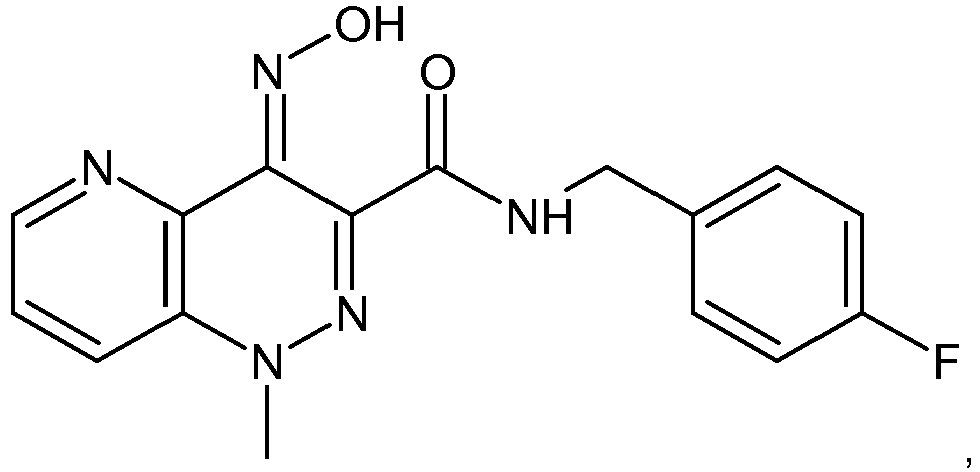


- The compound according to claim 1 or 2, wherein X is selected from Se, N-OH, NH, or N-CN; and R5 is selected from H, a substituted or unsubstituted hydrocarbon group, a substituted or unsubstituted heterogeneous group, a substituted or unsubstituted aromatic group, or a substituted or unsubstituted heteroaromatic group.
- The compound according to claim 1 or 2, wherein X is O or S and R5 is the
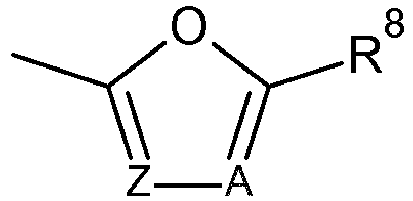
- The compound according to claim 10, wherein at least one of Z and A is N, preferably, both Z and A are N, and more preferably, R8 is a substituted or unsubstituted hydrocarbon group.
- The compound according to claim 1, wherein the compound is selected from:

- A compound of any one of claims 1 to 12, a pharmaceutically-acceptable salt, hydrate, solvate, tautomer, optical isomer, E-isomer, Z-isomer, or combination thereof, optionally with a pharmaceutically acceptable carrier or diluent, for use in the treatment of HIV in a mammal and/or for use in salvage therapy in the treatment of HIV in a mammal, wherein the compound is present in an anti-HIV effective treatment amount.
Priority Applications (1)
| Application Number | Priority Date | Filing Date | Title |
|---|---|---|---|
| EP17171615.2A EP3235818A3 (en) | 2010-04-01 | 2011-04-01 | Compounds for the treatment of hiv |
Applications Claiming Priority (2)
| Application Number | Priority Date | Filing Date | Title |
|---|---|---|---|
| US32022310P | 2010-04-01 | 2010-04-01 | |
| PCT/CA2011/000357 WO2011120153A1 (en) | 2010-04-01 | 2011-04-01 | Compounds and method for treatment of hiv |
Related Child Applications (2)
| Application Number | Title | Priority Date | Filing Date |
|---|---|---|---|
| EP17171615.2A Division EP3235818A3 (en) | 2010-04-01 | 2011-04-01 | Compounds for the treatment of hiv |
| EP17171615.2A Division-Into EP3235818A3 (en) | 2010-04-01 | 2011-04-01 | Compounds for the treatment of hiv |
Publications (3)
| Publication Number | Publication Date |
|---|---|
| EP2552915A1 EP2552915A1 (en) | 2013-02-06 |
| EP2552915A4 EP2552915A4 (en) | 2014-08-13 |
| EP2552915B1 true EP2552915B1 (en) | 2017-07-19 |
Family
ID=44711266
Family Applications (2)
| Application Number | Title | Priority Date | Filing Date |
|---|---|---|---|
| EP17171615.2A Withdrawn EP3235818A3 (en) | 2010-04-01 | 2011-04-01 | Compounds for the treatment of hiv |
| EP11761876.9A Not-in-force EP2552915B1 (en) | 2010-04-01 | 2011-04-01 | Compounds for the treatment of hiv |
Family Applications Before (1)
| Application Number | Title | Priority Date | Filing Date |
|---|---|---|---|
| EP17171615.2A Withdrawn EP3235818A3 (en) | 2010-04-01 | 2011-04-01 | Compounds for the treatment of hiv |
Country Status (4)
| Country | Link |
|---|---|
| US (3) | US8987272B2 (en) |
| EP (2) | EP3235818A3 (en) |
| CA (2) | CA2794952C (en) |
| WO (1) | WO2011120153A1 (en) |
Families Citing this family (5)
| Publication number | Priority date | Publication date | Assignee | Title |
|---|---|---|---|---|
| CN103864699B (en) * | 2012-12-11 | 2016-04-06 | 北京大学 | There is resisting HBV virus and have the Synthesis and applications of the new class non-nucleosides S-DABOs pyrimidone derivatives of AntiHIV1 RT activity and HCV virus function concurrently |
| BR112015028760A2 (en) | 2013-05-16 | 2017-07-25 | Us Health | compounds for inhibiting drug resistant hiv-1 integrase strains |
| KR102323515B1 (en) | 2013-09-12 | 2021-11-05 | 얀센 바이오파마, 인코퍼레이트. | Aza-pyridone compounds and uses thereof |
| LT3030549T (en) | 2013-09-12 | 2019-06-25 | Janssen Biopharma, Inc. | Pyridazinone compounds and uses thereof |
| EA036776B1 (en) | 2015-03-11 | 2020-12-21 | Янссен Байофарма, Инк. | Azapyridone compounds and methods of use thereof |
Family Cites Families (274)
| Publication number | Priority date | Publication date | Assignee | Title |
|---|---|---|---|---|
| US2723979A (en) * | 1954-08-02 | 1955-11-15 | Du Pont | 4-amino-5-hydroxy-2, 6-di(hydroxymethyl)-pyrimidine and process of preparing same |
| US3239539A (en) | 1960-12-02 | 1966-03-08 | Exxon Research Engineering Co | Gem dimethylol alicyclic esters |
| GB1026401A (en) | 1961-02-23 | 1966-04-20 | Wellcome Found | Isatin thiosemicarbazones,their preparation and pharmaceutical formulations containing them |
| US3250791A (en) | 1961-12-29 | 1966-05-10 | Du Pont | Tetracyanoethylene oxide and process for preparing same |
| GB1231783A (en) | 1967-05-16 | 1971-05-12 | May & Baker Ltd | Benzene derivatives |
| DE1767924A1 (en) | 1968-07-02 | 1971-10-07 | Bayer Ag | 1-phenyl-4,4-dialkyl-thiosemicarbazide |
| JPS5695161U (en) | 1979-12-20 | 1981-07-28 | ||
| JPS5695161A (en) | 1979-12-28 | 1981-08-01 | Otsuka Pharmaceut Factory Inc | 2-admantanon derivative |
| US4463077A (en) | 1982-05-26 | 1984-07-31 | Toray Industries, Inc. | Electrophotographic photosensitive material comprises pyrazoline and hydrazone derivatives |
| US4537844A (en) | 1982-10-08 | 1985-08-27 | Ricoh Co. Ltd. | Electrophotographic element containing disazo compound |
| DE3237649A1 (en) | 1982-10-11 | 1984-04-12 | Hoechst Ag, 6230 Frankfurt | 3-Aryl-7-chloro-10-hydroxy-3,4-dihydroacridine-1,9-(2H, 10H)-dione-1-oximes and -1-hydrazone derivatives, their salts, process for their preparation, compositions containing them and their use |
| EP0106284B1 (en) | 1982-10-11 | 1987-06-16 | Hoechst Aktiengesellschaft | 3-aryl-7-chloro-3,4-dihydro-acridine-1,9-(2h,10h)-dione-1-oximes and 1-hydrazones, their salts, process for their preparation and pharmaceutical preparations containing them, and their application |
| DE3243021C2 (en) | 1982-11-20 | 1985-09-26 | Dornier Gmbh, 7990 Friedrichshafen | Composite material and its use |
| JPS5988468U (en) | 1982-12-08 | 1984-06-15 | 三菱電線工業株式会社 | Vibration detection device for vertically running striated bodies |
| US4604134A (en) * | 1983-09-14 | 1986-08-05 | Lafarge Coppee | Pollen suppressant comprising a fused pyridazine |
| HU189765B (en) | 1983-10-25 | 1986-07-28 | Richter Gedeon Vegyeszeti Gyar Rt,Hu | Process for preparing n-substituted 1-(bis (hydroxy-metiol)-methyl)-isoquinoline-derivatives |
| JPS60184254A (en) | 1984-03-02 | 1985-09-19 | Canon Inc | Electrophotographic sensitive body |
| JPS60184254U (en) | 1984-05-16 | 1985-12-06 | ソニー株式会社 | cathode ray tube |
| US4619878A (en) | 1984-06-26 | 1986-10-28 | Ricoh Co., Ltd. | Tetrazonium salt compound, disazo compound, method for preparing the same, and photosensitive material containing said disazo compound for use in electrophotography |
| CA1238325A (en) | 1984-08-17 | 1988-06-21 | Adam C. Hsu | Sulfenylated acylhydrazones |
| EP0183398B1 (en) | 1984-11-30 | 1989-04-12 | FISONS plc | Angiotensin converting enzyme inhibitors and their production and use as pharmaceuticals |
| WO1986004582A1 (en) | 1985-02-11 | 1986-08-14 | The Upjohn Company | Anthelmintic pyridinyl acylhydrazones, method of use and compositions |
| US4833153A (en) | 1985-11-08 | 1989-05-23 | Glaxo Group Limited | Indole derivatives |
| US5231185A (en) | 1985-11-19 | 1993-07-27 | Cornell Research Foundation, Inc. | Monosaccharide analog-based glycosidase inhibitors |
| US4757880A (en) | 1985-11-21 | 1988-07-19 | Borg-Warner Automotive, Inc. | Strap configuration for a reverse double wrap band |
| IL77496A (en) | 1986-01-01 | 1989-02-28 | Univ Ramot | Anti-viral preparations comprising isatine 3-thiosemicarbazones |
| JPH01502022A (en) | 1986-04-07 | 1989-07-13 | ジ・アップジョン・カンパニー | Anthelmintic quaternary alkyl acylhydrazone, methods of use and compositions |
| US5023334A (en) | 1986-10-03 | 1991-06-11 | The Upjohn Company | Anthelmintic pyridinyl acylhydrazones |
| JPH07114195B2 (en) | 1987-04-13 | 1995-12-06 | 株式会社日立製作所 | Etching end point determination method |
| ES2059527T3 (en) | 1987-09-09 | 1994-11-16 | Zeneca Ltd | FUNGICIDES. |
| US5155110A (en) | 1987-10-27 | 1992-10-13 | Warner-Lambert Company | Fenamic acid hydroxamate derivatives having cyclooxygenase and 5-lipoxygenase inhibition |
| US4958010A (en) | 1988-02-16 | 1990-09-18 | Bristol-Myers Company | Epipodophyllotoxin glucoside lactam derivatives |
| ZA894508B (en) | 1988-06-16 | 1990-03-28 | Rohm & Haas | Pharmaceutical compounds |
| JP2521137B2 (en) | 1988-11-08 | 1996-07-31 | 富士写真フイルム株式会社 | Electrophotographic photoreceptor |
| US5196291A (en) | 1989-05-24 | 1993-03-23 | Fuji Photo Film Co., Ltd. | Silver halide photographic material |
| JPH0393767A (en) | 1989-09-04 | 1991-04-18 | Konica Corp | Production of hydrazine compound having semicarbazide group |
| EP0420005B1 (en) | 1989-09-18 | 1996-07-10 | Fuji Photo Film Co., Ltd. | High contrast silver halide photographic material |
| YU201090A (en) | 1989-10-25 | 1993-05-28 | Egis Gyogyszergyar | NEW TRIAZOLE DERIVATIVES AND PROCEDURE FOR THEIR MANUFACTURE |
| AU654264B2 (en) | 1989-10-31 | 1994-11-03 | Biocryst Pharmaceuticals, Inc. | Inhibitors of purine nucleoside phosphorylase |
| US4985434A (en) | 1989-10-31 | 1991-01-15 | Biocryst, Inc. | 7-substituted derivatives of 2-amino-3H,5H-pyrrolo(3,2-d)pyrimidin-4-ones and pharamceutical uses and compositions containing the same |
| US5008265A (en) | 1989-10-31 | 1991-04-16 | Biocryst, Inc. | 2-amino-7-(alicyclomethyl)-3H,5H,-pyrrolo[3,2-d]pyrimidin-4-ones and pharmaceutical uses and compositions containing the same |
| US4985433A (en) | 1989-10-31 | 1991-01-15 | Biocryst, Inc. | 2-amino-7-(pyridinylmethyl)-3H,5H-pyrrolo[3,2-d]pyrimidin-4-ones and pharmaceutical uses and compositions containing the same |
| US5008270A (en) | 1989-10-31 | 1991-04-16 | Biocryst, Inc. | 2-amino-7-(heterocyclomethyl)-3H,5H-pyrrolo[3,2-d]pyrimidin-4-ones and pharmaceutical uses and compositions containing the same |
| JP3093767B2 (en) | 1989-11-27 | 2000-10-03 | 松下電工株式会社 | Cleaning equipment |
| US5189039A (en) | 1989-11-29 | 1993-02-23 | Biocryst, Inc. | 7-disubstituted-methyl-4-oxo-3H,5H-pyrrolo[3,2d]pyrimidine and pharmaceutical uses and compositions containing the same |
| US5230983A (en) | 1990-04-13 | 1993-07-27 | Fuji Photo Film Co., Ltd. | Silver halide photographic material |
| LU87766A1 (en) | 1990-07-20 | 1992-03-11 | Oreal | USE OF PYRIMIDINE 3-OXIDE DERIVATIVES FOR BRAKING HAIR LOSS AND TOPICAL COMPOSITIONS IMPLEMENTED |
| WO1992003421A2 (en) | 1990-08-17 | 1992-03-05 | E.I. Du Pont De Nemours And Company | Arthropodicidal pyrazolines, pyrazolidines and hydrazines |
| NZ239846A (en) | 1990-09-27 | 1994-11-25 | Merck & Co Inc | Sulphonamide derivatives and pharmaceutical compositions thereof |
| CA2093351A1 (en) | 1990-10-05 | 1992-04-06 | Charles R. Harrison | Semicarbazone arthropodicides |
| WO1992008464A1 (en) | 1990-11-15 | 1992-05-29 | Tanabe Seiyaku Co. Ltd. | Substituted urea and related cell adhesion modulation compounds |
| IL100555A (en) | 1991-02-07 | 2000-08-31 | Hoechst Marion Roussel Inc | N-substituted quinoline derivatives their preparation their use for the preparation of medicaments and the pharmaceutical compositions containing them |
| US5747469A (en) | 1991-03-06 | 1998-05-05 | Board Of Regents, The University Of Texas System | Methods and compositions comprising DNA damaging agents and p53 |
| JPH05333467A (en) | 1991-05-02 | 1993-12-17 | Fuji Photo Film Co Ltd | Silver halide photographic sensitive material |
| CA2102780C (en) | 1991-05-10 | 2007-01-09 | Alfred P. Spada | Bis mono-and bicyclic aryl and heteroaryl compounds which inhibit egf and/or pdgf receptor tyrosine kinase |
| US5714493A (en) | 1991-05-10 | 1998-02-03 | Rhone-Poulenc Rorer Pharmaceuticals, Inc. | Aryl and heteroaryl quinazoline compounds which inhibit CSF-1R receptor tyrosine kinase |
| US5480883A (en) | 1991-05-10 | 1996-01-02 | Rhone-Poulenc Rorer Pharmaceuticals Inc. | Bis mono- and bicyclic aryl and heteroaryl compounds which inhibit EGF and/or PDGF receptor tyrosine kinase |
| US5710158A (en) | 1991-05-10 | 1998-01-20 | Rhone-Poulenc Rorer Pharmaceuticals Inc. | Aryl and heteroaryl quinazoline compounds which inhibit EGF and/or PDGF receptor tyrosine kinase |
| USRE37650E1 (en) | 1991-05-10 | 2002-04-09 | Aventis Pharmacetical Products, Inc. | Aryl and heteroaryl quinazoline compounds which inhibit CSF-1R receptor tyrosine kinase |
| JPH0528463A (en) | 1991-07-23 | 1993-02-05 | Sony Corp | Magnetic recording medium |
| JPH0558894A (en) | 1991-08-27 | 1993-03-09 | Kanegafuchi Chem Ind Co Ltd | Antitumor agent |
| US5344836A (en) | 1991-11-11 | 1994-09-06 | Ono Pharmaceutical Co., Ltd. | Fused benzeneoxyacetic acid derivatives |
| DE4138820A1 (en) | 1991-11-26 | 1993-05-27 | Basf Ag | CHINOLIN-3-CARBONATEAMIDE, THEIR PREPARATION AND USE |
| JP2787630B2 (en) | 1992-02-06 | 1998-08-20 | 富士写真フイルム株式会社 | Silver halide photosensitive material |
| JP2995360B2 (en) | 1992-02-26 | 1999-12-27 | コニカ株式会社 | Silver halide photographic material |
| DE4207400A1 (en) | 1992-03-09 | 1993-09-16 | Bayer Ag | New hydrazone cpds. - useful as antimicrobial agents, insecticides, acaricides and fungicides, etc., for plant and wood protection, antibacterial therapy, etc. |
| US5521184A (en) | 1992-04-03 | 1996-05-28 | Ciba-Geigy Corporation | Pyrimidine derivatives and processes for the preparation thereof |
| EP0638080A4 (en) | 1992-04-21 | 1995-08-23 | Biocryst Pharm Inc | PYRIMIDINE 7-BISUBSTITUEE-METHYL-4-OXO-3H -, 5H --PYRROLO 3,2-d -], PHARMACEUTICAL USE AND COMPOSITIONS CONTAINING SAID PYRIMIDINE. |
| US5358946A (en) | 1992-05-29 | 1994-10-25 | The Du Pont Merck Pharmaceutical Company | Heterocycle-substituted amides, carbamates and ureas as agents for the treatment of atherosclerosis |
| DE4217723A1 (en) | 1992-05-29 | 1993-12-02 | Bayer Ag | Thiosemicarbazides |
| JP2994182B2 (en) | 1992-07-23 | 1999-12-27 | 石原産業株式会社 | Amide compounds or salts thereof, methods for producing them and pest control agents containing them |
| EP0600832A1 (en) | 1992-11-27 | 1994-06-08 | Ciba-Geigy Ag | Derivatives of diamino benzoic and diamino phthalic acid und their use as protein linase inhibitors |
| JP3197703B2 (en) | 1992-12-28 | 2001-08-13 | 花王株式会社 | Novel phosphoric acid diester polyvalent metal salt and method for producing the same |
| TW251302B (en) | 1992-12-28 | 1995-07-11 | Kao Corp | |
| DE4400451A1 (en) | 1993-01-20 | 1994-07-21 | Basf Ag | New 2- or 4- methyl-pyridine derivs. |
| US5618829A (en) | 1993-01-28 | 1997-04-08 | Mitsubishi Chemical Corporation | Tyrosine kinase inhibitors and benzoylacrylamide derivatives |
| EP0637237B1 (en) | 1993-02-23 | 2004-05-19 | Brigham And Women's Hospital, Inc. | Calcium receptor-active molecules |
| US5750088A (en) | 1993-03-30 | 1998-05-12 | The Dupont Merck Pharmaceutical Company | Stable hydrazones linked to a peptide moiety as reagents for the preparation of radiopharmaceuticals |
| JP3350739B2 (en) | 1993-06-10 | 2002-11-25 | コニカ株式会社 | Method for developing black-and-white silver halide photographic materials |
| JPH0772571A (en) | 1993-09-02 | 1995-03-17 | Fuji Photo Film Co Ltd | Novel coordination compound, silver halide photographic sensitive material containing same compound, photographic processing composition and processing method |
| JPH08503971A (en) | 1993-10-01 | 1996-04-30 | チバ−ガイギー アクチェンゲゼルシャフト | Pyrimidineamine derivatives and methods for their preparation |
| US5543520A (en) | 1993-10-01 | 1996-08-06 | Ciba-Geigy Corporation | Pyrimidine derivatives |
| JP3258788B2 (en) | 1993-10-14 | 2002-02-18 | 株式会社リコー | Electrophotographic photoreceptor |
| US5656643A (en) | 1993-11-08 | 1997-08-12 | Rhone-Poulenc Rorer Pharmaceuticals Inc. | Bis mono-and bicyclic aryl and heteroaryl compounds which inhibit EGF and/or PDGF receptor tyrosine kinase |
| JP3303201B2 (en) | 1993-12-11 | 2002-07-15 | 株式会社リコー | Electrophotographic photoreceptor |
| UA42747C2 (en) | 1993-12-23 | 2001-11-15 | Ново Нордіск А/С | PEPTIDE DERIVATIVES, PHARMACEUTICAL COMPOSITION AND METHOD FOR STIMULATING GROWTH HORMONE SECRETION |
| PL315941A1 (en) | 1994-02-23 | 1996-12-09 | Pfizer | 4-heterocyclic substituted derivatives of quinazoline, methods of obtaining them and their application as anticarcinogenic agents |
| WO1995023796A1 (en) | 1994-03-01 | 1995-09-08 | Ono Pharmaceutical Co., Ltd. | Guanylhydrazone derivative |
| CN1176918C (en) | 1994-04-06 | 2004-11-24 | 盐野义制药株式会社 | Intermediates of Novel α-Substituted Phenylacetic Acid Derivatives with Agricultural Fungicidal Activity |
| EP0704215A3 (en) | 1994-06-02 | 1998-04-01 | Takeda Chemical Industries, Ltd. | Inhibitor of vascular permeability enhancer |
| WO1996005818A1 (en) | 1994-08-19 | 1996-02-29 | Nps Pharmaceuticals, Inc. | Methods and compounds active at metabotropic glutamate receptors useful for treatment of neurological disorders and diseases |
| GB9510757D0 (en) | 1994-09-19 | 1995-07-19 | Wellcome Found | Therapeuticaly active compounds |
| DE4439334A1 (en) | 1994-11-04 | 1996-05-09 | Bayer Ag | Butenyl dithiocarbazonate |
| TW280906B (en) | 1994-12-01 | 1996-07-11 | Ibm | |
| DE19501481A1 (en) | 1995-01-19 | 1996-07-25 | Bayer Ag | 2,8-disubstituted quinazolinones |
| JPH08220666A (en) | 1995-02-15 | 1996-08-30 | Konica Corp | Black-and-white silver halide photographic sensitive material and processing method thereof |
| EP0824525B1 (en) | 1995-04-27 | 2001-06-13 | AstraZeneca AB | Quinazoline derivatives |
| AU5896396A (en) | 1995-05-24 | 1996-12-11 | Ciba-Geigy Ag | Pyridine-microbicides |
| US6265427B1 (en) | 1995-06-07 | 2001-07-24 | The Proctor & Gamble Company | Pharmaceutical composition for the method of treating leukemia |
| US5763470A (en) | 1995-06-07 | 1998-06-09 | Sugen Inc. | Benzopyran compounds and methods for their use |
| DE69618587T2 (en) | 1995-06-07 | 2002-08-29 | Sugen, Inc. | CHINAZOLINE AND PHARMACEUTICAL COMPOSITIONS |
| KR19990028303A (en) | 1995-06-22 | 1999-04-15 | 한센 핀 베네드, 안네 제헤르 | Compounds having growth hormone releasing properties |
| DE19524435A1 (en) | 1995-07-05 | 1997-01-09 | Bayer Ag | Fluorobutenic acid hydrazones |
| GB9514265D0 (en) | 1995-07-13 | 1995-09-13 | Wellcome Found | Hetrocyclic compounds |
| US5633786A (en) | 1995-08-21 | 1997-05-27 | Motorola | Shield assembly and method of shielding suitable for use in a communication device |
| GB9520822D0 (en) | 1995-10-11 | 1995-12-13 | Wellcome Found | Therapeutically active compounds |
| AR004010A1 (en) | 1995-10-11 | 1998-09-30 | Glaxo Group Ltd | HETERO CYCLIC COMPOUNDS |
| GB9523675D0 (en) | 1995-11-20 | 1996-01-24 | Celltech Therapeutics Ltd | Chemical compounds |
| DE19545878A1 (en) | 1995-12-08 | 1997-06-12 | Basf Ag | Pyridyl carbamates, processes and intermediates for their preparation and their use |
| US5760041A (en) | 1996-02-05 | 1998-06-02 | American Cyanamid Company | 4-aminoquinazoline EGFR Inhibitors |
| DE19619518A1 (en) | 1996-05-15 | 1997-11-20 | Haeussler & Sauter Kg | Process for attaching a thread to an infusion bag |
| US6306574B1 (en) | 1996-05-17 | 2001-10-23 | Fuji Photo Film Co., Ltd. | Photothermographic material |
| US20040171032A1 (en) | 1996-06-06 | 2004-09-02 | Baker Brenda F. | Non-phosphorous-linked oligomeric compounds and their use in gene modulation |
| DE69716916T2 (en) | 1996-07-13 | 2003-07-03 | Glaxo Group Ltd., Greenford | CONDENSED HETEROCYCLIC COMPOUNDS AS PROTEIN KINASE INHIBITORS |
| HRP970371A2 (en) | 1996-07-13 | 1998-08-31 | Kathryn Jane Smith | Heterocyclic compounds |
| EA199900021A1 (en) | 1996-07-13 | 1999-08-26 | Глаксо, Груп Лимитед | BICYCLIC HETEROAROMATIC COMPOUNDS AS PROTEINTHYROSINKINASE INHIBITORS |
| AU720429B2 (en) | 1996-08-23 | 2000-06-01 | Novartis Ag | Substituted pyrrolopyrimidines and processes for their preparation |
| AU3938797A (en) | 1996-08-29 | 1998-03-19 | Novo Nordisk A/S | Transdermal delivery of peptides |
| ES2239779T3 (en) | 1996-10-02 | 2005-10-01 | Novartis Ag | PIRIMIDINE DERIVATIVES AND PROCEDURES FOR THE PREPARATION OF THE SAME. |
| CN1259118A (en) | 1997-06-03 | 2000-07-05 | 诺瓦提斯公司 | organic compounds |
| CO4940418A1 (en) | 1997-07-18 | 2000-07-24 | Novartis Ag | MODIFICATION OF A CRYSTAL OF A DERIVATIVE OF N-PHENYL-2-PIRIMIDINAMINE, PROCESSES FOR ITS MANUFACTURE AND USE |
| ZA986729B (en) | 1997-07-29 | 1999-02-02 | Warner Lambert Co | Irreversible inhibitors of tyrosine kinases |
| ZA986732B (en) | 1997-07-29 | 1999-02-02 | Warner Lambert Co | Irreversible inhibitiors of tyrosine kinases |
| TW436485B (en) | 1997-08-01 | 2001-05-28 | American Cyanamid Co | Substituted quinazoline derivatives |
| GB9716557D0 (en) | 1997-08-06 | 1997-10-08 | Glaxo Group Ltd | Benzylidene-1,3-dihydro-indol-2-one derivatives having anti-cancer activity |
| JPH1180131A (en) | 1997-09-01 | 1999-03-26 | Mitsubishi Chem Corp | Ethynylpyrimidine derivatives |
| EP0902028A1 (en) | 1997-09-11 | 1999-03-17 | E.I. Du Pont De Nemours And Company | Tetrazoline herbicides |
| WO1999018102A1 (en) | 1997-10-08 | 1999-04-15 | E.I. Du Pont De Nemours And Company | Fungicidal and arthropodicidal cyclic amides |
| JPH11133545A (en) | 1997-10-31 | 1999-05-21 | Fuji Photo Film Co Ltd | Heat developable recording material |
| US6184377B1 (en) | 1997-12-15 | 2001-02-06 | Sepracor Inc. | Compositions containing N-amino- and N-hydroxy-quinazolinones and methods for preparing libraries thereof |
| AU1507199A (en) | 1997-12-15 | 1999-07-05 | Yamanouchi Pharmaceutical Co., Ltd. | Novel pyrimidine-5-carboxamide derivatives |
| DE69918950T2 (en) | 1998-02-06 | 2005-07-28 | De Montfort University | BY HYDROXYLATION ACTIVATED MEDICAMENT PREPARATIONS |
| US20020042423A1 (en) | 1998-04-29 | 2002-04-11 | John R. Richert | Methods for identifying compounds that bind to hla molecules and use of such compounds as hla-agonists or antagonists |
| US20010051628A1 (en) | 1998-05-04 | 2001-12-13 | H.-J. Su Huang | Methods to modulate the resistance of cells to apoptosis mediated by mutant epidermal growth factor receptors |
| US6289352B1 (en) | 1998-05-29 | 2001-09-11 | Crystal Decisions, Inc. | Apparatus and method for compound on-line analytical processing in databases |
| JPH11345811A (en) | 1998-06-01 | 1999-12-14 | Seiko Instruments Inc | Method for manufacturing semiconductor device |
| AU761737B2 (en) | 1998-06-03 | 2003-06-12 | Gpi Nil Holdings, Inc. | N-oxide of heterocyclic ester, amide, thioester, or ketone hair growth compositions and uses |
| US20030181495A1 (en) | 1998-06-23 | 2003-09-25 | Medinox, Inc. | Therapeutic methods employing disulfide derivatives of dithiocarbamates and compositions useful therefor |
| US6596770B2 (en) | 2000-05-05 | 2003-07-22 | Medinox, Inc. | Therapeutic methods employing disulfide derivatives of dithiocarbamates and compositions useful therefor |
| US6399648B1 (en) | 1998-08-14 | 2002-06-04 | Gpi Nil Holdings, Inc. | N-oxides of heterocyclic ester, amide, thioester, or ketone for vision and memory disorders |
| EP1117397A1 (en) | 1998-08-31 | 2001-07-25 | Sugen, Inc. | Geometrically restricted 2-indolinone derivatives as modulators of protein kinase activity |
| JP2000143636A (en) | 1998-09-02 | 2000-05-26 | Sumitomo Pharmaceut Co Ltd | Amino derivative |
| US20020010550A1 (en) | 1998-09-14 | 2002-01-24 | George M. Grass | Pharmacokinetic-based drug design tool and method |
| CN1224005A (en) | 1998-09-26 | 1999-07-28 | 杭州民生凯普医药化工有限公司 | Novel anticancer drug thiosemicarbazone compound and its manufacturing method |
| AU5652499A (en) | 1998-09-29 | 2000-04-17 | Shionogi & Co., Ltd. | Heterocyclic derivatives having acaricidal activity |
| AU6159499A (en) | 1998-09-29 | 2000-04-17 | Wyeth Holdings Corporation | Substituted 3-cyanoquinolines as protein tyrosine kinases inhibitors |
| GB9904387D0 (en) | 1999-02-25 | 1999-04-21 | Pharmacia & Upjohn Spa | Antitumour synergistic composition |
| AU4972900A (en) | 1999-04-08 | 2000-11-14 | Arch Development Corporation | Use of anti-vegf antibody to enhance radiation in cancer therapy |
| US6544541B1 (en) | 1999-06-02 | 2003-04-08 | Cardiovascular Solutions, Inc. | Devices and compounds for treating arterial restenosis |
| WO2000074702A1 (en) | 1999-06-04 | 2000-12-14 | Novo Nordisk A/S | Compositions for the treatment of the catabolic state of prolonged critical illness |
| US6420560B1 (en) | 1999-06-07 | 2002-07-16 | Theravance, Inc. | H1—histamine receptor antagonists |
| AU5469400A (en) | 1999-06-11 | 2001-01-02 | Merck & Co., Inc. | Cyclopentyl modulators of chemokine receptor activity |
| DK1202746T3 (en) | 1999-08-12 | 2007-01-02 | Wyeth Corp | NSAID and EGFR kinase inhibitor-containing preparation for the treatment or inhibition of colon polyps and colorectal cancer |
| CA2383596A1 (en) | 1999-09-01 | 2001-03-08 | Unilever Plc | Composition and method for bleaching a substrate |
| KR20020027649A (en) | 1999-09-15 | 2002-04-13 | 로즈 암스트롱, 크리스틴 에이. 트러트웨인 | Pteridinones as Kinase Inhibitors |
| US7264932B2 (en) | 1999-09-24 | 2007-09-04 | Applera Corporation | Nuclease inhibitor cocktail |
| JP2003511378A (en) | 1999-10-07 | 2003-03-25 | アムジエン・インコーポレーテツド | Triazine kinase inhibitors |
| GB9924862D0 (en) | 1999-10-20 | 1999-12-22 | Celltech Therapeutics Ltd | Chemical compounds |
| JP2003513965A (en) | 1999-11-05 | 2003-04-15 | スミスクライン・ビーチャム・コーポレイション | Semicarbazone derivatives and their use as thrombopoietin mimetics |
| WO2001038332A1 (en) | 1999-11-24 | 2001-05-31 | Merck & Co., Inc. | Gamma-hydroxy-2-(fluoroalkylaminocarbonyl)-1-piperazinepentanamides as hiv protease inhibitors |
| FR2801586B1 (en) | 1999-11-29 | 2002-09-20 | Oreal | PHOTOPROTECTIVE COSMETIC COMPOSITIONS CONTAINING AMINOAMIDINE DERIVATIVES AND USES |
| JP2001172217A (en) | 1999-12-21 | 2001-06-26 | Shionogi & Co Ltd | Ethylene derivatives with acaricidal and fungicidal activity |
| GB2357971A (en) | 1999-12-23 | 2001-07-11 | Novartis Ag | Protection of plants against microorganism attack |
| DE19963235A1 (en) | 1999-12-27 | 2001-07-05 | Boehringer Ingelheim Pharma | Substituted piperazine derivatives, their manufacture and their use as pharmaceuticals |
| ITMI992711A1 (en) | 1999-12-27 | 2001-06-27 | Novartis Ag | ORGANIC COMPOUNDS |
| HN2001000008A (en) | 2000-01-21 | 2003-12-11 | Inc Agouron Pharmaceuticals | AMIDA COMPOSITE AND PHARMACEUTICAL COMPOSITIONS TO INHIBIT PROTEINKINASES, AND THE INSTRUCTIONS FOR USE |
| IL145757A (en) | 2000-02-05 | 2007-12-03 | Vertex Pharma | Pyrazole derivatives and pharmaceutical compositions containing the same |
| US6313138B1 (en) | 2000-02-25 | 2001-11-06 | Merck & Co., Inc. | Tyrosine kinase inhibitors |
| US6420382B2 (en) | 2000-02-25 | 2002-07-16 | Merck & Co., Inc. | Tyrosine kinase inhibitors |
| EP1259490A2 (en) | 2000-03-01 | 2002-11-27 | Sloan Kettering Institute For Cancer Research | Synthesis of epothilones, intermediates thereto and analogues thereof |
| GB0005087D0 (en) | 2000-03-01 | 2000-04-26 | Unilever Plc | Method for reducing dye fading of fabrics in laundry bleaching compositions |
| GB0005089D0 (en) | 2000-03-01 | 2000-04-26 | Unilever Plc | Bleaching and dye transfer inhibiting composition and method for laundry fabrics |
| GB0005088D0 (en) | 2000-03-01 | 2000-04-26 | Unilever Plc | Composition and method for bleaching laundry fabrics |
| GB0005326D0 (en) | 2000-03-06 | 2000-04-26 | Deutsches Krebsforsch | Enzymes and uses relating thereto |
| EE200200506A (en) | 2000-03-06 | 2004-02-16 | Warner-Lambert Company | 5-alkylpyrido [2,3-d] pyrimidines as tyrosine kinase inhibitors |
| GB0007657D0 (en) | 2000-03-29 | 2000-05-17 | Celltech Therapeutics Ltd | Chemical compounds |
| GB2372562A (en) | 2000-04-26 | 2002-08-28 | Ribotargets Ltd | In silico screening |
| DE60141871D1 (en) | 2000-05-05 | 2010-06-02 | Wallac Oy | Oligonucleotide labels and their use |
| DE10023492A1 (en) | 2000-05-09 | 2001-11-22 | Schering Ag | New 2-(((hetero)aryl-alkyl)-amino)-aza-benzamide derivatives, are VEGF receptor, KDR kinase and FLT kinase inhibitors useful e.g. for treating tumors, psoriasis, arthritis or renal or ophthalmological diseases |
| US6489094B2 (en) | 2000-05-31 | 2002-12-03 | Pfizer Inc. | Method and device for drug-drug interaction testing sample preparation |
| US7211192B2 (en) | 2000-06-02 | 2007-05-01 | The Regents Of The University Of California | Hybrid organic-inorganic adsorbents |
| US7022484B2 (en) | 2000-06-08 | 2006-04-04 | Board Of Regents, The University Of Texas System | Methods for treating neuropathological states and neurogenic inflammatory states and methods for identifying compounds useful therein |
| US20020013334A1 (en) | 2000-06-15 | 2002-01-31 | Robl Jeffrey A. | HMG-CoA reductase inhibitors and method |
| US20020028826A1 (en) | 2000-06-15 | 2002-03-07 | Robl Jeffrey A. | HMG-CoA reductase inhibitors and method |
| US6620821B2 (en) | 2000-06-15 | 2003-09-16 | Bristol-Myers Squibb Company | HMG-CoA reductase inhibitors and method |
| EP1294349A2 (en) | 2000-06-26 | 2003-03-26 | The Regents Of The University Of Michigan | Use of egf-r protein tyrosine kinase inhibitors for preventing photoaging in human skin |
| US7175844B2 (en) | 2000-07-18 | 2007-02-13 | Joslin Diabetes Center, Inc. | Methods of modulating fibrosis |
| US7067046B2 (en) | 2000-08-04 | 2006-06-27 | Essen Instruments, Inc. | System for rapid chemical activation in high-throughput electrophysiological measurements |
| US6647342B2 (en) | 2000-08-07 | 2003-11-11 | Novodynamics, Inc. | Knowledge-based process for the development of materials |
| GB0022438D0 (en) | 2000-09-13 | 2000-11-01 | Novartis Ag | Organic Compounds |
| ATE430745T1 (en) * | 2000-10-12 | 2009-05-15 | Merck & Co Inc | AZA- AND POLYAZA NAPHTHALENYL CARBOXAMIDES AS INHIBITORS OF HIV INTEGRASE |
| CA2424689A1 (en) | 2000-10-17 | 2002-04-25 | Merck & Co., Inc. | Orally active salts with tyrosine kinase activity |
| DE10057751A1 (en) * | 2000-11-22 | 2002-05-23 | Bayer Ag | New carbamate-substituted pyrazolo (3,4-b) pyridine derivatives, are soluble guanylate cyclase stimulants useful e.g. for treating cardiovascular or central nervous system diseases, sexual dysfunction or inflammation |
| EP1349613A4 (en) | 2000-12-19 | 2005-09-21 | Smithkline Beecham Corp | MIMETICS OF THROMBOPOIETINE |
| GB0104980D0 (en) | 2001-02-28 | 2001-04-18 | Unilever Plc | Liquid cleaning compositions and their use |
| GB0104979D0 (en) | 2001-02-28 | 2001-04-18 | Unilever Plc | Unit dose cleaning product |
| UY27192A1 (en) | 2001-03-01 | 2002-09-30 | Smithkline Beecham Corp | PEPTIDE DEFORMILASE INHIBITORS |
| EP1390029B1 (en) | 2001-04-11 | 2009-12-16 | Idenix (Cayman) Limited | Phenylindoles for the treatment of hiv |
| US7759323B2 (en) | 2001-05-22 | 2010-07-20 | Eisai R & D Management Co., Ltd. | Highly purified antiendotoxin compound |
| US6352168B1 (en) | 2001-06-21 | 2002-03-05 | Jung-Chuang Lin | Rotation cup |
| US20040235798A1 (en) | 2001-07-05 | 2004-11-25 | Murthi Krishna K | Compositions and methods for inhibiting prenyltransferases |
| EP1406889A2 (en) | 2001-07-09 | 2004-04-14 | Pharmacia Italia S.p.A. | Interaction inhibitors of tcf-4 with beta-catenin |
| DE60209381T2 (en) * | 2001-10-26 | 2006-10-05 | Istituto Di Ricerche Di Biologia Molecolare P. Angeletti S.P.A. | N-SUBSTITUTED HYDROXYPYRIMIDINONE CARBOXAMIDE INHIBITORS OF THE HIV INTEGRASE |
| SE0104326D0 (en) | 2001-12-19 | 2001-12-19 | Astrazeneca Ab | Therapeutic heterocycles |
| US6878709B2 (en) * | 2002-01-04 | 2005-04-12 | Schering Corporation | 3,4-di-substituted pyridazinediones as CXC chemokine receptor antagonists |
| MXPA03000145A (en) | 2002-01-07 | 2003-07-15 | Pfizer | Oxo or oxy-pyridine compounds as 5-ht4 receptor modulators. |
| ES2291642T3 (en) * | 2002-01-17 | 2008-03-01 | MERCK & CO., INC. | USEFUL HYDROXINE FTIRIDINON CARBOXAMIDS AS INHIBITORS OF HIV INTEGRESS. |
| US7071190B2 (en) | 2002-02-15 | 2006-07-04 | Rigel Pharmaceuticals, Inc. | Inhibitors to tubulin polymerization |
| FR2840303B1 (en) | 2002-05-31 | 2005-07-15 | Rhodia Chimie Sa | PROCESS FOR ARYLATION OR VINYLATION OR ALKYLATION OF A NUCLEOPHILIC COMPOUND |
| KR20040105853A (en) | 2002-04-08 | 2004-12-16 | 토렌트 파마슈티칼스 리미티드 | Thiazolidine-4-carbonitriles and analogues and their use as dipeptidyl-peptidas inhobitors |
| CA2484209C (en) | 2002-05-03 | 2013-06-11 | Exelixis, Inc. | Protein kinase modulators and methods of use |
| WO2004004725A2 (en) | 2002-07-09 | 2004-01-15 | Boehringer Ingelheim Pharma Gmbh & Co. Kg | Pharmaceutical compositions of anticholinergics and p38 kinase inhibitors in the treatment of respiratory diseases |
| ATE360015T1 (en) | 2002-07-31 | 2007-05-15 | Critical Outcome Technologies | PROTEIN TYROSINE KINASE INHIBITORS |
| AU2003262946A1 (en) * | 2002-08-30 | 2004-03-19 | Pharmacia And Upjohn Company | Method of preventing or treating atherosclerosis or restenosis |
| JP4398866B2 (en) | 2002-10-18 | 2010-01-13 | ビーエーエスエフ ソシエタス・ヨーロピア | 1-phenylpyrrolidin-2-one-3-carboxamide |
| WO2004063147A1 (en) | 2003-01-10 | 2004-07-29 | Novo Nordisk A/S | Salts and solvates of glucagon antagonists |
| GB0302310D0 (en) | 2003-01-31 | 2003-03-05 | Syngenta Participations Ag | Avermectin- and avermectin monosaccharide derivatives substituted in the 4"- or 4' - positionhaving pesticidal properties |
| US20060252798A1 (en) | 2003-02-05 | 2006-11-09 | Richardson Desi R | Metal ion chelators and therapeutic use thereof |
| EP1594894A2 (en) | 2003-02-18 | 2005-11-16 | Whitehead Institute For Biomedical Research | Mtor kinase-associated proteins |
| WO2004076640A2 (en) | 2003-02-25 | 2004-09-10 | Ambion, Inc. | Small-molecule inhibitors of angiogenin and rnases and in vivo and in vitro methods of using same |
| GB0305704D0 (en) | 2003-03-13 | 2003-04-16 | Amersham Plc | Radiofluorination methods |
| WO2004085382A1 (en) | 2003-03-27 | 2004-10-07 | Kirin Beer Kabushiki Kaisha | Compound inhibiting in vivo phosphorus transport and medicine containing the same |
| US20040193538A1 (en) | 2003-03-31 | 2004-09-30 | Raines Walter L. | Receipt processing system and method |
| US7427683B2 (en) | 2003-04-25 | 2008-09-23 | Ortho-Mcneil Pharmaceutical, Inc. | c-fms kinase inhibitors |
| US7456179B2 (en) | 2003-05-01 | 2008-11-25 | Panacea Pharmaceuticals, Inc. | Methods of treating ischemic related conditions |
| WO2004101512A2 (en) | 2003-05-13 | 2004-11-25 | Smithkline Beecham Corporation | Naphthyridine integrase inhibitors |
| US20050010017A1 (en) | 2003-07-11 | 2005-01-13 | Blakely Dale Milton | Addition of UV inhibitors to pet process for maximum yield |
| AU2003248103A1 (en) | 2003-07-24 | 2005-02-14 | Banyu Pharmaceutical Co., Ltd | Indolopyrrolocarbazole derivative and antitumor agent |
| WO2005012252A1 (en) | 2003-07-31 | 2005-02-10 | Altana Pharma Ag | Novel 6-phenylphenantridines |
| TW200510425A (en) | 2003-08-13 | 2005-03-16 | Japan Tobacco Inc | Nitrogen-containing fused ring compound and use thereof as HIV integrase inhibitor |
| JP2007504136A (en) | 2003-08-28 | 2007-03-01 | ニトロメッド インコーポレーティッド | Nitrosated and nitrosylated diuretic compounds, compositions and methods of use |
| US20050249697A1 (en) | 2003-09-24 | 2005-11-10 | Uhrich Kathryn E | Compositions and methods for the inhibition of bone growth and resorption |
| US20050090668A1 (en) | 2003-10-28 | 2005-04-28 | Dreher Spencer D. | Preparation of 5-hydroxy-6-oxo-1,6-dihydropyrimidine compounds |
| EP1689403A4 (en) | 2003-11-10 | 2007-09-05 | Synta Pharmaceuticals Corp | Heteroaryl-hydrazone compounds |
| TW200526635A (en) * | 2003-12-22 | 2005-08-16 | Shionogi & Co | Hydroxypyrimidinone derivative having HIV integrase inhibitory activity |
| WO2005070133A2 (en) | 2004-01-20 | 2005-08-04 | Merck & Co., Inc. | 2,6-disubstituted piperidines as modulators of chemokine receptor activity |
| GB0402138D0 (en) | 2004-01-30 | 2004-03-03 | Smithkline Beecham Corp | Novel compounds |
| KR20120090077A (en) | 2004-01-30 | 2012-08-16 | 얀센 알 앤드 디 아일랜드 | Hcv ns-3 serine protease inhibitors |
| GB0402143D0 (en) | 2004-01-30 | 2004-03-03 | Smithkline Beecham Corp | Novel compounds |
| ZA200607582B (en) | 2004-03-05 | 2009-02-25 | Univ California | Anti-parasitic compounds and methods of their use |
| WO2005107463A1 (en) | 2004-05-03 | 2005-11-17 | University Of Virginia Patent Foundation | Agonists of a2a adenosine receptors for treatment of diabetic nephropathy |
| WO2005116039A1 (en) | 2004-05-26 | 2005-12-08 | Genesis Group Inc. | Molecular platforms having transition metal grid complexes for a binary information recording medium |
| CN101031790B (en) | 2004-06-17 | 2011-04-13 | 拜尔健康护理有限责任公司 | Coaxial diffuse reflectance read head |
| CA2570501A1 (en) | 2004-06-18 | 2006-01-26 | Gergely Szakacs | Methods for the identification and use of compounds suitable for the treatment of drug resistant cancer cells |
| EP1799679B1 (en) | 2004-10-13 | 2008-01-23 | Merck Patent GmbH | N,n'-dithenylurea derivatives suitable as kinase inhibitors |
| JP5228488B2 (en) * | 2004-12-03 | 2013-07-03 | メルク・シャープ・アンド・ドーム・コーポレーション | Pharmaceutical formulations of carboxamide HIV integrase inhibitors containing release rate modifying compositions |
| UA87884C2 (en) * | 2004-12-03 | 2009-08-25 | Мерк Энд Ко., Инк. | Potassium salt of an hiv integrase inhibitor |
| FR2879194B1 (en) | 2004-12-14 | 2007-01-19 | Galderma Res & Dev | NOVEL BI-AROMATIC COMPOUNDS MODULATING PPAR TYPE RECEPTORS, PROCESS FOR THEIR PREPARATION AND THEIR USE IN COSMETIC OR PHARMACEUTICAL COMPOSITIONS |
| AR054416A1 (en) | 2004-12-22 | 2007-06-27 | Incyte Corp | PIRROLO [2,3-B] PIRIDIN-4-IL-AMINAS AND PIRROLO [2,3-B] PIRIMIDIN-4-IL-AMINAS AS INHIBITORS OF THE JANUS KINASES. PHARMACEUTICAL COMPOSITIONS. |
| JP2006181940A (en) | 2004-12-28 | 2006-07-13 | Mitsubishi Paper Mills Ltd | Inkjet recording material |
| EP1695971A1 (en) | 2004-12-30 | 2006-08-30 | Laboratorios Del Dr. Esteve, S.A. | Substituted phenyl-piperazine compounds, their preparation and use in medicaments |
| WO2006081425A1 (en) | 2005-01-28 | 2006-08-03 | Whitehead Institute For Biomedical Research | Phosphorylation and regulation of akt/pkb by the rictor-mtor complex |
| MX2007009946A (en) | 2005-02-16 | 2007-09-26 | Schering Corp | Pyridyl and phenyl substituted piperazine-piperidines with cxcr3 antagonist activity. |
| WO2006095542A1 (en) | 2005-03-04 | 2006-09-14 | Kureha Corporation | Pharmaceutical composition comprising amine compound |
| WO2006128172A2 (en) | 2005-05-26 | 2006-11-30 | Synta Pharmaceuticals Corp. | Method for treating b cell regulated autoimmune disorders |
| WO2006128129A2 (en) | 2005-05-26 | 2006-11-30 | Synta Pharmaceuticals Corp. | Method for treating cancer |
| US20080318960A1 (en) | 2005-05-26 | 2008-12-25 | Ethan Burstein | PAR2-modulating compounds and their use |
| US7373246B2 (en) | 2005-05-27 | 2008-05-13 | Google Inc. | Using boundaries associated with a map view for business location searching |
| EP1745784A1 (en) | 2005-06-27 | 2007-01-24 | Ferrer Internacional, S.A. | Oxazolidinone derivatives and use thereof as antibiotics |
| CN1891701A (en) | 2005-07-07 | 2007-01-10 | 桑迪亚医药技术(上海)有限责任公司 | Heteraromatic ring thiosemicarbazone compound, and its derivatives and their use forpreparing antitumour medicine |
| CN100497309C (en) | 2005-08-04 | 2009-06-10 | 卡南吉医药科技(上海)有限公司 | Method for synthesizing heteroaryl thiosemicarbazone antineoplastic |
| US20100016298A1 (en) | 2005-08-29 | 2010-01-21 | Housey Gerad M | Theramutein modulators |
| TW200804307A (en) | 2005-10-27 | 2008-01-16 | Synta Pharmaceuticals Corp | Process for preparing mesylate salts of IL-12 inhibitory compounds |
| KR101464384B1 (en) | 2005-11-22 | 2014-11-21 | 쿠도스 파마슈티칼스 리미티드 | As mTOR inhibitors, pyridopyrimidine, pyrazopyrimidine and pyrimidopyrimidine derivatives |
| JP2009523701A (en) * | 2005-12-28 | 2009-06-25 | 武田薬品工業株式会社 | Fused heterocyclic compounds and uses thereof |
| WO2007106503A2 (en) | 2006-03-13 | 2007-09-20 | Osi Pharmaceuticals, Inc. | Combined treatment with an egfr kinase inhibitor and an agent that sensitizes tumor cells to the effects of egfr kinase inhibitors |
| US20100008874A1 (en) * | 2006-04-11 | 2010-01-14 | Yissum Research Development Company | Substituted pyrimidines, process for their production and their use as effective absorbents of uv irradiation |
| EP1992628A1 (en) * | 2007-05-18 | 2008-11-19 | Glaxo Group Limited | Derivatives and analogs of N-ethylquinolones and N-ethylazaquinolones |
| JP2008088107A (en) | 2006-10-02 | 2008-04-17 | Fujiyakuhin Co Ltd | New pyridazine derivative |
| CA2673683C (en) | 2007-01-11 | 2014-07-29 | Critical Outcome Technologies, Inc. | Compounds and method for treatment of cancer |
| WO2008148074A2 (en) | 2007-05-24 | 2008-12-04 | Research Foundation Of State University Of New York | Inhibitors of mtor and methods of treatment using same |
| CA2710039C (en) | 2007-12-26 | 2018-07-03 | Critical Outcome Technologies, Inc. | Semicarbazones, thiosemicarbazones and related compounds and methods for treatment of cancer |
| CA2730890C (en) | 2008-07-17 | 2018-05-15 | Critical Outcome Technologies Inc. | Thiosemicarbazone inhibitor compounds and cancer treatment methods |
| EP2394995B1 (en) * | 2009-02-03 | 2014-01-15 | Kumiai Chemical Industry CO., LTD. | Ring-fused 2-pyridone derivatives and herbicides |
-
2011
- 2011-04-01 CA CA2794952A patent/CA2794952C/en not_active Expired - Fee Related
- 2011-04-01 CA CA2999435A patent/CA2999435A1/en not_active Abandoned
- 2011-04-01 WO PCT/CA2011/000357 patent/WO2011120153A1/en not_active Ceased
- 2011-04-01 EP EP17171615.2A patent/EP3235818A3/en not_active Withdrawn
- 2011-04-01 EP EP11761876.9A patent/EP2552915B1/en not_active Not-in-force
- 2011-04-01 US US13/638,597 patent/US8987272B2/en not_active Expired - Fee Related
-
2015
- 2015-02-10 US US14/618,986 patent/US9422282B2/en not_active Expired - Fee Related
-
2016
- 2016-07-13 US US15/209,231 patent/US9624220B2/en not_active Expired - Fee Related
Also Published As
| Publication number | Publication date |
|---|---|
| CA2794952A1 (en) | 2011-10-06 |
| EP2552915A4 (en) | 2014-08-13 |
| EP3235818A3 (en) | 2018-03-14 |
| US9624220B2 (en) | 2017-04-18 |
| CA2794952C (en) | 2018-05-15 |
| US9422282B2 (en) | 2016-08-23 |
| US20130217693A1 (en) | 2013-08-22 |
| CA2999435A1 (en) | 2011-10-06 |
| US8987272B2 (en) | 2015-03-24 |
| EP2552915A1 (en) | 2013-02-06 |
| US20160333010A1 (en) | 2016-11-17 |
| WO2011120153A1 (en) | 2011-10-06 |
| US20150183782A1 (en) | 2015-07-02 |
| EP3235818A2 (en) | 2017-10-25 |
Similar Documents
| Publication | Publication Date | Title |
|---|---|---|
| CN114008033B (en) | Glucagon-like peptide 1 receptor agonists | |
| US12331036B2 (en) | Heterocyclic RIP1 kinase inhibitors | |
| US10526291B2 (en) | Potent dual BRD4-kinase inhibitors as cancer therapeutics | |
| US11643396B2 (en) | BRD4-kinase inhibitors as cancer therapeutics | |
| EP2173734B1 (en) | Chemical compounds | |
| AU2002363174B2 (en) | Amide derivatives as glycogen synthase kinase 3-beta inhibitors | |
| US9624220B2 (en) | Compounds and method for treatment of HIV | |
| CA2890981A1 (en) | Amide-substituted heterocyclic compounds useful as modulators of il-12, il-23 and/or ifn.alpha. responses | |
| EP0445811A2 (en) | Nitrogen-containing heterocyclic compounds, their production and use | |
| EA033698B1 (en) | Inhibitors of lysine specific demethylase-1 | |
| BRPI0720525A2 (en) | MAPK / ERK KINASE INHIBITORS | |
| US20190000823A1 (en) | 2-amino-6-(difluoromethyl)-5,5-difluoro-6-phenyl-3,4,5,6-tetrahydropyridines as bace1 inhibitors | |
| WO2016075064A1 (en) | 2-amino-5,5-difluoro-6-(fluoromethyl)-6-phenyl-3,4,5,6-tetrahydropyridines as bace1 inhibitors | |
| JP2007505888A (en) | Substituted triazole derivatives as oxytocin antagonists | |
| CN109641909B (en) | Mechanism targets for rapamycin signaling pathway inhibitors and therapeutic applications thereof | |
| Zhou et al. | Structure-guided design of novel HEPT analogs with enhanced potency and safety: from isopropyl-HEPTs to cyclopropyl-HEPTs | |
| EP4122923B1 (en) | Oxadiazole derivative | |
| Li et al. | Arylazolyl (azinyl) thioacetanilides. Part 16: Structure-based bioisosterism design, synthesis and biological evaluation of novel pyrimidinylthioacetanilides as potent HIV-1 inhibitors | |
| US20230286948A1 (en) | Haloalkylpyridyl triazole mll1-wdr5 protein-protein interaction inhibitor | |
| JP2024528073A (en) | Organic pyridine-pyrazole compounds and uses thereof | |
| US10117871B2 (en) | 3-hydroxypyrimidine-2,4-dione-5-carboxamides as potent inhibitors of HIV | |
| RU2481349C2 (en) | New tetracyclic cystein protease inhibitors, pharmaceutical compositions thereof and application thereof | |
| JP2025527314A (en) | Difluoroacetylhydrazides and trifluoroacetylhydrazides as selective HDAC6 inhibitors |
Legal Events
| Date | Code | Title | Description |
|---|---|---|---|
| PUAI | Public reference made under article 153(3) epc to a published international application that has entered the european phase |
Free format text: ORIGINAL CODE: 0009012 |
|
| 17P | Request for examination filed |
Effective date: 20121016 |
|
| AK | Designated contracting states |
Kind code of ref document: A1 Designated state(s): AL AT BE BG CH CY CZ DE DK EE ES FI FR GB GR HR HU IE IS IT LI LT LU LV MC MK MT NL NO PL PT RO RS SE SI SK SM TR |
|
| DAX | Request for extension of the european patent (deleted) | ||
| A4 | Supplementary search report drawn up and despatched |
Effective date: 20140715 |
|
| RIC1 | Information provided on ipc code assigned before grant |
Ipc: C07D 239/40 20060101ALI20140709BHEP Ipc: A61P 31/18 20060101ALI20140709BHEP Ipc: C07D 471/04 20060101AFI20140709BHEP Ipc: C07D 239/36 20060101ALI20140709BHEP Ipc: A61K 31/519 20060101ALI20140709BHEP Ipc: A61K 31/506 20060101ALI20140709BHEP Ipc: C07D 239/42 20060101ALI20140709BHEP Ipc: C07D 413/04 20060101ALI20140709BHEP |
|
| 17Q | First examination report despatched |
Effective date: 20160222 |
|
| GRAP | Despatch of communication of intention to grant a patent |
Free format text: ORIGINAL CODE: EPIDOSNIGR1 |
|
| STAA | Information on the status of an ep patent application or granted ep patent |
Free format text: STATUS: GRANT OF PATENT IS INTENDED |
|
| INTG | Intention to grant announced |
Effective date: 20170210 |
|
| RAP1 | Party data changed (applicant data changed or rights of an application transferred) |
Owner name: CRITICAL OUTCOME TECHNOLOGIES INC. |
|
| GRAS | Grant fee paid |
Free format text: ORIGINAL CODE: EPIDOSNIGR3 |
|
| GRAA | (expected) grant |
Free format text: ORIGINAL CODE: 0009210 |
|
| STAA | Information on the status of an ep patent application or granted ep patent |
Free format text: STATUS: THE PATENT HAS BEEN GRANTED |
|
| AK | Designated contracting states |
Kind code of ref document: B1 Designated state(s): AL AT BE BG CH CY CZ DE DK EE ES FI FR GB GR HR HU IE IS IT LI LT LU LV MC MK MT NL NO PL PT RO RS SE SI SK SM TR |
|
| REG | Reference to a national code |
Ref country code: GB Ref legal event code: FG4D |
|
| REG | Reference to a national code |
Ref country code: CH Ref legal event code: EP |
|
| REG | Reference to a national code |
Ref country code: IE Ref legal event code: FG4D |
|
| REG | Reference to a national code |
Ref country code: AT Ref legal event code: REF Ref document number: 910277 Country of ref document: AT Kind code of ref document: T Effective date: 20170815 |
|
| REG | Reference to a national code |
Ref country code: DE Ref legal event code: R096 Ref document number: 602011039740 Country of ref document: DE |
|
| REG | Reference to a national code |
Ref country code: NL Ref legal event code: MP Effective date: 20170719 |
|
| REG | Reference to a national code |
Ref country code: LT Ref legal event code: MG4D |
|
| REG | Reference to a national code |
Ref country code: AT Ref legal event code: MK05 Ref document number: 910277 Country of ref document: AT Kind code of ref document: T Effective date: 20170719 |
|
| PG25 | Lapsed in a contracting state [announced via postgrant information from national office to epo] |
Ref country code: HR Free format text: LAPSE BECAUSE OF FAILURE TO SUBMIT A TRANSLATION OF THE DESCRIPTION OR TO PAY THE FEE WITHIN THE PRESCRIBED TIME-LIMIT Effective date: 20170719 Ref country code: FI Free format text: LAPSE BECAUSE OF FAILURE TO SUBMIT A TRANSLATION OF THE DESCRIPTION OR TO PAY THE FEE WITHIN THE PRESCRIBED TIME-LIMIT Effective date: 20170719 Ref country code: AT Free format text: LAPSE BECAUSE OF FAILURE TO SUBMIT A TRANSLATION OF THE DESCRIPTION OR TO PAY THE FEE WITHIN THE PRESCRIBED TIME-LIMIT Effective date: 20170719 Ref country code: NL Free format text: LAPSE BECAUSE OF FAILURE TO SUBMIT A TRANSLATION OF THE DESCRIPTION OR TO PAY THE FEE WITHIN THE PRESCRIBED TIME-LIMIT Effective date: 20170719 Ref country code: LT Free format text: LAPSE BECAUSE OF FAILURE TO SUBMIT A TRANSLATION OF THE DESCRIPTION OR TO PAY THE FEE WITHIN THE PRESCRIBED TIME-LIMIT Effective date: 20170719 Ref country code: NO Free format text: LAPSE BECAUSE OF FAILURE TO SUBMIT A TRANSLATION OF THE DESCRIPTION OR TO PAY THE FEE WITHIN THE PRESCRIBED TIME-LIMIT Effective date: 20171019 Ref country code: SE Free format text: LAPSE BECAUSE OF FAILURE TO SUBMIT A TRANSLATION OF THE DESCRIPTION OR TO PAY THE FEE WITHIN THE PRESCRIBED TIME-LIMIT Effective date: 20170719 |
|
| PG25 | Lapsed in a contracting state [announced via postgrant information from national office to epo] |
Ref country code: LV Free format text: LAPSE BECAUSE OF FAILURE TO SUBMIT A TRANSLATION OF THE DESCRIPTION OR TO PAY THE FEE WITHIN THE PRESCRIBED TIME-LIMIT Effective date: 20170719 Ref country code: RS Free format text: LAPSE BECAUSE OF FAILURE TO SUBMIT A TRANSLATION OF THE DESCRIPTION OR TO PAY THE FEE WITHIN THE PRESCRIBED TIME-LIMIT Effective date: 20170719 Ref country code: BG Free format text: LAPSE BECAUSE OF FAILURE TO SUBMIT A TRANSLATION OF THE DESCRIPTION OR TO PAY THE FEE WITHIN THE PRESCRIBED TIME-LIMIT Effective date: 20171019 Ref country code: GR Free format text: LAPSE BECAUSE OF FAILURE TO SUBMIT A TRANSLATION OF THE DESCRIPTION OR TO PAY THE FEE WITHIN THE PRESCRIBED TIME-LIMIT Effective date: 20171020 Ref country code: IS Free format text: LAPSE BECAUSE OF FAILURE TO SUBMIT A TRANSLATION OF THE DESCRIPTION OR TO PAY THE FEE WITHIN THE PRESCRIBED TIME-LIMIT Effective date: 20171119 Ref country code: ES Free format text: LAPSE BECAUSE OF FAILURE TO SUBMIT A TRANSLATION OF THE DESCRIPTION OR TO PAY THE FEE WITHIN THE PRESCRIBED TIME-LIMIT Effective date: 20170719 Ref country code: PL Free format text: LAPSE BECAUSE OF FAILURE TO SUBMIT A TRANSLATION OF THE DESCRIPTION OR TO PAY THE FEE WITHIN THE PRESCRIBED TIME-LIMIT Effective date: 20170719 |
|
| REG | Reference to a national code |
Ref country code: FR Ref legal event code: PLFP Year of fee payment: 8 Ref country code: DE Ref legal event code: R097 Ref document number: 602011039740 Country of ref document: DE |
|
| PG25 | Lapsed in a contracting state [announced via postgrant information from national office to epo] |
Ref country code: RO Free format text: LAPSE BECAUSE OF FAILURE TO SUBMIT A TRANSLATION OF THE DESCRIPTION OR TO PAY THE FEE WITHIN THE PRESCRIBED TIME-LIMIT Effective date: 20170719 Ref country code: CZ Free format text: LAPSE BECAUSE OF FAILURE TO SUBMIT A TRANSLATION OF THE DESCRIPTION OR TO PAY THE FEE WITHIN THE PRESCRIBED TIME-LIMIT Effective date: 20170719 Ref country code: DK Free format text: LAPSE BECAUSE OF FAILURE TO SUBMIT A TRANSLATION OF THE DESCRIPTION OR TO PAY THE FEE WITHIN THE PRESCRIBED TIME-LIMIT Effective date: 20170719 |
|
| PLBE | No opposition filed within time limit |
Free format text: ORIGINAL CODE: 0009261 |
|
| STAA | Information on the status of an ep patent application or granted ep patent |
Free format text: STATUS: NO OPPOSITION FILED WITHIN TIME LIMIT |
|
| PG25 | Lapsed in a contracting state [announced via postgrant information from national office to epo] |
Ref country code: SM Free format text: LAPSE BECAUSE OF FAILURE TO SUBMIT A TRANSLATION OF THE DESCRIPTION OR TO PAY THE FEE WITHIN THE PRESCRIBED TIME-LIMIT Effective date: 20170719 Ref country code: EE Free format text: LAPSE BECAUSE OF FAILURE TO SUBMIT A TRANSLATION OF THE DESCRIPTION OR TO PAY THE FEE WITHIN THE PRESCRIBED TIME-LIMIT Effective date: 20170719 Ref country code: IT Free format text: LAPSE BECAUSE OF FAILURE TO SUBMIT A TRANSLATION OF THE DESCRIPTION OR TO PAY THE FEE WITHIN THE PRESCRIBED TIME-LIMIT Effective date: 20170719 Ref country code: SK Free format text: LAPSE BECAUSE OF FAILURE TO SUBMIT A TRANSLATION OF THE DESCRIPTION OR TO PAY THE FEE WITHIN THE PRESCRIBED TIME-LIMIT Effective date: 20170719 |
|
| 26N | No opposition filed |
Effective date: 20180420 |
|
| PGFP | Annual fee paid to national office [announced via postgrant information from national office to epo] |
Ref country code: DE Payment date: 20180420 Year of fee payment: 8 |
|
| PG25 | Lapsed in a contracting state [announced via postgrant information from national office to epo] |
Ref country code: SI Free format text: LAPSE BECAUSE OF FAILURE TO SUBMIT A TRANSLATION OF THE DESCRIPTION OR TO PAY THE FEE WITHIN THE PRESCRIBED TIME-LIMIT Effective date: 20170719 |
|
| PGFP | Annual fee paid to national office [announced via postgrant information from national office to epo] |
Ref country code: FR Payment date: 20180420 Year of fee payment: 8 |
|
| PGFP | Annual fee paid to national office [announced via postgrant information from national office to epo] |
Ref country code: GB Payment date: 20180418 Year of fee payment: 8 |
|
| PG25 | Lapsed in a contracting state [announced via postgrant information from national office to epo] |
Ref country code: MC Free format text: LAPSE BECAUSE OF FAILURE TO SUBMIT A TRANSLATION OF THE DESCRIPTION OR TO PAY THE FEE WITHIN THE PRESCRIBED TIME-LIMIT Effective date: 20170719 |
|
| REG | Reference to a national code |
Ref country code: CH Ref legal event code: PL |
|
| REG | Reference to a national code |
Ref country code: BE Ref legal event code: MM Effective date: 20180430 |
|
| REG | Reference to a national code |
Ref country code: IE Ref legal event code: MM4A |
|
| PG25 | Lapsed in a contracting state [announced via postgrant information from national office to epo] |
Ref country code: LU Free format text: LAPSE BECAUSE OF NON-PAYMENT OF DUE FEES Effective date: 20180401 |
|
| PG25 | Lapsed in a contracting state [announced via postgrant information from national office to epo] |
Ref country code: LI Free format text: LAPSE BECAUSE OF NON-PAYMENT OF DUE FEES Effective date: 20180430 Ref country code: CH Free format text: LAPSE BECAUSE OF NON-PAYMENT OF DUE FEES Effective date: 20180430 Ref country code: BE Free format text: LAPSE BECAUSE OF NON-PAYMENT OF DUE FEES Effective date: 20180430 |
|
| PG25 | Lapsed in a contracting state [announced via postgrant information from national office to epo] |
Ref country code: IE Free format text: LAPSE BECAUSE OF NON-PAYMENT OF DUE FEES Effective date: 20180401 |
|
| REG | Reference to a national code |
Ref country code: DE Ref legal event code: R119 Ref document number: 602011039740 Country of ref document: DE |
|
| GBPC | Gb: european patent ceased through non-payment of renewal fee |
Effective date: 20190401 |
|
| PG25 | Lapsed in a contracting state [announced via postgrant information from national office to epo] |
Ref country code: GB Free format text: LAPSE BECAUSE OF NON-PAYMENT OF DUE FEES Effective date: 20190401 Ref country code: DE Free format text: LAPSE BECAUSE OF NON-PAYMENT OF DUE FEES Effective date: 20191101 Ref country code: MT Free format text: LAPSE BECAUSE OF NON-PAYMENT OF DUE FEES Effective date: 20180401 |
|
| PG25 | Lapsed in a contracting state [announced via postgrant information from national office to epo] |
Ref country code: FR Free format text: LAPSE BECAUSE OF NON-PAYMENT OF DUE FEES Effective date: 20190430 |
|
| PG25 | Lapsed in a contracting state [announced via postgrant information from national office to epo] |
Ref country code: TR Free format text: LAPSE BECAUSE OF FAILURE TO SUBMIT A TRANSLATION OF THE DESCRIPTION OR TO PAY THE FEE WITHIN THE PRESCRIBED TIME-LIMIT Effective date: 20170719 |
|
| PG25 | Lapsed in a contracting state [announced via postgrant information from national office to epo] |
Ref country code: HU Free format text: LAPSE BECAUSE OF FAILURE TO SUBMIT A TRANSLATION OF THE DESCRIPTION OR TO PAY THE FEE WITHIN THE PRESCRIBED TIME-LIMIT; INVALID AB INITIO Effective date: 20110401 Ref country code: PT Free format text: LAPSE BECAUSE OF FAILURE TO SUBMIT A TRANSLATION OF THE DESCRIPTION OR TO PAY THE FEE WITHIN THE PRESCRIBED TIME-LIMIT Effective date: 20170719 |
|
| PG25 | Lapsed in a contracting state [announced via postgrant information from national office to epo] |
Ref country code: MK Free format text: LAPSE BECAUSE OF NON-PAYMENT OF DUE FEES Effective date: 20170719 Ref country code: CY Free format text: LAPSE BECAUSE OF FAILURE TO SUBMIT A TRANSLATION OF THE DESCRIPTION OR TO PAY THE FEE WITHIN THE PRESCRIBED TIME-LIMIT Effective date: 20170719 |
|
| PG25 | Lapsed in a contracting state [announced via postgrant information from national office to epo] |
Ref country code: AL Free format text: LAPSE BECAUSE OF FAILURE TO SUBMIT A TRANSLATION OF THE DESCRIPTION OR TO PAY THE FEE WITHIN THE PRESCRIBED TIME-LIMIT Effective date: 20170719 |