EP2551850B1 - Verfahren, Vorrichtung und Computer Programm auf ein computerlesbares Speichermedium für die konvolutive blinde Quellentrennung - Google Patents
Verfahren, Vorrichtung und Computer Programm auf ein computerlesbares Speichermedium für die konvolutive blinde Quellentrennung Download PDFInfo
- Publication number
- EP2551850B1 EP2551850B1 EP12178508.3A EP12178508A EP2551850B1 EP 2551850 B1 EP2551850 B1 EP 2551850B1 EP 12178508 A EP12178508 A EP 12178508A EP 2551850 B1 EP2551850 B1 EP 2551850B1
- Authority
- EP
- European Patent Office
- Prior art keywords
- gradient
- coefficients
- threshold
- frequency bins
- unmixing
- Prior art date
- Legal status (The legal status is an assumption and is not a legal conclusion. Google has not performed a legal analysis and makes no representation as to the accuracy of the status listed.)
- Active
Links
Images


Classifications
-
- G—PHYSICS
- G10—MUSICAL INSTRUMENTS; ACOUSTICS
- G10L—SPEECH ANALYSIS TECHNIQUES OR SPEECH SYNTHESIS; SPEECH RECOGNITION; SPEECH OR VOICE PROCESSING TECHNIQUES; SPEECH OR AUDIO CODING OR DECODING
- G10L21/00—Speech or voice signal processing techniques to produce another audible or non-audible signal, e.g. visual or tactile, in order to modify its quality or its intelligibility
- G10L21/02—Speech enhancement, e.g. noise reduction or echo cancellation
- G10L21/0272—Voice signal separating
-
- G—PHYSICS
- G06—COMPUTING OR CALCULATING; COUNTING
- G06F—ELECTRIC DIGITAL DATA PROCESSING
- G06F18/00—Pattern recognition
- G06F18/20—Analysing
- G06F18/21—Design or setup of recognition systems or techniques; Extraction of features in feature space; Blind source separation
- G06F18/213—Feature extraction, e.g. by transforming the feature space; Summarisation; Mappings, e.g. subspace methods
- G06F18/2134—Feature extraction, e.g. by transforming the feature space; Summarisation; Mappings, e.g. subspace methods based on separation criteria, e.g. independent component analysis
- G06F18/21343—Feature extraction, e.g. by transforming the feature space; Summarisation; Mappings, e.g. subspace methods based on separation criteria, e.g. independent component analysis using decorrelation or non-stationarity, e.g. minimising lagged cross-correlations
-
- G—PHYSICS
- G06—COMPUTING OR CALCULATING; COUNTING
- G06F—ELECTRIC DIGITAL DATA PROCESSING
- G06F18/00—Pattern recognition
- G06F18/20—Analysing
- G06F18/21—Design or setup of recognition systems or techniques; Extraction of features in feature space; Blind source separation
- G06F18/213—Feature extraction, e.g. by transforming the feature space; Summarisation; Mappings, e.g. subspace methods
- G06F18/2134—Feature extraction, e.g. by transforming the feature space; Summarisation; Mappings, e.g. subspace methods based on separation criteria, e.g. independent component analysis
- G06F18/21345—Feature extraction, e.g. by transforming the feature space; Summarisation; Mappings, e.g. subspace methods based on separation criteria, e.g. independent component analysis enforcing sparsity or involving a domain transformation
-
- G—PHYSICS
- G06—COMPUTING OR CALCULATING; COUNTING
- G06F—ELECTRIC DIGITAL DATA PROCESSING
- G06F18/00—Pattern recognition
- G06F18/20—Analysing
- G06F18/21—Design or setup of recognition systems or techniques; Extraction of features in feature space; Blind source separation
- G06F18/213—Feature extraction, e.g. by transforming the feature space; Summarisation; Mappings, e.g. subspace methods
- G06F18/2134—Feature extraction, e.g. by transforming the feature space; Summarisation; Mappings, e.g. subspace methods based on separation criteria, e.g. independent component analysis
- G06F18/21348—Feature extraction, e.g. by transforming the feature space; Summarisation; Mappings, e.g. subspace methods based on separation criteria, e.g. independent component analysis overcoming non-stationarity or permutations
-
- H—ELECTRICITY
- H03—ELECTRONIC CIRCUITRY
- H03H—IMPEDANCE NETWORKS, e.g. RESONANT CIRCUITS; RESONATORS
- H03H21/00—Adaptive networks
- H03H21/0012—Digital adaptive filters
- H03H21/0025—Particular filtering methods
- H03H2021/0034—Blind source separation
- H03H2021/0036—Blind source separation of convolutive mixtures
-
- H—ELECTRICITY
- H03—ELECTRONIC CIRCUITRY
- H03H—IMPEDANCE NETWORKS, e.g. RESONANT CIRCUITS; RESONATORS
- H03H21/00—Adaptive networks
- H03H21/0012—Digital adaptive filters
- H03H21/0025—Particular filtering methods
- H03H21/0027—Particular filtering methods filtering in the frequency domain
Definitions
- the present invention relates generally to audio signal processing. More specifically, embodiments of the present invention relate to methods and apparatuses for convolutive blind source separation.
- a convolutive mixing model is usually used to approximate the relationships between the original source signals and the mixed signals captured by the sensors such as microphones.
- a linear convolution can be approximated by a circular convolution if the frame size of the discrete Fourier transform (DFT) is much larger than the channel length.
- DFT discrete Fourier transform
- Y ( ⁇ , t ) represents the estimated sources [Y 1 ( ⁇ , t ),..., Y N ( ⁇ , t )] T
- X ( ⁇ , t ) is the microphone signals [X 1 ( ⁇ , t ),..., X N ( ⁇ , t )] T
- W ( ⁇ , t ) also called as unmixing filter for frequency bin ⁇ denotes the unmixing matrix including unmixing filter coefficients.
- ADF adaptive decorrelation filter
- a method according to claim 1 of performing convolutive blind source separation.
- Each of a plurality of input signals is transformed into frequency domain.
- Values of coefficients of unmixing filters corresponding to frequency bins are calculated by performing a gradient descent process on a cost function at least dependent on the coefficients of the unmixing filters. In each iteration of the gradient descent process, gradient terms for calculating the values of the same coefficient of the unmixing filters are adjusted to improve smoothness of the gradient terms across the frequency bins.
- source signals are estimated by filtering the transformed input signals through the respective unmixing filter configured with the calculated values of the coefficients.
- the estimated source signals on the respective frequency bins are transformed into time domain.
- the cost function is adapted to evaluate decorrelation between the estimated source signals.
- an apparatus for performing convolutive blind source separation.
- the apparatus includes a first transformer, a calculator, an estimator and a second transformer.
- the first transformer transforms each of a plurality of input signals into frequency domain.
- the calculator calculates values of coefficients of unmixing filters corresponding to frequency bins by performing a gradient descent process on a cost function at least dependent on the coefficients of the unmixing filters. In each iteration of the gradient descent process, gradient terms for calculating the values of the same coefficient of the unmixing filter are adjusted to improve smoothness of the gradient terms across the frequency bins.
- the estimator estimates source signals by filtering the transformed input signals through the respective unmixing filter configured with the calculated values of the coefficients.
- the second transformer transforms the estimated source signals on the respective frequency bins into time domain.
- the cost function is adapted to evaluate decorrelation between the estimated source signals.
- a computer-readable medium having computer program instructions recorded thereon according to claim 21 When being executed by a processor, the instructions enable the processor to perform a method of performing convolutive blind source separation. According to the method, each of a plurality of input signals is transformed into frequency domain. Values of coefficients of unmixing filters corresponding to frequency bins are calculated by performing a gradient descent process on a cost function at least dependent on the coefficients of the unmixing filters. In each iteration of the gradient descent process, gradient terms for calculating the values of the same coefficient of the unmixing filters are adjusted to improve smoothness of the gradient terms across the frequency bins.
- source signals are estimated by filtering the transformed input signals through the respective unmixing filter configured with the calculated values of the coefficients.
- the estimated source signals on the respective frequency bins are transformed into time domain.
- the cost function is adapted to evaluate decorrelation between the estimated source signals.
- aspects of the present invention may be embodied as a system, method or computer program product. Accordingly, aspects of the present invention may take the form of an entirely hardware embodiment, an entirely software embodiment (including firmware, resident software, microcode, etc.) or an embodiment combining software and hardware aspects that may all generally be referred to herein as a "circuit,” “module” or “system.” Furthermore, aspects of the present invention may take the form of a computer program product embodied in one or more computer readable medium(s) having computer readable program code embodied thereon.
- the computer readable medium may be a computer readable signal medium or a computer readable storage medium.
- a computer readable storage medium may be, for example, but not limited to, an electronic, magnetic, optical, electromagnetic, infrared, or semiconductor system, apparatus, or device, or any suitable combination of the foregoing.
- a computer readable storage medium may be any tangible medium that can contain, or store a program for use by or in connection with an instruction execution system, apparatus, or device.
- a computer readable signal medium may include a propagated data signal with computer readable program code embodied therein, for example, in baseband or as part of a carrier wave. Such a propagated signal may take any of a variety of forms, including, but not limited to, electro-magnetic, optical, or any suitable combination thereof.
- a computer readable signal medium may be any computer readable medium that is not a computer readable storage medium and that can communicate, propagate, or transport a program for use by or in connection with an instruction execution system, apparatus, or device.
- Program code embodied on a computer readable medium may be transmitted using any appropriate medium, including but not limited to wireless, wired line, optical fiber cable, RF, etc., or any suitable combination of the foregoing.
- Computer program code for carrying out operations for aspects of the present invention may be written in any combination of one or more programming languages, including an object oriented programming language such as Java, Smalltalk, C++ or the like and conventional procedural programming languages, such as the "C" programming language or similar programming languages.
- the program code may execute entirely on the user's computer, partly on the user's computer, as a stand-alone software package, partly on the user's computer and partly on a remote computer or entirely on the remote computer or server.
- the remote computer may be connected to the user's computer through any type of network, including a local area network (LAN) or a wide area network (WAN), or the connection may be made to an external computer (for example, through the Internet using an Internet Service Provider).
- LAN local area network
- WAN wide area network
- Internet Service Provider for example, AT&T, MCI, Sprint, EarthLink, MSN, GTE, etc.
- These computer program instructions may also be stored in a computer readable medium that can direct a computer, other programmable data processing apparatus, or other devices to function in a particular manner, such that the instructions stored in the computer readable medium produce an article of manufacture including instructions which implement the function/act specified in the flowchart and/or block diagram block or blocks.
- the computer program instructions may also be loaded onto a computer, other programmable data processing apparatus, or other devices to cause a series of operational steps to be performed on the computer, other programmable apparatus or other devices to produce a computer implemented process such that the instructions which execute on the computer or other programmable apparatus provide processes for implementing the functions/acts specified in the flowchart and/or block diagram block or blocks.
- Fig. 1 is a block diagram illustrating an example apparatus 100 for performing convolutive blind source separation according to an embodiment of the present invention.
- apparatus 100 includes a transformer 101, a calculator 102, an estimator 103 and a transformer 104.
- Sound sources 110-1 to 110-N emit sound signals S 1 to S N respectively.
- mixed signals of sound signals S 1 to S N are captured by microphones 130-1 to 130-N respectively.
- the captured signals are converted into digital signals s 1 to s N respectively.
- calculator 102 calculates values W ij ( ⁇ k ,t ) of coefficients W ij ( ⁇ , t ) of the unmixing filter W ( ⁇ k , t ) by performing a gradient descent process on a cost function at least dependent on the coefficients W ij ( ⁇ ,t ) of the unmixing filter W ( ⁇ ,t ) .
- non-stationarity constraint To perform convolutive source separation, non-stationarity constraint is exploited. According to the non-stationarity constraint, it is possible to adopt a cost function f ( W ( ⁇ ,t )) to evaluate decorrelation between the estimated source signals Y i ( ⁇ , t ) ⁇ Y ( ⁇ , t ) . If each of the estimated source signals includes less mixed components, the cost function f ( W ( ⁇ , t )) approaches a minimum value. Through a gradient descent process, it is possible to make the cost function f ( W ( ⁇ ,t )) approach the minimum value in an iterative manner.
- the gradient descent process is based on the observation that if a function f ( W ( ⁇ ,t )) is defined and differentiable in a neighborhood of a point W ( ⁇ ,t 0 ), then it decreases fastest if one goes in the direction of the negative gradient of f ( W ( ⁇ , t )) at W (( ⁇ , t 0 )- ⁇ f ( W ( ⁇ , t 0 )).
- E[ • ] denotes the statistical expectation
- W ( ⁇ ,t ) is a matrix where non-diagonal elements are coefficients and diagonal elements are assumed as unit gains
- R xx ( ⁇ , t ) is the cross-power spectrum of microphone signals.
- R xx ⁇ t R x ⁇ 1 ⁇ x ⁇ 1 ⁇ t R x ⁇ 1 ⁇ x ⁇ 2 ⁇ t R x ⁇ 2 ⁇ x ⁇ 1 ⁇ t R x ⁇ 2 ⁇ x ⁇ 2 ⁇ t
- R xixj ⁇ t X i ⁇ t ⁇ X j * ⁇ t
- ⁇ y ( ⁇ , t) is the diagonal component of an estimate of the sources' cross-power spectrum.
- its gradients with respect to the real and imaginary parts are obtained by taking partial derivatives formally with respect to the conjugate quantities W * ( ⁇ , t ).
- ⁇ ( ⁇ , t ) is the adaptation step size function that is made in inverse proportion to the input signal powers. Therefore, the gradient term is ⁇ ⁇ t ⁇ ⁇ J t ⁇ W * ⁇ t .
- gradients may be simplified as cross-power of two estimated source signals.
- the gradient for calculating the coefficient W 12 may be calculated as Y 2 *( ⁇ , t)Y 1 ( ⁇ , t ), and thus the corresponding gradient term is ⁇ 1 ⁇ t ⁇ Y 2 * ⁇ t ⁇ Y 1 ⁇ t
- the gradient for calculating the coefficient W 21 may be calculated as Y 1 *( ⁇ , t ) Y 2 ( ⁇ , t ), and thus the corresponding gradient term is ⁇ 2 ⁇ t ⁇ Y 1 * ⁇ t ⁇ Y 2 ⁇ t
- ⁇ 1 ( ⁇ , t ) and ⁇ 2 ( ⁇ , t ) are the adaptation step size functions that are made in inverse proportion to the input signal powers.
- ⁇ ⁇ c E X 1 ⁇ 2 + E X 2 ⁇ 2 where c is a constant.
- the source signals in each frequency bin may be estimated with an arbitrary permutation. If the permutation is not consistent across the frequency bins, then converting the signal back to the time domain will combine contributions from different sources into a single channel
- calculator 102 adjusts the gradient terms ⁇ f ( W ij ( ⁇ 1 , t )) to ⁇ f ( W ij ( ⁇ M , t )) for calculating the values of the same coefficient W ij of the unmixing filters W ( ⁇ 1 ,t ) to W ( ⁇ M , t ) to improve smoothness of the gradient terms across the frequency bins ⁇ 1 to ⁇ M .
- the coefficients subjected to the adjustment may be some or all of the coefficients of the unmixing filters.
- the coefficients subjected to the adjustment may be non-diagonal coefficients of the unmixing filters.
- Various methods may be used to improve the smoothness of the gradient terms across the frequency bins by adjusting the gradient terms.
- each of the coefficients W ij ( ⁇ , t ) it is possible to transform the gradient terms ⁇ f ( W ij ( ⁇ i1 , t )), ..., ⁇ f ( W ij ( ⁇ iM , t )) over the frequency bins ⁇ 1 to ⁇ M for calculating the values W ij ( ⁇ 1 , t ) to W ij ( ⁇ M , t ) of the coefficient W ij ( ⁇ , t ) into a time domain filter of length T, de-emphasize coefficients of the time domain filter at time indices t exceeding a threshold Q smaller than the length T, and transform coefficients of the time domain filter from time domain into frequency domain through a length-T transformation, so as to obtain adjusted gradient terms over the frequency bins ⁇ 1 to ⁇ M .
- De-emphasizing may be implemented by setting the coefficients to zero, or multiplying the coefficients with respective weights smaller than 1 (for example, 0.1), that is, reducing the coefficients at time indices t exceeding the threshold Q relative to coefficients of the time domain filter not at time indices t exceeding the threshold Q .
- Fig. 2 is a flow chart illustrating an example method 200 of adjusting gradient terms over frequency bins ⁇ 1 to ⁇ M for calculating a coefficient W ij .
- the method is implemented in Matlab, where the frequency domain gradient includes 129 frequency bins, and the size of Fast Fourier Transformation (FFT) and the time domain filter are 256.
- FFT Fast Fourier Transformation
- step 203 an array tmp is formed of gradient terms ⁇ f ( W ij ( ⁇ 1 , t )), ..., ⁇ f ( W ij ( ⁇ 129 , t )) (in array a ) and complex conjugates of gradient terms ⁇ f ( W ij ( ⁇ 128 , t )), ..., ⁇ f ( W ij ( ⁇ 2 , t )).
- Inverse FFT of size 256 is performed on array tmp to obtain a time domain filter of length 256, and an array at is formed of the coefficients of the time domain filter.
- coefficients in array at at time indices from Q+1 to T are set to zero.
- FFT of size 256 is performed on array at to obtain an array aa formed of 256 new coefficients.
- array a is updated with the first 129 coefficients of array aa.
- the method ends at step 213.
- Fig. 3 is a graph demonstrating the effectiveness of the de-permutation to improve smoothness of gradient terms across the frequency bins through a comparison between magnitudes of the gradient terms before and after the de-permutation. As illustrated in Fig. 3 , the magnitude before the de-permutation exhibits poor smoothness over frequency bins, and the magnitude after the de-permutation exhibits good smoothness over the frequency bins.
- calculator 102 provides unmixing filter W ( ⁇ ,t ) to estimator 103.
- estimator 103 estimates source signals Y ( ⁇ ,t ) by filtering the transformed input signals X ( ⁇ ,t ) through the respective unmixing filter W ( ⁇ ,t ) configured with the calculated values of the coefficients.
- the process of estimator 103 can be represented with Equation (1).
- Transformer 104 transforms the estimated source signals on the respective frequency bins into time domain, so as to produce separated source signals S' 1 to S' N .
- the de-permutation can be performed based on the gradient terms. This can be an alternative or addition to the de-permutation performed in other ways.
- calculator 102 may be further configured to adjust the threshold Q in at least one iteration of the gradient descent process.
- the at least one iteration may comprise arbitrary iteration, periodic iteration or every iteration.
- the threshold Q may be adjusted according to the proportion of the unmixing filters in a divergence condition. In this case, if the proportion in the current iteration is higher, or higher than that in the previous iteration, the threshold Q which is smaller or smaller than that in the previous iteration is adopted, and if the proportion in the current iteration is lower, or lower than that in the previous iteration, the threshold Q which is greater or greater than that in the previous iteration is adopted.
- the divergence condition may be determined based on whether the unmixing filter is stable. In an example, the divergence condition of the unmixing filter corresponding to the respective frequency bin is determined if the power ratio of the output to the input of the unmixing filter is greater than a threshold D.
- the threshold D may be determined according to the requirement on the smoothness of the gradient terms. The higher requirement determines the smaller threshold D, and the lower requirement determines the greater threshold D. For example, the threshold D is equal to or smaller than 1.
- the threshold Q may be adjusted according to the smoothness of the gradient terms between the frequency bins.
- the threshold Q is increased, e.g. to 2Q or the maximum length allowed if the smoothness is equal to or higher than a threshold P, and is reduced, e.g. to Q/2 if the smoothness is lower than the threshold P.
- Various measures may be used to evaluate the smoothness. For example, it is possible to calculate correlations of gradient terms between neighboring frequency bins and then average the correlations as the smoothness.
- the threshold P may be determined according to the requirement on the smoothness of the gradient terms. The higher requirement determines the higher threshold P, and the lower requirement determines the lower threshold P. In an example, the threshold P is equal to or greater than 0.5.
- the threshold Q may be adjusted according to the consistency of the spectrum of the estimated source signals.
- the threshold Q is increased, e.g. to 2Q or the maximum length allowed if the consistency is equal to or higher than a threshold G, and is reduced, e.g. to Q/2 if the consistency is lower than the threshold G.
- Various measures may be used to evaluate the consistency of the spectrum of the estimated source signals. For example, it is possible to calculate correlations of the estimated source signals between neighboring frequency bins and average the correlations as the consistency of the spectrum of the estimated source signals.
- the threshold G may be determined according to the requirement on the consistency of the spectrum. The higher requirement determines the higher threshold G, and the lower requirement determines the lower threshold G. In an example, the threshold G is equal to or greater than 0.5.
- calculator 102 may be further configured to adjust the gradient terms by choosing the permutation that minimizes the Euclidean distances or maximizes correlations of gradient terms between neighboring frequency bins. In this case, it is possible to try arbitrary permutations of the gradient terms and choose the permutation that minimizes the Euclidean distances or maximizes correlations of gradient terms between neighboring frequency bins. The Euclidean distances or correlations may be evaluated with their total sum or average.
- calculator 102 may be further configured to determine whether the unmixing filter corresponding to each of the frequency bins is in a divergence condition or not.
- the divergence condition may be determined based on whether the unmixing filter is stable. In an example, the divergence condition of the unmixing filter corresponding to the respective frequency bin is determined if the power ratio of the output to the input of the unmixing filter is greater than the threshold D.
- Calculator 102 may be further configured to adopt the gradient terms calculated in the previous iteration as the gradient terms for use in the current iteration if the unmixing filter is in the divergence condition, and calculate the gradient terms for use in the current iteration if the unmixing filter is not in the divergence condition.
- previous gradient terms are used for a particular frequency bin if the corresponding unmixing filter is deemed unstable, or new gradient terms are calculated if otherwise. Then the gradient terms are subjected to de-permutation. From Eqs. (5) and (6), it can be seen that such an approach may achieve a balance between maintaining existing filters (previously regularized) and adapting to the new gradient direction.
- the calculating cost may be reduced. Further, by calculating the gradient terms based on Eqs. (10) and (11), the system can be simple, efficient and stable.
- Fig. 4 is a flow chart illustrating an example method 400 of performing convolutive blind source separation according to an embodiment of the present invention.
- step 403 digital signals s 1 to s N obtained through respective microphones are transformed into frequency domain respectively.
- digital signals s 1 to s N obtained through respective microphones are transformed into frequency domain respectively.
- values W ij ( ⁇ k , t ) of coefficients W ij ( ⁇ ,t ) of the unmixing filter W ( ⁇ k ,t ) are calculated by performing a gradient descent process on a cost function at least dependent on the coefficients W ij ( ⁇ ,t ) of the unmixing filter W ( ⁇ ,t ).
- non-stationarity constraint To perform convolutive source separation, non-stationarity constraint is exploited. According to the non-stationarity constraint, it is possible to adopt a cost function f ( W ( ⁇ , t )) to evaluate decorrelation between the estimated source signals Y i ( ⁇ , t ) ⁇ Y ( ⁇ ,t ) . If each of the estimated source signals includes less mixed components, the cost function W ( ⁇ ,t )) approaches a minimum value. Through a gradient descent process, it is possible to make the cost function f ( W ( ⁇ ,t )) approach the minimum value in an iterative manner.
- second-order statistics in the frequency domain is captured by the cross-power spectrum in Eq. (5).
- the goal is to minimize the cross-powers on the off-diagonal of this matrix, e.g. by minimizing the cost function in Eq. (7).
- its gradients with respect to the real and imaginary parts are obtained by taking partial derivatives formally with respect to the conjugate quantities W *( ⁇ ,t ) .
- the gradient at time t is estimated as in Eq. (8) and the unmixing filter is estimated as in Eq. (9).
- the gradients may be simplified as cross-power of two estimated source signals.
- the gradient term for calculating the coefficient W 12 may be calculated based on Eq. (10)
- the gradient term for calculating the coefficient W 21 may be calculated based on Eq. (11).
- the gradient terms ⁇ f ( W ij ( ⁇ 1 , t )) to ⁇ f ( W ij ( ⁇ M , t )) for calculating the values of the same coefficient W ij of the unmixing filters W ( ⁇ 1 ,t ) to W ( ⁇ M ,t ) are adjusted to improve smoothness of the gradient terms across the frequency bins ⁇ 1 to ⁇ M .
- the coefficients subjected to the adjustment may be some or all of the coefficients of the unmixing filters.
- the coefficients subjected to the adjustment may be non-diagonal coefficients of the unmixing filters.
- Various methods may be used to improve the smoothness of the gradient terms across the frequency bins by adjusting the gradient terms.
- each of the coefficients W ij ( ⁇ ,t ) it is possible to transform the gradient terms ⁇ f ( W ij ( ⁇ i1 , t )), ..., ⁇ f ( W ij ( ⁇ iM , t )) over the frequency bins ⁇ 1 to ⁇ M for calculating the values W ij ⁇ 1 , t ) to W ij ( ⁇ M , t ) of the coefficient W ij ( ⁇ , t ) into a time domain filter of length T, de-emphasize coefficients of the time domain filter at time indices t exceeding a threshold Q smaller than the length T, and transform coefficients of the time domain filter from time domain into frequency domain through a length-T transformation, so as to obtain adjusted gradient terms over the frequency bins ⁇ 1 to ⁇ M .
- De-emphasizing may be implemented by setting the coefficients to zero, or multiplying the coefficients with respective weights smaller than 1 (for example, 0.1), that is, reducing the coefficients at time indices t exceeding the threshold Q relative to coefficients of the time domain filter not at time indices t exceeding the threshold Q .
- the unmixing filter W ( ⁇ ,t ) obtained at step 405 is used at step 407.
- source signals Y ( ⁇ ,t ) are estimated by filtering the transformed input signals X ( ⁇ ,t ) through the respective unmixing filter W ( ⁇ ,t ) configured with the calculated values of the coefficients.
- the process of step 407 can be represented with Equation (1).
- the estimated source signals on the respective frequency bins are transformed into time domain, so as to produce separated source signals S' 1 to S' N .
- step 411 it is determined whether there are other digital signals to be processed. If YES, the process returns to step 403. If NO, method 400 ends at step 413.
- step 405 may further comprise adjusting the threshold Q in at least one iteration of the gradient descent process.
- the at least one iteration may comprises arbitrary iteration, periodic iteration or every iteration.
- the threshold Q may be adjusted according to the proportion of the unmixing filters in a divergence condition. In this case, if the proportion in the current iteration is higher, or higher than that in the previous iteration, the threshold Q which is smaller or smaller than that in the previous iteration is adopted, and if the proportion in the current iteration is lower, or lower than that in the previous iteration, the threshold Q which is greater or greater than that in the previous iteration is adopted.
- the divergence condition may be determined based on whether the unmixing filter is stable. In an example, the divergence condition of the unmixing filter corresponding to the respective frequency bin is determined if the power ratio of the output to the input of the unmixing filter is greater than a threshold D.
- the threshold D may be determined according to the requirement on the smoothness of the gradient terms. The higher requirement determines the smaller threshold D, and the lower requirement determines the greater threshold D. For example, the threshold D is equal to or smaller than 1.
- the threshold Q may be adjusted according to the smoothness of the gradient terms between the frequency bins.
- the threshold Q is increased, e.g. to 2Q or the maximum length allowed if the smoothness is equal to or higher than a threshold P, and is reduced, e.g. to Q/2 if the smoothness is lower than the threshold P.
- Various measures may be used to evaluate the smoothness. For example, it is possible to calculate correlations of gradient terms between neighboring frequency bins and then average the correlations as the smoothness.
- the threshold P may be determined according to the requirement on the smoothness of the gradient terms. The higher requirement determines the higher threshold P, and the lower requirement determines the lower threshold P. In an example, the threshold P is equal to or greater than 0.5.
- the threshold Q may be adjusted according to the consistency of the spectrum of the estimated source signals.
- the threshold Q is increased, e.g. to 2Q or the maximum length allowed if the consistency is equal to or higher than a threshold G, and is reduced, e.g. to Q/2 if the consistency is lower than the threshold G.
- Various measures may be used to evaluate the consistency of the spectrum of the estimated source signals. For example, it is possible to calculate correlations of the estimated source signals between neighboring frequency bins and average the correlations as the consistency of the spectrum of the estimated source signals.
- the threshold G may be determined according to the requirement on the consistency of the spectrum. The higher requirement determines the higher threshold G, and the lower requirement determines the lower threshold G. In an example, the threshold G is equal to or greater than 0.5.
- step 405 may further comprise adjusting the gradient terms by choosing the permutation that minimizes the Euclidean distances or maximizes correlations of gradient terms between neighboring frequency bins.
- the Euclidean distances or correlations may be evaluated with their total sum or average.
- step 405 may further comprise determining whether the unmixing filter corresponding to each of the frequency bins is in a divergence condition or not.
- the divergence condition may be determined based on whether the unmixing filter is stable. In an example, the divergence condition of the unmixing filter corresponding to the respective frequency bin is determined if the power ratio of the output to the input of the unmixing filter is greater than the threshold D.
- step 405 may further comprise adopting the gradient terms calculated in the previous iteration as the gradient terms for use in the current iteration if the unmixing filter is in the divergence condition, and calculating the gradient terms for use in the current iteration if the unmixing filter is not in the divergence condition.
- previous gradient terms are used for a particular frequency bin if the corresponding unmixing filter is deemed unstable, or new gradient terms are calculated if otherwise. Then the gradient terms are subjected to de-permutation. From Eqs. (5) and (6), it can be seen that such an approach may achieve a balance between maintaining existing filters (previously regularized) and adapting to the new gradient direction.
- step 405 may further comprise, with respect to each of the frequency bins ⁇ , calculating the gradient terms for use in the current iteration according to Eqs. (15) and (16), or according to Eqs. (17) and (18), or according to Eqs. (19) and (20).
- Fig. 5 is a block diagram illustrating an exemplary system for implementing the aspects of the present invention.
- a central processing unit (CPU) 501 performs various processes in accordance with a program stored in a read only memory (ROM) 502 or a program loaded from a storage section 508 to a random access memory (RAM) 503.
- ROM read only memory
- RAM random access memory
- data required when the CPU 501 performs the various processes or the like is also stored as required.
- the CPU 501, the ROM 502 and the RAM 503 are connected to one another via a bus 504.
- An input / output interface 505 is also connected to the bus 504.
- the following components are connected to the input / output interface 505: an input section 506 including a keyboard, a mouse, or the like ; an output section 507 including a display such as a cathode ray tube (CRT), a liquid crystal display (LCD), or the like, and a loudspeaker or the like; the storage section 508 including a hard disk or the like ; and a communication section 509 including a network interface card such as a LAN card, a modem, or the like.
- the communication section 509 performs a communication process via the network such as the internet.
- a drive 510 is also connected to the input / output interface 505 as required.
- a removable medium 511 such as a magnetic disk, an optical disk, a magneto - optical disk, a semiconductor memory, or the like, is mounted on the drive 510 as required, so that a computer program read therefrom is installed into the storage section 508 as required.
- the program that constitutes the software is installed from the network such as the internet or the storage medium such as the removable medium 511.
Landscapes
- Engineering & Computer Science (AREA)
- Computer Vision & Pattern Recognition (AREA)
- Data Mining & Analysis (AREA)
- Theoretical Computer Science (AREA)
- Physics & Mathematics (AREA)
- Bioinformatics & Computational Biology (AREA)
- Bioinformatics & Cheminformatics (AREA)
- Evolutionary Biology (AREA)
- Evolutionary Computation (AREA)
- Artificial Intelligence (AREA)
- General Engineering & Computer Science (AREA)
- General Physics & Mathematics (AREA)
- Life Sciences & Earth Sciences (AREA)
- Quality & Reliability (AREA)
- Computational Linguistics (AREA)
- Signal Processing (AREA)
- Health & Medical Sciences (AREA)
- Audiology, Speech & Language Pathology (AREA)
- Human Computer Interaction (AREA)
- Acoustics & Sound (AREA)
- Multimedia (AREA)
- Circuit For Audible Band Transducer (AREA)
- Compression, Expansion, Code Conversion, And Decoders (AREA)
- Measurement And Recording Of Electrical Phenomena And Electrical Characteristics Of The Living Body (AREA)
- Complex Calculations (AREA)
Claims (21)
- Verfahren zum Durchführen einer blinden Trennung von Quellen durch Faltung, umfassend:Erfassen von Mischsignalen aus mehreren Tonsignalen, die von mehreren Tonquellen emittiert werden, durch mehrere Mikrofone;Umwandeln der erfassten Mischsignale in mehrere digitale Eingangssignale;Transformieren jedes der mehreren digitalen Eingangssignale in die Frequenzdomäne;Berechnen von Werten von Koeffizienten von Entmischungsfiltern, welche Frequenzkriterien entsprechen, durch Durchführen eines Gradientenabfallverfahrens an einer Kostenfunktion zumindest in Abhängigkeit von den Koeffizienten der Entmischungsfilter, wobei bei jeder Iteration des Gradientenabfallverfahrens Gradiententerme zum Berechnen der Werte desselben Koeffizienten der Entmischungsfilter so eingestellt werden, dass die Flachheit der Gradiententerme über die Frequenzkriterien verbessert wird;Abschätzen von Quellensignalen in Bezug auf jedes der Frequenzkriterien durch Filtern der transformierten Eingangssignale durch den entsprechenden Entmischungsfilter, der mit den berechneten Werten der Koeffizienten konfiguriert ist; undTransformieren der abgeschätzten Quellensignale auf den entsprechenden Frequenzkriterien in die Zeitdomäne,wobei die Kostenfunktion dafür geeignet ist, die Dekorrellation zwischen den abgeschätzten Quellensignalen auszuwerten.
- Verfahren nach Anspruch 1, wobei die Anzahl der mehreren Eingangssignale zwei ist.
- Verfahren nach Anspruch 2, wobei in Bezug auf jedes der Frequenzkriterien die Gradiententerme zur Verwendung in der aktuellen Iteration gemäß einem der folgenden Verfahren berechnet werden:



und

wobeiµ 1 und µ 2 Schrittgrößenfunktionen sind,∇W12 der Gradiententerm zum Berechnen des Werts des Koeffizienten W 12 ist, ∇W21 der Gradiententerm zum Berechnen des Werts des Koeffizienten W 21 ist,X 1 bzw. X 2 die transformierten Eingangssignale in der vorhergehenden Iteration sind, Y 1 das Quellensignal ist, das als X 1 + W 12 X 2 in der vorhergehenden Iteration abgeschätzt wird, Y 2 das Quellensignal ist, das als X 2 + W 21 X 1 in der vorhergehenden Iteration abgeschätzt wird, und * für eine konjugiert komplexe Zahl steht. - Verfahren nach Anspruch 2, wobei in Bezug auf jedes der Frequenzkriterien die Gradiententerme zur Verwendung in der aktuellen Iteration wie folgt berechnet werden:


wobeiµ 1 und µ 2 Schrittgrößenfunktionen sind,∇1 der Gradiententerm zum Berechnen des Werts des Koeffizienten W 12 ist, ∇2 der Gradiententerm zum Berechnen des Werts des Koeffizienten W 21 ist,Y 1 das Quellensignal ist, das als X 1 + W 12 X 2 in der vorhergehenden Iteration abgeschätzt wird, Y 2 das Quellensignal ist, das als X 2 + W 21 X 1 in der vorhergehenden Iteration abgeschätzt wird, und * für eine konjugiert komplexe Zahl steht. - Verfahren nach Anspruch 1, wobei in Bezug auf jedes der Frequenzkriterien das Berechnen der Werte das Folgende umfasst:Bestimmen, ob sich der Entmischungsfilter in einem Divergenzzustand befindet oder nicht;wenn sich der Entmischungsfilter im Divergenzzustand befindet, Verwenden der in der vorhergehenden Iteration berechneten Gradiententerme als Gradiententerme zur Verwendung in der aktuellen Iteration; undwenn sich der Entmischungsfilter nicht im Divergenzzustand befindet, Berechnen der Gradiententerme zur Verwendung in der aktuellen Iteration.
- Verfahren nach Anspruch 1, wobei das Einstellen das Folgende umfasst:in Bezug auf jeden der Koeffizienten Transformieren der Gradiententerme über die Frequenzkriterien zum Berechnen des Koeffizienten in einen Zeitdomänenfilter der Länge T;Entzerren von Koeffizienten des Zeitdomänenfilters an Zeitindizes, die einen ersten Schwellenwert übersteigen, der geringer als die Länge T ist; undTransformieren von Koeffizienten des Zeitdomänenfilters von der Zeitdomäne in die Frequenzdomäne durch eine Länge-T-Transformation.
- Verfahren nach Anspruch 6, wobei das Entzerren der Koeffizienten das Nullen der Koeffizienten an Zeitindizes, welche den ersten Schwellenwert übersteigen, oder das Verringern der Koeffizienten an Zeitindizes, welche den ersten Schwellenwert übersteigen, relativ zu Koeffizienten des Zeitdomänenfilters umfasst, die nicht an Zeitindizes liegen, welche den ersten Schwellenwert übersteigen.
- Verfahren nach Anspruch 6, wobei der erste Schwellenwert in mindestens einer Iteration des Gradientenabfallverfahrens gemäß dem Anteil der Entmischungsfilter in einem Divergenzzustand eingestellt wird, wobei der erste Schwellenwert umso kleiner ist, je höher der Anteil ist.
- Verfahren nach Anspruch 6, wobei der erste Schwellenwert in mindestens einer Iteration des Gradientenabfallverfahrens gemäß der Flachheit eingestellt wird, wobei der erste Schwellenwert erhöht wird, wenn die Flachheit nicht niedriger als ein zweiter Schwellenwert ist, und herabgesetzt wird, wenn die Flachheit niedriger als der zweite Schwellenwert ist.
- Verfahren nach Anspruch 1, wobei die Gradiententerme durch Auswählen einer von Permutationen eingestellt werden, welche den euklidischen Abstand minimiert oder Korrelationen von Gradiententermen zwischen benachbarten Frequenzkriterien maximiert.
- Vorrichtung zum Durchführen einer blinden Trennung von Quellen durch Faltung, umfassend:mehrere Mikrofone (130-1, ..., 130-N), welche dafür geeignet sind, Mischsignale aus mehreren Tonsignalen zu erfassen, die von mehreren Tonquellen emittiert werden, und einen Wandler, welcher dafür geeignet ist, die erfassten Mischsignale in mehrere digitale Eingangssignale umzuwandeln;eine erste Transformationseinheit (101), welche jedes der mehreren digitalen Eingangssignale in die Frequenzdomäne transformiert;eine Recheneinheit (102), welche Werte von Koeffizienten von Entmischungsfiltern, welche Frequenzkriterien entsprechen, durch Durchführen eines Gradientenabfallverfahrens an einer Kostenfunktion zumindest in Abhängigkeit von den Koeffizienten der Entmischungsfilter berechnet, wobei bei jeder Iteration des Gradientenabfallverfahrens Gradiententerme zum Berechnen der Werte desselben Koeffizienten der Entmischungsfilter so eingestellt werden, dass die Flachheit der Gradiententerme über die Frequenzkriterien verbessert wird;eine Abschätzeinheit (103), welche in Bezug auf jedes der Frequenzkriterien Quellensignale durch Filtern der transformierten Eingangssignale durch den entsprechenden Entmischungsfilter abschätzt, der mit den berechneten Werten der Koeffizienten konfiguriert ist; undeine zweite Transformationseinheit (104), welche die abgeschätzten Quellensignale auf den entsprechenden Frequenzkriterien in die Zeitdomäne transformiert,wobei die Kostenfunktion dafür geeignet ist, die Dekorrellation zwischen den abgeschätzten Quellensignalen auszuwerten.
- Vorrichtung nach Anspruch 11, wobei die Anzahl der mehreren Eingangssignale zwei ist.
- Vorrichtung nach Anspruch 12, wobei die Recheneinheit dafür konfiguriert ist, in Bezug auf jedes der Frequenzkriterien die Gradiententerme zur Verwendung in der aktuellen Iteration gemäß einem der folgenden Verfahren zu berechnen:



und

wobeiµ 1 und µ 2 Schrittgrößenfunktionen sind,∇W12 der Gradiententerm zum Berechnen des Werts des Koeffizienten W 12 ist, ∇W21 der Gradiententerm zum Berechnen des Werts des Koeffizienten W21 ist,X 1 bzw. X 2 die transformierten Eingangssignale in der vorhergehenden Iteration sind, Y 1 das Quellensignal ist, das als X 1 + W 12 X 2 in der vorhergehenden Iteration abgeschätzt wird, Y 2 das Quellensignal ist, das als X 2 + W 21 X 1 in der vorhergehenden Iteration abgeschätzt wird, und * für eine konjugiert komplexe Zahl steht. - Vorrichtung nach Anspruch 12, wobei die Recheneinheit dafür konfiguriert ist, in Bezug auf jedes der Frequenzkriterien die Gradiententerme zur Verwendung in der aktuellen Iteration wie folgt zu berechnen:

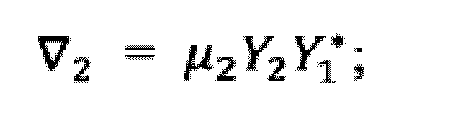
wobeiµ 1 und µ 2 Schrittgrößenfunktionen sind,∇1 der Gradiententerm zum Berechnen des Werts des Koeffizienten W 12 ist, ∇2 der Gradiententerm zum Berechnen des Werts des Koeffizienten W 21 ist,Y 1 das Quellensignal ist, das als X 1 + W 12 X 2 in der vorhergehenden Iteration abgeschätzt wird, Y 2 das Quellensignal ist, das als X 2 + W 21 X 1 in der vorhergehenden Iteration abgeschätzt wird, und * für eine konjugiert komplexe Zahl steht. - Vorrichtung nach Anspruch 11, wobei die Recheneinheit ferner dafür konfiguriert ist, in Bezug auf jedes der Frequenzkriterien zu bestimmen, ob sich der Entmischungsfilter in einem Divergenzzustand befindet oder nicht, die in der vorhergehenden Iteration berechneten Gradiententerme als Gradiententerme zur Verwendung in der aktuellen Iteration zu verwenden, wenn sich der Entmischungsfilter im Divergenzzustand befindet, und die Gradiententerme zur Verwendung in der aktuellen Iteration zu berechnen, wenn sich der Entmischungsfilter nicht im Divergenzzustand befindet.
- Vorrichtung nach Anspruch 11, wobei die Recheneinheit dafür konfiguriert ist, in Bezug auf jeden der Koeffizienten die Gradiententerme über die Frequenzkriterien zum Berechnen des Koeffizienten in einen Zeitdomänenfilter der Länge T zu transformieren, Koeffizienten des Zeitdomänenfilters an Zeitindizes zu entzerren, die einen ersten Schwellenwert übersteigen, der geringer als die Länge T ist, und Koeffizienten des Zeitdomänenfilters durch eine Länge-T-Transformation von der Zeitdomäne in die Frequenzdomäne zu transformieren.
- Vorrichtung nach Anspruch 16, wobei das Entzerren der Koeffizienten das Nullen der Koeffizienten an Zeitindizes, welche den ersten Schwellenwert übersteigen, oder das Verringern der Koeffizienten an Zeitindizes, welche den ersten Schwellenwert übersteigen, relativ zu Koeffizienten des Zeitdomänenfilters umfasst, die nicht an Zeitindizes liegen, welche den ersten Schwellenwert übersteigen.
- Vorrichtung nach Anspruch 16, wobei die Recheneinheit ferner dafür konfiguriert ist, den ersten Schwellenwert in mindestens einer Iteration des Gradientenabfallverfahrens gemäß dem Anteil der Entmischungsfilter in einem Divergenzzustand einzustellen, wobei der erste Schwellenwert umso kleiner ist, je höher der Anteil ist.
- Vorrichtung nach Anspruch 16, wobei die Recheneinheit ferner dafür konfiguriert ist, den ersten Schwellenwert in mindestens einer Iteration des Gradientenabfallverfahrens gemäß der Flachheit einzustellen, wobei der erste Schwellenwert erhöht wird, wenn die Flachheit nicht niedriger als ein zweiter Schwellenwert ist, und herabgesetzt wird, wenn die Flachheit niedriger als der zweite Schwellenwert ist.
- Vorrichtung nach Anspruch 11, wobei die Recheneinheit ferner dafür konfiguriert ist, die Gradiententerme durch Auswählen einer von Permutationen einzustellen, welche den euklidischen Abstand minimiert oder Korrelationen von Gradiententermen zwischen benachbarten Frequenzkriterien maximiert.
- Computerlesbares Medium, welches darauf aufgezeichnete Computerprogrammbefehle aufweist, wobei die Befehle, wenn sie von einem Prozessor ausgeführt werden, ermöglichen, dass der Prozessor ein auf Statistik zweiter Ordnung basierendes Verfahren einer blinden Trennung von Quellen durch Faltung ausführt, welches das Folgende umfasst:Erfassen von Mischsignalen aus mehreren Tonsignalen, die von mehreren Tonquellen emittiert werden, durch mehrere Mikrofone;Umwandeln der erfassten Mischsignale in mehrere digitale Eingangssignale;Transformieren jedes der mehreren digitalen Eingangssignale in die Frequenzdomäne;Berechnen von Werten von Koeffizienten von Entmischungsfiltern, welche Frequenzkriterien entsprechen, durch Durchführen eines Gradientenabfallverfahrens an einer Kostenfunktion zumindest in Abhängigkeit von den Koeffizienten der Entmischungsfilter, wobei bei jeder Iteration des Gradientenabfallverfahrens Gradiententerme zum Berechnen der Werte desselben Koeffizienten der Entmischungsfilter so eingestellt werden, dass die Flachheit der Gradiententerme über die Frequenzkriterien verbessert wird;Abschätzen von Quellensignalen in Bezug auf jedes der Frequenzkriterien durch Filtern der transformierten Eingangssignale durch den entsprechenden Entmischungsfilter, der mit den berechneten Werten der Koeffizienten konfiguriert ist; undTransformieren der abgeschätzten Quellensignale auf den entsprechenden Frequenzkriterien in die Zeitdomäne,wobei die Kostenfunktion dafür geeignet ist, die Dekorrellation zwischen den abgeschätzten Quellensignalen auszuwerten.
Applications Claiming Priority (2)
| Application Number | Priority Date | Filing Date | Title |
|---|---|---|---|
| CN201110226040.4A CN102903368B (zh) | 2011-07-29 | 2011-07-29 | 用于卷积盲源分离的方法和设备 |
| US201161540344P | 2011-09-28 | 2011-09-28 |
Publications (2)
| Publication Number | Publication Date |
|---|---|
| EP2551850A1 EP2551850A1 (de) | 2013-01-30 |
| EP2551850B1 true EP2551850B1 (de) | 2014-04-23 |
Family
ID=47076055
Family Applications (1)
| Application Number | Title | Priority Date | Filing Date |
|---|---|---|---|
| EP12178508.3A Active EP2551850B1 (de) | 2011-07-29 | 2012-07-30 | Verfahren, Vorrichtung und Computer Programm auf ein computerlesbares Speichermedium für die konvolutive blinde Quellentrennung |
Country Status (3)
| Country | Link |
|---|---|
| US (1) | US8892618B2 (de) |
| EP (1) | EP2551850B1 (de) |
| CN (1) | CN102903368B (de) |
Families Citing this family (26)
| Publication number | Priority date | Publication date | Assignee | Title |
|---|---|---|---|---|
| KR101474321B1 (ko) * | 2012-06-29 | 2014-12-30 | 한국과학기술원 | 암묵신호 분리에서의 순열/비례 문제 해결장치 및 그 방법 |
| US9285272B2 (en) * | 2012-07-17 | 2016-03-15 | Sciaps, Inc. | Dual source system and method |
| FR2996043B1 (fr) * | 2012-09-27 | 2014-10-24 | Univ Bordeaux 1 | Procede et dispositif pour separer des signaux par filtrage spatial a variance minimum sous contrainte lineaire |
| WO2014126688A1 (en) | 2013-02-14 | 2014-08-21 | Dolby Laboratories Licensing Corporation | Methods for audio signal transient detection and decorrelation control |
| EP2956935B1 (de) | 2013-02-14 | 2017-01-04 | Dolby Laboratories Licensing Corporation | Steuerung der interkanalkohärenz von aufwärtsgemischten audiosignalen |
| TWI618050B (zh) | 2013-02-14 | 2018-03-11 | 杜比實驗室特許公司 | 用於音訊處理系統中之訊號去相關的方法及設備 |
| CN104010265A (zh) | 2013-02-22 | 2014-08-27 | 杜比实验室特许公司 | 音频空间渲染设备及方法 |
| KR101474633B1 (ko) * | 2013-02-25 | 2014-12-24 | 한국과학기술원 | 주파수 영역의 암묵신호 추출에서의 다중 주파수 해상도를 이용한 비례문제 해결장치 및 그 방법 |
| JP6325663B2 (ja) | 2013-06-21 | 2018-05-16 | ブリュール アンド ケーア サウンド アンド バイブレーション メジャーメント アクティーゼルスカブ | 原動機駆動移動体のノイズ源のノイズ音寄与度を決定する方法 |
| CN103870875B (zh) * | 2014-03-18 | 2016-08-31 | 中国人民解放军理工大学 | 一种分离时频域混合信号的方法 |
| CN103956992B (zh) * | 2014-03-26 | 2017-09-12 | 复旦大学 | 一种基于多步梯度下降的自适应信号处理方法 |
| CN103903631B (zh) * | 2014-03-28 | 2017-10-03 | 哈尔滨工程大学 | 基于变步长自然梯度算法的语音信号盲分离方法 |
| US10012603B2 (en) | 2014-06-25 | 2018-07-03 | Sciaps, Inc. | Combined handheld XRF and OES systems and methods |
| CN104202098B (zh) * | 2014-08-08 | 2016-06-15 | 中国科学院上海微系统与信息技术研究所 | 一种基于多通道压缩采样的宽带功率谱估计方法 |
| EP3010017A1 (de) * | 2014-10-14 | 2016-04-20 | Thomson Licensing | Verfahren und Vorrichtung zur Trennung von Sprachdaten von Hintergrunddaten in der Audiokommunikation |
| CN104866866A (zh) * | 2015-05-08 | 2015-08-26 | 太原理工大学 | 改进的自然梯度变步长盲源分离算法 |
| US9607603B1 (en) * | 2015-09-30 | 2017-03-28 | Cirrus Logic, Inc. | Adaptive block matrix using pre-whitening for adaptive beam forming |
| EP3335217B1 (de) | 2015-12-21 | 2022-05-04 | Huawei Technologies Co., Ltd. | Signalverarbeitungsvorrichtung und -verfahren |
| CN108282424B (zh) * | 2018-01-26 | 2021-02-12 | 大连理工大学 | 用于四个数据集联合盲源分离的四阶张量联合对角化算法 |
| US10749555B2 (en) | 2018-09-26 | 2020-08-18 | Samsung Electronics Co., Ltd. | Time-domain IQ mismatch compensator with frequency-domain observations |
| WO2020209941A1 (en) * | 2019-04-08 | 2020-10-15 | Commscope Technologies Llc | Method and system for enhancing capacity of radios sharing spectrum |
| CN111009257B (zh) * | 2019-12-17 | 2022-12-27 | 北京小米智能科技有限公司 | 一种音频信号处理方法、装置、终端及存储介质 |
| CN112908354B (zh) * | 2021-01-29 | 2024-03-22 | 中国人民解放军63892部队 | 基于影响权重的频域卷积盲源分离幅度相关性的排序方法 |
| CN113536226B (zh) * | 2021-07-14 | 2024-04-12 | 东南大学 | 增强旋转机械故障信号特征的盲解卷积算法 |
| EP4471768A1 (de) * | 2023-05-30 | 2024-12-04 | Koninklijke Philips N.V. | Adaptive räumliche dekorrelation von audiosignalen im frequenzbereich |
| EP4471765A1 (de) * | 2023-05-30 | 2024-12-04 | Koninklijke Philips N.V. | Strahlformungsabhängige anpassung der frequenzausgleichung |
Family Cites Families (17)
| Publication number | Priority date | Publication date | Assignee | Title |
|---|---|---|---|---|
| US6185309B1 (en) | 1997-07-11 | 2001-02-06 | The Regents Of The University Of California | Method and apparatus for blind separation of mixed and convolved sources |
| US6167417A (en) | 1998-04-08 | 2000-12-26 | Sarnoff Corporation | Convolutive blind source separation using a multiple decorrelation method |
| US6898612B1 (en) | 1998-11-12 | 2005-05-24 | Sarnoff Corporation | Method and system for on-line blind source separation |
| US6343268B1 (en) | 1998-12-01 | 2002-01-29 | Siemens Corporation Research, Inc. | Estimator of independent sources from degenerate mixtures |
| WO2001017109A1 (en) * | 1999-09-01 | 2001-03-08 | Sarnoff Corporation | Method and system for on-line blind source separation |
| US6879952B2 (en) | 2000-04-26 | 2005-04-12 | Microsoft Corporation | Sound source separation using convolutional mixing and a priori sound source knowledge |
| US7917336B2 (en) | 2001-01-30 | 2011-03-29 | Thomson Licensing | Geometric source separation signal processing technique |
| GB0204548D0 (en) | 2002-02-27 | 2002-04-10 | Qinetiq Ltd | Blind signal separation |
| US7474756B2 (en) | 2002-12-18 | 2009-01-06 | Siemens Corporate Research, Inc. | System and method for non-square blind source separation under coherent noise by beamforming and time-frequency masking |
| KR100600313B1 (ko) * | 2004-02-26 | 2006-07-14 | 남승현 | 다중경로 다채널 혼합신호의 주파수 영역 블라인드 분리를 위한 방법 및 그 장치 |
| KR100636368B1 (ko) | 2005-11-09 | 2006-10-19 | 한국전자통신연구원 | 상대 최적화를 이용한 다중경로 혼합신호 분리 방법 및 그장치 |
| JP4556875B2 (ja) | 2006-01-18 | 2010-10-06 | ソニー株式会社 | 音声信号分離装置及び方法 |
| WO2007100330A1 (en) * | 2006-03-01 | 2007-09-07 | The Regents Of The University Of California | Systems and methods for blind source signal separation |
| CN1909064B (zh) * | 2006-08-22 | 2011-05-18 | 复旦大学 | 一种在线自然语音卷积混合信号的时域盲分离方法 |
| US8131541B2 (en) | 2008-04-25 | 2012-03-06 | Cambridge Silicon Radio Limited | Two microphone noise reduction system |
| US8515096B2 (en) | 2008-06-18 | 2013-08-20 | Microsoft Corporation | Incorporating prior knowledge into independent component analysis |
| DK2211563T3 (da) | 2009-01-21 | 2011-12-19 | Siemens Medical Instr Pte Ltd | Fremgangsmåde og apparat til blind kildeadskillelse til forbedring af interferensestimering ved binaural Weiner-filtrering |
-
2011
- 2011-07-29 CN CN201110226040.4A patent/CN102903368B/zh active Active
-
2012
- 2012-06-22 US US13/531,118 patent/US8892618B2/en active Active
- 2012-07-30 EP EP12178508.3A patent/EP2551850B1/de active Active
Also Published As
| Publication number | Publication date |
|---|---|
| CN102903368A (zh) | 2013-01-30 |
| US20130031152A1 (en) | 2013-01-31 |
| CN102903368B (zh) | 2017-04-12 |
| EP2551850A1 (de) | 2013-01-30 |
| US8892618B2 (en) | 2014-11-18 |
Similar Documents
| Publication | Publication Date | Title |
|---|---|---|
| EP2551850B1 (de) | Verfahren, Vorrichtung und Computer Programm auf ein computerlesbares Speichermedium für die konvolutive blinde Quellentrennung | |
| US9668066B1 (en) | Blind source separation systems | |
| US8223988B2 (en) | Enhanced blind source separation algorithm for highly correlated mixtures | |
| EP3696814A1 (de) | Verfahren und vorrichtung zur sprachverbesserung, vorrichtung und speichermedium | |
| US10924849B2 (en) | Sound source separation device and method | |
| US20030055627A1 (en) | Multi-channel speech enhancement system and method based on psychoacoustic masking effects | |
| US10013997B2 (en) | Adaptive interchannel discriminative rescaling filter | |
| US10818302B2 (en) | Audio source separation | |
| CN102238456A (zh) | 信号处理装置、信号处理方法和程序 | |
| US20160232914A1 (en) | Sound Enhancement through Deverberation | |
| CN114299916B (zh) | 语音增强方法、计算机设备及存储介质 | |
| CN115831145B (zh) | 一种双麦克风语音增强方法和系统 | |
| CN102246230B (zh) | 用于提高噪声环境中话音的可理解性的系统和方法 | |
| US9065409B2 (en) | Method and arrangement for processing of audio signals | |
| CN112309418A (zh) | 一种抑制风噪声的方法及装置 | |
| US20140105338A1 (en) | Low-delay filtering | |
| CN102568491B (zh) | 噪声抑制方法及设备 | |
| CN104202018A (zh) | 确定自适应滤波器的稳定因子的方法和装置 | |
| HK1181914B (en) | Methods and apparatuses for convolutive blind source separation | |
| HK1181914A (en) | Methods and apparatuses for convolutive blind source separation | |
| Matsumoto | Noise reduction with complex bilateral filter | |
| EP4332962A1 (de) | Signalfilterungsverfahren und -vorrichtung, speichermedium und elektronische vorrichtung | |
| Tang et al. | Multiscale blind image restoration using a wavelet decomposition | |
| JP4714892B2 (ja) | 耐高残響ブラインド信号分離装置及び方法 | |
| Souden et al. | New insights into non-causal multichannel linear filtering for noise reduction |
Legal Events
| Date | Code | Title | Description |
|---|---|---|---|
| PUAI | Public reference made under article 153(3) epc to a published international application that has entered the european phase |
Free format text: ORIGINAL CODE: 0009012 |
|
| AK | Designated contracting states |
Kind code of ref document: A1 Designated state(s): AL AT BE BG CH CY CZ DE DK EE ES FI FR GB GR HR HU IE IS IT LI LT LU LV MC MK MT NL NO PL PT RO RS SE SI SK SM TR |
|
| AX | Request for extension of the european patent |
Extension state: BA ME |
|
| 17P | Request for examination filed |
Effective date: 20130730 |
|
| RBV | Designated contracting states (corrected) |
Designated state(s): AL AT BE BG CH CY CZ DE DK EE ES FI FR GB GR HR HU IE IS IT LI LT LU LV MC MK MT NL NO PL PT RO RS SE SI SK SM TR |
|
| GRAP | Despatch of communication of intention to grant a patent |
Free format text: ORIGINAL CODE: EPIDOSNIGR1 |
|
| INTG | Intention to grant announced |
Effective date: 20131212 |
|
| GRAS | Grant fee paid |
Free format text: ORIGINAL CODE: EPIDOSNIGR3 |
|
| GRAA | (expected) grant |
Free format text: ORIGINAL CODE: 0009210 |
|
| AK | Designated contracting states |
Kind code of ref document: B1 Designated state(s): AL AT BE BG CH CY CZ DE DK EE ES FI FR GB GR HR HU IE IS IT LI LT LU LV MC MK MT NL NO PL PT RO RS SE SI SK SM TR |
|
| REG | Reference to a national code |
Ref country code: GB Ref legal event code: FG4D |
|
| REG | Reference to a national code |
Ref country code: CH Ref legal event code: EP |
|
| REG | Reference to a national code |
Ref country code: AT Ref legal event code: REF Ref document number: 664241 Country of ref document: AT Kind code of ref document: T Effective date: 20140515 |
|
| REG | Reference to a national code |
Ref country code: IE Ref legal event code: FG4D |
|
| REG | Reference to a national code |
Ref country code: DE Ref legal event code: R096 Ref document number: 602012001478 Country of ref document: DE Effective date: 20140605 |
|
| REG | Reference to a national code |
Ref country code: AT Ref legal event code: MK05 Ref document number: 664241 Country of ref document: AT Kind code of ref document: T Effective date: 20140423 |
|
| REG | Reference to a national code |
Ref country code: NL Ref legal event code: VDEP Effective date: 20140423 |
|
| REG | Reference to a national code |
Ref country code: LT Ref legal event code: MG4D |
|
| PG25 | Lapsed in a contracting state [announced via postgrant information from national office to epo] |
Ref country code: IS Free format text: LAPSE BECAUSE OF FAILURE TO SUBMIT A TRANSLATION OF THE DESCRIPTION OR TO PAY THE FEE WITHIN THE PRESCRIBED TIME-LIMIT Effective date: 20140823 Ref country code: NO Free format text: LAPSE BECAUSE OF FAILURE TO SUBMIT A TRANSLATION OF THE DESCRIPTION OR TO PAY THE FEE WITHIN THE PRESCRIBED TIME-LIMIT Effective date: 20140723 Ref country code: NL Free format text: LAPSE BECAUSE OF FAILURE TO SUBMIT A TRANSLATION OF THE DESCRIPTION OR TO PAY THE FEE WITHIN THE PRESCRIBED TIME-LIMIT Effective date: 20140423 Ref country code: FI Free format text: LAPSE BECAUSE OF FAILURE TO SUBMIT A TRANSLATION OF THE DESCRIPTION OR TO PAY THE FEE WITHIN THE PRESCRIBED TIME-LIMIT Effective date: 20140423 Ref country code: LT Free format text: LAPSE BECAUSE OF FAILURE TO SUBMIT A TRANSLATION OF THE DESCRIPTION OR TO PAY THE FEE WITHIN THE PRESCRIBED TIME-LIMIT Effective date: 20140423 Ref country code: GR Free format text: LAPSE BECAUSE OF FAILURE TO SUBMIT A TRANSLATION OF THE DESCRIPTION OR TO PAY THE FEE WITHIN THE PRESCRIBED TIME-LIMIT Effective date: 20140724 Ref country code: CY Free format text: LAPSE BECAUSE OF FAILURE TO SUBMIT A TRANSLATION OF THE DESCRIPTION OR TO PAY THE FEE WITHIN THE PRESCRIBED TIME-LIMIT Effective date: 20140423 Ref country code: BG Free format text: LAPSE BECAUSE OF FAILURE TO SUBMIT A TRANSLATION OF THE DESCRIPTION OR TO PAY THE FEE WITHIN THE PRESCRIBED TIME-LIMIT Effective date: 20140723 |
|
| PG25 | Lapsed in a contracting state [announced via postgrant information from national office to epo] |
Ref country code: SE Free format text: LAPSE BECAUSE OF FAILURE TO SUBMIT A TRANSLATION OF THE DESCRIPTION OR TO PAY THE FEE WITHIN THE PRESCRIBED TIME-LIMIT Effective date: 20140423 Ref country code: PL Free format text: LAPSE BECAUSE OF FAILURE TO SUBMIT A TRANSLATION OF THE DESCRIPTION OR TO PAY THE FEE WITHIN THE PRESCRIBED TIME-LIMIT Effective date: 20140423 Ref country code: HR Free format text: LAPSE BECAUSE OF FAILURE TO SUBMIT A TRANSLATION OF THE DESCRIPTION OR TO PAY THE FEE WITHIN THE PRESCRIBED TIME-LIMIT Effective date: 20140423 Ref country code: LV Free format text: LAPSE BECAUSE OF FAILURE TO SUBMIT A TRANSLATION OF THE DESCRIPTION OR TO PAY THE FEE WITHIN THE PRESCRIBED TIME-LIMIT Effective date: 20140423 Ref country code: AT Free format text: LAPSE BECAUSE OF FAILURE TO SUBMIT A TRANSLATION OF THE DESCRIPTION OR TO PAY THE FEE WITHIN THE PRESCRIBED TIME-LIMIT Effective date: 20140423 Ref country code: RS Free format text: LAPSE BECAUSE OF FAILURE TO SUBMIT A TRANSLATION OF THE DESCRIPTION OR TO PAY THE FEE WITHIN THE PRESCRIBED TIME-LIMIT Effective date: 20140423 Ref country code: ES Free format text: LAPSE BECAUSE OF FAILURE TO SUBMIT A TRANSLATION OF THE DESCRIPTION OR TO PAY THE FEE WITHIN THE PRESCRIBED TIME-LIMIT Effective date: 20140423 |
|
| PG25 | Lapsed in a contracting state [announced via postgrant information from national office to epo] |
Ref country code: PT Free format text: LAPSE BECAUSE OF FAILURE TO SUBMIT A TRANSLATION OF THE DESCRIPTION OR TO PAY THE FEE WITHIN THE PRESCRIBED TIME-LIMIT Effective date: 20140825 |
|
| REG | Reference to a national code |
Ref country code: DE Ref legal event code: R097 Ref document number: 602012001478 Country of ref document: DE |
|
| PG25 | Lapsed in a contracting state [announced via postgrant information from national office to epo] |
Ref country code: BE Free format text: LAPSE BECAUSE OF FAILURE TO SUBMIT A TRANSLATION OF THE DESCRIPTION OR TO PAY THE FEE WITHIN THE PRESCRIBED TIME-LIMIT Effective date: 20140423 Ref country code: EE Free format text: LAPSE BECAUSE OF FAILURE TO SUBMIT A TRANSLATION OF THE DESCRIPTION OR TO PAY THE FEE WITHIN THE PRESCRIBED TIME-LIMIT Effective date: 20140423 Ref country code: SK Free format text: LAPSE BECAUSE OF FAILURE TO SUBMIT A TRANSLATION OF THE DESCRIPTION OR TO PAY THE FEE WITHIN THE PRESCRIBED TIME-LIMIT Effective date: 20140423 Ref country code: DK Free format text: LAPSE BECAUSE OF FAILURE TO SUBMIT A TRANSLATION OF THE DESCRIPTION OR TO PAY THE FEE WITHIN THE PRESCRIBED TIME-LIMIT Effective date: 20140423 Ref country code: RO Free format text: LAPSE BECAUSE OF FAILURE TO SUBMIT A TRANSLATION OF THE DESCRIPTION OR TO PAY THE FEE WITHIN THE PRESCRIBED TIME-LIMIT Effective date: 20140423 Ref country code: CZ Free format text: LAPSE BECAUSE OF FAILURE TO SUBMIT A TRANSLATION OF THE DESCRIPTION OR TO PAY THE FEE WITHIN THE PRESCRIBED TIME-LIMIT Effective date: 20140423 |
|
| PG25 | Lapsed in a contracting state [announced via postgrant information from national office to epo] |
Ref country code: LU Free format text: LAPSE BECAUSE OF FAILURE TO SUBMIT A TRANSLATION OF THE DESCRIPTION OR TO PAY THE FEE WITHIN THE PRESCRIBED TIME-LIMIT Effective date: 20140730 |
|
| PLBE | No opposition filed within time limit |
Free format text: ORIGINAL CODE: 0009261 |
|
| STAA | Information on the status of an ep patent application or granted ep patent |
Free format text: STATUS: NO OPPOSITION FILED WITHIN TIME LIMIT |
|
| PG25 | Lapsed in a contracting state [announced via postgrant information from national office to epo] |
Ref country code: IT Free format text: LAPSE BECAUSE OF FAILURE TO SUBMIT A TRANSLATION OF THE DESCRIPTION OR TO PAY THE FEE WITHIN THE PRESCRIBED TIME-LIMIT Effective date: 20140423 |
|
| 26N | No opposition filed |
Effective date: 20150126 |
|
| REG | Reference to a national code |
Ref country code: IE Ref legal event code: MM4A |
|
| REG | Reference to a national code |
Ref country code: DE Ref legal event code: R097 Ref document number: 602012001478 Country of ref document: DE Effective date: 20150126 |
|
| REG | Reference to a national code |
Ref country code: FR Ref legal event code: PLFP Year of fee payment: 4 |
|
| PG25 | Lapsed in a contracting state [announced via postgrant information from national office to epo] |
Ref country code: SI Free format text: LAPSE BECAUSE OF FAILURE TO SUBMIT A TRANSLATION OF THE DESCRIPTION OR TO PAY THE FEE WITHIN THE PRESCRIBED TIME-LIMIT Effective date: 20140423 |
|
| PG25 | Lapsed in a contracting state [announced via postgrant information from national office to epo] |
Ref country code: IE Free format text: LAPSE BECAUSE OF NON-PAYMENT OF DUE FEES Effective date: 20140730 |
|
| REG | Reference to a national code |
Ref country code: CH Ref legal event code: PL |
|
| PG25 | Lapsed in a contracting state [announced via postgrant information from national office to epo] |
Ref country code: LI Free format text: LAPSE BECAUSE OF NON-PAYMENT OF DUE FEES Effective date: 20150731 Ref country code: CH Free format text: LAPSE BECAUSE OF NON-PAYMENT OF DUE FEES Effective date: 20150731 Ref country code: MC Free format text: LAPSE BECAUSE OF FAILURE TO SUBMIT A TRANSLATION OF THE DESCRIPTION OR TO PAY THE FEE WITHIN THE PRESCRIBED TIME-LIMIT Effective date: 20140423 Ref country code: SM Free format text: LAPSE BECAUSE OF FAILURE TO SUBMIT A TRANSLATION OF THE DESCRIPTION OR TO PAY THE FEE WITHIN THE PRESCRIBED TIME-LIMIT Effective date: 20140423 |
|
| PG25 | Lapsed in a contracting state [announced via postgrant information from national office to epo] |
Ref country code: MT Free format text: LAPSE BECAUSE OF FAILURE TO SUBMIT A TRANSLATION OF THE DESCRIPTION OR TO PAY THE FEE WITHIN THE PRESCRIBED TIME-LIMIT Effective date: 20140423 |
|
| REG | Reference to a national code |
Ref country code: FR Ref legal event code: PLFP Year of fee payment: 5 |
|
| PG25 | Lapsed in a contracting state [announced via postgrant information from national office to epo] |
Ref country code: HU Free format text: LAPSE BECAUSE OF FAILURE TO SUBMIT A TRANSLATION OF THE DESCRIPTION OR TO PAY THE FEE WITHIN THE PRESCRIBED TIME-LIMIT; INVALID AB INITIO Effective date: 20120730 Ref country code: TR Free format text: LAPSE BECAUSE OF FAILURE TO SUBMIT A TRANSLATION OF THE DESCRIPTION OR TO PAY THE FEE WITHIN THE PRESCRIBED TIME-LIMIT Effective date: 20140423 |
|
| REG | Reference to a national code |
Ref country code: FR Ref legal event code: PLFP Year of fee payment: 6 |
|
| PG25 | Lapsed in a contracting state [announced via postgrant information from national office to epo] |
Ref country code: MK Free format text: LAPSE BECAUSE OF FAILURE TO SUBMIT A TRANSLATION OF THE DESCRIPTION OR TO PAY THE FEE WITHIN THE PRESCRIBED TIME-LIMIT Effective date: 20140423 |
|
| REG | Reference to a national code |
Ref country code: FR Ref legal event code: PLFP Year of fee payment: 7 |
|
| PG25 | Lapsed in a contracting state [announced via postgrant information from national office to epo] |
Ref country code: AL Free format text: LAPSE BECAUSE OF FAILURE TO SUBMIT A TRANSLATION OF THE DESCRIPTION OR TO PAY THE FEE WITHIN THE PRESCRIBED TIME-LIMIT Effective date: 20140423 |
|
| P01 | Opt-out of the competence of the unified patent court (upc) registered |
Effective date: 20230512 |
|
| PGFP | Annual fee paid to national office [announced via postgrant information from national office to epo] |
Ref country code: GB Payment date: 20250619 Year of fee payment: 14 |
|
| PGFP | Annual fee paid to national office [announced via postgrant information from national office to epo] |
Ref country code: FR Payment date: 20250620 Year of fee payment: 14 |
|
| PGFP | Annual fee paid to national office [announced via postgrant information from national office to epo] |
Ref country code: DE Payment date: 20250620 Year of fee payment: 14 |