EP2545902A2 - Sonnenschutzzusammensetzungen mit verbessertem antioxidativen Potenzial zum Schutz der Haut vor IR-Strahlung - Google Patents
Sonnenschutzzusammensetzungen mit verbessertem antioxidativen Potenzial zum Schutz der Haut vor IR-Strahlung Download PDFInfo
- Publication number
- EP2545902A2 EP2545902A2 EP12174550A EP12174550A EP2545902A2 EP 2545902 A2 EP2545902 A2 EP 2545902A2 EP 12174550 A EP12174550 A EP 12174550A EP 12174550 A EP12174550 A EP 12174550A EP 2545902 A2 EP2545902 A2 EP 2545902A2
- Authority
- EP
- European Patent Office
- Prior art keywords
- weight
- composition according
- acid
- total amount
- cosmetic composition
- Prior art date
- Legal status (The legal status is an assumption and is not a legal conclusion. Google has not performed a legal analysis and makes no representation as to the accuracy of the status listed.)
- Ceased
Links
- 0 *C(*)(CCc1c2)Oc1cc(*)c2I Chemical compound *C(*)(CCc1c2)Oc1cc(*)c2I 0.000 description 2
Classifications
-
- A—HUMAN NECESSITIES
- A61—MEDICAL OR VETERINARY SCIENCE; HYGIENE
- A61K—PREPARATIONS FOR MEDICAL, DENTAL OR TOILETRY PURPOSES
- A61K8/00—Cosmetics or similar toiletry preparations
- A61K8/18—Cosmetics or similar toiletry preparations characterised by the composition
- A61K8/30—Cosmetics or similar toiletry preparations characterised by the composition containing organic compounds
- A61K8/40—Cosmetics or similar toiletry preparations characterised by the composition containing organic compounds containing nitrogen
-
- A—HUMAN NECESSITIES
- A61—MEDICAL OR VETERINARY SCIENCE; HYGIENE
- A61K—PREPARATIONS FOR MEDICAL, DENTAL OR TOILETRY PURPOSES
- A61K8/00—Cosmetics or similar toiletry preparations
- A61K8/18—Cosmetics or similar toiletry preparations characterised by the composition
- A61K8/30—Cosmetics or similar toiletry preparations characterised by the composition containing organic compounds
- A61K8/33—Cosmetics or similar toiletry preparations characterised by the composition containing organic compounds containing oxygen
- A61K8/35—Ketones, e.g. benzophenone
-
- A—HUMAN NECESSITIES
- A61—MEDICAL OR VETERINARY SCIENCE; HYGIENE
- A61K—PREPARATIONS FOR MEDICAL, DENTAL OR TOILETRY PURPOSES
- A61K8/00—Cosmetics or similar toiletry preparations
- A61K8/18—Cosmetics or similar toiletry preparations characterised by the composition
- A61K8/30—Cosmetics or similar toiletry preparations characterised by the composition containing organic compounds
- A61K8/33—Cosmetics or similar toiletry preparations characterised by the composition containing organic compounds containing oxygen
- A61K8/37—Esters of carboxylic acids
-
- A—HUMAN NECESSITIES
- A61—MEDICAL OR VETERINARY SCIENCE; HYGIENE
- A61K—PREPARATIONS FOR MEDICAL, DENTAL OR TOILETRY PURPOSES
- A61K8/00—Cosmetics or similar toiletry preparations
- A61K8/18—Cosmetics or similar toiletry preparations characterised by the composition
- A61K8/30—Cosmetics or similar toiletry preparations characterised by the composition containing organic compounds
- A61K8/46—Cosmetics or similar toiletry preparations characterised by the composition containing organic compounds containing sulfur
- A61K8/466—Cosmetics or similar toiletry preparations characterised by the composition containing organic compounds containing sulfur containing sulfonic acid derivatives; Salts
-
- A—HUMAN NECESSITIES
- A61—MEDICAL OR VETERINARY SCIENCE; HYGIENE
- A61K—PREPARATIONS FOR MEDICAL, DENTAL OR TOILETRY PURPOSES
- A61K8/00—Cosmetics or similar toiletry preparations
- A61K8/18—Cosmetics or similar toiletry preparations characterised by the composition
- A61K8/30—Cosmetics or similar toiletry preparations characterised by the composition containing organic compounds
- A61K8/49—Cosmetics or similar toiletry preparations characterised by the composition containing organic compounds containing heterocyclic compounds
- A61K8/4973—Cosmetics or similar toiletry preparations characterised by the composition containing organic compounds containing heterocyclic compounds with oxygen as the only hetero atom
- A61K8/498—Cosmetics or similar toiletry preparations characterised by the composition containing organic compounds containing heterocyclic compounds with oxygen as the only hetero atom having 6-membered rings or their condensed derivatives, e.g. coumarin
-
- A—HUMAN NECESSITIES
- A61—MEDICAL OR VETERINARY SCIENCE; HYGIENE
- A61Q—SPECIFIC USE OF COSMETICS OR SIMILAR TOILETRY PREPARATIONS
- A61Q17/00—Barrier preparations; Preparations brought into direct contact with the skin for affording protection against external influences, e.g. sunlight, X-rays or other harmful rays, corrosive materials, bacteria or insect stings
- A61Q17/04—Topical preparations for affording protection against sunlight or other radiation; Topical sun tanning preparations
-
- A—HUMAN NECESSITIES
- A61—MEDICAL OR VETERINARY SCIENCE; HYGIENE
- A61K—PREPARATIONS FOR MEDICAL, DENTAL OR TOILETRY PURPOSES
- A61K2800/00—Properties of cosmetic compositions or active ingredients thereof or formulation aids used therein and process related aspects
- A61K2800/20—Chemical, physico-chemical or functional or structural properties of the composition as a whole
- A61K2800/30—Characterized by the absence of a particular group of ingredients
Definitions
- the present invention relates to cosmetic and dermatological compositions for the protection of skin and hair against UV radiation and IR radiation, which have a high antioxidant activity.
- the skin damaging effect of the ultraviolet part of solar radiation is known.
- the UV radiation in the range between 290 nm and 320 nm, the so-called UV-B range, can lead to erythema, a simple sunburn or even more or less severe burns as acute manifestations.
- the narrower range around 308 nm is given.
- UV-A radiation is far more dangerous than UV-B radiation with regard to the triggering of photodynamic, especially phototoxic reactions and chronic changes in the skin.
- UV-B radiation can be enhanced by UV-A radiation. So it is u. a. It has been proven that even under normal everyday conditions even UV-A radiation is sufficient to rapidly damage the collagen and elastin fibers, which are essential for the structure and firmness of the skin. This leads to chronic light-induced skin changes - the skin "ages" prematurely.
- the clinical appearance of light-aged skin includes, for example, wrinkles and wrinkles, and an irregular, ridged relief. Furthermore, the areas affected by photoaging may have irregular pigmentation. The formation of brown spots, keratoses and even carcinomas or malignant melanomas is possible. In addition, a prematurely aged skin due to the everyday UV exposure is characterized by a lower activity of the Langerhans cells and a slight, chronic inflammation.
- UV-A radiation About 90% of the ultraviolet radiation reaching the Earth consists of UVA rays. While UV-B radiation varies widely depending on many factors (eg, time of year, day or latitude), UV-A radiation remains relatively constant day and day regardless of year, daytime or geographical factors. At the same time, most of the UV-A radiation penetrates into the living epidermis, while about 70% of the UV-B rays are retained by the horny layer.
- cosmetic and dermatological sunscreen compositions provide adequate protection against both UV-B and UV-A radiation.
- cosmetic compositions which contain at least one UV filter substance have already been developed in the prior art.
- the UV filter substances are substances which are liquid or crystalline at room temperature and which are capable of absorbing ultraviolet rays and of absorbing the absorbed energy in the form of longer-wave radiation, eg. B. heat, again.
- compositions of the prior art are further improved.
- compositions containing combinations of UV filter substances or other active ingredients sometimes have formulation difficulties with respect to the use concentrations that make it difficult to achieve good UV protection performance.
- Another disadvantage of the prior art is that conventional sunscreen formulations leave a mostly sticky film on the skin.
- the object of the present invention was to provide sunscreen compositions which offer high protection against the above-mentioned various adverse effects of the radiation in the UV-A and UV-B range, in particular solar radiation, and at the same time have improved sensory properties.
- the compositions according to the invention are also said to have good skin care properties, especially anti-aging properties (e.g., wrinkling, loss of elasticity), and a pleasant skin feel and skin spread.
- the present invention has for its object to provide alternative anti-aging preparations that protect the skin from the negative effects of IR radiation as well as the negative effects of UV radiation.
- compositions containing a combination of certain UV filters and certain antioxidants can also be achieved by a composition containing a combination of certain UV filters and certain antioxidants.
- the invention further provides the use of the above-defined compositions according to the invention for the protection of skin and hair against the harmful effects of UV radiation, in particular UV-A and UV-B radiation, in particular solar radiation.
- the invention further provides the use of the above-defined compositions according to the invention for protecting the skin and hair against the harmful effects of IR radiation.
- the invention furthermore relates to a method for protecting the skin and hair against the harmful effects of IR radiation and / or against the harmful effects of UV radiation, in particular UVA and UVB radiation, in particular solar radiation, in which an inventive or inventively preferred composition is applied to the skin or hair.
- compositions according to the invention are in all respects extremely satisfactory preparations which, with regard to the further constituents, are not limited to a specific choice of these further constituents. Accordingly, they are particularly suitable for serving as a basis for compositional forms having a variety of uses.
- the compositions according to the invention surprisingly show synergistically improved sensory and cosmetic properties, such as, for example, the uniform spreadability on the skin or the ability to absorb into the skin, and at the same time have a high light-protection effectiveness combined with outstanding skincare data.
- Preferred cosmetic compositions according to the invention have a pH in the range of 5.7 to 7.3 at 20 ° C., more preferably a pH in the range of 6.0 to 6.7, particularly preferably 6.2 to 6.4 , on.
- preferred cosmetic compositions according to the invention contain up to 40% by weight, preferably 17-30% by weight, particularly preferably 19-27% by weight, most preferably 21-25% by weight, at least an organic UV filter substance dissolved in the oil phase or the water phase, including 2-ethylhexyl 2-cyano-3,3-phenylcinnamate, 4- (tert-butyl) -4'-methoxydibenzoylmethane, and at least one organic UV dissolved in the water phase Filter substance selected from phenylene-1,4-bis (2-benzimidazyl) -3,3'-5,5'-tetrasulfonic acid, 2-phenylbenzimidazole-5-sulfonic acid and the salts of these acids and mixtures thereof sulfonic acid derivatives.
- the oil-soluble UVB filters 2-cyano-3,3-phenylcinnamate, 2-ethylhexyl ( Ethylhexyl-2-cyano-3,3-diphenylacrylate (INCI: Octocrylene)), for example, under the trade name Parsol ® 340, Eusolex OCR ® , Uvinul ® N 539 and Neo Heliopano ® 303 available.
- Octocrylene is preferably present in a total amount of 0.5 to 15 wt .-%, particularly preferably 3 to 13 wt .-%, in particular 5 to 11 wt .-% and most preferably 8 - 10 wt .-%, in each case based on the total weight of the composition according to the invention.
- 4-tert-butyl-4'-methoxydibenzoylmethane having the INCI name butyl methoxydibenzoylmethane (also referred to as 1- (4'-tert-butylphenyl) -3- (4'-methoxyphenyl) propane-1,3-dione) is a oil-soluble UVA sunscreen filter.
- compositions according to the invention comprise 4-tert-butyl-4'-methoxydibenzoylmethane in a total amount of from 0.5 to 10% by weight, preferably from 1 to 8% by weight, more preferably from 2 to 5% by weight and most preferably 3 - 4 wt .-%, each based on the total weight of the composition according to the invention.
- 3,3,5-trimethylcyclohexyl salicylate also called 3,3,5-trimethylcyclohexyl-2-hydroxybenzoate or homomenthyl salicylate, with the INCI name "Homosalate”
- Homosalate is an oil-soluble UVB filter and available, for example, as Neo Heliopan HMS from Symrise.
- Preferred oil-in-water emulsions according to the invention comprise 3,3,5-trimethylcyclohexyl salicylate in a total amount of 0.5-10% by weight, preferably 2-9% by weight, particularly preferably 4-8% by weight. extremely preferable 5.5 to 7 wt .-%, each based on the total weight of the composition according to the invention.
- 3,3,5-Trimethylcyclohexylsalicylate has various advantages over many other oil-soluble UVB filters, especially over other salicylic acid ester filters such as 2-ethylhexyl salicylate or 4-isopropylbenzyl salicylate: at the same concentration, a higher SPF is achieved; Furthermore, emulsions with this filter have better stability compared to other oil-soluble salicylic acid ester filters such as 2-ethylhexyl salicylate, especially for longer storage times and / or when stored at elevated temperatures (for example 45 ° C).
- emulsions with this filter have better haptic properties compared to other oil-soluble salicylic acid ester filters, such as 2-ethylhexyl salicylate or 4-isopropylbenzyl salicylate, in particular less stickiness and a less dull skin feel.
- oil-soluble salicylic acid ester filters such as 2-ethylhexyl salicylate or 4-isopropylbenzyl salicylate
- compositions of the invention are free of 2-ethylhexyl salicylate and free of 4-isopropylbenzyl salicylate.
- the cosmetic compositions according to the invention therefore contain at least one water-soluble organic UV filter.
- Preferred cosmetic compositions according to the invention comprise at least one water-soluble organic UV filter in a total amount of from 0.5% by weight to 15% by weight, preferably from 1 to 10% by weight, particularly preferably from 2 to 5% by weight and extraordinarily preferably 3 to 4 wt .-%, each based on the total weight of the composition according to the invention.
- the at least one water-soluble organic UV filter comprises at least one derivative of benzimidazole sulfonic acid.
- benzimidazole sulfonic acid as the water-soluble organic UV filter substance (s) is or are the phenylene-1,4-bis (2-benzimidazyl) -3,3'-5,5'-tetrasulfonic acid (UV-A) and their salts, especially the alkali, alkaline earth, ammonium, alkylammonium, alkanolamine and glucammonium salts, preferably the corresponding sodium, potassium, trialkylammonium or triethanolamine, lysine, arginine, histidine and ornithine salts.
- UV-A phenylene-1,4-bis (2-benzimidazyl) -3,3'-5,5'-tetrasulfonic acid
- salts of this acid with amino-C 1 -C 6 alkanols and amino-C 1 -C 6 -alkanediols, in particular with 2-amino-2-methylpropan-1-ol, 2- Amino-2-methylpropane-1,3-diol, 2-aminopropan-1-ol, 3-aminopropan-1-ol, 1-aminopropan-2-ol (MIPA) and 2-amino-2- (hydroxymethyl) propane 1,3-diol (TRIS) and mixtures thereof.
- amino-C 1 -C 6 alkanols and amino-C 1 -C 6 -alkanediols in particular with 2-amino-2-methylpropan-1-ol, 2- Amino-2-methylpropane-1,3-diol, 2-aminopropan-1-ol, 3-aminopropan-1-ol, 1-aminopropan-2-ol (MIPA) and 2-amino-2- (hydroxy
- a proportion of the at least one benzimidazole sulfonic acid derivative is preferably a salt of at least one basic amino acid selected from lysine, arginine, histidine and ornithine, before.
- this proportion is at least 30 mol%, more preferably at least 50 mol%, most preferably at least 70 mol%, each based on the total content of benzimidazole sulfonic acid derivative.
- a preferred amino acid is arginine.
- the proportion of arginine salt is particularly preferably at least 30 mol%, particularly preferably at least 50 mol%, very preferably at least 70 mol%, in each case based on the total content of benzimidazole sulfonic acid derivative.
- further salts of the at least one benzimidazole sulphonic acid derivative may be present.
- Preferred as a further salt are the alkali, alkaline earth, ammonium, alkylammonium, alkanolamine and glucammonium salts, preferably the corresponding sodium, potassium, trialkylammonium or triethanolamine salts.
- phenylene-1,4-bis (2-benzimidazyl) -3,3'-5,5'-tetrasulfonic acid bis-sodium salt with the INCI name "Disodium Phenyl Dibenzimidazole Tetrasulfonate” (CAS no. 180898-37-7), which is available, for example, under the trade name Neo Heliopan AP from Symrise.
- Further preferred water-soluble organic UV filter substances are 2-phenylbenzimidazole-5-sulfonic acid (UV-B filter, INCI name "phenylbenzimidazole sulfonic acid” (CAS No.
- salts in particular the Alkali, alkaline earth, ammonium, alkylammonium, alkanolamine and glucammonium salts, preferably the corresponding sodium, potassium, trialkylammonium or triethanolamine salts, furthermore the salts of this acid with at least one basic amino acid selected from lysine, arginine, Histidine and ornithine, especially with arginine, but especially mixtures of the salts of 2-phenylbenzimidazole-5-sulfonic acid with sodium ions and arginine.
- the at least one water-soluble organic UV filter which is a derivative of benzimidazole sulfonic acid
- the at least one water-soluble organic UV filter which is a derivative of benzimidazole sulfonic acid
- These preferred salts may be present in a particularly preferred embodiment in combination with alkali, alkaline earth, ammonium, alkylammonium, alkanolamine and glucammonium salts, preferably with sodium, potassium, trialkylammonium or triethanolamine salts.
- compositions according to the invention contain the derivative (s) of the benzimidazole sulfonic acid in a total amount of from 0.5 to 15% by weight, preferably from 1 to 10% by weight, more preferably from 2 to 5% by weight and most preferably from 3 to 4 Wt .-%, each based on the total weight of the composition according to the invention.
- weights are based on the weight of the benzimidazole sulfonic acid derivative in the acid form, regardless of the form in which the benzimidazole sulfonic acid derivative is present (salt, free acid).
- compositions according to the invention comprise 2-phenylbenzimidazole-5-sulfonic acid or a salt thereof in a total amount of from 0.5 to 8% by weight, preferably from 1 to 6% by weight, particularly preferably from 1.5 to 4% by weight and most preferably 2 to 3 wt .-%, each based on the total weight of the composition according to the invention.
- compositions according to the invention comprise phenylene-1,4-bis (2-benzimidazyl) -3,3'-5,5'-tetrasulphonic acid or a salt thereof in a total amount of from 0.1 to 10% by weight, preferably 0 , 5 to 8 wt .-%, particularly preferably 0.8 to 5 wt .-% and most preferably 0.9 - 2 wt .-%, each based on the total weight of the composition according to the invention.
- the total amount of all benzimidazole sulfonic acid derivatives is from 0.5 to 15% by weight, preferably from 1 to 10% by weight, more preferably from 2 to 5% by weight and most preferably from 3 to 4% by weight , in each case based on the total weight of the composition according to the invention.
- compositions according to the invention contain phenylene-1,4-bis (2-benzimidazyl) -3,3'-5,5'-tetrasulfonic acid and 2-phenylbenzimidazole-5-sulfonic acid or salts thereof in a total amount of 0.5-15 % By weight, preferably 1-10% by weight, more preferably 2-5% by weight and most preferably 3-4% by weight, in each case based on the total weight of the composition according to the invention.
- the agents according to the invention contain 6,7-disubstituted 2,2-dialkylchromans or chromenes of the general formulas (I) or (II), wherein R 1 and R 2 independently represent an OH group, a methoxy group or a CF 3 CH 2 O group and R 3 and R 4 independently represent a C 1 -C 4 alkyl group.
- R 1 and R 2 are independently selected from an OH group, a methoxy group and a CF 3 CH 2 O group.
- R 1 and R 2 are independently selected from an OH group and a methoxy group.
- R 1 represents an OH group and R 2 represents a methoxy group.
- R 3 and R 4 independently of one another represent a C 1 -C 4 -alkyl group.
- C 1 -C 4 -alkyl group is a methyl, ethyl, n-propyl, isopropyl, n-butyl , Isobutyl- or 2-methylpropyl, sec-butyl or 1-methylpropyl or a tert-butyl group to understand.
- R 3 and R 4 are independently selected from methyl, ethyl, n-propyl, isopropyl and n-butyl.
- R 3 and R 4 independently of one another represent a methyl or ethyl group. It is extremely preferred that R 3 and R 4 are identical.
- the 6,7-disubstituted 2,2-dialkylchromans are preferably used according to the invention.
- An extremely highly preferred active ingredient according to the invention is 2,2-dimethyl-6-hydroxy-7-methoxychromane with the systematic name 3,4-dihydro-7-methoxy-2,2-dimethyl-2H-1-benzopyran-6 ol and the INCI name dimethylmethoxy chromanol.
- the substance is sold under the trade name Lipochroman-6 by Lipotec S.A. available.
- compositions preferred according to the invention comprise, based on their weight, at least one 6,7-disubstituted 2,2-dialkylchroman or chroma of the general formulas (I) or (II) in a total amount of 0.001-2% by weight, preferably 0.005%.
- compositions preferred according to the invention comprise, based on their weight, a mixture of the oxidized and the reduced form of 3,4-dihydro-7-methoxy-2,2-dimethyl-2H-1-benzopyran-6-ol in a total amount of 0.001-2 wt%, preferably 0.005-1 wt%, more preferably 0.01-0.5 wt%, most preferably 0.05-0.2 wt%.
- Further compositions preferred according to the invention comprise at least one salt of C 12-20 -alkyl phosphates which, as an anionic oil-in-water emulsifier, forms a first part of a preferred O / W emulsifier system according to the invention.
- Preferred salts of C 12-20 alkyl phosphates are selected from the monoesters of phosphoric acid with lauryl alcohol, tridecyl alcohol, isotridecyl alcohol, myristyl alcohol, pentadecyl alcohol, cetyl alcohol, palmityl alcohol, isocetyl alcohol, isostearyl alcohol, stearyl alcohol, oleyl alcohol, elaidyl alcohol, linoleyl alcohol, linolenyl alcohol, nonadecyl alcohol, arachyl alcohol, gadoleyl alcohol or arachidonic alcohol which is in the form of an alkali, alkaline earth, ammonium, alkylammonium, alkanolamine or glucammonium salt, preferably the sodium, potassium, alkanolamine, trialkylammonium, triethanolamine, 2-amino-1-butanol-, Amino-2-methyl-1-propanol, 2-amino-2-methyl-1,3-prop
- C 12-20 -alkyl phosphates which are preferred according to the invention and form an anionic oil-in-water emulsifier as a first part of the preferred O / W emulsifier system according to the invention are selected from the diesters of phosphoric acid with lauryl alcohol, tridecyl alcohol, isotridecyl alcohol, myristyl alcohol , Pentadecyl alcohol, cetyl alcohol, palmityl alcohol, isocetyl alcohol, Isostearyl alcohol, stearyl alcohol, oleyl alcohol, elaidyl alcohol, linoleyl alcohol, linolenyl alcohol, nonadecyl alcohol, arachyl alcohol, gadoleyl alcohol or arachidonic alcohol, which are in the form of alkali metal, alkaline earth metal, ammonium, alkylammonium, alkanolamine or glucammonium salt, preferably the corresponding sodium, potassium, alkanol
- mixtures of mono-C 12-20 alkyl phosphates and di-C 12-20 alkyl phosphates are particularly preferred.
- mixtures of dipotassium monocetyl phosphate and potassium dicetyl phosphate are particularly preferred.
- C 14-20 mono- or diacylglycerides which are preferred according to the invention and form the second part of the preferred O / W emulsifier system according to the invention are selected from monomyristoylglyceride, monopalmitoylglyceride, monostearoylglyceride, monoarachinoylglyceride, dimyristoylglyceride, dipalmitoylglyceride, distearoylglyceride and diarachinoylglyceride.
- Further inventively preferred C 14-20 mono- or diacylglycerides are glycerides cured, that is, hydrogenated, preferably fully hydrogenated, fatty acids of natural oils. Hardened palm oil glycerides are particularly preferred according to the invention.
- the at least one C 14-20 mono- or diacylglyceride is in compositions preferred according to the invention in a total amount of 0.3-1.7% by weight, preferably 0.6-1.4% by weight, particularly preferably 0, 9-1.1 wt .-%, each based on the total weight of the composition.
- compositions according to the invention contain at least one substance selected from monomyristoylglyceride, monopalmitoylglyceride, monostearoylglyceride, monoarachinoylglyceride, dimyristoylglyceride, dipalmitoylglyceride, distearoylglyceride and diarachinoylglyceride, as well as mixtures thereof, in a total amount of 0.3-1.7% by weight, preferably 0.6 - 1.4 wt .-%, particularly preferably 0.9 - 1.1 wt .-%, each based on the total weight of the composition.
- compositions according to the invention comprise, as C 14-20 mono- or diacylglyceride mixture, hardened palm oil glycerides in a total amount of 0.3-1.7% by weight, preferably 0.6-1.4% by weight, particularly preferably 0, 9-1.1% by weight, based in each case on the total weight of the composition.
- compositions according to the invention comprise a mixture of dipotassium monocetyl phosphate and potassium dicetyl phosphate in a total amount of 0.5-2.0% by weight, preferably 0.8-1.8% by weight, especially preferably 1.2-1.5% by weight, furthermore in a total amount of 0.3-1.7% by weight, preferably 0.6-1.4% by weight, particularly preferably 0.9-1 , 1% by weight, at least one substance selected from monomyristoylglyceride, monopalmitoylglyceride, monostearoylglyceride, monoarachinoylglyceride, Dimyristoylglyceride, dipalmitoylglyceride, distearoylglyceride and diarachinoylglyceride and mixtures thereof.
- compositions according to the invention comprise a mixture of dipotassium monocetyl phosphate and potassium dicetyl phosphate in a total amount of 0.5-2.0% by weight, preferably 0.8-1.8% by weight, especially preferably 1.2-1.5% by weight, furthermore in a total amount of 0.3-1.7% by weight, preferably 0.6-1.4% by weight, particularly preferably 0.9-1 , 1 wt .-%, at least one substance selected from hardened palm oil glycerides.
- a particularly preferred O / W emulsifier system according to the invention comprising a mixture of dipotassium monocetyl phosphate and potassium dicetyl phosphate with hardened palm oil glycerides is available as a commercial product "Emulsiphos 677660" (INCI: Potassium Cetyl Phosphate, Hydrogenated Palm Glycerides) from Symrise.
- the O / W emulsifier system consisting of at least one salt of C 12-20 alkyl phosphate as an anionic oil-in-water emulsifier and at least one C 14-20 mono- or diacylglyceride is preferably in a total amount of 0.5 Wt .-% to 10 wt .-%, particularly preferably 1 to 7 wt .-%, in particular 2-4 wt .-% and exceptionally preferably 2.5 to 3 wt .-%, in each case based on the total weight of composition according to the invention.
- the cosmetic compositions according to the invention contain no polysilicone-15.
- the substance having the INCI name polysilicone-15 is also referred to as 3- (4- (2,2-bis-ethoxycarbonylvinyl) -phenoxy) propenyl) -methoxysiloxane / dimethylsiloxane copolymer, dimethicodiethylbenzalmalonate, diethylbenzylidene malonate dimethicone or diethylmalonylbenzylidene oxypropene dimethicone, and is under the trade name Parsol ® SLX (INCI name Dimethicodiethylbenzal malonate (CAS no. 207574-74-1)) from DSM available.
- Parsol ® SLX INCI name Dimethicodiethylbenzal malonate (CAS no. 207574-74-1)) from DSM available.
- the chemical structure is for example in EP 709080 A2 described.
- compositions according to the invention comprise a) 2-cyano-3,3-phenylcinnamic acid 2-ethylhexyl ester, b) 4- (tert-butyl) -4'-methoxydibenzoylmethane, c) 3,3,5-trimethylcyclohexyl salicylate and d ) 2-phenylbenzimidazole-5-sulfonic acid sodium salt.
- compositions according to the invention comprise a) 2-cyano-3,3-phenylcinnamic acid 2-ethylhexyl ester, b) 4- (tert-butyl) -4'-methoxydibenzoylmethane, c) 3,3,5-trimethylcyclohexyl salicylate and d ) 2-phenylbenzimidazole-5-sulfonic acid arginine salt.
- compositions according to the invention comprise a) 2-cyano-3,3-phenylcinnamic acid 2-ethylhexyl ester, b) 4- (tert-butyl) -4'-methoxydibenzoylmethane, c) 3,3,5-trimethylcyclohexyl salicylate and d ) Disodium phenylbenzimidazole tetrasulfonate.
- compositions according to the invention comprise a mixture of dipotassium monocetyl phosphate and potassium dicetyl phosphate with hardened palm oil glycerides, furthermore a) 2-ethylhexyl 2-cyano-3,3-phenylcinnamate, b) 4- (tert-butyl) -4'-methoxydibenzoylmethane, c) 3,3,5-trimethylcyclohexyl salicylate, d) i) 2-phenylbenzimidazole-5-sulfonic acid arginine salt, and d) ii) disodium phenylbenzimidazole tetrasulfonate.
- compositions according to the invention comprise a mixture of dipotassium monocetyl phosphate and potassium dicetyl phosphate with hardened palm oil glycerides in a total amount of 0.5-10% by weight, more preferably 1-7% by weight, in particular 2-4% by weight and most preferably 2 , 5 - 3 wt .-%, further 2-cyano-3,3-phenylzimtklare-2-ethylhexylester in a total amount of 0.5 to 15 wt .-%, particularly preferably 3-13 wt .-%, in particular 5 - 11 wt .-% and most preferably 8 - 10 wt .-%, 4-tert-butyl-4'-methoxydibenzoylmethane in a total amount of 0.5 to 10 wt .-%, preferably 1 - 8 wt .-%, especially preferably 2 - 5 wt .-% and most preferably 3 - 4 wt
- compositions according to the invention comprise a mixture of dipotassium monocetyl phosphate and potassium dicetyl phosphate with hardened palm oil glycerides in a total amount of 0.5-10% by weight, more preferably 1-7% by weight, in particular 2-4% by weight and most preferably 2 , 5 - 3 wt .-%, further 2-cyano-3,3-phenylzimtklare-2-ethylhexylester in a total amount of 0.5 to 15 wt .-%, particularly preferably 3 to 13 wt .-%, in particular 5 to 11 wt .-% and most preferably 8 - 10 wt .-%, 4-tert-butyl-4'-methoxydibenzoylmethane in a total amount of 0.5 to 10 wt .-%, preferably 1 - 8 wt .-%, especially preferably 2 - 5 wt .-% and most preferably 3 - 4 wt
- compositions according to the invention comprise a mixture of dipotassium monocetyl phosphate and potassium dicetyl phosphate with hardened palm oil glycerides in a total amount of 0.5-10% by weight, more preferably 1-7% by weight, in particular 2-4% by weight and most preferably 2 , 5 - 3 wt .-%, further 2-cyano-3,3-phenylzimtklare-2-ethylhexylester in a total amount of 0.5 to 15 wt .-%, particularly preferably 3-13 wt .-%, in particular 5 - 11 wt .-% and most preferably 8 - 10 wt .-%, 4-tert-butyl-4'-methoxydibenzoylmethane in a total amount of 0.5 to 10 wt .-%, preferably 1 - 8 wt .-%, especially preferably 2 - 5 wt .-% and most preferably 3 - 4 wt
- compositions according to the invention comprise the UV filters a), b), c) and d) in a weight ratio to one another of a): b): c): d) as (3 - 3.5): (1 - 1, 5): (2 - 2.5): (0.8 - 1.2).
- compositions according to the invention contain the UV filters a), b), c) and d) in a weight ratio of a): b): c): d) as (3.2-3.4): (1, 2-1.4): (2.2-2.4) :( 0.9-1.1), preferably 3.3: 1.3: 2.3: 1.
- compositions according to the invention comprise a mixture of dipotassium monocetyl phosphate and potassium dicetyl phosphate with hardened palm oil glycerides and furthermore 3,3,5-trimethylcyclohexyl salicylate and have a pH at 20.degree. C. of 5.7-7.3, preferably 6.0-6.7 , more preferably 6.2 to 6.4, on.
- compositions according to the invention comprise a mixture of dipotassium monocetyl phosphate and potassium dicetyl phosphate with hardened palm oil glycerides, furthermore a) 2-ethylhexyl 2-cyano-3,3-phenylcinnamate, b) 4- (tert-butyl) -4'-methoxydibenzoylmethane, c) 3,3,5-trimethylcyclohexyl salicylate, d) i) 2-phenylbenzimidazole-5-sulfonic acid arginine salt and d) ii) disodium phenylbenzimidazole tetrasulfonate and have a pH at 20 ° C of 5.7 to 7.3, preferably 6.0 - 6.7, more preferably 6.2 to 6.4, on.
- compositions according to the invention comprise a mixture of dipotassium monocetyl phosphate and potassium dicetyl phosphate with hardened palm oil glycerides in a total amount of 0.5-10% by weight, more preferably 1-7% by weight, in particular 2-4% by weight and most preferably 2 , 5 - 3 wt .-%, further 2-cyano-3,3-phenylzimtklare-2-ethylhexylester in a total amount of 0.5 to 15 wt .-%, particularly preferably 3-13 wt .-%, in particular 5 - 11 wt .-% and most preferably 8 - 10 wt .-%, 4-tert-butyl-4'-methoxydibenzoylmethane in a total amount of 0.5 to 10 wt .-%, preferably 1 - 8 wt .-%, especially preferably 2 - 5 wt .-% and most preferably 3 - 4 wt
- compositions according to the invention comprise a mixture of dipotassium monocetyl phosphate and potassium dicetyl phosphate with hardened palm oil glycerides in a total amount of 0.5-10% by weight, more preferably 1-7% by weight, in particular 2-4% by weight and most preferably 2 , 5 - 3 wt .-%, further 2-cyano-3,3-phenylzimtklare-2-ethylhexylester in a total amount of 0.5 to 15 wt .-%, particularly preferably 3 to 13 wt .-%, in particular 5 to 11 wt .-% and most preferably 8 - 10 wt .-%, 4-tert-butyl-4'-methoxydibenzoylmethane in a total amount of 0.5 to 10 wt .-%, preferably 1 - 8 wt .-%, especially preferably 2 - 5 wt .-% and most preferably 3 - 4 wt
- compositions according to the invention comprise a mixture of dipotassium monocetyl phosphate and potassium dicetyl phosphate with hardened palm oil glycerides in a total amount of 0.5-10% by weight, more preferably 1-7% by weight, in particular 2-4% by weight and most preferably 2 , 5 - 3 wt .-%, further 2-cyano-3,3-phenylzimtklare-2-ethylhexylester in a total amount of 0.5 to 15 wt .-%, particularly preferably 3-13 wt .-%, in particular 5 - 11 wt .-% and most preferably 8 - 10 wt .-%, 4-tert-butyl-4'-methoxydibenzoylmethane in a total amount of 0.5 to 10 wt .-%, preferably 1 - 8 wt .-%, especially preferably 2 - 5 wt .-% and most preferably 3 - 4 wt
- compositions according to the invention may preferably contain at least one further organic and / or inorganic UV filter substance.
- compositions according to the invention are therefore free of s-triazine derivatives which have the structure motif TRIAZIN-GRUND above.
- s-triazine derivatives having the structure motif TRIAZIN-GRUND above are known in the art, for example from EP 775698 .
- EP 878469 and EP 1027881 are known in the art, for example from EP 775698 .
- EP 878469 and EP 1027881 are known in the art, for example from EP 775698 .
- EP 878469 and EP 1027881 are known in the art, for example from EP 775698 .
- EP 878469 and EP 1027881 are known in the art, for example from EP 775698 .
- EP 878469 and EP 1027881 are known in the art, for example from EP 775698 .
- EP 878469 and EP 1027881 are known in the art, for example from EP 775698 .
- EP 878469 and EP 1027881 are known in the art, for example from EP 775698 .
- EP 878469 and EP 1027881 are
- symmetrically substituted s-triazines have three identical substituents R 1 R 2 and R 3 , while asymmetrically substituted s-triazine derivatives consequently have different substituents, whereby the C 3 symmetry is destroyed.
- "unsymmetrical” is always understood to be asymmetrical with respect to the C 3 axis of the triazine base body, unless something else is expressly mentioned.
- Corresponding symmetrical triazine derivatives are 4,4 ', 4 "- (1,3,5-triazine-2,4,6-triyltriimino) tris-benzoic acid tris (alkyl ester), in particular 4,4', 4" - (1 , 3,5-triazine-2,4,6-triyltrimino) tris-benzoic acid tris (2-ethylhexyl ester) [INCI: ethylhexyl triazone, formerly octyl triazone], which is marketed as a single substance under the name UVINUL® T 150, but also available in various commercial UV filter blends.
- Unsymmetrical triazine derivatives are, for example, those which are known in EP 775698 are disclosed: and or
- R 4 and R 5 can be selected from the group of branched and unbranched alkyl groups of 1 to 18 carbon atoms. Also, the alkyl groups may in turn be substituted with silyloxy groups.
- a 1 represents, for example, a substituted homo- or heterocyclic aromatic five-membered ring or six-membered ring.
- R 6 may represent a hydrogen atom or a branched or unbranched alkyl group having 1-10 carbon atoms.
- An exemplary compound of the general formula (BIS-RESOR-TRIAZIN) -I in which R 4 and R 5 each represent a 2-ethylhexyl group and R 6 represents a methyl group is 2,4-bis - ⁇ [4- (2 -ethyl-hexyloxy) -2-hydroxy] phenyl ⁇ -6- (4-methoxyphenyl) -1,3,5-triazine (INCI: bis-Ethylhexyloxyphenol methoxyphenyl triazine available), under the trade name Tinosorb S from CIBA ® ,
- This UV filter a UV-A filter, is available under the trade name UVASORB HEB from Sigma 3V.
- compositions according to the invention may preferably comprise at least one further organic and / or inorganic UV filter substance, which is particularly preferably different from s-triazine derivatives having the structure motif TRIAZIN-GRUND above.
- compositions according to the invention comprise a) 2-ethylhexyl 2-cyano-3,3-phenylcinnamate, b) 4- (tert-butyl) -4'-methoxydibenzoylmethane, c) 3,3,5-trimethylcyclohexyl salicylate and d) 2 Phenylbenzimidazole-5-sulfonic acid sodium salt and are free of s-triazine derivatives having the above structural motif TRIAZIN-GRUND.
- compositions according to the invention comprise a) 2-ethylhexyl 2-cyano-3,3-phenylcinnamate, b) 4- (tert-butyl) -4'-methoxydibenzoylmethane, c) 3,3,5-trimethylcyclohexyl salicylate and d) 2 Phenylbenzimidazole-5-sulfonic acid-arginine salt and are free of s-triazine derivatives having the above structural motif TRIAZIN-GRUND.
- compositions according to the invention comprise a) 2-ethylhexyl 2-cyano-3,3-phenylcinnamate, b) 4- (tert-butyl) -4'-methoxydibenzoylmethane, c) 3,3,5-trimethylcyclohexyl salicylate and d) disodium phenylbenzimidazole tetrasulfonate and are free of s-triazine derivatives having the structure motif TRIAZIN-GRUND above.
- UV filter substance is 2,2'-methylenebis (6- (2H-benzotriazol-2-yl) -4- (1,1,3,3-tetramethylbutyl) phenol) (INCI: Methylene Bis Benzotriazolyl tetramethylbutylphenol, MBBT) having the following structural formula Available under the trade name Tinosorb ® M from CIBA. This is a so-called broadband filter that absorbs both UVA and UVB radiation.
- Another preferred broadband UV UV screening substance is 2- (2H-benzotriazol-2-yl) -4-methyl-6- [2-methyl-3- [1,3,3,3-tetramethyl-1 - (( trimethylsilyl) oxy] disiloxanyl] propyl] phenol (CAS No .: 155633-54-8) with the INCI name Drometrizole Trisiloxane.
- benzotriazole filters are 2,2'-methyl-bis- [6 (2H-benzotriazol-2-yl) -4- (methyl) phenol] (MIXXIM BB / 200 from Fairmount Chemical), 2- (2 '-Hydroxy-3', 5'-di-t-amylphenyl) benzotriazole (CAS No .: 025973-551), 2- (2'-hydroxy-5'-octylphenyl) benzotriazole (CAS No. 003147- 75-9), 2- (2'-hydroxy-5'-methylphenyl) benzotriazole (CAS No.
- UV-A filter 1- (4-tert-butylphenyl) -3- (4'-methoxyphenyl) propane-1,3-dione
- UV-B filters solutions of the UV-A filter 1- (4-tert-butylphenyl) -3- (4'-methoxyphenyl) propane-1,3-dione can be prepared in various UV-B filters.
- compositions according to the invention contain 1- (4-tert-butylphenyl) -3- (4'-methoxyphenyl) propane-1,3-dione in combination with at least one UV-B filter selected from 4 2-ethylhexyl 2-ethoxycinnamate, 2-ethylhexyl 2-cyano-3,3-phenylcinnamate, 2-ethylhexyl salicylate and 3,3,5-trimethylcyclohexylsalicylate.
- UV-B filter selected from 4 2-ethylhexyl 2-ethoxycinnamate, 2-ethylhexyl 2-cyano-3,3-phenylcinnamate, 2-ethylhexyl salicylate and 3,3,5-trimethylcyclohexylsalicylate.
- the weight ratio of UV-B filter to 1- (4-tert-butylphenyl) -3- (4'-methoxyphenyl) propane-1,3-dione is between 1: 1 and 10: 1, preferably between 2: 1 and 8: 1, the molar ratio is between 0.3 and 3.8, preferably between 0.7 and 3.0, more preferably 0.5-0.75, most preferably 0.6 0.9.
- the weight ratio of UV-B filter to 1- (4-tert-butylphenyl) -3- (4'methoxyphenyl) propane-1,3-dione is in the range of 0.5 to 6, preferably in Range from 0.6 to 3, the molar ratio is correspondingly in the range of 0.3 to 3, preferably in the range of 0.5 to 1.5, more preferably 0.5 to 0.75, most preferably 0, 6 - 0.9.
- the weight ratio of octocrylene to 1- (4-tert-butylphenyl) -3- (4'methoxyphenyl) propane-1,3-dione is in the range of 0.5 to 6, preferably in the range of 0, 6 to 3, the molar ratio is correspondingly in the range of 0.3 to 3, preferably in the range of 0.5 to 1.5, more preferably 0.5 to 0.75, most preferably 0.6 to 0, 9th
- the inventively preferred optional inorganic UV filter substances are preferably finely dispersed or colloidally disperse metal oxides and metal salts, such as titanium dioxide, zinc oxide, iron oxide, alumina, cerium oxide, zirconium oxide, silicates (talc) and barium sulfate. Particularly preferred are titanium dioxide and zinc oxide.
- the particles should have an average diameter of less than 100 nm, preferably between 5 and 50 nm and in particular between 15 and 30 nm, ie represent so-called nanopigments. They may have a spherical shape, but it is also possible to use those particles which have an ellipsoidal or otherwise deviating shape from the spherical shape.
- the pigments can also be surface-treated, ie hydrophilized or hydrophobized.
- Typical examples are coated titanium dioxides, such as. Example, titanium dioxide T 805 (Degussa) or Eusolex ® T2000 (Merck).
- Suitable hydrophobic coating agents are in particular silicones and in particular trialkoxyoctylsilanes, preferably triethoxycaprylylsilanes or simethicones.
- Further preferred coating agents are aluminum oxides.
- Further preferred coating agents are silica, e.g. For example, the commercial product Eusolex T AVO from Merck KGaA.
- Another preferred coating agent is stearic acid.
- Another preferred coating agent is polyhydroxystearic acid.
- Another preferred coating agent is aluminum stearate.
- a particularly preferred Inorganic UV filter is a triethoxy caprylylsilane hydrophobically coated titanium dioxide, available under the name Titan M 265 from Kemira.
- compositions according to the invention contain cetyl alcohol and / or stearyl alcohol and / or arachyl alcohol and / or behenyl alcohol.
- Particularly preferred compositions according to the invention contain cetyl alcohol and / or stearyl alcohol and / or arachyl alcohol and / or behenyl alcohol in a total amount of 0.5-3% by weight, preferably 1-2.5% by weight, based in each case on the entire composition.
- the compositions according to the invention may preferably contain at least one particulate solid selected from coloring, coloring, matting or lustering pigments.
- Preferred pigments of this type may be inorganic or organic. Further preferred pigments have a number-average particle diameter of 0.1-200 ⁇ m, preferably 0.5-100 ⁇ m, more preferably 1-50 ⁇ m and exceptionally preferably 2-30 ⁇ m.
- Particularly preferred inorganic pigments are selected from the oxides of silicon, titanium, iron, zinc, zirconium, magnesium, cerium and bismuth, bismuth oxychloride, boron nitride, mica, fluorspar and water-insoluble pearlescent pigments which are coated with at least one inorganic and / or organic compound can.
- Pearlescent pigments which are preferred according to the invention are selected from natural pearlescent pigments, such as, for example, pearlescent pigments.
- monocrystalline pearlescent pigments such as.
- layer substrate pigments eg. Mica / metal oxide.
- the basis for pearlescent pigments are, for example, pulverulent pigments or castor oil dispersions of bismuth oxychloride and / or titanium dioxide and also bismuth oxychloride and / or titanium dioxide on mica. Particular preference is z. For example, listed under the CIN 77163 luster pigment.
- a substrate such as mica.
- pearlescent pigments prepared using SiO 2 .
- Such pigments which may also have additional goniochromatic effects are, for. B. under the trade name Sicopearl Fantastico available from BASF.
- pigments are selected from colored and colorless pigments. Some of the pigments mentioned below also serve as UV absorbers. Particularly preferred colored pigments are selected from the iron oxides with the Color Index numbers Cl 77491 (iron oxide red), Cl 77492 (iron oxide hydrate yellow) and Cl 77499 (iron oxide black), from Cl 77891 (titanium dioxide) and carbon black. A particularly preferred pigment is the commercial product SUNPMMA-S and SUNSIL Tin 30 from Sunjin Chemicals Co. having a number-average particle diameter of 5 to 10 ⁇ m and 2 to 7 ⁇ m, respectively.
- Particularly preferred optional inorganic pigments are coated.
- the coating can be carried out with the aid of inorganic and / or organic compounds.
- Particularly preferred according to the invention are inorganic pigments which have an inorganic coating.
- Exceptionally preferred pigments of this type are selected from silica particles coated with titanium dioxide and / or iron oxides.
- a particularly preferred pigment of this type is the commercial product Ronasphere ® LDP Merck KGaA. This product is a spherical silica particle coated with titanium dioxide and iron oxide.
- Ronasphere LDP ® has a number average particle diameter of 4 - 7 microns.
- inorganic-coated mica pigments which have no pearlescence.
- Further preferred optional inorganically coated inorganic pigments are mica pigments coated with titanium dioxide in different layer thicknesses, for example, the products of Timiron ® series of Rona / Merck KGaA, in particular pigments of the product lines Timiron ® MP, Timiron ® Super, Timiron ® Starlight and Timiron® ® Silk.
- the products mentioned have average particle diameters of 5 to 60 ⁇ m or 10 to 60 ⁇ m or 10 to 125 ⁇ m or 5 to 25 ⁇ m.
- mica particles having a coating of titanium dioxide and iron oxide e.g.
- mica particles coated with titanium dioxide and / or red and / or black iron oxide eg.
- the products of the Colorona ® series are also preferred.
- Further preferred pigments are silica gel-coated mica pigments, e.g. As the commercial product Micronasphere ® M.
- Further inventively preferred pigments are inorganic coated inorganic pigments whose coating has a content of 0.1 to 1 wt .-% tin oxide.
- inorganic pigments which are coated with organic substances.
- Preferred examples thereof are coated with aluminum titanium dioxide pigments (eg., The commercial product MT 100 T from the company Tayca), dimethylpolysiloxane (dimethicone) coated zinc oxide, with dimethicone-coated boron nitride (Tres BN ® UHP in 1106 from Carborundum), with a mixture of dimethylpolysiloxane and silica gel (simethicone) and hydrated aluminum oxide (alumina) coated titanium dioxide (Eusolex ® T 2000 by Merck), coated with titanium dioxide or octylsilanol Polyalkylsesquisiloxan spherical particles (z. B. Aerosil ® R972 from Evonik).
- aluminum titanium dioxide pigments eg., The commercial product MT 100 T from the company Tayca
- dimethylpolysiloxane dimethicone-coated boron nitride
- compositions which are particularly preferred according to the invention comprise at least one coloring, coloring, matting or lustering pigment in a total amount of from 0.1% by weight to 30% by weight, preferably from 0.5 to 15% by weight, particularly preferably 1.0 to 10 wt .-% and most preferably 2 - 5 wt .-%, each based on the total weight of the composition according to the invention.
- More preferred optional particulate solids are the Polymethylsilsesquioxane obtainable by hydrolysis and condensation reactions of Methyltrimethoxysilane that may be spherical (especially Aerosil ® R 972 and Aerosil ® 200 V from Evonik Degussa), and their particle size distribution can be controlled by the preparation.
- the optional particulate solids can be used singly or in admixture.
- the total amount of optional particulate solids is preferably 0.1-30% by weight, more preferably 0.5-15% by weight, most preferably 1.0-10% by weight, or even 2-4% by weight. %, in each case based on the total weight of the composition according to the invention.
- compositions according to the invention comprise at least one ubiquinone or a ubiquinol or derivatives thereof.
- Ubiquinols are the reduced form of ubiquinones.
- ubiquinone of the formula (UBI-I) with n 10, also known as coenzyme Q10.
- compositions according to the invention comprise at least one ubiquinone, ubiquinol or a derivative thereof in a total amount of 0.0001-1% by weight, preferably 0.001-0.5% by weight and particularly preferably 0.005-0.1% by weight. , in each case based on the entire composition.
- compositions according to the invention comprise at least one naturally occurring xanthine derivative selected from caffeine, theophylline, theobromine and aminophylline.
- the naturally occurring xanthine derivatives are preferred in amounts of from 0.0001 to 1% by weight, more preferably from 0.001 to 0.5% by weight and most preferably from 0.005 to 0.1% by weight, based in each case on entire composition, included.
- the compositions according to the invention contain ectoine.
- Ectoin is the common name for 2-methyl-1,4,5,6-tetrahydropyrimidine-4-carboxylate.
- ectoine is preferably present in amounts of 0.0001 to 1% by weight, more preferably 0.001 to 0.5% by weight and most preferably 0.005 to 0.01% by weight, based in each case on the total composition.
- compositions according to the invention comprise at least one natural betaine compound.
- the origin of the natural betaine compound used according to the invention may well be synthetic.
- Naturally preferred natural betaine compounds according to the invention are naturally occurring compounds with the atomic grouping R 3 N + -CH 2 -X-COO - according to IUPAC Rule C-816.1.
- So-called betaine surfactants (synthetic) do not fall under the betaine compounds used according to the invention, nor any other zwitterionic compounds in which the positive charge on N or P and the negative charge formally reside on O, S, B or C, but which are not of the IUPAC Comply with rule C-816.1.
- salts and / or esters of natural betaine compounds according to the invention can preferably be used.
- Particularly preferred such derivatives are carnitine tartrate, propionyl carnitine and especially acetyl carnitine.
- Both enantiomers (D and L form) are to be used advantageously in the context of the present invention. It may also be advantageous to use any mixtures of enantiomers, for example a racemate of D and L form.
- compositions according to the invention are characterized in that they contain at least one natural betaine compound in a total amount of 0.01 to 5 wt.%, Preferably 0.1 to 3 wt.%, Particularly preferably 0.2 to 1 wt extraordinarily preferably 0.3-0.5% by weight, based in each case on the total composition according to the invention.
- compositions are characterized in that they contain at least one conditioning agent.
- conditioning substances are to be understood as substances which are absorbed by keratinic materials, in particular on the skin, and improve the physical and sensory properties of both the skin and of the product as such. Conditioners smooth the top layer of the skin and make it soft and supple. Through the choice of conditioning agents (greasy - less greasy, fast or slow spreading, quickly or slowly absorbed into the skin and so on), the skin feel of the entire product can be adjusted.
- Conditioning agents according to the invention are selected from fatty substances, in particular vegetable oils, such as sunflower oil, olive oil, soybean oil, rapeseed oil, almond oil, jojoba oil, orange oil, wheat germ oil, peach kernel oil and the liquid portions of coconut oil, lanolin and its derivatives, liquid paraffin oils, isoparaffin oils and synthetic hydrocarbons , Di-n-alkyl ethers having a total of 12 to 36 carbon atoms, z.
- vegetable oils such as sunflower oil, olive oil, soybean oil, rapeseed oil, almond oil, jojoba oil, orange oil, wheat germ oil, peach kernel oil and the liquid portions of coconut oil, lanolin and its derivatives, liquid paraffin oils, isoparaffin oils and synthetic hydrocarbons , Di-n-alkyl ethers having a total of 12 to 36 carbon atoms, z.
- Hardened triglyceride fats for example soybean lecithin, egg lecithin and cephalins, silicone compounds selected from decamethylcyclopentasiloxane, dodecamethylcyclohexasiloxane and silicone polymers which may, if desired, be cross-linked, e.g. B.
- polydialkylsiloxanes polyalkylarylsiloxanes, ethoxylated and / or propoxylated polydialkylsiloxanes having the earlier INCI name Dimethicone Copolyol, and polydialkylsiloxanes containing amine and / or hydroxyl groups, preferably substances with the INCI names Dimethiconol, Amodimethicone or Trimethylsilylamodimethicone.
- the amount of fatty substances used is preferably 0.1-99% by weight, more preferably 2-50% by weight and most preferably 5-20% by weight, in each case based on the total composition according to the invention.
- the cosmetic or dermatological compositions according to the invention are preferably in the form of a liquid, flowable or solid oil-in-water emulsion, water-in-oil emulsion, multiple emulsion, in particular an oil-in-water-in-oil or water in-oil-in-water emulsion, macroemulsion, miniemulsion, microemulsion, PIT emulsion, nanoemulsion, Pickering emulsion, hydrodispersion, hydrogel, lipogel, mono- or multiphase solution, foam, powder or mixture with at least one polymer suitable as a medical adhesive.
- the agents may also be presented in anhydrous form, such as an oil or a balm.
- the carrier may be a vegetable or animal oil, a mineral oil, a synthetic oil or a mixture of such oils.
- the agents are present as microemulsions.
- microemulsions are understood to mean not only the thermodynamically stable microemulsions but also the so-called "PIT" emulsions.
- PIT phase inversion temperature
- O / W emulsions are again formed, but also at room temperature as microemulsions or as very finely divided emulsions having a mean particle diameter below 400 nm and in particular from about 100 to 300 nm.
- those micro- or "PIT" emulsions may be preferred which have an average particle diameter of about 200 nm.
- the compositions according to the invention contain at least one surface-active substance as emulsifier or dispersant.
- suitable emulsifiers are addition products of from 4 to 30 mol of ethylene oxide and / or from 0 to 5 mol of propylene oxide onto linear C 8 -C 22 -fatty alcohols, on C 12 -C 22 -fatty acids and on C 8 -C 15 -alkylphenols, C 12 - C 22 -fatty acid mono- and diesters of addition products of 1 to 30 moles of ethylene oxide onto C 3 -C 6 -polyols, in particular to glycerol, ethylene oxide and polyglycerol addition products of methylglucoside fatty acid esters, fatty acid alkanolamides and fatty acid glucamides, C 8 -C 22 - Alkyl mono- and oligoglycosides and their ethoxylated analogues, with degrees of oligomerization of
- the commercially available product Montanov ® 68 addition products of 5 to 60 moles of ethylene oxide with castor oil and hydrogenated castor oil, partial esters of polyols having 3-6 carbon atoms with saturated C 8 -C 22 fatty acids, sterols, in particular cholesterol, lanosterol, beta-sitosterol, stigmasterol, campesterol and ergosterol, as well as mycosterols, phospholipids, especially glucose phospholipids, fatty acid ester of sugars and sugar alcohols such as sorbitol, polyglycerols and polyglycerol, preferably Polyglyceryl-2-dipolyhydroxystearate (commercial product Dehymuls ® PGPH) and Polyglyceryl-3 -diisostearat (commercial product Lameform ® TGI) as well as linear and branched C 8 -C 30 fatty acids and their Na, K, ammonium, Ca, Mg and Zn salts.
- compositions according to the invention preferably contain the emulsifiers in a total amount of from 0.1 to 25% by weight, more preferably 0.5 to 15% by weight, based on the total composition.
- At least one nonionic emulsifier having an HLB value of 8 and below is included.
- a particularly preferred compound R 1 -O-R 2 is behenyl alcohol.
- emulsifiers with an HLB value of 8 and below are the adducts of 1 or 2 moles of ethylene oxide or propylene oxide with behenyl alcohol, erucyl alcohol, arachidyl alcohol or behenic acid or erucic acid.
- the monoesters of C 16 -C 30 fatty acids with polyols such as.
- pentaerythritol trimethylolpropane, diglycerol, sorbitol, glucose or methyl glucose. Examples of such products are z.
- compositions according to the invention are therefore characterized in that they are present in the form of a lamellar structures having oil-in-water emulsion.
- compositions according to the invention are in the form of a water-in-oil emulsion.
- water-in-oil emulsions can be formulated to have a higher viscosity so that they are carefully sized into the skin. This supports the anti-cellulite effect of the compositions of the invention.
- low-viscous water-in-oil emulsions can also be formulated just as well, in particular based on the polymeric water-in-oil emulsifier PEG-30 dipolyhydroxystearate, obtainable by way of example. B. under the trade name Arlacel P 135 from Uniqema.
- sprayable water-in-oil emulsions can be formulated.
- suitable additives are thickeners, for.
- Preferred nonionic monomers are acrylamide, methacrylamide, acrylic esters, methacrylic esters, vinylpyrrolidone, vinyl ethers and vinyl esters.
- Preferred anionic copolymers are acrylic acid-acrylamide copolymers and in particular polyacrylamide copolymers with sulfonic acid-containing monomers. These copolymers can also be present in crosslinked form. Suitable commercial products are NS Sepigel ® 305 Simulgel® ® 600 ® and Simulgel® Simulgel® ® EC SEPPIC. Further particularly preferred anionic homopolymers and copolymers are uncrosslinked and crosslinked polyacrylic acids. Such compounds are for example the commercial products Carbopol ®.
- a particularly preferred anionic copolymer contains as monomer 80-98% of an unsaturated, optionally substituted C 3-6 carboxylic acid or its anhydride and 2-20% of optionally substituted acrylic acid esters of saturated C 10-30 carboxylic acids, the copolymer having the can be crosslinked aforementioned crosslinking agents.
- Corresponding commercial products are Pemulen ® and Carbopol ® grades 954, 980, 1342 and ETD 2020 (ex BF Goodrich).
- Suitable nonionic polymers include polyvinyl alcohols, which may be partially saponified, for. B. the commercial products Mowiol ® and vinylpyrrolidone / vinyl ester copolymers and polyvinylpyrrolidones z. B. under the trademark Luviskol ® (BASF) are sold.
- solvents such as ethanol, isopropanol, ethylene glycol, propylene glycol, propylene glycol monoethyl ether, glycerol and diethylene glycol, perfume oils, substances for adjusting the pH, complexing agents such as EDTA, NTA, ⁇ -alaninediacetic acid and phosphonic acids, propellants such as propane-butane mixtures, Pentane, isopentane, isobutane, N 2 O dimethyl ether, CO 2 and air.
- solvents such as ethanol, isopropanol, ethylene glycol, propylene glycol, propylene glycol monoethyl ether, glycerol and diethylene glycol
- perfume oils substances for adjusting the pH
- complexing agents such as EDTA, NTA, ⁇ -alaninediacetic acid and phosphonic acids
- propellants such as propane-butane mixtures, Pentane, isopentane, isobutane, N 2 O
- compositions according to the invention are packaged in a spray dispenser or pump dispenser.
- the Antioxidant Power (AP) method allows for the determination of the antioxidant activity of active ingredients in cosmetic products, e.g. Plant extracts and vitamins.
- the AP is based on ESR (Electron Spin Resonance) spectroscopy, a method of quantitatively and qualitatively characterizing free radicals.
- ESR Electro Spin Resonance
- the method also implies the quantitative and qualitative characterization of antioxidants and radical scavengers as the antagonist of free radicals.
- the Antioxidant Power is a two-dimensional size that indicates both the capacity of an antioxidant to neutralize free radicals, as well as its reactivity.
- the capacity is determined on the basis of a concentration-dependent signal intensity; Reactivity is measured by creating reaction kinetics.
- both the reaction time (t r ) and the radical-reducing capacity are detected and both variables are included in the calculation of the AP.
- the reaction time (t r ) is an important indicator of the effectiveness of a substance and its degree of oxidation and is an identifying feature for an antioxidant.
- the AP indicates how many radicals are neutralized by 1 mg of substance in 1 minute and is given in (rad / m * min).
- the AP method has been standardized on the activity of vitamin C (ascorbic acid) as a reference so that the AP can be expressed in antioxidant units (AU), with 1 AU corresponding to the activity of 1 ppm of vitamin C.
- An AP of a substance of 100 AU means that 1 mg of the substance can neutralize the same amount of radicals per unit of time as 0.1 pg of vitamin C.
- the RSF method measures the UV-induced free radicals in the skin.
- the protection factor (RSF) caused by the topically applied products.
- RSF Radical amount in unprotected skin / Radical amount in protected skin ,
- the effect of UV radiation on the skin is measured when determining the RSF.
- erythema As a measure or indicator in comparison between unirradiated and irradiated skin is not used as the biological endpoints designated erythema, but it is the amount and type of UV-generated free radicals in the skin determined.
- the amount of free Radicals are proportional to the UV dose and their distribution in the individual skin layers (epidermis, dermis) is largely determined by the wavelength of the penetrating photons.
- the determination of the RSF is expediently carried out as an ex vivo method on skin biopsies.
- the skin biopsies are labeled with a radical indicator (nitroxyl compound).
- the free radicals generated by the UV radiation in the skin react with the radical indicator, whose amount and activity is measured with an ESR spectrometer.
- the formation of UVA and UVB induced free radicals is a process that occurs in the epidermal and dermal layers of the skin.
- the effect of UVB radiation is limited due to the low penetration depth, mainly on the epidermis.
- the radical indicator is hydrophilic and therefore has a morphologically determined equal distribution in the dermis and epidermis.
- the radical indicator itself is photostable and is not degraded by UV in aqueous solution.
- UVA ultraviolet protection
- UVB especially the short-wave UVB
- DNA genetic information
- a factor is specified by which the amount of radical generated is reduced when using a sunscreen product.
- the factor by which the residence time under UV radiation for protected skin can be increased can be given.
- a direct reference to the SPF (sun protection factor) is given.
- the skin model used is based on the use of pig skin from slaughter animals.
- the pig skin model is recognized as the one most similar to human skin.
- the pigskin was prepared immediately after slaughter (within 4 hours) for skin examinations. Until the measurement, the pig skin strips (> 1 cm ⁇ 1 cm) on a PBS solution soaked gauze were stored in the refrigerator.
- the age of slaughter animals is uniform at about 6 months, so that large age-related skin differences are not expected and have not been observed.
- a 4 mm ⁇ biopsy is punched out and mounted on an ESR tissue cell. This is followed by a first ESR measurement (0 measurement). The biopsy is irradiated with increasing UV doses (UV irradiation times). After each measurement, the radical intensity is measured.
- the individual irradiation intensities are 22.0 mW / cm 2 for UVA and 1.2 mW / cm 2 for UVB.
- Cream A (according to the invention Mixture of dipotassium monocetyl phosphate and potassium dicetyl phosphate (ex Emulsiphos 677660) 1.5 Hydrogenated Palm Glycerides (ex Emulsiphos 677660) 0.9 Lanette 22 1 Cetearyl Alcohol - SymMollient S 1 PCL Solid 660086 - beeswax - 2-ethylhexyl-3,5,5-trimethyl 3.5 Octanoic acid-4-methyl-2-pentylbutylester 2 Cetiol B - Myritol 318 - Refined safflower oil - 3,3,5-trimethylcyclohexyl 7 Octocrylene 10 butylmethoxydibenzoylmethane 4 Parsol SLX - Neo Heliopan Hydro 2 Neo Heliopan AP 1 L-arginine 1 Sodium hydroxide beads 0.24 AMP-ULTRA PC 2000
Landscapes
- Health & Medical Sciences (AREA)
- Life Sciences & Earth Sciences (AREA)
- Animal Behavior & Ethology (AREA)
- General Health & Medical Sciences (AREA)
- Public Health (AREA)
- Veterinary Medicine (AREA)
- Birds (AREA)
- Epidemiology (AREA)
- Emergency Medicine (AREA)
- Dermatology (AREA)
- Cosmetics (AREA)
Abstract
Description
- Die vorliegende Erfindung betrifft kosmetische und dermatologische Zusammensetzungen zum Schutz von Haut und Haar gegen UV-Strahlung und IR-Strahlung, die eine hohe antioxidative Wirkung aufweisen. Die Haut schädigende Wirkung des ultravioletten Teils der Sonnenstrahlung ist bekannt. Die UV-Strahlung im Bereich zwischen 290 nm und 320 nm, dem so genannten UV-B-Bereich, kann zu einem Erythem, einem einfachen Sonnenbrand oder sogar mehr oder weniger starken Verbrennungen als akuten Erscheinungsformen führen. Als ein Maximum der Erythemwirksamkeit des Sonnenlichtes wird der engere Bereich um 308 nm angegeben.
- Man hat lange Zeit fälschlicherweise angenommen, dass die längerwellige UV-A-Strahlung mit einer Wellenlänge zwischen 320 nm und 400 nm nur eine vernachlässigbare biologische Wirkung aufweist. Inzwischen ist allerdings durch zahlreiche Studien belegt, dass UV-A-Strahlung im Hinblick auf die Auslösung photodynamischer, speziell phototoxischer Reaktionen und chronischer Veränderungen der Haut, weitaus gefährlicher als UV-B-Strahlung ist. Auch kann der schädigende Einfluss der UV-B-Strahlung durch UV-A-Strahlung noch verstärkt werden. So ist es u. a. erwiesen, dass selbst die UV-A-Strahlung unter ganz normalen Alltagsbedingungen ausreicht, um innerhalb kurzer Zeit die Collagen- und Elastinfasern zu schädigen, die für die Struktur und Festigkeit der Haut von wesentlicher Bedeutung sind. Hierdurch kommt es zu chronischen lichtbedingten Hautveränderungen - die Haut "altert" vorzeitig. Zum klinischen Erscheinungsbild der durch Licht gealterten Haut gehören beispielsweise Falten und Fältchen sowie ein unregelmäßiges, zerfurchtes Relief. Ferner können die von lichtbedingter Hautalterung betroffenen Partien eine unregelmäßige Pigmentierung aufweisen. Auch die Bildung von braunen Flecken, Keratosen und sogar Karzinomen bzw. malignen Melanomen ist möglich. Eine durch die alltägliche UV-Belastung vorzeitig gealterte Haut zeichnet sich außerdem durch eine geringere Aktivität der Langerhanszellen und eine leichte, chronische Entzündung aus.
- Etwa 90 % der auf die Erde gelangenden ultravioletten Strahlung besteht aus UV-A-Strahlen. Während die UV-B-Strahlung in Abhängigkeit von zahlreichen Faktoren stark variiert (z. B. Jahres- und Tageszeit oder Breitengrad), bleibt die UV-A-Strahlung unabhängig von jahres- und tageszeitlichen oder geographischen Faktoren Tag für Tag relativ konstant. Gleichzeitig dringt der überwiegende Teil der UV-A-Strahlung in die lebende Epidermis ein, während etwa 70 % der UV-B-Strahlen von der Hornschicht zurückgehalten werden.
- Es ist daher von grundsätzlicher Wichtigkeit, dass kosmetische und dermatologische Lichtschutzzusammensetzungen sowohl gegen UV-B- als auch gegen UV-A-Strahlung ausreichenden Schutz bieten. Hierzu sind im Stand der Technik schon eine Vielzahl von kosmetischen Zusammensetzungen entwickelt worden, die mindestens eine UV-Filtersubstanz enthalten.
- Bei den UV-Filtersubstanzen handelt es sich um bei Raumtemperatur flüssig oder kristallin vorliegende Substanzen, die in der Lage sind, ultraviolette Strahlen zu absorbieren und die aufgenommene Energie in Form längerwelliger Strahlung, z. B. Wärme, wieder abzugeben. Man unterscheidet UV-A-Filter und UV-B-Filter, je nachdem, in welchem Wellenlängenbereich das Absorptionsmaximum des Filters liegt.
- Neuere wissenschaftliche Untersuchungen haben gezeigt, dass auch IR-Strahlung zur Schädigung von Hautzellen führen kann, obwohl diese Strahlungsart weniger energiereich ist als UV-Strahlung. Laut diesen Studien führt die Bestrahlung der Haut mit IR-Strahlung im Wellenlängenbereich von 760-1400 nm zu einer Aktivierung des MAP-Kinase-Signalwegs (mitogen-activated protein-Kinase, MAPK) und zu einer vermehrten Expression der Matrixmetalloproteinase MMP-1, einer Kollagenase, in den Fibroblasten (J. Krutmann, Hautarzt 2003, 54, 809 - 817). Mit der gesteigerten Expression von MMP-1 geht ein verstärkter Abbau des Kollagens einher, das einen wesentlichen Bestandteil der extracellulären Matrix (ECM) in der Dermis darstellt und dessen Verlust eine Erschlaffung der Haut und die Bildung von Fältchen und Falten bewirkt.
- Die Verbesserung des Erscheinungsbildes alternder Haut ist ein wesentliches Ziel kosmetischer Antiage-Pflegeprodukte. Im Stand der Technik sind bereits zahlreiche Wirkstoffe bekannt, die der Expression von MMP-1 entgegenwirken und bei regelmäßiger topischer Applikation das Auftreten von Hautalterungserscheinungen, wie Falten und Fältchen, verzögern können. Zum Schutz der Haut vor der schädigenden Wirkung der UV-Strahlung sind bereits gut wirksame Lichtschutzfiltersubstanzen bekannt. Aus
EP 1591105 A1 ist die Verwendung diverser Antioxidantien, darunter Taurin, zum Schutz der Haut vor IR-Strahlung bekannt. Dennoch besteht ein ständiger Bedarf an weiteren Wirkstoffen und Wirkstoffkombinationen zur wirksamen Behandlung von Hautalterungserscheinungen. Besonders interessant sind dabei solche Wirkstoffe und Wirkstoffkombinationen, die möglichst früh in Prozesse, die der Hautalterung zu Grunde liegen, eingreifen und diese stoppen oder zumindest verzögern. - Die Zusammensetzungen des Standes der Technik sind weiter verbesserbar. Insbesondere weisen Zusammensetzungen, die Kombinationen von UV-Filtersubstanzen oder anderen Wirkstoffen enthalten, bisweilen in Bezug auf die Einsatzkonzentrationen formulierungstechnische Schwierigkeiten auf, die das Erreichen guter UV-Schutzleistung erschweren. Ein weiterer Nachteil des Standes der Technik ist, dass übliche Lichtschutzformulierungen einen meist klebrigen Film auf der Haut hinterlassen. Aufgabe der vorliegenden Erfindung war es, Lichtschutzzusammensetzungen bereitzustellen, die einen hohen Schutz gegen die oben genannten verschiedenen nachteiligen Wirkungen der Strahlung im UV-A-und UV-B-Bereich, insbesondere Sonnenstrahlung, bieten und gleichzeitig verbesserte sensorische Eigenschaften aufweisen. Die erfindungsgemäßen Zusammensetzungen sollen ferner gute hautpflegende Eigenschaften, insbesondere Wirksamkeit gegen Hautalterungserscheinungen (z.B. Faltenbildung, Elastizitätsverlust), sowie ein angenehmes Hautgefühl und eine leichte Verteilbarkeit auf der Haut aufweisen.
-
DE 102008025576 undEP 2266527 A2 offenbaren Sonnenschutzzusammensetzungen, die einen hohen Schutz gegen die oben genannten verschiedenen nachteiligen Wirkungen der Strahlung im UV-A-und UV-B-Bereich, insbesondere Sonnenstrahlung, bieten, verbesserte sensorische Eigenschaften aufweisen und gute hautpflegende Eigenschaften, insbesondere Wirksamkeit gegen Hautalterungserscheinungen (z.B. Faltenbildung, Elastizitätsverlust), sowie ein angenehmes Hautgefühl und eine leichte Verteilbarkeit auf der Haut aufweisen. - Der vorliegenden Erfindung lag die Aufgabe zugrunde, alternative Antiage-Zubereitungen bereitzustellen, die die Haut vor den negativen Folgen der IR-Strahlung wie auch vor den negativen Folgen der UV-Strahlung schützen.
- Es wurde nun gefunden, dass sich diese Eigenschaften auch durch eine Zusammensetzung erreichen lassen, die eine Kombination aus bestimmten UV-Filtern und bestimmten Antioxidantien enthalten.
- Gegenstand der vorliegenden Anmeldung sind kosmetische Zusammensetzung, enthaltend
- a) 2-Cyano-3,3-phenylzimtsäure-2-ethylhexylester,
- b) 4-(tert.-Butyl)-4'-methoxydibenzoylmethan,
- c) 3,3,5-Trimethylcyclohexylsalicylat (Homosalate),
- d) mindestens einen wasserlöslichen organischen UV-Filter,
- e) mindestens eine Substanz, ausgewählt aus 6,7-disubstituierten 2,2-Dialkylchromanen oder -chromenen der allgemeinen Formeln (I) oder (II),

- Gegenstand der Erfindung ist ferner die Verwendung der erfindungsgemäßen vorstehend definierten Zusammensetzungen zum Schutz von Haut und Haar gegen die schädlichen Wirkungen von UV-Strahlung, insbesondere UV-A-und UV-B-Strahlung, insbesondere Sonnenstrahlung. Gegenstand der Erfindung ist ferner die Verwendung der erfindungsgemäßen vorstehend definierten Zusammensetzungen zum Schutz von Haut und Haar gegen die schädlichen Wirkungen von IR-Strahlung.
- Gegenstand der Erfindung ist ferner ein Verfahren zum Schutz von Haut und Haar gegen die schädlichen Wirkungen von IR-Strahlung und/oder gegen die schädlichen Wirkungen von UV-Strahlung, insbesondere UV-A-und UV-B-Strahlung, insbesondere Sonnenstrahlung, bei dem eine erfindungsgemäße oder eine erfindungsgemäß bevorzugte Zusammensetzung auf die Haut oder das Haar aufgetragen wird.
- Bevorzugte Ausführungsformen der vorliegenden Erfindung ergeben sich aus den abhängigen Patentansprüchen.
- Die erfindungsgemäßen Zusammensetzungen stellen in jeglicher Hinsicht überaus befriedigende Präparate dar, die im Hinblick auf die weiteren Bestandteile nicht auf eine spezielle Auswahl dieser weiteren Bestandteile begrenzt sind. Dementsprechend eignen sie sich ganz besonders, um als Grundlage für Zusammensetzungsformen mit vielfältigen Anwendungszwecken zu dienen. Die erfindungsgemäßen Zusammensetzungen zeigen überraschenderweise synergistisch verbesserte sensorische und kosmetische Eigenschaften, wie beispielsweise die gleichmäßige Verteilbarkeit auf der Haut oder das Einzugsvermögen in die Haut, und zeichnen sich gleichzeitig durch eine hohe Lichtschutzeffektivität bei gleichzeitig hervorragenden Hautpflegedaten aus.
- Bevorzugte erfindungsgemäße kosmetische Zusammensetzungen weisen bei 20°C einen pH-Wert im Bereich von 5,7 - 7,3, besonders bevorzugt einen pH-Wert im Bereich von 6,0 bis 6,7, besonders bevorzugt 6,2 bis 6,4, auf.
- Erfindungsgemäß bevorzugte kosmetische Zusammensetzungen enthalten, jeweils bezogen auf ihr Gesamtgewicht, bis zu 40 Gew.-%, bevorzugt 17 - 30 Gew.-%, besonders bevorzugt 19 - 27 Gew.-%, außerordentlich bevorzugt 21 - 25 Gew.-%, mindestens einer in der Ölphase oder der Wasserphase gelösten organischen UV-Filtersubstanz, darunter 2-Cyano-3,3-phenylzimtsäure-2-ethylhexylester, 4-(tert.-Butyl)-4'-methoxydibenzoylmethan und mindestens eine in der Wasserphase gelöste organische UV-Filtersubstanz, die ausgewählt ist aus Phenylen-1,4-bis-(2-benzimidazyl)-3,3'-5,5'-tetrasulfonsäure, 2-Phenylbenzimidazol-5-sulfonsäure und den Salzen dieser Säuren sowie aus Mischungen der genannten Sulfonsäurederivate.
- Der öllösliche UVB-Filter 2-Cyano-3,3-phenylzimtsäure-2-ethylhexylester (= Ethylhexyl-2-cyano-3,3-diphenylacrylat (INCI: Octocrylene)), ist beispielsweise unter den Handelsnamen Parsol® 340, Eusolex® OCR, Uvinul® N 539 und Neo Heliopano® 303 erhältlich. Octocrylene ist bevorzugt in einer Gesamtmenge von 0,5 bis 15 Gew.-%, besonders bevorzugt 3 bis 13 Gew.-%, insbesondere 5 bis 11 Gew.-% und außerordentlich bevorzugt 8 - 10 Gew.-%, enthalten, jeweils bezogen auf das Gesamtgewicht der erfindungsgemäßen Zusammensetzung.
- 4-tert-Butyl-4'-Methoxydibenzoylmethan mit der INCI-Bezeichnung Butyl Methoxydibenzoylmethane (auch als 1-(4'-tert-Butylphenyl)-3-(4'-methoxyphenyl)propan-1,3-dion bezeichnet) ist ein öllöslicher UVA-Lichtschutzfilter.
- Bevorzugte erfindungsgemäße Zusammensetzungen enthalten 4-tert-Butyl-4'-Methoxydibenzoylmethan in einer Gesamtmenge von 0,5 bis 10 Gew.-%, bevorzugt 1 bis 8 Gew.-%, besonders bevorzugt 2 bis 5 Gew.-% und außerordentlich bevorzugt 3 - 4 Gew.-%, jeweils bezogen auf das Gesamtgewicht der erfindungsgemäßen Zusammensetzung.
- 3,3,5-Trimethylcyclohexylsalicylat, auch 3,3,5-Trimethylcyclohexyl-2-hydroxybenzoat oder Homomenthylsalicylat genannt, mit der INCI-Bezeichnung "Homosalate", ist ein öllöslicher UVB-Filter und z.B. als Neo Heliopan HMS von Symrise erhältlich. Bevorzugte erfindungsgemäße Öl-in-Wasser-Emulsionen enthalten 3,3,5-Trimethylcyclohexylsalicylat in einer Gesamtmenge von 0,5 - 10 Gew.-%, bevorzugt 2 - 9 Gew.-%, besonders bevorzugt 4 - 8 Gew.-%, außerordentlich bevorzugt 5,5 - 7 Gew.-%, jeweils bezogen auf das Gesamtgewicht der erfindungsgemäßen Zusammensetzung. 3,3,5-Trimethylcyclohexylsalicylat hat gegenüber vielen anderen öllöslichen UVB-Filtern, insbesondere gegenüber anderen Salicylsäureester-Filtern, wie 2-Ethylhexylsalicylat oder 4-Isopropylbenzylsalicylat, diverse Vorteile: bei gleicher Konzentration erzielt man einen höheren Lichtschutzfaktor; weiterhin weisen Emulsionen mit diesem Filter im Vergleich zu anderen öllöslichen Salicylsäureester-Filtern, wie 2-Ethylhexylsalicylat, eine bessere Stabilität auf, insbesondere bei längerer Lagerdauer und/oder bei Lagerung bei erhöhten Temperaturen (beispielsweise 45°C). Weiterhin weisen Emulsionen mit diesem Filter im Vergleich zu anderen öllöslichen Salicylsäureester-Filtern, wie 2-Ethylhexylsalicylat oder 4-Isopropylbenzylsalicylat, bessere haptische Eigenschaften auf, insbesondere eine geringere Klebrigkeit und ein weniger stumpfes Hautgefühl.
- In einer bevorzugten Ausführungsform sind die erfindungsgemäßen Zusammensetzungen frei von 2-Ethylhexylsalicylat und frei von 4-Isopropylbenzylsalicylat.
- Aufgrund des angenehmeren Hautgefühls bevorzugen viele Verbraucher Öl-in-Wasser-Emulsionen gegenüber Wasser-in-Öl-Emulsionen. Da die äußere Wasserphase in solchen Emulsionen häufig einen höheren Gewichtsanteil hat als die dispergierte Öl-/Fettphase, ist es vorteilhaft, die UV-Filtersubstanzen auf beide Phasen zu verteilen und also neben den öllöslichen Filtern 2-Cyano-3,3-phenylzimtsäure-2-ethylhexylester, 4-(tert.-Butyl)-4'-methoxydibenzoylmethan und 3,3,5-Trimethylcyclohexylsalicylat (Homosalate) auch mindestens eine wasserlösliche UV-Filtersubstanz einzuarbeiten.
- Die erfindungsgemäßen kosmetischen Zusammensetzungen enthalten demnach mindestens einen wasserlöslichen organischen UV-Filter.
- Bevorzugte erfindungsgemäße kosmetische Zusammensetzungen enthalten mindestens einen wasserlöslichen organischen UV-Filter in einer Gesamtmenge von 0,5 Gew.-% bis 15 Gew.-%, bevorzugt 1 bis 10 Gew.-%, besonders bevorzugt 2 bis 5 Gew.-% und außerordentlich bevorzugt 3 - 4 Gew.-%, jeweils bezogen auf das Gesamtgewicht der erfindungsgemäßen Zusammensetzung. Derivat der Benzimidazolsulfonsäure
- In einer weiteren bevorzugten Ausführungsform der Erfindung umfasst der mindestens eine wasserlösliche organische UV-Filter mindestens ein Derivat der Benzimidazolsulfonsäure.
- Erfindungsgemäß bevorzugte Derivate der Benzimidazolsulfonsäure als wasserlösliche organische UV-Filtersubstanz(en) ist bzw. sind die Phenylen-1,4-bis-(2-benzimidazyl)-3,3'-5,5'-tetrasulfonsäure (UV-A) und ihre Salze, insbesondere die Alkali-, Erdalkali-, Ammonium-, Alkylammonium-, Alkanolamin- und Glucammoniumsalze, bevorzugt die entsprechenden Natrium-, Kalium-, Trialkylammonium- oder Triethanolamin-, Lysin-, Arginin-, Histidin- und Ornithin-Salze. Ebenfalls geeignet, wenn auch weniger bevorzugt, sind die Salze dieser Säure mit Amino-C1-C6-Alkanolen und Amino-C1-C6-Alkandiolen, insbesondere mit 2-Amino-2-methylpropan-1-ol, 2-Amino-2-methylpropan-1,3-diol, 2-Aminopropan-1-ol, 3-Aminopropan-1-ol, 1-Aminopropan-2-ol (MIPA) und 2-Amino-2-(hydroxymethyl)propan-1,3-diol (TRIS) sowie Mischungen hiervon.
- Erfindungsgemäß bevorzugt liegt ein Anteil des mindestens einen Benzimidazolsulfonsäure-Derivats als Salz von mindestens einer basischen Aminosäure, ausgewählt aus Lysin, Arginin, Histidin und Ornithin, vor. Bevorzugt beträgt dieser Anteil mindestens 30 Mol-%, besonders bevorzugt mindestens 50 Mol-%, außerordentlich bevorzugt mindestens 70 Mol-%, jeweils bezogen auf den Gesamtgehalt an Benzimidazolsulfonsäure-Derivat. Eine bevorzugte Aminosäure ist Arginin. Besonders bevorzugt beträgt der Anteil an Arginin-Salz mindestens 30 Mol-%, besonders bevorzugt mindestens 50 Mol.-%, außerordentlich bevorzugt mindestens 70 Mol-%, jeweils bezogen auf den Gesamtgehalt an Benzimidazolsulfonsäure-Derivat.
- Neben dem Salz von mindestens einer basischen Aminosäure, ausgewählt aus Lysin, Arginin, Histidin und Ornithin, können weitere Salze des mindestens einen Benzimidazolsulfonsäure-Derivats vorliegen. Als weiteres Salz bevorzugt sind die Alkali-, Erdalkali-, Ammonium-, Alkylammonium-, Alkanolamin- und Glucammoniumsalze, bevorzugt die entsprechenden Natrium-, Kalium-, Trialkylammonium- oder Triethanolamin-Salze.
- Außerordentlich bevorzugt ist das Phenylen-1,4-bis-(2-benzimidazyl)-3,3'-5,5'-tetrasulfonsäure-bis-natriumsalz mit der INCI-Bezeichnung "Disodium Phenyl Dibenzimidazole Tetrasulfonate" (CAS-Nr.: 180898-37-7), das beispielsweise unter der Handelsbezeichnung Neo Heliopan AP von Symrise erhältlich ist. Weitere bevorzugte wasserlösliche organische UV-Filtersubstanzen sind die 2-Phenylbenzimidazol-5-sulfonsäure (UV-B-Filter, INCI-Bezeichnung "Phenylbenzimidazole sulfonic acid" (CAS.-Nr. 27503-81-7)) und ihre Salze, insbesondere die Alkali-, Erdalkali-, Ammonium-, Alkylammonium-, Alkanolamin- und Glucammoniumsalze, bevorzugt die entsprechenden Natrium-, Kalium-, Trialkylammonium- oder Triethanolamin-Salze, weiterhin die Salze dieser Säure mit mindestens einer basischen Aminosäure, ausgewählt aus Lysin, Arginin, Histidin und Ornithin, insbesondere mit Arginin, insbesondere aber Mischungen der Salze der 2-Phenylbenzimidazol-5-sulfonsäure mit Natriumionen und mit Arginin.
- In einer besonders bevorzugten Ausführungsform der Erfindung ist der mindestens eine wasserlösliche organische UV-Filter, der ein Derivat der Benzimidazolsulfonsäure darstellt, ausgewählt aus Phenylen-1,4-bis-(2-benzimidazyl)-3,3'-5,5'-tetrasulfonsäure, 2-Phenylbenzimidazol-5-sulfonsäure und den Salzen dieser Säuren, bevorzugt den entsprechenden Natrium-, Kalium- oder Triethanolamin-Salzen, insbesondere aus Phenylbenzimidazolsulfonsäure und dem Phenylen-1,4-bis-(2-benzimidazyl)-3,3'-5,5'-tetrasulfonsäure-bis-natriumsalz sowie Mischungen hiervon.
- In einer weiteren besonders bevorzugten Ausführungsform der Erfindung ist der mindestens eine wasserlösliche organische UV-Filter, der ein Derivat der Benzimidazolsulfonsäure darstellt, ausgewählt aus Phenylen-1,4-bis-(2-benzimidazyl)-3,3'-5,5'-tetrasulfonsäure, 2-Phenylbenzimidazol-5-sulfonsäure und den Salzen dieser Säuren mit mindestens einer basischen Aminosäure, ausgewählt aus Lysin, Arginin, Histidin und Ornithin, insbesondere aus den Salzen der Phenylbenzimidazolsulfonsäure und des Phenylen-1,4-bis-(2-benzimidazyl)-3,3'-5,5'-tetrasulfonsäure-bis-natriumsalzes mit Natrium und mit Arginin als Gegenionen. Diese bevorzugten Salze können in besonders bevorzugter Ausführungsform in Kombination mit Alkali-, Erdalkali-, Ammonium-, Alkylammonium-, Alkanolamin- und Glucammoniumsalzen, bevorzugt mit Natrium-, Kalium-, Trialkylammonium- oder Triethanolamin-Salzen vorliegen.
- Bevorzugte erfindungsgemäße Zusammensetzungen enthalten das/die Derivat/e der Benzimidazolsulfonsäure in einer Gesamtmenge von 0,5 bis 15 Gew.-%, bevorzugt 1 bis 10 Gew.-%, besonders bevorzugt 2 bis 5 Gew.-% und außerordentlich bevorzugt 3 - 4 Gew.-%, jeweils bezogen auf das Gesamtgewicht der erfindungsgemäßen Zusammensetzung.
- Diese und die folgenden Gewichtsangaben beziehen sich dabei, unabhängig von der Form, in der das Benzimidazolsulfonsäure-Derivat vorliegt (Salz, freie Säure), auf das Gewicht des Benzimidazolsulfonsäure-Derivats in der Säureform.
- Weitere bevorzugte erfindungsgemäße Zusammensetzungen enthalten 2-Phenylbenzimidazol-5-sulfonsäure oder ein Salz hiervon in einer Gesamtmenge von 0,5 bis 8 Gew.-%, bevorzugt 1 bis 6 Gew.-%, besonders bevorzugt 1,5 bis 4 Gew.-% und außerordentlich bevorzugt 2 - 3 Gew.-%, jeweils bezogen auf das Gesamtgewicht der erfindungsgemäßen Zusammensetzung.
- Weitere bevorzugte erfindungsgemäße Zusammensetzungen enthalten Phenylen-1,4-bis-(2-benzimidazyl)-3,3'-5,5'-tetrasulfonsäure oder ein Salz hiervon in einer Gesamtmenge von 0,1 bis 10 Gew.-%, bevorzugt 0,5 bis 8 Gew.-%, besonders bevorzugt 0,8 bis 5 Gew.-% und außerordentlich bevorzugt 0,9 - 2 Gew.-%, jeweils bezogen auf das Gesamtgewicht der erfindungsgemäßen Zusammensetzung.
- In weiteren bevorzugten erfindungsgemäßen Zusammensetzungen beträgt die Gesamtmenge aller Benzimidazolsulfonsäure-Derivate 0,5 bis 15 Gew.-%, bevorzugt 1 bis 10 Gew.-%, besonders bevorzugt 2 bis 5 Gew.-% und außerordentlich bevorzugt 3 - 4 Gew.-%, jeweils bezogen auf das Gesamtgewicht der erfindungsgemäßen Zusammensetzung.
- Weitere bevorzugte erfindungsgemäße Zusammensetzungen enthalten Phenylen-1,4-bis-(2-benzimidazyl)-3,3'-5,5'-tetrasulfonsäure und 2-Phenylbenzimidazol-5-sulfonsäure oder Salze hiervon in einer Gesamtmenge von 0,5 - 15 Gew.-%, bevorzugt 1 - 10 Gew.-%, besonders bevorzugt 2 - 5 Gew.-% und außerordentlich bevorzugt 3 - 4 Gew.-%, jeweils bezogen auf das Gesamtgewicht der erfindungsgemäßen Zusammensetzung.
- Als Inhaltsstoffe) enthalten die erfindungsgemäßen Mittel 6,7-disubstituierte 2,2-Dialkylchromane oder -chromene der allgemeinen Formeln (I) oder (II),

- Die Substituenten R1 und R2 sind unabhängig voneinander ausgewählt aus einer OH-Gruppe, einer Methoxy-Gruppe und einer CF3CH2O-Gruppe. In einer bevorzugten Ausführungsform sind R1 und R2 unabhängig voneinander ausgewählt aus einer OH-Gruppe und einer Methoxy-Gruppe. In einer besonders bevorzugten Ausführungsform stellen R1 eine OH-Gruppe und R2 eine Methoxy-Gruppe dar.
- Die Substituenten R3 und R4 stellen unabhängig voneinander eine C1-C4-Alkylgruppe dar. Unter C1-C4-Alkylgruppe ist dabei erfindungsgemäß eine Methyl-, Ethyl-, n-Propyl-, Isopropyl-, n-Butyl-, Isobutyl- beziehungsweise 2-Methylpropyl-, sec-Butyl- beziehungsweise 1-Methylpropyl- oder eine tert.-Butyl-Gruppe zu verstehen. In einer bevorzugten Ausführungsform sind R3 und R4 unabhängig voneinander ausgewählt aus einer Methyl-, Ethyl-, n-Propyl-, Isopropyl- und einer n-Butyl-Gruppe. Besonders bevorzugt stellen R3 und R4 unabhängig voneinander eine Methyl- oder Ethylgruppe dar. Außerordentlich bevorzugt ist, dass R3 und R4 identisch sind.
- Erfindungsgemäß bevorzugt verwendet werden die 6,7-disubstituierten 2,2-Dialkylchromane. Ein erfindungsgemäß außerordentlich bevorzugt verwendeter Wirkstoff ist 2,2-Dimethyl-6-hydroxy-7-methoxy-chroman mit der systematischen Bezeichnung 3,4-Dihydro-7-methoxy-2,2-dimethyl-2H-1-benzopyran-6-ol und der INCI-Bezeichnung Dimethylmethoxy Chromanol. Die Substanz ist unter dem Handelsnamen Lipochroman-6 von der Firma Lipotec S.A. erhältlich.
- Erfindungsgemäß bevorzugte Zusammensetzungen enthalten - bezogen auf ihr Gewicht - mindestens ein 6,7-disubstituiertes 2,2-Dialkylchroman oder -chromen der allgemeinen Formeln (I) oder (II) in einer Gesamtmenge von 0,001 - 2 Gew.-%, bevorzugt 0,005 - 1 Gew.-%, besonders bevorzugt 0,01 - 0,5 Gew.-%, außerordentlich bevorzugt 0,05 - 0,2 Gew.-%.
- Weitere erfindungsgemäß bevorzugte Zusammensetzungen enthalten - bezogen auf ihr Gewicht - eine Mischung aus der oxidierten und der reduzierten Form von 3,4-Dihydro-7-methoxy-2,2-dimethyl-2H-1-benzopyran-6-ol in einer Gesamtmenge von 0,001 - 2 Gew.-%, bevorzugt 0,005 - 1 Gew.-%, besonders bevorzugt 0,01 - 0,5 Gew.-%, außerordentlich bevorzugt 0,05 - 0,2 Gew.-%. Weitere erfindungsgemäß bevorzugte Zusammensetzungen enthalten mindestens ein Salz von C12-20-Alkylphosphaten, das als anionischer Öl-in-Wasser-Emulgator einen ersten Teil eines erfindungsgemäß bevorzugten O/W-Emulgatorsystems bildet. Bevorzugte Salze von C12-20-Alkylphosphaten sind ausgewählt aus den Monoestern von Phosphorsäure mit Laurylalkohol, Tridecylalkohol, Isotridecylalkohol, Myristylalkohol, Pentadecylalkohol, Cetylalkohol, Palmitylalkohol, Isocetylalkohol, Isostearylalkohol, Stearylalkohol, Oleylalkohol, Elaidylalkohol, Linoleylalkohol, Linolenylalkohol, Nonadecylalkohol, Arachylalkohol, Gadoleylalkohol oder Arachidonalkohol, die als Alkali-, Erdalkali-, Ammonium-, Alkylammonium-, Alkanolamin- oder Glucammoniumsalz, bevorzugt die Natrium-, Kalium-, Alkanolamin-, Trialkylammonium-, Triethanolamin-, 2-Amino-1-butanol-, 2-Amino-2-methyl-1-propanol-, 2-Amino-2-methyl-1,3-propandiol-, 2-Amino-2-ethyl-1,3-propandiol- oder Tris-(hydroxymethyl)aminomethan-Salze sowie als Salze der basischen Aminosäuren Ornithin, Lysin, Arginin und/oder Histidin, vorliegen. Bevorzugt sind die Kaliumsalze der genannten Phosphorsäuremonoester. Besonders bevorzugt ist Dikaliummonocetylphosphat.
- Weitere erfindungsgemäß bevorzugte Salze von C12-20-Alkylphosphaten, die als anionischer Öl-in-Wasser-Emulgator einen ersten Teil des erfindungsgemäß bevorzugten O/W-Emulgatorsystems bilden, sind ausgewählt aus den Diestern von Phosphorsäure mit Laurylalkohol, Tridecylalkohol, Isotridecylalkohol, Myristylalkohol, Pentadecylalkohol, Cetylalkohol, Palmitylalkohol, Isocetylalkohol, Isostearylalkohol, Stearylalkohol, Oleylalkohol, Elaidylalkohol, Linoleylalkohol, Linolenylalkohol, Nonadecylalkohol, Arachylalkohol, Gadoleylalkohol oder Arachidonalkohol, die als Alkali-, Erdalkali-, Ammonium-, Alkylammonium-, Alkanolamin- oder Glucammoniumsalz, bevorzugt die entsprechenden Natrium-, Kalium-, Alkanolamin-, Trialkylammonium-, Triethanolamin-, 2-Amino-1-butanol-, 2-Amino-2-methyl-1-propanol-, 2-Amino-2-methyl-1,3-propandiol-, 2-Amino-2-ethyl-1,3-propandiol- oder Tris-(hydroxymethyl)aminomethan-Salze sowie als Salze der basischen Aminosäuren Ornithin, Lysin, Arginin und/oder Histidin, vorliegen. Bevorzugt sind die Kaliumsalze der genannten Phosphorsäurediester. Besonders bevorzugt ist Kaliumdicetylphosphat.
- Besonders bevorzugt sind Mischungen aus Mono-C12-20-Alkylphosphaten und Di-C12-20-Alkylphosphaten. Außerordentlich bevorzugt sind Mischungen aus Dikaliummonocetylphosphat und Kaliumdicetylphosphat.
- Erfindungsgemäß bevorzugte C14-20-Mono- oder Diacylglyceride, die den zweiten Teil des erfindungsgemäß bevorzugten O/W-Emulgatorsystems bilden, sind ausgewählt aus Monomyristoylglycerid, Monopalmitoylglycerid, Monostearoylglycerid, Monoarachinoylglycerid, Dimyristoylglycerid, Dipalmitoylglycerid, Distearoylglycerid und Diarachinoylglycerid. Weitere erfindungsgemäß bevorzugte C14-20-Mono- oder Diacylglyceride sind Glyceride gehärteter, das heißt, hydrierter, bevorzugt vollständig hydrierter, Fettsäuren natürlicher Öle. Erfindungsgemäß besonders bevorzugt sind gehärtete Palmölglyceride.
- Das mindestens eine C14-20-Mono- oder Diacylglycerid ist in erfindungsgemäß bevorzugten Zusammensetzungen in einer Gesamtmenge von 0,3 - 1,7 Gew.-%, bevorzugt 0,6 - 1,4 Gew.-%, besonders bevorzugt 0,9 - 1,1 Gew.-%, jeweils bezogen auf das Gesamtgewicht der Zusammensetzung, enthalten.
- Bevorzugte erfindungsgemäße Zusammensetzungen enthalten mindestens eine Substanz, ausgewählt aus Monomyristoylglycerid, Monopalmitoylglycerid, Monostearoylglycerid, Monoarachinoylglycerid, Dimyristoylglycerid, Dipalmitoylglycerid, Distearoylglycerid und Diarachinoylglycerid sowie aus Mischungen hiervon, in einer Gesamtmenge von 0,3 - 1,7 Gew.-%, bevorzugt 0,6 - 1,4 Gew.-%, besonders bevorzugt 0,9 - 1,1 Gew.-%, jeweils bezogen auf das Gesamtgewicht der Zusammensetzung.
- Weitere bevorzugte erfindungsgemäße Zusammensetzungen enthalten als C14-20-Mono- oder Diacylglyceridmischung gehärtete Palmölglyceride in einer Gesamtmenge von 0,3 - 1,7 Gew.-%, bevorzugt 0,6 - 1,4 Gew.-%, besonders bevorzugt 0,9 - 1,1 Gew.-%, jeweils bezogen auf das Gesamtgewicht der Zusammensetzung.
- Weitere bevorzugte erfindungsgemäße Zusammensetzungen enthalten, jeweils bezogen auf das Gesamtgewicht der Zusammensetzung, eine Mischung aus Dikaliummonocetylphosphat und Kaliumdicetylphosphat in einer Gesamtmenge von 0,5 - 2,0 Gew.-%, bevorzugt 0,8 - 1,8 Gew.-%, besonders bevorzugt 1,2 - 1,5 Gew.-%, weiterhin in einer Gesamtmenge von 0,3 - 1,7 Gew.-%, bevorzugt 0,6 - 1,4 Gew.-%, besonders bevorzugt 0,9 - 1,1 Gew.-%, mindestens eine Substanz, ausgewählt aus Monomyristoylglycerid, Monopalmitoylglycerid, Monostearoylglycerid, Monoarachinoylglycerid, Dimyristoylglycerid, Dipalmitoylglycerid, Distearoylglycerid und Diarachinoylglycerid sowie aus Mischungen hiervon.
- Weitere bevorzugte erfindungsgemäße Zusammensetzungen enthalten, jeweils bezogen auf das Gesamtgewicht der Zusammensetzung, eine Mischung aus Dikaliummonocetylphosphat und Kaliumdicetylphosphat in einer Gesamtmenge von 0,5 - 2,0 Gew.-%, bevorzugt 0,8 - 1,8 Gew.-%, besonders bevorzugt 1,2 - 1,5 Gew.-%, weiterhin in einer Gesamtmenge von 0,3 - 1,7 Gew.-%, bevorzugt 0,6 - 1,4 Gew.-%, besonders bevorzugt 0,9 - 1,1 Gew.-%, mindestens eine Substanz, ausgewählt aus gehärteten Palmölglyceriden.
- Eine erfindungsgemäß besonders bevorzugtes O/W-Emulgatorsystem, umfassend ein Gemisch aus Dikaliummonocetylphosphat und Kaliumdicetylphosphat mit gehärteten Palmölglyceriden, ist als Handelsprodukt "Emulsiphos 677660" (INCI: Potassium Cetyl Phosphate, Hydrogenated Palm Glycerides) von der Firma Symrise erhältlich.
- Das O/W-Emulgatorsystem, bestehend aus mindestens einem Salz von C12-20-Alkylphosphat als anionischem Öl-in-Wasser-Emulgator und mindestens einem C14-20-Mono- oder Diacylglycerid, ist bevorzugt in einer Gesamtmenge von 0,5 Gew.-% bis 10 Gew.-%, besonders bevorzugt 1 bis 7 Gew.-%, insbesondere 2 - 4 Gew.-% und außerordentlich bevorzugt 2,5 - 3 Gew.-%, enthalten, jeweils bezogen auf das Gesamtgewicht der erfindungsgemäßen Zusammensetzung.
- Die erfindungsgemäßen kosmetischen Zusammensetzungen enthalten kein Polysilicone-15. Die Substanz mit der INCI-Bezeichnung Polysilicone-15 wird auch als 3-(4-(2,2-Bis-Ethoxycarbonylvinyl)-phenoxy)propenyl)-methoxysiloxan/Dimethylsiloxan-Copolymer, Dimethicodiethylbenzalmalonat, Diethylbenzylidene Malonate Dimethicone oder Diethylmalonylbenzylidene Oxypropene Dimethicone bezeichnet und ist unter dem Handelsnamen Parsol® SLX (INCI-Bezeichnung Dimethicodiethylbenzal malonate (CAS-Nr. 207574-74-1)) von DSM erhältlich. Die chemische Struktur ist beispielsweise in
EP 709080 A2 - Weitere bevorzugte erfindungsgemäße Zusammensetzungen enthalten a) 2-Cyano-3,3-phenyl-zimtsäure-2-ethylhexylester, b) 4-(tert.-Butyl)-4'-methoxydibenzoylmethan, c) 3,3,5-Trimethylcyclohexylsalicylat und d) 2-Phenylbenzimidazol-5-sulfonsäure-Natriumsalz.
- Weitere bevorzugte erfindungsgemäße Zusammensetzungen enthalten a) 2-Cyano-3,3-phenyl-zimtsäure-2-ethylhexylester, b) 4-(tert.-Butyl)-4'-methoxydibenzoylmethan, c) 3,3,5-Trimethylcyclohexylsalicylat und d) 2-Phenylbenzimidazol-5-sulfonsäure-Argininsalz.
- Weitere bevorzugte erfindungsgemäße Zusammensetzungen enthalten a) 2-Cyano-3,3-phenyl-zimtsäure-2-ethylhexylester, b) 4-(tert.-Butyl)-4'-methoxydibenzoylmethan, c) 3,3,5-Trimethylcyclohexylsalicylat und d) Dinatriumphenylbenzimidazoltetrasulfonat.
- Weitere bevorzugte erfindungsgemäße Zusammensetzungen enthalten ein Gemisch aus Dikaliummonocetylphosphat und Kaliumdicetylphosphat mit gehärteten Palmölglyceriden, weiterhin a) 2-Cyano-3,3-phenylzimtsäure-2-ethylhexylester, b) 4-(tert.-Butyl)-4'-methoxydibenzoylmethan, c) 3,3,5-Trimethylcyclohexylsalicylat, d)i) 2-Phenylbenzimidazol-5-sulfonsäure-Argininsalz und d)ii) Dinatriumphenylbenzimidazoltetrasulfonat.
- Weitere bevorzugte erfindungsgemäße Zusammensetzungen enthalten ein Gemisch aus Dikaliummonocetylphosphat und Kaliumdicetylphosphat mit gehärteten Palmölglyceriden in einer Gesamtmenge von 0,5 - 10 Gew.-%, besonders bevorzugt 1 - 7 Gew.-%, insbesondere 2 - 4 Gew.-% und außerordentlich bevorzugt 2,5 - 3 Gew.-%, weiterhin 2-Cyano-3,3-phenylzimtsäure-2-ethylhexylester in einer Gesamtmenge von 0,5 - 15 Gew.-%, besonders bevorzugt 3 - 13 Gew.-%, insbesondere 5 - 11 Gew.-% und außerordentlich bevorzugt 8 - 10 Gew.-%, 4-tert-Butyl-4'-methoxydibenzoylmethan in einer Gesamtmenge von 0,5 - 10 Gew.-%, bevorzugt 1 - 8 Gew.-%, besonders bevorzugt 2 - 5 Gew.-% und außerordentlich bevorzugt 3 - 4 Gew.-%, 3,3,5-Trimethylcyclohexylsalicylat in einer Gesamtmenge von 0,5 - 10 Gew.-%, bevorzugt 2 - 9 Gew.-%, besonders bevorzugt 4 - 8 Gew.-%, außerordentlich bevorzugt 5,5 - 7 Gew.-%, und das Argininsalz der 2-Phenylbenzimidazol-5-sulfonsäure in einer Gesamtmenge von 0,5 - 8 Gew.-%, bevorzugt 1 - 6 Gew.-%, besonders bevorzugt 1,5 - 4 Gew.-% und außerordentlich bevorzugt 2 - 3 Gew.-%, jeweils bezogen auf das Gesamtgewicht der erfindungsgemäßen Zusammensetzung.
- Weitere bevorzugte erfindungsgemäße Zusammensetzungen enthalten ein Gemisch aus Dikaliummonocetylphosphat und Kaliumdicetylphosphat mit gehärteten Palmölglyceriden in einer Gesamtmenge von 0,5 - 10 Gew.-%, besonders bevorzugt 1 - 7 Gew.-%, insbesondere 2 - 4 Gew.-% und außerordentlich bevorzugt 2,5 - 3 Gew.-%, weiterhin 2-Cyano-3,3-phenylzimtsäure-2-ethylhexylester in einer Gesamtmenge von 0,5 - 15 Gew.-%, besonders bevorzugt 3 bis 13 Gew.-%, insbesondere 5 bis 11 Gew.-% und außerordentlich bevorzugt 8 - 10 Gew.-%, 4-tert-Butyl-4'-methoxydibenzoylmethan in einer Gesamtmenge von 0,5 - 10 Gew.-%, bevorzugt 1 - 8 Gew.-%, besonders bevorzugt 2 - 5 Gew.-% und außerordentlich bevorzugt 3 - 4 Gew.-%, 3,3,5-Trimethylcyclohexylsalicylat in einer Gesamtmenge von 0,5 - 10 Gew.-%, bevorzugt 2 - 9 Gew.-%, besonders bevorzugt 4 - 8 Gew.-%, außerordentlich bevorzugt 5,5 - 7 Gew.-%, und Dinatriumphenylbenzimidazoltetrasulfonat in einer Gesamtmenge von 0,1 - 10 Gew.-%, bevorzugt 0,5 - 8 Gew.-%, besonders bevorzugt 0,8 - 5 Gew.-% und außerordentlich bevorzugt 0,9 - 2 Gew.-%, jeweils bezogen auf das Gesamtgewicht der erfindungsgemäßen Zusammensetzung.
- Weitere bevorzugte erfindungsgemäße Zusammensetzungen enthalten ein Gemisch aus Dikaliummonocetylphosphat und Kaliumdicetylphosphat mit gehärteten Palmölglyceriden in einer Gesamtmenge von 0,5 - 10 Gew.-%, besonders bevorzugt 1 - 7 Gew.-%, insbesondere 2 - 4 Gew.-% und außerordentlich bevorzugt 2,5 - 3 Gew.-%, weiterhin 2-Cyano-3,3-phenylzimtsäure-2-ethylhexylester in einer Gesamtmenge von 0,5 - 15 Gew.-%, besonders bevorzugt 3 - 13 Gew.-%, insbesondere 5 - 11 Gew.-% und außerordentlich bevorzugt 8 - 10 Gew.-%, 4-tert-Butyl-4'-methoxydibenzoylmethan in einer Gesamtmenge von 0,5 - 10 Gew.-%, bevorzugt 1 - 8 Gew.-%, besonders bevorzugt 2 - 5 Gew.-% und außerordentlich bevorzugt 3 - 4 Gew.-%, 3,3,5-Trimethylcyclohexylsalicylat in einer Gesamtmenge von 0,5 - 10 Gew.-%, bevorzugt 2 - 9 Gew.-%, besonders bevorzugt 4 - 8 Gew.-%, außerordentlich bevorzugt 5,5 - 7 Gew.-%, das Argininsalz der 2-Phenylbenzimidazol-5-sulfonsäure in einer Gesamtmenge von 0,5 - 8 Gew.-%, bevorzugt 1 - 6 Gew.-%, besonders bevorzugt 1,5 - 4 Gew.-% und außerordentlich bevorzugt 2 - 3 Gew.-%, und Dinatriumphenylbenzimidazoltetrasulfonat in einer Gesamtmenge von 0,1 - 10 Gew.-%, bevorzugt 0,5 - 8 Gew.-%, besonders bevorzugt 0,8 - 5 Gew.-% und außerordentlich bevorzugt 0,9 - 2 Gew.-%, jeweils bezogen auf das Gesamtgewicht der erfindungsgemäßen Zusammensetzung.
- Weitere bevorzugte erfindungsgemäße Zusammensetzungen enthalten die UV-Filter a), b), c) und d) in einem Gewichtsverhältnis zueinander von a) : b) : c) : d) wie (3 - 3,5) : (1 - 1,5) : (2 - 2,5) : (0,8 - 1,2).
- Weitere bevorzugte erfindungsgemäße Zusammensetzungen enthalten die UV-Filter a), b), c) und d) in einem Gewichtsverhältnis zueinander von a) : b) : c) : d) wie (3,2 - 3,4) : (1,2 - 1,4) : (2,2 - 2,4) : (0,9 - 1,1 ), bevorzugt 3,3 : 1,3 : 2,3 : 1.
- Weitere bevorzugte erfindungsgemäße Zusammensetzungen enthalten ein Gemisch aus Dikaliummonocetylphosphat und Kaliumdicetylphosphat mit gehärteten Palmölglyceriden und weiterhin 3,3,5-Trimethylcyclohexylsalicylat und weisen einen pH-Wert bei 20°C von 5,7 - 7,3, bevorzugt 6,0 - 6,7, besonders bevorzugt 6,2 bis 6,4, auf.
- Weitere bevorzugte erfindungsgemäße Zusammensetzungen enthalten ein Gemisch aus Dikaliummonocetylphosphat und Kaliumdicetylphosphat mit gehärteten Palmölglyceriden, weiterhin a) 2-Cyano-3,3-phenylzimtsäure-2-ethylhexylester, b) 4-(tert.-Butyl)-4'-methoxydibenzoylmethan, c) 3,3,5-Trimethylcyclohexylsalicylat, d)i) 2-Phenylbenzimidazol-5-sulfonsäure-Argininsalz und d)ii) Dinatriumphenylbenzimidazoltetrasulfonat und weisen einen pH-Wert bei 20°C von 5,7 - 7,3, bevorzugt 6,0 - 6,7, besonders bevorzugt 6,2 bis 6,4, auf.
- Weitere bevorzugte erfindungsgemäße Zusammensetzungen enthalten ein Gemisch aus Dikaliummonocetylphosphat und Kaliumdicetylphosphat mit gehärteten Palmölglyceriden in einer Gesamtmenge von 0,5 - 10 Gew.-%, besonders bevorzugt 1 - 7 Gew.-%, insbesondere 2 - 4 Gew.-% und außerordentlich bevorzugt 2,5 - 3 Gew.-%, weiterhin 2-Cyano-3,3-phenylzimtsäure-2-ethylhexylester in einer Gesamtmenge von 0,5 - 15 Gew.-%, besonders bevorzugt 3 - 13 Gew.-%, insbesondere 5 - 11 Gew.-% und außerordentlich bevorzugt 8 - 10 Gew.-%, 4-tert-Butyl-4'-methoxydibenzoylmethan in einer Gesamtmenge von 0,5 - 10 Gew.-%, bevorzugt 1 - 8 Gew.-%, besonders bevorzugt 2 - 5 Gew.-% und außerordentlich bevorzugt 3 - 4 Gew.-%, 3,3,5-Trimethylcyclohexylsalicylat in einer Gesamtmenge von 0,5 - 10 Gew.-%, bevorzugt 2 - 9 Gew.-%, besonders bevorzugt 4 - 8 Gew.-%, außerordentlich bevorzugt 5,5 - 7 Gew.-%, und das Argininsalz der 2-Phenylbenzimidazol-5-sulfonsäure in einer Gesamtmenge von 0,5 - 8 Gew.-%, bevorzugt 1 - 6 Gew.-%, besonders bevorzugt 1,5 - 4 Gew.-% und außerordentlich bevorzugt 2 - 3 Gew.-%, jeweils bezogen auf das Gesamtgewicht der erfindungsgemäßen Zusammensetzung, und weisen einen pH-Wert bei 20°C von 5,7 - 7,3, bevorzugt 6,0 - 6,7, besonders bevorzugt 6,2 bis 6,4, auf.
- Weitere bevorzugte erfindungsgemäße Zusammensetzungen enthalten ein Gemisch aus Dikaliummonocetylphosphat und Kaliumdicetylphosphat mit gehärteten Palmölglyceriden in einer Gesamtmenge von 0,5 - 10 Gew.-%, besonders bevorzugt 1 - 7 Gew.-%, insbesondere 2 - 4 Gew.-% und außerordentlich bevorzugt 2,5 - 3 Gew.-%, weiterhin 2-Cyano-3,3-phenylzimtsäure-2-ethylhexylester in einer Gesamtmenge von 0,5 - 15 Gew.-%, besonders bevorzugt 3 bis 13 Gew.-%, insbesondere 5 bis 11 Gew.-% und außerordentlich bevorzugt 8 - 10 Gew.-%, 4-tert-Butyl-4'-methoxydibenzoylmethan in einer Gesamtmenge von 0,5 - 10 Gew.-%, bevorzugt 1 - 8 Gew.-%, besonders bevorzugt 2 - 5 Gew.-% und außerordentlich bevorzugt 3 - 4 Gew.-%, 3,3,5-Trimethylcyclohexylsalicylat in einer Gesamtmenge von 0,5 - 10 Gew.-%, bevorzugt 2 - 9 Gew.-%, besonders bevorzugt 4 - 8 Gew.-%, außerordentlich bevorzugt 5,5 - 7 Gew.-%, und Dinatriumphenylbenzimidazoltetrasulfonat in einer Gesamtmenge von 0,1 - 10 Gew.-%, bevorzugt 0,5 - 8 Gew.-%, besonders bevorzugt 0,8 - 5 Gew.-% und außerordentlich bevorzugt 0,9 - 2 Gew.-%, jeweils bezogen auf das Gesamtgewicht der erfindungsgemäßen Zusammensetzung, und weisen einen pH-Wert bei 20°C von 5,7 - 7,3, bevorzugt 6,0 - 6,7, besonders bevorzugt 6,2 bis 6,4, auf.
- Weitere bevorzugte erfindungsgemäße Zusammensetzungen enthalten ein Gemisch aus Dikaliummonocetylphosphat und Kaliumdicetylphosphat mit gehärteten Palmölglyceriden in einer Gesamtmenge von 0,5 - 10 Gew.-%, besonders bevorzugt 1 - 7 Gew.-%, insbesondere 2 - 4 Gew.-% und außerordentlich bevorzugt 2,5 - 3 Gew.-%, weiterhin 2-Cyano-3,3-phenylzimtsäure-2-ethylhexylester in einer Gesamtmenge von 0,5 - 15 Gew.-%, besonders bevorzugt 3 - 13 Gew.-%, insbesondere 5 - 11 Gew.-% und außerordentlich bevorzugt 8 - 10 Gew.-%, 4-tert-Butyl-4'-methoxydibenzoylmethan in einer Gesamtmenge von 0,5 - 10 Gew.-%, bevorzugt 1 - 8 Gew.-%, besonders bevorzugt 2 - 5 Gew.-% und außerordentlich bevorzugt 3 - 4 Gew.-%, 3,3,5-Trimethylcyclohexylsalicylat in einer Gesamtmenge von 0,5 - 10 Gew.-%, bevorzugt 2 - 9 Gew.-%, besonders bevorzugt 4 - 8 Gew.-%, außerordentlich bevorzugt 5,5 - 7 Gew.-%, das Argininsalz der 2-Phenylbenzimidazol-5-sulfonsäure in einer Gesamtmenge von 0,5 - 8 Gew.-%, bevorzugt 1 - 6 Gew.-%, besonders bevorzugt 1,5 - 4 Gew.-% und außerordentlich bevorzugt 2 - 3 Gew.-%, und Dinatriumphenylbenzimidazoltetrasulfonat in einer Gesamtmenge von 0,1 - 10 Gew.-%, bevorzugt 0,5 - 8 Gew.-%, besonders bevorzugt 0,8 - 5 Gew.-% und außerordentlich bevorzugt 0,9 - 2 Gew.-%, jeweils bezogen auf das Gesamtgewicht der erfindungsgemäßen Zusammensetzung, und weisen einen pH-Wert bei 20°C von 5,7 - 7,3, bevorzugt 6,0 - 6,7, besonders bevorzugt 6,2 bis 6,4, auf.
- Um den Lichtschutzfaktor weiter zu erhöhen, können die erfindungsgemäßen Zusammensetzungen bevorzugt mindestens eine weitere organische und/oder anorganische UV-Filtersubstanz enthalten. s-Triazinderivate
- Überraschend wurde festgestellt, dass mit öllöslichen organischen UV-Filtersubstanzen auf Basis von s-Triazinderivaten, die das nachfolgende Strukturmotiv

- s-Triazinderivate, die das oben stehende Strukturmotiv TRIAZIN-GRUND aufweisen, sind im Stand der Technik bekannt, beispielsweise aus
EP 775698 EP 878469 EP 1027881 . - Hinsichtlich der C3-Achse des Triazin-Grundkörpers dieser Verbindungen sind sowohl symmetrische Substitution als auch unsymmetrische Substitution denkbar.
- In diesem Sinne symmetrisch substituierte s-Triazine weisen drei gleiche Substituenten R1 R2 und R3 auf, während unsymmetrisch substituierte s-Triazinderivate demzufolge unterschiedliche Substituenten aufweisen, wodurch die C3-Symmetrie zerstört wird. Im Sinne der vorliegenden Erfindung wird als "unsymmetrisch" stets unsymmetrisch hinsichtlich der C3-Achse des Triazin-grundkörpers verstanden, es sei denn, etwas anderes wäre ausdrücklich erwähnt.
- Hinsichtlich der C3-Achse des Triazin-Grundkörpers symmetrische Triazinderivate sind beispielsweise solche der allgemeinen Formel TRIAZIN-GRUND mit R1 = R2 = R3 = -NH-Phe-COOR, mit Phe = Phenyl-Rest, bei dem die Substituenten -NH und -COOR in para-Position zueinander stehen. Entsprechende symmetrische Triazinderivate sind 4,4',4"-(1,3,5-Triazin-2,4,6-triyltriimino)-tris-benzoesäure-tris(alkylester), insbesondere 4,4',4"-(1,3,5-Triazin-2,4,6-triyltrümino)-tris-benzoesäure-tris(2-ethylhexylester) [INCI: Ethylhexyl Triazone, vormals Octyl Triazone], das als Einzelsubstanz unter dem Namen UVINUL® T 150 vertrieben wird, aber auch in diversen kommerziellen UV-Filtermischungen erhältlich ist.
- Unsymmetrische Triazinderivate sind beispielsweise solche, die in
EP 775698 

- R4 und R5 können aus der Gruppe der verzweigten und unverzweigten Alkylgruppen von 1 bis 18 Kohlenstoffatomen gewählt. Auch können die Alkylgruppen wiederum mit Silyloxygruppen substituiert sein.
- A1 stellt beispielsweise einen substituierten homo- oder heterocyclischen aromatischen Fünfring oder Sechsring dar.
- In der allgemeinen Formel (BIS-RESOR-TRIAZIN)-I kann R6 ein Wasserstoffatom oder eine verzweigte oder unverzweigte Alkylgruppe mit 1 - 10 Kohlenstoffatomen darstellen. Eine beispielhafte Verbindung der allgemeinen Formel (BIS-RESOR-TRIAZIN)-I, in der R4 und R5 jeweils eine 2-Ethylhexyl-Gruppe und R6 eine Methylgruppe darstellen, ist 2,4-Bis-{[4-(2-ethyl-hexyloxy)-2-hydro-xy]-phenyl}-6-(4-methoxyphenyl)-1,3,5-triazin (INCI: Bis-Ethylhexyloxyphenol Methoxyphenyl Triazine), unter dem Handelsnamen Tinosorb® S von CIBA erhältlich.
- Eine weitere beispielhafte unsymmetrisch substituierte s-Triazin-Verbindung ist eine Verbindung mit der INCI-Bezeichnung Diethylhexyl Butamido Triazone, mit der allgemeinen Formel TRIAZIN-GRUND mit R1 = R2 -NH-Phe-COOR, mit Phe = Phenyl-Rest, bei dem die Substituenten -NH und -COOR in para-Position zueinander stehen, R = 2-Ethylhexyl und R3 = -NH-Phe-CONH-tert-Butyl, mit Phe = Phenyl-Rest, bei dem die Substituenten -NH und -CONH-tert.-Butyl in para-Position zueinander stehen. Diese UV-Filtersubstanz, ein UV-A-Filter, ist unter der Handelsbezeichnung UVASORB HEB bei Sigma 3V erhältlich ist.
- Weitere UV-Filtersubstanzen auf Basis von s-Triazin-Verbindungen sind:
- 2,4,6-Tris([1,1'-Biphenyl]-4-yl)-1,3,5-Triazine, INCI: Tris-Biphenyl Triazine, erhältlich unter dem Handelsnamen Tinosorb A2B von CIBA,
- 2,4-bis-[5-1(di-methylpropyl)benzoxazol-2-yl-(4-phenyl)-imino]-6-(2-ethylhexyl)-imino-1,3,5-triazin (CAS Nr. 288254-16-0, Uvasorb® K2A von 3V Sigma, INCI: Ethylhexyl Bis-Isopentylbenzoxazolylphenyl Melamine),
- 2,4-Bis-{[4-(3-sulfonato)-2-hydroxy-propyloxy)-2-hydroxy]-phenyl}-6-(4-methoxyphenyl)-1,3,5-triazin-Natriumsalz,
- 2,4-Bis-{[4-(3-(2-propyloxy)-2-hydroxy-propyloxy)-2-hydroxy]-phenyl}-6-(4-methoxyphenyl)-1,3,5-triazin,
- 2,4-Bis-{[4-(2-ethyl-hexyloxy)-2-hydroxy]-phenyl}-6-[4-(2-methoxyethyl-carboxyl)-phenylamino]-1,3,5-triazin,
- 2,4-Bis-{[4-(3-(2-propyloxy)-2-hydroxy-propyloxy)-2-hydroxy]-phenyl}-6-[4-(ethylcarboxyl)-phenylamino]-1, 3,5-triazin,
- 2,4-Bis-{[4-(2-ethyl-hexyloxy)-2-hydroxy]-phenyl}-6-(1-methyl-pyrrol-2-yl)-1,3,5-triazin,
- 2,4-Bis-{[4-tris(trimethylsiloxy-silylpropyloxy)-2-hydroxy]-phenyl}-6-(4-methoxyphenyl)-1,3,5-triazin,
- 2,4-Bis-([4-(2-methylpropenyloxy)-2-hydroxy]-phenyl}-6-(4-methoxyphenyl)-1,3,5-triazin und
- 2,4-Bis-{[4-(1',1',1',3',5',5',5'-Heptamethylsiloxy-2-methyl-propyloxy)-2-hydroxy]-phenyl}-6-(4-methoxyphenyl)-1,3,5-triazin,
- 2-[4,6-Bis(2,4-dimethylphenyl)-1,3,5-triazin-2-yl]-5-(ethylhexyloxy)phenol.
- Um den Lichtschutzfaktor weiter zu erhöhen, können die erfindungsgemäßen Zusammensetzungen bevorzugt mindestens eine weitere organische und/oder anorganische UV-Filtersubstanz enthalten, die besonders bevorzugt verschieden ist von s-Triazinderivaten, die das oben stehende Strukturmotiv TRIAZIN-GRUND aufweisen.
- Weitere bevorzugte erfindungsgemäße Zusammensetzungen enthalten a) 2-Cyano-3,3-phenylzimtsäure-2-ethylhexylester, b) 4-(tert.-Butyl)-4'-methoxydibenzoylmethan, c) 3,3,5-Trimethylcyclohexylsalicylat und d) 2-Phenylbenzimidazol-5-sulfonsäure-Natriumsalz und sind frei von s-Triazinderivaten, die das oben stehende Strukturmotiv TRIAZIN-GRUND aufweisen.
- Weitere bevorzugte erfindungsgemäße Zusammensetzungen enthalten a) 2-Cyano-3,3-phenylzimtsäure-2-ethylhexylester, b) 4-(tert.-Butyl)-4'-methoxydibenzoylmethan, c) 3,3,5-Trimethylcyclohexylsalicylat und d) 2-Phenylbenzimidazol-5-sulfonsäure-Argininsalz und sind frei von s-Triazinderivaten, die das oben stehende Strukturmotiv TRIAZIN-GRUND aufweisen.
- Weitere bevorzugte erfindungsgemäße Zusammensetzungen enthalten a) 2-Cyano-3,3-phenylzimtsäure-2-ethylhexylester, b) 4-(tert.-Butyl)-4'-methoxydibenzoylmethan, c) 3,3,5-Trimethylcyclohexylsalicylat und d) Dinatriumphenylbenzimidazoltetrasulfonat und sind frei von s-Triazinderivaten, die das oben stehende Strukturmotiv TRIAZIN-GRUND aufweisen.
- Weitere bevorzugte öllösliche organische UV-Filtersubstanzen, die vorteilhaft in den erfindungsgemäßen Zusammensetzungen eingesetzt werden können, sind im Folgenden genannt.
- Benzotriazole
- Eine weitere bevorzugte UV-Filtersubstanz ist 2,2'-Methylen-bis-(6-(2H-benzotriazol-2-yl)-4-(1,1,3,3-tetramethylbutyl)-phenol) (INCI: Methylene Bis-Benzotriazolyl Tetramethylbutylphenol, MBBT) mit folgender Strukturformel
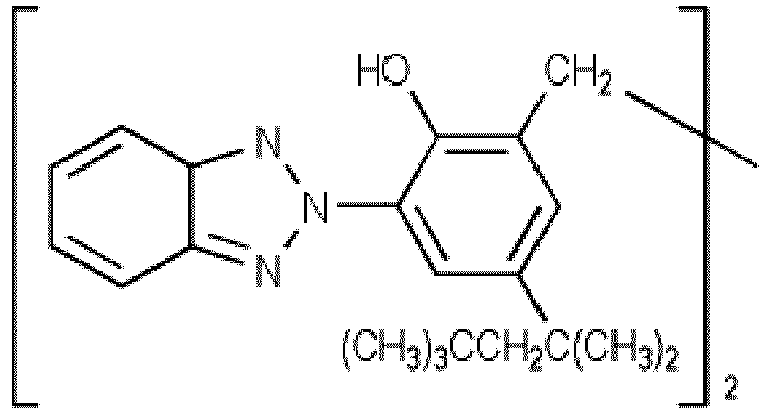
- Eine weitere bevorzugte optionale Breitband-UV-Filtersubstanz ist 2-(2H-Benzotriazol-2-yl)-4-methyl-6-[2-methyl-3-[1,3,3,3-tetramethyl-1-((trimethylsilyl)oxy]disiloxanyl]propyl]-phenol (CAS-Nr.: 155633-54-8) mit der INCI-Bezeichnung Drometrizole Trisiloxane.
- Weitere bevorzugte optionale Benzotriazol-Filter sind 2,2'-Methyl-bis-[6(2H-benzotriazol-2-yl)-4-(methyl)phenol] (MIXXIM BB/200 der Firma Fairmount Chemical), 2-(2'-Hydroxy-3',5'-di-t-amylphenyl)benzotriazol (CAS- Nr.: 025973-551), 2-(2'-Hydroxy-5'-octylphenyl)-benzotriazol (CAS-Nr. 003147-75-9), 2-(2'-Hydroxy-5'-methylphenyl)benzotriazol (CAS-Nr. 2440-22-4) und 2-(2H-benzotriazol-2-yl)-4-methyl-6-[2-methyl-3-[1,3,3,3-tetramethyl-1-((trimethylsilyl)oxy]disiloxanyl)propyl]-phenol (CAS-Nr.: 155633-54-8) mit der INCI-Bezeichnung Drometrizole Trisiloxane.
- Weitere bevorzugte UV-Filtersubstanzen, die neben denen der Komponenten (a), (b), (c) und (d) in den erfindungsgemäßen Zusammensetzungen eingesetzt werden, sind im Folgenden genannt:
- Derivate des Camphers, insbesondere 3-Benzylidencampher-Derivate, die keine ionisierbaren funktionellen Gruppen im Molekül aufweisen können, bevorzugt 3-(4'-Methylbenzyliden)-D,L-campher [INCI: 4-Methylbenzylidene Camphor];
- Derivate des Camphers, die ionisierbare funktionelle Gruppen im Molekül aufweisen können, bevorzugt Sulfonsäure-Derivate des 3-Benzylidencamphers, wie z. B. 4-(2-Oxo-3-bornylidenmethyl)benzolsulfonsäure, 2-Methyl-5-(2-oxo-3-bornylidenmethyl)sulfonsäure und deren Salze; das 1,4-di(2-oxo-10-Sulfo-3-bornylidenmethyl)-Benzol und dessen Salze (besonders die entsprechenden 10-Sulfato-verbindungen, insbesondere das entsprechende Natrium-, Kalium- oder Triethanolamin-Salz), das auch als Benzol-1,4-di(2-oxo-3-bornylidenmethyl-10-sulfonsäure) bezeichnet wird, Sulfonsäurederivate des 3-Benzylidencamphers, wie z. B. 4-(2-Oxo-3-bornylidenmethyl)benzolsulfonsäure und 2-Methyl-5-(2-oxo-3-bornyliden)sulfonsäure und deren Salze mit der INCI-Bezeichnung Terephthalylidene Dicamphor Sulfonic Acid (CAS.-Nr.: 92761-26-7, als Mexoryl SX von der Firma Chimex erhältlich);
- 4-Aminobenzoësäure-Derivate, bevorzugt 4-(Dimethylamino)-benzoësäure(2-ethylhexyl)ester, 4-(Dimethylamino)benzoësäureamylester;
- 2-Aminobenzoësäure-Derivate
- 4-Methoxyzimtsäure(2-ethylhexyl)ester,
- 4-Methoxyzimtsäurepropylester,
- 4-Methoxyzimtsäureisopentylester;
- Salicylsäure(2-ethylhexyl)ester (2-Ethylhexylsalicylat (= Octylsalicylat)),
- Salicylsäure(4-isopropylbenzyl)ester (4-Isopropylbenzylsalicylat),
- Derivate des Benzophenons, die keine ionisierbaren funktionellen Gruppen im Molekül aufweisen, bevorzugt 2-Hydroxy-4-methoxy-4'-methylbenzophenon, 2,2'-Dihydroxy-4-methoxybenzophenon, 2-Hydroxy-4-methoxybenzophenon, 2-Hydroxy-4-methoxy-4'-methylbenzophenon, 2,2'-Dihydroxy-4-methoxybenzophenon; 2-(4'-Diethylamino-2'-hydroxybenzoyl)-benzoesäurehexylester (auch: Aminobenzophenon, unter der Bezeichnung Uvinul A Plus von BASF erhältlich),
- Derivate des Benzophenons, die ionisierbare funktionelle Gruppen im Molekül aufweisen, bevorzugt Sulfonsäurederivate von Benzophenonen, besonders bevorzugt 2-Hydroxy-4-methoxybenzophenon-5-sulfonsäure und ihre Salze,
- Ester der Benzalmalonsäure, bevorzugt 4-Methoxybenzalmalonsäuredi(2-ethylhexyl)ester,
- an Polymere gebundene UV-Filter, die von Polysilicone-15 verschieden sind;
- Derivate von Benzoxazol, bevorzugt 2,2'(Naphthalene-1,4-Diyl)bis(benzoxazole) (INCI: Dibenzoxazoyl Naphthalene) und 2,4-bis-[5-1(di-methylpropyl)benzoxazol-2-yl-(4-phenyl)-imino]-6-(2-ethylhexyl)-imino-1,3,5-triazin (Uvasorb® K2A von 3V Sigma, INCI: Ethylhexyl Bis-Isopentylbenzoxazolylphenyl Melamine). Die Benzoxazol-Derivate liegen bevorzugt in gelöster Form in den erfindungsgemäßen kosmetischen Zusammensetzungen vor. Es kann ggf. aber auch von Vorteil sein, wenn die Benzoxazol-Derivate in pigmentärer, d. h. ungelöster Form - beispielsweise in Partikelgrößen von 10 nm bis zu 300 nm - vorliegen.
- Einige der öllöslichen UV-Filter können selbst als Lösungsmittel oder Lösungsvermittler für andere UV-Filter dienen. So lassen sich beispielsweise Lösungen des UV-A-Filters 1-(4-tert.-Butylphenyl)-3-(4'-methoxyphenyl)propan-1,3-dion in verschiedenen UV-B-Filtern herstellen. Die erfindungsgemäßen Zusammensetzungen enthalten daher in einer weiteren bevorzugten Ausführungsform 1-(4-tert.-Butylphenyl)-3-(4'-methoxyphenyl)propan-1,3-dion in Kombination mit mindestens einem UV-B-Filter, ausgewählt aus 4-Methoxyzimtsäure-2-ethylhexylester, 2-Cyano-3,3-phenylzimtsäure-2-ethylhexylester, Salicylsäure-2-ethylhexylester und 3,3,5-Trimethyl-cyclohexylsalicylat. In diesen Kombinationen liegt das Gewichtsverhältnis von UV-B-Filter zu 1-(4-tert.-Butylphenyl)-3-(4'-methoxyphenyl)propan-1,3-dion zwischen 1:1 und 10:1, bevorzugt zwischen 2:1 und 8:1, das molare Verhältnis liegt entsprechend zwischen 0,3 und 3,8, bevorzugt zwischen 0,7 und 3,0, besonders bevorzugt bei 0,5 - 0,75, außerordentlich bevorzugt bei 0,6 - 0,9.
- In weiteren bevorzugten Kombinationen liegt das Gewichtsverhältnis von UV-B-Filter zu 1-(4-tert.-Butylphenyl)-3-(4'methoxyphenyl)propan-1,3-dion im Bereich von 0,5 bis 6, bevorzugt im Bereich von 0,6 bis 3, das molare Verhältnis liegt entsprechend im Bereich von 0,3 bis 3, bevorzugt im Bereich von 0,5 bis 1,5, besonders bevorzugt bei 0,5 - 0,75, außerordentlich bevorzugt bei 0,6 - 0,9. In weiteren bevorzugten Kombinationen liegt das Gewichtsverhältnis von Octocrylene zu 1-(4-tert.-Butylphenyl)-3-(4'methoxyphenyl)propan-1,3-dion im Bereich von 0,5 bis 6, bevorzugt im Bereich von 0,6 bis 3, das molare Verhältnis liegt entsprechend im Bereich von 0,3 bis 3, bevorzugt im Bereich von 0,5 bis 1,5, besonders bevorzugt bei 0,5 - 0,75, außerordentlich bevorzugt bei 0,6 - 0,9.
- Bei den erfindungsgemäß bevorzugten optionalen anorganischen UV-Filtersubstanzen handelt es sich bevorzugt um feindisperse oder kolloiddisperse Metalloxide und Metallsalze, beispielsweise Titandioxid, Zinkoxid, Eisenoxid, Aluminiumoxid, Ceroxid, Zirkoniumoxid, Silicate (Talk) und Bariumsulfat. Besonders bevorzugt sind Titandioxid und Zinkoxid. Die Partikel sollten dabei einen mittleren Durchmesser von weniger als 100 nm, bevorzugt zwischen 5 und 50 nm und insbesondere zwischen 15 und 30 nm aufweisen, also so genannte Nanopigmente darstellen. Sie können eine sphärische Form aufweisen, es können jedoch auch solche Partikel zum Einsatz kommen, die eine ellipsoide oder in sonstiger Weise von der sphärischen Gestalt abweichende Form besitzen. Die Pigmente können auch oberflächenbehandelt, d.h. hydrophilisiert oder hydrophobiert vorliegen. Typische Beispiele sind gecoatete Titandioxide, wie z. B. Titandioxid T 805 (Degussa) oder Eusolex® T2000 (Merck). Als hydrophobe Coatingmittel kommen dabei vor allem Silicone und dabei speziell Trialkoxyoctylsilane, bevorzugt Triethoxy Caprylylsilane, oder Simethicone in Frage. Weitere bevorzugte Coatingmittel sind Aluminiumoxide. Weitere bevorzugte Coatingmittel ist Siliciumdioxid, z. B. bei dem Handelsprodukt Eusolex T AVO von Merck KGaA. Ein weiteres bevorzugtes Coatingmittel ist Stearinsäure. Ein weiteres bevorzugtes Coatingmittel ist Polyhydroxystearinsäure. Ein weiteres bevorzugtes Coatingmittel ist Aluminiumstearat. Ein besonders bevorzugter anorganischer UV-Filter ist ein mit Triethoxy Caprylylsilane hydrophob beschichtetes Titandioxid, erhältlich unter der Bezeichnung Titan M 265 von Kemira.
- Erfindungsgemäß bevorzugt ist mindestens eine anorganische UV-Filtersubstanz in einer Gesamtmenge von 0,1 - 15 Gew.-%, besonders bevorzugt 0,5 - 10 Gew.-%, außerordentlich bevorzugt 1,0 - 5 Gew.-% und weiter bevorzugt 2,0 - 4,0 Gew.-%, jeweils bezogen auf die gesamte Zusammensetzung, enthalten.
- Um die haptischen Eigenschaften der erfindungsgemäßen Zusammensetzungen weiter zu verbessern, enthalten bevorzugte erfindungsgemäße Zusammensetzungen Cetylalkohol und/oder Stearylalkohol und/oder Arachylalkohol und/oder Behenylalkohol. Besonders bevorzugte erfindungsgemäße Zusammensetzungen enthalten Cetylalkohol und/oder Stearylalkohol und/oder Arachylalkohol und/oder Behenylalkohol in einer Gesamtmenge von 0,5 - 3 Gew.-%, bevorzugt 1 - 2,5 Gew.-%, jeweils bezogen auf die gesamte Zusammensetzung.
- Um die haptischen Eigenschaften und/oder den Lichtschutzfaktor der erfindungsgemäßen Zusammensetzungen weiter zu verbessern, können die erfindungsgemäßen Zusammensetzungen bevorzugt mindestens einen teilchenförmigen Feststoff, ausgewählt aus färbenden, farbgebenden, mattierenden oder glanzgebenden Pigmenten. Bevorzugte Pigmente dieser Art können anorganisch oder organisch sein. Weitere bevorzugte Pigmente weisen einen zahlenmittleren Teilchendurchmesser von 0,1 - 200 µm, bevorzugt 0,5 - 100 µm, besonders bevorzugt 1 - 50 µm und außerordentlich bevorzugt 2 - 30 µm auf. Besonders bevorzugte anorganische Pigmente sind ausgewählt aus den Oxiden von Silicium, Titan, Eisen, Zink, Zirkonium, Magnesium, Cer und Bismut, aus Bismutoxychlorid, Bornitrid, Glimmer, Flussspat und wasserunlöslichen Perlglanzpigmenten, die mit mindestens einer anorganischen und/oder organischen Verbindung beschichtet sein können.
- Erfindungsgemäß bevorzugte Perlglanzpigmente sind ausgewählt aus natürlichen Perlglanzpigmenten, wie z. B. "Fischsilber" (Guanin/Hypoxanthin-Mischkristalle aus Fischschuppen) und "Perlmutt" (vermahlene Muschelschalen), monokristallinen Perlglanzpigmenten, wie z. B. Bismuthoxychlorid (BiOCl), und Schicht-Substrat Pigmenten, z. B. Glimmer / Metalloxid. Basis für Perlglanzpigmente sind beispielsweise pulverförmige Pigmente oder Ricinusöldispersionen von Bismutoxychlorid und/oder Titandioxid sowie Bismutoxychlorid und/oder Titandioxid auf Glimmer. Insbesondere bevorzugt ist z. B. das unter der CIN 77163 aufgelistete Glanzpigment.
- Es kann andererseits erfindungsgemäß bevorzugt sein, gänzlich auf ein Substrat wie Glimmer zu verzichten. Besonders bevorzugt sind Perlglanzpigmente, die unter der Verwendung von SiO2 hergestellt werden. Solche Pigmente, die auch zusätzlich goniochromatische Effekte haben können, sind z. B. unter dem Handelsnamen Sicopearl Fantastico bei der Firma BASF erhältlich.
- Weitere bevorzugte Pigmente sind ausgewählt aus farbigen und farblosen Pigmenten. Einige der im Folgenden genannten Pigmente dienen auch als UV-Absorber. Besonders bevorzugte farbige Pigmente sind ausgewählt aus den Eisenoxiden mit den Color Index-Nummern Cl 77491 (Eisenoxid rot), Cl 77492 (Eisenoxidhydrat gelb) und Cl 77499 (Eisenoxid schwarz), aus Cl 77891 (Titandioxid) und Ruß. Ein besonders bevorzugtes Pigment ist das Handelsprodukt SUNPMMA-S und SUNSIL Tin 30 von Sunjin Chemicals Co. mit einem zahlenmittleren Teilchendurchmesser von 5 - 10 µm bzw. 2 - 7 µm.
- Besonders bevorzugte optionale anorganische Pigmente sind beschichtet. Die Beschichtung kann mit Hilfe von anorganischen und/oder organischen Verbindungen erfolgen. Erfindungsgemäß besonders bevorzugt sind anorganische Pigmente, die eine anorganische Beschichtung aufweisen. Außerordentlich bevorzugte Pigmente dieser Art sind ausgewählt aus Siliciumdioxid-Partikeln, die mit Titandioxid und/oder Eisenoxiden beschichtet sind. Ein besonders bevorzugtes Pigment dieser Art ist das Handelsprodukt Ronasphere® LDP der Firma Merck KGaA. Bei diesem Produkt handelt es sich um sphärische Siliciumdioxid-Partikel, die mit Titandioxid und Eisenoxid beschichtet sind. Ronasphere® LDP weist einen zahlenmittleren Teilchendurchmesser von 4 - 7 µm auf.
- Weiterhin bevorzugt sind anorganisch beschichtete Glimmerpigmente, die keinen Perlglanz aufweisen. Weitere bevorzugte optionale anorganisch beschichtete anorganische Pigmente sind Glimmerpigmente, die mit Titandioxid in verschiedenen Schichtdicken beschichtet sind, beispielsweise die Produkte der Timiron®-Serie von Rona/Merck KGaA, insbesondere Pigmente der Produktreihen Timiron® MP, Timiron® Super, Timiron® Starlight und Timiron® Silk. Die genannten Produkte weisen mittlere Teilchendurchmesser von 5 - 60 µm bzw. 10 - 60 µm bzw. 10 - 125 µm bzw. 5 - 25 µm auf. Ebenfalls bevorzugt sind Glimmerpartikel mit einer Beschichtung aus Titandioxid und Eisenoxid, z. B. die Handelsprodukte Timiron® MP-20, MP-24, MP-25, MP-28, MP-29, MP-60 und MP-65. Weiterhin erfindungsgemäß bevorzugt sind mit Titandioxid und/oder rotem und/oder schwarzem Eisenoxid beschichtete Glimmerpartikel, z. B. die Produkte der Colorona®-Serie. Weitere bevorzugte Pigmente sind mit Kieselgel beschichtete Glimmerpigmente, z. B. das Handelsprodukt Micronasphere® M. Weitere erfindungsgemäß bevorzugte Pigmente sind anorganisch beschichtete anorganische Pigmente, deren Beschichtung einen Anteil von 0,1 - 1 Gew.-% Zinnoxid aufweist.
- Ebenfalls erfindungsgemäß bevorzugt sind anorganische Pigmente, die mit organischen Substanzen beschichtet sind. Bevorzugte Beispiele hierfür sind mit Aluminiumstearat beschichtete Titandioxid-Pigmente (z. B. das Handelsprodukt MT 100 T von der Firma Tayca), mit Dimethylpolysiloxan (Dimethicone) beschichtetes Zinkoxid, mit Dimethicone beschichtetes Bornitrid (Très BN® UHP 1106 von Carborundum), mit einem Gemisch aus Dimethylpolysiloxan und Silicagel (Simethicone) und Aluminiumoxidhydrat (Alumina) beschichtetes Titandioxid (Eusolex® T 2000 von Merck), mit Octylsilanol beschichtetes Titandioxid oder sphärische Polyalkylsesquisiloxan-Partikel (z. B. Aerosil® R972 von Evonik).
- Weitere erfindungsgemäß besonders bevorzugte Zusammensetzungen enthalten mindestens ein färbendes, farbgebendes, mattierendes oder glanzgebendes Pigment in einer Gesamtmenge von 0,1 Gew.-% bis 30 Gew.-%, bevorzugt 0,5 bis 15 Gew.-%, besonders bevorzugt 1,0 bis 10 Gew.-% und außerordentlich bevorzugt 2 - 5 Gew.-%, jeweils bezogen auf das Gesamtgewicht der erfindungsgemäßen Zusammensetzung.
- Weitere bevorzugte optionale teilchenförmige Feststoffe sind die durch Hydrolyse und Kondensationsreaktionen von Methyltrimethoxysilane erhältlichen Polymethylsilsesquioxane, die sphärisch sein können (insbesondere Aerosil® R 972 und Aerosil® 200 V von Evonik Degussa), und deren Teilchengrößenverteilung durch die Herstellung gesteuert werden kann.
- Die optionalen teilchenförmigen Feststoffe können sowohl einzeln als auch im Gemisch eingesetzt werden.
- Die Gesamtmenge der optionalen teilchenförmigen Feststoffe beträgt bevorzugt 0,1 - 30 Gew.-%, besonders bevorzugt 0,5 - 15 Gew.-%, außerordentlich bevorzugt 1,0 - 10 Gew.-%, oder auch 2 -4 Gew.-%, jeweils bezogen auf das Gesamtgewicht der erfindungsgemäßen Zusammensetzung.
- In einer weiteren bevorzugten Ausführungsform enthalten die erfindungsgemäßen Zusammensetzungen mindestens ein Ubichinon oder ein Ubichinol oder deren Derivate. Ubichinole sind die reduzierte Form der Ubichinone. Die erfindungsgemäß bevorzugten Ubichinone weisen die Formel (UBI-I) auf:

- Besonders bevorzugt ist das Ubichinon der Formel (UBI-I) mit n = 10, auch bekannt als Coenzym Q10.
- Erfindungsgemäß besonders bevorzugte Zusammensetzungen enthalten mindestens ein Ubichinon, Ubichinol oder ein Derivat hiervon in einer Gesamtmenge von 0,0001 - 1 Gew.-%, bevorzugt 0,001 - 0,5 Gew.-% und besonders bevorzugt 0,005 - 0,1 Gew.-%, jeweils bezogen auf die gesamte Zusammensetzung.
- In einer weiteren bevorzugten Ausführungsform enthalten die erfindungsgemäßen Zusammensetzungen mindestens ein natürlich vorkommendes Xanthin-Derivat, ausgewählt aus Coffein, Theophyllin, Theobromin und Aminophyllin. Erfindungsgemäß bevorzugt sind die natürlich vorkommenden Xanthin-Derivate in Mengen von 0,0001 bis 1 Gew.-%, besonders bevorzugt 0,001 bis 0,5 Gew.-% und außerordentlich bevorzugt 0,005 bis 0,1 Gew.-%, jeweils bezogen auf die gesamte Zusammensetzung, enthalten.
- In einer weiteren bevorzugten Ausführungsform enthalten die erfindungsgemäßen Zusammensetzungen Ectoin. Ectoin ist der Trivialname für 2-Methyl-1,4,5,6-tetrahydropyrimidin-4-carboxylat. Erfindungsgemäß bevorzugt ist Ectoin in Mengen von 0,0001 bis 1 Gew.-%, besonders bevorzugt 0,001 bis 0,5 Gew.-% und außerordentlich bevorzugt 0,005 bis 0,01 Gew.-%, jeweils bezogen auf die gesamte Zusammensetzung, enthalten.
- In einer weiteren bevorzugten Ausführungsform enthalten die erfindungsgemäßen Zusammensetzungen mindestens eine natürliche Betainverbindung. Die Herkunft der eingesetzten natürlichen Betainverbindung kann erfindungsgemäß durchaus synthetisch sein. Erfindungsgemäß bevorzugte natürliche Betainverbindungen sind natürlich vorkommende Verbindungen mit der Atomgruppierung R3N+-CH2-X-COO- gemäß IUPAC-Regel C-816.1. Sogenannte Betaintenside (synthetisch) fallen nicht unter die erfindungsgemäß verwendeten Betainverbindungen, ebenso wenig andere zwitterionische Verbindungen, in denen sich die positive Ladung an N oder P und die negative Ladung formal an O, S, B oder C befindet, die aber nicht der IUPAC-Regel C-816.1 entsprechen. Erfindungsgemäß bevorzugte Betainverbindungen sind Betain (Me3N+-CH2-COO-), Carnitin (Me3N+-CH2-CHOH-CH2-COO-), jeweils mit Me = Methyl, und Ergothionein = 2-Mercapto-NαNαNα-trimethyl-L-histidinium-Betain der Formel (BETA-II)
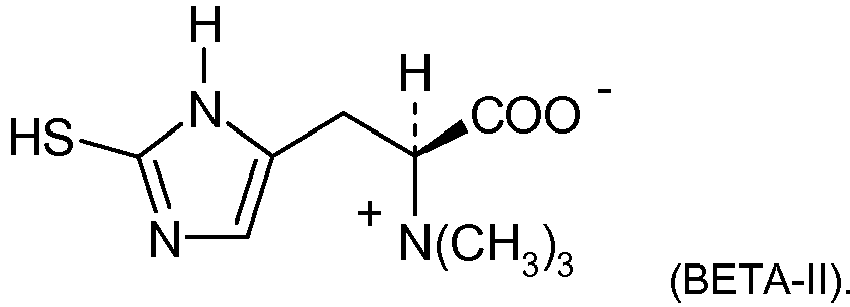
- Weiterhin können auch Salze und/oder Ester der natürlichen Betainverbindungen erfindungsgemäß bevorzugt eingesetzt werden. Besonders bevorzugte derartige Derivate sind Carnitintartrat, Propionylcarnitin und insbesondere Acetylcarnitin. Beide Enantiomere (D-und L-Form) sind vorteilhaft im Sinne der vorliegenden Erfindung zu verwenden. Es kann auch von Vorteil sein, beliebige Enantiomerengemische, beispielsweise ein Racemat aus D-und L-Form, zu verwenden. Bevorzugte erfindungsgemäße Zusammensetzungen sind dadurch gekennzeichnet, dass sie mindestens eine natürliche Betainverbindung in einer Gesamtmenge von 0,01 bis 5 Gew.-%, bevorzugt 0,1 bis 3 Gew.-%, besonders bevorzugt 0,2 bis 1 Gew.-% und außerordentlich bevorzugt 0,3 - 0,5 Gew.-%, jeweils bezogen auf die gesamte erfindungsgemäße Zusammensetzung, enthalten.
- Weitere erfindungsgemäß bevorzugte Zusammensetzungen sind dadurch gekennzeichnet, dass sie mindestens einen konditionierenden Wirkstoff enthalten. Unter konditionierenden Wirkstoffen sind erfindungsgemäß solche Substanzen zu verstehen, die auf keratinische Materialien, insbesondere auf die Haut, aufziehen und die physikalischen und sensorischen Eigenschaften sowohl der Haut als auch des Produktes als solchem verbessern. Konditionierungsmittel glätten die oberste Schicht der Haut und machen sie weich und geschmeidig. Über die Auswahl der Konditionierungsmittel (fettig - weniger fettig, schnell oder langsam spreitend, schnell oder langsam in die Haut einziehend und so weiter) lässt sich das Hautgefühl des gesamten Produktes einstellen. Erfindungsgemäß bevorzugte konditionierende Wirkstoffe sind ausgewählt aus Fettstoffen, insbesondere pflanzlichen Ölen, wie Sonnenblumenöl, Olivenöl, Sojaöl, Rapsöl, Mandelöl, Jojobaöl, Orangenöl, Weizenkeimöl, Pfirsichkernöl und den flüssigen Anteilen des Kokosöls, Lanolin und seinen Derivaten, flüssigen Paraffinölen, Isoparaffinölen und synthetischen Kohlenwasserstoffen, Di-n-alkylethern mit insgesamt 12 bis 36 C-Atomen, z. B. Di-n-octylether und n-Hexyl-n-octylether, Fettsäuren, besonders linearen und/oder verzweigten, gesättigten und/oder ungesättigten C8-30-Fettsäuren, Fettalkoholen, besonders gesättigten, ein- oder mehrfach ungesättigten, verzweigten oder unverzweigten Fettalkoholen mit 4 - 30 Kohlenstoffatomen, die mit 1 - 75, bevorzugt 5 - 20 Ethylenoxid-Einheiten ethoxyliert und/oder mit 3 - 30, bevorzugt 9 - 14 Propylenoxid-Einheiten propoxyliert sein können, Esterölen, das heißt Estern von C6-30-Fettsäuren mit C2-30-Fettalkoholen, Hydroxycarbonsäurealkylestern, Dicarbonsäureestern wie Di-n-butyladipat sowie Diolestern wie Ethylenglykoldioleat oder Propylenglykoldi(2-ethylhexanoat), symmetrischen, unsymmetrischen oder cyclischen Estern der Kohlensäure mit Fettalkoholen, z. B. Glycerincarbonat oder Dicaprylylcarbonat (Cetiol® CC), Mono,- Di- und Trifettsäureestern von gesättigten und/oder ungesättigten linearen und/oder verzweigten Fettsäuren mit Glycerin, die mit 1 - 10, bevorzugt 7 - 9 Ethylenoxid-Einheiten ethoxyliert sein können, z. B. PEG-7 Glyceryl Cocoate, Wachsen, insbesondere Insektenwachsen, Pflanzenwachsen, Fruchtwachsen, Ozokerit, Mikrowachsen, Ceresin, Paraffinwachsen, Triglyceriden gesättigter und gegebenenfalls hydroxylierter C16-30-Fettsäuren, z. B. gehärteten Triglyceridfetten, Phospholipiden, beispielsweise Sojalecithin, Ei-Lecithin und Kephalinen, Siliconverbindungen, ausgewählt aus Decamethylcyclopentasiloxan, Dodecamethylcyclohexasiloxan und Siliconpolymeren, die gewünschtenfalls quervernetzt sein können, z. B. Polydialkylsiloxanen, Polyalkylarylsiloxanen, ethoxylierten und/oder propoxylierten Polydialkylsiloxanen mit der früheren INCI-Bezeichnung Dimethicone Copolyol, sowie Polydialkylsiloxanen, die Amin- und/oder HydroxyGruppen enthalten, bevorzugt Substanzen mit den INCI-Bezeichnungen Dimethiconol, Amodimethicone oder Trimethylsilylamodimethicone.
- Die Einsatzmenge der Fettstoffe beträgt bevorzugt 0,1 - 99 Gew.-%, besonders bevorzugt 2 - 50 Gew.-% und außerordentlich bevorzugt 5 - 20 Gew.-%, jeweils bezogen auf die gesamte erfindungsgemäße Zusammensetzung.
- Bevorzugt liegen die erfindungsgemäßen kosmetischen oder dermatologischen Zusammensetzungen in Form einer flüssigen, fließfähigen oder festen Öl-in-Wasser-Emulsion, Wasser-in-Öl-Emulsion, Mehrfach-Emulsion, insbesondere einer Öl-in-Wasser-in-Öl- oder Wasser-in-Öl-in-Wasser-Emulsion, Makroemulsion, Miniemulsion, Mikroemulsion, PIT-Emulsion, Nanoemulsion, Pickering-Emulsion, Hydrodispersion, eines Hydrogels, eines Lipogels, einer ein- oder mehrphasigen Lösung, eines Schaumes, eines Puders oder einer Mischung mit mindestens einem als medizinischen Klebstoff geeigneten Polymer vor. Die Mittel können auch in wasserfreier Form, wie beispielsweise einem Öl oder einem Balsam, dargereicht werden. Hierbei kann der Träger ein pflanzliches oder tierisches Öl, ein Mineralöl, ein synthetisches Öl oder eine Mischung solcher Öle sein. In einer besonders bevorzugten Ausführungsform der erfindungsgemäßen Mittel liegen die Mittel als Mikroemulsion vor. Unter Mikroemulsionen werden im Rahmen der Erfindung neben den thermodynamisch stabilen Mikroemulsionen auch die so genannten "PIT"-Emulsionen verstanden. Bei diesen Emulsionen handelt es sich um Systeme mit den 3 Komponenten Wasser, Öl und Emulgator, die bei Raumtemperatur als Öl-in-Wasser-Emulsion vorliegen. Beim Erwärmen dieser Systeme bilden sich in einem bestimmten Temperaturbereich (als Phaseninversionstemperatur oder "PIT" bezeichnet) Mikroemulsionen aus, die sich bei weiterer Erwärmung in Wasser-in-Öl-Emulsionen umwandeln. Beim anschließenden Abkühlen werden wieder O/W-Emulsionen gebildet, die aber auch bei Raumtemperatur als Mikroemulsionen oder als sehr feinteilige Emulsionen mit einem mittleren Teilchendurchmesser unter 400 nm und insbesondere von etwa 100-300 nm, vorliegen. Erfindungsgemäß können solche Mikro- oder "PIT"-Emulsionen bevorzugt sein, die einen mittleren Teilchendurchmesser von etwa 200 nm aufweisen.
- In der bevorzugten Ausführungsform als Emulsion enthalten die erfindungsgemäßen Zusammensetzungen mindestens eine oberflächenaktive Substanz als Emulgator oder Dispergiermittel. Geeignete Emulgatoren sind beispielsweise Anlagerungsprodukte von 4 bis 30 Mol Ethylenoxid und/oder 0 bis 5 Mol Propylenoxid an lineare C8-C22-Fettalkohole, an C12-C22-Fettsäuren und an C8-C15-Alkylphenole, C12-C22-Fettsäuremono- und -diester von Anlagerungsprodukten von 1 bis 30 Mol Ethylenoxid an C3-C6-Polyole, insbesondere an Glycerin, Ethylenoxid- und Polyglycerin-Anlagerungsprodukte an Methylglucosid-Fettsäureester, Fettsäurealkanolamide und Fettsäureglucamide, C8-C22-Alkylmono- und -oligoglycoside und deren ethoxylierte Analoga, wobei Oligomerisierungsgrade von 1,1 bis 5, insbesondere 1,2 bis 2,0, und Glucose als Zuckerkomponente bevorzugt sind, Gemische aus Alkyl-(oligo)-glucosiden und Fettalkoholen, z. B. das im Handel erhältliche Produkt Montanov® 68, Anlagerungsprodukte von 5 bis 60 Mol Ethylenoxid an Rizinusöl und gehärtetes Rizinusöl, Partialester von Polyolen mit 3-6 Kohlenstoffatomen mit gesättigten C8-C22-Fettsäuren, Sterole (Sterine), insbesondere Cholesterol, Lanosterol, Beta-Sitosterol, Stigmasterol, Campesterol und Ergosterol sowie Mykosterole, Phospholipide, vor allem Glucose-Phospolipide, Fettsäureester von Zuckern und Zuckeralkoholen wie Sorbit, Polyglycerine und Polyglycerinderivate, bevorzugt Polyglyceryl-2-dipolyhydroxystearat (Handelsprodukt Dehymuls® PGPH) und Polyglyceryl-3-diisostearat (Handelsprodukt Lameform® TGI) sowie lineare und verzweigte C8-C30-Fettsäuren und deren Na-, K-, Ammonium-, Ca-, Mg- und Zn-Salze.
- Die erfindungsgemäßen Zusammensetzungen enthalten die Emulgatoren bevorzugt in einer Gesamtmenge von 0,1 bis 25 Gew.-%, besonders bevorzugt 0,5 - 15 Gew.-%, bezogen auf die gesamte Zusammensetzung.
- In einer besonders bevorzugten Ausführungsform ist mindestens ein nichtionischer Emulgator mit einem HLB-Wert von 8 und darunter enthalten. Derartige bevorzugte Emulgatoren sind insbesondere Verbindungen der allgemeinen Formel R1 - O - R2, in der R1 eine primäre lineare Alkyl-, Alkenyl- oder Acylgruppe mit 20 - 30 C-Atomen, bevorzugt ein Behenyl-Rest, und R2 Wasserstoff, eine Gruppe mit der Formel -(CnH2nO)x-H mit x = 1 oder 2 und n = 2 - 4 oder eine Polyhydroxyalkylgruppe mit 4 - 6 C-Atomen und 2 - 5 Hydroxylgruppen, bevorzugt Wasserstoff, darstellt. Eine besonders bevorzugte Verbindung R1 - O - R2 ist Behenylalkohol. Weitere bevorzugt geeignete Emulgatoren mit einem HLB-Wert von 8 und darunter sind die Anlagerungsprodukte von 1 oder 2 Mol Ethylenoxid oder Propylenoxid an Behenylalkohol, Erucylalkohol, Arachidylalkohol oder auch an Behensäure oder Erucasäure. Bevorzugt eignen sich auch die Monoester von C16-C30-Fettsäuren mit Polyolen wie z. B. Pentaerythrit, Trimethylolpropan, Diglycerin, Sorbit, Glucose oder Methylglucose. Beispiele für solche Produkte sind z. B. Sorbitanmonobehenat oder Pentaerythritmonoerucat. Die Anwesenheit von Emulgatoren der allgemeinen Formel R1 - O - R2 kann zu lamellaren Strukturen in der Emulsion führen, die besonders günstige Effekte auf die Wiederherstellung der lamellaren Struktur der Haut haben können. Besonders bevorzugte erfindungsgemäße Zusammensetzungen sind daher dadurch gekennzeichnet, dass sie in Form einer lamellare Strukturen aufweisenden Öl-in-Wasser-Emulsion vorliegen.
- In einer weiteren besonders bevorzugten Ausführungsform liegen die erfindungsgemäßen Zusammensetzungen in Form einer Wasser-in-Öl-Emulsion vor. Derartige Wasser-in-Öl-Emulsionen können so formuliert werden, dass die eine höhere Viskosität aufweisen, so dass sie sorgfältig in die Haut einzumassieren sind. Dies unterstützt die Anticellulite-Wirkung der erfindungsgemäßen Zusammensetzungen. Genau so gut lassen sich aber auch niedrig-viskose Wasser-in-Öl-Emulsionen formulieren, insbesondere auf Basis des polymeren Wasser-in-Öl-Emulgators PEG-30 Dipolyhydroxystearat, erhältlich z. B. unter dem Handelsnamen Arlacel P 135 von Uniqema. Insbesondere mit Hilfe dieses Emulgators lassen sich sprühbare Wasser-in-Öl-Emulsionen formulieren. Weitere geeignete Zusatzstoffe sind Verdickungsmittel, z. B. anionische Polymere aus Acrylsäure, Methacrylsäure, Crotonsäure, Maleinsäureanhydrid und 2-Acrylamido-2-methylpropansulfonsäure, wobei die sauren Gruppen ganz oder teilweise als Natrium-, Kalium-, Ammonium-, Mono- oder Triethanolammonium-Salz vorliegen können und wobei mindestens ein nichtionisches Monomer enthalten sein kann. Bevorzugte nichtionogene Monomere sind Acrylamid, Methacrylamid, Acrylsäureester, Methacrylsäureester, Vinylpyrrolidon, Vinylether und Vinylester. Bevorzugte anionische Copolymere sind Acrylsäure-Acrylamid-Copolymere sowie insbesondere Polyacrylamidcopolymere mit Sulfonsäuregruppen-haltigen Monomeren. Diese Copolymere können auch vernetzt vorliegen. Geeignete Handelsprodukte sind Sepigel®305, Simulgel® 600, Simulgel® NS und Simulgel® EG der Firma SEPPIC. Weitere besonders bevorzugte anionische Homo- und Copolymere sind unvernetzte und vernetzte Polyacrylsäuren. Solche Verbindungen sind zum Beispiel die Handelsprodukte Carbopol®. Ein besonders bevorzugtes anionisches Copolymer enthält als Monomer zu 80 - 98 % eine ungesättigte, gewünschtenfalls substituierte C3-6-Carbonsäure oder ihr Anhydrid sowie zu 2 - 20 % gewünschtenfalls substituierte Acrylsäureester von gesättigten C10-30-Carbonsäuren, wobei das Copolymer mit den vorgenannten Vernetzungsagentien vernetzt sein kann. Entsprechende Handelsprodukte sind Pemulen® und die Carbopol®-Typen 954, 980, 1342 und ETD 2020 (ex B.F. Goodrich).
- Geeignete nichtionische Polymere sind beispielsweise Polyvinylalkohole, die teilverseift sein können, z. B. die Handelsprodukte Mowiol® sowie Vinylpyrrolidon/Vinylester-Copolymere und Polyvinylpyrrolidone, die z. B. unter dem Warenzeichen Luviskol® (BASF) vertrieben werden.
- Weitere bevorzugte Zusatzstoffe sind Lösungsmittel wie Ethanol, Isopropanol, Ethylenglycol, Propylenglycol, Propylenglykolmonoethylether, Glycerin und Diethylenglykol, Parfümöle, Substanzen zur Einstellung des pH-Wertes, Komplexbildner wie EDTA, NTA, β-Alanindiessigsäure und Phosphonsäuren, Treibmittel wie Propan-Butan-Gemische, Pentan, Isopentan, Isobutan, N2O Dimethylether, CO2 und Luft.
- In einer weiteren bevorzugten Ausführungsform liegen die erfindungsgemäßen Zusammensetzungen in einem Sprühspender oder Pumpspender verpackt vor.
- Die nachfolgenden Beispiele sollen den Gegenstand der vorliegenden Anmeldung verdeutlichen, ohne ihn hierauf einzuschränken.
- Die Zahlenwerte in den Beispielen bedeuten Gewichtsprozente, bezogen auf das Gesamtgewicht der jeweiligen Zusammensetzungen.
- Die Methode der Antioxidative Power (AP) ermöglicht die Bestimmung der antioxidativen Aktivität von aktiven Inhaltsstoffen in kosmetischen Produkten wie z.B. Pflanzenextrakten und Vitaminen. Die AP basiert auf der ESR (Elektronen Spin Resonanz) Spektroskopie, einer Methode, mit der freie Radikale quantitativ und qualitativ charakterisiert werden können. Damit impliziert die Methode auch die quantitative und qualitative Charakterisierung von Antioxidantien und Radikalfängern als den Antagonisten der freien Radikale.
- Die Antioxidative Power ist eine zweidimensionale Größe, die sowohl die Kapazität eines Antioxidans, freie Radikale zu neutralisieren angibt, als auch seine Reaktivität. Die Kapazität wird anhand einer konzentrationsabhängigen Signalintensität ermittelt; die Reaktivität wird über das Erstellen von Reaktionskinetiken gemessen. So werden sowohl die Reaktionszeit (tr) als auch die radikalreduzierende Kapazität erfasst und beide Größen fließen in die Berechnung der AP ein. Je schneller eine Substanz mit den freien Radikalen reagiert, desto niedriger ist ihre Reaktionszeit (tr), desto höher ist ihre Antioxidative Power. Die Reaktionszeit (tr) ist ein wichtiges Indiz für die Wirksamkeit einer Substanz und ihres Oxidationsgrades und ist ein Identifikationsmerkmal für ein Antioxidans. Die AP gibt an, wie viele Radikale von 1 mg Substanz in 1 Minute neutralisiert werden und wird in (rad/m*min) angegeben. Die AP Methode ist auf die Aktivität von Vitamin C (Ascorbinsäure) als Bezugspunkt standardisiert worden, so dass die AP in Antioxidative Units (AU) angegeben werden kann, wobei 1 AU der Aktivität von 1 ppm Vitamin C entspricht. Ein AP einer Substanz von 100 AU bedeutet, dass 1 mg der Substanz die gleiche Menge Radikale pro Zeiteinheit neutralisieren kann wie 0,1 pg Vitamin C.
- Bei der RSF Methode werden die durch UV-Strahlung induzierten freien Radikale in der Haut gemessen. An Hand von experimentell bestimmten Gleichungen und mathematisch durchgeführten Kalibrierungen kann der Schutzfaktor (RSF), verursacht durch die topisch applizierten Produkte, bestimmt werden. Dabei gilt für die RSF-Bestimmung folgender Zusammenhang:

- Ähnlich dem SPF wird bei der Bestimmung des RSF die Wirkung der UV-Strahlung auf der Haut gemessen. Als Messgröße bzw. Indikator im Vergleich zwischen unbestrahlter und bestrahlter Haut wird nicht das als biologischer Endpunkte bezeichnete Erythem verwendet, sondern es wird die Menge und Art an UV generierten freien Radikalen in der Haut bestimmt. Die Menge an freien Radikalen ist proportional zur UV-Dosis und ihre Verteilung in den einzelnen Hautschichten (Epidermis, Dermis) wird maßgeblich von der Wellenlänge der eindringenden Photonen bestimmt. Die Bestimmung des RSF wird zweckmäßigerweise als ex vivo Methode an Hautbiopsien durchgeführt. Die Hautbiopsien werden mit einem Radikalindikator (Nitroxyl-Verbindung) markiert. Die durch die UV-Strahlung in der Haut generierten freien Radikale reagieren mit dem Radikalindikator, dessen Menge und Aktivität mit einem ESR-Spektrometer gemessen wird. Die Bildung der durch UVA und UVB induzierten freien Radikale ist ein Prozess, der sich in der epidermalen und dermalen Schicht der Haut abspielt. Die Wirkung der UVB-Strahlung beschränkt sich, bedingt durch die geringe Eindringtiefe, hauptsächlich auf die Epidermis. Der Radikalindikator ist hydrophil und weist demzufolge in der Dermis und Epidermis eine morphologisch bedingte Gleichverteilung auf. Der Radikalindikator selbst ist fotostabil und wird in wässriger Lösung nicht durch UV abgebaut.
- Die in der Haut induzierten freien Radikale oxidieren das Molekül der Nitroxylverbindung und werden mit der ESR-Spektroskopie nachgewiesen. Über diesen Effekt kann die UV-schützende Wirkung (Radikalschutz) von UV-Filtern getestet werden. Während das UVA ausschließlich freie Radikale in der Haut generiert, kann das UVB (insbesondere das kurzwellige UVB) auch zu direkten Schäden an der Erbinformation (DNA) der Zelle führen. Dementsprechend ist die RSF-Methode besonders sensitiv gegenüber der Wirkung von UVA-Filtern.
- Gleiche UV-Dosis für beide Messungen vorausgesetzt. Es wird ein Faktor angegeben, um den die generierte Radikalmenge bei Benutzung eines Sonnenschutzproduktes verringert wird.
- Ebenfalls kann für eine gleiche vorgegebene induzierte Radikalmenge in beiden Fällen (ungeschützt versus geschützt) der Faktor angegeben werden, um den die Verweildauer unter UV-Strahlung für geschützte Haut erhöht werden kann. Eine direkte Bezugnahme zum SPF (Sonnenschutzfaktor) ist damit gegeben.
- Hautmodell
- Das verwendete Hautmodell basiert auf der Verwendung von Schweinehaut von Schlachttieren. Das Schweinehautmodell ist als dasjenige anerkannt, das der menschlichen Haut am ähnlichsten ist. Die Schweinehaut wurde unmittelbar nach der Schlachtung (innerhalb von 4 Stunden) für die Hautuntersuchungen präpariert. Bis zur Messung wurden die Schweinehautstreifen (>1 cm x 1 cm) auf einer PBS-Lösung getränkten Gaze im Kühlschrank gelagert. Das Alter der Schlachttiere liegt einheitlich bei ca. 6 Monaten, so dass große altersbedingte Hautunterschiede nicht zu erwarten sind und bisher nicht beobachtet wurden.
- Die Durchführung des Testverfahrens ist im Wesentlichen gekennzeichnet durch zwei Prozesse:
- 1. Einwirkung des Radikalindikators von der dermalen (5 min.) und der Probe der epidermalen (15 min.) Seite der Haut.
- 2. Die UV-Bestrahlung der Haut mit variablen Zeiten (entsprechend Versuchsprotokoll) von der epidermalen Seite und anschließender unmittelbarer Messung der induzierten freien Radikale mit der ESR-Spektroskopie.
- Aus dem 1 cm2 Hautareal wird eine 4 mm Ø große Biopsie ausgestanzt und auf einer ESR-Gewebezelle montiert. Danach erfolgt eine erste ESR-Messung (0-Messung). Die Biopsie wird mit zunehmenden UV-Dosen (UV-Bestrahlungszeiten) bestrahlt. Nach jeder Messung erfolgt eine Messung der Radikalintensität.
- Die Bestrahlung erfolgt mit einem Sonnensimulator der Firma Hönle AG, Modell SOL2, bei einer Bestrahlungsstärke von E(UVA + UVB) = 23,2 mW/cm2. Die einzelnen Bestrahlungsintensitäten betragen 22,0 mW/cm2 für UVA und 1,2 mW/cm2 für UVB. Das E(UVA)/E(UVB)-Verhältnis ist 22/2,1 = 18,3. Dieses Verhältnis entspricht der COLIPA-Anforderung, die sich nach den Sonnenintensitäts-Verhältnissen für die einzelnen Spektralbereiche richtet.
- Es wurde folgende Rezeptur hergestellt (Mengenangaben in Gew.-%):
Creme A (erfindungsgemäß Mischung aus Dikaliummonocetylphosphat und Kaliumdicetylphosphat (ex Emulsiphos 677660) 1,5 Hydrogenated Palm Glycerides (ex Emulsiphos 677660) 0,9 Lanette 22 1 Cetearyl Alcohol - SymMollient S 1 PCL Solid 660086 - Bienenwachs - 2-Ethylhexyl-3,5,5-trimethylhexanoat 3,5 Octansäure-4-methyl-2-pentylbutylester 2 Cetiol B - Myritol 318 - Safloröl raffiniert - 3,3,5-Trimethylcyclohexylsalicylat 7 Octocrylene 10 Butylmethoxydibenzoylmethan 4 Parsol SLX - Neo Heliopan Hydro 2 Neo Heliopan AP 1 L-Arginin 1 Natriumhydroxid Perlen 0,24 AMP-ULTRA PC 2000 - Cosmedia Silc 2 Carbopol ETD 2020 0,2 Xanthan 0,2 Aristoflex AVC 0,6 Cosmedia SP - Olivem 1000 - Tetranatrium-EDTA (Pulver) 0,1 Ethylparaben 0,2 Methylparaben 0,2 Phenoxyethanol 0,4 RonaCare AP 0,05 Lipochroman-6 0,01 Vitamin E Acetat 0,5 Controx KS C 0,05 Hexandiol-1,6 4 Glycerin 5 Parfum 0,4 Wasser vollentsalzt ad 100 -
Handelsname INCI Hersteller AMP-ULTRA PC 2000 Aminomethyl propanol (2-Amino-2-methylpropanol), 95 Gew.-%(und 5 Gew.-% Wasser) Dow (Angus Chemie) Aristoflex AVC AMMONIUM ACRYLOYLDIMETHYLTAURATE/VP COPOLYMER, T-BUTYL ALCOHOL Clariant Carbopol ETD 2020 Acrylates/C10-30 Alkyl Acrylate Crosspolymer Lubrizol Cetiol B DIBUTYL ADIPATE Cognis Controx KS Tocopherol, Hydrogenated Palm Glycerides Citrate Cognis Cosmedia Silc Silica (spherical) Cognis Cosmedia SP Sodium Polyacrylate Cognis Emulsiphos 677660 Potassium Cetyl Phosphate, Hydrogenated Palm Glycerides Symrise Lanette 22 Behenyl alcohol (C22-Alkohol: 70-80 Gew.-%, C20-Alkohol: 10-20 Gew.-%, C18-Alkohol: 5-15 Gew.-%, C16-Alkohol: 0-0,5 Gew.-%, C24-Alkohol: 0-1 Gew.-%) BASF/ Cognis Lipochroman-6 Dimethylmethoxy Chromanol Lipotec RonaCare AP Bis-Ethylhexyl Hydroxydimethoxy Benzylmalonate Merck KGaA Myritol 318 Caprylic/Capric Triglyceride BASF/ Cognis Neo Heliopan AP Disodium Phenyl Dibenzimidazole Tetrasulfonate Symrise Neo Heliopan Hydro Phenylbenzimidazol sulfonic acid Symrise Olivem 1000 Cetearyl Olivate, Sorbitan Olivate Erbslöh PCL Solid 660086 STEARYLHEPTANOAT + STEARYLOCTANOAT (STEARYL HEPTANOATE, STEARYL CAPRYLATE) Symrise SymMollient S n-Hexadecyl-n-nonanoat + n-Octadecyl-n-nonanoat (Cetearyl Nonanoate) Symrise - Es wurde folgender Wert für die "Antioxidative Power" (AP) in Antioxidative Units (AU) ermittelt: 718 AU; tr = 0,19
- Für die Skin Antioxidative Retention (SAR) nach Infrarotbestrahlung wurden folgende Werte ermittelt (n = 4 Proben):
-
Probe Ohne Produkt Sonnenschutz-formel Positivkontrolle (Sonnenschutzfolie) 1 91 101 101 2 90 99 96 3 88 95 94 4 82 90 94 MW 88 96 96 SD 4 5 3
Claims (15)
- Kosmetische Zusammensetzung, enthaltenda) 2-Cyano-3,3-phenylzimtsäure-2-ethylhexylester,b) 4-(tert.-Butyl)-4'-methoxydibenzoylmethan,c) 3,3,5-Trimethylcyclohexylsalicylat (Homosalate),d) mindestens einen wasserlöslichen organischen UV-Filter,e) mindestens eine Substanz, ausgewählt aus 6,7-disubstituierten 2,2-Dialkylchromanen oder -chromenen der allgemeinen Formeln (I) oder (II),

- Kosmetische Zusammensetzung gemäß Anspruch 1, dadurch gekennzeichnet, dass sie — bezogen auf ihr Gewicht - mindestens ein 6,7-disubstituiertes 2,2-Dialkylchroman oder -chromen der allgemeinen Formeln (I) oder (II) in einer Gesamtmenge von 0,001 - 2 Gew.-%, bevorzugt 0,005 - 1 Gew.-%, besonders bevorzugt 0,01 - 0,5 Gew.-%, außerordentlich bevorzugt 0,05 - 0,2 Gew.-%, enthalten.
- Kosmetische Zusammensetzung gemäß Anspruch 1 oder 2, dadurch gekennzeichnet, dass sie — bezogen auf ihr Gewicht - eine Mischung aus der oxidierten und der reduzierten Form von 3,4-Dihydro-7-methoxy-2,2-dimethyl-2H-1-benzopyran-6-ol in einer Gesamtmenge von 0,001 - 2 Gew.-%, bevorzugt 0,005 - 1 Gew.-%, besonders bevorzugt 0,01 - 0,5 Gew.-%, außerordentlich bevorzugt 0,05 - 0,2 Gew.-%, enthalten.
- Kosmetische Zusammensetzung gemäß Anspruch 1, 2 oder 3, dadurch gekennzeichnet, dass der mindestens eine wasserlösliche organische UV-Filter mindestens ein Derivat der Benzimidazolsulfonsäure umfasst.
- Kosmetische Zusammensetzung gemäß Anspruch 1, 2, 3 oder 4, dadurch gekennzeichnet, dass der mindestens eine wasserlösliche organische UV-Filter ausgewählt ist aus Phenylen-1,4-bis-(2-benzimidazyl)-3,3'-5,5'-tetrasulfonsäure, 2-Phenylbenzimidazol-5-sulfonsäure und/oder den Salzen dieser Säuren sowie aus Mischungen hiervon ausgewählt ist.
- Kosmetische Zusammensetzung gemäß Anspruch 1, 2, 3, 4 oder 5, dadurch gekennzeichnet, dass das Salz des mindestens einen wasserlöslichen organischen UV-Filters, bevorzugt der Phenylen-1,4-bis-(2-benzimidazyl)-3,3'-5,5'-tetrasulfonsäure und/oder der 2-Phenylbenzimidazol-5-sulfonsäure, ausgewählt ist aus den Natrium-, Kalium-, Triethanolamin-, Lysin-, Arginin-, Histidin- und Ornithin-Salzen sowie den Salzen mit Amino-C1-C6-Alkanolen und/oder Amino-C1-C6-Alkandiolen, insbesondere mit 2-Amino-2-methylpropan-1-ol, 2-Amino-2-methylpropan-1,3-diol, 2-Aminopropan-1-ol, 3-Aminopropan-1-ol, 1-Aminopropan-2-ol (MIPA) oder 2-Amino-2-(hydroxymethyl)propan-1,3-diol (TRIS), sowie aus Mischungen dieser Salze.
- Kosmetische Zusammensetzung gemäß Anspruch 1, 2, 3, 4, 5 oder 6, dadurch gekennzeichnet, dass das/die Derivat/e der Benzimidazolsulfonsäure in einer Gesamtmenge von 0,5 bis 15 Gew.-%, bevorzugt 1 bis 10 Gew.-%, besonders bevorzugt 2 bis 5 Gew.-% und außerordentlich bevorzugt 3 - 4 Gew.-%, jeweils bezogen auf das Gesamtgewicht der erfindungsgemäßen Zusammensetzung, enthalten sind.
- Kosmetische Zusammensetzung gemäß Anspruch 1, 2, 3, 4, 5, 6 oder 7, dadurch gekennzeichnet, dass 2-Cyano-3,3-phenylzimtsäure-2-ethylhexylester in einer Gesamtmenge von 0,5 bis 15 Gew.-%, besonders bevorzugt 3 bis 13 Gew.-%, insbesondere 5 bis 11 Gew.-% und außerordentlich bevorzugt 8 - 10 Gew.-%, jeweils bezogen auf das Gewicht der gesamten Zusammensetzung, enthalten ist.
- Kosmetische Zusammensetzung gemäß Anspruch 1, 2, 3, 4, 5, 6, 7 oder 8, dadurch gekennzeichnet, dass 4-(tert.-Butyl)-4'-methoxydibenzoylmethan in einer Gesamtmenge von 0,5 bis 10 Gew.-%, bevorzugt 1 bis 8 Gew.-%, besonders bevorzugt 2 bis 5 Gew.-% und außerordentlich bevorzugt 3 - 4 Gew.-%, jeweils bezogen auf das Gewicht der gesamten Zusammensetzung, enthalten ist.
- Kosmetische Zusammensetzung gemäß Anspruch 1, 2, 3, 4, 5, 6, 7, 8 oder 9, dadurch gekennzeichnet, dass 3,3,5-Trimethylcyclohexylsalicylat in einer Gesamtmenge von 0,5 - 10 Gew.-%, bevorzugt 2 - 9 Gew.-%, besonders bevorzugt 4 - 8 Gew.-%, außerordentlich bevorzugt 5,5 - 7 Gew.-%, jeweils bezogen auf das Gewicht der gesamten Zusammensetzung, enthalten ist.
- Kosmetische Zusammensetzung gemäß Anspruch Anspruch 1, 2, 3, 4, 5, 6, 7, 8, 9 oder 10, gekennzeichnet durch einen pH-Wert bei 20°C im Bereich von 5,7 - 7,3, bevorzugt im Bereich von 6,0 bis 6,7, besonders bevorzugt 6,2 bis 6,4.
- Kosmetische Zusammensetzung gemäß Anspruch 1, 2, 3, 4, 5, 6, 7, 8, 9, 10 oder 11, dadurch gekennzeichnet, dass jeweils bezogen auf ihr Gesamtgewicht, 17 - 30 Gew.-%, bevorzugt 19 - 27 Gew.-%, besonders bevorzugt 21 - 25 Gew.-%, mindestens einer in der Ölphase oder der Wasserphase gelösten organischen UV-Filtersubstanz, darunter 2-Cyano-3,3-phenylzimtsäure-2-ethylhexylester, 4-(tert.-Butyl)-4'-methoxydibenzoylmethan und mindestens eine in der Wasserphase gelöste organische UV-Filtersubstanz, die ausgewählt ist aus Phenylen-1,4-bis-(2-benzimidazyl)-3,3'-5,5'-tetrasulfonsäure, 2-Phenylbenzimidazol-5-sulfonsäure und den Salzen dieser Säuren sowie aus Mischungen der genannten Sulfonsäurederivate, enthalten sind.
- Kosmetische Zusammensetzung gemäß Anspruch 1, 2, 3, 4, 5, 6, 7, 8, 9, 10, 11 oder 12, dadurch gekennzeichnet, dass 2-Phenylbenzimidazol-5-sulfonsäure oder ein Salz hiervon in einer Gesamtmenge von 0,5 bis 8 Gew.-%, bevorzugt 1 bis 6 Gew.-%, besonders bevorzugt 1,5 bis 4 Gew.-% und außerordentlich bevorzugt 2 - 3 Gew.-%, jeweils bezogen auf das Gesamtgewicht der erfindungsgemäßen Zusammensetzung, enthalten ist.
- Kosmetische Zusammensetzung gemäß Anspruch 1, 2, 3, 4, 5, 6, 7, 8, 9, 10, 11, 12 oder 13, dadurch gekennzeichnet, dass Phenylen-1,4-bis-(2-benzimidazyl)-3,3'-5,5'-tetrasulfonsäure oder ein Salz hiervon in einer Gesamtmenge von 0,1 bis 10 Gew.-%, bevorzugt 0,5 bis 8 Gew.-%, besonders bevorzugt 0,8 bis 5 Gew.-% und außerordentlich bevorzugt 0,9 - 2 Gew.-%, jeweils bezogen auf das Gesamtgewicht der erfindungsgemäßen Zusammensetzung, enthalten ist.
- Kosmetische Verwendung einer Zusammensetzung gemäß Anspruch 1, 2, 3, 4, 5, 6, 7, 8, 9, 10, 11, 12, 13 oder 14 zum Schutz der Haut oder des Haars vor UV-Strahlung und vor IR-Strahlung.
Applications Claiming Priority (1)
| Application Number | Priority Date | Filing Date | Title |
|---|---|---|---|
| DE102011079256A DE102011079256A1 (de) | 2011-07-15 | 2011-07-15 | Sonnenschutzzusammensetzungen mit verbessertem antioxidativen Potenzial zum Schutz der Haut vor IR-Strahlung |
Publications (2)
| Publication Number | Publication Date |
|---|---|
| EP2545902A2 true EP2545902A2 (de) | 2013-01-16 |
| EP2545902A3 EP2545902A3 (de) | 2015-12-16 |
Family
ID=46419995
Family Applications (1)
| Application Number | Title | Priority Date | Filing Date |
|---|---|---|---|
| EP12174550.9A Ceased EP2545902A3 (de) | 2011-07-15 | 2012-07-02 | Sonnenschutzzusammensetzungen mit verbessertem antioxidativen Potenzial zum Schutz der Haut vor IR-Strahlung |
Country Status (2)
| Country | Link |
|---|---|
| EP (1) | EP2545902A3 (de) |
| DE (1) | DE102011079256A1 (de) |
Families Citing this family (1)
| Publication number | Priority date | Publication date | Assignee | Title |
|---|---|---|---|---|
| DE102013209904A1 (de) * | 2013-05-28 | 2014-12-04 | Beiersdorf Ag | Stabile kosmetische Zubereitung |
Citations (7)
| Publication number | Priority date | Publication date | Assignee | Title |
|---|---|---|---|---|
| EP0709080A1 (de) | 1994-10-14 | 1996-05-01 | Givaudan-Roure (International) S.A. | Lichtstabile kosmetische Sonnenschutzmittel |
| EP0775698A1 (de) | 1995-11-23 | 1997-05-28 | Ciba SC Holding AG | Bis-Resorcinyl-Triazine als UV-Absorber |
| EP0878469A1 (de) | 1997-05-16 | 1998-11-18 | Ciba SC Holding AG | Resorcinyl-Triazine |
| EP1027881A1 (de) | 1999-02-12 | 2000-08-16 | L'oreal | Lichtschutzzusammensetzungen enthaltend eines Bisresorcinyltriazinderivat und eine Verbindung mit Benzoazolyl- oder Benzodiazolylgruppen |
| EP1591105A1 (de) | 2004-03-17 | 2005-11-02 | Stada Arzneimittel Ag | Verwendung von Antioxidantien zur Herstellung einer pharmazeutischen oder kosmetischen Zusammensetzung zum Schutz der Haut gegen Schädigung durch Infrarot-Strahlung |
| DE102008025576A1 (de) | 2008-05-28 | 2009-12-03 | Henkel Ag & Co. Kgaa | Sonnenschutzzusammensetzungen |
| EP2266527A2 (de) | 2009-06-23 | 2010-12-29 | Henkel AG & Co. KGaA | Sonnenschutzzusammensetzungen mit verbessertem antioxidativen Potential |
Family Cites Families (3)
| Publication number | Priority date | Publication date | Assignee | Title |
|---|---|---|---|---|
| ES2154560B1 (es) * | 1998-09-16 | 2001-12-01 | Lipotec Sa | Composicion a base de derivados de cromanos y su uso para reducir quimicamente las reacciones oxidativas o inducidas por radicales libres. |
| DE102008048328A1 (de) * | 2008-09-16 | 2010-04-15 | Beiersdorf Ag | UV-Filter haltige O/W-Wirkstoffemulsion |
| DE102010062915A1 (de) * | 2010-12-13 | 2012-06-14 | Henkel Ag & Co. Kgaa | Synergistische Wirkstoffkombination zum Schutz der Haut vor IR-Strahlung |
-
2011
- 2011-07-15 DE DE102011079256A patent/DE102011079256A1/de not_active Withdrawn
-
2012
- 2012-07-02 EP EP12174550.9A patent/EP2545902A3/de not_active Ceased
Patent Citations (7)
| Publication number | Priority date | Publication date | Assignee | Title |
|---|---|---|---|---|
| EP0709080A1 (de) | 1994-10-14 | 1996-05-01 | Givaudan-Roure (International) S.A. | Lichtstabile kosmetische Sonnenschutzmittel |
| EP0775698A1 (de) | 1995-11-23 | 1997-05-28 | Ciba SC Holding AG | Bis-Resorcinyl-Triazine als UV-Absorber |
| EP0878469A1 (de) | 1997-05-16 | 1998-11-18 | Ciba SC Holding AG | Resorcinyl-Triazine |
| EP1027881A1 (de) | 1999-02-12 | 2000-08-16 | L'oreal | Lichtschutzzusammensetzungen enthaltend eines Bisresorcinyltriazinderivat und eine Verbindung mit Benzoazolyl- oder Benzodiazolylgruppen |
| EP1591105A1 (de) | 2004-03-17 | 2005-11-02 | Stada Arzneimittel Ag | Verwendung von Antioxidantien zur Herstellung einer pharmazeutischen oder kosmetischen Zusammensetzung zum Schutz der Haut gegen Schädigung durch Infrarot-Strahlung |
| DE102008025576A1 (de) | 2008-05-28 | 2009-12-03 | Henkel Ag & Co. Kgaa | Sonnenschutzzusammensetzungen |
| EP2266527A2 (de) | 2009-06-23 | 2010-12-29 | Henkel AG & Co. KGaA | Sonnenschutzzusammensetzungen mit verbessertem antioxidativen Potential |
Non-Patent Citations (1)
| Title |
|---|
| J. KRUTMANN, HAUTARZT, vol. 54, 2003, pages 809 - 817 |
Also Published As
| Publication number | Publication date |
|---|---|
| EP2545902A3 (de) | 2015-12-16 |
| DE102011079256A1 (de) | 2013-01-17 |
Similar Documents
| Publication | Publication Date | Title |
|---|---|---|
| DE102009027105A1 (de) | Sonnenschutzzusammensetzungen mit verbessertem antioxidativen Potenzial | |
| DE102009045998A1 (de) | Sonnenschutzzusammensetzungen | |
| EP2332513A2 (de) | Sonnenschutzzusammensetzungen mit verbessertem Lichtschutzfaktor | |
| DE19933463A1 (de) | W/O-Emulsionen mit einem Gehalt an Ectoinen | |
| EP2201927A2 (de) | Sonnenschutzzusammensetzungen | |
| EP2127633A1 (de) | Sonnenschutzzusammensetzungen | |
| US20260083654A1 (en) | Photoprotective system consisting of 4 sunscreens | |
| DE19602619C2 (de) | Stabile kosmetische und dermatologische Lichtschutzzubereitungen in Form von W/O-Emulsionen, enthaltend ein Triazinderivat, einen oder mehrere spezielle(n) W/O-Emulgator(en) und/oder weitere Komponenten | |
| DE10061360A1 (de) | Verwendung von wasserlöslichen, filmbildenden Polymeren zur Verstärkung des Lichtschutzfaktors und/oder der UV-A-Schutzleistung kosmetischer oder dermatologischer Formulierungen | |
| EP2545901B1 (de) | Emulsionsbasis für Sonnenschutzzusammensetzungen | |
| WO2016076202A1 (ja) | 水中油型紫外線防御化粧料 | |
| EP2485806B1 (de) | Verwendung von cetearylsulfosuccinaten in sonnenschutzmitteln | |
| EP2201928A2 (de) | Sonnenschutzzusammensetzungen | |
| DE10141477A1 (de) | Stabilisierung oxidations- und/oder UV-empfindlicher Wirkstoffe | |
| EP2545896B1 (de) | Sonnenschutzzusammensetzungen | |
| EP2201929A2 (de) | Sonnenschutzzusammensetzungen | |
| DE102008063288A1 (de) | Sonnenschutzzusammensetzungen | |
| DE102009045949A1 (de) | Sonnenschutzzusammensetzungen | |
| EP0922447A2 (de) | Verwendung von C18-38 -Alkylhydroxystearoylstearat zur Verstärkung des Lichtschutzfaktors und/oder der UV-A-Schutzleistung kosmetischer oder dermatologischer Formulierungen | |
| EP0935959A2 (de) | Verwendung von Bienenwachs zur Verstärkung der UV-A-Schutzleistung kosmetischer oder dermatologischer Formulierungen | |
| DE102011079256A1 (de) | Sonnenschutzzusammensetzungen mit verbessertem antioxidativen Potenzial zum Schutz der Haut vor IR-Strahlung | |
| EP1834630A1 (de) | Kosmetische oder dermatologische Zubereitungen enthaltend Glycyrrhetin und/oder Glycyrrhizin und 2,4-Bis-{[4-(2-ethyl-hexyloxy)-2-hydroxy]-phenyl}-6-(4-methoxyphenyl)-1,3,5-triazin | |
| EP2545900B1 (de) | Sonnenschutzzusammensetzungen mit hohem Lichtschutzfaktor und angenehmer Sensorik | |
| DE10106133A1 (de) | Kosmetische und dermatologische Lichtschutzformulierungen in Form von O/W-Emulsionen, mit einem Gehalt an Polyoxyethylen(20)cetylstearylether und hydrophoben anorganischen Mikropigmenten | |
| EP1055410A2 (de) | Kosmetische oder dermatologische Lichtschutzzubereitungen mit einem Gehalt an Bornitrid und Ethylhexyl-2-cyano-3,3-diphenylacrylat sowie die Verwendung von Bornitrid zur Verstärkung des Lichtschutzfaktors und/oder der UV-Schutzleistung kosmetischer oder dermatologischer Lichtschutzmittel |
Legal Events
| Date | Code | Title | Description |
|---|---|---|---|
| PUAI | Public reference made under article 153(3) epc to a published international application that has entered the european phase |
Free format text: ORIGINAL CODE: 0009012 |
|
| 17P | Request for examination filed |
Effective date: 20120702 |
|
| AK | Designated contracting states |
Kind code of ref document: A2 Designated state(s): AL AT BE BG CH CY CZ DE DK EE ES FI FR GB GR HR HU IE IS IT LI LT LU LV MC MK MT NL NO PL PT RO RS SE SI SK SM TR |
|
| AX | Request for extension of the european patent |
Extension state: BA ME |
|
| PUAL | Search report despatched |
Free format text: ORIGINAL CODE: 0009013 |
|
| AK | Designated contracting states |
Kind code of ref document: A3 Designated state(s): AL AT BE BG CH CY CZ DE DK EE ES FI FR GB GR HR HU IE IS IT LI LT LU LV MC MK MT NL NO PL PT RO RS SE SI SK SM TR |
|
| AX | Request for extension of the european patent |
Extension state: BA ME |
|
| RIC1 | Information provided on ipc code assigned before grant |
Ipc: A61K 8/35 20060101AFI20151109BHEP Ipc: A61Q 17/04 20060101ALI20151109BHEP Ipc: A61K 8/37 20060101ALI20151109BHEP Ipc: A61K 8/46 20060101ALI20151109BHEP Ipc: A61K 8/49 20060101ALI20151109BHEP Ipc: A61K 8/40 20060101ALI20151109BHEP |
|
| 17Q | First examination report despatched |
Effective date: 20151218 |
|
| 18R | Application refused |
Effective date: 20171117 |