EP2542737B1 - Verstärkte lichtkuppel - Google Patents
Verstärkte lichtkuppel Download PDFInfo
- Publication number
- EP2542737B1 EP2542737B1 EP11703198.9A EP11703198A EP2542737B1 EP 2542737 B1 EP2542737 B1 EP 2542737B1 EP 11703198 A EP11703198 A EP 11703198A EP 2542737 B1 EP2542737 B1 EP 2542737B1
- Authority
- EP
- European Patent Office
- Prior art keywords
- molding
- meth
- breakage
- resistant arrangement
- acrylate
- Prior art date
- Legal status (The legal status is an assumption and is not a legal conclusion. Google has not performed a legal analysis and makes no representation as to the accuracy of the status listed.)
- Not-in-force
Links
- 238000000465 moulding Methods 0.000 claims description 52
- NIXOWILDQLNWCW-UHFFFAOYSA-M Acrylate Chemical compound [O-]C(=O)C=C NIXOWILDQLNWCW-UHFFFAOYSA-M 0.000 claims description 38
- 238000000034 method Methods 0.000 claims description 19
- 230000004224 protection Effects 0.000 claims description 16
- 230000008569 process Effects 0.000 claims description 13
- 229920003023 plastic Polymers 0.000 claims description 12
- 229920000515 polycarbonate Polymers 0.000 claims description 12
- 239000004033 plastic Substances 0.000 claims description 11
- 239000004417 polycarbonate Substances 0.000 claims description 11
- 239000011159 matrix material Substances 0.000 claims description 9
- 239000004952 Polyamide Substances 0.000 claims description 6
- 229920002647 polyamide Polymers 0.000 claims description 6
- 229920001169 thermoplastic Polymers 0.000 claims description 6
- 239000004416 thermosoftening plastic Substances 0.000 claims description 6
- 239000004698 Polyethylene Substances 0.000 claims description 5
- 230000004888 barrier function Effects 0.000 claims description 4
- 238000005253 cladding Methods 0.000 claims description 4
- 239000004744 fabric Substances 0.000 claims description 4
- 229920000728 polyester Polymers 0.000 claims description 4
- 125000006850 spacer group Chemical group 0.000 claims description 3
- 238000000071 blow moulding Methods 0.000 claims description 2
- 238000005192 partition Methods 0.000 claims description 2
- 230000002265 prevention Effects 0.000 claims 1
- 230000001681 protective effect Effects 0.000 claims 1
- 230000009182 swimming Effects 0.000 claims 1
- 238000003856 thermoforming Methods 0.000 claims 1
- -1 polyethylene Polymers 0.000 description 21
- 239000002184 metal Substances 0.000 description 17
- 229920000642 polymer Polymers 0.000 description 13
- 150000001252 acrylic acid derivatives Chemical class 0.000 description 12
- 239000011521 glass Substances 0.000 description 12
- VPWNQTHUCYMVMZ-UHFFFAOYSA-N 4,4'-sulfonyldiphenol Chemical class C1=CC(O)=CC=C1S(=O)(=O)C1=CC=C(O)C=C1 VPWNQTHUCYMVMZ-UHFFFAOYSA-N 0.000 description 7
- 229930185605 Bisphenol Natural products 0.000 description 7
- 238000013461 design Methods 0.000 description 7
- 238000010276 construction Methods 0.000 description 6
- 239000000203 mixture Substances 0.000 description 6
- 238000012360 testing method Methods 0.000 description 6
- IISBACLAFKSPIT-UHFFFAOYSA-N bisphenol A Chemical compound C=1C=C(O)C=CC=1C(C)(C)C1=CC=C(O)C=C1 IISBACLAFKSPIT-UHFFFAOYSA-N 0.000 description 4
- 238000004519 manufacturing process Methods 0.000 description 4
- 239000000178 monomer Substances 0.000 description 4
- 229920003229 poly(methyl methacrylate) Polymers 0.000 description 4
- 229920000573 polyethylene Polymers 0.000 description 4
- 239000004926 polymethyl methacrylate Substances 0.000 description 4
- YMWUJEATGCHHMB-UHFFFAOYSA-N Dichloromethane Chemical compound ClCCl YMWUJEATGCHHMB-UHFFFAOYSA-N 0.000 description 3
- 125000003118 aryl group Chemical group 0.000 description 3
- 239000000463 material Substances 0.000 description 3
- 150000002734 metacrylic acid derivatives Chemical class 0.000 description 3
- 238000006116 polymerization reaction Methods 0.000 description 3
- 238000007789 sealing Methods 0.000 description 3
- 239000000243 solution Substances 0.000 description 3
- XLYOFNOQVPJJNP-UHFFFAOYSA-N water Substances O XLYOFNOQVPJJNP-UHFFFAOYSA-N 0.000 description 3
- DTGKSKDOIYIVQL-WEDXCCLWSA-N (+)-borneol Chemical group C1C[C@@]2(C)[C@@H](O)C[C@@H]1C2(C)C DTGKSKDOIYIVQL-WEDXCCLWSA-N 0.000 description 2
- VEORPZCZECFIRK-UHFFFAOYSA-N 3,3',5,5'-tetrabromobisphenol A Chemical compound C=1C(Br)=C(O)C(Br)=CC=1C(C)(C)C1=CC(Br)=C(O)C(Br)=C1 VEORPZCZECFIRK-UHFFFAOYSA-N 0.000 description 2
- HRPVXLWXLXDGHG-UHFFFAOYSA-N Acrylamide Chemical compound NC(=O)C=C HRPVXLWXLXDGHG-UHFFFAOYSA-N 0.000 description 2
- HTVITOHKHWFJKO-UHFFFAOYSA-N Bisphenol B Chemical compound C=1C=C(O)C=CC=1C(C)(CC)C1=CC=C(O)C=C1 HTVITOHKHWFJKO-UHFFFAOYSA-N 0.000 description 2
- LYCAIKOWRPUZTN-UHFFFAOYSA-N Ethylene glycol Chemical compound OCCO LYCAIKOWRPUZTN-UHFFFAOYSA-N 0.000 description 2
- 238000012696 Interfacial polycondensation Methods 0.000 description 2
- VVQNEPGJFQJSBK-UHFFFAOYSA-N Methyl methacrylate Chemical compound COC(=O)C(C)=C VVQNEPGJFQJSBK-UHFFFAOYSA-N 0.000 description 2
- YGYAWVDWMABLBF-UHFFFAOYSA-N Phosgene Chemical compound ClC(Cl)=O YGYAWVDWMABLBF-UHFFFAOYSA-N 0.000 description 2
- ATUOYWHBWRKTHZ-UHFFFAOYSA-N Propane Chemical compound CCC ATUOYWHBWRKTHZ-UHFFFAOYSA-N 0.000 description 2
- WYURNTSHIVDZCO-UHFFFAOYSA-N Tetrahydrofuran Chemical compound C1CCOC1 WYURNTSHIVDZCO-UHFFFAOYSA-N 0.000 description 2
- 208000027418 Wounds and injury Diseases 0.000 description 2
- NIXOWILDQLNWCW-UHFFFAOYSA-N acrylic acid group Chemical group C(C=C)(=O)O NIXOWILDQLNWCW-UHFFFAOYSA-N 0.000 description 2
- 239000000654 additive Substances 0.000 description 2
- 150000001298 alcohols Chemical class 0.000 description 2
- 238000013459 approach Methods 0.000 description 2
- 230000008901 benefit Effects 0.000 description 2
- PXKLMJQFEQBVLD-UHFFFAOYSA-N bisphenol F Chemical compound C1=CC(O)=CC=C1CC1=CC=C(O)C=C1 PXKLMJQFEQBVLD-UHFFFAOYSA-N 0.000 description 2
- WERYXYBDKMZEQL-UHFFFAOYSA-N butane-1,4-diol Chemical compound OCCCCO WERYXYBDKMZEQL-UHFFFAOYSA-N 0.000 description 2
- 238000005266 casting Methods 0.000 description 2
- 238000006243 chemical reaction Methods 0.000 description 2
- MVPPADPHJFYWMZ-UHFFFAOYSA-N chlorobenzene Chemical compound ClC1=CC=CC=C1 MVPPADPHJFYWMZ-UHFFFAOYSA-N 0.000 description 2
- 150000001875 compounds Chemical class 0.000 description 2
- 230000006378 damage Effects 0.000 description 2
- 230000000694 effects Effects 0.000 description 2
- 238000001125 extrusion Methods 0.000 description 2
- 231100001261 hazardous Toxicity 0.000 description 2
- 238000010438 heat treatment Methods 0.000 description 2
- 238000001746 injection moulding Methods 0.000 description 2
- 208000014674 injury Diseases 0.000 description 2
- YWXYYJSYQOXTPL-SLPGGIOYSA-N isosorbide mononitrate Chemical compound [O-][N+](=O)O[C@@H]1CO[C@@H]2[C@@H](O)CO[C@@H]21 YWXYYJSYQOXTPL-SLPGGIOYSA-N 0.000 description 2
- 238000012423 maintenance Methods 0.000 description 2
- 239000003960 organic solvent Substances 0.000 description 2
- 238000006068 polycondensation reaction Methods 0.000 description 2
- 238000012545 processing Methods 0.000 description 2
- 239000012815 thermoplastic material Substances 0.000 description 2
- 238000005809 transesterification reaction Methods 0.000 description 2
- OWEYKIWAZBBXJK-UHFFFAOYSA-N 1,1-Dichloro-2,2-bis(4-hydroxyphenyl)ethylene Chemical compound C1=CC(O)=CC=C1C(=C(Cl)Cl)C1=CC=C(O)C=C1 OWEYKIWAZBBXJK-UHFFFAOYSA-N 0.000 description 1
- MQCPOLNSJCWPGT-UHFFFAOYSA-N 2,2'-Bisphenol F Chemical compound OC1=CC=CC=C1CC1=CC=CC=C1O MQCPOLNSJCWPGT-UHFFFAOYSA-N 0.000 description 1
- 125000000954 2-hydroxyethyl group Chemical group [H]C([*])([H])C([H])([H])O[H] 0.000 description 1
- 125000003903 2-propenyl group Chemical group [H]C([*])([H])C([H])=C([H])[H] 0.000 description 1
- 125000001494 2-propynyl group Chemical group [H]C#CC([H])([H])* 0.000 description 1
- YEBSYMIZFYCPRG-UHFFFAOYSA-N 3-(oxomethylidene)penta-1,4-diene-1,5-dione Chemical compound O=C=CC(=C=O)C=C=O YEBSYMIZFYCPRG-UHFFFAOYSA-N 0.000 description 1
- QOXOZONBQWIKDA-UHFFFAOYSA-N 3-hydroxypropyl Chemical group [CH2]CCO QOXOZONBQWIKDA-UHFFFAOYSA-N 0.000 description 1
- ODJUOZPKKHIEOZ-UHFFFAOYSA-N 4-[2-(4-hydroxy-3,5-dimethylphenyl)propan-2-yl]-2,6-dimethylphenol Chemical compound CC1=C(O)C(C)=CC(C(C)(C)C=2C=C(C)C(O)=C(C)C=2)=C1 ODJUOZPKKHIEOZ-UHFFFAOYSA-N 0.000 description 1
- 241001136792 Alle Species 0.000 description 1
- SDDLEVPIDBLVHC-UHFFFAOYSA-N Bisphenol Z Chemical compound C1=CC(O)=CC=C1C1(C=2C=CC(O)=CC=2)CCCCC1 SDDLEVPIDBLVHC-UHFFFAOYSA-N 0.000 description 1
- 241000252254 Catostomidae Species 0.000 description 1
- 239000004609 Impact Modifier Substances 0.000 description 1
- 229920004142 LEXAN™ Polymers 0.000 description 1
- 239000004425 Makrolon Substances 0.000 description 1
- CERQOIWHTDAKMF-UHFFFAOYSA-N Methacrylic acid Chemical compound CC(=C)C(O)=O CERQOIWHTDAKMF-UHFFFAOYSA-N 0.000 description 1
- 101100498160 Mus musculus Dach1 gene Proteins 0.000 description 1
- 229920002292 Nylon 6 Polymers 0.000 description 1
- 229920005372 Plexiglas® Polymers 0.000 description 1
- 229910001294 Reinforcing steel Inorganic materials 0.000 description 1
- 206010041662 Splinter Diseases 0.000 description 1
- NINIDFKCEFEMDL-UHFFFAOYSA-N Sulfur Chemical compound [S] NINIDFKCEFEMDL-UHFFFAOYSA-N 0.000 description 1
- UCKMPCXJQFINFW-UHFFFAOYSA-N Sulphide Chemical compound [S-2] UCKMPCXJQFINFW-UHFFFAOYSA-N 0.000 description 1
- 230000006750 UV protection Effects 0.000 description 1
- 238000004378 air conditioning Methods 0.000 description 1
- 125000001931 aliphatic group Chemical group 0.000 description 1
- 239000012670 alkaline solution Substances 0.000 description 1
- 150000001408 amides Chemical class 0.000 description 1
- 150000001412 amines Chemical class 0.000 description 1
- 150000005840 aryl radicals Chemical class 0.000 description 1
- 238000005452 bending Methods 0.000 description 1
- 125000001797 benzyl group Chemical group [H]C1=C([H])C([H])=C(C([H])=C1[H])C([H])([H])* 0.000 description 1
- 230000002457 bidirectional effect Effects 0.000 description 1
- 230000005540 biological transmission Effects 0.000 description 1
- 230000015572 biosynthetic process Effects 0.000 description 1
- BVKZGUZCCUSVTD-UHFFFAOYSA-N carbonic acid Chemical compound OC(O)=O BVKZGUZCCUSVTD-UHFFFAOYSA-N 0.000 description 1
- 150000004650 carbonic acid diesters Chemical class 0.000 description 1
- 239000003054 catalyst Substances 0.000 description 1
- 238000004140 cleaning Methods 0.000 description 1
- 239000002131 composite material Substances 0.000 description 1
- 238000007906 compression Methods 0.000 description 1
- 230000006835 compression Effects 0.000 description 1
- 238000001816 cooling Methods 0.000 description 1
- 125000000753 cycloalkyl group Chemical group 0.000 description 1
- 125000000113 cyclohexyl group Chemical group [H]C1([H])C([H])([H])C([H])([H])C([H])(*)C([H])([H])C1([H])[H] 0.000 description 1
- 238000013016 damping Methods 0.000 description 1
- 230000034994 death Effects 0.000 description 1
- 231100000517 death Toxicity 0.000 description 1
- 238000011161 development Methods 0.000 description 1
- 238000001035 drying Methods 0.000 description 1
- 230000008030 elimination Effects 0.000 description 1
- 238000003379 elimination reaction Methods 0.000 description 1
- RTZKZFJDLAIYFH-UHFFFAOYSA-N ether Substances CCOCC RTZKZFJDLAIYFH-UHFFFAOYSA-N 0.000 description 1
- 125000001495 ethyl group Chemical group [H]C([H])([H])C([H])([H])* 0.000 description 1
- 239000000945 filler Substances 0.000 description 1
- 238000009472 formulation Methods 0.000 description 1
- 239000012634 fragment Substances 0.000 description 1
- 230000008570 general process Effects 0.000 description 1
- 125000003187 heptyl group Chemical group [H]C([*])([H])C([H])([H])C([H])([H])C([H])([H])C([H])([H])C([H])([H])C([H])([H])[H] 0.000 description 1
- 125000004051 hexyl group Chemical group [H]C([H])([H])C([H])([H])C([H])([H])C([H])([H])C([H])([H])C([H])([H])* 0.000 description 1
- WGCNASOHLSPBMP-UHFFFAOYSA-N hydroxyacetaldehyde Natural products OCC=O WGCNASOHLSPBMP-UHFFFAOYSA-N 0.000 description 1
- 125000002768 hydroxyalkyl group Chemical group 0.000 description 1
- 230000001771 impaired effect Effects 0.000 description 1
- 230000007794 irritation Effects 0.000 description 1
- 125000001449 isopropyl group Chemical group [H]C([H])([H])C([H])(*)C([H])([H])[H] 0.000 description 1
- 238000000691 measurement method Methods 0.000 description 1
- 230000007246 mechanism Effects 0.000 description 1
- 125000002496 methyl group Chemical group [H]C([H])([H])* 0.000 description 1
- 239000012778 molding material Substances 0.000 description 1
- 125000004108 n-butyl group Chemical group [H]C([H])([H])C([H])([H])C([H])([H])C([H])([H])* 0.000 description 1
- 150000002825 nitriles Chemical class 0.000 description 1
- 125000002347 octyl group Chemical group [H]C([*])([H])C([H])([H])C([H])([H])C([H])([H])C([H])([H])C([H])([H])C([H])([H])C([H])([H])[H] 0.000 description 1
- 125000001117 oleyl group Chemical group [H]C([*])([H])C([H])([H])C([H])([H])C([H])([H])C([H])([H])C([H])([H])C([H])([H])C([H])([H])/C([H])=C([H])\C([H])([H])C([H])([H])C([H])([H])C([H])([H])C([H])([H])C([H])([H])C([H])([H])C([H])([H])[H] 0.000 description 1
- 125000001147 pentyl group Chemical group C(CCCC)* 0.000 description 1
- 239000003444 phase transfer catalyst Substances 0.000 description 1
- 125000001997 phenyl group Chemical group [H]C1=C([H])C([H])=C(*)C([H])=C1[H] 0.000 description 1
- 229920000193 polymethacrylate Polymers 0.000 description 1
- 238000003672 processing method Methods 0.000 description 1
- 239000001294 propane Substances 0.000 description 1
- 125000001436 propyl group Chemical group [H]C([*])([H])C([H])([H])C([H])([H])[H] 0.000 description 1
- 230000008439 repair process Effects 0.000 description 1
- 229920006395 saturated elastomer Polymers 0.000 description 1
- 238000007493 shaping process Methods 0.000 description 1
- 239000007787 solid Substances 0.000 description 1
- 210000002023 somite Anatomy 0.000 description 1
- 229910052717 sulfur Inorganic materials 0.000 description 1
- 239000011593 sulfur Substances 0.000 description 1
- YLQBMQCUIZJEEH-UHFFFAOYSA-N tetrahydrofuran Natural products C=1C=COC=1 YLQBMQCUIZJEEH-UHFFFAOYSA-N 0.000 description 1
- 238000009757 thermoplastic moulding Methods 0.000 description 1
- 229920006352 transparent thermoplastic Polymers 0.000 description 1
- 125000000391 vinyl group Chemical group [H]C([*])=C([H])[H] 0.000 description 1
- 229920002554 vinyl polymer Polymers 0.000 description 1
- 230000000007 visual effect Effects 0.000 description 1
- 208000008918 voyeurism Diseases 0.000 description 1
Images


Classifications
-
- B—PERFORMING OPERATIONS; TRANSPORTING
- B32—LAYERED PRODUCTS
- B32B—LAYERED PRODUCTS, i.e. PRODUCTS BUILT-UP OF STRATA OF FLAT OR NON-FLAT, e.g. CELLULAR OR HONEYCOMB, FORM
- B32B27/00—Layered products comprising a layer of synthetic resin
- B32B27/30—Layered products comprising a layer of synthetic resin comprising vinyl (co)polymers; comprising acrylic (co)polymers
- B32B27/308—Layered products comprising a layer of synthetic resin comprising vinyl (co)polymers; comprising acrylic (co)polymers comprising acrylic (co)polymers
-
- B—PERFORMING OPERATIONS; TRANSPORTING
- B32—LAYERED PRODUCTS
- B32B—LAYERED PRODUCTS, i.e. PRODUCTS BUILT-UP OF STRATA OF FLAT OR NON-FLAT, e.g. CELLULAR OR HONEYCOMB, FORM
- B32B27/00—Layered products comprising a layer of synthetic resin
- B32B27/32—Layered products comprising a layer of synthetic resin comprising polyolefins
-
- B—PERFORMING OPERATIONS; TRANSPORTING
- B32—LAYERED PRODUCTS
- B32B—LAYERED PRODUCTS, i.e. PRODUCTS BUILT-UP OF STRATA OF FLAT OR NON-FLAT, e.g. CELLULAR OR HONEYCOMB, FORM
- B32B27/00—Layered products comprising a layer of synthetic resin
- B32B27/34—Layered products comprising a layer of synthetic resin comprising polyamides
-
- B—PERFORMING OPERATIONS; TRANSPORTING
- B32—LAYERED PRODUCTS
- B32B—LAYERED PRODUCTS, i.e. PRODUCTS BUILT-UP OF STRATA OF FLAT OR NON-FLAT, e.g. CELLULAR OR HONEYCOMB, FORM
- B32B27/00—Layered products comprising a layer of synthetic resin
- B32B27/36—Layered products comprising a layer of synthetic resin comprising polyesters
-
- B—PERFORMING OPERATIONS; TRANSPORTING
- B32—LAYERED PRODUCTS
- B32B—LAYERED PRODUCTS, i.e. PRODUCTS BUILT-UP OF STRATA OF FLAT OR NON-FLAT, e.g. CELLULAR OR HONEYCOMB, FORM
- B32B27/00—Layered products comprising a layer of synthetic resin
- B32B27/36—Layered products comprising a layer of synthetic resin comprising polyesters
- B32B27/365—Layered products comprising a layer of synthetic resin comprising polyesters comprising polycarbonates
-
- B—PERFORMING OPERATIONS; TRANSPORTING
- B32—LAYERED PRODUCTS
- B32B—LAYERED PRODUCTS, i.e. PRODUCTS BUILT-UP OF STRATA OF FLAT OR NON-FLAT, e.g. CELLULAR OR HONEYCOMB, FORM
- B32B5/00—Layered products characterised by the non- homogeneity or physical structure, i.e. comprising a fibrous, filamentary, particulate or foam layer; Layered products characterised by having a layer differing constitutionally or physically in different parts
- B32B5/02—Layered products characterised by the non- homogeneity or physical structure, i.e. comprising a fibrous, filamentary, particulate or foam layer; Layered products characterised by having a layer differing constitutionally or physically in different parts characterised by structural features of a fibrous or filamentary layer
-
- B—PERFORMING OPERATIONS; TRANSPORTING
- B32—LAYERED PRODUCTS
- B32B—LAYERED PRODUCTS, i.e. PRODUCTS BUILT-UP OF STRATA OF FLAT OR NON-FLAT, e.g. CELLULAR OR HONEYCOMB, FORM
- B32B5/00—Layered products characterised by the non- homogeneity or physical structure, i.e. comprising a fibrous, filamentary, particulate or foam layer; Layered products characterised by having a layer differing constitutionally or physically in different parts
- B32B5/02—Layered products characterised by the non- homogeneity or physical structure, i.e. comprising a fibrous, filamentary, particulate or foam layer; Layered products characterised by having a layer differing constitutionally or physically in different parts characterised by structural features of a fibrous or filamentary layer
- B32B5/12—Layered products characterised by the non- homogeneity or physical structure, i.e. comprising a fibrous, filamentary, particulate or foam layer; Layered products characterised by having a layer differing constitutionally or physically in different parts characterised by structural features of a fibrous or filamentary layer characterised by the relative arrangement of fibres or filaments of different layers, e.g. the fibres or filaments being parallel or perpendicular to each other
-
- E—FIXED CONSTRUCTIONS
- E04—BUILDING
- E04D—ROOF COVERINGS; SKY-LIGHTS; GUTTERS; ROOF-WORKING TOOLS
- E04D13/00—Special arrangements or devices in connection with roof coverings; Protection against birds; Roof drainage ; Sky-lights
- E04D13/03—Sky-lights; Domes; Ventilating sky-lights
- E04D13/0335—Skylight guards, security devices protecting skylights or preventing objects or persons from falling through skylight openings
-
- B—PERFORMING OPERATIONS; TRANSPORTING
- B32—LAYERED PRODUCTS
- B32B—LAYERED PRODUCTS, i.e. PRODUCTS BUILT-UP OF STRATA OF FLAT OR NON-FLAT, e.g. CELLULAR OR HONEYCOMB, FORM
- B32B2250/00—Layers arrangement
- B32B2250/02—2 layers
-
- B—PERFORMING OPERATIONS; TRANSPORTING
- B32—LAYERED PRODUCTS
- B32B—LAYERED PRODUCTS, i.e. PRODUCTS BUILT-UP OF STRATA OF FLAT OR NON-FLAT, e.g. CELLULAR OR HONEYCOMB, FORM
- B32B2260/00—Layered product comprising an impregnated, embedded, or bonded layer wherein the layer comprises an impregnation, embedding, or binder material
- B32B2260/02—Composition of the impregnated, bonded or embedded layer
- B32B2260/021—Fibrous or filamentary layer
-
- B—PERFORMING OPERATIONS; TRANSPORTING
- B32—LAYERED PRODUCTS
- B32B—LAYERED PRODUCTS, i.e. PRODUCTS BUILT-UP OF STRATA OF FLAT OR NON-FLAT, e.g. CELLULAR OR HONEYCOMB, FORM
- B32B2260/00—Layered product comprising an impregnated, embedded, or bonded layer wherein the layer comprises an impregnation, embedding, or binder material
- B32B2260/04—Impregnation, embedding, or binder material
- B32B2260/046—Synthetic resin
-
- B—PERFORMING OPERATIONS; TRANSPORTING
- B32—LAYERED PRODUCTS
- B32B—LAYERED PRODUCTS, i.e. PRODUCTS BUILT-UP OF STRATA OF FLAT OR NON-FLAT, e.g. CELLULAR OR HONEYCOMB, FORM
- B32B2307/00—Properties of the layers or laminate
- B32B2307/40—Properties of the layers or laminate having particular optical properties
-
- B—PERFORMING OPERATIONS; TRANSPORTING
- B32—LAYERED PRODUCTS
- B32B—LAYERED PRODUCTS, i.e. PRODUCTS BUILT-UP OF STRATA OF FLAT OR NON-FLAT, e.g. CELLULAR OR HONEYCOMB, FORM
- B32B2307/00—Properties of the layers or laminate
- B32B2307/40—Properties of the layers or laminate having particular optical properties
- B32B2307/402—Coloured
-
- B—PERFORMING OPERATIONS; TRANSPORTING
- B32—LAYERED PRODUCTS
- B32B—LAYERED PRODUCTS, i.e. PRODUCTS BUILT-UP OF STRATA OF FLAT OR NON-FLAT, e.g. CELLULAR OR HONEYCOMB, FORM
- B32B2307/00—Properties of the layers or laminate
- B32B2307/40—Properties of the layers or laminate having particular optical properties
- B32B2307/406—Bright, glossy, shiny surface
-
- B—PERFORMING OPERATIONS; TRANSPORTING
- B32—LAYERED PRODUCTS
- B32B—LAYERED PRODUCTS, i.e. PRODUCTS BUILT-UP OF STRATA OF FLAT OR NON-FLAT, e.g. CELLULAR OR HONEYCOMB, FORM
- B32B2307/00—Properties of the layers or laminate
- B32B2307/40—Properties of the layers or laminate having particular optical properties
- B32B2307/408—Matt, dull surface
-
- B—PERFORMING OPERATIONS; TRANSPORTING
- B32—LAYERED PRODUCTS
- B32B—LAYERED PRODUCTS, i.e. PRODUCTS BUILT-UP OF STRATA OF FLAT OR NON-FLAT, e.g. CELLULAR OR HONEYCOMB, FORM
- B32B2307/00—Properties of the layers or laminate
- B32B2307/40—Properties of the layers or laminate having particular optical properties
- B32B2307/41—Opaque
-
- B—PERFORMING OPERATIONS; TRANSPORTING
- B32—LAYERED PRODUCTS
- B32B—LAYERED PRODUCTS, i.e. PRODUCTS BUILT-UP OF STRATA OF FLAT OR NON-FLAT, e.g. CELLULAR OR HONEYCOMB, FORM
- B32B2307/00—Properties of the layers or laminate
- B32B2307/40—Properties of the layers or laminate having particular optical properties
- B32B2307/412—Transparent
-
- B—PERFORMING OPERATIONS; TRANSPORTING
- B32—LAYERED PRODUCTS
- B32B—LAYERED PRODUCTS, i.e. PRODUCTS BUILT-UP OF STRATA OF FLAT OR NON-FLAT, e.g. CELLULAR OR HONEYCOMB, FORM
- B32B2307/00—Properties of the layers or laminate
- B32B2307/50—Properties of the layers or laminate having particular mechanical properties
- B32B2307/54—Yield strength; Tensile strength
-
- B—PERFORMING OPERATIONS; TRANSPORTING
- B32—LAYERED PRODUCTS
- B32B—LAYERED PRODUCTS, i.e. PRODUCTS BUILT-UP OF STRATA OF FLAT OR NON-FLAT, e.g. CELLULAR OR HONEYCOMB, FORM
- B32B2307/00—Properties of the layers or laminate
- B32B2307/50—Properties of the layers or laminate having particular mechanical properties
- B32B2307/546—Flexural strength; Flexion stiffness
-
- B—PERFORMING OPERATIONS; TRANSPORTING
- B32—LAYERED PRODUCTS
- B32B—LAYERED PRODUCTS, i.e. PRODUCTS BUILT-UP OF STRATA OF FLAT OR NON-FLAT, e.g. CELLULAR OR HONEYCOMB, FORM
- B32B2307/00—Properties of the layers or laminate
- B32B2307/50—Properties of the layers or laminate having particular mechanical properties
- B32B2307/582—Tearability
- B32B2307/5825—Tear resistant
-
- B—PERFORMING OPERATIONS; TRANSPORTING
- B32—LAYERED PRODUCTS
- B32B—LAYERED PRODUCTS, i.e. PRODUCTS BUILT-UP OF STRATA OF FLAT OR NON-FLAT, e.g. CELLULAR OR HONEYCOMB, FORM
- B32B2307/00—Properties of the layers or laminate
- B32B2307/70—Other properties
- B32B2307/732—Dimensional properties
-
- B—PERFORMING OPERATIONS; TRANSPORTING
- B32—LAYERED PRODUCTS
- B32B—LAYERED PRODUCTS, i.e. PRODUCTS BUILT-UP OF STRATA OF FLAT OR NON-FLAT, e.g. CELLULAR OR HONEYCOMB, FORM
- B32B2333/00—Polymers of unsaturated acids or derivatives thereof
- B32B2333/04—Polymers of esters
- B32B2333/12—Polymers of methacrylic acid esters, e.g. PMMA, i.e. polymethylmethacrylate
-
- B—PERFORMING OPERATIONS; TRANSPORTING
- B32—LAYERED PRODUCTS
- B32B—LAYERED PRODUCTS, i.e. PRODUCTS BUILT-UP OF STRATA OF FLAT OR NON-FLAT, e.g. CELLULAR OR HONEYCOMB, FORM
- B32B2419/00—Buildings or parts thereof
-
- B—PERFORMING OPERATIONS; TRANSPORTING
- B32—LAYERED PRODUCTS
- B32B—LAYERED PRODUCTS, i.e. PRODUCTS BUILT-UP OF STRATA OF FLAT OR NON-FLAT, e.g. CELLULAR OR HONEYCOMB, FORM
- B32B2419/00—Buildings or parts thereof
- B32B2419/06—Roofs, roof membranes
-
- B—PERFORMING OPERATIONS; TRANSPORTING
- B32—LAYERED PRODUCTS
- B32B—LAYERED PRODUCTS, i.e. PRODUCTS BUILT-UP OF STRATA OF FLAT OR NON-FLAT, e.g. CELLULAR OR HONEYCOMB, FORM
- B32B2571/00—Protective equipment
-
- Y—GENERAL TAGGING OF NEW TECHNOLOGICAL DEVELOPMENTS; GENERAL TAGGING OF CROSS-SECTIONAL TECHNOLOGIES SPANNING OVER SEVERAL SECTIONS OF THE IPC; TECHNICAL SUBJECTS COVERED BY FORMER USPC CROSS-REFERENCE ART COLLECTIONS [XRACs] AND DIGESTS
- Y10—TECHNICAL SUBJECTS COVERED BY FORMER USPC
- Y10T—TECHNICAL SUBJECTS COVERED BY FORMER US CLASSIFICATION
- Y10T428/00—Stock material or miscellaneous articles
- Y10T428/24—Structurally defined web or sheet [e.g., overall dimension, etc.]
- Y10T428/24628—Nonplanar uniform thickness material
- Y10T428/24636—Embodying mechanically interengaged strand[s], strand-portion[s] or strand-like strip[s] [e.g., weave, knit, etc.]
Definitions
- the invention relates to moldings which are suitable as lightweight components and are preferably translucent. Moldings of this kind are, for example, light domes or barrel vaults of acrylic glass plates. They are preferably used as a translucent roof element. In Austria, there are on average 35 accidents a year, during which in the repair of air conditioning systems, satellite systems, snow removal, maintenance, etc., through a dome made of transparent plastics fall and seriously injured. Ten to twenty percent of these accidents end fatally! In Germany too, there are fatal casualties every year due to the collapse of skylights.
- XP 002 635 299 describes a skylight with a net which is mounted between the skins of the skylight.
- US 4,223,493 describes a roofing element of a web plate and a solid arched plate arranged above the web plate.
- the massive arched plate and The web plate is brought by spacers to a distance between 10 mm to 40 mm.
- thermoplastic material which comprise plastic threads which are cast in the polymer matrix. These moldings are used as noise barriers, the threads serving to prevent splintering in an impact. This is achieved by the fragments sticking to the threads. In the noise barriers well visible colored threads are used to avoid bird strike problems. Shapes according to this principle are unsuitable as roofing, as they are much too heavy, produce a clear shadow and also do not meet the safety requirements for roofing.
- the inventors have surprisingly found that it is possible to produce lightweight moldings which meet the safety requirements for roofing by incorporating a suitable tear-resistant arrangement, in a special manner, into a thin polymer matrix and thus producing a crash-resistant shaped body.
- the tear-resistant arrangement used in the invention can dissolve from the polymer matrix in the direction of impact energy and has sufficient freedom of movement to absorb an impact energy acting on the molding according to EN 1873.
- the tear-resistant arrangement comprises threads and / or ropes and / or bands, which along the longest and second longest side of the molding are arranged so that they form a network or grid or fabric. Along the longest and second longest sides does not mean that the threads and / or ropes and / or bands need to be parallel to these sides. Diagonal or other arrangements are possible. By this formulation, only the plane is to be defined in the tear-resistant arrangement.
- the threads and / or ropes and / or bands are firmly connected to each other at as few as possible of the crossing points, preferably at no crossing point, ie that they are arranged such that they move against one another when force is applied to the shaped body can.
- the threads or ropes or bands may only be knotted or glued together or otherwise firmly connected at a few points of intersection, preferably not at all.
- the ropes, tapes or threads are preferably connected to only 50%, particularly preferably less than 25%, very particularly preferably less than 10%, especially preferably less than 5% and very particularly preferably 0% of the crossing points.
- the tear-resistant arrangement used according to the invention is thus characterized by a high degree of freedom of movement in itself and in all dimensions of the shaped body with appropriate force acting on the molded body and thus differs greatly from z. B. fixed networks.
- the moldings of the invention offer a wide range of design options, since the tear-resistant arrangement can consist of other materials such as PE, PP, polyester, etc. in addition to the preferred polyamide.
- the moldings of the invention can be used both as simple forms such. B. as a plate as well as in a two- or three-dimensionally shaped Gestallt be made. It can therefore also consuming three-dimensionally shaped body such. B. skylights are made. In all cases, the moldings of the invention are characterized in that they are very light and crash-proof. This is particularly surprising with three-dimensionally shaped bodies, since it has been possible to compensate for the influences of the shaping process.
- a two-dimensionally shaped body is to be understood as meaning shaped bodies which are obtained by uniformly or non-uniformly bending and / or buckling a plate-shaped shaped body about an axis. There are also several forward and backward bends (eg waveform) and / or kinks around this axis.
- Examples of two-dimensionally shaped moldings can be found in the EP 1 029 984 A1 .
- Under a three-dimensionally shaped shaped body are correspondingly shaped body which is obtained in which one obtains a plate-shaped body about two axes evenly or non-uniformly bends and / or kinks (eg dome light). It can, of course, to stretching and compression of the body. come.
- the definition above applies.
- the shaped bodies according to the invention are preferably made of a thermoplastic, more preferably of poly (meth) acrylate (PMMA) or polycarbonate (PC). They can be transparent, not transparent, matt, glossy or colored. In particular, it is preferably a transparent thermoplastic material.
- the plastics may be known to the expert known additives such. B. impact modifiers or fillers.
- the tear-resistant plastic arrangement comprises threads and / or ropes and / or bands which, as described above, are arranged on the surface of the shaped body in a bidirectional manner so as to form a net or grid or fabric.
- the threads and / or ropes and / or bands may only be used on some Crossing points, preferably at no crossing point, be firmly connected to each other. It has also proven to be particularly advantageous if the tear-resistant arrangement to ensure even better flexibility and damping effect an elongation at break (measured according to DIN EN ISO 13934) of 1 to 60%, more preferably from 10 to 60% and most preferably from 20 up to 50%.
- the threads or ropes used according to the invention have a diameter of 0.001-1.5 mm, preferably 0.01-1.5 mm, particularly preferably 0.1-1.3 mm, very particularly preferably 0.5-1, 2 mm and especially preferably 0.7 to 1.2 mm.
- the very thin threads with a diameter of less than 0.1 mm are thereby processed into ropes with a corresponding diameter. This can u.a. the disturbing shadow is optimized in light transmission and the costs are reduced. Furthermore, it was surprising that such small diameter partially even improve the fall-through security.
- the tear-resistant arrangement used according to the invention is an arrangement in the form of polyamide defined above with an elongation at break (measured according to DIN EN ISO 13934) of 10 to 60%, preferably 20 to 50%.
- Examples of this are networks of the company SEFAR (eg NITEX 06), networks of the company LECO WERKE (eg article no. 02/09000000/000/103), threads of the company Filkemp (product PA, type KJ2S, presentation MEADA 6000M)) or the Company Monofilament - Kunststoff GmbH or Forma Perlon Monofil GmbH.
- the tear-resistant arrangement used according to the invention is an arrangement in the above-defined form of polypopylene (PP) with an elongation at break (measured according to DIN EN ISO 13934) of 10 to 60%, preferably 20 to 50%.
- PP polypopylene
- Examples of this are nets from the company SEFAR (for example PROPYLTEX 05), nets made by LECO WERKE from PP, threads from corresponding manufacturers.
- the tear-resistant arrangement used according to the invention is an arrangement in the above-defined form of polyethylene (PE) with an elongation at break (measured according to DIN EN ISO 13934) of 1 to 50%, preferably 10 to 40%.
- PE polyethylene
- Examples are networks made by LECO WERKE made of PE.
- the tear-resistant arrangement used according to the invention is an arrangement in the above-defined form of polyesters having an elongation at break (measured according to DIN EN ISO 13934) of 10 to 60%, preferably 20 to 50%.
- Examples of this are Netz Schlingen company Schilgen (for example Monofil 161800).
- the tear-resistant arrangement comprises threads and / or ropes and / or bands.
- Ropes according to the invention are products which have been processed into threads by known methods to ropes.
- For tapes are z. B. extrudates from the o.g. Plastics which do not have a round shape.
- the threads and / or ropes and / or bands are according to the invention two-dimensionally arranged over the surface of the molding so that they form a net or form lattice or tissue, wherein they are firmly connected to each other only at a part of the crossing points, preferably at no crossing point.
- the threads and / or ropes and / or bands must be arranged so that their distance is in each case 1 to 25 mm, preferably 2 to 15 mm and particularly preferably 5 to 15 mm. There is no need for square stitches. Rectangular or otherwise shaped stitches are also possible.
- the distances in the respective axes can vary and also the distances along an axis can vary. This allows correspondingly diverse design freedom.
- the close spacing significantly contributes to compliance with the safety requirements.
- the mesh sizes or spacing between the threads can be adapted to the size and requirements of the molded article.
- the introduction of the tear-resistant arrangement into the polymer matrix is preferably carried out in such a way that initially a shaped body in the form of a polymer plate with an embedded frost-proof arrangement is produced.
- This shaped body can then be shaped into shaped bodies having a complex shape.
- the shaped body is provided with corresponding heating devices, such as e.g. an IR emitter, convection oven, or corresponding heating tables to a temperature of preferably 160-200 ° C brought.
- the thus heated shaped body is then preferably brought into the desired two- or three-dimensional shape by blow molding or by a Vakuumtiefzieh revitaliz. Thereafter, the shaped body is cooled and taken out of the mold.
- the heat sources, in particular the IR emitters can be used on one or two sides. Of course, other deformation methods known to those skilled in the art can also be used.
- the polymer plate is preferably produced by a casting process.
- the shaped bodies according to the invention are rather thin-walled and thus lightweight and inexpensive. They therefore preferably have a thickness at the thickest point of 1 to 15 mm, more preferably 2 to 12 and most preferably 3 to 10 mm.
- the shaped bodies according to the invention preferably have a ratio of thickness of the shaped body at the thickest point to the diameter of the threads / ropes or thickness of the bands in the range of 20 to 1 to 5 to 1, preferably 15 to 1 to 5 to 1.
- the ratio of stitch height to the thickness of the shaped body is in the thickest point in the range of 150 to 1, preferably 100 to 1, particularly preferably 75 to 1.
- a particularly preferred group of monomers are (meth) acrylates.
- the term (meth) acrylates includes methacrylates and acrylates as well as mixtures of both. These monomers are well known. These include, but are not limited to, (meth) acrylates derived from saturated alcohols such as methyl (meth) acrylate, ethyl (meth) acrylate, propyl (meth) acrylate, isopropyl (meth) acrylate, n-butyl (meth) acrylate tert-butyl (meth) acrylate, butoxymethyl (meth) acrylate, pentyl (meth) acrylate, hexyl (meth) acrylate, heptyl (meth) acrylate, octyl (meth) acrylate, isooctyl (meth) acrylate, isodecyl (meth) acrylate, tetrahydrofurfuryl (me
- Polycarbonates are known in the art. Polycarbonates may be considered formally as carbonic acid polyesters and aliphatic or aromatic dihydroxy compounds. They are easily accessible through Reaction of diglycols or bisphenols with phosgene or carbonic acid diesters by polycondensation or transesterification reactions.
- polycarbonates are preferred which are derived from bisphenols.
- bisphenols include in particular 2,2-bis (4-hydroxyphenyl) propane (bisphenol A), 2,2-bis (4-hydroxyphenyl) butane (bisphenol B), 1,1-bis (4-hydroxyphenyl ) cyclohexane (bisphenol C), 2,2'-methylenediphenol (bisphenol F), 2,2-bis (3,5-dibromo-4-hydroxyphenyl) propane (tetrabromobisphenol A) and 2,2-bis (3,5-bis) dimethyl-4-hydroxyphenyl) propane (tetramethyl bisphenol A).
- aromatic polycarbonates are usually prepared by interfacial polycondensation or transesterification, details of which are incorporated herein by reference Encycl. Polym. Sci. Engng. 11, 648-718 or in Ullmann's Encyclopedia of Industrial Chemistry, 7th Edition (2009 ), Article "Polycarbonates" are shown.
- the bisphenols are emulsified as an aqueous, alkaline solution in inert organic solvents, such as methylene chloride, chlorobenzene or tetrahydrofuran, and reacted in a step reaction with phosgene.
- organic solvents such as methylene chloride, chlorobenzene or tetrahydrofuran
- Amines are used as catalysts, and in the case of sterically hindered bisphenols also phase transfer catalysts are used.
- the resulting polymers are soluble in the organic solvents used.
- the polycarbonates are sold, for example, by Bayer MaterialScience under the trademark MAKROLON® or by Sabic under the brand LEXAN®.
- the polycarbonates are an amorphous thermoplastic molding material and can be processed by any of the usual thermoplastic methods, such as injection molding or extrusion.
- the processing temperatures are about 280 degrees Celsius to 320 degrees Celsius in the injection molding and between about 240 degrees Celsius and 280 degrees Celsius during the extrusion.
- the residual moisture of the molding composition must be brought to less than 0.01% by weight by drying.
- the moldings according to the invention can be produced as already indicated, in which the tear-resistant arrangement of plastic is poured into the plastic of the matrix material.
- the tear-resistant arrangement is in a range defined by the center ⁇ 50%, preferably ⁇ 25%, more preferably ⁇ 10%, most preferably ⁇ 5%, based on the thickness of the molding at the respective measuring point, inserted.
- the tear-resistant arrangement is inserted 1 mm below the outer surface of the shaped body according to the invention.
- spacers can be made preferably with a tolerance of +/- 0.1 mm and. to be built in.
- the moldings according to the invention have the special advantage that the two or three-dimensional deformation is possible with already cast-in, tear-resistant arrangement and at the same time the fall-through security can be ensured.
- the moldings according to the invention are preferably roof elements, more preferably light domes.
- the moldings of the invention can also be used as separating elements in hazardous areas such.
- B. as balcony cladding, railing paneling (also illuminated), ski lift fall protection, facade panels with net, roofing elements, partitions for buses, tractor glazing, machinery protection, general pool cover, disguising emergency phones on motorways, construction site safety, stadium security barriers, corrugated roofs, safe roof glazing, carports, cabin glazing , Ship safety glazing, walkways, safety cabins for window cleaners, machine glazing, robot manipulation cells are used.
- the fall-through safety is tested according to the standard EN 1873 6.4.2.2.1. This test is intended to evaluate the behavior of a molded article in a laboratory environment, when impacted by a spheroconical 50 kg bag falling from a predetermined height of 60 cm to 240 cm. A spherical test gauge with a diameter of> 300 mm must not fall through any opening caused by the impact. It may thus during the test no hole with a diameter of> 300 mm is formed in the dome.
- the waterbath process produces cast acrylic glass.
- the casting takes place between 2 shaped glass plates.
- the mold is sealed by a sealing cord of PVC (or the like) and fixed by clamps.
- a prepolymer or MMA (batch) is then filled.
- the approach may include conventional additives for the polymerization.
- the polymerization takes place in a water basin or in a convection oven. Polymerization in a water bath completes the process in a postpolymerization oven. In a convection oven, the entire process takes place via a controlled process.
- the sealing cord is applied to the lower glass plate. After that the net for the fall-through protection is placed on the glass plate and fixed so that it assumes the desired position in the finished plate.
- the upper glass plate is positioned on the lower glass plate and the mold is closed with clamps.
- the sealing cord is applied to the lower glass plate. Thereafter, the polyamide threads, which were previously mounted on strips at a precisely defined distance, stretched by means of the strips on the glass plate and fixed to the glass edge.
- the mold is closed with the upper glass plate and fixed with press stamp.
- the polyamide threads are cut from the strips at the edge of the glass and the strips are pulled from the glass plates.
- the shape is fixed with brackets.
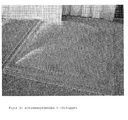
- the mold is mounted by means of a lifting cylinder and suckers on one side and filled with the approach under inclination of the mold. Due to the open mold design all variations of the pouring are possible. Mold making is a manual activity. Since there is no automation at this point, the construction is flexible. The type and shape of the product to be cast is limited only by the size of the glass plate.
- a PMMA sheet with fall-through protection from a PA net with a thread diameter of 0.9 mm and a mesh size of 5 mm from the company Sefar Nitex 06 was produced in accordance with Example 1. Thereafter, it was made as follows, a dome light of a thickness of 4 mm: The plate was heated by means of IR emitter on one side to 180 °, clamped in a tenter and inflated to a stitch height of 30cm. After cooling down, the dome was removed from the mold and prepared for impact according to EN 1873. (please refer FIG. 2 ).
- a break test according to the above-mentioned standard EN 1873 showed a very positive result. Even at a low temperature of - 20 ° C, the breakage was guaranteed.
Landscapes
- Engineering & Computer Science (AREA)
- Architecture (AREA)
- Civil Engineering (AREA)
- Structural Engineering (AREA)
- Compositions Of Macromolecular Compounds (AREA)
- Blow-Moulding Or Thermoforming Of Plastics Or The Like (AREA)
- Manufacture Of Macromolecular Shaped Articles (AREA)
- Extrusion Moulding Of Plastics Or The Like (AREA)
- Moulding By Coating Moulds (AREA)
- Vehicle Interior And Exterior Ornaments, Soundproofing, And Insulation (AREA)
- Casting Or Compression Moulding Of Plastics Or The Like (AREA)
Description
- Die Erfindung betrifft Formkörper die sich als leichte Bauelemente eignen und vorzugsweise lichtdurchlässig sind. Formteile dieser Gattung sind beispielsweise Lichtkuppeln oder Tonnengewölbe aus Acrylglasplatten. Sie werden vorzugsweise als lichtdurchlässiges Dachelement eingesetzt. In Österreich gibt es durchschnittlich 35 Unfälle pro Jahr, bei denen Dacharbeiter z.B. bei Reparatur von Klimaanlagen, Satellitenanlagen, Schneeräumungen, Wartungen etc., durch eine Lichtkuppel aus transparenten Kunststoffen stürzen und sich schwer verletzen. Zehn bis zwanzig Prozent dieser Unfälle enden tödlich! Auch in Deutschland sind jährlich wegen Durchsturzunfällen von Lichtkuppeln Todesopfer zu beklagen.
- XP 002 635 299 beschreibt eine Lichtkuppel mit einem Netz, das zwischen den Schalen der Lichtkuppel montiert ist.
-
DE 79 31 201 U1 beschreibt starre, einstückige Formkörper aus biaxial gerecktem, plattenförmigem Kunststoff von mindestens 1 mm Dicke, dessen Rand nicht in einer Ebene liegt. Diese Körper werden als Bedachungselemente verwendet. -
DE 93 16 382.7 U1 beschreibt eine flache Pyramidenkuppel aus Kunststoff, enthaltend eine Mehrzahl von gradlinig begrenzten ebenen Pyramidenflächen, die an leicht gerundeten Kantenflächen zusammenstoßen. -
US 4,223,493 beschreibt ein Bedachungselement aus einer Stegplatte und einer über der Stegplatte angeordneten massiven gewölbten Platte. Die massive gewölbte Platte und die Stegplatte werden durch Distanzstücke auf einen Abstand zwischen 10 mm bis 40 mm gebracht. - Alle zuvor genannten Formkörper werden zwar als Bedachungselemente eingesetzt erfordern jedoch zusätzliche Sicherungen um den heutigen Sicherheitsstandards gerecht zu werden. Zu diesen Sicherungsmaßnahmen gehören:
- vollflächige Gitterkonstruktion mit Baustahlgitter innerhalb des Aufsetzkranzes
- außenseitige vollflächige Abdeckung der Konstruktion durch Gitter oder gelochte Bleche
- Anschlageinrichtung mit Einzelanschlagpunkten bzw. horizontalen Führungen, wo am Dach befindliche Personen mittels Anseilen vor dem Absturz gesichert werden
- vollflächige Gitterkonstruktionen wie z. B. ein Gitterzaun rund um die Lichtkuppel.
- Die zuvor beschrieben Sicherheitseinrichtungen bei Dachverglasung bzw. Elementverglasungen mit Gefahrenpotential sind sehr aufwendig, teuer oder bieten unzureichende Sicherheit.
- Eine Möglichkeit auf zusätzliche Sicherungsmaßnahmen zu verzichten wurde durch die Entwicklung von Lichtkuppeln verwirklicht, welche mit einer Durchsturzsicherung ausgerüstet sind. Dazu wurde ein weitmaschiges Metallnetz, welches an einem Metallrahmen befestigt ist, verwendet (siehe
Figur 1 ). Dieses am Metallrahmen montierte Metallnetz wird zwischen der Außen- und der Innenschale befestigt und liegt lose zwischen den Schalen. Die Befestigung des Metallrahmens erfolgt über die Verschraubung der Lichtkuppeln mit dem Aufsatzkranz. Diese Art der Durchsturzsicherung wird z. B. von der Fa. Sadler in Österreich vertrieben. - Alls Nachteil der oben beschriebenen Durchsturzsicherung aus Metalldrähten ist zu bewerten, dass die bisher bekannten Verarbeitungsmethoden von Lichtkuppeln sich auf eine biaxiale Verformung beschränken. Der Gestaltungsspielraum der Planer und Architekten wird also stark eingeschränkt. Als weiterer Nachteil ist zu sehen, dass das Metallgitter in der Lichtkuppel deutlich sichtbar ist (siehe
Figur 1 ). - Am Beispiel - Metallnetz -, welches zwischen der Außen- und der Innenschale der Lichtkuppel eingebracht wird, wird zudem der große Mehraufwand sichtbar. So muss für jedes Dachelement eine entsprechende Metallnetzkonstruktion angefertigt werden. Ferner besteht immer das Risiko einer nicht einwandfreien Verarbeitung bzw. Montage.
- In der
EP 1 029 984 A1 werden Formkörper aus thermoplastischem Kunststoff beschrieben welche Kunststofffäden umfassen die in die Polymermatrix eingegossen sind. Diese Formkörper werden als Lärmschutzwände verwendet, wobei die Fäden der Vermeidung von Splitterbildung bei einem Aufprall dienen. Dies wird dadurch erreicht, dass die Bruchstücke an den Fäden hängen bleiben. In den Lärmschutzwänden werden gut sichtbare farbige Fäden verwendet um Vogelschlagprobleme zu vermeiden. Formkörper nach diesem Prinzip sind als Bedachungen ungeeignet, da sie viel zu schwer sind, einen deutlichen Schattenwurf erzeugen und auch den Sicherheitsanforderungen für Bedachungen nicht genügen. - In Anbetracht des oben diskutierten Standes' der Technik bestand daher die Aufgabe Formkörper bereitzustellen, welche zur Herstellung von Bedachungen oder Trennelementen in Gefahrenbereichen verwendet werden können und die die zuvor diskutierten Nachteile nicht oder nur in verringertem Maße aufweisen. Eine spezielle Aufgabe bestand darin Formkörper zu entwickeln, die ohne zusätzliche Sicherungsmaßnahmen den Sicherheitsanforderungen genügen. Eine weitere spezielle Aufgabe bestand darin Formkörper zu entwickeln, die ohne zusätzliche Sicherungsmaßnahmen den Sicherheitsanforderungen genügen und gleichzeitig leicht und einfach zu verarbeiten sind sowie einen reduzierten Schattenwurf im Vergleich zu den bekannten Formkörpern aufweisen.
- Die Lösung dieser Aufgabe wird durch die in Anspruch 1angegebenen Merkmale erhalten.
- Weitere nicht explizit genannte Aufgaben ergeben sich aus dem Gesamtzusammenhang der nachfolgenden Beispiele, Beschreibung und Ansprüche.
- Gelöst werden diese Aufgaben durch die in der nachfolgenden Beschreibung, den Beispielen und Ansprüchen näher definierten Formkörper.
- Die Erfinder haben überraschend herausgefunden, dass es möglich ist leichte Formkörper herzustellen, die den Sicherheitsanforderungen für Bedachungen genügen, indem eine geeignete reißfeste Anordnung, in einer speziellen Art und Weise, in eine dünne Polymermatrix eingearbeitet und somit ein durchsturzsicherer Formkörper hergestellt wird.
- Die Erfinder haben dabei gefunden, dass es notwendig ist, dass sich die erfindungsgemäß verwendete reißfeste Anordnung von der Polymermatrix in Richtung der Aufschlagenergie lösen kann und eine hinreichende Bewegungsfreiheit besitzt um eine auf den Formkörper einwirkende Schlagenergie entsprechend der EN 1873 zu absorbieren. Dies wird erfindungsgemäß dadurch erreicht, dass die reißfeste Anordnung Fäden und/oder Seile und/oder Bänder umfasst, welche entlang der längsten und zweitlängsten Seite des Formkörpers so angeordnet sind, dass sie ein Netz oder Gitter oder Gewebe ausbilden. Entlang der längsten und zweitlängsten Seite bedeutet nicht, dass die Fäden und/oder Seile und/oder Bänder parallel zu diesen Seiten angeordnet sein müssen. Auch diagonale oder sonstige Anordnungen sind möglich. Durch diese Formulierung soll lediglich die Ebene definiert werden in der die reißfeste Anordnung liegt.
- Erfindungsgemäß muss ferner sichergestellt werden, dass die Fäden und/oder Seile und/oder Bänder an möglichst wenigen der Kreuzungspunkte, bevorzugt an keinem Kreuzungspunkt, fest miteinander verbunden sind, d.h. dass sie so angeordnet sind, dass sie sich bei Krafteinwirkung auf den Formkörper gegeneinander bewegen können. Mit anderen Worten, die Fäden bzw. Seile bzw. Bänder dürfen nur an wenigen Kreuzungspunkten, bevorzugt gar nicht, miteinander verknotet oder verklebt oder anderweitig fest verbunden sein. Bevorzugt sind die Seile, Bänder oder Fäden nur an 50%, besonders bevorzugt an weniger als 25%, ganz besonders bevorzugt an weniger als 10%, speziell bevorzugt an weniger als 5% und ganz speziell bevorzugt an 0% der Kreuzungspunkte miteinander verbunden.
- Die erfindungsgemäß verwendete reißfeste Anordnung zeichnet sich somit bei entsprechender Krafteinwirkung auf den Formkörper durch eine hohe Bewegungsfreiheit in sich und in alle Dimensionen des Formkörpers aus und unterscheidet sich somit stark von z. B. fixen Netzen.
- Die erfindungsgemäßen Formkörper bieten eine breite Palette an Gestaltungsmöglichkeiten, da die reißfeste Anordnung neben dem bevorzugten Polyamid auch aus anderen Materialien wie PE, PP, Polyester etc. bestehen kann.
- Die erfindungsgemäßen Formkörper können sowohl als einfache Formen wie z. B. als Platte als auch in einer zwei- oder dreidimensional geformten Gestallt hergestellt werden. Es können somit auch aufwendig dreidimensional geformte Körper wie z. B. Lichtkuppeln hergestellt werden. In allen Fällen zeichnen sich die erfindungsgemäßen Formkörper dadurch aus, dass sie sehr leicht und durchsturzsicher sind. Dies ist bei dreidimensional geformten Körpern besonders erstaunlich, da es gelungen ist die Einflüsse des Formgebungsprozesses zu kompensieren.
- Unter einem zweidimensional geformten Körper werden im Rahmen der vorliegenden Erfindung Formkörper verstanden die man erhält in dem man einen plattenförmigen Formkörper um eine Achse gleichmäßig oder ungleichmäßig biegt und/oder knickt. Dabei sind auch mehrere Vor- und Rückbiegungen (z. B. Wellenform) und/oder Knicke um diese Achse möglich. Beispiele für zweidimensional geformte Formkörper finden sich in der
EP 1 029 984 A1 . Unter einem dreidimensional geformten Formkörper werden entsprechend Formkörper verstanden die man erhält in dem man einen plattenförmigen Formkörper um zwei Achsen gleichmäßig oder ungleichmäßig biegt und/oder knickt (z. B. Lichtkuppel). Dabei kann es selbstverständlich zu Streckungen und Stauchungen des Körpers. kommen. Für die Festlegung ob ein Körper im Sinne der vorliegenden Erfindung als zwei- oder dreidimensional geformt anzusehen ist, gilt jedoch o.g. Definition. - Die Vorteile der erfindungsgemäßen Formkörper, insbesondere der erfindungsgemäßen dreidimensional verformten Formkörper, lassen sich wie folgt zusammenfassen:
- Im Gegensatz zu Lichtkuppeln bei denen die Durchsturzsicherung aus Metalldrähten besteht, ist die Montage der erfindungsgemäßen Formkörper nicht auf eine biaxiale Montage beschränkten, sodass der Gestaltungsspielraum der Planer und Architekten stark erweitert wird.
- Das Problem, dass das Metallgitter in der Lichtkuppel des Standes der Technik deutlich sichtbar ist, sodass es durch die Schattenbildung des Gitters zu optischen Irritationen kommt, insbesondere bei darunter befindlichen Arbeitsplätzen, konnte minimiert werden.
- Im Stand der Technik muss die Sicherung des Metallrahmens sehr sorgfältig ausgeführt werden, z.B. Verschraubung mit dem Aufsatzkranz, da sonst keine entsprechende Sicherung vorhanden ist. Dies entfällt bei den erfindungsgemäßen Formteilen.
- Ein wesentlicher Nachteil der Lichtkuppeln des Standes der Technik ist die Splitterbildung nach dem Aufschlag des Prüfkörpers. Der Prüfkörper wird zwar durch die Metalldrähte gefangen und kann nicht durchfallen. Durch die gebrochenen spitzen und scharfen Teile der Lichtkuppel, kann es aber dennoch ohne Fangsicherung zu gefährlichen Verletzungen kommen. Auch dieses Problem wurde gelöst.
- Das Gewicht der erfindungsgemäßen Formkörper ist deutlich geringer als bei solchen mit Metallrahmen
- Der Herstellprozess bzw. Montageprozess der bisher verwendeten Metallnetze ist konstruktiv sehr viel aufwendiger und kostenintensiver
- Die erfindungsgemäßen Formteile bieten einen optimalen Schutz vor Verletzungsgefahr bei Durchsturz durch die gebrochenen Kuppelteile, verringern somit die Unfallgefahr und vermeiden Todesfälle
- Die erfindungsgemäßen Formkörper bieten fast uneingeschränkte Lichtdurchlässigkeit trotz Durchsturzsicherung
- Eine hohe Wirtschaftlichkeit und Kostenersparnis durch Vereinfachung des Herstellprozesses/Montageprozesses der Durchsturzsicherung bei Lichtkuppeln/Dachelementen/Elementverglasungen ist bei den erfindungsgemäßen Formkörpern gewährleistet
- Die erfindungsgemäßen Formteil stellen eine Gesamtlösung bei der Montage dar, d.h. es müssen keine zusätzlichen Arbeitsschritte für eine Durchsturzsicherung durchgeführt werden, da die entsprechende Fangsicherung in der Platte integriert ist
- Den bestehenden Normen durchsturzsicher nach EN 1873 der Klasse SB 450 und nach GS Bau 18 des Hauptverbandes der deutschen Berufsgenossenschaft wird entsprochen
- Die gesamte Sicherheitseinrichtung wird bei den erfindungsgemäßen Formkörpern als eine Einheit von einem Hersteller produziert
- Der Öffnungsmechanismus der Lichtkuppeln/Dachelemen-te/Elementverglasungen wird durch die Durchsturzsicherung nicht beeinträchtigt
- Reinigung und Wartung werden durch den Wegfall des zusätzliches Handlings eines Metallgitters erleichtert
- Bedingt durch den durch die Polymermatrix und der integrierten Fangsicherung entstandenen Verbund kommt es zu kaum einer Splitterung des Materials beim Bruch
- Die erfindungsgemäß verwendete Durchsturzsicherung lässt sich in alle Richtungen einfach verformen und bedingt daher kaum Einschränkungen in der Gestaltungsfreiheit
- Die erfindungsgemäßen Formkörper stellen sortenreine Lösungen dar. Durch den Wegfall einer Mischung aus Metall und Kunststoff sind sie umweltfreundlich und wieder verwertbar
- Sie bieten Individualität und ästhetisch ansprechende Anmutung sowie uneingeschränkte Designmöglichkeiten in Form, Ausführung und Farbe
- Die Widerstandsfähigkeit, Belastbarkeit und Langlebigkeit und ein Schutz über Jahre hinweg der durchsturzsicheren Acrylglasplatte in Bezug auf Freibewitterung und UV-Beständigkeit ist gewährleistet
- Die Einsetzbarkeit bei vielen anderen Sicherheitsvorrichtung neben Dachelementen ist gewährleistet
- Die erfindungsgemäßen Formkörper, bevorzugt eine Platte oder ein dreidimensional verformter Formkörper, insbesondere ein Dachelement, eine Lichtkuppel oder ein Tonnengewölbe, bestehen bevorzugt aus einem thermoplastischen Kunststoff, besonders bevorzugt aus Poly(meth)acrylat (PMMA) oder Polycarbonat (PC). Sie können transparent, nicht transparent, matt, glänzend oder farbig sein. Insbesondere bevorzugt handelt es sich um einen transparenten thermoplastischen Kunststoff. Die Kunststoffe können entsprechende dem Fachmann bekannte Zuschlagstoffe wie z. B. Schlagzähmodifier oder Füllstoffe aufweisen.
- Die reißfeste Anordnung aus Kunststoff umfasst Fäden und/oder Seile und/oder Bänder, welche wie oben beschrieben zweidinterisional über die Fläche des Formkörpers so angeordnet sind, dass sie ein Netz oder Gitter oder Gewebe ausbilden. Wie ebenfalls bereits erwähnt dürfen die Fäden und/oder Seile und/oder Bänder nur an einigen Kreuzungspunkten, bevorzugt an keinem Kreuzungspunkt, fest miteinander verbunden sein. Es hat sich weiterhin als besonders vorteilhaft erwiesen, wenn die reißfeste Anordnung zur Sicherstellung einer noch besseren Flexibilität und Dämpfungswirkung eine Reißdehnung (gemessen nach DIN EN ISO 13934) von 1 bis 60 %, besonders bevorzugt von 10 bis 60% und ganz besonders bevorzugt von 20 bis 50 % aufweist.
- Die erfindungsgemäß verwendeten Fäden bzw. Seile weisen einen Durchmesser von 0, 001 - 1,5 mm, bevorzugt 0,01 - 1,5 mm, besonders bevorzugt 0,1 bis 1,3 mm, ganz besonders bevorzugt 0,5 bis 1,2 mm und speziell bevorzugt 0,7 - 1,2 mm auf. Die sehr dünnen Fäden mit einem Durchmesser von weniger als 0,1 mm werden dabei zu Seilen mit einem entsprechenden Durchmesser verarbeitet. Dadurch kann u.a. der störende Schattenwurf bei Lichtdurchstrahlung optimiert und die Kosten gesenkt werden. Ferner war es überraschend, dass so geringe Durchmesser die Durchsturzsicherheit teilweise sogar noch verbessern.
- In einer ersten speziellen Ausführungsform der vorliegenden Erfindung handelt es sich bei der erfindungsgemäß verwendeten reißfesten Anordnung um eine Anordnung in der oben definierten Form aus Polyamid mit einer Reißdehnung (gemessen nach DIN EN ISO 13934) von 10 bis 60%, bevorzugt von 20 bis 50 %. Beispiele hierfür sind Netze der Firma SEFAR (z.B. NITEX 06), Netze der Firma LECO WERKE (z.B. Artikel Nr. 02/09000000/000/103), Fäden der Firma Filkemp (Produkt PA, Typ KJ2S, Aufmachung MEADA 6000M)) oder der Firma Monofil - Technik GmbH oder der Forma Perlon Monofil GmbH.
- In einer zweiten speziellen Ausführungsform handelt es sich bei der erfindungsgemäß verwendeten reißfesten Anordnung um eine Anordnung in der oben definierten Form aus Polypopylen (PP) mit einer Reißdehnung (gemessen nach DIN EN ISO 13934) von 10 bis 60%, bevorzugt von 20 bis 50 %. Beispiele hierfür sind Netze der Firma SEFAR (z.B. PROPYLTEX 05), Netze der Firma LECO WERKE aus PP, Fäden entsprechender Hersteller.
- In einer dritten speziellen Ausführungsform handelt es sich bei der erfindungsgemäß verwendeten reißfesten Anordnung um eine Anordnung in der oben definierten Form aus Polyethylen (PE) mit einer Reißdehnung (gemessen nach DIN EN ISO 13934) von 1 bis 50%, bevorzugt von 10 bis 40 %. Beispiele hierfür sind Netze der Firma LECO WERKE aus PE.
- In einer vierten speziellen Ausführungsform handelt es sich bei der erfindungsgemäß verwendeten reißfesten Anordnung um eine Anordnung in der oben definierten Form aus Polyestern mit einer Reißdehnung (gemessen nach DIN EN ISO 13934) von 10 bis 60%, bevorzugt von 20 bis 50 %. Beispiele hierfür sind Netz Schlingen Firma Schilgen (z.B. Monofil 161800).
- Wie bereits erläutert umfasst die reißfeste Anordnung Fäden und/oder Seile und / oder Bänder. Bei Seilen handelt es sich erfindungsgemäß um Erzeugnisse, welche aus Fäden nach bekannten Verfahren zu Seilen verarbeitet wurden. Bei Bändern handelt es sich z. B. um Extrudate aus den o.g. Kunststoffen welche keine runde Form aufweisen.
- Wie ebenfalls bereits angedeutet sind die Fäden und/oder Seile und/oder Bänder erfindungsgemäß zweidimensional über die Fläche des Formkörpers so angeordnet, dass sie ein Netz oder Gitter oder Gewebe ausbilden, wobei sie nur an einem Teil der Kreuzungspunkte, bevorzugt an keinem Kreuzungspunkt, fest miteinander verbunden sind.
- Dies kann z. B. dadurch erreicht werden, dass erfindungsgemäße Fäden und/oder Seile und/oder Bänder so aufgespannt werden, dass sie ein Gitter bilden welches anschließend von der Polymermatrix umhüllt wird. Es ist aber auch möglich die Fäden und/oder Seile und/oder Bänder nach bekannten Verfahren zu einem entsprechend grobmaschigen Gewebe zu verarbeiten und anschließend in die Polymermatrix einzubetten.
- Im Falle von Netzen ist darauf zu achten, dass es sich nicht um Netze handelt die an den Kreuzungspunkten verklebt oder verknotet sind, sondern, dass es sich z. B. um schlingenförmige Netze handelt, bei denen sich die einzelnen Fäden an den Kreuzungspunkten gegeneinander bewegen können.
- Die Fäden und/oder Seile und/oder Bänder müssen so angeordnet sein, dass ihr Abstand jeweils 1 bis 25 mm, bevorzugt 2 bis 15 mm und besonders bevorzugt 5 bis 15 mm beträgt. Dabei müssen keine quadratischen Maschen entstehen. Rechteckige oder anderweitig geformte Maschen sind ebenfalls möglich. Die Abstände in den jeweiligen Achsen können variieren und auch die Abstände entlang einer Achse können variieren. Dies.ermöglicht entsprechend vielfältige Gestaltungsspielräume. Die engen Abstände tragen wesentlich zur Einhaltung der Sicherheitsanforderungen bei.. Die Maschenweiten bzw. Fadenabstände können entsprechen der Größe und den Anforderungen des Formkörpers angepasst werden.
- Die Einbringung der reißfesten Anordnung in die Polymermatrix erfolgt bevorzugt derart, dass zunächst ein Formkörper in Form einer Polymerplatte mit eingebetteter reisfester Anordnung hergestellt wird. Dieser Formkörper kann anschließend zu Formkörpern mit komplexer Gestalt verformt werden. In einem bevorzugten Verfahren wird dabei der Formkörper mit entsprechenden Heizgeräten wie z.B. einem IR - Strahler, Umluftofen, oder entsprechenden Heiztischen auf eine Temperatur von bevorzugt 160 - 200°C gebracht. Der so erwärmte Formkörper wird danach bevorzugt durch Blasformen oder durch einen Vakuumtiefziehprozess in die gewünschte zwei- oder dreidimensionale Form gebracht. Danach wird der Formkörper abgekühlt und aus der Form genommen. Die Heizquellen, insbesondere die IR - Strahler können einseitig oder zweiseitig verwendet werden. Andere dem Fachmann bekannte Verformungsverfahren können natürlich auch eingesetzt werden.
- Die Polymerplatte wird bevorzugt nach einem Gießverfahren hergestellt.
- Die erfindungsgemäßen Formkörper sind eher dünnwandig und somit leicht und kostengünstig. Sie weisen daher bevorzugt eine Dicke an der dicksten Stelle von 1 bis 15 mm, besonders bevorzugt 2 bis 12 und ganz besonders bevorzugt 3 bis 10 mm auf.
- Um die Sicherheitseigenschaften noch weiter zu verbessern weisen die erfindungsgemäßen Formkörper bevorzugt ein Verhältnis aus Dicke des Formkörpers an der dicksten Stelle zu Durchmesser der Fäden/Seile bzw. Dicke der Bänder im Bereich von 20 zu 1 bis 5 zu 1, bevorzugt 15 zu 1 bis 5 zu 1 liegt.
- Weiterhin ist es mit den erfindungsgemäßen Formkörpern erstmals gelungen durchsturzsichere, dreidimensional verformte Körper mit einem engen Radius bei gleichzeitig geringer Dicke herzustellen. Das Verhältnis aus Stichhöhe zur Dicke des Formkörpers liegt an der dicksten Stelle im Bereich von 150 zu 1, bevorzugt 100 zu 1, besonders bevorzugt 75 zu 1.
- Eine besonders bevorzugte Gruppe von Monomeren stellen (Meth)acrylate dar. Der Ausdruck (Meth)acrylate umfasst Methacrylate und Acrylate sowie Mischungen aus beiden. Diese Monomere sind weithin bekannt. Zu diesen gehören unter anderem (Meth)acrylate, die sich von gesättigten Alkoholen ableiten, wie beispielsweise Methyl(meth)acrylat, Ethyl(meth)acrylat, Propyl(meth)acrylat, Isopropyl(meth)acrylat, n-Butyl(meth)acrylat, tert.-Butyl(meth)acrylat, Butoxymethyl(meth)acrylat, Pentyl (meth) acrylat, Hexyl(meth)acrylat, Heptyl(meth)acrylat, Octyl(meth)acrylat, Isooctyl(meth)acrylat, Isodecyl (meth)acrylat, Tetrahydrofurfuryl(meth)acrylat, Cyclohexyl(meth)acrylat und 2-Ethylhexyl(meth)acrylat; (Meth)acrylate, die sich von ungesättigten Alkoholen ableiten, wie beispielsweise Oleyl(meth)acrylat, 2-Propinyl(meth)acrylat, Allyl(meth)acrylat, Vinyl(meth)acrylat; Aryl(meth)acrylate, wie beispielsweise Benzyl(meth)acrylat oder Phenyl(meth)acrylat, wobei die Arylreste jeweils unsubstituiert oder bis zu vierfach substituiert sein können; Cycloalkyl(meth)acrylate, wie beispielsweise 3-Vinylcyclohexyl(meth)acrylat, Bornyl(meth)acrylat; Isobornyl(meth)acrylat, Hydroxylalkyl(meth)acrylate, wie beispielsweise 3-Hydroxypropyl(meth)acrylat, 3,4-Dihydroxybutyl(meth)acrylat, 2-Hydroxyethyl (meth)acrylat, 2-Hydroxypropyl(meth)acrylat; Glycoldi(meth)acrylate, wie beispielsweise 1,4-Butandiol(meth)acrylat, (Meth)acrylate von Etheralkoholen, wie beispielsweise Tetrahydrofurfuryl (meth) acrylat, Vinyloxyethoxyethyl(meth)acrylat; Amide und Nitrile der (Meth)acrylsäure, wie beispielsweise N-(3-Dimethylaminopropyl)(meth)acrylamid, N- (Diethylphosphono)(meth)acrylamid, 1-Methacryloylamido-2-methyl-2-propanol; schwefelhaltige Methacrylate, wie beispielsweise Ethylsulfinylethyl(meth)acrylat, 4-Thiocyanatobutyl(meth)acrylat, Ethylsulfonylethyl(meth)acrylat, Thiocyanatomethyl(meth)acrylat, Methylsulfinylmethyl(meth)acrylat, Bis((meth)acryloyloxyethyl)sulfid; mehrwertige (Meth)acrylate, wie beispielsweise Trimethyloylpropantri(meth)acrylat. Diese Monomere können einzeln oder als Mischung verwendet werden. Hierbei sind Mischungen besonders bevorzugt, die Methacrylate und Acrylsäureester enthalten.
- Weitere besonders bevorzugte Monomere sind die Polycarbonate. Polycarbonate sind in der Fachwelt bekannt. Polycarbonate können formal als Polyester aus Kohlensäure und aliphatischen oder aromatischen Dihydroxy-Verbindungen betrachtet werden. Sie sind leicht zugänglich durch Umsetzung von Diglykolen oder Bisphenolen mit Phosgen bzw. Kohlensäurediestern durch Polykondensations- bzw. Umesterungsreaktionen.
- Hierbei sind Polycarbonate bevorzugt, die sich von Bisphenolen ableiten. Zu diesen Bisphenolen gehören insbesondere 2,2-Bis-(4-hydroxyphenyl)-propan (Bisphenol A), 2,2-Bis-(4-hydroxyphenyl)-butan (Bisphenol B), 1,1-Bis(4-hydroxyphenyl)cyclohexan (Bisphenol C), 2,2'-Methylendiphenol (Bisphenol F), 2,2-Bis(3,5-dibrom-4-hydroxyphenyl)propan (Tetrabrombisphenol A) und 2,2-Bis(3,5-dimethyl-4-hydroxyphenyl)propan (Tetramethylbisphenol A).
- Üblich werden derartige aromatische Polycarbonate durch Grenzflächenpolykondensation oder Umesterung hergestellt, wobei Einzelheiten in Encycl. Polym. Sci. Engng. 11, 648-718 oder in Ullmann's Encyclopedia of Industrial Chemistry, 7. Auflage (2009), Artikel "Polycarbonates" dargestellt sind.
- Bei der Grenzflächenpolykondensation werden die Bisphenole als wässrige, alkalische Lösung in inerten organischen Lösungsmitteln, wie beispielsweise Methylenchlorid, Chlorbenzol oder Tetrahydrofuran, emulgiert und in einer Stufenreaktion mit Phosgen umgesetzt. Als Katalysatoren gelangen Amine, bei sterisch gehinderten Bisphenolen auch Phasentransferkatalysatoren zum Einsatz. Die resultierenden Polymere sind in den verwendeten organischen Lösungsmitteln löslich.
- Über die Wahl der Bisphenole können die Eigenschaften der Polymere breit variiert werden. Bei gleichzeitigem Einsatz unterschiedlicher Bisphenole lassen sich in Mehrstufen-Polykondensationen auch Block-Polymere aufbauen.
- Die Polycarbonate werden beispielsweise von Bayer MaterialScience unter der Marke MAKROLON® oder von Sabic unter der Marke LEXAN® vertrieben.
- Die Polycarbonate stellen eine amorphe thermoplastische Formmasse d.ar und lassen sich mit allen für Thermoplaste üblichen Verfahren verarbeiten, wie beispielsweise Spritzguß oder Extrusion. Die Verarbeitungstemperaturen betragen beim Spritzguß ca. 280 Grad Celsius bis 320 Grad Celsius und bei der Extrusion zwischen ca. 240 Grad Celsius und 280 Grad Celsius. Vor der Verarbeitung der Formmasse muss die Restfeuchte der Formmasse durch Trocknung auf unter 0,01 Gew.-% gebracht werden.
- Die erfindungsgemäßen Formkörper können wie bereits angedeutet hergestellt werden, in dem die reißfeste Anordnung aus Kunststoff in den Kunststoff des Matrixmaterials eingegossen wird.
- Vorzugsweise wird die reißfeste Anordnung in einen Bereich definiert durch die Mitte ± 50 %, bevorzugt ± 25 %, besonders bevorzugt ± 10 %, ganz besonders bevorzugt ± 5 %, bezogen auf die Dicke des Formkörpers am jeweiligen Messpunkt, eingelegt.
- In einer alternativen Ausführungsform wird die reißfeste Anordnung 1 mm unter der äußeren Oberfläche des erfindungsgemäßen Formkörpers eingelegt.
- Um die richtige Position der reißfesten Anordnung aus Kunststoff gewährleisten zu können, können Distanzhalter bevorzugt mit einer Toleranz +/- 0,1 mm hergestellt und. eingebaut werden.
- Die erfindungsgemäßen Formkörper weisen den speziellen Vorteil auf, dass die zwei bzw. dreidimensionale Verformung mit bereits eingegossener, reißfester Anordnung möglich ist und gleichzeitig die Durchsturzsicherheit gewährleistet werden kann.
- Bei den erfindungsgemäßen Formkörpern handelt es sich bevorzugt um Dachelemente, besonders bevorzugt um Lichtkuppeln. Die erfindungsgemäßen Formkörper können aber auch als Trennelemente in Gefahrenbereichen wie z. B. als Balkonverkleidung, Geländerverkleidung (auch beleuchtet),Skilift Absturzsicherung, Fassadenplatten mit Netz, Überdachungselemente, Trennwände für Autobusse, Traktorenverglasung, Maschinenschutz, allgemein Schwimmbadabdeckung, Verkleiden von Notrufsäulen auf Autobahnen, Baustellensicherung, Stadion Sicherheitsabsperrungen, Welldächer, Sichere Dachverglasung, Carports, Kabinenverglasung, Schiffssicherheitsverglasung, Laufbrücken, Sicherheitskabinen für Fensterputzer, Arbeitsmaschinenverglasung, Robotermanipulationszellen eingesetzt werden.
- Die Durchsturzsicherheit wird geprüft entsprechend der Norm EN 1873 6.4.2.2.1. Diese Prüfung dient der Beurteilung des Verhaltens eines Formkörpers in einer Laborumgebung, bei einem Aufschlag durch einen sphärokonischen 50 kg schweren Sack der aus einer vorgegebenen Höhe von 60 cm - 240cm fällt. Eine kugelförmige Prüflehre mit einem Durchmesser von > 300 mm darf durch keine, durch den Aufschlag entstandene Öffnung, durchfallen. Es darf somit beim Test kein Loch mit einem Durchmesser von > 300 mm in der Lichtkuppel entstehen.
- Die nachfolgenden Beispiele dienen zum besseren Verständnis der vorliegenden Erfindung, schränken diese aber in keiner Weise ein.
- Im Wasserbadverfahren wird gegossenes Acrylglas hergestellt. Der Guss erfolgt dabei zwischen 2 Formglasplatten. Zunächst wird die Form mittels einer Dichtschnur aus PVC (oder ähnlichem) abgedichtet und durch Klammern fixiert. In diese Form wird danach ein Vorpolymerisat oder MMA (Ansatz) gefüllt. Der Ansatz kann übliche Zusätze für die Polymerisation beinhalten. Die Polymerisation erfolgt in einem Wasserbecken oder in einem Umluftofen. Bei der Polymerisation im Wasserbad wird der Prozess in einem Ofen zur Postpolymerisation abgeschlossen. Im Umluftofen erfolgt der gesamte Vorgang über einen gesteuerten Vorgang.
- Die Dichtschnur wird auf die untere Glasplatte aufgebracht. Danach wird das Netz für die Durchsturzsicherung auf die Glasplatte gelegt und so fixiert, dass es die gewünschte Position in der fertigen Platte einnimmt. Die obere Glasplatte wird auf die untere Glasplatte positioniert und die Form mit Klammern verschlossen.
- Die Dichtschnur wird auf die untere Glasplatte aufgebracht. Danach werden die Polyamidfäden, welche zuvor auf Leisten in genau definierten Abstand angebracht wurden, mittels der Leisten über die Glasplatte gespannt und an der Glaskante fixiert. Die Form wird mit der oberen Glasplatte geschlossen und mit Pressstempel fixiert. Die Polyamidfäden werden an der Glaskante von den Leisten geschnitten und die Leisten von den Glasplatten gezogen. Die Form wird mit Klammern fixiert.
- Die Form wird mittels eines Hubzylinders und Saugern an einer Seite aufgezogen und mit dem Ansatz unter Schrägstellung der Form befüllt. Durch den offenen Formenbau sind alle Variationen des Eingießens möglich. Der Formenbau ist eine manuelle Tätigkeit. Da an diesem Punkt keine Automatisierung vorhanden ist, gestaltet sich der Bau flexibel. Die Art und Form des zu gießenden Produktes ist nur durch die Größe der Glasplatte limitiert.
- Eine PMMA-Platte mit Durchsturzsicherung aus einem PA-Netz mit einem Fadendurchmesser von 0,9 mm und einer Maschenweite von 5 mm der Fa.Sefar Nitex 06 wurde entsprechend Beispiel 1 hergestellt. Danach wurde daraus wie folgt eine Lichtkuppel einer Stärke von 4 mm gefertigt: Die Platte wurde mittels IR -Strahler einseitig auf 180° erwärmt, in einem Spannrahmen eingeklemmt und auf eine Stichhöhe von 30cm aufgeblasen. Nach dem Erkalten der Kuppel wurde diese aus der Form genommen und für die Stoßbeanspruchung entsprechend der EN 1873 vorbereitet. (siehe
Figur 2 ). - Ein Bruchversuch entsprechend der oben genannten Norm EN 1873 zeigte ein überaus positives Resultat. Auch bei einer Tieftemperatur von - 20°C war die Bruchsicherheit gewährleistet.
- Es wurde dabei die Lichtkuppel mit 3 Fallversuchen aus verschiedenen Höhen 0,6m 1,2m und 1,5m belastet.
- Obwohl die Kuppel bereits beim ersten Fallversuch gebrochen war, konnten auch die nachfolgenden Fallversuche die Kuppel nicht durchschlagen (siehe
Figur 3 ).
Claims (14)
- Formkörper, wobei
es sich um eine Platte oder um einen dreidimensional verformten Formkörper aus einem thermoplastischen Kunststoff handelt,
wobei- er eine Dicke von 1 bis 15 mm aufweist,- er durchsturzsicher ausgestaltet ist d.h. dadurch gekennzeichnet, dass er den Vorgaben der Norm EN 1873, 6.4.2.2.1, entspricht,- er eine reißfeste Anordnung aus Kunststoff aufweist, welche in eine Matrix aus einem thermoplastischen Kunststoff eingearbeitet ist, wobei■ die reißfeste Anordnung Fäden und/oder Seile und/oder Bänder umfasst, welche zweidimensional entlang der längsten und der zweitlängsten Seite des Formkörpers so angeordnet sind, dass sie ein Netz oder Gitter oder Gewebe ausbilden,■ der Abstand der Fäden und/oder Seile und/oder Bänder jeweils 1 bis 25 mm beträgt■ der Durchmesser der Fäden / Seile bzw. die Dicke der Bänder 0,1 bis 1,5 mm beträgt■ die Fäden und/oder Seile und/oder Bänder nur an einem Teil der Kreuzungspunkte, bevorzugt an keinem Kreuzungspunkt, fest miteinander verbunden sind, d.h. so angeordnet sind, dass sie sich bei Krafteinwirkung auf den Formkörper gegeneinander bewegen können. - Formkörper nach Anspruch 1,
dadurch gekennzeichnet,
dass es sich um eine transparente oder nicht transparente, farbige oder nicht farbige Platte handelt. - Formkörper nach Anspruch 1,
dadurch gekennzeichnet,
dass es sich um ein einen eine transparenten oder nicht transparenten, farbigen oder nicht farbigen zwei oder dreidimensional verformten Formkörper handelt. - Formkörper nach Anspruch 3,
dadurch gekennzeichnet,
dass das Verhältnis aus Stichhöhe zur Dicke des Formkörpers an der dicksten Stelle im Bereich von 150 zu 1, bevorzugt 100 zu 1, besonders bevorzugt 75 zu 1 liegt. - Formkörper nach einem der Ansprüche 3 oder 4,
dadurch gekennzeichnet,
dass es sich um ein Dachelement, bevorzugt um eine Lichtkuppel oder Tonnengewölbe handelt. - Formkörper nach einem der Ansprüche 1 bis 5,
dadurch gekennzeichnet,
dass die reißfeste Anordnung aus Polyamid, PP, PE oder Polyester besteht. - Formkörper nach einem der Ansprüche 1 bis 6,
dadurch gekennzeichnet,
dass das Verhältnis aus Dicke des Formkörpers an der dicksten Stelle zu Durchmesser der Fäden/Seile im Bereich von 20 zu 1 bis 5 zu 1, bevorzugt 15 zu 1 bis 5 zu 1 liegt. - Formkörper nach Anspruch 1 bis 7,
dadurch gekennzeichnet,
dass die reißfeste Anordnung eine Reißdehnung (gemessen nach DIN EN ISO 13934) von 1 bis 60 %, besonders bevorzugt von 10 bis 60% und ganz besonders bevorzugt von 20 bis 50 % aufweist. - Formkörper nach einem der Ansprüche 1 bis 8,
dadurch gekennzeichnet,
dass es sich bei dem thermoplastischen Kunststoff um ein (Meth)acrylat oder ein Polycarbonat handelt. - Verfahren zur Herstellung eines Formkörpers nach einem der Ansprüche 1 bis 9,
dadurch gekennzeichnet,
dass die reißfeste Anordnung in den thermoplastischen Kunststoff eingegossen und somit eine Platte oder ein 2-oder 3-dimensional geformter Körper erhalten wird. - Verfahren nach Anspruch 10,
dadurch gekennzeichnet,
dass ein zweidimensional oder dreidimensional geformter Körper aus einer Platte mit bereits eingegossener reißfester Anordnung hergestellt wird. - Verfahren nach Anspruch 11,
dadurch gekennzeichnet,
dass die Platte auf eine Temperatur von bevorzugt 160-200°C erhitz, danach durch Blasformen oder durch einen Vakuumtiefziehprozess in die gewünschte zwei- oder dreidimensionale Form gebracht, anschließend abgekühlt und aus der Form genommen wird. - Verfahren nach einem der Ansprüche 10 bis 12,
dadurch gekennzeichnet,
dass die Position der reißfesten Anordnung mittels Abstandshaltern festgelegt wird. - Verwendung eines Formköpers nach einem der Ansprüche 1 bis 9 als Balkonverkleidung, Geländerverkleidung (auch beleuchtet),Skilift Absturzsicherung, Fassadenplatten mit Netz, Überdachungselemente, Trennwände für Autobusse, Traktorenverglasung, Maschinenschutz, allgemein Schwimmbadabdeckung, Verkleiden von Notrufsäulen auf Autobahnen, Baustellensicherung, Stadion Sicherheitsabsperrungen, Welldächer, Sichere Dachverglasung, Carports, Kabinenverglasung, Schiffssicherheitsverglasung, Laufbrücken, Sicherheitskabinen für Fensterputzer, Arbeitsmaschinenverglasung, Robotermanipulationszellen.
Applications Claiming Priority (3)
| Application Number | Priority Date | Filing Date | Title |
|---|---|---|---|
| DE102010010312 | 2010-03-04 | ||
| DE102010028317A DE102010028317A1 (de) | 2010-03-04 | 2010-04-28 | Durchsturzsichere Formkörper |
| PCT/EP2011/051648 WO2011107315A1 (de) | 2010-03-04 | 2011-02-04 | Metallnetzverstärkter lichtkuppelförmiger formkörper |
Publications (2)
| Publication Number | Publication Date |
|---|---|
| EP2542737A1 EP2542737A1 (de) | 2013-01-09 |
| EP2542737B1 true EP2542737B1 (de) | 2014-08-20 |
Family
ID=44503060
Family Applications (1)
| Application Number | Title | Priority Date | Filing Date |
|---|---|---|---|
| EP11703198.9A Not-in-force EP2542737B1 (de) | 2010-03-04 | 2011-02-04 | Verstärkte lichtkuppel |
Country Status (13)
| Country | Link |
|---|---|
| US (1) | US20120321858A1 (de) |
| EP (1) | EP2542737B1 (de) |
| JP (1) | JP2013521152A (de) |
| KR (1) | KR20130048195A (de) |
| CN (1) | CN102906355A (de) |
| AU (1) | AU2011223158A1 (de) |
| BR (1) | BR112012021966A2 (de) |
| CA (1) | CA2791333A1 (de) |
| DE (1) | DE102010028317A1 (de) |
| MX (1) | MX2012010067A (de) |
| RU (1) | RU2012142113A (de) |
| WO (1) | WO2011107315A1 (de) |
| ZA (1) | ZA201207415B (de) |
Families Citing this family (3)
| Publication number | Priority date | Publication date | Assignee | Title |
|---|---|---|---|---|
| DE102013103731A1 (de) * | 2013-04-15 | 2014-10-30 | Jörg Kaiser | Ruhe- und Entspannungsraum |
| BE1023600B1 (fr) * | 2015-10-30 | 2017-05-12 | Metal Quartz Sa | Paroi et cloison pour enceinte securisee |
| US12065847B1 (en) * | 2022-04-26 | 2024-08-20 | Vada, Llc | Skylight leak repair |
Family Cites Families (13)
| Publication number | Priority date | Publication date | Assignee | Title |
|---|---|---|---|---|
| CH393700A (de) * | 1960-01-02 | 1965-06-15 | Kuball Geb | Oberlicht für Gebäuderäume |
| DE2746495A1 (de) | 1977-10-15 | 1979-04-26 | Roehm Gmbh | Mehrschalige lichtkuppel |
| DE7931201U1 (de) | 1979-11-05 | 1980-03-13 | Roehm Gmbh, 6100 Darmstadt | Starrer, einstueckiger, biaxial gereckter kunststofformkoerper |
| DE2948017A1 (de) | 1979-11-29 | 1981-06-04 | Wilh. Frank Gmbh, 7022 Leinfelden-Echterdingen | Verfahren zur herstellung von mehrscheiben-isolierglas |
| CN1013957B (zh) * | 1987-02-20 | 1991-09-18 | 詹姆斯·阿瑟·艾伯特·希克曼 | 耐火安全玻璃 |
| US5219630A (en) * | 1987-02-20 | 1993-06-15 | Miller Construction Limited | Fire resistant safety glass |
| CN1023868C (zh) * | 1991-08-07 | 1994-02-23 | 慈溪市彭桥玻纤制品厂 | 增强型玻纤涂塑胶粘带及制造方法 |
| US5425977A (en) * | 1993-08-16 | 1995-06-20 | Monsanto Company | Rough-surfaced interlayer |
| DE9316382U1 (de) | 1993-10-27 | 1993-12-09 | Röhm GmbH & Co. KG, 64293 Darmstadt | Flache Pyramidenkuppel aus Kunststoff |
| DE19539214A1 (de) * | 1995-10-21 | 1997-04-24 | Degussa | Brandsicheres, transparentes Scheibenelement und dessen Verwendung |
| DE19906989A1 (de) | 1999-02-19 | 2000-09-14 | Roehm Gmbh | Lärmschutzwandsegment |
| GB0008617D0 (en) * | 2000-04-10 | 2000-05-31 | Southfields Fabric Sys Ltd | Reinforced glass panel |
| FR2846345B1 (fr) * | 2002-10-29 | 2004-12-10 | Chomarat Composites | Ruban de renforcement comportant une nappe de fils longitudinaux de haute tenacite |
-
2010
- 2010-04-28 DE DE102010028317A patent/DE102010028317A1/de not_active Withdrawn
-
2011
- 2011-02-04 MX MX2012010067A patent/MX2012010067A/es not_active Application Discontinuation
- 2011-02-04 US US13/580,065 patent/US20120321858A1/en not_active Abandoned
- 2011-02-04 JP JP2012555344A patent/JP2013521152A/ja not_active Withdrawn
- 2011-02-04 WO PCT/EP2011/051648 patent/WO2011107315A1/de not_active Ceased
- 2011-02-04 CA CA2791333A patent/CA2791333A1/en not_active Abandoned
- 2011-02-04 BR BR112012021966A patent/BR112012021966A2/pt not_active Application Discontinuation
- 2011-02-04 EP EP11703198.9A patent/EP2542737B1/de not_active Not-in-force
- 2011-02-04 KR KR1020127022999A patent/KR20130048195A/ko not_active Withdrawn
- 2011-02-04 AU AU2011223158A patent/AU2011223158A1/en not_active Abandoned
- 2011-02-04 CN CN2011800104700A patent/CN102906355A/zh active Pending
- 2011-02-04 RU RU2012142113/03A patent/RU2012142113A/ru not_active Application Discontinuation
-
2012
- 2012-10-03 ZA ZA2012/07415A patent/ZA201207415B/en unknown
Also Published As
| Publication number | Publication date |
|---|---|
| RU2012142113A (ru) | 2014-04-10 |
| CN102906355A (zh) | 2013-01-30 |
| EP2542737A1 (de) | 2013-01-09 |
| US20120321858A1 (en) | 2012-12-20 |
| DE102010028317A1 (de) | 2011-09-08 |
| WO2011107315A1 (de) | 2011-09-09 |
| MX2012010067A (es) | 2012-09-12 |
| KR20130048195A (ko) | 2013-05-09 |
| JP2013521152A (ja) | 2013-06-10 |
| CA2791333A1 (en) | 2011-09-09 |
| AU2011223158A1 (en) | 2012-08-02 |
| ZA201207415B (en) | 2013-06-26 |
| BR112012021966A2 (pt) | 2016-06-07 |
Similar Documents
| Publication | Publication Date | Title |
|---|---|---|
| EP1029984B1 (de) | Lärmschutzwandsegment | |
| EP0407852B1 (de) | Als Lärmschutzelemente geeignete Platten aus Acrylglas | |
| US6194051B1 (en) | Composite structural components for outdoor use | |
| US7846535B2 (en) | Edge stiffened polymeric corrugated sheet material | |
| DE2901372B2 (de) | Vorgefertigte, als Verbundkörper ausgebildete Platten und Verfahren zu ihrer Herstellung | |
| EP2619370B1 (de) | Verstärkte acrylglasplatten | |
| DE102010028317A1 (de) | Durchsturzsichere Formkörper | |
| WO2013053768A1 (de) | Befestigungskonstruktion für lichtpanel | |
| WO2018002132A1 (de) | Aufzuganlage, insbesondere in form eines kletterliftsystems, mit speziell ausgebildetem schutzdach | |
| DE202024101479U1 (de) | Abdeckplatte zur Abdeckung von Arbeitsbereichen | |
| WO2003060238A1 (de) | Lärmdämmendes rückhaltesystem | |
| EP2322726B1 (de) | Noppenelement | |
| EP1485250B1 (de) | Larmschutzplatte aus acrylglas | |
| HK1181095A (en) | Moulded body which is reinforced by a metal mesh and is in the form of a domelight | |
| AU2012100748A4 (en) | Warning fence for road safety | |
| AT507677B1 (de) | Belichtungselement, insbesondere lichtkuppel | |
| CN206245768U (zh) | 高强塑网窗 | |
| US20250116133A1 (en) | Fence post | |
| KR200354096Y1 (ko) | 폴리카보네이트를 이용한 건축물 방호벽용 방호시트 | |
| KR100544903B1 (ko) | 폴리카보네이트를 이용한 건축물 방호벽용 방호시트 | |
| GB2622766A (en) | Crash fence assembly | |
| WO2026064430A1 (en) | Sustainable crash cushions | |
| DE202004005091U1 (de) | Schutzeinrichtung für Gebäudeteile und -einbauteile | |
| DE3016607A1 (de) | Raeumliches licht-element | |
| HK1187658B (en) | Reinforced acrylic glass panels |
Legal Events
| Date | Code | Title | Description |
|---|---|---|---|
| PUAI | Public reference made under article 153(3) epc to a published international application that has entered the european phase |
Free format text: ORIGINAL CODE: 0009012 |
|
| 17P | Request for examination filed |
Effective date: 20120903 |
|
| AK | Designated contracting states |
Kind code of ref document: A1 Designated state(s): AL AT BE BG CH CY CZ DE DK EE ES FI FR GB GR HR HU IE IS IT LI LT LU LV MC MK MT NL NO PL PT RO RS SE SI SK SM TR |
|
| DAX | Request for extension of the european patent (deleted) | ||
| GRAP | Despatch of communication of intention to grant a patent |
Free format text: ORIGINAL CODE: EPIDOSNIGR1 |
|
| INTG | Intention to grant announced |
Effective date: 20140310 |
|
| GRAS | Grant fee paid |
Free format text: ORIGINAL CODE: EPIDOSNIGR3 |
|
| GRAA | (expected) grant |
Free format text: ORIGINAL CODE: 0009210 |
|
| AK | Designated contracting states |
Kind code of ref document: B1 Designated state(s): AL AT BE BG CH CY CZ DE DK EE ES FI FR GB GR HR HU IE IS IT LI LT LU LV MC MK MT NL NO PL PT RO RS SE SI SK SM TR |
|
| REG | Reference to a national code |
Ref country code: GB Ref legal event code: FG4D Free format text: NOT ENGLISH |
|
| REG | Reference to a national code |
Ref country code: CH Ref legal event code: EP |
|
| REG | Reference to a national code |
Ref country code: AT Ref legal event code: REF Ref document number: 683565 Country of ref document: AT Kind code of ref document: T Effective date: 20140915 |
|
| REG | Reference to a national code |
Ref country code: IE Ref legal event code: FG4D Free format text: LANGUAGE OF EP DOCUMENT: GERMAN |
|
| REG | Reference to a national code |
Ref country code: DE Ref legal event code: R096 Ref document number: 502011004101 Country of ref document: DE Effective date: 20141002 |
|
| REG | Reference to a national code |
Ref country code: NL Ref legal event code: T3 |
|
| REG | Reference to a national code |
Ref country code: LT Ref legal event code: MG4D |
|
| PG25 | Lapsed in a contracting state [announced via postgrant information from national office to epo] |
Ref country code: FI Free format text: LAPSE BECAUSE OF FAILURE TO SUBMIT A TRANSLATION OF THE DESCRIPTION OR TO PAY THE FEE WITHIN THE PRESCRIBED TIME-LIMIT Effective date: 20140820 Ref country code: BG Free format text: LAPSE BECAUSE OF FAILURE TO SUBMIT A TRANSLATION OF THE DESCRIPTION OR TO PAY THE FEE WITHIN THE PRESCRIBED TIME-LIMIT Effective date: 20141120 Ref country code: LT Free format text: LAPSE BECAUSE OF FAILURE TO SUBMIT A TRANSLATION OF THE DESCRIPTION OR TO PAY THE FEE WITHIN THE PRESCRIBED TIME-LIMIT Effective date: 20140820 Ref country code: GR Free format text: LAPSE BECAUSE OF FAILURE TO SUBMIT A TRANSLATION OF THE DESCRIPTION OR TO PAY THE FEE WITHIN THE PRESCRIBED TIME-LIMIT Effective date: 20141121 Ref country code: PT Free format text: LAPSE BECAUSE OF FAILURE TO SUBMIT A TRANSLATION OF THE DESCRIPTION OR TO PAY THE FEE WITHIN THE PRESCRIBED TIME-LIMIT Effective date: 20141222 Ref country code: NO Free format text: LAPSE BECAUSE OF FAILURE TO SUBMIT A TRANSLATION OF THE DESCRIPTION OR TO PAY THE FEE WITHIN THE PRESCRIBED TIME-LIMIT Effective date: 20141120 Ref country code: SE Free format text: LAPSE BECAUSE OF FAILURE TO SUBMIT A TRANSLATION OF THE DESCRIPTION OR TO PAY THE FEE WITHIN THE PRESCRIBED TIME-LIMIT Effective date: 20140820 Ref country code: ES Free format text: LAPSE BECAUSE OF FAILURE TO SUBMIT A TRANSLATION OF THE DESCRIPTION OR TO PAY THE FEE WITHIN THE PRESCRIBED TIME-LIMIT Effective date: 20140820 |
|
| PG25 | Lapsed in a contracting state [announced via postgrant information from national office to epo] |
Ref country code: RS Free format text: LAPSE BECAUSE OF FAILURE TO SUBMIT A TRANSLATION OF THE DESCRIPTION OR TO PAY THE FEE WITHIN THE PRESCRIBED TIME-LIMIT Effective date: 20140820 Ref country code: IS Free format text: LAPSE BECAUSE OF FAILURE TO SUBMIT A TRANSLATION OF THE DESCRIPTION OR TO PAY THE FEE WITHIN THE PRESCRIBED TIME-LIMIT Effective date: 20141220 Ref country code: LV Free format text: LAPSE BECAUSE OF FAILURE TO SUBMIT A TRANSLATION OF THE DESCRIPTION OR TO PAY THE FEE WITHIN THE PRESCRIBED TIME-LIMIT Effective date: 20140820 Ref country code: HR Free format text: LAPSE BECAUSE OF FAILURE TO SUBMIT A TRANSLATION OF THE DESCRIPTION OR TO PAY THE FEE WITHIN THE PRESCRIBED TIME-LIMIT Effective date: 20140820 |
|
| PG25 | Lapsed in a contracting state [announced via postgrant information from national office to epo] |
Ref country code: SK Free format text: LAPSE BECAUSE OF FAILURE TO SUBMIT A TRANSLATION OF THE DESCRIPTION OR TO PAY THE FEE WITHIN THE PRESCRIBED TIME-LIMIT Effective date: 20140820 Ref country code: IT Free format text: LAPSE BECAUSE OF FAILURE TO SUBMIT A TRANSLATION OF THE DESCRIPTION OR TO PAY THE FEE WITHIN THE PRESCRIBED TIME-LIMIT Effective date: 20140820 Ref country code: DK Free format text: LAPSE BECAUSE OF FAILURE TO SUBMIT A TRANSLATION OF THE DESCRIPTION OR TO PAY THE FEE WITHIN THE PRESCRIBED TIME-LIMIT Effective date: 20140820 Ref country code: CZ Free format text: LAPSE BECAUSE OF FAILURE TO SUBMIT A TRANSLATION OF THE DESCRIPTION OR TO PAY THE FEE WITHIN THE PRESCRIBED TIME-LIMIT Effective date: 20140820 Ref country code: EE Free format text: LAPSE BECAUSE OF FAILURE TO SUBMIT A TRANSLATION OF THE DESCRIPTION OR TO PAY THE FEE WITHIN THE PRESCRIBED TIME-LIMIT Effective date: 20140820 Ref country code: RO Free format text: LAPSE BECAUSE OF FAILURE TO SUBMIT A TRANSLATION OF THE DESCRIPTION OR TO PAY THE FEE WITHIN THE PRESCRIBED TIME-LIMIT Effective date: 20140820 |
|
| REG | Reference to a national code |
Ref country code: DE Ref legal event code: R097 Ref document number: 502011004101 Country of ref document: DE |
|
| PG25 | Lapsed in a contracting state [announced via postgrant information from national office to epo] |
Ref country code: PL Free format text: LAPSE BECAUSE OF FAILURE TO SUBMIT A TRANSLATION OF THE DESCRIPTION OR TO PAY THE FEE WITHIN THE PRESCRIBED TIME-LIMIT Effective date: 20140820 |
|
| PLBE | No opposition filed within time limit |
Free format text: ORIGINAL CODE: 0009261 |
|
| STAA | Information on the status of an ep patent application or granted ep patent |
Free format text: STATUS: NO OPPOSITION FILED WITHIN TIME LIMIT |
|
| 26N | No opposition filed |
Effective date: 20150521 |
|
| PG25 | Lapsed in a contracting state [announced via postgrant information from national office to epo] |
Ref country code: LU Free format text: LAPSE BECAUSE OF FAILURE TO SUBMIT A TRANSLATION OF THE DESCRIPTION OR TO PAY THE FEE WITHIN THE PRESCRIBED TIME-LIMIT Effective date: 20150204 |
|
| GBPC | Gb: european patent ceased through non-payment of renewal fee |
Effective date: 20150204 |
|
| PG25 | Lapsed in a contracting state [announced via postgrant information from national office to epo] |
Ref country code: MC Free format text: LAPSE BECAUSE OF FAILURE TO SUBMIT A TRANSLATION OF THE DESCRIPTION OR TO PAY THE FEE WITHIN THE PRESCRIBED TIME-LIMIT Effective date: 20140820 |
|
| REG | Reference to a national code |
Ref country code: IE Ref legal event code: MM4A |
|
| REG | Reference to a national code |
Ref country code: FR Ref legal event code: ST Effective date: 20151030 |
|
| PG25 | Lapsed in a contracting state [announced via postgrant information from national office to epo] |
Ref country code: SI Free format text: LAPSE BECAUSE OF FAILURE TO SUBMIT A TRANSLATION OF THE DESCRIPTION OR TO PAY THE FEE WITHIN THE PRESCRIBED TIME-LIMIT Effective date: 20140820 |
|
| PG25 | Lapsed in a contracting state [announced via postgrant information from national office to epo] |
Ref country code: GB Free format text: LAPSE BECAUSE OF NON-PAYMENT OF DUE FEES Effective date: 20150204 Ref country code: IE Free format text: LAPSE BECAUSE OF NON-PAYMENT OF DUE FEES Effective date: 20150204 |
|
| PG25 | Lapsed in a contracting state [announced via postgrant information from national office to epo] |
Ref country code: FR Free format text: LAPSE BECAUSE OF NON-PAYMENT OF DUE FEES Effective date: 20150302 |
|
| PG25 | Lapsed in a contracting state [announced via postgrant information from national office to epo] |
Ref country code: MT Free format text: LAPSE BECAUSE OF FAILURE TO SUBMIT A TRANSLATION OF THE DESCRIPTION OR TO PAY THE FEE WITHIN THE PRESCRIBED TIME-LIMIT Effective date: 20140820 |
|
| PG25 | Lapsed in a contracting state [announced via postgrant information from national office to epo] |
Ref country code: HU Free format text: LAPSE BECAUSE OF FAILURE TO SUBMIT A TRANSLATION OF THE DESCRIPTION OR TO PAY THE FEE WITHIN THE PRESCRIBED TIME-LIMIT; INVALID AB INITIO Effective date: 20110204 Ref country code: SM Free format text: LAPSE BECAUSE OF FAILURE TO SUBMIT A TRANSLATION OF THE DESCRIPTION OR TO PAY THE FEE WITHIN THE PRESCRIBED TIME-LIMIT Effective date: 20140820 |
|
| PG25 | Lapsed in a contracting state [announced via postgrant information from national office to epo] |
Ref country code: CY Free format text: LAPSE BECAUSE OF FAILURE TO SUBMIT A TRANSLATION OF THE DESCRIPTION OR TO PAY THE FEE WITHIN THE PRESCRIBED TIME-LIMIT Effective date: 20140820 |
|
| PG25 | Lapsed in a contracting state [announced via postgrant information from national office to epo] |
Ref country code: TR Free format text: LAPSE BECAUSE OF FAILURE TO SUBMIT A TRANSLATION OF THE DESCRIPTION OR TO PAY THE FEE WITHIN THE PRESCRIBED TIME-LIMIT Effective date: 20140820 |
|
| PG25 | Lapsed in a contracting state [announced via postgrant information from national office to epo] |
Ref country code: MK Free format text: LAPSE BECAUSE OF FAILURE TO SUBMIT A TRANSLATION OF THE DESCRIPTION OR TO PAY THE FEE WITHIN THE PRESCRIBED TIME-LIMIT Effective date: 20140820 |
|
| PG25 | Lapsed in a contracting state [announced via postgrant information from national office to epo] |
Ref country code: AL Free format text: LAPSE BECAUSE OF FAILURE TO SUBMIT A TRANSLATION OF THE DESCRIPTION OR TO PAY THE FEE WITHIN THE PRESCRIBED TIME-LIMIT Effective date: 20140820 |
|
| PGFP | Annual fee paid to national office [announced via postgrant information from national office to epo] |
Ref country code: NL Payment date: 20190218 Year of fee payment: 9 |
|
| PGFP | Annual fee paid to national office [announced via postgrant information from national office to epo] |
Ref country code: DE Payment date: 20190219 Year of fee payment: 9 Ref country code: CH Payment date: 20190218 Year of fee payment: 9 |
|
| PGFP | Annual fee paid to national office [announced via postgrant information from national office to epo] |
Ref country code: BE Payment date: 20190218 Year of fee payment: 9 Ref country code: AT Payment date: 20190219 Year of fee payment: 9 |
|
| REG | Reference to a national code |
Ref country code: DE Ref legal event code: R081 Ref document number: 502011004101 Country of ref document: DE Owner name: ROEHM GMBH, DE Free format text: FORMER OWNER: EVONIK ROEHM GMBH, 64293 DARMSTADT, DE |
|
| REG | Reference to a national code |
Ref country code: NL Ref legal event code: HC Owner name: ROEHM GMBH; DE Free format text: DETAILS ASSIGNMENT: CHANGE OF OWNER(S), CHANGE OF OWNER(S) NAME; FORMER OWNER NAME: EVONIK ROEHM GMBH Effective date: 20200116 |
|
| REG | Reference to a national code |
Ref country code: BE Ref legal event code: HC Owner name: ROEHM GMBH; DE Free format text: DETAILS ASSIGNMENT: CHANGE OF OWNER(S), CHANGEMENT DE NOM DU PROPRIETAIRE Effective date: 20200123 |
|
| REG | Reference to a national code |
Ref country code: DE Ref legal event code: R119 Ref document number: 502011004101 Country of ref document: DE |
|
| REG | Reference to a national code |
Ref country code: DE Ref legal event code: R081 Ref document number: 502011004101 Country of ref document: DE Owner name: ROEHM GMBH, DE Free format text: FORMER OWNER: ROEHM GMBH, 45127 ESSEN, DE |
|
| REG | Reference to a national code |
Ref country code: AT Ref legal event code: HC Ref document number: 683565 Country of ref document: AT Kind code of ref document: T Owner name: ROEHM GMBH, DE Effective date: 20200803 |
|
| REG | Reference to a national code |
Ref country code: CH Ref legal event code: PL |
|
| REG | Reference to a national code |
Ref country code: NL Ref legal event code: MM Effective date: 20200301 |
|
| REG | Reference to a national code |
Ref country code: AT Ref legal event code: MM01 Ref document number: 683565 Country of ref document: AT Kind code of ref document: T Effective date: 20200204 |
|
| REG | Reference to a national code |
Ref country code: BE Ref legal event code: MM Effective date: 20200229 |
|
| PG25 | Lapsed in a contracting state [announced via postgrant information from national office to epo] |
Ref country code: CH Free format text: LAPSE BECAUSE OF NON-PAYMENT OF DUE FEES Effective date: 20200229 Ref country code: AT Free format text: LAPSE BECAUSE OF NON-PAYMENT OF DUE FEES Effective date: 20200204 Ref country code: LI Free format text: LAPSE BECAUSE OF NON-PAYMENT OF DUE FEES Effective date: 20200229 |
|
| PG25 | Lapsed in a contracting state [announced via postgrant information from national office to epo] |
Ref country code: NL Free format text: LAPSE BECAUSE OF NON-PAYMENT OF DUE FEES Effective date: 20200301 |
|
| PG25 | Lapsed in a contracting state [announced via postgrant information from national office to epo] |
Ref country code: DE Free format text: LAPSE BECAUSE OF NON-PAYMENT OF DUE FEES Effective date: 20200901 |
|
| PG25 | Lapsed in a contracting state [announced via postgrant information from national office to epo] |
Ref country code: BE Free format text: LAPSE BECAUSE OF NON-PAYMENT OF DUE FEES Effective date: 20200229 |