EP2540710A1 - New precursors for direct radiosynthesis of protected derivatives of O-([18F]Fluoromethyl) tyrosine - Google Patents
New precursors for direct radiosynthesis of protected derivatives of O-([18F]Fluoromethyl) tyrosine Download PDFInfo
- Publication number
- EP2540710A1 EP2540710A1 EP11075154A EP11075154A EP2540710A1 EP 2540710 A1 EP2540710 A1 EP 2540710A1 EP 11075154 A EP11075154 A EP 11075154A EP 11075154 A EP11075154 A EP 11075154A EP 2540710 A1 EP2540710 A1 EP 2540710A1
- Authority
- EP
- European Patent Office
- Prior art keywords
- tert
- tyrosinate
- butoxycarbonyl
- methyl
- formula
- Prior art date
- Legal status (The legal status is an assumption and is not a legal conclusion. Google has not performed a legal analysis and makes no representation as to the accuracy of the status listed.)
- Withdrawn
Links
- OUYCCCASQSFEME-QMMMGPOBSA-N L-tyrosine Chemical compound OC(=O)[C@@H](N)CC1=CC=C(O)C=C1 OUYCCCASQSFEME-QMMMGPOBSA-N 0.000 title claims description 10
- OUYCCCASQSFEME-UHFFFAOYSA-N tyrosine Natural products OC(=O)C(N)CC1=CC=C(O)C=C1 OUYCCCASQSFEME-UHFFFAOYSA-N 0.000 title claims description 9
- 239000002243 precursor Substances 0.000 title abstract description 19
- 150000001875 compounds Chemical class 0.000 claims abstract description 154
- 238000000034 method Methods 0.000 claims abstract description 28
- -1 p-Methoxybenzyl carbonyl Chemical group 0.000 claims description 111
- 239000000203 mixture Substances 0.000 claims description 98
- 125000000217 alkyl group Chemical group 0.000 claims description 80
- 125000002221 trityl group Chemical group [H]C1=C([H])C([H])=C([H])C([H])=C1C([*])(C1=C(C(=C(C(=C1[H])[H])[H])[H])[H])C1=C([H])C([H])=C([H])C([H])=C1[H] 0.000 claims description 61
- 125000002496 methyl group Chemical group [H]C([H])([H])* 0.000 claims description 55
- 125000001997 phenyl group Chemical group [H]C1=C([H])C([H])=C(*)C([H])=C1[H] 0.000 claims description 53
- 125000004433 nitrogen atom Chemical group N* 0.000 claims description 52
- 229910052739 hydrogen Inorganic materials 0.000 claims description 48
- 229910052760 oxygen Inorganic materials 0.000 claims description 46
- 238000002372 labelling Methods 0.000 claims description 41
- 229910052757 nitrogen Inorganic materials 0.000 claims description 39
- 229910052736 halogen Inorganic materials 0.000 claims description 37
- 150000002367 halogens Chemical class 0.000 claims description 36
- 125000005913 (C3-C6) cycloalkyl group Chemical group 0.000 claims description 32
- 125000006274 (C1-C3)alkoxy group Chemical group 0.000 claims description 30
- 125000004169 (C1-C6) alkyl group Chemical group 0.000 claims description 30
- 125000004432 carbon atom Chemical group C* 0.000 claims description 30
- 125000004430 oxygen atom Chemical group O* 0.000 claims description 29
- 125000006273 (C1-C3) alkyl group Chemical group 0.000 claims description 28
- 125000004434 sulfur atom Chemical group 0.000 claims description 28
- 125000004342 dicyclopropylmethyl group Chemical group [H]C1([H])C([H])([H])C1([H])C([H])(*)C1([H])C([H])([H])C1([H])[H] 0.000 claims description 26
- 125000006239 protecting group Chemical group 0.000 claims description 25
- 125000001584 benzyloxycarbonyl group Chemical group C(=O)(OCC1=CC=CC=C1)* 0.000 claims description 24
- JRNVZBWKYDBUCA-UHFFFAOYSA-N N-chlorosuccinimide Chemical compound ClN1C(=O)CCC1=O JRNVZBWKYDBUCA-UHFFFAOYSA-N 0.000 claims description 22
- 150000003839 salts Chemical class 0.000 claims description 19
- QVGXLLKOCUKJST-UHFFFAOYSA-N atomic oxygen Chemical compound [O] QVGXLLKOCUKJST-UHFFFAOYSA-N 0.000 claims description 18
- 125000001072 heteroaryl group Chemical group 0.000 claims description 18
- 239000001301 oxygen Substances 0.000 claims description 18
- UFHFLCQGNIYNRP-UHFFFAOYSA-N Hydrogen Chemical compound [H][H] UFHFLCQGNIYNRP-UHFFFAOYSA-N 0.000 claims description 17
- 150000004677 hydrates Chemical class 0.000 claims description 17
- 239000001257 hydrogen Substances 0.000 claims description 17
- 150000007524 organic acids Chemical class 0.000 claims description 17
- 239000012453 solvate Chemical class 0.000 claims description 17
- 150000007522 mineralic acids Chemical class 0.000 claims description 16
- 235000005985 organic acids Nutrition 0.000 claims description 16
- 125000002924 primary amino group Chemical group [H]N([H])* 0.000 claims description 15
- 125000000999 tert-butyl group Chemical group [H]C([H])([H])C(*)(C([H])([H])[H])C([H])([H])[H] 0.000 claims description 14
- 125000005931 tert-butyloxycarbonyl group Chemical group [H]C([H])([H])C(OC(*)=O)(C([H])([H])[H])C([H])([H])[H] 0.000 claims description 14
- 125000003088 (fluoren-9-ylmethoxy)carbonyl group Chemical group 0.000 claims description 13
- 125000006244 carboxylic acid protecting group Chemical group 0.000 claims description 13
- 101100170604 Mus musculus Dmap1 gene Proteins 0.000 claims description 12
- 239000003153 chemical reaction reagent Substances 0.000 claims description 12
- 125000003118 aryl group Chemical group 0.000 claims description 11
- BHMBVRSPMRCCGG-OUTUXVNYSA-N prostaglandin D2 Chemical compound CCCCC[C@H](O)\C=C\[C@@H]1[C@@H](C\C=C/CCCC(O)=O)[C@@H](O)CC1=O BHMBVRSPMRCCGG-OUTUXVNYSA-N 0.000 claims description 10
- 239000003795 chemical substances by application Substances 0.000 claims description 9
- 238000003682 fluorination reaction Methods 0.000 claims description 8
- 125000001434 methanylylidene group Chemical group [H]C#[*] 0.000 claims description 7
- 125000004217 4-methoxybenzyl group Chemical group [H]C1=C([H])C(=C([H])C([H])=C1OC([H])([H])[H])C([H])([H])* 0.000 claims description 6
- 150000002148 esters Chemical group 0.000 claims description 5
- TWWMEWYAJFLSNC-OAQYLSRUSA-N cyclopropylmethyl (2r)-3-[4-(benzotriazol-1-yloxymethoxy)phenyl]-2-[(2-methylpropan-2-yl)oxycarbonylamino]propanoate Chemical compound O=C([C@@H](CC=1C=CC(OCON2C3=CC=CC=C3N=N2)=CC=1)NC(=O)OC(C)(C)C)OCC1CC1 TWWMEWYAJFLSNC-OAQYLSRUSA-N 0.000 claims description 4
- 238000010511 deprotection reaction Methods 0.000 claims description 4
- 125000001153 fluoro group Chemical group F* 0.000 claims description 4
- 125000001424 substituent group Chemical group 0.000 claims description 4
- LDLYOEKGHWIESV-GBAXHLBXSA-N 1-phenylethyl (2r)-3-[4-(benzotriazol-1-yloxymethoxy)phenyl]-2-[(2-methylpropan-2-yl)oxycarbonylamino]propanoate Chemical compound O=C([C@@H](CC=1C=CC(OCON2C3=CC=CC=C3N=N2)=CC=1)NC(=O)OC(C)(C)C)OC(C)C1=CC=CC=C1 LDLYOEKGHWIESV-GBAXHLBXSA-N 0.000 claims description 3
- ULQDXCFRUCDPGQ-HSZRJFAPSA-N dicyclopropylmethyl (2r)-3-[4-(benzotriazol-1-yloxymethoxy)phenyl]-2-[(2-methylpropan-2-yl)oxycarbonylamino]propanoate Chemical compound O=C([C@@H](CC=1C=CC(OCON2C3=CC=CC=C3N=N2)=CC=1)NC(=O)OC(C)(C)C)OC(C1CC1)C1CC1 ULQDXCFRUCDPGQ-HSZRJFAPSA-N 0.000 claims description 3
- DJSMALOZIWNGIX-HXUWFJFHSA-N ethyl 1-[[[(2R)-1-(cyclopropylmethoxy)-3-(4-hydroxyphenyl)-1-oxopropan-2-yl]-[(2-methylpropan-2-yl)oxycarbonyloxy]amino]methoxy]triazole-4-carboxylate Chemical compound C(C)(C)(C)OC(=O)ON([C@H](CC1=CC=C(C=C1)O)C(=O)OCC1CC1)CON1N=NC(=C1)C(=O)OCC DJSMALOZIWNGIX-HXUWFJFHSA-N 0.000 claims description 3
- 150000007529 inorganic bases Chemical class 0.000 claims description 3
- 150000007530 organic bases Chemical class 0.000 claims description 3
- YZJVWCLGNAYSRE-SRNWUZHTSA-N (2,4-dimethoxyphenyl)methyl (2R)-3-[4-((18F)fluoranylmethoxy)phenyl]-2-(tritylamino)propanoate Chemical compound [18F]COC1=CC=C(C[C@@H](NC(C2=CC=CC=C2)(C2=CC=CC=C2)C2=CC=CC=C2)C(=O)OCC2=C(C=C(C=C2)OC)OC)C=C1 YZJVWCLGNAYSRE-SRNWUZHTSA-N 0.000 claims description 2
- FIPPJAZRVINBAZ-MDCUDUNSSA-N (4-methoxyphenyl)methyl (2R)-3-[4-((18F)fluoranylmethoxy)phenyl]-2-(tritylamino)propanoate Chemical compound [18F]COC1=CC=C(C[C@@H](NC(C2=CC=CC=C2)(C2=CC=CC=C2)C2=CC=CC=C2)C(=O)OCC2=CC=C(C=C2)OC)C=C1 FIPPJAZRVINBAZ-MDCUDUNSSA-N 0.000 claims description 2
- ZFQBWUWKBGJMMM-SQZVAGKESA-N C(C)(C)(C)OC(=O)ON(C(CC1=CC=C(C=C1)O)(C(=O)OC)C)C[18F] Chemical compound C(C)(C)(C)OC(=O)ON(C(CC1=CC=C(C=C1)O)(C(=O)OC)C)C[18F] ZFQBWUWKBGJMMM-SQZVAGKESA-N 0.000 claims description 2
- VCNBSLKTYWAGTL-HVGUUZQNSA-N C(C)(C)(C)OC(=O)ON([C@H](CC1=CC=C(C=C1)O)C(=O)OC(C)(C)C)C[18F] Chemical compound C(C)(C)(C)OC(=O)ON([C@H](CC1=CC=C(C=C1)O)C(=O)OC(C)(C)C)C[18F] VCNBSLKTYWAGTL-HVGUUZQNSA-N 0.000 claims description 2
- NRTDNAPAPVHZEE-ZLXHIWEKSA-N C(C)(C)(C)OC(=O)ON([C@H](CC1=CC=C(C=C1)O)C(=O)OC(C1=CC=CC=C1)(C)C)C[18F] Chemical compound C(C)(C)(C)OC(=O)ON([C@H](CC1=CC=C(C=C1)O)C(=O)OC(C1=CC=CC=C1)(C)C)C[18F] NRTDNAPAPVHZEE-ZLXHIWEKSA-N 0.000 claims description 2
- YANPXNZZQOAMCY-QCGCGQODSA-N C(C)(C)(C)OC(=O)ON([C@H](CC1=CC=C(C=C1)O)C(=O)OC(C1=CC=CC=C1)C)C[18F] Chemical compound C(C)(C)(C)OC(=O)ON([C@H](CC1=CC=C(C=C1)O)C(=O)OC(C1=CC=CC=C1)C)C[18F] YANPXNZZQOAMCY-QCGCGQODSA-N 0.000 claims description 2
- CHNUUVWSAJJALY-BYNNLANUSA-N C(C)(C)(C)OC(=O)ON([C@H](CC1=CC=C(C=C1)O)C(=O)OC(C1CC1)C1CC1)C[18F] Chemical compound C(C)(C)(C)OC(=O)ON([C@H](CC1=CC=C(C=C1)O)C(=O)OC(C1CC1)C1CC1)C[18F] CHNUUVWSAJJALY-BYNNLANUSA-N 0.000 claims description 2
- WXSQNQJKHUAFBJ-ZLXHIWEKSA-N C(C)(C)(C)OC(=O)ON([C@H](CC1=CC=C(C=C1)O)C(=O)OCC1=C(C=C(C=C1)OC)OC)C[18F] Chemical compound C(C)(C)(C)OC(=O)ON([C@H](CC1=CC=C(C=C1)O)C(=O)OCC1=C(C=C(C=C1)OC)OC)C[18F] WXSQNQJKHUAFBJ-ZLXHIWEKSA-N 0.000 claims description 2
- AJYNDMNYMZIVOR-AREMUKBSSA-N C(C)(C)(C)OC(=O)ON([C@H](CC1=CC=C(C=C1)O)C(=O)OCC1=CC=C(C=C1)OC)CON1N=NC2=C1C=C(C=C2)C(F)(F)F Chemical compound C(C)(C)(C)OC(=O)ON([C@H](CC1=CC=C(C=C1)O)C(=O)OCC1=CC=C(C=C1)OC)CON1N=NC2=C1C=C(C=C2)C(F)(F)F AJYNDMNYMZIVOR-AREMUKBSSA-N 0.000 claims description 2
- ZFGRFOZHUHGYAF-LVHRIDKPSA-N C(C)(C)(C)OC(=O)ON([C@H](CC1=CC=C(C=C1)O)C(=O)OCC1=CC=C(C=C1)OC)C[18F] Chemical compound C(C)(C)(C)OC(=O)ON([C@H](CC1=CC=C(C=C1)O)C(=O)OCC1=CC=C(C=C1)OC)C[18F] ZFGRFOZHUHGYAF-LVHRIDKPSA-N 0.000 claims description 2
- CELKHFGLGJFQLW-GMWXXYCGSA-N C(C)(C)(C)OC(=O)ON([C@H](CC1=CC=C(C=C1)O)C(=O)OCC1CC1)C[18F] Chemical compound C(C)(C)(C)OC(=O)ON([C@H](CC1=CC=C(C=C1)O)C(=O)OCC1CC1)C[18F] CELKHFGLGJFQLW-GMWXXYCGSA-N 0.000 claims description 2
- 125000003277 amino group Chemical group 0.000 claims description 2
- 150000001450 anions Chemical class 0.000 claims description 2
- 125000004186 cyclopropylmethyl group Chemical group [H]C([H])(*)C1([H])C([H])([H])C1([H])[H] 0.000 claims description 2
- 125000005843 halogen group Chemical group 0.000 claims description 2
- JPDXBRNMTKREFA-ABSHHGFDSA-N tert-butyl (2r)-3-[4-(fluoranylmethoxy)phenyl]-2-(tritylamino)propanoate Chemical compound C([C@H](C(=O)OC(C)(C)C)NC(C=1C=CC=CC=1)(C=1C=CC=CC=1)C=1C=CC=CC=1)C1=CC=C(OC[18F])C=C1 JPDXBRNMTKREFA-ABSHHGFDSA-N 0.000 claims description 2
- 235000002374 tyrosine Nutrition 0.000 abstract description 11
- 150000003668 tyrosines Chemical class 0.000 abstract description 9
- XEKOWRVHYACXOJ-UHFFFAOYSA-N Ethyl acetate Chemical compound CCOC(C)=O XEKOWRVHYACXOJ-UHFFFAOYSA-N 0.000 description 219
- VLKZOEOYAKHREP-UHFFFAOYSA-N n-Hexane Chemical compound CCCCCC VLKZOEOYAKHREP-UHFFFAOYSA-N 0.000 description 176
- WEVYAHXRMPXWCK-UHFFFAOYSA-N Acetonitrile Chemical compound CC#N WEVYAHXRMPXWCK-UHFFFAOYSA-N 0.000 description 161
- IAZDPXIOMUYVGZ-UHFFFAOYSA-N Dimethylsulphoxide Chemical compound CS(C)=O IAZDPXIOMUYVGZ-UHFFFAOYSA-N 0.000 description 125
- LFQSCWFLJHTTHZ-UHFFFAOYSA-N Ethanol Chemical compound CCO LFQSCWFLJHTTHZ-UHFFFAOYSA-N 0.000 description 123
- YMWUJEATGCHHMB-UHFFFAOYSA-N Dichloromethane Chemical compound ClCCl YMWUJEATGCHHMB-UHFFFAOYSA-N 0.000 description 113
- XLYOFNOQVPJJNP-UHFFFAOYSA-N water Substances O XLYOFNOQVPJJNP-UHFFFAOYSA-N 0.000 description 110
- ZMXDDKWLCZADIW-UHFFFAOYSA-N N,N-Dimethylformamide Chemical compound CN(C)C=O ZMXDDKWLCZADIW-UHFFFAOYSA-N 0.000 description 76
- 235000019439 ethyl acetate Nutrition 0.000 description 73
- 229940093499 ethyl acetate Drugs 0.000 description 73
- 239000000243 solution Substances 0.000 description 73
- HEDRZPFGACZZDS-MICDWDOJSA-N Trichloro(2H)methane Chemical compound [2H]C(Cl)(Cl)Cl HEDRZPFGACZZDS-MICDWDOJSA-N 0.000 description 63
- YMWUJEATGCHHMB-DICFDUPASA-N dichloromethane-d2 Chemical compound [2H]C([2H])(Cl)Cl YMWUJEATGCHHMB-DICFDUPASA-N 0.000 description 63
- 125000000956 methoxy group Chemical group [H]C([H])([H])O* 0.000 description 61
- 238000005160 1H NMR spectroscopy Methods 0.000 description 60
- BWHMMNNQKKPAPP-UHFFFAOYSA-L potassium carbonate Chemical compound [K+].[K+].[O-]C([O-])=O BWHMMNNQKKPAPP-UHFFFAOYSA-L 0.000 description 56
- 238000001644 13C nuclear magnetic resonance spectroscopy Methods 0.000 description 54
- OKKJLVBELUTLKV-UHFFFAOYSA-N Methanol Chemical compound OC OKKJLVBELUTLKV-UHFFFAOYSA-N 0.000 description 54
- 238000006243 chemical reaction Methods 0.000 description 41
- 125000001559 cyclopropyl group Chemical group [H]C1([H])C([H])([H])C1([H])* 0.000 description 40
- 125000006237 oxymethylenoxy group Chemical group [H]C([H])([*:1])[*:2] 0.000 description 40
- FJDQFPXHSGXQBY-UHFFFAOYSA-L caesium carbonate Chemical compound [Cs+].[Cs+].[O-]C([O-])=O FJDQFPXHSGXQBY-UHFFFAOYSA-L 0.000 description 32
- 239000002904 solvent Substances 0.000 description 32
- 238000003786 synthesis reaction Methods 0.000 description 31
- 229910000027 potassium carbonate Inorganic materials 0.000 description 28
- 230000015572 biosynthetic process Effects 0.000 description 26
- 239000000047 product Substances 0.000 description 25
- QGZKDVFQNNGYKY-UHFFFAOYSA-N Ammonia Chemical compound N QGZKDVFQNNGYKY-UHFFFAOYSA-N 0.000 description 22
- IJGRMHOSHXDMSA-UHFFFAOYSA-N Atomic nitrogen Chemical compound N#N IJGRMHOSHXDMSA-UHFFFAOYSA-N 0.000 description 22
- 238000004128 high performance liquid chromatography Methods 0.000 description 22
- FVAUCKIRQBBSSJ-UHFFFAOYSA-M sodium iodide Chemical compound [Na+].[I-] FVAUCKIRQBBSSJ-UHFFFAOYSA-M 0.000 description 21
- WYURNTSHIVDZCO-UHFFFAOYSA-N Tetrahydrofuran Chemical compound C1CCOC1 WYURNTSHIVDZCO-UHFFFAOYSA-N 0.000 description 19
- KRHYYFGTRYWZRS-BJUDXGSMSA-M fluorine-18(1-) Chemical compound [18F-] KRHYYFGTRYWZRS-BJUDXGSMSA-M 0.000 description 19
- 239000011541 reaction mixture Substances 0.000 description 18
- IAZDPXIOMUYVGZ-WFGJKAKNSA-N Dimethyl sulfoxide Chemical class [2H]C([2H])([2H])S(=O)C([2H])([2H])[2H] IAZDPXIOMUYVGZ-WFGJKAKNSA-N 0.000 description 17
- 229910000024 caesium carbonate Inorganic materials 0.000 description 17
- 238000004587 chromatography analysis Methods 0.000 description 17
- 238000000524 positive electrospray ionisation mass spectrometry Methods 0.000 description 17
- 238000002953 preparative HPLC Methods 0.000 description 16
- VEXZGXHMUGYJMC-UHFFFAOYSA-N Hydrochloric acid Chemical compound Cl VEXZGXHMUGYJMC-UHFFFAOYSA-N 0.000 description 15
- YXFVVABEGXRONW-UHFFFAOYSA-N Toluene Chemical compound CC1=CC=CC=C1 YXFVVABEGXRONW-UHFFFAOYSA-N 0.000 description 15
- HBAQYPYDRFILMT-UHFFFAOYSA-N 8-[3-(1-cyclopropylpyrazol-4-yl)-1H-pyrazolo[4,3-d]pyrimidin-5-yl]-3-methyl-3,8-diazabicyclo[3.2.1]octan-2-one Chemical class C1(CC1)N1N=CC(=C1)C1=NNC2=C1N=C(N=C2)N1C2C(N(CC1CC2)C)=O HBAQYPYDRFILMT-UHFFFAOYSA-N 0.000 description 14
- VYPSYNLAJGMNEJ-UHFFFAOYSA-N Silicium dioxide Chemical compound O=[Si]=O VYPSYNLAJGMNEJ-UHFFFAOYSA-N 0.000 description 14
- JWMLCCRPDOIBAV-UHFFFAOYSA-N chloro(methylsulfanyl)methane Chemical compound CSCCl JWMLCCRPDOIBAV-UHFFFAOYSA-N 0.000 description 14
- HNSDLXPSAYFUHK-UHFFFAOYSA-N 1,4-bis(2-ethylhexyl) sulfosuccinate Chemical compound CCCCC(CC)COC(=O)CC(S(O)(=O)=O)C(=O)OCC(CC)CCCC HNSDLXPSAYFUHK-UHFFFAOYSA-N 0.000 description 12
- CSNNHWWHGAXBCP-UHFFFAOYSA-L Magnesium sulfate Chemical compound [Mg+2].[O-][S+2]([O-])([O-])[O-] CSNNHWWHGAXBCP-UHFFFAOYSA-L 0.000 description 12
- 229960001760 dimethyl sulfoxide Drugs 0.000 description 12
- 239000007788 liquid Substances 0.000 description 12
- 239000007787 solid Substances 0.000 description 12
- BDAGIHXWWSANSR-UHFFFAOYSA-N Formic acid Chemical compound OC=O BDAGIHXWWSANSR-UHFFFAOYSA-N 0.000 description 11
- FAPWRFPIFSIZLT-UHFFFAOYSA-M Sodium chloride Chemical compound [Na+].[Cl-] FAPWRFPIFSIZLT-UHFFFAOYSA-M 0.000 description 11
- 238000001035 drying Methods 0.000 description 11
- 238000000105 evaporative light scattering detection Methods 0.000 description 11
- 125000004785 fluoromethoxy group Chemical group [H]C([H])(F)O* 0.000 description 11
- DTQVDTLACAAQTR-UHFFFAOYSA-N trifluoroacetic acid Substances OC(=O)C(F)(F)F DTQVDTLACAAQTR-UHFFFAOYSA-N 0.000 description 11
- 238000005406 washing Methods 0.000 description 11
- 239000003643 water by type Substances 0.000 description 11
- PMZURENOXWZQFD-UHFFFAOYSA-L Sodium Sulfate Chemical compound [Na+].[Na+].[O-]S([O-])(=O)=O PMZURENOXWZQFD-UHFFFAOYSA-L 0.000 description 10
- UIIMBOGNXHQVGW-UHFFFAOYSA-M Sodium bicarbonate Chemical class [Na+].OC([O-])=O UIIMBOGNXHQVGW-UHFFFAOYSA-M 0.000 description 10
- 239000003921 oil Substances 0.000 description 10
- 229910052938 sodium sulfate Inorganic materials 0.000 description 10
- 235000011152 sodium sulphate Nutrition 0.000 description 10
- 229960004441 tyrosine Drugs 0.000 description 10
- 0 *[n]1nnc2c1cc(C(F)(F)F)cc2 Chemical compound *[n]1nnc2c1cc(C(F)(F)F)cc2 0.000 description 9
- QTBSBXVTEAMEQO-UHFFFAOYSA-N Acetic acid Chemical compound CC(O)=O QTBSBXVTEAMEQO-UHFFFAOYSA-N 0.000 description 9
- YCKRFDGAMUMZLT-UHFFFAOYSA-N Fluorine atom Chemical compound [F] YCKRFDGAMUMZLT-UHFFFAOYSA-N 0.000 description 9
- KWYUFKZDYYNOTN-UHFFFAOYSA-M Potassium hydroxide Chemical compound [OH-].[K+] KWYUFKZDYYNOTN-UHFFFAOYSA-M 0.000 description 9
- 238000001704 evaporation Methods 0.000 description 9
- 230000008020 evaporation Effects 0.000 description 9
- 229910052731 fluorine Inorganic materials 0.000 description 9
- 239000011737 fluorine Substances 0.000 description 9
- 239000012074 organic phase Substances 0.000 description 9
- 238000003756 stirring Methods 0.000 description 9
- 238000004293 19F NMR spectroscopy Methods 0.000 description 8
- IMNFDUFMRHMDMM-UHFFFAOYSA-N N-Heptane Chemical compound CCCCCCC IMNFDUFMRHMDMM-UHFFFAOYSA-N 0.000 description 8
- HRQGCQVOJVTVLU-UHFFFAOYSA-N bis(chloromethyl) ether Chemical class ClCOCCl HRQGCQVOJVTVLU-UHFFFAOYSA-N 0.000 description 8
- ZPWVASYFFYYZEW-UHFFFAOYSA-L dipotassium hydrogen phosphate Chemical compound [K+].[K+].OP([O-])([O-])=O ZPWVASYFFYYZEW-UHFFFAOYSA-L 0.000 description 8
- 229910000396 dipotassium phosphate Inorganic materials 0.000 description 8
- VDZOOKBUILJEDG-UHFFFAOYSA-M tetrabutylammonium hydroxide Chemical compound [OH-].CCCC[N+](CCCC)(CCCC)CCCC VDZOOKBUILJEDG-UHFFFAOYSA-M 0.000 description 8
- YLQBMQCUIZJEEH-UHFFFAOYSA-N tetrahydrofuran Natural products C=1C=COC=1 YLQBMQCUIZJEEH-UHFFFAOYSA-N 0.000 description 8
- 239000002253 acid Substances 0.000 description 7
- LHMHCLYDBQOYTO-UHFFFAOYSA-N bromofluoromethane Chemical compound FCBr LHMHCLYDBQOYTO-UHFFFAOYSA-N 0.000 description 7
- 125000000753 cycloalkyl group Chemical group 0.000 description 7
- 235000019797 dipotassium phosphate Nutrition 0.000 description 7
- 239000000706 filtrate Substances 0.000 description 7
- 239000000463 material Substances 0.000 description 7
- LWIHDJKSTIGBAC-UHFFFAOYSA-K potassium phosphate Substances [K+].[K+].[K+].[O-]P([O-])([O-])=O LWIHDJKSTIGBAC-UHFFFAOYSA-K 0.000 description 7
- LPNYRYFBWFDTMA-UHFFFAOYSA-N potassium tert-butoxide Chemical compound [K+].CC(C)(C)[O-] LPNYRYFBWFDTMA-UHFFFAOYSA-N 0.000 description 7
- 238000002360 preparation method Methods 0.000 description 7
- 238000000746 purification Methods 0.000 description 7
- 235000009518 sodium iodide Nutrition 0.000 description 7
- 239000007858 starting material Substances 0.000 description 7
- VHYFNPMBLIVWCW-UHFFFAOYSA-N 4-Dimethylaminopyridine Chemical compound CN(C)C1=CC=NC=C1 VHYFNPMBLIVWCW-UHFFFAOYSA-N 0.000 description 6
- KFZMGEQAYNKOFK-UHFFFAOYSA-N Isopropanol Chemical compound CC(C)O KFZMGEQAYNKOFK-UHFFFAOYSA-N 0.000 description 6
- HEMHJVSKTPXQMS-UHFFFAOYSA-M Sodium hydroxide Chemical compound [OH-].[Na+] HEMHJVSKTPXQMS-UHFFFAOYSA-M 0.000 description 6
- 230000029936 alkylation Effects 0.000 description 6
- 238000005804 alkylation reaction Methods 0.000 description 6
- 125000001797 benzyl group Chemical group [H]C1=C([H])C([H])=C(C([H])=C1[H])C([H])([H])* 0.000 description 6
- 125000001246 bromo group Chemical group Br* 0.000 description 6
- 235000019253 formic acid Nutrition 0.000 description 6
- NPZTUJOABDZTLV-UHFFFAOYSA-N hydroxybenzotriazole Substances O=C1C=CC=C2NNN=C12 NPZTUJOABDZTLV-UHFFFAOYSA-N 0.000 description 6
- 229910052943 magnesium sulfate Inorganic materials 0.000 description 6
- 235000019341 magnesium sulphate Nutrition 0.000 description 6
- 238000009206 nuclear medicine Methods 0.000 description 6
- 230000002285 radioactive effect Effects 0.000 description 6
- DYHSDKLCOJIUFX-UHFFFAOYSA-N tert-butoxycarbonyl anhydride Chemical compound CC(C)(C)OC(=O)OC(=O)OC(C)(C)C DYHSDKLCOJIUFX-UHFFFAOYSA-N 0.000 description 6
- ASOKPJOREAFHNY-UHFFFAOYSA-N 1-Hydroxybenzotriazole Chemical compound C1=CC=C2N(O)N=NC2=C1 ASOKPJOREAFHNY-UHFFFAOYSA-N 0.000 description 5
- PJUPKRYGDFTMTM-UHFFFAOYSA-N 1-hydroxybenzotriazole;hydrate Chemical compound O.C1=CC=C2N(O)N=NC2=C1 PJUPKRYGDFTMTM-UHFFFAOYSA-N 0.000 description 5
- OSWFIVFLDKOXQC-UHFFFAOYSA-N 4-(3-methoxyphenyl)aniline Chemical compound COC1=CC=CC(C=2C=CC(N)=CC=2)=C1 OSWFIVFLDKOXQC-UHFFFAOYSA-N 0.000 description 5
- 239000008346 aqueous phase Substances 0.000 description 5
- 125000003710 aryl alkyl group Chemical group 0.000 description 5
- 239000012267 brine Substances 0.000 description 5
- 238000004440 column chromatography Methods 0.000 description 5
- 238000003384 imaging method Methods 0.000 description 5
- 229910000069 nitrogen hydride Inorganic materials 0.000 description 5
- 239000000523 sample Substances 0.000 description 5
- 239000000377 silicon dioxide Substances 0.000 description 5
- 229910000104 sodium hydride Inorganic materials 0.000 description 5
- HPALAKNZSZLMCH-UHFFFAOYSA-M sodium;chloride;hydrate Chemical compound O.[Na+].[Cl-] HPALAKNZSZLMCH-UHFFFAOYSA-M 0.000 description 5
- GEBHVOHKNWLITQ-DEVVULMSSA-N (2r)-2-amino-3-[4-(fluoranylmethoxy)phenyl]propanoic acid Chemical compound OC(=O)[C@H](N)CC1=CC=C(OC[18F])C=C1 GEBHVOHKNWLITQ-DEVVULMSSA-N 0.000 description 4
- CNBUSIJNWNXLQQ-LLVKDONJSA-N (2r)-3-(4-hydroxyphenyl)-2-[(2-methylpropan-2-yl)oxycarbonylamino]propanoic acid Chemical compound CC(C)(C)OC(=O)N[C@@H](C(O)=O)CC1=CC=C(O)C=C1 CNBUSIJNWNXLQQ-LLVKDONJSA-N 0.000 description 4
- OUYCCCASQSFEME-MRVPVSSYSA-N D-tyrosine Chemical compound OC(=O)[C@H](N)CC1=CC=C(O)C=C1 OUYCCCASQSFEME-MRVPVSSYSA-N 0.000 description 4
- BZLVMXJERCGZMT-UHFFFAOYSA-N Methyl tert-butyl ether Chemical compound COC(C)(C)C BZLVMXJERCGZMT-UHFFFAOYSA-N 0.000 description 4
- NQRYJNQNLNOLGT-UHFFFAOYSA-N Piperidine Chemical compound C1CCNCC1 NQRYJNQNLNOLGT-UHFFFAOYSA-N 0.000 description 4
- KEAYESYHFKHZAL-UHFFFAOYSA-N Sodium Chemical compound [Na] KEAYESYHFKHZAL-UHFFFAOYSA-N 0.000 description 4
- 102000004183 Synaptosomal-Associated Protein 25 Human genes 0.000 description 4
- 108010057722 Synaptosomal-Associated Protein 25 Proteins 0.000 description 4
- 238000004296 chiral HPLC Methods 0.000 description 4
- 229910052681 coesite Inorganic materials 0.000 description 4
- 238000001816 cooling Methods 0.000 description 4
- 229910052906 cristobalite Inorganic materials 0.000 description 4
- 239000012467 final product Substances 0.000 description 4
- 238000002347 injection Methods 0.000 description 4
- 239000007924 injection Substances 0.000 description 4
- CPZBTYRIGVOOMI-UHFFFAOYSA-N methylsulfanyl(methylsulfanylmethoxy)methane Chemical compound CSCOCSC CPZBTYRIGVOOMI-UHFFFAOYSA-N 0.000 description 4
- 239000002808 molecular sieve Substances 0.000 description 4
- 239000012038 nucleophile Substances 0.000 description 4
- ISWSIDIOOBJBQZ-UHFFFAOYSA-N phenol group Chemical group C1(=CC=CC=C1)O ISWSIDIOOBJBQZ-UHFFFAOYSA-N 0.000 description 4
- 238000000163 radioactive labelling Methods 0.000 description 4
- 239000000700 radioactive tracer Substances 0.000 description 4
- 239000000741 silica gel Substances 0.000 description 4
- 229910002027 silica gel Inorganic materials 0.000 description 4
- 229960001866 silicon dioxide Drugs 0.000 description 4
- 239000011734 sodium Substances 0.000 description 4
- URGAHOPLAPQHLN-UHFFFAOYSA-N sodium aluminosilicate Chemical compound [Na+].[Al+3].[O-][Si]([O-])=O.[O-][Si]([O-])=O URGAHOPLAPQHLN-UHFFFAOYSA-N 0.000 description 4
- 239000011780 sodium chloride Substances 0.000 description 4
- 239000012312 sodium hydride Substances 0.000 description 4
- 229910052682 stishovite Inorganic materials 0.000 description 4
- 239000000725 suspension Substances 0.000 description 4
- DZLFLBLQUQXARW-UHFFFAOYSA-N tetrabutylammonium Chemical compound CCCC[N+](CCCC)(CCCC)CCCC DZLFLBLQUQXARW-UHFFFAOYSA-N 0.000 description 4
- 125000003944 tolyl group Chemical group 0.000 description 4
- 229910052905 tridymite Inorganic materials 0.000 description 4
- RGUFBMVWGADYPG-UUWRZZSWSA-N (2,4-dimethoxyphenyl)methyl (2r)-3-(4-hydroxyphenyl)-2-(tritylamino)propanoate Chemical compound COC1=CC(OC)=CC=C1COC(=O)[C@H](NC(C=1C=CC=CC=1)(C=1C=CC=CC=1)C=1C=CC=CC=1)CC1=CC=C(O)C=C1 RGUFBMVWGADYPG-UUWRZZSWSA-N 0.000 description 3
- WHHDJNDPEDJBGA-VIFPVBQESA-N (2s)-2-(fluoromethylamino)-3-(4-hydroxyphenyl)propanoic acid Chemical class FCN[C@H](C(=O)O)CC1=CC=C(O)C=C1 WHHDJNDPEDJBGA-VIFPVBQESA-N 0.000 description 3
- RYHBNJHYFVUHQT-UHFFFAOYSA-N 1,4-Dioxane Chemical compound C1COCCO1 RYHBNJHYFVUHQT-UHFFFAOYSA-N 0.000 description 3
- GIGRWGTZFONRKA-UHFFFAOYSA-N 1-(bromomethyl)-4-methoxybenzene Chemical compound COC1=CC=C(CBr)C=C1 GIGRWGTZFONRKA-UHFFFAOYSA-N 0.000 description 3
- KXDHJXZQYSOELW-UHFFFAOYSA-M Carbamate Chemical group NC([O-])=O KXDHJXZQYSOELW-UHFFFAOYSA-M 0.000 description 3
- 229930195709 D-tyrosine Natural products 0.000 description 3
- 238000005481 NMR spectroscopy Methods 0.000 description 3
- ZMANZCXQSJIPKH-UHFFFAOYSA-N Triethylamine Chemical compound CCN(CC)CC ZMANZCXQSJIPKH-UHFFFAOYSA-N 0.000 description 3
- KRHYYFGTRYWZRS-BJUDXGSMSA-N ac1l2y5h Chemical compound [18FH] KRHYYFGTRYWZRS-BJUDXGSMSA-N 0.000 description 3
- 150000007513 acids Chemical class 0.000 description 3
- 229910021529 ammonia Inorganic materials 0.000 description 3
- 125000003178 carboxy group Chemical group [H]OC(*)=O 0.000 description 3
- KRKNYBCHXYNGOX-UHFFFAOYSA-N citric acid Chemical compound OC(=O)CC(O)(C(O)=O)CC(O)=O KRKNYBCHXYNGOX-UHFFFAOYSA-N 0.000 description 3
- NUQHFNGCUKUQHM-QGZVFWFLSA-N dicyclopropylmethyl (2r)-3-(4-hydroxyphenyl)-2-[(2-methylpropan-2-yl)oxycarbonylamino]propanoate Chemical compound C([C@@H](NC(=O)OC(C)(C)C)C(=O)OC(C1CC1)C1CC1)C1=CC=C(O)C=C1 NUQHFNGCUKUQHM-QGZVFWFLSA-N 0.000 description 3
- 238000010828 elution Methods 0.000 description 3
- 230000007613 environmental effect Effects 0.000 description 3
- 125000001495 ethyl group Chemical group [H]C([H])([H])C([H])([H])* 0.000 description 3
- ZZUFCTLCJUWOSV-UHFFFAOYSA-N furosemide Chemical compound C1=C(Cl)C(S(=O)(=O)N)=CC(C(O)=O)=C1NCC1=CC=CO1 ZZUFCTLCJUWOSV-UHFFFAOYSA-N 0.000 description 3
- RAXXELZNTBOGNW-UHFFFAOYSA-N imidazole Natural products C1=CNC=N1 RAXXELZNTBOGNW-UHFFFAOYSA-N 0.000 description 3
- 238000010348 incorporation Methods 0.000 description 3
- 239000000543 intermediate Substances 0.000 description 3
- 238000010534 nucleophilic substitution reaction Methods 0.000 description 3
- 239000012044 organic layer Substances 0.000 description 3
- 239000012217 radiopharmaceutical Substances 0.000 description 3
- 229940121896 radiopharmaceutical Drugs 0.000 description 3
- 230000002799 radiopharmaceutical effect Effects 0.000 description 3
- 230000035484 reaction time Effects 0.000 description 3
- 235000017557 sodium bicarbonate Nutrition 0.000 description 3
- 229910000030 sodium bicarbonate Inorganic materials 0.000 description 3
- 210000000225 synapse Anatomy 0.000 description 3
- UKMGDEPADXLYMW-RRHRGVEJSA-N (2,4-dimethoxyphenyl)methyl (2r)-3-[4-(benzotriazol-1-yloxymethoxy)phenyl]-2-(tritylamino)propanoate Chemical compound COC1=CC(OC)=CC=C1COC(=O)[C@H](NC(C=1C=CC=CC=1)(C=1C=CC=CC=1)C=1C=CC=CC=1)CC(C=C1)=CC=C1OCON1C2=CC=CC=C2N=N1 UKMGDEPADXLYMW-RRHRGVEJSA-N 0.000 description 2
- BDNYEHSDYJEBSA-RUZDIDTESA-N (2,4-dimethoxyphenyl)methyl (2r)-3-[4-(benzotriazol-1-yloxymethoxy)phenyl]-2-[(2-methylpropan-2-yl)oxycarbonylamino]propanoate Chemical compound COC1=CC(OC)=CC=C1COC(=O)[C@H](NC(=O)OC(C)(C)C)CC(C=C1)=CC=C1OCON1C2=CC=CC=C2N=N1 BDNYEHSDYJEBSA-RUZDIDTESA-N 0.000 description 2
- YZJVWCLGNAYSRE-PGUFJCEWSA-N (2,4-dimethoxyphenyl)methyl (2r)-3-[4-(fluoromethoxy)phenyl]-2-(tritylamino)propanoate Chemical compound COC1=CC(OC)=CC=C1COC(=O)[C@H](NC(C=1C=CC=CC=1)(C=1C=CC=CC=1)C=1C=CC=CC=1)CC1=CC=C(OCF)C=C1 YZJVWCLGNAYSRE-PGUFJCEWSA-N 0.000 description 2
- CALWLFOVSDOYBG-RRHRGVEJSA-N (2,4-dimethoxyphenyl)methyl (2r)-3-[4-[(6-chlorobenzotriazol-1-yl)oxymethoxy]phenyl]-2-(tritylamino)propanoate Chemical compound COC1=CC(OC)=CC=C1COC(=O)[C@H](NC(C=1C=CC=CC=1)(C=1C=CC=CC=1)C=1C=CC=CC=1)CC(C=C1)=CC=C1OCON1C2=CC(Cl)=CC=C2N=N1 CALWLFOVSDOYBG-RRHRGVEJSA-N 0.000 description 2
- LLEPQUPDFIMTKJ-RRHRGVEJSA-N (2,4-dimethoxyphenyl)methyl (2r)-3-[4-[[6-(trifluoromethyl)benzotriazol-1-yl]oxymethoxy]phenyl]-2-(tritylamino)propanoate Chemical compound COC1=CC(OC)=CC=C1COC(=O)[C@H](NC(C=1C=CC=CC=1)(C=1C=CC=CC=1)C=1C=CC=CC=1)CC(C=C1)=CC=C1OCON1C2=CC(C(F)(F)F)=CC=C2N=N1 LLEPQUPDFIMTKJ-RRHRGVEJSA-N 0.000 description 2
- GGAGAEQYRWDHFB-AREMUKBSSA-N (2r)-3-(4-hydroxyphenyl)-2-(tritylamino)propanoic acid Chemical compound C([C@H](C(=O)O)NC(C=1C=CC=CC=1)(C=1C=CC=CC=1)C=1C=CC=CC=1)C1=CC=C(O)C=C1 GGAGAEQYRWDHFB-AREMUKBSSA-N 0.000 description 2
- KSKJMSAKVZSMMV-LBXDGNDASA-N (2s,3s)-n-[[2-(fluoranylmethoxy)-5-[5-(trifluoromethyl)tetrazol-1-yl]phenyl]methyl]-2-phenylpiperidin-3-amine Chemical compound FC(F)(F)C1=NN=NN1C1=CC=C(OC[18F])C(CN[C@@H]2[C@@H](NCCC2)C=2C=CC=CC=2)=C1 KSKJMSAKVZSMMV-LBXDGNDASA-N 0.000 description 2
- DFASFMFLTQKMOB-UUWRZZSWSA-N (4-methoxyphenyl)methyl (2r)-3-(4-hydroxyphenyl)-2-(tritylamino)propanoate Chemical compound C1=CC(OC)=CC=C1COC(=O)[C@H](NC(C=1C=CC=CC=1)(C=1C=CC=CC=1)C=1C=CC=CC=1)CC1=CC=C(O)C=C1 DFASFMFLTQKMOB-UUWRZZSWSA-N 0.000 description 2
- PXVLSROYBQRGBX-RRHRGVEJSA-N (4-methoxyphenyl)methyl (2r)-3-[4-(benzotriazol-1-yloxymethoxy)phenyl]-2-(tritylamino)propanoate Chemical compound C1=CC(OC)=CC=C1COC(=O)[C@H](NC(C=1C=CC=CC=1)(C=1C=CC=CC=1)C=1C=CC=CC=1)CC(C=C1)=CC=C1OCON1C2=CC=CC=C2N=N1 PXVLSROYBQRGBX-RRHRGVEJSA-N 0.000 description 2
- PDZOTTOWBOBKNI-RUZDIDTESA-N (4-methoxyphenyl)methyl (2r)-3-[4-(benzotriazol-1-yloxymethoxy)phenyl]-2-[(2-methylpropan-2-yl)oxycarbonylamino]propanoate Chemical compound C1=CC(OC)=CC=C1COC(=O)[C@H](NC(=O)OC(C)(C)C)CC(C=C1)=CC=C1OCON1C2=CC=CC=C2N=N1 PDZOTTOWBOBKNI-RUZDIDTESA-N 0.000 description 2
- 125000004178 (C1-C4) alkyl group Chemical group 0.000 description 2
- NLMDJJTUQPXZFG-UHFFFAOYSA-N 1,4,10,13-tetraoxa-7,16-diazacyclooctadecane Chemical compound C1COCCOCCNCCOCCOCCN1 NLMDJJTUQPXZFG-UHFFFAOYSA-N 0.000 description 2
- XEZNGIUYQVAUSS-UHFFFAOYSA-N 18-crown-6 Chemical compound C1COCCOCCOCCOCCOCCO1 XEZNGIUYQVAUSS-UHFFFAOYSA-N 0.000 description 2
- HIXDQWDOVZUNNA-UHFFFAOYSA-N 2-(3,4-dimethoxyphenyl)-5-hydroxy-7-methoxychromen-4-one Chemical compound C=1C(OC)=CC(O)=C(C(C=2)=O)C=1OC=2C1=CC=C(OC)C(OC)=C1 HIXDQWDOVZUNNA-UHFFFAOYSA-N 0.000 description 2
- FEJSRGOFCGDODE-RUZDIDTESA-N 2-phenylpropan-2-yl (2r)-3-[4-(benzotriazol-1-yloxymethoxy)phenyl]-2-[(2-methylpropan-2-yl)oxycarbonylamino]propanoate Chemical compound O=C([C@@H](CC=1C=CC(OCON2C3=CC=CC=C3N=N2)=CC=1)NC(=O)OC(C)(C)C)OC(C)(C)C1=CC=CC=C1 FEJSRGOFCGDODE-RUZDIDTESA-N 0.000 description 2
- AUFVJZSDSXXFOI-UHFFFAOYSA-N 2.2.2-cryptand Chemical compound C1COCCOCCN2CCOCCOCCN1CCOCCOCC2 AUFVJZSDSXXFOI-UHFFFAOYSA-N 0.000 description 2
- 125000002774 3,4-dimethoxybenzyl group Chemical group [H]C1=C([H])C(=C([H])C(OC([H])([H])[H])=C1OC([H])([H])[H])C([H])([H])* 0.000 description 2
- TZCYLJGNWDVJRA-UHFFFAOYSA-N 6-chloro-1-hydroxybenzotriazole Chemical compound C1=C(Cl)C=C2N(O)N=NC2=C1 TZCYLJGNWDVJRA-UHFFFAOYSA-N 0.000 description 2
- VCNBSLKTYWAGTL-OAHLLOKOSA-N C(C)(C)(C)OC(=O)ON([C@H](CC1=CC=C(C=C1)O)C(=O)OC(C)(C)C)CF Chemical compound C(C)(C)(C)OC(=O)ON([C@H](CC1=CC=C(C=C1)O)C(=O)OC(C)(C)C)CF VCNBSLKTYWAGTL-OAHLLOKOSA-N 0.000 description 2
- CHNUUVWSAJJALY-GOSISDBHSA-N C(C)(C)(C)OC(=O)ON([C@H](CC1=CC=C(C=C1)O)C(=O)OC(C1CC1)C1CC1)CF Chemical compound C(C)(C)(C)OC(=O)ON([C@H](CC1=CC=C(C=C1)O)C(=O)OC(C1CC1)C1CC1)CF CHNUUVWSAJJALY-GOSISDBHSA-N 0.000 description 2
- PERIFUKUSZOWDX-AREMUKBSSA-N C(C)(C)(C)OC(=O)ON([C@H](CC1=CC=C(C=C1)O)C(=O)OCC1=CC=C(C=C1)OC)CON1N=NC2=C1C=C(C=C2)Cl Chemical compound C(C)(C)(C)OC(=O)ON([C@H](CC1=CC=C(C=C1)O)C(=O)OCC1=CC=C(C=C1)OC)CON1N=NC2=C1C=C(C=C2)Cl PERIFUKUSZOWDX-AREMUKBSSA-N 0.000 description 2
- ZFQBWUWKBGJMMM-QGZVFWFLSA-N C(C)(C)(C)OC(=O)ON([C@](CC1=CC=C(C=C1)O)(C(=O)OC)C)CF Chemical compound C(C)(C)(C)OC(=O)ON([C@](CC1=CC=C(C=C1)O)(C(=O)OC)C)CF ZFQBWUWKBGJMMM-QGZVFWFLSA-N 0.000 description 2
- 238000005684 Liebig rearrangement reaction Methods 0.000 description 2
- 101100208721 Mus musculus Usp5 gene Proteins 0.000 description 2
- NBIIXXVUZAFLBC-UHFFFAOYSA-N Phosphoric acid Chemical compound OP(O)(O)=O NBIIXXVUZAFLBC-UHFFFAOYSA-N 0.000 description 2
- KAESVJOAVNADME-UHFFFAOYSA-N Pyrrole Chemical compound C=1C=CNC=1 KAESVJOAVNADME-UHFFFAOYSA-N 0.000 description 2
- QAOWNCQODCNURD-UHFFFAOYSA-N Sulfuric acid Chemical compound OS(O)(=O)=O QAOWNCQODCNURD-UHFFFAOYSA-N 0.000 description 2
- DHXVGJBLRPWPCS-UHFFFAOYSA-N Tetrahydropyran Chemical compound C1CCOCC1 DHXVGJBLRPWPCS-UHFFFAOYSA-N 0.000 description 2
- 230000004913 activation Effects 0.000 description 2
- 239000002671 adjuvant Substances 0.000 description 2
- 125000001931 aliphatic group Chemical group 0.000 description 2
- 125000006242 amine protecting group Chemical group 0.000 description 2
- 229910052789 astatine Inorganic materials 0.000 description 2
- 125000000484 butyl group Chemical group [H]C([*])([H])C([H])([H])C([H])([H])C([H])([H])[H] 0.000 description 2
- 150000004657 carbamic acid derivatives Chemical class 0.000 description 2
- 150000001732 carboxylic acid derivatives Chemical class 0.000 description 2
- 150000001735 carboxylic acids Chemical class 0.000 description 2
- 108010062049 chirobiotic T Proteins 0.000 description 2
- 125000001309 chloro group Chemical group Cl* 0.000 description 2
- IJOOHPMOJXWVHK-UHFFFAOYSA-N chlorotrimethylsilane Chemical compound C[Si](C)(C)Cl IJOOHPMOJXWVHK-UHFFFAOYSA-N 0.000 description 2
- 150000003983 crown ethers Chemical class 0.000 description 2
- 239000002739 cryptand Substances 0.000 description 2
- TWWMEWYAJFLSNC-WJDYSQALSA-N cyclopropylmethyl (2r)-3-[4-[benzotriazol-1-yloxy(dideuterio)methoxy]phenyl]-2-[(2-methylpropan-2-yl)oxycarbonylamino]propanoate Chemical compound O=C([C@H](NC(=O)OC(C)(C)C)CC1=CC=C(C=C1)OC([2H])([2H])ON1C2=CC=CC=C2N=N1)OCC1CC1 TWWMEWYAJFLSNC-WJDYSQALSA-N 0.000 description 2
- GGNAISSGJWVEEU-LJQANCHMSA-N dicyclopropylmethyl (2R)-3-(4-hydroxyphenyl)-2-[(2-methylpropan-2-yl)oxycarbonyloxy-(methylsulfanylmethyl)amino]propanoate Chemical compound C(C)(C)(C)OC(=O)ON([C@H](CC1=CC=C(C=C1)O)C(=O)OC(C1CC1)C1CC1)CSC GGNAISSGJWVEEU-LJQANCHMSA-N 0.000 description 2
- 239000003085 diluting agent Substances 0.000 description 2
- BNIILDVGGAEEIG-UHFFFAOYSA-L disodium hydrogen phosphate Chemical compound [Na+].[Na+].OP([O-])([O-])=O BNIILDVGGAEEIG-UHFFFAOYSA-L 0.000 description 2
- 229910000397 disodium phosphate Inorganic materials 0.000 description 2
- 230000032050 esterification Effects 0.000 description 2
- 238000005886 esterification reaction Methods 0.000 description 2
- RTZKZFJDLAIYFH-UHFFFAOYSA-N ether Substances CCOCC RTZKZFJDLAIYFH-UHFFFAOYSA-N 0.000 description 2
- 150000002170 ethers Chemical class 0.000 description 2
- 239000000284 extract Substances 0.000 description 2
- 230000014759 maintenance of location Effects 0.000 description 2
- VNWKTOKETHGBQD-UHFFFAOYSA-N methane Chemical compound C VNWKTOKETHGBQD-UHFFFAOYSA-N 0.000 description 2
- 125000004184 methoxymethyl group Chemical group [H]C([H])([H])OC([H])([H])* 0.000 description 2
- TXQPJTGJYWBEAX-QHCPKHFHSA-N methyl (2s)-3-[4-(benzotriazol-1-yloxymethoxy)phenyl]-2-methyl-2-[(2-methylpropan-2-yl)oxycarbonylamino]propanoate Chemical compound C1=CC(C[C@@](C)(C(=O)OC)NC(=O)OC(C)(C)C)=CC=C1OCON1C2=CC=CC=C2N=N1 TXQPJTGJYWBEAX-QHCPKHFHSA-N 0.000 description 2
- 125000002816 methylsulfanyl group Chemical group [H]C([H])([H])S[*] 0.000 description 2
- 239000002480 mineral oil Substances 0.000 description 2
- 235000010446 mineral oil Nutrition 0.000 description 2
- 125000002950 monocyclic group Chemical group 0.000 description 2
- QJGQUHMNIGDVPM-UHFFFAOYSA-N nitrogen group Chemical group [N] QJGQUHMNIGDVPM-UHFFFAOYSA-N 0.000 description 2
- 239000003960 organic solvent Substances 0.000 description 2
- VLTRZXGMWDSKGL-UHFFFAOYSA-N perchloric acid Chemical compound OCl(=O)(=O)=O VLTRZXGMWDSKGL-UHFFFAOYSA-N 0.000 description 2
- 239000000546 pharmaceutical excipient Substances 0.000 description 2
- DCKVNWZUADLDEH-UHFFFAOYSA-N sec-butyl acetate Chemical compound CCC(C)OC(C)=O DCKVNWZUADLDEH-UHFFFAOYSA-N 0.000 description 2
- UNDAEHUTLKJOSI-LJQANCHMSA-N tert-butyl (2R)-3-(4-hydroxyphenyl)-2-[(2-methylpropan-2-yl)oxycarbonyloxy-(triazolo[4,5-b]pyridin-1-yloxymethyl)amino]propanoate Chemical compound C(C)(C)(C)OC(=O)ON([C@H](CC1=CC=C(C=C1)O)C(=O)OC(C)(C)C)CON1N=NC2=NC=CC=C21 UNDAEHUTLKJOSI-LJQANCHMSA-N 0.000 description 2
- NVTSIBWEEIZCBZ-GDLZYMKVSA-N tert-butyl (2r)-3-(4-hydroxyphenyl)-2-(tritylamino)propanoate Chemical compound C([C@H](C(=O)OC(C)(C)C)NC(C=1C=CC=CC=1)(C=1C=CC=CC=1)C=1C=CC=CC=1)C1=CC=C(O)C=C1 NVTSIBWEEIZCBZ-GDLZYMKVSA-N 0.000 description 2
- ARWPWLOIVCAJGR-PGUFJCEWSA-N tert-butyl (2r)-3-[4-(benzotriazol-1-yloxymethoxy)phenyl]-2-(tritylamino)propanoate Chemical compound N([C@H](CC=1C=CC(OCON2C3=CC=CC=C3N=N2)=CC=1)C(=O)OC(C)(C)C)C(C=1C=CC=CC=1)(C=1C=CC=CC=1)C1=CC=CC=C1 ARWPWLOIVCAJGR-PGUFJCEWSA-N 0.000 description 2
- BZCAEVBQLNWJMR-HXUWFJFHSA-N tert-butyl (2r)-3-[4-(benzotriazol-1-yloxymethoxy)phenyl]-2-[(2-methylpropan-2-yl)oxycarbonylamino]propanoate Chemical compound C1=CC(C[C@@H](NC(=O)OC(C)(C)C)C(=O)OC(C)(C)C)=CC=C1OCON1C2=CC=CC=C2N=N1 BZCAEVBQLNWJMR-HXUWFJFHSA-N 0.000 description 2
- JPDXBRNMTKREFA-SSEXGKCCSA-N tert-butyl (2r)-3-[4-(fluoromethoxy)phenyl]-2-(tritylamino)propanoate Chemical compound C([C@H](C(=O)OC(C)(C)C)NC(C=1C=CC=CC=1)(C=1C=CC=CC=1)C=1C=CC=CC=1)C1=CC=C(OCF)C=C1 JPDXBRNMTKREFA-SSEXGKCCSA-N 0.000 description 2
- 125000005497 tetraalkylphosphonium group Chemical group 0.000 description 2
- 238000004704 ultra performance liquid chromatography Methods 0.000 description 2
- 238000010626 work up procedure Methods 0.000 description 2
- RNKOUSCCPHSCFE-UHFFFAOYSA-N (2,4-dimethoxyphenyl)methanol Chemical compound COC1=CC=C(CO)C(OC)=C1 RNKOUSCCPHSCFE-UHFFFAOYSA-N 0.000 description 1
- GXIMXAGSSXOODB-OAQYLSRUSA-N (2,4-dimethoxyphenyl)methyl (2R)-3-(4-hydroxyphenyl)-2-[(2-methylpropan-2-yl)oxycarbonyloxy-(methylsulfanylmethyl)amino]propanoate Chemical compound C(C)(C)(C)OC(=O)ON([C@H](CC1=CC=C(C=C1)O)C(=O)OCC1=C(C=C(C=C1)OC)OC)CSC GXIMXAGSSXOODB-OAQYLSRUSA-N 0.000 description 1
- KFBWNABXEQIMBP-JOCHJYFZSA-N (2,4-dimethoxyphenyl)methyl (2r)-2-[(2-methylpropan-2-yl)oxycarbonylamino]-3-[4-[(2-methylpropan-2-yl)oxycarbonyloxy]phenyl]propanoate Chemical compound COC1=CC(OC)=CC=C1COC(=O)[C@H](NC(=O)OC(C)(C)C)CC1=CC=C(OC(=O)OC(C)(C)C)C=C1 KFBWNABXEQIMBP-JOCHJYFZSA-N 0.000 description 1
- QQYYLQJAOIKVMF-LJQANCHMSA-N (2,4-dimethoxyphenyl)methyl (2r)-3-(4-hydroxyphenyl)-2-[(2-methylpropan-2-yl)oxycarbonylamino]propanoate Chemical compound COC1=CC(OC)=CC=C1COC(=O)[C@H](NC(=O)OC(C)(C)C)CC1=CC=C(O)C=C1 QQYYLQJAOIKVMF-LJQANCHMSA-N 0.000 description 1
- OTFQAXZJYXSOBL-PSXMRANNSA-N (2,4-dimethoxyphenyl)methyl (2r)-3-[4-(methylsulfanylmethoxy)phenyl]-2-(tritylamino)propanoate Chemical compound COC1=CC(OC)=CC=C1COC(=O)[C@H](NC(C=1C=CC=CC=1)(C=1C=CC=CC=1)C=1C=CC=CC=1)CC1=CC=C(OCSC)C=C1 OTFQAXZJYXSOBL-PSXMRANNSA-N 0.000 description 1
- MRYIHKCPPKHOPJ-CQSZACIVSA-N (2r)-2-[(2-methylpropan-2-yl)oxycarbonylamino]-3-[4-[(2-methylpropan-2-yl)oxycarbonyloxy]phenyl]propanoic acid Chemical compound CC(C)(C)OC(=O)N[C@@H](C(O)=O)CC1=CC=C(OC(=O)OC(C)(C)C)C=C1 MRYIHKCPPKHOPJ-CQSZACIVSA-N 0.000 description 1
- GEBHVOHKNWLITQ-SECBINFHSA-N (2r)-2-amino-3-[4-(fluoromethoxy)phenyl]propanoic acid Chemical compound OC(=O)[C@H](N)CC1=CC=C(OCF)C=C1 GEBHVOHKNWLITQ-SECBINFHSA-N 0.000 description 1
- MRYIHKCPPKHOPJ-AWEZNQCLSA-N (2s)-2-[(2-methylpropan-2-yl)oxycarbonylamino]-3-[4-[(2-methylpropan-2-yl)oxycarbonyloxy]phenyl]propanoic acid Chemical compound CC(C)(C)OC(=O)N[C@H](C(O)=O)CC1=CC=C(OC(=O)OC(C)(C)C)C=C1 MRYIHKCPPKHOPJ-AWEZNQCLSA-N 0.000 description 1
- GEBHVOHKNWLITQ-OWOYRDRDSA-N (2s)-2-amino-3-[4-(fluoranylmethoxy)phenyl]propanoic acid Chemical class OC(=O)[C@@H](N)CC1=CC=C(OC[18F])C=C1 GEBHVOHKNWLITQ-OWOYRDRDSA-N 0.000 description 1
- GEBHVOHKNWLITQ-VIFPVBQESA-N (2s)-2-amino-3-[4-(fluoromethoxy)phenyl]propanoic acid Chemical class OC(=O)[C@@H](N)CC1=CC=C(OCF)C=C1 GEBHVOHKNWLITQ-VIFPVBQESA-N 0.000 description 1
- CNBUSIJNWNXLQQ-NSHDSACASA-N (2s)-3-(4-hydroxyphenyl)-2-[(2-methylpropan-2-yl)oxycarbonylamino]propanoic acid Chemical compound CC(C)(C)OC(=O)N[C@H](C(O)=O)CC1=CC=C(O)C=C1 CNBUSIJNWNXLQQ-NSHDSACASA-N 0.000 description 1
- WWDWHODANVZXHQ-OAQYLSRUSA-N (4-methoxyphenyl)methyl (2R)-3-(4-hydroxyphenyl)-2-[(2-methylpropan-2-yl)oxycarbonyloxy-(methylsulfanylmethyl)amino]propanoate Chemical compound C(C)(C)(C)OC(=O)ON([C@H](CC1=CC=C(C=C1)O)C(=O)OCC1=CC=C(C=C1)OC)CSC WWDWHODANVZXHQ-OAQYLSRUSA-N 0.000 description 1
- FNCBRHKUQQIZMD-RUZDIDTESA-N (4-methoxyphenyl)methyl (2r)-2-[(2-methylpropan-2-yl)oxycarbonylamino]-3-[4-[[6-(trifluoromethyl)benzotriazol-1-yl]oxymethoxy]phenyl]propanoate Chemical compound C1=CC(OC)=CC=C1COC(=O)[C@H](NC(=O)OC(C)(C)C)CC(C=C1)=CC=C1OCON1C2=CC(C(F)(F)F)=CC=C2N=N1 FNCBRHKUQQIZMD-RUZDIDTESA-N 0.000 description 1
- XZDOBIVLJAEIJP-LJQANCHMSA-N (4-methoxyphenyl)methyl (2r)-3-(4-hydroxyphenyl)-2-[(2-methylpropan-2-yl)oxycarbonylamino]propanoate Chemical compound C1=CC(OC)=CC=C1COC(=O)[C@H](NC(=O)OC(C)(C)C)CC1=CC=C(O)C=C1 XZDOBIVLJAEIJP-LJQANCHMSA-N 0.000 description 1
- NQUDXYUDWIISOE-PSXMRANNSA-N (4-methoxyphenyl)methyl (2r)-3-[4-(methylsulfanylmethoxy)phenyl]-2-(tritylamino)propanoate Chemical compound C1=CC(OC)=CC=C1COC(=O)[C@H](NC(C=1C=CC=CC=1)(C=1C=CC=CC=1)C=1C=CC=CC=1)CC1=CC=C(OCSC)C=C1 NQUDXYUDWIISOE-PSXMRANNSA-N 0.000 description 1
- WZCFNCRZGRZNRV-UHFFFAOYSA-N 1-(bromomethyl)-2,4-dimethoxybenzene Chemical compound COC1=CC=C(CBr)C(OC)=C1 WZCFNCRZGRZNRV-UHFFFAOYSA-N 0.000 description 1
- VFQYMJYUSRAJCZ-UHFFFAOYSA-N 1-(chloromethylsulfanyl)-4-methylbenzene Chemical compound CC1=CC=C(SCCl)C=C1 VFQYMJYUSRAJCZ-UHFFFAOYSA-N 0.000 description 1
- CRRUGYDDEMGVDY-UHFFFAOYSA-N 1-bromoethylbenzene Chemical compound CC(Br)C1=CC=CC=C1 CRRUGYDDEMGVDY-UHFFFAOYSA-N 0.000 description 1
- XPJUCMIJGVAEGF-UHFFFAOYSA-N 1-chloro-4-(chloromethylsulfanyl)benzene Chemical compound ClCSC1=CC=C(Cl)C=C1 XPJUCMIJGVAEGF-UHFFFAOYSA-N 0.000 description 1
- DGIBHCWBCOAPDN-UHFFFAOYSA-N 1-hydroxy-6-(trifluoromethyl)benzotriazole Chemical compound C1=C(C(F)(F)F)C=C2N(O)N=NC2=C1 DGIBHCWBCOAPDN-UHFFFAOYSA-N 0.000 description 1
- HXMKQCFGOQBFIB-UHFFFAOYSA-M 1-hydroxy-6-(trifluoromethyl)benzotriazole-4-carboxylate;tetrabutylazanium Chemical compound CCCC[N+](CCCC)(CCCC)CCCC.C1=C(C(F)(F)F)C=C2N(O)N=NC2=C1C([O-])=O HXMKQCFGOQBFIB-UHFFFAOYSA-M 0.000 description 1
- FPIRBHDGWMWJEP-UHFFFAOYSA-N 1-hydroxy-7-azabenzotriazole Chemical compound C1=CN=C2N(O)N=NC2=C1 FPIRBHDGWMWJEP-UHFFFAOYSA-N 0.000 description 1
- VXRSSQYGFLUYIB-UHFFFAOYSA-M 1-hydroxybenzotriazole-4-carboxylate;tetrabutylazanium Chemical compound C1=CC=C2N(O)N=NC2=C1C([O-])=O.CCCC[N+](CCCC)(CCCC)CCCC VXRSSQYGFLUYIB-UHFFFAOYSA-M 0.000 description 1
- SNUSZUYTMHKCPM-UHFFFAOYSA-N 1-hydroxypyridin-2-one Chemical compound ON1C=CC=CC1=O SNUSZUYTMHKCPM-UHFFFAOYSA-N 0.000 description 1
- BSXPDVKSFWQFRT-UHFFFAOYSA-N 1-hydroxytriazolo[4,5-b]pyridine Chemical compound C1=CC=C2N(O)N=NC2=N1 BSXPDVKSFWQFRT-UHFFFAOYSA-N 0.000 description 1
- KLUVYGZNMQLGKD-UHFFFAOYSA-N 1-oxidobenzotriazole;tetrabutylazanium Chemical compound C1=CC=C2N([O-])N=NC2=C1.CCCC[N+](CCCC)(CCCC)CCCC KLUVYGZNMQLGKD-UHFFFAOYSA-N 0.000 description 1
- KIUZFKBKNZOJGV-FBLFFUNLSA-N 1-phenylethyl (2R)-3-(4-hydroxyphenyl)-2-[(2-methylpropan-2-yl)oxycarbonyloxy-(methylsulfanylmethyl)amino]propanoate Chemical compound C(C)(C)(C)OC(=O)ON([C@H](CC1=CC=C(C=C1)O)C(=O)OC(C1=CC=CC=C1)C)CSC KIUZFKBKNZOJGV-FBLFFUNLSA-N 0.000 description 1
- QQENUXMAZBZUOJ-XCWJXAQQSA-N 1-phenylethyl (2r)-3-(4-hydroxyphenyl)-2-[(2-methylpropan-2-yl)oxycarbonylamino]propanoate Chemical compound C([C@H](C(=O)OC(C)C=1C=CC=CC=1)NC(=O)OC(C)(C)C)C1=CC=C(O)C=C1 QQENUXMAZBZUOJ-XCWJXAQQSA-N 0.000 description 1
- LBLYYCQCTBFVLH-UHFFFAOYSA-N 2-Methylbenzenesulfonic acid Chemical compound CC1=CC=CC=C1S(O)(=O)=O LBLYYCQCTBFVLH-UHFFFAOYSA-N 0.000 description 1
- 125000000094 2-phenylethyl group Chemical group [H]C1=C([H])C([H])=C(C([H])=C1[H])C([H])([H])C([H])([H])* 0.000 description 1
- PDSPECNIYYTQMS-LJQANCHMSA-N 2-phenylpropan-2-yl (2r)-3-(4-hydroxyphenyl)-2-[(2-methylpropan-2-yl)oxycarbonylamino]propanoate Chemical compound C([C@@H](NC(=O)OC(C)(C)C)C(=O)OC(C)(C)C=1C=CC=CC=1)C1=CC=C(O)C=C1 PDSPECNIYYTQMS-LJQANCHMSA-N 0.000 description 1
- HJBLUNHMOKFZQX-UHFFFAOYSA-N 3-hydroxy-1,2,3-benzotriazin-4-one Chemical compound C1=CC=C2C(=O)N(O)N=NC2=C1 HJBLUNHMOKFZQX-UHFFFAOYSA-N 0.000 description 1
- NRCARQIQENJOAQ-UHFFFAOYSA-N 4-(2h-benzotriazol-4-ylmethoxymethyl)-2h-benzotriazole Chemical compound C1=CC2=NNN=C2C(COCC=2C3=NNN=C3C=CC=2)=C1 NRCARQIQENJOAQ-UHFFFAOYSA-N 0.000 description 1
- 229960000549 4-dimethylaminophenol Drugs 0.000 description 1
- YIEVBCTUVAEKBU-UHFFFAOYSA-M 6-chloro-1-hydroxybenzotriazole-4-carboxylate;tetrabutylazanium Chemical compound C1=C(Cl)C=C2N(O)N=NC2=C1C([O-])=O.CCCC[N+](CCCC)(CCCC)CCCC YIEVBCTUVAEKBU-UHFFFAOYSA-M 0.000 description 1
- WDYVUKGVKRZQNM-UHFFFAOYSA-N 6-phosphonohexylphosphonic acid Chemical compound OP(O)(=O)CCCCCCP(O)(O)=O WDYVUKGVKRZQNM-UHFFFAOYSA-N 0.000 description 1
- UHOVQNZJYSORNB-UHFFFAOYSA-N Benzene Chemical compound C1=CC=CC=C1 UHOVQNZJYSORNB-UHFFFAOYSA-N 0.000 description 1
- BOKXFEBUPRUWRG-UHFFFAOYSA-N C#CC(C#CC1)=CC=C1OCN Chemical compound C#CC(C#CC1)=CC=C1OCN BOKXFEBUPRUWRG-UHFFFAOYSA-N 0.000 description 1
- YVSIJHLIGNJMDC-OAHLLOKOSA-N C(C)(C)(C)OC(=O)ON([C@H](CC1=CC=C(C=C1)O)C(=O)OC(C)(C)C)CCl Chemical compound C(C)(C)(C)OC(=O)ON([C@H](CC1=CC=C(C=C1)O)C(=O)OC(C)(C)C)CCl YVSIJHLIGNJMDC-OAHLLOKOSA-N 0.000 description 1
- CELKHFGLGJFQLW-KZJVRTDTSA-N C(C)(C)(C)OC(=O)ON([C@H](CC1=CC=C(C=C1)O)C(=O)OCC1CC1)C([2H])([2H])[18F] Chemical compound C(C)(C)(C)OC(=O)ON([C@H](CC1=CC=C(C=C1)O)C(=O)OCC1CC1)C([2H])([2H])[18F] CELKHFGLGJFQLW-KZJVRTDTSA-N 0.000 description 1
- TYGHOJMVABKAOW-SFHVURJKSA-N CC(C)(C)OC(N[C@@H](Cc(cc1)ccc1OCF)C(OC(C1CC1)C1CC1)=O)=O Chemical compound CC(C)(C)OC(N[C@@H](Cc(cc1)ccc1OCF)C(OC(C1CC1)C1CC1)=O)=O TYGHOJMVABKAOW-SFHVURJKSA-N 0.000 description 1
- ZVEJRZRAUYJYCO-UHFFFAOYSA-N CC1c2ccccc2-c2c1cccc2 Chemical compound CC1c2ccccc2-c2c1cccc2 ZVEJRZRAUYJYCO-UHFFFAOYSA-N 0.000 description 1
- FSFNLHFSRSMZDJ-UHFFFAOYSA-N C[n]1nnc(cc2)c1cc2Cl Chemical compound C[n]1nnc(cc2)c1cc2Cl FSFNLHFSRSMZDJ-UHFFFAOYSA-N 0.000 description 1
- IIQUAOCMJONUOT-UHFFFAOYSA-N C[n]1nnc2c1nccc2 Chemical compound C[n]1nnc2c1nccc2 IIQUAOCMJONUOT-UHFFFAOYSA-N 0.000 description 1
- CURLTUGMZLYLDI-UHFFFAOYSA-N Carbon dioxide Chemical compound O=C=O CURLTUGMZLYLDI-UHFFFAOYSA-N 0.000 description 1
- XDTMQSROBMDMFD-UHFFFAOYSA-N Cyclohexane Chemical compound C1CCCCC1 XDTMQSROBMDMFD-UHFFFAOYSA-N 0.000 description 1
- GSNUFIFRDBKVIE-UHFFFAOYSA-N DMF Natural products CC1=CC=C(C)O1 GSNUFIFRDBKVIE-UHFFFAOYSA-N 0.000 description 1
- KRHYYFGTRYWZRS-UHFFFAOYSA-M Fluoride anion Chemical compound [F-] KRHYYFGTRYWZRS-UHFFFAOYSA-M 0.000 description 1
- YATUXKFWIIHFTQ-UHFFFAOYSA-N I[n]1nnc2c1cccc2 Chemical compound I[n]1nnc2c1cccc2 YATUXKFWIIHFTQ-UHFFFAOYSA-N 0.000 description 1
- SIKJAQJRHWYJAI-UHFFFAOYSA-N Indole Chemical compound C1=CC=C2NC=CC2=C1 SIKJAQJRHWYJAI-UHFFFAOYSA-N 0.000 description 1
- NHTGHBARYWONDQ-JTQLQIEISA-N L-α-methyl-Tyrosine Chemical class OC(=O)[C@](N)(C)CC1=CC=C(O)C=C1 NHTGHBARYWONDQ-JTQLQIEISA-N 0.000 description 1
- AFVFQIVMOAPDHO-UHFFFAOYSA-N Methanesulfonic acid Chemical compound CS(O)(=O)=O AFVFQIVMOAPDHO-UHFFFAOYSA-N 0.000 description 1
- JGFZNNIVVJXRND-UHFFFAOYSA-N N,N-Diisopropylethylamine (DIPEA) Chemical compound CCN(C(C)C)C(C)C JGFZNNIVVJXRND-UHFFFAOYSA-N 0.000 description 1
- FXHOOIRPVKKKFG-UHFFFAOYSA-N N,N-Dimethylacetamide Chemical compound CN(C)C(C)=O FXHOOIRPVKKKFG-UHFFFAOYSA-N 0.000 description 1
- 206010028980 Neoplasm Diseases 0.000 description 1
- GRYLNZFGIOXLOG-UHFFFAOYSA-N Nitric acid Chemical compound O[N+]([O-])=O GRYLNZFGIOXLOG-UHFFFAOYSA-N 0.000 description 1
- QOSMNYMQXIVWKY-UHFFFAOYSA-N Propyl levulinate Chemical compound CCCOC(=O)CCC(C)=O QOSMNYMQXIVWKY-UHFFFAOYSA-N 0.000 description 1
- 229910000831 Steel Inorganic materials 0.000 description 1
- SGAMQLNREKTWEK-QNGFNXCSSA-N [18F]COC[18F] Chemical class [18F]COC[18F] SGAMQLNREKTWEK-QNGFNXCSSA-N 0.000 description 1
- SGAMQLNREKTWEK-MNHMBLDNSA-N [19F]COC[19F] Chemical class [19F]COC[19F] SGAMQLNREKTWEK-MNHMBLDNSA-N 0.000 description 1
- CPTZEJXJFNYHGE-UHFFFAOYSA-N [O-][N+](c(cc1)cc2c1nn[n]2I)=O Chemical compound [O-][N+](c(cc1)cc2c1nn[n]2I)=O CPTZEJXJFNYHGE-UHFFFAOYSA-N 0.000 description 1
- SPEUIVXLLWOEMJ-UHFFFAOYSA-N acetaldehyde dimethyl acetal Natural products COC(C)OC SPEUIVXLLWOEMJ-UHFFFAOYSA-N 0.000 description 1
- WBDLSXCAFVEULB-UHFFFAOYSA-N acetonitrile;methylsulfinylmethane Chemical compound CC#N.CS(C)=O WBDLSXCAFVEULB-UHFFFAOYSA-N 0.000 description 1
- 150000008043 acidic salts Chemical class 0.000 description 1
- 230000003213 activating effect Effects 0.000 description 1
- 239000000654 additive Substances 0.000 description 1
- 230000002411 adverse Effects 0.000 description 1
- 125000004183 alkoxy alkyl group Chemical group 0.000 description 1
- 125000006307 alkoxy benzyl group Chemical group 0.000 description 1
- 125000003545 alkoxy group Chemical group 0.000 description 1
- 125000005119 alkyl cycloalkyl group Chemical group 0.000 description 1
- 239000002168 alkylating agent Substances 0.000 description 1
- 229940100198 alkylating agent Drugs 0.000 description 1
- 150000001408 amides Chemical class 0.000 description 1
- 229940024606 amino acid Drugs 0.000 description 1
- 235000001014 amino acid Nutrition 0.000 description 1
- 150000001413 amino acids Chemical class 0.000 description 1
- 239000000538 analytical sample Substances 0.000 description 1
- 238000013459 approach Methods 0.000 description 1
- 239000003125 aqueous solvent Substances 0.000 description 1
- 229910052786 argon Inorganic materials 0.000 description 1
- 239000012300 argon atmosphere Substances 0.000 description 1
- 150000001491 aromatic compounds Chemical class 0.000 description 1
- 230000008901 benefit Effects 0.000 description 1
- SRSXLGNVWSONIS-UHFFFAOYSA-N benzenesulfonic acid Chemical compound OS(=O)(=O)C1=CC=CC=C1 SRSXLGNVWSONIS-UHFFFAOYSA-N 0.000 description 1
- 150000001556 benzimidazoles Chemical class 0.000 description 1
- 150000001565 benzotriazoles Chemical class 0.000 description 1
- 125000002619 bicyclic group Chemical group 0.000 description 1
- LHMHCLYDBQOYTO-KTXUZGJCSA-N bromo(fluoranyl)methane Chemical compound [18F]CBr LHMHCLYDBQOYTO-KTXUZGJCSA-N 0.000 description 1
- AEILLAXRDHDKDY-UHFFFAOYSA-N bromomethylcyclopropane Chemical compound BrCC1CC1 AEILLAXRDHDKDY-UHFFFAOYSA-N 0.000 description 1
- 239000007853 buffer solution Substances 0.000 description 1
- 150000001663 caesium Chemical class 0.000 description 1
- 150000001718 carbodiimides Chemical class 0.000 description 1
- 125000006364 carbonyl oxy methylene group Chemical group [H]C([H])([*:2])OC([*:1])=O 0.000 description 1
- 239000000969 carrier Substances 0.000 description 1
- 239000002738 chelating agent Substances 0.000 description 1
- 238000000451 chemical ionisation Methods 0.000 description 1
- GDYSBUDPQFCOFS-UHFFFAOYSA-N chlorosulfanylmethoxymethyl thiohypochlorite Chemical class ClSCOCSCl GDYSBUDPQFCOFS-UHFFFAOYSA-N 0.000 description 1
- 238000012937 correction Methods 0.000 description 1
- 239000006184 cosolvent Substances 0.000 description 1
- 238000010168 coupling process Methods 0.000 description 1
- 125000004981 cycloalkylmethyl group Chemical group 0.000 description 1
- 125000001995 cyclobutyl group Chemical group [H]C1([H])C([H])([H])C([H])(*)C1([H])[H] 0.000 description 1
- 125000000113 cyclohexyl group Chemical group [H]C1([H])C([H])([H])C([H])([H])C([H])(*)C([H])([H])C1([H])[H] 0.000 description 1
- 125000001511 cyclopentyl group Chemical group [H]C1([H])C([H])([H])C([H])([H])C([H])(*)C1([H])[H] 0.000 description 1
- PYAMUUMMZPWXRQ-ZHYXWUEASA-N cyclopropylmethyl (2R)-2-[[dideuterio(trideuteriomethylsulfanyl)methyl]-[(2-methylpropan-2-yl)oxycarbonyloxy]amino]-3-(4-hydroxyphenyl)propanoate Chemical compound C(C)(C)(C)OC(=O)ON([C@H](CC1=CC=C(C=C1)O)C(=O)OCC1CC1)C([2H])([2H])SC([2H])([2H])[2H] PYAMUUMMZPWXRQ-ZHYXWUEASA-N 0.000 description 1
- PYAMUUMMZPWXRQ-QGZVFWFLSA-N cyclopropylmethyl (2R)-3-(4-hydroxyphenyl)-2-[(2-methylpropan-2-yl)oxycarbonyloxy-(methylsulfanylmethyl)amino]propanoate Chemical compound C(C)(C)(C)OC(=O)ON([C@H](CC1=CC=C(C=C1)O)C(=O)OCC1CC1)CSC PYAMUUMMZPWXRQ-QGZVFWFLSA-N 0.000 description 1
- FBNSPKLFQJTFDD-OAHLLOKOSA-N cyclopropylmethyl (2r)-3-(4-hydroxyphenyl)-2-[(2-methylpropan-2-yl)oxycarbonylamino]propanoate Chemical compound C([C@@H](NC(=O)OC(C)(C)C)C(=O)OCC1CC1)C1=CC=C(O)C=C1 FBNSPKLFQJTFDD-OAHLLOKOSA-N 0.000 description 1
- DEZRYPDIMOWBDS-UHFFFAOYSA-N dcm dichloromethane Chemical compound ClCCl.ClCCl DEZRYPDIMOWBDS-UHFFFAOYSA-N 0.000 description 1
- 238000000354 decomposition reaction Methods 0.000 description 1
- PIXLZMHERIHLJL-UHFFFAOYSA-N dicyclopropylmethanol Chemical compound C1CC1C(O)C1CC1 PIXLZMHERIHLJL-UHFFFAOYSA-N 0.000 description 1
- FTLUBXIJAYUFAZ-XMMPIXPASA-N dicyclopropylmethyl (2R)-3-(4-hydroxyphenyl)-2-[(2-methylpropan-2-yl)oxycarbonyloxy-[(6-nitrobenzotriazol-1-yl)oxymethyl]amino]propanoate Chemical compound C(C)(C)(C)OC(=O)ON([C@H](CC1=CC=C(C=C1)O)C(=O)OC(C1CC1)C1CC1)CON1N=NC2=C1C=C(C=C2)[N+](=O)[O-] FTLUBXIJAYUFAZ-XMMPIXPASA-N 0.000 description 1
- GLBWGVSNDPSCTR-HXUWFJFHSA-N dicyclopropylmethyl (2r)-2-[(2-methylpropan-2-yl)oxycarbonylamino]-3-[4-[(2-methylpropan-2-yl)oxycarbonyloxy]phenyl]propanoate Chemical compound C([C@@H](NC(=O)OC(C)(C)C)C(=O)OC(C1CC1)C1CC1)C1=CC=C(OC(=O)OC(C)(C)C)C=C1 GLBWGVSNDPSCTR-HXUWFJFHSA-N 0.000 description 1
- SAOVMCFTSKYABE-HSZRJFAPSA-N dicyclopropylmethyl (2r)-2-[(2-methylpropan-2-yl)oxycarbonylamino]-3-[4-[(6-nitrobenzotriazol-1-yl)oxymethoxy]phenyl]propanoate Chemical compound O=C([C@@H](CC=1C=CC(OCON2C3=CC(=CC=C3N=N2)[N+]([O-])=O)=CC=1)NC(=O)OC(C)(C)C)OC(C1CC1)C1CC1 SAOVMCFTSKYABE-HSZRJFAPSA-N 0.000 description 1
- UXGNZZKBCMGWAZ-UHFFFAOYSA-N dimethylformamide dmf Chemical compound CN(C)C=O.CN(C)C=O UXGNZZKBCMGWAZ-UHFFFAOYSA-N 0.000 description 1
- 235000019800 disodium phosphate Nutrition 0.000 description 1
- CETRZFQIITUQQL-UHFFFAOYSA-N dmso dimethylsulfoxide Chemical compound CS(C)=O.CS(C)=O CETRZFQIITUQQL-UHFFFAOYSA-N 0.000 description 1
- 239000003937 drug carrier Substances 0.000 description 1
- 238000000132 electrospray ionisation Methods 0.000 description 1
- 150000002081 enamines Chemical class 0.000 description 1
- CCIVGXIOQKPBKL-UHFFFAOYSA-M ethanesulfonate Chemical compound CCS([O-])(=O)=O CCIVGXIOQKPBKL-UHFFFAOYSA-M 0.000 description 1
- OCLXJTCGWSSVOE-UHFFFAOYSA-N ethanol etoh Chemical compound CCO.CCO OCLXJTCGWSSVOE-UHFFFAOYSA-N 0.000 description 1
- 125000003754 ethoxycarbonyl group Chemical group C(=O)(OCC)* 0.000 description 1
- FIRHQRGFVOSDDY-UHFFFAOYSA-N ethyl 1-hydroxytriazole-4-carboxylate Chemical compound CCOC(=O)C1=CN(O)N=N1 FIRHQRGFVOSDDY-UHFFFAOYSA-N 0.000 description 1
- 125000004494 ethyl ester group Chemical group 0.000 description 1
- OJCSPXHYDFONPU-UHFFFAOYSA-N etoac etoac Chemical compound CCOC(C)=O.CCOC(C)=O OJCSPXHYDFONPU-UHFFFAOYSA-N 0.000 description 1
- XGVXNTVBGYLJIR-JVVVGQRLSA-N fluoranyl(iodo)methane Chemical compound [18F]CI XGVXNTVBGYLJIR-JVVVGQRLSA-N 0.000 description 1
- RFCGZPLGJZELOK-RVRFMXCPSA-N fluoranylmethyl 4-methylbenzenesulfonate Chemical compound CC1=CC=C(S(=O)(=O)OC[18F])C=C1 RFCGZPLGJZELOK-RVRFMXCPSA-N 0.000 description 1
- QGSJWGZTYINMFU-KTXUZGJCSA-N fluoranylmethyl methanesulfonate Chemical compound CS(=O)(=O)OC[18F] QGSJWGZTYINMFU-KTXUZGJCSA-N 0.000 description 1
- QSSVYRPOXMPNLG-KTXUZGJCSA-N fluoranylmethyl trifluoromethanesulfonate Chemical compound FC(F)(F)S(=O)(=O)OC[18F] QSSVYRPOXMPNLG-KTXUZGJCSA-N 0.000 description 1
- 125000005519 fluorenylmethyloxycarbonyl group Chemical group 0.000 description 1
- RFCGZPLGJZELOK-UHFFFAOYSA-N fluoromethyl 4-methylbenzenesulfonate Chemical compound CC1=CC=C(S(=O)(=O)OCF)C=C1 RFCGZPLGJZELOK-UHFFFAOYSA-N 0.000 description 1
- 239000007789 gas Substances 0.000 description 1
- 238000007429 general method Methods 0.000 description 1
- 150000004820 halides Chemical class 0.000 description 1
- 238000010438 heat treatment Methods 0.000 description 1
- 125000000623 heterocyclic group Chemical group 0.000 description 1
- 230000007062 hydrolysis Effects 0.000 description 1
- 238000006460 hydrolysis reaction Methods 0.000 description 1
- LBSDGCNTBFGZKY-VPLDNDRNSA-N hydron;methyl (2s)-2-amino-3-(4-hydroxyphenyl)-2-methylpropanoate;methyl (2r)-2-amino-3-(4-hydroxyphenyl)-2-methylpropanoate;dichloride Chemical compound Cl.Cl.COC(=O)[C@](C)(N)CC1=CC=C(O)C=C1.COC(=O)[C@@](C)(N)CC1=CC=C(O)C=C1 LBSDGCNTBFGZKY-VPLDNDRNSA-N 0.000 description 1
- 125000002887 hydroxy group Chemical group [H]O* 0.000 description 1
- 239000005457 ice water Substances 0.000 description 1
- DSDYQSRJTULSDI-UHFFFAOYSA-N imidazo[4,5-d]triazole Chemical class N1=NC2=NC=NC2=N1 DSDYQSRJTULSDI-UHFFFAOYSA-N 0.000 description 1
- 150000003949 imides Chemical class 0.000 description 1
- 238000011503 in vivo imaging Methods 0.000 description 1
- 229910052500 inorganic mineral Inorganic materials 0.000 description 1
- 229910052740 iodine Inorganic materials 0.000 description 1
- 125000002346 iodo group Chemical group I* 0.000 description 1
- 125000000959 isobutyl group Chemical group [H]C([H])([H])C([H])(C([H])([H])[H])C([H])([H])* 0.000 description 1
- 125000001972 isopentyl group Chemical group [H]C([H])([H])C([H])(C([H])([H])[H])C([H])([H])C([H])([H])* 0.000 description 1
- 125000001449 isopropyl group Chemical group [H]C([H])([H])C([H])(*)C([H])([H])[H] 0.000 description 1
- 239000010410 layer Substances 0.000 description 1
- 238000004519 manufacturing process Methods 0.000 description 1
- 238000004949 mass spectrometry Methods 0.000 description 1
- BCVXHSPFUWZLGQ-UHFFFAOYSA-N mecn acetonitrile Chemical compound CC#N.CC#N BCVXHSPFUWZLGQ-UHFFFAOYSA-N 0.000 description 1
- COTNUBDHGSIOTA-UHFFFAOYSA-N meoh methanol Chemical compound OC.OC COTNUBDHGSIOTA-UHFFFAOYSA-N 0.000 description 1
- YUAOBZXQZBSBNQ-GOSISDBHSA-N methyl (2R)-3-(4-hydroxyphenyl)-2-methoxy-2-[(2-methylpropan-2-yl)oxycarbonyl-(methylsulfanylmethyl)amino]propanoate Chemical compound C(C)(C)(C)OC(=O)N([C@@](CC1=CC=C(C=C1)O)(C(=O)OC)OC)CSC YUAOBZXQZBSBNQ-GOSISDBHSA-N 0.000 description 1
- WYJJUDJUEGRXHZ-NSHDSACASA-N methyl (2s)-2-amino-3-(4-hydroxyphenyl)-2-methylpropanoate Chemical compound COC(=O)[C@@](C)(N)CC1=CC=C(O)C=C1 WYJJUDJUEGRXHZ-NSHDSACASA-N 0.000 description 1
- KQGPVVXMIKLWFA-NRFANRHFSA-N methyl (2s)-2-methyl-2-[(2-methylpropan-2-yl)oxycarbonylamino]-3-[4-[(2-methylpropan-2-yl)oxycarbonyloxy]phenyl]propanoate Chemical compound CC(C)(C)OC(=O)N[C@](C)(C(=O)OC)CC1=CC=C(OC(=O)OC(C)(C)C)C=C1 KQGPVVXMIKLWFA-NRFANRHFSA-N 0.000 description 1
- NQIFXJSLCUJHBB-LBPRGKRZSA-N methyl (2s)-3-(4-hydroxyphenyl)-2-[(2-methylpropan-2-yl)oxycarbonylamino]propanoate Chemical compound CC(C)(C)OC(=O)N[C@H](C(=O)OC)CC1=CC=C(O)C=C1 NQIFXJSLCUJHBB-LBPRGKRZSA-N 0.000 description 1
- VRYCUUXVTGQJDB-INIZCTEOSA-N methyl (2s)-3-(4-hydroxyphenyl)-2-methyl-2-[(2-methylpropan-2-yl)oxycarbonylamino]propanoate Chemical compound CC(C)(C)OC(=O)N[C@](C)(C(=O)OC)CC1=CC=C(O)C=C1 VRYCUUXVTGQJDB-INIZCTEOSA-N 0.000 description 1
- 150000004702 methyl esters Chemical class 0.000 description 1
- BGTMJCYYKAHCFQ-UHFFFAOYSA-N methylsulfanyloxymethane Chemical class COSC BGTMJCYYKAHCFQ-UHFFFAOYSA-N 0.000 description 1
- 235000010755 mineral Nutrition 0.000 description 1
- 239000011707 mineral Substances 0.000 description 1
- 230000004048 modification Effects 0.000 description 1
- 238000012986 modification Methods 0.000 description 1
- LHPKLNAIFGCVQP-UHFFFAOYSA-N n,2,2-trichloro-2-phenyl-n-propan-2-ylacetamide Chemical compound CC(C)N(Cl)C(=O)C(Cl)(Cl)C1=CC=CC=C1 LHPKLNAIFGCVQP-UHFFFAOYSA-N 0.000 description 1
- 125000001624 naphthyl group Chemical group 0.000 description 1
- 229930014626 natural product Natural products 0.000 description 1
- 125000001971 neopentyl group Chemical group [H]C([*])([H])C(C([H])([H])[H])(C([H])([H])[H])C([H])([H])[H] 0.000 description 1
- 125000006502 nitrobenzyl group Chemical group 0.000 description 1
- 125000001147 pentyl group Chemical group C(CCCC)* 0.000 description 1
- 239000012071 phase Substances 0.000 description 1
- 238000005191 phase separation Methods 0.000 description 1
- 150000002989 phenols Chemical class 0.000 description 1
- PIZOACXKIKXRDJ-UHFFFAOYSA-N phenyl 2-methylpropanoate Chemical compound CC(C)C(=O)OC1=CC=CC=C1 PIZOACXKIKXRDJ-UHFFFAOYSA-N 0.000 description 1
- 239000003880 polar aprotic solvent Substances 0.000 description 1
- 238000002600 positron emission tomography Methods 0.000 description 1
- CHKVPAROMQMJNQ-UHFFFAOYSA-M potassium bisulfate Chemical compound [K+].OS([O-])(=O)=O CHKVPAROMQMJNQ-UHFFFAOYSA-M 0.000 description 1
- 239000001120 potassium sulphate Substances 0.000 description 1
- 239000000843 powder Substances 0.000 description 1
- 230000000063 preceeding effect Effects 0.000 description 1
- 239000002244 precipitate Substances 0.000 description 1
- 230000008569 process Effects 0.000 description 1
- 125000001436 propyl group Chemical group [H]C([*])([H])C([H])([H])C([H])([H])[H] 0.000 description 1
- 125000004076 pyridyl group Chemical group 0.000 description 1
- MHOZZUICEDXVGD-UHFFFAOYSA-N pyrrolo[2,3-d]imidazole Chemical class C1=NC2=CC=NC2=N1 MHOZZUICEDXVGD-UHFFFAOYSA-N 0.000 description 1
- 239000002994 raw material Substances 0.000 description 1
- 239000000376 reactant Substances 0.000 description 1
- 239000012048 reactive intermediate Substances 0.000 description 1
- 230000009257 reactivity Effects 0.000 description 1
- 238000012552 review Methods 0.000 description 1
- 125000002914 sec-butyl group Chemical group [H]C([H])([H])C([H])([H])C([H])(*)C([H])([H])[H] 0.000 description 1
- WBHQBSYUUJJSRZ-UHFFFAOYSA-M sodium bisulfate Chemical compound [Na+].OS([O-])(=O)=O WBHQBSYUUJJSRZ-UHFFFAOYSA-M 0.000 description 1
- 229910000342 sodium bisulfate Inorganic materials 0.000 description 1
- 239000001488 sodium phosphate Substances 0.000 description 1
- 238000001228 spectrum Methods 0.000 description 1
- 239000010959 steel Substances 0.000 description 1
- 238000003860 storage Methods 0.000 description 1
- 239000000126 substance Substances 0.000 description 1
- 150000003460 sulfonic acids Chemical class 0.000 description 1
- 229910052717 sulfur Inorganic materials 0.000 description 1
- YBBRCQOCSYXUOC-UHFFFAOYSA-N sulfuryl dichloride Chemical compound ClS(Cl)(=O)=O YBBRCQOCSYXUOC-UHFFFAOYSA-N 0.000 description 1
- 125000004213 tert-butoxy group Chemical group [H]C([H])([H])C(O*)(C([H])([H])[H])C([H])([H])[H] 0.000 description 1
- AIWZRHAPVVBYHB-MRXNPFEDSA-N tert-butyl (2R)-3-(4-hydroxyphenyl)-2-[(2-methylpropan-2-yl)oxycarbonyloxy-(methylsulfanylmethyl)amino]propanoate Chemical compound C(C)(C)(C)OC(=O)ON([C@H](CC1=CC=C(C=C1)O)C(=O)OC(C)(C)C)CSC AIWZRHAPVVBYHB-MRXNPFEDSA-N 0.000 description 1
- LTIFFPUWZDWBTH-WJOKGBTCSA-N tert-butyl (2R)-3-[4-(methylsulfanylmethoxy)phenyl]-2-(tritylamino)propanoate Chemical compound CSCOc1ccc(C[C@@H](NC(c2ccccc2)(c2ccccc2)c2ccccc2)C(=O)OC(C)(C)C)cc1 LTIFFPUWZDWBTH-WJOKGBTCSA-N 0.000 description 1
- DIGHFXIWRPMGSA-LLVKDONJSA-N tert-butyl (2r)-2-amino-3-(4-hydroxyphenyl)propanoate Chemical compound CC(C)(C)OC(=O)[C@H](N)CC1=CC=C(O)C=C1 DIGHFXIWRPMGSA-LLVKDONJSA-N 0.000 description 1
- DBPOHOOLWKEUPX-GFCCVEGCSA-N tert-butyl (2r)-2-amino-3-[4-(fluoromethoxy)phenyl]propanoate Chemical compound CC(C)(C)OC(=O)[C@H](N)CC1=CC=C(OCF)C=C1 DBPOHOOLWKEUPX-GFCCVEGCSA-N 0.000 description 1
- WGJGINMQCMATNP-CQSZACIVSA-N tert-butyl (2r)-3-(4-hydroxyphenyl)-2-[(2-methylpropan-2-yl)oxycarbonylamino]propanoate Chemical compound CC(C)(C)OC(=O)N[C@@H](C(=O)OC(C)(C)C)CC1=CC=C(O)C=C1 WGJGINMQCMATNP-CQSZACIVSA-N 0.000 description 1
- RKSOPLXZQNSWAS-UHFFFAOYSA-N tert-butyl bromide Chemical compound CC(C)(C)Br RKSOPLXZQNSWAS-UHFFFAOYSA-N 0.000 description 1
- 125000001981 tert-butyldimethylsilyl group Chemical group [H]C([H])([H])[Si]([H])(C([H])([H])[H])[*]C(C([H])([H])[H])(C([H])([H])[H])C([H])([H])[H] 0.000 description 1
- 125000005207 tetraalkylammonium group Chemical group 0.000 description 1
- 150000005621 tetraalkylammonium salts Chemical class 0.000 description 1
- DPKBAXPHAYBPRL-UHFFFAOYSA-M tetrabutylazanium;iodide Chemical compound [I-].CCCC[N+](CCCC)(CCCC)CCCC DPKBAXPHAYBPRL-UHFFFAOYSA-M 0.000 description 1
- BJQWBACJIAKDTJ-UHFFFAOYSA-N tetrabutylphosphanium Chemical compound CCCC[P+](CCCC)(CCCC)CCCC BJQWBACJIAKDTJ-UHFFFAOYSA-N 0.000 description 1
- WHRNULOCNSKMGB-UHFFFAOYSA-N tetrahydrofuran thf Chemical compound C1CCOC1.C1CCOC1 WHRNULOCNSKMGB-UHFFFAOYSA-N 0.000 description 1
- 150000003852 triazoles Chemical class 0.000 description 1
- ITMCEJHCFYSIIV-UHFFFAOYSA-N triflic acid Chemical compound OS(=O)(=O)C(F)(F)F ITMCEJHCFYSIIV-UHFFFAOYSA-N 0.000 description 1
- 150000003667 tyrosine derivatives Chemical class 0.000 description 1
- 238000001946 ultra-performance liquid chromatography-mass spectrometry Methods 0.000 description 1
- 239000003981 vehicle Substances 0.000 description 1
- 238000005303 weighing Methods 0.000 description 1
Images


Classifications
-
- C—CHEMISTRY; METALLURGY
- C07—ORGANIC CHEMISTRY
- C07D—HETEROCYCLIC COMPOUNDS
- C07D249/00—Heterocyclic compounds containing five-membered rings having three nitrogen atoms as the only ring hetero atoms
- C07D249/02—Heterocyclic compounds containing five-membered rings having three nitrogen atoms as the only ring hetero atoms not condensed with other rings
- C07D249/04—1,2,3-Triazoles; Hydrogenated 1,2,3-triazoles
-
- C—CHEMISTRY; METALLURGY
- C07—ORGANIC CHEMISTRY
- C07B—GENERAL METHODS OF ORGANIC CHEMISTRY; APPARATUS THEREFOR
- C07B59/00—Introduction of isotopes of elements into organic compounds ; Labelled organic compounds per se
-
- C—CHEMISTRY; METALLURGY
- C07—ORGANIC CHEMISTRY
- C07C—ACYCLIC OR CARBOCYCLIC COMPOUNDS
- C07C229/00—Compounds containing amino and carboxyl groups bound to the same carbon skeleton
- C07C229/02—Compounds containing amino and carboxyl groups bound to the same carbon skeleton having amino and carboxyl groups bound to acyclic carbon atoms of the same carbon skeleton
- C07C229/34—Compounds containing amino and carboxyl groups bound to the same carbon skeleton having amino and carboxyl groups bound to acyclic carbon atoms of the same carbon skeleton the carbon skeleton containing six-membered aromatic rings
- C07C229/36—Compounds containing amino and carboxyl groups bound to the same carbon skeleton having amino and carboxyl groups bound to acyclic carbon atoms of the same carbon skeleton the carbon skeleton containing six-membered aromatic rings with at least one amino group and one carboxyl group bound to the same carbon atom of the carbon skeleton
-
- C—CHEMISTRY; METALLURGY
- C07—ORGANIC CHEMISTRY
- C07C—ACYCLIC OR CARBOCYCLIC COMPOUNDS
- C07C271/00—Derivatives of carbamic acids, i.e. compounds containing any of the groups, the nitrogen atom not being part of nitro or nitroso groups
- C07C271/06—Esters of carbamic acids
- C07C271/08—Esters of carbamic acids having oxygen atoms of carbamate groups bound to acyclic carbon atoms
- C07C271/10—Esters of carbamic acids having oxygen atoms of carbamate groups bound to acyclic carbon atoms with the nitrogen atoms of the carbamate groups bound to hydrogen atoms or to acyclic carbon atoms
- C07C271/22—Esters of carbamic acids having oxygen atoms of carbamate groups bound to acyclic carbon atoms with the nitrogen atoms of the carbamate groups bound to hydrogen atoms or to acyclic carbon atoms to carbon atoms of hydrocarbon radicals substituted by carboxyl groups
-
- C—CHEMISTRY; METALLURGY
- C07—ORGANIC CHEMISTRY
- C07D—HETEROCYCLIC COMPOUNDS
- C07D249/00—Heterocyclic compounds containing five-membered rings having three nitrogen atoms as the only ring hetero atoms
- C07D249/16—Heterocyclic compounds containing five-membered rings having three nitrogen atoms as the only ring hetero atoms condensed with carbocyclic rings or ring systems
- C07D249/18—Benzotriazoles
-
- C—CHEMISTRY; METALLURGY
- C07—ORGANIC CHEMISTRY
- C07D—HETEROCYCLIC COMPOUNDS
- C07D471/00—Heterocyclic compounds containing nitrogen atoms as the only ring hetero atoms in the condensed system, at least one ring being a six-membered ring with one nitrogen atom, not provided for by groups C07D451/00 - C07D463/00
- C07D471/02—Heterocyclic compounds containing nitrogen atoms as the only ring hetero atoms in the condensed system, at least one ring being a six-membered ring with one nitrogen atom, not provided for by groups C07D451/00 - C07D463/00 in which the condensed system contains two hetero rings
- C07D471/04—Ortho-condensed systems
-
- A—HUMAN NECESSITIES
- A61—MEDICAL OR VETERINARY SCIENCE; HYGIENE
- A61K—PREPARATIONS FOR MEDICAL, DENTAL OR TOILETRY PURPOSES
- A61K51/00—Preparations containing radioactive substances for use in therapy or testing in vivo
- A61K51/02—Preparations containing radioactive substances for use in therapy or testing in vivo characterised by the carrier, i.e. characterised by the agent or material covalently linked or complexing the radioactive nucleus
- A61K51/04—Organic compounds
- A61K51/0404—Lipids, e.g. triglycerides; Polycationic carriers
- A61K51/0406—Amines, polyamines, e.g. spermine, spermidine, amino acids, (bis)guanidines
-
- C—CHEMISTRY; METALLURGY
- C07—ORGANIC CHEMISTRY
- C07B—GENERAL METHODS OF ORGANIC CHEMISTRY; APPARATUS THEREFOR
- C07B2200/00—Indexing scheme relating to specific properties of organic compounds
- C07B2200/05—Isotopically modified compounds, e.g. labelled
-
- C—CHEMISTRY; METALLURGY
- C07—ORGANIC CHEMISTRY
- C07C—ACYCLIC OR CARBOCYCLIC COMPOUNDS
- C07C2601/00—Systems containing only non-condensed rings
- C07C2601/02—Systems containing only non-condensed rings with a three-membered ring
Definitions
- the invention describes novel and stable precursors for the direct radiosynthesis of protected derivatives of O -([ 18 F]Fluoromethyl)tyrosines, and methods for obtaining thoses compounds.
- Aromatic tosyloxymethoxy-compounds can be synthesized (e.g. Synthesis 1971, 150 ), but such compounds have not been used for synthesis of 18 F-tracers.
- methoxy-compounds substituted with leaving groups commonly used for aliphatic nucleophilic substitution reactions e.g. OCH 2 -Hal, OCH 2 -OTs, OCH 2 -OMs or OCH 2 -OTf
- precursors are lacking, which are stable compounds with a long shelf life unlike those compounds mentioned above, which do not decompose under standard labelling conditions and give reproducible results in the labelling reaction.
- Activating groups consisting of a heterocyclic ring containing one to four nitrogen atoms with an oxygen atom directly attached to one of the nitrogens (further referred to as O-N-activating groups, Fig 1 ) are known and are commonly used in amide-forming reactions. (e.g.
- N -Hydroxybenzotriazole HABt
- 7-aza- N -Hydroxybenzotriazole HAt
- 6-chloro- N- hydroxybenzotriazole 3-Hydroxy-1,2,3-benzotriazin-4(3H)-one, 1-Hydroxypyridinone, ethyl-1-hydroxy-1 H -1,2,3 -triazole-4-carboxylate) (e.g. Houben-Weyl E22, 2003, p 443ff and 522ff ).
- Such groups have also been used as leaving groups in aromatic nucleophilic substitution reactions to form 18 F-substituted aromatic compounds ( WO2008/104203A2 ).
- O-N-activating groups can be used as leaving groups in aliphatic nucleophilic substitutions to form Fluoromethoxy-groups. They form stable precursors for reliable and reproducible synthesis of fluoromethoxy-compounds.
- the present invention is directed to novel compounds of Formula I and Formula III and methods for obtaining those compounds.
- the present invention is directed to compounds of Formula I wherein:
- the invention further refers to suitable salts of inorganic or organic acids, hydrates and solvates of the compounds of Formula I and is also meant to comprise single isomers, diastereomers, enantiomers and mixtures thereof of Formula I.
- Y is 5 to 10 membered heteroaromatic ring containing one to four Nitrogen atoms (N).
- the heteroaromatic ring is a single ring (preferably 5 or 6 membered with up to three Nitrogen atoms (N)) or a fused ring (preferably 9 or 10 membered with up to four Nitrogen atoms (N)).
- a substituted heteroaromatic ring is substituted with halogen, NO2, CN, COOR3, SO2R3 or CF 3 wherein R3 is defined below.
- the heteroaromatic ring comprises 2 to 4, Nitrogen atoms (N)) more preferably 3 to 4 or 3.
- Y is a moiety of Formula II wherein * indicates the position of the covalent bond to the Oxygen (O*) in Formula I ;
- R 1 and R 2 form together a 6 membered aromatic ring, which optionally comprise 1 Nitrogen atoms (N) and 1 methine of the 6 membered ring is optionally substituted with halogen, NO 2 , or CF 3 .
- R 3 is C 1 alkyl (methyl).
- R 4 is C 1 alkyl (methyl) or C 2 alkyl (ethyl).
- halogen is chloro (Cl).
- Y is or * indicates the position of the covalent bond to the Oxygen (O*) in Formula I . Even more preferably, Y is * indicates the position of the covalent bond to the Oxygen (O*) in Formula I.
- O*- Y acts as a leaving group suitable for introducing a fluoride.
- PG1 is a carboxylic acid protecting group (forming an ester) containing up to 20 carbon atoms, optionally containing independently one ore more O, N or S atoms; and compatible with radiolabeling conditions.
- PG1 is N-(2-aminoethyl)-2-aminoethyl-N-(2-aminoethyl)-2-aminoethyl-N-(2-aminoethyl)-2-aminoethyl-N-(2-aminoethyl)-2-aminoethyl-N-(2-aminoethyl)-2-aminoethyl-N-(2-aminoethyl)-2-aminoethyl-N-(2-aminoethyl)-2-aminoethyl-N-(2-aminoethyl)-2-aminoethyl-N-(2-aminoethyl)-2-aminoethyl-N-(2-aminoethyl)-2-aminoethyl-N-(2-aminoethyl)-2-aminoethyl-N
- PG1 is defined with the proviso that PG1 contains up to 20 carbon atoms
- branched or linear C 1 -C 6 alkyl is a C 1 -C 3 alkyl. More preferably, C 1 -C 6 alkyl is C 1 -alkyl (methyl) when substituted and C 4 -alkyl (e.g.tert-Butyl) when unsubstituted.
- branched or linear C 1 -C 6 alkyl substituted with one phenyl is a branched or linear C 1 -C 3 alkyl substituted with one phenyl. More preferably, branched or linear C 1 -C 6 alkyl substituted with one phenyl is a methyl-phenyl (benzyl), ethyl-phenyl or i-Propyl-phenyl (e.g. Cumyl). Preferably, methyl-phenyl (benzyl), ethyl-phenyl and i-Propyl-phenyl (e.g. Cumyl) are is substituted with up to two methoxy-groups.
- C 1 -C 3 alkoxy is C 1 -alkoxy (methoxy).
- branched or linear C 1 -C 6 alkyl substituted with one or two C 3 -C 6 cycloalkyl is a branched or linear C 1 -C 3 alkyl substituted with one or two cyclo-propyl.
- branched or linear C 1 -C 6 alkyl substituted with one phenyl and one C 3 -C 6 cycloalkyl is a branched or linear C 1 -C 3 alkyl substituted with one phenyl and one C 3 -C 6 cycloalkyl wherein the C 3 -C 6 cycloalkyl is preferably C 3 cycloalkyl (cyclo-propyl),
- PG1 is
- PG1 is wherein * indicates the position of the Oxygen (O) forming the ester bond in Formula I.
- PG1 is wherein * indicates the position of the Oxygen (O) forming the ester bond in Formula I.
- PG2 is an amino protecting group containing up to 20 carbon atoms, optionally containing one ore more O, N or S atoms and are optionally substituted with one to three halogen atoms, and compatible with radiolabeling conditions.
- PG2 is a carbamate or an arylalkyl protecting group containing up to 20 carbon atoms.
- PG2 is selected from the group comprising Carbobenzyloxy (Cbz), p-Methoxybenzyl carbonyl (Moz or MeOZ), tert-Butoxycarbonyl (BOC), 9-Fluorenylmethoxycarbonyl (FMOC), Triphenylmethyl (trityl), 4-Methylphenyl-diphenylmethyl (Mtt) and 4-Methoxyphenyldiphenylmethyl (MMTr).
- Cbz Carbobenzyloxy
- Moz or MeOZ p-Methoxybenzyl carbonyl
- BOC tert-Butoxycarbonyl
- FMOC 9-Fluorenylmethoxycarbonyl
- Triphenylmethyl trityl
- Mtt 4-Methylphenyl-diphenylmethyl
- MMTr 4-Methoxyphenyldiphenylmethyl
- PG2 is tert-Butoxycarbonyl (BOC) or Triphenylmethyl (trityl).
- Z is Hydrogen
- the invention is directed to compounds of Formula I wherein:
- the invention further refers to suitable salts of inorganic or organic acids, hydrates and solvates of the compounds of Formula I and is also meant to comprise single isomers, diastereomers, enantiomers and mixtures thereof of Formula I.
- the invention is directed to compounds of Formula (la) wherein Y is a moiety of Formula II wherein * indicates the position of the covalent bond to the Oxygen (O*) in Formula Ia; R 1 is H, CN, or COO R 4 , and R 2 is H, CN, or COO R 4 , or R 1 and R 2 form together a 6 membered aromatic ring, which optionally comprise 1 Nitrogen atoms (N) and 1 methine of the 6 membered ring is optionally substituted with halogen, NO 2 , CN, COO R 3 , SO 2 R 3 or CF 3 , R 3 is C 1 -C 3 alkyl, R 4 is C 1 -C 6 alkyl; PG1 is Alkyl, Alkyl substituted with one phenyl, Alkyl substituted with one or two C 3 -C 6 cycloalkyl, Alkyl substituted with one phenyl and one C 3 -C 6 cycloalkyl, or
- compounds of Formula ( la ) is wherein Y is PG1 is dicyclopropylmethyl or 2,4-dimethoxybenzyl, and PG2 is tert-Butoxycarbonyl (BOC) or Triphenylmethyl (trityl).
- the invention further refers to suitable salts of inorganic or organic acids, hydrates and solvates of the compounds of Formula I and is also meant to comprise single isomers, diastereomers, enantiomers and mixtures thereof of Formula I .
- the invention is directed to compounds of Formula (lb) wherein Y is a moiety of Formula II wherein * indicates the position of the covalent bond to the Oxygen (O*) in Formula Ib; R 1 is H, CN, or COO R 4 , and R 2 is H, CN, or COO R 4 , or R 1 and R 2 form together a 6 membered aromatic ring, which optionally comprise 1 Nitrogen atoms (N) and 1 methine of the 6 membered ring is optionally substituted with halogen, NO 2 , CN, COO R 3 , SO 2 R 3 or CF 3 , R 3 is C 1 -C 3 alkyl, R 4 is C 1 -C 6 alkyl; PG1 is Alkyl, Alkyl substituted with one phenyl, Alkyl substituted with one or two C 3 -C 6 cycloalkyl, Alkyl substituted with one phenyl and one C 3 -C 6 cycloalkyl,
- compounds of Formula ( Ib ) is wherein Y is or PG1 is dicyclopropylmethyl or 2,4-dimethoxybenzyl, and PG2 is tert-Butoxycarbonyl (BOC) or Triphenylmethyl (trityl).
- the invention is directed to compounds of Formula I wherein:
- the invention further refers to suitable salts of inorganic or organic acids, hydrates and solvates of the compounds of Formula I and is also meant to comprise single isomers, diastereomers, enantiomers and mixtures thereof of Formula I .
- the invention is directed to compounds of Formula ( Ic ) wherein Y is a moiety of Formula II wherein * indicates the position of the covalent bond to the Oxygen (O*) in Formula Ic ;
- R 1 . is H, CN, or COO R 4
- R 2 is H, CN, or COO R 4 , or R 1 and R 2 form together a 6 membered aromatic ring, which optionally comprise 1 Nitrogen atoms (N) and 1 methine of the 6 membered ring is optionally substituted with halogen, NO 2 , CN, COO R 3 , SO 2 R 3 or CF 3 , R 3 is C 1 -C 3 alkyl, R 4 is C 1 -C 6 alkyl;
- PG1 is Alkyl, Alkyl substituted with one phenyl, Alkyl substituted with one or two C 3 -C 6 cycloalkyl, Alkyl substituted with one phenyl and one C 3 -C 6 cyclo
- compounds of Formula (Ic) is wherein Y is or PG1 is dicyclopropylmethyl or 2,4-dimethoxybenzyl, and PG2 is tert-Butoxycarbonyl (BOC) or Triphenylmethyl (trityl).
- the invention is directed to compounds of Formula I wherein:
- the invention further refers to suitable salts of inorganic or organic acids, hydrates and solvates of the compounds of Formula I and is also meant to comprise single isomers, diastereomers, enantiomers and mixtures thereof of Formula I .
- the invention is directed to compounds of Formula (Id) wherein Y is a moiety of Formula II wherein * indicates the position of the covalent bond to the Oxygen (O*) in Formula Id;
- R 1 is H, CN, or COO R 4
- R 2 is H, CN, or COO R 4 , or R 1 and R 2 form together a 6 membered aromatic ring, which optionally comprise 1 Nitrogen atoms (N) and 1 methine of the 6 membered ring is optionally substituted with halogen, NO 2 , CN, COO R 3 , SO 2 R 3 or CF 3 , R 3 is C 1 -C 3 alkyl, R 4 is C 1 -C 6 alkyl;
- PG1 is Alkyl, Alkyl substituted with one phenyl, Alkyl substituted with one or two C 3 -C 6 cycloalkyl, Alkyl substituted with one phenyl and one C 3 -C 6 cycloalkyl,
- compounds of Formula (Id) is wherein Y is or PG1 is dicyclopropylmethyl or 2,4-dimethoxybenzyl, and PG2 is tert-Butoxycarbonyl (BOC) or Triphenylmethyl (trityl).
- the invention is directed to compounds of Formula (D-I), (D-Ia), (D-Ib), (D-Ic) or (D-Id) wherein Formula ⁇ Substituent Z X D-I H, CH 3 CH 2 ,CD 2 D-la H CH 2 D-Ib H CD 2 D-Ic CH 3 CH 2 D-Id CH 3 CD 2 Y, PG1 and PG2 are disclosed as above and encompass preferred features as disclosed above.
- the invention further refers to suitable salts of inorganic or organic acids, hydrates and solvates of the compounds of Formula (D-I), (D-Ia) , (D-Ib), (D-Ic) or (D-Id) and is also meant to comprise single isomers, diastereomers, enantiomers and mixtures thereof of Formula (D-I), (D-Ia), (D-Ib), (D-Ic) or (D-Id).
- Invention compounds are but not limited to
- the present invention is directed to compounds of Formula III wherein:
- the invention further refers to suitable salts of inorganic or organic acids, hydrates and solvates of the compounds of Formula III and is also meant to comprise single isomers, diastereomers, enantiomers and mixtures thereof of Formula III.
- PG1 is a carboxylic acid protecting group (forming an ester) containing up to 20 carbon atoms, optionally containing independently one ore more O, N or S atoms; and compatible with radiolabeling conditions.
- PG1 is Alkyl, Alkyl substituted with one phenyl, Alkyl substituted with one or two C 3 -C 6 cycloalkyl, Alkyl substituted with one phenyl and one C 3 -C 6 cycloalkyl, or fluorenylmethyl wherein Alkyl is a branched or linear C 1 -C 6 alkyl, and optionally substituted with C 1 -C 3 alkoxy, and Phenyl is optionally substituted with up to three C 1 -C 3 alkyl, C 1 -C 3 alkoxy or halogen.
- branched or linear C 1 -C 6 alkyl is a C 1 -C 3 alkyl. More preferably, C 1 -C 6 alkyl is C 1 -alkyl (methyl) when substituted and C 4 -alkyl (e.g.tert-Butyl) when unsubstituted.
- branched or linear C 1 -C 6 alkyl substituted with one phenyl is branched or linear C 1 -C 3 alkyl substituted with one phenyl. More preferably, branched or linear C 1 -C 6 alkyl substituted with one phenyl is methyl-phenyl (benzyl), ethyl-phenyl or i-Propyl-phenyl (e.g. Cumyl) Preferably, methyl-phenyl (benzyl), ethyl-phenyl and i-Propyl-phenyl (e.g. Cumyl) are is substituted with up to two methoxy-groups.
- C 1 -C 3 alkoxy is C 1 alkoxy (methoxy).
- branched or linear C 1 -C 6 alkyl substituted with one or two C 3 -C 6 cycloalkyl is branched or linear C 1 -C 3 alkyl substituted with one or two cyclo-propyl.
- branched or linear C 1 -C 6 alkyl substituted with one phenyl and one C 3 -C 6 cycloalkyl is branched or linear C 1 -C 3 alkyl substituted with one phenyl and one C 3 -C 6 cycloalkyl wherein the C 3 -C 6 cycloalkyl is preferably C 3 cycloalkyl (cyclo-propyl), Fluorenylmethyl is
- PG1 is Alkyl, Alkyl substituted with one phenyl, Alkyl substituted with one or two C 3 cycloalkyl, Alkyl substituted with one phenyl and one C 3 cycloalkyl, or fluorenylmethyl wherein Alkyl is a branched or linear C 1 -C 4 alkyl, and optionally substituted with C 1 -C 3 alkoxy, and Phenyl is optionally substituted with up to three C 1 -C 3 alkyl, C 1 -C 3 alkoxy or halogen.
- PG1 is wherein * indicates the position of the Oxygen (O) forming the ester bond in Formula III; Even more preferably, PG1 is wherein * indicates the position of the Oxygen (O) forming the ester bond in Formula III.
- PG2 is an amino protecting group containing up to 20 carbon atoms, optionally containing one ore more O, N or S atoms and are optionally substituted with one to three halogens, and compatible with radiolabeling conditions.
- PG2 is a carbamate or an arylalkyl protecting group.
- PG2 is selected from the group comprising Carbobenzyloxy (Cbz), p-Methoxybenzyl carbonyl (Moz or MeOZ), tert-Butoxycarbonyl (BOC), 9-Fluorenylmethoxycarbonyl (FMOC), Triphenylmethyl (trityl), 4-Methylphenyl-diphenylmethyl (Mtt) and 4-Methoxyphenyldiphenylmethyl (MMTr).
- Cbz Carbobenzyloxy
- Moz or MeOZ p-Methoxybenzyl carbonyl
- BOC tert-Butoxycarbonyl
- FMOC 9-Fluorenylmethoxycarbonyl
- Triphenylmethyl trityl
- Mtt 4-Methylphenyl-diphenylmethyl
- MMTr 4-Methoxyphenyldiphenylmethyl
- PG2 is tert-Butoxycarbonyl (BOC) or Triphenylmethyl (trityl).
- F is 18 F.
- F is 19 F.
- Z is Hydrogen
- the invention is directed to compounds of Formula III wherein:
- the invention further refers to suitable salts of inorganic or organic acids, hydrates and solvates of the compounds of Formula III and is also meant to comprise single isomers, diastereomers, enantiomers and mixtures thereof of Formula III.
- the invention is directed to compounds of Formula (IIIa) wherein F is 18 F or 19 F;
- PG1 is Alkyl, Alkyl substituted with one phenyl, Alkyl substituted with one or two C 3 -C 6 cycloalkyl, Alkyl substituted with one phenyl and one C 3 -C 6 cycloalkyl, or fluorenylmethyl wherein Alkyl is a branched or linear C 1 -C 6 alkyl, and optionally substituted with C 1 -C 3 alkoxy, and Phenyl is optionally substituted with up to three C 1 -C 3 alkyl, C 1 -C 3 alkoxy or halogen; and PG2 is selected from the group comprising Carbobenzyloxy (Cbz), p-Methoxybenzyl carbonyl (Moz or MeOZ), tert-Butoxycarbonyl (BOC), 9-Fluorenylmethoxycarbonyl (FMOC), Triphen
- compounds of Formula (IIIa) is wherein F is 18 F; PG1 is dicyclopropylmethyl or 2,4-dimethoxybenzyl, and PG2 is tert-Butoxycarbonyl (BOC) or Triphenylmethyl (trityl).
- the invention further refers to suitable salts of inorganic or organic acids, hydrates and solvates of the compounds of Formula III and is also meant to comprise single isomers, diastereomers, enantiomers and mixtures thereof of Formula III.
- the invention is directed to compounds of Formula (IIIb) wherein Y is 18 F or 19 F;
- PG1 is Alkyl, Alkyl substituted with one phenyl, Alkyl substituted with one or two C 3 -C 6 cycloalkyl, Alkyl substituted with one phenyl and one C 3 -C 6 cycloalkyl, or fluorenylmethyl wherein Alkyl is a branched or linear C 1 -C 6 alkyl, and optionally substituted with C 1 -C 3 alkoxy, and Phenyl is optionally substituted with up to three C 1 -C 3 alkyl, C 1 -C 3 alkoxy or halogen; and PG2 is selected from the group comprising Carbobenzyloxy (Cbz), p-Methoxybenzyl carbonyl (Moz or MeOZ), tert-Butoxycarbonyl (BOC), 9-Fluorenylmethoxycarbonyl (FMOC), Tri
- the invention is directed to compounds of Formula III wherein:
- the invention further refers to suitable salts of inorganic or organic acids, hydrates and solvates of the compounds of Formula III and is also meant to comprise single isomers, diastereomers, enantiomers and mixtures thereof of Formula III.
- the invention is directed to compounds of Formula (IIIc) wherein Y is 18 F or 19 F;
- PG1 is Alkyl, Alkyl substituted with one phenyl, Alkyl substituted with one or two C 3 -C 6 cycloalkyl, Alkyl substituted with one phenyl and one C 3 -C 6 cycloalkyl, or fluorenylmethyl wherein Alkyl is a branched or linear C 1 -C 6 alkyl, and optionally substituted with C 1 -C 3 alkoxy, and Phenyl is optionally substituted with up to three C 1 -C 3 alkyl, C 1 -C 3 alkoxy or halogen; and PG2 is selected from the group comprising Carbobenzyloxy (Cbz), p-Methoxybenzyl carbonyl (Moz or MeOZ), tert-Butoxycarbonyl (BOC), 9-Fluorenylmethoxycarbonyl (FMOC), Tri
- compounds of Formula (IIIc) is wherein Y is 18 F; PG1 is dicyclopropylmethyl or 2,4-dimethoxybenzyl, and PG2 is tert-Butoxycarbonyl (BOC) or Triphenylmethyl (trityl).
- the invention is directed to compounds of Formula III wherein:
- the invention further refers to suitable salts of inorganic or organic acids, hydrates and solvates of the compounds of Formula III and is also meant to comprise single isomers, diastereomers, enantiomers and mixtures thereof of Formula III.
- the invention is directed to compounds of Formula (IIId) wherein Y is 18 F or 19 F;
- PG1 is Alkyl, Alkyl substituted with one phenyl, Alkyl substituted with one or two C 3 -C 6 cycloalkyl, Alkyl substituted with one phenyl and one C 3 -C 6 cycloalkyl, or fluorenylmethyl wherein Alkyl is a branched or linear C 1 -C 6 alkyl, and optionally substituted with C 1 -C 3 alkoxy, and Phenyl is optionally substituted with up to three C 1 -C 3 alkyl, C 1 -C 3 alkoxy or halogen; and PG2 is selected from the group comprising Carbobenzyloxy (Cbz), p-Methoxybenzyl carbonyl (Moz or MeOZ), tert-Butoxycarbonyl (BOC), 9-Fluorenylmethoxycarbonyl (FMOC), Tri
- compounds of Formula (IIId) is wherein Y is 18 F; PG1 is dicyclopropylmethyl or 2,4-dimethoxybenzyl, and PG2 is tert-Butoxycarbonyl (BOC) or Triphenylmethyl (trityl).
- the invention is directed to compounds of Formula (D-III), (D-IIIa), (D-IIIb), (D-IIIc) or (D-IIId) wherein Formula ⁇ Substituent Z X D-III H, CH 3 CH 2 ,CD 2 D-IIIa H CH 2 D-IIIb H CD 2 D-IIIc CH 3 CH 2 D-IIId CH 3 CD 2 F, PG1 and PG2 are disclosed as above and encompass preferred features as disclosed above.
- the invention further refers to suitable salts of inorganic or organic acids, hydrates and solvates of the compounds of Formula (D-III), (D-IIIa), (D-IIIb), (D-IIIc) or (D-IIId) and is also meant to comprise single isomers, diastereomers, enantiomers and mixtures thereof of Formula (D-III), (D-IIIa), (D-IIIb), (D-IIIc) or (D-IIId).
- the present invention is directed to compositions comprising compound(s) of the Formula III, IIIa, IIIb, IIIc, IIId, (D-III), (D-IIIa), (D-IIIb), (D-IIIc) or (D-IIId) independently or mixtures thereof and reagents suitable for deprotection of the amino group and the ester function of the tyrosine, as exemplified in Greene, Wuts, Protecting Groups in Organic synthesis (third edition 1999 and Fourth Edition, Wiley 2007 ).
- auxiliaries, vehicles, excipients, diluents, carriers or adjuvants which are suitable for the desired deprotecting reaction leading to the unprotected fluoromethyl-tyrosines on account of his/her expert knowledge.
- the present invention is directed to compositions comprising compound(s) of the Formula I, la, Ib, Ic, Id, (D-I), (D-Ia), (D-Ib), (D-Ic) or (D-Id) independently or mixtures thereof and reagents suitable for fluoro labelling.
- reagents, solvents and conditions which can be used for this fluorination are known to the person skilled in the field. See, e.g., J. Fluorine Chem., 27 (1985):177-191 .
- the present invention provides a kit comprising a sealed vial containing a predetermined quantity of a compound of Formula I, Ia, Ib, Ic, Id, (D-I), (D-Ia), (D-Ib), (D-Ic) or (D-Id) independently or mixtures thereof and suitable salts of inorganic or organic acids, hydrates and solvates.
- the kit comprises reagents for labelling, deprotection and a pharmaceutically acceptable carrier, diluent, excipient or adjuvant.
- the present invention is directed to methods for obtaining compounds of Formula I.
- the methods for obtaining compounds of Formula I comprises the step of
- the method step is preceded by alkylation of a compound of Formula IV with Cl-X-SCH 3 for obtaining intermediate of Formula V, wherein Z, PG1, PG2, and X are as defined above in first aspect.
- the method for obtaining compounds of Formula I is defined as such that
- the present invention is directed to a method for obtaining compounds of Formula III.
- the method for obtaining compounds of Formula III comprises the step of
- the method for obtaining compounds of Formula III is defined as such that
- the 18 F-Fluorination agent can be K 18 F, H 18 F, Rb 18 F, Cs 18 F, Na 18 F.
- the 18 F-Fluorination agent comprises a chelating agent such as a cryptand (e.g.: 4,7,13,16,21,24-Hexaoxa-1,10-diazabicyclo[8.8.8]-hexacosane - Kryptofix®) or a crown ether (e.g.: 18-crown-6).
- a cryptand e.g.: 4,7,13,16,21,24-Hexaoxa-1,10-diazabicyclo[8.8.8]-hexacosane - Kryptofix®
- a crown ether e.g.: 18-crown-6
- the 18 F-Fluorination agent can also be a tetraalkylammonium salt of 18 F - or a tetraalkylphosphonium salt of 18 F - , known to those skilled in the art, e.g.: tetrabutylammonium [ 18 F]fluoride, tetrabutylphosphonium [ 18 F]fluoride.
- the 18 F-Fluorination agent is Cs 18 F, K 18 F, tetrabutylammonium [ 18 F]fluoride.
- the reagents, solvents and conditions which can be used for this fluorination are common and well-known to the skilled person in the field. See, e.g., J. Fluorine Chem., 27 (1985):177-191 ; Coenen, Fluorine-18 Labeling Methods: Features and Possibilities of Basic Reactions, (2006), in: Schubiger P.A., Friebe M., Lehmann L., (eds), PET-Chemistry - The Driving Force in Molecular Imaging. Springer, Berlin Heidelberg, pp.15-50 ).
- the solvents used in the present method are DMF, DMSO, acetonitrile, DMA, or mixtures thereof, preferably the solvent is acetonitrile, DMSO.
- the present invention is directed to a method for obtaining compounds of Formula VI.
- the method for obtaining compounds of Formula VI comprises the step of
- Deprotecting means removing the protecting groups PG1 and PG2. Deprotecting occurs under acid conditions wherein preferably the acid is HCl in organic- or aqueous- solvents or TFA with or without additives.
- the method for obtaining compounds of Formula VI is defined as such that
- N-protected tyrosines can be directly esterified by alkylation of the carboxylic acid without protection of the phenol function (e.g. Jung M.E. Tetrahedron 1997, 8815 ).
- the reaction of the caesium salts of N-protected tyrosines with suitable alkylation agents also gives the protected tyrosine esters.
- a tyrosine ester can be reacted with a dialkyldicarbonate to introduce a carbamate or a trityl-group as N-protection.
- D-Tyrosine is bisbocylated according to Pozdnev, V. F.; Chemistry of Natural Compounds; English; 18; 1; 1982; 125 - 126 and then be esterified with a standard DMAP/Carbodiimide coupling method. Selective deprotection is done according to Nakamura K., Tetrahedron Lett. 2004, 495 .
- the phenol group of the protected tyrosine esters is converted into a methylthiomethylether by alkylation with methylthiomethylchloride in a DMF/THF mixture using potassium-tert.-butylate as base and sodium iodide to enhance the reactivity of the alkylation agent.
- chlorothiomethyl ethers can be employed, like for example 1-[(chloromethyl)sulfanyl]-4-methylbenzene or 1-[(chloromethyl)sulfanyl]-4-chlorobenzene.
- the chloromethyl ether can also be obtained by reaction with sulfuryl chloride in dichloromethane at 0 °C as described in Journal of Medicinal Chemistry, 2005, Vol. 48, No. 10, 3586-3604 .
- HOBt is commercial supplied only as the hydrate.
- Anhydrous salts of HOBt are not commercially available as well. It was found however, that tetrabutylammonium OBt can easily be prepared in anhydrous form.
- Commercial HOBt hydrate was dissolved in anhydrous tetrabutyl-ammoniumhydroxide (Commercial 1M in MeOH) and the solvent evaporated to give a yellow solid. This was stripped twice with toluene to give anhydrous Bu 4 NOBt. This compound can safely be dried at 40°C.
- KOBt can be made by reaction of HOBt*H 2 O with KOH in Methanol and dried by stripping with toluene and evaporation in the vacuum at 40 °C.
- the radiosynthesis of the [ 18 F]-fluoromethylethers III can be carried out in a two-step process using a reactive intermediate synthon, e.g. [ 18 F]Fluoromethyl bromide ( Iwata et al., Appl. Radiat. Isot., 2002, 57, 347-352 ), [ 18 F]Fluoromethyl iodide ( Zhang et al., J. Med. Chem., 2004, 47, 2228-2235 , Zhang et al., J. Fluorine Chem., 2004, 125, 1879-1886 ), [ 18 F]Fluoromethyl tosylate ( Neal et al., J. Label. Compd.
- a reactive intermediate synthon e.g.
- [ 18 F]Fluoromethyl bromide Iwata et al., Appl. Radiat. Isot., 2002, 57, 347-352
- the radiofluorination reactions are carried out in acetonitrile with potassium carbonate as base and "kryptofix" as crown-ether. But also other solvents can be used which are well known to experts. These possible conditions include, but are not limited to: dimethyl sulfoxide and dimethylformamide as solvent and tetraalkyl ammonium and tetraalkyl phosphonium carbonate as base. Water and/or alcohol can be involved in such a reaction as co-solvent.
- the radiofluorination reactions are conducted for one to 60 minutes. Preferred reaction times are five to 50 minutes. Further preferred reaction times are 10 to 40 min.
- the radiofluorination can be carried out in a "hot-cell” and/or by use of a module (review: Krasikowa, Synthesis Modules and Automation in F-18 labeling (2006), in: Schubiger P.A., Friebe M., Lehmann L., (eds), PET-Chemistry - The Driving Force in Molecular Imaging. Springer, Berlin Heidelberg, pp. 289-316 ) which allows an automated or semi-automated synthesis.
- D means Deuterinium
- salts of inorganic or organic acids refer to mineral acids, including, but not being limited to: acids such as carbonic, nitric, phosphoric, hydrochloric, perchloric or sulfuric acid or the acidic salts thereof such as potassium hydrogen sulphate, or to appropriate organic acids which include, but are not limited to: acids such as carboxylic and sulfonic acids, examples of which are trifluoracetic, methansulfonic, ethanesulfonic, benzenesulfonic, toluenesulfonic and trifluormethanesulfonic acid, respectively.
- chiral centers or other forms of isomeric centers are present in a compound according to the present invention, all forms of such stereoisomers, including enantiomers and diastereoisomers, are intended to be covered herein.
- Compounds containing chiral centers may be used as racemic mixture or as an enantiomerically enriched mixture or as a diastereomeric mixture or as a diastereomerically enriched mixture, or these isomeric mixtures may be separated using well-known techniques, and an individual stereoisomer maybe used alone.
- compounds may exist in tautomeric forms, such as keto-enol tautomers, each tautomeric form is contemplated as being included within this invention whether existing in equilibrium or predominantly in one form.
- amine-protecting group as employed herein by itself or as part of another group is known or obvious to someone skilled in the art, which is chosen from but not limited to a class of protecting groups namely carbamates, amides, imides, N-alkyl amines, N-aryl amines, enamines, N-sulfonyl and and which is chosen from but not limited to those described in the textbook Greene and Wuts, Protecting groups in Organic Synthesis, third edition, (third edition 1999, page 494-653 , which is hereby incorporated herein by reference.
- Preferred amine protecting groups are carbamates (e.g. Boc) and Aralkyl (e.g. Trityl)
- carboxylic acid-protecting group refers to a protecting group employed to block or protect the carboxylic acid functionality while the reactions involving other functional sites of the compound are carried out.
- Carboxy protecting groups are disclosed in Greene, Wuts, Protective Groups in Organic Synthesis, third edition, 1999, page 372-453 , which is hereby incorporated herein by reference. Such protecting groups are well known to those skilled in the art, having been extensively used in the protection of carboxylic acids.
- carboxy protecting groups are alkyl (e.g., methyl, ethyl or tertiary butyl and the like); arylalkyl, for example, phenethyl or benzyl and substituted derivatives thereof such as alkoxybenzyl or nitrobenzyl groups and the like; alkylcycloalky (e.g. cyclopropylmethyl or dicyclopropylmethyl); alkoxyalkyl (e.g. methoxymethyl (MOM) or benzyloxymethyl (BOM).
- alkyl e.g., methyl, ethyl or tertiary butyl and the like
- arylalkyl for example, phenethyl or benzyl and substituted derivatives thereof such as alkoxybenzyl or nitrobenzyl groups and the like
- alkylcycloalky e.g. cyclopropylmethyl or dicyclopropylmethyl
- alkoxyalkyl
- Preferred O-protected compounds of the invention are compounds wherein the protected carboxy group is a lower alkyl (for example, methyl ester, ethyl ester, propyl ester, isopropyl ester, butyl ester, sec -butyl ester, isobutyl ester, tert . butylester, amyl ester, isoamyl ester), alkyl-cycloalkyl (for example cycloalkylmethyl, dicycloalkylmethyl, 1-cycloalkylethyl) or arylalkyl (for example, benzyl, 4-methoxybenzyl, 2,4-dimethoxybenzyl) ester.
- a lower alkyl for example, methyl ester, ethyl ester, propyl ester, isopropyl ester, butyl ester, sec -butyl ester, isobutyl ester, tert . butylester, amy
- alkyl as employed herein by itself or as part of another group refers to a C 1 -C 6 straight chain or branched chain alkyl group such as, for example methyl, ethyl, propyl, isopropyl, butyl, isobutyl, tert-butyl, pentyl, isopentyl, and neopentyl.
- alkyl is C 1 -C 3 straight chain or branched chain alkyl or C 4 -C 6 branched chain alkyl.
- cycloalkyl as employed herein by itself or as part of another group refers to a C 3 -C 6 cycloalkyl-group, i.e. cyclopropyl, cyclobutyl, cyclopentyl and cyclohexyl.
- aryl as employed herein by itself or as part of another group refers to monocyclic or bicyclic aromatic rings comprising from 6 to 12 carbons, such as phenyl or naphthyl.
- heteroaryl as employed herein by itself or as part of another group refers to monocyclic or bicyclic aromatic groups containing from 5 to 12 carbons in the ring and where up to 4 carbons are replaced by nitrogens in a way, that the resulting heteroaromatic system contains one N-H group.
- Typical examples are pyrrole, imidazole, triazole; their benzannelated analogs, indol, benzimidazoles, benzotriazoles, pyridyl fused analogs like azabenzotriazole and other fused systems like imidazopyrroles or imidazotriazoles.
- halide halogen as employed herein by itself or as part of another group is known or obvious to someone skilled in the art, and means fluoro, chloro, bromo, and iodo.
- fluorine isotope refers to all isotopes of the fluorine atomic element unless explicitly otherwise indicated. Fluorine isotope (F) is selected from radioactive or non-radioactive isotope.
- the radioactive fluorine isotope is [ 18 F] .
- the non-radioactive "cold" fluorine isotope is [ 19 F].
- stereochemistry can be denoted in several ways.
- D/L is used for the alpha-position referring to position of the residues when drawn in the Fischer-projection.
- Stereochemically D corresponds to the stereodescriptor "R” and L corresponds to the stereodescriptor "S” for all of the compounds of the invention.
- First number denotes Precursor (1), that is compounds of Formula (I), cold standard (2), that is compounds of Formula (III) or intermediates (3)
- second number denotes example, third number to distinguish compounds within the example.
- (1-3-2 second compound of Formula (I) in example 3)
- the acid solvent apparently caused some decomposition during evaporation.
- the compound was repurified: Agilent: Prep 1200, 2xPrep Pump, DLA, MWD, Prep FC, ESA: Corona; Chiralpak IC 5 ⁇ m 250x20 mm; hexane / ethanol 80:20; 20 ml/min; r.t.; 36 mg / 1.5 ml ethanol/methanol 1:1; 2 x 0.75 ml; UV 254 nm. The peak at 10.6 - 12.6 min was collected to give 22 mg of the title material (purity: 99.7 % by UV).
- the compound can be prepared in analogy to 1-2-1 from 3-2-7. In the fact, it was isolated from a preparation of 1-2-1, where a stereochemically impure tyrosine derivative had been inadvertedly used as starting material.
- the compound was further purified by preparative HPLC: Dionex: Pump P 580, Gilson: Liquid Handler 215, Knauer: UV-Detector K-2501; Chiralpak IC 5 ⁇ m 250x20 mm; hexane / ethanol 80:20; 20 ml/min; r.t.; 71 mg / 1 ml ethanol/methanol 1:1; 2 x 0.5 ml, UV 254 nm. The peak at 20.0 - 22.5 min was collected to give 43 mg (15%) of the title material (purity: 98,5%) as white solid.
- the compound was further purified by preparative HPLC: Dionex: Pump P 580, Gilson: Liquid Handler 215, Knauer: UV-Detector K-2501; Chiralpak IC 5 ⁇ m 250x20 mm; hexane / ethanol 80:20; 40 ml/min; r.t.; 400 mg / 3.2 ml ethanol; 8 x 0.4 ml, UV 254 nm.
- the peak at 15.6 - 18.1 min was collected to give 308 mg (39%) of 1-4-1 as white solid with 99,9% purity.
- 1,60 g (3,99 mmol) 3-5-1 were dissolved in 32 ml N,N -dimethylformamide.
- 2,60 g (7,97 mmol) caesium carbonate were added and the mixture stirred for 30 min.
- 0,4 ml (4,78 mmol) Chloromethyl methyl sulfide were added and the mixture stirred at r.t. for 48 h.
- Further 0,1 ml (1,20 mmol) Chloromethyl methyl sulfide were added and the mixture stirred for 24 h.
- the solvent was distilled off and the residue distributed between water and ethyl acetate.
- the organic solvent was extracted with sodium chloride solution, dried and evaporated.
- the compound was further purified by preparative HPLC.
- the material was further purified by HPLC: (Dionex: Pump P 580, Gilson: Liquid Handler 215, Knauer: UV-Detector K-2501; Chiralpak IC 5 ⁇ m 250x30 mm; Hexan / Ethanol 80:20; 40 ml/min; RT; 221 mg / 3 ml EtOH / Dichlormethan 1:1; 6 x 500 ml; UV 210 nm). Two peaks, 13.1 - 14.1 min (77mg (38%), 99.5 % purity, 1-5-3) and 14.1 - 15.5 min (48 mg (22%), 93.2 % purity, 1-5-4) were collected.
- HPLC HPLC: (Dionex: Pump P 580, Gilson: Liquid Handler 215, Knauer: UV-Detector K-2501; Chiralpak IC 5 ⁇ m 250x30 mm; Hexan / Ethanol 80:20; 40 ml/min; RT; 221 mg / 3 m
- the compound can be prepared in analogy to 1-5-3 from L-tyrosine. In the event it was isolated from the preparation of 1-5-4, where a partial racemisation had occurred during the synthesis or stereochemically impure tyrosine had been used.
- the aqueous phase was neutralized with acetic acid to pH 5 and extracted with ethyl acetate.
- the organic solutions were combined, dried over sodium sulfate and concentrated.
- the residue was purified by chromatography over 10 g silica gel with hexane/ethyl acetate 100 - 80/20 - 60/40 to give 215 mg.
- HPLC Waters Autopurificationsystem: Pump 254, Sample Manager 2767, CFO, DAD 2996, ELSD 2424, SQD 3001, XBrigde C18 5 ⁇ m 100x30
- the compound was further purified by preparative HPLC (Dionex: Pump P 580, Gilson: Liquid Handler 215, Knauer: UV-Detector K-2501, Chiralpak IC 5 ⁇ m 250x30 mm, hexane / ethanol 80:20, 40 ml/min, r.t., 88 mg / 1.6 ml ethanol 2 x 0.8 ml, UV 254 nm). Collection of the eluate from 16.0 to 17.2 min gave after evaporation 43 mg of 1-10 with a purity of 97.3%. After thorough drying under high vakuum, 15.4 mg (8%) 1-10 was obtained.
- N -chlorosuccinimide (82,5 mg, 0,62 mmol). The cooling bath was removed and the solution stirred for 4 h. A solution of tetrabutylammonium 1-hydroxybenzotriazolat (253,8 mg, 0,67 mmol) in dichloromethane (2 + 0,5 ml) was added. The solution was stirred for 1 h.
- the reaction mixture was directly applied to Isolute and chromatographed on a Biotage system (Isolera Four, SNAP 10 g, dichloromethane/ethyl acetate 100/0 - 95/5) to give 248 mg.
- the compound was purified by preparative HPLC (Dionex: Pump P 580, Gilson: Liquid Handler 215, Knauer: UV-Detektor K-2501,Chiralpak IB 5 ⁇ m 250x30 mm,Hexan / Ethanol 80:20,40 ml/min,RT,248 mg / 3.5 ml Ethanol/Dichloromethane,5 x 0.7 ml,UV 254 nm, 8.5 - 12.2 min,94.2 % ,120 mg,Peak 6 - 5.17 min) to give 116 mg of 1-11-1 with 94 % purity.
- DAD Waters Autopurificationsystem: Pump 254, Sample Manager 2767, CFO, DAD 2996, ELSD 2424, SQD 3001, XBrigde C
- reaction mixture was directly applied to Isolute and chromatographed (SNAP 25 g, n-hexane/ethyl acetate 100/0 - 85/15 - 60/40) to give 213 mg of 1-11-3 with >95 % purity.
- [ 18 F]Fluoride was immobilized on a preconditioned QMA (Waters) cartridge (preconditioned by washing the cartridge with 5 ml 0.5 M potassium carbonate and 10 ml water), The [ 18 F]fluoride was eluted using a solution of either:
- This solution was dried at 120°C with a nitrogen flow of 150 ml/min. Additional acetonitrile (1 ml) was added and the drying step was repeated. This drying step was repeated once more.
- a solution of precursor (2 mg) in a solvent (300 ⁇ l) was added and heated at elevated temperature for a period of time (See Table 1 for details).
- [ 18 F]Fluoride (1.72 GBq) was immobilized on a preconditioned QMA (Waters) cartridge (preconditioned by washing the cartridge with 5 ml 0.5M potassium carbonate and 10 ml water), The [ 18 F]fluoride was eluted using a solution of potassium carbonate (1 mg) in 250 ⁇ l water and K 222 (5 mg) in 1250 ⁇ l acetonitrile. This solution was dried at 120°C with stirring under a nitrogen stream. Additional acetonitrile (1 ml) was added and the drying step was repeated. A solution of precursor 1-2-1 (2 mg) in dimethyl sulfoxide:acetonitrile (1:1; 300 ⁇ l) was added and heated at 140°C for 15 min.
- QMA Waters
- the reaction was diluted with water (20 ml) and passed through a C18 Plus Light (preconditioned by washing the cartridge with 5 ml ethanol and 10 ml water).
- the SPE cartridge was washed with water (10 ml) and eluted with acetonitrile (1 ml).
- the elution was concentrated at 70°C with stirring under a nitrogen stream.
- dichloromethane:trifluoroacetic acid (1:2, 500 ⁇ l
- the reaction was concentrated under a nitrogen stream.
- [ 18 F]Fluoride (1.697 GBq) was immobilized on a preconditioned QMA (Waters) cartridge (preconditioned by washing the cartridge with 5 ml 0.5M potassium carbonate and 10 ml water), The [ 18 F]fluoride was eluted using a solution of potassium carbonate (1 mg) in 500 ⁇ l water and K 222 (5 mg) in 1500 ⁇ l acetonitrile. This solution was dried at 120°C with stirring under a nitrogen stream. Additional acetonitrile (1 ml) was added and the drying step was repeated. Additional acetonitrile (1 ml) was added and the drying step was repeated.
- QMA Waters
- the reaction was diluted with water (10 ml) and passed through a C18 Plus Light (preconditioned by washing the cartridge with 5 ml ethanol and 10 ml water).
- the SPE cartridge was washed with water (5 ml) and eluted with acetonitrile (1 ml).
- the elution was concentrated at 70°C with stirring under a nitrogen stream.
- dichloromethane:trifluoroacetic acid (1:2, 500 ⁇ l
- the reaction was concentrated under a nitrogen stream.
- [ 18 F]Fluoride (1063 MBq) was immobilized on a preconditioned QMA (Waters) cartridge (preconditioned by washing the cartridge with 5 ml 0.5M potassium carbonate and 10 ml water), The [ 18 F]fluoride was eluted using a solution of potassium carbonate (1 mg) in 500 ⁇ l water and K 222 (5 mg) in 1500 ⁇ l acetonitrile. This solution was dried at 120°C with stirring under a nitrogen stream. Additional acetonitrile (1 ml) was added and the drying step was repeated. Additional acetonitrile (1 ml) was added and the drying step was repeated.
- QMA Waters
- the reaction was diluted with water (10 ml) and passed through a C18 Plus Light (preconditioned by washing the cartridge with 5 ml ethanol and 10 ml water).
- the SPE cartridge was washed with water (5 ml) and eluted with acetonitrile (1 ml).
- the elution was concentrated at 70°C with stirring under a nitrogen stream.
- dichloromethane:trifluoroacetic acid (1:2, 500 ⁇ l
- the reaction was concentrated under a nitrogen stream.
- pH2 water 5 ml, water pH adjusted to pH 2 with 0.1 M hydrochloric acid
- HPLC Hydrochloric acid
- the product peak was collected, diluted with water (pH 2) and passed through a C18 Plus Environmental SPE (preconditioned by washing the cartridge with 5 ml ethanol and 10 ml water).
- the SPE cartridge was washed with water pH 2 (5 ml).
- the product was eluted with a 1:1 mixture of ethanol and water pH2 (2 ml).
- [ 18 F]Fluoride (2086 MBq) was immobilized on a preconditioned QMA (Waters) cartridge (preconditioned by washing the cartridge with 5 ml 0.5M potassium carbonate and 10 ml water), The [ 18 F]fluoride was eluted using a solution of potassium carbonate (1 mg) in 500 ⁇ l water and K 222 (5 mg) in 1500 ⁇ l acetonitrile. This solution was dried at 120°C with stirring under a nitrogen stream. Additional acetonitrile (1 ml) was added and the drying step was repeated. This azeotropic drying step was repeated twice more.
- QMA Waters
- This solution was passed through a SCX SPE (not preconditioned).
- the SPE cartridge was washed with pH2 water:MeCN (10 ml, 1:1).
- the SPE was kept wet for 2min and then air (10 ml) was passed through. through.
- the SPE cartridge was washed with pH2 water (10 ml, 1:1).
- the SPE was kept wet for 2min and then air (10 ml) was passed through.
- the desired product was eluted with a 10 ml buffer solution (7g Na 2 HPO 4 and 6g NaCl in 1L). Starting from 2086 MBq [ 18 F]fluoride, 161.8 MBq (14.6 % d.c.) of D-FMT was isolated.
Landscapes
- Chemical & Material Sciences (AREA)
- Organic Chemistry (AREA)
- Organic Low-Molecular-Weight Compounds And Preparation Thereof (AREA)
Abstract
Description
- The invention describes novel and stable precursors for the direct radiosynthesis of protected derivatives of O-([18F]Fluoromethyl)tyrosines, and methods for obtaining thoses compounds.
- Both O-(Fluoromethyl)-D-tyrosine and O-(Fluoromethyl)-L-tyrosine have been described as PET-tracers for in vivo imaging of various tumor types. (D-FMT:
WO 2005115971 ; Eur. J. Nucl. Med. Mol. Imag. 2006, p1017 ; J. Nucl. Med. 50, p290, 2009 ; J. Nucl. Med. 47, p679, 2006 ; Nuc. Med. Biol. 2009 p295 ; L-FMT,WO 2005009928 ; J. Label. Comp. Radiopharm. 46, p555, 2003). In all syntheses reported to date for these compounds, a so called "indirect" labelling has been employed. It consists of preparation of a labelled 18F-synthon (e.g. Fluoromethyl bromide, Fluoromethyl-tosylate, -mesylate or -triflate), which is then reacted with tyrosine to give the desired tracer. The radiochemical practise knows a variety of such labelling reagents, but not only for synthesis of O-fluoromethyltyrosines, as detailed in the table 1.Table 1: Reagents for indirect synthesis of 18F-Fluoromethyltracers Tracer (trivial name) CAS Literature Reagent (F-synthon) 1083103-28-9 WO 2008141249 GEF-CH2OTs 1059188-91-8 Journal of Medicinal Chemistry (2008), 51(18), 5833-5842 F-CH2-Br 947395-20-2 WO 2007096193 A3 F-CH2-Br [18F]FM-SA4503 1004511-89-0 Nuclear Medicine and Biology (2007), 34(5), 571-577 Indirect 934200-18-7 WO 2007041025 A3 F-CD2-Br [18F]SPA-RQ 262598-99-2 Journal of Labelled Compounds and Radio pharmaceuticals (2006), 49(1), 17-31 and 49(11), 935-937 (correction) Synapse (2007), 61 (4), 242-251 F-CH2-Br 863887-82-5 WO 2005079391 A3 F-CH2-Br 849469-05-2 WO 2005030723 A1 F-CH2OTf di-deutero FMDAA1106 848769-79-9 Bioorganic & Medicinal Chemistry (2005), 13(5), 1811-1818 FCH2I D-FMT 870452-26-9 WO 2005115971 A1 indirect L-FMT 627092-21-1 WO 2005009928 A3 indirect 867281-18-3 Journal of Labelled Compounds & Radio pharmaceuticals (2005), 48(1), 1-10 BrCH2F Journal of Nuclear Medicine and Molecular Imaging (2006), 33(10),1134-1139 FMDAA1106 505084-40-2 US 6870069 B2 FCH2I Journal of Medicinal Chemistry (2004), 47(9), 2228-2235 Indirect and direct Bioorganic & Medicinal Chemistry Letters (2003), 13(2), 201-204 FCH2I 844446-45-3 Synapse (New York, NY, US) (2004), 53(2), 57-67 BrCD2F (S,S)-[18F] FMeNER 844446-44-2 Synapse (2004), 53(2), 57-67 Psychopharmacology (2006), 188(1), 119-127 BrCH2F 686768-01-4 WO 2004038374 A3 BrCD2F 677000-29-2 WO 2004029024 A3 BrCD2F 262598-99- WO 2004029006 A3 FCH2l, 2P WO 2000018403 A1 FCH2Br Journal of Nuclear Medicine(2007),48(1),100-107 844446-45-3 Nuclear Medicine and Biology (2008), 35(7), 733-740 indirect 870452-26-9 Journal of Nuclear Medicine (2006), 47(4), 679-688 indirect European Journal of Nuclear Medicine and Molecular Imaging (2006), 33(9), 1017-1024 851014-76-1 Journal of Fluorine Chemistry (2004), 125(12), 1879-1886 FCH2I - Generally, such indirect syntheses require more steps compared to direct syntheses and some of the employed reagents are gaseous, thus requiring special equipment not present in every laboratory. Thus a direct approach could be much easier. Although chloromethyl ethers of phenols are known and some are commercially available, they have to date not been used as precursors to 18F-labelled Fluoromethylarylethers. This might be due to stability problems. For example, the chloromethyl ether of BOC tyrosine methyl ester was synthesized and found to be chemically not stable (Angew. Chem. Int. Ed. 2002, 3449). Other authors found such compounds stable, but very reactive when dissolved in solvents containing water (J. Appl. Chem. 1953, 266). As usual labelling conditions (Kryxptofix /KF/K2CO2/polar aprotic solvent) are rarely completely anhydrous, this might explain the failure of chloromethylaryl ethers as precursors to labelled fluoromethylaryl ethers. There is only one report for use of an iodomethylaryl ether as a labelling precursor to make a fluoromethoxy-labelled tracer (Bioorganic & Medicinal Chemistry Letters (2003), 13(2), 201-204). This report stated, that the labelled fluoromethoxy compound "could be obtained, but the radiochemical yield was not reproducible (0-35%)". In the end, the authors relied for production of the tracer on the established indirect methods. Aromatic tosyloxymethoxy-compounds can be synthesized (e.g. Synthesis 1971, 150), but such compounds have not been used for synthesis of 18F-tracers. Thus it appears, that methoxy-compounds substituted with leaving groups commonly used for aliphatic nucleophilic substitution reactions (e.g. OCH2-Hal, OCH2-OTs, OCH2-OMs or OCH2-OTf), are not of practical use for the synthesis of 18F-fluoromethoxy-compounds (OCH2-F).
- So for direct synthesis of 18F fluoromethoxy compounds, precursors are lacking, which are stable compounds with a long shelf life unlike those compounds mentioned above, which do not decompose under standard labelling conditions and give reproducible results in the labelling reaction.
- Activating groups consisting of a heterocyclic ring containing one to four nitrogen atoms with an oxygen atom directly attached to one of the nitrogens (further referred to as O-N-activating groups,
Fig 1 ) are known and are commonly used in amide-forming reactions. (e.g. N-Hydroxybenzotriazole (HOBt), 7-aza-N-Hydroxybenzotriazole (HOAt), 6-chloro-N-hydroxybenzotriazole, 3-Hydroxy-1,2,3-benzotriazin-4(3H)-one, 1-Hydroxypyridinone, ethyl-1-hydroxy-1H-1,2,3 -triazole-4-carboxylate) (e.g. Houben-Weyl E22, 2003, p 443ff and 522ff). Such groups have also been used as leaving groups in aromatic nucleophilic substitution reactions to form 18F-substituted aromatic compounds (WO2008/104203A2 ). - Surprisingly, such O-N-activating groups can be used as leaving groups in aliphatic nucleophilic substitutions to form Fluoromethoxy-groups. They form stable precursors for reliable and reproducible synthesis of fluoromethoxy-compounds.
- The present invention is directed to novel compounds of Formula I and Formula III and methods for obtaining those compounds.

-
-
Figure 2 . HPLC final product DFMT (QC). -
Figure 3 . HPLC final product DFMT (QC) + co-injection with cold reference. -
Figure 4 . HPLC final product DFMT (chiral). -
Figure 5 . HPLC final product DFMT (chiral) + co-injection with cold reference. - In a first aspect, the present invention is directed to compounds of Formula I

- X
- is CH2, CHD or CD2;
- Y
- is a substituted or unsubstituted heteroaromatic ring containing one to four Nitrogen atoms (N) with the proviso that the oxygen (O*) is directly bound to one of the Nitrogen atoms (N) of the heteroaromatic ring and O*-Y acts as leaving group;
- Z
- is Hydrogen or methyl;
- PG1
- is a carboxylic acid protecting group, containing up to 20 carbon atoms, optionally containing independently one ore more O, N or S atoms; and
- PG2
- is an amino protecting group, containing up to 20 carbon atoms, optionally containing one ore more O, N or S atoms and are optionally substituted with one to three halogens.
- The invention further refers to suitable salts of inorganic or organic acids, hydrates and solvates of the compounds of Formula I and is also meant to comprise single isomers, diastereomers, enantiomers and mixtures thereof of Formula I.
- Preferably, Y is 5 to 10 membered heteroaromatic ring containing one to four Nitrogen atoms (N).
- The heteroaromatic ring is a single ring (preferably 5 or 6 membered with up to three Nitrogen atoms (N)) or a fused ring (preferably 9 or 10 membered with up to four Nitrogen atoms (N)).
- A substituted heteroaromatic ring is substituted with halogen, NO2, CN, COOR3, SO2R3 or CF3 wherein R3 is defined below.
- Preferably, the heteroaromatic ring comprises 2 to 4, Nitrogen atoms (N)) more preferably 3 to 4 or 3.
- More preferably, Y is a moiety of Formula II

* indicates the position of the covalent bond to the Oxygen (O*) in Formula I; - R1
- is H, CN, or COOR4 , and R2 is H, CN, or COOR4 , or
- R1
- and R2 form together a 6 membered aromatic ring, which optionally comprise 1 Nitrogen atoms (N) and 1 methine of the 6 membered ring is optionally substituted with halogen, NO2, CN, COOR3 , SO2 R3 or CF3,
- R3
- is C1-C3 alkyl, and R4 is C1-C6 alkyl.
- Preferably, R1 and R2 form together a 6 membered aromatic ring, which optionally comprise 1 Nitrogen atoms (N) and 1 methine of the 6 membered ring is optionally substituted with halogen, NO2, or CF3.
- Preferably, R3 is C1 alkyl (methyl).
- Preferably, R4 is C1 alkyl (methyl) or C2 alkyl (ethyl).
- Preferably, halogen is chloro (Cl).
- Even more preferably, Y is


- Preferably, O*-Y acts as a leaving group suitable for introducing a fluoride.
- PG1 is a carboxylic acid protecting group (forming an ester) containing up to 20 carbon atoms, optionally containing independently one ore more O, N or S atoms; and compatible with radiolabeling conditions.
- Preferably, PG1 is
- Alkyl,
- Alkyl substituted with one phenyl,
- Alkyl substituted with one or two C3-C6 cycloalkyl,
- Alkyl substituted with one phenyl and one C3-C6 cycloalkyl, or
- fluorenylmethyl
- PG1 is defined with the proviso that PG1 contains up to 20 carbon atoms,
- Preferably, branched or linear C1-C6 alkyl is a C1-C3 alkyl. More preferably, C1-C6 alkyl is C1-alkyl (methyl) when substituted and C4-alkyl (e.g.tert-Butyl) when unsubstituted.
- Preferably, branched or linear C1-C6 alkyl substituted with one phenyl is a branched or linear C1-C3 alkyl substituted with one phenyl. More preferably, branched or linear C1-C6 alkyl substituted with one phenyl is a methyl-phenyl (benzyl), ethyl-phenyl or i-Propyl-phenyl (e.g. Cumyl). Preferably, methyl-phenyl (benzyl), ethyl-phenyl and i-Propyl-phenyl (e.g. Cumyl) are is substituted with up to two methoxy-groups.
- Preferably, C1-C3 alkoxy is C1-alkoxy (methoxy).
- Preferably, branched or linear C1-C6 alkyl substituted with one or two C3-C6 cycloalkyl is a branched or linear C1-C3 alkyl substituted with one or two cyclo-propyl.
- Preferably, branched or linear C1-C6 alkyl substituted with one phenyl and one C3-C6 cycloalkyl is a branched or linear C1-C3 alkyl substituted with one phenyl and one C3-C6 cycloalkyl wherein the C3-C6 cycloalkyl is preferably C3 cycloalkyl (cyclo-propyl),
- Fluorenylmethyl is

- More preferably, PG1 is
- Alkyl,
- Alkyl substituted with one phenyl,
- Alkyl substituted with one or two C3 cycloalkyl,
- Alkyl substituted with one phenyl and one C3 cycloalkyl, or fluorenylmethyl
- Even more preferably, PG1 is
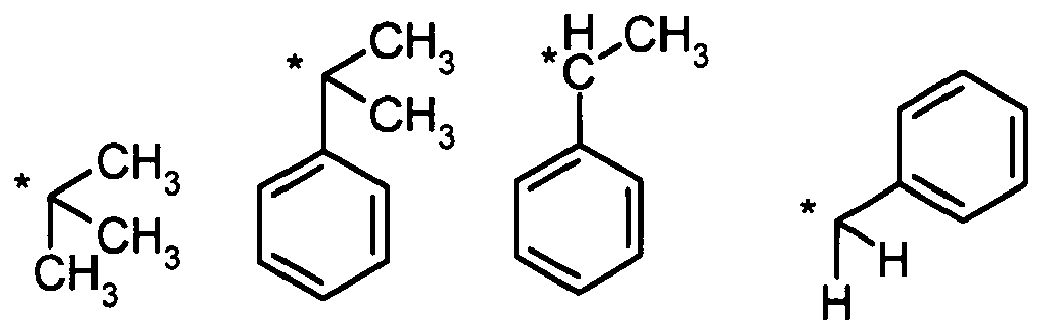


- Even more preferably, PG1 is

- PG2 is an amino protecting group containing up to 20 carbon atoms, optionally containing one ore more O, N or S atoms and are optionally substituted with one to three halogen atoms, and compatible with radiolabeling conditions.
- Preferably, PG2 is a carbamate or an arylalkyl protecting group containing up to 20 carbon atoms.
- More preferably PG2 is selected from the group comprising Carbobenzyloxy (Cbz), p-Methoxybenzyl carbonyl (Moz or MeOZ), tert-Butoxycarbonyl (BOC), 9-Fluorenylmethoxycarbonyl (FMOC), Triphenylmethyl (trityl), 4-Methylphenyl-diphenylmethyl (Mtt) and 4-Methoxyphenyldiphenylmethyl (MMTr).
- Even more preferably, PG2 is tert-Butoxycarbonyl (BOC) or Triphenylmethyl (trityl).
- Preferably, Z is Hydrogen.
-

- X
- is CH2 or CD2;
- Y
- is
- Z
- is Hydrogen or methyl;
- PG1
- is dicyclopropylmethyl or 2,4-dimethoxybenzyl; and
- PG2
- is tert-Butoxycarbonyl (BOC) or Triphenylmethyl (trityl).
- In a first embodiment, the invention is directed to compounds of Formula I
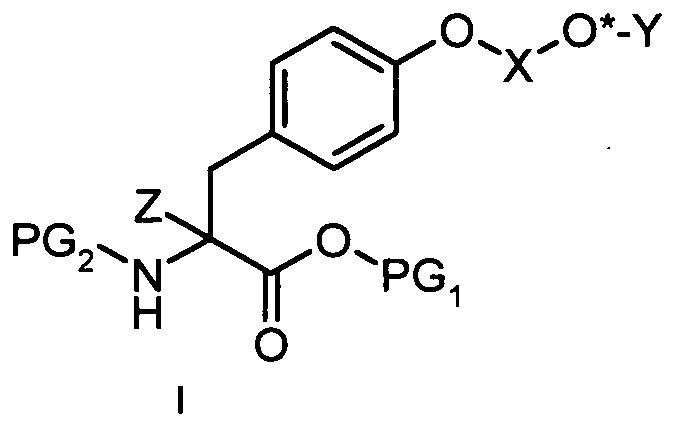
- X
- CH2;
- Y
- is a substituted or unsubstituted heteroaromatic ring containing one to four Nitrogen atoms (N) with the proviso that the oxygen (O*) is directly bound to one of the Nitrogen atoms (N) of the heteroaromatic ring and O*-Y acts as leaving group;
- Z
- Hydrogen;
- PG1
- is a carboxylic acid protecting group, containing up to 20 carbon atoms, optionally containing independently one ore more O, N or S atoms; and
- PG2
- is an amino protecting group, containing up to 20 carbon atoms, optionally containing one ore more O, N or S atoms and are optionally substituted with one to three halogens.
- The invention further refers to suitable salts of inorganic or organic acids, hydrates and solvates of the compounds of Formula I and is also meant to comprise single isomers, diastereomers, enantiomers and mixtures thereof of Formula I.
- Formula (la) correspond to the Markush Formula below

- Preferred features disclosed above in respect of Y, PG1 and PG2 are incorporated herein.
- Preferably, the invention is directed to compounds of Formula (la) wherein
Y is a moiety of Formula II
* indicates the position of the covalent bond to the Oxygen (O*) in Formula Ia;
R1 is H, CN, or COOR4 , and R2 is H, CN, or COOR4 , or
R1 and R2 form together a 6 membered aromatic ring, which optionally comprise 1 Nitrogen atoms (N) and 1 methine of the 6 membered ring is optionally substituted with halogen, NO2, CN, COOR3 , SO2 R3 or CF3,
R3 is C1-C3 alkyl,
R4 is C1-C6 alkyl;
PG1 is
Alkyl,
Alkyl substituted with one phenyl,
Alkyl substituted with one or two C3-C6 cycloalkyl,
Alkyl substituted with one phenyl and one C3-C6 cycloalkyl, or fluorenylmethyl
wherein
Alkyl is a branched or linear C1-C6 alkyl, and optionally substituted with C1-C3 alkoxy, and
Phenyl is optionally substituted with up to three C1-C3 alkyl, C1-C3 alkoxy or halogen; and
PG2 is selected from the group comprising Carbobenzyloxy (Cbz), p-Methoxybenzyl carbonyl (Moz or MeOZ), tert-Butoxycarbonyl (BOC), 9-Fluorenylmethoxycarbonyl (FMOC), Triphenylmethyl (trityl), 4-Methylphenyl-diphenylmethyl (Mtt) and 4-Methoxyphenyldiphenylmethyl (MMTr). - More preferably, compounds of Formula (la) is wherein
Y is

PG2 is tert-Butoxycarbonyl (BOC) or Triphenylmethyl (trityl). - In a second embodiment, the invention is directed to compounds of Formula I

- X
- is CD2;
- Y
- is a substituted or unsubstituted heteroaromatic ring containing one to four Nitrogen atoms (N) with the proviso that the oxygen ( O *) is directly bound to one of the Nitrogen atoms (N) of the heteroaromatic ring and O*-Y acts as leaving group;
- Z
- is Hydrogen;
- PG1
- is a carboxylic acid protecting group, containing up to 20 carbon atoms, optionally containing independently one ore more O, N or S atoms; and
- PG2
- is an amino protecting group, containing up to 20 carbon atoms, optionally containing one ore more O, N or S atoms and are optionally substituted with one to three halogens.
- The invention further refers to suitable salts of inorganic or organic acids, hydrates and solvates of the compounds of Formula I and is also meant to comprise single isomers, diastereomers, enantiomers and mixtures thereof of Formula I.
- Formula (lb) corresponds to the Markush Formula below

- Preferred features disclosed above in respect of Y, PG1 and PG2 are incorporated herein.
- Preferably, the invention is directed to compounds of Formula (lb) wherein
Y is a moiety of Formula II
* indicates the position of the covalent bond to the Oxygen (O*) in Formula Ib;
R1 is H, CN, or COOR4 , and R2 is H, CN, or COOR4, or
R1 and R2 form together a 6 membered aromatic ring, which optionally comprise 1 Nitrogen atoms (N) and 1 methine of the 6 membered ring is optionally substituted with halogen, NO2, CN, COOR3 , SO2 R3 or CF3,
R3 is C1-C3 alkyl,
R4 is C1-C6 alkyl;
PG1 is
Alkyl,
Alkyl substituted with one phenyl,
Alkyl substituted with one or two C3-C6 cycloalkyl,
Alkyl substituted with one phenyl and one C3-C6 cycloalkyl, or fluorenylmethyl
wherein
Alkyl is a branched or linear C1-C6 alkyl, and optionally substituted with C1-C3 alkoxy, and
Phenyl is optionally substituted with up to three C1-C3 alkyl, C1-C3 alkoxy or halogen; and
PG2 is selected from the group comprising Carbobenzyloxy (Cbz), p-Methoxybenzyl carbonyl (Moz or MeOZ), tert-Butoxycarbonyl (BOC), 9-Fluorenylmethoxycarbonyl (FMOC), Triphenylmethyl (trityl), 4-Methylphenyl-diphenylmethyl (Mtt) and 4-Methoxyphenyldiphenylmethyl (MMTr). - More preferably, compounds of Formula (Ib) is wherein
Y is

PG2 is tert-Butoxycarbonyl (BOC) or Triphenylmethyl (trityl). - In a third embodiment, the invention is directed to compounds of Formula I
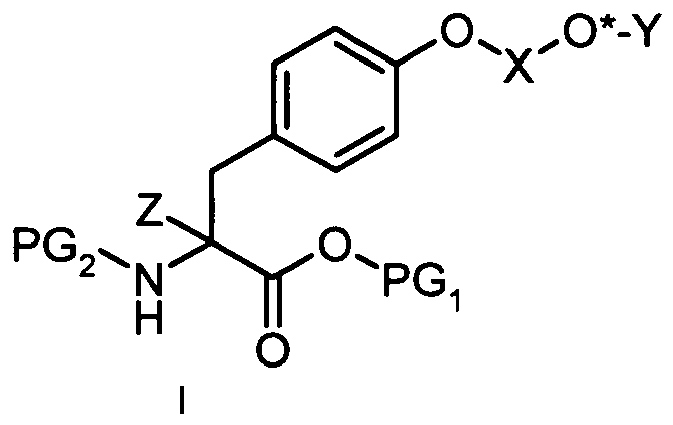
- X
- is CH2;
- Y
- is a substituted or unsubstituted heteroaromatic ring containing one to four Nitrogen atoms (N) with the proviso that the oxygen (O*) is directly bound to one of the Nitrogen atoms (N) of the heteroaromatic ring and O*-Y acts as leaving group;
- Z
- is methyl;
- PG1
- is a carboxylic acid protecting group, containing up to 20 carbon atoms, optionally containing independently one ore more O, N or S atoms; and
- PG2
- is an amino protecting group, containing up to 20 carbon atoms, optionally containing one ore more O, N or S atoms and are optionally substituted with one to three halogens.
- The invention further refers to suitable salts of inorganic or organic acids, hydrates and solvates of the compounds of Formula I and is also meant to comprise single isomers, diastereomers, enantiomers and mixtures thereof of Formula I.
- Formula (Ic) corresponds to to the Markush Formula below

- Preferred features disclosed above in respect of Y, PG1 and PG2 are incorporated herein.
- Preferably, the invention is directed to compounds of Formula (Ic) wherein
Y is a moiety of Formula II
* indicates the position of the covalent bond to the Oxygen (O*) in Formula Ic;
R1 . is H, CN, or COOR4 , and R2 is H, CN, or COOR4 , or
R1 and R2 form together a 6 membered aromatic ring, which optionally comprise 1 Nitrogen atoms (N) and 1 methine of the 6 membered ring is optionally substituted with halogen, NO2, CN, COOR3 , SO2 R3 or CF3,
R3 is C1-C3 alkyl,
R4 is C1-C6 alkyl;
PG1 is
Alkyl,
Alkyl substituted with one phenyl,
Alkyl substituted with one or two C3-C6 cycloalkyl,
Alkyl substituted with one phenyl and one C3-C6 cycloalkyl, or fluorenylmethyl
wherein
Alkyl is a branched or linear C1-C6 alkyl, and optionally substituted with C1-C3 alkoxy, and
Phenyl is optionally substituted with up to three C1-C3 alkyl, C1-C3 alkoxy or halogen; and
PG2 is selected from the group comprising Carbobenzyloxy (Cbz), p-Methoxybenzyl carbonyl (Moz or MeOZ), tert-Butoxycarbonyl (BOC), 9-Fluorenylmethoxycarbonyl (FMOC), Triphenylmethyl (trityl), 4-Methylphenyl-diphenylmethyl (Mtt) and 4-Methoxyphenyldiphenylmethyl (MMTr). - More preferably, compounds of Formula (Ic) is wherein
Y is

PG2 is tert-Butoxycarbonyl (BOC) or Triphenylmethyl (trityl). - In a fourth embodiment, the invention is directed to compounds of Formula I

- X
- is CD2;
- Y
- is a substituted or unsubstituted heteroaromatic ring containing one to four Nitrogen atoms (N) with the proviso that the oxygen (O*) is directly bound to one of the Nitrogen atoms (N) of the heteroaromatic ring and O*-Y acts as leaving group;
- Z
- is methyl;
- PG1
- is a carboxylic acid protecting group, containing up to 20 carbon atoms, optionally containing independently one ore more O, N or S atoms; and
- PG2
- is an amino protecting group, containing up to 20 carbon atoms, optionally containing one ore more O, N or S atoms and are optionally substituted with one to three halogens.
- The invention further refers to suitable salts of inorganic or organic acids, hydrates and solvates of the compounds of Formula I and is also meant to comprise single isomers, diastereomers, enantiomers and mixtures thereof of Formula I.
- Formula (Id) ) corresponds to to the Markush Formula below

- Preferred features disclosed above in respect of Y, PG1 and PG2 are incorporated herein.
- Preferably, the invention is directed to compounds of Formula (Id) wherein
Y is a moiety of Formula II
* indicates the position of the covalent bond to the Oxygen (O*) in Formula Id;
R1 is H, CN, or COOR4 , and R2 is H, CN, or COOR4 , or
R1 and R2 form together a 6 membered aromatic ring, which optionally comprise 1 Nitrogen atoms (N) and 1 methine of the 6 membered ring is optionally substituted with halogen, NO2, CN, COOR3 , SO2 R3 or CF3,
R3 is C1-C3 alkyl,
R4 is C1-C6 alkyl;
PG1 is
Alkyl,
Alkyl substituted with one phenyl,
Alkyl substituted with one or two C3-C6 cycloalkyl,
Alkyl substituted with one phenyl and one C3-C6 cycloalkyl, or fluorenylmethyl
wherein
Alkyl is a branched or linear C1-C6 alkyl, and optionally substituted with C1-C3 alkoxy, and
Phenyl is optionally substituted with up to three C1-C3 alkyl, C1-C3 alkoxy or halogen; and
PG2 is selected from the group comprising Carbobenzyloxy (Cbz), p-Methoxybenzyl carbonyl (Moz or MeOZ), tert-Butoxycarbonyl (BOC), 9-Fluorenylmethoxycarbonyl (FMOC), Triphenylmethyl (trityl), 4-Methylphenyl-diphenylmethyl (Mtt) and 4-Methoxyphenyldiphenylmethyl (MMTr). - More preferably, compounds of Formula (Id) is wherein
Y is

PG2 is tert-Butoxycarbonyl (BOC) or Triphenylmethyl (trityl). - In a fifth embodiment, the invention is directed to compounds of Formula (D-I), (D-Ia), (D-Ib), (D-Ic) or (D-Id) wherein

Formula\Substituent Z X D-I H, CH3 CH2,CD2 D-la H CH2 D-Ib H CD2 D-Ic CH3 CH2 D-Id CH3 CD2 - The invention further refers to suitable salts of inorganic or organic acids, hydrates and solvates of the compounds of Formula (D-I), (D-Ia), (D-Ib), (D-Ic) or (D-Id) and is also meant to comprise single isomers, diastereomers, enantiomers and mixtures thereof of Formula (D-I), (D-Ia), (D-Ib), (D-Ic) or (D-Id).
- Embodiments and preferred features can be combined together and are within the scope of the invention.
- Invention compounds are but not limited to
- tert-Butyl O-[(1H-benzotriazol-1-yloxy)methyl]-N-(tert-butoxycarbonyl)-D-tyrosinate

- tert-Butyl N-(tert-butoxycarbonyl)-O-[(1H-1,2,3-triazolo[5,4-b]pyridin-1-yloxy)methyl] -D-tyrosinate

- Dicyclopropylmethyl O-[(1H-benzotriazol-1-yloxy)methyl]-N-(tert-butoxycarbonyl) -D-tyrosinate

- Dicyclopropylmethyl O-[(1H-benzotriazol-1-yloxy)methyl]-N-(tert-butoxycarbonyl) -L-tyrosinate

- Dicyclopropylmethyl N-(tert-butoxycarbonyl)-O-[(6-nitro-1H-benzotriazol -1-yloxy)methyl]-D-tyrosinate

- 2,4-Dimethoxybenzyl O-[(1H-benzotriazol-1-yloxy)methyl]-N-(tert-butoxycarbonyl) -D-tyrosinate

- Cyclopropylmethyl O-[(1H-benzotriazol-1-yloxy)methyl]-N-(tert-butoxycarbonyl) -D-tyrosinate

- Cyclopropylmethyl N-(tert-butoxycarbonyl)-O-({[4-(ethoxycarbonyl)-1H-1,2,3-triazol-1-yl]oxy}methyl)-D-tyrosinate
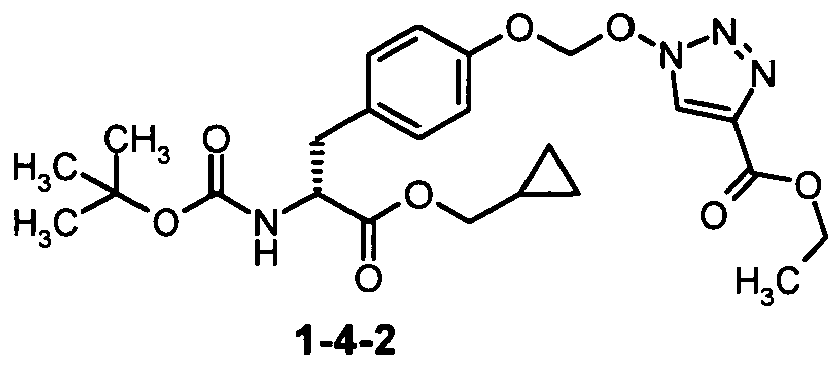
- 4-Methoxybenzyl O-[(1H-benzotriazol-1-yloxy)methyl]-N-(tert-butoxycarbonyl) -D-tyrosinate

- 4-Methoxybenzyl N-(tert-butoxycarbonyl)-O-{[(6-chloro-1H-benzotriazol-1-yl) oxy]methyl}-D-tyrosinate

- 4-Methoxybenzyl N-(tert-butoxycarbonyl)-O-[(6-trifluoromethyl-1H-benzotriazol -1-yloxy)methyl]- D-tyrosinate

- 4-Methoxybenzyl O-[(6-trifluoromethyl-1H-benzotriazol-1-yloxy)methyl]-N-(tert-butoxycarbonyl)-L-tyrosinate.

- alpha-Methylbenzyl O-[(1H-benzotriazol-1-yloxy)methyl]-N-(tert-butoxycarbonyl) -D-tyrosinate

- alpha,alpha-Dimethylbenzyl O-[(1H-benzotriazol-1-yloxy)methyl]-N-(tert-butoxycarbonyl) -D-tyrosinate

- tert-Butyl O-[(1H-benzotriazol-1-yloxy)methyl]-N-trityl-D-tyrosinate

- 4-Methoxybenzyl O-[(1H-benzotriazol-1-yloxy)methyl]-N-trityl-D-tyrosinate

- Cyclopropylmethyl O-[(1H-benzotriazol-1-yloxy)[2H2]methyl]-N-(tert-butoxycarbonyl)-D-tyrosinate

- 2,4-Dimethoxybenzyl O-[(1H-benzotriazol-1-yloxy)methyl]-N-trityl-D-tyrosinate

- 2,4-Dimethoxybenzyl O-{[(6-chloro-1H-benzotriazol-1-yl)oxy]methyl}-N-trityl-D-tyrosinate
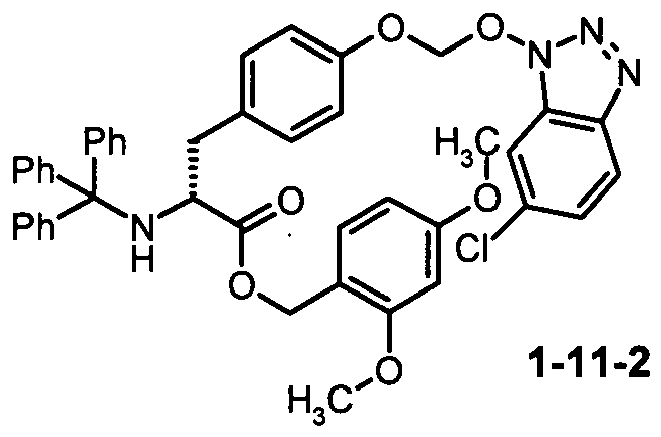
- 2,4-Dimethoxybenzyl O-{[(6-trifluoromethyl-1H-benzotriazol-1-yl)oxy]methyl}-N-trityl-D-tyrosinate

- Methyl O-[(1H-benzotriazol-1-yloxy)methyl]-N-(tert-butoxycarbonyl)-alpha-methyltyrosinate

- In a second aspect, the present invention is directed to compounds of Formula III

- X
- is CH2, CHD or CD2;
- F
- is 18F or 19F;
- Z
- is Hydrogen or methyl;
- PG1
- is a carboxylic protecting group, containing up to 20 carbon atoms, optionally containing independently one ore more O, N or S atoms; and
- PG2
- is an amino protecting group, containing up to 20 carbon atoms, optionally containing one ore more O, N or S atoms and are optionally substituted with one or two halogens.
- The invention further refers to suitable salts of inorganic or organic acids, hydrates and solvates of the compounds of Formula III and is also meant to comprise single isomers, diastereomers, enantiomers and mixtures thereof of Formula III.
- PG1 is a carboxylic acid protecting group (forming an ester) containing up to 20 carbon atoms, optionally containing independently one ore more O, N or S atoms; and compatible with radiolabeling conditions.
- Preferably, PG1 is
Alkyl,
Alkyl substituted with one phenyl,
Alkyl substituted with one or two C3-C6 cycloalkyl,
Alkyl substituted with one phenyl and one C3-C6 cycloalkyl, or
fluorenylmethyl
wherein
Alkyl is a branched or linear C1-C6 alkyl, and optionally substituted with C1-C3 alkoxy, and
Phenyl is optionally substituted with up to three C1-C3 alkyl, C1-C3 alkoxy or halogen. - Preferably, branched or linear C1-C6 alkyl is a C1-C3 alkyl. More preferably, C1-C6 alkyl is C1-alkyl (methyl) when substituted and C4-alkyl (e.g.tert-Butyl) when unsubstituted.
- Preferably, branched or linear C1-C6 alkyl substituted with one phenyl is branched or linear C1-C3 alkyl substituted with one phenyl. More preferably, branched or linear C1-C6 alkyl substituted with one phenyl is methyl-phenyl (benzyl), ethyl-phenyl or i-Propyl-phenyl (e.g. Cumyl) Preferably, methyl-phenyl (benzyl), ethyl-phenyl and i-Propyl-phenyl (e.g. Cumyl) are is substituted with up to two methoxy-groups.
- Preferably, C1-C3 alkoxy is C1 alkoxy (methoxy).
- Preferably, branched or linear C1-C6 alkyl substituted with one or two C3-C6 cycloalkyl is branched or linear C1-C3 alkyl substituted with one or two cyclo-propyl.
- Preferably, branched or linear C1-C6 alkyl substituted with one phenyl and one C3-C6 cycloalkyl is branched or linear C1-C3 alkyl substituted with one phenyl and one C3-C6 cycloalkyl wherein the C3-C6 cycloalkyl is preferably C3 cycloalkyl (cyclo-propyl),
Fluorenylmethyl is
- More preferably, PG1 is
Alkyl,
Alkyl substituted with one phenyl,
Alkyl substituted with one or two C3 cycloalkyl,
Alkyl substituted with one phenyl and one C3 cycloalkyl, or fluorenylmethyl
wherein
Alkyl is a branched or linear C1-C4 alkyl, and optionally substituted with C1-C3 alkoxy, and
Phenyl is optionally substituted with up to three C1-C3 alkyl, C1-C3 alkoxy or halogen. - Even more preferably, PG1 is


- PG2 is an amino protecting group containing up to 20 carbon atoms, optionally containing one ore more O, N or S atoms and are optionally substituted with one to three halogens, and compatible with radiolabeling conditions.
- Preferably, PG2 is a carbamate or an arylalkyl protecting group.
- More preferably PG2 is selected from the group comprising Carbobenzyloxy (Cbz), p-Methoxybenzyl carbonyl (Moz or MeOZ), tert-Butoxycarbonyl (BOC), 9-Fluorenylmethoxycarbonyl (FMOC), Triphenylmethyl (trityl), 4-Methylphenyl-diphenylmethyl (Mtt) and 4-Methoxyphenyldiphenylmethyl (MMTr).
- Even more preferably, PG2 is tert-Butoxycarbonyl (BOC) or Triphenylmethyl (trityl).
- Preferably, F is 18F.
- Preferably, F is 19F.
- Preferably, Z is Hydrogen.
-

- X
- is CH2 or CD2;
- F
- is 18F;
- Z
- is Hydrogen or methyl;
- PG1
- is dicyclopropylmethyl or 2,4-dimethoxybenzyl; and
- PG2
- is tert-Butoxycarbonyl (BOC) or Triphenylmethyl (trityl).
- In a first embodiment, the invention is directed to compounds of Formula III

- X
- is CH2;
- F
- is 18F or 19F;
- Z
- is Hydrogen;
- PG1
- is a carboxylic acid protecting group, containing up to 20 carbon atoms, optionally containing independently one ore more O, N or S atoms; and
- PG2
- is an amino protecting group, containing up to 20 carbon atoms, optionally containing one ore more O, N or S atoms and are optionally substituted with one to three halogens.
- The invention further refers to suitable salts of inorganic or organic acids, hydrates and solvates of the compounds of Formula III and is also meant to comprise single isomers, diastereomers, enantiomers and mixtures thereof of Formula III.
- Formula (IIIa) corresponds to the Markush Formula below

- Preferred features disclosed above in respect of F, PG1 and PG2 are incorporated herein.
- Preferably, the invention is directed to compounds of Formula (IIIa) wherein
F is 18 F or 19F;
PG1 is
Alkyl,
Alkyl substituted with one phenyl,
Alkyl substituted with one or two C3-C6 cycloalkyl,
Alkyl substituted with one phenyl and one C3-C6 cycloalkyl, or fluorenylmethyl
wherein
Alkyl is a branched or linear C1-C6 alkyl, and optionally substituted with C1-C3 alkoxy, and
Phenyl is optionally substituted with up to three C1-C3 alkyl, C1-C3 alkoxy or halogen; and
PG2 is selected from the group comprising Carbobenzyloxy (Cbz), p-Methoxybenzyl carbonyl (Moz or MeOZ), tert-Butoxycarbonyl (BOC), 9-Fluorenylmethoxycarbonyl (FMOC), Triphenylmethyl (trityl), 4-Methylphenyl-diphenylmethyl (Mtt) and 4-Methoxyphenyldiphenylmethyl (MMTr). - More preferably, compounds of Formula (IIIa) is wherein
F is 18F;
PG1 is dicyclopropylmethyl or 2,4-dimethoxybenzyl, and
PG2 is tert-Butoxycarbonyl (BOC) or Triphenylmethyl (trityl). - In a second embodiment, the invention is directed to compounds of Formula III

- X
- is CD2 ;
- F
- is 18F or 19F;
- Z
- is Hydrogen;
- PG1
- is a carboxylic acid protecting group, containing up to 20 carbon atoms, optionally containing independently one ore more O, N or S atoms; and
- PG2
- is an amino protecting group, containing up to 20 carbon atoms, optionally containing one ore more O, N or S atoms and are optionally substituted with one to three halogens.
- The invention further refers to suitable salts of inorganic or organic acids, hydrates and solvates of the compounds of Formula III and is also meant to comprise single isomers, diastereomers, enantiomers and mixtures thereof of Formula III.
- Formula (IIIb) corresponds to the Markush Formula below

- Preferred features disclosed above in respect of F, PG1 and PG2 are incorporated herein.
- Preferably, the invention is directed to compounds of Formula (IIIb) wherein
Y is 18F or19F;
PG1 is
Alkyl,
Alkyl substituted with one phenyl,
Alkyl substituted with one or two C3-C6 cycloalkyl,
Alkyl substituted with one phenyl and one C3-C6 cycloalkyl, or fluorenylmethyl
wherein
Alkyl is a branched or linear C1-C6 alkyl, and optionally substituted with C1-C3 alkoxy, and
Phenyl is optionally substituted with up to three C1-C3 alkyl, C1-C3 alkoxy or halogen; and
PG2 is selected from the group comprising Carbobenzyloxy (Cbz), p-Methoxybenzyl carbonyl (Moz or MeOZ), tert-Butoxycarbonyl (BOC), 9-Fluorenylmethoxycarbonyl (FMOC), Triphenylmethyl (trityl), 4-Methylphenyl-diphenylmethyl (Mtt) and 4-Methoxyphenyldiphenylmethyl (MMTr). - More preferably, compounds of Formula (IIIb) is wherein
- Y
- is 18F;
- PG1
- is dicyclopropylmethyl or 2,4-dimethoxybenzyl, and
- PG2
- is tert-Butoxycarbonyl (BOC) or Triphenylmethyl (trityl).
- In a third embodiment, the invention is directed to compounds of Formula III

- X
- is CH2 ;
- F
- is 18F or 19F;
- Z
- is methyl;
- PG1
- is a carboxylic acid protecting group, containing up to 20 carbon atoms, optionally containing independently one ore more O, N or S atoms; and
- PG2
- is an amino protecting group, containing up to 20 carbon atoms, optionally containing one ore more O, N or S atoms and are optionally substituted with one to three halogens.
- The invention further refers to suitable salts of inorganic or organic acids, hydrates and solvates of the compounds of Formula III and is also meant to comprise single isomers, diastereomers, enantiomers and mixtures thereof of Formula III.
- Formula (IIIc) corresponds to the Markush Formula below

- Preferred features disclosed above in respect of F, PG1 and PG2 are incorporated herein.
- Preferably, the invention is directed to compounds of Formula (IIIc) wherein
Y is 18F or 19F;
PG1 is
Alkyl,
Alkyl substituted with one phenyl,
Alkyl substituted with one or two C3-C6 cycloalkyl,
Alkyl substituted with one phenyl and one C3-C6 cycloalkyl, or fluorenylmethyl
wherein
Alkyl is a branched or linear C1-C6 alkyl, and optionally substituted with C1-C3 alkoxy, and
Phenyl is optionally substituted with up to three C1-C3 alkyl, C1-C3 alkoxy or halogen; and
PG2 is selected from the group comprising Carbobenzyloxy (Cbz), p-Methoxybenzyl carbonyl (Moz or MeOZ), tert-Butoxycarbonyl (BOC), 9-Fluorenylmethoxycarbonyl (FMOC), Triphenylmethyl (trityl), 4-Methylphenyl-diphenylmethyl (Mtt) and 4-Methoxyphenyldiphenylmethyl (MMTr). - More preferably, compounds of Formula (IIIc) is wherein
Y is 18F;
PG1 is dicyclopropylmethyl or 2,4-dimethoxybenzyl, and
PG2 is tert-Butoxycarbonyl (BOC) or Triphenylmethyl (trityl). - In a fourth embodiment, the invention is directed to compounds of Formula III

- X
- is CD2 ;
- F
- is 18F or 19F;
- Z
- is methyl;
- PG1
- is a suitable carboxylic acid protecting group, containing up to 20 carbon atoms, optionally containing independently one ore more O, N or S atoms; and
- PG2
- is a suitable amino protecting group, containing up to 20 carbon atoms, optionally containing one ore more O, N or S atoms and are optionally substituted with one to three halogens.
- The invention further refers to suitable salts of inorganic or organic acids, hydrates and solvates of the compounds of Formula III and is also meant to comprise single isomers, diastereomers, enantiomers and mixtures thereof of Formula III.
- Formula (IIId) corresponds to the Markush Formula below

- Preferred features disclosed above in respect of F, PG1 and PG2 are incorporated herein.
- Preferably, the invention is directed to compounds of Formula (IIId) wherein
Y is 18F or 19F;
PG1 is
Alkyl,
Alkyl substituted with one phenyl,
Alkyl substituted with one or two C3-C6 cycloalkyl,
Alkyl substituted with one phenyl and one C3-C6 cycloalkyl, or fluorenylmethyl
wherein
Alkyl is a branched or linear C1-C6 alkyl, and optionally substituted with C1-C3 alkoxy, and
Phenyl is optionally substituted with up to three C1-C3 alkyl, C1-C3 alkoxy or halogen; and
PG2 is selected from the group comprising Carbobenzyloxy (Cbz), p-Methoxybenzyl carbonyl (Moz or MeOZ), tert-Butoxycarbonyl (BOC), 9-Fluorenylmethoxycarbonyl (FMOC), Triphenylmethyl (trityl), 4-Methylphenyl-diphenylmethyl (Mtt) and 4-Methoxyphenyldiphenylmethyl (MMTr). - Preferably, compounds of Formula (IIId) is wherein
Y is 18F;
PG1 is dicyclopropylmethyl or 2,4-dimethoxybenzyl, and
PG2 is tert-Butoxycarbonyl (BOC) or Triphenylmethyl (trityl). - In a fifth embodiment, the invention is directed to compounds of Formula (D-III), (D-IIIa), (D-IIIb), (D-IIIc) or (D-IIId)

Formula\Substituent Z X D-III H, CH3 CH2 ,CD2 D-IIIa H CH2 D-IIIb H CD2 D-IIIc CH3 CH2 D-IIId CH3 CD2 - The invention further refers to suitable salts of inorganic or organic acids, hydrates and solvates of the compounds of Formula (D-III), (D-IIIa), (D-IIIb), (D-IIIc) or (D-IIId) and is also meant to comprise single isomers, diastereomers, enantiomers and mixtures thereof of Formula (D-III), (D-IIIa), (D-IIIb), (D-IIIc) or (D-IIId).
- Embodiments and preferred features can be combined together and are within the scope of the invention.
- 19F-Invention compounds are but not limited to tert-Butyl N-(tert-butoxycarbonyl)-O-(fluoromethyl)-D-tyrosinate

- Dicyclopropylmethyl N-(tert-butoxycarbonyl)-O-(fluoromethyl)-D-tyrosinate

- Dicyclopropylmethyl N-(tert-butoxycarbonyl)-O-(fluoromethyl)-L-tyrosinate

- tert-Butyl O-(fluoromethyl)-N-trityl-D-tyrosinate

- 2,4-Dimethoxybenzyl O-(fluoromethyl)-N-trityl-D-tyrosinate

- Methyl N-(tert-butoxycarbonyl)-O-(fluoromethyl)-alpha-methyl-D-tyrosinate

- Methyl N-(tert-butoxycarbonyl)-O-(fluoromethyl)-alpha-methyl-L-tyrosinate

- 18F-Invention compounds are but not limited to tert-Butyl N-(tert-butoxycarbonyl)-O-([18F]fluoromethyl)-D-tyrosinate.
- Labelling of 1-1-1 and 1-1-2
- Dicyclopropylmethyl N-(tert-butoxycarbonyl)-O-([18F]fluoromethyl)-D-tyrosinate.
- Labelling of 1-2-1 and 1-2-3
- Dicyclopropylmethyl N-(tert-butoxycarbonyl)-O-([18F]fluoromethyl)-L-tyrosinate.
- Labelling of 1-2-2
- 2,4-Dimethoxybenzyl N-(tert-butoxycarbonyl)-O-([18F]fluoromethyl)-D-tyrosinate.
- Labelling of 1-3
- Cyclopropylmethyl N-(tert-butoxycarbonyl)-O-([18F]fluoromethyl)-D-tyrosinate.
- Labelling of 1-4-1 and 1-4-2
- 4-Methoxybenzyl N-(tert-butoxycarbonyl)-O-([18F]fluoromethyl)-D-tyrosinate.
- Labelling of 1-5-1, 1-5-2 and 1-5-3
- 4-Methoxybenzyl N-(tert-butoxycarbonyl)-O-([18F]fluoromethyl)-L-tyrosinate.
- Labelling of 1-5-4
- alpha-Methylbenzyl N-(tert-butoxycarbonyl)-O-([18F]fluoromethyl)-D-tyrosinate.
- Labelling of 1-6
- alpha,alpha-Dimethylbenzyl N-(tert-butoxycarbonyl)-O-([18F]fluoromethyl)- D-tyrosinate.
- Labelling of 1-7
- tert-Butyl O-([18F]fluoromethyl)-N-trityl-D-tyrosinate.
- Labelling of 1-8
- 4-Methoxybenzyl O-([18F]fluoromethyl)-N-trityl-D-tyrosinate.
- Labelling of 1-9
- Cyclopropylmethyl N-(tert-butoxycarbonyl)-O-([18F]fluoro[2H2]methyl)-D-tyrosinate.
- Labelling of 1-10
- 2,4-Dimethoxybenzyl O-([18F]fluoromethyl)-N-trityl-D-tyrosinate
- Labelling of 1-11-1, 1-11-2 and 1-11-3
- Methyl N-(tert-butoxycarbonyl)-O-([18F]fluoromethyl)-alpha-methyl-DL-tyrosinate.
- Labelling of 1-12
- In a third aspect, the present invention is directed to compositions comprising compound(s) of the Formula III, IIIa, IIIb, IIIc, IIId, (D-III), (D-IIIa), (D-IIIb), (D-IIIc) or (D-IIId) independently or mixtures thereof and reagents suitable for deprotection of the amino group and the ester function of the tyrosine, as exemplified in Greene, Wuts, Protecting Groups in Organic synthesis (third edition 1999 and Fourth Edition, Wiley 2007 ).
- The person skilled in the art is familiar with auxiliaries, vehicles, excipients, diluents, carriers or adjuvants which are suitable for the desired deprotecting reaction leading to the unprotected fluoromethyl-tyrosines on account of his/her expert knowledge.
- In a fourth aspect, the present invention is directed to compositions comprising compound(s) of the Formula I, la, Ib, Ic, Id, (D-I), (D-Ia), (D-Ib), (D-Ic) or (D-Id) independently or mixtures thereof and reagents suitable for fluoro labelling. The reagents, solvents and conditions which can be used for this fluorination are known to the person skilled in the field. See, e.g., J. Fluorine Chem., 27 (1985):177-191.
- In a fifth aspect, the present invention provides a kit comprising a sealed vial containing a predetermined quantity of a compound of Formula I, Ia, Ib, Ic, Id, (D-I), (D-Ia), (D-Ib), (D-Ic) or (D-Id) independently or mixtures thereof and suitable salts of inorganic or organic acids, hydrates and solvates. Optionally the kit comprises reagents for labelling, deprotection and a pharmaceutically acceptable carrier, diluent, excipient or adjuvant.
- In a sixth aspect, the present invention is directed to methods for obtaining compounds of Formula I.

- The methods for obtaining compounds of Formula I comprises the step of
- Reacting compound of Formula V first with N-Chloro-succinimide (NCS) and then with anion of H-O*-Y for obtaining compounds of Formula I,
- Optionally, the method step is preceded by alkylation of a compound of Formula IV with Cl-X-SCH3 for obtaining intermediate of Formula V,

- Preferred features disclosed above in respect of Z, PG1, PG2 , X, and Y are incorporated herein.
- Preferably, the method for obtaining compounds of Formula I is defined as such that
- X
- is CH2 or CD2;
- Y
- is
- In a seventh aspect, the present invention is directed to a method for obtaining compounds of Formula III.

- Reacting compound of Formula I with a 18F-Fluorination agent, and
- [Optionally] converting obtained compound into a suitable salts of inorganic or organic bases thereof, hydrates, complexes, and solvates thereof
- Preferred features disclosed above in respect of F, Z, PG1, PG2 , X, and Y are incorporated herein.
- Preferably, the method for obtaining compounds of Formula III is defined as such that
- X
- is CH2 or CD2;
- Y
- is
- Z
- is Hydrogen or methyl;
- F
- is 18F;
- PG1
- is dicyclopropylmethyl and 2,4-dimethoxybenzyl; and
- PG2
- is tert-Butoxycarbonyl (BOC) or Triphenylmethyl (trityl).
- The 18F-Fluorination agent can be K18F, H18F, Rb18F, Cs18F, Na18F.
- Optionally, the 18F-Fluorination agent comprises a chelating agent such as a cryptand (e.g.: 4,7,13,16,21,24-Hexaoxa-1,10-diazabicyclo[8.8.8]-hexacosane - Kryptofix®) or a crown ether (e.g.: 18-crown-6).
- The 18F-Fluorination agent can also be a tetraalkylammonium salt of 18F- or a tetraalkylphosphonium salt of 18F-, known to those skilled in the art, e.g.: tetrabutylammonium [18F]fluoride, tetrabutylphosphonium [18F]fluoride.
- Preferably, the 18F-Fluorination agent is Cs18F, K18F, tetrabutylammonium [18F]fluoride.
- The reagents, solvents and conditions which can be used for this fluorination are common and well-known to the skilled person in the field. See, e.g., J. Fluorine Chem., 27 (1985):177-191; Coenen, Fluorine-18 Labeling Methods: Features and Possibilities of Basic Reactions, (2006), in: Schubiger P.A., Friebe M., Lehmann L., (eds), PET-Chemistry - The Driving Force in Molecular Imaging. Springer, Berlin Heidelberg, pp.15-50). Preferably, the solvents used in the present method are DMF, DMSO, acetonitrile, DMA, or mixtures thereof, preferably the solvent is acetonitrile, DMSO.
- In a eighth aspect, the present invention is directed to a method for obtaining compounds of Formula VI.

- The method for obtaining compounds of Formula VI comprises the step of
- deprotecting the compound of Formula III for obtaining deprotected compound of Formula VI, and
- [Optionally] converting obtained compound into a suitable salts of inorganic or organic bases thereof, hydrates, complexes, and solvates thereof
- Preferred features disclosed above in respect of F, Z, PG1, PG2 , X, and Y are incorporated herein.
- Deprotecting means removing the protecting groups PG1 and PG2. Deprotecting occurs under acid conditions wherein preferably the acid is HCl in organic- or aqueous- solvents or TFA with or without additives.
- Preferably, the method for obtaining compounds of Formula VI is defined as such that
- X
- is CH2 or CD2;
- Z
- is Hydrogen or methyl;
- F
- is 18F;
- PG1
- is dicyclopropylmethyl or 2,4-dimethoxybenzyl; and
- PG2
- is tert-Butoxycarbonyl (BOC) or Triphenylmethyl (trityl).
- N-protected tyrosines can be directly esterified by alkylation of the carboxylic acid without protection of the phenol function (e.g. Jung M.E. Tetrahedron 1997, 8815). The reaction of the caesium salts of N-protected tyrosines with suitable alkylation agents also gives the protected tyrosine esters.

- Alternatively, a tyrosine ester can be reacted with a dialkyldicarbonate to introduce a carbamate or a trityl-group as N-protection.

- Finally, if no suitable alkylating agent is available or the tyrosine ester is not easily available, direct esterification methods can be employed using the corresponding alkohol. This is exemplary demonstrated in the synthesis of the dicyclopropylmethylester. In such case it is advisable to protect the phenol prior to esterification as shown in
scheme 3.
- D-Tyrosine is bisbocylated according to Pozdnev, V. F.; Chemistry of Natural Compounds; English; 18; 1; 1982; 125 - 126 and then be esterified with a standard DMAP/Carbodiimide coupling method. Selective deprotection is done according to Nakamura K., Tetrahedron Lett. 2004, 495.
- These examples show, that a wide choice of protected tyrosines can be easily synthesized.
- The phenol group of the protected tyrosine esters is converted into a methylthiomethylether by alkylation with methylthiomethylchloride in a DMF/THF mixture using potassium-tert.-butylate as base and sodium iodide to enhance the reactivity of the alkylation agent.

- To a person skilled in the art it is obvious, that other chlorothiomethyl ethers can be employed, like for example 1-[(chloromethyl)sulfanyl]-4-methylbenzene or 1-[(chloromethyl)sulfanyl]-4-chlorobenzene.
-
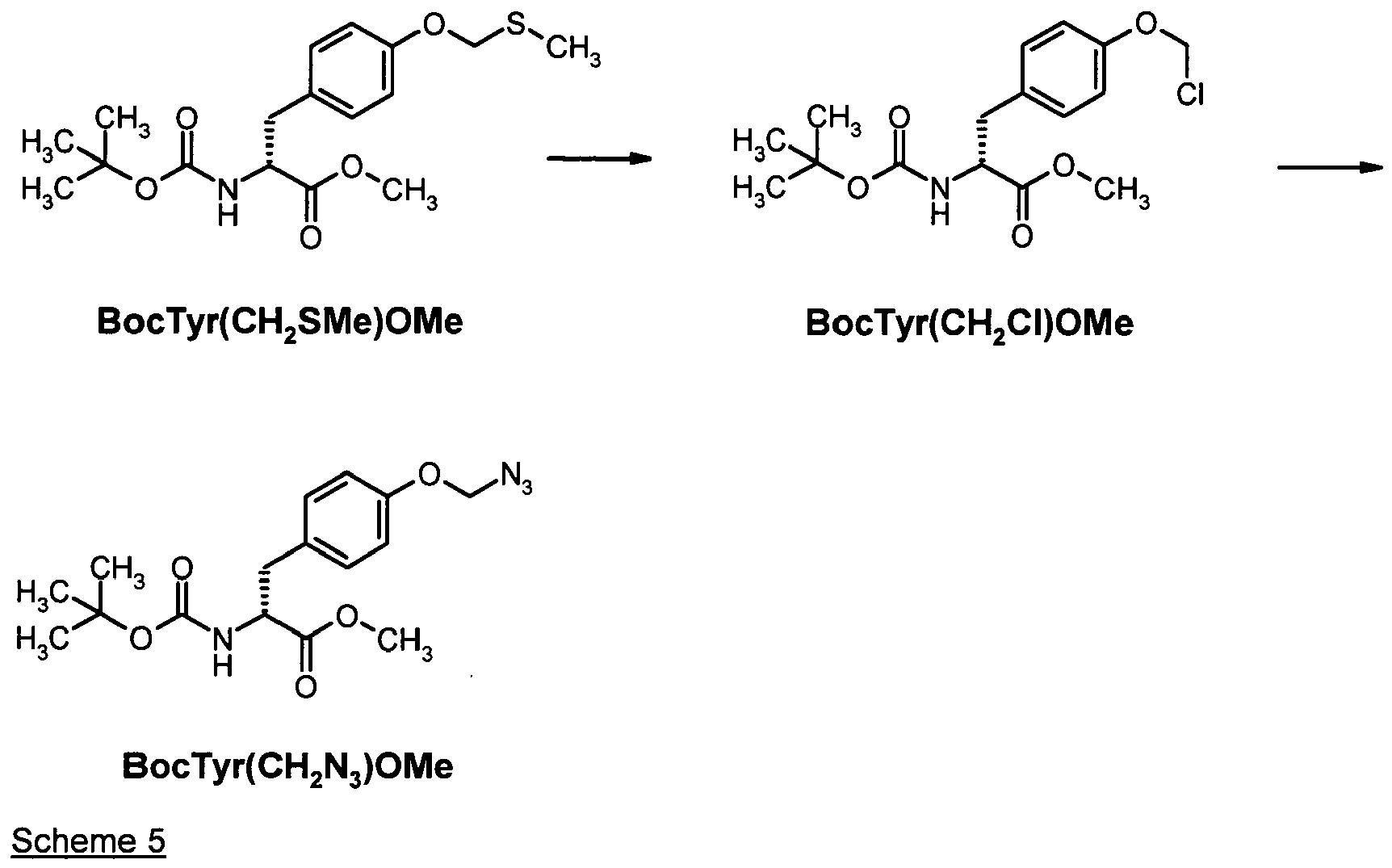
- The basic strategy has been described in Angew. Chem. Int. Ed. 2002, 3449 for the synthesis of BocTyr(azidomethyl)OMe. The chloromethylether can be made in 73% using N-chlorosuccinimide and trimethylsilylchloride as activation agent in dichloromethane. The compound could be isolated although some hydrolysis was reported. When this reaction was conducted with the more acid labile tert-butyl ester, the yield dropped to 24% and with the even more labile dicyclopropylmethyl ester, the chloromethylether could not be isolated. It proved advantageous not to isolate this labile intermediate. In an improved protocol, no activation is employed and the reaction mixture is immediately after workup reacted with the ON-nucleophile in an anhydrous environment.
- The chloromethyl ether can also be obtained by reaction with sulfuryl chloride in dichloromethane at 0 °C as described in Journal of Medicinal Chemistry, 2005, Vol. 48, No. 10, 3586-3604 .
- For the reaction with the chloro methylether thus generated, it is advantageous to employ the ON-nucleophiles like HOBt in anhydrous form. However, HOBt is commercial supplied only as the hydrate. Anhydrous salts of HOBt are not commercially available as well. It was found however, that tetrabutylammonium OBt can easily be prepared in anhydrous form. Commercial HOBt hydrate was dissolved in anhydrous tetrabutyl-ammoniumhydroxide (Commercial 1M in MeOH) and the solvent evaporated to give a yellow solid. This was stripped twice with toluene to give anhydrous Bu4NOBt. This compound can safely be dried at 40°C. This method can be used for all O-N-nucleophiles described in this patent. Alternatively, KOBt can be made by reaction of HOBt*H2O with KOH in Methanol and dried by stripping with toluene and evaporation in the vacuum at 40 °C.
- Reaction of the raw mixture from the reaction of the methylthiomethylether with N-chlorosuccinimide with the tetrabutylammonium salt of the O-N-nucleophile, gives the inventive compounds of Formula I.

- It is understood, that this method is also applicable to tyrosine esters with other N-protection.
- For the synthesis of deuterated compounds Ib a slightly different synthesis route is employed (Scheme 7) which has the advantage, that perdeuterated dimethylsulfoxide is a readily available reagent. It is reacted according to a published procedure (J. Chem. Soc. Perkin I, 1983, 1141-44) with the protected tyrosine to give the deuterated methylthiomethylether. The last reaction step is the same as described above.
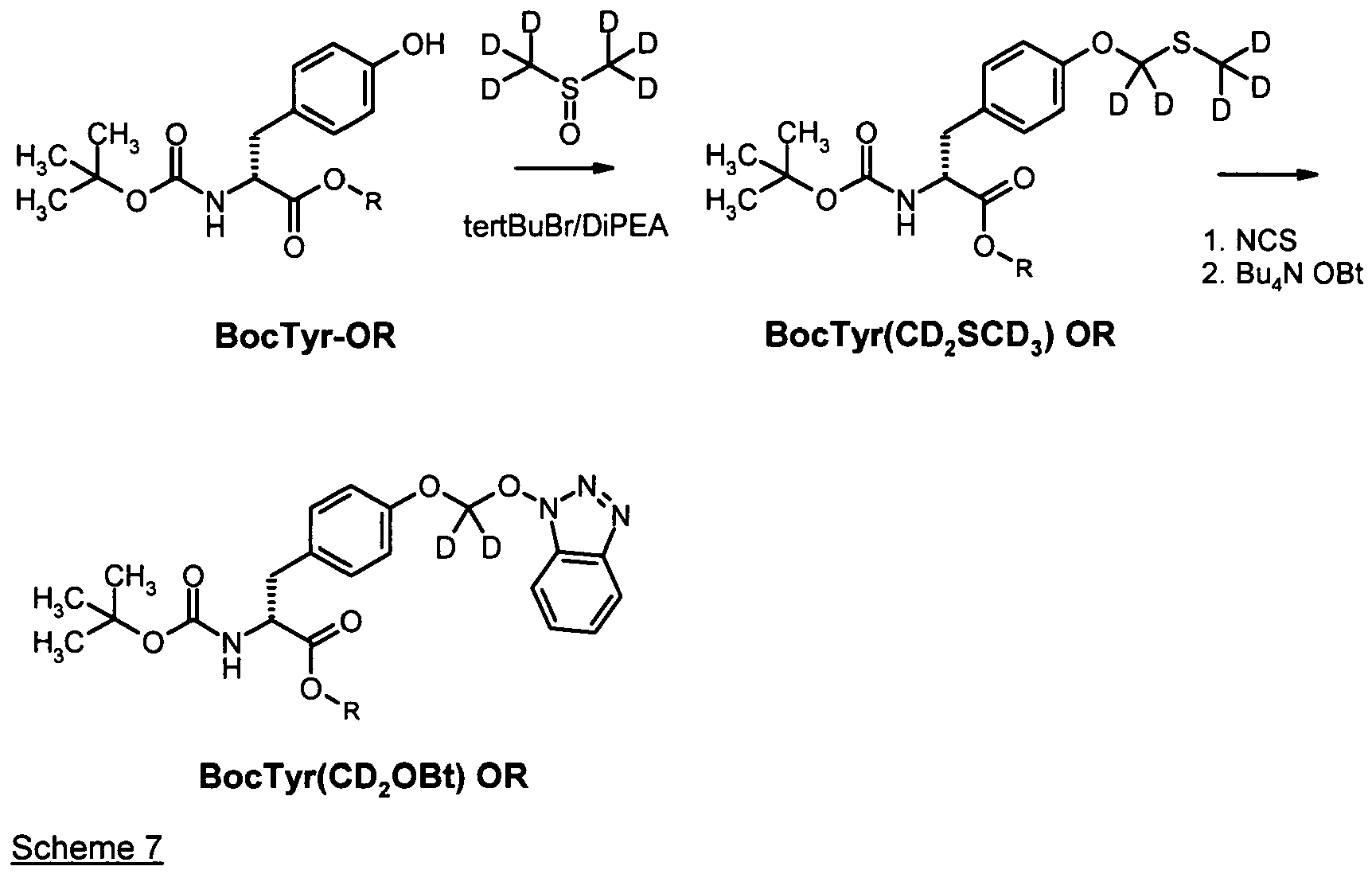
- Synthesis of the αMethyl tyrosine derivatives Ic and Id is done by combination of the methods descibed for the synthesis of la and Ib respectively. For synthesis of the compounds Ic commercially available racemic α Methyl-tyrosine-methylester is used as starting material (Scheme 8). Bocylation proceeds as described (J. Med. Chem. 2004, 47, 1223-33). Alkylation with CICH2SCH3 is done as described above. The benzotriazolyl-methylether can be obtained by the same reaction as described for compounds la above.

- The compounds of Formula Id can be obtained by combination of the methods depicted in
Schemes - Synthesis of the [19F]-fluoromethylethers IIIa or IIIc is usually done by reaction of the N-protected tyrosine ester with Bromofluoromethane as shown in
Scheme 9 for IIIa.
- Compounds of Formula IIIb and IIId could be synthesized in analogy using Bromo-fluoro[2 H2]methane. In our experimental work, the compounds IIIa and IIIc were used as cold reference in the radiosynthesis of [18F]-IIIb and [18F]-IIId.
- The radiosynthesis of the [18F]-fluoromethylethers III can be carried out in a two-step process using a reactive intermediate synthon, e.g. [18F]Fluoromethyl bromide (Iwata et al., Appl. Radiat. Isot., 2002, 57, 347-352), [18F]Fluoromethyl iodide (Zhang et al., J. Med. Chem., 2004, 47, 2228-2235, Zhang et al., J. Fluorine Chem., 2004, 125, 1879-1886), [18F]Fluoromethyl tosylate (Neal et al., J. Label. Compd. Radiopharm., 2005, 48, 557-568), [18F]Fluoromethyl triflate (Iwata et al., Appl. Radiat. Isot., 2002, 57, 347-352) or [18F]Fluoromethyl mesylate (Neal et al., J. Label. Compd. Radiopharm., 2005, 48, 557-568), and reacting it with the a hydroxyl functional under basic conditions. These methods are known to those skilled in the art. The reactions can be carried out, for example in a typical reaction vessel (e.g. Wheaton vial) which is known to someone skilled in the art or in a microreactor. The reaction can be heated by typical methods, e.g. oil bath, heating block or microwave. The radiofluorination reactions are carried out in acetonitrile with potassium carbonate as base and "kryptofix" as crown-ether. But also other solvents can be used which are well known to experts. These possible conditions include, but are not limited to: dimethyl sulfoxide and dimethylformamide as solvent and tetraalkyl ammonium and tetraalkyl phosphonium carbonate as base. Water and/or alcohol can be involved in such a reaction as co-solvent. The radiofluorination reactions are conducted for one to 60 minutes. Preferred reaction times are five to 50 minutes. Further preferred reaction times are 10 to 40 min. This and other conditions for such radiofluorination are known to experts ( Coenen, Fluorine-18 Labeling Methods: Features and Possibilities of Basic Reactions, (2006), in: Schubiger P.A., Friebe M., Lehmann L., (eds), PET-Chemistry - The Driving Force in Molecular Imaging. Springer, Berlin Heidelberg, pp.15-50 ; Ametamey et al., Chem. Rev., 2008, 108, 1501-1516 ). The radiofluorination can be carried out in a "hot-cell" and/or by use of a module (review: Krasikowa, Synthesis Modules and Automation in F-18 labeling (2006), in: Schubiger P.A., Friebe M., Lehmann L., (eds), PET-Chemistry - The Driving Force in Molecular Imaging. Springer, Berlin Heidelberg, pp. 289-316) which allows an automated or semi-automated synthesis.
- As used hereinafter in the description of the invention and in the claims, the terms "salts of inorganic or organic acids", "inorganic acid" and "organic acid" refer to mineral acids, including, but not being limited to: acids such as carbonic, nitric, phosphoric, hydrochloric, perchloric or sulfuric acid or the acidic salts thereof such as potassium hydrogen sulphate, or to appropriate organic acids which include, but are not limited to: acids such as carboxylic and sulfonic acids, examples of which are trifluoracetic, methansulfonic, ethanesulfonic, benzenesulfonic, toluenesulfonic and trifluormethanesulfonic acid, respectively.
- If chiral centers or other forms of isomeric centers are present in a compound according to the present invention, all forms of such stereoisomers, including enantiomers and diastereoisomers, are intended to be covered herein. Compounds containing chiral centers may be used as racemic mixture or as an enantiomerically enriched mixture or as a diastereomeric mixture or as a diastereomerically enriched mixture, or these isomeric mixtures may be separated using well-known techniques, and an individual stereoisomer maybe used alone. In cases wherein compounds may exist in tautomeric forms, such as keto-enol tautomers, each tautomeric form is contemplated as being included within this invention whether existing in equilibrium or predominantly in one form.
- The term "amine-protecting group" as employed herein by itself or as part of another group is known or obvious to someone skilled in the art, which is chosen from but not limited to a class of protecting groups namely carbamates, amides, imides, N-alkyl amines, N-aryl amines, enamines, N-sulfonyl and and which is chosen from but not limited to those described in the textbook Greene and Wuts, Protecting groups in Organic Synthesis, third edition, (third edition 1999, page 494-653, which is hereby incorporated herein by reference.
- Preferred amine protecting groups are carbamates (e.g. Boc) and Aralkyl (e.g. Trityl)
- The term "carboxylic acid-protecting group" as employed herein refers to a protecting group employed to block or protect the carboxylic acid functionality while the reactions involving other functional sites of the compound are carried out. Carboxy protecting groups are disclosed in Greene, Wuts, Protective Groups in Organic Synthesis, third edition, 1999, page 372-453, which is hereby incorporated herein by reference. Such protecting groups are well known to those skilled in the art, having been extensively used in the protection of carboxylic acids. Representative carboxy protecting groups are alkyl (e.g., methyl, ethyl or tertiary butyl and the like); arylalkyl, for example, phenethyl or benzyl and substituted derivatives thereof such as alkoxybenzyl or nitrobenzyl groups and the like; alkylcycloalky (e.g. cyclopropylmethyl or dicyclopropylmethyl); alkoxyalkyl (e.g. methoxymethyl (MOM) or benzyloxymethyl (BOM).
- Preferred O-protected compounds of the invention are compounds wherein the protected carboxy group is a lower alkyl (for example, methyl ester, ethyl ester, propyl ester, isopropyl ester, butyl ester, sec-butyl ester, isobutyl ester, tert. butylester, amyl ester, isoamyl ester), alkyl-cycloalkyl (for example cycloalkylmethyl, dicycloalkylmethyl, 1-cycloalkylethyl) or arylalkyl (for example, benzyl, 4-methoxybenzyl, 2,4-dimethoxybenzyl) ester.
- The term "alkyl" as employed herein by itself or as part of another group refers to a C1-C6 straight chain or branched chain alkyl group such as, for example methyl, ethyl, propyl, isopropyl, butyl, isobutyl, tert-butyl, pentyl, isopentyl, and neopentyl. Preferably, alkyl is C1-C3 straight chain or branched chain alkyl or C4-C6 branched chain alkyl.
- The term "cycloalkyl" as employed herein by itself or as part of another group refers to a C3-C6 cycloalkyl-group, i.e. cyclopropyl, cyclobutyl, cyclopentyl and cyclohexyl.
- The term "aryl" as employed herein by itself or as part of another group refers to monocyclic or bicyclic aromatic rings comprising from 6 to 12 carbons, such as phenyl or naphthyl.
- The term "heteroaryl" as employed herein by itself or as part of another group refers to monocyclic or bicyclic aromatic groups containing from 5 to 12 carbons in the ring and where up to 4 carbons are replaced by nitrogens in a way, that the resulting heteroaromatic system contains one N-H group. Typical examples are pyrrole, imidazole, triazole; their benzannelated analogs, indol, benzimidazoles, benzotriazoles, pyridyl fused analogs like azabenzotriazole and other fused systems like imidazopyrroles or imidazotriazoles.
- The term "halide" (halogen) as employed herein by itself or as part of another group is known or obvious to someone skilled in the art, and means fluoro, chloro, bromo, and iodo.
- As used hereinafter in the description of the invention and in the claims, the term "fluorine isotope" (F) refers to all isotopes of the fluorine atomic element unless explicitly otherwise indicated. Fluorine isotope (F) is selected from radioactive or non-radioactive isotope. The radioactive fluorine isotope is [18F] . The non-radioactive "cold" fluorine isotope is [19F].
- The stereochemistry can be denoted in several ways. For the amino acids often D/L is used for the alpha-position referring to position of the residues when drawn in the Fischer-projection. Stereochemically D corresponds to the stereodescriptor "R" and L corresponds to the stereodescriptor "S" for all of the compounds of the invention.
- Without further elaboration, it is believed that one skilled in the art can, using the preceeding description, utilize the present invention to its fullest extent. The following preferred specific embodiments are, therefore, to be construed as merely illustrative, and not limitative of the remainder of the disclosure in any way whatsoever.
- The entire disclosure[s] of all applications, patents and publications, cited herein are incorporated by reference herein.
- The following examples can be repeated with similar success by substituting the generically or specifically described reactants and/or operating conditions of this invention for those used in the preceding examples.
- From the foregoing description, one skilled in the art can easily ascertain the essential characteristics of this invention and, without departing from the spirit and scope thereof, can make various changes and modifications of the invention to adapt it to various usages and conditions.
-
18-c-6 1,4,7,10,13,16-hexaoxacyclooctadecane br broad signal (in NMR data) CI chemical ionisation d doublet CH2Cl2 dichloromethane Cs2CO3 cesium carbonate DAD diode array detector dd doublet of doublet ddd doublet of doublet of doublet dt doublet of triplet DMF N,N-dimethylformamide DMSO dimethylsulfoxide EI electron ionisation ELSD evaporative light scattering detector ESI electrospray ionisation EtOAc ethyl acetate EtOH ethanol Fmoc fluorenylmethyloxycarbonyl HCOOH Formic acid HPLC high performance liquid chromatography GBq Giga Bequerel h hour K 2.2.2 4, 7, 13, 16, 21, 24-hexaoxa-1,10-diazabicyclo[8.8.8]-hexacosane K2CO3 potassium carbonate K2HPO4 dipotassium phosphate KOH potassium hydroxide MBq Mega Bequerel MeCN acetonitrile MeOH methanol MS mass spectrometry MTB methyl tert-butyl ether m multiplet mc centred multiplet min minute NaH sodium hydride NMR nuclear magnetic resonance spectroscopy : chemical shifts (δ) are given in ppm. q quadruplett (quartet) PMB para-methoxybenzyl PET positron Emission Tomography RT room temperature s singlet t triplet TBAOH tetrabutylammonium hydroxide TBS tert-butyldimethyl silyl THF tetrahydrofuran THP tetrahydropyran UPLC ultra performance liquid chromatography - The invention is demonstrated, but not limited to, by the following examples.
- First number denotes Precursor (1), that is compounds of Formula (I), cold standard (2), that is compounds of Formula (III) or intermediates (3), second number denotes example, third number to distinguish compounds within the example. (1-3-2 = second compound of Formula (I) in example 3)
-


- To a stirred solution of tert-butyl D-tyrosinate (47.46 g, 200 mmol) in dichloromethane (600 ml) and N,N-dimethylformamide (60 ml) was added triethylamine (22 g, 220 mmol) and di-tert-butyl dicarbonate (43,65 g, 200 mmol). The mixture was stirred at r.t. for 2 h and then subsequently washed with aqueous 1 N hydrochloric acid (3x100 ml), saturated sodium hydrogen carbonate (100 ml), brine (100 ml), dried (magnesium sulfate) and concentrated to give 3-1-1 as a light yellow oil, which solidified on standing. Yield 64 g (95%).
- MS (Cl, NH3): m/z = 355 (M + NH4), 388 (M + H), 399 (M + NH4 - C4H8), 382 (M + H - C4H8), 238 (M + H - C4H8 - CO2).
- 1H-NMR (400 MHz, CD2Cl2): δ = 7.00 (d, J = 8.3 Hz, 2H, Ar), 6.74 (d, J = 8.1Hz, 2H, Ar), 5.31 (d, J = 8.1Hz, 1H, NH), 4.33 (mc, 1H, 2-H), 2.94 (mc, 2H, 3-H), 1.41 ppm (s, 18H, 1-tBu, 2-tBu).
- 13C-NMR (100 MHz, CD2Cl2): δ = 27.40 (q, 1-C2), 27.70 (q, 2-C3), 37.38 (tb, C-3), 55.20 (d, C-2), 79.64 (sb, 2-C2), 81.93 (s, 1-C1), 115.18 (d, Ar-C3), 127.59 (s, Ar-C1), 130.52 (d, Ar-C2), 155.22 (s, Ar-C4), 155.59 (sb, 2-C1), 171.13 ppm (s, C1).

- A solution of 3-1-1 (4.62 g, 13.7 mmol) and sodium iodide (0.21 g, 1.4 mmol) in N,N-dimethylformamide (30 ml) was cooled in an ice water bath. A solution of potassium tert-butoxide (1.73 g , 15.4 mmol) in tetrahydrofuran (15 ml) was added. Then chloromethyl methyl sulfide (1.3 ml, 1.50 g, 15.8 mmol) was added. The mixture was stirred at r.t. for 3 h after which TLC showed complete conversion. Ethyl acetate (60 ml) was added and the mixture was washed with water (50 ml). The water layer was extracted with ethyl acetate (50 ml). The combined organic layers were consecutively washed with 10% citric acid, brine, dried (magnesium sulfate) and concentrated to give a thick yellow oil (smelly), 6.0 g. Purification on column chromatography (SiO2, heptane/
ethyl acetate 3/1) gave pure 3-1-2 as an oil, 3.3 g (81 %). - The reaction was repeated with 23.1 g of 3-1-1 to give 19.6 g of 3-1-2 (72%)
- MS (ES+): m/z = 420 (M + Na), 398 (M + H), 242 (M - 2 C4H8 - CO2).
- MS (CI, NH3): m/z = 415 (M + NH4), 398 (M + H), 359 (M + NH4 - C4H8), 342 (M - C4H8), 303 (M + NH4 - 2 C4H8).
- 1H-NMR (400 MHz, CD2Cl2): δ = 7.08 (d, J = 8.6 Hz, 2H, Ar), 6.87 (d, J = 8.3Hz, 2H, Ar), 5.13 (s, 2H, O-CH2-O), 4.98 (db, J = 6.8Hz, 1 H, NH), 4.34 (mc, 1H, 2-H), 2.98 (mc, 2H, 3-H), 2.15 (s, 3H, SCH3), 1.41, 1.40 ppm (s, 18H, 1-tBu, 2-tBu).
- 13C-NMR (100 MHz, CD2Cl2): δ = 14.29 (q, SCH3), 27.72 (q, 1-C2), 28.05 (q, 2-C3), 37.43 (tb, C-3), 55.08 (d, C-2), 77.48 (t, O-CH2-S), 79.38 (sb, 2-C2), 81.85 (s, 1-C1), 115.81 (d, Ar-C3), 130.50 (d, Ar-C2), 130.61 (s, Ar-C1), 154.97 (sb, 2-C1), 154.97 (s, Ar-C4), 170.93 ppm (s, C1).

- To a solution of 3-1-2 (18.2 g, 46 mmol) in dichloromethane (200 ml) at r.t. was added N-chlorosuccinimide (7.34 g, 55 mmol). After stirring for 10 min was added trimethylsilyl chloride (7.60 g, 70 mmol). The mixture was stirred at r.t. overnight. The mixture was consecutively washed with saturated sodium hydrogen carbonate, water, dried (magnesium sulfate) and concentrated to a yellow oil, 18 g (quantitative). Purification on column chromatography (450 g SiO2, heptane/
ethyl acetate 3/1) gave 3-1-3 as light yellow oil (4.3 g, 24%). - 1H-NMR (400 MHz, CD2Cl2): δ = 7.17 (d, J = 8.6 Hz, 1H, Ar), 7.02 (d, J = 8.6Hz, 1H, Ar), 5.90 (s, 2H, O-CH2-O), 4.98 (db, J = 6.6Hz, 1H, NH), 4.36 (mc, 1H, 2-H), 3.00 (mc, 2H, 3-H), 1.41, 1.40 ppm (s, 18H, 1-tBu, 2-tBu).
- 13C-NMR (100 MHz, CD2Cl2): δ = 27.71 (q, 1-C2), 28.03 (q, 2-C3), 37.53 (tb, C-3), 54.95 (d, C-2), 77.61 (t, O-CH2-O), 79.41 (sb, 2-C2), 81.96 (s, 1-C1), 115.93 (d, Ar-C3), 130.78 (d, Ar-C2), 131.75 (s, Ar-C1), 154.48 (s, Ar-C4), 154.91 (sb, 2-C1), 170.80 ppm (s, C1).

- To a stirred solution of 1H-benzotriazol-1-ol hydrate (1.0 g, 8.5 mmol, stripped free of water with toluene) in N,N-dimethylformamide (2 ml) and dichloromethane (20 ml) was added at r.t. a solution of 3-1-3 (1.0 g, 2.6 mmol) in dichloromethane (5 ml), followed by 4-(dimethylamino)pyridine (0.4 g, 3.2 mmol). The mixture was stirred at r.t. for 30 min after which time TLC indicated complete consumption of starting material. Water (50 ml) was added and the mixture was extracted with tert-butyl methyl ether (3x50 ml). The organic layers were combined and washed with water (2x30 ml), dried (magnesium sulfate) and concentrated to give 1.3 g of a solid/oil mixture. Purification on column chromatography (30 g SiO2, heptane/
ethyl acetate 3/1) gave pure 1-1-1 as white solid (0.75 g, 60%). - MS (ES+): m/z = 507 (M + Na), 485 (M + H), 429 (M + H - C4H8), 385 (M + H - C4H8 - CO2.
- 1H-NMR (300 MHz, CD2Cl2): δ = 7.97 (db, J = 8.6 Hz, 1H, Bt), 7.38 (mc, 2H, Bt), 7.25 - 7.06 (m, 5H, 1 Bt, Ar-H), 6.03 (s, 2H, O-CH2-O), 5.05 (db, J = 7.7Hz, 1H, NH), 4.41 (m, 1H, 2-H), 3.09 (dd, J = 13.8Hz, J = 6.0Hz, 1H, 3-H), 3.00 (dd, J = 13.8Hz, J = 6.0Hz, 1H, 3-H), 1.43, 1.41 ppm (s, 18H, 1-tBu, 2-tBu).
- 13C-NMR (75 MHz, CD2Cl2): δ = 27.71 (q, 1-C2), 28.01 (q, 2-C3), 37.52 (tb, C-3), 55.00 (d, C-2), 79.40 (sb, 2-C2), 81.93 (s, 1-C1), 99.06 (t, O-CH2-O), 108.99 (d, Bt C7), 115.94 (d, Ar-C3), 119.83 (d, Bt C4), 124.55 (d, Bt C5), 128.18 (d, Bt C6), 128.68 (s, Bt C7a), 130.95 (d, Ar-C2), 131.94 (s, Ar-C1), 143.44 (s, Bt C3a), 154.88 (sb, 2-C1), 155.12 (s, Ar-C4), 170.72 ppm (s, C1).

- To a stirred solution of 1H-1,2,3-triazolo[5,4-b]pyridine-1-ol (0.5 g, 3.7 mmol) in N,N-dimethylformamide (1 ml) and dichloromethane (10 ml) was added at r.t. a solution of 3-1-3 (1.0 g, 2.6 mmol) in dichloromethane (5 ml) followed by 4-(dimethylamino)pyridine (0.4 g, 3.2 mmol). The mixture was stirred at r.t. for 3 days after which time TLC indicated only trace of starting material. Water (20 ml) was added and the mixture was extracted with tert-butyl methyl ether (3x25 ml). The organic layers were combined and consecutively washed with water (20 ml), 0.5 N hydrochloric acid (10 ml), brine (10 ml), dried (magnesium sulfate) and concentrated to a sticky solid, 0.85 g. Purification on column chromatography (25 g SiO2, heptane/
ethyl acetate 1/1) gave pure 1-1-2 as white solid (0.40 g, 32%). - MS (ES+): m/z = 508 (M + Na), 486 (M + H), 430 (M + H - C4H8), 374 (M + H - 2 x C4H8), 366 (M + H - C4H8 - CO2), 330 (M + H - 2 × C4H8 - CO2).
- 1H-NMR (400 MHz, CD2Cl2): δ = 8.67 (dd, J = 4.5Hz, J = 1.0Hz, 1H, At 6-H), 8.37 (dd, J = 8.5Hz, J = 1.0Hz, 1H, At 5-H), 7.41 (dd, J = 8.5Hz, J = 4.5Hz, 1H, At 4-H), 7.19 (s, 4H, Ph-H), 6.04 (s, 2H, O-CH2-O), 5.03 (db, J = 7.6Hz, 1H, NH), 4.38 (m, 1H, 2-H), 3.08 (dd,
j 0 13:7Hz, J = 5.9Hz, 1H, 3-H), 3.00 (dd, J = 13.7Hz, J = 6.1Hz, 1H, 3-H). 1.43, 1.41 ppm (s, 18H, 1-tBu, 2-tBu). - 13C-NMR (100 MHz, CD2Cl2): δ = 27.75 (q, 1-C2), 28.06 (q, 2-C3), 37.51 (t, C-3), 55.02 (d, C-2), 79.42 (sb, 2-C2), 81.96 (s, 1-C1), 99.65 (t, O-CH2-O), 117.13 (d, Ar-C3), 120.76 (d, At C5), 129.12 (d, At C4), 130.82 (d, Ar-C2), 132.21 (s, Ar-C1), 135.14 (s, At C3a), 140.25 (s, At C7a), 151.50 (d, At C6), 154.97 (sb, 2-C1), 155.69 (s, Ar-C4), 170.82 ppm (s, C1).

- A: 1.50 g (4.45 mmol) 3-1-1 were dissolved in 30 ml N,N-dimethylformamide, cooled to 10° C and 194 mg (4.45 mmol) sodium hydride (60% in mineral oil) were added in one portion. The mixture was stirred for 30 min.
- B: 30 ml N,N-dimethylformamide were cooled to 0° C and bromofluoromethane was bubbled into the solution. By weighing of the flask and of the steel container the amount of gas dissolved was determined. 30 ml of N,N-dimethylformamide containing 1 g (8.89 mmol) bromofluoromethane were added slowly at 0° C to the solution prepared in A and the reaction was stirred at 0° C for 2 h. The mixture was allowed to warm to r.t. and was stirred another 2 h, after which the reaction mixture was poured in to water and extracted with dichloromethane twice. The combined organic phases were dried over magnesium sulfate, and evaporated to give the raw product as an oil. Chromatography (Silica gel, Gradient hexane to hexane/ ethyl acetate 3:1) gave 1.3 g (79%) of the title compound as clear oil. An analytical sample was purified by preparative HPLC.
- HPLC (Chiralpak AD-H 5µ 150x4.6 mm, Hexane / Ethanol 9:1, 1.0 ml/min, (1 mg/ml EtOH, 5 µl injected), DAD 210 nm, 25°C): tr = 4.8 min (96.35%).
- MS (Cl, NH3): m/z = 387 (M + NH4 +), 370 (M + H+), 331 (M + NH4 + - C4H8), 314 (M + H+ - C4H8).
- MS (ES+): m/z = 761 (2M + Na+), 739 (2M + H+), 683 (M + H+ - C4H8), 639 (2M + H+ - C4H8 - CO2). 392 (M + Na+), 370 (M + H+).
- 1H-NMR (400 MHz, CD2Cl2): δ = 7.14 (d, J = 8.6 Hz, 2H, Ar), 7.00 (d, J = 8.6Hz, 2H, Ar), 5.69 (d, 2JHF = 54.8Hz, 2H, F-CH2-O), 4.99 (d, J = 7.6Hz, 1H, NH), 4.36 (mc, 1H, 2-H), 3.00 (mc, 2H, 3-H), 1.41 ppm (s, 9H, 1-tBu), 1.40 (s, 9H, 2-tBu).
- 13C-NMR (100 MHz, CD2Cl2): δ = 27.71 (q, 1-C2), 28.03 (qb, 2-C3), 37.48 (t, C-3), 54.99 (d, C-2), 79.38 (sb, 2-C2), 81.92 (s, 1-C1), 100.01 (t, 1JCF = 217.3Hz, O-CH2-F), 116.36 (d, Ar-C3), 130.80 (d, Ar-C2), 131.82 (s, Ar-C1), 154.90 (s, 2-C1), 155.72 (s, 3JCF = 3.2Hz, ArC4), 170.79 ppm (s, C1).
-

- 18,1g (100.0 mmol) D-tyrosine were suspended in 250 ml water and a solution of 65,4g (300.0 mmol) di-tert-butyl dicarbonate in 150 ml 2-propanol was added. The pH was adjusted to 11,5-12 by repeated addition of sodium hydroxide (32% in water). The reaction warmed slightly to about 37°C and was brought to 20°C by cooling. Then 250 ml water were added and the mixture extracted with ether. The combined organic phases were washed with water and dried over sodium sulfate. Evaporation of the solvent gave a gummy residue, which was taken up in ethyl acetate. The solution was filtered and hexane added. Upon evaporation, white crystalls formed, which were dried i. vac. at 30°C. The yield was 39.1 g (>100%).
- αD = -27.9 (c = 1, dioxane).
- MS (ESI+): m/e = 785 (2M + Na+), 763 (2M + H+), 663 (2M + H+ - C4H8 - CO2), 404 (M + Na+).
- MS (ESI-): m/e = 761 (2M - H+), 661 (2M - H+ - C4H8 - CO2), 380 (M - H+).
- 1H NMR (DMSO-d6 ,400MHz): δ (ppm) 7.25 (d, J=8.6 Hz, 2H, H-2'), 7.06 (d, J=8.6 Hz, 2H. H-3'), 6.88 (d, J=8.1 Hz, 1H, NH), 4.03 (ddd, J=9.3, 8.3, 4.6 Hz, 1H, H-2), 3.03 (dd, J=13.6, 4.5 Hz, 1H, H-3), 2.83 (dd, J=13.6, 9.9 Hz, 1H, H3), 1.48 (s, 9H), 1.32 (s, 9H).
- 13C NMR (DMSO-d6, 101MHz): δ (ppm) 173.4 (C-1), 155.3 (2C-1), 151.3 (4'C-1), 149.1 (C-4'), 135.9 (C-1'), 130.1 (C-2'), 120.9 (C-3'), 83.0 (4'C-2), 77.9 (2C-2), 55.3 (C-2), 35.9 (C-3), 28.1 (2C-3), 27.2 (4'C-3).

- In the same way as for 3-2-1, 18.1 g L-tyrosine were reacted to give 35.9 g (94%) of 3-2-5 as a white solid.
- αD = +14.6° (c = 1, dioxane).
- MS (ESI+): m/e = 785 (2M + Na+), 763 (2M + H+), 663 (2M + H+ - C4H8 - CO2), 404 (M + Na+).
- MS (ESI-): m/e = 761 (2M - H+), 661 (2M - H+ - C4H8 - CO2), 380 (M - H+).
- 1H NMR (400 MHz, DMSO-d6): δ (ppm) 7.09 (d, J = 8.3 Hz, 2H), 6.94 (d, J = 8.3 Hz, 2H), 5.79 (d, J = 6.1 Hz, 1H), 3.69 (dt, J = 5.1, 5.8 Hz, 1H), 3.01 (dd, J = 5.3, 13.1 Hz, 1H), 2.90 (dd, J = 5.6, 13.4 Hz, 1H), 1.44 (s, 9H), 1.31 (s, 9H).
- 13C NMR (DMSO-d6, 101MHz): δ (ppm) 173.3 (C-1), 155.0 (2C-1), 151.9 (4'C-1), 149.2 (3C-4), 137.5 (3C-1), 130.9 (3C-2), 120.8 (3C-3), 83.3 (4'C-2), 77.6 (2C-2), 56.6 (C-2), 37.2 (C-3), 28.7 (2C-3), 27.7 (4'C-3).

- 10.0g (26.2 mmol) 3-2-1 and 320 mg (2,62 mmol) 4-(dimethylamino)pyridine were dissolved in 30 ml dichloromethane. 3.82 g (34.1 mmol) dicyclopropylmethanol and 653 mg (34.11 mmol) N-ethyl-N'-3-dimethylaminopropyl carbodiimide hydrochloride were added and the mixture stirred at ambient temperature. The reaction was stirred over night. Ethyl acetate was added and the insolubles were filtered off. The filtrate was concentrated i. vac.. Chromatography in two batches on a Biotage system (Flash40+M cartidge, 40 ml/min, n-hexane to n-hexane/ ethyl acetate 1:4 in 30 min) gave 6,99 g (56%) of 3-2-2.
- MS (ESI+): m/e = 514 (M + K+), 498 (M + Na+), 476 (M + H+), 458 (M + H+ - H2O), 420 (M + H+ - C4H8), 376 (M + H+ - C4H8 - CO2).
- 1H NMR (CHLOROFORM-d, 300MHz): ): δ (ppm) 7.21 (d, J=8.7 Hz, 2H, Ar-H), 7.09 (d, J=8.7 Hz, 2H, Ar-H), 5.00 (d, J=7.3 Hz, 1H, NH), 4.52 - 4.64 (m, 1H, 2-H), 3.89 (t, J=8.9 Hz, 1H, OCH), 3.03 - 3.23 (m, 2H, 3H2), 1.56 (s, 9H, OBoc), 1.43 (s, 9H, NBoc), 1.00 - 1.16 (m, 2H, cyclopropyl CH), 0.41 - 0.64 (m, 4H, cyclopropyl CH2), 0.25 - 0.41 (m, 4H, cyclopropyl CH2).
- 13C NMR (CHLOROFORM-d ,75MHz): δ (ppm): 171.4 (C-1), 155.0 (2C-1), 151.8 (4'C-1), 150.0 (3C-4), 133.6 (3C-1), 130.5 (3C-2), 121.1 (3C-3), 83.8 (1C-1), 83.5 (4'C-2), 79.8 (2C-2), 54.4 (C-2), 37.5 (C-3), 28.3 (2C-3), 27.7 (4'C-3), 14.6, 14.6 (cyclopropyl CH), 3.1, 3.0, 2.9, 2.7 (cyclopropyl CH2).

- In the same way as for 3-2-2, 10 g 3-2-5 were reacted to give 5.52 g (44%) 3-2-6.
- MS (CI+, NH3): m/e = 493 (M + NH4 +), 476 (M + H+), 437 (M + NH4 + - C4H8), 420 (M + H+ - C4H8), 376 (M + H+ - C4H8 - CO2), 95 (C7H11 +).
- 1H NMR (CHLOROFORM-d ,300MHz): δ (ppm) 7.20 (d, J=8.7 Hz, 2H, Ar-H), 7.08 (d, J=8.5 Hz, 2H, Ar-H), 4.99 (d, J=7.9 Hz, 1H, NH), 4.49 - 4.65 (m, 1H, 2-H), 3.87 (t, J=8.5 Hz, 1H, OCH), 3.03 - 3.20 (m, 2H, 3-H2), 1.55 (s, 9H, OBoc), 1.42 (s, 9H, NBoc), 0.98 - 1.14 (m, 2H, Cyclopropyl CH), 0.40 - 0.62 (m, 4H, Cyclopropyl CH2), 0.25 - 0.39 (m, 4H, Cyclopropyl CH2).
- 13C NMR (CHLOROFORM-d ,75MHz): δ (ppm) 171.4 (C-1), 155.0 (2C-1), 151.8 (OBoc C-1), 150.0 (3C-4), 133.6 (3C-1), 130.5 (3C-2), 121.1 (3C-3), 83.8 (1C-1), 83.5 (OBoc C-2), 79.8 (2C-2), 54.4 (C-2), 37.5 (C-3), 28.3 (3C-3), 27.7 (OBoc C-3), 14.7, 14.6 (cyclopropyl CH), 3.2, 3.0, 2.9, 2.7 (Cyclopropyl CH).

- 5.0 g (10.5 mmol) 3-2-2 was dissolved in 150 ml dichloromethane and 150 ml piperidine added. The mixture was stirred at r.t. for 3 h, after which HPLC/MS indicated complete conversion. Ethyl acetate was added the insolubles were filtered off. The filtrate was concentrated i. vac. and taken up in ethyl acetate. Again the insolubles were separated and the solvent removed i. vac.. Chromatography in two batches on a Biotage system (Flash40+M cartidge, 40 ml/min, hexane to ethyl acetate in 30 min) gave 3.74 g (95%) of 3-2-3.
- 1H NMR (CHLOROFORM-d ,400MHz): δ (ppm) 7.05 (d, J=8.0 Hz, 2H, Ar-H), 6.73 (d, J=8.0 Hz, 2H, Ar-H), 5.71 (br. s., 1H, NH), 5.02 (d, J=8.0 Hz, 1H), 4.49 - 4.60 (m, 1H, 2-H), 3.90 (t, J=8.3 Hz, 3H, OCH), 2.96 - 3.13 (m, 2H, 3-H2), 1.44 (s, 9H, Boc), 1.03 - 1.16 (m, 2H, cyclopropyl CH), 0.53 - 0.64 (m, 2H, cyclopropyl CH2), 0.43 - 0.52 (m, 2H, cyclopropyl CH2), 0.28 - 0.42 (m, 4H, cyclopropyl CH2).
- 13C NMR (CHLOROFORM-d, 101 MHz): δ (ppm) 171.8 (C-1), 155.2 (2C-1), 154.9 (3C-4), 130.6 (3C-2), 127.8 (3C-1), 115.3 (3C-3), 83.7 (1C-1), 79.9 (2C-2), 54.7 (C-2), 37.4 (C-3), 28.3 (2C-3), 14.7, 14.6 (cyclopropyl CH), 3.1, 3.0, 2.9, 2.7 (cyclopropyl CH2).

- In the same way as for 3-2-3, 2.5 g of 3-2-6 were reacted to give 1.53 g (77%) of slightly impure 3-2-7.
- 450 mg were purified by preparative HPLC:
- Dionex: Pump P 580, Gilson: Liquid Handler 215, Knauer: UV-Detector K-2501, Chiralpak IC 5µm 250x30 mm, hexane / ethanol 95:5, 40 ml/min, r.t., 450 mg / 3.0 ml ethanol, 8 x 0.35 ml, UV 220 nm. 298 mg of 3-2-7 were obtained with 99.6% purity.
- MS (ESI+): m/e = 773 (2M + Na+), 751 (2M + H+), 473.
- MS (ESI-): m/e = 795 (2M + HCOO-), 749 (2M - H+), 420, (M + HCOO-). 1H NMR (CHLOROFORM-d ,400MHz): δ (ppm) 7.04 (d, J=8.1 Hz, 2H, Ar-H), 6.72 (d, J=8.3 Hz, 2H, Ar-H), 4.94 - 5.07 (m, 1H, NH), 4.46 - 4.60 (m, 1H, 2-H), 3.88 (t, J=8.3 Hz, 1H, OCH), 2.96 - 3.12 (m, 2H, 3-H2), 1.42 (s, 9H, Boc), 1.02 - 1.15 (m, 2H, cyclopropyl CH), 0.52 - 0.64 (m, 2H, cyclopropyl CH2), 0.41 - 0.52 (m, 2H, cyclopropyl CH2), 0.26 - 0.41 (m, 4H, cyclopropyl CH2).
- 13C NMR (CHLOROFORM-d ,101MHz): δ (ppm) 171.8 (C-1), 155.3 (3C-4), 155.1 (2C-1), 130.7 (3C-2), 127.7 (3C-1), 115.4 (3C-3), 83.8 (1C-1), 79.9 (2C-2), 54.8 (C-2), 37.4 (C-3), 28.4 (2C-3), 14.7, 14.7 (cyclopropyl CH), 3.2, 3.0, 3.0, 2.8, 2.7 (cyclopropyl CH2).

- A solution of 2.5 g (6.66 mmol) 3-2-3, 100 mg (0.67 mmol) sodium iodide and 17 ml N,N-dimethylformamide was cooled to 0°C in an ice bath. A suspension of 822 mg (7.23 mmol) potassium tert-butylate in 10 ml tetrahydrofuran was added, resulting in a greenish solution. 510 µl chloro dimethyl sulfide were added. The mixture was allowed to come to r.t., after 2 h HPLC/MS indicated complete consumption of the starting material. Ethyl acetate was added and the insolubles were filtered off. The filtrate was concentrated i. vac.. Chromatography on a Biotage system (Flash40+M cartidge, 40 ml/min, n-hexane to n-hexane / ethyl acetate 1:4 in 30 min) gave 1.60 g (55%) of 3-2-4.
- MS (ESI+): m/e = 771 (2M + H+ - C4H8 - CO2), 590 (771 - Tyr), 530 (M + C7H11), 474 (M + K+), 436 (M + H+), 380 (M + H+ - C4H8), 336 (M + H+ - C4H8 - CO2).
- 1H NMR (CHLOROFORM-d ,400MHz): δ (ppm) 7.10 - 7.17 (m, 2H, Ar-H), 6.84 - 6.91 (m, 2H, Ar-H), 5.12 (s, 2H, OCH2S), 4.98 (d, J=7.8 Hz, 1H, NH), 4.50 - 4.62 (m, 1H, 2-H), 3.90 (t, J=8.3 Hz, 1H, OCH), 2.99 - 3.17 (m, 2H, 3-H2), 2.25 (s, 3H, S-CH3), 1.43 (s, 9H, Boc), 1.02 - 1.14 (m, 2H, cyclopropyl CH), 0.52 - 0.63 (m, 2H, cyclopropyl CH2), 0.42 - 0.53 (m, 2H, cyclopropyl CH2), 0.27 - 0.42 (m, 4H, cyclopropyl CH2).
- 13C NMR (CHLOROFORM-d, 101MHz): δ (ppm) 171.5 (C-1), 156.1 (3C-4), 155.0 (2C-1), 130.6 (3C-2), 129.3 (3C-1), 115.9 (3C-3), 83.6 (1C-1), 79.7 (2C-2), 72.5 (OCH2S), 54.6 (C-2), 37.3 (C-3), 28.3 (2C-3), 14.6, 14.6 (cyclopropyl CH), 14.6 (SCH3), 3.1, 3,0, 2.9, 2.7 (cyclopropyl CH2).

-
- 1. A solution of 500 mg (1.15 mmol) Dicyclopropylmethyl N-(tert-butoxycarbonyl)-O-[(methylsulfanyl)methyl]-D-tyrosinate 3-2-4 in 4.5 ml dichloromethane was cooled to -15°C and 169 mg (1.26 mmol) N-chlorosuccinimide added. After 4 h during which the mixture was allowed to come to ambient temperature, UPLC-MS indicated formation of about 50% chloromethyl ether.
- 2. 495,9 mg (3.66 mmol) 1H-benzotriazol-1-ol hydrate were stirred with 3,67ml tetrabutyl ammonium hydroxide (anhydrous, 1 M in methanol). After 30 min at ambient temperature, the solution was carefully evaporated i. vac. at max. 40°C. The residue was dissolved twice in anhydrous toluene and evaporated as described above. A yellow solid resulted, which was used without further purification.
- 3. The tetrabutylammonium 1H-benzotriazol-1-olate prepared above was dissolved in 5 ml dichloromethane and molecular sieve (4Ǻ) added. To this solution the chloromethyl ether prepared under 1.) was added at ambient temperature and stirred over night.
- The solution was directly chromatographed on a Biotage system (Flash40+M cartidge, 40 ml/min, n-hexane to n-hexane / ethyl acetate 1:4 in 20CV = 2640 ml) gave 71.5 mg (12%) of 1-2-1.
- The compound was further purified by preparative HPLC: Waters Autopurificationsystem: Pump 254, Sample Manager 2767, CFO; DAD 2996, ELSD 2424, SQD 3001; XBrigde C18 5µm 150x19 mm; A = water + 0.1% formic acid; B = acetonitrile; 0-1 min 40% B, 1-8 min 40-100% B, 8-10
min 100% B; 25 ml/min; r.t.; 71 mg / 2 ml dimethyl sulfoxide/ methanol 1:1; 2 x 1 ml, DAD scan range 210-400 nm. Peak at 7.2 - 7.5 min was collected to give 36 mg of the title material (purity: 95.0 % by DAD). - The acid solvent apparently caused some decomposition during evaporation. The compound was repurified: Agilent: Prep 1200, 2xPrep Pump, DLA, MWD, Prep FC, ESA: Corona;
Chiralpak IC 5 µm 250x20 mm; hexane / ethanol 80:20; 20 ml/min; r.t.; 36 mg / 1.5 ml ethanol/methanol 1:1; 2 x 0.75 ml; UV 254 nm. The peak at 10.6 - 12.6 min was collected to give 22 mg of the title material (purity: 99.7 % by UV). - 1H NMR (DICHLOROMETHANE-d2 ,300MHz): δ (ppm) 7.93 - 8.05 (m, 1H), 7.31 - 7.47 (m, 2H), 7.24 (d, J=8.7 Hz, 2H) 7,17 - 7,25 (m, 1H), 7.08 (d, J=8.7 Hz, 2H), 6.03 (s, 2H, OCH2O), 5.05 (d, J=7.7 Hz, 1H, NH), 4.46 - 4.63 (m, 1H, 2-H), 3.90 (t, J=8.7 Hz, 1H, OCH), 2.95 - 3.30 (m, 2H, 3-H2), 1.41 (s, 9H, tBu), 1.02 - 1.19 (m, 2H, CH,cyclopropyl), 0.41 - 0.66 (m, 4H, CH2,cyclopropyl), 0.26 - 0.41 (m, 4H, CH2,cyclopropyl).
- 13C NMR (DICHLOROMETHANE-d2 ,75MHz): δ (ppm) 171.4 (C-1), 155.2 (2C-1), 154.9 (3C-4), 143.5 (BtC-4), 131.8 (3C-1), 131.0 (3C-2), 128.7 (BtC-7a), 128.2 (BtC-6), 124.6 (BtC-5), 119.9 (BtC-4), 116.1 (3C-3), 109.0 (BtC-7), 99.1 (OCH2O), 83.6 (1C-1), 79.5 (2C-2), 54.7 (C-2), 37.3 (C-3), 28.1 (2C-3), 14.6, 14.6 (cyclopropyl CH), 3.0, 2.7, 2,7, 2.5 (Cyclopropyl CH2).
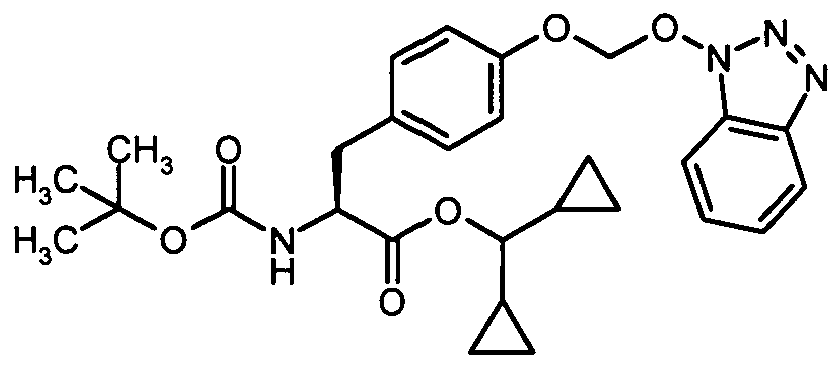
- The compound can be prepared in analogy to 1-2-1 from 3-2-7. In the fact, it was isolated from a preparation of 1-2-1, where a stereochemically impure tyrosine derivative had been inadvertedly used as starting material.
- 307 mg of a mixture were purified by preparative HPLC: Dionex: Pump P 580, Gilson: Liquid Handler 215, Knauer: UV-Detector K-2501;
Chiralpak IC 5 µm 250x30 mm; hexane / ethanol 80:20; 30 ml/min; r.t.; 307 mg / 1.5 ml ethanol; 6 x 0.25 ml; UV 254 nm. The peak at 15.7 to 17.5 min was collected to give 128 mg of 1-2-1 with 98% purity. The peak at 20.0 to 21.3 min was collected to give 30 mg of 1-2-2 with 98% purity. - MS (ESI+): m/e = 524 (M + H+).
- 1H NMR (DICHLOROMETHANE-d2 ,300MHz): δ (ppm) 7.97 (dt, J=7.5, 0.9 Hz, 1H, Bt-H), 7.31 - 7.47 (m, 2H, Bt-H), 7.24 (d, J=8.7 Hz, 2H, Ar-H), 7.21 (d, J=7.5 Hz, 1H, Bt-H), 7.08 (d, J=8.7 Hz, 2H, Ar-H), 6.03 (s, 2H, OCH2O), 5.06 (d, J=7.5 Hz, 1H, NH), 4.53 (dt, J=7.5, 5.8 Hz, 1H, 2-H), 3.90 (t, J=8.5 Hz, 1H, CHO), 3.17 (dd, J=13.8, 5.8 Hz, 1H, 3-H), 3.06 (dd, J=13.8, 5.7 Hz, 1H, 3-H), 1.41 (s, 9H, Boc), 1.04 - 1.18 (m, 2H, cyclopropyl CH), 0.42 - 0.65 (m, 4H, cyclopropyl CH2), 0.30 - 0.41 (m, 4H, cyclopropyl CH2).
- 13C NMR (DICHLOROMETHANE-d2 ,75MHz): δ (ppm) 171.3 (C-1), 155.1 (3C-4), 154.9 (2C-1), 143.4 (Bt C-3a), 131.7 (3C-1), 131.0 (3C-2), 128.6 (Bt C-7a), 128.2 (Bt C-6), 124.6 (Bt C-5), 119.8 (Bt C-4), 116.0 (3C-3), 109.0 (Bt C-7), 99.0 (OCH2O), 83.6 (1C-1), 79.5 (2C-2), 54.7 (C-2), 37.3 (C-3), 28.0 (2C-3), 14.6, 14.5 (cyclopropyl CH), 3.0, 2.7, 2.4 (cyclopropyl CH2).

- In the same way as described for 1-2-1, 150 mg (0.30 mmol) 3-2-4 in 2.5 ml dichloromethane were reacted to give after chromatography (
Biotage system SNAP 25 cartidge, 25 ml/min, n-hexane to n-hexane / ethyl acetate 6:4 in 10CV, then isokratic 4 CV) 74 mg (43%) of 1-2-3, which was further purified by preparative HPLC: (Dionex: Pump P 580, Gilson: Liquid Handler 215, Knauer: UV-Detektor K-2501; Chiralpak IC 5µm 250x20 mm; Hexan / Ethanol 50:50; 30 ml/min; RT; 74mg / 2.0 ml EtOH; 2 x 1.0 ml: UV 210 nm). The fraction eluting at 10.6 -11.8 min were collected to give 45 mg (26%) of 1-2-3 with a purity of 99.5 %. - MS (ESI+): m/e = 662 (M + C7H11 +), 590 (M + Na+), 568 (M + H+), 512 (M + H+ -C4H8), 468 (M + H+- CO2 - C4H8).
- 1H NMR (DICHLOROMETHANE-d2 ,500MHz): δ (ppm) 8.25 (dd, J=9.1, 1.3 Hz, 1H, Bt H-5), 8.18 (d, J=9.1 Hz, 1H, Bt H-4), 8.19 (d, J=1.3 Hz, 1H, Bt H-7), 7.31 (d, J=8.2 Hz, 2H, Ar-H), 7.11 (d, J=8.2 Hz, 2H, Ar-H), 6.14 (s, 2H, OCH2O), 5.12 (d, J=7.6 Hz, 1H, NH), 4.57 (dt, J=7.6, 5.4 Hz, 1H, 2-H), 3.95 (t, J=8.2 Hz, 1H, OCH), 3.24 (dd, J=13.9, 5.4 Hz, 1H, 3-H), 3.14 (dd, J=13.9, 5.4 Hz, 1H, 3-H), 1.46 (s, 9H, Boc), 1.10 - 1.21 (m, 2H, cyclopropyl CH), 0.47 - 0.67 (m, 4H, cyclopropyl CH2), 0.35 - 0.45 (m, 4H, cyclopropyl CH2).
- 13C NMR (DICHLOROMETHANE-d2 ,126MHz): δ (ppm) 171.3 (C-1), 154.9 (2C-1), 154.6 (3C-4), 147.4 (Bt C-6), 145.4 (Bt C-3a), 132.3 (3C-1), 131.3 (3C-2), 128.2 (Bt C-7a), 121.2 (Bt C-4), 119.5 (Bt C-5), 115.9 (3C-3), 106.7 (Bt C-7), 99.4 (OCH2O), 83.6 (1C-1), 79.5 (2C-2), 54.7 (C-2), 37.2 (C-3), 28.0 (2C-3), 14.6, 14.5 (1 C-2), 3.0, 2.7, 2.5 (1C-3/4).

- As described in the preparation of 2-1-1, 250 mg (0,67 mmol) 3-2-3 were reacted to give 290 mg of raw product, which was purified by preparative HPLC.
- Dionex: Pump P 580, Gilson: Liquid Handler 215, Knauer: UV-Detector K-2501,
Chiralpak IC 5 µm 250x30 mm, hexane / ethanol 95:5, 40 ml/min, r.t., 290 mg / 3 ml ethanol, 10 x 0.3 ml, UV 220 nm. The peak at 7.7 - 8.2 min was collected to give 85 mg (33%) 2-2-1 with 99.8 % purity. - 1H NMR (CHLOROFORM-d ,400MHz): δ (ppm) 7.16 (d, J=8.5 Hz, 2H, Ar-H), 6.99 (d, J=8.5 Hz, 2H, Ar-H), 5.68 (d, 2JHF=54.7 Hz, 2H, OCH2F), 4.98 (d, J=7.8 Hz, 1H, NH), 4.50 - 4.62 (m, 1H, 2-H), 3.89 (t, J=8.5 Hz, 2H, CHO), 3.13 (dd, J=14.1, 6.0 Hz, 1H, 3-H), 3.05 (dd, J=13.8, 5.5 Hz, 1H, 3-H), 1.42 (s, 9H, Boc), 0.99 - 1.16 (m, 2H, Cyclopropyl CH), 0.52 - 0.63 (m, 2H, cyclopropyl CH2), 0.41 - 0.52 (m, 2H, cyclopropyl CH2), 0.27 - 0.40 (m, 4H, cyclopropyl CH2).
- 13C NMR (101 MHz, CHLOROFORM-d): δ ppm 171.5 (C-1) 155.8 (d, 3JCF=3,1 Hz, 3C-4) 155.0 (2C-1) 131.31(3C-1) 130.8 (3C-2) 116.6 (3C-3) 100.8 (d, 1JCF=218.5 Hz, OCH2F) 83.7 (1C-1) 79.76 (2C-2) 54.56 (C-2) 37.41 (C-3) 28.31 (2C-3) 14.66, 14.62 (cyclopropylCH) 3.13, 2.96, 2.92, 2.71 (cyclopropyl CH2).

- As described in the preparation of 2-1-1, 250 mg (0,67 mmol) 3-2-7 were reacted to give 244 mg of raw product, which was purified by preparative HPLC.
- Dionex: Pump P 580, Gilson: Liquid Handler 215, Knauer: UV-Detector K-2501,
Chiralpak IC 5 µm 250x30 mm, hexane / ethanol 95:5, 40 ml/min, r.t., 244 mg / 1.8 ml ethanol/methanol 1:1, 3 x 0.6 ml, UV 220 nm. The peaks at 8.3 - 9.2 min were collected to give 83 mg (38%) of 2-2-2 in >99 % purity. - 19F NMR (DMSO-d6 ,376MHz): δ (ppm) -149.8 (t, 1JHF =55.1 Hz).
- 1H NMR (DMSO-d6 ,300MHz): δ (ppm) 7.21 (d, J=8.5 Hz, 2H, Ar-H), 6.98 (d, J=8.5 Hz, 2H, Ar-H), 5.78 (d, 1JHF =54.3 Hz, 2H, OCH2O), 3.97 - 4.12 (m, 1H, NH), 3.82 (t, J=81 Hz, 1H, OCH), 2.90 (dd, J=13.8, 5.7 Hz, 1H, 3-H), 2.80 (dd, J=13.6, 10.0 Hz, 1H, 3-H), 1.30 (s, 9H, Boc), 0.92 - 1.12 (m, 2H, cyclopropyl CH), 0.09 - 0.53 (m, 8H, cyclopropyl CH2).
- 13C NMR (DMSO-d6, 75MHz): δ (ppm) 172.1 (C-1), 155.7 (3C-4), 155.2 (2C-1), 132.8 (3C-1), 130.9 (3C-2), 116.4 (3C-3), 101.0 (d, 1JCF = 215.8 Hz, OCH2O), 81.8 (1C-1), 78.6 (2C-2), 56.2 (C-2), 36.1 (C-3), 28.6 (2C-2), 15.0 (cyclopropyl CH), 3.1, 2.9, 2.8, 2.8 (cyclopropyl CH2).
-

- 5.0 g (13.1 mmol) 3-2-1 and 160 mg (1,31 mmol) 4-(dimethylamino)pyridine were dissolved in 30 ml dichloromethane (previously dried over 4Ǻ molecular sieve). 2,87 g (17.0 mmol) 2,4-Dimethoxybenzyl alcohol and 3.27 g (17.0 mmol) N-ethyl-N'-3-dimethylaminopropyl carbodiimide hydrochloride were added and the mixture stirred at ambient temperature over night. Ethyl acetate was added and the insolubles were filtered off. The filtrate was concentrated i. vac.. Column chromatography over 500 g silicagel with stepwise gradient (1L hexane, hexane/ethyl acetate 9:1, hexane/ethyl acetate 8:2, hexane/ethyl acetate 7:3, hexane/ethyl acetate 6:4, respectively) gave 2.15 g (31 %) of 3-3-1. (smaller scale reactions gave 49 - 55% yield).
- MS (ESI+): m/e = 549 (M + H+ + OH), 532 (M + H+), 151 (C9H11O2 +).
- 1H NMR (CHLOROFORM-d ,400MHz): δ (ppm) 7.19 (d, J=9.1 Hz, 2H, Dmb H-7), 6.98 - 7.10 (m, 4H, Dmb H6, H-4, Tyr H-4/8), 6.42 - 6.51 (m, 2H, Tyr H-5/7), 5.19 (d, J=11.1 Hz, 1H, Dmb H-1), 5.07 (d, J=11.1 Hz, 1H, Dmb H-1), 4.99 (d, J=8.1 Hz, 1H, NH), 4.54 - 4.64 (m, 1H, Tyr H-2), 3.83 (s, 3H, Dmb OMe), 3.82 (s, 3H, Dmb OMe), 3.00 - 3.15 (m, 2H, Tyr H-3), 1.56 (s, 9H, tBu), 1.41 (s, 9H, t-Bu).
- 13C NMR (CHLOROFORM-d ,101MHz): δ (ppm) 171.7 (C-1), 161.6 (Dmb C-5), 159.2 (Dmb C-3), 155.1 (2C-1), 151.9 (OBoc C-1), 150.0 (3C-4), 133.6 (3C-1), 132.0 (Dmb C-7), 130.4 (3C-2), 121.2 (3C-3), 116.0 (Dmb C-2), 104.1 (Dmb C-6), 98.6 (Dmb C-4), 83.5 (OBoc C-2), 79.9 (2C-2), 62.8 (Dmb C-1), 55.5 (Dmb-OMe), 55.5 (Dmb-OMe), 54.3 (C-2), 37.5 (C-3), 28.4 (2C-3), 27.7 (OBoc C-3).

- 2.10 g (3,95 mmol) 3-3-1 was dissolved in 40 ml dichloromethane (dried over 4Ǻ molecular sieve) and 40 ml piperidine added. The mixture was stirred at r.t. for 2 h, after which HPLC/MS over 80% conversion. The reaction mixture was partitioned between ethyl-acetate and water, The organic phase was separated and dried over sodium sulfate. The residue obtained upon evaporation i. vac. (3.8g) was purified by chromatography on a Biotage system (Flash 40+M, n-hexane to ethyl acetate in 15CV =1980 ml) to give 1.10 g (64.5%) 3-3-2.
- 1H NMR (400 MHz, DICHLOROMETHANE-d2): δ (ppm) 7.19 (d, J = 7.8 Hz, 1H, DMB 6-H), 6.92 (m, d, J = 8.6 Hz, 2H, Ar-H), 6.68 (d, J = 8.1 Hz, 2H, Ar-H), 6.43 - 6.51 (m, 2H, DMB 3-H, 5-H), 5.14 (d, J = 11.9 Hz, 1H, DMB 1-H), 5.00 (d, J = 8.3 Hz, 1H, NH), 5.05 (d, J = 11.6 Hz, 1H, DMB 1-H), 4.41 - 4.54 (m, 1H, 2-H), 3.82 (s, 3H, DMB OMe), 3.81 (s, 3H, DMB OMe), 2.83 - 3.08 (m, 2H, 3-H), 1.39 (s, 9H, Boc).
- 13C NMR (101 MHz, DICHLOROMETHANE-d2): δ (ppm) 171.9 (C-1), 161.6 (DMB C-5), 159.2 (DMB C-3), 155.1 (3C-4), 155.1 (2C-1), 131.7 (DMB C-7), 130.5 (3C-2), 127.8 (3C-1), 116.0 (DMB C-2), 115.2 (3C-3), 104.1 (DMB C-6), 98.4 (DMB C-4), 79.6 (2C-2), 62.6 (DMB C-1), 55.5 (DMB 5-OMe), 55.4 (DMB 3-OMe), 54.7 (C-2), 37.2 (C-3), 28.0 (2C-3).

- 1.1 g (2.556 mmol) 3-3-2 were reacted as described for 3-2-4. Chromatography of the raw product on a Biotage system (Flash 40+M, gradient hexane to ethyl acetate/hexane 1:3, 15CV =1980 ml) gave 490 mg (39%) of 3-3-3.
- MS (ESI+): m/e = 514 (M + Na+), 301 (C18H21O4 +).151 (C9H11O2 +).
- MS (ESI-): m/e = 536 (M + HCOO-).
- 1H NMR (400 MHz, DICHLOROMETHANE-d2) δ (ppm) 7.20 (d, J = 8.1 Hz, 1H, Dmb 7-H), 7.00 (d, J = 8.3 Hz, 2H, Ar-H), 6.82 (d, J = 8.6 Hz, 2H, Ar-H), 6.49 (d, J = 2.3 Hz, 1H, Dmb 4-H), 6.47 (dd, J = 2.3, 8.3 Hz, 1H, Dmb 6-H), 5.12 (s, 2H, S-CH2), 5.14 (d, J = 11.9 Hz, 1H), 5.06 (d, J = 11.9 Hz, 1H), 4.98 (d, J = 8.1 Hz, 1H, NH), 4.43 - 4.55 (m, 1H. 2-H), 3.82 (s, 3H, Dmb-OCH3), 3.81 (s, 3H, Dmb-OCH3), 3.03 (dd, J = 5.3, 13.9 Hz, 1H, 3-H), 2.96 (dd, J = 5.8, 13.9 Hz, 1H, 3-H), 2.23 (s, 3H, SCH3), 1.39 (s, 9H, Boc).
- 13C NMR (101 MHz, DICHLOROMETHANE-d2): δ (ppm) 171.8 (C-1), 161.6 (Dmb C-5), 159.2 (Dmb C-3), 156.1 (3C-4), 154.9 (2C-1), 131.8 (Dmb C-7), 130.4 (3C-2), 129.3 (3C-1), 116.0 (Dmb C-2), 115.8 (3C-3), 104.1 (Dmb C-6), 98.4 (Dmb C-4), 79.5 (2C-2), 72.4 (OCH2S), 62.6 (Dmb C-1), 55.5 (Dmb OCH3), 55.4 (Dmb OCH3), 54.6 (C-2), 37.2 (C-3), 28.0 (3C-3), 14.3 (SCH3).

- 240 mg (0.49 mmol) 3-3-3 were reacted as described for 1-2-1. The raw product was directly chromatographed on a Biotage system (Flash40+M cartidge, 40 ml/min, n-hexane to n-hexane / ethyl acetate 65:35 in 18CV = 2376 ml) gave 75 mg (27%) of 1-3.
- The compound was further purified by preparative HPLC: Dionex: Pump P 580, Gilson: Liquid Handler 215, Knauer: UV-Detector K-2501;
Chiralpak IC 5 µm 250x20 mm; hexane / ethanol 80:20; 20 ml/min; r.t.; 71 mg / 1 ml ethanol/methanol 1:1; 2 x 0.5 ml, UV 254 nm. The peak at 20.0 - 22.5 min was collected to give 43 mg (15%) of the title material (purity: 98,5%) as white solid. - MS (Cl+ ' NH3): m/e = 578 (M+), 151 (C9H11O+).
- 1H NMR (DICHLOROMETHANE-d2 ,400MHz): δ (ppm) 8.03 (d, J=8.3 Hz, 1 H, Bt), 7.38 - 7.49 (m, 2 H, Bt), 7.26 (d, J=8.3 Hz, 1 H, Dmb 7-H), 7.24 (d, J=8.5 Hz, 1 H, Bt), 7.15 (d, J=8.5 Hz, 2 H, Ar-H), 7.07 (d, J=8.5 Hz, 2 H, Ar-H), 6.54 (d, J=2.3 Hz, 1 H, Dmb 4-H), 6.51 (dd, J=8.3, 2.3 Hz, 1 H, Dmb 6-H), 6.07 (s, 2 H, OCH2O), 5.22 (d, J=11.8 Hz, 1 H, Dmb-1-H), 5.14 (d, J=11.5 Hz, 1 H, Dmb 1-H), 5.09 (d, J=7.3 Hz, 1 H, NH), 4.52 - 4.65 (m, 1 H, 2-H), 3.88 (s, 3 H, Dmb OMe), 3.84 (s, 3 H, Dmb OMe), 3.16 (dd, J=13.8, 5.5 Hz, 1 H, 3-H), 3.07 (dd, J=13.8, 5.3 Hz, 1 H, 3-H), 1.46 (s, 9 H, Boc).
- 13C NMR (101 MHz, DICHLOROMETHANE-d2): δ (ppm) 172.0 (C-1), 162.1 (Dmb C-5), 159.6 (Dmb C-3), 155.5 (3C-4), 155.3 (2C-1), 143.9 (Bt C-3a), 132.2 (Dmb C-7), 132.0 (3C-1), 131.3 (3C-2), 129.1 (Bt C-7a), 128.6 (Bt C-6), 125.0 (Bt C-5), 120.3 (Bt C-4), 116.5 (3C-3), 116.4 (Dmb C-2), 109.5 (Bt C-7), 104.6 (Dmb C-6), 99.4 (OCH2O), 98.8 (Dmb C-4), 80.0 (2C-2), 63.1 (Dmb C-1), 55.9 (Dmb OMe), 55.8 (Dmb OMe), 55.0 (C-2), 37.8 (C-3), 28.4 (2C-3).
-

- 5.00 g (17.8 mmol) Boc-D-tyrosine and 2.90 g (8.89 mmol) caesium carbonate were stirred in 150 ml water for 30 min at r.t. and then lyophilized. The resulting white powder was dissolved in 100 ml N,N-dimethylformamide (dried over 4Ǻ molecular sieve), 1,724 ml (17.8 mmol) (Bromomethyl)cyclopropane were added and the mixture stirred at r.t. over night. The mixture was partitioned between ethyl acetate and water, the aqueous phase was extracted with ethyl acetate, the combined organic phases dried over sodium sulfate and the solvent evaporated i. vac.. The residue was dissolved in ethyl acetate and extracted twice with water. After drying and
evaporation 5,28 g (89%) 3-4-1 were obtained as a white solid. - 1H NMR (400 MHz, CHLOROFORM-d) d ppm 7.00 (d, J=8.1 Hz, 2 H, Ar-H) 6.73 (d, J=7.8 Hz, 2 H, Ar-H) 5.54 (br. s, 1 H, OH) 5.02 (d, J=7.6 Hz, 1 H, NH) 4.48 - 4.61 (m, 1 H, 2-H) 3.88 - 3.99 (m, 2 H, OCH2) 2.95 - 3.10 (m, 2 H, 3-H2) 1.42 (s, 9 H, Boc) 1.03 - 1.18 (m, 1 H, cyclopropyl CH) 0.52 - 0.63 (m, 2 H, cyclopropyl CH2) 0.22 - 0.31 (m, 2 H, cyclopropyl CH2). Spectrum is identical with an earlier preparation via a different route.
- MS (ESI+): m/e = 693 (2M + Na+), 671 (2M + H+), 336 (M + H+), 280 (M + H+ - C4H8), 236 (M + H+ - C4H8 - CO2).
- 13C NMR (CHLOROFORM-d ,101 MHz): δ (ppm) 172.2 (C-1), 155.7 (3C-4), 155.2 (2C-1), 130.4 (3C-2), 127.1 (3C-1), 115.5 (3C-3), 79.9 (2C-2), 70.2 (1C-1), 54.6 (C-2), 37.5 (C-3), 28.4 (2C-3), 9.7 (cyclopropyl CH), 3.5, 3.4 (cyclopropyl CH2).

- A solution of 1.19 g (3.55 mmol) 3-4-1, 53 mg (0.36 mmol) sodium iodide and 8 ml N,N-dimethylformamide was cooled to 0°C in an ice bath. A suspension of 358 mg (3.19 mmol) potassium tert-butylate in 3 ml tetrahydrofuran was added, resulting in a greenish solution. 337 µl (4.08 mmol) chloro dimethyl sulfide were added. The mixture was allowed to come to r.t., stirred for 2 h and stored at 5°C over night. Ethyl acetate was added and the insolubles were filtered off. The filtrate was concentrated i. vac.. Chromatography on a Biotage system (Flash40+M cartridge, 40 ml/min, n-hexane to n-hexane / ethyl acetate 1:4, 15 CV=1980 ml) gave 660 mg (47%) of 3-2-4 and 200 mg (17%) starting material. MS (ESI+): m/e = 791 (2M + H+), 396 (M + H+), 340 (M + H+ - C4H8), 296 (M + H+ - C4H8 - CO2).
- 1H NMR (DICHLOROMETHANE-d2, 400MHz): δ (ppm) 7.09 (d, J=8.6 Hz, 2H, Ar-H), 6.87 (d, J=8.6 Hz, 2H, Ar-H), 5.13 (s, 2H, OCH2S), 4.99 (d, J=7.8 Hz, 1H, NH), 4.42 - 4.54 (m, 1H, 2-H), 3.87 - 3.99 (m, 2H, OCH2), 2.95 - 3.12 (mc, 2H, 3-H), 2.22 (s, 3H, SCH3), 1.40 (s, 9H, Boc), 1.04 - 1.18 (m, 1H, cyclopropyl CH), 0.53 - 0.61 (m, 2H, cyclopropyl CH2), 0.22 - 0.31 (m, 2H, cyclopropyl CH2).
- 13C NMR (101 MHz, DICHLOROMETHANE-d2): δ (ppm) 171.9 (C-2), 156.1 (3C-4), 154.9 (2C-1), 130.4 (3C-2), 129.4 (3C-1), 115.9 (3C-3), 79.5 (2C-2), 72.4 (OCH2S), 70.1 (1C-1), 54.6 (C-2), 37.4 (C-3), 28.0 (3C-3), 14.3 (SCH3), 9.6 (1C-2), 3.2 (1 C-3), 3.1 (1C-4).

- 650 mg (1.64 mmol) 3-4-2 were reacted as described for 1-2-1. The reaction mixture was directly applied to Isolute and chromatographed on a Biotage system (Flash40+M cartridge, 40 ml/min, n-hexane to n-hexane / ethyl acetate 1:2 in 15CV = 1980 ml) gave 400 mg (50%) of 1-4-1. The whole reaction including purification was done in one day. Storage of the raw product adversely affects the yield.
- The compound was further purified by preparative HPLC: Dionex: Pump P 580, Gilson: Liquid Handler 215, Knauer: UV-Detector K-2501; Chiralpak IC 5µm 250x20 mm; hexane / ethanol 80:20; 40 ml/min; r.t.; 400 mg / 3.2 ml ethanol; 8 x 0.4 ml, UV 254 nm. The peak at 15.6 - 18.1 min was collected to give 308 mg (39%) of 1-4-1 as white solid with 99,9% purity.
- MS (ESI+): m/e = 505 (M + Na+), 483 (M + H+), 427 (M + H+ - C4H8), 383 (M + H+ - C4H8 - CO2).
- 1H NMR (DICHLOROMETHANE-d2 ,400MHz): δ (ppm) 8.03 (dt, J=8.3, 1.0 Hz, 1H, Bt H-7), 7.47 (ddd, J=8.0, 7.0, 1.0 Hz, 1H, Bt 5-H*), 7.41 (ddd, J=8.0, 7.0, 1.0 Hz, 1H, Bt 6-H*), 7.27 (d, br., J=8.0 Hz, 1H, Bt 4-H), 7.25 (d, J=8.5 Hz, 2H, Ar-H), 7.13 (d, J=8.5 Hz, 2H, Ar-H), 6.08 (s, 2H, OCH2O), 5.11 (d, J=7.5 Hz, 1H, NH), 4.53 - 4.64 (m, 1H, 2-H), 3.94 - 4.07 (mc, 2H, OCH2), 3.20 (dd, J=14.1, 5.5 Hz, 1H, 3-H), 3.11 (dd, J=13.6, 5.5 Hz, 1H, 3-H), 1.47 (s, 9H, Boc), 1.13 - 1.22 (m, 1H, cyclopropyl CH), 0.59 - 0.66 (m, 2H, cyclopropyl CH2), 0.31 - 0.37 (m, 2H, cyclopropyl CH2).
- 13C NMR (DICHLOROMETHANE-d2 ,101MHz): δ (ppm) 172.2 (C-1), 155.6 (3C-4), 155.3 (2C-1), 143.9 (Bt C-3a), 132.1 (3C-1), 131.3 (3C-2), 129.1 (Bt C-7a), 128.6 (Bt C-6), 125.0 (Bt C-5), 120.3 (Bt C-4), 116.6 (3C-3), 109.4 (Bt C-7), 99.5 (OCH2O), 80.0 (2C-2), 70.6 (1C-1), 55.0 (C-2), 37.9 (C-3), 28.4 (2C-3), 10.1 (1C-2), 3.6 (1C-3), 3.5 (1 C-4).

- 360 mg (0,91 mmol) 3-4-2 were reacted as described for 1-4-1. The reaction mixture was directly applied to Isolute and chromatographed on a Biotage system (Flash40+M cartridge, 40 ml/min, n-hexane to n-hexane / ethyl acetate 1:2 in 15CV = 1980ml) gave 230 mg (50%) of 1-4-2. The compound was further purified by preparative HPLC. Agilent: Prep 1200, 2xPrep Pump, DLA, MWD, Prep FC, ESA: Corona,
Chiralpak IC 5 µm 250x20 mm, hexane / ethanol 50:50, 15 ml/min, r.t., 230 mg / 3.5 ml ethanol/methanol 1:1, 7 x 0.5 ml, UV 210 nm. The peak at 7.0 - 8.9 min was collected to give 190 mg (41%) of 1-4-2 with 98,5% purity. - MS (ESI+): m/e = 527 (M + Na+), 505 (M + H+), 449 (M + H+ - C4H8), 405 (M + H+ - C4H8 - CO2).
- MS (ESI-): m/e = 549 (M + HCOO).
- 1H NMR (DICHLOROMETHANE-d2, 400MHz): δ (ppm) 8.00 (s, 1H, T H-5), 7.19 (d, J=8.6 Hz, 2H, Ar-H), 7.06 (d, J=8.6 Hz, 2H, Ar-H), 5.90 (s, 2H, OCH2O), 5.04 (d, J=7.8 Hz, 1H, NH), 4.52 (ddd, J=7.8, 6.1, 5.6 Hz, 1H, 2-H), 4.36 (q, J=7.3 Hz, 2H, T OCH2), 3.92 (dd, J=11.4, 7.6 Hz, 1H, OCH2), 3.96 (dd, J=11.4, 7.3 Hz, 2H, OCH2), 3.13 (dd, J=13.6, 5.6 Hz, 1H, 3-H), 3.04 (dd, J=13.6, 6.1 Hz, 1H, 3-H), 1.36 (t, J=7.1 Hz, 3H), 1.40 (s, 9H, Boc), 1.08 - 1.16 (m, 1H, cyclopropyl CH), 0.53 - 0.62 (m, 2H, cyclopropyl CH2), 0.24 - 0.32 (m, 2H, cyclopropyl CH2).
- 13C NMR (101 MHz, DICHLOROMETHANE-d2): δ (ppm) 171.7 (C-), 159.9 (T COOEt), 155.0 (3C-4), 154.9 (2C-1), 138.2 (T C-4), 132.2 (3C-1), 131.0 (3C-2), 123.3 (T C-5), 116.3 (3C-3), 99.2 (OCH2O), 79.6 (2C-2), 70.2 (1C-1), 61.4 (T OCH2), 54.6 (C-2), 37.4 (C-3), 28.0 (2C-3), 14.0 (T CH3), 9.7 (cyclopropyl CH), 3.2 (cyclopropyl CH2), 3.1 (cyclopropyl CH2).
-

- To 1,763 g (6,27 mmol) Boc-D-Tyr-OH in 52 ml N,N-dimethylformamide were added 1,041 g (3,2 mmol) caesium carbonate and the mixture stirred at r.t. for 1,5 h. 1,260 g (6,27 mmol) 4-methoxybenzyl bromide were added and the mixture stirred at r.t. over night. It was diluted with ethyl acetate and water. The pH was adjusted to 5 with 250 µl of 5 % acetic acid. The aqueous phase was separated and extracted with ethyl acetate. The combined extracts were dried and evaporated in the vacuum at 50 °C to yield 2,79 g (100 %) of 3-5-1.
- MS (ES+): m/e = 402,53 (M M + H+), 803,72 (2M + H+).
- 1H NMR (CHLOROFORM-d ,400MHz): δ (ppm) 7.24 (d, J=8.5 Hz, 2H, Mbn-H), 6.82 - 6.92 (m, 4H, Mbn-H, Ar-H), 6.67 (d, J=8.3 Hz, 2H, Ar-H), 5.11 (d, J=12.0 Hz, 1H, Mbn 1-H), 5.02 (d, J=12.5 Hz, 1H, Mbn 1-H), 4.99 (d, J=8.5 Hz, 1H, NH), 4.49 - 4.59 (m, 1H, 2-H), 3.81 (s, 3H, Mbn OCH3), 2.93 - 3.03 (m, 2H, 3-H), 1.41 (s, 9H, Boc).
- 13C NMR (CHLOROFORM-d ,101 MHz): δ (ppm) 171.9 (C-1), 159.8 (Mbn C-5), 155.2 (3C-4), 155.1 (2C-1), 130.4 (3C-2), 127.4 (3C-1), 127.4 (Mbn C-2), 115.4 (3C-3), 114.0 (Mbn C-4), 80.0 (2C-1), 66.9 (Mbn C-1), 55.3 (Mbn OCH3), 54.6 (C-3), 37.4 (C-3), 28.3 (2C-3).
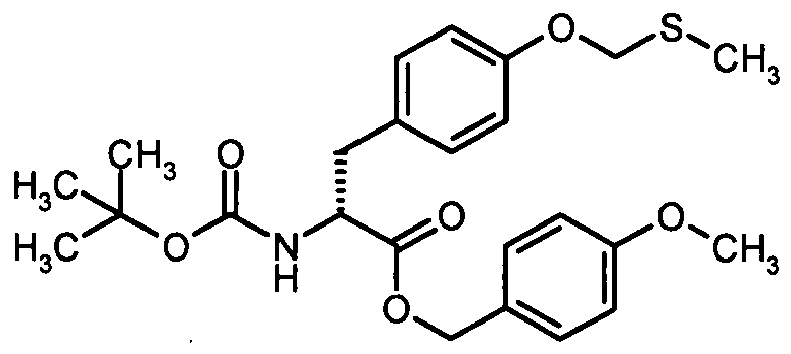
- 1,60 g (3,99 mmol) 3-5-1 were dissolved in 32 ml N,N-dimethylformamide. 2,60 g (7,97 mmol) caesium carbonate were added and the mixture stirred for 30 min. 0,4 ml (4,78 mmol) Chloromethyl methyl sulfide were added and the mixture stirred at r.t. for 48 h. Further 0,1 ml (1,20 mmol) Chloromethyl methyl sulfide were added and the mixture stirred for 24 h. The solvent was distilled off and the residue distributed between water and ethyl acetate. The organic solvent was extracted with sodium chloride solution, dried and evaporated. The residue was chromatographed on a Biotage system (isolera Four,
SNAP 25g, 25 ml/min, n-hexane to n-hexane / ethyl acetate 1:5) to give 682 mg (33 %) 3-5-2. - MS (ES+): m/e = 462,55 (M + H+), 923,69 (2M + H+).
- 1H NMR (CHLOROFORM-d ,300MHz): δ (ppm) 7.25 (d, J=8.3 Hz, 2H, Mbn-H), 6.93 (d, J=8.3 Hz, 2H, Ar-H), 6.89 (d, J=8.7 Hz, 2H, Ar-H), 6.80 (d, J=8.5 Hz, 2H, Mbn-H), 5.10 (s, 2H, OCH2S), 5.12 (d, J=12.1 Hz, 1H, Mbn 1-H), 5.03 (d, J=11.9 Hz, 1H, Mbn 1-H), 4.96 (d, J=8.5 Hz, 1H, NH), 4.48 - 4.63 (m, 1H, 2-H), 3.82 (s, 3H, OCH3), 2.92 - 3.10 (m, 2H, 3-H), 2.25 (s, 3H, SCH3), 1.41 (s, 9H, Boc).
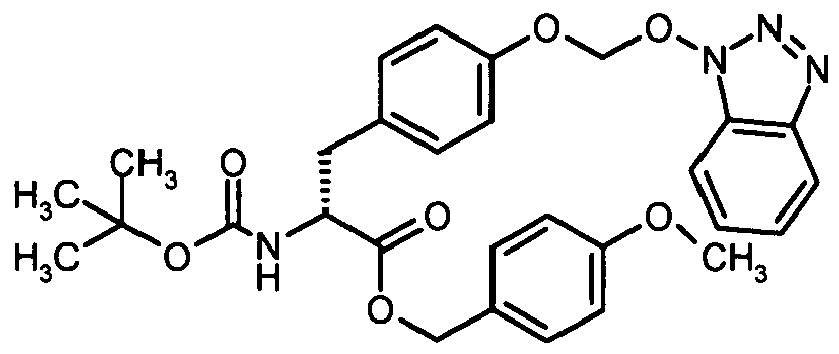
- 520 mg (1,13 mmol) 3-5-2 were reacted as described for 1-2-1. The reaction mixture was directly applied to Isolute and chromatographed on a Biotage system (Isolera Four, SNAP 50 g, 40 ml/min, n-hexane to n-hexane / ethyl acetate 1:4) to give 492 mg.
- The compound was further purified by preparative HPLC. Waters Autopurificationsystem: Pump 254, Sample Manager 2767, CFO, DAD 2996, ELSD 2424, SQD 3001,
XBrigde C18 5 µm 150x19 mm, A = water + 0.2% ammonia, B = acetonitrile, 0-1 min 40% B, 1-8 min 40-100% B, 25 ml/min, r.t., 500 mg / 7 ml dimethyl sufoxide/methanol 1:1, 7 x 1 ml, DAD scan range 210-400 nm, MS ESI+, ESI-, scan range 160-1000 m/z, ELSD. The peak at 6.6 - 7.0 min was collected to give 213 mg (33 %) of 1-5-1 as white solid.with >99% purity. - MS (ES+): m/e = 549,62 (M + H+).
- 1H NMR (CHLOROFORM-d ,400MHz): δ (ppm) 8.00 (d, J=7.6 Hz, 1H), 7.32 - 7.43 (m, 2H), 7.25 - 7.31 (m, 2H), 7.12 (d, J=8.1 Hz, 1H), 6.97 (d, J=8.6 Hz, 1H), 6.93 - 7.07 (d, J=8.6 Hz, 2H), 6.88 (d, J=8.6 Hz, 2H, Bn), 6.01 (s, 2H, OCH2O) 5.16 (d, J=11.4 Hz, 1H), and 5.05 (d, J=11.4 Hz, 2H, OCH2Ar), 5.02 (d, J=8.8 Hz, 1H, NH), 4.55 - 4.66 (m, 1H, 2-H), 3.79 (s, 3H. OCH3), 3.11 (dd, J=13.9, 5.8 Hz, 1H, 3-H), 3.03 (dd, J=14.1, 5.6 Hz, 1H, 3-H), 1.43 (s, 9H, Boc).
- 13C NMR (CHLOROFORM-d ,101 MHz): δ (ppm) 171.6 (C-1), 159.9 (Mbn C-5), 155.2 (3C-4), 155.1 (2C-1), 143.5 (Bt C-3a), 131.2 (3C-1), 130.9 (3C2), 130.7 (Mbn C-3), 128.8 (Bt C-7a), 128.3 (Bt C-6), 127.3 (Mbn C-2), 124.7 (Bt C-5), 120.1 (Bt C-4), 116.1 (3C-3), 114.0 (Mbn C-4), 109.1 (Bt C-7), 99.0 (OCH2O), 80.1 (2C-1), 67.1 (Mbn C-1), 55.4 (Mbn C-6), 54.5 (C-2), 37.5 (C-3), 28.4 (2C-3).

- 100 mg (0,22 mmol) 3-5-2 were reacted as described for 1-2-1, where the 1H-benzotriazol-1-ol hydrate was replaced by 6-chloro-1H-benzotriazol-1-ol. The reaction mixture was directly applied to Isolute and chromatographed on a Biotage system (Isolera Four, SNAP 10 g, 12 ml/min, n-hexane to n-hexane / ethyl acetate 4:1) to give 75 mg.
- MS (ESI+): m/e = 583,17 (M + H+).
- MS (ESI-): m/e = 627,10 (M + HCOO).
- 1H NMR (CHLOROFORM-d ,300MHz): δ (ppm) 7.92 (dd, J=8.9, 0.4 Hz, 1H Bt 4-h), 7.31 (dd, J=8.9, 1.9 Hz, 1H, Bt 5-H), 7.28 (d, J=8.5 Hz, 2H, PMB 2-H), 7.03 (d, J=8.7 Hz, 2H, Ar 2-H), 7.06 (br. s., 1H, Bt 7-H), 6.94 (d, J=8.5 Hz, 2H, PMB 3-H), 6.87 (d, J=8.7 Hz, 2H, Ar 3-H), 5.96 - 6.04 (m, 2H, OCH2O), 5.15 (d, J=11.7 Hz, 1H, PMB CH2), 5.05 (d, J=12.1 Hz, 1H, PMB CH2), 5.01 (br. s., 1H, NH), 4.53 - 4.66 (m, 1H, 2-H), 3.79 (s, 3H, PMB OMe), 3.08 (br. s., 2H, 3-H), 1.43 (s, 9H, Boc).
- 13C NMR (CHLOROFORM-d ,75MHz): δ (ppm) 171.6 (C-1), 159.8 (1C-5), 155.0 (2C-1), 154.8 (3C-4), 142.0 (Bt C-7a), 134.8 (Bt C-3a), 131.4 (3C-1), 131.0 (1C-2), 130.6 (3C-2), 129.3 (1C-3), 127.3 (Bt C-6), 126.0 (Bt C-5), 121.1 (Bt C-7), 116.0 (3C-3), 113.9 (1C-4), 108.9 (Bt C-4), 98.8 (OCH2O), 80.0 (2C-2), 67.1 (1C-1), 55.3 (OCH3), 54.4 (C-2), 37.4 (C-3), 28.3 (2C-3).
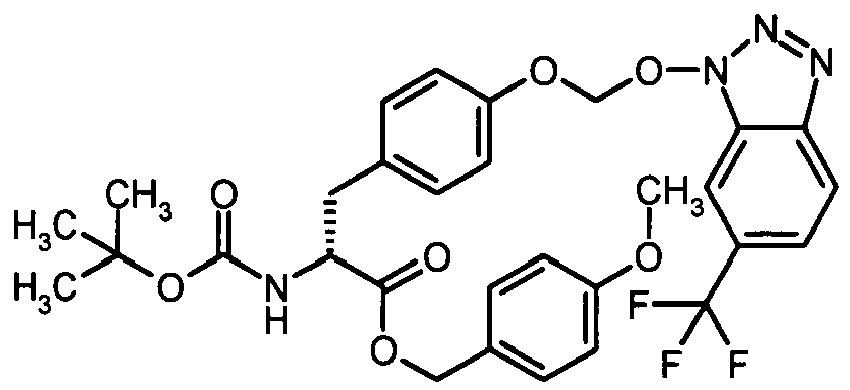
- 150 mg (0,33 mmol) 3-5-2 were reacted as described for 1-2-1, where the 1H-benzotriazol-1-ol hydrate was replaced by 6-trifluoromethyl-1H-benzotriazol-1-ol. The reaction mixture was directly applied to Isolute and chromatographed on a Biotage system (Isolera Four,
SNAP 25 g, 25 ml/min, n-hexane 1 CV, n-hexane to n-hexane / ethyl acetate 6:4 10CV, then isokratic 4CV) to give 221 mg (>100%). The material was further purified by HPLC: (Dionex: Pump P 580, Gilson: Liquid Handler 215, Knauer: UV-Detector K-2501; Chiralpak IC 5µm 250x30 mm; Hexan / Ethanol 80:20; 40 ml/min; RT; 221 mg / 3 ml EtOH / Dichlormethan 1:1; 6 x 500 ml; UV 210 nm). Two peaks, 13.1 - 14.1 min (77mg (38%), 99.5 % purity, 1-5-3) and 14.1 - 15.5 min (48 mg (22%), 93.2 % purity, 1-5-4) were collected. - Both peaks had the same mass. The stereochemistry was putatively assigned in comparison with 1-2-1 and 1-2-2.
- MS (ESI+): m/e = 639 (M + Na+), 617 (M + H+), 561 (M + H+ -C4H8), 121 (C8H9O+).
- 1H NMR (DICHLOROMETHANE-d2, 400MHz): δ (ppm) 8.13 (d, J=8.6 Hz, 1H, Bt 4-H), 7.59 (dd, J=8.8, 1.3 Hz, 1H, Bt 5-H), 7.48 (s, 1H, Bt 7-H), 7.24 - 7.32 (m, 2H, Mbn 3-H), 7.07 (d, J=8.3 Hz, 2H, Ar-H), 6.98 (d, J=8.6 Hz, 2H, Ar-H), 6.83 - 6.92 (m, 2H, Mbn 4-H), 6.01 - 6.09 (m, 2H, OCH2O), 5.12 (d, J=11.9 Hz, 1H, Mbn 1-H), 5.06 (d, J=11.9 Hz, 1H, Mbn 1-H), 5.02 (d, J=7.8 Hz, 1H, NH), 4.54 (dt, J=7.8, 5.8 Hz, 1H, 2-H), 3.77 (s, 1H, OMe), 3.11 (dd, J=13.9, 5.8 Hz, 1H, 3-H), 3.03 (dd, J=13.9, 5.8 Hz, 1H, 3H), 1.40 (s, 9H, Boc).
- 19F NMR (DICHLOROMETHANE-d2 ,376MHz): δ (ppm) -62,3.
- 13C NMR (101 MHz, DICHLOROMETHANE-d 2) δ ppm 171.6 (C-1), 159.9 (Mbn C-5), 155.0 (br., 2C1), 154.6 (3C-4), 144.6 (Bt C-3a), 131.8 (3C-1), 131.0 (3C-2), 130.5 (Mbn C-3) 130.1 (q, 2JCF=32.8 Hz, Bt C-6), 128.2 (Bt C-7a), 127.5 (Mbn C-2), 123.7 (q, 1JCF =272.4 Hz, CF3), 121.2 (Bt C-4, Bt C-5), 115.9 (3C-3) 113.8 (Mbn C-4), 107.8 (q, 3JCF =4.8 Hz, Bt C-7), 99.0 (OCH2O), 79.6 (2C-2) ,66.9 (Mbn C-1) ,55.2 (Mbn OMe), 54.6 (C-2), 37.2 (C-3), 28.0 (2C-3).

- The compound can be prepared in analogy to 1-5-3 from L-tyrosine. In the event it was isolated from the preparation of 1-5-4, where a partial racemisation had occurred during the synthesis or stereochemically impure tyrosine had been used.
- MS (ESI+): m/e = 639 (M + Na+), 617 (M + H+), 561 (M + H+ -C4H8), 121 (C8H9O+).
- 1H NMR (DICHLOROMETHANE-d2 ,400MHz): δ (ppm) 8.13 (d, J=8.8 Hz, 1H, Bt 4-H), 7.59 (dd, J=8.8, 1.3 Hz, 1H, Bt 5-H), 7.48 (s, 1H, Bt 7-H), 7.28 (d, J=8.6 Hz, 2H, Mbn 3-H), 7.07 (d, J=8.3 Hz, 2H, Ar-H), 6.98 (d, J=8.6 Hz, 2H, Ar-H), 6.84 - 6.90 (m, 2H, Mbn 4-H), 6.02 - 6.08 (m, 2H, OCH2O), 5.12 (d, J=11.6 Hz, 1H, Mbn 1-H), 5.06 (d, J=11.6 Hz, 1H, Mbn 1-H), 5.02 (d, J=8.1 Hz, 1H, NH), 4.54 (dt, J=8.1, 5.8 Hz, 1H, 2-H), 3.77 (s, 3H, Mbn OMe), 3.11 (dd, J=13.9, 5.8 Hz, 1H, 3-H), 3.03 (dd, J=13.6, 5.8 Hz, 1H, 3-H), 1.40 (s, 9H, Boc).
- 19F NMR (DICHLOROMETHANE-d2 ,376MHz): δ (ppm) -62.3.
- 13C NMR (DICHLOROMETHANE-d2, 101MHz): δ ppm 171.6 (C-1), 159.9 (Mbn C-5), 155.0 (2C1), 154.6 (3C-4), 144.6 (Bt C-3a), 131.8 (3C-1), 131.0 (3C-2), 130.5 (Mbn C-3), 130.1 (q, 2JCF =32.8 Hz, Bt C-6), 128.2 (Bt C-7a), 127.5 (Mbn C5), 123.7 (q, 1JCF =273.2 Hz, CF3), 121.2 (Bt C-4, Bt C-5), 115.9 (3C-3), 113.8 (MBn C-4), 107.8 (q, 3JCF =4.8 Hz, Bt C-7), 99.0 (OCH2O) 79.7 (2C-2), 66.9 (Mbn C-1), 55.2 (Mbn OMe), 54.6 (C-2), 37.2 (C-3) 28.0 (2C-3).
-
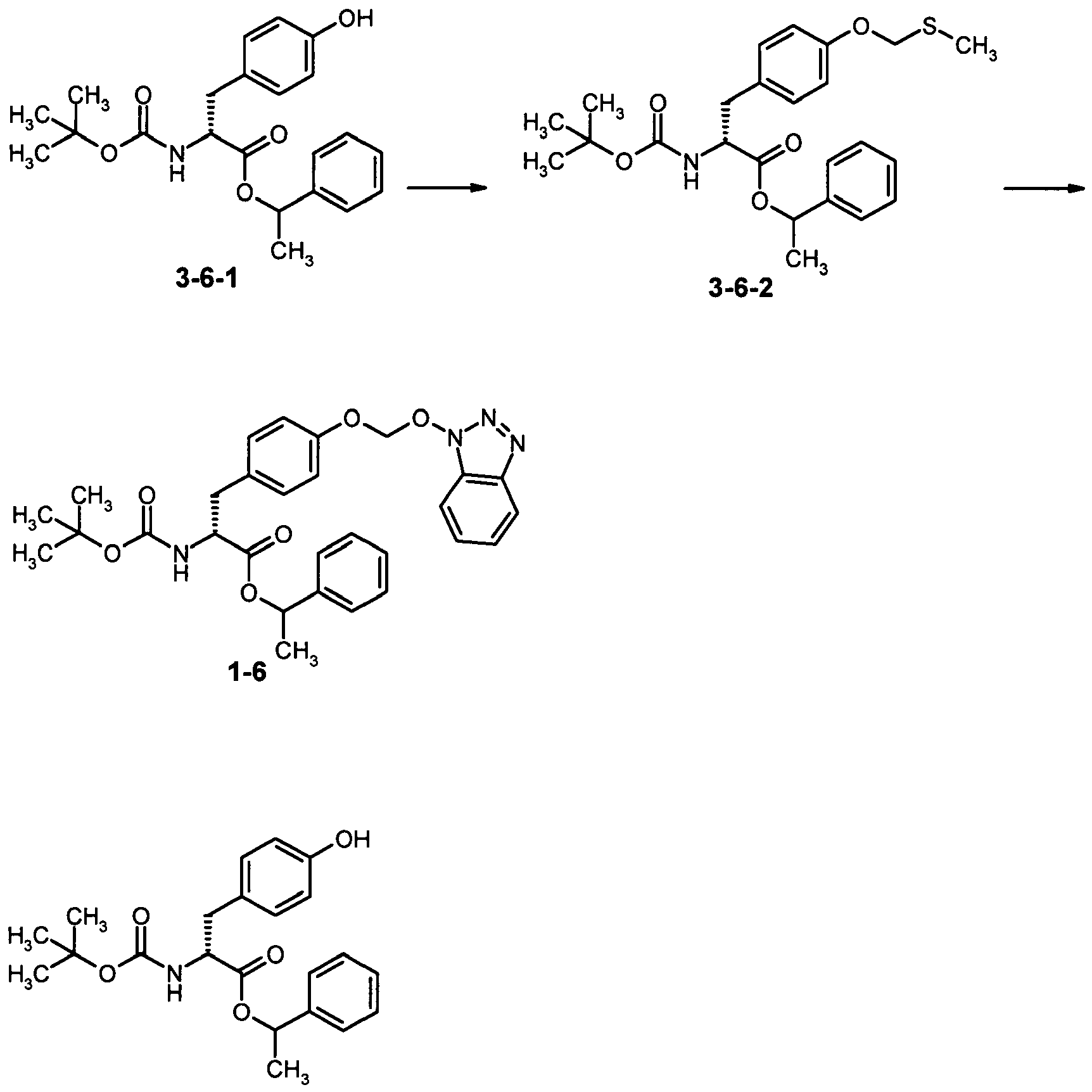
- To 500 mg (1,78 mmol) Boc-D-Tyr-OH in 15 ml N,N-dimethylformamide were added 295,4 mg (0,91 mmol) caesium carbonate and the mixture stirred at r.t. for 0,5 h. 328,9 mg (1,78 mmol) 1-phenylethyl bromide were added and the mixture stirred at r.t. over night. The mixture was evaporated in the vacuum at 50°C. The residue was dissolved in ethyl acetate and water. The aqueous phase was separated and extracted with ethyl acetate. The combined extracts were dried and evaporated in the vacuum at 50 °C to yield 725 mg (106 %) of 3-6-1 as mixture of diastereomers.
- MS (ES+): m/e = 386,55 (M + H+), 771,71 (2M + H+).
- 1H-NMR (400MHz, CHLOROFORM-d): δ [ppm]= 1.37 - 1.47 (m, 9H), 1.51 (d, 1.5H), 1.57 (d, 1.5H), 3.02 - 3.13 (m, 2H), 4.48 - 4.63 (m, 1H), 4.84 - 5.05 (m, 1H), 5.82 - 5.99 (m, 1H), 6.55 - 6.66 (m, 1H), 6.68 - 6.84 (m, 2H), 7.00 (m, 1H), 7.29 - 7.41 (m, 5H).

- 101 mg (0,26 mmol) 3-6-1 and 4,05 mg (0,03 mmol) sodium iodide were dissolved in 2 ml N,N-dimethylformamide and cooled for 10 minutes with ice. 0,30 ml (0,30 mmol) potassium tert-butoxide, 1,0M in tetrahydrofuran were added and the mixture stirred for 60 min. 0,03 ml (0,30 mmol) chloromethyl methyl sulfide were added and the mixture stirred at r.t. for 48 h and at 66 °C for 5 h. The mixture was diluted with ethyl acetate, extracted with sodium chloride solution, dried and evaporated. The residue was chromatographed ( SNAP 5g, n-hexane / ethyl acetate 85:15) to give 45 mg (27 %) 3-6-2 as mixture of diastereomers.
- MS (ES+): m/e = 446,54 (M + H+), 891,69 (2M + H+).
- 1H-NMR (400MHz, CHLOROFORM-d): δ [ppm]= 1.38 - 1.47 (m, 9H), 1.51 (m, 1.5H), 1.55 - 1.60 (m, 1.5H), 2.24 - 2.26 (m, 3H), 3.02 - 3.13 (m, 2H), 4.58 (m, 1H), 4.90 - 5.03 (m, 1H), 5.13 (s, 2H), 5.84 - 5.97 (m, 1H), 6.70 - 6.83 (m, 1H), 6.84 - 6.93 (m, 1H), 7.04 - 7.16 (m, 1 H), 7.28 - 7.42 (m, 6H).

- 120 mg (0,27 mmol) 3-6-2 were reacted as described for 1-2-1. The reaction mixture was directly applied to Isolute and chromatographed on a Biotage system (Isolera Four, SNAP 10 g, n-hexane to n-hexane / ethyl acetate 1:4) to give 55 mg (34,5 %) 1-6 as mixture of diastereomers.
- MS (ES+): m/e = 533,64 (M + H+).
- 1H NMR (CHLOROFORM-d ,300MHz): δ (ppm) 7.96 - 8.04 (m, 1H), 7.28 - 7.43 (m, 9H), 7.00 - 7.21 (m, 4H), 6.81 - 6.93 (m, 2H, Ar-H), 5.83 - 6.09 (m, 3H, OCH2O, OCH), 4.91 - 5.09 (m, 1H, NH), 4.51 - 4.68 (m, 1H, 2-H), 2.89 - 3.23 (m, 2H, 3-H), 1.53 und 1.59 (d, J=6.8 Hz, CH3), 1.43 (s, 9H).
- 13C NMR (CHLOROFORM-d ,75MHz): δ (ppm) 171.0, 171.0 (C-1), 1551, 155.1 (3C-4), 155.0 (2C-1), 143.5 (Bt C-3a), 140.8, 140.6 (1 ipso), 131.4, 131.0 (3C-1), 130.9, 130.9 (3C-2), 128.8 (Bt C-3a), 128.6, 128.6 (1 meta), 128.3, 128.3 (1 para), 128.2 (Bt C-6), 126.6,126.1 (1 ortho), 124.7 (Bt C-5), 120.1, 120.1 (Bt C-4), 116.1, 116.0 (3C-3), 109.1, 109.0 (Bt C-7), 99.0, 98.9 (OCH2O), 80.0 (2C-2), 73.7, 73.7 (1C-1), 54.6, 54.3 (C-2), 37.7, 37.3 (C-3), 28.3 (2C-3), 22.1, 21.9 (1 CH3).
-

- To 511,3 mg (1,82 mmol) Boc-D-Tyr-OH in 51 ml dichloromethane were added 1020,0 mg (3,6 mmol) 2-phenylisopropyltrichloroacetamidate (Tetrahedron Lett. 1993, 34, 323-326;
WO 2008/048970 , 66) in 10 ml cyclohexane. After stirring for 20 h, the mixture was concentrated and separated by chromatography (10 g, n-hexane to n-hexane / ethyl acetate 2:3) to give 772 mg (106 %) 3-7-1. - MS (ES+): m/e = 400,54 (M + H+).
- 1H-NMR (300MHz, CHLOROFORM-d): δ [ppm]= 1.42 (s, 9H), 1.60 (s, 3H), 1.70 (s, 3H), 2.92 - 3.05 (m, 2H), 4.42 - 4.55 (m, 1H), 4.85 - 4.97 (m, 1H), 6.75 (d, 2H), 7.04 (d, 2H), 7.28 - 7.34 (m, 5H).

- A solution of 1,228 g (3,07 mmol) 3-7-1, 47 mg (0.32 mmol) sodium iodide and 7 ml N,N-dimethylformamide was cooled to 0°C in an ice bath. A suspension of 388 mg (3,46 mmol) potassium tert-butylate in 3 ml tetrahydrofuran was added. 293 µl (3,54 mmol) chloro dimethyl sulfide were added. The mixture was allowed to come to r.t. and stirred for 3 h. ethyl acetate was added. The mixture was extracted with water and sodium chloride solution, dried and concentrated in the vacuum. Chromatography over 10 g basic silicagel (n-hexane to n-hexane / ethyl acetate 2:3) gave 139 mg (8%) of 3-7-2 and 208 mg (14%) starting material.
- MS (Cl+): m/e = 477,61 (M + NH4 +), 936,71 (2M + NH4 +).
- 1H-NMR (300MHz, CHLOROFORM-d): δ [ppm]= 1.42 (s, 9H), 1.73 (m, 3H), 1.76 (m, 3H), 2.26 (s, 3H), 2.98 - 3.12 (m, 2H), 4.49 (d, 1H), 5.13 (s, 2H), 6.88 (d, 2H), 7.11 (d, 2H), 7.30 - 7.37 (m, 5H).

- 120 mg (0,26 mmol) 3-7-2 were reacted as described for 1-2-1. The reaction mixture was directly applied to Isolute and chromatographed on a Biotage system (Isolera Four, SNAP 10 g, n-hexane to n-hexane / ethyl acetate 1:4) to give 35 mg (23,3 %) 1-7.
- MS (ES+): m/e = 547,36 (M + H+).
- 1H NMR (CHLOROFORM-d, 300MHz): δ (ppm) 7.95 - 8.04 (m, 1H), 7.11 - 7.41 (m, 11H), 7.06 (d, J=8.7 Hz, 2H, Ar-H), 6.03 (s, 2H, OCH2O) 4.98 (d, J=8.1 Hz, 2H. NH), 4.47 - 4.63 (m, 1H, 2-H), 3.15 (dd, J=13.9, 6.4 Hz, 1H, 3-H), 3.04 (dd, J=13.9, 6.0 Hz, 1H), 3-H, 1.78 (s, 3H, CH3), 1.75 (s, 3H, CH3), 1.42 (s, 9H, Boc).
- 13C NMR (CHLOROFORM-d ,75MHz): δ (ppm) 170.4 (C-1), 155.2 (3C-4), 155.1 (2C-1), 144.9 (Cu ipso), 143.5 (Bt C-3a), 131.6 (3C-1), 131.0 (3C-2), 128.8 (Bt C-7a), 128.3 (Cu meta), 128.3 (Bt C-6), 127.3 (Cu para), 124.7 (Bt C-5), 124.4 (Cu ortho), 120.1 (Bt C-4), 116.0 (3C-3), 109.0 (Bt C-7), 99.0 (OCH2O) 83.4 (Cu C), 79.9 (2C-2), 54.8 (C-2), 37.6 (C-3), 28.8 (Cu CH3), 28.3 (2C-3), 27.9 (Cu CH3).
-


- This compound was synthesized as described (Journal of Labelled Compounds and Radiopharmaceuticals 2004; 47, 477-483) using D-Tyrosine.
- MS (ES+): m/e = 243,47 (Ph3C+).
- MS (ES-): m/e = 524,66 (M + HCOO-), 957,71 (2M - H+).
- 1H NMR (DMSO-d6 ,300MHz): δ (ppm) 9.16 (s, 1H, OH), 7.29 - 7.37 (m, 6H), 7.18 - 7.27 (m, 6H), 7.10 - 7.18 (m, 3H), 6.83 (d, J=8.3 Hz, 2H), 6.60 (d, J=8.5 Hz, 2H), 3.09 - 3.21 (m, 1H, 2-H), 2.64 (d, J=9.2 Hz, 1H, NH), 2.56 (dd, J=13.6, 7.7 Hz, 1H, 3-H), 2.36 (dd, J=13.6, 6.0 Hz, 1H, 3-H), 1.01 (s, 9H, OtBu).
- 13C NMR (101 MHz, CHLOROFORM-d): δ (ppm) 173.9 (C-1), 154.4 (3C-4), 146.4 (Tr C-2), 131.2 (3C-2), 129.8 (3C-1), 128.9 (Tr C-3), 127.8 (Tr C-4), 126.4 (Tr C-5), 114.9 (3C-3), 80.5 (1C-1), 71.2 (Tr C-1), 58.2 (C-2), 41.3 (C-3), 27.9 (1 C-2).

- A solution of 1,20 g (2,50 mmol) 3-8-1, 39 mg (0.26 mmol) sodium iodide and 5,5 ml N,N-dimethylformamide was cooled to 0°C in an ice bath. A suspension of 365 mg (3,25 mmol) potassium tert-butylate in 3 ml tetrahydrofuran was added. After 10 min 238 µl (2,89 mmol) chloro dimethyl sulfide were added. The mixture was allowed to come to r.t. and stirred for 20 h. Ethyl acetate was added. The mixture was extracted with water, dried and concentrated in the vacuum. This gave 1,46 g (92%) of 3-8-2 with 85% purity.
- MS (ES+): m/e = 243,47 (Ph3C+), 540,66 (M + H+).
- 1H NMR (CHLOROFORM-d ,400MHz): δ (ppm) 7.41 - 7.48 (m, 6 H), 7.18 - 7.25 (m, 6 H), 7.11 - 7.18 (m, 5 H), 6.88 (d, J=8.6 Hz, 2 H), 5.13 (s, 2 H, OCH2S), 3.42 - 3.52 (m, 1 H, 2-H), 2.83 (dd, J=13.4, 6.8 Hz, 1 H, 3-H), 2.76 (dd, J=13.4, 6.1 Hz, 1 H, 3-H), 2.58 (d, J=7.6 Hz, 1 H, NH), 2.24 (s, 3 H, SCH3), 1.06 ppm (s, 9 H, tBu).
- 13C NMR (CHLOROFORM-d, 75 MHz,): δ (ppm) 173.7 (C-1), 155.7 (3C-4), 146.3 (Tr C-2), 131.1 (3C-1), 131.0 (3C-2), 128.8 (Tr C-3), 127.8 (Tr C-4), 126.3 (Tr C-5), 115.6 (3C-3), 80.4 (1C-1), 72.5 (SCH2O) 71.2 (Tr C-1), 58.1 (C-2), 41.3 (C-3), 27.8 (1C-2), 14.5 (SCH3).

- 240 mg (0,45 mmol) 3-8-2 were reacted as described for 1-2-1. The reaction mixture was directly applied to Isolute and chromatographed on a Biotage system (Isolera Four, SNAP 25 g, n-hexane to n-hexane / ethyl acetate 1:4) to give 65 mg (23,3 %) 1-8.
- Waters Autopurificationsystem: Pump 254, Sample Manager 2767, CFO, DAD 2996, ELSD 2424, SQD 3001, Luna C18(2) 5 µm 150x21.2 mm, A = water + 0.1 % formic acid, B = acetonitrile, 0-1 min 70% B, 1-12 min 70-100% B, 25 ml/min, r.t., 54 mg / 1 ml dimethyl sulfoxide/methanol 1:1, 1 x 1 ml, DAD scan range 210-400 nm, MS ESI+, ESI-, scan range 160-1000 m/z, ELSD. The peak at 13.0 - 13.2 min was collected to give 12 mg (3,9%) of 1-8 with 97.4 % purity.
- MS (ES+): m/e = 243,47 (Ph3C+), 627,63 (M + H+).
- 1H NMR (CHLOROFORM-d ,400MHz): δ (ppm) 7.99 (d, J=8.1 Hz, 1H, Bt-H), 7.47 (d, J=7.1 Hz, 6H, Tr-H), 7.28 - 7.34 (m, 2H, Bt-H), 7.21 - 7.24 (m, 6H, Tr-H), 7.13 - 7.20 (m, 4H, Bt-H, Ar-H), 7.09 (d, J=8.6 Hz, 2H, Ar-H), 6.01 - 6.08 (m, 2H, OCH2O), 3.54 (dd, J=7.1, 5.8 Hz, 1H. 2-H), 2.90 (dd, J=13.4, 7.1 Hz, 1H, 3-H), 2.82 (dd, J=13.9, 5.8 Hz, 1H, 3-H), 2.62 (br. s, 1H, NH), 1.11 (s, 9H, tBu-H).
- 13C NMR (DICHLOROMETHANE-d2 ,151MHz): δ = 173.6 (C-1), 155.5 (3C-4), 146.8 (Tr C-2), 143.9 (Bt C-3a), 133.6 (3C-1), 131.9 (3C-2), 129.2 (Tr C-3), 129.1 (Bt C-7a), 128.6 (Bt C-6), 128.2 (Tr C-4, 126.8 (Tr C-5), 125.0 (Bt C-5), 120.2 (Bt C-4), 116.1 (3C-3), 109.5 (Bt C-7), 99.7 (OCH2O) 80.8 (1C-1), 71.7 (Tr C-1), 58.4 (C-2), 41.4 (C-3), 28.1 (1C-2).

- To 200,0 mg (0,42 mmol) 3-8-1 in 4 ml N,N-dimethylformamide cooled to 5 °C were added 16,7 mg (0,42 mmol) sodium hydride (60%). The mixture was stirred for 30 min at 5-10 °C. A solution of 167 mg (1,48 mmol) bromofluoromethane in 4 ml N,N-dimethylformamide was added and the mixture stirred for 2 h at 5-10 °C and 2 h at r.t.. The mixture was partitioned between dichloromethane and water, the aqueous phase was extracted with dichloromethane, the combined organic phases dried and the solvent evaporated to give 214 mg (90%) 2-8-1.
- MS (ES+): m/e = 243,47 (Ph3C+) only.
- 19F NMR (376 MHz, CHLOROFORM-d): δ (ppm) -148.02 (t, J=55.1 Hz).
- 1H NMR (CHLOROFORM-d ,300MHz): δ (ppm) 7.44 (d, J=7.2 Hz, 6H), 7.11 - 7.25 (m, 11H), 7.00 (d, J=8.5 Hz, 2H), 5.69 (d, 1 JHF=55.0 Hz, 2H), 3.42 - 3.55 (m, 1H, 2-H), 2.85 (dd, J=13.9, 6.4 Hz, 1H, 3-H), 2.78 (dd, J=13.6, 5.8 Hz, 1H, 3-H), 2.52 - 2.64 (m, 1H, NH), 1.07 (s, 9H, tBu).
- 13C NMR (101 MHz, CHLOROFORM- d ) δ ppm 173.6 (C-1), 162.6 (s, 1 C), 155.6 (d, 3 JCF =2.4 Hz, 3C-4), 146.3 (Tr C2), 133.0 (3C-1), 131.3 (3 C-2), 128.8 (Tr C-3), 127.9 (Tr C4), 126.4 (Tr C-5), 116.4 (3C-3), 101.0 (d, 1JCF =218.9 Hz, OCH2F), 80.6 (1C-1), 71.3 (Tr C-1), 58.0 (C-2), 41.3 (C-3), 36.5 (s, 1 C), 29.8 (s, 1 C), 27.9 (1 C-2).

- To a solution of 80 mg (0,16 mmol) 2-8-1 in 0,8 ml acetic acid were added 0,2 ml water and the solution stirred for 2 h at r.t.. Water was added and the precipitate was filtered off. The filtrate was neutralized with sodium hydrogen-carbonate solution and extracted with ethyl acetate. The combined organic phases were dried over sodium sulfate and the solvent evaporated to give 30 mg (71%) 2-8-2.
- Agilent: Prep 1200, 2 x Prep Pump, DLA, MWD, Prep FC,
XBrigde C18 5 µm 150x19 mm, A = water + 0.2% ammonia, B = methanol, 0-1min 10% B, 1-8 min 10-80% B, 8-8.1 min 80-100% B, 8.1-10min 100% B, 25 ml/min, r.t., 30 mg / 1 ml dimethyl sulfoxide/methanol 1:1, 1 x 1 ml, UV 219 nm. The Peak at 5 - 1.33 min was collected to give 17 mg (36%) of 2-8-2 with 99,3 % purity. - MS (ES+): m/e = 214,42 (M + H+ - C4H8), 270,51 (M + H+), 539,62 (2M + H+).
- 19F NMR (376 MHz, CHLOROFORM-d): δ (ppm) -148.29 (t, J=53.9 Hz).
- 1H NMR (CHLOROFORM-d ,400MHz): δ (ppm) 7.10 (d, J=8.5 Hz, 2H, Ar-H), 6.94 (d, J=8.5 Hz, 2H, Ar-H), 5.61 (d, 2JHF=54.7 Hz, 2H), 3.50 (dd, J=7.5, 5.5 Hz, 1H, 2-H), 2.92 (dd, J=13.6, 5.8 Hz, 1H, 3-H), 2.74 (dd, J=13.8, 7.5 Hz, 1H, 3-H), 1.65 (br. s, 2H, NH), 1.36 (s, 9H, tBu-H).
- 13C NMR (101 MHz, CHLOROFORM-d) δ (ppm) 174.25 (C-1) 155.67 (3 C-4) 155.64 (2C-1) 132.71 (3 -1 C) 130.60 (3 C-2) 116.70 (d, 4JCF=1.3 Hz, 3 C-3),100.88 (d, 1JCF=218.9 Hz, OCH2O 81.21 (1C-1) 56.32 (C-2) 40.32 (C-3) 28.02 (1C-2).
-

- 265 mg (0,53 mmol) N-trityl-D-tyrosine (Liebigs Ann. Chem. 1988, 1083-1084) were dissolved in 4,4 ml N,N-dimethylformamide. 89 mg (0,27 mmol) caesium carbonate were added and the mixture stirred for 30 min. 107 mg (0,54 mmol) 4-methoxybenzyl bromide were added and the mixture stirred for 16 h. Further 54 mg (0,27 mmol) 4-methoxybenzyl bromide were added and the mixture stirred at 40 °C for 4 h. The mixture was diluted with ethyl acetate and extracted with water. The aqueous phase was neutralized with acetic acid to
pH 5 and extracted with ethyl acetate. The organic solutions were combined, dried over sodium sulfate and concentrated. The residue was purified by chromatography over 10 g silica gel with hexane/ethyl acetate 100 - 80/20 - 60/40 to give 215 mg. - MS (ESI+): m/e = 544,33 (M + H+).
- MS (ESI-): m/e = 588,18 (M + HCOO).
- 1H-NMR (400MHz, CHLOROFORM-d): δ [ppm]= 2.59 - 2.69 (m, 1H), 2.84 (dd, 1H), 2.94 (dd, 1H), 3.51 - 3.61 (m, 1H), 3.81 (s, 3H), 4.20 (d, 1H), 4.42 (d, 1H), 4.92 (br. s., 1H), 6.68 - 6.73 (m, 2H), 6.79 - 6.84 (m, 2H), 6.91 - 7.02 (m, 4H), 7.13 - 7.26 (m, 9H), 7.40 - 7.49 (m, 6H).
- 13C-NMR (101MHz, CHLOROFORM-d): δ [ppm]= 41.4, 55.3, 58.3, 66.1, 71.0, 113.7, 115.0, 126.3, 127.5, 127.9, 128.8, 129.4, 130.0, 130.9, 145.9, 154.4, 159.5, 174.4.
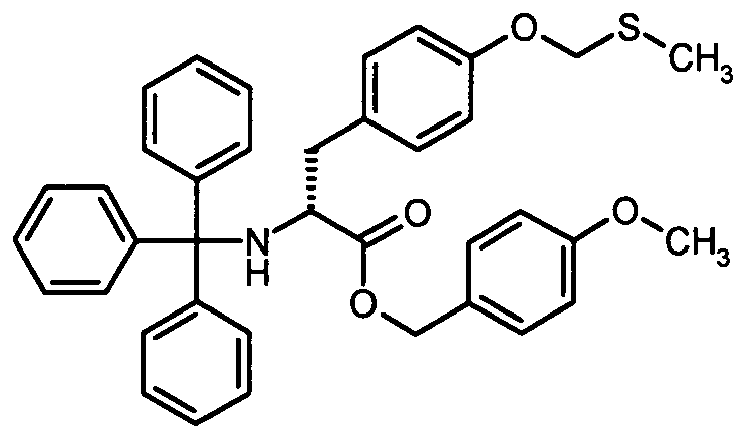
- 298 mg (0,55 mmol) 4-Methoxybenzyl N-trityl-D-tyrosinate 3-9-1 were dissolved in 4,5 ml N,N-dimethylformamide. 357 mg (1,1 mmol) caesium carbonate were added and the mixture stirred for 16 h. 64 mg (0,66 mmol) chloro dimethyl sulfide were added and the mixture stirred for 16 h. Further 23 mg (0,24 mmol) chloro dimethyl sulfide were added and the mixture stirred for 2 h. Further 23 mg (0,24 mmol) chloro dimethyl sulfide and 200 mg caesium carbonate were added and the mixture stirred for 20 h. The mixture was concentrated, diluted with ethyl acetate and extracted with water. The organic solutions were washed with saturated sodium chloride solution, dried over sodium sulfate and concentrated to give 335 mg.
- MS (ESI+): m/e = 604,23 (M + H+).
- MS (ESI-): m/e = 648,00 (M + HCOO).
- 1H-NMR (300MHz, CHLOROFORM-d): δ [ppm]= 2.23 - 2.30 (m, 3H), 2.68 (d, 1H), 2.76 (dd, 1 H), 2.86 (dd, 1 H), 3.52 - 3.61 (m, 1H), 3.78 - 3.83 (m, 3H), 4.20 (d, 1H), 4.41 (d, 1H), 5.12 (s, 2H), 6.77 - 6.88 (m, 4H), 6.94 (d, 2H), 7.06 (d, 2H), 7.12 - 7.26 (m, 9H), 7.38 - 7.50 (m, 6H).

- 160 mg (0,27 mmol) 3-9-2 were reacted as described for 1-2-1. The reaction mixture was directly applied to Isolute and chromatographed on a Biotage system (Isolera Four, SNAP 10 g, n-hexane to n-hexane / ethyl acetate 4:1) to give 73 mg (40 %) 1-9.
- The material was further purified by HPLC (Waters Autopurificationsystem: Pump 254, Sample Manager 2767, CFO, DAD 2996, ELSD 2424, SQD 3001, XBrigde C18 5µm 100x30 mm, A = water + 0.1% formic acid, B = acetonitrile, 0-1
min 50% B, 1-8 min 50-100% B, 50 ml/min, r.t., 69 mg / 2.1 ml dimethyl sulfoxide/methanol 1:1, 3 x 0.7 ml, DAD scan range 210-400 nm, MS ESI+, ESI-, scan range 160-1000 m/z, ELSD). The peak at 7.8 - 8.1 min was collected to give 16 mg (9%) of 1-9 with >99 % purity. - MS (ESI+): m/e = 691,26 (M + H+).
- MS (ESI-): m/e = 736,15 (M + HCOO).
- 1H NMR (CHLOROFORM-d ,300MHz): δ (ppm) 7.98 (d, J=8.3 Hz, 1H, Bt 7-H), 7.44 (d, J=7.0 Hz, 6H, Tr o-H), 7.09 - 7.33 (m, 14H, Tr m-H, p-H, Ar 2-H, Bt H-4,5,6), 7.02 (d, J=8.3 Hz, 2H, Mbn 2-H), 6.99 (d, J=8.3 Hz, 2H, Ar 3-H), 6.78 (d, J=8.7 Hz, 2H, Mbn 3-H), 6.01 (br. s, 2H, OCH2O) 4.46 (d, J=12.1 Hz, 1H, Mbn 1-H), 4.26 (d, J=11.9 Hz, 1H, Mbn 1-H), 3.75 (s, 3H, Mbn OMe), 3.55 - 3.65 (m, 1H, 2-H), 2.95 (s, 2H).
- 13C NMR (CHLOROFORM-d ,101MHz): δ (ppm) 174.2 (C-1), 159.6 (Mbn C-5), 155.1 (3C-4), 145.9 (Tr C-2), 143.5 (Bt C-3a), 132.6 (3C-1), 131.4 (3C-2), 130.2 (Mbn C-3), 128.8 (Tr C-3), 128.4 (Bt C-6), 128.0 (Bt C-7a), 127.9 (Tr C-4), 127.5 (Mbn C-2), 126.5 (Tr C-5), 124.7 (Bt C-5), 120.0 (Bt C-4), 115.9 (3C-3), 113.8 (Mbn C-4), 109.1 (Bt C-7), 99.2 (OCH2O), 71.2 (Tr C-1), 66.3 (Mbn C-1), 58.1 (C-2), 55.3 (Mbn OMe), 41.4 (C-3).
-

- A solution of 1.00g (2.98 mmol) 3-4-1 was dissolved in 10 ml [2H6]dimethyl sulfoxide and 5,1 ml (29,8 mmol) ethyl-diisopropyl amine added. The mixture was heated to 45° C under Argon atmosphere and the reaction started by addition of 3,46 ml 4.09 mmol) tert-butyl bromide. It was kept at this temperature for 72 h and then filtered. The filtrate was diluted with dichloromethane and washed with sat. sodium hydrogen carbonate. The organic phase was evaporated and the residue chromatographed on a Biotage system: (Flash40+M cartidge, 40 ml/min, 3CV dichloromethane, dichloromethane to dichloromethane/methanol 4:1 in 12CV, 15CV = 1980 ml) gave 1,08 g which was further purified on an Autopurification System (Waters: 2525 Binary Gradient Module, Detector: MS Micromass ZQ, UV Photo Diode Array 2996, 210-350 nm; X-Bridge Prep 50x50mm,
C18 5 µm; Gradient: acetonitrile from 50% acetonitrile to 80%,water - 1H NMR (DICHLOROMETHANE-d2 ,600MHz): δ (ppm) 7.14 (d, J=8.7 Hz, 2H, Ar-H), 6.92 (d, J=8.7 Hz, 2H, Ar-H), 5.15 - 5.17 (m, 0,09H, OCHDS), 4.99 - 5.09 (m, 1H, NH), 4.48 - 4.57 (m, 1H, 2-H), 3.97 (mc, 2H, OCH2), 2.97 - 3.15 (m, 2H, 3-H), 2.22 - 2.25 (m, 0.09H, SCHD2), 1.45 (s, 9H, Boc), 1.11 - 1.20 (m, 1H, cyclopropyl CH), 0.58 - 0.65 (m, 2H, cyclopropyl CH2), 0.27 - 0.37 (m, 2H, cyclopropyl CH2) [>90% deuteration in both positions].
- 13C NMR (DICHLOROMETHANE-d2 ,151MHz): δ (ppm) 172.3 (C-1), 156.5 (3C-4), 155.3 (2C-1), 130.8 (3C-2), 129.8 (3C-1), 116.3 (3C-3), 79.9 (2C-2), 72.3 (quint., 1JCD = 24.2 Hz, OCD2S), 70.4 (1C-1), 55.0 (C-2), 37.7 (C-), 28.4 (2C-3), 14.0 (sept., 1JCD = 21.6 Hz, SCD3), 14.1 (quint, 1JCD = 22.3 Hz, SCHD2), 10.0 (1C-2), 3.6 (1 C-3), 3.5 (1 C-4).

- 160 mg (0.40 mmol) of 3-10-1 were reacted as described for 1-2-1 with the exception that the reaction time in
step 3 is shortened to 10 min. The solution was directly chromatographed on a Biotage system (Flash25+M cartidge, 25 ml/min, n-hexane to n-hexane / ethyl acetate 1:1 in 15CV = 780 ml) gave 88 mg of 1-10. The compound was further purified by preparative HPLC (Dionex: Pump P 580, Gilson: Liquid Handler 215, Knauer: UV-Detector K-2501, Chiralpak IC 5µm 250x30 mm, hexane / ethanol 80:20, 40 ml/min, r.t., 88 mg / 1.6 ml ethanol 2 x 0.8 ml, UV 254 nm). Collection of the eluate from 16.0 to 17.2 min gave after evaporation 43 mg of 1-10 with a purity of 97.3%. After thorough drying under high vakuum, 15.4 mg (8%) 1-10 was obtained. - MS (ESI+): m/e = 485 (M + H+), 429 (M + H+ - C4H8), 385 (M + H+ - C4H8 - CO2).
- 1H NMR (DICHLOROMETHANE-d2 ,600MHz): δ (ppm) 7.95 (d, J=8.3 Hz, 1H, Bt-H), 7.39 (ddd, J=8.3, 6.8, 0.8 Hz, 1H, Bt-H), 7.34 (ddd, J=8.3, 6.8, 1.1 Hz, 1H, Bt-H), 7.16 - 7.23 (m, 3H, Bt-H, Ar-H), 7.06 (d, J=8.3 Hz, 2H, Ar-H), 5.38 (d, J=7.9 Hz, 1H, NH), 4.48 (ddd, J=7.9, 6.8, 5.6 Hz, 1H, 2-H), 3.98 - 3,88 (m, 2H, COOCH2), 3.12 (dd, J=13.9, 5.6 Hz, 1H, 3-H), 3.02 (dd, J=13.9, 6.8 Hz, 1H. 3-H), 1.39 (s, 9H, Boc), 1.07 - 1.13 (m, 1H, Cyclopropyl CH), 0.51 - 0.59 (m, 2H, cyclopropyl CH2), 0.23 - 0.29 (m, 2H, cyclopropyl CH2). 6.02 (s, 0.08H, OCH2O corresponds to 4 mol% undeuterated compound, 6.01 (d, J=1.1 Hz, 0.12H, OCDHO) corresponds to 12 mol% monodeuterated compound.
- 13C NMR (DICHLOROMETHANE-d2 ,151MHz): δ (ppm) 172.2 (C-1), 155.4 (3C-4, 2C-1), 143.7 (Bt C-3a), 132.1 (3C-1), 131.1 (3C-2), 128.9 (Bt C-7a), 128.5 (Bt C-6), 124.9 (Bt C-5), 120.1 (Bt C-4), 116.4 (3C-3), 109.3 (Bt C-7), 98.8 (p, 1JCD = 25Hz, OCD2O), 79.7 (2C-2), 70.3 (1C-1), 55.0 (C-2), 37.5 (C-3), 28.3 (2C-3), 9.9 (1C-2). 3.5 (1C-3), 3.4 (1C-4).
-


- 5,00 g (11,81 mmol) N-trityl-D-tyrosine (Liebigs Ann. Chem. 1988, 1083-1084) were dissolved in 97,7 ml N,N-dimethylformamide. 2,31 g (7,08 mmol) caesium carbonate were added and the mixture stirred for 15 min. 3,14 g (13,58 mmol) 2,4-dimethoxybenzyl bromide in toluene (
US5663200, 1997 , Example 49a) were added and the mixture stirred for 16 h. The mixture was concentrated, diluted with ethyl acetate and extracted with water. The organic solutions were washed with saturated sodium chloride solution, dried over sodium sulfate and concentrated. The residue was purified by chromatography over a 55 g SNAP KP-NH cartridge (Biotage) with dichloromethane/ethanol 100/0 - 97/3 - 94/6 -91/9 to give 4,218 g. - MS (ESI+): m/e = 574,42 (M + H+).
- MS (ESI-): m/e = 572,29 (M - H), 618,42 (M + HCOO).
- 1H NMR (CHLOROFORM-d ,300 MHz): δ (ppm) 7.40 - 7.45 (m, 6H, Tr-H), 7.12 - 7.24 (m, 9H, Tr-H), 6.99 (d, 2H, Ar-H), 6.92 (d, 1H, Dmb H-6), 6.68 (d, 2H, Ar-H), 6.49 (d, 1H, Dmb H-3), 6.40 (dd, 1H, Dmb H-5), 4.94 (br. s, 1H, OH), 4.58 (d, 1H, OCH2Ar), 4.34 (d, 1H), 3.81 (s, 3H, Dmb OMe), 3.76 (s, 3H, Dmb OMe), 3.52 - 3.61 (m, 1H, 2-H), 2.85 (br. s, 1H, 3-H), 2.84 (br. s, 1H, 3-H), 2.59 (d, 1H, NH).
- 13C NMR (CHLOROFORM-d ,101MHz): δ (ppm) 174.4 (C-1), 161.1 (Dmb C-5), 158.8 (Dmb C-3), 154.3 (3C-4), 146.0 (Tr C-2), 131.6 (Dmb C-7), 131.0 (3C-2), 129.5 (3C-1), 128.8 (Tr C-3), 127.8 (Tr C-4), 126.3 (Tr C-5), 116.4 (Dmb C-2), 115.0 (3C-3), 103.9 (Dmb C-6), 98.4 Dmb C-4), 71.1 (Tr C-1), 61.8 (Dmb C-1), 58.2 (C-2), 55.5 (Dmb OMe), 55.3 (Dmb OMe), 41.2 (C-3).

- 8,791 g (15,32 mmol) 2,4-Dimethoxybenzyl N-trityl-D-tyrosinate 3-11-1 were dissolved in 123 ml N,N-dimethylformamide. 9,99 g (30,65 mmol) caesium carbonate were added and the mixture stirred for 30 min. 1,78 g (18,39 mmol) chloro dimethyl sulfide were added and the mixture stirred for 20 h. The mixture was concentrated, diluted with ethyl acetate and extracted with water. The organic solutions were washed with saturated sodium chloride solution, dried over sodium sulfate and concentrated. The residue was purified by chromatography over a 110 g SNAP KP-NH cartridge (Biotage) with n-hexane/
ethyl acetate 100/0 - 80/20 - 60/40 to give 5,59 g. - 1H NMR (CHLOROFORM-d ,300MHz): δ (ppm) 7.37 - 7.46 (m, 6H, Tr-H), 7.11 - 7.25 (m, 9H, Tr-H), 7.07 (d, J=8.7 Hz, 2H, Ar-H), 6.92 (d, J=8.9 Hz, 1H, Dmb H-6), 6.83 (d, J=8.7 Hz, 2H, Ar-H), 6.40 (d, J=2.1 Hz, 1H, Dmb H-3), 6.39 (dd, J=7.0, 2.3 Hz, 1H, Dmb H-5), 5.11 (s, 2H, OCH2S), 4.58 (d, J=12.1 Hz, 1H, OCH2Ar), 4.34 (d, J=12.1 Hz, 1H, OCH2Ar), 3.80 (s, 3H, Dmb OMe), 3.76 (s, 3H, Dmb OMe), 3.51 - 3.63 (m, 1H, 2-H), 2.86 (br. s, 1H, 3-H), 2.84 (br. s, 1H, 3-H), 2.59 (d, J=10.5 Hz, 1H, NH), 2.25 (s, 3H, SCH3).
- 13C NMR (CHLOROFORM-d ,75MHz): δ (ppm) 174.2 (C-1), 161.1 (Dmb C-5), 158.8 (Dmb C-3), 155.8 (3C-4), 146.0 (Tr C-2), 131.5 (Dmb C-7), 130.9 (3C-2), 130.7 (3C-1), 128.8 (Tr C-3), 127.8 (Tr C-4), 126.3 (Tr C-5), 116.3 (Dmb C-2), 115.6 (3C-3), 103.8 (Dmb C-6), 98.3 (Dmb C-4), 72.4 (OCH2S, 71.0 (Tr C-1), 61.6 (Dmb C-1), 58.1 (C-2), 55.4 (Dmb OMe), 55.3 (Dmb OMe), 41.2 (C-3), 14.6 (SCH3).

- To a solution of 3-11-2 (356 mg, 0,56 mmol) in dichloromethane (5 ml) at -15 °C was added N-chlorosuccinimide (82,5 mg, 0,62 mmol). The cooling bath was removed and the solution stirred for 4 h. A solution of tetrabutylammonium 1-hydroxybenzotriazolat (253,8 mg, 0,67 mmol) in dichloromethane (2 + 0,5 ml) was added. The solution was stirred for 1 h. The reaction mixture was directly applied to Isolute and chromatographed on a Biotage system (Isolera Four, SNAP 10 g, dichloromethane/
ethyl acetate 100/0 - 95/5) to give 248 mg. The compound was purified by preparative HPLC (Dionex: Pump P 580, Gilson: Liquid Handler 215, Knauer: UV-Detektor K-2501,Chiralpak IB 5µm 250x30 mm,Hexan / Ethanol 80:20,40 ml/min,RT,248 mg / 3.5 ml Ethanol/Dichloromethane,5 x 0.7 ml,UV 254 nm, 8.5 - 12.2 min,94.2 % ,120 mg,Peak 6 - 5.17 min) to give 116 mg of 1-11-1 with 94 % purity. - MS (ESI+): m/e = 721,39 (M + H+), 243,11 (C19H15 +).
- 1H NMR (DICHLOROMETHANE-d2 ,300MHz): δ (ppm) 7.96 (d, J=8.3 Hz, 1H, Bt H-4), 7.37 - 7.51 (m, 6H, Tr H), 7.10 - 7.36 (m, 17H, Tr-H, Ar-H), 7.04 (d, J=8.7 Hz, 2H, Ar-H), 6.96 (d, J=8.1 Hz, 1H, Dmb 6-H), 6.40 (d, J=2.4 Hz, 1H, Dmb 3-H), 6.38 (dd, J=8.1, 2.4 Hz, 1H, Dmb 5-H), 5.98 - 6.07 (mc, 2H, OCH2O), 4.59 (d, J=11.9 Hz, 1H, Dmb 1-H), 4.34 (d, J=11.9 Hz, 1H, Dmb 1-H), 3.75 (s, 3H, Dmb OMe), 3.75 (s, 3H, Dmb OMe), 2.80 - 2.99 (m, 2H, 3-H).
- 13C NMR (CHLOROFORM-d ,75MHz): δ (ppm) 173.7 (C-1), 161.2 (Dmb C-5), 158.8 (Dmb C-3), 154.9 (3C-4), 146.0 (2C-2), 143.4 (Bt C-3a), 132.8 (3C-1), 131.4 (Dmb C-7), 131.3 (3C-3), 128.7 (Tr C-3), 128.7 (Bt C-7a), 128.2 (Bt C-6), 127.8 (Tr C-4), 126.3 (Tr C-5), 124.5 (Bt C-5), 119.7 (Bt C-4), 116.2 (Dmb C-2), 115.7 (3C-3), 109.0 (Bt C-7), 103.9 (Dmb C-6), 99.1 (OCH2O) 98.1 (Dmb C-4), 71.1 (Tr C-1), 61.6 (Dmb C-1), 57.9 (C-2), 55.3 (Dmb OMe), 55.3 (Dmb OMe), 41.0 (C-3).

- To a solution of 3-11-2 (80 mg, 0,13 mmol) in dichloromethane (1,1 ml) at -15 °C was added N-chlorosuccinimide (18,54 mg, 0,14 mmol). The cooling bath was removed and the solution stirred for 4 h. A solution of tetrabutylammonium 6-chloro-1-hydroxybenzotriazolat (62,3 mg, 0,15 mmol) in dichloromethane (0,6 ml) was added. The solution was stirred for 1 h. The reaction mixture was directly applied to Isolute and chromatographed (SNAP 5 g, dichloromethane to dichloromethane / ethyl acetate 95:5). The compound was purified by preparative HPLC (Waters Autopurificationsystem: Pump 254, Sample Manager 2767, CFO, DAD 2996, ELSD 2424, SQD 3001,
XBrigde C18 5 µm 100x30 mm, A = water + 0.2% ammonia, B = acetonitrile, 0-1 min 70% B, 1-8 min 70-100% B, 50 ml/min, r.t. 14 mg / 1.5 ml dimethyl sulfoxide/methanol 1:1, 1 x 1.5 ml, DAD scan range 210-400 nm, MS ESI+, ESI-, scan range 160-1000 m/z, ELSD). The fractions eluting at 6.6 - 7.0 min were collected to give 6 mg (6%) of 1-11-2 with >99 % purity (DAD). - 1H NMR (DICHLOROMETHANE-d2 ,400MHz): (ppm) 7.90 (d, J=8.8 Hz, 1H, Bt 4-H), 7.41 - 7.46 (m, 6H, Tr-H), 7.27 - 7.33 (m, 2H, Bt 5-H, H-7), 7.14 - 7.26 (m, 11H, Tr-H, Ar-H), 7.01 (d, J=8.8 Hz, 2H, Ar-H), 6.94 (d, J=8.1 Hz, 1H, Dmb 6-H), 6.38 (d, J=2.3 Hz, 1H, Dmb 3-H), 6.36 (dd, J=8.1, 2.5 Hz, 1H, Dmb 5-H), 6.00 (s, 2H, OCH2O), 4.59 (d, J=11.9 Hz, 1H, Dmb 1-H), 4.33 (d, J=11.9 Hz, 1H, Dmb 1-H), 3.75 (s, 3H, Dmb OMe), 3.74 (s, 3H, Dmb OMe), 3.53 - 3.60 (m, 1H, 2-H), 2.85 - 2.97 (m, 2H, 3-H).
- 13C NMR (CHLOROFORM-d ,101MHz): δ (ppm) 173.8 (C-1), 161.2 (Dmb C-5), 158.9 (Dmb C-3), 154.7 (3C-4), 146.0 (2C-2), 142.1 (Bt C-3a), 134.6 (Bt C-6), 133.0 (3C-1), 131.5 (Dmb C-7), 131.4 (3C-2), 129.2 (Bt C-7a), 128.8 (Tr C-3), 127.9 (Tr C-4), 126.4 (Tr C-5), 125.9 (Bt C-5), 121.0 (Bt C-4), 116.2 (Dmb C-2), 115.8 (3C-3), 109.0 (Bt C-7), 103.9 (Dmb C-6), 99.2 (OCH2O), 98.1 (Dmb C-4), 71.2 (Tr C-1), 61.6 (Dmb C-1), 58.0 (C-2), 55.3 (Dmb OMe), 55.3 (Dmb OMe), 41.0 (C-3).

- To a solution of 3-11-2 (824,6 mg, 1,30 mmol) in dichloromethane (12 ml) at -15 °C was added N-chlorosuccinimide (191,1 mg, 1,43 mmol). The cooling bath was removed and the solution stirred for 5 h. A solution of tetrabutylammonium 6-trifluoromethyl-1-hydroxybenzotriazolat (694,1 mg, 1,56 mmol) in dichloromethane (6 ml) was added. The solution was stirred for 1 h. The reaction mixture was directly applied to Isolute and chromatographed (SNAP 25 g, n-hexane/
ethyl acetate 100/0 - 85/15 - 60/40) to give 213 mg of 1-11-3 with >95 % purity. - MS (ESI+): m/e = 789,37 (M + H+).
- MS (ESI-): m/e = 833,07 (M + HCOO).
- 1H NMR (CHLOROFORM-d ,400MHz): δ (ppm) 8.12 (d, J=8.8 Hz, 1H, Bt 4-H), 7.57 (d, J=8.8 Hz, 1H, Bt 5-H), 7.40 - 7.50 (m, 6H, Tr o-H), 7.11 - 7.25 (m, 12H, Tr m-H, p-H, Bt 7-H, Ar-H), 6.95 (m, 3H, Ar-H, Dmb 6-H), 6.32 - 6.42 (m, 2H, Dmb 3-H, 5-H), 6.04 (s, 2H, OCH2O), 4.62 (d, J=11.9 Hz, 1H, Dmb 1-H), 4.35 (d, J=11.9 Hz, 1H, Dmb 1-H), 3.76 (s, 3H, Dmb OMe), 3.75 (s, 3H, Dmb OMe), 3.62 (br. s., 1H, 2-H), 2.93 (m, 2H, 3-H), 2.62 (br. s, 1H, NH).
- 13C NMR (101 MHz, CHLOROFORM-d) δ ppm 174.0 (C-1), 161.2 (Dmb C-5), 158.9 (Dmb C-3), 154.3 (3C-4), 146.0 (2C-2), 144.5 (Bt C-3a), 133.1 (3C-1), 131.6 (Dmb C-7), 131.5 (3C-2), 130.4 (q, 2JCF=32.0 Hz, Bt C-6), 128.8 (Tr C-3), 128.2 (Bt C-7a), 127.8 (Tr C-4), 126.4 (Tr C-5), 123.6 (q, 1JCF=273.2 Hz, CF3), 121.4 (q, 3JCF=3.2 Hz, Bt C-5), 121.2 (Bt C-4), 116.3 (Dmb C-2), 115.6 (3C-3), 107.9 (q, J=4.8 Hz, Bt C-7), 103.9 (Dmb C-6), 99.0 (OCH2O) 98.4 (Dmb C-4), 71.2 (Tr C-1), 61.8 (Dmb C-1), 57.9 (C-2), 55.4 (Dmb OMe), 55.3 (Dmb OMe), 41.1 (C-3).

- 84 mg (0,15 mmol) 2,4-dimethoxybenzyl N-trityl-D-tyrosinate 3-11-1 were dissolved in 1 ml tetrahydrofuran. The solution was cooled to 0 °C. 16,5 mg (0,41 mmol) sodium hydride (60% in mineral oil) were added and the mixture stirred for 1 hour. 1,05 ml of tetrahydrofuran containing bromofluoromethane were added slowly at 0 °C and the mixture was stirred at 0 °C for 12 h. 1 ml methanol was added and the mixture diluted with ethyl acetate and extracted with water. The organic solutions were dried over sodium sulfate and concentrated. The residue was applied to Isolute and chromatographed (SNAP 10 g, n-hexane to n-hexane/ethyl acetate 6:4) to give 60 mg of 2-11-1 with 90 % purity.
- MS (ESI+): m/e = 606,24 (M + H+).
- 19F NMR (376 MHz, CHLOROFORM-d): δ (ppm) -147.9 (t, J=55.1 Hz).
- 1H NMR (CHLOROFORM-d ,300MHz): δ (ppm) 7.39 - 7.47 (m, 6H, Tr-H), 7.11 - 7.25 (m, 9H, Tr-H), 7.07 (d, J=8.5 Hz, 2H, Ar-H), 6.93 (d, J=8.5 Hz, 2H, Ar-H), 6.89 (d, J=8.9 Hz, 1H, Dmb 6-H), 6.35 - 6.43 (m, 2H, Dmb 5-H, 3-H), 5.67 (d, 2JHF=55.0 Hz, 2H, OCH2F), 4.58 (d, J=11.9 Hz, 1H, Dmb 1-H), 4.34 (d, J=11.9 Hz, 1H, Dmb 1-H), 3.80 (s, 3H, Dmb OMe), 3.75 (s, 3H, Dmb OMe), 3.52 - 3.64 (m, 1H, 2-H), 2.84 - 2.92 (m, 2H, 3-H, NH), 2.60 (d, br., J=9.6 Hz, 1H, 3-H).
- 13C NMR (75 MHz, CHLOROFORM-d) δ (ppm) 174.1 (C-1), 161.1 (Dmb C-5), 158.8 (Dmb C-3), 155.6 (d, 3JCF =3.0 Hz, 3C-4), 145.9 (Tr C-2), 132.5 (Dmb C-7), 131.5 (3C-1), 131.0 (3C-2), 128.8 (Tr C-3), 127.8 (Tr C-4), 126.3 (Tr C-5), 116.3 (d, 4JCF=1.2 Hz, 3C-3), 116.3 (Dmb C-2), 103.9 (Dmb C-6), 100.9 (d, 1JCF =218.4 Hz, OCH2F), 98.3 (Dmb C-4), 71.1 (Tr C-1), 61.6 (Dmb C-1), 58.0 (C-2), 55.4 (Dmb OMe), 55.3 (Dmb OMe), 41.3 (C-3).
-

- 9.25 g (37.6 mmol) Methyl alpha-methyltyrosinate hydrochloride were suspended in 100 ml dioxane and 100 ml 1N sodium hydrogen carbonate The pH of the reaction mixture was adjusted to 8-9 with 1N sodium hydroxide. 28.8 g (131 mmol) di-tert-butyl dicarbonate were added in portions and the mixture stirred for 3 d at r.t., while the pH was controlled and kept between 8 and 9. The reaction mixture was brought to
pH 2 with 1 N sodium hydrogen sulfate and extracted with ethyl acetate. The organic phase was washed with water and brine, after evaporation of the solvent 14.8 g of raw material were obtained. - Chromatography on a Biotage Isolera system (
SNAP 340 cartridge, 100 ml/min, n-hexane to n-hexane/ethyl acetate 59:41 in 12 CV = 4080 ml, Fractions 83-100) gave 10 g (86%) 3-12-1 as white solid. - MS (ESI-): m/e = 618 (2M - H+), 354 (M + HCOO-), 308 (M - H+).
- MS (ESI+): m/e = 641 (2M + Na+), 619 (2M + H+), 332 (M + Na+), 310 (M + H+), 254 (M + H+ -C4H8), 210 (M + H+ - CO2 - C4H8).
- 1H NMR (CHLOROFORM-d ,500MHz): δ (ppm) 6.96 (d, J=8.5 Hz, 2H, Ar-H), 6.77 (d, J=8.2 Hz, 2H, Ar-H), 5.91 (br. s., 1H, OH), 5.20 (br. s., 1H, NH), 3.79 (s, 3H, OMe), 3.30 (br. s., 1H, 3-H), 3.15 (d, J=13.6 Hz, 1H, 3-H), 1.59 (br. s., 3H, 2-CH3), 1.51 (s, 9H, Boc). 13C NMR (CHLOROFORM-d, 126MHz): δ (ppm) 174.6 (C-1), 155.1 (3C-4), 154.5 (2C-1), 131.2 (3C-2), 128.0 (br. 3C-1), 115.2 (3C-3), 79.6 (br. 2C-2), 60.5 (br. C-2), 52.5 (1C-1), 41.2 (br. C-3), 28.4 (3C-3), 23.6 (2-CH3).
- In fraction 62 - 68, 1.48 g (10%) of the bisbocylated compound were isolated. Methyl N,O-bis(tert-butoxycarbonyl)-alpha-methyltyrosinate
- MS (ESI+): m/e = 432 (M + Na+), 427 (M+ + H2O), 410 (M + H+), 354 (M + H+ - C4H8), 310 (M + H+- CO2 - C4H8), 254 (M + H+- CO2 - 2C4H8).
- 1H NMR (CHLOROFORM-d ,500MHz): δ (ppm) 7.08 (s, 4H, Ar-H), 5.11 (br. s., 1H, NH), 3.76 (s, 3H, OCH3), 3.36 (br. d, J=12.3 Hz, 1H, 3-H), 3.23 (d, J=13.6 Hz, 1H, 3-H), 1.56 (s, 9H, OBoc), 1.54 (br. s., 3H, 2-CH3), 1.47 (s, 9H, NBoc).
- 13C NMR (CHLOROFORM-d, 126MHz): δ (ppm) 174.3 (C-1), 154.3 (2C-1), 151.9 (OBoc C-1), 150.1 (3C-4), 134.0 (br., 3C-1), 131.0 (3C-2), 120.9 (3C-3), 83.5 (OBoc C-2), 79.6 (br., 2C-2), 60.2 (br., C-2), 52.6 (OCH3), 40.8 (br., C-3), 28.4 (2C-3), 27.8 (OBoc C-3), 23.7 (br., 2-CH3).
- As described in the preparation of 2-1-1, 250 mg (0,81 mmol) 3-12-1 were reacted to give 221 mg of raw product, which was purified by preparative HPLC (Dionex: Pump P 580, Gilson: Liquid Handler 215, Knauer: UV-Detector K-2501, Chiralpak AD-
H 5 µm 250x20 mm, hexan / ethanol 80:20, 20 ml/min, r.t., 221 mg / 4 ml ethanol, 10 x 0.4 ml, UV 210 nm) The peaks at 4.8 - 5.5 min (75 mg 99.5 %) and 5.7 - 6.3 min (76 mg 98.6 %) were collected. Combined yield 27%. - The stereochemistry of the first peak was putatively assigned "R" (comparison of the retention behaviour on the chiral HPLC with 2-2-1 and 2-2-2).

- MS (ESI+): m/e = 364 (M + Na+), 342 (M + H+), 286 (M + H+ - C4H8), 242 (M + H+- CO2 - C4H8).
- 19F NMR (376 MHz, DICHLOROMETHANE-d 2) δ ppm -149.0 (t, 2JHF =55.1 Hz). 1H NMR (DICHLOROMETHANE-d2, 400MHz): δ (ppm) 7.07 (d, J=8.5 Hz, 2H, Ar-H), 7.01 (d, J=8.5 Hz, 2H, Ar-H), 5.72 (d, 2 JHF =54.7 Hz, 2H, OCH2F), 5.14 (br. s., 1H, NH), 3.75 (s, 3H, OCH3), 3.34 (br. d, J=13.1 Hz, 1H, 3-H), 3.17 (d, J=13.8 Hz, 1H, 3-H), 1.54 (s, 3H, 2-CH3), 1.48 (s, 9H, Boc).
- 13C NMR (101 MHz, DICHLOROMETHANE-d2) δ ppm 174.3 (C-1), 155.7 (d, 3JCF=2.7 Hz, 3C-4), 154.2 (2C-1), 131.8 (3C-1), 131.3 (3C-2)), 116.2 (d, 4JCF =1.2 Hz, 3C-3), 101.0 (d, 1JCF=217.4 Hz, OCH2F), 79.3 (br., 2C-2), 60.3 (C-2), 52.3 (1C-1), 40.7 (br., C-3), 28.1 (2C-3), 23.4 (2-CH3).
- The stereochemistry of the second peak was putatively assigned "S" (comparison of the retention behaviour on the chiral HPLC with 2-2-1 and 2-2-2).

- MS (ESI+): m/e = 364 (M + Na+), 342 (M + H+), 286 (M + H+ - C4H8), 242 (M + H+ - CO2 - C4H8).
- 19F NMR (376 MHz, DICHLOROMETHANE-d2) δ ppm -149.0 (t, 2JHF =55.1 Hz). 1H NMR (DICHLOROMETHANE-d2 ,400MHz): δ (ppm) 7.04 (d, J=8.8 Hz, 2H, Ar-H), 6.98 (d, J=8.6 Hz, 2H, Ar-H), 5.70 (d, J=54.8 Hz, 2H, OCH2F), 5.13 (br. s, 1H, NH), 3.73 (s, 3H, OCH3), 3.33 (br. d, J=13.6 Hz, 1H, 3-H), 3.14 (d, J=13.6 Hz, 1H, 3-H), 1.51 (s, 3H, 2-CH3), 1.45 (s, 9H, Boc).
- 13C NMR (101 MHz, DICHLOROMETHANE-d2) δ ppm 174.3 (C-1), 155.7 (d, 3JCF=2.4 Hz, 3C-4), 154.2 (2C-1), 131.7 (3C-1), 131.3 (3C-2)), 116.2 (3C-3), 100.9 (d, 1JCF=217.3 Hz, OCH2F), 79.3 (br., 2C-2), 60.3 (C-2), 52.3 (1C-1), 40.7 (br., C-3), 28.1 (2C-3), 23.4 (2-CH3).

- A solution of 2.00 g (6.67 mmol) 3-12-1, 239 mg (0.67 mmol) tetrabutyl ammonium iodide in 20ml N,N-dimethylformamide were cooled in an ice bath and a solution of 798 mg (7.11 mmol) potassium tert-butoxide in 7 ml tetrahydrofurane added. Subsequently 614 µl (7.44 mmol) chloromethyl methyl sulfide were added, whereupon the solution turned yellow. The ice bath was removed and the reaction stirred for 2 h at r.t. For work-up, ethyl acetate was added and the resulting solution washed with water. After phase separation, the aquaeus phase was re-extracted with ethyl acetate. The combined organic phases were washed with 1 N sodium hydrogen carbonate3 and brine and then dried over sodium sulfate. Evaporation gave 2.56 g raw product. Chromatography on a Biotage Isolera system (
SNAP 50 cartridge, 50 ml/min, n-hexane to n-hexane/ethyl acetate 6:4 in 12 CV) did not return pure product. Rechromatography of the product containing fractions on a Biotage system (C18HS 40+M cartidge, 40 ml/min, water to water / acetonitrile 1:1 in 12CV = 1584 ml, water / acetonitrile 1:1 3CV = 396 ml) gave 1.39 g (58%) 3-12-2. - MS (ESI*): m/e = 392 (M + Na+), 370 (M + H+), 314 (M + H+ - C4H8), 270 (M + H+ - CO2 - C4H8).
- 1H NMR (CHLOROFORM-d ,300MHz): δ (ppm) 7.00 (d, J=8.5 Hz, 2H, Ar-H), 6.85 (d, J=8.7 Hz, 2H, Ar-H), 5.11 (s, 2H, OCH2S), 3.75 (s, 3H, OCH3), 3.31 (br. d, J=13.4 Hz, 1H, 3-H), 3.14 (d, J=13.8 Hz, 1H, 3-H), 2.25 (s, 3H, SCH3), 1.54 (br. s., 3H, 2-CH3), 1.46 (s, 9H, Boc).
- 13C NMR (CHLOROFORM-d ,75MHz): δ (ppm) 174.4 (C-1), 156.0 (3C-4), 154.3 (2C-1), 131.0 (3C-2), 129.6 (br., 3C-1), 115.6 (3C-3), 79.5 (br., 2C-2), 72.4 (OCH2S), 60.4 (C-2), 52.5 (O CH3), 40.9 (br., C-3), 28.4 (2C-3), 23.6 (2-CH3), 14.6 (SCH3).

- 300 mg (0.81 mmol) of 3-12-2 were reacted as described for 1-2-1. The raw product was purified by chromatography on a Biotage Isolera system (
SNAP 50 cartridge, 50 ml/min, n-Hexane, 1 CV, n-Hexane to n-hexane/ethyl acetate 6:4 in 10 CV, n-hexane/ethyl acetate 6:4 4 CV) gave slightly impure material. Further purification was done by preparative HPLC (Dionex: Pump P 580, Gilson: Liquid Handler 215, Knauer: UV-Detector K-2501;Chiralpak IA 5 µm 250x20 mm; hexane / 2-propanol 50:50; 12 ml/min; r.t. 170 mg / 1.5 ml ethanol; 5 x 0.3 ml; UV 254 nm). The peak eluting 7.0 - 8.2 min was collected to give 137 mg (37%) of 1-12 with a purity of 99.7 %. The material was not resolved into the enantiomers. - MS (ESI+): m/e = 479 (M + Na+), 457 (M + H+), 401 (M + H+ - C4H8), 357 (M + H+ - CO2 -C4H8).
- 1H NMR (DICHLOROMETHANE-d2 ,400MHz): δ (ppm) 7.97 (d, J=8.3 Hz, 1H, Bt-H), 7.41 (ddd, J=8.1, 7.1, 0.8 Hz, 1H, Bt-H), 7.36 (ddd, J=8.3, 7.1, 1.3 Hz, 1H, Bt-H), 7.19 (d, J=8.1 Hz, 1H, Bt-H), 7.05 (d, J=8.8 Hz, 2H, Ar-H), 7.10 (d, J=8.8 Hz, 2H, Ar-H), 6.04 (s, 2H, OCH2O), 5.1 (br. s., 1H, NH), 3.74 (s, 3H, OCH3), 3.38 (d, br., J=13.4 Hz, 1H, 3-H), 3.17 (d, J=13.6 Hz, 1H, 3-H), 1.56 (s, 3H, 2-CH3), 1.46 (s, 9H, Boc).
- 13C NMR (101 MHz, DICHLOROMETHANE-d2) δ ppm 174.3 (C-1), 155.1 (2C-1), 154.2 (3C-4), 143.5 (Bt C-3a), 131.9 (3C-1), 131.5 (3C-2), 128.7 (Bt C-7a), 128.2 (Bt C-6), 124.6 (Bt C-5), 119.9 (Bt C-4), 115.8 (3C-3), 109.0 (Bt C-7), 98.9 (OCH2O), 60.3 (C-2), 52.4 (1 C-1), 40.7 (br., C-3), 28.1 (2C-3), 23.4 (br., 2-CH3).
- Labelling of 1-1-1, 1-1-2, 1-2-1, 1-2-2, 1-2-3, 1-3, 1-4-1, 1-4-2, 1-5-1, 1-5-2, 1-5-3, 1-5-4, 1-6, 1-7, 1-8, 1-9, 1-10, 1-11-1, 1-11-2 and 1-11-3, 1-12.
-

- I) potassium carbonate (1 mg) in 500 µl water and K222 (5 mg) in 1500 µl acetonitrile
- II) cesium carbonate (2.3 mg) in 500 µl water and K222 (5 mg) in 1500 µl acetonitrile
- III) 40% tetrabutylammonium hydroxide (aq) (8µl) in 500 µl water and K222 (5 mg) in 1500 µl acetonitrile
- This solution was dried at 120°C with a nitrogen flow of 150 ml/min. Additional acetonitrile (1 ml) was added and the drying step was repeated. This drying step was repeated once more. A solution of precursor (2 mg) in a solvent (300 µl) was added and heated at elevated temperature for a period of time (See Table 1 for details). The [18F]fluoride incorporation was analyzed by HPLC (ACE C18 3µ 50 x 4.6 mm; Solvent A: 10 mM dipotassium phosphate in water, Solvent B: 10 mM dipotassium phosphate in acetonitrile:water (7:3); Gradient: 5% B to 95% B in 7 min, 95% B to 100% B in 6 secs, 100% B for 92 secs, 100% B to 5% B in 12 secs, 5% B for 3 min; flow: 2 ml/min). For compound 1-11-3 the [18F]fluoride incorporation was analyzed via a slightly modified HPLC method was used (ACE C18 3µ 50 x 4.6 mm; Solvent A: 10 mM disodium phosphate in water pH 7.4, Solvent B: acetonitrile; Gradient: 5% B to 95% B in 7 min, 95% B to 100% B in 6 secs, 100% B for 92 secs, 100% B to 5% B in 12 secs, 5% B for 3 min; flow: 2 ml/min).
Table 1. Radiofluorination results using with different precursors and reaction conditions. Cpd PG1 PG2 LG x Base Cryptand Solvent Temp. Time (min) Incorporation 1-1-1 Boc tBu OBt CH2 TBAOH na MeCN DMSO/MeCN (1:1) 140° C 15 38% 1-1-1 Boc tBu OBt CH2 TBAOH na 140° C 15 40% 1-1-2 Boc tBu OAt CH2 TBAOH na MeCN 120° C 15 26% 1-2-1 Boc dicyclopropyl OBt CH2 TBAOH na DMSO 150° C 10 31% 1-2-2 Boc dicyclopropyl OBtCF3 CH2 Cs2CO3 K222 (5mg) DMSO/MeCN (1·1) 140° C 15 52% 1-2-3 Boc dicyclopropyl OBtNO2 CH2 TBAOH na DMSO/MeCN (1:1) 140° C 15 12% 1-3 Boc DMB OBt CH2 TBAOH na DMSO/MeCN (1:1) 140° C 15 18% 1-3 Boc DMB OBt CH2 K2CO3 K222 (5mg) DMSO/MeCN (1:1) 140° C 15 20% 1-4-1 Boc cyclopropyl OBt CH2 TBAOH na DMSO/MeCN (1 1) 140° C 15 25% 1-4-1 Boc cyclopropyl OBt CH2 K2CO3 K222 (5mg) DMSO/MeCN (1·1) 140° C 15 35% 1-4-2 Boc cyclopropyl triazoleC O2Et CH2 TBAOH na DMSO 120° C 10 12% 1-4-2 Boc cyclopropyl triazoleC O2Et CH2 Cs2CO3 K222 (5mg) DMSO 120° C 10 16% 1-5-1 Boc PMB OBt CH2 K2CO3 K222 (5mg) DMSO/MeCN (1·1) 140°C 15 25% 1-5-1 Boc PMB OBt CH2 TBAOH na DMSO/MeCN (1,1) 140°C 15 22% 1-5-2 Boc PMB OBt-Cl CH2 K2CO3 K222 (5mg) DMSO/MeCN (1:1) 140°C 15 33% 1-5-3 Boc PMB OBtCF3 CH2 K2CO3 na DMSO/MeCN (1:1) 140°C 15 25% 1-5-4 Boc PMB OBtCF3 CH2 Cs2CO3 na DMSO/MeCN (1:1) 140°C 15 60% 1-6 Boc αMeBn OBt CH2 TBAOH na DMSO/MeCN (1:1) 140°C 15 13% 1-6 Boc αMeBn OBt CH2 K2CO3 K222 (5mg) DMSO/MeCN (1:1) 140°C 15 15% 1-7 Boc cumyl OBt CH2 TBAOH na DMSO/MeCN (1:1) 140°C 15 21% 1-7 Boc cumyl OBt CH2 K2CO3 K222 (5mg) DMSO/MeCN (1.1) 140°C 15 20% 1-8 Trt tBu OBt CH2 K2CO3 K222 (5mg) DMSO/MeCN (1.1) 140°C 15 30% 1-9 Trt PMB OBt CH2 TBAOH na DMSO/MeCN (1:1) 140°C 15 35% 1-9 Trt PMB OBt CH2 K2CO3 K222 (5mg) DMSO/MeCN (1:1) 140°C 15 32% 1-10 Boc cyclopropyl OBt CD2 TBAOH na DMSO/MeCN (1:1) 140°C 15 38% 1-10 Boc cyclopropyl OBt CD2 K2CO3 K222 (5mg) DMSO/MeCN (1:1) 140°C 15 24% 1-2-2 Boc dicycloprop yl OBt CH2 K2CO3 K222 (5mg) DMSO/MeCN (1:1) 140°C 15 29% 1-11-1 Trt Dmb OBt CH2 K2CO3 K222 (5mg) DMSO/MeCN (1.1) 140°C 15 30% 1-11-1 Trt Dmb OBt CH2 CS2CO3 K222 (5mg) DMSO/MeCN (1 1) 140°C 15 36% 1-11-2 Trt Dmb OBt-Cl CH2 TBAOH na DMSO/MeCN (1 1) 140°C 15 27% 1-11-2 Trt Dmb OBt-Ct CH2 K2CO3 K222 (5mg) DMSO/MeCN (1-1) 140°C 15 28% 1-11-3 Trt Dmb OBt-CF3 CH2 K2CO3 K222 (5mg) DMSO/MeCN (1.1) 140°C 15 43% 1-11-3 Trt Dmb OBt-CF3 CH2 Cs2CO3 K222 (5mg) DMSO/MeCN (1:1) 140°C 15 56% 1-12 Boc Me (α-Me) OBtl CH2 Cs2CO3 K222 (5mg) DMSO/MeCN (1·1) 140° C 15 40% 1-12 Boc Me (α-Me) OBt CH2 K2CO3 K222 (5mg) DMSO/MeCN (1·1) 140° C 15 31% - [18F]Fluoride (1.72 GBq) was immobilized on a preconditioned QMA (Waters) cartridge (preconditioned by washing the cartridge with 5 ml 0.5M potassium carbonate and 10 ml water), The [18F]fluoride was eluted using a solution of potassium carbonate (1 mg) in 250 µl water and K222 (5 mg) in 1250 µl acetonitrile. This solution was dried at 120°C with stirring under a nitrogen stream. Additional acetonitrile (1 ml) was added and the drying step was repeated. A solution of precursor 1-2-1 (2 mg) in dimethyl sulfoxide:acetonitrile (1:1; 300 µl) was added and heated at 140°C for 15 min. The reaction was diluted with water (20 ml) and passed through a C18 Plus Light (preconditioned by washing the cartridge with 5 ml ethanol and 10 ml water). The SPE cartridge was washed with water (10 ml) and eluted with acetonitrile (1 ml). The elution was concentrated at 70°C with stirring under a nitrogen stream. To this was added dichloromethane:trifluoroacetic acid (1:2, 500 µl) and stirred at r.t. for 2 min. The reaction was concentrated under a nitrogen stream. To the residue was added pH2 water (4ml, water pH adjusted to
pH 2 with 0.1 M hydrochloric acid) and purified by HPLC (Synergi Hydro RP 4µ 250 x 10mm; 10% acetonitrile in water atpH 2; flow 5 ml/min). The product peak was collected, diluted with water (pH 2) and passed through a C18 Plus Environmental SPE (preconditioned by washing the cartridge with 5 ml ethanol and 10 ml water). The SPE cartridge was washed with water pH 2 (5 ml). The product was eluted with a 1:1 mixture of ethanol and water pH2 (3 ml). Starting from 1.72 GBq [18F]fluoride, 132 MBq (5,7 % d.c.) of desired product were obtained in 103 min. - [18F]Fluoride (1.697 GBq) was immobilized on a preconditioned QMA (Waters) cartridge (preconditioned by washing the cartridge with 5 ml 0.5M potassium carbonate and 10 ml water), The [18F]fluoride was eluted using a solution of potassium carbonate (1 mg) in 500 µl water and K222 (5 mg) in 1500 µl acetonitrile. This solution was dried at 120°C with stirring under a nitrogen stream. Additional acetonitrile (1 ml) was added and the drying step was repeated. Additional acetonitrile (1 ml) was added and the drying step was repeated. A solution of precursor 1-3 (2 mg) in dimethyl sulfoxide:acetonitrile (1:1; 300 µl) was added and heated at 140°C for 15 min. The reaction was diluted with water (10 ml) and passed through a C18 Plus Light (preconditioned by washing the cartridge with 5 ml ethanol and 10 ml water). The SPE cartridge was washed with water (5 ml) and eluted with acetonitrile (1 ml). The elution was concentrated at 70°C with stirring under a nitrogen stream. To this was added dichloromethane:trifluoroacetic acid (1:2, 500 µl) and stirred at r.t. for 10 min. The reaction was concentrated under a nitrogen stream. To the residue was added pH2 water at (5ml, water pH adjusted to
pH 2 with 0.1 M hydrochloric acid) and purified by HPLC (Synergi Hydro RP 4 µ 250 x 10 mm; 10% acetonitrile in water atpH 2; flow 5 ml/min). The product peak was collected, diluted with water (pH 2) and passed through a C18 Plus Environmental SPE (preconditioned by washing the cartridge with 5 ml ethanol and 10 ml water). The SPE cartridge was washed with water pH 2 (5 ml). The product was eluted with a 1:1 mixture of ethanol and water pH2 (2 ml). Starting from 1.697 GBq [18F]fluoride, 5.7 MBq (0.8 % d.c.) of desired product was isolated. The product was anaylzed by analytical HPLC (ACE C18 3µ 50 x 4.6 mm; Solvent A: 10 mM dipotassium phosphate in water, Solvent B: 10 mM dipotassium phosphate in acetonitrile:water (7:3); Gradient: 5% B to 95% B in 7 min, 95% B to 100% B in 6 secs, 100% B for 92 secs, 100% B to 5% B in 12 secs, 5% B for 3 min; flow: 2 ml/min). - [18F]Fluoride (1063 MBq) was immobilized on a preconditioned QMA (Waters) cartridge (preconditioned by washing the cartridge with 5 ml 0.5M potassium carbonate and 10 ml water), The [18F]fluoride was eluted using a solution of potassium carbonate (1 mg) in 500 µl water and K222 (5 mg) in 1500 µl acetonitrile. This solution was dried at 120°C with stirring under a nitrogen stream. Additional acetonitrile (1 ml) was added and the drying step was repeated. Additional acetonitrile (1 ml) was added and the drying step was repeated. A solution of precursor 1-11-1 (2 mg) in dimethyl sulfoxide:acetonitrile (1:1; 300 µl) was added and heated at 140°C for 15 min. The reaction was diluted with water (10 ml) and passed through a C18 Plus Light (preconditioned by washing the cartridge with 5 ml ethanol and 10 ml water). The SPE cartridge was washed with water (5 ml) and eluted with acetonitrile (1 ml). The elution was concentrated at 70°C with stirring under a nitrogen stream. To this was added dichloromethane:trifluoroacetic acid (1:2, 500 µl) and stirred at r.t. for 10 min. The reaction was concentrated under a nitrogen stream. To the residue was added pH2 water (5 ml, water pH adjusted to
pH 2 with 0.1 M hydrochloric acid)and purified by HPLC (Synergi Hydro RP 4µ 250 x 10mm; 10% acetonitrile in water atpH 2; flow 5 ml/min). The product peak was collected, diluted with water (pH 2) and passed through a C18 Plus Environmental SPE (preconditioned by washing the cartridge with 5 ml ethanol and 10 ml water). The SPE cartridge was washed with water pH 2 (5 ml). The product was eluted with a 1:1 mixture of ethanol and water pH2 (2 ml). Starting from 1063 MBq [18F]fluoride, 1.7 MBq (0.4 % d.c.) of D-FMT was isolated. The product was anaylzed by analytical HPLC (ACE C18 3µ 50 x 4.6 mm; Solvent A: 10 mM dipotassium phosphate in water, Solvent B: 10 mM dipotassium phosphate in acetonitrile:water (7:3); Gradient: 5% B to 95% B in 7 min, 95% B to 100% B in 6 secs, 100% B for 92 secs, 100% B to 5% B in 12 secs, 5% B for 3 min; flow: 2 ml/min) and using a chiral HPLC (Astec Chirobiotic T 250 x 4.6 mm; Solvent A: Water, Solvent B: Ethanol; Gradient: 50% B in A isocratic; flow: 5 ml/min). - [18F]Fluoride (2086 MBq) was immobilized on a preconditioned QMA (Waters) cartridge (preconditioned by washing the cartridge with 5 ml 0.5M potassium carbonate and 10 ml water), The [18F]fluoride was eluted using a solution of potassium carbonate (1 mg) in 500 µl water and K222 (5 mg) in 1500 µl acetonitrile. This solution was dried at 120°C with stirring under a nitrogen stream. Additional acetonitrile (1 ml) was added and the drying step was repeated. This azeotropic drying step was repeated twice more. A solution of precursor 1-11-3 (2 mg) in dimethyl sulfoxide:acetonitrile (1:1; 300 µl) was added and heated at 140°C for 15 min. The reaction mixture was diluted with 1,5ml MeCN (1.5 ml) and passed through a Silica Plus SPE (preconditioned with 5ml MeCN). The SPE was washed with MeCN (1.5 ml). This solution was purified by HPLC (ACE 5µ C18, 250 x 10 mm; 85% acetonitrile in water + 0.%TFA; flow 5 ml/min). The product peak was collected, diluted with pH2 water (10 ml, water pH adjusted to
pH 2 with 0.1 M hydrochloric acid) and stood for 10min. This solution was passed through a SCX SPE (not preconditioned). The SPE cartridge was washed with pH2 water:MeCN (10 ml, 1:1). The SPE was kept wet for 2min and then air (10 ml) was passed through. through. The SPE cartridge was washed with pH2 water (10 ml, 1:1). The SPE was kept wet for 2min and then air (10 ml) was passed through. The desired product was eluted with a 10 ml buffer solution (7g Na2HPO4 and 6g NaCl in 1L). Starting from 2086 MBq [18 F]fluoride, 161.8 MBq (14.6 % d.c.) of D-FMT was isolated. The product was analyzed by analytical HPLC (Figure 2 ) (ACE C18 3N 50 x 4.6 mm; Solvent A: water + 0.1 % TFA, Solvent B: acetonitrile + 0.1 % TFA: Gradient: 5% B to 95% B in 7 min, 95% B to 100% B in 6 secs, 100% B for 92 secs, 100% B to 5% B in 12 secs, 5% B for 3 min; flow: 2 ml/min) and with co-injection of the cold standard (Figure 3 ). The product was also analyzed using a chiral HPLC (Figure 4 ) (Astec Chirobiotic T 250 x 4.6 mm; Solvent A: Water, Solvent B: Ethanol; Gradient: 50% B in A isocratic; flow: 5 ml/min) and with co-injection of the cold standard (Figure 5 ).Fig 2 ,3 ,4 and5 : HPLC Left UV-detector and Right γ-detector.
Alkyl is a branched or linear C1-C6 alkyl, and optionally substituted with C1-C3-alkoxy, and
Phenyl is optionally substituted with up to three C1-C3 alkyl, C1-C3 alkoxy or halogen.
Alkyl is a branched or linear C1-C4 alkyl, and optionally substituted with C1-C3-alkoxy, and
Phenyl is optionally substituted with up to three C1-C3 alkyl, C1-C3 alkoxy or halogen.


PG1 is dicyclopropylmethyl or 2,4-dimethoxybenzyl, and
PG2 is tert-Butoxycarbonyl (BOC) or Triphenylmethyl (trityl).


Claims (18)
- A compound of Formula I
 X is CH2, CHD or CD2;Y is a substituted or unsubstituted heteroaromatic ring containing one to four Nitrogen atoms (N)with the proviso that the oxygen (O*) is directly bound to one of the Nitrogen atoms (N) of the heteroaromatic ring and O*-Y acts as leaving group;Z is Hydrogen or methyl;PG1 is a carboxylic acid protecting group, containing up to 20 carbon atoms, optionally containing independently one ore more O, N or S atoms; andPG2 is an amino protecting group, containing up to 20 carbon atoms, optionally containing one ore more O, N or S atoms and are optionally substituted with one to three halogens.
 - The compound according to claim 1 wherein independently from eachotherX is CH2 or CD2;Y is a moiety of Formula II

* indicates the position of the covalent bond to the Oxygen (O*) in Formula 1; R1 is H, CN, or COOR4 , and R2 is H, CN, or COOR4 , or
R1 and R2 form together a 6 membered aromatic ring, which optionally comprise 1
Nitrogen atoms (N) and 1 methine of the 6 membered ring is optionally substituted with halogen, NO2, CN, COOR3 , SO2 R3 or CF3,
R3 is C1-C3 alkyl, and
R4 is C1-C6 alkyl;
PG1 is
Alkyl,
Alkyl substituted with one phenyl,
Alkyl substituted with one or two C3-C6 cydoalkyl,
Alkyl substituted with one phenyl and one C3-C6 cycloalkyl, or fluorenylmethyl
wherein
Alkyl is a branched or linear C1-C6 alkyl, and optionally substituted with C1-C3 alkoxy, and
Phenyl is optionally substituted with up to three C1-C3 alkyl, C1-C3 alkoxy or halogen; and
PG2 is selected from the group comprising Carbobenzyloxy (Cbz), p-Methoxybenzyl carbonyl (Moz or MeOZ), tert-Butoxycarbonyl (BOC), 9-Fluorenylmethoxycarbonyl (FMOC), Triphenylmethyl (trityl), 4-Methylphenyl-diphenylmethyl (Mtt) and 4-Methoxyphenyldiphenylmethyl (MMTr). - The compound according to claims 1 or 2 whereinX is CH2 or CD2;Y is

 Z is Hydrogen or methyl;PG1 is dicyclopropylmethyl or2,4-dimethoxybenzyl, andPG2 is tert-Butoxycarbonyl (BOC) or Triphenylmethyl (trityl).
 - The compound according to claims 1 to 3 corresponding to compound of Formula (Ia)


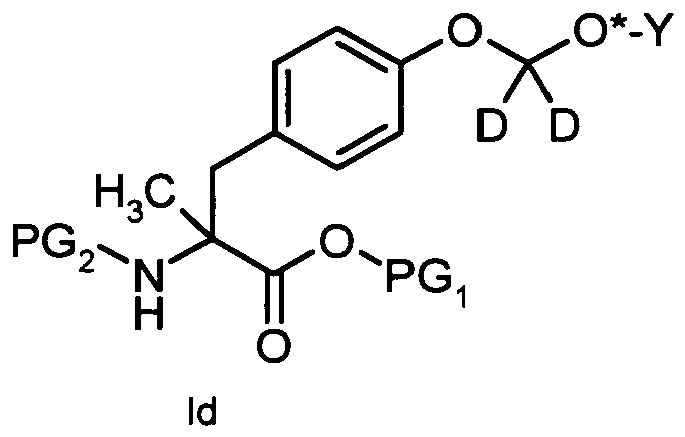
- The compound according to claims 1 to 4 corresponding to compound of Formula (D-I), (D-Ia), (D-Ib), (D-Ic) or (D-Id)
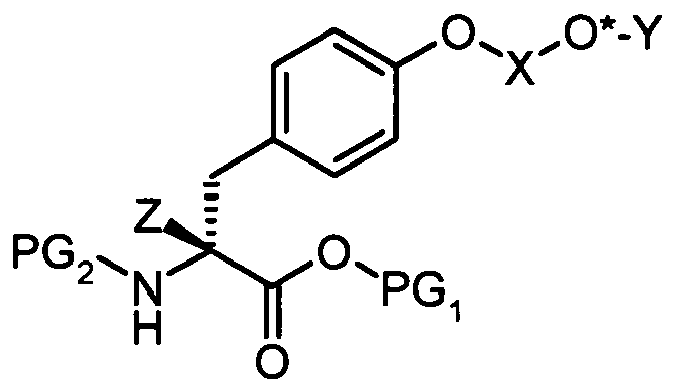
Formula\Substituent Z Z D-I H, CH3 CH2 ,CD2 D-Ia H CH2 D-Ib H CD2 D-Ic CH3 CH2 D-Id CH3 CD2 - The compound according to claims 1 to 5tert-Butyl O-[(1H-benzotriazol-1-yloxy)methyl]-N-(tert-butoxycarbonyl)-D-tyrosinate
 tert-Butyl N-(tert-butoxycarbonyl)-O-[(1H-1,2,3-triazolo[5,4-b]pyridin-1-yloxy)methyl] -D-tyrosinate
 Dicyclopropylmethyl O-[(1H-benzotriazol-1-yloxy)methyl]-N-(tert-butoxycarbonyl) -D-tyrosinate
 Dicyclopropylmethyl O-[(1H-benzotriazol-1-yloxy)methyl]-N-(tert-butoxycarbonyl) -L-tyrosinate
 Dicyclopropylmethyl O-[(6-nitro-1H-benzotriazol-1-yloxy)methyl]-N-(tert-butoxy carbonyl)-D-tyrosinate
 2,4-Dimethoxybenzyl O-[(1H-benzotriazol-1-yloxy)methyl]-N-(tert-butoxycarbonyl) -D-tyrosinate
 Cyclopropylmethyl O-[(1H-benzotriazol-1-yloxy)methyl]-N-(tert-butoxycarbonyl) -D-tyrosinate
 Cyclopropylmethyl N-(tert-butoxycarbonyl)-O-({[4-(ethoxycarbonyl)-1H-1,2,3-triazol-1-yl]oxy}methyl)-D-tyrosinate
 4-Methoxybenzyl O-[(1H-benzotriazol-1-yloxy)methyl]-N-(tert-butoxycarbonyl) -D-tyrosinate
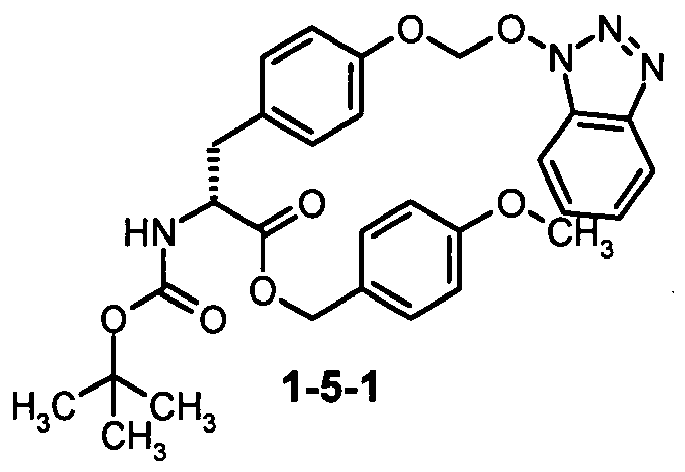 4-Methoxybenzyl N-(tert-butoxycarbonyl)-O-{[(6-chloro-1H-benzotriazol-1-yl) oxy]methyl}-D-tyrosinate
 4-Methoxybenzyl N-(tert-butoxycarbonyl)-O-[(6-trifluoromethyl-1H-benzotriazol -1-yloxy)methyl]- D-tyrosinate
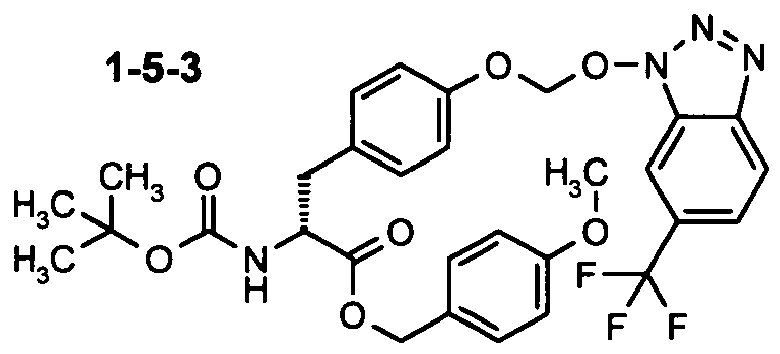 4-Methoxybenzyl O-[(6-trifluoromethyl-1H-benzotriazol-1-yloxy)methyl]-N-(tert-butoxycarbonyl)-L-tyrosinate.
 alpha-Methylbenzyl O-[(1H-benzotriazol-1-yloxy)methyl]-N-(tert-butoxycarbonyl) -D-tyrosinate
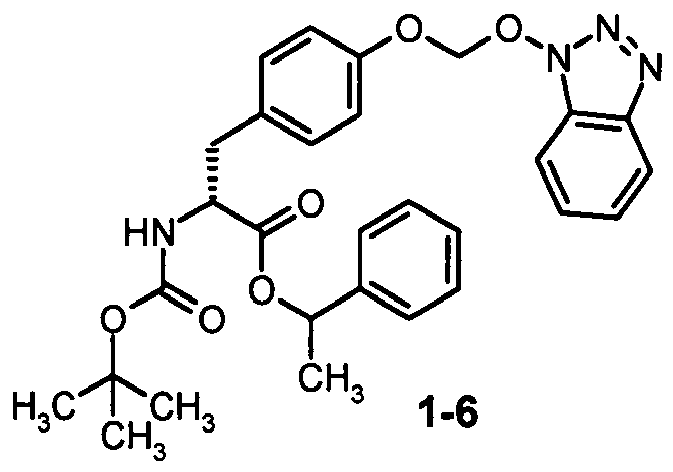 alpha,alpha-Dimethylbenzyl O-[(1H-benzotriazol-1-yloxy)methyl]-N-(tert-butoxycarbonyl) -D-tyrosinate
 tert-Butyl O-[(1H-benzotriazol-1-yloxy)methyl]-N-trityl-D-tyrosinate
 4-Methoxybenzyl O-[(1H-benzotriazol-1-yloxy)methyl]-N-trityl-D-tyrosinate
 Cyclopropylmethyl O-[(1H-benzotriazol-1-yloxy)[2H2]methyl]-N-(tert-butoxycarbonyl)-D-tyrosinate
 2,4-Dimethoxybenzyl O-[(1H-benzotriazol-1-yloxy)methyl]-N-trityl-D-tyrosinate
 2,4-Dimethoxybenzyl O-{[(6-chloro-1H-benzotriazol-1-yl)oxy]methyl}-N-trityl-D-tyrosinate
 2,4-Dimethoxybenzyl O-{[(6-thf)uoromethyl-1H-benzotriazol-1-yl)oxy]methyl}-N-trityl-D-tyrosinate
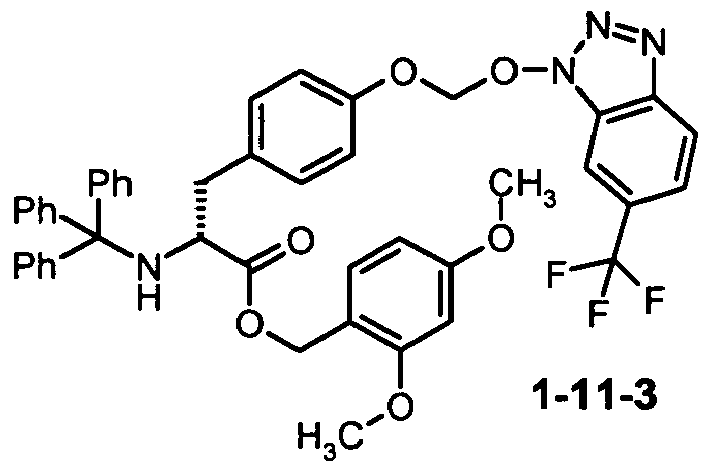 Methyl O-[(1H-benzotriazol-1-yloxy)methyl]-N-(tert-butoxycarbonyl)-alpha-methyltyrosinate
- A compound of Formula III
 X is CH2,CHD or CD2;F is 18F or19F;Z is Hydrogen or methyl;PG1 is a carboxylic protecting group, containing up to 20 carbon atoms, optionally containing independently one ore more O, N or S atoms; andPG2 is an amino protecting group, containing up to 20 carbon atoms, optionally containing one ore more O, N or S atoms and are optionally substituted with one or two halogens.
 - The compound according to claim 7 wherein independently from eachother X is CH2 or CD2;
F is 18F or19F;
PG1 is
Alkyl,
Alkyl substituted with one phenyl,
Alkyl substituted with one or two C3-C6 cycloalkyl,
Alkyl substituted with one phenyl and one C3-C6 cycloalkyl, or fluorenylmethyl
wherein
Alkyl is a branched or linear C1-C6 alkyl, and optionally substituted with C1-C3 alkoxy, and
Phenyl is optionally substituted with up to three C1-C3 alkyl, C1-C3 alkoxy or halogen; and
PG2 is selected from the group comprising Carbobenzyloxy (Cbz), p-Methoxybenzyl carbonyl (Moz or MeOZ), tert-Butoxycarbonyl (BOC), 9-Fluorenylmethoxycarbonyl (FMOC), Triphenylmethyl (trityl), 4-Methylphenyl-diphenylmethyl (Mtt) and 4-Methoxyphenyldiphenylmethyl (MMTr). - The compound according to claims 7 or 8 whereinX is CH2 or CD2;F is 18F;Z is Hydrogen or methyl;PG1 is dicyclopropylmethyl or 2,4-dimethoxybenzyl, andPG2 is tert-Butoxycarbonyl (BOC) or Triphenylmethyl (trityl).
- The compound according to claims 7 to 9 corresponding to compound of Formula (IIIa)


- The compound according to claims 7 to 10 corresponding to compound of Formula (D-III), (D-IIia), (D-IIIb), (D-IIIc) or (D-IIId)

Formula\Substituent Z X D-III H, CH3 CH2,CD2 D-IIIa H CH2 D-IIIb H CD2 D-IIIc CH3 CH2 D-IIId CH3 CD2 - The compound according to claims 7 to 11tert-Butyl N-(tert-butooycarbonyl)-O-(fluoromethyl)-D-tyrosinate
 Dicyclopropylmethyl N-(tert-butoxycarbonyl)-O-(fluoromethyl)-D-tyrosinate
 Dicyclopropylmethyl N-(tert-butoxycarbonyl)-O-(fluoromethyl)-L-tyrosinate
 tert-Butyl O-(fluoromethyl)-N-trityl-D-tyrosinate
 2,4-Dimethoxybenzyl O-(fluoromethyl)-N-trityl-D-tyrosinate
 Methyl N-(tert-butoxycarbonyl)-O-(fluoromethyl)-alpha-methyl-D-tyrosinate
 Methyl N-(tert-butoxycarbonyl)-O-(fluoromethyl)-alpha-methyl-L-tyrosinate
- The compound according to claims 7 to 11tert-Butyl N-(tert-butoxycarbonyl)-O-([18F]fluoromethyl)-D-tyrosinate. Labelling of 1-1-1 and 1-1-2Dicyclopropylmethyl N-(tert-butoxycarbonyl)-O-([18F]fluoromethyl)-D-tyrosinate. Labelling of 1-2-1 and 1-2-3Dicyclopropylmethyl N-(tert-butoxycarbonyl)-O-([18F]fluoromethyl)-L-tyrosinate. Labelling of 1-2-22,4-Dimethoxybenzyl N-(tert-butoxycarbonyl)-O-([18F]fluoromethyl)-D-tyrosinate. Labelling of 1-3Cyclopropylmethyl N-(tert-butoxycarbonyl)-O-([18F]fluoromethyl)-D-tyrosinate. Labelling of 1-4-1 and 1-4-24-Methoxybenzyl N-(tert-butoxycarbonyl)-O-([18F]fluoromethyl)-D-tyrosinate. Labelling of 1-5-1, 1-5-2 and 1-5-34-Methoxybenzyl N-(tert-butoxycarbonyl)-O-([18F]fluoromethyl)-L-tyrosinate. Labelling of 1-5-4alpha-Methylbenzyl N-(tert-butoxycarbonyl)-O-([18F]fluoromethyl)-D-tyrosinate. Labelling of 1-6alpha,alpha-Dimethylbenzyl N-(tert-butoxycarbonyl)-O-([18F]fluoromethyl)- D-tyrosinate. Labelling of 1-7tert-Butyl O-([18F]fluoromethyl)-N-trityl-D-tyrosinate. Labelling of 1-84-Methoxybenzyl O-([18F]fluoromethyl)-N-trityl-D-tyrosinate. Labelling of 1-9Cyclopropylmethyl N-(tert-butoxycarbonyt)-O-([18F]fluoro]2H2]methy)-D-tyrosinate. Labelling of 1-102,4-Dimethoxybenzyl O-([18F]fluoromethyl)-N-trityl-D-tyrosinate Labelling of 1-11-1, 1-11-2 and 1-11-3Methyl N-(tert-butoxycarbonyl)-O-([18F]fluoromethyl)-alpha-methyl-DL-tyrosinate. Labelling of 1-12
- A composition comprising compound(s) of the Formula III, IIIa, IIIb, IIIc, IIId, (D-III), (D-IIIa), (D-IIIb), (D-IIIc) or (D-IIId) independently or mixtures thereof and reagents suitable for deprotection of the amino group and the ester function of the tyrosine,
- A composition comprising compound(s) of the Formula I, Ia, Ib, Ic, Id, (D-I), (D-Ia), (D-Ib), (D-Ic) or (D-Id) independently or mixtures thereof and reagents suitable for fluoro labelling.
- A kit comprising a sealed vial containing a predetermined quantity of a compound of Formula I, Ia, Ib, Ic, Id, (D-I), (D-Ia), (D-Ib), (D-Ic) or (D-Id) independently or mixtures thereof and suitable salts of inorganic or organic acids, hydrates and solvates.
- A method for obtaining compounds of Formula I comprising the step of- Reacting compound of Formula V first with N-Chloro-succinimide (NCS) and then with anion of H-O*-Y for obtaining compounds of Formula I,wherein

- A method for obtaining compounds of Formula III comprising the step of- Reacting compound of Formula I with a 18F-Fluorination agent, and- [Optionally] converting obtained compound into a suitable salts of inorganic or organic bases thereof, hydrates, complexes, and solvates thereofwherein

Priority Applications (13)
| Application Number | Priority Date | Filing Date | Title |
|---|---|---|---|
| EP11075154A EP2540710A1 (en) | 2011-06-30 | 2011-06-30 | New precursors for direct radiosynthesis of protected derivatives of O-([18F]Fluoromethyl) tyrosine |
| US14/129,174 US20140309424A1 (en) | 2011-06-30 | 2012-06-29 | Direct synthesis of 18f-fluoromethoxy compounds for pet imaging and the provision of new precursors for direct radiosynthesis of protected derivatives of o-([18f] fluoromethyl) tyrosine |
| RU2014102887/04A RU2014102887A (en) | 2011-06-30 | 2012-06-29 | DIRECT SYNTHESIS OF 18F-FLUORMETOXY COMPOUNDS FOR PET VISUALIZATIONS AND NEW PREDATORS FOR DIRECT RADIOSYNTHESIS OF PROTECTED O - ([18F] Fluoromethyl) Tyrosine Derivatives |
| JP2014517753A JP2014523890A (en) | 2011-06-30 | 2012-06-29 | Novel precursors for the direct synthesis of 18F-fluoromethoxy compounds for PET imaging and the direct radioactive synthesis of protected derivatives of O-([18F] fluoromethyl) tyrosine |
| CN201280040670.5A CN103857660A (en) | 2011-06-30 | 2012-06-29 | Direct synthesis of 18F-fluoromethoxy compounds for PET imaging and new precursors for the direct radiosynthesis of protected derivatives of O-([18F]fluoromethyl)tyrosine |
| EP12732636.1A EP2751087A1 (en) | 2011-06-30 | 2012-06-29 | Direct synthesis of 18f-fluoromethoxy compounds for pet imaging and the provision of new precursors for direct radiosynthesis of protected derivatives of o-([18f]fluoromethyl)tyrosine |
| MX2013015239A MX2013015239A (en) | 2011-06-30 | 2012-06-29 | DIRECT SYNTHESIS OF 18F-FLUOROMETHOXY COMPOUNDS FOR PET IMAGING AND THE PROVISION OF NEW PRECURSORS FOR DIRECT RADIOSYNTHESIS OF PROTECTED DERIVATIVES OF O-([18</s up>F]FLUOROMETHYL) TYROSINE. |
| BR112013034070A BR112013034070A2 (en) | 2011-06-30 | 2012-06-29 | direct synthesis of 18f-fluoromethoxy compounds for pet imaging and new precursors for direct radiosynthesis of protected o - ([18f] fluoromethyl) tyrosine derivatives |
| AU2012277730A AU2012277730A1 (en) | 2011-06-30 | 2012-06-29 | Direct synthesis of 18F-fluoromethoxy compounds for pet imaging and the provision of new precursors for direct radiosynthesis of protected derivatives of o-( [18F]fluoromethyl) tyrosine |
| KR1020147002204A KR20140063577A (en) | 2011-06-30 | 2012-06-29 | Direct synthesis of 18f-fluoromethoxy compounds for pet imaging and the provision of new precursors for direct radiosynthesis of protected derivatives of o-([18f]fluoromethyl) tyrosine |
| CA2840768A CA2840768A1 (en) | 2011-06-30 | 2012-06-29 | Direct synthesis of 18f-fluoromethoxy compounds for pet imaging and new precursors for direct radiosynthesis of protected derivatives of o-([18f]fluoromethyl) tyrosine |
| PCT/EP2012/062786 WO2013001088A1 (en) | 2011-06-30 | 2012-06-29 | Direct synthesis of 18f-fluoromethoxy compounds for pet imaging and the provision of new precursors for direct radiosynthesis of protected derivatives of o-([18f]fluoromethyl) tyrosine |
| IL230225A IL230225A0 (en) | 2011-06-30 | 2013-12-29 | Direct synthesis of 18f-fluoromethoxy compounds for pet imaging and the provision of new precursors for direct o([18f]fluoromethyl)tyrosine |
Applications Claiming Priority (1)
| Application Number | Priority Date | Filing Date | Title |
|---|---|---|---|
| EP11075154A EP2540710A1 (en) | 2011-06-30 | 2011-06-30 | New precursors for direct radiosynthesis of protected derivatives of O-([18F]Fluoromethyl) tyrosine |
Publications (1)
| Publication Number | Publication Date |
|---|---|
| EP2540710A1 true EP2540710A1 (en) | 2013-01-02 |
Family
ID=44983417
Family Applications (1)
| Application Number | Title | Priority Date | Filing Date |
|---|---|---|---|
| EP11075154A Withdrawn EP2540710A1 (en) | 2011-06-30 | 2011-06-30 | New precursors for direct radiosynthesis of protected derivatives of O-([18F]Fluoromethyl) tyrosine |
Country Status (1)
| Country | Link |
|---|---|
| EP (1) | EP2540710A1 (en) |
Citations (6)
| Publication number | Priority date | Publication date | Assignee | Title |
|---|---|---|---|---|
| US5663200A (en) | 1994-10-19 | 1997-09-02 | Ciba-Geigy Corporation | Antiviral ethers of aspartate protease substrate isosteres |
| WO2005009928A2 (en) | 2003-07-24 | 2005-02-03 | The Queen's Medical Center | Preparation and use of alkylating agents |
| WO2005115971A1 (en) | 2004-05-28 | 2005-12-08 | Hamamatsu Photonics K.K. | Radioactive tyrosine derivative, method for producing same, labeling agent for positron imaging and medical agent for assessing grade of malignancy of tumor respectively composed of radioactive tyrosine derivative, and method for detecting tumor |
| WO2008048970A2 (en) | 2006-10-16 | 2008-04-24 | The Arizona Board Of Regents, A Body Corporate Of The State Of Arizona Acting For And On Behalf Of Arizona State University | Synthetic antibodies |
| WO2008104203A2 (en) | 2007-03-01 | 2008-09-04 | Bayer Schering Pharma Aktiengesellschaft | 18f fluoro-benzoyl labelled biological active coumpounds as diagnositic imaging agents as well as benzotriazol-1-yloxy-benzoyl, 2,5-dioxo-pyrrolidin-1-yloxy) benzoyl and trimethylammonio-benzoyl precursers |
| JP2009106268A (en) * | 2007-10-11 | 2009-05-21 | Okayama Univ | Method for introducing an amino acid into a target protein or peptide |
-
2011
- 2011-06-30 EP EP11075154A patent/EP2540710A1/en not_active Withdrawn
Patent Citations (7)
| Publication number | Priority date | Publication date | Assignee | Title |
|---|---|---|---|---|
| US5663200A (en) | 1994-10-19 | 1997-09-02 | Ciba-Geigy Corporation | Antiviral ethers of aspartate protease substrate isosteres |
| WO2005009928A2 (en) | 2003-07-24 | 2005-02-03 | The Queen's Medical Center | Preparation and use of alkylating agents |
| WO2005115971A1 (en) | 2004-05-28 | 2005-12-08 | Hamamatsu Photonics K.K. | Radioactive tyrosine derivative, method for producing same, labeling agent for positron imaging and medical agent for assessing grade of malignancy of tumor respectively composed of radioactive tyrosine derivative, and method for detecting tumor |
| EP1749815A1 (en) * | 2004-05-28 | 2007-02-07 | Hamamatsu Photonics K.K. | Radioactive tyrosine derivative, method for producing same, labeling agent for positron imaging and medical agent for assessing grade of malignancy of tumor respectively composed of radioactive tyrosine derivative, and method for detecting tumor |
| WO2008048970A2 (en) | 2006-10-16 | 2008-04-24 | The Arizona Board Of Regents, A Body Corporate Of The State Of Arizona Acting For And On Behalf Of Arizona State University | Synthetic antibodies |
| WO2008104203A2 (en) | 2007-03-01 | 2008-09-04 | Bayer Schering Pharma Aktiengesellschaft | 18f fluoro-benzoyl labelled biological active coumpounds as diagnositic imaging agents as well as benzotriazol-1-yloxy-benzoyl, 2,5-dioxo-pyrrolidin-1-yloxy) benzoyl and trimethylammonio-benzoyl precursers |
| JP2009106268A (en) * | 2007-10-11 | 2009-05-21 | Okayama Univ | Method for introducing an amino acid into a target protein or peptide |
Non-Patent Citations (27)
| Title |
|---|
| AMETAMEY ET AL., CHEM. REV., vol. 108, 2008, pages 1501 - 1516 |
| ANGEW. CHEM. INT ED., 2002, pages 3449 |
| ANGEW. CHEM. INT. ED., 2002, pages 3449 |
| BIOORGANIC & MEDICINAL |
| CHEMISTRY LETTERS, vol. 13, no. 2, 2003, pages 201 - 204 |
| COENEN: "PET-Chemistry - The Driving Force in Molecular Imaging", 2006, SPRINGER, article "Fluorine-18 Labeling Methods: Features and Possibilities of Basic Reactions", pages: 15 - 50 |
| EUR. J. NUCL. MED. MOL. IMAG., 2006, pages 1017 |
| GREENE, WUTS: "Protecting Groups in Organic synthesis", 1999, WILEY |
| IWATA ET AL., APPL. RADIAT. ISOT., vol. 57, 2002, pages 347 - 352 |
| IWATA R ET AL: "Radiosynthesis of O-[11C]methyl-L-tyrosine and O-[18F]Fluoromethyl-L-tyrosine as potential PET tracers for imaging amino acid transport", JOURNAL OF LABELLED COMPOUNDS AND RADIOPHARMACEUTICALS, JOHN WILEY, CHICHESTER, GB, vol. 46, 1 May 2003 (2003-05-01), pages 555 - 566, XP002313435, ISSN: 0362-4803, DOI: 10.1002/JLCR.696 * |
| J. APPL. CHEM., 1953, pages 266 |
| J. FLUORINE CHEM., vol. 27, 1985, pages 177 - 191 |
| J. LABEL. COMP. RADIOPHARM., vol. 46, 2003, pages 555 |
| J. MED. CHEM., vol. 47, 2004, pages 1223 - 33 |
| J. NUCL. MED., vol. 47, 2006, pages 679 |
| J. NUCL. MED., vol. 50, 2009, pages 290 |
| JOURNAL OF LABELLED COMPOUNDS AND RADIOPHARMACEUTICALS, vol. 47, 2004, pages 477 - 483 |
| JOURNAL OF MEDICINAL CHEMISTRY, vol. 48, no. 10, 2005, pages 3586 - 3604 |
| JUNG M.E., TETRAHEDRON, 1997, pages 8815 |
| KRASIKOWA: "PET-Chemistry - The Driving Force in Molecular Imaging", 2006, SPRINGER, article "Synthesis Modules and Automation in F-18 labeling", pages: 289 - 316 |
| LIEBIGS ANN. CHEM., 1988, pages 1083 - 1084 |
| NAKAMURA K., TETRAHEDRON LETT., 2004, pages 495 |
| NEAL ET AL., J. LABEL. COMPD. RADIOPHARM., vol. 48, 2005, pages 557 - 568 |
| NUC. MED. BIOL., 2009, pages 295 |
| POZDNEV, V. F., CHEMISTRY OF NATURAL COMPOUNDS; ENGLISH, vol. 18, no. 1, 1982, pages 125 - 126 |
| TETRAHEDRON LETT., vol. 34, 1993, pages 323 - 326 |
| ZHANG ET AL., J. FLUORINE CHEM., vol. 125, 2004, pages 1879 - 1886 |
Similar Documents
| Publication | Publication Date | Title |
|---|---|---|
| RU2315769C9 (en) | Nucleophilic fluorination in solid phase | |
| JP4981683B2 (en) | Process for the preparation of organic fluoro compounds in alcoholic solvents | |
| US9238631B2 (en) | Radiolabeled amino acids for diagnostic imaging | |
| ES2643487T3 (en) | Compounds for use in imaging, diagnosis and / or treatment of diseases of the central nervous system or tumors | |
| US20120123120A1 (en) | No-Carrier-Added Nucleophilic [F-18] Fluorination of Aromatic Compounds | |
| MX2013015239A (en) | DIRECT SYNTHESIS OF 18F-FLUOROMETHOXY COMPOUNDS FOR PET IMAGING AND THE PROVISION OF NEW PRECURSORS FOR DIRECT RADIOSYNTHESIS OF PROTECTED DERIVATIVES OF O-([18</s up>F]FLUOROMETHYL) TYROSINE. | |
| RU2600981C2 (en) | Novel precursors of glutamate derivatives | |
| AU2010321278B2 (en) | Method for production of F-18 labeled glutamic acid derivatives | |
| EP2540710A1 (en) | New precursors for direct radiosynthesis of protected derivatives of O-([18F]Fluoromethyl) tyrosine | |
| PT93126B (en) | PROCESS FOR THE PREPARATION OF 2-AMINO-7-HYDROXYETRALIN CARBOXYL-ETHYLIC ETERS | |
| US20250042841A1 (en) | Processes for the preparation of deuterated d-serine | |
| KR100483650B1 (en) | New imaging agents, precursors thereof and methods of manufacture | |
| JP7165853B2 (en) | Radioactive fluorine-labeled precursor compound and method for producing radioactive fluorine-labeled compound using the same | |
| RU2593372C2 (en) | Simple method of producing precursor compound | |
| HK1194065A (en) | Direct synthesis of 18f-fluoromethoxy compounds for pet imaging and the provision of new precursors for direct radiosynthesis of protected derivatives of o-([18f]fluoromethyl) tyrosine | |
| DK2655321T3 (en) | PURIFICATION OF STARTING MATERIAL BY CRYSTALLIZATION | |
| JP2019131532A (en) | Acid anhydride, and method for producing l-carnosine with the acid anhydride | |
| WO2022186273A1 (en) | Radioactive compound | |
| NZ617331B2 (en) | Novel precursors of glutamate derivatives | |
| JP2007106722A (en) | A method for producing a precursor of an unsupported 18F-labeled amino acid O- (2- [18F] fluoroethyl) -L-tyrosine. |
Legal Events
| Date | Code | Title | Description |
|---|---|---|---|
| PUAI | Public reference made under article 153(3) epc to a published international application that has entered the european phase |
Free format text: ORIGINAL CODE: 0009012 |
|
| AK | Designated contracting states |
Kind code of ref document: A1 Designated state(s): AL AT BE BG CH CY CZ DE DK EE ES FI FR GB GR HR HU IE IS IT LI LT LU LV MC MK MT NL NO PL PT RO RS SE SI SK SM TR |
|
| AX | Request for extension of the european patent |
Extension state: BA ME |
|
| 17P | Request for examination filed |
Effective date: 20130702 |
|
| RAP1 | Party data changed (applicant data changed or rights of an application transferred) |
Owner name: PIRAMAL IMAGING SA |
|
| RBV | Designated contracting states (corrected) |
Designated state(s): AL AT BE BG CH CY CZ DE DK EE ES FI FR GB GR HR HU IE IS IT LI LT LU LV MC MK MT NL NO PL PT RO RS SE SI SK SM TR |
|
| GRAP | Despatch of communication of intention to grant a patent |
Free format text: ORIGINAL CODE: EPIDOSNIGR1 |
|
| INTG | Intention to grant announced |
Effective date: 20131212 |
|
| 17Q | First examination report despatched |
Effective date: 20140603 |
|
| STAA | Information on the status of an ep patent application or granted ep patent |
Free format text: STATUS: THE APPLICATION IS DEEMED TO BE WITHDRAWN |
|
| 18D | Application deemed to be withdrawn |
Effective date: 20141014 |