EP2540278A1 - Hair styling composition - Google Patents
Hair styling composition Download PDFInfo
- Publication number
- EP2540278A1 EP2540278A1 EP11747370A EP11747370A EP2540278A1 EP 2540278 A1 EP2540278 A1 EP 2540278A1 EP 11747370 A EP11747370 A EP 11747370A EP 11747370 A EP11747370 A EP 11747370A EP 2540278 A1 EP2540278 A1 EP 2540278A1
- Authority
- EP
- European Patent Office
- Prior art keywords
- hair
- component
- linear
- composition
- hair shape
- Prior art date
- Legal status (The legal status is an assumption and is not a legal conclusion. Google has not performed a legal analysis and makes no representation as to the accuracy of the status listed.)
- Withdrawn
Links
- 239000000203 mixture Substances 0.000 title claims abstract description 127
- 150000001875 compounds Chemical class 0.000 claims abstract description 21
- 239000003638 chemical reducing agent Substances 0.000 claims abstract description 20
- 239000003795 chemical substances by application Substances 0.000 claims abstract description 19
- VEXZGXHMUGYJMC-UHFFFAOYSA-M Chloride anion Chemical compound [Cl-] VEXZGXHMUGYJMC-UHFFFAOYSA-M 0.000 claims abstract description 14
- 239000004354 Hydroxyethyl cellulose Substances 0.000 claims abstract description 12
- 229920000663 Hydroxyethyl cellulose Polymers 0.000 claims abstract description 12
- LFQSCWFLJHTTHZ-UHFFFAOYSA-N Ethanol Chemical compound CCO LFQSCWFLJHTTHZ-UHFFFAOYSA-N 0.000 claims abstract description 11
- 235000019447 hydroxyethyl cellulose Nutrition 0.000 claims abstract description 11
- 125000003342 alkenyl group Chemical group 0.000 claims abstract description 10
- 125000001436 propyl group Chemical group [H]C([*])([H])C([H])([H])C([H])([H])[H] 0.000 claims abstract description 9
- 125000004169 (C1-C6) alkyl group Chemical group 0.000 claims abstract description 8
- 125000004435 hydrogen atom Chemical group [H]* 0.000 claims abstract description 8
- 125000005466 alkylenyl group Chemical group 0.000 claims abstract description 4
- HZAXFHJVJLSVMW-UHFFFAOYSA-N 2-Aminoethan-1-ol Chemical group NCCO HZAXFHJVJLSVMW-UHFFFAOYSA-N 0.000 claims description 14
- PMNLUUOXGOOLSP-UHFFFAOYSA-N 2-mercaptopropanoic acid Chemical group CC(S)C(O)=O PMNLUUOXGOOLSP-UHFFFAOYSA-N 0.000 claims description 13
- 239000007800 oxidant agent Substances 0.000 claims description 13
- 150000003839 salts Chemical class 0.000 claims description 12
- 150000005846 sugar alcohols Chemical class 0.000 claims description 12
- FBPFZTCFMRRESA-FSIIMWSLSA-N D-Glucitol Natural products OC[C@H](O)[C@H](O)[C@@H](O)[C@H](O)CO FBPFZTCFMRRESA-FSIIMWSLSA-N 0.000 claims description 11
- 239000000600 sorbitol Substances 0.000 claims description 11
- 150000003242 quaternary ammonium salts Chemical class 0.000 claims description 10
- 125000002947 alkylene group Chemical group 0.000 claims description 3
- 125000000217 alkyl group Chemical group 0.000 abstract description 5
- 125000003161 (C1-C6) alkylene group Chemical group 0.000 abstract 1
- 231100000640 hair analysis Toxicity 0.000 description 31
- XLYOFNOQVPJJNP-UHFFFAOYSA-N water Substances O XLYOFNOQVPJJNP-UHFFFAOYSA-N 0.000 description 28
- BXWNKGSJHAJOGX-UHFFFAOYSA-N hexadecan-1-ol Chemical compound CCCCCCCCCCCCCCCCO BXWNKGSJHAJOGX-UHFFFAOYSA-N 0.000 description 22
- -1 cyclic mercapto compounds Chemical class 0.000 description 21
- 238000001035 drying Methods 0.000 description 21
- 230000006378 damage Effects 0.000 description 16
- 230000000694 effects Effects 0.000 description 16
- DNIAPMSPPWPWGF-UHFFFAOYSA-N Propylene glycol Chemical compound CC(O)CO DNIAPMSPPWPWGF-UHFFFAOYSA-N 0.000 description 14
- 239000000835 fiber Substances 0.000 description 14
- MHAJPDPJQMAIIY-UHFFFAOYSA-N Hydrogen peroxide Chemical compound OO MHAJPDPJQMAIIY-UHFFFAOYSA-N 0.000 description 12
- 239000000047 product Substances 0.000 description 12
- 239000008213 purified water Substances 0.000 description 12
- 229960000541 cetyl alcohol Drugs 0.000 description 11
- GLDOVTGHNKAZLK-UHFFFAOYSA-N octadecan-1-ol Chemical compound CCCCCCCCCCCCCCCCCCO GLDOVTGHNKAZLK-UHFFFAOYSA-N 0.000 description 11
- PEDCQBHIVMGVHV-UHFFFAOYSA-N Glycerine Chemical compound OCC(O)CO PEDCQBHIVMGVHV-UHFFFAOYSA-N 0.000 description 10
- YSJGOMATDFSEED-UHFFFAOYSA-M behentrimonium chloride Chemical compound [Cl-].CCCCCCCCCCCCCCCCCCCCCC[N+](C)(C)C YSJGOMATDFSEED-UHFFFAOYSA-M 0.000 description 10
- 239000002304 perfume Substances 0.000 description 10
- 235000010356 sorbitol Nutrition 0.000 description 10
- 229940075506 behentrimonium chloride Drugs 0.000 description 9
- 238000000034 method Methods 0.000 description 9
- LQPLDXQVILYOOL-UHFFFAOYSA-I pentasodium;2-[bis[2-[bis(carboxylatomethyl)amino]ethyl]amino]acetate Chemical compound [Na+].[Na+].[Na+].[Na+].[Na+].[O-]C(=O)CN(CC([O-])=O)CCN(CC(=O)[O-])CCN(CC([O-])=O)CC([O-])=O LQPLDXQVILYOOL-UHFFFAOYSA-I 0.000 description 9
- 125000004079 stearyl group Chemical group [H]C([*])([H])C([H])([H])C([H])([H])C([H])([H])C([H])([H])C([H])([H])C([H])([H])C([H])([H])C([H])([H])C([H])([H])C([H])([H])C([H])([H])C([H])([H])C([H])([H])C([H])([H])C([H])([H])C([H])([H])C([H])([H])[H] 0.000 description 9
- FBPFZTCFMRRESA-JGWLITMVSA-N D-glucitol Chemical compound OC[C@H](O)[C@@H](O)[C@H](O)[C@H](O)CO FBPFZTCFMRRESA-JGWLITMVSA-N 0.000 description 8
- XEEYBQQBJWHFJM-UHFFFAOYSA-N Iron Chemical compound [Fe] XEEYBQQBJWHFJM-UHFFFAOYSA-N 0.000 description 8
- 230000000052 comparative effect Effects 0.000 description 8
- 230000003700 hair damage Effects 0.000 description 8
- 238000009472 formulation Methods 0.000 description 7
- RZOXALOSBVDYRY-UHFFFAOYSA-N azane;2-(carboxymethyldisulfanyl)acetic acid Chemical compound [NH4+].[NH4+].[O-]C(=O)CSSCC([O-])=O RZOXALOSBVDYRY-UHFFFAOYSA-N 0.000 description 6
- WWVIUVHFPSALDO-UHFFFAOYSA-N n-[3-(dimethylamino)propyl]octadecanamide Chemical compound CCCCCCCCCCCCCCCCCC(=O)NCCCN(C)C WWVIUVHFPSALDO-UHFFFAOYSA-N 0.000 description 6
- LWIHDJKSTIGBAC-UHFFFAOYSA-K tripotassium phosphate Chemical compound [K+].[K+].[K+].[O-]P([O-])([O-])=O LWIHDJKSTIGBAC-UHFFFAOYSA-K 0.000 description 6
- 229920003171 Poly (ethylene oxide) Polymers 0.000 description 5
- QGZKDVFQNNGYKY-UHFFFAOYSA-N ammonia Natural products N QGZKDVFQNNGYKY-UHFFFAOYSA-N 0.000 description 5
- 238000011156 evaluation Methods 0.000 description 5
- 235000011187 glycerol Nutrition 0.000 description 5
- 239000002480 mineral oil Substances 0.000 description 5
- 235000010446 mineral oil Nutrition 0.000 description 5
- ZZTCCAPMZLDHFM-UHFFFAOYSA-N ammonium thioglycolate Chemical compound [NH4+].[O-]C(=O)CS ZZTCCAPMZLDHFM-UHFFFAOYSA-N 0.000 description 4
- 229920002678 cellulose Polymers 0.000 description 4
- 239000001913 cellulose Substances 0.000 description 4
- 230000006866 deterioration Effects 0.000 description 4
- 229910052742 iron Inorganic materials 0.000 description 4
- 238000007254 oxidation reaction Methods 0.000 description 4
- 230000035807 sensation Effects 0.000 description 4
- CWERGRDVMFNCDR-UHFFFAOYSA-N thioglycolic acid Chemical compound OC(=O)CS CWERGRDVMFNCDR-UHFFFAOYSA-N 0.000 description 4
- 238000005406 washing Methods 0.000 description 4
- FFJCNSLCJOQHKM-CLFAGFIQSA-N (z)-1-[(z)-octadec-9-enoxy]octadec-9-ene Chemical compound CCCCCCCC\C=C/CCCCCCCCOCCCCCCCC\C=C/CCCCCCCC FFJCNSLCJOQHKM-CLFAGFIQSA-N 0.000 description 3
- OGGSSJKOBUVXRI-UHFFFAOYSA-N 1-(dimethylamino)-3-octadecoxypropan-2-ol Chemical compound CCCCCCCCCCCCCCCCCCOCC(O)CN(C)C OGGSSJKOBUVXRI-UHFFFAOYSA-N 0.000 description 3
- 150000003863 ammonium salts Chemical class 0.000 description 3
- 229940075861 ammonium thioglycolate Drugs 0.000 description 3
- 125000002511 behenyl group Chemical group [H]C([*])([H])C([H])([H])C([H])([H])C([H])([H])C([H])([H])C([H])([H])C([H])([H])C([H])([H])C([H])([H])C([H])([H])C([H])([H])C([H])([H])C([H])([H])C([H])([H])C([H])([H])C([H])([H])C([H])([H])C([H])([H])C([H])([H])C([H])([H])C([H])([H])C([H])([H])[H] 0.000 description 3
- KRKNYBCHXYNGOX-UHFFFAOYSA-N citric acid Chemical compound OC(=O)CC(O)(C(O)=O)CC(O)=O KRKNYBCHXYNGOX-UHFFFAOYSA-N 0.000 description 3
- XUJNEKJLAYXESH-UHFFFAOYSA-N cysteine Natural products SCC(N)C(O)=O XUJNEKJLAYXESH-UHFFFAOYSA-N 0.000 description 3
- 235000018417 cysteine Nutrition 0.000 description 3
- BNIILDVGGAEEIG-UHFFFAOYSA-L disodium hydrogen phosphate Chemical compound [Na+].[Na+].OP([O-])([O-])=O BNIILDVGGAEEIG-UHFFFAOYSA-L 0.000 description 3
- 125000003438 dodecyl group Chemical group [H]C([H])([H])C([H])([H])C([H])([H])C([H])([H])C([H])([H])C([H])([H])C([H])([H])C([H])([H])C([H])([H])C([H])([H])C([H])([H])C([H])([H])* 0.000 description 3
- 125000002496 methyl group Chemical group [H]C([H])([H])* 0.000 description 3
- 125000001421 myristyl group Chemical group [H]C([*])([H])C([H])([H])C([H])([H])C([H])([H])C([H])([H])C([H])([H])C([H])([H])C([H])([H])C([H])([H])C([H])([H])C([H])([H])C([H])([H])C([H])([H])C([H])([H])[H] 0.000 description 3
- GOQYKNQRPGWPLP-UHFFFAOYSA-N n-heptadecyl alcohol Natural products CCCCCCCCCCCCCCCCCO GOQYKNQRPGWPLP-UHFFFAOYSA-N 0.000 description 3
- 230000003647 oxidation Effects 0.000 description 3
- 125000000913 palmityl group Chemical group [H]C([*])([H])C([H])([H])C([H])([H])C([H])([H])C([H])([H])C([H])([H])C([H])([H])C([H])([H])C([H])([H])C([H])([H])C([H])([H])C([H])([H])C([H])([H])C([H])([H])C([H])([H])C([H])([H])[H] 0.000 description 3
- 229920001296 polysiloxane Polymers 0.000 description 3
- 229910000160 potassium phosphate Inorganic materials 0.000 description 3
- 235000011009 potassium phosphates Nutrition 0.000 description 3
- WXMKPNITSTVMEF-UHFFFAOYSA-M sodium benzoate Chemical compound [Na+].[O-]C(=O)C1=CC=CC=C1 WXMKPNITSTVMEF-UHFFFAOYSA-M 0.000 description 3
- 235000010234 sodium benzoate Nutrition 0.000 description 3
- 239000004299 sodium benzoate Substances 0.000 description 3
- XUXNAKZDHHEHPC-UHFFFAOYSA-M sodium bromate Chemical compound [Na+].[O-]Br(=O)=O XUXNAKZDHHEHPC-UHFFFAOYSA-M 0.000 description 3
- 239000004094 surface-active agent Substances 0.000 description 3
- 238000010998 test method Methods 0.000 description 3
- ATRRKUHOCOJYRX-UHFFFAOYSA-N Ammonium bicarbonate Chemical compound [NH4+].OC([O-])=O ATRRKUHOCOJYRX-UHFFFAOYSA-N 0.000 description 2
- 229910000013 Ammonium bicarbonate Inorganic materials 0.000 description 2
- KWIUHFFTVRNATP-UHFFFAOYSA-N Betaine Natural products C[N+](C)(C)CC([O-])=O KWIUHFFTVRNATP-UHFFFAOYSA-N 0.000 description 2
- SNRUBQQJIBEYMU-UHFFFAOYSA-N Dodecane Natural products CCCCCCCCCCCC SNRUBQQJIBEYMU-UHFFFAOYSA-N 0.000 description 2
- KWIUHFFTVRNATP-UHFFFAOYSA-O N,N,N-trimethylglycinium Chemical compound C[N+](C)(C)CC(O)=O KWIUHFFTVRNATP-UHFFFAOYSA-O 0.000 description 2
- NBIIXXVUZAFLBC-UHFFFAOYSA-N Phosphoric acid Chemical compound OP(O)(O)=O NBIIXXVUZAFLBC-UHFFFAOYSA-N 0.000 description 2
- WCUXLLCKKVVCTQ-UHFFFAOYSA-M Potassium chloride Chemical compound [Cl-].[K+] WCUXLLCKKVVCTQ-UHFFFAOYSA-M 0.000 description 2
- FAPWRFPIFSIZLT-UHFFFAOYSA-M Sodium chloride Chemical compound [Na+].[Cl-] FAPWRFPIFSIZLT-UHFFFAOYSA-M 0.000 description 2
- XSQUKJJJFZCRTK-UHFFFAOYSA-N Urea Chemical compound NC(N)=O XSQUKJJJFZCRTK-UHFFFAOYSA-N 0.000 description 2
- 239000002253 acid Substances 0.000 description 2
- 229910052783 alkali metal Inorganic materials 0.000 description 2
- 235000001014 amino acid Nutrition 0.000 description 2
- 150000001413 amino acids Chemical class 0.000 description 2
- 229910021529 ammonia Inorganic materials 0.000 description 2
- 235000012538 ammonium bicarbonate Nutrition 0.000 description 2
- 239000001099 ammonium carbonate Substances 0.000 description 2
- 125000001204 arachidyl group Chemical group [H]C([*])([H])C([H])([H])C([H])([H])C([H])([H])C([H])([H])C([H])([H])C([H])([H])C([H])([H])C([H])([H])C([H])([H])C([H])([H])C([H])([H])C([H])([H])C([H])([H])C([H])([H])C([H])([H])C([H])([H])C([H])([H])C([H])([H])C([H])([H])[H] 0.000 description 2
- JSBIFVGFAMLBFB-UHFFFAOYSA-N azane;2-hydroxypropanethioic s-acid Chemical compound [NH4+].CC(O)C([O-])=S JSBIFVGFAMLBFB-UHFFFAOYSA-N 0.000 description 2
- 229960003237 betaine Drugs 0.000 description 2
- 239000004202 carbamide Substances 0.000 description 2
- 125000002704 decyl group Chemical group [H]C([H])([H])C([H])([H])C([H])([H])C([H])([H])C([H])([H])C([H])([H])C([H])([H])C([H])([H])C([H])([H])C([H])([H])* 0.000 description 2
- 239000004205 dimethyl polysiloxane Substances 0.000 description 2
- 235000013870 dimethyl polysiloxane Nutrition 0.000 description 2
- NOPFSRXAKWQILS-UHFFFAOYSA-N docosan-1-ol Chemical compound CCCCCCCCCCCCCCCCCCCCCCO NOPFSRXAKWQILS-UHFFFAOYSA-N 0.000 description 2
- 125000000755 henicosyl group Chemical group [H]C([*])([H])C([H])([H])C([H])([H])C([H])([H])C([H])([H])C([H])([H])C([H])([H])C([H])([H])C([H])([H])C([H])([H])C([H])([H])C([H])([H])C([H])([H])C([H])([H])C([H])([H])C([H])([H])C([H])([H])C([H])([H])C([H])([H])C([H])([H])C([H])([H])[H] 0.000 description 2
- 125000003187 heptyl group Chemical group [H]C([*])([H])C([H])([H])C([H])([H])C([H])([H])C([H])([H])C([H])([H])C([H])([H])[H] 0.000 description 2
- 125000004051 hexyl group Chemical group [H]C([H])([H])C([H])([H])C([H])([H])C([H])([H])C([H])([H])C([H])([H])* 0.000 description 2
- 238000010348 incorporation Methods 0.000 description 2
- JVTAAEKCZFNVCJ-UHFFFAOYSA-N lactic acid Chemical compound CC(O)C(O)=O JVTAAEKCZFNVCJ-UHFFFAOYSA-N 0.000 description 2
- 125000002463 lignoceryl group Chemical group [H]C([*])([H])C([H])([H])C([H])([H])C([H])([H])C([H])([H])C([H])([H])C([H])([H])C([H])([H])C([H])([H])C([H])([H])C([H])([H])C([H])([H])C([H])([H])C([H])([H])C([H])([H])C([H])([H])C([H])([H])C([H])([H])C([H])([H])C([H])([H])C([H])([H])C([H])([H])C([H])([H])C([H])([H])[H] 0.000 description 2
- 125000005645 linoleyl group Chemical group 0.000 description 2
- 238000004519 manufacturing process Methods 0.000 description 2
- 125000002960 margaryl group Chemical group [H]C([*])([H])C([H])([H])C([H])([H])C([H])([H])C([H])([H])C([H])([H])C([H])([H])C([H])([H])C([H])([H])C([H])([H])C([H])([H])C([H])([H])C([H])([H])C([H])([H])C([H])([H])C([H])([H])C([H])([H])[H] 0.000 description 2
- KKBOOQDFOWZSDC-UHFFFAOYSA-N n-[2-(diethylamino)ethyl]octadecanamide Chemical compound CCCCCCCCCCCCCCCCCC(=O)NCCN(CC)CC KKBOOQDFOWZSDC-UHFFFAOYSA-N 0.000 description 2
- 125000001196 nonadecyl group Chemical group [H]C([*])([H])C([H])([H])C([H])([H])C([H])([H])C([H])([H])C([H])([H])C([H])([H])C([H])([H])C([H])([H])C([H])([H])C([H])([H])C([H])([H])C([H])([H])C([H])([H])C([H])([H])C([H])([H])C([H])([H])C([H])([H])C([H])([H])[H] 0.000 description 2
- 125000001400 nonyl group Chemical group [H]C([*])([H])C([H])([H])C([H])([H])C([H])([H])C([H])([H])C([H])([H])C([H])([H])C([H])([H])C([H])([H])[H] 0.000 description 2
- 125000002347 octyl group Chemical group [H]C([*])([H])C([H])([H])C([H])([H])C([H])([H])C([H])([H])C([H])([H])C([H])([H])C([H])([H])[H] 0.000 description 2
- 125000001117 oleyl group Chemical group [H]C([*])([H])C([H])([H])C([H])([H])C([H])([H])C([H])([H])C([H])([H])C([H])([H])C([H])([H])/C([H])=C([H])\C([H])([H])C([H])([H])C([H])([H])C([H])([H])C([H])([H])C([H])([H])C([H])([H])C([H])([H])[H] 0.000 description 2
- 125000002958 pentadecyl group Chemical group [H]C([*])([H])C([H])([H])C([H])([H])C([H])([H])C([H])([H])C([H])([H])C([H])([H])C([H])([H])C([H])([H])C([H])([H])C([H])([H])C([H])([H])C([H])([H])C([H])([H])C([H])([H])[H] 0.000 description 2
- 229920000435 poly(dimethylsiloxane) Polymers 0.000 description 2
- NARVIWMVBMUEOG-UHFFFAOYSA-N prop-1-en-2-ol Chemical group CC(O)=C NARVIWMVBMUEOG-UHFFFAOYSA-N 0.000 description 2
- 238000009864 tensile test Methods 0.000 description 2
- HLZKNKRTKFSKGZ-UHFFFAOYSA-N tetradecan-1-ol Chemical compound CCCCCCCCCCCCCCO HLZKNKRTKFSKGZ-UHFFFAOYSA-N 0.000 description 2
- 125000002469 tricosyl group Chemical group [H]C([*])([H])C([H])([H])C([H])([H])C([H])([H])C([H])([H])C([H])([H])C([H])([H])C([H])([H])C([H])([H])C([H])([H])C([H])([H])C([H])([H])C([H])([H])C([H])([H])C([H])([H])C([H])([H])C([H])([H])C([H])([H])C([H])([H])C([H])([H])C([H])([H])C([H])([H])C([H])([H])[H] 0.000 description 2
- 125000002889 tridecyl group Chemical group [H]C([*])([H])C([H])([H])C([H])([H])C([H])([H])C([H])([H])C([H])([H])C([H])([H])C([H])([H])C([H])([H])C([H])([H])C([H])([H])C([H])([H])C([H])([H])[H] 0.000 description 2
- 125000002948 undecyl group Chemical group [H]C([*])([H])C([H])([H])C([H])([H])C([H])([H])C([H])([H])C([H])([H])C([H])([H])C([H])([H])C([H])([H])C([H])([H])C([H])([H])[H] 0.000 description 2
- 238000004804 winding Methods 0.000 description 2
- LCPVQAHEFVXVKT-UHFFFAOYSA-N 2-(2,4-difluorophenoxy)pyridin-3-amine Chemical compound NC1=CC=CN=C1OC1=CC=C(F)C=C1F LCPVQAHEFVXVKT-UHFFFAOYSA-N 0.000 description 1
- XWNSFEAWWGGSKJ-UHFFFAOYSA-N 4-acetyl-4-methylheptanedinitrile Chemical compound N#CCCC(C)(C(=O)C)CCC#N XWNSFEAWWGGSKJ-UHFFFAOYSA-N 0.000 description 1
- FJKROLUGYXJWQN-UHFFFAOYSA-N 4-hydroxybenzoic acid Chemical compound OC(=O)C1=CC=C(O)C=C1 FJKROLUGYXJWQN-UHFFFAOYSA-N 0.000 description 1
- VHUUQVKOLVNVRT-UHFFFAOYSA-N Ammonium hydroxide Chemical compound [NH4+].[OH-] VHUUQVKOLVNVRT-UHFFFAOYSA-N 0.000 description 1
- STLBCUFGWDTCAF-UHFFFAOYSA-N C(CCCCCCCCCCCCCCCCC)OC(CCN)O.C(O)CN Chemical compound C(CCCCCCCCCCCCCCCCC)OC(CCN)O.C(O)CN STLBCUFGWDTCAF-UHFFFAOYSA-N 0.000 description 1
- FBPFZTCFMRRESA-KVTDHHQDSA-N D-Mannitol Chemical compound OC[C@@H](O)[C@@H](O)[C@H](O)[C@H](O)CO FBPFZTCFMRRESA-KVTDHHQDSA-N 0.000 description 1
- QZKRHPLGUJDVAR-UHFFFAOYSA-K EDTA trisodium salt Chemical compound [Na+].[Na+].[Na+].OC(=O)CN(CC([O-])=O)CCN(CC([O-])=O)CC([O-])=O QZKRHPLGUJDVAR-UHFFFAOYSA-K 0.000 description 1
- 241000196324 Embryophyta Species 0.000 description 1
- IAYPIBMASNFSPL-UHFFFAOYSA-N Ethylene oxide Chemical compound C1CO1 IAYPIBMASNFSPL-UHFFFAOYSA-N 0.000 description 1
- PWKSKIMOESPYIA-BYPYZUCNSA-N L-N-acetyl-Cysteine Chemical compound CC(=O)N[C@@H](CS)C(O)=O PWKSKIMOESPYIA-BYPYZUCNSA-N 0.000 description 1
- 229930195725 Mannitol Natural products 0.000 description 1
- 239000012425 OXONE® Substances 0.000 description 1
- 239000004153 Potassium bromate Substances 0.000 description 1
- 241000221095 Simmondsia Species 0.000 description 1
- 235000004433 Simmondsia californica Nutrition 0.000 description 1
- 206010040880 Skin irritation Diseases 0.000 description 1
- 235000021355 Stearic acid Nutrition 0.000 description 1
- VBIIFPGSPJYLRR-UHFFFAOYSA-M Stearyltrimethylammonium chloride Chemical compound [Cl-].CCCCCCCCCCCCCCCCCC[N+](C)(C)C VBIIFPGSPJYLRR-UHFFFAOYSA-M 0.000 description 1
- TVXBFESIOXBWNM-UHFFFAOYSA-N Xylitol Natural products OCCC(O)C(O)C(O)CCO TVXBFESIOXBWNM-UHFFFAOYSA-N 0.000 description 1
- 239000002250 absorbent Substances 0.000 description 1
- 230000002745 absorbent Effects 0.000 description 1
- 229960004308 acetylcysteine Drugs 0.000 description 1
- 150000001298 alcohols Chemical class 0.000 description 1
- 150000005215 alkyl ethers Chemical class 0.000 description 1
- 125000005211 alkyl trimethyl ammonium group Chemical group 0.000 description 1
- 229910000147 aluminium phosphate Inorganic materials 0.000 description 1
- 150000001412 amines Chemical class 0.000 description 1
- 239000002280 amphoteric surfactant Substances 0.000 description 1
- 239000002585 base Substances 0.000 description 1
- SXDBWCPKPHAZSM-UHFFFAOYSA-M bromate Inorganic materials [O-]Br(=O)=O SXDBWCPKPHAZSM-UHFFFAOYSA-M 0.000 description 1
- 239000004359 castor oil Substances 0.000 description 1
- 235000019438 castor oil Nutrition 0.000 description 1
- 229920006317 cationic polymer Chemical class 0.000 description 1
- 229940082500 cetostearyl alcohol Drugs 0.000 description 1
- 239000003086 colorant Substances 0.000 description 1
- 230000003750 conditioning effect Effects 0.000 description 1
- 238000001816 cooling Methods 0.000 description 1
- 229920001577 copolymer Polymers 0.000 description 1
- 239000002537 cosmetic Substances 0.000 description 1
- 239000008406 cosmetic ingredient Substances 0.000 description 1
- 239000006071 cream Substances 0.000 description 1
- UFULAYFCSOUIOV-UHFFFAOYSA-N cysteamine Chemical compound NCCS UFULAYFCSOUIOV-UHFFFAOYSA-N 0.000 description 1
- MHDVGSVTJDSBDK-UHFFFAOYSA-N dibenzyl ether Chemical compound C=1C=CC=CC=1COCC1=CC=CC=C1 MHDVGSVTJDSBDK-UHFFFAOYSA-N 0.000 description 1
- SZXQTJUDPRGNJN-UHFFFAOYSA-N dipropylene glycol Chemical compound OCCCOCCCO SZXQTJUDPRGNJN-UHFFFAOYSA-N 0.000 description 1
- DGLRDKLJZLEJCY-UHFFFAOYSA-L disodium hydrogenphosphate dodecahydrate Chemical compound O.O.O.O.O.O.O.O.O.O.O.O.[Na+].[Na+].OP([O-])([O-])=O DGLRDKLJZLEJCY-UHFFFAOYSA-L 0.000 description 1
- 229960000735 docosanol Drugs 0.000 description 1
- LQZZUXJYWNFBMV-UHFFFAOYSA-N dodecan-1-ol Chemical compound CCCCCCCCCCCCO LQZZUXJYWNFBMV-UHFFFAOYSA-N 0.000 description 1
- 239000000839 emulsion Substances 0.000 description 1
- 150000002169 ethanolamines Chemical class 0.000 description 1
- 239000000284 extract Substances 0.000 description 1
- 230000002349 favourable effect Effects 0.000 description 1
- 238000005187 foaming Methods 0.000 description 1
- ZEMPKEQAKRGZGQ-XOQCFJPHSA-N glycerol triricinoleate Natural products CCCCCC[C@@H](O)CC=CCCCCCCCC(=O)OC[C@@H](COC(=O)CCCCCCCC=CC[C@@H](O)CCCCCC)OC(=O)CCCCCCCC=CC[C@H](O)CCCCCC ZEMPKEQAKRGZGQ-XOQCFJPHSA-N 0.000 description 1
- 238000010438 heat treatment Methods 0.000 description 1
- 125000004836 hexamethylene group Chemical group [H]C([H])([*:2])C([H])([H])C([H])([H])C([H])([H])C([H])([H])C([H])([H])[*:1] 0.000 description 1
- 239000003906 humectant Substances 0.000 description 1
- 230000003752 improving hair Effects 0.000 description 1
- 239000004310 lactic acid Substances 0.000 description 1
- 235000014655 lactic acid Nutrition 0.000 description 1
- 239000007788 liquid Substances 0.000 description 1
- 239000000845 maltitol Substances 0.000 description 1
- 235000010449 maltitol Nutrition 0.000 description 1
- VQHSOMBJVWLPSR-WUJBLJFYSA-N maltitol Chemical compound OC[C@H](O)[C@@H](O)[C@@H]([C@H](O)CO)O[C@H]1O[C@H](CO)[C@@H](O)[C@H](O)[C@H]1O VQHSOMBJVWLPSR-WUJBLJFYSA-N 0.000 description 1
- 229940035436 maltitol Drugs 0.000 description 1
- 239000000594 mannitol Substances 0.000 description 1
- 235000010355 mannitol Nutrition 0.000 description 1
- 229960001855 mannitol Drugs 0.000 description 1
- 229960003151 mercaptamine Drugs 0.000 description 1
- HEBKCHPVOIAQTA-UHFFFAOYSA-N meso ribitol Natural products OCC(O)C(O)C(O)CO HEBKCHPVOIAQTA-UHFFFAOYSA-N 0.000 description 1
- 229920000609 methyl cellulose Polymers 0.000 description 1
- 239000001923 methylcellulose Substances 0.000 description 1
- 229940043348 myristyl alcohol Drugs 0.000 description 1
- 239000002736 nonionic surfactant Substances 0.000 description 1
- QIQXTHQIDYTFRH-UHFFFAOYSA-N octadecanoic acid Chemical compound CCCCCCCCCCCCCCCCCC(O)=O QIQXTHQIDYTFRH-UHFFFAOYSA-N 0.000 description 1
- OQCDKBAXFALNLD-UHFFFAOYSA-N octadecanoic acid Natural products CCCCCCCC(C)CCCCCCCCC(O)=O OQCDKBAXFALNLD-UHFFFAOYSA-N 0.000 description 1
- 239000003921 oil Substances 0.000 description 1
- 150000007524 organic acids Chemical class 0.000 description 1
- 235000005985 organic acids Nutrition 0.000 description 1
- DXGLGDHPHMLXJC-UHFFFAOYSA-N oxybenzone Chemical compound OC1=CC(OC)=CC=C1C(=O)C1=CC=CC=C1 DXGLGDHPHMLXJC-UHFFFAOYSA-N 0.000 description 1
- 229960001173 oxybenzone Drugs 0.000 description 1
- HJKYXKSLRZKNSI-UHFFFAOYSA-I pentapotassium;hydrogen sulfate;oxido sulfate;sulfuric acid Chemical compound [K+].[K+].[K+].[K+].[K+].OS([O-])(=O)=O.[O-]S([O-])(=O)=O.OS(=O)(=O)O[O-].OS(=O)(=O)O[O-] HJKYXKSLRZKNSI-UHFFFAOYSA-I 0.000 description 1
- 239000012466 permeate Substances 0.000 description 1
- 150000002978 peroxides Chemical class 0.000 description 1
- WVDDGKGOMKODPV-ZQBYOMGUSA-N phenyl(114C)methanol Chemical compound O[14CH2]C1=CC=CC=C1 WVDDGKGOMKODPV-ZQBYOMGUSA-N 0.000 description 1
- 229920003023 plastic Polymers 0.000 description 1
- 239000004033 plastic Substances 0.000 description 1
- 239000001267 polyvinylpyrrolidone Substances 0.000 description 1
- 229920000036 polyvinylpyrrolidone Polymers 0.000 description 1
- 235000013855 polyvinylpyrrolidone Nutrition 0.000 description 1
- 229940094037 potassium bromate Drugs 0.000 description 1
- 235000019396 potassium bromate Nutrition 0.000 description 1
- 239000001103 potassium chloride Substances 0.000 description 1
- 235000011164 potassium chloride Nutrition 0.000 description 1
- USHAGKDGDHPEEY-UHFFFAOYSA-L potassium persulfate Chemical compound [K+].[K+].[O-]S(=O)(=O)OOS([O-])(=O)=O USHAGKDGDHPEEY-UHFFFAOYSA-L 0.000 description 1
- 239000003755 preservative agent Substances 0.000 description 1
- 235000018102 proteins Nutrition 0.000 description 1
- 102000004169 proteins and genes Human genes 0.000 description 1
- 108090000623 proteins and genes Proteins 0.000 description 1
- 239000011369 resultant mixture Substances 0.000 description 1
- 239000003352 sequestering agent Substances 0.000 description 1
- 230000036556 skin irritation Effects 0.000 description 1
- 231100000475 skin irritation Toxicity 0.000 description 1
- 239000011780 sodium chloride Substances 0.000 description 1
- HRZFUMHJMZEROT-UHFFFAOYSA-L sodium disulfite Chemical compound [Na+].[Na+].[O-]S(=O)S([O-])(=O)=O HRZFUMHJMZEROT-UHFFFAOYSA-L 0.000 description 1
- 235000010262 sodium metabisulphite Nutrition 0.000 description 1
- 229960001922 sodium perborate Drugs 0.000 description 1
- CHQMHPLRPQMAMX-UHFFFAOYSA-L sodium persulfate Substances [Na+].[Na+].[O-]S(=O)(=O)OOS([O-])(=O)=O CHQMHPLRPQMAMX-UHFFFAOYSA-L 0.000 description 1
- MWNQXXOSWHCCOZ-UHFFFAOYSA-L sodium;oxido carbonate Chemical compound [Na+].[O-]OC([O-])=O MWNQXXOSWHCCOZ-UHFFFAOYSA-L 0.000 description 1
- YKLJGMBLPUQQOI-UHFFFAOYSA-M sodium;oxidooxy(oxo)borane Chemical compound [Na+].[O-]OB=O YKLJGMBLPUQQOI-UHFFFAOYSA-M 0.000 description 1
- 229960002920 sorbitol Drugs 0.000 description 1
- 241000894007 species Species 0.000 description 1
- 239000003381 stabilizer Substances 0.000 description 1
- 239000008117 stearic acid Substances 0.000 description 1
- 229940012831 stearyl alcohol Drugs 0.000 description 1
- 239000000126 substance Substances 0.000 description 1
- 230000001629 suppression Effects 0.000 description 1
- 230000003664 tensile strength of the hair Effects 0.000 description 1
- OULAJFUGPPVRBK-UHFFFAOYSA-N tetratriacontyl alcohol Natural products CCCCCCCCCCCCCCCCCCCCCCCCCCCCCCCCCCO OULAJFUGPPVRBK-UHFFFAOYSA-N 0.000 description 1
- USFMMZYROHDWPJ-UHFFFAOYSA-N trimethyl-[2-(2-methylprop-2-enoyloxy)ethyl]azanium Chemical class CC(=C)C(=O)OCC[N+](C)(C)C USFMMZYROHDWPJ-UHFFFAOYSA-N 0.000 description 1
- AQLJVWUFPCUVLO-UHFFFAOYSA-N urea hydrogen peroxide Chemical compound OO.NC(N)=O AQLJVWUFPCUVLO-UHFFFAOYSA-N 0.000 description 1
- 229920003169 water-soluble polymer Polymers 0.000 description 1
- 239000000811 xylitol Substances 0.000 description 1
- 235000010447 xylitol Nutrition 0.000 description 1
- HEBKCHPVOIAQTA-SCDXWVJYSA-N xylitol Chemical compound OC[C@H](O)[C@@H](O)[C@H](O)CO HEBKCHPVOIAQTA-SCDXWVJYSA-N 0.000 description 1
- 229960002675 xylitol Drugs 0.000 description 1
Images
Classifications
-
- A—HUMAN NECESSITIES
- A61—MEDICAL OR VETERINARY SCIENCE; HYGIENE
- A61K—PREPARATIONS FOR MEDICAL, DENTAL OR TOILETRY PURPOSES
- A61K8/00—Cosmetics or similar toiletry preparations
- A61K8/18—Cosmetics or similar toiletry preparations characterised by the composition
- A61K8/30—Cosmetics or similar toiletry preparations characterised by the composition containing organic compounds
- A61K8/40—Cosmetics or similar toiletry preparations characterised by the composition containing organic compounds containing nitrogen
- A61K8/42—Amides
-
- A—HUMAN NECESSITIES
- A61—MEDICAL OR VETERINARY SCIENCE; HYGIENE
- A61K—PREPARATIONS FOR MEDICAL, DENTAL OR TOILETRY PURPOSES
- A61K8/00—Cosmetics or similar toiletry preparations
- A61K8/18—Cosmetics or similar toiletry preparations characterised by the composition
- A61K8/30—Cosmetics or similar toiletry preparations characterised by the composition containing organic compounds
- A61K8/33—Cosmetics or similar toiletry preparations characterised by the composition containing organic compounds containing oxygen
- A61K8/34—Alcohols
- A61K8/342—Alcohols having more than seven atoms in an unbroken chain
-
- A—HUMAN NECESSITIES
- A61—MEDICAL OR VETERINARY SCIENCE; HYGIENE
- A61K—PREPARATIONS FOR MEDICAL, DENTAL OR TOILETRY PURPOSES
- A61K8/00—Cosmetics or similar toiletry preparations
- A61K8/18—Cosmetics or similar toiletry preparations characterised by the composition
- A61K8/30—Cosmetics or similar toiletry preparations characterised by the composition containing organic compounds
- A61K8/40—Cosmetics or similar toiletry preparations characterised by the composition containing organic compounds containing nitrogen
- A61K8/41—Amines
-
- A—HUMAN NECESSITIES
- A61—MEDICAL OR VETERINARY SCIENCE; HYGIENE
- A61K—PREPARATIONS FOR MEDICAL, DENTAL OR TOILETRY PURPOSES
- A61K8/00—Cosmetics or similar toiletry preparations
- A61K8/18—Cosmetics or similar toiletry preparations characterised by the composition
- A61K8/72—Cosmetics or similar toiletry preparations characterised by the composition containing organic macromolecular compounds
- A61K8/73—Polysaccharides
- A61K8/731—Cellulose; Quaternized cellulose derivatives
-
- A—HUMAN NECESSITIES
- A61—MEDICAL OR VETERINARY SCIENCE; HYGIENE
- A61Q—SPECIFIC USE OF COSMETICS OR SIMILAR TOILETRY PREPARATIONS
- A61Q5/00—Preparations for care of the hair
- A61Q5/04—Preparations for permanent waving or straightening the hair
Definitions
- the present invention relates to a composition for controlling the shape of hair (hereinafter may be referred to as a "hair shape-controlling composition"). More particularly, the present invention relates to a composition adopted in hair treatment for the purpose of controlling the shape of hair, such as permanent wave treatment or hair straightening treatment.
- Permanent wave treatment or hair straightening treatment has been performed for intentionally controlling the shape of hair for the sake of fashion or appearance.
- a hair treatment is performed by applying, to hair, a first component for permanent waving or hair straightening containing a reducing agent (e.g., thioglycolic acid or a salt thereof, thiolactic acid or a salt thereof, or cysteine or a salt thereof) and an alkaline agent (e.g., aqueous ammonia, monoethanolamine, or ammonium hydrogencarbonate), thereby reduction-cleaving disulfide bonds present in proteins forming the hair and attaining a desired hair shape, and then treating the hair with a second component containing, as a main component, an oxidizing agent (e.g., sodium bromate or hydrogen peroxide), thereby re-forming disulfide bonds at positions different from the original positions.
- a reducing agent e.g., thioglycolic acid or a salt thereof, thiolactic acid or a salt thereof, or cysteine or a salt thereof
- an alkaline agent e.g., aque
- the thus-treated hair tends to be damaged (i.e., the hair loses smoothness, fingers do not smoothly run through the hair, the hair becomes rough, or the hair loses moisture), and the hair shows a poor texture.
- the surface of the treated hair is roughened, the hair loses a glossy appearance; i.e., the hair has an appearance markedly different from that of healthy hair, and thus the treated hair tends to make a strong impression of being apparently damaged.
- a hair shape-controlling composition which has excellent applicability to hair, which causes less damage to permanent-waved hair or straightened hair, which can provide treated hair with an excellent texture, and which does not impede a glossy appearance of treated hair, the composition being produced by incorporating a specific surfactant into a hair shape-controlling composition containing a reducing agent and an alkaline agent (i.e., a composition for permanent wave treatment or hair straightening treatment) (Patent Document 1).
- An object of the present invention is to technically develop the hair shape-controlling composition disclosed in Patent Document 1, to thereby provide means for further improving hair shape-controlling performance.
- the present inventors have found that when a specific hydroxy-ether-amine compound, a specific amidoamine compound and/or cationized cellulose, and a higher alcohol are incorporated into a hair shape-controlling composition, the resultant hair shape-controlling composition causes much less damage to hair during use thereof, provides hair with a favorable texture, and realizes further improved hair handling performance and hair straightening performance.
- the present invention has been accomplished on the basis of this finding.
- the present invention provides a hair shape-controlling composition
- a hair shape-controlling composition comprising a reducing agent and an alkaline agent, which composition is characterized by comprising the following components (1) to (3):
- the present composition comprises a quaternary ammonium salt.
- the present composition is adopted as a first component of a two-component hair shape-controlling composition which comprises the first component containing a reducing agent and an alkaline agent, and a second component containing an oxidizing agent.
- the amount of each component of the present composition represents that on the basis of the first component of the two-component hair shape-controlling composition
- the present composition is a one-component hair shape-controlling composition
- the amount of each component of the present composition represents that on the basis of the entire one-component hair shape-controlling composition
- a hair shape-controlling composition which has excellent applicability to hair during use thereof for controlling the shape of the hair, which causes much less damage to permanent-waved hair or straightened hair, which can provide treated hair with a further excellent texture, which does not impede a glossy appearance of treated hair, and which realizes further improved hair handling performance and hair straightening performance.
- the reducing agent and alkaline agent contained in the present composition are components for cleaving disulfide bonds in hair.
- Examples of the reducing agent include thiolactic acid or a salt thereof, thioglycolic acid or a salt thereof, cysteine or a salt thereof, acetylcysteine or a salt thereof, cysteamine or a salt thereof, and cyclic mercapto compounds.
- the present composition may contain, as a preferred reducing agent, thiolactic acid or a salt thereof, which exhibits an excellent effect of straightening curly hair during hair straightening.
- thiolactic acid salt include an ammonium salt and a monoethanolamine salt of thiolactic acid.
- the amount of thiolactic acid or a salt thereof contained in the present composition is preferably 1 to 12 mass%, particularly preferably 2 to 11 mass%.
- alkaline agent examples include monoethanolamine, ammonia, inorganic ammonium salts (e.g., ammonium hydrogencarbonate), organic ammonium salts, organic amines, inorganic alkaline agents, and basic amino acids.
- monoethanolamine is most preferably incorporated in the present composition.
- the hair swells, and the reducing agent can readily permeate the swollen hair.
- the amount of monoethanolamine is preferably 0.01 to 8 mass%, particularly preferably 0.1 to 4 mass%, on the basis of the entirety of the composition.
- the amount is less than 0.01 mass% on the basis of the entirety of the composition, the effect of incorporation of monoethanolamine is less likely to be obtained, whereas when the amount exceeds 8 mass% on the basis of the entirety of the composition, the resultant composition tends to cause more damage to hair.
- the reducing agent and the alkaline agent may be appropriately chosen in consideration of, for example, the specific intended use (for controlling the shape of hair) of the present composition, or the types of the coexistent reducing agent and alkaline agent.
- the present composition contains a hydroxy-ether-amine compound represented by formula (I) (hereinafter may be referred to as "hydroxy-ether-amine compound (I)").
- the hydroxy-ether-amine compound (I) may be produced through a known production method (see, for example, Patent Document 2 or 3), or may be a commercially available product (e.g., Catinal SHPA-80: N-(2-hydroxy-3-stearoxypropyl)-N,N-dimethylamine, product of Toho Chemical Industry Co., Ltd.).
- R 1 represents a linear or branched C6 to C24 alkyl or alkenyl group.
- Examples of the linear or branched C6 to C24 alkyl or alkenyl group include hexyl, heptyl, octyl, nonyl, decyl, undecyl, dodecyl, tridecyl, tetradecyl, pentadecyl, hexadecyl, heptadecyl, stearyl (octadecyl), nonadecyl, icosyl, henicosyl, docosyl, tricosyl, tetracosyl, myristoleyl, palmitoleyl, oleyl, linoyl, linoleyl, ricinoleyl, and isostearyl.
- Examples of the linear or branched C1 to C6 hydroxyalkylene or hydroxyalkylenyl group (divalent group) represented by R 2 include hydroxyethylene, hydroxytrimethylene, hydroxytetramethylene, hydroxypentamethylene, and hydroxyhexamethylene.
- each of R 3 and R 4 which may be identical to or different from each other, represents a hydrogen atom or a linear C1 to C6 alkyl group.
- the aforementioned N-(2-hydroxy-3-stearoxypropyl)-N,N-dimethylamine is a particularly preferred hydroxy-ether-amine compound (I), in which R 1 is a stearyl group (octadecyl group), R 2 is a 2-hydroxypropylene group (divalent group), and each of R 3 and R 4 is a methyl group.
- the amount of the hydroxy-ether-amine compound (I) contained in the present composition is preferably about 0.01 to about 8 mass%, particularly preferably 0.1 to 4 mass%, on the basis of the entirety of the composition.
- the amount of the hydroxy-ether-amine compound (I) is less than 0.01 mass% on the basis of the entirety of the present composition, hair treated with the composition tends to lack smooth texture during rinsing or after drying and to exhibit poor gloss, whereas when the amount of the hydroxy-ether-amine compound (I) exceeds 8 mass% on the basis of the entirety of the composition, the composition itself poses a problem in terms of stability, and tends to lack spreadability during application thereof to hair.
- Amidoamine compound represented by formula (II) (hereinafter may be referred to as "amidoamine compound (II)"
- R 5 represents a linear or branched C6 to C24 alkyl or alkenyl group.
- the linear or branched C6 to C24 alkyl or alkenyl group include hexyl, heptyl, octyl, nonyl, decyl, undecyl, dodecyl, tridecyl, tetradecyl, pentadecyl, hexadecyl, heptadecyl, stearyl (octadecyl), nonadecyl, icosyl, henicosyl, docosyl, tricosyl, tetracosyl, myristoleyl, palmitoleyl, oleyl, linoyl, linoleyl, ricinoleyl, and isostearyl.
- Examples of the linear or branched C1 to C6 alkylene or alkylenyl group represented by R 6 include methylene, ethylene, trimethylene, tetramethylene, pentamethylene, and hexamethylene.
- each of R 7 and R 8 which may be identical to or different from each other, represents a hydrogen atom or a linear or branched C1 to C6 alkyl group (typically a methyl group).
- amidoamine compounds (II) are stearic acid dimethylaminopropylamide and stearic acid diethylaminoethylamide.
- Amidoamine compounds (II) may be used singly or in combination of two or more species.
- the amount of the amidoamine compound(s) (II) is preferably about 0.01 to about 8 mass%, particularly preferably 0.1 to 4 mass%, on the basis of the entirety of the composition.
- the present composition may fail to sufficiently exhibit the effect of suppressing damage to hair, or may fail to realize sufficiently easy hair handling performance.
- the amount of the amidoamine compound(s) (II) exceeds 8 mass% on the basis of the entirety of the composition, an effect commensurate with an increase in amount is less likely to be attained.
- O- 2-hydroxy-3-(trimethylammonio)propyl]hydroxyethylcellulose chloride (cosmetic ingredient name: Polyquaternium-10) is currently adopted as a hair conditioning component.
- the amount of O-[2-hydroxy-3-(trimethylammonio)propyl]hydroxyethylcellulose chloride is preferably 0.01 to 4 mass%, particularly preferably 0.1 to 2 mass%, on the basis of the entirety of the composition.
- the present composition may fail to sufficiently exhibit the effect of suppressing damage to hair, or may fail to realize sufficiently easy hair handling performance.
- an effect commensurate with an increase in amount is less likely to be attained.
- the present composition may contain either or both of the aforementioned amidoamine compound (II) and cationized cellulose.
- the higher alcohol which may be incorporated into the present composition.
- the higher alcohol include lauryl alcohol, myristyl alcohol, cetyl alcohol, cetostearyl alcohol, stearyl alcohol, aralkyl alcohol, behenyl alcohol, and jojoba alcohol.
- preferred higher alcohols are cetyl alcohol and stearyl alcohol.
- the amount of the higher alcohol contained in the present composition is preferably 0.1 to 20 mass%, particularly preferably 1 to 10 mass%, on the basis of the entirety of the composition.
- the amount of the higher alcohol is less than 0.1 mass% on the basis of the entirety of the composition, hair treated with the composition tends to lack smooth texture, whereas when the amount of the higher alcohol exceeds 20 mass%, the base becomes excessively hard, and many manufacturing problems tend to arise.
- the composition When a sugar alcohol is incorporated into the present composition, the composition further exhibits the effect of suppressing damage to hair, and exhibits further improved hair handling performance.
- sugar alcohol which may be incorporated into the present composition.
- examples of the sugar alcohol include maltitol, mannitol, sorbitol, and xylitol. Of these, sorbitol is particularly preferred.
- the amount of the sugar alcohol is preferably 1 to 40 mass%, particularly preferably 5 to 20 mass%, on the basis of the entirety of the composition.
- the amount of the sugar alcohol is less than 1 mass% on the basis of the entirety of the composition, the effect of incorporation of the sugar alcohol is less likely to be obtained, whereas when the amount of the sugar alcohol exceeds 40 mass% on the basis of the entirety of the composition, the composition greatly tends to become sticky.
- the composition When a quaternary ammonium salt is incorporated into the present composition, the composition exhibits reduced skin irritation and improved washing performance and foaming performance.
- the quaternary ammonium salt which may be incorporated include alkyltrimethylammonium salts and alkyldimethylaminoacetic acid betaines.
- the alkyl group of such a quaternary ammonium salt may be selected from among alkyl groups of quaternary ammonium salts which are generally incorporated into hair cosmetic compositions. Specific examples of the alkyl group include lauryl, myristyl, palmityl, stearyl, and behenyl.
- the present composition can preferably contain behenyltrimethylammonium chloride or stearyltrimethylammonium chloride.
- the amount of the quaternary ammonium salt is preferably 0.01 to 5 mass% on the basis of the entirety of the composition.
- the present composition may optionally contain, in addition to the aforementioned components, an appropriate amount of a component which may be generally adopted in a permanent waving agent composition or a hair straightening agent composition.
- the optionally incorporated component examples include water; humectants (e.g., propylene glycol, dipropylene glycol, and glycerin); water-soluble polymer compounds (e.g., methylcellulose and hydroxyethylcellulose); cationic polymer compounds (e.g., a copolymer of a methacryloxyethyltrimethylammonium salt and polyvinyl pyrrolidone); water-soluble silicone; nonionic surfactants (e.g., polyoxyethylene hydrogenated castor oil and polyoxyethylene alkyl ether); amphoteric surfactants (e.g., 2-alkyl-N-carboxymethyl-N-hydroxyethylimidazolinium betaine and trialkylaminoacetic acid betaine); penetrants (e.g., urea, alkyl urea, benzyl alcohol, and monoethylene oxide benzyl ether); natural animal (or plant) extracts; amino acids; organic acids (e.
- the composition may be provided in the form of non-emulsified product or emulsified product (oil-in-water type or water-in-oil type).
- the present composition in the form of, for example, liquid, emulsion, or cream may be produced through a customary method.
- the present composition when used for attaining a desired hair shape, generally, a process corresponding to a two-component composition is carried out.
- the first component of the hair shape-controlling composition containing a reducing agent and an alkaline agent may be brought into contact with hair, and subsequently the second component containing an oxidizing agent may be brought into contact with the hair, to thereby control the shape of the hair.
- the second component containing an oxidizing agent may be brought into contact with the hair, to thereby control the shape of the hair.
- there may be carried out a process corresponding to a one-component composition in which natural (air) oxidation is adopted, and use of the second component containing an oxidization agent is omitted.
- hair shape control encompasses permanent wave treatment and hair straightening treatment.
- the second component of a two-component composition generally contains an oxidizing agent.
- the oxidizing agent include compounds containing a peroxide such as hydrogen peroxide, sodium peroxocarbonate, or urea peroxide; alkali metal peracid salts such as sodium perborate, sodium persulfate, and potassium monopersulfate; and products containing an oxidizing agent such as an alkali metal bromate (e.g., sodium bromate or potassium bromate).
- a peroxide such as hydrogen peroxide, sodium peroxocarbonate, or urea peroxide
- alkali metal peracid salts such as sodium perborate, sodium persulfate, and potassium monopersulfate
- products containing an oxidizing agent such as an alkali metal bromate (e.g., sodium bromate or potassium bromate).
- an alkali metal bromate e.g., sodium bromate or potassium bromate
- a step of physically fixing hair (typically, a step of winding hair around a curler for permanent waving, or a step of fixing hair by means of a hair straightening instrument for attaining a desired hair shape), a washing step, a heating step by means of a hair dryer, and so on, may be appropriately carried out according to need.
- the permanent waving process may be carried out through, for example, the following steps (1) to (4):
- step (3) i.e., application of the second component containing an oxidizing agent
- step (3) may be omitted.
- the hair straightening process may be carried out through, for example, the following steps (1) to (5):
- step (4) i.e., application of the second component containing an oxidizing agent
- step (4) may be omitted.
- the second component of a hair shape-controlling composition adopted in the below-described Test Examples 1 to 3 was prepared by mixing the components shown in Table 1.
- hair samples were subjected to a test employing permanent wave treatment or hair straightening treatment.
- a plurality of hair bundles (each having a weight of 0.7 g and a length of 20 cm) (hereinafter may be referred to as hair samples) were prepared from non-chemically damaged hair fibers collected from a single person.
- the thus-prepared hair samples were immersed in a commercially available breaching agent (ammonia: 0.8%, hydrogen peroxide: 3.0%, potassium persulfate: 0.1%) for 20 minutes so that the hair was damaged to the same extent.
- a commercially available breaching agent ammonia: 0.8%, hydrogen peroxide: 3.0%, potassium persulfate: 0.1%) for 20 minutes so that the hair was damaged to the same extent.
- Each of the thus-bleached hair samples was wound around a plastic rod having a diameter of 1.5 cm, and a first component (2.0 mL) was applied to the hair sample.
- the hair sample was allowed to stand at 25°C for 15 minutes and then washed with water.
- a second component 2.0 mL was applied to the hair sample, and
- bleached hair samples were prepared.
- the first component (2.0 g) was applied to each of the bleached hair samples, and the hair sample was allowed to stand at 25°C for 15 minutes and then washed with water, followed by drying with a towel. Thereafter, the thus-dried hair sample was treated with a high-temperature styling iron set at 170°C for three seconds.
- the second component (2.0 g) was applied to the hair sample, and the hair sample was allowed to stand at 25°C for five minutes and then washed with water, followed by natural drying.
- the degree of damage of hair after the final natural drying in the aforementioned treatment (1) or (2) was organoleptically evaluated by 12 expert panelists. Specifically, when six of the 12 expert panelists recognized a significant difference, rating " ⁇ 1" was assigned, whereas when nine of the 12 expert panelists recognized a significant difference, rating " ⁇ 2" was assigned. A positive number (+) represents a tendency toward improvement, and a negative number(-) represents a tendency toward deterioration.
- a hair sample which had undergone the aforementioned treatment (1) or (2) was subjected to an actual use test (in terms of damage sensation by hair texture) by the 12 expert panelists.
- rating " ⁇ 1" was assigned, whereas when nine of the 12 expert panelists recognized a significant difference, rating " ⁇ 2" was assigned.
- a positive number (+) represents a tendency toward improvement, and a negative number(-) represents a tendency toward deterioration.
- a hair sample after the final natural drying in the aforementioned treatment (2) was subjected to an actual use test by the 12 expert panelists for evaluation of a hair straightening effect (generally in terms of easy hair handling performance).
- rating " ⁇ 1" was assigned, whereas when nine of the 12 expert panelists recognized a significant difference, rating " ⁇ 2" was assigned.
- a positive number (+) represents a tendency toward improvement, and a negative number(-) represents a tendency toward deterioration.
- the acceptability of a hair sample which had undergone the aforementioned treatment (1) or (2) was evaluated by the 12 expert panelists.
- rating " ⁇ 1" was assigned, whereas when nine of the 12 expert panelists recognized a significant difference, rating " ⁇ 2" was assigned.
- a positive number (+) represents a tendency toward improvement of acceptability, and a negative number(-) represents a tendency toward deterioration of acceptability.
- Test samples employed in Test Example 1 were prepared according to formulations shown in Table 2. Specifically, each test sample was prepared by mixing surfactants and oily components with ion-exchanged water heated to 75°C, cooling the resultant mixture to 40°C or lower, and adding a reducing agent, a stabilizer, and a perfume to the mixture.
- stearoxyhydroxypropylamine is an abbreviation of N-(2-hydroxy-3-stearoxypropyl)-N,N-dimethylamine, which is a hydroxy-ether-amine compound represented by formula (I) (hydroxy-ether-amine compound (I)) wherein R 1 is a stearyl group (octadecyl group), R 2 is a 2-hydroxypropylene group (divalent group), and each of R 3 and R 4 is a methyl group.
- the present compositions (Examples 1 to 4) cause less damage to hair (evaluated by hair texture), and exhibit excellent hair straightening effect, as compared with the case of the composition of Comparative Example 2 (i.e., formulation of Patent Document 1). Also, the samples of these Examples provide higher panelist acceptability. As shown in Table 2, when glycerin is replaced with sorbitol, damage sensation is further suppressed, and hair handling performance is improved. As is clear from these data, even when an amidoamine compound is replaced with O-[2-hydroxy-3-(trimethylammonio)propyl]hydroxyethylcellulose chloride (i.e., cationized cellulose) (Example 4), the effects of the present invention are achieved.
- Bleached hair samples were subjected to the treatment (2) of the actual use test of Test Example 1. Specifically, the first component (2.0 g) was applied to each of the bleached hair samples, and the hair sample was allowed to stand at 25°C for 15 minutes. Then, (i) washing with water (rinsing), and (ii) towel drying were carried out. Thereafter, the thus-dried hair sample was treated with a high-temperature styling iron set at 170°C for three seconds. Subsequently, the second component (2.0 g) was applied to the hair sample, and the hair sample was allowed to stand at 25°C for five minutes and then washed with water, followed by (iii) natural drying.
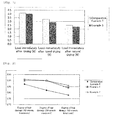
- the above-straightened hair sample was subjected to a combing test immediately after (i) washing with water (rinsing), immediately after (ii) towel drying, and immediately after (iii) natural drying.
- the test was carried out under the following conditions: combing and showering (10 times) (immediately after rinsing) ⁇ drying with a towel and combing (10 times) (immediately after towel drying) ⁇ drying at room temperature for two hours ⁇ combing (10 times) (immediately after natural drying).
- the loads measured at each timing (N 6) was averaged.
- Table 3 shows the formulations of test samples (Comparative Example 3 and Example 5) employed in the test, as well as the test results. The test results are also shown in Fig. 1 .
- the test samples were prepared in a manner similar to that of the test samples shown in Table 2.
- the invention product exhibits a combing load (as measured immediately after towel drying or natural drying) lower than that of the comparative product.
- the objective numerical values indicate that the invention product realizes suppression of damage to hair.
- Bleached hair samples were subjected to the treatment (2) of the actual use test of Test Example 1. Specifically, the first component (2.0 g) was applied to each of the bleached hair samples, and the hair sample was allowed to stand at 25°C for 15 minutes and then washed with water (rinsing), followed by drying with a towel. Thereafter, the thus-dried hair sample was treated with a high-temperature styling iron set at 170°C for three seconds. Subsequently, the second component (2.0 g) was applied to the hair sample, and the hair sample was allowed to stand at 25°C for five minutes and then washed with water, followed by natural drying.
- Table 4 shows the formulations of test samples (Comparative Example 4 and Examples 6 and 7) employed in the test, as well as the test results. The test results are also shown in Fig. 2 (the vertical axis corresponds to the degree of hair damage). The test samples were prepared in a manner similar to that of the test samples shown in Table 2.
- compositions a two-component hair shape-controlling composition containing the present composition as a first component, or a one-component hair shape-controlling composition.
- a composition may be prepared through a customary method.
- Component Amount (mass%) Monoammonium thioglycolate 10 Diammonium dithiodiglycolate 3 Monoethanolamine 5 Stearoxyhydroxypropylamine 2 Stearic acid diethylaminoethylamide 1 Stearyltrimonium chloride 1 Stearyl alcohol 7 Sorbitol 5 Pentasodium diethylenetriaminepentaacetate Appropriate amount Perfume Appropriate amount Purified water Balance
- Component Amount (mass%) Hydrogen peroxide 1.5 Behentrimonium chloride 2 Dimethylpolysiloxane 1 Cetyl alcohol 1 Disodium hydrogenphosphate 0.2 Potassium phosphate 0.4 Sodium benzoate 0.1 Purified water Balance
- Component Amount (mass%) Monoammonium thiolactate 11 Diammonium dithiodiglycolate 4 Monoethanolamine 4 Stearoxyhydroxypropylamine 1 Stearic acid dimethylaminopropylamide 1 Behentrimonium chloride 2 Stearyl alcohol 7 Sorbitol 5 Propylene glycol 5 Pentasodium diethylenetriaminepentaacetate Appropriate amount Perfume Appropriate amount Purified water Balance
- Component Amount (mass%) Hydrogen peroxide 1.5 Behentrimonium chloride 2 Mineral oil 0.5 Cetyl alcohol 3 Disodium hydrogenphosphate 0.2 Potassium phosphate 0.4 Sodium benzoate 0.2 Purified water Balance
- Component Amount (mass%) Cysteine 8 Diammonium dithiodiglycolate 3 Monoethanolamine 5 Stearoxyhydroxypropylamine 1.5 O-[2-hydroxy-3-(trimethylammonio)-propyl]hydroxyethylcellulose chloride 1 Stearyltrimonium chloride 1 Stearyl alcohol 7 Sorbitol 5 Pentasodium diethylenetriaminepentaacetate Appropriate amount Perfume Appropriate amount Purified water Balance
- Component Amount (mass%) Sodium bromate 6 Behentrimonium chloride 2 Dimethylpolysiloxane 1 Cetyl alcohol 1 Disodium hydrogenphosphate 0.2 Potassium phosphate 0.4 Sodium benzoate 0.1 Purified water Balance
- Component Amount (mass%) Monoammonium thiolactate 7 Monoethanolamine 4 Stearoxyhydroxypropylamine 1 O-[2-hydroxy-3-(trimethylammonio)-propyl]hydroxyethylcellulose chloride 1 Stearic acid dimethylaminopropylamide 1 Behentrimonium chloride 1 Stearyl alcohol 7 Cetyl alcohol 1 Sorbitol 10 Pentasodium diethylenetriaminepentaacetate Appropriate amount Perfume Appropriate amount Purified water Balance
- Component Amount (mass%) Sodium pyrosulfite 4 Monoethanolamine 3 Stearoxyhydroxypropylamine 1 Stearic acid dimethylaminopropylamide 1 Behentrimonium chloride 1 Stearyl alcohol 4 Cetyl alcohol 3 Pentasodium diethylenetriaminepentaacetate Appropriate amount Perfume Appropriate amount Purified water Balance
Landscapes
- Health & Medical Sciences (AREA)
- Life Sciences & Earth Sciences (AREA)
- Animal Behavior & Ethology (AREA)
- General Health & Medical Sciences (AREA)
- Public Health (AREA)
- Veterinary Medicine (AREA)
- Birds (AREA)
- Epidemiology (AREA)
- Emergency Medicine (AREA)
- Cosmetics (AREA)
Abstract
Provided is a hair shape-controlling composition containing a reducing agent and an alkaline agent, which composition contains (1) a hydroxy-ether-amine compound (I) (wherein R1 represents a linear or branched C6-24 alkyl or alkenyl group; R2 represents a linear or branched C1-6 hydroxyalkylene or hydroxyalkylenyl group; and each of R3 and R4, which may be identical to or different from each other, represents a hydrogen atom or a linear C1-6 alkyl group); (2) an amidoamine compound (II) (wherein R5 represents a linear or branched C6-24 alkyl or alkenyl group; A represents -CONH-; R6 represents a linear or branched C1-6 alkylene or alkylenyl group; and each of R7 and R8, which may be identical to or different from each other, represents a hydrogen atom or a linear or branched C1-6 alkyl group) and/or O-[2-hydroxy-3-(trimethylammonio)propyl]hydroxyethylcellulose chloride; and (3) a higher alcohol. The hair shape-controlling composition exhibits greatly improved hair shape-controlling performance.

Description
- The present invention relates to a composition for controlling the shape of hair (hereinafter may be referred to as a "hair shape-controlling composition"). More particularly, the present invention relates to a composition adopted in hair treatment for the purpose of controlling the shape of hair, such as permanent wave treatment or hair straightening treatment.
- Permanent wave treatment or hair straightening treatment has been performed for intentionally controlling the shape of hair for the sake of fashion or appearance.
- In many cases, permanent wave treatment or hair straightening treatment is carried out by use of a "two-component hair shape-controlling composition"; specifically, such a hair treatment is performed by applying, to hair, a first component for permanent waving or hair straightening containing a reducing agent (e.g., thioglycolic acid or a salt thereof, thiolactic acid or a salt thereof, or cysteine or a salt thereof) and an alkaline agent (e.g., aqueous ammonia, monoethanolamine, or ammonium hydrogencarbonate), thereby reduction-cleaving disulfide bonds present in proteins forming the hair and attaining a desired hair shape, and then treating the hair with a second component containing, as a main component, an oxidizing agent (e.g., sodium bromate or hydrogen peroxide), thereby re-forming disulfide bonds at positions different from the original positions.
- In recent years, such a hair treatment has also been carried out by use of a "one-component hair shape-controlling composition," in which natural (air) oxidation is adopted in place of oxidation with a second component.
- Generally, when hair undergoes permanent wave treatment or hair straightening treatment, the thus-treated hair tends to be damaged (i.e., the hair loses smoothness, fingers do not smoothly run through the hair, the hair becomes rough, or the hair loses moisture), and the hair shows a poor texture. In addition, since the surface of the treated hair is roughened, the hair loses a glossy appearance; i.e., the hair has an appearance markedly different from that of healthy hair, and thus the treated hair tends to make a strong impression of being apparently damaged.
- In order to solve such a problem, the present applicant previously conducted technical studies, and provided a hair shape-controlling composition which has excellent applicability to hair, which causes less damage to permanent-waved hair or straightened hair, which can provide treated hair with an excellent texture, and which does not impede a glossy appearance of treated hair, the composition being produced by incorporating a specific surfactant into a hair shape-controlling composition containing a reducing agent and an alkaline agent (i.e., a composition for permanent wave treatment or hair straightening treatment) (Patent Document 1).
-
- Patent Document 1: Japanese Patent Application Laid-Open (kokai) No.
2008-231098 - Patent Document 2: Japanese Patent Application Laid-Open (kokai) No.
2004-323495 - Patent Document 3: Japanese Patent Application Laid-Open (kokai) No.
2004-323496 - An object of the present invention is to technically develop the hair shape-controlling composition disclosed in Patent Document 1, to thereby provide means for further improving hair shape-controlling performance.
- The present inventors have found that when a specific hydroxy-ether-amine compound, a specific amidoamine compound and/or cationized cellulose, and a higher alcohol are incorporated into a hair shape-controlling composition, the resultant hair shape-controlling composition causes much less damage to hair during use thereof, provides hair with a favorable texture, and realizes further improved hair handling performance and hair straightening performance. The present invention has been accomplished on the basis of this finding.
- Accordingly, the present invention provides a hair shape-controlling composition comprising a reducing agent and an alkaline agent, which composition is characterized by comprising the following components (1) to (3):
- (1) a hydroxy-ether-amine compound represented by the following formula (I):

- (2) an amidoamine compound represented by the following formula (II) and/or O-[2-hydroxy-3-(trimethylammonio)propyl]hydroxyethylcellulose chloride;

- (3) a higher alcohol (hereinafter the hair shape-controlling composition may be referred to as "the present composition").
- The effects of the present composition can be further improved by incorporating a sugar alcohol and/or monoethanolamine. In one referred mode, the present composition comprises a quaternary ammonium salt. In another preferred mode, the present composition is adopted as a first component of a two-component hair shape-controlling composition which comprises the first component containing a reducing agent and an alkaline agent, and a second component containing an oxidizing agent.
- When the present composition is a first component of a two-component hair shape-controlling composition, the amount of each component of the present composition represents that on the basis of the first component of the two-component hair shape-controlling composition, whereas the present composition is a one-component hair shape-controlling composition, the amount of each component of the present composition represents that on the basis of the entire one-component hair shape-controlling composition.
- According to the present invention, there is provided a hair shape-controlling composition which has excellent applicability to hair during use thereof for controlling the shape of the hair, which causes much less damage to permanent-waved hair or straightened hair, which can provide treated hair with a further excellent texture, which does not impede a glossy appearance of treated hair, and which realizes further improved hair handling performance and hair straightening performance.
-
- [
Fig. 1 ]
Fig. 1 shows the results of a combing test performed on the invention product. - [
Fig. 2 ]
Fig. 2 shows the results of a hair tensile test performed on the invention product. - The reducing agent and alkaline agent contained in the present composition are components for cleaving disulfide bonds in hair.
- Examples of the reducing agent include thiolactic acid or a salt thereof, thioglycolic acid or a salt thereof, cysteine or a salt thereof, acetylcysteine or a salt thereof, cysteamine or a salt thereof, and cyclic mercapto compounds.
- The present composition may contain, as a preferred reducing agent, thiolactic acid or a salt thereof, which exhibits an excellent effect of straightening curly hair during hair straightening. Examples of the thiolactic acid salt include an ammonium salt and a monoethanolamine salt of thiolactic acid. The amount of thiolactic acid or a salt thereof contained in the present composition is preferably 1 to 12 mass%, particularly preferably 2 to 11 mass%.
- Examples of the alkaline agent include monoethanolamine, ammonia, inorganic ammonium salts (e.g., ammonium hydrogencarbonate), organic ammonium salts, organic amines, inorganic alkaline agents, and basic amino acids.
- Of these, monoethanolamine is most preferably incorporated in the present composition. In such a case, when the composition is applied to hair, the hair swells, and the reducing agent can readily permeate the swollen hair.
- When monoethanolamine is incorporated in the present composition, the amount of monoethanolamine is preferably 0.01 to 8 mass%, particularly preferably 0.1 to 4 mass%, on the basis of the entirety of the composition. When the amount is less than 0.01 mass% on the basis of the entirety of the composition, the effect of incorporation of monoethanolamine is less likely to be obtained, whereas when the amount exceeds 8 mass% on the basis of the entirety of the composition, the resultant composition tends to cause more damage to hair.
- The reducing agent and the alkaline agent may be appropriately chosen in consideration of, for example, the specific intended use (for controlling the shape of hair) of the present composition, or the types of the coexistent reducing agent and alkaline agent.
- The present composition contains a hydroxy-ether-amine compound represented by formula (I) (hereinafter may be referred to as "hydroxy-ether-amine compound (I)").
- The hydroxy-ether-amine compound (I) may be produced through a known production method (see, for example, Patent Document 2 or 3), or may be a commercially available product (e.g., Catinal SHPA-80: N-(2-hydroxy-3-stearoxypropyl)-N,N-dimethylamine, product of Toho Chemical Industry Co., Ltd.).
- In the formula representing the hydroxy-ether-amine compound (I), R1 represents a linear or branched C6 to C24 alkyl or alkenyl group. Examples of the linear or branched C6 to C24 alkyl or alkenyl group include hexyl, heptyl, octyl, nonyl, decyl, undecyl, dodecyl, tridecyl, tetradecyl, pentadecyl, hexadecyl, heptadecyl, stearyl (octadecyl), nonadecyl, icosyl, henicosyl, docosyl, tricosyl, tetracosyl, myristoleyl, palmitoleyl, oleyl, linoyl, linoleyl, ricinoleyl, and isostearyl. Examples of the linear or branched C1 to C6 hydroxyalkylene or hydroxyalkylenyl group (divalent group) represented by R2 include hydroxyethylene, hydroxytrimethylene, hydroxytetramethylene, hydroxypentamethylene, and hydroxyhexamethylene. As described above, each of R3 and R4, which may be identical to or different from each other, represents a hydrogen atom or a linear C1 to C6 alkyl group.
- In the present invention, the aforementioned N-(2-hydroxy-3-stearoxypropyl)-N,N-dimethylamine is a particularly preferred hydroxy-ether-amine compound (I), in which R1 is a stearyl group (octadecyl group), R2 is a 2-hydroxypropylene group (divalent group), and each of R3 and R4 is a methyl group.
- The amount of the hydroxy-ether-amine compound (I) contained in the present composition is preferably about 0.01 to about 8 mass%, particularly preferably 0.1 to 4 mass%, on the basis of the entirety of the composition.
- When the amount of the hydroxy-ether-amine compound (I) is less than 0.01 mass% on the basis of the entirety of the present composition, hair treated with the composition tends to lack smooth texture during rinsing or after drying and to exhibit poor gloss, whereas when the amount of the hydroxy-ether-amine compound (I) exceeds 8 mass% on the basis of the entirety of the composition, the composition itself poses a problem in terms of stability, and tends to lack spreadability during application thereof to hair.
- In the formula representing the amidoamine compound (II), R5 represents a linear or branched C6 to C24 alkyl or alkenyl group. Examples of the linear or branched C6 to C24 alkyl or alkenyl group include hexyl, heptyl, octyl, nonyl, decyl, undecyl, dodecyl, tridecyl, tetradecyl, pentadecyl, hexadecyl, heptadecyl, stearyl (octadecyl), nonadecyl, icosyl, henicosyl, docosyl, tricosyl, tetracosyl, myristoleyl, palmitoleyl, oleyl, linoyl, linoleyl, ricinoleyl, and isostearyl. Examples of the linear or branched C1 to C6 alkylene or alkylenyl group represented by R6 include methylene, ethylene, trimethylene, tetramethylene, pentamethylene, and hexamethylene. As described above, each of R7 and R8, which may be identical to or different from each other, represents a hydrogen atom or a linear or branched C1 to C6 alkyl group (typically a methyl group).
- Among the above-exemplified amidoamine compounds (II), the particularly preferred amidoamine compounds (II) are stearic acid dimethylaminopropylamide and stearic acid diethylaminoethylamide.
- Amidoamine compounds (II) may be used singly or in combination of two or more species. The amount of the amidoamine compound(s) (II) is preferably about 0.01 to about 8 mass%, particularly preferably 0.1 to 4 mass%, on the basis of the entirety of the composition. When the amount of the amidoamine compound(s) (II) is less than 0.01 mass% on the basis of the entirety of the composition, the present composition may fail to sufficiently exhibit the effect of suppressing damage to hair, or may fail to realize sufficiently easy hair handling performance. In contrast, even when the amount of the amidoamine compound(s) (II) exceeds 8 mass% on the basis of the entirety of the composition, an effect commensurate with an increase in amount is less likely to be attained.
- O- 2-hydroxy-3-(trimethylammonio)propyl]hydroxyethylcellulose chloride (cosmetic ingredient name: Polyquaternium-10) is currently adopted as a hair conditioning component.
- The amount of O-[2-hydroxy-3-(trimethylammonio)propyl]hydroxyethylcellulose chloride is preferably 0.01 to 4 mass%, particularly preferably 0.1 to 2 mass%, on the basis of the entirety of the composition. When the amount of the compound is less than 0.01 mass% on the basis of the entirety of the composition, the present composition may fail to sufficiently exhibit the effect of suppressing damage to hair, or may fail to realize sufficiently easy hair handling performance. In contrast, even when the amount of the compound exceeds 2 mass% on the basis of the entirety of the composition, an effect commensurate with an increase in amount is less likely to be attained.
- No particular limitation is imposed on the higher alcohol which may be incorporated into the present composition. Examples of the higher alcohol include lauryl alcohol, myristyl alcohol, cetyl alcohol, cetostearyl alcohol, stearyl alcohol, aralkyl alcohol, behenyl alcohol, and jojoba alcohol. Of these, preferred higher alcohols are cetyl alcohol and stearyl alcohol.
- The amount of the higher alcohol contained in the present composition is preferably 0.1 to 20 mass%, particularly preferably 1 to 10 mass%, on the basis of the entirety of the composition. When the amount of the higher alcohol is less than 0.1 mass% on the basis of the entirety of the composition, hair treated with the composition tends to lack smooth texture, whereas when the amount of the higher alcohol exceeds 20 mass%, the base becomes excessively hard, and many manufacturing problems tend to arise.
- When a sugar alcohol is incorporated into the present composition, the composition further exhibits the effect of suppressing damage to hair, and exhibits further improved hair handling performance.
- No particular limitation is imposed on the sugar alcohol which may be incorporated into the present composition. Examples of the sugar alcohol include maltitol, mannitol, sorbitol, and xylitol. Of these, sorbitol is particularly preferred.
- When a sugar alcohol is incorporated into the present composition, the amount of the sugar alcohol is preferably 1 to 40 mass%, particularly preferably 5 to 20 mass%, on the basis of the entirety of the composition. When the amount of the sugar alcohol is less than 1 mass% on the basis of the entirety of the composition, the effect of incorporation of the sugar alcohol is less likely to be obtained, whereas when the amount of the sugar alcohol exceeds 40 mass% on the basis of the entirety of the composition, the composition greatly tends to become sticky.
- When a quaternary ammonium salt is incorporated into the present composition, the composition exhibits reduced skin irritation and improved washing performance and foaming performance. Examples of the quaternary ammonium salt which may be incorporated include alkyltrimethylammonium salts and alkyldimethylaminoacetic acid betaines. The alkyl group of such a quaternary ammonium salt may be selected from among alkyl groups of quaternary ammonium salts which are generally incorporated into hair cosmetic compositions. Specific examples of the alkyl group include lauryl, myristyl, palmityl, stearyl, and behenyl. The present composition can preferably contain behenyltrimethylammonium chloride or stearyltrimethylammonium chloride.
- When a quaternary ammonium salt is incorporated into the present composition, no particular limitation is imposed on the amount of the quaternary ammonium salt. However, generally, the amount of the quaternary ammonium salt is preferably 0.01 to 5 mass% on the basis of the entirety of the composition.
- The present composition may optionally contain, in addition to the aforementioned components, an appropriate amount of a component which may be generally adopted in a permanent waving agent composition or a hair straightening agent composition.
- Examples of the optionally incorporated component include water; humectants (e.g., propylene glycol, dipropylene glycol, and glycerin); water-soluble polymer compounds (e.g., methylcellulose and hydroxyethylcellulose); cationic polymer compounds (e.g., a copolymer of a methacryloxyethyltrimethylammonium salt and polyvinyl pyrrolidone); water-soluble silicone; nonionic surfactants (e.g., polyoxyethylene hydrogenated castor oil and polyoxyethylene alkyl ether); amphoteric surfactants (e.g., 2-alkyl-N-carboxymethyl-N-hydroxyethylimidazolinium betaine and trialkylaminoacetic acid betaine); penetrants (e.g., urea, alkyl urea, benzyl alcohol, and monoethylene oxide benzyl ether); natural animal (or plant) extracts; amino acids; organic acids (e.g., citric acid and lactic acid); inorganic salts (e.g., sodium chloride and potassium chloride); perfumes; preservatives (e.g., paraben); sequestering agents (e.g., EDTA-3Na); UV absorbents (e.g., oxybenzone); and colorants.
- No particular limitation is imposed on the product form of the present composition, and the composition may be provided in the form of non-emulsified product or emulsified product (oil-in-water type or water-in-oil type). The present composition in the form of, for example, liquid, emulsion, or cream may be produced through a customary method.
- As described above, when the present composition is used for attaining a desired hair shape, generally, a process corresponding to a two-component composition is carried out. Firstly, the first component of the hair shape-controlling composition containing a reducing agent and an alkaline agent may be brought into contact with hair, and subsequently the second component containing an oxidizing agent may be brought into contact with the hair, to thereby control the shape of the hair. Alternatively, there may be carried out a process corresponding to a one-component composition, in which natural (air) oxidation is adopted, and use of the second component containing an oxidization agent is omitted.
- As described above, the expression "hair shape control" encompasses permanent wave treatment and hair straightening treatment.
- The second component of a two-component composition generally contains an oxidizing agent. Examples of the oxidizing agent include compounds containing a peroxide such as hydrogen peroxide, sodium peroxocarbonate, or urea peroxide; alkali metal peracid salts such as sodium perborate, sodium persulfate, and potassium monopersulfate; and products containing an oxidizing agent such as an alkali metal bromate (e.g., sodium bromate or potassium bromate). No particular limitation is imposed on the amount of the oxidizing agent contained in the second component, and the amount may be appropriately determined in consideration of, for example, the specific intended use (for controlling the shape of hair) of the present composition, or the type of the oxidizing agent adopted.
- In any of the aforementioned hair shape-controlling processes, a step of physically fixing hair (typically, a step of winding hair around a curler for permanent waving, or a step of fixing hair by means of a hair straightening instrument for attaining a desired hair shape), a washing step, a heating step by means of a hair dryer, and so on, may be appropriately carried out according to need.
- The permanent waving process may be carried out through, for example, the following steps (1) to (4):
- (1) hair fibers are fixed by winding them around a curler;
- (2) a first component containing a reducing agent is applied to the hair fibers, and the hair fibers are allowed to stand for 15 to 30 minutes;
- (3) the first component is rinsed off with water while the hair fibers are fixed, and a second component containing an oxidizing agent is applied to the hair fibers, followed by allowing them to stand for 5 to 20 minutes; and
- (4) the fixing instrument is removed, and the second component is rinsed off with running water, followed by drying of the hair fibers with a dryer for finishing.
- In this process, step (3) (i.e., application of the second component containing an oxidizing agent) may be omitted.
- The hair straightening process may be carried out through, for example, the following steps (1) to (5):
- (1) a first component containing a reducing agent is applied to hair fibers, and then the hair fibers are allowed to stand for 15 to 30 minutes;
- (2) the first component is rinsed off with running water, and the hair fibers are dried with a dryer;
- (3) the hair fibers are straightened with a hair iron (in this case, preferably, bath treatment is carried out twice on a handful of hair at 140 to 180°C);
- (4) a second component containing an oxidizing agent is applied to the hair fibers, and the hair fibers are allowed to stand for 5 to 20 minutes; and
- (5) the second component is rinsed off with running water, and the hair fibers are dried with a dryer for finishing.
- Similar to the case of the permanent waving process, step (4) (i.e., application of the second component containing an oxidizing agent) may be omitted.
- he present invention will next be described in more detail by way of examples, which should not be construed as limiting the invention thereto. Unless otherwise specified, the amount of a component incorporated is represented by "mass%." The amounts of components in a first component and a second component are described on the basis of the first component and the second component, respectively.
- The second component of a hair shape-controlling composition adopted in the below-described Test Examples 1 to 3 was prepared by mixing the components shown in Table 1.
-
[Table 1] Component Amount (mass%) Aqueous hydrogen peroxide 1.5 Mineral oil 0.3 Cetyl alcohol 2.0 Stearyltrimonium chloride 1.0 Pentasodium diethylenetriaminepentaacetate Appropriate amount Phosphoric acid Appropriate amount Disodium hydrogenphosphate dodecahydrate Appropriate amount Purified water Balance Total 100 - For evaluation of the effects of the present invention, in the present Example, hair samples were subjected to a test employing permanent wave treatment or hair straightening treatment.
- A plurality of hair bundles (each having a weight of 0.7 g and a length of 20 cm) (hereinafter may be referred to as hair samples) were prepared from non-chemically damaged hair fibers collected from a single person. The thus-prepared hair samples were immersed in a commercially available breaching agent (ammonia: 0.8%, hydrogen peroxide: 3.0%, potassium persulfate: 0.1%) for 20 minutes so that the hair was damaged to the same extent. Each of the thus-bleached hair samples was wound around a plastic rod having a diameter of 1.5 cm, and a first component (2.0 mL) was applied to the hair sample. The hair sample was allowed to stand at 25°C for 15 minutes and then washed with water. Subsequently, a second component (2.0 mL) was applied to the hair sample, and the hair sample was allowed to stand at 25°C for 15 minutes and then washed with water, followed by natural drying.
- In a manner similar to the case of the permanent wave treatment described above in (1), bleached hair samples were prepared. The first component (2.0 g) was applied to each of the bleached hair samples, and the hair sample was allowed to stand at 25°C for 15 minutes and then washed with water, followed by drying with a towel. Thereafter, the thus-dried hair sample was treated with a high-temperature styling iron set at 170°C for three seconds. Subsequently, the second component (2.0 g) was applied to the hair sample, and the hair sample was allowed to stand at 25°C for five minutes and then washed with water, followed by natural drying.
- The degree of damage of hair after the final natural drying in the aforementioned treatment (1) or (2) was organoleptically evaluated by 12 expert panelists. Specifically, when six of the 12 expert panelists recognized a significant difference, rating "±1" was assigned, whereas when nine of the 12 expert panelists recognized a significant difference, rating "±2" was assigned. A positive number (+) represents a tendency toward improvement, and a negative number(-) represents a tendency toward deterioration.
- A hair sample which had undergone the aforementioned treatment (1) or (2) was subjected to an actual use test (in terms of damage sensation by hair texture) by the 12 expert panelists. When six of the 12 expert panelists recognized a significant difference, rating "±1" was assigned, whereas when nine of the 12 expert panelists recognized a significant difference, rating "±2" was assigned. A positive number (+) represents a tendency toward improvement, and a negative number(-) represents a tendency toward deterioration.
- A hair sample after the final natural drying in the aforementioned treatment (2) was subjected to an actual use test by the 12 expert panelists for evaluation of a hair straightening effect (generally in terms of easy hair handling performance). When six of the 12 expert panelists recognized a significant difference, rating "±1" was assigned, whereas when nine of the 12 expert panelists recognized a significant difference, rating "±2" was assigned. A positive number (+) represents a tendency toward improvement, and a negative number(-) represents a tendency toward deterioration.
- The acceptability of a hair sample which had undergone the aforementioned treatment (1) or (2) was evaluated by the 12 expert panelists. When six of the 12 expert panelists recognized a significant difference, rating "±1" was assigned, whereas when nine of the 12 expert panelists recognized a significant difference, rating "±2" was assigned. A positive number (+) represents a tendency toward improvement of acceptability, and a negative number(-) represents a tendency toward deterioration of acceptability.
- Test samples employed in Test Example 1 (Examples 1 to 4 and Comparative Examples 1 and 2) were prepared according to formulations shown in Table 2. Specifically, each test sample was prepared by mixing surfactants and oily components with ion-exchanged water heated to 75°C, cooling the resultant mixture to 40°C or lower, and adding a reducing agent, a stabilizer, and a perfume to the mixture.
- For evaluation of the thus-prepared test samples, they were subjected to the aforementioned evaluation tests (a) to (d). The below-described "stearoxyhydroxypropylamine" is an abbreviation of N-(2-hydroxy-3-stearoxypropyl)-N,N-dimethylamine, which is a hydroxy-ether-amine compound represented by formula (I) (hydroxy-ether-amine compound (I)) wherein R1 is a stearyl group (octadecyl group), R2 is a 2-hydroxypropylene group (divalent group), and each of R3 and R4 is a methyl group.
-
[Table 2] Comp. Ex. 1 Comp. Ex. 2 Ex. 1 Ex. 2 Ex. 3 Ex. 4 Component Amount (mass%) Purified water Balance Balance Balance Balance Balance Balance Aminopropyl dimethvcone 1.0 1.0 1.0 1.0 1.0 1.0 Mineral oil 1.5 1.5 1.5 1.5 1.5 1.5 Cetyl alcohol 5.0 5.0 5.0 5.0 5.0 5.0 Glycerin 10.0 10.0 10.0 - - - Sorbitol - - - 10.0 10.0 10.0 Propylene glycol 3.0 3.0 3.0 3.0 3.0 3.0 Polyoxyethylene oleyl ether 0.5 0.5 0.5 0.5 0.5 0.5 Behentrimonium chloride 2.0 1.2 1.0 1.0 1.0 1.0 Stearoxyhydroxyoropylamine - 0.5 0.5 0.5 0.5 0.5 Stearic acid dimethylaminopropylamide - - 0.3 0.3 - - Stearic acid diethylaminoethylamide - - - - 0.3 - Monoethanolamine 1.0 1.0 1.0 1.0 1.0 1.0 Ammonium thioglycolate 3.5 - - - - - Ammonium thiolactate - 3.5 3.5 3.5 3.5 3.5 Diammonium dithiodiglycolate 3.5 2.5 2.5 2.5 2.5 2.5 O-[2-hydroxy-3-(trimethylammonio)propyl]-hydroxyethylcellulose chloride - - - - 0.5 0.5 Pentasodium diethylenetriaminepentaacetate Appropriate amount Appropriate amount Appropriate amount Appropriate amount Appropriate amount Appropriate amount Perfume Appropriate amount Appropriate amount Appropriate amount Appropriate amount Appropriate amount Appropriate amount Total 100 100 100 100 100 100 Test Results Damage of hair 0 1 1 1 1 1 Damage sensation by hair texture 0 0 1 2 1 1 Hair straightening effect (easy hair handling performance) 0 -1 1 2 2 2 Panelist acceptability 0 0 1 1 1 1 - As shown in the data of Table 2, the present compositions (Examples 1 to 4) cause less damage to hair (evaluated by hair texture), and exhibit excellent hair straightening effect, as compared with the case of the composition of Comparative Example 2 (i.e., formulation of Patent Document 1). Also, the samples of these Examples provide higher panelist acceptability. As shown in Table 2, when glycerin is replaced with sorbitol, damage sensation is further suppressed, and hair handling performance is improved. As is clear from these data, even when an amidoamine compound is replaced with O-[2-hydroxy-3-(trimethylammonio)propyl]hydroxyethylcellulose chloride (i.e., cationized cellulose) (Example 4), the effects of the present invention are achieved.
- Bleached hair samples were subjected to the treatment (2) of the actual use test of Test Example 1. Specifically, the first component (2.0 g) was applied to each of the bleached hair samples, and the hair sample was allowed to stand at 25°C for 15 minutes. Then, (i) washing with water (rinsing), and (ii) towel drying were carried out. Thereafter, the thus-dried hair sample was treated with a high-temperature styling iron set at 170°C for three seconds. Subsequently, the second component (2.0 g) was applied to the hair sample, and the hair sample was allowed to stand at 25°C for five minutes and then washed with water, followed by (iii) natural drying.
- By means of a combing tester, the above-straightened hair sample was subjected to a combing test immediately after (i) washing with water (rinsing), immediately after (ii) towel drying, and immediately after (iii) natural drying. The test was carried out under the following conditions: combing and showering (10 times) (immediately after rinsing) → drying with a towel and combing (10 times) (immediately after towel drying) → drying at room temperature for two hours → combing (10 times) (immediately after natural drying). The loads measured at each timing (N = 6) was averaged.
- Table 3 shows the formulations of test samples (Comparative Example 3 and Example 5) employed in the test, as well as the test results. The test results are also shown in
Fig. 1 . The test samples were prepared in a manner similar to that of the test samples shown in Table 2. -
[Table 3] Comparative Example 3 Example 5 Component Amount (mass%) Purified water Balance Balance Amino-modified silicone 1.0 1.0 Mineral oil 1.0 1.0 Cetyl alcohol 5.0 5.0 Glycerin 10.0 - Sorbitol - 10.0 Propylene glycol 3.0 10.0 Polyoxyethylene oleyl ether 0.5 0.5 Behentrimonium chloride 2.5 1.0 Stearoxyhydroxypropylamine - 1.0 Stearic acid dimethylaminopropylamide - 0.5 Monoethanolamine 1.5 1.5 Ammonium thioglycolate 7.0 - Ammonium thiolactate - 7.0 Diammonium dithiodiglycolate 2.0 2.0 Pentasodium diethylenetriaminepentaacetate Appropriate amount Appropriate amount Perfume Appropriate amount Appropriate amount Total 100 100 Test results Load immediately after rinsing (N) 4.1 4.0 Load immediately after towel drying (N) 3.3 2.9 Load immediately after natural drying (N) 2.5 2.3 - As is clear from the data of Table 2 (
Fig. 1 ), the invention product exhibits a combing load (as measured immediately after towel drying or natural drying) lower than that of the comparative product. The objective numerical values indicate that the invention product realizes suppression of damage to hair. - Bleached hair samples were subjected to the treatment (2) of the actual use test of Test Example 1. Specifically, the first component (2.0 g) was applied to each of the bleached hair samples, and the hair sample was allowed to stand at 25°C for 15 minutes and then washed with water (rinsing), followed by drying with a towel. Thereafter, the thus-dried hair sample was treated with a high-temperature styling iron set at 170°C for three seconds. Subsequently, the second component (2.0 g) was applied to the hair sample, and the hair sample was allowed to stand at 25°C for five minutes and then washed with water, followed by natural drying.
- The tensile strength of hair (12 hair samples) was measured (N = 6) by means of Autograph AGS-H 50N (precise universal tester, product of Shimadzu Corporation).
- Specifically, the degree of hair damage was determined by use of the following formula:

- Table 4 shows the formulations of test samples (Comparative Example 4 and Examples 6 and 7) employed in the test, as well as the test results. The test results are also shown in
Fig. 2 (the vertical axis corresponds to the degree of hair damage). The test samples were prepared in a manner similar to that of the test samples shown in Table 2. -
[Table 4] Comparative Example 4 Example Example 7 Component Amount (mass%) Purified water Balance Balance Balance Amino-modified silicone 1.0 1.0 1.0 Mineral oil 1.5 1.5 1.5 Cetyl alcohol 6.0 6.0 6.0 Glycerin 15.0 15.0 15.0 Sorbitol - - - Propylene glycol 3.0 3.0 3.0 Polyoxyethylene oleyl ether 0.5 0.5 0.5 Behentrimonium chloride 1.0 1.0 1.0 Stearoxyhydroxypropylamine 0.5 0.5 0.5 Stearic acid dimethylaminooropylamide - 0.3 0.3 Monoethanolamine 1.0 1.0 1.0 Ammonium thioglycolate 3.0 - - Ammonium thiolactate - 3.0 4.0 Diammonium dithiodiglycolate 2.0 2.0 2.0 Pentasodium diethylenetriaminepentaacetate Appropriate amount Appropriate amount Appropriate amount Perfume Appropriate amount Appropriate amount Appropriate amount Total 100 100 100 Test results Degree of hair damage (10-minute treatment) 0.87 0.91 0.90 Degree of hair damage (20-minute treatment) 0.82 0.9 0.90 Degree of hair damage (30-minute treatment) 0.78 0.84 0.86 - As is clear from the data of Table 4 (
Fig. 2 ), generally, the degree of hair damage is lower in the case of the Examples than in the case of the Comparative Example, and, even when the amount of the reducing agent is increased, virtually no increase in degree of hair damage is observed. - Next will be described formulation examples of the present composition (a two-component hair shape-controlling composition containing the present composition as a first component, or a one-component hair shape-controlling composition). In each formulation example, a composition may be prepared through a customary method.
-
Component Amount (mass%) Monoammonium thioglycolate 10 Diammonium dithiodiglycolate 3 Monoethanolamine 5 Stearoxyhydroxypropylamine 2 Stearic acid diethylaminoethylamide 1 Stearyltrimonium chloride 1 Stearyl alcohol 7 Sorbitol 5 Pentasodium diethylenetriaminepentaacetate Appropriate amount Perfume Appropriate amount Purified water Balance -
Component Amount (mass%) Hydrogen peroxide 1.5 Behentrimonium chloride 2 Dimethylpolysiloxane 1 Cetyl alcohol 1 Disodium hydrogenphosphate 0.2 Potassium phosphate 0.4 Sodium benzoate 0.1 Purified water Balance -
Component Amount (mass%) Monoammonium thiolactate 11 Diammonium dithiodiglycolate 4 Monoethanolamine 4 Stearoxyhydroxypropylamine 1 Stearic acid dimethylaminopropylamide 1 Behentrimonium chloride 2 Stearyl alcohol 7 Sorbitol 5 Propylene glycol 5 Pentasodium diethylenetriaminepentaacetate Appropriate amount Perfume Appropriate amount Purified water Balance -
Component Amount (mass%) Hydrogen peroxide 1.5 Behentrimonium chloride 2 Mineral oil 0.5 Cetyl alcohol 3 Disodium hydrogenphosphate 0.2 Potassium phosphate 0.4 Sodium benzoate 0.2 Purified water Balance -
Component Amount (mass%) Cysteine 8 Diammonium dithiodiglycolate 3 Monoethanolamine 5 Stearoxyhydroxypropylamine 1.5 O-[2-hydroxy-3-(trimethylammonio)-propyl]hydroxyethylcellulose chloride 1 Stearyltrimonium chloride 1 Stearyl alcohol 7 Sorbitol 5 Pentasodium diethylenetriaminepentaacetate Appropriate amount Perfume Appropriate amount Purified water Balance -
Component Amount (mass%) Sodium bromate 6 Behentrimonium chloride 2 Dimethylpolysiloxane 1 Cetyl alcohol 1 Disodium hydrogenphosphate 0.2 Potassium phosphate 0.4 Sodium benzoate 0.1 Purified water Balance -
Component Amount (mass%) Monoammonium thiolactate 7 Monoethanolamine 4 Stearoxyhydroxypropylamine 1 O-[2-hydroxy-3-(trimethylammonio)-propyl]hydroxyethylcellulose chloride 1 Stearic acid dimethylaminopropylamide 1 Behentrimonium chloride 1 Stearyl alcohol 7 Cetyl alcohol 1 Sorbitol 10 Pentasodium diethylenetriaminepentaacetate Appropriate amount Perfume Appropriate amount Purified water Balance -
Component Amount (mass%) Sodium pyrosulfite 4 Monoethanolamine 3 Stearoxyhydroxypropylamine 1 Stearic acid dimethylaminopropylamide 1 Behentrimonium chloride 1 Stearyl alcohol 4 Cetyl alcohol 3 Pentasodium diethylenetriaminepentaacetate Appropriate amount Perfume Appropriate amount Purified water Balance
Claims (9)
- A hair shape-controlling composition comprising a reducing agent and an alkaline agent, which composition is characterized by comprising the following components (1) to (3):(1) a hydroxy-ether-amine compound represented by the following formula (I) :
 (2) an amidoamine compound represented by the following formula (II) and/or O-[2-hydroxy-3-(trimethylammonio)propyl]hydroxyethylcellulose chloride;
 (3) a higher alcohol,
- The hair shape-controlling composition according to claim 1, which is a first component of a two-component hair shape-controlling composition comprising the first component containing a reducing agent and an alkaline agent, and a second component containing an oxidizing agent.
- The hair shape-controlling composition according to claim 1 or 2, which further comprises a sugar alcohol.
- The hair shape-controlling composition according to claim 3, wherein the sugar alcohol is sorbitol.
- The hair shape-controlling composition according to any of claims 1 to 4, which further comprises a quaternary ammonium salt.
- The hair shape-controlling composition according to any of claims 1 to 5, wherein the reducing agent is thiolactic acid or a salt thereof.
- The hair shape-controlling composition according to any of claims 1 to 6, wherein the alkaline agent is monoethanolamine.
- The hair shape-controlling composition according to any of claims 1 to 7, which is a composition for permanent wave treatment.
- The hair shape-controlling composition according to any of claims 1 to 7, which is a composition for hair straightening treatment,
Applications Claiming Priority (2)
| Application Number | Priority Date | Filing Date | Title |
|---|---|---|---|
| JP2010043094 | 2010-02-26 | ||
| PCT/JP2011/053937 WO2011105410A1 (en) | 2010-02-26 | 2011-02-23 | Hair styling composition |
Publications (1)
| Publication Number | Publication Date |
|---|---|
| EP2540278A1 true EP2540278A1 (en) | 2013-01-02 |
Family
ID=44506815
Family Applications (1)
| Application Number | Title | Priority Date | Filing Date |
|---|---|---|---|
| EP11747370A Withdrawn EP2540278A1 (en) | 2010-02-26 | 2011-02-23 | Hair styling composition |
Country Status (6)
| Country | Link |
|---|---|
| US (1) | US20130189209A1 (en) |
| EP (1) | EP2540278A1 (en) |
| JP (2) | JP4955833B2 (en) |
| KR (1) | KR20130008565A (en) |
| CN (1) | CN102770116B (en) |
| WO (1) | WO2011105410A1 (en) |
Cited By (1)
| Publication number | Priority date | Publication date | Assignee | Title |
|---|---|---|---|---|
| EP2857003A1 (en) * | 2013-10-02 | 2015-04-08 | The Procter and Gamble Company | Hair conditioning composition comprising ammonium thioglycolate and/or ammonium thiolactate |
Families Citing this family (11)
| Publication number | Priority date | Publication date | Assignee | Title |
|---|---|---|---|---|
| DE102010029976A1 (en) * | 2010-06-11 | 2011-12-15 | Henkel Ag & Co. Kgaa | Substantially ammonia-free corrugating agent |
| DE102011076852A1 (en) * | 2011-06-01 | 2012-12-06 | Henkel Kgaa | Substantially ammonia-free corrugating agent with cysteine |
| CN104053428A (en) * | 2012-01-26 | 2014-09-17 | 莱雅公司 | Methods of treating keratin fibers |
| EP2914237B1 (en) * | 2012-11-05 | 2017-11-01 | Kao Corporation | Process for straightening and bleaching hair |
| WO2014068101A2 (en) * | 2012-11-05 | 2014-05-08 | Kao Corporation | Process for bleaching and straightening hair |
| MY182279A (en) * | 2015-08-21 | 2021-01-18 | Ictb Global Co Ltd | Method for hair shaping treatment that is hair straightening treatment or permanent waving treatment, and hair treating liquid for hair shaping treatment |
| JP6929621B2 (en) * | 2016-08-22 | 2021-09-01 | 株式会社ミルボン | Second agent for hair deformation, hair deformation agent and hair deformation method |
| TW201829021A (en) * | 2016-11-28 | 2018-08-16 | 日商資生堂股份有限公司 | Keratin fiber treatment composition |
| DE102017111283B4 (en) | 2017-05-23 | 2019-05-23 | Matev Gmbh | Through drive arrangement for use on a drive vehicle, in particular tractor, with an automatic coupling system for Zwischenachsanbaugeräte |
| FR3090341B1 (en) * | 2018-12-21 | 2020-12-04 | Oreal | COMPOSITION CONSISTING OF A BODY FAT, A PEG POLYMER, A DIOL AND A POLYSACCHARIDE |
| JP2021161072A (en) * | 2020-03-31 | 2021-10-11 | 東邦化学工業株式会社 | Composition for hair |
Family Cites Families (11)
| Publication number | Priority date | Publication date | Assignee | Title |
|---|---|---|---|---|
| JP3926063B2 (en) * | 1999-06-29 | 2007-06-06 | ホーユー株式会社 | Permanent wave pretreatment composition and method of using the same |
| JP2004217589A (en) * | 2003-01-16 | 2004-08-05 | Shiseido Co Ltd | Permanent hair treatment agent for dyed hair and method for preventing fading of dyed hair |
| JP3980521B2 (en) | 2003-04-24 | 2007-09-26 | 東邦化学工業株式会社 | Hair composition |
| JP3980520B2 (en) | 2003-04-24 | 2007-09-26 | 東邦化学工業株式会社 | Hair composition |
| JP4878446B2 (en) * | 2004-07-08 | 2012-02-15 | 花王株式会社 | Reducing composition for permanent wave or straight permanent |
| JP4953705B2 (en) * | 2006-06-20 | 2012-06-13 | 株式会社 資生堂 | Hair cosmetics |
| TWI418368B (en) * | 2006-08-23 | 2013-12-11 | 花王股份有限公司 | Water-based hair cosmetics |
| JP5042652B2 (en) * | 2007-02-02 | 2012-10-03 | 株式会社 資生堂 | Hair cosmetics |
| US20100111885A1 (en) * | 2007-02-20 | 2010-05-06 | Shiseido Company, Ltd. | Hair-Shape Controlling Composition |
| JP4863408B2 (en) * | 2009-03-06 | 2012-01-25 | 株式会社 資生堂 | Hair treatment composition |
| WO2010116940A1 (en) * | 2009-04-10 | 2010-10-14 | 株式会社資生堂 | Hair cosmetic |
-
2011
- 2011-02-23 EP EP11747370A patent/EP2540278A1/en not_active Withdrawn
- 2011-02-23 CN CN201180010875.4A patent/CN102770116B/en not_active Expired - Fee Related
- 2011-02-23 JP JP2011510755A patent/JP4955833B2/en not_active Expired - Fee Related
- 2011-02-23 KR KR1020127024611A patent/KR20130008565A/en not_active Ceased
- 2011-02-23 US US13/580,505 patent/US20130189209A1/en not_active Abandoned
- 2011-02-23 WO PCT/JP2011/053937 patent/WO2011105410A1/en not_active Ceased
-
2012
- 2012-03-15 JP JP2012058764A patent/JP5000023B2/en not_active Expired - Fee Related
Non-Patent Citations (1)
| Title |
|---|
| See references of WO2011105410A1 * |
Cited By (3)
| Publication number | Priority date | Publication date | Assignee | Title |
|---|---|---|---|---|
| EP2857003A1 (en) * | 2013-10-02 | 2015-04-08 | The Procter and Gamble Company | Hair conditioning composition comprising ammonium thioglycolate and/or ammonium thiolactate |
| WO2015050914A1 (en) * | 2013-10-02 | 2015-04-09 | The Procter & Gamble Company | Hair conditioning composition comprising ammonium thioglycolate and/or ammonium thiolactate |
| CN105592841A (en) * | 2013-10-02 | 2016-05-18 | 宝洁公司 | Hair conditioning composition comprising ammonium thioglycolate and/or ammonium thiolactate |
Also Published As
| Publication number | Publication date |
|---|---|
| JP2012149072A (en) | 2012-08-09 |
| WO2011105410A1 (en) | 2011-09-01 |
| KR20130008565A (en) | 2013-01-22 |
| JPWO2011105410A1 (en) | 2013-06-20 |
| US20130189209A1 (en) | 2013-07-25 |
| JP4955833B2 (en) | 2012-06-20 |
| JP5000023B2 (en) | 2012-08-15 |
| HK1174563A1 (en) | 2013-06-14 |
| CN102770116B (en) | 2015-05-13 |
| CN102770116A (en) | 2012-11-07 |
Similar Documents
| Publication | Publication Date | Title |
|---|---|---|
| US20130189209A1 (en) | Hair shape-controlling composition | |
| EP2123250A1 (en) | Hair-shape controlling composition | |
| JP2519024B2 (en) | Hair cosmetics | |
| US5332570A (en) | Reducing solution for permanent wave | |
| US20070277332A1 (en) | Use of agents containing creatine, creatinine and/or their derivatives to fortify and improve the structure of keratinic fibers | |
| US20040258651A1 (en) | Use of alkylguanidine compounds for the treatment and after-treatment of hair | |
| US7871601B2 (en) | Hair cosmetic compositions | |
| US6506373B1 (en) | Agent and method for permanent waving | |
| US20070041921A1 (en) | Method for relaxing hair | |
| BR112019025729A2 (en) | AQUEOUS COMPOSITIONS FOR HAIR TREATMENT | |
| CA2073816A1 (en) | Cysteinamide-containing permanent wave composition and method | |
| KR100633439B1 (en) | Hair dye composition | |
| US20120240954A1 (en) | Use of ester oil in method for perming hair | |
| JP2005533074A (en) | Hair conditioning composition | |
| WO2000015181A1 (en) | Hair care compositions comprising ceramide and phytantriol | |
| WO1993005757A1 (en) | Hair-setting agent and a hair-perming method using this agent | |
| WO2001082881A1 (en) | Perming compositions and perming method by using the same | |
| EP3290019B1 (en) | Hair treatment method | |
| JP5714233B2 (en) | Hair deformation agent | |
| JP6983505B2 (en) | A composition containing glutaric acid and at least one aromatic alcohol for treating keratin fibers. | |
| JPH0469319A (en) | Hair-treating agent | |
| JP7346241B2 (en) | perm method | |
| KR20210114924A (en) | Reducing composition for permanent reshaping of keratin fibers | |
| JP2018184347A (en) | Composition for hair cosmetics and hair cosmetics containing the composition for hair cosmetic | |
| HK1174563B (en) | Hair styling composition |
Legal Events
| Date | Code | Title | Description |
|---|---|---|---|
| PUAI | Public reference made under article 153(3) epc to a published international application that has entered the european phase |
Free format text: ORIGINAL CODE: 0009012 |
|
| 17P | Request for examination filed |
Effective date: 20120913 |
|
| AK | Designated contracting states |
Kind code of ref document: A1 Designated state(s): AL AT BE BG CH CY CZ DE DK EE ES FI FR GB GR HR HU IE IS IT LI LT LU LV MC MK MT NL NO PL PT RO RS SE SI SK SM TR |
|
| DAX | Request for extension of the european patent (deleted) | ||
| STAA | Information on the status of an ep patent application or granted ep patent |
Free format text: STATUS: THE APPLICATION IS DEEMED TO BE WITHDRAWN |
|
| 18D | Application deemed to be withdrawn |
Effective date: 20130903 |