EP2539403B1 - Verfahren zur verifikation von sicherheits- und wertdokumenten mit einem anthrachinon-farbstoff - Google Patents
Verfahren zur verifikation von sicherheits- und wertdokumenten mit einem anthrachinon-farbstoff Download PDFInfo
- Publication number
- EP2539403B1 EP2539403B1 EP11705865.1A EP11705865A EP2539403B1 EP 2539403 B1 EP2539403 B1 EP 2539403B1 EP 11705865 A EP11705865 A EP 11705865A EP 2539403 B1 EP2539403 B1 EP 2539403B1
- Authority
- EP
- European Patent Office
- Prior art keywords
- und
- nrr
- mit
- security
- anthraquinone dye
- Prior art date
- Legal status (The legal status is an assumption and is not a legal conclusion. Google has not performed a legal analysis and makes no representation as to the accuracy of the status listed.)
- Active
Links
- NZTGGRGGJFCKGG-UHFFFAOYSA-N Nc(c(Oc1ccccc1)c(c(N)c1C(c2ccccc22)=O)Oc3ccccc3)c1C2=O Chemical compound Nc(c(Oc1ccccc1)c(c(N)c1C(c2ccccc22)=O)Oc3ccccc3)c1C2=O NZTGGRGGJFCKGG-UHFFFAOYSA-N 0.000 description 1
Images

Classifications
-
- C—CHEMISTRY; METALLURGY
- C09—DYES; PAINTS; POLISHES; NATURAL RESINS; ADHESIVES; COMPOSITIONS NOT OTHERWISE PROVIDED FOR; APPLICATIONS OF MATERIALS NOT OTHERWISE PROVIDED FOR
- C09B—ORGANIC DYES OR CLOSELY-RELATED COMPOUNDS FOR PRODUCING DYES, e.g. PIGMENTS; MORDANTS; LAKES
- C09B1/00—Dyes with anthracene nucleus not condensed with any other ring
- C09B1/16—Amino-anthraquinones
-
- B—PERFORMING OPERATIONS; TRANSPORTING
- B42—BOOKBINDING; ALBUMS; FILES; SPECIAL PRINTED MATTER
- B42D—BOOKS; BOOK COVERS; LOOSE LEAVES; PRINTED MATTER CHARACTERISED BY IDENTIFICATION OR SECURITY FEATURES; PRINTED MATTER OF SPECIAL FORMAT OR STYLE NOT OTHERWISE PROVIDED FOR; DEVICES FOR USE THEREWITH AND NOT OTHERWISE PROVIDED FOR; MOVABLE-STRIP WRITING OR READING APPARATUS
- B42D25/00—Information-bearing cards or sheet-like structures characterised by identification or security features; Manufacture thereof
- B42D25/30—Identification or security features, e.g. for preventing forgery
- B42D25/36—Identification or security features, e.g. for preventing forgery comprising special materials
- B42D25/378—Special inks
- B42D25/382—Special inks absorbing or reflecting infrared light
-
- C—CHEMISTRY; METALLURGY
- C09—DYES; PAINTS; POLISHES; NATURAL RESINS; ADHESIVES; COMPOSITIONS NOT OTHERWISE PROVIDED FOR; APPLICATIONS OF MATERIALS NOT OTHERWISE PROVIDED FOR
- C09B—ORGANIC DYES OR CLOSELY-RELATED COMPOUNDS FOR PRODUCING DYES, e.g. PIGMENTS; MORDANTS; LAKES
- C09B1/00—Dyes with anthracene nucleus not condensed with any other ring
- C09B1/50—Amino-hydroxy-anthraquinones; Ethers and esters thereof
-
- C—CHEMISTRY; METALLURGY
- C09—DYES; PAINTS; POLISHES; NATURAL RESINS; ADHESIVES; COMPOSITIONS NOT OTHERWISE PROVIDED FOR; APPLICATIONS OF MATERIALS NOT OTHERWISE PROVIDED FOR
- C09B—ORGANIC DYES OR CLOSELY-RELATED COMPOUNDS FOR PRODUCING DYES, e.g. PIGMENTS; MORDANTS; LAKES
- C09B5/00—Dyes with an anthracene nucleus condensed with one or more heterocyclic rings with or without carbocyclic rings
- C09B5/02—Dyes with an anthracene nucleus condensed with one or more heterocyclic rings with or without carbocyclic rings the heterocyclic ring being only condensed in peri position
- C09B5/14—Benz-azabenzanthrones (anthrapyridones)
-
- G—PHYSICS
- G07—CHECKING-DEVICES
- G07D—HANDLING OF COINS OR VALUABLE PAPERS, e.g. TESTING, SORTING BY DENOMINATIONS, COUNTING, DISPENSING, CHANGING OR DEPOSITING
- G07D7/00—Testing specially adapted to determine the identity or genuineness of valuable papers or for segregating those which are unacceptable, e.g. banknotes that are alien to a currency
- G07D7/06—Testing specially adapted to determine the identity or genuineness of valuable papers or for segregating those which are unacceptable, e.g. banknotes that are alien to a currency using wave or particle radiation
- G07D7/12—Visible light, infrared or ultraviolet radiation
- G07D7/1205—Testing spectral properties
-
- G—PHYSICS
- G07—CHECKING-DEVICES
- G07D—HANDLING OF COINS OR VALUABLE PAPERS, e.g. TESTING, SORTING BY DENOMINATIONS, COUNTING, DISPENSING, CHANGING OR DEPOSITING
- G07D7/00—Testing specially adapted to determine the identity or genuineness of valuable papers or for segregating those which are unacceptable, e.g. banknotes that are alien to a currency
- G07D7/06—Testing specially adapted to determine the identity or genuineness of valuable papers or for segregating those which are unacceptable, e.g. banknotes that are alien to a currency using wave or particle radiation
- G07D7/12—Visible light, infrared or ultraviolet radiation
- G07D7/128—Viewing devices
Definitions
- the invention relates to a method for verifying a security or value document via at least one security feature, which is formed by in each case at least one luminescent in the NIR spectral region marker, for the verification of security or value documents, in particular of personal documents such as passports, identity cards, driving licenses , Visa, business and professional cards and the like.
- an inkjet ink is known. This has as a component a colorant or a colorant mixture, wherein colorants are understood to mean all colorants. Possible coloring substances are called anthraquinone dyes. Furthermore, the ink-jet printing ink has a further component which can be seen using technical aids, for example luminescent substances.
- the object of the present invention is now to provide a method for verifying a security or value document in which a potential counterfeiter can not immediately recognize the machine readability of the feature.
- alkyl saturated hydrocarbon groups.
- C n -alkyl is meant a saturated hydrocarbon group having n carbon atoms
- C 1 -C m -alkyl includes all saturated hydrocarbon groups having 1 to m carbon atoms.
- n and m are integers.
- C 1 alkyl is methyl
- C 2 alkyl is ethyl
- C 3 alkyl includes n-propyl and methylethyl (i-propyl)
- C 4 alkyl includes n-butyl, 1-methylpropyl, 2-methylpropyl (i-butyl ) and 1,1-dimethylethyl (t-butyl).
- C 5 alkyl includes n-pentyl, 1-methylbutyl, 2-methylbutyl, 3-methylbutyl, 1,1-dimethylpropyl, 1,2-dimethylpropyl, 2,2-dimethylpropyl, 1-ethylpropyl and the isomers of cyclopentyl.
- C 6 alkyl includes n-hexyl and its isomers, furthermore cyclohexyl and the isomers of methylcyclopentyl.
- C 7 -alkyl includes n-heptyl and its isomers, and also the isomers of methylcyclohexyl, dimethylcyclopentyl and ethylcyclopentyl.
- C 8 alkyl comprises n-octyl and its isomers, furthermore the isomers of dimethylcyclohexyl, ethylcyclohexyl, trimethylcyclopentyl, Methyl ethylcyclopentyl and propylcyclopentyl.
- the higher homologs similarly comprise the corresponding isomers.
- aryl cyclic aromatic hydrocarbon groups.
- C n -aryl is meant a cyclic aromatic hydrocarbon group having n carbon atoms in the aromatic ring system, C 1 -C m -aryl comprises all cyclic aromatic hydrocarbon groups having 1 to m carbon atoms in the aromatic ring system. n and m are integers.
- C 6 -aryl is phenyl, C 10 -aryl comprises naphthyl.
- Aryl may be substituted and unsubstituted.
- each aryl ring may be substituted with one or more C 1 -C 15 alkyl, C 5 -C 12 aryl, OR, NRR ', COR, COOR, CONRR', SO 2 R, SO 2 NRR ', SO 2 OR, NO 2 , CN be substituted, wherein the substituents on the aryl ring may be selected independently of each other and wherein R and R 'may independently be H, C 1 -C 8 alkyl and C 5 -C 12 aryl.
- the object is achieved by the method according to claim 1.
- the method according to the invention for verifying a security or value document via at least one security feature comprises the method steps of (a) providing the security or value document, (b) exciting and (c) registering a luminescence.
- the security or value document has at least one security feature, which is formed by in each case at least one luminescent in the NIR spectral region marker.
- NIR is understood to mean the range between 650 nm and 1600 nm. According to the invention, the NIR luminescence thus lies in the range greater than 650 nm, preferably greater than 700 nm.
- the NIR luminescence has at least a portion of the luminescence in the range of less than 1600 nm, preferably less than 1400 nm, particularly preferably less than 1100 nm on.
- the excitation of the at least one marker substance is below 650 nm.
- the marker is excited to luminesce, and the luminescence of the at least one marker produced by the excitation is detected in the NIR spectral region.
- the registration can be spectrally resolved or without spectral resolution.
- the registration is done by means of a diode which can detect only radiation in the NIR spectral range by means of a 650 nm long-pass filter.
- the luminescence can be spectrally resolved, for example by means of a Spectrophotometer registered. It is essential to the invention that at least one marker is selected from the class of anthraquinone dyes.
- the method according to the invention is used, in particular, for securing inserted, personalized information or for further increasing the security of known security features.
- the inventive method for hedging a passport photograph or writing, which reproduces, for example, the name of the owner is used.
- at least one of the colors used to generate the passport picture may contain an anthraquinone dye.
- at least one second color can make the personalized information, for example the passport picture, visible through its absorption in the visible spectral range.
- the method according to the invention can be used to additionally protect, for example, guilloches or a background print with an iris profile against readjustment.
- Anthraquinone dyes are commonly used colorants in the coloring of plastic parts. Colorants are dyes which produce a colored impression due to their absorption. Conventional anthraquinone dyes have a light fastness between 6 and 8 and are therefore generally well suited for use in long-lived documents. However, a counterfeiter who identifies the anthraquinone dyes will find them relevant only in terms of their absorption properties and the resulting coloration. Even assuming that the forger would take into account NIR luminescence as a relevant property, there is increased security against counterfeiting and falsification since not only the visual impression but also the NIR luminescence properties of the substance by the counterfeiter coincide exactly have to be readjusted to a dye. This is more difficult than the readjustment of a first substance which affects the visual properties of the document and a second, separately present substance which has NIR luminescence properties.
- At least one anthraquinone dye is selected from monoamino, preferably 1-monoamino, diamino, preferably 1,4-diamino, and amino-hydroxy, preferably 1-amino-4-hydroxyanthraquinone dyes ,
- Another preferred dye is given by the following structural formula:
- Preferred anthraquinone dyes are further given by formula 1:
- A, A ', B and B' are radicals independently selected from the group comprising H, OR, NRR 'and NO 2 .
- R 1 , R 2 , R 3 and R 4 are radicals independently selected from the group comprising H, OR and SR.
- Suitable anthraquinone dyes can be used by the person skilled in the art, for example, in the article “ Bien, Stawitz, Wunderlich, Anthraquinone Dyes and Intermediates “, from Ullmann's Encyclopedia of Industrial Chemistry, Electronic Release 2009, Wiley-VCH remove.
- the anthraquinone dye advantageously has a sufficient solubility in a solvent used for introduction, provided that the application of the dye takes place on a substrate by means of an ink or ink.
- solubility is not necessary.
- the introduction of the dye can be carried out by coating, brushing, knife coating, spraying or printing. Gravure printing, gravure printing, letter set, letterpress, offset (in particular waterless offset), screen printing. Furthermore, all relevant digital printing methods are of interest. These include inkjet printing, electrophotography, laser sublimation printing, dye sublimation printing, and other methods to name just a few of the most important examples.
- Preferred solvents are halogen-free organic solvents.
- Particular preference is given to polyol ethers, highly condensed esters, glycol esters, aliphatic, cycloaliphatic, aromatic hydrocarbons, such as mesitylene (1,3,5-trimethylbenzene), 1,2,4-trimethylbenzene, cumene (2-phenylpropane), solvent naphtha, Toluene and xylene, (organic) esters such as methyl acetate, ethyl acetate, butyl acetate, methoxypropyl acetate, ethyl 3-ethoxypropionate, butyl glycol acetate, methyl diethylene glycol acetate.
- mesitylene, 1,2,4-trimethylbenzene, cumene and solvent naphtha toluene, xylene, methyl acetate, ethyl acetate, methoxypropyl acetate, ethyl 3-ethoxypropionate, butylglycol acetate, methyldiethyleneglycol acetate.
- the anthraquinone dye has a good solubility in a solvent mixture.
- a typical solvent mixture comprises, for example, L1) 0 to 10% by weight, preferably 1 to 5% by weight, in particular 2 to 3% by weight, mesitylene, L2) 10 to 50% by weight, preferably 25 to 50% by weight %, in particular 30 to 40% by weight, 1-methoxy-2-propanol acetate, L3) 0 to 20% by weight, preferably 1 to 20% by weight, in particular 7 to 15% by weight, 1 , 2,4-trimethylbenzene, L4) 10 to 50 wt.%, Preferably 25 to 50 wt.%, In particular 30 to 40 wt.%, Ethyl 3-ethoxypropionate, L5) 0 to 10 wt.
- a color, in particular an ink, in addition to the dye of the invention and the solvent or solvent mixture optionally contain additional ingredients, in particular binders, fillers, colorants or colorant mixtures, functional materials or a mixture of such materials, additives and / or auxiliaries or a mixture thereof substances.
- the colorants are all colorants.
- Functional materials include luminescent materials, for example, electroluminophores, Antistokes luminophores, magnetizable materials, and Raman-active or Raman-enhancing materials. These serve as additional security features.
- Additives and / or adjuvants include antifoam agents, modifiers, wetting agents, surfactants, flow agents, dryers, catalysts, stabilizers, biocides, viscosity adjusting polymers, and buffer systems.
- the excitation takes place in one embodiment in the VIS spectral range.
- the VIS spectral range is understood to mean the range between 400 and 650 nm.
- excitation is effected by excitation in the UV spectral range between 200 and 400 nm.
- excitation in the UV-A range 400 to 320 nm
- excitation in the UV-B range US Pat. 320 to 280 nm
- 312 nm 312 nm.
- the excitation is combined in the UV and VIS spectral range. This is preferred if the security feature contains various markers which have luminescence in the NIR.
- At least one anthraquinone dye has no absorption in the VIS spectral range.
- the maximum absorption of the dye in the range of 400 to 650 nm is not greater than 10% of the maximum absorption of the dye in the range of 250 to 1600 nm. More preferably, the maximum absorption in the range of 400 to 650 nm is not greater than 2% of the maximum absorption in the range of 250 to 1600 nm.
- the security feature has, in addition to the at least one anthraquinone dye, at least one second marking substance.
- the second marker has an absorption in the VIS spectral range. This is advantageous because in this way color impressions can be generated which would not be accessible by chemically pure dyes due to the limited available color space of the conceivable compounds.
- the security or value document is a multi-layer structure.
- a multilayer construction is a body made by means of lamination or gluing, for example a card body. This one will by gathering individual layers, such as films and lamination and / or gluing connected to a body.
- the films may consist of the same or different materials, in particular polycarbonate (PC), in particular bisphenol A polycarbonate, polyethylene terephthalate (PET), their derivatives such as glycol-modified PET (PETG), polyethylene naphthalate (PEN), polyvinyl chloride (PVC) , Polyvinyl butyral (PVB), polymethyl methacrylate (PMMA), polyimide (PI), polyvinyl alcohol (PVA), polystyrene (PS), polyvinylphenol (PVP), polypropylene (PP), polyethylene (PE), thermoplastic elastomers (TPE), especially thermoplastic polyurethane (TPU), acrylonitrile-butadiene-styrene (ABS), paper, Teslin ® and their derivatives, coextruded films containing these materials, among others, as well as hybrid materials containing the above-mentioned materials, among others.
- security or value documents which consist at least partially of polycarbonate.
- An apparatus for verifying a security or value document via at least one security feature has a holding device for placing the security or value document in the verification device, an excitation source for exciting the at least one marker and a detector for registering the luminescence of the at least one marker in the NIR spectral region on.
- LEDs diode lasers, mercury vapor lamps or halogen lamps can be used as excitation sources.
- silicon or InGaAs photodiodes or array detectors can be used. These can be suitable for selective sensitivity in the NIR by means of filters or by means of dispersive elements, in particular gratings. Particular preference is given to interchangeable filters provided CCD or CMOS cameras as detectors, since they can additionally detect geometric information.
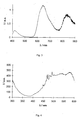
- Fig. 1 and Fig. 2 Spectra of a laminated Rakelan horrs are shown.
- the proof contained the anthraquinone colorant 1,8-bis-p-methylphenylaminoanthraquinone (Compound 16).
- the pressure on PC was laminated with other PC films to a monolithic card body, so that the pressure was inside the card.
- the wavelength ⁇ is in nm on the abscissa, and on the ordinate the intensity I is plotted in arbitrary units au.
- the measurements were carried out on a Fluorolog-3 spectrometer.
- Fig. 1 an emission spectrum is shown. The excitation took place at 460 nm and thus in the VIS range. The emission was detected wavelength selective. The emission maximum at 703 nm and thus in the NIR range is clearly recognizable.
- Fig. 2 is the excitation spectrum of the in Fig. 1 shown, that is, at a given emission wavelength, the excitation wavelength was changed.
- NIR luminescence was detected at 703 nm, from the emission measurement according to Fig. 1 determined maximum.
- FIG. 3 and FIG. 4 Spectra of a laminated Rakelan horrs are shown.
- the proof contained the anthraquinone colorant 1,4-diamino-2,3-diphenoxyanthraquinone (Compound 15).
- the pressure on PC was laminated with other PC films to a monolithic card body, so that the pressure was inside the card.
- the wavelength ⁇ is in nm on the abscissa, and on the ordinate the intensity I is plotted in arbitrary units au.
- the measurements were carried out on a Fluorolog-3 spectrometer.
- Fig. 3 an emission spectrum is shown. The excitation took place at 360 nm and thus in the UV-A range. The emission was detected wavelength selective. The emission maximum at 643.5 nm and a second emission band at about 800 nm in the NIR range are clearly visible. A significant proportion of the emission is in the range from 650 nm and larger.
- Fig. 4 is the excitation spectrum of the in Fig. 3 shown, that is, at a given emission wavelength, the excitation wavelength was changed.
- For detection of the NIR luminescence was detected at 643 nm, from the emission measurement according to Fig. 3 determined maximum.
- Clearly visible are the broad absorption bands in the VIS region, which are responsible for the red-violet color impression of the anthraquinone dye.
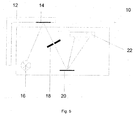
- a device 10 for verifying a security or value document 12 is shown schematically. Shown is the verification of a document 12 in the form of an open passbook with a security feature 14 which includes an anthraquinone dye.
- the device 10 has a light source 16.
- the light source is designed as a halogen lamp, low-pressure mercury lamp, LED suitable wavelength or a combination of these light sources.
- the light emitted by the light source 16 strikes the pressure area of the security feature 14 and there stimulates the anthraquinone dye for luminescence.
- the light emitted by the anthraquinone dye light is separated by a gap 18 from the scattered light, and guided by means of a grating 20 spectrally resolved on a detector 22 in the form of a CCD line.
- a grating 20 spectrally resolved on a detector 22 in the form of a CCD line.
- a long-pass filter can also be used which is transparent only for luminescent light above 650 nm.
- the device 10 may also be designed such that it can check other security features of the security or value document 12 in parallel or in terms of time, and / or record the data.
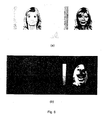
- Fig. 6 are pictures of passport photos on PC shown.
- the passport photographs were inkjet-printed of a color containing an anthraquinone dye in the case of the photograph shown on the right, and a reference dye (phthalocyanine dye) of substantially the same concentration in the case of the photograph shown on the left.
- the print was done with a Inkjet printer on eg 80 - 120 ⁇ m thick PC foil. Subsequently, the printed film was combined with other films to form a 800 ⁇ m film composite and laminated to a monolithic body so that the pressure was ultimately inside the card body.
- Fig. 6 (a) Two shots of identical passport photos are shown. The images were taken under excitation with white light with a sensitive in the visible spectral camera. In the visible only a small difference between the right, produced with the anthraquinone dye according to the invention passport photo and the left, produced with the reference dye passport photo can be seen.
- Fig. 6 (b) the same passport photos are shown under detection in the NIR by means of a CCD camera with a 650 nm long pass filter. The difference is clearly visible.
- the right produced with the anthraquinone dye according to the invention passport photo NIR luminescence could be detected very well under VIS excitation.
- the left passport photograph made with the reference dye was virtually undetectable. Thus, although a readjustment of the passport image with the reference dye for a simple visual inspection was possible, but not for a control under NIR luminescence conditions.
Landscapes
- Chemical & Material Sciences (AREA)
- Organic Chemistry (AREA)
- Health & Medical Sciences (AREA)
- General Health & Medical Sciences (AREA)
- Toxicology (AREA)
- Physics & Mathematics (AREA)
- General Physics & Mathematics (AREA)
- Spectroscopy & Molecular Physics (AREA)
- Credit Cards Or The Like (AREA)
- Printing Methods (AREA)
- Investigating Or Analysing Materials By The Use Of Chemical Reactions (AREA)
Description
- Gegenstand der Erfindung ist ein Verfahren zum Verifizieren eines Sicherheits- oder Wertdokuments über mindestens ein Sicherheitsmerkmal, welches durch jeweils mindestens einen im NIR-Spektralbereich lumineszierenden Markierungsstoff gebildet ist, für die Verifikation von Sicherheits- oder Wertdokumenten, insbesondere von Personaldokumenten wie Pässen, Personalausweisen, Führerscheinen, Visa, Betriebs- und Dienstausweisen und dergleichen.
- Zur Absicherung von Sicherheits- oder Wertdokumenten ist die Prüfung nicht visuell wahrnehmbarer Merkmale von zunehmender Bedeutung. Zum einen dienen diese einer maschinellen und somit oftmals schnellen und sicheren Verifikation. Zum anderen ist das Vorhandensein von Sicherheitsmerkmalen außerhalb der menschlichen Wahrnehmung für einen potentiellen Fälscher schwer zu erkennen.
- Weiter hat sich gezeigt, dass die Nutzung verschiedener Eigenschaften zur Überprüfung der Echtheit eines Sicherheits- oder Wertdokuments deren Fälschung oder Verfälschung deutlich erschweren.
- Als besonders praktisch hat es sich erwiesen, Lumineszenzen im nahen infraroten Spektralbereich des Lichtes (NIR) zu verwenden, da Detektoren auf Siliziumbasis einfach und kostengünstig eingesetzt werden können. Diese haben jedoch nur bis etwa 1100 nm eine ausreichende Empfindlichkeit. InGaAs-Detektoren können bis etwa 1600 nm effizient eingesetzt werden. Eine Detektion bei höheren Wellenlängen ist verhältnismäßig aufwändig, insbesondere werden oftmals gekühlte Detektoren benötigt.
- Aus
DE 603 13 034 T2 ist ein Verfahren zur Markierung optischer Gegenstände, zum Beispiel CDs und DVDs, bekannt. Hierbei werden spektroskopische Markierungen auf bestimmte Stellen auf die Oberfläche aufgebracht. Die Aufbringung erfolgt hierbei mittels lokaler Modifizierung der Oberflächenenergie und anschließendes Spincoating. Zur spektroskopischen Markierung können Farbstoffe und Pigmente, zum Beispiel Fluoreszenzfarbstoffe, eingesetzt werden. - Aus
DE 10 2007 052 947 A1 ist eine Tintenstrahldruckfarbe bekannt. Diese weist als eine Komponente ein Farbmittel oder ein Farbmittelgemisch auf, wobei unter Farbmittel alle farbgebenden Stoffe verstanden werden. Als mögliche farbgebende Stoffe werden Anthrachinon-Farbstoffe genannt. Ferner weist die Tintenstrahldruckfarbe eine weitere Komponente auf, welche unter Einsatz von technischen Hilfsmitteln ersichtlich sind, zum Beispiel Lumineszenzstoffe. - Nachteilig an den genannten Systemen ist, dass die Einbringung von im NIR lumineszierenden Stoffen für einen Fälscher potentiell erkennbar ist, da diese entweder gesondert oder zusätzlich zu den farbgebenden Farbstoffen eingesetzt werden. Dadurch lassen sich diese chemisch identifizieren und lässt sich deren Funktion anhand ihrer physikalischen Eigenschaften erraten.
- Die Aufgabe der vorliegenden Erfindung ist es nun, ein Verfahren zum Verifizieren eines Sicherheits- oder Wertdokuments bereit zu stellen, bei welchem ein potentieller Fälscher die Maschinenlesbarkeit des Merkmals nicht unmittelbar erkennen kann.
- Unter Alkyl werden gesättigte Kohlenwasserstoffgruppen verstanden. Unter Cn-Alkyl wird eine gesättigte Kohlenwasserstoffgruppe mit n Kohlenstoffatomen verstanden, C1-Cm-Alkyl umfasst alle gesättigten Kohlenwasserstoffgruppen mit 1 bis m Kohlenstoffatomen. n und m sind ganze Zahlen. C1-Alkyl ist Methyl, C2-Alkyl ist Ethyl, C3-Alkyl umfasst n-Propyl und Methylethyl (i-Propyl), C4-Alkyl umfasst n-Butyl, 1-Methylpropyl, 2-Methylpropyl (i-Butyl) und 1,1-Dimethylethyl (t-Butyl). C5-Alkyl umfasst n-Pentyl, 1-Methylbutyl, 2-Methylbutyl, 3-Methylbutyl, 1,1-Dimethylpropyl, 1,2-Dimethylpropyl, 2,2-Dimethylpropyl, 1-Ethylpropyl und die Isomeren von Cyclopentyl. C6-Alkyl umfasst n-Hexyl sowie dessen Isomere, ferner Cyclohexyl und die Isomeren von Methylcyclopentyl. C7-Alkyl umfasst n-Heptyl sowie dessen Isomere, ferner die Isomeren von Methylcyclohexyl, Dimethylcyclopentyl und Ethylcyclopentyl. C8-Alkyl umfasst n-Octyl sowie dessen Isomere, ferner die Isomeren von Dimethylcyclohexyl, Ethylcyclohexyl, Trimethylcyclopentyl, Methylethylcycopentyl und Propylcyclopentyl. Die höheren Homologen umfassen in entsprechender Weise die entsprechenden Isomeren.
- Unter Aryl werden cyclische aromatische Kohlenwasserstoffgruppen verstanden. Unter Cn-Aryl wird eine cyclische aromatische Kohlenwasserstoffgruppe mit n Kohlenstoffatomen im aromatischen Ringsystem verstanden, C1-Cm-Aryl umfasst alle cyclischen aromatischen Kohlenwasserstoffgruppen mit 1 bis m Kohlenstoffatomen im aromatischen Ringsystem. n und m sind ganze Zahlen. C6-Aryl ist Phenyl, C10-Aryl umfasst Naphthyl. Aryl kann substituiert und unsubstituiert sein. Sofern Aryl substituiert ist, kann jeder Arylring mit einem oder mehreren C1-C15-Alkyl, C5-C12-Aryl, OR, NRR', COR, COOR, CONRR', SO2R, SO2NRR', SO2OR, NO2, CN substituiert sein, wobei die Substituenten am Arylring unabhängig voneinander gewählt sein können und wobei R und R' unabhängig voneinander H, C1-C8-Alkyl und C5-C12-Aryl sein können.
- Die Aufgabe wird durch das Verfahren gemäß Anspruch 1 gelöst.
- Das erfindungsgemäße Verfahren zum Verifizieren eines Sicherheits- oder Wertdokuments über mindestens ein Sicherheitsmerkmal umfasst die Verfahrensschritte (a) Bereitstellen des Sicherheits- oder Wertdokuments, (b) Anregen und (c) Registrieren einer Lumineszenz. Das Sicherheits- oder Wertdokument weist mindestens ein Sicherheitsmerkmal auf, welches durch jeweils mindestens einen im NIR-Spektralbereich lumineszierenden Markierungsstoff gebildet wird. Erfindungsgemäß wird unter NIR der Bereich zwischen 650 nm und 1600 nm verstanden. Die NIR-Lumineszenz liegt somit erfindungsgemäß im Bereich größer 650 nm, bevorzugt größer 700 nm. Weiter weist die NIR-Lumineszenz erfindungsgemäß wenigstens einen Anteil der Lumineszenz im Bereich von weniger als 1600 nm, bevorzugt weniger als 1400 nm, besonders bevorzugt weniger als 1100 nm auf. Die Anregung des mindestens einen Markierungsstoffes erfolgt erfindungsgemäß unterhalb von 650 nm. Der Markierungsstoff wird zur Lumineszenz angeregt, und die durch die Anregung erzeugte Lumineszenz des mindestens einen Markierungsstoffes wird im NIR-Spektralbereich detektiert. Hierbei kann das Registrieren spektral aufgelöst oder ohne spektrale Auflösung erfolgen. Beispielsweise erfolgt das Registrieren mittels einer Diode, welche mittels eines 650 nm-Langpassfilters nur Strahlung im NIR-Spektralbereich detektieren kann. Alternativ kann die Lumineszenz spektral aufgelöst, zum Beispiel mittels eines Spektralphotometers registriert werden. Erfindungswesentlich ist, dass mindestens ein Markierungsstoff aus der Klasse der Anthrachinon-Farbstoffe ausgewählt ist.
- Das erfindungsgemäße Verfahren wird insbesondere zur Absicherung von eingebrachten, personalisierten Informationen oder zur weiteren Erhöhung der Sicherheit von bekannten Sicherheitsmerkmälen verwendet. Beispielsweise wird das erfindungsgemäße Verfahren zur Absicherung eines Passbildes oder von Schrift, welche beispielsweise den Inhabernamen wiedergibt, eingesetzt. So kann mindestens eine der zur Erzeugung des Passbildes verwendeten Farben einen Anthrachinon-Farbstoff enthalten. Zusätzlich kann mindestens eine zweite Farbe durch ihre Absorption im sichtbaren Spektralbereich die personalisierte Information, beispielsweise das Passbild, sichtbar machen. Ebenso kann das erfindungsgemäße Verfahren eingesetzt werden, um zum Beispiel Guillochen oder einen Hintergrunddruck mit Irisverlauf zusätzlich gegen Nachstellung abzusichern.
- Anthrachinon-Farbstoffe sind bei der Einfärbung von Kunststoffteilen häufig verwendete Farbmittel. Farbmittel sind Farbstoffe, welche aufgrund ihrer Absorption einen farbigen Eindruck erzeugen. Übliche Anthrachinon-Farbstoffe weisen eine Lichtechtheit zwischen 6 und 8 auf und sind daher grundsätzlich auch für die Verwendung in langlebigen Dokumenten gut geeignet. Allerdings wird ein Fälscher, welcher die Anthrachinon-Farbstoffe identifiziert, diese jedoch nur im Hinblick auf deren Absorptionseigenschaften und die somit erzeugte Farbigkeit für relevant erachten. Selbst unter der Voraussetzung, dass der Fälscher die NIR-Lumineszenz als relevante Eigenschaft mit berücksichtigen würde, ergibt sich eine erhöhte Sicherheit gegen Fälschung und Verfälschung, da nicht nur der visuelle Eindruck sondern auch die NIR-Lumineszenz-Eigenschaften des Stoffes durch den Fälscher exakt mit einem Farbstoff nachgestellt werden müssen. Dieses ist schwieriger als die Nachstellung eines ersten Stoffes, welcher die visuellen Eigenschaften des Dokuments beeinflusst und eines zweiten, getrennt vorliegenden Stoffes, welcher über NIR-Lumineszenz-Eigenschaften verfügt.
- In einer bevorzugten Ausführungsform der Erfindung ist mindestens ein Anthrachinon-Farbstoff ausgewählt aus Monoamino-, vorzugsweise 1-Monoamino-, Diamino-, vorzugsweise 1,4-Diamino-, und Amino-hydroxy-, vorzugsweise 1-Amino-4-hydroxyanthrachinon-Farbstoffen.
- Ein weiterer bevorzugter Farbstoff ist durch die folgende Strukturformel gegeben:

- Bevorzugte Antrachinon-Farbstoffe sind ferner durch die Formel 1 gegeben:

- A, A', B und B' sind Reste, die unabhängig voneinander ausgewählt sind aus der Gruppe, umfassend H, OR, NRR' und NO2.
- R1, R2, R3 und R4 sind Reste, die unabhängig voneinander ausgewählt sind aus der Gruppe, umfassend H, OR und SR.
- In den vorstehend angegebenen Resten sind R und R' unabhängig voneinander ausgewählt aus der Gruppe, umfassend H, C1-C15-Alkyl, bevorzugt C1-C8-Alkyl, unsubstituiertes oder substituiertes Aryl, insbesondere unsubstituiertes oder substituiertes C5-C10-Aryl, ganz besonders unsubstituiertes oder substituiertes Phenyl, (CH2)n-OR" mit n = 1 - 8, bevorzugt n = 1 - 4, und wobei R" = H, C1-C15-Alkyl, bevorzugt C1-C8-Alkyl, sowie (CH2CH2O)n-R" mit n = 1 - 8, bevorzugt n = 1 - 4, und wobei R" = H, C1-C15-Alkyl, bevorzugt C1-C8-Alkyl.
- Besonders bevorzugt sind folgende Verbindungen:
- 1. A und B sind NRR' mit R = H und R' = CH2-CH(CH3)2 sowie A', B', R1, R2, R3 und R4 = H:

- 2.
- (i)
- A = NRR' mit R = H und R' = (CH2)n-OR", wobei n = 3 und R" = CH2-CH(C2H5)((CH2)3CH3), und
- B = NRR' mit R = H und R' = (CH2)n-OR", wobei n = 3 und R" = CH2-CH(C2H5)((CH2)3CH3) sowie A', B', R1, R2, R3 und R4 = H oder
- (ii)
- A = NRR' mit R = H und R' = (CH2)n-OR", wobei n = 3 und R" = CH2-CH(C2H5)((CH2)3CH3) und
- B = NRR' mit R = H und R' = CH2-CH(C2H5)((CH2)3CH3) sowie A', B', R1, R2, R3 und R4 = H oder
- (iii)
- A = NRR' mit R = H und R' = CH2-CH(C2H5)((CH2)3CH3) und
- B = NRR' mit R = H und R' = (CH2)n-OR", wobei n = 3 und R" = CH2-CH(C2H5)((CH2)3CH3) sowie A', B', R1 , R2, R3 und R4 = H oder
- (iv)
- A = NRR' mit R = H und R' = CH2-CH(C2H5)((CH2)3CH3) und
- B = NRR' mit R = H und R' = CH2-CH(C2H5)((CH2)3CH3) sowie A', B', R1, R2, R3 und R4 = H:

- (i)
- 3. A gleich NRR' mit R = H und R' = CH3 sowie B, A', B', R1 , R2, R3 und R4 = H:

- 4. A = OR mit R = H, B = NRR' mit R = H und R' = (4-methylphenyl) sowie A', B', R1, R2, R3 und R4 = H:

- 5. A und B = NRR' mit R = H und R' = phenyl sowie A', B', R1, R2, R3 und R4 gleich H:

- 6. A = OR mit R = H, B = NRR' mit R = R' = H sowie A', B', R1, R2, R3 und R4 = H:

- 7. A und B gleich NRR' mit R = R' = H sowie A', B', R1, R2, R3 und R4 = H:

- 8. A = OR mit R = H, B = NRR' mit R = H und R' hat eine der oben genannten Bedeutungen sowie A', B', R1, R2, R3 und R4 = H:

- 9.
- (i) A und B' = OR mit R = H, A' und B = NRR' mit R = R' = H, sowie R1 , R2, R3 und R4 = H oder
- (ii) A und B = OR mit R = H, A' und B' = NRR' mit R = R' = H sowie R1, R2, R3 und R4 = H oder
- (iii) A und A' = OR mit R = H und B und B' = NRR' mit R = R' = H sowie R1 , R2 , R3 und R4 = H:

- (i) A = OR mit R = H, B = NRR' mit R = H und R' = Aryl, A' = NO2,:B' = OR mit R = H oder
- (ii) A = OR mit R = H, B = NRR' mit R = H und R' = Aryl, A' = OR mit R = H,:B' = NO2:

- 10. A = NRR' mit R = R' = H, B = OR mit R = H, R1 = OR mit R = (CH2)n-OR" mit n = 2 und R" = H sowie A', B', R2 , R3 und R4 = H:

- 11. A und B = NRR' mit R = H und R'=CH3 sowie A', B', R1 , R2, R3 und R4 = H:

- 12. A = NRR' mit R = R' = H, B = NRR' mit R = H und R' = cyclohexyl, R' = SR mit R = (CH2)n-OR" mit n = 2 und R" = H sowie A', B', R2 , R3 und R4 = H:

- 13. A, B, A' und B' = NRR' mit R = R' = H sowie R1 R2 , R3 und R4 jeweils unabhängig voneinander ausgewählt aus H und CH3,
insbesondere A, B, A' und B' = NRR' mit R = R' = H, R1 oder R2 oder R3 oder R4 = CH3 sowie die übrigen Reste = H:
- 14. A und B = NRR' mit R = H und R' = (CH2)n-OR" mit n = 2 und R" = H, A' und B' = OR mit R = H sowie R1, R2, R3 und R4 = H:

- 15. A und B = NRR' mit R = R' = H, R1 und R2 = OR mit R = phenyl sowie A', B', R3 und R4 = H

- 16. A und A' = NRR' mit R = H, R' = 4-Methylphenyl sowie B, B', R1 , R2, R3 und R4 = H

- Ganz besonders bevorzugt sind Anthrachinon-Farbstoffe mit der allgemeinen chemischen Formel (I), in denen:
- a. A = OH, B = NH2 sowie A', B', R1, R2, R3 und R4 gleich H;
- b. A und B = NH2 sowie A', B', R1 , R2, R3 und R4 gleich H;
- c. A = NH2 sowie B, A', B', R1, R2, R3 und R4 gleich H;
- Geeignete Anthrachinon-Farbstoffe kann der Fachmann zum Beispiel dem Artikel "Bien, Stawitz, Wunderlich, Anthraquinone Dyes and Intermediates", aus Ullmann's Encyclopedia of Industrial Chemistry, Electronic Release 2009, Wiley-VCH entnehmen.
- Um eine gute Einbringung des Farbstoffes in ein Sicherheits- oder Wertdokument zu ermöglichen, weist der Anthrachinon-Farbstoff vorteilhaft eine ausreichende Löslichkeit in einem zur Einbringung eingesetzten Lösemittel auf, sofern die Aufbringung des Farbstoffes auf ein Substrat mittels einer Tinte oder Druckfarbe erfolgt. Erfolgt die Aufbringung in fester Form, zum Beispiel als Toner eines Laserdruckers, so ist eine Löslichkeit nicht notwendig.
- Die Einbringung des Farbstoffes kann über Beschichten (Coating), Streichen, Rakeln, Sprühen oder Drucken erfolgen. Zu den Druckverfahren zählen Tief-, Hoch-, Flach- und Durchdruck in den Ausprägungen Stichtiefdruck, Rastertiefdruck, Letterset, Buchdruck, Offset (insbesondere wasserloser Offset), Siebdruck. Ferner sind alle einschlägigen Digitaldruckverfahren von Interesse. Dazu zählen Tintenstrahldruck, Elektrophotographie, Lasersublimationsdruck, Thermosublimationsdruck und andere Verfahren, um hier nur die Wichtigsten beispielhaft zu nennen.
- Bevorzugte Lösemittel sind halogenfreie organische Losungsmittel. Besonders bevorzugt sind insbesondere Polyol-Ether, hochkondensierte Ester, Glykolester, aliphatische, cycloaliphatische, aromatische Kohlenwasserstoffe, wie Mesitylen (1,3,5-Trimethylbenzol), 1,2,4-Trimethylbenzol, Cumol (2-Phenylpropan), Solvent Naptha, Toluol und Xylol, (organische) Ester, wie Methylacetat, Ethylacetat, Butylacetat, Methoxypropylacetat, Ethyl-3-ethoxypropionat, Butylglycolacetat, Methyldiethylenglycolacetat. Bevorzugt sind Mesitylen, 1,2,4-Trimethylbenzol, Cumol und Solvent Naptha, Toluol, Xylol, Essigsäuremethylester, Essigsäureethylester, Methoxypropylacetat, Ethyl-3-ethoxypropionat, Butylglycolacetat, Methyldiethylenglycolacetat. Ganz besonders bevorzugt sind Mesitylen, 1,2,4-Trimethylbenzol, Cumol, Solvent Naptha und Ethyl-3-ethoxypropionat, Butylglycolacetat, Methyldiethylenglycolacetat.
- Besonders bevorzugter Weise weist der Anthrachinon-Farbstoff eine gute Löslichkeit in einem Lösemittelgemisch auf. Ein typisches Lösemittelgemisch umfasst beispielsweise L1) 0 bis 10 Gew.-%, vorzugsweise 1 bis 5 Gew.-%, insbesondere 2 bis 3 Gew.-%, Mesitylen, L2) 10 bis 50 Gew.-%, vorzugsweise 25 bis 50 Gew.-%, insbesondere 30 bis 40 Gew.-%, 1-Methoxy-2-propanolacetat, L3) 0 bis 20 Gew.-%, vorzugsweise 1 bis 20 Gew.-%, insbesondere 7 bis 15 Gew.-%, 1,2,4-Trimethylbenzol, L4) 10 bis 50 Gew.-%, vorzugsweise 25 bis 50 Gew.-%, insbesondere 30 bis 40 Gew.-%, Ethyl-3-ethoxypropionat , L5) 0 bis 10 Gew.-%, vorzugsweise 0,01 bis 2 Gew.-%, insbesondere 0,05 bis 0,5 Gew.-%, Cumol, und L6) 0 bis 80 Gew.-%, vorzugsweise 1 bis 40 Gew.-%, insbesondere 15 bis 25 Gew.-%, Solvent Naphtha, wobei die Summe der Komponenten L1 bis L6 stets 100 Gew.-% ergibt.
- Eine Farbe, insbesondere eine Tinte, können neben dem erfindungsgemäßen Farbstoff und dem Lösemittel bzw. Lösemittelgemisch optional noch zusätzliche Bestandteile enthalten, insbesondere Bindemittel, Füllstoffe, Farbmittel oder Farbmittelgemische, funktionelle Materialien oder eine Mischung solcher Materialien, Additive und/oder Hilfsstoffe oder eine Mischung solcher Stoffe. Als Farbmittel sind alle farbgebenden Stoffe bezeichnet. Funktionelle Materialien umfassen Lumineszenzstoffe, zum Beispiel Elektroluminophore, Antistokes Luminophore, magnetisierbare Materialien sowie Raman-aktive oder Ramanverstärkende Materialien. Diese dienen als weitere Sicherheitsmerkmale. Additive und/oder Hilfsstoffe umfassen Antischaummittel, Stellmittel, Netzmittel, Tenside, Fließmittel, Trockner, Katalysatoren, Stabilisatoren, Biozide, Polymere zur Viskositätseinstellung und Puffersysteme.
- Die Anregung erfolgt in einer Ausführungsform im VIS-Spektralbereich. Unter dem VIS-Spektralbereich wird der Bereich zwischen 400 und 650 nm verstanden.
- In einer alternativen Ausführungsform erfolgt die Anregung durch Anregung im UV-Spektralbereich zwischen 200 und 400 nm. Besonders bevorzugt ist eine Anregung im UV-A Bereich (400 bis 320 nm), insbesondere mit 365 nm, und/oder im UV-B Bereich (320 bis 280 nm), insbesondere 312 nm.
- In einer weiteren alternativen Ausführungsform der Erfindung erfolgt die Anregung kombiniert im UV- und VIS-Spektralbereich. Dieses ist bevorzugt, wenn das Sicherheitsmerkmal verschiedene Markierungsstoffe enthält, welche eine Lumineszenz im NIR aufweisen.
- In einer weiteren bevorzugten Ausführungsform der Erfindung weist mindestens ein Anthrachinon-Farbstoff im VIS-Spektralbereich keine Absorption auf. Hierunter wird verstanden, dass die maximale Absorption des Farbstoffes im Bereich von 400 bis 650 nm nicht größer ist als 10 % der maximalen Absorption des Farbstoffes im Bereich von 250 bis 1600 nm. Besonders bevorzugt ist die maximale Absorption im Bereich von 400 bis 650 nm nicht größer als 2 % der maximalen Absorption im Bereich von 250 bis 1600 nm.
- In einer weiteren bevorzugten Ausführungsform der Erfindung weist das Sicherheitsmerkmal zusätzlich zu dem mindestens einen Anthrachinon-Farbstoff mindestens einen zweiten Markierungsstoff auf. Der zweite Markierungsstoff weist eine Absorption im VIS-Spektralbereich auf. Dieses ist vorteilhaft, da auf diese Weise Farbeindrücke erzeugt werden können, welche durch chemisch reine Farbstoffe aufgrund des begrenzten verfügbaren Farbraumes der denkbaren Verbindungen nicht zugänglich wären.
- In einer weiteren bevorzugten Ausführungsform der Erfindung handelt es sich bei dem Sicherheits- oder Wertdokument um einen Mehrschichtaufbau. Ein Mehrschichtaufbau ist ein mittels Lamination oder Kleben hergestellter Körper, zum Beispiel ein Kartenkörper. Dieser wird durch Zusammentragen einzelner Schichten, z.B. Folien und Lamination und/oder Kleben zu einem Körper verbunden. Hierbei können die Folien aus gleichen oder verschiedenen Materialien bestehen, insbesondere aus Polycarbonat (PC), insbesondere Bisphenol-A-Polycarbonat, Polyethylenterephthalat (PET), deren Derivaten wie Glykol-modifiziertem PET (PETG), Polyethylennaphthalat (PEN), Polyvinylchlorid (PVC), Polyvinylbutyral (PVB), Polymethylmethacrylat (PMMA), Polyimid (PI), Polyvinylalkohol (PVA), Polystyrol (PS), Polyvinylphenol (PVP), Polypropylen (PP), Polyethylen (PE), thermoplastischen Elastomeren (TPE), insbesondere thermoplastischem Polyurethan (TPU), Acrylnitril-Butadien-Styrol (ABS), Papier, Teslin® sowie deren Derivaten, koextrudierten Folien, welche unter anderen diese Materialien enthalten, sowie Hybridmaterialien, welche unter anderen die oben genannten Materialien enthalten. Besonders bevorzugt sind Sicherheits- oder Wertdokumente, welche zumindest teilweise aus Polycarbonat bestehen.
- Eine Vorrichtung zum Verifizieren eines Sicherheits- oder Wertdokuments über mindestens ein Sicherheitsmerkmal weist eine Halteeinrichtung zur Platzierung des Sicherheits- oder Wertdokuments in der Verifikationsvorrichtung, eine Anregungsquelle zur Anregung des mindestens einen Markierungsstoffs und einen Detektor zur Registrierung der Lumineszenz des mindestens einen Markierungsstoffes im NIR-Spektralbereich auf.
- Als Anregungsquellen können insbesondere LEDs, Dioden-Laser, Quecksilber-Dampflampen oder Halogenlampen eingesetzt werden. Bevorzugt sind Halogenlampen, Quecksilber-Niederdrucklampen und LEDs geeigneter Wellenlänge.
- Als Detektoren können Silizum- oder InGaAs-Photodioden oder Array-Detektoren eingesetzt werden. Diese können mittels Filtern oder mittels dispersiver Elemente, insbesondere Gitter, zur selektiven Empfindlichkeit im NIR geeignet sein. Besonders bevorzugt werden mit wechselbaren Filtern versehene CCD- oder CMOS-Kameras als Detektoren eingesetzt, da diese zusätzlich geometrische Informationen erfassen können.
- Ausführungsbeispiele der Erfindung werden nun unter Bezugnahme auf die beigefügten Figuren beschrieben. Die einzelnen Figuren zeigen:
- Fig. 1:
- Emissionsspektrum eines ersten Anthrachinon-Farbstoffes;
- Fig. 2:
- Anregungsspektrum eines ersten Anthrachinon-Farbstoffes:
- Fig. 3:
- Emissionsspektrum eines zweiten Anthrachinon-Farbstoffes;
- Fig. 4:
- Anregungsspektrum eines zweiten Anthrachinon-Farbstoffes:
- Fig. 5:
- Vorrichtung zur Verifikation eines Sicherheits- oder Wertdokuments mit einem Sicherheitsmerkmal mit einem Anthrachinon-Farbstoff;
- Fig. 6:
- Aufnahme eines Passfotos (a) im VIS-Bereich bzw. (b) im NIR-Bereich unter VIS-Anregung, rechts mit einem erfindungsgemäßen Anthrachinon-Farbstoff gedruckt, links mit einem Referenz-Farbstoff (Phthalocyanin-Farbstoff);
- In
Fig. 1 und Fig. 2 sind Spektren eines einlaminierten Rakelandrucks gezeigt. Der Andruck enthielt das Anthrachinon-Farbmittel 1,8-bis-p-Methylphenylaminoanthrachinon (Verbindung 16). Der Andruck auf PC wurde mit weiteren PC-Folien zu einem monolithischen Kartenkörper laminiert, sodass sich der Andruck im Karteninneren befand. Auf der Abszisse ist jeweils die Wellenlänge λ in nm, und auf der Ordinate ist die Intensität I in willkürlichen Einheiten a.u. aufgetragen. Die Messungen wurden durchgeführt an einem Fluorolog-3 Spektrometer. - In
Fig. 1 ist ein Emissionsspektrum gezeigt. Die Anregung erfolgte bei 460 nm und somit im VIS-Bereich. Die Emission wurde wellenlängenselektiv detektiert. Gut erkennbar ist das Emissionsmaximum bei 703 nm und somit im NIR-Bereich. - In
Fig. 2 ist das Anregungsspektrum des inFig. 1 gezeigten Anthrachinon-Farbmittels dargestellt, dass heißt, bei vorgegebener Emissionswellenlänge wurde die Anregungswellenlänge verändert. Zur Detektion der NIR-Lumineszenz wurde bei 703 nm detektiert, dem aus der Emissionsmessung gemäßFig. 1 ermittelten Maximum. Gut erkennbar sind die breiten Absorptionsbanden im VIS-Bereich, welche für den blauen Farbeindruck des Anthrachinon-Farbmittels verantwortlich sind. - In
Fig. 3 und Fig. 4 sind Spektren eines einlaminierten Rakelandrucks gezeigt. Der Andruck enthielt das Anthrachinon-Farbmittel 1,4-Diamino-2,3-diphenoxyanthrachinon (Verbindung 15). Der Andruck auf PC wurde mit weiteren PC-Folien zu einem monolithischen Kartenkörper laminiert, sodass sich der Andruck im Karteninneren befand. Auf der Abszisse ist jeweils die Wellenlänge λ in nm, und auf der Ordinate ist die Intensität I in willkürlichen Einheiten a.u. aufgetragen. Die Messungen wurden durchgeführt an einem Fluorolog-3 Spektrometer. - In
Fig. 3 ist ein Emissionsspektrum gezeigt. Die Anregung erfolgte bei 360 nm und somit im UV-A-Bereich. Die Emission wurde wellenlängenselektiv detektiert. Gut erkennbar sind das Emissionsmaximum bei 643,5 nm und eine zweite Emissionsbande bei etwa 800 nm im NIR-Bereich. Ein wesentlicher Anteil der Emission befindet sich im Bereich ab 650 nm und größer. - In
Fig. 4 ist das Anregungsspektrum des inFig. 3 gezeigten Anthrachinon-Farbmittels dargestellt, dass heißt, bei vorgegebener Emissionswellenlänge wurde die Anregungswellenlänge verändert. Zur Detektion der NIR-Lumineszenz wurde bei 643 nm detektiert, dem aus der Emissionsmessung gemäßFig. 3 ermittelten Maximum. Gut erkennbar sind die breiten Absorptionsbanden im VIS-Bereich, welche für den rotvioletten Farbeindruck des Anthrachinon-Farbstoffs verantwortlich sind. - In
Fig. 5 ist eine Vorrichtung 10 zur Verifikation eines Sicherheits- oder Wertdokuments 12 schematisch dargestellt. Gezeigt ist die Verifikation eines Dokuments 12 in Form eines aufgeschlagenen Passbuches mit einem Sicherheitsmerkmal 14, welches einen Anthrachinon-Farbstoff beinhaltet. Die Vorrichtung 10 weist eine Lichtquelle 16 auf. Die Lichtquelle ist als Halogenlampe, Quecksilber-Niederdrucklampe, LED geeigneter Wellenlänge oder eine Kombination dieser Lichtquellen ausgebildet. Das von der Lichtquelle 16 emittierte Licht trifft auf den Andruckbereich des Sicherheitsmerkmals 14 und regt dort den Anthrachinon-Farbstoff zur Lumineszenz an. Das vom Anthrachinon-Farbstoff emittierte Licht wird durch einen Spalt 18 vom Streulicht getrennt, und mit Hilfe eines Gitters 20 spektral aufgelöst auf einen Detektor 22 in Form einer CCD-Zeile geleitet. Zur Auswertung werden ausschließlich die spektralen Anteile der Lumineszenz verwendet, die sich oberhalb von 650 nm befinden. Anstelle eines Gitters kann auch ein Langpassfilter verwendet werden, der lediglich für Lumineszenzlicht oberhalb von 650 nm transparent ist. Die Vorrichtung 10 kann ferner derart ausgebildet sein, dass diese parallel oder zeitlich versetzt weitere Sicherheitsmerkmale des Sicherheits- oder Wertdokuments 12 prüfen und/oder die Daten erfassen kann. - In
Fig. 6 sind Aufnahmen von Passfotos auf PC dargestellt. Die Passfotos wurden mittels Inkjet-Drucks einer Farbe, welche im Falle des rechts dargestellten Fotos einen Anthrachinon-Farbstoff, und im Falle des links dargestellten Fotos einen Referenz-Farbstoff (Phthalocyanin-Farbstoff) mit im Wesentlichen gleicher Konzentration enthielt. Der Druck erfolgte mit einem Inkjet-Drucker auf einer z.B. 80 - 120 µm dicken PC-Folie. Anschließend wurde die bedruckte Folie mit weiteren Folien zu einem 800 µm Folienverbund zusammengetragen und zu einem monolithischen Körper laminiert, sodass sich der Andruck letztlich innerhalb des Kartenkörpers befand. - In der
Fig. 6 (a) sind zwei Aufnahmen von identischen Passfotos dargestellt. Die Aufnahmen wurden unter Anregung mit Weißlicht mit einer im sichtbaren Spektralbereich empfindlichen Kamera aufgenommen. Im Sichtbaren ist nur ein geringer Unterschied zwischen dem rechten, mit dem erfindungsgemäßen Anthrachinon-Farbstoff hergestellten Passfoto und dem linken, mit dem Referenz-Farbstoff hergestellten Passfoto zu sehen. InFig. 6 (b) sind die gleichen Passfotos unter Detektion im NIR mittels einer CCD-Kamera mit einem 650 nm Langpassfilter gezeigt. Der Unterschied ist deutlich erkennbar. Im rechten, mit dem erfindungsgemäßen Anthrachinon-Farbstoff hergestellten Passfoto konnte die NIR-Lumineszenz unter VIS-Anregung sehr gut detektiert werden. Das linke, mit dem Referenz-Farbstoff hergestellte Passbild war praktisch nicht detektierbar. Somit war zwar eine Nachstellung des Passbildes mit dem Referenz-Farbstoff für eine einfache Sichtkontrolle möglich, nicht jedoch für eine Kontrolle unter NIR-Lumineszenzbedingungen.
Claims (7)
- Verfahren zum Verifizieren eines Sicherheits- oder Wertdokuments (12) über mindestens ein Sicherheitsmerkmal (14), umfassend die folgenden Verfahrensschritte:a. Bereitstellen des Sicherheits- oder Wertdokuments (12), wobei das mindestens eine Sicherheitsmerkmal (14) durch jeweils mindestens einen im NIR-Spektralbereich lumineszierenden Markierungsstoff gebildet ist,b. Anregen des mindestens einen Markierungsstoffes undc. Registrieren einer Lumineszenz des mindestens einen Markierungsstoffes im NIR-Spektralbereich,dadurch gekennzeichnet, dass der mindestens eine Markierungsstoff aus der Klasse der Anthrachinon-Farbstoffe ausgewählt ist.
- Verfahren zum Verifizieren nach Anspruch 1, dadurch gekennzeichnet, dass der mindestens eine Anthrachinon-Farbstoff ausgewählt ist aus der Gruppe, umfassend 1-Monoamino-, 1,4-Diamino- und 1-Amino-4-hydroxyanthrachinon-Farbstoffen.
- Verfahren zum Verifizieren nach einem der vorstehenden Ansprüche, dadurch gekennzeichnet, dass der mindestens eine Anthrachinon-Farbstoff im VIS-Spektralbereich eine Absorption aufweist.
- Verfahren zum Verifizieren nach einem der Ansprüche 1 und 2, dadurch gekennzeichnet, dass der mindestens eine Anthrachinon-Farbstoff im VIS-Spektralbereich keine Absorption aufweist.
- Verfahren zum Verifizieren nach einem der vorstehenden Ansprüche, dadurch gekennzeichnet, dass zusätzlich zu dem mindestens einen Anthrachinon-Farbstoff mindestens ein zweiter Markierungsstoff in dem Sicherheitsmerkmal (14) enthalten ist, der im VIS-Spektralbereich eine Absorption aufweist.
- Verfahren zum Verifizieren nach einem der vorstehenden Ansprüche, dadurch gekennzeichnet, dass das Sicherheits- oder Wertdokument (12) zumindest teilweise aus Polycarbonat besteht.
- Verfahren zum Verifizieren nach einem der vorstehenden Ansprüche, dadurch gekennzeichnet, dass der mindestens eine Markierungsstoff ausgewählt ist aus der Gruppe, umfassend die Verbindung mit der chemischen Formel


Applications Claiming Priority (2)
| Application Number | Priority Date | Filing Date | Title |
|---|---|---|---|
| DE102010000559A DE102010000559A1 (de) | 2010-02-25 | 2010-02-25 | Verfahren zur Verifikation von Sicherheits- oder Wertdokumenten mit einem Anthrachinon-Farbstoff |
| PCT/EP2011/052615 WO2011104240A1 (de) | 2010-02-25 | 2011-02-22 | Verfahren zur verifikation von sicherheits- und wertdokumenten mit einem anthrachinon-farbstoff |
Publications (2)
| Publication Number | Publication Date |
|---|---|
| EP2539403A1 EP2539403A1 (de) | 2013-01-02 |
| EP2539403B1 true EP2539403B1 (de) | 2014-08-06 |
Family
ID=43902772
Family Applications (1)
| Application Number | Title | Priority Date | Filing Date |
|---|---|---|---|
| EP11705865.1A Active EP2539403B1 (de) | 2010-02-25 | 2011-02-22 | Verfahren zur verifikation von sicherheits- und wertdokumenten mit einem anthrachinon-farbstoff |
Country Status (6)
| Country | Link |
|---|---|
| EP (1) | EP2539403B1 (de) |
| CN (1) | CN102741353B (de) |
| BR (1) | BR112012021011B1 (de) |
| DE (1) | DE102010000559A1 (de) |
| WO (1) | WO2011104240A1 (de) |
| ZA (1) | ZA201203265B (de) |
Families Citing this family (1)
| Publication number | Priority date | Publication date | Assignee | Title |
|---|---|---|---|---|
| DE102019119687A1 (de) * | 2019-07-19 | 2021-01-21 | Bundesdruckerei Gmbh | Sicherheitsmerkmal für ein Sicherheits- oder Wertdokument, mit mindestens einem Leuchtstoff, der im ultravioletten Spektralbereich anregbar ist und der im infraroten Spektralbereich emittiert |
Family Cites Families (17)
| Publication number | Priority date | Publication date | Assignee | Title |
|---|---|---|---|---|
| EP0256168B1 (de) * | 1986-08-12 | 1990-04-11 | Joh. Enschedé en Zonen Grafische Inrichting B.V. | Identitätskarte |
| JP3195854B2 (ja) * | 1993-04-30 | 2001-08-06 | ダイセル化学工業株式会社 | 近赤外線吸収ポリカーボネート系樹脂積層体およびその成形体 |
| DE19803997B4 (de) * | 1998-02-02 | 2018-01-25 | Giesecke+Devrient Currency Technology Gmbh | Wertdokument |
| JP4097926B2 (ja) * | 2000-12-21 | 2008-06-11 | 大日精化工業株式会社 | 近赤外線反射性複合顔料の製造方法 |
| US6514617B1 (en) * | 2001-07-11 | 2003-02-04 | General Electric Company | Tagging materials for polymers, methods, and articles made thereby |
| JP2004127135A (ja) * | 2002-10-04 | 2004-04-22 | Konica Minolta Holdings Inc | 認証識別カード及び認証識別カードの製造方法 |
| AU2003288173A1 (en) * | 2002-11-28 | 2004-06-18 | Hueck Folien Ges.M.B.H | Safety element exhibiting properties activable by energy supply |
| US20040115421A1 (en) | 2002-12-12 | 2004-06-17 | Potyrailo Radislav Alexandrovich | Methods for application of tags onto optical media articles |
| KR100740756B1 (ko) * | 2003-11-14 | 2007-07-19 | 기와 가가쿠 고교 가부시키가이샤 | 시큐리티 스티커 및 그 제조 방법 |
| US7597961B2 (en) * | 2004-07-13 | 2009-10-06 | Sabic Innovative Plastics Ip B.V. | Authenticatable article and method of authenticating |
| DE102004060315A1 (de) * | 2004-12-15 | 2006-06-22 | Basf Ag | Verfahren zur Authentizitätsprüfung von Waren |
| JP4248020B2 (ja) * | 2005-04-08 | 2009-04-02 | 日東電工株式会社 | ホログラム記録材料 |
| EP1901924B1 (de) * | 2005-06-02 | 2012-03-21 | Agfa Graphics Nv | Tintenstrahlauthentifizierungsmarkierung für ein produkt oder eine produktverpackung |
| CN1702127A (zh) * | 2005-07-01 | 2005-11-30 | 上海印钞厂 | 一种具有近红外透射特征的光学变色颜料及其制备工艺 |
| DE102005060390A1 (de) * | 2005-12-16 | 2007-06-21 | Heinz Prof. Dr. Langhals | Chirale, bichromophore Silikone. Neue Farbeffekte durch die Organisation von Chromophoren |
| CN101139316B (zh) * | 2007-10-18 | 2010-08-11 | 北京大学 | 一种蒽醌酰亚胺类化合物及其制备方法 |
| DE102007052947A1 (de) | 2007-10-31 | 2009-05-07 | Bayer Materialscience Ag | Verfahren zur Herstellung eines Polycarbonat-Schichtverbundes |
-
2010
- 2010-02-25 DE DE102010000559A patent/DE102010000559A1/de not_active Withdrawn
-
2011
- 2011-02-22 EP EP11705865.1A patent/EP2539403B1/de active Active
- 2011-02-22 WO PCT/EP2011/052615 patent/WO2011104240A1/de not_active Ceased
- 2011-02-22 BR BR112012021011A patent/BR112012021011B1/pt active IP Right Grant
- 2011-02-22 CN CN201180008031.6A patent/CN102741353B/zh active Active
-
2012
- 2012-05-07 ZA ZA2012/03265A patent/ZA201203265B/en unknown
Also Published As
| Publication number | Publication date |
|---|---|
| EP2539403A1 (de) | 2013-01-02 |
| DE102010000559A1 (de) | 2011-08-25 |
| CN102741353B (zh) | 2014-11-12 |
| WO2011104240A1 (de) | 2011-09-01 |
| ZA201203265B (en) | 2012-12-27 |
| BR112012021011A2 (pt) | 2016-05-03 |
| BR112012021011B1 (pt) | 2020-06-09 |
| CN102741353A (zh) | 2012-10-17 |
Similar Documents
| Publication | Publication Date | Title |
|---|---|---|
| EP3411245B1 (de) | Wert- oder sicherheitsprodukt, verfahren zum herstellen eines vorproduktes und verifikationsverfahren | |
| DE602004013360T2 (de) | Sicherheitsdokument, verfahren zur herstellung eines sicherheitsdokuments und verwendung eines sicherheitselements | |
| EP2296911B1 (de) | Verfahren zur herstellung eines sicherheits- und/oder wertprodukts mit zufallsmuster und korrelierter identzeichenfolge | |
| EP2212122B1 (de) | Sicherung von dokumenten mittels digitaler wasserzeicheninformation | |
| EP2004419B1 (de) | Sicherheits- und/oder wertdokument | |
| DE102012218615B4 (de) | Sicherheitsmerkmal für ein Wert- und/oder Sicherheitsprodukt mit Farbverlaufsstruktur und das Sicherheitsmerkmal aufweisendes Wert- und/oder Sicherheitsdokument | |
| DE102013200895B4 (de) | Wert- oder Sicherheitsprodukt sowie Verfahren zur Herstellung eines Sicherheitsmerkmals auf oder in dem Wert- oder Sicherheitsprodukt | |
| EP2318884A1 (de) | Binäres kippbild | |
| WO2010006583A2 (de) | Verfahren zur herstellung eines sicherheits- und/oder wertprodukts mit teilbereichen mit unterschiedlicher lumineszenzemission | |
| US6858323B1 (en) | Valuable document | |
| DE102012218053B4 (de) | Sicherheitsmerkmal, das Sicherheitsmerkmal enthaltendes Wert- und/oder Sicherheitsprodukt sowie Verfahren zur Herstellung des Wert- und/oder Sicherheitsprodukts | |
| DE102013218861A1 (de) | Halbzeug, Sicherheitsdokument und Verfahren zur Herstellung solcher mit einem UV-anregbaren Lumineszenzsicherheitsdruck | |
| EP2558304B1 (de) | Sicherheitselement mit einer lokal hinsichtlich ihrer lichtausbreitungseigenschaften modifizierten lichtleitenden struktur und verfahren zur herstellung eines solchen sicherheitselements | |
| DE102019006315A1 (de) | Optisch variables Sicherheitselement | |
| WO2007003531A1 (de) | Holmiumdotierte anti-stokes-leuchtstoffe und sicherheitsmerkmale mit diesen leuchtstoffen | |
| DE102010000559A1 (de) | Verfahren zur Verifikation von Sicherheits- oder Wertdokumenten mit einem Anthrachinon-Farbstoff | |
| DE102013218751A1 (de) | Verfahren zum Herstellen eines Sicherheitsmerkmals eines Wert- oder Sicherheitsprodukts sowie Verfahren zum Herstellen eines derartigen Produkts | |
| EP2651654B1 (de) | Aktivierbares sicherheitselement | |
| DE102008012420A1 (de) | Dokument mit Sicherheitsdruck | |
| DE102021000892A1 (de) | Sicherheitselement mit bei IR-Beleuchtung transparenten Druckfarben und einem maschinenlesbaren Merkmal |
Legal Events
| Date | Code | Title | Description |
|---|---|---|---|
| PUAI | Public reference made under article 153(3) epc to a published international application that has entered the european phase |
Free format text: ORIGINAL CODE: 0009012 |
|
| 17P | Request for examination filed |
Effective date: 20120601 |
|
| AK | Designated contracting states |
Kind code of ref document: A1 Designated state(s): AL AT BE BG CH CY CZ DE DK EE ES FI FR GB GR HR HU IE IS IT LI LT LU LV MC MK MT NL NO PL PT RO RS SE SI SK SM TR |
|
| DAX | Request for extension of the european patent (deleted) | ||
| GRAP | Despatch of communication of intention to grant a patent |
Free format text: ORIGINAL CODE: EPIDOSNIGR1 |
|
| RIC1 | Information provided on ipc code assigned before grant |
Ipc: C09B 5/14 20060101ALI20140217BHEP Ipc: C09B 1/50 20060101ALI20140217BHEP Ipc: G07D 7/12 20060101ALI20140217BHEP Ipc: C09B 1/16 20060101AFI20140217BHEP |
|
| INTG | Intention to grant announced |
Effective date: 20140320 |
|
| GRAS | Grant fee paid |
Free format text: ORIGINAL CODE: EPIDOSNIGR3 |
|
| GRAA | (expected) grant |
Free format text: ORIGINAL CODE: 0009210 |
|
| AK | Designated contracting states |
Kind code of ref document: B1 Designated state(s): AL AT BE BG CH CY CZ DE DK EE ES FI FR GB GR HR HU IE IS IT LI LT LU LV MC MK MT NL NO PL PT RO RS SE SI SK SM TR |
|
| REG | Reference to a national code |
Ref country code: GB Ref legal event code: FG4D Free format text: NOT ENGLISH |
|
| REG | Reference to a national code |
Ref country code: CH Ref legal event code: EP Ref country code: AT Ref legal event code: REF Ref document number: 681076 Country of ref document: AT Kind code of ref document: T Effective date: 20140815 |
|
| REG | Reference to a national code |
Ref country code: CH Ref legal event code: NV Representative=s name: PATENTANWALTSBUERO JEAN HUNZIKER AG, CH |
|
| REG | Reference to a national code |
Ref country code: IE Ref legal event code: FG4D Free format text: LANGUAGE OF EP DOCUMENT: GERMAN |
|
| REG | Reference to a national code |
Ref country code: DE Ref legal event code: R096 Ref document number: 502011003947 Country of ref document: DE Effective date: 20140918 |
|
| REG | Reference to a national code |
Ref country code: NL Ref legal event code: VDEP Effective date: 20140806 |
|
| REG | Reference to a national code |
Ref country code: LT Ref legal event code: MG4D |
|
| PG25 | Lapsed in a contracting state [announced via postgrant information from national office to epo] |
Ref country code: FI Free format text: LAPSE BECAUSE OF FAILURE TO SUBMIT A TRANSLATION OF THE DESCRIPTION OR TO PAY THE FEE WITHIN THE PRESCRIBED TIME-LIMIT Effective date: 20140806 Ref country code: SE Free format text: LAPSE BECAUSE OF FAILURE TO SUBMIT A TRANSLATION OF THE DESCRIPTION OR TO PAY THE FEE WITHIN THE PRESCRIBED TIME-LIMIT Effective date: 20140806 Ref country code: NO Free format text: LAPSE BECAUSE OF FAILURE TO SUBMIT A TRANSLATION OF THE DESCRIPTION OR TO PAY THE FEE WITHIN THE PRESCRIBED TIME-LIMIT Effective date: 20141106 Ref country code: ES Free format text: LAPSE BECAUSE OF FAILURE TO SUBMIT A TRANSLATION OF THE DESCRIPTION OR TO PAY THE FEE WITHIN THE PRESCRIBED TIME-LIMIT Effective date: 20140806 Ref country code: GR Free format text: LAPSE BECAUSE OF FAILURE TO SUBMIT A TRANSLATION OF THE DESCRIPTION OR TO PAY THE FEE WITHIN THE PRESCRIBED TIME-LIMIT Effective date: 20141107 Ref country code: PT Free format text: LAPSE BECAUSE OF FAILURE TO SUBMIT A TRANSLATION OF THE DESCRIPTION OR TO PAY THE FEE WITHIN THE PRESCRIBED TIME-LIMIT Effective date: 20141209 Ref country code: LT Free format text: LAPSE BECAUSE OF FAILURE TO SUBMIT A TRANSLATION OF THE DESCRIPTION OR TO PAY THE FEE WITHIN THE PRESCRIBED TIME-LIMIT Effective date: 20140806 Ref country code: BG Free format text: LAPSE BECAUSE OF FAILURE TO SUBMIT A TRANSLATION OF THE DESCRIPTION OR TO PAY THE FEE WITHIN THE PRESCRIBED TIME-LIMIT Effective date: 20141106 |
|
| PG25 | Lapsed in a contracting state [announced via postgrant information from national office to epo] |
Ref country code: CY Free format text: LAPSE BECAUSE OF FAILURE TO SUBMIT A TRANSLATION OF THE DESCRIPTION OR TO PAY THE FEE WITHIN THE PRESCRIBED TIME-LIMIT Effective date: 20140806 Ref country code: RS Free format text: LAPSE BECAUSE OF FAILURE TO SUBMIT A TRANSLATION OF THE DESCRIPTION OR TO PAY THE FEE WITHIN THE PRESCRIBED TIME-LIMIT Effective date: 20140806 Ref country code: IS Free format text: LAPSE BECAUSE OF FAILURE TO SUBMIT A TRANSLATION OF THE DESCRIPTION OR TO PAY THE FEE WITHIN THE PRESCRIBED TIME-LIMIT Effective date: 20141206 Ref country code: LV Free format text: LAPSE BECAUSE OF FAILURE TO SUBMIT A TRANSLATION OF THE DESCRIPTION OR TO PAY THE FEE WITHIN THE PRESCRIBED TIME-LIMIT Effective date: 20140806 Ref country code: PL Free format text: LAPSE BECAUSE OF FAILURE TO SUBMIT A TRANSLATION OF THE DESCRIPTION OR TO PAY THE FEE WITHIN THE PRESCRIBED TIME-LIMIT Effective date: 20140806 Ref country code: NL Free format text: LAPSE BECAUSE OF FAILURE TO SUBMIT A TRANSLATION OF THE DESCRIPTION OR TO PAY THE FEE WITHIN THE PRESCRIBED TIME-LIMIT Effective date: 20140806 Ref country code: HR Free format text: LAPSE BECAUSE OF FAILURE TO SUBMIT A TRANSLATION OF THE DESCRIPTION OR TO PAY THE FEE WITHIN THE PRESCRIBED TIME-LIMIT Effective date: 20140806 |
|
| PG25 | Lapsed in a contracting state [announced via postgrant information from national office to epo] |
Ref country code: IT Free format text: LAPSE BECAUSE OF FAILURE TO SUBMIT A TRANSLATION OF THE DESCRIPTION OR TO PAY THE FEE WITHIN THE PRESCRIBED TIME-LIMIT Effective date: 20140806 Ref country code: EE Free format text: LAPSE BECAUSE OF FAILURE TO SUBMIT A TRANSLATION OF THE DESCRIPTION OR TO PAY THE FEE WITHIN THE PRESCRIBED TIME-LIMIT Effective date: 20140806 Ref country code: SK Free format text: LAPSE BECAUSE OF FAILURE TO SUBMIT A TRANSLATION OF THE DESCRIPTION OR TO PAY THE FEE WITHIN THE PRESCRIBED TIME-LIMIT Effective date: 20140806 Ref country code: RO Free format text: LAPSE BECAUSE OF FAILURE TO SUBMIT A TRANSLATION OF THE DESCRIPTION OR TO PAY THE FEE WITHIN THE PRESCRIBED TIME-LIMIT Effective date: 20140806 Ref country code: DK Free format text: LAPSE BECAUSE OF FAILURE TO SUBMIT A TRANSLATION OF THE DESCRIPTION OR TO PAY THE FEE WITHIN THE PRESCRIBED TIME-LIMIT Effective date: 20140806 Ref country code: CZ Free format text: LAPSE BECAUSE OF FAILURE TO SUBMIT A TRANSLATION OF THE DESCRIPTION OR TO PAY THE FEE WITHIN THE PRESCRIBED TIME-LIMIT Effective date: 20140806 |
|
| REG | Reference to a national code |
Ref country code: DE Ref legal event code: R097 Ref document number: 502011003947 Country of ref document: DE |
|
| PLBE | No opposition filed within time limit |
Free format text: ORIGINAL CODE: 0009261 |
|
| STAA | Information on the status of an ep patent application or granted ep patent |
Free format text: STATUS: NO OPPOSITION FILED WITHIN TIME LIMIT |
|
| PG25 | Lapsed in a contracting state [announced via postgrant information from national office to epo] |
Ref country code: BE Free format text: LAPSE BECAUSE OF NON-PAYMENT OF DUE FEES Effective date: 20150228 |
|
| 26N | No opposition filed |
Effective date: 20150507 |
|
| PG25 | Lapsed in a contracting state [announced via postgrant information from national office to epo] |
Ref country code: LU Free format text: LAPSE BECAUSE OF FAILURE TO SUBMIT A TRANSLATION OF THE DESCRIPTION OR TO PAY THE FEE WITHIN THE PRESCRIBED TIME-LIMIT Effective date: 20150222 |
|
| PG25 | Lapsed in a contracting state [announced via postgrant information from national office to epo] |
Ref country code: MC Free format text: LAPSE BECAUSE OF FAILURE TO SUBMIT A TRANSLATION OF THE DESCRIPTION OR TO PAY THE FEE WITHIN THE PRESCRIBED TIME-LIMIT Effective date: 20140806 |
|
| REG | Reference to a national code |
Ref country code: IE Ref legal event code: MM4A |
|
| PG25 | Lapsed in a contracting state [announced via postgrant information from national office to epo] |
Ref country code: SI Free format text: LAPSE BECAUSE OF FAILURE TO SUBMIT A TRANSLATION OF THE DESCRIPTION OR TO PAY THE FEE WITHIN THE PRESCRIBED TIME-LIMIT Effective date: 20140806 |
|
| PG25 | Lapsed in a contracting state [announced via postgrant information from national office to epo] |
Ref country code: IE Free format text: LAPSE BECAUSE OF NON-PAYMENT OF DUE FEES Effective date: 20150222 |
|
| REG | Reference to a national code |
Ref country code: FR Ref legal event code: PLFP Year of fee payment: 6 |
|
| PG25 | Lapsed in a contracting state [announced via postgrant information from national office to epo] |
Ref country code: MT Free format text: LAPSE BECAUSE OF FAILURE TO SUBMIT A TRANSLATION OF THE DESCRIPTION OR TO PAY THE FEE WITHIN THE PRESCRIBED TIME-LIMIT Effective date: 20140806 |
|
| REG | Reference to a national code |
Ref country code: FR Ref legal event code: PLFP Year of fee payment: 7 |
|
| REG | Reference to a national code |
Ref country code: AT Ref legal event code: MM01 Ref document number: 681076 Country of ref document: AT Kind code of ref document: T Effective date: 20160222 |
|
| PG25 | Lapsed in a contracting state [announced via postgrant information from national office to epo] |
Ref country code: SM Free format text: LAPSE BECAUSE OF FAILURE TO SUBMIT A TRANSLATION OF THE DESCRIPTION OR TO PAY THE FEE WITHIN THE PRESCRIBED TIME-LIMIT Effective date: 20140806 Ref country code: AT Free format text: LAPSE BECAUSE OF NON-PAYMENT OF DUE FEES Effective date: 20160222 Ref country code: HU Free format text: LAPSE BECAUSE OF FAILURE TO SUBMIT A TRANSLATION OF THE DESCRIPTION OR TO PAY THE FEE WITHIN THE PRESCRIBED TIME-LIMIT; INVALID AB INITIO Effective date: 20110222 |
|
| PG25 | Lapsed in a contracting state [announced via postgrant information from national office to epo] |
Ref country code: TR Free format text: LAPSE BECAUSE OF FAILURE TO SUBMIT A TRANSLATION OF THE DESCRIPTION OR TO PAY THE FEE WITHIN THE PRESCRIBED TIME-LIMIT Effective date: 20140806 |
|
| REG | Reference to a national code |
Ref country code: FR Ref legal event code: PLFP Year of fee payment: 8 |
|
| PG25 | Lapsed in a contracting state [announced via postgrant information from national office to epo] |
Ref country code: MK Free format text: LAPSE BECAUSE OF FAILURE TO SUBMIT A TRANSLATION OF THE DESCRIPTION OR TO PAY THE FEE WITHIN THE PRESCRIBED TIME-LIMIT Effective date: 20140806 |
|
| PG25 | Lapsed in a contracting state [announced via postgrant information from national office to epo] |
Ref country code: AL Free format text: LAPSE BECAUSE OF FAILURE TO SUBMIT A TRANSLATION OF THE DESCRIPTION OR TO PAY THE FEE WITHIN THE PRESCRIBED TIME-LIMIT Effective date: 20140806 |
|
| REG | Reference to a national code |
Ref country code: CH Ref legal event code: PFUS Owner name: BUNDESDRUCKEREI GMBH, DE Free format text: FORMER OWNER: BUNDESDRUCKEREI GMBH, DE |
|
| P01 | Opt-out of the competence of the unified patent court (upc) registered |
Effective date: 20230526 |
|
| REG | Reference to a national code |
Ref country code: CH Ref legal event code: U11 Free format text: ST27 STATUS EVENT CODE: U-0-0-U10-U11 (AS PROVIDED BY THE NATIONAL OFFICE) Effective date: 20260301 |
|
| PGFP | Annual fee paid to national office [announced via postgrant information from national office to epo] |
Ref country code: GB Payment date: 20260219 Year of fee payment: 16 |
|
| PGFP | Annual fee paid to national office [announced via postgrant information from national office to epo] |
Ref country code: DE Payment date: 20260217 Year of fee payment: 16 |
|
| PGFP | Annual fee paid to national office [announced via postgrant information from national office to epo] |
Ref country code: FR Payment date: 20260219 Year of fee payment: 16 |
|
| PGFP | Annual fee paid to national office [announced via postgrant information from national office to epo] |
Ref country code: CH Payment date: 20260301 Year of fee payment: 16 |