EP2535383B1 - Resin composite for forming hard coat layer - Google Patents
Resin composite for forming hard coat layer Download PDFInfo
- Publication number
- EP2535383B1 EP2535383B1 EP11742470.5A EP11742470A EP2535383B1 EP 2535383 B1 EP2535383 B1 EP 2535383B1 EP 11742470 A EP11742470 A EP 11742470A EP 2535383 B1 EP2535383 B1 EP 2535383B1
- Authority
- EP
- European Patent Office
- Prior art keywords
- resin
- weight
- resin composition
- hard coating
- parts
- Prior art date
- Legal status (The legal status is an assumption and is not a legal conclusion. Google has not performed a legal analysis and makes no representation as to the accuracy of the status listed.)
- Not-in-force
Links
- 239000000805 composite resin Substances 0.000 title 1
- 238000000576 coating method Methods 0.000 claims description 90
- 239000011248 coating agent Substances 0.000 claims description 89
- 229920005989 resin Polymers 0.000 claims description 80
- 239000011347 resin Substances 0.000 claims description 80
- 239000011247 coating layer Substances 0.000 claims description 72
- NIXOWILDQLNWCW-UHFFFAOYSA-M Acrylate Chemical compound [O-]C(=O)C=C NIXOWILDQLNWCW-UHFFFAOYSA-M 0.000 claims description 53
- 238000000034 method Methods 0.000 claims description 50
- 239000011342 resin composition Substances 0.000 claims description 39
- 150000003573 thiols Chemical class 0.000 claims description 36
- 239000003795 chemical substances by application Substances 0.000 claims description 31
- 125000003647 acryloyl group Chemical group O=C([*])C([H])=C([H])[H] 0.000 claims description 22
- 125000003700 epoxy group Chemical group 0.000 claims description 19
- 125000002947 alkylene group Chemical group 0.000 claims description 16
- 239000003963 antioxidant agent Substances 0.000 claims description 12
- 239000004593 Epoxy Substances 0.000 claims description 9
- 125000000217 alkyl group Chemical group 0.000 claims description 9
- JJSYPAGPNHFLML-UHFFFAOYSA-N 2-ethyl-2-(hydroxymethyl)propane-1,3-diol;3-sulfanylpropanoic acid Chemical class OC(=O)CCS.OC(=O)CCS.OC(=O)CCS.CCC(CO)(CO)CO JJSYPAGPNHFLML-UHFFFAOYSA-N 0.000 claims description 8
- LYCAIKOWRPUZTN-UHFFFAOYSA-N Ethylene glycol Chemical compound OCCO LYCAIKOWRPUZTN-UHFFFAOYSA-N 0.000 claims description 8
- 230000003078 antioxidant effect Effects 0.000 claims description 8
- IMQFZQVZKBIPCQ-UHFFFAOYSA-N 2,2-bis(3-sulfanylpropanoyloxymethyl)butyl 3-sulfanylpropanoate Chemical compound SCCC(=O)OCC(CC)(COC(=O)CCS)COC(=O)CCS IMQFZQVZKBIPCQ-UHFFFAOYSA-N 0.000 claims description 6
- 125000003342 alkenyl group Chemical group 0.000 claims description 6
- 125000003545 alkoxy group Chemical group 0.000 claims description 6
- 125000000304 alkynyl group Chemical group 0.000 claims description 6
- 125000003118 aryl group Chemical group 0.000 claims description 6
- 239000002202 Polyethylene glycol Substances 0.000 claims description 5
- ZJCCRDAZUWHFQH-UHFFFAOYSA-N Trimethylolpropane Chemical compound CCC(CO)(CO)CO ZJCCRDAZUWHFQH-UHFFFAOYSA-N 0.000 claims description 5
- 239000006096 absorbing agent Substances 0.000 claims description 5
- 229910052739 hydrogen Inorganic materials 0.000 claims description 5
- 239000001257 hydrogen Substances 0.000 claims description 5
- 125000004435 hydrogen atom Chemical class [H]* 0.000 claims description 5
- 239000000314 lubricant Substances 0.000 claims description 5
- 229920001223 polyethylene glycol Polymers 0.000 claims description 5
- 239000007983 Tris buffer Substances 0.000 claims description 4
- WGCNASOHLSPBMP-UHFFFAOYSA-N hydroxyacetaldehyde Natural products OCC=O WGCNASOHLSPBMP-UHFFFAOYSA-N 0.000 claims description 4
- RUDUCNPHDIMQCY-UHFFFAOYSA-N [3-(2-sulfanylacetyl)oxy-2,2-bis[(2-sulfanylacetyl)oxymethyl]propyl] 2-sulfanylacetate Chemical compound SCC(=O)OCC(COC(=O)CS)(COC(=O)CS)COC(=O)CS RUDUCNPHDIMQCY-UHFFFAOYSA-N 0.000 claims description 3
- JOBBTVPTPXRUBP-UHFFFAOYSA-N [3-(3-sulfanylpropanoyloxy)-2,2-bis(3-sulfanylpropanoyloxymethyl)propyl] 3-sulfanylpropanoate Chemical compound SCCC(=O)OCC(COC(=O)CCS)(COC(=O)CCS)COC(=O)CCS JOBBTVPTPXRUBP-UHFFFAOYSA-N 0.000 claims description 3
- 229920001187 thermosetting polymer Polymers 0.000 claims description 3
- JRNVQLOKVMWBFR-UHFFFAOYSA-N 1,2-benzenedithiol Chemical compound SC1=CC=CC=C1S JRNVQLOKVMWBFR-UHFFFAOYSA-N 0.000 claims description 2
- DFOGGJMYYQUURK-UHFFFAOYSA-N 2,2-bis(sulfanyl)acetic acid Chemical class OC(=O)C(S)S DFOGGJMYYQUURK-UHFFFAOYSA-N 0.000 claims description 2
- CEUQYYYUSUCFKP-UHFFFAOYSA-N 2,3-bis(2-sulfanylethylsulfanyl)propane-1-thiol Chemical compound SCCSCC(CS)SCCS CEUQYYYUSUCFKP-UHFFFAOYSA-N 0.000 claims description 2
- PSYGHMBJXWRQFD-UHFFFAOYSA-N 2-(2-sulfanylacetyl)oxyethyl 2-sulfanylacetate Chemical compound SCC(=O)OCCOC(=O)CS PSYGHMBJXWRQFD-UHFFFAOYSA-N 0.000 claims description 2
- KSJBMDCFYZKAFH-UHFFFAOYSA-N 2-(2-sulfanylethylsulfanyl)ethanethiol Chemical compound SCCSCCS KSJBMDCFYZKAFH-UHFFFAOYSA-N 0.000 claims description 2
- DKIDEFUBRARXTE-UHFFFAOYSA-N 3-mercaptopropanoic acid Chemical class OC(=O)CCS DKIDEFUBRARXTE-UHFFFAOYSA-N 0.000 claims description 2
- DKIDEFUBRARXTE-UHFFFAOYSA-M 3-mercaptopropionate Chemical compound [O-]C(=O)CCS DKIDEFUBRARXTE-UHFFFAOYSA-M 0.000 claims description 2
- RDLVSWJHDFENPL-UHFFFAOYSA-N 4-tert-butylbenzene-1,2-dithiol Chemical compound CC(C)(C)C1=CC=C(S)C(S)=C1 RDLVSWJHDFENPL-UHFFFAOYSA-N 0.000 claims description 2
- JLLMOYPIVVKFHY-UHFFFAOYSA-N Benzenethiol, 4,4'-thiobis- Chemical compound C1=CC(S)=CC=C1SC1=CC=C(S)C=C1 JLLMOYPIVVKFHY-UHFFFAOYSA-N 0.000 claims description 2
- OAICVXFJPJFONN-UHFFFAOYSA-N Phosphorus Chemical compound [P] OAICVXFJPJFONN-UHFFFAOYSA-N 0.000 claims description 2
- RHFMMGCOKWMHGT-UHFFFAOYSA-N SCCC(=O)OCCOC(CCS)=O.SC(C(=O)O)(C)S Chemical compound SCCC(=O)OCCOC(CCS)=O.SC(C(=O)O)(C)S RHFMMGCOKWMHGT-UHFFFAOYSA-N 0.000 claims description 2
- 239000003054 catalyst Substances 0.000 claims description 2
- 239000013522 chelant Substances 0.000 claims description 2
- 239000000945 filler Substances 0.000 claims description 2
- 239000002530 phenolic antioxidant Substances 0.000 claims description 2
- 229910052698 phosphorus Inorganic materials 0.000 claims description 2
- 239000011574 phosphorus Substances 0.000 claims description 2
- 239000010410 layer Substances 0.000 description 51
- 238000001723 curing Methods 0.000 description 33
- 239000000203 mixture Substances 0.000 description 26
- -1 wooden Substances 0.000 description 25
- 239000012790 adhesive layer Substances 0.000 description 24
- 239000000463 material Substances 0.000 description 23
- 239000000047 product Substances 0.000 description 19
- 230000001681 protective effect Effects 0.000 description 16
- 238000000016 photochemical curing Methods 0.000 description 13
- 238000000151 deposition Methods 0.000 description 12
- 230000008021 deposition Effects 0.000 description 12
- 230000000704 physical effect Effects 0.000 description 12
- 238000007259 addition reaction Methods 0.000 description 11
- 239000000178 monomer Substances 0.000 description 11
- 150000001875 compounds Chemical class 0.000 description 10
- 239000000126 substance Substances 0.000 description 10
- 238000005299 abrasion Methods 0.000 description 8
- 125000001424 substituent group Chemical group 0.000 description 8
- 125000003396 thiol group Chemical group [H]S* 0.000 description 8
- 150000001252 acrylic acid derivatives Chemical class 0.000 description 7
- 238000006243 chemical reaction Methods 0.000 description 7
- 238000013007 heat curing Methods 0.000 description 7
- ZWEHNKRNPOVVGH-UHFFFAOYSA-N 2-Butanone Chemical compound CCC(C)=O ZWEHNKRNPOVVGH-UHFFFAOYSA-N 0.000 description 6
- 239000004925 Acrylic resin Substances 0.000 description 6
- 239000007795 chemical reaction product Substances 0.000 description 6
- 125000003055 glycidyl group Chemical group C(C1CO1)* 0.000 description 6
- 229920000642 polymer Polymers 0.000 description 6
- NIXOWILDQLNWCW-UHFFFAOYSA-N 2-Propenoic acid Natural products OC(=O)C=C NIXOWILDQLNWCW-UHFFFAOYSA-N 0.000 description 5
- 230000000052 comparative effect Effects 0.000 description 5
- 238000010586 diagram Methods 0.000 description 5
- 239000000243 solution Substances 0.000 description 5
- OZAIFHULBGXAKX-UHFFFAOYSA-N 2-(2-cyanopropan-2-yldiazenyl)-2-methylpropanenitrile Chemical compound N#CC(C)(C)N=NC(C)(C)C#N OZAIFHULBGXAKX-UHFFFAOYSA-N 0.000 description 4
- IJGRMHOSHXDMSA-UHFFFAOYSA-N Atomic nitrogen Chemical compound N#N IJGRMHOSHXDMSA-UHFFFAOYSA-N 0.000 description 4
- 229920000877 Melamine resin Polymers 0.000 description 4
- CERQOIWHTDAKMF-UHFFFAOYSA-N Methacrylic acid Chemical compound CC(=C)C(O)=O CERQOIWHTDAKMF-UHFFFAOYSA-N 0.000 description 4
- PPBRXRYQALVLMV-UHFFFAOYSA-N Styrene Chemical compound C=CC1=CC=CC=C1 PPBRXRYQALVLMV-UHFFFAOYSA-N 0.000 description 4
- XBDQKXXYIPTUBI-UHFFFAOYSA-N dimethylselenoniopropionate Natural products CCC(O)=O XBDQKXXYIPTUBI-UHFFFAOYSA-N 0.000 description 4
- 230000001747 exhibiting effect Effects 0.000 description 4
- 238000001746 injection moulding Methods 0.000 description 4
- 239000012948 isocyanate Substances 0.000 description 4
- 238000004519 manufacturing process Methods 0.000 description 4
- PSHKMPUSSFXUIA-UHFFFAOYSA-N n,n-dimethylpyridin-2-amine Chemical compound CN(C)C1=CC=CC=N1 PSHKMPUSSFXUIA-UHFFFAOYSA-N 0.000 description 4
- 229920001225 polyester resin Polymers 0.000 description 4
- 239000004645 polyester resin Substances 0.000 description 4
- 239000011241 protective layer Substances 0.000 description 4
- 239000001993 wax Substances 0.000 description 4
- SMZOUWXMTYCWNB-UHFFFAOYSA-N 2-(2-methoxy-5-methylphenyl)ethanamine Chemical compound COC1=CC=C(C)C=C1CCN SMZOUWXMTYCWNB-UHFFFAOYSA-N 0.000 description 3
- 229920000178 Acrylic resin Polymers 0.000 description 3
- JOYRKODLDBILNP-UHFFFAOYSA-N Ethyl urethane Chemical compound CCOC(N)=O JOYRKODLDBILNP-UHFFFAOYSA-N 0.000 description 3
- 239000002253 acid Substances 0.000 description 3
- 230000015572 biosynthetic process Effects 0.000 description 3
- 229920002678 cellulose Polymers 0.000 description 3
- 125000004122 cyclic group Chemical group 0.000 description 3
- 238000001035 drying Methods 0.000 description 3
- 229920001971 elastomer Polymers 0.000 description 3
- 238000005227 gel permeation chromatography Methods 0.000 description 3
- DMEGYFMYUHOHGS-UHFFFAOYSA-N heptamethylene Natural products C1CCCCCC1 DMEGYFMYUHOHGS-UHFFFAOYSA-N 0.000 description 3
- JDSHMPZPIAZGSV-UHFFFAOYSA-N melamine Chemical compound NC1=NC(N)=NC(N)=N1 JDSHMPZPIAZGSV-UHFFFAOYSA-N 0.000 description 3
- 239000002184 metal Substances 0.000 description 3
- 229910052751 metal Inorganic materials 0.000 description 3
- 238000000465 moulding Methods 0.000 description 3
- 229910052757 nitrogen Inorganic materials 0.000 description 3
- WXZMFSXDPGVJKK-UHFFFAOYSA-N pentaerythritol Chemical compound OCC(CO)(CO)CO WXZMFSXDPGVJKK-UHFFFAOYSA-N 0.000 description 3
- 229920006122 polyamide resin Polymers 0.000 description 3
- 229920000139 polyethylene terephthalate Polymers 0.000 description 3
- 239000005020 polyethylene terephthalate Substances 0.000 description 3
- 229920005990 polystyrene resin Polymers 0.000 description 3
- 238000002360 preparation method Methods 0.000 description 3
- 239000005060 rubber Substances 0.000 description 3
- VYPSYNLAJGMNEJ-UHFFFAOYSA-N silicon dioxide Inorganic materials O=[Si]=O VYPSYNLAJGMNEJ-UHFFFAOYSA-N 0.000 description 3
- 229920002803 thermoplastic polyurethane Polymers 0.000 description 3
- 238000004448 titration Methods 0.000 description 3
- HAQZWTGSNCDKTK-UHFFFAOYSA-N 2-(3-sulfanylpropanoyloxy)ethyl 3-sulfanylpropanoate Chemical compound SCCC(=O)OCCOC(=O)CCS HAQZWTGSNCDKTK-UHFFFAOYSA-N 0.000 description 2
- TXBCBTDQIULDIA-UHFFFAOYSA-N 2-[[3-hydroxy-2,2-bis(hydroxymethyl)propoxy]methyl]-2-(hydroxymethyl)propane-1,3-diol Chemical compound OCC(CO)(CO)COCC(CO)(CO)CO TXBCBTDQIULDIA-UHFFFAOYSA-N 0.000 description 2
- NJWGQARXZDRHCD-UHFFFAOYSA-N 2-methylanthraquinone Chemical compound C1=CC=C2C(=O)C3=CC(C)=CC=C3C(=O)C2=C1 NJWGQARXZDRHCD-UHFFFAOYSA-N 0.000 description 2
- OZAIFHULBGXAKX-VAWYXSNFSA-N AIBN Substances N#CC(C)(C)\N=N\C(C)(C)C#N OZAIFHULBGXAKX-VAWYXSNFSA-N 0.000 description 2
- CSCPPACGZOOCGX-UHFFFAOYSA-N Acetone Chemical compound CC(C)=O CSCPPACGZOOCGX-UHFFFAOYSA-N 0.000 description 2
- KWOLFJPFCHCOCG-UHFFFAOYSA-N Acetophenone Chemical compound CC(=O)C1=CC=CC=C1 KWOLFJPFCHCOCG-UHFFFAOYSA-N 0.000 description 2
- DKPFZGUDAPQIHT-UHFFFAOYSA-N Butyl acetate Natural products CCCCOC(C)=O DKPFZGUDAPQIHT-UHFFFAOYSA-N 0.000 description 2
- VTYYLEPIZMXCLO-UHFFFAOYSA-L Calcium carbonate Chemical compound [Ca+2].[O-]C([O-])=O VTYYLEPIZMXCLO-UHFFFAOYSA-L 0.000 description 2
- RGSFGYAAUTVSQA-UHFFFAOYSA-N Cyclopentane Chemical compound C1CCCC1 RGSFGYAAUTVSQA-UHFFFAOYSA-N 0.000 description 2
- 239000004698 Polyethylene Substances 0.000 description 2
- 239000004721 Polyphenylene oxide Substances 0.000 description 2
- 239000004793 Polystyrene Substances 0.000 description 2
- XUIMIQQOPSSXEZ-UHFFFAOYSA-N Silicon Chemical compound [Si] XUIMIQQOPSSXEZ-UHFFFAOYSA-N 0.000 description 2
- 244000028419 Styrax benzoin Species 0.000 description 2
- 235000000126 Styrax benzoin Nutrition 0.000 description 2
- 235000008411 Sumatra benzointree Nutrition 0.000 description 2
- BZHJMEDXRYGGRV-UHFFFAOYSA-N Vinyl chloride Chemical compound ClC=C BZHJMEDXRYGGRV-UHFFFAOYSA-N 0.000 description 2
- XLOMVQKBTHCTTD-UHFFFAOYSA-N Zinc monoxide Chemical compound [Zn]=O XLOMVQKBTHCTTD-UHFFFAOYSA-N 0.000 description 2
- MPIAGWXWVAHQBB-UHFFFAOYSA-N [3-prop-2-enoyloxy-2-[[3-prop-2-enoyloxy-2,2-bis(prop-2-enoyloxymethyl)propoxy]methyl]-2-(prop-2-enoyloxymethyl)propyl] prop-2-enoate Chemical compound C=CC(=O)OCC(COC(=O)C=C)(COC(=O)C=C)COCC(COC(=O)C=C)(COC(=O)C=C)COC(=O)C=C MPIAGWXWVAHQBB-UHFFFAOYSA-N 0.000 description 2
- ORILYTVJVMAKLC-UHFFFAOYSA-N adamantane Chemical compound C1C(C2)CC3CC1CC2C3 ORILYTVJVMAKLC-UHFFFAOYSA-N 0.000 description 2
- 239000000853 adhesive Substances 0.000 description 2
- 230000001070 adhesive effect Effects 0.000 description 2
- ISAOCJYIOMOJEB-UHFFFAOYSA-N benzoin Chemical compound C=1C=CC=CC=1C(O)C(=O)C1=CC=CC=C1 ISAOCJYIOMOJEB-UHFFFAOYSA-N 0.000 description 2
- 230000000903 blocking effect Effects 0.000 description 2
- WERYXYBDKMZEQL-UHFFFAOYSA-N butane-1,4-diol Chemical compound OCCCCO WERYXYBDKMZEQL-UHFFFAOYSA-N 0.000 description 2
- 239000011203 carbon fibre reinforced carbon Substances 0.000 description 2
- 239000001913 cellulose Substances 0.000 description 2
- 125000005442 diisocyanate group Chemical group 0.000 description 2
- 230000000694 effects Effects 0.000 description 2
- 229940117927 ethylene oxide Drugs 0.000 description 2
- 239000011888 foil Substances 0.000 description 2
- 230000014509 gene expression Effects 0.000 description 2
- VOZRXNHHFUQHIL-UHFFFAOYSA-N glycidyl methacrylate Chemical compound CC(=C)C(=O)OCC1CO1 VOZRXNHHFUQHIL-UHFFFAOYSA-N 0.000 description 2
- 238000007756 gravure coating Methods 0.000 description 2
- 235000019382 gum benzoic Nutrition 0.000 description 2
- 238000010438 heat treatment Methods 0.000 description 2
- FUZZWVXGSFPDMH-UHFFFAOYSA-M hexanoate Chemical compound CCCCCC([O-])=O FUZZWVXGSFPDMH-UHFFFAOYSA-M 0.000 description 2
- 239000002346 layers by function Substances 0.000 description 2
- 239000002075 main ingredient Substances 0.000 description 2
- 125000002496 methyl group Chemical group [H]C([H])([H])* 0.000 description 2
- 239000012299 nitrogen atmosphere Substances 0.000 description 2
- OTLDLKLSNZMTTA-UHFFFAOYSA-N octahydro-1h-4,7-methanoindene-1,5-diyldimethanol Chemical compound C1C2C3C(CO)CCC3C1C(CO)C2 OTLDLKLSNZMTTA-UHFFFAOYSA-N 0.000 description 2
- NWVVVBRKAWDGAB-UHFFFAOYSA-N p-methoxyphenol Chemical compound COC1=CC=C(O)C=C1 NWVVVBRKAWDGAB-UHFFFAOYSA-N 0.000 description 2
- 239000012188 paraffin wax Substances 0.000 description 2
- 229920003229 poly(methyl methacrylate) Polymers 0.000 description 2
- 229920005668 polycarbonate resin Polymers 0.000 description 2
- 239000004431 polycarbonate resin Substances 0.000 description 2
- 229920000573 polyethylene Polymers 0.000 description 2
- 238000006116 polymerization reaction Methods 0.000 description 2
- 239000004926 polymethyl methacrylate Substances 0.000 description 2
- 229920005672 polyolefin resin Polymers 0.000 description 2
- 229920006324 polyoxymethylene Polymers 0.000 description 2
- 229920006380 polyphenylene oxide Polymers 0.000 description 2
- 229920002223 polystyrene Polymers 0.000 description 2
- 229920000915 polyvinyl chloride Polymers 0.000 description 2
- 238000011417 postcuring Methods 0.000 description 2
- 239000000843 powder Substances 0.000 description 2
- 238000003825 pressing Methods 0.000 description 2
- 238000007639 printing Methods 0.000 description 2
- 235000019260 propionic acid Nutrition 0.000 description 2
- 238000000926 separation method Methods 0.000 description 2
- 239000010703 silicon Substances 0.000 description 2
- 229910052710 silicon Inorganic materials 0.000 description 2
- 239000000377 silicon dioxide Substances 0.000 description 2
- 239000002904 solvent Substances 0.000 description 2
- 238000009281 ultraviolet germicidal irradiation Methods 0.000 description 2
- 238000001771 vacuum deposition Methods 0.000 description 2
- 238000004804 winding Methods 0.000 description 2
- RLUFBDIRFJGKLY-UHFFFAOYSA-N (2,3-dichlorophenyl)-phenylmethanone Chemical compound ClC1=CC=CC(C(=O)C=2C=CC=CC=2)=C1Cl RLUFBDIRFJGKLY-UHFFFAOYSA-N 0.000 description 1
- DHKHKXVYLBGOIT-UHFFFAOYSA-N 1,1-Diethoxyethane Chemical compound CCOC(C)OCC DHKHKXVYLBGOIT-UHFFFAOYSA-N 0.000 description 1
- XKSUVRWJZCEYQQ-UHFFFAOYSA-N 1,1-dimethoxyethylbenzene Chemical compound COC(C)(OC)C1=CC=CC=C1 XKSUVRWJZCEYQQ-UHFFFAOYSA-N 0.000 description 1
- MSAHTMIQULFMRG-UHFFFAOYSA-N 1,2-diphenyl-2-propan-2-yloxyethanone Chemical compound C=1C=CC=CC=1C(OC(C)C)C(=O)C1=CC=CC=C1 MSAHTMIQULFMRG-UHFFFAOYSA-N 0.000 description 1
- DKEGCUDAFWNSSO-UHFFFAOYSA-N 1,8-dibromooctane Chemical compound BrCCCCCCCCBr DKEGCUDAFWNSSO-UHFFFAOYSA-N 0.000 description 1
- ILBBNQMSDGAAPF-UHFFFAOYSA-N 1-(6-hydroxy-6-methylcyclohexa-2,4-dien-1-yl)propan-1-one Chemical compound CCC(=O)C1C=CC=CC1(C)O ILBBNQMSDGAAPF-UHFFFAOYSA-N 0.000 description 1
- 239000012956 1-hydroxycyclohexylphenyl-ketone Substances 0.000 description 1
- GIMQKKFOOYOQGB-UHFFFAOYSA-N 2,2-diethoxy-1,2-diphenylethanone Chemical compound C=1C=CC=CC=1C(OCC)(OCC)C(=O)C1=CC=CC=C1 GIMQKKFOOYOQGB-UHFFFAOYSA-N 0.000 description 1
- KWVGIHKZDCUPEU-UHFFFAOYSA-N 2,2-dimethoxy-2-phenylacetophenone Chemical compound C=1C=CC=CC=1C(OC)(OC)C(=O)C1=CC=CC=C1 KWVGIHKZDCUPEU-UHFFFAOYSA-N 0.000 description 1
- CZZVAVMGKRNEAT-UHFFFAOYSA-N 2,2-dimethylpropane-1,3-diol;3-hydroxy-2,2-dimethylpropanoic acid Chemical compound OCC(C)(C)CO.OCC(C)(C)C(O)=O CZZVAVMGKRNEAT-UHFFFAOYSA-N 0.000 description 1
- YRTNMMLRBJMGJJ-UHFFFAOYSA-N 2,2-dimethylpropane-1,3-diol;hexanedioic acid Chemical compound OCC(C)(C)CO.OC(=O)CCCCC(O)=O YRTNMMLRBJMGJJ-UHFFFAOYSA-N 0.000 description 1
- BTJPUDCSZVCXFQ-UHFFFAOYSA-N 2,4-diethylthioxanthen-9-one Chemical compound C1=CC=C2C(=O)C3=CC(CC)=CC(CC)=C3SC2=C1 BTJPUDCSZVCXFQ-UHFFFAOYSA-N 0.000 description 1
- LCHAFMWSFCONOO-UHFFFAOYSA-N 2,4-dimethylthioxanthen-9-one Chemical compound C1=CC=C2C(=O)C3=CC(C)=CC(C)=C3SC2=C1 LCHAFMWSFCONOO-UHFFFAOYSA-N 0.000 description 1
- UMLWXYJZDNNBTD-UHFFFAOYSA-N 2-(dimethylamino)-1-phenylethanone Chemical compound CN(C)CC(=O)C1=CC=CC=C1 UMLWXYJZDNNBTD-UHFFFAOYSA-N 0.000 description 1
- XOGPDSATLSAZEK-UHFFFAOYSA-N 2-Aminoanthraquinone Chemical compound C1=CC=C2C(=O)C3=CC(N)=CC=C3C(=O)C2=C1 XOGPDSATLSAZEK-UHFFFAOYSA-N 0.000 description 1
- VCYCUECVHJJFIQ-UHFFFAOYSA-N 2-[3-(benzotriazol-2-yl)-4-hydroxyphenyl]ethyl 2-methylprop-2-enoate Chemical compound CC(=C)C(=O)OCCC1=CC=C(O)C(N2N=C3C=CC=CC3=N2)=C1 VCYCUECVHJJFIQ-UHFFFAOYSA-N 0.000 description 1
- YCPMSWJCWKUXRH-UHFFFAOYSA-N 2-[4-[9-[4-(2-prop-2-enoyloxyethoxy)phenyl]fluoren-9-yl]phenoxy]ethyl prop-2-enoate Chemical compound C1=CC(OCCOC(=O)C=C)=CC=C1C1(C=2C=CC(OCCOC(=O)C=C)=CC=2)C2=CC=CC=C2C2=CC=CC=C21 YCPMSWJCWKUXRH-UHFFFAOYSA-N 0.000 description 1
- DZZAHLOABNWIFA-UHFFFAOYSA-N 2-butoxy-1,2-diphenylethanone Chemical compound C=1C=CC=CC=1C(OCCCC)C(=O)C1=CC=CC=C1 DZZAHLOABNWIFA-UHFFFAOYSA-N 0.000 description 1
- ZCDADJXRUCOCJE-UHFFFAOYSA-N 2-chlorothioxanthen-9-one Chemical compound C1=CC=C2C(=O)C3=CC(Cl)=CC=C3SC2=C1 ZCDADJXRUCOCJE-UHFFFAOYSA-N 0.000 description 1
- KMNCBSZOIQAUFX-UHFFFAOYSA-N 2-ethoxy-1,2-diphenylethanone Chemical compound C=1C=CC=CC=1C(OCC)C(=O)C1=CC=CC=C1 KMNCBSZOIQAUFX-UHFFFAOYSA-N 0.000 description 1
- SJEBAWHUJDUKQK-UHFFFAOYSA-N 2-ethylanthraquinone Chemical compound C1=CC=C2C(=O)C3=CC(CC)=CC=C3C(=O)C2=C1 SJEBAWHUJDUKQK-UHFFFAOYSA-N 0.000 description 1
- YJQMXVDKXSQCDI-UHFFFAOYSA-N 2-ethylthioxanthen-9-one Chemical compound C1=CC=C2C(=O)C3=CC(CC)=CC=C3SC2=C1 YJQMXVDKXSQCDI-UHFFFAOYSA-N 0.000 description 1
- XMLYCEVDHLAQEL-UHFFFAOYSA-N 2-hydroxy-2-methyl-1-phenylpropan-1-one Chemical compound CC(C)(O)C(=O)C1=CC=CC=C1 XMLYCEVDHLAQEL-UHFFFAOYSA-N 0.000 description 1
- BQZJOQXSCSZQPS-UHFFFAOYSA-N 2-methoxy-1,2-diphenylethanone Chemical compound C=1C=CC=CC=1C(OC)C(=O)C1=CC=CC=C1 BQZJOQXSCSZQPS-UHFFFAOYSA-N 0.000 description 1
- LWRBVKNFOYUCNP-UHFFFAOYSA-N 2-methyl-1-(4-methylsulfanylphenyl)-2-morpholin-4-ylpropan-1-one Chemical compound C1=CC(SC)=CC=C1C(=O)C(C)(C)N1CCOCC1 LWRBVKNFOYUCNP-UHFFFAOYSA-N 0.000 description 1
- MYISVPVWAQRUTL-UHFFFAOYSA-N 2-methylthioxanthen-9-one Chemical compound C1=CC=C2C(=O)C3=CC(C)=CC=C3SC2=C1 MYISVPVWAQRUTL-UHFFFAOYSA-N 0.000 description 1
- YTPSFXZMJKMUJE-UHFFFAOYSA-N 2-tert-butylanthracene-9,10-dione Chemical compound C1=CC=C2C(=O)C3=CC(C(C)(C)C)=CC=C3C(=O)C2=C1 YTPSFXZMJKMUJE-UHFFFAOYSA-N 0.000 description 1
- ZCILGMFPJBRCNO-UHFFFAOYSA-N 4-phenyl-2H-benzotriazol-5-ol Chemical compound OC1=CC=C2NN=NC2=C1C1=CC=CC=C1 ZCILGMFPJBRCNO-UHFFFAOYSA-N 0.000 description 1
- NJCDRURWJZAMBM-UHFFFAOYSA-N 6-phenyl-1h-1,3,5-triazin-2-one Chemical compound OC1=NC=NC(C=2C=CC=CC=2)=N1 NJCDRURWJZAMBM-UHFFFAOYSA-N 0.000 description 1
- NLHHRLWOUZZQLW-UHFFFAOYSA-N Acrylonitrile Chemical compound C=CC#N NLHHRLWOUZZQLW-UHFFFAOYSA-N 0.000 description 1
- 229920000298 Cellophane Polymers 0.000 description 1
- RYGMFSIKBFXOCR-UHFFFAOYSA-N Copper Chemical compound [Cu] RYGMFSIKBFXOCR-UHFFFAOYSA-N 0.000 description 1
- XDTMQSROBMDMFD-UHFFFAOYSA-N Cyclohexane Chemical compound C1CCCCC1 XDTMQSROBMDMFD-UHFFFAOYSA-N 0.000 description 1
- IAYPIBMASNFSPL-UHFFFAOYSA-N Ethylene oxide Chemical compound C1CO1 IAYPIBMASNFSPL-UHFFFAOYSA-N 0.000 description 1
- PXGOKWXKJXAPGV-UHFFFAOYSA-N Fluorine Chemical compound FF PXGOKWXKJXAPGV-UHFFFAOYSA-N 0.000 description 1
- AFCARXCZXQIEQB-UHFFFAOYSA-N N-[3-oxo-3-(2,4,6,7-tetrahydrotriazolo[4,5-c]pyridin-5-yl)propyl]-2-[[3-(trifluoromethoxy)phenyl]methylamino]pyrimidine-5-carboxamide Chemical compound O=C(CCNC(=O)C=1C=NC(=NC=1)NCC1=CC(=CC=C1)OC(F)(F)F)N1CC2=C(CC1)NN=N2 AFCARXCZXQIEQB-UHFFFAOYSA-N 0.000 description 1
- 229930182556 Polyacetal Natural products 0.000 description 1
- 239000004697 Polyetherimide Substances 0.000 description 1
- 239000004743 Polypropylene Substances 0.000 description 1
- 239000004820 Pressure-sensitive adhesive Substances 0.000 description 1
- UCKMPCXJQFINFW-UHFFFAOYSA-N Sulphide Chemical compound [S-2] UCKMPCXJQFINFW-UHFFFAOYSA-N 0.000 description 1
- 239000004699 Ultra-high molecular weight polyethylene Substances 0.000 description 1
- XSQUKJJJFZCRTK-UHFFFAOYSA-N Urea Chemical class NC(N)=O XSQUKJJJFZCRTK-UHFFFAOYSA-N 0.000 description 1
- 229920001807 Urea-formaldehyde Polymers 0.000 description 1
- XTXRWKRVRITETP-UHFFFAOYSA-N Vinyl acetate Chemical compound CC(=O)OC=C XTXRWKRVRITETP-UHFFFAOYSA-N 0.000 description 1
- 239000011354 acetal resin Substances 0.000 description 1
- 239000003522 acrylic cement Substances 0.000 description 1
- 229920000122 acrylonitrile butadiene styrene Polymers 0.000 description 1
- 239000000654 additive Substances 0.000 description 1
- 229920000180 alkyd Polymers 0.000 description 1
- LBDSXVIYZYSRII-IGMARMGPSA-N alpha-particle Chemical compound [4He+2] LBDSXVIYZYSRII-IGMARMGPSA-N 0.000 description 1
- 229910052782 aluminium Inorganic materials 0.000 description 1
- XAGFODPZIPBFFR-UHFFFAOYSA-N aluminium Chemical compound [Al] XAGFODPZIPBFFR-UHFFFAOYSA-N 0.000 description 1
- 150000001408 amides Chemical class 0.000 description 1
- 150000001412 amines Chemical class 0.000 description 1
- 238000004458 analytical method Methods 0.000 description 1
- 125000004429 atom Chemical group 0.000 description 1
- 239000011324 bead Substances 0.000 description 1
- WPYMKLBDIGXBTP-UHFFFAOYSA-N benzoic acid Chemical compound OC(=O)C1=CC=CC=C1 WPYMKLBDIGXBTP-UHFFFAOYSA-N 0.000 description 1
- 229960002130 benzoin Drugs 0.000 description 1
- RWCCWEUUXYIKHB-UHFFFAOYSA-N benzophenone Chemical compound C=1C=CC=CC=1C(=O)C1=CC=CC=C1 RWCCWEUUXYIKHB-UHFFFAOYSA-N 0.000 description 1
- 239000012965 benzophenone Substances 0.000 description 1
- 230000001588 bifunctional effect Effects 0.000 description 1
- 239000011230 binding agent Substances 0.000 description 1
- MQDJYUACMFCOFT-UHFFFAOYSA-N bis[2-(1-hydroxycyclohexyl)phenyl]methanone Chemical compound C=1C=CC=C(C(=O)C=2C(=CC=CC=2)C2(O)CCCCC2)C=1C1(O)CCCCC1 MQDJYUACMFCOFT-UHFFFAOYSA-N 0.000 description 1
- QDVNNDYBCWZVTI-UHFFFAOYSA-N bis[4-(ethylamino)phenyl]methanone Chemical compound C1=CC(NCC)=CC=C1C(=O)C1=CC=C(NCC)C=C1 QDVNNDYBCWZVTI-UHFFFAOYSA-N 0.000 description 1
- 230000005587 bubbling Effects 0.000 description 1
- 238000012662 bulk polymerization Methods 0.000 description 1
- 229910000019 calcium carbonate Inorganic materials 0.000 description 1
- 125000002837 carbocyclic group Chemical group 0.000 description 1
- BVKZGUZCCUSVTD-UHFFFAOYSA-N carbonic acid Chemical class OC(O)=O BVKZGUZCCUSVTD-UHFFFAOYSA-N 0.000 description 1
- 125000003178 carboxy group Chemical group [H]OC(*)=O 0.000 description 1
- 229920006026 co-polymeric resin Polymers 0.000 description 1
- 238000004040 coloring Methods 0.000 description 1
- 238000001816 cooling Methods 0.000 description 1
- 239000011889 copper foil Substances 0.000 description 1
- 238000004132 cross linking Methods 0.000 description 1
- SCKHCCSZFPSHGR-UHFFFAOYSA-N cyanophos Chemical compound COP(=S)(OC)OC1=CC=C(C#N)C=C1 SCKHCCSZFPSHGR-UHFFFAOYSA-N 0.000 description 1
- 125000000753 cycloalkyl group Chemical group 0.000 description 1
- 125000000113 cyclohexyl group Chemical group [H]C1([H])C([H])([H])C([H])([H])C([H])(*)C([H])([H])C1([H])[H] 0.000 description 1
- 230000002542 deteriorative effect Effects 0.000 description 1
- VFHVQBAGLAREND-UHFFFAOYSA-N diphenylphosphoryl-(2,4,6-trimethylphenyl)methanone Chemical compound CC1=CC(C)=CC(C)=C1C(=O)P(=O)(C=1C=CC=CC=1)C1=CC=CC=C1 VFHVQBAGLAREND-UHFFFAOYSA-N 0.000 description 1
- WNAHIZMDSQCWRP-UHFFFAOYSA-N dodecane-1-thiol Chemical compound CCCCCCCCCCCCS WNAHIZMDSQCWRP-UHFFFAOYSA-N 0.000 description 1
- 238000010894 electron beam technology Methods 0.000 description 1
- 238000004049 embossing Methods 0.000 description 1
- 238000007720 emulsion polymerization reaction Methods 0.000 description 1
- 125000001495 ethyl group Chemical group [H]C([H])([H])C([H])([H])* 0.000 description 1
- IPZIVCLZBFDXTA-UHFFFAOYSA-N ethyl n-prop-2-enoylcarbamate Chemical compound CCOC(=O)NC(=O)C=C IPZIVCLZBFDXTA-UHFFFAOYSA-N 0.000 description 1
- 239000005038 ethylene vinyl acetate Substances 0.000 description 1
- 239000012530 fluid Substances 0.000 description 1
- 239000011737 fluorine Substances 0.000 description 1
- 229910052731 fluorine Inorganic materials 0.000 description 1
- 238000010528 free radical solution polymerization reaction Methods 0.000 description 1
- 238000007429 general method Methods 0.000 description 1
- 239000011521 glass Substances 0.000 description 1
- 239000003365 glass fiber Substances 0.000 description 1
- 239000011086 glassine Substances 0.000 description 1
- 238000007646 gravure printing Methods 0.000 description 1
- 229910052736 halogen Inorganic materials 0.000 description 1
- 150000002367 halogens Chemical class 0.000 description 1
- 125000005842 heteroatom Chemical group 0.000 description 1
- 125000000623 heterocyclic group Chemical group 0.000 description 1
- VLKZOEOYAKHREP-UHFFFAOYSA-N hexane Substances CCCCCC VLKZOEOYAKHREP-UHFFFAOYSA-N 0.000 description 1
- XXMIOPMDWAUFGU-UHFFFAOYSA-N hexane-1,6-diol Chemical compound OCCCCCCO XXMIOPMDWAUFGU-UHFFFAOYSA-N 0.000 description 1
- 125000002887 hydroxy group Chemical group [H]O* 0.000 description 1
- 230000001939 inductive effect Effects 0.000 description 1
- 238000002347 injection Methods 0.000 description 1
- 239000007924 injection Substances 0.000 description 1
- 239000011256 inorganic filler Substances 0.000 description 1
- 229910003475 inorganic filler Inorganic materials 0.000 description 1
- 150000002513 isocyanates Chemical class 0.000 description 1
- ZFSLODLOARCGLH-UHFFFAOYSA-N isocyanuric acid Chemical group OC1=NC(O)=NC(O)=N1 ZFSLODLOARCGLH-UHFFFAOYSA-N 0.000 description 1
- 150000002576 ketones Chemical class 0.000 description 1
- 239000004973 liquid crystal related substance Substances 0.000 description 1
- ZLNQQNXFFQJAID-UHFFFAOYSA-L magnesium carbonate Chemical compound [Mg+2].[O-]C([O-])=O ZLNQQNXFFQJAID-UHFFFAOYSA-L 0.000 description 1
- 239000001095 magnesium carbonate Substances 0.000 description 1
- 229910000021 magnesium carbonate Inorganic materials 0.000 description 1
- 125000002950 monocyclic group Chemical group 0.000 description 1
- 239000012170 montan wax Substances 0.000 description 1
- SLCVBVWXLSEKPL-UHFFFAOYSA-N neopentyl glycol Chemical compound OCC(C)(C)CO SLCVBVWXLSEKPL-UHFFFAOYSA-N 0.000 description 1
- 125000000449 nitro group Chemical group [O-][N+](*)=O 0.000 description 1
- MPQXHAGKBWFSNV-UHFFFAOYSA-N oxidophosphanium Chemical class [PH3]=O MPQXHAGKBWFSNV-UHFFFAOYSA-N 0.000 description 1
- 229910052760 oxygen Inorganic materials 0.000 description 1
- 239000000123 paper Substances 0.000 description 1
- 239000002245 particle Substances 0.000 description 1
- 125000001997 phenyl group Chemical group [H]C1=C([H])C([H])=C(*)C([H])=C1[H] 0.000 description 1
- LYXOWKPVTCPORE-UHFFFAOYSA-N phenyl-(4-phenylphenyl)methanone Chemical compound C=1C=C(C=2C=CC=CC=2)C=CC=1C(=O)C1=CC=CC=C1 LYXOWKPVTCPORE-UHFFFAOYSA-N 0.000 description 1
- 239000000049 pigment Substances 0.000 description 1
- 239000002985 plastic film Substances 0.000 description 1
- 229920001200 poly(ethylene-vinyl acetate) Polymers 0.000 description 1
- 229920002492 poly(sulfone) Polymers 0.000 description 1
- 229920001707 polybutylene terephthalate Polymers 0.000 description 1
- 239000004417 polycarbonate Substances 0.000 description 1
- 229920000515 polycarbonate Polymers 0.000 description 1
- 125000003367 polycyclic group Chemical group 0.000 description 1
- 229920000728 polyester Polymers 0.000 description 1
- 229920001601 polyetherimide Polymers 0.000 description 1
- 229920013716 polyethylene resin Polymers 0.000 description 1
- 229920001721 polyimide Polymers 0.000 description 1
- 239000009719 polyimide resin Substances 0.000 description 1
- 229920000098 polyolefin Polymers 0.000 description 1
- 229920006389 polyphenyl polymer Polymers 0.000 description 1
- 229920001955 polyphenylene ether Polymers 0.000 description 1
- 229920001155 polypropylene Polymers 0.000 description 1
- 229920006295 polythiol Polymers 0.000 description 1
- 229920005749 polyurethane resin Polymers 0.000 description 1
- 239000004800 polyvinyl chloride Substances 0.000 description 1
- 239000012779 reinforcing material Substances 0.000 description 1
- 229920002379 silicone rubber Polymers 0.000 description 1
- 238000004544 sputter deposition Methods 0.000 description 1
- 238000003756 stirring Methods 0.000 description 1
- 239000000758 substrate Substances 0.000 description 1
- 229910052717 sulfur Inorganic materials 0.000 description 1
- 238000010557 suspension polymerization reaction Methods 0.000 description 1
- 229920003002 synthetic resin Polymers 0.000 description 1
- 239000000057 synthetic resin Substances 0.000 description 1
- 229920005992 thermoplastic resin Polymers 0.000 description 1
- 239000013638 trimer Substances 0.000 description 1
- 229920000785 ultra high molecular weight polyethylene Polymers 0.000 description 1
- 229920002554 vinyl polymer Polymers 0.000 description 1
- 238000004383 yellowing Methods 0.000 description 1
- 239000011787 zinc oxide Substances 0.000 description 1
- PAPBSGBWRJIAAV-UHFFFAOYSA-N ε-Caprolactone Chemical compound O=C1CCCCCO1 PAPBSGBWRJIAAV-UHFFFAOYSA-N 0.000 description 1
Images



Classifications
-
- C—CHEMISTRY; METALLURGY
- C08—ORGANIC MACROMOLECULAR COMPOUNDS; THEIR PREPARATION OR CHEMICAL WORKING-UP; COMPOSITIONS BASED THEREON
- C08G—MACROMOLECULAR COMPOUNDS OBTAINED OTHERWISE THAN BY REACTIONS ONLY INVOLVING UNSATURATED CARBON-TO-CARBON BONDS
- C08G18/00—Polymeric products of isocyanates or isothiocyanates
- C08G18/06—Polymeric products of isocyanates or isothiocyanates with compounds having active hydrogen
- C08G18/28—Polymeric products of isocyanates or isothiocyanates with compounds having active hydrogen characterised by the compounds used containing active hydrogen
- C08G18/30—Low-molecular-weight compounds
- C08G18/38—Low-molecular-weight compounds having heteroatoms other than oxygen
- C08G18/3855—Low-molecular-weight compounds having heteroatoms other than oxygen having sulfur
- C08G18/3876—Low-molecular-weight compounds having heteroatoms other than oxygen having sulfur containing mercapto groups
-
- C—CHEMISTRY; METALLURGY
- C08—ORGANIC MACROMOLECULAR COMPOUNDS; THEIR PREPARATION OR CHEMICAL WORKING-UP; COMPOSITIONS BASED THEREON
- C08G—MACROMOLECULAR COMPOUNDS OBTAINED OTHERWISE THAN BY REACTIONS ONLY INVOLVING UNSATURATED CARBON-TO-CARBON BONDS
- C08G18/00—Polymeric products of isocyanates or isothiocyanates
- C08G18/06—Polymeric products of isocyanates or isothiocyanates with compounds having active hydrogen
- C08G18/70—Polymeric products of isocyanates or isothiocyanates with compounds having active hydrogen characterised by the isocyanates or isothiocyanates used
- C08G18/72—Polyisocyanates or polyisothiocyanates
- C08G18/77—Polyisocyanates or polyisothiocyanates having heteroatoms in addition to the isocyanate or isothiocyanate nitrogen and oxygen or sulfur
- C08G18/78—Nitrogen
- C08G18/79—Nitrogen characterised by the polyisocyanates used, these having groups formed by oligomerisation of isocyanates or isothiocyanates
- C08G18/791—Nitrogen characterised by the polyisocyanates used, these having groups formed by oligomerisation of isocyanates or isothiocyanates containing isocyanurate groups
- C08G18/792—Nitrogen characterised by the polyisocyanates used, these having groups formed by oligomerisation of isocyanates or isothiocyanates containing isocyanurate groups formed by oligomerisation of aliphatic and/or cycloaliphatic isocyanates or isothiocyanates
-
- C—CHEMISTRY; METALLURGY
- C08—ORGANIC MACROMOLECULAR COMPOUNDS; THEIR PREPARATION OR CHEMICAL WORKING-UP; COMPOSITIONS BASED THEREON
- C08K—Use of inorganic or non-macromolecular organic substances as compounding ingredients
- C08K5/00—Use of organic ingredients
- C08K5/36—Sulfur-, selenium-, or tellurium-containing compounds
- C08K5/37—Thiols
-
- C—CHEMISTRY; METALLURGY
- C09—DYES; PAINTS; POLISHES; NATURAL RESINS; ADHESIVES; COMPOSITIONS NOT OTHERWISE PROVIDED FOR; APPLICATIONS OF MATERIALS NOT OTHERWISE PROVIDED FOR
- C09D—COATING COMPOSITIONS, e.g. PAINTS, VARNISHES OR LACQUERS; FILLING PASTES; CHEMICAL PAINT OR INK REMOVERS; INKS; CORRECTING FLUIDS; WOODSTAINS; PASTES OR SOLIDS FOR COLOURING OR PRINTING; USE OF MATERIALS THEREFOR
- C09D133/00—Coating compositions based on homopolymers or copolymers of compounds having one or more unsaturated aliphatic radicals, each having only one carbon-to-carbon double bond, and at least one being terminated by only one carboxyl radical, or of salts, anhydrides, esters, amides, imides, or nitriles thereof; Coating compositions based on derivatives of such polymers
- C09D133/04—Homopolymers or copolymers of esters
- C09D133/06—Homopolymers or copolymers of esters of esters containing only carbon, hydrogen and oxygen, the oxygen atom being present only as part of the carboxyl radical
- C09D133/062—Copolymers with monomers not covered by C09D133/06
- C09D133/068—Copolymers with monomers not covered by C09D133/06 containing glycidyl groups
-
- C—CHEMISTRY; METALLURGY
- C09—DYES; PAINTS; POLISHES; NATURAL RESINS; ADHESIVES; COMPOSITIONS NOT OTHERWISE PROVIDED FOR; APPLICATIONS OF MATERIALS NOT OTHERWISE PROVIDED FOR
- C09D—COATING COMPOSITIONS, e.g. PAINTS, VARNISHES OR LACQUERS; FILLING PASTES; CHEMICAL PAINT OR INK REMOVERS; INKS; CORRECTING FLUIDS; WOODSTAINS; PASTES OR SOLIDS FOR COLOURING OR PRINTING; USE OF MATERIALS THEREFOR
- C09D175/00—Coating compositions based on polyureas or polyurethanes; Coating compositions based on derivatives of such polymers
- C09D175/04—Polyurethanes
-
- G02B1/105—
-
- G—PHYSICS
- G02—OPTICS
- G02B—OPTICAL ELEMENTS, SYSTEMS OR APPARATUS
- G02B1/00—Optical elements characterised by the material of which they are made; Optical coatings for optical elements
- G02B1/10—Optical coatings produced by application to, or surface treatment of, optical elements
- G02B1/14—Protective coatings, e.g. hard coatings
Definitions
- the present invention relates to a resin composition for forming a hard coating, a sheet for forming a hard coating, and a method of forming a hard coating.
- a hard coating also referred to as a protective layer
- a sheet on which a coating layer is formed of a photo-curable resin composition on a release coating layer of a base having release properties may be used.
- the coating layer is attached to the surface of a molded article, and the base is separated, thereby forming a hard coating.
- Another method of forming a hard coating uses a sheet in which a coating layer is formed on one side of a base having no release properties and an adhesive layer is formed on the opposite side of the base as needed (such a sheet is referred to as a "surface protective sheet").
- a surface protective sheet such a sheet is referred to as a "surface protective sheet”
- the base of the surface protective sheet is attached to the surface of a molded article to form a hard coating.
- the transfer material or surface protective sheet may include a decorative layer, such as a patterned layer or deposition layer, in a proper position as necessary.
- the transfer material mostly includes a patterned layer or deposition layer formed between the base and the coating layer, and the surface protective sheet generally includes a patterned layer or deposition layer formed on an opposite side of the base to the coating layer.
- a pre-curing process is carried out, in which light is irradiated prior to application of the transfer material or surface protective sheet to a molded article to photo-cure a coating layer.
- a cured hard coating may be separated from a curved potion or cracks may occur on the hard coating.
- an un-cured coating layer is bonded to the surface of the molded article and then cured, which is referred to as an after-curing method.
- the after-curing process has the following problems.
- a transfer material or surface protective sheet is generally prepared using a machine, such as a gravure rotary printing machine.
- a machine such as a gravure rotary printing machine.
- components of an uncured coating layer may be transferred to a guide roll or components used for forming the patterned layer or adhesive layer may be transferred to the coating layer. Further, components of the coating layer may be transferred back to the guide roll for forming the patterned layer or adhesive layer (a so-called back trapping phenomenon).
- the coating layer, the patterned layer, or the adhesive layer may not be formed at the same time and substantial costs of designing separate equipment are needed, thereby reducing productivity of a transfer material or surface protective sheet and considerably increasing manufacturing costs.
- the present invention provides a resin composition for forming a hard coating, a sheet for forming a hard coating, and a method of forming a hard coating.
- An aspect of the present invention provides a resin composition for forming a hard coating, which includes a resin having an epoxy group and a (meth)acryloyl group and a thiol curing agent.
- hard coating refers to a high-hardness functional layer which imparts wear and tear resistance, abrasion resistance, scratch resistance, and chemical resistance to surfaces of various molded articles including resin, wooden, metal or complex molded articles and may refer to a functional layer employed for various display apparatuses in some cases.
- hard coating may be equivalent to the term “protective layer” in some cases.
- the composition of the present invention includes a resin containing an epoxy group and a (meth)acryloyl group.
- the term "(meth)acryloyl group,” “(meth)acrylate,” and “(meth)acrylic acid” collectively refer to both an acryloyl group and a (meth)acryloyl group, to both acrylate and (meth)acrylate, and to both acrylic acid and (meth)acrylic acid, respectively.
- the resin included in the resin composition has an epoxy equivalent weight of 4,000 to 8,000 g/eq.
- epoxy equivalent weight (g/eq) refers to a value obtained by dividing the molecular weight of an epoxy group by the number of epoxy groups included in the resin. Epoxy equivalent weight may be chemically analyzed by various titration methods known in the art. In the present invention, the epoxy equivalent weight of the resin is controlled within the above range, thereby providing a resin layer having excellent process efficiency such as heat curing efficiency, exhibiting properly controlled tack or adhesion after heat curing, and having excellent physical properties including solvent resistance or chemical resistance.
- the resin may also have a (meth)acryloyl equivalent weight of about 100 to 1,000 g/eq, preferably about 200 to 500 g/eq.
- (meth)acryloyl equivalent weight (g/eq) refers to a value obtained by dividing the molecular weight of a (meth)acryloyl group by the number of (meth)acryloyl groups included in the resin.
- a (meth)acryloyl equivalent weight may be chemically analyzed by various titration methods generally known in the art.
- the (meth)acryloyl equivalent weight of the resin is controlled within the above range, thereby providing a hard coating layer having excellent process efficiency, such as photo curing efficiency, and exhibiting excellent physical properties including wear and tear resistance, abrasion resistance, and chemical resistance after curing.
- the resin containing the epoxy group and the (meth)acryloyl group may have a weight average molecular weight of about 5,000 to 100,000, preferably about 10,000 to 80,000, and more preferably about 20,000 to 70,000.
- weight average molecular weight (Mw) refers to a value obtained based on a polystyrene standard measured by gel permeation chromatography (GPC).
- the weight average molecular weight is controlled within the above range, thereby providing a hard coating layer having excellent process efficiency, such as coatability, heat curing efficiency, and photo curing efficiency, exhibiting properly controlled tack or adhesion after heat curing, and having excellent physical properties including wear and tear resistance, abrasion resistance, and chemical resistance after photo curing.
- the resin may be prepared by any method.
- a monomer mixture including an epoxy group containing monomer e.g., glycidyl (meth)acrylate
- an epoxy group containing polymer e.g., glycidyl (meth)acrylate
- a (meth)acryloyl group containing the compound e.g., ⁇ , ⁇ -unsaturated monocarbonic acid (e.g., (meth)acrylic acid)
- the monomer mixture may include glycidyl (meth)acrylate alone or include glycidyl (meth)acrylate and another comonomer as necessary.
- any comonomer which includes an ⁇ , ⁇ -unsaturated carbon-carbon double bond may be included in the monomer mixture.
- the comonomer may include, without being limited to, C1 to C14 alkyl group containing (meth)acrylates, styrene, vinyl acetate, or (meth)acrylonitrile.
- the monomer mixture includes glycidyl (meth)acrylate and a comonomer
- the amount of each monomer may not be particularly limited but be adjusted properly in consideration of desired effects.
- the monomer mixture may include 5 to 70 parts by weight of the glycidyl (meth)acrylate and 5 to 70 parts by weight of the comonomer.
- the monomer mixture may be polymerized into a polymer by any polymerization method.
- any polymerization generally used in the art such as solution polymerization, photopolymerization, bulk polymerization, suspension polymerization, or emulsion polymerization, may be used.
- the polymer is then subjected to addition reaction with a (meth)acryloyl group containing compound, e.g., ⁇ , ⁇ -unsaturated monocarbonic acid (e.g., (meth)acrylic acid), thereby preparing the above resin.
- a method and conditions of the addition reaction of the polymer with the compound are not particularly limited but may be properly selected from methods and conditions generally used in the art.
- the amount of the (meth)acryloyl group containing compound involved in addition reaction with respect to the polymer is not particularly limited but may be properly adjusted within the range in which an epoxy equivalent weight and a (meth)acryloyl equivalent weight are satisfactory.
- the compound may be added such that the remaining amount of epoxy groups included in the polymer in addition reaction may be about 50% or less, preferably about 30% or less, and more preferably about 5 % with respect to a reaction equivalent weight of ⁇ , ⁇ -unsaturated monocarbonic acid of 100% based on the amount of the epoxy group containing monomer involved in the reaction.
- the resin composition of the present invention includes a thiol curing agent.
- thiol curing agent refers to a compound having at least one thiol group which reacts with an epoxy group included in the resin or a carbon-carbon double bond of the compound included in the composition to primarily heat-cure the resin composition.
- Any thiol curing agent may be used so long as the curing agent includes at least one thiol group, preferably at least two thiol groups.
- Examples of the thiol curing agent may include at least one polythiol selected from the group consisting of ethoxylated trimethylolpropane tris(3-mercaptopropionate), trimethylolpropane tris(3-mercaptopropionate), glycol di(3-mercaptopropionate), pentaerythritol tetrakis (3-mercapto-propionate), 4-mercaptomethyl-3,6-dithia-1,8-octanedithiol, pentaerythritol tetrakis(3-mercaptoacetate), trimethylolpropane tris(3-mercaptoacetate), 4-t-butyl-1,2-benzenedithiol, 2-mercaptoethylsulfide, 4,4'-thiodibenzenethiol, benzenedithiol, glycol dimercaptoacetate, glycol dimercaptopropionate ethylene bis(3-mer
- the thiol curing agent may include a thiol curing agent represented by Formula 1: where R 1 to R 4 each independently represent hydrogen, alkyl, alkoxy, alkenyl, alkynyl, or a thiol containing group, and at least two, preferably at least three of R 1 to R 4 represent a thiol containing group.
- R 1 to R 4 each independently represent hydrogen, alkyl, alkoxy, alkenyl, alkynyl, or a thiol containing group, and at least two, preferably at least three of R 1 to R 4 represent a thiol containing group.
- alkyl or “alkoxy” may refer to a C1 to C20, C1 to C16, C1 to C12, C1 to C8, or C1 to C4 straight, branched, cyclic or noncyclic alkyl or alkoxy group, and the alkyl or alkoxy group may be randomly substituted by at least one substituent.
- alkenyl or “ alkynyl” may refer to a C2 to C20, C2 to C16, C2 to C12, C2 to C8, or C2 to C4 straight, branched, cyclic or noncyclic alkenyl or alkynyl group, and the alkenyl or alkynyl group may be randomly substituted by at least one substituent.
- examples of the substituent to substitute for the alkyl, alkoxy, alkenyl, or alkynyl group may include any substituent generally used in the field of chemistry, for example, a thiol, amine, amide, halogen, hydroxyl, carboxyl, glycidyl, cynao, nitro, hetercycloalkyl, or aryl group, without being limited thereto.
- any thiol containing group may be used so long as a substituent structure has a univalent moiety having a thiol group (-SH) at a terminal thereof.
- P represents a bivalent aryl group
- n is an integer from 0 to 10.
- the term "single bond" means that there is no atom at the A, C or D position.
- the thiol containing group is represented by -B-C-D-SH.
- C is a single bond
- D is a single bond
- the thiol containing group is represented by -A-B-C-SH.
- alkylene may represent C1 to C20, C1 to C16, C1 to C12, C1 to C8, or C1 to C4 straight, branched, cyclic, or noncyclic alkylene, and the alkylene may be randomly substituted by at least one substituent.
- bivalent aryl refers to a bivalent moiety derived from an aromatic ring compound or including the compound in the structure.
- bivalent aryl may refer to a bivalent moiety derived from a 6 to 22-membered, 6 to 18-membered, 6 to 14-membered, or 6 to 10-membered aromatic ring compound or including these compounds in the structure and be randomly substituted by at least one substituent.
- n may be an integer from 0 to 7, preferably 0 to 5, and more preferably 0 to 3.
- R 1 to R 4 each independently may represent hydrogen, C1 to C4 alkyl or -A-B-C-D-SH, preferably hydrogen, methyl, ethyl or -A-B-C-D-SH.
- Examples of the thiol curing agent represented by the above formula may include, without being limited to, alkoxylated trimethylolpropane tris(3-mercaptopropionate), trimethylolpropane tris(3-mercaptopropionate), or alkylene glycol bis(3-mercaptopropionate), more specifically ethoxylated trimethylolpropane tris(3-mercaptopropionate), trimethylolpropane tris(3-mercaptopropionate), or ethylene glycol bis(3-mercaptopropionate).
- the amount of the thiol curing agent may be properly adjusted in consideration of the equivalent weight of epoxy groups included in the resin or a desired curing rate, without being limited particularly.
- the resin composition may include 0.1 to 10 parts by weight, preferably 0.5 to 5 parts by weight of the thiol curing agent based on 100 parts by weight of the resin.
- a ratio of the thiol curing agent to the resin is controlled within the above range, thereby inducing appropriate reaction with an epoxy group or a carbon-carbon double bond in heat curing, properly controlling expression of tact after heat curing, and maintaining superior physical properties including solvent resistance or coatability.
- the resin composition of the present invention may further include a photoinitiator.
- a photoinitiator any photoinitiator generally known in the art may be used.
- the photoinitiator may include benzoins, hydroxyl ketones, amino ketones, or phosphine oxides, specifically benzoin, benzoin methyl ether, benzoin ethyl ether, benzoin isopropyl ether, benzoin-n-butyl ether, benzoin isobutyl ether, acetophenone, dimethylaminoacetophenone, 2,2-dimethoxy-2-phenylacetophenone, 2,2-diethoxy-2-phenylacetophenone, 2-hydroxy-2-methyl-1-phenylpropane-1-one, 1-hydroxycyclohexyl phenyl ketone, 2-methyl-1-[4-(methylthio)phenyl]-2-morpholino-propane-1-one, 4-(2-hydroxyethoxy)phenyl-2(hydroxy-2-propyl)ketone, benzophenone, p-phenylbenzophenone, 4,4'-diethylamino benzophenone, dichlor
- the photoinitiator may be present in an amount of 1 to 15 parts by weight, preferably 3 to 12 parts by weight, and more preferably 5 to 10 parts by weight, based on 100 parts by weight of the resin. Within this range, the composition can maintain excellent photo-curing efficiency and be prevented from deteriorating in physical properties due to remaining components after curing.
- the resin composition may further include multifunctional acrylate.
- the hard coating can have a close cross-linking structure after photo-curing and thus have improved physical properties, such as hardness, wear and tear resistance, abrasion resistance, and chemical resistance.
- Examples of the multifunctional acrylate may include, without being limited to, bifunctional acrylates, such as 1,4-butanediol di(meth)acrylate, 1,6-hexanediol di(meth)acrylate, neopentyl glycol di(meth)acrylate, polyethylene glycol di(meth)acrylate, neopentyl glycol adipate di(meth)acrylate, hydroxyl pivalic acid neopentyl glycol di(meth)acrylate, dicyclopentanyl di(meth)acrylate, caprolactone modified dicyclopentenyl di(meth)acrylate, ethyleneoxide modified di(meth)acrylate, di(meth)acryloxy ethyl isocyanurate, allylated cyclohexyl di(meth)acrylate, tricyclodecanedimethanol (meth)acrylate, dimethylol dicyclopentane di(meth)acrylate, ethylene
- an acrylate including a ring structure and/or a urethane bond in the molecular structure thereof may be used as the multifunctional acrylate. Due to use of such acrylate, the hard coating layer can have excellent hardness after curing and a high refractive index.
- the ring structure included in the acrylate may be a carbocyclic, heterocyclic, monocyclic or polycyclic structure.
- examples of the ring structure included in the multifunctional acrylate may include C3 to C12, preferably C3 to C8 cycloalkyl ring structures, such as cyclopentane, cyclohexane, or cycloheptane, and the acrylate may include at least one, preferably 1 to 5, and more preferably 1 to 3 such ring structures and may include at least one hetero atom, such as O, S or N.
- Examples of the multifunctional acrylate containing the ring structure may include, without being limited to, a monomer having an isocyanurate structure, such as tris(meth)acryloxyethylisocyanurate, and isocyanurate modified urethane acrylate (e.g., reaction products of isocyanate compounds having a ring structure, such as isoboron diisocyanate, and acrylate compounds, such as trimethylolpropane tri(meth)acrylate or pentaerythritol tri(meth)acrylate).
- a monomer having an isocyanurate structure such as tris(meth)acryloxyethylisocyanurate
- isocyanurate modified urethane acrylate e.g., reaction products of isocyanate compounds having a ring structure, such as isoboron diisocyanate, and acrylate compounds, such as trimethylolpropane tri(meth)acrylate or pentaerythrito
- the multifunctional acrylate may be present in an amount of 30 parts by weight or less, preferably 5 to 15 parts by weight based on 100 parts by weight of the resin. Within this range, the hard coating layer can have superior physical properties, such as hardness.
- the resin composition may further include an antioxidant, and thus yellowing of the coating layer may be prevented.
- antioxidants e.g., IRGANOX, RONOTEC and ETANOX
- phosphorus antioxidants e.g., CYANOX and ULTRANOX
- chelate antioxidants e.g., IGAFOS
- the amount of the antioxidant is not particularly limited but may be properly adjusted in view of physical properties of the coating layer.
- the resin composition may include 0.1 to 2 parts by weight of the antioxidant based on 100 parts by weight of the resin.
- the resin composition may further include a lubricant.
- the lubricant may improve winding efficiency of the coating layer formed of the resin composition, blocking resistance, wear and tear resistance, and scratch resistance.
- Any lubricant may be used, for example, waxes, such as polyethylene wax, paraffin wax, synthetic wax, and montan wax; and synthetic resins, such as silicon resins or fluoric resins.
- the lubricant may be present in an amount of 0.5 to 15 parts by weight, preferably 1 to 6 parts by weight based on 100 parts by weight of the resin, without being limited thereto. Within this range, the coating layer can have excellent blocking resistance, abrasion resistance, and scratch resistance while maintaining superior transparency as well.
- the resin composition may include a proper amount of a UV absorber in order to improve light resistance.
- a UV absorber may include hydroxyphenyl benzotriazole, hydroxyphenyl-S-triazine, or 2-(2'-hydroxy-5'-methacryloxyethylphenyl)-2H-benzotriazole, without being limited thereto.
- the amount of the UV absorber is not particularly limited and may be properly adjusted in view of desired physical properties.
- the resin composition may further include additives generally known in the art, for example, a thermosetting catalyst, such as dimethylaminopyridine (DMAP), fillers, such as nano-silica, an isocyanate compound, etc.
- a thermosetting catalyst such as dimethylaminopyridine (DMAP)
- fillers such as nano-silica, an isocyanate compound, etc.
- Another aspect of the present invention provides a sheet for forming a hard coating which includes a base and a coating layer formed on the base and containing a heat-cured product of the resin composition according to the present invention.
- the sheet for forming the hard coating of the present invention may be a transfer material or surface protective sheet to form a hard coating on surfaces of various molded products by various methods.
- Fig. 1 is a cross-sectional view of a sheet for forming a hard coating according to an exemplary embodiment of the invention.
- the sheet 1 for forming the hard coating may include a base 11 and a coating layer 12 formed on one side of the base.
- the sheet 1 may further include a layer formed on the coating layer 12 or an opposite side of the base 11 to the coating layer 12.
- the layer may be any layer generally known in the art including a patterned layer, a deposition layer, or an adhesive layer.
- B formed on A means that B can be attached or bonded directly to the surface of A, B can be attached or bonded to A by a pressure-sensitive adhesive or an adhesive, or an intervening layer can be formed between A and B (e.g., A-C-B).
- the coating layer may be a photo-curable type layer, which includes a heat-cured product of the resin composition of the present invention as an effective element.
- heat-cured product of a resin composition refers to an addition reaction product formed by epoxy groups included in the resin and thiol groups of the thiol curing agent via open ring addition reaction.
- photocurable type means that curing reaction may occur by reaction of (meth)acryloyl groups included in the resin when electromagnetic waves are irradiated thereupon.
- electromagnetic waves may collectively refer not only to microwaves, infrared light (IR), ultraviolet light (UV), x-rays and gamma ( ⁇ ) rays, but also to particle beams, such as ⁇ -particle beams, proton beams, neutron beams, and electron beams.
- the coating layer may be formed, for example, by treating the resin composition containing the above components in proper conditions to form an addition reaction product via addition reaction of epoxy groups of the resin of the composition and thiol groups of the thiol curing agent and applying the composition including the product to the base in a proper manner.
- reaction conditions to preform the addition reaction product are not particularly limited and may be properly set in consideration of the amount or kind of the epoxy groups of the resin or the thiol groups of the curing agent.
- the resin composition is prepared and treated at about 100 to 170°C for 30 minutes to 2 minutes, thereby forming the addition reaction product.
- the coating layer which does not have tack is formed even though a drying process is not included. Accordingly, the present invention enables further formation of additional layers, such as a patterned layer, a deposition layer, or an adhesive layer, on the coating layer or winding of the sheet for forming the hard coating without special equipment for forming a coating layer or a drying process.
- additional layers such as a patterned layer, a deposition layer, or an adhesive layer
- the thickness of the coating layer of the sheet for forming the hard coating is not particularly limited but may be properly adjusted in view of desired physical properties.
- the base is not particularly limited as to kind.
- the base may include resin films containing polypropylene resins, polyethylene resins, polyamide resins, polyester resins, polyacrylic resins, or polyvinyl chloride resins as a main ingredient; metal foils, such as aluminum foil or copper foil; cellulose sheets, such as glassine paper, coated paper, or cellophane; or a complex sheet of at least two thereof.
- the base may include a resin sheet which does not have release properties and contains an acrylic resin, a polycarbonate resin, a vinyl chloride resin, a urethane resin, or a polyester resin as a main ingredient.
- the thickness of the base is not particularly limited but may be properly adjusted in view of desired physical properties.
- a release coating layer may be formed by any method, for example, various printing methods or coating methods using epoxy, epoxy-melamine, aminoalkyd, acrylic, melamine, silicon, fluorine, cellulose, urea resin, polyolefin, paraffin release agents or a complex release agent of at least two thereof.
- the base or the release coating surface may be formed in a photoless form.
- embossing is conducted or fine powder of calcium carbonate, silica, zinc oxide, magnesium carbonate, polyethylene wax, or glass beads are introduced into the release coating layer to form the photoless type base.
- fine uneven parts formed on the release coating surface are transferred to the surface of the coating layer after separating the base, thereby obtaining a molded article having a photoless surface.
- the photoless surface may be formed entirely or partly on the surface of the base or release coating layer. When "formed partly, the photoless surface may include a material containing the same fine powder as in forming the release coating layer.
- the thickness of the release coating layer or photoless layer is not particularly limited and may be properly adjusted as necessary.
- sheets 2, 3 for forming a hard coating according to the present invention may further include adhesive layers 21, 31 formed on a coating layer 12 or a base 11.
- the adhesive layers 21, 31 may provide adhesive strength to a molded product.
- the adhesive layers 21, 31 may be formed of various heat-sensitive or pressure-sensitive resins generally known in the art.
- the adhesive layers 21, 31 may include a proper material among a polyacrylic resin, a polystyrene resin, a polyamide resin, a chloridized polyolefin resin, a chloridized ethylene-vinyl acetate copolymer resin, and a rubber resin in view of the material quality of an adherend to which the adhesive layers 21, 31 are attached.
- sheets 4, 5 for forming a hard coating according to the present invention may include patterned layers 41, 51 formed on a coating layer 12 or a base 11, and adhesive layers 21, 31 formed on the patterned layers 41, 51.
- the patterned layers 41, 51 may be formed by any method, without being limited thereto.
- the patterned layers may be formed using a binder of a polyvinyl resin, a polyamide resin, a polyester resin, a polyacrylic resin, a polyurethane resin, a polyvinyl acetal resin, a polyester urethane resin, a cellulose ester resin, or an alkyd resin and coloring ink including a proper color of pigment or dye.
- the patterned layers are not particularly limited as to formation methods and thickness and may be properly formed using methods known in the art.
- sheets 6, 7 for forming a hard coating according to the present invention may further include deposition layers 61, 71 formed on patterned layers 41, 51.
- Figs. 6, 7 show that the patterned layers 41, 51 are formed on a coating layer 12 or a base 11 and the deposition layers 61, 71 are formed thereon, the deposition layers 61, 71 may be formed directly on the coating layer 12 or the base 11 without the deposition layers 61, 71 as necessary.
- the deposition layers may be formed using any material and method generally used in the art, for example by vacuum deposition, sputtering, and the like.
- the sheets for forming the hard coating of the present invention may include at least one anchor layer installed in a proper place between the layers.
- the anchor layer may function to enhance adhesion between the layers of the sheets and to protect a molded article or a patterned layer from chemicals.
- the anchor layer may be formed, for example, of a two-component urethane resin, melamine or epoxy thermosetting resins, or a thermoplastic resin including a vinyl chloride copolymer resin by a general method.
- Still another aspect of the present invention provides a method of forming a hard coating which forms a hard coating on the surface of a molded article using the sheet for forming the hard coating according to the present invention.
- the method of forming the hard coating may include various steps depending on a type of a sheet for forming a hard coating.
- the method may include bonding a coating layer of the sheet or an adhesive layer formed on the coating layer to the surface of a molded article; separating a base; and photo-curing the coating layer through light irradiation.
- a hard coating may be formed on the surface of a molded article concurrently with manufacture of the molded article though injection molding.
- the method may include disposing the sheet in a mold, with the coating layer or the adhesive layer, if formed on the coating layer, being disposed inward; injecting a melted resin into a cavity of the mold; separating the base from the sheet; and photo-curing the coating layer through light irradiation.
- the method may include disposing the sheet, with a base or an adhesive layer, if formed on the base, facing the surface of a molded article; heating the sheet to soften the base; vacuum-suctioning the sheet at a lower part to adhere to the surface of the molded article; and photo-curing the coating layer through light irradiation.
- a hard coating may be formed on the surface of a molded article concurrently with manufacture of the molded article though injection molding.
- the method may include disposing the sheet in a mold, with the coating layer or the adhesive layer, if formed on the coating layer, being disposed inward; injecting a melted resin into a cavity of the mold; separating the base from the sheet; and photo-curing the coating layer through light irradiation.
- separating the base and photo-curing may be performed in random order. For example, separating the base may be conducted prior to photo-curing through light irradiation.
- the base may be formed of a light-transmitting material and the coating layer is cured, followed by separating the base.
- Fig. 8 is a diagram of a transfer method according to an embodiment of the present invention. The method shown in Fig. 8 is effectively employed when a sheet according to the present invention is used as a transfer material (as shown in Figs. 2 , 4 , and 6 ), without being limited thereto.
- a sheet for forming a hard coating is disposed on a molded article 81, with a coating layer 12 (or an adhesive layer, not shown, if formed on the coating layer 12) being placed at the bottom. Then, heat and/or pressure is applied to a base 11 of the sheet at about 80 to 260°C and about 50 to 200 kg/m 2 using a roll transcriber or an up-down transcriber including a heat-resistant rubber elastic member 82, e.g., silicon rubber, by a medium of the heat-resistant rubber elastic member 82. Accordingly, the coating layer 12 or the adhesive layer is bonded to the surface of the molded article 81.
- a coating layer 12 or an adhesive layer, not shown, if formed on the coating layer 12
- the sheet is properly cooled as necessary, and then the base 11 is separated from the coating layer 12. Then, the coating layer 12 transferred to the molded article 81 is photo-cured through light irradiation. As described above, the photo-curing process may be performed before separation of the base 11.
- Conditions of photo irradiation are not particularly limited but may be properly controlled in view of a composition of the coating layer.
- the material quality of the molded article is not particularly limited.
- the molded article may include resin products, wooden products, metal products, complex products thereof, or any type of molded products requiring a hard coating.
- the resin products may include widely used resins, such as a polystyrene resin, a polyolefin resin, an ABS resin, an AS resin, or an AN resin.
- general engineering resins such as a polyphenylene oxide/polystyrene resin, a polycarbonate resin, a polyacetal resin, an acrylic resin, a polycarbonate modified polyphenylene ether resin, a polyethylene terephthalate resin, a polybutylene terephthalate resin, and an ultra-high-molecular weight polyethylene resin; and super engineering resins, such as a polysulfone resin, a polyphenyl sulfide resin, a polyphenylene oxide resin, a polyacrylate resin, a polyether imide resin, a polyimide resin, a liquid crystal polyester resin, and a heat-resistant polyaryl resin, may be used.
- complex resins containing a reinforcing material such as glass fiber or inorganic fillers, may be used.
- Fig. 9 is a diagram of a transfer method according to another embodiment of the invention, in which molding and transferring are concurrently performed by injection molding, thereby transferring a coating layer to the surface of a molded article.
- a sheet for forming a hard coating is disposed in a mold including a movable mold 91 and a fixed mold 92 such that a coating layer 12 (or an adhesive layer, not shown, if formed on the coating layer) is disposed inward and a base 11 is placed in contact with the fixed mold 92.
- the mold is sealed, and then a melted resin 93 is injected into the mold from a gate formed in the movable mold 91 to form a molded article and to bond the coating layer to the surface of the molded article at the same time.
- the mold is opened and the resin molded article is taken out.
- the coating layer is cured by light irradiation to form a hard coating.
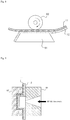
- Fig. 10 is a diagram of a method of forming a hard coating effectively employed when a sheet for forming a hard coating is used as a surface protective sheet.
- the sheet for forming the hard coating is disposed on the surface of a molded article 101 such that a base 11 (or an adhesive layer, not shown, if formed on the base 11) is placed at the bottom.
- the sheet is heated with a heater 103 to soften the base 11 and vacuum-suctioned 102 at a lower side to adhere the same to the molded article 101.
- the coating layer is photo-cured through light irradiation, thereby forming a hard coating.
- heating and vacuum-suctioning the sheet may be performed at the same time, and pressing is conducted from an upper side simultaneously with vacuum- suctioning at the lower side to improve adhesion efficiency.
- pressing the sheet for forming the hard coating may be conducted directly using a fluid or using a plastic sheet.
- Fig. 11 is a diagram of another method of forming a hard coating when a sheet for forming a hard coating is used as a surface protective sheet, in which molding by injection molding and forming the hard coating are concurrently performed.
- the sheet for forming the hard coating is disposed in a mold including a movable mold 112 and a fixed mold 111 such that a coating layer 12 is placed in contact with the fixed mold 111.
- the mold is sealed, and then a melted resin is injected 113 from a gate formed in the movable mold 112 to form a molded article and to bond a base of the sheet or an adhesive layer formed on the base to the surface of the molded article at the same time.
- the mold is opened and the molded article is taken out.
- the coating layer is cured by light irradiation to form a hard coating.
- a hard coating may be formed by various methods known in the art.
- the composition forms a hard coating or a protective layer exhibiting excellent physical properties, such as hardness, wear and tear resistance, abrasion resistance, and chemical resistance, and having superior gloss and a high refractive index.
- the composition when the composition is applied to a transfer material or a surface protective sheet, the composition exhibits excellent adhesion to another layer, e.g., a print layer, a deposition layer, or an adhesive layer, and has superior hardness, wear and tear resistance, abrasion resistance, and chemical resistance, thereby effectively forming a hard coating or a protective layer having excellent properties on the surface of various molded articles.
- GMA glycidyl methacrylate
- MMA methyl (meth)acrylate
- SM styrene
- BA butyl acetate
- AIBN 2,2'-azobisisobutyronitrile
- the temperature was adjusted to about 105°C and the nitrogen introduction pipe was replaced by an air introduction pipe, after which 37 parts by weight of acrylic acid (AA), 0.05 parts by weight of p-methoxyphenol, and 0.04 parts by weight of dimethylaminopyridine (DMAP) were added to and mixed with the product, followed by staying at 105°C under air bubbling.
- the mixture was left at the same temperature for 15 hours, 0.05 parts by weight of p-methoxyphenol was added thereto and cooled, and then methyl ethyl ketone was added thereto such that the content of nonvolatile components was 30%, thereby preparing a resin having an epoxy group and an acryloyl group.
- the prepared resin had an epoxy equivalent weight of 6,600 g/eq, an acryloyl equivalent weight of 349 g/eq. and a weight average molecular weight of 60,000 based on a polystyrene standard, measured by GPC.
- a melamine release agent was applied to a thickness of about 1 ⁇ m to one side of a polyethylene terephthalate (PET) film having a thickness of 38 ⁇ m as a base using gravure coating, thereby forming a release layer.
- the prepared coating solution was applied to a thickness of about 6 ⁇ m to the release layer using micro-gravure coating. Then, the applied coating solution was heated at 150°C for 30 seconds to cause reaction of epoxy groups of the resin and thiol groups of the thiol curing agent, thereby forming a heat-cured product.
- an anchor layer (acrylic anchor layer), a patterned layer (acryl-urethane ink), a vacuum-deposition layer (acrylic resin deposited primer), and an adhesive layer (acrylic adhesive) were sequentially formed on the coating layer including the heat-cured product using micro-gravure printing, thereby manufacturing a sheet for forming a hard coating.
- a hard coating was formed on the surface of a molded article by applying the prepared sheet to the method illustrated in Fig. 9 .
- the sheet was disposed such that the base was placed in contact with the fixed mold 92, followed by injection of a melted resin, separation of the base, and UV irradiation, thereby forming the hard coating.
- molding was carried out under the following conditions: the temperature of the resin was about 280°C, the temperature of the mold was about 60°C, and the pressure of the resin was about 1,600 kg/cm 2 . Further, UV was irradiated at 1,000 w/cm for about 3 seconds with a lamp from a height of about 10 cm.
- a composition and sheet for forming a hard coating were prepared in the same manner as in Example 1 except that ethylene glycol bis(3-mercaptopropionate) was used as a thiol curing agent instead of ethoxylated trimethylolpropane tris(3-mercaptopropionate), and a hard coating was formed on the surface of a molded article using the sheet.
- a composition and sheet for forming a hard coating were prepared in the same manner as in Example 1 except that trimethylolpropane tris(3-mercaptopropionate) was used as a thiol curing agent instead of ethoxylated trimethylolpropane tris(3-mercaptopropionate), and a hard coating was formed on the surface of a molded article using the sheet.
- a composition and sheet for forming a hard coating were prepared in the same manner as in Example 1 except that pentaerythritol tetrakis (3-mercapto-propionate) was used as a thiol curing agent instead of ethoxylated trimethylolpropane tris(3-mercaptopropionate), and a hard coating was formed on the surface of a molded article using the sheet.
- a composition and sheet for forming a hard coating were prepared in the same manner as in Example 1 except that pentaerythritol tetrakis (3-mercaptoacetate) was used as a thiol curing agent instead of ethoxylated trimethylolpropane tris(3-mercaptopropionate), and a hard coating was formed on the surface of a molded article using the sheet.
- a composition and sheet for forming a hard coating were prepared in the same manner as in Example 1 except that a urethane curing agent, diisocyanate, was used instead of a thiol curing agent, and a hard coating was formed on the surface of a molded article using the sheet.
- compositions for coating prepared in Examples and Comparative Example were evaluated as to physical propertirs (pencil hardness), and results are shown in Table 1.
- compositions prepared in Examples 1 to 5 and the Comparative Example were applied to a thickness of 6 ⁇ m to a 2 mm-thick poly(methyl methacrylate) (PMMA) substrate using bar coating. Subsequently, the product was heat-cured at 160°C for 40 seconds and then cured by UV irradiation (1,000 mW). Then, the pencil hardness of each product was evaluated at a load of 1 kg using a pencil hardness tester (Coretech Co.) and a Mitsubishi pencil for measuring hardness. Table 1 Example Comparative Example 1 2 3 4 5 Pencil hardness (H) 5 5 5.5 6 5.8 4
Landscapes
- Chemical & Material Sciences (AREA)
- Organic Chemistry (AREA)
- Health & Medical Sciences (AREA)
- Polymers & Plastics (AREA)
- Medicinal Chemistry (AREA)
- Chemical Kinetics & Catalysis (AREA)
- Wood Science & Technology (AREA)
- Life Sciences & Earth Sciences (AREA)
- Materials Engineering (AREA)
- Engineering & Computer Science (AREA)
- Physics & Mathematics (AREA)
- General Physics & Mathematics (AREA)
- Optics & Photonics (AREA)
- Laminated Bodies (AREA)
- Paints Or Removers (AREA)
- Application Of Or Painting With Fluid Materials (AREA)
Description
- The present invention relates to a resin composition for forming a hard coating, a sheet for forming a hard coating, and a method of forming a hard coating.
- Various methods are used to form a hard coating (also referred to as a protective layer) having excellent abrasion resistance and chemical resistance on various molded articles, such as resin products or wooden products, such as the resin composition disclosed in
JP2006089623 - The transfer material or surface protective sheet may include a decorative layer, such as a patterned layer or deposition layer, in a proper position as necessary. The transfer material mostly includes a patterned layer or deposition layer formed between the base and the coating layer, and the surface protective sheet generally includes a patterned layer or deposition layer formed on an opposite side of the base to the coating layer.
- When forming a hard coating using a transfer material or a surface protective sheet, a pre-curing process is carried out, in which light is irradiated prior to application of the transfer material or surface protective sheet to a molded article to photo-cure a coating layer. However, in the pre-curing process, when the transfer material or surface protective sheet is applied to the molded article, a cured hard coating may be separated from a curved potion or cracks may occur on the hard coating.
- Thus, in application to a molded article, an un-cured coating layer is bonded to the surface of the molded article and then cured, which is referred to as an after-curing method. However, the after-curing process has the following problems.
- A transfer material or surface protective sheet is generally prepared using a machine, such as a gravure rotary printing machine. However, when the post-curing process is used to form, for example, a patterned layer, a deposition layer, or an adhesive layer on a coating layer in forming a transfer material or to roll a sheet in forming a surface protective sheet, components of an uncured coating layer may be transferred to a guide roll or components used for forming the patterned layer or adhesive layer may be transferred to the coating layer. Further, components of the coating layer may be transferred back to the guide roll for forming the patterned layer or adhesive layer (a so-called back trapping phenomenon).
- Accordingly, when the post-curing process is used, special equipment or an additional process including a drying process is involved in forming a coating layer in order to remove fluidity or tack of the coating layer before photo curing. However, in this case, the coating layer, the patterned layer, or the adhesive layer may not be formed at the same time and substantial costs of designing separate equipment are needed, thereby reducing productivity of a transfer material or surface protective sheet and considerably increasing manufacturing costs.
- The present invention provides a resin composition for forming a hard coating, a sheet for forming a hard coating, and a method of forming a hard coating.
- An aspect of the present invention provides a resin composition for forming a hard coating, which includes a resin having an epoxy group and a (meth)acryloyl group and a thiol curing agent.
- As used herein, the term "hard coating" refers to a high-hardness functional layer which imparts wear and tear resistance, abrasion resistance, scratch resistance, and chemical resistance to surfaces of various molded articles including resin, wooden, metal or complex molded articles and may refer to a functional layer employed for various display apparatuses in some cases. The term "hard coating" may be equivalent to the term "protective layer" in some cases.
- Hereinafter, the resin composition according to the present invention will be described in detail.
- The composition of the present invention includes a resin containing an epoxy group and a (meth)acryloyl group. Herein, the term "(meth)acryloyl group," "(meth)acrylate," and "(meth)acrylic acid" collectively refer to both an acryloyl group and a (meth)acryloyl group, to both acrylate and (meth)acrylate, and to both acrylic acid and (meth)acrylic acid, respectively.
- The resin included in the resin composition has an epoxy equivalent weight of 4,000 to 8,000 g/eq. The term "epoxy equivalent weight (g/eq)" refers to a value obtained by dividing the molecular weight of an epoxy group by the number of epoxy groups included in the resin. Epoxy equivalent weight may be chemically analyzed by various titration methods known in the art. In the present invention, the epoxy equivalent weight of the resin is controlled within the above range, thereby providing a resin layer having excellent process efficiency such as heat curing efficiency, exhibiting properly controlled tack or adhesion after heat curing, and having excellent physical properties including solvent resistance or chemical resistance.
- In the resin composition, the resin may also have a (meth)acryloyl equivalent weight of about 100 to 1,000 g/eq, preferably about 200 to 500 g/eq. The term "(meth)acryloyl equivalent weight (g/eq)" refers to a value obtained by dividing the molecular weight of a (meth)acryloyl group by the number of (meth)acryloyl groups included in the resin. A (meth)acryloyl equivalent weight may be chemically analyzed by various titration methods generally known in the art. In the present invention, the (meth)acryloyl equivalent weight of the resin is controlled within the above range, thereby providing a hard coating layer having excellent process efficiency, such as photo curing efficiency, and exhibiting excellent physical properties including wear and tear resistance, abrasion resistance, and chemical resistance after curing.
- The resin containing the epoxy group and the (meth)acryloyl group may have a weight average molecular weight of about 5,000 to 100,000, preferably about 10,000 to 80,000, and more preferably about 20,000 to 70,000. As used herein, the term "weight average molecular weight (Mw)" refers to a value obtained based on a polystyrene standard measured by gel permeation chromatography (GPC). In the present invention, the weight average molecular weight is controlled within the above range, thereby providing a hard coating layer having excellent process efficiency, such as coatability, heat curing efficiency, and photo curing efficiency, exhibiting properly controlled tack or adhesion after heat curing, and having excellent physical properties including wear and tear resistance, abrasion resistance, and chemical resistance after photo curing.
- In the present invention, the resin may be prepared by any method. For example, a monomer mixture including an epoxy group containing monomer (e.g., glycidyl (meth)acrylate) is polymerized into an epoxy group containing polymer, which is subjected to addition reaction with a (meth)acryloyl group containing the compound, e.g., α,β-unsaturated monocarbonic acid (e.g., (meth)acrylic acid), thereby preparing the above resin.
- In one embodiment, the monomer mixture may include glycidyl (meth)acrylate alone or include glycidyl (meth)acrylate and another comonomer as necessary.
- Any comonomer which includes an α,β-unsaturated carbon-carbon double bond may be included in the monomer mixture. Examples of the comonomer may include, without being limited to, C1 to C14 alkyl group containing (meth)acrylates, styrene, vinyl acetate, or (meth)acrylonitrile. When the monomer mixture includes glycidyl (meth)acrylate and a comonomer, the amount of each monomer may not be particularly limited but be adjusted properly in consideration of desired effects. For example, the monomer mixture may include 5 to 70 parts by weight of the glycidyl (meth)acrylate and 5 to 70 parts by weight of the comonomer.
- The monomer mixture may be polymerized into a polymer by any polymerization method. For example, any polymerization generally used in the art, such as solution polymerization, photopolymerization, bulk polymerization, suspension polymerization, or emulsion polymerization, may be used.
- The polymer is then subjected to addition reaction with a (meth)acryloyl group containing compound, e.g., α,β-unsaturated monocarbonic acid (e.g., (meth)acrylic acid), thereby preparing the above resin. In this case, a method and conditions of the addition reaction of the polymer with the compound are not particularly limited but may be properly selected from methods and conditions generally used in the art. Further, the amount of the (meth)acryloyl group containing compound involved in addition reaction with respect to the polymer is not particularly limited but may be properly adjusted within the range in which an epoxy equivalent weight and a (meth)acryloyl equivalent weight are satisfactory. For example, the compound may be added such that the remaining amount of epoxy groups included in the polymer in addition reaction may be about 50% or less, preferably about 30% or less, and more preferably about 5 % with respect to a reaction equivalent weight of α,β-unsaturated monocarbonic acid of 100% based on the amount of the epoxy group containing monomer involved in the reaction.
- The resin composition of the present invention includes a thiol curing agent. As used herein, the term "thiol curing agent" refers to a compound having at least one thiol group which reacts with an epoxy group included in the resin or a carbon-carbon double bond of the compound included in the composition to primarily heat-cure the resin composition.
- Any thiol curing agent may be used so long as the curing agent includes at least one thiol group, preferably at least two thiol groups.
- Examples of the thiol curing agent may include at least one polythiol selected from the group consisting of ethoxylated trimethylolpropane tris(3-mercaptopropionate), trimethylolpropane tris(3-mercaptopropionate), glycol di(3-mercaptopropionate), pentaerythritol tetrakis (3-mercapto-propionate), 4-mercaptomethyl-3,6-dithia-1,8-octanedithiol, pentaerythritol tetrakis(3-mercaptoacetate), trimethylolpropane tris(3-mercaptoacetate), 4-t-butyl-1,2-benzenedithiol, 2-mercaptoethylsulfide, 4,4'-thiodibenzenethiol, benzenedithiol, glycol dimercaptoacetate, glycol dimercaptopropionate ethylene bis(3-mercaptopropionate), polyethylene glycol dimercaptoacetates, and polyethylene glycol di(3-mercaptopropionates).
- Specifically, the thiol curing agent may include a thiol curing agent represented by Formula 1:

- As used herein, the term "alkyl" or "alkoxy" may refer to a C1 to C20, C1 to C16, C1 to C12, C1 to C8, or C1 to C4 straight, branched, cyclic or noncyclic alkyl or alkoxy group, and the alkyl or alkoxy group may be randomly substituted by at least one substituent.
- Further, the term "alkenyl" or " alkynyl" may refer to a C2 to C20, C2 to C16, C2 to C12, C2 to C8, or C2 to C4 straight, branched, cyclic or noncyclic alkenyl or alkynyl group, and the alkenyl or alkynyl group may be randomly substituted by at least one substituent.
- Here, examples of the substituent to substitute for the alkyl, alkoxy, alkenyl, or alkynyl group may include any substituent generally used in the field of chemistry, for example, a thiol, amine, amide, halogen, hydroxyl, carboxyl, glycidyl, cynao, nitro, hetercycloalkyl, or aryl group, without being limited thereto.
- In the compound represented by Formula 1, any thiol containing group may be used so long as a substituent structure has a univalent moiety having a thiol group (-SH) at a terminal thereof. For example, the thiol containing group may be a univalent moiety represented by Formula 2:
-A-B-C-D-SH,
where A is a single bond or alkylene, B is -NH(C=O)-, -OC(=O), -O-E-C(=O)-, -SC(=O)-, or -OCH2-, C is a single bond or alkylene, D is a single bond or a bivalent moiety represented byFormula 3, and E is alkylene.
- In A, C or D, the term "single bond" means that there is no atom at the A, C or D position. For example, when A is a single bond, the thiol containing group is represented by -B-C-D-SH. When C is a single bond, the thiol containing group is represented by -A-B-D-SH. When D is a single bond, the thiol containing group is represented by -A-B-C-SH.
- Further, the term "alkylene" may represent C1 to C20, C1 to C16, C1 to C12, C1 to C8, or C1 to C4 straight, branched, cyclic, or noncyclic alkylene, and the alkylene may be randomly substituted by at least one substituent.
- In addition, the term "bivalent aryl" refers to a bivalent moiety derived from an aromatic ring compound or including the compound in the structure. For example, bivalent aryl may refer to a bivalent moiety derived from a 6 to 22-membered, 6 to 18-membered, 6 to 14-membered, or 6 to 10-membered aromatic ring compound or including these compounds in the structure and be randomly substituted by at least one substituent.
- In
Formula 3, n may be an integer from 0 to 7, preferably 0 to 5, and more preferably 0 to 3. - Examples of the substituent to substitute alkylene or bivalent aryl are described as above with reference to Formula 1.
- In the thiol curing agent represented by Formula 1, R1 to R4 each independently may represent hydrogen, C1 to C4 alkyl or -A-B-C-D-SH, preferably hydrogen, methyl, ethyl or -A-B-C-D-SH.
- Further, at least two, preferably at least three of R1 to R4 may be -A-B-C-D-SH, wherein A may be a single bond or C1 to C4 alkylene, B may be -OC(=O) or - O-E-OC(=O)-, C may be a single bond or C1 to C4 alkylene, D may be a single bond or a bivalent moiety represented by Formula 4, and E may be a C1 to C4 alkylene:

- Examples of the thiol curing agent represented by the above formula may include, without being limited to, alkoxylated trimethylolpropane tris(3-mercaptopropionate), trimethylolpropane tris(3-mercaptopropionate), or alkylene glycol bis(3-mercaptopropionate), more specifically ethoxylated trimethylolpropane tris(3-mercaptopropionate), trimethylolpropane tris(3-mercaptopropionate), or ethylene glycol bis(3-mercaptopropionate).
- In the resin composition, the amount of the thiol curing agent may be properly adjusted in consideration of the equivalent weight of epoxy groups included in the resin or a desired curing rate, without being limited particularly. For example, the resin composition may include 0.1 to 10 parts by weight, preferably 0.5 to 5 parts by weight of the thiol curing agent based on 100 parts by weight of the resin. In the present invention, a ratio of the thiol curing agent to the resin is controlled within the above range, thereby inducing appropriate reaction with an epoxy group or a carbon-carbon double bond in heat curing, properly controlling expression of tact after heat curing, and maintaining superior physical properties including solvent resistance or coatability.
- The resin composition of the present invention may further include a photoinitiator. In the present invention, any photoinitiator generally known in the art may be used.
- Examples of the photoinitiator may include benzoins, hydroxyl ketones, amino ketones, or phosphine oxides, specifically benzoin, benzoin methyl ether, benzoin ethyl ether, benzoin isopropyl ether, benzoin-n-butyl ether, benzoin isobutyl ether, acetophenone, dimethylaminoacetophenone, 2,2-dimethoxy-2-phenylacetophenone, 2,2-diethoxy-2-phenylacetophenone, 2-hydroxy-2-methyl-1-phenylpropane-1-one, 1-hydroxycyclohexyl phenyl ketone, 2-methyl-1-[4-(methylthio)phenyl]-2-morpholino-propane-1-one, 4-(2-hydroxyethoxy)phenyl-2(hydroxy-2-propyl)ketone, benzophenone, p-phenylbenzophenone, 4,4'-diethylamino benzophenone, dichlorobenzophenone, 2-methylanthraquinone, 2-ethylanthraquinone, 2-tert-butylanthraquinone, 2-aminoanthraquinone, 2-methylthioxanthone, 2-ethylthioxanthone, 2-chlorothioxanthone, 2,4-dimethylthioxanthone, 2,4-diethylthioxanthone, benzyl dimethyl ketal, acetophenonedimethyl ketal, p-dimethylamine benzoate, oligo(2-hydroxy-2-methyl-1-[4-(1-methylvinyl)phenyl]propanone), and 2,4,6-trimethylbenzoyldiphenylphosphine oxide, which may be used alone or as mixtures, without being limited thereto.
- The photoinitiator may be present in an amount of 1 to 15 parts by weight, preferably 3 to 12 parts by weight, and more preferably 5 to 10 parts by weight, based on 100 parts by weight of the resin. Within this range, the composition can maintain excellent photo-curing efficiency and be prevented from deteriorating in physical properties due to remaining components after curing.
- The resin composition may further include multifunctional acrylate. When the resin composition includes a multifunctional acrylate, the hard coating can have a close cross-linking structure after photo-curing and thus have improved physical properties, such as hardness, wear and tear resistance, abrasion resistance, and chemical resistance.
- Examples of the multifunctional acrylate may include, without being limited to, bifunctional acrylates, such as 1,4-butanediol di(meth)acrylate, 1,6-hexanediol di(meth)acrylate, neopentyl glycol di(meth)acrylate, polyethylene glycol di(meth)acrylate, neopentyl glycol adipate di(meth)acrylate, hydroxyl pivalic acid neopentyl glycol di(meth)acrylate, dicyclopentanyl di(meth)acrylate, caprolactone modified dicyclopentenyl di(meth)acrylate, ethyleneoxide modified di(meth)acrylate, di(meth)acryloxy ethyl isocyanurate, allylated cyclohexyl di(meth)acrylate, tricyclodecanedimethanol (meth)acrylate, dimethylol dicyclopentane di(meth)acrylate, ethyleneoxide modified hexahydrophthalic acid di(meth)acrylate, tricyclodecane dimethanol(meth)acrylate, neopentyl glycol modified trimethylpropane di(meth)acrylate, adamantane di(meth)acrylate or 9,9-bis[4-(2-acryloyloxyethoxy)phenyl]fluorene); trifunctional acrylates, such as trimethylolpropane tri(meth)acrylate, dipentaerythritol tri(meth)acrylate, propionic acid modified dipentaerythritol tri(meth)acrylate, pentaerythritol tri(meth)acrylate, propyleneoxide modified trimethylolpropane tri(meth)acrylate, trifunctional urethane (meth)acrylate or tris(meth)acryloxyethylisocyanurate; tetrafunctional acrylates, such as digylcerin tetra(meth)acrylate or pentaerythritol tetra(meth)acrylate; pentafunctional acrylates, such as propionic acid modified dipentaerythritol penta(meth)acrylate; and hexafunctional acrylates, such as dipentaerythritol hexa(meth)acrylate, caprolactone modified dipentaerythritol hexa(meth)acrylate or urethane (meth)acrylate (e.g, reaction products of an isocyanate monomer and trimethylolpropane tri(meth)acrylate).
- Specifically, an acrylate including a ring structure and/or a urethane bond in the molecular structure thereof may be used as the multifunctional acrylate. Due to use of such acrylate, the hard coating layer can have excellent hardness after curing and a high refractive index. In this case, the ring structure included in the acrylate may be a carbocyclic, heterocyclic, monocyclic or polycyclic structure. In detail, examples of the ring structure included in the multifunctional acrylate may include C3 to C12, preferably C3 to C8 cycloalkyl ring structures, such as cyclopentane, cyclohexane, or cycloheptane, and the acrylate may include at least one, preferably 1 to 5, and more preferably 1 to 3 such ring structures and may include at least one hetero atom, such as O, S or N.
- Examples of the multifunctional acrylate containing the ring structure may include, without being limited to, a monomer having an isocyanurate structure, such as tris(meth)acryloxyethylisocyanurate, and isocyanurate modified urethane acrylate (e.g., reaction products of isocyanate compounds having a ring structure, such as isoboron diisocyanate, and acrylate compounds, such as trimethylolpropane tri(meth)acrylate or pentaerythritol tri(meth)acrylate).
- The multifunctional acrylate may be present in an amount of 30 parts by weight or less, preferably 5 to 15 parts by weight based on 100 parts by weight of the resin. Within this range, the hard coating layer can have superior physical properties, such as hardness.
- The resin composition may further include an antioxidant, and thus yellowing of the coating layer may be prevented.
- Any antioxidant known in the art may be used, without being limited thereto. For example, phenolic antioxidants, (e.g., IRGANOX, RONOTEC and ETANOX), phosphorus antioxidants (e.g., CYANOX and ULTRANOX), or chelate antioxidants (e.g., IGAFOS) may be used.
- The amount of the antioxidant is not particularly limited but may be properly adjusted in view of physical properties of the coating layer. For example, the resin composition may include 0.1 to 2 parts by weight of the antioxidant based on 100 parts by weight of the resin.
- The resin composition may further include a lubricant. The lubricant may improve winding efficiency of the coating layer formed of the resin composition, blocking resistance, wear and tear resistance, and scratch resistance. Any lubricant may be used, for example, waxes, such as polyethylene wax, paraffin wax, synthetic wax, and montan wax; and synthetic resins, such as silicon resins or fluoric resins. The lubricant may be present in an amount of 0.5 to 15 parts by weight, preferably 1 to 6 parts by weight based on 100 parts by weight of the resin, without being limited thereto. Within this range, the coating layer can have excellent blocking resistance, abrasion resistance, and scratch resistance while maintaining superior transparency as well.
- The resin composition may include a proper amount of a UV absorber in order to improve light resistance. Examples of the UV absorber may include hydroxyphenyl benzotriazole, hydroxyphenyl-S-triazine, or 2-(2'-hydroxy-5'-methacryloxyethylphenyl)-2H-benzotriazole, without being limited thereto. When the UV absorber is included, the amount of the UV absorber is not particularly limited and may be properly adjusted in view of desired physical properties.
- In addition to the above components, the resin composition may further include additives generally known in the art, for example, a thermosetting catalyst, such as dimethylaminopyridine (DMAP), fillers, such as nano-silica, an isocyanate compound, etc. Another aspect of the present invention provides a sheet for forming a hard coating which includes a base and a coating layer formed on the base and containing a heat-cured product of the resin composition according to the present invention.
- The sheet for forming the hard coating of the present invention may be a transfer material or surface protective sheet to form a hard coating on surfaces of various molded products by various methods.
-
Fig. 1 is a cross-sectional view of a sheet for forming a hard coating according to an exemplary embodiment of the invention. As shown inFig. 1 , the sheet 1 for forming the hard coating may include abase 11 and acoating layer 12 formed on one side of the base. As needed, the sheet 1 may further include a layer formed on thecoating layer 12 or an opposite side of the base 11 to thecoating layer 12. In this case, the layer may be any layer generally known in the art including a patterned layer, a deposition layer, or an adhesive layer. - As used herein, the expressions "B formed on A," "B formed on an upper side of A," or "B formed on the surface of A" mean that B can be attached or bonded directly to the surface of A, B can be attached or bonded to A by a pressure-sensitive adhesive or an adhesive, or an intervening layer can be formed between A and B (e.g., A-C-B).
- In the sheet for forming the hard coating layer, the coating layer may be a photo-curable type layer, which includes a heat-cured product of the resin composition of the present invention as an effective element. As used herein, the term "heat-cured product of a resin composition" refers to an addition reaction product formed by epoxy groups included in the resin and thiol groups of the thiol curing agent via open ring addition reaction. Further, the term "photocurable type" means that curing reaction may occur by reaction of (meth)acryloyl groups included in the resin when electromagnetic waves are irradiated thereupon. In this case, electromagnetic waves may collectively refer not only to microwaves, infrared light (IR), ultraviolet light (UV), x-rays and gamma (γ) rays, but also to particle beams, such as α-particle beams, proton beams, neutron beams, and electron beams.
- The coating layer may be formed, for example, by treating the resin composition containing the above components in proper conditions to form an addition reaction product via addition reaction of epoxy groups of the resin of the composition and thiol groups of the thiol curing agent and applying the composition including the product to the base in a proper manner. In this case, reaction conditions to preform the addition reaction product are not particularly limited and may be properly set in consideration of the amount or kind of the epoxy groups of the resin or the thiol groups of the curing agent. For example, the resin composition is prepared and treated at about 100 to 170°C for 30 minutes to 2 minutes, thereby forming the addition reaction product.
- According to the above process, the coating layer which does not have tack is formed even though a drying process is not included. Accordingly, the present invention enables further formation of additional layers, such as a patterned layer, a deposition layer, or an adhesive layer, on the coating layer or winding of the sheet for forming the hard coating without special equipment for forming a coating layer or a drying process.
- The thickness of the coating layer of the sheet for forming the hard coating is not particularly limited but may be properly adjusted in view of desired physical properties.
- The base is not particularly limited as to kind. Examples of the base may include resin films containing polypropylene resins, polyethylene resins, polyamide resins, polyester resins, polyacrylic resins, or polyvinyl chloride resins as a main ingredient; metal foils, such as aluminum foil or copper foil; cellulose sheets, such as glassine paper, coated paper, or cellophane; or a complex sheet of at least two thereof. Further, when the sheet for forming the hard coating constitutes a surface protective sheet, the base may include a resin sheet which does not have release properties and contains an acrylic resin, a polycarbonate resin, a vinyl chloride resin, a urethane resin, or a polyester resin as a main ingredient. Further, the thickness of the base is not particularly limited but may be properly adjusted in view of desired physical properties.
- When the sheet for forming the hard coating constitutes a transfer material, one or opposite sides of the base are subjected to release coating and the coating layer may be formed on a release coating surface. In this case, a release coating layer may be formed by any method, for example, various printing methods or coating methods using epoxy, epoxy-melamine, aminoalkyd, acrylic, melamine, silicon, fluorine, cellulose, urea resin, polyolefin, paraffin release agents or a complex release agent of at least two thereof.
- As needed, the base or the release coating surface may be formed in a photoless form. For example, embossing is conducted or fine powder of calcium carbonate, silica, zinc oxide, magnesium carbonate, polyethylene wax, or glass beads are introduced into the release coating layer to form the photoless type base. Accordingly, in the transfer material, fine uneven parts formed on the release coating surface are transferred to the surface of the coating layer after separating the base, thereby obtaining a molded article having a photoless surface. The photoless surface may be formed entirely or partly on the surface of the base or release coating layer. When "formed partly, the photoless surface may include a material containing the same fine powder as in forming the release coating layer.
- The thickness of the release coating layer or photoless layer is not particularly limited and may be properly adjusted as necessary.
- Referring to
Figs. 2 and 3 ,sheets adhesive layers coating layer 12 or abase 11. - For example, when the
sheet 2 is used as a transfer material or surface protective sheet, theadhesive layers - The adhesive layers 21, 31 may be formed of various heat-sensitive or pressure-sensitive resins generally known in the art. For example, the
adhesive layers adhesive layers - Referring to
Figs. 4, 5 ,sheets 4, 5 for forming a hard coating according to the present invention may includepatterned layers coating layer 12 or abase 11, andadhesive layers patterned layers - Referring to
Figs. 6, 7 ,sheets layers Figs. 6, 7 show that thepatterned layers coating layer 12 or abase 11 and the deposition layers 61, 71 are formed thereon, the deposition layers 61, 71 may be formed directly on thecoating layer 12 or thebase 11 without the deposition layers 61, 71 as necessary. The deposition layers may be formed using any material and method generally used in the art, for example by vacuum deposition, sputtering, and the like. - The sheets for forming the hard coating of the present invention may include at least one anchor layer installed in a proper place between the layers. The anchor layer may function to enhance adhesion between the layers of the sheets and to protect a molded article or a patterned layer from chemicals. The anchor layer may be formed, for example, of a two-component urethane resin, melamine or epoxy thermosetting resins, or a thermoplastic resin including a vinyl chloride copolymer resin by a general method.
- Still another aspect of the present invention provides a method of forming a hard coating which forms a hard coating on the surface of a molded article using the sheet for forming the hard coating according to the present invention.
- The method of forming the hard coating may include various steps depending on a type of a sheet for forming a hard coating.
- For example, when the sheet for forming the hard coating is a transfer material, the method may include bonding a coating layer of the sheet or an adhesive layer formed on the coating layer to the surface of a molded article; separating a base; and photo-curing the coating layer through light irradiation.
- In the present invention, due to use of the transfer material, a hard coating may be formed on the surface of a molded article concurrently with manufacture of the molded article though injection molding. In this case, the method may include disposing the sheet in a mold, with the coating layer or the adhesive layer, if formed on the coating layer, being disposed inward; injecting a melted resin into a cavity of the mold; separating the base from the sheet; and photo-curing the coating layer through light irradiation.
- When the sheet is a surface protection film, the method may include disposing the sheet, with a base or an adhesive layer, if formed on the base, facing the surface of a molded article; heating the sheet to soften the base; vacuum-suctioning the sheet at a lower part to adhere to the surface of the molded article; and photo-curing the coating layer through light irradiation.
- In the present invention, due to use of the surface protection film, a hard coating may be formed on the surface of a molded article concurrently with manufacture of the molded article though injection molding. In this case, the method may include disposing the sheet in a mold, with the coating layer or the adhesive layer, if formed on the coating layer, being disposed inward; injecting a melted resin into a cavity of the mold; separating the base from the sheet; and photo-curing the coating layer through light irradiation.
- In each method, separating the base and photo-curing may be performed in random order. For example, separating the base may be conducted prior to photo-curing through light irradiation. In the present invention, the base may be formed of a light-transmitting material and the coating layer is cured, followed by separating the base.
- Hereinafter, a transfer method of the present invention will be described in detail with reference to the accompanying drawings.
-
Fig. 8 is a diagram of a transfer method according to an embodiment of the present invention. The method shown inFig. 8 is effectively employed when a sheet according to the present invention is used as a transfer material (as shown inFigs. 2 ,4 , and6 ), without being limited thereto. - According to the method, a sheet for forming a hard coating is disposed on a molded
article 81, with a coating layer 12 (or an adhesive layer, not shown, if formed on the coating layer 12) being placed at the bottom. Then, heat and/or pressure is applied to abase 11 of the sheet at about 80 to 260°C and about 50 to 200 kg/m2 using a roll transcriber or an up-down transcriber including a heat-resistant rubberelastic member 82, e.g., silicon rubber, by a medium of the heat-resistant rubberelastic member 82. Accordingly, thecoating layer 12 or the adhesive layer is bonded to the surface of the moldedarticle 81. Subsequently, the sheet is properly cooled as necessary, and then thebase 11 is separated from thecoating layer 12. Then, thecoating layer 12 transferred to the moldedarticle 81 is photo-cured through light irradiation. As described above, the photo-curing process may be performed before separation of thebase 11. - Conditions of photo irradiation are not particularly limited but may be properly controlled in view of a composition of the coating layer.
- Further, the material quality of the molded article is not particularly limited. For example, the molded article may include resin products, wooden products, metal products, complex products thereof, or any type of molded products requiring a hard coating. Here, the resin products may include widely used resins, such as a polystyrene resin, a polyolefin resin, an ABS resin, an AS resin, or an AN resin. In addition, general engineering resins, such as a polyphenylene oxide/polystyrene resin, a polycarbonate resin, a polyacetal resin, an acrylic resin, a polycarbonate modified polyphenylene ether resin, a polyethylene terephthalate resin, a polybutylene terephthalate resin, and an ultra-high-molecular weight polyethylene resin; and super engineering resins, such as a polysulfone resin, a polyphenyl sulfide resin, a polyphenylene oxide resin, a polyacrylate resin, a polyether imide resin, a polyimide resin, a liquid crystal polyester resin, and a heat-resistant polyaryl resin, may be used. Furthermore, complex resins containing a reinforcing material, such as glass fiber or inorganic fillers, may be used.
-
Fig. 9 is a diagram of a transfer method according to another embodiment of the invention, in which molding and transferring are concurrently performed by injection molding, thereby transferring a coating layer to the surface of a molded article. - According to the method, a sheet for forming a hard coating is disposed in a mold including a
movable mold 91 and a fixedmold 92 such that a coating layer 12 (or an adhesive layer, not shown, if formed on the coating layer) is disposed inward and abase 11 is placed in contact with the fixedmold 92. Subsequently, the mold is sealed, and then a meltedresin 93 is injected into the mold from a gate formed in themovable mold 91 to form a molded article and to bond the coating layer to the surface of the molded article at the same time. Then, after the resin molded article is cooled in proper conditions as necessary, the mold is opened and the resin molded article is taken out. Before or after separating thebase 11, the coating layer is cured by light irradiation to form a hard coating. -
Fig. 10 is a diagram of a method of forming a hard coating effectively employed when a sheet for forming a hard coating is used as a surface protective sheet. According to the method, the sheet for forming the hard coating is disposed on the surface of a moldedarticle 101 such that a base 11 (or an adhesive layer, not shown, if formed on the base 11) is placed at the bottom. Then, the sheet is heated with aheater 103 to soften thebase 11 and vacuum-suctioned 102 at a lower side to adhere the same to the moldedarticle 101. The coating layer is photo-cured through light irradiation, thereby forming a hard coating. In this method, heating and vacuum-suctioning the sheet may be performed at the same time, and pressing is conducted from an upper side simultaneously with vacuum- suctioning at the lower side to improve adhesion efficiency. In this case, pressing the sheet for forming the hard coating may be conducted directly using a fluid or using a plastic sheet. -
Fig. 11 is a diagram of another method of forming a hard coating when a sheet for forming a hard coating is used as a surface protective sheet, in which molding by injection molding and forming the hard coating are concurrently performed. According to this method, the sheet for forming the hard coating is disposed in a mold including amovable mold 112 and a fixedmold 111 such that acoating layer 12 is placed in contact with the fixedmold 111. The mold is sealed, and then a melted resin is injected 113 from a gate formed in themovable mold 112 to form a molded article and to bond a base of the sheet or an adhesive layer formed on the base to the surface of the molded article at the same time. Then, after the molded article is cooled as necessary, the mold is opened and the molded article is taken out. Subsequently, the coating layer is cured by light irradiation to form a hard coating. - In addition to the above methods, a hard coating may be formed by various methods known in the art.
- According to embodiments of the invention, the composition forms a hard coating or a protective layer exhibiting excellent physical properties, such as hardness, wear and tear resistance, abrasion resistance, and chemical resistance, and having superior gloss and a high refractive index. For example, when the composition is applied to a transfer material or a surface protective sheet, the composition exhibits excellent adhesion to another layer, e.g., a print layer, a deposition layer, or an adhesive layer, and has superior hardness, wear and tear resistance, abrasion resistance, and chemical resistance, thereby effectively forming a hard coating or a protective layer having excellent properties on the surface of various molded articles.
-
-
Figs. 1 to 7 are cross-sectional views of sheets for forming a hard coating according to various embodiments of the present invention; and -
Figs. 8 to 11 are diagrams of methods of forming a hard coating according to various embodiments of the present invention. - Next, the present invention will be explained in more detail with reference to examples and comparative examples. These examples are provided for illustrative purposes only and are not to be in any way construed as limiting the present invention.
- 11 parts by weight of glycidyl methacrylate (GMA), 3 parts by weight of methyl (meth)acrylate (MMA), 6 parts by weight of styrene (SM), 150 parts by weight of butyl acetate (BA), and 0.25 parts by weight of 2,2'-azobisisobutyronitrile (AIBN) were added to a reactor having a stirring device, a cooling pipe, a dropping lot, and a nitrogen introduction pipe. The reactor was heated to about 65°C over about 1 hour under a nitrogen atmosphere and kept warm for about 9 hours. Then, a mixture including 43 parts by weight of GMA, 12 parts by weight of MMA, 25 parts by weight of SM, 0.5 parts by weight of lauryl mercaptan, and 1 part by weight of AIBN was dripped into the reactor over about 2 hours under a nitrogen atmosphere using the dropping lot, and the reactor was held at the same temperature for about 3 hours. Then, 0.25 parts by weight of AIBS was added to the reactor, which was kept warm for 2 hours. Subsequently, the temperature was adjusted to about 105°C and the nitrogen introduction pipe was replaced by an air introduction pipe, after which 37 parts by weight of acrylic acid (AA), 0.05 parts by weight of p-methoxyphenol, and 0.04 parts by weight of dimethylaminopyridine (DMAP) were added to and mixed with the product, followed by staying at 105°C under air bubbling. The mixture was left at the same temperature for 15 hours, 0.05 parts by weight of p-methoxyphenol was added thereto and cooled, and then methyl ethyl ketone was added thereto such that the content of nonvolatile components was 30%, thereby preparing a resin having an epoxy group and an acryloyl group. As a result of chemical analysis through titration, the prepared resin had an epoxy equivalent weight of 6,600 g/eq, an acryloyl equivalent weight of 349 g/eq. and a weight average molecular weight of 60,000 based on a polystyrene standard, measured by GPC.
- 5 parts by weight of ethoxylated trimethylolpropane tris(3-mercaptopropionate) as a thiol curing agent, 20 parts by weight of dipentaerythritol hexaacrylate (DPHA), 5 parts by weight of a 1,6-hexane isocyanate trimer, 8 parts by weight of a photoinitiator, 1 part by weight of an antioxidant, 20 parts by weight of nanosilica, and 70 parts by weight of methyl ethyl ketone were mixed with 100 parts by weight of the resin, thereby preparing a coating solution.
- A melamine release agent was applied to a thickness of about 1 µm to one side of a polyethylene terephthalate (PET) film having a thickness of 38 µm as a base using gravure coating, thereby forming a release layer. The prepared coating solution was applied to a thickness of about 6 µm to the release layer using micro-gravure coating. Then, the applied coating solution was heated at 150°C for 30 seconds to cause reaction of epoxy groups of the resin and thiol groups of the thiol curing agent, thereby forming a heat-cured product. Then, an anchor layer (acrylic anchor layer), a patterned layer (acryl-urethane ink), a vacuum-deposition layer (acrylic resin deposited primer), and an adhesive layer (acrylic adhesive) were sequentially formed on the coating layer including the heat-cured product using micro-gravure printing, thereby manufacturing a sheet for forming a hard coating.
- A hard coating was formed on the surface of a molded article by applying the prepared sheet to the method illustrated in
Fig. 9 . In detail, the sheet was disposed such that the base was placed in contact with the fixedmold 92, followed by injection of a melted resin, separation of the base, and UV irradiation, thereby forming the hard coating. Here, molding was carried out under the following conditions: the temperature of the resin was about 280°C, the temperature of the mold was about 60°C, and the pressure of the resin was about 1,600 kg/cm2. Further, UV was irradiated at 1,000 w/cm for about 3 seconds with a lamp from a height of about 10 cm. - A composition and sheet for forming a hard coating were prepared in the same manner as in Example 1 except that ethylene glycol bis(3-mercaptopropionate) was used as a thiol curing agent instead of ethoxylated trimethylolpropane tris(3-mercaptopropionate), and a hard coating was formed on the surface of a molded article using the sheet.
- A composition and sheet for forming a hard coating were prepared in the same manner as in Example 1 except that trimethylolpropane tris(3-mercaptopropionate) was used as a thiol curing agent instead of ethoxylated trimethylolpropane tris(3-mercaptopropionate), and a hard coating was formed on the surface of a molded article using the sheet.
- A composition and sheet for forming a hard coating were prepared in the same manner as in Example 1 except that pentaerythritol tetrakis (3-mercapto-propionate) was used as a thiol curing agent instead of ethoxylated trimethylolpropane tris(3-mercaptopropionate), and a hard coating was formed on the surface of a molded article using the sheet.
- A composition and sheet for forming a hard coating were prepared in the same manner as in Example 1 except that pentaerythritol tetrakis (3-mercaptoacetate) was used as a thiol curing agent instead of ethoxylated trimethylolpropane tris(3-mercaptopropionate), and a hard coating was formed on the surface of a molded article using the sheet.
- A composition and sheet for forming a hard coating were prepared in the same manner as in Example 1 except that a urethane curing agent, diisocyanate, was used instead of a thiol curing agent, and a hard coating was formed on the surface of a molded article using the sheet.
- The compositions for coating prepared in Examples and Comparative Example were evaluated as to physical propertirs (pencil hardness), and results are shown in Table 1.
- Each of the compositions prepared in Examples 1 to 5 and the Comparative Example was applied to a thickness of 6 µm to a 2 mm-thick poly(methyl methacrylate) (PMMA) substrate using bar coating. Subsequently, the product was heat-cured at 160°C for 40 seconds and then cured by UV irradiation (1,000 mW). Then, the pencil hardness of each product was evaluated at a load of 1 kg using a pencil hardness tester (Coretech Co.) and a Mitsubishi pencil for measuring hardness.
Table 1 Example Comparative Example 1 2 3 4 5 Pencil hardness (H) 5 5 5.5 6 5.8 4 - As shown in Table 1, when the compositions for forming a hard coating according to the present invention are used, a hard coating having an effectively high hardness is formed.
Claims (14)
- A resin composition for forming a hard coating (1), comprising:a resin having an epoxy group and a (meth)acryloyl group; anda thiol curing agent, characterized in that the resin has an epoxy equivalent weight of 4 000 to 8 000 g/eq.
- The resin composition of claim 1, wherein the resin has a (meth)acryloyl equivalent weight of about 100 to 1 000 g/eq.
- The resin composition of claim 1, wherein the resin has a weight average molecular weight of about 5 000 to 100 000
- The resin composition of claim 1, wherein the thiol curing agent comprises at least one selected from the group consisting of ethoxylated trimethylolpropane tris(3-mercaptopropionate), trimethylolpropane tris(3-mercaptopropionate), glycol di(3-mercaptopropionate), pentaerythritol tetrakis (3-mercapto-propionate), 4-mercaptomethyl-3,6-dithia-1,8-octanedithiol, pentaerythritol tetrakis(3-mercaptoacetate), trimethylolpropane tris(3-mercaptoacetate), 4-t-butyl-1,2-benzenedithiol, 2-mercaptoethylsulfide, 4,4'-thiodibenzenethiol, benzenedithiol, glycol dimercaptoacetate, glycol dimercaptopropionate ethylene bis(3-mercaptopropionate), polyethylene glycol dimercaptoacetates, and polyethylene glycol di(3-mercaptopropionates).
- The resin composition of claim 1, wherein the thiol curing agent is represented by Formula 1:

- The resin composition of claim 5, wherein the thiol containing group is represented by Formula 2:
-A-B-C-D-SH
where A is a single bond or alkylene, B is -NH(C=O)-, -OC(=O), -O-E-C(=O)-, - SC(=O)-, or -OCH2-, C is a single bond or alkylene, D is a single bond or a bivalent moiety represented by Formula 3, and E is alkylene:
- The resin composition of claim 5, wherein R1 to R4 each independently represent hydrogen, C1 to C4 alkyl or -A-B-C-D-SH, and at least two of R1 to R4 comprise -A-B-C-D-SH, in which A is a single bond or C1 to C4 alkylene, B is - OC(=O) or -O-E-OC(=O)-, C is a single bond or C1 to C4 alkylene, D is a single bond or a bivalent moiety represented by Formula 4, and E is C1 to C4 alkylene:


- The resin composition of claim 1, wherein the thiol curing agent is present in an amount of 0.1 to 10 parts by weight based on 100 parts by weight of the resin.
- The resin composition of claim 1, further comprising a photoinitiator, preferably wherein the photoinitiator is present in an amount of 1 to 15 parts by weight based on 100 parts by weight of the resin.
- The resin composition of claim 1, further comprising a multifunctional acrylate, preferably wherein the multifunctional acrylate is present in an amount of 30 parts by weight or less based on 100 parts by weight of the resin.
- The resin composition of claim 1, further comprising an antioxidant, preferably wherein the antioxidant comprises phenolic antioxidants, phosphorus antioxidants, or chelate antioxidants, preferably wherein the antioxidant is present in an amount of 0.1 to 2 parts by weight based on 100 parts by weight of the resin.
- The resin composition of claim 1, further comprising a lubricant, a UV absorber, a thermosetting catalyst, or fillers.
- A sheet a hard coating comprising:a base; anda coating layer formed on the base and comprising a heat-cured product of the resin composition of any one of claims 1 to 12.
- A method of forming a hard coating comprising:
forming a hard coating on a surface of a molded article using the sheet for forming the hard coating of claim 13.
Applications Claiming Priority (2)
| Application Number | Priority Date | Filing Date | Title |
|---|---|---|---|
| KR1020100012460A KR101585269B1 (en) | 2010-02-10 | 2010-02-10 | Resin composition for forming hardcoating |
| PCT/KR2011/000878 WO2011099778A2 (en) | 2010-02-10 | 2011-02-09 | Resin composite for forming hard coat layer |
Publications (3)
| Publication Number | Publication Date |
|---|---|
| EP2535383A2 EP2535383A2 (en) | 2012-12-19 |
| EP2535383A4 EP2535383A4 (en) | 2013-08-21 |
| EP2535383B1 true EP2535383B1 (en) | 2018-08-08 |
Family
ID=44368303
Family Applications (1)
| Application Number | Title | Priority Date | Filing Date |
|---|---|---|---|
| EP11742470.5A Not-in-force EP2535383B1 (en) | 2010-02-10 | 2011-02-09 | Resin composite for forming hard coat layer |
Country Status (7)
| Country | Link |
|---|---|
| US (1) | US8937116B2 (en) |
| EP (1) | EP2535383B1 (en) |
| JP (1) | JP5602240B2 (en) |
| KR (1) | KR101585269B1 (en) |
| CN (1) | CN102482529A (en) |
| TW (1) | TWI438217B (en) |
| WO (1) | WO2011099778A2 (en) |
Families Citing this family (18)
| Publication number | Priority date | Publication date | Assignee | Title |
|---|---|---|---|---|
| KR101552739B1 (en) | 2010-02-10 | 2015-09-14 | (주)엘지하우시스 | Sheet for forming hardcoating |
| JP5727606B2 (en) * | 2011-06-23 | 2015-06-03 | 三井化学株式会社 | Polymerizable composition for optical material |
| CN102443139A (en) * | 2011-09-22 | 2012-05-09 | 福建省东协橡塑实业有限公司 | Polythiol curing agent and preparation method thereof |
| KR101657052B1 (en) * | 2011-12-29 | 2016-09-20 | 금호석유화학 주식회사 | Organic anti reflective layer composition |
| KR101420079B1 (en) * | 2012-05-08 | 2014-07-15 | 에스케이씨 주식회사 | In-mold film for injection molding and method for forming undercoating layer used in the preparation thereof |
| KR101600390B1 (en) * | 2014-04-15 | 2016-03-07 | 김재익 | Flexible hardcoating composition and forming hardcoating using the same |
| US10066136B2 (en) * | 2014-04-22 | 2018-09-04 | Dow Global Technologies Llc | Polyurethane-acrylate epoxy adhesive |
| KR101828516B1 (en) | 2014-09-18 | 2018-02-12 | 주식회사 엘지화학 | Plastic film and method for preparing the same |
| WO2016208785A1 (en) * | 2015-06-24 | 2016-12-29 | 삼성전자 주식회사 | Hard coating film for display device and display device comprising same |
| US9870972B2 (en) * | 2015-08-13 | 2018-01-16 | Fuji Electric Co., Ltd. | Thermosetting resin molded article |
| KR102060079B1 (en) * | 2016-04-21 | 2019-12-30 | (주)엘지하우시스 | Dual curing type hard coating composition and decoration sheet using the same and method of manufacturing the decoration sheet |
| CN106366294B (en) * | 2016-09-29 | 2018-11-09 | 西安交通大学 | Fluorine-containing hydrophobic epoxy hardener of one kind and preparation method thereof |
| KR102109452B1 (en) * | 2017-01-25 | 2020-05-12 | (주)엘지하우시스 | A decoration sheet and methods for manufacturing the decoration sheet |
| JP6842977B2 (en) * | 2017-04-12 | 2021-03-17 | 株式会社ダイセル | Laminate |
| CN111978857B (en) * | 2020-09-08 | 2021-11-05 | 杭州星点包装材料有限公司 | Coating liquid used before film evaporation and preparation process thereof |
| JP7748181B2 (en) * | 2020-12-04 | 2025-10-02 | 日本ペイント・オートモーティブコーティングス株式会社 | Laminated film and molded article, and methods for producing the same |
| JP2023169799A (en) * | 2022-05-17 | 2023-11-30 | Toppanホールディングス株式会社 | Optical film and image display device using the same |
| KR20260019218A (en) * | 2024-08-01 | 2026-02-10 | 국립금오공과대학교 산학협력단 | Film with durable and long-lasting anti-fog effect and manufacturing method thereof |
Family Cites Families (17)
| Publication number | Priority date | Publication date | Assignee | Title |
|---|---|---|---|---|
| EP0031305B1 (en) * | 1979-12-22 | 1985-10-02 | Ciba-Geigy Ag | Compositions containing acrylate and their polymerisation |
| JPS5986001A (en) | 1982-11-09 | 1984-05-18 | Showa Denko Kk | Method for coating surface of plastic lens |
| JPH07233242A (en) | 1994-02-24 | 1995-09-05 | Sekisui Chem Co Ltd | In-mold coating composition for molding |
| JP2883555B2 (en) | 1995-02-07 | 1999-04-19 | 大日本印刷株式会社 | Transfer sheet |
| US6153719A (en) * | 1998-02-04 | 2000-11-28 | Lord Corporation | Thiol-cured epoxy composition |
| JPH11256013A (en) | 1998-03-12 | 1999-09-21 | Ajinomoto Co Inc | Epoxy resin composition |
| JP2006052260A (en) | 2004-08-10 | 2006-02-23 | Lintec Corp | Coating composition, coating film, coating film manufacturing method and optical recording medium |
| JP2006089623A (en) * | 2004-09-24 | 2006-04-06 | Nippon Paint Co Ltd | Cationic electrodeposition coating composition using ene-thiol curing system and electrodeposition coating film forming method |
| EP1777269A1 (en) | 2005-10-18 | 2007-04-25 | Dainippon Ink And Chemicals, Inc. | Curable composition and acryloyl group containing curable oligomer and process for producing the acryloyl group containing curable oligomer |
| JP2008069303A (en) | 2006-09-15 | 2008-03-27 | Arakawa Chem Ind Co Ltd | Curl inhibitor, active energy ray-curable resin composition and film substrate |
| JP2008095035A (en) * | 2006-10-16 | 2008-04-24 | Aica Kogyo Co Ltd | Antistatic hard coat agent and antistatic film |
| KR100884079B1 (en) | 2006-12-28 | 2009-02-19 | 제일모직주식회사 | Hard Coating Composition |
| CN101578303B (en) * | 2007-01-15 | 2012-08-08 | Lg化学株式会社 | Polymer resin compound and photoresist composition comprising the polymer resin compound |
| US20090047531A1 (en) * | 2007-08-17 | 2009-02-19 | Ppg Industries Ohio, Inc. | Packages having radiation-curable coatings |
| JP2010024255A (en) * | 2008-07-15 | 2010-02-04 | Nippon Synthetic Chem Ind Co Ltd:The | Active energy ray-curing resin composition and coating agent composition |
| KR101552739B1 (en) * | 2010-02-10 | 2015-09-14 | (주)엘지하우시스 | Sheet for forming hardcoating |
| KR101552740B1 (en) * | 2010-02-10 | 2015-09-14 | (주)엘지하우시스 | Method for forming hardcoating |
-
2010
- 2010-02-10 KR KR1020100012460A patent/KR101585269B1/en not_active Expired - Fee Related
-
2011
- 2011-02-09 EP EP11742470.5A patent/EP2535383B1/en not_active Not-in-force
- 2011-02-09 JP JP2012541034A patent/JP5602240B2/en not_active Expired - Fee Related
- 2011-02-09 US US13/395,206 patent/US8937116B2/en not_active Expired - Fee Related
- 2011-02-09 CN CN2011800036718A patent/CN102482529A/en active Pending
- 2011-02-09 WO PCT/KR2011/000878 patent/WO2011099778A2/en not_active Ceased
- 2011-02-10 TW TW100104458A patent/TWI438217B/en not_active IP Right Cessation
Non-Patent Citations (1)
| Title |
|---|
| None * |
Also Published As
| Publication number | Publication date |
|---|---|
| EP2535383A2 (en) | 2012-12-19 |
| US20120184640A1 (en) | 2012-07-19 |
| KR20110092818A (en) | 2011-08-18 |
| WO2011099778A3 (en) | 2011-12-29 |
| KR101585269B1 (en) | 2016-01-14 |
| WO2011099778A2 (en) | 2011-08-18 |
| CN102482529A (en) | 2012-05-30 |
| TWI438217B (en) | 2014-05-21 |
| TW201130879A (en) | 2011-09-16 |
| JP2013512305A (en) | 2013-04-11 |
| US8937116B2 (en) | 2015-01-20 |
| JP5602240B2 (en) | 2014-10-08 |
| EP2535383A4 (en) | 2013-08-21 |
Similar Documents
| Publication | Publication Date | Title |
|---|---|---|
| EP2535184B1 (en) | Sheet for forming hard coating | |
| US8937116B2 (en) | Resin composition for forming hard coating | |
| US9387610B2 (en) | Hard coating forming method | |
| KR101241575B1 (en) | Hard-coating composition and hard-coating film | |
| KR100263007B1 (en) | Thermal and active energy ray-curable resin compositions, transfer materials, surface protective materials, and moldings with excellent wear resistance and chemical resistance used in the protective layer of transfer materials | |
| KR20140038475A (en) | Transfer film for in-mold molding and method for producing same | |
| JP5422787B2 (en) | LAMINATED FILM AND METHOD FOR PRODUCING MOLDED BODY | |
| KR20180072265A (en) | Composition For Hard Coating and Hard Coating film Including Cured Product Of The Same As The Coating Layer | |
| JP7273252B2 (en) | Laminate and its manufacturing method | |
| KR101967146B1 (en) | Composition For Hard Coating and Hard Coating Film Including Cured Product Of The Same As The Coating Layer | |
| JP4304737B2 (en) | Ultraviolet shielding active energy ray curable composition, curable coating material, and molded article coated with them | |
| JP2008120011A (en) | Hard coat film | |
| KR101290415B1 (en) | Resin composition with excellent energy curing property, method of manufacturing the resin composition and surface protection sheet using the resin composition | |
| KR20230050643A (en) | Coating compositon for imd film and coating film using same | |
| KR20160081859A (en) | Composition For Hard Coating and Optical Sheet Including Cured Product Of The Same As The Coating Layer | |
| TW201315595A (en) | Hard coating forming method |
Legal Events
| Date | Code | Title | Description |
|---|---|---|---|
| PUAI | Public reference made under article 153(3) epc to a published international application that has entered the european phase |
Free format text: ORIGINAL CODE: 0009012 |
|
| 17P | Request for examination filed |
Effective date: 20120404 |
|
| AK | Designated contracting states |
Kind code of ref document: A2 Designated state(s): AL AT BE BG CH CY CZ DE DK EE ES FI FR GB GR HR HU IE IS IT LI LT LU LV MC MK MT NL NO PL PT RO RS SE SI SK SM TR |
|
| DAX | Request for extension of the european patent (deleted) | ||
| A4 | Supplementary search report drawn up and despatched |
Effective date: 20130718 |
|
| RIC1 | Information provided on ipc code assigned before grant |
Ipc: B32B 27/00 20060101ALI20130712BHEP Ipc: C09D 163/00 20060101AFI20130712BHEP Ipc: C08G 18/79 20060101ALI20130712BHEP Ipc: G02B 1/10 20060101ALI20130712BHEP Ipc: C09D 133/04 20060101ALI20130712BHEP Ipc: C08G 18/38 20060101ALI20130712BHEP Ipc: C09D 175/04 20060101ALI20130712BHEP |
|
| GRAP | Despatch of communication of intention to grant a patent |
Free format text: ORIGINAL CODE: EPIDOSNIGR1 |
|
| STAA | Information on the status of an ep patent application or granted ep patent |
Free format text: STATUS: GRANT OF PATENT IS INTENDED |
|
| INTG | Intention to grant announced |
Effective date: 20180301 |
|
| GRAS | Grant fee paid |
Free format text: ORIGINAL CODE: EPIDOSNIGR3 |
|
| GRAA | (expected) grant |
Free format text: ORIGINAL CODE: 0009210 |
|
| STAA | Information on the status of an ep patent application or granted ep patent |
Free format text: STATUS: THE PATENT HAS BEEN GRANTED |
|
| AK | Designated contracting states |
Kind code of ref document: B1 Designated state(s): AL AT BE BG CH CY CZ DE DK EE ES FI FR GB GR HR HU IE IS IT LI LT LU LV MC MK MT NL NO PL PT RO RS SE SI SK SM TR |
|
| REG | Reference to a national code |
Ref country code: GB Ref legal event code: FG4D |
|
| REG | Reference to a national code |
Ref country code: CH Ref legal event code: EP Ref country code: AT Ref legal event code: REF Ref document number: 1026965 Country of ref document: AT Kind code of ref document: T Effective date: 20180815 |
|
| REG | Reference to a national code |
Ref country code: IE Ref legal event code: FG4D |
|
| REG | Reference to a national code |
Ref country code: DE Ref legal event code: R096 Ref document number: 602011050832 Country of ref document: DE |
|
| REG | Reference to a national code |
Ref country code: NL Ref legal event code: MP Effective date: 20180808 |
|
| REG | Reference to a national code |
Ref country code: LT Ref legal event code: MG4D |
|
| REG | Reference to a national code |
Ref country code: AT Ref legal event code: MK05 Ref document number: 1026965 Country of ref document: AT Kind code of ref document: T Effective date: 20180808 |
|
| PG25 | Lapsed in a contracting state [announced via postgrant information from national office to epo] |
Ref country code: RS Free format text: LAPSE BECAUSE OF FAILURE TO SUBMIT A TRANSLATION OF THE DESCRIPTION OR TO PAY THE FEE WITHIN THE PRESCRIBED TIME-LIMIT Effective date: 20180808 Ref country code: FI Free format text: LAPSE BECAUSE OF FAILURE TO SUBMIT A TRANSLATION OF THE DESCRIPTION OR TO PAY THE FEE WITHIN THE PRESCRIBED TIME-LIMIT Effective date: 20180808 Ref country code: NO Free format text: LAPSE BECAUSE OF FAILURE TO SUBMIT A TRANSLATION OF THE DESCRIPTION OR TO PAY THE FEE WITHIN THE PRESCRIBED TIME-LIMIT Effective date: 20181108 Ref country code: SE Free format text: LAPSE BECAUSE OF FAILURE TO SUBMIT A TRANSLATION OF THE DESCRIPTION OR TO PAY THE FEE WITHIN THE PRESCRIBED TIME-LIMIT Effective date: 20180808 Ref country code: GR Free format text: LAPSE BECAUSE OF FAILURE TO SUBMIT A TRANSLATION OF THE DESCRIPTION OR TO PAY THE FEE WITHIN THE PRESCRIBED TIME-LIMIT Effective date: 20181109 Ref country code: AT Free format text: LAPSE BECAUSE OF FAILURE TO SUBMIT A TRANSLATION OF THE DESCRIPTION OR TO PAY THE FEE WITHIN THE PRESCRIBED TIME-LIMIT Effective date: 20180808 Ref country code: PL Free format text: LAPSE BECAUSE OF FAILURE TO SUBMIT A TRANSLATION OF THE DESCRIPTION OR TO PAY THE FEE WITHIN THE PRESCRIBED TIME-LIMIT Effective date: 20180808 Ref country code: IS Free format text: LAPSE BECAUSE OF FAILURE TO SUBMIT A TRANSLATION OF THE DESCRIPTION OR TO PAY THE FEE WITHIN THE PRESCRIBED TIME-LIMIT Effective date: 20181208 Ref country code: LT Free format text: LAPSE BECAUSE OF FAILURE TO SUBMIT A TRANSLATION OF THE DESCRIPTION OR TO PAY THE FEE WITHIN THE PRESCRIBED TIME-LIMIT Effective date: 20180808 Ref country code: NL Free format text: LAPSE BECAUSE OF FAILURE TO SUBMIT A TRANSLATION OF THE DESCRIPTION OR TO PAY THE FEE WITHIN THE PRESCRIBED TIME-LIMIT Effective date: 20180808 Ref country code: BG Free format text: LAPSE BECAUSE OF FAILURE TO SUBMIT A TRANSLATION OF THE DESCRIPTION OR TO PAY THE FEE WITHIN THE PRESCRIBED TIME-LIMIT Effective date: 20181108 |
|
| PG25 | Lapsed in a contracting state [announced via postgrant information from national office to epo] |
Ref country code: HR Free format text: LAPSE BECAUSE OF FAILURE TO SUBMIT A TRANSLATION OF THE DESCRIPTION OR TO PAY THE FEE WITHIN THE PRESCRIBED TIME-LIMIT Effective date: 20180808 Ref country code: LV Free format text: LAPSE BECAUSE OF FAILURE TO SUBMIT A TRANSLATION OF THE DESCRIPTION OR TO PAY THE FEE WITHIN THE PRESCRIBED TIME-LIMIT Effective date: 20180808 Ref country code: AL Free format text: LAPSE BECAUSE OF FAILURE TO SUBMIT A TRANSLATION OF THE DESCRIPTION OR TO PAY THE FEE WITHIN THE PRESCRIBED TIME-LIMIT Effective date: 20180808 |
|
| PG25 | Lapsed in a contracting state [announced via postgrant information from national office to epo] |
Ref country code: CZ Free format text: LAPSE BECAUSE OF FAILURE TO SUBMIT A TRANSLATION OF THE DESCRIPTION OR TO PAY THE FEE WITHIN THE PRESCRIBED TIME-LIMIT Effective date: 20180808 Ref country code: RO Free format text: LAPSE BECAUSE OF FAILURE TO SUBMIT A TRANSLATION OF THE DESCRIPTION OR TO PAY THE FEE WITHIN THE PRESCRIBED TIME-LIMIT Effective date: 20180808 Ref country code: ES Free format text: LAPSE BECAUSE OF FAILURE TO SUBMIT A TRANSLATION OF THE DESCRIPTION OR TO PAY THE FEE WITHIN THE PRESCRIBED TIME-LIMIT Effective date: 20180808 Ref country code: EE Free format text: LAPSE BECAUSE OF FAILURE TO SUBMIT A TRANSLATION OF THE DESCRIPTION OR TO PAY THE FEE WITHIN THE PRESCRIBED TIME-LIMIT Effective date: 20180808 Ref country code: IT Free format text: LAPSE BECAUSE OF FAILURE TO SUBMIT A TRANSLATION OF THE DESCRIPTION OR TO PAY THE FEE WITHIN THE PRESCRIBED TIME-LIMIT Effective date: 20180808 |
|
| REG | Reference to a national code |
Ref country code: DE Ref legal event code: R097 Ref document number: 602011050832 Country of ref document: DE |
|
| PG25 | Lapsed in a contracting state [announced via postgrant information from national office to epo] |
Ref country code: DK Free format text: LAPSE BECAUSE OF FAILURE TO SUBMIT A TRANSLATION OF THE DESCRIPTION OR TO PAY THE FEE WITHIN THE PRESCRIBED TIME-LIMIT Effective date: 20180808 Ref country code: SM Free format text: LAPSE BECAUSE OF FAILURE TO SUBMIT A TRANSLATION OF THE DESCRIPTION OR TO PAY THE FEE WITHIN THE PRESCRIBED TIME-LIMIT Effective date: 20180808 Ref country code: SK Free format text: LAPSE BECAUSE OF FAILURE TO SUBMIT A TRANSLATION OF THE DESCRIPTION OR TO PAY THE FEE WITHIN THE PRESCRIBED TIME-LIMIT Effective date: 20180808 |
|
| PLBE | No opposition filed within time limit |
Free format text: ORIGINAL CODE: 0009261 |
|
| STAA | Information on the status of an ep patent application or granted ep patent |
Free format text: STATUS: NO OPPOSITION FILED WITHIN TIME LIMIT |
|
| 26N | No opposition filed |
Effective date: 20190509 |
|
| PG25 | Lapsed in a contracting state [announced via postgrant information from national office to epo] |
Ref country code: SI Free format text: LAPSE BECAUSE OF FAILURE TO SUBMIT A TRANSLATION OF THE DESCRIPTION OR TO PAY THE FEE WITHIN THE PRESCRIBED TIME-LIMIT Effective date: 20180808 |
|
| REG | Reference to a national code |
Ref country code: CH Ref legal event code: PL |
|
| GBPC | Gb: european patent ceased through non-payment of renewal fee |
Effective date: 20190209 |
|
| PG25 | Lapsed in a contracting state [announced via postgrant information from national office to epo] |
Ref country code: LU Free format text: LAPSE BECAUSE OF NON-PAYMENT OF DUE FEES Effective date: 20190209 Ref country code: MC Free format text: LAPSE BECAUSE OF FAILURE TO SUBMIT A TRANSLATION OF THE DESCRIPTION OR TO PAY THE FEE WITHIN THE PRESCRIBED TIME-LIMIT Effective date: 20180808 |
|
| REG | Reference to a national code |
Ref country code: BE Ref legal event code: MM Effective date: 20190228 |
|
| REG | Reference to a national code |
Ref country code: IE Ref legal event code: MM4A |
|
| PG25 | Lapsed in a contracting state [announced via postgrant information from national office to epo] |
Ref country code: CH Free format text: LAPSE BECAUSE OF NON-PAYMENT OF DUE FEES Effective date: 20190228 Ref country code: LI Free format text: LAPSE BECAUSE OF NON-PAYMENT OF DUE FEES Effective date: 20190228 |
|
| PG25 | Lapsed in a contracting state [announced via postgrant information from national office to epo] |
Ref country code: IE Free format text: LAPSE BECAUSE OF NON-PAYMENT OF DUE FEES Effective date: 20190209 Ref country code: GB Free format text: LAPSE BECAUSE OF NON-PAYMENT OF DUE FEES Effective date: 20190209 |
|
| PG25 | Lapsed in a contracting state [announced via postgrant information from national office to epo] |
Ref country code: BE Free format text: LAPSE BECAUSE OF NON-PAYMENT OF DUE FEES Effective date: 20190228 Ref country code: FR Free format text: LAPSE BECAUSE OF NON-PAYMENT OF DUE FEES Effective date: 20190228 |
|
| PG25 | Lapsed in a contracting state [announced via postgrant information from national office to epo] |
Ref country code: TR Free format text: LAPSE BECAUSE OF FAILURE TO SUBMIT A TRANSLATION OF THE DESCRIPTION OR TO PAY THE FEE WITHIN THE PRESCRIBED TIME-LIMIT Effective date: 20180808 |
|
| PGFP | Annual fee paid to national office [announced via postgrant information from national office to epo] |
Ref country code: DE Payment date: 20191205 Year of fee payment: 10 |
|
| PG25 | Lapsed in a contracting state [announced via postgrant information from national office to epo] |
Ref country code: MT Free format text: LAPSE BECAUSE OF NON-PAYMENT OF DUE FEES Effective date: 20190209 Ref country code: PT Free format text: LAPSE BECAUSE OF FAILURE TO SUBMIT A TRANSLATION OF THE DESCRIPTION OR TO PAY THE FEE WITHIN THE PRESCRIBED TIME-LIMIT Effective date: 20181208 |
|
| PG25 | Lapsed in a contracting state [announced via postgrant information from national office to epo] |
Ref country code: CY Free format text: LAPSE BECAUSE OF FAILURE TO SUBMIT A TRANSLATION OF THE DESCRIPTION OR TO PAY THE FEE WITHIN THE PRESCRIBED TIME-LIMIT Effective date: 20180808 |
|
| PG25 | Lapsed in a contracting state [announced via postgrant information from national office to epo] |
Ref country code: HU Free format text: LAPSE BECAUSE OF FAILURE TO SUBMIT A TRANSLATION OF THE DESCRIPTION OR TO PAY THE FEE WITHIN THE PRESCRIBED TIME-LIMIT; INVALID AB INITIO Effective date: 20110209 |
|
| REG | Reference to a national code |
Ref country code: DE Ref legal event code: R119 Ref document number: 602011050832 Country of ref document: DE |
|
| PG25 | Lapsed in a contracting state [announced via postgrant information from national office to epo] |
Ref country code: DE Free format text: LAPSE BECAUSE OF NON-PAYMENT OF DUE FEES Effective date: 20210901 |
|
| PG25 | Lapsed in a contracting state [announced via postgrant information from national office to epo] |
Ref country code: MK Free format text: LAPSE BECAUSE OF FAILURE TO SUBMIT A TRANSLATION OF THE DESCRIPTION OR TO PAY THE FEE WITHIN THE PRESCRIBED TIME-LIMIT Effective date: 20180808 |