EP2532919A2 - Planetengetriebesystem - Google Patents
Planetengetriebesystem Download PDFInfo
- Publication number
- EP2532919A2 EP2532919A2 EP12170272A EP12170272A EP2532919A2 EP 2532919 A2 EP2532919 A2 EP 2532919A2 EP 12170272 A EP12170272 A EP 12170272A EP 12170272 A EP12170272 A EP 12170272A EP 2532919 A2 EP2532919 A2 EP 2532919A2
- Authority
- EP
- European Patent Office
- Prior art keywords
- insert
- carrier
- pin
- planet
- planetary gear
- Prior art date
- Legal status (The legal status is an assumption and is not a legal conclusion. Google has not performed a legal analysis and makes no representation as to the accuracy of the status listed.)
- Withdrawn
Links
Images






Classifications
-
- F—MECHANICAL ENGINEERING; LIGHTING; HEATING; WEAPONS; BLASTING
- F16—ENGINEERING ELEMENTS AND UNITS; GENERAL MEASURES FOR PRODUCING AND MAINTAINING EFFECTIVE FUNCTIONING OF MACHINES OR INSTALLATIONS; THERMAL INSULATION IN GENERAL
- F16H—GEARING
- F16H1/00—Toothed gearings for conveying rotary motion
- F16H1/28—Toothed gearings for conveying rotary motion with gears having orbital motion
- F16H1/2809—Toothed gearings for conveying rotary motion with gears having orbital motion with means for equalising the distribution of load on the planet gears
- F16H1/2836—Toothed gearings for conveying rotary motion with gears having orbital motion with means for equalising the distribution of load on the planet gears by allowing limited movement of the planet gears relative to the planet carrier or by using free floating planet gears
-
- F—MECHANICAL ENGINEERING; LIGHTING; HEATING; WEAPONS; BLASTING
- F16—ENGINEERING ELEMENTS AND UNITS; GENERAL MEASURES FOR PRODUCING AND MAINTAINING EFFECTIVE FUNCTIONING OF MACHINES OR INSTALLATIONS; THERMAL INSULATION IN GENERAL
- F16H—GEARING
- F16H57/00—General details of gearing
- F16H57/08—General details of gearing of gearings with members having orbital motion
- F16H57/082—Planet carriers
-
- F—MECHANICAL ENGINEERING; LIGHTING; HEATING; WEAPONS; BLASTING
- F16—ENGINEERING ELEMENTS AND UNITS; GENERAL MEASURES FOR PRODUCING AND MAINTAINING EFFECTIVE FUNCTIONING OF MACHINES OR INSTALLATIONS; THERMAL INSULATION IN GENERAL
- F16H—GEARING
- F16H57/00—General details of gearing
- F16H57/08—General details of gearing of gearings with members having orbital motion
- F16H2057/085—Bearings for orbital gears
Definitions
- the invention relates generally to a gear system, and more particularly, to a gear system with planet pins, for anchoring planet gears, which centralize the load on each of the planet gears and balance the load between the planet gears.
- Planetary gear systems are known. Examples of planetary gear systems may be found in U.S. Patents Nos. 6,994,651 and 7,297,086 and U.S. Patents Pubs. 2011/0039654 and 2011/0053730 .
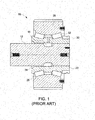
- an epicyclic gear system 10 is shown in cross-section in FIG. 1 to include a planet pin 12 about which a sleeve 22 is disposed.
- a planet gear 26 encompasses the sleeve 22 and is connected thereto through a rib ring 30.
- the planet pin 12 includes a groove 14 at a central location thereof.
- the sleeve 22 includes a tapered landing 24.
- the planet gear 26 has an indent 28.
- Rollers 32 are positioned between races found on an inner surface of the planet gear 26 and races found on an outer surface of the sleeve 22.
- the planet pin 12 is press fit to an upwind carrier plate (not shown).
- the gear system 10 acts as a double joint system that allows the planet gear 26 to align to a ring gear and a sun gear (not shown) despite planet pin's 12 tangential location and misalignment.
- Planetary gear systems such as system 10, find use in applications such as wind turbines. Other potential applications can be found in mill operations, the oil and gas industry, and the aviation industry.
- K ⁇ T Branch ⁇ N CP / T Nom
- T Branch is the torque for the gear with the heaviest load
- N CP is the number of planets
- T Nom is the total nominal torque for the system.
- K ⁇ 1.0
- gear teeth of the planetary gears are manufactured with a normal variance for such teeth.
- the thickness of the gear teeth may vary to an extent expected of tolerances for gear teeth.
- the pitch - the distance between adjacent gear teeth - also may vary.
- a planetary gear system that includes planetary gears that self-align as they mesh with a ring and a centralized sun gear would be welcome in the art.
- An embodiment of the invention includes a planetary gear system that includes a carrier body configured to receive planet gears, at least one pin received by the carrier body, and an insert positioned between the carrier body and the at least one pin.
- the flex means includes an inner ring, an outer ring, a pair of stabilizers connecting the inner and outer rings, and a stopper material positioned between the inner and outer rings.
- An embodiment of the invention includes a planetary gear system that includes a carrier body configured to receive planet gears, at least one pin received by the carrier body, and a compliant insert positioned within a cut-out portion formed on an interior surface of the carrier body.
- An embodiment of the invention includes a method for balancing a load on a planetary gear system that has a plurality of planet gears mounted on a carrier through a plurality of planet pins.
- the method includes preparing the carrier and providing flex means between the planet pins and the carrier, the flex means configured to enable movement of the planet pins in response to a force directed thereon.
- Various embodiments of the invention are intended to better accommodate pin misalignment relative to the central shaft, to more evenly distribute the force along the planet gear tooth width, and to more evenly share the loading among the various planet gears.
- FIG. 2 illustrates a planetary gear system 100 including a carrier 110 and a planet gear 120.
- the carrier 110 has a carrier body 112 which includes a sun gear opening 114, a plurality of planet gear openings 116, and a plurality of planet pin openings 118.
- the planet pin openings 118 serve as anchoring points for planet pins, about which each planet gear 120 is disposed. A portion of each planet gear 120 protrudes through a respective planet gear opening 116.
- FIG. 2 Although only a single planet gear 120 is illustrated in FIG. 2 , it is to be understood that four such planet gears 120 are intended for mounting on the carrier 110 of FIG. 2 . Further, it is to be understood that more or less than four planet gears 120 may be mounted on a carrier, depending upon the need and the configuration of the carrier.
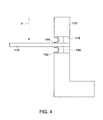
- FIGS. 3 and 4 illustrate the planetary gear system 100 of FIG. 2 in greater clarity.
- the planetary gear system 100 includes a spring insert 140 through which a planet pin 115 ( FIG. 4 ) may extend.
- the spring insert 140 is a toroid-shaped object that includes an outer flange 142 surrounding an inner flange 144.
- the spring insert 140 may be may be sized to cause an interference fit within the planet pin opening 118. It should be appreciated, however, that there are a plurality of attachment methods and mechanisms that can be used.
- One process for shrink fitting the spring insert 140 is to cool the insert down; the fit being created when the insert 140 warms back up.
- the spring insert inner flange 144 is configured to fit around the planet pin 115.
- the spring insert 140 provides flexure to the planet pins 115 to accommodate manufacturing tolerances and pin misalignments.
- the spring insert 140 is formed of a high strength metal, such as a high strength steel. Further, the geometry and the thinness of the spring insert 140 is such as to allow springiness, or flexure, of the insert. The springiness is translated to the planet pins 115. As shown in FIG. 4 , a bushing 149 may be located within the planet pin openings 118 to ensure the pin 115 remains in place.
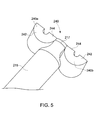
- FIG. 5 illustrates an embodiment of an insert and a planet pin, the planet pin 215 having an extrusion portion 217.
- the body of the pin 215 slopes down to the substantially rectangular-shaped extrusion portion 217.
- Engaged with the extrusion portion 217 is an insert 240 having a first part 240a and a second part 240b.
- Each of the first and second parts 240a, 240b has an outer flange 242 and an inner flange 244.
- the insert 240 acts similarly as the insert 140; the major difference being that the insert 240 flexes in only on direction, whereas the insert 140 has the capability of flexing in any direction.
- the portion of the pin 215 sloping toward the extrusion portion 217 is configured to accommodate the sloping portion of the first and second parts 240a, 240b. It should be understood, however, that the first and second parts 240a, 240b may be reversed such that the open ends of the outer and inner flanges 242, 244 face toward the sloping portion of the pin 215.
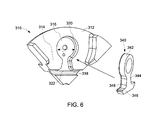
- FIG. 6 illustrates a carrier 310 according to an embodiment of the invention.
- the carrier 310 includes a carrier body 312 which has an inner surface 314. Cut-out portions 316, 318 are contiguous with one another and are located on the inner surface 314. A beveled edge 320 extends around the contour of at least the ring/neck cut-out portion 316 and may extend into the base cut-out portion 318. An oil passage is located in the middle of cut-out portion 316. A step-down line 322 may be located at a transition position between the ring/neck cut-out portion 316 and the base cut-out portion 318.
- An insert 340 is formed to fit within the cut out portions 316, 318.
- the insert 340 includes a ring portion 342 extending from a neck portion 344.
- the ring portion 342 is configured to receive a pin (not shown).
- a base portion 346 extends outwardly from a lower extent of the neck portion 344.
- On a back surface of the insert 340 is a beveled surface 348.
- the cut-out portion 318 and the insert 340 are configured and sized such that there is an interference fit therebetween.
- the cut-out portion 316 and the ring and neck portions 342, 344 are configured and sized such that there is a slight gap therebetween.
- the gap allows the ring portion 342 and the neck portion 344 to move slightly in the direction D within the cut-out portion 316 due to force placed on the pin (not shown).
- the gap between the ring and neck portions 342, 344 and the cut-out portion 316 is sized to allow normal operating torque but not extreme torque. When extreme torque is experienced, the ring portion 342 contacts the beveled edge 320 of the cut-out portion 316, allowing the carrier 310 to share the increased load.
- cut-out portions 316, 318 are created at all the pin positions for the carrier 310 such that inserts 340 are enabled to be fit within the cut-out portions.
- the insert 340 has geometry that is more compliant, or more flexible, than the material used to form the carrier 310. Further, the material forming the insert 340 may be a high strength material that has a greater yield strength than the material used to form the carrier 310. For example, the carrier 310 may be formed of cast iron, whereas the insert 340 may be formed of steel. The high strength of the insert 340, plus the shape of the insert, gives the insert suitable flexibility. The greater compliance of the insert 340 is translated to the pin held therein, thus assisting in providing a more even load share between pins.
- FIG. 7 illustrates a carrier 410 and an insert 440 according to an embodiment of the invention.
- the carrier 410 includes a carrier body 412 having a carrier inner surface 414.
- An insert cut-out portion 416 is located in the inner surface 414.
- the insert cut-out portion 416 includes a central cut-out portion 422 from which radially extend a plurality of ring cut-out portions 418 and neck cut-out portions 420.
- a beveled edge 424 extends along a periphery of the insert cut-out portion 416.
- Attachment openings 426 are located throughout the central cut-out portion 422.
- an insert 440 that includes a central portion 446 from which a plurality of neck portions 444 and ring portions 442 radially extend.
- the ring portions 442 are configured to each receive a pin (not shown).
- a plurality of attachment openings 448 is located in the central portion 446.
- the insert cut-out portion 416 and the insert 440 are sized and configured such that the central portion 446 does not move within the central cut-out portion 422, but the ring and neck portions 442, 444 can move slightly within, respectively, the ring cut-out and neck cut-out portions 418, 420.
- the central portion 446 may be sized to cause an interference fit within the central cut-out portion 422 such that there is no gap therebetween.
- attachment means may be placed through several attachment openings 448 and through respective attachment openings 426 to attach the insert 440 to the carrier 410.
- the gap between the ring and neck portions 442, 444 and the cut-out portions 418, 420 is sized to allow normal operating torque but not extreme torque. When extreme torque is experienced, the ring portion 442 contacts the beveled edge 424 of the cut-out portion 418, allowing the carrier 410 to share the increased load.
- insert 440 is more compliant, or more flexible, than the carrier 410.
- the material forming the insert 440 is a high strength material that has a greater yield strength than the material used to form the carrier 410.
- the carrier 410 may be formed of cast iron, whereas the insert 440 may be formed of steel. The greater compliance of the insert 440 is translated to the pin held therein, thus assisting in providing a more even load sharing among pins.
- the insert 440 is sized and positioned such that the carrier 410 is split into two portions.
- the insert may be sized and positioned such that the carrier need not be split into two portions to accommodate it.
- each carrier portion may accommodate an insert 440. Since the carrier 410 is in two portions, it has to be re-formed in such a way as to inhibit shear forces from separating the carrier portions from each other.
- a shear block 428 may be utilized, along with attachment means such as bolts or screws to recombine the carrier portions together once the inserts 440 have been put in place.
- FIG. 8 illustrates a carrier 510 and an insert 540 according to another embodiment of the invention.
- the carrier 510 includes an opening 513 having a wall 519. It is to be understood that the carrier 510 will have a plurality of openings 513, one being shown for ease of illustration.
- the openings 513 are located at a periphery of the carrier 510.
- the insert 540 includes an insert body 542 and first and second springs 550, 556.
- the insert body 542 includes a first surface 544 and an opposing second surface 546 as well as a pin opening 548.
- the first spring 550 has a first end 552 and an opposing second end 554.
- the second spring 556 has a first end 558 and an opposing second end 560.
- the insert 540 is placed within the opening 513 such that the first surface 544 contacts the wall 519.
- the insert 540 and the opening 513 may be configured and sized such that the insert 540 is under tension when in place within the opening 513.
- the first and second springs 550, 556 are sized and formed of a material that allows for flexing. When exposed to a tangential force, the first spring 550 flexes such that the first and second ends 552, 554 contact the second surface 546. The second spring 556 flexes such that the first and second ends 558, 560 contact the wall 519 of the opening 513. The flexing of the first and second springs 550, 556 is such that they contact one another at a midpoint M.
- the first and second springs 550, 556 provide flexure to the pin.
- the insert 540 will not exhibit flexure in response to a tangential force in a direction opposite direction D T1 . Nonetheless, the inserts 540 can be installed to allow for flexing in both tangential direction D T1 and the opposite direction. It should be further understood that more or less than two springs may be utilized with the insert body 542.
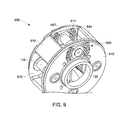
- FIG. 9 illustrates a planetary gear system 600 including a carrier 610 and inserts 640 according to an embodiment of the invention.
- the carrier 610 has a carrier body 612 with a plurality of planetary gear openings 613 through which planetary gears, such as the planetary gear 26, extend.
- the carrier 610 also has a plurality of carrier openings 614.
- the openings 614 are paired on opposing sides of the carrier body 612.
- Each insert 640 includes an insert ring 642 from which extend a plurality of insert springs 644.
- the insert rings 642 are configured to receive planet pins 115.
- the inserts 640 are sized and shaped to form an interference fit with the openings 614.
- the springs 644 are sized and formed of a material that allow for flexing in response to a tangential force exerted on the pins 115.
- the springs 644 may be S-shaped or shaped otherwise, and they may be formed of steel.
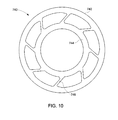
- FIG. 10 illustrates an insert 740 according to another embodiment of the invention.
- the insert 740 is configured and sized to be interference fit within a planet pin opening 118.
- the insert 740 includes an outer ring 742 connected to an inner ring 744 by a plurality of springs 746.
- the inner ring 744 is sized to receive a planet pin, such as pin 115.
- the springs 746 flex in response to a force directed at the pin.
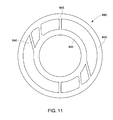
- FIG. 11 illustrates an insert 840 according to an embodiment of the invention, which like insert 740, is interference fit within a planet pin opening 118.
- the insert 840 includes an outer ring 842 separated from an inner ring 844.
- the outer ring 842 is connected to the inner ring 842 with a pair of stabilizers 845 and a plurality of springs 846.
- the inner ring 844 is sized to receive a planet pin, such as pin 115.
- the springs 846 flex in response to a force directed at the planet pin in a first direction.
- the stabilizers 845 extend along a midline of the insert 840.
- the stabilizers 845 inhibit flexing in response to a force directed at the planet pin in a second direction.
- the insert 840 can be installed in a planet pin opening 118 such that the first direction is a tangential direction and the second direction is a radial direction. In other words, the insert 840 can be installed such that the stabilizers 845 inhibit force in a radial direction on the planet pin.
- FIG. 12 illustrates an insert 940 according to an embodiment of the invention.
- the insert 940 is sized to be interference fit within a planetary pin opening 118.
- the insert 940 includes an outer ring 942 connected to an inner ring 944 by a plurality of springs 946.
- the inner ring 944 is sized to receive a planet pin, such as planet pin 115.
- the springs 946 are overloaded on one side of the insert 940.
- the springs 946 allow flexing of the planet pin in response to a force on the pin in a first direction.
- the insert 940 can be installed such that the springs 946 foster flexing in the first tangential direction but inhibit flexing in a second radial direction. Further, the overloading of the springs 946 on one side of the insert 940 allows greater flexing from force in one tangential direction D T1 as opposed to force applied in an opposite tangential direction D T2 . Nonetheless, the inserts 940, like the inserts 540, can be installed to allow for flexing in both tangential directions D T1 and D T2 .
- pairs of the inserts 940 on opposite ends of one planet pin may be reversed so that the springs 946 are overloaded on the D T2 direction side on one end of the planet pin and overloaded on the D T1 direction side on the other end of the planet pin.
- FIG. 13 illustrates a partial carrier 610 and an insert 1040 according to an embodiment of the invention.
- a complete carrier 610 has a plurality of planetary gear openings 613 to receive planetary gears. Further, the carrier 610 has carrier openings 614 to accommodate inserts 1040. As shown, an opening 614 is formed on one side of the carrier 610 but not the other. It should be understood that the openings 614 may be formed on opposing sides of the carrier 610 to accommodate inserts 1040.
- the insert 1040 which is sized to cause an interference fit within an opening 614, includes an outer ring 1042 connected to an inner ring 1044 by a pair of stabilizers 1045.
- the inner ring 1044 is sized to receive a planet pin 115.
- Filling in the space between the outer and inner rings 1042, 1044 is a stopper material 1049.
- the outer and inner rings 1042, 1044 are formed to be more compliant or flexible than the stopper material 1049.
- the outer and inner rings 1042, 1044 may be formed of a material having a higher strength than the stopper material 1049.
- the outer and inner rings 1042, 1044 may be formed of steel, while the stopper material 1049 is formed of cast iron.
- the greater compliancy of the outer and inner rings 1042, 1044 allow for flexing, which translates into tangential movement of the pin 115.
- the outer and inner rings 1042, 1044 can flex in response to normal, operating torque.
- the force of the torque is transferred to the stopper material 1049, thus causing the carrier to share in the load.
- FIG. 14 illustrates a partial carrier 610 and an insert 1140 according to an embodiment of the invention.
- the insert 1140 is configured and sized to be interference fit within the carrier openings 614.
- an opening 614 is formed on one side of the carrier 610 but not the other. It should be understood that the openings 614 may be formed on opposing sides of the carrier 610 to accommodate inserts 1140.
- the insert 1140 includes an outer ring 1142 connected to an inner ring 1144 by a pair of stabilizers 1145 and stiffeners 1147.
- the inner ring 1144 is sized to receive a planet pin 115.
- Filling in the space between the outer and inner rings 1142, 1144 is a stopper material 1149.
- the outer and inner rings 1142, 1144 are formed to be more compliant or flexible than the stopper material 1149.
- the outer and inner rings 1142, 1144 may be formed of steel, while the stopper material 1149 is formed of cast iron.
- a distinction between the insert 1040 ( FIG. 13 ) and insert 1140 is the length of the stabilizers 1145. The longer stabilizers 1145 of insert 1140 allow for greater compliance in response to a tangentially directed force.
- the greater compliancy of the outer and inner rings 1142, 1144 allow for flexing, which translates into tangential movement of the pin 115.
- the outer and inner rings 1142, 1144 can flex in response to normal, operating torque.
- the force of the torque is combatted by the stiffeners 1147 and transferred to the stopper material 1149, thus causing the carrier to share in the load.
- FIG. 15 illustrates a partial carrier 1210 and an insert 1240 according to an embodiment of the invention.
- the carrier 1210 has a carrier body 1212 that includes a plurality of carrier cut-outs 1213. Each cut-out 713 includes a wall 1216. An opening is formed in the carrier cut-outs 1213 to receive a planet pin 115.
- the insert 1240 includes a ring 1242 sized and configured to receive the planet pin 115. Further, the insert 1240 includes a pair of stabilizers 1245 connected to the ring 1242 by a pair of stiffeners 1247. The stabilizers 1245 are not intimate with the cut-out walls 716 except at the comers. This arrangement allows the stabilizers to flex in response to a force tangentially directed on the pin 115, absorbing some of the torque. Filling in the remaining space within the cut-outs 1213 is a stopper material (not shown). The insert 1240 can withstand normal, operating torque. If extreme torque is experienced by the pin 115, the stabilizers 1245 will flex to a certain extent to absorb some of the torque, and then the remaining torque will be taken up by the stiffeners 1247 and the stopper material.
- a carrier is prepared.
- Preparation of the carrier may include boring planet pin openings, such as opening 118, within a carrier.
- Preparation of the carrier also may include creating cut-outs within the carrier, such as cut-outs 316, 318 or cut-out 416 or cut-out 1213.
- preparation of the carrier also may include splitting the carrier into two parts.
- Preparation of the carrier also may include creating slots, like slots 513, or carrier openings 614.
- Preparation of the carrier also may include forming the carrier, or at least one part of the carrier, out of a high strength material like steel.
- a flex means is provided to the carrier.
- Provision of a flex means may include fitting spring inserts, like spring inserts 140, 240, 740, 840, or 940 within planet pin openings, like openings 118.
- Provision of a flex means may include adding compliant inserts, like compliant inserts 340 or compliant inserts 440, into, respectively, cut-outs 316, 318 or cut-outs 416.
- Provision of flex means may include adding inserts 540 into slots 513.
- Provision of flex means may include fitting inserts, like inserts 640, 1040, or 1140 within carrier openings 614.
- Provision of flex means may include fitting inserts 1240 within cut-outs 1213.
Landscapes
- Engineering & Computer Science (AREA)
- General Engineering & Computer Science (AREA)
- Mechanical Engineering (AREA)
- Retarders (AREA)
- General Details Of Gearings (AREA)
Applications Claiming Priority (1)
| Application Number | Priority Date | Filing Date | Title |
|---|---|---|---|
| US13/155,417 US8550957B2 (en) | 2011-06-08 | 2011-06-08 | Gear system and method for using same |
Publications (2)
| Publication Number | Publication Date |
|---|---|
| EP2532919A2 true EP2532919A2 (de) | 2012-12-12 |
| EP2532919A3 EP2532919A3 (de) | 2013-04-10 |
Family
ID=46208332
Family Applications (1)
| Application Number | Title | Priority Date | Filing Date |
|---|---|---|---|
| EP12170272.4A Withdrawn EP2532919A3 (de) | 2011-06-08 | 2012-05-31 | Planetengetriebesystem |
Country Status (3)
| Country | Link |
|---|---|
| US (1) | US8550957B2 (de) |
| EP (1) | EP2532919A3 (de) |
| CN (1) | CN102817966B (de) |
Cited By (5)
| Publication number | Priority date | Publication date | Assignee | Title |
|---|---|---|---|---|
| WO2015106896A1 (de) * | 2014-01-16 | 2015-07-23 | Zf Friedrichshafen Ag | Stufenplanet mit innenliegender lagerung |
| EP3293422A1 (de) * | 2016-08-23 | 2018-03-14 | Rolls-Royce plc | Montageanordnung für planetengetriebe |
| GB2555600A (en) * | 2016-11-02 | 2018-05-09 | Johnson Electric Sa | Planetary gear carrier and electric parking brake |
| EP3926213A1 (de) * | 2020-06-19 | 2021-12-22 | Ge Avio S.r.l. | Epizyklisches getriebe mit presspassungsbund mit reduzierten kantenkontakt-spannungskonzentrationen |
| EP4647631A1 (de) * | 2024-05-08 | 2025-11-12 | Hamilton Sundstrand Corporation | Planetengetriebeträger für epizyklische getriebeanordnung |
Families Citing this family (28)
| Publication number | Priority date | Publication date | Assignee | Title |
|---|---|---|---|---|
| DE102009032294A1 (de) * | 2009-07-09 | 2011-01-13 | Aktiebolaget Skf | Lageranordnung |
| ITTO20111202A1 (it) * | 2011-12-23 | 2013-06-24 | Avio Spa | Rotismo epicicloidale |
| DE102012204354B3 (de) * | 2012-03-20 | 2013-09-05 | Schaeffler Technologies AG & Co. KG | Stützstruktur eines Planetenradträgers |
| CN103925338A (zh) * | 2013-01-11 | 2014-07-16 | 劲力工业有限公司 | 行星齿轮装置及其行星齿轮组 |
| US10145259B2 (en) | 2013-05-08 | 2018-12-04 | United Technologies Corporation | Fan drive gear system with improved misalignment capability |
| WO2014210462A1 (en) * | 2013-06-28 | 2014-12-31 | General Electric Company | Lightweight gear assembly for epicyclic gearbox |
| US10267365B2 (en) | 2015-12-11 | 2019-04-23 | General Electric Company | Power gearbox pin arrangement |
| US10100875B2 (en) | 2016-07-26 | 2018-10-16 | General Electric Company | Roller bearing and systems including such |
| US10030708B2 (en) | 2016-07-29 | 2018-07-24 | General Electric Company | Roller bearing cage for use in a gearbox |
| US10138940B2 (en) | 2016-08-09 | 2018-11-27 | General Electric Company | Roller bearing cage for use in a gearbox |
| US10400678B2 (en) | 2017-01-03 | 2019-09-03 | General Electric Company | Apparatus and system for light-weight, flexible double-helical gear |
| US10508731B2 (en) | 2017-01-05 | 2019-12-17 | General Electric Company | Apparatus and method for managing pinch loads on a gear |
| US10247298B2 (en) | 2017-01-10 | 2019-04-02 | General Electric Company | Resilient bearing pin and gear assemblies including resilient bearing pins |
| US10228024B2 (en) | 2017-01-10 | 2019-03-12 | General Electric Company | Reduced-weight bearing pins and methods of manufacturing such bearing pins |
| US10247297B2 (en) | 2017-01-18 | 2019-04-02 | General Electric Company | Apparatus for a gearbox with multiple scavenge ports |
| US10408304B2 (en) | 2017-02-07 | 2019-09-10 | General Electric Company | Gears having reduced roller element stresses and methods of manufacturing such gears |
| US10260563B2 (en) | 2017-05-18 | 2019-04-16 | General Electric Company | Bearing cages for roller bearing assemblies |
| US10451113B2 (en) | 2017-05-18 | 2019-10-22 | General Electric Company | Bearing cages for roller bearing assemblies |
| US10816086B2 (en) | 2017-08-14 | 2020-10-27 | General Electric Company | Power gearbox gear arrangement |
| US10385961B2 (en) | 2017-10-25 | 2019-08-20 | General Electric Company | Planetary gear system |
| US10851671B2 (en) | 2019-03-29 | 2020-12-01 | Pratt & Whitney Canada Corp. | Bending stiffening feature used for compliant journal bearing |
| US11391217B2 (en) | 2019-10-03 | 2022-07-19 | Rolls-Royce Corporation | Stiffening member for epicyclical gear system housing assembly |
| US11353089B2 (en) | 2019-10-03 | 2022-06-07 | Rolls-Royce Corporation | Epicyclical gear system housing assembly |
| US11215265B2 (en) | 2019-10-03 | 2022-01-04 | Rolls-Royce Corporation | Static curvic joint for epicyclical gear system housing assembly |
| CN215293537U (zh) * | 2021-04-21 | 2021-12-24 | 采埃孚(天津)风电有限公司 | 行星架及齿轮箱 |
| US11566701B1 (en) | 2022-01-14 | 2023-01-31 | Textron Innovations Inc. | Propped cantilever carrier |
| US12066096B2 (en) * | 2022-08-30 | 2024-08-20 | Dana Automotive Systems Group, Llc | Systems for differential assembly |
| CN119244731A (zh) * | 2024-10-24 | 2025-01-03 | 钟文 | 一种弹性缓冲行星架及减速机 |
Citations (4)
| Publication number | Priority date | Publication date | Assignee | Title |
|---|---|---|---|---|
| US6994651B2 (en) | 2003-10-07 | 2006-02-07 | The Timken Company | Epicyclic gear system |
| US7297086B2 (en) | 2003-01-27 | 2007-11-20 | The Timken Company | Epicyclic gear systems |
| US20110039654A1 (en) | 2008-04-30 | 2011-02-17 | The Timken Company | Epicyclic Gear System With Flexpins |
| US20110053730A1 (en) | 2008-02-13 | 2011-03-03 | The Timken Company | Epicyclic Gear System Having Two Arrays Of Pinions Mounted On Flexpins With Compensation For Carrier Distortion |
Family Cites Families (19)
| Publication number | Priority date | Publication date | Assignee | Title |
|---|---|---|---|---|
| US2460629A (en) * | 1945-03-19 | 1949-02-01 | Thomas L Fawick | Cushioned planetary gearing |
| SE372806B (de) * | 1973-03-01 | 1975-01-13 | Stal Laval Turbin Ab | |
| GB1448059A (en) | 1974-04-18 | 1976-09-02 | Vickers Ltd | Gears |
| EP0093584A1 (de) * | 1982-05-01 | 1983-11-09 | Hicks Transmissions Limited | Zahnradzusammenbau |
| JPS63231036A (ja) | 1987-03-16 | 1988-09-27 | Masanori Mochizuki | 遊星歯車装置 |
| FR2651185B1 (fr) | 1989-08-31 | 1991-10-25 | Cousin Freres Sa | Mecanisme reducteur pour articulation sans jeu utilisable notamment pour le reglage de diverses parties d'un siege de vehicule automobile. |
| DE4411604C2 (de) | 1994-04-02 | 1999-07-08 | Schaeffler Waelzlager Ohg | Planetenträger eines Planetengetriebes |
| JPH08170695A (ja) | 1994-12-19 | 1996-07-02 | Nippon Seiko Kk | 遊星歯車用回転支持装置 |
| US5679089A (en) | 1995-09-14 | 1997-10-21 | The United States Of America As Represented By The Secretary Of The Navy | Bicoupled contrarotating epicyclic gears |
| US20030008748A1 (en) | 2001-06-28 | 2003-01-09 | Gerald Fox | Epicyclic gear system |
| US20030073537A1 (en) | 2001-10-15 | 2003-04-17 | Eastman Kodak Company | Precision differential planetary gear drive |
| DE10334824A1 (de) | 2003-07-31 | 2005-05-19 | Zf Friedrichshafen Ag | Verbesserung der Lastverteilung in Planetengetrieben |
| GB0326951D0 (en) | 2003-11-20 | 2003-12-24 | Hansen Transmissions Int | Gear transmission unit wit planetary gears |
| DE102004014578A1 (de) | 2004-03-25 | 2005-12-15 | Zf Friedrichshafen Ag | Planetengetriebe |
| EP2055986B1 (de) | 2005-08-01 | 2011-09-07 | The Timken Company | Epizyklisches Antriebssystem mit Flexpins |
| US20100303626A1 (en) | 2007-12-20 | 2010-12-02 | Vestas Wind Systems A/S | Epicyclic gear stage for a wind turbine gearbox, a wind turbine gearbox and a wind turbine |
| US8313412B2 (en) | 2009-02-05 | 2012-11-20 | Friede & Goldman, Ltd. | Gear assembly with asymmetric flex pin |
| US20120028754A1 (en) * | 2011-04-29 | 2012-02-02 | General Electric Company | Liquid equalized gear system and method for using same |
| US8172717B2 (en) * | 2011-06-08 | 2012-05-08 | General Electric Company | Compliant carrier wall for improved gearbox load sharing |
-
2011
- 2011-06-08 US US13/155,417 patent/US8550957B2/en active Active
-
2012
- 2012-05-31 EP EP12170272.4A patent/EP2532919A3/de not_active Withdrawn
- 2012-06-08 CN CN201210188879.8A patent/CN102817966B/zh active Active
Patent Citations (4)
| Publication number | Priority date | Publication date | Assignee | Title |
|---|---|---|---|---|
| US7297086B2 (en) | 2003-01-27 | 2007-11-20 | The Timken Company | Epicyclic gear systems |
| US6994651B2 (en) | 2003-10-07 | 2006-02-07 | The Timken Company | Epicyclic gear system |
| US20110053730A1 (en) | 2008-02-13 | 2011-03-03 | The Timken Company | Epicyclic Gear System Having Two Arrays Of Pinions Mounted On Flexpins With Compensation For Carrier Distortion |
| US20110039654A1 (en) | 2008-04-30 | 2011-02-17 | The Timken Company | Epicyclic Gear System With Flexpins |
Cited By (7)
| Publication number | Priority date | Publication date | Assignee | Title |
|---|---|---|---|---|
| WO2015106896A1 (de) * | 2014-01-16 | 2015-07-23 | Zf Friedrichshafen Ag | Stufenplanet mit innenliegender lagerung |
| EP3293422A1 (de) * | 2016-08-23 | 2018-03-14 | Rolls-Royce plc | Montageanordnung für planetengetriebe |
| US10422420B2 (en) | 2016-08-23 | 2019-09-24 | Rolls-Royce Plc | Mounting arrangement for a planet gear |
| GB2555600A (en) * | 2016-11-02 | 2018-05-09 | Johnson Electric Sa | Planetary gear carrier and electric parking brake |
| EP3926213A1 (de) * | 2020-06-19 | 2021-12-22 | Ge Avio S.r.l. | Epizyklisches getriebe mit presspassungsbund mit reduzierten kantenkontakt-spannungskonzentrationen |
| US11578610B2 (en) | 2020-06-19 | 2023-02-14 | Ge Avio S.R.L. | System and method for reducing edge contact stress concentrations in a press-fit |
| EP4647631A1 (de) * | 2024-05-08 | 2025-11-12 | Hamilton Sundstrand Corporation | Planetengetriebeträger für epizyklische getriebeanordnung |
Also Published As
| Publication number | Publication date |
|---|---|
| EP2532919A3 (de) | 2013-04-10 |
| US8550957B2 (en) | 2013-10-08 |
| CN102817966A (zh) | 2012-12-12 |
| CN102817966B (zh) | 2017-06-27 |
| US20120316027A1 (en) | 2012-12-13 |
Similar Documents
| Publication | Publication Date | Title |
|---|---|---|
| EP2532919A2 (de) | Planetengetriebesystem | |
| EP2532928B1 (de) | Elastische Trägerwand zur verbesserten Getriebelastteilung | |
| EP2518371A1 (de) | Planetenbolzen und Planetengetriebesystem | |
| JP6635502B2 (ja) | 遊星歯車装置のための遊星キャリア、及び、当該遊星キャリアを具備する遊星歯車装置 | |
| EP2394075B1 (de) | Getriebeanordnung mit sich verjüngendem flexiblen zapfen | |
| EP2518367A1 (de) | Lastausgeglichenes Getriebesystem | |
| EP3279507A1 (de) | Planetengetriebevorrichtung | |
| WO2014024505A1 (ja) | 回転機械のロータ接続用治具、及びロータ接続方法 | |
| EP2745031B1 (de) | Mehrstufiges getriebegehäuse | |
| EP2241780B1 (de) | Planetenreduktionsgetriebevorrichtung | |
| EP2383468A1 (de) | System und Verfahren zum Verbinden von Windturbinewellen | |
| WO2013097865A1 (en) | A ring segment for a flange of a wind turbine tower | |
| US20240218927A1 (en) | Planetary carrier and gear box | |
| US20160376130A1 (en) | A lifting device | |
| US8523188B2 (en) | Centered floating seal | |
| EP4136347B1 (de) | Alternierendes shimming für stützstrukturflanschen | |
| EP2798134B1 (de) | Ringförmiger flansch zur befestigung eines windturbinenturmabschnitts an einem anderen turmabschnitt | |
| CN112696469A (zh) | 具有柔性销的齿轮箱 | |
| EP1785594A2 (de) | Aufgereihte Statoranordnung einer Reaktionsdampfturbine | |
| CN113236504B (zh) | 风力发电机齿轮箱 | |
| EP2649355B1 (de) | Bolzenlose verriegelungsanordnung | |
| CN105090197B (zh) | 轴上零件定位结构 | |
| US20250116301A1 (en) | Disc coupling | |
| EP1785584A2 (de) | Gestapelter Rotor einer Dampfturbine | |
| ITBO950011A1 (it) | Dispositivo di supporto per cuscinetti volventi di alberi rotanti su una struttura portante fissa |
Legal Events
| Date | Code | Title | Description |
|---|---|---|---|
| PUAI | Public reference made under article 153(3) epc to a published international application that has entered the european phase |
Free format text: ORIGINAL CODE: 0009012 |
|
| AK | Designated contracting states |
Kind code of ref document: A2 Designated state(s): AL AT BE BG CH CY CZ DE DK EE ES FI FR GB GR HR HU IE IS IT LI LT LU LV MC MK MT NL NO PL PT RO RS SE SI SK SM TR |
|
| AX | Request for extension of the european patent |
Extension state: BA ME |
|
| PUAL | Search report despatched |
Free format text: ORIGINAL CODE: 0009013 |
|
| AK | Designated contracting states |
Kind code of ref document: A3 Designated state(s): AL AT BE BG CH CY CZ DE DK EE ES FI FR GB GR HR HU IE IS IT LI LT LU LV MC MK MT NL NO PL PT RO RS SE SI SK SM TR |
|
| AX | Request for extension of the european patent |
Extension state: BA ME |
|
| RIC1 | Information provided on ipc code assigned before grant |
Ipc: F16H 1/28 20060101AFI20130307BHEP Ipc: F16H 57/08 20060101ALI20130307BHEP |
|
| 17P | Request for examination filed |
Effective date: 20131010 |
|
| RBV | Designated contracting states (corrected) |
Designated state(s): AL AT BE BG CH CY CZ DE DK EE ES FI FR GB GR HR HU IE IS IT LI LT LU LV MC MK MT NL NO PL PT RO RS SE SI SK SM TR |
|
| 17Q | First examination report despatched |
Effective date: 20141112 |
|
| STAA | Information on the status of an ep patent application or granted ep patent |
Free format text: STATUS: THE APPLICATION IS DEEMED TO BE WITHDRAWN |
|
| 18D | Application deemed to be withdrawn |
Effective date: 20150523 |