EP2519862B1 - Verfahren und system zur prozessoptimierung für ein kraftwerk - Google Patents
Verfahren und system zur prozessoptimierung für ein kraftwerk Download PDFInfo
- Publication number
- EP2519862B1 EP2519862B1 EP10726200.8A EP10726200A EP2519862B1 EP 2519862 B1 EP2519862 B1 EP 2519862B1 EP 10726200 A EP10726200 A EP 10726200A EP 2519862 B1 EP2519862 B1 EP 2519862B1
- Authority
- EP
- European Patent Office
- Prior art keywords
- objective function
- adaptive
- constraints
- constraint values
- power plant
- Prior art date
- Legal status (The legal status is an assumption and is not a legal conclusion. Google has not performed a legal analysis and makes no representation as to the accuracy of the status listed.)
- Active
Links
Images

Classifications
-
- G—PHYSICS
- G05—CONTROLLING; REGULATING
- G05B—CONTROL OR REGULATING SYSTEMS IN GENERAL; FUNCTIONAL ELEMENTS OF SUCH SYSTEMS; MONITORING OR TESTING ARRANGEMENTS FOR SUCH SYSTEMS OR ELEMENTS
- G05B13/00—Adaptive control systems, i.e. systems automatically adjusting themselves to have a performance which is optimum according to some preassigned criterion
- G05B13/02—Adaptive control systems, i.e. systems automatically adjusting themselves to have a performance which is optimum according to some preassigned criterion electric
- G05B13/04—Adaptive control systems, i.e. systems automatically adjusting themselves to have a performance which is optimum according to some preassigned criterion electric involving the use of models or simulators
- G05B13/041—Adaptive control systems, i.e. systems automatically adjusting themselves to have a performance which is optimum according to some preassigned criterion electric involving the use of models or simulators in which a variable is automatically adjusted to optimise the performance
-
- F—MECHANICAL ENGINEERING; LIGHTING; HEATING; WEAPONS; BLASTING
- F02—COMBUSTION ENGINES; HOT-GAS OR COMBUSTION-PRODUCT ENGINE PLANTS
- F02C—GAS-TURBINE PLANTS; AIR INTAKES FOR JET-PROPULSION PLANTS; CONTROLLING FUEL SUPPLY IN AIR-BREATHING JET-PROPULSION PLANTS
- F02C9/00—Controlling gas-turbine plants; Controlling fuel supply in air- breathing jet-propulsion plants
- F02C9/26—Control of fuel supply
- F02C9/42—Control of fuel supply specially adapted for the control of two or more plants simultaneously
-
- G—PHYSICS
- G05—CONTROLLING; REGULATING
- G05B—CONTROL OR REGULATING SYSTEMS IN GENERAL; FUNCTIONAL ELEMENTS OF SUCH SYSTEMS; MONITORING OR TESTING ARRANGEMENTS FOR SUCH SYSTEMS OR ELEMENTS
- G05B19/00—Program-control systems
- G05B19/02—Program-control systems electric
- G05B19/418—Total factory control, i.e. centrally controlling a plurality of machines, e.g. direct or distributed numerical control [DNC], flexible manufacturing systems [FMS], integrated manufacturing systems [IMS] or computer integrated manufacturing [CIM]
-
- F—MECHANICAL ENGINEERING; LIGHTING; HEATING; WEAPONS; BLASTING
- F05—INDEXING SCHEMES RELATING TO ENGINES OR PUMPS IN VARIOUS SUBCLASSES OF CLASSES F01-F04
- F05D—INDEXING SCHEME FOR ASPECTS RELATING TO NON-POSITIVE-DISPLACEMENT MACHINES OR ENGINES, GAS-TURBINES OR JET-PROPULSION PLANTS
- F05D2270/00—Control
- F05D2270/40—Type of control system
- F05D2270/44—Type of control system active, predictive, or anticipative
-
- F—MECHANICAL ENGINEERING; LIGHTING; HEATING; WEAPONS; BLASTING
- F05—INDEXING SCHEMES RELATING TO ENGINES OR PUMPS IN VARIOUS SUBCLASSES OF CLASSES F01-F04
- F05D—INDEXING SCHEME FOR ASPECTS RELATING TO NON-POSITIVE-DISPLACEMENT MACHINES OR ENGINES, GAS-TURBINES OR JET-PROPULSION PLANTS
- F05D2270/00—Control
- F05D2270/70—Type of control algorithm
- F05D2270/71—Type of control algorithm synthesized, i.e. parameter computed by a mathematical model
Definitions
- the invention relates generally to a system and method for process optimization for power plants and more specifically to load scheduling optimization in the power plant by using adaptive constraints in the optimization method and system.
- a power plant typically consists of several units, each having a set of equipments contributing to different stages of power generation.
- equipments include for example, boilers, steam turbines and electrical generators.
- one of the critical aspects is the optimal load scheduling between the different units and thei respective equipments in order to meet a given power demand.
- US 5 640 491 A relates to a control system using an adaptive neural network for target and path optimization for a multivariable, nonlinear process.
- US 2004/049295 A1 according to its title relates to constraint and limit feasibility handling in a process control system optimizer.
- US 2004/088060 A1 according to its title relates to a method and system for model based control of heavy duty gas turbine.
- US 2006/178782 A1 according to its title relates to methods and apparatus for optimizing combined cycle/combined process facilities.
- EP 1 420 153 A2 according to its title relates to adaptive model-based control systems for controlling a gas turbine.
- Load scheduling has a major impact on the productivity of the power generation process.
- the purpose of load scheduling is to minimize the power production time and/or costs, by deciding the timing, values etc. of different operating parameters for each of the equipments in order to meet the power demand effectively and efficiently.
- the load sheduling is usually optimized by an optimizer in the power plant control system.
- the goal for the optimization exercise for example, cost minimization is expressed as an objective function for the optimization problem.
- the optimization method solves such an objective function within the identified constraints. Almost all of the operational parameters can be experessed as cost function and the optimizer is deployed to solve the cost function associated with variety of operations and their consequences (e.g. penalty for not meeting the demand).
- the solution from the optimizer provides setpoints for the various operations to achieve the desired optimized results.
- the optimizer uses techniques suct as Non Linear Programming (NLP), Mixed Integer Linear Programming (MILP), Mixed Integer Non Linear Programming (MINLP), etc to solve the objective function.
- the objective function there is a desire to include as many terms (fuel cost, emission reduction cost, start-up and shutdown cost, ageing cost, maintenance cost, penalty cost) in the objective function for considerations to work everything possible optimally.
- fuel cost, emission reduction cost, start-up and shutdown cost, ageing cost, maintenance cost, penalty cost in the objective function for considerations to work everything possible optimally.
- the solving of the objective function becomes difficult as there is reduction in the degree of freedom to make adjustments in operating parameters i.e. set points for different equipments, in order to achieve the optimal solution for the power plant.
- the necessary number of terms to be considered for a particular objective function is based on how the process control system has been designed and the values of constraints. If the number of terms is more i.e.
- the invention describes a method to identify and treat such situations so that the optimizer provides an acceptable solution in a defined manner. More specifically the present technique, describes a system and method for solving the objective function for a power plant operation by identifying and relaxing some constraints.
- a method for optimizing load scheduling for a power plant having one or more power generation units is defined in independent claim 1.
- an optimizer for optimizing load scheduling for a power plant is defined in independent claim 8.
- the system and method described herein relates to optimization of power plant operation to meet the desired power demand under conditions of non-convergence of an solution with existing constraints or under conditions when it is not clear that the solution with exisiting constraints is a best solution.
- the system and method described herein ensure that the power plant is operated by properly defining the constraints, their values and by ensuring there is an optimal solution every time i.e. the degree of freedom is available for solving the objective function and hence the optimization solution is dynamically improved while still considering all the terms defined in the objective function.
- novel modules and methods of the invention advantageously provide for adapting the value of constraints dynamically to solve the objective function and induce benefiting solutions. Such adaptations are done within the permissible beneficial outcomes (short-term and long-term) of the power plant.
- FIG. 1 is a block diagram representation of a simplified generic fossil fired power plant (FFPP) 10 that is controlled by a control system 12 that includes an optimizer 14 to obtain the optimal solution for operating the power plant.
- the FFPP 10 consists of three FFPP units, 16, 18, 20 running in parallel. Each FFPP unit has three main equipments namely, a boiler (B) 22, a steam turbine ( ST ) 24 that is mechanically coupled with an electrical generator (G) 26.
- steam loads generally referred to as u 1 , u 2 and u 3 are representative of the steam generated by the respective boiler and the corresponding fuel consumption is expressed as y 11 , y 21 , y 3 .
- the manipulated variables u l2 , u l2 and u l3 are binary variables which define the state of the boiler whether it is "off” or "on".
- the steam from the boiler is given to the steam turbine to work the generators.
- the power output from the generators is expressed as y 12 , y 22 , y 32 .
- the control system 12 is used to monitor and control the different operating parameters of the power plant 10 to ensure the power plant is operated at the optimum conditions.
- one of the critical aspects is the optimal load scheduling between the different FFPP units as shown in FIG. 1 , and the calculation for the optimized solution is done at the optimizer 14.
- the objective of a load scheduling optimization problem is to meet the power demand by scheduling the load among the three FFPP units, subject to different constraints such as the minimization of the fuel cost, start up cost, running cost, emission cost and life time cost.
- the optimizer 14 receives inputs from the power plant, and applies optimization techniques for the optimal load scheduling. Based on the optimal solution, the control system 12 sends commands to different actuators in the power plant to control the process parameters.
- the optimizer 14 includes novel modules to handle the above mentioned situations of non-convergence of an solution with existing constraints or under conditions when it is not clear that the solution with exisiting constraints is the best solution.
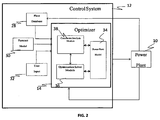
- FIG.2 is a block diagram representation of the optimizer 14 within the control system 12 as explained in reference to FIG.1 .
- the modules within the optimizer 14 use the inputs from power plant database 28 that provides historic power plant operating data, power demand forecast model 30 that provides future power demand forecasts, user input 32 for any specific user needs, and power plant model 34 for providing simulated data for the power plant and the power plant 10 for providing current operating data.
- the optimizer 14 includes an optimization solver module 36 to solve the objective function, for example as per the equations 1-16 given below.
- the objective function being considered is a cost function that needs to be minimized as given by equation. 1.
- the optimization problem is solved within the constraints as defined by equations. from 10 to 16, to obtain the optimal load schedule for the power plant.
- C dem is the penalty function for not meeting the electric demands over the prediction horizon:
- k dem el ( t ) is the suitable weight coefficient
- D dem el ( t ) is the forecast of the electric demand within the prediction horizon and.
- y 12 , y 22 , y 32 are the power generated by the respective generators.
- M is the length of the prediction horizon
- T is the current time
- dt is the time interval
- C st fixed represent the fixed running cost of the steam turbine. It is non-zero only when the device is on and it does not depend on the level of the steam flow u 2 .
- LT comp,load is the life time cost of the component which could be boiler, turbine or generator for the given load
- Load Load base on RHS of equation 8 calculates the rate of (Equivalent Operating Hours) EOH consumption with respect to the base load ( Load base ). This term should be multiplied by the total time during which the unit is running at that load.
- the optimizer calculates the EOH consumption for each sampling time and eventually adds the EOH consumption at every sampling instance into the cost function.
- the constraint analysis module 38 is activated when there is a condition of non-convergence of the objective function or it is not clear if the solution obtained by the optimization solver module 36 is the best solution, both these situations create an "event" that is indicative of a need for adapting one or more constraints.. On detection os such event the constraint analysis module 38 is activated to calculate new constraint values to solve the objective function.
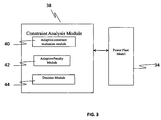
- the constraint analysis module 38 determines the new constraint values as explained in reference to FIG. 3 .
- the constraint analysis module 38 includes an adaptive constraint evaluation module 40 to select one or more adaptive constraints, i.e. constraints whose values can be altered, and the values for these adaptive constraints to solve the objective function.
- the adaptive constraint evaluation module 40 analyzes using the power plant model 34 and the objective function, which of the manipulated variable(s) maybe relaxed through its constraints for optimization, referred herein as “flexible manipulated variables” and by how much in terms of values, and also which of the manipulated variables cannot be relaxed, referred herein as "tight manipulated variables”. Accordingly, the adaptive constraint evaluation module 40 selects the constraints to be relaxed which are referred herein as “adaptive constraints” and the new values of such constraints referred herein as “adaptive constraint values” in order to arrive at an optimal solution.
- the adaptive constraints and the adaptive constraint values may also be pre-configured, e.g. the adaptive constraint evaluation module 40 has pre-configured definitions for desirable constraint values and also acceptable adaptive constraint values allowing for deviation from the desirable constraint values (i.e. how much the constraint value can vary may be predefined).
- the acceptable adaptive constraint values may be the same as or within the limits specified by the manufacturer or system designer to operate the plant.
- Priorities may also be determined to select the adaptive constaints and adaptive constraint values through techniques like sensitivity analysis or principal component analysis. In one example, the most sensitive constraint with respect to the solution of the objective function is assigned the highest priority so that it's value is selected first as the adaptive constraint value to solve the objective function.
- the adaptive constraint evaluation module 40 selects the preconfigured acceptable adaptive constraint values based on priority already defined alongwith, if it is available.
- the solution may be attempted by relaxing more than one adaptive constraints at same time, based on the priorites.
- the adaptive constraint evaluation module 40 may deploy techniques such as principal component analysis to determine which cost function is most significant and then identify which manipulated variable is significant term or dominated term, as "flexible manipulated variable” or "tight manipulated variable” and use the acceptable constraint values to simulate (e.g. through Monte-Carlo method) and to identify what may be the value for the flexible manipulated variable that may be suitable as an adaptive constraint value being as close as possible to the existing (or desired) constraint value, that results in a solution.
- Monte-Carlo method Monte-Carlo method
- it is determined which ones and how many constraints to be relaxed i.e how many adaptive constraints can be considered and by what extent i.e what would be the values of such adaptive constraints.
- the determination of adaptive constraints and their value is another optimization problem to optimally determine which adaptive constraints to be relaxed and by how much to produce effect as close to the desired or recommended settings for the power plant.
- the constraints associated with tight manipulated variables may also be relaxed based on priority (least priority relaxed first) or as determined through simulation to find conditions that provide an solution. This solution, though sub-optimal solution (not resulting from the desired constraints) is selected to satisfy the objective function.
- the analyis module considers the existing constraint values (defined within the acceptable values of constraints), the tight manipulated valriables and the flexible manipulated variables to find a new solution. It may be noted that such activation may be carried out periodically and in purpose to determine if indeed the solution practised is the best solution i.e such events happen in pre-programmed manner after every finite cycles. Alternatively, such event may also be user triggered.
- the adaptive constraint evaluation module 40 selects the associated constraints both for tight and flexible manipulated variables for adapting their values such that the tight manipulated variables are not impacted or they are further tightened to improve the solution. Thus, here, instead of only relaxing the constraints, some constraints are tightened and some others are relaxed. This ensures, a solution is obtained and that the solution is also the best among the possible solutions (more stable and profitable solution over long term).
- the adapative constraint values may be selected as the acceptable values of constraints as initial conditions and the new adapative constraint values are arrived at algorithmically, where some of the adaptive constraints values are for the tight manipulated variable and the values are such that it helps operate the plant with as tight a value as possible for the tight manipulated variable.
- Such an operation may be advantageous when the functions resulting from the tight manipulated variable influences multiple aspects/functions of the plant and having tighter control over the tight manipulated variable helps have better control over all the related aspects/functions of the plant.
- the constraint analysis module 38 finds the optimal solution of the objective function i.e. the optimal load scheduling solution that is sent to the control system for further action by the control system to deliver set-points through process controllers for operating parameters of different equipments in the power plant
- the constraint analysis module 38 may include additional modules for example a decision module 40 to analyze the impact of using the adaptive constraint values on the power plant operation in short term and long term.
- the term short-term effect as used herein is used to indicate the immediate effect of new values (recommended adaptive values of constraints to be used in the optimization problem). It will be appreciated by those skilled in the art that when the power plant is being operated by the solution obtained by changing at least one of the constraints from its first values i.e using the adaptive constraint values, there shall be an effect in the overall operation of the power plant different from the first values and impacting the power plant differently from that of the first values. This impact is being referred to be associated with the term 'long term effect'.
- the decision module compares the impact of adaptive constraints in long term to help decision making.
- the objective function is modified to include a compensation term to compensate for the effect on power plant operation in long term by using the adaptive constraints.
- the compensation term is calculated by the adaptive penalty module 42 over the long term (long term is a prediction horizon or the time period for which the power plant model, forecast modules and data such as demand forecast can reliably be used to forecast plant trajectory).
- the modified objective function that includes the compensation term is checked to ascertain if the use of adaptive constraint values brought any significant benefit in the power plant operation as shown in equations 17 and 18 given below in the Example section. The benefit may also be ascertained with respect to other alternative solutions in any time span within the prediction horizon.
- the decision module 40 may seek user intervention or use configured significance values to determine if the optimizer should continue with the modification as done using the adaptive constraints based on the benefit over long term.
- the decision module may be used to compare the new solution i.e value of objective function with the adaptive constraints with that obtained prior to applying the adaptive constraints and observe the effect of both of these in short or long term. The selection is then based on the values that are beneficial to the plant (without too much side affects expressed as compensation term wherein the side affects are less significant than the benefit from the new solution resulting from adapted constraints).
- electric generators G1, G2 and G3 are said to be operated nominally (typical value) for 45 MW production and have the maximum capacity of 50 MW power.
- nominal capacity is used as the upper bound for the generator capacity constraint (desired constraint) in the optimization problem.
- values of the constraints are adapted to have the upper bound between nominal and maximum value in order to find the optimal solution. The method of adapting the constraints is discussed in the following section.
- the value of the cost function is obtained from the optimization solver module of FIG. 2 .
- This cost function is used in the adaptive constraint evaluation module of the constraint analysis module ( FIG. 3 ) to find the dominant cost terms in equation 1 and dominant variables which contribute to the cost function.
- the dominant variables are identified using statistical analysis tool such as Principal Component Analysis (PCA). For example, consider the case where all the generators G1, G2 and G3 have the nominal capacity of 45 MW. Assume that G1 has the lowest operating cost of all the three and G2 has lower operating cost than G3.
- PCA Principal Component Analysis
- the optimizer will choose to run all the three generators less than or equal to its nominal value of 45 MW to meet the power demand. But if the power demand is 140 MW, then some of the generators capacity has to be relaxed and operate up to its maximum capacity of 50 MW to meet the power demand.
- the adaptive constraint evaluation module makes use of the power plant model (like relation between depreciation cost and load as given in eqn. 8) together with PCA technique to decide upon which generator capacity constraint has to be relaxed to the maximum value of 50 MW in order to meet the demand constraint. This analysis, say identifies the cost terms C dem and C st,life as the dominant cost terms in the cost function given in equation 1.
- the analysis is said to identify the capacity of generators G1 and G2 as the dominant variable and its upper bound capacity constraint value may be advantageous to be relaxed up to 50 MW.
- the Monte-Carlo simulation may be used to identify the new constraints values corresponding to the dominant variables (also in consideration with statistical confidence limits) that gives least cost function value.
- Adaptive Penalty module makes use of the demand forecast and power plant model to calculate the penalty value of adapting the constraint value on the long term.
- This penalty value is used as additive term to short term cost function to calculate the long term cost function value (J LT ) as given by eqn. 17.
- J LT is given by eqn. 18.
- J LT J ST + Penalty
- L LT J ST + C life where, C life is the depreciation cost calculated from equation 8, on operating the generators G1 and G2 with the adapted value of rapacity constraint over long time horizon.
- the suitability of short term cost function or that of long term cost function is based on the conditions (e.g.
- the new adapted constraint value may only be used in the optimization solution if the benefit from lowering the penalty from not meeting the demand by operating the generators above its nominal value is significant compared with the penalty associated with depreciation of the generators.
Landscapes
- Engineering & Computer Science (AREA)
- Combustion & Propulsion (AREA)
- Chemical & Material Sciences (AREA)
- Physics & Mathematics (AREA)
- General Engineering & Computer Science (AREA)
- Automation & Control Theory (AREA)
- General Physics & Mathematics (AREA)
- Evolutionary Computation (AREA)
- Software Systems (AREA)
- Medical Informatics (AREA)
- Health & Medical Sciences (AREA)
- Computer Vision & Pattern Recognition (AREA)
- Mechanical Engineering (AREA)
- Artificial Intelligence (AREA)
- Manufacturing & Machinery (AREA)
- Quality & Reliability (AREA)
- Supply And Distribution Of Alternating Current (AREA)
- Feedback Control In General (AREA)
- Management, Administration, Business Operations System, And Electronic Commerce (AREA)
Claims (8)
- Ein Verfahren zur Optimierung der Lastplanung für ein Kraftwerk (10) mit einer oder mehreren Energieerzeugungseinheiten, wobei das Verfahren umfasst:Erfassen eines Ereignisses, das indikativ für eine Notwendigkeit für ein Anpassen einer oder mehrerer Randbedingungen für eine Zielfunktion ist, die in der Lastplanung verwendet wird;Analysieren der Zielfunktion, um angepasste Randbedingungswerte für die eine oder mehrere Randbedingungen zum optimalen Lösen der Zielfunktion zu bestimmen;Verwenden der angepassten Randbedingungswerte von einer oder mehreren Randbedingungen, um die die Zielfunktion zu lösen; undVerwenden der Lösung der Zielfunktion mit dem einen oder den mehreren angepassten Randbedingungswerten, um eine oder mehrere Energieerzeugungseinheiten des Kraftwerks (10) zu betreiben,wobei der Schritt zum Analysieren der Zielfunktion ein Bestimmen eines Langzeiteffekts und eines Kurzzeiteffekts auf die Lastplanung aufgrund der Verwendung der angepassten Randbedingungswerte vor dem Anwenden der angepassten Randbedingungswerte umfasst.
- Das Verfahren nach Anspruch 1, wobei der Schritt zum Analysieren der Zielfunktion umfasst:Bestimmen einer oder mehrerer Stellgrößen zusammen mit jeweiligen Prioritäten, die dominante Terme in der Zielfunktion darstellen; undAuswählen der einen oder mehreren angepassten Randbedingungswerte für die eine oder die mehreren Stellgrößen.
- Das Verfahren nach Anspruch 2, wobei der eine oder die mehreren angepassten Randbedingungswerte vorkonfiguriert sind und zugehörige zuvor festgelegte Prioritäten haben.
- Das Verfahren nach Anspruch 2, wobei der eine oder die mehrere angepassten Randbedingungswerte unter Verwendung einer Empfindlichkeitsanalyse abgeschätzt werden.
- Das Verfahren nach Anspruch 2, wobei die Stellgrößen zumindest eine von flexiblen Stellgrößen oder festen Stellgrößen sind.
- Das Verfahren nach Anspruch 5, wobei der Schritt zum Analysieren der Zielfunktion ferner umfasst:Auswählen einer oder mehrerer angepassten Randbedingung(en) zum Lockern und/oder Anziehen auf der Basis der flexiblen Stellgrößen und der festen Stellgrößen; undSchätzen von angepassten Randbedingungswerten für die eine oder mehrere ausgewählten angepassten Randbedingungen.
- Das Verfahren nach Anspruch 1, wobei der Langzeiteffekt durch Modifizieren der Zielfunktion bestimmt wird, um einen Kompensationsterm miteinzubeziehen, um den langfristigen Effekt auf das Kraftwerk (10) unter Verwendung der Lösung der Zielfunktion mit der einen oder den mehreren angepassten Randbedingungswerten zu kompensieren.
- Ein Randbedingungsanalysemodul (38) in einem Optimierer (14) zum Optimieren einer Lastplanung für ein Kraftwerk (10) mit einer oder mehreren Energieerzeugungseinheiten, umfassend:ein adaptives Randbedingungsanalysemodul (40) zum Erfassen eines Ereignisses, das indikativ für eine Notwendigkeit eines Anpassens einer oder mehrerer Randbedingungen für eine Zielfunktion ist, die in der Lastplanung verwendet wird, zum Analysieren der Zielfunktion, um angepasste Randbedingungswerte für die eine oder die mehreren Randbedingungen zum optimalen Lösen der Zielfunktion zu bestimmen, und zum Verwenden der angepassten Randbedingungswerte einer oder mehrerer Randbedingungen um die die Zielfunktion zu lösen, wobei der Optimierer (14) die Lösung der Zielfunktion mit dem einen oder den mehreren angepassten Randbedingungswerten verwendet um die Sollwerte zu generieren, die verwendet werden, um eine oder mehrere Energieerzeugungseinheiten zu betreiben,ein adaptives Aufschlagsmodul (42) um einen Kompensationsterm zu berechnen, der einem Effekt der Verwendung eines oder mehrerer angepasster Randbedingungswerte bei Langzeitbelastungsplanung entspricht; undein Entscheidungsmodul (44) zum Auswählen angepasster Randbedingungswerte auf Grundlage des langfristigen Effekts und eines kurzfristigen Effekts auf das Kraftwerk aufgrund der Verwendung der angepassten Randbedingungswerte.
Applications Claiming Priority (2)
| Application Number | Priority Date | Filing Date | Title |
|---|---|---|---|
| IN3246CH2009 | 2009-12-31 | ||
| PCT/IB2010/001103 WO2011080547A1 (en) | 2009-12-31 | 2010-05-13 | Process optimization method and system for a power plant |
Publications (2)
| Publication Number | Publication Date |
|---|---|
| EP2519862A1 EP2519862A1 (de) | 2012-11-07 |
| EP2519862B1 true EP2519862B1 (de) | 2016-04-20 |
Family
ID=42985551
Family Applications (1)
| Application Number | Title | Priority Date | Filing Date |
|---|---|---|---|
| EP10726200.8A Active EP2519862B1 (de) | 2009-12-31 | 2010-05-13 | Verfahren und system zur prozessoptimierung für ein kraftwerk |
Country Status (10)
| Country | Link |
|---|---|
| US (1) | US10591875B2 (de) |
| EP (1) | EP2519862B1 (de) |
| JP (1) | JP5602878B2 (de) |
| KR (1) | KR101774205B1 (de) |
| CN (1) | CN102884484B (de) |
| AU (1) | AU2010337990B2 (de) |
| CA (1) | CA2785748C (de) |
| RU (1) | RU2533054C2 (de) |
| WO (1) | WO2011080547A1 (de) |
| ZA (1) | ZA201302263B (de) |
Families Citing this family (61)
| Publication number | Priority date | Publication date | Assignee | Title |
|---|---|---|---|---|
| US8880202B2 (en) | 2010-07-09 | 2014-11-04 | Emerson Process Management Power & Water Solutions, Inc. | Optimization system using an iteratively coupled expert engine |
| US9335748B2 (en) * | 2010-07-09 | 2016-05-10 | Emerson Process Management Power & Water Solutions, Inc. | Energy management system |
| KR20130098346A (ko) * | 2010-08-20 | 2013-09-04 | 비질런트 코포레이션 | Hvac 시스템을 위한 에너지 최적화 제어 결정 |
| US8781660B2 (en) * | 2012-04-11 | 2014-07-15 | GM Global Technology Operations LLC | Tiered, subtractive method to solve a linear constraint function associated with controlling a hybrid powertrain system |
| US20140142766A1 (en) * | 2012-11-20 | 2014-05-22 | General Electric Company | Methods and systems to improve power plant performance by corrective set points |
| CA2897041C (en) | 2013-03-15 | 2020-08-25 | Rolls-Royce Corporation | Lifing and performance optimization limit management for turbine engine |
| US9957843B2 (en) | 2013-12-31 | 2018-05-01 | General Electric Company | Methods and systems for enhancing control of power plant generating units |
| US20150184549A1 (en) | 2013-12-31 | 2015-07-02 | General Electric Company | Methods and systems for enhancing control of power plant generating units |
| US10101730B2 (en) | 2014-05-01 | 2018-10-16 | Johnson Controls Technology Company | Incorporating a load change penalty in central plant optimization |
| WO2015171624A1 (en) | 2014-05-05 | 2015-11-12 | Vigilent Corporation | Point-based risk score for managing environmental systems |
| JP6188653B2 (ja) * | 2014-08-08 | 2017-08-30 | 三菱電機株式会社 | エネルギー供給システムの管理・制御支援システム |
| US9771875B2 (en) * | 2014-11-18 | 2017-09-26 | General Electric Company | Application of probabilistic control in gas turbine tuning, related control systems, computer program products and methods |
| US9803561B2 (en) | 2014-11-18 | 2017-10-31 | General Electric Company | Power output and emissions based degraded gas turbine tuning and control systems, computer program products and related methods |
| US9771877B2 (en) | 2014-11-18 | 2017-09-26 | General Electric Company | Power output and fuel flow based probabilistic control in part load gas turbine tuning, related control systems, computer program products and methods |
| US9771876B2 (en) | 2014-11-18 | 2017-09-26 | General Electric Compnay | Application of probabilistic control in gas turbine tuning with measurement error, related control systems, computer program products and methods |
| US9771874B2 (en) | 2014-11-18 | 2017-09-26 | General Electric Company | Power output and fuel flow based probabilistic control in gas turbine tuning, related control systems, computer program products and methods |
| US9784183B2 (en) | 2014-11-18 | 2017-10-10 | General Electric Company | Power outlet, emissions, fuel flow and water flow based probabilistic control in liquid-fueled gas turbine tuning, related control systems, computer program products and methods |
| JP6816949B2 (ja) * | 2014-11-26 | 2021-01-20 | ゼネラル・エレクトリック・カンパニイ | 発電プラント発電ユニットの制御を強化するための方法 |
| JP6453073B2 (ja) * | 2014-12-24 | 2019-01-16 | 株式会社日立製作所 | データ入力支援装置及びデータ入力支援方法 |
| WO2016108891A1 (en) * | 2014-12-31 | 2016-07-07 | Halliburton Energy Services, Inc. | Optimizing running operations |
| US10253599B2 (en) * | 2014-12-31 | 2019-04-09 | Halliburton Energy Services, Inc. | Optimizing stimulation and fluid management operations |
| US10329882B2 (en) | 2014-12-31 | 2019-06-25 | Halliburton Energy Services, Inc. | Optimizing completion operations |
| US9909507B2 (en) | 2015-01-27 | 2018-03-06 | General Electric Company | Control system for can-to-can variation in combustor system and related method |
| JP6522445B2 (ja) * | 2015-06-30 | 2019-05-29 | 三菱日立パワーシステムズ株式会社 | 制御パラメータ最適化システム及びそれを備えた運転制御最適化装置 |
| US9856796B2 (en) | 2015-12-07 | 2018-01-02 | General Electric Company | Application of probabilistic control in gas turbine tuning for power output-emissions parameters with scaling factor, related control systems, computer program products and methods |
| US9856797B2 (en) | 2015-12-16 | 2018-01-02 | General Electric Company | Application of combined probabilistic control in gas turbine tuning for power output-emissions parameters with scaling factor, related control systems, computer program products and methods |
| US9879612B2 (en) | 2015-12-16 | 2018-01-30 | General Electric Company | Combined probabilistic control in gas turbine tuning for power output-emissions parameters with scaling factor, related control systems, computer program products and methods |
| US9879615B2 (en) | 2015-12-16 | 2018-01-30 | General Electric Company | Machine-specific probabilistic control in gas turbine tuning for power output-emissions parameters, related control systems, computer program products and methods |
| US9879614B2 (en) | 2015-12-16 | 2018-01-30 | General Electric Company | Machine-specific combined probabilistic control in gas turbine tuning for power output-emissions parameters with scaling factor, related control systems, computer program products and methods |
| US9879613B2 (en) | 2015-12-16 | 2018-01-30 | General Electric Company | Application of combined probabilistic control in gas turbine tuning for power output-emissions parameters with scaling factor, related control systems, computer program products and methods |
| US9797315B2 (en) | 2015-12-16 | 2017-10-24 | General Electric Company | Probabilistic control in gas turbine tuning for power output-emissions parameters, related control systems, computer program products and methods |
| US9882454B2 (en) | 2015-12-16 | 2018-01-30 | General Electric Company | Application of combined probabilistic control in gas turbine tuning for power output-emissions parameters with scaling factor, related control systems, computer program products and methods |
| US9790865B2 (en) | 2015-12-16 | 2017-10-17 | General Electric Company | Modelling probabilistic control in gas turbine tuning for power output-emissions parameters, related control systems, computer program products and methods |
| US10359748B2 (en) | 2017-02-07 | 2019-07-23 | Johnson Controls Technology Company | Building energy cost optimization system with asset sizing |
| US11238547B2 (en) | 2017-01-12 | 2022-02-01 | Johnson Controls Tyco IP Holdings LLP | Building energy cost optimization system with asset sizing |
| US11061424B2 (en) | 2017-01-12 | 2021-07-13 | Johnson Controls Technology Company | Building energy storage system with peak load contribution and stochastic cost optimization |
| US10282796B2 (en) | 2017-01-12 | 2019-05-07 | Johnson Controls Technology Company | Building energy storage system with multiple demand charge cost optimization |
| US11010846B2 (en) | 2017-01-12 | 2021-05-18 | Johnson Controls Technology Company | Building energy storage system with multiple demand charge cost optimization |
| US10324483B2 (en) | 2017-01-12 | 2019-06-18 | Johnson Controls Technology Company | Building energy storage system with peak load contribution cost optimization |
| US10949777B2 (en) | 2017-06-07 | 2021-03-16 | Johnson Controls Technology Company | Building energy optimization system with economic load demand response (ELDR) optimization |
| US11847617B2 (en) | 2017-02-07 | 2023-12-19 | Johnson Controls Tyco IP Holdings LLP | Model predictive maintenance system with financial analysis functionality |
| US11900287B2 (en) | 2017-05-25 | 2024-02-13 | Johnson Controls Tyco IP Holdings LLP | Model predictive maintenance system with budgetary constraints |
| US11374409B2 (en) | 2017-04-03 | 2022-06-28 | Savant Technologies Llc | Power system load flexibility forecasting |
| US12242259B2 (en) | 2017-05-25 | 2025-03-04 | Tyco Fire & Security Gmbh | Model predictive maintenance system with event or condition based performance |
| US12282324B2 (en) | 2017-05-25 | 2025-04-22 | Tyco Fire & Security Gmbh | Model predictive maintenance system with degradation impact model |
| US11409274B2 (en) | 2017-05-25 | 2022-08-09 | Johnson Controls Tyco IP Holdings LLP | Model predictive maintenance system for performing maintenance as soon as economically viable |
| US11416955B2 (en) | 2017-05-25 | 2022-08-16 | Johnson Controls Tyco IP Holdings LLP | Model predictive maintenance system with integrated measurement and verification functionality |
| WO2018217251A1 (en) | 2017-05-25 | 2018-11-29 | Johnson Controls Technology Company | Model predictive maintenance system for building equipment |
| US11747800B2 (en) | 2017-05-25 | 2023-09-05 | Johnson Controls Tyco IP Holdings LLP | Model predictive maintenance system with automatic service work order generation |
| US11636429B2 (en) | 2017-05-25 | 2023-04-25 | Johnson Controls Tyco IP Holdings LLP | Model predictive maintenance systems and methods with automatic parts resupply |
| US11120411B2 (en) | 2017-05-25 | 2021-09-14 | Johnson Controls Tyco IP Holdings LLP | Model predictive maintenance system with incentive incorporation |
| EP3457513A1 (de) | 2017-09-13 | 2019-03-20 | Johnson Controls Technology Company | Gebäude-energiesystem mit lastverteilung |
| US10284860B1 (en) * | 2018-07-02 | 2019-05-07 | Tencent America LLC | Method and apparatus for video coding |
| CN109584099B (zh) * | 2018-10-24 | 2021-08-31 | 华中科技大学 | 电网调峰的水电站短期多目标发电计划编制方法及系统 |
| US10758660B2 (en) * | 2018-12-21 | 2020-09-01 | Fresenius Medical Care Holdings, Inc. | Dialysis system with artificial intelligence |
| US11281198B2 (en) * | 2019-05-31 | 2022-03-22 | Johnson Controls Tyco IP Holdings LLP | Central plant optimization with optimization modification |
| US11480360B2 (en) | 2019-08-06 | 2022-10-25 | Johnson Controls Tyco IP Holdings LLP | Building HVAC system with modular cascaded model |
| CN110866632B (zh) * | 2019-10-17 | 2022-05-06 | 杭州电子科技大学 | 一种发电机机组优化的方法 |
| CN111476475B (zh) * | 2020-04-01 | 2023-10-13 | 贵州黔源电力股份有限公司 | 多约束条件下梯级水电站短期优化调度方法 |
| US12281809B2 (en) * | 2021-11-04 | 2025-04-22 | Tyco Fire & Security Gmbh | Building equipment selection using soft constraints |
| US12627157B2 (en) * | 2023-07-07 | 2026-05-12 | Saudi Arabian Oil Company | Multi-site optimization of energy systems |
Family Cites Families (24)
| Publication number | Priority date | Publication date | Assignee | Title |
|---|---|---|---|---|
| US5477444A (en) * | 1992-09-14 | 1995-12-19 | Bhat; Naveen V. | Control system using an adaptive neural network for target and path optimization for a multivariable, nonlinear process |
| US5873251A (en) * | 1995-09-13 | 1999-02-23 | Kabushiki Kaisha Toshiba | Plant operation control system |
| WO2004084371A1 (ja) * | 1998-08-31 | 2004-09-30 | Kaoru Fujita | 発電プラントの最適化制御方法及び最適化制御装置 |
| US6321207B1 (en) * | 1999-04-15 | 2001-11-20 | I2 Technologies Us, Inc. | System and method for optimizing the allocation of a resource |
| RU2204438C1 (ru) * | 2001-09-14 | 2003-05-20 | Зобнин Борис Борисович | Устройство для автоматического управления процессом дробления материала |
| US7474995B2 (en) * | 2002-05-03 | 2009-01-06 | Sungard Energy Systems Inc. | Valuing and optimizing scheduling of generation assets |
| US7389209B2 (en) * | 2002-05-03 | 2008-06-17 | Sungard Energy Systems Inc. | Valuing and optimizing scheduling of generation assets for a group of facilities |
| DE10341762B4 (de) * | 2002-09-11 | 2014-05-15 | Fisher-Rosemount Systems, Inc. | Handhabung der Realisierbarkeit von Beschränkungen und Grenzen in einem Optimierer für Prozesssteuerungssysteme |
| US7376472B2 (en) | 2002-09-11 | 2008-05-20 | Fisher-Rosemount Systems, Inc. | Integrated model predictive control and optimization within a process control system |
| US7219040B2 (en) * | 2002-11-05 | 2007-05-15 | General Electric Company | Method and system for model based control of heavy duty gas turbine |
| US6823675B2 (en) * | 2002-11-13 | 2004-11-30 | General Electric Company | Adaptive model-based control systems and methods for controlling a gas turbine |
| CN100580677C (zh) * | 2003-03-05 | 2010-01-13 | 穆罕默德·M·El-凯瑟 | 面向电力市场的dc-分段设计以及电力传输的最优调度 |
| US7305282B2 (en) * | 2003-05-13 | 2007-12-04 | Siemens Power Transmission & Distribution, Inc. | Very short term load prediction in an energy management system |
| US7689323B2 (en) * | 2003-05-13 | 2010-03-30 | Siemens Aktiengesellschaft | Automatic generation control of a power distribution system |
| JP4115958B2 (ja) * | 2004-03-26 | 2008-07-09 | 株式会社東芝 | プラントの運転スケジュール最適化方法および最適化システム |
| US7117046B2 (en) * | 2004-08-27 | 2006-10-03 | Alstom Technology Ltd. | Cascaded control of an average value of a process parameter to a desired value |
| US7356383B2 (en) * | 2005-02-10 | 2008-04-08 | General Electric Company | Methods and apparatus for optimizing combined cycle/combined process facilities |
| US7463937B2 (en) * | 2005-11-10 | 2008-12-09 | William Joseph Korchinski | Method and apparatus for improving the accuracy of linear program based models |
| US7489990B2 (en) * | 2006-07-17 | 2009-02-10 | Fehr Stephen L | Systems and methods for calculating and predicting near term production cost, incremental heat rate, capacity and emissions of electric generation power plants based on current operating and, optionally, atmospheric conditions |
| US8892264B2 (en) * | 2009-10-23 | 2014-11-18 | Viridity Energy, Inc. | Methods, apparatus and systems for managing energy assets |
| GB2545860B (en) * | 2014-12-31 | 2020-12-09 | Halliburton Energy Services Inc | Real-time control of drilling fluid properties using predictive models |
| JP6522445B2 (ja) * | 2015-06-30 | 2019-05-29 | 三菱日立パワーシステムズ株式会社 | 制御パラメータ最適化システム及びそれを備えた運転制御最適化装置 |
| CN105302315A (zh) * | 2015-11-20 | 2016-02-03 | 小米科技有限责任公司 | 图片处理方法及装置 |
| JP6702421B2 (ja) * | 2015-12-25 | 2020-06-03 | 日本電気株式会社 | コスト関数設計システム、コスト関数設計方法、およびコスト関数設計プログラム |
-
2010
- 2010-05-13 EP EP10726200.8A patent/EP2519862B1/de active Active
- 2010-05-13 CA CA2785748A patent/CA2785748C/en active Active
- 2010-05-13 RU RU2012132644/08A patent/RU2533054C2/ru active
- 2010-05-13 KR KR1020127020235A patent/KR101774205B1/ko active Active
- 2010-05-13 JP JP2012546511A patent/JP5602878B2/ja active Active
- 2010-05-13 AU AU2010337990A patent/AU2010337990B2/en active Active
- 2010-05-13 CN CN201080064995.8A patent/CN102884484B/zh active Active
- 2010-05-13 WO PCT/IB2010/001103 patent/WO2011080547A1/en not_active Ceased
-
2012
- 2012-07-02 US US13/540,075 patent/US10591875B2/en active Active
-
2013
- 2013-03-26 ZA ZA2013/02263A patent/ZA201302263B/en unknown
Also Published As
| Publication number | Publication date |
|---|---|
| CN102884484B (zh) | 2016-06-01 |
| US10591875B2 (en) | 2020-03-17 |
| WO2011080547A1 (en) | 2011-07-07 |
| EP2519862A1 (de) | 2012-11-07 |
| KR101774205B1 (ko) | 2017-09-04 |
| CA2785748C (en) | 2015-08-04 |
| US20130006429A1 (en) | 2013-01-03 |
| AU2010337990A1 (en) | 2012-07-19 |
| JP2013516670A (ja) | 2013-05-13 |
| CA2785748A1 (en) | 2011-07-07 |
| RU2533054C2 (ru) | 2014-11-20 |
| AU2010337990B2 (en) | 2014-03-06 |
| KR20120117846A (ko) | 2012-10-24 |
| RU2012132644A (ru) | 2014-02-10 |
| ZA201302263B (en) | 2014-06-25 |
| JP5602878B2 (ja) | 2014-10-08 |
| CN102884484A (zh) | 2013-01-16 |
Similar Documents
| Publication | Publication Date | Title |
|---|---|---|
| US10591875B2 (en) | Process optimization method and system for a power plant | |
| RU2523191C2 (ru) | Способ и система управления для планирования нагрузки электростанции | |
| US11620545B2 (en) | Planning apparatus, method of generating operating plan, hydrogen production method, and computer readable storage medium | |
| EP3155260B1 (de) | Optimaler windparkbetrieb | |
| US20110004356A1 (en) | Event-based control system for wind turbine generators | |
| KR101920251B1 (ko) | 기술 시스템의 컴퓨터-도움 제어 및/또는 조절을 위한 방법 | |
| US20170160706A1 (en) | Method for computer-aided installation control optimization using a simulation module | |
| US20160230699A1 (en) | Combined cycle power generation optimization system | |
| EP1577721A2 (de) | Modell-Prädikitve Steuerung mit Lebensdauerverlängerung | |
| CN106933202A (zh) | 利用基于所估计的状态信息的间歇重新初始化的前馈控制 | |
| EP3922842A1 (de) | Verfahren zur steuerung einer windturbine | |
| JP2016082740A (ja) | 発電設備の運転制御方法及び運転制御装置 | |
| CN117616655A (zh) | 电力需求预测方法及系统 | |
| JP4810550B2 (ja) | 受電点電力運用制御装置及び受電点電力運用制御方法 | |
| EP2827204B1 (de) | Gasturbinenmotorsteuerung mit Ereignisauslöser | |
| EP2624080B1 (de) | System und Verfahren zur Leistungsoptimierung eines Systems | |
| AU2024366005A1 (en) | Automatic central tuning on a compressed air system |
Legal Events
| Date | Code | Title | Description |
|---|---|---|---|
| PUAI | Public reference made under article 153(3) epc to a published international application that has entered the european phase |
Free format text: ORIGINAL CODE: 0009012 |
|
| 17P | Request for examination filed |
Effective date: 20120731 |
|
| AK | Designated contracting states |
Kind code of ref document: A1 Designated state(s): AL AT BE BG CH CY CZ DE DK EE ES FI FR GB GR HR HU IE IS IT LI LT LU LV MC MK MT NL NO PL PT RO SE SI SK SM TR |
|
| DAX | Request for extension of the european patent (deleted) | ||
| GRAP | Despatch of communication of intention to grant a patent |
Free format text: ORIGINAL CODE: EPIDOSNIGR1 |
|
| INTG | Intention to grant announced |
Effective date: 20151020 |
|
| GRAS | Grant fee paid |
Free format text: ORIGINAL CODE: EPIDOSNIGR3 |
|
| GRAA | (expected) grant |
Free format text: ORIGINAL CODE: 0009210 |
|
| AK | Designated contracting states |
Kind code of ref document: B1 Designated state(s): AL AT BE BG CH CY CZ DE DK EE ES FI FR GB GR HR HU IE IS IT LI LT LU LV MC MK MT NL NO PL PT RO SE SI SK SM TR |
|
| REG | Reference to a national code |
Ref country code: GB Ref legal event code: FG4D |
|
| REG | Reference to a national code |
Ref country code: CH Ref legal event code: EP |
|
| REG | Reference to a national code |
Ref country code: AT Ref legal event code: REF Ref document number: 793091 Country of ref document: AT Kind code of ref document: T Effective date: 20160515 |
|
| REG | Reference to a national code |
Ref country code: IE Ref legal event code: FG4D |
|
| REG | Reference to a national code |
Ref country code: DE Ref legal event code: R096 Ref document number: 602010032483 Country of ref document: DE |
|
| REG | Reference to a national code |
Ref country code: LT Ref legal event code: MG4D |
|
| PG25 | Lapsed in a contracting state [announced via postgrant information from national office to epo] |
Ref country code: BE Free format text: LAPSE BECAUSE OF NON-PAYMENT OF DUE FEES Effective date: 20160531 |
|
| REG | Reference to a national code |
Ref country code: AT Ref legal event code: MK05 Ref document number: 793091 Country of ref document: AT Kind code of ref document: T Effective date: 20160420 |
|
| REG | Reference to a national code |
Ref country code: NL Ref legal event code: MP Effective date: 20160420 |
|
| PG25 | Lapsed in a contracting state [announced via postgrant information from national office to epo] |
Ref country code: NO Free format text: LAPSE BECAUSE OF FAILURE TO SUBMIT A TRANSLATION OF THE DESCRIPTION OR TO PAY THE FEE WITHIN THE PRESCRIBED TIME-LIMIT Effective date: 20160720 Ref country code: NL Free format text: LAPSE BECAUSE OF FAILURE TO SUBMIT A TRANSLATION OF THE DESCRIPTION OR TO PAY THE FEE WITHIN THE PRESCRIBED TIME-LIMIT Effective date: 20160420 Ref country code: FI Free format text: LAPSE BECAUSE OF FAILURE TO SUBMIT A TRANSLATION OF THE DESCRIPTION OR TO PAY THE FEE WITHIN THE PRESCRIBED TIME-LIMIT Effective date: 20160420 Ref country code: PL Free format text: LAPSE BECAUSE OF FAILURE TO SUBMIT A TRANSLATION OF THE DESCRIPTION OR TO PAY THE FEE WITHIN THE PRESCRIBED TIME-LIMIT Effective date: 20160420 Ref country code: LT Free format text: LAPSE BECAUSE OF FAILURE TO SUBMIT A TRANSLATION OF THE DESCRIPTION OR TO PAY THE FEE WITHIN THE PRESCRIBED TIME-LIMIT Effective date: 20160420 |
|
| PG25 | Lapsed in a contracting state [announced via postgrant information from national office to epo] |
Ref country code: PT Free format text: LAPSE BECAUSE OF FAILURE TO SUBMIT A TRANSLATION OF THE DESCRIPTION OR TO PAY THE FEE WITHIN THE PRESCRIBED TIME-LIMIT Effective date: 20160822 Ref country code: SE Free format text: LAPSE BECAUSE OF FAILURE TO SUBMIT A TRANSLATION OF THE DESCRIPTION OR TO PAY THE FEE WITHIN THE PRESCRIBED TIME-LIMIT Effective date: 20160420 Ref country code: HR Free format text: LAPSE BECAUSE OF FAILURE TO SUBMIT A TRANSLATION OF THE DESCRIPTION OR TO PAY THE FEE WITHIN THE PRESCRIBED TIME-LIMIT Effective date: 20160420 Ref country code: GR Free format text: LAPSE BECAUSE OF FAILURE TO SUBMIT A TRANSLATION OF THE DESCRIPTION OR TO PAY THE FEE WITHIN THE PRESCRIBED TIME-LIMIT Effective date: 20160721 Ref country code: LV Free format text: LAPSE BECAUSE OF FAILURE TO SUBMIT A TRANSLATION OF THE DESCRIPTION OR TO PAY THE FEE WITHIN THE PRESCRIBED TIME-LIMIT Effective date: 20160420 Ref country code: ES Free format text: LAPSE BECAUSE OF FAILURE TO SUBMIT A TRANSLATION OF THE DESCRIPTION OR TO PAY THE FEE WITHIN THE PRESCRIBED TIME-LIMIT Effective date: 20160420 Ref country code: AT Free format text: LAPSE BECAUSE OF FAILURE TO SUBMIT A TRANSLATION OF THE DESCRIPTION OR TO PAY THE FEE WITHIN THE PRESCRIBED TIME-LIMIT Effective date: 20160420 |
|
| PG25 | Lapsed in a contracting state [announced via postgrant information from national office to epo] |
Ref country code: BE Free format text: LAPSE BECAUSE OF FAILURE TO SUBMIT A TRANSLATION OF THE DESCRIPTION OR TO PAY THE FEE WITHIN THE PRESCRIBED TIME-LIMIT Effective date: 20160420 Ref country code: IT Free format text: LAPSE BECAUSE OF FAILURE TO SUBMIT A TRANSLATION OF THE DESCRIPTION OR TO PAY THE FEE WITHIN THE PRESCRIBED TIME-LIMIT Effective date: 20160420 |
|
| REG | Reference to a national code |
Ref country code: CH Ref legal event code: PL |
|
| REG | Reference to a national code |
Ref country code: DE Ref legal event code: R097 Ref document number: 602010032483 Country of ref document: DE |
|
| PG25 | Lapsed in a contracting state [announced via postgrant information from national office to epo] |
Ref country code: RO Free format text: LAPSE BECAUSE OF FAILURE TO SUBMIT A TRANSLATION OF THE DESCRIPTION OR TO PAY THE FEE WITHIN THE PRESCRIBED TIME-LIMIT Effective date: 20160420 Ref country code: MC Free format text: LAPSE BECAUSE OF FAILURE TO SUBMIT A TRANSLATION OF THE DESCRIPTION OR TO PAY THE FEE WITHIN THE PRESCRIBED TIME-LIMIT Effective date: 20160420 Ref country code: EE Free format text: LAPSE BECAUSE OF FAILURE TO SUBMIT A TRANSLATION OF THE DESCRIPTION OR TO PAY THE FEE WITHIN THE PRESCRIBED TIME-LIMIT Effective date: 20160420 Ref country code: SK Free format text: LAPSE BECAUSE OF FAILURE TO SUBMIT A TRANSLATION OF THE DESCRIPTION OR TO PAY THE FEE WITHIN THE PRESCRIBED TIME-LIMIT Effective date: 20160420 Ref country code: LI Free format text: LAPSE BECAUSE OF NON-PAYMENT OF DUE FEES Effective date: 20160531 Ref country code: CZ Free format text: LAPSE BECAUSE OF FAILURE TO SUBMIT A TRANSLATION OF THE DESCRIPTION OR TO PAY THE FEE WITHIN THE PRESCRIBED TIME-LIMIT Effective date: 20160420 Ref country code: CH Free format text: LAPSE BECAUSE OF NON-PAYMENT OF DUE FEES Effective date: 20160531 Ref country code: DK Free format text: LAPSE BECAUSE OF FAILURE TO SUBMIT A TRANSLATION OF THE DESCRIPTION OR TO PAY THE FEE WITHIN THE PRESCRIBED TIME-LIMIT Effective date: 20160420 |
|
| REG | Reference to a national code |
Ref country code: IE Ref legal event code: MM4A |
|
| PLBE | No opposition filed within time limit |
Free format text: ORIGINAL CODE: 0009261 |
|
| STAA | Information on the status of an ep patent application or granted ep patent |
Free format text: STATUS: NO OPPOSITION FILED WITHIN TIME LIMIT |
|
| PG25 | Lapsed in a contracting state [announced via postgrant information from national office to epo] |
Ref country code: SM Free format text: LAPSE BECAUSE OF FAILURE TO SUBMIT A TRANSLATION OF THE DESCRIPTION OR TO PAY THE FEE WITHIN THE PRESCRIBED TIME-LIMIT Effective date: 20160420 |
|
| REG | Reference to a national code |
Ref country code: FR Ref legal event code: ST Effective date: 20170131 |
|
| GBPC | Gb: european patent ceased through non-payment of renewal fee |
Effective date: 20160720 |
|
| 26N | No opposition filed |
Effective date: 20170123 |
|
| PG25 | Lapsed in a contracting state [announced via postgrant information from national office to epo] |
Ref country code: FR Free format text: LAPSE BECAUSE OF NON-PAYMENT OF DUE FEES Effective date: 20160620 |
|
| PG25 | Lapsed in a contracting state [announced via postgrant information from national office to epo] |
Ref country code: GB Free format text: LAPSE BECAUSE OF NON-PAYMENT OF DUE FEES Effective date: 20160720 Ref country code: SI Free format text: LAPSE BECAUSE OF FAILURE TO SUBMIT A TRANSLATION OF THE DESCRIPTION OR TO PAY THE FEE WITHIN THE PRESCRIBED TIME-LIMIT Effective date: 20160420 Ref country code: IE Free format text: LAPSE BECAUSE OF NON-PAYMENT OF DUE FEES Effective date: 20160513 |
|
| PG25 | Lapsed in a contracting state [announced via postgrant information from national office to epo] |
Ref country code: HU Free format text: LAPSE BECAUSE OF FAILURE TO SUBMIT A TRANSLATION OF THE DESCRIPTION OR TO PAY THE FEE WITHIN THE PRESCRIBED TIME-LIMIT; INVALID AB INITIO Effective date: 20100513 Ref country code: CY Free format text: LAPSE BECAUSE OF FAILURE TO SUBMIT A TRANSLATION OF THE DESCRIPTION OR TO PAY THE FEE WITHIN THE PRESCRIBED TIME-LIMIT Effective date: 20160420 |
|
| PG25 | Lapsed in a contracting state [announced via postgrant information from national office to epo] |
Ref country code: MT Free format text: LAPSE BECAUSE OF NON-PAYMENT OF DUE FEES Effective date: 20160531 Ref country code: TR Free format text: LAPSE BECAUSE OF FAILURE TO SUBMIT A TRANSLATION OF THE DESCRIPTION OR TO PAY THE FEE WITHIN THE PRESCRIBED TIME-LIMIT Effective date: 20160420 Ref country code: MK Free format text: LAPSE BECAUSE OF FAILURE TO SUBMIT A TRANSLATION OF THE DESCRIPTION OR TO PAY THE FEE WITHIN THE PRESCRIBED TIME-LIMIT Effective date: 20160420 Ref country code: IS Free format text: LAPSE BECAUSE OF FAILURE TO SUBMIT A TRANSLATION OF THE DESCRIPTION OR TO PAY THE FEE WITHIN THE PRESCRIBED TIME-LIMIT Effective date: 20160420 Ref country code: LU Free format text: LAPSE BECAUSE OF NON-PAYMENT OF DUE FEES Effective date: 20160513 |
|
| PG25 | Lapsed in a contracting state [announced via postgrant information from national office to epo] |
Ref country code: BG Free format text: LAPSE BECAUSE OF FAILURE TO SUBMIT A TRANSLATION OF THE DESCRIPTION OR TO PAY THE FEE WITHIN THE PRESCRIBED TIME-LIMIT Effective date: 20160420 |
|
| PG25 | Lapsed in a contracting state [announced via postgrant information from national office to epo] |
Ref country code: AL Free format text: LAPSE BECAUSE OF FAILURE TO SUBMIT A TRANSLATION OF THE DESCRIPTION OR TO PAY THE FEE WITHIN THE PRESCRIBED TIME-LIMIT Effective date: 20160420 |
|
| REG | Reference to a national code |
Ref country code: DE Ref legal event code: R082 Ref document number: 602010032483 Country of ref document: DE Representative=s name: ZIMMERMANN & PARTNER PATENTANWAELTE MBB, DE Ref country code: DE Ref legal event code: R081 Ref document number: 602010032483 Country of ref document: DE Owner name: ABB SCHWEIZ AG, CH Free format text: FORMER OWNER: ABB RESEARCH LTD., ZUERICH, CH |
|
| PGFP | Annual fee paid to national office [announced via postgrant information from national office to epo] |
Ref country code: DE Payment date: 20250521 Year of fee payment: 16 |