EP2511408A1 - Flexible carbon fiber nonwoven fabric - Google Patents
Flexible carbon fiber nonwoven fabric Download PDFInfo
- Publication number
- EP2511408A1 EP2511408A1 EP10835815A EP10835815A EP2511408A1 EP 2511408 A1 EP2511408 A1 EP 2511408A1 EP 10835815 A EP10835815 A EP 10835815A EP 10835815 A EP10835815 A EP 10835815A EP 2511408 A1 EP2511408 A1 EP 2511408A1
- Authority
- EP
- European Patent Office
- Prior art keywords
- nonwoven fabric
- carbon fiber
- fiber nonwoven
- resins
- flexible carbon
- Prior art date
- Legal status (The legal status is an assumption and is not a legal conclusion. Google has not performed a legal analysis and makes no representation as to the accuracy of the status listed.)
- Withdrawn
Links
- 239000004745 nonwoven fabric Substances 0.000 title claims abstract description 178
- 229920000049 Carbon (fiber) Polymers 0.000 title claims abstract description 112
- 239000004917 carbon fiber Substances 0.000 title claims abstract description 112
- VNWKTOKETHGBQD-UHFFFAOYSA-N methane Chemical compound C VNWKTOKETHGBQD-UHFFFAOYSA-N 0.000 title claims abstract description 102
- 238000001523 electrospinning Methods 0.000 claims abstract description 62
- 239000000126 substance Substances 0.000 claims abstract description 50
- 238000010000 carbonizing Methods 0.000 claims abstract description 24
- 150000002894 organic compounds Chemical class 0.000 claims abstract description 23
- 239000000203 mixture Substances 0.000 claims abstract description 22
- 229910052723 transition metal Inorganic materials 0.000 claims abstract description 22
- 150000003624 transition metals Chemical class 0.000 claims abstract description 22
- 239000005011 phenolic resin Substances 0.000 claims abstract description 11
- 229920006350 polyacrylonitrile resin Polymers 0.000 claims abstract description 7
- 229920005989 resin Polymers 0.000 claims description 20
- 239000011347 resin Substances 0.000 claims description 20
- UFHFLCQGNIYNRP-UHFFFAOYSA-N Hydrogen Chemical compound [H][H] UFHFLCQGNIYNRP-UHFFFAOYSA-N 0.000 claims description 17
- 239000001257 hydrogen Substances 0.000 claims description 17
- 229910052739 hydrogen Inorganic materials 0.000 claims description 17
- XEEYBQQBJWHFJM-UHFFFAOYSA-N Iron Chemical compound [Fe] XEEYBQQBJWHFJM-UHFFFAOYSA-N 0.000 claims description 15
- -1 polypropylene Polymers 0.000 claims description 12
- 229920001568 phenolic resin Polymers 0.000 claims description 10
- 239000007789 gas Substances 0.000 claims description 9
- 229910052757 nitrogen Inorganic materials 0.000 claims description 9
- 229910017052 cobalt Inorganic materials 0.000 claims description 8
- 239000010941 cobalt Substances 0.000 claims description 8
- 229910052742 iron Inorganic materials 0.000 claims description 8
- PXHVJJICTQNCMI-UHFFFAOYSA-N Nickel Chemical compound [Ni] PXHVJJICTQNCMI-UHFFFAOYSA-N 0.000 claims description 7
- GUTLYIVDDKVIGB-UHFFFAOYSA-N cobalt atom Chemical compound [Co] GUTLYIVDDKVIGB-UHFFFAOYSA-N 0.000 claims description 7
- 229910052719 titanium Inorganic materials 0.000 claims description 7
- 239000010936 titanium Substances 0.000 claims description 7
- KXGFMDJXCMQABM-UHFFFAOYSA-N 2-methoxy-6-methylphenol Chemical compound [CH]OC1=CC=CC([CH])=C1O KXGFMDJXCMQABM-UHFFFAOYSA-N 0.000 claims description 6
- 238000001069 Raman spectroscopy Methods 0.000 claims description 6
- RTAQQCXQSZGOHL-UHFFFAOYSA-N Titanium Chemical compound [Ti] RTAQQCXQSZGOHL-UHFFFAOYSA-N 0.000 claims description 6
- MCMNRKCIXSYSNV-UHFFFAOYSA-N Zirconium dioxide Chemical compound O=[Zr]=O MCMNRKCIXSYSNV-UHFFFAOYSA-N 0.000 claims description 6
- 239000001913 cellulose Substances 0.000 claims description 6
- 229920002678 cellulose Polymers 0.000 claims description 6
- 238000004519 manufacturing process Methods 0.000 claims description 6
- BASFCYQUMIYNBI-UHFFFAOYSA-N platinum Chemical compound [Pt] BASFCYQUMIYNBI-UHFFFAOYSA-N 0.000 claims description 6
- 239000000446 fuel Substances 0.000 claims description 5
- 125000004433 nitrogen atom Chemical group N* 0.000 claims description 5
- 238000009792 diffusion process Methods 0.000 claims description 4
- 229910052759 nickel Inorganic materials 0.000 claims description 4
- RYGMFSIKBFXOCR-UHFFFAOYSA-N Copper Chemical compound [Cu] RYGMFSIKBFXOCR-UHFFFAOYSA-N 0.000 claims description 3
- 229920000877 Melamine resin Polymers 0.000 claims description 3
- 239000004962 Polyamide-imide Substances 0.000 claims description 3
- 239000004721 Polyphenylene oxide Substances 0.000 claims description 3
- 239000004743 Polypropylene Substances 0.000 claims description 3
- 229920001328 Polyvinylidene chloride Polymers 0.000 claims description 3
- 229920001807 Urea-formaldehyde Polymers 0.000 claims description 3
- 229910052802 copper Inorganic materials 0.000 claims description 3
- 239000010949 copper Substances 0.000 claims description 3
- 239000003822 epoxy resin Substances 0.000 claims description 3
- LNEPOXFFQSENCJ-UHFFFAOYSA-N haloperidol Chemical compound C1CC(O)(C=2C=CC(Cl)=CC=2)CCN1CCCC(=O)C1=CC=C(F)C=C1 LNEPOXFFQSENCJ-UHFFFAOYSA-N 0.000 claims description 3
- 229920005610 lignin Polymers 0.000 claims description 3
- 239000011295 pitch Substances 0.000 claims description 3
- 229910052697 platinum Inorganic materials 0.000 claims description 3
- 229920006122 polyamide resin Polymers 0.000 claims description 3
- 229920002312 polyamide-imide Polymers 0.000 claims description 3
- 229920000647 polyepoxide Polymers 0.000 claims description 3
- 229920001225 polyester resin Polymers 0.000 claims description 3
- 239000004645 polyester resin Substances 0.000 claims description 3
- 229920000570 polyether Polymers 0.000 claims description 3
- 229920013716 polyethylene resin Polymers 0.000 claims description 3
- 229920001721 polyimide Polymers 0.000 claims description 3
- 239000009719 polyimide resin Substances 0.000 claims description 3
- 229920001155 polypropylene Polymers 0.000 claims description 3
- 229920005749 polyurethane resin Polymers 0.000 claims description 3
- 229920000915 polyvinyl chloride Polymers 0.000 claims description 3
- 239000005033 polyvinylidene chloride Substances 0.000 claims description 3
- 239000011232 storage material Substances 0.000 claims description 3
- 238000005452 bending Methods 0.000 abstract description 8
- 229920000642 polymer Polymers 0.000 abstract description 7
- 239000000835 fiber Substances 0.000 description 64
- ZMXDDKWLCZADIW-UHFFFAOYSA-N N,N-Dimethylformamide Chemical compound CN(C)C=O ZMXDDKWLCZADIW-UHFFFAOYSA-N 0.000 description 30
- 229920001410 Microfiber Polymers 0.000 description 28
- 229920001187 thermosetting polymer Polymers 0.000 description 24
- 230000000052 comparative effect Effects 0.000 description 23
- 238000000034 method Methods 0.000 description 23
- 238000010304 firing Methods 0.000 description 22
- VEXZGXHMUGYJMC-UHFFFAOYSA-N Hydrochloric acid Chemical compound Cl VEXZGXHMUGYJMC-UHFFFAOYSA-N 0.000 description 15
- 239000003153 chemical reaction reagent Substances 0.000 description 14
- 239000004744 fabric Substances 0.000 description 14
- WSFSSNUMVMOOMR-UHFFFAOYSA-N Formaldehyde Chemical compound O=C WSFSSNUMVMOOMR-UHFFFAOYSA-N 0.000 description 12
- OKKJLVBELUTLKV-UHFFFAOYSA-N Methanol Chemical compound OC OKKJLVBELUTLKV-UHFFFAOYSA-N 0.000 description 12
- 238000005259 measurement Methods 0.000 description 12
- 229920002239 polyacrylonitrile Polymers 0.000 description 12
- 239000011148 porous material Substances 0.000 description 12
- 238000002156 mixing Methods 0.000 description 11
- 238000002360 preparation method Methods 0.000 description 11
- OKTJSMMVPCPJKN-UHFFFAOYSA-N Carbon Chemical compound [C] OKTJSMMVPCPJKN-UHFFFAOYSA-N 0.000 description 10
- IJGRMHOSHXDMSA-UHFFFAOYSA-N Atomic nitrogen Chemical compound N#N IJGRMHOSHXDMSA-UHFFFAOYSA-N 0.000 description 9
- 238000000635 electron micrograph Methods 0.000 description 9
- 238000012360 testing method Methods 0.000 description 9
- XLYOFNOQVPJJNP-UHFFFAOYSA-N water Substances O XLYOFNOQVPJJNP-UHFFFAOYSA-N 0.000 description 9
- JUJWROOIHBZHMG-UHFFFAOYSA-N Pyridine Chemical compound C1=CC=NC=C1 JUJWROOIHBZHMG-UHFFFAOYSA-N 0.000 description 8
- CDBYLPFSWZWCQE-UHFFFAOYSA-L Sodium Carbonate Chemical compound [Na+].[Na+].[O-]C([O-])=O CDBYLPFSWZWCQE-UHFFFAOYSA-L 0.000 description 8
- 238000002844 melting Methods 0.000 description 8
- 230000008018 melting Effects 0.000 description 8
- 229920002037 poly(vinyl butyral) polymer Polymers 0.000 description 8
- 239000000243 solution Substances 0.000 description 8
- 239000002904 solvent Substances 0.000 description 8
- 229910052751 metal Inorganic materials 0.000 description 7
- 239000002184 metal Substances 0.000 description 7
- 238000001179 sorption measurement Methods 0.000 description 7
- 238000010438 heat treatment Methods 0.000 description 6
- 238000010306 acid treatment Methods 0.000 description 5
- 230000035699 permeability Effects 0.000 description 5
- 238000003917 TEM image Methods 0.000 description 4
- 238000011161 development Methods 0.000 description 4
- 229910021389 graphene Inorganic materials 0.000 description 4
- 239000004615 ingredient Substances 0.000 description 4
- RBTARNINKXHZNM-UHFFFAOYSA-K iron trichloride Chemical compound Cl[Fe](Cl)Cl RBTARNINKXHZNM-UHFFFAOYSA-K 0.000 description 4
- UMJSCPRVCHMLSP-UHFFFAOYSA-N pyridine Natural products COC1=CC=CN=C1 UMJSCPRVCHMLSP-UHFFFAOYSA-N 0.000 description 4
- 230000000717 retained effect Effects 0.000 description 4
- 229910000029 sodium carbonate Inorganic materials 0.000 description 4
- XJDNKRIXUMDJCW-UHFFFAOYSA-J titanium tetrachloride Chemical compound Cl[Ti](Cl)(Cl)Cl XJDNKRIXUMDJCW-UHFFFAOYSA-J 0.000 description 4
- QTBSBXVTEAMEQO-UHFFFAOYSA-N Acetic acid Chemical compound CC(O)=O QTBSBXVTEAMEQO-UHFFFAOYSA-N 0.000 description 3
- CSCPPACGZOOCGX-UHFFFAOYSA-N Acetone Chemical compound CC(C)=O CSCPPACGZOOCGX-UHFFFAOYSA-N 0.000 description 3
- WEVYAHXRMPXWCK-UHFFFAOYSA-N Acetonitrile Chemical compound CC#N WEVYAHXRMPXWCK-UHFFFAOYSA-N 0.000 description 3
- UHOVQNZJYSORNB-UHFFFAOYSA-N Benzene Chemical compound C1=CC=CC=C1 UHOVQNZJYSORNB-UHFFFAOYSA-N 0.000 description 3
- 229910021580 Cobalt(II) chloride Inorganic materials 0.000 description 3
- YMWUJEATGCHHMB-UHFFFAOYSA-N Dichloromethane Chemical compound ClCCl YMWUJEATGCHHMB-UHFFFAOYSA-N 0.000 description 3
- LFQSCWFLJHTTHZ-UHFFFAOYSA-N Ethanol Chemical compound CCO LFQSCWFLJHTTHZ-UHFFFAOYSA-N 0.000 description 3
- YXFVVABEGXRONW-UHFFFAOYSA-N Toluene Chemical compound CC1=CC=CC=C1 YXFVVABEGXRONW-UHFFFAOYSA-N 0.000 description 3
- 239000002253 acid Substances 0.000 description 3
- 239000007864 aqueous solution Substances 0.000 description 3
- 230000015572 biosynthetic process Effects 0.000 description 3
- 239000007833 carbon precursor Substances 0.000 description 3
- 238000003763 carbonization Methods 0.000 description 3
- 230000008859 change Effects 0.000 description 3
- GVPFVAHMJGGAJG-UHFFFAOYSA-L cobalt dichloride Chemical compound [Cl-].[Cl-].[Co+2] GVPFVAHMJGGAJG-UHFFFAOYSA-L 0.000 description 3
- 238000009826 distribution Methods 0.000 description 3
- 230000000694 effects Effects 0.000 description 3
- IXCSERBJSXMMFS-UHFFFAOYSA-N hydrogen chloride Substances Cl.Cl IXCSERBJSXMMFS-UHFFFAOYSA-N 0.000 description 3
- 229910000041 hydrogen chloride Inorganic materials 0.000 description 3
- VHUUQVKOLVNVRT-UHFFFAOYSA-N Ammonium hydroxide Chemical compound [NH4+].[OH-] VHUUQVKOLVNVRT-UHFFFAOYSA-N 0.000 description 2
- XKRFYHLGVUSROY-UHFFFAOYSA-N Argon Chemical compound [Ar] XKRFYHLGVUSROY-UHFFFAOYSA-N 0.000 description 2
- HEDRZPFGACZZDS-UHFFFAOYSA-N Chloroform Chemical compound ClC(Cl)Cl HEDRZPFGACZZDS-UHFFFAOYSA-N 0.000 description 2
- IAZDPXIOMUYVGZ-UHFFFAOYSA-N Dimethylsulphoxide Chemical compound CS(C)=O IAZDPXIOMUYVGZ-UHFFFAOYSA-N 0.000 description 2
- 229910021578 Iron(III) chloride Inorganic materials 0.000 description 2
- KFZMGEQAYNKOFK-UHFFFAOYSA-N Isopropanol Chemical compound CC(C)O KFZMGEQAYNKOFK-UHFFFAOYSA-N 0.000 description 2
- SECXISVLQFMRJM-UHFFFAOYSA-N N-Methylpyrrolidone Chemical compound CN1CCCC1=O SECXISVLQFMRJM-UHFFFAOYSA-N 0.000 description 2
- 229920002845 Poly(methacrylic acid) Polymers 0.000 description 2
- QAOWNCQODCNURD-UHFFFAOYSA-N Sulfuric acid Chemical compound OS(O)(=O)=O QAOWNCQODCNURD-UHFFFAOYSA-N 0.000 description 2
- WYURNTSHIVDZCO-UHFFFAOYSA-N Tetrahydrofuran Chemical compound C1CCOC1 WYURNTSHIVDZCO-UHFFFAOYSA-N 0.000 description 2
- 235000011114 ammonium hydroxide Nutrition 0.000 description 2
- 125000004429 atom Chemical group 0.000 description 2
- QVGXLLKOCUKJST-UHFFFAOYSA-N atomic oxygen Chemical compound [O] QVGXLLKOCUKJST-UHFFFAOYSA-N 0.000 description 2
- 239000011230 binding agent Substances 0.000 description 2
- 230000005540 biological transmission Effects 0.000 description 2
- FPCJKVGGYOAWIZ-UHFFFAOYSA-N butan-1-ol;titanium Chemical compound [Ti].CCCCO.CCCCO.CCCCO.CCCCO FPCJKVGGYOAWIZ-UHFFFAOYSA-N 0.000 description 2
- 239000002134 carbon nanofiber Substances 0.000 description 2
- 239000002041 carbon nanotube Substances 0.000 description 2
- 239000003054 catalyst Substances 0.000 description 2
- UFMZWBIQTDUYBN-UHFFFAOYSA-N cobalt dinitrate Chemical compound [Co+2].[O-][N+]([O-])=O.[O-][N+]([O-])=O UFMZWBIQTDUYBN-UHFFFAOYSA-N 0.000 description 2
- QSQUFRGBXGXOHF-UHFFFAOYSA-N cobalt(iii) nitrate Chemical compound [Co].O[N+]([O-])=O.O[N+]([O-])=O.O[N+]([O-])=O QSQUFRGBXGXOHF-UHFFFAOYSA-N 0.000 description 2
- 238000004132 cross linking Methods 0.000 description 2
- 239000003431 cross linking reagent Substances 0.000 description 2
- JHIVVAPYMSGYDF-UHFFFAOYSA-N cyclohexanone Chemical compound O=C1CCCCC1 JHIVVAPYMSGYDF-UHFFFAOYSA-N 0.000 description 2
- 230000005684 electric field Effects 0.000 description 2
- 239000003792 electrolyte Substances 0.000 description 2
- VCJMYUPGQJHHFU-UHFFFAOYSA-N iron(3+);trinitrate Chemical compound [Fe+3].[O-][N+]([O-])=O.[O-][N+]([O-])=O.[O-][N+]([O-])=O VCJMYUPGQJHHFU-UHFFFAOYSA-N 0.000 description 2
- JVTAAEKCZFNVCJ-UHFFFAOYSA-N lactic acid Chemical compound CC(O)C(O)=O JVTAAEKCZFNVCJ-UHFFFAOYSA-N 0.000 description 2
- BDAGIHXWWSANSR-UHFFFAOYSA-N methanoic acid Natural products OC=O BDAGIHXWWSANSR-UHFFFAOYSA-N 0.000 description 2
- 150000007522 mineralic acids Chemical class 0.000 description 2
- 239000001301 oxygen Substances 0.000 description 2
- 229910052760 oxygen Inorganic materials 0.000 description 2
- 150000003839 salts Chemical class 0.000 description 2
- 238000003756 stirring Methods 0.000 description 2
- 238000003860 storage Methods 0.000 description 2
- VZGDMQKNWNREIO-UHFFFAOYSA-N tetrachloromethane Chemical compound ClC(Cl)(Cl)Cl VZGDMQKNWNREIO-UHFFFAOYSA-N 0.000 description 2
- OERNJTNJEZOPIA-UHFFFAOYSA-N zirconium nitrate Chemical compound [Zr+4].[O-][N+]([O-])=O.[O-][N+]([O-])=O.[O-][N+]([O-])=O.[O-][N+]([O-])=O OERNJTNJEZOPIA-UHFFFAOYSA-N 0.000 description 2
- YOBOXHGSEJBUPB-MTOQALJVSA-N (z)-4-hydroxypent-3-en-2-one;zirconium Chemical compound [Zr].C\C(O)=C\C(C)=O.C\C(O)=C\C(C)=O.C\C(O)=C\C(C)=O.C\C(O)=C\C(C)=O YOBOXHGSEJBUPB-MTOQALJVSA-N 0.000 description 1
- UOCLXMDMGBRAIB-UHFFFAOYSA-N 1,1,1-trichloroethane Chemical compound CC(Cl)(Cl)Cl UOCLXMDMGBRAIB-UHFFFAOYSA-N 0.000 description 1
- RYHBNJHYFVUHQT-UHFFFAOYSA-N 1,4-Dioxane Chemical compound C1COCCO1 RYHBNJHYFVUHQT-UHFFFAOYSA-N 0.000 description 1
- AIFLGMNWQFPTAJ-UHFFFAOYSA-J 2-hydroxypropanoate;titanium(4+) Chemical compound [Ti+4].CC(O)C([O-])=O.CC(O)C([O-])=O.CC(O)C([O-])=O.CC(O)C([O-])=O AIFLGMNWQFPTAJ-UHFFFAOYSA-J 0.000 description 1
- OSWFIVFLDKOXQC-UHFFFAOYSA-N 4-(3-methoxyphenyl)aniline Chemical compound COC1=CC=CC(C=2C=CC(N)=CC=2)=C1 OSWFIVFLDKOXQC-UHFFFAOYSA-N 0.000 description 1
- DUFCMRCMPHIFTR-UHFFFAOYSA-N 5-(dimethylsulfamoyl)-2-methylfuran-3-carboxylic acid Chemical compound CN(C)S(=O)(=O)C1=CC(C(O)=O)=C(C)O1 DUFCMRCMPHIFTR-UHFFFAOYSA-N 0.000 description 1
- NLHHRLWOUZZQLW-UHFFFAOYSA-N Acrylonitrile Chemical compound C=CC#N NLHHRLWOUZZQLW-UHFFFAOYSA-N 0.000 description 1
- 238000004438 BET method Methods 0.000 description 1
- 229920001824 Barex® Polymers 0.000 description 1
- WRAGBEWQGHCDDU-UHFFFAOYSA-M C([O-])([O-])=O.[NH4+].[Zr+] Chemical compound C([O-])([O-])=O.[NH4+].[Zr+] WRAGBEWQGHCDDU-UHFFFAOYSA-M 0.000 description 1
- 229920003043 Cellulose fiber Polymers 0.000 description 1
- 229910021582 Cobalt(II) fluoride Inorganic materials 0.000 description 1
- 229910021503 Cobalt(II) hydroxide Inorganic materials 0.000 description 1
- 229910021584 Cobalt(II) iodide Inorganic materials 0.000 description 1
- 229910021581 Cobalt(III) chloride Inorganic materials 0.000 description 1
- 229910021583 Cobalt(III) fluoride Inorganic materials 0.000 description 1
- JJLJMEJHUUYSSY-UHFFFAOYSA-L Copper hydroxide Chemical compound [OH-].[OH-].[Cu+2] JJLJMEJHUUYSSY-UHFFFAOYSA-L 0.000 description 1
- 239000005750 Copper hydroxide Substances 0.000 description 1
- 229910021594 Copper(II) fluoride Inorganic materials 0.000 description 1
- XDTMQSROBMDMFD-UHFFFAOYSA-N Cyclohexane Chemical compound C1CCCCC1 XDTMQSROBMDMFD-UHFFFAOYSA-N 0.000 description 1
- OIFBSDVPJOWBCH-UHFFFAOYSA-N Diethyl carbonate Chemical compound CCOC(=O)OCC OIFBSDVPJOWBCH-UHFFFAOYSA-N 0.000 description 1
- KMTRUDSVKNLOMY-UHFFFAOYSA-N Ethylene carbonate Chemical compound O=C1OCCO1 KMTRUDSVKNLOMY-UHFFFAOYSA-N 0.000 description 1
- 229910021577 Iron(II) chloride Inorganic materials 0.000 description 1
- 229910021579 Iron(II) iodide Inorganic materials 0.000 description 1
- CERQOIWHTDAKMF-UHFFFAOYSA-N Methacrylic acid Chemical compound CC(=C)C(O)=O CERQOIWHTDAKMF-UHFFFAOYSA-N 0.000 description 1
- FXHOOIRPVKKKFG-UHFFFAOYSA-N N,N-Dimethylacetamide Chemical compound CN(C)C(C)=O FXHOOIRPVKKKFG-UHFFFAOYSA-N 0.000 description 1
- 229910021586 Nickel(II) chloride Inorganic materials 0.000 description 1
- GRYLNZFGIOXLOG-UHFFFAOYSA-N Nitric acid Chemical compound O[N+]([O-])=O GRYLNZFGIOXLOG-UHFFFAOYSA-N 0.000 description 1
- QAOWNCQODCNURD-UHFFFAOYSA-L Sulfate Chemical compound [O-]S([O-])(=O)=O QAOWNCQODCNURD-UHFFFAOYSA-L 0.000 description 1
- 235000011054 acetic acid Nutrition 0.000 description 1
- 150000007513 acids Chemical class 0.000 description 1
- 239000012814 acoustic material Substances 0.000 description 1
- 239000003463 adsorbent Substances 0.000 description 1
- 230000002411 adverse Effects 0.000 description 1
- 150000001408 amides Chemical class 0.000 description 1
- 150000003863 ammonium salts Chemical class 0.000 description 1
- 229910003481 amorphous carbon Inorganic materials 0.000 description 1
- 238000004458 analytical method Methods 0.000 description 1
- 238000013459 approach Methods 0.000 description 1
- 229910052786 argon Inorganic materials 0.000 description 1
- 230000005587 bubbling Effects 0.000 description 1
- 229910021393 carbon nanotube Inorganic materials 0.000 description 1
- 239000003795 chemical substances by application Substances 0.000 description 1
- NMJZSDAICDMEHY-UHFFFAOYSA-L cobalt(2+);diiodate Chemical compound [Co+2].[O-]I(=O)=O.[O-]I(=O)=O NMJZSDAICDMEHY-UHFFFAOYSA-L 0.000 description 1
- AVWLPUQJODERGA-UHFFFAOYSA-L cobalt(2+);diiodide Chemical compound [Co+2].[I-].[I-] AVWLPUQJODERGA-UHFFFAOYSA-L 0.000 description 1
- HWVKIRQMNIWOLT-UHFFFAOYSA-L cobalt(2+);octanoate Chemical compound [Co+2].CCCCCCCC([O-])=O.CCCCCCCC([O-])=O HWVKIRQMNIWOLT-UHFFFAOYSA-L 0.000 description 1
- QAHREYKOYSIQPH-UHFFFAOYSA-L cobalt(II) acetate Chemical compound [Co+2].CC([O-])=O.CC([O-])=O QAHREYKOYSIQPH-UHFFFAOYSA-L 0.000 description 1
- BZRRQSJJPUGBAA-UHFFFAOYSA-L cobalt(ii) bromide Chemical compound Br[Co]Br BZRRQSJJPUGBAA-UHFFFAOYSA-L 0.000 description 1
- YCYBZKSMUPTWEE-UHFFFAOYSA-L cobalt(ii) fluoride Chemical compound F[Co]F YCYBZKSMUPTWEE-UHFFFAOYSA-L 0.000 description 1
- WZJQNLGQTOCWDS-UHFFFAOYSA-K cobalt(iii) fluoride Chemical compound F[Co](F)F WZJQNLGQTOCWDS-UHFFFAOYSA-K 0.000 description 1
- PKSIZOUDEUREFF-UHFFFAOYSA-N cobalt;dihydrate Chemical compound O.O.[Co] PKSIZOUDEUREFF-UHFFFAOYSA-N 0.000 description 1
- 239000000571 coke Substances 0.000 description 1
- 239000002131 composite material Substances 0.000 description 1
- 150000001875 compounds Chemical class 0.000 description 1
- 239000004020 conductor Substances 0.000 description 1
- 238000007796 conventional method Methods 0.000 description 1
- 229940116318 copper carbonate Drugs 0.000 description 1
- 229910001956 copper hydroxide Inorganic materials 0.000 description 1
- 229910000365 copper sulfate Inorganic materials 0.000 description 1
- ORTQZVOHEJQUHG-UHFFFAOYSA-L copper(II) chloride Chemical compound Cl[Cu]Cl ORTQZVOHEJQUHG-UHFFFAOYSA-L 0.000 description 1
- XTVVROIMIGLXTD-UHFFFAOYSA-N copper(II) nitrate Chemical compound [Cu+2].[O-][N+]([O-])=O.[O-][N+]([O-])=O XTVVROIMIGLXTD-UHFFFAOYSA-N 0.000 description 1
- ARUVKPQLZAKDPS-UHFFFAOYSA-L copper(II) sulfate Chemical compound [Cu+2].[O-][S+2]([O-])([O-])[O-] ARUVKPQLZAKDPS-UHFFFAOYSA-L 0.000 description 1
- OPQARKPSCNTWTJ-UHFFFAOYSA-L copper(ii) acetate Chemical compound [Cu+2].CC([O-])=O.CC([O-])=O OPQARKPSCNTWTJ-UHFFFAOYSA-L 0.000 description 1
- GWFAVIIMQDUCRA-UHFFFAOYSA-L copper(ii) fluoride Chemical compound [F-].[F-].[Cu+2] GWFAVIIMQDUCRA-UHFFFAOYSA-L 0.000 description 1
- GEZOTWYUIKXWOA-UHFFFAOYSA-L copper;carbonate Chemical compound [Cu+2].[O-]C([O-])=O GEZOTWYUIKXWOA-UHFFFAOYSA-L 0.000 description 1
- LLVVIWYEOKVOFV-UHFFFAOYSA-L copper;diiodate Chemical compound [Cu+2].[O-]I(=O)=O.[O-]I(=O)=O LLVVIWYEOKVOFV-UHFFFAOYSA-L 0.000 description 1
- 238000010586 diagram Methods 0.000 description 1
- 229910001873 dinitrogen Inorganic materials 0.000 description 1
- 239000007772 electrode material Substances 0.000 description 1
- 238000004880 explosion Methods 0.000 description 1
- 238000001125 extrusion Methods 0.000 description 1
- MSNWSDPPULHLDL-UHFFFAOYSA-K ferric hydroxide Chemical compound [OH-].[OH-].[OH-].[Fe+3] MSNWSDPPULHLDL-UHFFFAOYSA-K 0.000 description 1
- 239000002657 fibrous material Substances 0.000 description 1
- 239000000945 filler Substances 0.000 description 1
- 235000019253 formic acid Nutrition 0.000 description 1
- 230000009477 glass transition Effects 0.000 description 1
- 229910002804 graphite Inorganic materials 0.000 description 1
- 239000010439 graphite Substances 0.000 description 1
- 238000005087 graphitization Methods 0.000 description 1
- XLYOFNOQVPJJNP-UHFFFAOYSA-M hydroxide Chemical compound [OH-] XLYOFNOQVPJJNP-UHFFFAOYSA-M 0.000 description 1
- 238000009413 insulation Methods 0.000 description 1
- 238000011835 investigation Methods 0.000 description 1
- NMCUIPGRVMDVDB-UHFFFAOYSA-L iron dichloride Chemical compound Cl[Fe]Cl NMCUIPGRVMDVDB-UHFFFAOYSA-L 0.000 description 1
- ZICFUFGMZGWZMA-UHFFFAOYSA-L iron(2+) diiodate Chemical compound [Fe+2].[O-]I(=O)=O.[O-]I(=O)=O ZICFUFGMZGWZMA-UHFFFAOYSA-L 0.000 description 1
- BAUYGSIQEAFULO-UHFFFAOYSA-L iron(2+) sulfate (anhydrous) Chemical compound [Fe+2].[O-]S([O-])(=O)=O BAUYGSIQEAFULO-UHFFFAOYSA-L 0.000 description 1
- MVFCKEFYUDZOCX-UHFFFAOYSA-N iron(2+);dinitrate Chemical compound [Fe+2].[O-][N+]([O-])=O.[O-][N+]([O-])=O MVFCKEFYUDZOCX-UHFFFAOYSA-N 0.000 description 1
- FYKBHPZYQWSXTG-UHFFFAOYSA-L iron(2+);octanoate Chemical compound [Fe+2].CCCCCCCC([O-])=O.CCCCCCCC([O-])=O FYKBHPZYQWSXTG-UHFFFAOYSA-L 0.000 description 1
- RUTXIHLAWFEWGM-UHFFFAOYSA-H iron(3+) sulfate Chemical compound [Fe+3].[Fe+3].[O-]S([O-])(=O)=O.[O-]S([O-])(=O)=O.[O-]S([O-])(=O)=O RUTXIHLAWFEWGM-UHFFFAOYSA-H 0.000 description 1
- PVFSDGKDKFSOTB-UHFFFAOYSA-K iron(3+);triacetate Chemical compound [Fe+3].CC([O-])=O.CC([O-])=O.CC([O-])=O PVFSDGKDKFSOTB-UHFFFAOYSA-K 0.000 description 1
- 229910021506 iron(II) hydroxide Inorganic materials 0.000 description 1
- 229910000359 iron(II) sulfate Inorganic materials 0.000 description 1
- 229910000360 iron(III) sulfate Inorganic materials 0.000 description 1
- LNOZJRCUHSPCDZ-UHFFFAOYSA-L iron(ii) acetate Chemical compound [Fe+2].CC([O-])=O.CC([O-])=O LNOZJRCUHSPCDZ-UHFFFAOYSA-L 0.000 description 1
- GYCHYNMREWYSKH-UHFFFAOYSA-L iron(ii) bromide Chemical compound [Fe+2].[Br-].[Br-] GYCHYNMREWYSKH-UHFFFAOYSA-L 0.000 description 1
- NCNCGGDMXMBVIA-UHFFFAOYSA-L iron(ii) hydroxide Chemical compound [OH-].[OH-].[Fe+2] NCNCGGDMXMBVIA-UHFFFAOYSA-L 0.000 description 1
- BQZGVMWPHXIKEQ-UHFFFAOYSA-L iron(ii) iodide Chemical compound [Fe+2].[I-].[I-] BQZGVMWPHXIKEQ-UHFFFAOYSA-L 0.000 description 1
- 239000004310 lactic acid Substances 0.000 description 1
- 235000014655 lactic acid Nutrition 0.000 description 1
- URIIGZKXFBNRAU-UHFFFAOYSA-N lithium;oxonickel Chemical compound [Li].[Ni]=O URIIGZKXFBNRAU-UHFFFAOYSA-N 0.000 description 1
- 239000000463 material Substances 0.000 description 1
- WSFSSNUMVMOOMR-NJFSPNSNSA-N methanone Chemical compound O=[14CH2] WSFSSNUMVMOOMR-NJFSPNSNSA-N 0.000 description 1
- 239000002121 nanofiber Substances 0.000 description 1
- QMMRZOWCJAIUJA-UHFFFAOYSA-L nickel dichloride Chemical compound Cl[Ni]Cl QMMRZOWCJAIUJA-UHFFFAOYSA-L 0.000 description 1
- LGQLOGILCSXPEA-UHFFFAOYSA-L nickel sulfate Chemical compound [Ni+2].[O-]S([O-])(=O)=O LGQLOGILCSXPEA-UHFFFAOYSA-L 0.000 description 1
- KERTUBUCQCSNJU-UHFFFAOYSA-L nickel(2+);disulfamate Chemical compound [Ni+2].NS([O-])(=O)=O.NS([O-])(=O)=O KERTUBUCQCSNJU-UHFFFAOYSA-L 0.000 description 1
- 229910021508 nickel(II) hydroxide Inorganic materials 0.000 description 1
- 229910000363 nickel(II) sulfate Inorganic materials 0.000 description 1
- BFDHFSHZJLFAMC-UHFFFAOYSA-L nickel(ii) hydroxide Chemical compound [OH-].[OH-].[Ni+2] BFDHFSHZJLFAMC-UHFFFAOYSA-L 0.000 description 1
- 229910017604 nitric acid Inorganic materials 0.000 description 1
- BPYXFMVJXTUYRV-UHFFFAOYSA-J octanoate;zirconium(4+) Chemical compound [Zr+4].CCCCCCCC([O-])=O.CCCCCCCC([O-])=O.CCCCCCCC([O-])=O.CCCCCCCC([O-])=O BPYXFMVJXTUYRV-UHFFFAOYSA-J 0.000 description 1
- 150000007524 organic acids Chemical class 0.000 description 1
- 235000005985 organic acids Nutrition 0.000 description 1
- 230000008520 organization Effects 0.000 description 1
- CMOAHYOGLLEOGO-UHFFFAOYSA-N oxozirconium;dihydrochloride Chemical compound Cl.Cl.[Zr]=O CMOAHYOGLLEOGO-UHFFFAOYSA-N 0.000 description 1
- 239000002245 particle Substances 0.000 description 1
- CLSUSRZJUQMOHH-UHFFFAOYSA-L platinum dichloride Chemical compound Cl[Pt]Cl CLSUSRZJUQMOHH-UHFFFAOYSA-L 0.000 description 1
- SNPHNDVOPWUNON-UHFFFAOYSA-J platinum(4+);tetrabromide Chemical compound [Br-].[Br-].[Br-].[Br-].[Pt+4] SNPHNDVOPWUNON-UHFFFAOYSA-J 0.000 description 1
- 229920002401 polyacrylamide Polymers 0.000 description 1
- 238000006116 polymerization reaction Methods 0.000 description 1
- USHAGKDGDHPEEY-UHFFFAOYSA-L potassium persulfate Chemical compound [K+].[K+].[O-]S(=O)(=O)OOS([O-])(=O)=O USHAGKDGDHPEEY-UHFFFAOYSA-L 0.000 description 1
- 239000002243 precursor Substances 0.000 description 1
- 230000008569 process Effects 0.000 description 1
- 238000012545 processing Methods 0.000 description 1
- BDERNNFJNOPAEC-UHFFFAOYSA-N propan-1-ol Chemical compound CCCO BDERNNFJNOPAEC-UHFFFAOYSA-N 0.000 description 1
- XPGAWFIWCWKDDL-UHFFFAOYSA-N propan-1-olate;zirconium(4+) Chemical compound [Zr+4].CCC[O-].CCC[O-].CCC[O-].CCC[O-] XPGAWFIWCWKDDL-UHFFFAOYSA-N 0.000 description 1
- RUOJZAUFBMNUDX-UHFFFAOYSA-N propylene carbonate Chemical compound CC1COC(=O)O1 RUOJZAUFBMNUDX-UHFFFAOYSA-N 0.000 description 1
- 230000002787 reinforcement Effects 0.000 description 1
- 230000003014 reinforcing effect Effects 0.000 description 1
- 229910001220 stainless steel Inorganic materials 0.000 description 1
- 239000010935 stainless steel Substances 0.000 description 1
- 239000006228 supernatant Substances 0.000 description 1
- 238000003786 synthesis reaction Methods 0.000 description 1
- FBEIPJNQGITEBL-UHFFFAOYSA-J tetrachloroplatinum Chemical compound Cl[Pt](Cl)(Cl)Cl FBEIPJNQGITEBL-UHFFFAOYSA-J 0.000 description 1
- YLQBMQCUIZJEEH-UHFFFAOYSA-N tetrahydrofuran Natural products C=1C=COC=1 YLQBMQCUIZJEEH-UHFFFAOYSA-N 0.000 description 1
- YONPGGFAJWQGJC-UHFFFAOYSA-K titanium(iii) chloride Chemical compound Cl[Ti](Cl)Cl YONPGGFAJWQGJC-UHFFFAOYSA-K 0.000 description 1
- IEKWPPTXWFKANS-UHFFFAOYSA-K trichlorocobalt Chemical compound Cl[Co](Cl)Cl IEKWPPTXWFKANS-UHFFFAOYSA-K 0.000 description 1
- 230000001960 triggered effect Effects 0.000 description 1
- ZXAUZSQITFJWPS-UHFFFAOYSA-J zirconium(4+);disulfate Chemical compound [Zr+4].[O-]S([O-])(=O)=O.[O-]S([O-])(=O)=O ZXAUZSQITFJWPS-UHFFFAOYSA-J 0.000 description 1
Images



Classifications
-
- H—ELECTRICITY
- H01—ELECTRIC ELEMENTS
- H01M—PROCESSES OR MEANS, e.g. BATTERIES, FOR THE DIRECT CONVERSION OF CHEMICAL ENERGY INTO ELECTRICAL ENERGY
- H01M8/00—Fuel cells; Manufacture thereof
- H01M8/04—Auxiliary arrangements, e.g. for control of pressure or for circulation of fluids
- H01M8/04082—Arrangements for control of reactant parameters, e.g. pressure or concentration
- H01M8/04201—Reactant storage and supply, e.g. means for feeding, pipes
- H01M8/04216—Reactant storage and supply, e.g. means for feeding, pipes characterised by the choice for a specific material, e.g. carbon, hydride, absorbent
-
- B—PERFORMING OPERATIONS; TRANSPORTING
- B01—PHYSICAL OR CHEMICAL PROCESSES OR APPARATUS IN GENERAL
- B01J—CHEMICAL OR PHYSICAL PROCESSES, e.g. CATALYSIS OR COLLOID CHEMISTRY; THEIR RELEVANT APPARATUS
- B01J20/00—Solid sorbent compositions or filter aid compositions; Sorbents for chromatography; Processes for preparing, regenerating or reactivating thereof
- B01J20/02—Solid sorbent compositions or filter aid compositions; Sorbents for chromatography; Processes for preparing, regenerating or reactivating thereof comprising inorganic material
- B01J20/20—Solid sorbent compositions or filter aid compositions; Sorbents for chromatography; Processes for preparing, regenerating or reactivating thereof comprising inorganic material comprising free carbon; comprising carbon obtained by carbonising processes
-
- B—PERFORMING OPERATIONS; TRANSPORTING
- B01—PHYSICAL OR CHEMICAL PROCESSES OR APPARATUS IN GENERAL
- B01J—CHEMICAL OR PHYSICAL PROCESSES, e.g. CATALYSIS OR COLLOID CHEMISTRY; THEIR RELEVANT APPARATUS
- B01J20/00—Solid sorbent compositions or filter aid compositions; Sorbents for chromatography; Processes for preparing, regenerating or reactivating thereof
- B01J20/28—Solid sorbent compositions or filter aid compositions; Sorbents for chromatography; Processes for preparing, regenerating or reactivating thereof characterised by their form or physical properties
- B01J20/28014—Solid sorbent compositions or filter aid compositions; Sorbents for chromatography; Processes for preparing, regenerating or reactivating thereof characterised by their form or physical properties characterised by their form
- B01J20/28033—Membrane, sheet, cloth, pad, lamellar or mat
- B01J20/28038—Membranes or mats made from fibers or filaments
-
- D—TEXTILES; PAPER
- D01—NATURAL OR MAN-MADE THREADS OR FIBRES; SPINNING
- D01D—MECHANICAL METHODS OR APPARATUS IN THE MANUFACTURE OF ARTIFICIAL FILAMENTS, THREADS, FIBRES, BRISTLES OR RIBBONS
- D01D5/00—Formation of filaments, threads, or the like
- D01D5/0007—Electro-spinning
- D01D5/0015—Electro-spinning characterised by the initial state of the material
- D01D5/003—Electro-spinning characterised by the initial state of the material the material being a polymer solution or dispersion
- D01D5/0038—Electro-spinning characterised by the initial state of the material the material being a polymer solution or dispersion the fibre formed by solvent evaporation, i.e. dry electro-spinning
-
- D—TEXTILES; PAPER
- D01—NATURAL OR MAN-MADE THREADS OR FIBRES; SPINNING
- D01F—CHEMICAL FEATURES IN THE MANUFACTURE OF ARTIFICIAL FILAMENTS, THREADS, FIBRES, BRISTLES OR RIBBONS; APPARATUS SPECIALLY ADAPTED FOR THE MANUFACTURE OF CARBON FILAMENTS
- D01F1/00—General methods for the manufacture of artificial filaments or the like
- D01F1/02—Addition of substances to the spinning solution or to the melt
- D01F1/10—Other agents for modifying properties
-
- D—TEXTILES; PAPER
- D01—NATURAL OR MAN-MADE THREADS OR FIBRES; SPINNING
- D01F—CHEMICAL FEATURES IN THE MANUFACTURE OF ARTIFICIAL FILAMENTS, THREADS, FIBRES, BRISTLES OR RIBBONS; APPARATUS SPECIALLY ADAPTED FOR THE MANUFACTURE OF CARBON FILAMENTS
- D01F6/00—Monocomponent artificial filaments or the like of synthetic polymers; Manufacture thereof
- D01F6/44—Monocomponent artificial filaments or the like of synthetic polymers; Manufacture thereof from mixtures of polymers obtained by reactions only involving carbon-to-carbon unsaturated bonds as major constituent with other polymers or low-molecular-weight compounds
- D01F6/54—Monocomponent artificial filaments or the like of synthetic polymers; Manufacture thereof from mixtures of polymers obtained by reactions only involving carbon-to-carbon unsaturated bonds as major constituent with other polymers or low-molecular-weight compounds of polymers of unsaturated nitriles
-
- D—TEXTILES; PAPER
- D01—NATURAL OR MAN-MADE THREADS OR FIBRES; SPINNING
- D01F—CHEMICAL FEATURES IN THE MANUFACTURE OF ARTIFICIAL FILAMENTS, THREADS, FIBRES, BRISTLES OR RIBBONS; APPARATUS SPECIALLY ADAPTED FOR THE MANUFACTURE OF CARBON FILAMENTS
- D01F6/00—Monocomponent artificial filaments or the like of synthetic polymers; Manufacture thereof
- D01F6/88—Monocomponent artificial filaments or the like of synthetic polymers; Manufacture thereof from mixtures of polycondensation products as major constituent with other polymers or low-molecular-weight compounds
- D01F6/94—Monocomponent artificial filaments or the like of synthetic polymers; Manufacture thereof from mixtures of polycondensation products as major constituent with other polymers or low-molecular-weight compounds of other polycondensation products
-
- D—TEXTILES; PAPER
- D01—NATURAL OR MAN-MADE THREADS OR FIBRES; SPINNING
- D01F—CHEMICAL FEATURES IN THE MANUFACTURE OF ARTIFICIAL FILAMENTS, THREADS, FIBRES, BRISTLES OR RIBBONS; APPARATUS SPECIALLY ADAPTED FOR THE MANUFACTURE OF CARBON FILAMENTS
- D01F9/00—Artificial filaments or the like of other substances; Manufacture thereof; Apparatus specially adapted for the manufacture of carbon filaments
- D01F9/08—Artificial filaments or the like of other substances; Manufacture thereof; Apparatus specially adapted for the manufacture of carbon filaments of inorganic material
- D01F9/12—Carbon filaments; Apparatus specially adapted for the manufacture thereof
- D01F9/14—Carbon filaments; Apparatus specially adapted for the manufacture thereof by decomposition of organic filaments
-
- D—TEXTILES; PAPER
- D01—NATURAL OR MAN-MADE THREADS OR FIBRES; SPINNING
- D01F—CHEMICAL FEATURES IN THE MANUFACTURE OF ARTIFICIAL FILAMENTS, THREADS, FIBRES, BRISTLES OR RIBBONS; APPARATUS SPECIALLY ADAPTED FOR THE MANUFACTURE OF CARBON FILAMENTS
- D01F9/00—Artificial filaments or the like of other substances; Manufacture thereof; Apparatus specially adapted for the manufacture of carbon filaments
- D01F9/08—Artificial filaments or the like of other substances; Manufacture thereof; Apparatus specially adapted for the manufacture of carbon filaments of inorganic material
- D01F9/12—Carbon filaments; Apparatus specially adapted for the manufacture thereof
- D01F9/14—Carbon filaments; Apparatus specially adapted for the manufacture thereof by decomposition of organic filaments
- D01F9/20—Carbon filaments; Apparatus specially adapted for the manufacture thereof by decomposition of organic filaments from polyaddition, polycondensation or polymerisation products
- D01F9/21—Carbon filaments; Apparatus specially adapted for the manufacture thereof by decomposition of organic filaments from polyaddition, polycondensation or polymerisation products from macromolecular compounds obtained by reactions only involving carbon-to-carbon unsaturated bonds
- D01F9/22—Carbon filaments; Apparatus specially adapted for the manufacture thereof by decomposition of organic filaments from polyaddition, polycondensation or polymerisation products from macromolecular compounds obtained by reactions only involving carbon-to-carbon unsaturated bonds from polyacrylonitriles
-
- D—TEXTILES; PAPER
- D01—NATURAL OR MAN-MADE THREADS OR FIBRES; SPINNING
- D01F—CHEMICAL FEATURES IN THE MANUFACTURE OF ARTIFICIAL FILAMENTS, THREADS, FIBRES, BRISTLES OR RIBBONS; APPARATUS SPECIALLY ADAPTED FOR THE MANUFACTURE OF CARBON FILAMENTS
- D01F9/00—Artificial filaments or the like of other substances; Manufacture thereof; Apparatus specially adapted for the manufacture of carbon filaments
- D01F9/08—Artificial filaments or the like of other substances; Manufacture thereof; Apparatus specially adapted for the manufacture of carbon filaments of inorganic material
- D01F9/12—Carbon filaments; Apparatus specially adapted for the manufacture thereof
- D01F9/14—Carbon filaments; Apparatus specially adapted for the manufacture thereof by decomposition of organic filaments
- D01F9/20—Carbon filaments; Apparatus specially adapted for the manufacture thereof by decomposition of organic filaments from polyaddition, polycondensation or polymerisation products
- D01F9/24—Carbon filaments; Apparatus specially adapted for the manufacture thereof by decomposition of organic filaments from polyaddition, polycondensation or polymerisation products from macromolecular compounds obtained otherwise than by reactions only involving carbon-to-carbon unsaturated bonds
-
- D—TEXTILES; PAPER
- D04—BRAIDING; LACE-MAKING; KNITTING; TRIMMINGS; NON-WOVEN FABRICS
- D04H—MAKING TEXTILE FABRICS, e.g. FROM FIBRES OR FILAMENTARY MATERIAL; FABRICS MADE BY SUCH PROCESSES OR APPARATUS, e.g. FELTS, NON-WOVEN FABRICS; COTTON-WOOL; WADDING ; NON-WOVEN FABRICS FROM STAPLE FIBRES, FILAMENTS OR YARNS, BONDED WITH AT LEAST ONE WEB-LIKE MATERIAL DURING THEIR CONSOLIDATION
- D04H1/00—Non-woven fabrics formed wholly or mainly of staple fibres or like relatively short fibres
- D04H1/70—Non-woven fabrics formed wholly or mainly of staple fibres or like relatively short fibres characterised by the method of forming fleeces or layers, e.g. reorientation of fibres
- D04H1/72—Non-woven fabrics formed wholly or mainly of staple fibres or like relatively short fibres characterised by the method of forming fleeces or layers, e.g. reorientation of fibres the fibres being randomly arranged
- D04H1/728—Non-woven fabrics formed wholly or mainly of staple fibres or like relatively short fibres characterised by the method of forming fleeces or layers, e.g. reorientation of fibres the fibres being randomly arranged by electro-spinning
-
- H—ELECTRICITY
- H01—ELECTRIC ELEMENTS
- H01M—PROCESSES OR MEANS, e.g. BATTERIES, FOR THE DIRECT CONVERSION OF CHEMICAL ENERGY INTO ELECTRICAL ENERGY
- H01M8/00—Fuel cells; Manufacture thereof
- H01M8/02—Details
- H01M8/0202—Collectors; Separators, e.g. bipolar separators; Interconnectors
- H01M8/023—Porous and characterised by the material
- H01M8/0234—Carbonaceous material
-
- Y—GENERAL TAGGING OF NEW TECHNOLOGICAL DEVELOPMENTS; GENERAL TAGGING OF CROSS-SECTIONAL TECHNOLOGIES SPANNING OVER SEVERAL SECTIONS OF THE IPC; TECHNICAL SUBJECTS COVERED BY FORMER USPC CROSS-REFERENCE ART COLLECTIONS [XRACs] AND DIGESTS
- Y02—TECHNOLOGIES OR APPLICATIONS FOR MITIGATION OR ADAPTATION AGAINST CLIMATE CHANGE
- Y02E—REDUCTION OF GREENHOUSE GAS [GHG] EMISSIONS, RELATED TO ENERGY GENERATION, TRANSMISSION OR DISTRIBUTION
- Y02E60/00—Enabling technologies; Technologies with a potential or indirect contribution to GHG emissions mitigation
- Y02E60/30—Hydrogen technology
- Y02E60/50—Fuel cells
-
- Y—GENERAL TAGGING OF NEW TECHNOLOGICAL DEVELOPMENTS; GENERAL TAGGING OF CROSS-SECTIONAL TECHNOLOGIES SPANNING OVER SEVERAL SECTIONS OF THE IPC; TECHNICAL SUBJECTS COVERED BY FORMER USPC CROSS-REFERENCE ART COLLECTIONS [XRACs] AND DIGESTS
- Y10—TECHNICAL SUBJECTS COVERED BY FORMER USPC
- Y10T—TECHNICAL SUBJECTS COVERED BY FORMER US CLASSIFICATION
- Y10T442/00—Fabric [woven, knitted, or nonwoven textile or cloth, etc.]
- Y10T442/60—Nonwoven fabric [i.e., nonwoven strand or fiber material]
- Y10T442/681—Spun-bonded nonwoven fabric
Definitions
- the present invention relates to a flexible carbon fiber nonwoven fabric.
- Nonwoven fabrics composed of ultrafine carbon fibers have hitherto been widely used as impurity-removing filters and as fuel cell electrode components, including gas diffusion layers for fuel cells and electrode catalysts (see, for example, Patent Documents 1 to 7).
- the carbon fibers which have an inherently low resistance to bending, have been made even finer in such nonwoven fabrics, the fabric is very brittle and lacks sufficient strength for processing. Accordingly, a drawback of nonwoven fabrics made of ultrafine carbon fibers is that they cannot be used alone to form such components.
- heating to at least 800°C is generally required to carbonize organic compound, but most organic compound which serves as the carbon precursor has a glass transition point or melting point at or below 800°C. Therefore, when an ultrafine-fiber nonwoven fabric is heated, the organic fibers making up the fabric fuse or deform before the firing temperature is reached, making it impossible to maintain the shape of the fibers. Hence, in the case of phenolic resins, melting during firing is prevented using a crosslinking agent such as formaldehyde to chemically effect three-dimensional crosslinking beforehand.
- a crosslinking agent such as formaldehyde
- infusibilizing treatment is generally carried out wherein the fibers are gradually heated in air (in the presence of oxygen) so as to oxidize the fiber surfaces and thereby form on the fiber surfaces an organization coat which does not melt. As a result, the fiber shape remains unchanged up to the firing temperature.
- Firing and carbonizing ultrafine fibers in this way without associated shape deformation due to melting requires the formation of a three-dimensionally crosslinked structure (thermosetting or hardening) or infusibilization.
- Polymers that allow this to be done are limited to fibers capable of being infusibilized such as polyacrylonitrile and cellulose fibers, and thermosetting fibers such as amide and amide-imide fibers.
- infusibilizing ultrafine fibers without associated shape deformation has required strict temperature control.
- CNT carbon nanotubes
- Non-Patent Document 1 A flexible carbon nanofiber has been reported in Non-Patent Document 1 (Non-Patent Document 1). This is obtained by dissolving, in methanol as the solvent: a phenolic resin, high-molecular-weight polyvinyl butyral, and also, as electrolytes, pyridine and sodium carbonate (Na 2 CO 3 ). The resulting solution is electrospun into a nanofiber nonwoven fabric, which is then subjected to crosslinking treatment with formaldehyde in a hydrochloric acid solution, neutralized and washed, then fired.
- this production process is highly involved.
- the resulting carbon nanofibers do exhibit a certain degree of flexibility, they break when bent in two, and thus leave something to be desired in terms of flexibility.
- Patent Document 1 JP-A 2003-239164 Patent Document 2: JP-A 2005-240224 Patent Document 3: WO 2005/045115 Patent Document 4: JP-A 2007-70738 Patent Document 5: JP-A 2007-27319 Patent Document 6: WO 2007/052650 Patent Document 7: WO 2009/098812
- Non-Patent Document 1 Polymer Journal, Vol. 41, No. 12, p. 1124 (2009 )
- a further object is to provide a simple method of producing the same.
- the inventor has conducted extensive investigations in order to achieve the above objects and has discovered as a result that when a nonwoven fabric which has been obtained by electrospinning a composition prepared by the mixture of at least two organic components, one of which is an electrospinnable polymeric substance and another of which is a different organic compound, with a transition metal is then carbonized, there can be obtained a flexible carbon fiber nonwoven fabric which has such a good resistance to folding that it does not break even when folded in two.
- the invention provides:
- the present invention by making it possible to impart to ultrafine carbon fibers the property of having a good resistance to bending, which has not been achievable by conventional methods, enables a flexible carbon fiber nonwoven fabric that is supple and endowed with a good processability to be provided.
- the flexible carbon fiber nonwoven fabric of the invention does not require the type of conventional reinforcement treatment described above, and thus can be directly used in the form of a thin nonwoven fabric in a variety of applications. Also, because treatment using reagents such as acids, alkalis, hardening agents and crosslinking agents is not required during production of the nonwoven fabric, the production operations can be simplified.
- Such a flexible carbon fiber nonwoven fabric can be advantageously used alone as a fuel cell electrode component such as a gas diffusion layer, as other electrode materials, as a support for a catalyst or for hydrogen storage particles, and also as chemical-resistant and heat-resistant filters, heat conductors, heat sinks, thermal insulation fillers, adsorbents and acoustic materials.
- this nonwoven fabric can also be used as a hydrogen storage material.
- the highly flexible carbon fiber nonwoven fabric of the invention is particularly advantageous when packed into high-pressure vessels for storing hydrogen. For example, when the inventive nonwoven fabric is wound into a roll, in spite of the high density of the rolled fabric, the gaps between the fibers readily form flow channels suitable for moving hydrogen in and out.
- the flexible carbon fiber nonwoven fabric according to the present invention is obtained by carbonizing a nonwoven fabric obtained by electrospinning a composition which includes an electrospinnable polymeric substance, an organic compound differing from the polymeric substance, and a transition metal.
- the electrospinnable polymer substance is not subject to any particular limitation and may be suitably selected from among hitherto known electrospinnable polymeric substances.
- Illustrative examples include polyacrylonitrile resins, polyester resins, polyurethane resins, polyethylene resins, polypropylene resins, polyacrylic resins, polyether resins, polyvinylidene chloride resins, polyvinyl resins, polyamide resins, polyimide resins and polyamide-imide resins. These may be used singly, or two or more may be used in combination. Of these, to further increase the folding strength of the resulting carbon fiber nonwoven fabric, a polymeric substance containing a nitrogen atom on the molecule is preferred, and a polyacrylonitrile resin is especially preferred.
- the resulting carbon fiber nonwoven fabric manifest a flexibility and toughness that keeps it from failing even when folded
- the electrospinnable polymer plays the role of a "connector,” allowing the overall composition to be electrospun and also preventing the development of graphene sheets in the carbon fibers making up the resulting ultrafine carbon fiber nonwoven fabric.
- carbon fibers having a good resistance to folding can be obtained.
- the organic compound is a substance which differs from the above-described polymeric substance. Any of the various compounds which have hitherto been employed as carbon precursor materials may be used. Illustrative examples include phenolic resins, epoxy resins, melamine resins, urea resins, polycarbodiimide, pitch, cellulose, cellulose derivatives and lignin. These may be used singly or two or more may be used in combination. In cases where the polymeric substance used is one which does not contain a nitrogen atom, for the same reasons as indicated above, it is preferable for that the organic compound to be one which contains a nitrogen atom.
- a transition metal is essential for achieving the desired flexibility and toughness in the carbon fiber nonwoven fabric of the invention. That is, by making use of a transition metal-containing composition, when heat is applied to a nonwoven fabric electrospun from the composition, melting can be prevented from occurring up until the firing temperature is reached, and the carbon fiber nonwoven fabric following carbonization can be conferred with a flexibility and toughness that keep the fabric from failing even when folded.
- Such transition metals are not subject to any particular limitation, and are exemplified by titanium, cobalt, iron, nickel, copper, zirconia and platinum. Of these, titanium, iron and cobalt are preferred. These may be used singly, or two or more may be used in combination.
- transition metals are preferably used in the form of a complex, salt, hydroxide, sulfate or organic oxide.
- tetraalkoxytitaniums such as tetra-n-butoxytitanium
- titanium halides such as titanium(III) chloride and titanium(IV) chloride
- organic acid salts such as the ammonium salt of titanium lactate
- cobalt halides such as cobalt(II) chloride, cobalt(III) chloride, cobalt(II) bromide, cobalt(II) fluoride, cobalt(III) fluoride, cobalt(II) iodide and cobalt(II) iodate
- organic acid salts of cobalt such as cobalt(II) acetate and cobalt(II) octanoate
- cobalt(II) hydroxide cobalt(II) nitrate and cobalt(III) n
- the contents of the above polymeric substance, organic compound and transition metal in the composition used to produce the carbon fiber nonwoven fabric of the invention are not subject to any particular limitation, provided the composition is capable of being electrospun, although it is preferable for the polymeric substance to be included in an amount of from 1.0 to 15 parts by weight, especially from 1.5 to 15 parts by weight, for the organic compound to be included in an amount of from 1.0 to 15 parts by weight, especially from 1.5 to 15 parts by weight, and for the transition metal to be included in an amount (weight of metal) of from 0.1 to 2 parts by weight, especially from 0.1 to 1.5 parts by weight. Any suitable method may be used to prepare the composition, so long as each of the above ingredients is mixed in accordance with common practice. The respective ingredients may be mixed in any suitable order.
- a solvent which is capable of dissolving the resin to be used may be suitably selected and employed as this solvent.
- solvents which may be used include water, acetone, methanol, ethanol, propanol, isopropanol, toluene, benzene, cyclohexane, cyclohexanone, tetrahydrofuran, dimethylsulfoxide, 1,4-dioxane, carbon tetrachloride, methylene chloride, chloroform, pyridine, trichloroethane, N,N-dimethylformamide, N,N-dimethylacetamide, N-methyl-2-pyrrolidone, ethylene carbonate, diethyl carbonate, propylene carbonate and acetonitrile, as well as organic acids such as formic acid, lactic acid and acetic acid.
- solvents may be used singly, or two or more may be mixed and used together. This solvent may be included in any order. That is, it may be mixed together with the various above ingredients or it may be added after the above composition has been prepared.
- Electrospinning is a process in which, as an electrically charged electrospinning dope (electrospinning solution) is spun within an electrical field, the dope is explosion up by forces of repulsion between the electrical charges, resulting in the formation of a very fine fibrous material composed of the resin.
- a nozzle for ejecting the dope serving as a first electrode and a collector serving as a second electrode a high voltage of from several thousands to several tens of thousands of volts is applied to the dope, causing the dope to be discharged as a jet from the nozzle. Due to the high-speed jet and subsequent folding and expansion of the jet within the electrical field, the discharged dope forms into very fine fibers which collect on the collector surface as an ultrafine fiber nonwoven fabric.
- the resulting ultrafine fiber nonwoven fabric is then fired to give an ultrafine carbon fiber nonwoven fabric.
- the fiber surface may be oxidized and subjected to thermosetting and infusibilizing treatment as in the prior art.
- the heating temperature is not subject to any particular limitation, so long as infusibilization is possible.
- the method used may be one in which the temperature is raised from room temperature to about 300°C over a period of about 2 to about 10 hours, after which the same temperature is maintained for a period of from about 30 minutes to about 3 hours.
- the ultrafine fiber nonwoven fabric obtained as described above may be rendered into an ultrafine carbon fiber nonwoven fabric without melting and uniting of the fibers by gradual heating to the firing temperature of about 800 to about 1,500°C.
- the temperature rise rate may be set as suitable, such as from about 1°C/min to 10°C/min. Temperature control need not be very strict.
- the resulting ultrafine carbon fiber nonwoven fabric of the invention is a flexible carbon fiber nonwoven fabric which has a resistance to folding sufficient to not break even when folded in two. Moreover, this flexibility is retained even after the metal atoms have been removed from the resulting carbon fiber nonwoven fabric. It appears from this that the transition metal has the effect of building, in the course of carbonization, a structure having a good resistance to folding. Removal of the metal atoms may be carried out by, for example, acid treatment. Such acid treatment may be carried out by exposing the carbon fiber nonwoven fabric to a single inorganic acid such as hydrochloric acid, nitric acid or sulfuric acid, or to a mixed acid composed of a mixture of such inorganic acids. Accordingly, in cases where the carbon fiber nonwoven fabric of the invention are to be used in applications which are adversely affected by the presence of metal components, the metal components should be removed by acid treatment.
- acid treatment may be carried out by exposing the carbon fiber nonwoven fabric to a single inorganic acid such as hydrochloric acid,
- the carbon fibers making up the ultrafine carbon fiber nonwoven fabric of the invention have a fiber diameter of preferably from 0.1 to 15 ⁇ m, more preferably from 0.1 to 10 ⁇ m, and even more preferably from 0.1 to 1 ⁇ m.
- the carbon fibers have a pore size, as measured by the bubble point method, of preferably 5 ⁇ m or less, and a pore size at the surface of preferably from 0.4 to 50 nm.
- the fibers have at the surface a micropore (2 nm and smaller) surface area of preferably from 27 to 2,700 m 2 /g, and have a BET specific surface area of preferably from 30 to 3,000 m 2 /g.
- the carbon fiber nonwoven fabric has a basis weight of preferably from 0.3 to 100 g/m 2 , a thickness of preferably from 5 to 500 ⁇ m, and a bulk density of preferably from 0.06 to 0.3 g/cm 3 .
- the bending stiffness of the nonwoven fabric as measured by Method B (slide method) described in JIS L 1096, is preferably from 0.0005 to 50 mN ⁇ cm.
- the gas permeability of the nonwoven fabric as measured by Method A (Frazier method) described in JIS L 1096, is preferably from 0.5 to 300 mL/sec/cm 2 .
- the ratio Id/Ig of the peak intensity Id near 1,355 cm -1 to the peak intensity Ig near 1,580 cm -1 which indicates the degree of graphitization as measured by Raman spectroscopy, is preferably in a range of from 0.7 to 1.3. Within this range, the crystalline structure of graphite is disordered and approaches the state of noncrystalline amorphous carbon, meaning that the carbon fiber nonwoven fabric has an even better flexibility.
- the sizes of 50 randomly selected fibers examined under an electron microscope (JSM-67010F, manufactured by JEOL, Ltd.) were measured, and the average fiber diameter was determined.
- the thickness was measured at ten random points, and the average thickness of the fabric was determined.
- An electrospinning dope was prepared by mixing together and dissolving 2.7 wt % of polyacrylonitrile (abbreviated below as "PAN,” available as “Barex” from Mitsubishi Chemical Corporation), 3.0 wt % of phenolic resin (abbreviated below as “Ph,” available as “PSK-2320” from Gunei Chemical Industry Co., Ltd.) and 3.5 wt % of titanium(IV) butoxide (available from Aldrich Co.) in 90.8 wt % of dimethylformamide (available from Wako Pure Chemical Industries, Ltd.; guaranteed reagent).
- PAN polyacrylonitrile
- Ph phenolic resin
- Ti(IV) butoxide available from Aldrich Co.
- the electrospinning dope obtained as described above was set in an electrospinning system (ESP-2300, manufactured by Fuence Co., Ltd.) and electrospun at a needle outlet diameter of 0.5 mm, an applied voltage of 17 kV, an extrusion pressure of 7 kPa and a relative humidity of 50% (25°C), thereby forming an ultrafine fiber nonwoven fabric built up of filaments having a diameter of about 600 nm.
- ESP-2300 manufactured by Fuence Co., Ltd.
- Thermosetting treatment was carried out by placing the resulting ultrafine fiber nonwoven fabric in an oven, ramping the oven from room temperature to 250°C over a period of 1.5 hours, and then additionally holding the oven at 250°C for 1 hour. After thermosetting treatment, the nonwoven fabric was examined under an electron microscope. FIG. 1 shows an electron micrograph of the fabric. As a result, it was confirmed that there was no change in the fiber shape and that the fibers had not melted together and united.
- the ultrafine fiber nonwoven fabric was subjected to carbonizing treatment under the following conditions, giving an ultrafine carbon fiber nonwoven fabric.
- a flask was charged with 30.93 g of acrylonitrile (available from Wako Pure Chemical Industries, Ltd.), 4.07 g of methacrylic acid (Wako Pure Chemical Industries) and 300 mL of pure water, following which deaeration (oxygen removal) was carried out by bubbling through nitrogen gas.
- the flask contents were then heated to 70°C, following which a solution of 100 mg of potassium peroxodisulfate (Wako Pure Chemical Industries) dissolved in 50 mL of pure water was poured in under stirring. Stirring was continued for 4 hours, after which the cloudy solution was concentrated and finally dried in vacuo, giving about 20 g of a polyacrylonitrile-polymethacrylic acid copolymer (referred to below as "PAN-MAA").
- PAN-MAA polyacrylonitrile-polymethacrylic acid copolymer
- An electrospinning dope was prepared by mixing together and dissolving 1.5 wt % of the PAN-MAA obtained as described above, 1.5 wt % of Ph and 0.4 wt % of titanium(IV) tetrachloride (Aldrich Co.) in 96.6 wt % of dimethylformamide (Wako Pure Chemical Industries; guaranteed reagent).
- Electrospinning was carried out under the same conditions as in Example 1, forming an ultrafine fiber nonwoven fabric built up of filaments having a diameter of about 200 nm.
- thermosetting treatment carried out in Example 1 was omitted. Instead, the ultrafine fiber nonwoven fabric obtained after electrospinning was heat-treated under the following conditions, giving an ultrafine carbon fiber nonwoven fabric.
- An electrospinning dope was prepared by mixing together and dissolving 15 wt % of PAN, 15 wt % of Ph and 4.0 wt % of titanium(IV) tetrachloride (Aldrich Co.) in 66 wt % of dimethylformamide (Wako Pure Chemical Industries; guaranteed reagent).
- Electrospinning was carried out under the same conditions as in Example 1, forming an ultrafine fiber nonwoven fabric built up of filaments having a diameter of about 15 ⁇ m.
- Example 2 Heat treatment was carried out under the same conditions as in Example 2, giving an ultrafine carbon fiber nonwoven fabric.
- the resulting ultrafine carbon fiber nonwoven fabric was examined under an electron microscope, from which it was confirmed that the fibers had not melted together and united.
- the fiber diameter was about 10 ⁇ m.
- the nonwoven fabric had a thickness of 20 ⁇ m.
- An electrospinning dope was prepared by mixing together and dissolving 1.5 wt % of PAN, 1.5 wt % of Ph and 0.4 wt % of cobalt(II) chloride (Aldrich Co.) in 96.6 wt % of dimethylformamide (Wako Pure Chemical Industries; guaranteed reagent).
- Electrospinning was carried out under the same conditions as in Example 1, forming an ultrafine fiber nonwoven fabric built up of filaments having a diameter of about 500 nm.
- Example 2 Heat treatment was carried out under the same conditions as in Example 2, giving an ultrafine carbon fiber nonwoven fabric.
- the resulting ultrafine carbon fiber nonwoven fabric was examined under an electron microscope, from which it was confirmed that the fibers had not melted together and united.
- the fiber diameter was about 400 nm.
- the nonwoven fabric had a thickness of 20 ⁇ m.
- An electrospinning dope was prepared by mixing together and dissolving 1.5 wt % of PAN, 1.5 wt % of Ph and 0.5 wt % of iron(III) chloride (Aldrich Co.) in 96.5 wt % of dimethylformamide (Wako Pure Chemical Industries; guaranteed reagent).
- Electrospinning was carried out under the same conditions as in Example 1, forming an ultrafine fiber nonwoven fabric built up of filaments having a diameter of about 500 nm.
- Example 2 Heat treatment was carried out under the same conditions as in Example 2, giving an ultrafine carbon fiber nonwoven fabric.
- the resulting ultrafine carbon fiber nonwoven fabric was examined under an electron microscope, from which it was confirmed that the fibers had not melted together and united.
- the fiber diameter was about 400 nm.
- the nonwoven fabric had a thickness of 20 ⁇ m.
- An electrospinning dope was prepared by mixing together and dissolving 1.5 wt % of PAN and 1.5 wt % of Ph in 97.0 wt % of dimethylformamide (Wako Pure Chemical Industries; guaranteed reagent).
- Electrospinning was carried out under the same conditions as in Example 1, forming an ultrafine fiber nonwoven fabric built up of filaments having a diameter of about 500 nm.
- Thermosetting treatment was carried out under the same conditions as in Example 1, but melting of the fibers was observed near 150°C, following which the fibers melted completely, as a result of which the nonwoven fabric shape could not be retained. Accordingly, the ultrafine fiber nonwoven fabric which was obtained as described above was immersed for 2 hours at 98°C in an aqueous solution (hardening solution) containing 15 wt % of hydrogen chloride and 8 wt % of formaldehyde, following which the fabric was neutralized, rinsed with water and dried, then subjected to hardening treatment.
- aqueous solution hardening solution
- Carbonizing treatment was carried out under the same conditions as in Example 1. Following treatment, the ultrafine carbon fiber nonwoven fabric was examined under an electron microscope, from which it was confirmed that the fibers had not melted together and united. The fiber diameter was about 400 nm. The nonwoven fabric had a thickness of 20 ⁇ m.
- Non-Patent Document 1 pp. 1124-1128, Table 1, "P12"
- An electrospinning dope was prepared by mixing together and dissolving 29.4 wt % of Ph and 0.6 wt % of polyvinyl butyral (Wako Pure Chemical Industries; average degree of polymerization, about 2,300 to 2,500; abbreviated below as "PVB") in 70.0 wt % of methanol (Wako Pure Chemical Industries; guaranteed reagent).
- PVB polyvinyl butyral
- electrospinning was carried out under the same conditions as in Example 1, forming an ultrafine fiber nonwoven fabric built up of filaments having a diameter of about 1,380 nm.
- the ultrafine fiber nonwoven fabric obtained as described above was immersed at 98°C for 2 hours in an aqueous solution (hardening solution) containing 15 wt % of hydrogen chloride and 8 wt % of formaldehyde. The fabric was then taken out and rinsed with water, neutralized with 3% ammonia water at 60°C for 30 minutes, rinsed with water again, and dried, giving a Ph-PVB ultrafine fiber nonwoven fabric.
- thermosetting treatment was carried out under the same conditions as in Example 1, melting of the fibers was observed near 150°C, following which the fibers melted completely, as a result of which the nonwoven fabric shape could not be retained.
- Carbonizing treatment was carried out under the same conditions as in Example 1. Following treatment, the ultrafine carbon fiber nonwoven fabric was examined under an electron microscope, from which it was confirmed that the fibers had not melted together and united. The fiber diameter was about 1,230 nm. The nonwoven fabric had a thickness of 20 ⁇ m.
- Non-Patent Document 1 pp. 1124-1128, Table 1, "P25"
- An electrospinning dope was prepared by mixing together and dissolving 7.9 wt % of Ph, 2.0 wt % of PVB, 54.0 wt % of methanol (Wako Pure Chemical Industries; guaranteed reagent), 36.0 wt % of pyridine (Wako Pure Chemical Industries; guaranteed reagent) and 0.1 wt % of sodium carbonate (Wako Pure Chemical Industries; guaranteed reagent).
- electrospinning was carried out under the same conditions as in Example 1, forming an ultrafine fiber nonwoven fabric built up of filaments having a diameter of about 140 nm.
- the ultrafine fiber nonwoven fabric obtained as described above was immersed at 98°C for 2 hours in an aqueous solution (hardening solution) containing 15 wt % of hydrogen chloride and 8 wt % of formaldehyde. The fabric was then taken out and rinsed with water, neutralized with 3% ammonia water at 60°C for 30 minutes, rinsed with water again, and dried, giving a Ph-PVB ultrafine fiber nonwoven fabric.
- thermosetting treatment was carried out under the same conditions as in Example 1, melting of the fibers was observed near 150°C, following which the fibers melted completely, as a result of which the nonwoven fabric shape could not be retained.
- Example 1 Carbonizing treatment was carried out under the same conditions as in Example 1. Following treatment, the ultrafine carbon fiber nonwoven fabric was examined under an electron microscope, from which it was confirmed that the fibers had not melted together and united. The fiber diameter was about 110 nm. The nonwoven fabric had a thickness of 20 ⁇ m. Above Examples 1 to 5 and Comparative Examples 1 to 3 are summarized in Table 1.
- the ultrafine carbon fiber nonwoven fabrics obtained in Examples 1 to 5 and Comparative Examples 1 to 3 were subjected to a folding test, a folding test after concentrated hydrochloric acid treatment (in Examples 1 to 5), measurement of the specific surface area and Raman analysis by the methods described below. The results are presented in Table 2.
- Each of the ultrafine carbon fiber nonwoven fabrics (size of specimens: 10 cm x 10 cm) obtained in Examples 1 to 5 and Comparative Examples 1 to 3 was folded in two, clamped between two stainless steel plates and a load of 98 kPa (1 kgf/cm 2 ) was applied. The nonwoven fabric was then examined to determine whether breaking had occurred.
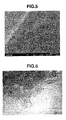
- FIG. 4 shows an electron micrograph of the folded area of the ultrafine carbon fiber nonwoven fabric obtained in Example 1
- FIG. 5 shows an electron micrograph of the folded area of the ultrafine carbon fiber nonwoven fabric obtained in Comparative Example 3.
- the ultrafine carbon fiber nonwoven fabrics obtained in Examples 1 to 5 and Comparative Examples 1 to 3 were shredded.
- the specific surface area was determined by using the BET method to measure the adsorption of 77 K nitrogen and the pore size distribution was determined by the MP method.
- the pore size distributions in Examples 4 and 5 and Comparative Example 1 because the presence of mesopores was apparent from the adsorption isotherms, mesopores were also determined by additionally using the BJH method.
- the ultrafine carbon fiber nonwoven fabrics obtained in Examples 1 to 5 and Comparative Examples 1 to 3 were shredded, and measurement was carried out using a micro-laser Raman spectroscope (Horiba Jobin Yvon Co., Ltd.; LabRAM HR-800) and using an argon laser (wavelength, 532 nm).
- the ratio Id/Ig of the peak intensity of the D band near 1,355 cm -1 (Id) to the peak intensity of the G band near 1,580 cm -1 (Ig) was determined from the measurement results.
- An electrospinning dope was prepared by mixing together and dissolving 1.5 wt % of PAN-MAA, 1.5 wt % of Ph and 2.7 wt % of titanium(IV) tetrachloride in 94.3 wt % of dimethylformamide (Wako Pure Chemical Industries; guaranteed reagent).
- Electrospinning was carried out under the same conditions as in Example 1, forming an ultrafine fiber nonwoven fabric having a thickness of about 6 ⁇ m built up of filaments having a diameter of about 300 nm.
- the ultrafine fiber nonwoven fabric obtained after electrospinning was heat-treated under the following conditions, giving an ultrafine carbon fiber nonwoven fabric.
- an ultrafine carbon fiber nonwoven fabric was produced under the same conditions as in Example 6.
- thermosetting and firing were carried out under the same conditions as in Example 6, giving an ultrafine carbon fiber nonwoven fabric having a fiber diameter of about 200 nm and a thickness of about 100 ⁇ m.
- an ultrafine carbon fiber nonwoven fabric was produced under the same conditions as in Example 6.
- thermosetting and firing were carried out under the same conditions as in Example 6, giving an ultrafine carbon fiber nonwoven fabric having a fiber diameter of about 200 nm and a thickness of about 500 ⁇ m.
- an ultrafine carbon fiber nonwoven fabric was produced under the same conditions as in Example 6.
- thermosetting and firing were carried out under the same conditions as in Example 6, thereby giving an ultrafine carbon fiber nonwoven fabric having a fiber diameter of about 200 nm and a thickness of about 450 ⁇ m.
- the nonwoven fabric was then pressed, and thereby compressing it to a thickness of 300 ⁇ m.
- An electrospinning dope was prepared by mixing together and dissolving 3 wt % of PAN and 97.0 wt % of dimethylformamide (Wako Pure Chemical Industries; guaranteed reagent).
- Electrospinning was carried out under the same conditions as in Example 1, forming an ultrafine fiber nonwoven fabric having a thickness of about 120 ⁇ m built up of filaments having a diameter of about 300 nm.
- Thermosetting treatment was carried out under the same conditions as in Example 1.
- the treated nonwoven fabric was examined under an electron microscope, from which it was confirmed that there was no change in the shape of the fibers and that the fibers had not melted together and united.
- Example 2 Aside from setting the holding temperature to 1,500°C, carbonizing treatment was carried out under the same conditions as in Example 1. Following treatment, the ultrafine carbon fiber nonwoven fabric was examined under an electron microscope, from which it was confirmed that the fibers had not melted together and united. The fiber diameter was about 200 nm. The nonwoven fabric had a thickness of about 100 ⁇ m. After firing, the nonwoven fabric was very brittle, making it impossible to measure the maximum pore size by the subsequently described bubble point method or to measure the bending stiffness and gas permeability.
- An electrospinning dope was prepared by mixing together and dissolving 3 wt % of the PAN-MAA prepared in Example 2 and 2.7 wt % of cobalt(II) chloride (Aldrich Co.) in 94.3 wt % of dimethylformamide (Wako Pure Chemical Industries; guaranteed reagent).
- Electrospinning was carried out under the same conditions as in Example 1, forming an ultrafine fiber nonwoven fabric having a thickness of about 120 ⁇ m built up of filaments having a diameter of about 300 nm.
- Thermosetting treatment was carried out under the same conditions as in Example 1.
- the treated nonwoven fabric was examined under an electron microscope, from which it was confirmed that there was no change in the shape of the fibers and that the fibers had not melted together and united.
- Example 2 Aside from setting the holding temperature to 1,500°C, carbonizing treatment was carried out under the same conditions as in Example 1. Following treatment, the ultrafine carbon fiber nonwoven fabric was examined under an electron microscope, from which it was confirmed that the fibers had not melted together and united. The fiber diameter was about 200 nm. The nonwoven fabric had a thickness of about 100 ⁇ m. After firing, the nonwoven fabric was very brittle, making it impossible to measure the maximum pore size by the bubble point method or to measure the bending stiffness and gas permeability. The fibers were examined under a transmission electron microscope (TEM) to determine the cause of the above, whereupon the development of graphene sheets was observed. FIG. 6 shows a TEM image. The development of graphene sheets and the layer structure these form presumably triggered structural changes at the interior of the fibers, making the fibers brittle to folding. Above Examples 6 to 9 and Comparative Examples 4 and 5 are summarized in Table 3.
- the ultrafine carbon fiber nonwoven fabrics obtained in Examples 6 to 9 and Comparative Examples 4 and 5 were subjected to a folding test and measurement of the basis weight, bubble point maximum pore size, gas permeability, bulk density, bending stiffness and electrical resistivity by the methods described below. The results are presented in Table 4.
- a nonwoven fabric specimen having a size of 20 cm x 20 cm was dried, following which the weight was measured.
- the maximum pore size was determined by the bubble point method using a porous material automated pore size distribution measuring system (Automated Perm Porometer, from Porous Materials, Inc.).
- the nonwoven fabric was clamped between gold-plated electrode plates, each having a radius of 3 cm and a thickness of 1 cm, the electrical resistivity under the application of a load of 10 kPa was measured, and the electrical resistivity in the thickness direction per unit area was calculated.
- the ultrafine carbon fiber nonwoven fabric produced in Example 1 was shredded, and the hydrogen adsorption isotherm curve at 77 K was measured for 150 mg of the shredded fabric using a specific surface area measuring instrument (Belsorp Max, from Bel Japan, Inc.).
- the amount of hydrogen adsorbed per gram was determined from the hydrogen adsorption volume obtained by measurement (cm 3 /g ⁇ STP, where STP is 101.325 kPa and 0°C (273 K)), and the relationship between the amount of adsorbed hydrogen and the measurement pressure (mmHg) was plotted on a graph. The results are shown in FIG. 7 .
- ultrafine carbon fiber nonwoven fabric can be regarded as advantageous when considering the storage of hydrogen at high pressure.
Landscapes
- Chemical & Material Sciences (AREA)
- Engineering & Computer Science (AREA)
- Chemical Kinetics & Catalysis (AREA)
- Textile Engineering (AREA)
- General Chemical & Material Sciences (AREA)
- Manufacturing & Machinery (AREA)
- Life Sciences & Earth Sciences (AREA)
- Organic Chemistry (AREA)
- Analytical Chemistry (AREA)
- Sustainable Development (AREA)
- Sustainable Energy (AREA)
- Electrochemistry (AREA)
- Inorganic Chemistry (AREA)
- Dispersion Chemistry (AREA)
- Mechanical Engineering (AREA)
- Inorganic Fibers (AREA)
- Nonwoven Fabrics (AREA)
- Spinning Methods And Devices For Manufacturing Artificial Fibers (AREA)
Abstract
Description
- The present invention relates to a flexible carbon fiber nonwoven fabric.
- Nonwoven fabrics composed of ultrafine carbon fibers have hitherto been widely used as impurity-removing filters and as fuel cell electrode components, including gas diffusion layers for fuel cells and electrode catalysts (see, for example,
Patent Documents 1 to 7).
However, owing to the fact that the carbon fibers, which have an inherently low resistance to bending, have been made even finer in such nonwoven fabrics, the fabric is very brittle and lacks sufficient strength for processing. Accordingly, a drawback of nonwoven fabrics made of ultrafine carbon fibers is that they cannot be used alone to form such components. - To compensate for such a drawback and enable use in a variety of applications, it has been necessary to reinforce the fabric in some way, such as by increasing the thickness of the nonwoven fabric itself, forming a composite with larger-diameter carbon fibers that already exist, or bonding together the fibers with a binder.
However, applying such reinforcing treatment not only increases the thickness, it also gives rise to other problems which hinder use of the fabric, such as a loss of breathability. - Also, heating to at least 800°C is generally required to carbonize organic compound, but most organic compound which serves as the carbon precursor has a glass transition point or melting point at or below 800°C. Therefore, when an ultrafine-fiber nonwoven fabric is heated, the organic fibers making up the fabric fuse or deform before the firing temperature is reached, making it impossible to maintain the shape of the fibers.
Hence, in the case of phenolic resins, melting during firing is prevented using a crosslinking agent such as formaldehyde to chemically effect three-dimensional crosslinking beforehand.
With resins such as polyacrylamide, infusibilizing treatment is generally carried out wherein the fibers are gradually heated in air (in the presence of oxygen) so as to oxidize the fiber surfaces and thereby form on the fiber surfaces an organization coat which does not melt. As a result, the fiber shape remains unchanged up to the firing temperature.
Firing and carbonizing ultrafine fibers in this way without associated shape deformation due to melting requires the formation of a three-dimensionally crosslinked structure (thermosetting or hardening) or infusibilization. Polymers that allow this to be done are limited to fibers capable of being infusibilized such as polyacrylonitrile and cellulose fibers, and thermosetting fibers such as amide and amide-imide fibers.
Moreover, infusibilizing ultrafine fibers without associated shape deformation has required strict temperature control. - High-strength ultrafine carbon fibers (carbon nanotubes, or "CNT") are also known.
Yet, although CNTs are both ultrafine and high-strength, because the fibers are of short length, they cannot by themselves be rendered into a nonwoven fabric, and must be consolidated with a binder.
Another drawback is that CNT production requires complex operations. - A flexible carbon nanofiber has been reported in Non-Patent Document 1 (Non-Patent Document 1). This is obtained by dissolving, in methanol as the solvent: a phenolic resin, high-molecular-weight polyvinyl butyral, and also, as electrolytes, pyridine and sodium carbonate (Na2CO3). The resulting solution is electrospun into a nanofiber nonwoven fabric, which is then subjected to crosslinking treatment with formaldehyde in a hydrochloric acid solution, neutralized and washed, then fired.
However, this production process is highly involved. Moreover, although the resulting carbon nanofibers do exhibit a certain degree of flexibility, they break when bent in two, and thus leave something to be desired in terms of flexibility. -
Patent Document 1: JP-A 2003-239164 Patent Document 2: JP-A 2005-240224 Patent Document 3: WO 2005/045115 Patent Document 4: JP-A 2007-70738 Patent Document 5: JP-A 2007-27319 Patent Document 6: WO 2007/052650 Patent Document 7: WO 2009/098812 - Non-Patent Document 1: Polymer Journal, Vol. 41, No. 12, p. 1124 (2009)
- It is therefore an object of the present invention to provide a flexible carbon fiber nonwoven fabric which has a good resistance to folding, is supple and has a good processability. A further object is to provide a simple method of producing the same.
- The inventor has conducted extensive investigations in order to achieve the above objects and has discovered as a result that when a nonwoven fabric which has been obtained by electrospinning a composition prepared by the mixture of at least two organic components, one of which is an electrospinnable polymeric substance and another of which is a different organic compound, with a transition metal is then carbonized, there can be obtained a flexible carbon fiber nonwoven fabric which has such a good resistance to folding that it does not break even when folded in two.
- Accordingly, the invention provides:
- 1. A flexible carbon fiber nonwoven fabric obtained by carbonizing a nonwoven fabric obtained by electrospinning a composition containing an electrospinnable polymeric substance, an organic compound differing from the polymeric substance, and a transition metal;
- 2. The flexible carbon fiber nonwoven fabric of 1, wherein one or both of the polymeric substance and the organic compound contains a nitrogen atom;
- 3. The flexible carbon fiber nonwoven fabric of 1 or 2, wherein the polymeric substance is one, two or more selected from among polyacrylonitrile resins, polyester resins, polyurethane resins, polyethylene resins, polypropylene resins, polyacrylic resins, polyether resins, polyvinylidene chloride resins, polyvinyl resins, polyamide resins, polyimide resins and polyamide-imide resins;
- 4. The flexible carbon fiber nonwoven fabric of any one of 1 to 3, wherein the organic compound is one, two or more selected from among phenolic resins, epoxy resins, melamine resins, urea resins, polycarbodiimide, pitch, cellulose, cellulose derivatives and lignin;
- 5. The flexible carbon fiber nonwoven fabric of 4, wherein the polymeric substance is a polyacrylonitrile resin and the organic compound is a phenolic resin;
- 6. The flexible carbon fiber nonwoven fabric of any one of 1 to 5, wherein the transition metal is one, two or more selected from among titanium, cobalt, iron, nickel, copper, zirconia and platinum;
- 7. The flexible carbon fiber nonwoven fabric of 6, wherein the transition metal is one, two or more selected from among titanium, iron and cobalt;
- 8. The flexible carbon fiber nonwoven fabric of any one of 1 to 7, wherein the composition includes from 1.5 to 15 parts by weight of the polymeric substance, from 1.5 to 15 parts by weight of the organic compound, and from 0.1 to 2 parts by weight of the transition metal;
- 9. The flexible carbon fiber nonwoven fabric of any one of 1 to 8 which has a ratio Id/Ig of the peak intensity Id near 1,355 cm-1 to the peak intensity Ig near 1,580 cm-1, as measured by Raman spectroscopy, in a range of 0.7 to 1.3;
- 10. A hydrogen storage material composed of the flexible carbon fiber nonwoven fabric of any one of 1 to 9;
- 11. A gas diffusion layer for a fuel cell, composed of the flexible carbon fiber nonwoven fabric of any one of 1 to 9; and
- 12. A method of manufacturing a flexible carbon fiber nonwoven fabric, which method includes the steps of: electrospinning a composition containing an electrospinnable polymeric substance, an organic compound differing from the polymeric substance and a transition metal so as to obtain a nonwoven fabric; and carbonizing the nonwoven fabric.
- The present invention, by making it possible to impart to ultrafine carbon fibers the property of having a good resistance to bending, which has not been achievable by conventional methods, enables a flexible carbon fiber nonwoven fabric that is supple and endowed with a good processability to be provided.
The flexible carbon fiber nonwoven fabric of the invention does not require the type of conventional reinforcement treatment described above, and thus can be directly used in the form of a thin nonwoven fabric in a variety of applications.
Also, because treatment using reagents such as acids, alkalis, hardening agents and crosslinking agents is not required during production of the nonwoven fabric, the production operations can be simplified.
Such a flexible carbon fiber nonwoven fabric can be advantageously used alone as a fuel cell electrode component such as a gas diffusion layer, as other electrode materials, as a support for a catalyst or for hydrogen storage particles, and also as chemical-resistant and heat-resistant filters, heat conductors, heat sinks, thermal insulation fillers, adsorbents and acoustic materials. - In addition, because the carbon fibers making up the flexible carbon fiber nonwoven fabric of the invention have numerous micropores on the surface, this nonwoven fabric can also be used as a hydrogen storage material.
The highly flexible carbon fiber nonwoven fabric of the invention is particularly advantageous when packed into high-pressure vessels for storing hydrogen. For example, when the inventive nonwoven fabric is wound into a roll, in spite of the high density of the rolled fabric, the gaps between the fibers readily form flow channels suitable for moving hydrogen in and out. -
-
FIG. 1 is an electron micrograph of a nonwoven fabric before carbonization in Example 1. -
FIG. 2 is an electron micrograph of the carbon fiber nonwoven fabric obtained in Example 1. -
FIG. 3 is a transmission electron micrograph of the fibers making up the carbon fiber nonwoven fabric obtained in Example 1. -
FIG. 4 is an electron micrograph of the folded area following a folding test on the carbon fiber nonwoven fabric obtained in Example 1. -
FIG. 5 is an electron micrograph of the folded area following a folding test on the carbon fiber nonwoven fabric obtained in Comparative Example 3. -
FIG. 6 is a transmission electron micrograph of the fibers making up the carbon fiber nonwoven fabric obtained in Comparative Example 5. -
FIG. 7 is a graph showing the relationship between the amount of hydrogen adsorbed per gram and the measurement pressure (mmHg) in Example 10 and Comparative Example 6. - The invention is described more fully below.
The flexible carbon fiber nonwoven fabric according to the present invention is obtained by carbonizing a nonwoven fabric obtained by electrospinning a composition which includes an electrospinnable polymeric substance, an organic compound differing from the polymeric substance, and a transition metal.
In the invention, the electrospinnable polymer substance is not subject to any particular limitation and may be suitably selected from among hitherto known electrospinnable polymeric substances.
Illustrative examples include polyacrylonitrile resins, polyester resins, polyurethane resins, polyethylene resins, polypropylene resins, polyacrylic resins, polyether resins, polyvinylidene chloride resins, polyvinyl resins, polyamide resins, polyimide resins and polyamide-imide resins. These may be used singly, or two or more may be used in combination.
Of these, to further increase the folding strength of the resulting carbon fiber nonwoven fabric, a polymeric substance containing a nitrogen atom on the molecule is preferred, and a polyacrylonitrile resin is especially preferred. - In this invention, to have the resulting carbon fiber nonwoven fabric manifest a flexibility and toughness that keeps it from failing even when folded, it is critical for the above-described electrospinnable polymeric substance and an organic compound commonly used as a carbon precursor to be used together. By using these two ingredients together, even in cases where a carbon fiber precursor organic compound that is difficult to electrospin by itself is employed, the electrospinnable polymer plays the role of a "connector," allowing the overall composition to be electrospun and also preventing the development of graphene sheets in the carbon fibers making up the resulting ultrafine carbon fiber nonwoven fabric. Hence, carbon fibers having a good resistance to folding can be obtained.
- The organic compound is a substance which differs from the above-described polymeric substance. Any of the various compounds which have hitherto been employed as carbon precursor materials may be used.
Illustrative examples include phenolic resins, epoxy resins, melamine resins, urea resins, polycarbodiimide, pitch, cellulose, cellulose derivatives and lignin. These may be used singly or two or more may be used in combination.
In cases where the polymeric substance used is one which does not contain a nitrogen atom, for the same reasons as indicated above, it is preferable for that the organic compound to be one which contains a nitrogen atom. - A transition metal is essential for achieving the desired flexibility and toughness in the carbon fiber nonwoven fabric of the invention.
That is, by making use of a transition metal-containing composition, when heat is applied to a nonwoven fabric electrospun from the composition, melting can be prevented from occurring up until the firing temperature is reached, and the carbon fiber nonwoven fabric following carbonization can be conferred with a flexibility and toughness that keep the fabric from failing even when folded.
Such transition metals are not subject to any particular limitation, and are exemplified by titanium, cobalt, iron, nickel, copper, zirconia and platinum. Of these, titanium, iron and cobalt are preferred. These may be used singly, or two or more may be used in combination. - These transition metals are preferably used in the form of a complex, salt, hydroxide, sulfate or organic oxide. For example, preferred use may be made of tetraalkoxytitaniums such as tetra-n-butoxytitanium; titanium halides such as titanium(III) chloride and titanium(IV) chloride; organic acid salts such as the ammonium salt of titanium lactate; cobalt halides such as cobalt(II) chloride, cobalt(III) chloride, cobalt(II) bromide, cobalt(II) fluoride, cobalt(III) fluoride, cobalt(II) iodide and cobalt(II) iodate; organic acid salts of cobalt such as cobalt(II) acetate and cobalt(II) octanoate; cobalt(II) hydroxide, cobalt(II) nitrate and cobalt(III) nitrate; iron halides such as iron(II) chloride, iron(III) chloride, iron bromide, iron(II) iodide and iron(II) iodate; organic acid salts of iron such as iron(II) acetate, iron(III) acetate and iron(II) octanoate; iron(II) hydroxide, iron(III) hydroxide, iron(II) nitrate, iron(III) nitrate, iron(II) sulfate and iron(III) sulfate; nickel(II) chloride, nickel(II) hydroxide, nickel(II) sulfate, nickel carbonyl, nickel sulfamate and lithium nickel oxide; copper chloride, copper acetate, copper nitrate, copper hydroxide, copper carbonate, copper fluoride, copper iodate and copper sulfate; zirconium oxychloride, zirconium sulfate, zirconium nitrate, zirconium acetate, ammonium zirconium carbonate, zirconium octanoate, zirconium tetra-n-propoxide, zirconium tetraacetylacetonate; and platinum(II) chloride, platinum(IV) chloride, platinum(IV) bromide and hexachloroplatinic acid salts.
- The contents of the above polymeric substance, organic compound and transition metal in the composition used to produce the carbon fiber nonwoven fabric of the invention are not subject to any particular limitation, provided the composition is capable of being electrospun, although it is preferable for the polymeric substance to be included in an amount of from 1.0 to 15 parts by weight, especially from 1.5 to 15 parts by weight, for the organic compound to be included in an amount of from 1.0 to 15 parts by weight, especially from 1.5 to 15 parts by weight, and for the transition metal to be included in an amount (weight of metal) of from 0.1 to 2 parts by weight, especially from 0.1 to 1.5 parts by weight.
Any suitable method may be used to prepare the composition, so long as each of the above ingredients is mixed in accordance with common practice. The respective ingredients may be mixed in any suitable order. - In the practice of the invention, because electrospinning is used to obtain the ultrafine fiber nonwoven fabric, it is essential to employ a solvent for preparing an electrospinning dope.
A solvent which is capable of dissolving the resin to be used may be suitably selected and employed as this solvent. Illustrative examples of solvents which may be used include water, acetone, methanol, ethanol, propanol, isopropanol, toluene, benzene, cyclohexane, cyclohexanone, tetrahydrofuran, dimethylsulfoxide, 1,4-dioxane, carbon tetrachloride, methylene chloride, chloroform, pyridine, trichloroethane, N,N-dimethylformamide, N,N-dimethylacetamide, N-methyl-2-pyrrolidone, ethylene carbonate, diethyl carbonate, propylene carbonate and acetonitrile, as well as organic acids such as formic acid, lactic acid and acetic acid.
These solvents may be used singly, or two or more may be mixed and used together.
This solvent may be included in any order. That is, it may be mixed together with the various above ingredients or it may be added after the above composition has been prepared. - Electrospinning is a process in which, as an electrically charged electrospinning dope (electrospinning solution) is spun within an electrical field, the dope is explosion up by forces of repulsion between the electrical charges, resulting in the formation of a very fine fibrous material composed of the resin.
Specifically, with a nozzle for ejecting the dope serving as a first electrode and a collector serving as a second electrode, a high voltage of from several thousands to several tens of thousands of volts is applied to the dope, causing the dope to be discharged as a jet from the nozzle. Due to the high-speed jet and subsequent folding and expansion of the jet within the electrical field, the discharged dope forms into very fine fibers which collect on the collector surface as an ultrafine fiber nonwoven fabric. - The resulting ultrafine fiber nonwoven fabric is then fired to give an ultrafine carbon fiber nonwoven fabric.
At this time, if the ultrafine fiber nonwoven fabric has been obtained using a polymer that is conducive to infusibilizing treatment, the fiber surface may be oxidized and subjected to thermosetting and infusibilizing treatment as in the prior art.
In such a case, the heating temperature is not subject to any particular limitation, so long as infusibilization is possible. Generally, the method used may be one in which the temperature is raised from room temperature to about 300°C over a period of about 2 to about 10 hours, after which the same temperature is maintained for a period of from about 30 minutes to about 3 hours.
However, even without carrying out conventional infusibilizing treatment, the ultrafine fiber nonwoven fabric obtained as described above may be rendered into an ultrafine carbon fiber nonwoven fabric without melting and uniting of the fibers by gradual heating to the firing temperature of about 800 to about 1,500°C.
The temperature rise rate may be set as suitable, such as from about 1°C/min to 10°C/min. Temperature control need not be very strict. - The resulting ultrafine carbon fiber nonwoven fabric of the invention is a flexible carbon fiber nonwoven fabric which has a resistance to folding sufficient to not break even when folded in two.
Moreover, this flexibility is retained even after the metal atoms have been removed from the resulting carbon fiber nonwoven fabric. It appears from this that the transition metal has the effect of building, in the course of carbonization, a structure having a good resistance to folding. Removal of the metal atoms may be carried out by, for example, acid treatment. Such acid treatment may be carried out by exposing the carbon fiber nonwoven fabric to a single inorganic acid such as hydrochloric acid, nitric acid or sulfuric acid, or to a mixed acid composed of a mixture of such inorganic acids.
Accordingly, in cases where the carbon fiber nonwoven fabric of the invention are to be used in applications which are adversely affected by the presence of metal components, the metal components should be removed by acid treatment. - The carbon fibers making up the ultrafine carbon fiber nonwoven fabric of the invention have a fiber diameter of preferably from 0.1 to 15 µm, more preferably from 0.1 to 10 µm, and even more preferably from 0.1 to 1 µm. The carbon fibers have a pore size, as measured by the bubble point method, of preferably 5 µm or less, and a pore size at the surface of preferably from 0.4 to 50 nm. The fibers have at the surface a micropore (2 nm and smaller) surface area of preferably from 27 to 2,700 m2/g, and have a BET specific surface area of preferably from 30 to 3,000 m2/g.
The carbon fiber nonwoven fabric has a basis weight of preferably from 0.3 to 100 g/m2, a thickness of preferably from 5 to 500 µm, and a bulk density of preferably from 0.06 to 0.3 g/cm3.
The bending stiffness of the nonwoven fabric, as measured by Method B (slide method) described in JIS L 1096, is preferably from 0.0005 to 50 mN·cm. The gas permeability of the nonwoven fabric, as measured by Method A (Frazier method) described in JIS L 1096, is preferably from 0.5 to 300 mL/sec/cm2. - In the carbon fiber nonwoven fabric of the invention, the ratio Id/Ig of the peak intensity Id near 1,355 cm-1 to the peak intensity Ig near 1,580 cm-1, which indicates the degree of graphitization as measured by Raman spectroscopy, is preferably in a range of from 0.7 to 1.3.
Within this range, the crystalline structure of graphite is disordered and approaches the state of noncrystalline amorphous carbon, meaning that the carbon fiber nonwoven fabric has an even better flexibility. - Examples of the invention and Comparative Examples are given below by way of illustration, and not by way of limitation. The fiber diameter and thickness of the nonwoven fabric were measured by the following methods.
- The sizes of 50 randomly selected fibers examined under an electron microscope (JSM-67010F, manufactured by JEOL, Ltd.) were measured, and the average fiber diameter was determined.
- Using a digital thickness gauge (SMD-565, manufactured by Teclock Corporation), the thickness was measured at ten random points, and the average thickness of the fabric was determined.
- An electrospinning dope was prepared by mixing together and dissolving 2.7 wt % of polyacrylonitrile (abbreviated below as "PAN," available as "Barex" from Mitsubishi Chemical Corporation), 3.0 wt % of phenolic resin (abbreviated below as "Ph," available as "PSK-2320" from Gunei Chemical Industry Co., Ltd.) and 3.5 wt % of titanium(IV) butoxide (available from Aldrich Co.) in 90.8 wt % of dimethylformamide (available from Wako Pure Chemical Industries, Ltd.; guaranteed reagent).
- The electrospinning dope obtained as described above was set in an electrospinning system (ESP-2300, manufactured by Fuence Co., Ltd.) and electrospun at a needle outlet diameter of 0.5 mm, an applied voltage of 17 kV, an extrusion pressure of 7 kPa and a relative humidity of 50% (25°C), thereby forming an ultrafine fiber nonwoven fabric built up of filaments having a diameter of about 600 nm.
- Thermosetting treatment was carried out by placing the resulting ultrafine fiber nonwoven fabric in an oven, ramping the oven from room temperature to 250°C over a period of 1.5 hours, and then additionally holding the oven at 250°C for 1 hour. After thermosetting treatment, the nonwoven fabric was examined under an electron microscope.
FIG. 1 shows an electron micrograph of the fabric. As a result, it was confirmed that there was no change in the fiber shape and that the fibers had not melted together and united. - After thermosetting treatment, the ultrafine fiber nonwoven fabric was subjected to carbonizing treatment under the following conditions, giving an ultrafine carbon fiber nonwoven fabric.
- Temperature ramp-up rate: 10°C/min
- Holding temperature: 900°C
- Holding time: 60 min
- Nitrogen flow rate: 5 L/min
- A flask was charged with 30.93 g of acrylonitrile (available from Wako Pure Chemical Industries, Ltd.), 4.07 g of methacrylic acid (Wako Pure Chemical Industries) and 300 mL of pure water, following which deaeration (oxygen removal) was carried out by bubbling through nitrogen gas. The flask contents were then heated to 70°C, following which a solution of 100 mg of potassium peroxodisulfate (Wako Pure Chemical Industries) dissolved in 50 mL of pure water was poured in under stirring. Stirring was continued for 4 hours, after which the cloudy solution was concentrated and finally dried in vacuo, giving about 20 g of a polyacrylonitrile-polymethacrylic acid copolymer (referred to below as "PAN-MAA").
- An electrospinning dope was prepared by mixing together and dissolving 1.5 wt % of the PAN-MAA obtained as described above, 1.5 wt % of Ph and 0.4 wt % of titanium(IV) tetrachloride (Aldrich Co.) in 96.6 wt % of dimethylformamide (Wako Pure Chemical Industries; guaranteed reagent).
- Electrospinning was carried out under the same conditions as in Example 1, forming an ultrafine fiber nonwoven fabric built up of filaments having a diameter of about 200 nm.
- The thermosetting treatment carried out in Example 1 was omitted. Instead, the ultrafine fiber nonwoven fabric obtained after electrospinning was heat-treated under the following conditions, giving an ultrafine carbon fiber nonwoven fabric.
- Temperature ramp-up rate: 10°C/min
- Holding temperature: 900°C
- Holding time: 60 min
- Nitrogen flow rate: 5 L/min
- An electrospinning dope was prepared by mixing together and dissolving 15 wt % of PAN, 15 wt % of Ph and 4.0 wt % of titanium(IV) tetrachloride (Aldrich Co.) in 66 wt % of dimethylformamide (Wako Pure Chemical Industries; guaranteed reagent).
- Electrospinning was carried out under the same conditions as in Example 1, forming an ultrafine fiber nonwoven fabric built up of filaments having a diameter of about 15 µm.
- Heat treatment was carried out under the same conditions as in Example 2, giving an ultrafine carbon fiber nonwoven fabric.
The resulting ultrafine carbon fiber nonwoven fabric was examined under an electron microscope, from which it was confirmed that the fibers had not melted together and united. The fiber diameter was about 10 µm. The nonwoven fabric had a thickness of 20 µm. - An electrospinning dope was prepared by mixing together and dissolving 1.5 wt % of PAN, 1.5 wt % of Ph and 0.4 wt % of cobalt(II) chloride (Aldrich Co.) in 96.6 wt % of dimethylformamide (Wako Pure Chemical Industries; guaranteed reagent).
- Electrospinning was carried out under the same conditions as in Example 1, forming an ultrafine fiber nonwoven fabric built up of filaments having a diameter of about 500 nm.
- Heat treatment was carried out under the same conditions as in Example 2, giving an ultrafine carbon fiber nonwoven fabric.
The resulting ultrafine carbon fiber nonwoven fabric was examined under an electron microscope, from which it was confirmed that the fibers had not melted together and united. The fiber diameter was about 400 nm. The nonwoven fabric had a thickness of 20 µm. - An electrospinning dope was prepared by mixing together and dissolving 1.5 wt % of PAN, 1.5 wt % of Ph and 0.5 wt % of iron(III) chloride (Aldrich Co.) in 96.5 wt % of dimethylformamide (Wako Pure Chemical Industries; guaranteed reagent).
- Electrospinning was carried out under the same conditions as in Example 1, forming an ultrafine fiber nonwoven fabric built up of filaments having a diameter of about 500 nm.
- Heat treatment was carried out under the same conditions as in Example 2, giving an ultrafine carbon fiber nonwoven fabric.
The resulting ultrafine carbon fiber nonwoven fabric was examined under an electron microscope, from which it was confirmed that the fibers had not melted together and united. The fiber diameter was about 400 nm. The nonwoven fabric had a thickness of 20 µm. - An electrospinning dope was prepared by mixing together and dissolving 1.5 wt % of PAN and 1.5 wt % of Ph in 97.0 wt % of dimethylformamide (Wako Pure Chemical Industries; guaranteed reagent).
- Electrospinning was carried out under the same conditions as in Example 1, forming an ultrafine fiber nonwoven fabric built up of filaments having a diameter of about 500 nm.
- Thermosetting treatment was carried out under the same conditions as in Example 1, but melting of the fibers was observed near 150°C, following which the fibers melted completely, as a result of which the nonwoven fabric shape could not be retained.
Accordingly, the ultrafine fiber nonwoven fabric which was obtained as described above was immersed for 2 hours at 98°C in an aqueous solution (hardening solution) containing 15 wt % of hydrogen chloride and 8 wt % of formaldehyde, following which the fabric was neutralized, rinsed with water and dried, then subjected to hardening treatment. - Carbonizing treatment was carried out under the same conditions as in Example 1. Following treatment, the ultrafine carbon fiber nonwoven fabric was examined under an electron microscope, from which it was confirmed that the fibers had not melted together and united. The fiber diameter was about 400 nm. The nonwoven fabric had a thickness of 20 µm.
- An electrospinning dope was prepared by mixing together and dissolving 29.4 wt % of Ph and 0.6 wt % of polyvinyl butyral (Wako Pure Chemical Industries; average degree of polymerization, about 2,300 to 2,500; abbreviated below as "PVB") in 70.0 wt % of methanol (Wako Pure Chemical Industries; guaranteed reagent).
- Other than setting the applied voltage to 15 kV and the relative humidity to 35% (at 25°C), electrospinning was carried out under the same conditions as in Example 1, forming an ultrafine fiber nonwoven fabric built up of filaments having a diameter of about 1,380 nm.
- The ultrafine fiber nonwoven fabric obtained as described above was immersed at 98°C for 2 hours in an aqueous solution (hardening solution) containing 15 wt % of hydrogen chloride and 8 wt % of formaldehyde. The fabric was then taken out and rinsed with water, neutralized with 3% ammonia water at 60°C for 30 minutes, rinsed with water again, and dried, giving a Ph-PVB ultrafine fiber nonwoven fabric.
When thermosetting treatment was carried out under the same conditions as in Example 1, melting of the fibers was observed near 150°C, following which the fibers melted completely, as a result of which the nonwoven fabric shape could not be retained. - Carbonizing treatment was carried out under the same conditions as in Example 1. Following treatment, the ultrafine carbon fiber nonwoven fabric was examined under an electron microscope, from which it was confirmed that the fibers had not melted together and united. The fiber diameter was about 1,230 nm. The nonwoven fabric had a thickness of 20 µm.
- (
Non-Patent Document 1, pp. 1124-1128, Table 1, "P25") - An electrospinning dope was prepared by mixing together and dissolving 7.9 wt % of Ph, 2.0 wt % of PVB, 54.0 wt % of methanol (Wako Pure Chemical Industries; guaranteed reagent), 36.0 wt % of pyridine (Wako Pure Chemical Industries; guaranteed reagent) and 0.1 wt % of sodium carbonate (Wako Pure Chemical Industries; guaranteed reagent).
- Other than setting the applied voltage to 15 kV and the relative humidity to 35% (at 25°C), electrospinning was carried out under the same conditions as in Example 1, forming an ultrafine fiber nonwoven fabric built up of filaments having a diameter of about 140 nm.
- The ultrafine fiber nonwoven fabric obtained as described above was immersed at 98°C for 2 hours in an aqueous solution (hardening solution) containing 15 wt % of hydrogen chloride and 8 wt % of formaldehyde. The fabric was then taken out and rinsed with water, neutralized with 3% ammonia water at 60°C for 30 minutes, rinsed with water again, and dried, giving a Ph-PVB ultrafine fiber nonwoven fabric.
When thermosetting treatment was carried out under the same conditions as in Example 1, melting of the fibers was observed near 150°C, following which the fibers melted completely, as a result of which the nonwoven fabric shape could not be retained. - Carbonizing treatment was carried out under the same conditions as in Example 1. Following treatment, the ultrafine carbon fiber nonwoven fabric was examined under an electron microscope, from which it was confirmed that the fibers had not melted together and united. The fiber diameter was about 110 nm. The nonwoven fabric had a thickness of 20 µm.
Above Examples 1 to 5 and Comparative Examples 1 to 3 are summarized in Table 1. -

- The ultrafine carbon fiber nonwoven fabrics obtained in Examples 1 to 5 and Comparative Examples 1 to 3 were subjected to a folding test, a folding test after concentrated hydrochloric acid treatment (in Examples 1 to 5), measurement of the specific surface area and Raman analysis by the methods described below. The results are presented in Table 2.
- Each of the ultrafine carbon fiber nonwoven fabrics (size of specimens: 10 cm x 10 cm) obtained in Examples 1 to 5 and Comparative Examples 1 to 3 was folded in two, clamped between two stainless steel plates and a load of 98 kPa (1 kgf/cm2) was applied. The nonwoven fabric was then examined to determine whether breaking had occurred.
FIG. 4 shows an electron micrograph of the folded area of the ultrafine carbon fiber nonwoven fabric obtained in Example 1, andFIG. 5 shows an electron micrograph of the folded area of the ultrafine carbon fiber nonwoven fabric obtained in Comparative Example 3. - One gram of the ultrafine carbon fiber nonwoven fabrics obtained in Examples 1 to 5 was immersed in 50 mL of concentrated hydrochloric acid, left to stand at room temperature for 18 hours, then washed five times with 200 mL of pure water. The washed nonwoven fabric was dried in vacuo, and the same folding test as described above was carried out.
In order to determine whether the metal had been washed from the ultrafine carbon fiber nonwoven fabric by this treatment, a portion of the washed and dried ultrafine carbon fiber nonwoven fabric was treated in air at 700°C, the resulting ash was immersed in concentrated hydrochloric acid, and the supernatant was measured with a high-frequency plasma emission spectrometer (ICPS-8100, manufactured by Shimadzu Corporation). As a result, all of the nonwoven fabrics were confirmed to be free of metal residues. - The ultrafine carbon fiber nonwoven fabrics obtained in Examples 1 to 5 and Comparative Examples 1 to 3 were shredded. Using an instrument for measuring the specific surface area (Belsorp Max, available from Bel Japan, Inc.), the specific surface area was determined by using the BET method to measure the adsorption of 77 K nitrogen and the pore size distribution was determined by the MP method. With regard to the pore size distributions in Examples 4 and 5 and Comparative Example 1, because the presence of mesopores was apparent from the adsorption isotherms, mesopores were also determined by additionally using the BJH method.
- The ultrafine carbon fiber nonwoven fabrics obtained in Examples 1 to 5 and Comparative Examples 1 to 3 were shredded, and measurement was carried out using a micro-laser Raman spectroscope (Horiba Jobin Yvon Co., Ltd.; LabRAM HR-800) and using an argon laser (wavelength, 532 nm). The ratio Id/Ig of the peak intensity of the D band near 1,355 cm-1 (Id) to the peak intensity of the G band near 1,580 cm-1 (Ig) was determined from the measurement results.
-

- An electrospinning dope was prepared by mixing together and dissolving 1.5 wt % of PAN-MAA, 1.5 wt % of Ph and 2.7 wt % of titanium(IV) tetrachloride in 94.3 wt % of dimethylformamide (Wako Pure Chemical Industries; guaranteed reagent).
- Electrospinning was carried out under the same conditions as in Example 1, forming an ultrafine fiber nonwoven fabric having a thickness of about 6 µm built up of filaments having a diameter of about 300 nm.
- The ultrafine fiber nonwoven fabric obtained after electrospinning was heat-treated under the following conditions, giving an ultrafine carbon fiber nonwoven fabric.
- Temperature ramp-up rate: 10°C/min
- Holding temperature: 1,500°C
- Holding time: 60 min
- Nitrogen flow rate: 5 L/min
- Aside from setting the thickness of the nonwoven fabric at the time of electrospinning to 110 µm, an ultrafine carbon fiber nonwoven fabric was produced under the same conditions as in Example 6. Next, thermosetting and firing were carried out under the same conditions as in Example 6, giving an ultrafine carbon fiber nonwoven fabric having a fiber diameter of about 200 nm and a thickness of about 100 µm.
- Aside from setting the thickness of the nonwoven fabric at the time of electrospinning to 550 µm, an ultrafine carbon fiber nonwoven fabric was produced under the same conditions as in Example 6. Next, thermosetting and firing were carried out under the same conditions as in Example 6, giving an ultrafine carbon fiber nonwoven fabric having a fiber diameter of about 200 nm and a thickness of about 500 µm.
- Aside from setting the thickness of the nonwoven fabric at the time of electrospinning to 500 µm, an ultrafine carbon fiber nonwoven fabric was produced under the same conditions as in Example 6. Next, thermosetting and firing were carried out under the same conditions as in Example 6, thereby giving an ultrafine carbon fiber nonwoven fabric having a fiber diameter of about 200 nm and a thickness of about 450 µm. The nonwoven fabric was then pressed, and thereby compressing it to a thickness of 300 µm.
- An electrospinning dope was prepared by mixing together and dissolving 3 wt % of PAN and 97.0 wt % of dimethylformamide (Wako Pure Chemical Industries; guaranteed reagent).
- Electrospinning was carried out under the same conditions as in Example 1, forming an ultrafine fiber nonwoven fabric having a thickness of about 120 µm built up of filaments having a diameter of about 300 nm.
- Thermosetting treatment was carried out under the same conditions as in Example 1. The treated nonwoven fabric was examined under an electron microscope, from which it was confirmed that there was no change in the shape of the fibers and that the fibers had not melted together and united.
- Aside from setting the holding temperature to 1,500°C, carbonizing treatment was carried out under the same conditions as in Example 1. Following treatment, the ultrafine carbon fiber nonwoven fabric was examined under an electron microscope, from which it was confirmed that the fibers had not melted together and united. The fiber diameter was about 200 nm. The nonwoven fabric had a thickness of about 100 µm.
After firing, the nonwoven fabric was very brittle, making it impossible to measure the maximum pore size by the subsequently described bubble point method or to measure the bending stiffness and gas permeability. - An electrospinning dope was prepared by mixing together and dissolving 3 wt % of the PAN-MAA prepared in Example 2 and 2.7 wt % of cobalt(II) chloride (Aldrich Co.) in 94.3 wt % of dimethylformamide (Wako Pure Chemical Industries; guaranteed reagent).
- Electrospinning was carried out under the same conditions as in Example 1, forming an ultrafine fiber nonwoven fabric having a thickness of about 120 µm built up of filaments having a diameter of about 300 nm.
- Thermosetting treatment was carried out under the same conditions as in Example 1. The treated nonwoven fabric was examined under an electron microscope, from which it was confirmed that there was no change in the shape of the fibers and that the fibers had not melted together and united.
- Aside from setting the holding temperature to 1,500°C, carbonizing treatment was carried out under the same conditions as in Example 1. Following treatment, the ultrafine carbon fiber nonwoven fabric was examined under an electron microscope, from which it was confirmed that the fibers had not melted together and united. The fiber diameter was about 200 nm. The nonwoven fabric had a thickness of about 100 µm.
After firing, the nonwoven fabric was very brittle, making it impossible to measure the maximum pore size by the bubble point method or to measure the bending stiffness and gas permeability.
The fibers were examined under a transmission electron microscope (TEM) to determine the cause of the above, whereupon the development of graphene sheets was observed.FIG. 6 shows a TEM image. The development of graphene sheets and the layer structure these form presumably triggered structural changes at the interior of the fibers, making the fibers brittle to folding.
Above Examples 6 to 9 and Comparative Examples 4 and 5 are summarized in Table 3. -

- The ultrafine carbon fiber nonwoven fabrics obtained in Examples 6 to 9 and Comparative Examples 4 and 5 were subjected to a folding test and measurement of the basis weight, bubble point maximum pore size, gas permeability, bulk density, bending stiffness and electrical resistivity by the methods described below. The results are presented in Table 4.
- The same method as described above was carried out.
- A nonwoven fabric specimen having a size of 20 cm x 20 cm was dried, following which the weight was measured.
- The maximum pore size was determined by the bubble point method using a porous material automated pore size distribution measuring system (Automated Perm Porometer, from Porous Materials, Inc.).
- Measured in general accordance with Method A (Frazier method) described in JIS L 1096.
- Calculated from the thickness and basis weight.
- Measured in general accordance with Method B (slide method) described in JIS L 1096.
- The nonwoven fabric was clamped between gold-plated electrode plates, each having a radius of 3 cm and a thickness of 1 cm, the electrical resistivity under the application of a load of 10 kPa was measured, and the electrical resistivity in the thickness direction per unit area was calculated.
-

- As shown in Tables 2 and 4, it is apparent that the carbon fiber nonwoven fabrics in each of the examples of the invention that were obtained using compositions containing a PAN resin, Ph and a transition metal were flexible and had a good resistance to folding.
By contrast, it is apparent that flexible carbon fiber nonwoven fabrics having a good resistance to folding cannot be obtained from a composition containing PAN and Ph alone (Comparative Example 1), a composition containing PAN alone (Comparative Example 4), or a composition containing a PAN resin and a transition metal alone (Comparative Example 5).
In addition, it is apparent from the electron micrograph inFIG. 5 that flexible carbon fiber nonwoven fabrics having a good resistance to folding cannot be obtained from a system composed of polyvinyl butyral mixed with a phenolic resin (Comparative Example 2), or a system composed of a phenolic resin to which polyvinyl butyral has been added and to which pyridine and sodium carbonate have also been added as electrolytes. - The ultrafine carbon fiber nonwoven fabric produced in Example 1 was shredded, and the hydrogen adsorption isotherm curve at 77 K was measured for 150 mg of the shredded fabric using a specific surface area measuring instrument (Belsorp Max, from Bel Japan, Inc.). The amount of hydrogen adsorbed per gram was determined from the hydrogen adsorption volume obtained by measurement (cm3/g·STP, where STP is 101.325 kPa and 0°C (273 K)), and the relationship between the amount of adsorbed hydrogen and the measurement pressure (mmHg) was plotted on a graph. The results are shown in
FIG. 7 . - Aside from using 150 mg of activated carbon (Maxsorb®, available from Kansai Coke and Chemicals Co., Ltd.), hydrogen adsorption was measured in the same way as in Example 10, and the amount of hydrogen adsorbed per gram was determined. The relationship of this amount with the measurement pressure (mmHg) was plotted on a graph. The results are shown in
FIG. 7 . - As shown in
FIG. 7 , activated carbon absorbed about 3.6 wt %/g of hydrogen under a pressure of 760 mmHg (atmospheric pressure), whereas the ultrafine carbon fiber nonwoven fabric exhibited a higher value of about 4.0 wt %/g. Hence, ultrafine carbon fiber nonwoven fabric can be regarded as advantageous when considering the storage of hydrogen at high pressure.
The structure of the carbon fibers making up the resulting ultrafine carbon fiber nonwoven fabric was examined using a transmission electron microscope (TEM) (JEM-2010, manufactured by JEOL, Ltd.).
Claims (12)
- A flexible carbon fiber nonwoven fabric obtained by carbonizing a nonwoven fabric obtained by electrospinning a composition comprising an electrospinnable polymeric substance, an organic compound differing from the polymeric substance, and a transition metal.
- The flexible carbon fiber nonwoven fabric of claim 1, wherein one or both of the polymeric substance and the organic compound contains a nitrogen atom.
- The flexible carbon fiber nonwoven fabric of claim 1 or 2, wherein the polymeric substance is one, two or more selected from among polyacrylonitrile resins, polyester resins, polyurethane resins, polyethylene resins, polypropylene resins, polyacrylic resins, polyether resins, polyvinylidene chloride resins, polyvinyl resins, polyamide resins, polyimide resins and polyamide-imide resins.
- The flexible carbon fiber nonwoven fabric of any one of claims 1 to 3, wherein the organic compound is one, two or more selected from among phenolic resins, epoxy resins, melamine resins, urea resins, polycarbodiimide, pitch, cellulose, cellulose derivatives and lignin.
- The flexible carbon fiber nonwoven fabric of claim 4, wherein the polymeric substance is a polyacrylonitrile resin and the organic compound is a phenolic resin.
- The flexible carbon fiber nonwoven fabric of any one of claims 1 to 5, wherein the transition metal is one, two or more selected from among titanium, cobalt, iron, nickel, copper, zirconia and platinum.
- The flexible carbon fiber nonwoven fabric of claim 6, wherein the transition metal is one, two or more selected from among titanium, iron and cobalt.
- The flexible carbon fiber nonwoven fabric of any one of claims 1 to 7, wherein the composition includes from 1.5 to 15 parts by weight of the polymeric substance, from 1.5 to 15 parts by weight of the organic compound, and from 0.1 to 2 parts by weight of the transition metal.
- The flexible carbon fiber nonwoven fabric of any one of claims 1 to 8 which has a ratio Id/Ig of the peak intensity Id near 1,355 cm-1 to the peak intensity Ig near 1,580 cm-1, as measured by Raman spectroscopy, in a range of 0.7 to 1.3.
- A hydrogen storage material comprising the flexible carbon fiber nonwoven fabric of any one of claims 1 to 9.
- A gas diffusion layer for a fuel cell, comprising the flexible carbon fiber nonwoven fabric of any one of claims 1 to 9.
- A method of manufacturing a flexible carbon fiber nonwoven fabric, comprising the steps of: electrospinning a composition containing an electrospinnable polymeric substance, an organic compound differing from the polymeric substance and a transition metal so as to obtain a nonwoven fabric; and carbonizing the nonwoven fabric.
Applications Claiming Priority (2)
| Application Number | Priority Date | Filing Date | Title |
|---|---|---|---|
| JP2009279112 | 2009-12-09 | ||
| PCT/JP2010/070334 WO2011070893A1 (en) | 2009-12-09 | 2010-11-16 | Flexible carbon fiber nonwoven fabric |
Publications (2)
| Publication Number | Publication Date |
|---|---|
| EP2511408A1 true EP2511408A1 (en) | 2012-10-17 |
| EP2511408A4 EP2511408A4 (en) | 2017-07-26 |
Family
ID=44145444
Family Applications (1)
| Application Number | Title | Priority Date | Filing Date |
|---|---|---|---|
| EP10835815.1A Withdrawn EP2511408A4 (en) | 2009-12-09 | 2010-11-16 | Flexible carbon fiber nonwoven fabric |
Country Status (6)
| Country | Link |
|---|---|
| US (1) | US8993199B2 (en) |
| EP (1) | EP2511408A4 (en) |
| JP (1) | JP5672239B2 (en) |
| CN (1) | CN102652192B (en) |
| CA (1) | CA2782274A1 (en) |
| WO (1) | WO2011070893A1 (en) |
Cited By (4)
| Publication number | Priority date | Publication date | Assignee | Title |
|---|---|---|---|---|
| EP2600452A4 (en) * | 2010-07-29 | 2016-07-27 | Nisshinbo Holdings Inc | ELECTRODE FOR FUEL CELL |
| CN107326539A (en) * | 2017-06-16 | 2017-11-07 | 凤台精兴生物科技有限公司 | A kind of preparation method of high baffer modified Saran filter membrane |
| CN113046925A (en) * | 2021-03-05 | 2021-06-29 | 浙江理工大学 | Polyvinylidene fluoride superfine nanofiber membrane and preparation method thereof |
| EP4442864A4 (en) * | 2021-11-30 | 2025-09-17 | Hanwha Solutions Corp | Gas diffusion layer for anion exchange membrane electrolysis and manufacturing process therefor |
Families Citing this family (44)
| Publication number | Priority date | Publication date | Assignee | Title |
|---|---|---|---|---|
| JP6128709B2 (en) * | 2012-12-24 | 2017-05-17 | ベイジン ユニバーシティ オブ ケミカル テクノロジー | Gas diffusion electrode and preparation method thereof |
| US10128503B2 (en) * | 2013-05-10 | 2018-11-13 | Agency For Science, Technology And Research | Conductive fibrous materials |
| KR102216454B1 (en) * | 2013-08-21 | 2021-02-17 | 코넬 유니버시티 | Porous carbon nanofibers and manufacturing thereof |
| JP6327500B2 (en) * | 2013-09-25 | 2018-05-23 | 日本エクスラン工業株式会社 | Acrylonitrile fiber, carbon material obtained by firing the fiber, and electrode containing the material |
| WO2015098530A1 (en) * | 2013-12-27 | 2015-07-02 | 東レ株式会社 | Carbon fiber nonwoven fabric, production method for carbon fiber nonwoven fabric, and nonwoven fabric of carbon fiber precurser fibers |
| CN106103821B (en) * | 2014-02-14 | 2018-03-02 | 日产化学工业株式会社 | Active ester group-containing fiber production composition and cell culture scaffold material using the same |
| JPWO2015146984A1 (en) * | 2014-03-27 | 2017-04-13 | 日本バイリーン株式会社 | Conductive porous body, polymer electrolyte fuel cell, and method for producing conductive porous body |
| US9890480B2 (en) * | 2014-06-05 | 2018-02-13 | University Of North Texas | Methods for producing carbon fibers from poly-(caffeyl alcohol) |
| ES2531462B2 (en) * | 2014-06-28 | 2016-07-12 | Universidad De Málaga | Particles and carbonaceous materials with optimized properties, procedures for obtaining them, and applications thereof |
| JP6658535B2 (en) | 2014-10-31 | 2020-03-04 | 日産化学株式会社 | Ligand-bound fiber and cell culture substrate using the fiber |
| JP6519859B2 (en) * | 2015-03-30 | 2019-05-29 | 国立大学法人信州大学 | Method for producing carbon nanofiber non-woven fabric |
| CN104947246B (en) * | 2015-04-24 | 2017-04-12 | 福建师范大学泉港石化研究院 | Method for preparing lignin-based carbon fiber hydrogen storage material by electrostatic spinning process |
| CN104779378B (en) * | 2015-04-24 | 2017-02-01 | 福建师范大学泉港石化研究院 | Preparation method of cathode material of germanium-mesoporous carbon fiber composite lithium battery |
| US10327429B2 (en) | 2015-06-02 | 2019-06-25 | G-Rods International Llc | Incorporation of graphene in various components and method of manufacturing |
| US10064400B2 (en) | 2015-06-02 | 2018-09-04 | G-Rods International Llc | Fishing rod with graphene and method of manufacturing |
| CN104878616A (en) * | 2015-06-08 | 2015-09-02 | 江苏同康特种活性炭纤维面料有限公司 | Long-service-life high-strength viscose-based active carbon fiber fabric |
| CN104947247B (en) * | 2015-06-15 | 2017-08-25 | 中国科学院宁波材料技术与工程研究所 | A kind of preparation method of lignin-base carbon nano-fiber |
| WO2017007977A1 (en) * | 2015-07-08 | 2017-01-12 | G-Rods International Llc | Incorporation of graphene in various components and method of manufacturing |
| JP6604788B2 (en) * | 2015-09-14 | 2019-11-13 | 日本バイリーン株式会社 | Conductive porous body, polymer electrolyte fuel cell, and method for producing conductive porous body |
| WO2017082276A1 (en) * | 2015-11-09 | 2017-05-18 | 日本バイリーン株式会社 | Conductive porous sheet, polymer electrolyte fuel cell, and conductive porous sheet production method |
| US10058502B2 (en) | 2015-12-31 | 2018-08-28 | L'oreal | Nail polish compositions |
| US10540952B2 (en) * | 2016-03-30 | 2020-01-21 | Maryam Mohammadi Gojani | Sound absorbing structure including nanofibers |
| JP6571043B2 (en) | 2016-05-19 | 2019-09-04 | 株式会社神戸製鋼所 | Carbon fiber manufacturing method, carbon fiber, and electrode for electric double layer capacitor |
| US11289721B2 (en) * | 2016-09-27 | 2022-03-29 | Guardnec Co., Ltd. | Gas diffusion layer comprising porous carbonaceous film layer for fuel cell |
| WO2018075654A1 (en) * | 2016-10-21 | 2018-04-26 | Board Of Regents, The University Of Texas System | Noise-absorbent and odor-adsorbent fabric cover systems for vehicle interiors |
| JP2018178284A (en) | 2017-04-07 | 2018-11-15 | 株式会社神戸製鋼所 | METHOD FOR MANUFACTURING POROUS CARBON FIBER SHEET AND METHOD FOR MANUFACTURING POROUS CARBON ELECTRODE |
| JP7021869B2 (en) * | 2017-06-06 | 2022-02-17 | 日本バイリーン株式会社 | Method for manufacturing carbon fiber sheet, gas diffusion electrode, membrane-electrode assembly, polymer electrolyte fuel cell, and carbon fiber sheet |
| KR101997968B1 (en) * | 2017-07-24 | 2019-07-09 | 재단법인대구경북과학기술원 | Spider network structure composition of N-doped carbon nanofibers containing MnCoOx nanoparticles, the preparation method, and application to anode material for secondary battery |
| JP7014900B2 (en) * | 2018-04-27 | 2022-02-01 | 富士フイルム株式会社 | Solid electrolyte-containing sheets, electrode sheets for all-solid-state secondary batteries, all-solid-state secondary batteries, electronic devices and electric vehicles, and methods for manufacturing these. |
| CN108642712A (en) * | 2018-06-22 | 2018-10-12 | 合肥洁诺医疗用品有限公司 | A kind of non-woven fabrics for medical mask |
| CN108914390A (en) * | 2018-07-13 | 2018-11-30 | 合肥洁诺医疗用品有限公司 | A kind of preparation method of antibacterial nonwoven cloth |
| CN109695070A (en) * | 2018-12-04 | 2019-04-30 | 长春安旨科技有限公司 | A kind of high kiss-coating amount composite construction fiber of high intensity and preparation method thereof |
| CN110624516A (en) * | 2019-10-24 | 2019-12-31 | 福州大学 | A kind of quaternary ammonium salt type cellulose adsorbent and its electrospinning preparation process |
| CN111118883B (en) * | 2019-12-31 | 2022-03-01 | 东华大学 | A kind of cellulose-based carbon nanofiber composite material and its preparation and application |
| KR102264667B1 (en) * | 2020-02-10 | 2021-06-14 | 대구대학교 산학협력단 | Method for Preparing Metal Oxide/Carbon Nanofiber Composite, Metal Oxide/Carbon Nanofiber Composite Produced by the Method, and Use of the Composite |
| CN112226898A (en) * | 2020-10-13 | 2021-01-15 | 嘉兴纳科新材料有限公司 | Preparation method of carbon fiber non-woven fabric by spunlace process |
| CN112981553A (en) * | 2021-02-03 | 2021-06-18 | 国际竹藤中心 | Iron-doped lignin-based flexible carbon fiber material and preparation method and application thereof |
| CN113457647B (en) * | 2021-07-29 | 2024-04-09 | 东南大学 | Cobalt modified carbon-based fiber membrane and preparation method thereof |
| CN113600033B (en) * | 2021-07-30 | 2022-09-02 | 南通大学 | Preparation method of phenolic-based super-hydrophilic carbon nanofiber net film |
| CN114632433B (en) * | 2022-04-18 | 2023-05-09 | 南昌大学共青城光氢储技术研究院 | Preparation method of a flexible three-dimensional self-supporting noble metal-carbon fiber network material |
| CN114953635B (en) * | 2022-05-30 | 2023-09-15 | 安徽天富环保科技材料有限公司 | Activated carbon fiber cloth for gas diffusion of new energy battery |
| WO2025090156A1 (en) * | 2023-10-27 | 2025-05-01 | Teknor Apex Company | Hydrogen storage vessel with metal-based hydrogen storage fibers |
| CN119017800A (en) * | 2024-09-02 | 2024-11-26 | 上海嘉资新材料有限公司 | Preparation method of carbon fiber paper for fuel cell gas diffusion layer and carbon fiber paper for gas diffusion layer |
| CN119800557B (en) * | 2025-01-13 | 2025-09-02 | 唐山市薄冰能源有限公司 | A polymer-reinforced nanocarbon material-metal composite material and preparation method thereof |
Family Cites Families (18)
| Publication number | Priority date | Publication date | Assignee | Title |
|---|---|---|---|---|
| FI852791A7 (en) * | 1983-11-29 | 1985-07-16 | Avtex Fibers Inc | Microbicidal materials. |
| US6183898B1 (en) * | 1995-11-28 | 2001-02-06 | Hoescht Research & Technology Deutschland Gmbh & Co. Kg | Gas diffusion electrode for polymer electrolyte membrane fuel cells |
| JPH11124721A (en) * | 1997-10-23 | 1999-05-11 | Toho Rayon Co Ltd | Easily degradable starch-containing viscose rayon fiber and its production |
| JP3954860B2 (en) | 2002-02-15 | 2007-08-08 | 東邦テナックス株式会社 | Polyacrylonitrile-based carbon fiber nonwoven fabric, carbon fiber nonwoven fabric roll, and method for producing carbon fiber nonwoven fabric |
| EP1686208A4 (en) | 2003-11-10 | 2009-06-24 | Teijin Ltd | Carbon fiber nonwoven fabric, and production method and use thereof |
| JP2005240224A (en) | 2004-02-26 | 2005-09-08 | Toho Tenax Co Ltd | High-density flame resistant fiber nonwoven fabric and carbon fiber nonwoven fabric, and methods for producing them |
| JP2007027319A (en) | 2005-07-14 | 2007-02-01 | Sony Corp | Mesh material and electronic equipment |
| JP2007070738A (en) | 2005-09-05 | 2007-03-22 | Gun Ei Chem Ind Co Ltd | Ultra fine phenolic resin fibers, aggregates thereof, and production methods thereof |
| EP1944819B1 (en) | 2005-10-31 | 2013-04-24 | Asahi Glass Company, Limited | Method for producing membrane electrode assembly for solid polymer fuel cell |
| KR100702156B1 (en) * | 2005-12-14 | 2007-04-02 | 한국과학기술연구원 | Ultrafine Porous Graphite Carbon Fiber and Its Manufacturing Method |
| JP2007273190A (en) * | 2006-03-30 | 2007-10-18 | Shinshu Univ | COMPOSITE MATERIAL, FILTER AND METHOD FOR PRODUCING DIFFUSION LAYER FOR FUEL CELL |
| KR100759103B1 (en) * | 2006-06-19 | 2007-09-19 | 주식회사 나노테크닉스 | Polyacrylonitrile and Phenolic Resin Carbon Nanofibers and Activated Carbon Nanofibers by Electrospinning Method |
| US8084167B2 (en) * | 2007-01-24 | 2011-12-27 | Samsung Sdi Co., Ltd. | Nanocomposite for fuel cell, method of preparing the nanocomposite, and fuel cell including the nanocomposite |
| JP4450060B2 (en) | 2007-11-30 | 2010-04-14 | トヨタ自動車株式会社 | Method for producing metal nanoparticle-supported carbon nanofiber |
| KR100936488B1 (en) * | 2008-02-05 | 2010-01-13 | 충남대학교산학협력단 | Carbon nanofibers for hydrogen storage medium containing fluorine treated vanadium catalyst and method for producing same |
| JP2009208061A (en) * | 2008-02-06 | 2009-09-17 | Gunma Univ | Carbon catalyst, slurry containing the carbon catalyst, manufacturing method of carbon catalyst, fuel cell using carbon catalyst, electric storage device and environmental catalyst |
| WO2011027462A1 (en) * | 2009-09-04 | 2011-03-10 | 株式会社アツミテック | Hydrogen storage unit |
| WO2011089754A1 (en) * | 2010-01-21 | 2011-07-28 | 平松産業株式会社 | Carbon fiber nonwoven fabric, carbon fibers, method for producing the carbon fiber nonwoven fabric, method for producing carbon fibers, electrode, battery, and filter |
-
2010
- 2010-11-16 CA CA2782274A patent/CA2782274A1/en not_active Abandoned
- 2010-11-16 WO PCT/JP2010/070334 patent/WO2011070893A1/en not_active Ceased
- 2010-11-16 CN CN201080055628.1A patent/CN102652192B/en not_active Expired - Fee Related
- 2010-11-16 EP EP10835815.1A patent/EP2511408A4/en not_active Withdrawn
- 2010-11-16 US US13/513,798 patent/US8993199B2/en active Active
- 2010-11-16 JP JP2011545157A patent/JP5672239B2/en not_active Expired - Fee Related
Cited By (5)
| Publication number | Priority date | Publication date | Assignee | Title |
|---|---|---|---|---|
| EP2600452A4 (en) * | 2010-07-29 | 2016-07-27 | Nisshinbo Holdings Inc | ELECTRODE FOR FUEL CELL |
| CN107326539A (en) * | 2017-06-16 | 2017-11-07 | 凤台精兴生物科技有限公司 | A kind of preparation method of high baffer modified Saran filter membrane |
| CN107326539B (en) * | 2017-06-16 | 2019-03-26 | 凤台精兴生物科技有限公司 | A kind of preparation method of high baffer modified Saran filter membrane |
| CN113046925A (en) * | 2021-03-05 | 2021-06-29 | 浙江理工大学 | Polyvinylidene fluoride superfine nanofiber membrane and preparation method thereof |
| EP4442864A4 (en) * | 2021-11-30 | 2025-09-17 | Hanwha Solutions Corp | Gas diffusion layer for anion exchange membrane electrolysis and manufacturing process therefor |
Also Published As
| Publication number | Publication date |
|---|---|
| JP5672239B2 (en) | 2015-02-18 |
| CN102652192A (en) | 2012-08-29 |
| CN102652192B (en) | 2014-12-24 |
| US8993199B2 (en) | 2015-03-31 |
| JPWO2011070893A1 (en) | 2013-04-22 |
| WO2011070893A1 (en) | 2011-06-16 |
| CA2782274A1 (en) | 2011-06-16 |
| US20120251925A1 (en) | 2012-10-04 |
| EP2511408A4 (en) | 2017-07-26 |
Similar Documents
| Publication | Publication Date | Title |
|---|---|---|
| US8993199B2 (en) | Flexible carbon fiber nonwoven fabric | |
| KR100605006B1 (en) | Method for producing activated carbon fibers having nanopore distribution by carbonization of nanofibers prepared by electrospinning | |
| JP4223042B2 (en) | Method for producing carbon fiber nonwoven fabric | |
| JP6266519B2 (en) | Metal and ceramic nanofibers | |
| KR101494160B1 (en) | Electrospinning solution for fabricating silver nano fiber | |
| KR101274662B1 (en) | Preparation method of multilayered carbon nano-fiber using electrospinning and multilayered carbon nano-fiber formed therefrom | |
| KR100914991B1 (en) | Platinum group metal particles-distributed carbon or graphite nanofiber and method for producing it | |
| EP1666649A1 (en) | Fibrous activated carbon and nonwoven fabric made of same | |
| KR20140000664A (en) | Electrode for use in a fuel cell | |
| JP4460232B2 (en) | Activated carbon fiber and method for producing the same | |
| KR20160045791A (en) | Porous carbon nanofibers and manufacturing thereof | |
| Mohite et al. | Electrospun polyacrylonitrile (PAN) carbon nanofibers (CFNs) as electrode material for supercapacitors: A comprehensive review of synthesis, characterization, and electrochemical performance | |
| KR20090055299A (en) | Porous Carbon Material and Method of Making the Same | |
| JP4456600B2 (en) | Method for producing porous carbon nanofiber using camphor and carbon nanofiber produced by this method | |
| CN116639682B (en) | Porous carbon fiber-carbon nanotube three-dimensional network skeleton film and preparation method thereof | |
| KR101221615B1 (en) | Preparation method of carbon nano-fiber using electrospinning | |
| JP4138510B2 (en) | Polyacrylonitrile-based carbon fiber sheet and method for producing the same | |
| JP2007080742A (en) | Carbon fiber sheet for solid polymer electrolyte fuel cell and its manufacturing method | |
| JP4407854B2 (en) | Carbon fiber felt for electrode material and method for producing the same | |
| JP4133700B2 (en) | Conductive nonwoven fabric and conductive nonwoven fabric | |
| FARAJI | Activated Carbon Nano-Fiber from Polymers | |
| 양호성 | Innovative wet-spinning for manufacturing defect free PAN fibers: Electric current assisted process | |
| JP2002001071A (en) | Braided carbon hollow fiber membrane |
Legal Events
| Date | Code | Title | Description |
|---|---|---|---|
| PUAI | Public reference made under article 153(3) epc to a published international application that has entered the european phase |
Free format text: ORIGINAL CODE: 0009012 |
|
| 17P | Request for examination filed |
Effective date: 20120627 |
|
| AK | Designated contracting states |
Kind code of ref document: A1 Designated state(s): AL AT BE BG CH CY CZ DE DK EE ES FI FR GB GR HR HU IE IS IT LI LT LU LV MC MK MT NL NO PL PT RO RS SE SI SK SM TR |
|
| DAX | Request for extension of the european patent (deleted) | ||
| RA4 | Supplementary search report drawn up and despatched (corrected) |
Effective date: 20170627 |
|
| RIC1 | Information provided on ipc code assigned before grant |
Ipc: H01M 4/88 20060101ALI20170620BHEP Ipc: B01J 20/20 20060101ALI20170620BHEP Ipc: D01F 9/14 20060101ALI20170620BHEP Ipc: D04H 1/72 20120101AFI20170620BHEP Ipc: H01M 4/96 20060101ALI20170620BHEP |
|
| STAA | Information on the status of an ep patent application or granted ep patent |
Free format text: STATUS: THE APPLICATION IS DEEMED TO BE WITHDRAWN |
|
| 18D | Application deemed to be withdrawn |
Effective date: 20180125 |