EP2508081A1 - Reconstituted rice containing fibers - Google Patents
Reconstituted rice containing fibers Download PDFInfo
- Publication number
- EP2508081A1 EP2508081A1 EP11161788A EP11161788A EP2508081A1 EP 2508081 A1 EP2508081 A1 EP 2508081A1 EP 11161788 A EP11161788 A EP 11161788A EP 11161788 A EP11161788 A EP 11161788A EP 2508081 A1 EP2508081 A1 EP 2508081A1
- Authority
- EP
- European Patent Office
- Prior art keywords
- fibers
- rice
- reconstituted
- grains
- mixture
- Prior art date
- Legal status (The legal status is an assumption and is not a legal conclusion. Google has not performed a legal analysis and makes no representation as to the accuracy of the status listed.)
- Withdrawn
Links
- 239000000835 fiber Substances 0.000 title claims abstract description 124
- 235000007164 Oryza sativa Nutrition 0.000 title claims abstract description 92
- 235000009566 rice Nutrition 0.000 title claims abstract description 92
- 240000007594 Oryza sativa Species 0.000 title 1
- 241000209094 Oryza Species 0.000 claims abstract description 91
- XLYOFNOQVPJJNP-UHFFFAOYSA-N water Substances O XLYOFNOQVPJJNP-UHFFFAOYSA-N 0.000 claims abstract description 30
- 239000000203 mixture Substances 0.000 claims abstract description 27
- 235000013339 cereals Nutrition 0.000 claims abstract description 25
- 238000000034 method Methods 0.000 claims abstract description 23
- 238000010521 absorption reaction Methods 0.000 claims abstract description 12
- 238000004519 manufacturing process Methods 0.000 claims abstract description 10
- 239000011159 matrix material Substances 0.000 claims abstract description 9
- 238000004898 kneading Methods 0.000 claims abstract description 5
- 229940100486 rice starch Drugs 0.000 claims abstract description 5
- 238000001035 drying Methods 0.000 claims abstract description 4
- 230000000887 hydrating effect Effects 0.000 claims abstract description 4
- 240000008042 Zea mays Species 0.000 claims description 14
- 235000005824 Zea mays ssp. parviglumis Nutrition 0.000 claims description 14
- 235000002017 Zea mays subsp mays Nutrition 0.000 claims description 14
- 235000005822 corn Nutrition 0.000 claims description 14
- 235000013325 dietary fiber Nutrition 0.000 claims description 11
- 241000195493 Cryptophyta Species 0.000 claims description 4
- 244000000626 Daucus carota Species 0.000 claims description 4
- 235000002767 Daucus carota Nutrition 0.000 claims description 4
- MHAJPDPJQMAIIY-UHFFFAOYSA-N Hydrogen peroxide Chemical compound OO MHAJPDPJQMAIIY-UHFFFAOYSA-N 0.000 claims description 4
- 240000006240 Linum usitatissimum Species 0.000 claims description 4
- 235000004431 Linum usitatissimum Nutrition 0.000 claims description 4
- 244000046052 Phaseolus vulgaris Species 0.000 claims description 4
- 235000010627 Phaseolus vulgaris Nutrition 0.000 claims description 4
- 244000061456 Solanum tuberosum Species 0.000 claims description 4
- 235000002595 Solanum tuberosum Nutrition 0.000 claims description 4
- 235000004426 flaxseed Nutrition 0.000 claims description 4
- 235000019895 oat fiber Nutrition 0.000 claims description 4
- 150000002978 peroxides Chemical class 0.000 claims description 2
- 239000003995 emulsifying agent Substances 0.000 description 5
- 235000013312 flour Nutrition 0.000 description 5
- 238000010411 cooking Methods 0.000 description 4
- 230000036571 hydration Effects 0.000 description 4
- 238000006703 hydration reaction Methods 0.000 description 4
- 239000000047 product Substances 0.000 description 4
- 230000000052 comparative effect Effects 0.000 description 3
- 238000005496 tempering Methods 0.000 description 3
- 229920001353 Dextrin Polymers 0.000 description 2
- 229920002472 Starch Polymers 0.000 description 2
- 238000002845 discoloration Methods 0.000 description 2
- 238000001125 extrusion Methods 0.000 description 2
- 238000010438 heat treatment Methods 0.000 description 2
- 235000019698 starch Nutrition 0.000 description 2
- 239000008107 starch Substances 0.000 description 2
- 238000013022 venting Methods 0.000 description 2
- 229940075430 wheat dextrin Drugs 0.000 description 2
- LDVVTQMJQSCDMK-UHFFFAOYSA-N 1,3-dihydroxypropan-2-yl formate Chemical compound OCC(CO)OC=O LDVVTQMJQSCDMK-UHFFFAOYSA-N 0.000 description 1
- ROGUAPYLUCHQGK-UHFFFAOYSA-N 1-piperazinecarboxamide, 4-(3-chloro-2-pyridinyl)-n-[4-(1,1-dimethylethyl)phenyl]- Chemical compound C1=CC(C(C)(C)C)=CC=C1NC(=O)N1CCN(C=2C(=CC=CN=2)Cl)CC1 ROGUAPYLUCHQGK-UHFFFAOYSA-N 0.000 description 1
- 241000196324 Embryophyta Species 0.000 description 1
- 229920002488 Hemicellulose Polymers 0.000 description 1
- 108010050181 aleurone Proteins 0.000 description 1
- 238000004458 analytical method Methods 0.000 description 1
- 235000014633 carbohydrates Nutrition 0.000 description 1
- 150000001720 carbohydrates Chemical class 0.000 description 1
- 210000002421 cell wall Anatomy 0.000 description 1
- 229920002678 cellulose Polymers 0.000 description 1
- 239000001913 cellulose Substances 0.000 description 1
- 238000002474 experimental method Methods 0.000 description 1
- 239000012467 final product Substances 0.000 description 1
- 235000014106 fortified food Nutrition 0.000 description 1
- 239000011785 micronutrient Substances 0.000 description 1
- 235000013369 micronutrients Nutrition 0.000 description 1
- 239000002245 particle Substances 0.000 description 1
- 229920006395 saturated elastomer Polymers 0.000 description 1
- 238000011144 upstream manufacturing Methods 0.000 description 1
- 235000013311 vegetables Nutrition 0.000 description 1
Images

Classifications
-
- A—HUMAN NECESSITIES
- A23—FOODS OR FOODSTUFFS; TREATMENT THEREOF, NOT COVERED BY OTHER CLASSES
- A23P—SHAPING OR WORKING OF FOODSTUFFS, NOT FULLY COVERED BY A SINGLE OTHER SUBCLASS
- A23P30/00—Shaping or working of foodstuffs characterised by the process or apparatus
- A23P30/20—Extruding
-
- A—HUMAN NECESSITIES
- A23—FOODS OR FOODSTUFFS; TREATMENT THEREOF, NOT COVERED BY OTHER CLASSES
- A23L—FOODS, FOODSTUFFS OR NON-ALCOHOLIC BEVERAGES, NOT OTHERWISE PROVIDED FOR; PREPARATION OR TREATMENT THEREOF
- A23L33/00—Modifying nutritive qualities of foods; Dietetic products; Preparation or treatment thereof
- A23L33/20—Reducing nutritive value; Dietetic products with reduced nutritive value
- A23L33/21—Addition of substantially indigestible substances, e.g. dietary fibres
-
- A—HUMAN NECESSITIES
- A23—FOODS OR FOODSTUFFS; TREATMENT THEREOF, NOT COVERED BY OTHER CLASSES
- A23L—FOODS, FOODSTUFFS OR NON-ALCOHOLIC BEVERAGES, NOT OTHERWISE PROVIDED FOR; PREPARATION OR TREATMENT THEREOF
- A23L7/00—Cereal-derived products; Malt products; Preparation or treatment thereof
- A23L7/10—Cereal-derived products
- A23L7/143—Cereal granules or flakes to be cooked and eaten hot, e.g. oatmeal; Reformed rice products
-
- A—HUMAN NECESSITIES
- A23—FOODS OR FOODSTUFFS; TREATMENT THEREOF, NOT COVERED BY OTHER CLASSES
- A23L—FOODS, FOODSTUFFS OR NON-ALCOHOLIC BEVERAGES, NOT OTHERWISE PROVIDED FOR; PREPARATION OR TREATMENT THEREOF
- A23L7/00—Cereal-derived products; Malt products; Preparation or treatment thereof
- A23L7/10—Cereal-derived products
- A23L7/196—Products in which the original granular shape is maintained, e.g. parboiled rice
-
- A—HUMAN NECESSITIES
- A23—FOODS OR FOODSTUFFS; TREATMENT THEREOF, NOT COVERED BY OTHER CLASSES
- A23V—INDEXING SCHEME RELATING TO FOODS, FOODSTUFFS OR NON-ALCOHOLIC BEVERAGES AND LACTIC OR PROPIONIC ACID BACTERIA USED IN FOODSTUFFS OR FOOD PREPARATION
- A23V2002/00—Food compositions, function of food ingredients or processes for food or foodstuffs
Definitions
- the present invention is related to a process for the manufacture of reconstituted rice, to the reconstituted rice produced by such a method, to a mixture comprising reconstituted rice and natural rice and to a use of reconstituted rice for enriching natural rice.
- a related process is disclosed in WO 2005/053433 .
- a mixture of a comminuted rice matrix material, a micronutrient and an emulsifier are hydrated, kneaded, formed to strands, cut and dried.
- the grains obtained by this method are also referred to as reconstituted rice kernels and resemble natural rice.
- the publication also suggests to add vegetable fibers such as cellulose, hemi-cellulose or aleurone in order to strengthen the reconstituted rice kernels.
- this process does not result in satisfying products for many kinds of fibers and is also limited to small possible ranges of weight contents of the fibers in the product.
- natural rice grains i. e. rice grains which have not been reconstituted
- these coated rice kernels obtained by this known method also have certain drawbacks. For instance, when the fibers contained in the rice are highly water-soluble, they are washed off the rice grains when the rice is cooked in water. The fibers can therefore escape into the cooking water, so that they are not available to the consumer.
- the fibers contained in the reconstituted rice should not be easily washed out/off when the rice is cooked in water.
- the reconstituted rice should preferably be stable and have an acceptable shape and texture after cooking.
- the mixture provided or prepared in step a) contains fibers and/or fibers are added during step b).
- crushed rice matrix material denotes any broken, cracked or otherwise degraded rice grains which are at least partially or predominantly comminuted, including rice semolina or rice flour.
- fiber denotes indigestible complex carbohydrates originating from the cell walls of plants.
- the fibers have a water absorption capacity of at least 2, preferably at least 3, most preferably at least 4.
- the fibers are only washed off/out to a negligible extent when the reconstituted rice is cooked in water, and embedding the fibers in the matrix material is now reliably made possible. In consequence, a higher portion of the fibers remains within the reconstituted rice and is therefore available to the consumer, therefore providing a more enriched food product.
- the invention provides flexibility with respect to the point of addition of the fibers, based on the critical water absorption capacity outlined above. In any case, the fibers should be added before step c).
- the mixture may also be heated in order to enhance the semi-gelatinization. Moreover, steam and/or water may be added to the mixture in step b).
- the fibers may comprise corn fibers and/or pea fibers and/or rice fibers and/or white corn fibers and/or okara fibers and/or linseed fibers and/or bean fibers and/or oat fibers and/or carrot fibers and/or potato fibers and/or apple fibers and/or algae fibers and/or leguminose fibers.
- the addition of rice fibers tends to produce a brown color of the final product, which is not desirable for many consumers.
- at least some of the fibers used in the process may be at least partially bleached.
- the fibers contained in the mixture provided or prepared in step a) and/or added during step b) may be at least partially bleached.
- the fibers may be bleached, for example, by treatment with a peroxide, in particular hydrogen peroxide.
- the fibers contain or consist of pea fibers.
- Pea fibers were found to produce only a minor discoloration of the reconstituted rice, in particular a smaller discoloration than that produced by rice fibers or corn fibers.
- the total amount of fibers contained in the mixture provided or prepared in step a) and/or added during step b) is chosen such that the total dietary fiber in the final, dried grains lies in the range between 5 % and 40 %, preferably between 10 % and 30 %, most preferably between 15 % and 25 % by weight of the dried grains.
- the total dietary fiber is determined according to the AOAC official method of analysis 985.29, for example with the Megazyme Kit obtainable from Megazyme International Ireland Limited.
- step a) The person skilled in the art may easily calculate or determine by routine experiments the amounts of fibers to be contained in the mixture provided or prepared in step a) and/or to be added during step b) in order to obtain final, dried grains having a total dietary fiber in the above range.
- a total dietary fiber within these ranges satisfies a compromise: On the one hand, a high total dietary fiber is preferred in order to create the desired texture. On the other hand, a higher total dietary fiber would lead to an unnatural or unpleasant taste.
- At least 90 %, preferably at least 95 %, most preferably at least 99 % by weight of the fibers have a length in the range from 20 ⁇ m to 500 ⁇ m, preferably from 50 ⁇ m to 250 ⁇ m.
- Step b) of hydrating and kneading may be performed in an extruder.
- Possible operational parameters for the extruder including water contents, temperatures and treatment times) are disclosed in the above-mentioned publication WO 2005/053433 . The disclosure of this document with respect to these parameters (including water contents, temperatures and treatment times) is hereby incorporated by reference.
- a preconditioner is advantageously used when the fibers have a high water absorption capacity. Moreover, a preconditioner helps to pretreat the starch contained in the rice in such a way that it is not damaged. In addition, the use of a preconditioner allows a shorter extruder configuration.
- Step c) of forming and cutting may be performed with equipment known per se.
- any known dryer may be used which is suitable for drying conventional reconstituted rice.
- a further aspect of the present invention is reconstituted rice comprising comminuted rice matrix material and fibers, in which the fibers have a water absorption capacity of at least 2, preferably at least 3, most preferably at least 4.
- the reconstituted rice may be produced by a method as described above.
- the fibers contained in the reconstituted rice have a water absorption capacity of at least 2, preferably at least 3, most preferably at least 4.
- the fibers contained in the reconstituted rice may comprise corn fibers and/or pea fibers and/or rice fibers and/or white corn fibers and/or okara fibers and/or linseed fibers and/or bean fibers and/or oat fibers and/or carrot fibers and/or potato fibers and/or apple fibers and/or algae fibers and/or leguminose fibers. At least some of the fibers, in particular the rice fibers, may be at least partially bleached.
- the total dietary fiber within in the reconstituted rice is in the range between 5 % and 40 %, preferably between 10 % and 30 %, most preferably between 15 % and 25 % by weight of the grains.
- a further aspect of the invention is a mixture comprising reconstituted rice as disclosed above and natural rice. It is therefore possible to produce and store reconstituted rice as disclosed above with a certain total dietary fiber. By mixing this reconstituted rice with natural rice in an appropriate mass ratio, the total dietary fiber may be flexibly adjusted to individual desires.
- the invention also relates to the use of reconstituted rice as disclosed above for enriching natural rice.
- Figure 1 shows a first embodiment of a facility for manufacturing reconstituted rice in accordance with the invention.
- a dosing member 1 a premix comprising rice flour and an emulsifier having a weight ratio of 2:1 is obtained.
- mixer 2 these components are thoroughly mixed and fed into a first hopper 3, from which it is dispensed into a feedline 6.
- rice flour is added at a rate between 1 and 90 kg/h.
- fibers are added.
- This mixture is fed into an extruder 7 via feedline 6. By adding water through feedline 8, the mixture is hydrated to obtain a paste. This paste is then kneaded within the extruder 7 until the rice starch is at least semi-gelatinized. From optional hopper 12, additional fibers may be added into the extruder 7 after hydration. A venting 13 may be provided through a venting opening 14 in order to cool down the mass, which prevents the strands to be extruded from expanding. The mass is then formed to strands by extrusion through an extrusion die and cut by a cutter 9 to obtain grains similar or equal to the size of rice grains. These grains are collected by a collecting hopper 20 and transported to a fluidized bed dryer 11 via a pneumatic transport line 21, where the grains are dried.
- the rate at which the premix is dispensed from first hopper 3 is chosen such that the amount of emulsifier lies in the range from 0.5 % to 1 % by weight of the total dry infeed.
- This total dry infeed is the total amount of premix from first hopper 3, rice flour from second hopper 4, fibers from third hopper 5 and, if applicable, fibers from optional hopper 12 directly into the extruder 7.
- the rate at which the fibers are dispensed from hopper 5 and, optionally, from hopper 12 is chosen such that the total amount of fibers lies in the range from 15 % to 25 % by weight of the total dry infeed.
- FIG 2 shows a second embodiment of the facility.
- this second embodiment contains two tempering unit 15 and 15', which are connected to the extruder 7 to provide a water circulation.
- additional water is also introduced through feedline 19, which is arranged downstream of the first tempering unit 15 and upstream of the second tempering unit 15'. This additional water allows to control the viscosity of the mass.
- the rice starch is substantially saturated with water. The water introduced through feedline 19 is then predominantly available to saturate the fibers.
- the mixture comprising the rice flour, emulsifier and fibers is first directed into a preconditioner 16 (for example model BCTC obtainable from Bühler AG, 9240 Uzwil, Switzerland), into which steam is introduced through feedline 17 and/or water is introduced through feedline 18.
- a preconditioner 16 for example model BCTC obtainable from Bühler AG, 9240 Uzwil, Switzerland
- the preconditioning helps to pretreat the starch contained in the rice without damage.
- Figure 4 shows a fourth embodiment of a facility.
- this embodiment comprises no hopper 5 for adding fibers to the dry mixture. Instead, fibers are added only after hydration into extruder 7.
- the comminuted rice used for preparing the mixture in step a) may, for example, be milled on a hammer mill, such as on a DFZC mill obtainable from Bühler AG, 9240 Uzwil, Switzerland.
- This hammer mill contains conidur sieves having openings of 0.8 mm.
- the milled products may then be sieved (for example with a MPAR plan sifter, also obtainable by Bühler AG) to particle sizes below 500 ⁇ m before used in the process.
- DIMODAN HP may be used, which is a distilled monoglyceride made from edible, fully hydrogenated palm based oil.
- the fibers may be, for example, corn fibers, pea fibers or rice fibers.
- Example 1 is a comparative example without fibers.
- Example 11 contains wheat dextrin, which has a water absorption capacity of less than 2 and is therefore also not covered by the invention. All samples were prepared with a facility according to Figure 3 .
- the fiber content refers to the content of the fibers by weight of the total dry infeed, as defined above.
- Example # Fiber Fiber content 1 - (comparative example) 0 % 2 corn 15 % 3 corn 15 % 4 corn 25 % 5 corn 25 % 6 pea 15 % 7 pea 25 % 8 pea 25 % 9 pea 25 % 10 pea 25 % 11 wheat dextrin (comparative example) 25 %
- All samples prepared according to the invention had an acceptable shape and a very good texture after cooking. Moreover, at most a slight amount of fibers escaped during cooking of the reconstituted rice.
Landscapes
- Life Sciences & Earth Sciences (AREA)
- Engineering & Computer Science (AREA)
- Chemical & Material Sciences (AREA)
- Food Science & Technology (AREA)
- Polymers & Plastics (AREA)
- Health & Medical Sciences (AREA)
- Nutrition Science (AREA)
- Mycology (AREA)
- Manufacturing & Machinery (AREA)
- Cereal-Derived Products (AREA)
- Coloring Foods And Improving Nutritive Qualities (AREA)
Abstract
A process for the manufacture of reconstituted rice is disclosed which comprising the steps of a) providing or preparing a mixture containing comminuted rice matrix material; b) hydrating the mixture to obtain a paste and kneading the paste obtained until the rice starch is at least semi-gelatinized; c) forming the semi-gelatinized mass to strands and cutting them to obtain grains similar or equal to the size of rice grains; and d) drying the grains. The mixture provided or prepared in step a) contains fibers and/or fibers are added during step b) and/or between step b) and step c). According to the invention, the fibers have a water absorption capacity of at least 2, preferably at least 3, most preferably at least 4. Moreover, the invention relates to reconstituted rice produced by such a method, to a mixture comprising reconstituted rice and natural rice and to a use of reconstituted rice for enriching natural rice.
Description
- The present invention is related to a process for the manufacture of reconstituted rice, to the reconstituted rice produced by such a method, to a mixture comprising reconstituted rice and natural rice and to a use of reconstituted rice for enriching natural rice.
- A related process is disclosed in
WO 2005/053433 . In this known process, a mixture of a comminuted rice matrix material, a micronutrient and an emulsifier are hydrated, kneaded, formed to strands, cut and dried. The grains obtained by this method are also referred to as reconstituted rice kernels and resemble natural rice. The publication also suggests to add vegetable fibers such as cellulose, hemi-cellulose or aleurone in order to strengthen the reconstituted rice kernels. However, this process does not result in satisfying products for many kinds of fibers and is also limited to small possible ranges of weight contents of the fibers in the product. - In another known process, natural rice grains (i. e. rice grains which have not been reconstituted) are coated with a solution containing fibers. However, without further precautions, these coated rice kernels obtained by this known method also have certain drawbacks. For instance, when the fibers contained in the rice are highly water-soluble, they are washed off the rice grains when the rice is cooked in water. The fibers can therefore escape into the cooking water, so that they are not available to the consumer.
- It is an object of the present invention to provide a process for the manufacture of reconstituted rice in which these problems are overcome. In particular, the fibers contained in the reconstituted rice should not be easily washed out/off when the rice is cooked in water. At the same time, the reconstituted rice should preferably be stable and have an acceptable shape and texture after cooking.
- This problem is solved by a process for the manufacture of reconstituted rice which comprises the following steps:
- a) providing or preparing a mixture containing comminuted rice matrix material;
- b) hydrating the mixture to obtain a paste and kneading the paste obtained until the rice starch is at least semi-gelatinized;
- c) forming the at least semi-gelatinized mass to strands and cutting them to obtain grains similar or equal to the size of rice grains; and
- d) drying the grains.
- In this process, the mixture provided or prepared in step a) contains fibers and/or fibers are added during step b).
- The term "comminuted rice matrix material" denotes any broken, cracked or otherwise degraded rice grains which are at least partially or predominantly comminuted, including rice semolina or rice flour. Moreover, within the context of the present invention, the term "fiber" denotes indigestible complex carbohydrates originating from the cell walls of plants.
- According to the invention, the fibers have a water absorption capacity of at least 2, preferably at least 3, most preferably at least 4. Within the context of the present invention, the water absorption capacity is determined as follows: A sample of dry fibers is first weighed and then soaked in a tank of water having a temperature of 20°C for 3 minutes and at a normal pressure of 101325 Pa. The fibers are then removed from the tank with the help of a sieve. Subsequently, superfluous water is allowed to drip off through the sieve for 2 minutes. The wet sample containing the remaining absorbed water is then weighed again. The difference of both weights is then determined and divided by the initial weight, which yields the water absorption capacity. For example, when a sample has an initial dry weight of 100 g and a final wet weight of 250 g, the water absorption capacity is (250 g - 100 g)/100 g = 1.5.
- Therefore, the fibers are only washed off/out to a negligible extent when the reconstituted rice is cooked in water, and embedding the fibers in the matrix material is now reliably made possible. In consequence, a higher portion of the fibers remains within the reconstituted rice and is therefore available to the consumer, therefore providing a more enriched food product.
- The invention provides flexibility with respect to the point of addition of the fibers, based on the critical water absorption capacity outlined above. In any case, the fibers should be added before step c).
- In step b), the mixture may also be heated in order to enhance the semi-gelatinization. Moreover, steam and/or water may be added to the mixture in step b).
- The fibers may comprise corn fibers and/or pea fibers and/or rice fibers and/or white corn fibers and/or okara fibers and/or linseed fibers and/or bean fibers and/or oat fibers and/or carrot fibers and/or potato fibers and/or apple fibers and/or algae fibers and/or leguminose fibers.
- Tests have shown that the addition of rice fibers tends to produce a brown color of the final product, which is not desirable for many consumers. In order to avoid this problem, at least some of the fibers used in the process may be at least partially bleached. In particular, the fibers contained in the mixture provided or prepared in step a) and/or added during step b) may be at least partially bleached. The fibers may be bleached, for example, by treatment with a peroxide, in particular hydrogen peroxide.
- In a preferable embodiment, the fibers contain or consist of pea fibers. Pea fibers were found to produce only a minor discoloration of the reconstituted rice, in particular a smaller discoloration than that produced by rice fibers or corn fibers.
- Advantageously, the total amount of fibers contained in the mixture provided or prepared in step a) and/or added during step b) is chosen such that the total dietary fiber in the final, dried grains lies in the range between 5 % and 40 %, preferably between 10 % and 30 %, most preferably between 15 % and 25 % by weight of the dried grains. Within the scope of the present invention, the total dietary fiber is determined according to the AOAC official method of analysis 985.29, for example with the Megazyme Kit obtainable from Megazyme International Ireland Limited. The person skilled in the art may easily calculate or determine by routine experiments the amounts of fibers to be contained in the mixture provided or prepared in step a) and/or to be added during step b) in order to obtain final, dried grains having a total dietary fiber in the above range.
- A total dietary fiber within these ranges satisfies a compromise: On the one hand, a high total dietary fiber is preferred in order to create the desired texture. On the other hand, a higher total dietary fiber would lead to an unnatural or unpleasant taste.
- With preference, at least 90 %, preferably at least 95 %, most preferably at least 99 % by weight of the fibers have a length in the range from 20 µm to 500 µm, preferably from 50 µm to 250 µm.
- Step b) of hydrating and kneading may be performed in an extruder. Possible operational parameters for the extruder (including water contents, temperatures and treatment times) are disclosed in the above-mentioned publication
WO 2005/053433 . The disclosure of this document with respect to these parameters (including water contents, temperatures and treatment times) is hereby incorporated by reference. - Alternatively, it is also possible to perform at least a partial hydration and heating in a preconditioner, and then an optional further hydration, heating and kneading in an extruder. A preconditioner is advantageously used when the fibers have a high water absorption capacity. Moreover, a preconditioner helps to pretreat the starch contained in the rice in such a way that it is not damaged. In addition, the use of a preconditioner allows a shorter extruder configuration.
- Step c) of forming and cutting may be performed with equipment known per se. For step d), any known dryer may be used which is suitable for drying conventional reconstituted rice.
- A further aspect of the present invention is reconstituted rice comprising comminuted rice matrix material and fibers, in which the fibers have a water absorption capacity of at least 2, preferably at least 3, most preferably at least 4. In particular, the reconstituted rice may be produced by a method as described above.
- Preferably, the fibers contained in the reconstituted rice have a water absorption capacity of at least 2, preferably at least 3, most preferably at least 4.
- The fibers contained in the reconstituted rice may comprise corn fibers and/or pea fibers and/or rice fibers and/or white corn fibers and/or okara fibers and/or linseed fibers and/or bean fibers and/or oat fibers and/or carrot fibers and/or potato fibers and/or apple fibers and/or algae fibers and/or leguminose fibers. At least some of the fibers, in particular the rice fibers, may be at least partially bleached.
- Preferably, the total dietary fiber within in the reconstituted rice is in the range between 5 % and 40 %, preferably between 10 % and 30 %, most preferably between 15 % and 25 % by weight of the grains.
- A further aspect of the invention is a mixture comprising reconstituted rice as disclosed above and natural rice. It is therefore possible to produce and store reconstituted rice as disclosed above with a certain total dietary fiber. By mixing this reconstituted rice with natural rice in an appropriate mass ratio, the total dietary fiber may be flexibly adjusted to individual desires.
- Likewise, the invention also relates to the use of reconstituted rice as disclosed above for enriching natural rice.
- The invention will now be further explained by several embodiments and examples, wherein
- Figure 1
- shows a first embodiment of a facility for manufacturing reconstituted rice;
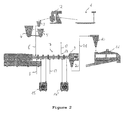
- Figure 2
- shows a second embodiment of a facility for manufacturing reconstituted rice;
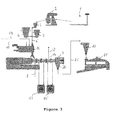
- Figure 3
- shows a third embodiment of a facility for manufacturing reconstituted rice;
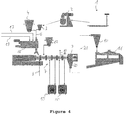
- Figure 4
- shows a fourth embodiment of a facility for manufacturing reconstituted rice.
-
Figure 1 shows a first embodiment of a facility for manufacturing reconstituted rice in accordance with the invention. In adosing member 1, a premix comprising rice flour and an emulsifier having a weight ratio of 2:1 is obtained. In mixer 2, these components are thoroughly mixed and fed into a first hopper 3, from which it is dispensed into afeedline 6. From asecond hopper 4, rice flour is added at a rate between 1 and 90 kg/h. Moreover, from a third hopper 5, fibers are added. By the process steps described so far, a mixture containing comminuted rice matrix material and fibers is obtained. - This mixture is fed into an
extruder 7 viafeedline 6. By adding water throughfeedline 8, the mixture is hydrated to obtain a paste. This paste is then kneaded within theextruder 7 until the rice starch is at least semi-gelatinized. Fromoptional hopper 12, additional fibers may be added into theextruder 7 after hydration. A venting 13 may be provided through a ventingopening 14 in order to cool down the mass, which prevents the strands to be extruded from expanding. The mass is then formed to strands by extrusion through an extrusion die and cut by a cutter 9 to obtain grains similar or equal to the size of rice grains. These grains are collected by acollecting hopper 20 and transported to afluidized bed dryer 11 via apneumatic transport line 21, where the grains are dried. - The rate at which the premix is dispensed from first hopper 3 is chosen such that the amount of emulsifier lies in the range from 0.5 % to 1 % by weight of the total dry infeed. This total dry infeed is the total amount of premix from first hopper 3, rice flour from
second hopper 4, fibers from third hopper 5 and, if applicable, fibers fromoptional hopper 12 directly into theextruder 7. Moreover, the rate at which the fibers are dispensed from hopper 5 and, optionally, fromhopper 12 is chosen such that the total amount of fibers lies in the range from 15 % to 25 % by weight of the total dry infeed. -
Figure 2 shows a second embodiment of the facility. As opposed to the embodiment depicted inFigure 1 , this second embodiment contains two temperingunit 15 and 15', which are connected to theextruder 7 to provide a water circulation. Moreover, additional water is also introduced throughfeedline 19, which is arranged downstream of thefirst tempering unit 15 and upstream of the second tempering unit 15'. This additional water allows to control the viscosity of the mass. Moreover, by the first addition of water throughfeedline 8, the rice starch is substantially saturated with water. The water introduced throughfeedline 19 is then predominantly available to saturate the fibers. - In the third embodiment shown in
Figure 3 , the mixture comprising the rice flour, emulsifier and fibers is first directed into a preconditioner 16 (for example model BCTC obtainable from Bühler AG, 9240 Uzwil, Switzerland), into which steam is introduced throughfeedline 17 and/or water is introduced throughfeedline 18. The preconditioning helps to pretreat the starch contained in the rice without damage. - Finally,
Figure 4 shows a fourth embodiment of a facility. In contrast toFigure 3 , this embodiment comprises no hopper 5 for adding fibers to the dry mixture. Instead, fibers are added only after hydration intoextruder 7. - The comminuted rice used for preparing the mixture in step a) may, for example, be milled on a hammer mill, such as on a DFZC mill obtainable from Bühler AG, 9240 Uzwil, Switzerland. This hammer mill contains conidur sieves having openings of 0.8 mm. The milled products may then be sieved (for example with a MPAR plan sifter, also obtainable by Bühler AG) to particle sizes below 500 µm before used in the process. As an emulsifier, DIMODAN HP may be used, which is a distilled monoglyceride made from edible, fully hydrogenated palm based oil. The fibers may be, for example, corn fibers, pea fibers or rice fibers.
- The following table provides data of 9 samples of reconstituted rice prepared according to the invention (2-10). Example 1 is a comparative example without fibers. Example 11 contains wheat dextrin, which has a water absorption capacity of less than 2 and is therefore also not covered by the invention. All samples were prepared with a facility according to
Figure 3 . The fiber content refers to the content of the fibers by weight of the total dry infeed, as defined above.Example # Fiber Fiber content 1 - (comparative example) 0 % 2 corn 15 % 3 corn 15 % 4 corn 25 % 5 corn 25 % 6 pea 15 % 7 pea 25 % 8 pea 25 % 9 pea 25 % 10 pea 25 % 11 wheat dextrin (comparative example) 25 % - All samples prepared according to the invention had an acceptable shape and a very good texture after cooking. Moreover, at most a slight amount of fibers escaped during cooking of the reconstituted rice.
Claims (11)
- Process for the manufacture of reconstituted rice, comprising the steps ofa) providing or preparing a mixture containing comminuted rice matrix material;b) hydrating the mixture to obtain a paste and kneading the paste obtained until the rice starch is at least semi-gelatinized;c) forming the at least semi-gelatinized mass to strands and cutting them to obtain grains similar or equal to the size of rice grains; andd) drying the grains;wherein the mixture provided or prepared in step a) contains fibers and/or fibers are added during step b),
characterized in that
the fibers have a water absorption capacity of at least 2, preferably at least 3, most preferably at least 4. - Process according to claim 1,
characterized in that
the fibers comprise corn fibers and/or pea fibers and/or rice fibers and/or white corn fibers and/or okara fibers and/or linseed fibers and/or bean fibers and/or oat fibers and/or carrot fibers and/or potato fibers and/or apple fibers and/or algae fibers and/or leguminose fibers. - Process according to one of the previous claims,
characterized in that
at least some of the fibers, in particular the rice fibers, contained in the mixture provided or prepared in step a) and/or added during step b) are at least partially bleached, for example by treatment with a peroxide, in particular hydrogen peroxide. - Process according to one of the previous claims,
characterized in that
the total amount of fibers contained in the mixture provided or prepared in step a) and/or added during step b) is chosen such that the total dietary fiber in the final, dried grains lies in the range between 5 % and 40 %, preferably between 10 % and 30 %, most preferably between 15 % and 25 % by weight of the dried grains. - Process according to one of the previous claims,
characterized in that
at least 90 %, preferably at least 95 %, most preferably at least 99 % by weight of the fibers have a length in the range from 20 µm to 500 µm, preferably from 50 µm to 250 µm. - Reconstituted rice, in particular produced by a method according to one to the preceding claims, comprising comminuted rice matrix material and fibers,
characterized in that
the fibers have a water absorption capacity of at least 2, preferably at least 3, most preferably at least 4. - Reconstituted rice according to claim 6,
characterized in that
the fibers comprise corn fibers and/or pea fibers and/or rice fibers and/or white corn fibers and/or okara fibers and/or linseed fibers and/or bean fibers and/or oat fibers and/or carrot fibers and/or potato fibers and/or apple fibers and/or algae fibers and/or leguminose fibers. - Reconstituted rice according to one of claims 6 and 7,
characterized in that
at least some of the fibers, in particular the rice fibers, are at least partially bleached. - Reconstituted rice according to one of claims 6 to 8,
characterized in that
the total dietary fiber within in the reconstituted rice is in the range between 5 % and 40 %, preferably between 10 % and 30 %, most preferably between 15 % and 25 % by weight of the grains. - Mixture comprising reconstituted rice according to one of claims 6 to 9 and natural rice.
- Use of reconstituted rice according to one of claims 6 to 9 for enriching natural rice.
Priority Applications (5)
| Application Number | Priority Date | Filing Date | Title |
|---|---|---|---|
| EP11161788A EP2508081A1 (en) | 2011-04-08 | 2011-04-08 | Reconstituted rice containing fibers |
| CN201280022471.1A CN103517639A (en) | 2011-04-08 | 2012-04-10 | Reconstituted rice containing fibers |
| PCT/EP2012/056426 WO2012136844A1 (en) | 2011-04-08 | 2012-04-10 | Reconstituted rice containing fibers |
| EP12713725.5A EP2693891A1 (en) | 2011-04-08 | 2012-04-10 | Reconstituted rice containing fibers |
| US14/009,536 US20140295048A1 (en) | 2011-04-08 | 2012-04-10 | Reconstituted Rice Containing Fibers |
Applications Claiming Priority (1)
| Application Number | Priority Date | Filing Date | Title |
|---|---|---|---|
| EP11161788A EP2508081A1 (en) | 2011-04-08 | 2011-04-08 | Reconstituted rice containing fibers |
Publications (1)
| Publication Number | Publication Date |
|---|---|
| EP2508081A1 true EP2508081A1 (en) | 2012-10-10 |
Family
ID=44307781
Family Applications (2)
| Application Number | Title | Priority Date | Filing Date |
|---|---|---|---|
| EP11161788A Withdrawn EP2508081A1 (en) | 2011-04-08 | 2011-04-08 | Reconstituted rice containing fibers |
| EP12713725.5A Withdrawn EP2693891A1 (en) | 2011-04-08 | 2012-04-10 | Reconstituted rice containing fibers |
Family Applications After (1)
| Application Number | Title | Priority Date | Filing Date |
|---|---|---|---|
| EP12713725.5A Withdrawn EP2693891A1 (en) | 2011-04-08 | 2012-04-10 | Reconstituted rice containing fibers |
Country Status (4)
| Country | Link |
|---|---|
| US (1) | US20140295048A1 (en) |
| EP (2) | EP2508081A1 (en) |
| CN (1) | CN103517639A (en) |
| WO (1) | WO2012136844A1 (en) |
Cited By (1)
| Publication number | Priority date | Publication date | Assignee | Title |
|---|---|---|---|---|
| CN103284078A (en) * | 2013-05-22 | 2013-09-11 | 马小军 | Production process of big oat flakes |
Families Citing this family (6)
| Publication number | Priority date | Publication date | Assignee | Title |
|---|---|---|---|---|
| CN106578898A (en) * | 2016-12-30 | 2017-04-26 | 定远县文凡米业有限公司 | Nutritional rice rich in dietary fiber and preparation method thereof |
| US10287366B2 (en) | 2017-02-15 | 2019-05-14 | Cp Kelco Aps | Methods of producing activated pectin-containing biomass compositions |
| US20210161194A1 (en) * | 2017-05-01 | 2021-06-03 | Trouw Nutrition Usa Llc | Methods and systems for making food |
| WO2019226128A2 (en) * | 2017-12-30 | 2019-11-28 | Abdullah Serin Gida Sanayi Ltd. Sti. | Method of converting rice flour and rice semolina into rice |
| CN109247512A (en) * | 2018-09-06 | 2019-01-22 | 山东禹王生态食业有限公司 | A kind of bean dregs integration engineering reproduced rice and its processing method |
| CN112544881B (en) * | 2020-12-02 | 2023-09-08 | 浙江省林业科学研究院 | Recombinant instant mountain rice containing vine tea extract and preparation method thereof |
Citations (8)
| Publication number | Priority date | Publication date | Assignee | Title |
|---|---|---|---|---|
| US5069919A (en) * | 1990-08-08 | 1991-12-03 | Fmc Corporation | Process for bleaching/sanitizing food fiber |
| JP2002233317A (en) * | 2001-02-08 | 2002-08-20 | Alpha Shokuhin Kk | Method for producing artificial rice for enriching brown rice ingredient |
| WO2005053433A1 (en) | 2003-11-21 | 2005-06-16 | Dsm Ip Assets B.V. | Rice-based food compositions and processes for their preparation |
| WO2006020806A2 (en) * | 2004-08-12 | 2006-02-23 | Cargill, Incorporated | Food products comprising starch phosphorylated with sodium trimetaphosphate that retain dietary fiber and methods of making said food products |
| US20070054029A1 (en) * | 2005-09-06 | 2007-03-08 | Kraft Foods Holdings, Inc. | Fiber-containing rice-based cereals and methods of preparation |
| WO2009125281A2 (en) * | 2008-04-11 | 2009-10-15 | Universidad De Santiago De Chile | A process for obtaining reconfigured rice from rice by-products used as raw materials, and reconfigured rice resulting from said process |
| FR2937506A1 (en) * | 2008-10-24 | 2010-04-30 | Panzani | RECONSTITUTED RICE GRAIN AND METHOD FOR MANUFACTURING THE SAME |
| EP2250907A1 (en) * | 2009-05-11 | 2010-11-17 | Bühler AG | Grain-based food compositions and processes for their preparation |
Family Cites Families (6)
| Publication number | Priority date | Publication date | Assignee | Title |
|---|---|---|---|---|
| CN1207255A (en) * | 1998-06-30 | 1999-02-10 | 曾登发 | Pearl reproduced rice |
| JP2002023317A (en) * | 2000-07-12 | 2002-01-23 | Fuji Photo Film Co Ltd | Film unit with lens |
| SE526999C2 (en) * | 2001-02-26 | 2005-12-06 | Biovelop Internat Bv | Process for extracting cell wall components and less accessible cereal clay proteins substantially free of soluble compounds |
| TWI253327B (en) * | 2002-12-04 | 2006-04-21 | Food Industry Res & Dev Inst | Recombination multi-cereal grain |
| CN101828706A (en) * | 2009-03-10 | 2010-09-15 | 上海亦晨信息科技发展有限公司 | Rice composite grain and preparation method thereof |
| CN101658258A (en) * | 2009-09-18 | 2010-03-03 | 南昌大学 | Preparation method of high dietary fiber enriched rice |
-
2011
- 2011-04-08 EP EP11161788A patent/EP2508081A1/en not_active Withdrawn
-
2012
- 2012-04-10 CN CN201280022471.1A patent/CN103517639A/en active Pending
- 2012-04-10 WO PCT/EP2012/056426 patent/WO2012136844A1/en not_active Ceased
- 2012-04-10 EP EP12713725.5A patent/EP2693891A1/en not_active Withdrawn
- 2012-04-10 US US14/009,536 patent/US20140295048A1/en not_active Abandoned
Patent Citations (8)
| Publication number | Priority date | Publication date | Assignee | Title |
|---|---|---|---|---|
| US5069919A (en) * | 1990-08-08 | 1991-12-03 | Fmc Corporation | Process for bleaching/sanitizing food fiber |
| JP2002233317A (en) * | 2001-02-08 | 2002-08-20 | Alpha Shokuhin Kk | Method for producing artificial rice for enriching brown rice ingredient |
| WO2005053433A1 (en) | 2003-11-21 | 2005-06-16 | Dsm Ip Assets B.V. | Rice-based food compositions and processes for their preparation |
| WO2006020806A2 (en) * | 2004-08-12 | 2006-02-23 | Cargill, Incorporated | Food products comprising starch phosphorylated with sodium trimetaphosphate that retain dietary fiber and methods of making said food products |
| US20070054029A1 (en) * | 2005-09-06 | 2007-03-08 | Kraft Foods Holdings, Inc. | Fiber-containing rice-based cereals and methods of preparation |
| WO2009125281A2 (en) * | 2008-04-11 | 2009-10-15 | Universidad De Santiago De Chile | A process for obtaining reconfigured rice from rice by-products used as raw materials, and reconfigured rice resulting from said process |
| FR2937506A1 (en) * | 2008-10-24 | 2010-04-30 | Panzani | RECONSTITUTED RICE GRAIN AND METHOD FOR MANUFACTURING THE SAME |
| EP2250907A1 (en) * | 2009-05-11 | 2010-11-17 | Bühler AG | Grain-based food compositions and processes for their preparation |
Non-Patent Citations (2)
| Title |
|---|
| JEFF FEARN: "Technology Brief Manufacture of a Fiber Enhanced, Nutritionally Superior Rice Product by Supercritical Fluid Extrusion (SCFX)", 2 August 2011 (2011-08-02), pages 1 - 1, XP055004044, Retrieved from the Internet <URL:http://ip.cctec.cornell.edu/techdocs/D3724.3724_Fortified_Rice_Tech_Brief_final.pdf> [retrieved on 20110802] * |
| MATTHIAS DIPIKA: "Introduction of Fortified Rice Using the Ultra Rice Technology", 1 September 2007 (2007-09-01), pages 1 - 10, XP055003990, Retrieved from the Internet <URL:http://www.path.org/files/MCHN_ultrarice_faq.pdf> [retrieved on 20110801] * |
Cited By (1)
| Publication number | Priority date | Publication date | Assignee | Title |
|---|---|---|---|---|
| CN103284078A (en) * | 2013-05-22 | 2013-09-11 | 马小军 | Production process of big oat flakes |
Also Published As
| Publication number | Publication date |
|---|---|
| EP2693891A1 (en) | 2014-02-12 |
| CN103517639A (en) | 2014-01-15 |
| WO2012136844A1 (en) | 2012-10-11 |
| US20140295048A1 (en) | 2014-10-02 |
Similar Documents
| Publication | Publication Date | Title |
|---|---|---|
| Kohajdová et al. | Effect of apple pomace powder addition on farinographic properties of wheat dough and biscuits quality | |
| CN101917859B (en) | Nutritious snack products | |
| US20140295048A1 (en) | Reconstituted Rice Containing Fibers | |
| Wandee et al. | Enrichment of rice noodles with fibre-rich fractions derived from cassava pulp and pomelo peel | |
| JP4724592B2 (en) | Manufacture of whole grain shredded products | |
| US20030198725A1 (en) | Nixtamalized corn and products thereof | |
| CN101562983A (en) | Fruit based dough and fabricated snack products made therefrom | |
| JP4774451B2 (en) | Method for producing rice noodle, rice noodle by the method, and dry noodle by the rice noodle | |
| CN108925831A (en) | The processing method that a kind of extrusion modification coarse cereal powder improves full coarse cereals wheat flour food quality | |
| CN101385517A (en) | Highland barley cereals and production method | |
| CN104920539A (en) | Special flour for full nutritional corn biscuit and production method thereof | |
| CA2888608A1 (en) | Food product made from plant parts containing starch, and method for the production of said food product | |
| RU2555480C2 (en) | Whole-grain instant pasta products | |
| Tanwar et al. | Effect of finger millet on nutritional, rheological, cooking and pasting profile of Asian noodles | |
| Mahmud et al. | Noodles | |
| Padalino et al. | Durum wheat whole-meal spaghetti with tomato peels: how by-product particles size can affect final quality of pasta. | |
| KR101111300B1 (en) | The Manufacturing Method of the Functional SeolKi Rice Cake Adding Radish | |
| CN101019670A (en) | Production process of sausage with starch and candied plant | |
| CN105581070A (en) | Total-nutrition anti-cancer food capable of reducing high blood pressure, high blood sugar and high blood fat as well as processing method thereof | |
| KR101481154B1 (en) | Puffed cereal containing sea algae and preparing method thereof | |
| CN109463633A (en) | A kind of corn compound wheat germ brewing powder and preparation method thereof | |
| RU2375934C2 (en) | Formed product production method, device for production of formed product and formed product | |
| JPH05137526A (en) | Preparation of glutinous wheat noodle | |
| Van Tai et al. | Banana peel powder as the potential ingredient to substitute wheat flour in noodles processing. | |
| Gunasekara et al. | Physicochemical, Functional, and Nutritional Characterization of Cashew (Anacardium occidentale L.) Apple Flour and Its Use in |
Legal Events
| Date | Code | Title | Description |
|---|---|---|---|
| PUAI | Public reference made under article 153(3) epc to a published international application that has entered the european phase |
Free format text: ORIGINAL CODE: 0009012 |
|
| AK | Designated contracting states |
Kind code of ref document: A1 Designated state(s): AL AT BE BG CH CY CZ DE DK EE ES FI FR GB GR HR HU IE IS IT LI LT LU LV MC MK MT NL NO PL PT RO RS SE SI SK SM TR |
|
| AX | Request for extension of the european patent |
Extension state: BA ME |
|
| STAA | Information on the status of an ep patent application or granted ep patent |
Free format text: STATUS: THE APPLICATION IS DEEMED TO BE WITHDRAWN |
|
| 18D | Application deemed to be withdrawn |
Effective date: 20130411 |