EP2507070B1 - Pneumatique comportant des cables d'armature de carcasse presentant des permeabilites differentes - Google Patents
Pneumatique comportant des cables d'armature de carcasse presentant des permeabilites differentes Download PDFInfo
- Publication number
- EP2507070B1 EP2507070B1 EP10784786.5A EP10784786A EP2507070B1 EP 2507070 B1 EP2507070 B1 EP 2507070B1 EP 10784786 A EP10784786 A EP 10784786A EP 2507070 B1 EP2507070 B1 EP 2507070B1
- Authority
- EP
- European Patent Office
- Prior art keywords
- layer
- carcass reinforcement
- tyre
- reinforcing elements
- cables
- Prior art date
- Legal status (The legal status is an assumption and is not a legal conclusion. Google has not performed a legal analysis and makes no representation as to the accuracy of the status listed.)
- Not-in-force
Links
Images

Classifications
-
- D—TEXTILES; PAPER
- D07—ROPES; CABLES OTHER THAN ELECTRIC
- D07B—ROPES OR CABLES IN GENERAL
- D07B1/00—Constructional features of ropes or cables
- D07B1/06—Ropes or cables built-up from metal wires, e.g. of section wires around a hemp core
- D07B1/0606—Reinforcing cords for rubber or plastic articles
- D07B1/062—Reinforcing cords for rubber or plastic articles the reinforcing cords being characterised by the strand configuration
-
- B—PERFORMING OPERATIONS; TRANSPORTING
- B60—VEHICLES IN GENERAL
- B60C—VEHICLE TYRES; TYRE INFLATION; TYRE CHANGING; CONNECTING VALVES TO INFLATABLE ELASTIC BODIES IN GENERAL; DEVICES OR ARRANGEMENTS RELATED TO TYRES
- B60C9/00—Reinforcements or ply arrangement of pneumatic tyres
- B60C9/0007—Reinforcements made of metallic elements, e.g. cords, yarns, filaments or fibres made from metal
-
- B—PERFORMING OPERATIONS; TRANSPORTING
- B60—VEHICLES IN GENERAL
- B60C—VEHICLE TYRES; TYRE INFLATION; TYRE CHANGING; CONNECTING VALVES TO INFLATABLE ELASTIC BODIES IN GENERAL; DEVICES OR ARRANGEMENTS RELATED TO TYRES
- B60C9/00—Reinforcements or ply arrangement of pneumatic tyres
- B60C9/005—Reinforcements made of different materials, e.g. hybrid or composite cords
-
- D—TEXTILES; PAPER
- D07—ROPES; CABLES OTHER THAN ELECTRIC
- D07B—ROPES OR CABLES IN GENERAL
- D07B1/00—Constructional features of ropes or cables
- D07B1/06—Ropes or cables built-up from metal wires, e.g. of section wires around a hemp core
- D07B1/0606—Reinforcing cords for rubber or plastic articles
- D07B1/062—Reinforcing cords for rubber or plastic articles the reinforcing cords being characterised by the strand configuration
- D07B1/0633—Reinforcing cords for rubber or plastic articles the reinforcing cords being characterised by the strand configuration having a multiple-layer configuration
-
- B—PERFORMING OPERATIONS; TRANSPORTING
- B60—VEHICLES IN GENERAL
- B60C—VEHICLE TYRES; TYRE INFLATION; TYRE CHANGING; CONNECTING VALVES TO INFLATABLE ELASTIC BODIES IN GENERAL; DEVICES OR ARRANGEMENTS RELATED TO TYRES
- B60C9/00—Reinforcements or ply arrangement of pneumatic tyres
- B60C9/02—Carcasses
- B60C2009/0269—Physical properties or dimensions of the carcass coating rubber
-
- B—PERFORMING OPERATIONS; TRANSPORTING
- B60—VEHICLES IN GENERAL
- B60C—VEHICLE TYRES; TYRE INFLATION; TYRE CHANGING; CONNECTING VALVES TO INFLATABLE ELASTIC BODIES IN GENERAL; DEVICES OR ARRANGEMENTS RELATED TO TYRES
- B60C9/00—Reinforcements or ply arrangement of pneumatic tyres
- B60C9/02—Carcasses
- B60C9/04—Carcasses the reinforcing cords of each carcass ply arranged in a substantially parallel relationship
- B60C2009/0475—Particular materials of the carcass cords
-
- D—TEXTILES; PAPER
- D07—ROPES; CABLES OTHER THAN ELECTRIC
- D07B—ROPES OR CABLES IN GENERAL
- D07B1/00—Constructional features of ropes or cables
- D07B1/06—Ropes or cables built-up from metal wires, e.g. of section wires around a hemp core
- D07B1/0606—Reinforcing cords for rubber or plastic articles
- D07B1/062—Reinforcing cords for rubber or plastic articles the reinforcing cords being characterised by the strand configuration
- D07B1/0626—Reinforcing cords for rubber or plastic articles the reinforcing cords being characterised by the strand configuration the reinforcing cords consisting of three core wires or filaments and at least one layer of outer wires or filaments, i.e. a 3+N configuration
-
- D—TEXTILES; PAPER
- D07—ROPES; CABLES OTHER THAN ELECTRIC
- D07B—ROPES OR CABLES IN GENERAL
- D07B2201/00—Ropes or cables
- D07B2201/20—Rope or cable components
- D07B2201/2001—Wires or filaments
- D07B2201/2006—Wires or filaments characterised by a value or range of the dimension given
-
- D—TEXTILES; PAPER
- D07—ROPES; CABLES OTHER THAN ELECTRIC
- D07B—ROPES OR CABLES IN GENERAL
- D07B2201/00—Ropes or cables
- D07B2201/20—Rope or cable components
- D07B2201/2015—Strands
- D07B2201/2024—Strands twisted
- D07B2201/2025—Strands twisted characterised by a value or range of the pitch parameter given
-
- D—TEXTILES; PAPER
- D07—ROPES; CABLES OTHER THAN ELECTRIC
- D07B—ROPES OR CABLES IN GENERAL
- D07B2201/00—Ropes or cables
- D07B2201/20—Rope or cable components
- D07B2201/2015—Strands
- D07B2201/2024—Strands twisted
- D07B2201/2027—Compact winding
- D07B2201/2028—Compact winding having the same lay direction and lay pitch
-
- D—TEXTILES; PAPER
- D07—ROPES; CABLES OTHER THAN ELECTRIC
- D07B—ROPES OR CABLES IN GENERAL
- D07B2201/00—Ropes or cables
- D07B2201/20—Rope or cable components
- D07B2201/2015—Strands
- D07B2201/2024—Strands twisted
- D07B2201/2029—Open winding
- D07B2201/2031—Different twist pitch
-
- D—TEXTILES; PAPER
- D07—ROPES; CABLES OTHER THAN ELECTRIC
- D07B—ROPES OR CABLES IN GENERAL
- D07B2201/00—Ropes or cables
- D07B2201/20—Rope or cable components
- D07B2201/2015—Strands
- D07B2201/2046—Strands comprising fillers
-
- D—TEXTILES; PAPER
- D07—ROPES; CABLES OTHER THAN ELECTRIC
- D07B—ROPES OR CABLES IN GENERAL
- D07B2201/00—Ropes or cables
- D07B2201/20—Rope or cable components
- D07B2201/2047—Cores
- D07B2201/2052—Cores characterised by their structure
- D07B2201/2059—Cores characterised by their structure comprising wires
-
- D—TEXTILES; PAPER
- D07—ROPES; CABLES OTHER THAN ELECTRIC
- D07B—ROPES OR CABLES IN GENERAL
- D07B2201/00—Ropes or cables
- D07B2201/20—Rope or cable components
- D07B2201/2075—Fillers
- D07B2201/2077—Fillers having an anti-corrosive function
-
- D—TEXTILES; PAPER
- D07—ROPES; CABLES OTHER THAN ELECTRIC
- D07B—ROPES OR CABLES IN GENERAL
- D07B2501/00—Application field
- D07B2501/20—Application field related to ropes or cables
- D07B2501/2046—Tyre cords
-
- Y—GENERAL TAGGING OF NEW TECHNOLOGICAL DEVELOPMENTS; GENERAL TAGGING OF CROSS-SECTIONAL TECHNOLOGIES SPANNING OVER SEVERAL SECTIONS OF THE IPC; TECHNICAL SUBJECTS COVERED BY FORMER USPC CROSS-REFERENCE ART COLLECTIONS [XRACs] AND DIGESTS
- Y10—TECHNICAL SUBJECTS COVERED BY FORMER USPC
- Y10T—TECHNICAL SUBJECTS COVERED BY FORMER US CLASSIFICATION
- Y10T152/00—Resilient tires and wheels
- Y10T152/10—Tires, resilient
- Y10T152/10495—Pneumatic tire or inner tube
- Y10T152/10855—Characterized by the carcass, carcass material, or physical arrangement of the carcass materials
- Y10T152/10873—Characterized by the carcass, carcass material, or physical arrangement of the carcass materials with two or more differing cord materials
Definitions
- the present invention relates to a tire, radial carcass reinforcement and more particularly a tire intended to equip vehicles carrying heavy loads and driving at a high speed, such as, for example, trucks, tractors, trailers or road buses.
- the carcass reinforcement is anchored on both sides in the bead zone and is radially surmounted by a crown reinforcement consisting of at least two superposed layers. and formed of parallel wires or cables in each layer and crossed from one layer to the next by making with the circumferential direction angles between 10 ° and 45 °.
- Said working layers, forming the working armature can still be covered with at least one so-called protective layer and formed of advantageously metallic and extensible reinforcing elements, called elastic elements.
- It may also comprise a layer of low extensibility wires or metal cables forming with the circumferential direction an angle of between 45 ° and 90 °, this so-called triangulation ply being radially located between the carcass reinforcement and the first ply of plywood.
- so-called working top formed of parallel wires or cables having angles at most equal to 45 ° in absolute value.
- the triangulation ply forms with at least said working ply a triangulated reinforcement, which presents, under the different stresses it undergoes, few deformations, the triangulation ply having the essential role of taking up the transverse compression forces of which the object all the reinforcing elements in the area of the crown of the tire.
- the circumferential direction of the tire is the direction corresponding to the periphery of the tire and defined by the rolling direction of the tire.
- the transverse or axial direction of the tire is parallel to the axis of rotation of the tire.
- the radial direction is a direction intersecting the axis of rotation of the tire and perpendicular to it.
- the axis of rotation of the tire is the axis around which it rotates under normal use.
- a radial or meridian plane is a plane which contains the axis of rotation of the tire.
- the circumferential median plane is a plane perpendicular to the axis of rotation of the tire and which divides the tire into two halves.
- Some current tires are intended to run at high speed and on longer and longer journeys, because of the improvement of the road network and the growth of the motorway network in the world.
- the set of conditions under which such a tire is called to roll undoubtedly allows an increase in the number of kilometers traveled, the wear of the tire being less; on the other hand, the stamina of the latter is penalized.
- the elements of the carcass reinforcement are in particular subjected to bending and compression stresses during rollings which run counter to their endurance.
- the cables constituting the reinforcement elements of the carcass layers are in fact subjected to considerable stresses during the rolling of the tires, in particular to repeated bending or variations of curvature inducing at the level of the yarns of friction, and therefore of wear, as well as fatigue; This phenomenon is called "fatigue-fretting".
- said cables must first have good flexibility and high endurance in bending, which implies in particular that their threads have a relatively small diameter, preferably less than 0.28 mm, more preferably less than 0.25 mm, generally smaller than that of the yarns used in conventional cables for tire crown reinforcement.
- the cables of the carcass reinforcement are also subject to phenomena known as "fatigue-corrosion” due to the very nature of the cables that favor the passage or even drain corrosive agents such as oxygen and moisture. Indeed, the air or water entering the tire for example during a degradation during a cut or simply because of the permeability, even small of the inner surface of the tire, can be driven by the channels formed within the cables because of their structure.
- the movement of the air is along the carcass reinforcement following passages between the reinforcing elements, the layers of rubber mixture covering the reinforcing elements forming recess zones parallel to the reinforcing elements before the step cooking of the tire.
- These recess areas thus allow the air to move slightly depending on the pressure exerted on the regions where the air pockets are.
- the pressure or pressure variations occur in particular during the baking step of the tire or during the conformation step if it exists.
- the inventors have thus made it their mission to supply tires for heavy vehicles of the "heavy-weight” type, the wear performance of which is retained for road uses and whose performances, in particular endurance performance, are improved in particular with regard to the phenomena of "fatigue-corrosion” or “fatigue-fretting-corrosion”, whatever the conditions of rolling in particular in terms of inflation and whose manufacturing cost remains acceptable.
- a radial carcass reinforcement tire consisting of at least one layer of reinforcement elements, said tire comprising a crown reinforcement, itself capped radially with a tread.
- said tread being joined to two beads by two sidewalls, at least 85% of the metal reinforcing elements of at least one layer of the carcass reinforcement being unfrowed metal cables having the so-called permeability a flow rate less than 20 cm 3 / min and at least 5% of the reinforcing elements of said at least one layer of the carcass reinforcement being cables comprising at least one strand consisting of textile multifilament fibers.
- the cables are either stranded cables or layered cables, or layered cable strands or layered cables with strands.
- Strand cables are cables consisting of strands or twines together.
- So-called " layered cords” or “multilayer” cables are cables consisting of a central core and one or more layers of substantially concentric strands or wires arranged around this central core.
- the most common layered cables in truck tire carcasses are cables of formula (L + M) or (L + M + N), the latter being generally intended for larger tires.
- These cables are formed in known manner of a core of L wire (s) surrounded by a layer of M son, the set L + M forming the core of the cable, itself surrounded by an outer layer of N son, with in general L varying from 1 to 4, M varying from 3 to 12, N ranging from 8 to 20. If necessary, the assembly can be shrunk by an outer hoop wound helically around the last layer .
- the cables are obtained from strand or yarn consisting of multifilament yarns (multifilament yarns), these strands or yarns being able to be twisted or not on themselves or from single yarns such as cylindrical or oblong monofilaments, with or without twisting on themselves.
- the cables may be of the hybrid type, that is to say composite, when they comprise elements of different natures.
- the multifilament textile fibers are of polyamide type and more preferably aromatic polyamide type to find the closest possible mechanical properties to those of metal son.
- aliphatic polyamides are not excluded, they may have disadvantages in some cases, in particular because of possible withdrawal phenomena.
- the so-called permeability test makes it possible to determine the longitudinal permeability to air of the cables tested, by measuring the volume of air passing through a specimen under constant pressure for a given time.
- the principle of such a test is to demonstrate the effectiveness of the treatment of a cable to make it impermeable to air; it has been described for example in ASTM D2692-98.
- the test is carried out on cables extracted directly, by shelling, vulcanized rubber sheets that they reinforce, thus penetrated by the cooked rubber.
- the test is carried out on 2 cm of cable length, thus coated by its surrounding rubber composition (or coating gum) in the fired state, as follows: air is sent to the cable inlet at a pressure of 1 bar, and the volume of air at the outlet is measured using a flow meter (calibrated for example from 0 to 500 cm 3 / min).
- a flow meter calibrated for example from 0 to 500 cm 3 / min.
- the cable sample is locked in a compressed seal (eg a dense foam or rubber seal) in such a way that only the amount of air passing through the cable from one end to the other, along its longitudinal axis, is taken into account by the measure; the tightness of the seal itself is checked beforehand with the aid of a solid rubber specimen, that is to say without cable.
- a compressed seal eg a dense foam or rubber seal
- the average air flow rate (average on 10 test pieces) is even lower than the longitudinal imperviousness of the cable is high.
- the measured values less than or equal to 0.2 cm 3 / min are considered as zero; they correspond to a cable that can be described as airtight (totally airtight) along its axis (ie, in its longitudinal direction).
- This permeability test is also a simple means for indirect measurement of the penetration rate of the cable by a rubber composition.
- the measured flow rate is even lower than the penetration rate of the cable by the rubber is high.
- Cables with a permeability test having a flow rate of less than 20 cm3 / min have a penetration rate greater than 66%.
- Cables having a flow rate of less than 2 cm3 / min with a permeability test have a penetration rate greater than 90%.
- the penetration rate of a cable can still be estimated according to the method described below.
- the method consists first of all in eliminating the outer layer on a sample having a length of between 2 and 4 cm, and then measuring in a longitudinal direction and along a given axis the sum of the lengths of rubber mix reported over the length of the sample. These measurements of rubber mix lengths exclude non-penetrated spaces on this longitudinal axis. These measurements are repeated on three longitudinal axes distributed over the periphery of the sample and repeated over five cable samples.
- the first removal step is repeated with the newly outer layer and length measurements of rubber mix along longitudinal axes.
- the inventors have demonstrated that a tire thus produced according to the invention leads to improvements in terms of endurance compromise and cost of very interesting manufacturing. Indeed, the endurance properties with such a tire are equivalent with the solutions mentioned above.
- the presence of at least 85% of carcass reinforcement cables presenting a permeability test with a flow rate of less than 20 cm 3 / min makes it possible to limit the risks associated with corrosion.
- the presence of at least 5% of cables comprising at least one strand consisting of textile multifilament fibers makes it possible to drain the occluded air during the manufacture of the tire and therefore leads to a productivity higher than that mentioned previously and therefore to more interesting costs.
- the inventors have been able to demonstrate that a number of cables comprising at least one strand consisting of textile multifilament fibers of between 5 and 15% allows the occluded air to meet a "drain" either as soon as a pocket is formed. air, or during a displacement of said air pocket in a direction parallel to the reinforcing elements of the carcass reinforcement layer during the manufacturing steps of the tire as mentioned above.
- the tests carried out confirmed that the results obtained with cables comprising at least one strand consisting of textile multifilament fibers in these proportions are out of all proportion to those obtained with carcass reinforcement layers comprising only cables presenting the so-called permeability a flow rate less than 20 cm 3 / min.
- the presence of at least 5% of cables comprising at least one strand made of textile multifilament fibers has made it possible to preserve almost all the tires thus manufactured and thus reduce the unit manufacturing cost to acceptable values.
- said at least 5% of cables comprising at least one strand consisting of textile multifilament fibers are textile cords, that is to say that they consist solely of strands or yarns. textiles. According to this variant embodiment, their number is preferably less than 10% of the reinforcing elements of said at least one layer of the carcass reinforcement.
- said at least 5% of cables are hybrid cables comprising strands or textile threads and metal strands or threads.
- the presence of at least a portion of strands or metal son in said at least 5% of cables provides mechanical properties closer to those of a wire rope.
- their number is preferably greater than 10% of the reinforcing elements of said at least one layer of the carcass reinforcement to ensure the total drainage of the occluded air during the manufacturing phase.
- said at least 5% of the reinforcing elements of said at least one layer of the carcass reinforcement are hybrid layer cables whose core comprises at least one strand. or yarn consisting of textile multifilament fibers, the strands of the intermediate and / or outer layers being metallic.
- said at least 5% of the reinforcing elements of said at least one layer of the carcass reinforcement are hybrid cables of the type 1 + M + N, that is to say that the core corresponds to a only yarn or strand made of textile multifilament fibers, the strands of the intermediate and outer layers being metallic.
- said at least 85% of the carcass reinforcement cables exhibiting a flow rate of less than 20 cm 3 / min in the so-called permeability test are cables with similar metal layers. formula that said at least 5% of hybrid cables.
- each of said layers may be in accordance with the invention.
- at least the radially outer layer comprises at least 85% of non-shrunk metal cables exhibiting, in the so-called permeability test, a flow rate of less than 20 cm 3 / min and at least 5% of cables comprising at least one strand consisting of textile multifilament fibers. This choice is particularly advantageous for ensuring complete evacuation of the air pockets that form during the manufacture of the tire, these appearing essentially on the axially and / or radially outer surface of the carcass reinforcement during manufacture.
- said at least 85% of the metal reinforcing elements of at least one layer of the carcass reinforcement are cables with at least two layers, at least one inner layer being sheathed with a layer consisting of a polymeric composition such as a crosslinkable or crosslinked rubber composition, preferably based on at least one diene elastomer.
- the cables of the carcass reinforcement have, in the so-called permeability test, a flow rate of less than 10 cm 3 / min and more preferably less than 2 cm 3 / min.
- the invention also proposes a tire with a radial carcass reinforcement, consisting of at least one layer of reinforcing elements, said tire comprising a crown reinforcement, itself capped radially by a tread, said tread being joined to two beads by means of two flanks, at least 85% of the reinforcing elements of at least one layer of the carcass reinforcement being non-shrunk metal cables with at least two layers, at least one inner layer being sheathed with a layer consisting of a polymeric composition such as a crosslinkable or crosslinked rubber composition, preferably based on at least one diene elastomer and at least 5% of the reinforcing elements of said at least one layer of the carcass reinforcement being cables comprising at least one strand consisting of textile multifilament fibers.
- a radial carcass reinforcement consisting of at least one layer of reinforcing elements, said tire comprising a crown reinforcement, itself capped radially by a tread, said tread being joined to two beads by means of two flanks,
- the hybrid cables are cables with at least three layers, at least one intermediate layer being sheathed with a layer consisting of a polymeric composition such as a crosslinkable or crosslinked rubber composition, preferably base of at least one diene elastomer.
- a polymeric composition such as a crosslinkable or crosslinked rubber composition, preferably base of at least one diene elastomer.
- the layer consisting of a polymeric composition avoids friction between the strands or wires of the different layers.
- composition based on at least one diene elastomer is understood to mean in a known manner that the composition comprises in majority (i.e. in a mass fraction greater than 50%) this or these diene elastomers.
- the sheath according to the invention extends in a continuous manner around the layer which it covers (that is to say that this sheath is continuous in the "orthoradial" direction of the cable which is perpendicular to its radius), so as to form a continuous sleeve of cross section which is preferably substantially circular.
- the rubber composition of this sheath is crosslinkable or crosslinked, that is to say that it comprises by definition a crosslinking system adapted to allow the crosslinking of the composition during its cooking (ie, its hardening and not its fusion); thus, this rubber composition can be described as infusible, since it can not be melted by heating at any temperature.
- elastomer or "diene” rubber is meant in known manner an elastomer derived at least in part (i.e. a homopolymer or a copolymer) of monomers dienes (monomers bearing two carbon-carbon double bonds, conjugated or not).
- diene elastomers can be classified in known manner into two categories: those known as “essentially unsaturated” and those known as “essentially saturated”.
- the term "diene elastomer” is used herein to mean a diene elastomer derived at least in part from conjugated diene monomers having a level of units or units of diene origin (conjugated dienes) which is greater than 15% (%). in moles).
- conjugated diene monomers having a level of units or units of diene origin (conjugated dienes) which is greater than 15% (%). in moles).
- diene elastomers such as butyl rubbers or copolymers of dienes and alpha-olefins of the EPDM type do not fall within the above definition and may in particular be described as "essentially saturated” diene elastomers.
- the term “highly unsaturated” diene elastomer is particularly understood to mean a diene elastomer having a content of units of diene origin (conjugated dienes) which is greater than 50%.
- the present invention is first of all carried out with essentially unsaturated diene elastomers, in particular of the type (a) or (b) above.
- the diene elastomer is preferably chosen from the group consisting of polybutadienes (BR), natural rubber (NR), synthetic polyisoprenes (IR), the various butadiene copolymers, the various isoprene copolymers, and mixtures of these elastomers.
- Such copolymers are more preferably selected from the group consisting of butadiene-styrene copolymers (SBR), isoprene-butadiene copolymers (BIR), isoprene-styrene copolymers (SIR) and isoprene-copolymers.
- SBIR butadiene-styrene
- the diene elastomer chosen is predominantly (that is to say for more than 50 phr) consisting of an isoprene elastomer.
- isoprene elastomer is meant in known manner a homopolymer or copolymer of isoprene, in other words a diene elastomer chosen from the group consisting of natural rubber (NR), synthetic polyisoprenes (IR), different isoprene copolymers and mixtures of these elastomers.
- the diene elastomer chosen is exclusively (that is to say, 100 phr) consisting of natural rubber, synthetic polyisoprene or a mixture of these elastomers, synthetic polyisoprene having a rate (mol%) of cis-1,4 bonds preferably greater than 90%, more preferably still greater than 98%.
- blends mixtures of this natural rubber and / or these synthetic polyisoprenes with other highly unsaturated diene elastomers, in particular with SBR or BR elastomers such as supra.
- the rubber sheath of the cable of the invention may contain one or more diene elastomer (s), this last one (s) can be used in combination with any type of synthetic elastomer other than diene, or even with polymers other than elastomers, for example thermoplastic polymers, these polymers other than elastomers then being present as a minority polymer.
- the rubber composition of said sheath is preferably free of any plastomer and comprises only one elastomer (or mixture of elastomers) diene (s) as polymer base
- said composition could also comprise at least one plastomer according to a mass fraction x p less than the mass fraction x c of the elastomer (s).
- the following relationship is preferably: 0 ⁇ x p ⁇ 0.5. x e , and more preferably: 0 ⁇ x p ⁇ 0.1. x e .
- the system for crosslinking the rubber sheath is a so-called vulcanization system, that is to say based on sulfur (or a sulfur-donor agent) and a primary vulcanization accelerator.
- a vulcanization system may be added various known secondary accelerators or vulcanization activators.
- the sulfur is used at a preferential rate of between 0.5 and 10 phr, more preferably between 1 and 8 phr
- the primary vulcanization accelerator for example a sulfenamide, is used at a preferential rate of between 0.5 and 10 phr, more preferably between 0.5 and 5.0 phr.
- the rubber composition of the sheath according to the invention comprises, in addition to said crosslinking system, all the usual ingredients which can be used in tire rubber compositions, such as reinforcing fillers based on carbon black and / or a filler.
- reinforcing inorganic material such as silica, anti-aging agents, for example, antioxidants, extender oils, plasticizers or agents facilitating the use of the compositions in the green state, acceptors and donors of methylene, resins, bismaleimides, adhesion promoter systems known from type "RFS" (resorcinol-formaldehyde-silica) or metal salts, especially cobalt salts.
- the composition of the rubber sheath has, in the crosslinked state, a secant modulus in extension at 10% elongation (denoted M10), measured according to the ASTM D 412 standard of 1998, less than 20 MPa and more. preferably less than 12 MPa, in particular between 4 and 11 MPa.
- the composition of this sheath is chosen to be identical to the composition used for the rubber matrix that the cables according to the invention are intended to reinforce.
- the composition of this sheath is chosen to be identical to the composition used for the rubber matrix that the cables according to the invention are intended to reinforce.
- said composition is based on natural rubber and comprises carbon black as a reinforcing filler, for example a grade (ASTM) carbon black 300, 600 or 700 (for example N326, N330, N347, N375 , N683, N772).
- ASTM grade carbon black 300, 600 or 700
- said at least 85% of cables of at least one layer of the carcass reinforcement having a permeability test with a flow rate of less than 20 cm 3 / min are metal cables with building layers.
- [L + M] or [L + M + N] having a first layer C1 to L son of diameter d 1 with L ranging from 1 to 4, surrounded by at least one intermediate layer C2 to M son of diameter d 2 wound together helically in a pitch p 2 with M ranging from 3 to 12, said layer C2 possibly being surrounded by an outer layer C 3 of N 3 d-diameter wires wound together in a helix in a pitch p 3 with N ranging from 8 at 20, a sheath consisting of a crosslinkable or crosslinked rubber composition based on at least one diene elastomer, covering, in the construction [L + M], said first layer C1 and, in the construction [L + M + N], at least said layer C2.
- the diameter of the wires of the first layer of the inner layer (C1) is between 0.10 and 0.5 mm and the diameter of the wires of the outer layers (C2, C3) is between 0.10 and 0.5 mm.
- the pitch of winding helix of said son of the outer layer (C3) is between 8 and 25 mm.
- the pitch represents the length, measured parallel to the axis of the cable, at the end of which a wire having this pitch performs a complete revolution around the axis of the cable; thus, if the axis is divided by two planes perpendicular to said axis and separated by a length equal to the pitch of a wire of a constituent layer of the cable, the axis of this wire has in these two planes the same position on the two circles corresponding to the layer of the wire considered.
- all the wires of the layers C2 and C3 are wound in the same direction of torsion, that is to say either in the direction S (disposition "S / S"), or in the direction Z ("Z / Z" arrangement).
- the winding in the same direction of the layers C2 and C3 advantageously makes it possible, in the cable according to the invention, to minimize the friction between these two layers C2 and C3 and therefore the wear of the wires constituting them (since there is more cross-contact between the wires).
- said at least 85% of cables of at least one layer of the carcass reinforcement having a permeability test having a flow rate of less than 20 cm 3 / min are layered construction cables rated 1 + M + N. i.e., the inner layer C1 consists of a single wire.
- a too low value of the ratio d 1 / d 2 can be detrimental to the wear between the inner layer and the wires of the layer C2.
- a value that is too high can in turn affect the compactness of the cable, for a level of resistance that is ultimately little modified, as well as its flexibility; the increased rigidity of the inner layer C1 due to a diameter d 1 too high could also be detrimental to the feasibility itself of the cable, during wiring operations.
- the maximum number N max of roll-up yarns in a saturated single layer C3 around the layer C2 is of course a function of numerous parameters (diameter d 1 of the inner layer, number M and diameter d 2 of the strands of the layer C2, diameter d 3 of the strands of the layer C3).
- Said at least 85% of cables of at least one layer of the carcass reinforcement having a permeability test with a flow rate of less than 20 cm 3 / min are preferably chosen from the cables of structure 1 + 6 + 10, 1 + 6 + 11, 1 + 6 + 12, 1 + 7 + 11, 1 + 7 + 12 or 1 + 7 + 13.
- the diameters of the son of the layers C2 and C3, identical or not, are included between 0.12 mm and 0.22 mm.
- a diameter of less than 0.19 mm makes it possible to reduce the level of stress experienced by the wires during significant variations in the curvature of the cables, whereas diameters greater than 0.16 mm are preferably chosen for reasons of, for example, resistance of the wires. son and industrial cost.
- An advantageous embodiment consists, for example, in choosing p 2 and p 3 of between 8 and 12 mm, advantageously with cables of structure 1 + 6 + 12.
- the rubber sheath has an average thickness of 0.010 mm to 0.040 mm.
- said at least 85% of cables of at least one layer of the carcass reinforcement having a permeability test with a flow rate of less than 20. cm 3 / min according to the invention can be made with any type of metal son, especially steel, for example carbon steel son and / or stainless steel son. Carbon steel is preferably used, but it is of course possible to use other steels or other alloys.
- carbon steel When a carbon steel is used, its carbon content (% by weight of steel) is preferably between 0.1% and 1.2%, more preferably from 0.4% to 1.0%; these grades represent a good compromise between the mechanical properties required for the tire and the feasibility of the wire. It should be noted that a carbon content of between 0.5% and 0.6% makes such steels ultimately less expensive because easier to draw.
- Another advantageous embodiment of the invention may also consist, depending on the applications concerned, of using steels with a low carbon content, for example between 0.2% and 0.5%, in particular because of a cost lower and easier to draw.
- Said at least 85% of cables of at least one layer of the carcass reinforcement having a permeability test with a flow rate of less than 20 cm 3 / min according to the invention may be obtained according to various techniques known to the person skilled in the art. trade, for example in two stages, firstly by sheathing via an extrusion head of the core or intermediate structure L + M (C1 + C2 layers), followed step in a second step of a final wiring operation or twisting the remaining N son (layer C3) around the layer C2 sheathed.
- the problem of stickiness in the green state posed by the rubber sheath, during any intermediate operations of winding and uncoiling can be solved in a manner known to those skilled in the art, for example by the use of a spacer film. plastic material.
- the number of said at least 5% of cables comprising at least one strand consisting of adjacent textile multifilament fibers is preferably less than 3.
- This number of cables comprising at least one strand consisting of adjacent textile multifilament fibers is preferably still zero, that is to say that two of these layered cables comprising at least one strand consisting of textile multifilament fibers are never adjacent but always separated by at least one metal cable having a permeability test with a flow rate of less than 20 cm 3 / min.
- the diameter of said at least 5% of cables comprising at least one strand consisting of textile multifilament fibers is between 0.9 and 1.1 times the diameter of the metal cables exhibiting a flow rate of less than 20 cm 3 in the so-called permeability test. / min.
- the breaking force of said at least 5% of cables comprising at least one strand consisting of textile multifilament fibers is between 0.9 and 1.1 times the breaking strength of the metal cables exhibiting a flow rate of less than 20 cm 3 / in the so-called permeability test. min.
- the crown reinforcement of the tire is formed of at least two working crown layers of inextensible reinforcing elements, crossed from one layer to the other while making with the direction circumferential angles between 10 ° and 45 °.
- the crown reinforcement further comprises at least one layer of circumferential reinforcing elements.
- a preferred embodiment of the invention further provides that the crown reinforcement is completed radially on the outside by at least one additional protective layer of so-called elastic reinforcing elements oriented with respect to the circumferential direction with a angle between 10 ° and 45 ° and in the same direction as the angle formed by the inextensible elements of the working layer which is radially adjacent thereto.
- the protective layer may have an axial width smaller than the axial width of the narrower working layer.
- Said protective layer may also have an axial width greater than the axial width of the narrower working layer, such that it covers the edges of the narrower working layer and, in the case of the radially upper layer, being the smallest, as coupled, in the axial extension of the additional reinforcement, with the widest working crown layer over an axial width, to be subsequently, axially outside, decoupled from said widest working layer with profiles at least 2 mm thick.
- the protective layer formed of elastic reinforcing elements may, in the case mentioned above, be on the one hand optionally decoupled from the edges of said least-extensive working layer by profiles of thickness substantially less than the thickness profiles separating the edges of the two working layers, and have on the other hand an axial width less than or greater than the axial width of the widest vertex layer.
- the crown reinforcement can be further completed, radially inwardly between the carcass reinforcement and the radially inner working layer closest to said reinforcement. of carcass, by a triangulation layer of steel metal non-extensible reinforcing elements forming, with the circumferential direction, an angle greater than 60 ° and in the same direction as that of the angle formed by the reinforcing elements of the layer radially. closest to the carcass reinforcement.
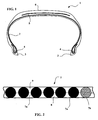
- the figure 2 illustrates a schematic representation in section of a carcass reinforcement layer 2 according to the invention, the section being made in a plane perpendicular to the direction of orientation of the reinforcing elements.
- This consists of a set of cables 7a, 7b oriented parallel to each other and held between two layers 8, 9 of rubber mix, called calendering.
- the reinforcing elements 7a represent the at least 85% of non-shrunk wire cables having a permeability test with a flow rate of less than 20 cm 3 / min and, in the present case, non-shrunk cables with at least two layers, at least one inner layer being sheathed with a layer of a polymeric composition such as a crosslinkable or crosslinked rubber composition.
- Element 7b, the hatched circle on the figure 2 represent the at least 5% of layered cables having at least one strand consisting of textile multifilament fibers.
- the figure 3 illustrates a schematic representation of the section of a carcass reinforcement cable 7a of the tire 1 of the figure 1 .
- This cable 7a is a non-shrunk 1 + 6 + 12 layer structure cable consisting of a central core formed of a wire 32, an intermediate layer formed of six wires 33 and an outer layer formed of twelve sons 35.
- the core of the cable consisting of the central core formed of the wire 32 and the intermediate layer formed by the six son 33 is sheathed by a rubber composition 34 based on unvulcanized diene elastomer (in the green state).
- the sheathing is obtained via an extrusion head of the core constituted by the wire 32 surrounded by the six wires 33, followed by a final twisting or wiring operation of the 12 wires 35 around the core thus sheathed.
- the cable 7a has the so-called permeability test, as described above, a flow rate equal to 0 cm 3 / min and therefore less than 2 cm 3 / min. Its penetration by the rubber composition is equal to 95%.
- the cable 7a has a diameter equal to 0.95 mm.
- the elastomeric composition constituting the rubber sheath 34 is made from a composition as described above and in the present case has the same formulation, based on natural rubber and carbon black, as that of the calendering layers 8, 9 of the carcass reinforcement that the cables are intended to reinforce.
- the figure 4 illustrates a schematic representation of the section of another carcass reinforcement cable 41 that can be used in a tire according to the invention to replace the cable of the figure 3 , that is to say under said at least 85% of non-shrunk cables with at least two layers, at least one inner layer being sheathed with a layer consisting of a polymeric composition.
- This cable 41 is a 3 + 9 structure layer cable, not shrunk, consisting of a central core formed of a cable consisting of three wires 42 twisted together and an outer layer formed of nine wires 43.
- the central core consisting of a cable formed of three son 42 was sheathed by a rubber composition 44 based on unvulcanized diene elastomer (in the green state).
- the sheathing is obtained via an extrusion head of the cable 42, followed by a final operation of wiring the 9 son 43 around the core thus sheathed.
- the cable 41 has the so-called permeability test, as described above, a flow rate equal to 0 cm 3 / min and therefore less than 2 cm 3 / min. Its penetration by the rubber composition is equal to 95%.
- the cable 41 has a diameter equal to 1.0 mm.
- the figure 5 illustrates a schematic representation of the section of another carcass reinforcement cable 51 that can be used in a tire according to the invention to replace the cable of the figure 3 , that is to say under said at least 85% of non-shrunk cables with at least two layers, at least one inner layer being sheathed with a layer consisting of a polymeric composition.
- This cable 51 is a non-shrunk 1 + 6 structure layer cable consisting of a central core formed of a wire 52 and an outer layer formed of six wires 53.
- the central core consisting of the wire 52 has been sheathed with a rubber composition 54 based on unvulcanized diene elastomer (in the green state).
- the sheathing is obtained via an extrusion head of the wire 52, followed by a final operation of wiring the 6 wires 53 around the core thus sheathed.
- the cable 51 has the so-called permeability test, as described above, a flow rate equal to 0 cm 3 / min and therefore less than 2 cm 3 / min. Its penetration by the rubber composition is equal to 95%.
- the cable 51 has a diameter equal to 0.75 mm.
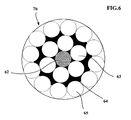
- the figure 6 illustrates a schematic representation of the section of a carcass reinforcement cable 7b of the tire 1 of the figure 1 .
- This cable 7b is a hybrid cable structure layer 1 + 6 + 12, not shrunk, consisting of a central core formed of a wire 61 made of aromatic polyamide multifilament fibers, an intermediate layer formed of six metal wires 63 and an outer layer formed of twelve metal wires 65.
- the central core is a 22/2/1 S200 aromatic polyamide cord.
- the core of the cable consisting of the central core formed of the aromatic polyamide wire 62 and the intermediate layer formed of the six son 63 is sheathed with a rubber composition 64 based on unvulcanized diene elastomer (in the green state).
- the sheathing is obtained via an extrusion head of the core constituted by the wire 62 surrounded by the six wires 63, and followed by a final twisting or wiring operation of the 12 wires 65 around the core thus sheathed.
- the sheath is shown as reaching the core of the cable 7b. It thus prevents friction between the son 63 of the intermediate layer but the layer does not penetrate the multifilament fibers of the wire 62 to maintain its drain function.
- the wire 62 has, in known manner, previously been glued to promote its adhesion to the rubber composition 64 which penetrates to the core at the time of baking of the tire, said adhesive further blocking and preventing the penetration of the composition of rubber between the filaments of the thread 62.
- the cable 7b is therefore similar to the cable 7a of the figure 3 and differs from it by its core which is not a wire but a wire or strand made of aromatic polyamide multifilament fibers.
- the cable 7b has a diameter equal to 0.95 mm.
- the carcass reinforcement layer of the tire 1 produced in accordance with these Figures 1, 2 and 6 has reinforcing elements 7a for 87% and elements 7b for 13%.
- the cable 7b may be a 330x2 aromatic polyamide cable 315/315.
- a cable consists of two strands of 330 aromatic polyamide filaments, each strand being twisted with 315 twists per meter and finally the two strands being assembled with a twist equivalent to 315 turns per meter in the opposite direction to that of the strands.
- the cable then passes through a gluing step in order to deposit an adhesion promoting adhesive between said cable and the elastomeric mixtures of the calendering layers.
- Such a cable has a diameter equal to 1.0 mm.
- a carcass reinforcement layer made according to the invention with such a cable would comprise reinforcing elements 7a for 94% and elements 7b for 6%.
- textile cords also not shown in the figures, can be used for the invention. These are, for example, 252x3 265/265 aromatic polyamide cables having a diameter of 0.96 mm or 167x2x2 210/210 polyethylene naphthalate cables having a diameter of 0.94 mm.
- the reference tires differ from the tires according to the invention by a carcass reinforcement whose reinforcement elements are cables such as those shown on the drawing. figure 3 but which do not include a cladding layer.
- the carcass reinforcement also does not include layered cables comprising at least one strand consisting of multifilamentary textile fibers such as that of the invention.
- tires differ from the tires according to the invention by a carcass reinforcement comprising only cables 7a as shown in FIG. figure 3 .
Landscapes
- Engineering & Computer Science (AREA)
- Mechanical Engineering (AREA)
- Ropes Or Cables (AREA)
- Tires In General (AREA)
- Woven Fabrics (AREA)
- Yarns And Mechanical Finishing Of Yarns Or Ropes (AREA)
Applications Claiming Priority (2)
| Application Number | Priority Date | Filing Date | Title |
|---|---|---|---|
| FR0958652A FR2953450B1 (fr) | 2009-12-04 | 2009-12-04 | Pneumatique comportant des cables d'armature de carcasse presentant des permeabilites differentes |
| PCT/EP2010/068408 WO2011067206A1 (fr) | 2009-12-04 | 2010-11-29 | Pneumatique comportant des cables d'armature de carcasse presentant des permeabilites differentes |
Publications (2)
| Publication Number | Publication Date |
|---|---|
| EP2507070A1 EP2507070A1 (fr) | 2012-10-10 |
| EP2507070B1 true EP2507070B1 (fr) | 2013-10-09 |
Family
ID=42235603
Family Applications (1)
| Application Number | Title | Priority Date | Filing Date |
|---|---|---|---|
| EP10784786.5A Not-in-force EP2507070B1 (fr) | 2009-12-04 | 2010-11-29 | Pneumatique comportant des cables d'armature de carcasse presentant des permeabilites differentes |
Country Status (8)
| Country | Link |
|---|---|
| US (1) | US20120318428A1 (enExample) |
| EP (1) | EP2507070B1 (enExample) |
| JP (1) | JP2013512811A (enExample) |
| CN (1) | CN102639337B (enExample) |
| BR (1) | BR112012013459A2 (enExample) |
| FR (1) | FR2953450B1 (enExample) |
| RU (1) | RU2535965C2 (enExample) |
| WO (1) | WO2011067206A1 (enExample) |
Families Citing this family (12)
| Publication number | Priority date | Publication date | Assignee | Title |
|---|---|---|---|---|
| FR2947575B1 (fr) * | 2009-07-03 | 2011-08-19 | Michelin Soc Tech | Cable multitorons dont les torons elementaires sont des cables a deux couches gommes in situ. |
| FR2947574B1 (fr) * | 2009-07-03 | 2012-11-09 | Michelin Soc Tech | Cable multitorons dont les torons elementaires sont des cables a deux couches gommes in situ. |
| FR3045496B1 (fr) * | 2015-12-19 | 2017-12-08 | Michelin & Cie | Pneumatique a carcasse radiale ou croisee avec cables de grand diametre |
| WO2017110076A1 (ja) * | 2015-12-21 | 2017-06-29 | 日本板硝子株式会社 | ゴム補強用コード及びそれを用いたゴム製品 |
| FR3094277B1 (fr) * | 2019-03-29 | 2021-02-26 | Michelin & Cie | Armature de sommet de pneumatique constituée de deux couches de sommet de travail et d’une couche d’éléments de renforcement circonférentiels |
| FR3094278B1 (fr) * | 2019-03-29 | 2021-02-19 | Michelin & Cie | Armature de sommet de pneumatique constituée de deux couches de sommet de travail |
| WO2021124133A1 (en) | 2019-12-17 | 2021-06-24 | Pirelli Tyre S.P.A. | Process and apparatus for manufacturing a metallic reinforcing cord for tyres for vehicle wheels |
| EP4606948A3 (en) * | 2019-12-17 | 2025-11-05 | Pirelli Tyre S.p.A. | Metallic reinforcing cord for tyres for vehicle wheels |
| CN114786961B (zh) | 2019-12-17 | 2024-07-09 | 倍耐力轮胎股份公司 | 用于车轮轮胎的金属增强帘线 |
| FR3111923B1 (fr) * | 2020-06-24 | 2022-06-17 | Michelin & Cie | Câble multi-torons à deux couches à endurance sous flexion améliorée |
| BR112023002877A2 (pt) | 2020-09-25 | 2023-04-11 | Pirelli | Cabo metálico de reforço para pneus de rodas de veículo, e, pneu para rodas de veículo |
| US12257867B2 (en) * | 2020-12-21 | 2025-03-25 | Nv Bekaert Sa | Steel cord for rubber reinforcement |
Family Cites Families (12)
| Publication number | Priority date | Publication date | Assignee | Title |
|---|---|---|---|---|
| US3133584A (en) * | 1962-07-12 | 1964-05-19 | Nat Standard Co | Rope construction |
| US4363346A (en) * | 1981-09-23 | 1982-12-14 | The Goodyear Tire & Rubber Company | Pneumatic tire including gas absorbing cords |
| JPS6433288A (en) * | 1987-07-23 | 1989-02-03 | Toyo Tire & Rubber Co | Falt radial tire for truck bus |
| JPH04257381A (ja) * | 1990-12-27 | 1992-09-11 | Tokyo Seiko Co Ltd | スチールタイヤコード |
| JP3294378B2 (ja) * | 1993-04-21 | 2002-06-24 | 住友ゴム工業株式会社 | 空気入りタイヤ |
| EP1038064B1 (en) * | 1997-12-15 | 2003-03-26 | N.V. Bekaert S.A. | Steel cord with polymer material |
| JPH11314504A (ja) * | 1998-05-01 | 1999-11-16 | Bridgestone Corp | 空気入りラジアルタイヤ |
| EP1033435A1 (en) * | 1999-03-04 | 2000-09-06 | N.V. Bekaert S.A. | Steel cord with polymer core |
| FR2795751A1 (fr) * | 1999-06-29 | 2001-01-05 | Michelin Soc Tech | Cable d'acier multicouches pour carcasse de pneumatique |
| FR2864556B1 (fr) * | 2003-12-24 | 2006-02-24 | Michelin Soc Tech | Cable a couches pour armature de carcasse de pneumatique |
| FR2897076B1 (fr) * | 2006-02-09 | 2008-04-18 | Michelin Soc Tech | Cable composite elastique pour pneumatique. |
| JP4940753B2 (ja) * | 2006-05-15 | 2012-05-30 | 横浜ゴム株式会社 | ゴム補強用スチールコード及びそれを用いた空気入りラジアルタイヤの製造方法 |
-
2009
- 2009-12-04 FR FR0958652A patent/FR2953450B1/fr not_active Expired - Fee Related
-
2010
- 2010-11-29 RU RU2012127764/11A patent/RU2535965C2/ru not_active IP Right Cessation
- 2010-11-29 JP JP2012541440A patent/JP2013512811A/ja active Pending
- 2010-11-29 US US13/513,826 patent/US20120318428A1/en not_active Abandoned
- 2010-11-29 EP EP10784786.5A patent/EP2507070B1/fr not_active Not-in-force
- 2010-11-29 BR BR112012013459-0A patent/BR112012013459A2/pt not_active Application Discontinuation
- 2010-11-29 CN CN201080054596.3A patent/CN102639337B/zh not_active Expired - Fee Related
- 2010-11-29 WO PCT/EP2010/068408 patent/WO2011067206A1/fr not_active Ceased
Also Published As
| Publication number | Publication date |
|---|---|
| RU2012127764A (ru) | 2014-01-10 |
| JP2013512811A (ja) | 2013-04-18 |
| WO2011067206A1 (fr) | 2011-06-09 |
| US20120318428A1 (en) | 2012-12-20 |
| CN102639337B (zh) | 2015-07-22 |
| CN102639337A (zh) | 2012-08-15 |
| FR2953450A1 (fr) | 2011-06-10 |
| RU2535965C2 (ru) | 2014-12-20 |
| EP2507070A1 (fr) | 2012-10-10 |
| FR2953450B1 (fr) | 2011-11-18 |
| BR112012013459A2 (pt) | 2018-04-03 |
Similar Documents
| Publication | Publication Date | Title |
|---|---|---|
| EP2379796B1 (fr) | Pneumatique comportant des cables d'armature de carcasse presentant une faible permeabilite, et des fils textiles associes a l'armature de carcasse | |
| EP2379345B1 (fr) | Pneumatique comportant des câbles d'armature de carcasse présentant une faible perméabilité, et des fils textiles associés a l'armature de carcasse | |
| EP2485903B1 (fr) | Pneumatioue comportant des cables d'armatures de carcasse presentant une faible permeabilite, et des epaisseurs de melanges caoutchouteux variables | |
| EP2507071B1 (fr) | Pneumatique comportant des cables d'armature de carcasse hybrides | |
| EP2358548B1 (fr) | Pneumatique comportant des cables d'armatures de carcasse presentant une faible permeabilite, et des epaisseurs de melanges caoutchouteux reduites | |
| WO2011067206A1 (fr) | Pneumatique comportant des cables d'armature de carcasse presentant des permeabilites differentes | |
| EP2655098B1 (fr) | Pneumatique dont l'armature de carcasse est renforcee par une couche d'elements de renforcement dans la zone du bourrelet | |
| EP2655096B1 (fr) | Pneumatique dont l'armature de carcasse est renforcee par une couche d'elements de renforcement dans la zone du bourrelet | |
| EP2655100B1 (fr) | Pneumatique dont l'armature de carcasse est renforcee par une couche d'elements de renforcement dans la zone du bourrelet | |
| EP2507072B1 (fr) | Pneumatique comportant des cables d'armature de carcasse frettes | |
| EP2501560B1 (fr) | Pneumatique comportant des cables d'armature de carcasse presentant des permeabilites differentes | |
| EP2655099B1 (fr) | Pneumatique dont l'armature de carcasse est renforcee par une couche d'elements de renforcement dans la zone du bourrelet | |
| FR2841573A1 (fr) | Cables hybrides a couches utilisables pour renforcer des pneumatiques | |
| EP2655097B1 (fr) | Pneumatique dont l'armature de carcasse est renforcee par une couche d'elements de renforcement dans la zone du bourrelet | |
| EP2507073B1 (fr) | Pneumatique comportant une armature de carcasse constituée de câbles et de tubes capillaires | |
| WO2025124881A1 (fr) | Pneumatique comportant une armature de carcasse constituee de cables metalliques a faible permeabilite |
Legal Events
| Date | Code | Title | Description |
|---|---|---|---|
| PUAI | Public reference made under article 153(3) epc to a published international application that has entered the european phase |
Free format text: ORIGINAL CODE: 0009012 |
|
| 17P | Request for examination filed |
Effective date: 20120704 |
|
| AK | Designated contracting states |
Kind code of ref document: A1 Designated state(s): AL AT BE BG CH CY CZ DE DK EE ES FI FR GB GR HR HU IE IS IT LI LT LU LV MC MK MT NL NO PL PT RO RS SE SI SK SM TR |
|
| DAX | Request for extension of the european patent (deleted) | ||
| GRAP | Despatch of communication of intention to grant a patent |
Free format text: ORIGINAL CODE: EPIDOSNIGR1 |
|
| INTG | Intention to grant announced |
Effective date: 20130704 |
|
| GRAS | Grant fee paid |
Free format text: ORIGINAL CODE: EPIDOSNIGR3 |
|
| GRAA | (expected) grant |
Free format text: ORIGINAL CODE: 0009210 |
|
| AK | Designated contracting states |
Kind code of ref document: B1 Designated state(s): AL AT BE BG CH CY CZ DE DK EE ES FI FR GB GR HR HU IE IS IT LI LT LU LV MC MK MT NL NO PL PT RO RS SE SI SK SM TR |
|
| REG | Reference to a national code |
Ref country code: GB Ref legal event code: FG4D Free format text: NOT ENGLISH |
|
| REG | Reference to a national code |
Ref country code: CH Ref legal event code: EP Ref country code: AT Ref legal event code: REF Ref document number: 635390 Country of ref document: AT Kind code of ref document: T Effective date: 20131015 |
|
| REG | Reference to a national code |
Ref country code: IE Ref legal event code: FG4D Free format text: LANGUAGE OF EP DOCUMENT: FRENCH |
|
| REG | Reference to a national code |
Ref country code: DE Ref legal event code: R096 Ref document number: 602010010878 Country of ref document: DE Effective date: 20131205 |
|
| REG | Reference to a national code |
Ref country code: NL Ref legal event code: T3 |
|
| REG | Reference to a national code |
Ref country code: AT Ref legal event code: MK05 Ref document number: 635390 Country of ref document: AT Kind code of ref document: T Effective date: 20131009 |
|
| PG25 | Lapsed in a contracting state [announced via postgrant information from national office to epo] |
Ref country code: SI Free format text: LAPSE BECAUSE OF FAILURE TO SUBMIT A TRANSLATION OF THE DESCRIPTION OR TO PAY THE FEE WITHIN THE PRESCRIBED TIME-LIMIT Effective date: 20131009 |
|
| REG | Reference to a national code |
Ref country code: LT Ref legal event code: MG4D |
|
| PG25 | Lapsed in a contracting state [announced via postgrant information from national office to epo] |
Ref country code: HR Free format text: LAPSE BECAUSE OF FAILURE TO SUBMIT A TRANSLATION OF THE DESCRIPTION OR TO PAY THE FEE WITHIN THE PRESCRIBED TIME-LIMIT Effective date: 20131009 Ref country code: NO Free format text: LAPSE BECAUSE OF FAILURE TO SUBMIT A TRANSLATION OF THE DESCRIPTION OR TO PAY THE FEE WITHIN THE PRESCRIBED TIME-LIMIT Effective date: 20140109 Ref country code: FI Free format text: LAPSE BECAUSE OF FAILURE TO SUBMIT A TRANSLATION OF THE DESCRIPTION OR TO PAY THE FEE WITHIN THE PRESCRIBED TIME-LIMIT Effective date: 20131009 Ref country code: SE Free format text: LAPSE BECAUSE OF FAILURE TO SUBMIT A TRANSLATION OF THE DESCRIPTION OR TO PAY THE FEE WITHIN THE PRESCRIBED TIME-LIMIT Effective date: 20131009 Ref country code: IS Free format text: LAPSE BECAUSE OF FAILURE TO SUBMIT A TRANSLATION OF THE DESCRIPTION OR TO PAY THE FEE WITHIN THE PRESCRIBED TIME-LIMIT Effective date: 20140209 Ref country code: LT Free format text: LAPSE BECAUSE OF FAILURE TO SUBMIT A TRANSLATION OF THE DESCRIPTION OR TO PAY THE FEE WITHIN THE PRESCRIBED TIME-LIMIT Effective date: 20131009 |
|
| PG25 | Lapsed in a contracting state [announced via postgrant information from national office to epo] |
Ref country code: CY Free format text: LAPSE BECAUSE OF FAILURE TO SUBMIT A TRANSLATION OF THE DESCRIPTION OR TO PAY THE FEE WITHIN THE PRESCRIBED TIME-LIMIT Effective date: 20131009 Ref country code: LV Free format text: LAPSE BECAUSE OF FAILURE TO SUBMIT A TRANSLATION OF THE DESCRIPTION OR TO PAY THE FEE WITHIN THE PRESCRIBED TIME-LIMIT Effective date: 20131009 Ref country code: AT Free format text: LAPSE BECAUSE OF FAILURE TO SUBMIT A TRANSLATION OF THE DESCRIPTION OR TO PAY THE FEE WITHIN THE PRESCRIBED TIME-LIMIT Effective date: 20131009 Ref country code: RS Free format text: LAPSE BECAUSE OF FAILURE TO SUBMIT A TRANSLATION OF THE DESCRIPTION OR TO PAY THE FEE WITHIN THE PRESCRIBED TIME-LIMIT Effective date: 20131009 Ref country code: ES Free format text: LAPSE BECAUSE OF FAILURE TO SUBMIT A TRANSLATION OF THE DESCRIPTION OR TO PAY THE FEE WITHIN THE PRESCRIBED TIME-LIMIT Effective date: 20131009 Ref country code: PL Free format text: LAPSE BECAUSE OF FAILURE TO SUBMIT A TRANSLATION OF THE DESCRIPTION OR TO PAY THE FEE WITHIN THE PRESCRIBED TIME-LIMIT Effective date: 20131009 |
|
| BERE | Be: lapsed |
Owner name: CIE GENERALE DES ETABLISSEMENTS MICHELIN Effective date: 20131130 Owner name: MICHELIN RECHERCHE ET TECHNIQUE S.A. Effective date: 20131130 |
|
| PG25 | Lapsed in a contracting state [announced via postgrant information from national office to epo] |
Ref country code: PT Free format text: LAPSE BECAUSE OF FAILURE TO SUBMIT A TRANSLATION OF THE DESCRIPTION OR TO PAY THE FEE WITHIN THE PRESCRIBED TIME-LIMIT Effective date: 20140210 |
|
| REG | Reference to a national code |
Ref country code: DE Ref legal event code: R097 Ref document number: 602010010878 Country of ref document: DE |
|
| PG25 | Lapsed in a contracting state [announced via postgrant information from national office to epo] |
Ref country code: EE Free format text: LAPSE BECAUSE OF FAILURE TO SUBMIT A TRANSLATION OF THE DESCRIPTION OR TO PAY THE FEE WITHIN THE PRESCRIBED TIME-LIMIT Effective date: 20131009 Ref country code: MC Free format text: LAPSE BECAUSE OF FAILURE TO SUBMIT A TRANSLATION OF THE DESCRIPTION OR TO PAY THE FEE WITHIN THE PRESCRIBED TIME-LIMIT Effective date: 20131009 |
|
| PLBE | No opposition filed within time limit |
Free format text: ORIGINAL CODE: 0009261 |
|
| STAA | Information on the status of an ep patent application or granted ep patent |
Free format text: STATUS: NO OPPOSITION FILED WITHIN TIME LIMIT |
|
| REG | Reference to a national code |
Ref country code: IE Ref legal event code: MM4A |
|
| PG25 | Lapsed in a contracting state [announced via postgrant information from national office to epo] |
Ref country code: IT Free format text: LAPSE BECAUSE OF FAILURE TO SUBMIT A TRANSLATION OF THE DESCRIPTION OR TO PAY THE FEE WITHIN THE PRESCRIBED TIME-LIMIT Effective date: 20131009 Ref country code: RO Free format text: LAPSE BECAUSE OF FAILURE TO SUBMIT A TRANSLATION OF THE DESCRIPTION OR TO PAY THE FEE WITHIN THE PRESCRIBED TIME-LIMIT Effective date: 20131009 Ref country code: CZ Free format text: LAPSE BECAUSE OF FAILURE TO SUBMIT A TRANSLATION OF THE DESCRIPTION OR TO PAY THE FEE WITHIN THE PRESCRIBED TIME-LIMIT Effective date: 20131009 Ref country code: SK Free format text: LAPSE BECAUSE OF FAILURE TO SUBMIT A TRANSLATION OF THE DESCRIPTION OR TO PAY THE FEE WITHIN THE PRESCRIBED TIME-LIMIT Effective date: 20131009 |
|
| 26N | No opposition filed |
Effective date: 20140710 |
|
| PG25 | Lapsed in a contracting state [announced via postgrant information from national office to epo] |
Ref country code: DK Free format text: LAPSE BECAUSE OF FAILURE TO SUBMIT A TRANSLATION OF THE DESCRIPTION OR TO PAY THE FEE WITHIN THE PRESCRIBED TIME-LIMIT Effective date: 20131009 Ref country code: BE Free format text: LAPSE BECAUSE OF NON-PAYMENT OF DUE FEES Effective date: 20131130 |
|
| REG | Reference to a national code |
Ref country code: DE Ref legal event code: R097 Ref document number: 602010010878 Country of ref document: DE Effective date: 20140710 |
|
| PG25 | Lapsed in a contracting state [announced via postgrant information from national office to epo] |
Ref country code: IE Free format text: LAPSE BECAUSE OF NON-PAYMENT OF DUE FEES Effective date: 20131129 |
|
| PG25 | Lapsed in a contracting state [announced via postgrant information from national office to epo] |
Ref country code: SM Free format text: LAPSE BECAUSE OF FAILURE TO SUBMIT A TRANSLATION OF THE DESCRIPTION OR TO PAY THE FEE WITHIN THE PRESCRIBED TIME-LIMIT Effective date: 20131009 |
|
| REG | Reference to a national code |
Ref country code: CH Ref legal event code: PL |
|
| GBPC | Gb: european patent ceased through non-payment of renewal fee |
Effective date: 20141129 |
|
| PG25 | Lapsed in a contracting state [announced via postgrant information from national office to epo] |
Ref country code: BG Free format text: LAPSE BECAUSE OF FAILURE TO SUBMIT A TRANSLATION OF THE DESCRIPTION OR TO PAY THE FEE WITHIN THE PRESCRIBED TIME-LIMIT Effective date: 20131009 Ref country code: HU Free format text: LAPSE BECAUSE OF FAILURE TO SUBMIT A TRANSLATION OF THE DESCRIPTION OR TO PAY THE FEE WITHIN THE PRESCRIBED TIME-LIMIT; INVALID AB INITIO Effective date: 20101129 Ref country code: CH Free format text: LAPSE BECAUSE OF NON-PAYMENT OF DUE FEES Effective date: 20141130 Ref country code: LI Free format text: LAPSE BECAUSE OF NON-PAYMENT OF DUE FEES Effective date: 20141130 Ref country code: LU Free format text: LAPSE BECAUSE OF NON-PAYMENT OF DUE FEES Effective date: 20131129 Ref country code: MK Free format text: LAPSE BECAUSE OF FAILURE TO SUBMIT A TRANSLATION OF THE DESCRIPTION OR TO PAY THE FEE WITHIN THE PRESCRIBED TIME-LIMIT Effective date: 20131009 |
|
| PG25 | Lapsed in a contracting state [announced via postgrant information from national office to epo] |
Ref country code: MT Free format text: LAPSE BECAUSE OF FAILURE TO SUBMIT A TRANSLATION OF THE DESCRIPTION OR TO PAY THE FEE WITHIN THE PRESCRIBED TIME-LIMIT Effective date: 20131009 Ref country code: GR Free format text: LAPSE BECAUSE OF NON-PAYMENT OF DUE FEES Effective date: 20131009 |
|
| PG25 | Lapsed in a contracting state [announced via postgrant information from national office to epo] |
Ref country code: GB Free format text: LAPSE BECAUSE OF NON-PAYMENT OF DUE FEES Effective date: 20141129 |
|
| REG | Reference to a national code |
Ref country code: FR Ref legal event code: PLFP Year of fee payment: 6 |
|
| PG25 | Lapsed in a contracting state [announced via postgrant information from national office to epo] |
Ref country code: GR Free format text: LAPSE BECAUSE OF FAILURE TO SUBMIT A TRANSLATION OF THE DESCRIPTION OR TO PAY THE FEE WITHIN THE PRESCRIBED TIME-LIMIT Effective date: 20140110 |
|
| PG25 | Lapsed in a contracting state [announced via postgrant information from national office to epo] |
Ref country code: TR Free format text: LAPSE BECAUSE OF FAILURE TO SUBMIT A TRANSLATION OF THE DESCRIPTION OR TO PAY THE FEE WITHIN THE PRESCRIBED TIME-LIMIT Effective date: 20131009 |
|
| REG | Reference to a national code |
Ref country code: FR Ref legal event code: PLFP Year of fee payment: 7 |
|
| REG | Reference to a national code |
Ref country code: FR Ref legal event code: PLFP Year of fee payment: 8 |
|
| PG25 | Lapsed in a contracting state [announced via postgrant information from national office to epo] |
Ref country code: AL Free format text: LAPSE BECAUSE OF FAILURE TO SUBMIT A TRANSLATION OF THE DESCRIPTION OR TO PAY THE FEE WITHIN THE PRESCRIBED TIME-LIMIT Effective date: 20131009 |
|
| PGFP | Annual fee paid to national office [announced via postgrant information from national office to epo] |
Ref country code: NL Payment date: 20181120 Year of fee payment: 9 |
|
| REG | Reference to a national code |
Ref country code: NL Ref legal event code: MM Effective date: 20191201 |
|
| PG25 | Lapsed in a contracting state [announced via postgrant information from national office to epo] |
Ref country code: NL Free format text: LAPSE BECAUSE OF NON-PAYMENT OF DUE FEES Effective date: 20191201 |
|
| PGFP | Annual fee paid to national office [announced via postgrant information from national office to epo] |
Ref country code: FR Payment date: 20201120 Year of fee payment: 11 Ref country code: DE Payment date: 20201119 Year of fee payment: 11 |
|
| REG | Reference to a national code |
Ref country code: DE Ref legal event code: R119 Ref document number: 602010010878 Country of ref document: DE |
|
| PG25 | Lapsed in a contracting state [announced via postgrant information from national office to epo] |
Ref country code: DE Free format text: LAPSE BECAUSE OF NON-PAYMENT OF DUE FEES Effective date: 20220601 |
|
| PG25 | Lapsed in a contracting state [announced via postgrant information from national office to epo] |
Ref country code: FR Free format text: LAPSE BECAUSE OF NON-PAYMENT OF DUE FEES Effective date: 20211130 |