EP2504397B1 - Compositions à base de colorants anthraquinonique violet polymère et leurs procédés de fabrication - Google Patents
Compositions à base de colorants anthraquinonique violet polymère et leurs procédés de fabrication Download PDFInfo
- Publication number
- EP2504397B1 EP2504397B1 EP10784915.0A EP10784915A EP2504397B1 EP 2504397 B1 EP2504397 B1 EP 2504397B1 EP 10784915 A EP10784915 A EP 10784915A EP 2504397 B1 EP2504397 B1 EP 2504397B1
- Authority
- EP
- European Patent Office
- Prior art keywords
- anthraquinone
- polyoxyalkylene
- polymeric
- alkyl
- colorant
- Prior art date
- Legal status (The legal status is an assumption and is not a legal conclusion. Google has not performed a legal analysis and makes no representation as to the accuracy of the status listed.)
- Active
Links
Classifications
-
- C—CHEMISTRY; METALLURGY
- C09—DYES; PAINTS; POLISHES; NATURAL RESINS; ADHESIVES; COMPOSITIONS NOT OTHERWISE PROVIDED FOR; APPLICATIONS OF MATERIALS NOT OTHERWISE PROVIDED FOR
- C09B—ORGANIC DYES OR CLOSELY-RELATED COMPOUNDS FOR PRODUCING DYES, e.g. PIGMENTS; MORDANTS; LAKES
- C09B69/00—Dyes not provided for by a single group of this subclass
-
- C—CHEMISTRY; METALLURGY
- C08—ORGANIC MACROMOLECULAR COMPOUNDS; THEIR PREPARATION OR CHEMICAL WORKING-UP; COMPOSITIONS BASED THEREON
- C08G—MACROMOLECULAR COMPOUNDS OBTAINED OTHERWISE THAN BY REACTIONS ONLY INVOLVING UNSATURATED CARBON-TO-CARBON BONDS
- C08G65/00—Macromolecular compounds obtained by reactions forming an ether link in the main chain of the macromolecule
- C08G65/02—Macromolecular compounds obtained by reactions forming an ether link in the main chain of the macromolecule from cyclic ethers by opening of the heterocyclic ring
- C08G65/32—Polymers modified by chemical after-treatment
- C08G65/329—Polymers modified by chemical after-treatment with organic compounds
- C08G65/333—Polymers modified by chemical after-treatment with organic compounds containing nitrogen
- C08G65/33303—Polymers modified by chemical after-treatment with organic compounds containing nitrogen containing amino group
- C08G65/3331—Polymers modified by chemical after-treatment with organic compounds containing nitrogen containing amino group cyclic
- C08G65/33313—Polymers modified by chemical after-treatment with organic compounds containing nitrogen containing amino group cyclic aromatic
-
- C—CHEMISTRY; METALLURGY
- C08—ORGANIC MACROMOLECULAR COMPOUNDS; THEIR PREPARATION OR CHEMICAL WORKING-UP; COMPOSITIONS BASED THEREON
- C08G—MACROMOLECULAR COMPOUNDS OBTAINED OTHERWISE THAN BY REACTIONS ONLY INVOLVING UNSATURATED CARBON-TO-CARBON BONDS
- C08G65/00—Macromolecular compounds obtained by reactions forming an ether link in the main chain of the macromolecule
- C08G65/02—Macromolecular compounds obtained by reactions forming an ether link in the main chain of the macromolecule from cyclic ethers by opening of the heterocyclic ring
- C08G65/32—Polymers modified by chemical after-treatment
- C08G65/329—Polymers modified by chemical after-treatment with organic compounds
- C08G65/333—Polymers modified by chemical after-treatment with organic compounds containing nitrogen
- C08G65/33396—Polymers modified by chemical after-treatment with organic compounds containing nitrogen having oxygen in addition to nitrogen
Definitions
- This invention relates to polymeric violet anthraquinone colorants, to processes for making the compositions, and also to the use of the compositions thus prepared for coloring consumer products.
- the colorants are generally characterized as being water soluble, non-staining and pH stable.
- Anthraquinone dyes have been widely used to dye fabrics, such as cotton, polyester, acrylic, wool, cellulose acetate, nylon, and the like, due to their excellent light fastness, uniform leveling, dye bath stability, and shade brilliancy.
- Anthraquinones are also well known for use as coloring agents for providing coloration to oils, drugs, cosmetic products, paper, rubber, printing inks, plastics, coatings, leather, waxes, and detergents.
- These types of anthraquinone dyes may be classified as, for example, acid dyes, disperse dyes, vat dyes, metallizable dyes, direct dyes, solvent dyes, basic dyes and reactive dyes.
- violet anthraquinone dyes are known. Commercially available examples of violet anthraquinone dyes include Acid Violet 39, Acid Violet 41, Acid Violet 42, Acid Violet 43, Acid Violet 48, Acid Violet 51, Acid Violet 34, Acid Violet 47, Acid Violet 109, Acid Violet 126, Basic Violet 24, Basic Violet 25, Disperse Violet 1, Disperse Violet 4, Disperse Violet 26, Disperse Violet 27, Disperse Violet 28, Disperse Violet 57, Solvent Violet 11, Solvent Violet 13, Solvent Violet 14, Solvent Violet 26, Solvent Violet 28, Solvent Violet 31, Solvent Violet 36, Solvent Violet 37, Solvent Violet 38, Solvent Violet 48, Solvent Violet 59, Solvent Violet 60, Vat Violet 13, Vat Violet 15, Vat Violet 16.
- violet anthraquinone dyes are not polymeric in nature, and they tend to exhibit stability, gelling and precipitation challenges when incorporated into other formulations, such as detergent formulations and other consumer cleaning products.
- water soluble violet anthraquinone dyes such as acid violet dyes, are known to cause staining to textile substrates (such as fabrics), skin, and other surfaces. Thus, they are not suitable for use in applications where non-staining colorants are desired, such as in washable markers and paints and in cleaning formulations such as laundry detergents and fabric softeners.
- these anthraquinone violet dyes are generally provided in powder form which is often difficult to handle. While these dyes may be made into liquid form by dissolving the dye in water or organic liquid, the solubility of such liquid dyes is low and the resulting liquid dye solutions tend to have very low color strength. Color strength, or color value, is determined using a modified version of AATCC Test Method 182-2000 wherein the color value is determined and calculated on the absorbance of a 1 gram per liter through a one centimeter cell length of the colorant, in the appropriate solvent, by UV-vis spectroscopy.
- violet anthraquinone colorants include US Patent No. 3,192,117 to Kaiser et al. , which provides some examples of violet anthraquinone compositions useful as hair dyes. These colorants exhibit good dyeing ability when they are incorporated into the dyeing creams or pastes. Similar to the acid dyes described above, these compositions cause staining to the substances to which they are applied. In this instance, it is desirable to use staining anthraquinone colorants for dyeing human hair.
- the colorants taught by Kaiser et al. are not polymeric in nature, and they are not non-staining. Additionally, the colorants taught by Kaiser et al. preferably contain two nitrogen-containing primary groups on the anthraquinone radical.
- GB-B-859,283 teaches water soluble anthraquinone dyestuffs useful for dyeing fibers, leather and paper.
- the water solubility is introduced by sulfonic acid, sulfuric, or carboxylic acid groups on the anthraquinone dye molecule. These are small molecules which contain triazine units and ionic groups to make them water soluble. These dyes are also generally blue in nature.
- anthraquinone colorants such as 1,4-disubstituted aliphatic aminoanthraquinones
- US 4,846,846 Rekers et al.
- anthraquinones were prepared from a mixture of quinizarin, leucoquinizarin, and amine in water followed by various purification procedures.
- the preferred amines are sec-alkyl primary amines with terminal reactive groups, such as -OH, -NH 2 , or -SH, on the end of the amine moiety.
- These anthraquinone colorants are used to color polyurethane resins, particularly foams.
- US 4,137,243 discloses polymeric anthraquinone colorants with terminal amino groups from leucoquinizarin and polymeric diamines.
- the leucoquinizarin can be generated in-situ by reduction of quinizarin with sodium hydrosulfite.
- the polymeric aminoanthraquinone colorants prepared according to the above patent processes tend to contain high levels of impurities, such that further purification is needed to obtain higher purity anthraquinone colorants.
- Purification of low melting or liquid water-soluble anthraquinone colorants usually involves time consuming extraction and washing procedures that often require organic solvents, which generally are not environmentally friendly. Additionally, these solvents are typically not suitable for use in many consumer product applications and complete removal is required. The organic solvents are often expensive and generate additional waste during production of the anthraquinone colorants. Furthermore, some of the impurities in these anthraquinone colorants are often difficult to filter and generally cause dull color, shade shift, and staining.
- US 4,224,228 and US 4,244,691 disclose water soluble anthraquinone dyes in the form of free acid having one or more -SO 3 H group on the anthraquinone conjugated system. These anthraquinone dyes are used for dyeing or printing textile materials, such as natural and synthetic polyamide fibers, and exhibit good dye uptake and fastness to wet-processing.
- these anthraquinone dyes have fiber-reactive groups, such as acryloyl, vinylsulfonyl, chloroacetyl, fluorotriazinyl radicals, and bromoacryloyl groups.
- US 6,593,483 (Xia ) describes a polymeric blue anthraquinone colorant, wherein a poly(oxyalkylene) chain is attached to the 1- position, or/and the 4- position through aromatic amino group(s) on an anthraquinone backbone.
- US 6,635,350 (Connor et al. ) discloses a polymeric red anthraquinone colorant, where at least one poly(oxyalkylene) chain is attached to the 1- position, as well as at least one poly(oxyalkylene) chain is attached to either the 5-position or the 8- position of an anthraquinone backbone.
- a polymeric violet anthraquinone colorant that exhibits excellent light and pH stability, that is compatible with other materials, and that is suitable for use in coloring various consumer products.
- the colorant is also desirably non-staining and water soluble with bright shades.
- one object of this invention is to provide a polymeric violet anthraquinone colorant, preferably a 1,4-diamino-2-polyalkyleneoxy violet anthraquinone colorant, that exhibits bright shades, high pH stability, good light fastness and compatibility with other materials.
- Another object of this invention is to provide methods to make such anthraquinone colorants.
- a further object of this invention is to use these inventive colorants for coloration of consumer products, such as liquid and solid laundry detergents and liquid fabric softeners.
- the present invention provides a polymeric violet anthraquinone colorant comprising a compound of any of the formulae (III) and (IV): wherein:
- Also provided is a method for making the above polymeric violet anthraquinone colorant comprising the sequential steps of
- polyalkyleneoxy and "poly(oxyalkylene),” as used interchangeably herein, generally refer to molecular structures containing the following repeating units: -CH 2 CH 2 O-, -CH 2 CH 2 CH 2 O-, -CH 2 CH 2 CH 2 CH 2 O-, -CH 2 CH(CH 3 )O-, -CH 2 CH 2 CH(CH 3 )O-, and any combinations thereof.
- the polyoxyalkylene constituent may be selected from one or more monomers selected from a C 2-20 alkyleneoxy group, a glycidol group, a glycidyl group, or mixtures thereof.
- alkyl encompasses any straight or branched C 1-30 -alkyl moiety.
- anthraquinone generally refers to the following general chemical structure and numbering sequence:
- violet generally refers to compounds that exhibit a maximum absorbance in the visible spectrum in the wavelength range of 550-610 nm.
- the polymeric violet anthraquinone colorant of the invention is of the formula (III) or (IV): wherein:
- the present polymeric violet anthraquinone colorant is represented by formula (II): wherein A 1 and A 2 are as defined in claim 1; and A 4 is aryl optionally substituted with alkyl, polyoxyalkylene, sulfonate, or a combination thereof; and preferably is a group wherein B 1 -B 5 each independently are H, methyl or sulfonate, and preferably are all H.
- Q is oxygen
- E is a polyoxyalkylene moiety consisting of ethylene oxide and propylene oxide monomers
- z is 1.
- the inventive polymeric violet anthraquinone colorants are generally synthesized according to the procedures described herein. However, the rate of the reaction may be affected, for example, by the temperature, the specific raw materials, and the agitation rate employed. The progress of the reaction may be monitored by visible spectroscopy, Thin Layer Chromatography (TLC), and/or High Performance Liquid Chromatography (HPLC).
- TLC Thin Layer Chromatography
- HPLC High Performance Liquid Chromatography
- Synthesis of the inventive colorants can be achieved by several routes as illustrated by the following methods. All four methods below have in common the substitution of a leaving group at the 2 position of the anthraquinone moiety by a nucleophile. To generate the color desired, it is necessary to have a substituted amino group at the 4 position of the anthraquinone moiety. This may be achieved by reacting bromamine acid with a suitable arylamine as in Method 1 or with a polyoxyalkylene-substituted arylamine as in Method 2, or using an anthraquinone with a preformed 4-amino group as in Methods 3 and 4.
- polymeric alcohol compounds may be used to make the inventive polymeric violet anthraquinone colorants of the present invention.
- Polymeric alcohol compounds include any polymer with one or more hydroxyl group which can be used to react with the suitable anthraquinone compounds to make the inventive polymeric violet anthraquinone colorants.
- Polymeric alcohols include, but are not limited to, polyethylene glycols, polyethylene glycol monoethers, polyethylene glycol monoesters, polypropylene glycols and their monoesters and monoethers, star-shaped or multi-armed poly(ethylene oxide)s, copolymers of ethylene glycol and propylene glycol, polyglycidols, polyglycidyl ethers, polyvinyl alcohols, polyacrylate and polymethylacrylate homopolymers or copolymers with hydroxyl group(s), hydroxyl terminated polybutadiene, polyether polyols, polyester polyols, hydroxyl terminated polydimethylsiloxane, hydroxyl terminated polyamines like ethoxylated polyethylenimine, polyethylene mono-alcohols, polyethylene- block -poly(ethylene glycol)s, polyoxyethylene alkyl ethers, and polytetrahydrofurans.
- the polymeric alcohols are polymers having ethylene glycol, propy
- polymeric alcohols include alcohol ethoxylates from Air Products including Tomadol ® 45-13, Tomadol ® 25-7, Tomadol ® 1-9, Tomadol ® 23-5, Tomadol ® 91-6 and Tomadol ® 45-7; polyethylene glycols from Dow including Carbowax ® PEG 200, Carbowax ® PEG 300 and Carbowax ® PEG 400; methoxypolyethylene glycols (MPEGs) from Dow including Carbowax TM MPEG 350 and Carbowax TM MPEG 550; alkoxylated polyols from Perstorp including Polyol 3165, Polyol 4800, Polyol R2490 and Polyol R6405.
- alcohol ethoxylates from Air Products including Tomadol ® 45-13, Tomadol ® 25-7, Tomadol ® 1-9, Tomadol ® 23-5, Tomadol ® 91-6 and Tomadol ® 45-7
- Polymeric phenols refer generally to any polymer with phenol or substituted phenol moieties as the end group.
- the general structure of such polymer is HO-Ph-R', wherein R' is the polymer chain and Ph is a benzene ring or a substituted benzene ring.
- Mercaptan terminated polymers generally refer to any polymer having an - SH as the end group.
- One method for making the polymeric violet anthraquinone colorant of the present invention involves a two step reaction.
- the first step consists of reacting bromamine acid with a polyoxyalkylene substituted primary aromatic or aliphatic amine catalyzed by metallic copper, cupric (Cu (II)), or cuprous (Cu (I)) ions, also known as an Ullmann condensation reaction, and as further described on pages 501-502 of "March's Advanced Organic Chemistry: Reactions, Mechanisms, and Structure” by Michael B. Smith and Jerry March, 5th Edition, 2001 and the references contained therein.
- the resulting anthraquinone intermediate is 1-amino-4-arylamino-2-anthraquinone sulfonic acid.
- the second step consists of reacting the 1-amino-4-arylamino-2-anthraquinone sulfonic acid with an alcohol, a polymeric alcohol, a thiol, or a polymeric thiol and with a base, which results in displacement of the sulfonic acid group to yield the 2-alkoxy derivative, a violet chromophore.
- the polyoxyalkylene substituted primary aromatic amines used in this method may be of the formula (VII): wherein R 1 -R 5 are each independently selected from H, C 1-20- alkyl, C 1-20 -alkoxy, halogen, nitro, amino, carboxylic acid, carboxylic acid ester, carboxamide, sulfonic acid, sulfonamide and sulfonic acid esters.
- the first step of this method typically employs a copper catalyst as mentioned above.
- this catalyst include CuCI, CuCl 2 , Cu powder, or CuSO 4 .
- a solvent such as alcohol (such as methanol, ethanol, propylene glycol, or glycerol), dimethylformamide (DMF) or dimethylsulfoxide (DMSO) may optionally be utilized.
- a mild base may be used, such as sodium carbonate or sodium bicarbonate.
- the typical reaction temperature is - 60-150°C.
- the second step of this method consists of heating the 1-amino-4-arylamino-2-anthraquinonesulfonic acid and an OH or SH terminated polymer with a base to 50-250°C in a reactor with optional solvent.
- the reaction temperature is 50-150°C, more preferably 70-120°C.
- a strong base is typically needed for this reaction.
- Alkali hydroxides can be used, such as sodium hydroxide, potassium hydroxide, or lithium hydroxide.
- Alkali alkoxides also may be used, such as sodium methoxide, sodium butoxide, or potassium isopropoxide.
- Solvent for this reaction may be e.g. water, alcohols, ethers, toluene, dimethylsulfoxide (DMSO) and dimethylformamide (DMF). The use of a solvent is optional. Solvent may be used to help dissolve the reactants/products or reduce the viscosity of the reaction mixtures.
- Another method of synthesizing the polymeric violet anthraquinone colorant involves reacting a polyoxyalkylene substituted primary aromatic or aliphatic amine with bromamine acid, followed by treatment of the anthraquinone intermediate obtained with an alcohol or glycol compound and a base. This method is illustrated below:
- the polyoxyalkylene substituted primary aromatic amines with polyoxyalkylene chains have the general structure (VIII), as described in US 6,593,482 and shown below: wherein R 1 -R 5 are each independently selected from H, C 1-20- alkyl, C 1-20 -alkoxy, and Q-E, wherein Q is a linking group selected from NH, O, S, SO 2 , SO 3 , CO 2 , SO 2 N, alkylene, and alkyleneoxy, and E is a polymer chain and end group moiety of formula (IX): [polyoxyalkyene constituent] z R' (IX) wherein
- Q is oxygen
- E is a combination of ethylene oxide and propylene oxide
- z is 1.
- the alcohol reactant used in the second step to replace the sulfonic acid moiety on the anthraquinone may be an alcohol, such as methanol, ethanol, propylene glycol, glycerol, a polyol, or the monoether of a polyol. Phenol or substituted phenols also may be used.
- the base and reaction conditions used are the same as those described in Method 1.
- anthraquinone acid blue compound having a sulfonic acid moiety in the 2 position e.g. 1-amino-4-arylamino-2-anthraquinone sulfonic acid or monosodium salt, such as Acid Blue 145, with a polymeric alcohol and a base compound as shown by the reaction below:
- reaction conditions are those described in Step 2 of Method 1.
- Suitable acid blue dyes which may be used to make the inventive polymeric violet colorants of the present invention include Color Index Acid Blue 23, Acid Blue 25, Acid Blue 41, Acid Blue 53, Acid Blue 62, Acid Blue 68, Acid Blue 69, Acid Blue 111, Acid Blue 124, Acid Blue 127, Acid Blue 129, Acid Blue 138, Acid Blue 150, Acid Blue 230, Acid Blue 277, and Acid Blue 344.
- reactive blue dyes may be used to make the inventive polymeric violet colorants if there is an -SO 3 H moiety on the ⁇ position of the anthraquinone backbone.
- Reactive Blue 2 Reactive Blue 4
- Reactive Blue 5 Reactive Blue 19
- Reactive Blue 27 Reactive Blue 29, Reactive Blue 36
- Reactive Blue 49 Reactive Blue 50
- Reactive Blue 69 Reactive Blue 74
- Reactive Blue 94 Reactive Blue 166.
- the 2- position of the anthraquinone is substituted by a halogen, such as fluorine, chlorine, bromine, and iodine.
- the halogen is chlorine or bromine.
- the compound, 1-amino-4-arylamino-2-haloanthraquinone reacts with a polymeric alkali metal alkoxide or phenoxide at a temperature range of about 80°C to about 200°C in a non-aqueous medium to give the product illustrated in Formula IV.
- halogen substituted anthraquinone colorants include acid blue, disperse blue and solvent blue dyes. Specific examples of such dyes include Acid Blue 78, Acid Blue 81, Acid Blue 96, Disperse Blue 56, Disperse Blue 81, and Solvent Blue 12.
- inventive polymeric violet anthraquinone colorants have excellent compatibility with the target formulations to which they are added. Furthermore, they may be tailored to be miscible with the intended systems.
- inventive polymeric violet anthraquinone colorants have excellent colorations, low extraction, thermal stability, and lightfastness within target thermoplastic and/or thermoset articles.
- the violet polymeric colorants contain poly(oxyalkylene) groups that are easy to process, which mix well within target plastics, and which provide excellent colorations within the target finished articles.
- the inventive polymeric violet anthraquinone colorants as described herein are preferably water soluble. More specifically, the colorants are preferably water soluble at concentrations which provide sufficient coloration for a desired end-use application. Furthermore, the present polymeric violet anthraquinone colorants are preferably water fugitive (i.e. washable from substrates with water) on all kinds of substrates, such as, for example, human skin, textile substrates, coated surfaces (such as, for example, painted surfaces) and ceramic surfaces. Also, the inventive polymeric violet anthraquinone colorants are generally liquid or semi-solid at ambient conditions. "Semi-solid" generally means the colorant is a highly viscous liquid, or may even be paste-like, and its melting temperature, if it has any, is typically below 60°C.
- polymeric violet anthraquinone colorants made according to the present methods.
- these colorants are generally more soluble in water than other colorants. They are generally pH stable and non-staining, which allows for their use in many consumer products, such as laundry detergents and other cleaning products. Additionally, these colorants have a wider range of compatibility with other materials. This allows for ease of incorporation of the colorants into these other materials.
- the polymeric violet anthraquinone colorants represent a useful advance over the prior art.
- the present polymeric violet anthraquinone colorants generally possess many desirable and advantageous properties for use in various consumer products.
- the colorants generally have good alkali fastness. They can typically be used in high pH formulations, such as wherein the pH is 8-13, without having stability problems. Such pH ranges are often found in powder detergents, heavy-duty liquid detergents, hard surface cleaners, etc.
- these anthraquinone colorants may exhibit desirable color brightness due to fluorescence of the anthraquinone chromophore. As such, these anthraquinone colorants may be used to color various personal care, home care, and fabric care products.
- the colorants may be used to color soap bars, liquid soaps, fabric softeners, car washing formulations, glass cleaners, toilet cleaners and shampoos.
- laundry detergent formulations both granular and liquid
- fabrics cleaners both granular and liquid
- fabrics softener formulations which may be suitable for use with the anthraquinone of the present invention
- fabrics softener formulations which may be suitable for use with the anthraquinone of the present invention
- the polymeric violet anthraquinone colorants can also be used in industrial formulations, such as heavy-duty industrial cleaners and detergents and fertilizers. Additionally, it is contemplated that the colorants of the current invention may be ideal for use in coloring thermoplastic materials (such as, for example, polyolefin and polyester) and thermoset materials (such as, for example, polyurethane foam). Examples of specific thermoplastic formulations, which may be suitable for use with the anthraquinone of the present invention, are disclosed in US 4,640,690 ; US 4,732,570 and US 4,812,141 (all Baumgartner et al. )
- thermoset formulations which may be suitable for use with the anthraquinone of the present invention, are disclosed in commonly assigned US 4,284,729 (Cross et al. ) and US 4,846,846 (Rekers et al. ).
- polyurethane foam is produced through the catalyzed polymerization of the reaction products of polyols and isocyanates. Blowing agents present within the polymerization step typically provide the necessary foam-making capability. Such a reaction is well known throughout the polyurethane industry and has been practiced for many years.
- a large variety of colors and shades may be obtained by blending the inventive polymeric violet anthraquinone colorant with one or more additional water soluble colorants. Blending of the colorants may be readily accomplished, for example, when combining colorants having substantially identical solubility characteristics.
- Several exemplary classes of colorants include the Reactint ® and Liquitint ® colorants (available from Milliken Chemical of Spartanburg, South Carolina). These colorants are generally water soluble, or dispersible, at room temperature and may be suitably blended with the anthraquinone colorant of the present invention to achieve improved colors and shades.
- Example 1 was repeated, except that the 50% sodium hydroxide solution was replaced with 3.0 g of sodium tert-butoxide powder.
- the polymeric violet anthraquinone colorant was subsequently incorporated into a wax based candle formulation at 0.3% weight loading.
- the colored candle exhibited an excellent uniform violet shade.
- a mixture of 0.8 g of NaOH pellet, 7.5 g of glycerol 15 EO and 1.0 g of Acid Blue 25 was charged into a 3-neck flask equipped with agitator, temperature probe and condenser. The reaction mixture was heated to 110°C for 2 hours. TLC analysis confirmed that all of the Acid Blue 25 was consumed. The reaction mixture contained the liquid violet polymeric anthraquinone colorant having a maximum absorption in methanol of 572 nm.
- Example 1 100 ppm of the polymeric violet colorant from Example 1 was added to various pH buffer solutions.
- the colored buffer solutions were put into a 50°C oven for 10 days and the shade of the final colored solutions was compared with the initial solutions using a spectrometer GretagMacbeth TM Color-Eye 7000A spectrophotometer. Test results are provided in Table 1.
- Table 1 pH Stability of Example 1 Buffer Solution Delta E value after 10 days at 50°C oven pH 2.0 buffer 0.896 pH 4.0 buffer 1.018 pH 6.0 buffer 0.340 pH 8.0 buffer 0.346 pH 12.45 buffer 5.178
- test results illustrate that the inventive polymeric violet anthraquinone colorants exhibit good pH stability.
- Example 1 30 ppm of the polymeric violet anthraquinone colorant of Example 1 was added to a standard liquid laundry detergent. 127 ppm of the polymeric violet anthraquinone colorant of Example 1 was added to a fabric softener formulation. Each colorant-containing formulation was evaluated for staining on several different fabric swatches comprised of different fiber types. The stain evaluation was performed by visual observation according to the rating system for AATCC Grey Scale No.2 "Grey Scale For Staining.” A rating of "5" indicates no staining was observed. A rating of "1" indicates high degree of staining was present.
- Table 2 Stain Testing of Example 1 Sample AATCC Stain Rating in Laundry Detergent AATCC Stain Rating in Fabric Softener Spun Diacetate 5 5 Bleached Cotton 5 3/4 Nylon 6,6 (Polyamide) 5 5 Dacron 54 (Polyester) 5 5 Orion 75 (Acrylic) 5 5 Wool 5 5 Terry Cotton 5 3/4
Landscapes
- Chemical & Material Sciences (AREA)
- Organic Chemistry (AREA)
- General Chemical & Material Sciences (AREA)
- Health & Medical Sciences (AREA)
- Chemical Kinetics & Catalysis (AREA)
- Medicinal Chemistry (AREA)
- Polymers & Plastics (AREA)
- Polyethers (AREA)
- Compositions Of Macromolecular Compounds (AREA)
- Coloring (AREA)
Claims (17)
- Colorant d'anthraquinone violet polymère comprenant un composé selon l'une quelconque des formules (III) et (IV) :
 A1 est H, alkyle, hydroxyalkyle, polyoxyalkylène ou aryle ;X est O ou S ;A2 est un polyoxyalkylène ou polyoxyalkylène lié à un aryle avec plus de 3 unités répétitives et terminé avec un hydroxyle, alkyle ou aryle ;A4 est H ; aryle éventuellement substitué avec un alkyle, polyoxyalkylène, sulfonate ou une combinaison de ceux-ci ; alkyle éventuellement substitué avec un polyoxyalkylène, hydroxyle, alcoxyle, acide ou ester carboxylique, sulfonate ou sulfate ; cyclohexyle éventuellement substitué avec un ou plusieurs alkyle ou polyoxyalkylène ; ou un groupe
 R1-R5 sont chacun indépendamment H, alkyle en C1-20, alcoxy en C1-20, ou Q-E, avec au moins un de R1-R5 étant Q-E, oùQ est NH, O, S, SO2, SO3, CO2, SO2N, alkylène, ou alkylèneoxy, etE est une moitié de groupe terminal et chaîne polymère de la formule
[constituant de po/yoxya/ky/ène]zR',
oùz est égal à 1 ou 2 ;
constituant de po/yoxya/ky/ène est un groupe ayant plus d'une unité choisie parmi un alkylèneoxy en C2-20, une unité dérivée de glycidol ou glycidyle, et des mélanges de ceux-ci ; etR' est un groupe terminal choisi parmi H, alkyle en C1-20, ester alkylique en C1-20, halogène, hydroxyle, thio, cyano, sulfonyle, sulfo, sulfato, aryle, nitro, carboxyle, alcoxy en C1-20, amino, alkylamino en C1-20, acrylamino, alkylthio en C1-20, alkylsulfonyle en C1-20, alkylphényle en C1-20, phosphonyle, alkylphosphonyle en C1-20, alcoxycarbonyle en C1-20, et phénylthio ; etA5-A8 sont chacun indépendamment H, halogène, nitro, amino, alkylamino ou arylamino. - Colorant selon la revendication 1, qui comprend un composé de formule (II) :


- Colorant selon la revendication 1, où A4 est un groupe

- Colorant selon la revendication 3, où Q est O, E est un polyoxyalkylène consistant en monomères d'oxyde d'éthylène et d'oxyde de propylène, et z est égal à 1.
- Procédé pour la fabrication du colorant d'anthraquinone violet polymère selon la revendication 1, comprenant les étapes successives de :(a) formation d'un intermédiaire d'anthraquinone par réaction d'acide de bromamine avec une amine aromatique ou aliphatique primaire substituée par un polyoxyalkylène (A), et(b) formation d'un colorant d'anthraquinone violet polymère par réaction de l'anthraquinone de l'étape (a) avec- un composé choisi parmi des alcools, polyéthylène glycols et monoéthers ou monoesters de ceux-ci, polypropylène glycols et monoéthers ou monoesters de ceux-ci, poly(oxydes d'éthylène) en forme d'étoile ou multi-ramifiés, copolymères d'éthylène glycol et propylène glycol, polyglycidols, polyglycidyléthers, poly(alcools vinyliques), homopolymères ou copolymères de poly(méth)acrylate avec un(des) groupe(s) hydroxyle, polybutadiène à terminaison hydroxyle, polyéther polyols, polyester polyols, polydiméthylsiloxane à terminaison hydroxyle, polyamines à terminaison hydroxyle, mono-alcools de polyéthylène, polyéthylène-séquence-poly(éthylène glycols), polyoxyéthylène alkyléthers, polytétrahydrofuranes, thiols, et thiols polymères ; et- une base.
- Procédé selon la revendication 5, où l'amine (A) est un composé de formule (VIII) :
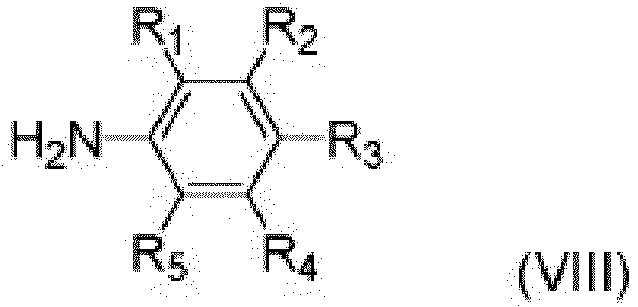 Q est NH, O, S, SO2, SO3, CO2, SO2N, alkylène ou alkylèneoxy, etE est une moitié de groupe terminal et chaîne polymère de la formule
[constituant de po/yoxya/ky/ène] zR',
oùz est égal à 1 ou 2 ;
constituant de polyoxyalkylène est un groupe ayant plus d'une unité choisie parmi un alkylèneoxy en C2-20, une unité dérivée de glycidol ou glycidyle, et des mélanges de ceux-ci ; etR' est un groupe terminal choisi parmi H, alkyle en C1-20, ester alkylique en C1-20, halogène, hydroxyle, thio, cyano, sulfonyle, sulfo, sulfato, aryle, nitro, carboxyle, alcoxy en C1-20, amino, alkylamino en C1-20, acrylamino, alkylthio en C1-20, alkylsulfonyle en C1-20, alkylphényle en C1-20, phosphonyle, alkylphosphonyle en C1-20, alcoxycarbonyle en C1-20, et phénylthio. - Procédé selon la revendication 6, où dans la formule (VIII) Q est O, E est une combinaison d'oxyde d'éthylène et oxyde de propylène, et z est égal à 1.
- Procédé selon la revendication 5, où l'étape (a) est réalisée en présence d'un catalyseur contenant du cuivre, et de préférence un catalyseur contenant du cuivre choisi parmi CuCI, CuCl2, de la poudre de cuivre et CuSO4.
- Procédé selon la revendication 5, où la réaction de l'étape (a) comprend de plus un solvant, et un solvant est de préférence choisi parmi un alcool, le diméthylformamide (DMF) ou diméthylsulfoxyde (DMSO).
- Procédé selon la revendication 5, où la réaction de l'étape (a) inclut de plus une base.
- Procédé selon la revendication 5, où la réaction de l'étape (a) est réalisée à une température de 60-150°C.
- Procédé selon la revendication 6, où la réaction de l'étape (b) inclut de plus un solvant, et de préférence un solvant choisi parmi l'eau, un alcool, un éther, le toluène, le diméthylsulfoxyde (DMSO) et diméthylformamide (DMF).
- Procédé selon la revendication 5, où la base de l'étape (b) est choisie parmi des hydroxydes alcalins, alcoxydes alcalins, hydrure de sodium, amide de sodium, sodium bis(triméthylsilyl)amide, hydroxyde de tétraméthylammonium (TMAH), hydroxyde de benzyltriméthylammonium (BTMAH), diisopropylamide de lithium et triméthylsilanolate de sodium.
- Procédé selon la revendication 5, dans lequel la réaction de l'étape (b) est réalisée à une température de 50-250°C.
- Procédé pour la fabrication du colorant d'anthraquinone violet polymère selon la revendication 1 comprenant les étapes successives de :(a) fourniture d'un composé bleu acide d'anthraquinone ayant une moitié acide sulfonique dans la position "2", et(b) formation d'un colorant d'anthraquinone violet polymère par réaction du composé bleu acide d'anthraquinone de l'étape (a) avec- un composé choisi parmi des polyéthylène glycols et monoéthers ou monoesters de ceux-ci, polypropylène glycols et monoéthers ou monoesters de ceux-ci, poly(oxydes d'éthylène) en forme d'étoile ou multi-ramifiés, copolymères d'éthylène glycol et propylène glycol, polyglycidols, polyglycidyl éthers, poly(alcools vinyliques), homopolymères ou copolymères de poly(méth)acrylate avec un(des) groupe(s) hydroxyle, polybutadiène à terminaison hydroxyle, polyéther polyols, polyester polyols, polydiméthylsiloxane à terminaison hydroxyle, polyamines à terminaison hydroxyle, mono-alcools de polyéthylène, polyéthylène-séquence-poly(éthylène glycols), polyoxyéthylène alkyléthers, et polytétrahydrofuranes, et- une base.
- Procédé pour la fabrication du colorant d'anthraquinone violet polymère selon la revendication 1 comprenant les étapes successives de :(a) fourniture de 1-amino-4-arylamino-2-haloanthraquinone ayant un halogène dans la position "2", et(b) formation d'un colorant d'anthraquinone violet polymère par réaction du composé d'haloanthraquinone de l'étape (a) avec un alcoxyde ou phénoxyde de métal alcalin polymère.
- Procédé pour la fabrication d'un colorant d'anthraquinone violet polymère selon la revendication 1, comprenant les étapes successives de :(a) formation d'acide 1-amino-4-arylamino-2-anthraquinone sulfonique par réaction d'acide de bromamine avec une amine aromatique ou aliphatique primaire substituée par un polyoxyalkylène, de préférence un composé de formule (VII) :
 (b) formation de 1-amino-2-polyalkylèneoxy-4-arylamino-anthraquinone, méthyléther par réaction de l'anthraquinone de l'étape (a) avec- un composé choisi parmi des alcools, polyéthylène glycols et monoéthers ou monoesters de ceux-ci, polypropylène glycols et monoéthers ou monoesters de ceux-ci, poly(oxydes d'éthylène) en forme d'étoile ou multi-ramifiés, copolymères d'éthylène glycol et propylène glycol, polyglycidols, polyglycidyl éthers, poly(alcools vinyliques), homopolymères ou copolymères de poly(méth)acrylate avec un(des) groupe(s) hydroxyle, polybutadiène à terminaison hydroxyle, polyéther polyols, polyester polyols, polydiméthylsiloxane à terminaison hydroxyle, polyamines à terminaison hydroxyle, mono-alcools de polyéthylène, polyéthylène-séquence-poly(éthylène glycols), polyoxyéthylène alkyléthers, polytétrahydrofuranes, thiols, et thiols polymères ; et- une base.
Applications Claiming Priority (2)
| Application Number | Priority Date | Filing Date | Title |
|---|---|---|---|
| US12/624,646 US8735533B2 (en) | 2009-11-24 | 2009-11-24 | Polymeric violet anthraquinone colorant compositions and methods for producing the same |
| PCT/US2010/057150 WO2011066161A1 (fr) | 2009-11-24 | 2010-11-18 | Compositions à base de colorant anthraquinonique violet polymère et leurs procédés de fabrication |
Publications (2)
| Publication Number | Publication Date |
|---|---|
| EP2504397A1 EP2504397A1 (fr) | 2012-10-03 |
| EP2504397B1 true EP2504397B1 (fr) | 2022-10-26 |
Family
ID=43536649
Family Applications (1)
| Application Number | Title | Priority Date | Filing Date |
|---|---|---|---|
| EP10784915.0A Active EP2504397B1 (fr) | 2009-11-24 | 2010-11-18 | Compositions à base de colorants anthraquinonique violet polymère et leurs procédés de fabrication |
Country Status (7)
| Country | Link |
|---|---|
| US (1) | US8735533B2 (fr) |
| EP (1) | EP2504397B1 (fr) |
| JP (1) | JP5852004B2 (fr) |
| CN (1) | CN102639647B (fr) |
| ES (1) | ES2929609T3 (fr) |
| IN (1) | IN2012DN03203A (fr) |
| WO (1) | WO2011066161A1 (fr) |
Families Citing this family (18)
| Publication number | Priority date | Publication date | Assignee | Title |
|---|---|---|---|---|
| CN103429670B (zh) * | 2011-03-10 | 2016-01-27 | 荷兰联合利华有限公司 | 染料聚合物 |
| DE102011082716A1 (de) * | 2011-09-14 | 2013-03-14 | Fraunhofer-Gesellschaft zur Förderung der angewandten Forschung e.V. | Indikatorelement mit einer von einer in kontakt zu bringenden substanz abhängigen farbgebung |
| TW201331304A (zh) * | 2011-11-10 | 2013-08-01 | Sicpa Holding Sa | 聚合物結合的還原染料 |
| US20140338134A1 (en) | 2013-05-20 | 2014-11-20 | The Procter & Gamble Company | Encapsulates |
| EP2806018A1 (fr) | 2013-05-20 | 2014-11-26 | The Procter & Gamble Company | Produits encapsulés |
| WO2015157983A1 (fr) * | 2014-04-18 | 2015-10-22 | Dow Global Technologies Llc | Composé anthraquinonique utilisé pour un filtre coloré d'écran à cristaux liquides |
| WO2015171592A1 (fr) * | 2014-05-06 | 2015-11-12 | Milliken & Company | Compositions pour l'entretien du linge |
| CN104448885B (zh) * | 2014-12-19 | 2016-07-06 | 江苏道博化工有限公司 | 一种制备溶剂紫14的方法 |
| CN104530745B (zh) * | 2014-12-19 | 2017-02-01 | 江苏道博化工有限公司 | 一种制备溶剂紫38的方法 |
| US10245221B2 (en) | 2015-05-07 | 2019-04-02 | Celeb LLC | Stabilized color depositing shampoo |
| US9889080B2 (en) | 2015-05-07 | 2018-02-13 | Celeb LLC | Color depositing shampoo |
| US10155868B2 (en) * | 2015-10-13 | 2018-12-18 | Milliken & Company | Whitening agents for cellulosic substrates |
| EP3830159A1 (fr) * | 2018-07-27 | 2021-06-09 | Milliken & Company | Antioxydants aminé polymères |
| US12291635B2 (en) | 2018-12-05 | 2025-05-06 | Avient Corporation | Composition for protecting light sensitive materials |
| CN109679366B (zh) * | 2018-12-27 | 2020-09-01 | 浙江理工大学上虞工业技术研究院有限公司 | 蒽醌型羧酸酯分散染料及其制备方法 |
| WO2022197295A1 (fr) | 2021-03-17 | 2022-09-22 | Milliken & Company | Colorants polymères à tachage réduit |
| CN113024889B (zh) * | 2021-04-30 | 2021-10-15 | 鞍山辉虹颜料科技有限公司 | 一种可用于树脂着色的有机着色剂及其制备方法 |
| CN120882789A (zh) * | 2023-01-31 | 2025-10-31 | 中国石油化工股份有限公司 | 有色尼龙及其制备方法和应用 |
Family Cites Families (34)
| Publication number | Priority date | Publication date | Assignee | Title |
|---|---|---|---|---|
| GB323026A (en) * | 1928-09-18 | 1929-12-18 | Ici Ltd | Manufacture of anthraquinone derivatives |
| GB430160A (en) * | 1933-11-28 | 1935-05-28 | Ici Ltd | Manufacture of new anthraquinone derivatives |
| GB446819A (en) * | 1934-10-31 | 1936-04-30 | Ici Ltd | New anthraquinone dyestuffs |
| CH194097A (de) * | 1936-06-18 | 1937-11-15 | Chem Fab Vormals Sandoz | Verfahren zur Darstellung eines neuen Anthrachinonfarbstoffes. |
| US2117569A (en) * | 1936-06-18 | 1938-05-17 | Firm Chemical Works Formerly S | Dyestuffs of the anthraquinone series and a process for their manufacture |
| US2580190A (en) * | 1949-06-03 | 1951-12-25 | Sandoz Ag | Dyestuffs of the anthraquinone series |
| FR1150966A (fr) | 1956-05-24 | 1958-01-22 | Cfmc | Nouveaux colorants de la série anthraquinonique et leur procédé de préparation |
| GB859283A (en) | 1957-08-31 | 1961-01-18 | Basf Ag | Water-soluble dyestuffs of the anthraquinone series and a process for the preparation of the same |
| NL275142A (fr) * | 1961-02-23 | |||
| GB1159683A (en) | 1965-11-29 | 1969-07-30 | Ici Ltd | Dyeing of Synthetic Polyamides. |
| US3715373A (en) * | 1970-01-21 | 1973-02-06 | Toms River Chemical Corp | Preparation of 1,4-diamino-2-alkoxy (phenoxy)-anthraquinones |
| US3689510A (en) * | 1970-04-01 | 1972-09-05 | Ciba Geigy Ag | Dispersible anthraquinone dyestuffs |
| BE789459A (fr) * | 1971-09-30 | 1973-03-29 | Bayer Ag | Composes anthraquinoniques |
| US4137243A (en) * | 1976-08-24 | 1979-01-30 | Milliken Research Corporation | Polymeric anthraquinone derived colorants |
| LU77419A1 (fr) * | 1977-05-26 | 1979-01-19 | ||
| CH636893A5 (de) * | 1977-05-26 | 1983-06-30 | Ciba Geigy Ag | Wasserloesliche anthrachinonfarbstoffe. |
| DE2806733A1 (de) * | 1978-02-17 | 1979-08-23 | Bayer Ag | Anthrachinonfarbstoffe |
| US4244691A (en) * | 1978-11-24 | 1981-01-13 | Ciba-Geigy Corporation | Novel water-soluble anthraquinone dyes |
| US4284729A (en) * | 1980-03-31 | 1981-08-18 | Milliken Research Corporation | Process for coloring thermosetting resins |
| US4812141A (en) * | 1985-09-13 | 1989-03-14 | Milliken Research Corporation | Colored thermoplastic resin composition |
| US4640690A (en) * | 1985-09-13 | 1987-02-03 | Milliken Research Corporation | Colored thermoplastic resin composition containing a colorant having an alkylenoxy-substituted chromophore group |
| US4732570A (en) * | 1985-09-13 | 1988-03-22 | Milliken Research Corporation | Colored thermoplastic resin |
| US5300475A (en) | 1987-12-29 | 1994-04-05 | Mitsui Toatsu Chemicals, Incorporated | Sublimation thermal transfer printing sheet comprising novel magenta dyestuffs |
| US4846846A (en) * | 1988-06-20 | 1989-07-11 | Milliken Research Corporation | Process for preparing polyurethane resins colored with anthraquinone colorants and products produced thereby |
| GB9014234D0 (en) * | 1990-06-26 | 1990-08-15 | Ciba Geigy Ag | Preparation process |
| US6022944A (en) * | 1990-09-05 | 2000-02-08 | Milliken & Company | Anthraquinone and condensed anthraquinone colorants having sulfonamide linked poly(oxyalkylene) moieties and their preparation |
| US6593482B2 (en) * | 1993-02-01 | 2003-07-15 | Aventis Pharma S.A. | Methods for preparing new taxoids and pharmaceutical compositions containing them |
| US5770557A (en) * | 1997-03-13 | 1998-06-23 | Milliken Research Corporation | Fabric softener composition containing poly(oxyalkylene)-substituted colorant |
| US5770552A (en) * | 1997-03-13 | 1998-06-23 | Milliken Research Corporation | Laundry detergent composition containing poly(oxyalkylene)-substituted reactive dye colorant |
| ATE378382T1 (de) * | 2001-10-12 | 2007-11-15 | Milliken & Co | Neue polymere blaue anthrachinonderivat- farbmittel |
| US6593483B2 (en) * | 2001-10-12 | 2003-07-15 | Milliken & Company | Polymeric blue anthraquinone-derivative colorants |
| US6635350B2 (en) * | 2001-10-16 | 2003-10-21 | Milliken & Company | Polymeric 1,5- or 1,8-disubstituted anthraquinone-derivative colorants and articles comprising such colorants |
| DE102004001522A1 (de) * | 2004-01-10 | 2005-08-04 | Clariant Gmbh | Haarfärbemittel |
| CN101939386B (zh) | 2008-01-17 | 2014-06-25 | 巴斯夫欧洲公司 | 蓝色聚合物毛发染料 |
-
2009
- 2009-11-24 US US12/624,646 patent/US8735533B2/en active Active
-
2010
- 2010-11-18 JP JP2012541114A patent/JP5852004B2/ja active Active
- 2010-11-18 ES ES10784915T patent/ES2929609T3/es active Active
- 2010-11-18 CN CN201080053316.7A patent/CN102639647B/zh active Active
- 2010-11-18 IN IN3203DEN2012 patent/IN2012DN03203A/en unknown
- 2010-11-18 EP EP10784915.0A patent/EP2504397B1/fr active Active
- 2010-11-18 WO PCT/US2010/057150 patent/WO2011066161A1/fr not_active Ceased
Also Published As
| Publication number | Publication date |
|---|---|
| IN2012DN03203A (fr) | 2015-10-23 |
| US20110124837A1 (en) | 2011-05-26 |
| JP2013512308A (ja) | 2013-04-11 |
| CN102639647A (zh) | 2012-08-15 |
| EP2504397A1 (fr) | 2012-10-03 |
| JP5852004B2 (ja) | 2016-02-03 |
| CN102639647B (zh) | 2015-05-13 |
| ES2929609T3 (es) | 2022-11-30 |
| US8735533B2 (en) | 2014-05-27 |
| WO2011066161A1 (fr) | 2011-06-03 |
Similar Documents
| Publication | Publication Date | Title |
|---|---|---|
| EP2504397B1 (fr) | Compositions à base de colorants anthraquinonique violet polymère et leurs procédés de fabrication | |
| JPH0264119A (ja) | アントラキノン着色剤で着色したポリウレタン樹脂の製造方法及びその製品 | |
| EP2897968A1 (fr) | Esters de l'acide phosphorique hyperramifiés | |
| AU2014315592A1 (en) | ICI thickener composition and uses | |
| JP5219517B2 (ja) | 向上したアントラキノン着色剤組成物およびその製造法 | |
| WO2009030344A2 (fr) | Colorant contenant de la polyglycérine | |
| US20200255593A1 (en) | Polymeric dispersants from aralkylated phenols | |
| US7342113B2 (en) | Colorant compositions | |
| KR20170083603A (ko) | 빗살형 폴리우레탄 분산제 | |
| EP3165576B1 (fr) | Colorants polymèriques à base de poly (amidoamines) | |
| EP1836264B1 (fr) | Compositions colorantes a base de triphenylmethane alkoxyle | |
| CN116102903A (zh) | 用于制备彩色洗衣粉的染料分散体及彩色洗衣粉的制备方法 | |
| WO2002044134A1 (fr) | Colorants azoiques d'acetoacetanilide polymere | |
| BRPI0518892B1 (pt) | Colorante de antraquinona e processo para a fabricação do mesmo e produto |
Legal Events
| Date | Code | Title | Description |
|---|---|---|---|
| PUAI | Public reference made under article 153(3) epc to a published international application that has entered the european phase |
Free format text: ORIGINAL CODE: 0009012 |
|
| 17P | Request for examination filed |
Effective date: 20120523 |
|
| AK | Designated contracting states |
Kind code of ref document: A1 Designated state(s): AL AT BE BG CH CY CZ DE DK EE ES FI FR GB GR HR HU IE IS IT LI LT LU LV MC MK MT NL NO PL PT RO RS SE SI SK SM TR |
|
| DAX | Request for extension of the european patent (deleted) | ||
| 17Q | First examination report despatched |
Effective date: 20130404 |
|
| STAA | Information on the status of an ep patent application or granted ep patent |
Free format text: STATUS: EXAMINATION IS IN PROGRESS |
|
| GRAP | Despatch of communication of intention to grant a patent |
Free format text: ORIGINAL CODE: EPIDOSNIGR1 |
|
| STAA | Information on the status of an ep patent application or granted ep patent |
Free format text: STATUS: GRANT OF PATENT IS INTENDED |
|
| RIC1 | Information provided on ipc code assigned before grant |
Ipc: C08G 65/333 20060101ALI20220430BHEP Ipc: C09B 69/00 20060101ALI20220430BHEP Ipc: C09B 69/10 20060101AFI20220430BHEP |
|
| INTG | Intention to grant announced |
Effective date: 20220520 |
|
| GRAS | Grant fee paid |
Free format text: ORIGINAL CODE: EPIDOSNIGR3 |
|
| GRAA | (expected) grant |
Free format text: ORIGINAL CODE: 0009210 |
|
| STAA | Information on the status of an ep patent application or granted ep patent |
Free format text: STATUS: THE PATENT HAS BEEN GRANTED |
|
| AK | Designated contracting states |
Kind code of ref document: B1 Designated state(s): AL AT BE BG CH CY CZ DE DK EE ES FI FR GB GR HR HU IE IS IT LI LT LU LV MC MK MT NL NO PL PT RO RS SE SI SK SM TR |
|
| REG | Reference to a national code |
Ref country code: GB Ref legal event code: FG4D |
|
| REG | Reference to a national code |
Ref country code: CH Ref legal event code: EP |
|
| REG | Reference to a national code |
Ref country code: DE Ref legal event code: R096 Ref document number: 602010068535 Country of ref document: DE |
|
| REG | Reference to a national code |
Ref country code: AT Ref legal event code: REF Ref document number: 1527026 Country of ref document: AT Kind code of ref document: T Effective date: 20221115 |
|
| REG | Reference to a national code |
Ref country code: IE Ref legal event code: FG4D |
|
| REG | Reference to a national code |
Ref country code: ES Ref legal event code: FG2A Ref document number: 2929609 Country of ref document: ES Kind code of ref document: T3 Effective date: 20221130 |
|
| REG | Reference to a national code |
Ref country code: LT Ref legal event code: MG9D |
|
| REG | Reference to a national code |
Ref country code: NL Ref legal event code: MP Effective date: 20221026 |
|
| REG | Reference to a national code |
Ref country code: AT Ref legal event code: MK05 Ref document number: 1527026 Country of ref document: AT Kind code of ref document: T Effective date: 20221026 |
|
| PG25 | Lapsed in a contracting state [announced via postgrant information from national office to epo] |
Ref country code: NL Free format text: LAPSE BECAUSE OF FAILURE TO SUBMIT A TRANSLATION OF THE DESCRIPTION OR TO PAY THE FEE WITHIN THE PRESCRIBED TIME-LIMIT Effective date: 20221026 |
|
| PG25 | Lapsed in a contracting state [announced via postgrant information from national office to epo] |
Ref country code: SE Free format text: LAPSE BECAUSE OF FAILURE TO SUBMIT A TRANSLATION OF THE DESCRIPTION OR TO PAY THE FEE WITHIN THE PRESCRIBED TIME-LIMIT Effective date: 20221026 Ref country code: PT Free format text: LAPSE BECAUSE OF FAILURE TO SUBMIT A TRANSLATION OF THE DESCRIPTION OR TO PAY THE FEE WITHIN THE PRESCRIBED TIME-LIMIT Effective date: 20230227 Ref country code: NO Free format text: LAPSE BECAUSE OF FAILURE TO SUBMIT A TRANSLATION OF THE DESCRIPTION OR TO PAY THE FEE WITHIN THE PRESCRIBED TIME-LIMIT Effective date: 20230126 Ref country code: LT Free format text: LAPSE BECAUSE OF FAILURE TO SUBMIT A TRANSLATION OF THE DESCRIPTION OR TO PAY THE FEE WITHIN THE PRESCRIBED TIME-LIMIT Effective date: 20221026 Ref country code: FI Free format text: LAPSE BECAUSE OF FAILURE TO SUBMIT A TRANSLATION OF THE DESCRIPTION OR TO PAY THE FEE WITHIN THE PRESCRIBED TIME-LIMIT Effective date: 20221026 Ref country code: AT Free format text: LAPSE BECAUSE OF FAILURE TO SUBMIT A TRANSLATION OF THE DESCRIPTION OR TO PAY THE FEE WITHIN THE PRESCRIBED TIME-LIMIT Effective date: 20221026 |
|
| PG25 | Lapsed in a contracting state [announced via postgrant information from national office to epo] |
Ref country code: RS Free format text: LAPSE BECAUSE OF FAILURE TO SUBMIT A TRANSLATION OF THE DESCRIPTION OR TO PAY THE FEE WITHIN THE PRESCRIBED TIME-LIMIT Effective date: 20221026 Ref country code: PL Free format text: LAPSE BECAUSE OF FAILURE TO SUBMIT A TRANSLATION OF THE DESCRIPTION OR TO PAY THE FEE WITHIN THE PRESCRIBED TIME-LIMIT Effective date: 20221026 Ref country code: LV Free format text: LAPSE BECAUSE OF FAILURE TO SUBMIT A TRANSLATION OF THE DESCRIPTION OR TO PAY THE FEE WITHIN THE PRESCRIBED TIME-LIMIT Effective date: 20221026 Ref country code: IS Free format text: LAPSE BECAUSE OF FAILURE TO SUBMIT A TRANSLATION OF THE DESCRIPTION OR TO PAY THE FEE WITHIN THE PRESCRIBED TIME-LIMIT Effective date: 20230226 Ref country code: HR Free format text: LAPSE BECAUSE OF FAILURE TO SUBMIT A TRANSLATION OF THE DESCRIPTION OR TO PAY THE FEE WITHIN THE PRESCRIBED TIME-LIMIT Effective date: 20221026 Ref country code: GR Free format text: LAPSE BECAUSE OF FAILURE TO SUBMIT A TRANSLATION OF THE DESCRIPTION OR TO PAY THE FEE WITHIN THE PRESCRIBED TIME-LIMIT Effective date: 20230127 |
|
| P01 | Opt-out of the competence of the unified patent court (upc) registered |
Effective date: 20230509 |
|
| REG | Reference to a national code |
Ref country code: CH Ref legal event code: PL |
|
| REG | Reference to a national code |
Ref country code: DE Ref legal event code: R097 Ref document number: 602010068535 Country of ref document: DE Ref country code: BE Ref legal event code: MM Effective date: 20221130 |
|
| PG25 | Lapsed in a contracting state [announced via postgrant information from national office to epo] |
Ref country code: SM Free format text: LAPSE BECAUSE OF FAILURE TO SUBMIT A TRANSLATION OF THE DESCRIPTION OR TO PAY THE FEE WITHIN THE PRESCRIBED TIME-LIMIT Effective date: 20221026 Ref country code: RO Free format text: LAPSE BECAUSE OF FAILURE TO SUBMIT A TRANSLATION OF THE DESCRIPTION OR TO PAY THE FEE WITHIN THE PRESCRIBED TIME-LIMIT Effective date: 20221026 Ref country code: MC Free format text: LAPSE BECAUSE OF FAILURE TO SUBMIT A TRANSLATION OF THE DESCRIPTION OR TO PAY THE FEE WITHIN THE PRESCRIBED TIME-LIMIT Effective date: 20221026 Ref country code: LI Free format text: LAPSE BECAUSE OF NON-PAYMENT OF DUE FEES Effective date: 20221130 Ref country code: EE Free format text: LAPSE BECAUSE OF FAILURE TO SUBMIT A TRANSLATION OF THE DESCRIPTION OR TO PAY THE FEE WITHIN THE PRESCRIBED TIME-LIMIT Effective date: 20221026 Ref country code: DK Free format text: LAPSE BECAUSE OF FAILURE TO SUBMIT A TRANSLATION OF THE DESCRIPTION OR TO PAY THE FEE WITHIN THE PRESCRIBED TIME-LIMIT Effective date: 20221026 Ref country code: CZ Free format text: LAPSE BECAUSE OF FAILURE TO SUBMIT A TRANSLATION OF THE DESCRIPTION OR TO PAY THE FEE WITHIN THE PRESCRIBED TIME-LIMIT Effective date: 20221026 Ref country code: CH Free format text: LAPSE BECAUSE OF NON-PAYMENT OF DUE FEES Effective date: 20221130 |
|
| PG25 | Lapsed in a contracting state [announced via postgrant information from national office to epo] |
Ref country code: SK Free format text: LAPSE BECAUSE OF FAILURE TO SUBMIT A TRANSLATION OF THE DESCRIPTION OR TO PAY THE FEE WITHIN THE PRESCRIBED TIME-LIMIT Effective date: 20221026 Ref country code: LU Free format text: LAPSE BECAUSE OF NON-PAYMENT OF DUE FEES Effective date: 20221118 Ref country code: AL Free format text: LAPSE BECAUSE OF FAILURE TO SUBMIT A TRANSLATION OF THE DESCRIPTION OR TO PAY THE FEE WITHIN THE PRESCRIBED TIME-LIMIT Effective date: 20221026 |
|
| PLBE | No opposition filed within time limit |
Free format text: ORIGINAL CODE: 0009261 |
|
| STAA | Information on the status of an ep patent application or granted ep patent |
Free format text: STATUS: NO OPPOSITION FILED WITHIN TIME LIMIT |
|
| 26N | No opposition filed |
Effective date: 20230727 |
|
| PG25 | Lapsed in a contracting state [announced via postgrant information from national office to epo] |
Ref country code: IE Free format text: LAPSE BECAUSE OF NON-PAYMENT OF DUE FEES Effective date: 20221118 |
|
| PG25 | Lapsed in a contracting state [announced via postgrant information from national office to epo] |
Ref country code: SI Free format text: LAPSE BECAUSE OF FAILURE TO SUBMIT A TRANSLATION OF THE DESCRIPTION OR TO PAY THE FEE WITHIN THE PRESCRIBED TIME-LIMIT Effective date: 20221026 Ref country code: BE Free format text: LAPSE BECAUSE OF NON-PAYMENT OF DUE FEES Effective date: 20221130 |
|
| PG25 | Lapsed in a contracting state [announced via postgrant information from national office to epo] |
Ref country code: HU Free format text: LAPSE BECAUSE OF FAILURE TO SUBMIT A TRANSLATION OF THE DESCRIPTION OR TO PAY THE FEE WITHIN THE PRESCRIBED TIME-LIMIT; INVALID AB INITIO Effective date: 20101118 |
|
| PG25 | Lapsed in a contracting state [announced via postgrant information from national office to epo] |
Ref country code: CY Free format text: LAPSE BECAUSE OF FAILURE TO SUBMIT A TRANSLATION OF THE DESCRIPTION OR TO PAY THE FEE WITHIN THE PRESCRIBED TIME-LIMIT Effective date: 20221026 |
|
| PG25 | Lapsed in a contracting state [announced via postgrant information from national office to epo] |
Ref country code: MK Free format text: LAPSE BECAUSE OF FAILURE TO SUBMIT A TRANSLATION OF THE DESCRIPTION OR TO PAY THE FEE WITHIN THE PRESCRIBED TIME-LIMIT Effective date: 20221026 |
|
| PG25 | Lapsed in a contracting state [announced via postgrant information from national office to epo] |
Ref country code: TR Free format text: LAPSE BECAUSE OF FAILURE TO SUBMIT A TRANSLATION OF THE DESCRIPTION OR TO PAY THE FEE WITHIN THE PRESCRIBED TIME-LIMIT Effective date: 20221026 |
|
| PG25 | Lapsed in a contracting state [announced via postgrant information from national office to epo] |
Ref country code: BG Free format text: LAPSE BECAUSE OF FAILURE TO SUBMIT A TRANSLATION OF THE DESCRIPTION OR TO PAY THE FEE WITHIN THE PRESCRIBED TIME-LIMIT Effective date: 20221026 |
|
| PG25 | Lapsed in a contracting state [announced via postgrant information from national office to epo] |
Ref country code: MT Free format text: LAPSE BECAUSE OF FAILURE TO SUBMIT A TRANSLATION OF THE DESCRIPTION OR TO PAY THE FEE WITHIN THE PRESCRIBED TIME-LIMIT Effective date: 20221026 |
|
| PGFP | Annual fee paid to national office [announced via postgrant information from national office to epo] |
Ref country code: DE Payment date: 20251128 Year of fee payment: 16 |
|
| PGFP | Annual fee paid to national office [announced via postgrant information from national office to epo] |
Ref country code: GB Payment date: 20251127 Year of fee payment: 16 |
|
| PGFP | Annual fee paid to national office [announced via postgrant information from national office to epo] |
Ref country code: IT Payment date: 20251119 Year of fee payment: 16 |
|
| PGFP | Annual fee paid to national office [announced via postgrant information from national office to epo] |
Ref country code: FR Payment date: 20251125 Year of fee payment: 16 |
|
| PGFP | Annual fee paid to national office [announced via postgrant information from national office to epo] |
Ref country code: ES Payment date: 20251201 Year of fee payment: 16 |