EP2503533B1 - Verschlüsselungsverarbeitungssystem, schlüsselerzeugungsvorrichtung, schlüsseldelegationsvorrichtung, entschlüsselungsvorrichtung, verschlüsselungsverarbeitungsverfahren und verschlüsselungsverarbeitungsprogramm - Google Patents
Verschlüsselungsverarbeitungssystem, schlüsselerzeugungsvorrichtung, schlüsseldelegationsvorrichtung, entschlüsselungsvorrichtung, verschlüsselungsverarbeitungsverfahren und verschlüsselungsverarbeitungsprogramm Download PDFInfo
- Publication number
- EP2503533B1 EP2503533B1 EP10831530.0A EP10831530A EP2503533B1 EP 2503533 B1 EP2503533 B1 EP 2503533B1 EP 10831530 A EP10831530 A EP 10831530A EP 2503533 B1 EP2503533 B1 EP 2503533B1
- Authority
- EP
- European Patent Office
- Prior art keywords
- vector
- key
- basis
- dec
- del
- Prior art date
- Legal status (The legal status is an assumption and is not a legal conclusion. Google has not performed a legal analysis and makes no representation as to the accuracy of the status listed.)
- Not-in-force
Links
Images


Classifications
-
- H—ELECTRICITY
- H04—ELECTRIC COMMUNICATION TECHNIQUE
- H04L—TRANSMISSION OF DIGITAL INFORMATION, e.g. TELEGRAPHIC COMMUNICATION
- H04L9/00—Cryptographic mechanisms or cryptographic arrangements for secret or secure communications; Network security protocols
- H04L9/08—Key distribution or management, e.g. generation, sharing or updating, of cryptographic keys or passwords
-
- H—ELECTRICITY
- H04—ELECTRIC COMMUNICATION TECHNIQUE
- H04L—TRANSMISSION OF DIGITAL INFORMATION, e.g. TELEGRAPHIC COMMUNICATION
- H04L9/00—Cryptographic mechanisms or cryptographic arrangements for secret or secure communications; Network security protocols
- H04L9/08—Key distribution or management, e.g. generation, sharing or updating, of cryptographic keys or passwords
- H04L9/0816—Key establishment, i.e. cryptographic processes or cryptographic protocols whereby a shared secret becomes available to two or more parties, for subsequent use
- H04L9/0819—Key transport or distribution, i.e. key establishment techniques where one party creates or otherwise obtains a secret value, and securely transfers it to the other(s)
- H04L9/083—Key transport or distribution, i.e. key establishment techniques where one party creates or otherwise obtains a secret value, and securely transfers it to the other(s) involving central third party, e.g. key distribution center [KDC] or trusted third party [TTP]
- H04L9/0833—Key transport or distribution, i.e. key establishment techniques where one party creates or otherwise obtains a secret value, and securely transfers it to the other(s) involving central third party, e.g. key distribution center [KDC] or trusted third party [TTP] involving conference or group key
- H04L9/0836—Key transport or distribution, i.e. key establishment techniques where one party creates or otherwise obtains a secret value, and securely transfers it to the other(s) involving central third party, e.g. key distribution center [KDC] or trusted third party [TTP] involving conference or group key using tree structure or hierarchical structure
-
- H—ELECTRICITY
- H04—ELECTRIC COMMUNICATION TECHNIQUE
- H04L—TRANSMISSION OF DIGITAL INFORMATION, e.g. TELEGRAPHIC COMMUNICATION
- H04L9/00—Cryptographic mechanisms or cryptographic arrangements for secret or secure communications; Network security protocols
- H04L9/08—Key distribution or management, e.g. generation, sharing or updating, of cryptographic keys or passwords
- H04L9/0816—Key establishment, i.e. cryptographic processes or cryptographic protocols whereby a shared secret becomes available to two or more parties, for subsequent use
- H04L9/0838—Key agreement, i.e. key establishment technique in which a shared key is derived by parties as a function of information contributed by, or associated with, each of these
- H04L9/0847—Key agreement, i.e. key establishment technique in which a shared key is derived by parties as a function of information contributed by, or associated with, each of these involving identity based encryption [IBE] schemes
-
- H—ELECTRICITY
- H04—ELECTRIC COMMUNICATION TECHNIQUE
- H04L—TRANSMISSION OF DIGITAL INFORMATION, e.g. TELEGRAPHIC COMMUNICATION
- H04L9/00—Cryptographic mechanisms or cryptographic arrangements for secret or secure communications; Network security protocols
- H04L9/12—Transmitting and receiving encryption devices synchronised or initially set up in a particular manner
-
- H—ELECTRICITY
- H04—ELECTRIC COMMUNICATION TECHNIQUE
- H04L—TRANSMISSION OF DIGITAL INFORMATION, e.g. TELEGRAPHIC COMMUNICATION
- H04L9/00—Cryptographic mechanisms or cryptographic arrangements for secret or secure communications; Network security protocols
- H04L9/30—Public key, i.e. encryption algorithm being computationally infeasible to invert or user's encryption keys not requiring secrecy
- H04L9/3066—Public key, i.e. encryption algorithm being computationally infeasible to invert or user's encryption keys not requiring secrecy involving algebraic varieties, e.g. elliptic or hyper-elliptic curves
- H04L9/3073—Public key, i.e. encryption algorithm being computationally infeasible to invert or user's encryption keys not requiring secrecy involving algebraic varieties, e.g. elliptic or hyper-elliptic curves involving pairings, e.g. identity based encryption [IBE], bilinear mappings or bilinear pairings, e.g. Weil or Tate pairing
Definitions
- This invention relates to a hierarchical predicate key encapsulation mechanism (HPKEM) scheme and a hierarchical predicate encryption (HPE) scheme.
- HPKEM hierarchical predicate key encapsulation mechanism
- HPE hierarchical predicate encryption
- Non-Patent Literature18 discusses implementation of HPKEM and HPE schemes in dual spaces paired through a pairing operation.
- PE predicate encryption
- PKEM predicate key encapsulation mechanism
- a cryptographic processing system for example, performs a predicate encryption process using dual vector spaces of a space V and a space V* paired through a pairing operation shown in Formula 1, and the cryptographic processing system comprises:
- a cryptographic system can implement a predicate encryption (PE) scheme and a predicate key encapsulation mechanism (PKEM) scheme with enhanced security.
- PE predicate encryption
- PKEM predicate key encapsulation mechanism
- a processing device is a CPU 911 or the like to be described later.
- a storage device is a ROM 913, a RAM 914, a magnetic disk 920 or the like to be described later.
- a communication device is a communication board 915 or the like to be described later.
- An input device is a keyboard 902, the communication board 915 or the like to be described later.
- An output device is the RAM 914, the magnetic disk 920, the communication board 915, an LCD 901 or the like to be described later. That is, the processing device, the storage device, the communication device, the input device, and the output device are hardware.
- Formula 101 denotes that y is randomly selected from A according to the distribution of A. That is, y is a random number in Formula 101. y ⁇ R A
- Formula 102 denotes that y is uniformly selected from A. That is, y is a uniform random number in Formula 102. y ⁇ U A
- Formula 104 denotes that a machine (algorithm) A outputs a on an input x.
- a vector symbol denotes a vector representation over a finite field Fq, that is, Formula 105.
- x ⁇ denotes x 1 , ... , x n ⁇ F q .
- Formula 106 denotes the inner-product of two vectors x ⁇ and v ⁇ shown in Formula 107, and Formula 108 shows this inner-product.
- a cryptographic process shall include an encryption process, a decryption process, and a key generation process, and shall also include a key encapsulation process.
- PE (PKEM) scheme with delegation for inner-product predicates which is a type of PE (PKEM) scheme with delegation
- the PE (PKEM) schemes with delegation to be discussed in the subsequent embodiments are PE (PKEM) schemes with delegation for inner-product predicates.
- PKEM PE
- HPE hierarchical PE
- HPKEM hierarchical PKEM
- the HPE scheme for inner-product predicates in vector spaces will be described.
- the HPE and HPKEM schemes for inner-product predicates are implemented in vector spaces.
- a “base” and a “basis vector” will be described first.
- the "PE scheme for inner-product predicates in vector spaces” will be described.
- a "method for implementing a hierarchical structure in a vector space” will be described. Further, to reinforce the understanding, an implementation example of the hierarchical structure will be described.
- Fig. 1 is a diagram for explaining the notion of "delegation (hierarchical delegation)".
- Delegation means that a user who has a higher level key generates a lower level key having more limited capabilities than the user's (higher level) key.
- a root (key generation device) generates secret keys for first level (level-1) users by using a master secret key. That is, the root generates keys 1, 2, and 3 for first level users 1, 2, and 3, respectively. Then, by using the key 1, for example, the user 1 can generate keys 11, 12, and 13 for users 11, 12, and 13, respectively, who are lower (second) level users of the user 1.
- the keys 11, 12, and 13 possessed by the users 11, 12, and 13 have more limited capabilities than the key 1 possessed by the user 1.
- the limited capabilities mean that ciphertexts that can be decrypted by that secret key are limited. That is, a lower level secret key can only decrypt some of ciphertexts that can be decrypted by a higher level secret key.
- the keys 11, 12, and 13 possessed by the users 11, 12, and 13 can only decrypt some of ciphertexts that can be decrypted by the key 1 possessed by the user 1. Normally, the keys 11, 12, and 13 can decrypt respectively different ciphertexts. On the other hand, a ciphertext that can be decrypted by the keys 11, 12, or 13 can be decrypted by the key 1.
- each secret key is provided for a specific level. This is described as “hierarchical”. That is, as shown in Fig. 1 , hierarchical generation of lower level keys is called “hierarchical delegation”.
- the root generates the secret keys for the first level users
- the first level users generate the secret keys for the second level users
- the second level users generate the secret keys for the third level users.
- the root can generate not only the secret keys for the first level users, but also the secret keys for the second or lower level users.
- the first level users can generate not only the secret keys for the second level users, but also the secret keys for the third or lower level users. That is, the root or each user can generate the secret keys for levels lower than the level of its own secret key.
- the attribute information x is embedded in a ciphertext
- the predicate information f v is embedded in a secret key That is, in the PE scheme, a ciphertext c encrypted based on the attribute information x is decrypted by a secret key SK f generated based on the predicate information f v .
- f v (x) 1 if the inner-product of the attribute information x and the predicate information f v is 0.
- HPE (HPKEM) scheme for inner-product predicates is a type of "PE scheme for inner-product predicates" with the above-described notion of "hierarchical delegation”.
- attribute information and predicate information have hierarchical structures, in order to add a hierarchical delegation system to the PE scheme for inner-product predicates.
- Fig. 3 is a diagram showing hierarchical structures of attribute information and predicate information.
- attribute information and predicate information with the same reference numerals correspond to each other (i.e., their inner-product is 0). That is, the inner-product of an attribute 1 and a predicate 1 is 0, the inner-product of an attribute 11 and a predicate 11 is 0, the inner-product of an attribute 12 and a predicate 12 is 0, and the inner-product of an attribute 13 and a predicate 13 is 0.
- a ciphertext c1 encrypted by the attribute 1 can be decrypted by a secret key k1 generated based on the predicate 1.
- a ciphertext c11 encrypted by the attribute 11 can be decrypted by a secret key k1 generated based on the predicate 11.
- the same can be said of the attribute 12 and the predicate 12 as well as the attribute 13 and the predicate 13.
- the HPE scheme for inner-product predicates has the hierarchical delegation system.
- the secret key k11 can be generated based on the predicate 11 and the secret key k1 generated based on the predicate 1. That is, a user having the higher level secret key k1 can generate its lower level secret key k11 from the secret key k1 and the lower level predicate 11.
- a secret key k12 can be generated from the secret key k1 and the predicate 12
- a secret key k13 can be generated from the secret key k1 and the predicate 13.
- a ciphertext encrypted by a key (public key) corresponding to a lower level secret key can be decrypted by a higher level secret key.
- a ciphertext encrypted by a key (public key) corresponding to a higher level secret key cannot be decrypted by a lower level secret key. That is, the ciphertexts c11, c12, and c13 encrypted by the attributes 11, 12, and 13, respectively, can be decrypted by the secret key k1 generated based on the predicate 1.
- the ciphertext c1 encrypted by the attribute 1 cannot be decrypted by the secret keys k11, k12, and k13 generated based on the predicates 11, 12, and 13, respectively. That is, the inner-product of the attribute 11, 12, or 13 and the predicate 1 is 0.
- the inner-product of the attribute 1 and the predicate 11, 12, or 13 is not 0.
- Fig. 4 is a diagram showing an example of a hierarchical identity-based encryption (HIBE) scheme, which is an application example of the HPE scheme for inner-product predicates to be described later.
- the HIBE scheme is a cryptographic process in which the notion of hierarchical is applied to an identity-based encryption (IBE) scheme.
- the IBE scheme is a type of PE scheme, namely, a matching PE scheme, which allows a ciphertext to be decrypted if an ID included in the ciphertext matches an ID included in a secret key.
- a root (key generation device) generates a secret key (key A) corresponding to the ID "A".
- a security administrator of Company A based on the key A and the ID of each division, a security administrator of Company A generates a secret key corresponding to that ID.
- the security administrator generates a secret key (key 1) corresponding to an ID "A-1" of a sales division.
- an administrator of each division Based on the secret key of each division and the ID of each unit belonging to that division, for example, an administrator of each division generates a secret key corresponding to that ID.
- an administrator of the sales division generates a secret key (key 11) corresponding to an ID "A-11" of a sales unit 1.
- a ciphertext encrypted by the ID "A-11" of the sales unit 1 can be decrypted by the key 11 which is the secret key corresponding to the ID "A-11" of the sales unit 1.
- a ciphertext encrypted by the ID of a sales unit 2 or a sales unit 3 cannot be decrypted by the key 11.
- a ciphertext encrypted by the ID of the sales division cannot be decrypted by the key 11.
- a ciphertext encrypted by the ID "A-1" of the sales division can be decrypted by the key 1 which is the secret key corresponding to the ID "A-1" of the sales division.
- a ciphertext encrypted by the ID of a unit belonging to the sales division can be decrypted by the key 1. That is, a ciphertext encrypted by the ID of the sales unit 1, 2, or 3 can be decrypted by the key 1.
- a ciphertext encrypted by the ID of a manufacturing division (ID: A-2) or a staff division (ID: A-3) cannot be decrypted by the key 1.
- a ciphertext encrypted by the ID of Company A cannot be decrypted by the key 1.
- a ciphertext encrypted by the ID "A" of Company A can be decrypted by the key A which is the secret key corresponding to the ID "A" of Company A. Also, a ciphertext encrypted by the ID of each division belonging to Company A or the ID of a unit belonging to each division can be decrypted by the key A.
- the HPE scheme for inner-product predicates can be adapted to various applications other than the IBE scheme.
- the cryptographic processes to be described later are not limited to a class of equality tests, so that they can be applied to a vast number of applications.
- the cryptographic processes can also be adapted for other types of PE scheme for inner-product predicates such as a searchable encryption scheme, making it possible to implement applications that are not possible with a prior art PE scheme with the delegation system, such as limiting a searchable range at each level by using a conditional expression such as AND or OR.
- HPKEM and HPE schemes to be described in the subsequent embodiments can be applied to a wide variety of applications such as the IBE and searchable encryption schemes.
- HPKEM and HPE schemes are implemented in high-dimensional vector spaces called dual pairing vector spaces (DPVS) to be described later.
- DPVS dual pairing vector spaces
- Fig. 5 is a diagram for explaining the basis and the basis vector.
- Fig. 5 shows a vector v of a 2-dimensional vector space.
- the vector v is c 1 a 1 + c 2 a 2 .
- the vector v is y 1 b 1 + y 2 b 2 .
- c 1 , c 2 , y 1 , and y 2 are coefficients of respective basis vectors.
- Fig. 5 shows a 2-dimensional vector space, so that there are two basis vectors in each basis. In an N-dimensional vector space, there are an N number of basis vectors in each basis.
- the attribute information x and the predicate information f v are vectors, namely, an attribute vector x ⁇ and a predicate vector v ⁇ , their inner-product predicate is defined as shown in Formula 109.
- a result of inputting the attribute information x to the predicate information f v is 1 (true) if the inner-product of the attribute vector x ⁇ and the predicate vector v ⁇ (i.e., the sum of element-wise inner-products) is 0, and a result of inputting the attribute information x to the predicate information f v is 0 (false) if the inner-product of the attribute vector x ⁇ and the predicate vector v ⁇ is not 0.
- Fig. 6 is a diagram for explaining an example of the method for implementing a hierarchical structure in a vector space.
- L-th level attribute information not only L-th level but first to L-th level attribute information is used to generate a ciphertext.
- a format of hierarchy ⁇ ⁇ is used to denote a hierarchical structure of a vector space.
- the format of hierarchy ⁇ ⁇ is shown in Formula 110.
- ⁇ ⁇ : n , d ; ⁇ 1 , ... , ⁇ d
- the format of hierarchy ⁇ ⁇ has information n which denotes the number of basis vectors (number of dimensions) assigned to represent the hierarchical structure, information d which denotes the depth of hierarchy, and information ⁇ 1 , ..., ⁇ d which denote basis vectors assigned to each level.
- Hierarchical predicates shown in Formula 114 on hierarchical attributes shown in Formula 113 are defined as shown in Formula 115.
- F f v ⁇ 1 , ... , v ⁇ L
- the first level secret key sk 1 generated based on the first level predicate vector v ⁇ 1 is a secret key generated by (v ⁇ 1 ; (0, 0), (0, 0)).
- "*" denotes an arbitrary value.
- the second level secret key sk 2 generated based on the second level predicate vectors (v ⁇ 1 , v ⁇ 2 ) is a secret key generated by (v ⁇ 1 , v ⁇ 2 , (0, 0)).
- the Setup algorithm takes as input a security parameter 1 ⁇ and a format of hierarchy ⁇ ⁇ , and outputs a master public key pk and a master secret key sk.
- the master secret key sk is a top level key.
- the GenKey algorithm takes as input the master public key pk, the master secret key sk, and predicate vectors shown in Formula 119, and outputs an L-th level secret key shown in Formula 120.
- the Enc algorithm takes as input the master public key pk, attribute vectors shown in Formula 121, and a message m, and outputs a ciphertext c. That is, the Enc algorithm outputs the ciphertext c containing the message m and encrypted by the attribute vectors shown in Formula 121. x ⁇ 1 , ... , x ⁇ h where 1 ⁇ h ⁇ d .
- the Dec algorithm takes as input the master public key pk, the L-th level secret key shown in Formula 122, and the ciphertext c, and outputs either the message m or a distinguished symbol ⁇ .
- the distinguished symbol ⁇ is information indicating decryption failure. That is, the Dec algorithm decrypts the ciphertext c by the L-th level secret key, and extracts the message m. In case of decryption failure, the Dec algorithm outputs the distinguished symbol ⁇ . sk v ⁇ 1 , ... , v ⁇ L where 1 ⁇ L ⁇ d .
- Delegate L takes as input the master public key pk, the L-th level secret key shown in Formula 123, and an (L+1)-th level predicate vector shown in Formula 124, and outputs an (L+1)-th level secret key shown in Formula 125. That is, the Delegate L algorithm outputs a lower level secret key. sk v ⁇ 1 , ... , v ⁇ L v ⁇ L + 1 sk v ⁇ 1 , ... , v ⁇ L + 1
- the Setup algorithm takes as input a security parameter 1 ⁇ and a format of hierarchy u ⁇ , and outputs a master public key pk and a master secret key sk.
- the master secret key sk is a top level key.
- the GenKey algorithm takes as input the master public key pk, the master secret key sk, and predicate vectors shown in Formula 126, and outputs an L-th level secret key shown in Formula 127.
- the Enc algorithm takes as input the master public key pk and attribute vectors shown in Formula 128, and outputs a ciphertext c and a session key K. That is, the Enc algorithm outputs the ciphertext c containing predetermined information (p) and encrypted by the attribute vectors shown in Formula 128 as well as the session key K generated from the predetermined information (p). x ⁇ 1 , ... , x ⁇ h where 1 ⁇ h ⁇ d .
- the Dec algorithm takes as input the master public key pk, the L-th level secret key shown in Formula 129, and the ciphertext c, and outputs either the session key K or a distinguished symbol ⁇ .
- the distinguished symbol ⁇ is information indicating decryption failure. That is, the Dec algorithm decrypts the ciphertext c by the L-th level secret key, extracts the information on the predetermined information (p), and generates the session key K. In case of decryption failure, the Dec algorithm outputs the distinguished symbol ⁇ . sk v ⁇ 1 , ... , v ⁇ L
- the Delegate L algorithm takes as input the master public key pk, the L-th level secret key shown in Formula 130, and an (L+1)-th level predicate vector shown in Formula 131, and outputs an (L+1)-th level secret key shown in Formula 132. That is, the Delegate L algorithm outputs a lower level secret key. sk v ⁇ 1 , ... , v ⁇ L v ⁇ L + 1 sk v ⁇ 1 , ... , v ⁇ L + 1
- the cryptographic processing system 10 will be described.
- the cryptographic processing system 10 executes the above-described algorithms of the HPE and HPKEM schemes.
- Fig. 7 is a configuration diagram of the cryptographic processing system 10.
- the cryptographic processing system 10 includes a key generation device 100, an encryption device 200, a decryption device 300, and a key delegation device 400.
- the decryption device 300 includes the key delegation device 400.
- the cryptographic processing system 10 implements hierarchical cryptographic processes, so that it includes a plurality of the encryption devices 200, a plurality of the decryption devices 300, and a plurality of the key delegation devices 400.
- the key generation device 100 executes the Setup and GenKey algorithms of the HPKEM and HPE schemes.
- the encryption device 200 executes the Enc algorithm of the HPKEM and HPE schemes.
- the decryption device 300 executes the Dec algorithm of the HPKEM and HPE schemes.
- the key delegation device 400 executes the Delegate L algorithm of the HPKEM and HPE schemes.
- Fig. 8 is a flowchart showing operations of the key generation device 100, an L-th level encryption device 200, and an L-th level decryption device 300 of the cryptographic processing system 10. That is, Fig. 8 is a flowchart showing operations from the generation of master keys (a master public key and a master secret key) and the generation of an L-th level secret key to the encryption and decryption at the L-th level.
- master keys a master public key and a master secret key
- the encryption device 200 executes the Enc algorithm to generate a ciphertext c.
- the encryption device 200 also generates a session key K.
- the encryption device 200 transmits the generated ciphertext c to the decryption device 300 through a network or the like.
- the attribute vector x ⁇ L may be public, or may be obtained by the encryption device 200 from the key generation device 100 or the decryption device 300.
- the decryption device 300 executes the Dec algorithm to decrypt the ciphertext c received from the encryption device 200. As a result of decrypting the ciphertext c, the decryption device 300 obtains the session key K in the case of the HPKEM scheme, or obtains a message m in the case of the HPE scheme. In case of decryption failure, the decryption device 300 outputs a distinguished symbol ⁇ .
- Fig. 9 shows a flowchart showing operations of an L-th level key delegation device 400, an (L+1)-th level encryption device 200, and an (L+1)-th level decryption device 300 of the cryptographic processing system 10. That is, Fig. 9 is a flowchart showing operations from the generation of an (L+1)-th level secret key to the encryption and decryption at the (L+1)-th level.
- the L-th level delegation device 400 executes the Delegate L algorithm to generate an (L+1)-th level secret key.
- the L-th level key delegation device 400 secretly provides the generated secret key to the (L+1)-th level decryption device 300.
- the encryption device 200 executes the Enc algorithm to generate a ciphertext c.
- the encryption device 200 also generates a session key K.
- the encryption device 200 transmits the generated ciphertext c to the decryption device 300 through a network or the like.
- the decryption device 300 executes the Dec algorithm to decrypt the ciphertext c received from the encryption device 200. As a result of decrypting the ciphertext c, the decryption device 300 obtains the session key K in the case of the HPKEM scheme, or obtains a message m in the case of the HPE scheme.
- DPVS dual pairing vector spaces
- DPVS are not limited to those realized by direct products of asymmetric pairing groups. That is, the cryptographic processes to be described below can be implemented in DPVS constructed by other methods. Three typical examples of DFVS are discussed in Non-Patent Literature 17.
- Bilinear pairing groups (q, G 1 , G 2 , G T , g 1 , g 2 , g T ) will be described.
- the bilinear pairing groups (q, G 1 , G 2 , G T , g 1 , g 2 , g T ) are a tuple of three cyclic groups G 1 , G 2 and G T of order q.
- g 1 is a generator of G 1
- g 2 is a generator of G 2 .
- the bilinear pairing groups (q, G 1 , G 2 , G T , g 1 , g 2 , g T ) satisfy the following condition of nondegenerate bilinear pairing:
- Symmetric bilinear pairing can be constructed using supersingular (hyper) elliptic curves.
- asymmetric bilinear pairing can be constructed using any (hyper) elliptic curves.
- Asymmetric bilinear pairing can be constructed using, for example, ordinary elliptic curves.
- Acyclic group (1-dimensional space) is extended to a higher-dimensional (vector) space. That is, as shown in Formula 134, N-dimensional vector spaces V and V* are constructed by direct products of G 1 and G 2 .
- V : G 1 ⁇ ... ⁇ G 1 ⁇ N
- V * : G 2 ⁇ ... ⁇ G 2 ⁇ N
- x i , y i ⁇ F q for i 1, ...,N.
- Formula 135 shows the canonical bases A and A * .
- a : a 1 , ... , a N
- a * : a 1 * , ... , a N *
- the canonical bases A and A * satisfy the conditions shown in Formula 136.
- e a i a j * g T ⁇ i , j i , j ⁇ 1 , ... , N
- the canonical bases A and A * are dual orthonormal bases, and the spaces V and V * are dual vector spaces paired through the pairing operation e.
- a pairing operation e on the N-dimensional vector spaces V and V * is defined as shown in Formula 137.
- the pairing operation e (x, y) can be expressed as shown in Formula 138.
- Fig. 10 is a diagram for explaining the base change method.
- the canonical basis A of the space V is changed to another basis B of the space V as shown in Formula 140.
- X : x i , j ⁇ U GL N
- B : b 1 , ... , b N .
- GL stands for general linear. That is, GL is a general linear group, a set of square matrices with nonzero determinants, and a group under multiplication.
- the basis B*: (b* I , ..., b* N ) of the space V* can be efficiently computed from the canonical basis A* of the space V*.
- the basis B* of the space V* is computed by using X as shown in Formula 141.
- v i , j : X T ⁇ 1
- B * : b 1 * , ... , b N * .
- the bases B and B * are dual orthonormal bases of dual spaces V and V * . This means that even when the canonical bases A and A * are changed by using X, dual orthonormal bases are preserved.
- a linear transformation, called a distortion map, for a generator x in the space V over the canonical basis A will be described.
- the distortion map ⁇ i, j can achieve the transformation shown in Formula 145.
- x : x 1 g 1 , ... , x j g 1 , ... , x N g 1 , ⁇ i , j x : ( 0 , ... , 0 ⁇ i ⁇ 1 , x j g 1 , 0 , ... , 0 ) ⁇ N ⁇ i
- an element, namely a basis vector j, in the canonical basis A of the vector x can be transformed into another element, namely a basis vector i, in the canonical basis A.
- elements other than the basis vector j that is transformed all become 0. That is, in the vector x, the basis vector j becomes the basis vector i and other elements become 0.
- a distortion map ⁇ * i, j on the canonical basis A* of the space V* can be represented in the same manner as the distortion map ⁇ i, j on the canonical basis A of the space V
- any linear transformation W expressed as an N ⁇ N-matrix shown in Formula 146, for x ⁇ V can be efficiently computed by Formula 147.
- the DPVS (q, V, V*, G T , A, A*) satisfy the following three conditions: (1) there exists a nondegenerate bilinear pairing, (2) the canonical bases A and A * are dual orthonormal bases, and (3) there exist distortion maps.
- the first condition is that there exists a nondegenerate bilinear pairing e shown in Formula 148.
- the canonical bases A and A * of the spaces V and V* are dual orthonormal bases.
- the second condition is that the canonical bases A and A * of the spaces V and V * satisfy the condition shown in Formula 149.
- the cryptographic processing system 10 implements the PE scheme for inner-product predicates in the DPVS (q, V, V * , G T , A, A*), where the spaces V and V * are (n+3)-dimensional spaces.
- the basis B ⁇ is used as a master public key pk
- the basis B * is used as a master secret key sk.
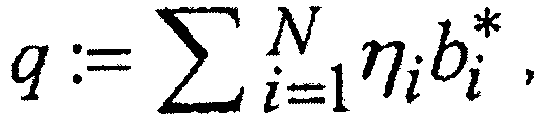
- k * : ⁇ v 1 b 1 * + ⁇ + v n b n * + ⁇ b n + 1 * + 1 ⁇ ⁇ b n + 2 * where ⁇ , ⁇ ⁇ U F q .
- the ciphertexts c 1 and c 2 are generated as shown in Formula 152.
- c 1 ⁇ 1 x 1 b 1 + ⁇ + x n b n + ⁇ d n + 1 + ⁇ 2 b n + 3
- the decryption device 300 can obtain the message m by computing Formula 153 as shown in Formula 154.
- a master secret key includes a basis B*: (b* 1 , ..., b* 9 ).
- a subscript “dec” stands for “decryption” and indicates a key vector used for decrypting a ciphertext.
- a subscript “ran” stands for “randomization” and indicates a randomizing vector for randomizing the coefficient of a predetermined basis vector of a lower level key.
- a subscript “del” stands for “delegation” and indicates a key generation vector for generating a lower level key vector.
- c 1 ⁇ 1 x 1 b 1 + x 2 b 2 + ⁇ + ⁇ 3 x 5 b 5 + x 6 b 6 + ⁇ d 7 + ⁇ 4 b 9
- x ⁇ + : x 1 x 2 x 3 + x 4 + x 5 + x 6 + where x 3 + x 4 + x 5 + x 6 + ⁇ U F q 4 .
- the ciphertext c 1 generated by the attribute vector x ⁇ 1 is generated as the ciphertext c 1 generated by the attribute vector x ⁇ + shown in Formula 156.
- k * 1,dec is a key vector used for decrypting a ciphertext.
- (k * 1,ran,1 , k * 1,ran,2 ) are randomizing vectors for randomizing the coefficient of a predetermined basis vector of a lower level key vector.
- (k * i,del,3 , ..., k * 1,del,6 ) are key-generation vectors for generating a lower level key vector.
- k * 1,dec , (k * 1,ran,1 , k * 1,ran,2 ), and (k * 1,del,3 , ..., k * 1,del,6 ) are generated as shown in Formula 157.
- ⁇ 2,0 (v 3 k * 1,del,3 + v 4 k * 1,del,4 ) is added to k * 1,dec .
- the coefficients of(v i b * 1 + v 2 b * 2 ), b * 7 , and b * 8 of the second level secret key are randomized (uniformly distributed).
- dec ( ⁇ 0 , 1 k * 1,ran,1 + ⁇ 0 , 2 k * 1,ran,2 ) is also added.
- the second level secret key k ⁇ * 2 : (k * 2,dec , k * 2,ran,1 , k * 2,ran,2 , k * 2,ran,3 ) k * 2,del,5 k * 2,del,6 ) is generated as shown in Formula 160.
- k * 2,dec is a key vector used for decrypting a ciphertext.
- (k * 2,ran,1 , k * 2,ran,2 , k * 2,ran,3 ) are randomizing vectors for randomizing the coefficient of a predetermined basis vector of a lower level key vector.
- (k * 2,del,5 ) k * 2,del,6 ) are used for generating a lower level key.
- k * L,dec is a key vector used for decrypting a ciphertext.
- k * L,ran,j is a randomizing vector for randomizing the coefficient of a predetermined basis vector of a lower level key vector.
- k * L,del,j is a key-generation vector for generating a lower level key vector.
- Fig. 11 is a functional block diagram showing the functions of the cryptographic processing system 10 that implements the HPE scheme.
- the cryptographic processing system 10 includes the key generation device 100, the encryption device 200, the decryption device 300, and the key delegation device 400. It is also assumed in this embodiment that the decryption device 300 includes the key delegation device 400.
- Fig. 12 is a flowchart showing operations of the key generation device 100.
- Fig. 13 is a flowchart showing operations of the encryption device 200.
- Fig. 14 is a flowchart showing operations of the decryption device 300.
- Fig. 15 is a flowchart showing operations of the key delegation device 400.
- Fig. 16 is a conceptual diagram showing a structure of a basis of dual pairing vector spaces (DPVS).
- the key generation device 100 includes a master key generation unit 110, a master key storage unit 120, a key vector generation unit 130, a randomizing vector generation unit 140, a key-generation vector generation unit 150, and a key distribution unit 160.
- the master key generation unit 110 computes Formula 161 to generate a master public key pk and a master secret key sk, and stores the generated keys in the master key storage unit 120.
- N : n + 3 , q V V * G T A A * ⁇ R G dpvs 1 ⁇ N X : ⁇ i , j ⁇ U GL N
- N the number of bases assigned to represent the hierarchical structure of the format of hierarchy ⁇ ⁇ . That is, in addition to the n number of bases assigned to represent the hierarchical structure, three basis vectors are provided. The number of basis vectors may, of course, be increased further.
- the structure of the basis vectors assigned for the predicate vectors and attribute vectors is the same as the structure shown in Fig. 6 .
- Two of the three remaining basis vectors (the (n+1)-th and (n+2)-th basis vectors) are used for information for generating a session key.
- the remaining one of the three remaining basis vectors (the (n+3)-th basis vector) is used for randomizing a ciphertext c 1 .
- the master key generation unit 110 executes the Setup algorithm shown in Formula 162 to generate the master public key pk and the master secret key sk.
- the key vector generation unit 130 uses the processing device and based on the master public key pk, the master secret key sk, and predicate vectors (v ⁇ 1 , ..., v ⁇ L ) shown in Formula 163, the key vector generation unit 130 computes Formula 164 to generate a key vector k * L, dec which is the first element of an L-th level (level L) secret key.
- the randomizing vector k * L,ran,j is the j-th element of the L-th level secret key.
- the key-generation vector k * L,del,j is the j-th element of the L-th level secret key.
- the key vector generation unit 130, the randomizing vector generation unit 140, and the key-generation vector generation unit 150 execute the GenKey algorithm shown in Formula 167.
- the key distribution unit 160 transmits the master public key generated by the master key generation unit 110 and the key information k ⁇ * L generated by the key vector generation unit 130, the randomizing vector generation unit 140, and the key-generation vector generation unit 150 to the decryption device 300 through the communication device.
- the key distribution unit 160 also transmits the master public key to the encryption device 200 through the communication device.
- the key information k ⁇ * L is secretly transmitted to the decryption device 300. Any method may be used to secretly transmit the key information k ⁇ * L to the decryption device 300.
- the key information k ⁇ * 1 may be transmitted using a prior art cryptographic process.
- the encryption device 200 includes a transmission information setting unit 210, a cipher vector generation unit 220, a cipher information generation unit 230, a data transmission unit 240, and a public key acquisition unit 250.
- the public key acquisition unit 250 has obtained the master public key and the attribute information vectors corresponding to the predicate information vectors of the decryption device 300 before the steps to be described below.
- the transmission information setting unit 210 uses the processing device and based on the master public key pk to compute Formula 168 to generate a transmission information vector ⁇ v.
- the cipher vector generation unit 220 uses the processing device and based on the master public key pk and attribute vectors (x ⁇ 1 , ..., x ⁇ L ) shown in Formula 169, the cipher vector generation unit 220 computes Formula 170 to generate a cipher vector c 1 .
- the vector rv is added for enhancing security and is not a requisite element.
- the cipher information generation unit 230 uses the processing device and based on a message m, the cipher information generation unit 230 computes Formula 171 to generate cipher information c 2 .
- the data transmission unit 240 transmits the cipher vector c 1 generated by the cipher vector generation unit 220 and the cipher information c 2 generated by the cipher information generation unit 230 to the decryption device 300 through the communication device.
- the encryption device 200 executes the Enc algorithm shown in Formula 172 to generate the cipher vector c 1 and the cipher information c 2 .
- the decryption device 300 includes a vector input unit 310, a key vector storage unit 320, and a pairing operation unit 330.
- the vector input unit 310 receives through the communication device and inputs the cipher vector c 1 and the cipher information c 2 transmitted by the data transmission unit 240 of the encryption device 200.
- the pairing operation unit 330 uses the processing device and based on the master public key pk and the key vector k * L,dec which is the first element of the L-th level secret key to compute Formula 173 to generate a message m'.
- m ⁇ : c 2 / e c 1 k L , dec *
- the pairing operation unit 330 performs the pairing operation e on the cipher vector c 1 input by the vector input unit 310 and the key vector k * L,dec stored in the storage device by the key vector storage unit 320.
- the pairing operation unit 330 thus computes g ⁇ T .
- the key vector storage unit 320 stores the key vector k * L,dec in the storage device.
- the decryption device 300 executes the Dec algorithm shown in Formula 175 to generate the message m'.
- Dec pk k L , dec * c 1 c 2 : m ⁇ : c 2 / e c 1 k L , dec * , return m ⁇ .
- the key delegation device 400 includes a key vector acquisition unit 410 (key-generation vector acquisition unit), a key vector generation unit 420, a randomizing vector generation unit 430, a key-generation vector generation unit 440, and a key distribution unit 450.
- the key vector generation unit 420 computes Formula 177 to generate a key vector k * L+1,dec which is the first element of an (L+1)-th level secret key.
- the randomizing vector k * L+1,ran,j is the j-th element of the (L+1)-th level secret key.
- the key-generation vector k * L+1,del,j is the j-th element of the (L+1)-th level secret key.
- the key distribution unit 440 transmits the key information k ⁇ * L+1 generated by the key vector generation unit 420, the randomizing vector generation unit 430, and the key-generation vector generation unit 440 to the decryption device 300 of a lower level through the communication device.
- the key information k ⁇ * L+1 is secretly transmitted to the decryption device 300. Any method may be used to secretly transmit the key information k ⁇ * L+1 to the decryption device 300. For example, the key information k ⁇ * L+1 may be transmitted using a prior art cryptographic process.
- the cryptographic processes to be implemented by the cryptographic processing system 10 have higher security than the cryptographic processes proposed in Non-Patent Literature 18, and security proof can be given in a standard model.
- the two lower level key vectors k * L+1,dec (A) and k * L+1,dec (B) generated from the key information k ⁇ * L are constructed as shown in Formula 182.
- the randomizing vector k * L,ran,j in which the coefficient is uniformly distributed by the random number ⁇ A,i is added to the key vector k * L+1,dec (A).
- the randomizing vector k * L,ran,i in which the coefficient is uniformly distributed by the random number ⁇ B,i is added to the key vector k * L+1,dec (B).
- the basis vector d n+1 in which the encryption device 200 sets transmission information is 2-dimensional.
- the dimension of the basis vector d n+1 may be 3-dimensional or higher, i.e., m-dimensional (basis vector b n+1 , ..., basis vector b n+m ).
- the key vector generation unit 130 sets the coefficients of the basis vectors b n+1 , ..., and b n+m such that the sum of the coefficients of the basis vectors b n+1 , ..., and b n+m is 1.
- the randomizing vector generation unit 140 sets the coefficients of the basis vectors b n+1 , ..., and b n+m such that the sum of the coefficients of the basis vectors b n+1 , ..., and b n+m is 0.
- the key-generation vector generation unit 150 sets the coefficients of the basis vectors b n+1 , ..., and b n+m such that the sum of the coefficients of the basis vectors b n+1 , ..., and b n+m is 0.
- the cipher vector generation unit 220 generates the vector rv by setting a random number as the coefficient of the basis vector b n+m+1 .
- n is an integer of 1 or larger. Accordingly, N is an integer of 4 or larger.
- n is an integer of 2 or larger. Accordingly, N is an integer of 5 or larger.
- (S402) it is not essential that the encryption device 200 generates the vector rv by using the basis vector b n+3 .
- N is an integer of 3 or larger.
- N is an integer of 4 or larger.
- distortion maps which have been described as one of the conditions of DPVS are not used. Distortion maps are used not in the algorithms for implementing the cryptographic processes, but for proving the security of the cryptographic processes.
- the cryptographic processes described above can be established in spaces without distortion maps. That is, it is not essential that there exist distortion maps in spaces for implementing the cryptographic processes described above. The same applies to the cryptographic processes to be described below.
- HPE scheme has been described above.
- HPKEM scheme will now be described. Only portions of the HPKEM scheme that are different from the above HPE scheme will be described.
- Fig. 17 is a functional block diagram showing functions of the cryptographic processing system 10 that implements the HPKEM scheme.
- the processing steps of the key generation device 100 and the processing steps of the key delegation device 400 are the same as those of the HPE scheme described above. Thus, only the processing steps of the encryption device 200 and the processing steps of the decryption device 300 will be described.
- Fig. 18 is a flowchart showing operations of the encryption device 200.
- Fig. 19 is a flowchart showing operations of the decryption device 300.
- the encryption device 200 shown in Fig. 17 includes a session key generation unit 260, in addition to the functions included in the encryption device 200 shown in Fig. 11 .
- the encryption device 200 shown in Fig. 17 does not include the cipher information generation unit 230 included in the encryption device 200 shown in Fig. 11 .
- the cipher vector c 1 generated by the cipher vector generation unit 220 in (S702) is transmitted to the decryption device 300 through the communication device. That is, in the HPKEM scheme, cipher information c 2 in which a message m is embedded is not generated and is not transmitted to the decryption device 300.
- the session key generation unit 260 computes Formula 183 to generate a session key K.
- the encryption device 200 executes the Enc algorithm shown in Formula 184 to generate the cipher vector c 1 and the session key K.
- the functions and operations of the decryption device 300 will be described.
- the vector input unit 310 receives through the communication device and inputs the cipher vector c 1 transmitted by the data transmission unit 240 of the encryption device 200.
- the pairing operation unit 330 uses the processing device and based on the master public key pk and the key vector k * L,dec which is the first element of the L-th level secret key to compute a session key K.
- K ⁇ : e c 1 k L , dec *
- the pairing operation unit 330 performs the pairing operation e on the cipher vector c 1 input by the vector input unit 310 and the key vector k * L,dec stored in the storage device by the vector storage unit 320.
- the session key K can be secretly transmitted from the encryption device 200 to the decryption device 300. This means that the session key can be shared between the encryption device 200 and the decryption device 300.
- basis vectors are used as shown in Fig. 16 . That is, the n number of basis vectors out the (n+3) number of basis vectors are used to represent the hierarchical structure of the basis vectors for attribute vectors and predicate vectors.
- a first ⁇ 1 number of basis vectors are used as the basis vectors for the first level attribute vectors and predicate vectors.
- a ( ⁇ 2 - ⁇ 1 ) number of basis vectors are used as the basis vectors for the second level attribute vectors and predicate vectors.
- a ( ⁇ L - ⁇ L-1 ) number of basis vectors are used as the basis vectors for the L-th level attribute vectors and predicate vectors.
- the n number of basis vectors out of the (n+3) number of basis vectors are used as the basis vectors for attribute vectors and predicate vectors.
- all of the n number of basis vectors are used as the basis vectors for predicate vectors. That is, all of the n number of basis vectors are always used as the basis vectors for attribute vectors or predicate vectors.
- Fig. 20 is a functional block diagram showing functions of the cryptographic processing system 10 that implements the PE scheme with delegation.
- the functions included in the cryptographic processing system 10 shown in Fig. 20 are the same as the functions included in the cryptographic processing system 10 shown in Fig. 11 .
- the flow of operations of the cryptographic processing system 10 for implementing the PE scheme with delegation according to the third embodiment are the same as the flow of operations of the cryptographic processing system 10 according to the second embodiment.
- the functions and operations of the cryptographic processing system 10 according to the third embodiment will be described with reference to Figs. 20 and 12 to 16 .
- the master key generation unit 110 computes Formula 187 to generate a master public key pk and a master secret key sk and stores the keys in the master key storage unit 120.
- the key vector generation unit 130 uses the processing device and based on the master public key pk, the master secret key sk, and predicate vectors (v ⁇ 1 , ..., v ⁇ L ) shown in Formula 188, the key vector generation unit 130 computes Formula 189 to generate a key vector k * L,dec which is the first element of an L-th level (level L) secret key.
- the key vector generation unit 130, the randomizing vector generation unit 140, and the key-generation vector generation unit 150 execute the GenKey algorithm shown in Formula 192.
- the key distribution unit 160 transmits the master public key generated by the master key generation unit 110 and the key information k ⁇ * L generated by the key vector generation unit 130, the randomizing vector generation unit 140, and the key-generation vector generation unit 150 to the decryption device 300 through the communication device.
- the key distribution unit 160 transmits the master public key to the encryption device 200 through the communication device.
- the transmission information setting unit 210 uses the processing device and based on the master public key pk, the transmission information setting unit 210 computes Formula 193 to generate a transmission information vector ⁇ v.
- the cipher vector generation unit 220 uses the processing device and based on the master public key pk and attribute vectors (x ⁇ 1 , ..., x ⁇ L ) shown in Formula 194, the cipher vector generation unit 220 computes Formula 195 to generate a cipher vector c 1 .
- the cipher information generation unit 230 computes Formula 196 to generate cipher information c 2 .
- c 2 : g T ⁇ m
- the data transmission unit 240 transmits the cipher vector c 1 generated by the cipher vector generation unit 220 and the cipher information c 2 generated by the cipher information generation unit 230 to the decryption device 300 through the communication device.
- the encryption device 200 executes the Enc algorithm shown in Formula 197 to generate the cipher vector c 1 and the cipher information c 2 .
- the functions and operations of the decryption device 300 will be described.
- the vector input unit 310 receives through the communication device and inputs the cipher vector c 1 and the cipher information c 2 transmitted by the data transmission unit 240 of the encryption device 200.
- the pairing operation unit 330 uses the processing device and based on the master public key pk and the key vector k * L, dec which is the first element of the L-th level secret key, the pairing operation unit 330 computes Formula 198 to generate a message m'.
- m ⁇ : c 2 / e c 1 k L , dec *
- the pairing operation unit 330 can generate the message m. It is assumed that the message m ⁇ G T .
- the decryption device 300 executes the Dec algorithm shown in Formula 199 to generate the message m'.
- Dec pk k L , dec * c 1 c 2 : m ⁇ : c 2 / e c 1 k L , dec * , return m ⁇ .
- the key vector generation unit 420 computes Formula 201 to generate a key vector k * L+1,dec which is the first element of an (L+1)-th level secret key.
- the key distribution unit 450 transmits the key information k ⁇ * L+1 generated by the key vector generation unit 420, the randomizing vector generation unit 430, and the key-generation vector generation unit 440 to the decryption device 300 of a lower level through the communication device.
- the basis vector d n+1 in which the encryption device 200 sets transmission information is 2-dimensional.
- the dimension of the basis vector d n+1 may be 3-dimensional or higher, i.e., m-dimensional (basis vector b n+1 , ..., basis vector b n+m ).
- the HPKEM scheme may also be implemented by modifying the Enc algorithm executed by the encryption device 200 and the Dec algorithm executed by the decryption device 300 as shown in Formula 205 and Formula 206 respectively.
- the cryptographic processes are implemented in cyclic groups of prime order q.
- a ring R is expressed using a composite number M as shown in Formula 207
- the cryptographic processes described in the above embodiments can be adapted to a module having the ring R as the coefficient.
- R : / M Z Z
- a hardware configuration of the cryptographic processing system 10 (the key generation device 100, the encryption device 200, the decryption device 300, and the key delegation device 400) according to the embodiments will now be described.
- Fig. 21 is a diagram showing an example hardware configuration of the key generation device 100, the encryption device 200, the decryption device 300, and the key delegation device 400.
- the key generation device 100, the encryption device 200, the decryption device 300, and the key delegation device 400 each include the CPU 911 (central processing unit, also called a processing unit, an arithmetic unit, a microprocessor, a microcomputer, or a processor).
- the CPU 911 is connected through the bus 912 with the ROM 913, the RAM 914, the LCD 901 (liquid crystal display), the keyboard 902 (K/B), the communication board 915, and the magnetic disk device 920, and controls these hardware devices.
- the magnetic disk device 920 (fixed disk device) may be replaced with a storage device such as an optical disk device or a memory card read/write device.
- the magnetic disk device 920 is connected through a predetermined fixed disk interface.
- the ROM 913 and the magnetic disk device 920 are examples of a nonvolatile memory.
- the RAM 914 is an example of a volatile memory.
- the ROM 913, the RAM 914, and the magnetic disk device 920 are examples of a storage device (memory).
- the keyboard 902 and the communication board 915 are examples of an input device.
- the communication board 915 is an example of a communication device (network interface).
- the LCD 901 is an example of a display device.
- the magnetic disk device 920, the ROM 913, or the like stores an operating system 921 (OS), a window system 922, programs 923, and files 924.
- the programs 923 are executed by the CPU 911, the operating system 921, and the window system 922.
- the programs 923 store software or programs for executing the functions described hereinabove as “the master key generation unit 110", “the master key storage unit 120", “the key vector generation unit 130", “the randomizing vector generation unit 140", “the key-generation vector generation unit 150”, “the key distribution unit 160”, “the transmission information setting unit 210", “the cipher vector generation unit 220", “the cipher information generation unit 230", “the data transmission unit 240", “the public key acquisition unit 250", "the session key generation unit 260”, “the vector input unit 310", “the key vector storage unit 320”, “the pairing operation unit 330”, “the key vector acquisition unit 410", “the key vector generation unit 420”, “the randomizing vector generation unit 430", “the key-generation vector generation unit 440", “the key distribution unit 450”, and so on.
- the programs are read and executed by the CPU 911.
- the files 924 store information, data, signal values, variable values, and parameters, such as "the master public key pk", “the master secret key sk", “the cipher vector c", and “the key vector” described hereinabove, each of which is stored as an item of a "file” or a “database”.
- the "file” or “database” is stored in a storage device such as a disk or memory.
- the information, data, signal values, variable values, and parameters stored in the storage device such as the disk or memory are read by the CPU 911 through a read/write circuit to a main memory or a cache memory, and are used for operations of the CPU 911 such as extraction, search, reference, comparison, calculation, computation, processing, output, printing, and display.
- the information, data, signal values, variable values, and parameters are temporarily stored in the main memory, the cache memory, or a buffer memory during the operations of the CPU 911 such as extraction, search, reference, comparison, calculation, computation, processing, output, printing, and display.
- an arrow mainly represents an input/output of data or a signal, and each data or signal value is stored in the RAM 914, or other types of storage medium such as an optical disk, or an IC chip.
- the data or signal is transferred online through the bus 912, a signal line, a cable, other types of transfer medium, or a radio wave.
- a ... unit may be “a ... circuit", “a ... device”, “a ... tool”, “a ... means”, or “a ... function”, and may also be “a ... step”, “a ... procedure”, or “a ... process”.
- a ... device may be “a ... circuit”, “a ... tool”, “a ... means”, or “a ... function”, and may also be “a ... step”, “a ... procedure”, or “a ... process”.
- What is described as “a ... process” may be “a ... step”. That is, what is described as “a ... unit” may be implemented by firmware stored in the ROM 913. Alternatively, "the ...
- the unit may be implemented solely by software, or solely by hardware such as elements, devices, boards, and wiring, or by a combination of software and hardware, or by a combination including firmware.
- Firmware or software is stored as a program in a storage medium such as the ROM 913.
- the program is read by the CPU 911 and executed by the CPU 911. That is, the program causes a computer or the like to function as "the ... unit” described above. Alternatively, the program causes the computer or the like to execute a procedure or a method of "the ... unit” described above.
Landscapes
- Engineering & Computer Science (AREA)
- Computer Security & Cryptography (AREA)
- Computer Networks & Wireless Communication (AREA)
- Signal Processing (AREA)
- Theoretical Computer Science (AREA)
- General Physics & Mathematics (AREA)
- Algebra (AREA)
- Mathematical Analysis (AREA)
- Mathematical Optimization (AREA)
- Mathematical Physics (AREA)
- Pure & Applied Mathematics (AREA)
- Physics & Mathematics (AREA)
- Computing Systems (AREA)
- Storage Device Security (AREA)
- Complex Calculations (AREA)
Claims (32)
- Kryptographisches Verarbeitungssystem (10), das einen Prädikatverschlüsselungsprozess durchführt unter Verwendung von Dualmodulen eines Raumes V und eines Raumes V*, die mittels einer in Formel 1 gezeigten Paarungsoperation gepaart sind, wobei das kryptographische Verarbeitungssystem Folgendes umfasst:eine Verschlüsselungsvorrichtung (200), die unter Verwendung einer Verarbeitungsvorrichtung auf einer Basis B^ einen Vektor als einen Chiffriervektor c1 erzeugt, wobei die Basis B^ aus Basisvektoren bi (i = 1, ..., n, ..., N) (N ist eine ganze Zahl größer oder gleich 3 und n ist eine ganze Zahl von 1 bis N-2), die eine vorherbestimmte Basis B des Raumes V bilden, Basisvektoren bi(i = 1, ..., n) und einem Basisvektor dn+1, der eine Summe von zwei oder mehr Basisvektoren bi (i = n+1, ..., m) aus den Basisvektoren bi (i = n+1, ..., N) ist, gebildet ist, wobei der Chiffriervektor c1 der Vektor ist, in dem Attributinformationen als Koeffizienten von einem oder mehreren Basisvektoren aus den Basisvektoren bi(i = 1, ..., n) eingebettet sind, und vorherbestimmte Informationen als ein Koeffizient des Basisvektors dn+1eingebettet sind; undeine Entschlüsselungsvorrichtung (300), die unter Verwendung der Verarbeitungsvorrichtung die in Formel 1 gezeigte Paarungsoperation e (c1, k*L,dec) an dem Chiffriervektor c1, der von der Verschlüsselungsvorrichtung erzeugt wurde, und an dem Schlüsselvektor k*L,dec durchführt, um den Chiffriervektor c1 zu entschlüsseln, und einen Wert, der die vorherbestimmte Information betrifft, zu extrahieren, wobei der Schlüsselvektor k*L,dec ein Vektor auf einer Basis B* des Raumes V* ist und derart konstruiert ist, dass Prädikatinformationen als Koeffizienten eines oder mehrerer Basisvektoren von Basisvektoren b* i(i = 1, ..., n) aus Basisvektoren b*i(i = 1, ..., n, ..., N), die die Basis B* bilden, und Koeffizienten von Basisvektoren b*i(i = n+1, ..., m) der Basis B* derart eingebettet sind, dass eine Summe der Koeffizienten der Basisvektoren b*i (i = n+1, ..., m) 1 ist.


- Kryptographisches Verarbeitungssystem nach Anspruch 1, wobei die Dualmodule Dualvektorräume umfassen.
- Kryptographisches Verarbeitungssystem nach Anspruch 2, das ferner Folgendes umfasst:eine Schlüsselerzeugungsvorrichtung (100), die unter Verwendung der Verarbeitungsvorrichtung den Vektor als den Schlüsselvektor k*L,dec erzeugt, in dem die Prädikatinformationen als die Koeffizienten des einen oder der mehreren Basisvektoren der Basisvektoren b*i(i = 1, ..., n) der Basisvektoren b*i(i = 1, ..., N), die die Basis B* bilden, eingestellt sind und die Koeffizienten der Basisvektoren b*i(i = n+1, ..., m) derart eingestellt sind, dass die Summe der Koeffizienten der Basisvektoren b*i(i = n+1, ..., m) 1 ist, und wobeidie Entschlüsselungsvorrichtung den von der Schlüsselerzeugungsvorrichtung erzeugten Schlüsselvektor k*L,dec erhält und die Paarungsoperation an dem erhaltenen Schlüsselvektor k*L,dec und dem Chiffriervektor c1 durchführt.
- Kryptographisches Verarbeitungssystem nach Anspruch 3, das ferner Folgendes umfasst:eine Schlüsseldelegationsvorrichtung (400), die einen Vektor als einen Schlüsselvektor k*L+1,dec erzeugt, der einen oder mehrere Chiffriervektoren, aber nicht alle, die von dem von der Schlüsselerzeugungsvorrichtung erzeugten Schlüsselvektor k*L,dec entschlüsselt werden können, entschlüsseln kann, wobei der Schlüsselvektor k*L+1,dec der Vektor ist, in dem Zufallszahlen mit gleichmäßig verteilten Werten als Koeffizienten von Basisvektoren, in denen Prädikatinformationen eingestellt sind, eingestellt ist.
- Schlüsselerzeugungsvorrichtung (100), die einen Schlüsselvektor k*L,dec erzeugt, der ein geheimer Schlüssel in einem Prädikatverschlüsselungsschema ist, wobei die Schlüsselerzeugungsvorrichtung Folgendes umfasst:eine Masterschlüsselspeichereinheit (120), die, wenn ein Raum V und ein Raum V* durch eine Paarungsoperation gepaarte Dualmodule sind, eine vorherbestimmte Basis B* des Raumes V* in einer Speichervorrichtung speichert; undeine Schlüsselvektorerzeugungseinheit (130), die unter Verwendung einer Verarbeitungsvorrichtung einen Vektor als den Schlüsselvektor k*L,dec erzeugt, in dem Prädikatinformationen als Koeffizienten von einem oder mehreren Basisvektoren b*i(i = 1, ..., µL) vom Basisvektor b*i(i = 1, ..., n) aus den Basisvektoren b*i(i = 1, ..., n, ..., N) (N ist eine ganze Zahl größer oder gleich 3 und n ist eine ganze Zahl von 1 bis N-2) eingestellt sind, die die Basis B*, die von der Masterschlüsselspeichereinheit gespeichert wird, bilden, und Koeffizienten von zwei oder mehr vorherbestimmten Basisvektoren aus Basisvektoren b*i(i = n+1, ..., N) derart eingestellt sind, dass eine Summe der Koeffizienten der zwei oder mehr vorherbestimmten Basisvektoren 1 ist.
- Schlüsselerzeugungsvorrichtung nach Anspruch 5, wobei die Dualmodule Dualvektorräume umfassen.
- Schlüsselerzeugungsvorrichtung nach Anspruch 6, wobei die Schlüsselvektorerzeugungseinheit den Schlüsselvektor k*L,dec, wie in Formel 2 gezeigt, erzeugt.
 σ 0,i ,η 0 (i = 1,...,L): vorherbestimmte Werte,vi (i = 1,...,µL ): Prädikatinformationen.
 - Schlüsselerzeugungsvorrichtung nach Anspruch 6, wobei die Schlüsselvektorerzeugungseinheit den Schlüsselvektor k*L,dec, wie in Formel 3 gezeigt, erzeugt.
 σdec,t ,η dec (t = 1,..., L): vorherbestimmte Werte,vt,i (t = 1,...,L; i = 1,...,n): Prädikatinformationen.
 - Schlüsselerzeugungsvorrichtung nach Anspruch 6, die ferner Folgendes umfasst:eine Schlüsselerzeugungsvektorerzeugungseinheit (150), die unter Verwendung der Verarbeitungsvorrichtung mindestens eine (n-µL) Anzahl von Vektoren als einen Schlüsselerzeugungsvektor k*L,del,j erzeugt, der eine oder mehrere, aber nicht alle, der Chiffriervektoren entschlüsseln kann, die von dem von der Schlüsselvektorerzeugungseinheit erzeugten Schlüsselvektor k*L,dec entschlüsselt werden können, wobei der Schlüsselerzeugungsvektor k*L,del,j ein Vektor ist, in dem ein vorherbestimmter Wert als ein Koeffizient eines Basisvektors b*j für mindestens jedes j aus j = µL+1, ..., n eingestellt ist; undeine Randomisierungsvektorerzeugungseinheit (140), die unter Verwendung der Verarbeitungsvorrichtung mindestens eine Anzahl (L+1) von Vektoren als einen Randomisierungsvektor k*L,ran,j erzeugt, zum Setzen gleichmäßig verteilter Werte als Koeffizienten von Basisvektoren des Schlüsselvektors k*L+1,dec, der mit dem von der Schlüsselerzeugungsvektorerzeugungseinheit erzeugten Schlüsselerzeugungsvektor k*L,del,j erzeugt wurde, wobei die Koeffizienten so eingestellt werden, dass Prädikatinformationen eingestellt werden, und der Randomisierungsvektor k*L,ran,j ein Vektor ist, in dem ein vorherbestimmter Wert als ein Koeffizient eines Basisvektors b*j für mindestens jedes j aus j = 1, ..., L+1 eingestellt ist.
- Schlüsselerzeugungsvorrichtung nach Anspruch 9, wobei die Schlüsselvektorerzeugungseinheit den Schlüsselerzeugungsvektor k*L,del,j wie in Formel 4 gezeigt erzeugt, und
wobei die Randomisierungsvektorerzeugungseinheit den Randomisierungsvektor k*L,ran,j wie in Formel 5 gezeigt erzeugt. σj,i,ψ,ηj vorherbestimmte Werte,vi (i = 1,...,µL): Prädikatinformationen.
 σj,i,ηj (j = 1,...,L + 1; i = 1,..,L): vorherbestimmte Werte,Vi (i = 1,...,µL ): Prädikatinformationen.
 - Schlüsselerzeugungsvorrichtung nach Anspruch 9, wobei die Schlüsselvektorerzeugungseinheit den Schlüsselerzeugungsvektor k*L,del,j wie in Formel 6 gezeigt erzeugt, und
wobei die Randomisierungsvektorerzeugungseinheit den Randomisierungsvektor k*L,ran,j wie in Formel 7 gezeigt erzeugt. σ del, j,t,η del, j,ψ (j = 1,...,n; t = 1,...,L): vorherbestimmte Werte,vt,i (t = 1,...,L; i = 1,...,n): Prädikatinformationen.
 σ ran, j,t,η ran,j (J = 1,...,L + 1;t = 1,...,L): vorherbestimmte Werte,vt,i (t = 1,...,L; i = 1,...,n): Prädikatinformationen.
 - Schlüsseldelegationsvorrichtung (400), die einen Schlüsselvektor k*L+1,dec erzeugt, der einen oder mehrere, aber nicht alle, Chiffriervektoren, die von einem Schlüsselvektor k*L,dec, der ein geheimer Schlüssel in einem Prädikatverschlüsselungssystem ist, entschlüsselt werden können, entschlüsseln kann, wobei die Schlüsseldelegationsvorrichtung Folgendes umfasst:eine Schlüsselvektorerfassungseinheit (410), die, wenn ein Raum V und ein Raum V* durch eine Paarungsoperation gepaarte Dualmodule sind, den Schlüsselvektor k*L,dec erhält, in dem Prädikatinformationen als Koeffizienten von einem oder mehreren Basisvektoren b*i (i = 1, ..., µL) von Basisvektoren b*i(i = 1, ..., n) aus den Basisvektoren b*i(i = 1, ..., n, ..., N) (N ist eine ganze Zahl größer oder gleich 3 und n ist eine ganze Zahl von 1 bis N-2) eingestellt sind, die eine vorherbestimmte Basis B* des Raumes V* bilden, und Koeffizienten von zwei oder mehr vorherbestimmten Basisvektoren aus Basisvektoren b*i(i = n+1, ..., N) derart eingestellt sind, dass eine Summe der Koeffizienten der zwei oder mehr vorherbestimmten Basisvektoren 1 ist;eine Schlüsselerzeugungsvektorerfassungseinheit (410), die mindestens eine (n-µL) Anzahl von Schlüsselerzeugungsvektoren k*L,del,j erhält, in denen ein vorherbestimmter Wert als ein Koeffizient eines Basisvektors b*j für mindestens jedes j von j = µL+1, ..., n eingestellt ist; undeine Schlüsselvektorerzeugungseinheit (420), die den Schlüsselvektor k*L+1,dec durch Multiplizieren mit Prädikatinformationen eines Koeffizienten von jedem Basisvektor von einem oder mehreren Schlüsselerzeugungsvektoren k*L,del,j aus den Schlüsselerzeugungsvektoren k*L,del,j, die durch die Schlüsselerzeugungsvektorerfassungseinheit erhalten wurden, und Hinzufügen jedes Ergebnisses zu dem Schlüsselvektor k*L,dec, der von der Schlüsselvektorerfassungseinheit erhalten wurde, erzeugt.
- Schlüsseldelegationsvorrichtung nach Anspruch 12, wobei die Dualmodule Dualvektorräume umfassen.
- Schlüsseldelegationsvorrichtung nach Anspruch 13, die ferner Folgendes umfasst:eine Randomisierungsvektorerfassungseinheit, die mindestens eine Anzahl (L+1) von Randomisierungsvektoren k*L,ran,j erhält, in denen ein vorherbestimmter Wert als ein Koeffizient eines Basisvektors b*j für mindestens jedes j aus j = 1, ..., L+1 eingestellt ist; und wobei
die Schlüsselvektorerzeugungseinheit den Schlüsselvektor k*L+1,dec durch Multiplizieren eines Koeffizienten von jedem Basisvektor von einem oder mehreren Randomisierungsvektoren k*L,ran,j aus den Randomisierungsvektoren k*L,ran,j, die durch die Randomisierungsvektorerfassungseinheit erhalten wurden, mit einer Zufallszahl und ferner Hinzufügen jedes Ergebnisses zu dem Schlüsselvektor k*L+1,dec, erzeugt. - Schlüsseldelegationsvorrichtung nach Anspruch 14,
wobei die Schlüsselvektorerfassungseinheit den Schlüsselvektor k*L,dec, wie in Formel 8 gezeigt, erhält, wobei die Schlüsselerzeugungsvektorerfassungseinheit den Schlüsselerzeugungsvektor k*L,del,j, wie in Formel 9 gezeigt, erhält,
wobei die Randomisierungsvektorerfassungseinheit den Randomisierungsvektor k*L,ran,j, wie in Formel 10 gezeigt, erhält,
wobei die Schlüsselvektorerzeugungseinheit den Schlüsselvektor k*L+1,dec, wie in Formel 11 gezeigt, erzeugt. σ 0, i,η 0 (i = 1,..., L): vorherbestimmte Werte,vi (i = 1,...,µL ): Prädikatinformationen.
 σj,i,ψ,ηj (j = µL + 1,...,n; i = 1,...,L) : vorherbestimmte Werte,vi (i = 1,...,µL ): Prädikatinformationen.
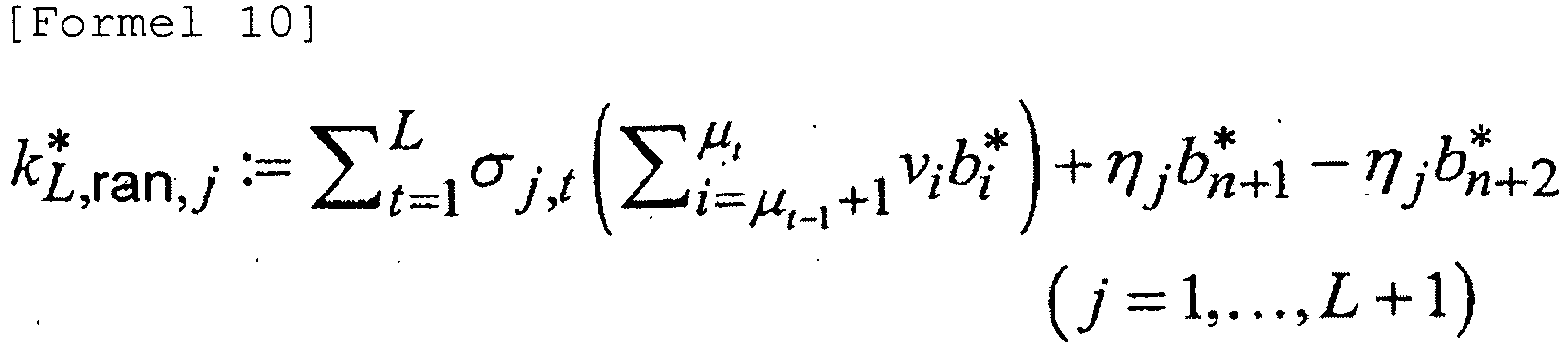 σj,i,ηj (j = 1,...,L + 1; i = 1,... ,L): vorherbestimmte Werte,vi (i = 1,..., µL ): Prädikatinformationen.
 σ 0 ,i,σ 0 (i = 1,...,L + 1): vorherbestimmte Werte,vi (i = µL + 1,...,µ L+1): Prädikatinformationen.
 - Schlüsseldelegationsvorrichtung nach Anspruch 14, wobei die Schlüsselvektorerfassungseinheit den Schlüsselvektor k*L,dec, wie in Formel 12 gezeigt, erhält,
wobei die Schlüsselerzeugungsvektorerfassungseinheit den Schlüsselerzeugungsvektor k*L,del,j, wie in Formel 13 gezeigt, erhält,
wobei die Randomisierungsvektorerfassungseinheit den Randomisierungsvektor k*L,ran,j, wie in Formel 14 gezeigt, erhält, und
wobei die Schlüsselvektorerzeugungseinheit den Schlüsselvektor k*L+1,dec, wie in Formel 15 gezeigt, erzeugt. σ del, t,η del (t = 1,...,L): vorherbestimmte Werte,vt,i (t = 1,...,L;i = 1,...,n): Prädikatinformationen.
 σ del, j,t,η del, j,ψ (J = 1,...,n; t = 1,...,L) : vorherbestimmte Werte,vt,i (t = 1,..., L;i = 1,...,n): Prädikatinformationen.
 σ ran,j,t ,η ran,j (j = 1,...,L + 1;t = 1,...,L): vorherbestimmte Werte,vt,i (t = 1,...,L;i = 1,...,n): Prädikatinformationen.
 σ del, t,σ dec (t = 1,...,L + 1): vorherbestimmte Werte,v L+1,i (i = 1,...,n): Prädikatinformationen.
 - Schlüsseldelegationsvorrichtung nach Anspruch 14, die ferner Folgendes umfasst:eine Schlüsselerzeugungsvektorerzeugungseinheit (440), die unter Verwendung der Verarbeitungsvorrichtung mindestens eine (n-µL+1) Anzahl von Vektoren als einen Schlüsselerzeugungsvektor k*L+1,del,j erzeugt, der eine oder mehrere, aber nicht alle, der Chiffriervektoren entschlüsseln kann, die von dem von der Schlüsselvektorerzeugungseinheit erzeugten Schlüsselvektor k*L+1,dec entschlüsselt werden können, wobei der Schlüsselerzeugungsvektor k*L+1,del,j ein Vektor ist, in dem ein vorherbestimmter Wert als ein Koeffizient eines Basisvektors b*j für mindestens jedes j aus j = µL+1+1, ..., n eingestellt ist; undeine Randomisierungsvektorerzeugungseinheit (430), die unter Verwendung der Verarbeitungsvorrichtung mindestens eine (L+2) Anzahl von Vektoren als einen Randomisierungsvektor k*L+1,ran,j erzeugt, zum Setzen gleichmäßig verteilter Werte als Koeffizienten von Basisvektoren des Schlüsselvektors k*L+2,dec, der mit dem von der Schlüsselerzeugungsvektorerzeugungseinheit erzeugten Schlüsselerzeugungsvektor k*L+1,del,j erzeugt wurde, wobei die Koeffizienten so eingestellt werden, dass Prädikatinformationen eingestellt werden, und der Randomisierungsvektor k*L+1,ran,j ein Vektor ist, in dem ein vorherbestimmter Wert als ein Koeffizient eines Basisvektors b*j für mindestens jedes j aus j = 1, ..., L+2 eingestellt ist.
- Schlüsseldelegationsvorrichtung nach Anspruch 17, wobei die Schlüsselerzeugungsvektorerfassungseinheit den Schlüsselerzeugungsvektor k*L,del,j, wie in Formel 16 gezeigt, erhält,
wobei die Randomisierungsvektorerfassungseinheit den Randomisierungsvektor k*L,ran,j, wie in Formel 17 gezeigt, erhält,
wobei die Schlüsselvektorerzeugungseinheit den Schlüsselerzeugungsvektor k*L+1,del,j, wie in Formel 18 gezeigt, erzeugt, und
wobei die Randomisierungsvektorerzeugungseinheit den Randomisierungsvektor k*L+1,ran,j, wie in Formel 19 gezeigt, erzeugt. σj,t,ψ,ηj (j = µL + 1,...,n; t = 1,...,L) : vorherbestimmte Werte,vi (i = 1,..., µL ): Prädikatinformationen.
 σj,t,ηj (j = 1,...,L + 1; t = 1,...,L): vorherbestimmte Werte,vi (i = 1,...,µL ): Prädikatinformationen.
 αj,i,σj,ψ' (j = µ L+1 +1,...,n; i = 1,...,L + 1): vorherbestimmte Werte,vi (i = µL + 1,..., µ L+1): Prädikatinformationen.
 αj,i,σj (j = 1,...,L + 2; i = 1,...,L + 1): vorherbestimmte Werte,vi (i = µL + 1,...,µ L+1): Prädikatinformationen.
 - Schlüsseldelegationsvorrichtung nach Anspruch 17,
wobei die Schlüsselerzeugungsvektorerfassungseinheit den Schlüsselerzeugungsvektor k*L,del,j, wie in Formel 20 gezeigt, erhält,
wobei die Randomisierungsvektorerfassungseinheit den Randomisierungsvektor k*L,ran,j, wie in Formel 21 gezeigt, erhält,
wobei die Schlüsselvektorerzeugungseinheit den Schlüsselvektor k*L+1,dej,j, wie in Formel 22 gezeigt, erzeugt, und
wobei die Randomisierungsvektorerzeugungseinheit den Randomisierungsvektor k*L+1,ran,j, wie in Formel 23 gezeigt, erzeugt. σ del, j,t,η del, j,ψ (j = 1,...,n; t = 1,...,L) : vorherbestimmte Werte,vt,i (t = 1,..., L;i = 1,...,n): Prädikatinformationen.
 σ ran, j,t,η ran,j (j = 1,...,L + 1;t = 1,...,L): vorherbestimmte Werte,vt,i (t = 1,...,L;i = 1,...,n): Prädikatinformationen.
 α del, j,t,σ del, j,ψ' (j = 1,...,n; i = 1,...,L + 1): vorherbestimmte Werte,v L+1,i (i = 1,...,n): Prädikatinformationen.
 α ran, j,t,σ ran,j (j = 1,...,L + 2; t = 1,...,L + 1) : vorherbestimmte Werte,v L+1,i (i = 1,...,n): Prädikatinformationen.
 - Verschlüsselungsvorrichtung (200), die einen Chiffriervektor c1 erzeugt, der ein Chiffriertext in einem Prädikatverschlüsselungsschema ist, wobei die Verschlüsselungsvorrichtung Folgendes umfasst:eine Öffentlicher-Schlüssel-Erfassungseinheit (250), die, wenn ein Raum V und ein Raum V* durch eine Paarungsoperation gepaarte Dualmodule sind, eine Basis B^ und vorherbestimmte Attributinformationen erhält, wobei die Basis B^ aus Basisvektoren bi (i = 1, ..., n, ..., N) (N ist eine ganze Zahl größer oder gleich 3 und n ist eine ganze Zahl von 1 bis N-2), die eine vorherbestimmte Basis B des Raumes V bilden, Basisvektoren bi(i = 1, ..., n) und einem Basisvektor dn+1, der eine Summe von zwei oder mehr vorherbestimmten Basisvektoren aus den Basisvektoren bi (i = n+1, ..., N) ist, besteht;eine Übertragungsinformationeneinstelleinheit (210), die unter Verwendung einer Verarbeitungsvorrichtung einen Vektor auf der Basis B^, die von der Öffentlicher-Schlüssel-Erfassungseinheit erhalten wurde, als einen Übertragungsinformationenvektor ζν erzeugt, wobei der Übertragungsinformationenvektor ζν der Vektor ist, in dem vorherbestimmte Informationen als ein Koeffizient des Basisvektors dn+1 eingestellt sind; undeine Chiffriervektorerzeugungseinheit (220), die unter Verwendung der Verarbeitungsvorrichtung den Chiffriervektor c1 durch Hinzufügen eines Attributinformationenvektors erzeugt, in dem Attributinformationen als Koeffizienten eines oder mehrerer Basisvektoren aus den Basisvektoren bi(i = 1, ..., n) der Basis B^ zu dem Übertragungsinformationenvektor ζν, der von der Übertragungsinformationeneinstelleinheit erzeugt wurde, eingestellt werden.
- Verschlüsselungsvorrichtung nach Anspruch 20, wobei die Dualmodule Dualvektorräume umfassen.
- Verschlüsselungsvorrichtung nach Anspruch 21, wobei die Übertragungsinformationeneinstelleinheit den Übertragungsinformationenvektor ζν, wie in Formel 24 gezeigt, erzeugt, und
wobei die Chiffriervektorerzeugungseinheit den Chiffriervektor c1, wie in Formel 25 gezeigt, erzeugt.
ζ : vorherbestimmter Wert.

 δ 1,...,δd : vorherbestimmte Werte.
 - Verschlüsselungsvorrichtung nach Anspruch 21, wobei die Übertragungsinformationeneinstelleinheit den Übertragungsinformationenvektor ζν, wie in Formel 26 gezeigt, erzeugt, und
wobei die Chiffriervektorerzeugungseinheit den Chiffriervektor c1, wie in Formel 27 gezeigt, erzeugt.
ζ : vorherbestimmter Wert.
 δ 1,...,δ d: vorherbestimmte Werte.
 - Verschlüsselungsvorrichtung nach Anspruch 21, die ferner Folgendes umfasst:eine Chiffrierinformationenerzeugungseinheit (230), die in Formel 28 gezeigte Chiffrierinformationen c2 erzeugt.wobei

 A eine Basis des Raums V ist und A := (a 1,...,aN ),A* eine Basis des Raums V* ist und
- Entschlüsselungsvorrichtung (300), die einen Chiffriertext in einem Prädikatverschlüsselungsschema entschlüsselt, wobei die Entschlüsselungsvorrichtung Folgendes umfasst:eine Vektoreingabeeinheit (310), die, wenn ein Raum V und ein Raum V* durch eine Paarungsoperation gepaarte Dualmodule sind, einen Chiffriervektor c1 einer Basis B^ eingibt, wobei die Basis B^ aus Basisvektoren bi (i = 1, ..., n, ..., N) (N ist eine ganze Zahl größer oder gleich 3 und n ist eine ganze Zahl von 1 bis N-2), die eine vorherbestimmte Basis B des Raumes V bilden, Basisvektoren bi(i = 1, ..., n) und einen Basisvektor dn+1, der eine Summe von zwei oder mehr vorherbestimmten Basisvektoren aus den Basisvektoren bi (i = n+1, ..., N) ist, aufweist, wobei der Chiffriervektor c1 ein Vektor ist, in dem Attributinformationen als Koeffizienten von mindestens Basisvektoren bi(i = 1, ..., µh) aus den Basisvektoren bi(i = 1, ..., n) eingestellt sind, und vorherbestimmte Informationen als ein Koeffizient des Basisvektors dn+1 eingestellt sind;eine Schlüsselvektorspeichereinheit (320), die in einer Speichervorrichtung einen Schlüsselvektor k*L,dec speichert, in dem Prädikatinformationen νi(i = 1, ..., µL) als Koeffizienten von mindestens Basisvektoren b*i(i = 1, ..., µL) (µL ≤ µh) von Basisvektoren b*i(i = 1, ..., n) von Basisvektoren b*i (i = 1, ..., n, ..., N) einer vorherbestimmten Basis B* des Raumes V* eingestellt sind, und Koeffizienten von Basisvektoren b*i, die den Basisvektoren bi entsprechen, die den Basisvektor dn+1 bilden, derart eingestellt sind, dass eine Summe der Koeffizienten der Basisvektoren b*i 1 ist; undeine Paarungsoperationseinheit (330), die unter Verwendung einer Verarbeitungsvorrichtung die Paarungsoperation an dem Chiffriervektor c1, der von der Vektoreingabeeinheit eingegeben wird, und dem Schlüsselvektor k*L,dec, der von der Schlüsselvektorspeichereinheit gespeichert wird, durchführt, um einen Wert betreffend die vorherbestimmten Informationen aus dem Chiffriervektor c1 zu extrahieren.
- Entschlüsselungsvorrichtung nach Anspruch 25, wobei die Dualmodule Dualvektorräume umfassen.
- Entschlüsselungsvorrichtung nach Anspruch 26, wobei die Vektoreingabeeinheit den Chiffriervektor c1, wie in Formel 29 gezeigt, eingibt,
wobei die Schlüsselvektorspeichereinheit den Schlüsselvektor k*L,dec, wie in Formel 30 gezeigt, speichert, und
wobei die Paarungsoperationseinheit die Paarungsoperation, wie in Formel 31 gezeigt, durchführt, um den Wert betreffend die vorherbestimmten Informationen aus dem Chiffriervektor zu extrahieren.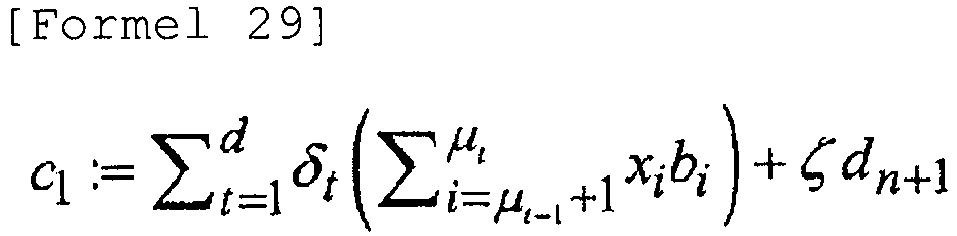

 δ 1,...,δd ,ζ: vorherbestimmte Werte.
 σ0,i,η 0 (i = 1,...,L): vorherbestimmte Werte,νi (i = 1,...,µL ): Prädikatinformationen.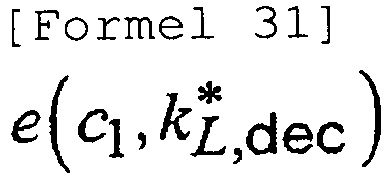

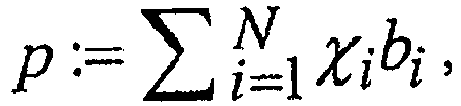
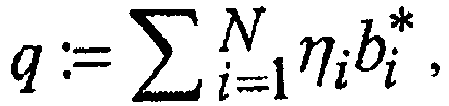
- Entschlüsselungsvorrichtung nach Anspruch 26, wobei die Vektoreingabeeinheit den Chiffriervektor c1, wie in Formel 32 gezeigt, eingibt,
wobei die Schlüsselvektorspeichereinheit den Schlüsselvektor k*L,dec, wie in Formel 33 gezeigt, speichert, und
wobei die Paarungsoperationseinheit die Paarungsoperation, wie in Formel 34 gezeigt, durchführt, um den Wert betreffend die vorherbestimmten Informationen aus dem Chiffriervektor zu extrahieren.
 δ 1,...,δd,ζ : vorherbestimmte Werte.
 σdec,t ,η dec (t = 1,...,L) : vorherbestimmte Werte,υt,i (t = 1,...,L; i = 1,...,n) : Attributinformationen.


- Entschlüsselungsvorrichtung nach Anspruch 26, wobei die Vektoreingabeeinheit den Chiffriervektor c1, wie in Formel 35 gezeigt, und die Chiffrierinformationen c2, wie in Formel 36 gezeigt, eingibt, wo eine Nachricht m verschlüsselt wird,
wobei die Schlüsselvektorspeichereinheit den Schlüsselvektor k*L,dec, wie in Formel 37 gezeigt, speichert, und
wobei die Paarungsoperationseinheit die Paarungsoperation, wie in Formel 38 gezeigt, durchführt, um die Nachricht m aus dem Chiffriervektor c1 zu extrahieren.

 vorherbestimmte Werte δ 1,...,δd ,ζ : vorherbestimmte Werte.
 A eine Basis des Raums V ist und A := (a 1,...aN ),A* eine Basis des Raums V* ist und
 σ 0,i ,η 0 (i = 1,...,L): vorherbestimmte Werte,νi (i = 1,...,µL ): Prädikatinformationen.


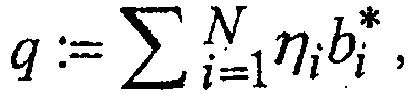
- Entschlüsselungsvorrichtung nach Anspruch 26, wobei die Vektoreingabeeinheit den Chiffriervektor c1, wie in Formel 39 gezeigt, und die Chiffrierinformationen c2, wie in Formel 40 gezeigt, eingibt, wo eine Nachricht m verschlüsselt wird,
wobei die Schlüsselvektorspeichereinheit den Schlüsselvektor k*L,dec, wie in Formel 41 gezeigt, speichert, und
wobei die Paarungsoperationseinheit eine Operation, wie in Formel 42 gezeigt, durchführt, um die Nachricht m aus dem Chiffriervektor c1 zu extrahieren.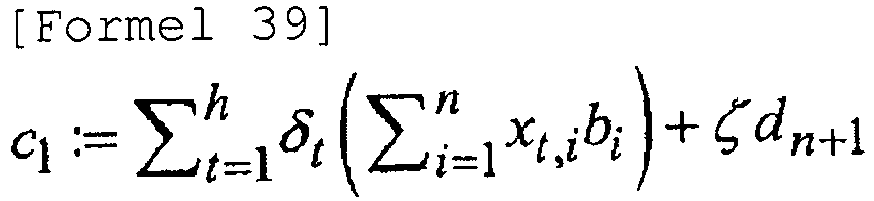
 δ 1,...,δd,ζ : vorherbestimmte Werte.
 A eine Basis des Raums V ist und A := (a 1,..., aN ),A* eine Basis des Raums V* ist und
 σdec,t ,η dec (t = 1,...,L): vorherbestimmte Werte,υ t,i (t = 1,...,L; i = 1,...,n): Prädikatinformationen.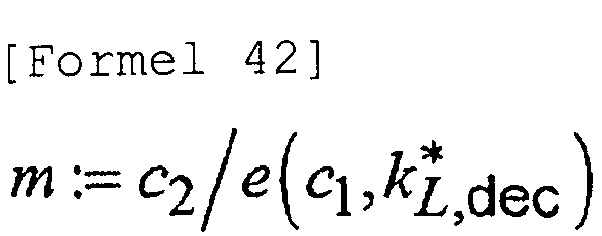


- Kryptographisches Verarbeitungsverfahren zum Durchführen eines Prädikatverschlüsselungsprozesses unter Verwendung von Dualvektorräumen eines Raumes V und eines Raumes V*, die mittels einer in Formel 44 gezeigten Paarungsoperation gepaart sind, wobei das kryptographische Verarbeitungsverfahren Folgendes umfasst:
Erzeugen eines Vektors als ein Chiffriervektor c1 auf einer Basis B^, wobei die Basis B^ aus Basisvektoren bi (i = 1, ..., n, ..., N) (N ist eine ganze Zahl größer oder gleich 3 und n ist eine ganze Zahl von 1 bis N-2), die eine vorherbestimmte Basis B des Raumes V bilden, Basisvektoren bi(i = 1, ..., n) und einem Basisvektor dn+1, der eine Summe von zwei oder mehr Basisvektoren bi (i = n+1, ..., m) aus den Basisvektoren bi (i = n+1, ..., N) ist, gebildet ist, wobei der Chiffriervektor c1 der Vektor ist, in dem Attributinformationen als Koeffizienten von einem oder mehreren Basisvektoren aus den Basisvektoren bi(i = 1, ..., n) eingebettet sind, und vorherbestimmte Informationen als ein Koeffizient des Basisvektors dn+1 eingebettet sind; und
Durchführen der in Formel 44 gezeigten Paarungsoperation e (c1, k*L,dec) an dem erzeugten Chiffriervektor c1 und an einem Schlüsselvektor k*L,dec, um den Chiffriervektor c1 zu entschlüsseln, und einen Wert, der die vorherbestimmten Informationen betrifft, zu extrahieren, wobei der Schlüsselvektor k*L,dec ein Vektor auf einer Basis B* des Raumes V* ist und derart konstruiert ist, dass Prädikatinformationen als Koeffizienten eines oder mehrerer Basisvektoren von Basisvektoren b*i(i = 1, ..., n) aus Basisvektoren b*i(i = 1, ..., n, ..., N), die die Basis B* bilden, und Koeffizienten von Basisvektoren b*i(i = n+1, ..., m) der Basis B* derart eingebettet sind, dass eine Summe der Koeffizienten der Basisvektoren b*i(i = n+1, ..., m) 1 ist.


- Kryptographisches Verarbeitungsprogramm, das einen Prädikatverschlüsselungsprozess unter Verwendung von Dualvektorräumen eines Raumes V und eines Raumes V*, die mittels einer in Formel 45 gezeigten Paarungsoperation gepaart sind, durchführt, wobei das kryptographische Verarbeitungsprogramm einen Computer veranlasst, Folgendes auszuführen:einen Verschlüsselungsprozess, der einen Vektor als einen Chiffriervektor c1 auf einer Basis B^ erzeugt, wobei die Basis B^ aus Basisvektoren bi (i = 1, ..., n, ..., N) (N ist eine ganze Zahl größer oder gleich 3 und n ist eine ganze Zahl von 1 bis N-2), die eine vorherbestimmte Basis B des Raumes V bilden, Basisvektoren bi(i = 1, ..., n) und einem Basisvektor dn+1, der eine Summe von zwei oder mehr Basisvektoren bi (i = n+1, ..., m) aus den Basisvektoren bi (i = n+1, ..., N) ist, gebildet ist, wobei der Chiffriervektor c1 der Vektor ist, in dem Attributinformationen als Koeffizienten von einem oder mehreren Basisvektoren aus den Basisvektoren bi(i = 1, ..., n) eingebettet sind, und vorherbestimmte Informationen als ein Koeffizient des Basisvektors dn+1eingebettet sind; undeinen Entschlüsselungsprozess, der die in Formel 45 gezeigte Paarungsoperation e(c1, k*L,dec) an dem von der Entschlüsselungsvorrichtung erzeugten Chiffriervektor c1 und an einem Schlüsselvektor k*L,dec durchführt, um den Chiffriervektor c1 zu entschlüsseln und einen Wert, der die vorherbestimmten Informationen betrifft, zu extrahieren, wobei der Schlüsselvektor k*L,dec ein Vektor auf einer Basis B* des Raumes V* ist und derart konstruiert ist, dass Prädikatinformationen als Koeffizienten eines oder mehrerer Basisvektoren von Basisvektoren b*i(i = 1, ..., n) aus Basisvektoren b*i(i = 1, ..., n, ..., N), die die Basis B* bilden, eingebettet sind und Koeffizienten von Basisvektoren b*i(i = n+1, ..., m) der Basis B* derart eingebettet sind, dass eine Summe der Koeffizienten der Basisvektoren b*i(i = n+1, ..., m) 1 ist.

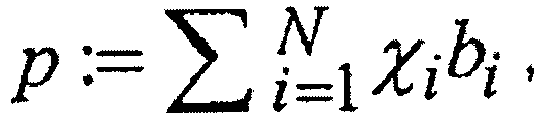
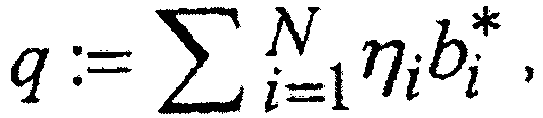
Applications Claiming Priority (2)
| Application Number | Priority Date | Filing Date | Title |
|---|---|---|---|
| JP2009264454 | 2009-11-20 | ||
| PCT/JP2010/070280 WO2011062136A1 (ja) | 2009-11-20 | 2010-11-15 | 暗号処理システム、鍵生成装置、鍵委譲装置、暗号化装置、復号装置、暗号処理方法及び暗号処理プログラム |
Publications (3)
| Publication Number | Publication Date |
|---|---|
| EP2503533A1 EP2503533A1 (de) | 2012-09-26 |
| EP2503533A4 EP2503533A4 (de) | 2014-09-10 |
| EP2503533B1 true EP2503533B1 (de) | 2016-10-05 |
Family
ID=44059614
Family Applications (1)
| Application Number | Title | Priority Date | Filing Date |
|---|---|---|---|
| EP10831530.0A Not-in-force EP2503533B1 (de) | 2009-11-20 | 2010-11-15 | Verschlüsselungsverarbeitungssystem, schlüsselerzeugungsvorrichtung, schlüsseldelegationsvorrichtung, entschlüsselungsvorrichtung, verschlüsselungsverarbeitungsverfahren und verschlüsselungsverarbeitungsprogramm |
Country Status (7)
| Country | Link |
|---|---|
| US (1) | US8577030B2 (de) |
| EP (1) | EP2503533B1 (de) |
| JP (1) | JP5769401B2 (de) |
| KR (1) | KR101336349B1 (de) |
| CN (1) | CN103038805B (de) |
| ES (1) | ES2602052T3 (de) |
| WO (1) | WO2011062136A1 (de) |
Families Citing this family (17)
| Publication number | Priority date | Publication date | Assignee | Title |
|---|---|---|---|---|
| EP2525340B1 (de) | 2010-01-15 | 2018-06-06 | Mitsubishi Electric Corporation | Vertrauliches suchsystem und verschlüsselungsverarbeitungssystem |
| US8462939B2 (en) * | 2010-12-07 | 2013-06-11 | King Fahd University Of Petroleum And Minerals | RNS-based cryptographic system and method |
| EP2756627B1 (de) | 2011-09-28 | 2018-11-14 | Koninklijke Philips N.V. | Hierarchische attributbasierte verschlüsselung und entschlüsselung |
| EP2797254A4 (de) * | 2011-12-20 | 2015-10-28 | Mitsubishi Electric Corp | Vorrichtung für verschlüsselte datenverwaltung, verfahren für verschlüsselte datenverwaltung und programm für verschlüsselte datenverwaltung |
| JP5730805B2 (ja) * | 2012-04-04 | 2015-06-10 | 日本電信電話株式会社 | 格子問題に基づく階層型内積暗号システム,格子問題に基づく階層型内積暗号方法,装置 |
| JP5901803B2 (ja) * | 2013-01-16 | 2016-04-13 | 三菱電機株式会社 | 情報処理装置及び情報処理方法及びプログラム |
| EP2860905A1 (de) * | 2013-10-09 | 2015-04-15 | Thomson Licensing | Verfahren zur Verschlüsselung einer Nachricht mittels einer geschlüsselten homomorphischen Verschlüsselungsfunktion, sowie entsprechendes elektronisches Gerät und Computerprogrammprodukt |
| EP3113405B1 (de) | 2014-02-24 | 2020-10-28 | Mitsubishi Electric Corporation | Kryptografisches system und kryptografisches programm |
| JP6266130B2 (ja) * | 2014-12-05 | 2018-01-24 | 三菱電機株式会社 | 暗号システム、マスター鍵更新装置及びマスター鍵更新プログラム |
| CN107454975B (zh) | 2015-04-07 | 2020-11-27 | 三菱电机株式会社 | 加密系统和密钥生成装置 |
| EP3483866B1 (de) * | 2016-07-06 | 2020-12-23 | Nippon Telegraph and Telephone Corporation | System zur sicheren berechnung, vorrichtung zur sicheren berechnung, verfahren zur sicheren berechnung und programm |
| US10205713B2 (en) * | 2017-04-05 | 2019-02-12 | Fujitsu Limited | Private and mutually authenticated key exchange |
| AU2018271515B2 (en) * | 2017-05-25 | 2020-09-10 | Ntt, Inc. | Secret tampering detection system, secret tampering detection apparatus, secret tampering detection method, and program |
| JP6456451B1 (ja) | 2017-09-25 | 2019-01-23 | エヌ・ティ・ティ・コミュニケーションズ株式会社 | 通信装置、通信方法、及びプログラム |
| US11483136B2 (en) | 2019-12-10 | 2022-10-25 | Google Llc | Wrapped keys with access control predicates |
| US12099997B1 (en) | 2020-01-31 | 2024-09-24 | Steven Mark Hoffberg | Tokenized fungible liabilities |
| CN112733111B (zh) * | 2020-12-31 | 2023-05-23 | 暨南大学 | 一种基于片段分割的阈值谓词加密生物特征认证方法 |
Family Cites Families (8)
| Publication number | Priority date | Publication date | Assignee | Title |
|---|---|---|---|---|
| US20070223686A1 (en) | 2004-09-16 | 2007-09-27 | Shidong Li | Methods and apparatus for data and signal encryption and decryption by irregular subspace leaping |
| JP2008011092A (ja) * | 2006-06-28 | 2008-01-17 | Fuji Xerox Co Ltd | 暗号化コンテンツ検索方式 |
| US8401179B2 (en) | 2008-01-18 | 2013-03-19 | Mitsubishi Electric Corporation | Encryption parameter setting apparatus, key generation apparatus, cryptographic system, program, encryption parameter setting method, and key generation method |
| CN101335615B (zh) * | 2008-05-30 | 2010-12-29 | 北京飞天诚信科技有限公司 | 用于usb key音频加解密装置密钥协商的方法 |
| CN101404577B (zh) * | 2008-10-30 | 2010-04-21 | 南京大学 | 一种融合多种保密技术的保密通信方法 |
| JP5349261B2 (ja) * | 2009-04-23 | 2013-11-20 | 三菱電機株式会社 | 暗号処理システム、鍵生成装置、鍵委譲装置、暗号化装置、復号装置、暗号処理方法及び暗号処理プログラム |
| US8515060B2 (en) * | 2009-04-24 | 2013-08-20 | Nippon Telegraph And Telephone Corporation | Encryption apparatus, decryption apparatus, encryption method, decryption method, security method, program, and recording medium |
| EP2525340B1 (de) * | 2010-01-15 | 2018-06-06 | Mitsubishi Electric Corporation | Vertrauliches suchsystem und verschlüsselungsverarbeitungssystem |
-
2010
- 2010-11-15 WO PCT/JP2010/070280 patent/WO2011062136A1/ja not_active Ceased
- 2010-11-15 CN CN201080065337.0A patent/CN103038805B/zh not_active Expired - Fee Related
- 2010-11-15 US US13/509,695 patent/US8577030B2/en active Active
- 2010-11-15 KR KR1020127013861A patent/KR101336349B1/ko not_active Expired - Fee Related
- 2010-11-15 EP EP10831530.0A patent/EP2503533B1/de not_active Not-in-force
- 2010-11-15 ES ES10831530.0T patent/ES2602052T3/es active Active
- 2010-11-19 JP JP2010258447A patent/JP5769401B2/ja active Active
Also Published As
| Publication number | Publication date |
|---|---|
| JP5769401B2 (ja) | 2015-08-26 |
| KR101336349B1 (ko) | 2013-12-04 |
| US8577030B2 (en) | 2013-11-05 |
| CN103038805A (zh) | 2013-04-10 |
| US20120284530A1 (en) | 2012-11-08 |
| ES2602052T3 (es) | 2017-02-17 |
| EP2503533A4 (de) | 2014-09-10 |
| CN103038805B (zh) | 2015-07-29 |
| EP2503533A1 (de) | 2012-09-26 |
| WO2011062136A1 (ja) | 2011-05-26 |
| KR20120088774A (ko) | 2012-08-08 |
| JP2011128609A (ja) | 2011-06-30 |
Similar Documents
| Publication | Publication Date | Title |
|---|---|---|
| EP2523178B1 (de) | Kryptographisches verarbeitungssystem, schlüsselgenerierungsgerät, schlüsseldelegierungsgerät, verschlüsselungsgerät, entschlüsselungsgerät, kryptografie verarbeitungsverfahren und kryptographisches verarbeitungsprogramm | |
| EP2565862B1 (de) | Verschlüsselungsverarbeitungssystem, schlüsselerzeugungsvorrichtung, verschlüsselungsvorrichtung, unterschriftenverarbeitungssystem und überprüfungsvorrichtung | |
| US8577030B2 (en) | Cryptographic processing system, key generation device, key delegation device, encryption device, decryption device, cryptographic processing method, and cryptographic processing program | |
| EP2690817B1 (de) | Codeverarbeitungssystem, schlüsselerzeugungsvorrichtung, kodierer, dekodierer, codeverarbeitungsverfahren und codeverarbeitungsprogramm | |
| EP2424154B1 (de) | Verschlüsselungsverarbeitungssystem | |
| EP2824652B1 (de) | Verschlüsselungssystem, verschlüsselungsverfahren und verschlüsselungsprogramm | |
| US8938623B2 (en) | Cryptographic processing system, key generation device, encryption device, decryption device, cryptographic processing method, and cryptographic processing program | |
| EP2670081B1 (de) | Signaturverarbeitungssystem, schlüsselerzeugungsvorrichtung, signaturvorrichtung, signaturverarbeitungsverfahren und signaturverarbeitungsprogramm | |
| EP2911137B1 (de) | Kryptosystem | |
| EP2947810A1 (de) | Verschlüsselungssystem, schlüsselerzeugungsvorrichtung für neuverschlüsselung, neuverschlüsselungsvorrichtung, verschlüsselungsverfahren und verschlüsselungsprogramm | |
| EP2675107B1 (de) | Verschlüsselungsverarbeitungssystem, schlüsselerzeugungsvorrichtung, verschlüsselungsvorrichtung, entschlüsselungsvorrichtung, schlüsselweitergabevorrichtung, verschlüsselungsverarbeitungsverfahren und verschlüsselungsverarbeitungsprogramm | |
| EP3113405A1 (de) | Kryptografisches system und kryptografisches programm |
Legal Events
| Date | Code | Title | Description |
|---|---|---|---|
| PUAI | Public reference made under article 153(3) epc to a published international application that has entered the european phase |
Free format text: ORIGINAL CODE: 0009012 |
|
| 17P | Request for examination filed |
Effective date: 20120504 |
|
| AK | Designated contracting states |
Kind code of ref document: A1 Designated state(s): AL AT BE BG CH CY CZ DE DK EE ES FI FR GB GR HR HU IE IS IT LI LT LU LV MC MK MT NL NO PL PT RO RS SE SI SK SM TR |
|
| DAX | Request for extension of the european patent (deleted) | ||
| REG | Reference to a national code |
Ref country code: DE Ref legal event code: R079 Ref document number: 602010037034 Country of ref document: DE Free format text: PREVIOUS MAIN CLASS: G09C0001000000 Ipc: H04L0009300000 |
|
| A4 | Supplementary search report drawn up and despatched |
Effective date: 20140811 |
|
| RIC1 | Information provided on ipc code assigned before grant |
Ipc: H04L 9/08 20060101ALI20140805BHEP Ipc: H04L 9/30 20060101AFI20140805BHEP |
|
| GRAP | Despatch of communication of intention to grant a patent |
Free format text: ORIGINAL CODE: EPIDOSNIGR1 |
|
| INTG | Intention to grant announced |
Effective date: 20160419 |
|
| GRAS | Grant fee paid |
Free format text: ORIGINAL CODE: EPIDOSNIGR3 |
|
| GRAA | (expected) grant |
Free format text: ORIGINAL CODE: 0009210 |
|
| AK | Designated contracting states |
Kind code of ref document: B1 Designated state(s): AL AT BE BG CH CY CZ DE DK EE ES FI FR GB GR HR HU IE IS IT LI LT LU LV MC MK MT NL NO PL PT RO RS SE SI SK SM TR |
|
| REG | Reference to a national code |
Ref country code: GB Ref legal event code: FG4D |
|
| REG | Reference to a national code |
Ref country code: CH Ref legal event code: EP |
|
| REG | Reference to a national code |
Ref country code: AT Ref legal event code: REF Ref document number: 835425 Country of ref document: AT Kind code of ref document: T Effective date: 20161015 |
|
| REG | Reference to a national code |
Ref country code: FR Ref legal event code: PLFP Year of fee payment: 7 |
|
| REG | Reference to a national code |
Ref country code: IE Ref legal event code: FG4D |
|
| REG | Reference to a national code |
Ref country code: DE Ref legal event code: R096 Ref document number: 602010037034 Country of ref document: DE |
|
| REG | Reference to a national code |
Ref country code: NL Ref legal event code: MP Effective date: 20161005 |
|
| REG | Reference to a national code |
Ref country code: LT Ref legal event code: MG4D |
|
| REG | Reference to a national code |
Ref country code: ES Ref legal event code: FG2A Ref document number: 2602052 Country of ref document: ES Kind code of ref document: T3 Effective date: 20170217 |
|
| PG25 | Lapsed in a contracting state [announced via postgrant information from national office to epo] |
Ref country code: BE Free format text: LAPSE BECAUSE OF NON-PAYMENT OF DUE FEES Effective date: 20161130 Ref country code: LV Free format text: LAPSE BECAUSE OF FAILURE TO SUBMIT A TRANSLATION OF THE DESCRIPTION OR TO PAY THE FEE WITHIN THE PRESCRIBED TIME-LIMIT Effective date: 20161005 |
|
| REG | Reference to a national code |
Ref country code: AT Ref legal event code: MK05 Ref document number: 835425 Country of ref document: AT Kind code of ref document: T Effective date: 20161005 |
|
| PG25 | Lapsed in a contracting state [announced via postgrant information from national office to epo] |
Ref country code: LT Free format text: LAPSE BECAUSE OF FAILURE TO SUBMIT A TRANSLATION OF THE DESCRIPTION OR TO PAY THE FEE WITHIN THE PRESCRIBED TIME-LIMIT Effective date: 20161005 Ref country code: SE Free format text: LAPSE BECAUSE OF FAILURE TO SUBMIT A TRANSLATION OF THE DESCRIPTION OR TO PAY THE FEE WITHIN THE PRESCRIBED TIME-LIMIT Effective date: 20161005 Ref country code: GR Free format text: LAPSE BECAUSE OF FAILURE TO SUBMIT A TRANSLATION OF THE DESCRIPTION OR TO PAY THE FEE WITHIN THE PRESCRIBED TIME-LIMIT Effective date: 20170106 Ref country code: NO Free format text: LAPSE BECAUSE OF FAILURE TO SUBMIT A TRANSLATION OF THE DESCRIPTION OR TO PAY THE FEE WITHIN THE PRESCRIBED TIME-LIMIT Effective date: 20170105 |
|
| PG25 | Lapsed in a contracting state [announced via postgrant information from national office to epo] |
Ref country code: FI Free format text: LAPSE BECAUSE OF FAILURE TO SUBMIT A TRANSLATION OF THE DESCRIPTION OR TO PAY THE FEE WITHIN THE PRESCRIBED TIME-LIMIT Effective date: 20161005 Ref country code: IS Free format text: LAPSE BECAUSE OF FAILURE TO SUBMIT A TRANSLATION OF THE DESCRIPTION OR TO PAY THE FEE WITHIN THE PRESCRIBED TIME-LIMIT Effective date: 20170205 Ref country code: RS Free format text: LAPSE BECAUSE OF FAILURE TO SUBMIT A TRANSLATION OF THE DESCRIPTION OR TO PAY THE FEE WITHIN THE PRESCRIBED TIME-LIMIT Effective date: 20161005 Ref country code: BE Free format text: LAPSE BECAUSE OF FAILURE TO SUBMIT A TRANSLATION OF THE DESCRIPTION OR TO PAY THE FEE WITHIN THE PRESCRIBED TIME-LIMIT Effective date: 20161005 Ref country code: PT Free format text: LAPSE BECAUSE OF FAILURE TO SUBMIT A TRANSLATION OF THE DESCRIPTION OR TO PAY THE FEE WITHIN THE PRESCRIBED TIME-LIMIT Effective date: 20170206 Ref country code: AT Free format text: LAPSE BECAUSE OF FAILURE TO SUBMIT A TRANSLATION OF THE DESCRIPTION OR TO PAY THE FEE WITHIN THE PRESCRIBED TIME-LIMIT Effective date: 20161005 Ref country code: HR Free format text: LAPSE BECAUSE OF FAILURE TO SUBMIT A TRANSLATION OF THE DESCRIPTION OR TO PAY THE FEE WITHIN THE PRESCRIBED TIME-LIMIT Effective date: 20161005 Ref country code: PL Free format text: LAPSE BECAUSE OF FAILURE TO SUBMIT A TRANSLATION OF THE DESCRIPTION OR TO PAY THE FEE WITHIN THE PRESCRIBED TIME-LIMIT Effective date: 20161005 Ref country code: NL Free format text: LAPSE BECAUSE OF FAILURE TO SUBMIT A TRANSLATION OF THE DESCRIPTION OR TO PAY THE FEE WITHIN THE PRESCRIBED TIME-LIMIT Effective date: 20161005 |
|
| REG | Reference to a national code |
Ref country code: CH Ref legal event code: PL |
|
| REG | Reference to a national code |
Ref country code: DE Ref legal event code: R097 Ref document number: 602010037034 Country of ref document: DE |
|
| PG25 | Lapsed in a contracting state [announced via postgrant information from national office to epo] |
Ref country code: CH Free format text: LAPSE BECAUSE OF NON-PAYMENT OF DUE FEES Effective date: 20161130 Ref country code: MC Free format text: LAPSE BECAUSE OF FAILURE TO SUBMIT A TRANSLATION OF THE DESCRIPTION OR TO PAY THE FEE WITHIN THE PRESCRIBED TIME-LIMIT Effective date: 20161005 Ref country code: SK Free format text: LAPSE BECAUSE OF FAILURE TO SUBMIT A TRANSLATION OF THE DESCRIPTION OR TO PAY THE FEE WITHIN THE PRESCRIBED TIME-LIMIT Effective date: 20161005 Ref country code: RO Free format text: LAPSE BECAUSE OF FAILURE TO SUBMIT A TRANSLATION OF THE DESCRIPTION OR TO PAY THE FEE WITHIN THE PRESCRIBED TIME-LIMIT Effective date: 20161005 Ref country code: LI Free format text: LAPSE BECAUSE OF NON-PAYMENT OF DUE FEES Effective date: 20161130 Ref country code: EE Free format text: LAPSE BECAUSE OF FAILURE TO SUBMIT A TRANSLATION OF THE DESCRIPTION OR TO PAY THE FEE WITHIN THE PRESCRIBED TIME-LIMIT Effective date: 20161005 Ref country code: DK Free format text: LAPSE BECAUSE OF FAILURE TO SUBMIT A TRANSLATION OF THE DESCRIPTION OR TO PAY THE FEE WITHIN THE PRESCRIBED TIME-LIMIT Effective date: 20161005 Ref country code: CZ Free format text: LAPSE BECAUSE OF FAILURE TO SUBMIT A TRANSLATION OF THE DESCRIPTION OR TO PAY THE FEE WITHIN THE PRESCRIBED TIME-LIMIT Effective date: 20161005 |
|
| PLBE | No opposition filed within time limit |
Free format text: ORIGINAL CODE: 0009261 |
|
| STAA | Information on the status of an ep patent application or granted ep patent |
Free format text: STATUS: NO OPPOSITION FILED WITHIN TIME LIMIT |
|
| REG | Reference to a national code |
Ref country code: IE Ref legal event code: MM4A |
|
| PG25 | Lapsed in a contracting state [announced via postgrant information from national office to epo] |
Ref country code: BG Free format text: LAPSE BECAUSE OF FAILURE TO SUBMIT A TRANSLATION OF THE DESCRIPTION OR TO PAY THE FEE WITHIN THE PRESCRIBED TIME-LIMIT Effective date: 20170105 Ref country code: SM Free format text: LAPSE BECAUSE OF FAILURE TO SUBMIT A TRANSLATION OF THE DESCRIPTION OR TO PAY THE FEE WITHIN THE PRESCRIBED TIME-LIMIT Effective date: 20161005 |
|
| 26N | No opposition filed |
Effective date: 20170706 |
|
| PG25 | Lapsed in a contracting state [announced via postgrant information from national office to epo] |
Ref country code: LU Free format text: LAPSE BECAUSE OF NON-PAYMENT OF DUE FEES Effective date: 20161130 |
|
| REG | Reference to a national code |
Ref country code: FR Ref legal event code: PLFP Year of fee payment: 8 |
|
| PG25 | Lapsed in a contracting state [announced via postgrant information from national office to epo] |
Ref country code: SI Free format text: LAPSE BECAUSE OF FAILURE TO SUBMIT A TRANSLATION OF THE DESCRIPTION OR TO PAY THE FEE WITHIN THE PRESCRIBED TIME-LIMIT Effective date: 20161005 Ref country code: IE Free format text: LAPSE BECAUSE OF NON-PAYMENT OF DUE FEES Effective date: 20161115 |
|
| PG25 | Lapsed in a contracting state [announced via postgrant information from national office to epo] |
Ref country code: CY Free format text: LAPSE BECAUSE OF FAILURE TO SUBMIT A TRANSLATION OF THE DESCRIPTION OR TO PAY THE FEE WITHIN THE PRESCRIBED TIME-LIMIT Effective date: 20161005 Ref country code: HU Free format text: LAPSE BECAUSE OF FAILURE TO SUBMIT A TRANSLATION OF THE DESCRIPTION OR TO PAY THE FEE WITHIN THE PRESCRIBED TIME-LIMIT; INVALID AB INITIO Effective date: 20101115 |
|
| PG25 | Lapsed in a contracting state [announced via postgrant information from national office to epo] |
Ref country code: TR Free format text: LAPSE BECAUSE OF FAILURE TO SUBMIT A TRANSLATION OF THE DESCRIPTION OR TO PAY THE FEE WITHIN THE PRESCRIBED TIME-LIMIT Effective date: 20161005 Ref country code: MK Free format text: LAPSE BECAUSE OF FAILURE TO SUBMIT A TRANSLATION OF THE DESCRIPTION OR TO PAY THE FEE WITHIN THE PRESCRIBED TIME-LIMIT Effective date: 20161005 |
|
| PG25 | Lapsed in a contracting state [announced via postgrant information from national office to epo] |
Ref country code: MT Free format text: LAPSE BECAUSE OF NON-PAYMENT OF DUE FEES Effective date: 20161115 |
|
| REG | Reference to a national code |
Ref country code: FR Ref legal event code: PLFP Year of fee payment: 9 |
|
| PGFP | Annual fee paid to national office [announced via postgrant information from national office to epo] |
Ref country code: ES Payment date: 20191202 Year of fee payment: 10 Ref country code: IT Payment date: 20191108 Year of fee payment: 10 |
|
| PG25 | Lapsed in a contracting state [announced via postgrant information from national office to epo] |
Ref country code: AL Free format text: LAPSE BECAUSE OF FAILURE TO SUBMIT A TRANSLATION OF THE DESCRIPTION OR TO PAY THE FEE WITHIN THE PRESCRIBED TIME-LIMIT Effective date: 20161005 |
|
| PGFP | Annual fee paid to national office [announced via postgrant information from national office to epo] |
Ref country code: DE Payment date: 20201103 Year of fee payment: 11 Ref country code: FR Payment date: 20201013 Year of fee payment: 11 Ref country code: GB Payment date: 20201104 Year of fee payment: 11 |
|
| PG25 | Lapsed in a contracting state [announced via postgrant information from national office to epo] |
Ref country code: IT Free format text: LAPSE BECAUSE OF NON-PAYMENT OF DUE FEES Effective date: 20201115 |
|
| REG | Reference to a national code |
Ref country code: ES Ref legal event code: FD2A Effective date: 20220202 |
|
| PG25 | Lapsed in a contracting state [announced via postgrant information from national office to epo] |
Ref country code: ES Free format text: LAPSE BECAUSE OF NON-PAYMENT OF DUE FEES Effective date: 20201116 |
|
| REG | Reference to a national code |
Ref country code: DE Ref legal event code: R119 Ref document number: 602010037034 Country of ref document: DE |
|
| GBPC | Gb: european patent ceased through non-payment of renewal fee |
Effective date: 20211115 |
|
| PG25 | Lapsed in a contracting state [announced via postgrant information from national office to epo] |
Ref country code: GB Free format text: LAPSE BECAUSE OF NON-PAYMENT OF DUE FEES Effective date: 20211115 Ref country code: DE Free format text: LAPSE BECAUSE OF NON-PAYMENT OF DUE FEES Effective date: 20220601 |
|
| PG25 | Lapsed in a contracting state [announced via postgrant information from national office to epo] |
Ref country code: FR Free format text: LAPSE BECAUSE OF NON-PAYMENT OF DUE FEES Effective date: 20211130 |