EP2503533B1 - Cipher processing system, key generating device, key delegating device, encrypting device, decrypting device, cipher processing method and cipher processing program - Google Patents
Cipher processing system, key generating device, key delegating device, encrypting device, decrypting device, cipher processing method and cipher processing program Download PDFInfo
- Publication number
- EP2503533B1 EP2503533B1 EP10831530.0A EP10831530A EP2503533B1 EP 2503533 B1 EP2503533 B1 EP 2503533B1 EP 10831530 A EP10831530 A EP 10831530A EP 2503533 B1 EP2503533 B1 EP 2503533B1
- Authority
- EP
- European Patent Office
- Prior art keywords
- vector
- key
- basis
- dec
- del
- Prior art date
- Legal status (The legal status is an assumption and is not a legal conclusion. Google has not performed a legal analysis and makes no representation as to the accuracy of the status listed.)
- Not-in-force
Links
Images


Classifications
-
- H—ELECTRICITY
- H04—ELECTRIC COMMUNICATION TECHNIQUE
- H04L—TRANSMISSION OF DIGITAL INFORMATION, e.g. TELEGRAPHIC COMMUNICATION
- H04L9/00—Cryptographic mechanisms or cryptographic arrangements for secret or secure communications; Network security protocols
- H04L9/08—Key distribution or management, e.g. generation, sharing or updating, of cryptographic keys or passwords
-
- H—ELECTRICITY
- H04—ELECTRIC COMMUNICATION TECHNIQUE
- H04L—TRANSMISSION OF DIGITAL INFORMATION, e.g. TELEGRAPHIC COMMUNICATION
- H04L9/00—Cryptographic mechanisms or cryptographic arrangements for secret or secure communications; Network security protocols
- H04L9/08—Key distribution or management, e.g. generation, sharing or updating, of cryptographic keys or passwords
- H04L9/0816—Key establishment, i.e. cryptographic processes or cryptographic protocols whereby a shared secret becomes available to two or more parties, for subsequent use
- H04L9/0819—Key transport or distribution, i.e. key establishment techniques where one party creates or otherwise obtains a secret value, and securely transfers it to the other(s)
- H04L9/083—Key transport or distribution, i.e. key establishment techniques where one party creates or otherwise obtains a secret value, and securely transfers it to the other(s) involving central third party, e.g. key distribution center [KDC] or trusted third party [TTP]
- H04L9/0833—Key transport or distribution, i.e. key establishment techniques where one party creates or otherwise obtains a secret value, and securely transfers it to the other(s) involving central third party, e.g. key distribution center [KDC] or trusted third party [TTP] involving conference or group key
- H04L9/0836—Key transport or distribution, i.e. key establishment techniques where one party creates or otherwise obtains a secret value, and securely transfers it to the other(s) involving central third party, e.g. key distribution center [KDC] or trusted third party [TTP] involving conference or group key using tree structure or hierarchical structure
-
- H—ELECTRICITY
- H04—ELECTRIC COMMUNICATION TECHNIQUE
- H04L—TRANSMISSION OF DIGITAL INFORMATION, e.g. TELEGRAPHIC COMMUNICATION
- H04L9/00—Cryptographic mechanisms or cryptographic arrangements for secret or secure communications; Network security protocols
- H04L9/08—Key distribution or management, e.g. generation, sharing or updating, of cryptographic keys or passwords
- H04L9/0816—Key establishment, i.e. cryptographic processes or cryptographic protocols whereby a shared secret becomes available to two or more parties, for subsequent use
- H04L9/0838—Key agreement, i.e. key establishment technique in which a shared key is derived by parties as a function of information contributed by, or associated with, each of these
- H04L9/0847—Key agreement, i.e. key establishment technique in which a shared key is derived by parties as a function of information contributed by, or associated with, each of these involving identity based encryption [IBE] schemes
-
- H—ELECTRICITY
- H04—ELECTRIC COMMUNICATION TECHNIQUE
- H04L—TRANSMISSION OF DIGITAL INFORMATION, e.g. TELEGRAPHIC COMMUNICATION
- H04L9/00—Cryptographic mechanisms or cryptographic arrangements for secret or secure communications; Network security protocols
- H04L9/12—Transmitting and receiving encryption devices synchronised or initially set up in a particular manner
-
- H—ELECTRICITY
- H04—ELECTRIC COMMUNICATION TECHNIQUE
- H04L—TRANSMISSION OF DIGITAL INFORMATION, e.g. TELEGRAPHIC COMMUNICATION
- H04L9/00—Cryptographic mechanisms or cryptographic arrangements for secret or secure communications; Network security protocols
- H04L9/30—Public key, i.e. encryption algorithm being computationally infeasible to invert or user's encryption keys not requiring secrecy
- H04L9/3066—Public key, i.e. encryption algorithm being computationally infeasible to invert or user's encryption keys not requiring secrecy involving algebraic varieties, e.g. elliptic or hyper-elliptic curves
- H04L9/3073—Public key, i.e. encryption algorithm being computationally infeasible to invert or user's encryption keys not requiring secrecy involving algebraic varieties, e.g. elliptic or hyper-elliptic curves involving pairings, e.g. identity based encryption [IBE], bilinear mappings or bilinear pairings, e.g. Weil or Tate pairing
Definitions
- This invention relates to a hierarchical predicate key encapsulation mechanism (HPKEM) scheme and a hierarchical predicate encryption (HPE) scheme.
- HPKEM hierarchical predicate key encapsulation mechanism
- HPE hierarchical predicate encryption
- Non-Patent Literature18 discusses implementation of HPKEM and HPE schemes in dual spaces paired through a pairing operation.
- PE predicate encryption
- PKEM predicate key encapsulation mechanism
- a cryptographic processing system for example, performs a predicate encryption process using dual vector spaces of a space V and a space V* paired through a pairing operation shown in Formula 1, and the cryptographic processing system comprises:
- a cryptographic system can implement a predicate encryption (PE) scheme and a predicate key encapsulation mechanism (PKEM) scheme with enhanced security.
- PE predicate encryption
- PKEM predicate key encapsulation mechanism
- a processing device is a CPU 911 or the like to be described later.
- a storage device is a ROM 913, a RAM 914, a magnetic disk 920 or the like to be described later.
- a communication device is a communication board 915 or the like to be described later.
- An input device is a keyboard 902, the communication board 915 or the like to be described later.
- An output device is the RAM 914, the magnetic disk 920, the communication board 915, an LCD 901 or the like to be described later. That is, the processing device, the storage device, the communication device, the input device, and the output device are hardware.
- Formula 101 denotes that y is randomly selected from A according to the distribution of A. That is, y is a random number in Formula 101. y ⁇ R A
- Formula 102 denotes that y is uniformly selected from A. That is, y is a uniform random number in Formula 102. y ⁇ U A
- Formula 104 denotes that a machine (algorithm) A outputs a on an input x.
- a vector symbol denotes a vector representation over a finite field Fq, that is, Formula 105.
- x ⁇ denotes x 1 , ... , x n ⁇ F q .
- Formula 106 denotes the inner-product of two vectors x ⁇ and v ⁇ shown in Formula 107, and Formula 108 shows this inner-product.
- a cryptographic process shall include an encryption process, a decryption process, and a key generation process, and shall also include a key encapsulation process.
- PE (PKEM) scheme with delegation for inner-product predicates which is a type of PE (PKEM) scheme with delegation
- the PE (PKEM) schemes with delegation to be discussed in the subsequent embodiments are PE (PKEM) schemes with delegation for inner-product predicates.
- PKEM PE
- HPE hierarchical PE
- HPKEM hierarchical PKEM
- the HPE scheme for inner-product predicates in vector spaces will be described.
- the HPE and HPKEM schemes for inner-product predicates are implemented in vector spaces.
- a “base” and a “basis vector” will be described first.
- the "PE scheme for inner-product predicates in vector spaces” will be described.
- a "method for implementing a hierarchical structure in a vector space” will be described. Further, to reinforce the understanding, an implementation example of the hierarchical structure will be described.
- Fig. 1 is a diagram for explaining the notion of "delegation (hierarchical delegation)".
- Delegation means that a user who has a higher level key generates a lower level key having more limited capabilities than the user's (higher level) key.
- a root (key generation device) generates secret keys for first level (level-1) users by using a master secret key. That is, the root generates keys 1, 2, and 3 for first level users 1, 2, and 3, respectively. Then, by using the key 1, for example, the user 1 can generate keys 11, 12, and 13 for users 11, 12, and 13, respectively, who are lower (second) level users of the user 1.
- the keys 11, 12, and 13 possessed by the users 11, 12, and 13 have more limited capabilities than the key 1 possessed by the user 1.
- the limited capabilities mean that ciphertexts that can be decrypted by that secret key are limited. That is, a lower level secret key can only decrypt some of ciphertexts that can be decrypted by a higher level secret key.
- the keys 11, 12, and 13 possessed by the users 11, 12, and 13 can only decrypt some of ciphertexts that can be decrypted by the key 1 possessed by the user 1. Normally, the keys 11, 12, and 13 can decrypt respectively different ciphertexts. On the other hand, a ciphertext that can be decrypted by the keys 11, 12, or 13 can be decrypted by the key 1.
- each secret key is provided for a specific level. This is described as “hierarchical”. That is, as shown in Fig. 1 , hierarchical generation of lower level keys is called “hierarchical delegation”.
- the root generates the secret keys for the first level users
- the first level users generate the secret keys for the second level users
- the second level users generate the secret keys for the third level users.
- the root can generate not only the secret keys for the first level users, but also the secret keys for the second or lower level users.
- the first level users can generate not only the secret keys for the second level users, but also the secret keys for the third or lower level users. That is, the root or each user can generate the secret keys for levels lower than the level of its own secret key.
- the attribute information x is embedded in a ciphertext
- the predicate information f v is embedded in a secret key That is, in the PE scheme, a ciphertext c encrypted based on the attribute information x is decrypted by a secret key SK f generated based on the predicate information f v .
- f v (x) 1 if the inner-product of the attribute information x and the predicate information f v is 0.
- HPE (HPKEM) scheme for inner-product predicates is a type of "PE scheme for inner-product predicates" with the above-described notion of "hierarchical delegation”.
- attribute information and predicate information have hierarchical structures, in order to add a hierarchical delegation system to the PE scheme for inner-product predicates.
- Fig. 3 is a diagram showing hierarchical structures of attribute information and predicate information.
- attribute information and predicate information with the same reference numerals correspond to each other (i.e., their inner-product is 0). That is, the inner-product of an attribute 1 and a predicate 1 is 0, the inner-product of an attribute 11 and a predicate 11 is 0, the inner-product of an attribute 12 and a predicate 12 is 0, and the inner-product of an attribute 13 and a predicate 13 is 0.
- a ciphertext c1 encrypted by the attribute 1 can be decrypted by a secret key k1 generated based on the predicate 1.
- a ciphertext c11 encrypted by the attribute 11 can be decrypted by a secret key k1 generated based on the predicate 11.
- the same can be said of the attribute 12 and the predicate 12 as well as the attribute 13 and the predicate 13.
- the HPE scheme for inner-product predicates has the hierarchical delegation system.
- the secret key k11 can be generated based on the predicate 11 and the secret key k1 generated based on the predicate 1. That is, a user having the higher level secret key k1 can generate its lower level secret key k11 from the secret key k1 and the lower level predicate 11.
- a secret key k12 can be generated from the secret key k1 and the predicate 12
- a secret key k13 can be generated from the secret key k1 and the predicate 13.
- a ciphertext encrypted by a key (public key) corresponding to a lower level secret key can be decrypted by a higher level secret key.
- a ciphertext encrypted by a key (public key) corresponding to a higher level secret key cannot be decrypted by a lower level secret key. That is, the ciphertexts c11, c12, and c13 encrypted by the attributes 11, 12, and 13, respectively, can be decrypted by the secret key k1 generated based on the predicate 1.
- the ciphertext c1 encrypted by the attribute 1 cannot be decrypted by the secret keys k11, k12, and k13 generated based on the predicates 11, 12, and 13, respectively. That is, the inner-product of the attribute 11, 12, or 13 and the predicate 1 is 0.
- the inner-product of the attribute 1 and the predicate 11, 12, or 13 is not 0.
- Fig. 4 is a diagram showing an example of a hierarchical identity-based encryption (HIBE) scheme, which is an application example of the HPE scheme for inner-product predicates to be described later.
- the HIBE scheme is a cryptographic process in which the notion of hierarchical is applied to an identity-based encryption (IBE) scheme.
- the IBE scheme is a type of PE scheme, namely, a matching PE scheme, which allows a ciphertext to be decrypted if an ID included in the ciphertext matches an ID included in a secret key.
- a root (key generation device) generates a secret key (key A) corresponding to the ID "A".
- a security administrator of Company A based on the key A and the ID of each division, a security administrator of Company A generates a secret key corresponding to that ID.
- the security administrator generates a secret key (key 1) corresponding to an ID "A-1" of a sales division.
- an administrator of each division Based on the secret key of each division and the ID of each unit belonging to that division, for example, an administrator of each division generates a secret key corresponding to that ID.
- an administrator of the sales division generates a secret key (key 11) corresponding to an ID "A-11" of a sales unit 1.
- a ciphertext encrypted by the ID "A-11" of the sales unit 1 can be decrypted by the key 11 which is the secret key corresponding to the ID "A-11" of the sales unit 1.
- a ciphertext encrypted by the ID of a sales unit 2 or a sales unit 3 cannot be decrypted by the key 11.
- a ciphertext encrypted by the ID of the sales division cannot be decrypted by the key 11.
- a ciphertext encrypted by the ID "A-1" of the sales division can be decrypted by the key 1 which is the secret key corresponding to the ID "A-1" of the sales division.
- a ciphertext encrypted by the ID of a unit belonging to the sales division can be decrypted by the key 1. That is, a ciphertext encrypted by the ID of the sales unit 1, 2, or 3 can be decrypted by the key 1.
- a ciphertext encrypted by the ID of a manufacturing division (ID: A-2) or a staff division (ID: A-3) cannot be decrypted by the key 1.
- a ciphertext encrypted by the ID of Company A cannot be decrypted by the key 1.
- a ciphertext encrypted by the ID "A" of Company A can be decrypted by the key A which is the secret key corresponding to the ID "A" of Company A. Also, a ciphertext encrypted by the ID of each division belonging to Company A or the ID of a unit belonging to each division can be decrypted by the key A.
- the HPE scheme for inner-product predicates can be adapted to various applications other than the IBE scheme.
- the cryptographic processes to be described later are not limited to a class of equality tests, so that they can be applied to a vast number of applications.
- the cryptographic processes can also be adapted for other types of PE scheme for inner-product predicates such as a searchable encryption scheme, making it possible to implement applications that are not possible with a prior art PE scheme with the delegation system, such as limiting a searchable range at each level by using a conditional expression such as AND or OR.
- HPKEM and HPE schemes to be described in the subsequent embodiments can be applied to a wide variety of applications such as the IBE and searchable encryption schemes.
- HPKEM and HPE schemes are implemented in high-dimensional vector spaces called dual pairing vector spaces (DPVS) to be described later.
- DPVS dual pairing vector spaces
- Fig. 5 is a diagram for explaining the basis and the basis vector.
- Fig. 5 shows a vector v of a 2-dimensional vector space.
- the vector v is c 1 a 1 + c 2 a 2 .
- the vector v is y 1 b 1 + y 2 b 2 .
- c 1 , c 2 , y 1 , and y 2 are coefficients of respective basis vectors.
- Fig. 5 shows a 2-dimensional vector space, so that there are two basis vectors in each basis. In an N-dimensional vector space, there are an N number of basis vectors in each basis.
- the attribute information x and the predicate information f v are vectors, namely, an attribute vector x ⁇ and a predicate vector v ⁇ , their inner-product predicate is defined as shown in Formula 109.
- a result of inputting the attribute information x to the predicate information f v is 1 (true) if the inner-product of the attribute vector x ⁇ and the predicate vector v ⁇ (i.e., the sum of element-wise inner-products) is 0, and a result of inputting the attribute information x to the predicate information f v is 0 (false) if the inner-product of the attribute vector x ⁇ and the predicate vector v ⁇ is not 0.
- Fig. 6 is a diagram for explaining an example of the method for implementing a hierarchical structure in a vector space.
- L-th level attribute information not only L-th level but first to L-th level attribute information is used to generate a ciphertext.
- a format of hierarchy ⁇ ⁇ is used to denote a hierarchical structure of a vector space.
- the format of hierarchy ⁇ ⁇ is shown in Formula 110.
- ⁇ ⁇ : n , d ; ⁇ 1 , ... , ⁇ d
- the format of hierarchy ⁇ ⁇ has information n which denotes the number of basis vectors (number of dimensions) assigned to represent the hierarchical structure, information d which denotes the depth of hierarchy, and information ⁇ 1 , ..., ⁇ d which denote basis vectors assigned to each level.
- Hierarchical predicates shown in Formula 114 on hierarchical attributes shown in Formula 113 are defined as shown in Formula 115.
- F f v ⁇ 1 , ... , v ⁇ L
- the first level secret key sk 1 generated based on the first level predicate vector v ⁇ 1 is a secret key generated by (v ⁇ 1 ; (0, 0), (0, 0)).
- "*" denotes an arbitrary value.
- the second level secret key sk 2 generated based on the second level predicate vectors (v ⁇ 1 , v ⁇ 2 ) is a secret key generated by (v ⁇ 1 , v ⁇ 2 , (0, 0)).
- the Setup algorithm takes as input a security parameter 1 ⁇ and a format of hierarchy ⁇ ⁇ , and outputs a master public key pk and a master secret key sk.
- the master secret key sk is a top level key.
- the GenKey algorithm takes as input the master public key pk, the master secret key sk, and predicate vectors shown in Formula 119, and outputs an L-th level secret key shown in Formula 120.
- the Enc algorithm takes as input the master public key pk, attribute vectors shown in Formula 121, and a message m, and outputs a ciphertext c. That is, the Enc algorithm outputs the ciphertext c containing the message m and encrypted by the attribute vectors shown in Formula 121. x ⁇ 1 , ... , x ⁇ h where 1 ⁇ h ⁇ d .
- the Dec algorithm takes as input the master public key pk, the L-th level secret key shown in Formula 122, and the ciphertext c, and outputs either the message m or a distinguished symbol ⁇ .
- the distinguished symbol ⁇ is information indicating decryption failure. That is, the Dec algorithm decrypts the ciphertext c by the L-th level secret key, and extracts the message m. In case of decryption failure, the Dec algorithm outputs the distinguished symbol ⁇ . sk v ⁇ 1 , ... , v ⁇ L where 1 ⁇ L ⁇ d .
- Delegate L takes as input the master public key pk, the L-th level secret key shown in Formula 123, and an (L+1)-th level predicate vector shown in Formula 124, and outputs an (L+1)-th level secret key shown in Formula 125. That is, the Delegate L algorithm outputs a lower level secret key. sk v ⁇ 1 , ... , v ⁇ L v ⁇ L + 1 sk v ⁇ 1 , ... , v ⁇ L + 1
- the Setup algorithm takes as input a security parameter 1 ⁇ and a format of hierarchy u ⁇ , and outputs a master public key pk and a master secret key sk.
- the master secret key sk is a top level key.
- the GenKey algorithm takes as input the master public key pk, the master secret key sk, and predicate vectors shown in Formula 126, and outputs an L-th level secret key shown in Formula 127.
- the Enc algorithm takes as input the master public key pk and attribute vectors shown in Formula 128, and outputs a ciphertext c and a session key K. That is, the Enc algorithm outputs the ciphertext c containing predetermined information (p) and encrypted by the attribute vectors shown in Formula 128 as well as the session key K generated from the predetermined information (p). x ⁇ 1 , ... , x ⁇ h where 1 ⁇ h ⁇ d .
- the Dec algorithm takes as input the master public key pk, the L-th level secret key shown in Formula 129, and the ciphertext c, and outputs either the session key K or a distinguished symbol ⁇ .
- the distinguished symbol ⁇ is information indicating decryption failure. That is, the Dec algorithm decrypts the ciphertext c by the L-th level secret key, extracts the information on the predetermined information (p), and generates the session key K. In case of decryption failure, the Dec algorithm outputs the distinguished symbol ⁇ . sk v ⁇ 1 , ... , v ⁇ L
- the Delegate L algorithm takes as input the master public key pk, the L-th level secret key shown in Formula 130, and an (L+1)-th level predicate vector shown in Formula 131, and outputs an (L+1)-th level secret key shown in Formula 132. That is, the Delegate L algorithm outputs a lower level secret key. sk v ⁇ 1 , ... , v ⁇ L v ⁇ L + 1 sk v ⁇ 1 , ... , v ⁇ L + 1
- the cryptographic processing system 10 will be described.
- the cryptographic processing system 10 executes the above-described algorithms of the HPE and HPKEM schemes.
- Fig. 7 is a configuration diagram of the cryptographic processing system 10.
- the cryptographic processing system 10 includes a key generation device 100, an encryption device 200, a decryption device 300, and a key delegation device 400.
- the decryption device 300 includes the key delegation device 400.
- the cryptographic processing system 10 implements hierarchical cryptographic processes, so that it includes a plurality of the encryption devices 200, a plurality of the decryption devices 300, and a plurality of the key delegation devices 400.
- the key generation device 100 executes the Setup and GenKey algorithms of the HPKEM and HPE schemes.
- the encryption device 200 executes the Enc algorithm of the HPKEM and HPE schemes.
- the decryption device 300 executes the Dec algorithm of the HPKEM and HPE schemes.
- the key delegation device 400 executes the Delegate L algorithm of the HPKEM and HPE schemes.
- Fig. 8 is a flowchart showing operations of the key generation device 100, an L-th level encryption device 200, and an L-th level decryption device 300 of the cryptographic processing system 10. That is, Fig. 8 is a flowchart showing operations from the generation of master keys (a master public key and a master secret key) and the generation of an L-th level secret key to the encryption and decryption at the L-th level.
- master keys a master public key and a master secret key
- the encryption device 200 executes the Enc algorithm to generate a ciphertext c.
- the encryption device 200 also generates a session key K.
- the encryption device 200 transmits the generated ciphertext c to the decryption device 300 through a network or the like.
- the attribute vector x ⁇ L may be public, or may be obtained by the encryption device 200 from the key generation device 100 or the decryption device 300.
- the decryption device 300 executes the Dec algorithm to decrypt the ciphertext c received from the encryption device 200. As a result of decrypting the ciphertext c, the decryption device 300 obtains the session key K in the case of the HPKEM scheme, or obtains a message m in the case of the HPE scheme. In case of decryption failure, the decryption device 300 outputs a distinguished symbol ⁇ .
- Fig. 9 shows a flowchart showing operations of an L-th level key delegation device 400, an (L+1)-th level encryption device 200, and an (L+1)-th level decryption device 300 of the cryptographic processing system 10. That is, Fig. 9 is a flowchart showing operations from the generation of an (L+1)-th level secret key to the encryption and decryption at the (L+1)-th level.
- the L-th level delegation device 400 executes the Delegate L algorithm to generate an (L+1)-th level secret key.
- the L-th level key delegation device 400 secretly provides the generated secret key to the (L+1)-th level decryption device 300.
- the encryption device 200 executes the Enc algorithm to generate a ciphertext c.
- the encryption device 200 also generates a session key K.
- the encryption device 200 transmits the generated ciphertext c to the decryption device 300 through a network or the like.
- the decryption device 300 executes the Dec algorithm to decrypt the ciphertext c received from the encryption device 200. As a result of decrypting the ciphertext c, the decryption device 300 obtains the session key K in the case of the HPKEM scheme, or obtains a message m in the case of the HPE scheme.
- DPVS dual pairing vector spaces
- DPVS are not limited to those realized by direct products of asymmetric pairing groups. That is, the cryptographic processes to be described below can be implemented in DPVS constructed by other methods. Three typical examples of DFVS are discussed in Non-Patent Literature 17.
- Bilinear pairing groups (q, G 1 , G 2 , G T , g 1 , g 2 , g T ) will be described.
- the bilinear pairing groups (q, G 1 , G 2 , G T , g 1 , g 2 , g T ) are a tuple of three cyclic groups G 1 , G 2 and G T of order q.
- g 1 is a generator of G 1
- g 2 is a generator of G 2 .
- the bilinear pairing groups (q, G 1 , G 2 , G T , g 1 , g 2 , g T ) satisfy the following condition of nondegenerate bilinear pairing:
- Symmetric bilinear pairing can be constructed using supersingular (hyper) elliptic curves.
- asymmetric bilinear pairing can be constructed using any (hyper) elliptic curves.
- Asymmetric bilinear pairing can be constructed using, for example, ordinary elliptic curves.
- Acyclic group (1-dimensional space) is extended to a higher-dimensional (vector) space. That is, as shown in Formula 134, N-dimensional vector spaces V and V* are constructed by direct products of G 1 and G 2 .
- V : G 1 ⁇ ... ⁇ G 1 ⁇ N
- V * : G 2 ⁇ ... ⁇ G 2 ⁇ N
- x i , y i ⁇ F q for i 1, ...,N.
- Formula 135 shows the canonical bases A and A * .
- a : a 1 , ... , a N
- a * : a 1 * , ... , a N *
- the canonical bases A and A * satisfy the conditions shown in Formula 136.
- e a i a j * g T ⁇ i , j i , j ⁇ 1 , ... , N
- the canonical bases A and A * are dual orthonormal bases, and the spaces V and V * are dual vector spaces paired through the pairing operation e.
- a pairing operation e on the N-dimensional vector spaces V and V * is defined as shown in Formula 137.
- the pairing operation e (x, y) can be expressed as shown in Formula 138.
- Fig. 10 is a diagram for explaining the base change method.
- the canonical basis A of the space V is changed to another basis B of the space V as shown in Formula 140.
- X : x i , j ⁇ U GL N
- B : b 1 , ... , b N .
- GL stands for general linear. That is, GL is a general linear group, a set of square matrices with nonzero determinants, and a group under multiplication.
- the basis B*: (b* I , ..., b* N ) of the space V* can be efficiently computed from the canonical basis A* of the space V*.
- the basis B* of the space V* is computed by using X as shown in Formula 141.
- v i , j : X T ⁇ 1
- B * : b 1 * , ... , b N * .
- the bases B and B * are dual orthonormal bases of dual spaces V and V * . This means that even when the canonical bases A and A * are changed by using X, dual orthonormal bases are preserved.
- a linear transformation, called a distortion map, for a generator x in the space V over the canonical basis A will be described.
- the distortion map ⁇ i, j can achieve the transformation shown in Formula 145.
- x : x 1 g 1 , ... , x j g 1 , ... , x N g 1 , ⁇ i , j x : ( 0 , ... , 0 ⁇ i ⁇ 1 , x j g 1 , 0 , ... , 0 ) ⁇ N ⁇ i
- an element, namely a basis vector j, in the canonical basis A of the vector x can be transformed into another element, namely a basis vector i, in the canonical basis A.
- elements other than the basis vector j that is transformed all become 0. That is, in the vector x, the basis vector j becomes the basis vector i and other elements become 0.
- a distortion map ⁇ * i, j on the canonical basis A* of the space V* can be represented in the same manner as the distortion map ⁇ i, j on the canonical basis A of the space V
- any linear transformation W expressed as an N ⁇ N-matrix shown in Formula 146, for x ⁇ V can be efficiently computed by Formula 147.
- the DPVS (q, V, V*, G T , A, A*) satisfy the following three conditions: (1) there exists a nondegenerate bilinear pairing, (2) the canonical bases A and A * are dual orthonormal bases, and (3) there exist distortion maps.
- the first condition is that there exists a nondegenerate bilinear pairing e shown in Formula 148.
- the canonical bases A and A * of the spaces V and V* are dual orthonormal bases.
- the second condition is that the canonical bases A and A * of the spaces V and V * satisfy the condition shown in Formula 149.
- the cryptographic processing system 10 implements the PE scheme for inner-product predicates in the DPVS (q, V, V * , G T , A, A*), where the spaces V and V * are (n+3)-dimensional spaces.
- the basis B ⁇ is used as a master public key pk
- the basis B * is used as a master secret key sk.
- k * : ⁇ v 1 b 1 * + ⁇ + v n b n * + ⁇ b n + 1 * + 1 ⁇ ⁇ b n + 2 * where ⁇ , ⁇ ⁇ U F q .
- the ciphertexts c 1 and c 2 are generated as shown in Formula 152.
- c 1 ⁇ 1 x 1 b 1 + ⁇ + x n b n + ⁇ d n + 1 + ⁇ 2 b n + 3
- the decryption device 300 can obtain the message m by computing Formula 153 as shown in Formula 154.
- a master secret key includes a basis B*: (b* 1 , ..., b* 9 ).
- a subscript “dec” stands for “decryption” and indicates a key vector used for decrypting a ciphertext.
- a subscript “ran” stands for “randomization” and indicates a randomizing vector for randomizing the coefficient of a predetermined basis vector of a lower level key.
- a subscript “del” stands for “delegation” and indicates a key generation vector for generating a lower level key vector.
- c 1 ⁇ 1 x 1 b 1 + x 2 b 2 + ⁇ + ⁇ 3 x 5 b 5 + x 6 b 6 + ⁇ d 7 + ⁇ 4 b 9
- x ⁇ + : x 1 x 2 x 3 + x 4 + x 5 + x 6 + where x 3 + x 4 + x 5 + x 6 + ⁇ U F q 4 .
- the ciphertext c 1 generated by the attribute vector x ⁇ 1 is generated as the ciphertext c 1 generated by the attribute vector x ⁇ + shown in Formula 156.
- k * 1,dec is a key vector used for decrypting a ciphertext.
- (k * 1,ran,1 , k * 1,ran,2 ) are randomizing vectors for randomizing the coefficient of a predetermined basis vector of a lower level key vector.
- (k * i,del,3 , ..., k * 1,del,6 ) are key-generation vectors for generating a lower level key vector.
- k * 1,dec , (k * 1,ran,1 , k * 1,ran,2 ), and (k * 1,del,3 , ..., k * 1,del,6 ) are generated as shown in Formula 157.
- ⁇ 2,0 (v 3 k * 1,del,3 + v 4 k * 1,del,4 ) is added to k * 1,dec .
- the coefficients of(v i b * 1 + v 2 b * 2 ), b * 7 , and b * 8 of the second level secret key are randomized (uniformly distributed).
- dec ( ⁇ 0 , 1 k * 1,ran,1 + ⁇ 0 , 2 k * 1,ran,2 ) is also added.
- the second level secret key k ⁇ * 2 : (k * 2,dec , k * 2,ran,1 , k * 2,ran,2 , k * 2,ran,3 ) k * 2,del,5 k * 2,del,6 ) is generated as shown in Formula 160.
- k * 2,dec is a key vector used for decrypting a ciphertext.
- (k * 2,ran,1 , k * 2,ran,2 , k * 2,ran,3 ) are randomizing vectors for randomizing the coefficient of a predetermined basis vector of a lower level key vector.
- (k * 2,del,5 ) k * 2,del,6 ) are used for generating a lower level key.
- k * L,dec is a key vector used for decrypting a ciphertext.
- k * L,ran,j is a randomizing vector for randomizing the coefficient of a predetermined basis vector of a lower level key vector.
- k * L,del,j is a key-generation vector for generating a lower level key vector.
- Fig. 11 is a functional block diagram showing the functions of the cryptographic processing system 10 that implements the HPE scheme.
- the cryptographic processing system 10 includes the key generation device 100, the encryption device 200, the decryption device 300, and the key delegation device 400. It is also assumed in this embodiment that the decryption device 300 includes the key delegation device 400.
- Fig. 12 is a flowchart showing operations of the key generation device 100.
- Fig. 13 is a flowchart showing operations of the encryption device 200.
- Fig. 14 is a flowchart showing operations of the decryption device 300.
- Fig. 15 is a flowchart showing operations of the key delegation device 400.
- Fig. 16 is a conceptual diagram showing a structure of a basis of dual pairing vector spaces (DPVS).
- the key generation device 100 includes a master key generation unit 110, a master key storage unit 120, a key vector generation unit 130, a randomizing vector generation unit 140, a key-generation vector generation unit 150, and a key distribution unit 160.
- the master key generation unit 110 computes Formula 161 to generate a master public key pk and a master secret key sk, and stores the generated keys in the master key storage unit 120.
- N : n + 3 , q V V * G T A A * ⁇ R G dpvs 1 ⁇ N X : ⁇ i , j ⁇ U GL N
- N the number of bases assigned to represent the hierarchical structure of the format of hierarchy ⁇ ⁇ . That is, in addition to the n number of bases assigned to represent the hierarchical structure, three basis vectors are provided. The number of basis vectors may, of course, be increased further.
- the structure of the basis vectors assigned for the predicate vectors and attribute vectors is the same as the structure shown in Fig. 6 .
- Two of the three remaining basis vectors (the (n+1)-th and (n+2)-th basis vectors) are used for information for generating a session key.
- the remaining one of the three remaining basis vectors (the (n+3)-th basis vector) is used for randomizing a ciphertext c 1 .
- the master key generation unit 110 executes the Setup algorithm shown in Formula 162 to generate the master public key pk and the master secret key sk.
- the key vector generation unit 130 uses the processing device and based on the master public key pk, the master secret key sk, and predicate vectors (v ⁇ 1 , ..., v ⁇ L ) shown in Formula 163, the key vector generation unit 130 computes Formula 164 to generate a key vector k * L, dec which is the first element of an L-th level (level L) secret key.
- the randomizing vector k * L,ran,j is the j-th element of the L-th level secret key.
- the key-generation vector k * L,del,j is the j-th element of the L-th level secret key.
- the key vector generation unit 130, the randomizing vector generation unit 140, and the key-generation vector generation unit 150 execute the GenKey algorithm shown in Formula 167.
- the key distribution unit 160 transmits the master public key generated by the master key generation unit 110 and the key information k ⁇ * L generated by the key vector generation unit 130, the randomizing vector generation unit 140, and the key-generation vector generation unit 150 to the decryption device 300 through the communication device.
- the key distribution unit 160 also transmits the master public key to the encryption device 200 through the communication device.
- the key information k ⁇ * L is secretly transmitted to the decryption device 300. Any method may be used to secretly transmit the key information k ⁇ * L to the decryption device 300.
- the key information k ⁇ * 1 may be transmitted using a prior art cryptographic process.
- the encryption device 200 includes a transmission information setting unit 210, a cipher vector generation unit 220, a cipher information generation unit 230, a data transmission unit 240, and a public key acquisition unit 250.
- the public key acquisition unit 250 has obtained the master public key and the attribute information vectors corresponding to the predicate information vectors of the decryption device 300 before the steps to be described below.
- the transmission information setting unit 210 uses the processing device and based on the master public key pk to compute Formula 168 to generate a transmission information vector ⁇ v.
- the cipher vector generation unit 220 uses the processing device and based on the master public key pk and attribute vectors (x ⁇ 1 , ..., x ⁇ L ) shown in Formula 169, the cipher vector generation unit 220 computes Formula 170 to generate a cipher vector c 1 .
- the vector rv is added for enhancing security and is not a requisite element.
- the cipher information generation unit 230 uses the processing device and based on a message m, the cipher information generation unit 230 computes Formula 171 to generate cipher information c 2 .
- the data transmission unit 240 transmits the cipher vector c 1 generated by the cipher vector generation unit 220 and the cipher information c 2 generated by the cipher information generation unit 230 to the decryption device 300 through the communication device.
- the encryption device 200 executes the Enc algorithm shown in Formula 172 to generate the cipher vector c 1 and the cipher information c 2 .
- the decryption device 300 includes a vector input unit 310, a key vector storage unit 320, and a pairing operation unit 330.
- the vector input unit 310 receives through the communication device and inputs the cipher vector c 1 and the cipher information c 2 transmitted by the data transmission unit 240 of the encryption device 200.
- the pairing operation unit 330 uses the processing device and based on the master public key pk and the key vector k * L,dec which is the first element of the L-th level secret key to compute Formula 173 to generate a message m'.
- m ⁇ : c 2 / e c 1 k L , dec *
- the pairing operation unit 330 performs the pairing operation e on the cipher vector c 1 input by the vector input unit 310 and the key vector k * L,dec stored in the storage device by the key vector storage unit 320.
- the pairing operation unit 330 thus computes g ⁇ T .
- the key vector storage unit 320 stores the key vector k * L,dec in the storage device.
- the decryption device 300 executes the Dec algorithm shown in Formula 175 to generate the message m'.
- Dec pk k L , dec * c 1 c 2 : m ⁇ : c 2 / e c 1 k L , dec * , return m ⁇ .
- the key delegation device 400 includes a key vector acquisition unit 410 (key-generation vector acquisition unit), a key vector generation unit 420, a randomizing vector generation unit 430, a key-generation vector generation unit 440, and a key distribution unit 450.
- the key vector generation unit 420 computes Formula 177 to generate a key vector k * L+1,dec which is the first element of an (L+1)-th level secret key.
- the randomizing vector k * L+1,ran,j is the j-th element of the (L+1)-th level secret key.
- the key-generation vector k * L+1,del,j is the j-th element of the (L+1)-th level secret key.
- the key distribution unit 440 transmits the key information k ⁇ * L+1 generated by the key vector generation unit 420, the randomizing vector generation unit 430, and the key-generation vector generation unit 440 to the decryption device 300 of a lower level through the communication device.
- the key information k ⁇ * L+1 is secretly transmitted to the decryption device 300. Any method may be used to secretly transmit the key information k ⁇ * L+1 to the decryption device 300. For example, the key information k ⁇ * L+1 may be transmitted using a prior art cryptographic process.
- the cryptographic processes to be implemented by the cryptographic processing system 10 have higher security than the cryptographic processes proposed in Non-Patent Literature 18, and security proof can be given in a standard model.
- the two lower level key vectors k * L+1,dec (A) and k * L+1,dec (B) generated from the key information k ⁇ * L are constructed as shown in Formula 182.
- the randomizing vector k * L,ran,j in which the coefficient is uniformly distributed by the random number ⁇ A,i is added to the key vector k * L+1,dec (A).
- the randomizing vector k * L,ran,i in which the coefficient is uniformly distributed by the random number ⁇ B,i is added to the key vector k * L+1,dec (B).
- the basis vector d n+1 in which the encryption device 200 sets transmission information is 2-dimensional.
- the dimension of the basis vector d n+1 may be 3-dimensional or higher, i.e., m-dimensional (basis vector b n+1 , ..., basis vector b n+m ).
- the key vector generation unit 130 sets the coefficients of the basis vectors b n+1 , ..., and b n+m such that the sum of the coefficients of the basis vectors b n+1 , ..., and b n+m is 1.
- the randomizing vector generation unit 140 sets the coefficients of the basis vectors b n+1 , ..., and b n+m such that the sum of the coefficients of the basis vectors b n+1 , ..., and b n+m is 0.
- the key-generation vector generation unit 150 sets the coefficients of the basis vectors b n+1 , ..., and b n+m such that the sum of the coefficients of the basis vectors b n+1 , ..., and b n+m is 0.
- the cipher vector generation unit 220 generates the vector rv by setting a random number as the coefficient of the basis vector b n+m+1 .
- n is an integer of 1 or larger. Accordingly, N is an integer of 4 or larger.
- n is an integer of 2 or larger. Accordingly, N is an integer of 5 or larger.
- (S402) it is not essential that the encryption device 200 generates the vector rv by using the basis vector b n+3 .
- N is an integer of 3 or larger.
- N is an integer of 4 or larger.
- distortion maps which have been described as one of the conditions of DPVS are not used. Distortion maps are used not in the algorithms for implementing the cryptographic processes, but for proving the security of the cryptographic processes.
- the cryptographic processes described above can be established in spaces without distortion maps. That is, it is not essential that there exist distortion maps in spaces for implementing the cryptographic processes described above. The same applies to the cryptographic processes to be described below.
- HPE scheme has been described above.
- HPKEM scheme will now be described. Only portions of the HPKEM scheme that are different from the above HPE scheme will be described.
- Fig. 17 is a functional block diagram showing functions of the cryptographic processing system 10 that implements the HPKEM scheme.
- the processing steps of the key generation device 100 and the processing steps of the key delegation device 400 are the same as those of the HPE scheme described above. Thus, only the processing steps of the encryption device 200 and the processing steps of the decryption device 300 will be described.
- Fig. 18 is a flowchart showing operations of the encryption device 200.
- Fig. 19 is a flowchart showing operations of the decryption device 300.
- the encryption device 200 shown in Fig. 17 includes a session key generation unit 260, in addition to the functions included in the encryption device 200 shown in Fig. 11 .
- the encryption device 200 shown in Fig. 17 does not include the cipher information generation unit 230 included in the encryption device 200 shown in Fig. 11 .
- the cipher vector c 1 generated by the cipher vector generation unit 220 in (S702) is transmitted to the decryption device 300 through the communication device. That is, in the HPKEM scheme, cipher information c 2 in which a message m is embedded is not generated and is not transmitted to the decryption device 300.
- the session key generation unit 260 computes Formula 183 to generate a session key K.
- the encryption device 200 executes the Enc algorithm shown in Formula 184 to generate the cipher vector c 1 and the session key K.
- the functions and operations of the decryption device 300 will be described.
- the vector input unit 310 receives through the communication device and inputs the cipher vector c 1 transmitted by the data transmission unit 240 of the encryption device 200.
- the pairing operation unit 330 uses the processing device and based on the master public key pk and the key vector k * L,dec which is the first element of the L-th level secret key to compute a session key K.
- K ⁇ : e c 1 k L , dec *
- the pairing operation unit 330 performs the pairing operation e on the cipher vector c 1 input by the vector input unit 310 and the key vector k * L,dec stored in the storage device by the vector storage unit 320.
- the session key K can be secretly transmitted from the encryption device 200 to the decryption device 300. This means that the session key can be shared between the encryption device 200 and the decryption device 300.
- basis vectors are used as shown in Fig. 16 . That is, the n number of basis vectors out the (n+3) number of basis vectors are used to represent the hierarchical structure of the basis vectors for attribute vectors and predicate vectors.
- a first ⁇ 1 number of basis vectors are used as the basis vectors for the first level attribute vectors and predicate vectors.
- a ( ⁇ 2 - ⁇ 1 ) number of basis vectors are used as the basis vectors for the second level attribute vectors and predicate vectors.
- a ( ⁇ L - ⁇ L-1 ) number of basis vectors are used as the basis vectors for the L-th level attribute vectors and predicate vectors.
- the n number of basis vectors out of the (n+3) number of basis vectors are used as the basis vectors for attribute vectors and predicate vectors.
- all of the n number of basis vectors are used as the basis vectors for predicate vectors. That is, all of the n number of basis vectors are always used as the basis vectors for attribute vectors or predicate vectors.
- Fig. 20 is a functional block diagram showing functions of the cryptographic processing system 10 that implements the PE scheme with delegation.
- the functions included in the cryptographic processing system 10 shown in Fig. 20 are the same as the functions included in the cryptographic processing system 10 shown in Fig. 11 .
- the flow of operations of the cryptographic processing system 10 for implementing the PE scheme with delegation according to the third embodiment are the same as the flow of operations of the cryptographic processing system 10 according to the second embodiment.
- the functions and operations of the cryptographic processing system 10 according to the third embodiment will be described with reference to Figs. 20 and 12 to 16 .
- the master key generation unit 110 computes Formula 187 to generate a master public key pk and a master secret key sk and stores the keys in the master key storage unit 120.
- the key vector generation unit 130 uses the processing device and based on the master public key pk, the master secret key sk, and predicate vectors (v ⁇ 1 , ..., v ⁇ L ) shown in Formula 188, the key vector generation unit 130 computes Formula 189 to generate a key vector k * L,dec which is the first element of an L-th level (level L) secret key.
- the key vector generation unit 130, the randomizing vector generation unit 140, and the key-generation vector generation unit 150 execute the GenKey algorithm shown in Formula 192.
- the key distribution unit 160 transmits the master public key generated by the master key generation unit 110 and the key information k ⁇ * L generated by the key vector generation unit 130, the randomizing vector generation unit 140, and the key-generation vector generation unit 150 to the decryption device 300 through the communication device.
- the key distribution unit 160 transmits the master public key to the encryption device 200 through the communication device.
- the transmission information setting unit 210 uses the processing device and based on the master public key pk, the transmission information setting unit 210 computes Formula 193 to generate a transmission information vector ⁇ v.
- the cipher vector generation unit 220 uses the processing device and based on the master public key pk and attribute vectors (x ⁇ 1 , ..., x ⁇ L ) shown in Formula 194, the cipher vector generation unit 220 computes Formula 195 to generate a cipher vector c 1 .
- the cipher information generation unit 230 computes Formula 196 to generate cipher information c 2 .
- c 2 : g T ⁇ m
- the data transmission unit 240 transmits the cipher vector c 1 generated by the cipher vector generation unit 220 and the cipher information c 2 generated by the cipher information generation unit 230 to the decryption device 300 through the communication device.
- the encryption device 200 executes the Enc algorithm shown in Formula 197 to generate the cipher vector c 1 and the cipher information c 2 .
- the functions and operations of the decryption device 300 will be described.
- the vector input unit 310 receives through the communication device and inputs the cipher vector c 1 and the cipher information c 2 transmitted by the data transmission unit 240 of the encryption device 200.
- the pairing operation unit 330 uses the processing device and based on the master public key pk and the key vector k * L, dec which is the first element of the L-th level secret key, the pairing operation unit 330 computes Formula 198 to generate a message m'.
- m ⁇ : c 2 / e c 1 k L , dec *
- the pairing operation unit 330 can generate the message m. It is assumed that the message m ⁇ G T .
- the decryption device 300 executes the Dec algorithm shown in Formula 199 to generate the message m'.
- Dec pk k L , dec * c 1 c 2 : m ⁇ : c 2 / e c 1 k L , dec * , return m ⁇ .
- the key vector generation unit 420 computes Formula 201 to generate a key vector k * L+1,dec which is the first element of an (L+1)-th level secret key.
- the key distribution unit 450 transmits the key information k ⁇ * L+1 generated by the key vector generation unit 420, the randomizing vector generation unit 430, and the key-generation vector generation unit 440 to the decryption device 300 of a lower level through the communication device.
- the basis vector d n+1 in which the encryption device 200 sets transmission information is 2-dimensional.
- the dimension of the basis vector d n+1 may be 3-dimensional or higher, i.e., m-dimensional (basis vector b n+1 , ..., basis vector b n+m ).
- the HPKEM scheme may also be implemented by modifying the Enc algorithm executed by the encryption device 200 and the Dec algorithm executed by the decryption device 300 as shown in Formula 205 and Formula 206 respectively.
- the cryptographic processes are implemented in cyclic groups of prime order q.
- a ring R is expressed using a composite number M as shown in Formula 207
- the cryptographic processes described in the above embodiments can be adapted to a module having the ring R as the coefficient.
- R : / M Z Z
- a hardware configuration of the cryptographic processing system 10 (the key generation device 100, the encryption device 200, the decryption device 300, and the key delegation device 400) according to the embodiments will now be described.
- Fig. 21 is a diagram showing an example hardware configuration of the key generation device 100, the encryption device 200, the decryption device 300, and the key delegation device 400.
- the key generation device 100, the encryption device 200, the decryption device 300, and the key delegation device 400 each include the CPU 911 (central processing unit, also called a processing unit, an arithmetic unit, a microprocessor, a microcomputer, or a processor).
- the CPU 911 is connected through the bus 912 with the ROM 913, the RAM 914, the LCD 901 (liquid crystal display), the keyboard 902 (K/B), the communication board 915, and the magnetic disk device 920, and controls these hardware devices.
- the magnetic disk device 920 (fixed disk device) may be replaced with a storage device such as an optical disk device or a memory card read/write device.
- the magnetic disk device 920 is connected through a predetermined fixed disk interface.
- the ROM 913 and the magnetic disk device 920 are examples of a nonvolatile memory.
- the RAM 914 is an example of a volatile memory.
- the ROM 913, the RAM 914, and the magnetic disk device 920 are examples of a storage device (memory).
- the keyboard 902 and the communication board 915 are examples of an input device.
- the communication board 915 is an example of a communication device (network interface).
- the LCD 901 is an example of a display device.
- the magnetic disk device 920, the ROM 913, or the like stores an operating system 921 (OS), a window system 922, programs 923, and files 924.
- the programs 923 are executed by the CPU 911, the operating system 921, and the window system 922.
- the programs 923 store software or programs for executing the functions described hereinabove as “the master key generation unit 110", “the master key storage unit 120", “the key vector generation unit 130", “the randomizing vector generation unit 140", “the key-generation vector generation unit 150”, “the key distribution unit 160”, “the transmission information setting unit 210", “the cipher vector generation unit 220", “the cipher information generation unit 230", “the data transmission unit 240", “the public key acquisition unit 250", "the session key generation unit 260”, “the vector input unit 310", “the key vector storage unit 320”, “the pairing operation unit 330”, “the key vector acquisition unit 410", “the key vector generation unit 420”, “the randomizing vector generation unit 430", “the key-generation vector generation unit 440", “the key distribution unit 450”, and so on.
- the programs are read and executed by the CPU 911.
- the files 924 store information, data, signal values, variable values, and parameters, such as "the master public key pk", “the master secret key sk", “the cipher vector c", and “the key vector” described hereinabove, each of which is stored as an item of a "file” or a “database”.
- the "file” or “database” is stored in a storage device such as a disk or memory.
- the information, data, signal values, variable values, and parameters stored in the storage device such as the disk or memory are read by the CPU 911 through a read/write circuit to a main memory or a cache memory, and are used for operations of the CPU 911 such as extraction, search, reference, comparison, calculation, computation, processing, output, printing, and display.
- the information, data, signal values, variable values, and parameters are temporarily stored in the main memory, the cache memory, or a buffer memory during the operations of the CPU 911 such as extraction, search, reference, comparison, calculation, computation, processing, output, printing, and display.
- an arrow mainly represents an input/output of data or a signal, and each data or signal value is stored in the RAM 914, or other types of storage medium such as an optical disk, or an IC chip.
- the data or signal is transferred online through the bus 912, a signal line, a cable, other types of transfer medium, or a radio wave.
- a ... unit may be “a ... circuit", “a ... device”, “a ... tool”, “a ... means”, or “a ... function”, and may also be “a ... step”, “a ... procedure”, or “a ... process”.
- a ... device may be “a ... circuit”, “a ... tool”, “a ... means”, or “a ... function”, and may also be “a ... step”, “a ... procedure”, or “a ... process”.
- What is described as “a ... process” may be “a ... step”. That is, what is described as “a ... unit” may be implemented by firmware stored in the ROM 913. Alternatively, "the ...
- the unit may be implemented solely by software, or solely by hardware such as elements, devices, boards, and wiring, or by a combination of software and hardware, or by a combination including firmware.
- Firmware or software is stored as a program in a storage medium such as the ROM 913.
- the program is read by the CPU 911 and executed by the CPU 911. That is, the program causes a computer or the like to function as "the ... unit” described above. Alternatively, the program causes the computer or the like to execute a procedure or a method of "the ... unit” described above.
Landscapes
- Engineering & Computer Science (AREA)
- Computer Security & Cryptography (AREA)
- Computer Networks & Wireless Communication (AREA)
- Signal Processing (AREA)
- Theoretical Computer Science (AREA)
- General Physics & Mathematics (AREA)
- Algebra (AREA)
- Mathematical Analysis (AREA)
- Mathematical Optimization (AREA)
- Mathematical Physics (AREA)
- Pure & Applied Mathematics (AREA)
- Physics & Mathematics (AREA)
- Computing Systems (AREA)
- Storage Device Security (AREA)
- Complex Calculations (AREA)
Description
- This invention relates to a hierarchical predicate key encapsulation mechanism (HPKEM) scheme and a hierarchical predicate encryption (HPE) scheme.
- Non-Patent Literature18 discusses implementation of HPKEM and HPE schemes in dual spaces paired through a pairing operation.
-
- Non-Patent
Literature 1 Bethencourt, J., Sahai, A., Waters, B.: Ciphertext-policy attribute-based encryption. In: 2007 IEEE Symposium on Security and Privacy, pp. 321--334. IEEE Press (2007) - Non-Patent Literature 2: Boneh, D., Boyen, X.: Efficient selective-ID secure identity based encryption without random oracles. In: Cachin, C., Camenisch, J. (eds.) EUROCRYPT 2004. LNCS, vol. 3027, pp. 223-238. Springer Heidelberg (2004) Non-Patent Literature 3: Boneh, D., Boyen, X.: Secure identity based encryption without random oracles. In: Franklin, M.K. (ed.) CRYPTO 2004. LNCS, vol. 3152, pp. 443--459. Springer Heidelberg (2004)
- Non-Patent Literature 4: Boneh, D., Boyen, X., Goh, E.: Hierarchical identity based encryption with constant size ciphertext. In: Cramer, R. (ed.) EUROCRYPT 2005. LNCS, vol. 3494, pp. 440--456. Springer Heidelberg (2005)
- Non-Patent Literature 5: Boneh, D., Franklin, M.: Identity-based encryption from the Weil pairing. In: Kilian, J. (ed.) CRYPTO 2001. LNCS, vol. 2139, pp. 213--229. Springer Heidelberg (2001)
- Non-Patent Literature 6: Boneh, D., Hamburg, M.: Generalized identity based and broadcast encryption scheme. In: Pieprzyk, J. (ed.) ASIACRYPT 2008. LNCS, vol. 5350, pp. 455--470. Springer Heidelberg (2008)
- Non-Patent Literature 7: Boneh, D., Waters, B.: Conjunctive, subset, and range queries on encrypted data. In: Vadhan, S.P. (ed.) TCC 2007. LNCS, vol. 4392, pp. 535--554. Springer Heidelberg (2007)
- Non-Patent Literature 8: Boyen, X., Waters, B.: Anonymous hierarchical identity-based encryption (without random oracles). In: Dwork, C. (ed.) CRYPTO 2006. LNCS, vol. 4117, pp. 290--307. Springer Heidelberg (2006)
- Non-Patent Literature 9: Cocks, C.: An identity based encryption scheme based on quadratic residues. In: Honary, B. (ed.) IMA Int. Conf. LNCS, vol. 2260, pp. 360--363. Springer Heidelberg (2001)
- Non-Patent Literature 10: Gentry, C.: Practical identity-based encryption without random oracles. In: Vaudenay, S. (ed.) EUROCRYPT 2006. LNCS, vol. 4004, pp. 445--464. Springer Heidelberg (2006)
- Non-Patent Literature 11: Gentry, C., Halevi, S.: Hierarchical identity-based encryption with polynomially many levels. In: Reingold, O. (ed.) TCC 2009. LNCS, vol. 5444, pp. 437--456. Springer Heidelberg (2009)
- Non-Patent Literature 12: Gentry, C., Silverberg, A.: Hierarchical ID-based cryptography. In: Zheng, Y (ed.) ASIACRYPT 2002. LNCS, vol. 2501, pp. 548--566. Springer Heidelberg (2002)
- Non-Patent Literature 13: Goyal, V, Pandey, O., Sahai, A., Waters, B.: Attribute-based encryption for fine-grained access control of encrypted data. In: ACM Conference on Computer and Communication Security 2006, pp. 89--98, ACM (2006)
- Non-Patent Literature 14: Groth, J., Sahai, A.: Efficient non-interactive proof systems for bilinear groups. In: Smart, N.P. (ed.) EUROCRYPT 2008. LNCS, vol. 4965, pp. 415--432. Springer Heidelberg (2008)
- Non-Patent Literature 15: Horwitz, J., Lynn, B.: Towards hierarchical identity-based encryption. In: Knudsen, L.R. (ed.) EUROCRYPT 2002. LNCS, vol. 2332, pp. 466--481. Springer Heidelberg (2002)
- Non-Patent Literature 16: Katz, J., Sahai, A., Waters, B.: Predicate encryption supporting disjunctions, polynomial equations, and inner products. In: Smart, N.P (ed.) EUROCRYPT 2008. LNCS, vol. 4965, pp. 14--162. Springer Heidelberg (2008)
- Non-Patent Literature 17: Okamoto, T., Takashima, K.: Homomorphic encryption and signatures from vector decomposition. In: Galbraith, S.D., Paterson, K.G (eds.) Pairing 2008. LNCS, vol. 5209, pp. 57--74. Springer Heidelberg (2008)
- Non-Patent Literature 18: Okamoto, T., Takashima, K.: A geometric approach on pairing and hierarchical predicate encryption. In: Poster session, EUROCRYPT 2009. (2009)
- Non-Patent Literature 19: Ostrovsky, R., Sahai, A., Waters, B.: Attribute-based encryption with non-monotonic access structures. In: ACM Conference on Computer and Communication Security 2007, pp. 195--203, ACM, (2007)
- Non-Patent Literature 20: Pirretti, M., Traynor, P., McDaniel, P., Waters, B.: Secure attribute-based systems. In: ACM Conference on Computer and Communication Security 2006, pp. 99--112, ACM, (2006)
- Non-Patent Literature 21: Sahai, A., Waters, B.: Fuzzy identity-based encryption. In: Cramer, R. (ed.) EUROCRYPT 2005. LNCS, vol. 3494, pp. 457--473. Springer Heidelberg (2005)
- Non-Patent Literature 22: Shi, E., Waters, B.: Delegating capability in predicate encryption systems. In: Aceto, L., Damgard, I., Goldberg, L.A., Halldorsson, M.M., Ingolfsdottir, A., Walukiewicz, I. (eds.) ICALP (2) 2008. LNCS, vol. 5126, pp. 560--578. Springer Heidelberg (2008)
- Non-Patent Literature 23: Takashima, K.: Efficiently computable distortion maps for supersingular curves. In: van der Poorten, A. J., Stein, A. (eds.) ANTS VIII, LNCS, vol. 5011, pp. 88--101. Springer Heidelberg (2008)
- Non-Patent Literature 24: Waters, B: Ciphertext-policy attribute-based encryption: an expressive, efficient, and provably secure realization. ePrint, IACR, http://eprint.iacr.org/2008/290
- In the HPKEM and HPE schemes proposed in Non-Patent Literature 18, security proof is given in an idealized (generic) model. However, in the HPKEM and HPE schemes proposed in Non-Patent Literature 18, security proof is not given in a standard model.
- It is an object of this invention to provide a predicate encryption (PE) scheme and a predicate key encapsulation mechanism (PKEM) scheme with enhanced security. In particular, it is an object of this invention to provide a PE scheme and a PKEM scheme with delegation capability.
- A cryptographic processing system according to this invention, for example, performs a predicate encryption process using dual vector spaces of a space V and a space V* paired through a pairing operation shown in
Formula 1, and the cryptographic processing system comprises: - an encryption device that, using a processing device, generates as a cipher vector c1 a vector of a basis B^, the basis B^ having, out of basis vectors b1 (i = 1, ..., n, ..., N) (N being an integer of 3 or greater and n being an integer from 1 to N-2) that constitute a predetermined basis B of the space V, basis vectors bi (i = 1, ..., n) and a basis vector dn+1 which is a sum of two or more basis vectors bi (i = n+1, ..., m) out of the basis vectors bi (i = n+1, ..., N), the cipher vector c1 being the vector in which attribute information is embedded as coefficients of one or more basis vectors out of the basis vector bi (i = 1, ..., n), and predetermined information is embedded as a coefficient of the basis vector dn+1; and
- a decryption device that, using the processing device, performs the pairing operation e (c1, k*L,dec) shown in
Formula 1 on the cipher vector c1 generated by the encryption device and a key vector k*L,dec to decrypt the cipher vector c1 and to extract a value concerning the predetermined information, the key vector k*L,dec being a vector of a basis B* of the space V* and constructed such that predicate information is embedded as coefficients of one or more basis vectors of basis vectors b*i (i =1, ..., n) out of basis vectors b*i(i=1, ..., n, ..., N) that constitute the basis B*, and coefficients of basis vectors b*i(i=n+1, ..., m) of the basis B* are embedded such that a sum of the coefficients of the basis vectors b*i (i=n+1, ..., m) is 1.


- A cryptographic system according to this invention can implement a predicate encryption (PE) scheme and a predicate key encapsulation mechanism (PKEM) scheme with enhanced security.
-
-
Fig. 1 is a diagram for explaining a notion of "delegation (hierarchical delegation}"; -
Fig. 2 is a diagram for explaining delegation skipping over a level; -
Fig. 3 is a diagram showing hierarchical structures of attribute information and predicate information; -
Fig. 4 is a diagram showing an example of a hierarchical identity-based encryption (HIBE) scheme which is an application example of a hierarchical predicate encryption (HPE) scheme for inner-product predicates; -
Fig. 5 is a diagram for explaining a basis and a basis vector; -
Fig. 6 is a diagram for explaining an example of a method for implementing a hierarchical structure in a vector space; -
Fig. 7 is a configuration diagram of acryptographic processing system 10; -
Fig. 8 is a flowchart showing operations of akey generation device 100, an L-thlevel encryption device 200, and an L-thlevel decryption device 300 of thecryptographic processing system 10; -
Fig. 9 is a flowchart showing operations of an L-th levelkey delegation device 400, an (L+1)-thlevel encryption device 200 and an (L+1)-thlevel decryption device 300 of thecryptographic processing system 10; -
Fig. 10 is a diagram for explaining a base change method; -
Fig. 11 is a functional block diagram showing functions of thecryptographic processing system 10 that implements an HPE scheme according to a second embodiment; -
Fig. 12 is a flowchart showing operations of thekey generation device 100 according to the second embodiment; -
Fig. 13 is a flowchart showing operations of theencryption device 200 according to the second embodiment; -
Fig. 14 is a flowchart showing operations of thedecryption device 300 according to the second embodiment; -
Fig. 15 is a flowchart showing operations of thekey delegation device 400 according to the second embodiment; -
Fig. 16 is a conceptual diagram showing a structure of a basis of dual pairing vector spaces according to the second embodiment; -
Fig. 17 is a functional block diagram showing functions of thecryptographic processing system 10 that implements a hierarchical predicate key encapsulation mechanism (HPKEM) scheme according to the second embodiment; -
Fig. 18 is a flowchart showing operations of theencryption device 200 according to the second embodiment; -
Fig. 19 is a flowchart showing operations of thedecryption device 300 according to the second embodiment; -
Fig. 20 is a functional block diagram showing functions of thecryptographic processing system 10 that implements a predicate encryption (PE) scheme with delegation capability according to a third embodiment; and -
Fig. 21 is a diagram showing an example of a hardware configuration of thekey generation device 100, theencryption device 200, thedecryption device 300, and thekey delegation device 400. - Embodiments of the invention will now be described with reference to drawings.
- In the following description, a processing device is a
CPU 911 or the like to be described later. A storage device is aROM 913, aRAM 914, amagnetic disk 920 or the like to be described later. A communication device is acommunication board 915 or the like to be described later. An input device is akeyboard 902, thecommunication board 915 or the like to be described later. An output device is theRAM 914, themagnetic disk 920, thecommunication board 915, anLCD 901 or the like to be described later. That is, the processing device, the storage device, the communication device, the input device, and the output device are hardware. - Notations to be used in the following description will be described.
- When A is a random variable or distribution,
Formula 101 denotes that y is randomly selected from A according to the distribution of A. That is, y is a random number inFormula 101.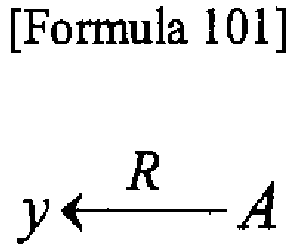
- When A is a set, Formula 102 denotes that y is uniformly selected from A. That is, y is a uniform random number in Formula 102.

-
Formula 103 denotes that y is set, defined or substituted by z.
- When a is a fixed value, Formula 104 denotes that a machine (algorithm) A outputs a on an input x.

- For example,

- A vector symbol denotes a vector representation over a finite field Fq, that is, Formula 105.

- Formula 106 denotes the inner-product of two vectors x→ and v→ shown in Formula 107, and Formula 108 shows this inner-product.


- In the following description, a cryptographic process shall include an encryption process, a decryption process, and a key generation process, and shall also include a key encapsulation process.
- In this embodiment, basic concepts for implementing a "predicate encryption (PE) scheme with delegation" and a "predicate key encapsulation mechanism (PKEM) scheme with delegation" to be discussed in subsequent embodiments will be described, together with basic constrictions of the PE (PKEM) scheme with delegation.
- Firstly, a notion of a "PE (PKEM) scheme with delegation for inner-product predicates", which is a type of PE (PKEM) scheme with delegation, will be described. The PE (PKEM) schemes with delegation to be discussed in the subsequent embodiments are PE (PKEM) schemes with delegation for inner-product predicates. To describe the notion of the PE scheme with delegation for inner-product predicates, a notion of "delegation" will be described first, together with a notion of "hierarchical delegation". Then, the "PE scheme for inner-product predicates" will be described. Then, a "hierarchical PE (HPE) scheme for inner-product predicates (hierarchical PKEM (HPKEM) scheme for inner-product predicates), which is a type of PE scheme for inner-product predicates with the notion of hierarchical delegation, will be described. Further, to reinforce the understanding of the HPE scheme for inner-product predicates, an application example of the HPE scheme for inner-product predicates will be described.
- Secondly, the HPE scheme for inner-product predicates in vector spaces will be described. In this and subsequent embodiments, the HPE and HPKEM schemes for inner-product predicates are implemented in vector spaces. A "base" and a "basis vector" will be described first. Then, the "PE scheme for inner-product predicates in vector spaces" will be described. Then, a "method for implementing a hierarchical structure in a vector space" will be described. Further, to reinforce the understanding, an implementation example of the hierarchical structure will be described.
- Thirdly, basic constructions of the "HPE and HPKEM schemes" according to this and subsequent embodiments will be described. A "
cryptographic processing system 10" that implements the HPE and HPKEM schemes will also be described. Fourthly, concepts for implementing the HPKEM and HPE schemes will be described. "Bilinear pairing groups", "vector spaces V and V*", "canonical dual bases A and A*", "pairing operation", "base change", and "distortion maps" will be described. - Fifthly, "dual pairing vector spaces (DPVS)" having rich mathematical structures for implementing the HPKEM and HPE schemes will be described.
- Sixthly, based on the above descriptions, a method for implementing the HPE and HPKEM schemes to be discussed in detail in the subsequent embodiments will be briefly described.
-
Fig. 1 is a diagram for explaining the notion of "delegation (hierarchical delegation)". - Delegation means that a user who has a higher level key generates a lower level key having more limited capabilities than the user's (higher level) key.
- In
Fig. 1 , a root (key generation device) generates secret keys for first level (level-1) users by using a master secret key. That is, the root generateskeys first level users key 1, for example, theuser 1 can generatekeys users user 1. Thekeys users user 1. The limited capabilities mean that ciphertexts that can be decrypted by that secret key are limited. That is, a lower level secret key can only decrypt some of ciphertexts that can be decrypted by a higher level secret key. This means that thekeys users key 1 possessed by theuser 1. Normally, thekeys keys key 1. - As shown in
Fig. 1 , each secret key is provided for a specific level. This is described as "hierarchical". That is, as shown inFig. 1 , hierarchical generation of lower level keys is called "hierarchical delegation". - In
Fig. 1 , it has been described that the root generates the secret keys for the first level users, the first level users generate the secret keys for the second level users, and the second level users generate the secret keys for the third level users. However, as shown inFig. 2 , the root can generate not only the secret keys for the first level users, but also the secret keys for the second or lower level users. Likewise, the first level users can generate not only the secret keys for the second level users, but also the secret keys for the third or lower level users. That is, the root or each user can generate the secret keys for levels lower than the level of its own secret key. - Next, the "PE scheme for inner-product predicates" will be described.
- The PE scheme is a cryptographic scheme in which a ciphertext can be decrypted if a result of inputting attribute information x to predicate information fv is 1 (true) (fv(x) = 1). Normally, the attribute information x is embedded in a ciphertext, and the predicate information fv is embedded in a secret key That is, in the PE scheme, a ciphertext c encrypted based on the attribute information x is decrypted by a secret key SKf generated based on the predicate information fv. The PE scheme may be described as a cryptographic scheme in which, for example, the predicate information fv is a conditional expression and the attribute information x is information to be input to the conditional expression, and a ciphertext can be decrypted if the input information (attribute information x) satisfies the conditional expression (predicate information fv) (fv(x)=1).
- The PE scheme is discussed in detail in Non-Patent Literature 16.
- The PE scheme for inner-product predicates is a type of PE scheme in which fv(x)=1 if the inner-product of attribute information x and predicate information fv is a predetermined value. That is, a ciphertext c encrypted by the attribute information x can be decrypted by a secret key SKf generated based on the predicate information fv if and only if the inner-product of the attribute information x and the predicate information fv is a predetermined value. In the following description, it is assumed that fv(x) = 1 if the inner-product of the attribute information x and the predicate information fv is 0.
- The HPE (HPKEM) scheme for inner-product predicates is a type of "PE scheme for inner-product predicates" with the above-described notion of "hierarchical delegation".
- In the HPE scheme for inner-product predicates, attribute information and predicate information have hierarchical structures, in order to add a hierarchical delegation system to the PE scheme for inner-product predicates.
-
Fig. 3 is a diagram showing hierarchical structures of attribute information and predicate information. - In
Fig. 3 , attribute information and predicate information with the same reference numerals correspond to each other (i.e., their inner-product is 0). That is, the inner-product of anattribute 1 and apredicate 1 is 0, the inner-product of anattribute 11 and apredicate 11 is 0, the inner-product of anattribute 12 and apredicate 12 is 0, and the inner-product of anattribute 13 and apredicate 13 is 0. This means that a ciphertext c1 encrypted by theattribute 1 can be decrypted by a secret key k1 generated based on thepredicate 1. A ciphertext c11 encrypted by theattribute 11 can be decrypted by a secret key k1 generated based on thepredicate 11. The same can be said of theattribute 12 and thepredicate 12 as well as theattribute 13 and thepredicate 13. - As described above, the HPE scheme for inner-product predicates has the hierarchical delegation system. Thus, the secret key k11 can be generated based on the
predicate 11 and the secret key k1 generated based on thepredicate 1. That is, a user having the higher level secret key k1 can generate its lower level secret key k11 from the secret key k1 and thelower level predicate 11. Likewise, a secret key k12 can be generated from the secret key k1 and thepredicate 12, and a secret key k13 can be generated from the secret key k1 and thepredicate 13. - A ciphertext encrypted by a key (public key) corresponding to a lower level secret key can be decrypted by a higher level secret key. On the other hand, a ciphertext encrypted by a key (public key) corresponding to a higher level secret key cannot be decrypted by a lower level secret key. That is, the ciphertexts c11, c12, and c13 encrypted by the
attributes predicate 1. On the other hand, the ciphertext c1 encrypted by theattribute 1 cannot be decrypted by the secret keys k11, k12, and k13 generated based on thepredicates attribute predicate 1 is 0. On the other hand, the inner-product of theattribute 1 and thepredicate -
Fig. 4 is a diagram showing an example of a hierarchical identity-based encryption (HIBE) scheme, which is an application example of the HPE scheme for inner-product predicates to be described later. The HIBE scheme is a cryptographic process in which the notion of hierarchical is applied to an identity-based encryption (IBE) scheme. The IBE scheme is a type of PE scheme, namely, a matching PE scheme, which allows a ciphertext to be decrypted if an ID included in the ciphertext matches an ID included in a secret key. - In the example shown in
Fig. 4 , based on a master secret key sk and an ID "A" of Company A, a root (key generation device) generates a secret key (key A) corresponding to the ID "A". For example, based on the key A and the ID of each division, a security administrator of Company A generates a secret key corresponding to that ID. For example, the security administrator generates a secret key (key 1) corresponding to an ID "A-1" of a sales division. Then, based on the secret key of each division and the ID of each unit belonging to that division, for example, an administrator of each division generates a secret key corresponding to that ID. For example, an administrator of the sales division generates a secret key (key 11) corresponding to an ID "A-11" of asales unit 1. - In this case, a ciphertext encrypted by the ID "A-11" of the
sales unit 1 can be decrypted by the key 11 which is the secret key corresponding to the ID "A-11" of thesales unit 1. However, a ciphertext encrypted by the ID of asales unit 2 or asales unit 3 cannot be decrypted by the key 11. Also, a ciphertext encrypted by the ID of the sales division cannot be decrypted by the key 11. - A ciphertext encrypted by the ID "A-1" of the sales division can be decrypted by the key 1 which is the secret key corresponding to the ID "A-1" of the sales division. Also, a ciphertext encrypted by the ID of a unit belonging to the sales division can be decrypted by the
key 1. That is, a ciphertext encrypted by the ID of thesales unit key 1. However, a ciphertext encrypted by the ID of a manufacturing division (ID: A-2) or a staff division (ID: A-3) cannot be decrypted by thekey 1. Also, a ciphertext encrypted by the ID of Company A cannot be decrypted by thekey 1. - A ciphertext encrypted by the ID "A" of Company A can be decrypted by the key A which is the secret key corresponding to the ID "A" of Company A. Also, a ciphertext encrypted by the ID of each division belonging to Company A or the ID of a unit belonging to each division can be decrypted by the key A.
- The HPE scheme for inner-product predicates can be adapted to various applications other than the IBE scheme. In particular, the cryptographic processes to be described later are not limited to a class of equality tests, so that they can be applied to a vast number of applications. For example, the cryptographic processes can also be adapted for other types of PE scheme for inner-product predicates such as a searchable encryption scheme, making it possible to implement applications that are not possible with a prior art PE scheme with the delegation system, such as limiting a searchable range at each level by using a conditional expression such as AND or OR.
- That is, the HPKEM and HPE schemes to be described in the subsequent embodiments can be applied to a wide variety of applications such as the IBE and searchable encryption schemes.
- The HPKEM and HPE schemes are implemented in high-dimensional vector spaces called dual pairing vector spaces (DPVS) to be described later. Thus, the HPE scheme for inner-product predicates in vector spaces will be described.
- First, a "basis" and a "basis vector" to be used for explaining a vector space will be briefly explained.
-
Fig. 5 is a diagram for explaining the basis and the basis vector. -
Fig. 5 shows a vector v of a 2-dimensional vector space. The vector v is c1a1 + c2a2. Further, the vector v is y1b1 + y2b2. Here, a1 and a2 are called basis vectors in a basis A, and are represented as basis A: = (a1, a2). b1 and b2 are called basis vectors in a basis B, and are represented as basis B: = (b1,b2). c1, c2, y1, and y2 are coefficients of respective basis vectors.Fig. 5 shows a 2-dimensional vector space, so that there are two basis vectors in each basis. In an N-dimensional vector space, there are an N number of basis vectors in each basis. - The PE scheme for inner-product predicates in vector spaces will now be described.
- As described above, the PE scheme for inner-product predicates is a type of PE scheme in which fv(x) = 1 if the inner-product of the attribute information x and the predicate information fv is a predetermined value (0 in this case). When the attribute information x and the predicate information fv are vectors, namely, an attribute vector x→ and a predicate vector v→, their inner-product predicate is defined as shown in Formula 109.


- That is, it is a type of PE scheme in which a result of inputting the attribute information x to the predicate information fv is 1 (true) if the inner-product of the attribute vector x→ and the predicate vector v→ (i.e., the sum of element-wise inner-products) is 0, and a result of inputting the attribute information x to the predicate information fv is 0 (false) if the inner-product of the attribute vector x→ and the predicate vector v→ is not 0.
- A method for implementing a hierarchical structure in a vector space will now be described.
-
Fig. 6 is a diagram for explaining an example of the method for implementing a hierarchical structure in a vector space. - The vector space here is assumed to be a high-dimensional (N-dimensional) vector space. That is, there exist an N number of basis vectors c1 (i = 1, ..., N) in a predetermined basis C of the vector space.
- An n number of basis vectors (basis vectors c1 (i = 1, ..., n)) out of the N number of basis vectors are used to represent the hierarchical structure. The basis vectors ci (i = 1, ..., n) are divided into a d number of groups, namely, basis vectors c1 (i = 1, ..., µ1), basis vectors ci (i = µ1+1, ..., µ2), ..., and basis vectors ci (i = µd-1+1, ..., n), where d denotes a depth of hierarchy.
- Then, a µ1 number of basis vectors c1 (i =1, ..., µ1) are assigned to represent attribute information and predicate information of the first level. A (µ2-µ1) number of basis vectors ci (i = µ1+1, ..., µ2) are assigned to represent attribute information and predicate information of the second level. Likewise, a (µd-µd-1) number of basis vectors ci (i = µd-1+1, ..., µd (=n)) are assigned to represent attribute information and predicate information of the d-th level.
- To generate a ciphertext by L-th level attribute information, not only L-th level but first to L-th level attribute information is used to generate a ciphertext. Likewise, to generate a secret key by L-th level predicate information, not only L-th level but first to L-th level predicate information is used to generate a secret key That is, to generate a ciphertext by the L-th level attribute information, or to generate a secret key by the L-th level predicate information, a µL number of basis vectors ci (i = 1, ..., µL) assigned to the first to L-th levels are used. For example, to generate a ciphertext by third level attribute information, a µ3 number of basis vectors ci (i = 1, ..., µ3) assigned to the first to third levels are used to generate a ciphertext, such that first to third level attribute information is reflected. Likewise, to generate a secret key by third level predicate information, the µ3 number of basis vectors ci (i = 1, ..., µ3) assigned to the first to third levels are used to generate a secret key, such that first to third level predicate information is reflected. That is, attribute information or predicate information to be used at a lower level includes attribute information or predicate information to be used at a higher level. In this way, attribute information and predicate information each have a hierarchical structure. Then, by using the hierarchical structures of attribute information and predicate information, a delegation system is incorporated in the PE scheme for inner-product predicates.
- In the following description, a format of hierarchy µ→ is used to denote a hierarchical structure of a vector space. The format of hierarchy µ→ is shown in
Formula 110.

- That is, the format of hierarchy µ→ has information n which denotes the number of basis vectors (number of dimensions) assigned to represent the hierarchical structure, information d which denotes the depth of hierarchy, and information µ1, ..., µd which denote basis vectors assigned to each level.
- The HPE scheme for inner-product predicates in vector spaces will now be described.
- Let an attribute space ∑L (L = 1, ..., d) be a space assigned to represent L-th level attribute information, where each ∑L is as shown in Formula 111.

- Let a set of hierarchical attributes be ∑ shown in Formula 112, where the union is a disjoint union.

- Then, hierarchical predicates shown in Formula 114 on hierarchical attributes shown in Formula 113 are defined as shown in Formula 115.


- Let a space of hierarchical predicates be F shown in Formula 116.

- Let h in Formula 117 and L in Formula 118 each be called a level.


- The hierarchical structure will be explained by using a simple example, where 6-dimensional space having three levels, each level consisting of 2-dimensional space, is employed. That is, µ→: = (n, d; µl, ..., µd) = (6, 3; 2, 4, 6).
- A user who has a first level secret key sk1 generated based on a first level predicate vector v→ 1: = (vi, v2) can generate a second level secret key sk2 based on the first level secret key sk1 and a second level predicate vector v→ 2: = (v3, v4). That is, the second level secret key sk2 is generated based on the predicate vectors (v→ 1, v→ 2). Likewise, a user who has the second level secret key sk2 can generate a third level secret key sk3 based on the second level secret key sk2 and a third level predicate vector v→ 3: = (v5, v6). That is, the third level secret key sk3 is generated based on the predicate vectors (
v →1, v→ 2, V→ 3). - The first level secret key sk1 generated based on the first level predicate vector v→ 1 is a secret key generated by (v→ 1; (0, 0), (0, 0)). Thus, the first level secret key sk1 can decrypt a ciphertext encrypted by an attribute vector (x→ 1, (*, *), (*, *)): = ((x1, x2), (*, *), (*, *)) if v→ 1 · x→ 1 = 0. This is because (*, *) · (0, 0) = 0. Here, "*" denotes an arbitrary value.
- Likewise, the second level secret key sk2 generated based on the second level predicate vectors (v→ 1, v→ 2) is a secret key generated by (v→ 1, v→ 2, (0, 0)). Thus, the second level secret key sk2 can decrypt a ciphertext encrypted by attribute vectors (x→ 1, x→ 2, (*, *)): = ((x1, x2), (x3, x4), (*, *)) if v→ 1 · x→ 1 = 0 and v→ 2 · x→ 2 = 0.
- However, the second level secret key sk2 cannot decrypt a ciphertext encrypted by the first level attribute vector x→ 1: = (x1, x2) (i.e., (x→ 1, (*, *), (*, *)). This is because if not v→ 2 = (0, 0), then (*, *) . v→ 2 ≠ 0 and v→ 2 · x→ 2 ≠ 0. Therefore, it can be stated that the second level secret key sk2 has more limited capabilities than the parent secret key sk1.
- A construction of the HPE scheme will be briefly described.
- The HPE scheme includes five probabilistic polynomial-time algorithms: Setup, GenKey, Enc, Dec, and DelegateL (L= 1, ..., d-1).
- The Setup algorithm takes as input a
security parameter 1λ and a format of hierarchy µ→, and outputs a master public key pk and a master secret key sk. The master secret key sk is a top level key. - The GenKey algorithm takes as input the master public key pk, the master secret key sk, and predicate vectors shown in Formula 119, and outputs an L-th level secret key shown in
Formula 120.

- The Enc algorithm takes as input the master public key pk, attribute vectors shown in Formula 121, and a message m, and outputs a ciphertext c. That is, the Enc algorithm outputs the ciphertext c containing the message m and encrypted by the attribute vectors shown in Formula 121.
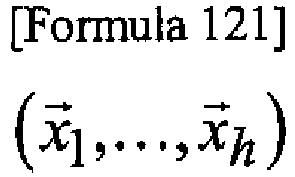

- The Dec algorithm takes as input the master public key pk, the L-th level secret key shown in Formula 122, and the ciphertext c, and outputs either the message m or a distinguished symbol ⊥. The distinguished symbol ⊥ is information indicating decryption failure. That is, the Dec algorithm decrypts the ciphertext c by the L-th level secret key, and extracts the message m. In case of decryption failure, the Dec algorithm outputs the distinguished symbol ⊥.
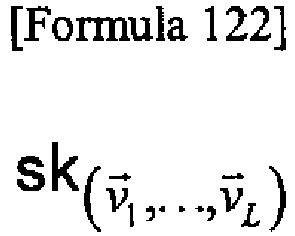

- DelegateL takes as input the master public key pk, the L-th level secret key shown in Formula 123, and an (L+1)-th level predicate vector shown in Formula 124, and outputs an (L+1)-th level secret key shown in Formula 125. That is, the DelegateL algorithm outputs a lower level secret key.


- A construction of the HPKEM scheme will be briefly explained.
- As with the HPE scheme, the HPKEM scheme includes five probabilistic polynomial-time algorithms: Setup, GenKey, Enc, Dec, and DelegateL (L = 1, ..., d-1).
- The Setup algorithm takes as input a
security parameter 1λ and a format of hierarchy u→, and outputs a master public key pk and a master secret key sk. The master secret key sk is a top level key. - The GenKey algorithm takes as input the master public key pk, the master secret key sk, and predicate vectors shown in Formula 126, and outputs an L-th level secret key shown in Formula 127.


- The Enc algorithm takes as input the master public key pk and attribute vectors shown in Formula 128, and outputs a ciphertext c and a session key K. That is, the Enc algorithm outputs the ciphertext c containing predetermined information (p) and encrypted by the attribute vectors shown in Formula 128 as well as the session key K generated from the predetermined information (p).
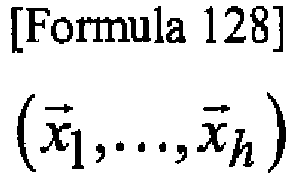

- The Dec algorithm takes as input the master public key pk, the L-th level secret key shown in Formula 129, and the ciphertext c, and outputs either the session key K or a distinguished symbol ⊥. The distinguished symbol ⊥ is information indicating decryption failure. That is, the Dec algorithm decrypts the ciphertext c by the L-th level secret key, extracts the information on the predetermined information (p), and generates the session key K. In case of decryption failure, the Dec algorithm outputs the distinguished symbol ⊥.

- The DelegateL algorithm takes as input the master public key pk, the L-th level secret key shown in
Formula 130, and an (L+1)-th level predicate vector shown in Formula 131, and outputs an (L+1)-th level secret key shown in Formula 132. That is, the DelegateL algorithm outputs a lower level secret key.


- The
cryptographic processing system 10 will be described. Thecryptographic processing system 10 executes the above-described algorithms of the HPE and HPKEM schemes. -
Fig. 7 is a configuration diagram of thecryptographic processing system 10. - The
cryptographic processing system 10 includes akey generation device 100, anencryption device 200, adecryption device 300, and akey delegation device 400. Here, thedecryption device 300 includes thekey delegation device 400. As described above, thecryptographic processing system 10 implements hierarchical cryptographic processes, so that it includes a plurality of theencryption devices 200, a plurality of thedecryption devices 300, and a plurality of thekey delegation devices 400. - The
key generation device 100 executes the Setup and GenKey algorithms of the HPKEM and HPE schemes. - The
encryption device 200 executes the Enc algorithm of the HPKEM and HPE schemes. - The
decryption device 300 executes the Dec algorithm of the HPKEM and HPE schemes. - The
key delegation device 400 executes the DelegateL algorithm of the HPKEM and HPE schemes. -
Fig. 8 is a flowchart showing operations of thekey generation device 100, an L-thlevel encryption device 200, and an L-thlevel decryption device 300 of thecryptographic processing system 10. That is,Fig. 8 is a flowchart showing operations from the generation of master keys (a master public key and a master secret key) and the generation of an L-th level secret key to the encryption and decryption at the L-th level. - The
key generation device 100 executes the Setup algorithm to generate a master public key pk and a master secret key sk. Based on the generated master public key pk, the generated master secret key sk, and a predicate vector v→ L (v→L = (v1, ..., vi) (i = µL)) corresponding to a predetermined decryption device 300 (the L-th level decryption device 300), thekey generation device 100 executes the GenKey algorithm to generate an L-th level secret key. Then, thekey generation device 100 publishes (distributes) the generated master public key pk, and secretly provides the L-th level secret key to thepredetermined decryption device 300 Thekey generation device 100 secretly keeps the master secret key. - Based on the master public key pk distributed by the
key generation device 100 in (S101) and an attribute vector x→ L (x→ L = (x1, ..., xi) (i = µL)) of thedecryption device 300, theencryption device 200 executes the Enc algorithm to generate a ciphertext c. In the case of the HPKEM scheme, theencryption device 200 also generates a session key K. Then, theencryption device 200 transmits the generated ciphertext c to thedecryption device 300 through a network or the like. The attribute vector x→ L may be public, or may be obtained by theencryption device 200 from thekey generation device 100 or thedecryption device 300. - Based on the master public key pk and the L-th level secret key provided by the
key generation device 100 in (S101), thedecryption device 300 executes the Dec algorithm to decrypt the ciphertext c received from theencryption device 200. As a result of decrypting the ciphertext c, thedecryption device 300 obtains the session key K in the case of the HPKEM scheme, or obtains a message m in the case of the HPE scheme. In case of decryption failure, thedecryption device 300 outputs a distinguished symbol ⊥. -
Fig. 9 shows a flowchart showing operations of an L-th levelkey delegation device 400, an (L+1)-thlevel encryption device 200, and an (L+1)-thlevel decryption device 300 of thecryptographic processing system 10. That is,Fig. 9 is a flowchart showing operations from the generation of an (L+1)-th level secret key to the encryption and decryption at the (L+1)-th level. - Based on the master public key pk distributed by the
key generation device 100 in (S101), the L-th level secret key provided by thekey generation device 100 or an (L-1)-th levelkey delegation device 400, and a predicate vector v→ L+1 (v→ L+1 = (vi, ..., vj) (i = µL+1,j = µL+1)) corresponding to the (L+1)-thlevel decryption device 300, the L-th level delegation device 400 (thekey delegation device 400 included in the L-th level decryption device 300) executes the DelegateL algorithm to generate an (L+1)-th level secret key. Then, the L-th levelkey delegation device 400 secretly provides the generated secret key to the (L+1)-thlevel decryption device 300. - Based on the master public key pk distributed by the
key generation device 100 in (S101) and attribute vectors x→ 1 to x→ L+1 (x→ i (i = 1, ..., L+1) (= (x1, ..., xi) (i = µL+1))) of the first to (L+1)-thlevel decryption devices 300, theencryption device 200 executes the Enc algorithm to generate a ciphertext c. In the case of the HPKEM scheme, theencryption device 200 also generates a session key K. Then, theencryption device 200 transmits the generated ciphertext c to thedecryption device 300 through a network or the like. The attribute vectors x→ 1 to x→ L+1 (x→ i (i = 1, ..., L+1)) may be public, or may be obtained by theencryption device 200 from thekey generation device 100 or thedecryption device 300. - Based on the master public key pk distributed by the
key generation device 100 in (S101) and the secret key provided by the L-th levelkey delegation device 400 in (S201), thedecryption device 300 executes the Dec algorithm to decrypt the ciphertext c received from theencryption device 200. As a result of decrypting the ciphertext c, thedecryption device 300 obtains the session key K in the case of the HPKEM scheme, or obtains a message m in the case of the HPE scheme. - Concepts required for implementing the above-described algorithms of the HPKEM and HPE schemes will now be described.
- The method for implementing the cryptographic processes will be described by using an example in which dual pairing vector spaces (DPVS) to be described later are constructed by direct products of asymmetric pairing groups. However, DPVS are not limited to those realized by direct products of asymmetric pairing groups. That is, the cryptographic processes to be described below can be implemented in DPVS constructed by other methods. Three typical examples of DFVS are discussed in Non-Patent Literature 17.
- Bilinear pairing groups (q, G1, G2, GT, g1, g2, gT) will be described.
- The bilinear pairing groups (q, G1, G2, GT, g1, g2, gT) are a tuple of three cyclic groups G1, G2 and GT of order q. g1 is a generator of G1, and g2 is a generator of G2. The bilinear pairing groups (q, G1, G2, GT, g1, g2, gT) satisfy the following condition of nondegenerate bilinear pairing:
- There exists a polynomial-time computable nondegenerate bilinear pairing shown in Formula 133.
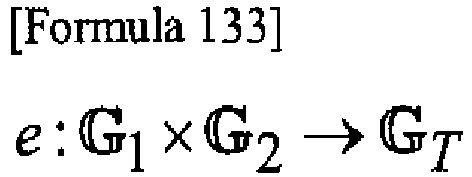
- That is, for every


- This is called symmetric bilinear pairing when G1 = G2 (=: G), and asymmetric bilinear pairing when G1 ≠ G2. Symmetric bilinear pairing can be constructed using supersingular (hyper) elliptic curves. On the other hand, asymmetric bilinear pairing can be constructed using any (hyper) elliptic curves. Asymmetric bilinear pairing can be constructed using, for example, ordinary elliptic curves.
- Acyclic group (1-dimensional space) is extended to a higher-dimensional (vector) space. That is, as shown in Formula 134, N-dimensional vector spaces V and V* are constructed by direct products of G1 and G2.
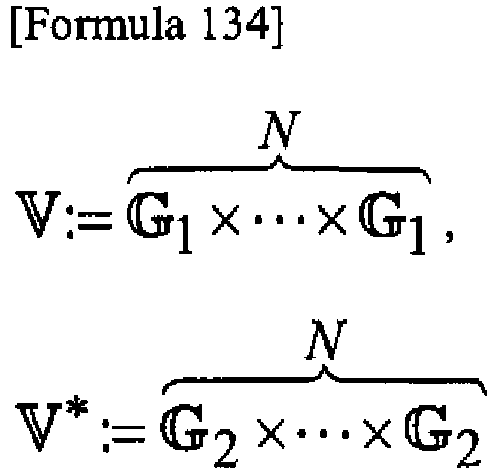 is represented by an N-dimensional vector as x := (x 1 g 1,...,xNg 1), and likewise, an element y of the space
 * is represented by an N-dimensional vector as y := (y 1 g 2,...,yNg 2), where
- Canonical bases A and A* of the N-dimensional vector spaces V and V* will be described.
- Formula 135 shows the canonical bases A and A*.



- The canonical bases A and A* satisfy the conditions shown in Formula 136.


- That is, the canonical bases A and A* are dual orthonormal bases, and the spaces V and V* are dual vector spaces paired through the pairing operation e.
- The statement that the canonical bases A and A* satisfy the conditions shown in Formula 136 will be further explained.
- First, the equation e(ai, a*i) = gT will be explained. To take an example, e(a1 a*1) will be computed. Based on a1 = (g1, 0, ..., 0) and a*1 = (g2, 0, ..., 0) as described above, it follows that: e(a1, a*1) = e(g1, g2) × e(0, 0) ×, ..., × e(0, 0). Here, as described above, the equation e(g1, g2) = gT holds. Also, based on e(0, 0) = e(0-g1, 0·g2)= e(g1, g2)°, it follows that: e(0, 0) = 1. Thus, the equation e(a1, a*1) = gT holds. The same computations also hold for other e(ai, a*i), so that the equation e(ai, a*i) = gT holds.
- Next, the equation e(ai, a*j) = 1 (i ≠ j) will be explained. To take an example, e(a1, a*2) will be computed. Based on a1 = (g1, 0, ..., 0) and a*2 = (0, g2,0, ..., 0) as described above, it follows that: e(a1, a*2) = e(g1, 0) × e(0, g2) × e(0, 0) ×,..., × e(0, 0). Based on e(g1, 0) = e(g1, 0·g2) = e(g1, g2)°, the equation e(g1, 0) = 1 holds. Likewise, the equation e(0, g2) = 1 holds. Also, as described above, the equation e(0, 0) = 1 holds. Thus, the equation e(ai, a*j) = 1 holds. The same computations also hold for other e(ai, a*j), so that the equation e(ai, a*j) = 1 holds.
- Thus, the equations e(ai, a*;) = gT and e(ai, a*j) = 1 (i ≠ j) hold over the canonical bases A and A*.
- A pairing operation e on the N-dimensional vector spaces V and V* is defined as shown in Formula 137.

- That is, the pairing operation e (x, y) on a vector x: = (x1g1, x2g1, ..., xNg1) of the N-dimensional vector space V and a vector y: = (y1g2, y2g2, ..., yNg2) of the N-dimensional vector space V* is defined as the product of pairing operations on respective elements of the vectors x and y. Then, based on the above-described condition of nondegenerate bilinear pairing, the pairing operation e (x, y) can be expressed as shown in Formula 138.

- A base change method for changing the canonical bases A and A* to other bases B and B* will be described.
Fig. 10 is a diagram for explaining the base change method. - The canonical basis A of the space V is changed to another basis B: = (b1, ..., bN) of the space V. Using a uniformly chosen linear transformation X shown in Formula 139, the canonical basis A of the space V is changed to another basis B of the space V as shown in
Formula 140.


- Here, GL stands for general linear. That is, GL is a general linear group, a set of square matrices with nonzero determinants, and a group under multiplication.
- By using X, the basis B*: = (b*I, ..., b*N) of the space V* can be efficiently computed from the canonical basis A* of the space V*. The basis B* of the space V* is computed by using X as shown in Formula 141.


- Here, Formula 142 holds.


- That is, the bases B and B* are dual orthonormal bases of dual spaces V and V*. This means that even when the canonical bases A and A* are changed by using X, dual orthonormal bases are preserved.
- A linear transformation, called a distortion map, for a generator x in the space V over the canonical basis A will be described.
- A distortion map (ϕi, j on the canonical basis A of the space V is a map shown in Formula 143.

- Since Formula 144 holds, the distortion map ϕi, j can achieve the transformation shown in Formula 145.
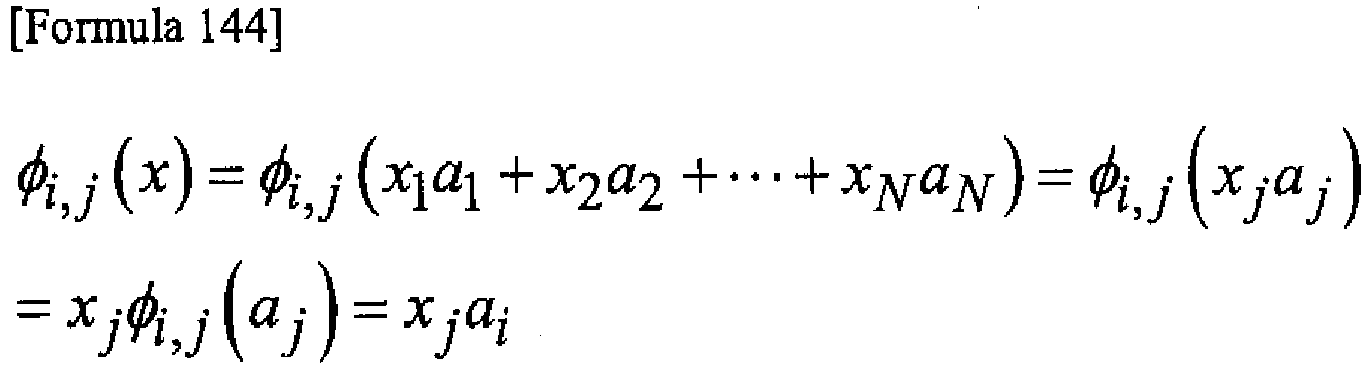

- That is, an element, namely a basis vector j, in the canonical basis A of the vector x can be transformed into another element, namely a basis vector i, in the canonical basis A. At this time, elements other than the basis vector j that is transformed all become 0. That is, in the vector x, the basis vector j becomes the basis vector i and other elements become 0.
- A distortion map ϕ*i, j on the canonical basis A* of the space V* can be represented in the same manner as the distortion map ϕi, j on the canonical basis A of the space V
- By using the distortion map ϕi, j (ϕ*i, j), any linear transformation W, expressed as an N×N-matrix shown in Formula 146, for x ∈ V can be efficiently computed by Formula 147.


- Based on the concepts described in the above 4, dual pairing vector spaces (DPVS) will be described. The HPE and HPKEM schemes to be described later are implemented in DPVS.
- DPVS (q, V, V*, GT, A, A*) include a prime order q, two N-dimensional vector spaces V and V* over Fq, a cyclic group GT of order q, a canonical basis A: = (a1,..., aN-1) of the space V, and a canonical basis A*: = (a*1, ..., a*N-1) of the space V*. The DPVS (q, V, V*, GT, A, A*) satisfy the following three conditions: (1) there exists a nondegenerate bilinear pairing, (2) the canonical bases A and A* are dual orthonormal bases, and (3) there exist distortion maps.
- There exists a polynomial-time computable nondegenerate bilinear pairing e.
- That is, the first condition is that there exists a nondegenerate bilinear pairing e shown in Formula 148.


- The canonical bases A and A* of the spaces V and V* are dual orthonormal bases.
- That is, the second condition is that the canonical bases A and A* of the spaces V and V* satisfy the condition shown in Formula 149.


- There exist polynomial-time computable distortion maps ϕi, j and ϕ*i, j.
- That is, the third condition is that endomorphisms ϕi, j and ϕ*i, j of the spaces V and V* shown in
Formula 150 are polynomial-time computable.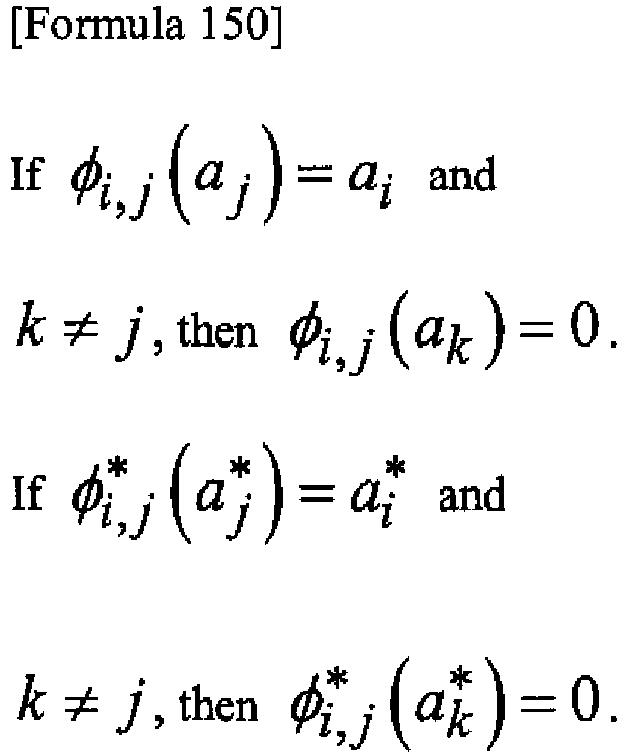
- By satisfying the second condition, it can also be stated that the spaces V and V* are dual spaces paired through the pairing operation e (see the above 4-2).
- Based on the concepts (see the above 4) and the DPVS (see the above 5) described above, a method will be briefly described by which the above-mentioned cryptographic processing system 10 (see the above 3) implements the HPE and HPKEM schemes.
- First, an outline of the PE scheme for inner-product predicates to be implemented by the
cryptographic processing system 10 will be described. For simplicity of description, the notion of hierarchical will be omitted, and an outline of the PE scheme for inner-product predicates with only one level will be described. - The
cryptographic processing system 10 implements the PE scheme for inner-product predicates in the DPVS (q, V, V*, GT, A, A*), where the spaces V and V* are (n+3)-dimensional spaces. - The
key generation device 100 generates orthonormal bases B: = (b1, ..., bn+3) and B*: = (b*i, ..., b*n+3) from canonical bases A and A* by the base change method described in the above 4-5. Thekey generation device 100 generates a basis B^: = (b1, ..., bn, dn+1, bn+3) in which basis vectors bn+1 and bn+2 of the basis B: = (b1, ..., bn+3) are replaced with a basis vector dn+1 which is the sum of the basis vectors bn+1 and bn+2. The basis B^ is used as a master public key pk, and the basis B* is used as a master secret key sk. Further, thekey generation device 100 generates a secret key k* from a predicate vector v→ (v→ = (v1, ..., vn)∈Fn q) as shown in Formula 151, and secretly transmits the secret key k* to thedecryption device 300.

- The
encryption device 200 generates two ciphertexts c1 and c2 from an attribute vector x→ (x→ = (x1, ..., xn)∈Fn q) and a message m. The ciphertexts c1 and c2 are generated as shown in Formula 152.

- Based on the ciphertexts c1 and c2 and the secret key k*, the
decryption device 300 computes Formula 153 to extract the message m.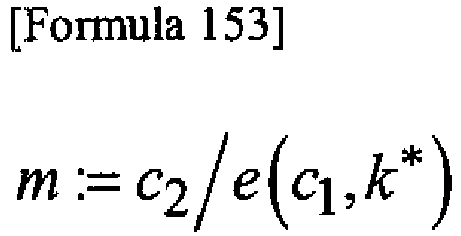
- If v→· x→ = 0, the
decryption device 300 can obtain the message m by computing Formula 153 as shown in Formula 154.
- Next, an outline of the PE scheme for inner-product predicates with hierarchical delegation capability, that is the HPE scheme for inner-product predicates, will be described using a simple example. The example employs 9-dimensional spaces, each space having six dimensions (three levels, each having two dimensions) which are used for predicate vectors and attribute vectors and three other dimensions. That is, the spaces V and V* are 9-dimensional spaces. Hence, a master public key includes a base B^: = (b1, ..., b6, d7, b9), where d7: = b7 + b8. A master secret key includes a basis B*: (b*1, ..., b*9).
- In the following description, a subscript "dec" stands for "decryption" and indicates a key vector used for decrypting a ciphertext. A subscript "ran" stands for "randomization" and indicates a randomizing vector for randomizing the coefficient of a predetermined basis vector of a lower level key. A subscript "del" stands for "delegation" and indicates a key generation vector for generating a lower level key vector.
- Ciphertexts c1 and c2 are generated by attribute vectors (x→ 1, x→ 2, x→ 3) = ((x1, x2), (x3, x4), (x5, x6)) and a message m, as shown in Formula 155.


- If the attribute vector is of a higher level such as x→ 1: = (x1, x2), the attribute vector is modified as shown in Formula 156.


- That is, the ciphertext c1 generated by the attribute vector x→ 1 is generated as the ciphertext c1 generated by the attribute vector x→+ shown in Formula 156.
- A first level secret key k→* i: = (k* 1,dec, k* 1,ran,1, k* 1,ran,2, k* 1,del,3, ..., k* 1,del,6) generated based on a first level predicate vector v→ 1: = (v1, v2)∈F2 q consists of three types of elements: k* 1,dec, (k* 1,ran,1 , k* 1,ran,2), and (k* 1,del,3, ..., k* 1,del,6). k* 1,dec is a key vector used for decrypting a ciphertext. (k* 1,ran,1, k* 1,ran,2) are randomizing vectors for randomizing the coefficient of a predetermined basis vector of a lower level key vector. (k* i,del,3, ..., k* 1,del,6) are key-generation vectors for generating a lower level key vector. k* 1,dec, (k* 1,ran,1, k* 1,ran,2), and (k* 1,del,3, ..., k* 1,del,6) are generated as shown in Formula 157.


- If the attribute vectors used in generating the ciphertext c1 is ((x1, x2), (*, *), (*, *)) such that (x1, x2) · (v1, v2) = 0, then Formula 158 holds. Hence, k* 1,0 can decrypt the ciphertexts c1 and c2 by computing Formula 159.


- A second level secret key k→* 2: = (k* 2,dec, k* 2,ran,1, k* 2,ran,2, k* 2,ran,3, k* 2,del,5, k* 2,del,6) is generated by a second level predicate vector v→ 2: = (v3, v4).
- To generate k* 2,dec, σ2,0 (v3k* 1,del,3 + v4k* 1,del,4) is added to k* 1,dec. To generate k* 2,ran,j, σ2,j (V3k* 1,del,3 '+' v4k* 1,del,4) is added to 0 (j = 1, 2, 3). To generate k* 2,del,j, σ2j (v3k* 1,del,3 + v4k* 1,del,4) is added to ψ+k* 1,del,j (j = 5, 6). Here, σ2,j (j = 0, 1, 2, 3, 5, 6) and ψ+ are uniformly selected values.
- Further, the coefficients of(vib* 1 + v2b* 2), b* 7, and b* 8 of the second level secret key are randomized (uniformly distributed). Hence, to generate k* 2, dec, (α0, 1k* 1,ran,1 + α0, 2k* 1,ran,2) is also added. To generate k* 2,ran,j, (αj, 1k* 1,ran,1 + αj,2k* 1,ran,2) is added (j = 1, 2, 3). To generate, k* 2,del,j, (αj, 1k* 1,ran,1 + αj, 2k* 1,ran,2) is added (j = 5, 6). Here, αj,1 and αj,2 (j = 0, 1, 2, 3, 5, 6) are uniformly selected values.
- To summarize, the second level secret key k→* 2: = (k* 2,dec, k* 2,ran,1, k* 2,ran,2, k* 2,ran,3) k* 2,del,5 k* 2,del,6) is generated as shown in
Formula 160.


- k* 2,dec is a key vector used for decrypting a ciphertext. (k* 2,ran,1, k* 2,ran,2, k* 2,ran,3) are randomizing vectors for randomizing the coefficient of a predetermined basis vector of a lower level key vector. (k* 2,del,5) k* 2,del,6) are used for generating a lower level key.
- In general, in an L-th level secret key k→* L: = (k* L,dec, k* L,ran,j, k* L,del,j), k* L,dec is a key vector used for decrypting a ciphertext. k* L,ran,j is a randomizing vector for randomizing the coefficient of a predetermined basis vector of a lower level key vector. k* L,del,j is a key-generation vector for generating a lower level key vector.
- In this embodiment, based on the concepts described in the first embodiment, the
cryptographic processing system 10 that implements the HPE scheme will be described. - Referring to
Figs. 11 to 16 , functions and operations of thecryptographic processing system 10 according to the second embodiment will be described. -
Fig. 11 is a functional block diagram showing the functions of thecryptographic processing system 10 that implements the HPE scheme. As described above, thecryptographic processing system 10 includes thekey generation device 100, theencryption device 200, thedecryption device 300, and thekey delegation device 400. It is also assumed in this embodiment that thedecryption device 300 includes thekey delegation device 400. -
Fig. 12 is a flowchart showing operations of thekey generation device 100.Fig. 13 is a flowchart showing operations of theencryption device 200.Fig. 14 is a flowchart showing operations of thedecryption device 300.Fig. 15 is a flowchart showing operations of thekey delegation device 400. -
Fig. 16 is a conceptual diagram showing a structure of a basis of dual pairing vector spaces (DPVS). - The functions and operations of the
key generation device 100 will be described. Thekey generation device 100 includes a masterkey generation unit 110, a masterkey storage unit 120, a keyvector generation unit 130, a randomizingvector generation unit 140, a key-generationvector generation unit 150, and akey distribution unit 160. - Using the processing device, the master
key generation unit 110 computes Formula 161 to generate a master public key pk and a master secret key sk, and stores the generated keys in the masterkey storage unit 120.
[Formula 161]
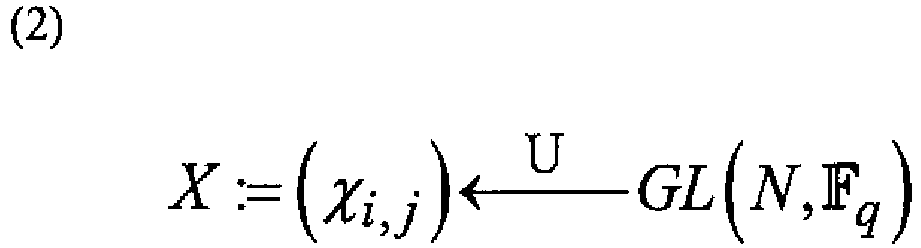


- That is:
- (1) using the processing device, the master
key generation unit 110 generates N(= n+3)-dimensional DPVS (q, V, V*, GT, A, A*) with asecurity parameter 1λ. Gdpvs is a DPVS generation algorithm that takes asinput 1λ and N, and outputs DPVS (q, V, V*, GT, A, A*) with thesecurity parameter 1λ and N-dimensional spaces. - (2) Using the processing device, the master
key generation unit 110 randomly selects a linear transformation X in order to generate a basis B from a canonical basis A. - (3) Using the processing device and based on the selected linear transformation X, the master
key generation unit 110 generates the basis B: = (b1, ..., bN) from the basis A: = (a1, ..., aN). - (4) Using the processing device, the master
key generation unit 110 generates a basis vector B^: = (b1, ..., bn, dn+1, bn+3) in which basis vectors bn+1 and bn+2 of the basis B are replaced with a basis vector dn+1 which is the sum of the basis vectors bn+1 and bn+2. - (5) Using the processing device, the master
key generation unit 110 generates a linear transformation (XT)-1 from the linear transformation X in order to generate a basis B*: = (b* 1, ..., b* N) from a basis A*: = (a* 1, ..., a* N). - (6) Using the processing device and based on the generated linear transformation (XT)-1, the master
key generation unit 110 generates the basis B*: = (b* 1, ..., b* N) from the basis A*. - (7) The master
key generation unit 110 designates the generated linear transformation X and basis B*as the master secret key sk, and (1λ, q, V, V*, GT, A, A*, B^) including the generated basis B^ as the master public key pk. The masterkey storage unit 120 stores in a storage device the master public key pk and the master secret key sk generated by the masterkey generation unit 110. - It is assumed that there are an N (= n+3) number of dimensions in the DPVS, where n denotes the number of bases assigned to represent the hierarchical structure of the format of hierarchy µ→. That is, in addition to the n number of bases assigned to represent the hierarchical structure, three basis vectors are provided. The number of basis vectors may, of course, be increased further.
- As shown in
Fig. 16 , the n number of basis vectors out of the N (= n+3) number of basis vectors are assigned for the predicate vectors and attribute vectors. The structure of the basis vectors assigned for the predicate vectors and attribute vectors is the same as the structure shown inFig. 6 . Two of the three remaining basis vectors (the (n+1)-th and (n+2)-th basis vectors) are used for information for generating a session key. The remaining one of the three remaining basis vectors (the (n+3)-th basis vector) is used for randomizing a ciphertext c1. - To summarize, in (S301), the master
key generation unit 110 executes the Setup algorithm shown in Formula 162 to generate the master public key pk and the master secret key sk.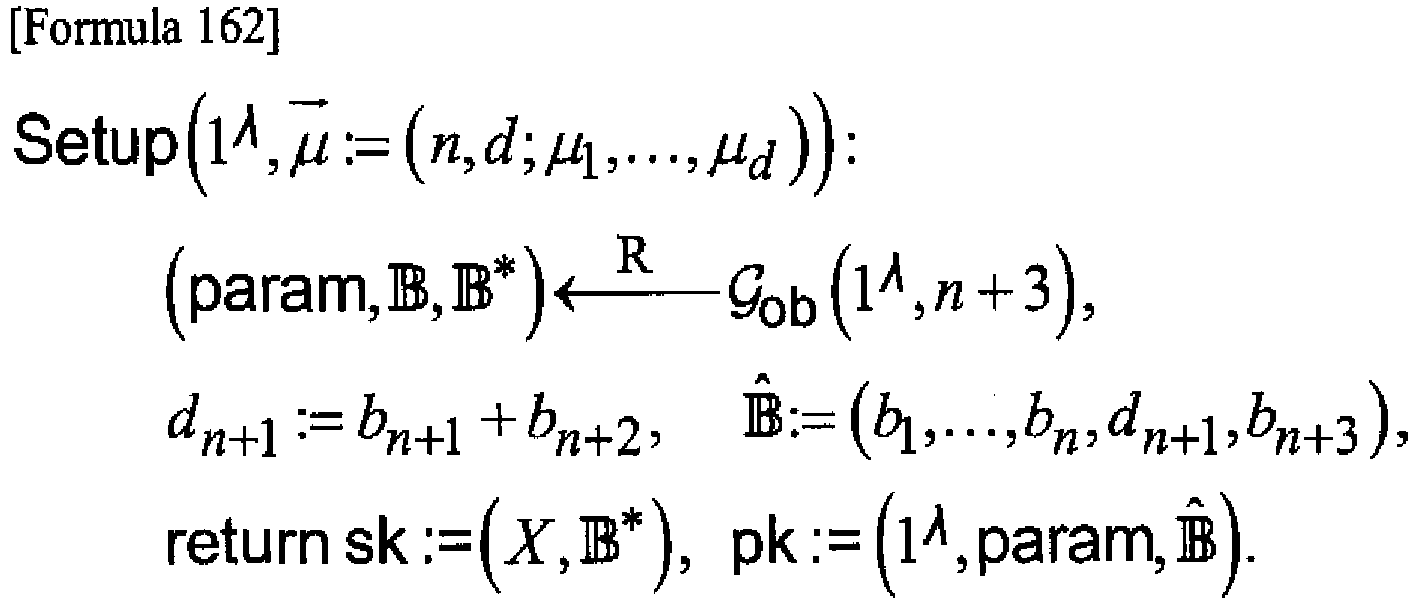

- Using the processing device and based on the master public key pk, the master secret key sk, and predicate vectors (v→ 1, ..., v→ L) shown in Formula 163, the key
vector generation unit 130 computes Formula 164 to generate a key vector k* L, dec which is the first element of an L-th level (level L) secret key.
[Formula 164]

- That is:
- (1) using the processing device, the key
vector generation unit 130 generates random numbers σ0,i (i = 1, ..., L) and η0. - (2) Using the processing device, the key
vector generation unit 130 sets each of the predicate vectors randomized by the generated random number σ0,t as the coefficient of the basis vector b* i (i = 1, ..., µL). That is, each of the predicate vectors is embedded in the coefficient of the basis vector b* i (i = 1, ..., µL). Using the processing device, the keyvector generation unit 130 sets the random number η0 as the coefficient of the basis vector b* n+1, and sets a value obtained by subtracting the random number η0 from 1 (1-η0) as the coefficient of the basis vector b* n+2. That is, the coefficients of the basis vectors b* n+1 and b* n+2 are set such that the sum of the coefficients of the basis vectors b* n+1 and b* n+2 is 1. The keyvector generation unit 130 thus generates the key vector k* L,dec. - Based on the master public key pk, the master secret key sk, and the predicate vectors (v→ 1, ..., v→ L) shown in Formula 163, the randomizing
vector generation unit 140 computes Formula 165 to generate a randomizing vector k* L,ran,j (j = 1, ..., L+1). The randomizing vector k* L,ran,j (j = 1, ..., L+1) is a vector, in a lower level key, for uniformly distributing the coefficient of a basis vector in which each of predicate vectors is embedded. The randomizing vector k* L,ran,j is the j-th element of the L-th level secret key.
[Formula 165]


- That is,
- (1) using the processing device, the randomizing
vector generation unit 140 generates random numbers σj,i(j = 1, ..., L+1; i= 1, ..., L) and ηj (j = 1, ..., L+1). - (2) Using the processing device, the randomizing
vector generation unit 140 generates a vector vvj, for each j of j = 1, ..., L+1, by setting each of the predicate vectors randomized by the random number σj,t as the coefficient of the basis vector b* i (i = 1, ..., µL). That is, each of the predicate vectors is embedded in the coefficient of the basis vector b* i (i = 1, ..., µL). - (3) Using the processing device, the randomizing
vector generation unit 140 generates a vector dvj, for each j of j = 1, ..., L+1, by setting the random number ηj as the coefficient of the basis vector b* n+1 and setting a value obtained by subtracting the random number ηj from 0 (-ηj) as the coefficient of the basis vector b* n+2. That is, the coefficients of the basis vectors b* n+1 and b* n+2 are set such that the sum of the coefficients of the basis vectors b* n+1 and b* n+2 is 0. - (4) The randomizing
vector generation unit 140 generates the randomizing vector k* L,ran,j (j = 1, ..., L+1), for each j of j = 1, ..., L+1, by adding together the generated vectors vvi and dvj. - Using the processing device and based on the master public key pk, the master secret key sk, and the predicate vectors (v→ 1, ..., v→ L) shown in Formula 163, the key-generation
vector generation unit 150 computes Formula 166 to generate a key-generation vector k* L,del,j (j = µL+1, ..., n). The key-generation vector k* L,del,j (j = µL + 1, ..., n) is a vector for generating a lower level secret key (lower level key vector). The key-generation vector k* L,del,j is the j-th element of the L-th level secret key.
[Formula 166]

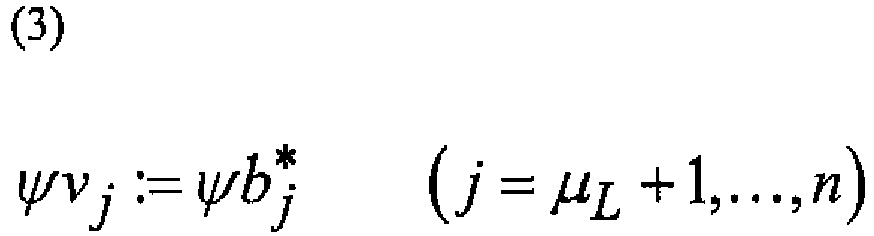

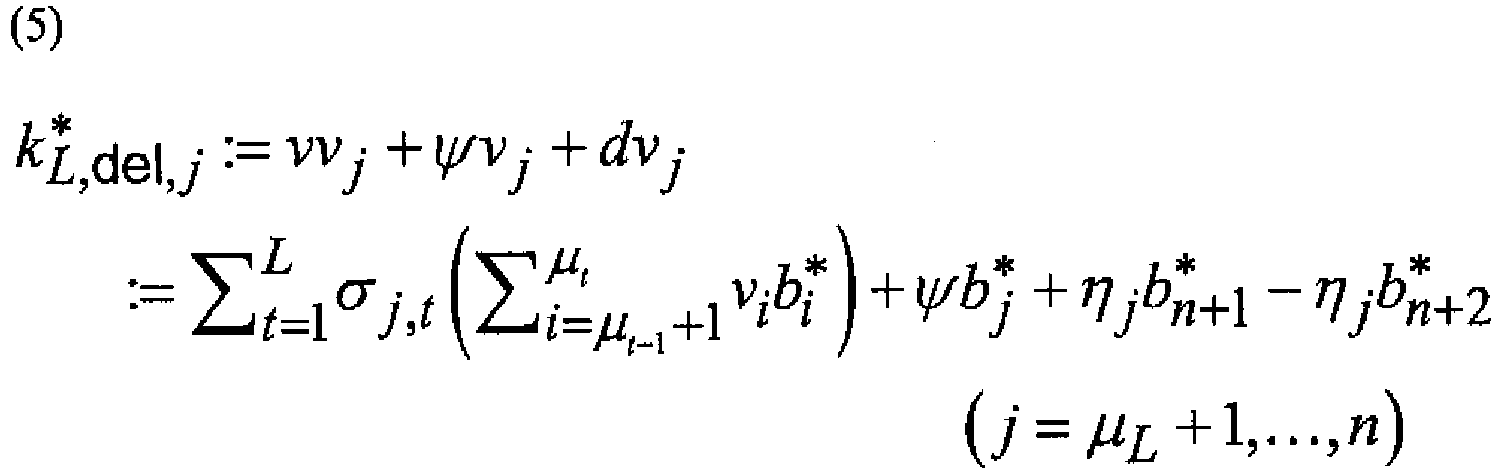
- That is,
- (1) using the processing device, the key-generation
vector generation unit 150 generates random numbers σj,i (j = µL+1, ..., n; i = 1, ..., L), ψ, and ηj (j = µL+1, ..., n). - (2) Using the processing device, the key-generation
vector generation unit 150 generates a vector vvj, for each j of j = µL+1, ..., n, by setting each of the predicate vectors randomized by the random number σj,t as the coefficient of the basis vector b* i (i = 1, ..., µL). That is, each of the predicate vectors is embedded in the coefficient of the basis vector b* i (i = 1, ..., µL). - (3) Using the processing device, the key-generation
vector generation unit 150 generates a vector ψvj, for each j of j = µL+1, ..., n, by setting the random number ψ as the coefficient of the basis vector b* j. - (4) Using the processing device, the key-generation
vector generation unit 150 generates a vector dvj, for each j of j = µL+1, ..., n, by setting the random number ηj as the coefficient of the basis vector b* n+1 and setting a value obtained by subtracting the random number ηj from 0 (-ηj) as the coefficient of the basis vector b* n+2. That is, the coefficients of the basis vectors b* n+1 and b* n+2 are set such that the sum of the coefficients of the basis vectors b* n+1 and b* n+2 is 0. - (5) The key-generation
vector generation unit 150 generates the key-generation vector k* L,del,j (j = µL+1, ..., n), for each j of j = µL+1, ..., n, by adding together the vectors vvj, ψvj, and dvj. - To summarize, in (S302) to (S304), using the processing device, the key
vector generation unit 130, the randomizingvector generation unit 140, and the key-generationvector generation unit 150 execute the GenKey algorithm shown in Formula 167. This generates the L-th level secret key (key information k→* L) including the key vector k* L,dec, the randomizing vector k* L,ran,j (j = 1, ..., L+1), and the key-generation vector k* L,del,j (j = µL+1, ..., n).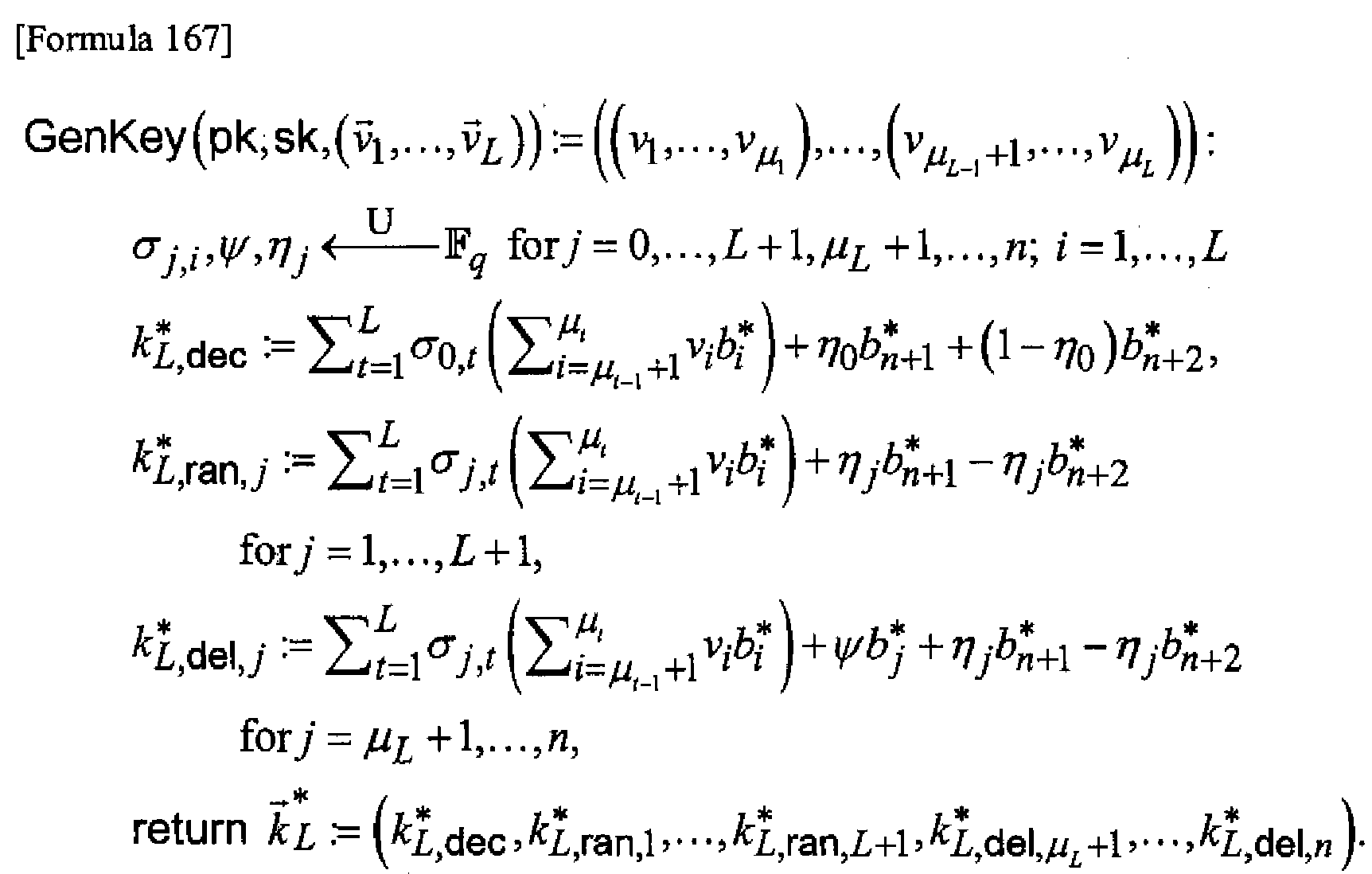
- The
key distribution unit 160 transmits the master public key generated by the masterkey generation unit 110 and the key information k→* L generated by the keyvector generation unit 130, the randomizingvector generation unit 140, and the key-generationvector generation unit 150 to thedecryption device 300 through the communication device. Thekey distribution unit 160 also transmits the master public key to theencryption device 200 through the communication device. The key information k→* L is secretly transmitted to thedecryption device 300. Any method may be used to secretly transmit the key information k→* L to thedecryption device 300. For example, the key information k→* 1 may be transmitted using a prior art cryptographic process. - The functions and operations of the
encryption device 200 will be described. Theencryption device 200 includes a transmissioninformation setting unit 210, a ciphervector generation unit 220, a cipherinformation generation unit 230, adata transmission unit 240, and a publickey acquisition unit 250. - It is assumed that the public
key acquisition unit 250 has obtained the master public key and the attribute information vectors corresponding to the predicate information vectors of thedecryption device 300 before the steps to be described below. - Using the processing device and based on the master public key pk, the transmission
information setting unit 210 computes Formula 168 to generate a transmission information vector ζv.
[Formula 168]

- That is,
- (1) using the processing device, the transmission
information setting unit 210 generates a random number ζ. - (2) Using the processing device, the transmission
information setting unit 210 generates the transmission information vector ζv by setting the random number ζ as the coefficient of the basis vector dn+1 in the basis B^ included in the master public key pk. - Using the processing device and based on the master public key pk and attribute vectors (x→ 1, ..., x→ L) shown in Formula 169, the cipher
vector generation unit 220 computes Formula 170 to generate a cipher vector c1.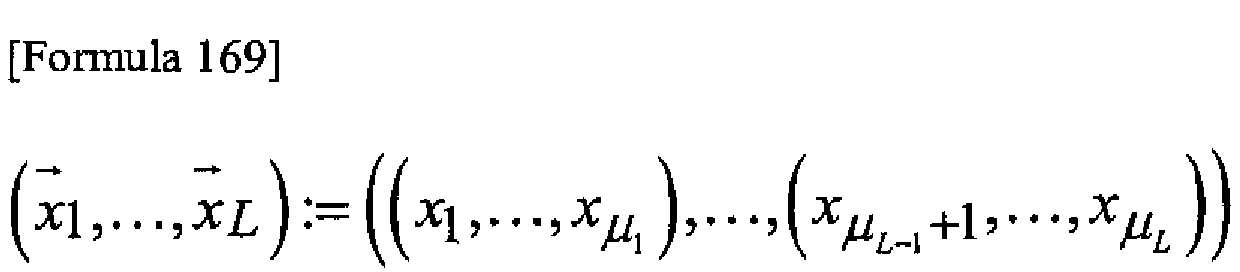
[Formula 170]


- That is,
- (1) using the processing device, the cipher
vector generation unit 220 generates random numbers (x→ L+1, ..., x→ d) and δi (i = 1, ..., d, n+3). - (2) Using the processing device, the cipher
vector generation unit 220 sets each of the attribute vectors as the coefficient of the basis vector bi (i = 1, ..., µL) of the basis B included in the master public key pk. That is, each of the attribute vectors is embedded in the coefficient of the basis vector bi (i = 1,..., µL). Using the processing device, the ciphervector generation unit 220 sets the random number as the coefficient of the basis vector bi (i = µL+1, ..., n). The ciphervector generation unit 220 thus generates a vector xv. - (3) Using the processing device, the cipher
vector generation unit 220 generates a vector rv by setting the random number δn+3 as the coefficient of the basis vector bn+3 of the basis B included in the master public key pk. - (4) Using the processing device, the cipher
vector generation unit 220 generates the cipher vector c1 by adding the generated vectors xv and rv to the transmission information vector ζv generated by the transmissioninformation setting unit 210. - The vector rv is added for enhancing security and is not a requisite element.
- Using the processing device and based on a message m, the cipher
information generation unit 230 computes Formula 171 to generate cipher information c2.
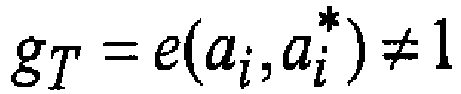
- The
data transmission unit 240 transmits the cipher vector c1 generated by the ciphervector generation unit 220 and the cipher information c2 generated by the cipherinformation generation unit 230 to thedecryption device 300 through the communication device. - To summarize, the
encryption device 200 executes the Enc algorithm shown in Formula 172 to generate the cipher vector c1 and the cipher information c2.
- The functions and operations of the
decryption device 300 will be described. Thedecryption device 300 includes avector input unit 310, a keyvector storage unit 320, and apairing operation unit 330. - The
vector input unit 310 receives through the communication device and inputs the cipher vector c1 and the cipher information c2 transmitted by thedata transmission unit 240 of theencryption device 200. - Using the processing device and based on the master public key pk and the key vector k* L,dec which is the first element of the L-th level secret key, the
pairing operation unit 330 computes Formula 173 to generate a message m'.
- That is, using the processing device, the
pairing operation unit 330 performs the pairing operation e on the cipher vector c1 input by thevector input unit 310 and the key vector k* L,dec stored in the storage device by the keyvector storage unit 320. Thepairing operation unit 330 thus computes gζ T. Then, by dividing the cipher information c2 (=gζ Tm) by the computed gζ T, the message m' (= m) is computed. When the key vector k* L,dec is provided by thekey generation device 100 or thekey delegation device 400 of a higher level, the keyvector storage unit 320 stores the key vector k* L,dec in the storage device. - If L ≤ h holds for the attribute vector x→ i(i = 1, ..., h) used by the
encryption device 200 for encryption and the predicate vector v→ i(i = 1, ..., L) used by thedecryption device 300 for decryption and if x→ i·v→ i = 0 for all i (i = 1, ..., L), then gζ t can be obtained by performing the pairing operation e on the cipher vector c1 and the key vector k* L,dec as shown in Formula 174.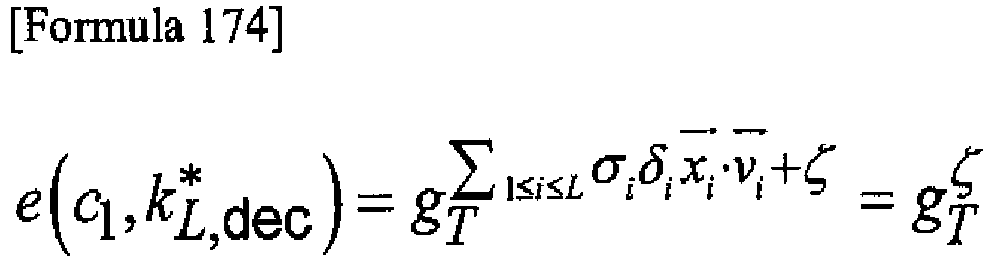
- To summarize, the
decryption device 300 executes the Dec algorithm shown in Formula 175 to generate the message m'.
- The functions and operations of the
key delegation device 400 will be described. Thekey delegation device 400 includes a key vector acquisition unit 410 (key-generation vector acquisition unit), a keyvector generation unit 420, a randomizingvector generation unit 430, a key-generationvector generation unit 440, and akey distribution unit 450. - The key
vector acquisition unit 410 obtains, through the communication device, the L-th level secret key (key information k→ L) including the key vector k* L,dec which is the first element of the L-th level secret key, the randomizing vector k* L,ran,j (j = 1, ..., L+1), and the key-generation vector k* L,del,j (j = µL+1, ..., n). - Using the processing device and based on the master public key pk, the key information k→* L, a predicate vector v→* L+1 shown in Formula 176, the key
vector generation unit 420 computes Formula 177 to generate a key vector k* L+1,dec which is the first element of an (L+1)-th level secret key.
[Formula 177]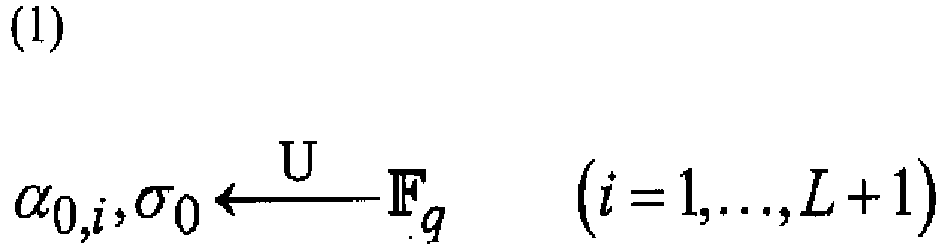
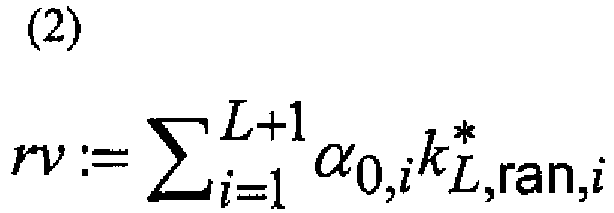


- That is:
- (1) using the processing device, the key
vector generation unit 420 generates random numbers α0,i (i = 1, ..., L+1) and σ0. - (2) Using the processing device, the key
vector generation unit 420 generates a vector rv by adding together vectors in which the coefficient of the randomizing vector k* L,ran,i is multiplied by the random number α0,i for each i of i = 1, ..., L+1. Each of the predicate vectors is embedded in the coefficient of the basis vector b* i(i = 1, ..., µL) of the randomizing vector k* L,ran,i (i = 1,..., L+1). Thus, each of the predicate vectors multiplied by the random number is embedded in the coefficient of the basis vector b* i (i = 1, ..., µL) of the vector rv. - (3) Using the processing device, the key
vector generation unit 420 generates a vector vv by adding together vectors in which each vector of the predicate vectors v→ L+1 is set as the coefficient of the key-generation vector k* L,del,i (i = µL+1, ..., µL+1) and multiplying the sum by the random number σ0. That is, each of the predicate vectors is embedded in the coefficient of the basis vector b* i (i = µL+1, ..., µL+1). - (4) Using the processing device, the key
vector generation unit 420 generates the key vector k* L+1,dec by adding together the key vector k* L,dec, the vector rv, and the vector vv. - Based on the master public key pk, the key information k→* L, and the predicate vector v→* L+1 shown in Formula 176, the randomizing
vector generation unit 430 computes Formula 178 to generate a randomizing vector k* L+1,ran,j (j = 1, ..., L+2). The randomizing vector k* L+1,ran,j (j = 1, ..., L+2) is a vector, in a lower level key, for uniformly distributing the coefficient of a basis vector in which each of predicate vectors is embedded. The randomizing vector k* L+1,ran,j is the j-th element of the (L+1)-th level secret key.
[Formula 178]


- That is,
- (1) using the processing device, the randomizing
vector generation unit 430 generates random numbers αj,i (j = 1, ..., L+2; i = 1, ..., L) and σj (j = 1, ..., L+2). - (2) Using the processing device, the randomizing
vector generation unit 430 generates a vector rvj, for each j of j = 1, ..., L+2, by multiplying the coefficient of the randomizing vector k* L,ran,i (i = 1, ..., L+1) by the random number αj,i (i = 1, ..., L+1). As described above, each of the predicate vectors is embedded in the coefficient of the basis vector b* i (i = 1, ..., µL) of the randomizing vector k* L,ran,i (i = 1, ..., L+1). Thus, each of the predicate vectors multiplied by the random number is embedded in the coefficient of the basis vector b* i (i = 1 µL) of the vector rvj. - (3) Using the processing device, the randomizing
vector generation unit 430 generates a vector vvj, for each j of j = 1, ..., L+2, by adding together vectors in which each of the predicate vectors is set as the coefficient of the key-generation vector k* L,del,i (i = µL+1, ..., µL+1) and multiplying the sum by the random number σj. That is, each of the predicate vectors is embedded in the coefficient of the basis vector b* i (i = µL+1, ..., µL+1). - (4) Using the processing device, the randomizing
vector generation unit 430 generates the randomizing vector k* L+1,ran,j, for each j of j = 1, ..., L+2, by adding together the generated vectors rvj and vvj. - Using the processing device and based on the master public key pk, the key information k→* L, and the predicate vector v→ L+1 shown in Formula 176, the key-generation
vector generation unit 440 computes Formula 179 to generate a key-generation vector k* L+1,del,j (j = µL+1+1, ..., n). The key-generation vector k* L+1,del,j (j = µL+1+1, ..., n) is a vector for generating a lower level secret key (lower level key vector). The key-generation vector k* L+1,del,j is the j-th element of the (L+1)-th level secret key.
[Formula 179]




- That is,
- (1) using the processing device, the key-generation
vector generation unit 440 generates random numbers αj,i (j = µL+1+1, ..., n; i = 1, ...., L+1), σj (j = µL+1+1, ..., n) and ψ'. - (2) Using the processing device, the key-generation
vector generation unit 440 generates a vector rvj, for each j of j = µL+1+1, ..., n, by multiplying the coefficient of the randomizing vector k* L,ran,i(i = 1, ..., L+1) by the random number αj,i. As described above, each of the predicate vectors is embedded in the coefficient of the basis vector b* i (i = 1, ..., µL) of the randomizing vector k* L,ran,i (i = 1, ..., L+1). Thus, each of the predicate vectors multiplied by the random number is embedded in the coefficient of the basis vector b* i (i = 1, ..., µL) of the vector rvj. - (3) Using the processing device, the key-generation
vector generation unit 440 generates a vector vvj, for each j of j = µL+1+1, ..., n, by adding together vectors in which each of the predicate vectors is set as the coefficient of the key-generation vector k* L,del,j (i = µL+1, ..., µL+1) and multiplying the sum by the random number σj. That is, each of the predicate vectors is embedded in the coefficient of the basis vector b* i (i = µL+1, ..., µL+1). - (4) Using the processing device, the key-generation
vector generation unit 440 generates a vector ψvj, for each j of j = µL+1+1, ..., n, by multiplying the coefficient of the key-generation vector k* L,del,j by the random number ψ'. Each of the predicate vectors is embedded in the coefficient of the basis vector b* j (j = µL+1+1, ..., n) of the key-generation vector k* L,del,j. Thus, each of the predicate vectors multiplied by the random number is embedded in the coefficient of the basis vector b* j of the vector ψvj (j = µL+1+1, ..., n). - (5) Using the processing device, the key-generation
vector generation unit 440 generates the key-generation vector k* L+1,del,j (j = µL+1+1, ..., n), for each j of j = µL+1+1, ..., n, by adding together the generated vectors rvj, vvj, and ψvj. - To summarize, in (S602) to (S604), using the processing device, the key
vector generation unit 420, the randomizingvector generation unit 430, and the key-generationvector generation unit 440 execute the DelegateL algorithm shown in Formula 180 to generate the (L+1)-th level secret key (key information k→* L+1) including the key vector k* L+1,dec, the randomizing vector k* L+1,ran,j (j = 1, ..., L+2), and the key-generation vector k* L+1,del,j (j = µL+1+1, ..., n).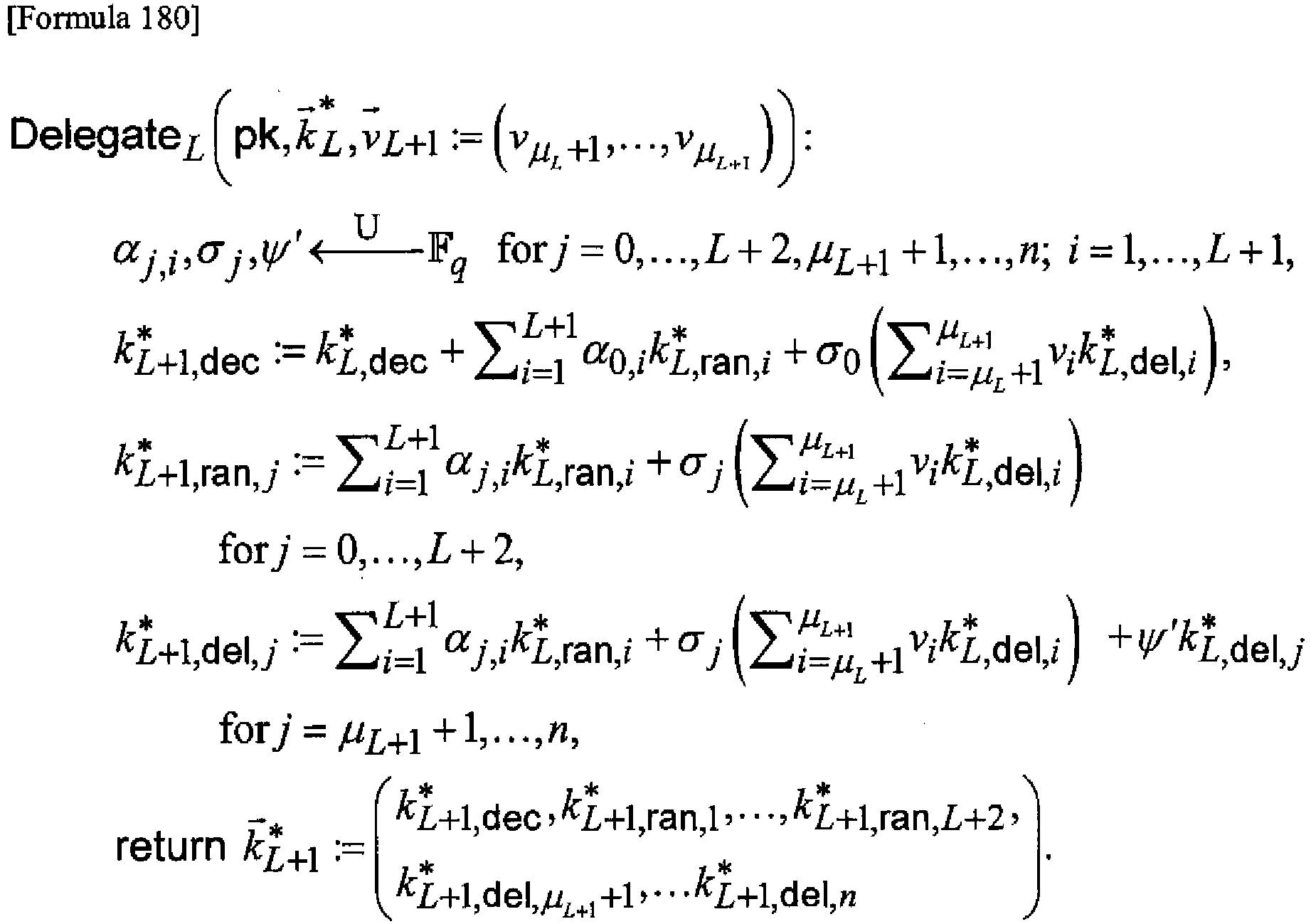
- The
key distribution unit 440 transmits the key information k→* L+1 generated by the keyvector generation unit 420, the randomizingvector generation unit 430, and the key-generationvector generation unit 440 to thedecryption device 300 of a lower level through the communication device. The key information k→* L+1 is secretly transmitted to thedecryption device 300. Any method may be used to secretly transmit the key information k→* L+1 to thedecryption device 300. For example, the key information k→* L+1 may be transmitted using a prior art cryptographic process. - As described above, the cryptographic processes to be implemented by the
cryptographic processing system 10 have higher security than the cryptographic processes proposed in Non-Patent Literature 18, and security proof can be given in a standard model. - This is mainly because of the following two features (1) and (2).
- (1) The basis vector dn+1 in which the
encryption device 200 sets transmission information is 2-dimensional (basis vectors bn+1 and bn+2). Because of this feature, the coefficients of the basis vectors b* n+1 and b* n+2 of the key vector k* L,dec corresponding to the basis vector dn+1 can be randomly selected. Only the basis vector dn+1 is published, and the basis vectors bn+1 and bn+2 are kept secret. - (2) The
key delegation device 400 generates a lower level key by using a randomizing vector. Because of this feature, the coefficient of a predetermined basis vector of the lower level key can be randomized. As a result, the security of a key is not compromised by generating its lower level key. - When the randomizing vector is not used, two lower level key vectors k* L+1,dec (A) and k* L+1,dec (B) generated from the key information k→* L are constructed as shown in Formula 181.
- That is, when the randomizing vector is not used, the coefficient of the basis vector b* i (i = 1, ..., µL) included in the key vector k* L,dec and in which predicate information is embedded is the same between the key vectors k* L+1,dec (A) and k* L+1, dec (B).
- However, when the randomizing vector is used, the two lower level key vectors k* L+1,dec (A) and k* L+1,dec (B) generated from the key information k→* L are constructed as shown in Formula 182.

- That is, when the randomizing vector is used, the randomizing vector k* L,ran,j in which the coefficient is uniformly distributed by the random number αA,i is added to the key vector k* L+1,dec (A). The randomizing vector k* L,ran,i in which the coefficient is uniformly distributed by the random number αB,i is added to the key vector k* L+1,dec (B). The randomizing vector k* L,ran,i includes the basis vector b* i (i = 1, ..., µL). Thus, in the key vectors k* L+1,dec (A) and k* L+1,dec (B), the coefficient of the basis vector b* i (i = 1, ..., µL) is uniformly distributed. That is, the coefficient of the basis vector b* i (i = 1, ..., µL) in which predicate information is set is different between the key vectors k* L+1,dec (A) and k* L+1,dec (B).
- In the above description, the basis vector dn+1 in which the
encryption device 200 sets transmission information is 2-dimensional. However, the dimension of the basis vector dn+1 may be 3-dimensional or higher, i.e., m-dimensional (basis vector bn+1, ..., basis vector bn+m). - In this case, in (S301), the master
key generation unit 110 operates with N = n+m+1. In the key vector k* L,dec generation step (S302), the keyvector generation unit 130 sets the coefficients of the basis vectors bn+1, ..., and bn+m such that the sum of the coefficients of the basis vectors bn+1, ..., and bn+m is 1. In the randomizing vector k* L,ran,j generation step (S303), the randomizingvector generation unit 140 sets the coefficients of the basis vectors bn+1, ..., and bn+m such that the sum of the coefficients of the basis vectors bn+1, ..., and bn+m is 0. Likewise, in the key-generation vector k* L,del,j generation step (S304), the key-generationvector generation unit 150 sets the coefficients of the basis vectors bn+1, ..., and bn+m such that the sum of the coefficients of the basis vectors bn+1, ..., and bn+m is 0. In the cipher vector c1 generation step (S402), the ciphervector generation unit 220 generates the vector rv by setting a random number as the coefficient of the basis vector bn+m+1. - In the above description, the cryptographic processes are implemented in the N(= n+3)-dimensional vector spaces. For the cryptographic processes without delegation, n is an integer of 1 or larger. Accordingly, N is an integer of 4 or larger. For the cryptographic processes with delegation, n is an integer of 2 or larger. Accordingly, N is an integer of 5 or larger. As described above, in (S402), it is not essential that the
encryption device 200 generates the vector rv by using the basis vector bn+3. When the vector rv is not generated, the cryptographic processes can be implemented in N(= n+2)-dimensional vector spaces. Thus, for the cryptographic processes without delegation, N is an integer of 3 or larger. For the cryptographic processes with delegation, N is an integer of 4 or larger. - In the cryptographic processes described above, distortion maps which have been described as one of the conditions of DPVS are not used. Distortion maps are used not in the algorithms for implementing the cryptographic processes, but for proving the security of the cryptographic processes. Thus, the cryptographic processes described above can be established in spaces without distortion maps. That is, it is not essential that there exist distortion maps in spaces for implementing the cryptographic processes described above. The same applies to the cryptographic processes to be described below.
- The HPE scheme has been described above. The HPKEM scheme will now be described. Only portions of the HPKEM scheme that are different from the above HPE scheme will be described.
-
Fig. 17 is a functional block diagram showing functions of thecryptographic processing system 10 that implements the HPKEM scheme. - The processing steps of the
key generation device 100 and the processing steps of thekey delegation device 400 are the same as those of the HPE scheme described above. Thus, only the processing steps of theencryption device 200 and the processing steps of thedecryption device 300 will be described. -
Fig. 18 is a flowchart showing operations of theencryption device 200.Fig. 19 is a flowchart showing operations of thedecryption device 300. - The functions and operations of the
encryption device 200 will be described. - The
encryption device 200 shown inFig. 17 includes a sessionkey generation unit 260, in addition to the functions included in theencryption device 200 shown inFig. 11 . Theencryption device 200 shown inFig. 17 does not include the cipherinformation generation unit 230 included in theencryption device 200 shown inFig. 11 . - (S701) and (S702) are the same as (S401) and (S402).
- In (S703: data transmission step), the cipher vector c1 generated by the cipher
vector generation unit 220 in (S702) is transmitted to thedecryption device 300 through the communication device. That is, in the HPKEM scheme, cipher information c2 in which a message m is embedded is not generated and is not transmitted to thedecryption device 300. - In (S704: session key generation step), using the processing device, the session
key generation unit 260 computes Formula 183 to generate a session key K.

- To summarize, the
encryption device 200 executes the Enc algorithm shown in Formula 184 to generate the cipher vector c1 and the session key K.
- The functions and operations of the
decryption device 300 will be described. - The configuration of the functions of the
decryption device 300 shown inFig. 17 is the same as that of thedecryption device 300 shown inFig. 11 . (S801: Vector input step) - The
vector input unit 310 receives through the communication device and inputs the cipher vector c1 transmitted by thedata transmission unit 240 of theencryption device 200. - Using the processing device and based on the master public key pk and the key vector k* L,dec which is the first element of the L-th level secret key, the
pairing operation unit 330 computes Formula 185 to generate a session key K.
- That is, using the processing device, the
pairing operation unit 330 performs the pairing operation e on the cipher vector c1 input by thevector input unit 310 and the key vector k* L,dec stored in the storage device by thevector storage unit 320. Thepairing operation unit 330 thus computes gζ T (= K) which is a value concerning ζ embedded by theencryption device 200. - To summarize, the
decryption device 300 executes the Dec algorithm shown in Formula 186 to generate the session key K' (= K).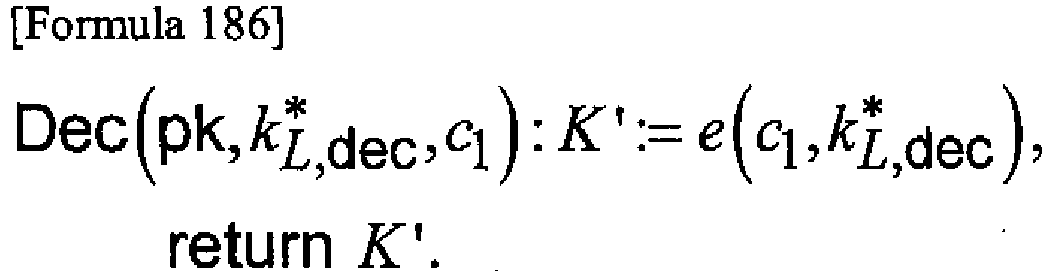
- As described above, according to the HPKEM scheme, the session key K can be secretly transmitted from the
encryption device 200 to thedecryption device 300. This means that the session key can be shared between theencryption device 200 and thedecryption device 300. - In a third embodiment, a PE scheme with delegation which is more generic than the HPE and HPKEM schemes described in the second embodiment will be described.
- As described above, in the HPE and HPKEM schemes described in the second embodiment, basis vectors are used as shown in
Fig. 16 . That is, the n number of basis vectors out the (n+3) number of basis vectors are used to represent the hierarchical structure of the basis vectors for attribute vectors and predicate vectors. In particular, a first µ1 number of basis vectors are used as the basis vectors for the first level attribute vectors and predicate vectors. A (µ2-µ1) number of basis vectors are used as the basis vectors for the second level attribute vectors and predicate vectors. Likewise, a (µL -µL-1) number of basis vectors are used as the basis vectors for the L-th level attribute vectors and predicate vectors. - The L-th level key vector k* L,dec is computed as shown in Formula 164. That is, in the L-th level key vector k* L,dec, each of the predicate vectors is assigned as the coefficient of the basis vector b* i (i = 1, ..., L), and 0 is assigned as the coefficient of the basis vector b* i (i = L+1, ..., n).
- The L-th level cipher vector c1 is computed as shown in Formula 170. That is, in the L-th level cipher vector c1, each of the attribute vectors is assigned as the coefficient of the basis vector bi (i = 1, ..., L), and the random number is assigned as the coefficient of the basis vector bi (i = L+1, ..., n).
- With this arrangement, hierarchical delegation is implemented.
- In the PE (PKEM) scheme to be described in the third embodiment, as in the second embodiment, the n number of basis vectors out of the (n+3) number of basis vectors are used as the basis vectors for attribute vectors and predicate vectors. However, for any key (regardless of level), all of the n number of basis vectors are used as the basis vectors for predicate vectors. That is, all of the n number of basis vectors are always used as the basis vectors for attribute vectors or predicate vectors.
- In the key vector k* L,dec, each of the predicate vectors is assigned as the coefficient of the basis vector b* i (i = 1, ..., n). In the L-th level cipher vector c1, each of the attribute vectors is assigned as the coefficient of the basis vector bi (i = 1, ..., n).
- That is, there is no concept of hierarchical structure for the n number of basis vectors. There is also no concept of hierarchical delegation for secret keys. Therefore, more flexible delegation can be realized, compared to the cryptographic processes described in the second embodiment.
- First, implementation of the PE scheme with delegation will be described.
-
Fig. 20 is a functional block diagram showing functions of thecryptographic processing system 10 that implements the PE scheme with delegation. The functions included in thecryptographic processing system 10 shown inFig. 20 are the same as the functions included in thecryptographic processing system 10 shown inFig. 11 . - The flow of operations of the
cryptographic processing system 10 for implementing the PE scheme with delegation according to the third embodiment are the same as the flow of operations of thecryptographic processing system 10 according to the second embodiment. Thus, the functions and operations of thecryptographic processing system 10 according to the third embodiment will be described with reference toFigs. 20 and12 to 16 . - The functions and operations of the
key generation device 100 will be described. - As in (S301) of the second embodiment, using the processing device, the master
key generation unit 110 computes Formula 187 to generate a master public key pk and a master secret key sk and stores the keys in the masterkey storage unit 120.
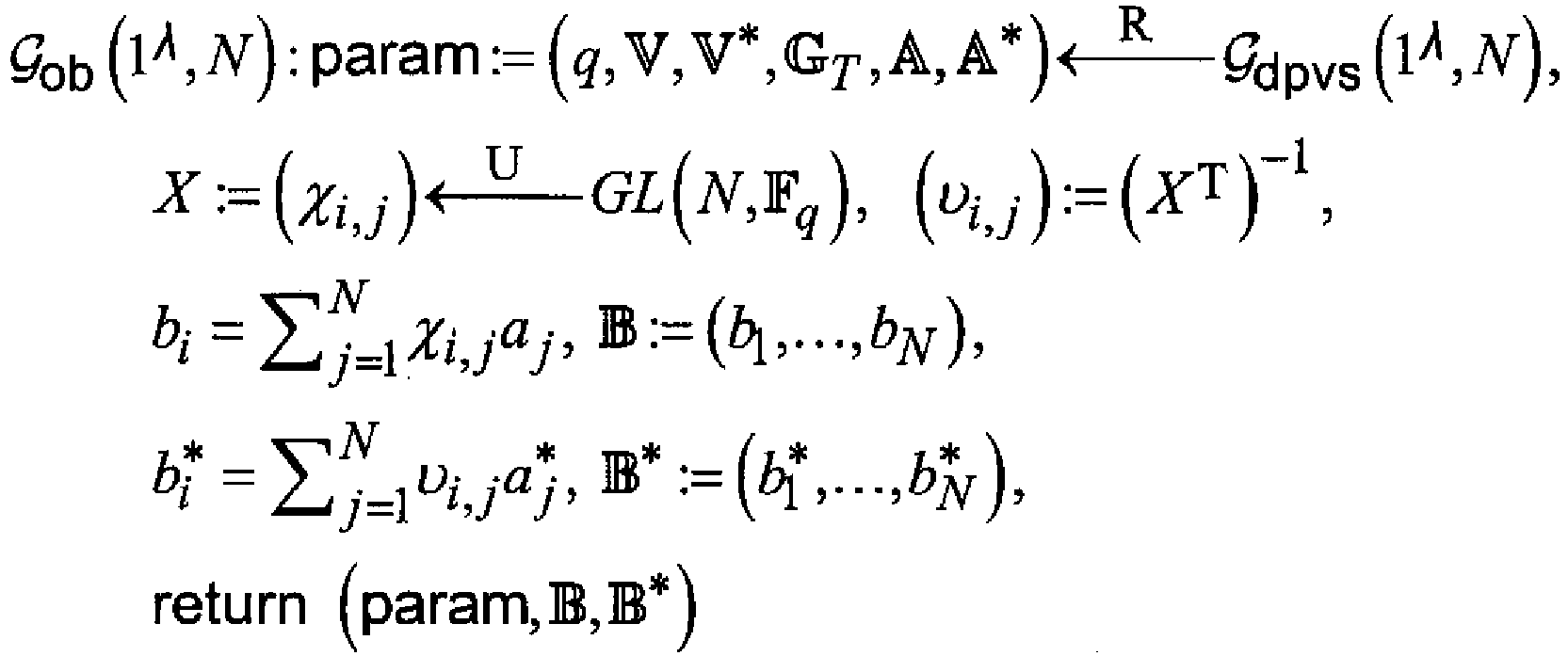
- Using the processing device and based on the master public key pk, the master secret key sk, and predicate vectors (v→ 1, ..., v→ L) shown in Formula 188, the key
vector generation unit 130 computes Formula 189 to generate a key vector k* L,dec which is the first element of an L-th level (level L) secret key.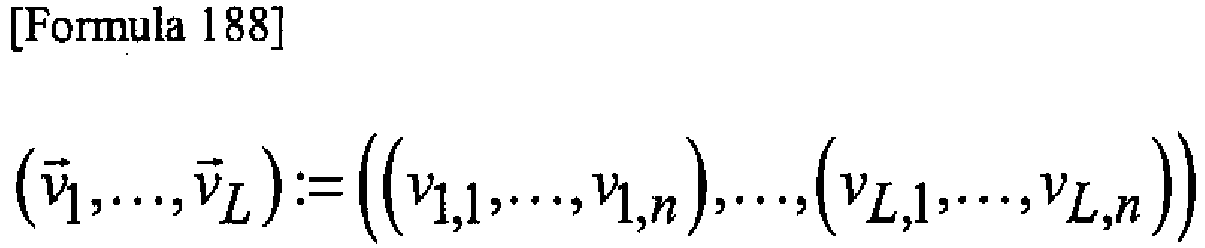
[Formula 189]

- Based on the master public key pk, the master secret key sk, and the predicate vectors (v→ 1, ..., v→ L) shown in Formula 188, the randomizing
vector generation unit 140 computes Formula 190 to generate a randomizing vector k* L,ran,j (j = 1, ..., L+1).
[Formula 190]



- Using the processing device and based on the master public key pk, the master secret key sk, and the predicate vectors (v→ 1, ..., v→ L) shown in Formula 188, the key-generation
vector generation unit 150 computes Formula 191 to generate a key-generation vector k* L,del,j (j = 1, ..., n).
[Formula 191]

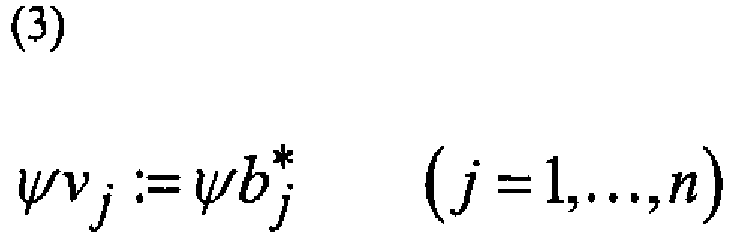


- To summarize, in (S302) to (S304), using the processing device, the key
vector generation unit 130, the randomizingvector generation unit 140, and the key-generationvector generation unit 150 execute the GenKey algorithm shown in Formula 192. This generates the L-th level secret key (key information k→* L) including the key vector k* L,dec, the randomizing vector k* L,ran,j (j = 1, ..., L+1), and the key-generation vector k* L,del,j (j = 1, ..., n).
- As in (S305) of the second embodiment, the
key distribution unit 160 transmits the master public key generated by the masterkey generation unit 110 and the key information k→* L generated by the keyvector generation unit 130, the randomizingvector generation unit 140, and the key-generationvector generation unit 150 to thedecryption device 300 through the communication device. Thekey distribution unit 160 transmits the master public key to theencryption device 200 through the communication device. - The functions and operations of the
encryption device 200 will be described. - As in (S401) of the second embodiment, using the processing device and based on the master public key pk, the transmission
information setting unit 210 computes Formula 193 to generate a transmission information vector ζv.
[Formula 193]

- Using the processing device and based on the master public key pk and attribute vectors (x→ 1, ..., x→ L) shown in Formula 194, the cipher
vector generation unit 220 computes Formula 195 to generate a cipher vector c1.
[Formula 195]
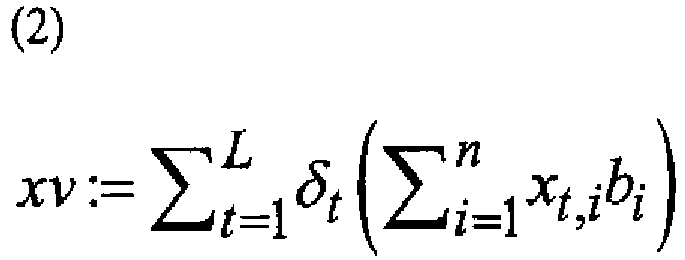
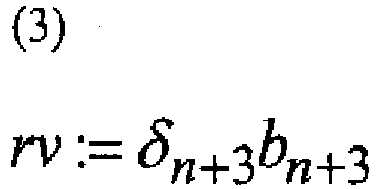

- As in (S403) of the second embodiment, using the processing device and based on a message m, the cipher
information generation unit 230 computes Formula 196 to generate cipher information c2.
- As in (S404) of the second embodiment, the
data transmission unit 240 transmits the cipher vector c1 generated by the ciphervector generation unit 220 and the cipher information c2 generated by the cipherinformation generation unit 230 to thedecryption device 300 through the communication device. - To summarize, the
encryption device 200 executes the Enc algorithm shown in Formula 197 to generate the cipher vector c1 and the cipher information c2.
- The functions and operations of the
decryption device 300 will be described. - As in (S501) of the second embodiment, the
vector input unit 310 receives through the communication device and inputs the cipher vector c1 and the cipher information c2 transmitted by thedata transmission unit 240 of theencryption device 200. - As in (S502) of the second embodiment, using the processing device and based on the master public key pk and the key vector k* L, dec which is the first element of the L-th level secret key, the
pairing operation unit 330 computes Formula 198 to generate a message m'.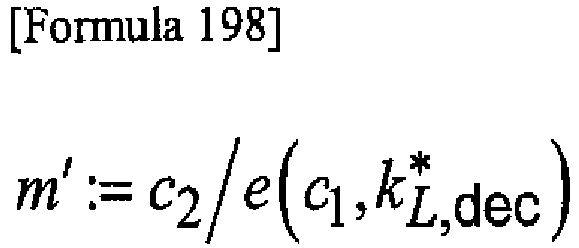
- If x→ i·v→ j = 0 holds for the attribute vector x→ i (i = 1, ..., h) used by the
encryption device 200 for encryption and the predicate vector v→ j (j = 1, ..., L) of the key vector used by thedecryption device 300 for decryption for every i of (i = 1, ..., h) and every j of (j = 1, ..., L), then thepairing operation unit 330 can generate the message m. It is assumed that the message m∈GT. - To summarize, the
decryption device 300 executes the Dec algorithm shown in Formula 199 to generate the message m'.
- The functions and operations of the
key delegation device 400 will be described. - As in (S601) of the second embodiment, the key
vector acquisition unit 410 obtains through the communication device the L-th level secret key (key information k→* L) including the key vector k* L,dec which is the first element of the L-th level secret key, the randomizing vector k* L,ran,j (j = 1, ..., L+1), and the key-generation vector k* L,del,j (j = 1, ..., n). - Using the processing device and based on the master public key pk, the key information k→* L, and a predicate vector v→ L+1 shown in
Formula 200, the keyvector generation unit 420 computes Formula 201 to generate a key vector k* L+1,dec which is the first element of an (L+1)-th level secret key.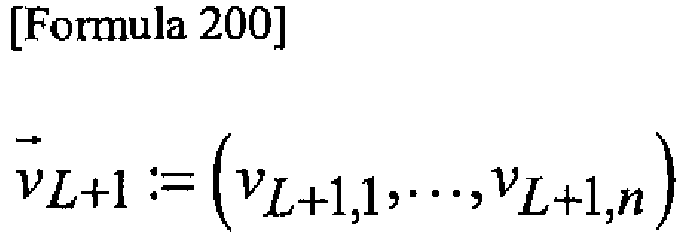
[Formula 201]
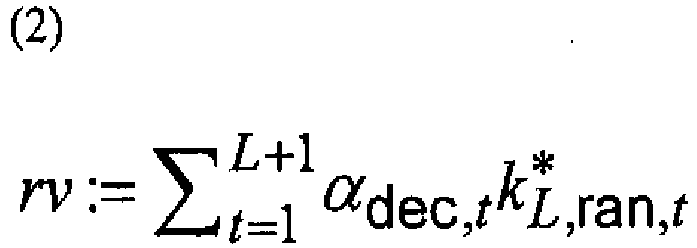
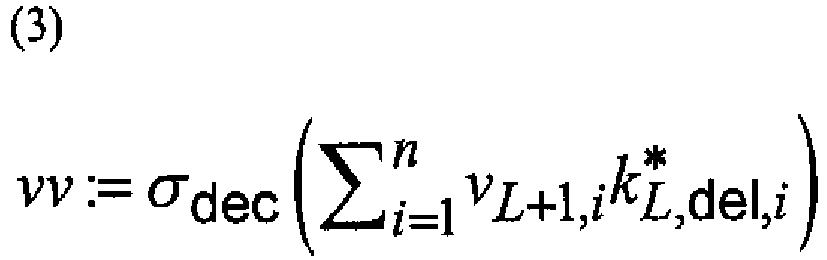

- Based on the master public key pk, the key information k→*L, and the predicate vector v→ L+1 shown in
Formula 200, the randomizingvector generation unit 430 computesFormula 202 to generate a randomizing vector k* L+1,ran,j (j = 1, ..., L+2).
[Formula 202]



- Using the processing device and based on the master public key pk, the key information k→* L, and the predicate vector v→ L+1 shown in
Formula 200, the key-generationvector generation unit 440 computesFormula 203 to generate a key-generation vector k* L+1,del,j (j = 1, ..., n).
[Formula 203]


- To summarize, in (S602) to (S604), using the processing device, the key
vector generation unit 420, the randomizingvector generation unit 430, and the key-generationvector generation unit 440 execute the DelegateL algorithm shown in Formula 204 to generate the (L+1)-th level secret key (key information k→* L+1) including the key vector k* L+1,dec, the randomizing vector k* L+1,ran,j (j = 1, ..., L+2), and the key-generation vector k* L+1,del,j (j = 1, ..., n).
- As in (S605) of the second embodiment, the
key distribution unit 450 transmits the key information k→* L+1 generated by the keyvector generation unit 420, the randomizingvector generation unit 430, and the key-generationvector generation unit 440 to thedecryption device 300 of a lower level through the communication device. - As described above, if x→ i·v→ j = 0 holds for the attribute vector x→ i (i = 1, ..., h) used by the
encryption device 200 for encryption and the predicate vector v→* j (j = 1, ..., L) of the key vector k* L,dec used by thedecryption device 300 for decryption for every i of (i = 1, ..., h) and every j of (j = 1, ..., L), then thedecryption device 300 succeeds in decryption. That is, when the key vector k* 1, dec generated based on the predicate vector (v→ 1) is used for decryption, thedecryption device 300 succeeds in decryption if x→·v→ 1 = 0. When the key vector k* 2, dec generated based on the predicate vectors (v→ 1, v→ 2) is used for decryption, thedecryption device 300 succeeds in decryption if x→·v→ 1, = 0 and x→·v→* 2 = 0. That is, as with the algorithms described in the second embodiment, the lower level key vector k* 2,dec has more limited capabilities than the higher level key vector k* 1,dec. - In this embodiment, as in the second embodiment, it is assumed that the basis vector dn+1 in which the
encryption device 200 sets transmission information is 2-dimensional. However, the dimension of the basis vector dn+1 may be 3-dimensional or higher, i.e., m-dimensional (basis vector bn+1, ..., basis vector bn+m). - As in the second embodiment, the HPKEM scheme may also be implemented by modifying the Enc algorithm executed by the
encryption device 200 and the Dec algorithm executed by thedecryption device 300 as shown in Formula 205 and Formula 206 respectively.
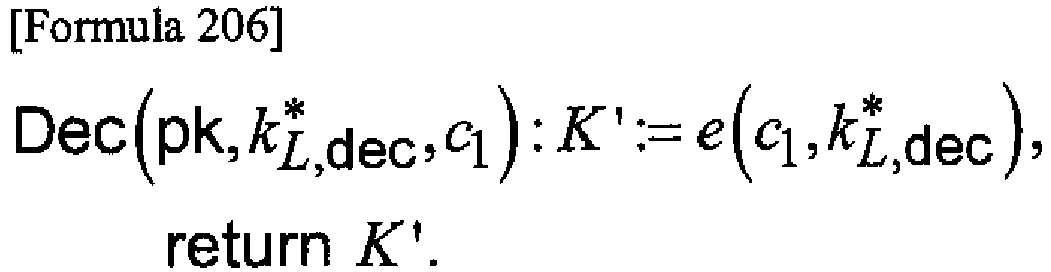
- In the above embodiments, the methods for implementing the cryptographic processes in dual vector spaces have been described. In this embodiment, a method for implementing the cryptographic processes in dual modules will be described.
- That is, in the above embodiments, the cryptographic processes are implemented in cyclic groups of prime order q. However, when a ring R is expressed using a composite number M as shown in Formula 207, the cryptographic processes described in the above embodiments can be adapted to a module having the ring R as the coefficient.

- Z: integer,
- M : composite number.
- For example, when the HPE scheme described in the second embodiment is implemented in the module having the ring R as the coefficient, it is expressed as shown in Formulas 208 to 212.

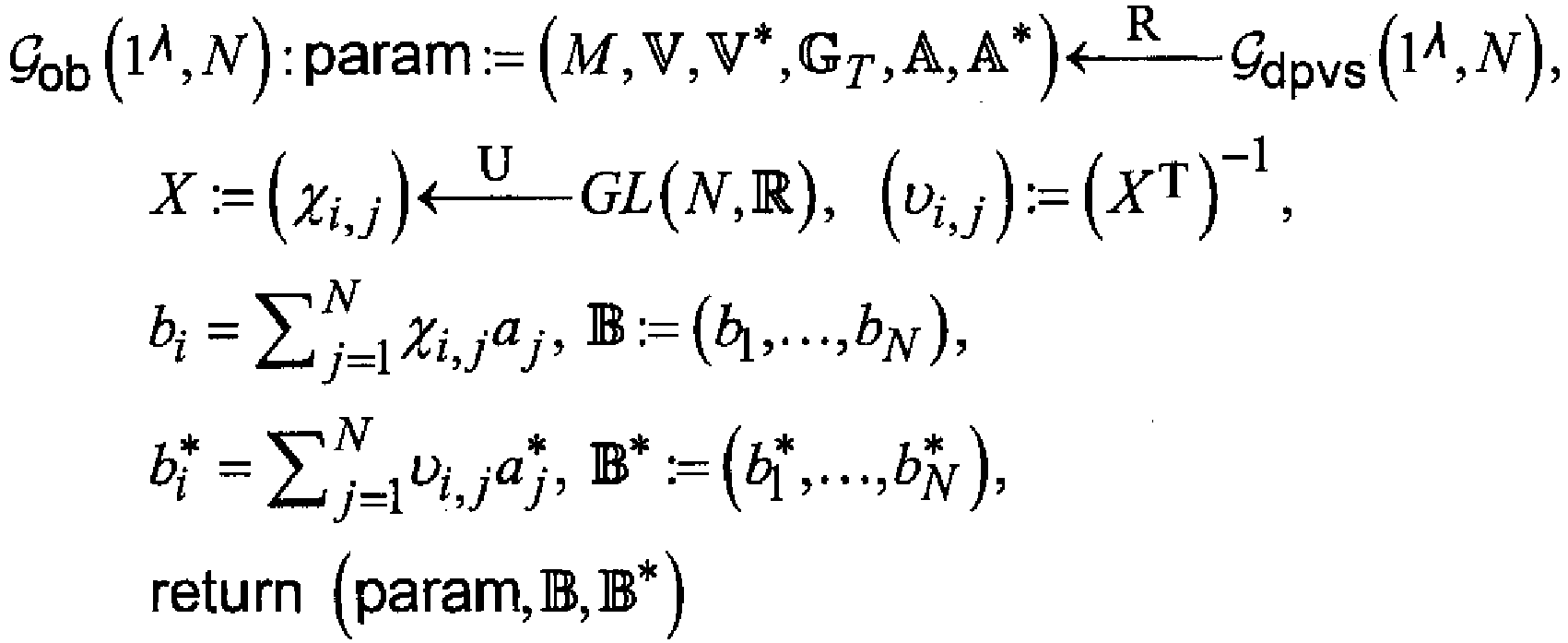
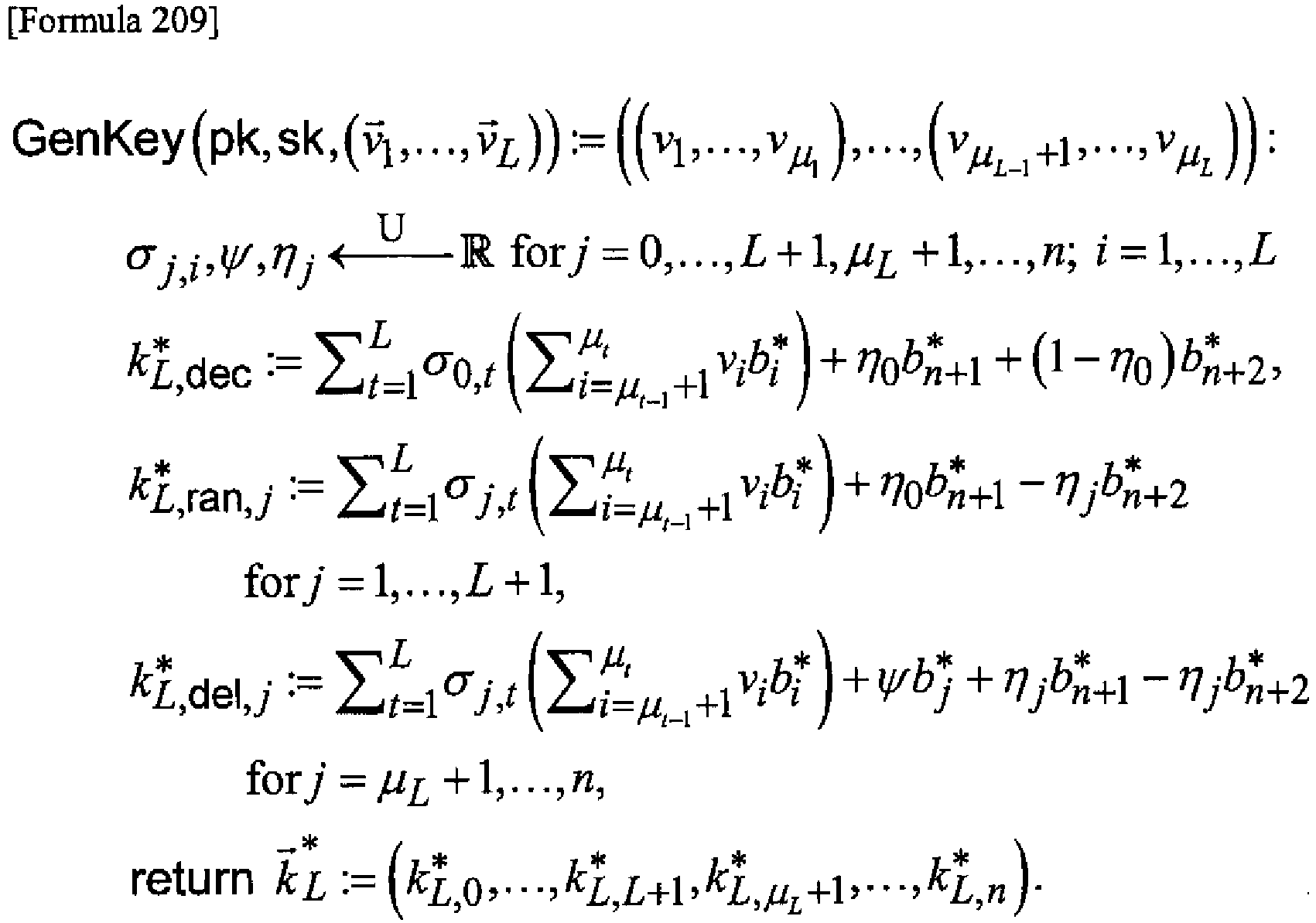


- In this embodiment, only the method for implementing the HPE scheme of the second embodiment in the module having the ring R as the coefficient has been described. However, in principle, the processes described for the field Fq in the above embodiments can be implemented in the module having the ring R as the coefficient by replacing the field Fq with the ring R.
- A hardware configuration of the cryptographic processing system 10 (the
key generation device 100, theencryption device 200, thedecryption device 300, and the key delegation device 400) according to the embodiments will now be described. -
Fig. 21 is a diagram showing an example hardware configuration of thekey generation device 100, theencryption device 200, thedecryption device 300, and thekey delegation device 400. - As shown in
Fig. 21 , thekey generation device 100, theencryption device 200, thedecryption device 300, and thekey delegation device 400 each include the CPU 911 (central processing unit, also called a processing unit, an arithmetic unit, a microprocessor, a microcomputer, or a processor). TheCPU 911 is connected through the bus 912 with theROM 913, theRAM 914, the LCD 901 (liquid crystal display), the keyboard 902 (K/B), thecommunication board 915, and themagnetic disk device 920, and controls these hardware devices. The magnetic disk device 920 (fixed disk device) may be replaced with a storage device such as an optical disk device or a memory card read/write device. Themagnetic disk device 920 is connected through a predetermined fixed disk interface. - The
ROM 913 and themagnetic disk device 920 are examples of a nonvolatile memory. TheRAM 914 is an example of a volatile memory. TheROM 913, theRAM 914, and themagnetic disk device 920 are examples of a storage device (memory). Thekeyboard 902 and thecommunication board 915 are examples of an input device. Thecommunication board 915 is an example of a communication device (network interface). TheLCD 901 is an example of a display device. - The
magnetic disk device 920, theROM 913, or the like stores an operating system 921 (OS), awindow system 922,programs 923, and files 924. Theprograms 923 are executed by theCPU 911, theoperating system 921, and thewindow system 922. - The
programs 923 store software or programs for executing the functions described hereinabove as "the masterkey generation unit 110", "the masterkey storage unit 120", "the keyvector generation unit 130", "the randomizingvector generation unit 140", "the key-generationvector generation unit 150", "thekey distribution unit 160", "the transmissioninformation setting unit 210", "the ciphervector generation unit 220", "the cipherinformation generation unit 230", "thedata transmission unit 240", "the publickey acquisition unit 250", "the sessionkey generation unit 260", "thevector input unit 310", "the keyvector storage unit 320", "thepairing operation unit 330", "the keyvector acquisition unit 410", "the keyvector generation unit 420", "the randomizingvector generation unit 430", "the key-generationvector generation unit 440", "thekey distribution unit 450", and so on. The programs are read and executed by theCPU 911. - The
files 924 store information, data, signal values, variable values, and parameters, such as "the master public key pk", "the master secret key sk", "the cipher vector c", and "the key vector" described hereinabove, each of which is stored as an item of a "file" or a "database". The "file" or "database" is stored in a storage device such as a disk or memory. The information, data, signal values, variable values, and parameters stored in the storage device such as the disk or memory are read by theCPU 911 through a read/write circuit to a main memory or a cache memory, and are used for operations of theCPU 911 such as extraction, search, reference, comparison, calculation, computation, processing, output, printing, and display. The information, data, signal values, variable values, and parameters are temporarily stored in the main memory, the cache memory, or a buffer memory during the operations of theCPU 911 such as extraction, search, reference, comparison, calculation, computation, processing, output, printing, and display. - In the flowcharts described hereinabove, an arrow mainly represents an input/output of data or a signal, and each data or signal value is stored in the
RAM 914, or other types of storage medium such as an optical disk, or an IC chip. The data or signal is transferred online through the bus 912, a signal line, a cable, other types of transfer medium, or a radio wave. - What is described hereinabove as "a ... unit" may be "a ... circuit", "a ... device", "a ... tool", "a ... means", or "a ... function", and may also be "a ... step", "a ... procedure", or "a ... process". What is described as "a ... device" may be "a ... circuit", "a ... tool", "a ... means", or "a ... function", and may also be "a ... step", "a ... procedure", or "a ... process". What is described as "a ... process" may be "a ... step". That is, what is described as "a ... unit" may be implemented by firmware stored in the
ROM 913. Alternatively, "the ... unit" may be implemented solely by software, or solely by hardware such as elements, devices, boards, and wiring, or by a combination of software and hardware, or by a combination including firmware. Firmware or software is stored as a program in a storage medium such as theROM 913. The program is read by theCPU 911 and executed by theCPU 911. That is, the program causes a computer or the like to function as "the ... unit" described above. Alternatively, the program causes the computer or the like to execute a procedure or a method of "the ... unit" described above. -
- 10:
- cryptographic processing system
- 100:
- key generation device
- 110:
- master key generation unit
- 120:
- master key storage unit
- 130:
- key vector generation unit
- 140:
- randomizing vector generation unit
- 150
- key-generation vector generation unit
- 160:
- key distribution unit
- 200:
- encryption device
- 210:
- transmission information setting unit
- 220:
- cipher vector generation unit
- 230:
- cipher information generation unit
- 240:
- data transmission unit
- 250:
- public key acquisition unit
- 260:
- session key generation unit
- 300:
- decryption device
- 310:
- vector input unit
- 320:
- key vector storage unit
- 330:
- pairing operation unit
- 400:
- key delegation device
- 410:
- key vector acquisition unit
- 420:
- key vector generation unit
- 430:
- randomizing vector generation unit
- 440:
- key-generation vector generation unit
- 450:
- key distribution unit

Claims (32)
- A cryptographic processing system (10) that performs a predicate encryption process using dual modules of a space V and a space V* paired through a pairing operation shown in Formula 1, the cryptographic processing system comprising:an encryption device (200) that, using a processing device, generates as a cipher vector c1 a vector of a basis B^, the basis B^ having, out of basis vectors bi (i = 1, ..., n, ..., N) (N being an integer of 3 or greater and n being an integer from 1 to N-2) that constitute a predetermined basis B of the space V, basis vectors bi (i = 1, ..., n) and a basis vector dn+1 which is a sum of two or more basis vectors bi (i = n+1, ..., m) out of the basis vectors bi (i = n+1, ..., N), the cipher vector c1 being the vector in which attribute information is embedded as coefficients of one or more basis vectors out of the basis vector bi (i = 1, ..., n), and predetermined information is embedded as a coefficient of the basis vector dn+1; anda decryption device (300) that, using the processing device, performs the pairing operation e (c1, k* L,dec) shown in Formula 1 on the cipher vector c1 generated by the encryption device and a key vector k* L,dec to decrypt the cipher vector c1 and to extract a value concerning the predetermined information, the key vector k* L,dec being a vector of a basis B* of the space V* and constructed such that predicate information is embedded as coefficients of one or more basis vectors of basis vectors b* i (i =1, ..., n) out of basis vectors b* i (i =1, ..., n, ..., N) that constitute the basis B*, and coefficients of basis vectors b* i (i = n+1, ..., m) of the basis B* are embedded such that a sum of the coefficients of the basis vectors b* i (i = n+1, ..., m) is 1.


- The cryptographic processing system of claim 1, wherein said dual modules comprise dual vector spaces.
- The cryptographic processing system of claim 2, further comprising:a key generation device (100) that, using the processing device, generates as the key vector k* L, dec the vector in which the predicate information is set as the coefficients of the one or more basis vectors of the basis vectors b* i (i = 1, ..., n) out of the basis vectors b* i (i = 1, ..., N) that constitute the basis B*, and the coefficients of the basis vectors b* i (i = n+1, ..., m) are set such that the sum of the coefficients of the basis vectors b* i (i = n+1, ..., m) is 1, and whereinthe decryption device obtains the key vector k* L,dec generated by the key generation device, and performs the pairing operation on the key vector k* L, dec obtained and the cipher vector c1.
- The cryptographic processing system of claim 3, further comprising:a key delegation device (400) that generates as a key vector k* L+1, dec a vector that can decrypt one or more, but not all, of cipher vectors that can be decrypted by the key vector k* L,dec generated by the key generation device, the key vector k* L+1, dec being the vector in which random numbers having uniformly distributed values are set as coefficients of basis vectors in which predicate information is set.
- A key generation device (100) that generates a key vector k* L,dec which is a secret key in a predicate encryption scheme, the key generation device comprising:a master key storage unit (120) that, when a space V and a space V* are dual modules paired through a pairing operation, stores in a storage device a predetermined basis B* of the space V*; anda key vector generation unit (130) that, using a processing device, generates as the key vector k* L, dec a vector in which predicate information is set as coefficients of one or more basis vectors b* i (i = 1, ..., µL) of basis vector b* i (i = 1, ..., n) out of basis vectors b* i (i = 1, ..., n, ..., N) (N being an integer of 3 or greater and n being an integer from 1 to N-2) that constitute the basis B* stored by the master key storage unit, and coefficients of two or more predetermined basis vectors out of basis vectors b* i (i = n+1,..., N) are set such that a sum of the coefficients of the two or more predetermined basis vectors is 1.
- The key generation device of claim 5, wherein said dual modules comprise dual vector spaces.
- The key generation device of claim 6,
wherein the key vector generation unit generates the key vector k* L, dec as shown in Formula 2. σ0,i,η 0 (i = 1,...,L): predetermined values,vi (i = 1,...,µL ): predicate information.
 - The key generation device of claim 6,
wherein the key vector generation unit generates the key vector k*L,dec as shown in Formula 3. σdec, t,η dec (t = 1,...,L): predetermined values,vt,i (t = 1,...,L; i = 1,...,n): predicate information.
 - The key generation device of claim 6, further comprising:a key-generation vector generation unit (150) that, using the processing device, generates as a key-generation vector k*L,del,j at least an (n-µL) number of vectors that can decrypt one or more, but not all, of cipher vectors that can be decrypted by the key vector k*L,dec generated by the key vector generation unit, the key-generation vector k*L,del,j being a vector in which a predetermined value is set as a coefficient of a basis vector b*j for at least each j of j = µL+1, ..., n; anda randomizing vector generation unit (140) that, using the processing device, generates as a randomizing vector k*L, ran,j at least an (L+1) number of vectors for setting uniformly distributed values as coefficients of basis vectors of the key vector k*L+1,dec generated with the key-generation vector k*L,del,j generated by the key-generation vector generation unit, the coefficients being set such that predicate information is set, and the randomizing vector k* L, ran,j being a vector in which a predetermined value is set as a coefficient of a basis vector b* j for at least each j of j = 1, ..., L+1.
- The key generation device of claim 9,
wherein the key vector generation unit generates the key-generation vector k*L,del,j as shown in Formula 4, and
wherein the randomizing vector generation unit generates the randomizing vector k*L,ran,j as shown in Formula 5.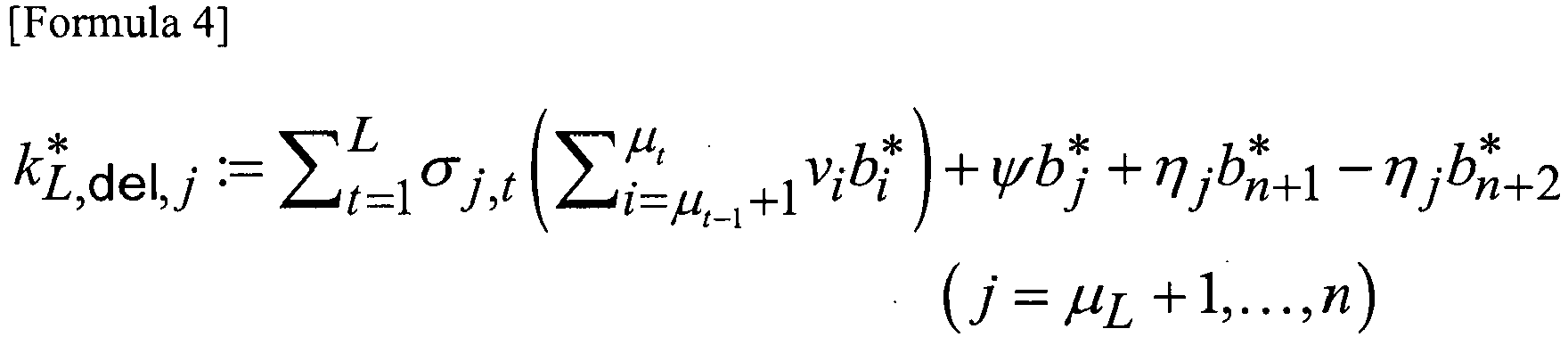 σj,i,ψ,ηj (j = µL + 1,...,n; i = 1,...,L) : predetermined values,vi (i = 1,...,µL ): predicate information.
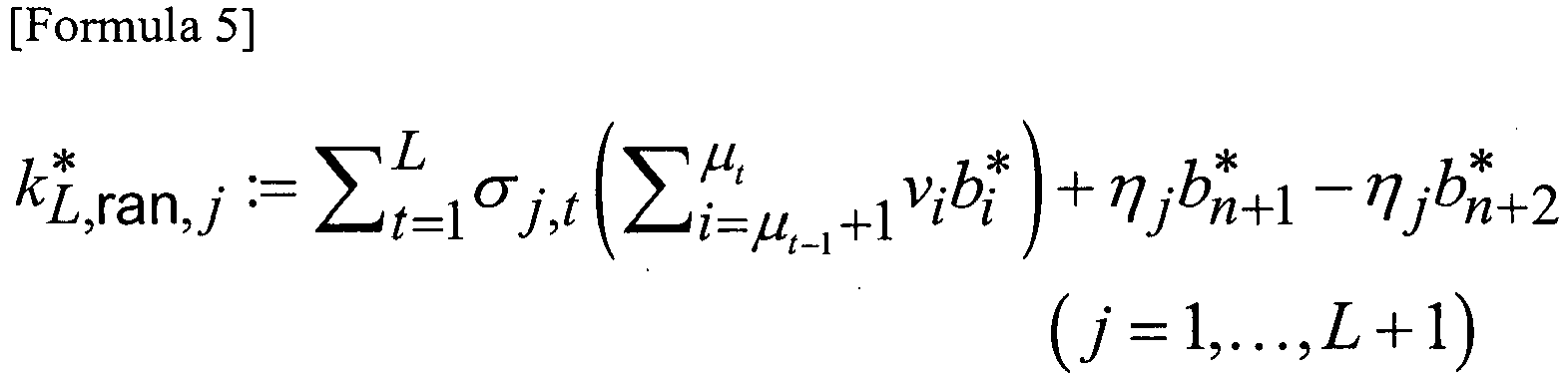 σj,i,ηj (j= 1...,L + 1; i = 1,..., L): predetermined values,vi (i = 1,..., µL ): predicate information.
 - The key generation device of claim 9,
wherein the key vector generation unit generates the key-generation vector k*L,del,j as shown in Formula 6, and
wherein the randomizing vector generation unit generates the randomizing vector k*L,ran,j as shown in Formula 7.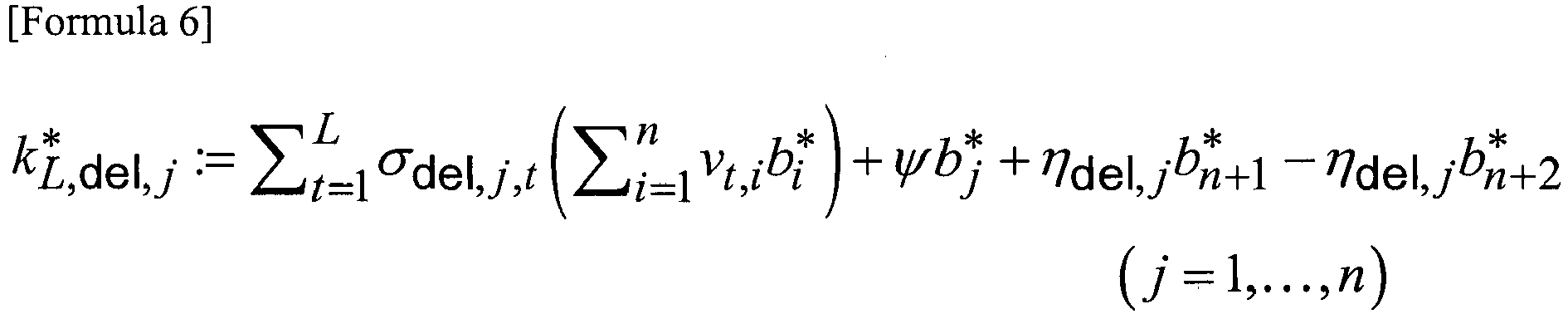 σ del, j,t,η del, j,ψ (j = 1,...,n; t = 1,...,L) : predetermined values,vt,i (t = 1,..., L; i = 1,...,n): predicate information.
 σ ran, j,t,ηran,j (j = 1,...,L + 1;t = 1,...,L): predetermined values,vt,i (t = 1,...,L; i = 1,...,n): predicate information.
 - A key delegation device (400) that generates a key vector k*L+1,dec that can decrypt one or more, but not all, of cipher vectors that can be decrypted by a key vector k*L,dec which is a secret key in a predicate encryption scheme, the key delegation device comprising:a key vector acquisition unit (410) that, when a space V and a space V* are dual modules paired through a pairing operation, obtains the key vector k*L,dec in which predicate information is set as coefficients of one or more basis vectors b*i (i = 1,..., µL) of basis vectors b*i (i = 1, ..., n) out of basis vector b*i (i =1, ..., n, ..., N) (N being an integer of 3 or greater and n being an integer from 1 to N-2) that constitute a predetermined basis B* of the space V*, and coefficients of two or more predetermined basis vectors out of basis vectors b*i (i = n+1, ..., N) are set such that a sum of the coefficients of the two or more predetermined basis vectors is 1;a key-generation vector acquisition unit (410) that obtains at least an (n-µL) number of key-generation vectors k*L,del,j in which a predetermined value is set as a coefficient of a basis vector b*j for at least each j of j = µL+1, ..., n; anda key vector generation unit (420) that generates the key vector k*L+1,dec by multiplying by predicate information a coefficient of each basis vector of one or more key-generation vectors k*L,del,j out of the key generation vectors k*L,del,j obtained by the key-generation vector acquisition unit and adding each result to the key vector k*L, dec obtained by the key vector acquisition unit.
- The key delegation device of claim 12, wherein said dual modules comprise dual vector spaces.
- The key delegation device of claim 13, further comprising:a randomizing vector acquisition unit that obtains at least an (L+1) number of randomizing vectors k*L,ran,j in which a predetermined value is set as a coefficient of a basis vector b* j for at least each j of j = 1, ..., L+1, and whereinthe key vector generation unit generates the key vector k*L+1,dec by multiplying by a random number a coefficient of each basis vector of one or more randomizing vectors k*L,ran,j out of the randomizing vectors k*L,ran,j obtained by the randomizing vector acquisition unit and further adding each result to the key vector k*L+1,dec.
- The key delegation device of claim 14,
wherein the key vector acquisition unit obtains the key vector k*L,dec as shown in Formula 8,
wherein the key-generation vector acquisition unit obtains the key-generation vector k*L,del,j as shown in Formula 9,
wherein the randomizing vector acquisition unit obtains the randomizing vector k*L,ran,j as shown in Formula 10, and
wherein the key vector generation unit generates the key vector k*L+1,dec as shown in Formula 11. σ 0 ,i,η 0 (i = 1,...,L): predetermined values,vi (i = 1,..., µL ): predicate information.
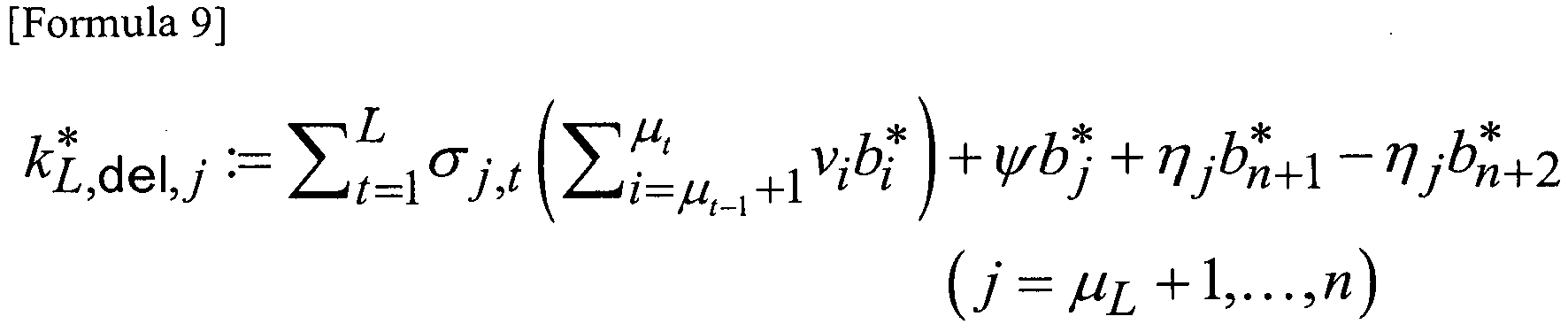 σj,i,ψ,ηj (j = µL + 1,...,n; i = 1,...,L) : predetermined values,vi (i = 1,...,µL ): predicate information.
 σj,i,ηj (j = 1,...,L + 1; i = 1,...,L): predetermined values,vi (i = 1,..., µL ): predicate information.
 σ 0 ,i,σ 0 (i = 1,...,L + 1): predetermined values,vi (i = µL + 1,..., µ L+1): predicate information.
 - The key delegation device of claim 14,
wherein the key vector acquisition unit obtains the key vector k*L,dec as shown in Formula 12,
wherein the key-generation vector acquisition unit obtains the key-generation vector k*L,del,j as shown in Formula 13,
wherein the randomizing vector acquisition unit obtains the randomizing vector k*L, ran,j as shown in Formula 14, and
wherein the key vector generation unit generates the key vector k*L+1,dec as shown in Formula 15. σ dec ,t,η dec (t =1,..., L): predetermined values,vt,i (t = 1,...,L;i = 1,...,n): predicate information.
 σ del, j,t,η del, j,ψ (j = 1,...,n; t = 1,...,L) : predetermined values,vt,i (t = 1,...,L;i = 1,...,n): predicate information.
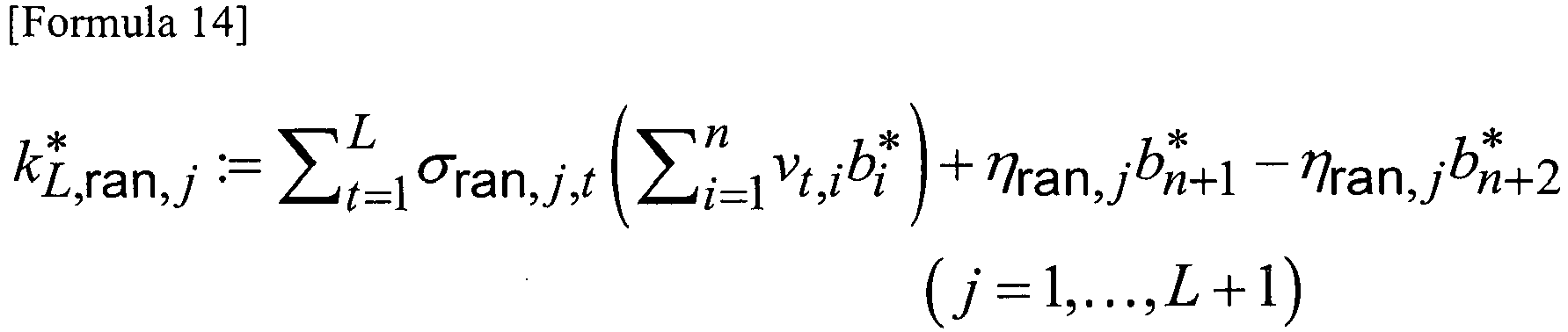 σ ran, j,t,η ran,j (j = 1,...,L + 1;t = 1,...,L): predetermined values,vt,i (t = 1,...,L;i = 1,...,n): predicate information.
 σ dec, t,σ dec (t = 1,...,L + 1): predetermined values,v L+1,i (i = 1,...,n): predicate information.
 - The key delegation device of claim 14, further comprising:a key-generation vector generation unit (440) that, using a processing device, generates as a key-generation vector k*L+1,del,j at least an (n-µL+1) number of vectors that, can decrypt one or more, but not all, of cipher vectors that can be decrypted by the key vector k*L+1,dec generated by the key vector generation unit, the key-generation vector k*L+1,dei,j being a vector in which a predetermined value is set as a coefficient of a basis vector b* j for at least each j of j = µL+1 + 1, ..., n; anda randomizing vector generation unit (430) that, using the processing device, generates as a randomizing vector k*L+1,ran,j at least an (L+2) number of vectors for setting uniformly distributed values as coefficients of basis vectors of the key vector k*L+2,dec generated with the key-generation vector k*L+1,del,j generated by the key-generation vector generation unit, the coefficients being set such that predicate information is set, and the randomizing vector k*L+1,ran,j being a vector in which a predetermined value is set as a coefficient of a basis vector b* j for at least each j of j = 1, ..., L+2.
- The key delegation device of claim 17,
wherein the key-generation vector acquisition unit obtains the key-generation vector k*L,del,j as shown in Formula 16,
wherein the randomizing vector acquisition unit obtains the randomizing vector k*L,ran,j as shown in Formula 17,
wherein the key vector generation unit generates the key-generation vector k*L+1,del,j as shown in Formula 18, and
wherein the randomizing vector generation unit generates the randomizing vector k*L+1,ran,j as shown in Formula 19.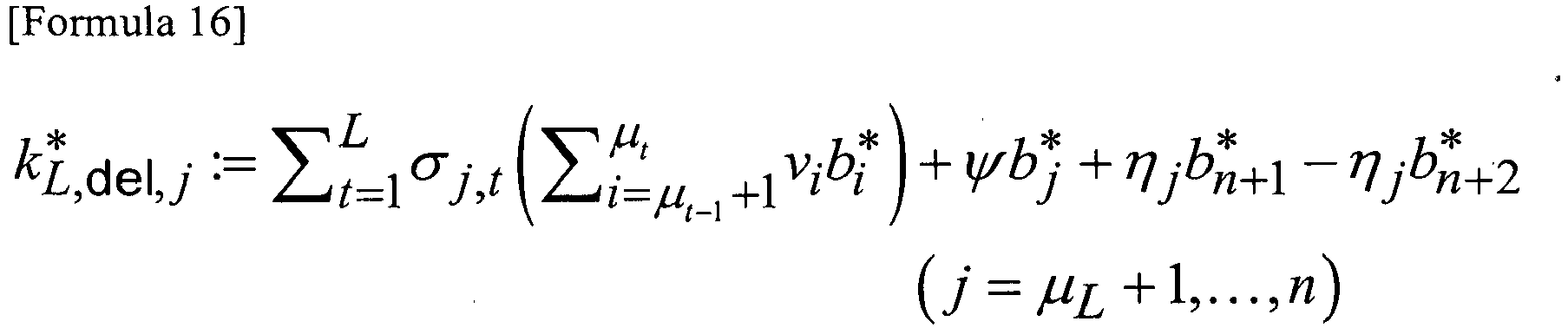 σj,t,ψ,ηj (j = µL + 1,...n; t = 1,...,L) : predetermined values,vi (i = 1,..., µL ): predicate information.
 σj,t,ηj (j = 1,...,L + 1; t = 1,...,L): predetermined values,vi (i = 1,..., µL ): predicate information.
 αj,i,σj,ψ' (j = µ L+1 + 1,...,n; i = 1, ... ,L + 1): predetermined values,vi (i = µL + 1,...,µ L+1): predicate information.
 α j,i,σj (j = 1,...,L + 2; i = 1,...,L + 1): predetermined values,vi (i = µL + 1,...,µ L+1): predicate information.
 - The key delegation device of claim 17,
wherein the key-generation vector acquisition unit obtains the key-generation vector k*L,del,j as shown in Formula 20,
wherein the randomizing vector acquisition unit obtains the randomizing vector k*L,ran,j as shown in Formula 21,
wherein the key vector generation unit generates the key-generation vector k*L+1, del,j as shown in Formula 22, and
wherein the randomizing vector generation unit generates the randomizing vector k*L+1,ran,j as shown in Formula 23. σ del, j,t,η del, j,ψ (j = 1,...,n;t = 1,...,L) : predetermined values,vt,i (t = 1,...,L;i = 1,...,n): predicate information.
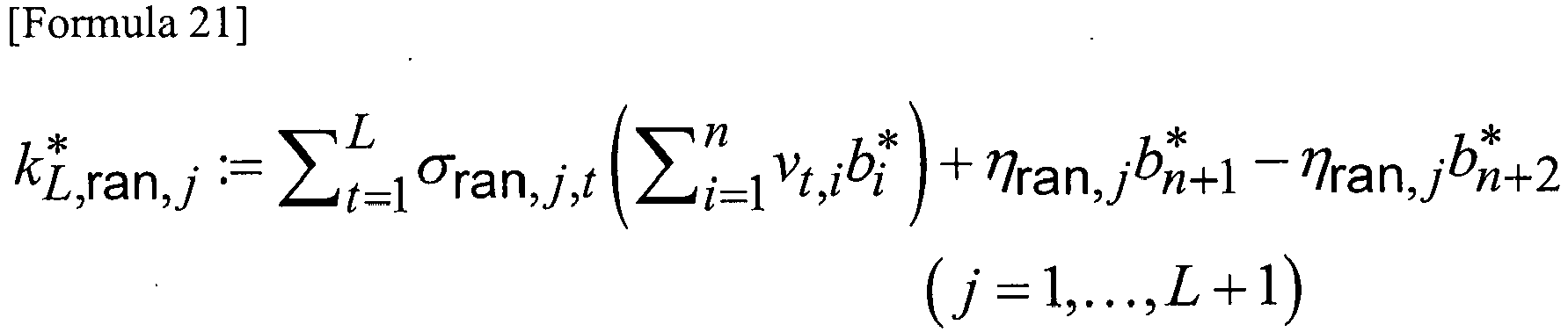 σ ran, j,t,η ran,j (j = 1,...,L + 1;t = 1,...,L): predetermined values,vt,i (t = 1,...,L;i = 1,...,n): predicate information.
 α del, j,t,σ del, j,ψ' (j = 1,...,n; i = 1,...,L + 1): predetermined values,v L+1,i (i = 1,...,n): predicate information.
 α ran, j,t,σ ran,j (j = 1,...,L + 2; t = 1,...,L + 1): predetermined values,v L+1,i (i = 1,..., n): predicate information.
 - An encryption device (200) that generates a cipher vector c1 which is a ciphertext in a predicate encryption scheme, the encryption device comprising:a public key acquisition unit (250) that, when a space V and a space V* are dual modules paired through a pairing operation, obtains a basis B^ and predetermined attribute information, the basis B^ having, out of basis vector bi (i = 1, ..., n, ..., N) (N being an integer of 3 or greater and n being an integer from 1 to N-2) that constitute a predetermined basis B of the space V, basis vectors bi (i = 1, ..., n) and a basis vector dn+1 which is a sum of two or more predetermined basis vectors out of basis vectors bi (i = n+1, ..., N);a transmission information setting unit (210) that, using a processing device, generates as a transmission information vector ζv a vector of the basis B^ obtained by the public key acquisition unit, the transmission information vector ζv being the vector in which predetermined information is set as a coefficient of the basis vector dn+1; anda cipher vector generation unit (220) that, using the processing device, generates the cipher vector c1 by adding an attribute information vector in which attribute information is set as coefficients of one or more basis vectors out of the basis vectors bi (i = 1, ..., n) of the basis B^ to the transmission information vector ζv generated by the transmission information setting unit.
- The encryption device of claim 20, wherein said dual modules comprise dual vector spaces.
- The encryption device of claim 21,
wherein the transmission information setting unit generates the transmission information vector ζv as shown in Formula 24, and
wherein the cipher vector generation unit generates the cipher vector c1 as shown in Formula 25.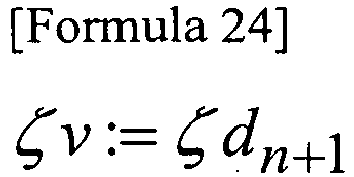
ζ : predetermined value.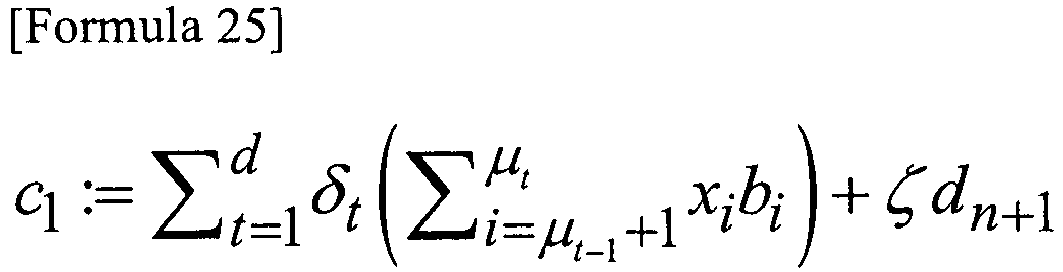


δ 1,...,δd : predetermined values. - The encryption device of claim 21,
wherein the transmission information setting unit generates the transmission information vector ζv as shown in Formula 26, and
wherein the cipher vector generation unit generates the cipher vector c1 as shown in Formula 27.
ζ : predetermined value.

- The encryption device of claim 21, further comprising:a cipher information generation unit (230) that generates cipher information c2 shown in Formula 28.

 A is a basis of the space V and is A := (a 1 ,...,aN ),A* is a basis of the space V* and is
- A decryption device (300) that decrypts a ciphertext in a predicate encryption scheme, the decryption device comprising:a vector input unit (310) that, when a space V and a space V* are dual modules paired through a pairing operation, inputs a cipher vector c1 of a basis B^, the basis B^ having, out of basis vectors bi (i =1, ..., n, ..., N) (N being an integer of 3 or greater and n being an integer from 1 to N-2) that constitute a predetermined basis B of the space V, basis vectors bi (i =1, ..., n) and a basis vector dn+1 which is a sum of two or more predetermined basis vectors out of basis vectors bi (i = n+1, ..., N), the cipher vector c1 being a vector in which attribute information is set as coefficients of at least basis vectors bi (i = 1, ..., µh) out of the basis vectors bi (i = 1, ..., n) and predetermined information is set as a coefficient of the basis vector dn+1;a key vector storage unit (320) that stores in a storage device a key vector k*L, dec in which predicate information vi (i = 1, ..., µL) is set as coefficients of at least basis vectors b* i (i = 1, ..., µL) (µL≤µh) of basis vectors b* i (i = 1, ..., n) out of basis vectors b* i (i = 1, ..., n, ..., N) of a predetermined basis B* of the space V*, and coefficients of basis vectors b* i corresponding to the basis vectors bi that constitute the basis vector dn+1 are set such that a sum of the coefficients of the basis vectors b* i is 1; anda pairing operation unit (330) that, using a processing device, performs the pairing operation on the cipher vector c1 input by the vector input unit and the key vector k* L,dec stored by the key vector storage unit to extract from the cipher vector c1 a value concerning the predetermined information.
- The decryption device of claim 25, wherein said dual modules comprise dual vector spaces.
- The decryption device of claim 26,
wherein the vector input unit inputs the cipher vector c1 as shown in Formula 29,
wherein the key vector storage unit stores the key vector k*L,dec as shown in Formula 30, and
wherein the pairing operation unit performs the pairing operation as shown in Formula 31 to extract from the cipher vector the value concerning the predetermined information.


δ 1,...,δd ,ζ : predetermined values. σ 0, i,η 0 (i = 1,..., L): predetermined values,vi (i = 1,...,µL ): predicate information.


- The decryption device of claim 26, wherein the vector input unit inputs the cipher vector c1 as shown in Formula 32,
wherein the key vector storage unit stores the key vector k*L,dec as shown in Formula 33, and
wherein the pairing operation unit performs the pairing operation as shown in Formula 34 to extract from the cipher vector the value concerning the predetermined information.
 δ 1,...,δd ,ζ : predetermined values.
 σdec,t,η dec (t = 1,...,L): predetermined values,vt,i (t = 1,...,L; i = 1,...,n): attribute information.


- The decryption device of claim 26,
wherein the vector input unit inputs the cipher vector c1 as shown in Formula 35 and cipher information c2 as shown in Formula 36 in which a message m is encrypted,
wherein the key vector storage unit stores the key vector k*L,dec as shown in Formula 37, and
wherein the pairing operation unit performs an operation as shown in Formula 38 to extract the message m from the cipher vector c1.

 δ 1,...,δd,ζ : predetermined values.
 A is a basis of the space V and is A := (a 1,...,aN ),A* is a basis of the space V* and is
 σ 0,i ,η 0 (i = 1,..., L): predetermined values,vi (i = 1,..., µL ): predicate information.


- The decryption device of claim 26,
wherein the vector input unit inputs the cipher vector c1 as shown in Formula 39 and cipher information c2 as shown in Formula 40 in which a message m is encrypted,
wherein the key vector storage unit stores the key vector k*L,dec as shown in Formula 41, and
wherein the pairing operation unit performs an operation as shown in Formula 42 to extract the message m from the cipher vector c1.
 δ 1,...,δd,ζ : predetermined values.
 A is a basis of the space V and is A := (a 1,...,aN ),A* is a basis of the space V* and is
 σ dec,t ,η dec (t = 1,...,L): predetermined values,vt,i (t = 1,...,L; i = 1,...,n): predicate information.


- A cryptographic processing method of performing a predicate encryption process using dual vector spaces of a space V and a space V* paired through a pairing operation shown in Formula 44, the cryptographic processing method comprising:generating as a cipher vector c1 a vector of a basis B^, the basis B^ having, out of basis vectors bi (i = 1, ..., n, ..., N) (N being an integer of 3 or greater and n being an integer from 1 to N-2) that constitute a predetermined basis B of the space V, basis vectors bi (i = 1, ..., n) and a basis vector dn+1 which is a sum of two or more basis vectors bi (i = n+1, ..., m) out of the basis vectors bi (i = n+1, ..., N), the cipher vector c1 being the vector in which attribute information is embedded as coefficients of one or more basis vectors out of the basis vector bi (i = 1, ..., n), and predetermined information is embedded as a coefficient of the basis vector dn+1; andperforming the pairing operation e (c1, k*L,dec) shown in Formula 44 on the cipher vector c1 generated and a key vector k*L,dec to decrypt the cipher vector c1 and to extract a value concerning the predetermined information, the key vector k*L,dec being a vector of a basis B* of the space V* and constructed such that predicate information is embedded as coefficients of one or more basis vectors of basis vectors b* i (i =1, ..., n) out of basis vectors b* i (i =1, ..., n, ..., N) that constitute the basis B*, and coefficients of basis vectors b*i (i = n+1, ..., m) of the basis B* are embedded such that a sum of the coefficients of the basis vectors b*i (i = n+1, ..., m) is 1.

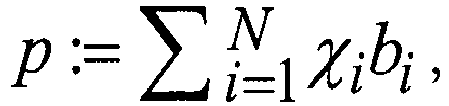

- A cryptographic processing program that performs a predicate encryption process using dual vector spaces of a space V and a space V* paired through a pairing operation shown in Formula 45, the cryptographic processing program causing a computer to execute:an encryption process that generates as a cipher vector c1 a vector of a basis B^, the basis B^ having, out of basis vectors bi (i = 1, ..., n, ..., N) (N being an integer of 3 or greater and n being an integer from 1 to N-2) that constitute a predetermined basis B of the space V, basis vectors bi (i = 1, ..., n) and a basis vector dn+1 which is a sum of two or more basis vectors bi (i = n+1, ..., m) out of basis vectors bi (i = n+1, ..., N), the cipher vector c1 being the vector in which attribute information is embedded as coefficients of one or more basis vectors out of the basis vector bi (i = 1, ..., n), and predetermined information is embedded as a coefficient of the basis vector dn+1; anda decryption process that performs the pairing operation e (c1, k*L,dec) shown in Formula 45 on the cipher vector c1 generated by the encryption device and a key vector k*L,dec to decrypt the cipher vector c1 and to extract a value concerning the predetermined information, the key vector k*L,dec being a vector of a basis B* of the space V* and constructed such that predicate information is embedded as coefficients of one or more basis vectors of basis vectors b*i (i =1, ..., n) out of basis vectors b*i (i =1, ..., n, ..., N) that constitute the basis B*, and coefficients of basis vectors b*i (i = n+1, ..., m) of the basis B* are embedded such that a sum of the coefficients of the basis vectors b*i (i = n+1, ..., m) is 1.
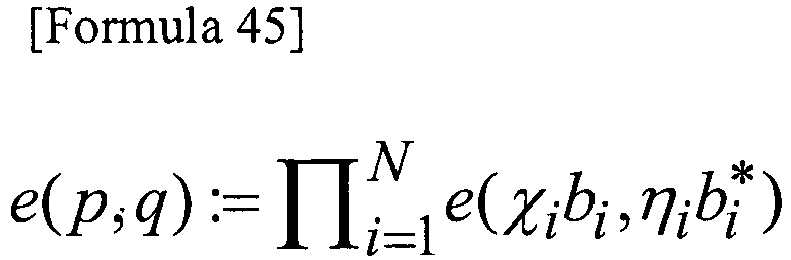


Applications Claiming Priority (2)
| Application Number | Priority Date | Filing Date | Title |
|---|---|---|---|
| JP2009264454 | 2009-11-20 | ||
| PCT/JP2010/070280 WO2011062136A1 (en) | 2009-11-20 | 2010-11-15 | Cipher processing system, key generating device, key delegating device, encrypting device, decrypting device, cipher processing method, and cipher processing program |
Publications (3)
| Publication Number | Publication Date |
|---|---|
| EP2503533A1 EP2503533A1 (en) | 2012-09-26 |
| EP2503533A4 EP2503533A4 (en) | 2014-09-10 |
| EP2503533B1 true EP2503533B1 (en) | 2016-10-05 |
Family
ID=44059614
Family Applications (1)
| Application Number | Title | Priority Date | Filing Date |
|---|---|---|---|
| EP10831530.0A Not-in-force EP2503533B1 (en) | 2009-11-20 | 2010-11-15 | Cipher processing system, key generating device, key delegating device, encrypting device, decrypting device, cipher processing method and cipher processing program |
Country Status (7)
| Country | Link |
|---|---|
| US (1) | US8577030B2 (en) |
| EP (1) | EP2503533B1 (en) |
| JP (1) | JP5769401B2 (en) |
| KR (1) | KR101336349B1 (en) |
| CN (1) | CN103038805B (en) |
| ES (1) | ES2602052T3 (en) |
| WO (1) | WO2011062136A1 (en) |
Families Citing this family (17)
| Publication number | Priority date | Publication date | Assignee | Title |
|---|---|---|---|---|
| EP2525340B1 (en) | 2010-01-15 | 2018-06-06 | Mitsubishi Electric Corporation | Confidential search system and encryption processing system |
| US8462939B2 (en) * | 2010-12-07 | 2013-06-11 | King Fahd University Of Petroleum And Minerals | RNS-based cryptographic system and method |
| EP2756627B1 (en) | 2011-09-28 | 2018-11-14 | Koninklijke Philips N.V. | Hierarchical attribute-based encryption and decryption |
| EP2797254A4 (en) * | 2011-12-20 | 2015-10-28 | Mitsubishi Electric Corp | DEVICE FOR ENCRYPTED DATA MANAGEMENT, METHOD FOR ENCRYPTED DATA MANAGEMENT AND CLASSED DATA MANAGEMENT PROGRAM |
| JP5730805B2 (en) * | 2012-04-04 | 2015-06-10 | 日本電信電話株式会社 | Hierarchical inner product encryption system based on lattice problem, hierarchical inner product encryption method and apparatus based on lattice problem |
| JP5901803B2 (en) * | 2013-01-16 | 2016-04-13 | 三菱電機株式会社 | Information processing apparatus, information processing method, and program |
| EP2860905A1 (en) * | 2013-10-09 | 2015-04-15 | Thomson Licensing | Method for ciphering a message via a keyed homomorphic encryption function, corresponding electronic device and computer program product |
| EP3113405B1 (en) | 2014-02-24 | 2020-10-28 | Mitsubishi Electric Corporation | Cipher system and cipher program |
| JP6266130B2 (en) * | 2014-12-05 | 2018-01-24 | 三菱電機株式会社 | Cryptographic system, master key update device, and master key update program |
| CN107454975B (en) | 2015-04-07 | 2020-11-27 | 三菱电机株式会社 | Encryption system and key generation device |
| EP3483866B1 (en) * | 2016-07-06 | 2020-12-23 | Nippon Telegraph and Telephone Corporation | Secure computation system, secure computation device, secure computation method, and program |
| US10205713B2 (en) * | 2017-04-05 | 2019-02-12 | Fujitsu Limited | Private and mutually authenticated key exchange |
| AU2018271515B2 (en) * | 2017-05-25 | 2020-09-10 | Ntt, Inc. | Secret tampering detection system, secret tampering detection apparatus, secret tampering detection method, and program |
| JP6456451B1 (en) | 2017-09-25 | 2019-01-23 | エヌ・ティ・ティ・コミュニケーションズ株式会社 | COMMUNICATION DEVICE, COMMUNICATION METHOD, AND PROGRAM |
| US11483136B2 (en) | 2019-12-10 | 2022-10-25 | Google Llc | Wrapped keys with access control predicates |
| US12099997B1 (en) | 2020-01-31 | 2024-09-24 | Steven Mark Hoffberg | Tokenized fungible liabilities |
| CN112733111B (en) * | 2020-12-31 | 2023-05-23 | 暨南大学 | Threshold predicate encryption biological feature authentication method based on segment segmentation |
Family Cites Families (8)
| Publication number | Priority date | Publication date | Assignee | Title |
|---|---|---|---|---|
| US20070223686A1 (en) | 2004-09-16 | 2007-09-27 | Shidong Li | Methods and apparatus for data and signal encryption and decryption by irregular subspace leaping |
| JP2008011092A (en) * | 2006-06-28 | 2008-01-17 | Fuji Xerox Co Ltd | Encrypted-content retrieval system |
| US8401179B2 (en) | 2008-01-18 | 2013-03-19 | Mitsubishi Electric Corporation | Encryption parameter setting apparatus, key generation apparatus, cryptographic system, program, encryption parameter setting method, and key generation method |
| CN101335615B (en) * | 2008-05-30 | 2010-12-29 | 北京飞天诚信科技有限公司 | Method for Key Negotiation of USB KEY Audio Encryption and Decryption Device |
| CN101404577B (en) * | 2008-10-30 | 2010-04-21 | 南京大学 | A secure communication method integrating multiple security technologies |
| JP5349261B2 (en) * | 2009-04-23 | 2013-11-20 | 三菱電機株式会社 | Cryptographic processing system, key generation device, key delegation device, encryption device, decryption device, cryptographic processing method, and cryptographic processing program |
| US8515060B2 (en) * | 2009-04-24 | 2013-08-20 | Nippon Telegraph And Telephone Corporation | Encryption apparatus, decryption apparatus, encryption method, decryption method, security method, program, and recording medium |
| EP2525340B1 (en) * | 2010-01-15 | 2018-06-06 | Mitsubishi Electric Corporation | Confidential search system and encryption processing system |
-
2010
- 2010-11-15 WO PCT/JP2010/070280 patent/WO2011062136A1/en not_active Ceased
- 2010-11-15 CN CN201080065337.0A patent/CN103038805B/en not_active Expired - Fee Related
- 2010-11-15 US US13/509,695 patent/US8577030B2/en active Active
- 2010-11-15 KR KR1020127013861A patent/KR101336349B1/en not_active Expired - Fee Related
- 2010-11-15 EP EP10831530.0A patent/EP2503533B1/en not_active Not-in-force
- 2010-11-15 ES ES10831530.0T patent/ES2602052T3/en active Active
- 2010-11-19 JP JP2010258447A patent/JP5769401B2/en active Active
Also Published As
| Publication number | Publication date |
|---|---|
| JP5769401B2 (en) | 2015-08-26 |
| KR101336349B1 (en) | 2013-12-04 |
| US8577030B2 (en) | 2013-11-05 |
| CN103038805A (en) | 2013-04-10 |
| US20120284530A1 (en) | 2012-11-08 |
| ES2602052T3 (en) | 2017-02-17 |
| EP2503533A4 (en) | 2014-09-10 |
| CN103038805B (en) | 2015-07-29 |
| EP2503533A1 (en) | 2012-09-26 |
| WO2011062136A1 (en) | 2011-05-26 |
| KR20120088774A (en) | 2012-08-08 |
| JP2011128609A (en) | 2011-06-30 |
Similar Documents
| Publication | Publication Date | Title |
|---|---|---|
| EP2523178B1 (en) | Cryptographic processing system, key generation device, key delegation device, encryption device, decryption device, cryptographic processing method, and cryptographic processing program | |
| EP2565862B1 (en) | Encryption processing system, key generation device, encryption device, decryption device, signature processing system, signature device and verification device | |
| US8577030B2 (en) | Cryptographic processing system, key generation device, key delegation device, encryption device, decryption device, cryptographic processing method, and cryptographic processing program | |
| EP2690817B1 (en) | Code processing system, key generation device, encoder, decoder, code processing method and code processing program | |
| EP2424154B1 (en) | Encryption processing system | |
| EP2824652B1 (en) | Cipher system, cipher method, and cipher program | |
| US8938623B2 (en) | Cryptographic processing system, key generation device, encryption device, decryption device, cryptographic processing method, and cryptographic processing program | |
| EP2670081B1 (en) | Signature processing system, key generation device, signature device, verification device, signature processing method and signature processing program | |
| EP2911137B1 (en) | Cryptographic system | |
| EP2947810A1 (en) | Encryption system, re-encryption key generation device, re-encryption device, encryption method and encryption program | |
| EP2675107B1 (en) | Encryption processing system, key generation device, encryption device, decryption device, key delegation device, encryption processing method, and encryption processing program | |
| EP3113405A1 (en) | Cipher system and cipher program |
Legal Events
| Date | Code | Title | Description |
|---|---|---|---|
| PUAI | Public reference made under article 153(3) epc to a published international application that has entered the european phase |
Free format text: ORIGINAL CODE: 0009012 |
|
| 17P | Request for examination filed |
Effective date: 20120504 |
|
| AK | Designated contracting states |
Kind code of ref document: A1 Designated state(s): AL AT BE BG CH CY CZ DE DK EE ES FI FR GB GR HR HU IE IS IT LI LT LU LV MC MK MT NL NO PL PT RO RS SE SI SK SM TR |
|
| DAX | Request for extension of the european patent (deleted) | ||
| REG | Reference to a national code |
Ref country code: DE Ref legal event code: R079 Ref document number: 602010037034 Country of ref document: DE Free format text: PREVIOUS MAIN CLASS: G09C0001000000 Ipc: H04L0009300000 |
|
| A4 | Supplementary search report drawn up and despatched |
Effective date: 20140811 |
|
| RIC1 | Information provided on ipc code assigned before grant |
Ipc: H04L 9/08 20060101ALI20140805BHEP Ipc: H04L 9/30 20060101AFI20140805BHEP |
|
| GRAP | Despatch of communication of intention to grant a patent |
Free format text: ORIGINAL CODE: EPIDOSNIGR1 |
|
| INTG | Intention to grant announced |
Effective date: 20160419 |
|
| GRAS | Grant fee paid |
Free format text: ORIGINAL CODE: EPIDOSNIGR3 |
|
| GRAA | (expected) grant |
Free format text: ORIGINAL CODE: 0009210 |
|
| AK | Designated contracting states |
Kind code of ref document: B1 Designated state(s): AL AT BE BG CH CY CZ DE DK EE ES FI FR GB GR HR HU IE IS IT LI LT LU LV MC MK MT NL NO PL PT RO RS SE SI SK SM TR |
|
| REG | Reference to a national code |
Ref country code: GB Ref legal event code: FG4D |
|
| REG | Reference to a national code |
Ref country code: CH Ref legal event code: EP |
|
| REG | Reference to a national code |
Ref country code: AT Ref legal event code: REF Ref document number: 835425 Country of ref document: AT Kind code of ref document: T Effective date: 20161015 |
|
| REG | Reference to a national code |
Ref country code: FR Ref legal event code: PLFP Year of fee payment: 7 |
|
| REG | Reference to a national code |
Ref country code: IE Ref legal event code: FG4D |
|
| REG | Reference to a national code |
Ref country code: DE Ref legal event code: R096 Ref document number: 602010037034 Country of ref document: DE |
|
| REG | Reference to a national code |
Ref country code: NL Ref legal event code: MP Effective date: 20161005 |
|
| REG | Reference to a national code |
Ref country code: LT Ref legal event code: MG4D |
|
| REG | Reference to a national code |
Ref country code: ES Ref legal event code: FG2A Ref document number: 2602052 Country of ref document: ES Kind code of ref document: T3 Effective date: 20170217 |
|
| PG25 | Lapsed in a contracting state [announced via postgrant information from national office to epo] |
Ref country code: BE Free format text: LAPSE BECAUSE OF NON-PAYMENT OF DUE FEES Effective date: 20161130 Ref country code: LV Free format text: LAPSE BECAUSE OF FAILURE TO SUBMIT A TRANSLATION OF THE DESCRIPTION OR TO PAY THE FEE WITHIN THE PRESCRIBED TIME-LIMIT Effective date: 20161005 |
|
| REG | Reference to a national code |
Ref country code: AT Ref legal event code: MK05 Ref document number: 835425 Country of ref document: AT Kind code of ref document: T Effective date: 20161005 |
|
| PG25 | Lapsed in a contracting state [announced via postgrant information from national office to epo] |
Ref country code: LT Free format text: LAPSE BECAUSE OF FAILURE TO SUBMIT A TRANSLATION OF THE DESCRIPTION OR TO PAY THE FEE WITHIN THE PRESCRIBED TIME-LIMIT Effective date: 20161005 Ref country code: SE Free format text: LAPSE BECAUSE OF FAILURE TO SUBMIT A TRANSLATION OF THE DESCRIPTION OR TO PAY THE FEE WITHIN THE PRESCRIBED TIME-LIMIT Effective date: 20161005 Ref country code: GR Free format text: LAPSE BECAUSE OF FAILURE TO SUBMIT A TRANSLATION OF THE DESCRIPTION OR TO PAY THE FEE WITHIN THE PRESCRIBED TIME-LIMIT Effective date: 20170106 Ref country code: NO Free format text: LAPSE BECAUSE OF FAILURE TO SUBMIT A TRANSLATION OF THE DESCRIPTION OR TO PAY THE FEE WITHIN THE PRESCRIBED TIME-LIMIT Effective date: 20170105 |
|
| PG25 | Lapsed in a contracting state [announced via postgrant information from national office to epo] |
Ref country code: FI Free format text: LAPSE BECAUSE OF FAILURE TO SUBMIT A TRANSLATION OF THE DESCRIPTION OR TO PAY THE FEE WITHIN THE PRESCRIBED TIME-LIMIT Effective date: 20161005 Ref country code: IS Free format text: LAPSE BECAUSE OF FAILURE TO SUBMIT A TRANSLATION OF THE DESCRIPTION OR TO PAY THE FEE WITHIN THE PRESCRIBED TIME-LIMIT Effective date: 20170205 Ref country code: RS Free format text: LAPSE BECAUSE OF FAILURE TO SUBMIT A TRANSLATION OF THE DESCRIPTION OR TO PAY THE FEE WITHIN THE PRESCRIBED TIME-LIMIT Effective date: 20161005 Ref country code: BE Free format text: LAPSE BECAUSE OF FAILURE TO SUBMIT A TRANSLATION OF THE DESCRIPTION OR TO PAY THE FEE WITHIN THE PRESCRIBED TIME-LIMIT Effective date: 20161005 Ref country code: PT Free format text: LAPSE BECAUSE OF FAILURE TO SUBMIT A TRANSLATION OF THE DESCRIPTION OR TO PAY THE FEE WITHIN THE PRESCRIBED TIME-LIMIT Effective date: 20170206 Ref country code: AT Free format text: LAPSE BECAUSE OF FAILURE TO SUBMIT A TRANSLATION OF THE DESCRIPTION OR TO PAY THE FEE WITHIN THE PRESCRIBED TIME-LIMIT Effective date: 20161005 Ref country code: HR Free format text: LAPSE BECAUSE OF FAILURE TO SUBMIT A TRANSLATION OF THE DESCRIPTION OR TO PAY THE FEE WITHIN THE PRESCRIBED TIME-LIMIT Effective date: 20161005 Ref country code: PL Free format text: LAPSE BECAUSE OF FAILURE TO SUBMIT A TRANSLATION OF THE DESCRIPTION OR TO PAY THE FEE WITHIN THE PRESCRIBED TIME-LIMIT Effective date: 20161005 Ref country code: NL Free format text: LAPSE BECAUSE OF FAILURE TO SUBMIT A TRANSLATION OF THE DESCRIPTION OR TO PAY THE FEE WITHIN THE PRESCRIBED TIME-LIMIT Effective date: 20161005 |
|
| REG | Reference to a national code |
Ref country code: CH Ref legal event code: PL |
|
| REG | Reference to a national code |
Ref country code: DE Ref legal event code: R097 Ref document number: 602010037034 Country of ref document: DE |
|
| PG25 | Lapsed in a contracting state [announced via postgrant information from national office to epo] |
Ref country code: CH Free format text: LAPSE BECAUSE OF NON-PAYMENT OF DUE FEES Effective date: 20161130 Ref country code: MC Free format text: LAPSE BECAUSE OF FAILURE TO SUBMIT A TRANSLATION OF THE DESCRIPTION OR TO PAY THE FEE WITHIN THE PRESCRIBED TIME-LIMIT Effective date: 20161005 Ref country code: SK Free format text: LAPSE BECAUSE OF FAILURE TO SUBMIT A TRANSLATION OF THE DESCRIPTION OR TO PAY THE FEE WITHIN THE PRESCRIBED TIME-LIMIT Effective date: 20161005 Ref country code: RO Free format text: LAPSE BECAUSE OF FAILURE TO SUBMIT A TRANSLATION OF THE DESCRIPTION OR TO PAY THE FEE WITHIN THE PRESCRIBED TIME-LIMIT Effective date: 20161005 Ref country code: LI Free format text: LAPSE BECAUSE OF NON-PAYMENT OF DUE FEES Effective date: 20161130 Ref country code: EE Free format text: LAPSE BECAUSE OF FAILURE TO SUBMIT A TRANSLATION OF THE DESCRIPTION OR TO PAY THE FEE WITHIN THE PRESCRIBED TIME-LIMIT Effective date: 20161005 Ref country code: DK Free format text: LAPSE BECAUSE OF FAILURE TO SUBMIT A TRANSLATION OF THE DESCRIPTION OR TO PAY THE FEE WITHIN THE PRESCRIBED TIME-LIMIT Effective date: 20161005 Ref country code: CZ Free format text: LAPSE BECAUSE OF FAILURE TO SUBMIT A TRANSLATION OF THE DESCRIPTION OR TO PAY THE FEE WITHIN THE PRESCRIBED TIME-LIMIT Effective date: 20161005 |
|
| PLBE | No opposition filed within time limit |
Free format text: ORIGINAL CODE: 0009261 |
|
| STAA | Information on the status of an ep patent application or granted ep patent |
Free format text: STATUS: NO OPPOSITION FILED WITHIN TIME LIMIT |
|
| REG | Reference to a national code |
Ref country code: IE Ref legal event code: MM4A |
|
| PG25 | Lapsed in a contracting state [announced via postgrant information from national office to epo] |
Ref country code: BG Free format text: LAPSE BECAUSE OF FAILURE TO SUBMIT A TRANSLATION OF THE DESCRIPTION OR TO PAY THE FEE WITHIN THE PRESCRIBED TIME-LIMIT Effective date: 20170105 Ref country code: SM Free format text: LAPSE BECAUSE OF FAILURE TO SUBMIT A TRANSLATION OF THE DESCRIPTION OR TO PAY THE FEE WITHIN THE PRESCRIBED TIME-LIMIT Effective date: 20161005 |
|
| 26N | No opposition filed |
Effective date: 20170706 |
|
| PG25 | Lapsed in a contracting state [announced via postgrant information from national office to epo] |
Ref country code: LU Free format text: LAPSE BECAUSE OF NON-PAYMENT OF DUE FEES Effective date: 20161130 |
|
| REG | Reference to a national code |
Ref country code: FR Ref legal event code: PLFP Year of fee payment: 8 |
|
| PG25 | Lapsed in a contracting state [announced via postgrant information from national office to epo] |
Ref country code: SI Free format text: LAPSE BECAUSE OF FAILURE TO SUBMIT A TRANSLATION OF THE DESCRIPTION OR TO PAY THE FEE WITHIN THE PRESCRIBED TIME-LIMIT Effective date: 20161005 Ref country code: IE Free format text: LAPSE BECAUSE OF NON-PAYMENT OF DUE FEES Effective date: 20161115 |
|
| PG25 | Lapsed in a contracting state [announced via postgrant information from national office to epo] |
Ref country code: CY Free format text: LAPSE BECAUSE OF FAILURE TO SUBMIT A TRANSLATION OF THE DESCRIPTION OR TO PAY THE FEE WITHIN THE PRESCRIBED TIME-LIMIT Effective date: 20161005 Ref country code: HU Free format text: LAPSE BECAUSE OF FAILURE TO SUBMIT A TRANSLATION OF THE DESCRIPTION OR TO PAY THE FEE WITHIN THE PRESCRIBED TIME-LIMIT; INVALID AB INITIO Effective date: 20101115 |
|
| PG25 | Lapsed in a contracting state [announced via postgrant information from national office to epo] |
Ref country code: TR Free format text: LAPSE BECAUSE OF FAILURE TO SUBMIT A TRANSLATION OF THE DESCRIPTION OR TO PAY THE FEE WITHIN THE PRESCRIBED TIME-LIMIT Effective date: 20161005 Ref country code: MK Free format text: LAPSE BECAUSE OF FAILURE TO SUBMIT A TRANSLATION OF THE DESCRIPTION OR TO PAY THE FEE WITHIN THE PRESCRIBED TIME-LIMIT Effective date: 20161005 |
|
| PG25 | Lapsed in a contracting state [announced via postgrant information from national office to epo] |
Ref country code: MT Free format text: LAPSE BECAUSE OF NON-PAYMENT OF DUE FEES Effective date: 20161115 |
|
| REG | Reference to a national code |
Ref country code: FR Ref legal event code: PLFP Year of fee payment: 9 |
|
| PGFP | Annual fee paid to national office [announced via postgrant information from national office to epo] |
Ref country code: ES Payment date: 20191202 Year of fee payment: 10 Ref country code: IT Payment date: 20191108 Year of fee payment: 10 |
|
| PG25 | Lapsed in a contracting state [announced via postgrant information from national office to epo] |
Ref country code: AL Free format text: LAPSE BECAUSE OF FAILURE TO SUBMIT A TRANSLATION OF THE DESCRIPTION OR TO PAY THE FEE WITHIN THE PRESCRIBED TIME-LIMIT Effective date: 20161005 |
|
| PGFP | Annual fee paid to national office [announced via postgrant information from national office to epo] |
Ref country code: DE Payment date: 20201103 Year of fee payment: 11 Ref country code: FR Payment date: 20201013 Year of fee payment: 11 Ref country code: GB Payment date: 20201104 Year of fee payment: 11 |
|
| PG25 | Lapsed in a contracting state [announced via postgrant information from national office to epo] |
Ref country code: IT Free format text: LAPSE BECAUSE OF NON-PAYMENT OF DUE FEES Effective date: 20201115 |
|
| REG | Reference to a national code |
Ref country code: ES Ref legal event code: FD2A Effective date: 20220202 |
|
| PG25 | Lapsed in a contracting state [announced via postgrant information from national office to epo] |
Ref country code: ES Free format text: LAPSE BECAUSE OF NON-PAYMENT OF DUE FEES Effective date: 20201116 |
|
| REG | Reference to a national code |
Ref country code: DE Ref legal event code: R119 Ref document number: 602010037034 Country of ref document: DE |
|
| GBPC | Gb: european patent ceased through non-payment of renewal fee |
Effective date: 20211115 |
|
| PG25 | Lapsed in a contracting state [announced via postgrant information from national office to epo] |
Ref country code: GB Free format text: LAPSE BECAUSE OF NON-PAYMENT OF DUE FEES Effective date: 20211115 Ref country code: DE Free format text: LAPSE BECAUSE OF NON-PAYMENT OF DUE FEES Effective date: 20220601 |
|
| PG25 | Lapsed in a contracting state [announced via postgrant information from national office to epo] |
Ref country code: FR Free format text: LAPSE BECAUSE OF NON-PAYMENT OF DUE FEES Effective date: 20211130 |