EP2497832A1 - Method for producing l-amino acid - Google Patents
Method for producing l-amino acid Download PDFInfo
- Publication number
- EP2497832A1 EP2497832A1 EP10828270A EP10828270A EP2497832A1 EP 2497832 A1 EP2497832 A1 EP 2497832A1 EP 10828270 A EP10828270 A EP 10828270A EP 10828270 A EP10828270 A EP 10828270A EP 2497832 A1 EP2497832 A1 EP 2497832A1
- Authority
- EP
- European Patent Office
- Prior art keywords
- amino acid
- gene
- bacterium
- strain
- protein
- Prior art date
- Legal status (The legal status is an assumption and is not a legal conclusion. Google has not performed a legal analysis and makes no representation as to the accuracy of the status listed.)
- Withdrawn
Links
- 238000004519 manufacturing process Methods 0.000 title claims abstract description 20
- PEDCQBHIVMGVHV-UHFFFAOYSA-N Glycerine Chemical compound OCC(O)CO PEDCQBHIVMGVHV-UHFFFAOYSA-N 0.000 claims abstract description 141
- 241000894006 Bacteria Species 0.000 claims abstract description 113
- 150000008575 L-amino acids Chemical class 0.000 claims abstract description 85
- 101150118830 ydgT gene Proteins 0.000 claims abstract description 78
- 241000588724 Escherichia coli Species 0.000 claims abstract description 57
- 238000000034 method Methods 0.000 claims abstract description 54
- 101150093134 cnu gene Proteins 0.000 claims abstract description 42
- 230000000694 effects Effects 0.000 claims abstract description 41
- OKTJSMMVPCPJKN-UHFFFAOYSA-N Carbon Chemical compound [C] OKTJSMMVPCPJKN-UHFFFAOYSA-N 0.000 claims abstract description 13
- 229910052799 carbon Inorganic materials 0.000 claims abstract description 13
- 241000192128 Gammaproteobacteria Species 0.000 claims abstract description 3
- 238000012258 culturing Methods 0.000 claims abstract description 3
- 108090000623 proteins and genes Proteins 0.000 claims description 174
- KDXKERNSBIXSRK-YFKPBYRVSA-N L-lysine Chemical compound NCCCC[C@H](N)C(O)=O KDXKERNSBIXSRK-YFKPBYRVSA-N 0.000 claims description 94
- 238000006467 substitution reaction Methods 0.000 claims description 61
- 235000001014 amino acid Nutrition 0.000 claims description 47
- 239000004472 Lysine Substances 0.000 claims description 40
- 235000019766 L-Lysine Nutrition 0.000 claims description 39
- 235000018102 proteins Nutrition 0.000 claims description 38
- 102000004169 proteins and genes Human genes 0.000 claims description 38
- 230000014509 gene expression Effects 0.000 claims description 35
- 150000001413 amino acids Chemical group 0.000 claims description 31
- 210000000349 chromosome Anatomy 0.000 claims description 31
- 239000002773 nucleotide Substances 0.000 claims description 30
- 125000003729 nucleotide group Chemical group 0.000 claims description 30
- 241000588722 Escherichia Species 0.000 claims description 23
- CKLJMWTZIZZHCS-REOHCLBHSA-N L-aspartic acid Chemical compound OC(=O)[C@@H](N)CC(O)=O CKLJMWTZIZZHCS-REOHCLBHSA-N 0.000 claims description 19
- 125000000539 amino acid group Chemical group 0.000 claims description 15
- 239000000523 sample Substances 0.000 claims description 13
- 238000012217 deletion Methods 0.000 claims description 11
- 230000037430 deletion Effects 0.000 claims description 11
- 238000003780 insertion Methods 0.000 claims description 11
- 230000037431 insertion Effects 0.000 claims description 11
- 238000007792 addition Methods 0.000 claims description 10
- 230000009467 reduction Effects 0.000 claims description 9
- 241000588921 Enterobacteriaceae Species 0.000 claims description 7
- 235000003704 aspartic acid Nutrition 0.000 claims description 7
- OQFSQFPPLPISGP-UHFFFAOYSA-N beta-carboxyaspartic acid Natural products OC(=O)C(N)C(C(O)=O)C(O)=O OQFSQFPPLPISGP-UHFFFAOYSA-N 0.000 claims description 7
- 230000000295 complement effect Effects 0.000 claims description 7
- 230000006872 improvement Effects 0.000 claims description 5
- WPLOVIFNBMNBPD-ATHMIXSHSA-N subtilin Chemical compound CC1SCC(NC2=O)C(=O)NC(CC(N)=O)C(=O)NC(C(=O)NC(CCCCN)C(=O)NC(C(C)CC)C(=O)NC(=C)C(=O)NC(CCCCN)C(O)=O)CSC(C)C2NC(=O)C(CC(C)C)NC(=O)C1NC(=O)C(CCC(N)=O)NC(=O)C(CC(C)C)NC(=O)C(NC(=O)C1NC(=O)C(=C/C)/NC(=O)C(CCC(N)=O)NC(=O)C(CC(C)C)NC(=O)C(C)NC(=O)CNC(=O)C(NC(=O)C(NC(=O)C2NC(=O)CNC(=O)C3CCCN3C(=O)C(NC(=O)C3NC(=O)C(CC(C)C)NC(=O)C(=C)NC(=O)C(CCC(O)=O)NC(=O)C(NC(=O)C(CCCCN)NC(=O)C(N)CC=4C5=CC=CC=C5NC=4)CSC3)C(C)SC2)C(C)C)C(C)SC1)CC1=CC=CC=C1 WPLOVIFNBMNBPD-ATHMIXSHSA-N 0.000 abstract description 11
- 241000741267 Enterobacteriaceae bacterium Species 0.000 abstract 1
- 241001670770 uncultured gamma proteobacterium Species 0.000 abstract 1
- 239000002609 medium Substances 0.000 description 80
- AYFVYJQAPQTCCC-GBXIJSLDSA-N L-threonine Chemical compound C[C@@H](O)[C@H](N)C(O)=O AYFVYJQAPQTCCC-GBXIJSLDSA-N 0.000 description 71
- 239000004473 Threonine Substances 0.000 description 44
- 229940024606 amino acid Drugs 0.000 description 44
- 229960002898 threonine Drugs 0.000 description 44
- COLNVLDHVKWLRT-QMMMGPOBSA-N L-phenylalanine Chemical compound OC(=O)[C@@H](N)CC1=CC=CC=C1 COLNVLDHVKWLRT-QMMMGPOBSA-N 0.000 description 37
- 210000004027 cell Anatomy 0.000 description 37
- 239000013612 plasmid Substances 0.000 description 32
- 108020004414 DNA Proteins 0.000 description 28
- QIVBCDIJIAJPQS-VIFPVBQESA-N L-tryptophane Chemical compound C1=CC=C2C(C[C@H](N)C(O)=O)=CNC2=C1 QIVBCDIJIAJPQS-VIFPVBQESA-N 0.000 description 28
- OUYCCCASQSFEME-QMMMGPOBSA-N L-tyrosine Chemical compound OC(=O)[C@@H](N)CC1=CC=C(O)C=C1 OUYCCCASQSFEME-QMMMGPOBSA-N 0.000 description 27
- 108090000790 Enzymes Proteins 0.000 description 26
- 102000004190 Enzymes Human genes 0.000 description 25
- 230000035772 mutation Effects 0.000 description 25
- IJGRMHOSHXDMSA-UHFFFAOYSA-N Atomic nitrogen Chemical compound N#N IJGRMHOSHXDMSA-UHFFFAOYSA-N 0.000 description 22
- AYFVYJQAPQTCCC-UHFFFAOYSA-N Threonine Natural products CC(O)C(N)C(O)=O AYFVYJQAPQTCCC-UHFFFAOYSA-N 0.000 description 22
- 241000607598 Vibrio Species 0.000 description 22
- 230000005764 inhibitory process Effects 0.000 description 21
- 230000001965 increasing effect Effects 0.000 description 20
- -1 aromatic amino acid Chemical class 0.000 description 16
- ZDXPYRJPNDTMRX-VKHMYHEASA-N L-glutamine Chemical compound OC(=O)[C@@H](N)CCC(N)=O ZDXPYRJPNDTMRX-VKHMYHEASA-N 0.000 description 15
- KDXKERNSBIXSRK-UHFFFAOYSA-N Lysine Natural products NCCCCC(N)C(O)=O KDXKERNSBIXSRK-UHFFFAOYSA-N 0.000 description 15
- KRKNYBCHXYNGOX-UHFFFAOYSA-N citric acid Chemical compound OC(=O)CC(O)(C(O)=O)CC(O)=O KRKNYBCHXYNGOX-UHFFFAOYSA-N 0.000 description 15
- 229960005190 phenylalanine Drugs 0.000 description 15
- 229960004799 tryptophan Drugs 0.000 description 15
- 239000006142 Luria-Bertani Agar Substances 0.000 description 14
- 125000003275 alpha amino acid group Chemical group 0.000 description 14
- 229960000723 ampicillin Drugs 0.000 description 14
- AVKUERGKIZMTKX-NJBDSQKTSA-N ampicillin Chemical compound C1([C@@H](N)C(=O)N[C@H]2[C@H]3SC([C@@H](N3C2=O)C(O)=O)(C)C)=CC=CC=C1 AVKUERGKIZMTKX-NJBDSQKTSA-N 0.000 description 14
- 101150008667 cadA gene Proteins 0.000 description 14
- 244000005700 microbiome Species 0.000 description 13
- MTCFGRXMJLQNBG-REOHCLBHSA-N (2S)-2-Amino-3-hydroxypropansäure Chemical compound OC[C@H](N)C(O)=O MTCFGRXMJLQNBG-REOHCLBHSA-N 0.000 description 12
- WHUUTDBJXJRKMK-UHFFFAOYSA-N Glutamic acid Natural products OC(=O)C(N)CCC(O)=O WHUUTDBJXJRKMK-UHFFFAOYSA-N 0.000 description 12
- WHUUTDBJXJRKMK-VKHMYHEASA-N L-glutamic acid Chemical compound OC(=O)[C@@H](N)CCC(O)=O WHUUTDBJXJRKMK-VKHMYHEASA-N 0.000 description 12
- AGPKZVBTJJNPAG-WHFBIAKZSA-N L-isoleucine Chemical compound CC[C@H](C)[C@H](N)C(O)=O AGPKZVBTJJNPAG-WHFBIAKZSA-N 0.000 description 12
- OKKJLVBELUTLKV-UHFFFAOYSA-N Methanol Chemical compound OC OKKJLVBELUTLKV-UHFFFAOYSA-N 0.000 description 12
- 230000001851 biosynthetic effect Effects 0.000 description 12
- 239000000047 product Substances 0.000 description 12
- ODKSFYDXXFIFQN-BYPYZUCNSA-N L-arginine Chemical compound OC(=O)[C@@H](N)CCCN=C(N)N ODKSFYDXXFIFQN-BYPYZUCNSA-N 0.000 description 11
- 230000015572 biosynthetic process Effects 0.000 description 11
- 230000012010 growth Effects 0.000 description 11
- 229910052757 nitrogen Inorganic materials 0.000 description 11
- 125000003412 L-alanyl group Chemical group [H]N([H])[C@@](C([H])([H])[H])(C(=O)[*])[H] 0.000 description 10
- UKAUYVFTDYCKQA-VKHMYHEASA-N L-homoserine Chemical compound OC(=O)[C@@H](N)CCO UKAUYVFTDYCKQA-VKHMYHEASA-N 0.000 description 10
- ROHFNLRQFUQHCH-YFKPBYRVSA-N L-leucine Chemical compound CC(C)C[C@H](N)C(O)=O ROHFNLRQFUQHCH-YFKPBYRVSA-N 0.000 description 10
- 230000003247 decreasing effect Effects 0.000 description 10
- 230000002950 deficient Effects 0.000 description 10
- 229960004441 tyrosine Drugs 0.000 description 10
- 241000282326 Felis catus Species 0.000 description 9
- 125000000010 L-asparaginyl group Chemical class O=C([*])[C@](N([H])[H])([H])C([H])([H])C(=O)N([H])[H] 0.000 description 9
- 229960005261 aspartic acid Drugs 0.000 description 9
- 229960005091 chloramphenicol Drugs 0.000 description 9
- WIIZWVCIJKGZOK-RKDXNWHRSA-N chloramphenicol Chemical compound ClC(Cl)C(=O)N[C@H](CO)[C@H](O)C1=CC=C([N+]([O-])=O)C=C1 WIIZWVCIJKGZOK-RKDXNWHRSA-N 0.000 description 9
- 238000004520 electroporation Methods 0.000 description 9
- 238000000855 fermentation Methods 0.000 description 9
- 230000004151 fermentation Effects 0.000 description 9
- 239000000203 mixture Substances 0.000 description 9
- 239000000725 suspension Substances 0.000 description 9
- 101150014006 thrA gene Proteins 0.000 description 9
- HEDRZPFGACZZDS-UHFFFAOYSA-N Chloroform Chemical compound ClC(Cl)Cl HEDRZPFGACZZDS-UHFFFAOYSA-N 0.000 description 8
- 241001646716 Escherichia coli K-12 Species 0.000 description 8
- 125000000393 L-methionino group Chemical group [H]OC(=O)[C@@]([H])(N([H])[*])C([H])([H])C(SC([H])([H])[H])([H])[H] 0.000 description 8
- 125000005907 alkyl ester group Chemical group 0.000 description 8
- 239000006285 cell suspension Substances 0.000 description 8
- 238000005516 engineering process Methods 0.000 description 8
- UCSJYZPVAKXKNQ-HZYVHMACSA-N streptomycin Chemical compound CN[C@H]1[C@H](O)[C@@H](O)[C@H](CO)O[C@H]1O[C@@H]1[C@](C=O)(O)[C@H](C)O[C@H]1O[C@@H]1[C@@H](NC(N)=N)[C@H](O)[C@@H](NC(N)=N)[C@H](O)[C@H]1O UCSJYZPVAKXKNQ-HZYVHMACSA-N 0.000 description 8
- YZQCXOFQZKCETR-UWVGGRQHSA-N Asp-Phe Chemical compound OC(=O)C[C@H](N)C(=O)N[C@H](C(O)=O)CC1=CC=CC=C1 YZQCXOFQZKCETR-UWVGGRQHSA-N 0.000 description 7
- 241000701959 Escherichia virus Lambda Species 0.000 description 7
- FFEARJCKVFRZRR-UHFFFAOYSA-N L-Methionine Natural products CSCCC(N)C(O)=O FFEARJCKVFRZRR-UHFFFAOYSA-N 0.000 description 7
- DCXYFEDJOCDNAF-REOHCLBHSA-N L-asparagine Chemical compound OC(=O)[C@@H](N)CC(N)=O DCXYFEDJOCDNAF-REOHCLBHSA-N 0.000 description 7
- 229930195722 L-methionine Natural products 0.000 description 7
- 125000002842 L-seryl group Chemical group O=C([*])[C@](N([H])[H])([H])C([H])([H])O[H] 0.000 description 7
- 108010015724 Prephenate Dehydratase Proteins 0.000 description 7
- 239000012526 feed medium Substances 0.000 description 7
- 229960004452 methionine Drugs 0.000 description 7
- 239000006228 supernatant Substances 0.000 description 7
- 101150072448 thrB gene Proteins 0.000 description 7
- 101150000850 thrC gene Proteins 0.000 description 7
- UKAUYVFTDYCKQA-UHFFFAOYSA-N -2-Amino-4-hydroxybutanoic acid Natural products OC(=O)C(N)CCO UKAUYVFTDYCKQA-UHFFFAOYSA-N 0.000 description 6
- QGZKDVFQNNGYKY-UHFFFAOYSA-N Ammonia Chemical compound N QGZKDVFQNNGYKY-UHFFFAOYSA-N 0.000 description 6
- VTYYLEPIZMXCLO-UHFFFAOYSA-L Calcium carbonate Chemical compound [Ca+2].[O-]C([O-])=O VTYYLEPIZMXCLO-UHFFFAOYSA-L 0.000 description 6
- XEEYBQQBJWHFJM-UHFFFAOYSA-N Iron Chemical compound [Fe] XEEYBQQBJWHFJM-UHFFFAOYSA-N 0.000 description 6
- 241000520272 Pantoea Species 0.000 description 6
- KZSNJWFQEVHDMF-UHFFFAOYSA-N Valine Chemical compound CC(C)C(N)C(O)=O KZSNJWFQEVHDMF-UHFFFAOYSA-N 0.000 description 6
- 230000033228 biological regulation Effects 0.000 description 6
- 238000005119 centrifugation Methods 0.000 description 6
- 239000012634 fragment Substances 0.000 description 6
- 239000012535 impurity Substances 0.000 description 6
- 230000004048 modification Effects 0.000 description 6
- 238000012986 modification Methods 0.000 description 6
- 239000000126 substance Substances 0.000 description 6
- 238000011282 treatment Methods 0.000 description 6
- 238000005406 washing Methods 0.000 description 6
- 229920001817 Agar Polymers 0.000 description 5
- 108010037870 Anthranilate Synthase Proteins 0.000 description 5
- 102000004625 Aspartate Aminotransferases Human genes 0.000 description 5
- 108010003415 Aspartate Aminotransferases Proteins 0.000 description 5
- 108020004652 Aspartate-Semialdehyde Dehydrogenase Proteins 0.000 description 5
- UXVMQQNJUSDDNG-UHFFFAOYSA-L Calcium chloride Chemical compound [Cl-].[Cl-].[Ca+2] UXVMQQNJUSDDNG-UHFFFAOYSA-L 0.000 description 5
- 241001302584 Escherichia coli str. K-12 substr. W3110 Species 0.000 description 5
- XUJNEKJLAYXESH-REOHCLBHSA-N L-Cysteine Chemical compound SC[C@H](N)C(O)=O XUJNEKJLAYXESH-REOHCLBHSA-N 0.000 description 5
- FFEARJCKVFRZRR-BYPYZUCNSA-N L-methionine Chemical compound CSCC[C@H](N)C(O)=O FFEARJCKVFRZRR-BYPYZUCNSA-N 0.000 description 5
- 239000002253 acid Substances 0.000 description 5
- 239000008272 agar Substances 0.000 description 5
- 230000002238 attenuated effect Effects 0.000 description 5
- 230000006696 biosynthetic metabolic pathway Effects 0.000 description 5
- 239000001110 calcium chloride Substances 0.000 description 5
- 229910001628 calcium chloride Inorganic materials 0.000 description 5
- 229940041514 candida albicans extract Drugs 0.000 description 5
- 238000006243 chemical reaction Methods 0.000 description 5
- 230000002708 enhancing effect Effects 0.000 description 5
- 229960000310 isoleucine Drugs 0.000 description 5
- 101150035025 lysC gene Proteins 0.000 description 5
- 230000002503 metabolic effect Effects 0.000 description 5
- 229910052751 metal Inorganic materials 0.000 description 5
- 239000002184 metal Substances 0.000 description 5
- 150000002739 metals Chemical class 0.000 description 5
- 238000002703 mutagenesis Methods 0.000 description 5
- 231100000350 mutagenesis Toxicity 0.000 description 5
- 230000003204 osmotic effect Effects 0.000 description 5
- 230000006798 recombination Effects 0.000 description 5
- 238000005215 recombination Methods 0.000 description 5
- 101150117659 rhtA gene Proteins 0.000 description 5
- 150000003839 salts Chemical class 0.000 description 5
- 229960001153 serine Drugs 0.000 description 5
- 239000000243 solution Substances 0.000 description 5
- XLYOFNOQVPJJNP-UHFFFAOYSA-N water Substances O XLYOFNOQVPJJNP-UHFFFAOYSA-N 0.000 description 5
- 239000012138 yeast extract Substances 0.000 description 5
- CURLTUGMZLYLDI-UHFFFAOYSA-N Carbon dioxide Chemical compound O=C=O CURLTUGMZLYLDI-UHFFFAOYSA-N 0.000 description 4
- 102100037579 D-3-phosphoglycerate dehydrogenase Human genes 0.000 description 4
- WQZGKKKJIJFFOK-GASJEMHNSA-N Glucose Natural products OC[C@H]1OC(O)[C@H](O)[C@@H](O)[C@@H]1O WQZGKKKJIJFFOK-GASJEMHNSA-N 0.000 description 4
- 125000000510 L-tryptophano group Chemical group [H]C1=C([H])C([H])=C2N([H])C([H])=C(C([H])([H])[C@@]([H])(C(O[H])=O)N([H])[*])C2=C1[H] 0.000 description 4
- 101100276041 Mycolicibacterium smegmatis (strain ATCC 700084 / mc(2)155) ctpD gene Proteins 0.000 description 4
- 108700026244 Open Reading Frames Proteins 0.000 description 4
- 108010038555 Phosphoglycerate dehydrogenase Proteins 0.000 description 4
- 241000607142 Salmonella Species 0.000 description 4
- 108050008280 Shikimate dehydrogenase Proteins 0.000 description 4
- NINIDFKCEFEMDL-UHFFFAOYSA-N Sulfur Chemical compound [S] NINIDFKCEFEMDL-UHFFFAOYSA-N 0.000 description 4
- 241000607365 Vibrio natriegens Species 0.000 description 4
- BFNBIHQBYMNNAN-UHFFFAOYSA-N ammonium sulfate Chemical compound N.N.OS(O)(=O)=O BFNBIHQBYMNNAN-UHFFFAOYSA-N 0.000 description 4
- 229910052921 ammonium sulfate Inorganic materials 0.000 description 4
- 239000003242 anti bacterial agent Substances 0.000 description 4
- 101150037081 aroA gene Proteins 0.000 description 4
- 101150076125 aroG gene Proteins 0.000 description 4
- 239000003225 biodiesel Substances 0.000 description 4
- 230000007423 decrease Effects 0.000 description 4
- 239000008103 glucose Substances 0.000 description 4
- 101150063051 hom gene Proteins 0.000 description 4
- 238000002744 homologous recombination Methods 0.000 description 4
- 230000006801 homologous recombination Effects 0.000 description 4
- 238000009396 hybridization Methods 0.000 description 4
- 150000007524 organic acids Chemical class 0.000 description 4
- 239000013587 production medium Substances 0.000 description 4
- 230000035755 proliferation Effects 0.000 description 4
- 230000010076 replication Effects 0.000 description 4
- IFGCUJZIWBUILZ-UHFFFAOYSA-N sodium 2-[[2-[[hydroxy-(3,4,5-trihydroxy-6-methyloxan-2-yl)oxyphosphoryl]amino]-4-methylpentanoyl]amino]-3-(1H-indol-3-yl)propanoic acid Chemical compound [Na+].C=1NC2=CC=CC=C2C=1CC(C(O)=O)NC(=O)C(CC(C)C)NP(O)(=O)OC1OC(C)C(O)C(O)C1O IFGCUJZIWBUILZ-UHFFFAOYSA-N 0.000 description 4
- 229960005322 streptomycin Drugs 0.000 description 4
- 229910052717 sulfur Inorganic materials 0.000 description 4
- 239000011593 sulfur Substances 0.000 description 4
- 238000013518 transcription Methods 0.000 description 4
- 230000035897 transcription Effects 0.000 description 4
- QDGAVODICPCDMU-UHFFFAOYSA-N 2-amino-3-[3-[bis(2-chloroethyl)amino]phenyl]propanoic acid Chemical compound OC(=O)C(N)CC1=CC=CC(N(CCCl)CCCl)=C1 QDGAVODICPCDMU-UHFFFAOYSA-N 0.000 description 3
- 108091000044 4-hydroxy-tetrahydrodipicolinate synthase Proteins 0.000 description 3
- QTBSBXVTEAMEQO-UHFFFAOYSA-N Acetic acid Chemical compound CC(O)=O QTBSBXVTEAMEQO-UHFFFAOYSA-N 0.000 description 3
- 108010063377 Aspartokinase Homoserine Dehydrogenase Proteins 0.000 description 3
- 101000779368 Bacillus subtilis (strain 168) Aspartokinase 3 Proteins 0.000 description 3
- OYPRJOBELJOOCE-UHFFFAOYSA-N Calcium Chemical compound [Ca] OYPRJOBELJOOCE-UHFFFAOYSA-N 0.000 description 3
- BVKZGUZCCUSVTD-UHFFFAOYSA-L Carbonate Chemical compound [O-]C([O-])=O BVKZGUZCCUSVTD-UHFFFAOYSA-L 0.000 description 3
- 108010000898 Chorismate mutase Proteins 0.000 description 3
- 108091026890 Coding region Proteins 0.000 description 3
- 108020004705 Codon Proteins 0.000 description 3
- CKLJMWTZIZZHCS-UHFFFAOYSA-N D-OH-Asp Natural products OC(=O)C(N)CC(O)=O CKLJMWTZIZZHCS-UHFFFAOYSA-N 0.000 description 3
- QNAYBMKLOCPYGJ-UHFFFAOYSA-N D-alpha-Ala Natural products CC([NH3+])C([O-])=O QNAYBMKLOCPYGJ-UHFFFAOYSA-N 0.000 description 3
- 108010014468 Dihydrodipicolinate Reductase Proteins 0.000 description 3
- LFQSCWFLJHTTHZ-UHFFFAOYSA-N Ethanol Chemical compound CCO LFQSCWFLJHTTHZ-UHFFFAOYSA-N 0.000 description 3
- DHMQDGOQFOQNFH-UHFFFAOYSA-N Glycine Chemical compound NCC(O)=O DHMQDGOQFOQNFH-UHFFFAOYSA-N 0.000 description 3
- 108010064711 Homoserine dehydrogenase Proteins 0.000 description 3
- QNAYBMKLOCPYGJ-UWTATZPHSA-N L-Alanine Natural products C[C@@H](N)C(O)=O QNAYBMKLOCPYGJ-UWTATZPHSA-N 0.000 description 3
- CKLJMWTZIZZHCS-UWTATZPHSA-N L-Aspartic acid Natural products OC(=O)[C@H](N)CC(O)=O CKLJMWTZIZZHCS-UWTATZPHSA-N 0.000 description 3
- 150000008545 L-lysines Chemical class 0.000 description 3
- 125000000174 L-prolyl group Chemical group [H]N1C([H])([H])C([H])([H])C([H])([H])[C@@]1([H])C(*)=O 0.000 description 3
- 108010048581 Lysine decarboxylase Proteins 0.000 description 3
- FYYHWMGAXLPEAU-UHFFFAOYSA-N Magnesium Chemical compound [Mg] FYYHWMGAXLPEAU-UHFFFAOYSA-N 0.000 description 3
- 229910019142 PO4 Inorganic materials 0.000 description 3
- 108091000041 Phosphoenolpyruvate Carboxylase Proteins 0.000 description 3
- 108020005091 Replication Origin Proteins 0.000 description 3
- HEMHJVSKTPXQMS-UHFFFAOYSA-M Sodium hydroxide Chemical compound [OH-].[Na+] HEMHJVSKTPXQMS-UHFFFAOYSA-M 0.000 description 3
- 101100002724 Thermus thermophilus aroH gene Proteins 0.000 description 3
- 108010022394 Threonine synthase Proteins 0.000 description 3
- 102000006843 Threonine synthase Human genes 0.000 description 3
- 102100033451 Thyroid hormone receptor beta Human genes 0.000 description 3
- 108010075344 Tryptophan synthase Proteins 0.000 description 3
- 241000544286 Vibrio anguillarum Species 0.000 description 3
- 241001135138 Vibrio pelagius Species 0.000 description 3
- 229960003767 alanine Drugs 0.000 description 3
- 230000003321 amplification Effects 0.000 description 3
- 101150042732 aroC gene Proteins 0.000 description 3
- 101150005925 aspC gene Proteins 0.000 description 3
- 230000003115 biocidal effect Effects 0.000 description 3
- 239000006227 byproduct Substances 0.000 description 3
- 239000011575 calcium Substances 0.000 description 3
- 229910052791 calcium Inorganic materials 0.000 description 3
- 229910000019 calcium carbonate Inorganic materials 0.000 description 3
- 230000001276 controlling effect Effects 0.000 description 3
- 238000000586 desensitisation Methods 0.000 description 3
- 108010056578 diaminopimelate dehydrogenase Proteins 0.000 description 3
- 230000002255 enzymatic effect Effects 0.000 description 3
- 239000007789 gas Substances 0.000 description 3
- 101150056064 glpK gene Proteins 0.000 description 3
- 108010071598 homoserine kinase Proteins 0.000 description 3
- 229910052742 iron Inorganic materials 0.000 description 3
- AGPKZVBTJJNPAG-UHFFFAOYSA-N isoleucine Natural products CCC(C)C(N)C(O)=O AGPKZVBTJJNPAG-UHFFFAOYSA-N 0.000 description 3
- 239000011777 magnesium Substances 0.000 description 3
- 229910052749 magnesium Inorganic materials 0.000 description 3
- WPBNNNQJVZRUHP-UHFFFAOYSA-L manganese(2+);methyl n-[[2-(methoxycarbonylcarbamothioylamino)phenyl]carbamothioyl]carbamate;n-[2-(sulfidocarbothioylamino)ethyl]carbamodithioate Chemical compound [Mn+2].[S-]C(=S)NCCNC([S-])=S.COC(=O)NC(=S)NC1=CC=CC=C1NC(=S)NC(=O)OC WPBNNNQJVZRUHP-UHFFFAOYSA-L 0.000 description 3
- 230000004060 metabolic process Effects 0.000 description 3
- 229910000402 monopotassium phosphate Inorganic materials 0.000 description 3
- 238000006386 neutralization reaction Methods 0.000 description 3
- 238000003199 nucleic acid amplification method Methods 0.000 description 3
- 235000005985 organic acids Nutrition 0.000 description 3
- NBIIXXVUZAFLBC-UHFFFAOYSA-K phosphate Chemical compound [O-]P([O-])([O-])=O NBIIXXVUZAFLBC-UHFFFAOYSA-K 0.000 description 3
- 239000010452 phosphate Substances 0.000 description 3
- 238000011218 seed culture Methods 0.000 description 3
- 241000894007 species Species 0.000 description 3
- 101150044170 trpE gene Proteins 0.000 description 3
- 101150044161 tyrR gene Proteins 0.000 description 3
- OUYCCCASQSFEME-UHFFFAOYSA-N tyrosine Natural products OC(=O)C(N)CC1=CC=C(O)C=C1 OUYCCCASQSFEME-UHFFFAOYSA-N 0.000 description 3
- 238000011144 upstream manufacturing Methods 0.000 description 3
- NWUYHJFMYQTDRP-UHFFFAOYSA-N 1,2-bis(ethenyl)benzene;1-ethenyl-2-ethylbenzene;styrene Chemical compound C=CC1=CC=CC=C1.CCC1=CC=CC=C1C=C.C=CC1=CC=CC=C1C=C NWUYHJFMYQTDRP-UHFFFAOYSA-N 0.000 description 2
- 108050006180 3-dehydroquinate synthase Proteins 0.000 description 2
- 108010020183 3-phosphoshikimate 1-carboxyvinyltransferase Proteins 0.000 description 2
- 101100163490 Alkalihalobacillus halodurans (strain ATCC BAA-125 / DSM 18197 / FERM 7344 / JCM 9153 / C-125) aroA1 gene Proteins 0.000 description 2
- NLXLAEXVIDQMFP-UHFFFAOYSA-N Ammonia chloride Chemical compound [NH4+].[Cl-] NLXLAEXVIDQMFP-UHFFFAOYSA-N 0.000 description 2
- VHUUQVKOLVNVRT-UHFFFAOYSA-N Ammonium hydroxide Chemical compound [NH4+].[OH-] VHUUQVKOLVNVRT-UHFFFAOYSA-N 0.000 description 2
- 241001167018 Aroa Species 0.000 description 2
- 108010055400 Aspartate kinase Proteins 0.000 description 2
- 101000780609 Bacillus subtilis (strain 168) Aspartokinase 1 Proteins 0.000 description 2
- 101100216993 Bacillus subtilis (strain 168) aroD gene Proteins 0.000 description 2
- 101100259583 Bacillus subtilis (strain 168) tyrS2 gene Proteins 0.000 description 2
- BVKZGUZCCUSVTD-UHFFFAOYSA-M Bicarbonate Chemical compound OC([O-])=O BVKZGUZCCUSVTD-UHFFFAOYSA-M 0.000 description 2
- 108010003662 Chorismate synthase Proteins 0.000 description 2
- RYGMFSIKBFXOCR-UHFFFAOYSA-N Copper Chemical compound [Cu] RYGMFSIKBFXOCR-UHFFFAOYSA-N 0.000 description 2
- 241000186031 Corynebacteriaceae Species 0.000 description 2
- 108030003594 Diaminopimelate decarboxylases Proteins 0.000 description 2
- 101100491986 Emericella nidulans (strain FGSC A4 / ATCC 38163 / CBS 112.46 / NRRL 194 / M139) aromA gene Proteins 0.000 description 2
- 241000660147 Escherichia coli str. K-12 substr. MG1655 Species 0.000 description 2
- 229930091371 Fructose Natural products 0.000 description 2
- 239000005715 Fructose Substances 0.000 description 2
- RFSUNEUAIZKAJO-ARQDHWQXSA-N Fructose Chemical compound OC[C@H]1O[C@](O)(CO)[C@@H](O)[C@@H]1O RFSUNEUAIZKAJO-ARQDHWQXSA-N 0.000 description 2
- VZCYOOQTPOCHFL-OWOJBTEDSA-N Fumaric acid Chemical compound OC(=O)\C=C\C(O)=O VZCYOOQTPOCHFL-OWOJBTEDSA-N 0.000 description 2
- 108700039691 Genetic Promoter Regions Proteins 0.000 description 2
- VEXZGXHMUGYJMC-UHFFFAOYSA-N Hydrochloric acid Chemical compound Cl VEXZGXHMUGYJMC-UHFFFAOYSA-N 0.000 description 2
- 239000007836 KH2PO4 Substances 0.000 description 2
- AHLPHDHHMVZTML-BYPYZUCNSA-N L-Ornithine Chemical compound NCCC[C@H](N)C(O)=O AHLPHDHHMVZTML-BYPYZUCNSA-N 0.000 description 2
- 125000000570 L-alpha-aspartyl group Chemical group [H]OC(=O)C([H])([H])[C@]([H])(N([H])[H])C(*)=O 0.000 description 2
- RHGKLRLOHDJJDR-BYPYZUCNSA-N L-citrulline Chemical compound NC(=O)NCCC[C@H]([NH3+])C([O-])=O RHGKLRLOHDJJDR-BYPYZUCNSA-N 0.000 description 2
- LEVWYRKDKASIDU-IMJSIDKUSA-N L-cystine Chemical compound [O-]C(=O)[C@@H]([NH3+])CSSC[C@H]([NH3+])C([O-])=O LEVWYRKDKASIDU-IMJSIDKUSA-N 0.000 description 2
- 229930182844 L-isoleucine Natural products 0.000 description 2
- 125000000241 L-isoleucino group Chemical class [H]OC(=O)[C@@]([H])(N([H])[*])[C@@](C([H])([H])[H])(C(C([H])([H])[H])([H])[H])[H] 0.000 description 2
- 125000003290 L-leucino group Chemical class [H]OC(=O)[C@@]([H])(N([H])[*])C([H])([H])C(C([H])([H])[H])([H])C([H])([H])[H] 0.000 description 2
- 229930182821 L-proline Natural products 0.000 description 2
- KZSNJWFQEVHDMF-BYPYZUCNSA-N L-valine Chemical compound CC(C)[C@H](N)C(O)=O KZSNJWFQEVHDMF-BYPYZUCNSA-N 0.000 description 2
- 241001465754 Metazoa Species 0.000 description 2
- 101100435931 Methanosarcina acetivorans (strain ATCC 35395 / DSM 2834 / JCM 12185 / C2A) aroK gene Proteins 0.000 description 2
- NSTPXGARCQOSAU-VIFPVBQESA-N N-formyl-L-phenylalanine Chemical compound O=CN[C@H](C(=O)O)CC1=CC=CC=C1 NSTPXGARCQOSAU-VIFPVBQESA-N 0.000 description 2
- VZUNGTLZRAYYDE-UHFFFAOYSA-N N-methyl-N'-nitro-N-nitrosoguanidine Chemical compound O=NN(C)C(=N)N[N+]([O-])=O VZUNGTLZRAYYDE-UHFFFAOYSA-N 0.000 description 2
- PVNIIMVLHYAWGP-UHFFFAOYSA-N Niacin Chemical compound OC(=O)C1=CC=CN=C1 PVNIIMVLHYAWGP-UHFFFAOYSA-N 0.000 description 2
- 108020004485 Nonsense Codon Proteins 0.000 description 2
- 108091034117 Oligonucleotide Proteins 0.000 description 2
- 241000588912 Pantoea agglomerans Species 0.000 description 2
- 239000001888 Peptone Substances 0.000 description 2
- 108010080698 Peptones Proteins 0.000 description 2
- 102000004160 Phosphoric Monoester Hydrolases Human genes 0.000 description 2
- 108090000608 Phosphoric Monoester Hydrolases Proteins 0.000 description 2
- 108010009736 Protein Hydrolysates Proteins 0.000 description 2
- 101100408135 Pseudomonas aeruginosa (strain ATCC 15692 / DSM 22644 / CIP 104116 / JCM 14847 / LMG 12228 / 1C / PRS 101 / PAO1) phnA gene Proteins 0.000 description 2
- FAPWRFPIFSIZLT-UHFFFAOYSA-M Sodium chloride Chemical compound [Na+].[Cl-] FAPWRFPIFSIZLT-UHFFFAOYSA-M 0.000 description 2
- 238000002105 Southern blotting Methods 0.000 description 2
- 229920002472 Starch Polymers 0.000 description 2
- 229930006000 Sucrose Natural products 0.000 description 2
- CZMRCDWAGMRECN-UGDNZRGBSA-N Sucrose Chemical compound O[C@H]1[C@H](O)[C@@H](CO)O[C@@]1(CO)O[C@@H]1[C@H](O)[C@@H](O)[C@H](O)[C@@H](CO)O1 CZMRCDWAGMRECN-UGDNZRGBSA-N 0.000 description 2
- QAOWNCQODCNURD-UHFFFAOYSA-L Sulfate Chemical compound [O-]S([O-])(=O)=O QAOWNCQODCNURD-UHFFFAOYSA-L 0.000 description 2
- 101100492609 Talaromyces wortmannii astC gene Proteins 0.000 description 2
- QIVBCDIJIAJPQS-UHFFFAOYSA-N Tryptophan Natural products C1=CC=C2C(CC(N)C(O)=O)=CNC2=C1 QIVBCDIJIAJPQS-UHFFFAOYSA-N 0.000 description 2
- XSQUKJJJFZCRTK-UHFFFAOYSA-N Urea Chemical compound NC(N)=O XSQUKJJJFZCRTK-UHFFFAOYSA-N 0.000 description 2
- HCHKCACWOHOZIP-UHFFFAOYSA-N Zinc Chemical compound [Zn] HCHKCACWOHOZIP-UHFFFAOYSA-N 0.000 description 2
- JLCPHMBAVCMARE-UHFFFAOYSA-N [3-[[3-[[3-[[3-[[3-[[3-[[3-[[3-[[3-[[3-[[3-[[5-(2-amino-6-oxo-1H-purin-9-yl)-3-[[3-[[3-[[3-[[3-[[3-[[5-(2-amino-6-oxo-1H-purin-9-yl)-3-[[5-(2-amino-6-oxo-1H-purin-9-yl)-3-hydroxyoxolan-2-yl]methoxy-hydroxyphosphoryl]oxyoxolan-2-yl]methoxy-hydroxyphosphoryl]oxy-5-(5-methyl-2,4-dioxopyrimidin-1-yl)oxolan-2-yl]methoxy-hydroxyphosphoryl]oxy-5-(6-aminopurin-9-yl)oxolan-2-yl]methoxy-hydroxyphosphoryl]oxy-5-(6-aminopurin-9-yl)oxolan-2-yl]methoxy-hydroxyphosphoryl]oxy-5-(6-aminopurin-9-yl)oxolan-2-yl]methoxy-hydroxyphosphoryl]oxy-5-(6-aminopurin-9-yl)oxolan-2-yl]methoxy-hydroxyphosphoryl]oxyoxolan-2-yl]methoxy-hydroxyphosphoryl]oxy-5-(5-methyl-2,4-dioxopyrimidin-1-yl)oxolan-2-yl]methoxy-hydroxyphosphoryl]oxy-5-(4-amino-2-oxopyrimidin-1-yl)oxolan-2-yl]methoxy-hydroxyphosphoryl]oxy-5-(5-methyl-2,4-dioxopyrimidin-1-yl)oxolan-2-yl]methoxy-hydroxyphosphoryl]oxy-5-(5-methyl-2,4-dioxopyrimidin-1-yl)oxolan-2-yl]methoxy-hydroxyphosphoryl]oxy-5-(6-aminopurin-9-yl)oxolan-2-yl]methoxy-hydroxyphosphoryl]oxy-5-(6-aminopurin-9-yl)oxolan-2-yl]methoxy-hydroxyphosphoryl]oxy-5-(4-amino-2-oxopyrimidin-1-yl)oxolan-2-yl]methoxy-hydroxyphosphoryl]oxy-5-(4-amino-2-oxopyrimidin-1-yl)oxolan-2-yl]methoxy-hydroxyphosphoryl]oxy-5-(4-amino-2-oxopyrimidin-1-yl)oxolan-2-yl]methoxy-hydroxyphosphoryl]oxy-5-(6-aminopurin-9-yl)oxolan-2-yl]methoxy-hydroxyphosphoryl]oxy-5-(4-amino-2-oxopyrimidin-1-yl)oxolan-2-yl]methyl [5-(6-aminopurin-9-yl)-2-(hydroxymethyl)oxolan-3-yl] hydrogen phosphate Polymers Cc1cn(C2CC(OP(O)(=O)OCC3OC(CC3OP(O)(=O)OCC3OC(CC3O)n3cnc4c3nc(N)[nH]c4=O)n3cnc4c3nc(N)[nH]c4=O)C(COP(O)(=O)OC3CC(OC3COP(O)(=O)OC3CC(OC3COP(O)(=O)OC3CC(OC3COP(O)(=O)OC3CC(OC3COP(O)(=O)OC3CC(OC3COP(O)(=O)OC3CC(OC3COP(O)(=O)OC3CC(OC3COP(O)(=O)OC3CC(OC3COP(O)(=O)OC3CC(OC3COP(O)(=O)OC3CC(OC3COP(O)(=O)OC3CC(OC3COP(O)(=O)OC3CC(OC3COP(O)(=O)OC3CC(OC3COP(O)(=O)OC3CC(OC3COP(O)(=O)OC3CC(OC3COP(O)(=O)OC3CC(OC3COP(O)(=O)OC3CC(OC3CO)n3cnc4c(N)ncnc34)n3ccc(N)nc3=O)n3cnc4c(N)ncnc34)n3ccc(N)nc3=O)n3ccc(N)nc3=O)n3ccc(N)nc3=O)n3cnc4c(N)ncnc34)n3cnc4c(N)ncnc34)n3cc(C)c(=O)[nH]c3=O)n3cc(C)c(=O)[nH]c3=O)n3ccc(N)nc3=O)n3cc(C)c(=O)[nH]c3=O)n3cnc4c3nc(N)[nH]c4=O)n3cnc4c(N)ncnc34)n3cnc4c(N)ncnc34)n3cnc4c(N)ncnc34)n3cnc4c(N)ncnc34)O2)c(=O)[nH]c1=O JLCPHMBAVCMARE-UHFFFAOYSA-N 0.000 description 2
- 101150116772 aatA gene Proteins 0.000 description 2
- 238000009825 accumulation Methods 0.000 description 2
- 230000002378 acidificating effect Effects 0.000 description 2
- 238000005273 aeration Methods 0.000 description 2
- 239000003513 alkali Substances 0.000 description 2
- 150000003863 ammonium salts Chemical class 0.000 description 2
- 235000011130 ammonium sulphate Nutrition 0.000 description 2
- 101150090235 aroB gene Proteins 0.000 description 2
- 101150040872 aroE gene Proteins 0.000 description 2
- 101150019536 aroF gene Proteins 0.000 description 2
- 101150007004 aroL gene Proteins 0.000 description 2
- 230000001580 bacterial effect Effects 0.000 description 2
- WQZGKKKJIJFFOK-VFUOTHLCSA-N beta-D-glucose Chemical compound OC[C@H]1O[C@@H](O)[C@H](O)[C@@H](O)[C@@H]1O WQZGKKKJIJFFOK-VFUOTHLCSA-N 0.000 description 2
- 238000009395 breeding Methods 0.000 description 2
- 230000001488 breeding effect Effects 0.000 description 2
- 150000001720 carbohydrates Chemical class 0.000 description 2
- 239000001569 carbon dioxide Substances 0.000 description 2
- 229910002092 carbon dioxide Inorganic materials 0.000 description 2
- 239000003054 catalyst Substances 0.000 description 2
- 239000000306 component Substances 0.000 description 2
- 150000001875 compounds Chemical class 0.000 description 2
- 238000006482 condensation reaction Methods 0.000 description 2
- 230000021615 conjugation Effects 0.000 description 2
- 229910052802 copper Inorganic materials 0.000 description 2
- 239000010949 copper Substances 0.000 description 2
- 229960002433 cysteine Drugs 0.000 description 2
- 229960003067 cystine Drugs 0.000 description 2
- 101150011371 dapA gene Proteins 0.000 description 2
- 101150073654 dapB gene Proteins 0.000 description 2
- 101150100742 dapL gene Proteins 0.000 description 2
- 101150057904 ddh gene Proteins 0.000 description 2
- 101150032129 egsA gene Proteins 0.000 description 2
- 229910052564 epsomite Inorganic materials 0.000 description 2
- 231100000221 frame shift mutation induction Toxicity 0.000 description 2
- 230000037433 frameshift Effects 0.000 description 2
- 101150096836 fsaB gene Proteins 0.000 description 2
- 239000000499 gel Substances 0.000 description 2
- 101150033931 gldA gene Proteins 0.000 description 2
- 101150040073 glpK2 gene Proteins 0.000 description 2
- 125000000291 glutamic acid group Chemical class N[C@@H](CCC(O)=O)C(=O)* 0.000 description 2
- RWSXRVCMGQZWBV-WDSKDSINSA-N glutathione Chemical compound OC(=O)[C@@H](N)CCC(=O)N[C@@H](CS)C(=O)NCC(O)=O RWSXRVCMGQZWBV-WDSKDSINSA-N 0.000 description 2
- 239000001963 growth medium Substances 0.000 description 2
- 230000002209 hydrophobic effect Effects 0.000 description 2
- 125000002887 hydroxy group Chemical group [H]O* 0.000 description 2
- 230000010354 integration Effects 0.000 description 2
- 239000003456 ion exchange resin Substances 0.000 description 2
- 229920003303 ion-exchange polymer Polymers 0.000 description 2
- 150000002500 ions Chemical class 0.000 description 2
- SQQMAOCOWKFBNP-UHFFFAOYSA-L manganese(II) sulfate Chemical compound [Mn+2].[O-]S([O-])(=O)=O SQQMAOCOWKFBNP-UHFFFAOYSA-L 0.000 description 2
- 229910000357 manganese(II) sulfate Inorganic materials 0.000 description 2
- 238000005259 measurement Methods 0.000 description 2
- 229910052603 melanterite Inorganic materials 0.000 description 2
- 108020004999 messenger RNA Proteins 0.000 description 2
- BDAGIHXWWSANSR-UHFFFAOYSA-N methanoic acid Natural products OC=O BDAGIHXWWSANSR-UHFFFAOYSA-N 0.000 description 2
- 235000013379 molasses Nutrition 0.000 description 2
- 238000010369 molecular cloning Methods 0.000 description 2
- 239000003471 mutagenic agent Substances 0.000 description 2
- 231100000707 mutagenic chemical Toxicity 0.000 description 2
- 230000003505 mutagenic effect Effects 0.000 description 2
- 230000037434 nonsense mutation Effects 0.000 description 2
- 235000015097 nutrients Nutrition 0.000 description 2
- 239000003921 oil Substances 0.000 description 2
- 230000007918 pathogenicity Effects 0.000 description 2
- 235000019319 peptone Nutrition 0.000 description 2
- COLNVLDHVKWLRT-UHFFFAOYSA-N phenylalanine Natural products OC(=O)C(N)CC1=CC=CC=C1 COLNVLDHVKWLRT-UHFFFAOYSA-N 0.000 description 2
- 229930029653 phosphoenolpyruvate Natural products 0.000 description 2
- DTBNBXWJWCWCIK-UHFFFAOYSA-N phosphoenolpyruvic acid Chemical compound OC(=O)C(=C)OP(O)(O)=O DTBNBXWJWCWCIK-UHFFFAOYSA-N 0.000 description 2
- 101150000475 pntAB gene Proteins 0.000 description 2
- 239000011148 porous material Substances 0.000 description 2
- GNSKLFRGEWLPPA-UHFFFAOYSA-M potassium dihydrogen phosphate Chemical compound [K+].OP(O)([O-])=O GNSKLFRGEWLPPA-UHFFFAOYSA-M 0.000 description 2
- 229960002429 proline Drugs 0.000 description 2
- 230000001737 promoting effect Effects 0.000 description 2
- 230000001105 regulatory effect Effects 0.000 description 2
- 108091008146 restriction endonucleases Proteins 0.000 description 2
- 238000000926 separation method Methods 0.000 description 2
- 108020001482 shikimate kinase Proteins 0.000 description 2
- 238000002741 site-directed mutagenesis Methods 0.000 description 2
- 239000008107 starch Substances 0.000 description 2
- 235000019698 starch Nutrition 0.000 description 2
- KDYFGRWQOYBRFD-UHFFFAOYSA-N succinic acid Chemical compound OC(=O)CCC(O)=O KDYFGRWQOYBRFD-UHFFFAOYSA-N 0.000 description 2
- 239000005720 sucrose Substances 0.000 description 2
- 150000003467 sulfuric acid derivatives Chemical class 0.000 description 2
- 230000002194 synthesizing effect Effects 0.000 description 2
- VZCYOOQTPOCHFL-UHFFFAOYSA-N trans-butenedioic acid Natural products OC(=O)C=CC(O)=O VZCYOOQTPOCHFL-UHFFFAOYSA-N 0.000 description 2
- 238000010361 transduction Methods 0.000 description 2
- 230000026683 transduction Effects 0.000 description 2
- 238000005809 transesterification reaction Methods 0.000 description 2
- 238000012546 transfer Methods 0.000 description 2
- 238000013519 translation Methods 0.000 description 2
- 239000011782 vitamin Substances 0.000 description 2
- 235000013343 vitamin Nutrition 0.000 description 2
- 229940088594 vitamin Drugs 0.000 description 2
- 229930003231 vitamin Natural products 0.000 description 2
- 101150051662 yddG gene Proteins 0.000 description 2
- 101150115337 yedA gene Proteins 0.000 description 2
- 239000011701 zinc Substances 0.000 description 2
- 229910052725 zinc Inorganic materials 0.000 description 2
- NZWPVDFOIUKVSJ-YFKPBYRVSA-N (2s)-2,6-diamino-n-hydroxyhexanamide Chemical compound NCCCC[C@H](N)C(=O)NO NZWPVDFOIUKVSJ-YFKPBYRVSA-N 0.000 description 1
- VBNGJYNPUFWTKX-UHFFFAOYSA-N 10,10-diamino-1,6-dioxacyclotridecane-2,5,7,13-tetrone Chemical compound NC1(CCC(=O)OC(CCC(=O)OC(CC1)=O)=O)N VBNGJYNPUFWTKX-UHFFFAOYSA-N 0.000 description 1
- 108020004465 16S ribosomal RNA Proteins 0.000 description 1
- AKSIYNOQZYMJED-UHFFFAOYSA-N 2-amino-4-(aminomethoxy)butanoic acid Chemical compound NCOCCC(N)C(O)=O AKSIYNOQZYMJED-UHFFFAOYSA-N 0.000 description 1
- LDRFQSZFVGJGGP-UHFFFAOYSA-N 2-azaniumyl-3-hydroxy-3-methylbutanoate Chemical compound CC(C)(O)C(N)C(O)=O LDRFQSZFVGJGGP-UHFFFAOYSA-N 0.000 description 1
- 108010080376 3-Deoxy-7-Phosphoheptulonate Synthase Proteins 0.000 description 1
- NDXGCVGKTPQXFA-UHFFFAOYSA-N 3-chloroazepan-2-one Chemical compound ClC1CCCCNC1=O NDXGCVGKTPQXFA-UHFFFAOYSA-N 0.000 description 1
- OSWFIVFLDKOXQC-UHFFFAOYSA-N 4-(3-methoxyphenyl)aniline Chemical compound COC1=CC=CC(C=2C=CC(N)=CC=2)=C1 OSWFIVFLDKOXQC-UHFFFAOYSA-N 0.000 description 1
- RZVAJINKPMORJF-UHFFFAOYSA-N Acetaminophen Chemical compound CC(=O)NC1=CC=C(O)C=C1 RZVAJINKPMORJF-UHFFFAOYSA-N 0.000 description 1
- 241000607620 Aliivibrio fischeri Species 0.000 description 1
- 241000607337 Aliivibrio logei Species 0.000 description 1
- 241000122170 Aliivibrio salmonicida Species 0.000 description 1
- 241001600138 Aliivibrio wodanis Species 0.000 description 1
- GUBGYTABKSRVRQ-XLOQQCSPSA-N Alpha-Lactose Chemical compound O[C@@H]1[C@@H](O)[C@@H](O)[C@@H](CO)O[C@H]1O[C@@H]1[C@@H](CO)O[C@H](O)[C@H](O)[C@H]1O GUBGYTABKSRVRQ-XLOQQCSPSA-N 0.000 description 1
- USFZMSVCRYTOJT-UHFFFAOYSA-N Ammonium acetate Chemical compound N.CC(O)=O USFZMSVCRYTOJT-UHFFFAOYSA-N 0.000 description 1
- 239000005695 Ammonium acetate Substances 0.000 description 1
- ATRRKUHOCOJYRX-UHFFFAOYSA-N Ammonium bicarbonate Chemical compound [NH4+].OC([O-])=O ATRRKUHOCOJYRX-UHFFFAOYSA-N 0.000 description 1
- 239000004254 Ammonium phosphate Substances 0.000 description 1
- 101100368748 Aquifex aeolicus (strain VF5) tal gene Proteins 0.000 description 1
- 101000640990 Arabidopsis thaliana Tryptophan-tRNA ligase, chloroplastic/mitochondrial Proteins 0.000 description 1
- 108010011485 Aspartame Proteins 0.000 description 1
- 108700016171 Aspartate ammonia-lyases Proteins 0.000 description 1
- 241001037822 Bacillus bacterium Species 0.000 description 1
- 101100021490 Bacillus subtilis (strain 168) lnrK gene Proteins 0.000 description 1
- 239000002028 Biomass Substances 0.000 description 1
- 101100280051 Brucella abortus biovar 1 (strain 9-941) eryH gene Proteins 0.000 description 1
- 241000178343 Butea superba Species 0.000 description 1
- VEXZGXHMUGYJMC-UHFFFAOYSA-M Chloride anion Chemical compound [Cl-] VEXZGXHMUGYJMC-UHFFFAOYSA-M 0.000 description 1
- 241001135745 Colwellia psychrerythraea Species 0.000 description 1
- 108091035707 Consensus sequence Proteins 0.000 description 1
- 241000186226 Corynebacterium glutamicum Species 0.000 description 1
- 101100435903 Corynebacterium glutamicum (strain ATCC 13032 / DSM 20300 / BCRC 11384 / JCM 1318 / LMG 3730 / NCIMB 10025) aroG gene Proteins 0.000 description 1
- 108010001625 Diaminopimelate epimerase Proteins 0.000 description 1
- 101100465553 Dictyostelium discoideum psmB6 gene Proteins 0.000 description 1
- 241000588914 Enterobacter Species 0.000 description 1
- 241000305093 Enterovibrio calviensis Species 0.000 description 1
- 241000588698 Erwinia Species 0.000 description 1
- 101100117542 Escherichia coli (strain K12) dps gene Proteins 0.000 description 1
- 101100117984 Escherichia coli (strain K12) eamB gene Proteins 0.000 description 1
- 101100398755 Escherichia coli (strain K12) ldcC gene Proteins 0.000 description 1
- 101100454725 Escherichia coli (strain K12) leuE gene Proteins 0.000 description 1
- 101100400218 Escherichia coli (strain K12) lysO gene Proteins 0.000 description 1
- 101100406412 Escherichia coli (strain K12) ompP gene Proteins 0.000 description 1
- 101100248359 Escherichia coli (strain K12) rhtA gene Proteins 0.000 description 1
- 101100375583 Escherichia coli (strain K12) yaaX gene Proteins 0.000 description 1
- 108050000235 Fructose-6-phosphate aldolases Proteins 0.000 description 1
- 101000892220 Geobacillus thermodenitrificans (strain NG80-2) Long-chain-alcohol dehydrogenase 1 Proteins 0.000 description 1
- 108010024636 Glutathione Proteins 0.000 description 1
- 108700016170 Glycerol kinases Proteins 0.000 description 1
- 102000057621 Glycerol kinases Human genes 0.000 description 1
- 108010015895 Glycerone kinase Proteins 0.000 description 1
- 244000068988 Glycine max Species 0.000 description 1
- 235000010469 Glycine max Nutrition 0.000 description 1
- 101100386829 Haloferax mediterranei (strain ATCC 33500 / DSM 1411 / JCM 8866 / NBRC 14739 / NCIMB 2177 / R-4) ddh gene Proteins 0.000 description 1
- 101000833492 Homo sapiens Jouberin Proteins 0.000 description 1
- 101000651236 Homo sapiens NCK-interacting protein with SH3 domain Proteins 0.000 description 1
- 101000854060 Homo sapiens Oxygen-regulated protein 1 Proteins 0.000 description 1
- 101000720693 Homo sapiens Oxysterol-binding protein-related protein 1 Proteins 0.000 description 1
- 108010016979 Homoserine O-succinyltransferase Proteins 0.000 description 1
- 102100034343 Integrase Human genes 0.000 description 1
- 108010061833 Integrases Proteins 0.000 description 1
- 102100024407 Jouberin Human genes 0.000 description 1
- 241000588748 Klebsiella Species 0.000 description 1
- ONIBWKKTOPOVIA-BYPYZUCNSA-N L-Proline Chemical compound OC(=O)[C@@H]1CCCN1 ONIBWKKTOPOVIA-BYPYZUCNSA-N 0.000 description 1
- QNAYBMKLOCPYGJ-REOHCLBHSA-N L-alanine Chemical compound C[C@H](N)C(O)=O QNAYBMKLOCPYGJ-REOHCLBHSA-N 0.000 description 1
- SRBFZHDQGSBBOR-HWQSCIPKSA-N L-arabinopyranose Chemical compound O[C@H]1COC(O)[C@H](O)[C@H]1O SRBFZHDQGSBBOR-HWQSCIPKSA-N 0.000 description 1
- 229930064664 L-arginine Natural products 0.000 description 1
- 235000014852 L-arginine Nutrition 0.000 description 1
- 239000004201 L-cysteine Substances 0.000 description 1
- 235000013878 L-cysteine Nutrition 0.000 description 1
- 229930182816 L-glutamine Natural products 0.000 description 1
- 239000004395 L-leucine Substances 0.000 description 1
- 235000019454 L-leucine Nutrition 0.000 description 1
- GHSJKUNUIHUPDF-BYPYZUCNSA-N L-thialysine Chemical compound NCCSC[C@H](N)C(O)=O GHSJKUNUIHUPDF-BYPYZUCNSA-N 0.000 description 1
- 108010043075 L-threonine 3-dehydrogenase Proteins 0.000 description 1
- 101100387236 Lactococcus lactis subsp. lactis (strain IL1403) dhaS gene Proteins 0.000 description 1
- 101100504994 Lactococcus lactis subsp. lactis (strain IL1403) glpO gene Proteins 0.000 description 1
- GUBGYTABKSRVRQ-QKKXKWKRSA-N Lactose Natural products OC[C@H]1O[C@@H](O[C@H]2[C@H](O)[C@@H](O)C(O)O[C@@H]2CO)[C@H](O)[C@@H](O)[C@H]1O GUBGYTABKSRVRQ-QKKXKWKRSA-N 0.000 description 1
- 102000003960 Ligases Human genes 0.000 description 1
- 108090000364 Ligases Proteins 0.000 description 1
- 101100023016 Methanothermobacter marburgensis (strain ATCC BAA-927 / DSM 2133 / JCM 14651 / NBRC 100331 / OCM 82 / Marburg) mat gene Proteins 0.000 description 1
- 101100261636 Methanothermobacter marburgensis (strain ATCC BAA-927 / DSM 2133 / JCM 14651 / NBRC 100331 / OCM 82 / Marburg) trpB2 gene Proteins 0.000 description 1
- 241000588771 Morganella <proteobacterium> Species 0.000 description 1
- 241001600139 Moritella viscosa Species 0.000 description 1
- 101100019512 Mus musculus Kiaa1109 gene Proteins 0.000 description 1
- 101100235161 Mycolicibacterium smegmatis (strain ATCC 700084 / mc(2)155) lerI gene Proteins 0.000 description 1
- 102000000818 NADP Transhydrogenases Human genes 0.000 description 1
- 108010001609 NADP Transhydrogenases Proteins 0.000 description 1
- IOVCWXUNBOPUCH-UHFFFAOYSA-N Nitrous acid Chemical compound ON=O IOVCWXUNBOPUCH-UHFFFAOYSA-N 0.000 description 1
- 108091092724 Noncoding DNA Proteins 0.000 description 1
- 108091028043 Nucleic acid sequence Proteins 0.000 description 1
- AHLPHDHHMVZTML-UHFFFAOYSA-N Orn-delta-NH2 Natural products NCCCC(N)C(O)=O AHLPHDHHMVZTML-UHFFFAOYSA-N 0.000 description 1
- 102100025924 Oxysterol-binding protein-related protein 1 Human genes 0.000 description 1
- 241000588696 Pantoea ananatis Species 0.000 description 1
- 241000932831 Pantoea stewartii Species 0.000 description 1
- OAICVXFJPJFONN-UHFFFAOYSA-N Phosphorus Chemical compound [P] OAICVXFJPJFONN-UHFFFAOYSA-N 0.000 description 1
- 241000565621 Photobacterium iliopiscarium Species 0.000 description 1
- 241001148062 Photorhabdus Species 0.000 description 1
- QOSMNYMQXIVWKY-UHFFFAOYSA-N Propyl levulinate Chemical compound CCCOC(=O)CCC(C)=O QOSMNYMQXIVWKY-UHFFFAOYSA-N 0.000 description 1
- 241000588768 Providencia Species 0.000 description 1
- 241000589516 Pseudomonas Species 0.000 description 1
- 101710104378 Putative malate oxidoreductase [NAD] Proteins 0.000 description 1
- 101100169519 Pyrococcus abyssi (strain GE5 / Orsay) dapAL gene Proteins 0.000 description 1
- 108010053763 Pyruvate Carboxylase Proteins 0.000 description 1
- 102100039895 Pyruvate carboxylase, mitochondrial Human genes 0.000 description 1
- 102000018120 Recombinases Human genes 0.000 description 1
- 108010091086 Recombinases Proteins 0.000 description 1
- AUNGANRZJHBGPY-SCRDCRAPSA-N Riboflavin Chemical compound OC[C@@H](O)[C@@H](O)[C@@H](O)CN1C=2C=C(C)C(C)=CC=2N=C2C1=NC(=O)NC2=O AUNGANRZJHBGPY-SCRDCRAPSA-N 0.000 description 1
- 102100026115 S-adenosylmethionine synthase isoform type-1 Human genes 0.000 description 1
- 108050008511 S-adenosylmethionine synthases Proteins 0.000 description 1
- 241000499381 Salinivibrio costicola Species 0.000 description 1
- 101100281670 Salmonella typhi fsa gene Proteins 0.000 description 1
- 238000012300 Sequence Analysis Methods 0.000 description 1
- MTCFGRXMJLQNBG-UHFFFAOYSA-N Serine Natural products OCC(N)C(O)=O MTCFGRXMJLQNBG-UHFFFAOYSA-N 0.000 description 1
- 101710142113 Serine protease inhibitor A3K Proteins 0.000 description 1
- 241000607720 Serratia Species 0.000 description 1
- 241000607768 Shigella Species 0.000 description 1
- 108010073771 Soybean Proteins Proteins 0.000 description 1
- 108091081024 Start codon Proteins 0.000 description 1
- QAOWNCQODCNURD-UHFFFAOYSA-N Sulfuric acid Chemical compound OS(O)(=O)=O QAOWNCQODCNURD-UHFFFAOYSA-N 0.000 description 1
- 102100040653 Tryptophan 2,3-dioxygenase Human genes 0.000 description 1
- 101710136122 Tryptophan 2,3-dioxygenase Proteins 0.000 description 1
- 102000002501 Tryptophan-tRNA Ligase Human genes 0.000 description 1
- 241000607281 Vibrio adaptatus Species 0.000 description 1
- 241001332187 Vibrio aerogenes CECT 7868 Species 0.000 description 1
- 241001135143 Vibrio aestuarianus Species 0.000 description 1
- 241000607594 Vibrio alginolyticus Species 0.000 description 1
- 241000022143 Vibrio algosus Species 0.000 description 1
- 241000000675 Vibrio campbellii CAIM 519 = NBRC 15631 Species 0.000 description 1
- 241000972689 Vibrio coralliilyticus ATCC BAA-450 Species 0.000 description 1
- 241000219284 Vibrio cyclitrophicus Species 0.000 description 1
- 241000607315 Vibrio cyclosites Species 0.000 description 1
- 241000607306 Vibrio diazotrophicus Species 0.000 description 1
- 241000607339 Vibrio gazogenes Species 0.000 description 1
- 241001234514 Vibrio halioticoli Species 0.000 description 1
- 241000607618 Vibrio harveyi Species 0.000 description 1
- 241001354898 Vibrio harveyi NBRC 15634 = ATCC 14126 Species 0.000 description 1
- 241000319280 Vibrio ichthyoenteri ATCC 700023 Species 0.000 description 1
- 241000965623 Vibrio lentus Species 0.000 description 1
- 241000607334 Vibrio mediterranei Species 0.000 description 1
- 241001135144 Vibrio metschnikovii Species 0.000 description 1
- 241000501793 Vibrio mytili Species 0.000 description 1
- 241001354843 Vibrio natriegens NBRC 15636 = ATCC 14048 = DSM 759 Species 0.000 description 1
- 241001148073 Vibrio navarrensis Species 0.000 description 1
- 241000607359 Vibrio nereis Species 0.000 description 1
- 241000020598 Vibrio nigripulchritudo ATCC 27043 Species 0.000 description 1
- 241000754808 Vibrio ordalii ATCC 33509 Species 0.000 description 1
- 241001135140 Vibrio orientalis Species 0.000 description 1
- 241000896074 Vibrio pectenicida Species 0.000 description 1
- 241001490532 Vibrio penaeicida Species 0.000 description 1
- 241000092104 Vibrio ponticus Species 0.000 description 1
- 241000607269 Vibrio proteolyticus Species 0.000 description 1
- 241001148079 Vibrio splendidus Species 0.000 description 1
- 241000607493 Vibrionaceae Species 0.000 description 1
- 241000607734 Yersinia <bacteria> Species 0.000 description 1
- 240000008042 Zea mays Species 0.000 description 1
- 235000005824 Zea mays ssp. parviglumis Nutrition 0.000 description 1
- 235000002017 Zea mays subsp mays Nutrition 0.000 description 1
- DFPAKSUCGFBDDF-ZQBYOMGUSA-N [14c]-nicotinamide Chemical compound N[14C](=O)C1=CC=CN=C1 DFPAKSUCGFBDDF-ZQBYOMGUSA-N 0.000 description 1
- 150000007513 acids Chemical class 0.000 description 1
- 239000000654 additive Substances 0.000 description 1
- 230000000996 additive effect Effects 0.000 description 1
- 150000001298 alcohols Chemical class 0.000 description 1
- WQZGKKKJIJFFOK-PHYPRBDBSA-N alpha-D-galactose Chemical compound OC[C@H]1O[C@H](O)[C@H](O)[C@@H](O)[C@H]1O WQZGKKKJIJFFOK-PHYPRBDBSA-N 0.000 description 1
- 229910021529 ammonia Inorganic materials 0.000 description 1
- 229940043376 ammonium acetate Drugs 0.000 description 1
- 235000019257 ammonium acetate Nutrition 0.000 description 1
- 239000001099 ammonium carbonate Substances 0.000 description 1
- 235000012501 ammonium carbonate Nutrition 0.000 description 1
- 235000019270 ammonium chloride Nutrition 0.000 description 1
- 229910000148 ammonium phosphate Inorganic materials 0.000 description 1
- 235000019289 ammonium phosphates Nutrition 0.000 description 1
- 229940088710 antibiotic agent Drugs 0.000 description 1
- 101150010999 aroP gene Proteins 0.000 description 1
- 101150107204 asd gene Proteins 0.000 description 1
- 229960001230 asparagine Drugs 0.000 description 1
- 239000000605 aspartame Substances 0.000 description 1
- IAOZJIPTCAWIRG-QWRGUYRKSA-N aspartame Chemical compound OC(=O)C[C@H](N)C(=O)N[C@H](C(=O)OC)CC1=CC=CC=C1 IAOZJIPTCAWIRG-QWRGUYRKSA-N 0.000 description 1
- 229960003438 aspartame Drugs 0.000 description 1
- 235000010357 aspartame Nutrition 0.000 description 1
- QVGXLLKOCUKJST-UHFFFAOYSA-N atomic oxygen Chemical compound [O] QVGXLLKOCUKJST-UHFFFAOYSA-N 0.000 description 1
- SRBFZHDQGSBBOR-UHFFFAOYSA-N beta-D-Pyranose-Lyxose Natural products OC1COC(O)C(O)C1O SRBFZHDQGSBBOR-UHFFFAOYSA-N 0.000 description 1
- 102000023732 binding proteins Human genes 0.000 description 1
- 108091008324 binding proteins Proteins 0.000 description 1
- 239000012620 biological material Substances 0.000 description 1
- 239000004202 carbamide Substances 0.000 description 1
- 235000013877 carbamide Nutrition 0.000 description 1
- 101150055766 cat gene Proteins 0.000 description 1
- 150000001768 cations Chemical class 0.000 description 1
- 230000001413 cellular effect Effects 0.000 description 1
- 239000007795 chemical reaction product Substances 0.000 description 1
- 239000003795 chemical substances by application Substances 0.000 description 1
- 229960002173 citrulline Drugs 0.000 description 1
- AGVAZMGAQJOSFJ-WZHZPDAFSA-M cobalt(2+);[(2r,3s,4r,5s)-5-(5,6-dimethylbenzimidazol-1-yl)-4-hydroxy-2-(hydroxymethyl)oxolan-3-yl] [(2r)-1-[3-[(1r,2r,3r,4z,7s,9z,12s,13s,14z,17s,18s,19r)-2,13,18-tris(2-amino-2-oxoethyl)-7,12,17-tris(3-amino-3-oxopropyl)-3,5,8,8,13,15,18,19-octamethyl-2 Chemical compound [Co+2].N#[C-].[N-]([C@@H]1[C@H](CC(N)=O)[C@@]2(C)CCC(=O)NC[C@@H](C)OP(O)(=O)O[C@H]3[C@H]([C@H](O[C@@H]3CO)N3C4=CC(C)=C(C)C=C4N=C3)O)\C2=C(C)/C([C@H](C\2(C)C)CCC(N)=O)=N/C/2=C\C([C@H]([C@@]/2(CC(N)=O)C)CCC(N)=O)=N\C\2=C(C)/C2=N[C@]1(C)[C@@](C)(CC(N)=O)[C@@H]2CCC(N)=O AGVAZMGAQJOSFJ-WZHZPDAFSA-M 0.000 description 1
- 235000005822 corn Nutrition 0.000 description 1
- 241000186254 coryneform bacterium Species 0.000 description 1
- 238000002425 crystallisation Methods 0.000 description 1
- 230000008025 crystallization Effects 0.000 description 1
- XUJNEKJLAYXESH-UHFFFAOYSA-N cysteine Natural products SCC(N)C(O)=O XUJNEKJLAYXESH-UHFFFAOYSA-N 0.000 description 1
- 235000018417 cysteine Nutrition 0.000 description 1
- 101150000582 dapE gene Proteins 0.000 description 1
- 239000007857 degradation product Substances 0.000 description 1
- 101150101290 dhaK gene Proteins 0.000 description 1
- 101150038914 dhaL gene Proteins 0.000 description 1
- 101150021516 dhaM gene Proteins 0.000 description 1
- 101150066721 dhaR gene Proteins 0.000 description 1
- MNNHAPBLZZVQHP-UHFFFAOYSA-N diammonium hydrogen phosphate Chemical compound [NH4+].[NH4+].OP([O-])([O-])=O MNNHAPBLZZVQHP-UHFFFAOYSA-N 0.000 description 1
- 235000014113 dietary fatty acids Nutrition 0.000 description 1
- XPPKVPWEQAFLFU-UHFFFAOYSA-N diphosphoric acid Chemical compound OP(O)(=O)OP(O)(O)=O XPPKVPWEQAFLFU-UHFFFAOYSA-N 0.000 description 1
- ZPWVASYFFYYZEW-UHFFFAOYSA-L dipotassium hydrogen phosphate Chemical compound [K+].[K+].OP([O-])([O-])=O ZPWVASYFFYYZEW-UHFFFAOYSA-L 0.000 description 1
- 230000008034 disappearance Effects 0.000 description 1
- 238000010494 dissociation reaction Methods 0.000 description 1
- 230000005593 dissociations Effects 0.000 description 1
- 230000007613 environmental effect Effects 0.000 description 1
- 238000005886 esterification reaction Methods 0.000 description 1
- 125000004494 ethyl ester group Chemical group 0.000 description 1
- 108010055246 excisionase Proteins 0.000 description 1
- 230000003721 exogen phase Effects 0.000 description 1
- 239000000284 extract Substances 0.000 description 1
- 229930195729 fatty acid Natural products 0.000 description 1
- 239000000194 fatty acid Substances 0.000 description 1
- 235000019387 fatty acid methyl ester Nutrition 0.000 description 1
- 150000004665 fatty acids Chemical class 0.000 description 1
- 238000001914 filtration Methods 0.000 description 1
- 210000003495 flagella Anatomy 0.000 description 1
- 235000019253 formic acid Nutrition 0.000 description 1
- 239000013505 freshwater Substances 0.000 description 1
- RNBGYGVWRKECFJ-UHFFFAOYSA-N fructose-1,6-phosphate Natural products OC1C(O)C(O)(COP(O)(O)=O)OC1COP(O)(O)=O RNBGYGVWRKECFJ-UHFFFAOYSA-N 0.000 description 1
- 101150028429 fsa gene Proteins 0.000 description 1
- 101150030308 fsaA gene Proteins 0.000 description 1
- 239000001530 fumaric acid Substances 0.000 description 1
- 230000005714 functional activity Effects 0.000 description 1
- 229930182830 galactose Natural products 0.000 description 1
- 230000002068 genetic effect Effects 0.000 description 1
- 238000010353 genetic engineering Methods 0.000 description 1
- 101150028543 glpA gene Proteins 0.000 description 1
- 101150083364 glpB gene Proteins 0.000 description 1
- 101150019438 glpC gene Proteins 0.000 description 1
- 101150081661 glpD gene Proteins 0.000 description 1
- 101150020594 glpD1 gene Proteins 0.000 description 1
- 101150017132 glpE gene Proteins 0.000 description 1
- 101150071897 glpF gene Proteins 0.000 description 1
- 101150007853 glpG gene Proteins 0.000 description 1
- 101150051832 glpO gene Proteins 0.000 description 1
- 101150042759 glpQ gene Proteins 0.000 description 1
- 101150097706 glpR gene Proteins 0.000 description 1
- 101150095702 glpT gene Proteins 0.000 description 1
- 101150024374 glpX gene Proteins 0.000 description 1
- 229960002989 glutamic acid Drugs 0.000 description 1
- 229960002743 glutamine Drugs 0.000 description 1
- 108010016102 glutamine transport proteins Proteins 0.000 description 1
- 229960003180 glutathione Drugs 0.000 description 1
- 125000000267 glycino group Chemical class [H]N([*])C([H])([H])C(=O)O[H] 0.000 description 1
- 230000034659 glycolysis Effects 0.000 description 1
- 230000036541 health Effects 0.000 description 1
- 235000013402 health food Nutrition 0.000 description 1
- 239000000413 hydrolysate Substances 0.000 description 1
- 230000007062 hydrolysis Effects 0.000 description 1
- 238000006460 hydrolysis reaction Methods 0.000 description 1
- 101150095957 ilvA gene Proteins 0.000 description 1
- 208000015181 infectious disease Diseases 0.000 description 1
- 239000003978 infusion fluid Substances 0.000 description 1
- 239000004615 ingredient Substances 0.000 description 1
- 229910001410 inorganic ion Inorganic materials 0.000 description 1
- 230000003993 interaction Effects 0.000 description 1
- 230000003834 intracellular effect Effects 0.000 description 1
- ODBLHEXUDAPZAU-UHFFFAOYSA-N isocitric acid Chemical compound OC(=O)C(O)C(C(O)=O)CC(O)=O ODBLHEXUDAPZAU-UHFFFAOYSA-N 0.000 description 1
- 238000002955 isolation Methods 0.000 description 1
- 125000000741 isoleucyl group Chemical group [H]N([H])C(C(C([H])([H])[H])C([H])([H])C([H])([H])[H])C(=O)O* 0.000 description 1
- 239000008101 lactose Substances 0.000 description 1
- 229960003136 leucine Drugs 0.000 description 1
- 101150033534 lysA gene Proteins 0.000 description 1
- 235000018977 lysine Nutrition 0.000 description 1
- 229960003646 lysine Drugs 0.000 description 1
- 229940049920 malate Drugs 0.000 description 1
- VZCYOOQTPOCHFL-UPHRSURJSA-N maleic acid Chemical compound OC(=O)\C=C/C(O)=O VZCYOOQTPOCHFL-UPHRSURJSA-N 0.000 description 1
- 239000003550 marker Substances 0.000 description 1
- 235000013372 meat Nutrition 0.000 description 1
- 239000012533 medium component Substances 0.000 description 1
- 239000013028 medium composition Substances 0.000 description 1
- 239000012528 membrane Substances 0.000 description 1
- 101150040895 metJ gene Proteins 0.000 description 1
- 101150095438 metK gene Proteins 0.000 description 1
- 239000002207 metabolite Substances 0.000 description 1
- 150000004702 methyl esters Chemical class 0.000 description 1
- 230000002906 microbiologic effect Effects 0.000 description 1
- 235000019796 monopotassium phosphate Nutrition 0.000 description 1
- 101150012186 mtr gene Proteins 0.000 description 1
- 235000001968 nicotinic acid Nutrition 0.000 description 1
- 229960003512 nicotinic acid Drugs 0.000 description 1
- 239000011664 nicotinic acid Substances 0.000 description 1
- 150000002823 nitrates Chemical class 0.000 description 1
- 108020004707 nucleic acids Proteins 0.000 description 1
- 150000007523 nucleic acids Chemical class 0.000 description 1
- 102000039446 nucleic acids Human genes 0.000 description 1
- 101150104551 ompX gene Proteins 0.000 description 1
- 229960003104 ornithine Drugs 0.000 description 1
- 239000001301 oxygen Substances 0.000 description 1
- 229910052760 oxygen Inorganic materials 0.000 description 1
- 101150088738 pckA gene Proteins 0.000 description 1
- 101150067708 pckG gene Proteins 0.000 description 1
- 101150023849 pheA gene Proteins 0.000 description 1
- 229920001523 phosphate polymer Polymers 0.000 description 1
- PJNZPQUBCPKICU-UHFFFAOYSA-N phosphoric acid;potassium Chemical compound [K].OP(O)(O)=O PJNZPQUBCPKICU-UHFFFAOYSA-N 0.000 description 1
- 229910052698 phosphorus Inorganic materials 0.000 description 1
- 239000011574 phosphorus Substances 0.000 description 1
- 235000014786 phosphorus Nutrition 0.000 description 1
- BZQFBWGGLXLEPQ-REOHCLBHSA-N phosphoserine Chemical compound OC(=O)[C@@H](N)COP(O)(O)=O BZQFBWGGLXLEPQ-REOHCLBHSA-N 0.000 description 1
- XAEFZNCEHLXOMS-UHFFFAOYSA-M potassium benzoate Chemical compound [K+].[O-]C(=O)C1=CC=CC=C1 XAEFZNCEHLXOMS-UHFFFAOYSA-M 0.000 description 1
- 229910001414 potassium ion Inorganic materials 0.000 description 1
- 230000003389 potentiating effect Effects 0.000 description 1
- 239000002244 precipitate Substances 0.000 description 1
- 238000001556 precipitation Methods 0.000 description 1
- 230000017854 proteolysis Effects 0.000 description 1
- ZUFQODAHGAHPFQ-UHFFFAOYSA-N pyridoxine hydrochloride Chemical compound Cl.CC1=NC=C(CO)C(CO)=C1O ZUFQODAHGAHPFQ-UHFFFAOYSA-N 0.000 description 1
- 229940005657 pyrophosphoric acid Drugs 0.000 description 1
- 238000011160 research Methods 0.000 description 1
- 230000035806 respiratory chain Effects 0.000 description 1
- 238000003757 reverse transcription PCR Methods 0.000 description 1
- 101150033014 rhtB gene Proteins 0.000 description 1
- 101150094644 rhtC gene Proteins 0.000 description 1
- 239000013535 sea water Substances 0.000 description 1
- 230000028327 secretion Effects 0.000 description 1
- 101150002295 serA gene Proteins 0.000 description 1
- 239000011780 sodium chloride Substances 0.000 description 1
- 229910001415 sodium ion Inorganic materials 0.000 description 1
- 159000000000 sodium salts Chemical class 0.000 description 1
- 235000019710 soybean protein Nutrition 0.000 description 1
- 239000007858 starting material Substances 0.000 description 1
- 239000001384 succinic acid Substances 0.000 description 1
- LSNNMFCWUKXFEE-UHFFFAOYSA-L sulfite Chemical class [O-]S([O-])=O LSNNMFCWUKXFEE-UHFFFAOYSA-L 0.000 description 1
- 125000004434 sulfur atom Chemical group 0.000 description 1
- 239000013589 supplement Substances 0.000 description 1
- 238000003786 synthesis reaction Methods 0.000 description 1
- 230000009885 systemic effect Effects 0.000 description 1
- DPJRMOMPQZCRJU-UHFFFAOYSA-M thiamine hydrochloride Chemical compound Cl.[Cl-].CC1=C(CCO)SC=[N+]1CC1=CN=C(C)N=C1N DPJRMOMPQZCRJU-UHFFFAOYSA-M 0.000 description 1
- 150000004764 thiosulfuric acid derivatives Chemical class 0.000 description 1
- 101150103782 thrL gene Proteins 0.000 description 1
- 125000000341 threoninyl group Chemical group [H]OC([H])(C([H])([H])[H])C([H])(N([H])[H])C(*)=O 0.000 description 1
- 101150037435 tnaB gene Proteins 0.000 description 1
- 101150080369 tpiA gene Proteins 0.000 description 1
- 230000001131 transforming effect Effects 0.000 description 1
- 230000004102 tricarboxylic acid cycle Effects 0.000 description 1
- 101150019416 trpA gene Proteins 0.000 description 1
- 101150081616 trpB gene Proteins 0.000 description 1
- 101150111232 trpB-1 gene Proteins 0.000 description 1
- 101150059846 trpS gene Proteins 0.000 description 1
- 239000012137 tryptone Substances 0.000 description 1
- 101150049689 tyrP gene Proteins 0.000 description 1
- 238000009281 ultraviolet germicidal irradiation Methods 0.000 description 1
- 229960004295 valine Drugs 0.000 description 1
- 239000011691 vitamin B1 Substances 0.000 description 1
- 239000011715 vitamin B12 Substances 0.000 description 1
- 239000011716 vitamin B2 Substances 0.000 description 1
- 239000011726 vitamin B6 Substances 0.000 description 1
- 108010062110 water dikinase pyruvate Proteins 0.000 description 1
- 238000001262 western blot Methods 0.000 description 1
Images
Classifications
-
- C—CHEMISTRY; METALLURGY
- C12—BIOCHEMISTRY; BEER; SPIRITS; WINE; VINEGAR; MICROBIOLOGY; ENZYMOLOGY; MUTATION OR GENETIC ENGINEERING
- C12P—FERMENTATION OR ENZYME-USING PROCESSES TO SYNTHESISE A DESIRED CHEMICAL COMPOUND OR COMPOSITION OR TO SEPARATE OPTICAL ISOMERS FROM A RACEMIC MIXTURE
- C12P13/00—Preparation of nitrogen-containing organic compounds
- C12P13/04—Alpha- or beta- amino acids
- C12P13/08—Lysine; Diaminopimelic acid; Threonine; Valine
Definitions
- the present invention relates to a method for producing an L-amino acid utilizing a ⁇ -proteobacterium, and especially for producing L-lysine.
- L-Lysine is an industrially useful L-amino acid as an additive for animal feed, ingredient of health food, amino acid infusion solution, and so forth.
- the ydgT gene codes for a protein having a full length of 71 amino acid residues called Cnu (oriC-binding nucleoid-associated) protein (Non-patent document 1), and it has been thought that the Cnu protein belongs to the Hha/YmoA family of gene regulation factors that respond to environmental changes on the basis of the amino acid sequence thereof (Non-patent document 2). It has also been thought that the ydgT gene product of Salmonella bacteria regulates expression of the region SPI-2 coding for genes involved in systemic infection of Salmonella bacteria in animals through interactions with the H-NS protein (Non-patent document 3).
- An object of the present invention is to provide a method for efficiently producing an L-amino acid, especially L-lysine, by using a ⁇ -proteobacterium.
- the inventors of the present invention conducted various researches in order to achieve the aforementioned object, as a result, found that L-amino acids could be efficiently produced by using a bacterium in which functional activity of the Cnu protein was reduced, and thus accomplished the present invention.
- the present invention is embodied as follows.
- L-amino acids especially L-lysine
- the proliferation rate and glycerol-assimilating ability of bacteria are improved.
- the ⁇ -proteobacterium used in the present invention is not particularly limited, so long as it is a microorganism that belongs to ⁇ -Proteobacteria, and has an ability to produce an L-amino acid or can be imparted with the ability to produce L-lysine.
- the bacterium of the present invention can be obtained by modifying a bacterium belonging to ⁇ -Proteobacteria and having an ability to produce an L-amino acid so that the activity of the Cnu protein is reduced.
- Bacteria used as a parent strain of the bacterium of the present invention which is to be modified so that expression amount of the ydgT gene is reduced, and methods for imparting or enhancing an L-amino acid-producing ability are exemplified below.
- the bacterium of the present invention can also be obtained by imparting an L-amino acid-producing ability to a ⁇ -proteobacterium modified so that expression amount of the ydgT gene is reduced, or enhancing an L-amino acid-producing ability of a ⁇ -proteobacterium modified so that expression amount of the ydgT gene is reduced.
- a bacterium having an L-amino acid-producing ability refers to a bacterium that has an ability to produce and accumulate an L-amino acid in a medium when it is cultured in the medium.
- the bacterium having an L-amino acid-producing ability also refers to a bacterium having an ability to accumulate an objective L-amino acid in a medium in an amount of preferably 0.5 g/L or more, more preferably 1.0 g/L or more.
- examples of the L-amino acid include L-lysine, L-glutamic acid, L-threonine, L-valine, L-leucine, L-isoleucine, L-serine, L-aspartic acid, L-asparagine, L-glutamine, L-arginine, L-cysteine (cystine), L-methionine, L-phenylalanine, L-tryptophan, L-tyrosine, L-glycine, L-alanine, L-proline, L-ornithine, L-citrulline, and L-homoserine, and an aspartic acid type amino acid or an aromatic amino acid is especially preferred.
- Examples of the aspartic acid type amino acid include L-lysine, L-threonine, and L-methionine, and L-lysine is especially preferred.
- Examples of the aromatic amino acid include L-tryptophan, L-phenylalanine, and L-tyrosine.
- the L-amino acid can consist of one kind of L-amino acid, or two or more kinds of L-amino acids.
- the L-amino acid includes not only an L-amino acid in free form, but also a salt thereof, such as sulfate, hydrochloride, carbonate, ammonium salt, sodium salt, and potassium salt.
- Bacteria to be used as parent strain of the bacterium of the present invention Bacteria to be used as parent strain of the bacterium of the present invention
- the bacterium of present invention is a bacterium belonging to ⁇ -Proteobacteria and having an L-amino acid-producing ability.
- ⁇ -Proteobacteria include bacteria belonging to the family Enterobacteriaceae, such as those of genera Escherichia, Enterobacter, Erwinia, Klebsiella, Pantoea, Photorhabdus, Providencia, Salmonella, Serratia, Shigella, Morganella, and Yersinia, and bacteria belonging to the genus Vibrio and so forth.
- a bacterium belonging to the genus Escherichia means that the bacterium is classified into the genus Escherichia according to classification known to a person skilled in the art of microbiology, although the bacterium is not particularly limited.
- Examples of the bacterium belonging to the genus Escherichia used in the present invention include, but are not limited to, Escherichia coli (E. coli).
- the bacterium belonging to the genus Escherichia that can be used in the present invention is not particularly limited.
- examples include, for example, the bacteria of the phyletic groups described in the work of Neidhardt et al. (Neidhardt F.C. Ed., 1996, Escherichia coli and Salmonella: Cellular and Molecular Biology/Second Edition, pp.2477-2483, Table 1, American Society for Microbiology Press, Washington, D.C .).
- Specific examples include the Escherichia coli W3110 (ATCC 27325), Escherichia coli MG1655 (ATCC 47076), and the like derived from the prototype wild-type strain, K12 strain.
- strains are available from, for example, the American Type Culture Collection (Address: P.O. Box 1549, Manassas, VA 20108, United States of America). That is, registration numbers are given to each of the strains, and the strains can be ordered by using these numbers. The registration numbers of the strains are listed in the catalogue of the American Type Culture Collection.
- a bacterium belonging to the genus Pantoea means that the bacterium is classified into the genus Pantoea according to the classification known to a person skilled in the art of microbiology. Some species of Enterobacter agglomerans have been recently re-classified into Pantoea agglomerans, Pantoea ananatis, Pantoea stewartii, or the like, on the basis of the nucleotide sequence analysis of 16S rRNA, etc. ( Int. J. Syst. Bacteriol., 43, 162-173 (1993 )). In the present invention, bacteria belonging to the genus Pantoea encompass such bacteria re-classified into the genus Pantoea as described above.
- the Vibrio bacteria are facultative anaerobic gram-negative bacteria belonging to the family Vibrionanceae of ⁇ -Proteobacteria, and are motile bacteria with one localized flagellum seen in fresh water or seawater.
- the Vibrio bacteria used in the present invention are desirably nonpathogenic Vibrio bacteria.
- Vibrio bacteria for which pathogenicity is not known are mentioned in Biosafety level 1 ( Biosafety in Microbiological and Biomedical Laboratories (BMBL), 4th Edition, published by Office of Health and Safety (OHS )), and such Vibrio bacteria as mentioned below can be used.
- Beneckea pelagia and Listonella anguillarum are closely related to the Vibrio bacteria, and some strains thereof are classified into Vibrio bacteria according to the current classification ( Thompson F.L. et al., Microbiol. Mol. Biol. Rev., 23, 403-431 (2004 ) and Macian M.C. et al., Syst. Appl. Microbiol., 23, 373-375 (2000 )). Therefore, such bacteria can also be used in the present invention as the Vibrio bacteria.
- Vibrio natriegens is an oceanic facultative anaerobic bacterium belonging to the family Vibrionaceae of ⁇ - Proteobacteria, and it was isolated on 1958 as an uronic acid-oxidizing bacterium ( Payne, W.J., J. Bacteriology, 76, 301 (1958 )).
- the bacterium was considered to belong to the genus Pseudomonas, which genus is also of ⁇ - Proteobacteria, but the bacterium was re-classified into the genus Beneckea and then incorporated into the genus Vibrio along with other bacteria belonging to the genus Beneckea. That bacterium is classified as Biosafety level 1 in ATCC, and classified as Risk Group 1 (German classification) in the German National Resource Center for Biological Material (DSMZ), and the pathogenicity is not known for the bacterium.
- Biosafety level 1 in ATCC
- Risk Group 1 German classification
- DSMZ German National Resource Center for Biological Material
- Vibrio natriegens the Vibrio natriegens IFO 15636 strain (ATCC 14048) can be used.
- the Vibrio bacteria mentioned above are available from, for example, American Type Culture Collection (Address: P.O. Box 1549, Manassas, VA 20108, United States of America). That is, registration numbers are given to each of the strains, and the strains can be ordered by using these registration numbers (refer to http://www.atcc.org/). The registration numbers of the strains are listed in the catalogue of the American Type Culture Collection.
- the Vibrio bacteria can grow well under high osmotic pressure conditions during the period where the produced substance is accumulated at a high level at a later stage of amino acid fermentation, or under high osmotic pressure conditions due to a high sugar concentration, in contrast to microorganisms that have been conventionally used for production of an L-amino acid (such as Escherichia coli and coryneform bacteria), which cannot sufficiently grow under such conditions as mentioned above.
- the "high osmotic pressure" referred to here is, for example, not lower than 925 mOsm, preferably not lower than 1100 mOsm, more preferably not lower than 1500 mOsm.
- the maximum osmotic pressure is not particularly limited so long as the amino acid fermentation is possible, and is, for example, 2000 mOsm.
- the expression "the bacteria can grow well under high osmotic pressure” means that the growth rate is maintained to be, for example, higher than 50% of the maximum growth rate at 1100 mOsm, at which the growth rate of the E. coli wild-type strain, for example, MG1655 strain (ATCC 47076), decreases to 50% or less of the maximum growth rate, preferably not lower than about 90% of the maximum growth rate.
- L-amino acid-producing bacteria In the breeding of L-amino acid-producing bacteria, the above-described property(s) such as auxotrophy, analogue resistance, and metabolic regulation mutation can be imparted alone or in combinations of two or more.
- the expression of L-amino acid biosynthesis enzyme(s) can be enhanced alone or in combinations of two or more.
- imparting such properties as an auxotrophy, analogue resistance, or metabolic regulation mutation can be combined with enhancing the biosynthetic enzymes.
- An auxotrophic mutant strain, L-amino acid analogue-resistant strain, or metabolic regulation mutant strain with the ability to produce an L-amino acid can be obtained by subjecting a parent or wild-type strain to conventional mutagenesis, such as exposure to X-rays or UV irradiation, or treatment with a mutagen such as N-methyl-N'-nitro-N-nitrosoguanidine, and then selecting those which exhibit autotrophy, analogue resistance, or a metabolic regulation mutation and which also have the ability to produce an L-amino acid.
- conventional mutagenesis such as exposure to X-rays or UV irradiation
- a mutagen such as N-methyl-N'-nitro-N-nitrosoguanidine
- the L-amino acid-producing ability can also be imparted or enhanced by increasing enzymatic activity by gene recombination.
- An example of the method for increasing enzymatic activity includes modifying the bacterium so that expression of a gene coding for an enzyme involved in biosynthesis of an L-amino acid is enhanced.
- Gene expression can also be increased by introducing an amplification plasmid prepared by introducing a DNA fragment containing the gene into an appropriate plasmid, for example, a plasmid containing at least a gene responsible for replication and proliferation of the plasmid in the microorganism, increasing the copy number of the gene on the chromosome by conjugation, transfer, or the like, or introducing a mutation into the promoter region of the gene (refer to International Publication WO95/34672 ).
- an amplification plasmid prepared by introducing a DNA fragment containing the gene into an appropriate plasmid, for example, a plasmid containing at least a gene responsible for replication and proliferation of the plasmid in the microorganism, increasing the copy number of the gene on the chromosome by conjugation, transfer, or the like, or introducing a mutation into the promoter region of the gene (refer to International Publication WO95/34672 ).
- any promoter can be used to express the gene so long as the chosen promoter functions in bacteria belonging to the Enterobacteriaceae bacteria.
- the promoter can be the native promoter for the gene, or a modified promoter.
- the expression of a gene can also be controlled by suitably choosing a promoter that strongly functions in the Enterobacteriaceae bacteria, or by making the -35 and -10 regions of the promoter closer to the consensus sequence.
- microorganisms having L-threonine-producing ability include bacteria in which one or more activities of L-threonine biosynthetic enzymes are enhanced.
- L-threonine biosynthetic enzymes include aspartokinase III (lysC), aspartate semialdehyde dehydrogenase (asd), aspartokinase I (thrA), homoserine kinase (thrB), threonine synthase (thrC), and aspartate aminotransferase (aspartate transaminase) (aspC).
- genes coding for the respective enzymes are mentioned in the parentheses after the names of the enzymes (the same shall apply throughout this specification).
- aspartate semialdehyde dehydrogenase aspartokinase I
- homoserine kinase aspartate aminotransferase
- threonine synthase is particularly preferred examples.
- the genes coding for the L-threonine biosynthetic enzymes can be introduced into an Escherichia bacterium which has a reduced ability to decompose threonine.
- An example of such an Escherichia bacterium having a reduced ability to decompose threonine is the TDH6 strain, which is deficient in threonine dehydrogenase activity (Japanese Patent Laid-open (Kokai) No. 2001-346578 ).
- the enzymatic activities of the L-threonine biosynthetic enzymes are inhibited by the endproduct, L-threonine. Therefore, for constructing L-threonine-producing strains, it is desirable that the genes for the L-threonine biosynthetic enzymes are modified so that the enzymes are desensitized to feedback inhibition by L-threonine.
- the aforementioned thrA, thrB, and thrC genes constitute the threonine operon, which forms an attenuator structure.
- the expression of the threonine operon is inhibited by isoleucine and threonine in the culture medium and also suppressed by attenuation.
- the threonine operon can be modified by removing the leader sequence in the attenuation region or the attenuator (refer to Lynn, S.P., Burton, W.S., Donohue, T.J., Gould, R.M., Gumport, R.L, and Gardner, J.F., J. Mol. Biol. 194:59-69 (1987 ); WO02/26993 WO2005/049808 ).
- the native promoter of the threonine operon is present upstream of the threonine operon, and can be replaced with a non-native promoter (refer to WO98/04715 ), or a threonine operon which has been modified so that expression of the threonine biosynthesis genes is controlled by the repressor and promoter of ⁇ -phage can be constructed (European Patent No. 0593792 ).
- a strain resistant to ⁇ -amino- ⁇ -hydroxyisovaleric acid (AHV) can be selected.
- the copy number of the threonine operon that is modified to be desensitized to feedback inhibition by L-threonine is increased in a host, or the expression amount of the threonine operon is increased by ligating it to a potent promoter.
- the copy number can also be increased by, besides amplification using a plasmid, transferring the threonine operon to a genome by using a transposon, Mu-phage, or the like.
- L-threonine biosynthetic genes expression of the genes involved in the glycolytic pathway, TCA cycle, or respiratory chain, the genes that regulate the expression of these genes, or the genes involved in sugar uptake can also be preferably increased.
- genes effective on L-threonine production include the genes encoding transhydrogenase (pntAB, European Patent No. 733712 ), phosphoenolpyruvate carboxylase (ppc, WO95/06114 ), phosphoenolpyruvate synthase (pps, European Patent No.
- a gene that imparts resistance to L-threonine or L-homoserine is enhanced, or resistance to L-threonine or L-homoserine is imparted to the host.
- resistance genes include the rhtA gene ( Res. Microbiol., 154:123-135 (2003 )), rhtB gene (European Patent Laid-open No. 0994190 ), rhtC gene (European Patent Laid-open No. 1013765 ), and yfiK and yeaS genes (European Patent Laid-open No. 1016710 ).
- the methods for imparting L-threonine resistance to a host are described in European Patent Laid-open No. 0994190 and WO90/04636 .
- L-threonine-producing bacteria and parent strains for deriving them include, but are not limited to, strains belonging to the genus Escherichia, such as E. coli TDH-6/pVIC40 (VKPM B-3996) ( U.S. Patent No. 5,175,107 , U.S. Patent No. 5,705,371 ), E. coli 472T23/pYN7 (ATCC 98081) ( U.S. Patent No. 5,631,157 ), E. coli NRRL-21593 ( U.S. Patent No. 5,939,307 ), E. coli FERM BP-3756 ( U.S. Patent No. 5,474,918 ), E.
- E. coli TDH-6/pVIC40 VKPM B-3996
- U.S. Patent No. 5,175,107 U.S. Patent No. 5,705,371
- E. coli 472T23/pYN7 ATCC 98081
- the TDH-6 strain is deficient in the thrC gene, and sucrose-assimilative, and the ilvA gene thereof has a leaky mutation.
- This strain also has a mutation in the rhtA gene, which imparts resistance to high concentration of threonine or homoserine.
- the B-3996 strain contains the plasmid pVIC40, which was obtained by inserting the thrA*BC operon, including a mutant thrA gene, into the RSF1010-derived vector.
- This mutant thrA gene encodes aspartokinase homoserine dehydrogenase I which is substantially desensitized to feedback inhibition by threonine.
- the B-3996 strain was deposited on November 19, 1987 in the All-Union Scientific Center of Antibiotics (Nagatinskaya Street 3-A, 117105 Moscow, Russia) under the accession number RIA 1867. The strain was also deposited at the Russian National Collection of Industrial Microorganisms (VKPM) (1 Dorozhny proezd., 1 Moscow 117545, Russia) on April 7, 1987 under the accession number VKPM B-3996.
- VKPM Russian National Collection of Industrial Microorganisms
- E. coli VKPM B-5318 (European Patent No. 0593792 ) can also be used as an L-threonine-producing bacterium or a parent strain for deriving it.
- the B-5318 strain is prototrophic with regard to isoleucine, and a temperature-sensitive lambda-phage Cl repressor and PR promoter replace the regulatory region of the threonine operon in the plasmid pVIC40.
- the VKPM B-5318 strain was deposited as an international deposit at the Russian National Collection of Industrial Microorganisms (VKPM) (1 Dorozhny proezd., 1 Moscow 117545, Russia) on May 3, 1990 under the accession number of VKPM B-5318.
- the thrA gene coding for aspartokinase homoserine dehydrogenase I of Escherichia coli has been elucidated (nucleotide numbers 337 to 2799, GenBank accession NC_000913.2, gi: 49175990).
- the thrA gene is located between the thrL and thrB genes on the chromosome of E . coli K-12.
- the thrB gene coding for homoserine kinase of Escherichia coli has been elucidated (nucleotide numbers 2801 to 3733, GenBank accession NC_000913.2, gi: 49175990).
- the thrB gene is located between the thrA and thrC genes on the chromosome of E. coli K-12.
- the thrC gene coding for threonine synthase of Escherichia coli has been elucidated (nucleotide numbers 3734 to 5020, GenBank accession NC_000913.2, gi: 49175990).
- the thrC gene is located between the thrB gene and the yaaX open reading frame on the chromosome of E. coli K-12. All these three genes function as a single threonine operon.
- the attenuator region which affects the transcription, is preferably removed from the operon ( WO2005/049808 , WO2003/097839 ).
- a mutant thrA gene coding for aspartokinase homoserine dehydrogenase I resistant to feedback inhibition by threonine, as well as the thrB and thrC genes can be obtained as a single operon from the well-known pVIC40 plasmid, which is present in the threonine-producing E . coli strain VKPM B-3996.
- the plasmid pVIC40 is described in detail in U.S. Patent No. 5,705,371 .
- the rhtA gene is present at 18 min on the E . coli chromosome close to the glnHPQ operon, which encodes components of the glutamine transport system.
- the rhtA gene is identical to ORF1 (ybiF gene, nucleotide numbers 764 to 1651, GenBank accession number AAA218541, gi:440181) and is located between the pexB and ompX genes.
- the unit expressing the protein encoded by the ORP1 has been designated the rhtA gene (rht: resistance to homoserine and threonine).
- the asd gene coding for aspartate semialdehyde dehydrogenase of E . coli has already been elucidated (nucleotide numbers 3572511 to 3571408, GenBank accession NC_000913.1, gi:16131307), and can be obtained by PCR (refer to White, T.J. et al., Trends Genet, 5, 185 (1989 )) utilizing primers prepared on the basis of the nucleotide sequence of the gene.
- the asd genes of other microorganisms can also be obtained in a similar manner.
- the aspC gene coding for aspartate aminotransferase of E . coli has already been elucidated (nucleotide numbers 983742 to 984932, GenBank accession NC_000913.1, gi:16128895), and can be obtained by PCR.
- the aspC genes of other microorganisms can also be obtained in a similar manner.
- L-lysine-producing bacteria belonging to the genus Escherichia include mutants having resistance to an L-lysine analogue.
- L-Lysine analogues inhibit the growth of Escherichia bacteria, but this inhibition is fully or partially eliminated when L-lysine is present in the medium.
- Examples of these L-lysine analogues include, but are not limited to, oxalysine, lysine hydroxamate, S-(2-aminoethyl)-L-cysteine (AEC), ⁇ -methyllysine, ⁇ -chlorocaprolactam, and so forth.
- Mutants having resistance to these lysine analogues can be obtained by subjecting Escherichia bacteria to conventional artificial mutagenesis treatments.
- Specific examples of bacterial strains useful for producing L-lysine include Escherichia coli AJ11442 (FERM BP-1543, NRRL B-12185; see U.S. Patent No. 4,346,170 ) and Escherichia coli VL611. In these microorganisms, aspartokinase is desensitized to the feedback inhibition by L-lysine.
- L-lysine-producing bacteria and parent strains for deriving them also include strains in which expression of one or more genes encoding an L-lysine biosynthetic enzyme are enhanced.
- L-lysine biosynthetic enzymes include, but are not limited to, dihydrodipicolinate synthase (dapA), aspartokinase (lysC), dihydrodipicolinate reductase (dapB), diaminopimelate decarboxylase (lysA), diaminopimelate dehydrogenase (ddh) ( U.S. Patent No.
- phosphoenolpyruvate carboxylase ppc
- aspartate semialdehyde dehydrogenase aspartate semialdehyde dehydrogenase
- dapE succinyl diaminopimelate deacylase
- aspartase aspartase (aspA)
- dihydrodipicolinate reductase, diaminopimelate decarboxylase, diaminopimelate dehydrogenase, phosphoenolpyruvate carboxylase, aspartate aminotransferase, diaminopimelate epimerase, and aspartate semialdehyde dehydrogenase are particularly preferred.
- the parent strains can express increased levels of the gene involved in energy efficiency (cyo) (European Patent Laid-open No. 1170376 ), the genes encoding nicotinamide nucleotide transhydrogenase (pntAB) ( U.S. Patent No. 5,830,716 ), the ybjE gene, which is a gene for L-lysine secretion ( WO2005/073390 ), or combinations of these.
- cyo European Patent Laid-open No. 1170376
- pntAB nicotinamide nucleotide transhydrogenase
- ybjE gene which is a gene for L-lysine secretion
- L-lysine-producing bacteria and parent strains for deriving them also include strains in which the activity of an enzyme that catalyzes a reaction for generating a compound other than L-lysine, which reaction branches away from the biosynthetic pathway of L-lysine, is reduced or eliminated.
- the enzyme that catalyzes a reaction for generating a compound other than L-lysine, which reaction branches away from the biosynthetic pathway of L-lysine include homoserine dehydrogenase, lysine decarboxylase ( U.S. Patent No. 5,827,698 ), and the malic enzyme ( WO2005/010175 ).
- L-lysine-producing bacteria include Escherichia coli WC196 ⁇ cadA ⁇ ldc/pCABD2 ( WO2006/078039 ). This strain was constructed from the WC196 strain by disrupting cadA and ldcC genes, which encode lysine decarboxylase, and introducing the plasmid pCABD2 containing lysine biosynthetic genes ( U.S. Patent No. 6,040,160 ) into the resulting strain.
- the WC196 strain was bred from the W3110 strain, which was derived from Escherichia coli K-12, by replacing the wild type lysC gene on the chromosome of the W3110 strain with a mutant lysC gene encoding a mutant aspartokinase III in which threonine at position 352 was replaced with isoleucine, resulting in desensitization of the feedback inhibition thereof by L-lysine ( U.S. Patent No. 5,661,012 ), and conferring AEC resistance to the resulting strain ( U.S. Patent No. 5,827,698 ).
- the WC196 strain was designated Escherichia coli AJ13069, deposited at the National Institute of Bioscience and Human-Technology, Agency of Industrial Science and Technology (currently National Institute of Advanced Industrial Science and Technology, International Patent Organism Depositary, Tsukuba Central 6, 1-1, Higashi 1-Chome, Tsukuba-shi, Ibaraki-ken, 305-8566, Japan) on December 6, 1994, and assigned an accession number of FERM P-14690. Then, it was converted to an international deposit under the provisions of the Budapest Treaty on September 29, 1995, and assigned an accession number of FERM BP-5252 ( U.S. Patent No. 5,827,698 ).
- the WC196 ⁇ cadA ⁇ ldc strain itself is also a preferred L-lysine-producing bacterium.
- the WC196 ⁇ cadA ⁇ ldc was designated AJ110692, and deposited at the independent administrative agency, National Institute of Advanced Industrial Science and Technology, International Patent Organism Depositary (Tsukuba Central 6, 1-1, Higashi 1-Chome, Tsukuba-shi, Ibaraki-ken, 305-8566, Japan) on October 7, 2008 as an international deposit and assigned an accession number of FERM BP-11027.
- the plasmid pCABD2 contains a mutant dapA gene derived from Escherichia coli and coding for a dihydrodipicolinate synthase (DDPS) having a mutation for desensitization to the feedback inhibition by L-lysine, a mutant lysC gene derived from Escherichia coli and coding for aspartokinase III having a mutation for desensitization to the feedback inhibition by L-lysine, the dapB gene derived from Escherichia coli and coding for dihydrodipicolinate reductase, and the ddh gene derived from Brevibacterium lactofermentum and coding for diaminopimelate dehydrogenase ( WO95/16042 and WO01/53459 ).
- DDPS dihydrodipicolinate synthase
- an Escherichia bacterium deficient in the repressor of the L-methionine biosynthesis system (metJ) and having enhanced intracellular homoserine transsuccinylase activity (metA), or having attenuated S-adenosylmethionine synthase activity (metK) can be used (Japanese Patent No. 04110641 ).
- L-Tryptophan, L-phenylalanine, and L-tyrosine are all aromatic amino acids and share a common biosynthesis pathway.
- the genes encoding the biosynthetic enzymes for aromatic amino acids include genes of deoxyarabino-heptulosonate phosphate synthase (aroG), chorismate mutase/prephenate dehydratase (pheA), 3-dehydroquinate synthase (aroB), shikimate dehydrogenase (aroE), shikimate kinase (aroL), 5-enolpyruvylshikimate-3-phosphate synthase (aroA), and chorismate synthase (aroC) (European Patent Laid-open No.
- the enzyme can be modified so as to be desensitized to the feedback inhibition.
- An aromatic amino acid-producing bacterium can be obtained, for example, by introducing a mutant aroF gene coding for a protein in which the L-aspartic acid at position 147 or the L-serine at position 181, as counted from the N-terminus, is replaced by another amino acid, or by introducing a mutant aroG gene coding for a protein in which single amino acid residue of the L-aspartic acid at position 146, the L-methionine at position 147, the L-proline at position 150, or the L-alanine at position 202, or two amino acid residues of the L-methionine at position 157 and the L-alanine at position 219, as counted from the N-terminus, are replaced by other amino acid(s) (European Patent Laid-open No. 0488424 ). Furthermore, because the chorismate mutase/prephenate dehydratase is also inhibited by feedback inhibition by aromatic amino acids, it can be modified so as to
- a strain in which a biosynthesis system specific to an aromatic amino acid other than the objective L-amino acid is attenuated is preferably used.
- a strain that efficiently produces an objective L-amino acid can be obtained by attenuating biosynthesis systems specific to L-phenylalanine or L-tyrosine when the objective amino acid is L-tryptophan, or by attenuating biosynthesis systems specific to L-tryptophan or L-tyrosine when the objective amino acid is L-phenylalanine.
- Attenuation of a biosynthesis system can be attained by introducing a mutation into a gene coding for an enzyme of the biosynthesis system, or obtaining a strain requiring an L-amino acid synthesized by the biosynthesis system to be attenuated using a synthetic medium containing the L-amino acid ( U.S. Patent No. 4,371,614 ).
- L-tryptophan-producing bacteria and parent strains for deriving them include, but are not limited to, Escherichia bacteria strains, such as E. coli JP4735/pMU3028 (DSM10122) and E. coli JP6015/pMU91 (DSM10123), which lack tryptophanyl-tRNA synthetase encoded by a mutant trpS gene ( U.S. Patent No. 5,756,345 ), E. coli AGX17 (pGX44) (NRRL B-12263) and E. coli AGX6 (pGX50) aroP (NRRL B-12264), which lack tryptophanase ( U.S. Patent No. 4,371,614 ), and E.
- Escherichia bacteria strains such as E. coli JP4735/pMU3028 (DSM10122) and E. coli JP6015/pMU91 (DSM10123), which lack tryptophanyl-tRNA synthet
- L-tryptophan-producing bacteria and parent strains for deriving them also include strains in which one or two or more activities of the enzymes selected form the following are increased: anthranilate synthase (trpE), phosphoglycerate dehydrogenase (serA), 3-deoxy-D-arabinoheptulosonate-7-phosphate synthase (aroG), 3- dehydroquinate synthase (aroB), shikimate dehydrogenase (aroE), shikimate kinase (aroL), 5-enolpyruvylshikimate-3-phosphate synthase (aroA), chorismate synthase (aroC), prephenate dehydratase, chorismate mutase, and tryptophan synthase (trpAB).
- anthranilate synthase trpE
- serA phosphoglycerate dehydrogenase
- aroG 3-de
- the anthranilate synthase and phosphoglycerate dehydrogenase are both inhibited by feedback inhibition by L-tryptophan and L-serine, and therefore a mutation desensitizing the enzymes for the feedback inhibition can be introduced into these enzymes.
- Specific examples of strains having such a mutation include E. coli SV164(trpE8), which harbors desensitized anthranilate synthase, and SV164 (pGH5) obtained by introducing the plasmid pGH5 containing a mutant serA gene encoding feedback inhibition-desensitized phosphoglycerate dehydrogenase into the E . coli SV164.
- E . coli SV164(trpE8) is a strain obtained by introducing a mutant trpE gene coding for anthranilate synthase desensitized to the feedback inhibition by L-tryptophan into a trpE-deficient strain, Escherichia coli KB862 (DSM7196) ( WO94/08031 , Japanese Patent Laid-open (Kohyo) No. 7-507693 ).
- DSM7196 Escherichia coli KB862
- WO94/08031 Japanese Patent Laid-open (Kohyo) No. 7-507693 .
- coli SV164(pGH5) strain is a strain obtained by introducing a plasmid pGH5 ( WO94/08031 ) containing a mutant serA5 gene coding for phosphoglycerate dehydrogenase desensitized to feedback inhibition by serine into the SV164 strain.
- the E . coli SV164(pGH5) strain produces not only L-tryptophan but also L-serine (U.S, Patent No. 7,045,320).
- E . coli KB862 strain was designated AJ13828 and deposited on December 21, 2000 at National Institute of Bioscience and Human Technology of Agency of Industrial Science and Technology (currently independent administrative agency, National Institute of Advanced Industrial Science and Technology, International Patent Organism Depositary, Tsukuba Central 6, 1-1, Higashi 1-Chome, Tsukuba-shi, Ibaraki-ken, 305-8566, Japan) as an international deposit under the provisions of the Budapest Treaty, and assigned an accession number of FERM BP-7405.
- L-tryptophan-producing bacteria and parent strains for deriving them also include a strain which has enhanced activity of 3-phosphoserine phosphatase (serB) ( U.S. Patent No. 4,371,614 ), a strain which has enhanced activity of phosphoenolpyruvate carboxykinase (pckA) ( WO2004/090125 ), and a strain which constitutively express maleate synthase-isocitrate lyase-isocitrate dehydrogenasekinase/phosphatase operon (ace operon), or of which expression of this operon is enhanced ( WO2005/103275 ).
- serB 3-phosphoserine phosphatase
- pckA phosphoenolpyruvate carboxykinase
- ace operon a strain which constitutively express maleate synthase-isocitrate lyase-isocitrate dehydrogenasekinase/phosphatase operon
- L-tryptophan-producing bacteria and parent strains for deriving them also include strains which have been transformed with the tryptophan operon containing a gene encoding inhibition-desensitized anthranilate synthase (Japanese Patent Laid-open Nos. 57-71397 , 62-244382 , U.S. Patent No. 4,371,614 ).
- L-tryptophan-producing ability can be imparted by increasing expression of a gene coding for tryptophan synthase in the tryptophan operon (trpBA). Tryptophan synthase consists of ⁇ and ⁇ subunits which are encoded by the trpA and trpB genes, respectively.
- L-tryptophan-producing ability can be improved by increasing expression of the isocitrate lyase-malate synthase operon ( WO2005/103275 ).
- L-phenylalanine-producing bacteria and parent strains for deriving them include, but are not limited to, strains belonging to the genus Escherichia, such as E. coli AJ12479 (FERM BP-4796) (European Patent Laid-open No. 1484410 ), E. coli AJ12739 deficient in chorismate mutase-prephenate dehydratase and tyrocine repressor (tyrA: :Tn10, tyrR) (VKPM B-8197), E .
- E coli K-12 [W3110 (tyrA)/pPHAB] (FERM BP-3566) harboring a gene coding for chorismate mutase-prephenate dehydratase desensitized to the feedback inhibition, E . coli K-12 [W3110 (tyrA)/pPHAD] (FERM BP-12659), E . coli K-12 [W3110 (tyrA)/pPHATerm] (FERM BP-12662) and E . coli K-12 [W3110 (tyrA)/pBR-aroG4, pACMAB] named as AJ12604 (FERM BP-3579) can also be used (European Patent No. 488424 ).
- L-phenylalanine-producing bacteria belonging to the genus Escherichia with an increased activity of the protein encoded by the yedA gene or the yddG gene can also be used ( U.S. Patent Published Application Nos. 2003/0148473 and 2003/0157667 ).
- strains efficiently producing L-phenylalanine can also be obtained by such modification that bacteria incorporate by-products into cells, for example, by increasing expression amount of the L-tryptophan uptake gene, tnaB or mtr, or the L-tyrosine uptake gene, tyrP (European Patent No. 1484410 ).
- tyrosine-producing bacteria examples include Escherichia bacteria having a desensitized type prephenate dehydratase gene (tyrA), of which the product is not inhibited by tyrosine (European Patent Laid-open No. 1616940 ).
- the genes to be used are not limited to genes having the genetic information described above or genes having known sequences, but also include variants of the genes, namely, genes having conservative mutations, such as homologues of the genes or artificially modified genes, can also be used so long as the functions of the encoded proteins are not degraded. That is, they can be genes encoding a protein having a known amino acid sequence, but including substitution, deletion, insertion, addition, or the like of one or several amino acid residues at one or several positions.
- the number of the "one or several" referred to herein can differ depending on the position of amino acid residues in the three-dimensional structure of the protein or the types of amino acid residues, specifically, it can be preferably 1 to 10, more preferably 1 to 5, still more preferably 1 to 3, particularly preferably 1 or 2.
- the conservative mutation is typically a conservative substitution.
- the conservative substitution is a mutation wherein substitution takes place mutually among Phe, Trp, and Tyr, if the substitution site is an aromatic amino acid; among Leu, Ile and Val, if it is a hydrophobic amino acid; between Gln and Asn, if it is a polar amino acid; among Lys, Arg and His, if it is a basic amino acid; between Asp and Glu, if it is an acidic amino acid; and between Ser and Thr, if it is an amino acid having a hydroxyl group.
- substitutions considered conservative substitutions include, specifically, substitution of Ser or Thr for Ala, substitution of Gln, His or Lys for Arg, substitution of Glu, Gln, Lys, His or Asp for Asn, substitution of Asn, Glu or Gln for Asp, substitution of Ser or Ala for Cys, substitution of Asn, Glu, Lys, His, Asp or Arg for Gln, substitution of Gly, Asn, Gln, Lys or Asp for Glu, substitution of Pro for Gly, substitution of Asn, Lys, Gln, Arg or Tyr for His, substitution of Leu, Met, Val or Phe for Ile, substitution of Ile, Met, Val or Phe for Leu, substitution of Asn, Glu, Gln, His or Arg for Lys, substitution of Ile, Leu, Val or Phe for Met, substitution of Trp, Tyr, Met, Ile or Leu for Phe, substitution of Thr or Ala for Ser, substitution of Ser or Ala for Thr, substitution of
- the aforementioned amino acid substitution, deletion, insertion, addition, inversion, or the like can be a result of a naturally-occurring mutation or a variation due to an individual difference or difference of species of a microorganism from which the genes are derived (mutant or variant).
- Such genes can be obtained by, for example, modifying a known nucleotide sequence of a gene by site-specific mutagenesis so that the amino acid residues at the specific sites of the encoded protein include substitution, deletion, insertion, or addition of amino acid residues.
- genes having conservative mutation(s) as described above can encode a protein having a homology of 80% or more, preferably 90% or more, more preferably 95% or more, particularly preferably 97% or more, to the entire encoded amino acid sequence and having a function equivalent to that of the wild-type protein.
- “homology” can mean “identity”.
- codons in the gene sequences can be replaced with other codons which are easily used in the host into which the genes are introduced.
- genes having conservative mutation(s) can be obtained by methods usually used in mutagenesis treatments such as treatments with mutagenesis agents.
- the genes can be a DNA which can hybridize with a complementary sequence of a known gene sequence or a probe which can be prepared from such a complementary sequence under stringent conditions and encodes a protein having a function equivalent to that of the known gene product.
- stringent conditions are conditions under which a so-called specific hybrid is formed, and a non-specific hybrid is not formed.
- Examples of the stringent conditions include those under which highly homologous DNAs hybridize to each other, for example, DNAs not less than 80% homologous, preferably not less than 90% homologous, more preferably not less than 95% homologous, particularly preferably not less than 97% homologous, hybridize to each other, and DNAs less homologous than the above do not hybridize to each other, or conditions of washing of typical Southern hybridization, i.e., conditions of washing once, preferably 2 or 3 times, at a salt concentration and temperature corresponding to 1 x SSC, 0.1% SDS at 60°C, preferably 0.1 x SSC, 0.1% SDS at 60°C, more preferably 0.1 x SSC, 0.1% SDS at 68°C.
- a part of a complementary sequence of a gene can also be used.
- Such a probe can be prepared by PCR using oligonucleotides prepared on the basis of a known gene sequence as primers and a DNA fragment containing the nucleotide sequences as a template.
- the washing conditions of hybridization can be 50°C, 2 x SSC and 0.1% SDS.
- the bacterium used for the present invention is a bacterium having glycerol-assimilating ability, and it can be a bacterium inherently having glycerol-assimilating ability, or a recombinant strain imparted with glycerol-assimilating ability.
- the L-amino acid-producing bacterium of the present invention can have been modified so that glycerol-assimilating ability thereof is enhanced.
- the glycerol-assimilating ability can be imparted or enhanced by modifying a gene involved in the glycerol metabolism.
- expression of the glpR gene (European Patent No. 1715056 ) can be attenuated, or expression of a glycerol metabolism gene such as glpA, glpB, glpC, glpD, glpE, glpF, glpG, glpK, glpQ, glpT, glpX, tpiA, gldA, dhaK, dhaL, dhaM, dhaR, fsa and talC genes (European Patent Laid-open No. 1715055 ) can be enhanced.
- a glycerol metabolism gene such as glpA, glpB, glpC, glpD, glpE, glpF, glpG, glpK, glpQ, glpT, glpX, tpiA,
- glycerol dehydrogenase gene glycerol dehydrogenase gene
- dhaKLM dihydroxyacetone kinase gene
- fsaB fructose-6-phosphate aldolase gene
- glycerol kinase glpK
- it is preferable to use a desensitized type glpK gene of which the product is desensitized to the feedback inhibition by fructose-1,6-phosphate WO2008/081959 , WO2008/107277 ).
- the Cnu protein is encoded by the ydgT gene (synonyms: Cnu, ECK1621, b1625).
- ydgT gene a gene having the nucleotide sequence shown in SEQ ID NO: 13, which locates at the nucleotide numbers 1702973 to 1703188 of the genome sequence of Escherichia coli (GenBank Accession No. U00096).
- the amino acid sequence encoded by this gene is shown in SEQ ID NO: 14.
- the ydgT gene product is also known as B1625, YdgT, or H-NS- and StpA-binding protein, and it has been reported that the Cnu protein binds to the replication origin oriC ( Kim, M.S. et al., J. Bacteriol., 187:6998-7008 (2005 )).
- the "activity of the Cnu protein" is such a property that when the activity is reduced in a bacterium, for example, when amount of the Cnu protein in the cell is reduced, an L-amino acid-producing ability, for example, L-lysine-producing ability, is improved compared with that of a non-modified strain, or proliferation rate or glycerol-assimilating ability of the bacterium is improved.
- the Cnu protein examples include, for example as for Escherichia coli, a protein having the amino acid sequence of SEQ ID NO: 14.
- the Cnu protein can also be a protein having the amino acid sequence, but including a conservative mutation(s) so long as the protein has the activity of the Cnu protein. That is, the Cnu protein can be a protein having the amino acid sequence of SEQ ID NO: 14, but including substitution, deletion, insertion, addition, or the like of one or several amino acid residues.
- the number of the "one or several" referred to herein can differ depending on the position of amino acid residues in the three-dimensional structure or the types of amino acid residues of the protein, specifically, it can be, for example, 1 to 20, preferably 1 to 10, more preferably 1 to 5.
- the conservative mutation is typically a conservative substitution.
- the conservative substitution is a mutation wherein substitution takes place mutually among Phe, Trp, and Tyr, if the substitution site is an aromatic amino acid; among Leu, Ile and Val, if it is a hydrophobic amino acid; between Gln and Asn, if it is a polar amino acid; among Lys, Arg and His, if it is a basic amino acid; between Asp and Glu, if it is an acidic amino acid; and between Ser and Thr, if it is an amino acid having a hydroxyl group.
- substitutions considered conservative substitutions include, specifically, substitution of Ser or Thr for Ala, substitution of Gln, His or Lys for Arg, substitution of Glu, Gln, Lys, His or Asp for Asn, substitution of Asn, Glu or Gln for Asp, substitution of Ser or Ala for Cys, substitution of Asn, Glu, Lys, His, Asp or Arg for Gln, substitution of Asn, Gln, Lys or Asp for Glu, substitution of Pro for Gly, substitution of Asn, Lys, Gln, Arg or Tyr for His, substitution of Leu, Met, Val or Phe for Ile, substitution of Ile, Met, Val or Phe for Leu, substitution of Asn, Glu, Gln, His or Arg for Lys, substitution of Ile, Leu, Val or Phe for Met, substitution of Trp, Tyr, Met, Ile or Leu for Phe, substitution of Thr or Ala for Ser, substitution of Ser or Ala for Thr, substitution of Phe or
- the aforementioned amino acid substitution, deletion, insertion, addition, inversion, or the like can be a result of a naturally-occurring mutation or a variation due to an individual difference or difference of species of a microorganism from which the genes are derived (mutant or variant).
- Such genes can be obtained by, for example, modifying a known nucleotide sequence of a gene by site-specific mutagenesis so that the amino acid residues at the specific sites of the encoded protein include substitution, deletion, insertion, or addition of amino acid residues.
- the gene coding for the Cnu protein can be a DNA that is able to hybridize with a nucleotide sequence complementary to the nucleotide sequence of SEQ ID NO: 13 or a probe that can be prepared from the nucleotide sequence under stringent conditions, so long as it codes for the Cnu protein.
- stringent conditions refer to conditions under which a so-called specific hybrid is formed, and a non-specific hybrid is not formed.
- Examples of the stringent conditions include those under which highly homologous DNAs hybridize to each other, for example, DNAs not less than 90% homologous, preferably not less than 95% homologous, more preferably not less than 97% homologous, particularly preferably not less than 99% homologous, hybridize to each other, and DNAs less homologous than the above do not hybridize to each other, or conditions of washing of typical Southern hybridization, i.e., conditions of washing once, preferably 2 or 3 times, at a salt concentration and temperature corresponding to 1 x SSC, 0.1% SDS at 60°C, preferably 0.1 x SSC, 0.1% SDS at 60°C, more preferably 0.1 x SSC, 0.1% SDS at 68°C.
- a part of a sequence that is complementary to the gene can also be used.
- Such a probe can be prepared by PCR using oligonucleotides prepared on the basis of a known gene sequence as primers and a DNA fragment containing the nucleotide sequence as a template.
- length of the probe is appropriately chosen according to the conditions of the hybridization, it is usually 100 bp to 1 kbp.
- the washing conditions of the hybridization can be, for example, 50°C, 2 x SSC and 0.1% SDS.
- modified so that the activity of the Cnu protein is reduced means that the activity of the Cnu protein per cell of the bacterium has become lower than that of a non-modified strain, such as a wild-type strain of the bacterium belonging to the family Enterobacteriaceae. This means, for example, that the number of molecules of the Cnu protein per cell is decreased, or that the activity of the Cnu protein per molecule is decreased.
- reduction of the activity includes the complete disappearance of the activity.
- the activity of the Cnu protein is reduced preferably means that activity of the Cnu protein is reduced to, for example, 50% or less, preferably 30% or less, more preferably 10% or less, of the activity of a non-modified strain, such as a wild-type strain.
- a non-modified strain such as a wild-type strain.
- the wild-type strain of Escherichia bacterium as a control of the comparison include, for example, the Escherichia coli MG1655 strain, and so forth.
- the modification for reducing the activity of the Cnu protein can be achieved by, specifically, deleting a part or all of the ydgT gene on a chromosome, or modifying an expression control sequence such as a promoter or the Shine-Dalgarno (SD) sequence of the gene.
- the reduction of expression includes reduction of transcription and reduction of translation.
- expression of the gene can also be reduced by modifying a non-translation region other than the expression control sequence.
- the entire gene as well as the sequences on both sides of the gene on the chromosome can also be deleted.
- the modification can also be attained by introducing an amino acid substitution (missense mutation), a stop codon (nonsense mutation), or a frame shift mutation which adds or deletes one or two nucleotides, into the coding region of the gene on the chromosome ( Journal of Biological Chemistry, 272:8611-8617 (1997 ); Proceedings of the National Academy of Sciences, USA, 95:5511-5515 (1998 ); Journal of Biological Chemistry, 266, 20833-20839 (1991 )).
- Modifying a gene so that the function of the gene or the expression product thereof is decreased or deleted as described above is also called gene disruption.
- disruption of the gene of the Cnu protein is preferably performed by deleting the entire sequence or 30% or more, preferably 50% or more, more preferably 70% or more, of the promoter and/or the coding region of the gene.
- Modification of the gene is preferably attained by gene recombination.
- Specific examples of the methods based on gene recombination include deleting a part or all of an expression control sequence such as a promoter region, a coding region, or a non-coding region of a target gene on the chromosome, inserting another sequence into these regions, and introducing a frame shift mutation, a nonsense mutation, or a missense mutation into these regions, by utilizing homologous recombination.
- a modification of an expression control sequence is performed for preferably one or more nucleotides, more preferably two or more nucleotides, particularly preferably three or more nucleotides.
- the region to be deleted can be any of an N-terminus region, an internal region, or a C-terminus region, or even can be the entire coding region, so long as the function of the protein produced from the gene is decreased or deleted. Deletion of a longer region can usually more surely inactivate a target gene. Furthermore, it is preferred that reading frames upstream and downstream of the region to be deleted are not the same.
- sequence when another sequence is inserted into the coding region, such a sequence can be inserted into any region of the target gene, and insertion of a longer sequence can more surely inactivate the target gene. It is preferred that reading frames upstream and downstream of the insertion site are not the same.
- the other sequence is not particularly limited so long as a sequence of which insertion decreases or deletes the function of a protein encoded by the target gene is chosen, and examples include a transposon carrying an antibiotic resistance gene or a gene useful for L-amino acid production, and so forth.
- a target gene on the chromosome can be modified as described above by, for example, preparing a deletion-type gene in which a partial sequence of the gene is deleted so that the deletion-type gene does not produce a protein that normally functions, and transforming a bacterium with a DNA containing the deletion-type gene to cause homologous recombination between the deletion-type gene and the target gene on the chromosome, and thereby substitute the deletion-type gene for the target gene on the chromosome.
- the protein encoded by the deletion-type gene has a conformation different from that of the wild-type protein, if it is even produced, and thus the function is reduced or deleted.
- Bacteriol., 184:5200-5203 (2002 )) (refer to WO2005/010175 ), a method using a plasmid containing a temperature sensitive replication origin, a method using a plasmid capable of conjugative transfer, a method utilizing a suicide vector not having replication origin in a host ( U.S. Patent No. 6,303,383 , Japanese Patent Laid-open (Kokai) No. 05-007491 ), and so forth.
- Decrease of the transcription amount of the target gene can be confirmed by comparing the amount of mRNA transcribed from the target gene with that observed in a wild-type strain or non-modified strain.
- Examples of the method for evaluating mRNA amount include Northern hybridization, RT-PCR ( Molecular Cloning, Cold Spring Harbor Laboratory Press, Cold Spring Harbor, USA, 2001 ), and so forth.
- the transcription amount can be decreased to any extent so long as it is decreased compared with that observed in a wild-type strain or non-modified strain, it is desirably decreased to, for example, at least 75% or less, 50% or less, 25% or less, or 10% or less, of that observed in a wild-type strain or non-modified strain, and it is particularly preferred that the gene is not expressed at all.
- the amount of the protein encoded by the target gene can be confirmed by Western blotting using antibodies that bind to the protein ( Molecular Cloning, Cold Spring Harbor Laboratory Press, Cold Spring Harbor, USA, 2001 ).
- the amount of the protein can be decreased to any extent so long as it is decreased compared with that observed in a wild-type strain or non-modified strain, it is desirably decreased to, for example, at least 75% or less, 50% or less, 25% or less, or 10% or less, of that observed in a wild-type strain or non-modified strain, and it is particularly preferred that the protein is not produced at all (the activity has completely disappeared).
- a gene coding for the Cnu protein showing low activity can also be obtained by subjecting the ydgT gene to a mutation treatment.
- Examples of the method for reducing the activity of the Cnu protein include, besides the aforementioned genetic manipulation techniques, for example, a method of treating an Escherichia bacterium with ultraviolet irradiation or a mutagen used for usual mutagenesis treatment such as N-methyl-N'-nitro-N-nitrosoguanidine (NTG) or nitrous acid, and selecting a strain showing reduced activity of the Cnu protein.
- a method of treating an Escherichia bacterium with ultraviolet irradiation or a mutagen used for usual mutagenesis treatment such as N-methyl-N'-nitro-N-nitrosoguanidine (NTG) or nitrous acid
- a bacterium belonging to ⁇ - Proteobacteria having the ability to produce an L-amino acid, and modified so that the activity of the Cnu protein is reduced is cultured in a medium containing glycerol as a carbon source to produce and accumulate the L-amino acid in the medium, and the L-amino acid is collected from the medium.
- the L-amino acid include the aforementioned L-amino acids, especially aspartic acid type amino acids and aromatic amino acids, and among these, L-lysine is particularly preferred.
- glycerol is used as a carbon source.
- Glycerol can be used at any concentration so long as a concentration suitable for production of the L-amino acid is chosen.
- glycerol is used as a sole carbon source in the medium, it is preferably contained in the medium in an amount of about 0.1 to 50 w/v %, more preferably about 0.5 to 40 w/v %, particularly preferably about 1 to 30% w/v %.
- Glycerol can also be used in combination with other carbon sources such as glucose, fructose, sucrose, blackstrap molasses, and starch hydrolysate.
- glycerol and other carbon sources can be mixed at an arbitrary ratio, it is desirable that the ratio of glycerol in the carbon source should be 10% by weight or more, more preferably 50% by weight or more, still more preferably 70% by weight or more.
- Preferred as the other carbon sources are saccharides such as glucose, fructose, sucrose, lactose, galactose, blackstrap molasses, starch hydrolysate, and a sugar solution obtained by hydrolysis of biomass, alcohols such as ethanol, and organic acids such as fumaric acid, citric acid and succinic acid. Among these, glucose is preferred.
- glycerol can be supplemented according to the consumption of glycerol during the culture.
- Glycerol to be used can be pure glycerol or crude glycerol.
- Crude glycerol refers to industrially produced glycerol containing impurities. Crude glycerol is industrially produced by contacting oils with water under a high temperature and high pressure to hydrolyze them, or by the esterification reaction for biodiesel fuel production.
- Biodiesel fuel refers to fatty acid methyl esters produced from oils and methanol by a transesterification reaction, and crude glycerol is produced as a by-product of this reaction (refer to Fukuda, H., Kondo, A., and Noda, H., 2001, J. Biosci. Bioeng., 92, 405-416 ).
- the alkaline catalyst method is used for the transesterification in many cases, and acids are added for neutralization. Therefore, crude glycerol of a purity of about 70 to 95% by weight, containing water and impurities, is produced.
- Crude glycerol produced in the biodiesel fuel production process contains, in addition to water, residual methanol and salts of alkali such as NaOH as a catalyst and an acid used for neutralization thereof such as H 2 SO 4 as impurities. Although it depends on manufacturers and production methods, the amount of these salts and methanol can reach several percents.
- the crude glycerol preferably contains ions derived from the alkali and the acid used for neutralization thereof, such as sodium ions, potassium ions, chloride ions, and sulfate ions, in an amount of 2 to 7%, preferably 3 to 6%, more preferably 4 to 5.8%, based on the weight of the crude glycerol. Although methanol may not be contained as an impurity, it is preferably contained in an amount of 0.01% or less.
- the crude glycerol can further contain trace amounts of metals, organic acids, phosphorus, fatty acids, and so forth.
- organic acids to be contained include formic acid, acetic acid, and so forth, and although they may not be contained as impurities, they are preferably contained in an amount of 0.01% or less.
- trace metals contained in the crude glycerol trace metals required for growth of the microorganism are preferred, and examples include, for example, magnesium, iron, calcium, manganese, copper, zinc, and so forth.
- Magnesium, iron, and calcium are preferably contained in an amount of 0.00001 to 0.1%, preferably 0.0005 to 0.1%, more preferably 0.004 to 0.05%, still more preferably 0.007 to 0.01%, in terms of the total amount based on the weight of the crude glycerol.
- Manganese, copper, and zinc are preferably contained in an amount of 0.000005 to 0.01%, preferably 0.000007 to 0.005%, more preferably 0.00001 to 0.001%, in terms of the total amount.
- the purity of glycerol in the crude glycerol is 10% or higher, and is preferably 50% or higher, more preferably 70% or higher, particularly preferably 80% or higher. As long as the contained amounts of impurities are within the aforementioned ranges, the purity of the glycerol can be 90% or higher.
- the crude glycerol can be added to the medium according to the purity of the glycerol so that the amount of glycerol is within the concentration range described above. Both glycerol and crude glycerol can be added to the medium.
- ordinary media containing a nitrogen source, inorganic ions, and other organic components as required, in addition to the aforementioned carbon source can be used.
- a nitrogen source contained in the medium used in the present invention ammonia, ammonium salts such as ammonium sulfate, ammonium carbonate, ammonium chloride, ammonium phosphate, ammonium acetate, and urea, nitrate salts, and so forth can be used.
- Ammonia gas or aqueous ammonia used for adjustment of pH can also be used as the nitrogen source.
- Peptone, yeast extract, meat extract, malt extract, corn steep liquor, soybean hydrolysate, and so forth can also be used as the nitrogen source.
- the medium can contain one of these nitrogen sources, or two or more of them. These nitrogen sources can be used in both starting medium and feed medium. Furthermore, the same nitrogen source can be used in both the starting medium and feed medium, or nitrogen source of the feed medium can be different from nitrogen source of the starting medium.
- the medium used in the present invention preferably contains a phosphate source and a sulfur source in addition to the carbon source and the nitrogen source.
- a phosphate source potassium dihydrogen phosphate, dipotassium hydrogen phosphate, phosphate polymers such as pyrophosphoric acid and so forth can be utilized.
- the sulfur source can be any substance containing sulfur atoms, sulfate salts such as sulfates, thiosulfates, and sulfites, and sulfur-containing amino acids such as cysteine, cystine, and glutathione are desirable, and ammonium sulfate is especially desirable.
- the medium can contain a growth-promoting factor (nutrient having a growth promoting effect) in addition to the carbon source, nitrogen source, and sulfur source.
- a growth-promoting factor nutrient having a growth promoting effect
- trace metals amino acids, vitamins, nucleic acids as well as peptone, casamino acid, yeast extract, soybean protein degradation product, and so forth containing the foregoing substances can be used.
- the trace metals include iron, manganese, magnesium, calcium, and so forth.
- the vitamins include vitamin B 1 , vitamin B 2 , vitamin B 6 , nicotinic acid, nicotinamide, vitamin B 12 , and so forth.
- an auxotrophic mutant strain that requires an amino acid or the like for growth thereof it is preferable to supplement a required nutrient to the medium.
- the L-lysine biosynthetic pathway is often enhanced and L-lysine-degrading ability is often attenuated in L-lysine-producing bacteria that can be used for the present invention as described above, one or more substances selected from L-threonine, L-homoserine, L-isoleucine, and L-methionine are preferably added.
- the starting medium and the feed medium can have the same medium composition or different medium compositions.
- the composition of the feed medium fed at each of the steps can be the same or different.
- the culture is preferably performed as aeration culture at a fermentation temperature of 20 to 45°C, particularly preferably 33 to 42°C.
- the culture is preferably performed with controlling the oxygen concentration to be about 5 to 50%, desirably about 10%.
- pH is preferably controlled to be 5 to 9 during the aeration culture. If pH of the medium is lowered during the culture, for example, calcium carbonate can be added, or the medium can be neutralized with an alkaline such as ammonia gas and aqueous ammonia. If culture is performed under such conditions as described above preferably for about 10 to 120 hours, a marked amount of L-amino acid is accumulated in the culture medium.
- the concentration of L-amino acid accumulated is not limited so long as it is higher than that observed with a wild-type strain, and it enables isolation and collection of the L-amino acid from the medium, it is desirably 50 g/L or higher, more desirably 75 g/L or higher, still more desirably 100 g/L or higher.
- culture of the microorganism in order to keep the accumulation of L-amino acid to be a certain level or higher, culture of the microorganism can be carried out as separate seed culture and main culture.
- the seed culture can be carried out with shaking using a flask or the like or as batch culture, and the main culture can be carried out as fed-batch culture or continuous culture. Both the seed culture and main culture can be carried out as batch culture.
- the production can be performed by a method in which fermentation is performed by controlling pH of the medium during culture to be 6.5 to 9.0 and pH of the medium at the end of the culture to be 7.2 to 9.0 and controlling the pressure in the fermentation tank to be positive during the fermentation, or by supplying carbon dioxide gas or a mixed gas containing carbon dioxide gas to the medium to provide a culture period where the medium contains 2 g/L or more of bicarbonate ions and/or carbonate ions, so that these bicarbonate ions and/or carbonate ions act as counter ions of cations mainly consisting of a basic amino acid, and the objective basic amino acid is then collected (refer to Japanese Patent Laid-open (Kokai) No. 2002-065287 ).
- the L-amino acid can be collected from fermentation broth by a combination of conventionally known methods such as ion-exchange resin method ( Nagai, H. et al., Separation Science and Technology, 39(16), 3691-3710 ), precipitation, membrane separation (Japanese Patent Laid-open (Kokai) Nos. 9-164323 and 9-173792 ), crystallization ( WO2008/078448 , W02008/078646 ), and other methods.
- ion-exchange resin method Nagai, H. et al., Separation Science and Technology, 39(16), 3691-3710
- precipitation precipitation
- membrane separation Japanese Patent Laid-open (Kokai) Nos. 9-164323 and 9-173792
- crystallization WO2008/078448 , W02008/078646
- the cells When the L-amino acid accumulates in the cells, the cells can be disrupted with, for example, ultrasonic waves or the like, and the L-amino acid can be collected by the ion exchange resin method or the like from the supernatant obtained by removing the cells from the cell-disrupted suspension by centrifugation.
- the L-amino acid collected can contain bacterial cells, medium components, moisture, and by-product metabolites of the bacterium in addition to the objective L-amino acid.
- Purity of the collected L-amino acid can be 50% or higher, preferably 85% or higher, particularly preferably 95% or higher (Japanese Patent No. 1214636 , U.S. Patent Nos. 5,431,933 , 4,956,471 , 4,777,051 , 4,946,654 , 5,840,358 , 6,238,714 , U.S. Patent Published Application No. 2005/0025878 ).
- L-amino acid precipitates in the medium it can be collected by centrifugation, filtration, or the like.
- L-Amino acid precipitated in the medium and L-amino acid dissolved in the medium can be isolated together after the L-amino acid dissolved in the medium is crystallized.
- Phenylalanine produced by the method of the present invention can be used for, for example, producing a lower alkyl ester of ⁇ -L-aspartyl-L-phenylalanine (also referred to as "aspartame"). Therefore, the present invention also provides a method for producing a lower alkyl ester of ⁇ -L-aspartyl-L-phenylalanine using L-phenylalanine as a starting material. This method comprises the step of synthesizing a lower alkyl ester of ⁇ -L-aspartyl-L-phenylalanine from L-phenylalanine produced by the aforementioned method of the present invention, and aspartic acid or a derivative thereof. Examples of the lower alkyl ester include methyl ester, ethyl ester, propyl ester, and so forth.
- the method for synthesizing a lower alkyl ester of ⁇ -L-aspartyl-L-phenylalanine from L-phenylalanine and aspartic acid or a derivative thereof is not particularly limited, so long as L-phenylalanine or a derivative thereof is used for the synthesis of the lower alkyl ester of ⁇ -L-aspartyl-L-phenylalanine.
- a lower alkyl ester of ⁇ -L-aspartyl-L-phenylalanine can be produced by the following method ( U.S. Patent No. 3,786,039 ).
- L-Phenylalanine is esterified to obtain a lower alkyl ester of L-phenylalanine.
- the L-phenylalanine alkyl ester is reacted with an L-aspartic acid derivative of which ⁇ -carboxyl group is protected and ⁇ -carboxyl group is esterified and thereby activated.
- L-acyl-L-aspartic anhydride such as N-formyl-, N-carbobenzoxy-, or N-p-methoxycarbobenzoxy-L-aspartic anhydride.
- Example 1 Deletion of ydgT gene in Escherichia coli W3110 strain
- the ydgT gene on the chromosome of the Escherichia coli W3110 strain was deleted by the method ( WO2005/010175 ) consisting of the combination of the method of Datsenko et al. ( Datsenko, K.A. et al., Proc. Natl. Acad. Sci. USA, 97:6640-6645 (2000 )) and an excision system derived from ⁇ phage ( Cho E.H. et al., J. Bacteriol., 184:5200-5203 (2002 )) .
- PCR was performed by using the plasmid pMW118-attL-cat-attR ( WO2005/010175 ) as a template DNA and synthetic oligo-DNAs shown in SEQ ID NOS: 1 and 2.
- pMW118-attL-cat-attR is a plasmid obtained by inserting the attL and attR genes, which are the attachment sites of ⁇ phage, and the cat gene as an antibiotic resistance gene into pMW118 (Takara Bio), and they are inserted in the order of attL-cat-attR.
- the template DNA was fully digested with the restriction enzyme DpnI, and the obtained PCR product was purified with Wizard(R) SV Gel and PCR Clean-Up System (Promega, USA).
- This PCR product was introduced into the Escherichia coli W3110 strain containing the plasmid pKD46 having temperature sensitive replication ability ( WO2005/010175 , Datsenko, K.A. et al., Proc. Natl. Acad. Sci. USA., 97:6640-6645 (2000 )) by electroporation.
- the plasmid pKD46 is a temperature sensitive plasmid containing the DNA fragment of 2154 nucleotides in total of ⁇ phage (GenBank/EMBL accession number J02459, 31088th to 33241st nucleotides) containing the genes coding for the Red recombinase of ⁇ Red homologous recombination system ( ⁇ , ⁇ and exo genes) controlled by the arabinose-inducible ParaB promoter.
- W3110/pKD46 was cultured at 30°C for 18 hours in 1 mL of the LB medium containing 100 mg/L of ampicillin.
- the obtained culture broth (300 ⁇ l) was added to the LB medium (50 mL) containing 100 mg/L of ampicillin and 1 mM L-arabinose, and flask culture was performed at 30°C for 3 hours.
- the obtained cells were washed 3 times with 10% glycerol to prepare competent cells for electroporation.
- the PCR product (about 100 ng) was added to 300 ⁇ L of the competent cells, and electroporation was performed.
- the cells subjected to electroporation were cultured at 37°C for 1 hour in 1 mL of the LB medium, and then inoculated on the LB agar medium (containing 40 mg/L of chloramphenicol).
- the cells were cultured at 37°C for 18 hours to obtain a chloramphenicol resistant strain, and thereby obtain a W3110 strain in which the ydgT gene on the chromosome was replaced with the attL-cat-attR gene. This strain was designated W3110ydgT::cat strain.
- pMW-intxis-ts is a plasmid carrying a gene coding for ⁇ phage integrase (Int) and a gene coding for excisionase (Xis), and having temperature sensitive replication ability.
- Competent cells of the W3110ydgT::cat strain were prepared in a conventional manner, transformed with the helper plasmid pMW-intxis-ts, and cultured at 30°C for 24 hours on the LB agar medium containing 100 mg/L of ampicillin to select an ampicillin-resistant strain. Then, to remove the pMW-intxis-ts plasmid, the ampicillin-resistant transformant was inoculated on the LB agar medium and cultured at 37°C for 18 hours.
- Example 2 L-Lysine production with Escherichia coli L-lysine-producing bacterium deficient in ydgT gene (1)
- L-Lysine production was performed by using Escherichia coli deficient in the ydgT gene.
- the L-lysine-producing bacterium the WC196 ⁇ cadA ⁇ ldcC strain (also called "WC196LC strain", WO96/17930 , European Patent No. 0796912 ) was used.
- the ydgT gene on the chromosome of the WC196 ⁇ cadA ⁇ ldcC strain was disrupted by P1 transduction using the W3110ydgT::cat strain, specifically, as follows.
- the W3110ydgT::cat strain was cultured at 37°C for 18 hours in 1 mL of the LB medium.
- the obtained culture broth (50 ⁇ L) was added to the LB medium (4 mL), and culture was performed at 37°C for 1 hour.
- the cells were collected from the culture broth, and suspended in fresh LB medium (1 mL, containing 5 mM calcium chloride). P1 phage was added to the cell suspension, and the suspension was left at 37°C for 1 hour.
- R-Top Agar containing 10 g/L of tryptone, 1 g/L of yeast extract, 8 g/L of NaCl, 8 g/L of agar, 2 mM CaCl 2 , and 0.1% glucose
- the mixture was overlaid on the LB agar medium, and incubated at 37°C for 14 hours.
- 2 mL of the LB medium was added on the plate, the P1 phage and the cells were collected together with R-Top Agar, 30 ⁇ L of chloroform was added to them, and the supernatant was collected by centrifugation. After the addition of chloroform and collection of supernatant were repeated 3 times, the supernatant was filtered with a filter having a pore size of 0.2 ⁇ m to obtain a P1 phage solution for ydgT gene disruption.
- the WC196 ⁇ cadA ⁇ ldcC strain was cultured at 37°C for 18 hours in 1 mL of the LB medium.
- the obtained culture broth (50 ⁇ l) was added to 4 mL of the LB medium, and culture was performed at 37°C for 1 hour.
- the cells were collected from the obtained culture broth, and suspended in fresh LB medium (1 mL, containing 5 mM calcium chloride), the P1 phage solution for ydgT gene disruption was added to the suspension, and the mixture was left at room temperature for 15 minutes.
- 5 mL of the LB medium containing 1% citric acid was added, the mixture was left at 30°C for 15 minutes, and then the cells were collected by centrifugation.
- the obtained cells were suspended in 5 mL of the fresh LB medium containing 1% citric acid, and the suspension was left at 30°C for 30 minutes. Then, the cells were washed twice with the LB medium, inoculated on the LB agar medium (containing 40 mg/L of chloramphenicol), and cultured at 37°C for 18 hours. In such a manner as described above, WC196 ⁇ cadA ⁇ 1dcC ydgT::cat strain was obtained, in which the ydgT gene was replaced with the attL-cat-attR gene.
- Competent cells of the WC196 ⁇ cadA ⁇ 1dcC ydgT::cat strain obtained above were prepared in a conventional manner, transformed with the helper plasmid pMW-intxis-ts ( WO2005/010175 ), and cultured at 30°C for 24 hours on the LB agar medium containing 100 mg/L of ampicillin to select an ampicillin-resistant strain. Then, to remove the pMW-intxis-ts plasmid, the ampicillin-resistant strain was inoculated on the LB agar medium and cultured at 37°C for 18 hours.
- WC196 ⁇ cadA ⁇ 1dcC ⁇ ydgT strain Into the obtained WC196 ⁇ cadA ⁇ 1dcC ⁇ ydgT strain and the parent strain thereof, WC196 ⁇ cadA ⁇ 1dcC strain, pCABD2 ( WO95/16042 ) was introduced to obtain WC196 ⁇ cadA ⁇ 1dcC ⁇ ydgT/pCABD2 strain and WC196 ⁇ cadA ⁇ 1dcC/pCABD2 strain. Each of these two strains was inoculated on the LB agar medium (containing 100 mg/L of streptomycin), and cultured at 37°C for 24 hours.
- LB agar medium containing 100 mg/L of streptomycin
- L-lysine production medium A 60 g/L of glycerol, 16 g/L of (NH 4 ) 2 SO 4 , 1.0 g/L of KH 2 PO 4 , 1.0 g/L of MgSO 4 ⁇ 7H 2 O, 0.01 g/L of FeSO 4 ⁇ 7H 2 O, 0.01 g/L of MnSO 4 ⁇ 7H 2 O, 2.0 g/L of yeast extract, and 30 g/L of CaCO 3 (Wako Pure Chemical Industries)] containing 100 mg/L of streptomycin.
- L-lysine production medium A 60 g/L of glycerol, 16 g/L of (NH 4 ) 2 SO 4 , 1.0 g/L of KH 2 PO 4 , 1.0 g/L of MgSO 4 ⁇ 7H 2 O, 0.01 g/L of FeSO 4 ⁇ 7H 2 O, 0.01 g/L of MnSO 4 ⁇ 7H 2 O, 2.0 g/L of
- the obtained cell suspension was inoculated into 20 mL of the medium A at a specific turbidity OD660 of 0.1, and culture was performed at 37°C.
- the culture broth was repeatedly sampled in a volume of 0.5 mL during the culture, and specific turbidity of the culture broth (OD660), L-lysine concentration in the culture broth, and glycerol concentration in the culture broth were measured for each sample.
- OD660 specific turbidity of the culture broth
- L-lysine concentration in the culture broth L-lysine concentration in the culture broth
- glycerol concentration in the culture broth were measured for each sample.
- the culture broth was diluted 51 times with 0.1 M HCl, and specific turbidity at 660 nm was measured with a spectrophotometer DU-800 (Beckman Coulter, USA).
- the L-lysine concentration in the culture broth was measured for the culture broth diluted 20 times with water by using Biotech Analyzer AS310 (Sakura Seiki, Japan).
- the glycerol concentration in the culture broth was measured for the culture broth diluted 20 times or 40 times with water by using a multifunctional biosensor BF-5 (Oji Scientific Instruments).
- the measurement was performed for four samples, except that the measurement was performed for nine samples immediately after the start of the culture and at 48 hours after the start of the culture.
- the L-lysine accumulation in the culture broth increased from 125.3 ⁇ 5.0 mM to 136.3 ⁇ 4.5 mM due to the deletion of the ydgT gene ( Fig. 1 ). Furthermore, L-lysine yield based on glycerol was improved from 34.9 ⁇ 1.5 (%) to 37.5 ⁇ 1.5 (%).
- Example 3 L-Lysine production with Escherichia coli L-lysine-producing bacterium deficient in ydgT gene (2)
- the Escherichia coli VKPM B-5318 strain European Patent No. 0593792 , henceforth referred to as "B5318 strain"
- B5318 strain in which the cadA gene and the 1dcC gene were disrupted
- the cadA gene and the 1dcC gene coding for lysine decarboxylase on the chromosome of the B5318 strain were disrupted in the same manner as that used for disruption of the ydgT gene in Example 1.
- PCR was performed by using the plasmid pMW118-attL-cat-attR as a template DNA, and synthetic oligo-DNAs shown in SEQ ID NOS: 3 and 4 or SEQ ID NOS: 5 and 6, respectively.
- the template DNA was fully digested with the restriction enzyme Dpn I , and the obtained PCR product was purified with Wizard(R) SV Gel and PCR Clean-Up System (Promega).
- Each PCR product was introduced into the Escherichia coli W3110 strain containing the plasmid pKD46 having temperature sensitive replication ability by electroporation. Competent cells for the electroporation were prepared in the same manner as that of Example 1.
- the PCR product (about 100 ng) was added to 300 ⁇ L of the competent cells, and electroporation was performed.
- the cells subjected to electroporation were cultured at 37°C for 1 hour in 1 mL of the LB medium, and then inoculated on the LB agar medium (containing 40 mg/L of chloramphenicol).
- the cells were cultured at 37°C for 18 hours to obtain a chloramphenicol resistant strain, and thereby obtain a W3110 strain in which the cadA gene or the 1dcC gene on the chromosome was replaced with the attL-cat-attR gene.
- P1 phages in which the chromosome of each disrupted strain was incorporated were prepared.
- the W3110 strain in which the cadA gene was disrupted was cultured at 37°C for 18 hours in 1 mL of the LB medium.
- the obtained culture broth (50 ⁇ l) was added to the LB medium (4 mL), and culture was performed at 37°C for 1 hour.
- the cells were collected from the obtained culture broth, and suspended in fresh LB medium (1 mL, containing 5 mM calcium chloride), P1 phage was added to the cell suspension, and the suspension was left at 37°C for 1 hour.
- R-Top Agar 2.5 mL was overlaid on the cell suspension infected with the P1 phage, the cell suspension was inoculated on the LB agar medium, and culture was performed at 37°C for 14 hours. Then, 2 mL of the LB medium was added on the plate, the P1 phage and the cells were collected together with R-Top Agar, 30 ⁇ L of chloroform was added to them, and the supernatant was collected by centrifugation.
- a P1 phage solution for cadA gene disruption was obtained in the same manner by using the W3110 strain in which the 1dcC gene was disrupted.
- the cadA gene on the chromosome of the B5318 strain was disrupted by using the P1 phage for cadA gene disruption, specifically, as follows.
- the B5318 strain was cultured at 37°C for 18 hours in 1 mL of the LB medium.
- the obtained culture broth (50 ⁇ L) was added to the LB medium (4 mL), and culture was performed at 37°C for 1 hour.
- the obtained cells were collected, and suspended in fresh LB medium (1 mL, containing 5 mM calcium chloride), P1 phage was added to the cell suspension, and the suspension was left at room temperature for 15 minutes.
- Competent cells of the B5318 cadA::cat strain obtained above were prepared in a conventional manner, transformed with the helper plasmid pMW-intxis-ts, and cultured at 30°C for 24 hours on the LB agar medium containing 100 mg/L of ampicillin to select an ampicillin-resistant strain. Then, to remove the pMW-intxis-ts plasmid, the ampicillin-resistant strain was inoculated on the LB agar medium and cultured at 37°C for 18 hours.
- the 1dcC gene of the B5318 ⁇ cadA strain was disrupted, and attL-cat-attR and pMW-intxis-ts were further eliminated in the same manner as that described above to obtain B5318 ⁇ cadA ⁇ 1dcC strain.
- the P1 phage for ydgT gene disruption the ydgT gene of this strain was disrupted, and attL-cat-attR and pMW-intxis-ts were further eliminated to obtain B5318 ⁇ cadA ⁇ 1dcC ⁇ ydgT strain.
- Disruption of the 1dcC gene on the chromosome was confirmed by PCR using the synthetic DNAs shown in SEQ ID NOS: 11 and 12 as primers. Furthermore, disruption of the ydgT gene on the chromosome was confirmed by PCR using the synthetic DNAs shown in SEQ ID NOS: 8 and 9 as primers.
- pCABD2 was introduced into the B5318 ⁇ cadA ⁇ 1dcC ⁇ ydgT strain and the B5318 ⁇ cadA ⁇ 1dcC strain to obtain B5318 ⁇ cadA ⁇ 1dcC ⁇ ydgT/pCABD2 strain and B5318 ⁇ cadA ⁇ 1dcC/pCABD2 strain.
- L-lysine production medium B [40 g/L of glycerol, 16 g/L of (NH 4 ) 2 SO 4 , 1.0 g/L of KH 2 PO 4 , 1.0 g/L of MgSO 4 ⁇ 7H 2 O, 0.01 g/L of FeSO 4 ⁇ 7H 2 O, 0.01 g/L of MnSO 4 ⁇ 7H 2 O, 2.0 g/L of yeast extract, and 30 g/L of CaCO 3 (Wako Pure Chemical Industries)] containing 100 mg/L of streptomycin.
- L-lysine production medium B 40 g/L of glycerol, 16 g/L of (NH 4 ) 2 SO 4 , 1.0 g/L of KH 2 PO 4 , 1.0 g/L of MgSO 4 ⁇ 7H 2 O, 0.01 g/L of FeSO 4 ⁇ 7H 2 O, 0.01 g/L of MnSO 4 ⁇ 7H 2 O, 2.0 g/L
- the obtained cell suspension was inoculated into 20 mL of the medium B at a specific turbidity OD660 of 0.1, and culture was performed at 37°C. Culture was performed with three samples for each strain, and specific turbidity of the culture broth (OD660), L-lysine concentration in the culture broth, and glycerol concentration in the culture broth were measured for each sample.
Landscapes
- Organic Chemistry (AREA)
- Chemical & Material Sciences (AREA)
- Engineering & Computer Science (AREA)
- Zoology (AREA)
- Life Sciences & Earth Sciences (AREA)
- Wood Science & Technology (AREA)
- Chemical Kinetics & Catalysis (AREA)
- Microbiology (AREA)
- General Chemical & Material Sciences (AREA)
- Biotechnology (AREA)
- Health & Medical Sciences (AREA)
- Biochemistry (AREA)
- Bioinformatics & Cheminformatics (AREA)
- General Engineering & Computer Science (AREA)
- General Health & Medical Sciences (AREA)
- Genetics & Genomics (AREA)
- Preparation Of Compounds By Using Micro-Organisms (AREA)
- Micro-Organisms Or Cultivation Processes Thereof (AREA)
Abstract
Description
- The present invention relates to a method for producing an L-amino acid utilizing a Υ-proteobacterium, and especially for producing L-lysine. L-Lysine is an industrially useful L-amino acid as an additive for animal feed, ingredient of health food, amino acid infusion solution, and so forth.
- In Escherichia coli, the ydgT gene codes for a protein having a full length of 71 amino acid residues called Cnu (oriC-binding nucleoid-associated) protein (Non-patent document 1), and it has been thought that the Cnu protein belongs to the Hha/YmoA family of gene regulation factors that respond to environmental changes on the basis of the amino acid sequence thereof (Non-patent document 2). It has also been thought that the ydgT gene product of Salmonella bacteria regulates expression of the region SPI-2 coding for genes involved in systemic infection of Salmonella bacteria in animals through interactions with the H-NS protein (Non-patent document 3).
- However, involvement of the ydgT gene in metabolism, such as saccharide consumption and amino acid production, has not been understood well for any bacteria.
-
- Non-patent document 1: Kim, M.S. et al., J. Bacteriol., 187:6998-7008 (2005)
- Non-patent document 2: Paytubi, S. et al., Mol. Microbiol., 54 (1) :251-63 (2004)
- Non-patent document 3: Coombes, B.K. et al., Proc. Natl. Acad. Sci. U.S.A., 102:17460 (2005)
- An object of the present invention is to provide a method for efficiently producing an L-amino acid, especially L-lysine, by using a Υ-proteobacterium.
- The inventors of the present invention conducted various researches in order to achieve the aforementioned object, as a result, found that L-amino acids could be efficiently produced by using a bacterium in which functional activity of the Cnu protein was reduced, and thus accomplished the present invention.
- That is, the present invention is embodied as follows.
- (1) A method for producing an L-amino acid comprising culturing a bacterium belonging to Υ-Proteobacteria and having an ability to produce the L-amino acid in a medium containing glycerol as a carbon source to produce and accumulate the L-amino acid in the medium, and collecting the L-amino acid from the medium, wherein the bacterium is a bacterium modified so that the activity of the Cnu protein is reduced.
- (2) The method as mentioned above, wherein the activity of the Cnu protein is reduced by disrupting the ydgT gene coding for the Cnu protein on the chromosome, or by reducing expression amount of the gene.
- (3) The method as mentioned above, wherein the Cnu protein is a protein defined in the following (A) or (B):
- (A) a protein having the amino acid sequence shown in SEQ ID NO: 14,
- (B) a protein having the amino acid sequence shown in SEQ ID NO: 14, but including substitution, deletion, insertion, or addition of one or several amino acid residues, reduction of which activity in the bacterium results in improvement in the ability to produce the L-amino acid.
- (4) The method as mentioned above, wherein the ydgT gene is a DNA defined in the following (a) or (b):
- (a) a DNA comprising the nucleotide sequence of SEQ ID NO: 13,
- (b) a DNA hybridizable with a nucleotide sequence complementary to the nucleotide sequence of SEQ ID NO: 13 or a probe that can be prepared from the nucleotide sequence under stringent conditions, and coding for a protein, reduction of which activity in the bacterium results in improvement in the ability to produce the L-amino acid.
- (5) The method as mentioned above, wherein the L-amino acid is an aspartic acid type amino acid.
- (6) The method as mentioned above, wherein the L-amino acid is L-lysine.
- (7) The method as mentioned above, wherein the bacterium is a bacterium belonging to the family Enterobacteriaceae.
- (8) The method as mentioned above, wherein the bacterium is an Escherichia bacterium.
- (9) The method as mentioned above, wherein the bacterium is Escherichia coli.
- According to the method of the present invention, L-amino acids, especially L-lysine, can be extremely efficiently produced by fermentation. Moreover, according to one embodiment of the present invention, the proliferation rate and glycerol-assimilating ability of bacteria are improved.
-
- [
Fig. 1] Fig. 1 includes graphs showing (a) L-lysine concentrations, and (b) glycerol concentrations in an L-lysine production medium observed when a control strain and a ydgT gene-deficient strain of Escherichia coli were cultured in the medium. - [
Fig. 2] Fig. 2 includes graphs showing (a) growth curves, and (b) glycerol concentrations in an L-lysine production medium observed when a control strain and a ydgT gene-deficient strain of Escherichia coli were cultured in the medium. - The Υ-proteobacterium used in the present invention is not particularly limited, so long as it is a microorganism that belongs to Υ-Proteobacteria, and has an ability to produce an L-amino acid or can be imparted with the ability to produce L-lysine. The bacterium of the present invention can be obtained by modifying a bacterium belonging to Υ-Proteobacteria and having an ability to produce an L-amino acid so that the activity of the Cnu protein is reduced.
- Bacteria used as a parent strain of the bacterium of the present invention, which is to be modified so that expression amount of the ydgT gene is reduced, and methods for imparting or enhancing an L-amino acid-producing ability are exemplified below. The bacterium of the present invention can also be obtained by imparting an L-amino acid-producing ability to a Υ-proteobacterium modified so that expression amount of the ydgT gene is reduced, or enhancing an L-amino acid-producing ability of a Υ-proteobacterium modified so that expression amount of the ydgT gene is reduced.
- In the present invention, a bacterium having an L-amino acid-producing ability (a bacterium having an ability to produce an L-amino acid) refers to a bacterium that has an ability to produce and accumulate an L-amino acid in a medium when it is cultured in the medium. The bacterium having an L-amino acid-producing ability also refers to a bacterium having an ability to accumulate an objective L-amino acid in a medium in an amount of preferably 0.5 g/L or more, more preferably 1.0 g/L or more.
- In the present invention, examples of the L-amino acid include L-lysine, L-glutamic acid, L-threonine, L-valine, L-leucine, L-isoleucine, L-serine, L-aspartic acid, L-asparagine, L-glutamine, L-arginine, L-cysteine (cystine), L-methionine, L-phenylalanine, L-tryptophan, L-tyrosine, L-glycine, L-alanine, L-proline, L-ornithine, L-citrulline, and L-homoserine, and an aspartic acid type amino acid or an aromatic amino acid is especially preferred. Examples of the aspartic acid type amino acid include L-lysine, L-threonine, and L-methionine, and L-lysine is especially preferred. Examples of the aromatic amino acid include L-tryptophan, L-phenylalanine, and L-tyrosine. The L-amino acid can consist of one kind of L-amino acid, or two or more kinds of L-amino acids.
- In the present invention, the L-amino acid includes not only an L-amino acid in free form, but also a salt thereof, such as sulfate, hydrochloride, carbonate, ammonium salt, sodium salt, and potassium salt.
- The bacterium of present invention is a bacterium belonging to Υ-Proteobacteria and having an L-amino acid-producing ability.
Υ-Proteobacteria include bacteria belonging to the family Enterobacteriaceae, such as those of genera Escherichia, Enterobacter, Erwinia, Klebsiella, Pantoea, Photorhabdus, Providencia, Salmonella, Serratia, Shigella, Morganella, and Yersinia, and bacteria belonging to the genus Vibrio and so forth. In the present invention, in particular, bacteria classified into Υ-Proteobacteria according to the taxonomy used in the NCBI (National Center for Biotechnology Information) database (http://www.ncbi.nlm.nih.gov/Taxonomy/Browser/wwwtax.cgi?id =91347) can be mentioned, and it is preferable to use an Escherichia or Pantoea bacterium belonging to the family Enterobacteriaceae, or a Vibrio bacterium. - A bacterium belonging to the genus Escherichia means that the bacterium is classified into the genus Escherichia according to classification known to a person skilled in the art of microbiology, although the bacterium is not particularly limited. Examples of the bacterium belonging to the genus Escherichia used in the present invention include, but are not limited to, Escherichia coli (E. coli).
- The bacterium belonging to the genus Escherichia that can be used in the present invention is not particularly limited. However, examples include, for example, the bacteria of the phyletic groups described in the work of Neidhardt et al. (Neidhardt F.C. Ed., 1996, Escherichia coli and Salmonella: Cellular and Molecular Biology/Second Edition, pp.2477-2483, Table 1, American Society for Microbiology Press, Washington, D.C.). Specific examples include the Escherichia coli W3110 (ATCC 27325), Escherichia coli MG1655 (ATCC 47076), and the like derived from the prototype wild-type strain, K12 strain.
- These strains are available from, for example, the American Type Culture Collection (Address: P.O. Box 1549, Manassas, VA 20108, United States of America). That is, registration numbers are given to each of the strains, and the strains can be ordered by using these numbers. The registration numbers of the strains are listed in the catalogue of the American Type Culture Collection.
- A bacterium belonging to the genus Pantoea means that the bacterium is classified into the genus Pantoea according to the classification known to a person skilled in the art of microbiology. Some species of Enterobacter agglomerans have been recently re-classified into Pantoea agglomerans, Pantoea ananatis, Pantoea stewartii, or the like, on the basis of the nucleotide sequence analysis of 16S rRNA, etc. (Int. J. Syst. Bacteriol., 43, 162-173 (1993)). In the present invention, bacteria belonging to the genus Pantoea encompass such bacteria re-classified into the genus Pantoea as described above.
- The Vibrio bacteria are facultative anaerobic gram-negative bacteria belonging to the family Vibrionanceae of Υ-Proteobacteria, and are motile bacteria with one localized flagellum seen in fresh water or seawater. The Vibrio bacteria used in the present invention are desirably nonpathogenic Vibrio bacteria. Vibrio bacteria for which pathogenicity is not known are mentioned in Biosafety level 1 (Biosafety in Microbiological and Biomedical Laboratories (BMBL), 4th Edition, published by Office of Health and Safety (OHS)), and such Vibrio bacteria as mentioned below can be used.
- Vibrio abalonicus ATCC 27390
Vibrio adaptatus ATCC 19263
Vibrio aerogenes ATCC 700797
Vibrio aestuarianus ATCC 35048
Vibrio alginolyticus ATCC 14582
Vibrio algosus ATCC 14390
Vibrio anguillarum ATCC 43305
Vibrio calviensis ATCC BAA-606
Vibrio campbellii ATCC 25920
Vibrio carchariae ATCC 35084
Vibrio coralliilyticus ATCC BAA-450
Vibrio costicola ATCC 43147
Vibrio cyclitrophicus ATCC 700982
Vibrio cyclosites ATCC 14635
Vibrio diazotrophicus ATCC 33466
Vibrio fischeri ATCC 25918
Vibrio gazogenes ATCC 29988
Vibrio halioticoli ATCC 700680
Vibrio harveyi ATCC 14126
Vibrio hispanica ATCC 51589
Vibrio ichthyoenteri ATCC 700023
Vibrio iliopiscarius ATCC 51760
Vibrio lentus ATCC BAA-539
Vibrio liquefaciens ATCC 17058
Vibrio logei ATCC 15382
Vibrio marinagilis ATCC 14398
Vibrio marinofulvus ATCC 14395
Vibrio marinovulgaris ATCC 14394
Vibrio mediterranei ATCC 43341
Vibrio metschnikovii ATCC 7708
Vibrio mytili ATCC 51288
Vibrio natriegens ATCC 14048
Vibrio navarrensis ATCC 51183
Vibrio nereis ATCC 25917
Vibrio nigripulchritudo ATCC 27043
Vibrio ordalii ATCC 33509
Vibrio orientalis ATCC 33933
Vibrio pectenicida ATCC 700783
Vibrio pelagius ATCC 33504
Vibrio penaeicida ATCC 51841
Vibrio ponticus ATCC 14391
Vibrio proteolyticus ATCC 53559
Vibrio psychroerythrus ATCC 27364
Vibrio salmonicida ATCC 43839
Vibrio shiloii ATCC BAA-91
Vibrio splendidus ATCC 33125
Vibrio tyrosinaticus ATCC 19378
Vibrio viscosus ATCC BAA-105
Vibrio wodanis ATCC BAA-104
Beneckea pelagia ATCC 25916
Listonella anguillarum ATCC 19264 - Beneckea pelagia and Listonella anguillarum are closely related to the Vibrio bacteria, and some strains thereof are classified into Vibrio bacteria according to the current classification (Thompson F.L. et al., Microbiol. Mol. Biol. Rev., 23, 403-431 (2004) and Macian M.C. et al., Syst. Appl. Microbiol., 23, 373-375 (2000)). Therefore, such bacteria can also be used in the present invention as the Vibrio bacteria.
- It is especially preferable to use Vibrio natriegens. Vibrio natriegens is an oceanic facultative anaerobic bacterium belonging to the family Vibrionaceae of Υ-Proteobacteria, and it was isolated on 1958 as an uronic acid-oxidizing bacterium (Payne, W.J., J. Bacteriology, 76, 301 (1958)). At first, the bacterium was considered to belong to the genus Pseudomonas, which genus is also of Υ-Proteobacteria, but the bacterium was re-classified into the genus Beneckea and then incorporated into the genus Vibrio along with other bacteria belonging to the genus Beneckea. That bacterium is classified as Biosafety level 1 in ATCC, and classified as Risk Group 1 (German classification) in the German National Resource Center for Biological Material (DSMZ), and the pathogenicity is not known for the bacterium.
- As Vibrio natriegens, the Vibrio natriegens IFO 15636 strain (ATCC 14048) can be used.
- The Vibrio bacteria mentioned above are available from, for example, American Type Culture Collection (Address: P.O. Box 1549, Manassas, VA 20108, United States of America). That is, registration numbers are given to each of the strains, and the strains can be ordered by using these registration numbers (refer to http://www.atcc.org/). The registration numbers of the strains are listed in the catalogue of the American Type Culture Collection.
- The Vibrio bacteria can grow well under high osmotic pressure conditions during the period where the produced substance is accumulated at a high level at a later stage of amino acid fermentation, or under high osmotic pressure conditions due to a high sugar concentration, in contrast to microorganisms that have been conventionally used for production of an L-amino acid (such as Escherichia coli and coryneform bacteria), which cannot sufficiently grow under such conditions as mentioned above. It is preferable that the "high osmotic pressure" referred to here is, for example, not lower than 925 mOsm, preferably not lower than 1100 mOsm, more preferably not lower than 1500 mOsm. The maximum osmotic pressure is not particularly limited so long as the amino acid fermentation is possible, and is, for example, 2000 mOsm. In addition, the expression "the bacteria can grow well under high osmotic pressure" means that the growth rate is maintained to be, for example, higher than 50% of the maximum growth rate at 1100 mOsm, at which the growth rate of the E. coli wild-type strain, for example, MG1655 strain (ATCC 47076), decreases to 50% or less of the maximum growth rate, preferably not lower than about 90% of the maximum growth rate.
- Methods for imparting an L-amino acid-producing ability to such bacteria as mentioned above and methods for enhancing an L-amino acid-producing ability of such bacteria as mentioned above are described below.
- To impart an ability to produce an L-amino acid, methods conventionally employed in the breeding of coryneform bacteria or bacteria of the genus Escherichia (see "Amino Acid Fermentation", Gakkai Shuppan Center (Ltd.), 1st Edition, published May 30, 1986, pp.77-100) can be used. Such methods include acquiring an auxotrophic mutant, an L-amino acid analogue-resistant strain, or a metabolic regulation mutant, or constructing a recombinant strain in which an L-amino acid biosynthetic enzyme is overexpressed. In the breeding of L-amino acid-producing bacteria, the above-described property(s) such as auxotrophy, analogue resistance, and metabolic regulation mutation can be imparted alone or in combinations of two or more. The expression of L-amino acid biosynthesis enzyme(s) can be enhanced alone or in combinations of two or more. Furthermore, imparting such properties as an auxotrophy, analogue resistance, or metabolic regulation mutation can be combined with enhancing the biosynthetic enzymes.
- An auxotrophic mutant strain, L-amino acid analogue-resistant strain, or metabolic regulation mutant strain with the ability to produce an L-amino acid can be obtained by subjecting a parent or wild-type strain to conventional mutagenesis, such as exposure to X-rays or UV irradiation, or treatment with a mutagen such as N-methyl-N'-nitro-N-nitrosoguanidine, and then selecting those which exhibit autotrophy, analogue resistance, or a metabolic regulation mutation and which also have the ability to produce an L-amino acid.
- Moreover, the L-amino acid-producing ability can also be imparted or enhanced by increasing enzymatic activity by gene recombination. An example of the method for increasing enzymatic activity includes modifying the bacterium so that expression of a gene coding for an enzyme involved in biosynthesis of an L-amino acid is enhanced. Gene expression can also be increased by introducing an amplification plasmid prepared by introducing a DNA fragment containing the gene into an appropriate plasmid, for example, a plasmid containing at least a gene responsible for replication and proliferation of the plasmid in the microorganism, increasing the copy number of the gene on the chromosome by conjugation, transfer, or the like, or introducing a mutation into the promoter region of the gene (refer to International Publication
WO95/34672 - When an objective gene is introduced into the aforementioned amplification plasmid or chromosome, any promoter can be used to express the gene so long as the chosen promoter functions in bacteria belonging to the Enterobacteriaceae bacteria. The promoter can be the native promoter for the gene, or a modified promoter. The expression of a gene can also be controlled by suitably choosing a promoter that strongly functions in the Enterobacteriaceae bacteria, or by making the -35 and -10 regions of the promoter closer to the consensus sequence. These methods for enhancing expression of enzyme genes are fully described in International Publication
WO00/18935 1010755 , and so forth. - Specific methods for imparting an L-amino acid-producing ability to bacteria and bacteria imparted with L-amino acid-producing ability are exemplified below.
- Preferred examples of microorganisms having L-threonine-producing ability include bacteria in which one or more activities of L-threonine biosynthetic enzymes are enhanced. Examples of L-threonine biosynthetic enzymes include aspartokinase III (lysC), aspartate semialdehyde dehydrogenase (asd), aspartokinase I (thrA), homoserine kinase (thrB), threonine synthase (thrC), and aspartate aminotransferase (aspartate transaminase) (aspC). The names of the genes coding for the respective enzymes are mentioned in the parentheses after the names of the enzymes (the same shall apply throughout this specification). Among these enzymes, aspartate semialdehyde dehydrogenase, aspartokinase I, homoserine kinase, aspartate aminotransferase, and threonine synthase are particularly preferred examples. The genes coding for the L-threonine biosynthetic enzymes can be introduced into an Escherichia bacterium which has a reduced ability to decompose threonine. An example of such an Escherichia bacterium having a reduced ability to decompose threonine is the TDH6 strain, which is deficient in threonine dehydrogenase activity (Japanese Patent Laid-open (Kokai) No.
2001-346578 - The enzymatic activities of the L-threonine biosynthetic enzymes are inhibited by the endproduct, L-threonine. Therefore, for constructing L-threonine-producing strains, it is desirable that the genes for the L-threonine biosynthetic enzymes are modified so that the enzymes are desensitized to feedback inhibition by L-threonine. The aforementioned thrA, thrB, and thrC genes constitute the threonine operon, which forms an attenuator structure. The expression of the threonine operon is inhibited by isoleucine and threonine in the culture medium and also suppressed by attenuation. Therefore, the threonine operon can be modified by removing the leader sequence in the attenuation region or the attenuator (refer to Lynn, S.P., Burton, W.S., Donohue, T.J., Gould, R.M., Gumport, R.L, and Gardner, J.F., J. Mol. Biol. 194:59-69 (1987);
WO02/26993 WO2005/049808 ). - The native promoter of the threonine operon is present upstream of the threonine operon, and can be replaced with a non-native promoter (refer to
WO98/04715 0593792 ). Furthermore, in order to modify a bacterium so that it is desensitized to feedback inhibition by L-threonine, a strain resistant to α-amino-β-hydroxyisovaleric acid (AHV) can be selected. - It is preferred that the copy number of the threonine operon that is modified to be desensitized to feedback inhibition by L-threonine is increased in a host, or the expression amount of the threonine operon is increased by ligating it to a potent promoter. The copy number can also be increased by, besides amplification using a plasmid, transferring the threonine operon to a genome by using a transposon, Mu-phage, or the like.
- Other than increasing expression of the L-threonine biosynthetic genes, expression of the genes involved in the glycolytic pathway, TCA cycle, or respiratory chain, the genes that regulate the expression of these genes, or the genes involved in sugar uptake can also be preferably increased. Examples of such genes effective on L-threonine production include the genes encoding transhydrogenase (pntAB, European Patent No.
733712 WO95/06114 877090 WO99/18228 1092776 ). - It is also preferred that expression of a gene that imparts resistance to L-threonine or L-homoserine is enhanced, or resistance to L-threonine or L-homoserine is imparted to the host. Examples of such resistance genes include the rhtA gene (Res. Microbiol., 154:123-135 (2003)), rhtB gene (European Patent Laid-open No.
0994190 ), rhtC gene (European Patent Laid-open No.1013765 ), and yfiK and yeaS genes (European Patent Laid-open No.1016710 ). The methods for imparting L-threonine resistance to a host are described in European Patent Laid-open No.0994190 andWO90/04636 - Examples of L-threonine-producing bacteria and parent strains for deriving them include, but are not limited to, strains belonging to the genus Escherichia, such as E. coli TDH-6/pVIC40 (VKPM B-3996) (
U.S. Patent No. 5,175,107 ,U.S. Patent No. 5,705,371 ), E. coli 472T23/pYN7 (ATCC 98081) (U.S. Patent No. 5,631,157 ), E. coli NRRL-21593 (U.S. Patent No. 5,939,307 ), E. coli FERM BP-3756 (U.S. Patent No. 5,474,918 ), E. coli FERM BP-3519 and FERM BP-3520 (U.S. Patent No. 5,376,538 ), E. coli MG442 (Gusyatiner et al., Genetika (in Russian), 14, 947-956 (1978)), E. coli VL643 and VL2055 (European Patent Laid-open No.1149911 ), and so forth. - The TDH-6 strain is deficient in the thrC gene, and sucrose-assimilative, and the ilvA gene thereof has a leaky mutation. This strain also has a mutation in the rhtA gene, which imparts resistance to high concentration of threonine or homoserine. The B-3996 strain contains the plasmid pVIC40, which was obtained by inserting the thrA*BC operon, including a mutant thrA gene, into the RSF1010-derived vector. This mutant thrA gene encodes aspartokinase homoserine dehydrogenase I which is substantially desensitized to feedback inhibition by threonine. The B-3996 strain was deposited on November 19, 1987 in the All-Union Scientific Center of Antibiotics (Nagatinskaya Street 3-A, 117105 Moscow, Russia) under the accession number RIA 1867. The strain was also deposited at the Russian National Collection of Industrial Microorganisms (VKPM) (1 Dorozhny proezd., 1 Moscow 117545, Russia) on April 7, 1987 under the accession number VKPM B-3996.
- E. coli VKPM B-5318 (European Patent No.
0593792 ) can also be used as an L-threonine-producing bacterium or a parent strain for deriving it. The B-5318 strain is prototrophic with regard to isoleucine, and a temperature-sensitive lambda-phage Cl repressor and PR promoter replace the regulatory region of the threonine operon in the plasmid pVIC40. The VKPM B-5318 strain was deposited as an international deposit at the Russian National Collection of Industrial Microorganisms (VKPM) (1 Dorozhny proezd., 1 Moscow 117545, Russia) on May 3, 1990 under the accession number of VKPM B-5318. - The thrA gene coding for aspartokinase homoserine dehydrogenase I of Escherichia coli has been elucidated (nucleotide numbers 337 to 2799, GenBank accession NC_000913.2, gi: 49175990). The thrA gene is located between the thrL and thrB genes on the chromosome of E. coli K-12. The thrB gene coding for homoserine kinase of Escherichia coli has been elucidated (nucleotide numbers 2801 to 3733, GenBank accession NC_000913.2, gi: 49175990). The thrB gene is located between the thrA and thrC genes on the chromosome of E. coli K-12. The thrC gene coding for threonine synthase of Escherichia coli has been elucidated (nucleotide numbers 3734 to 5020, GenBank accession NC_000913.2, gi: 49175990). The thrC gene is located between the thrB gene and the yaaX open reading frame on the chromosome of E. coli K-12. All these three genes function as a single threonine operon. To increase expression of the threonine operon, the attenuator region, which affects the transcription, is preferably removed from the operon (
WO2005/049808 ,WO2003/097839 ). - A mutant thrA gene coding for aspartokinase homoserine dehydrogenase I resistant to feedback inhibition by threonine, as well as the thrB and thrC genes can be obtained as a single operon from the well-known pVIC40 plasmid, which is present in the threonine-producing E. coli strain VKPM B-3996. The plasmid pVIC40 is described in detail in
U.S. Patent No. 5,705,371 . - The rhtA gene is present at 18 min on the E. coli chromosome close to the glnHPQ operon, which encodes components of the glutamine transport system. The rhtA gene is identical to ORF1 (ybiF gene, nucleotide numbers 764 to 1651, GenBank accession number AAA218541, gi:440181) and is located between the pexB and ompX genes. The unit expressing the protein encoded by the ORP1 has been designated the rhtA gene (rht: resistance to homoserine and threonine). Also, it was revealed that the rhtA23 mutation is an A-for-G substitution at position -1 with respect to the ATG start codon (ABSTRACTS of the 17th International Congress of Biochemistry and Molecular Biology in conjugation with Annual Meeting of the American Society for Biochemistry and Molecular Biology, San Francisco, California August 24-29, 1997, abstract No. 457, European Patent Laid-open No.
1013765 ). - The asd gene coding for aspartate semialdehyde dehydrogenase of E. coli has already been elucidated (nucleotide numbers 3572511 to 3571408, GenBank accession NC_000913.1, gi:16131307), and can be obtained by PCR (refer to White, T.J. et al., Trends Genet, 5, 185 (1989)) utilizing primers prepared on the basis of the nucleotide sequence of the gene. The asd genes of other microorganisms can also be obtained in a similar manner.
- Also, the aspC gene coding for aspartate aminotransferase of E. coli has already been elucidated (nucleotide numbers 983742 to 984932, GenBank accession NC_000913.1, gi:16128895), and can be obtained by PCR. The aspC genes of other microorganisms can also be obtained in a similar manner.
- Examples of L-lysine-producing bacteria belonging to the genus Escherichia include mutants having resistance to an L-lysine analogue. L-Lysine analogues inhibit the growth of Escherichia bacteria, but this inhibition is fully or partially eliminated when L-lysine is present in the medium. Examples of these L-lysine analogues include, but are not limited to, oxalysine, lysine hydroxamate, S-(2-aminoethyl)-L-cysteine (AEC), Υ-methyllysine, α-chlorocaprolactam, and so forth. Mutants having resistance to these lysine analogues can be obtained by subjecting Escherichia bacteria to conventional artificial mutagenesis treatments. Specific examples of bacterial strains useful for producing L-lysine include Escherichia coli AJ11442 (FERM BP-1543, NRRL B-12185; see
U.S. Patent No. 4,346,170 ) and Escherichia coli VL611. In these microorganisms, aspartokinase is desensitized to the feedback inhibition by L-lysine. - Examples of L-lysine-producing bacteria and parent strains for deriving them also include strains in which expression of one or more genes encoding an L-lysine biosynthetic enzyme are enhanced. Examples of such enzymes include, but are not limited to, dihydrodipicolinate synthase (dapA), aspartokinase (lysC), dihydrodipicolinate reductase (dapB), diaminopimelate decarboxylase (lysA), diaminopimelate dehydrogenase (ddh) (
U.S. Patent No. 6,040,160 ), phosphoenolpyruvate carboxylase (ppc), aspartate semialdehyde dehydrogenase (asd), succinyl diaminopimelate deacylase (dapE), and aspartase (aspA) (European Patent Laid-open No.1253195 ). Among these enzymes, dihydrodipicolinate reductase, diaminopimelate decarboxylase, diaminopimelate dehydrogenase, phosphoenolpyruvate carboxylase, aspartate aminotransferase, diaminopimelate epimerase, and aspartate semialdehyde dehydrogenase are particularly preferred. In addition, the parent strains can express increased levels of the gene involved in energy efficiency (cyo) (European Patent Laid-open No.1170376 ), the genes encoding nicotinamide nucleotide transhydrogenase (pntAB) (U.S. Patent No. 5,830,716 ), the ybjE gene, which is a gene for L-lysine secretion (WO2005/073390 ), or combinations of these. - Examples of L-lysine-producing bacteria and parent strains for deriving them also include strains in which the activity of an enzyme that catalyzes a reaction for generating a compound other than L-lysine, which reaction branches away from the biosynthetic pathway of L-lysine, is reduced or eliminated. Examples of the enzyme that catalyzes a reaction for generating a compound other than L-lysine, which reaction branches away from the biosynthetic pathway of L-lysine, include homoserine dehydrogenase, lysine decarboxylase (
U.S. Patent No. 5,827,698 ), and the malic enzyme (WO2005/010175 ). - Preferred examples of L-lysine-producing bacteria include Escherichia coli WC196ΔcadAΔldc/pCABD2 (
WO2006/078039 ). This strain was constructed from the WC196 strain by disrupting cadA and ldcC genes, which encode lysine decarboxylase, and introducing the plasmid pCABD2 containing lysine biosynthetic genes (U.S. Patent No. 6,040,160 ) into the resulting strain. The WC196 strain was bred from the W3110 strain, which was derived from Escherichia coli K-12, by replacing the wild type lysC gene on the chromosome of the W3110 strain with a mutant lysC gene encoding a mutant aspartokinase III in which threonine at position 352 was replaced with isoleucine, resulting in desensitization of the feedback inhibition thereof by L-lysine (U.S. Patent No. 5,661,012 ), and conferring AEC resistance to the resulting strain (U.S. Patent No. 5,827,698 ). The WC196 strain was designated Escherichia coli AJ13069, deposited at the National Institute of Bioscience and Human-Technology, Agency of Industrial Science and Technology (currently National Institute of Advanced Industrial Science and Technology, International Patent Organism Depositary, Tsukuba Central 6, 1-1, Higashi 1-Chome, Tsukuba-shi, Ibaraki-ken, 305-8566, Japan) on December 6, 1994, and assigned an accession number of FERM P-14690. Then, it was converted to an international deposit under the provisions of the Budapest Treaty on September 29, 1995, and assigned an accession number of FERM BP-5252 (U.S. Patent No. 5,827,698 ). The WC196ΔcadAΔldc strain itself is also a preferred L-lysine-producing bacterium. The WC196ΔcadAΔldc was designated AJ110692, and deposited at the independent administrative agency, National Institute of Advanced Industrial Science and Technology, International Patent Organism Depositary (Tsukuba Central 6, 1-1, Higashi 1-Chome, Tsukuba-shi, Ibaraki-ken, 305-8566, Japan) on October 7, 2008 as an international deposit and assigned an accession number of FERM BP-11027. - The plasmid pCABD2 contains a mutant dapA gene derived from Escherichia coli and coding for a dihydrodipicolinate synthase (DDPS) having a mutation for desensitization to the feedback inhibition by L-lysine, a mutant lysC gene derived from Escherichia coli and coding for aspartokinase III having a mutation for desensitization to the feedback inhibition by L-lysine, the dapB gene derived from Escherichia coli and coding for dihydrodipicolinate reductase, and the ddh gene derived from Brevibacterium lactofermentum and coding for diaminopimelate dehydrogenase (
WO95/16042 WO01/53459 - As an L-methionine-producing bacterium, an Escherichia bacterium deficient in the repressor of the L-methionine biosynthesis system (metJ) and having enhanced intracellular homoserine transsuccinylase activity (metA), or having attenuated S-adenosylmethionine synthase activity (metK) can be used (Japanese Patent No.
04110641 - L-Tryptophan, L-phenylalanine, and L-tyrosine are all aromatic amino acids and share a common biosynthesis pathway. Examples of the genes encoding the biosynthetic enzymes for aromatic amino acids include genes of deoxyarabino-heptulosonate phosphate synthase (aroG), chorismate mutase/prephenate dehydratase (pheA), 3-dehydroquinate synthase (aroB), shikimate dehydrogenase (aroE), shikimate kinase (aroL), 5-enolpyruvylshikimate-3-phosphate synthase (aroA), and chorismate synthase (aroC) (European Patent Laid-open No.
763127 763127 - Furthermore, because 3-deoxy-D-arabinoheptulosonate-7-phosphate synthetase (aroF, aroG) is inhibited by feedback inhibition by aromatic amino acids, the enzyme can be modified so as to be desensitized to the feedback inhibition. An aromatic amino acid-producing bacterium can be obtained, for example, by introducing a mutant aroF gene coding for a protein in which the L-aspartic acid at position 147 or the L-serine at position 181, as counted from the N-terminus, is replaced by another amino acid, or by introducing a mutant aroG gene coding for a protein in which single amino acid residue of the L-aspartic acid at position 146, the L-methionine at position 147, the L-proline at position 150, or the L-alanine at position 202, or two amino acid residues of the L-methionine at position 157 and the L-alanine at position 219, as counted from the N-terminus, are replaced by other amino acid(s) (European Patent Laid-open No.
0488424 ). Furthermore, because the chorismate mutase/prephenate dehydratase is also inhibited by feedback inhibition by aromatic amino acids, it can be modified so as to be desensitized to the feedback inhibition. - Because the aromatic amino acids share a common biosynthesis pathway, a strain in which a biosynthesis system specific to an aromatic amino acid other than the objective L-amino acid is attenuated is preferably used. For example, a strain that efficiently produces an objective L-amino acid can be obtained by attenuating biosynthesis systems specific to L-phenylalanine or L-tyrosine when the objective amino acid is L-tryptophan, or by attenuating biosynthesis systems specific to L-tryptophan or L-tyrosine when the objective amino acid is L-phenylalanine. Attenuation of a biosynthesis system can be attained by introducing a mutation into a gene coding for an enzyme of the biosynthesis system, or obtaining a strain requiring an L-amino acid synthesized by the biosynthesis system to be attenuated using a synthetic medium containing the L-amino acid (
U.S. Patent No. 4,371,614 ). - Examples of L-tryptophan-producing bacteria and parent strains for deriving them include, but are not limited to, Escherichia bacteria strains, such as E. coli JP4735/pMU3028 (DSM10122) and E. coli JP6015/pMU91 (DSM10123), which lack tryptophanyl-tRNA synthetase encoded by a mutant trpS gene (
U.S. Patent No. 5,756,345 ), E. coli AGX17 (pGX44) (NRRL B-12263) and E. coli AGX6 (pGX50) aroP (NRRL B-12264), which lack tryptophanase (U.S. Patent No. 4,371,614 ), and E. coli AGX17/pGX50,pACKG4-pps, in which phosphoenolpyruvate-producing ability is increased (WO97/08333 U.S. Patent No. 6,319,696 ). L-Tryptophan-producing bacteria belonging to the genus Escherichia with increased activity of the protein encoded by the yedA gene or the yddG gene can also be used (U.S. Patent Published Application Nos. 2003/0148473 and2003/0157667 ). - Examples of L-tryptophan-producing bacteria and parent strains for deriving them also include strains in which one or two or more activities of the enzymes selected form the following are increased: anthranilate synthase (trpE), phosphoglycerate dehydrogenase (serA), 3-deoxy-D-arabinoheptulosonate-7-phosphate synthase (aroG), 3-dehydroquinate synthase (aroB), shikimate dehydrogenase (aroE), shikimate kinase (aroL), 5-enolpyruvylshikimate-3-phosphate synthase (aroA), chorismate synthase (aroC), prephenate dehydratase, chorismate mutase, and tryptophan synthase (trpAB). The anthranilate synthase and phosphoglycerate dehydrogenase are both inhibited by feedback inhibition by L-tryptophan and L-serine, and therefore a mutation desensitizing the enzymes for the feedback inhibition can be introduced into these enzymes. Specific examples of strains having such a mutation include E. coli SV164(trpE8), which harbors desensitized anthranilate synthase, and SV164 (pGH5) obtained by introducing the plasmid pGH5 containing a mutant serA gene encoding feedback inhibition-desensitized phosphoglycerate dehydrogenase into the E. coli SV164.
- The aforementioned E. coli SV164(trpE8) is a strain obtained by introducing a mutant trpE gene coding for anthranilate synthase desensitized to the feedback inhibition by L-tryptophan into a trpE-deficient strain, Escherichia coli KB862 (DSM7196) (
WO94/08031 7-507693 WO94/08031 - The aforementioned E. coli KB862 strain was designated AJ13828 and deposited on December 21, 2000 at National Institute of Bioscience and Human Technology of Agency of Industrial Science and Technology (currently independent administrative agency, National Institute of Advanced Industrial Science and Technology, International Patent Organism Depositary, Tsukuba Central 6, 1-1, Higashi 1-Chome, Tsukuba-shi, Ibaraki-ken, 305-8566, Japan) as an international deposit under the provisions of the Budapest Treaty, and assigned an accession number of FERM BP-7405.
- Examples of L-tryptophan-producing bacteria and parent strains for deriving them also include a strain which has enhanced activity of 3-phosphoserine phosphatase (serB) (
U.S. Patent No. 4,371,614 ), a strain which has enhanced activity of phosphoenolpyruvate carboxykinase (pckA) (WO2004/090125 ), and a strain which constitutively express maleate synthase-isocitrate lyase-isocitrate dehydrogenasekinase/phosphatase operon (ace operon), or of which expression of this operon is enhanced (WO2005/103275 ). - Examples of L-tryptophan-producing bacteria and parent strains for deriving them also include strains which have been transformed with the tryptophan operon containing a gene encoding inhibition-desensitized anthranilate synthase (Japanese Patent Laid-open Nos.
57-71397 62-244382 U.S. Patent No. 4,371,614 ). Moreover, L-tryptophan-producing ability can be imparted by increasing expression of a gene coding for tryptophan synthase in the tryptophan operon (trpBA). Tryptophan synthase consists of α and β subunits which are encoded by the trpA and trpB genes, respectively. In addition, L-tryptophan-producing ability can be improved by increasing expression of the isocitrate lyase-malate synthase operon (WO2005/103275 ). - Examples of L-phenylalanine-producing bacteria and parent strains for deriving them include, but are not limited to, strains belonging to the genus Escherichia, such as E. coli AJ12479 (FERM BP-4796) (European Patent Laid-open No.
1484410 ), E. coli AJ12739 deficient in chorismate mutase-prephenate dehydratase and tyrocine repressor (tyrA: :Tn10, tyrR) (VKPM B-8197), E. coli HW1089 (ATCC 55371) harboring a mutant pheA34 gene coding for chorismate mutase-prephenate dehydratase desensitized to feedback inhibition (U.S. Patent No. 5,354,672 ), E. coli MWEC101-b (KR8903681), E. coli NRRL B-12141, NRRL B-12145, NRRL B-12146, and NRRL B-12147 (U.S. Patent No. 4,407,952 ). As a parent strain, E. coli K-12 [W3110 (tyrA)/pPHAB] (FERM BP-3566) harboring a gene coding for chorismate mutase-prephenate dehydratase desensitized to the feedback inhibition, E. coli K-12 [W3110 (tyrA)/pPHAD] (FERM BP-12659), E. coli K-12 [W3110 (tyrA)/pPHATerm] (FERM BP-12662) and E. coli K-12 [W3110 (tyrA)/pBR-aroG4, pACMAB] named as AJ12604 (FERM BP-3579) can also be used (European Patent No.488424 U.S. Patent Published Application Nos. 2003/0148473 and2003/0157667 ). - As for phenylalanine-producing bacteria, strains efficiently producing L-phenylalanine can also be obtained by such modification that bacteria incorporate by-products into cells, for example, by increasing expression amount of the L-tryptophan uptake gene, tnaB or mtr, or the L-tyrosine uptake gene, tyrP (European Patent No.
1484410 ). - Examples of tyrosine-producing bacteria include Escherichia bacteria having a desensitized type prephenate dehydratase gene (tyrA), of which the product is not inhibited by tyrosine (European Patent Laid-open No.
1616940 ). - When the bacterium used for the present invention is bred by gene recombination, the genes to be used are not limited to genes having the genetic information described above or genes having known sequences, but also include variants of the genes, namely, genes having conservative mutations, such as homologues of the genes or artificially modified genes, can also be used so long as the functions of the encoded proteins are not degraded. That is, they can be genes encoding a protein having a known amino acid sequence, but including substitution, deletion, insertion, addition, or the like of one or several amino acid residues at one or several positions.
- Although the number of the "one or several" referred to herein can differ depending on the position of amino acid residues in the three-dimensional structure of the protein or the types of amino acid residues, specifically, it can be preferably 1 to 10, more preferably 1 to 5, still more preferably 1 to 3, particularly preferably 1 or 2. The conservative mutation is typically a conservative substitution. The conservative substitution is a mutation wherein substitution takes place mutually among Phe, Trp, and Tyr, if the substitution site is an aromatic amino acid; among Leu, Ile and Val, if it is a hydrophobic amino acid; between Gln and Asn, if it is a polar amino acid; among Lys, Arg and His, if it is a basic amino acid; between Asp and Glu, if it is an acidic amino acid; and between Ser and Thr, if it is an amino acid having a hydroxyl group. Substitutions considered conservative substitutions include, specifically, substitution of Ser or Thr for Ala, substitution of Gln, His or Lys for Arg, substitution of Glu, Gln, Lys, His or Asp for Asn, substitution of Asn, Glu or Gln for Asp, substitution of Ser or Ala for Cys, substitution of Asn, Glu, Lys, His, Asp or Arg for Gln, substitution of Gly, Asn, Gln, Lys or Asp for Glu, substitution of Pro for Gly, substitution of Asn, Lys, Gln, Arg or Tyr for His, substitution of Leu, Met, Val or Phe for Ile, substitution of Ile, Met, Val or Phe for Leu, substitution of Asn, Glu, Gln, His or Arg for Lys, substitution of Ile, Leu, Val or Phe for Met, substitution of Trp, Tyr, Met, Ile or Leu for Phe, substitution of Thr or Ala for Ser, substitution of Ser or Ala for Thr, substitution of Phe or Tyr for Trp, substitution of His, Phe or Trp for Tyr, and substitution of Met, Ile or Leu for Val. The aforementioned amino acid substitution, deletion, insertion, addition, inversion, or the like can be a result of a naturally-occurring mutation or a variation due to an individual difference or difference of species of a microorganism from which the genes are derived (mutant or variant). Such genes can be obtained by, for example, modifying a known nucleotide sequence of a gene by site-specific mutagenesis so that the amino acid residues at the specific sites of the encoded protein include substitution, deletion, insertion, or addition of amino acid residues.
- Furthermore, such genes having conservative mutation(s) as described above can encode a protein having a homology of 80% or more, preferably 90% or more, more preferably 95% or more, particularly preferably 97% or more, to the entire encoded amino acid sequence and having a function equivalent to that of the wild-type protein. In this specification, "homology" can mean "identity".
Moreover, codons in the gene sequences can be replaced with other codons which are easily used in the host into which the genes are introduced. - The genes having conservative mutation(s) can be obtained by methods usually used in mutagenesis treatments such as treatments with mutagenesis agents.
- Furthermore, the genes can be a DNA which can hybridize with a complementary sequence of a known gene sequence or a probe which can be prepared from such a complementary sequence under stringent conditions and encodes a protein having a function equivalent to that of the known gene product. The "stringent conditions" referred to here are conditions under which a so-called specific hybrid is formed, and a non-specific hybrid is not formed. Examples of the stringent conditions include those under which highly homologous DNAs hybridize to each other, for example, DNAs not less than 80% homologous, preferably not less than 90% homologous, more preferably not less than 95% homologous, particularly preferably not less than 97% homologous, hybridize to each other, and DNAs less homologous than the above do not hybridize to each other, or conditions of washing of typical Southern hybridization, i.e., conditions of washing once, preferably 2 or 3 times, at a salt concentration and temperature corresponding to 1 x SSC, 0.1% SDS at 60°C, preferably 0.1 x SSC, 0.1% SDS at 60°C, more preferably 0.1 x SSC, 0.1% SDS at 68°C.
- As the probe, a part of a complementary sequence of a gene can also be used. Such a probe can be prepared by PCR using oligonucleotides prepared on the basis of a known gene sequence as primers and a DNA fragment containing the nucleotide sequences as a template. For example, when a DNA fragment having a length of about 300 bp is used as the probe, the washing conditions of hybridization can be 50°C, 2 x SSC and 0.1% SDS.
- The aforementioned descriptions concerning variants of genes are similarly applied to the ydgT gene described below and the other genes mentioned in this specification.
- The bacterium used for the present invention is a bacterium having glycerol-assimilating ability, and it can be a bacterium inherently having glycerol-assimilating ability, or a recombinant strain imparted with glycerol-assimilating ability.
- The L-amino acid-producing bacterium of the present invention can have been modified so that glycerol-assimilating ability thereof is enhanced. The glycerol-assimilating ability can be imparted or enhanced by modifying a gene involved in the glycerol metabolism.
- In order to enhance glycerol-assimilating ability, expression of the glpR gene (European Patent No.
1715056 ) can be attenuated, or expression of a glycerol metabolism gene such as glpA, glpB, glpC, glpD, glpE, glpF, glpG, glpK, glpQ, glpT, glpX, tpiA, gldA, dhaK, dhaL, dhaM, dhaR, fsa and talC genes (European Patent Laid-open No.1715055 ) can be enhanced. In particular, in order to enhance glycerol-assimilating property, it is preferred that expression of the glycerol dehydrogenase gene (gldA), dihydroxyacetone kinase gene (dhaKLM, dak), and fructose-6-phosphate aldolase gene (fsaB) is enhanced (WO2008/102861 ).
Furthermore, as for glycerol kinase (glpK), it is preferable to use a desensitized type glpK gene of which the product is desensitized to the feedback inhibition by fructose-1,6-phosphate (WO2008/081959 ,WO2008/107277 ). - Hereafter, the modification for reducing the activity of the Cnu protein is explained.
The Cnu protein is encoded by the ydgT gene (synonyms: Cnu, ECK1621, b1625). Specific examples include, as the ydgT gene of Escherichia coli, a gene having the nucleotide sequence shown in SEQ ID NO: 13, which locates at the nucleotide numbers 1702973 to 1703188 of the genome sequence of Escherichia coli (GenBank Accession No. U00096). The amino acid sequence encoded by this gene is shown in SEQ ID NO: 14.
The ydgT gene product is also known as B1625, YdgT, or H-NS- and StpA-binding protein, and it has been reported that the Cnu protein binds to the replication origin oriC (Kim, M.S. et al., J. Bacteriol., 187:6998-7008 (2005)).
In the present invention, the "activity of the Cnu protein" is such a property that when the activity is reduced in a bacterium, for example, when amount of the Cnu protein in the cell is reduced, an L-amino acid-producing ability, for example, L-lysine-producing ability, is improved compared with that of a non-modified strain, or proliferation rate or glycerol-assimilating ability of the bacterium is improved. - Examples of the Cnu protein include, for example as for Escherichia coli, a protein having the amino acid sequence of SEQ ID NO: 14. However, the Cnu protein can also be a protein having the amino acid sequence, but including a conservative mutation(s) so long as the protein has the activity of the Cnu protein. That is, the Cnu protein can be a protein having the amino acid sequence of SEQ ID NO: 14, but including substitution, deletion, insertion, addition, or the like of one or several amino acid residues.
- Although the number of the "one or several" referred to herein can differ depending on the position of amino acid residues in the three-dimensional structure or the types of amino acid residues of the protein, specifically, it can be, for example, 1 to 20, preferably 1 to 10, more preferably 1 to 5. The conservative mutation is typically a conservative substitution. The conservative substitution is a mutation wherein substitution takes place mutually among Phe, Trp, and Tyr, if the substitution site is an aromatic amino acid; among Leu, Ile and Val, if it is a hydrophobic amino acid; between Gln and Asn, if it is a polar amino acid; among Lys, Arg and His, if it is a basic amino acid; between Asp and Glu, if it is an acidic amino acid; and between Ser and Thr, if it is an amino acid having a hydroxyl group. Substitutions considered conservative substitutions include, specifically, substitution of Ser or Thr for Ala, substitution of Gln, His or Lys for Arg, substitution of Glu, Gln, Lys, His or Asp for Asn, substitution of Asn, Glu or Gln for Asp, substitution of Ser or Ala for Cys, substitution of Asn, Glu, Lys, His, Asp or Arg for Gln, substitution of Asn, Gln, Lys or Asp for Glu, substitution of Pro for Gly, substitution of Asn, Lys, Gln, Arg or Tyr for His, substitution of Leu, Met, Val or Phe for Ile, substitution of Ile, Met, Val or Phe for Leu, substitution of Asn, Glu, Gln, His or Arg for Lys, substitution of Ile, Leu, Val or Phe for Met, substitution of Trp, Tyr, Met, Ile or Leu for Phe, substitution of Thr or Ala for Ser, substitution of Ser or Ala for Thr, substitution of Phe or Tyr for Trp, substitution of His, Phe or Trp for Tyr, and substitution of Met, Ile or Leu for Val. The aforementioned amino acid substitution, deletion, insertion, addition, inversion, or the like can be a result of a naturally-occurring mutation or a variation due to an individual difference or difference of species of a microorganism from which the genes are derived (mutant or variant). Such genes can be obtained by, for example, modifying a known nucleotide sequence of a gene by site-specific mutagenesis so that the amino acid residues at the specific sites of the encoded protein include substitution, deletion, insertion, or addition of amino acid residues.
- The gene coding for the Cnu protein can be a DNA that is able to hybridize with a nucleotide sequence complementary to the nucleotide sequence of SEQ ID NO: 13 or a probe that can be prepared from the nucleotide sequence under stringent conditions, so long as it codes for the Cnu protein. The "stringent conditions" refer to conditions under which a so-called specific hybrid is formed, and a non-specific hybrid is not formed. Examples of the stringent conditions include those under which highly homologous DNAs hybridize to each other, for example, DNAs not less than 90% homologous, preferably not less than 95% homologous, more preferably not less than 97% homologous, particularly preferably not less than 99% homologous, hybridize to each other, and DNAs less homologous than the above do not hybridize to each other, or conditions of washing of typical Southern hybridization, i.e., conditions of washing once, preferably 2 or 3 times, at a salt concentration and temperature corresponding to 1 x SSC, 0.1% SDS at 60°C, preferably 0.1 x SSC, 0.1% SDS at 60°C, more preferably 0.1 x SSC, 0.1% SDS at 68°C.
- As the probe, a part of a sequence that is complementary to the gene can also be used. Such a probe can be prepared by PCR using oligonucleotides prepared on the basis of a known gene sequence as primers and a DNA fragment containing the nucleotide sequence as a template. Although length of the probe is appropriately chosen according to the conditions of the hybridization, it is usually 100 bp to 1 kbp. When a DNA fragment having a length of about 300 bp is used as the probe, the washing conditions of the hybridization can be, for example, 50°C, 2 x SSC and 0.1% SDS.
- The phrase "modified so that the activity of the Cnu protein is reduced" means that the activity of the Cnu protein per cell of the bacterium has become lower than that of a non-modified strain, such as a wild-type strain of the bacterium belonging to the family Enterobacteriaceae. This means, for example, that the number of molecules of the Cnu protein per cell is decreased, or that the activity of the Cnu protein per molecule is decreased. The term "reduction" of the activity includes the complete disappearance of the activity.
- The phrase "the activity of the Cnu protein is reduced" preferably means that activity of the Cnu protein is reduced to, for example, 50% or less, preferably 30% or less, more preferably 10% or less, of the activity of a non-modified strain, such as a wild-type strain. Examples of the wild-type strain of Escherichia bacterium as a control of the comparison include, for example, the Escherichia coli MG1655 strain, and so forth.
- The modification for reducing the activity of the Cnu protein can be achieved by, specifically, deleting a part or all of the ydgT gene on a chromosome, or modifying an expression control sequence such as a promoter or the Shine-Dalgarno (SD) sequence of the gene. The reduction of expression includes reduction of transcription and reduction of translation. Furthermore, expression of the gene can also be reduced by modifying a non-translation region other than the expression control sequence. The entire gene as well as the sequences on both sides of the gene on the chromosome can also be deleted. Furthermore, the modification can also be attained by introducing an amino acid substitution (missense mutation), a stop codon (nonsense mutation), or a frame shift mutation which adds or deletes one or two nucleotides, into the coding region of the gene on the chromosome (Journal of Biological Chemistry, 272:8611-8617 (1997); Proceedings of the National Academy of Sciences, USA, 95:5511-5515 (1998); Journal of Biological Chemistry, 266, 20833-20839 (1991)).
Modifying a gene so that the function of the gene or the expression product thereof is decreased or deleted as described above is also called gene disruption. In the present invention, disruption of the gene of the Cnu protein is preferably performed by deleting the entire sequence or 30% or more, preferably 50% or more, more preferably 70% or more, of the promoter and/or the coding region of the gene. - Modification of the gene is preferably attained by gene recombination. Specific examples of the methods based on gene recombination include deleting a part or all of an expression control sequence such as a promoter region, a coding region, or a non-coding region of a target gene on the chromosome, inserting another sequence into these regions, and introducing a frame shift mutation, a nonsense mutation, or a missense mutation into these regions, by utilizing homologous recombination.
- A modification of an expression control sequence is performed for preferably one or more nucleotides, more preferably two or more nucleotides, particularly preferably three or more nucleotides. When a coding region is deleted, the region to be deleted can be any of an N-terminus region, an internal region, or a C-terminus region, or even can be the entire coding region, so long as the function of the protein produced from the gene is decreased or deleted. Deletion of a longer region can usually more surely inactivate a target gene. Furthermore, it is preferred that reading frames upstream and downstream of the region to be deleted are not the same.
- Also when another sequence is inserted into the coding region, such a sequence can be inserted into any region of the target gene, and insertion of a longer sequence can more surely inactivate the target gene. It is preferred that reading frames upstream and downstream of the insertion site are not the same. The other sequence is not particularly limited so long as a sequence of which insertion decreases or deletes the function of a protein encoded by the target gene is chosen, and examples include a transposon carrying an antibiotic resistance gene or a gene useful for L-amino acid production, and so forth.
- A target gene on the chromosome can be modified as described above by, for example, preparing a deletion-type gene in which a partial sequence of the gene is deleted so that the deletion-type gene does not produce a protein that normally functions, and transforming a bacterium with a DNA containing the deletion-type gene to cause homologous recombination between the deletion-type gene and the target gene on the chromosome, and thereby substitute the deletion-type gene for the target gene on the chromosome. The protein encoded by the deletion-type gene has a conformation different from that of the wild-type protein, if it is even produced, and thus the function is reduced or deleted. Such gene disruption based on gene substitution utilizing homologous recombination has been already established, and there are a method called "Red-driven integration" (Datsenko, K.A, and Wanner, B.L., Proc. Natl. Acad. Sci. USA, 97:6640-6645 (2000)), a method using a linear DNA such as a method utilizing the Red driven integration in combination with an excision system derived from λ phage (Cho, E.H., Gumport, R.I., Gardner, J.F., J. Bacteriol., 184:5200-5203 (2002)) (refer to
WO2005/010175 ), a method using a plasmid containing a temperature sensitive replication origin, a method using a plasmid capable of conjugative transfer, a method utilizing a suicide vector not having replication origin in a host (U.S. Patent No. 6,303,383 , Japanese Patent Laid-open (Kokai) No.05-007491 - Decrease of the transcription amount of the target gene can be confirmed by comparing the amount of mRNA transcribed from the target gene with that observed in a wild-type strain or non-modified strain. Examples of the method for evaluating mRNA amount include Northern hybridization, RT-PCR (Molecular Cloning, Cold Spring Harbor Laboratory Press, Cold Spring Harbor, USA, 2001), and so forth. Although the transcription amount can be decreased to any extent so long as it is decreased compared with that observed in a wild-type strain or non-modified strain, it is desirably decreased to, for example, at least 75% or less, 50% or less, 25% or less, or 10% or less, of that observed in a wild-type strain or non-modified strain, and it is particularly preferred that the gene is not expressed at all.
- Decrease in amount of the protein encoded by the target gene can be confirmed by Western blotting using antibodies that bind to the protein (Molecular Cloning, Cold Spring Harbor Laboratory Press, Cold Spring Harbor, USA, 2001). Although the amount of the protein can be decreased to any extent so long as it is decreased compared with that observed in a wild-type strain or non-modified strain, it is desirably decreased to, for example, at least 75% or less, 50% or less, 25% or less, or 10% or less, of that observed in a wild-type strain or non-modified strain, and it is particularly preferred that the protein is not produced at all (the activity has completely disappeared).
- A gene coding for the Cnu protein showing low activity can also be obtained by subjecting the ydgT gene to a mutation treatment.
- Examples of the method for reducing the activity of the Cnu protein include, besides the aforementioned genetic manipulation techniques, for example, a method of treating an Escherichia bacterium with ultraviolet irradiation or a mutagen used for usual mutagenesis treatment such as N-methyl-N'-nitro-N-nitrosoguanidine (NTG) or nitrous acid, and selecting a strain showing reduced activity of the Cnu protein.
- In the present invention, a bacterium belonging to γ-Proteobacteria, having the ability to produce an L-amino acid, and modified so that the activity of the Cnu protein is reduced is cultured in a medium containing glycerol as a carbon source to produce and accumulate the L-amino acid in the medium, and the L-amino acid is collected from the medium. Examples of the L-amino acid include the aforementioned L-amino acids, especially aspartic acid type amino acids and aromatic amino acids, and among these, L-lysine is particularly preferred.
- In the present invention, glycerol is used as a carbon source. Glycerol can be used at any concentration so long as a concentration suitable for production of the L-amino acid is chosen. When glycerol is used as a sole carbon source in the medium, it is preferably contained in the medium in an amount of about 0.1 to 50 w/v %, more preferably about 0.5 to 40 w/v %, particularly preferably about 1 to 30% w/v %. Glycerol can also be used in combination with other carbon sources such as glucose, fructose, sucrose, blackstrap molasses, and starch hydrolysate. In this case, although glycerol and other carbon sources can be mixed at an arbitrary ratio, it is desirable that the ratio of glycerol in the carbon source should be 10% by weight or more, more preferably 50% by weight or more, still more preferably 70% by weight or more. Preferred as the other carbon sources are saccharides such as glucose, fructose, sucrose, lactose, galactose, blackstrap molasses, starch hydrolysate, and a sugar solution obtained by hydrolysis of biomass, alcohols such as ethanol, and organic acids such as fumaric acid, citric acid and succinic acid. Among these, glucose is preferred.
- Although initial concentration of glycerol at the time of starting the culture is preferably as described above, glycerol can be supplemented according to the consumption of glycerol during the culture.
Glycerol to be used can be pure glycerol or crude glycerol. Crude glycerol refers to industrially produced glycerol containing impurities. Crude glycerol is industrially produced by contacting oils with water under a high temperature and high pressure to hydrolyze them, or by the esterification reaction for biodiesel fuel production. Biodiesel fuel refers to fatty acid methyl esters produced from oils and methanol by a transesterification reaction, and crude glycerol is produced as a by-product of this reaction (refer to Fukuda, H., Kondo, A., and Noda, H., 2001, J. Biosci. Bioeng., 92, 405-416). In the biodiesel fuel production process, the alkaline catalyst method is used for the transesterification in many cases, and acids are added for neutralization. Therefore, crude glycerol of a purity of about 70 to 95% by weight, containing water and impurities, is produced. Crude glycerol produced in the biodiesel fuel production process contains, in addition to water, residual methanol and salts of alkali such as NaOH as a catalyst and an acid used for neutralization thereof such as H2SO4 as impurities. Although it depends on manufacturers and production methods, the amount of these salts and methanol can reach several percents. The crude glycerol preferably contains ions derived from the alkali and the acid used for neutralization thereof, such as sodium ions, potassium ions, chloride ions, and sulfate ions, in an amount of 2 to 7%, preferably 3 to 6%, more preferably 4 to 5.8%, based on the weight of the crude glycerol. Although methanol may not be contained as an impurity, it is preferably contained in an amount of 0.01% or less. - The crude glycerol can further contain trace amounts of metals, organic acids, phosphorus, fatty acids, and so forth. Examples of the organic acids to be contained include formic acid, acetic acid, and so forth, and although they may not be contained as impurities, they are preferably contained in an amount of 0.01% or less. As the trace metals contained in the crude glycerol, trace metals required for growth of the microorganism are preferred, and examples include, for example, magnesium, iron, calcium, manganese, copper, zinc, and so forth. Magnesium, iron, and calcium are preferably contained in an amount of 0.00001 to 0.1%, preferably 0.0005 to 0.1%, more preferably 0.004 to 0.05%, still more preferably 0.007 to 0.01%, in terms of the total amount based on the weight of the crude glycerol. Manganese, copper, and zinc are preferably contained in an amount of 0.000005 to 0.01%, preferably 0.000007 to 0.005%, more preferably 0.00001 to 0.001%, in terms of the total amount.
- It is sufficient that the purity of glycerol in the crude glycerol is 10% or higher, and is preferably 50% or higher, more preferably 70% or higher, particularly preferably 80% or higher. As long as the contained amounts of impurities are within the aforementioned ranges, the purity of the glycerol can be 90% or higher.
When crude glycerol is used, the crude glycerol can be added to the medium according to the purity of the glycerol so that the amount of glycerol is within the concentration range described above. Both glycerol and crude glycerol can be added to the medium. - As the medium, ordinary media containing a nitrogen source, inorganic ions, and other organic components as required, in addition to the aforementioned carbon source, can be used. As the nitrogen source contained in the medium used in the present invention, ammonia, ammonium salts such as ammonium sulfate, ammonium carbonate, ammonium chloride, ammonium phosphate, ammonium acetate, and urea, nitrate salts, and so forth can be used. Ammonia gas or aqueous ammonia used for adjustment of pH can also be used as the nitrogen source. Peptone, yeast extract, meat extract, malt extract, corn steep liquor, soybean hydrolysate, and so forth can also be used as the nitrogen source. The medium can contain one of these nitrogen sources, or two or more of them. These nitrogen sources can be used in both starting medium and feed medium. Furthermore, the same nitrogen source can be used in both the starting medium and feed medium, or nitrogen source of the feed medium can be different from nitrogen source of the starting medium.
- The medium used in the present invention preferably contains a phosphate source and a sulfur source in addition to the carbon source and the nitrogen source. As the phosphate source, potassium dihydrogen phosphate, dipotassium hydrogen phosphate, phosphate polymers such as pyrophosphoric acid and so forth can be utilized. Although the sulfur source can be any substance containing sulfur atoms, sulfate salts such as sulfates, thiosulfates, and sulfites, and sulfur-containing amino acids such as cysteine, cystine, and glutathione are desirable, and ammonium sulfate is especially desirable.
- Furthermore, the medium can contain a growth-promoting factor (nutrient having a growth promoting effect) in addition to the carbon source, nitrogen source, and sulfur source. As the growth promoting factor, trace metals, amino acids, vitamins, nucleic acids as well as peptone, casamino acid, yeast extract, soybean protein degradation product, and so forth containing the foregoing substances can be used. Examples of the trace metals include iron, manganese, magnesium, calcium, and so forth. Examples of the vitamins include vitamin B1, vitamin B2, vitamin B6, nicotinic acid, nicotinamide, vitamin B12, and so forth. These growth-promoting factors can be contained in the starting medium or the feed medium.
- Furthermore, when an auxotrophic mutant strain that requires an amino acid or the like for growth thereof is used, it is preferable to supplement a required nutrient to the medium. In particular, because the L-lysine biosynthetic pathway is often enhanced and L-lysine-degrading ability is often attenuated in L-lysine-producing bacteria that can be used for the present invention as described above, one or more substances selected from L-threonine, L-homoserine, L-isoleucine, and L-methionine are preferably added. The starting medium and the feed medium can have the same medium composition or different medium compositions. Furthermore, when the feed medium is fed at multiple steps, the composition of the feed medium fed at each of the steps can be the same or different.
- The culture is preferably performed as aeration culture at a fermentation temperature of 20 to 45°C, particularly preferably 33 to 42°C. The culture is preferably performed with controlling the oxygen concentration to be about 5 to 50%, desirably about 10%. Furthermore, pH is preferably controlled to be 5 to 9 during the aeration culture. If pH of the medium is lowered during the culture, for example, calcium carbonate can be added, or the medium can be neutralized with an alkaline such as ammonia gas and aqueous ammonia. If culture is performed under such conditions as described above preferably for about 10 to 120 hours, a marked amount of L-amino acid is accumulated in the culture medium. Although the concentration of L-amino acid accumulated is not limited so long as it is higher than that observed with a wild-type strain, and it enables isolation and collection of the L-amino acid from the medium, it is desirably 50 g/L or higher, more desirably 75 g/L or higher, still more desirably 100 g/L or higher.
- In the present invention, in order to keep the accumulation of L-amino acid to be a certain level or higher, culture of the microorganism can be carried out as separate seed culture and main culture. The seed culture can be carried out with shaking using a flask or the like or as batch culture, and the main culture can be carried out as fed-batch culture or continuous culture. Both the seed culture and main culture can be carried out as batch culture.
- When the objective amino acid is a basic amino acid, the production can be performed by a method in which fermentation is performed by controlling pH of the medium during culture to be 6.5 to 9.0 and pH of the medium at the end of the culture to be 7.2 to 9.0 and controlling the pressure in the fermentation tank to be positive during the fermentation, or by supplying carbon dioxide gas or a mixed gas containing carbon dioxide gas to the medium to provide a culture period where the medium contains 2 g/L or more of bicarbonate ions and/or carbonate ions, so that these bicarbonate ions and/or carbonate ions act as counter ions of cations mainly consisting of a basic amino acid, and the objective basic amino acid is then collected (refer to Japanese Patent Laid-open (Kokai) No.
2002-065287 - The L-amino acid can be collected from fermentation broth by a combination of conventionally known methods such as ion-exchange resin method (Nagai, H. et al., Separation Science and Technology, 39(16), 3691-3710), precipitation, membrane separation (Japanese Patent Laid-open (Kokai) Nos.
9-164323 9-173792 WO2008/078448 ,W02008/078646 ), and other methods. When the L-amino acid accumulates in the cells, the cells can be disrupted with, for example, ultrasonic waves or the like, and the L-amino acid can be collected by the ion exchange resin method or the like from the supernatant obtained by removing the cells from the cell-disrupted suspension by centrifugation. - The L-amino acid collected can contain bacterial cells, medium components, moisture, and by-product metabolites of the bacterium in addition to the objective L-amino acid. Purity of the collected L-amino acid can be 50% or higher, preferably 85% or higher, particularly preferably 95% or higher (Japanese Patent No.
1214636 U.S. Patent Nos. 5,431,933 ,4,956,471 ,4,777,051 ,4,946,654 ,5,840,358 ,6,238,714 ,U.S. Patent Published Application No. 2005/0025878 ). - Furthermore, when L-amino acid precipitates in the medium, it can be collected by centrifugation, filtration, or the like. L-Amino acid precipitated in the medium and L-amino acid dissolved in the medium can be isolated together after the L-amino acid dissolved in the medium is crystallized.
- Phenylalanine produced by the method of the present invention can be used for, for example, producing a lower alkyl ester of α-L-aspartyl-L-phenylalanine (also referred to as "aspartame"). Therefore, the present invention also provides a method for producing a lower alkyl ester of α-L-aspartyl-L-phenylalanine using L-phenylalanine as a starting material. This method comprises the step of synthesizing a lower alkyl ester of α-L-aspartyl-L-phenylalanine from L-phenylalanine produced by the aforementioned method of the present invention, and aspartic acid or a derivative thereof. Examples of the lower alkyl ester include methyl ester, ethyl ester, propyl ester, and so forth.
- As the method of the present invention, the method for synthesizing a lower alkyl ester of α-L-aspartyl-L-phenylalanine from L-phenylalanine and aspartic acid or a derivative thereof is not particularly limited, so long as L-phenylalanine or a derivative thereof is used for the synthesis of the lower alkyl ester of α-L-aspartyl-L-phenylalanine. Specifically, for example, a lower alkyl ester of α-L-aspartyl-L-phenylalanine can be produced by the following method (
U.S. Patent No. 3,786,039 ). L-Phenylalanine is esterified to obtain a lower alkyl ester of L-phenylalanine. The L-phenylalanine alkyl ester is reacted with an L-aspartic acid derivative of which β-carboxyl group is protected and α-carboxyl group is esterified and thereby activated. Examples of such a derivative include N-acyl-L-aspartic anhydride such as N-formyl-, N-carbobenzoxy-, or N-p-methoxycarbobenzoxy-L-aspartic anhydride. By this condensation reaction, a mixture of N-acyl-α-L-aspartyl-L-phenylalanine and N-acyl-β-L-aspartyl-L-phenylalanine is obtained. If the condensation reaction is performed in the presence of an organic acid of which acid dissociation constant at 37°C is 10-4 or less, the ratio of the α-isomer to the β-isomer in the mixture is increased (Japanese Patent Laid-Open (kokai) No.51-113841 - Hereafter, the present invention will be still more specifically explained with reference to examples. Example 1: Deletion of ydgT gene in Escherichia coli W3110 strain
The ydgT gene on the chromosome of the Escherichia coli W3110 strain was deleted by the method (WO2005/010175 ) consisting of the combination of the method of Datsenko et al. (Datsenko, K.A. et al., Proc. Natl. Acad. Sci. USA, 97:6640-6645 (2000)) and an excision system derived from λ phage (Cho E.H. et al., J. Bacteriol., 184:5200-5203 (2002)) . - Specifically, PCR was performed by using the plasmid pMW118-attL-cat-attR (
WO2005/010175 ) as a template DNA and synthetic oligo-DNAs shown in SEQ ID NOS: 1 and 2. pMW118-attL-cat-attR is a plasmid obtained by inserting the attL and attR genes, which are the attachment sites of λ phage, and the cat gene as an antibiotic resistance gene into pMW118 (Takara Bio), and they are inserted in the order of attL-cat-attR. - After PCR, the template DNA was fully digested with the restriction enzyme DpnI, and the obtained PCR product was purified with Wizard(R) SV Gel and PCR Clean-Up System (Promega, USA). This PCR product was introduced into the Escherichia coli W3110 strain containing the plasmid pKD46 having temperature sensitive replication ability (
WO2005/010175 , Datsenko, K.A. et al., Proc. Natl. Acad. Sci. USA., 97:6640-6645 (2000)) by electroporation. The plasmid pKD46 is a temperature sensitive plasmid containing the DNA fragment of 2154 nucleotides in total of λ phage (GenBank/EMBL accession number J02459, 31088th to 33241st nucleotides) containing the genes coding for the Red recombinase of λRed homologous recombination system (Υ, β and exo genes) controlled by the arabinose-inducible ParaB promoter. In order to prepare competent cells for electroporation, W3110/pKD46 was cultured at 30°C for 18 hours in 1 mL of the LB medium containing 100 mg/L of ampicillin. The obtained culture broth (300 µl) was added to the LB medium (50 mL) containing 100 mg/L of ampicillin and 1 mM L-arabinose, and flask culture was performed at 30°C for 3 hours. The obtained cells were washed 3 times with 10% glycerol to prepare competent cells for electroporation. The PCR product (about 100 ng) was added to 300 µL of the competent cells, and electroporation was performed. The cells subjected to electroporation were cultured at 37°C for 1 hour in 1 mL of the LB medium, and then inoculated on the LB agar medium (containing 40 mg/L of chloramphenicol). The cells were cultured at 37°C for 18 hours to obtain a chloramphenicol resistant strain, and thereby obtain a W3110 strain in which the ydgT gene on the chromosome was replaced with the attL-cat-attR gene. This strain was designated W3110ydgT::cat strain. - Then, in order to remove the attL-cat-attR gene from the W3110ydgT::cat strain, the helper plasmid pMW-intxis-ts (
WO2005/010175 ) was used. pMW-intxis-ts is a plasmid carrying a gene coding for λ phage integrase (Int) and a gene coding for excisionase (Xis), and having temperature sensitive replication ability. If pMW-intxis-ts is introduced into a cell, recombination occurs between the plasmid and attL or attR on the chromosome, thus the gene between attL and-attR is excised, and only the attL or attR sequence remains on the chromosome. - Competent cells of the W3110ydgT::cat strain were prepared in a conventional manner, transformed with the helper plasmid pMW-intxis-ts, and cultured at 30°C for 24 hours on the LB agar medium containing 100 mg/L of ampicillin to select an ampicillin-resistant strain. Then, to remove the pMW-intxis-ts plasmid, the ampicillin-resistant transformant was inoculated on the LB agar medium and cultured at 37°C for 18 hours. Ampicillin resistance and chloramphenicol resistance of the obtained colonies were examined to obtain a ydgT gene-disrupted strain in which attL-cat-attR and pMW-intxis-ts had been eliminated, W3110ΔydgT. Disruption of the ydgT gene on the chromosome was confirmed by PCR using the synthetic DNAs shown in SEQ ID NOS: 7 and 8 as primers. Then, in order to impart an antibiotic resistance marker to the W3110ΔydgT strain, competent cells of W3110ΔydgT were produced in a conventional manner, and pSTV29 was introduced.
- L-Lysine production was performed by using Escherichia coli deficient in the ydgT gene. As the L-lysine-producing bacterium, the WC196ΔcadAΔldcC strain (also called "WC196LC strain",
WO96/17930 0796912 ) was used. - The ydgT gene on the chromosome of the WC196ΔcadAΔldcC strain was disrupted by P1 transduction using the W3110ydgT::cat strain, specifically, as follows. The W3110ydgT::cat strain was cultured at 37°C for 18 hours in 1 mL of the LB medium. The obtained culture broth (50 µL) was added to the LB medium (4 mL), and culture was performed at 37°C for 1 hour. The cells were collected from the culture broth, and suspended in fresh LB medium (1 mL, containing 5 mM calcium chloride). P1 phage was added to the cell suspension, and the suspension was left at 37°C for 1 hour. To the cell suspension infected with the P1 phage, 2.5 mL of R-Top Agar (containing 10 g/L of tryptone, 1 g/L of yeast extract, 8 g/L of NaCl, 8 g/L of agar, 2 mM CaCl2, and 0.1% glucose) was added, and the mixture was overlaid on the LB agar medium, and incubated at 37°C for 14 hours. Then, 2 mL of the LB medium was added on the plate, the P1 phage and the cells were collected together with R-Top Agar, 30 µL of chloroform was added to them, and the supernatant was collected by centrifugation. After the addition of chloroform and collection of supernatant were repeated 3 times, the supernatant was filtered with a filter having a pore size of 0.2 µm to obtain a P1 phage solution for ydgT gene disruption.
- Then, the WC196ΔcadAΔldcC strain was cultured at 37°C for 18 hours in 1 mL of the LB medium. The obtained culture broth (50 µl) was added to 4 mL of the LB medium, and culture was performed at 37°C for 1 hour. The cells were collected from the obtained culture broth, and suspended in fresh LB medium (1 mL, containing 5 mM calcium chloride), the P1 phage solution for ydgT gene disruption was added to the suspension, and the mixture was left at room temperature for 15 minutes. To the suspension, 5 mL of the LB medium containing 1% citric acid was added, the mixture was left at 30°C for 15 minutes, and then the cells were collected by centrifugation. The obtained cells were suspended in 5 mL of the fresh LB medium containing 1% citric acid, and the suspension was left at 30°C for 30 minutes. Then, the cells were washed twice with the LB medium, inoculated on the LB agar medium (containing 40 mg/L of chloramphenicol), and cultured at 37°C for 18 hours. In such a manner as described above, WC196ΔcadAΔ1dcC ydgT::cat strain was obtained, in which the ydgT gene was replaced with the attL-cat-attR gene.
- Competent cells of the WC196ΔcadAΔ1dcC ydgT::cat strain obtained above were prepared in a conventional manner, transformed with the helper plasmid pMW-intxis-ts (
WO2005/010175 ), and cultured at 30°C for 24 hours on the LB agar medium containing 100 mg/L of ampicillin to select an ampicillin-resistant strain. Then, to remove the pMW-intxis-ts plasmid, the ampicillin-resistant strain was inoculated on the LB agar medium and cultured at 37°C for 18 hours. Ampicillin resistance and chloramphenicol resistance of the obtained colonies were examined to obtain a ydgT gene-disrupted strain in which attL-cat-attR and pMW-intxis-ts had been eliminated, WC196ΔcadAΔ1dcCΔydgT. Disruption of the ydgT gene on the chromosome was confirmed by PCR using the synthetic DNAs shown in SEQ ID NOS: 7 and 8 as primers. - Into the obtained WC196ΔcadAΔ1dcCΔydgT strain and the parent strain thereof, WC196ΔcadAΔ1dcC strain, pCABD2 (
WO95/16042 - The obtained cell suspension was inoculated into 20 mL of the medium A at a specific turbidity OD660 of 0.1, and culture was performed at 37°C. The culture broth was repeatedly sampled in a volume of 0.5 mL during the culture, and specific turbidity of the culture broth (OD660), L-lysine concentration in the culture broth, and glycerol concentration in the culture broth were measured for each sample. In order to measure OD660, the culture broth was diluted 51 times with 0.1 M HCl, and specific turbidity at 660 nm was measured with a spectrophotometer DU-800 (Beckman Coulter, USA). The L-lysine concentration in the culture broth was measured for the culture broth diluted 20 times with water by using Biotech Analyzer AS310 (Sakura Seiki, Japan). The glycerol concentration in the culture broth was measured for the culture broth diluted 20 times or 40 times with water by using a multifunctional biosensor BF-5 (Oji Scientific Instruments). At each culture time, the measurement was performed for four samples, except that the measurement was performed for nine samples immediately after the start of the culture and at 48 hours after the start of the culture.
- As a result, the L-lysine accumulation in the culture broth increased from 125.3 ± 5.0 mM to 136.3 ± 4.5 mM due to the deletion of the ydgT gene (
Fig. 1 ). Furthermore, L-lysine yield based on glycerol was improved from 34.9 ± 1.5 (%) to 37.5 ± 1.5 (%). - As the L-lysine-producing bacterium, the Escherichia coli VKPM B-5318 strain (European Patent No.
0593792 , henceforth referred to as "B5318 strain"), in which the cadA gene and the 1dcC gene were disrupted, was used. - The cadA gene and the 1dcC gene coding for lysine decarboxylase on the chromosome of the B5318 strain were disrupted in the same manner as that used for disruption of the ydgT gene in Example 1.
- Specifically, disruption was performed as follows. PCR was performed by using the plasmid pMW118-attL-cat-attR as a template DNA, and synthetic oligo-DNAs shown in SEQ ID NOS: 3 and 4 or SEQ ID NOS: 5 and 6, respectively. After PCR, the template DNA was fully digested with the restriction enzyme DpnI, and the obtained PCR product was purified with Wizard(R) SV Gel and PCR Clean-Up System (Promega). Each PCR product was introduced into the Escherichia coli W3110 strain containing the plasmid pKD46 having temperature sensitive replication ability by electroporation. Competent cells for the electroporation were prepared in the same manner as that of Example 1. The PCR product (about 100 ng) was added to 300 µL of the competent cells, and electroporation was performed. The cells subjected to electroporation were cultured at 37°C for 1 hour in 1 mL of the LB medium, and then inoculated on the LB agar medium (containing 40 mg/L of chloramphenicol). The cells were cultured at 37°C for 18 hours to obtain a chloramphenicol resistant strain, and thereby obtain a W3110 strain in which the cadA gene or the 1dcC gene on the chromosome was replaced with the attL-cat-attR gene.
- Then, in order to successively disrupt the cadA gene and 1dcC gene on the chromosome of the B5318 strain by P1 transduction using each of those gene-disrupted strains, P1 phages in which the chromosome of each disrupted strain was incorporated were prepared. First, the W3110 strain in which the cadA gene was disrupted was cultured at 37°C for 18 hours in 1 mL of the LB medium. The obtained culture broth (50 µl) was added to the LB medium (4 mL), and culture was performed at 37°C for 1 hour. The cells were collected from the obtained culture broth, and suspended in fresh LB medium (1 mL, containing 5 mM calcium chloride), P1 phage was added to the cell suspension, and the suspension was left at 37°C for 1 hour. R-Top Agar (2.5 mL) was overlaid on the cell suspension infected with the P1 phage, the cell suspension was inoculated on the LB agar medium, and culture was performed at 37°C for 14 hours. Then, 2 mL of the LB medium was added on the plate, the P1 phage and the cells were collected together with R-Top Agar, 30 µL of chloroform was added to them, and the supernatant was collected by centrifugation. After the addition of chloroform and collection of supernatant were repeated 3 times, the supernatant was filtered with a filter having a pore size of 0.2 µm to obtain a P1 phage solution for cadA gene disruption. Furthermore, a P1 phage solution for 1dcC gene disruption was obtained in the same manner by using the W3110 strain in which the 1dcC gene was disrupted.
- Then, the cadA gene on the chromosome of the B5318 strain was disrupted by using the P1 phage for cadA gene disruption, specifically, as follows. The B5318 strain was cultured at 37°C for 18 hours in 1 mL of the LB medium. The obtained culture broth (50 µL) was added to the LB medium (4 mL), and culture was performed at 37°C for 1 hour. The obtained cells were collected, and suspended in fresh LB medium (1 mL, containing 5 mM calcium chloride), P1 phage was added to the cell suspension, and the suspension was left at room temperature for 15 minutes. To the suspension, 5 mL of the LB medium containing 1% citric acid was added, the mixture was left at 30°C for 15 minutes, and then the cells were collected by centrifugation. The obtained cells were suspended in 5 mL of fresh LB medium containing 1% citric acid, and the suspension was left at 30°C for 30 minutes. Then, the cells were washed twice with the LB medium, inoculated on the LB agar medium (containing 40 mg/L of chloramphenicol), and cultured at 37°C for 18 hours to obtain B5318 cadA::cat strain, in which the cadA gene was replaced with the attL-cat-attR gene.
- Competent cells of the B5318 cadA::cat strain obtained above were prepared in a conventional manner, transformed with the helper plasmid pMW-intxis-ts, and cultured at 30°C for 24 hours on the LB agar medium containing 100 mg/L of ampicillin to select an ampicillin-resistant strain. Then, to remove the pMW-intxis-ts plasmid, the ampicillin-resistant strain was inoculated on the LB agar medium and cultured at 37°C for 18 hours. Ampicillin resistance and chloramphenicol resistance of the obtained colonies were examined to obtain a cadA gene-disrupted strain, B5318ΔcadA strain, in which attL-cat-attR and pMW-intxis-ts had been eliminated. Disruption of the cadA gene on the chromosome was confirmed by PCR using the synthetic DNAs shown in SEQ ID NOS: 9 and 10 as primers.
- Then, by using the P1 phage for 1dcC gene disruption, the 1dcC gene of the B5318ΔcadA strain was disrupted, and attL-cat-attR and pMW-intxis-ts were further eliminated in the same manner as that described above to obtain B5318ΔcadAΔ1dcC strain. From this strain, by using the P1 phage for ydgT gene disruption, the ydgT gene of this strain was disrupted, and attL-cat-attR and pMW-intxis-ts were further eliminated to obtain B5318ΔcadAΔ1dcCΔydgT strain. Disruption of the 1dcC gene on the chromosome was confirmed by PCR using the synthetic DNAs shown in SEQ ID NOS: 11 and 12 as primers. Furthermore, disruption of the ydgT gene on the chromosome was confirmed by PCR using the synthetic DNAs shown in SEQ ID NOS: 8 and 9 as primers.
- pCABD2 was introduced into the B5318ΔcadAΔ1dcCΔydgT strain and the B5318ΔcadAΔ1dcC strain to obtain B5318ΔcadAΔ1dcCΔydgT/pCABD2 strain and B5318ΔcadAΔ1dcC/pCABD2 strain.
- Each of these two strains was inoculated on the LB agar medium (containing 100 mg/L of streptomycin), and cultured at 37°C for 24 hours. The grown cells were scraped up, and suspended in L-lysine production medium B [40 g/L of glycerol, 16 g/L of (NH4)2SO4, 1.0 g/L of KH2PO4, 1.0 g/L of MgSO4·7H2O, 0.01 g/L of FeSO4·7H2O, 0.01 g/L of MnSO4·7H2O, 2.0 g/L of yeast extract, and 30 g/L of CaCO3 (Wako Pure Chemical Industries)] containing 100 mg/L of streptomycin. The obtained cell suspension was inoculated into 20 mL of the medium B at a specific turbidity OD660 of 0.1, and culture was performed at 37°C. Culture was performed with three samples for each strain, and specific turbidity of the culture broth (OD660), L-lysine concentration in the culture broth, and glycerol concentration in the culture broth were measured for each sample.
- As a result, improvement in the proliferation rate and glycerol-assimilating ability due to the disruption of the ydgT gene was observed (
Fig. 2 ).

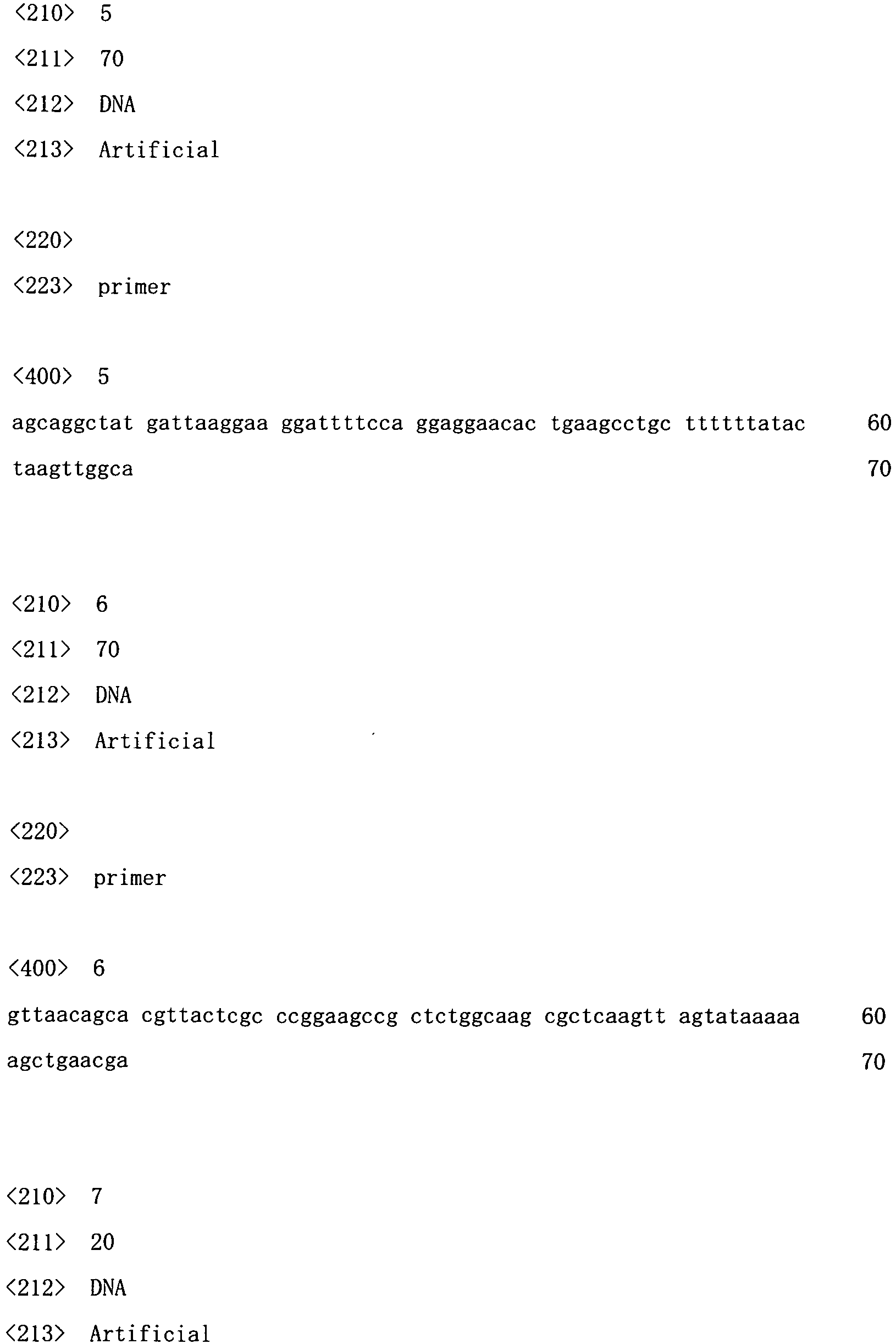


Claims (9)
- A method for producing an L-amino acid comprising culturing a bacterium belonging to γ-Proteobacteria and having an ability to produce the L-amino acid in a medium containing glycerol as a carbon source to produce and accumulate the L-amino acid in the medium, and collecting the L-amino acid from the medium, wherein the bacterium is a bacterium modified so that the activity of the Cnu protein is reduced.
- The method according to claim 1, wherein the activity of the Cnu protein is reduced by disrupting the ydgT gene coding for the Cnu protein on the chromosome, or by reducing expression amount of the gene.
- The method according to claim 1 or 2, wherein the Cnu protein is a protein defined in the following (A) or (B):(A) a protein having the amino acid sequence shown in SEQ ID NO: 14,(B) a protein having the amino acid sequence shown in SEQ ID NO: 14, but including substitution, deletion, insertion or addition of one or several amino acid residues, reduction of which activity in the bacterium results in improvement in the ability to produce the L-amino acid.
- The method according to claim 2 or 3, wherein the ydgT gene is a DNA defined in the following (a) or (b):(a) a DNA comprising the nucleotide sequence of SEQ ID NO: 13,(b) a DNA hybridizable with a nucleotide sequence complementary to the nucleotide sequence of SEQ ID NO: 13 or a probe that can be prepared from the nucleotide sequence under stringent conditions, and coding for a protein, reduction of which activity in the bacterium results in improvement in the ability to produce the L-amino acid.
- The method according to any one of claims 1 to 4, wherein the L-amino acid is an aspartic acid type amino acid.
- The method according to claim 5, wherein the L-amino acid is L-lysine.
- The method according to any one of claims 1 to 6, wherein the bacterium is a bacterium belonging to the family Enterobacteriaceae.
- The method according to claim 7, wherein the bacterium is an Escherichia bacterium.
- The method according to claim 8, wherein the bacterium is Escherichia coli.
Applications Claiming Priority (2)
| Application Number | Priority Date | Filing Date | Title |
|---|---|---|---|
| JP2009255042A JP2013013329A (en) | 2009-11-06 | 2009-11-06 | Method for producing l-amino acid |
| PCT/JP2010/069436 WO2011055710A1 (en) | 2009-11-06 | 2010-11-01 | Method for producing l-amino acid |
Publications (2)
| Publication Number | Publication Date |
|---|---|
| EP2497832A1 true EP2497832A1 (en) | 2012-09-12 |
| EP2497832A4 EP2497832A4 (en) | 2016-01-06 |
Family
ID=43969950
Family Applications (1)
| Application Number | Title | Priority Date | Filing Date |
|---|---|---|---|
| EP10828270.8A Withdrawn EP2497832A4 (en) | 2009-11-06 | 2010-11-01 | Method for producing l-amino acid |
Country Status (4)
| Country | Link |
|---|---|
| US (1) | US20120276598A1 (en) |
| EP (1) | EP2497832A4 (en) |
| JP (1) | JP2013013329A (en) |
| WO (1) | WO2011055710A1 (en) |
Cited By (1)
| Publication number | Priority date | Publication date | Assignee | Title |
|---|---|---|---|---|
| US8975045B2 (en) | 2010-02-08 | 2015-03-10 | Ajinomoto Co., Inc. | Mutant RpsA gene and method for producing L-amino acid |
Families Citing this family (1)
| Publication number | Priority date | Publication date | Assignee | Title |
|---|---|---|---|---|
| BR112014001371B1 (en) * | 2011-07-22 | 2021-06-01 | Myriant Corporation | GENETICALLY MODIFIED ESCHERICHIA COLI BACTERIA AND METHOD FOR SUCCINIC ACID PRODUCTION |
Family Cites Families (69)
| Publication number | Priority date | Publication date | Assignee | Title |
|---|---|---|---|---|
| US3786039A (en) | 1969-04-30 | 1974-01-15 | Ajinomoto Kk | Method of producing alpha-l-aspartyl-l-phenylalanine lower alkyl esters |
| JPS51113841A (en) | 1975-03-28 | 1976-10-07 | Ajinomoto Co Inc | Process for preparing lower alkyl esters of n-formyl-alpha -l-aspartyl-l-phenylalanine |
| JPS561890A (en) | 1979-06-15 | 1981-01-10 | Ajinomoto Co Inc | Preparation of l-phenylalanine by fermentation |
| JPS5618596A (en) | 1979-07-23 | 1981-02-21 | Ajinomoto Co Inc | Production of l-lysine through fermentation process |
| US4371614A (en) | 1980-08-22 | 1983-02-01 | Ajinomoto Co., Inc. | E.Coli bacteria carrying recombinant plasmids and their use in the fermentative production of L-tryptophan |
| EP0163836B1 (en) | 1984-04-07 | 1988-10-12 | Bayer Ag | Process and apparatus for the production of granules |
| JPH06102024B2 (en) | 1986-04-16 | 1994-12-14 | 味の素株式会社 | Novel promoter and gene expression method using the promoter |
| FR2603581B1 (en) | 1986-04-28 | 1993-08-13 | Ajinomoto Kk | PROCESS FOR ISOLATING AND PURIFYING AMINO ACIDS BY CHROMATOGRAPHY |
| US4777051A (en) | 1986-06-20 | 1988-10-11 | Ajinomoto Co., Inc. | Process for the production of a composition for animal feed |
| JP2537260B2 (en) | 1988-02-23 | 1996-09-25 | 東陶機器株式会社 | Japanese-style toilet construction method |
| JPH03501682A (en) | 1988-10-25 | 1991-04-18 | 味の素株式会社 | Escherichia coli BKIIM strain B-3996 as an L-threonine producer |
| US5705371A (en) | 1990-06-12 | 1998-01-06 | Ajinomoto Co., Inc. | Bacterial strain of escherichia coli BKIIM B-3996 as the producer of L-threonine |
| JPH07108228B2 (en) | 1990-10-15 | 1995-11-22 | 味の素株式会社 | Temperature sensitive plasmid |
| DE69133342T2 (en) | 1990-11-30 | 2004-07-22 | Ajinomoto Co., Inc. | Recombinant DNA sequences coding for enzymes free from feedback inhibition, plasmids containing these sequences, transformed microorganisms useful for the production of aromatic amino acids, and their methods of production by fermentation |
| JP3006926B2 (en) | 1991-09-04 | 2000-02-07 | 協和醗酵工業株式会社 | Method for producing L-threonine by fermentation method |
| DE4130868C2 (en) | 1991-09-17 | 1994-10-13 | Degussa | Animal feed supplement based on an amino acid and process for its preparation |
| JP3151073B2 (en) | 1992-02-25 | 2001-04-03 | 協和醗酵工業株式会社 | Production of amino acids by fermentation |
| DE4232468A1 (en) | 1992-09-28 | 1994-03-31 | Consortium Elektrochem Ind | Microorganisms for the production of tryptophan and process for their production |
| EP0593792B2 (en) | 1992-10-14 | 2004-01-07 | Ajinomoto Co., Inc. | Novel L-threonine-producing microbacteria and a method for the production of L-threonine |
| RU2113484C1 (en) | 1992-11-10 | 1998-06-20 | Адзиномото Ко., Инк. | Dna fragment encoding aspartokinase-iii, a method of l-threonine preparing |
| US5354672A (en) | 1992-11-24 | 1994-10-11 | Ian Fotheringham | Materials and methods for hypersecretion of amino acids |
| US5776736A (en) | 1992-12-21 | 1998-07-07 | Purdue Research Foundation | Deblocking the common pathway of aromatic amino acid synthesis |
| CA2169170C (en) | 1993-08-24 | 2007-01-09 | Masakazu Sugimoto | Mutant phosphoenolpyruvate carboxylase, its gene, and production method of amino acid |
| RU2182173C2 (en) | 1993-10-28 | 2002-05-10 | Адзиномото Ко., Инк. | Method of production of l-amino acid |
| JPH07155184A (en) * | 1993-12-08 | 1995-06-20 | Ajinomoto Co Inc | Fermentation method for producing L-lysine |
| CN1103819C (en) | 1994-06-14 | 2003-03-26 | 味之素株式会社 | α-ketoglutarate dehydrogenase gene |
| ES2256850T5 (en) | 1994-12-09 | 2013-04-15 | Ajinomoto Co., Inc. | New lysine decarboxylase gene and procedure for the production of L-lysine |
| JP4032441B2 (en) | 1995-08-30 | 2008-01-16 | 味の素株式会社 | Method for producing L-amino acid |
| GB2304718B (en) | 1995-09-05 | 2000-01-19 | Degussa | The production of tryptophan by the bacterium escherichia coli |
| JP3861341B2 (en) | 1995-10-13 | 2006-12-20 | 味の素株式会社 | Membrane sterilization method of fermentation broth |
| JPH09173792A (en) | 1995-10-23 | 1997-07-08 | Ajinomoto Co Inc | Fermentation liquid treatment method |
| DE19621930C1 (en) | 1996-05-31 | 1997-12-11 | Degussa | Process for the preparation of an animal feed additive based on fermentation broth |
| US5939307A (en) | 1996-07-30 | 1999-08-17 | The Archer-Daniels-Midland Company | Strains of Escherichia coli, methods of preparing the same and use thereof in fermentation processes for l-threonine production |
| DE59812638D1 (en) | 1997-10-04 | 2005-04-14 | Degussa | METHOD FOR MICROBIAL PRODUCTION OF AMINO ACIDS OF THE ASPART AND / OR GLUTAMATE FAMILY AND METHODS USED IN THE PROCESS |
| ES2335828T3 (en) | 1998-09-25 | 2010-04-05 | Ajinomoto Co., Inc. | CORINEFORM BACTERIA TO PRODUCE L-GLU. |
| RU2144564C1 (en) | 1998-10-13 | 2000-01-20 | Закрытое акционерное общество "Научно-исследовательский институт Аджиномото-Генетика" | Dna fragment rhtb encoding synthesis of protein rhtb that determines resistance of bacterium escherichia coli to l-homoserine and method of l-amino acid producing |
| JP4110641B2 (en) | 1998-11-17 | 2008-07-02 | 味の素株式会社 | Method for producing L-methionine by fermentation |
| BR9906279A (en) | 1998-12-18 | 2001-04-24 | Ajinomoto Kk | Chorineform bacteria, process to produce l-glutamic acid, and, dna. |
| RU2148642C1 (en) | 1998-12-23 | 2000-05-10 | ЗАО "Научно-исследовательский институт АДЖИНОМОТО-Генетика" (ЗАО "АГРИ") | Dna rhtc fragment encoding synthesis of rhtc protein that determines enhanced resistance of bacterium escherichia coli to l-threonine and method of l-amino acid producing |
| RU2175351C2 (en) | 1998-12-30 | 2001-10-27 | Закрытое акционерное общество "Научно-исследовательский институт "Аджиномото-Генетика" (ЗАО "АГРИ") | Escherichia coli dna fragment determining enhanced production of l-amino acids (variants) and method of l-amino acid producing |
| JP2000262288A (en) | 1999-03-16 | 2000-09-26 | Ajinomoto Co Inc | Temperature sensitive plasmid of coryneform bacteria |
| US6238714B1 (en) | 1999-05-05 | 2001-05-29 | Degussa-Huls Ag | Feedstuff additive which contains D-pantothenic acid and/or its salts and a process for the preparation thereof |
| RU2207376C2 (en) | 1999-10-14 | 2003-06-27 | Закрытое акционерное общество "Научно-исследовательский институт Аджиномото-Генетика" | Method for preparing l-amino acid by fermentation method, strain of bacterium escherichia coli as producer of l-amino acid (variants) |
| BRPI0016995B1 (en) | 2000-01-21 | 2016-03-08 | Ajinomoto Kk | genetically modified escherichia coli bacteria, and method for producing l-lysine |
| RU2212447C2 (en) | 2000-04-26 | 2003-09-20 | Закрытое акционерное общество "Научно-исследовательский институт Аджиномото-Генетика" | Strain escherichia coli as producer of amino acid (variants) and method for preparing amino acid (variants) |
| JP4380029B2 (en) | 2000-07-05 | 2009-12-09 | 味の素株式会社 | Manufacturing method of substances using microorganisms |
| JP4362959B2 (en) | 2000-08-24 | 2009-11-11 | 味の素株式会社 | Method for producing basic amino acid |
| US7220571B2 (en) | 2000-09-28 | 2007-05-22 | Archer-Daniels-Midland Company | Escherichia coli strains which over-produce L-threonine and processes for the production of L-threonine by fermentation |
| JP2002209596A (en) | 2001-01-19 | 2002-07-30 | Ajinomoto Co Inc | Method for producing l-amino acid |
| RU2229513C2 (en) | 2001-11-23 | 2004-05-27 | Закрытое акционерное общество "Научно-исследовательский институт Аджиномото-Генетика" | Method for preparing l-amino acids, strain escherichia coli as producer of l-amino acids (variants) |
| EP1449918B1 (en) | 2001-11-23 | 2010-06-09 | Ajinomoto Co., Inc. | Process for producing l-amino acid using escherichia |
| KR100459758B1 (en) | 2002-05-15 | 2004-12-03 | 씨제이 주식회사 | A nucleotide sequence of threonine operon deregulated from isoleucine and a method for producing L-threonine using a transformed cell containing the same |
| RU2268300C2 (en) | 2003-04-07 | 2006-01-20 | Закрытое акционерное общество "Научно-исследовательский институт Аджиномото-Генетика" | METHOD FOR PREPARING L-AMINO ACIDS BY USING MICROORGANISMS POSSESSING ENHANCED EXPRESSION OF pckA GENE |
| US7335496B2 (en) | 2003-06-05 | 2008-02-26 | Ajinomoto Co., Inc. | Method for producing target substance |
| DE10331366A1 (en) | 2003-07-11 | 2005-01-27 | Degussa Ag | Granulating feed additives containing amino acids and/or vitamins, especially L-threonine, optionally in fermentation broth form, using circulating fluidized bed |
| CN100520793C (en) | 2003-07-29 | 2009-07-29 | 味之素株式会社 | Method for determination of metabolic flux affecting production of useful material |
| JP4380305B2 (en) | 2003-11-21 | 2009-12-09 | 味の素株式会社 | Method for producing L-amino acid by fermentation |
| CN103146593B (en) | 2004-01-30 | 2015-07-15 | 味之素株式会社 | L-amino acid-producing microorganism and method for producing l-amino acid |
| WO2005103275A1 (en) | 2004-04-26 | 2005-11-03 | Ajinomoto Co., Ltd. | Process for producing l-tryptophan according to fermentation process |
| US7482140B2 (en) | 2004-06-15 | 2009-01-27 | Ajinomoto Co., Inc. | L-tyrosine-producing bacterium and a method for producing L-tyrosine |
| WO2006078039A1 (en) | 2005-01-18 | 2006-07-27 | Ajinomoto Co., Inc. | L-amino acid producing microorganism and a method for producing l-amino acid |
| DE102005018835A1 (en) | 2005-04-22 | 2006-11-02 | Degussa Ag | Process for the preparation of L-amino acids using improved strains of the family Enterobacteriaceae |
| DE102005019040A1 (en) | 2005-04-23 | 2006-10-26 | Degussa Ag | Process for the preparation of L-amino acids using improved strains of the family Enterobacteriaceae |
| WO2008078646A1 (en) | 2006-12-22 | 2008-07-03 | Ajinomoto Co., Inc. | Method for separation of crystal of amino acid or nucleic acid |
| RU2006145712A (en) | 2006-12-22 | 2008-06-27 | Закрытое акционерное общество "Научно-исследовательский институт Аджиномото-Генетика" (ЗАО АГРИ) (RU) | METHOD FOR PRODUCING L-AMINO ACIDS BY THE FERMENTATION METHOD USING BACTERIA HAVING AN INCREASED ABILITY FOR GYLICERINE DISPOSAL |
| BRPI0703692B1 (en) | 2006-12-25 | 2016-12-27 | Ajinomoto Kk | A method for obtaining the crystals of a basic amino acid hydrochloride comprising generating a basic amino acid using microbial cells by fermentation in a fermentation broth or by an enzymatic method in an enzyme reaction solution using the cells as catalysts. |
| US8247195B2 (en) * | 2007-01-16 | 2012-08-21 | The University Of Washington | Methods and host cells for recombinant protein expression |
| JP2010110217A (en) | 2007-02-22 | 2010-05-20 | Ajinomoto Co Inc | L-amino acid-producing microorganism and method for producing l-amino acid |
| DE102007051024A1 (en) | 2007-03-05 | 2008-09-11 | Evonik Degussa Gmbh | Process for the preparation of L-amino acids using strains of the family Enterobacteriaceae |
-
2009
- 2009-11-06 JP JP2009255042A patent/JP2013013329A/en active Pending
-
2010
- 2010-11-01 WO PCT/JP2010/069436 patent/WO2011055710A1/en not_active Ceased
- 2010-11-01 EP EP10828270.8A patent/EP2497832A4/en not_active Withdrawn
-
2012
- 2012-05-04 US US13/464,322 patent/US20120276598A1/en not_active Abandoned
Non-Patent Citations (1)
| Title |
|---|
| See references of WO2011055710A1 * |
Cited By (1)
| Publication number | Priority date | Publication date | Assignee | Title |
|---|---|---|---|---|
| US8975045B2 (en) | 2010-02-08 | 2015-03-10 | Ajinomoto Co., Inc. | Mutant RpsA gene and method for producing L-amino acid |
Also Published As
| Publication number | Publication date |
|---|---|
| BR112012010688A2 (en) | 2015-09-29 |
| EP2497832A4 (en) | 2016-01-06 |
| US20120276598A1 (en) | 2012-11-01 |
| WO2011055710A1 (en) | 2011-05-12 |
| JP2013013329A (en) | 2013-01-24 |
Similar Documents
| Publication | Publication Date | Title |
|---|---|---|
| EP2336347B1 (en) | An l-amino acid-producing microorganism and a method for producing an l-amino acid | |
| EP2218729B1 (en) | An L-amino acid-producing bacterium and a method for producing an L-amino acid | |
| US8293505B2 (en) | L-amino acid-producing microorganism and a method for producing an L-amino acid | |
| US8137938B2 (en) | Method for producing an L-amino acid | |
| EP1990416B1 (en) | Method for production of l-amino acid | |
| US8932834B2 (en) | Method for producing an L-amino acid in a cultured bacterium having reduced activity of the arginine succinyltransferase pathway | |
| CA2689046A1 (en) | Method of producing l-amino acid | |
| JP2007117082A (en) | L-amino acid producing bacteria and preparation process of l-amino acid | |
| EP2003209A1 (en) | Method for production of l-amino acid | |
| US10787691B2 (en) | Method for producing L-amino acid | |
| WO2010084995A2 (en) | A method for producing an l-amino acid | |
| CN103732736B (en) | The enterobacteriaceae lactobacteriaceae of the expression of flagellum formation and the mobility cascade gene with enhancing is used to produce the amino acid whose method of L- | |
| JP2010263789A (en) | L-amino acid-producing microorganism and method for producing l-amino acid | |
| US8975045B2 (en) | Mutant RpsA gene and method for producing L-amino acid | |
| US20120276598A1 (en) | Method for producing an l-amino acid | |
| JP2009240161A (en) | Method for producing l-amino acid | |
| BR112012010688B1 (en) | METHOD FOR PRODUCING AN L-AMINO ACID | |
| WO2011096555A1 (en) | Manufacturing method for l-amino acid | |
| JP2008086305A (en) | L-amino acid-producing bacterium and method for producing l-amino acid |
Legal Events
| Date | Code | Title | Description |
|---|---|---|---|
| PUAI | Public reference made under article 153(3) epc to a published international application that has entered the european phase |
Free format text: ORIGINAL CODE: 0009012 |
|
| 17P | Request for examination filed |
Effective date: 20120525 |
|
| AK | Designated contracting states |
Kind code of ref document: A1 Designated state(s): AL AT BE BG CH CY CZ DE DK EE ES FI FR GB GR HR HU IE IS IT LI LT LU LV MC MK MT NL NO PL PT RO RS SE SI SK SM TR |
|
| DAX | Request for extension of the european patent (deleted) | ||
| RA4 | Supplementary search report drawn up and despatched (corrected) |
Effective date: 20151204 |
|
| RIC1 | Information provided on ipc code assigned before grant |
Ipc: C12P 13/08 20060101ALI20151130BHEP Ipc: C12P 13/04 20060101AFI20151130BHEP Ipc: C12N 15/09 20060101ALI20151130BHEP |
|
| STAA | Information on the status of an ep patent application or granted ep patent |
Free format text: STATUS: THE APPLICATION IS DEEMED TO BE WITHDRAWN |
|
| 18D | Application deemed to be withdrawn |
Effective date: 20160702 |