EP2496618B1 - Verfahren zur herstellung eines polyurethanschaums und hieraus erhältlicher polyurethanschaum - Google Patents
Verfahren zur herstellung eines polyurethanschaums und hieraus erhältlicher polyurethanschaum Download PDFInfo
- Publication number
- EP2496618B1 EP2496618B1 EP10771777.9A EP10771777A EP2496618B1 EP 2496618 B1 EP2496618 B1 EP 2496618B1 EP 10771777 A EP10771777 A EP 10771777A EP 2496618 B1 EP2496618 B1 EP 2496618B1
- Authority
- EP
- European Patent Office
- Prior art keywords
- weight
- mixture
- component
- polyurethane foam
- process according
- Prior art date
- Legal status (The legal status is an assumption and is not a legal conclusion. Google has not performed a legal analysis and makes no representation as to the accuracy of the status listed.)
- Not-in-force
Links
Images

Classifications
-
- C—CHEMISTRY; METALLURGY
- C08—ORGANIC MACROMOLECULAR COMPOUNDS; THEIR PREPARATION OR CHEMICAL WORKING-UP; COMPOSITIONS BASED THEREON
- C08J—WORKING-UP; GENERAL PROCESSES OF COMPOUNDING; AFTER-TREATMENT NOT COVERED BY SUBCLASSES C08B, C08C, C08F, C08G or C08H
- C08J9/00—Working-up of macromolecular substances to porous or cellular articles or materials; After-treatment thereof
- C08J9/0014—Use of organic additives
- C08J9/0042—Use of organic additives containing silicon
-
- C—CHEMISTRY; METALLURGY
- C08—ORGANIC MACROMOLECULAR COMPOUNDS; THEIR PREPARATION OR CHEMICAL WORKING-UP; COMPOSITIONS BASED THEREON
- C08G—MACROMOLECULAR COMPOUNDS OBTAINED OTHERWISE THAN BY REACTIONS ONLY INVOLVING UNSATURATED CARBON-TO-CARBON BONDS
- C08G18/00—Polymeric products of isocyanates or isothiocyanates
- C08G18/06—Polymeric products of isocyanates or isothiocyanates with compounds having active hydrogen
- C08G18/28—Polymeric products of isocyanates or isothiocyanates with compounds having active hydrogen characterised by the compounds used containing active hydrogen
- C08G18/40—High-molecular-weight compounds
- C08G18/42—Polycondensates having carboxylic or carbonic ester groups in the main chain
-
- C—CHEMISTRY; METALLURGY
- C08—ORGANIC MACROMOLECULAR COMPOUNDS; THEIR PREPARATION OR CHEMICAL WORKING-UP; COMPOSITIONS BASED THEREON
- C08G—MACROMOLECULAR COMPOUNDS OBTAINED OTHERWISE THAN BY REACTIONS ONLY INVOLVING UNSATURATED CARBON-TO-CARBON BONDS
- C08G18/00—Polymeric products of isocyanates or isothiocyanates
- C08G18/06—Polymeric products of isocyanates or isothiocyanates with compounds having active hydrogen
- C08G18/28—Polymeric products of isocyanates or isothiocyanates with compounds having active hydrogen characterised by the compounds used containing active hydrogen
- C08G18/65—Low-molecular-weight compounds having active hydrogen with high-molecular-weight compounds having active hydrogen
- C08G18/66—Compounds of groups C08G18/42, C08G18/48, or C08G18/52
- C08G18/6633—Compounds of group C08G18/42
- C08G18/6637—Compounds of group C08G18/42 with compounds of group C08G18/32 or polyamines of C08G18/38
- C08G18/664—Compounds of group C08G18/42 with compounds of group C08G18/32 or polyamines of C08G18/38 with compounds of group C08G18/3203
- C08G18/6644—Compounds of group C08G18/42 with compounds of group C08G18/32 or polyamines of C08G18/38 with compounds of group C08G18/3203 having at least three hydroxy groups
-
- C—CHEMISTRY; METALLURGY
- C08—ORGANIC MACROMOLECULAR COMPOUNDS; THEIR PREPARATION OR CHEMICAL WORKING-UP; COMPOSITIONS BASED THEREON
- C08J—WORKING-UP; GENERAL PROCESSES OF COMPOUNDING; AFTER-TREATMENT NOT COVERED BY SUBCLASSES C08B, C08C, C08F, C08G or C08H
- C08J9/00—Working-up of macromolecular substances to porous or cellular articles or materials; After-treatment thereof
- C08J9/04—Working-up of macromolecular substances to porous or cellular articles or materials; After-treatment thereof using blowing gases generated by a previously added blowing agent
- C08J9/12—Working-up of macromolecular substances to porous or cellular articles or materials; After-treatment thereof using blowing gases generated by a previously added blowing agent by a physical blowing agent
-
- C—CHEMISTRY; METALLURGY
- C08—ORGANIC MACROMOLECULAR COMPOUNDS; THEIR PREPARATION OR CHEMICAL WORKING-UP; COMPOSITIONS BASED THEREON
- C08G—MACROMOLECULAR COMPOUNDS OBTAINED OTHERWISE THAN BY REACTIONS ONLY INVOLVING UNSATURATED CARBON-TO-CARBON BONDS
- C08G2101/00—Manufacture of cellular products
-
- C—CHEMISTRY; METALLURGY
- C08—ORGANIC MACROMOLECULAR COMPOUNDS; THEIR PREPARATION OR CHEMICAL WORKING-UP; COMPOSITIONS BASED THEREON
- C08J—WORKING-UP; GENERAL PROCESSES OF COMPOUNDING; AFTER-TREATMENT NOT COVERED BY SUBCLASSES C08B, C08C, C08F, C08G or C08H
- C08J2203/00—Foams characterized by the expanding agent
- C08J2203/08—Supercritical fluid
-
- C—CHEMISTRY; METALLURGY
- C08—ORGANIC MACROMOLECULAR COMPOUNDS; THEIR PREPARATION OR CHEMICAL WORKING-UP; COMPOSITIONS BASED THEREON
- C08J—WORKING-UP; GENERAL PROCESSES OF COMPOUNDING; AFTER-TREATMENT NOT COVERED BY SUBCLASSES C08B, C08C, C08F, C08G or C08H
- C08J2375/00—Characterised by the use of polyureas or polyurethanes; Derivatives of such polymers
- C08J2375/04—Polyurethanes
-
- C—CHEMISTRY; METALLURGY
- C08—ORGANIC MACROMOLECULAR COMPOUNDS; THEIR PREPARATION OR CHEMICAL WORKING-UP; COMPOSITIONS BASED THEREON
- C08J—WORKING-UP; GENERAL PROCESSES OF COMPOUNDING; AFTER-TREATMENT NOT COVERED BY SUBCLASSES C08B, C08C, C08F, C08G or C08H
- C08J2375/00—Characterised by the use of polyureas or polyurethanes; Derivatives of such polymers
- C08J2375/04—Polyurethanes
- C08J2375/06—Polyurethanes from polyesters
Definitions
- the present invention relates to a process for producing a polyurethane foam.
- Another object of the invention is a polyurethane foam obtainable by the process according to the invention.
- foams may have a bimodal cell size distribution.
- Nanocellular or nanoporous polymer foams are particularly good materials for thermal insulation due to theoretical considerations.
- the internal dimensions of the Sclaum Weg devisen lie in the range of the mean free path of a gas molecule. In this way, the proportion of the gas in the heat transfer can be reduced.
- a polymer group commonly used in thermal insulation are polyurethanes.
- polyurethane foams In the production of polyurethane foams, a polyol component in which a blowing agent is also contained is reacted with an isocyanate. The reaction of isocyanate with water produces carbon dioxide, which also acts as a propellant.
- the crucial step for the foaming and thus for the later cell size of the cured foam is the nucleation of blowing agents, since each cell in the foam is formed from a gas bubble. It can be observed here that as a rule no new gas bubbles are produced after nucleation, but propellants diffuse into already existing gas bubbles.
- stabilizers helps emulsify the various components, affects nucleation and prevents coalescence of the growing gas bubbles. They also affect the cell opening. In open-cell foams, the membranes of the growing pores are opened and the webs of the pores remain.
- the blowing agent is in the form of a microemulsion.
- Microemulsions form under certain conditions, which depend inter alia on the concentration of the emulsifiers and the temperature. Microemulsions are characterized by the fact that they are stable and that the non-polar phase, ie the blowing agent here, can be present in very small droplets within the polar phase. The diameters of such droplets can range from 1 to 100 nanometers.
- DE 102 60 815 A1 discloses foamed material and a method of producing the foamed material.
- Foamed material with nano-sized foam bubbles is to be generated without having to overcome the energy barrier that usually occurs in phase transformations and nucleation processes.
- the goal of controllably producing a foamed material which has a number density of foam bubbles between 10 12 and 10 18 per cm 3 and an average diameter of the foam bubbles between 10 nm and 10 microns.
- the basis is the dispersion of a second fluid in the form of pools in a matrix of a first fluid. In a reaction space, the first fluid is present as a matrix and the second fluid in pools.
- the second fluid By pressure and / or temperature change, the second fluid is converted into a near or supercritical state with a liquid-near density. Thus, the second fluid is completely or almost completely in pools, which are evenly distributed throughout the first fluid. By depressurizing, the second fluid returns to a gaseous density state where the pools are inflated into nanoscale foam bubbles. No energy barrier needs to be overcome, nor do the blowing agent molecules have to diffuse to the growing bubbles.
- the first fluid a polymerizable substance is generally proposed here.
- the second fluid should be selected from a group of hydrocarbons such as methane or ethane, further alkanols, chlorofluorocarbons or CO 2 .
- an amphiphilic material is used, which should have at least one block inclined to the first fluid and at least one block inclined to the second fluid.
- US 2004/054022 discloses the production of polyurethane foams from a surfactant-containing polyol component wherein carbon dioxide is introduced under supercritical conditions in the polyol.
- a polyisocyanate PMDI is used as a polyisocyanate PMDI.
- EP 0 353 061 discloses the preparation of polyurethane foams starting from CO 2 saturated polyol under supercritical conditions.
- polyurethane foams WO 2007/094780 A1 a resin composition comprising a polyol, a short chain compound initiated ethoxylated / propoxylated surfactant, and a hydrocarbon blowing agent.
- the ethoxylated / propoxylated surfactant increases the solubility and / or compatibility of the hydrocarbon blowing agent and improves the phase stability of the resin composition.
- the resin composition is suitable for reaction with polyfunctional organic isocyanates for the preparation of cellular polyurethane and polyisocyanurate foams.
- the surfactants are obtained by the reaction of ethylene oxide and propylene oxide with an initiator from the group of compounds having an alkylene oxide-active hydrogen atom and a C 1 to C 6 aliphatic or alicyclic hydrocarbon group, compounds having an alkylene oxide-active hydrogen atom and a C 6 to C 10 aryl or alkylaryl hydrocarbon group or combinations thereof.
- the initiator is preferably selected from the group of C 1 to C 6 aliphatic or alicyclic alcohols, phenol, C 1 to C 4 alkylphenols, and combinations thereof.
- butanol-initiated propylene oxide / ethylene oxide surfactant is mentioned.
- the surfactant may also comprise an alkoxylated triglyceride adduct or an ethoxylated derivative of a sorbitan ester.
- the blowing agent may be a C 4 to C 7 aliphatic hydrocarbon, C 4 to C 7 cycloaliphatic hydrocarbon or a combination thereof.
- pentanes are called.
- Special siloxane surfactants are among others in US 2005/0131090 A1 treated.
- Disclosed herein is a process for producing rigid polyurethane foams by reacting a polyisocyanate and a polyol in the presence of a urethanization catalyst, a blowing agent, optionally water, and a silicone surfactant.
- Blowing agents used are C 4 - or C 5 -hydrocarbons or their mixtures.
- the blowing agents have an average molecular weight of ⁇ 72 g / mol and a boiling point in the range of 27.8 to 50 ° C.
- the silicone surfactant comprises a polyether-polysiloxane copolymer represented by the following general formula: (CH 3 ) 3 -Si-O- (Si (CH 3 ) 2 -O) x - (Si (CH 3 ) (R) O) y -Si (CH 3 ) 3 , in which:
- R (CH 2 ) 3 -O - (- CH 2 -CH 2 -O) a - (CH 2 -CH (CH 3 ) -O) b -R "and where R" is H, (CH 2 ) z CH 3 or C (O) CH 3 .
- x + y + 2 is 60-130
- x / y is 5-14
- z is 0-4.
- the total molecular weight of the surfactant based on the above formula is 7000-30,000 g / mol.
- the weight proportion of the siloxane in the surfactant is 32-70% by weight, the average molecular weight BAMW (blend average molecular weight) of the polyether portion is 450-1000 g / mol, and the content of ethylene oxide, expressed in mol%, in the polyether portion 70-100 mol%.
- BAMW blend average molecular weight
- this publication does not relate to microemulsions or supercritical blowing agents. Rather, the siloxane surfactant is used as a cell stabilizer.
- GB 2 365 013 A discloses alkylene oxide modified silicone glycols for stable polyester polyol compositions.
- a polyester polyol composition comprises a phthalic anhydride initiated polyester polyol, a C 4 -C 6 hydrocarbon propellant, and an alkylene modified silicone glycol compatibilizer having an HLB of about 5 to about 8.
- the propellant is soluble in the polyol composition, thereby increasing the risk associated with such propellants is reduced in the production of polymer foam articles. foams with good dimensional stability and improved insulation properties are provided.
- an isocyanate-modified silicone glycol compatibilizer is also disclosed.
- microemulsions refers to the test for determining the storage stability of the polyol compositions.
- the polyol composition and propellant are mixed in a jar with a lid, shaken and stored for five days at room temperature. If no phase separation occurs, the propellant is found to be soluble in the polyol composition and the composition to be storage stable.
- storage in a lidded glass at room temperature does not allow for conditions in which a C 4 -C 6 hydrocarbon is in the supercritical state.
- the starting materials at a temperature of 15 ° C to 90 ° C, preferably from 20 ° C to 35 ° C can be introduced into an open or closed mold.
- a pressure above the atmospheric pressure prevail.
- the mixing of the isocyanate with the polyol composition containing dissolved propellant may be done by stirring or under high pressure by injection.
- the temperature of the mold may be 20 ° C to 110 ° C, preferably 30 ° C to 60 ° C and especially 45 ° C to 50 ° C. Again, there is no evidence that prevail for the propellant supercritical conditions.
- This patent application relates to a process for producing polyurethane slabstock foam wherein a carbon dioxide-containing polyurethane reactive mixture is suddenly depressurized from a pressure above the equilibrium solution pressure of the carbon dioxide to atmospheric pressure.
- the liquid polyurethane-reactive mixture is foamed to release dissolved carbon dioxide, the foamed mixture is applied to a substrate and then cured to block foam.
- the carbon dioxide is first completely dissolved at a pressure substantially above the equilibrium solution pressure in the reactive mixture or at least one of the components polyol and isocyanate.
- the pressure is reduced to a pressure close to the equilibrium solution pressure, meanwhile falling below the equilibrium solution pressure to release small amounts of carbon dioxide to form a bubble microdispersion, optionally the components are mixed and the sudden pressure reduction to normal pressure before the released carbon dioxide is completely dissolved again.
- the components are mixed and the sudden pressure reduction to normal pressure before the released carbon dioxide is completely dissolved again.
- a foam with a multimodal cell size distribution offers performance advantages such as greater toughness and improved insulating ability over a conventional foam of the same polymer composition, but which has a generally uniform cell size distribution.
- a foam with a bimodal cell size distribution (bimodal foam) is a type of multimodal foam.
- This patent application relates to a process for producing a multimodal thermoplastic polymer foam comprising the following sequential steps: (a) dispersing a blowing agent stabilizer and a blowing agent in a heat plastified thermoplastic polymer resin at an initial pressure to form a foamable composition, and (b) expanding the foamable polymer composition substantially in the absence of water and at a pressure less than this initial pressure to produce a multimodal thermoplastic foam.
- thermoplastics only heat-plasticizable thermoplastics can be processed.
- This method excludes, for example, thermoset polyurethane polymers.
- Polyurethane foams having very small pore sizes and also foams having a bimodal cell size distribution can be obtained by the process according to the invention.
- a maximum of the cell size distribution can be in the range of ⁇ 10 nm to ⁇ 500 nm, and a further maximum of the cell size distribution in the range of ⁇ 1 ⁇ m to ⁇ 500 ⁇ m.
- the process uses supercritical or near-critical blowing agent.
- near-critical conditions are present when the following condition is satisfied: (T c -T) / T ⁇ 0.4 and / or (p c -p) / p ⁇ 0.4.
- T is the temperature prevailing in the process
- T c is the critical temperature of the blowing agent or blowing agent mixture
- p is the pressure prevailing in the process
- p c is the critical pressure for the blowing agent or blowing agent mixture.
- near-critical conditions are present when: (T c -T) / T ⁇ 0.3 and / or (p c -P) / p ⁇ 0.3, and particularly preferably (T c -T) / T ⁇ 0, 2 and / or (p c - p) / p ⁇ 0.2.
- suitable surfactant components emulsions or microemulsions of the supercritical or near-critical blowing agent form in phase with isocyanate-reactive components.
- the mixture comprising the components A), B), C) and D) can be obtained, for example, by introducing all components in a high-pressure mixing head under conditions which are supercritical or near critical for the blowing agent, with the exception of the polyisocyanate component and then with the polyisocyanate D) be offset.
- the blowing agent is in the subcritical and preferably in the gaseous state.
- the reaction mixture from the mixing head can be easily introduced into an open mold or continuously used for the production of plates, such as by free foam systems or double transport systems.
- a foam with a bimodal cell size distribution in the sense of the present invention is present when a graph of the representative cross-sectional area has two maxima against the cell size.
- a "representative cross-sectional area” is a product of a number of cells of a given size and the cross-sectional area of the cell.
- a representative cross-sectional area corresponds to how much area of the scanning electron micrograph occupy cells of a given size.
- Cell size refers to cell diameter and the two terms are interchangeable herein.
- a scanning electron micrograph (SEM) image of a cross-section of a foam is used to collect cell diameter and representative cross-sectional area data for the foam.
- the SEM uptake should be of sufficient magnification to represent a representative distribution of cell sizes in the foam.
- the cell diameter for each cell in the SEM uptake is measured. Errors such as "blowholes" are not considered cells.
- Blow holes are spaces defined within a foam which penetrate multiple cell walls and cell struts and have a plurality of cell wall and cell strut fragments remaining therein.
- a cell wall is a polymeric film between two cells.
- a cell strut is a polymeric domain in which three or more cells meet.
- a convenient program for measuring cell diameters and calculating cross-sectional areas of a digitally scanned image is the Public Domain NIH Image Software of the United States National Institutes of Health (NIH) (available on the Internet at http://rsb.info.nih.gov/nih -image/).
- the representative cross-sectional area is calculated by multiplying the cross-sectional area for a cell of a given size by the number of cells of that size in a SEM scan.
- the cell sizes are measured in nm or ⁇ m and rounded to two places.
- a graph is made with the cell size on the X-axis and the representative area on the Y-axis.
- Cells having a peak (“small peak”) corresponding to the smallest cell size (s) are “small cells”.
- Cells having a peak (“large peak”) corresponding to the largest cell size (s) are “large cells”.
- “Medium cells” have "middle peaks” between a small peak and a large peak. Similarly, when a small peak and a large peak partly overlap, cells having the overlapping area are middle cells.
- Central cells may have properties similar to those of large cells, small cells, or properties of any combination of large and small cells.
- a “peak” is a point on a graph having at least one point progressively along the X-axis of the graph having a lower Y-axis value both before and after it exists before a point having a higher Y-axis value.
- a peak may contain more than one point with equal Y-axis values (a plateau), provided that the point on both sides of the plateau (progressing along the X-axis of the graph) has a lower Y-axis value than the points that the Make out the plateau.
- Suitable pressures for carrying out the process according to the invention can be, for example, in the range from ⁇ 40 bar to ⁇ 300 bar.
- Suitable temperatures are for example ⁇ 10 ° C to ⁇ 80 ° C and preferably ⁇ 25 ° C to ⁇ 60 ° C.
- pressures and temperatures above the critical point of CO 2 ie ⁇ 73.7 bar and ⁇ 31 ° C.
- Suitable isocyanate-reactive components A) are in particular polyols, polyamines, polyamino alcohols. and polythiols.
- polyamines examples include ethylenediamine, 1,2- and 1,3-diaminopropane, 1,4-diaminobutane, 1,6-diaminohexane, isophoronediamine, an isomer mixture of 2,2,4- and 2,4,4-trimethylhexamethylenediamine, 2 Methylpentamethylenediamine, diethylenetriamine, 1,3- and 1,4-xylylenediamine, ⁇ , ⁇ , ⁇ ', ⁇ '-tetramethyl-1,3- and 1,4-xylylenediamine and 4,4'-diaminodicyclohexylmethane, diethylmethylbenzenediamine (DETDA 4,4'-diamino-3,3'-dichlorodiphenylmethane (MOCA), dimethylethylenediamine, 1,4-bis (aminomethyl) cyclohexane, 4,4'-diamino-3,3'-di
- amino alcohols are N-aminoethylethanolamine, ethanolamine, 3-aminopropanol, neopentanolamine and diethanolamine.
- polythiols examples include di (2-mercaptoethyl) ether, pentaerythritol tetrakisthioglycolate, pentaerythritol tetrakis (3-mercaptopropionate) and 1,2-bis ((2-mercaptoethyl) thio) -3-mercaptopropane.
- the polyols which can be used according to the invention can have, for example, a number average molecular weight M n of ⁇ 62 g / mol to ⁇ 8000 g / mol, preferably from ⁇ 90 g / mol to ⁇ 5000 g / mol and more preferably from ⁇ 92 g / mol to ⁇ 1000 g / mol.
- the OH number of component A) indicates the OH number in the case of a single polyol added. In the case of mixtures, the average OH number is given. This value can be determined using DIN 53240.
- the average OH functionality of said polyols is, for example, ⁇ 2, for example in a range from ⁇ 2 to ⁇ 6, preferably from ⁇ 2.1 to ⁇ 4 and more preferably from ⁇ 2.2 to ⁇ 3.
- Polyether polyols which can be used according to the invention are, for example, polytetramethylene glycol polyethers obtainable by polymerization of tetrahydrofuran by means of cationic ring opening.
- polyether polyols are addition products of styrene oxide, ethylene oxide, propylene oxide, butylene oxides and / or epichlorohydrin to di- or polyfunctional starter molecules.
- Suitable starter molecules are, for example, water, ethylene glycol, diethylene glycol, butyldiglycol, glycerol, diethylene glycol, trimethylolpropane, propylene glycol, pentaerythritol, sorbitol, sucrose, ethylenediamine, toluenediamine, triethanolamine, 1,4-butanediol, 1,6-hexanediol and low molecular weight, hydroxyl-containing esters such polyols with dicarboxylic acids.
- Polyester polyols which can be used according to the invention include, among others, polycondensates of di- and also tri- and tetraols and di- and also tri- and tetracarboxylic acids or hydroxycarboxylic acids or lactones. Instead of the free polycarboxylic acids, it is also possible to use the corresponding polycarboxylic acid anhydrides or corresponding polycarboxylic acid esters of lower alcohols for the preparation of the polyesters.
- diols examples include ethylene glycol, butylene glycol, diethylene glycol, triethylene glycol, polyalkylene glycols such as polyethylene glycol, furthermore 1,2-propanediol, 1,3-propanediol, butanediol (1,3), butanediol (1,4), hexanediol (1,6) and isomers, neopentyl glycol or hydroxypivalic acid neopentyl glycol ester.
- polyalkylene glycols such as polyethylene glycol, furthermore 1,2-propanediol, 1,3-propanediol, butanediol (1,3), butanediol (1,4), hexanediol (1,6) and isomers, neopentyl glycol or hydroxypivalic acid neopentyl glycol ester.
- polyols such as trimethylolpropane, glycerol, erythritol, pentaerythritol, trimethylolbenzene or trishydroxyethyl isocyanurate.
- polycarboxylic acids examples include phthalic acid, isophthalic acid, terephthalic acid, tetrahydrophthalic acid, hexahydrophthalic acid, cyclohexanedicarboxylic acid, adipic acid, azelaic acid, sebacic acid, glutaric acid, tetrachlorophthalic acid, maleic acid, fumaric acid, itaconic acid, malonic acid, suberic acid, 2-methylsuccinic acid, 3,3-diethylglutaric acid, 2 2-dimethyl succinic acid, dodecanedioic acid, endomethylenetetrahydrophthalic acid, dimer fatty acid, trimer fatty acid, citric acid, or trimellitic acid.
- the acid source used may also be the corresponding anhydrides.
- the average functionality of the polyol to be esterified is ⁇ 2
- monocarboxylic acids such as benzoic acid and hexanecarboxylic acid.
- Hydroxycarboxylic acids which can be co-used as reactants in the preparation of a hydroxyl-terminated polyester polyol include, for example, hydroxycaproic acid, hydroxybutyric acid, hydroxydecanoic acid, hydroxystearic acid, and the like.
- Suitable lactones include caprolactone, butyrolactone and homologs.
- Polycarbonate polyols which can be used according to the invention are hydroxyl-containing polycarbonates, for example polycarbonate diols. These are obtainable by reaction of carbonic acid derivatives, such as diphenyl carbonate, dimethyl carbonate or phosgene, with polyols, preferably diols, or by the copolymerization of alkylene oxides, such as, for example, propylene oxide, with CO 2 .
- carbonic acid derivatives such as diphenyl carbonate, dimethyl carbonate or phosgene
- polyols preferably diols
- alkylene oxides such as, for example, propylene oxide
- diols examples include ethylene glycol, 1,2- and 1,3-propanediol, 1,3- and 1,4-butanediol, 1,6-hexanediol, 1,8-octanediol, neopentyl glycol, 1,4-bis-hydroxymethylcyclohexane, 2- Methyl-1,3-propanediol, 2,2,4-trimethylpentanediol-1,3, dipropylene glycol, polypropylene glycols, dibutylene glycol, polybutylene glycols, bisphenol A and lactone-modified diols of the aforementioned kind.
- polyether-polycarbonate diols instead of or in addition to pure polycarbonate diols, it is also possible to use polyether-polycarbonate diols.
- Polyetherester polyols which can be used according to the invention are those compounds which contain ether groups, ester groups and OH groups.
- Organic dicarboxylic acids having up to 12 carbon atoms are suitable for preparing the polyetheresterpolyols, preferably aliphatic dicarboxylic acids having ⁇ 4 to ⁇ 6 carbon atoms or aromatic dicarboxylic acids, used singly or in admixture.
- Examples of these are suberic acid, azelaic acid, decanedicarboxylic acid, maleic acid, malonic acid, phthalic acid, pimelic acid and sebacic acid, and in particular glutaric acid, fumaric acid, succinic acid, adipic acid, phthalic acid, terephthalic acid and isoterephthalic acid.
- As derivatives of these acids for example, their anhydrides and their esters and half esters with low molecular weight, monofunctional alcohols having ⁇ 1 to ⁇ 4 carbon atoms can be used.
- polyether polyols which are obtained by alkoxylating starter molecules such as polyhydric alcohols.
- the starter molecules are at least difunctional, but may optionally also contain fractions of higher-functionality, especially trifunctional starter molecules.
- Starter molecules are, for example, diols with primary OH groups and number average molecular weights M n of preferably ⁇ 18 g / mol to ⁇ 400 g / mol or from ⁇ 62 g / mol to ⁇ 200 g / mol such as 1,2-ethanediol, 1, 3-propanediol, 1,2-propanediol, 1,4-butanediol, 1,5-pentanediol, 1,5-pentanediol, neopentyl glycol, 1,6-hexanediol, 1,7-heptanediol, octanediol-1,8, 1, 10-decanediol, 2-methyl-1,3-propanediol, 2,2-dimethyl-1,3-propanediol, 3-methyl-1,5-pentanediol, 2-butyl-2-ethyl-1,3-
- polyols with number-average functionalities of> 2 to ⁇ 8, or of ⁇ 3 to ⁇ 4, for example 1,1,1-trimethylolpropane, triethanolamine, glycerol, sorbitan and pentaerythritol, and polyethylene oxide polyols started on triols or tetraols with average molecular weights of preferably ⁇ 62 g / mol to ⁇ 400 g / mol or from ⁇ 92 g / mol to ⁇ 200 g / mol.
- Polyetherester polyols can also be prepared by the alkoxylation of reaction products obtained by the reaction of organic dicarboxylic acids and diols.
- derivatives of these acids for example, their anhydrides can be used, such as phthalic anhydride.
- Polyacrylate polyols can be obtained by radical polymerization of hydroxyl-containing, olefinically unsaturated monomers or by free-radical copolymerization of hydroxyl-containing, olefinically unsaturated monomers with optionally other olefinically unsaturated monomers.
- Examples thereof are ethyl acrylate, butyl acrylate, 2-ethylhexyl acrylate, isobornyl acrylate, methyl methacrylate, ethyl methacrylate, butyl methacrylate, cyclohexyl methacrylate, isobornyl methacrylate, styrene, acrylic acid, acrylonitrile and / or methacrylonitrile.
- Suitable hydroxyl-containing, olefinically unsaturated monomers are in particular 2-hydroxyethyl acrylate, 2-hydroxyethyl methacrylate, the hydroxypropyl acrylate isomer mixture obtainable by addition of propylene oxide onto acrylic acid and the hydroxypropyl methacrylate isomer mixture obtainable by addition of propylene oxide onto methacrylic acid. Terminal hydroxyl groups may also be in protected form.
- Suitable radical initiators are those from the group of azo compounds, such as azoisobutyronitrile (AIBN), or from the group of peroxides, such as di-tert-butyl peroxide.
- suitable surfactants are initially not limited in their selection.
- the surfactants allow the propellant to form emulsions or microemulsions in the isocyanate-reactive phase.
- Surfactants are, for example, alkoxylated alkanols such as ethers of linear or branched alkanols having ⁇ 6 to ⁇ 30 carbon atoms with polyalkylene glycols having> 5 to ⁇ 100 alkylene oxide units, alkoxylated alkylphenols, alkoxylated fatty acids, fatty acid esters, polyalkyleneamines, alkyl sulfates, phosphatidylinositols, fluorinated surfactants, polysiloxane surfactants and surfactants or bis (2-ethyl-1-hexyl) sulfosuccinate.
- Fluorinated surfactants may be perfluorinated or partially fluorinated. Examples of these are partially fluorinated e
- the surfactant component B) comprises a siloxane-terminated polyalkylene oxide polyether.
- These surfactants may be linear or branched.
- Such a surfactant to be used in the present invention can be obtained, for example, by the hydrosilylation of an unsaturated compound with a polysiloxane carrying Si-H groups.
- the unsaturated compound may inter alia be the reaction product of allyl alcohol with ethylene oxide or propylene oxide.
- the surfactant may also be obtained by the reaction of polyether alcohols with a polysiloxane bearing Si-Cl groups.
- all end groups can be siloxane-terminated.
- mixed end groups are present, that is to say that siloxane end groups and OH end groups or OH end groups functionalized by reaction are present, such as methoxy groups.
- the siloxane-terminus can be a monosiloxane group R 3 Si-O or an oligo- or polysiloxane group R 3 Si-O- [R 2 Si-O] n - [AO] with, for example, n ⁇ 1 to ⁇ 100.
- the siloxane terpolymer can also be constructed according to R 3 Si-O-RSi [AO] -O- [R 2 Si-O] m -O-SiR 3 with, for example, m ⁇ 0 to ⁇ 10 or as a comb polymer according to R 3 Si-O- [RSi [AO]] n -O- [R 2 Si-O] m -O-SiR 3 may be constructed with m + n ⁇ 0 to ⁇ 250.
- the radical R is preferably an allyl group, in particular a methyl group.
- the group [AO] is a polyalkylene oxide radical, preferably Polyethylene oxide and / or polypropylene oxide.
- the group [AO] can also be attached via a linking group such as C 3 H 6 to the siloxane.
- the blowing agents C) which can be used according to the invention are in the supercritical or near-critical state, that is to say above the critical temperature and the critical pressure.
- the blowing agent can form its own phase in the reaction mixture.
- supercritical carbon dioxide can be used. It is possible that the carbon dioxide is formed during the reaction to the polyurethane foam, for example by the reaction of isocyanates with water or with acids.
- further blowing agents are linear C 1 -C 6 -alkanes, branched C 4 -C 6 -alkanes and cyclic C 3 -C 6 -alkanes.
- propellants are methane, ethane, propane, n-butane, iso-butane, n-pentane, cyclopentane, iso-hexane, and / or cyclohexane.
- Further examples are the partially fluorinated or perfluorinated derivatives of methane, ethane, propane, n-butane, isobutane, n-pentane, cyclopentane, hexane, isohexane, 2,3-dimethylbutane and / or cyclohexane.
- the proportion of the blowing agent in the reaction mixture comprising components A), B) and C), but without D for example, ⁇ 5% by weight to ⁇ 60% by weight.
- the proportion of the blowing agent in the reaction mixture comprising components A), B), C) and D) can be, for example, ⁇ 3% by weight to ⁇ 60% by weight, preferably ⁇ 4% by weight to ⁇ 40% by weight and particularly preferably ⁇ 5% by weight to ⁇ 30% by weight.
- Component D) is a polyisocyanate, ie an isocyanate having an NCO functionality of ⁇ 2. Consequently, there is now a reaction mixture which can react to form polyurethane or else polyisocyanurate foams. This reaction mixture can be generated directly in a mixing head.
- polyisocyanates examples include 1,4-butylene diisocyanate, 1,5-pentane diisocyanate, 1,6-hexamethylene diisocyanate (HDI), isophorone diisocyanate (IPDI), 2,2,4- and / or 2,4,4-trimethylhexamethylene diisocyanate, the isomers Bis (4,4'-isocyanatocyclohexyl) methanes or mixtures thereof of any isomer content, 1,4-cyclohexylene diisocyanate, 1,4-phenylene diisocyanate, 2,4- and / or 2,6-toluene diisocyanate (TDI), 1,5-naphthylene diisocyanate, 2,2'- and / or 2,4'- and / or 4,4'-diphenylmethane diisocyanate (MDI) and / or higher homologues (polymeric MDI), 1,3- and / or 1,4-bis (2
- modified diisocyanates with uretdione, isocyanurate, urethane, carbodiimide, uretonimine, allophanate, biuret, amide, Iminooxadiazindion- and / or Oxadiazintrion
- modified polyisocyanates having more than 2 NCO groups per molecule such as 4-Isocyanatomethyl-1,8-octane diisocyanate (nonane triisocyanate) or triphenylmethane-4,4 ', 4 "triisocyanate with ,
- the isocyanate is a prepolymer obtainable by reacting an isocyanate having an NCO functionality of ⁇ 2 and polyols having a molecular weight of> 62 g / mol to ⁇ 8000 g / mol and OH functionalities of ⁇ 1.5 to ⁇ 6.
- the number of NCO groups in the polyisocyanate component D) and the number of isocyanate-reactive groups of the component A) may, for example, in a numerical ratio of ⁇ 50: 100 to ⁇ 500: 100 to each other.
- This parameter can also be in a range from ⁇ 160: 100 to ⁇ 330: 100 or else from ⁇ 80: 100 to ⁇ 140: 100.
- a pressure of ⁇ 40 bar to ⁇ 150 bar prevails. This state can prevail in particular in a mixing head and after a mixing head.
- the pressure can also be ⁇ 80 bar to ⁇ 120 bar. At such pressures, supercritical or near-critical conditions for the blowing agent used can be maintained.
- means are arranged in the mixing head to increase the flow resistance during discharge of the mixture comprising the components A), B), C) and D).
- Such means may be arranged, for example, in the flow direction according to a mixing chamber of the mixing head arranged grid, splitter grid and / or screens.
- component A) comprises a polyesterpolyol having a hydroxyl value of ⁇ 200 mg KOH / g to ⁇ 600 mg KOH / g and a short-chain polyol having a hydroxyl number of ⁇ 800 mg KOH / g.
- Suitable polyester polyols include products with the trade name Desmophen® VP.PU 1431 from Bayer MaterialScience AG available.
- the OH number of the polyester polyol may also be ⁇ 290 mg KOH / g to ⁇ 320 mg KOH / g.
- Short-chain polyols are in particular polyols having> 2 to ⁇ 6 C atoms. Preference is given to glycerol. This has an OH number of 1827 mg KOH / g.
- the surfactant component B) comprises a polyethylene oxide polyether having oligodimethylsiloxane end groups, the number of dimethylsiloxane units being ⁇ 5.
- X may be an optional linking group such as alkyl- ⁇ or ⁇ -diyl, o is ⁇ 1 to ⁇ 100, preferably ⁇ 5 to ⁇ 30 and more preferably ⁇ 10 to ⁇ 20 and p is ⁇ 2.
- the group X may be, for example -CH 2 -CH 2 -CH 2 - be.
- a preferred surfactant is 3- (polyoxyethylene) propylheptamethyltrisiloxane. This is commercially available from Dow Corning under the trade name Q2-5211®.
- the surfactant component B) has an HLB value of ⁇ 10 to ⁇ 18. This characteristic may also be in a range of ⁇ 11 to ⁇ 16 or in a range of ⁇ 12 to ⁇ 14.
- the HLB value (hydrophilic-lipophilic balance) describes the hydrophilic and lipophilic portion of mainly nonionic surfactants.
- the surfactant component B) is covalently bonded to an isocyanate-reactive compound or to a polyisocyanate.
- the connection via a free OH group of the surfactant for example, in the case of a polyester polyol, covalent attachment to a polyol can be accomplished by an esterification reaction with an acid end group of the polyol.
- the attachment to a polyisocyanate is carried out by reaction of an NCO group with a free OH group of the surfactant.
- the covalent attachment of the surfactant to a component of the polyurethane matrix immobilizes it, so that leakage from the resulting polyurethane foam can be prevented.
- the polyisocyanate component D) comprises monomeric and / or polymeric diphenylmethane-4,4'-diisocyanate.
- a polyisocyanate is available under the trade name Desmodur® 44V70L as a mixture of diphenylmethane-4,4'-diisocyanate (MDI) with isomers and higher functional homologs from Bayer MaterialScience.
- the relative weight fraction ⁇ of the surfactant component B) in the total composition is ⁇ 0.05 to ⁇ 0.3.
- This mixture may comprise other conventional auxiliaries and additives.
- the term "mixture comprising A), B) and C)" is to be understood as the finished formulation prior to the addition of the polyisocyanate.
- the mixture has a temperature of ⁇ 20 ° C to ⁇ 80 ° C. Under these conditions, microemulsions of the blowing agent in the polyol phase can be expected with the least possible use of surfactant.
- the ⁇ value can also be ⁇ 0.10 to ⁇ 0.26 or else ⁇ 0.15 to ⁇ 0.20.
- the temperature can be between ⁇ 20 ° C and ⁇ 80 ° C.
- Another object of the present invention is a polyurethane foam, which is obtainable by a method according to the invention.
- the foam according to the invention may, for example, have a bulk density according to DIN EN 1602 of ⁇ 10 kg / m 3 to ⁇ 300 kg / m 3 and preferably of ⁇ 20 kg / m 3 to ⁇ 100 kg / m 3 .
- Preferred uses for the foam of the invention are in thermal insulation.
- this foam is present as a foam having an average pore diameter of ⁇ 10 nm to ⁇ 10000 nm.
- the pore diameter may also be ⁇ 20 nm to ⁇ 1000 nm and ⁇ 40 nm to ⁇ 800 nm.
- the pore diameter is determined by electron microscopy and measuring the pores.
- Alternative methods are the determination by mercury intrusion (DIN 66133) and nitrogen sorption (DIN 66134).
- this has a bimodal cell size distribution, a maximum of the cell size distribution is in the range of ⁇ 10 nm to ⁇ 500 nm and another maximum of the cell size distribution is in the range of ⁇ 1 micron to ⁇ 500 microns.
- the maxima are preferably in the range from ⁇ 20 nm to ⁇ 200 nm or ⁇ 10 ⁇ m to ⁇ 200 ⁇ m, and more preferably in the range from ⁇ 30 nm to ⁇ 100 mm or ⁇ 20 ⁇ m to ⁇ 100 ⁇ m.
- this has a pore density of ⁇ 10 9 pores / cm 3 to ⁇ 10 18 pores / cm 3 .
- the pore density is extrapolated to the volume by means of electron microscopy, the number of pores per unit area.
- the density can also be in a range from ⁇ 10 12 pores / cm 3 to ⁇ 10 17 pores / cm 3 and preferably ⁇ 10 14 pores / cm 3 to ⁇ 10 16 pores / cm 3 .
- this foam has a thermal conductivity of ⁇ 6 mW / m K to ⁇ 30 mW / m K.
- This can be determined by means of DIN 52616 and also in a range of ⁇ 8 mW / m K to ⁇ 25 mW / m K and preferably ⁇ 10 mW / m K to ⁇ 20 mW / m K.
- this foam is a foam driven purely with CO 2 . In other words, the blowing agent used to make this foam is exclusively CO 2 .
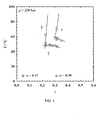
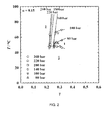
- the value ⁇ indicates the relative weight fraction of the blowing agent, ie the non-polar phase, in the polyol / blowing agent mixture.
- the value ⁇ denotes the mass fractions of the individual components in the polar phase.
- the value ⁇ denotes the relative weight fraction of the surfactant component in the total composition.
- reference numeral 1 denotes a single-phase region in which microemulsions occur, 2 a two-phase region wherein the surfactant is dissolved in the polar phase and 2 a biphasic area in which the surfactant is dissolved in the nonpolar phase.
- the individual examples each relate to certain polyol / blowing agent / surfactant systems.
- different formulations with different proportions ⁇ of the blowing agent were characterized in detail.
- the proportion ⁇ of the surfactant component was changed.
- the composition of the surfactant component itself was kept constant in the respective examples.
- the temperature of the system was noted and interpolated connecting lines between the measurement points to determine the boundaries between the one-, two- and three-phase areas. In this way, a diagram was obtained which corresponds to a Kahlweit-Fisch diagram ( Kahlweit, R. Strey, Angewandte Chemie International Edition, Vol. 28 (8), page 654 (1985 )) is comparable.
- Kahlweit-Fisch diagram Kahlweit, R. Strey, Angewandte Chemie International Edition, Vol. 28 (8), page 654 (1985 )
- Of particular interest for the characterization of the system is the intersection of the connecting lines. Given a known position of the point of intersection in the
- Q2-5211® was used for the surfactant component.
- the blowing agent used was supercritical CO 2 (scCO 2 ).
- the pressure in this example was 220 bar.
- the results are in FIG. 1 played. The following parameters were determined at the intersection of the connecting lines in the phase diagram: ⁇ -value ⁇ -worth Temperature at the intersection 0.15 0.22 48 ° C 0.30 0.29 58 ° C
- a microemulsion was reacted to a polyurethane foam.
- the mixture of polyols, TCPP and surfactant at 58 ° C and a pressure of 170 bar with CO 2 was added.
- This emulsion was mixed with the polyisocyanate in a high-pressure mixing head. Subsequently, the reaction mixture was introduced into an open beaker. One got a free foam.
- the recipe was as follows: component OH number parts by weight % by weight Desmophen® VP.PU 1431 310 mg KOH / g 80 29.93% glycerin 1827 mg KOH / g 15 4.86% TCPP 0 15 4.86% Q2-5211® not determined 45 14.59% Desmorapid® 726b 0 0.30 0.10% CO 2 0 19.4 6.29% Desmodur® 44V70L (NCO content 30.9% by weight) 133.7 43.37%
- the ⁇ and ⁇ values have been calculated including the isocyanate.
- the shot weight was 120 grams in total.
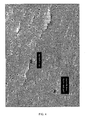
- the resulting foam was examined by scanning electron microscopy.
- FIG. 3 and 4 show scanning electron micrographs at different scales. It can be seen that in the gussets (this term refers in spherical geometry to an amount of points bounded by two large circles) of the foam formed, pores having a diameter of significantly less than 100 nm have been formed.
- the average pore radius is 15 ⁇ 6.8 nm.
- the average number density of the pores was 4.7 ⁇ 10 14 .
Landscapes
- Chemical & Material Sciences (AREA)
- Health & Medical Sciences (AREA)
- Chemical Kinetics & Catalysis (AREA)
- Medicinal Chemistry (AREA)
- Polymers & Plastics (AREA)
- Organic Chemistry (AREA)
- Engineering & Computer Science (AREA)
- Materials Engineering (AREA)
- Polyurethanes Or Polyureas (AREA)
- Manufacture Of Porous Articles, And Recovery And Treatment Of Waste Products (AREA)
Priority Applications (1)
| Application Number | Priority Date | Filing Date | Title |
|---|---|---|---|
| PL10771777T PL2496618T3 (pl) | 2009-11-06 | 2010-11-03 | Sposób wytwarzania pianki poliuretanowej i pianka poliuretanowa otrzymywana tym sposobem |
Applications Claiming Priority (2)
| Application Number | Priority Date | Filing Date | Title |
|---|---|---|---|
| DE102009053224A DE102009053224A1 (de) | 2009-11-06 | 2009-11-06 | Verfahren zur Herstellung eines Polyurethanschaums und hieraus erhältlicher Polyurethanschaum |
| PCT/EP2010/066738 WO2011054868A1 (de) | 2009-11-06 | 2010-11-03 | Verfahren zur herstellung eines polyurethanschaums und hieraus erhältlicher polyurethanschaum |
Publications (2)
| Publication Number | Publication Date |
|---|---|
| EP2496618A1 EP2496618A1 (de) | 2012-09-12 |
| EP2496618B1 true EP2496618B1 (de) | 2015-01-21 |
Family
ID=43462458
Family Applications (1)
| Application Number | Title | Priority Date | Filing Date |
|---|---|---|---|
| EP10771777.9A Not-in-force EP2496618B1 (de) | 2009-11-06 | 2010-11-03 | Verfahren zur herstellung eines polyurethanschaums und hieraus erhältlicher polyurethanschaum |
Country Status (14)
| Country | Link |
|---|---|
| US (2) | US9023909B2 (enExample) |
| EP (1) | EP2496618B1 (enExample) |
| JP (1) | JP5781528B2 (enExample) |
| KR (1) | KR20120104224A (enExample) |
| CN (1) | CN102686628B (enExample) |
| BR (1) | BR112012010631A2 (enExample) |
| CA (1) | CA2779862C (enExample) |
| DE (1) | DE102009053224A1 (enExample) |
| DK (1) | DK2496618T3 (enExample) |
| ES (1) | ES2535146T3 (enExample) |
| MX (1) | MX342652B (enExample) |
| PL (1) | PL2496618T3 (enExample) |
| RU (1) | RU2566502C9 (enExample) |
| WO (1) | WO2011054868A1 (enExample) |
Families Citing this family (17)
| Publication number | Priority date | Publication date | Assignee | Title |
|---|---|---|---|---|
| DE102010060386A1 (de) * | 2010-11-05 | 2012-05-10 | Bayer Materialscience Aktiengesellschaft | Verfahren zur Herstellung eines geschäumten Materials, hierbei eingesetzte emulsionsförmige Zusammensetzung und hieraus erhältliches geschäumtes Material |
| DE102010060390A1 (de) * | 2010-11-05 | 2012-05-10 | Bayer Materialscience Aktiengesellschaft | Emulsionsförmige Reaktionsmischung und Verfahren zur Herstellung von Polyurethanschäumen aus einer solchen Reaktionsmischung |
| DE102011050014A1 (de) | 2011-04-29 | 2012-10-31 | Bayer Materialscience Aktiengesellschaft | Polyurethanschaum und Verfahren zu seiner Herstellung |
| CA2885423C (en) * | 2012-09-24 | 2020-09-22 | Arkema Inc. | Improved stability of polyurethane polyol blends containing halogenated olefin blowing agent |
| EP2722144A1 (de) * | 2012-10-19 | 2014-04-23 | Bayer MaterialScience AG | Reaktionssystem zur Herstellung von PUR- und PIR Hartschaumstoffen enthaltend Schichtsilikate |
| WO2015067751A1 (de) * | 2013-11-08 | 2015-05-14 | Bayer Materialscience Ag | Polyurethanschaum und verfahren zu seiner herstellung |
| US10626290B2 (en) * | 2013-12-16 | 2020-04-21 | Ppg Industries Ohio, Inc. | Method of extending pot life of coating compositions |
| WO2015109488A1 (en) * | 2014-01-23 | 2015-07-30 | Dow Global Technologies Llc | Rigid polyurethane foam having a small cell size |
| EP3372625A1 (de) * | 2017-03-07 | 2018-09-12 | Covestro Deutschland AG | Polyurethanschaum und verfahren zu seiner herstellung |
| EP3421214B1 (en) * | 2017-06-30 | 2022-08-03 | Afros S.P.A. | Improved apparatus for dispersing a gas, for example carbon dioxide, in at least one reactive resin |
| EP3560970A1 (de) | 2018-04-25 | 2019-10-30 | Covestro Deutschland AG | Offenzelliger polyurethanhartschaum und dessen verwendung |
| EP3564283A1 (de) | 2018-04-30 | 2019-11-06 | Covestro Deutschland AG | Verfahren zur herstellung von geschlossenzelligem polyurethanschaum |
| CN109401281A (zh) * | 2018-09-11 | 2019-03-01 | 苏州市雄林新材料科技有限公司 | 一种高弹tpu薄膜及其制备方法 |
| CN109228444A (zh) * | 2018-10-26 | 2019-01-18 | 福建省安职教育服务有限公司 | 一种二氧化碳、二氯氟乙烷热塑性聚氨酯发泡注塑技术 |
| WO2020129671A1 (ja) * | 2018-12-21 | 2020-06-25 | Dic株式会社 | ウレタン樹脂組成物、表面処理剤、及び、物品 |
| EP3789417A1 (de) | 2019-09-06 | 2021-03-10 | Covestro Deutschland AG | Polyurethan-basierter isolationskörper und verfahren zu seiner herstellung |
| CN115702180B (zh) * | 2020-06-11 | 2025-08-19 | 陶氏环球技术有限责任公司 | 异氰酸酯反应性组合物及制备聚氨酯和聚异氰脲酸酯泡沫的方法 |
Family Cites Families (21)
| Publication number | Priority date | Publication date | Assignee | Title |
|---|---|---|---|---|
| GB8406050D0 (en) * | 1984-03-08 | 1984-04-11 | Ici Plc | Polyol compositions |
| US4906672A (en) | 1988-07-29 | 1990-03-06 | Pmc, Inc. | Blowing agents for polyurethane foam |
| DE4026702A1 (de) * | 1990-08-24 | 1992-02-27 | Bayer Ag | Verfahren zur herstellung von harten polyurethanschaumstoffen |
| TW568921B (en) * | 1998-08-07 | 2004-01-01 | Huntsman Int Llc | Process for preparing a moulded flexible polyurethane foam |
| JP3885225B2 (ja) * | 2000-05-23 | 2007-02-21 | 日本ポリウレタン工業株式会社 | 建築断熱材用硬質ウレタンスプレーフォームの製造法 |
| DE10030384A1 (de) | 2000-06-21 | 2002-01-03 | Hennecke Gmbh | Verfahren zur Herstellung von Blockschaum |
| US6294107B1 (en) | 2000-07-26 | 2001-09-25 | Basf Corporation | Alkylene oxide modified silicone glycol compatibilizing agents for stable polyester polyol compositions |
| KR20030051738A (ko) | 2000-10-24 | 2003-06-25 | 다우 글로벌 테크놀로지스 인크. | 다정형 열가소성 중합체 발포체의 제조방법 |
| US6472446B1 (en) * | 2001-03-09 | 2002-10-29 | Basf Corporation | Phase stable polyol composition containing hydrocarbon as the blowing agent |
| DE10145439A1 (de) * | 2001-09-14 | 2003-04-03 | Basf Ag | Verfahren zur Herstellung von reaktionsverzögerten Polyurethanhartschaumstoffen |
| JP4154654B2 (ja) * | 2002-09-13 | 2008-09-24 | アキレス株式会社 | 硬質ポリウレタンフォームの製造方法 |
| DE10260815B4 (de) | 2002-12-23 | 2008-07-03 | Universität Zu Köln | Aufgeschäumtes Material und Herstellverfahren für das aufgeschäumte Material |
| US7183330B2 (en) | 2003-12-15 | 2007-02-27 | Air Products And Chemicals, Inc. | Silicone surfactants for rigid polyurethane foam made with hydrocarbon blowing agents |
| RU2266305C2 (ru) * | 2004-02-02 | 2005-12-20 | Государственный научно-исследовательский институт органической химии и технологии ГосНИИОХТ | Способ получения полимерных материалов с заданной пористостью с помощью обработки двуокисью углерода в сверхкритическом состоянии и последующей термообработки при атмосферном давлении |
| US8048935B2 (en) * | 2004-11-08 | 2011-11-01 | Carpenter Co. | Liquid foam systems and ASTM E-84 class 1 rated rigid, high-density polyurethane foams and articles prepared therefrom |
| JP4694191B2 (ja) * | 2004-12-17 | 2011-06-08 | 住化バイエルウレタン株式会社 | ポリウレタンフォーム成形品の製造法 |
| EP1984415B1 (en) * | 2006-02-15 | 2011-01-05 | Stepan Company | Compatibilizing surfactants for polyurethane polyols and resins |
| US20090062414A1 (en) * | 2007-08-28 | 2009-03-05 | David Picheng Huang | System and method for producing damping polyurethane CMP pads |
| US8052507B2 (en) * | 2007-11-20 | 2011-11-08 | Praxair Technology, Inc. | Damping polyurethane CMP pads with microfillers |
| US8124665B2 (en) * | 2008-08-29 | 2012-02-28 | Bayer Materialscience Llc | Decorative molded foams with good impact resistance and fire retardant properties |
| US8551201B2 (en) * | 2009-08-07 | 2013-10-08 | Praxair S.T. Technology, Inc. | Polyurethane composition for CMP pads and method of manufacturing same |
-
2009
- 2009-11-06 DE DE102009053224A patent/DE102009053224A1/de not_active Ceased
-
2010
- 2010-11-03 CN CN201080060810.6A patent/CN102686628B/zh not_active Expired - Fee Related
- 2010-11-03 ES ES10771777.9T patent/ES2535146T3/es active Active
- 2010-11-03 JP JP2012537388A patent/JP5781528B2/ja not_active Expired - Fee Related
- 2010-11-03 BR BR112012010631A patent/BR112012010631A2/pt not_active Application Discontinuation
- 2010-11-03 DK DK10771777T patent/DK2496618T3/en active
- 2010-11-03 MX MX2012005128A patent/MX342652B/es active IP Right Grant
- 2010-11-03 KR KR1020127014598A patent/KR20120104224A/ko not_active Ceased
- 2010-11-03 EP EP10771777.9A patent/EP2496618B1/de not_active Not-in-force
- 2010-11-03 RU RU2012123134/04A patent/RU2566502C9/ru not_active IP Right Cessation
- 2010-11-03 US US13/505,785 patent/US9023909B2/en not_active Expired - Fee Related
- 2010-11-03 PL PL10771777T patent/PL2496618T3/pl unknown
- 2010-11-03 CA CA2779862A patent/CA2779862C/en not_active Expired - Fee Related
- 2010-11-03 WO PCT/EP2010/066738 patent/WO2011054868A1/de not_active Ceased
-
2015
- 2015-05-04 US US14/703,064 patent/US20150232629A1/en not_active Abandoned
Also Published As
| Publication number | Publication date |
|---|---|
| JP2013510208A (ja) | 2013-03-21 |
| CA2779862A1 (en) | 2011-05-12 |
| RU2566502C9 (ru) | 2016-09-10 |
| RU2566502C2 (ru) | 2015-10-27 |
| JP5781528B2 (ja) | 2015-09-24 |
| MX342652B (es) | 2016-10-06 |
| BR112012010631A2 (pt) | 2016-04-05 |
| CA2779862C (en) | 2017-11-28 |
| US9023909B2 (en) | 2015-05-05 |
| KR20120104224A (ko) | 2012-09-20 |
| US20150232629A1 (en) | 2015-08-20 |
| CN102686628A (zh) | 2012-09-19 |
| RU2012123134A (ru) | 2013-12-20 |
| CN102686628B (zh) | 2016-02-10 |
| PL2496618T3 (pl) | 2015-08-31 |
| WO2011054868A1 (de) | 2011-05-12 |
| MX2012005128A (es) | 2012-07-25 |
| DE102009053224A1 (de) | 2011-07-14 |
| EP2496618A1 (de) | 2012-09-12 |
| ES2535146T3 (es) | 2015-05-06 |
| DK2496618T3 (en) | 2015-04-20 |
| US20120238655A1 (en) | 2012-09-20 |
Similar Documents
| Publication | Publication Date | Title |
|---|---|---|
| EP2496624B1 (de) | Verfahren zur herstellung eines polyurethanschaums mittels über- oder nahekritischen treibmittels | |
| EP2702096B1 (de) | Polyurethanschaum und verfahren zu seiner herstellung | |
| DE102009053224A1 (de) | Verfahren zur Herstellung eines Polyurethanschaums und hieraus erhältlicher Polyurethanschaum | |
| EP2635615B1 (de) | Emulsionsförmige reaktionsmischung und verfahren zur herstellung von polyurethanschäumen aus einer solchen reaktionsmischung | |
| EP3592791B1 (de) | Polyurethanschaum und verfahren zu seiner herstellung | |
| EP2702095B1 (de) | Polyurethanschaum und verfahren zu seiner herstellung | |
| EP2908995B1 (de) | Reaktionssystem zur herstellung von pur- und pir hartschaumstoffen enthaltend schichtsilikate | |
| EP3066144B1 (de) | Polyurethanschaum und verfahren zu seiner herstellung | |
| EP4025621B1 (de) | Verfahren zur herstellung eines polyurethan-basierten isolationskörpers | |
| WO2019211200A1 (de) | Verfahren zur herstellung von geschlossenzelligem polyurethanschaum | |
| EP4532579A1 (de) | Komprimierter, offenzelliger, feinzelliger pur/pir-hartschaumstoff | |
| EP4514871A1 (de) | Dimensionsstabile offenzellige feinzellige polyurethan-hartschaumstoffe | |
| EP4275857A1 (de) | Werkzeug zur herstellung von schaumstoffen |
Legal Events
| Date | Code | Title | Description |
|---|---|---|---|
| PUAI | Public reference made under article 153(3) epc to a published international application that has entered the european phase |
Free format text: ORIGINAL CODE: 0009012 |
|
| 17P | Request for examination filed |
Effective date: 20120606 |
|
| AK | Designated contracting states |
Kind code of ref document: A1 Designated state(s): AL AT BE BG CH CY CZ DE DK EE ES FI FR GB GR HR HU IE IS IT LI LT LU LV MC MK MT NL NO PL PT RO RS SE SI SK SM TR |
|
| DAX | Request for extension of the european patent (deleted) | ||
| RAP1 | Party data changed (applicant data changed or rights of an application transferred) |
Owner name: BAYER INTELLECTUAL PROPERTY GMBH |
|
| GRAP | Despatch of communication of intention to grant a patent |
Free format text: ORIGINAL CODE: EPIDOSNIGR1 |
|
| INTG | Intention to grant announced |
Effective date: 20140813 |
|
| GRAS | Grant fee paid |
Free format text: ORIGINAL CODE: EPIDOSNIGR3 |
|
| GRAA | (expected) grant |
Free format text: ORIGINAL CODE: 0009210 |
|
| AK | Designated contracting states |
Kind code of ref document: B1 Designated state(s): AL AT BE BG CH CY CZ DE DK EE ES FI FR GB GR HR HU IE IS IT LI LT LU LV MC MK MT NL NO PL PT RO RS SE SI SK SM TR |
|
| REG | Reference to a national code |
Ref country code: GB Ref legal event code: FG4D Free format text: NOT ENGLISH |
|
| REG | Reference to a national code |
Ref country code: CH Ref legal event code: EP |
|
| REG | Reference to a national code |
Ref country code: IE Ref legal event code: FG4D Free format text: LANGUAGE OF EP DOCUMENT: GERMAN |
|
| REG | Reference to a national code |
Ref country code: DE Ref legal event code: R096 Ref document number: 502010008791 Country of ref document: DE Effective date: 20150312 |
|
| REG | Reference to a national code |
Ref country code: AT Ref legal event code: REF Ref document number: 709165 Country of ref document: AT Kind code of ref document: T Effective date: 20150315 |
|
| REG | Reference to a national code |
Ref country code: DK Ref legal event code: T3 Effective date: 20150416 |
|
| REG | Reference to a national code |
Ref country code: NL Ref legal event code: T3 |
|
| REG | Reference to a national code |
Ref country code: ES Ref legal event code: FG2A Ref document number: 2535146 Country of ref document: ES Kind code of ref document: T3 Effective date: 20150506 |
|
| REG | Reference to a national code |
Ref country code: LT Ref legal event code: MG4D |
|
| PG25 | Lapsed in a contracting state [announced via postgrant information from national office to epo] |
Ref country code: HR Free format text: LAPSE BECAUSE OF FAILURE TO SUBMIT A TRANSLATION OF THE DESCRIPTION OR TO PAY THE FEE WITHIN THE PRESCRIBED TIME-LIMIT Effective date: 20150121 Ref country code: BG Free format text: LAPSE BECAUSE OF FAILURE TO SUBMIT A TRANSLATION OF THE DESCRIPTION OR TO PAY THE FEE WITHIN THE PRESCRIBED TIME-LIMIT Effective date: 20150421 Ref country code: SE Free format text: LAPSE BECAUSE OF FAILURE TO SUBMIT A TRANSLATION OF THE DESCRIPTION OR TO PAY THE FEE WITHIN THE PRESCRIBED TIME-LIMIT Effective date: 20150121 Ref country code: LT Free format text: LAPSE BECAUSE OF FAILURE TO SUBMIT A TRANSLATION OF THE DESCRIPTION OR TO PAY THE FEE WITHIN THE PRESCRIBED TIME-LIMIT Effective date: 20150121 Ref country code: NO Free format text: LAPSE BECAUSE OF FAILURE TO SUBMIT A TRANSLATION OF THE DESCRIPTION OR TO PAY THE FEE WITHIN THE PRESCRIBED TIME-LIMIT Effective date: 20150421 |
|
| PG25 | Lapsed in a contracting state [announced via postgrant information from national office to epo] |
Ref country code: LV Free format text: LAPSE BECAUSE OF FAILURE TO SUBMIT A TRANSLATION OF THE DESCRIPTION OR TO PAY THE FEE WITHIN THE PRESCRIBED TIME-LIMIT Effective date: 20150121 Ref country code: IS Free format text: LAPSE BECAUSE OF FAILURE TO SUBMIT A TRANSLATION OF THE DESCRIPTION OR TO PAY THE FEE WITHIN THE PRESCRIBED TIME-LIMIT Effective date: 20150521 Ref country code: RS Free format text: LAPSE BECAUSE OF FAILURE TO SUBMIT A TRANSLATION OF THE DESCRIPTION OR TO PAY THE FEE WITHIN THE PRESCRIBED TIME-LIMIT Effective date: 20150121 Ref country code: GR Free format text: LAPSE BECAUSE OF FAILURE TO SUBMIT A TRANSLATION OF THE DESCRIPTION OR TO PAY THE FEE WITHIN THE PRESCRIBED TIME-LIMIT Effective date: 20150422 |
|
| REG | Reference to a national code |
Ref country code: PL Ref legal event code: T3 |
|
| REG | Reference to a national code |
Ref country code: DE Ref legal event code: R097 Ref document number: 502010008791 Country of ref document: DE |
|
| REG | Reference to a national code |
Ref country code: FR Ref legal event code: PLFP Year of fee payment: 6 |
|
| PG25 | Lapsed in a contracting state [announced via postgrant information from national office to epo] |
Ref country code: CZ Free format text: LAPSE BECAUSE OF FAILURE TO SUBMIT A TRANSLATION OF THE DESCRIPTION OR TO PAY THE FEE WITHIN THE PRESCRIBED TIME-LIMIT Effective date: 20150121 Ref country code: EE Free format text: LAPSE BECAUSE OF FAILURE TO SUBMIT A TRANSLATION OF THE DESCRIPTION OR TO PAY THE FEE WITHIN THE PRESCRIBED TIME-LIMIT Effective date: 20150121 Ref country code: RO Free format text: LAPSE BECAUSE OF FAILURE TO SUBMIT A TRANSLATION OF THE DESCRIPTION OR TO PAY THE FEE WITHIN THE PRESCRIBED TIME-LIMIT Effective date: 20150121 Ref country code: SK Free format text: LAPSE BECAUSE OF FAILURE TO SUBMIT A TRANSLATION OF THE DESCRIPTION OR TO PAY THE FEE WITHIN THE PRESCRIBED TIME-LIMIT Effective date: 20150121 |
|
| PLBE | No opposition filed within time limit |
Free format text: ORIGINAL CODE: 0009261 |
|
| STAA | Information on the status of an ep patent application or granted ep patent |
Free format text: STATUS: NO OPPOSITION FILED WITHIN TIME LIMIT |
|
| 26N | No opposition filed |
Effective date: 20151022 |
|
| REG | Reference to a national code |
Ref country code: DE Ref legal event code: R081 Ref document number: 502010008791 Country of ref document: DE Owner name: COVESTRO DEUTSCHLAND AG, DE Free format text: FORMER OWNER: BAYER INTELLECTUAL PROPERTY GMBH, 40789 MONHEIM, DE |
|
| PG25 | Lapsed in a contracting state [announced via postgrant information from national office to epo] |
Ref country code: SI Free format text: LAPSE BECAUSE OF FAILURE TO SUBMIT A TRANSLATION OF THE DESCRIPTION OR TO PAY THE FEE WITHIN THE PRESCRIBED TIME-LIMIT Effective date: 20150121 |
|
| PG25 | Lapsed in a contracting state [announced via postgrant information from national office to epo] |
Ref country code: MC Free format text: LAPSE BECAUSE OF FAILURE TO SUBMIT A TRANSLATION OF THE DESCRIPTION OR TO PAY THE FEE WITHIN THE PRESCRIBED TIME-LIMIT Effective date: 20150121 Ref country code: LU Free format text: LAPSE BECAUSE OF FAILURE TO SUBMIT A TRANSLATION OF THE DESCRIPTION OR TO PAY THE FEE WITHIN THE PRESCRIBED TIME-LIMIT Effective date: 20151103 |
|
| REG | Reference to a national code |
Ref country code: GB Ref legal event code: 732E Free format text: REGISTERED BETWEEN 20160922 AND 20160928 |
|
| REG | Reference to a national code |
Ref country code: FR Ref legal event code: PLFP Year of fee payment: 7 |
|
| REG | Reference to a national code |
Ref country code: NL Ref legal event code: PD Owner name: COVESTRO DEUTSCHLAND AG; DE Free format text: DETAILS ASSIGNMENT: VERANDERING VAN EIGENAAR(S), OVERDRACHT; FORMER OWNER NAME: BAYER INTELLECTUAL PROPERTY GMBH Effective date: 20160810 |
|
| REG | Reference to a national code |
Ref country code: FR Ref legal event code: TP Owner name: COVESTRO DEUTSCHLAND AG, DE Effective date: 20161115 |
|
| REG | Reference to a national code |
Ref country code: AT Ref legal event code: MM01 Ref document number: 709165 Country of ref document: AT Kind code of ref document: T Effective date: 20151103 |
|
| PGFP | Annual fee paid to national office [announced via postgrant information from national office to epo] |
Ref country code: IE Payment date: 20161109 Year of fee payment: 7 Ref country code: DK Payment date: 20161110 Year of fee payment: 7 Ref country code: CH Payment date: 20161115 Year of fee payment: 7 Ref country code: FI Payment date: 20161109 Year of fee payment: 7 Ref country code: FR Payment date: 20161028 Year of fee payment: 7 Ref country code: NL Payment date: 20161110 Year of fee payment: 7 |
|
| REG | Reference to a national code |
Ref country code: ES Ref legal event code: PC2A Owner name: BAYER MATERIALSCIENCE AG Effective date: 20170125 |
|
| PG25 | Lapsed in a contracting state [announced via postgrant information from national office to epo] |
Ref country code: AT Free format text: LAPSE BECAUSE OF NON-PAYMENT OF DUE FEES Effective date: 20151103 |
|
| PGFP | Annual fee paid to national office [announced via postgrant information from national office to epo] |
Ref country code: ES Payment date: 20161027 Year of fee payment: 7 |
|
| PG25 | Lapsed in a contracting state [announced via postgrant information from national office to epo] |
Ref country code: SM Free format text: LAPSE BECAUSE OF FAILURE TO SUBMIT A TRANSLATION OF THE DESCRIPTION OR TO PAY THE FEE WITHIN THE PRESCRIBED TIME-LIMIT Effective date: 20150121 Ref country code: HU Free format text: LAPSE BECAUSE OF FAILURE TO SUBMIT A TRANSLATION OF THE DESCRIPTION OR TO PAY THE FEE WITHIN THE PRESCRIBED TIME-LIMIT; INVALID AB INITIO Effective date: 20101103 |
|
| PG25 | Lapsed in a contracting state [announced via postgrant information from national office to epo] |
Ref country code: CY Free format text: LAPSE BECAUSE OF FAILURE TO SUBMIT A TRANSLATION OF THE DESCRIPTION OR TO PAY THE FEE WITHIN THE PRESCRIBED TIME-LIMIT Effective date: 20150121 |
|
| PG25 | Lapsed in a contracting state [announced via postgrant information from national office to epo] |
Ref country code: MT Free format text: LAPSE BECAUSE OF FAILURE TO SUBMIT A TRANSLATION OF THE DESCRIPTION OR TO PAY THE FEE WITHIN THE PRESCRIBED TIME-LIMIT Effective date: 20150121 |
|
| REG | Reference to a national code |
Ref country code: ES Ref legal event code: PC2A Owner name: COVESTRO DEUTSCHLAND AG Effective date: 20171219 |
|
| REG | Reference to a national code |
Ref country code: DK Ref legal event code: EBP Effective date: 20171130 |
|
| PG25 | Lapsed in a contracting state [announced via postgrant information from national office to epo] |
Ref country code: MK Free format text: LAPSE BECAUSE OF FAILURE TO SUBMIT A TRANSLATION OF THE DESCRIPTION OR TO PAY THE FEE WITHIN THE PRESCRIBED TIME-LIMIT Effective date: 20150121 Ref country code: PT Free format text: LAPSE BECAUSE OF FAILURE TO SUBMIT A TRANSLATION OF THE DESCRIPTION OR TO PAY THE FEE WITHIN THE PRESCRIBED TIME-LIMIT Effective date: 20150121 |
|
| REG | Reference to a national code |
Ref country code: NL Ref legal event code: MM Effective date: 20171201 |
|
| PG25 | Lapsed in a contracting state [announced via postgrant information from national office to epo] |
Ref country code: LI Free format text: LAPSE BECAUSE OF NON-PAYMENT OF DUE FEES Effective date: 20171130 Ref country code: CH Free format text: LAPSE BECAUSE OF NON-PAYMENT OF DUE FEES Effective date: 20171130 Ref country code: FI Free format text: LAPSE BECAUSE OF NON-PAYMENT OF DUE FEES Effective date: 20171103 |
|
| REG | Reference to a national code |
Ref country code: FR Ref legal event code: ST Effective date: 20180731 |
|
| REG | Reference to a national code |
Ref country code: IE Ref legal event code: MM4A |
|
| PG25 | Lapsed in a contracting state [announced via postgrant information from national office to epo] |
Ref country code: NL Free format text: LAPSE BECAUSE OF NON-PAYMENT OF DUE FEES Effective date: 20171201 Ref country code: FR Free format text: LAPSE BECAUSE OF NON-PAYMENT OF DUE FEES Effective date: 20171130 Ref country code: IE Free format text: LAPSE BECAUSE OF NON-PAYMENT OF DUE FEES Effective date: 20171103 Ref country code: AL Free format text: LAPSE BECAUSE OF FAILURE TO SUBMIT A TRANSLATION OF THE DESCRIPTION OR TO PAY THE FEE WITHIN THE PRESCRIBED TIME-LIMIT Effective date: 20150121 |
|
| PG25 | Lapsed in a contracting state [announced via postgrant information from national office to epo] |
Ref country code: DK Free format text: LAPSE BECAUSE OF NON-PAYMENT OF DUE FEES Effective date: 20171130 |
|
| REG | Reference to a national code |
Ref country code: ES Ref legal event code: FD2A Effective date: 20181221 |
|
| PG25 | Lapsed in a contracting state [announced via postgrant information from national office to epo] |
Ref country code: ES Free format text: LAPSE BECAUSE OF NON-PAYMENT OF DUE FEES Effective date: 20171104 |
|
| PGFP | Annual fee paid to national office [announced via postgrant information from national office to epo] |
Ref country code: TR Payment date: 20201102 Year of fee payment: 11 |
|
| PGFP | Annual fee paid to national office [announced via postgrant information from national office to epo] |
Ref country code: DE Payment date: 20201020 Year of fee payment: 11 Ref country code: GB Payment date: 20201022 Year of fee payment: 11 Ref country code: IT Payment date: 20201027 Year of fee payment: 11 |
|
| PGFP | Annual fee paid to national office [announced via postgrant information from national office to epo] |
Ref country code: PL Payment date: 20201028 Year of fee payment: 11 Ref country code: BE Payment date: 20201028 Year of fee payment: 11 |
|
| REG | Reference to a national code |
Ref country code: DE Ref legal event code: R119 Ref document number: 502010008791 Country of ref document: DE |
|
| GBPC | Gb: european patent ceased through non-payment of renewal fee |
Effective date: 20211103 |
|
| PG25 | Lapsed in a contracting state [announced via postgrant information from national office to epo] |
Ref country code: BE Free format text: LAPSE BECAUSE OF NON-PAYMENT OF DUE FEES Effective date: 20211130 |
|
| REG | Reference to a national code |
Ref country code: BE Ref legal event code: MM Effective date: 20211130 |
|
| PG25 | Lapsed in a contracting state [announced via postgrant information from national office to epo] |
Ref country code: GB Free format text: LAPSE BECAUSE OF NON-PAYMENT OF DUE FEES Effective date: 20211103 Ref country code: DE Free format text: LAPSE BECAUSE OF NON-PAYMENT OF DUE FEES Effective date: 20220601 |
|
| PG25 | Lapsed in a contracting state [announced via postgrant information from national office to epo] |
Ref country code: IT Free format text: LAPSE BECAUSE OF NON-PAYMENT OF DUE FEES Effective date: 20211103 |
|
| PG25 | Lapsed in a contracting state [announced via postgrant information from national office to epo] |
Ref country code: PL Free format text: LAPSE BECAUSE OF NON-PAYMENT OF DUE FEES Effective date: 20211103 |
|
| PG25 | Lapsed in a contracting state [announced via postgrant information from national office to epo] |
Ref country code: TR Free format text: LAPSE BECAUSE OF NON-PAYMENT OF DUE FEES Effective date: 20211103 |