EP2493889B1 - IMIDAZO[1,2-b]PYRIDAZINE DERIVATIVES AND THEIR USE AS PDE10 INHIBITORS - Google Patents
IMIDAZO[1,2-b]PYRIDAZINE DERIVATIVES AND THEIR USE AS PDE10 INHIBITORS Download PDFInfo
- Publication number
- EP2493889B1 EP2493889B1 EP10768978.8A EP10768978A EP2493889B1 EP 2493889 B1 EP2493889 B1 EP 2493889B1 EP 10768978 A EP10768978 A EP 10768978A EP 2493889 B1 EP2493889 B1 EP 2493889B1
- Authority
- EP
- European Patent Office
- Prior art keywords
- compound
- pyridinyl
- imidazo
- pyridazine
- methyl
- Prior art date
- Legal status (The legal status is an assumption and is not a legal conclusion. Google has not performed a legal analysis and makes no representation as to the accuracy of the status listed.)
- Active
Links
- 239000003112 inhibitor Substances 0.000 title description 21
- 150000004942 imidazo[1,2-b]pyridazines Chemical class 0.000 title description 3
- 150000001875 compounds Chemical class 0.000 claims description 388
- -1 chloro, methyl Chemical group 0.000 claims description 187
- 238000002360 preparation method Methods 0.000 claims description 122
- 208000037265 diseases, disorders, signs and symptoms Diseases 0.000 claims description 46
- 239000001257 hydrogen Substances 0.000 claims description 43
- 229910052739 hydrogen Inorganic materials 0.000 claims description 43
- 125000002023 trifluoromethyl group Chemical group FC(F)(F)* 0.000 claims description 41
- 150000003839 salts Chemical class 0.000 claims description 40
- 239000003814 drug Substances 0.000 claims description 34
- 125000002496 methyl group Chemical group [H]C([H])([H])* 0.000 claims description 31
- 125000001559 cyclopropyl group Chemical group [H]C1([H])C([H])([H])C1([H])* 0.000 claims description 29
- 239000008194 pharmaceutical composition Substances 0.000 claims description 26
- 125000004076 pyridyl group Chemical group 0.000 claims description 24
- 239000012453 solvate Substances 0.000 claims description 23
- 230000002265 prevention Effects 0.000 claims description 22
- 125000001495 ethyl group Chemical group [H]C([H])([H])C([H])([H])* 0.000 claims description 20
- 125000004435 hydrogen atom Chemical group [H]* 0.000 claims description 19
- 208000035475 disorder Diseases 0.000 claims description 17
- 125000004573 morpholin-4-yl group Chemical group N1(CCOCC1)* 0.000 claims description 17
- 208000012902 Nervous system disease Diseases 0.000 claims description 16
- 125000001449 isopropyl group Chemical group [H]C([H])([H])C([H])(*)C([H])([H])[H] 0.000 claims description 16
- 208000028017 Psychotic disease Diseases 0.000 claims description 15
- 201000000980 schizophrenia Diseases 0.000 claims description 15
- 125000004200 2-methoxyethyl group Chemical group [H]C([H])([H])OC([H])([H])C([H])([H])* 0.000 claims description 14
- 238000004519 manufacturing process Methods 0.000 claims description 14
- 125000003349 3-pyridyl group Chemical group N1=C([H])C([*])=C([H])C([H])=C1[H] 0.000 claims description 11
- 239000003937 drug carrier Substances 0.000 claims description 11
- 125000000959 isobutyl group Chemical group [H]C([H])([H])C([H])(C([H])([H])[H])C([H])([H])* 0.000 claims description 11
- 125000002757 morpholinyl group Chemical group 0.000 claims description 11
- 229940125904 compound 1 Drugs 0.000 claims description 10
- 208000030159 metabolic disease Diseases 0.000 claims description 10
- 208000024891 symptom Diseases 0.000 claims description 10
- 125000004206 2,2,2-trifluoroethyl group Chemical group [H]C([H])(*)C(F)(F)F 0.000 claims description 8
- 125000000339 4-pyridyl group Chemical group N1=C([H])C([H])=C([*])C([H])=C1[H] 0.000 claims description 8
- 125000005745 ethoxymethyl group Chemical group [H]C([H])([H])C([H])([H])OC([H])([H])* 0.000 claims description 8
- 239000008177 pharmaceutical agent Substances 0.000 claims description 8
- 125000004194 piperazin-1-yl group Chemical group [H]N1C([H])([H])C([H])([H])N(*)C([H])([H])C1([H])[H] 0.000 claims description 8
- 125000000956 methoxy group Chemical group [H]C([H])([H])O* 0.000 claims description 7
- 125000000719 pyrrolidinyl group Chemical group 0.000 claims description 7
- 208000015114 central nervous system disease Diseases 0.000 claims description 6
- 208000019901 Anxiety disease Diseases 0.000 claims description 5
- 208000019022 Mood disease Diseases 0.000 claims description 5
- OPFJDXRVMFKJJO-ZHHKINOHSA-N N-{[3-(2-benzamido-4-methyl-1,3-thiazol-5-yl)-pyrazol-5-yl]carbonyl}-G-dR-G-dD-dD-dD-NH2 Chemical compound S1C(C=2NN=C(C=2)C(=O)NCC(=O)N[C@H](CCCN=C(N)N)C(=O)NCC(=O)N[C@H](CC(O)=O)C(=O)N[C@H](CC(O)=O)C(=O)N[C@H](CC(O)=O)C(N)=O)=C(C)N=C1NC(=O)C1=CC=CC=C1 OPFJDXRVMFKJJO-ZHHKINOHSA-N 0.000 claims description 5
- 229940126086 compound 21 Drugs 0.000 claims description 5
- 125000003226 pyrazolyl group Chemical group 0.000 claims description 5
- UAOUIVVJBYDFKD-XKCDOFEDSA-N (1R,9R,10S,11R,12R,15S,18S,21R)-10,11,21-trihydroxy-8,8-dimethyl-14-methylidene-4-(prop-2-enylamino)-20-oxa-5-thia-3-azahexacyclo[9.7.2.112,15.01,9.02,6.012,18]henicosa-2(6),3-dien-13-one Chemical compound C([C@@H]1[C@@H](O)[C@@]23C(C1=C)=O)C[C@H]2[C@]12C(N=C(NCC=C)S4)=C4CC(C)(C)[C@H]1[C@H](O)[C@]3(O)OC2 UAOUIVVJBYDFKD-XKCDOFEDSA-N 0.000 claims description 4
- AOSZTAHDEDLTLQ-AZKQZHLXSA-N (1S,2S,4R,8S,9S,11S,12R,13S,19S)-6-[(3-chlorophenyl)methyl]-12,19-difluoro-11-hydroxy-8-(2-hydroxyacetyl)-9,13-dimethyl-6-azapentacyclo[10.8.0.02,9.04,8.013,18]icosa-14,17-dien-16-one Chemical compound C([C@@H]1C[C@H]2[C@H]3[C@]([C@]4(C=CC(=O)C=C4[C@@H](F)C3)C)(F)[C@@H](O)C[C@@]2([C@@]1(C1)C(=O)CO)C)N1CC1=CC=CC(Cl)=C1 AOSZTAHDEDLTLQ-AZKQZHLXSA-N 0.000 claims description 4
- ABJSOROVZZKJGI-OCYUSGCXSA-N (1r,2r,4r)-2-(4-bromophenyl)-n-[(4-chlorophenyl)-(2-fluoropyridin-4-yl)methyl]-4-morpholin-4-ylcyclohexane-1-carboxamide Chemical compound C1=NC(F)=CC(C(NC(=O)[C@H]2[C@@H](C[C@@H](CC2)N2CCOCC2)C=2C=CC(Br)=CC=2)C=2C=CC(Cl)=CC=2)=C1 ABJSOROVZZKJGI-OCYUSGCXSA-N 0.000 claims description 4
- SZUVGFMDDVSKSI-WIFOCOSTSA-N (1s,2s,3s,5r)-1-(carboxymethyl)-3,5-bis[(4-phenoxyphenyl)methyl-propylcarbamoyl]cyclopentane-1,2-dicarboxylic acid Chemical compound O=C([C@@H]1[C@@H]([C@](CC(O)=O)([C@H](C(=O)N(CCC)CC=2C=CC(OC=3C=CC=CC=3)=CC=2)C1)C(O)=O)C(O)=O)N(CCC)CC(C=C1)=CC=C1OC1=CC=CC=C1 SZUVGFMDDVSKSI-WIFOCOSTSA-N 0.000 claims description 4
- GHYOCDFICYLMRF-UTIIJYGPSA-N (2S,3R)-N-[(2S)-3-(cyclopenten-1-yl)-1-[(2R)-2-methyloxiran-2-yl]-1-oxopropan-2-yl]-3-hydroxy-3-(4-methoxyphenyl)-2-[[(2S)-2-[(2-morpholin-4-ylacetyl)amino]propanoyl]amino]propanamide Chemical compound C1(=CCCC1)C[C@@H](C(=O)[C@@]1(OC1)C)NC([C@H]([C@@H](C1=CC=C(C=C1)OC)O)NC([C@H](C)NC(CN1CCOCC1)=O)=O)=O GHYOCDFICYLMRF-UTIIJYGPSA-N 0.000 claims description 4
- IUSARDYWEPUTPN-OZBXUNDUSA-N (2r)-n-[(2s,3r)-4-[[(4s)-6-(2,2-dimethylpropyl)spiro[3,4-dihydropyrano[2,3-b]pyridine-2,1'-cyclobutane]-4-yl]amino]-3-hydroxy-1-[3-(1,3-thiazol-2-yl)phenyl]butan-2-yl]-2-methoxypropanamide Chemical compound C([C@H](NC(=O)[C@@H](C)OC)[C@H](O)CN[C@@H]1C2=CC(CC(C)(C)C)=CN=C2OC2(CCC2)C1)C(C=1)=CC=CC=1C1=NC=CS1 IUSARDYWEPUTPN-OZBXUNDUSA-N 0.000 claims description 4
- STBLNCCBQMHSRC-BATDWUPUSA-N (2s)-n-[(3s,4s)-5-acetyl-7-cyano-4-methyl-1-[(2-methylnaphthalen-1-yl)methyl]-2-oxo-3,4-dihydro-1,5-benzodiazepin-3-yl]-2-(methylamino)propanamide Chemical compound O=C1[C@@H](NC(=O)[C@H](C)NC)[C@H](C)N(C(C)=O)C2=CC(C#N)=CC=C2N1CC1=C(C)C=CC2=CC=CC=C12 STBLNCCBQMHSRC-BATDWUPUSA-N 0.000 claims description 4
- QFLWZFQWSBQYPS-AWRAUJHKSA-N (3S)-3-[[(2S)-2-[[(2S)-2-[5-[(3aS,6aR)-2-oxo-1,3,3a,4,6,6a-hexahydrothieno[3,4-d]imidazol-4-yl]pentanoylamino]-3-methylbutanoyl]amino]-3-(4-hydroxyphenyl)propanoyl]amino]-4-[1-bis(4-chlorophenoxy)phosphorylbutylamino]-4-oxobutanoic acid Chemical compound CCCC(NC(=O)[C@H](CC(O)=O)NC(=O)[C@H](Cc1ccc(O)cc1)NC(=O)[C@@H](NC(=O)CCCCC1SC[C@@H]2NC(=O)N[C@H]12)C(C)C)P(=O)(Oc1ccc(Cl)cc1)Oc1ccc(Cl)cc1 QFLWZFQWSBQYPS-AWRAUJHKSA-N 0.000 claims description 4
- IWZSHWBGHQBIML-ZGGLMWTQSA-N (3S,8S,10R,13S,14S,17S)-17-isoquinolin-7-yl-N,N,10,13-tetramethyl-2,3,4,7,8,9,11,12,14,15,16,17-dodecahydro-1H-cyclopenta[a]phenanthren-3-amine Chemical compound CN(C)[C@H]1CC[C@]2(C)C3CC[C@@]4(C)[C@@H](CC[C@@H]4c4ccc5ccncc5c4)[C@@H]3CC=C2C1 IWZSHWBGHQBIML-ZGGLMWTQSA-N 0.000 claims description 4
- KQZLRWGGWXJPOS-NLFPWZOASA-N 1-[(1R)-1-(2,4-dichlorophenyl)ethyl]-6-[(4S,5R)-4-[(2S)-2-(hydroxymethyl)pyrrolidin-1-yl]-5-methylcyclohexen-1-yl]pyrazolo[3,4-b]pyrazine-3-carbonitrile Chemical compound ClC1=C(C=CC(=C1)Cl)[C@@H](C)N1N=C(C=2C1=NC(=CN=2)C1=CC[C@@H]([C@@H](C1)C)N1[C@@H](CCC1)CO)C#N KQZLRWGGWXJPOS-NLFPWZOASA-N 0.000 claims description 4
- WZZBNLYBHUDSHF-DHLKQENFSA-N 1-[(3s,4s)-4-[8-(2-chloro-4-pyrimidin-2-yloxyphenyl)-7-fluoro-2-methylimidazo[4,5-c]quinolin-1-yl]-3-fluoropiperidin-1-yl]-2-hydroxyethanone Chemical compound CC1=NC2=CN=C3C=C(F)C(C=4C(=CC(OC=5N=CC=CN=5)=CC=4)Cl)=CC3=C2N1[C@H]1CCN(C(=O)CO)C[C@@H]1F WZZBNLYBHUDSHF-DHLKQENFSA-N 0.000 claims description 4
- ONBQEOIKXPHGMB-VBSBHUPXSA-N 1-[2-[(2s,3r,4s,5r)-3,4-dihydroxy-5-(hydroxymethyl)oxolan-2-yl]oxy-4,6-dihydroxyphenyl]-3-(4-hydroxyphenyl)propan-1-one Chemical compound O[C@@H]1[C@H](O)[C@@H](CO)O[C@H]1OC1=CC(O)=CC(O)=C1C(=O)CCC1=CC=C(O)C=C1 ONBQEOIKXPHGMB-VBSBHUPXSA-N 0.000 claims description 4
- UNILWMWFPHPYOR-KXEYIPSPSA-M 1-[6-[2-[3-[3-[3-[2-[2-[3-[[2-[2-[[(2r)-1-[[2-[[(2r)-1-[3-[2-[2-[3-[[2-(2-amino-2-oxoethoxy)acetyl]amino]propoxy]ethoxy]ethoxy]propylamino]-3-hydroxy-1-oxopropan-2-yl]amino]-2-oxoethyl]amino]-3-[(2r)-2,3-di(hexadecanoyloxy)propyl]sulfanyl-1-oxopropan-2-yl Chemical compound O=C1C(SCCC(=O)NCCCOCCOCCOCCCNC(=O)COCC(=O)N[C@@H](CSC[C@@H](COC(=O)CCCCCCCCCCCCCCC)OC(=O)CCCCCCCCCCCCCCC)C(=O)NCC(=O)N[C@H](CO)C(=O)NCCCOCCOCCOCCCNC(=O)COCC(N)=O)CC(=O)N1CCNC(=O)CCCCCN\1C2=CC=C(S([O-])(=O)=O)C=C2CC/1=C/C=C/C=C/C1=[N+](CC)C2=CC=C(S([O-])(=O)=O)C=C2C1 UNILWMWFPHPYOR-KXEYIPSPSA-M 0.000 claims description 4
- YSUIQYOGTINQIN-UZFYAQMZSA-N 2-amino-9-[(1S,6R,8R,9S,10R,15R,17R,18R)-8-(6-aminopurin-9-yl)-9,18-difluoro-3,12-dihydroxy-3,12-bis(sulfanylidene)-2,4,7,11,13,16-hexaoxa-3lambda5,12lambda5-diphosphatricyclo[13.2.1.06,10]octadecan-17-yl]-1H-purin-6-one Chemical compound NC1=NC2=C(N=CN2[C@@H]2O[C@@H]3COP(S)(=O)O[C@@H]4[C@@H](COP(S)(=O)O[C@@H]2[C@@H]3F)O[C@H]([C@H]4F)N2C=NC3=C2N=CN=C3N)C(=O)N1 YSUIQYOGTINQIN-UZFYAQMZSA-N 0.000 claims description 4
- TVTJUIAKQFIXCE-HUKYDQBMSA-N 2-amino-9-[(2R,3S,4S,5R)-4-fluoro-3-hydroxy-5-(hydroxymethyl)oxolan-2-yl]-7-prop-2-ynyl-1H-purine-6,8-dione Chemical compound NC=1NC(C=2N(C(N(C=2N=1)[C@@H]1O[C@@H]([C@H]([C@H]1O)F)CO)=O)CC#C)=O TVTJUIAKQFIXCE-HUKYDQBMSA-N 0.000 claims description 4
- NPRYCHLHHVWLQZ-TURQNECASA-N 2-amino-9-[(2R,3S,4S,5R)-4-fluoro-3-hydroxy-5-(hydroxymethyl)oxolan-2-yl]-7-prop-2-ynylpurin-8-one Chemical compound NC1=NC=C2N(C(N(C2=N1)[C@@H]1O[C@@H]([C@H]([C@H]1O)F)CO)=O)CC#C NPRYCHLHHVWLQZ-TURQNECASA-N 0.000 claims description 4
- QBWKPGNFQQJGFY-QLFBSQMISA-N 3-[(1r)-1-[(2r,6s)-2,6-dimethylmorpholin-4-yl]ethyl]-n-[6-methyl-3-(1h-pyrazol-4-yl)imidazo[1,2-a]pyrazin-8-yl]-1,2-thiazol-5-amine Chemical compound N1([C@H](C)C2=NSC(NC=3C4=NC=C(N4C=C(C)N=3)C3=CNN=C3)=C2)C[C@H](C)O[C@H](C)C1 QBWKPGNFQQJGFY-QLFBSQMISA-N 0.000 claims description 4
- HNFMVVHMKGFCMB-UHFFFAOYSA-N 3-[3-[4-(1-aminocyclobutyl)phenyl]-5-phenylimidazo[4,5-b]pyridin-2-yl]pyridin-2-amine Chemical compound NC1=NC=CC=C1C1=NC2=CC=C(C=3C=CC=CC=3)N=C2N1C1=CC=C(C2(N)CCC2)C=C1 HNFMVVHMKGFCMB-UHFFFAOYSA-N 0.000 claims description 4
- BPLVDYJDAVYLRQ-UHFFFAOYSA-N 4-[3-[6-(2-methoxyethyl)pyridin-3-yl]-2-methylimidazo[1,2-b]pyridazin-8-yl]morpholine Chemical compound C1=NC(CCOC)=CC=C1C1=C(C)N=C2N1N=CC=C2N1CCOCC1 BPLVDYJDAVYLRQ-UHFFFAOYSA-N 0.000 claims description 4
- PYLIIQSFEYKUDH-UHFFFAOYSA-N 4-[3-[6-(2-methoxyethyl)pyridin-3-yl]imidazo[1,2-b]pyridazin-8-yl]morpholine Chemical compound C1=NC(CCOC)=CC=C1C1=CN=C2N1N=CC=C2N1CCOCC1 PYLIIQSFEYKUDH-UHFFFAOYSA-N 0.000 claims description 4
- 229940126657 Compound 17 Drugs 0.000 claims description 4
- 229940126639 Compound 33 Drugs 0.000 claims description 4
- PNUZDKCDAWUEGK-CYZMBNFOSA-N Sitafloxacin Chemical compound C([C@H]1N)N(C=2C(=C3C(C(C(C(O)=O)=CN3[C@H]3[C@H](C3)F)=O)=CC=2F)Cl)CC11CC1 PNUZDKCDAWUEGK-CYZMBNFOSA-N 0.000 claims description 4
- 208000011963 Substance-induced psychotic disease Diseases 0.000 claims description 4
- 231100000393 Substance-induced psychotic disorder Toxicity 0.000 claims description 4
- LJOOWESTVASNOG-UFJKPHDISA-N [(1s,3r,4ar,7s,8s,8as)-3-hydroxy-8-[2-[(4r)-4-hydroxy-6-oxooxan-2-yl]ethyl]-7-methyl-1,2,3,4,4a,7,8,8a-octahydronaphthalen-1-yl] (2s)-2-methylbutanoate Chemical compound C([C@H]1[C@@H](C)C=C[C@H]2C[C@@H](O)C[C@@H]([C@H]12)OC(=O)[C@@H](C)CC)CC1C[C@@H](O)CC(=O)O1 LJOOWESTVASNOG-UFJKPHDISA-N 0.000 claims description 4
- LNUFLCYMSVYYNW-ZPJMAFJPSA-N [(2r,3r,4s,5r,6r)-2-[(2r,3r,4s,5r,6r)-6-[(2r,3r,4s,5r,6r)-6-[(2r,3r,4s,5r,6r)-6-[[(3s,5s,8r,9s,10s,13r,14s,17r)-10,13-dimethyl-17-[(2r)-6-methylheptan-2-yl]-2,3,4,5,6,7,8,9,11,12,14,15,16,17-tetradecahydro-1h-cyclopenta[a]phenanthren-3-yl]oxy]-4,5-disulfo Chemical compound O([C@@H]1[C@@H](COS(O)(=O)=O)O[C@@H]([C@@H]([C@H]1OS(O)(=O)=O)OS(O)(=O)=O)O[C@@H]1[C@@H](COS(O)(=O)=O)O[C@@H]([C@@H]([C@H]1OS(O)(=O)=O)OS(O)(=O)=O)O[C@@H]1[C@@H](COS(O)(=O)=O)O[C@H]([C@@H]([C@H]1OS(O)(=O)=O)OS(O)(=O)=O)O[C@@H]1C[C@@H]2CC[C@H]3[C@@H]4CC[C@@H]([C@]4(CC[C@@H]3[C@@]2(C)CC1)C)[C@H](C)CCCC(C)C)[C@H]1O[C@H](COS(O)(=O)=O)[C@@H](OS(O)(=O)=O)[C@H](OS(O)(=O)=O)[C@H]1OS(O)(=O)=O LNUFLCYMSVYYNW-ZPJMAFJPSA-N 0.000 claims description 4
- SMNRFWMNPDABKZ-WVALLCKVSA-N [[(2R,3S,4R,5S)-5-(2,6-dioxo-3H-pyridin-3-yl)-3,4-dihydroxyoxolan-2-yl]methoxy-hydroxyphosphoryl] [[[(2R,3S,4S,5R,6R)-4-fluoro-3,5-dihydroxy-6-(hydroxymethyl)oxan-2-yl]oxy-hydroxyphosphoryl]oxy-hydroxyphosphoryl] hydrogen phosphate Chemical compound OC[C@H]1O[C@H](OP(O)(=O)OP(O)(=O)OP(O)(=O)OP(O)(=O)OC[C@H]2O[C@H]([C@H](O)[C@@H]2O)C2C=CC(=O)NC2=O)[C@H](O)[C@@H](F)[C@@H]1O SMNRFWMNPDABKZ-WVALLCKVSA-N 0.000 claims description 4
- XRWSZZJLZRKHHD-WVWIJVSJSA-N asunaprevir Chemical compound O=C([C@@H]1C[C@H](CN1C(=O)[C@@H](NC(=O)OC(C)(C)C)C(C)(C)C)OC1=NC=C(C2=CC=C(Cl)C=C21)OC)N[C@]1(C(=O)NS(=O)(=O)C2CC2)C[C@H]1C=C XRWSZZJLZRKHHD-WVWIJVSJSA-N 0.000 claims description 4
- 229940125773 compound 10 Drugs 0.000 claims description 4
- 229940125797 compound 12 Drugs 0.000 claims description 4
- 229940126543 compound 14 Drugs 0.000 claims description 4
- 229940125758 compound 15 Drugs 0.000 claims description 4
- 229940126142 compound 16 Drugs 0.000 claims description 4
- 229940125782 compound 2 Drugs 0.000 claims description 4
- 229940125810 compound 20 Drugs 0.000 claims description 4
- 229940126208 compound 22 Drugs 0.000 claims description 4
- 229940125833 compound 23 Drugs 0.000 claims description 4
- 229940125961 compound 24 Drugs 0.000 claims description 4
- 229940125846 compound 25 Drugs 0.000 claims description 4
- 229940125851 compound 27 Drugs 0.000 claims description 4
- 229940127204 compound 29 Drugs 0.000 claims description 4
- 229940126214 compound 3 Drugs 0.000 claims description 4
- 229940125877 compound 31 Drugs 0.000 claims description 4
- 229940125878 compound 36 Drugs 0.000 claims description 4
- 229940125807 compound 37 Drugs 0.000 claims description 4
- 229940127573 compound 38 Drugs 0.000 claims description 4
- 229940125898 compound 5 Drugs 0.000 claims description 4
- JAXFJECJQZDFJS-XHEPKHHKSA-N gtpl8555 Chemical compound OC(=O)C[C@H](N)C(=O)N[C@@H](CCC(O)=O)C(=O)N[C@@H](C(C)C)C(=O)N[C@@H](C(C)C)C(=O)N1CCC[C@@H]1C(=O)N[C@H](B1O[C@@]2(C)[C@H]3C[C@H](C3(C)C)C[C@H]2O1)CCC1=CC=C(F)C=C1 JAXFJECJQZDFJS-XHEPKHHKSA-N 0.000 claims description 4
- ZLVXBBHTMQJRSX-VMGNSXQWSA-N jdtic Chemical compound C1([C@]2(C)CCN(C[C@@H]2C)C[C@H](C(C)C)NC(=O)[C@@H]2NCC3=CC(O)=CC=C3C2)=CC=CC(O)=C1 ZLVXBBHTMQJRSX-VMGNSXQWSA-N 0.000 claims description 4
- 208000015122 neurodegenerative disease Diseases 0.000 claims description 4
- PIDFDZJZLOTZTM-KHVQSSSXSA-N ombitasvir Chemical compound COC(=O)N[C@@H](C(C)C)C(=O)N1CCC[C@H]1C(=O)NC1=CC=C([C@H]2N([C@@H](CC2)C=2C=CC(NC(=O)[C@H]3N(CCC3)C(=O)[C@@H](NC(=O)OC)C(C)C)=CC=2)C=2C=CC(=CC=2)C(C)(C)C)C=C1 PIDFDZJZLOTZTM-KHVQSSSXSA-N 0.000 claims description 4
- 208000011117 substance-related disease Diseases 0.000 claims description 4
- HBENZIXOGRCSQN-VQWWACLZSA-N (1S,2S,6R,14R,15R,16R)-5-(cyclopropylmethyl)-16-[(2S)-2-hydroxy-3,3-dimethylpentan-2-yl]-15-methoxy-13-oxa-5-azahexacyclo[13.2.2.12,8.01,6.02,14.012,20]icosa-8(20),9,11-trien-11-ol Chemical compound N1([C@@H]2CC=3C4=C(C(=CC=3)O)O[C@H]3[C@@]5(OC)CC[C@@]2([C@@]43CC1)C[C@@H]5[C@](C)(O)C(C)(C)CC)CC1CC1 HBENZIXOGRCSQN-VQWWACLZSA-N 0.000 claims description 3
- YJLIKUSWRSEPSM-WGQQHEPDSA-N (2r,3r,4s,5r)-2-[6-amino-8-[(4-phenylphenyl)methylamino]purin-9-yl]-5-(hydroxymethyl)oxolane-3,4-diol Chemical compound C=1C=C(C=2C=CC=CC=2)C=CC=1CNC1=NC=2C(N)=NC=NC=2N1[C@@H]1O[C@H](CO)[C@@H](O)[C@H]1O YJLIKUSWRSEPSM-WGQQHEPDSA-N 0.000 claims description 3
- PHDIJLFSKNMCMI-ITGJKDDRSA-N (3R,4S,5R,6R)-6-(hydroxymethyl)-4-(8-quinolin-6-yloxyoctoxy)oxane-2,3,5-triol Chemical compound OC[C@@H]1[C@H]([C@@H]([C@H](C(O1)O)O)OCCCCCCCCOC=1C=C2C=CC=NC2=CC=1)O PHDIJLFSKNMCMI-ITGJKDDRSA-N 0.000 claims description 3
- MPDDTAJMJCESGV-CTUHWIOQSA-M (3r,5r)-7-[2-(4-fluorophenyl)-5-[methyl-[(1r)-1-phenylethyl]carbamoyl]-4-propan-2-ylpyrazol-3-yl]-3,5-dihydroxyheptanoate Chemical compound C1([C@@H](C)N(C)C(=O)C2=NN(C(CC[C@@H](O)C[C@@H](O)CC([O-])=O)=C2C(C)C)C=2C=CC(F)=CC=2)=CC=CC=C1 MPDDTAJMJCESGV-CTUHWIOQSA-M 0.000 claims description 3
- VUEGYUOUAAVYAS-JGGQBBKZSA-N (6ar,9s,10ar)-9-(dimethylsulfamoylamino)-7-methyl-6,6a,8,9,10,10a-hexahydro-4h-indolo[4,3-fg]quinoline Chemical compound C1=CC([C@H]2C[C@@H](CN(C)[C@@H]2C2)NS(=O)(=O)N(C)C)=C3C2=CNC3=C1 VUEGYUOUAAVYAS-JGGQBBKZSA-N 0.000 claims description 3
- QUDZELDYFMKKFK-UHFFFAOYSA-N 2-cyclopropyl-3-[1-(2-methoxy-2-methylpropyl)pyrazol-4-yl]-8-pyridin-4-ylimidazo[1,2-b]pyridazine Chemical compound C1=NN(CC(C)(C)OC)C=C1C1=C(C2CC2)N=C2N1N=CC=C2C1=CC=NC=C1 QUDZELDYFMKKFK-UHFFFAOYSA-N 0.000 claims description 3
- AWEIHONLOAIBFQ-UHFFFAOYSA-N 2-cyclopropyl-3-[1-(2-methoxyethyl)pyrazol-4-yl]-8-pyridin-4-ylimidazo[1,2-b]pyridazine Chemical compound C1=NN(CCOC)C=C1C1=C(C2CC2)N=C2N1N=CC=C2C1=CC=NC=C1 AWEIHONLOAIBFQ-UHFFFAOYSA-N 0.000 claims description 3
- RUIKFJUPOZFAAI-UHFFFAOYSA-N 2-cyclopropyl-3-[1-(2-methylpropyl)pyrazol-4-yl]-8-pyridin-4-ylimidazo[1,2-b]pyridazine Chemical compound C1=NN(CC(C)C)C=C1C1=C(C2CC2)N=C2N1N=CC=C2C1=CC=NC=C1 RUIKFJUPOZFAAI-UHFFFAOYSA-N 0.000 claims description 3
- DRTNNFSOXLGAIM-UHFFFAOYSA-N 2-cyclopropyl-3-[6-(2-methoxy-2-methylpropyl)pyridin-3-yl]-8-pyridin-4-ylimidazo[1,2-b]pyridazine Chemical compound C1=NC(CC(C)(C)OC)=CC=C1C1=C(C2CC2)N=C2N1N=CC=C2C1=CC=NC=C1 DRTNNFSOXLGAIM-UHFFFAOYSA-N 0.000 claims description 3
- CNLGWKXKWOPJIK-UHFFFAOYSA-N 2-cyclopropyl-3-[6-(2-methoxyethoxy)pyridin-3-yl]-6-methyl-8-pyridin-4-ylimidazo[1,2-b]pyridazine Chemical compound C1=NC(OCCOC)=CC=C1C1=C(C2CC2)N=C2N1N=C(C)C=C2C1=CC=NC=C1 CNLGWKXKWOPJIK-UHFFFAOYSA-N 0.000 claims description 3
- LFOIDLOIBZFWDO-UHFFFAOYSA-N 2-methoxy-6-[6-methoxy-4-[(3-phenylmethoxyphenyl)methoxy]-1-benzofuran-2-yl]imidazo[2,1-b][1,3,4]thiadiazole Chemical compound N1=C2SC(OC)=NN2C=C1C(OC1=CC(OC)=C2)=CC1=C2OCC(C=1)=CC=CC=1OCC1=CC=CC=C1 LFOIDLOIBZFWDO-UHFFFAOYSA-N 0.000 claims description 3
- MCIUNZPSMZDCEA-UHFFFAOYSA-N 2-methyl-3-[1-(2-methylpropyl)pyrazol-4-yl]-8-pyridin-4-ylimidazo[1,2-b]pyridazine Chemical compound C1=NN(CC(C)C)C=C1C1=C(C)N=C2N1N=CC=C2C1=CC=NC=C1 MCIUNZPSMZDCEA-UHFFFAOYSA-N 0.000 claims description 3
- SZTKASIPCIAITE-UHFFFAOYSA-N 2-methyl-8-pyridin-4-yl-3-[1-(2,2,2-trifluoroethyl)pyrazol-4-yl]imidazo[1,2-b]pyridazine Chemical compound CC=1N=C2C(C=3C=CN=CC=3)=CC=NN2C=1C=1C=NN(CC(F)(F)F)C=1 SZTKASIPCIAITE-UHFFFAOYSA-N 0.000 claims description 3
- RJLUMQAZHSARSZ-UHFFFAOYSA-N 3-[1-(2-methoxyethyl)pyrazol-4-yl]-2,6-dimethyl-8-pyridin-4-ylimidazo[1,2-b]pyridazine Chemical compound C1=NN(CCOC)C=C1C1=C(C)N=C2N1N=C(C)C=C2C1=CC=NC=C1 RJLUMQAZHSARSZ-UHFFFAOYSA-N 0.000 claims description 3
- WBSFLZHUTKCJTN-UHFFFAOYSA-N 3-[6-(2-methoxy-2-methylpropyl)pyridin-3-yl]-2,6-dimethyl-8-pyridin-4-ylimidazo[1,2-b]pyridazine Chemical compound C1=NC(CC(C)(C)OC)=CC=C1C1=C(C)N=C2N1N=C(C)C=C2C1=CC=NC=C1 WBSFLZHUTKCJTN-UHFFFAOYSA-N 0.000 claims description 3
- SMSPLRGSXCZTGG-UHFFFAOYSA-N 3-[6-(2-methoxy-2-methylpropyl)pyridin-3-yl]-2-methyl-8-pyridin-4-ylimidazo[1,2-b]pyridazine Chemical compound C1=NC(CC(C)(C)OC)=CC=C1C1=C(C)N=C2N1N=CC=C2C1=CC=NC=C1 SMSPLRGSXCZTGG-UHFFFAOYSA-N 0.000 claims description 3
- IMOXYURJXMYROT-UHFFFAOYSA-N 3-[6-(2-methoxyethoxy)-5-methylpyridin-3-yl]-2-methyl-8-pyridin-4-ylimidazo[1,2-b]pyridazine Chemical compound C1=C(C)C(OCCOC)=NC=C1C1=C(C)N=C2N1N=CC=C2C1=CC=NC=C1 IMOXYURJXMYROT-UHFFFAOYSA-N 0.000 claims description 3
- DZWHXLWRMLDKDP-UHFFFAOYSA-N 3-[6-(2-methoxyethoxy)pyridin-3-yl]-2-methyl-8-pyridin-3-ylimidazo[1,2-b]pyridazine Chemical compound C1=NC(OCCOC)=CC=C1C1=C(C)N=C2N1N=CC=C2C1=CC=CN=C1 DZWHXLWRMLDKDP-UHFFFAOYSA-N 0.000 claims description 3
- YGJXEAMJZBLXSW-UHFFFAOYSA-N 3-[6-(2-methoxyethoxy)pyridin-3-yl]-2-methyl-8-pyridin-4-ylimidazo[1,2-b]pyridazine Chemical compound C1=NC(OCCOC)=CC=C1C1=C(C)N=C2N1N=CC=C2C1=CC=NC=C1 YGJXEAMJZBLXSW-UHFFFAOYSA-N 0.000 claims description 3
- BIJAFYKWOXLIRC-UHFFFAOYSA-N 3-[6-(2-methoxyethyl)pyridin-3-yl]-2,6-dimethyl-8-pyridin-4-ylimidazo[1,2-b]pyridazine Chemical compound C1=NC(CCOC)=CC=C1C1=C(C)N=C2N1N=C(C)C=C2C1=CC=NC=C1 BIJAFYKWOXLIRC-UHFFFAOYSA-N 0.000 claims description 3
- NMRMVKYPJDXEMA-UHFFFAOYSA-N 3-[6-(2-methoxyethyl)pyridin-3-yl]-2-methyl-8-pyridin-4-ylimidazo[1,2-b]pyridazine Chemical compound C1=NC(CCOC)=CC=C1C1=C(C)N=C2N1N=CC=C2C1=CC=NC=C1 NMRMVKYPJDXEMA-UHFFFAOYSA-N 0.000 claims description 3
- BTXIWWGFSPQWMQ-UHFFFAOYSA-N 4-[2-cyclopropyl-3-[1-(2-methoxy-2-methylpropyl)pyrazol-4-yl]imidazo[1,2-b]pyridazin-8-yl]morpholine Chemical compound C1=NN(CC(C)(C)OC)C=C1C1=C(C2CC2)N=C2N1N=CC=C2N1CCOCC1 BTXIWWGFSPQWMQ-UHFFFAOYSA-N 0.000 claims description 3
- FKWYNNBESCIQGS-UHFFFAOYSA-N 4-[2-cyclopropyl-3-[6-(2-methoxyethyl)pyridin-3-yl]-6-methylimidazo[1,2-b]pyridazin-8-yl]morpholine Chemical compound C1=NC(CCOC)=CC=C1C1=C(C2CC2)N=C2N1N=C(C)C=C2N1CCOCC1 FKWYNNBESCIQGS-UHFFFAOYSA-N 0.000 claims description 3
- JKADXSALHDWHCZ-UHFFFAOYSA-N 4-[2-ethyl-3-[1-(2-methoxyethyl)pyrazol-4-yl]imidazo[1,2-b]pyridazin-8-yl]morpholine Chemical compound CCC=1N=C2C(N3CCOCC3)=CC=NN2C=1C=1C=NN(CCOC)C=1 JKADXSALHDWHCZ-UHFFFAOYSA-N 0.000 claims description 3
- VNIMVJWZJUEFKC-UHFFFAOYSA-N 4-[2-methoxy-3-[6-(2-methoxyethyl)pyridin-3-yl]imidazo[1,2-b]pyridazin-8-yl]morpholine Chemical compound C1=NC(CCOC)=CC=C1C1=C(OC)N=C2N1N=CC=C2N1CCOCC1 VNIMVJWZJUEFKC-UHFFFAOYSA-N 0.000 claims description 3
- WCCDAAVTNKJGFW-UHFFFAOYSA-N 4-[2-methyl-3-(6-piperazin-1-ylpyridin-3-yl)imidazo[1,2-b]pyridazin-8-yl]morpholine Chemical compound CC=1N=C2C(N3CCOCC3)=CC=NN2C=1C(C=N1)=CC=C1N1CCNCC1 WCCDAAVTNKJGFW-UHFFFAOYSA-N 0.000 claims description 3
- SWNYCDGXKNOINZ-UHFFFAOYSA-N 4-[2-methyl-3-(6-propan-2-ylpyridin-3-yl)imidazo[1,2-b]pyridazin-8-yl]morpholine Chemical compound C1=NC(C(C)C)=CC=C1C1=C(C)N=C2N1N=CC=C2N1CCOCC1 SWNYCDGXKNOINZ-UHFFFAOYSA-N 0.000 claims description 3
- AKKJZXQNYIFNFC-UHFFFAOYSA-N 4-[2-methyl-3-[1-(2-methylpropyl)pyrazol-4-yl]imidazo[1,2-b]pyridazin-8-yl]morpholine Chemical compound C1=NN(CC(C)C)C=C1C1=C(C)N=C2N1N=CC=C2N1CCOCC1 AKKJZXQNYIFNFC-UHFFFAOYSA-N 0.000 claims description 3
- MHOLICFZUNPFHM-UHFFFAOYSA-N 4-[3-(6-cyclopropylpyridin-3-yl)-2-methylimidazo[1,2-b]pyridazin-8-yl]morpholine Chemical compound CC=1N=C2C(N3CCOCC3)=CC=NN2C=1C(C=N1)=CC=C1C1CC1 MHOLICFZUNPFHM-UHFFFAOYSA-N 0.000 claims description 3
- GPSQZKMGFYMFLH-UHFFFAOYSA-N 4-[3-(6-ethylpyridin-3-yl)-2-methylimidazo[1,2-b]pyridazin-8-yl]morpholine Chemical compound C1=NC(CC)=CC=C1C1=C(C)N=C2N1N=CC=C2N1CCOCC1 GPSQZKMGFYMFLH-UHFFFAOYSA-N 0.000 claims description 3
- WFWWDPOBZMCHCP-UHFFFAOYSA-N 4-[3-[1-(2-methoxy-2-methylpropyl)pyrazol-4-yl]-2-methylimidazo[1,2-b]pyridazin-8-yl]morpholine Chemical compound C1=NN(CC(C)(C)OC)C=C1C1=C(C)N=C2N1N=CC=C2N1CCOCC1 WFWWDPOBZMCHCP-UHFFFAOYSA-N 0.000 claims description 3
- LAVWWAMERZQECE-UHFFFAOYSA-N 4-[3-[1-(2-methoxyethyl)pyrazol-4-yl]-2,6-dimethylimidazo[1,2-b]pyridazin-8-yl]morpholine Chemical compound C1=NN(CCOC)C=C1C1=C(C)N=C2N1N=C(C)C=C2N1CCOCC1 LAVWWAMERZQECE-UHFFFAOYSA-N 0.000 claims description 3
- SFOBWANTQMNBNQ-UHFFFAOYSA-N 4-[3-[1-[(2,2-difluorocyclopropyl)methyl]pyrazol-4-yl]-2-methylimidazo[1,2-b]pyridazin-8-yl]morpholine Chemical compound CC=1N=C2C(N3CCOCC3)=CC=NN2C=1C(=C1)C=NN1CC1CC1(F)F SFOBWANTQMNBNQ-UHFFFAOYSA-N 0.000 claims description 3
- LJGCFPYKJQICIW-ZDUSSCGKSA-N 4-[3-[1-[(2s)-2-methoxypropyl]pyrazol-4-yl]-2-methylimidazo[1,2-b]pyridazin-8-yl]morpholine Chemical compound C1=NN(C[C@H](C)OC)C=C1C1=C(C)N=C2N1N=CC=C2N1CCOCC1 LJGCFPYKJQICIW-ZDUSSCGKSA-N 0.000 claims description 3
- AMVPIYIWWANGIB-UHFFFAOYSA-N 4-[3-[2-(2-methoxyethyl)pyridin-4-yl]-2-methylimidazo[1,2-b]pyridazin-8-yl]morpholine Chemical compound C1=NC(CCOC)=CC(C=2N3N=CC=C(C3=NC=2C)N2CCOCC2)=C1 AMVPIYIWWANGIB-UHFFFAOYSA-N 0.000 claims description 3
- MOGUXZHZLFXTNC-UHFFFAOYSA-N 4-[3-[6-(1-methoxy-2-methylpropan-2-yl)pyridin-3-yl]-2-methylimidazo[1,2-b]pyridazin-8-yl]morpholine Chemical compound C1=NC(C(C)(C)COC)=CC=C1C1=C(C)N=C2N1N=CC=C2N1CCOCC1 MOGUXZHZLFXTNC-UHFFFAOYSA-N 0.000 claims description 3
- GQVZSUFDFWIVPA-UHFFFAOYSA-N 4-[3-[6-(2-ethoxypropan-2-yl)pyridin-3-yl]-2-methylimidazo[1,2-b]pyridazin-8-yl]morpholine Chemical compound C1=NC(C(C)(C)OCC)=CC=C1C1=C(C)N=C2N1N=CC=C2N1CCOCC1 GQVZSUFDFWIVPA-UHFFFAOYSA-N 0.000 claims description 3
- TXJMGDRKCHLBFZ-UHFFFAOYSA-N 4-[3-[6-(2-methoxy-2-methylpropoxy)pyridin-3-yl]-2-methylimidazo[1,2-b]pyridazin-8-yl]morpholine Chemical compound C1=NC(OCC(C)(C)OC)=CC=C1C1=C(C)N=C2N1N=CC=C2N1CCOCC1 TXJMGDRKCHLBFZ-UHFFFAOYSA-N 0.000 claims description 3
- IVODWMATAMTZCC-UHFFFAOYSA-N 4-[3-[6-(2-methoxy-2-methylpropyl)pyridin-3-yl]-2-methylimidazo[1,2-b]pyridazin-8-yl]morpholine Chemical compound C1=NC(CC(C)(C)OC)=CC=C1C1=C(C)N=C2N1N=CC=C2N1CCOCC1 IVODWMATAMTZCC-UHFFFAOYSA-N 0.000 claims description 3
- MTTYGOBXRTVANR-UHFFFAOYSA-N 4-[3-[6-(2-methoxyethoxy)pyridin-3-yl]-2-methylimidazo[1,2-b]pyridazin-8-yl]morpholine Chemical compound C1=NC(OCCOC)=CC=C1C1=C(C)N=C2N1N=CC=C2N1CCOCC1 MTTYGOBXRTVANR-UHFFFAOYSA-N 0.000 claims description 3
- NWJLSZPJGMJUCY-UHFFFAOYSA-N 4-[3-[6-(2-methoxypropan-2-yl)pyridin-3-yl]-2-methylimidazo[1,2-b]pyridazin-8-yl]morpholine Chemical compound C1=NC(C(C)(C)OC)=CC=C1C1=C(C)N=C2N1N=CC=C2N1CCOCC1 NWJLSZPJGMJUCY-UHFFFAOYSA-N 0.000 claims description 3
- AYUABLGPQXRPRV-UHFFFAOYSA-N 4-[3-[6-(3-methoxy-3-methylbutyl)pyridin-3-yl]-2-methylimidazo[1,2-b]pyridazin-8-yl]morpholine Chemical compound C1=NC(CCC(C)(C)OC)=CC=C1C1=C(C)N=C2N1N=CC=C2N1CCOCC1 AYUABLGPQXRPRV-UHFFFAOYSA-N 0.000 claims description 3
- MZGRLVKOASORJI-UHFFFAOYSA-N 4-[3-[6-(3-methoxypropyl)pyridin-3-yl]-2-methylimidazo[1,2-b]pyridazin-8-yl]morpholine Chemical compound C1=NC(CCCOC)=CC=C1C1=C(C)N=C2N1N=CC=C2N1CCOCC1 MZGRLVKOASORJI-UHFFFAOYSA-N 0.000 claims description 3
- HOIAJKAZEABUJT-UHFFFAOYSA-N 4-[3-[6-(ethoxymethyl)pyridin-3-yl]-2-methylimidazo[1,2-b]pyridazin-8-yl]morpholine Chemical compound C1=NC(COCC)=CC=C1C1=C(C)N=C2N1N=CC=C2N1CCOCC1 HOIAJKAZEABUJT-UHFFFAOYSA-N 0.000 claims description 3
- VZALFWQYYGTPCF-QGZVFWFLSA-N 4-[3-[6-[(3r)-3-methoxypyrrolidin-1-yl]pyridin-3-yl]-2-methylimidazo[1,2-b]pyridazin-8-yl]morpholine Chemical compound C1[C@H](OC)CCN1C1=CC=C(C=2N3N=CC=C(C3=NC=2C)N2CCOCC2)C=N1 VZALFWQYYGTPCF-QGZVFWFLSA-N 0.000 claims description 3
- UUIFVBFZIXNHAZ-UHFFFAOYSA-N 4-[4-(2-methyl-8-morpholin-4-ylimidazo[1,2-b]pyridazin-3-yl)pyridin-2-yl]morpholine Chemical compound CC=1N=C2C(N3CCOCC3)=CC=NN2C=1C(C=1)=CC=NC=1N1CCOCC1 UUIFVBFZIXNHAZ-UHFFFAOYSA-N 0.000 claims description 3
- IOZDUAADADICJJ-UHFFFAOYSA-N 4-[5-(2,6-dimethyl-8-morpholin-4-ylimidazo[1,2-b]pyridazin-3-yl)pyridin-2-yl]morpholine Chemical compound CC=1N=C2C(N3CCOCC3)=CC(C)=NN2C=1C(C=N1)=CC=C1N1CCOCC1 IOZDUAADADICJJ-UHFFFAOYSA-N 0.000 claims description 3
- QHLPUFKZGWDAPI-UHFFFAOYSA-N 4-[5-(2-cyclopropyl-6-methyl-8-pyridin-4-ylimidazo[1,2-b]pyridazin-3-yl)pyridin-2-yl]morpholine Chemical compound C12=NC(C3CC3)=C(C=3C=NC(=CC=3)N3CCOCC3)N2N=C(C)C=C1C1=CC=NC=C1 QHLPUFKZGWDAPI-UHFFFAOYSA-N 0.000 claims description 3
- QVTGFCPIHUTHSZ-UHFFFAOYSA-N 4-[5-(2-methyl-8-morpholin-4-ylimidazo[1,2-b]pyridazin-3-yl)pyridin-2-yl]morpholine Chemical compound CC=1N=C2C(N3CCOCC3)=CC=NN2C=1C(C=N1)=CC=C1N1CCOCC1 QVTGFCPIHUTHSZ-UHFFFAOYSA-N 0.000 claims description 3
- ZGZSSBQCZNTABQ-UHFFFAOYSA-N 4-[5-(2-methyl-8-pyridin-4-ylimidazo[1,2-b]pyridazin-3-yl)pyridin-2-yl]morpholine Chemical compound CC=1N=C2C(C=3C=CN=CC=3)=CC=NN2C=1C(C=N1)=CC=C1N1CCOCC1 ZGZSSBQCZNTABQ-UHFFFAOYSA-N 0.000 claims description 3
- BJXWWWDSSMDREM-UHFFFAOYSA-N 4-[5-(8-pyridin-4-ylimidazo[1,2-b]pyridazin-3-yl)pyridin-2-yl]morpholine Chemical compound C1COCCN1C1=CC=C(C=2N3N=CC=C(C3=NC=2)C=2C=CN=CC=2)C=N1 BJXWWWDSSMDREM-UHFFFAOYSA-N 0.000 claims description 3
- CNUMMXIHZVAQRD-UHFFFAOYSA-N 4-[6-cyclopropyl-3-[1-(2-methoxyethyl)pyrazol-4-yl]-2-methylimidazo[1,2-b]pyridazin-8-yl]morpholine Chemical compound C1=NN(CCOC)C=C1C1=C(C)N=C2N1N=C(C1CC1)C=C2N1CCOCC1 CNUMMXIHZVAQRD-UHFFFAOYSA-N 0.000 claims description 3
- WPSJOVTXTUWBKB-UHFFFAOYSA-N 4-[6-cyclopropyl-3-[6-(2-methoxyethyl)pyridin-3-yl]-2-methylimidazo[1,2-b]pyridazin-8-yl]morpholine Chemical compound C1=NC(CCOC)=CC=C1C1=C(C)N=C2N1N=C(C1CC1)C=C2N1CCOCC1 WPSJOVTXTUWBKB-UHFFFAOYSA-N 0.000 claims description 3
- GSDQYSSLIKJJOG-UHFFFAOYSA-N 4-chloro-2-(3-chloroanilino)benzoic acid Chemical compound OC(=O)C1=CC=C(Cl)C=C1NC1=CC=CC(Cl)=C1 GSDQYSSLIKJJOG-UHFFFAOYSA-N 0.000 claims description 3
- IJRKLHTZAIFUTB-UHFFFAOYSA-N 5-nitro-2-(2-phenylethylamino)benzoic acid Chemical compound OC(=O)C1=CC([N+]([O-])=O)=CC=C1NCCC1=CC=CC=C1 IJRKLHTZAIFUTB-UHFFFAOYSA-N 0.000 claims description 3
- OQBWCKHEVLRRLB-UHFFFAOYSA-N 6-chloro-3-[1-(2-methoxyethyl)pyrazol-4-yl]-2-methyl-8-pyridin-4-ylimidazo[1,2-b]pyridazine Chemical compound C1=NN(CCOC)C=C1C1=C(C)N=C2N1N=C(Cl)C=C2C1=CC=NC=C1 OQBWCKHEVLRRLB-UHFFFAOYSA-N 0.000 claims description 3
- RZKVLYJPNDMKPJ-UHFFFAOYSA-N 6-cyclopropyl-3-[6-(2-methoxyethyl)pyridin-3-yl]-2-methyl-8-pyridin-4-ylimidazo[1,2-b]pyridazine Chemical compound C1=NC(CCOC)=CC=C1C1=C(C)N=C2N1N=C(C1CC1)C=C2C1=CC=NC=C1 RZKVLYJPNDMKPJ-UHFFFAOYSA-N 0.000 claims description 3
- PKMUHQIDVVOXHQ-HXUWFJFHSA-N C[C@H](C1=CC(C2=CC=C(CNC3CCCC3)S2)=CC=C1)NC(C1=C(C)C=CC(NC2CNC2)=C1)=O Chemical compound C[C@H](C1=CC(C2=CC=C(CNC3CCCC3)S2)=CC=C1)NC(C1=C(C)C=CC(NC2CNC2)=C1)=O PKMUHQIDVVOXHQ-HXUWFJFHSA-N 0.000 claims description 3
- 208000024254 Delusional disease Diseases 0.000 claims description 3
- 208000016285 Movement disease Diseases 0.000 claims description 3
- 208000020186 Schizophreniform disease Diseases 0.000 claims description 3
- PSLUFJFHTBIXMW-WYEYVKMPSA-N [(3r,4ar,5s,6s,6as,10s,10ar,10bs)-3-ethenyl-10,10b-dihydroxy-3,4a,7,7,10a-pentamethyl-1-oxo-6-(2-pyridin-2-ylethylcarbamoyloxy)-5,6,6a,8,9,10-hexahydro-2h-benzo[f]chromen-5-yl] acetate Chemical compound O([C@@H]1[C@@H]([C@]2(O[C@](C)(CC(=O)[C@]2(O)[C@@]2(C)[C@@H](O)CCC(C)(C)[C@@H]21)C=C)C)OC(=O)C)C(=O)NCCC1=CC=CC=N1 PSLUFJFHTBIXMW-WYEYVKMPSA-N 0.000 claims description 3
- QBYJBZPUGVGKQQ-SJJAEHHWSA-N aldrin Chemical compound C1[C@H]2C=C[C@@H]1[C@H]1[C@@](C3(Cl)Cl)(Cl)C(Cl)=C(Cl)[C@@]3(Cl)[C@H]12 QBYJBZPUGVGKQQ-SJJAEHHWSA-N 0.000 claims description 3
- 230000019771 cognition Effects 0.000 claims description 3
- 229940126179 compound 72 Drugs 0.000 claims description 3
- 230000007812 deficiency Effects 0.000 claims description 3
- ZBELDPMWYXDLNY-UHFFFAOYSA-N methyl 9-(4-bromo-2-fluoroanilino)-[1,3]thiazolo[5,4-f]quinazoline-2-carboximidate Chemical compound C12=C3SC(C(=N)OC)=NC3=CC=C2N=CN=C1NC1=CC=C(Br)C=C1F ZBELDPMWYXDLNY-UHFFFAOYSA-N 0.000 claims description 3
- GVOISEJVFFIGQE-YCZSINBZSA-N n-[(1r,2s,5r)-5-[methyl(propan-2-yl)amino]-2-[(3s)-2-oxo-3-[[6-(trifluoromethyl)quinazolin-4-yl]amino]pyrrolidin-1-yl]cyclohexyl]acetamide Chemical compound CC(=O)N[C@@H]1C[C@H](N(C)C(C)C)CC[C@@H]1N1C(=O)[C@@H](NC=2C3=CC(=CC=C3N=CN=2)C(F)(F)F)CC1 GVOISEJVFFIGQE-YCZSINBZSA-N 0.000 claims description 3
- 208000002851 paranoid schizophrenia Diseases 0.000 claims description 3
- 125000002206 pyridazin-3-yl group Chemical group [H]C1=C([H])C([H])=C(*)N=N1 0.000 claims description 3
- 208000022610 schizoaffective disease Diseases 0.000 claims description 3
- DCGOVUKJSYGQDX-BTJKTKAUSA-N (z)-but-2-enedioic acid;4-[3-[6-(2-methoxyethyl)pyridin-3-yl]-2-methylimidazo[1,2-b]pyridazin-8-yl]morpholine Chemical compound OC(=O)\C=C/C(O)=O.C1=NC(CCOC)=CC=C1C1=C(C)N=C2N1N=CC=C2N1CCOCC1 DCGOVUKJSYGQDX-BTJKTKAUSA-N 0.000 claims description 2
- 125000004214 1-pyrrolidinyl group Chemical group [H]C1([H])N(*)C([H])([H])C([H])([H])C1([H])[H] 0.000 claims description 2
- 125000004793 2,2,2-trifluoroethoxy group Chemical group FC(CO*)(F)F 0.000 claims description 2
- VORGKNQKWXPMMI-UHFFFAOYSA-N 2-cyclopropyl-3-[6-(2-methoxyethyl)pyridin-3-yl]-8-pyridin-4-ylimidazo[1,2-b]pyridazine Chemical compound C1=NC(CCOC)=CC=C1C1=C(C2CC2)N=C2N1N=CC=C2C1=CC=NC=C1 VORGKNQKWXPMMI-UHFFFAOYSA-N 0.000 claims description 2
- QBXRUDVQFOBPAP-UHFFFAOYSA-N 3-[6-(2-methoxyethoxy)pyridin-3-yl]-2-methyl-8-pyridin-4-ylimidazo[1,2-b]pyridazine;hydrochloride Chemical compound Cl.C1=NC(OCCOC)=CC=C1C1=C(C)N=C2N1N=CC=C2C1=CC=NC=C1 QBXRUDVQFOBPAP-UHFFFAOYSA-N 0.000 claims description 2
- RJILSKBKKKBPOI-UHFFFAOYSA-N 4-[2-cyclopropyl-3-[6-(2-methoxy-2-methylpropyl)pyridin-3-yl]imidazo[1,2-b]pyridazin-8-yl]morpholine Chemical compound C1=NC(CC(C)(C)OC)=CC=C1C1=C(C2CC2)N=C2N1N=CC=C2N1CCOCC1 RJILSKBKKKBPOI-UHFFFAOYSA-N 0.000 claims description 2
- VTGKLOVDDLZSRV-UHFFFAOYSA-N 4-[2-cyclopropyl-3-[6-(2-methoxy-2-methylpropyl)pyridin-3-yl]imidazo[1,2-b]pyridazin-8-yl]morpholine;hydrochloride Chemical compound Cl.C1=NC(CC(C)(C)OC)=CC=C1C1=C(C2CC2)N=C2N1N=CC=C2N1CCOCC1 VTGKLOVDDLZSRV-UHFFFAOYSA-N 0.000 claims description 2
- ZHICIMUICGHRNQ-UHFFFAOYSA-N 4-[2-cyclopropyl-3-[6-(2-methoxyethyl)pyridin-3-yl]imidazo[1,2-b]pyridazin-8-yl]morpholine Chemical compound C1=NC(CCOC)=CC=C1C1=C(C2CC2)N=C2N1N=CC=C2N1CCOCC1 ZHICIMUICGHRNQ-UHFFFAOYSA-N 0.000 claims description 2
- XTNIIQUMSMKKDY-UHFFFAOYSA-N 4-[2-methyl-3-[6-(oxan-4-yl)pyridin-3-yl]imidazo[1,2-b]pyridazin-8-yl]morpholine Chemical compound CC=1N=C2C(N3CCOCC3)=CC=NN2C=1C(C=N1)=CC=C1C1CCOCC1 XTNIIQUMSMKKDY-UHFFFAOYSA-N 0.000 claims description 2
- ZHSKDXQWFMMHRM-UHFFFAOYSA-N 4-[3-[1-(2-methoxyethyl)pyrazol-4-yl]-2-methylimidazo[1,2-b]pyridazin-8-yl]morpholine Chemical compound C1=NN(CCOC)C=C1C1=C(C)N=C2N1N=CC=C2N1CCOCC1 ZHSKDXQWFMMHRM-UHFFFAOYSA-N 0.000 claims description 2
- DEUIHYAAEVICGJ-UHFFFAOYSA-N 4-[3-[6-(2-ethoxyethyl)pyridin-3-yl]-2-methylimidazo[1,2-b]pyridazin-8-yl]morpholine Chemical compound C1=NC(CCOCC)=CC=C1C1=C(C)N=C2N1N=CC=C2N1CCOCC1 DEUIHYAAEVICGJ-UHFFFAOYSA-N 0.000 claims description 2
- XFJBAZFNFPQCOW-UHFFFAOYSA-N 4-[3-[6-(2-methoxyethyl)pyridin-3-yl]-2,6-dimethylimidazo[1,2-b]pyridazin-8-yl]morpholine Chemical compound C1=NC(CCOC)=CC=C1C1=C(C)N=C2N1N=C(C)C=C2N1CCOCC1 XFJBAZFNFPQCOW-UHFFFAOYSA-N 0.000 claims description 2
- KWOHPPUCJMRJQS-UHFFFAOYSA-N 4-[3-[6-(2-methoxyethyl)pyridin-3-yl]-2-methylimidazo[1,2-b]pyridazin-8-yl]morpholine;hydrate Chemical compound O.C1=NC(CCOC)=CC=C1C1=C(C)N=C2N1N=CC=C2N1CCOCC1 KWOHPPUCJMRJQS-UHFFFAOYSA-N 0.000 claims description 2
- ZKCNIGTUVYPUOP-UHFFFAOYSA-N 4-[3-[6-(2-methoxyethyl)pyridin-3-yl]-2-methylimidazo[1,2-b]pyridazin-8-yl]morpholine;hydrochloride Chemical compound Cl.C1=NC(CCOC)=CC=C1C1=C(C)N=C2N1N=CC=C2N1CCOCC1 ZKCNIGTUVYPUOP-UHFFFAOYSA-N 0.000 claims description 2
- 208000027520 Somatoform disease Diseases 0.000 claims description 2
- 206010013663 drug dependence Diseases 0.000 claims description 2
- 125000003253 isopropoxy group Chemical group [H]C([H])([H])C([H])(O*)C([H])([H])[H] 0.000 claims description 2
- 150000004682 monohydrates Chemical class 0.000 claims description 2
- 208000027753 pain disease Diseases 0.000 claims description 2
- 239000000546 pharmaceutical excipient Substances 0.000 claims description 2
- GLGNXYJARSMNGJ-VKTIVEEGSA-N (1s,2s,3r,4r)-3-[[5-chloro-2-[(1-ethyl-6-methoxy-2-oxo-4,5-dihydro-3h-1-benzazepin-7-yl)amino]pyrimidin-4-yl]amino]bicyclo[2.2.1]hept-5-ene-2-carboxamide Chemical compound CCN1C(=O)CCCC2=C(OC)C(NC=3N=C(C(=CN=3)Cl)N[C@H]3[C@H]([C@@]4([H])C[C@@]3(C=C4)[H])C(N)=O)=CC=C21 GLGNXYJARSMNGJ-VKTIVEEGSA-N 0.000 claims 1
- WWTBZEKOSBFBEM-SPWPXUSOSA-N (2s)-2-[[2-benzyl-3-[hydroxy-[(1r)-2-phenyl-1-(phenylmethoxycarbonylamino)ethyl]phosphoryl]propanoyl]amino]-3-(1h-indol-3-yl)propanoic acid Chemical compound N([C@@H](CC=1C2=CC=CC=C2NC=1)C(=O)O)C(=O)C(CP(O)(=O)[C@H](CC=1C=CC=CC=1)NC(=O)OCC=1C=CC=CC=1)CC1=CC=CC=C1 WWTBZEKOSBFBEM-SPWPXUSOSA-N 0.000 claims 1
- MHSLDASSAFCCDO-UHFFFAOYSA-N 1-(5-tert-butyl-2-methylpyrazol-3-yl)-3-(4-pyridin-4-yloxyphenyl)urea Chemical compound CN1N=C(C(C)(C)C)C=C1NC(=O)NC(C=C1)=CC=C1OC1=CC=NC=C1 MHSLDASSAFCCDO-UHFFFAOYSA-N 0.000 claims 1
- KGNDCEVUMONOKF-UGPLYTSKSA-N benzyl n-[(2r)-1-[(2s,4r)-2-[[(2s)-6-amino-1-(1,3-benzoxazol-2-yl)-1,1-dihydroxyhexan-2-yl]carbamoyl]-4-[(4-methylphenyl)methoxy]pyrrolidin-1-yl]-1-oxo-4-phenylbutan-2-yl]carbamate Chemical compound C1=CC(C)=CC=C1CO[C@H]1CN(C(=O)[C@@H](CCC=2C=CC=CC=2)NC(=O)OCC=2C=CC=CC=2)[C@H](C(=O)N[C@@H](CCCCN)C(O)(O)C=2OC3=CC=CC=C3N=2)C1 KGNDCEVUMONOKF-UGPLYTSKSA-N 0.000 claims 1
- 201000002545 drug psychosis Diseases 0.000 claims 1
- YMWUJEATGCHHMB-UHFFFAOYSA-N Dichloromethane Chemical compound ClCCl YMWUJEATGCHHMB-UHFFFAOYSA-N 0.000 description 366
- 239000000543 intermediate Substances 0.000 description 278
- OKKJLVBELUTLKV-UHFFFAOYSA-N Methanol Chemical compound OC OKKJLVBELUTLKV-UHFFFAOYSA-N 0.000 description 201
- VYPSYNLAJGMNEJ-UHFFFAOYSA-N Silicium dioxide Chemical compound O=[Si]=O VYPSYNLAJGMNEJ-UHFFFAOYSA-N 0.000 description 201
- XEKOWRVHYACXOJ-UHFFFAOYSA-N Ethyl acetate Chemical compound CCOC(C)=O XEKOWRVHYACXOJ-UHFFFAOYSA-N 0.000 description 177
- 239000000203 mixture Substances 0.000 description 176
- 238000006243 chemical reaction Methods 0.000 description 121
- 239000000243 solution Substances 0.000 description 105
- 238000000034 method Methods 0.000 description 96
- 239000000377 silicon dioxide Substances 0.000 description 94
- WEVYAHXRMPXWCK-UHFFFAOYSA-N Acetonitrile Chemical compound CC#N WEVYAHXRMPXWCK-UHFFFAOYSA-N 0.000 description 93
- IMNFDUFMRHMDMM-UHFFFAOYSA-N N-Heptane Chemical compound CCCCCCC IMNFDUFMRHMDMM-UHFFFAOYSA-N 0.000 description 90
- 238000003818 flash chromatography Methods 0.000 description 89
- 239000007787 solid Substances 0.000 description 85
- 238000010438 heat treatment Methods 0.000 description 84
- 239000002904 solvent Substances 0.000 description 82
- RTZKZFJDLAIYFH-UHFFFAOYSA-N Diethyl ether Chemical compound CCOCC RTZKZFJDLAIYFH-UHFFFAOYSA-N 0.000 description 71
- 125000005843 halogen group Chemical group 0.000 description 66
- 125000001309 chloro group Chemical group Cl* 0.000 description 62
- QGZKDVFQNNGYKY-UHFFFAOYSA-N Ammonia Chemical compound N QGZKDVFQNNGYKY-UHFFFAOYSA-N 0.000 description 60
- 125000001246 bromo group Chemical group Br* 0.000 description 60
- 239000012043 crude product Substances 0.000 description 60
- 239000012442 inert solvent Substances 0.000 description 60
- LFQSCWFLJHTTHZ-UHFFFAOYSA-N Ethanol Chemical compound CCO LFQSCWFLJHTTHZ-UHFFFAOYSA-N 0.000 description 59
- 229940093499 ethyl acetate Drugs 0.000 description 59
- 235000019439 ethyl acetate Nutrition 0.000 description 59
- WYURNTSHIVDZCO-UHFFFAOYSA-N Tetrahydrofuran Chemical compound C1CCOC1 WYURNTSHIVDZCO-UHFFFAOYSA-N 0.000 description 58
- CDBYLPFSWZWCQE-UHFFFAOYSA-L Sodium Carbonate Chemical compound [Na+].[Na+].[O-]C([O-])=O CDBYLPFSWZWCQE-UHFFFAOYSA-L 0.000 description 56
- XLYOFNOQVPJJNP-UHFFFAOYSA-N water Substances O XLYOFNOQVPJJNP-UHFFFAOYSA-N 0.000 description 56
- 125000004178 (C1-C4) alkyl group Chemical group 0.000 description 52
- ZMXDDKWLCZADIW-UHFFFAOYSA-N N,N-Dimethylformamide Chemical compound CN(C)C=O ZMXDDKWLCZADIW-UHFFFAOYSA-N 0.000 description 51
- 239000012044 organic layer Substances 0.000 description 51
- NFHFRUOZVGFOOS-UHFFFAOYSA-N palladium;triphenylphosphane Chemical compound [Pd].C1=CC=CC=C1P(C=1C=CC=CC=1)C1=CC=CC=C1.C1=CC=CC=C1P(C=1C=CC=CC=1)C1=CC=CC=C1.C1=CC=CC=C1P(C=1C=CC=CC=1)C1=CC=CC=C1.C1=CC=CC=C1P(C=1C=CC=CC=1)C1=CC=CC=C1 NFHFRUOZVGFOOS-UHFFFAOYSA-N 0.000 description 48
- HEDRZPFGACZZDS-MICDWDOJSA-N Trichloro(2H)methane Chemical compound [2H]C(Cl)(Cl)Cl HEDRZPFGACZZDS-MICDWDOJSA-N 0.000 description 46
- 239000002585 base Chemical class 0.000 description 45
- 125000002346 iodo group Chemical group I* 0.000 description 43
- IJGRMHOSHXDMSA-UHFFFAOYSA-N Atomic nitrogen Chemical compound N#N IJGRMHOSHXDMSA-UHFFFAOYSA-N 0.000 description 42
- 239000007832 Na2SO4 Substances 0.000 description 41
- PMZURENOXWZQFD-UHFFFAOYSA-L Sodium Sulfate Chemical compound [Na+].[Na+].[O-]S([O-])(=O)=O PMZURENOXWZQFD-UHFFFAOYSA-L 0.000 description 41
- 229910052938 sodium sulfate Inorganic materials 0.000 description 41
- 238000005160 1H NMR spectroscopy Methods 0.000 description 39
- 241000700159 Rattus Species 0.000 description 38
- 239000003054 catalyst Substances 0.000 description 35
- 238000004895 liquid chromatography mass spectrometry Methods 0.000 description 35
- 239000003153 chemical reaction reagent Substances 0.000 description 32
- 239000012047 saturated solution Substances 0.000 description 32
- 229910021529 ammonia Inorganic materials 0.000 description 30
- 201000010099 disease Diseases 0.000 description 29
- YLQBMQCUIZJEEH-UHFFFAOYSA-N tetrahydrofuran Natural products C=1C=COC=1 YLQBMQCUIZJEEH-UHFFFAOYSA-N 0.000 description 29
- 230000000694 effects Effects 0.000 description 28
- 229910000029 sodium carbonate Inorganic materials 0.000 description 28
- YXFVVABEGXRONW-UHFFFAOYSA-N Toluene Chemical compound CC1=CC=CC=C1 YXFVVABEGXRONW-UHFFFAOYSA-N 0.000 description 27
- 229910052757 nitrogen Inorganic materials 0.000 description 26
- 238000012360 testing method Methods 0.000 description 26
- YNAVUWVOSKDBBP-UHFFFAOYSA-N Morpholine Chemical compound C1COCCN1 YNAVUWVOSKDBBP-UHFFFAOYSA-N 0.000 description 25
- IAZDPXIOMUYVGZ-WFGJKAKNSA-N Dimethyl sulfoxide Chemical compound [2H]C([2H])([2H])S(=O)C([2H])([2H])[2H] IAZDPXIOMUYVGZ-WFGJKAKNSA-N 0.000 description 24
- IAZDPXIOMUYVGZ-UHFFFAOYSA-N Dimethylsulphoxide Chemical compound CS(C)=O IAZDPXIOMUYVGZ-UHFFFAOYSA-N 0.000 description 24
- 229960004132 diethyl ether Drugs 0.000 description 23
- RYHBNJHYFVUHQT-UHFFFAOYSA-N 1,4-Dioxane Chemical compound C1COCCO1 RYHBNJHYFVUHQT-UHFFFAOYSA-N 0.000 description 21
- KDLHZDBZIXYQEI-UHFFFAOYSA-N Palladium Chemical compound [Pd] KDLHZDBZIXYQEI-UHFFFAOYSA-N 0.000 description 21
- UIIMBOGNXHQVGW-UHFFFAOYSA-M Sodium bicarbonate Chemical compound [Na+].OC([O-])=O UIIMBOGNXHQVGW-UHFFFAOYSA-M 0.000 description 20
- 238000001556 precipitation Methods 0.000 description 19
- 239000002243 precursor Substances 0.000 description 19
- 239000000725 suspension Substances 0.000 description 19
- 229940079593 drug Drugs 0.000 description 18
- 241001465754 Metazoa Species 0.000 description 17
- JTJMJGYZQZDUJJ-UHFFFAOYSA-N phencyclidine Chemical compound C1CCCCN1C1(C=2C=CC=CC=2)CCCCC1 JTJMJGYZQZDUJJ-UHFFFAOYSA-N 0.000 description 17
- NLXLAEXVIDQMFP-UHFFFAOYSA-N Ammonia chloride Chemical compound [NH4+].[Cl-] NLXLAEXVIDQMFP-UHFFFAOYSA-N 0.000 description 16
- 102000004190 Enzymes Human genes 0.000 description 16
- 108090000790 Enzymes Proteins 0.000 description 16
- JGFZNNIVVJXRND-UHFFFAOYSA-N N,N-Diisopropylethylamine (DIPEA) Chemical compound CCN(C(C)C)C(C)C JGFZNNIVVJXRND-UHFFFAOYSA-N 0.000 description 16
- 108090001050 Phosphoric Diester Hydrolases Proteins 0.000 description 16
- 102000004861 Phosphoric Diester Hydrolases Human genes 0.000 description 16
- ZOOGRGPOEVQQDX-UHFFFAOYSA-N cyclic GMP Natural products O1C2COP(O)(=O)OC2C(O)C1N1C=NC2=C1NC(N)=NC2=O ZOOGRGPOEVQQDX-UHFFFAOYSA-N 0.000 description 16
- 229940088598 enzyme Drugs 0.000 description 16
- 150000002431 hydrogen Chemical group 0.000 description 16
- LWIHDJKSTIGBAC-UHFFFAOYSA-K tripotassium phosphate Chemical compound [K+].[K+].[K+].[O-]P([O-])([O-])=O LWIHDJKSTIGBAC-UHFFFAOYSA-K 0.000 description 16
- ZOOGRGPOEVQQDX-UUOKFMHZSA-N 3',5'-cyclic GMP Chemical compound C([C@H]1O2)OP(O)(=O)O[C@H]1[C@@H](O)[C@@H]2N1C(N=C(NC2=O)N)=C2N=C1 ZOOGRGPOEVQQDX-UUOKFMHZSA-N 0.000 description 15
- CSCPPACGZOOCGX-UHFFFAOYSA-N Acetone Chemical compound CC(C)=O CSCPPACGZOOCGX-UHFFFAOYSA-N 0.000 description 15
- 125000006552 (C3-C8) cycloalkyl group Chemical group 0.000 description 14
- 206010012289 Dementia Diseases 0.000 description 14
- 239000004480 active ingredient Substances 0.000 description 14
- QTBSBXVTEAMEQO-UHFFFAOYSA-N Acetic acid Chemical compound CC(O)=O QTBSBXVTEAMEQO-UHFFFAOYSA-N 0.000 description 12
- CSNNHWWHGAXBCP-UHFFFAOYSA-L Magnesium sulfate Chemical compound [Mg+2].[O-][S+2]([O-])([O-])[O-] CSNNHWWHGAXBCP-UHFFFAOYSA-L 0.000 description 12
- XYFCBTPGUUZFHI-UHFFFAOYSA-N Phosphine Chemical compound P XYFCBTPGUUZFHI-UHFFFAOYSA-N 0.000 description 12
- JUJWROOIHBZHMG-UHFFFAOYSA-N Pyridine Chemical group C1=CC=NC=C1 JUJWROOIHBZHMG-UHFFFAOYSA-N 0.000 description 12
- KEAYESYHFKHZAL-UHFFFAOYSA-N Sodium Chemical compound [Na] KEAYESYHFKHZAL-UHFFFAOYSA-N 0.000 description 12
- ZMANZCXQSJIPKH-UHFFFAOYSA-N Triethylamine Chemical compound CCN(CC)CC ZMANZCXQSJIPKH-UHFFFAOYSA-N 0.000 description 12
- VZTDIZULWFCMLS-UHFFFAOYSA-N ammonium formate Chemical compound [NH4+].[O-]C=O VZTDIZULWFCMLS-UHFFFAOYSA-N 0.000 description 12
- 239000000706 filtrate Substances 0.000 description 12
- 230000005764 inhibitory process Effects 0.000 description 12
- 208000020016 psychiatric disease Diseases 0.000 description 12
- 239000012312 sodium hydride Substances 0.000 description 12
- 229910000104 sodium hydride Inorganic materials 0.000 description 12
- FVAUCKIRQBBSSJ-UHFFFAOYSA-M sodium iodide Chemical compound [Na+].[I-] FVAUCKIRQBBSSJ-UHFFFAOYSA-M 0.000 description 12
- JGQBNAFULRKENS-UHFFFAOYSA-N 3H-pyridin-3-ylium-6-ylideneazanide Chemical compound [N]C1=CC=CC=N1 JGQBNAFULRKENS-UHFFFAOYSA-N 0.000 description 11
- ZAFNJMIOTHYJRJ-UHFFFAOYSA-N Diisopropyl ether Chemical compound CC(C)OC(C)C ZAFNJMIOTHYJRJ-UHFFFAOYSA-N 0.000 description 11
- 239000005909 Kieselgur Substances 0.000 description 11
- 101001072037 Homo sapiens cAMP and cAMP-inhibited cGMP 3',5'-cyclic phosphodiesterase 10A Proteins 0.000 description 10
- VEXZGXHMUGYJMC-UHFFFAOYSA-N Hydrochloric acid Chemical compound Cl VEXZGXHMUGYJMC-UHFFFAOYSA-N 0.000 description 10
- 241000124008 Mammalia Species 0.000 description 10
- 208000025966 Neurological disease Diseases 0.000 description 10
- 239000002253 acid Substances 0.000 description 10
- VYFYYTLLBUKUHU-UHFFFAOYSA-N dopamine Chemical compound NCCC1=CC=C(O)C(O)=C1 VYFYYTLLBUKUHU-UHFFFAOYSA-N 0.000 description 10
- 230000000926 neurological effect Effects 0.000 description 10
- 239000003921 oil Substances 0.000 description 10
- 229910000030 sodium bicarbonate Inorganic materials 0.000 description 10
- 235000017557 sodium bicarbonate Nutrition 0.000 description 10
- MFRIHAYPQRLWNB-UHFFFAOYSA-N sodium tert-butoxide Chemical compound [Na+].CC(C)(C)[O-] MFRIHAYPQRLWNB-UHFFFAOYSA-N 0.000 description 10
- WTVXIBRMWGUIMI-UHFFFAOYSA-N trifluoro($l^{1}-oxidanylsulfonyl)methane Chemical group [O]S(=O)(=O)C(F)(F)F WTVXIBRMWGUIMI-UHFFFAOYSA-N 0.000 description 10
- 239000011701 zinc Substances 0.000 description 10
- 230000015572 biosynthetic process Effects 0.000 description 9
- 150000001642 boronic acid derivatives Chemical class 0.000 description 9
- 102100036377 cAMP and cAMP-inhibited cGMP 3',5'-cyclic phosphodiesterase 10A Human genes 0.000 description 9
- 238000004440 column chromatography Methods 0.000 description 9
- 238000002347 injection Methods 0.000 description 9
- 239000007924 injection Substances 0.000 description 9
- LXNAVEXFUKBNMK-UHFFFAOYSA-N palladium(II) acetate Substances [Pd].CC(O)=O.CC(O)=O LXNAVEXFUKBNMK-UHFFFAOYSA-N 0.000 description 9
- YJVFFLUZDVXJQI-UHFFFAOYSA-L palladium(ii) acetate Chemical compound [Pd+2].CC([O-])=O.CC([O-])=O YJVFFLUZDVXJQI-UHFFFAOYSA-L 0.000 description 9
- 241000282414 Homo sapiens Species 0.000 description 8
- UFHFLCQGNIYNRP-UHFFFAOYSA-N Hydrogen Chemical compound [H][H] UFHFLCQGNIYNRP-UHFFFAOYSA-N 0.000 description 8
- LQZMLBORDGWNPD-UHFFFAOYSA-N N-iodosuccinimide Chemical compound IN1C(=O)CCC1=O LQZMLBORDGWNPD-UHFFFAOYSA-N 0.000 description 8
- 235000019270 ammonium chloride Nutrition 0.000 description 8
- 239000000872 buffer Substances 0.000 description 8
- 150000005748 halopyridines Chemical class 0.000 description 8
- 238000011534 incubation Methods 0.000 description 8
- 230000014759 maintenance of location Effects 0.000 description 8
- SCVFZCLFOSHCOH-UHFFFAOYSA-M potassium acetate Chemical compound [K+].CC([O-])=O SCVFZCLFOSHCOH-UHFFFAOYSA-M 0.000 description 8
- 229910000160 potassium phosphate Inorganic materials 0.000 description 8
- 235000011009 potassium phosphates Nutrition 0.000 description 8
- 239000000047 product Substances 0.000 description 8
- 230000004044 response Effects 0.000 description 8
- 238000004007 reversed phase HPLC Methods 0.000 description 8
- GOTMKOSCLKVOGG-OAHLLOKOSA-N (5R)-8-chloro-3-methyl-5-phenyl-1,2,4,5-tetrahydro-3-benzazepin-7-ol Chemical compound C1([C@@H]2C3=CC(O)=C(Cl)C=C3CCN(C2)C)=CC=CC=C1 GOTMKOSCLKVOGG-OAHLLOKOSA-N 0.000 description 7
- DOSGEBYQRMBTGS-UHFFFAOYSA-N 2-(3,6-dihydro-2h-pyran-4-yl)-4,4,5,5-tetramethyl-1,3,2-dioxaborolane Chemical compound O1C(C)(C)C(C)(C)OB1C1=CCOCC1 DOSGEBYQRMBTGS-UHFFFAOYSA-N 0.000 description 7
- KFZMGEQAYNKOFK-UHFFFAOYSA-N Isopropanol Chemical compound CC(C)O KFZMGEQAYNKOFK-UHFFFAOYSA-N 0.000 description 7
- FJDQFPXHSGXQBY-UHFFFAOYSA-L caesium carbonate Chemical compound [Cs+].[Cs+].[O-]C([O-])=O FJDQFPXHSGXQBY-UHFFFAOYSA-L 0.000 description 7
- 229910000024 caesium carbonate Inorganic materials 0.000 description 7
- 239000003085 diluting agent Substances 0.000 description 7
- 239000002480 mineral oil Substances 0.000 description 7
- UMJSCPRVCHMLSP-UHFFFAOYSA-N pyridine Natural products COC1=CC=CN=C1 UMJSCPRVCHMLSP-UHFFFAOYSA-N 0.000 description 7
- 239000000126 substance Substances 0.000 description 7
- 239000000758 substrate Substances 0.000 description 7
- 239000003826 tablet Substances 0.000 description 7
- XEZNGIUYQVAUSS-UHFFFAOYSA-N 18-crown-6 Chemical compound C1COCCOCCOCCOCCOCCO1 XEZNGIUYQVAUSS-UHFFFAOYSA-N 0.000 description 6
- DPGSPRJLAZGUBQ-UHFFFAOYSA-N 4,4,5,5-tetramethyl-2-vinyl-1,3,2-dioxaborolane Substances CC1(C)OB(C=C)OC1(C)C DPGSPRJLAZGUBQ-UHFFFAOYSA-N 0.000 description 6
- 208000020925 Bipolar disease Diseases 0.000 description 6
- 229920000858 Cyclodextrin Polymers 0.000 description 6
- TWRXJAOTZQYOKJ-UHFFFAOYSA-L Magnesium chloride Chemical compound [Mg+2].[Cl-].[Cl-] TWRXJAOTZQYOKJ-UHFFFAOYSA-L 0.000 description 6
- MZRVEZGGRBJDDB-UHFFFAOYSA-N N-Butyllithium Chemical compound [Li]CCCC MZRVEZGGRBJDDB-UHFFFAOYSA-N 0.000 description 6
- HEMHJVSKTPXQMS-UHFFFAOYSA-M Sodium hydroxide Chemical compound [OH-].[Na+] HEMHJVSKTPXQMS-UHFFFAOYSA-M 0.000 description 6
- WQDUMFSSJAZKTM-UHFFFAOYSA-N Sodium methoxide Chemical compound [Na+].[O-]C WQDUMFSSJAZKTM-UHFFFAOYSA-N 0.000 description 6
- 238000000692 Student's t-test Methods 0.000 description 6
- OKJPEAGHQZHRQV-UHFFFAOYSA-N Triiodomethane Natural products IC(I)I OKJPEAGHQZHRQV-UHFFFAOYSA-N 0.000 description 6
- 230000001154 acute effect Effects 0.000 description 6
- 239000000164 antipsychotic agent Substances 0.000 description 6
- 229940005529 antipsychotics Drugs 0.000 description 6
- 230000037396 body weight Effects 0.000 description 6
- 210000004556 brain Anatomy 0.000 description 6
- 239000002775 capsule Substances 0.000 description 6
- 210000004027 cell Anatomy 0.000 description 6
- 229910052801 chlorine Inorganic materials 0.000 description 6
- IJOOHPMOJXWVHK-UHFFFAOYSA-N chlorotrimethylsilane Chemical compound C[Si](C)(C)Cl IJOOHPMOJXWVHK-UHFFFAOYSA-N 0.000 description 6
- NXQGGXCHGDYOHB-UHFFFAOYSA-L cyclopenta-1,4-dien-1-yl(diphenyl)phosphane;dichloropalladium;iron(2+) Chemical compound [Fe+2].Cl[Pd]Cl.[CH-]1C=CC(P(C=2C=CC=CC=2)C=2C=CC=CC=2)=C1.[CH-]1C=CC(P(C=2C=CC=CC=2)C=2C=CC=CC=2)=C1 NXQGGXCHGDYOHB-UHFFFAOYSA-L 0.000 description 6
- LNEPOXFFQSENCJ-UHFFFAOYSA-N haloperidol Chemical compound C1CC(O)(C=2C=CC(Cl)=CC=2)CCN1CCCC(=O)C1=CC=C(F)C=C1 LNEPOXFFQSENCJ-UHFFFAOYSA-N 0.000 description 6
- INQOMBQAUSQDDS-UHFFFAOYSA-N iodomethane Chemical compound IC INQOMBQAUSQDDS-UHFFFAOYSA-N 0.000 description 6
- 239000003446 ligand Substances 0.000 description 6
- 229910052943 magnesium sulfate Inorganic materials 0.000 description 6
- 238000002844 melting Methods 0.000 description 6
- 230000008018 melting Effects 0.000 description 6
- 230000037361 pathway Effects 0.000 description 6
- 230000000144 pharmacologic effect Effects 0.000 description 6
- 229910000073 phosphorus hydride Inorganic materials 0.000 description 6
- NLKNQRATVPKPDG-UHFFFAOYSA-M potassium iodide Chemical compound [K+].[I-] NLKNQRATVPKPDG-UHFFFAOYSA-M 0.000 description 6
- 230000001225 therapeutic effect Effects 0.000 description 6
- 238000004704 ultra performance liquid chromatography Methods 0.000 description 6
- LLNQWPTUJJYTTE-UHFFFAOYSA-N 4-iodopyrazole Chemical compound IC=1C=NNC=1 LLNQWPTUJJYTTE-UHFFFAOYSA-N 0.000 description 5
- HZYARHMBEOWYRA-UHFFFAOYSA-N 6,8-dichloro-2-methylimidazo[1,2-b]pyridazine Chemical compound N1=C(Cl)C=C(Cl)C2=NC(C)=CN21 HZYARHMBEOWYRA-UHFFFAOYSA-N 0.000 description 5
- GHPOTUPEYXAOSM-UHFFFAOYSA-N 8-bromo-6-chloro-2-methylimidazo[1,2-b]pyridazine Chemical compound N1=C(Cl)C=C(Br)C2=NC(C)=CN21 GHPOTUPEYXAOSM-UHFFFAOYSA-N 0.000 description 5
- USFZMSVCRYTOJT-UHFFFAOYSA-N Ammonium acetate Chemical compound N.CC(O)=O USFZMSVCRYTOJT-UHFFFAOYSA-N 0.000 description 5
- 239000005695 Ammonium acetate Substances 0.000 description 5
- 208000036864 Attention deficit/hyperactivity disease Diseases 0.000 description 5
- 0 CC=C(C1*2(**2)CCC1)C=C Chemical compound CC=C(C1*2(**2)CCC1)C=C 0.000 description 5
- 102000015554 Dopamine receptor Human genes 0.000 description 5
- 108050004812 Dopamine receptor Proteins 0.000 description 5
- 208000021384 Obsessive-Compulsive disease Diseases 0.000 description 5
- 208000002193 Pain Diseases 0.000 description 5
- 208000018737 Parkinson disease Diseases 0.000 description 5
- WTKZEGDFNFYCGP-UHFFFAOYSA-N Pyrazole Chemical compound C=1C=NNC=1 WTKZEGDFNFYCGP-UHFFFAOYSA-N 0.000 description 5
- 206010042008 Stereotypy Diseases 0.000 description 5
- HCHKCACWOHOZIP-UHFFFAOYSA-N Zinc Chemical compound [Zn] HCHKCACWOHOZIP-UHFFFAOYSA-N 0.000 description 5
- 235000019257 ammonium acetate Nutrition 0.000 description 5
- 229940043376 ammonium acetate Drugs 0.000 description 5
- VMWNQDUVQKEIOC-CYBMUJFWSA-N apomorphine Chemical compound C([C@H]1N(C)CC2)C3=CC=C(O)C(O)=C3C3=C1C2=CC=C3 VMWNQDUVQKEIOC-CYBMUJFWSA-N 0.000 description 5
- 229960004046 apomorphine Drugs 0.000 description 5
- 208000015802 attention deficit-hyperactivity disease Diseases 0.000 description 5
- 230000006399 behavior Effects 0.000 description 5
- 230000007278 cognition impairment Effects 0.000 description 5
- 229960003638 dopamine Drugs 0.000 description 5
- 239000002552 dosage form Substances 0.000 description 5
- IXCSERBJSXMMFS-UHFFFAOYSA-N hydrogen chloride Substances Cl.Cl IXCSERBJSXMMFS-UHFFFAOYSA-N 0.000 description 5
- 229910000041 hydrogen chloride Inorganic materials 0.000 description 5
- 239000004615 ingredient Substances 0.000 description 5
- 239000007788 liquid Substances 0.000 description 5
- 230000006742 locomotor activity Effects 0.000 description 5
- 230000015654 memory Effects 0.000 description 5
- 210000002569 neuron Anatomy 0.000 description 5
- 125000004433 nitrogen atom Chemical group N* 0.000 description 5
- 238000000746 purification Methods 0.000 description 5
- VNFWTIYUKDMAOP-UHFFFAOYSA-N sphos Chemical group COC1=CC=CC(OC)=C1C1=CC=CC=C1P(C1CCCCC1)C1CCCCC1 VNFWTIYUKDMAOP-UHFFFAOYSA-N 0.000 description 5
- 239000008223 sterile water Substances 0.000 description 5
- 238000007920 subcutaneous administration Methods 0.000 description 5
- 238000003786 synthesis reaction Methods 0.000 description 5
- 208000001072 type 2 diabetes mellitus Diseases 0.000 description 5
- 239000003643 water by type Substances 0.000 description 5
- 229910052725 zinc Inorganic materials 0.000 description 5
- 125000004169 (C1-C6) alkyl group Chemical group 0.000 description 4
- ARXJGSRGQADJSQ-UHFFFAOYSA-N 1-methoxypropan-2-ol Chemical compound COCC(C)O ARXJGSRGQADJSQ-UHFFFAOYSA-N 0.000 description 4
- GLLRMDGVQIRAKO-UHFFFAOYSA-N 6,8-dichloroimidazo[1,2-b]pyridazine Chemical compound N1=C(Cl)C=C(Cl)C2=NC=CN21 GLLRMDGVQIRAKO-UHFFFAOYSA-N 0.000 description 4
- LZEJQXOCRMRVNP-UHFFFAOYSA-N 8-bromo-6-chloroimidazo[1,2-b]pyridazine Chemical compound N1=C(Cl)C=C(Br)C2=NC=CN21 LZEJQXOCRMRVNP-UHFFFAOYSA-N 0.000 description 4
- 208000024827 Alzheimer disease Diseases 0.000 description 4
- 229920000742 Cotton Polymers 0.000 description 4
- 206010052804 Drug tolerance Diseases 0.000 description 4
- 241000282412 Homo Species 0.000 description 4
- 208000023105 Huntington disease Diseases 0.000 description 4
- BZLVMXJERCGZMT-UHFFFAOYSA-N Methyl tert-butyl ether Chemical compound COC(C)(C)C BZLVMXJERCGZMT-UHFFFAOYSA-N 0.000 description 4
- 206010028980 Neoplasm Diseases 0.000 description 4
- 239000007983 Tris buffer Substances 0.000 description 4
- 238000004458 analytical method Methods 0.000 description 4
- 210000004227 basal ganglia Anatomy 0.000 description 4
- 239000011324 bead Substances 0.000 description 4
- IPWKHHSGDUIRAH-UHFFFAOYSA-N bis(pinacolato)diboron Chemical compound O1C(C)(C)C(C)(C)OB1B1OC(C)(C)C(C)(C)O1 IPWKHHSGDUIRAH-UHFFFAOYSA-N 0.000 description 4
- ZADPBFCGQRWHPN-UHFFFAOYSA-N boronic acid Chemical class OBO ZADPBFCGQRWHPN-UHFFFAOYSA-N 0.000 description 4
- ZPUCINDJVBIVPJ-LJISPDSOSA-N cocaine Chemical compound O([C@H]1C[C@@H]2CC[C@@H](N2C)[C@H]1C(=O)OC)C(=O)C1=CC=CC=C1 ZPUCINDJVBIVPJ-LJISPDSOSA-N 0.000 description 4
- 208000010877 cognitive disease Diseases 0.000 description 4
- UAOMVDZJSHZZME-UHFFFAOYSA-N diisopropylamine Chemical compound CC(C)NC(C)C UAOMVDZJSHZZME-UHFFFAOYSA-N 0.000 description 4
- 239000006185 dispersion Substances 0.000 description 4
- 230000003291 dopaminomimetic effect Effects 0.000 description 4
- 238000002474 experimental method Methods 0.000 description 4
- 230000014509 gene expression Effects 0.000 description 4
- 230000026781 habituation Effects 0.000 description 4
- 230000035863 hyperlocomotion Effects 0.000 description 4
- ZCSHNCUQKCANBX-UHFFFAOYSA-N lithium diisopropylamide Chemical compound [Li+].CC(C)[N-]C(C)C ZCSHNCUQKCANBX-UHFFFAOYSA-N 0.000 description 4
- 239000000463 material Substances 0.000 description 4
- 238000005259 measurement Methods 0.000 description 4
- BDAGIHXWWSANSR-UHFFFAOYSA-N methanoic acid Natural products OC=O BDAGIHXWWSANSR-UHFFFAOYSA-N 0.000 description 4
- 235000011056 potassium acetate Nutrition 0.000 description 4
- 108090000623 proteins and genes Proteins 0.000 description 4
- 230000009467 reduction Effects 0.000 description 4
- 239000002002 slurry Substances 0.000 description 4
- 235000009518 sodium iodide Nutrition 0.000 description 4
- 238000002560 therapeutic procedure Methods 0.000 description 4
- ODLHGICHYURWBS-LKONHMLTSA-N trappsol cyclo Chemical compound CC(O)COC[C@H]([C@H]([C@@H]([C@H]1O)O)O[C@H]2O[C@@H]([C@@H](O[C@H]3O[C@H](COCC(C)O)[C@H]([C@@H]([C@H]3O)O)O[C@H]3O[C@H](COCC(C)O)[C@H]([C@@H]([C@H]3O)O)O[C@H]3O[C@H](COCC(C)O)[C@H]([C@@H]([C@H]3O)O)O[C@H]3O[C@H](COCC(C)O)[C@H]([C@@H]([C@H]3O)O)O3)[C@H](O)[C@H]2O)COCC(O)C)O[C@@H]1O[C@H]1[C@H](O)[C@@H](O)[C@@H]3O[C@@H]1COCC(C)O ODLHGICHYURWBS-LKONHMLTSA-N 0.000 description 4
- LENZDBCJOHFCAS-UHFFFAOYSA-N tris Chemical compound OCC(N)(CO)CO LENZDBCJOHFCAS-UHFFFAOYSA-N 0.000 description 4
- PAAZPARNPHGIKF-UHFFFAOYSA-N 1,2-dibromoethane Chemical compound BrCCBr PAAZPARNPHGIKF-UHFFFAOYSA-N 0.000 description 3
- PIEXCQIOSMOEOU-UHFFFAOYSA-N 1-bromo-3-chloro-5,5-dimethylimidazolidine-2,4-dione Chemical compound CC1(C)N(Br)C(=O)N(Cl)C1=O PIEXCQIOSMOEOU-UHFFFAOYSA-N 0.000 description 3
- BSKHPKMHTQYZBB-UHFFFAOYSA-N 2-methylpyridine Chemical compound CC1=CC=CC=N1 BSKHPKMHTQYZBB-UHFFFAOYSA-N 0.000 description 3
- QCQCHGYLTSGIGX-GHXANHINSA-N 4-[[(3ar,5ar,5br,7ar,9s,11ar,11br,13as)-5a,5b,8,8,11a-pentamethyl-3a-[(5-methylpyridine-3-carbonyl)amino]-2-oxo-1-propan-2-yl-4,5,6,7,7a,9,10,11,11b,12,13,13a-dodecahydro-3h-cyclopenta[a]chrysen-9-yl]oxy]-2,2-dimethyl-4-oxobutanoic acid Chemical compound N([C@@]12CC[C@@]3(C)[C@]4(C)CC[C@H]5C(C)(C)[C@@H](OC(=O)CC(C)(C)C(O)=O)CC[C@]5(C)[C@H]4CC[C@@H]3C1=C(C(C2)=O)C(C)C)C(=O)C1=CN=CC(C)=C1 QCQCHGYLTSGIGX-GHXANHINSA-N 0.000 description 3
- HBAQYPYDRFILMT-UHFFFAOYSA-N 8-[3-(1-cyclopropylpyrazol-4-yl)-1H-pyrazolo[4,3-d]pyrimidin-5-yl]-3-methyl-3,8-diazabicyclo[3.2.1]octan-2-one Chemical class C1(CC1)N1N=CC(=C1)C1=NNC2=C1N=C(N=C2)N1C2C(N(CC1CC2)C)=O HBAQYPYDRFILMT-UHFFFAOYSA-N 0.000 description 3
- 206010065040 AIDS dementia complex Diseases 0.000 description 3
- VHUUQVKOLVNVRT-UHFFFAOYSA-N Ammonium hydroxide Chemical compound [NH4+].[OH-] VHUUQVKOLVNVRT-UHFFFAOYSA-N 0.000 description 3
- OJRUSAPKCPIVBY-KQYNXXCUSA-N C1=NC2=C(N=C(N=C2N1[C@H]3[C@@H]([C@@H]([C@H](O3)COP(=O)(CP(=O)(O)O)O)O)O)I)N Chemical compound C1=NC2=C(N=C(N=C2N1[C@H]3[C@@H]([C@@H]([C@H](O3)COP(=O)(CP(=O)(O)O)O)O)O)I)N OJRUSAPKCPIVBY-KQYNXXCUSA-N 0.000 description 3
- KCBAMQOKOLXLOX-BSZYMOERSA-N CC1=C(SC=N1)C2=CC=C(C=C2)[C@H](C)NC(=O)[C@@H]3C[C@H](CN3C(=O)[C@H](C(C)(C)C)NC(=O)CCCCCCCCCCNCCCONC(=O)C4=C(C(=C(C=C4)F)F)NC5=C(C=C(C=C5)I)F)O Chemical compound CC1=C(SC=N1)C2=CC=C(C=C2)[C@H](C)NC(=O)[C@@H]3C[C@H](CN3C(=O)[C@H](C(C)(C)C)NC(=O)CCCCCCCCCCNCCCONC(=O)C4=C(C(=C(C=C4)F)F)NC5=C(C=C(C=C5)I)F)O KCBAMQOKOLXLOX-BSZYMOERSA-N 0.000 description 3
- OKTJSMMVPCPJKN-UHFFFAOYSA-N Carbon Chemical compound [C] OKTJSMMVPCPJKN-UHFFFAOYSA-N 0.000 description 3
- 206010012218 Delirium Diseases 0.000 description 3
- OFOBLEOULBTSOW-UHFFFAOYSA-N Malonic acid Chemical compound OC(=O)CC(O)=O OFOBLEOULBTSOW-UHFFFAOYSA-N 0.000 description 3
- 241000699670 Mus sp. Species 0.000 description 3
- PCLIMKBDDGJMGD-UHFFFAOYSA-N N-bromosuccinimide Chemical compound BrN1C(=O)CCC1=O PCLIMKBDDGJMGD-UHFFFAOYSA-N 0.000 description 3
- 208000008589 Obesity Diseases 0.000 description 3
- MUBZPKHOEPUJKR-UHFFFAOYSA-N Oxalic acid Chemical compound OC(=O)C(O)=O MUBZPKHOEPUJKR-UHFFFAOYSA-N 0.000 description 3
- DNIAPMSPPWPWGF-UHFFFAOYSA-N Propylene glycol Chemical compound CC(O)CO DNIAPMSPPWPWGF-UHFFFAOYSA-N 0.000 description 3
- RWRDLPDLKQPQOW-UHFFFAOYSA-N Pyrrolidine Chemical compound C1CCNC1 RWRDLPDLKQPQOW-UHFFFAOYSA-N 0.000 description 3
- MXZNUGFCDVAXLG-CHWSQXEVSA-N [(2S)-1-[(2R)-3-methyl-2-(pyridine-4-carbonylamino)butanoyl]pyrrolidin-2-yl]boronic acid Chemical compound CC(C)[C@@H](NC(=O)c1ccncc1)C(=O)N1CCC[C@@H]1B(O)O MXZNUGFCDVAXLG-CHWSQXEVSA-N 0.000 description 3
- 150000007513 acids Chemical class 0.000 description 3
- 230000004913 activation Effects 0.000 description 3
- 239000000654 additive Substances 0.000 description 3
- 239000000908 ammonium hydroxide Substances 0.000 description 3
- 238000003556 assay Methods 0.000 description 3
- 239000003693 atypical antipsychotic agent Substances 0.000 description 3
- 229940127236 atypical antipsychotics Drugs 0.000 description 3
- 230000003542 behavioural effect Effects 0.000 description 3
- HTJWUNNIRKDDIV-UHFFFAOYSA-N bis(1-adamantyl)-butylphosphane Chemical compound C1C(C2)CC(C3)CC2CC13P(CCCC)C1(C2)CC(C3)CC2CC3C1 HTJWUNNIRKDDIV-UHFFFAOYSA-N 0.000 description 3
- AZWXAPCAJCYGIA-UHFFFAOYSA-N bis(2-methylpropyl)alumane Chemical compound CC(C)C[AlH]CC(C)C AZWXAPCAJCYGIA-UHFFFAOYSA-N 0.000 description 3
- 201000011510 cancer Diseases 0.000 description 3
- 229910052799 carbon Inorganic materials 0.000 description 3
- 239000003795 chemical substances by application Substances 0.000 description 3
- 230000001684 chronic effect Effects 0.000 description 3
- KRKNYBCHXYNGOX-UHFFFAOYSA-N citric acid Chemical compound OC(=O)CC(O)(C(O)=O)CC(O)=O KRKNYBCHXYNGOX-UHFFFAOYSA-N 0.000 description 3
- 230000001143 conditioned effect Effects 0.000 description 3
- 238000001816 cooling Methods 0.000 description 3
- 150000003983 crown ethers Chemical class 0.000 description 3
- 238000000354 decomposition reaction Methods 0.000 description 3
- 206010012601 diabetes mellitus Diseases 0.000 description 3
- SIPUZPBQZHNSDW-UHFFFAOYSA-N diisobutylaluminium hydride Substances CC(C)C[Al]CC(C)C SIPUZPBQZHNSDW-UHFFFAOYSA-N 0.000 description 3
- 230000004064 dysfunction Effects 0.000 description 3
- 238000000605 extraction Methods 0.000 description 3
- 239000012458 free base Substances 0.000 description 3
- 229960003878 haloperidol Drugs 0.000 description 3
- 238000004128 high performance liquid chromatography Methods 0.000 description 3
- 238000000338 in vitro Methods 0.000 description 3
- 238000001727 in vivo Methods 0.000 description 3
- 230000002401 inhibitory effect Effects 0.000 description 3
- UEXQBEVWFZKHNB-UHFFFAOYSA-N intermediate 29 Natural products C1=CC(N)=CC=C1NC1=NC=CC=N1 UEXQBEVWFZKHNB-UHFFFAOYSA-N 0.000 description 3
- 229910001629 magnesium chloride Inorganic materials 0.000 description 3
- 150000002688 maleic acid derivatives Chemical class 0.000 description 3
- 238000001819 mass spectrum Methods 0.000 description 3
- 235000020824 obesity Nutrition 0.000 description 3
- 208000022821 personality disease Diseases 0.000 description 3
- 230000008569 process Effects 0.000 description 3
- 102000004169 proteins and genes Human genes 0.000 description 3
- 239000002464 receptor antagonist Substances 0.000 description 3
- 229940044551 receptor antagonist Drugs 0.000 description 3
- 238000002821 scintillation proximity assay Methods 0.000 description 3
- 239000012279 sodium borohydride Substances 0.000 description 3
- 229910000033 sodium borohydride Inorganic materials 0.000 description 3
- 239000012089 stop solution Substances 0.000 description 3
- 125000001424 substituent group Chemical group 0.000 description 3
- 238000012549 training Methods 0.000 description 3
- VZCYOOQTPOCHFL-UHFFFAOYSA-N trans-butenedioic acid Natural products OC(=O)C=CC(O)=O VZCYOOQTPOCHFL-UHFFFAOYSA-N 0.000 description 3
- KWTSXDURSIMDCE-QMMMGPOBSA-N (S)-amphetamine Chemical compound C[C@H](N)CC1=CC=CC=C1 KWTSXDURSIMDCE-QMMMGPOBSA-N 0.000 description 2
- NZMICYAXDXTDJV-UHFFFAOYSA-N 1-(2-methoxyethyl)-4-(4,4,5,5-tetramethyl-1,3,2-dioxaborolan-2-yl)pyrazole Chemical compound C1=NN(CCOC)C=C1B1OC(C)(C)C(C)(C)O1 NZMICYAXDXTDJV-UHFFFAOYSA-N 0.000 description 2
- QXOGPTXQGKQSJT-UHFFFAOYSA-N 1-amino-4-[4-(3,4-dimethylphenyl)sulfanylanilino]-9,10-dioxoanthracene-2-sulfonic acid Chemical compound Cc1ccc(Sc2ccc(Nc3cc(c(N)c4C(=O)c5ccccc5C(=O)c34)S(O)(=O)=O)cc2)cc1C QXOGPTXQGKQSJT-UHFFFAOYSA-N 0.000 description 2
- ZHXUWDPHUQHFOV-UHFFFAOYSA-N 2,5-dibromopyridine Chemical compound BrC1=CC=C(Br)N=C1 ZHXUWDPHUQHFOV-UHFFFAOYSA-N 0.000 description 2
- DPZHKLJPVMYFCU-UHFFFAOYSA-N 2-(5-bromopyridin-2-yl)acetonitrile Chemical compound BrC1=CC=C(CC#N)N=C1 DPZHKLJPVMYFCU-UHFFFAOYSA-N 0.000 description 2
- RDQCATQYMZDJLU-UHFFFAOYSA-N 2-(5-bromopyridin-2-yl)propan-2-ol Chemical compound CC(C)(O)C1=CC=C(Br)C=N1 RDQCATQYMZDJLU-UHFFFAOYSA-N 0.000 description 2
- ZWEHNKRNPOVVGH-UHFFFAOYSA-N 2-Butanone Chemical compound CCC(C)=O ZWEHNKRNPOVVGH-UHFFFAOYSA-N 0.000 description 2
- XNWFRZJHXBZDAG-UHFFFAOYSA-N 2-METHOXYETHANOL Chemical compound COCCO XNWFRZJHXBZDAG-UHFFFAOYSA-N 0.000 description 2
- HDECRAPHCDXMIJ-UHFFFAOYSA-N 2-methylbenzenesulfonyl chloride Chemical compound CC1=CC=CC=C1S(Cl)(=O)=O HDECRAPHCDXMIJ-UHFFFAOYSA-N 0.000 description 2
- HLTDBMHJSBSAOM-UHFFFAOYSA-N 2-nitropyridine Chemical compound [O-][N+](=O)C1=CC=CC=N1 HLTDBMHJSBSAOM-UHFFFAOYSA-N 0.000 description 2
- BMYNFMYTOJXKLE-UHFFFAOYSA-N 3-azaniumyl-2-hydroxypropanoate Chemical compound NCC(O)C(O)=O BMYNFMYTOJXKLE-UHFFFAOYSA-N 0.000 description 2
- AGFWARAIDHJHIH-UHFFFAOYSA-N 4-(2-cyclopropyl-6-methylimidazo[1,2-b]pyridazin-8-yl)morpholine Chemical compound C12=NC(C3CC3)=CN2N=C(C)C=C1N1CCOCC1 AGFWARAIDHJHIH-UHFFFAOYSA-N 0.000 description 2
- NZJBVRBXRJOPHL-UHFFFAOYSA-N 4-(2-methylimidazo[1,2-b]pyridazin-8-yl)morpholine Chemical compound C12=NC(C)=CN2N=CC=C1N1CCOCC1 NZJBVRBXRJOPHL-UHFFFAOYSA-N 0.000 description 2
- OSWFIVFLDKOXQC-UHFFFAOYSA-N 4-(3-methoxyphenyl)aniline Chemical compound COC1=CC=CC(C=2C=CC(N)=CC=2)=C1 OSWFIVFLDKOXQC-UHFFFAOYSA-N 0.000 description 2
- DJCLEMQTAZSIPD-UHFFFAOYSA-N 4-(6-chloro-2-methylimidazo[1,2-b]pyridazin-8-yl)morpholine Chemical compound C12=NC(C)=CN2N=C(Cl)C=C1N1CCOCC1 DJCLEMQTAZSIPD-UHFFFAOYSA-N 0.000 description 2
- FGOWNGCSUSKHQI-UHFFFAOYSA-N 4-bromo-6-chloropyridazin-3-amine Chemical compound NC1=NN=C(Cl)C=C1Br FGOWNGCSUSKHQI-UHFFFAOYSA-N 0.000 description 2
- AIPPPZQFXWPVPO-UHFFFAOYSA-N 5-bromo-2-(3-methoxypropyl)pyridine Chemical compound COCCCC1=CC=C(Br)C=N1 AIPPPZQFXWPVPO-UHFFFAOYSA-N 0.000 description 2
- PEAOEIWYQVXZMB-UHFFFAOYSA-N 5-bromo-2-chloropyridine Chemical compound ClC1=CC=C(Br)C=N1 PEAOEIWYQVXZMB-UHFFFAOYSA-N 0.000 description 2
- 208000007848 Alcoholism Diseases 0.000 description 2
- WKBOTKDWSSQWDR-UHFFFAOYSA-N Bromine atom Chemical compound [Br] WKBOTKDWSSQWDR-UHFFFAOYSA-N 0.000 description 2
- 208000028698 Cognitive impairment Diseases 0.000 description 2
- 108010056643 Corticotropin-Releasing Hormone Receptors Proteins 0.000 description 2
- 102000008130 Cyclic AMP-Dependent Protein Kinases Human genes 0.000 description 2
- 108010049894 Cyclic AMP-Dependent Protein Kinases Proteins 0.000 description 2
- 102000004654 Cyclic GMP-Dependent Protein Kinases Human genes 0.000 description 2
- 108010003591 Cyclic GMP-Dependent Protein Kinases Proteins 0.000 description 2
- XTHFKEDIFFGKHM-UHFFFAOYSA-N Dimethoxyethane Chemical compound COCCOC XTHFKEDIFFGKHM-UHFFFAOYSA-N 0.000 description 2
- ROSDSFDQCJNGOL-UHFFFAOYSA-N Dimethylamine Chemical compound CNC ROSDSFDQCJNGOL-UHFFFAOYSA-N 0.000 description 2
- 206010013654 Drug abuse Diseases 0.000 description 2
- 208000012661 Dyskinesia Diseases 0.000 description 2
- QUSNBJAOOMFDIB-UHFFFAOYSA-N Ethylamine Chemical compound CCN QUSNBJAOOMFDIB-UHFFFAOYSA-N 0.000 description 2
- VZCYOOQTPOCHFL-OWOJBTEDSA-N Fumaric acid Chemical compound OC(=O)\C=C\C(O)=O VZCYOOQTPOCHFL-OWOJBTEDSA-N 0.000 description 2
- 208000011688 Generalised anxiety disease Diseases 0.000 description 2
- WQZGKKKJIJFFOK-GASJEMHNSA-N Glucose Natural products OC[C@H]1OC(O)[C@H](O)[C@@H](O)[C@@H]1O WQZGKKKJIJFFOK-GASJEMHNSA-N 0.000 description 2
- AEMRFAOFKBGASW-UHFFFAOYSA-N Glycolic acid Chemical compound OCC(O)=O AEMRFAOFKBGASW-UHFFFAOYSA-N 0.000 description 2
- 239000007818 Grignard reagent Substances 0.000 description 2
- DGAQECJNVWCQMB-PUAWFVPOSA-M Ilexoside XXIX Chemical compound C[C@@H]1CC[C@@]2(CC[C@@]3(C(=CC[C@H]4[C@]3(CC[C@@H]5[C@@]4(CC[C@@H](C5(C)C)OS(=O)(=O)[O-])C)C)[C@@H]2[C@]1(C)O)C)C(=O)O[C@H]6[C@@H]([C@H]([C@@H]([C@H](O6)CO)O)O)O.[Na+] DGAQECJNVWCQMB-PUAWFVPOSA-M 0.000 description 2
- 108090000862 Ion Channels Proteins 0.000 description 2
- 102000004310 Ion Channels Human genes 0.000 description 2
- XEEYBQQBJWHFJM-UHFFFAOYSA-N Iron Chemical compound [Fe] XEEYBQQBJWHFJM-UHFFFAOYSA-N 0.000 description 2
- 108010044467 Isoenzymes Proteins 0.000 description 2
- 208000035180 MODY Diseases 0.000 description 2
- AFVFQIVMOAPDHO-UHFFFAOYSA-N Methanesulfonic acid Chemical compound CS(O)(=O)=O AFVFQIVMOAPDHO-UHFFFAOYSA-N 0.000 description 2
- BAVYZALUXZFZLV-UHFFFAOYSA-N Methylamine Chemical compound NC BAVYZALUXZFZLV-UHFFFAOYSA-N 0.000 description 2
- 208000005314 Multi-Infarct Dementia Diseases 0.000 description 2
- SECXISVLQFMRJM-UHFFFAOYSA-N N-Methylpyrrolidone Chemical compound CN1CCCC1=O SECXISVLQFMRJM-UHFFFAOYSA-N 0.000 description 2
- OFBQJSOFQDEBGM-UHFFFAOYSA-N Pentane Chemical compound CCCCC OFBQJSOFQDEBGM-UHFFFAOYSA-N 0.000 description 2
- 229940123773 Phosphodiesterase 10A inhibitor Drugs 0.000 description 2
- NBIIXXVUZAFLBC-UHFFFAOYSA-N Phosphoric acid Chemical compound OP(O)(O)=O NBIIXXVUZAFLBC-UHFFFAOYSA-N 0.000 description 2
- GLUUGHFHXGJENI-UHFFFAOYSA-N Piperazine Chemical compound C1CNCCN1 GLUUGHFHXGJENI-UHFFFAOYSA-N 0.000 description 2
- NQRYJNQNLNOLGT-UHFFFAOYSA-N Piperidine Chemical compound C1CCNCC1 NQRYJNQNLNOLGT-UHFFFAOYSA-N 0.000 description 2
- LCTONWCANYUPML-UHFFFAOYSA-N Pyruvic acid Chemical compound CC(=O)C(O)=O LCTONWCANYUPML-UHFFFAOYSA-N 0.000 description 2
- SMWDFEZZVXVKRB-UHFFFAOYSA-N Quinoline Chemical compound N1=CC=CC2=CC=CC=C21 SMWDFEZZVXVKRB-UHFFFAOYSA-N 0.000 description 2
- 241000700157 Rattus norvegicus Species 0.000 description 2
- FAPWRFPIFSIZLT-UHFFFAOYSA-M Sodium chloride Chemical compound [Na+].[Cl-] FAPWRFPIFSIZLT-UHFFFAOYSA-M 0.000 description 2
- 208000011962 Substance-induced mood disease Diseases 0.000 description 2
- 231100000395 Substance-induced mood disorder Toxicity 0.000 description 2
- QAOWNCQODCNURD-UHFFFAOYSA-N Sulfuric acid Chemical compound OS(O)(=O)=O QAOWNCQODCNURD-UHFFFAOYSA-N 0.000 description 2
- FEWJPZIEWOKRBE-UHFFFAOYSA-N Tartaric acid Natural products [H+].[H+].[O-]C(=O)C(O)C(O)C([O-])=O FEWJPZIEWOKRBE-UHFFFAOYSA-N 0.000 description 2
- DTQVDTLACAAQTR-UHFFFAOYSA-N Trifluoroacetic acid Chemical compound OC(=O)C(F)(F)F DTQVDTLACAAQTR-UHFFFAOYSA-N 0.000 description 2
- 206010067584 Type 1 diabetes mellitus Diseases 0.000 description 2
- 201000004810 Vascular dementia Diseases 0.000 description 2
- 239000003377 acid catalyst Substances 0.000 description 2
- 230000002378 acidificating effect Effects 0.000 description 2
- 230000009471 action Effects 0.000 description 2
- 239000000556 agonist Substances 0.000 description 2
- 150000001298 alcohols Chemical class 0.000 description 2
- 229940025084 amphetamine Drugs 0.000 description 2
- 230000036506 anxiety Effects 0.000 description 2
- 238000000065 atmospheric pressure chemical ionisation Methods 0.000 description 2
- 230000009286 beneficial effect Effects 0.000 description 2
- WQZGKKKJIJFFOK-VFUOTHLCSA-N beta-D-glucose Chemical compound OC[C@H]1O[C@@H](O)[C@H](O)[C@@H](O)[C@@H]1O WQZGKKKJIJFFOK-VFUOTHLCSA-N 0.000 description 2
- 239000012267 brine Substances 0.000 description 2
- GDTBXPJZTBHREO-UHFFFAOYSA-N bromine Substances BrBr GDTBXPJZTBHREO-UHFFFAOYSA-N 0.000 description 2
- 229910052794 bromium Inorganic materials 0.000 description 2
- 230000003491 cAMP production Effects 0.000 description 2
- 150000001721 carbon Chemical group 0.000 description 2
- MOIPGXQKZSZOQX-UHFFFAOYSA-N carbonyl bromide Chemical compound BrC(Br)=O MOIPGXQKZSZOQX-UHFFFAOYSA-N 0.000 description 2
- 239000000969 carrier Substances 0.000 description 2
- 210000003169 central nervous system Anatomy 0.000 description 2
- 229960003920 cocaine Drugs 0.000 description 2
- WLVKDFJTYKELLQ-UHFFFAOYSA-N cyclopropylboronic acid Chemical compound OB(O)C1CC1 WLVKDFJTYKELLQ-UHFFFAOYSA-N 0.000 description 2
- 208000026725 cyclothymic disease Diseases 0.000 description 2
- 230000002939 deleterious effect Effects 0.000 description 2
- 230000001419 dependent effect Effects 0.000 description 2
- JQVDAXLFBXTEQA-UHFFFAOYSA-N dibutylamine Chemical compound CCCCNCCCC JQVDAXLFBXTEQA-UHFFFAOYSA-N 0.000 description 2
- ZBQUMMFUJLOTQC-UHFFFAOYSA-L dichloronickel;3-diphenylphosphanylpropyl(diphenyl)phosphane Chemical compound Cl[Ni]Cl.C=1C=CC=CC=1P(C=1C=CC=CC=1)CCCP(C=1C=CC=CC=1)C1=CC=CC=C1 ZBQUMMFUJLOTQC-UHFFFAOYSA-L 0.000 description 2
- VAYGXNSJCAHWJZ-UHFFFAOYSA-N dimethyl sulfate Chemical compound COS(=O)(=O)OC VAYGXNSJCAHWJZ-UHFFFAOYSA-N 0.000 description 2
- LNGNZSMIUVQZOX-UHFFFAOYSA-L disodium;dioxido(sulfanylidene)-$l^{4}-sulfane Chemical compound [Na+].[Na+].[O-]S([O-])=S LNGNZSMIUVQZOX-UHFFFAOYSA-L 0.000 description 2
- 238000009826 distribution Methods 0.000 description 2
- ADEBPBSSDYVVLD-UHFFFAOYSA-N donepezil Chemical compound O=C1C=2C=C(OC)C(OC)=CC=2CC1CC(CC1)CCN1CC1=CC=CC=C1 ADEBPBSSDYVVLD-UHFFFAOYSA-N 0.000 description 2
- 231100000673 dose–response relationship Toxicity 0.000 description 2
- 230000009977 dual effect Effects 0.000 description 2
- 208000024732 dysthymic disease Diseases 0.000 description 2
- 230000001073 episodic memory Effects 0.000 description 2
- DEFVIWRASFVYLL-UHFFFAOYSA-N ethylene glycol bis(2-aminoethyl)tetraacetic acid Chemical compound OC(=O)CN(CC(O)=O)CCOCCOCCN(CC(O)=O)CC(O)=O DEFVIWRASFVYLL-UHFFFAOYSA-N 0.000 description 2
- 238000001914 filtration Methods 0.000 description 2
- 125000001153 fluoro group Chemical group F* 0.000 description 2
- 235000019253 formic acid Nutrition 0.000 description 2
- 238000009472 formulation Methods 0.000 description 2
- 125000000524 functional group Chemical group 0.000 description 2
- ASUTZQLVASHGKV-JDFRZJQESA-N galanthamine Chemical compound O1C(=C23)C(OC)=CC=C2CN(C)CC[C@]23[C@@H]1C[C@@H](O)C=C2 ASUTZQLVASHGKV-JDFRZJQESA-N 0.000 description 2
- 239000007789 gas Substances 0.000 description 2
- 208000029364 generalized anxiety disease Diseases 0.000 description 2
- 239000008103 glucose Substances 0.000 description 2
- 150000004795 grignard reagents Chemical class 0.000 description 2
- 229910052736 halogen Inorganic materials 0.000 description 2
- 125000001475 halogen functional group Chemical group 0.000 description 2
- 150000002367 halogens Chemical class 0.000 description 2
- 150000003840 hydrochlorides Chemical group 0.000 description 2
- XMBWDFGMSWQBCA-UHFFFAOYSA-N hydrogen iodide Chemical compound I XMBWDFGMSWQBCA-UHFFFAOYSA-N 0.000 description 2
- 208000013403 hyperactivity Diseases 0.000 description 2
- VTVRXITWWZGKHV-UHFFFAOYSA-N imidazo[1,2-b]pyridazine Chemical group N1=CC=CC2=NC=CN21 VTVRXITWWZGKHV-UHFFFAOYSA-N 0.000 description 2
- 230000001771 impaired effect Effects 0.000 description 2
- 229910017053 inorganic salt Inorganic materials 0.000 description 2
- 230000003834 intracellular effect Effects 0.000 description 2
- HVTICUPFWKNHNG-UHFFFAOYSA-N iodoethane Chemical compound CCI HVTICUPFWKNHNG-UHFFFAOYSA-N 0.000 description 2
- AWJUIBRHMBBTKR-UHFFFAOYSA-N isoquinoline Chemical compound C1=NC=CC2=CC=CC=C21 AWJUIBRHMBBTKR-UHFFFAOYSA-N 0.000 description 2
- JVTAAEKCZFNVCJ-UHFFFAOYSA-N lactic acid Chemical compound CC(O)C(O)=O JVTAAEKCZFNVCJ-UHFFFAOYSA-N 0.000 description 2
- 239000010410 layer Substances 0.000 description 2
- 238000004811 liquid chromatography Methods 0.000 description 2
- HQKMJHAJHXVSDF-UHFFFAOYSA-L magnesium stearate Chemical compound [Mg+2].CCCCCCCCCCCCCCCCCC([O-])=O.CCCCCCCCCCCCCCCCCC([O-])=O HQKMJHAJHXVSDF-UHFFFAOYSA-L 0.000 description 2
- IUYHWZFSGMZEOG-UHFFFAOYSA-M magnesium;propane;chloride Chemical compound [Mg+2].[Cl-].C[CH-]C IUYHWZFSGMZEOG-UHFFFAOYSA-M 0.000 description 2
- 208000024714 major depressive disease Diseases 0.000 description 2
- VZCYOOQTPOCHFL-UPHRSURJSA-N maleic acid Chemical compound OC(=O)\C=C/C(O)=O VZCYOOQTPOCHFL-UPHRSURJSA-N 0.000 description 2
- 201000006950 maturity-onset diabetes of the young Diseases 0.000 description 2
- QARBMVPHQWIHKH-UHFFFAOYSA-N methanesulfonyl chloride Chemical compound CS(Cl)(=O)=O QARBMVPHQWIHKH-UHFFFAOYSA-N 0.000 description 2
- KTMKRRPZPWUYKK-UHFFFAOYSA-N methylboronic acid Chemical compound CB(O)O KTMKRRPZPWUYKK-UHFFFAOYSA-N 0.000 description 2
- 150000007522 mineralic acids Chemical class 0.000 description 2
- 230000037023 motor activity Effects 0.000 description 2
- 239000006199 nebulizer Substances 0.000 description 2
- 210000001577 neostriatum Anatomy 0.000 description 2
- 231100000252 nontoxic Toxicity 0.000 description 2
- 230000003000 nontoxic effect Effects 0.000 description 2
- GLDOVTGHNKAZLK-UHFFFAOYSA-N octadecan-1-ol Chemical compound CCCCCCCCCCCCCCCCCCO GLDOVTGHNKAZLK-UHFFFAOYSA-N 0.000 description 2
- 239000002674 ointment Substances 0.000 description 2
- 150000007530 organic bases Chemical class 0.000 description 2
- 239000002245 particle Substances 0.000 description 2
- 230000002085 persistent effect Effects 0.000 description 2
- 239000003208 petroleum Substances 0.000 description 2
- 229950010883 phencyclidine Drugs 0.000 description 2
- 239000006187 pill Substances 0.000 description 2
- 208000028173 post-traumatic stress disease Diseases 0.000 description 2
- NNFCIKHAZHQZJG-UHFFFAOYSA-N potassium cyanide Chemical compound [K+].N#[C-] NNFCIKHAZHQZJG-UHFFFAOYSA-N 0.000 description 2
- LPNYRYFBWFDTMA-UHFFFAOYSA-N potassium tert-butoxide Chemical compound [K+].CC(C)(C)[O-] LPNYRYFBWFDTMA-UHFFFAOYSA-N 0.000 description 2
- 239000000843 powder Substances 0.000 description 2
- WGYKZJWCGVVSQN-UHFFFAOYSA-N propylamine Chemical compound CCCN WGYKZJWCGVVSQN-UHFFFAOYSA-N 0.000 description 2
- 125000006239 protecting group Chemical group 0.000 description 2
- GPTFURBXHJWNHR-UHFFFAOYSA-N protopine Chemical compound C1=C2C(=O)CC3=CC=C4OCOC4=C3CN(C)CCC2=CC2=C1OCO2 GPTFURBXHJWNHR-UHFFFAOYSA-N 0.000 description 2
- LETVJWLLIMJADE-UHFFFAOYSA-N pyridazin-3-amine Chemical compound NC1=CC=CN=N1 LETVJWLLIMJADE-UHFFFAOYSA-N 0.000 description 2
- 150000003254 radicals Chemical class 0.000 description 2
- 230000002285 radioactive effect Effects 0.000 description 2
- 239000011541 reaction mixture Substances 0.000 description 2
- 108020003175 receptors Proteins 0.000 description 2
- 102000005962 receptors Human genes 0.000 description 2
- 238000010992 reflux Methods 0.000 description 2
- 230000002441 reversible effect Effects 0.000 description 2
- YGSDEFSMJLZEOE-UHFFFAOYSA-N salicylic acid Chemical compound OC(=O)C1=CC=CC=C1O YGSDEFSMJLZEOE-UHFFFAOYSA-N 0.000 description 2
- 229920006395 saturated elastomer Polymers 0.000 description 2
- 230000000698 schizophrenic effect Effects 0.000 description 2
- QZAYGJVTTNCVMB-UHFFFAOYSA-N serotonin Chemical compound C1=C(O)C=C2C(CCN)=CNC2=C1 QZAYGJVTTNCVMB-UHFFFAOYSA-N 0.000 description 2
- 239000000741 silica gel Substances 0.000 description 2
- 229910002027 silica gel Inorganic materials 0.000 description 2
- 239000011734 sodium Substances 0.000 description 2
- 229910052708 sodium Inorganic materials 0.000 description 2
- LPXPTNMVRIOKMN-UHFFFAOYSA-M sodium nitrite Chemical compound [Na+].[O-]N=O LPXPTNMVRIOKMN-UHFFFAOYSA-M 0.000 description 2
- AKHNMLFCWUSKQB-UHFFFAOYSA-L sodium thiosulfate Chemical compound [Na+].[Na+].[O-]S([O-])(=O)=S AKHNMLFCWUSKQB-UHFFFAOYSA-L 0.000 description 2
- 235000019345 sodium thiosulphate Nutrition 0.000 description 2
- HPALAKNZSZLMCH-UHFFFAOYSA-M sodium;chloride;hydrate Chemical compound O.[Na+].[Cl-] HPALAKNZSZLMCH-UHFFFAOYSA-M 0.000 description 2
- 239000007921 spray Substances 0.000 description 2
- 239000007858 starting material Substances 0.000 description 2
- 239000012258 stirred mixture Substances 0.000 description 2
- 238000003756 stirring Methods 0.000 description 2
- YBBRCQOCSYXUOC-UHFFFAOYSA-N sulfuryl dichloride Chemical compound ClS(Cl)(=O)=O YBBRCQOCSYXUOC-UHFFFAOYSA-N 0.000 description 2
- 239000001117 sulphuric acid Substances 0.000 description 2
- 235000011149 sulphuric acid Nutrition 0.000 description 2
- 239000006228 supernatant Substances 0.000 description 2
- 239000006188 syrup Substances 0.000 description 2
- 235000020357 syrup Nutrition 0.000 description 2
- 238000012353 t test Methods 0.000 description 2
- 239000011975 tartaric acid Substances 0.000 description 2
- 235000002906 tartaric acid Nutrition 0.000 description 2
- HJUGFYREWKUQJT-UHFFFAOYSA-N tetrabromomethane Chemical compound BrC(Br)(Br)Br HJUGFYREWKUQJT-UHFFFAOYSA-N 0.000 description 2
- 125000001412 tetrahydropyranyl group Chemical group 0.000 description 2
- 238000004809 thin layer chromatography Methods 0.000 description 2
- FYSNRJHAOHDILO-UHFFFAOYSA-N thionyl chloride Chemical compound ClS(Cl)=O FYSNRJHAOHDILO-UHFFFAOYSA-N 0.000 description 2
- JOXIMZWYDAKGHI-UHFFFAOYSA-N toluene-4-sulfonic acid Chemical compound CC1=CC=C(S(O)(=O)=O)C=C1 JOXIMZWYDAKGHI-UHFFFAOYSA-N 0.000 description 2
- GRGCWBWNLSTIEN-UHFFFAOYSA-N trifluoromethanesulfonyl chloride Chemical compound FC(F)(F)S(Cl)(=O)=O GRGCWBWNLSTIEN-UHFFFAOYSA-N 0.000 description 2
- GETQZCLCWQTVFV-UHFFFAOYSA-N trimethylamine Chemical compound CN(C)C GETQZCLCWQTVFV-UHFFFAOYSA-N 0.000 description 2
- RIOQSEWOXXDEQQ-UHFFFAOYSA-N triphenylphosphine Chemical compound C1=CC=CC=C1P(C=1C=CC=CC=1)C1=CC=CC=C1 RIOQSEWOXXDEQQ-UHFFFAOYSA-N 0.000 description 2
- NHDIQVFFNDKAQU-UHFFFAOYSA-N tripropan-2-yl borate Chemical compound CC(C)OB(OC(C)C)OC(C)C NHDIQVFFNDKAQU-UHFFFAOYSA-N 0.000 description 2
- 239000003981 vehicle Substances 0.000 description 2
- SNICXCGAKADSCV-JTQLQIEISA-N (-)-Nicotine Chemical compound CN1CCC[C@H]1C1=CC=CN=C1 SNICXCGAKADSCV-JTQLQIEISA-N 0.000 description 1
- ASGMFNBUXDJWJJ-JLCFBVMHSA-N (1R,3R)-3-[[3-bromo-1-[4-(5-methyl-1,3,4-thiadiazol-2-yl)phenyl]pyrazolo[3,4-d]pyrimidin-6-yl]amino]-N,1-dimethylcyclopentane-1-carboxamide Chemical compound BrC1=NN(C2=NC(=NC=C21)N[C@H]1C[C@@](CC1)(C(=O)NC)C)C1=CC=C(C=C1)C=1SC(=NN=1)C ASGMFNBUXDJWJJ-JLCFBVMHSA-N 0.000 description 1
- WJYRVVDXJMJLTN-UHFFFAOYSA-N (2-chloropyridin-4-yl)boronic acid Chemical compound OB(O)C1=CC=NC(Cl)=C1 WJYRVVDXJMJLTN-UHFFFAOYSA-N 0.000 description 1
- QDZOEBFLNHCSSF-PFFBOGFISA-N (2S)-2-[[(2R)-2-[[(2S)-1-[(2S)-6-amino-2-[[(2S)-1-[(2R)-2-amino-5-carbamimidamidopentanoyl]pyrrolidine-2-carbonyl]amino]hexanoyl]pyrrolidine-2-carbonyl]amino]-3-(1H-indol-3-yl)propanoyl]amino]-N-[(2R)-1-[[(2S)-1-[[(2R)-1-[[(2S)-1-[[(2S)-1-amino-4-methyl-1-oxopentan-2-yl]amino]-4-methyl-1-oxopentan-2-yl]amino]-3-(1H-indol-3-yl)-1-oxopropan-2-yl]amino]-1-oxo-3-phenylpropan-2-yl]amino]-3-(1H-indol-3-yl)-1-oxopropan-2-yl]pentanediamide Chemical compound C([C@@H](C(=O)N[C@H](CC=1C2=CC=CC=C2NC=1)C(=O)N[C@@H](CC(C)C)C(=O)N[C@@H](CC(C)C)C(N)=O)NC(=O)[C@@H](CC=1C2=CC=CC=C2NC=1)NC(=O)[C@H](CCC(N)=O)NC(=O)[C@@H](CC=1C2=CC=CC=C2NC=1)NC(=O)[C@H]1N(CCC1)C(=O)[C@H](CCCCN)NC(=O)[C@H]1N(CCC1)C(=O)[C@H](N)CCCNC(N)=N)C1=CC=CC=C1 QDZOEBFLNHCSSF-PFFBOGFISA-N 0.000 description 1
- VIJSPAIQWVPKQZ-BLECARSGSA-N (2s)-2-[[(2s)-2-[[(2s)-2-[[(2s)-2-[[(2s)-2-[[(2s)-2-acetamido-5-(diaminomethylideneamino)pentanoyl]amino]-4-methylpentanoyl]amino]-4,4-dimethylpentanoyl]amino]-4-methylpentanoyl]amino]propanoyl]amino]-5-(diaminomethylideneamino)pentanoic acid Chemical compound NC(=N)NCCC[C@@H](C(O)=O)NC(=O)[C@H](C)NC(=O)[C@H](CC(C)C)NC(=O)[C@H](CC(C)(C)C)NC(=O)[C@H](CC(C)C)NC(=O)[C@H](CCCNC(N)=N)NC(C)=O VIJSPAIQWVPKQZ-BLECARSGSA-N 0.000 description 1
- UDQTXCHQKHIQMH-KYGLGHNPSA-N (3ar,5s,6s,7r,7ar)-5-(difluoromethyl)-2-(ethylamino)-5,6,7,7a-tetrahydro-3ah-pyrano[3,2-d][1,3]thiazole-6,7-diol Chemical compound S1C(NCC)=N[C@H]2[C@@H]1O[C@H](C(F)F)[C@@H](O)[C@@H]2O UDQTXCHQKHIQMH-KYGLGHNPSA-N 0.000 description 1
- OOKAZRDERJMRCJ-KOUAFAAESA-N (3r)-7-[(1s,2s,4ar,6s,8s)-2,6-dimethyl-8-[(2s)-2-methylbutanoyl]oxy-1,2,4a,5,6,7,8,8a-octahydronaphthalen-1-yl]-3-hydroxy-5-oxoheptanoic acid Chemical compound C1=C[C@H](C)[C@H](CCC(=O)C[C@@H](O)CC(O)=O)C2[C@@H](OC(=O)[C@@H](C)CC)C[C@@H](C)C[C@@H]21 OOKAZRDERJMRCJ-KOUAFAAESA-N 0.000 description 1
- JHHZLHWJQPUNKB-SCSAIBSYSA-N (3r)-pyrrolidin-3-ol Chemical compound O[C@@H]1CCNC1 JHHZLHWJQPUNKB-SCSAIBSYSA-N 0.000 description 1
- HUWSZNZAROKDRZ-RRLWZMAJSA-N (3r,4r)-3-azaniumyl-5-[[(2s,3r)-1-[(2s)-2,3-dicarboxypyrrolidin-1-yl]-3-methyl-1-oxopentan-2-yl]amino]-5-oxo-4-sulfanylpentane-1-sulfonate Chemical compound OS(=O)(=O)CC[C@@H](N)[C@@H](S)C(=O)N[C@@H]([C@H](C)CC)C(=O)N1CCC(C(O)=O)[C@H]1C(O)=O HUWSZNZAROKDRZ-RRLWZMAJSA-N 0.000 description 1
- YQOLEILXOBUDMU-KRWDZBQOSA-N (4R)-5-[(6-bromo-3-methyl-2-pyrrolidin-1-ylquinoline-4-carbonyl)amino]-4-(2-chlorophenyl)pentanoic acid Chemical compound CC1=C(C2=C(C=CC(=C2)Br)N=C1N3CCCC3)C(=O)NC[C@H](CCC(=O)O)C4=CC=CC=C4Cl YQOLEILXOBUDMU-KRWDZBQOSA-N 0.000 description 1
- STPKWKPURVSAJF-LJEWAXOPSA-N (4r,5r)-5-[4-[[4-(1-aza-4-azoniabicyclo[2.2.2]octan-4-ylmethyl)phenyl]methoxy]phenyl]-3,3-dibutyl-7-(dimethylamino)-1,1-dioxo-4,5-dihydro-2h-1$l^{6}-benzothiepin-4-ol Chemical compound O[C@H]1C(CCCC)(CCCC)CS(=O)(=O)C2=CC=C(N(C)C)C=C2[C@H]1C(C=C1)=CC=C1OCC(C=C1)=CC=C1C[N+]1(CC2)CCN2CC1 STPKWKPURVSAJF-LJEWAXOPSA-N 0.000 description 1
- RUCZFWMEACWFER-UHFFFAOYSA-N (5-bromopyridin-2-yl)methanol Chemical compound OCC1=CC=C(Br)C=N1 RUCZFWMEACWFER-UHFFFAOYSA-N 0.000 description 1
- OIIOPWHTJZYKIL-PMACEKPBSA-N (5S)-5-[[[5-[2-chloro-3-[2-chloro-3-[6-methoxy-5-[[[(2S)-5-oxopyrrolidin-2-yl]methylamino]methyl]pyrazin-2-yl]phenyl]phenyl]-3-methoxypyrazin-2-yl]methylamino]methyl]pyrrolidin-2-one Chemical compound C1(=C(N=C(C2=C(C(C3=CC=CC(=C3Cl)C3=NC(OC)=C(N=C3)CNC[C@H]3NC(=O)CC3)=CC=C2)Cl)C=N1)OC)CNC[C@H]1NC(=O)CC1 OIIOPWHTJZYKIL-PMACEKPBSA-N 0.000 description 1
- IOQORVDNYPOZPL-VQTJNVASSA-N (5S,6R)-5-(4-chlorophenyl)-6-cyclopropyl-3-[6-methoxy-5-(4-methylimidazol-1-yl)pyridin-2-yl]-5,6-dihydro-2H-1,2,4-oxadiazine Chemical compound ClC1=CC=C(C=C1)[C@@H]1NC(=NO[C@@H]1C1CC1)C1=NC(=C(C=C1)N1C=NC(=C1)C)OC IOQORVDNYPOZPL-VQTJNVASSA-N 0.000 description 1
- WPAPNCXMYWRTTL-UHFFFAOYSA-N (6-chloropyridin-3-yl)boronic acid Chemical compound OB(O)C1=CC=C(Cl)N=C1 WPAPNCXMYWRTTL-UHFFFAOYSA-N 0.000 description 1
- BJEPYKJPYRNKOW-REOHCLBHSA-N (S)-malic acid Chemical compound OC(=O)[C@@H](O)CC(O)=O BJEPYKJPYRNKOW-REOHCLBHSA-N 0.000 description 1
- DEVSOMFAQLZNKR-RJRFIUFISA-N (z)-3-[3-[3,5-bis(trifluoromethyl)phenyl]-1,2,4-triazol-1-yl]-n'-pyrazin-2-ylprop-2-enehydrazide Chemical compound FC(F)(F)C1=CC(C(F)(F)F)=CC(C2=NN(\C=C/C(=O)NNC=3N=CC=NC=3)C=N2)=C1 DEVSOMFAQLZNKR-RJRFIUFISA-N 0.000 description 1
- FGHVSEXHEAUJBT-HFNHQGOYSA-N (z)-but-2-enedioic acid;(5r)-8-chloro-3-methyl-5-phenyl-1,2,4,5-tetrahydro-3-benzazepin-7-ol Chemical compound OC(=O)\C=C/C(O)=O.C1([C@@H]2C3=CC(O)=C(Cl)C=C3CCN(C2)C)=CC=CC=C1 FGHVSEXHEAUJBT-HFNHQGOYSA-N 0.000 description 1
- KKHFRAFPESRGGD-UHFFFAOYSA-N 1,3-dimethyl-7-[3-(n-methylanilino)propyl]purine-2,6-dione Chemical compound C1=NC=2N(C)C(=O)N(C)C(=O)C=2N1CCCN(C)C1=CC=CC=C1 KKHFRAFPESRGGD-UHFFFAOYSA-N 0.000 description 1
- ICUJUTDDFUVYKC-UHFFFAOYSA-N 1-(2-methoxy-2-methylpropyl)-4-(4,4,5,5-tetramethyl-1,3,2-dioxaborolan-2-yl)pyrazole Chemical compound C1=NN(CC(C)(C)OC)C=C1B1OC(C)(C)C(C)(C)O1 ICUJUTDDFUVYKC-UHFFFAOYSA-N 0.000 description 1
- YMEBZRNYQBODKB-UHFFFAOYSA-N 1-(2-methylpropyl)-4-(4,4,5,5-tetramethyl-1,3,2-dioxaborolan-2-yl)pyrazole Chemical compound C1=NN(CC(C)C)C=C1B1OC(C)(C)C(C)(C)O1 YMEBZRNYQBODKB-UHFFFAOYSA-N 0.000 description 1
- AHLQONPFZPGIPL-UHFFFAOYSA-N 1-(4-iodopyrazol-1-yl)-2-methylpropan-2-ol Chemical compound CC(C)(O)CN1C=C(I)C=N1 AHLQONPFZPGIPL-UHFFFAOYSA-N 0.000 description 1
- YZUPZGFPHUVJKC-UHFFFAOYSA-N 1-bromo-2-methoxyethane Chemical compound COCCBr YZUPZGFPHUVJKC-UHFFFAOYSA-N 0.000 description 1
- HMCZVEFRWYFZIM-UHFFFAOYSA-N 1-bromo-3-methoxy-3-methylbutane Chemical compound COC(C)(C)CCBr HMCZVEFRWYFZIM-UHFFFAOYSA-N 0.000 description 1
- CEVMYGZHEJSOHZ-UHFFFAOYSA-N 1-bromo-3-methoxypropane Chemical compound COCCCBr CEVMYGZHEJSOHZ-UHFFFAOYSA-N 0.000 description 1
- JNOZGFXJZQXOSU-UHFFFAOYSA-N 1-chloro-2-methylpropan-2-ol Chemical compound CC(C)(O)CCl JNOZGFXJZQXOSU-UHFFFAOYSA-N 0.000 description 1
- MOGXVABFPCDCGC-UHFFFAOYSA-N 1-iodo-3-methoxy-3-methylbutane Chemical compound COC(C)(C)CCI MOGXVABFPCDCGC-UHFFFAOYSA-N 0.000 description 1
- AVFZOVWCLRSYKC-UHFFFAOYSA-N 1-methylpyrrolidine Chemical compound CN1CCCC1 AVFZOVWCLRSYKC-UHFFFAOYSA-N 0.000 description 1
- LIMXEVCFAUTBCK-UHFFFAOYSA-N 2,5-dibromo-3-methylpyridine Chemical compound CC1=CC(Br)=CN=C1Br LIMXEVCFAUTBCK-UHFFFAOYSA-N 0.000 description 1
- WGFNXGPBPIJYLI-UHFFFAOYSA-N 2,6-difluoro-3-[(3-fluorophenyl)sulfonylamino]-n-(3-methoxy-1h-pyrazolo[3,4-b]pyridin-5-yl)benzamide Chemical compound C1=C2C(OC)=NNC2=NC=C1NC(=O)C(C=1F)=C(F)C=CC=1NS(=O)(=O)C1=CC=CC(F)=C1 WGFNXGPBPIJYLI-UHFFFAOYSA-N 0.000 description 1
- DPDUDLKKFISLGJ-UHFFFAOYSA-N 2,6-dimethyl-3-(6-piperazin-1-ylpyridin-3-yl)-8-pyridin-4-ylimidazo[1,2-b]pyridazine Chemical compound CC=1N=C2C(C=3C=CN=CC=3)=CC(C)=NN2C=1C(C=N1)=CC=C1N1CCNCC1 DPDUDLKKFISLGJ-UHFFFAOYSA-N 0.000 description 1
- FQMZXMVHHKXGTM-UHFFFAOYSA-N 2-(1-adamantyl)-n-[2-[2-(2-hydroxyethylamino)ethylamino]quinolin-5-yl]acetamide Chemical compound C1C(C2)CC(C3)CC2CC13CC(=O)NC1=CC=CC2=NC(NCCNCCO)=CC=C21 FQMZXMVHHKXGTM-UHFFFAOYSA-N 0.000 description 1
- OXFQHJXDAWRXOQ-UHFFFAOYSA-N 2-(2,6-dimethylpyridin-4-yl)imidazo[1,2-b]pyridazine Chemical compound CC1=NC(=CC(=C1)C=1N=C2N(N=CC=C2)C=1)C OXFQHJXDAWRXOQ-UHFFFAOYSA-N 0.000 description 1
- VCUXVXLUOHDHKK-UHFFFAOYSA-N 2-(2-aminopyrimidin-4-yl)-4-(2-chloro-4-methoxyphenyl)-1,3-thiazole-5-carboxamide Chemical compound ClC1=CC(OC)=CC=C1C1=C(C(N)=O)SC(C=2N=C(N)N=CC=2)=N1 VCUXVXLUOHDHKK-UHFFFAOYSA-N 0.000 description 1
- QEBYEVQKHRUYPE-UHFFFAOYSA-N 2-(2-chlorophenyl)-5-[(1-methylpyrazol-3-yl)methyl]-4-[[methyl(pyridin-3-ylmethyl)amino]methyl]-1h-pyrazolo[4,3-c]pyridine-3,6-dione Chemical compound C1=CN(C)N=C1CN1C(=O)C=C2NN(C=3C(=CC=CC=3)Cl)C(=O)C2=C1CN(C)CC1=CC=CN=C1 QEBYEVQKHRUYPE-UHFFFAOYSA-N 0.000 description 1
- USAYECUJZNRKID-UHFFFAOYSA-N 2-(2-methoxy-2-methylpropoxy)-5-(4,4,5,5-tetramethyl-1,3,2-dioxaborolan-2-yl)pyridine Chemical compound C1=NC(OCC(C)(C)OC)=CC=C1B1OC(C)(C)C(C)(C)O1 USAYECUJZNRKID-UHFFFAOYSA-N 0.000 description 1
- XXIFFWUJVLUWSG-UHFFFAOYSA-N 2-(2-methoxyethoxy)-5-(4,4,5,5-tetramethyl-1,3,2-dioxaborolan-2-yl)pyridine Chemical compound C1=NC(OCCOC)=CC=C1B1OC(C)(C)C(C)(C)O1 XXIFFWUJVLUWSG-UHFFFAOYSA-N 0.000 description 1
- DKWQLEWPYQAHRA-UHFFFAOYSA-N 2-(2-methoxyethyl)-5-(4,4,5,5-tetramethyl-1,3,2-dioxaborolan-2-yl)pyridine Chemical compound C1=NC(CCOC)=CC=C1B1OC(C)(C)C(C)(C)O1 DKWQLEWPYQAHRA-UHFFFAOYSA-N 0.000 description 1
- BMUGSQNGOWGQQS-UHFFFAOYSA-N 2-(3-iodo-2-methylpyridin-4-yl)imidazo[1,2-b]pyridazine Chemical compound IC=1C(=NC=CC=1C=1N=C2N(N=CC=C2)C=1)C BMUGSQNGOWGQQS-UHFFFAOYSA-N 0.000 description 1
- FKKVSCHFZYVHAL-UHFFFAOYSA-N 2-(5-bromopyridin-2-yl)-2-methylpropan-1-ol Chemical compound OCC(C)(C)C1=CC=C(Br)C=N1 FKKVSCHFZYVHAL-UHFFFAOYSA-N 0.000 description 1
- CYPKAMSPKXSCOK-UHFFFAOYSA-N 2-(5-bromopyridin-2-yl)-2-methylpropanal Chemical compound O=CC(C)(C)C1=CC=C(Br)C=N1 CYPKAMSPKXSCOK-UHFFFAOYSA-N 0.000 description 1
- LCFRTRIRICENNR-UHFFFAOYSA-N 2-(5-bromopyridin-2-yl)-2-methylpropanenitrile Chemical compound N#CC(C)(C)C1=CC=C(Br)C=N1 LCFRTRIRICENNR-UHFFFAOYSA-N 0.000 description 1
- RRUJHBDRNJHHID-UHFFFAOYSA-N 2-(6-chloro-2-methylpyridin-3-yl)imidazo[1,2-b]pyridazine Chemical compound ClC1=CC=C(C(=N1)C)C=1N=C2N(N=CC=C2)C=1 RRUJHBDRNJHHID-UHFFFAOYSA-N 0.000 description 1
- JKWCANYCAPPBQU-UHFFFAOYSA-N 2-(ethoxymethyl)-5-(4,4,5,5-tetramethyl-1,3,2-dioxaborolan-2-yl)pyridine Chemical compound C1=NC(COCC)=CC=C1B1OC(C)(C)C(C)(C)O1 JKWCANYCAPPBQU-UHFFFAOYSA-N 0.000 description 1
- IUVCFHHAEHNCFT-INIZCTEOSA-N 2-[(1s)-1-[4-amino-3-(3-fluoro-4-propan-2-yloxyphenyl)pyrazolo[3,4-d]pyrimidin-1-yl]ethyl]-6-fluoro-3-(3-fluorophenyl)chromen-4-one Chemical compound C1=C(F)C(OC(C)C)=CC=C1C(C1=C(N)N=CN=C11)=NN1[C@@H](C)C1=C(C=2C=C(F)C=CC=2)C(=O)C2=CC(F)=CC=C2O1 IUVCFHHAEHNCFT-INIZCTEOSA-N 0.000 description 1
- PYRKKGOKRMZEIT-UHFFFAOYSA-N 2-[6-(2-cyclopropylethoxy)-9-(2-hydroxy-2-methylpropyl)-1h-phenanthro[9,10-d]imidazol-2-yl]-5-fluorobenzene-1,3-dicarbonitrile Chemical compound C1=C2C3=CC(CC(C)(O)C)=CC=C3C=3NC(C=4C(=CC(F)=CC=4C#N)C#N)=NC=3C2=CC=C1OCCC1CC1 PYRKKGOKRMZEIT-UHFFFAOYSA-N 0.000 description 1
- FMKGJQHNYMWDFJ-CVEARBPZSA-N 2-[[4-(2,2-difluoropropoxy)pyrimidin-5-yl]methylamino]-4-[[(1R,4S)-4-hydroxy-3,3-dimethylcyclohexyl]amino]pyrimidine-5-carbonitrile Chemical compound FC(COC1=NC=NC=C1CNC1=NC=C(C(=N1)N[C@H]1CC([C@H](CC1)O)(C)C)C#N)(C)F FMKGJQHNYMWDFJ-CVEARBPZSA-N 0.000 description 1
- PAYROHWFGZADBR-UHFFFAOYSA-N 2-[[4-amino-5-(5-iodo-4-methoxy-2-propan-2-ylphenoxy)pyrimidin-2-yl]amino]propane-1,3-diol Chemical compound C1=C(I)C(OC)=CC(C(C)C)=C1OC1=CN=C(NC(CO)CO)N=C1N PAYROHWFGZADBR-UHFFFAOYSA-N 0.000 description 1
- VVCMGAUPZIKYTH-VGHSCWAPSA-N 2-acetyloxybenzoic acid;[(2s,3r)-4-(dimethylamino)-3-methyl-1,2-diphenylbutan-2-yl] propanoate;1,3,7-trimethylpurine-2,6-dione Chemical compound CC(=O)OC1=CC=CC=C1C(O)=O.CN1C(=O)N(C)C(=O)C2=C1N=CN2C.C([C@](OC(=O)CC)([C@H](C)CN(C)C)C=1C=CC=CC=1)C1=CC=CC=C1 VVCMGAUPZIKYTH-VGHSCWAPSA-N 0.000 description 1
- ICSNLGPSRYBMBD-UHFFFAOYSA-N 2-aminopyridine Chemical compound NC1=CC=CC=N1 ICSNLGPSRYBMBD-UHFFFAOYSA-N 0.000 description 1
- WCCCDMWRBVVYCQ-UHFFFAOYSA-N 2-bromo-1-cyclopropylethanone Chemical compound BrCC(=O)C1CC1 WCCCDMWRBVVYCQ-UHFFFAOYSA-N 0.000 description 1
- QSKPIOLLBIHNAC-UHFFFAOYSA-N 2-chloro-acetaldehyde Chemical compound ClCC=O QSKPIOLLBIHNAC-UHFFFAOYSA-N 0.000 description 1
- OLEYDFLYMHGNFT-UHFFFAOYSA-N 2-cyclopropyl-3-(6-ethylpyridin-3-yl)-8-pyridin-4-ylimidazo[1,2-b]pyridazine Chemical compound C1=NC(CC)=CC=C1C1=C(C2CC2)N=C2N1N=CC=C2C1=CC=NC=C1 OLEYDFLYMHGNFT-UHFFFAOYSA-N 0.000 description 1
- CAHUEJYRIHWFPN-UHFFFAOYSA-N 2-cyclopropyl-3-(6-piperazin-1-ylpyridin-3-yl)-8-pyridin-4-ylimidazo[1,2-b]pyridazine Chemical compound C1CC1C1=C(C=2C=NC(=CC=2)N2CCNCC2)N2N=CC=C(C=3C=CN=CC=3)C2=N1 CAHUEJYRIHWFPN-UHFFFAOYSA-N 0.000 description 1
- SCDVONZHDUBLMQ-UHFFFAOYSA-N 2-cyclopropyl-3-[6-(2-methoxy-2-methylpropyl)pyridin-3-yl]-6-methyl-8-pyridin-4-ylimidazo[1,2-b]pyridazine Chemical compound C1=NC(CC(C)(C)OC)=CC=C1C1=C(C2CC2)N=C2N1N=C(C)C=C2C1=CC=NC=C1 SCDVONZHDUBLMQ-UHFFFAOYSA-N 0.000 description 1
- STAZQTJZVABJTM-UHFFFAOYSA-N 2-cyclopropyl-3-[6-(2-methoxyethoxy)pyridin-3-yl]-8-pyridin-4-ylimidazo[1,2-b]pyridazine Chemical compound C1=NC(OCCOC)=CC=C1C1=C(C2CC2)N=C2N1N=CC=C2C1=CC=NC=C1 STAZQTJZVABJTM-UHFFFAOYSA-N 0.000 description 1
- BREGEXDYKVJSPV-UHFFFAOYSA-N 2-cyclopropyl-3-[6-(2-methoxyethyl)pyridin-3-yl]-6-methyl-8-pyridin-4-ylimidazo[1,2-b]pyridazine Chemical compound C1=NC(CCOC)=CC=C1C1=C(C2CC2)N=C2N1N=C(C)C=C2C1=CC=NC=C1 BREGEXDYKVJSPV-UHFFFAOYSA-N 0.000 description 1
- ZLOZNJDTZIPQSG-UHFFFAOYSA-N 2-cyclopropyl-6-methyl-3-(6-piperazin-1-ylpyridin-3-yl)-8-pyridin-4-ylimidazo[1,2-b]pyridazine Chemical compound C12=NC(C3CC3)=C(C=3C=NC(=CC=3)N3CCNCC3)N2N=C(C)C=C1C1=CC=NC=C1 ZLOZNJDTZIPQSG-UHFFFAOYSA-N 0.000 description 1
- NCXVSNUMVURHLE-UHFFFAOYSA-N 2-cyclopropyl-6-methyl-3-[6-(oxan-4-yl)pyridin-3-yl]-8-pyridin-4-ylimidazo[1,2-b]pyridazine Chemical compound C12=NC(C3CC3)=C(C=3C=NC(=CC=3)C3CCOCC3)N2N=C(C)C=C1C1=CC=NC=C1 NCXVSNUMVURHLE-UHFFFAOYSA-N 0.000 description 1
- GOQKMDDEQDZIOZ-UHFFFAOYSA-N 2-cyclopropyl-8-pyridin-4-yl-3-[1-(2,2,2-trifluoroethyl)pyrazol-4-yl]imidazo[1,2-b]pyridazine Chemical compound C1=NN(CC(F)(F)F)C=C1C1=C(C2CC2)N=C2N1N=CC=C2C1=CC=NC=C1 GOQKMDDEQDZIOZ-UHFFFAOYSA-N 0.000 description 1
- MYOLGMRLQHJDOM-UHFFFAOYSA-N 2-cyclopropyl-8-pyridin-4-ylimidazo[1,2-b]pyridazine Chemical compound C1CC1C1=CN(N=CC=C2C=3C=CN=CC=3)C2=N1 MYOLGMRLQHJDOM-UHFFFAOYSA-N 0.000 description 1
- HNFKQFVNFICTSL-UHFFFAOYSA-N 2-ethyl-3-[1-(2-methoxyethyl)pyrazol-4-yl]-8-pyridin-4-ylimidazo[1,2-b]pyridazine Chemical compound CCC=1N=C2C(C=3C=CN=CC=3)=CC=NN2C=1C=1C=NN(CCOC)C=1 HNFKQFVNFICTSL-UHFFFAOYSA-N 0.000 description 1
- VMPUAIZSESMILD-UHFFFAOYSA-N 2-methoxy-2-methylpropan-1-ol Chemical compound COC(C)(C)CO VMPUAIZSESMILD-UHFFFAOYSA-N 0.000 description 1
- QFYRAGQOMSGGFW-UHFFFAOYSA-N 2-methyl-3-(6-piperazin-1-ylpyridin-3-yl)-8-pyridin-4-ylimidazo[1,2-b]pyridazine Chemical compound CC=1N=C2C(C=3C=CN=CC=3)=CC=NN2C=1C(C=N1)=CC=C1N1CCNCC1 QFYRAGQOMSGGFW-UHFFFAOYSA-N 0.000 description 1
- ZXLXVZBHXASCJD-UHFFFAOYSA-N 2-methyl-8-pyridin-3-ylimidazo[1,2-b]pyridazine Chemical compound C12=NC(C)=CN2N=CC=C1C1=CC=CN=C1 ZXLXVZBHXASCJD-UHFFFAOYSA-N 0.000 description 1
- BPLQDKKHKMTSJV-UHFFFAOYSA-N 2-methyl-8-pyridin-4-ylimidazo[1,2-b]pyridazine Chemical compound C12=NC(C)=CN2N=CC=C1C1=CC=NC=C1 BPLQDKKHKMTSJV-UHFFFAOYSA-N 0.000 description 1
- 125000004105 2-pyridyl group Chemical group N1=C([*])C([H])=C([H])C([H])=C1[H] 0.000 description 1
- DTXVKPOKPFWSFF-UHFFFAOYSA-N 3(S)-hydroxy-13-cis-eicosenoyl-CoA Chemical compound NC1=CC=C(Cl)N=N1 DTXVKPOKPFWSFF-UHFFFAOYSA-N 0.000 description 1
- DFRAKBCRUYUFNT-UHFFFAOYSA-N 3,8-dicyclohexyl-2,4,7,9-tetrahydro-[1,3]oxazino[5,6-h][1,3]benzoxazine Chemical compound C1CCCCC1N1CC(C=CC2=C3OCN(C2)C2CCCCC2)=C3OC1 DFRAKBCRUYUFNT-UHFFFAOYSA-N 0.000 description 1
- ORLFKTWOKZLWFS-UHFFFAOYSA-N 3-(6-chloropyridin-3-yl)-2-methyl-8-pyridin-4-ylimidazo[1,2-b]pyridazine Chemical compound CC=1N=C2C(C=3C=CN=CC=3)=CC=NN2C=1C1=CC=C(Cl)N=C1 ORLFKTWOKZLWFS-UHFFFAOYSA-N 0.000 description 1
- BAQFUHJZMQFWLJ-UHFFFAOYSA-N 3-(6-cyclopropylpyridin-3-yl)-2-methyl-8-pyridin-4-ylimidazo[1,2-b]pyridazine Chemical compound CC=1N=C2C(C=3C=CN=CC=3)=CC=NN2C=1C(C=N1)=CC=C1C1CC1 BAQFUHJZMQFWLJ-UHFFFAOYSA-N 0.000 description 1
- JFZGLDKNHCTTAZ-UHFFFAOYSA-N 3-(6-ethenylpyridin-3-yl)-2-methyl-8-pyridin-4-ylimidazo[1,2-b]pyridazine Chemical compound CC=1N=C2C(C=3C=CN=CC=3)=CC=NN2C=1C1=CC=C(C=C)N=C1 JFZGLDKNHCTTAZ-UHFFFAOYSA-N 0.000 description 1
- ATOSXYQZIBPVPC-UHFFFAOYSA-N 3-(6-ethylpyridin-3-yl)-2,6-dimethyl-8-pyridin-4-ylimidazo[1,2-b]pyridazine Chemical compound C1=NC(CC)=CC=C1C1=C(C)N=C2N1N=C(C)C=C2C1=CC=NC=C1 ATOSXYQZIBPVPC-UHFFFAOYSA-N 0.000 description 1
- LWPDGWMKDGFRQW-UHFFFAOYSA-N 3-(6-ethylpyridin-3-yl)-2-methyl-8-pyridin-4-ylimidazo[1,2-b]pyridazine Chemical compound C1=NC(CC)=CC=C1C1=C(C)N=C2N1N=CC=C2C1=CC=NC=C1 LWPDGWMKDGFRQW-UHFFFAOYSA-N 0.000 description 1
- WFOVEDJTASPCIR-UHFFFAOYSA-N 3-[(4-methyl-5-pyridin-4-yl-1,2,4-triazol-3-yl)methylamino]-n-[[2-(trifluoromethyl)phenyl]methyl]benzamide Chemical compound N=1N=C(C=2C=CN=CC=2)N(C)C=1CNC(C=1)=CC=CC=1C(=O)NCC1=CC=CC=C1C(F)(F)F WFOVEDJTASPCIR-UHFFFAOYSA-N 0.000 description 1
- GZBNMFNVPZNTFE-UHFFFAOYSA-N 3-[1-(2-methoxy-2-methylpropyl)pyrazol-4-yl]-2-methyl-8-pyridin-4-ylimidazo[1,2-b]pyridazine Chemical compound C1=NN(CC(C)(C)OC)C=C1C1=C(C)N=C2N1N=CC=C2C1=CC=NC=C1 GZBNMFNVPZNTFE-UHFFFAOYSA-N 0.000 description 1
- WHRMAVKTTJKNMN-UHFFFAOYSA-N 3-[1-(2-methoxyethyl)pyrazol-4-yl]-2-methyl-8-pyridin-4-yl-6-(trifluoromethyl)imidazo[1,2-b]pyridazine Chemical compound C1=NN(CCOC)C=C1C1=C(C)N=C2N1N=C(C(F)(F)F)C=C2C1=CC=NC=C1 WHRMAVKTTJKNMN-UHFFFAOYSA-N 0.000 description 1
- FDNXOWJOZISHJP-UHFFFAOYSA-N 3-[1-(2-methoxyethyl)pyrazol-4-yl]-2-methyl-8-pyridin-4-ylimidazo[1,2-b]pyridazine Chemical compound C1=NN(CCOC)C=C1C1=C(C)N=C2N1N=CC=C2C1=CC=NC=C1 FDNXOWJOZISHJP-UHFFFAOYSA-N 0.000 description 1
- FABIOMMPNRQWGP-UHFFFAOYSA-N 3-[1-(2-methoxyethyl)pyrazol-4-yl]-2-methyl-8-pyrrolidin-1-ylimidazo[1,2-b]pyridazine Chemical compound C1=NN(CCOC)C=C1C1=C(C)N=C2N1N=CC=C2N1CCCC1 FABIOMMPNRQWGP-UHFFFAOYSA-N 0.000 description 1
- BFWUSKUGDQYCPR-UHFFFAOYSA-N 3-[1-(2-methoxyethyl)pyrazol-4-yl]-2-propan-2-yl-8-pyridin-4-ylimidazo[1,2-b]pyridazine Chemical compound C1=NN(CCOC)C=C1C1=C(C(C)C)N=C2N1N=CC=C2C1=CC=NC=C1 BFWUSKUGDQYCPR-UHFFFAOYSA-N 0.000 description 1
- HAYYEHUTAZUVKZ-UHFFFAOYSA-N 3-[1-(2-methoxyethyl)pyrazol-4-yl]-8-pyridin-4-yl-2-(trifluoromethyl)imidazo[1,2-b]pyridazine Chemical compound C1=NN(CCOC)C=C1C1=C(C(F)(F)F)N=C2N1N=CC=C2C1=CC=NC=C1 HAYYEHUTAZUVKZ-UHFFFAOYSA-N 0.000 description 1
- SBOYVWXQSMCCGH-UHFFFAOYSA-N 3-[5-(2-methoxyethoxy)pyridin-3-yl]-2-methyl-8-pyridin-4-ylimidazo[1,2-b]pyridazine Chemical compound COCCOC1=CN=CC(C=2N3N=CC=C(C3=NC=2C)C=2C=CN=CC=2)=C1 SBOYVWXQSMCCGH-UHFFFAOYSA-N 0.000 description 1
- PBTOIEOVAKXCQB-UHFFFAOYSA-N 3-[6-(2-methoxy-2-methylpropyl)pyridin-3-yl]-8-pyridin-4-ylimidazo[1,2-b]pyridazine Chemical compound C1=NC(CC(C)(C)OC)=CC=C1C1=CN=C2N1N=CC=C2C1=CC=NC=C1 PBTOIEOVAKXCQB-UHFFFAOYSA-N 0.000 description 1
- PIDIMZJABDFKPF-UHFFFAOYSA-N 3-[6-(2-methoxyethoxy)pyridin-3-yl]-2,6-dimethyl-8-pyridin-4-ylimidazo[1,2-b]pyridazine Chemical compound C1=NC(OCCOC)=CC=C1C1=C(C)N=C2N1N=C(C)C=C2C1=CC=NC=C1 PIDIMZJABDFKPF-UHFFFAOYSA-N 0.000 description 1
- BXKQYKXQUWFNDJ-UHFFFAOYSA-N 3-[6-(2-methoxyethyl)pyridin-3-yl]-8-pyridin-4-ylimidazo[1,2-b]pyridazine Chemical compound C1=NC(CCOC)=CC=C1C1=CN=C2N1N=CC=C2C1=CC=NC=C1 BXKQYKXQUWFNDJ-UHFFFAOYSA-N 0.000 description 1
- VDCAOJKESIAVTN-UHFFFAOYSA-N 3-bromo-2-methyl-8-pyridin-4-ylimidazo[1,2-b]pyridazine Chemical compound C=1C=NN2C(Br)=C(C)N=C2C=1C1=CC=NC=C1 VDCAOJKESIAVTN-UHFFFAOYSA-N 0.000 description 1
- HRVQGUMYEWAAJW-UHFFFAOYSA-N 3-iodo-2,6-dimethyl-8-pyridin-4-ylimidazo[1,2-b]pyridazine Chemical compound C=1C(C)=NN2C(I)=C(C)N=C2C=1C1=CC=NC=C1 HRVQGUMYEWAAJW-UHFFFAOYSA-N 0.000 description 1
- MFKRHJVUCZRDTF-UHFFFAOYSA-N 3-methoxy-3-methylbutan-1-ol Chemical compound COC(C)(C)CCO MFKRHJVUCZRDTF-UHFFFAOYSA-N 0.000 description 1
- PMXMIIMHBWHSKN-UHFFFAOYSA-N 3-{2-[4-(6-fluoro-1,2-benzoxazol-3-yl)piperidin-1-yl]ethyl}-9-hydroxy-2-methyl-6,7,8,9-tetrahydropyrido[1,2-a]pyrimidin-4-one Chemical compound FC1=CC=C2C(C3CCN(CC3)CCC=3C(=O)N4CCCC(O)C4=NC=3C)=NOC2=C1 PMXMIIMHBWHSKN-UHFFFAOYSA-N 0.000 description 1
- AOOZONULEAMBHF-UHFFFAOYSA-N 4-(2,6-dimethylimidazo[1,2-b]pyridazin-8-yl)morpholine Chemical compound C12=NC(C)=CN2N=C(C)C=C1N1CCOCC1 AOOZONULEAMBHF-UHFFFAOYSA-N 0.000 description 1
- MFOLMUXRNASIJO-UHFFFAOYSA-N 4-(2-cyclopropyl-3-iodoimidazo[1,2-b]pyridazin-8-yl)morpholine Chemical compound C=1C=NN2C(I)=C(C3CC3)N=C2C=1N1CCOCC1 MFOLMUXRNASIJO-UHFFFAOYSA-N 0.000 description 1
- SISLOHGJHUEPHF-UHFFFAOYSA-N 4-(2-cyclopropylimidazo[1,2-b]pyridazin-8-yl)morpholine Chemical compound C1CC1C1=CN(N=CC=C2N3CCOCC3)C2=N1 SISLOHGJHUEPHF-UHFFFAOYSA-N 0.000 description 1
- JGGVRUAMFHSLNE-UHFFFAOYSA-N 4-(2-methoxyimidazo[1,2-b]pyridazin-8-yl)morpholine Chemical compound C12=NC(OC)=CN2N=CC=C1N1CCOCC1 JGGVRUAMFHSLNE-UHFFFAOYSA-N 0.000 description 1
- RFFATRILZLZIPV-UHFFFAOYSA-N 4-(2-methyl-8-morpholin-4-ylimidazo[1,2-b]pyridazin-3-yl)-n-propan-2-ylpyridin-2-amine Chemical compound C1=NC(NC(C)C)=CC(C=2N3N=CC=C(C3=NC=2C)N2CCOCC2)=C1 RFFATRILZLZIPV-UHFFFAOYSA-N 0.000 description 1
- GZNWOHTXZVTNJY-UHFFFAOYSA-N 4-(3-bromo-2-methylimidazo[1,2-b]pyridazin-8-yl)morpholine Chemical compound C=1C=NN2C(Br)=C(C)N=C2C=1N1CCOCC1 GZNWOHTXZVTNJY-UHFFFAOYSA-N 0.000 description 1
- WOCQKBIIBNBUGD-UHFFFAOYSA-N 4-(3-bromo-6-chloro-2-cyclopropylimidazo[1,2-b]pyridazin-8-yl)morpholine Chemical compound C12=NC(C3CC3)=C(Br)N2N=C(Cl)C=C1N1CCOCC1 WOCQKBIIBNBUGD-UHFFFAOYSA-N 0.000 description 1
- FMNZTVPSQMKGGT-UHFFFAOYSA-N 4-(3-iodo-2,6-dimethylimidazo[1,2-b]pyridazin-8-yl)morpholine Chemical compound C=1C(C)=NN2C(I)=C(C)N=C2C=1N1CCOCC1 FMNZTVPSQMKGGT-UHFFFAOYSA-N 0.000 description 1
- NIMNAZPZLMZWSV-UHFFFAOYSA-N 4-(3-iodo-2-methylimidazo[1,2-b]pyridazin-8-yl)morpholine Chemical compound C=1C=NN2C(I)=C(C)N=C2C=1N1CCOCC1 NIMNAZPZLMZWSV-UHFFFAOYSA-N 0.000 description 1
- TVOJIBGZFYMWDT-UHFFFAOYSA-N 4-(4,4,5,5-tetramethyl-1,3,2-dioxaborolan-2-yl)-1h-pyrazole Chemical compound O1C(C)(C)C(C)(C)OB1C1=CNN=C1 TVOJIBGZFYMWDT-UHFFFAOYSA-N 0.000 description 1
- CDQBGHQWRZJMMR-UHFFFAOYSA-N 4-(6-chloro-2-methoxyimidazo[1,2-b]pyridazin-8-yl)morpholine Chemical compound C12=NC(OC)=CN2N=C(Cl)C=C1N1CCOCC1 CDQBGHQWRZJMMR-UHFFFAOYSA-N 0.000 description 1
- USEAHHAKEYXBFE-UHFFFAOYSA-N 4-(6-chloroimidazo[1,2-b]pyridazin-8-yl)morpholine Chemical compound C12=NC=CN2N=C(Cl)C=C1N1CCOCC1 USEAHHAKEYXBFE-UHFFFAOYSA-N 0.000 description 1
- ZANPWQZNOXTKRR-UHFFFAOYSA-N 4-(6-cyclopropyl-2-methylimidazo[1,2-b]pyridazin-8-yl)morpholine Chemical compound C12=NC(C)=CN2N=C(C2CC2)C=C1N1CCOCC1 ZANPWQZNOXTKRR-UHFFFAOYSA-N 0.000 description 1
- NIBPOTFNOWMAAB-UHFFFAOYSA-N 4-[2-cyclopropyl-3-(6-ethylpyridin-3-yl)-6-methylimidazo[1,2-b]pyridazin-8-yl]morpholine Chemical compound C1=NC(CC)=CC=C1C1=C(C2CC2)N=C2N1N=C(C)C=C2N1CCOCC1 NIBPOTFNOWMAAB-UHFFFAOYSA-N 0.000 description 1
- CPJRPNDRVUPBMD-UHFFFAOYSA-N 4-[2-cyclopropyl-3-(6-ethylpyridin-3-yl)imidazo[1,2-b]pyridazin-8-yl]morpholine Chemical compound C1=NC(CC)=CC=C1C1=C(C2CC2)N=C2N1N=CC=C2N1CCOCC1 CPJRPNDRVUPBMD-UHFFFAOYSA-N 0.000 description 1
- VCVOMIGYSARVAF-UHFFFAOYSA-N 4-[2-cyclopropyl-3-(6-piperazin-1-ylpyridin-3-yl)imidazo[1,2-b]pyridazin-8-yl]morpholine Chemical compound C1CC1C1=C(C=2C=NC(=CC=2)N2CCNCC2)N2N=CC=C(N3CCOCC3)C2=N1 VCVOMIGYSARVAF-UHFFFAOYSA-N 0.000 description 1
- SFLYAGWROONUEY-UHFFFAOYSA-N 4-[2-cyclopropyl-3-[1-(2,2,2-trifluoroethyl)pyrazol-4-yl]imidazo[1,2-b]pyridazin-8-yl]morpholine Chemical compound C1=NN(CC(F)(F)F)C=C1C1=C(C2CC2)N=C2N1N=CC=C2N1CCOCC1 SFLYAGWROONUEY-UHFFFAOYSA-N 0.000 description 1
- HMBPZKHVUPMTRJ-UHFFFAOYSA-N 4-[2-cyclopropyl-3-[1-(2-methoxyethyl)pyrazol-4-yl]imidazo[1,2-b]pyridazin-8-yl]morpholine Chemical compound C1=NN(CCOC)C=C1C1=C(C2CC2)N=C2N1N=CC=C2N1CCOCC1 HMBPZKHVUPMTRJ-UHFFFAOYSA-N 0.000 description 1
- AUMIIXJMXCYVBV-UHFFFAOYSA-N 4-[2-cyclopropyl-3-[6-(2-methoxy-2-methylpropyl)pyridin-3-yl]-6-methylimidazo[1,2-b]pyridazin-8-yl]morpholine Chemical compound C1=NC(CC(C)(C)OC)=CC=C1C1=C(C2CC2)N=C2N1N=C(C)C=C2N1CCOCC1 AUMIIXJMXCYVBV-UHFFFAOYSA-N 0.000 description 1
- CQWJNYOAPYJJMC-UHFFFAOYSA-N 4-[2-cyclopropyl-3-[6-(2-methoxyethoxy)pyridin-3-yl]-6-methylimidazo[1,2-b]pyridazin-8-yl]morpholine Chemical compound C1=NC(OCCOC)=CC=C1C1=C(C2CC2)N=C2N1N=C(C)C=C2N1CCOCC1 CQWJNYOAPYJJMC-UHFFFAOYSA-N 0.000 description 1
- AZJQHGICSZOIOV-UHFFFAOYSA-N 4-[2-cyclopropyl-3-[6-(2-methoxyethoxy)pyridin-3-yl]imidazo[1,2-b]pyridazin-8-yl]morpholine Chemical compound C1=NC(OCCOC)=CC=C1C1=C(C2CC2)N=C2N1N=CC=C2N1CCOCC1 AZJQHGICSZOIOV-UHFFFAOYSA-N 0.000 description 1
- IYOYEFYPRBWCFK-UHFFFAOYSA-N 4-[2-cyclopropyl-3-[6-(2-methoxyethyl)pyridin-3-yl]-6-(trifluoromethyl)imidazo[1,2-b]pyridazin-8-yl]morpholine Chemical compound C1=NC(CCOC)=CC=C1C1=C(C2CC2)N=C2N1N=C(C(F)(F)F)C=C2N1CCOCC1 IYOYEFYPRBWCFK-UHFFFAOYSA-N 0.000 description 1
- VXTQZTPOIRVOGG-UHFFFAOYSA-N 4-[2-cyclopropyl-6-methyl-3-(6-piperazin-1-ylpyridin-3-yl)imidazo[1,2-b]pyridazin-8-yl]morpholine Chemical compound C12=NC(C3CC3)=C(C=3C=NC(=CC=3)N3CCNCC3)N2N=C(C)C=C1N1CCOCC1 VXTQZTPOIRVOGG-UHFFFAOYSA-N 0.000 description 1
- HKDDXNIXPPSXDX-UHFFFAOYSA-N 4-[2-cyclopropyl-6-methyl-3-[6-(oxan-4-yl)pyridin-3-yl]imidazo[1,2-b]pyridazin-8-yl]morpholine Chemical compound C12=NC(C3CC3)=C(C=3C=NC(=CC=3)C3CCOCC3)N2N=C(C)C=C1N1CCOCC1 HKDDXNIXPPSXDX-UHFFFAOYSA-N 0.000 description 1
- NYBFQMIFCMWQPR-UHFFFAOYSA-N 4-[2-methoxy-3-[1-(2-methoxyethyl)pyrazol-4-yl]imidazo[1,2-b]pyridazin-8-yl]morpholine Chemical compound C1=NN(CCOC)C=C1C1=C(OC)N=C2N1N=CC=C2N1CCOCC1 NYBFQMIFCMWQPR-UHFFFAOYSA-N 0.000 description 1
- RXGWRJXAWZEMTH-UHFFFAOYSA-N 4-[2-methyl-3-(1H-pyrazol-4-yl)imidazo[1,2-b]pyridazin-8-yl]morpholine Chemical compound CC=1N=C2C(N3CCOCC3)=CC=NN2C=1C=1C=NNC=1 RXGWRJXAWZEMTH-UHFFFAOYSA-N 0.000 description 1
- DQFLLIOAGGDTGL-UHFFFAOYSA-N 4-[2-methyl-3-(2-piperazin-1-ylpyridin-4-yl)imidazo[1,2-b]pyridazin-8-yl]morpholine Chemical compound CC=1N=C2C(N3CCOCC3)=CC=NN2C=1C(C=1)=CC=NC=1N1CCNCC1 DQFLLIOAGGDTGL-UHFFFAOYSA-N 0.000 description 1
- IVWHMAQMHQANMU-UHFFFAOYSA-N 4-[2-methyl-3-(2-propan-2-yloxypyridin-4-yl)imidazo[1,2-b]pyridazin-8-yl]morpholine Chemical compound C1=NC(OC(C)C)=CC(C=2N3N=CC=C(C3=NC=2C)N2CCOCC2)=C1 IVWHMAQMHQANMU-UHFFFAOYSA-N 0.000 description 1
- YWJMGDQRPBRUNW-UHFFFAOYSA-N 4-[2-methyl-3-(2-pyrrolidin-1-ylpyridin-4-yl)imidazo[1,2-b]pyridazin-8-yl]morpholine Chemical compound CC=1N=C2C(N3CCOCC3)=CC=NN2C=1C(C=1)=CC=NC=1N1CCCC1 YWJMGDQRPBRUNW-UHFFFAOYSA-N 0.000 description 1
- PYTTYJHKMRDRIG-UHFFFAOYSA-N 4-[2-methyl-3-(6-methylpyridin-3-yl)imidazo[1,2-b]pyridazin-8-yl]morpholine Chemical compound CC=1N=C2C(N3CCOCC3)=CC=NN2C=1C1=CC=C(C)N=C1 PYTTYJHKMRDRIG-UHFFFAOYSA-N 0.000 description 1
- SJTZKFXAFZEJPS-UHFFFAOYSA-N 4-[2-methyl-3-(6-propan-2-yloxypyridin-3-yl)imidazo[1,2-b]pyridazin-8-yl]morpholine Chemical compound C1=NC(OC(C)C)=CC=C1C1=C(C)N=C2N1N=CC=C2N1CCOCC1 SJTZKFXAFZEJPS-UHFFFAOYSA-N 0.000 description 1
- OTFMXMJTZXYXFC-UHFFFAOYSA-N 4-[2-methyl-3-(6-pyrrolidin-1-ylpyridin-3-yl)imidazo[1,2-b]pyridazin-8-yl]morpholine Chemical compound CC=1N=C2C(N3CCOCC3)=CC=NN2C=1C(C=N1)=CC=C1N1CCCC1 OTFMXMJTZXYXFC-UHFFFAOYSA-N 0.000 description 1
- PMNGHZZBVSAADE-UHFFFAOYSA-N 4-[2-methyl-3-[1-(2,2,2-trifluoroethyl)pyrazol-4-yl]imidazo[1,2-b]pyridazin-8-yl]morpholine Chemical compound CC=1N=C2C(N3CCOCC3)=CC=NN2C=1C=1C=NN(CC(F)(F)F)C=1 PMNGHZZBVSAADE-UHFFFAOYSA-N 0.000 description 1
- YXYPVYXRMMGDJH-UHFFFAOYSA-N 4-[2-methyl-3-[1-(oxan-4-yl)pyrazol-4-yl]imidazo[1,2-b]pyridazin-8-yl]morpholine Chemical compound CC=1N=C2C(N3CCOCC3)=CC=NN2C=1C(=C1)C=NN1C1CCOCC1 YXYPVYXRMMGDJH-UHFFFAOYSA-N 0.000 description 1
- VDAXXJCXYWNLIQ-UHFFFAOYSA-N 4-[2-methyl-3-[1-(pyridin-3-ylmethyl)pyrazol-4-yl]imidazo[1,2-b]pyridazin-8-yl]morpholine Chemical compound CC=1N=C2C(N3CCOCC3)=CC=NN2C=1C(=C1)C=NN1CC1=CC=CN=C1 VDAXXJCXYWNLIQ-UHFFFAOYSA-N 0.000 description 1
- SQVZXBAPPKXUHL-UHFFFAOYSA-N 4-[2-methyl-3-[2-(2-methylpropyl)pyridin-4-yl]imidazo[1,2-b]pyridazin-8-yl]morpholine Chemical compound C1=NC(CC(C)C)=CC(C=2N3N=CC=C(C3=NC=2C)N2CCOCC2)=C1 SQVZXBAPPKXUHL-UHFFFAOYSA-N 0.000 description 1
- ZLQBJFUEBFSBEY-UHFFFAOYSA-N 4-[2-methyl-3-[6-(2,2,2-trifluoroethoxy)pyridin-3-yl]imidazo[1,2-b]pyridazin-8-yl]morpholine Chemical compound CC=1N=C2C(N3CCOCC3)=CC=NN2C=1C1=CC=C(OCC(F)(F)F)N=C1 ZLQBJFUEBFSBEY-UHFFFAOYSA-N 0.000 description 1
- ATVARKCDMWLEDJ-UHFFFAOYSA-N 4-[2-methyl-3-[6-(2-methylpropyl)pyridin-3-yl]imidazo[1,2-b]pyridazin-8-yl]morpholine Chemical compound C1=NC(CC(C)C)=CC=C1C1=C(C)N=C2N1N=CC=C2N1CCOCC1 ATVARKCDMWLEDJ-UHFFFAOYSA-N 0.000 description 1
- UOPILIDVOVHAHM-UHFFFAOYSA-N 4-[2-methyl-3-[6-(2-propan-2-yloxyethyl)pyridin-3-yl]imidazo[1,2-b]pyridazin-8-yl]morpholine Chemical compound C1=NC(CCOC(C)C)=CC=C1C1=C(C)N=C2N1N=CC=C2N1CCOCC1 UOPILIDVOVHAHM-UHFFFAOYSA-N 0.000 description 1
- WHRZNZLEERCCIS-UHFFFAOYSA-N 4-[2-methyl-3-[6-(2-pyrrolidin-1-ylethyl)pyridin-3-yl]imidazo[1,2-b]pyridazin-8-yl]morpholine Chemical compound CC=1N=C2C(N3CCOCC3)=CC=NN2C=1C(C=N1)=CC=C1CCN1CCCC1 WHRZNZLEERCCIS-UHFFFAOYSA-N 0.000 description 1
- XVGDNHBFRCNZND-UHFFFAOYSA-N 4-[2-methyl-3-[6-(trifluoromethyl)pyridin-3-yl]imidazo[1,2-b]pyridazin-8-yl]morpholine Chemical compound CC=1N=C2C(N3CCOCC3)=CC=NN2C=1C1=CC=C(C(F)(F)F)N=C1 XVGDNHBFRCNZND-UHFFFAOYSA-N 0.000 description 1
- RBYPCFBMWRAGLK-UHFFFAOYSA-N 4-[3-(2-chloropyridin-4-yl)-2-methylimidazo[1,2-b]pyridazin-8-yl]morpholine Chemical compound CC=1N=C2C(N3CCOCC3)=CC=NN2C=1C1=CC=NC(Cl)=C1 RBYPCFBMWRAGLK-UHFFFAOYSA-N 0.000 description 1
- CEJANDUITWQYQU-UHFFFAOYSA-N 4-[3-(2-ethenylpyridin-4-yl)-2-methylimidazo[1,2-b]pyridazin-8-yl]morpholine Chemical compound CC=1N=C2C(N3CCOCC3)=CC=NN2C=1C1=CC=NC(C=C)=C1 CEJANDUITWQYQU-UHFFFAOYSA-N 0.000 description 1
- FVHYJQFOMVLLPC-UHFFFAOYSA-N 4-[3-(6-chloropyridin-3-yl)-2-methylimidazo[1,2-b]pyridazin-8-yl]morpholine Chemical compound CC=1N=C2C(N3CCOCC3)=CC=NN2C=1C1=CC=C(Cl)N=C1 FVHYJQFOMVLLPC-UHFFFAOYSA-N 0.000 description 1
- PEXREZVQXYRLSD-UHFFFAOYSA-N 4-[3-(6-cyclopropylpyridin-3-yl)-2,6-dimethylimidazo[1,2-b]pyridazin-8-yl]morpholine Chemical compound CC=1N=C2C(N3CCOCC3)=CC(C)=NN2C=1C(C=N1)=CC=C1C1CC1 PEXREZVQXYRLSD-UHFFFAOYSA-N 0.000 description 1
- GQRPMDYFQHZFCR-UHFFFAOYSA-N 4-[3-(6-cyclopropylpyridin-3-yl)imidazo[1,2-b]pyridazin-8-yl]morpholine Chemical compound C1CC1C1=CC=C(C=2N3N=CC=C(C3=NC=2)N2CCOCC2)C=N1 GQRPMDYFQHZFCR-UHFFFAOYSA-N 0.000 description 1
- UINSDUZNQJBDCJ-UHFFFAOYSA-N 4-[3-(6-ethenylpyridin-3-yl)-2-methylimidazo[1,2-b]pyridazin-8-yl]morpholine Chemical compound CC=1N=C2C(N3CCOCC3)=CC=NN2C=1C1=CC=C(C=C)N=C1 UINSDUZNQJBDCJ-UHFFFAOYSA-N 0.000 description 1
- JRIVHEVFRWLZAQ-UHFFFAOYSA-N 4-[3-(6-ethylpyridin-3-yl)-2,6-dimethylimidazo[1,2-b]pyridazin-8-yl]morpholine Chemical compound C1=NC(CC)=CC=C1C1=C(C)N=C2N1N=C(C)C=C2N1CCOCC1 JRIVHEVFRWLZAQ-UHFFFAOYSA-N 0.000 description 1
- BXOVXVBGMOKJLF-UHFFFAOYSA-N 4-[3-(6-ethylpyridin-3-yl)imidazo[1,2-b]pyridazin-8-yl]morpholine Chemical compound C1=NC(CC)=CC=C1C1=CN=C2N1N=CC=C2N1CCOCC1 BXOVXVBGMOKJLF-UHFFFAOYSA-N 0.000 description 1
- YFZNCXQAFDQZGH-UHFFFAOYSA-N 4-[3-[1-(2-cyclopropyl-2,2-difluoroethyl)pyrazol-4-yl]-2-methylimidazo[1,2-b]pyridazin-8-yl]morpholine Chemical compound CC=1N=C2C(N3CCOCC3)=CC=NN2C=1C(=C1)C=NN1CC(F)(F)C1CC1 YFZNCXQAFDQZGH-UHFFFAOYSA-N 0.000 description 1
- PJUNIHOSAZFXEL-UHFFFAOYSA-N 4-[3-[1-(2-methoxyethyl)pyrazol-4-yl]-2-(trifluoromethyl)imidazo[1,2-b]pyridazin-8-yl]morpholine Chemical compound C1=NN(CCOC)C=C1C1=C(C(F)(F)F)N=C2N1N=CC=C2N1CCOCC1 PJUNIHOSAZFXEL-UHFFFAOYSA-N 0.000 description 1
- OIKBQQXGRTUESH-UHFFFAOYSA-N 4-[3-[1-(2-methoxyethyl)pyrazol-4-yl]-2-methyl-6-(trifluoromethyl)imidazo[1,2-b]pyridazin-8-yl]morpholine Chemical compound C1=NN(CCOC)C=C1C1=C(C)N=C2N1N=C(C(F)(F)F)C=C2N1CCOCC1 OIKBQQXGRTUESH-UHFFFAOYSA-N 0.000 description 1
- SWPYPQIMEHIXRJ-UHFFFAOYSA-N 4-[3-[1-(2-methoxyethyl)pyrazol-4-yl]-2-propan-2-ylimidazo[1,2-b]pyridazin-8-yl]morpholine Chemical compound C1=NN(CCOC)C=C1C1=C(C(C)C)N=C2N1N=CC=C2N1CCOCC1 SWPYPQIMEHIXRJ-UHFFFAOYSA-N 0.000 description 1
- LAJUMMLKLJORGP-UHFFFAOYSA-N 4-[3-[6-(2-methoxy-2-methylpropyl)pyridin-3-yl]-2,6-dimethylimidazo[1,2-b]pyridazin-8-yl]morpholine Chemical compound C1=NC(CC(C)(C)OC)=CC=C1C1=C(C)N=C2N1N=C(C)C=C2N1CCOCC1 LAJUMMLKLJORGP-UHFFFAOYSA-N 0.000 description 1
- OOHAFPZXWJQIIJ-UHFFFAOYSA-N 4-[3-[6-(2-methoxy-2-methylpropyl)pyridin-3-yl]imidazo[1,2-b]pyridazin-8-yl]morpholine Chemical compound C1=NC(CC(C)(C)OC)=CC=C1C1=CN=C2N1N=CC=C2N1CCOCC1 OOHAFPZXWJQIIJ-UHFFFAOYSA-N 0.000 description 1
- DUUOSGVEGFNDGP-UHFFFAOYSA-N 4-[3-[6-(2-methoxyethoxy)pyridin-3-yl]-2,6-dimethylimidazo[1,2-b]pyridazin-8-yl]morpholine Chemical compound C1=NC(OCCOC)=CC=C1C1=C(C)N=C2N1N=C(C)C=C2N1CCOCC1 DUUOSGVEGFNDGP-UHFFFAOYSA-N 0.000 description 1
- PTPXYDHQPGRRFE-UHFFFAOYSA-N 4-[3-[6-(2-methoxyethoxy)pyridin-3-yl]imidazo[1,2-b]pyridazin-8-yl]morpholine Chemical compound C1=NC(OCCOC)=CC=C1C1=CN=C2N1N=CC=C2N1CCOCC1 PTPXYDHQPGRRFE-UHFFFAOYSA-N 0.000 description 1
- BLVVZWBLENSIAI-UHFFFAOYSA-N 4-[3-[6-(2-methoxyethyl)pyridin-3-yl]-2-(trifluoromethyl)imidazo[1,2-b]pyridazin-8-yl]morpholine Chemical compound C1=NC(CCOC)=CC=C1C1=C(C(F)(F)F)N=C2N1N=CC=C2N1CCOCC1 BLVVZWBLENSIAI-UHFFFAOYSA-N 0.000 description 1
- SUOQNZGQXRCGPM-UHFFFAOYSA-N 4-[3-[6-(2-methoxyethyl)pyridin-3-yl]-2-methyl-6-(trifluoromethyl)imidazo[1,2-b]pyridazin-8-yl]morpholine Chemical compound C1=NC(CCOC)=CC=C1C1=C(C)N=C2N1N=C(C(F)(F)F)C=C2N1CCOCC1 SUOQNZGQXRCGPM-UHFFFAOYSA-N 0.000 description 1
- UOXCACBMDPDDQP-UHFFFAOYSA-N 4-[3-[6-(3,6-dihydro-2h-pyran-4-yl)pyridin-3-yl]-2-methylimidazo[1,2-b]pyridazin-8-yl]morpholine Chemical compound CC=1N=C2C(N3CCOCC3)=CC=NN2C=1C(C=N1)=CC=C1C1=CCOCC1 UOXCACBMDPDDQP-UHFFFAOYSA-N 0.000 description 1
- WRURHBYHWMIKGC-UHFFFAOYSA-N 4-[3-[6-(cyclopropylmethoxy)pyridin-3-yl]-2-methylimidazo[1,2-b]pyridazin-8-yl]morpholine Chemical compound CC=1N=C2C(N3CCOCC3)=CC=NN2C=1C(C=N1)=CC=C1OCC1CC1 WRURHBYHWMIKGC-UHFFFAOYSA-N 0.000 description 1
- ZWUFLBSYCILANP-UHFFFAOYSA-N 4-[3-[6-(oxan-4-yl)pyridin-3-yl]imidazo[1,2-b]pyridazin-8-yl]morpholine Chemical compound C1COCCC1C1=CC=C(C=2N3N=CC=C(C3=NC=2)N2CCOCC2)C=N1 ZWUFLBSYCILANP-UHFFFAOYSA-N 0.000 description 1
- VZALFWQYYGTPCF-KRWDZBQOSA-N 4-[3-[6-[(3s)-3-methoxypyrrolidin-1-yl]pyridin-3-yl]-2-methylimidazo[1,2-b]pyridazin-8-yl]morpholine Chemical compound C1[C@@H](OC)CCN1C1=CC=C(C=2N3N=CC=C(C3=NC=2C)N2CCOCC2)C=N1 VZALFWQYYGTPCF-KRWDZBQOSA-N 0.000 description 1
- PGKFOZXSJXWQQL-UHFFFAOYSA-N 4-[5-(2,6-dimethyl-8-pyridin-4-ylimidazo[1,2-b]pyridazin-3-yl)pyridin-2-yl]morpholine Chemical compound CC=1N=C2C(C=3C=CN=CC=3)=CC(C)=NN2C=1C(C=N1)=CC=C1N1CCOCC1 PGKFOZXSJXWQQL-UHFFFAOYSA-N 0.000 description 1
- YYYMJFVDIQBRAT-UHFFFAOYSA-N 4-[5-(2-cyclopropyl-6-methyl-8-morpholin-4-ylimidazo[1,2-b]pyridazin-3-yl)pyridin-2-yl]morpholine Chemical compound C12=NC(C3CC3)=C(C=3C=NC(=CC=3)N3CCOCC3)N2N=C(C)C=C1N1CCOCC1 YYYMJFVDIQBRAT-UHFFFAOYSA-N 0.000 description 1
- QMCIVSGDMIYSRO-UHFFFAOYSA-N 4-[5-(2-cyclopropyl-8-morpholin-4-ylimidazo[1,2-b]pyridazin-3-yl)pyridin-2-yl]morpholine Chemical compound C1CC1C1=C(C=2C=NC(=CC=2)N2CCOCC2)N2N=CC=C(N3CCOCC3)C2=N1 QMCIVSGDMIYSRO-UHFFFAOYSA-N 0.000 description 1
- IDAPLUAKQZAKIJ-UHFFFAOYSA-N 4-[5-(2-cyclopropyl-8-pyridin-4-ylimidazo[1,2-b]pyridazin-3-yl)pyridin-2-yl]morpholine Chemical compound C1CC1C1=C(C=2C=NC(=CC=2)N2CCOCC2)N2N=CC=C(C=3C=CN=CC=3)C2=N1 IDAPLUAKQZAKIJ-UHFFFAOYSA-N 0.000 description 1
- YHWMNUVZRVLCFU-UHFFFAOYSA-N 4-[5-(6-cyclopropyl-2-methyl-8-morpholin-4-ylimidazo[1,2-b]pyridazin-3-yl)pyridin-2-yl]morpholine Chemical compound CC=1N=C2C(N3CCOCC3)=CC(C3CC3)=NN2C=1C(C=N1)=CC=C1N1CCOCC1 YHWMNUVZRVLCFU-UHFFFAOYSA-N 0.000 description 1
- HUBSIUVWEFIODJ-UHFFFAOYSA-N 4-[5-(6-cyclopropyl-2-methyl-8-pyridin-4-ylimidazo[1,2-b]pyridazin-3-yl)pyridin-2-yl]morpholine Chemical compound CC=1N=C2C(C=3C=CN=CC=3)=CC(C3CC3)=NN2C=1C(C=N1)=CC=C1N1CCOCC1 HUBSIUVWEFIODJ-UHFFFAOYSA-N 0.000 description 1
- LQWVWKLVEXTWER-UHFFFAOYSA-N 4-[5-(8-morpholin-4-ylimidazo[1,2-b]pyridazin-3-yl)pyridin-2-yl]morpholine Chemical compound C1COCCN1C1=CC=C(C=2N3N=CC=C(C3=NC=2)N2CCOCC2)C=N1 LQWVWKLVEXTWER-UHFFFAOYSA-N 0.000 description 1
- GEJVCDPLJCWOSC-UHFFFAOYSA-N 4-[6-chloro-2-cyclopropyl-3-[1-(2-methoxy-2-methylpropyl)pyrazol-4-yl]imidazo[1,2-b]pyridazin-8-yl]morpholine Chemical compound C1=NN(CC(C)(C)OC)C=C1C1=C(C2CC2)N=C2N1N=C(Cl)C=C2N1CCOCC1 GEJVCDPLJCWOSC-UHFFFAOYSA-N 0.000 description 1
- PIOWDKDLFQRXGE-UHFFFAOYSA-N 4-[6-chloro-2-methyl-3-[1-(2,2,2-trifluoroethyl)pyrazol-4-yl]imidazo[1,2-b]pyridazin-8-yl]morpholine Chemical compound CC=1N=C2C(N3CCOCC3)=CC(Cl)=NN2C=1C=1C=NN(CC(F)(F)F)C=1 PIOWDKDLFQRXGE-UHFFFAOYSA-N 0.000 description 1
- SIROLNIMXQIVNZ-UHFFFAOYSA-N 4-[6-cyclopropyl-2-methyl-3-[6-(oxan-4-yl)pyridin-3-yl]imidazo[1,2-b]pyridazin-8-yl]morpholine Chemical compound CC=1N=C2C(N3CCOCC3)=CC(C3CC3)=NN2C=1C(C=N1)=CC=C1C1CCOCC1 SIROLNIMXQIVNZ-UHFFFAOYSA-N 0.000 description 1
- XZGZGVKKGNPABM-UHFFFAOYSA-N 4-[6-cyclopropyl-3-(6-ethylpyridin-3-yl)-2-methylimidazo[1,2-b]pyridazin-8-yl]morpholine Chemical compound C1=NC(CC)=CC=C1C1=C(C)N=C2N1N=C(C1CC1)C=C2N1CCOCC1 XZGZGVKKGNPABM-UHFFFAOYSA-N 0.000 description 1
- AOLRDSDFTUTEPN-UHFFFAOYSA-N 4-[6-cyclopropyl-3-[5-(2-methoxyethoxy)pyridin-3-yl]-2-methylimidazo[1,2-b]pyridazin-8-yl]morpholine Chemical compound COCCOC1=CN=CC(C=2N3N=C(C=C(C3=NC=2C)N2CCOCC2)C2CC2)=C1 AOLRDSDFTUTEPN-UHFFFAOYSA-N 0.000 description 1
- SVMXUICSJBJPOJ-UHFFFAOYSA-N 4-[6-cyclopropyl-3-[6-(2-methoxy-2-methylpropyl)pyridin-3-yl]-2-methylimidazo[1,2-b]pyridazin-8-yl]morpholine Chemical compound C1=NC(CC(C)(C)OC)=CC=C1C1=C(C)N=C2N1N=C(C1CC1)C=C2N1CCOCC1 SVMXUICSJBJPOJ-UHFFFAOYSA-N 0.000 description 1
- CNJRWFJSWAWYPM-UHFFFAOYSA-N 4-[6-cyclopropyl-3-[6-(2-methoxyethoxy)pyridin-3-yl]-2-methylimidazo[1,2-b]pyridazin-8-yl]morpholine Chemical compound C1=NC(OCCOC)=CC=C1C1=C(C)N=C2N1N=C(C1CC1)C=C2N1CCOCC1 CNJRWFJSWAWYPM-UHFFFAOYSA-N 0.000 description 1
- WYFCZWSWFGJODV-MIANJLSGSA-N 4-[[(1s)-2-[(e)-3-[3-chloro-2-fluoro-6-(tetrazol-1-yl)phenyl]prop-2-enoyl]-5-(4-methyl-2-oxopiperazin-1-yl)-3,4-dihydro-1h-isoquinoline-1-carbonyl]amino]benzoic acid Chemical compound O=C1CN(C)CCN1C1=CC=CC2=C1CCN(C(=O)\C=C\C=1C(=CC=C(Cl)C=1F)N1N=NN=C1)[C@@H]2C(=O)NC1=CC=C(C(O)=O)C=C1 WYFCZWSWFGJODV-MIANJLSGSA-N 0.000 description 1
- MPMKMQHJHDHPBE-RUZDIDTESA-N 4-[[(2r)-1-(1-benzothiophene-3-carbonyl)-2-methylazetidine-2-carbonyl]-[(3-chlorophenyl)methyl]amino]butanoic acid Chemical compound O=C([C@@]1(N(CC1)C(=O)C=1C2=CC=CC=C2SC=1)C)N(CCCC(O)=O)CC1=CC=CC(Cl)=C1 MPMKMQHJHDHPBE-RUZDIDTESA-N 0.000 description 1
- WUBBRNOQWQTFEX-UHFFFAOYSA-N 4-aminosalicylic acid Chemical compound NC1=CC=C(C(O)=O)C(O)=C1 WUBBRNOQWQTFEX-UHFFFAOYSA-N 0.000 description 1
- RQWDDEGCNNPDRM-UHFFFAOYSA-N 4-imidazo[1,2-b]pyridazin-8-ylmorpholine Chemical compound C1COCCN1C1=CC=NN2C1=NC=C2 RQWDDEGCNNPDRM-UHFFFAOYSA-N 0.000 description 1
- SPLXCDHXKSRDFH-UHFFFAOYSA-N 5-(2-methyl-8-morpholin-4-ylimidazo[1,2-b]pyridazin-3-yl)-n-propan-2-ylpyridin-2-amine Chemical compound C1=NC(NC(C)C)=CC=C1C1=C(C)N=C2N1N=CC=C2N1CCOCC1 SPLXCDHXKSRDFH-UHFFFAOYSA-N 0.000 description 1
- VKLKXFOZNHEBSW-UHFFFAOYSA-N 5-[[3-[(4-morpholin-4-ylbenzoyl)amino]phenyl]methoxy]pyridine-3-carboxamide Chemical compound O1CCN(CC1)C1=CC=C(C(=O)NC=2C=C(COC=3C=NC=C(C(=O)N)C=3)C=CC=2)C=C1 VKLKXFOZNHEBSW-UHFFFAOYSA-N 0.000 description 1
- XPYVYLXYDCTUFM-UHFFFAOYSA-N 5-bromo-2-(1-methoxy-2-methylpropan-2-yl)pyridine Chemical compound COCC(C)(C)C1=CC=C(Br)C=N1 XPYVYLXYDCTUFM-UHFFFAOYSA-N 0.000 description 1
- PJLSPANCIYFFOD-UHFFFAOYSA-N 5-bromo-2-(2-ethoxypropan-2-yl)pyridine Chemical compound CCOC(C)(C)C1=CC=C(Br)C=N1 PJLSPANCIYFFOD-UHFFFAOYSA-N 0.000 description 1
- UQLCRQWXCPSHRU-UHFFFAOYSA-N 5-bromo-2-(2-methoxy-2-methylpropoxy)pyridine Chemical compound COC(C)(C)COC1=CC=C(Br)C=N1 UQLCRQWXCPSHRU-UHFFFAOYSA-N 0.000 description 1
- VBZGOCVKBCJPKY-UHFFFAOYSA-N 5-bromo-2-(2-methoxyethoxy)-3-methylpyridine Chemical compound COCCOC1=NC=C(Br)C=C1C VBZGOCVKBCJPKY-UHFFFAOYSA-N 0.000 description 1
- SSLGCBWBEBJXFC-UHFFFAOYSA-N 5-bromo-2-(2-methoxyethoxy)pyridine Chemical compound COCCOC1=CC=C(Br)C=N1 SSLGCBWBEBJXFC-UHFFFAOYSA-N 0.000 description 1
- QTXHCDDVOZAPTQ-UHFFFAOYSA-N 5-bromo-2-(2-methoxyethyl)pyridine Chemical compound COCCC1=CC=C(Br)C=N1 QTXHCDDVOZAPTQ-UHFFFAOYSA-N 0.000 description 1
- IHTRFWAUNDFPKH-UHFFFAOYSA-N 5-bromo-2-(2-methoxypropan-2-yl)pyridine Chemical compound COC(C)(C)C1=CC=C(Br)C=N1 IHTRFWAUNDFPKH-UHFFFAOYSA-N 0.000 description 1
- YESFMWFCJUGBLH-UHFFFAOYSA-N 5-bromo-2-(chloromethyl)pyridine Chemical compound ClCC1=CC=C(Br)C=N1 YESFMWFCJUGBLH-UHFFFAOYSA-N 0.000 description 1
- QODAYXWDIFBSLQ-UHFFFAOYSA-N 5-bromo-2-(ethoxymethyl)pyridine Chemical compound CCOCC1=CC=C(Br)C=N1 QODAYXWDIFBSLQ-UHFFFAOYSA-N 0.000 description 1
- OQSIJBZWAMCSTN-UHFFFAOYSA-N 5-bromo-2-ethenylpyridine Chemical compound BrC1=CC=C(C=C)N=C1 OQSIJBZWAMCSTN-UHFFFAOYSA-N 0.000 description 1
- OFKWIQJLYCKDNY-UHFFFAOYSA-N 5-bromo-2-methylpyridine Chemical compound CC1=CC=C(Br)C=N1 OFKWIQJLYCKDNY-UHFFFAOYSA-N 0.000 description 1
- XFJBGINZIMNZBW-CRAIPNDOSA-N 5-chloro-2-[4-[(1r,2s)-2-[2-(5-methylsulfonylpyridin-2-yl)oxyethyl]cyclopropyl]piperidin-1-yl]pyrimidine Chemical compound N1=CC(S(=O)(=O)C)=CC=C1OCC[C@H]1[C@@H](C2CCN(CC2)C=2N=CC(Cl)=CN=2)C1 XFJBGINZIMNZBW-CRAIPNDOSA-N 0.000 description 1
- RSIWALKZYXPAGW-NSHDSACASA-N 6-(3-fluorophenyl)-3-methyl-7-[(1s)-1-(7h-purin-6-ylamino)ethyl]-[1,3]thiazolo[3,2-a]pyrimidin-5-one Chemical compound C=1([C@@H](NC=2C=3N=CNC=3N=CN=2)C)N=C2SC=C(C)N2C(=O)C=1C1=CC=CC(F)=C1 RSIWALKZYXPAGW-NSHDSACASA-N 0.000 description 1
- GDUANFXPOZTYKS-UHFFFAOYSA-N 6-bromo-8-[(2,6-difluoro-4-methoxybenzoyl)amino]-4-oxochromene-2-carboxylic acid Chemical compound FC1=CC(OC)=CC(F)=C1C(=O)NC1=CC(Br)=CC2=C1OC(C(O)=O)=CC2=O GDUANFXPOZTYKS-UHFFFAOYSA-N 0.000 description 1
- KKBSGBBICSCBIZ-UHFFFAOYSA-N 6-chloro-2-cyclopropyl-8-pyridin-4-ylimidazo[1,2-b]pyridazine Chemical compound C12=NC(C3CC3)=CN2N=C(Cl)C=C1C1=CC=NC=C1 KKBSGBBICSCBIZ-UHFFFAOYSA-N 0.000 description 1
- LTSHNZJHNUKWBB-UHFFFAOYSA-N 6-chloro-2-methyl-8-pyridin-4-ylimidazo[1,2-b]pyridazine Chemical compound C12=NC(C)=CN2N=C(Cl)C=C1C1=CC=NC=C1 LTSHNZJHNUKWBB-UHFFFAOYSA-N 0.000 description 1
- MWPKSEGTDMNXII-UHFFFAOYSA-N 6-chloro-4-morpholin-4-ylpyridazin-3-amine Chemical compound NC1=NN=C(Cl)C=C1N1CCOCC1 MWPKSEGTDMNXII-UHFFFAOYSA-N 0.000 description 1
- XWHWIMNUWKQRMI-UHFFFAOYSA-N 6-chloro-8-iodo-2-methylimidazo[1,2-b]pyridazine Chemical compound N1=C(Cl)C=C(I)C2=NC(C)=CN21 XWHWIMNUWKQRMI-UHFFFAOYSA-N 0.000 description 1
- CHQAZIQUGGYQHO-UHFFFAOYSA-N 6-cyclopropyl-2-methyl-3-(6-piperazin-1-ylpyridin-3-yl)-8-pyridin-4-ylimidazo[1,2-b]pyridazine Chemical compound CC=1N=C2C(C=3C=CN=CC=3)=CC(C3CC3)=NN2C=1C(C=N1)=CC=C1N1CCNCC1 CHQAZIQUGGYQHO-UHFFFAOYSA-N 0.000 description 1
- IESZFJUCZBKTSA-UHFFFAOYSA-N 6-cyclopropyl-2-methyl-3-[6-(oxan-4-yl)pyridin-3-yl]-8-pyridin-4-ylimidazo[1,2-b]pyridazine Chemical compound CC=1N=C2C(C=3C=CN=CC=3)=CC(C3CC3)=NN2C=1C(C=N1)=CC=C1C1CCOCC1 IESZFJUCZBKTSA-UHFFFAOYSA-N 0.000 description 1
- PXBWXPJCYZRVCF-UHFFFAOYSA-N 6-cyclopropyl-2-methyl-8-pyridin-4-ylimidazo[1,2-b]pyridazine Chemical compound C12=NC(C)=CN2N=C(C2CC2)C=C1C1=CC=NC=C1 PXBWXPJCYZRVCF-UHFFFAOYSA-N 0.000 description 1
- HATKBMQVCWCPTF-UHFFFAOYSA-N 6-cyclopropyl-3-(6-ethylpyridin-3-yl)-2-methyl-8-pyridin-4-ylimidazo[1,2-b]pyridazine Chemical compound C1=NC(CC)=CC=C1C1=C(C)N=C2N1N=C(C1CC1)C=C2C1=CC=NC=C1 HATKBMQVCWCPTF-UHFFFAOYSA-N 0.000 description 1
- DVZLRLFQBRWDGI-UHFFFAOYSA-N 6-cyclopropyl-3-[1-(2-methoxyethyl)pyrazol-4-yl]-2-methyl-8-pyridin-4-ylimidazo[1,2-b]pyridazine Chemical compound C1=NN(CCOC)C=C1C1=C(C)N=C2N1N=C(C1CC1)C=C2C1=CC=NC=C1 DVZLRLFQBRWDGI-UHFFFAOYSA-N 0.000 description 1
- NTUPNIHYOIKDAD-UHFFFAOYSA-N 6-cyclopropyl-3-[6-(2-methoxy-2-methylpropyl)pyridin-3-yl]-2-methyl-8-pyridin-4-ylimidazo[1,2-b]pyridazine Chemical compound C1=NC(CC(C)(C)OC)=CC=C1C1=C(C)N=C2N1N=C(C1CC1)C=C2C1=CC=NC=C1 NTUPNIHYOIKDAD-UHFFFAOYSA-N 0.000 description 1
- JUEUFJZNJQPSNA-UHFFFAOYSA-N 6-cyclopropyl-3-[6-(2-methoxyethoxy)pyridin-3-yl]-2-methyl-8-pyridin-4-ylimidazo[1,2-b]pyridazine Chemical compound C1=NC(OCCOC)=CC=C1C1=C(C)N=C2N1N=C(C1CC1)C=C2C1=CC=NC=C1 JUEUFJZNJQPSNA-UHFFFAOYSA-N 0.000 description 1
- VFAGMCCTCHEXLS-UHFFFAOYSA-N 7-(6-methoxy-2-methylpyridin-3-yl)-2,6-dimethyl-n-pentan-3-ylpyrrolo[1,2-b]pyridazin-4-amine Chemical compound CC=1C=C2C(NC(CC)CC)=CC(C)=NN2C=1C1=CC=C(OC)N=C1C VFAGMCCTCHEXLS-UHFFFAOYSA-N 0.000 description 1
- HCCNBKFJYUWLEX-UHFFFAOYSA-N 7-(6-methoxypyridin-3-yl)-1-(2-propoxyethyl)-3-(pyrazin-2-ylmethylamino)pyrido[3,4-b]pyrazin-2-one Chemical compound O=C1N(CCOCCC)C2=CC(C=3C=NC(OC)=CC=3)=NC=C2N=C1NCC1=CN=CC=N1 HCCNBKFJYUWLEX-UHFFFAOYSA-N 0.000 description 1
- XASOHFCUIQARJT-UHFFFAOYSA-N 8-methoxy-6-[7-(2-morpholin-4-ylethoxy)imidazo[1,2-a]pyridin-3-yl]-2-(2,2,2-trifluoroethyl)-3,4-dihydroisoquinolin-1-one Chemical compound C(N1C(=O)C2=C(OC)C=C(C=3N4C(=NC=3)C=C(C=C4)OCCN3CCOCC3)C=C2CC1)C(F)(F)F XASOHFCUIQARJT-UHFFFAOYSA-N 0.000 description 1
- IRBAWVGZNJIROV-SFHVURJKSA-N 9-(2-cyclopropylethynyl)-2-[[(2s)-1,4-dioxan-2-yl]methoxy]-6,7-dihydropyrimido[6,1-a]isoquinolin-4-one Chemical compound C1=C2C3=CC=C(C#CC4CC4)C=C3CCN2C(=O)N=C1OC[C@@H]1COCCO1 IRBAWVGZNJIROV-SFHVURJKSA-N 0.000 description 1
- RZVAJINKPMORJF-UHFFFAOYSA-N Acetaminophen Chemical compound CC(=O)NC1=CC=C(O)C=C1 RZVAJINKPMORJF-UHFFFAOYSA-N 0.000 description 1
- 102000009346 Adenosine receptors Human genes 0.000 description 1
- 108050000203 Adenosine receptors Proteins 0.000 description 1
- 208000008811 Agoraphobia Diseases 0.000 description 1
- 229920001450 Alpha-Cyclodextrin Polymers 0.000 description 1
- 239000005995 Aluminium silicate Substances 0.000 description 1
- 208000000044 Amnesia Diseases 0.000 description 1
- 208000031091 Amnestic disease Diseases 0.000 description 1
- 208000029197 Amphetamine-Related disease Diseases 0.000 description 1
- 239000004475 Arginine Substances 0.000 description 1
- IYHHRZBKXXKDDY-UHFFFAOYSA-N BI-605906 Chemical compound N=1C=2SC(C(N)=O)=C(N)C=2C(C(F)(F)CC)=CC=1N1CCC(S(C)(=O)=O)CC1 IYHHRZBKXXKDDY-UHFFFAOYSA-N 0.000 description 1
- QNKUYHAFCHVLCX-UHFFFAOYSA-N Brc1cccc(SNC2CCOCC2)c1 Chemical compound Brc1cccc(SNC2CCOCC2)c1 QNKUYHAFCHVLCX-UHFFFAOYSA-N 0.000 description 1
- 206010006187 Breast cancer Diseases 0.000 description 1
- 208000026310 Breast neoplasm Diseases 0.000 description 1
- JQUCWIWWWKZNCS-LESHARBVSA-N C(C1=CC=CC=C1)(=O)NC=1SC[C@H]2[C@@](N1)(CO[C@H](C2)C)C=2SC=C(N2)NC(=O)C2=NC=C(C=C2)OC(F)F Chemical compound C(C1=CC=CC=C1)(=O)NC=1SC[C@H]2[C@@](N1)(CO[C@H](C2)C)C=2SC=C(N2)NC(=O)C2=NC=C(C=C2)OC(F)F JQUCWIWWWKZNCS-LESHARBVSA-N 0.000 description 1
- HJIOAVJZFRHRMF-UHFFFAOYSA-N CC1=C[I]=CN=C1OCCOC Chemical compound CC1=C[I]=CN=C1OCCOC HJIOAVJZFRHRMF-UHFFFAOYSA-N 0.000 description 1
- UHNRLQRZRNKOKU-UHFFFAOYSA-N CCN(CC1=NC2=C(N1)C1=CC=C(C=C1N=C2N)C1=NNC=C1)C(C)=O Chemical compound CCN(CC1=NC2=C(N1)C1=CC=C(C=C1N=C2N)C1=NNC=C1)C(C)=O UHNRLQRZRNKOKU-UHFFFAOYSA-N 0.000 description 1
- SJRJJKPEHAURKC-UHFFFAOYSA-N CN1CCOCC1 Chemical compound CN1CCOCC1 SJRJJKPEHAURKC-UHFFFAOYSA-N 0.000 description 1
- UHVIZGDIRKKSDW-UHFFFAOYSA-N COCCOc1ncccc1 Chemical compound COCCOc1ncccc1 UHVIZGDIRKKSDW-UHFFFAOYSA-N 0.000 description 1
- TXNOAQSDMOFPHJ-UHFFFAOYSA-N COCC[n]1ncc(I)c1 Chemical compound COCC[n]1ncc(I)c1 TXNOAQSDMOFPHJ-UHFFFAOYSA-N 0.000 description 1
- 108091005471 CRHR1 Proteins 0.000 description 1
- 229940127291 Calcium channel antagonist Drugs 0.000 description 1
- 102100024318 Calcium/calmodulin-dependent 3',5'-cyclic nucleotide phosphodiesterase 1B Human genes 0.000 description 1
- 239000004215 Carbon black (E152) Substances 0.000 description 1
- 206010007559 Cardiac failure congestive Diseases 0.000 description 1
- 208000024172 Cardiovascular disease Diseases 0.000 description 1
- 208000009132 Catalepsy Diseases 0.000 description 1
- ZFBRKSGGMODDHD-UHFFFAOYSA-N Cc1cc(N2CCNCC2)ncc1 Chemical compound Cc1cc(N2CCNCC2)ncc1 ZFBRKSGGMODDHD-UHFFFAOYSA-N 0.000 description 1
- 208000022497 Cocaine-Related disease Diseases 0.000 description 1
- 229940127007 Compound 39 Drugs 0.000 description 1
- 229910021589 Copper(I) bromide Inorganic materials 0.000 description 1
- 101100243075 Cricetulus griseus PDE1B1 gene Proteins 0.000 description 1
- 101710095468 Cyclase Proteins 0.000 description 1
- IVOMOUWHDPKRLL-KQYNXXCUSA-N Cyclic adenosine monophosphate Chemical compound C([C@H]1O2)OP(O)(=O)O[C@H]1[C@@H](O)[C@@H]2N1C(N=CN=C2N)=C2N=C1 IVOMOUWHDPKRLL-KQYNXXCUSA-N 0.000 description 1
- FBPFZTCFMRRESA-FSIIMWSLSA-N D-Glucitol Natural products OC[C@H](O)[C@H](O)[C@@H](O)[C@H](O)CO FBPFZTCFMRRESA-FSIIMWSLSA-N 0.000 description 1
- 206010011953 Decreased activity Diseases 0.000 description 1
- 206010012225 Delirium tremens Diseases 0.000 description 1
- 206010012239 Delusion Diseases 0.000 description 1
- FEWJPZIEWOKRBE-JCYAYHJZSA-N Dextrotartaric acid Chemical compound OC(=O)[C@H](O)[C@@H](O)C(O)=O FEWJPZIEWOKRBE-JCYAYHJZSA-N 0.000 description 1
- 206010070901 Diabetic dyslipidaemia Diseases 0.000 description 1
- 101100296720 Dictyostelium discoideum Pde4 gene Proteins 0.000 description 1
- 101100189582 Dictyostelium discoideum pdeD gene Proteins 0.000 description 1
- 101001117089 Drosophila melanogaster Calcium/calmodulin-dependent 3',5'-cyclic nucleotide phosphodiesterase 1 Proteins 0.000 description 1
- 108010065372 Dynorphins Proteins 0.000 description 1
- 208000032928 Dyslipidaemia Diseases 0.000 description 1
- 208000027776 Extrapyramidal disease Diseases 0.000 description 1
- 239000001116 FEMA 4028 Substances 0.000 description 1
- 241000282326 Felis catus Species 0.000 description 1
- 230000005526 G1 to G0 transition Effects 0.000 description 1
- 208000002705 Glucose Intolerance Diseases 0.000 description 1
- 208000004547 Hallucinations Diseases 0.000 description 1
- 206010019280 Heart failures Diseases 0.000 description 1
- 102000004157 Hydrolases Human genes 0.000 description 1
- 108090000604 Hydrolases Proteins 0.000 description 1
- 206010060378 Hyperinsulinaemia Diseases 0.000 description 1
- 206010056997 Impaired fasting glucose Diseases 0.000 description 1
- 206010022489 Insulin Resistance Diseases 0.000 description 1
- 208000004404 Intractable Pain Diseases 0.000 description 1
- GUBGYTABKSRVRQ-QKKXKWKRSA-N Lactose Natural products OC[C@H]1O[C@@H](O[C@H]2[C@H](O)[C@@H](O)C(O)O[C@@H]2CO)[C@H](O)[C@@H](O)[C@H]1O GUBGYTABKSRVRQ-QKKXKWKRSA-N 0.000 description 1
- 208000020358 Learning disease Diseases 0.000 description 1
- 208000017170 Lipid metabolism disease Diseases 0.000 description 1
- WHXSMMKQMYFTQS-UHFFFAOYSA-N Lithium Chemical compound [Li] WHXSMMKQMYFTQS-UHFFFAOYSA-N 0.000 description 1
- KDXKERNSBIXSRK-UHFFFAOYSA-N Lysine Natural products NCCCCC(N)C(O)=O KDXKERNSBIXSRK-UHFFFAOYSA-N 0.000 description 1
- 239000004472 Lysine Substances 0.000 description 1
- FYYHWMGAXLPEAU-UHFFFAOYSA-N Magnesium Chemical compound [Mg] FYYHWMGAXLPEAU-UHFFFAOYSA-N 0.000 description 1
- 229910021380 Manganese Chloride Inorganic materials 0.000 description 1
- GLFNIEUTAYBVOC-UHFFFAOYSA-L Manganese chloride Chemical compound Cl[Mn]Cl GLFNIEUTAYBVOC-UHFFFAOYSA-L 0.000 description 1
- 206010026749 Mania Diseases 0.000 description 1
- 208000026139 Memory disease Diseases 0.000 description 1
- 208000036626 Mental retardation Diseases 0.000 description 1
- 102000016193 Metabotropic glutamate receptors Human genes 0.000 description 1
- 108010010914 Metabotropic glutamate receptors Proteins 0.000 description 1
- KWYHDKDOAIKMQN-UHFFFAOYSA-N N,N,N',N'-tetramethylethylenediamine Chemical compound CN(C)CCN(C)C KWYHDKDOAIKMQN-UHFFFAOYSA-N 0.000 description 1
- LVDRREOUMKACNJ-BKMJKUGQSA-N N-[(2R,3S)-2-(4-chlorophenyl)-1-(1,4-dimethyl-2-oxoquinolin-7-yl)-6-oxopiperidin-3-yl]-2-methylpropane-1-sulfonamide Chemical compound CC(C)CS(=O)(=O)N[C@H]1CCC(=O)N([C@@H]1c1ccc(Cl)cc1)c1ccc2c(C)cc(=O)n(C)c2c1 LVDRREOUMKACNJ-BKMJKUGQSA-N 0.000 description 1
- LIMFPAAAIVQRRD-BCGVJQADSA-N N-[2-[(3S,4R)-3-fluoro-4-methoxypiperidin-1-yl]pyrimidin-4-yl]-8-[(2R,3S)-2-methyl-3-(methylsulfonylmethyl)azetidin-1-yl]-5-propan-2-ylisoquinolin-3-amine Chemical compound F[C@H]1CN(CC[C@H]1OC)C1=NC=CC(=N1)NC=1N=CC2=C(C=CC(=C2C=1)C(C)C)N1[C@@H]([C@H](C1)CS(=O)(=O)C)C LIMFPAAAIVQRRD-BCGVJQADSA-N 0.000 description 1
- AVYVHIKSFXVDBG-UHFFFAOYSA-N N-benzyl-N-hydroxy-2,2-dimethylbutanamide Chemical compound C(C1=CC=CC=C1)N(C(C(CC)(C)C)=O)O AVYVHIKSFXVDBG-UHFFFAOYSA-N 0.000 description 1
- POFVJRKJJBFPII-UHFFFAOYSA-N N-cyclopentyl-5-[2-[[5-[(4-ethylpiperazin-1-yl)methyl]pyridin-2-yl]amino]-5-fluoropyrimidin-4-yl]-4-methyl-1,3-thiazol-2-amine Chemical compound C1(CCCC1)NC=1SC(=C(N=1)C)C1=NC(=NC=C1F)NC1=NC=C(C=C1)CN1CCN(CC1)CC POFVJRKJJBFPII-UHFFFAOYSA-N 0.000 description 1
- AHVYPIQETPWLSZ-UHFFFAOYSA-N N-methyl-pyrrolidine Natural products CN1CC=CC1 AHVYPIQETPWLSZ-UHFFFAOYSA-N 0.000 description 1
- MBBZMMPHUWSWHV-BDVNFPICSA-N N-methylglucamine Chemical compound CNC[C@H](O)[C@@H](O)[C@H](O)[C@H](O)CO MBBZMMPHUWSWHV-BDVNFPICSA-N 0.000 description 1
- 238000011785 NMRI mouse Methods 0.000 description 1
- QOVYHDHLFPKQQG-NDEPHWFRSA-N N[C@@H](CCC(=O)N1CCC(CC1)NC1=C2C=CC=CC2=NC(NCC2=CN(CCCNCCCNC3CCCCC3)N=N2)=N1)C(O)=O Chemical compound N[C@@H](CCC(=O)N1CCC(CC1)NC1=C2C=CC=CC2=NC(NCC2=CN(CCCNCCCNC3CCCCC3)N=N2)=N1)C(O)=O QOVYHDHLFPKQQG-NDEPHWFRSA-N 0.000 description 1
- 208000009668 Neurobehavioral Manifestations Diseases 0.000 description 1
- 206010057852 Nicotine dependence Diseases 0.000 description 1
- GRYLNZFGIOXLOG-UHFFFAOYSA-N Nitric acid Chemical compound O[N+]([O-])=O GRYLNZFGIOXLOG-UHFFFAOYSA-N 0.000 description 1
- 208000026251 Opioid-Related disease Diseases 0.000 description 1
- 101150106395 PDE1B gene Proteins 0.000 description 1
- 101150098694 PDE5A gene Proteins 0.000 description 1
- 241000009328 Perro Species 0.000 description 1
- 206010034912 Phobia Diseases 0.000 description 1
- 229940123932 Phosphodiesterase 4 inhibitor Drugs 0.000 description 1
- 108091000080 Phosphotransferase Proteins 0.000 description 1
- 101100082610 Plasmodium falciparum (isolate 3D7) PDEdelta gene Proteins 0.000 description 1
- 206010065016 Post-traumatic pain Diseases 0.000 description 1
- ZLMJMSJWJFRBEC-UHFFFAOYSA-N Potassium Chemical compound [K] ZLMJMSJWJFRBEC-UHFFFAOYSA-N 0.000 description 1
- KWYUFKZDYYNOTN-UHFFFAOYSA-M Potassium hydroxide Chemical compound [OH-].[K+] KWYUFKZDYYNOTN-UHFFFAOYSA-M 0.000 description 1
- 206010036467 Poverty of speech Diseases 0.000 description 1
- 241000288906 Primates Species 0.000 description 1
- 102100024304 Protachykinin-1 Human genes 0.000 description 1
- 206010038389 Renal cancer Diseases 0.000 description 1
- 208000006265 Renal cell carcinoma Diseases 0.000 description 1
- 208000005793 Restless legs syndrome Diseases 0.000 description 1
- XSVMFMHYUFZWBK-NSHDSACASA-N Rivastigmine Chemical compound CCN(C)C(=O)OC1=CC=CC([C@H](C)N(C)C)=C1 XSVMFMHYUFZWBK-NSHDSACASA-N 0.000 description 1
- 241000283984 Rodentia Species 0.000 description 1
- 229920002684 Sepharose Polymers 0.000 description 1
- 206010041243 Social avoidant behaviour Diseases 0.000 description 1
- 206010041250 Social phobia Diseases 0.000 description 1
- 239000004133 Sodium thiosulphate Substances 0.000 description 1
- 229920002472 Starch Polymers 0.000 description 1
- 101800003906 Substance P Proteins 0.000 description 1
- KDYFGRWQOYBRFD-UHFFFAOYSA-N Succinic acid Natural products OC(=O)CCC(O)=O KDYFGRWQOYBRFD-UHFFFAOYSA-N 0.000 description 1
- 206010043118 Tardive Dyskinesia Diseases 0.000 description 1
- 208000025569 Tobacco Use disease Diseases 0.000 description 1
- 208000000323 Tourette Syndrome Diseases 0.000 description 1
- 208000016620 Tourette disease Diseases 0.000 description 1
- 108091023040 Transcription factor Proteins 0.000 description 1
- 102000040945 Transcription factor Human genes 0.000 description 1
- 208000031674 Traumatic Acute Stress disease Diseases 0.000 description 1
- 208000012931 Urologic disease Diseases 0.000 description 1
- 206010047853 Waxy flexibility Diseases 0.000 description 1
- SPXSEZMVRJLHQG-XMMPIXPASA-N [(2R)-1-[[4-[(3-phenylmethoxyphenoxy)methyl]phenyl]methyl]pyrrolidin-2-yl]methanol Chemical compound C(C1=CC=CC=C1)OC=1C=C(OCC2=CC=C(CN3[C@H](CCC3)CO)C=C2)C=CC=1 SPXSEZMVRJLHQG-XMMPIXPASA-N 0.000 description 1
- IOSLINNLJFQMFF-XMMPIXPASA-N [(2R)-1-[[4-[[3-[(4-fluorophenyl)methylsulfanyl]phenoxy]methyl]phenyl]methyl]pyrrolidin-2-yl]methanol Chemical compound FC1=CC=C(CSC=2C=C(OCC3=CC=C(CN4[C@H](CCC4)CO)C=C3)C=CC=2)C=C1 IOSLINNLJFQMFF-XMMPIXPASA-N 0.000 description 1
- KPCZJLGGXRGYIE-UHFFFAOYSA-N [C]1=CC=CN=C1 Chemical group [C]1=CC=CN=C1 KPCZJLGGXRGYIE-UHFFFAOYSA-N 0.000 description 1
- 230000001594 aberrant effect Effects 0.000 description 1
- DPXJVFZANSGRMM-UHFFFAOYSA-N acetic acid;2,3,4,5,6-pentahydroxyhexanal;sodium Chemical compound [Na].CC(O)=O.OCC(O)C(O)C(O)C(O)C=O DPXJVFZANSGRMM-UHFFFAOYSA-N 0.000 description 1
- 208000026345 acute stress disease Diseases 0.000 description 1
- 230000002411 adverse Effects 0.000 description 1
- 206010001584 alcohol abuse Diseases 0.000 description 1
- 201000007930 alcohol dependence Diseases 0.000 description 1
- 208000025746 alcohol use disease Diseases 0.000 description 1
- 208000029650 alcohol withdrawal Diseases 0.000 description 1
- 208000006246 alcohol withdrawal delirium Diseases 0.000 description 1
- 230000001476 alcoholic effect Effects 0.000 description 1
- 239000003513 alkali Substances 0.000 description 1
- 229910052784 alkaline earth metal Inorganic materials 0.000 description 1
- 230000002152 alkylating effect Effects 0.000 description 1
- BJEPYKJPYRNKOW-UHFFFAOYSA-N alpha-hydroxysuccinic acid Natural products OC(=O)C(O)CC(O)=O BJEPYKJPYRNKOW-UHFFFAOYSA-N 0.000 description 1
- 230000004075 alteration Effects 0.000 description 1
- 229910000147 aluminium phosphate Inorganic materials 0.000 description 1
- 235000012211 aluminium silicate Nutrition 0.000 description 1
- 150000001413 amino acids Chemical class 0.000 description 1
- 150000003927 aminopyridines Chemical class 0.000 description 1
- 229960004909 aminosalicylic acid Drugs 0.000 description 1
- 150000003863 ammonium salts Chemical class 0.000 description 1
- 238000000540 analysis of variance Methods 0.000 description 1
- 239000005557 antagonist Substances 0.000 description 1
- 230000000561 anti-psychotic effect Effects 0.000 description 1
- 230000006907 apoptotic process Effects 0.000 description 1
- 238000013459 approach Methods 0.000 description 1
- 239000007900 aqueous suspension Substances 0.000 description 1
- ODKSFYDXXFIFQN-UHFFFAOYSA-N arginine Natural products OC(=O)C(N)CCCNC(N)=N ODKSFYDXXFIFQN-UHFFFAOYSA-N 0.000 description 1
- 150000004982 aromatic amines Chemical class 0.000 description 1
- 238000003491 array Methods 0.000 description 1
- 125000003118 aryl group Chemical group 0.000 description 1
- 230000008901 benefit Effects 0.000 description 1
- JUHORIMYRDESRB-UHFFFAOYSA-N benzathine Chemical compound C=1C=CC=CC=1CNCCNCC1=CC=CC=C1 JUHORIMYRDESRB-UHFFFAOYSA-N 0.000 description 1
- SRSXLGNVWSONIS-UHFFFAOYSA-N benzenesulfonic acid Chemical compound OS(=O)(=O)C1=CC=CC=C1 SRSXLGNVWSONIS-UHFFFAOYSA-N 0.000 description 1
- 229940092714 benzenesulfonic acid Drugs 0.000 description 1
- 229960004853 betadex Drugs 0.000 description 1
- MUALRAIOVNYAIW-UHFFFAOYSA-N binap Chemical group C1=CC=CC=C1P(C=1C(=C2C=CC=CC2=CC=1)C=1C2=CC=CC=C2C=CC=1P(C=1C=CC=CC=1)C=1C=CC=CC=1)C1=CC=CC=C1 MUALRAIOVNYAIW-UHFFFAOYSA-N 0.000 description 1
- 239000011230 binding agent Substances 0.000 description 1
- 230000031018 biological processes and functions Effects 0.000 description 1
- 230000005540 biological transmission Effects 0.000 description 1
- KDYFGRWQOYBRFD-NUQCWPJISA-N butanedioic acid Chemical compound O[14C](=O)CC[14C](O)=O KDYFGRWQOYBRFD-NUQCWPJISA-N 0.000 description 1
- 125000000484 butyl group Chemical group [H]C([*])([H])C([H])([H])C([H])([H])C([H])([H])[H] 0.000 description 1
- 150000003940 butylamines Chemical class 0.000 description 1
- 102100029175 cGMP-specific 3',5'-cyclic phosphodiesterase Human genes 0.000 description 1
- 239000000480 calcium channel blocker Substances 0.000 description 1
- 159000000007 calcium salts Chemical class 0.000 description 1
- 238000004364 calculation method Methods 0.000 description 1
- 229930003827 cannabinoid Natural products 0.000 description 1
- 239000003557 cannabinoid Substances 0.000 description 1
- 125000004432 carbon atom Chemical group C* 0.000 description 1
- 239000001768 carboxy methyl cellulose Substances 0.000 description 1
- 239000012876 carrier material Substances 0.000 description 1
- 230000015556 catabolic process Effects 0.000 description 1
- 230000003197 catalytic effect Effects 0.000 description 1
- 206010007776 catatonia Diseases 0.000 description 1
- 230000002490 cerebral effect Effects 0.000 description 1
- 208000026106 cerebrovascular disease Diseases 0.000 description 1
- 238000012512 characterization method Methods 0.000 description 1
- 239000013522 chelant Substances 0.000 description 1
- 238000012822 chemical development Methods 0.000 description 1
- 230000001055 chewing effect Effects 0.000 description 1
- 239000000460 chlorine Substances 0.000 description 1
- BULLHNJGPPOUOX-UHFFFAOYSA-N chloroacetone Chemical compound CC(=O)CCl BULLHNJGPPOUOX-UHFFFAOYSA-N 0.000 description 1
- 239000000544 cholinesterase inhibitor Substances 0.000 description 1
- 238000004587 chromatography analysis Methods 0.000 description 1
- 235000015165 citric acid Nutrition 0.000 description 1
- 229960004170 clozapine Drugs 0.000 description 1
- QZUDBNBUXVUHMW-UHFFFAOYSA-N clozapine Chemical compound C1CN(C)CCN1C1=NC2=CC(Cl)=CC=C2NC2=CC=CC=C12 QZUDBNBUXVUHMW-UHFFFAOYSA-N 0.000 description 1
- 201000006145 cocaine dependence Diseases 0.000 description 1
- 230000001149 cognitive effect Effects 0.000 description 1
- 239000012230 colorless oil Substances 0.000 description 1
- 229940126540 compound 41 Drugs 0.000 description 1
- 229940125936 compound 42 Drugs 0.000 description 1
- 229940125844 compound 46 Drugs 0.000 description 1
- 229940127271 compound 49 Drugs 0.000 description 1
- 229940126545 compound 53 Drugs 0.000 description 1
- 229940127113 compound 57 Drugs 0.000 description 1
- 229940125900 compound 59 Drugs 0.000 description 1
- 230000003750 conditioning effect Effects 0.000 description 1
- 238000013270 controlled release Methods 0.000 description 1
- 230000001276 controlling effect Effects 0.000 description 1
- NKNDPYCGAZPOFS-UHFFFAOYSA-M copper(i) bromide Chemical compound Br[Cu] NKNDPYCGAZPOFS-UHFFFAOYSA-M 0.000 description 1
- 230000001054 cortical effect Effects 0.000 description 1
- 239000006071 cream Substances 0.000 description 1
- 239000000625 cyclamic acid and its Na and Ca salt Substances 0.000 description 1
- 125000004122 cyclic group Chemical group 0.000 description 1
- 125000001995 cyclobutyl group Chemical group [H]C1([H])C([H])([H])C([H])(*)C1([H])[H] 0.000 description 1
- 229940097362 cyclodextrins Drugs 0.000 description 1
- 125000000582 cycloheptyl group Chemical group [H]C1([H])C([H])([H])C([H])([H])C([H])([H])C([H])(*)C([H])([H])C1([H])[H] 0.000 description 1
- 125000000113 cyclohexyl group Chemical group [H]C1([H])C([H])([H])C([H])([H])C([H])(*)C([H])([H])C1([H])[H] 0.000 description 1
- HCAJEUSONLESMK-UHFFFAOYSA-N cyclohexylsulfamic acid Chemical compound OS(=O)(=O)NC1CCCCC1 HCAJEUSONLESMK-UHFFFAOYSA-N 0.000 description 1
- 125000000640 cyclooctyl group Chemical group [H]C1([H])C([H])([H])C([H])([H])C([H])([H])C([H])(*)C([H])([H])C([H])([H])C1([H])[H] 0.000 description 1
- 125000001511 cyclopentyl group Chemical group [H]C1([H])C([H])([H])C([H])([H])C([H])(*)C1([H])[H] 0.000 description 1
- 230000007423 decrease Effects 0.000 description 1
- 230000002950 deficient Effects 0.000 description 1
- 238000006731 degradation reaction Methods 0.000 description 1
- 230000018044 dehydration Effects 0.000 description 1
- 238000006297 dehydration reaction Methods 0.000 description 1
- 231100000868 delusion Toxicity 0.000 description 1
- 230000003001 depressive effect Effects 0.000 description 1
- 150000004985 diamines Chemical class 0.000 description 1
- NEFBYIFKOOEVPA-UHFFFAOYSA-K dicalcium phosphate Chemical compound [Ca+2].[Ca+2].[O-]P([O-])([O-])=O NEFBYIFKOOEVPA-UHFFFAOYSA-K 0.000 description 1
- YNHIGQDRGKUECZ-UHFFFAOYSA-N dichloropalladium;triphenylphosphanium Chemical compound Cl[Pd]Cl.C1=CC=CC=C1[PH+](C=1C=CC=CC=1)C1=CC=CC=C1.C1=CC=CC=C1[PH+](C=1C=CC=CC=1)C1=CC=CC=C1 YNHIGQDRGKUECZ-UHFFFAOYSA-N 0.000 description 1
- 235000005911 diet Nutrition 0.000 description 1
- 230000037213 diet Effects 0.000 description 1
- ZBCBWPMODOFKDW-UHFFFAOYSA-N diethanolamine Chemical compound OCCNCCO ZBCBWPMODOFKDW-UHFFFAOYSA-N 0.000 description 1
- HPNMFZURTQLUMO-UHFFFAOYSA-N diethylamine Chemical compound CCNCC HPNMFZURTQLUMO-UHFFFAOYSA-N 0.000 description 1
- CSJLBAMHHLJAAS-UHFFFAOYSA-N diethylaminosulfur trifluoride Chemical compound CCN(CC)S(F)(F)F CSJLBAMHHLJAAS-UHFFFAOYSA-N 0.000 description 1
- 230000004069 differentiation Effects 0.000 description 1
- IJKVHSBPTUYDLN-UHFFFAOYSA-N dihydroxy(oxo)silane Chemical compound O[Si](O)=O IJKVHSBPTUYDLN-UHFFFAOYSA-N 0.000 description 1
- 229940043279 diisopropylamine Drugs 0.000 description 1
- 238000010790 dilution Methods 0.000 description 1
- 239000012895 dilution Substances 0.000 description 1
- XBDQKXXYIPTUBI-UHFFFAOYSA-N dimethylselenoniopropionate Natural products CCC(O)=O XBDQKXXYIPTUBI-UHFFFAOYSA-N 0.000 description 1
- 230000003292 diminished effect Effects 0.000 description 1
- WEHWNAOGRSTTBQ-UHFFFAOYSA-N dipropylamine Chemical compound CCCNCCC WEHWNAOGRSTTBQ-UHFFFAOYSA-N 0.000 description 1
- 229960003530 donepezil Drugs 0.000 description 1
- 238000000132 electrospray ionisation Methods 0.000 description 1
- 230000008030 elimination Effects 0.000 description 1
- 238000003379 elimination reaction Methods 0.000 description 1
- 238000010828 elution Methods 0.000 description 1
- 239000000839 emulsion Substances 0.000 description 1
- 230000002124 endocrine Effects 0.000 description 1
- 238000005516 engineering process Methods 0.000 description 1
- BJXYHBKEQFQVES-NWDGAFQWSA-N enpatoran Chemical compound N[C@H]1CN(C[C@H](C1)C(F)(F)F)C1=C2C=CC=NC2=C(C=C1)C#N BJXYHBKEQFQVES-NWDGAFQWSA-N 0.000 description 1
- 230000007613 environmental effect Effects 0.000 description 1
- 201000006517 essential tremor Diseases 0.000 description 1
- CCIVGXIOQKPBKL-UHFFFAOYSA-M ethanesulfonate Chemical compound CCS([O-])(=O)=O CCIVGXIOQKPBKL-UHFFFAOYSA-M 0.000 description 1
- DQYBDCGIPTYXML-UHFFFAOYSA-N ethoxyethane;hydrate Chemical compound O.CCOCC DQYBDCGIPTYXML-UHFFFAOYSA-N 0.000 description 1
- GWNFQAKCJYEJEW-UHFFFAOYSA-N ethyl 3-[8-[[4-methyl-5-[(3-methyl-4-oxophthalazin-1-yl)methyl]-1,2,4-triazol-3-yl]sulfanyl]octanoylamino]benzoate Chemical compound CCOC(=O)C1=CC(NC(=O)CCCCCCCSC2=NN=C(CC3=NN(C)C(=O)C4=CC=CC=C34)N2C)=CC=C1 GWNFQAKCJYEJEW-UHFFFAOYSA-N 0.000 description 1
- 238000011156 evaluation Methods 0.000 description 1
- 230000007717 exclusion Effects 0.000 description 1
- 230000029142 excretion Effects 0.000 description 1
- 230000021824 exploration behavior Effects 0.000 description 1
- 239000000284 extract Substances 0.000 description 1
- 239000003889 eye drop Substances 0.000 description 1
- 229940012356 eye drops Drugs 0.000 description 1
- 235000013305 food Nutrition 0.000 description 1
- 210000004744 fore-foot Anatomy 0.000 description 1
- 238000001640 fractional crystallisation Methods 0.000 description 1
- 239000001530 fumaric acid Substances 0.000 description 1
- 235000011087 fumaric acid Nutrition 0.000 description 1
- 230000006870 function Effects 0.000 description 1
- 230000003371 gabaergic effect Effects 0.000 description 1
- 229960003980 galantamine Drugs 0.000 description 1
- ASUTZQLVASHGKV-UHFFFAOYSA-N galanthamine hydrochloride Natural products O1C(=C23)C(OC)=CC=C2CN(C)CCC23C1CC(O)C=C2 ASUTZQLVASHGKV-UHFFFAOYSA-N 0.000 description 1
- 239000000499 gel Substances 0.000 description 1
- 208000004104 gestational diabetes Diseases 0.000 description 1
- 230000004110 gluconeogenesis Effects 0.000 description 1
- 230000000848 glutamatergic effect Effects 0.000 description 1
- 230000004116 glycogenolysis Effects 0.000 description 1
- 229960004275 glycolic acid Drugs 0.000 description 1
- 150000002334 glycols Chemical class 0.000 description 1
- 230000012010 growth Effects 0.000 description 1
- 239000000380 hallucinogen Substances 0.000 description 1
- 230000036541 health Effects 0.000 description 1
- 125000005842 heteroatom Chemical group 0.000 description 1
- 210000001320 hippocampus Anatomy 0.000 description 1
- XGIHQYAWBCFNPY-AZOCGYLKSA-N hydrabamine Chemical class C([C@@H]12)CC3=CC(C(C)C)=CC=C3[C@@]2(C)CCC[C@@]1(C)CNCCNC[C@@]1(C)[C@@H]2CCC3=CC(C(C)C)=CC=C3[C@@]2(C)CCC1 XGIHQYAWBCFNPY-AZOCGYLKSA-N 0.000 description 1
- 150000004677 hydrates Chemical class 0.000 description 1
- 229930195733 hydrocarbon Natural products 0.000 description 1
- 230000007062 hydrolysis Effects 0.000 description 1
- 238000006460 hydrolysis reaction Methods 0.000 description 1
- 125000002768 hydroxyalkyl group Chemical group 0.000 description 1
- 201000001421 hyperglycemia Diseases 0.000 description 1
- 230000003451 hyperinsulinaemic effect Effects 0.000 description 1
- 201000008980 hyperinsulinism Diseases 0.000 description 1
- 208000006575 hypertriglyceridemia Diseases 0.000 description 1
- 238000000099 in vitro assay Methods 0.000 description 1
- 208000015181 infectious disease Diseases 0.000 description 1
- 208000014674 injury Diseases 0.000 description 1
- 150000007529 inorganic bases Chemical class 0.000 description 1
- 238000007689 inspection Methods 0.000 description 1
- 230000010354 integration Effects 0.000 description 1
- 238000007917 intracranial administration Methods 0.000 description 1
- 229910052742 iron Inorganic materials 0.000 description 1
- AQBLLJNPHDIAPN-LNTINUHCSA-K iron(3+);(z)-4-oxopent-2-en-2-olate Chemical compound [Fe+3].C\C([O-])=C\C(C)=O.C\C([O-])=C\C(C)=O.C\C([O-])=C\C(C)=O AQBLLJNPHDIAPN-LNTINUHCSA-K 0.000 description 1
- 230000001788 irregular Effects 0.000 description 1
- 208000002551 irritable bowel syndrome Diseases 0.000 description 1
- 125000001972 isopentyl group Chemical group [H]C([H])([H])C([H])(C([H])([H])[H])C([H])([H])C([H])([H])* 0.000 description 1
- JJWLVOIRVHMVIS-UHFFFAOYSA-N isopropylamine Chemical compound CC(C)N JJWLVOIRVHMVIS-UHFFFAOYSA-N 0.000 description 1
- 230000000155 isotopic effect Effects 0.000 description 1
- NLYAJNPCOHFWQQ-UHFFFAOYSA-N kaolin Chemical compound O.O.O=[Al]O[Si](=O)O[Si](=O)O[Al]=O NLYAJNPCOHFWQQ-UHFFFAOYSA-N 0.000 description 1
- 238000011813 knockout mouse model Methods 0.000 description 1
- 239000004310 lactic acid Substances 0.000 description 1
- 235000014655 lactic acid Nutrition 0.000 description 1
- 239000008101 lactose Substances 0.000 description 1
- 230000013016 learning Effects 0.000 description 1
- 201000003723 learning disability Diseases 0.000 description 1
- 230000004132 lipogenesis Effects 0.000 description 1
- 229910052744 lithium Inorganic materials 0.000 description 1
- 230000004807 localization Effects 0.000 description 1
- 230000033001 locomotion Effects 0.000 description 1
- 230000007774 longterm Effects 0.000 description 1
- 239000000314 lubricant Substances 0.000 description 1
- 239000011777 magnesium Substances 0.000 description 1
- 229910052749 magnesium Inorganic materials 0.000 description 1
- 235000019359 magnesium stearate Nutrition 0.000 description 1
- 239000011976 maleic acid Substances 0.000 description 1
- 239000001630 malic acid Substances 0.000 description 1
- 235000011090 malic acid Nutrition 0.000 description 1
- 239000011565 manganese chloride Substances 0.000 description 1
- 240000004308 marijuana Species 0.000 description 1
- 238000004949 mass spectrometry Methods 0.000 description 1
- 230000001404 mediated effect Effects 0.000 description 1
- 230000006984 memory degeneration Effects 0.000 description 1
- 208000023060 memory loss Diseases 0.000 description 1
- 210000001259 mesencephalon Anatomy 0.000 description 1
- 108020004999 messenger RNA Proteins 0.000 description 1
- 229910052751 metal Inorganic materials 0.000 description 1
- 239000002184 metal Substances 0.000 description 1
- 229940098779 methanesulfonic acid Drugs 0.000 description 1
- YDCHPLOFQATIDS-UHFFFAOYSA-N methyl 2-bromoacetate Chemical compound COC(=O)CBr YDCHPLOFQATIDS-UHFFFAOYSA-N 0.000 description 1
- 208000027061 mild cognitive impairment Diseases 0.000 description 1
- 230000004048 modification Effects 0.000 description 1
- 238000012986 modification Methods 0.000 description 1
- 230000036651 mood Effects 0.000 description 1
- 230000003551 muscarinic effect Effects 0.000 description 1
- 230000004118 muscle contraction Effects 0.000 description 1
- DUWWHGPELOTTOE-UHFFFAOYSA-N n-(5-chloro-2,4-dimethoxyphenyl)-3-oxobutanamide Chemical compound COC1=CC(OC)=C(NC(=O)CC(C)=O)C=C1Cl DUWWHGPELOTTOE-UHFFFAOYSA-N 0.000 description 1
- YGBMCLDVRUGXOV-UHFFFAOYSA-N n-[6-[6-chloro-5-[(4-fluorophenyl)sulfonylamino]pyridin-3-yl]-1,3-benzothiazol-2-yl]acetamide Chemical compound C1=C2SC(NC(=O)C)=NC2=CC=C1C(C=1)=CN=C(Cl)C=1NS(=O)(=O)C1=CC=C(F)C=C1 YGBMCLDVRUGXOV-UHFFFAOYSA-N 0.000 description 1
- PNBDKVRJOYSPJB-UHFFFAOYSA-N n-butan-2-yl-7-(6-methoxy-2-methylpyridin-3-yl)-2,6-dimethylpyrrolo[1,2-b]pyridazin-4-amine Chemical compound CC=1C=C2C(NC(C)CC)=CC(C)=NN2C=1C1=CC=C(OC)N=C1C PNBDKVRJOYSPJB-UHFFFAOYSA-N 0.000 description 1
- GOQYKNQRPGWPLP-UHFFFAOYSA-N n-heptadecyl alcohol Natural products CCCCCCCCCCCCCCCCCO GOQYKNQRPGWPLP-UHFFFAOYSA-N 0.000 description 1
- 125000000740 n-pentyl group Chemical group [H]C([H])([H])C([H])([H])C([H])([H])C([H])([H])C([H])([H])* 0.000 description 1
- IOMMMLWIABWRKL-WUTDNEBXSA-N nazartinib Chemical compound C1N(C(=O)/C=C/CN(C)C)CCCC[C@H]1N1C2=C(Cl)C=CC=C2N=C1NC(=O)C1=CC=NC(C)=C1 IOMMMLWIABWRKL-WUTDNEBXSA-N 0.000 description 1
- 208000004296 neuralgia Diseases 0.000 description 1
- 230000004770 neurodegeneration Effects 0.000 description 1
- 230000004031 neuronal differentiation Effects 0.000 description 1
- 230000006576 neuronal survival Effects 0.000 description 1
- 208000021722 neuropathic pain Diseases 0.000 description 1
- 239000002858 neurotransmitter agent Substances 0.000 description 1
- 229960002715 nicotine Drugs 0.000 description 1
- SNICXCGAKADSCV-UHFFFAOYSA-N nicotine Natural products CN1CCCC1C1=CC=CN=C1 SNICXCGAKADSCV-UHFFFAOYSA-N 0.000 description 1
- 229910017604 nitric acid Inorganic materials 0.000 description 1
- 238000001208 nuclear magnetic resonance pulse sequence Methods 0.000 description 1
- 238000010899 nucleation Methods 0.000 description 1
- 208000030459 obsessive-compulsive personality disease Diseases 0.000 description 1
- 229960005017 olanzapine Drugs 0.000 description 1
- KVWDHTXUZHCGIO-UHFFFAOYSA-N olanzapine Chemical compound C1CN(C)CCN1C1=NC2=CC=CC=C2NC2=C1C=C(C)S2 KVWDHTXUZHCGIO-UHFFFAOYSA-N 0.000 description 1
- 238000001543 one-way ANOVA Methods 0.000 description 1
- 201000005040 opiate dependence Diseases 0.000 description 1
- 229940005483 opioid analgesics Drugs 0.000 description 1
- 239000006186 oral dosage form Substances 0.000 description 1
- 150000007524 organic acids Chemical class 0.000 description 1
- 235000005985 organic acids Nutrition 0.000 description 1
- 230000003204 osmotic effect Effects 0.000 description 1
- 235000006408 oxalic acid Nutrition 0.000 description 1
- 229960001057 paliperidone Drugs 0.000 description 1
- 229910052763 palladium Inorganic materials 0.000 description 1
- PIBWKRNGBLPSSY-UHFFFAOYSA-L palladium(II) chloride Chemical compound Cl[Pd]Cl PIBWKRNGBLPSSY-UHFFFAOYSA-L 0.000 description 1
- WLJNZVDCPSBLRP-UHFFFAOYSA-N pamoic acid Chemical compound C1=CC=C2C(CC=3C4=CC=CC=C4C=C(C=3O)C(=O)O)=C(O)C(C(O)=O)=CC2=C1 WLJNZVDCPSBLRP-UHFFFAOYSA-N 0.000 description 1
- 208000019906 panic disease Diseases 0.000 description 1
- FJKROLUGYXJWQN-UHFFFAOYSA-N papa-hydroxy-benzoic acid Natural products OC(=O)C1=CC=C(O)C=C1 FJKROLUGYXJWQN-UHFFFAOYSA-N 0.000 description 1
- 239000003961 penetration enhancing agent Substances 0.000 description 1
- 235000019371 penicillin G benzathine Nutrition 0.000 description 1
- 230000002093 peripheral effect Effects 0.000 description 1
- 210000001428 peripheral nervous system Anatomy 0.000 description 1
- 239000000825 pharmaceutical preparation Substances 0.000 description 1
- 239000002587 phosphodiesterase IV inhibitor Substances 0.000 description 1
- 230000026731 phosphorylation Effects 0.000 description 1
- 238000006366 phosphorylation reaction Methods 0.000 description 1
- 102000020233 phosphotransferase Human genes 0.000 description 1
- 230000035790 physiological processes and functions Effects 0.000 description 1
- 230000006461 physiological response Effects 0.000 description 1
- 239000011591 potassium Substances 0.000 description 1
- 229910052700 potassium Inorganic materials 0.000 description 1
- XAEFZNCEHLXOMS-UHFFFAOYSA-M potassium benzoate Chemical compound [K+].[O-]C(=O)C1=CC=CC=C1 XAEFZNCEHLXOMS-UHFFFAOYSA-M 0.000 description 1
- CHKVPAROMQMJNQ-UHFFFAOYSA-M potassium bisulfate Chemical compound [K+].OS([O-])(=O)=O CHKVPAROMQMJNQ-UHFFFAOYSA-M 0.000 description 1
- 229910000343 potassium bisulfate Inorganic materials 0.000 description 1
- 229920001592 potato starch Polymers 0.000 description 1
- 230000003389 potentiating effect Effects 0.000 description 1
- 201000009104 prediabetes syndrome Diseases 0.000 description 1
- 210000002442 prefrontal cortex Anatomy 0.000 description 1
- 238000002203 pretreatment Methods 0.000 description 1
- 230000000770 proinflammatory effect Effects 0.000 description 1
- 210000001176 projection neuron Anatomy 0.000 description 1
- 239000001294 propane Substances 0.000 description 1
- 235000019260 propionic acid Nutrition 0.000 description 1
- 125000001436 propyl group Chemical group [H]C([*])([H])C([H])([H])C([H])([H])[H] 0.000 description 1
- 238000000425 proton nuclear magnetic resonance spectrum Methods 0.000 description 1
- ABMYEXAYWZJVOV-UHFFFAOYSA-N pyridin-3-ylboronic acid Chemical compound OB(O)C1=CC=CN=C1 ABMYEXAYWZJVOV-UHFFFAOYSA-N 0.000 description 1
- QLULGIRFKAWHOJ-UHFFFAOYSA-N pyridin-4-ylboronic acid Chemical compound OB(O)C1=CC=NC=C1 QLULGIRFKAWHOJ-UHFFFAOYSA-N 0.000 description 1
- 229940107700 pyruvic acid Drugs 0.000 description 1
- SBYHFKPVCBCYGV-UHFFFAOYSA-N quinuclidine Chemical compound C1CC2CCN1CC2 SBYHFKPVCBCYGV-UHFFFAOYSA-N 0.000 description 1
- 239000002287 radioligand Substances 0.000 description 1
- 230000000384 rearing effect Effects 0.000 description 1
- 230000014786 regulation of synaptic transmission Effects 0.000 description 1
- 230000001105 regulatory effect Effects 0.000 description 1
- 201000010174 renal carcinoma Diseases 0.000 description 1
- 238000011160 research Methods 0.000 description 1
- 238000012552 review Methods 0.000 description 1
- 229960001534 risperidone Drugs 0.000 description 1
- RAPZEAPATHNIPO-UHFFFAOYSA-N risperidone Chemical compound FC1=CC=C2C(C3CCN(CC3)CCC=3C(=O)N4CCCCC4=NC=3C)=NOC2=C1 RAPZEAPATHNIPO-UHFFFAOYSA-N 0.000 description 1
- 229960004136 rivastigmine Drugs 0.000 description 1
- 229960004889 salicylic acid Drugs 0.000 description 1
- 238000004062 sedimentation Methods 0.000 description 1
- 238000010956 selective crystallization Methods 0.000 description 1
- 229940076279 serotonin Drugs 0.000 description 1
- 239000002453 shampoo Substances 0.000 description 1
- 230000006403 short-term memory Effects 0.000 description 1
- 210000003625 skull Anatomy 0.000 description 1
- WXMKPNITSTVMEF-UHFFFAOYSA-M sodium benzoate Chemical compound [Na+].[O-]C(=O)C1=CC=CC=C1 WXMKPNITSTVMEF-UHFFFAOYSA-M 0.000 description 1
- 239000004299 sodium benzoate Substances 0.000 description 1
- 235000010234 sodium benzoate Nutrition 0.000 description 1
- 235000019812 sodium carboxymethyl cellulose Nutrition 0.000 description 1
- 229920001027 sodium carboxymethylcellulose Polymers 0.000 description 1
- 239000011780 sodium chloride Substances 0.000 description 1
- KSAVQLQVUXSOCR-UHFFFAOYSA-M sodium lauroyl sarcosinate Chemical compound [Na+].CCCCCCCCCCCC(=O)N(C)CC([O-])=O KSAVQLQVUXSOCR-UHFFFAOYSA-M 0.000 description 1
- 235000010288 sodium nitrite Nutrition 0.000 description 1
- 239000000600 sorbitol Substances 0.000 description 1
- 241000894007 species Species 0.000 description 1
- 201000001716 specific phobia Diseases 0.000 description 1
- 230000002269 spontaneous effect Effects 0.000 description 1
- 239000004544 spot-on Substances 0.000 description 1
- 238000010561 standard procedure Methods 0.000 description 1
- 235000019698 starch Nutrition 0.000 description 1
- 238000007619 statistical method Methods 0.000 description 1
- 239000011550 stock solution Substances 0.000 description 1
- 235000000346 sugar Nutrition 0.000 description 1
- 150000008163 sugars Chemical class 0.000 description 1
- 239000000829 suppository Substances 0.000 description 1
- 239000004094 surface-active agent Substances 0.000 description 1
- 239000000375 suspending agent Substances 0.000 description 1
- 208000011580 syndromic disease Diseases 0.000 description 1
- 238000001308 synthesis method Methods 0.000 description 1
- 229920002994 synthetic fiber Polymers 0.000 description 1
- 238000007910 systemic administration Methods 0.000 description 1
- 230000009885 systemic effect Effects 0.000 description 1
- 239000000454 talc Substances 0.000 description 1
- 235000012222 talc Nutrition 0.000 description 1
- 229910052623 talc Inorganic materials 0.000 description 1
- 125000000999 tert-butyl group Chemical group [H]C([H])([H])C(*)(C([H])([H])[H])C([H])([H])[H] 0.000 description 1
- 150000003510 tertiary aliphatic amines Chemical class 0.000 description 1
- 238000010998 test method Methods 0.000 description 1
- 210000001550 testis Anatomy 0.000 description 1
- CZDYPVPMEAXLPK-UHFFFAOYSA-N tetramethylsilane Chemical compound C[Si](C)(C)C CZDYPVPMEAXLPK-UHFFFAOYSA-N 0.000 description 1
- 229940124597 therapeutic agent Drugs 0.000 description 1
- 208000016686 tic disease Diseases 0.000 description 1
- 210000001519 tissue Anatomy 0.000 description 1
- 238000011200 topical administration Methods 0.000 description 1
- 230000000699 topical effect Effects 0.000 description 1
- 230000008733 trauma Effects 0.000 description 1
- YFTHZRPMJXBUME-UHFFFAOYSA-N tripropylamine Chemical compound CCCN(CCC)CCC YFTHZRPMJXBUME-UHFFFAOYSA-N 0.000 description 1
- 238000007492 two-way ANOVA Methods 0.000 description 1
- 241000701447 unidentified baculovirus Species 0.000 description 1
- 208000014001 urinary system disease Diseases 0.000 description 1
- 235000012431 wafers Nutrition 0.000 description 1
- 239000000080 wetting agent Substances 0.000 description 1
- 239000011592 zinc chloride Substances 0.000 description 1
- JIAARYAFYJHUJI-UHFFFAOYSA-L zinc dichloride Chemical compound [Cl-].[Cl-].[Zn+2] JIAARYAFYJHUJI-UHFFFAOYSA-L 0.000 description 1
Classifications
-
- C—CHEMISTRY; METALLURGY
- C07—ORGANIC CHEMISTRY
- C07D—HETEROCYCLIC COMPOUNDS
- C07D487/00—Heterocyclic compounds containing nitrogen atoms as the only ring hetero atoms in the condensed system, not provided for by groups C07D451/00 - C07D477/00
- C07D487/02—Heterocyclic compounds containing nitrogen atoms as the only ring hetero atoms in the condensed system, not provided for by groups C07D451/00 - C07D477/00 in which the condensed system contains two hetero rings
- C07D487/04—Ortho-condensed systems
-
- A—HUMAN NECESSITIES
- A61—MEDICAL OR VETERINARY SCIENCE; HYGIENE
- A61K—PREPARATIONS FOR MEDICAL, DENTAL OR TOILETRY PURPOSES
- A61K31/00—Medicinal preparations containing organic active ingredients
- A61K31/33—Heterocyclic compounds
- A61K31/395—Heterocyclic compounds having nitrogen as a ring hetero atom, e.g. guanethidine or rifamycins
- A61K31/495—Heterocyclic compounds having nitrogen as a ring hetero atom, e.g. guanethidine or rifamycins having six-membered rings with two or more nitrogen atoms as the only ring heteroatoms, e.g. piperazine or tetrazines
- A61K31/50—Pyridazines; Hydrogenated pyridazines
- A61K31/5025—Pyridazines; Hydrogenated pyridazines ortho- or peri-condensed with heterocyclic ring systems
-
- A—HUMAN NECESSITIES
- A61—MEDICAL OR VETERINARY SCIENCE; HYGIENE
- A61K—PREPARATIONS FOR MEDICAL, DENTAL OR TOILETRY PURPOSES
- A61K31/00—Medicinal preparations containing organic active ingredients
- A61K31/33—Heterocyclic compounds
- A61K31/395—Heterocyclic compounds having nitrogen as a ring hetero atom, e.g. guanethidine or rifamycins
- A61K31/495—Heterocyclic compounds having nitrogen as a ring hetero atom, e.g. guanethidine or rifamycins having six-membered rings with two or more nitrogen atoms as the only ring heteroatoms, e.g. piperazine or tetrazines
- A61K31/505—Pyrimidines; Hydrogenated pyrimidines, e.g. trimethoprim
- A61K31/519—Pyrimidines; Hydrogenated pyrimidines, e.g. trimethoprim ortho- or peri-condensed with heterocyclic rings
-
- A—HUMAN NECESSITIES
- A61—MEDICAL OR VETERINARY SCIENCE; HYGIENE
- A61P—SPECIFIC THERAPEUTIC ACTIVITY OF CHEMICAL COMPOUNDS OR MEDICINAL PREPARATIONS
- A61P25/00—Drugs for disorders of the nervous system
-
- A—HUMAN NECESSITIES
- A61—MEDICAL OR VETERINARY SCIENCE; HYGIENE
- A61P—SPECIFIC THERAPEUTIC ACTIVITY OF CHEMICAL COMPOUNDS OR MEDICINAL PREPARATIONS
- A61P25/00—Drugs for disorders of the nervous system
- A61P25/04—Centrally acting analgesics, e.g. opioids
-
- A—HUMAN NECESSITIES
- A61—MEDICAL OR VETERINARY SCIENCE; HYGIENE
- A61P—SPECIFIC THERAPEUTIC ACTIVITY OF CHEMICAL COMPOUNDS OR MEDICINAL PREPARATIONS
- A61P25/00—Drugs for disorders of the nervous system
- A61P25/14—Drugs for disorders of the nervous system for treating abnormal movements, e.g. chorea, dyskinesia
-
- A—HUMAN NECESSITIES
- A61—MEDICAL OR VETERINARY SCIENCE; HYGIENE
- A61P—SPECIFIC THERAPEUTIC ACTIVITY OF CHEMICAL COMPOUNDS OR MEDICINAL PREPARATIONS
- A61P25/00—Drugs for disorders of the nervous system
- A61P25/18—Antipsychotics, i.e. neuroleptics; Drugs for mania or schizophrenia
-
- A—HUMAN NECESSITIES
- A61—MEDICAL OR VETERINARY SCIENCE; HYGIENE
- A61P—SPECIFIC THERAPEUTIC ACTIVITY OF CHEMICAL COMPOUNDS OR MEDICINAL PREPARATIONS
- A61P25/00—Drugs for disorders of the nervous system
- A61P25/22—Anxiolytics
-
- A—HUMAN NECESSITIES
- A61—MEDICAL OR VETERINARY SCIENCE; HYGIENE
- A61P—SPECIFIC THERAPEUTIC ACTIVITY OF CHEMICAL COMPOUNDS OR MEDICINAL PREPARATIONS
- A61P25/00—Drugs for disorders of the nervous system
- A61P25/24—Antidepressants
-
- A—HUMAN NECESSITIES
- A61—MEDICAL OR VETERINARY SCIENCE; HYGIENE
- A61P—SPECIFIC THERAPEUTIC ACTIVITY OF CHEMICAL COMPOUNDS OR MEDICINAL PREPARATIONS
- A61P25/00—Drugs for disorders of the nervous system
- A61P25/28—Drugs for disorders of the nervous system for treating neurodegenerative disorders of the central nervous system, e.g. nootropic agents, cognition enhancers, drugs for treating Alzheimer's disease or other forms of dementia
-
- A—HUMAN NECESSITIES
- A61—MEDICAL OR VETERINARY SCIENCE; HYGIENE
- A61P—SPECIFIC THERAPEUTIC ACTIVITY OF CHEMICAL COMPOUNDS OR MEDICINAL PREPARATIONS
- A61P25/00—Drugs for disorders of the nervous system
- A61P25/30—Drugs for disorders of the nervous system for treating abuse or dependence
-
- A—HUMAN NECESSITIES
- A61—MEDICAL OR VETERINARY SCIENCE; HYGIENE
- A61P—SPECIFIC THERAPEUTIC ACTIVITY OF CHEMICAL COMPOUNDS OR MEDICINAL PREPARATIONS
- A61P3/00—Drugs for disorders of the metabolism
Definitions
- the present invention relates to novel imidazo[1,2-b]pyridazine derivatives which are inhibitors of the phosphodiesterase 10 enzyme (PDE10) and which are useful for the treatment or prevention of neurological, psychiatric and metabolic disorders in which the PDE10 enzyme is involved.
- PDE10 phosphodiesterase 10 enzyme
- the invention is also directed to pharmaceutical compositions comprising such compounds, to processes to prepare such compounds and compositions, to such compounds or pharmaceutical compositions for use in the prevention or treatment of neurological, psychiatric and metabolic disorders and diseases.
- Phosphodiesterases are a family of enzymes encoded by 21 genes and subdivided into 11 distinct families according to structural and functional properties. These enzymes metabolically inactivate widely occurring intracellular second messengers, 3',5'-cyclic adenosine monophosphate (cAMP) and 3',5'-cyclic guanosine monophosphate (cGMP). These two messengers regulate a wide variety of biological processes, including pro-inflammatory mediator production and action, ion channel function, muscle contraction, learning, differentiation, apoptosis, lipogenesis, glycogenolysis, and gluconeogenesis.
- cAMP 3',5'-cyclic adenosine monophosphate
- cGMP 3',5'-cyclic guanosine monophosphate
- PKA protein kinase A
- PKG protein kinase G
- Intracellular concentrations of cAMP and cGMP are strictly regulated by the rate of biosynthesis by cyclases and by the rate of degradation by PDEs.
- PDEs are hydrolases that inactivate cAMP and cGMP by catalytic hydrolysis of the 3'-ester bond, forming the inactive 5'-monophosphate (Scheme A).
- the PDE families can be divided into three groups: i) the cAMP-specific PDEs, which include PDE4, 7 and 8; ii) the cGMP-selective enzymes PDE5 and 9; and iii) the dual-substrate PDEs, PDE1, 2 and 3, as well as PDE 10 and 11.
- PDEs are expressed differentially throughout the organism, including the central nervous system. Different PDE isozymes therefore may play different physiological functions. Compounds that inhibit selectively PDE families or isozymes may display particular therapeutic activity, fewer side effects, or both.
- PDE10A phosphodiesterase 10A
- PDE10A mRNA and protein are highly expressed in a majority of striatal Medium Spiny Neurons (MSNs). This unique distribution of PDE10A in the brain, together with its increased pharmacological characterization, indicates a potential use of PDE10A inhibitors for treating neurological and psychiatric disorders like schizophrenia.
- MSNs constitute the major site for reception and integration of cortical glutamatergic and midbrain dopaminergic input, and form key output pathways that help discriminate and act on relevant and irrelevant cognitive and motor patterns.
- MSNs are GABAergic projection neurons evenly distributed between two distinct pathways. Striatonigral MSNs (in the direct pathway) express the D 1 dopamine receptor and neuropeptides dynorphin and substance P; striatopallidal MSNs (in the indirect pathway) express the D 2 dopamine receptors and neuropeptide enkephalin. D 1 dopamine receptors are positively coupled to cAMP production, while D 2 dopamine receptors are negatively coupled to cAMP production. These pathways affect the concentration of extracellular dopamine and modulate motor and behavioural responses.
- Schizophrenia is a severe and chronic mental illness that affects approximately 1 % of the population. Clinical symptoms are apparent relatively early in life, generally emerging during adolescence or early adulthood. The symptoms of schizophrenia are usually divided into those described as positive, including hallucinations, delusions and disorganised thoughts and those referred to as negative, which include social withdrawal, diminished affection, poverty of speech and the inability to experience pleasure. In addition, schizophrenic patients suffer from cognitive deficits, such as impaired attention and memory. The aetiology of the disease is still unknown, but aberrant neurotransmitter actions have been hypothesized to underlie the symptoms of schizophrenia. The dopaminergic hypothesis is one most often considered, which proposes that hyperactivity of dopamine transmission is responsible for the positive symptoms observed in schizophrenic patients.
- antipsychotics correlates their ability to inhibit the D 2 dopamine receptors.
- Acute and chronic administration of antipsychotics such as haloperidol has characteristic effects on striatal gene expression.
- Inhibition of PDE10A has also been observed to produce alterations in striatal gene expression similar to those exerted by haloperidol.
- Atypical antipsychotics such as clozapine, olanzapine, risperidone and paliperidone display lower profile of extrapyramidal adverse effects and tardive dyskinesia associated with acute and long-term D 2 receptor blockade.
- novel antipsychotics with lower side effects and using approaches beyond dopamine D 2 receptor blockade.
- PDE10 inhibitors may possess a pharmacological profile similar to that of the atypical antipsychotics, but lacking the non-target related side effects that are often observed with the currently available antipsychotics. Although EPS-like side effects are observed at relatively low doses, they are relatively mild.
- PDE10 inhibitors can be used to raise levels of cAMP and /or cGMP within cells that express the PDE10 enzyme, for example neurons that comprise the basal ganglia
- PDE10 inhibitors may be useful in treating schizophrenia and additionally, a variety of conditions involving the basal ganglia, such as the conditions described herein, for example, obesity, non-insulin dependent diabetes, bipolar disorder, obsessive compulsive disorder and pain.
- WO 2004/087710 discloses N -(1-ethylpropyl)-7-(6-methoxy-2-methyl-3-pyridinyl)-2,6-dimethyl-pyrrolo[1,2- b ]pyridazin-4-amine and 7-(6-methoxy-2-methyl-3-pyridinyl)-2,6-dimethyl- N -(1-methylpropyl)-pyrrolo[1,2- b ]pyridazin-4-amine as CRF receptor antagonists
- WO 2006/102194 (Eli Lilly and Company) discloses imidazo[1,2-b]pyridazines bearing a 5-membered aromatic ring at the 3 position and a linear alkyl substituent at the 8-position as CRF1 receptor antagonists. The CRF receptor has been validated as a possible target for depression, anxiety, cerebrovascular disorders, irritable bowel syndrome and congestive heart failure, but not for schizophrenia.
- the present compounds are centrally active, potent compounds which display efficacy in preclinical behavior challenge models in which known clinical useful antipsychotics display similar positive responses, such as in the reversal of apomorphine-induced stereotypy and phencyclidine (PCP)-induced hyperlocomotion in rodents. Additionally, representative compounds reverse the hypolocomotion effects exerted by SCH23390, a D1 receptor antagonist. Thus, the present compounds may act as dopamine modulating agents, inhibiting states of dopaminergic (D 2 ) hyperactivity and reversing states of dopaminergic (D 2 ) hypoactivity.
- the present invention relates to compounds having PDE10 inhibitory activity, said compounds having the Formula (I) and the stereoisomeric forms thereof, wherein
- the present invention also relates to a pharmaceutical composition
- a pharmaceutical composition comprising a therapeutically effective amount of a compound of Formula (I) and a pharmaceutically acceptable carrier or excipient.
- the invention relates to a compound of Formula (I) for use as a medicament.
- the invention also relates to the use of a compound according to Formula (I) or a pharmaceutical composition according to the invention for the manufacture of a medicament for treating or preventing neurological, psychiatric or metabolic disorders and diseases.
- the invention relates to the use of a compound of Formula (I) in combination with an additional pharmaceutical agent for the manufacture of a medicament for treating or preventing neurological, psychiatric or metabolic disorders and diseases.
- the invention relates to a process for preparing a pharmaceutical composition according to the invention, characterized in that a pharmaceutically acceptable carrier is intimately mixed with a therapeutically effective amount of a compound of Formula (I).
- the invention also relates to a product comprising a compound of Formula (I) and an additional pharmaceutical agent, as a combined preparation for simultaneous, separate or sequential use in the treatment or prevention of neurological, psychiatric or metabolic disorders and diseases.
- halogen or "halo” as used herein alone or as part of another group refers to fluoro, chloro, bromo or iodo, with fluoro or chloro being preferred.
- C 0-4 alkyl refers to a saturated straight or branched hydrocarbon radical, having unless otherwise stated, from 0 to 4, 1 to 4 or 1 to 5 carbon atoms, which is attached to the rest of the molecule by a single bond, such as methyl, ethyl, propyl, butyl, 1-pentyl, 1-methylethyl, 1,1-dimethylethyl, 2-methylpropyl, and 3-methylbutyl.
- C 3-8 cycloalkyl as employed herein alone or as part of another group unless otherwise stated, is generic to cyclopropyl, cyclobutyl, cyclopentyl, cyclohexyl, cycloheptyl and cyclooctyl.
- subject refers to an animal, preferably a mammal (e.g. cat, dog, primate or human), more preferably a human, who is or has been the object of treatment, observation or experiment.
- a mammal e.g. cat, dog, primate or human
- terapéuticaally effective amount means that amount of active compound or pharmaceutical agent that elicits the biological or medicinal response in a tissue system, animal or human that is being sought by a researcher, veterinarian, medical doctor or other clinician, which includes alleviation or reversal of the symptoms of the disease or disorder being treated.
- composition is intended to encompass a product comprising the specified ingredients in the specified amounts, as well as any product which results, directly or indirectly, from combinations of the specified ingredients in the specified amounts.
- treatment is intended to refer to all processes, wherein there may be a slowing, interrupting, arresting or stopping of the progression of a disease, but does not necessarily indicate a total elimination of all symptoms.
- heterocyclic substituents in R 1 such as pyridinyl may be attached to the remainder of the molecule of formula (I) through any available ring carbon atom.
- Het when Het is pyridinyl, it may be pyridin-2-yl, pyridin-3-yl or pyridin-4-yl, unless otherwise specified.
- Het may be attached to the remainder of the molecule of formula (I) through any available ring carbon or heteroatom as appropriate, if not otherwise specified.
- Het as used herein is preferably bound to the imidazo[1,2-b]pyridazine ring system through an available carbon atom of the ring.
- R 5 When Het is pyridine and R 5 is methyl, the R 5 substituent is placed in Het preferably in meta- or para-position relative to the position of attachment to the imidazo[1,2-b]pyridazine core.
- the invention relates to a compound according to Formula (I) or a stereochemically isomeric form thereof, wherein R 1 is selected from morpholinyl and pyridinyl ; R 2 is selected from hydrogen, methyl, ethyl, methoxy, and cyclopropyl ; R 3 is selected from hydrogen, methyl, and cyclopropyl ; and R 4 is selected from ethyl; isopropyl; isobutyl; 2,2,2-trifluoroethyl; 2-hydroxy-2-methylpropyl; 2,2-difluoro-2-cyclopropylethyl; cyclopropyl; 2-methoxyethyl; (2 S )-2-methoxypropyl; 2-ethoxyethyl; ethoxymethyl; 1-ethoxy-1-methylethyl; 1-methoxy-1-methylethyl; 2-methoxy-1,1-dimethylethyl; 3-methoxy-3-methylbuty
- the invention relates to a compound according to Formula (I) or a stereochemically isomeric form thereof wherein R 1 is selected from morpholinyl and pyridinyl ; R 2 is selected from hydrogen, methyl, methoxy, and cyclopropyl ; R 3 is selected from hydrogen, methyl, and cyclopropyl ; and R 4 is selected from ethyl; isopropyl; isobutyl; 2,2,2-trifluoroethyl; 2-hydroxy-2-methylpropyl; 2,2-difluoro-2-cyclopropylethyl; cyclopropyl; 2-methoxyethyl; (2 S )-2-methoxypropyl; 2-ethoxyethyl; ethoxymethyl; 1-ethoxy-1-methylethyl; 1-methoxy-1-methylethyl; 2-methoxy-1,1-dimethylethyl; 3-methoxy-3-methylbutyl; 3-methoxypropyl;
- the invention relates to a compound according to Formula (I) or a stereochemically isomeric form thereof wherein R 1 is selected from morpholinyl and pyridinyl ; R 2 is selected from hydrogen, methyl, methoxy, and cyclopropyl ; R 3 is selected from hydrogen, methyl, and cyclopropyl ; and R 4 is selected from 2-methoxyethyl; 3-methoxypropyl ; 2-methoxy-2-methylpropyl ; 2-methoxy-1,1-dimethylethyl ; 1-ethoxy-1-methylethyl ; 1-methoxy-1-methylethyl ; 2-methoxyethoxy ; ethoxymethyl ; 2-methoxy-2-methylpropoxy ; morpholin-4-yl ; 2-ethoxyethyl ; tetrahydro- 2H -pyran-4-yl ; ethyl; 3-methoxy-3-methylbutyl
- the invention relates to a compound according to Formula (I) or a stereochemically isomeric form thereof wherein R 1 is selected from morpholin-4-yl, pyridin-3-yl and pyridin-4-yl ; Het is selected from pyridin-3-yl, pyridin-4-yl and 1H -pyrazol-4-yl ; and R 2 -R 5 are as previously defined ; or a pharmaceutically acceptable salt or a solvate thereof.
- R 1 is selected from morpholin-4-yl, pyridin-3-yl and pyridin-4-yl
- Het is selected from pyridin-3-yl, pyridin-4-yl and 1H -pyrazol-4-yl
- R 2 -R 5 are as previously defined ; or a pharmaceutically acceptable salt or a solvate thereof.
- the invention relates to a compound according to Formula (I), or a stereochemically isomeric form thereof, wherein R 1 is morpholin-4-yl; Het is pyridin-3-yl or pyridin-4-yl ; and R 2 -R 5 are as previously defined ; or a pharmaceutically acceptable salt or a solvate thereof.
- the invention relates to a compound according to Formula (I) wherein R 1 is morpholin-4-yl; R 2 is methyl; R 3 is hydrogen; Het is pyridin-3-yl ; R 4 is 2-methoxyethyl ; and R 5 is hydrogen; or a pharmaceutically acceptable salt or a solvate thereof.
- An additional embodiment refers to compounds according to Formula (I), wherein R 3 is hydrogen and the rest of variables are as previously defined, and the stereochemically isomeric forms thereof and the pharmaceutically acceptable salts and solvates thereof.
- the invention relates to compounds according to formula (I), having the formula (I'-a) or (I'-b) wherein R 1 , R 2 , R 3 , R 4 and R 5 are as previously defined.
- R 1 is morpholin-4-yl.
- R 1 is pyridin-4-yl.
- R 1 is pyridin-3-yl.
- R 3 is hydrogen
- R 2 is methyl and R 3 is hydrogen.
- Het is 3-pyridinyl or 4-pyridinyl.
- Het is 1 H -pyrazol-4-yl.
- R 4 is selected from ethyl; isopropyl; isobutyl; 2,2,2-trifluoroethyl; 2-hydroxy-2-methylpropyl; 2,2-difluoro-2-cyclopropylethyl; cyclopropyl; 2-methoxyethyl; (2 S )-2-methoxypropyl; 2-ethoxyethyl; ethoxymethyl; 1-ethoxy-1-methylethyl; 1-methoxy-1-methylethyl; 2-methoxy-1,1-dimethylethyl; 3-methoxy-3-methylbutyl; 3-methoxypropyl; 2-methoxy-2-methyl-propyl; 2-methoxyethoxy; 2-methoxy-2-methyl-propoxy; tetrahydro-2 H -pyran-4-yl; morpholin-4-yl; piperazin-1-yl; and (3 R )-3-methoxypyrrolidin-1-yl.
- R 4 is selected from ethyl; isopropyl; isobutyl; 2-hydroxy-2-methylpropyl; cyclopropyl; 2-methoxyethyl; 2-ethoxyethyl; ethoxymethyl; 1-ethoxy-1-methylethyl; 1-methoxy-1-methylethyl; 2-methoxy-1,1-dimethylethyl; 3-methoxy-3-methylbutyl; 3-methoxypropyl; 2-methoxy-2-methylpropyl; 2-methoxyethoxy; 2-methoxy-2-methyl-propoxy; tetrahydro-2 H -pyran-4-yl; morpholin-4-yl; piperazin-1-yl; and (3 R )-3-methoxypyrrolidin-1-yl.
- R 4 is selected from ethyl; 2-hydroxy-2-methylpropyl; 2-methoxyethyl; 2-methoxy-2-methylpropyl; 2-methoxyethoxy; 2-methoxy-2-methyl-propoxy; and morpholin-4-yl.
- the invention relates to a compound according to formula (I'-a) of (I'-b) wherein R 1 is morpholin-4-yl; R 2 is methyl; R 3 is hydrogen; Het is pyridin-3-yl ; R 4 is 2-methoxyethyl ; and R 5 is hydrogen.
- the invention relates to a compound according to formula (I'-c) wherein R 1 , R 2 , R 3 are as previously defined, R 4a is selected from the group hydrogen; isobutyl; 2,2,2-trifluoroethyl; (2,2-difluorocyclopropyl)methyl; 2,2-difluoro-2-cyclopropylethyl; 2-methoxyethyl; (2 S )-2-methoxypropyl; 2-methoxy-2-methyl-propyl; tetrahydro-2 H -pyran-4-yl; and (pyridin-3-yl)methyl.
- R 4a is selected from isobutyl; 2,2,2-trifluoroethyl; 2,2-difluoro-2-cyclopropylethyl; 2-methoxyethyl; (2 S )-2-methoxypropyl; and 2-methoxy-2-methyl-propyl.
- Particularly preferred compounds may be selected from the group of:
- More preferred particular compounds are compounds 1 to 38, and pharmaceutically acceptable salts thereof.
- salts of the compounds of formula (I) are those wherein the counterion is pharmaceutically acceptable.
- salts of acids and bases which are non-pharmaceutically acceptable may also find use, for example, in the preparation or purification of a pharmaceutically acceptable compound. All salts, whether pharmaceutically acceptable or not, are included within the ambit of the present invention.
- the pharmaceutically acceptable salts are defined to comprise the therapeutically active non-toxic acid addition salt forms that the compounds according to Formula (I) are able to form.
- Said salts can be obtained by treating the base form of the compounds according to Formula (I) with appropriate acids, for example inorganic acids, for example hydrohalic acids, in particular hydrochloric acid, hydrobromic acid, sulphuric acid, nitric acid and phosphoric acid; organic acids, for example acetic acid, hydroxyacetic acid, propanoic acid, lactic acid, pyruvic acid, oxalic acid, malonic acid, succinic acid, maleic acid, fumaric acid, malic acid, tartaric acid, citric acid, methanesulfonic acid, ethanesulfonic acid, benzenesulfonic acid, p -toluenesulfonic acid, cyclamic acid, salicylic acid, p -aminosalicylic acid and pamoic acid.
- acids for example
- salt forms can be converted into the free base form by treatment with an appropriate base.
- the compounds according to Formula (I) containing acidic protons may also be converted into their therapeutically active non-toxic base salt forms by treatment with appropriate organic and inorganic bases.
- Appropriate base salt forms comprise, for example, the ammonium salts, the alkaline and alkaline earth metal salts, in particular lithium, sodium, potassium, magnesium and calcium salts, salts with organic bases, e.g.
- primary, secondary and tertiary aliphatic and aromatic amines such as methylamine, ethylamine, propylamine, isopropylamine, the four butylamine isomers, dimethylamine, diethylamine, diethanolamine, dipropylamine, diisopropylamine, di-n-butylamine, pyrrolidine, piperidine, morpholine, trimethylamine, triethylamine, tripropylamine, quinuclidine, pyridine, quinoline, and isoquinoline, the benzathine, N -methyl-D-glucamine, hydrabamine salts, and salts with amino acids, for example arginine and lysine.
- methylamine ethylamine
- propylamine isopropylamine
- the four butylamine isomers dimethylamine, diethylamine, diethanolamine, dipropylamine, diisopropylamine, di-n-but
- salt forms can be converted into the free acid forms by treatment with an appropriate acid.
- solvate comprises the solvent addition forms as well as the salts thereof, which the compounds of formula (I) are able to form.
- solvent addition forms are e.g. hydrates, alcoholates and the like.
- stereochemically isomeric forms or "stereoisomeric forms” as used hereinbefore defines all the possible isomeric forms that the compounds of Formula (I) may possess. Unless otherwise mentioned or indicated, the chemical designation of compounds denotes the mixture of all possible stereochemically isomeric forms, said mixtures containing all diastereomers and enantiomers of the basic molecular structure.
- the invention also embraces each of the individual isomeric forms of the compounds of Formula (I) and their salts and solvates, substantially free, i.e. associated with less than 10%, preferably less than 5%, in particular less than 2% and most preferably less than 1%, of the other isomers.
- an R or S descriptor is assigned (based on Cahn-Ingold-Prelog sequence rule) to the lowest-numbered chiral center, the reference center.
- the configuration of the second stereogenic center is indicated using relative descriptors [ R*,R *] or [ R*,S* ], where R* is always specified as the reference center and [ R*,R* ] indicates centers with the same chirality and [ R *, S *] indicates centers of unlike chirality.
- the stereo descriptor would be specified as S- [ R * ,S *] .
- Radiolabelled compounds of Formula (I) may comprise a radioactive isotope selected from the group of 3 H, 11 C, 18 F, 122 I, 123 I, 125 I, 131 I, 75 Br, 76 Br, 77 Br and 82 Br.
- the radioactive isotope is selected from the group of 3 H, 11 C and 18 F.
- the compounds according to the invention can generally be prepared by a succession of steps, each of which is known to the skilled person.
- the compounds can be prepared according to the following synthesis methods.
- the compounds of Formula (I) may be synthesized in the form of racemic mixtures of enantiomers which can be separated from one another following art-known resolution procedures.
- the racemic compounds of Formula (I) may be converted into the corresponding diastereomeric salt forms by reaction with a suitable chiral acid. Said diastereomeric salt forms are subsequently separated, for example, by selective or fractional crystallization and the enantiomers are liberated therefrom by alkali.
- An alternative manner of separating the enantiomeric forms of the compounds of Formula (I) involves liquid chromatography using a chiral stationary phase. Said pure stereochemically isomeric forms may also be derived from the corresponding pure stereochemically isomeric forms of the appropriate starting materials, provided that the reaction occurs stereospecifically.
- a compound of Formula (I) wherein R 1 , R 2 , R 4 and R 5 are as defined before, R 3 is hydrogen and Het is pyridinyl can be prepared by reacting a compound of Formula (Ia) wherein R 1 , R 2 , R 4 and R 5 are as defined before, with hydrogen in the presence of a suitable catalyst, such as 10% palladium on charcoal, in a suitable inert solvent, such as methanol or ethanol, under suitable reaction conditions, such as a convenient temperature, typically ranging between 25 °C and 40 °C or with ammonium formate in the presence of a suitable catalyst such as 10% palladium on charcoal, in a suitable inert solvent, such as methanol, ethanol, ethyl acetate or dichloromethane or mixtures thereof, under suitable reaction conditions, such as heating at a convenient temperature, typically ranging between 40 °C and 100 °C.
- a suitable catalyst such as 10% palladium on charcoal
- a suitable inert solvent such as
- a compound of Formula (I) wherein R 1 , R 2 , R 4 and R 5 are as defined before, R 3 is methyl or cyclopropyl and Het is pyridinyl can be prepared by reacting a compound of Formula (Ia) wherein R 1 , R 2 , R 4 and R 5 are as defined before, with a boronic acid derivative of Formula R 3 B(OH) 2 wherein R 3 is C 1-4 alkyl or C 3-8 cycloalkyl, in the presence of a suitable catalyst, such as tetrakis(triphenylphosphine)palladium (0) or palladium (II) acetate, in the presence of a suitable phosphine ligand, such as 2-dicyclohexylphosphino-2',6'-dimethoxybiphenyl, in the presence of a suitable base, such as sodium carbonate or potassium phosphate, in a suitable inert solvent, such as a mixture of 1,4-dio
- compounds of Formula (I) wherein R 1 , R 2 , R 3 , R 4 and R 5 are as defined before and Het is pyridinyl can also be prepared by reacting an intermediate of Formula (II) wherein R 1 , R 2 and R 3 are as defined before and halo represents a bromo or iodo, with a boronic acid derivative of Formula (III) where R 4 and R 5 are as defined before, in the presence of a suitable catalyst, such as tetrakis(triphenylphosphine)palladium (0), in the presence of a suitable base, such as sodium carbonate, in a suitable inert solvent, such as a mixture of 1,4-dioxane and water, under suitable reaction conditions, such as heating at a convenient temperature, either by conventional heating or under microwave irradiation for a period of time to ensure the completion of the reaction.
- a suitable catalyst such as tetrakis(triphenylphosphine)palladium (0)
- Compounds of Formula (I) wherein R 1 , R 2 , R 3 , R 4 and R 5 are as defined before and Het is pyridinyl can also be prepared by reacting an intermediate of Formula (II) wherein R 1 , R 2 and R 3 are as defined before and halo represents a bromo or iodo, with a boronate derivative of Formula (IV) where R 4 and R 5 are as defined before, in the presence of a suitable catalyst, such as tetrakis(triphenylphosphine)palladium (0), in the presence of a suitable base, such as sodium carbonate, in a suitable inert solvent, such as a mixture of 1,4-dioxane and water, under suitable reaction conditions, such as heating at a convenient temperature, either by conventional heating or under microwave irradiation for a period of time to ensure the completion of the reaction.
- a suitable catalyst such as tetrakis(triphenylphosphine)palladium
- Compounds of Formula (I) wherein R 1 , R 2 , R 3 , R 4 and R 5 are as defined before and Het is pyridinyl can also be prepared by reacting an intermediate of Formula (V) with a halopyridine of Formula (VI) where R 4 and R 5 are as defined before and halo is bromo or iodo, in the presence of a suitable catalyst, such as palladium (II) acetate, in the presence of a suitable phosphine ligand, such as butyldi-1-adamantylphosphine, in the presence of a suitable base, such as potassium phosphate, in a suitable inert solvent, such as N,N- dimethylformamide or N -methylpyrrolidine, under suitable reaction conditions, such as heating at a convenient temperature, either by conventional heating or under microwave irradiation for a period of time to ensure the completion of the reaction.
- a suitable catalyst such as palladium (II) acetate
- a compound of Formula (II) wherein R 1 , R 2 and R 3 are as defined before, except when simultaneously R 1 is morpholinyl or pyrrolidinyl R 2 is trifluoromethyl and R 3 is chloro, and halo represents a bromo or iodo, can be prepared by reacting a compound of Formula (V) wherein R 1 , R 2 and R 3 are as defined before, with N -bromo- or N -iodosuccinimide, in a suitable inert solvent, such as dichloromethane, in the presence of a suitable acid catalyst, such as acetic acid, under suitable reaction conditions, such as a convenient temperature, typically ranging between -10 °C and 40 °C.
- a compound of Formula (V) wherein R 1 and R 2 are as defined before and R 3 is hydrogen can also be prepared by reacting a compound of Formula (Va) wherein R 1 and R 2 are as defined before, with hydrogen in the presence of a suitable catalyst, such as 10% palladium on charcoal, in the presence of a suitable base, such as triethylamine, in a suitable inert solvent, such as methanol or ethanol, under suitable reaction conditions, such as a convenient temperature, typically ranging between 25 °C and 40 °C or with ammonium formate in the presence of a suitable catalyst such as 10% palladium on charcoal, in a suitable inert solvent, such as methanol, ethanol, ethyl acetate or dichloromethane or mixtures thereof, under suitable reaction conditions, such as heating at a convenient temperature, typically ranging between 40 °C and 100 °C.
- a suitable catalyst such as 10% palladium on charcoal
- a suitable base such as triethylamine
- a compound of Formula (V) wherein R 1 and R 2 are as defined before, and R 3 is methyl or cyclopropyl can be prepared by reacting a compound of Formula (Va) wherein R 1 and R 2 are as defined before with a boronic acid derivative of Formula R 3 B(OH) 2 where R 3 is methyl or cyclopropyl in the presence of a suitable catalyst, such as tetrakis(triphenylphosphine)palladium (0) or palladium (II) acetate, in the presence of a suitable phosphine ligand, such as 2-dicyclohexylphosphino-2',6'-dimethoxybiphenyl, in the presence of a suitable base, such as sodium carbonate or potassium phosphate, in a suitable inert solvent, such as a mixture of 1,4-dioxane and water or toluene, under suitable reaction conditions, such as heating at a convenient temperature, either by conventional heating or under microwave i
- a compound of Formula (V) wherein R 1 is pyridinyl, R 2 is hydrogen, methyl, ethyl, isopropyl, trifluoromethyl or cyclopropyl and R 3 is chloro or trifluoromethyl can be prepared by reacting a compound of Formula (VII) where R 2 is as described before, R 3 is chloro or trifluoromethyl and halo represents chloro, bromo or iodo, with a boronic acid derivative of Formula R 1 B(OH) 2 wherein R 1 is pyridinyl or pyridinyl optionally substituted with halogen, C 1-4 alkyl, trifluoromethyl or C 1-4 alkyloxy, in the presence of a suitable catalyst, such as tetrakis(triphenylphosphine)palladium (0), in the presence of a suitable base, such as sodium carbonate, in a suitable inert solvent, such as a mixture of 1,4-dioxane and water
- a compound of Formula (V) wherein R 1 is morpholinyl or pyrrolidinyl R 2 is as described before, R 3 is chloro or trifluoromethyl and R 6 and R 7 are as defined before, can be prepared by reacting a compound of Formula (VII) where R 2 is as described before, R 3 is chloro or trifluoromethyl and halo represents chloro, bromo or iodo with a compound of Formula R 6 R 7 NH wherein R 6 and R 7 are as defined before, in a suitable inert solvent, such as acetonitrile, under suitable reaction conditions, such as heating at a convenient temperature, either by conventional heating or under microwave irradiation for a period of time to ensure the completion of the reaction.
- a suitable inert solvent such as acetonitrile
- Reference compounds of Formula (V) wherein R 1 is tetrahydropyranyl, R 2 is as defined before and R 3 is chloro or trifluoromethyl can be prepared by reacting a compound of Formula (VIII) wherein R 2 is as defined before and R 3 is chloro or trifluoromethyl, with hydrogen in the presence of a suitable catalyst, such as 10% palladium on charcoal, in a suitable inert solvent, such as methanol or ethanol, under suitable reaction conditions, such as a convenient temperature, typically ranging between 25 °C and 40 °C or with ammonium formate in the presence of a suitable catalyst such as 10% palladium on charcoal, in a suitable inert solvent, such as methanol, ethanol, ethyl acetate or dichloromethane or mixtures thereof, under suitable reaction conditions, such as heating at a convenient temperature, typically ranging between 40 °C and 100 °C.
- a suitable catalyst such as 10% palladium on charcoal
- a suitable inert solvent such as
- a compound of Formula (VIII) where R 2 is as defined before and R 3 is chloro or trifluoromethyl can be prepared by reacting a compound of Formula (VII) where R 2 is as defined before, R 3 is chloro or trifluoromethyl and halo represents chloro, bromo or iodo with 3,6-dihydro- 2H -pyran-4-boronic acid pinacol ester, in the presence of a suitable catalyst, such as tetrakis(triphenylphosphine)palladium (0), in the presence of a suitable base, such as sodium carbonate, in a suitable inert solvent, such as a mixture of 1,4-dioxane and water, under suitable reaction conditions, such as heating at a convenient temperature, either by conventional heating or under microwave irradiation for a period of time to ensure the completion of the reaction.
- a suitable catalyst such as tetrakis(triphenylphosphine)palladium (0)
- a suitable base
- 3,6-Dihydro- 2H -pyran-4-boronic acid pinacol ester can be obtained by procedures similar to those described in, Qiu, Y. et al. WO 2004075846 A2 .
- a compound of Formula (VIIa) where R 2 is hydrogen, methyl, ethyl, cyclopropyl, isopropyl and trifluoromethyl and R 3 is chloro or trifluoromethyl can be prepared by reacting an intermediate of Formula (VII) wherein R 2 is hydrogen, C 1-4 alkyl, trifluoromethyl or C 3-8 cycloalkyl, R 3 is chloro or trifluoromethyl and halo represents chloro or bromo with sodium iodide, in the presence of a suitable acidic catalyst, such as hydriodic acid, in a suitable inert solvent, such as acetonitrile, under suitable reaction conditions, such as heating at a convenient temperature, either by conventional heating or under microwave irradiation for a period of time to ensure the completion of the reaction.
- a suitable acidic catalyst such as hydriodic acid
- a suitable inert solvent such as acetonitrile
- a compound of Formula (VII) where R 2 is hydrogen, methyl, ethyl, cyclopropyl, isopropyl and trifluoromethyl, R 3 is chloro or trifluoromethyl and halo represents chloro or bromo can be prepared by reacting a compound of Formula (IX) wherein R 3 is chloro or trifluoromethyl and halo represents chloro or bromo, with a compound of Formula (X) wherein R 2 is hydrogen, methyl, ethyl, cyclopropyl, isopropyl and trifluoromethyl and halo 1 represents chloro or bromo, either neat or in a suitable inert solvent, such as ethanol, isopropanol or 1,2-dimethoxyethane, under suitable reaction conditions, such as heating at a convenient temperature either by conventional heating or under microwave irradiation for a period of time to ensure the completion of the reaction.
- a suitable inert solvent such as ethanol, isopropanol or
- a compound of Formula (IX) where R 3 is chloro or trifluoromethyl and halo represents bromo can be prepared by reacting an aminopyridazine of Formula (XI) with bromine, in the presence of a suitable base, such as sodium hydrogen carbonate, in a suitable inert solvent, such as methanol, under suitable reaction conditions, such as a convenient temperature, typically ranging between -10 °C and 25 °C.
- a suitable base such as sodium hydrogen carbonate
- a suitable inert solvent such as methanol
- a compound of Formula (IX) where R 3 is chloro or trifluoromethyl and halo represents chloro can be obtained from an aminopyridazine of Formula (XI) by procedures similar to those described in Dewdney, N. et al. WO 2009077334 A1 .
- a compound of Formula (X) wherein R 2 is hydrogen, methyl, ethyl, cyclopropyl, isopropyl and trifluoromethyl and halo represents chloro or bromo can be obtained commercially or can be prepared by procedures similar to those described in Gaudry, M.; Marquet, A. Organic Syntheses. 1976, 55.
- a compound of Formula (XI) where R 3 is chloro can be obtained commercially.
- a compound of Formula (XI) where R 3 is trifluoromethyl can be obtained by procedures similar to those described in De Bruyn, M. F. L. et al. WO 2007048779 A1 .
- a compound of Formula (V) wherein R 1 is morpholinyl or pyrrolidinyl R 2 is methoxy and R 3 is chloro or trifluoromethyl and R 6 and R 7 are as defined before, can be prepared by reacting an intermediate of Formula (XII) wherein R 1 is NR 6 R 7 , R 3 is chloro or trifluoromethyl and R 6 and R 7 are as defined before, with a reagent of Formula (X) wherein R 2 is C 1-4 alkyloxy and and halo 1 represents chloro or bromo, in a suitable inert solvent, such as methanol, under suitable reaction conditions, such as heating at a convenient temperature either by conventional heating or under microwave irradiation for a period of time to ensure the completion of the reaction.
- a suitable inert solvent such as methanol
- a compound of Formula (II) wherein R 1 is morpholinyl or pyrrolidinyl, R 2 is trifluoromethyl, R 3 is chloro or trifluoromethyl, and halo represents a iodo can be prepared by reacting a compound of Formula (XIII) wherein R 3 is chloro or trifluoromethyl with a compound of formula R 6 R 7 NH, where R 6 and R 7 are as defined before in the presence of a suitable base, such as N , N- diisopropylethylamine, in a suitable solvent, such as acetonitrile, under suitable reaction conditions, such as heating at a convenient temperature, either by conventional heating or under microwave irradiation for a period of time to ensure the completion of the reaction.
- a suitable base such as N , N- diisopropylethylamine
- a compound of Formula (XIII), where R 3 is chloro or trifluoromethyl can be prepared by reacting a compound of Formula (VII) where R 2 is trifluoromethyl, R 3 is chloro or trifluoromethyl and halo represents a bromo, with N -iodosuccinimide, in a suitable inert solvent, such as dichlorometane, in the presence of a suitable acid catalyst, such as trifluoroacetic acid, under suitable reaction conditions, such as a convenient temperature, typically ranging between -10 °C and 60 °C.
- a compound of Formula (VII) where R 2 is trifluoromethyl, R 3 is chloro or trifluoromethyl and halo represents a bromo, can be obtained as described before.
- a compound of Formula (Ib) wherein R 1 , R 2 , R 3 and R 5 are as defined before, R 4 is Alk 1 -oxyethyl and Alk 1 is C 1-4 alkyl can be prepared by reacting a compound of Formula (XIV) where R 1 , R 2 , R 3 and R 5 are as defined before with an alcohol of Formula Alk 1 -OH wherein Alk 1 is C 1-4 alkyl in the presence of a suitable base, such as the sodium or potassium salt of the corresponding alcohol, in a suitable solvent, such as the corresponding alcohol, under suitable reaction conditions, such as heating at a convenient temperature, either by conventional heating or under microwave irradiation for a period of time to ensure the completion of the reaction.
- a suitable base such as the sodium or potassium salt of the corresponding alcohol
- suitable solvent such as the corresponding alcohol
- a compound of Formula (Ib) wherein R 1 , R 2 , R 3 and R 5 are as defined before, R 4 is Alk 1 -oxyethyl and Alk 1 is C 1-4 alkyl can be prepared by reacting a compound of Formula (XIV), where R 1 , R 2 , R 3 and R 5 are as defined before with an alcohol of Formula Alk 1 -OH wherein Alk 1 is C 1-4 alkyl, in the presence of a suitable acid, such as potassium hydrogensulfate, in a suitable solvent, such as the corresponding alcohol, under suitable reaction conditions, such as heating at a convenient temperature, either by conventional heating or under microwave irradiation for a period of time to ensure the completion of the reaction.
- a suitable acid such as potassium hydrogensulfate
- An alcohol of Formula Alk 1 -OH wherein Alk 1 is C 1-4 alkyl can be obtained commercially or alternatively can also be obtained by procedures similar to those described in Morel, P. US 2008102028 A1 .
- a compound of Formula (XIV) where R 1 , R 2 , R 3 and R 5 are as defined before can be prepared by reacting a compound of Formula (XV) wherein R 1 , R 2 , R 3 and R 5 are as defined before, with a compound of Formula (XVI) in the presence of a suitable catalyst, such as tetrakis(triphenylphosphine)palladium (0), in the presence of a suitable base, such as sodium carbonate, in a suitable inert solvent, such as a mixture of 1,4-dioxane and water, under suitable reaction conditions, such as heating at a convenient temperature, either by conventional heating or under microwave irradiation for a period of time to ensure the completion of the reaction.
- a suitable catalyst such as tetrakis(triphenylphosphine)palladium (0)
- a suitable base such as sodium carbonate
- a suitable inert solvent such as a mixture of 1,4-dioxane and water
- Vinylboronic acid pinacol ester, of Formula (XVI), can be obtained commercially.
- a compound of Formula (XV) where R 1 , R 2 , R 3 and R 5 are as defined before can be prepared by reacting a compound of Formula (II) wherein R 1 , R 2 and R 3 are as defined before and halo is bromo or iodo, with a boronic acid derivative of Formula (XVII) where R 5 is as defined before, in the presence of a suitable catalyst, such as tetrakis(triphenylphosphine)palladium (0), in the presence of a suitable base, such as sodium carbonate, in a suitable inert solvent such as a mixture of 1,4-dioxane and water, under suitable reaction conditions, such as heating at a convenient temperature, either by conventional heating or under microwave irradiation for a period of time to ensure the completion of the reaction.
- a suitable catalyst such as tetrakis(triphenylphosphine)palladium (0)
- a suitable base such as sodium carbonate
- a boronic acid derivative of Formula (XVII) where R 5 is as defined before can be obtained commercially or alternatively can be prepared by reacting a compound of Formula (XVIII) where R 5 is as defined before and halo represents a bromo or iodo, with triisopropyl borate, in the presence of a suitable base, such as n-butyllithium in the presence of a suitable diamine such as N , N , N ', N '-tetramethylenediamine, in a suitable inert solvent such as diethylether, under suitable reaction conditions, such as a convenient temperature, typically ranging between -78°C and 25°C.
- a suitable base such as n-butyllithium
- a suitable diamine such as N , N , N ', N '-tetramethylenediamine
- suitable inert solvent such as diethylether
- a halopyridine of Formula (XVIII) where R 5 is as defined before and halo is bromo or iodo, can be obtained commercially.
- a compound of Formula (XV) where R 1 , R 2 , R 3 and R 5 are as defined before can be prepared by reacting a compound of Formula (V) wherein R 1 , R 2 and R 3 are as defined before with a halopyridine of Formula (XVIII), where R 5 is as defined before and halo represents a bromo or iodo, in the presence of a suitable catalyst, such as palladium (II) acetate, in the presence of a suitable phosphine ligand, such as butyldi-1-adamantylphosphine, in the presence of a suitable base, such as potassium phosphate, in a suitable inert solvent, such as N , N -dimethylformamide, under suitable reaction conditions, such as heating at a convenient temperature, either by conventional heating or under microwave irradiation for a period of time to ensure the completion of the reaction.
- a suitable catalyst such as palladium (II) acetate
- a reagent of Formula R 6 R 7 NH or R 6a R 7a NH, wherein R 6 , R 6a , R 7 and R 7a are as defined before, can be obtained commercially.
- Compounds of Formula (I) where R 1 , R 2 , R 3 and R 5 are as defined before, R 4 is ethyl and Het is pyridinyl can also be prepared by reacting a compound of Formula (XIV) wherein R 1 , R 2 , R 3 and R 5 are as defined before, with hydrogen in the presence of a suitable catalyst, such as 10% palladium on charcoal, in a suitable inert solvent, such as methanol or ethanol, under suitable reaction conditions, such as a convenient temperature, typically ranging between 25 °C and 40 °C or with ammonium formate in the presence of a suitable catalyst such as 10% palladium on charcoal, in a suitable inert solvent, such as methanol, ethanol, ethyl acetate or dichloromethane or mixtures thereof, under suitable reaction conditions, such as heating at a convenient temperature, typically ranging between 40 °C and 100 °C.
- a suitable catalyst such as 10% palladium on charcoal
- Compounds of Formula (I) wherein R 1 , R 2 , R 3 and R 5 are as defined before, R 4 is tetrahydropyranyl and Het is pyridinyl can also be prepared by reacting a compound of Formula (XIX) where R 1 , R 2 , R 3 and R 5 are as defined before with hydrogen in the presence of a suitable catalyst such as 10% palladium on charcoal, in a suitable inert solvent such as methanol, under suitable reaction conditions, such as a convenient temperature, typically ranging between 25 °C and 40 °C or with ammonium formate in the presence of a suitable catalyst such as 10% palladium on charcoal, in a suitable inert solvent, such as methanol, ethanol, ethyl acetate or dichloromethane or mixtures thereof, under suitable reaction conditions, such as heating at a convenient temperature, typically ranging between 40 °C and 100 °C.
- a suitable catalyst such as 10% palladium on charcoal
- a compound of Formula (XIX) wherein R 1 , R 2 , R 3 and R 5 are as defined before can be prepared by reacting a compound of Formula (XV) wherein R 1 , R 2 , R 3 and R 5 are as defined before, with 3,6-dihydro- 2H -pyran-4-boronic acid pinacol ester, in the presence of a suitable catalyst, such as tetrakis(triphenylphosphine)palladium (0), in the presence of a suitable base, such as sodium carbonate, in a suitable inert solvent, such as a mixture of 1,4-dioxane and water, under suitable reaction conditions, such as heating at a convenient temperature, either by conventional heating or under microwave irradiation for a period of time to ensure the completion of the reaction.
- a suitable catalyst such as tetrakis(triphenylphosphine)palladium (0)
- a suitable base such as sodium carbonate
- a suitable inert solvent such
- 3,6-Dihydro- 2H -pyran-4-boronic acid pinacol ester can be obtained as described before.
- a compound of Formula (Id) wherein R 1 , R 2 , R 3 , R 5 are as defined before, R 4 is a radical of Formula (a), n is as defined before and Alk 2 is C 1-4 alkyl, can be prepared by reacting a compound of Formula (XX) where R 1 , R 2 , R 3 , R 5 and n are as defined before with a reagent of Formula Alk 2 -W wherein Alk 2 is C 1-4 alkyl and W represents a leaving group, such as halo, e.g.
- a reagent of Formula Alk 2 -W where Alk 2 is C 1-4 alkyl and W represents a leaving group, such as halo, e.g. chloro, bromo or iodo can be obtained commercially.
- compounds of Formula (I) wherein R 1 , R 2 , R 3 , R 5 are as defined before and R 4 is NR 6a R 7a can also be prepared by reacting a compound of Formula (XV) where R 1 , R 2 , R 3 and R 5 are as defined before with a reagent of Formula R 6a R 7a NH, where R 6a and R 7a are as defined before, in the presence of a suitable catalyst, such as palladium (II) acetate, in the presence of a suitable phosphine ligand, such as racemic-2,2'-bis(diphenylphosphino)-1,1'-binaphthyl and in the presence of a suitable base, such as cesium carbonate, in a suitable inert solvent, such as toluene, under suitable reaction conditions, such as heating at a convenient temperature, either by conventional heating or under microwave irradiation for a period of time to ensure the completion of the reaction.
- a suitable catalyst such as pal
- a reagent of Formula R 6a R 7a NH, where R 6a and R 7a are as defined before, can be obtained commercially.
- a reagent of Formula Alk 3 -OH wherein C 1-4 alkyl, trifluoromethylC 0-4 alkyl, C 3-8 cycloalkylC 1-4 alkyl or C 1-4 alkyloxyC 1-5 alkyl can be obtained commercially or can be prepared by procedures similar to those described in Morel, P. US 2008102028 A1 .
- a Grignard reagent of Formula R 4 Mghalo where R 4 is C 1-6 alkyl and halo is chloro, bromo or iodo, can be obtained commercially.
- compounds of Formula (I) wherein R 1 , R 2 , R 3 and R 5 are as defined before and R 4 is C 1-4 alkyl or C 3-8 cycloalkyl and Het is pyridinyl can also be prepared by reacting a compound of Formula (XV) where R 1 , R 2 , R 3 and R 5 are as defined before with a boronic acid derivative of Formula R 4 B(OH) 2 , where R 4 is C 1-4 alkyl or C 3-8 cycloalkyl, in the presence of a suitable catalyst, such as palladium (II) acetate, in the presence of a suitable phosphine ligand, such as 2-dicyclohexylphosphino-2',6'-dimethoxybiphenyl, in the presence of a suitable base, such as potassium phosphate, in a suitable inert solvent, such as toluene, under suitable reaction conditions, such as heating at a convenient temperature, either by conventional heating or under microwave
- a boronic acid derivative of Formula R 4 B(OH) 2 where R 4 is C 1-4 alkyl or C 3-8 cycloalkyl can be obtained commercially.
- Compounds of Formula (I) wherein R 1 , R 2 , R 3 and R 5 are as defined before and R 4 is C 1-4 alkyl, C 1-4 alkyloxyC 1-5 alkyl or trifluoromethylC 0-4 alkyl and Het is pyridinyl can also be prepared by reacting a compound of Formula (XV) where R 1 , R 2 , R 3 and R 5 are as defined before and the chlorine atom is ortho to the pyridinyl nitrogen with an organozinc reagent of Formula Zn(R 4 ) 2 where R 4 represents a C 1-4 alkyl, C 1-4 alkyloxyC 1-5 alkyl or trifluoromethylC 0-4 alkyl, in the presence of a suitable catalyst, such as tetrakis(triphenylphosphine)palladium (0), in a suitable inert solvent, such as tetrahydrofuran, under suitable reaction conditions, such as heating at a convenient temperature, either by conventional heating
- a reagent of Formula Zn(R 4 ) 2 wherein R 4 represents C 1-4 alkyl, C 1-4 alkyloxyC 1-5 alkyl or trifluoromethylC 0-4 alkyl can be obtained commercially.
- a reagent of Formula Zn(R 4 ) 2 wherein R 4 represents C 1-4 alkyl, C 1-4 alkyloxyC 1-5 alkyl or trifluoromethylC 0-4 alkyl can be prepared by reacting a compound of Formula R 4 -halo wherein R 4 represents C 1-4 alkyl, C 1-4 alkyloxyC 1-5 alkyl or trifluoromethylC 0-4 alkyl and halo represents iodo, with zinc in the presence of 1,2-dibromoethane and chlorotrimethylsilane, in a suitable inert solvent, such as N , N -dimethylformamide, under suitable reaction conditions such as heating at a convenient temperature, typically ranging between 25 °C and 100 °C
- a reagent of R 4 -halo wherein R 4 represents C 1-4 alkyl, C 1-4 alkyloxyC 1-5 alkyl or trifluoromethylC 0-4 alkyl and halo represents iodo can be obtained commercially or can be prepared by reacting a compound of Formula halo-R 4 wherein R 4 represents C 1-4 alkyl, C 1-4 alkyloxyC 1-5 alkyl or trifluoromethylC 0-4 alkyl and halo represents a chloro or bromo with sodium iodide in a suitable inert solvent, such as acetone, under suitable reaction conditions such as a convenient temperature, typically ranging between 25 °C and 40 °C.
- a suitable inert solvent such as acetone
- a compound of Formula halo-R 4 wherein R 4 represents C 1-4 alkyl, C 1-4 alkyloxyC 1-5 alkyl or trifluoromethylC 0-4 alkyl and halo represents a chloro or bromo, can be obtained commercially.
- a boronic acid of Formula (III) wherein R 4 and R 5 are as defined before can be obtained commercially.
- a boronic acid of Formula (III) wherein R 4 and R 5 are as defined before can be prepared by reacting a halopyridine of Formula (VI), wherein R 4 and R 5 are as defined before and halo is bromo or iodo, with triisopropyl borate, in the presence of a suitable base, such as n -butyllithium, in a suitable inert solvent, such as tetrahydrofuran, under suitable reaction conditions, such as a convenient temperature, typically ranging between -78°C and -10°C.
- a boronic derivative of Formula (IV) wherein R 4 and R 5 are as defined before can be obtained commercially.
- a compound of Formula (IV) wherein R 4 and R 5 are as defined before can also be prepared by reacting a halopyridine of Formula (VI), wherein R 4 and R 5 are as defined before and halo represents a bromo or iodo, with bis(pinacolato)diboron in the presence of a suitable catalyst, such as [1,1'-bis(diphenylphosphino)ferrocene]dichloropalladium (II), in the presence of a suitable base, such as potassium acetate, in a suitable inert solvent, such as N , N- dimethylformamide or dimethyl sulfoxide, under suitable reaction conditions, such as heating at a convenient temperature, either by conventional heating or under microwave irradiation for a period of time to ensure the completion of the reaction.
- a suitable catalyst such as [1,1'-bis(diphenyl
- a halopyridine of Formula (VI) wherein R 4 and R 5 are as defined before and halo represents a bromo or iodo can be obtained commercially.
- a halopyridine of Formula (VI) wherein R 5 is as defined before, halo represents a bromo and R 4 is C 1-6 alkyl or C 3-8 cycloalkyl can be prepared by reacting a di-halopyridine of Formula (XXI) where R 5 is as defined before, halo 1 represent a bromo and halo 2 represent a bromo or iodo ortho to the pyridinyl nitrogen, with a reagent of Formula R 4 B(OH) 2 where R 4 represents a C 1-4 alkyl or C 3-8 cycloalkyl, in the presence of a suitable catalyst, such as tetrakis(triphenylphosphine)palladium(0), in a suitable inert solvent, such as tetrahydrofuran,
- a boronic acid derivative of Formula R 4 B(OH) 2 where R 4 is C 1-4 alkyl or C 3-8 cycloalkyl can be obtained commercially.
- a halopyridine of Formula (VI) wherein R 5 is as defined before, halo represents a bromo an R 4 is C 1-4 alkyl, C 1-4 alkyloxyC 1-5 alkyl or trifluoromethylC 0-4 alkyl can be prepared by reacting a di-halopyridine of Formula (XXI) where R 5 is as defined before and halo 1 and halo 2 represent independently a bromo or iodo and halo 2 is ortho to the pyridinyl nitrogen, with an organozinc reagent of Formula Zn(R 4 ) 2 where R 4 represents a C 1-4 alkyl, C 1-4 alkyloxyC 1-5 alkyl or trifluoromethylC 0-4 alkyl, in the presence of a suitable catalyst, such as tetrakis(triphenylphosphine)palladium (0), in a suitable inert solvent, such as tetrahydrofuran, under suitable reaction conditions,
- a reagent of Formula Zn(R 4 ) 2 wherein R 4 represents C 1-4 alkyl, C 1-4 alkyloxyC 1-5 alkyl or trifluoromethylC 0-4 alkyl can be obtained as described before.
- Compounds of Formula (VIa) wherein R 5 is as defined before, Alk 4 represents a C 1-4 alkyl and Alk 5 represents a C 1-4 alkyl can be prepared by reacting a compound of Formula (VIb) wherein R 5 is as defined before and Alk 4 represents a C 1-4 alkyl, with a reagent of Formula Alk 5 2 SO 4 where Alk 5 represents a C 1-4 alkyl, in the presence of a suitable base, such as sodium hydride, in a suitable inert solvent, such as tetrahydrofuran, under suitable reaction conditions, such as a convenient temperature, typically ranging between -10 °C and 40 °C or with a reagent of Formula Alk 5 -W wherein Alk 5 represents a C 1-4 alkyl and W represents a leaving group, such as halo, e.g.
- sulfonyloxy group e.g. methylsulfonyloxy, trifluoromethylsulfonyloxy, or methylphenylsulfonyloxy
- a base such as sodium hydride or sodium tert -butoxide
- a suitable crown ether such as 18-crown-6
- suitable solvent such as tetrahydrofuran
- reaction conditions such as a convenient temperature, typically ranging from 0 °C to 40 °C.
- halo e.g. chloro, bromo or iodo
- a sulfonyloxy group e.g. methylsulfonyloxy, trifluoromethylsulfonyloxy, or methylphenylsulfonyloxy
- a compound of Formula (VIc) wherein R 5 is as defined before can be prepared by reacting a methylpyridine of Formula (VId) wherein R 5 is as defined before and the methyl group is ortho to the pyridinyl nitrogen with N , N -dimethylformamide in the presence of a suitable base, such as lithium diisopropylamide, in a suitable inert solvent, such as tetrahydrofuran, under suitable reaction conditions, such as a convenient temperature, typically ranging between -78 °C and -10 °C, followed by treatment with sodium borohydride in a suitable solvent, such as methanol, under suitable reaction conditions, such as a convenient temperature, typically ranging between -10 °C and 40 °C.
- a suitable base such as lithium diisopropylamide
- a suitable inert solvent such as tetrahydrofuran
- a compound of Formula (VIe) wherein R 5 is as defined before can be prepared by reacting a methylpyridine of Formula (VId), wherein R 5 is as defined before and the methyl group is ortho to the pyridinyl nitrogen with acetone in the presence of a suitable base, such as lithium diisopropylamide, in a suitable inert solvent, such as tetrahydrofuran, under suitable reaction conditions, such as a convenient temperature, typically ranging between -78 °C and -10 °C.
- a suitable base such as lithium diisopropylamide
- a suitable inert solvent such as tetrahydrofuran
- a methylpyridine of Formula (VId) wherein R 5 is as defined before, can be obtained commercially.
- a compound of Formula (VIf) wherein R 5 is as defined before can be prepared by reacting a di-halopyridine of Formula (XXI) where R 5 is as defined before, halo 1 represents a bromo and halo 2 represents a bromo ortho to the pyridinyl nitrogen, with acetone, in the presence of a suitable base, such as n -buthyllithium, in a suitable inert solvent, such as toluene, under suitable reaction conditions, such as a convenient temperature, typically ranging between -78 °C and 25 °C.
- a di-halopyridine of Formula (XXI) where R 5 is as defined before, halo 1 is a bromo and halo 2 represents bromo can be obtained commercially.
- a compound of Formula (VIg) wherein R 5 is as defined before can be prepared by reacting a compound of Formula (XXII) wherein R 5 is as defined before, with sodium borohydride, in a suitable inert solvent, such as dichloromethane, under suitable reaction conditions, such as a convenient temperature, typically ranging between -10 °C and 40 °C.
- a compound of Formula (XXII) wherein R 5 is as defined before and halo represents bromo can be prepared by reacting a compound of Formula (XXIII) wherein R 5 is as defined before, with diisobutylaluminium hydride, in a suitable inert solvent, such as dichloromethane, under suitable reaction conditions, such as a convenient temperature, typically ranging between -10 °C and 40 °C.
- a compound of Formula (XXIII) wherein R 5 is as defined before can be prepared by reacting a compound of Formula (XXIV) wherein R 5 is as defined before, with a suitable alkylating reagent such as iodomethane, in the presence of a base, such as sodium tert -butoxide, in the presence of a suitable crown ether, such as 18-crown-6, in a suitable solvent, such as tetrahydrofuran and under suitable reaction conditions, such as a convenient temperature, typically ranging between 0 °C and 40 °C.
- a suitable alkylating reagent such as iodomethane
- a base such as sodium tert -butoxide
- a suitable crown ether such as 18-crown-6
- suitable solvent such as tetrahydrofuran
- reaction conditions such as a convenient temperature, typically ranging between 0 °C and 40 °C.
- a compound of Formula (XXIV) wherein R 5 is as defined before can be obtained commercially or alternatively, can also be obtained by reacting a compound of Formula (XXV) wherein R 5 is as defined before, with potassium cyanide, in the presence of a suitable inorganic salt, such as potassium iodide, in a suitable solvent, such as a mixture of ethanol and water and under suitable reaction conditions, such as heating at a convenient temperature, typically ranging from 25 °C to 100 °C.
- a suitable inorganic salt such as potassium iodide
- a compound of Formula (XXV) wherein R 5 is as defined before can be obtained commercially or alternatively, can also be obtained by reacting a compound Formula (XXVI) wherein R 5 is as defined before, with thionyl chloride, in a suitable solvent, such as dichoromethane and under suitable reaction conditions, such as a convenient temperature, typically ranging from -10 °C to 25 °C.
- a compound of Formula (XXVI) wherein R 5 is as defined before can be obtained commercially.
- Compounds of Formula (VIh) wherein R 5 is as defined before can be prepared by reacting an amino pyridine of Formula (XXVII) where R 5 is as defined before, with sodium nitrite in the presence of a suitable inorganic salt, such as copper (I) bromide and a suitable inorganic acid, such as hydrobromic acid, in a suitable inert solvent, such as water, under suitable reaction conditions, such as a convenient temperature, typically ranging between -10 °C and 25 °C.
- a suitable inorganic salt such as copper (I) bromide
- a suitable inorganic acid such as hydrobromic acid
- An aminopyridine of Formula (XXVII) where R 5 is as defined before can be prepared by reacting a nitropyridine of Formula (XXVIII) where R 5 is as defined before, with hydrogen in the presence of a suitable catalyst, such as 10% palladium on charcoal, in a suitable inert solvent, such as methanol or ethanol, under suitable reaction conditions, such as heating at a convenient temperature, typically ranging between 25 °C and 40 °C.
- a suitable catalyst such as 10% palladium on charcoal
- a suitable inert solvent such as methanol or ethanol
- a nitropyridine of Formula (XXVIII) where R 5 is as defined before can be prepared by reacting an halonitropyridine of Formula (XXIX) where R 5 is as defined before and halo represents a chloro, bromo or iodo, with 3,6-dihydro- 2H -pyran-4-boronic acid pinacol ester in the presence of a suitable catalyst, such as tetrakis(triphenylphosphine)palladium(0), in the presence of a suitable base, such as sodium carbonate, in a suitable inert solvent, such as a mixture of 1,4-dioxane and water, under suitable reaction conditions, such as heating at a convenient temperature, either by conventional heating or under microwave irradiation for a period of time to ensure the completion of the reaction.
- a suitable catalyst such as tetrakis(triphenylphosphine)palladium(0)
- a suitable base such as sodium carbonate
- a halonitropyridine of Formula (XXIX) where R 5 is as defined before and halo represents a chloro, bromo or iodo can be obtained commercially.
- 3,6-Dihydro- 2H -pyran-4-boronic acid pinacol ester can be obtained as described before.
- a di-halo pyridine of Formula (XVIII) where R 5 is as defined before, halo represents a bromo or iodo, can be obtained commercially.
- a reagent of Formula Alk 6 -OH wherein Alk 6 is C 1-4 alkyl, C 1-4 alkyloxyC 1-5 alkyl or C 3-8 cycloalkylC 1-4 alkyl, can be obtained commercially or alternatively can also be obtained by procedures similar to those described in Morel, P. US 2008102028 A1 .
- Compounds of Formula (VIj) wherein R 5 , R 6a and R 7a are as defined before and halo represents bromo or iodo can also be prepared by reacting a di-halo pyridine of Formula (XVIII) where R 5 is as defined before, and halo represents a bromo or iodo and the chlorine atom is ortho to the pyridinyl nitrogen with a compound of formula R 6a R 7a NH, wherein R 6a and R 7a are as defined before, either neat or in a suitable inert solvent, such as acetonitrile, under suitable reaction conditions, such as heating at a convenient temperature, either by conventional heating or under microwave irradiation for a period of time to ensure the completion of the reaction.
- a suitable inert solvent such as acetonitrile
- a reagent of Formula R 6a R 7a NH, wherein R 6a and R 7a are as defined before, can be obtained commercially.
- a di-halo pyridine of Formula (XVIII) where R 5 is as defined before, halo represents a bromo or iodo, can be obtained commercially.
- a compound of Formula (I) wherein R 1 , R 2 , R 4 and R 5 are as defined before, R 3 is hydrogen, Het is pyrazolyl and R 4 is attached to the nitrogen atom of the pyrazole can be prepared by reacting a compound of Formula (If) wherein R 1 , R 2 , R 4 and R 5 are as defined before, with hydrogen in the presence of a suitable catalyst, such as 10% palladium on charcoal, in a suitable inert solvent, such as methanol or ethanol, under suitable reaction conditions, such as a convenient temperature, typically ranging between 25 °C and 40 °C or with ammonium formate in the presence of a suitable catalyst such as 10% palladium on charcoal, in a suitable inert solvent, such as methanol, ethanol, ethyl acetate or dichloromethane or mixtures thereof, under suitable reaction conditions, such as heating at a convenient temperature, typically ranging between 40 °C and 100 °C.
- a suitable catalyst such as 10% palladium
- Compounds of Formula (I) wherein R 1 , R 2 , R 3 , R 4 and R 5 are as defined before, Het is pyrazolyl and R 4 is attached to the nitrogen atom of the pyrazole can be prepared by reacting a compound of Formula (II) where R 1 , R 2 and R 3 are as defined before and halo represents a bromo or iodo, with a boronate of Formula (XXX) where R 4 and R 5 are as defined before, in the presence of a suitable catalyst, such as tetrakis(triphenylphosphine)palladium (0), in the presence of a suitable base, such as sodium carbonate, in a suitable inert solvent such as a mixture of 1,4-dioxane and water, under suitable reaction conditions, such as heating at a convenient temperature, either by conventional heating or under microwave irradiation for a period of time to ensure the completion of the reaction.
- a suitable catalyst such as tetraki
- a compound of Formula (XXX) wherein R 4 and R 5 are as defined before and R 4 is attached to the nitrogen atom of the pyrazole can be obtained commercially or alternatively, can be prepared by reacting a compound of Formula (XXXI) wherein R 5 is as defined before, with a reagent of Formula R 4 -W wherein R 4 is as defined before and W represents a leaving group, such as halo, e.g. chloro, bromo or iodo, or a sulfonyloxy group, e.g.
- methylsulfonyloxy, trifluoromethylsulfonyloxy, or methylphenylsulfonyloxy in the presence of a base such as cesium carbonate or diisopropylethylamine, in a suitable solvent, such as N , N -dimethylformamide or acetonitrile and under suitable reaction conditions, such as heating at a convenient temperature, either by conventional heating or under microwave irradiation for a period of time to ensure the completion of the reaction.
- a base such as cesium carbonate or diisopropylethylamine
- a suitable solvent such as N , N -dimethylformamide or acetonitrile
- reaction conditions such as heating at a convenient temperature, either by conventional heating or under microwave irradiation for a period of time to ensure the completion of the reaction.
- Compounds of Formula R 4 -W wherein R 4 is as defined before and W represents a leaving group, such as halo, e.g. chloro, bromo or iodo, can be obtained commercially.
- Compounds of formula R 4 -W wherein R 4 is as defined before and W represents a leaving group, such as a sulfonyloxy group, e.g. methylsulfonyloxy, trifluoromethylsulfonyloxy, or methylphenylsulfonyloxy can be prepared by reacting a compound of Formula R 4 -OH with a sulfonyl chloride, e.g.
- methylsulfonyl chloride trifluoromethylsulfonyl chloride, or methylphenylsulfonyl chloride in the presence of a suitable base, such as pyridine or diisopropylethylamine, in a suitable solvent, such as dichloromethane and under suitable reaction conditions, such as a convenient temperature, typically ranging from -10 °C to 25 °C.
- a suitable base such as pyridine or diisopropylethylamine
- a suitable solvent such as dichloromethane
- reaction conditions such as a convenient temperature, typically ranging from -10 °C to 25 °C.
- Compounds of Formula (XXX) wherein R 4 and R 5 are as defined before and R 4 is attached to the nitrogen atom of the pyrazole can also be prepared by reacting a compound of Formula (XXXII) wherein R 4 and R 5 are as defined before, with bis(pinacolato)diboron in the presence of a suitable catalyst, such as [1,1'-bis(diphenylphosphino)ferrocene]dichloropalladium (II), in the presence of a suitable base, such as potassium acetate, in a suitable inert solvent, such as N,N- dimethylformamide or dimethyl sulfoxide, under suitable reaction conditions, such as heating at a convenient temperature, either by conventional heating or under microwave irradiation for a period of time to ensure the completion of the reaction.
- a suitable catalyst such as [1,1'-bis(diphenylphosphino)ferrocene]dichloropalladium (II)
- a suitable base such
- Compounds of Formula (XXXII) wherein R 4 and R 5 are as defined before and R 4 is attached to the nitrogen atom of the pyrazole can be prepared by reacting a 4-iodo- 1H- pyrazole of Formula (XXXIII) wherein R 5 is as defined before, with a reagent of Formula R 4 -W wherein R 4 is as defined before and W represents a leaving group such as halo, e.g. chloro, bromo or iodo, or a sulfonyloxy group, e.g.
- methylsulfonyloxy, trifluoromethylsulfonyloxy, or methylphenylsulfonyloxy in the presence of a suitable base, such as cesium carbonate or diisopropylethylamine, in a suitable solvent, such as N,N -dimethylformamide or acetonitrile and under suitable reaction conditions, such as heating at a convenient temperature, either by conventional heating or under microwave irradiation for a period of time to ensure the completion of the reaction.
- a suitable base such as cesium carbonate or diisopropylethylamine
- a suitable solvent such as N,N -dimethylformamide or acetonitrile
- reaction conditions such as heating at a convenient temperature, either by conventional heating or under microwave irradiation for a period of time to ensure the completion of the reaction.
- a 4-iodo- 1H -pyrazole of Formula (XXXIII) where R 5 is as defined before, can be obtained commercially.
- compounds of formula R 4 -W wherein R 4 is as defined before and W represents a leaving group such as a sulfonyloxy group, e.g. methylsulfonyloxy, trifluoromethylsulfonyloxy, or methylphenylsulfonyloxy can be prepared by reacting a compound of formula R 4 -OH with a sulfonyl chloride, e.g.
- methylsulfonyl chloride trifluoromethylsulfonyl chloride, or methylphenylsulfonyl chloride in the presence of a suitable base such, as pyridine or diisopropylethylamine, in a suitable solvent, such as dichloromethane and under suitable reaction conditions, such as a convenient temperature, typically ranging from -10 °C to 25 °C.
- a suitable base such as pyridine or diisopropylethylamine
- a suitable solvent such as dichloromethane
- reaction conditions such as a convenient temperature, typically ranging from -10 °C to 25 °C.
- a compound of Formula (XXXIIa) wherein R 5 is as defined before and Alk 7 represents C 1-4 alkyl or C 3-8 cycloalkyl groups can be prepared by reacting a compound of Formula (XXXIIb). wherein R 5 is as defined before and Alk 7 represents C 1-4 alkyl or C 3-8 cycloalkyl groups with (diethylamino)sulphur trifluoride in a suitable inert solvent, such as dichloromethane, and under suitable reaction conditions, such as convenient temperatures, typically ranging from 0 °C to 25 °C.
- a compound of Formula (XXXIIb), wherein Alk 7 represents a C 1-4 alkyl or C 3-8 cycloalkyl group can be prepared by reacting a 4-iodo- 1H -pyrazole of Formula (XXXIII) with an alpha bromoketone of Formula (XXXV) wherein Alk 7 represents a C 1-4 alkyl or aC 3-8 cycloalkyl group, in the presence of a suitable base, such as cesium carbonate, in a suitable inert solvent, such as acetonitrile, under suitable reaction conditions, such as heating at a convenient temperature, either by conventional heating or under microwave irradiation for a period of time to ensure the completion of the reaction.
- a suitable base such as cesium carbonate
- a suitable inert solvent such as acetonitrile
- alpha bromoketone of Formula (XXXV) wherein Alk 7 is C 1-4 alkyl or C 3-8 cycloalkyl can be obtained commercially or alternatively can be obtained by procedures similar to those described in Carverley, M.J. Tetrahedron, 1987, 43(20), 4609-19 .
- a compound of Formula (XXXIIc) wherein R 5 is as defined before, Alk 8 represents C 1-4 alkyl and Alk 9 represents C 1-4 alkyl can be prepared by reacting a compound of Formula (XXXVI) where R 5 is as defined before and Alk 8 represents C 1-4 alkyl with a reagent of Formula Alk 9 -W wherein Alk 9 is C 1-4 alkyl, and W represents a leaving group such as halo, e.g. chloro, bromo or iodo, or a sulfonyloxy group, e.g.
- methylsulfonyloxy trifluoromethylsulfonyloxy, or methylphenylsulfonyloxy, in the presence of a suitable base, such as sodium hydride, in a suitable solvent such as tetrahydrofuran and under suitable reaction conditions, such as a convenient temperature, typically ranging from 0 °C to 40 °C.
- a suitable base such as sodium hydride
- a suitable solvent such as tetrahydrofuran
- reaction conditions such as a convenient temperature, typically ranging from 0 °C to 40 °C.
- a reagent of Formula Alk 9 -W wherein Alk 9 is C 1-4 alkyl and W represents a leaving group such as halo, e.g. chloro, bromo or iodo, or a sulfonyloxy group, e.g. methylsulfonyloxy, trifluoromethylsulfonyloxy, or methylphenylsulfonyloxy, can be obtained commercially.
- a compound of Formula (XXXVI) wherein R 5 is as defined before can be prepared by reacting a 4-iodo- 1H -pyrazole of Formula (XXXIII) where R 5 is as defined before, with a reagent of Formula W-Alk 8 -OH, wherein W represents a leaving group such as halo, e.g. chloro, bromo or iodo, or a sulfonyloxy group, e.g.
- Alk 8 represents a C 1-4 alkyl, in the presence of a suitable base, such as cesium carbonate, in a suitable inert solvent, such as N , N- dimethylformamide, under suitable reaction conditions, such as heating at a convenient temperature, either by conventional heating or under microwave irradiation for a period of time to ensure the completion of the reaction.
- a suitable base such as cesium carbonate
- a suitable inert solvent such as N , N- dimethylformamide
- W represents a leaving group such as halo, e.g. chloro, bromo or iodo
- a sulfonyloxy group e.g. methylsulfonyloxy, trifluoromethylsulfonyloxy, or methylphenylsulfonyloxy
- Alk 8 represents C 1-4 alkyl or C 3-8 cycloalkyl
- the free base can be dissolved in isopropanol, diisopropylether, diethyl ether and/or dichloromethane and subsequently, 1 to 2 equivalents of the appropriate acid, for example a 6N HCl solution in 2-propanol or a 2N HCl solution in diethyl ether, can be added dropwise.
- the mixture typically is stirred for 10 min or longer after which the product can be filtered off.
- the HCl salt is usually dried in vacuo.
- the compounds according to the invention inhibit PDE10 enzyme activity, in particular PDE10A enzyme activity and hence raise the levels of cAMP or cGMP within cells that express PDE10. Accordingly, inhibition of PDE10 enzyme activity may be useful in the treatment of diseases caused by deficient amounts of cAMP or cGMP in cells. PDE10 inhibitors may also be of benefit in cases in which raising the amount of cAMP or cGMP above normal levels results in a therapeutic effect. Inhibitors of PDE10 may be used to treat disorders of the peripheral and central nervous system, cardiovascular diseases, cancer, gastro-enterological diseases, endocrinological or metabolic diseases and urological diseases.
- the present invention relates to a compound according to the present invention for use as a medicine, as well as to the use of a compound according to the invention or a pharmaceutical composition according to the invention for the manufacture of a medicament.
- the present invention also relates to a compound according to the present invention or a pharmaceutical composition according to the invention for use in the treatment or prevention of, in particular treatment of, a condition in a mammal, including a human, the treatment or prevention of which is affected or facilitated by the inhibition of phosphodiesterase 10 enzyme.
- the present invention also relates to the use of a compound according to the present invention or a pharmaceutical composition according to the invention for the manufacture of a medicament for the treatment or prevention of, in particular treatment of, a condition in a mammal, including a human, the treatment or prevention of which is affected or facilitated by the inhibition of phosphodiesterase 10 enzyme.
- the present invention also relates to a compound according to the invention, or a pharmaceutical composition according to the invention for use in the treatment, prevention, amelioration, control or reduction of the risk of various neurological, psychiatric and metabolic disorders associated with phosphodiesterase 10 dysfunction in a mammal, including a human, the treatment or prevention of which is affected or facilitated by the inhibition of phosphodiesterase 10.
- the present invention relates to the use of a compound according to the invention or a pharmaceutical composition according to the invention for the manufacture of a medicament for treating, preventing, ameliorating, controlling or reducing the risk of various neurological and psychiatric disorders associated with phosphodiesterase 10 dysfunction in a mammal, including a human, the treatment or prevention of which is affected or facilitated by the inhibition of phosphodiesterase 10.
- the invention is said to relate to the use of a compound or composition according to the invention for the manufacture of a medicament for e.g. the treatment of a mammal, it is understood that such use is to be interpreted in certain jurisdictions as a method of e.g. treatment of a mammal, comprising administering to a mammal in need of such e.g. treatment, an effective amount of a compound or composition according to the invention.
- the indications that may be treated with PDE10 inhibitors include, but are not limited to, those diseases thought to be mediated in part by the basal ganglia, prefrontal cortex and hippocampus.
- neurological and psychiatric disorders selected from psychotic disorders and conditions; anxiety disorders; movement disorders; drug abuse; mood disorders; neurodegenerative disorders; disorders or conditions comprising as a symptom a deficiency in attention and/or cognition; pain and metabolic disorders.
- the psychotic disorders and conditions associated with PDE10 dysfunction include one or more of the following conditions or diseases: schizophrenia, for example of the paranoid, disorganized, catatonic, undifferentiated or residual type; schizophreniform disorder; schizoaffective disorder, such as delusional or depressive type; delusional disorder; substance-induced psychotic disorder such as psychosis induced by alcohol, amphetamine, cannabis, cocaine, hallucinogens, inhalants, opioids, or phencyclidine; personality disorders of the paranoid type; and personality disorder of the schizoid type.
- the anxiety disorders include panic disorder; agoraphobia; specific phobia; social phobia; obsessive-compulsive disorder; post-traumatic stress disorder; acute stress disorder; and generalized anxiety disorder.
- movement disorders include Huntington's disease and dyskinesia; Parkinson's disease; restless leg syndrome and essential tremor. Additionally, Tourette's syndrome and other tic disorders can be included.
- the central nervous system disorder is a substance-related disorder selected from the group of alcohol abuse; alcohol dependence; alcohol withdrawal; alcohol withdrawal delirium; alcohol-induced psychotic disorder; amphetamine dependence; amphetamine withdrawal; cocaine dependence; cocaine withdrawal; nicotine dependence; nicotine withdrawal; opioid dependence and opioid withdrawal.
- mood disorders and mood episodes include depression, mania and bipolar disorders.
- the mood disorder is selected from the group of bipolar disorders (I and II); cyclothymic disorder; depression; dysthymic disorder; major depressive disorder and substance-induced mood disorder.
- neurodegenerative disorders include Parkinson's disease; Huntington's disease; dementia such as for example Alzheimer's disease; multi-infarct dementia; AIDS-related dementia or fronto temperal dementia.
- the neurodegenerative disorder or condition comprises neurodegeneration of striatal medium spiny neurons.
- disorders or conditions comprising as a symptom a deficiency in attention and/or cognition include dementia, such as Alzheimer's disease; multi-infarct dementia; alcoholic dementia or drug-related dementia; dementia associated with intracranial tumours or cerebral trauma; dementia associated with Huntington's disease; dementia associated with Parkinson's disease; AIDS-related dementia; other diseases include delirium; amnestic disorder; post-traumatic stress disorder; mental retardation; a learning disorder; attention-deficit/hyperactivity disorder (ADHD); and age-related cognitive impairment.
- dementia such as Alzheimer's disease; multi-infarct dementia; alcoholic dementia or drug-related dementia; dementia associated with intracranial tumours or cerebral trauma; dementia associated with Huntington's disease; dementia associated with Parkinson's disease; AIDS-related dementia; other diseases include delirium; amnestic disorder; post-traumatic stress disorder; mental retardation; a learning disorder; attention-deficit/hyperactivity disorder (ADHD); and age-related cognitive impairment.
- ADHD attention-deficit/hyp
- pain includes acute and chronic states, severe pain, intractable pain, neuropathic pain and post-traumatic pain.
- metabolic disorders include diabetes, in particular type 1 or type 2 diabetes, and related disorders such as obesity.
- Additional related disorders include syndrome X, impaired glucose tolerance, impaired fasting glucose, gestational diabetes, maturity-onset diabetes of the young (MODY), latent autoimmune diabetes adult (LADA), associated diabetic dyslipidemia, hyperglycemia, hyperinsulinemia, dyslipidemia, hypertriglyceridemia, and insulin resistance.
- the compounds of the invention may be useful in the treatment of cancer, such as renal carcinoma and breast cancer.
- the psychotic disorder is selected from the group of schizophrenia, delusional disorder, schizoaffective disorder, schizophreniform disorder and substance-induced psychotic disorder.
- the central nervous system disorder is a personality disorder selected from the group of obsessive-compulsive personality disorder and schizoid, schizotypal disorder.
- the central nervous system disorder is a mood disorder selected from the group of bipolar disorders (I & II), cyclothymic disorder, depression, dysthymic disorder, major depressive disorder and substance-induced mood disorder.
- bipolar disorders I & II
- cyclothymic disorder depression
- dysthymic disorder major depressive disorder
- substance-induced mood disorder substance-induced mood disorder
- the central nervous system disorder is attention-deficit/hyperactivity disorder.
- the central nervous system disorder is a cognitive disorder selected from the group of delirium, substance-induced persisting delirium, dementia, dementia due to HIV disease, dementia due to Huntington's disease, dementia due to Parkinson's disease, dementia of the Alzheimer's type, substance-induced persisting dementia and mild cognitive impairment.
- disorders treated by the compounds of the present invention are selected from schizophrenia; obsessive-compulsive disorder; generalized anxiety disorder; Huntington's disease; dyskinesia; Parkinson's disease; depression; bipolar disorders; dementia such as Alzheimer's disease; attention-deficit/hyperactivity disorder; drug abuse; pain; diabetes and obesity.
- the disorders treated by the compounds of the present invention are schizophrenia, including positive and negative symptoms thereof, and cognitive deficits, such as impaired attention or memory.
- DSM-IV Diagnostic & Statistical Manual of Mental Disorders
- the invention also relates to a compound according to the invention, for use in the treatment of any one of the diseases mentioned hereinbefore.
- the invention also relates to a compound according to the invention, for the treatment or prevention, in particular treatment, of any one of the diseases mentioned hereinbefore.
- the invention also relates to the use of a compound according to the invention, for the manufacture of a medicament for the treatment or prevention of any one of the disease conditions mentioned hereinbefore.
- the invention also relates to the use of a compound according to the invention for the manufacture of a medicament for the treatment of any one of the disease conditions mentioned hereinbefore.
- the compounds of the present invention can be administered to mammals, preferably humans, for the treatment or prevention of any one of the diseases mentioned hereinbefore.
- herein disclosed is a method of treating warm-blooded animals, including humans, suffering from any one of the diseases mentioned hereinbefore, and a method of preventing in warm-blooded animals, including humans, any one of the diseases mentioned hereinbefore.
- Said methods comprise the administration, i.e. the systemic or topical administration, preferably oral administration, of a therapeutically effective amount of a compound according to the invention to warm-blooded animals, including humans.
- the disclosure also relates to a method for the prevention and/or treatment of any one of the diseases mentioned hereinbefore comprising administering a therapeutically effective amount of compound according to the invention to a patient in need thereof.
- the PDE10 inhibitors described herein can be used alone, in combination or in combination with other pharmaceutical agents such as other agents used in the treatment of psychoses, such as schizophrenia and bipolar disorder, obsessive-compulsive disorder, Parkinson's disease, cognitive impairment and/or memory loss, e.g. nicotinic ⁇ -7 agonists, PDE4 inhibitors, other PDE10 inhibitors, calcium channel blockers, muscarinic m1 and m2 modulators, adenosine receptor modulators, ampakines, NMDA-R modulators, mGluR modulators, dopamine modulators, serotonin modulators, cannabinoid modulators, and cholinesterase inhibitors (e.g.
- the compounds of the present invention may be utilized in combination with one or more other drugs in the treatment, prevention, control, amelioration, or reduction of risk of diseases or conditions for which compounds of Formula (I) or the other drugs may have utility, where the combination of the drugs together are safer or more effective than either drug alone.
- a therapeutically effective amount of the PDE10 inhibitors of the present invention is the amount sufficient to inhibit the PDE10 enzyme and that this amount varies inter alia , depending on the type of disease, the concentration of the compound in the therapeutic formulation, and the condition of the patient.
- an amount of PDE10 inhibitor to be administered as a therapeutic agent for treating diseases in which inhibition of the PDE10 enzyme is beneficial, such as the disorders described herein, will be determined on a case by case by an attending physician.
- a suitable dose is one that results in a concentration of the PDE10 inhibitor at the treatment site in the range of 0.5 nM to 200 ⁇ M, and more usually 5 nM to 50 ⁇ M.
- a patient in need of treatment likely will be administered between 0.001 mg/kg to 15 mg/kg body weight, in particular from 0.01 mg/kg to 2.50 mg/kg body weight, in particular, from 0.01 to 1.5 mg/kg body weight, in particular from 0.1 mg/kg to 0.50 mg/kg body weight.
- the amount of a compound according to the present invention, also referred to here as the active ingredient, which is required to achieve a therapeutical effect will, of course vary on case-by-case basis, vary with the particular compound, the route of administration, the age and condition of the recipient, and the particular disorder or disease being treated.
- a method of treatment may also include administering the active ingredient on a regimen of between one and four intakes per day.
- the compounds according to the invention are preferably formulated prior to admission.
- suitable pharmaceutical formulations are prepared by known procedures using well known and readily available ingredients.
- the present invention also provides compositions for use in preventing or treating diseases in which inhibition of the PDE10 enzyme is beneficial, such as the disorders described herein. While it is possible for the active ingredient to be administered alone, it is preferable to present it as a pharmaceutical composition. Accordingly, the present invention also relates to a pharmaceutical composition comprising a pharmaceutically acceptable carrier or diluent and, as active ingredient, a therapeutically effective amount of a compound according to the invention, in particular a compound according to Formula (I), a pharmaceutically acceptable salt thereof, a solvate thereof or a stereochemically isomeric form thereof.
- the carrier or diluent must be "acceptable" in the sense of being compatible with the other ingredients of the composition and not deleterious to the recipients thereof.
- the compounds according to the invention in particular the compounds according to Formula (I), the pharmaceutically acceptable salts thereof, the solvates and the stereochemically isomeric forms thereof, or any subgroup or combination thereof may be formulated into various pharmaceutical forms for administration purposes.
- compositions there may be cited all compositions usually employed for systemically administering drugs.
- compositions of this invention may be prepared by any methods well known in the art of pharmacy, for example, using methods such as those described in Gennaro et al. Remington's Pharmaceutical Sciences (18th ed., Mack Publishing Company, 1990 , see especially Part 8: Pharmaceutical preparations and their Manufacture).
- a therapeutically effective amount of the particular compound, optionally in salt form, as the active ingredient is combined in intimate admixture with a pharmaceutically acceptable carrier or diluent, which carrier or diluent may take a wide variety of forms depending on the form of preparation desired for administration.
- compositions are desirable in unitary dosage form suitable, in particular, for oral, topical (for example via a nose spray, eye drops or via a cream, gel, shampoo or the like), rectal or percutaneous administration, by parenteral injection or by inhalation, such as a nose spray.
- topical for example via a nose spray, eye drops or via a cream, gel, shampoo or the like
- percutaneous administration by parenteral injection or by inhalation, such as a nose spray.
- any of the usual pharmaceutical media may be employed such as, for example, water, glycols, oils, alcohols and the like in the case of oral liquid preparations such as, for example, suspensions, syrups, elixirs, emulsions and solutions; or solid carriers such as, for example, starches, sugars, kaolin, diluents, lubricants, binders, disintegrating agents and the like in the case of powders, pills, capsules and tablets. Because of the ease in administration, oral administration is preferred, and tablets and capsules represent the most advantageous oral dosage unit forms in which case solid pharmaceutical carriers are employed.
- the carrier will usually comprise sterile water, at least in large part, though other ingredients, for example, surfactants to aid solubility, may be included.
- injectable solutions for example, may be prepared in which the carrier comprises saline solution, glucose solution or a mixture of saline and glucose solution.
- injectable suspensions may also be prepared in which case appropriate liquid carriers, suspending agents and the like may be employed.
- solid form preparations that are intended to be converted, shortly before use, to liquid form preparations.
- the carrier optionally comprises a penetration enhancing agent and/or a suitable wetting agent, optionally combined with suitable additives of any nature in minor proportions, said additives do not introduce a significant deleterious effect on the skin. Said additives may facilitate the administration to the skin and/or may be helpful for preparing the desired compositions.
- These compositions may be administered in various ways, e.g., as a transdermal patch, as a spot-on treatment, as an ointment.
- Unit dosage form refers to physically discrete units suitable as unitary dosages, each unit containing a predetermined quantity of active ingredient calculated to produce the desired therapeutic effect in association with the required pharmaceutical carrier.
- unit dosage forms are tablets (including scored or coated tablets), capsules, pills, powder packets, wafers, suppositories, injectable solutions or suspensions and the like, teaspoonfuls, tablespoonfuls, and segregated multiples thereof.
- compositions comprising aid compounds for oral administration are especially advantageous.
- ⁇ -, ⁇ - or ⁇ -cyclodextrins or their derivatives in particular hydroxyalkyl substituted cyclodextrins, e.g. 2-hydroxypropyl- ⁇ -cyclodextrin or sulfobutyl- ⁇ -cyclodextrin.
- co-solvents such as alcohols may improve the solubility and/or the stability of the compounds according to the invention in pharmaceutical compositions.
- the exact dosage and frequency of administration depends on the particular compound of formula (I) used, the particular condition being treated, the severity of the condition being treated, the age, weight, sex, extent of disorder and general physical condition of the particular patient as well as other medication the individual may be taking, as is well known to those skilled in the art. Furthermore, it is evident that said effective daily amount may be lowered or increased depending on the response of the treated subject and/or depending on the evaluation of the physician prescribing the compounds of the instant invention.
- the pharmaceutical composition will comprise from 0.05 to 99 % by weight, preferably from 0.1 to 70 % by weight, more preferably from 0.1 to 50 % by weight of the active ingredient, and, from 1 to 99.95 % by weight, preferably from 30 to 99.9 % by weight, more preferably from 50 to 99.9 % by weight of a pharmaceutically acceptable carrier, all percentages being based on the total weight of the composition.
- suitable unit doses for the compounds of the present invention can, for example, preferably contain between 0.1 mg to about 1000 mg of the active compound.
- a preferred unit dose is between 1 mg to about 500 mg.
- a more preferred unit dose is between 1 mg to about 300mg.
- Even more preferred unit dose is between 1 mg to about 100 mg.
- Such unit doses can be administered more than once a day, for example, 2, 3, 4, 5 or 6 times a day, but preferably 1 or 2 times per day, so that the total dosage for a 70 kg adult is in the range of 0.001 to about 15 mg per kg weight of subject per administration.
- a preferred dosage is 0.01 to about 1.5 mg per kg weight of subject per administration, and such therapy can extend for a number of weeks or months, and in some cases, years.
- the specific dose level for any particular patient will depend on a variety of factors including the activity of the specific compound employed; the age, body weight, general health, sex and diet of the individual being treated; the time and route of administration; the rate of excretion; other drugs that have previously been administered; and the severity of the particular disease undergoing therapy, as is well understood by those of skill in the area.
- a typical dosage can be one 1 mg to about 100 mg tablet or 1 mg to about 300 mg taken once a day, or, multiple times per day, or one time-release capsule or tablet taken once a day and containing a proportionally higher content of active ingredient.
- the time-release effect can be obtained by capsule materials that dissolve at different pH values, by capsules that release slowly by osmotic pressure, or by any other known means of controlled release.
- the invention also relates to a pharmaceutical composition
- a pharmaceutical composition comprising the compounds according to the invention and one or more other drugs for use as a medicament or for use in the treatment, prevention, control, amelioration, or reduction of risk of diseases or conditions for which compounds of Formula (I) or the other drugs may have utility as well.
- the use of such a composition for the manufacture of a medicament, as well as the use of such a composition for the manufacture of a medicament in the treatment, prevention, control, amelioration or reduction of risk of diseases or conditions for which compounds of Formula (I) or the other drugs may have utility are also contemplated.
- the present invention also relates to a combination of a compound according to the present invention and an additional pharmaceutical agent.
- the present invention also relates to such a combination for use as a medicine.
- the present invention also relates to a product comprising (a) a compound according to the present invention, a pharmaceutically acceptable salt thereof or a solvate thereof, and (b) an additional pharmaceutical agent, as a combined preparation for simultaneous, separate or sequential use in the treatment or prevention of a condition in a mammal, including a human, the treatment or prevention of which is affected or facilitated by the effect of PDE10 inhibitors, in particular PDE10A inhibitors.
- the different drugs of such a combination or product may be combined in a single preparation together with pharmaceutically acceptable carriers or diluents, or they may each be present in a separate preparation together with pharmaceutically acceptable carriers or diluents.
- LCMS liquid chromatography/mass spectrometry
- HPLC high-performance liquid chromatography
- min. means minutes
- h. means hours
- R t means retention time (in minutes)
- [M+H] + means the protonated mass of the free base of the compound
- m.p. means melting point.
- Microwave assisted reactions were performed in a single-mode reactor: EmrysTM Optimizer microwave reactor (Personal Chemistry A.B., currently Biotage).
- TLC Thin layer chromatography
- Reverse phase HPLC was performed on a C18 XBridge 30 x 100 5 ⁇ m column.
- Melting Point values are peak values, and are obtained with experimental uncertainties that are commonly associated with this analytical method. For a number of compounds, melting points were determined in open capillary tubes either on a Mettler FP62 or on a Mettler FP81HT-FP90 apparatus. Melting points were measured with a temperature gradient of 10 °C/minute. Maximum temperature was 300 °C. The melting point was read from a digital display.
- the HPLC measurement was performed using an HP 1100 (Agilent Technologies) system comprising a pump (quaternary or binary) with degasser, an autosampler, a column oven, a diode-array detector (DAD) and a column as specified in the respective methods.
- the MS detector was configured with either an electrospray ionization source or an ESCI dual ionization source (electrospray combined with atmospheric pressure chemical ionization). Nitrogen was used as the nebulizer gas.
- the source temperature was maintained either at 140 °C or 100°C.
- Data acquisition was performed either with MassLynx-Openlynx software or Chemsation-Agilent Data Browser software.
- the UPLC (Ultra Performance Liquid Chromatography) measurement was performed using an Acquity UPLC (Waters) system comprising a sampler organizer, a binary pump with degasser, a four column's oven, a diode-array detector (DAD) and a column as specified in the respective methods.
- the MS detector was configured with an ESCI dual ionization source (electrospray combined with atmospheric pressure chemical ionization). Nitrogen was used as the nebulizer gas. The source temperature was maintained at 140 °C. Data acquisition was performed with MassLynx-Openlynx software.
- MS Procedure for LC Method 1 High-resolution mass spectra (Time of Flight, TOF detector) were acquired only in positive ionization mode or in positive/negative modes by scanning from 100 to 750 umas.
- the capillary needle voltage was 2.5 kV for positive mode and 2.9kV for negative ionization mode.
- the cone voltage was 20 V for both positive and negative ionization modes.
- Leucine-Enkephaline was the standard substance used for the lock mass calibration.
- MS Procedure for LC Methods 2, 4, 5, and 6 Low-resolution mass spectra (single quadrupole, SQD detector) were acquired only in positive ionization mode or in positive/negative modes by scanning from 100 to 1000 umas.
- the capillary needle voltage was 3 kV.
- For positive ionization mode the cone voltage was 20 V, 25 V or 20 V/50 V.
- For negative ionization mode the cone voltage was 30 V.
- Low-resolution mass spectra (single quadrupole, MSD detector) were acquired in positive/negative modes by scanning from 100 to 1000 umas.
- the capillary needle voltage was 1.0 kV and the fragmentor voltage was 70V for both positive and negative ionization modes.
- Reversed phase HPLC was carried out on a Sunfire-C18 column (2.5 ⁇ m, 2.1 x 30 mm) from Waters, with a flow rate of 1.0 ml/min, at 60 °C.
- the gradient conditions used are: 95% A (0.5 g/L ammonium acetate solution + 5% of acetonitrile), 5% B (acetonitrile or or acetonitrile/methanol 1/1), to 100% B and equilibrated to initial conditions up to 7 or 9 minutes run. Injection volume 2 ⁇ L.
- Reversed phase HPLC was carried out on an Eclipse Plus-C18 column (3.5 ⁇ m, 2.1 x 30 mm) from Agilent, with a flow rate of 1.0 mL/min, at 60 °C.
- the gradient conditions used are: 95% A (0.5 g/L ammonium acetate solution + 5% acetonitrile), 5% B (acetonitrile or mixture of acetonitrile / methanol, 1/1), to 100% B and equilibrated to initial conditions up to 7 or 9 minutes run. Injection volume 2 ⁇ L.
- Reversed phase HPLC was carried out on an Eclipse Plus-C18 column (3.5 ⁇ m, 2.1 x 30 mm) from Agilent, with a flow rate of 1.0 mL/min, at 60 °C.
- the gradient conditions used are: 95% A (0.5 g/L ammonium acetate solution + 5% acetonitrile), 5% B (acetonitrile), to 100% B in 5.0 minutes, kept till 5.15 minutes and equilibrated to initial conditions at 5.3 minutes until 7.0 minutes. Injection volume 2 ⁇ L.
- Reversed phase UPLC was carried out on a BEH-C18 column (1.7 ⁇ m, 2.1 x 50 mm) from Waters, with a flow rate of 0.8 mL/min, at 60 °C.
- the gradient conditions used are: 95% A (0.5 g/L ammonium acetate solution + 5% acetonitrile), 5% B (mixture of acetonitrile / methanol, 1/1), to 20% A, 80 % B, then to 100% B and equilibrated to initial conditions up to 5 or 7 minutes run. Injection volume 0.5 ⁇ L.
- Reversed phase UPLC was carried out on a BEH-C18 column (1.7 ⁇ m, 2.1 x 50 mm) from Waters, with a flow rate of 1.0 mL/min, at 50°C.
- the gradient conditions used are: 95% A (0.5 g/L ammonium acetate solution + 5% acetonitrile), 5% B (acetonitrile), to 40% A, 60 % B, then to 5% A, 95% B and equilibrated to initial conditions up to 5, 7, or 9 minutes run.
- Injection volume 0.5 ⁇ L.
- Reversed phase UPLC was carried out on a BEH-C18 column (1.7 ⁇ m, 2.1 x 50 mm) from Waters, with a flow rate of 0.8 mL/min, at 50°C.
- the gradient conditions used are: 95% A (formic acid solution, 0.1%), 5% B (methanol), to 40% A, 60 % B, then to 5% A, 95% B and equilibrated to initial conditions up to 7.0 minutes run. Injection volume 0.5 ⁇ L.
- intermediate 3 (19.5 g, 66%) as a white solid, in a 70/30 mixture of 6,8-dichloro-2-methyl-imidazo[1,2- b ]pyridazine and 8-bromo-6-chloro-2-methyl-imidazo[1,2- b ]pyridazine.
- C 7 H 5 Cl 2 N 3 requires 201; Found 202 [M+H] + ; R t : 1.25 min and C 7 H 5 BrClN 3 requires 247; Found 248 [M+H] + ; R t : 1.33 min (method 5).
- Morpholine (6.48 ml, 74.2 mmol) was added to a stirred solution of intermediate 3 (a 70/30 mixture of 6,8-dichloro-2-methyl-imidazo[1,2-b]pyridazine and 8-bromo-6-chloro-2-methyl-imidazo[1,2- b ]pyridazine) (12.5 g, 58.0 mmol) and N,N- diisopropylethylamine (16.2 ml, 92.8 mmol) in acetonitrile (40 ml). The mixture was stirred at 80 °C for 16 h. and then diluted with dichloromethane and washed with a saturated solution of ammonium chloride.
- Tetrakis(triphenylphosphine)palladium (0) (0.114 g, 0.10 mmol) was added to a stirred solution of intermediate 3 (a mixture 70/30 of 6,8-dichloro-2-methyl-imidazo[1,2- b ]pyridazine and 8-bromo-6-chloro-2-methyl-imidazo[1,2- b ]pyridazine) (0.4 g, 2.0 mmol) and 4-pyridineboronic acid (0.243 g, 2.0 mmol) in a mixture of 1,4-dioxane (2 ml) and a saturated solution of sodium carbonate (2 ml). The mixture was stirred at 100 °C for 16 h.
- Tetrakis(triphenylphosphine)palladium (0) (0.457 g, 0.396 mmol) was added to a stirred solution of intermediate 7 (1 g, 3.96 mmol) and methylboronic acid (1.18 g, 19.79 mmol) in a mixture of 1,4-dioxane (12 ml) and a saturated solution of sodium carbonate (4 ml). The mixture was stirred at 175 °C for 45 min. in a sealed tube under nitrogen and under microwave irradiation. The mixture was filtered through a pad of diatomaceous earth and the filtrate diluted with ethylacetate and washed with water.
- N -Iodosuccinimide (0.95 g, 4.36 mmol) was added to a stirred solution of a mixture 70/30 of intermediate 3 (0.95 g, 3.36 mmol) in a mixture of dichloromethane (9 ml) and acetic acid (1 ml). The mixture was stirred at room temperature for 16 h. and then washed with a saturated solution of sodium carbonate. The organic layer was separated, dried (Na 2 SO 4 ), filtered and the solvents evaporated in vacuo to yield 1.33 g of crude product.
- N -Bromosuccinimide (0.273 g, 1.53 mmol) was added to a stirred solution of intermediate 14 (0.335 g, 1.53 mmol) in acetonitrile (10 ml). The mixture was stirred at room temperature for 1h., then diluted with ethyl acetate and washed with a saturated solution of sodium carbonate. The organic layer was separated, dried (Na 2 SO 4 ), filtered and the solvents evaporated in vacuo. The crude product was purified by flash column chromatography (silica, 7 M solution of ammonia in methanol in dichloromethane 4/96).
- Tetrakis(triphenylphosphine)palladium (0) (0.403 g, 0.35 mmol) was added to a stirred solution of intermediate 26 (4 g, 11.6 mmol) and 2-chloropyridine-5-boronic acid (2.01 g, 12.79 mmol) in a mixture of 1,4-dioxane (40 ml) and a saturated solution of sodium carbonate (20 ml). The mixture was stirred at 100 °C for 16 h. in a sealed tube under nitrogen and then diluted with dichloromethane and extracted with water. The organic layer was separated, dried (Na 2 SO 4 ), filtered and the solvents evaporated in vacuo. The crude product was precipitated from methanol to yield intermediate 35 (0.364 g, 40%).
- Tetrakis(triphenylphosphine)palladium (0) (0.099 g, 0.086 mmol) was added to a stirred solution of intermediate 35 (0.945 g, 2.86 mmol) and vinylboronic acid pinacol ester (0.58 ml, 3.44 mmol) in a mixture of 1,4-dioxane (20 ml) and a saturated solution of sodium carbonate (4 ml). The mixture was stirred at 90 °C for 16 h. in a sealed tube under nitrogen. The mixture was diluted with dichloromethane and washed with water. The organic layer was separated, filtered over cotton and the solvents evaporated in vacuo.
- Tetrakis(triphenylphosphine)palladium (0) (0.037 g, 0.032 mmol) was added to a stirred solution of intermediate 35 (0.35 g, 1.06 mmol) and 3,6-dihydro- 2H -pyran-4-boronic acid pinacol ester (0.267 ml, 1.24 mmol) (obtained by procedures similar to those described in, Qiu, Y. et al. WO 2004/075846-A2 published on 20040910) in a mixture of 1,4-dioxane (5 ml) and a saturated solution of sodium carbonate (2 ml). The mixture was stirred at 85 °C for 5 h.
- Triphenylphosphine (12.3 g, 47.0 mmol) was added to a stirred solution of 3-methoxy-3-methyl-butan-1-ol (4 ml, 31.3 mmol) and carbon tetrabromide (15.6 g, 47.0 mmol) in dichloromethane (300 ml) at 0 °C. The mixture was stirred at room temperature for 18 h. and then a solution of sodium thiosulphate was added. The organic layer was separated, dried (Na 2 SO 4 ), filtered and the solvents evaporated in vacuo.
- AIM solution of diisobutylaluminium hydride in toluene (2.46 ml, 2.46 mmol) was added to a stirred solution of intermediate 51 (0.503 g, 2.23 mmol) in dichloromethane (5 ml) at -78 °C under nitrogen. The mixture was allowed to warm to room temperature and then stirred for 18 h. The mixture was cooled down to -78 °C and a further 1 M solution of diisobutylaluminium hydride in toluene (1 ml, 1.0 mmol) was added.
- Tetrakis(triphenylphosphine)palladium(0) (1.82 g, 1.53 mmol) was added to a stirred suspension of 2,5-dibromopyridine (15 g, 63.3 mmol) and 4,4,5,5-tetramethyl-2-vinyl-1,3,2-dioxaborolane (11.8 ml, 69.6 mmol) in a mixture of 1,4-dioxane (120 ml) and a saturated solution of sodium carbonate (36 ml). The mixture was stirred at 100 °C for 16 h. in a sealed tube under nitrogen. The mixture was diluted with dichloromethane and washed with water.
- 1,2-Dibromoethane (0.237 ml, 2.75 mmol) was added to a stirred suspension of zinc (3.6 g, 55.0 mmol) in dry N , N -dimethylformamide (40 ml). The mixture was stirred at 90 °C for 30 min. under nitrogen and then allowed to warm to room temperature. Chlorotrimethylsilane (0.09 ml, 0.69 mmol) was added and the mixture was stirred at room temperature for 15 min. A solution of intermediate 44 (5.5 g, 27.5 mmol) in tetrahydrofuran (20ml) was added dropwise and the mixture was stirred at 45 °C for 2.5 h.
- Tetrakis(triphenylphosphine)palladium(0) (0.068 g, 0.059 mmol) was added to a stirred solution of intermediate 34 (0.30 g, 0.84 mmol) and intermediate 67 (0.446 g, 1.59 mmol) in a mixture of 1,4-dioxane (20 ml) and a saturated solution of sodium carbonate (6 ml). The mixture was stirred at 150 °C for 15 min, in a sealed tube under nitrogen and under microwave irradiation. The mixture was diluted with dichlorometane and washed with water. The organic layer was separated, dried (Na 2 SO 4 ), filtered and the solvents evaporated in vacuo.
- Tetrakis(triphenylphosphine)palladium (0) (0.034 g, 0.009 mmol) was added to a stirred solution of intermediate 26 (0.2 g, 0.58 mmol) and intermediate 63 (0.243 g, 0.87 mmol), in a mixture of 1,4-dioxane (5 ml) and a saturated solution of sodium carbonate (3 ml). The mixture was stirred at 80 °C for 16 h. in a sealed tube under nitrogen and then diluted with dichloromethane and washed with water. The organic layer was separated, filtered over cotton, and the solvents evaporated in vacuo.
- 1,2-Dibromoethane (0.016 ml, 0.19 mmol) was added to a stirred suspension of zinc (0.337 g, 5.17 mmol) in dry N,N- dimethylformamide (8 ml). The mixture was stirred at 90 °C for 30 min. under nitrogen and then allowed to cool down to room temperature. Chlorotrimethylsilane (0.006 ml, 0.048 mmol) was added and the mixture was stirred at room temperature for 15 min. A solution of intermediate 43 (0.7 g, 2.58 mmol) in tetrahydrofuran (3 ml) was added dropwise and the mixture was stirred at 50 °C for 1.5 h.
- the crude product was dissolved in tetrahydrofuran (10 ml) and sodium tert -butoxide (0.34 g, 3.03 mmol), 18-crown-6 (0.024 g, 0.091 mmol) and iodomethane (0.378 ml, 6.06 mmol) were added. The mixture was stirred at room temperature for 18 h., then diluted with dichloromethane and washed with water. The organic layer was separated, dried (MgSO 4 ) filtered and the solvents evaporated in vacuo. The crude product was purified by column chromatography (silica; dichloromethane).
- Tetrakis(triphenylphosphine)palladium(0) (0.017 g, 0.015 mmol) was added to a stirred solution of intermediate 26 (0.2 g, 0.58 mmol) and 1-isobutyl-4-(4,4,5,5-tetramethyl-1,3,2-dioxaborolan-2-yl)- 1H -pyrazole (0.18 g, 0.73 mmol) in a mixture of 1,4-dioxane (8 ml) and a saturated solution of sodium carbonate (2 ml). The mixture was stirred at 140 °C for 20 min. in a sealed tube under nitrogen, under microwave irradiation.
- the compounds provided in the present invention are inhibitors of PDE10, particularly, of PDE10A.
- the behaviour of the PDE10 inhibitors according to Formula (I) in vitro and using an apomorphine induced stereotypy model in vivo is shown in Table 3.
- the in vitro selectivity towards PDE10A, occupancy, and results using PCP-induced hyperlocomotion, conditioned avoidance response models, SCH-23390-induced hypolocomotion in mice and object recognition test in rats of selected compounds are shown in tables 4 to 7.
- Rat recombinant PDE10A (rPDE10A2) was expressed in Sf9 cells using a recombinant rPDE10A baculovirus construct.
- Cells were harvested after 48 h of infection and the rPDE10A protein was purified by metal chelate chromatography on Ni-sepharose 6FF .
- Tested compounds were dissolved and diluted in 100% DMSO to a concentration 100 fold of the final concentration in the assay.
- Compound dilutions (0.4 ⁇ l) were added in 384 well plates to 20 ⁇ l of incubation buffer (50 mM Tris pH 7.8, 8.3 mM MgCl 2 , 1.7 mM EGTA).
- Control values were obtained by addition of a final concentration of 1% DMSO instead of compound.
- the same assay principle is applied for the measurement of the affinity of the compound for other members of the PDE family with appropriate modifications in incubation buffer, substrate concentration, incubation time and stop solution.
- An overview of the different protocols is presented in table A.
- a best fit curve is fitted by a minimum sum of squares method to the plot of % of control value substracted with blanc value versus compound concentration and the half maximal inhibitory concentration (IC 50 ) value is derived from this curve.
- the compounds of the invention are generally selective for PDE10 compared to other PDEs and there are a few that also have affinity for PDE1B1, 4D3 and 5A3.
- Table 4 provides data of some compounds according to the invention.
- Apomorphine (1.0 mg/kg, i.v.)-induced stereotypy was scored every 5 min over the first hour after injection of apomorphine, following a 1 hour interval pre-treatment with the test compound.
- the score system was: (3) pronounced, (2) moderate, (1) slight, and (0) absent.Criteria for drug-induced inhibition of stereotypy: fewer than 6 scores of 3 (0.16% false positives), fewer than 6 scores off ⁇ 2 (0.0% false positives), or fewer than 7 scores of ⁇ 1 (0.81% false positives).
- Dose-response or single dose experiments were performed to measure PDE10 occupancy 1 hour after subcutaneous (s.c.) or oral (p.o.) administration.
- Male Wistar rats (200 g) were treated by s.c. or p.o. administration of various PDE10 inhibitors.
- the PDE10 radioligand [ 3 H]-MP-10 (10 ⁇ Ci/animal) was injected intravenously (i.v.) 30 minutes before sacrifice. Brains were immediately removed from the skull and rapidly frozen. Twenty ⁇ m-thick brain sections were cut using a cryostat-microtome, thaw-mounted on microscope slides and loaded in a ⁇ -imager to quantify PDE10 occupancy in the striatum.
- Vertical activity was defined as the number of periods of continuous breaks reported by an infrared array of 32 light beams in a horizontal plane 13 cm above the floor.
- the intensity of the light within the activity meters ranged between 110 and 130 LUX.
- mice Male Wiga rats (200 to 260 g) were pretreated with test compound or solvent (10 ml/kg, s.c.) and placed in individual cages. At a predefined interval thereafter (60 min.), the rats were challenged with PCP (1.25 mg/kg, i.v.) and motor activity was measured over a period of 30 min starting immediately after the PCP challenge.
- PCP 1.25 mg/kg, i.v.
- motor activity was measured over a period of 30 min starting immediately after the PCP challenge.
- the following all-or-none criteria were adopted for drug-induced effects: (1) inhibition ( ⁇ 11000 counts; 2.9% false positives in 102 control rats), (2) blockade ( ⁇ 500 counts; 0.0% false positives). The results of this test are shown in table 5 below.
- the apparatus consisted of an inner box surrounded by an outer box.
- the inner box was composed of four walls of transparent, synthetic material (length x width x height: 30 x 30 x 30 cm), an open top, and a grid floor made of 15 pairs of iron bars (2 mm diameter; 6 mm inter-bar distance). Odd and even bars were connected with a source of alternative current (1.0 mA; Coulbourn Instruments Solid State Shocker/Distributor), which could be interrupted by a switch.
- the outer box was composed of the same material (length x width x height: 40 x 40 x 36 cm), also with an open top, with a distance of 5 cm between the inner and outer box on all sides.
- the outer box was made non-transparent.
- the front wall was left transparent to allow the necessary inspection of the animal during the test.
- the upper edge of the outer and inner box served as a target for the rats on which to jump with fore- and hind-paws, respectively.
- male Wiga Wistar rats (230 ⁇ 30 g) were housed in individual cages provided with bedding material.
- the rats received 5 training sessions at 15-min time intervals over a 1-h period during which, the rats were conditioned to avoid an electric shock: the rat was placed on the non-electrified grid floor and the grid was electrified 10 s later for not more than 30 s, if the rat did not jump out of the box. Only rats that showed correct avoidance responses in all the last 3 training sessions were included for further experiments, and received the test compound or solvent immediately after the last training session.
- Rats 60 female hooded-Lister rats (Charles River, UK) were used as subjects for these studies and weighed 248g ⁇ 20g. Rats were allowed at least a 7-day acclimatization period to the animal unit prior to commencement of experimentation. Rats were housed in groups of 5 under standard laboratory conditions under a 12 h light:dark cycle, lights on at 0700 h. All testing was carried out in the light phase. Food and water were freely provided. All experiments were conducted in accordance with the Animals Scientific Procedures Act, U.K. 1986 and were approved by the University of Bradford ethical review panel.
- test compound 40 mg was dissolved in 5 ml of 40% hydroxypropyl ⁇ -cyclodextrin (HPBC) solution. The solution was sonicated until completely dissolved. 2 ml of sterile water was added and the pH measured and adjusted with NaOH solution (0.1N) to obtain pH ⁇ 4. Finally, sterile water was added to a final volume of 10 ml. This stock solution was then diluted in 20% HPBC to obtain the final concentrations.
- HPBC hydroxypropyl ⁇ -cyclodextrin
- PQ10 100 mg was dissolved in a 40% HPBC solution and 8 mg of tartaric acid. The solution was sonicated until completely dissolved. 5 ml of sterile water was added and the pH measured and adjusted with NaOH solution (0.1N) to obtain pH ⁇ 4. Finally sterile water was added to a final volume of 10 ml.
- Test compound was administered at doses of 0.3 and 1.0 mg/kg via the oral route 30 min prior to testing.
- PQ10 was administered at a dose of 1.0 mg/kg via the oral route 30 min prior to testing.
- Certain pre-clinical tests allow the observation of relatively subtle cognitive deficits in the rat that resemble cognitive symptoms in subjects with schizophrenia.
- the cognitive deficits observed are seen in behaviours such as episodic memory, which can be measured by recognition tasks such as the novel object recognition (NOR) paradigm.
- NOR novel object recognition
- a recognition memory task allows the comparison between presented stimuli and previously stored information.
- Ennaceur, A Delacour, J (1988) A new one-trial test for neurobiological studies of memory in rats Behav Brain Res 31: 47-59 described the NOR test in rats which was based on the differential exploration of familiar and new objects.
- the NOR test is a non-rewarded, ethologically relevant paradigm based on the spontaneous exploratory behaviour of rats that measures episodic memory. Each session consists of two trials.
- the rats are exposed to two identical objects in an open field.
- rats are exposed to two dissimilar objects, one familiar object from the first trial and one new object.
- Object recognition in rats can be measured as the difference in time spent exploring the familiar and the new object. Rats have been shown to spend more time exploring the new object. It was found that rats are able to discriminate between the familiar and the novel object when the inter-trial interval is between 3 minutes and 1-3 hours, but not when it is greater than 24 hours, although this effect may be sex dependent in the rat.
- the duration of each trial is also important as a preference for the novel object only lasts during the first 1 or 2 minutes, after which time preference diminishes as both objects become familiar and are explored equally.
- Rats were allowed to habituate to the empty test box and the behavioural test room environment for 1 h on day 1. Prior to behavioural testing on day 2 rats were given a further 3 min habituation.
- the rats were given two 3 min trials (T1 and T2) which were separated by a 1 min inter-trial interval in the home cage during which the objects were changed.
- the object exploration was defined by animals licking, sniffing or touching the object with the forepaws whilst sniffing, but not leaning against, turning around, standing or sitting on the object.
- the exploration time (s) of each object (A1, A2, A and B) in each trial were recorded using two stopwatches and the following factors were calculated.
- the locomotor activity included the exploration time, as measured by the number of lines crossed, for both the trials.
- Discrimination index (DI), which was calculated as shown below: time spent exploring novel object ⁇ time spent exploring familiar object total time spent in exploring the objects
- n.t. n.t. 142 7.84 5.74 n.t. 5.26 5.29 5.55 5.94 n.t. 5.3 n.t. ⁇ 5 143 7.76 5.71 n.t. 5.4 5.84 5.29 6.19 n.t. 5.23 n.t. ⁇ 5 135 7.74 5.23 n.t. ⁇ 5 5.13 ⁇ 5 5.59 n.t. ⁇ 5 n.t. ⁇ 5 54 7.68 n.t. n.t. ⁇ 5 n.t. n.t. n.t. n.t. n.t. n.t. n.t. n.t. 124 7.65 5.27 n.t. 5.06 5.16 5.13 5.71 n.t.
- n.t. 22% n.t. 148 SD sc n.t. n.t. 66% n.t. 21a DR sc and po 2.6 14 61% n.t. Occ. means occupancy; ED 50 means effective dose; SD means single dose; DR means dose response; sc means subcutaneous administration; po means per os, oral administration; * the data between brackets means the % occupancy at the highest dose tested. Table 6. Pharmacological data for compounds according to the invention in the PCP, CAR and SCH-23390 tests. Co. No.
- PCP ED 50 (mg/kg) CAR ED 50 (mg/kg) SCH-23390 ED 50 (mg/kg) 1 2.0 4.7 7.1 21 6.1 5.4 5 Table 7. Effects of compound 1 on short-term memory. Vehicle + 20% HPBCD PCP + 20% HPBCD PCP + co. no. 1 (0.3 mg/kg) PCP + co. no.
- active ingredient can be replaced with the same amount of any of the compounds according to the present invention, in particular by the same amount of any of the exemplified compounds.
- An aqueous suspension is prepared for oral administration so that each 1 milliliter contains 1 to 5 mg of one of the active compounds, 50 mg of sodium carboxymethyl cellulose, 1 mg of sodium benzoate, 500 mg of sorbitol and water ad 1 ml.
- a parenteral composition is prepared by stirring 1.5 % by weight of active ingredient of the invention in 10% by volume propylene glycol in water.
- active ingredient can be replaced with the same amount of any of the compounds according to the present invention, in particular by the same amount of any of the exemplified compounds.
Landscapes
- Health & Medical Sciences (AREA)
- Chemical & Material Sciences (AREA)
- Organic Chemistry (AREA)
- Pharmacology & Pharmacy (AREA)
- Engineering & Computer Science (AREA)
- Bioinformatics & Cheminformatics (AREA)
- Veterinary Medicine (AREA)
- Public Health (AREA)
- General Health & Medical Sciences (AREA)
- Animal Behavior & Ethology (AREA)
- Medicinal Chemistry (AREA)
- Life Sciences & Earth Sciences (AREA)
- Chemical Kinetics & Catalysis (AREA)
- Nuclear Medicine, Radiotherapy & Molecular Imaging (AREA)
- General Chemical & Material Sciences (AREA)
- Neurosurgery (AREA)
- Neurology (AREA)
- Biomedical Technology (AREA)
- Psychiatry (AREA)
- Epidemiology (AREA)
- Pain & Pain Management (AREA)
- Psychology (AREA)
- Addiction (AREA)
- Diabetes (AREA)
- Hematology (AREA)
- Obesity (AREA)
- Hospice & Palliative Care (AREA)
- Pharmaceuticals Containing Other Organic And Inorganic Compounds (AREA)
- Nitrogen Condensed Heterocyclic Rings (AREA)
Description
- The present invention relates to novel imidazo[1,2-b]pyridazine derivatives which are inhibitors of the phosphodiesterase 10 enzyme (PDE10) and which are useful for the treatment or prevention of neurological, psychiatric and metabolic disorders in which the PDE10 enzyme is involved. The invention is also directed to pharmaceutical compositions comprising such compounds, to processes to prepare such compounds and compositions, to such compounds or pharmaceutical compositions for use in the prevention or treatment of neurological, psychiatric and metabolic disorders and diseases.
- Phosphodiesterases (PDEs) are a family of enzymes encoded by 21 genes and subdivided into 11 distinct families according to structural and functional properties. These enzymes metabolically inactivate widely occurring intracellular second messengers, 3',5'-cyclic adenosine monophosphate (cAMP) and 3',5'-cyclic guanosine monophosphate (cGMP). These two messengers regulate a wide variety of biological processes, including pro-inflammatory mediator production and action, ion channel function, muscle contraction, learning, differentiation, apoptosis, lipogenesis, glycogenolysis, and gluconeogenesis. They do this by activation of protein kinase A (PKA) and protein kinase G (PKG), which in turn phosphorylate a wide variety of substrates including transcription factors and ion channels that regulate innumerable physiological responses. In neurons, this includes the activation of cAMP and cGMP-dependent kinases and subsequent phosphorylation of proteins involved in acute regulation of synaptic transmission as well as in neuronal differentiation and survival. Intracellular concentrations of cAMP and cGMP are strictly regulated by the rate of biosynthesis by cyclases and by the rate of degradation by PDEs. PDEs are hydrolases that inactivate cAMP and cGMP by catalytic hydrolysis of the 3'-ester bond, forming the inactive 5'-monophosphate (Scheme A).

- On the basis of substrate specificity, the PDE families can be divided into three groups: i) the cAMP-specific PDEs, which include PDE4, 7 and 8; ii) the cGMP-selective enzymes PDE5 and 9; and iii) the dual-substrate PDEs, PDE1, 2 and 3, as well as PDE 10 and 11.
- Furthermore, PDEs are expressed differentially throughout the organism, including the central nervous system. Different PDE isozymes therefore may play different physiological functions. Compounds that inhibit selectively PDE families or isozymes may display particular therapeutic activity, fewer side effects, or both.
- The discovery of phosphodiesterase 10A (PDE10A) was reported in 1999. Of all the 11 known PDE families, PDE10 has the most restricted distribution with high expression only in the brain and testes.
- In the brain, PDE10A mRNA and protein are highly expressed in a majority of striatal Medium Spiny Neurons (MSNs). This unique distribution of PDE10A in the brain, together with its increased pharmacological characterization, indicates a potential use of PDE10A inhibitors for treating neurological and psychiatric disorders like schizophrenia.
- In the basal ganglia, MSNs constitute the major site for reception and integration of cortical glutamatergic and midbrain dopaminergic input, and form key output pathways that help discriminate and act on relevant and irrelevant cognitive and motor patterns.
- MSNs are GABAergic projection neurons evenly distributed between two distinct pathways. Striatonigral MSNs (in the direct pathway) express the D1 dopamine receptor and neuropeptides dynorphin and substance P; striatopallidal MSNs (in the indirect pathway) express the D2 dopamine receptors and neuropeptide enkephalin. D1 dopamine receptors are positively coupled to cAMP production, while D2 dopamine receptors are negatively coupled to cAMP production. These pathways affect the concentration of extracellular dopamine and modulate motor and behavioural responses.
- Due to the predominant localisation of PDE10 in MSNs, the majority of research on PDE10 inhibitors has focused on preclinical models of psychosis.
- On the basis of studies performed on knockout mice, the effects of PDE10 inhibition on striatal gene expression have been compared to the effects induced by a D1 agonist and a D2 antagonist.
- Schizophrenia is a severe and chronic mental illness that affects approximately 1 % of the population. Clinical symptoms are apparent relatively early in life, generally emerging during adolescence or early adulthood. The symptoms of schizophrenia are usually divided into those described as positive, including hallucinations, delusions and disorganised thoughts and those referred to as negative, which include social withdrawal, diminished affection, poverty of speech and the inability to experience pleasure. In addition, schizophrenic patients suffer from cognitive deficits, such as impaired attention and memory. The aetiology of the disease is still unknown, but aberrant neurotransmitter actions have been hypothesized to underlie the symptoms of schizophrenia. The dopaminergic hypothesis is one most often considered, which proposes that hyperactivity of dopamine transmission is responsible for the positive symptoms observed in schizophrenic patients.
- The efficacy of currently marketed antipsychotics correlates their ability to inhibit the D2 dopamine receptors. Acute and chronic administration of antipsychotics such as haloperidol has characteristic effects on striatal gene expression. Inhibition of PDE10A has also been observed to produce alterations in striatal gene expression similar to those exerted by haloperidol.
Atypical antipsychotics, such as clozapine, olanzapine, risperidone and paliperidone display lower profile of extrapyramidal adverse effects and tardive dyskinesia associated with acute and long-term D2 receptor blockade. However there is still a need to develop novel antipsychotics with lower side effects and using approaches beyond dopamine D2 receptor blockade. - In vivo data suggest that PDE10 inhibitors can produce catalepsy, but differently to that observed with current antipsychotics, such as haloperidol, attributed to activation of both direct and indirect pathway neurons in the striatum.
- PDE10 inhibitors may possess a pharmacological profile similar to that of the atypical antipsychotics, but lacking the non-target related side effects that are often observed with the currently available antipsychotics. Although EPS-like side effects are observed at relatively low doses, they are relatively mild.
- Since PDE10 inhibitors can be used to raise levels of cAMP and /or cGMP within cells that express the PDE10 enzyme, for example neurons that comprise the basal ganglia, PDE10 inhibitors may be useful in treating schizophrenia and additionally, a variety of conditions involving the basal ganglia, such as the conditions described herein, for example, obesity, non-insulin dependent diabetes, bipolar disorder, obsessive compulsive disorder and pain.
-
WO 2004/087710 (Pharmacia and Upjohn Company) discloses N-(1-ethylpropyl)-7-(6-methoxy-2-methyl-3-pyridinyl)-2,6-dimethyl-pyrrolo[1,2-b]pyridazin-4-amine and 7-(6-methoxy-2-methyl-3-pyridinyl)-2,6-dimethyl-N-(1-methylpropyl)-pyrrolo[1,2-b]pyridazin-4-amine as CRF receptor antagonists,WO 2006/102194 (Eli Lilly and Company) discloses imidazo[1,2-b]pyridazines bearing a 5-membered aromatic ring at the 3 position and a linear alkyl substituent at the 8-position as CRF1 receptor antagonists. The CRF receptor has been validated as a possible target for depression, anxiety, cerebrovascular disorders, irritable bowel syndrome and congestive heart failure, but not for schizophrenia. - There is still a great need for antipsychotic therapies with pharmacological profile similar to that of the atypical antipsychotics, with low extrapyramidal symptom liability.
- It is the object of the present invention to provide novel compounds that are PDE10 inhibitors. The present compounds are centrally active, potent compounds which display efficacy in preclinical behavior challenge models in which known clinical useful antipsychotics display similar positive responses, such as in the reversal of apomorphine-induced stereotypy and phencyclidine (PCP)-induced hyperlocomotion in rodents. Additionally, representative compounds reverse the hypolocomotion effects exerted by SCH23390, a D1 receptor antagonist. Thus, the present compounds may act as dopamine modulating agents, inhibiting states of dopaminergic (D2) hyperactivity and reversing states of dopaminergic (D2) hypoactivity.
- The present invention relates to compounds having PDE10 inhibitory activity, said compounds having the Formula (I)
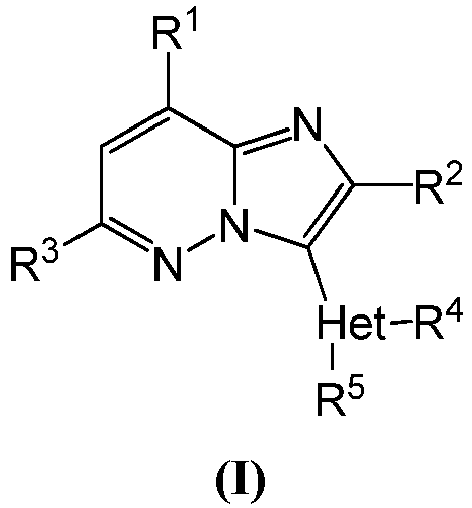
- R1 is selected from pyridinyl, morpholinyl and pyrrolidinyl;
- R2 is selected from hydrogen, methyl, ethyl, cyclopropyl, isopropyl, methoxy and trifluoromethyl ;
- R3 is selected from hydrogen, chloro, methyl, trifluoromethyl and cyclopropyl ;
- Het is selected from pyridinyl and pyrazolyl;
- R4 is selected from hydrogen ; methyl; ethyl; isopropyl ; isobutyl; trifluoromethyl ; 2,2,2-trifluoroethyl ; 2-hydroxy-2-methylpropyl ; (2,2-difluorocyclopropyl)methyl ; 2,2-difluoro-2-cyclopropylethyl ; cyclopropyl ; 2-methoxyethyl; 2-methoxypropyl; (2S)-2-methoxypropyl; 2-isopropoxyethyl; 2-ethoxyethyl ; ethoxymethyl ; 1-ethoxy-1-methylethyl ; 1-methoxy-1-methylethyl ; 2-methoxy-1,1-dimethylethyl ; 3-methoxy-3-methylbutyl ; 3-methoxypropyl ; 2-methoxy-2-methyl-propyl ; isopropoxy ; 2,2,2-trifluoroethoxy ; cyclopropylmethoxy ; 2-methoxyethoxy ; 2-methoxy-2-methyl-propoxy ; tetrahydro-2H-pyran-4-yl ; (pyridin-3-yl)methyl; 2-(pyrrolidin-1-yl)ethyl ; isopropylamino ; morpholin-4-yl; pyrrolidin-1-yl; piperazin-1-yl; (3R)-3-methoxypyrrolidin-1-yl ; and (3S)-3-methoxypyrrolidin-1-yl;
- R5 is hydrogen or methyl;
- The present invention also relates to a pharmaceutical composition comprising a therapeutically effective amount of a compound of Formula (I) and a pharmaceutically acceptable carrier or excipient.
- Additionally, the invention relates to a compound of Formula (I) for use as a medicament.
- The invention also relates to the use of a compound according to Formula (I) or a pharmaceutical composition according to the invention for the manufacture of a medicament for treating or preventing neurological, psychiatric or metabolic disorders and diseases.
- Additionally, the invention relates to the use of a compound of Formula (I) in combination with an additional pharmaceutical agent for the manufacture of a medicament for treating or preventing neurological, psychiatric or metabolic disorders and diseases.
- Furthermore, the invention relates to a process for preparing a pharmaceutical composition according to the invention, characterized in that a pharmaceutically acceptable carrier is intimately mixed with a therapeutically effective amount of a compound of Formula (I).
- The invention also relates to a product comprising a compound of Formula (I) and an additional pharmaceutical agent, as a combined preparation for simultaneous, separate or sequential use in the treatment or prevention of neurological, psychiatric or metabolic disorders and diseases.
- The Chemical names of the compounds of the present invention were generated according to the nomenclature rules agreed upon by the Chemical Abstracts Service (CAS) using Advanced Chemical Development, Inc., software (ACD/Name product version 10.01; Build 15494, 1 Dec 2006). In case of tautomeric forms, the name of the depicted tautomeric form of the structure was generated. However it should be clear that the other non-depicted tautomeric form is also included within the scope of the present invention.
- The term "halogen" or "halo" as used herein alone or as part of another group refers to fluoro, chloro, bromo or iodo, with fluoro or chloro being preferred.
- The term "C0-4alkyl", "C1-4alkyl" or"C1-5alkyl" as employed herein alone or as part of another group, unless otherwise stated, refers to a saturated straight or branched hydrocarbon radical, having unless otherwise stated, from 0 to 4, 1 to 4 or 1 to 5 carbon atoms, which is attached to the rest of the molecule by a single bond, such as methyl, ethyl, propyl, butyl, 1-pentyl, 1-methylethyl, 1,1-dimethylethyl, 2-methylpropyl, and 3-methylbutyl.
- The term "C3-8cycloalkyl" as employed herein alone or as part of another group unless otherwise stated, is generic to cyclopropyl, cyclobutyl, cyclopentyl, cyclohexyl, cycloheptyl and cyclooctyl.
- The term "subject" as used herein, refers to an animal, preferably a mammal (e.g. cat, dog, primate or human), more preferably a human, who is or has been the object of treatment, observation or experiment.
- The term "therapeutically effective amount" as used herein, means that amount of active compound or pharmaceutical agent that elicits the biological or medicinal response in a tissue system, animal or human that is being sought by a researcher, veterinarian, medical doctor or other clinician, which includes alleviation or reversal of the symptoms of the disease or disorder being treated.
- As used herein, the term "composition" is intended to encompass a product comprising the specified ingredients in the specified amounts, as well as any product which results, directly or indirectly, from combinations of the specified ingredients in the specified amounts.
- As used herein, the term "treatment" is intended to refer to all processes, wherein there may be a slowing, interrupting, arresting or stopping of the progression of a disease, but does not necessarily indicate a total elimination of all symptoms.
- Unless otherwise stated, heterocyclic substituents in R1 such as pyridinyl may be attached to the remainder of the molecule of formula (I) through any available ring carbon atom. Thus, for example, when Het is pyridinyl, it may be pyridin-2-yl, pyridin-3-yl or pyridin-4-yl, unless otherwise specified.
- Substituents covered by the term Het may be attached to the remainder of the molecule of formula (I) through any available ring carbon or heteroatom as appropriate, if not otherwise specified. Het as used herein is preferably bound to the imidazo[1,2-b]pyridazine ring system through an available carbon atom of the ring. When Het is pyridine and R5 is methyl, the R5 substituent is placed in Het preferably in meta- or para-position relative to the position of attachment to the imidazo[1,2-b]pyridazine core.
- In one embodiment, the invention relates to a compound according to Formula (I) or a stereochemically isomeric form thereof, wherein
R1 is selected from morpholinyl and pyridinyl ;
R2 is selected from hydrogen, methyl, ethyl, methoxy, and cyclopropyl ;
R3 is selected from hydrogen, methyl, and cyclopropyl ; and
R4 is selected from ethyl; isopropyl; isobutyl; 2,2,2-trifluoroethyl; 2-hydroxy-2-methylpropyl; 2,2-difluoro-2-cyclopropylethyl; cyclopropyl; 2-methoxyethyl; (2S)-2-methoxypropyl; 2-ethoxyethyl; ethoxymethyl; 1-ethoxy-1-methylethyl; 1-methoxy-1-methylethyl; 2-methoxy-1,1-dimethylethyl; 3-methoxy-3-methylbutyl; 3-methoxypropyl; 2-methoxy-2-methyl-propyl; 2-methoxyethoxy; 2-methoxy-2-methylpropoxy; tetrahydro-2H-pyran-4-yl; morpholin-4-yl; piperazin-1-yl; and (3R)-3-methoxypyrrolidin-1-yl;
or a pharmaceutically acceptable salt or a solvate thereof. - In yet another preferred embodiment, the invention relates to a compound according to Formula (I) or a stereochemically isomeric form thereof wherein
R1 is selected from morpholinyl and pyridinyl ;
R2 is selected from hydrogen, methyl, methoxy, and cyclopropyl ;
R3 is selected from hydrogen, methyl, and cyclopropyl ; and
R4 is selected from ethyl; isopropyl; isobutyl; 2,2,2-trifluoroethyl; 2-hydroxy-2-methylpropyl; 2,2-difluoro-2-cyclopropylethyl; cyclopropyl; 2-methoxyethyl; (2S)-2-methoxypropyl; 2-ethoxyethyl; ethoxymethyl; 1-ethoxy-1-methylethyl; 1-methoxy-1-methylethyl; 2-methoxy-1,1-dimethylethyl; 3-methoxy-3-methylbutyl; 3-methoxypropyl; 2-methoxy-2-methyl-propyl; 2-methoxyethoxy; 2-methoxy-2-methylpropoxy; tetrahydro-2H-pyran-4-yl; morpholin-4-yl; piperazin-1-yl; and (3R)-3-methoxypyrrolidin-1-yl;
or a pharmaceutically acceptable salt or a solvate thereof. - In yet another preferred embodiment, the invention relates to a compound according to Formula (I) or a stereochemically isomeric form thereof wherein
R1 is selected from morpholinyl and pyridinyl ;
R2 is selected from hydrogen, methyl, methoxy, and cyclopropyl ;
R3 is selected from hydrogen, methyl, and cyclopropyl ; and
R4 is selected from 2-methoxyethyl; 3-methoxypropyl ; 2-methoxy-2-methylpropyl ; 2-methoxy-1,1-dimethylethyl ; 1-ethoxy-1-methylethyl ; 1-methoxy-1-methylethyl ; 2-methoxyethoxy ; ethoxymethyl ; 2-methoxy-2-methylpropoxy ; morpholin-4-yl ; 2-ethoxyethyl ; tetrahydro-2H-pyran-4-yl ; ethyl; 3-methoxy-3-methylbutyl ; piperazin-1-yl ; isopropyl ; cyclopropyl ; (3R)-3-methoxypyrrolidin-1-yl ; and isobutyl;
or a pharmaceutically acceptable salt or a solvate thereof. - More preferably, the invention relates to a compound according to Formula (I) or a stereochemically isomeric form thereof wherein
R1 is selected from morpholin-4-yl, pyridin-3-yl and pyridin-4-yl ;
Het is selected from pyridin-3-yl, pyridin-4-yl and 1H-pyrazol-4-yl ;
and R2-R5 are as previously defined ;
or a pharmaceutically acceptable salt or a solvate thereof. - In a yet a more preferred embodiment, the invention relates to a compound according to Formula (I), or a stereochemically isomeric form thereof, wherein
R1 is morpholin-4-yl;
Het is pyridin-3-yl or pyridin-4-yl ;
and R2-R5 are as previously defined ;
or a pharmaceutically acceptable salt or a solvate thereof. - In the most preferred embodiment, the invention relates to a compound according to Formula (I) wherein
R1 is morpholin-4-yl;
R2 is methyl;
R3 is hydrogen;
Het is pyridin-3-yl ;
R4 is 2-methoxyethyl ; and
R5 is hydrogen;
or a pharmaceutically acceptable salt or a solvate thereof. - An additional embodiment refers to compounds according to Formula (I), wherein R3 is hydrogen and the rest of variables are as previously defined, and the stereochemically isomeric forms thereof and the pharmaceutically acceptable salts and solvates thereof.
- In an additional embodiment, the invention relates to compounds according to formula (I), having the formula (I'-a) or (I'-b)

- In an additional embodiment, R1 is morpholin-4-yl.
- In an additional embodiment, R1 is pyridin-4-yl.
- In an additional embodiment, R1 is pyridin-3-yl.
- In an additional embodiment, R3 is hydrogen.
- In an additional embodiment, R2 is methyl and R3 is hydrogen.
- In an additional embodiment, Het is 3-pyridinyl or 4-pyridinyl.
- In an additional embodiment, Het is 1H-pyrazol-4-yl.
- In an additional embodiment, R4 is selected from ethyl; isopropyl; isobutyl; 2,2,2-trifluoroethyl; 2-hydroxy-2-methylpropyl; 2,2-difluoro-2-cyclopropylethyl; cyclopropyl; 2-methoxyethyl; (2S)-2-methoxypropyl; 2-ethoxyethyl; ethoxymethyl; 1-ethoxy-1-methylethyl; 1-methoxy-1-methylethyl; 2-methoxy-1,1-dimethylethyl; 3-methoxy-3-methylbutyl; 3-methoxypropyl; 2-methoxy-2-methyl-propyl; 2-methoxyethoxy; 2-methoxy-2-methyl-propoxy; tetrahydro-2H-pyran-4-yl; morpholin-4-yl; piperazin-1-yl; and (3R)-3-methoxypyrrolidin-1-yl.
- In an additional embodiment, R4 is selected from ethyl; isopropyl; isobutyl; 2-hydroxy-2-methylpropyl; cyclopropyl; 2-methoxyethyl; 2-ethoxyethyl; ethoxymethyl; 1-ethoxy-1-methylethyl; 1-methoxy-1-methylethyl; 2-methoxy-1,1-dimethylethyl; 3-methoxy-3-methylbutyl; 3-methoxypropyl; 2-methoxy-2-methylpropyl; 2-methoxyethoxy; 2-methoxy-2-methyl-propoxy; tetrahydro-2H-pyran-4-yl; morpholin-4-yl; piperazin-1-yl; and (3R)-3-methoxypyrrolidin-1-yl.
- In an additional embodiment, R4 is selected from ethyl; 2-hydroxy-2-methylpropyl; 2-methoxyethyl; 2-methoxy-2-methylpropyl; 2-methoxyethoxy; 2-methoxy-2-methyl-propoxy; and morpholin-4-yl.
- In an additional embodiment, the invention relates to a compound according to formula (I'-a) of (I'-b) wherein
R1 is morpholin-4-yl;
R2 is methyl;
R3 is hydrogen;
Het is pyridin-3-yl ;
R4 is 2-methoxyethyl ; and
R5 is hydrogen. - In an additional embodiment, the invention relates to a compound according to formula (I'-c)

- In another embodiment, R4a is selected from isobutyl; 2,2,2-trifluoroethyl; 2,2-difluoro-2-cyclopropylethyl; 2-methoxyethyl; (2S)-2-methoxypropyl; and 2-methoxy-2-methyl-propyl.
- Particularly preferred compounds may be selected from the group of:
- 3-[6-(2-methoxyethyl)-3-pyridinyl]-2-methyl-8-(4-morpholinyl)-imidazo[1,2-b]pyridazine (compound 1),
- 3-[6-(3-methoxypropyl)-3-pyridinyl]-2-methyl-8-(4-morpholinyl)-imidazo[1,2-b]pyridazine (compound 2),
- 3-[6-(2-methoxy-2-methylpropyl)-3-pyridinyl]-2-methyl-8-(4-morpholinyl)-imidazo[1,2-b]pyridazine (compound 3),
- 3-[6-(2-methoxy-1,1-dimethylethyl)-3-pyridinyl]-2-methyl-8-(4-morpholinyl)-imidazo[1,2-b]pyridazine (compound 4),
- 3-[6-(1-ethoxy-1-methylethyl)-3-pyridinyl]-2-methyl-8-(4-morpholinyl)-imidazo[1,2-b]pyridazine (compound 5),
- 3-[6-(1-methoxy-1-methylethyl)-3-pyridinyl]-2-methyl-8-(4-morpholinyl)-imidazo[1,2-b]pyridazine (compound 6),
- 3-[6-(2-methoxy-2-methylpropyl)-3-pyridinyl]-2-methyl-8-(4-pyridinyl)-imidazo[1,2-b]pyridazine (compound 7),
- 3-[6-(2-methoxyethoxy)-5-methyl-3-pyridinyl]-2-methyl-8-(4-pyridinyl)-imidazo[1,2-b]pyridazine (compound 8),
- 3-[6-(2-methoxyethoxy)-3-pyridinyl]-2-methyl-8-(3-pyridinyl)-imidazo[1,2-b]pyridazine (compound 9),
- 2-cyclopropyl-3-[6-(2-methoxyethyl)-3-pyridinyl]-8-(4-pyridinyl)-imidazo[1,2-b]pyridazine (compound 10),
- 3-[6-(2-methoxyethyl)-3-pyridinyl]-8-(4-morpholinyl)-imidazo[1,2-b]pyridazine (compound 11),
- 2-methoxy-3-[6-(2-methoxyethyl)-3-pyridinyl]-8-(4-morpholinyl)-imidazo[1,2-b]pyridazine (compound 12),
- 6-cyclopropyl-3-[6-(2-methoxyethyl)-3-pyridinyl]-2-methyl-8-(4-morpholinyl)-imidazo[1,2-b]pyridazine (compound 13),
- 6-cyclopropyl-3-[6-(2-methoxyethyl)-3-pyridinyl]-2-methyl-8-(4-pyridinyl)-imidazo[1,2-b]pyridazine (compound 14),
- 2-cyclopropyl-3-[6-(2-methoxyethyl)-3-pyridinyl]-6-methyl-8-(4-morpholinyl)-imidazo[1,2-b]pyridazine (compound 15),
- 3-[6-(2-methoxyethoxy)-3-pyridinyl]-2-methyl-8-(4-morpholinyl)-imidazo[1,2-b]pyridazine (compound 16),
- 3-[6-(ethoxymethyl)-3-pyridinyl]-2-methyl-8-(4-morpholinyl)-imidazo[1,2-b]pyridazine (compound 17),
- 3-[6-(2-methoxy-2-methylpropoxy)-3-pyridinyl]-2-methyl-8-(4-morpholinyl)-imidazo[1,2-b]pyridazine (compound 18),
- 2-methyl-8-(4-morpholinyl)-3-[6-(4-morpholinyl)-3-pyridinyl]-imidazo[1,2-b]pyridazine (compound 19),
- 3-[6-(2-methoxyethyl)-3-pyridinyl]-2-methyl-8-(4-pyridinyl)-imidazo[1,2-b]pyridazine (compound 20),
- 3-[6-(2-methoxyethoxy)-3-pyridinyl]-2-methyl-8-(4-pyridinyl)-imidazo[1,2-b]pyridazine (compound 21),
- 2-cyclopropyl-3-[6-(2-methoxyethyl)-3-pyridinyl]-8-(4-morpholinyl)-imidazo[1,2-b]pyridazine (compound 22),
- 3-[6-(2-methoxyethyl)-3-pyridinyl]-2,6-dimethyl-8-(4-morpholinyl)-imidazo[1,2-b]pyridazine (compound 23),
- 3-[6-(2-methoxyethyl)-3-pyridinyl]-2,6-dimethyl-8-(4-pyridinyl)-imidazo[1,2-b]pyridazine (compound 24),
- 3-[6-(2-ethoxyethyl)-3-pyridinyl]-2-methyl-8-(4-morpholinyl)-imidazo[1,2-b]pyridazine (compound 25),
- 3-[2-(2-methoxyethyl)-4-pyridinyl]-2-methyl-8-(4-morpholinyl)-imidazo[1,2-b]pyridazine (compound 26),
- 2-methyl-8-(4-morpholinyl)-3-[6-(tetrahydro-2H-pyran-4-yl)-3-pyridinyl]-imidazo[1,2-b]pyridazine (compound 27),
- 3-(6-ethyl-3-pyridinyl)-2-methyl-8-(4-morpholinyl)-imidazo[1,2-b]pyridazine (compound 28),
- 3-[6-(3-methoxy-3-methylbutyl)-3-pyridinyl]-2-methyl-8-(4-morpholinyl)-imidazo[1,2-b]pyridazine (compound 29),
- 2-methyl-8-(4-morpholinyl)-3-[6-(1-piperazinyl)-3-pyridinyl]-imidazo[1,2-b]pyridazine (compound 30),
- 2-methyl-3-[6-(4-morpholinyl)-3-pyridinyl]-8-(4-pyridinyl)-imidazo[1,2-b]pyridazine (compound 31),
- 2-methyl-3-[6-(1-methylethyl)-3-pyridinyl]-8-(4-morpholinyl)-imidazo[1,2-b]pyridazine (compound 32),
- 3-(6-cyclopropyl-3-pyridinyl)-2-methyl-8-(4-morpholinyl)-imidazo[1,2-b]pyridazine (compound 33),
- 3-[6-[(3R)-3-methoxy-1-pyrrolidinyl]-3-pyridinyl]-2-methyl-8-(4-morpholinyl)-imidazo[1,2-b]pyridazine (compound 34),
- 2-methyl-3-[1-(2-methylpropyl)-1H-pyrazol-4-yl]-8-(4-morpholinyl)-imidazo[1,2-b]pyridazine (compound 35),
- 3-[1-(2-methoxyethyl)-1H-pyrazol-4-yl]-2-methyl-8-(4-morpholinyl)-imidazo[1,2-b]pyridazine (compound 36),
- 3-[1-(2-methoxy-2-methylpropyl)-1H-pyrazol-4-yl]-2-methyl-8-(4-morpholinyl)-imidazo[1,2-b]pyridazine (compound 37),
- 2-cyclopropyl-3-[1-(2-methoxy-2-methylpropyl)-1H-pyrazol-4-yl]-8-(4-morpholinyl)-imidazo[1,2-b]pyridazine (compound 38),
- 2-methyl-3-(6-methyl-3-pyridinyl)-8-(4-morpholinyl)-imidazo[1,2-b]pyridazine (compound 39),
- 6-cyclopropyl-3-[6-(2-methoxy-2-methylpropyl)-3-pyridinyl]-2-methyl-8-(4-pyridinyl)-imidazo[1,2-b]pyridazine (compound 40),
- 6-cyclopropyl-3-[6-(2-methoxyethoxy)-3-pyridinyl]-2-methyl-8-(4-morpholinyl)-imidazo[1,2-b]pyridazine (compound 41),
- 6-cyclopropyl-3-[5-(2-methoxyethoxy)-3-pyridinyl]-2-methyl-8-(4-morpholinyl)-imidazo[1,2-b]pyridazine (compound 42),
- 6-cyclopropyl-3-[6-(2-methoxy-2-methylpropyl)-3-pyridinyl]-2-methyl-8-(4-morpholinyl)- imidazo[1,2-b]pyridazine (compound 43),
- 2-cyclopropyl-3-[6-(2-methoxyethoxy)-3-pyridinyl]-8-(4-pyridinyl)-imidazo[1,2-b]pyridazine (compound 44),
- 2-cyclopropyl-3-[6-(2-methoxy-2-methylpropyl)-3-pyridinyl]-8-(4-morpholinyl)-imidazo[1,2-b]pyridazine (compound 45),
- 2-cyclopropyl-3-[6-(4-morpholinyl)-3-pyridinyl]-8-(4-pyridinyl)-imidazo[1,2-b]pyridazine (compound 46),
- 3-[6-(2-methoxy-2-methylpropyl)-3-pyridinyl]-2,6-dimethyl-8-(4-morpholinyl)-imidazo[1,2-b]pyridazine (compound 47),
- 3-[6-(2-methoxy-2-methylpropyl)-3-pyridinyl]-2,6-dimethyl-8-(4-pyridinyl)-imidazo[1,2-b]pyridazine (compound 48),
- 3-[6-(2-methoxyethoxy)-3-pyridinyl]-2,6-dimethyl-8-(4-pyridinyl)-imidazo[1,2-b]pyridazine (compound 49),
- 2-cyclopropyl-3-[6-(2-methoxy-2-methylpropyl)-3-pyridinyl]-8-(4-pyridinyl)-imidazo[1,2-b]pyridazine (compound 50),
- 3-[6-(2-methoxy-2-methylpropyl)-3-pyridinyl]-8-(4-morpholinyl)-imidazo[1,2-b]pyridazine (compound 51),
- 3-[6-(2-methoxyethoxy)-3-pyridinyl]-8-(4-morpholinyl)-imidazo[1,2-b]pyridazine (compound 52),
- 2-cyclopropyl-3-[6-(2-methoxy-2-methylpropyl)-3-pyridinyl]-6-methyl-8-(4-morpholinyl)-imidazo[1,2-b]pyridazine (compound 53),
- 5-[2-cyclopropyl-8-(4-morpholinyl)imidazo[1,2-b]pyridazin-3-yl]-α,α-dimethyl-2-pyridineethanol (compound 54),
- 2-cyclopropyl-3-[6-(2-methoxy-2-methylpropyl)-3-pyridinyl]-6-methyl-8-(4-pyridinyl)-imidazo[1,2-b]pyridazine (compound 55),
- 2-cyclopropyl-3-[6-(2-methoxyethyl)-3-pyridinyl]-6-methyl-8-(4-pyridinyl)-imidazo[1,2-b]pyridazine (compound 56),
- 3-[6-(2-methoxyethyl)-3-pyridinyl]-8-(4-pyridinyl)-imidazo[1,2-b]pyridazine (compound 57),
- 6-cyclopropyl-2-methyl-3-[6-(4-morpholinyl)-3-pyridinyl]-8-(4-pyridinyl)-imidazo[1,2-b]pyridazine (compound 58),
- 6-cyclopropyl-3-[6-(2-methoxyethoxy)-3-pyridinyl]-2-methyl-8-(4-pyridinyl)-imidazo[1,2-b]pyridazine (compound 59),
- 3-[6-(2-methoxy-2-methylpropyl)-3-pyridinyl]-8-(4-pyridinyl)-imidazo[1,2-b]pyridazine (compound 60),
- 3-[6-(4-morpholinyl)-3-pyridinyl]-8-(4-pyridinyl)-imidazo[1,2-b]pyridazine (compound 61),
- 2-methyl-8-(4-morpholinyl)-3-[6-(2,2,2-trifluoroethoxy)-3-pyridinyl]-imidazo[1,2-b]pyridazine (compound 62),
- 2-methyl-8-(4-morpholinyl)-3-[6-(trifluoromethyl)-3-pyridinyl]-imidazo[1,2-b]pyridazine (compound 63),
- 3-[6-(2-methoxyethyl)-3-pyridinyl]-2-methyl-8-(4-morpholinyl)-6-(trifluoromethyl)-imidazo[1,2-b]pyridazine (compound 64),
- 3-[6-(cyclopropylmethoxy)-3-pyridinyl]-2-methyl-8-(4-morpholinyl)-imidazo[1,2-b]pyridazine (compound 65),
- 2-methyl-3-[6-(1-methylethoxy)-3-pyridinyl]-8-(4-morpholinyl)-imidazo[1,2-b]pyridazine (compound 66),
- 2-methyl-3-[2-(1-methylethoxy)-4-pyridinyl]-8-(4-morpholinyl)-imidazo[1,2-b]pyridazine (compound 67),
- 2,6-dimethyl-8-(4-morpholinyl)-3-[6-(4-morpholinyl)-3-pyridinyl]-imidazo[1,2-b]pyridazine (compound 68),
- 3-[6-(2-methoxyethoxy)-3-pyridinyl]-2,6-dimethyl-8-(4-morpholinyl)-imidazo[1,2-b]pyridazine (compound 69),
- 2,6-dimethyl-3-[6-(4-morpholinyl)-3-pyridinyl]-8-(4-pyridinyl)-imidazo[1,2-b]pyridazine (compound 70),
- 2-cyclopropyl-6-methyl-3-[6-(4-morpholinyl)-3-pyridinyl]-8-(4-pyridinyl)-imidazo[1,2-b]pyridazine (compound 71),
- 2-cyclopropyl-3-[6-(2-methoxyethoxy)-3-pyridinyl]-6-methyl-8-(4-pyridinyl)-imidazo[1,2-b]pyridazine (compound 72),
- 2-cyclopropyl-3-[6-(2-methoxyethoxy)-3-pyridinyl]-8-(4-morpholinyl)-imidazo[1,2-b]pyridazine (compound 73),
- 2-cyclopropyl-3-[6-(2-methoxyethoxy)-3-pyridinyl]-6-methyl-8-(4-morpholinyl)-imidazo[1,2-b]pyridazine (compound 74),
- 2-cyclopropyl-6-methyl-8-(4-morpholinyl)-3-[6-(4-morpholinyl)-3-pyridinyl]-imidazo[1,2-b]pyridazine (compound 75),
- 2-methyl-3-[6-[2-(1-methylethoxy)ethyl]-3-pyridinyl]-8-(4-morpholinyl)-imidazo[1,2-b]pyridazine (compound 76),
- 2-methyl-8-(4-morpholinyl)-3-[6-[2-(1-pyrrolidinyl)ethyl]-3-pyridinyl]-imidazo[1,2-b]pyridazine (compound 77),
- 6-cyclopropyl-2-methyl-8-(4-morpholinyl)-3-[6-(tetrahydro-2H-pyran-4-yl)-3-pyridinyl]-imidazo[1,2-b]pyridazine (compound 78),
- 2-cyclopropyl-6-methyl-8-(4-morpholinyl)-3-[6-(tetrahydro-2H-pyran-4-yl)-3-pyridinyl]-imidazo[1,2-b]pyridazine (compound 79),
- 2-cyclopropyl-6-methyl-8-(4-pyridinyl)-3-[6-(tetrahydro-2H-pyran-4-yl)-3-pyridinyl]-imidazo[1,2-b]pyridazine (compound 80),
- 6-cyclopropyl-2-methyl-8-(4-pyridinyl)-3-[6-(tetrahydro-2H-pyran-4-yl)-3-pyridinyl]-imidazo[1,2-b]pyridazine (compound 81),
- 8-(4-morpholinyl)-3-[6-(tetrahydro-2H-pyran-4-yl)-3-pyridinyl]-imidazo[1,2-b]pyridazine (compound 82),
- 3-(6-ethyl-3-pyridinyl)-2-methyl-8-(4-pyridinyl)-imidazo[1,2-b]pyridazine (compound 83),
- 2-cyclopropyl-3-(6-ethyl-3-pyridinyl)-6-methyl-8-(4-morpholinyl)-imidazo[1,2-b]pyridazine (compound 84),
- 2-cyclopropyl-3-[6-(2-methoxyethyl)-3-pyridinyl]-8-(4-morpholinyl)-6-(trifluoromethyl)-imidazo[1,2-b]pyridazine (compound 85),
- 6-cyclopropyl-3-(6-ethyl-3-pyridinyl)-2-methyl-8-(4-pyridinyl)-imidazo[1,2-b]pyridazine (compound 86),
- 2-cyclopropyl-3-(6-ethyl-3-pyridinyl)-8-(4-pyridinyl)-imidazo[1,2-b]pyridazine (compound 87),
- 3-(6-ethyl-3-pyridinyl)-2,6-dimethyl-8-(4-pyridinyl)-imidazo[1,2-b]pyridazine (compound 88),
- 2-methyl-8-(4-morpholinyl)-3-[6-(1-pyrrolidinyl)-3-pyridinyl]-imidazo[1,2-b]pyridazine (compound 89),
- N-(1-methylethyl)-5-[2-methyl-8-(4-morpholinyl)imidazo[1,2-b]pyridazin-3-yl]-2-pyridinamine (compound 90),
- 2-methyl-8-(4-morpholinyl)-3-[2-(4-morpholinyl)-4-pyridinyl]-imidazo[1,2-b]pyridazine (compound 91),
- 2-methyl-8-(4-morpholinyl)-3-[2-(1-pyrrolidinyl)-4-pyridinyl]-imidazo[1,2-b]pyridazine (compound 92),
- N-(1-methylethyl)-4-[2-methyl-8-(4-morpholinyl)imidazo[1,2-b]pyridazin-3-yl]-2-pyridinamine (compound 93),
- 6-cyclopropyl-2-methyl-8-(4-morpholinyl)-3-[6-(4-morpholinyl)-3-pyridinyl]-imidazo[1,2-b]pyridazine (compound 94),
- 2-cyclopropyl-8-(4-morpholinyl)-3-[6-(4-morpholinyl)-3-pyridinyl]-imidazo[1,2-b]pyridazine (compound 95),
- 2,6-dimethyl-3-[6-(1-piperazinyl)-3-pyridinyl]-8-(4-pyridinyl)-imidazo[1,2-b]pyridazine (compound 96),
- 2-methyl-3-[6-(1-piperazinyl)-3-pyridinyl]-8-(4-pyridinyl)-imidazo[1,2-b]pyridazine (compound 97),
- 2-cyclopropyl-8-(4-morpholinyl)-3-[6-(1-piperazinyl)-3-pyridinyl]-imidazo[1,2-b]pyridazine (compound 98),
- 6-cyclopropyl-2-methyl-3-[6-(1-piperazinyl)-3-pyridinyl]-8-(4-pyridinyl)-imidazo[1,2-b]pyridazine (compound 99),
- 2-cyclopropyl-6-methyl-8-(4-morpholinyl)-3-[6-(1-piperazinyl)-3-pyridinyl]-imidazo[1,2-b]pyridazine (compound 100),
- 2-cyclopropyl-6-methyl-3-[6-(1-piperazinyl)-3-pyridinyl]-8-(4-pyridinyl)-imidazo[1,2-b]pyridazine (compound 101),
- 2-cyclopropyl-3-[6-(1-piperazinyl)-3-pyridinyl]-8-(4-pyridinyl)-imidazo[1,2-b]pyridazine (compound 102),
- 2-methyl-8-(4-morpholinyl)-3-[2-(1-piperazinyl)-4-pyridinyl]-imidazo[1,2-b]pyridazine (compound 103),
- 2-methyl-3-[6-(2-methylpropyl)-3-pyridinyl]-8-(4-morpholinyl)-imidazo[1,2-b]pyridazine (compound 104),
- 2-methyl-3-[2-(2-methylpropyl)-4-pyridinyl]-8-(4-morpholinyl)-imidazo[1,2-b]pyridazine (compound 105),
- 2-cyclopropyl-3-(6-ethyl-3-pyridinyl)-8-(4-morpholinyl)-imidazo[1,2-b]pyridazine (compound 106),
- 6-cyclopropyl-3-(6-ethyl-3-pyridinyl)-2-methyl-8-(4-morpholinyl)-imidazo[1,2-b]pyridazine (compound 107),
- 3-(6-ethyl-3-pyridinyl)-2,6-dimethyl-8-(4-morpholinyl)-imidazo[1,2-b]pyridazine (compound 108),
- 3-(6-ethyl-3-pyridinyl)-8-(4-morpholinyl)-imidazo[1,2-b]pyridazine (compound 109),
- 3-(6-cyclopropyl-3-pyridinyl)-2,6-dimethyl-8-(4-morpholinyl)-imidazo[1,2-b]pyridazine (compound 110),
- 3-(6-cyclopropyl-3-pyridinyl)-2-methyl-8-(4-pyridinyl)-imidazo[1,2-b]pyridazine (compound 111),
- 3-(6-cyclopropyl-3-pyridinyl)-8-(4-morpholinyl)-imidazo[1,2-b]pyridazine (compound 112),
- 3-[6-[(3S)-3-methoxy-1-pyrrolidinyl]-3-pyridinyl]-2-methyl-8-(4-morpholinyl)-imidazo[1,2-b]pyridazine (compound 113),
- 3-[1-(2-methoxyethyl)-1H-pyrazol-4-yl]-2-methyl-8-(4-pyridinyl)-imidazo[1,2-b]pyridazine (compound 114),
- 2-methyl-8-(4-morpholinyl)-3-[1-(3-pyridinylmethyl)-1H-pyrazol-4-yl]-imidazo[1,2-b]pyridazine (compound 115),
- 2-methyl-8-(4-morpholinyl)-3-(1H-pyrazol-4-yl)-imidazo[1,2-b]pyridazine (compound 116),
- 2-methyl-8-(4-morpholinyl)-3-[1-(tetrahydro-2H-pyran-4-yl)-1H-pyrazol-4-yl]-imidazo[1,2-b]pyridazine (compound 117),
- 3-{1-[(2,2-difluorocyclopropyl)methyl]-1H-pyrazol-4-yl}-2-methyl-8-morpholin-4-ylimidazo[1,2-b]pyridazine (compound 118),
- 2-cyclopropyl-3-[1-(2-methoxyethyl)-1H-pyrazol-4-yl]-8-(4-morpholinyl)-imidazo[1,2-b]pyridazine (compound 119),
- 3-[1-(2-methoxyethyl)-1H-pyrazol-4-yl]-2-(1-methylethyl)-8-(4-morpholinyl)-imidazo[1,2-b]pyridazine (compound 120),
- 3-[1-(2-methoxyethyl)-1H-pyrazol-4-yl]-2-(1-methylethyl)-8-(4-pyridinyl)-imidazo[1,2-b]pyridazine (compound 121),
- 3-[1-(2-methoxyethyl)-1H-pyrazol-4-yl]-8-(4-pyridinyl)-2-(trifluoromethyl)-imidazo[1,2-b]pyridazine (compound 122),
- 3-[1-(2-methoxy-2-methylpropyl)-1H-pyrazol-4-yl]-2-methyl-8-(4-pyridinyl)-imidazo[1,2-b]pyridazine (compound 123),
- 2-methyl-3-[1-(2-methylpropyl)-1H-pyrazol-4-yl]-8-(4-pyridinyl)-imidazo[1,2-b]pyridazine (compound 124),
- 6-cyclopropyl-3-[1-(2-methoxyethyl)-1H-pyrazol-4-yl]-2-methyl-8-(4-morpholinyl)-imidazo[1,2-b]pyridazine (compound 125),
- 6-cyclopropyl-3-[1-(2-methoxyethyl)-1H-pyrazol-4-yl]-2-methyl-8-(4-pyridinyl)-imidazo[1,2-b]pyridazine (compound 126),
- 2-ethyl-3-[1-(2-methoxyethyl)-1H-pyrazol-4-yl]-8-(4-morpholinyl)-imidazo[1,2-b]pyridazine (compound 127),
- 3-[1-(2-cyclopropyl-2,2-difluoroethyl)-1H-pyrazol-4-yl]-2-methyl-8-(4-morpholinyl)-imidazo[1,2-b]pyridazine (compound 128),
- 3-[1-(2-methoxyethyl)-1H-pyrazol-4-yl]-2-methyl-8-(4-pyridinyl)-6-(trifluoromethyl)-imidazo[1,2-b]pyridazine (compound 129),
- 3-[1-(2-methoxyethyl)-1H-pyrazol-4-yl]-2-methyl-8-(4-morpholinyl)-6-(trifluoromethyl)-imidazo[1,2-b]pyridazine (compound 130),
- 3-[1-[(2S)-2-methoxypropyl]-1H-pyrazol-4-yl]-2-methyl-8-(4-morpholinyl)-imidazo[1,2-b]pyridazine (compound 131),
- 2-ethyl-3-[1-(2-methoxyethyl)-1H-pyrazol-4-yl]-8-(4-pyridinyl)-imidazo[1,2-b]pyridazine (compound 132),
- 3-[1-(2-methoxyethyl)-1H-pyrazol-4-yl]-2,6-dimethyl-8-(4-morpholinyl)-imidazo[1,2-b]pyridazine (compound 133),
- 3-[1-(2-methoxyethyl)-1H-pyrazol-4-yl]-2,6-dimethyl-8-(4-pyridinyl)-imidazo[1,2-b]pyridazine (compound 134),
- 2-methyl-8-(4-pyridinyl)-3-[1-(2,2,2-trifluoroethyl)-1H-pyrazol-4-yl]-imidazo[1,2-b]pyridazine (compound 135),
- 3-[1-(2-methoxyethyl)-1H-pyrazol-4-yl]-2-methyl-8-(1-pyrrolidinyl)-imidazo[1,2-b]pyridazine (compound 136),
- 2-methyl-8-(4-morpholinyl)-3-[1-(2,2,2-trifluoroethyl)-1H-pyrazol-4-yl]-imidazo[1,2-b]pyridazine (compound 137),
- 2-cyclopropyl-8-(4-morpholinyl)-3-[1-(2,2,2-trifluoroethyl)-1H-pyrazol-4-yl]-imidazo[1,2-b]pyridazine (compound 138),
- 3-[1-(2-methoxyethyl)-1H-pyrazol-4-yl]-8-(4-morpholinyl)-2-(trifluoromethyl)-imidazo[1,2-b]pyridazine (compound 139),
- 2-methoxy-3-[1-(2-methoxyethyl)-1H-pyrazol-4-yl]-8-(4-morpholinyl)-imidazo[1,2-b]pyridazine (compound 140),
- 2-cyclopropyl-8-(4-pyridinyl)-3-[1-(2,2,2-trifluoroethyl)-1H-pyrazol-4-yl]-imidazo[1,2-b]pyridazine (compound 141),
- 2-cyclopropyl-3-[1-(2-methoxyethyl)-1H-pyrazol-4-yl]-8-(4-pyridinyl)-imidazo[1,2-b]pyridazine (compound 142),
- 2-cyclopropyl-3-[1-(2-methoxy-2-methylpropyl)-1H-pyrazol-4-yl]-8-(4-pyridinyl)-imidazo[1,2-b]pyridazine (compound 143),
- 8-(4-morpholinyl)-3-[6-(4-morpholinyl)-3-pyridinyl]-imidazo[1,2-b]pyridazine (compound 144),
- 3-[6-(2-methoxyethyl)-3-pyridinyl]-8-(4-morpholinyl)-2-(trifluoromethyl)-imidazo[1,2-b]pyridazine (compound 145),
- 6-chloro-2-methyl-8-(4-morpholinyl)-3-[1-(2,2,2-trifluoroethyl)-1H-pyrazol-4-yl]-imidazo[1,2-b]pyridazine (compound 146),
- 6-chloro-3-[1-(2-methoxyethyl)-1H-pyrazol-4-yl]-2-methyl-8-(4-pyridinyl)-imidazo[1,2-b]pyridazine (compound 147),
- 2-cyclopropyl-3-[1-(2-methylpropyl)-1H-pyrazol-4-yl]-8-(4-pyridinyl)-imidazo[1,2-b]pyridazine (compound 148), and
- 3-[5-(2-methoxyethoxy)-3-pyridinyl]-2-methyl-8-(4-pyridinyl)-imidazo[1,2-b]pyridazine (compound 149),
- More preferred particular compounds are compounds 1 to 38, and pharmaceutically acceptable salts thereof.
- Other particularly preferred compounds include
- 3-[6-(2-methoxyethyl)-3-pyridinyl]-2-methyl-8-(4-morpholinyl)-imidazo[1,2-b]pyridazine hydrochloride (compound 1a),
- 3-[6-(2-methoxyethyl)-3-pyridinyl]-2-methyl-8-(4-morpholinyl)-imidazo[1,2-b]pyridazine maleate (compound 1b),
- 3-[6-(2-methoxyethyl)-3-pyridinyl]-2-methyl-8-(4-morpholinyl)-imidazo[1,2-b]pyridazine monohydrate (compound 1c),
- 3-[6-(2-methoxyethoxy)-3-pyridinyl]-2-methyl-8-(4-pyridinyl)-imidazo[1,2-b]pyridazine hydrochloride (compound 21a),
- 2-cyclopropyl-3-[6-(2-methoxy-2-methylpropyl)-3-pyridinyl]-8-(4-morpholinyl)-imidazo[1,2-b]pyridazine hydrochloride (compound 45a),
- 3-[6-(2-methoxy-2-methylpropyl)-3-pyridinyl]-2,6-dimethyl-8-(4-pyridinyl)-imidazo[1,2-b]pyridazine (compound 48),
- 2-cyclopropyl-3-[6-(2-methoxy-2-methylpropyl)-3-pyridinyl]-8-(4-pyridinyl)-imidazo[1,2-b]pyridazine (compound 50),
- 5-[2-cyclopropyl-8-(4-morpholinyl)imidazo[1,2-b]pyridazin-3-yl]-α,α-dimethyl-2-pyridineethanol (compound 54),
- 3-[6-(4-morpholinyl)-3-pyridinyl]-8-(4-pyridinyl)-imidazo[1,2-b]pyridazine (compound 61),
- 2,6-dimethyl-8-(4-morpholinyl)-3-[6-(4-morpholinyl)-3-pyridinyl]-imidazo[1,2-b]pyridazine (compound 68),
- 2-cyclopropyl-6-methyl-3-[6-(4-morpholinyl)-3-pyridinyl]-8-(4-pyridinyl)-imidazo[1,2-b]pyridazine (compound 71),
- 2-cyclopropyl-3-[6-(2-methoxyethoxy)-3-pyridinyl]-6-methyl-8-(4-pyridinyl)-imidazo[1,2-b]pyridazine (compound 72),
- 2-methyl-8-(4-morpholinyl)-3-[2-(4-morpholinyl)-4-pyridinyl]-imidazo[1,2-b]pyridazine (compound 91),
- 3-{1-[(2,2-difluorocyclopropyl)methyl]-1H-pyrazol-4-yl}-2-methyl-8-morpholin-4-ylimidazo[1,2-b]pyridazine (compound 118),
- 2-methyl-3-[1-(2-methylpropyl)-1H-pyrazol-4-yl]-8-(4-pyridinyl)-imidazo[1,2-b]pyridazine (compound 124),
- 6-cyclopropyl-3-[1-(2-methoxyethyl)-1H-pyrazol-4-yl]-2-methyl-8-(4-morpholinyl)-imidazo[1,2-b]pyridazine (compound 125),
- 2-ethyl-3-[1-(2-methoxyethyl)-1H-pyrazol-4-yl]-8-(4-morpholinyl)-imidazo[1,2-b]pyridazine (compound 127),
- 3-[1-[(2S)-2-methoxypropyl]-1H-pyrazol-4-yl]-2-methyl-8-(4-morpholinyl)-imidazo[1,2-b]pyridazine (compound 131),
- 3-[1-(2-methoxyethyl)-1H-pyrazol-4-yl]-2,6-dimethyl-8-(4-morpholinyl)-imidazo[1,2-b]pyridazine (compound 133),
- 3-[1-(2-methoxyethyl)-1H-pyrazol-4-yl]-2,6-dimethyl-8-(4-pyridinyl)-imidazo[1,2-b]pyridazine (compound 134),
- 2-methyl-8-(4-pyridinyl)-3-[1-(2,2,2-trifluoroethyl)-1H-pyrazol-4-yl]-imidazo[1,2-b]pyridazine (compound 135),
- 2-cyclopropyl-3-[1-(2-methoxyethyl)-1H-pyrazol-4-yl]-8-(4-pyridinyl)-imidazo[1,2-b]pyridazine (compound 142),
- 2-cyclopropyl-3-[1-(2-methoxy-2-methylpropyl)-1H-pyrazol-4-yl]-8-(4-pyridinyl)-imidazo[1,2-b]pyridazine (compound 143),
- 6-chloro-3-[1-(2-methoxyethyl)-1H-pyrazol-4-yl]-2-methyl-8-(4-pyridinyl)-imidazo[1,2-b]pyridazine (compound 147), and
- 2-cyclopropyl-3-[1-(2-methylpropyl)-1H-pyrazol-4-yl]-8-(4-pyridinyl)-imidazo[1,2-b]pyridazine (compound 148),
- For therapeutic use, salts of the compounds of formula (I) are those wherein the counterion is pharmaceutically acceptable. However, salts of acids and bases which are non-pharmaceutically acceptable may also find use, for example, in the preparation or purification of a pharmaceutically acceptable compound. All salts, whether pharmaceutically acceptable or not, are included within the ambit of the present invention.
- The pharmaceutically acceptable salts are defined to comprise the therapeutically active non-toxic acid addition salt forms that the compounds according to Formula (I) are able to form. Said salts can be obtained by treating the base form of the compounds according to Formula (I) with appropriate acids, for example inorganic acids, for example hydrohalic acids, in particular hydrochloric acid, hydrobromic acid, sulphuric acid, nitric acid and phosphoric acid; organic acids, for example acetic acid, hydroxyacetic acid, propanoic acid, lactic acid, pyruvic acid, oxalic acid, malonic acid, succinic acid, maleic acid, fumaric acid, malic acid, tartaric acid, citric acid, methanesulfonic acid, ethanesulfonic acid, benzenesulfonic acid, p-toluenesulfonic acid, cyclamic acid, salicylic acid, p-aminosalicylic acid and pamoic acid.
- Conversely, said salt forms can be converted into the free base form by treatment with an appropriate base.
- The compounds according to Formula (I) containing acidic protons may also be converted into their therapeutically active non-toxic base salt forms by treatment with appropriate organic and inorganic bases. Appropriate base salt forms comprise, for example, the ammonium salts, the alkaline and alkaline earth metal salts, in particular lithium, sodium, potassium, magnesium and calcium salts, salts with organic bases, e.g. primary, secondary and tertiary aliphatic and aromatic amines such as methylamine, ethylamine, propylamine, isopropylamine, the four butylamine isomers, dimethylamine, diethylamine, diethanolamine, dipropylamine, diisopropylamine, di-n-butylamine, pyrrolidine, piperidine, morpholine, trimethylamine, triethylamine, tripropylamine, quinuclidine, pyridine, quinoline, and isoquinoline, the benzathine, N-methyl-D-glucamine, hydrabamine salts, and salts with amino acids, for example arginine and lysine.
- Conversely, said salt forms can be converted into the free acid forms by treatment with an appropriate acid.
- The term solvate comprises the solvent addition forms as well as the salts thereof, which the compounds of formula (I) are able to form. Examples of such solvent addition forms are e.g. hydrates, alcoholates and the like.
- The term "stereochemically isomeric forms" or "stereoisomeric forms" as used hereinbefore defines all the possible isomeric forms that the compounds of Formula (I) may possess. Unless otherwise mentioned or indicated, the chemical designation of compounds denotes the mixture of all possible stereochemically isomeric forms, said mixtures containing all diastereomers and enantiomers of the basic molecular structure. The invention also embraces each of the individual isomeric forms of the compounds of Formula (I) and their salts and solvates, substantially free, i.e. associated with less than 10%, preferably less than 5%, in particular less than 2% and most preferably less than 1%, of the other isomers. Thus, when a compound of formula (I) is for instance specified as (R), this means that the compound is substantially free of the (S) isomer. Stereogenic centers may have the R- or S-configuration; substituents on bivalent cyclic (partially) saturated radicals may have either the cis- or trans-configuration.
- Following CAS nomenclature conventions, when two stereogenic centers of known absolute configuration are present in a compound, an R or S descriptor is assigned (based on Cahn-Ingold-Prelog sequence rule) to the lowest-numbered chiral center, the reference center. The configuration of the second stereogenic center is indicated using relative descriptors [R*,R*] or [R*,S*], where R* is always specified as the reference center and [R*,R*] indicates centers with the same chirality and [R*,S*] indicates centers of unlike chirality. For example, if the lowest-numbered chiral center in the compound has an S configuration and the second center is R, the stereo descriptor would be specified as S-[R*,S*].
- In the framework of this application, an element, in particular when mentioned in relation to a compound according to Formula (I), comprises all isotopes and isotopic mixtures of this element, either naturally occurring or synthetically produced, either with natural abundance or in an isotopically enriched form. Radiolabelled compounds of Formula (I) may comprise a radioactive isotope selected from the group of 3H, 11C, 18F, 122I, 123I, 125I, 131I, 75Br, 76Br, 77Br and 82Br. Preferably, the radioactive isotope is selected from the group of 3H, 11C and 18F.
- The compounds according to the invention can generally be prepared by a succession of steps, each of which is known to the skilled person. In particular, the compounds can be prepared according to the following synthesis methods.
- The compounds of Formula (I) may be synthesized in the form of racemic mixtures of enantiomers which can be separated from one another following art-known resolution procedures. The racemic compounds of Formula (I) may be converted into the corresponding diastereomeric salt forms by reaction with a suitable chiral acid. Said diastereomeric salt forms are subsequently separated, for example, by selective or fractional crystallization and the enantiomers are liberated therefrom by alkali. An alternative manner of separating the enantiomeric forms of the compounds of Formula (I) involves liquid chromatography using a chiral stationary phase. Said pure stereochemically isomeric forms may also be derived from the corresponding pure stereochemically isomeric forms of the appropriate starting materials, provided that the reaction occurs stereospecifically.
- A compound of Formula (I) wherein R1, R2, R4 and R5 are as defined before, R3 is hydrogen and Het is pyridinyl, can be prepared by reacting a compound of Formula (Ia)

- A compound of Formula (I) wherein R1, R2, R4 and R5 are as defined before, R3 is methyl or cyclopropyl and Het is pyridinyl can be prepared by reacting a compound of Formula (Ia) wherein R1, R2, R4 and R5 are as defined before, with a boronic acid derivative of Formula R3B(OH)2 wherein R3 is C1-4alkyl or C3-8cycloalkyl, in the presence of a suitable catalyst, such as tetrakis(triphenylphosphine)palladium (0) or palladium (II) acetate, in the presence of a suitable phosphine ligand, such as 2-dicyclohexylphosphino-2',6'-dimethoxybiphenyl, in the presence of a suitable base, such as sodium carbonate or potassium phosphate, in a suitable inert solvent, such as a mixture of 1,4-dioxane and water or toluene, under suitable reaction conditions, such as heating at a convenient temperature, either by conventional heating or under microwave irradiation for a period of time to ensure the completion of the reaction.
- Alternatively, compounds of Formula (I) wherein R1, R2, R3, R4 and R5 are as defined before and Het is pyridinyl, can also be prepared by reacting an intermediate of Formula (II)


- Compounds of Formula (I) wherein R1, R2, R3, R4 and R5 are as defined before and Het is pyridinyl, can also be prepared by reacting an intermediate of Formula (II) wherein R1, R2 and R3 are as defined before and halo represents a bromo or iodo, with a boronate derivative of Formula (IV)
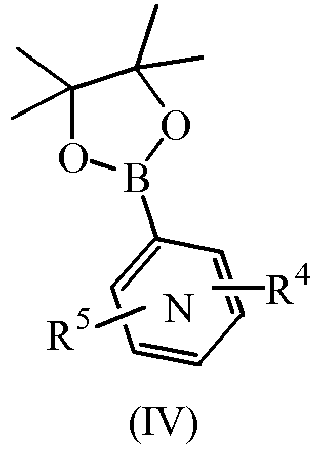
- Compounds of Formula (I) wherein R1, R2, R3, R4 and R5 are as defined before and Het is pyridinyl, can also be prepared by reacting an intermediate of Formula (V)


- A compound of Formula (II) wherein R1, R2 and R3 are as defined before, except when simultaneously R1 is morpholinyl or pyrrolidinyl R2 is trifluoromethyl and R3 is chloro, and halo represents a bromo or iodo, can be prepared by reacting a compound of Formula (V) wherein R1, R2 and R3 are as defined before, with N-bromo- or N-iodosuccinimide, in a suitable inert solvent, such as dichloromethane, in the presence of a suitable acid catalyst, such as acetic acid, under suitable reaction conditions, such as a convenient temperature, typically ranging between -10 °C and 40 °C.
- A compound of Formula (V) wherein R1 and R2 are as defined before and R3 is hydrogen, can also be prepared by reacting a compound of Formula (Va)

- A compound of Formula (V) wherein R1 and R2 are as defined before, and R3 is methyl or cyclopropyl can be prepared by reacting a compound of Formula (Va) wherein R1 and R2 are as defined before with a boronic acid derivative of Formula R3B(OH)2 where R3 is methyl or cyclopropyl in the presence of a suitable catalyst, such as tetrakis(triphenylphosphine)palladium (0) or palladium (II) acetate, in the presence of a suitable phosphine ligand, such as 2-dicyclohexylphosphino-2',6'-dimethoxybiphenyl, in the presence of a suitable base, such as sodium carbonate or potassium phosphate, in a suitable inert solvent, such as a mixture of 1,4-dioxane and water or toluene, under suitable reaction conditions, such as heating at a convenient temperature, either by conventional heating or under microwave irradiation for a period of time to ensure the completion of the reaction.
- A compound of Formula (V) wherein R1 is pyridinyl, R2 is hydrogen, methyl, ethyl, isopropyl, trifluoromethyl or cyclopropyl and R3 is chloro or trifluoromethyl, can be prepared by reacting a compound of Formula (VII)

- A compound of Formula (V) wherein R1 is morpholinyl or pyrrolidinyl R2 is as described before, R3 is chloro or trifluoromethyl and R6 and R7 are as defined before, can be prepared by reacting a compound of Formula (VII) where R2 is as described before, R3 is chloro or trifluoromethyl and halo represents chloro, bromo or iodo with a compound of Formula R6R7NH wherein R6 and R7 are as defined before, in a suitable inert solvent, such as acetonitrile, under suitable reaction conditions, such as heating at a convenient temperature, either by conventional heating or under microwave irradiation for a period of time to ensure the completion of the reaction. Reference compounds of Formula (V) wherein R1 is tetrahydropyranyl, R2 is as defined before and R3 is chloro or trifluoromethyl, can be prepared by reacting a compound of Formula (VIII)

- A compound of Formula (VIII) where R2 is as defined before and R3 is chloro or trifluoromethyl, can be prepared by reacting a compound of Formula (VII) where R2 is as defined before, R3 is chloro or trifluoromethyl and halo represents chloro, bromo or iodo with 3,6-dihydro-2H-pyran-4-boronic acid pinacol ester, in the presence of a suitable catalyst, such as tetrakis(triphenylphosphine)palladium (0), in the presence of a suitable base, such as sodium carbonate, in a suitable inert solvent, such as a mixture of 1,4-dioxane and water, under suitable reaction conditions, such as heating at a convenient temperature, either by conventional heating or under microwave irradiation for a period of time to ensure the completion of the reaction.
- 3,6-Dihydro-2H-pyran-4-boronic acid pinacol ester can be obtained by procedures similar to those described in,
Qiu, Y. et al. WO 2004075846 A2 . - A compound of Formula (VIIa)

- A compound of Formula (VII) where R2 is hydrogen, methyl, ethyl, cyclopropyl, isopropyl and trifluoromethyl, R3 is chloro or trifluoromethyl and halo represents chloro or bromo, can be prepared by reacting a compound of Formula (IX)


- A compound of Formula (IX) where R3 is chloro or trifluoromethyl and halo represents bromo, can be prepared by reacting an aminopyridazine of Formula (XI)

- A compound of Formula (IX) where R3 is chloro or trifluoromethyl and halo represents chloro, can be obtained from an aminopyridazine of Formula (XI) by procedures similar to those described in
Dewdney, N. et al. WO 2009077334 A1 . - A compound of Formula (X) wherein R2 is hydrogen, methyl, ethyl, cyclopropyl, isopropyl and trifluoromethyl and halo represents chloro or bromo, can be obtained commercially or can be prepared by procedures similar to those described in Gaudry, M.; Marquet, A. Organic Syntheses. 1976, 55.
- A compound of Formula (XI) where R3 is chloro can be obtained commercially.
- A compound of Formula (XI) where R3 is trifluoromethyl can be obtained by procedures similar to those described in
De Bruyn, M. F. L. et al. WO 2007048779 A1 . - A compound of Formula (V) wherein R1 is morpholinyl or pyrrolidinyl R2 is methoxy and R3 is chloro or trifluoromethyl and R6 and R7 are as defined before, can be prepared by reacting an intermediate of Formula (XII)
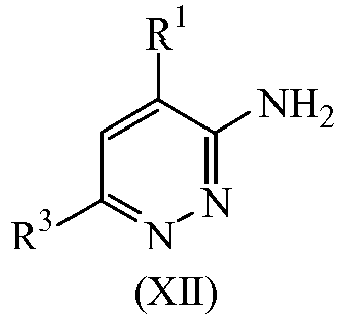
- Compounds of Formula (XII) wherein R1 is morpholinyl or pyrrolidinyl, R3 is chloro or trifluoromethyl and R6 and R7 are as defined before can be prepared by reacting a compound of Formula (IX) where R3 is chloro or trifluoromethyl and halo represents chloro or bromo with a derivative compound of formula R6R7NH wherein R6 and R7 are as defined before, in a suitable inert solvent, such as acetonitrile, under suitable reaction conditions, such as heating at a convenient temperature, either by conventional heating or under microwave irradiation for a period of time to ensure the completion of the reaction.
- Compounds of Formula (IX) can be obtained as described before.
- A compound of Formula (II) wherein R1 is morpholinyl or pyrrolidinyl, R2 is trifluoromethyl, R3 is chloro or trifluoromethyl, and halo represents a iodo, can be prepared by reacting a compound of Formula (XIII)

- A compound of Formula (XIII), where R3 is chloro or trifluoromethyl can be prepared by reacting a compound of Formula (VII) where R2 is trifluoromethyl, R3 is chloro or trifluoromethyl and halo represents a bromo, with N-iodosuccinimide, in a suitable inert solvent, such as dichlorometane, in the presence of a suitable acid catalyst, such as trifluoroacetic acid, under suitable reaction conditions, such as a convenient temperature, typically ranging between -10 °C and 60 °C.
- A compound of Formula (VII) where R2 is trifluoromethyl, R3 is chloro or trifluoromethyl and halo represents a bromo, can be obtained as described before.
- A compound of Formula (Ib)


- Alternatively, a compound of Formula (Ib) wherein R1, R2, R3 and R5 are as defined before, R4 is Alk1-oxyethyl and Alk1 is C1-4alkyl, can be prepared by reacting a compound of Formula (XIV), where R1, R2, R3 and R5 are as defined before with an alcohol of Formula Alk1-OH wherein Alk1 is C1-4alkyl, in the presence of a suitable acid, such as potassium hydrogensulfate, in a suitable solvent, such as the corresponding alcohol, under suitable reaction conditions, such as heating at a convenient temperature, either by conventional heating or under microwave irradiation for a period of time to ensure the completion of the reaction.
- An alcohol of Formula Alk1-OH wherein Alk1 is C1-4alkyl can be obtained commercially or alternatively can also be obtained by procedures similar to those described in Morel, P.
US 2008102028 A1 . - A compound of Formula (XIV) where R1, R2, R3 and R5 are as defined before can be prepared by reacting a compound of Formula (XV)


- Vinylboronic acid pinacol ester, of Formula (XVI), can be obtained commercially.
- A compound of Formula (XV) where R1, R2, R3 and R5 are as defined before, can be prepared by reacting a compound of Formula (II) wherein R1, R2 and R3 are as defined before and halo is bromo or iodo, with a boronic acid derivative of Formula (XVII)

- Compounds of Formula (II) can be obtained as described before.
- A boronic acid derivative of Formula (XVII) where R5 is as defined before, can be obtained commercially or alternatively can be prepared by reacting a compound of Formula (XVIII)

- A halopyridine of Formula (XVIII) where R5 is as defined before and halo is bromo or iodo, can be obtained commercially.
- Alternatively, a compound of Formula (XV) where R1, R2, R3 and R5 are as defined before, can be prepared by reacting a compound of Formula (V) wherein R1, R2 and R3 are as defined before with a halopyridine of Formula (XVIII), where R5 is as defined before and halo represents a bromo or iodo, in the presence of a suitable catalyst, such as palladium (II) acetate, in the presence of a suitable phosphine ligand, such as butyldi-1-adamantylphosphine, in the presence of a suitable base, such as potassium phosphate, in a suitable inert solvent, such as N,N-dimethylformamide, under suitable reaction conditions, such as heating at a convenient temperature, either by conventional heating or under microwave irradiation for a period of time to ensure the completion of the reaction.
- Compounds of Formula (V) can be obtained as described before.
- Compounds of Formula (Ic)

- A reagent of Formula R6R7NH or R6aR7aNH, wherein R6, R6a, R7 and R7a are as defined before, can be obtained commercially.
- Compounds of Formula (I) where R1, R2, R3 and R5 are as defined before, R4 is ethyl and Het is pyridinyl, can also be prepared by reacting a compound of Formula (XIV) wherein R1, R2, R3 and R5 are as defined before, with hydrogen in the presence of a suitable catalyst, such as 10% palladium on charcoal, in a suitable inert solvent, such as methanol or ethanol, under suitable reaction conditions, such as a convenient temperature, typically ranging between 25 °C and 40 °C or with ammonium formate in the presence of a suitable catalyst such as 10% palladium on charcoal, in a suitable inert solvent, such as methanol, ethanol, ethyl acetate or dichloromethane or mixtures thereof, under suitable reaction conditions, such as heating at a convenient temperature, typically ranging between 40 °C and 100 °C.
- Compounds of Formula (I) wherein R1, R2, R3 and R5 are as defined before, R4 is tetrahydropyranyl and Het is pyridinyl, can also be prepared by reacting a compound of Formula (XIX)

- A compound of Formula (XIX) wherein R1, R2, R3 and R5 are as defined before, can be prepared by reacting a compound of Formula (XV) wherein R1, R2, R3 and R5 are as defined before, with 3,6-dihydro-2H-pyran-4-boronic acid pinacol ester, in the presence of a suitable catalyst, such as tetrakis(triphenylphosphine)palladium (0), in the presence of a suitable base, such as sodium carbonate, in a suitable inert solvent, such as a mixture of 1,4-dioxane and water, under suitable reaction conditions, such as heating at a convenient temperature, either by conventional heating or under microwave irradiation for a period of time to ensure the completion of the reaction.
- 3,6-Dihydro-2H-pyran-4-boronic acid pinacol ester can be obtained as described before.
- A compound of Formula (Id)


- A reagent of Formula Alk2-W where Alk2 is C1-4alkyl and W represents a leaving group, such as halo, e.g. chloro, bromo or iodo can be obtained commercially.
- Compounds of Formula (I) wherein R1, R2, R3, R5 are as defined before and R4 is NR6aR7a and compounds of formula (XX), as previously defined, can also be prepared by reacting a compound of Formula (XV) wherein R1, R2, R3 and R5 are as defined before and the chlorine atom is ortho to the pyridinyl nitrogen, with a reagent of Formula R6aR7aNH, where R6a and R7a are as defined before, either neat or in a suitable inert solvent, such as acetonitrile, under suitable reaction conditions, such as heating at a convenient temperature, either by conventional heating or under microwave irradiation for a period of time to ensure the completion of the reaction.
- Alternatively, compounds of Formula (I) wherein R1, R2, R3, R5 are as defined before and R4 is NR6aR7a, can also be prepared by reacting a compound of Formula (XV) where R1, R2, R3 and R5 are as defined before with a reagent of Formula R6aR7aNH, where R6a and R7a are as defined before, in the presence of a suitable catalyst, such as palladium (II) acetate, in the presence of a suitable phosphine ligand, such as racemic-2,2'-bis(diphenylphosphino)-1,1'-binaphthyl and in the presence of a suitable base, such as cesium carbonate, in a suitable inert solvent, such as toluene, under suitable reaction conditions, such as heating at a convenient temperature, either by conventional heating or under microwave irradiation for a period of time to ensure the completion of the reaction.
- A reagent of Formula R6aR7aNH, where R6a and R7a are as defined before, can be obtained commercially.
- Compounds of Formula (Ie)

- A reagent of Formula Alk3-OH wherein C1-4alkyl, trifluoromethylC0-4alkyl, C3-8cycloalkylC1-4alkyl or C1-4alkyloxyC1-5alkyl can be obtained commercially or can be prepared by procedures similar to those described in Morel, P.
US 2008102028 A1 . - Compounds of Formula (I) wherein R1, R2, R3 and R5 are as defined before, R4 is C1-6alkyl and Het is pyridinyl, can also be prepared by reacting a compound of Formula (XV) where R1, R2, R3 and R5 are as defined before and the chlorine atom is ortho to the pyridinyl nitrogen with a Grignard reagent of Formula R4Mghalo, where R4 is C1-6alkyl and halo represents a chloro, bromo or iodo, in the presence of a suitable catalyst, such as [1,3-bis(diphenylphosphino)propane]dichloronickel (II) or iron (III) acetylacetonate, in a suitable inert solvent, such as a tetrahydrofuran or N-methylpyrrolidinone, under suitable reaction conditions, such as a convenient temperature, typically ranging between -10°C and 15°C.
- A Grignard reagent of Formula R4Mghalo where R4 is C1-6alkyl and halo is chloro, bromo or iodo, can be obtained commercially.
- Alternatively, compounds of Formula (I) wherein R1, R2, R3 and R5 are as defined before and R4 is C1-4alkyl or C3-8cycloalkyl and Het is pyridinyl can also be prepared by reacting a compound of Formula (XV) where R1, R2, R3 and R5 are as defined before with a boronic acid derivative of Formula R4B(OH)2, where R4 is C1-4alkyl or C3-8cycloalkyl, in the presence of a suitable catalyst, such as palladium (II) acetate, in the presence of a suitable phosphine ligand, such as 2-dicyclohexylphosphino-2',6'-dimethoxybiphenyl, in the presence of a suitable base, such as potassium phosphate, in a suitable inert solvent, such as toluene, under suitable reaction conditions, such as heating at a convenient temperature, either by conventional heating or under microwave irradiation for a period of time to ensure the completion of the reaction.
- A boronic acid derivative of Formula R4B(OH)2 where R4 is C1-4alkyl or C3-8cycloalkyl can be obtained commercially.
- Compounds of Formula (I) wherein R1, R2, R3 and R5 are as defined before and R4 is C1-4alkyl, C1-4alkyloxyC1-5alkyl or trifluoromethylC0-4alkyl and Het is pyridinyl, can also be prepared by reacting a compound of Formula (XV) where R1, R2, R3 and R5 are as defined before and the chlorine atom is ortho to the pyridinyl nitrogen with an organozinc reagent of Formula Zn(R4)2 where R4 represents a C1-4alkyl, C1-4alkyloxyC1-5alkyl or trifluoromethylC0-4alkyl, in the presence of a suitable catalyst, such as tetrakis(triphenylphosphine)palladium (0), in a suitable inert solvent, such as tetrahydrofuran, under suitable reaction conditions, such as heating at a convenient temperature, either by conventional heating or under microwave irradiation for a period of time to ensure the completion of the reaction.
- A reagent of Formula Zn(R4)2 wherein R4 represents C1-4alkyl, C1-4alkyloxyC1-5alkyl or trifluoromethylC0-4alkyl can be obtained commercially. Alternatively, a reagent of Formula Zn(R4)2 wherein R4 represents C1-4alkyl, C1-4alkyloxyC1-5alkyl or trifluoromethylC0-4alkyl, can be prepared by reacting a compound of Formula R4-halo wherein R4 represents C1-4alkyl, C1-4alkyloxyC1-5alkyl or trifluoromethylC0-4alkyl and halo represents iodo, with zinc in the presence of 1,2-dibromoethane and chlorotrimethylsilane, in a suitable inert solvent, such as N,N-dimethylformamide, under suitable reaction conditions such as heating at a convenient temperature, typically ranging between 25 °C and 100 °C.
- A reagent of R4-halo wherein R4 represents C1-4alkyl, C1-4alkyloxyC1-5alkyl or trifluoromethylC0-4alkyl and halo represents iodo can be obtained commercially or can be prepared by reacting a compound of Formula halo-R4 wherein R4 represents C1-4alkyl, C1-4alkyloxyC1-5alkyl or trifluoromethylC0-4alkyl and halo represents a chloro or bromo with sodium iodide in a suitable inert solvent, such as acetone, under suitable reaction conditions such as a convenient temperature, typically ranging between 25 °C and 40 °C.
- A compound of Formula halo-R4 wherein R4 represents C1-4alkyl, C1-4alkyloxyC1-5alkyl or trifluoromethylC0-4alkyl and halo represents a chloro or bromo, can be obtained commercially.
- A boronic acid of Formula (III) wherein R4 and R5 are as defined before, can be obtained commercially. Alternatively, a boronic acid of Formula (III) wherein R4 and R5 are as defined before, can be prepared by reacting a halopyridine of Formula (VI), wherein R4 and R5 are as defined before and halo is bromo or iodo, with triisopropyl borate, in the presence of a suitable base, such as n-butyllithium, in a suitable inert solvent, such as tetrahydrofuran, under suitable reaction conditions, such as a convenient temperature, typically ranging between -78°C and -10°C.
- A boronic derivative of Formula (IV) wherein R4 and R5 are as defined before, can be obtained commercially. Alternatively, a compound of Formula (IV) wherein R4 and R5 are as defined before, can also be prepared by reacting a halopyridine of Formula (VI), wherein R4 and R5 are as defined before and halo represents a bromo or iodo, with bis(pinacolato)diboron in the presence of a suitable catalyst, such as [1,1'-bis(diphenylphosphino)ferrocene]dichloropalladium (II), in the presence of a suitable base, such as potassium acetate, in a suitable inert solvent, such as N,N-dimethylformamide or dimethyl sulfoxide, under suitable reaction conditions, such as heating at a convenient temperature, either by conventional heating or under microwave irradiation for a period of time to ensure the completion of the reaction.
- A halopyridine of Formula (VI) wherein R4 and R5 are as defined before and halo represents a bromo or iodo, can be obtained commercially. Alternatively, a halopyridine of Formula (VI) wherein R5 is as defined before, halo represents a bromo and R4 is C1-6alkyl or C3-8cycloalkyl can be prepared by reacting a di-halopyridine of Formula (XXI)

- A boronic acid derivative of Formula R4B(OH)2 where R4 is C1-4alkyl or C3-8cycloalkyl can be obtained commercially.
- Alternatively, a halopyridine of Formula (VI) wherein R5 is as defined before, halo represents a bromo an R4 is C1-4alkyl, C1-4alkyloxyC1-5alkyl or trifluoromethylC0-4alkyl can be prepared by reacting a di-halopyridine of Formula (XXI) where R5 is as defined before and halo1 and halo2 represent independently a bromo or iodo and halo2 is ortho to the pyridinyl nitrogen, with an organozinc reagent of Formula Zn(R4)2 where R4 represents a C1-4alkyl, C1-4alkyloxyC1-5alkyl or trifluoromethylC0-4alkyl, in the presence of a suitable catalyst, such as tetrakis(triphenylphosphine)palladium (0), in a suitable inert solvent, such as tetrahydrofuran, under suitable reaction conditions, such as heating at a convenient temperature, either by conventional heating or under microwave irradiation for a period of time to ensure the completion of the reaction.
- A reagent of Formula Zn(R4)2 wherein R4 represents C1-4alkyl, C1-4alkyloxyC1-5alkyl or trifluoromethylC0-4alkyl can be obtained as described before.
- Compounds of Formula (VIa)


- Reagents of Formula Alk5 2SO4 and Alk5-W wherein Alk5 represents a C1-4alkyl and W represents a leaving group, such as halo, e.g. chloro, bromo or iodo, or a sulfonyloxy group, e.g. methylsulfonyloxy, trifluoromethylsulfonyloxy, or methylphenylsulfonyloxy, can be obtained commercially.
- A compound of Formula (VIc)


- A compound of Formula (VIe)

- A methylpyridine of Formula (VId) wherein R5 is as defined before, can be obtained commercially.
- A compound of Formula (VIf)

- A di-halopyridine of Formula (XXI) where R5 is as defined before, halo1 is a bromo and halo2 represents bromo can be obtained commercially.
- A compound of Formula (VIg)


- A compound of Formula (XXII) wherein R5 is as defined before and halo represents bromo, can be prepared by reacting a compound of Formula (XXIII)

- A compound of Formula (XXIII) wherein R5 is as defined before, can be prepared by reacting a compound of Formula (XXIV)

- A compound of Formula (XXIV) wherein R5 is as defined before, can be obtained commercially or alternatively, can also be obtained by reacting a compound of Formula (XXV)

- A compound of Formula (XXV) wherein R5 is as defined before, can be obtained commercially or alternatively, can also be obtained by reacting a compound Formula (XXVI)

- A compound of Formula (XXVI) wherein R5 is as defined before can be obtained commercially.
- Compounds of Formula (VIh)
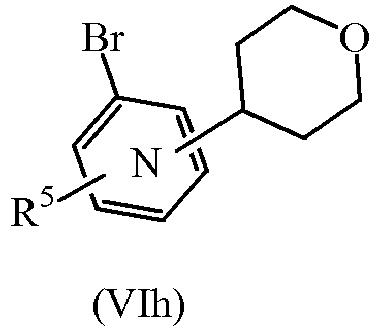

- An aminopyridine of Formula (XXVII) where R5 is as defined before, can be prepared by reacting a nitropyridine of Formula (XXVIII)
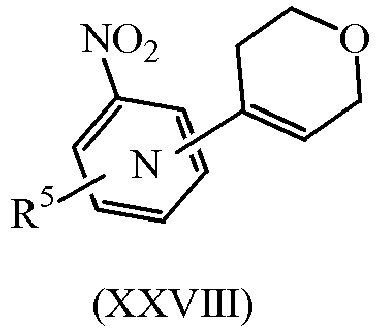
- A nitropyridine of Formula (XXVIII) where R5 is as defined before, can be prepared by reacting an halonitropyridine of Formula (XXIX)

- A halonitropyridine of Formula (XXIX) where R5 is as defined before and halo represents a chloro, bromo or iodo can be obtained commercially.
- 3,6-Dihydro-2H-pyran-4-boronic acid pinacol ester can be obtained as described before.
- Compounds of Formula (VIi)

- A di-halo pyridine of Formula (XVIII) where R5 is as defined before, halo represents a bromo or iodo, can be obtained commercially.
- A reagent of Formula Alk6-OH wherein Alk6 is C1-4alkyl, C1-4alkyloxyC1-5alkyl or C3-8cycloalkylC1-4alkyl, can be obtained commercially or alternatively can also be obtained by procedures similar to those described in Morel, P.
US 2008102028 A1 . - Compounds of Formula (VIj)

- A reagent of Formula R6aR7aNH, wherein R6a and R7a are as defined before, can be obtained commercially.
- A di-halo pyridine of Formula (XVIII) where R5 is as defined before, halo represents a bromo or iodo, can be obtained commercially.
- A compound of Formula (I) wherein R1, R2, R4 and R5 are as defined before, R3 is hydrogen, Het is pyrazolyl and R4 is attached to the nitrogen atom of the pyrazole can be prepared by reacting a compound of Formula (If)

- Compounds of Formula (I) wherein R1, R2, R3, R4 and R5 are as defined before, Het is pyrazolyl and R4 is attached to the nitrogen atom of the pyrazole can be prepared by reacting a compound of Formula (II) where R1, R2 and R3 are as defined before and halo represents a bromo or iodo, with a boronate of Formula (XXX)
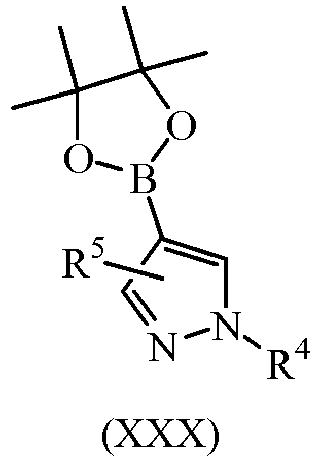
- A compound of Formula (XXX) wherein R4 and R5 are as defined before and R4 is attached to the nitrogen atom of the pyrazole, can be obtained commercially or alternatively, can be prepared by reacting a compound of Formula (XXXI)

- Compounds of Formula R4-W wherein R4 is as defined before and W represents a leaving group, such as halo, e.g. chloro, bromo or iodo, can be obtained commercially. Compounds of formula R4-W wherein R4 is as defined before and W represents a leaving group, such as a sulfonyloxy group, e.g. methylsulfonyloxy, trifluoromethylsulfonyloxy, or methylphenylsulfonyloxy can be prepared by reacting a compound of Formula R4-OH with a sulfonyl chloride, e.g. methylsulfonyl chloride, trifluoromethylsulfonyl chloride, or methylphenylsulfonyl chloride in the presence of a suitable base, such as pyridine or diisopropylethylamine, in a suitable solvent, such as dichloromethane and under suitable reaction conditions, such as a convenient temperature, typically ranging from -10 °C to 25 °C.
- Compounds of Formula R4-OH wherein R4 is as defined before, can be obtained commercially.
- Compounds of Formula (XXX) wherein R4 and R5 are as defined before and R4 is attached to the nitrogen atom of the pyrazole, can also be prepared by reacting a compound of Formula (XXXII)

- Compounds of Formula (XXXII) wherein R4 and R5 are as defined before and R4 is attached to the nitrogen atom of the pyrazole, can be prepared by reacting a 4-iodo-1H-pyrazole of Formula (XXXIII)

- A 4-iodo-1H-pyrazole of Formula (XXXIII) where R5 is as defined before, can be obtained commercially.
- Compounds of Formula R4-W wherein R4 is as defined before and W represents a leaving group such as halo, e.g. chloro, bromo or iodo, can be obtained commercially.
- Alternatively, compounds of formula R4-W wherein R4 is as defined before and W represents a leaving group such as a sulfonyloxy group, e.g. methylsulfonyloxy, trifluoromethylsulfonyloxy, or methylphenylsulfonyloxy can be prepared by reacting a compound of formula R4-OH with a sulfonyl chloride, e.g. methylsulfonyl chloride, trifluoromethylsulfonyl chloride, or methylphenylsulfonyl chloride in the presence of a suitable base such, as pyridine or diisopropylethylamine, in a suitable solvent, such as dichloromethane and under suitable reaction conditions, such as a convenient temperature, typically ranging from -10 °C to 25 °C.
- Compounds of Formula R4-OH wherein R4 is as defined before, can be obtained commercially.
- A compound of Formula (XXXIIa)

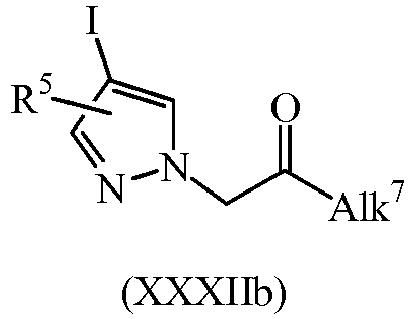
- A compound of Formula (XXXIIb), wherein Alk7 represents a C1-4alkyl or C3-8cycloalkyl group can be prepared by reacting a 4-iodo-1H-pyrazole of Formula (XXXIII) with an alpha bromoketone of Formula (XXXV)

- An alpha bromoketone of Formula (XXXV) wherein Alk7 is C1-4alkyl or C3-8cycloalkyl, can be obtained commercially or alternatively can be obtained by procedures similar to those described in Carverley, M.J. Tetrahedron, 1987, 43(20), 4609-19.
- A compound of Formula (XXXIIc)


- A reagent of Formula Alk9-W wherein Alk9 is C1-4alkyl and W represents a leaving group such as halo, e.g. chloro, bromo or iodo, or a sulfonyloxy group, e.g. methylsulfonyloxy, trifluoromethylsulfonyloxy, or methylphenylsulfonyloxy, can be obtained commercially.
- A compound of Formula (XXXVI) wherein R5 is as defined before, can be prepared by reacting a 4-iodo-1H-pyrazole of Formula (XXXIII)
where R5 is as defined before, with a reagent of Formula W-Alk8-OH, wherein W represents a leaving group such as halo, e.g. chloro, bromo or iodo, or a sulfonyloxy group, e.g. methylsulfonyloxy, trifluoromethylsulfonyloxy, or methylphenylsulfonyloxy and Alk8 represents a C1-4alkyl, in the presence of a suitable base, such as cesium carbonate, in a suitable inert solvent, such as N,N-dimethylformamide, under suitable reaction conditions, such as heating at a convenient temperature, either by conventional heating or under microwave irradiation for a period of time to ensure the completion of the reaction. - A reagent of Formula W-Alk8-OH wherein W represents a leaving group such as halo, e.g. chloro, bromo or iodo, or a sulfonyloxy group, e.g. methylsulfonyloxy, trifluoromethylsulfonyloxy, or methylphenylsulfonyloxy and Alk8 represents C1-4alkyl or C3-8cycloalkyl, can be obtained commercially.
- In order to obtain the acid addition salt forms of the compounds according to the invention, for example the HCl salt forms unless otherwise described, several procedures known to those skilled in the art can be used. In a typical procedure, for example, the free base can be dissolved in isopropanol, diisopropylether, diethyl ether and/or dichloromethane and subsequently, 1 to 2 equivalents of the appropriate acid, for example a 6N HCl solution in 2-propanol or a 2N HCl solution in diethyl ether, can be added dropwise. The mixture typically is stirred for 10 min or longer after which the product can be filtered off. The HCl salt is usually dried in vacuo.
- It will be appreciated by those skilled in the art that in the processes described above the functional groups of intermediate compounds may need to be blocked by protecting groups. In case the functional groups of intermediate compounds were blocked by protecting groups, they can be deprotected after a reaction step.
- The compounds according to the invention inhibit PDE10 enzyme activity, in particular PDE10A enzyme activity and hence raise the levels of cAMP or cGMP within cells that express PDE10. Accordingly, inhibition of PDE10 enzyme activity may be useful in the treatment of diseases caused by deficient amounts of cAMP or cGMP in cells. PDE10 inhibitors may also be of benefit in cases in which raising the amount of cAMP or cGMP above normal levels results in a therapeutic effect. Inhibitors of PDE10 may be used to treat disorders of the peripheral and central nervous system, cardiovascular diseases, cancer, gastro-enterological diseases, endocrinological or metabolic diseases and urological diseases.
- Hence, the present invention relates to a compound according to the present invention for use as a medicine, as well as to the use of a compound according to the invention or a pharmaceutical composition according to the invention for the manufacture of a medicament. The present invention also relates to a compound according to the present invention or a pharmaceutical composition according to the invention for use in the treatment or prevention of, in particular treatment of, a condition in a mammal, including a human, the treatment or prevention of which is affected or facilitated by the inhibition of phosphodiesterase 10 enzyme. The present invention also relates to the use of a compound according to the present invention or a pharmaceutical composition according to the invention for the manufacture of a medicament for the treatment or prevention of, in particular treatment of, a condition in a mammal, including a human, the treatment or prevention of which is affected or facilitated by the inhibition of phosphodiesterase 10 enzyme.
- The present invention also relates to a compound according to the invention, or a pharmaceutical composition according to the invention for use in the treatment, prevention, amelioration, control or reduction of the risk of various neurological, psychiatric and metabolic disorders associated with phosphodiesterase 10 dysfunction in a mammal, including a human, the treatment or prevention of which is affected or facilitated by the inhibition of phosphodiesterase 10.
- Also, the present invention relates to the use of a compound according to the invention or a pharmaceutical composition according to the invention for the manufacture of a medicament for treating, preventing, ameliorating, controlling or reducing the risk of various neurological and psychiatric disorders associated with phosphodiesterase 10 dysfunction in a mammal, including a human, the treatment or prevention of which is affected or facilitated by the inhibition of phosphodiesterase 10.
- Where the invention is said to relate to the use of a compound or composition according to the invention for the manufacture of a medicament for e.g. the treatment of a mammal, it is understood that such use is to be interpreted in certain jurisdictions as a method of e.g. treatment of a mammal, comprising administering to a mammal in need of such e.g. treatment, an effective amount of a compound or composition according to the invention.
- In particular, the indications that may be treated with PDE10 inhibitors, either alone or in combination with other drugs, include, but are not limited to, those diseases thought to be mediated in part by the basal ganglia, prefrontal cortex and hippocampus.
- These indications include neurological and psychiatric disorders selected from psychotic disorders and conditions; anxiety disorders; movement disorders; drug abuse; mood disorders; neurodegenerative disorders; disorders or conditions comprising as a symptom a deficiency in attention and/or cognition; pain and metabolic disorders.
- In particular, the psychotic disorders and conditions associated with PDE10 dysfunction include one or more of the following conditions or diseases: schizophrenia, for example of the paranoid, disorganized, catatonic, undifferentiated or residual type; schizophreniform disorder; schizoaffective disorder, such as delusional or depressive type; delusional disorder; substance-induced psychotic disorder such as psychosis induced by alcohol, amphetamine, cannabis, cocaine, hallucinogens, inhalants, opioids, or phencyclidine; personality disorders of the paranoid type; and personality disorder of the schizoid type.
- In particular, the anxiety disorders include panic disorder; agoraphobia; specific phobia; social phobia; obsessive-compulsive disorder; post-traumatic stress disorder; acute stress disorder; and generalized anxiety disorder.
- In particular, movement disorders include Huntington's disease and dyskinesia; Parkinson's disease; restless leg syndrome and essential tremor. Additionally, Tourette's syndrome and other tic disorders can be included.
- In particular, the central nervous system disorder is a substance-related disorder selected from the group of alcohol abuse; alcohol dependence; alcohol withdrawal; alcohol withdrawal delirium; alcohol-induced psychotic disorder; amphetamine dependence; amphetamine withdrawal; cocaine dependence; cocaine withdrawal; nicotine dependence; nicotine withdrawal; opioid dependence and opioid withdrawal.
- In particular, mood disorders and mood episodes include depression, mania and bipolar disorders. Preferably, the mood disorder is selected from the group of bipolar disorders (I and II); cyclothymic disorder; depression; dysthymic disorder; major depressive disorder and substance-induced mood disorder.
- In particular, neurodegenerative disorders include Parkinson's disease; Huntington's disease; dementia such as for example Alzheimer's disease; multi-infarct dementia; AIDS-related dementia or fronto temperal dementia. The neurodegenerative disorder or condition comprises neurodegeneration of striatal medium spiny neurons.
- In particular, disorders or conditions comprising as a symptom a deficiency in attention and/or cognition include dementia, such as Alzheimer's disease; multi-infarct dementia; alcoholic dementia or drug-related dementia; dementia associated with intracranial tumours or cerebral trauma; dementia associated with Huntington's disease; dementia associated with Parkinson's disease; AIDS-related dementia; other diseases include delirium; amnestic disorder; post-traumatic stress disorder; mental retardation; a learning disorder; attention-deficit/hyperactivity disorder (ADHD); and age-related cognitive impairment.
- In particular, pain includes acute and chronic states, severe pain, intractable pain, neuropathic pain and post-traumatic pain.
- In particular, metabolic disorders include diabetes, in particular type 1 or type 2 diabetes, and related disorders such as obesity. Additional related disorders include syndrome X, impaired glucose tolerance, impaired fasting glucose, gestational diabetes, maturity-onset diabetes of the young (MODY), latent autoimmune diabetes adult (LADA), associated diabetic dyslipidemia, hyperglycemia, hyperinsulinemia, dyslipidemia, hypertriglyceridemia, and insulin resistance.
- Additionally, the growth of some cancer cells is inhibited by cAMP and cGMP, the compounds of the invention may be useful in the treatment of cancer, such as renal carcinoma and breast cancer.
- Preferably, the psychotic disorder is selected from the group of schizophrenia, delusional disorder, schizoaffective disorder, schizophreniform disorder and substance-induced psychotic disorder.
- Preferably, the central nervous system disorder is a personality disorder selected from the group of obsessive-compulsive personality disorder and schizoid, schizotypal disorder.
- Preferably, the central nervous system disorder is a mood disorder selected from the group of bipolar disorders (I & II), cyclothymic disorder, depression, dysthymic disorder, major depressive disorder and substance-induced mood disorder.
- Preferably, the central nervous system disorder is attention-deficit/hyperactivity disorder.
- Preferably, the central nervous system disorder is a cognitive disorder selected from the group of delirium, substance-induced persisting delirium, dementia, dementia due to HIV disease, dementia due to Huntington's disease, dementia due to Parkinson's disease, dementia of the Alzheimer's type, substance-induced persisting dementia and mild cognitive impairment.
- Preferably the disorders treated by the compounds of the present invention are selected from schizophrenia; obsessive-compulsive disorder; generalized anxiety disorder; Huntington's disease; dyskinesia; Parkinson's disease; depression; bipolar disorders; dementia such as Alzheimer's disease; attention-deficit/hyperactivity disorder; drug abuse; pain; diabetes and obesity.
- Preferably, the disorders treated by the compounds of the present invention are schizophrenia, including positive and negative symptoms thereof, and cognitive deficits, such as impaired attention or memory.
- Of the disorders mentioned above, the treatment of anxiety, obsessive-compulsive disorder, schizophrenia, depression, attention-deficit/hyperactivity disorder, Alzheimer's disease and diabetes are of particular importance.
- At present, the fourth edition of the Diagnostic & Statistical Manual of Mental Disorders (DSM-IV) of the American Psychiatric Association provides a diagnostic tool for the identification of the disorders described herein. The person skilled in the art will recognize that alternative nomenclatures, nosologies, and classification systems for neurological and psychiatric disorders described herein exist, and that these evolve with medical and scientific progresses.
- Therefore, the invention also relates to a compound according to the invention, for use in the treatment of any one of the diseases mentioned hereinbefore.
- The invention also relates to a compound according to the invention, for the treatment or prevention, in particular treatment, of any one of the diseases mentioned hereinbefore.
- The invention also relates to the use of a compound according to the invention, for the manufacture of a medicament for the treatment or prevention of any one of the disease conditions mentioned hereinbefore.
- The invention also relates to the use of a compound according to the invention for the manufacture of a medicament for the treatment of any one of the disease conditions mentioned hereinbefore.
- The compounds of the present invention can be administered to mammals, preferably humans, for the treatment or prevention of any one of the diseases mentioned hereinbefore.
- In view of the utility of the compounds according to the invention, herein disclosed is a method of treating warm-blooded animals, including humans, suffering from any one of the diseases mentioned hereinbefore, and a method of preventing in warm-blooded animals, including humans, any one of the diseases mentioned hereinbefore.
- Said methods comprise the administration, i.e. the systemic or topical administration, preferably oral administration, of a therapeutically effective amount of a compound according to the invention to warm-blooded animals, including humans.
- Therefore, the disclosure also relates to a method for the prevention and/or treatment of any one of the diseases mentioned hereinbefore comprising administering a therapeutically effective amount of compound according to the invention to a patient in need thereof.
- The PDE10 inhibitors described herein can be used alone, in combination or in combination with other pharmaceutical agents such as other agents used in the treatment of psychoses, such as schizophrenia and bipolar disorder, obsessive-compulsive disorder, Parkinson's disease, cognitive impairment and/or memory loss, e.g. nicotinic α-7 agonists, PDE4 inhibitors, other PDE10 inhibitors, calcium channel blockers, muscarinic m1 and m2 modulators, adenosine receptor modulators, ampakines, NMDA-R modulators, mGluR modulators, dopamine modulators, serotonin modulators, cannabinoid modulators, and cholinesterase inhibitors (e.g. donepezil, rivastigmine, and galantamine). In such combinations, the compounds of the present invention may be utilized in combination with one or more other drugs in the treatment, prevention, control, amelioration, or reduction of risk of diseases or conditions for which compounds of Formula (I) or the other drugs may have utility, where the combination of the drugs together are safer or more effective than either drug alone.
- One skilled in the art will recognize that a therapeutically effective amount of the PDE10 inhibitors of the present invention is the amount sufficient to inhibit the PDE10 enzyme and that this amount varies inter alia, depending on the type of disease, the concentration of the compound in the therapeutic formulation, and the condition of the patient. Generally, an amount of PDE10 inhibitor to be administered as a therapeutic agent for treating diseases in which inhibition of the PDE10 enzyme is beneficial, such as the disorders described herein, will be determined on a case by case by an attending physician.
- Generally, a suitable dose is one that results in a concentration of the PDE10 inhibitor at the treatment site in the range of 0.5 nM to 200 µM, and more usually 5 nM to 50 µM. To obtain these treatment concentrations, a patient in need of treatment likely will be administered between 0.001 mg/kg to 15 mg/kg body weight, in particular from 0.01 mg/kg to 2.50 mg/kg body weight, in particular, from 0.01 to 1.5 mg/kg body weight, in particular from 0.1 mg/kg to 0.50 mg/kg body weight. The amount of a compound according to the present invention, also referred to here as the active ingredient, which is required to achieve a therapeutical effect will, of course vary on case-by-case basis, vary with the particular compound, the route of administration, the age and condition of the recipient, and the particular disorder or disease being treated. A method of treatment may also include administering the active ingredient on a regimen of between one and four intakes per day. In these methods of treatment the compounds according to the invention are preferably formulated prior to admission. As described herein below, suitable pharmaceutical formulations are prepared by known procedures using well known and readily available ingredients.
- The present invention also provides compositions for use in preventing or treating diseases in which inhibition of the PDE10 enzyme is beneficial, such as the disorders described herein. While it is possible for the active ingredient to be administered alone, it is preferable to present it as a pharmaceutical composition. Accordingly, the present invention also relates to a pharmaceutical composition comprising a pharmaceutically acceptable carrier or diluent and, as active ingredient, a therapeutically effective amount of a compound according to the invention, in particular a compound according to Formula (I), a pharmaceutically acceptable salt thereof, a solvate thereof or a stereochemically isomeric form thereof. The carrier or diluent must be "acceptable" in the sense of being compatible with the other ingredients of the composition and not deleterious to the recipients thereof.
- The compounds according to the invention, in particular the compounds according to Formula (I), the pharmaceutically acceptable salts thereof, the solvates and the stereochemically isomeric forms thereof, or any subgroup or combination thereof may be formulated into various pharmaceutical forms for administration purposes. As appropriate compositions there may be cited all compositions usually employed for systemically administering drugs.
- The pharmaceutical compositions of this invention may be prepared by any methods well known in the art of pharmacy, for example, using methods such as those described in Gennaro et al. Remington's Pharmaceutical Sciences (18th ed., Mack Publishing Company, 1990, see especially Part 8: Pharmaceutical preparations and their Manufacture). To prepare the pharmaceutical compositions of this invention, a therapeutically effective amount of the particular compound, optionally in salt form, as the active ingredient is combined in intimate admixture with a pharmaceutically acceptable carrier or diluent, which carrier or diluent may take a wide variety of forms depending on the form of preparation desired for administration. These pharmaceutical compositions are desirable in unitary dosage form suitable, in particular, for oral, topical (for example via a nose spray, eye drops or via a cream, gel, shampoo or the like), rectal or percutaneous administration, by parenteral injection or by inhalation, such as a nose spray. For example, in preparing the compositions in oral dosage form, any of the usual pharmaceutical media may be employed such as, for example, water, glycols, oils, alcohols and the like in the case of oral liquid preparations such as, for example, suspensions, syrups, elixirs, emulsions and solutions; or solid carriers such as, for example, starches, sugars, kaolin, diluents, lubricants, binders, disintegrating agents and the like in the case of powders, pills, capsules and tablets. Because of the ease in administration, oral administration is preferred, and tablets and capsules represent the most advantageous oral dosage unit forms in which case solid pharmaceutical carriers are employed. For parenteral compositions, the carrier will usually comprise sterile water, at least in large part, though other ingredients, for example, surfactants to aid solubility, may be included. Injectable solutions, for example, may be prepared in which the carrier comprises saline solution, glucose solution or a mixture of saline and glucose solution. Injectable suspensions may also be prepared in which case appropriate liquid carriers, suspending agents and the like may be employed. Also included are solid form preparations that are intended to be converted, shortly before use, to liquid form preparations. In the compositions suitable for percutaneous administration, the carrier optionally comprises a penetration enhancing agent and/or a suitable wetting agent, optionally combined with suitable additives of any nature in minor proportions, said additives do not introduce a significant deleterious effect on the skin. Said additives may facilitate the administration to the skin and/or may be helpful for preparing the desired compositions. These compositions may be administered in various ways, e.g., as a transdermal patch, as a spot-on treatment, as an ointment.
- It is especially advantageous to formulate the aforementioned pharmaceutical compositions in unit dosage form for ease of administration and uniformity of dosage. Unit dosage form as used herein refers to physically discrete units suitable as unitary dosages, each unit containing a predetermined quantity of active ingredient calculated to produce the desired therapeutic effect in association with the required pharmaceutical carrier. Examples of such unit dosage forms are tablets (including scored or coated tablets), capsules, pills, powder packets, wafers, suppositories, injectable solutions or suspensions and the like, teaspoonfuls, tablespoonfuls, and segregated multiples thereof.
- Since the compounds according to the invention are orally administrable compounds, pharmaceutical compositions comprising aid compounds for oral administration are especially advantageous.
- In order to enhance the solubility and/or the stability of the compounds of Formula (I) in pharmaceutical compositions, it can be advantageous to employ α-, β- or γ-cyclodextrins or their derivatives, in particular hydroxyalkyl substituted cyclodextrins, e.g. 2-hydroxypropyl-β-cyclodextrin or sulfobutyl-β-cyclodextrin. Also co-solvents such as alcohols may improve the solubility and/or the stability of the compounds according to the invention in pharmaceutical compositions.
- The exact dosage and frequency of administration depends on the particular compound of formula (I) used, the particular condition being treated, the severity of the condition being treated, the age, weight, sex, extent of disorder and general physical condition of the particular patient as well as other medication the individual may be taking, as is well known to those skilled in the art. Furthermore, it is evident that said effective daily amount may be lowered or increased depending on the response of the treated subject and/or depending on the evaluation of the physician prescribing the compounds of the instant invention.
- Depending on the mode of administration, the pharmaceutical composition will comprise from 0.05 to 99 % by weight, preferably from 0.1 to 70 % by weight, more preferably from 0.1 to 50 % by weight of the active ingredient, and, from 1 to 99.95 % by weight, preferably from 30 to 99.9 % by weight, more preferably from 50 to 99.9 % by weight of a pharmaceutically acceptable carrier, all percentages being based on the total weight of the composition.
- The amount of a compound of Formula (I) that can be combined with a carrier material to produce a single dosage form will vary depending upon the disease treated, the mammalian species, and the particular mode of administration. However, as a general guide, suitable unit doses for the compounds of the present invention can, for example, preferably contain between 0.1 mg to about 1000 mg of the active compound. A preferred unit dose is between 1 mg to about 500 mg. A more preferred unit dose is between 1 mg to about 300mg. Even more preferred unit dose is between 1 mg to about 100 mg. Such unit doses can be administered more than once a day, for example, 2, 3, 4, 5 or 6 times a day, but preferably 1 or 2 times per day, so that the total dosage for a 70 kg adult is in the range of 0.001 to about 15 mg per kg weight of subject per administration. A preferred dosage is 0.01 to about 1.5 mg per kg weight of subject per administration, and such therapy can extend for a number of weeks or months, and in some cases, years. It will be understood, however, that the specific dose level for any particular patient will depend on a variety of factors including the activity of the specific compound employed; the age, body weight, general health, sex and diet of the individual being treated; the time and route of administration; the rate of excretion; other drugs that have previously been administered; and the severity of the particular disease undergoing therapy, as is well understood by those of skill in the area.
- A typical dosage can be one 1 mg to about 100 mg tablet or 1 mg to about 300 mg taken once a day, or, multiple times per day, or one time-release capsule or tablet taken once a day and containing a proportionally higher content of active ingredient. The time-release effect can be obtained by capsule materials that dissolve at different pH values, by capsules that release slowly by osmotic pressure, or by any other known means of controlled release.
- It can be necessary to use dosages outside these ranges in some cases as will be apparent to those skilled in the art. Further, it is noted that the clinician or treating physician will know how and when to start, interrupt, adjust, or terminate therapy in conjunction with individual patient response.
- As already mentioned, the invention also relates to a pharmaceutical composition comprising the compounds according to the invention and one or more other drugs for use as a medicament or for use in the treatment, prevention, control, amelioration, or reduction of risk of diseases or conditions for which compounds of Formula (I) or the other drugs may have utility as well. The use of such a composition for the manufacture of a medicament, as well as the use of such a composition for the manufacture of a medicament in the treatment, prevention, control, amelioration or reduction of risk of diseases or conditions for which compounds of Formula (I) or the other drugs may have utility are also contemplated. The present invention also relates to a combination of a compound according to the present invention and an additional pharmaceutical agent. The present invention also relates to such a combination for use as a medicine. The present invention also relates to a product comprising (a) a compound according to the present invention, a pharmaceutically acceptable salt thereof or a solvate thereof, and (b) an additional pharmaceutical agent, as a combined preparation for simultaneous, separate or sequential use in the treatment or prevention of a condition in a mammal, including a human, the treatment or prevention of which is affected or facilitated by the effect of PDE10 inhibitors, in particular PDE10A inhibitors. The different drugs of such a combination or product may be combined in a single preparation together with pharmaceutically acceptable carriers or diluents, or they may each be present in a separate preparation together with pharmaceutically acceptable carriers or diluents.
- The following examples are intended to illustrate but not to limit the scope of the present invention.
- Several methods for preparing the compounds of this invention are illustrated in the following Examples. Unless otherwise noted, all starting materials were obtained from commercial suppliers and used without further purification.
- Hereinafter, the term "LCMS" means liquid chromatography/mass spectrometry, "HPLC" means high-performance liquid chromatography, "min." means minutes, "h." means hours, "Rt" means retention time (in minutes), "[M+H]+" means the protonated mass of the free base of the compound, "m.p." means melting point.
- Microwave assisted reactions were performed in a single-mode reactor: Emrys™ Optimizer microwave reactor (Personal Chemistry A.B., currently Biotage).
- Thin layer chromatography (TLC) was carried out on silica gel 60 F254 plates (Merck) using reagent grade solvents. Open column chromatography was performed on silica gel, particle size 60 Å, mesh = 230-400 (Merck) under standard techniques. Flash column chromatography was performed using ready-to-connect cartridges from Merck, on irregular silica gel, particle size 15-40 µm (normal phase disposable flash columns) on an SPOT or FLASH system from Armen Instrument.
- Reverse phase HPLC was performed on a C18 XBridge 30 x 100 5 µm column.
- 1H NMR spectra were recorded either on a Bruker DPX-400 or on a Bruker AV-500 spectrometer with standard pulse sequences, operating at 400 MHz and 500 MHz respectively. Chemical shifts (δ) are reported in parts per million (ppm) downfield from tetramethylsilane (TMS), which was used as internal standard.
- Melting Point values are peak values, and are obtained with experimental uncertainties that are commonly associated with this analytical method. For a number of compounds, melting points were determined in open capillary tubes either on a Mettler FP62 or on a Mettler FP81HT-FP90 apparatus. Melting points were measured with a temperature gradient of 10 °C/minute. Maximum temperature was 300 °C. The melting point was read from a digital display.
- The HPLC measurement was performed using an HP 1100 (Agilent Technologies) system comprising a pump (quaternary or binary) with degasser, an autosampler, a column oven, a diode-array detector (DAD) and a column as specified in the respective methods. The MS detector was configured with either an electrospray ionization source or an ESCI dual ionization source (electrospray combined with atmospheric pressure chemical ionization). Nitrogen was used as the nebulizer gas. The source temperature was maintained either at 140 °C or 100°C. Data acquisition was performed either with MassLynx-Openlynx software or Chemsation-Agilent Data Browser software.
- The UPLC (Ultra Performance Liquid Chromatography) measurement was performed using an Acquity UPLC (Waters) system comprising a sampler organizer, a binary pump with degasser, a four column's oven, a diode-array detector (DAD) and a column as specified in the respective methods. The MS detector was configured with an ESCI dual ionization source (electrospray combined with atmospheric pressure chemical ionization). Nitrogen was used as the nebulizer gas. The source temperature was maintained at 140 °C. Data acquisition was performed with MassLynx-Openlynx software.
- MS Procedure for LC Method 1: High-resolution mass spectra (Time of Flight, TOF detector) were acquired only in positive ionization mode or in positive/negative modes by scanning from 100 to 750 umas. The capillary needle voltage was 2.5 kV for positive mode and 2.9kV for negative ionization mode. The cone voltage was 20 V for both positive and negative ionization modes. Leucine-Enkephaline was the standard substance used for the lock mass calibration.
- MS Procedure for LC Methods 2, 4, 5, and 6: Low-resolution mass spectra (single quadrupole, SQD detector) were acquired only in positive ionization mode or in positive/negative modes by scanning from 100 to 1000 umas. The capillary needle voltage was 3 kV. For positive ionization mode the cone voltage was 20 V, 25 V or 20 V/50 V. For negative ionization mode the cone voltage was 30 V.
- Low-resolution mass spectra (single quadrupole, MSD detector) were acquired in positive/negative modes by scanning from 100 to 1000 umas. The capillary needle voltage was 1.0 kV and the fragmentor voltage was 70V for both positive and negative ionization modes.
- In addition to the general procedure: Reversed phase HPLC was carried out on a Sunfire-C18 column (2.5 µm, 2.1 x 30 mm) from Waters, with a flow rate of 1.0 ml/min, at 60 °C. The gradient conditions used are: 95% A (0.5 g/L ammonium acetate solution + 5% of acetonitrile), 5% B (acetonitrile or or acetonitrile/methanol 1/1), to 100% B and equilibrated to initial conditions up to 7 or 9 minutes run. Injection volume 2 µL.
- In addition to the general procedure: Reversed phase HPLC was carried out on an Eclipse Plus-C18 column (3.5 µm, 2.1 x 30 mm) from Agilent, with a flow rate of 1.0 mL/min, at 60 °C. The gradient conditions used are: 95% A (0.5 g/L ammonium acetate solution + 5% acetonitrile), 5% B (acetonitrile or mixture of acetonitrile / methanol, 1/1), to 100% B and equilibrated to initial conditions up to 7 or 9 minutes run. Injection volume 2 µL.
- In addition to the general procedure: Reversed phase HPLC was carried out on an Eclipse Plus-C18 column (3.5 µm, 2.1 x 30 mm) from Agilent, with a flow rate of 1.0 mL/min, at 60 °C. The gradient conditions used are: 95% A (0.5 g/L ammonium acetate solution + 5% acetonitrile), 5% B (acetonitrile), to 100% B in 5.0 minutes, kept till 5.15 minutes and equilibrated to initial conditions at 5.3 minutes until 7.0 minutes. Injection volume 2 µL.
- In addition to the general procedure: Reversed phase UPLC was carried out on a BEH-C18 column (1.7 µm, 2.1 x 50 mm) from Waters, with a flow rate of 0.8 mL/min, at 60 °C. The gradient conditions used are: 95% A (0.5 g/L ammonium acetate solution + 5% acetonitrile), 5% B (mixture of acetonitrile / methanol, 1/1), to 20% A, 80 % B, then to 100% B and equilibrated to initial conditions up to 5 or 7 minutes run. Injection volume 0.5 µL.
- In addition to the general procedure: Reversed phase UPLC was carried out on a BEH-C18 column (1.7 µm, 2.1 x 50 mm) from Waters, with a flow rate of 1.0 mL/min, at 50°C. The gradient conditions used are: 95% A (0.5 g/L ammonium acetate solution + 5% acetonitrile), 5% B (acetonitrile), to 40% A, 60 % B, then to 5% A, 95% B and equilibrated to initial conditions up to 5, 7, or 9 minutes run. Injection volume 0.5 µL.
- In addition to the general procedure: Reversed phase UPLC was carried out on a BEH-C18 column (1.7 µm, 2.1 x 50 mm) from Waters, with a flow rate of 0.8 mL/min, at 50°C. The gradient conditions used are: 95% A (formic acid solution, 0.1%), 5% B (methanol), to 40% A, 60 % B, then to 5% A, 95% B and equilibrated to initial conditions up to 7.0 minutes run. Injection volume 0.5 µL.
-

- Bromine (7.9 ml, 154.3 mmol) was added to a stirred suspension of 6-chloro-pyridazin-3-ylamine (20 g, 154.3 mmol) and sodium hydrogencarbonate (25.9 g, 308.8 mol) in methanol (500 ml). The mixture was stirred at room temperature for 16 h, then filtered. The filtrate was diluted with ethyl acetate and washed with a saturated solution of sodium thiosulfate, water and a saturated solution of sodium carbonate. The organic layer was separated, dried (Na2SO4), filtered and the solvents evaporated in vacuo to yield intermediate 1 (24.59 g, 64%) as a brown solid which was used in next step without further purification. LCMS: 208 [M+H]+; Rt: 0.59 min (method 5).
-

- Morpholine (8.37 ml, 95.9 mmol) was added to a stirred solution of intermediate 1 (2 g, 9.6 mmol) in acetonitrile (5 ml). The mixture was stirred at 80 °C for 16 h., then diluted with dichloromethane and washed with a saturated solution of sodium hydrogen carbonate. The organic layer was separated, dried (Na2SO4), filtered and the solvents evaporated in vacuo. The crude product was purified by flash column chromatography (silica, methanol in dichloromethane 0/100 to 30/70). The desired fractions were collected and concentrated in vacuo to yield intermediate 2 (1.98 g, 92%) as a pale brown solid. LCMS: 215 [M+H]+; Rt: 0.56 min (method 5).
-

- A mixture of intermediate 1 (28.57 g, 137.1 mmol) and chloroacetone (76.4 ml, 959.4 mmol) was stirred at 90°C for 16 h. in a sealed tube protected from light. After cooling to room temperature, diethylether was added and the solid formed was filtered off and washed with further diethylether. The solid was suspended in a saturated solution of sodium carbonate and extracted with dichloromethane. The organic layer was dried (Na2SO4), filtered and the solvents evaporated in vacuo. The crude products were purified by open column chromatography (silica; dichloromethane). The desired fractions were collected and concentrated in vacuo to yield intermediate 3 (19.5 g, 66%) as a white solid, in a 70/30 mixture of 6,8-dichloro-2-methyl-imidazo[1,2-b]pyridazine and 8-bromo-6-chloro-2-methyl-imidazo[1,2-b]pyridazine. C7H5Cl2N3 requires 201; Found 202 [M+H]+; Rt: 1.25 min and C7H5BrClN3 requires 247; Found 248 [M+H]+; Rt: 1.33 min (method 5).
-

- A mixture of intermediate 1 (5 g, 24 mmol) and 2-bromo-1-cyclopropyl-ethanone (15.25 g, 93.6 mmol) (obtained by a procedure similar to those described in Gaudry, M.; Marquet, A. Organic Syntheses 1976, 55) was stirred at 80 °C for 16 h. The crude product was suspended in dichloromethane and washed with a saturated solution of sodium hydrogen carbonate. The organic layer was separated, dried (Na2SO4), filtered and the solvents evaporated in vacuo. The crude product was purified by flash column chromatography (silica; dichloromethane in heptane 40/60 to 100/0). The desired fractions were collected and concentrated in vacuo to yield intermediate 4 (4.95 g, 76%) as a black solid. C9H7BrClN3 requires 271; Found 272 [M+H]+. Rt: 2.05 min (method 5).
-

- A 50% wt. solution of chloroacetaldehyde in water (5.79 ml, 44.5 mmol) was added dropwise to a solution of intermediate 1 (2.34 g, 11.2 mmol) in ethanol (50 ml). The mixture was stirred at reflux temperature for 2 h. After cooling to room temperature, the mixture was poured onto a mixture of ice / water and ethyl acetate was added. The mixture was basified by addition of a saturated solution of sodium carbonate. The organic layer was separated, washed with brine, dried (Na2SO4), filtered and the solvents evaporated in vacuo. The crude products were purified by open column chromatography (silica; 7M solution of ammonia in methanol in dichloromethane 2/98). The desired fractions were collected and concentrated in vacuo to yield intermediate 5 (1.5 g, 66%) as a 68/32 mixture of 6,8-dichloro-imidazo[1,2-b]pyridazine and 8-bromo-6-chloro-imidazo[1,2-b]pyridazine.
-

- Hydriodic acid (0.1 ml, 0.74 mmol) was added to a solution of intermediate 3 (a 70/30 mixture of 6,8-dichloro-2-methyl-imidazo[1,2-b]pyridazine and 8-bromo-6-chloro-2-methyl-imidazo[1,2-b]pyridazine) (1 g, 4.95 mmol) and sodium iodide (2.23 g, 45.1 mmol) in acetonitrile (10 ml). The mixture was stirred at 160 °C for 30 min. in a sealed tube, under microwave irradiation and then poured onto a 10% w/w solution of sodium carbonate. The mixture was diluted with dichloromethane and washed with a 10% solution of sodium thiosulfite. The organic layer was separated, dried (Na2SO4), filtered and the solvents evaporated in vacuo. The crude product was purified by flash column chromatography (silica; ethyl acetate in heptane 0/100 to 50/50). The desired fractions were collected and concentrated in vacuo to yield intermediate 6 (1.25 g, 86%) as a light brown solid. LCMS: 294 [M+H]+; Rt: 1.52 min (method 5).
-

- Morpholine (6.48 ml, 74.2 mmol) was added to a stirred solution of intermediate 3 (a 70/30 mixture of 6,8-dichloro-2-methyl-imidazo[1,2-b]pyridazine and 8-bromo-6-chloro-2-methyl-imidazo[1,2-b]pyridazine) (12.5 g, 58.0 mmol) and N,N-diisopropylethylamine (16.2 ml, 92.8 mmol) in acetonitrile (40 ml). The mixture was stirred at 80 °C for 16 h. and then diluted with dichloromethane and washed with a saturated solution of ammonium chloride. The organic layer was separated, dried (Na2SO4), filtered and the solvents evaporated in vacuo. The crude product was triturated with diethylether to yield intermediate 7 (15.4 g, 99 %) as a pale brown solid. LCMS: 253 [M+H]+; Rt: 1.62 min (method 5).
- The following intermediates were prepared from the indicated precursors according to a protocol analogous to A7.
-

- From intermediate 4. Flash column chromatography (silica; ethyl acetate in heptane 30/70) yielded intermediate 8 as a white solid (81%). LCMS: 279 [M+H]+; Rt: 2.60 min (method 4).
-
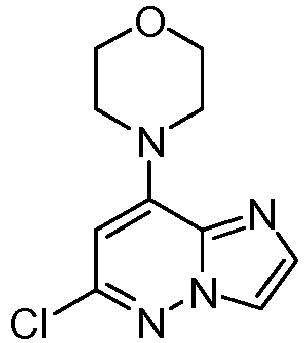
- From intermediate 5 (a 68/32 mixture of 6,8-dichloro-imidazo[1,2-b]pyridazine and 8-bromo-6-chloro-imidazo[1,2-b]pyridazine). Open column chromatography (silica, dichloromethane) yielded intermediate 9 as a pale yellow solid (66%).
-

- A mixture of intermediate 2 (0.7 g, 3.26 mmol) and methyl bromoacetate (0.93 ml, 9.78 mmol) in methanol (2.5 ml) was stirred at 130 °C for 15 min under microwave irradiation. The mixture was diluted with water and extracted with dichloromethane. The organic layer was separated, extracted with brine, dried (Na2SO4), filtered and the solvents evaporated in vacuo. The crude product was purified by flash column chromatography (silica; 7 M solution of ammonia in methanol in dichloromethane 0/100 to 3/97). The desired fractions were collected and concentrated in vacuo to yield intermediate 10 (0.314 g, 29%).
-

- Tetrakis(triphenylphosphine)palladium (0) (0.114 g, 0.10 mmol) was added to a stirred solution of intermediate 3 (a mixture 70/30 of 6,8-dichloro-2-methyl-imidazo[1,2-b]pyridazine and 8-bromo-6-chloro-2-methyl-imidazo[1,2-b]pyridazine) (0.4 g, 2.0 mmol) and 4-pyridineboronic acid (0.243 g, 2.0 mmol) in a mixture of 1,4-dioxane (2 ml) and a saturated solution of sodium carbonate (2 ml). The mixture was stirred at 100 °C for 16 h. in a sealed tube under nitrogen and then filtered through a pad of diatomaceous earth. The filtrate was diluted with dichloromethane and extracted with a saturated solution of sodium carbonate. The organic layer was separated, dried (Na2SO4), filtered and the solvents evaporated in vacuo. The crude product was purified by column chromatography (silica; ethyl acetate in heptane 0/100 to 50/50). The desired fractions were collected and concentrated in vacuo to yield intermediate 11 (0.26 g, 41%). LCMS: 288 [M+H]+; Rt: 2.17 min (method 4).
- The following intermediates were prepared from the indicated precursors according to a protocol analogous to A11.
-
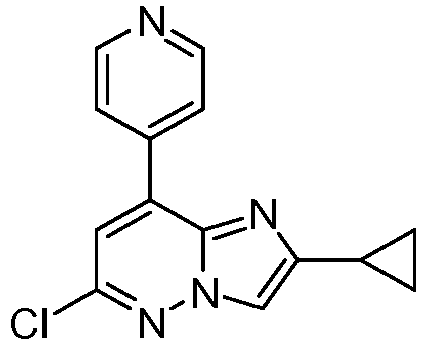
- From intermediate 4. Flash column chromatography (silica; ethyl acetate in dichloromethane 0/100 to 30/70) yielded intermediate 12 as a pale yellow solid (52%). LCMS: 271 [M+H]+; Rt: 2.11 min (method 5).
-
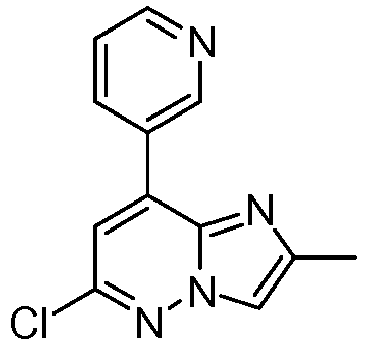
- From intermediate 6 and 3-pyridineboronic acid. Conditions: 140 °C for 15 min under microwave irradiation. Flash column chromatography (silica; 7 M solution of ammonia in methanol in dichloromethane 0/100 to 4/96) yielded intermediate 13 as a pale brown solid (100%).
-

- 10% Palladium on charcoal (0.421 g) was added to a suspension of intermediate 7 (1 g, 3.96 mmol) and ammonium formate (0.75 g, 11.9 mmol) in methanol (25 ml). The mixture was stirred at 80 °C for 4 h. and at room temperature for a further 16 h. The mixture was filtered through a pad of diatomaceous earth and the filtrate was concentrated in vacuo. The crude product was suspended in dichloromethane and washed with a saturated solution of sodium hydrogen carbonate. The organic layer was separated, dried (Na2SO4), filtered and the solvents evaporated in vacuo to yield intermediate 14 (0.78 g, 90%) as a white solid. LCMS: 219 [M+H]+; Rt: 0.98 min (method 5).
- The following intermediates were prepared from the indicated precursors according to a protocol analogous to A14.
-

- From intermediate 10. Flash column chromatography (7 M solution of ammonia in methanol in dichloromethane 0/100 to 3/97) yielded intermediate 15 as a pale brown solid (65%).
-

- 10% Palladium on charcoal (0.391 g) was added to a mixture of intermediate 8 (4.1 g, 14.7 mmol) and triethylamine (4.1 ml, 29.4 mmol) in a mixture of methanol (100 ml) and tetrahydrofuran (100 ml). The mixture was hydrogenated (atmospheric pressure) at room temperature for 8 h and then filtered through a pad of diatomaceous earth. The filtrate was concentrated in vacuo to yield intermediate 16 (3.1 g, 94%). LCMS: 219 [M+H]+; Rt: 0.98 min (method 5).
- The following intermediates were prepared from the indicated precursors according to a protocol analogous to A16.
-

- From intermediate 9. Precipitation from diisopropylether yielded intermediate 17 as a pale pink solid (76%).
-
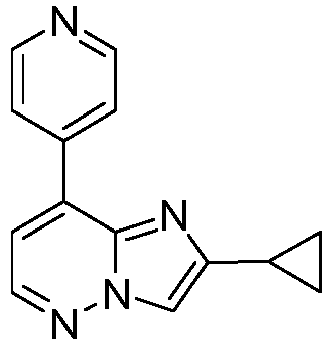
- From intermediate 12. Flash column chromatography (silica; ethylacetate in heptane 0/100 to 50/50) yielded intermediate 18 as a white solid (50%). LCMS: 237 [M+H]+; Rt: 1.83 min (method 5).
-

- From intermediate 13. Flash column chromatography (silica, 7 M solution of ammonia in methanol in dichloromethane 0/100 to 2/98) yielded intermediate 19 as a pale brown solid (43%). LCMS: 211 [M+H]+; Rt: 1.14 min (method 5).
-
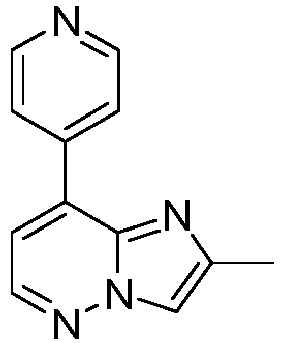
- 10% Palladium on charcoal (1.22 g) was added to a suspension of intermediate 11 (4 g, 16.35 mmol) in a mixture of methanol (400 ml) and dichlorometane (30 ml). The mixture was hydrogenated (40 psi) at 50 °C for 6 h. and then filtered through a pad of diatomaceous earth. The filtrate was concentrated in vacuo to yield intermediate 20 (3 g, 86%) as a yellow solid. LCMS: 211 [M+H]+; Rt: 2.11 min (method 1).
-

- Tetrakis(triphenylphosphine)palladium (0) (0.457 g, 0.396 mmol) was added to a stirred solution of intermediate 7 (1 g, 3.96 mmol) and methylboronic acid (1.18 g, 19.79 mmol) in a mixture of 1,4-dioxane (12 ml) and a saturated solution of sodium carbonate (4 ml). The mixture was stirred at 175 °C for 45 min. in a sealed tube under nitrogen and under microwave irradiation. The mixture was filtered through a pad of diatomaceous earth and the filtrate diluted with ethylacetate and washed with water. The organic layer was separated, dried (Na2SO4), filtered and the solvents evaporated in vacuo. The crude product was purified by column chromatography (silica; ethyl acetate in heptane 20/80 to 50/50). The desired fractions were collected and concentrated in vacuo to yield intermediate 21 (0.364 g, 40%). LCMS: 233 [M+H]+; Rt: 1.98 min (method 2).
- The following intermediates were prepared from the indicated precursors according to a protocol analogous to A21.
-

- From intermediate 11. Flash column chromatography (silica; 7 M solution of ammonia in methanol in dichloromethane 0/100 to 1.5/98.5) yielded intermediate 22 as a light yellow solid (65%). LCMS: 225 [M+H]+; Rt: 2.00 min (method 2).
-

- Palladium (II) acetate (0.066 g, 0.297 mmol) was added to a stirred solution of intermediate 7 (0.5 g, 1.98 mmol), cyclopropylboronic acid (0.255 g, 2.97 mmol), 2-dicyclohexylphosphino-2',6'-dimethoxybiphenyl (0.244 g, 0.594 mmol) and potassium phosphate (0.84 g, 3.96 mmol) in toluene (10 ml). The mixture was stirred at 150 °C for 45 min. in a sealed tube under nitrogen and under microwave irradiation. The mixture was diluted with dichloromethane and washed with water. The organic layer was separated, dried (Na2SO4), filtered and the solvents evaporated in vacuo. The crude product was purified by column chromatography (silica; ethyl acetate in heptane 0/100 to 50/50). The desired fractions were collected and concentrated in vacuo to yield intermediate 23 (0.434 g, 85%). LCMS: 259 [M+H]+; Rt: 2.22 min (method 5).
- The following intermediates were prepared from the indicated precursors according to a protocol analogous to A23.
-
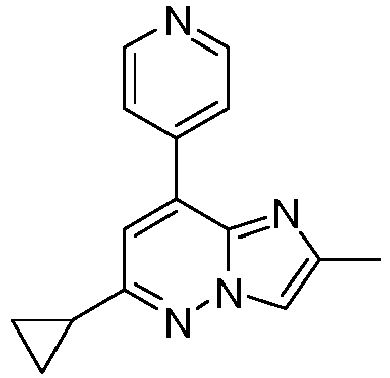
- From intermediate 11. Flash column chromatography (7 M solution of ammonia in methanol in dichloromethane 0/100 to 4/96) yielded intermediate 24 as a light yellow solid (87%). LCMS: 251 [M+H]+; Rt: 2.20 min (method 5).
-

- From intermediate 8 and methylboronic acid. Flash column chromatography (silica; ethyl acetate in dichloromethane 0/100 to 30/70) yielded intermediate 25 as a pale yellow solid (75%).
-

- N-Iodosuccinimide (1.08 g, 4.8 mmol) was added to a stirred solution of intermediate 14 (1 g, 4.58 mmol) in a mixture of dichloromethane (50 ml) and acetic acid (2 ml). The mixture was stirred at 0 °C for 30 min. and then extracted with a saturated solution of sodium carbonate and a 10% solution of sodium thiosulfite. The organic layer was filtered over cotton wool and the solvents evaporated in vacuo. The crude product was purified by flash column chromatography (silica, dichloromethane in heptane 70/30 first, then ethyl acetate in heptane 10/90 to 30/70). The desired fractions were collected and concentrated to yield intermediate 26 (4.68 g, 83 %) as a white solid. LCMS: 345 [M+H]+; Rt: 2.59 min (method 1).
- The following intermediates were prepared from the indicated precursors according to a protocol analogous to A26.
-

- From intermediate 16. Flash column chromatography (silica; ethyl acetate in dichloromethane 0/100 to 20/80) yielded intermediate 27 as a pale brown solid (95%). LCMS: 371 [M+H]+; Rt: 3.15 min (method 5).
-

- From intermediate 21. Flash column chromatography (silica; 7 M solution of ammonia in methanol in dichloromethane 0/100 to 2/98) yielded intermediate 28 as a white solid (77%). LCMS: 359 [M+H]+; Rt: 2.84 min (method 2).
-

- From intermediate 20. Flash column chromatography (silica; ethyl acetate in dichloromethane 0/100 to 30/70) yielded intermediate 29 as a pale yellow solid (96%). LCMS: 351 [M+H]+; Rt: 2.43 min (method 2).
-

- From intermediate 22. Flash column chromatography (silica; ethyl acetate in dichloromethane 30/70 to 70/30) yielded intermediate 30 as a pale yellow solid (72%). LCMS: 351 [M+H]+; Rt: 2.71 min (method 2).
-

- N-Iodosuccinimide (0.95 g, 4.36 mmol) was added to a stirred solution of a mixture 70/30 of intermediate 3 (0.95 g, 3.36 mmol) in a mixture of dichloromethane (9 ml) and acetic acid (1 ml). The mixture was stirred at room temperature for 16 h. and then washed with a saturated solution of sodium carbonate. The organic layer was separated, dried (Na2SO4), filtered and the solvents evaporated in vacuo to yield 1.33 g of crude product. A portion of this crude product (0.5 g) was dissolved in acetonitrile (8 ml) and morpholine (0.140 ml, 1.6 mmol) and N,N-diisopropylethylamine (0.393 ml, 2.29 mmol) were added. The mixture was stirred at 150 °C for 10 min in a sealed tube, under microwave irradiation. The mixture was diluted with ethyl acetate and washed with a saturated solution of ammonium chloride. The organic layer was separated, dried (Na2SO4), filtered and the solvents evaporated in vacuo to yield intermediate 31 (0.53 g, 69%).
-

- N-Bromosuccinimide (0.273 g, 1.53 mmol) was added to a stirred solution of intermediate 14 (0.335 g, 1.53 mmol) in acetonitrile (10 ml). The mixture was stirred at room temperature for 1h., then diluted with ethyl acetate and washed with a saturated solution of sodium carbonate. The organic layer was separated, dried (Na2SO4), filtered and the solvents evaporated in vacuo. The crude product was purified by flash column chromatography (silica, 7 M solution of ammonia in methanol in dichloromethane 4/96). The desired fractions were collected and concentrated in vacuo and the crude product purified again by flash column chromatography (silica, ethyl acetate in heptane 0/100 to 100/0). The desired fractions were collected and concentrated in vacuo to yield intermediate 32 (0.1 g, 21.2 %).
- The following intermediates were prepared from the indicated precursors according to a protocol analogous to A32.
-

- From intermediate 20. Flash column chromatography (silica; 7 M solution of ammonia in methanol in dichloromethane 0/100 to 4/96) to yield intermediate 33 as a pale brown solid (73%).
-

- From intermediate 8. Flash column chromatography (silica, dichloromethane) yielded intermediate 34 as a white solid (59%). LCMS: 357 [M+H]+; Rt: 3.16 min (method 4).
-

- Tetrakis(triphenylphosphine)palladium (0) (0.403 g, 0.35 mmol) was added to a stirred solution of intermediate 26 (4 g, 11.6 mmol) and 2-chloropyridine-5-boronic acid (2.01 g, 12.79 mmol) in a mixture of 1,4-dioxane (40 ml) and a saturated solution of sodium carbonate (20 ml). The mixture was stirred at 100 °C for 16 h. in a sealed tube under nitrogen and then diluted with dichloromethane and extracted with water. The organic layer was separated, dried (Na2SO4), filtered and the solvents evaporated in vacuo. The crude product was precipitated from methanol to yield intermediate 35 (0.364 g, 40%). LCMS: 330 [M+H]+; Rt: 1.90 min (method 5).
- The following intermediates were prepared from the indicated precursors according to a protocol analogous to A35.
-

- From intermediate 26 and 2-chloropyridine-4-boronic acid. Precipitation from methanol yielded intermediate 36 as a pale brown solid (95 %).
-

- From intermediate 29. Conditions: 150 °C for 15 min. under microwave irradiation. Precipitation from methanol yielded intermediate 37 as a pale brown solid (71 %).
-

- Tetrakis(triphenylphosphine)palladium (0) (0.099 g, 0.086 mmol) was added to a stirred solution of intermediate 35 (0.945 g, 2.86 mmol) and vinylboronic acid pinacol ester (0.58 ml, 3.44 mmol) in a mixture of 1,4-dioxane (20 ml) and a saturated solution of sodium carbonate (4 ml). The mixture was stirred at 90 °C for 16 h. in a sealed tube under nitrogen. The mixture was diluted with dichloromethane and washed with water. The organic layer was separated, filtered over cotton and the solvents evaporated in vacuo. The crude product was purified by flash column chromatography (silica; 7 M solution of ammonia in methanol in dichloromethane 0/100 to 4/96). The desired fractions were collected and concentrated in vacuo to yield intermediate 38 (0.159 g, 74%). LCMS: 322 [M+H]+; Rt: 3.66 min (method 6).
- The following intermediate was prepared from the indicated precursors according to a protocol analogous to A38.
-

- From intermediate 37. Conditions: 150 °C for 15 min. under microwave irradiation. Flash column chromatography (silica; ethyl acetate in dichloromethane 0/100 to 50/50) yielded intermediate 39 as a yellow solid (100%). LCMS: 314 [M+H]+; Rt: 1.67 min (method 5).
-

- From intermediate 36. Conditions: 150 °C for 15 min. under microwave irradiation. Flash column chromatography (silica; ethyl acetate in heptane 20/80 to 40/60) yielded intermediate 40 as a white solid (90%). LCMS: 322 [M+H]+; Rt: 1.83 min (method 5).
-

- Tetrakis(triphenylphosphine)palladium (0) (0.037 g, 0.032 mmol) was added to a stirred solution of intermediate 35 (0.35 g, 1.06 mmol) and 3,6-dihydro-2H-pyran-4-boronic acid pinacol ester (0.267 ml, 1.24 mmol) (obtained by procedures similar to those described in,
Qiu, Y. et al. WO 2004/075846-A2 published on 20040910) in a mixture of 1,4-dioxane (5 ml) and a saturated solution of sodium carbonate (2 ml). The mixture was stirred at 85 °C for 5 h. in a sealed tube under nitrogen, then diluted with dichloromethane and washed with water. The organic layer was separated, dried (MgSO4), filtered and the solvents evaporated in vacuo. The crude product was purified by flash column chromatography (silica; ethyl acetate in heptane 20/80 to 0/100). The desired fractions were collected and concentrated in vacuo to yield intermediate 41 (0.159 g, 62%). -

- Triphenylphosphine (12.3 g, 47.0 mmol) was added to a stirred solution of 3-methoxy-3-methyl-butan-1-ol (4 ml, 31.3 mmol) and carbon tetrabromide (15.6 g, 47.0 mmol) in dichloromethane (300 ml) at 0 °C. The mixture was stirred at room temperature for 18 h. and then a solution of sodium thiosulphate was added. The organic layer was separated, dried (Na2SO4), filtered and the solvents evaporated in vacuo. The crude product was triturated with diethyl ether, filtered off and purified by flash column chromatography (silica; petroleum ether in dichloromethane 0/100 to 50/50). The desired fractions were collected and concentrated in vacuo to yield intermediate 42 (2.1 g, 37%).
-

- Sodium iodide (2.9 g, 19.3 mmol) was added to a stirred solution of intermediate 42 (1.4 g, 7.7 mmol) in dry acetone (10 ml). The mixture was stirred at reflux temperature for 3 h. and then filtered. The filtrate was carefully concentrated in vacuo. The crude product was purified by flash column chromatography (silica; dichloromethane). The desired fractions were collected and concentrated in vacuo to yield intermediate 43 (1.7 g, 81%).
- The following intermediates were prepared from the indicated precursors according to a protocol analogous to A43.
-

- From 1-bromo-3-methoxy-propane. Flash column chromatography (silica; dichloromethane) yielded intermediate 44 as a colourless oil (84%).
-

- 2-Methoxy-ethanol (1.18 ml, 14.95 mmol) was added dropwise to a stirred suspension of a 60% dispersion of sodium hydride in mineral oils (0.558 g, 13.95 mmol) in dimethylsulfoxide (30 ml). The mixture was stirred at room temperature for 30 min. and then 2,5-dibromo-3-methylpyridine (2.5 g, 9.96 mmol) was added. The mixture was stirred at 60 °C for 1 h. and then diluted with heptane and washed with water. The organic layer was separated, dried (Na2SO4), filtered and the solvents evaporated in vacuo. The crude product was purified by flash column chromatography (silica; dichloromethane in heptanes 70/30). The desired fractions were collected and concentrated in vacuo to yield intermediate 45 (2.23 g, 91%).
- The following intermediates were prepared from the indicated precursors according to a protocol analogous to A45.
-
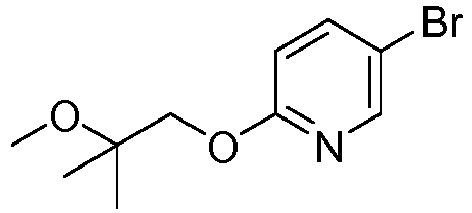
- From 2-methoxy-2-methyl-propan-1-ol (obtained by procedures similar to those described in,
Morel, P. US 2008102028-A1 published on 20080501) and 5-bromo-2-chloro-pyridine. Flash column chromatography (silica; dichloromethane in heptane 50/50 to 70/30) yielded intermediate 46 as a clear syrup (75%). -

- From 2-methoxy-ethanol and 5-bromo-2-chloro-pyridine. Flash column chromatography (silica; dichloromethane in heptane 30/70 to 70/30) yielded intermediate 47 as a colourless oil (75%). LCMS: 232 [M+H]+; Rt: 2.50 min (method 1).
-

- A solution of 2-(5-bromo-pyridin-2-yl)-propan-2-ol (0.80 g, 3.70 mmol) (obtained by procedures similar to those described in, Wang, X. et al. Tetrahedron Lett., 2000, 4335) in tetrahydrofuran (8 ml) was added dropwise to a stirred suspension of a 60% dispersion of sodium hydride in mineral oils (0.440 mg, 11.1 mmol) in tetrahydrofuran (6 ml). The mixture was stirred at 0 °C for 20 min. and then iodoethane (1.27 ml, 15.9 mmol) was added dropwise. The mixture was stirred at room temperature for 4 d., then diluted with dichloromethane and washed with water. The organic layer was separated, dried (Na2SO4), filtered and the solvents evaporated in vacuo. The crude product was purified by flash column chromatography (silica; ethyl acetate in heptane 0/100 to 20/80). The desired fractions were collected and concentrated in vacuo to yield intermediate 48 (0.7 g, 77%). LCMS: 244 [M+H]+; Rt: 2.93 min (method 5).
- The following intermediate was prepared from the indicated precursors according to a protocol analogous to A48.
-

- From 2-(5-bromo-pyridin-2-yl)-propan-2-ol (obtained by procedures similar to those described in, Wang, X. et al.; Tetrahedron Lett., 2000, 4335) and dimethylsulfate. Flash column chromatography (silica; dichloromethane in heptane 0/100 to 50/50) yielded intermediate 49 as a colourless oil (69%). LCMS; 230 [M+H]+; Rt: 1.81 min (method 5).
-

- Potassium cyanide (0.489 g, 7.41 mmol) and potassium iodide (0.013 g, 0.079 mmol) were added to a stirred solution of 5-bromo-2-chloromethyl-pyridine (0.9 g, 3.70 mmol) (obtained by procedures similar to those described in, van den Heuvel, M. et al.; J. Org. Chem., 2004, 250) in a mixture of ethanol (6 ml) and water (2 ml). The mixture was stirred at 80 °C for 6 h., then diluted with dichloromethane and washed with a saturated solution of sodium hydrogen carbonate. The organic layer was separated, dried (Na2SO4), filtered and the solvents evaporated in vacuo. The crude product was purified by flash column chromatography (silica; dichloromethane). The desired fractions were collected and concentrated in vacuo to yield intermediate 50 (0.498 g, 68%).
-

- Iodomethane (1.14 ml, 18.27 mmol) was added to a stirred mixture of intermediate 50 (0.45 g, 2.28 mmol), potassium tert-butoxide (0.64 g, 5.71 mmol) and 18-crown-6 (0.091 g, 0.34 mmol) in tetrahydrofuran (10 ml). The mixture was stirred at room temperature for 18 h., then diluted with dichloromethane and washed with water. The organic layer was separated, dried (Na2SO4), filtered and the solvents evaporated in vacuo. The crude product was purified by flash column chromatography (silica; dichloromethane). The desired fractions were collected and concentrated in vacuo to yield intermediate 51 (0.503 g, 98%).
-

- AIM solution of diisobutylaluminium hydride in toluene (2.46 ml, 2.46 mmol) was added to a stirred solution of intermediate 51 (0.503 g, 2.23 mmol) in dichloromethane (5 ml) at -78 °C under nitrogen. The mixture was allowed to warm to room temperature and then stirred for 18 h. The mixture was cooled down to -78 °C and a further 1 M solution of diisobutylaluminium hydride in toluene (1 ml, 1.0 mmol) was added. The mixture was stirred at room temperature for 4 h., then a 0.5 M sulphuric acid solution was added at -78 °C, after which the reaction was diluted with dichloromethane and filtered through a pad of diatomaceous earth. The organic layer was separated, dried (MgSO4), filtered and the solvents evaporated in vacuo. The crude product was purified by flash column chromatography (silica; dichloromethane in heptane 50/50 to 100/0). The desired fractions were collected and concentrated in vacuo to yield intermediate 52 (0.2 g, 40%).
-

- Sodium borohydride (0.043 g, 1.14 mmol) was added to a stirred solution of intermediate 52 (0.2 mg, 0.88 mmol) in dichloromethane (5 ml). The mixture was stirred at room temperature for 2 h. and then a saturated solution of sodium hydrogen carbonate was added. The organic layer was separated, dried (MgSO4), filtered and the solvents evaporated in vacuo. The crude product was purified by flash column chromatography (silica; ethyl acetate). The desired fractions were collected and concentrated in vacuo to yield intermediate 53 (0.2 g, 40%).
-

- Iodomethane (0.16 ml, 2.61 mmol) was added to a stirred mixture of intermediate 53 (0.20 g, 0.87 mmol), potassium tert-butoxide (0.146 mg, 1.30 mmol) and 18-crown-6 (0.34 mg, 0.13 mmol) in tetrahydrofuran (5 ml). The mixture was stirred at room temperature for 18 h., then diluted with dichloromethane and washed with water. The organic layer was separated, dried (Na2SO4), filtered and the solvents evaporated in vacuo. The crude product was purified by flash column chromatography (silica; dichloromethane). The desired fractions were collected and concentrated in vacuo to yield intermediate 54 (0.088 mg, 41 %).
-

- Tetrakis(triphenylphosphine)palladium(0) (1.82 g, 1.53 mmol) was added to a stirred suspension of 2,5-dibromopyridine (15 g, 63.3 mmol) and 4,4,5,5-tetramethyl-2-vinyl-1,3,2-dioxaborolane (11.8 ml, 69.6 mmol) in a mixture of 1,4-dioxane (120 ml) and a saturated solution of sodium carbonate (36 ml). The mixture was stirred at 100 °C for 16 h. in a sealed tube under nitrogen. The mixture was diluted with dichloromethane and washed with water. The organic layer was separated, dried (Na2SO4), filtered and the solvents evaporated in vacuo. The crude product was purified by flash column chromatography (silica; dichloromethane in heptane 20/80 to 80/20). The desired fractions were collected and concentrated in vacuo to yield intermediate 55 (6.23 g, 53 %). LCMS: 184 [M+H]+; Rt: 2.47 min (method 3).
-

- Sodium methoxide (5.48 g, 101.6 mmol) was added to a solution of intermediate 55 (6.23 g, 33.8 mmol) in dry methanol (120 ml). The mixture was stirred at 90 °C for 36 h. and then further sodium methoxide (1.82 g, 33.8 mmol) was added. The mixture was stirred at 90 °C for 7 h. and the solvents evaporated in vacuo. The crude product was dissolved in dichloromethane and washed with water. The organic layer was separated, dried (Na2SO4), filtered and the solvents evaporated in vacuo. The crude product was purified by flash column chromatography (silica; heptane in dichloromethane 70/30 to 0/100). The desired fractions were collected and concentrated in vacuo to yield intermediate 56 (3.78 g, 52%). LCMS: 216 [M+H]+; Rt: 1.21 min (method 5).
-

- A 2.5 M solution of n-butyllithium in pentane (8.37 ml, 20.9 mmol) was added dropwise to a stirred solution of N,N-diisopropylamine (3.45 ml, 24.4 mmol) in dry tetrahydrofuran (20 ml) at -78 °C. The mixture was stirred at 0 °C for 30 min, cooled down to -78 °C. and then added dropwise to a solution of 5-bromo-2-picoline (3.0 g, 17.4 mmol) in tetrahydrofuran (20 ml). The mixture was stirred at -78 °C for 15 min. and then acetone (3.85 ml, 52.3 mmol) was added dropwise. The mixture was stirred at -78 °C for 20 min. and then a saturated solution of ammonium chloride was added. The organic layer was separated and the aqueous layer was extracted with dichloromethane. The combined organic extracts were dried (Na2SO4), filtered and the solvents evaporated in vacuo. The crude product was purified by flash column chromatography (silica; ethyl acetate in dichloromethane 0/100 to 20/80). The desired fractions were collected and concentrated in vacuo to yield intermediate 57 (1.75 g, 43%) as a colourless oil.
-

- A 60% suspension of sodium hydride in mineral oils (2.36 g, 58.9 mmol) was added portionwise to a stirred solution of intermediate 57 (2.36 g, 58.9 mmol) in tetrahydrofuran (10 ml). The mixture was stirred at 0 °C for 30 min. and then iodomethane (3.67 ml, 58.9 mmol) was added. The mixture was stirred at room temperature for 18 h. and then further 60% suspension of sodium hydride in mineral oils (2.36 g, 58.9 mmol) and iodomethane (3.67 ml, 58.9 mmol) were added. The mixture was stirred at room temperature for 3 h. and then the solvents were evaporated in vacuo. The crude product was diluted with dichloromethane and washed with a saturated solution of ammonium chloride and a saturated solution of sodium hydrogen carbonate. The organic layer was separated, dried (Na2SO4), filtered and the solvents evaporated in vacuo. The crude product was purified by flash column chromatography (silica; ethyl acetate in dichloromethane 0/100 to 10/90). The desired fractions were collected and concentrated in vacuo to yield intermediate 58 (6.90 g, 53%).
-

- 1,2-Dibromoethane (0.237 ml, 2.75 mmol) was added to a stirred suspension of zinc (3.6 g, 55.0 mmol) in dry N,N-dimethylformamide (40 ml). The mixture was stirred at 90 °C for 30 min. under nitrogen and then allowed to warm to room temperature. Chlorotrimethylsilane (0.09 ml, 0.69 mmol) was added and the mixture was stirred at room temperature for 15 min. A solution of intermediate 44 (5.5 g, 27.5 mmol) in tetrahydrofuran (20ml) was added dropwise and the mixture was stirred at 45 °C for 2.5 h. The excess zinc was allowed to settle for 1 h and the supernatant liquid was transferred via cannula to a mixture of 2,5-dibromopyridine (2.17 g, 9.17 mmol) and bis(triphenylphosphine)palladium dichloride (0.212 g, 0.18 mmol). The mixture was stirred at 55 °C for 4 h. under nitrogen, then the solvents were evaporated in vacuo. The crude product was partitioned between dichloromethane and a saturated solution of sodium hydrogen carbonate. The organic layer was separated, dried (Na2SO4), filtered and the solvents evaporated in vacuo. The crude product was purified by flash column chromatography (silica, ethyl acetate in dichloromethane 0/100 to 20/80). The desired fractions were collected and concentrated in vacuo to yield intermediate 59 (1.4 g, 66%).
-

- A 60% suspension of sodium hydride in mineral oils (0.073 g, 3.19 mmol) was added to a stirred solution of 5-bromo-2-(hydroxymethyl)pyridine (0.5 g, 2.66 mmol) in tetrahydrofuran (10 ml). The mixture was stirred at 0 °C for 30 min. and then iodoethane (0.498 g, 3.19 mmol) was added. The mixture was stirred at 60 °C for 18 h., then diluted with diethyl ether and washed with a saturated solution of ammonium chloride in water. The organic layer was separated, dried (Na2SO4), filtered and the solvents evaporated in vacuo to yield intermediate 60 (0.520 g, 90%) as a colourless oil.
-
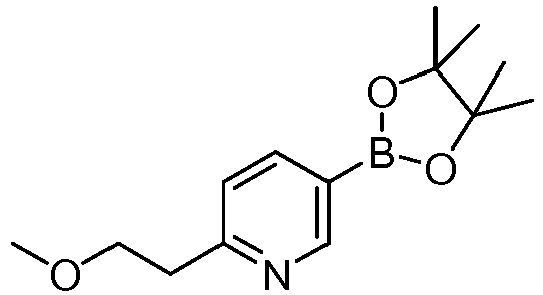
- [1,1'-Bis(diphenylphosphino)ferrocene]dichloropalladium (II) (0.061 g, 0.083 mmol) was added to a stirred suspension of intermediate 56 (0.6 g, 2.77 mmol), 4,4,4',4',5,5,5',5'-octamethyl-2,2'-bi-1,3,2-dioxaborolane (0.846 g, 3.33 mmol) and potassium acetate (0.817 g, 8.33 mmol) in a mixture of 1,4-dioxane (9 ml) and N,N-dimethylformamide (1.2 ml). The mixture was stirred at 150 °C for 40 min. in a sealed tube under nitrogen and under microwave irradiation. The mixture was filtered through a pad of diatomaceous earth, and the filtrate diluted with dichloromethane and washed with water. The organic layer was separated, dried (Na2SO4), filtered and the solvents evaporated in vacuo to yield intermediate 61 (1.1 g, 64%, 43% purity) used in next step without further purification. LCMS: 264 [M+H]+; Rt: 1.55 min (method 5).
- The following intermediates were prepared from the indicated precursors according to a protocol analogous to A61.
-

- From intermediate 46 in dimethylsulfoxide as solvent, 80 °C, 4h. Extraction with heptane yielded intermediate 62 as a colourless oil (97%).
-

- From intermediate 47 in dimethylsulfoxide as solvent, 80 °C, 4h. Extraction with heptane yielded intermediate 63 as a colourless oil (93%).
-

- From intermediate 60 in dimethylsulfoxide as solvent, 80 °C, 4h. Extraction with heptane yielded intermeiate 64 as a colourless oil (84%).
-

- A mixture of 4-iodopyrazole (3 g, 15.47 mmol), 1-chloro-2-methyl-2-propanol and cesium carbonate (8.06 g, 24.75 mmol) in N,N-dimethylformamide (30 ml) was stirred at 160°C for 40 min in a sealed tube, under microwave irradiation. The mixture was diluted with water and extracted with dichloromethane. The organic layer was separated, dried (Na2SO4), filtered and the solvents evaporated in vacuo. The crude product was purified by flash column chromatography (silica; ethyl acetate in heptane 20/80 to 40/60). The desired fractions were collected and concentrated in vacuo to yield intermediate 65 (3.98 g, 97%) as a white solid.
-

- A 60% dispersion of sodium hydride in mineral oils (1.85 g, 46.23 mmol) was added portionwise to a stirred solution of intermediate 65 (4.1 g, 15.41 mmol) in tetrahydrofuran (70 ml) at 0°C. The mixture was stirred at room temperature for 15 min and then dimethyl sulfate (3.67 ml, 66.26 mmol) was added. The mixture was stirred at room temperature for a further 18 h. and then partitioned between dichloromethane and a saturated solution of sodium hydrogen carbonate. The organic layer was separated, dried (Na2SO4), filtered and the solvents evaporated in vacuo. The crude product was purified by flash column chromatography (silica; ethyl acetate in heptane 0/100 to 20/80). Desired fractions were collected and concentrated in vacuo to yield intermediate 66 (3.32 g, 74%) as a colorless oil.
-

- [1,1'-bis(diphenylphosphino)]dichloropalladium(II) (0.026g, 0.36 mmol) was added to a stirred solution of intermediate 66 (1.18 g, 4.21 mmol), bis(pinacolato)diboron (1.28 g, 5.06 mmol) and potassium acetate (1.24 g, 12.64 mmol) in dimethylsulfoxide (15 ml). The mixture was stirred at 80 °C for 16 h. in a sealed tube under nitrogen. After cooling to room temperature, the mixture was partitioned between water and heptane and then filtered over cotton to remove the resulting black slurry. The organic layer was separated and the aqueous layer extracted with heptane. The combined organic layers were dried (Na2SO4), filtered and the solvents evaporated in vacuo to yield intermediate 67 (0.96 g, 81 %) which was used in the next step without further purification.
-

- A mixture of 4-(4,4,5,5-tetramethyl-[1,3,2]dioxaborolan-2-yl)-1H-pyrazole (1 g, 5.15 mmol), 2-bromoethyl methyl ether (0.63 ml, 6.7 mmol) and cesium carbonate (2.52 g, 7.73 mmol) in N,N-dimethylformamide (7 ml) was stirred at 150 °C for 30 min. under microwave irradiation. The mixture was partitioned between water and diethyl ether. The organic layer was separated, dried (Na2SO4), filtered and the solvents evaporated in vacuo. The crude product was purified by flash column chromatography (silica; ethyl acetate in heptane 30/70). The desired fractions were collected and concentrated in vacuo to yield intermediate 68 (0.88 g, 68%) as a pale yellow oil.
-

- Tetrakis(triphenylphosphine)palladium(0) (0.068 g, 0.059 mmol) was added to a stirred solution of intermediate 34 (0.30 g, 0.84 mmol) and intermediate 67 (0.446 g, 1.59 mmol) in a mixture of 1,4-dioxane (20 ml) and a saturated solution of sodium carbonate (6 ml). The mixture was stirred at 150 °C for 15 min, in a sealed tube under nitrogen and under microwave irradiation. The mixture was diluted with dichlorometane and washed with water. The organic layer was separated, dried (Na2SO4), filtered and the solvents evaporated in vacuo. The crude product was purified by flash column chromatography (silica: 7 M solution of ammonia in methanol in dichloromethane 0/100 to 2/98). The desired fractions were collected and concentrated and the crude product purified again by flash column chromatography (silica; ethyl acetate in heptane 10/90 to 50/50). The desired fractions were collected and concentrated in vacuo to yield intermediate 69 (0.216 g, 59%). LCMS: 431 [M+H]+; Rt: 4.30 min (method 1). This compound is also a final compound (compound 150).
-

- Palladium (II) acetate (0.066 g, 0.294 mmol) was added to a stirred solution of intermediate 14 (1.5 g, 5.89 mmol), intermediate A56 (1.91 g, 8.83 mmol), butyldi-1-adamantylphosphine (0.211 g, 0.59 mmol) and potassium phosphate (3.75 g, 17.7 mmol) in N,N-dimethylformamide (10 ml). The mixture was stirred at room temperature for 15 min. and then at 120 °C for 24 h. in a sealed tube under nitrogen. The mixture was diluted with diethyl ether and washed with a 1% potassium hydroxide solution. The organic layer was separated, dried (MgSO4), filtered and the solvents evaporated in vacuo. The crude product was purified by flash column chromatography (silica; 7 M solution of ammonia in methanol in dichloromethane 0/100 to 40/60). The desired fractions were collected and concentrated in vacuo. The crude product was triturated from diisopropyl ether to yield compound 1 (1.74 g, 84%) as a white solid. 1H NMR (400 MHz, CDCl3) δ ppm 2.54 (s, 3 H), 3.13 (t, J=6.7 Hz, 2 H), 3.39 (s, 3 H), 3.83 (t, J=6.8 Hz, 2 H), 3.88 - 4.04 (m, 8 H), 6.10 (d, J=5.5 Hz, 1 H), 7.36 (d, J=8.1 Hz, 1 H), 7.98 (dd, J=8.1, 2.1 Hz, 1 H), 7.99 (d, J=5.5 Hz, 1 H), 8.80 (d, J=2.3 Hz, 1 H).
- For compound 1, the hydrochloride salt (.HCl) (mp = 164.8 °C with decomposition); the maleate salt (.C4H4O4) (mp = 113.8 °C) and the monohydrate (.H2O) (DSC: dehydration at about 88 °C followed by melt at 131.9 °C), were obtained following the procedures described below.
- For the formation of the hydrochloride salt (compound 1a):
- To a stirred solution of compound 1 (0.5 g, 1.41 mmol) in 2-butanone (7.50 mL) was added hydrogen chloride (1 N, 1.27 mL, 1.27 mmol). The mixture was concentrated in vacuo till dry at 50 °C, then 2-butanone (7.50 mL) was added. Formation of a white solid was observed and the suspension was further stirred at room temperature overnight. The solid was filtered off and dried overnight at 50 °C to yield the hydrochloride salt (0.397 g, 72%) as a white solid.
- For the formation of the maleate salt (compound 1b):
- To a mixture of compound 1 (1.00 g, 2.83 mmol) and (Z)-2-butenedioic acid (344.85 mg, 2.97 mmol), was added 1-methoxy-2-propanol (15.00 mL) and the mixture was heated to 40 °C then cooled down to 0 °C and stirred overnight at 0 °C. Precipitation was observed, with formation of very fine solids, giving the reaction mixture an almost milky appearance. A small amount of these solids was set aside and used subsequently as seeding material (see below). The mixture was heated to 50 °C. The solvent was partially evaporated to a volume of 10 mL and the reaction mixture was seeded with original solids at 45 °C. Stirring was continued at 45 °C for 4 hours, then at 40 °C for 2 hours and continued at 20 °C overnight. The resulting solid was filtered off, washed once with a very small amount of propylene glycol monomethyl ether (PGME) and once with methyl tert-butyl ether (MTBE) and dried overnight at 45 °C, to yield the maleate salt (850 mg, 64%) as a white to slightly yellow solid.
- For the formation of the hydrate (compound 1c), two different procedures were used:
- a) water (2 mL) was added to the solid compound (20 mg) and allowed to slurry at 70 °C for 30 minutes. The heat was turned off and the solution mixture was allowed to continue to slurry at room temperature for 3 days.
- b) water (4 mL) was added to the solid compound (200 mg) and allowed to slurry at room temperature for 5 days.
- The following compounds were prepared from the indicated precursors according to a protocol analogous to B1.
-

- From intermediate 14 and intermediate 59. Flash column chromatography (silica; ethyl acetate in heptane 20/80 to 40/60) and precipitation from methanol yielded compound 2 as a white solid (55%). 1H NMR (500 MHz, CDCl3) δ ppm 1.99 - 2.17 (m, 2 H), 2.54 (s, 3 H), 2.93 (t, J=7.5 Hz, 2 H), 3.37 (s, 3 H), 3.48 (t, J=6.4 Hz, 2 H), 3.90 - 4.01 (m, 8 H), 6.10 (d, J=5.8 Hz, 1 H), 7.31 (d, J=7.8 Hz, 1 H), 7.97 (dd, J=8.1, 2.3 Hz, 1 H), 7.99 (d, J=5.8 Hz, 1 H), 8.78 (d, J=1.7 Hz, 1 H).
-

- From intermediate 14 and intermediate 58. Flash column chromatography (silica; methanol in dichloromethane 0/100 to 2/98) yielded compound 3 as a white solid (56%). 1H NMR (400 MHz, DMSO-d6 ) δ ppm 1.16 (s, 6 H), 2.44 (s, 3 H), 2.96 (s, 2 H), 3.22 (s, 3 H), 3.80 (br t, J=4.9 Hz, 4 H), 3.97 (dd, J=4.9, 4.4 Hz, 4 H), 6.37 (d, J=5.8 Hz, 1 H), 7.40 (d, J=8.1 Hz, 1 H), 7.99 (dd, J=8.1, 2.3 Hz, 1 H), 8.10 (d, J=5.5 Hz, 1 H), 8.74 (d, J=2.1 Hz, 1 H).
-

- From intermediate 14 and intermediate 54. Flash column chromatography (silica; ethyl acetate in dichloromethane 0/100 to 100/0) yielded compound 4 as a white solid (74%). 1H NMR (400 MHz, CDCl3) δ ppm 1.41 (s, 6 H), 2.55 (s, 3 H), 3.34 (s, 3 H), 3.62 (s, 2 H), 3.85 - 4.05 (m, 8 H), 6.10 (d, J=5.5 Hz, 1 H), 7.49 (dd, J=8.3, 0.7 Hz, 1 H), 7.99 (d, J=5.5 Hz, 1 H), 8.01 (dd, J=8.3, 2.3 Hz, 1 H), 8.84 (dd, J=2.1, 0.7 Hz, 1 H).
-

- From intermediate 14 and intermediate 48. Flash column chromatography (silica; ethyl acetate in heptane 0/100 to 100/0) and precipitation from diethyl ether yielded compound 5 as a white solid (92%). 1H NMR (500 MHz, DMSO-d6) δ ppm 1.16 (t, J=7.1 Hz, 3 H), 1.53 (s, 6 H), 2.46 (s, 3 H), 3.32 (q, J=6.9 Hz, 2 H), 3.80 (br. t, J=4.9 Hz, 4 H), 3.98 (dd, J=4.9, 4.3 Hz, 4 H), 6.38 (d, J=5.8 Hz, 1 H), 7.68 (d, J=8.4 Hz, 1 H), 8.05 - 8.17 (m, 2 H), 8.79 (d, J=1.7 Hz, 1 H).
-

- From intermediate 14 and intermediate 49. Flash column chromatography (silica; ethyl acetate in heptane 0/100 to 100/0) and precipitation from diethyl ether yielded compound 6 as a white solid (92%). 1H NMR (500 MHz, DMSO-d6) δ ppm 1.53 (s, 6 H), 2.47 (s, 3 H), 3.13 (s, 3 H), 3.80 (br. t, J=4.9 Hz, 4 H), 3.98 (dd, J=4.9, 4.3 Hz, 4 H), 6.39 (d, J=5.8 Hz, 1 H), 7.67 (d, J=8.1 Hz, 1 H), 8.05 - 8.16 (m, 2 H), 8.81 (d, J=1.7 Hz, 1 H).
-

- From intermediate 20 and intermediate 58. Flash column chromatography (silica; 7 M solution of ammonia in methanol in dichloromethane 0/100 to 2/98), reverse phase HPLC (0.1% solution of formic acid in acetonitrile 80/20 to 0/100) and precipitation from diethyl ether yielded compound 7 as a white solid (54%). 1H NMR (400 MHz, DMSO-d6) δ ppm 1.18 (s, 6 H), 2.57 (s, 3 H), 2.99 (s, 2 H), 3.23 (s, 3 H), 7.46 (d, J=8.1 Hz, 1 H), 7.71 (d, J=4.9 Hz, 1 H), 8.07 (dd, J=8.1, 2.3 Hz, 1 H), 8.32 (d, J=6.2 Hz, 2 H), 8.65 (d, J=4.9 Hz, 1 H), 8.78 - 8.86 (m, 3 H).
-

- From intermediate 20 and intermediate 45. Flash column chromatography (silica; 7 M solution of ammonia in methanol in dichloromethane 0/100 to 2/98) and precipitation from diethyl ether yielded compound 8 as a yellow solid (79%). 1H NMR (500 MHz, DMSO-d6) δ ppm 2.25 (s, 3 H), 2.53 (s, 3 H), 3.35 (s, 3 H), 3.73 (br. t, J=4.6 Hz, 2 H), 4.50 (br. t, J=4.9 Hz, 2 H), 7.68 (d, J=4.9 Hz, 1 H), 7.88 - 7.93 (m, 1 H), 8.30 (d, J=1.7 Hz, 1 H), 8.32 (d, J=6.4 Hz, 2 H), 8.63 (d, J=4.9 Hz, 1 H), 8.82 (d, J=6.1 Hz, 2 H).
-

- From intermediate 19 and intermediate 47. Flash column chromatography (silica; 7 M solution of ammonia in methanol in dichloromethane 0/100 to 2/98), reverse phase HPLC (0.1% solution of ammonium formate/ammonium hydroxide buffer pH 9 and acetonitrile 20/80 to 0/100) and precipitation from diethyl ether yielded compound 9 as a pale yellow solid (73%). 1H NMR (500 MHz, DMSO-d6) δ ppm 2.54 (s, 3 H), 3.33 (s, 3 H), 3.71 (br. t, J=4.6 Hz, 2 H), 4.47 (br. t, J=4.6 Hz, 2 H), 7.04 (d, J=8.7 Hz, 1 H), 7.64 (d, J=4.9 Hz, 1 H), 7.65 (d, J=4.6 Hz, 1 H), 8.08 (dd, J=8.5, 2.5 Hz, 1 H), 8.49 (d, J=2.6 Hz, 1 H), 8.59 (d, J=4.6 Hz, 1 H), 8.72 (dt, J=8.0, 1.9 Hz, 1 H), 8.74 (dd, J=4.8, 1.6 Hz, 1 H), 9.47 (d, J=2.0 Hz, 1 H).
-

- From intermediate 18 and intermediate 56. Flash column chromatography (silica; ethyl acetate in dichloromethane 30/70 to 100/0) and precipitation from diisopropyl ether yielded compound 10 as a pale yellow solid (31%). 1H NMR (400 MHz, CDCl3) δ ppm 1.02 - 1.09 (m, 2 H), 1.19 - 1.28 (m, 2 H), 2.14 - 2.26 (m, 1 H), 3.17 (t, J=6.6 Hz, 2 H), 3.41 (s, 3 H), 3.86 (t, J=6.7 Hz, 2 H), 7.26 (d, J=4.6 Hz, 1 H), 7.42 (d, J=8.1 Hz, 1 H), 8.14 (dd, J=8.1, 2.3 Hz, 1 H), 8.14 - 8.19 (m, J=6.0 Hz, 2 H), 8.37 (d, J=4.6 Hz, 1 H), 8.81 (d, J=6.0 Hz, 2 H), 9.03 (d, J=2.1 Hz, 1 H).
-

- From intermediate 17 and intermediate 56. Flash column chromatography (silica; 7 M solution of ammonia in methanol in dichloromethane 0/100 to 3/97) and filtration through an Isolute SCX-2 cartridge followed by elution with a 7 M solution of ammonia in methanol yielded compound 11 as a white solid (83%). 1H NMR (500 MHz, DMSO-d6) δ ppm 3.01 (t, J=6.6 Hz, 2 H), 3.25 (s, 3 H), 3.72 (t, J=6.5 Hz, 2 H), 3.79 (br. t, J=4.9 Hz, 4 H), 4.00 (dd, J=4.9, 4.3 Hz, 4 H), 6.42 (d, J=5.8 Hz, 1 H), 7.41 (d, J=8.4 Hz, 1 H), 8.06 (s, 1 H), 8.24 (d, J=5.8 Hz, 1 H), 8.38 (dd, J=8.1, 2.3 Hz, 1 H), 9.14 (d, J=1.7 Hz, 1 H).
-

- From intermediate 15 and intermediate 56. Flash column chromatography (silica; 7 M solution of ammonia in methanol in dichloromethane 0/100 to 3/97) and precipitation from diisopropyl ether yielded compound 12 as a white solid (83%). 1H NMR (400 MHz, DMSO-d6) δ ppm 2.98 (t, J=6.7 Hz, 2 H), 3.25 (s, 3 H), 3.71 (t, J=6.6 Hz, 2 H), 3.80 (dd, J=5.1, 4.4 Hz, 4 H), 3.92 (dd, J=5.1, 4.4 Hz, 4 H), 4.06 (s, 3 H), 6.48 (d, J=6.0 Hz, 1 H), 7.38 (d, J=8.3 Hz, 1 H), 8.21 (d, J=5.8 Hz, 1 H), 8.35 (dd, J=8.3, 2.3 Hz, 1 H), 9.15 (d, J=2.3 Hz, 1 H).
-

- From intermediate 23 and intermediate 56. Flash column chromatography (silica; ethyl acetate in heptane 0/100 to 100/0) yielded compound 13 as a white solid (85%). 1H NMR (400 MHz, CDCl3) δ ppm 0.93 - 0.96 (m, 4 H), 1.88 - 1.97 (m, 1 H), 2.53 (s, 3 H), 3.13 (t, J=6.7 Hz, 2 H), 3.40 (s, 3 H), 3.84 (t, J=6.7 Hz, 2 H), 3.87 - 3.92 (m, 4 H), 3.92 - 3.98 (m, 4 H), 5.98 (s, 1 H), 7.33 (d, J=8.1 Hz, 1 H), 7.97 (dd, J=8.1, 2.3 Hz, 1 H), 8.85 (d, J=1.6 Hz, 1 H).
-
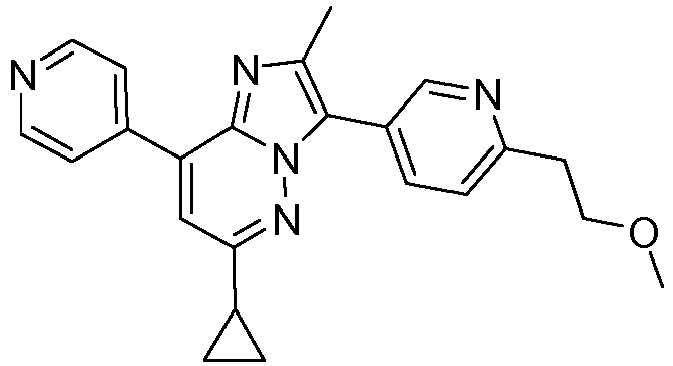
- From intermediate 24 and intermediate 56. Flash column chromatography (silica; methanol and ethyl acetate in heptane 0/30/70 to 2/98/0) and precipitation from diisopropyl ether yielded compound 14 as a pale yellow solid (85%). 1H NMR (500 MHz, CDCl3) δ ppm 1.03 - 1.15 (m, 4 H), 2.08 - 2.18 (m, 1 H), 2.63 (s, 3 H), 3.16 (t, J=6.5 Hz, 2 H), 3.41 (s, 3 H), 3.87 (t, J=6.6 Hz, 2 H), 7.06 (s, 1 H), 7.39 (d, J=8.1 Hz, 1 H), 8.00 (dd, J=8.1, 2.3 Hz, 1 H), 8.05 (d, J=6.1 Hz, 2 H), 8.81 (d, J=6.1 Hz, 2 H), 8.91 (d, J=1.7 Hz, 1 H).
-
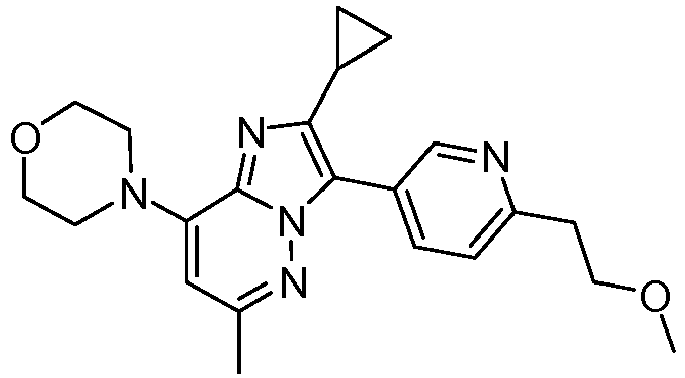
- From intermediate 25) and intermediate 56. Flash column chromatography (silica; ethyl acetate in heptane 20/80 to 50/50) yielded compound 15 as a white solid (47%). 1H NMR (400 MHz, CDCl3) δ ppm 0.91 - 0.98 (m, 2 H), 1.03 - 1.13 (m, 2 H), 2.05 - 2.15 (m, 1 H), 2.41 (s, 3 H), 3.13 (t, J=6.8 Hz, 2 H), 3.40 (s, 3 H), 3.84 (t, J=6.7 Hz, 2 H), 3.90 (br. s., 8 H), 5.96 (s, 1 H), 7.35 (d, J=8.1 Hz, 1 H), 8.13 (dd, J=8.1, 2.3 Hz, 1 H), 9.02 (d, J=2.3 Hz, 1 H).
-

- Tetrakis(triphenylphosphine)palladium (0) (0.034 g, 0.009 mmol) was added to a stirred solution of intermediate 26 (0.2 g, 0.58 mmol) and intermediate 63 (0.243 g, 0.87 mmol), in a mixture of 1,4-dioxane (5 ml) and a saturated solution of sodium carbonate (3 ml). The mixture was stirred at 80 °C for 16 h. in a sealed tube under nitrogen and then diluted with dichloromethane and washed with water. The organic layer was separated, filtered over cotton, and the solvents evaporated in vacuo. The crude product was purified by flash column chromatography (silica; ethyl acetate in dichloromethane 0/100 to 50/50). The desired fractions were collected and concentrated in vacuo to yield compound 16 (0.151 g, 70%). 1H NMR (400 MHz, CDCl3) δ ppm 2.51 (s, 3 H), 3.46 (s, 3 H), 3.78 (t, J=4.6 Hz, 2 H), 3.86 - 4.06 (m, 8 H), 4.55 (dd, J=4.9, 4.4 Hz, 2 H), 6.08 (d, J=5.5 Hz, 1 H), 6.96 (d, J=8.8 Hz, 1 H), 7.92 (dd, J=8.6, 2.3 Hz, 1 H), 7.97 (d, J=5.5 Hz, 1 H), 8.37 (d, J=2.3 Hz, 1 H).
- The following compounds were prepared from the indicated precursors according to a protocol analogous to B16.
-

- From intermediate 26 and intermediate 64. Conditions: 150°C, 15 min, microwave irradiation. Flash column chromatography (silica; 7 M solution of ammonia in methanol in dichloromethane 0/100 to 2/98) yielded compound 17 as a white solid (75%). 1H NMR (400 MHz, DMSO-d6) δ ppm 1.21 (t, J=7.1 Hz, 3 H), 2.45 (s, 3 H), 3.60 (q, J=7.0 Hz, 2 H), 3.79 (dd, J=5.1, 4.4 Hz, 4 H), 3.98 (br. t, J=4.6 Hz, 4 H), 4.60 (s, 2 H), 6.37 (d, J=5.8 Hz, 1 H), 7.56 (d, J=8.1 Hz, 1 H), 8.10 (dd, J=8.1, 2.1 Hz, 1 H), 8.10 (d, J=5.8 Hz, 1 H), 8.78 (d, J=2.1 Hz, 1 H).
-
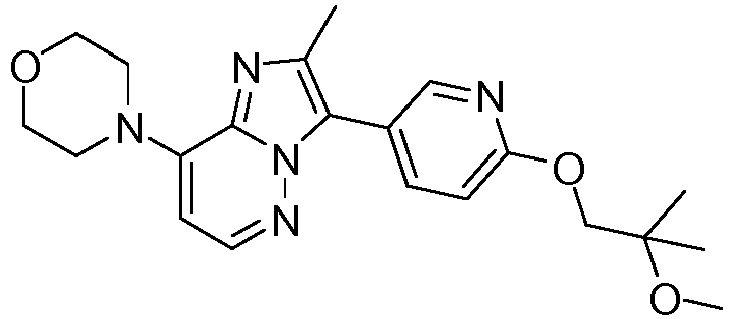
- From intermediate 26 and intermediate 62. Conditions: 140°C, 20 min, microwave irradiation. Flash column chromatography (silica; ethyl acetate in dichloromethane 0/100 to 50/50) yielded compound 18 as a white solid (82%). 1H NMR (400 MHz, CDCl3) δ ppm 1.32 (s, 6 H), 2.51 (s, 3 H), 3.32 (s, 3 H), 3.90 - 4.01 (m, 8 H), 4.30 (s, 2 H), 6.08 (d, 1 H), 6.98 (dd, J=8.6, 0.5 Hz, 1 H), 7.93 (dd, J=8.6, 2.3 Hz, 1 H), 7.97 (d, J=5.5 Hz, 1 H), 8.37 (d, J=1.8 Hz, 1 H).
-

- From intermediate 26 and commercially available 1-[5-(4,4,5,5-tetramethyl-[1,3,2]dioxaborolan-2-yl)-pyridin-2-yl]morpholine. Flash column chromatography (silica; ethyl acetate in heptanes 0/100 to 40/60) and flash column chromatography (silica; ethyl acetate and dichloromethane in heptane from 0/0/100 to 20/80/0) yielded compound 19 as a white solid (69%). 1H NMR (400 MHz, CDCl3) δ ppm 2.51 (s, 3 H), 3.58 (dd, J=5.1, 4.6 Hz, 4 H), 3.85 (dd, J=5.1, 4.6 Hz, 4 H), 3.95 (br. s., 8 H), 6.06 (d, J=5.8 Hz, 1 H), 6.78 (d, J=8.8 Hz, 1 H), 7.86 (dd, J=8.8, 2.3 Hz, 1 H), 7.97 (d, J=5.5 Hz, 1 H), 8.43 (d, J=2.3 Hz, 1 H).
-

- From intermediate 33 and intermediate 61. Conditions: 150 °C, 5 min, microwave irradiation. Flash column chromatography (silica; 7 M solution of ammonia in methanol in dichloromethane 0/100 to 4/96) and precipitation from diisopropyl ether yielded compound 20 as a white solid (45%). 1H NMR (400 MHz, CDCl3) δ ppm 2.66 (s, 3 H), 3.16 (t, J=6.6 Hz, 2 H), 3.41 (s, 3 H), 3.86 (t, J=6.7 Hz, 2 H), 7.24 (d, J=4.9 Hz, 1 H), 7.41 (d, J=8.1 Hz, 1 H), 8.02 (dd, J=8.1, 2.3 Hz, 1 H), 8.09 (d, J=6.2 Hz, 2 H), 8.40 (d, J=4.9 Hz, 1 H), 8.83 (d, J=6.2 Hz, 2 H), 8.88 (d, J=2.3 Hz, 1 H).
-

- From intermediate 33 and intermediate 63. Conditions: 150 °C, 15 min, microwave irradiation. Flash column chromatography (silica; ethyl acetate in heptane 0/100 to 100/0) and precipitation from diethyl ether yielded compound 21 as a white solid (44%). 1H NMR (500 MHz, DMSO-d6 ) δ ppm 2.55 (s, 3 H), 3.34 (s, 3 H), 3.72 (br t, J=4.6 Hz, 2 H), 4.48 (br t, J=4.6 Hz, 2 H), 7.05 (d, J=8.7 Hz, 1 H), 7.70 (d, J=4.6 Hz, 1 H), 8.09 (dd, J=8.7, 2.3 Hz, 1 H), 8.33 (dd, J=4.6, 1.7 Hz, 2 H), 8.49 (d, J=2.0 Hz, 1 H), 8.63 (d, J=4.6 Hz, 1 H), 8.82 (dd, J=4.6, 1.7 Hz, 2 H).
-

- Hydrochloric acid (38.16 mL, 2M solution in diethyl ether) was added to a solution of compound 21 (19.7 g, 54.51 mmol) in a mixture of diethylether (220 mL) and dichloromethane (600 mL). The mixture was stirred at room temperature for 2.5 h and then concentrated in vacuo. Diethyl ether was then added, and the solid was filtered, washed with diethyl ether and dried overnight in vacuo, to yield compound 21a (20.94 g, 91%) as an orange solid. 1H NMR (500 MHz, DMSO-d6 ) δ ppm 2.57 (s, 3 H), 3.33 (s, 3 H), 3.67 - 3.76 (m, 2 H), 4.42 - 4.51 (m, 2 H), 7.07 (d, J=8.7 Hz, 1 H), 7.94 (d, J=4.6 Hz, 1 H), 8.09 (dd, J=8.5, 2.5 Hz, 1 H), 8.50 (d, J=2.3 Hz, 1 H), 8.77 (d, J=4.9 Hz, 1 H), 8.88 - 8.98 (m, 2 H), 9.09 - 9.17 (m, 2 H).
-

- From intermediate 27 and intermediate 61. Conditions: 150 °C, 15 min, microwave irradiation. Flash column chromatography (silica; 7 M solution of ammonia in methanol in dichloromethane 0/100 to 7/93) and reverse phase HPLC (0.1% solution of ammonium formate/ammonium hydroxide buffer pH 9 and acetonitrile 80/20 to 0/100) yielded compound 22 as a white solid (14%). 1H NMR (400 MHz, CDCl3) δ ppm 0.92 - 1.01 (m, 2 H), 1.06 - 1.13 (m, 2 H), 2.05 - 2.16 (m, 1 H), 3.13 (t, J=6.7 Hz, 2 H), 3.39 (s, 3 H), 3.83 (t, J=6.7 Hz, 2 H), 3.88 - 4.05 (m, 8 H), 6.06 (d, J=5.8 Hz, 1 H), 7.37 (d, J=8.1 Hz, 1 H), 7.96 (d, J=5.8 Hz, 1 H), 8.10 (dd, J=8.0, 2.2 Hz, 1 H), 8.96 (d, J=2.3 Hz, 1 H).
-

- From intermediate 28 and intermediate 61. Conditions: 150 °C, 15 min, microwave irradiation. Flash column chromatography (silica; 7 M solution of ammonia in methanol in dichloromethane 0/100 to 2/98) and reverse phase HPLC (0.1% solution of ammonium formate/ammonium hydroxide buffer pH 9 and acetonitrile 80/20 to 0/100) yielded compound 23 as a white solid (14%). 1H NMR (400 MHz, CDCl3) δ ppm 2.41 (s, 3 H), 2.52 (s, 3 H), 3.13 (t, J=6.7 Hz, 2 H), 3.40 (s, 3 H), 3.84 (t, J=6.7 Hz, 2 H), 3.88 - 3.97 (m, 8 H), 5.99 (s, 1 H), 7.34 (d, J=8.1 Hz, 1 H), 7.99 (dd, J=8.1, 2.3 Hz, 1 H), 8.86 (d, J=2.3 Hz, 1 H).
-

- From intermediate 30 and intermediate 61. Conditions: 150 °C, 15 min, microwave irradiation. Flash column chromatography (silica; 7 M solution of ammonia in methanol in dichloromethane 0/100 to 2/98) and flash column chromatography (silica; 7 M solution of ammonia in methanol in dichloromethane 0/100 to 5/95) and precipitation from diisopropyl ether yielded compound 24 as a yellow solid (29%). 1H NMR (500 MHz, CDCl3) δ ppm 2.62 (s, 3 H), 2.64 (s, 3 H), 3.16 (t, J=6.5 Hz, 2 H), 3.41 (s, 3 H), 3.87 (t, J=6.6 Hz, 2 H), 7.12 (s, 1 H), 7.40 (d, J=8.1 Hz, 1 H), 8.02 (dd, J=8.1, 2.3 Hz, 1 H), 8.06 (d, J=6.1 Hz, 2 H), 8.81 (d, J=6.1 Hz, 2 H), 8.93 (d, J=1.7 Hz, 1 H).
-

- A 60% dispersion of sodium hydride in mineral oils (0.2 g, 5 mmol) was added portionwise to a stirred solution of intermediate 38 (0.2 g, 0.62 mmol) in ethanol (8 ml). The mixture was stirred at 100 °C for 16h. in a sealed tube and then poured onto water and extracted with dichloromethane. The organic layer was separated, dried (Na2SO4), filtered and the solvents evaporated in vacuo. The crude product was purified by flash column chromatography (silica; 7 M solution of ammonia in methanol in dichloromethane 0/100 to 1/99). The desired fractions were collected and concentrated in vacuo to yield compound 25 (0.042 g, 18%) as a white solid.
1H NMR (500 MHz, DMSO-d6 ) δ ppm 1.10 (t, J=6.9 Hz, 3 H), 2.44 (s, 3 H), 3.02 (t, J=6.8 Hz, 2 H), 3.46 (q, J=6.9 Hz, 2 H), 3.72 - 3.84 (m, 6 H), 3.97 (dd, J=4.9, 4.3 Hz, 4 H), 6.37 (d, J=5.8 Hz, 1 H), 7.44 (d, J=8.1 Hz, 1 H), 7.99 (dd, J=8.1, 2.3 Hz, 1 H), 8.09 (d, J=5.8 Hz, 1 H), 8.74 (d, J=1.7 Hz, 1 H). - The following compound was prepared from the indicated precursors according to aprotocol analogous to B25.
-
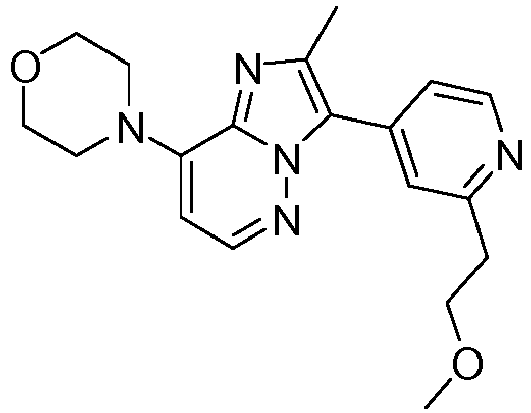
- From intermediate 40 and sodium methoxide. Flash column chromatography (silica; ethyl acetate in heptane 20/80 to 100/0) yielded compound 26 as a white solid (69%). 1H NMR (500 MHz, CDCl3) δ ppm 2.58 (s, 3 H), 3.15 (t, J=6.8 Hz, 2 H), 3.38 (s, 3 H), 3.83 (t, J=6.8 Hz, 2 H), 3.88 - 4.03 (m, 8 H), 6.13 (d, J=5.5 Hz, 1 H), 7.54 (dd, J=5.2, 1.7 Hz, 1 H), 7.60 (br. s., 1 H), 8.03 (d, J=5.8 Hz, 1 H), 8.64 (d, J=5.2 Hz, 1 H).
-

- 10% Palladium on charcoal (0.069 g) was added to a suspension of intermediate 41 (0.245 g, 0.65 mmol) and ammonium formate (0.122 g, 1.95 mmol) in methanol (10 ml). The mixture was stirred at 85 °C for 4 h. and then more 10% palladium on charcoal (0.69 g) and ammonium formate (0.122 g, 1.95 mmol) were added. The mixture was stirred at 90 °C for a further 16h. and then filtered through a pad of diatomaceous earth and the filtrate concentrated in vacuo. The crude product was diluted with dichloromethane and washed with water. The organic layer was separated, dried (Na2SO4), filtered and the solvents evaporated in vacuo. The crude product was purified by flash column chromatography (silica; ethyl acetate in heptane 30/70 to 100/0). The desired fractions were collected and evaporated to yield compound 27 (0.21 g, 86%) as a white solid. 1H NMR (400 MHz, CDCl3) δ ppm 1.83 - 2.06 (m, 4 H), 2.54 (s, 3 H), 2.94 - 3.10 (m, 1 H), 3.51 - 3.65 (m, 2 H), 3.87 - 4.03 (m, 8 H), 4.07 - 4.19 (m, 2 H), 6.10 (d, J=5.8 Hz, 1 H), 7.32 (d, J=8.1 Hz, 1 H), 7.99 (d, J=5.5 Hz, 1 H), 8.02 (dd, J=8.2, 2.2 Hz, 1H), 8.80 (d, J=2.1 Hz, 1H).
-

- 10% Palladium on charcoal (0.405 g) was added to a suspension of intermediate 38 (2.45 g, 7.62 mmol) in a mixture of methanol (90 ml) and ethyl acetate (90 ml). The mixture was hydrogenated (atmospheric pressure) at room temperature for 16 h. and then filtered through a pad of diatomaceous earth. The filtrate was concentrated in vacuo. The crude product was purified by flash column chromatography (silica; ethyl acetate in dichloromethane 0/100 to 100/0). The desired fractions were collected and concentrated in vacuo. The crude product was precipitated from diethyl ether to yield compound 28 (0.675 g, 27%) as a white solid. 1H NMR (500 MHz, DMSO-d 6) δ ppm 1.28 (t, J=7.7 Hz, 3 H), 2.44 (s, 3 H), 2.82 (q, J=7.6 Hz, 2 H), 3.79 (br t, J=4.9 Hz, 4 H), 3.97 (dd, J=4.9, 4.3 Hz, 4 H), 6.36 (d, J=5.8 Hz, 1 H), 7.41 (d, J=8.1 Hz, 1 H), 7.99 (dd, J=8.1, 2.3 Hz, 1 H), 8.09 (d, J=5.8 Hz, 1 H), 8.73 (d, J=1.7 Hz, 1 H).
-

- 1,2-Dibromoethane (0.016 ml, 0.19 mmol) was added to a stirred suspension of zinc (0.337 g, 5.17 mmol) in dry N,N-dimethylformamide (8 ml). The mixture was stirred at 90 °C for 30 min. under nitrogen and then allowed to cool down to room temperature. Chlorotrimethylsilane (0.006 ml, 0.048 mmol) was added and the mixture was stirred at room temperature for 15 min. A solution of intermediate 43 (0.7 g, 2.58 mmol) in tetrahydrofuran (3 ml) was added dropwise and the mixture was stirred at 50 °C for 1.5 h. The excess zinc was allowed to settle for 1 h and the supernatant liquid was transferred via cannula to a second flask charged with intermediate 35 (0.21 g, 0.64 mmol) and tetrakis(triphenylphosphine)palladium (0) (0.015 g, 0.013 mmol). The mixture was stirred at 55 °C for 16 h. under nitrogen, and then a saturated solution of ammonium chloride was added. The mixture was extracted with ethyl acetate and the organic layer was separated, dried (Na2SO4), filtered and the solvents evaporated in vacuo. The crude product was purified by flash column chromatography (silica; methanol in dichloromethane 0/100 to 2/98). The desired fractions were collected and concentrated to yield compound 29 (0.071 g, 28%). 1H NMR (400 MHz, CDCl3) δ ppm 1.26 (s, 6 H), 1.86 - 2.07 (m, 2 H), 2.53 (s, 3 H), 2.79 - 2.99 (m, 2 H), 3.26 (s, 3 H), 3.80 - 4.11 (m, 8 H), 6.09 (d, J=5.5 Hz, 1 H), 7.32 (d, J=8.1 Hz, 1 H), 7.96 (dd, J=8.1, 1.6 Hz, 1 H), 7.98 (d, J=5.5 Hz, 1 H), 8.78 (br. s., 1 H).
-

- Piperazine (4.68 g, 54.4 mmol) was added to a stirred solution of intermediate 35 (2.7 g, 6.80 mmol) in acetonitrile (24 ml). The mixture was stirred at 120 °C for 1 d. in a sealed tube and then diluted with dichloromethane and washed with water. The organic layer was separated, dried (Na2SO4), filtered and the solvents evaporated in vacuo. The crude product was purified by column chromatography (silica; 7 M solution of ammonia in methanol in dichloromethane 0/100 to 3/97). The desired fractions were collected and concentrated in vacuo and the crude product was precipitated from diisopropyl ether to yield compound 30 (1.64 g, 39%) as a pale yellow solid. 1H NMR (400 MHz, CDCl3) δ ppm 1.75 (s, 1 H), 2.51 (s, 3 H), 3.01 (br. t, J=5.1 Hz, 4 H), 3.59 (dd, J=5.3, 4.9 Hz, 4 H), 3.83 - 4.07 (m, 8 H), 6.06 (d, J=5.8 Hz, 1 H), 6.78 (d, J=9.0 Hz, 1 H), 7.83 (dd, J=8.9, 2.4 Hz, 1 H), 7.97 (d, J=5.5 Hz, 1 H), 8.41 (d, J=2.3 Hz, 1 H).
- The following compound was prepared from the indicated precursors according to a protocol analogous to that used of B30.
-

- From intermediate 37 and morpholine. Flash column chromatography (silica; 7 M solution of ammonia in methanol in dichloromethane 0/100 to 2/98) and precipitation from diethyl ether yielded compound 31 as an orange solid (80%). M. p. > 300 ° C (decomposition). 1H NMR (500 MHz, DMSO-d 6) δ ppm 2.53 (s, 3 H), 3.55 (dd, J=5.2, 4.6 Hz, 4 H), 3.74 (br. t, J=4.6 Hz, 4 H), 7.02 (d, J=8.7 Hz, 1 H), 7.64 (d, J=4.9 Hz, 1 H), 7.91 (dd, J=8.8, 2.5 Hz, 1 H), 8.32 (d, J=6.1 Hz, 2 H), 8.45 (d, J=2.0 Hz, 1 H), 8.59 (d, J=4.9 Hz, 1 H), 8.81 (d, J=6.4 Hz, 2 H).
-
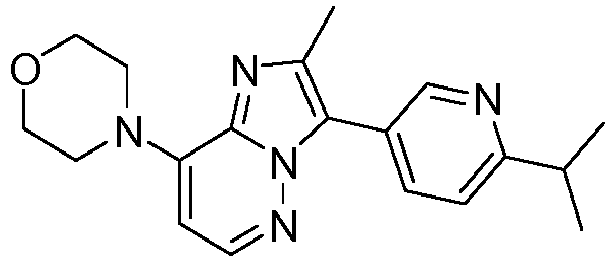
- A 2M solution of isopropylmagnesium chloride in tetrahydrofuran (0.758, 1.52) was added to a stirred solution of intermediate 35 (0.25 g, 0.76 mmol) and [1,3-bis(diphenylphosphino)propane]dichloronickel (II) (0.021 g, 0.038 mmol) in tetrahydrofuran (5 ml) at 0°C. The mixture was allowed to warm to room temperature over 1 h. and then stirred for a further 2h. A 10% solution of ammonium chloride solution was added and the mixture was extracted with dichloromethane. The organic layer was separated, dried (Na2SO4), filtered and the solvents evaporated in vacuo. The crude product was purified by flash column chromatography (silica; 7 M solution of ammonia in methanol in dichloromethane 0/100 to 2/98). The less pure fractions were evaporated in vacuo and the residue purified again by flash column chromatography (silica, ethyl acetate in heptane 20/80 to 60/40). The desired fractions were combined and concentrated in vacuo to yield compound 32 (0.116 g, 45%). 1H NMR (400 MHz, CDCl3) δ ppm 1.36 (d, J=6.9 Hz, 6 H), 2.54 (s, 3 H), 3.13 (spt, J=6.9 Hz, 1 H), 3.85 - 4.07 (m, 8 H), 6.09 (d, J=5.5 Hz, 1 H), 7.32 (d, J=8.1 Hz, 1 H), 7.98 (dd, J=8.1, 2.1 Hz, 1 H), 7.99 (d, J=5.5 Hz, 1 H), 8.79 (d, J=2.1 Hz, 1 H).
-

- Palladium (II) acetate (0.031 g, 0.14 mmol) was added to a stirred solution of intermediate 35 (0.3 g, 0.91 mmol), cyclopropylboronic acid (0.117 g, 1.37 mmol), 2-dicyclohexylphosphino-2',6'-dimethoxybiphenyl (0.244 g, 0.594 mmol) and potassium phosphate (0.11 g, 0.27 mmol) in toluene (5 ml). The mixture was stirred at 80 °C for 1 d. in a sealed tube under nitrogen and then diluted with dichloromethane and washed with water. The organic layer was separated, dried (Na2SO4), filtered and the solvents evaporated in vacuo. The crude product was purified by flash column chromatography (silica; ethyl acetate in heptane 20/80 to 100/0). The desired fractions were collected and concentrated in vacuo and the crude product triturated with diisopropyl ether to yield compound 33 (0.091 g, 30%) as a white solid. 1H NMR (500 MHz, CDCl3) δ ppm 1.00 - 1.06 (m, 2 H), 1.06 - 1.12 (m, 2 H), 2.06 - 2.13 (m, 1 H), 2.51 (s, 3 H), 3.90 - 4.00 (m, 8 H), 6.08 (d, J=5.8 Hz, 1 H), 7.26 (d, J=7.5 Hz, 4 H), 7.89 (dd, J=8.1, 2.0 Hz, 1 H), 7.97 (d, J=5.5 Hz, 1 H), 8.69 (d, J=2.3 Hz, 1 H).
-

- A mixture of intermediate 35 (0.2 g, 0.61 mmol), (R)-(+)-3-pyrrolidinol (0.21 g, 2.43 mmol) and diisopropylethylamine (0.158 ml, 0.91 mmol) was stirred at 120 °C for 3 h. The mixture was diluted with dichloromethane and extracted with a saturated solution of ammonium chloride. The organic layer was separated, dried (MgSO4) filtered and the solvents evaporated in vacuo. The crude product was dissolved in tetrahydrofuran (10 ml) and sodium tert-butoxide (0.34 g, 3.03 mmol), 18-crown-6 (0.024 g, 0.091 mmol) and iodomethane (0.378 ml, 6.06 mmol) were added. The mixture was stirred at room temperature for 18 h., then diluted with dichloromethane and washed with water. The organic layer was separated, dried (MgSO4) filtered and the solvents evaporated in vacuo. The crude product was purified by column chromatography (silica; dichloromethane). The desired fractions were collected and concentrated in vacuo to yield compound 34 (0.091 g, 30%) as a white solid. 1H NMR (500 MHz, CDCl3) δ ppm 2.08 - 2.24 (m, 2 H), 2.50 (s, 3 H), 3.38 (s, 3 H), 3.59 (dd, J=8.5, 5.9 Hz, 2 H), 3.64 - 3.71 (m, 2 H), 3.90 - 3.98 (m, 8 H), 4.08 - 4.14 (m, 1 H), 6.04 (d, J=5.5 Hz, 1 H), 6.51 (d, J=8.7 Hz, 1 H), 7.78 (dd, J=8.7, 2.3 Hz, 1 H), 7.95 (d, J=5.5 Hz, 1 H), 8.37 (d, J=2.3 Hz, 1 H).
-

- Tetrakis(triphenylphosphine)palladium(0) (0.017 g, 0.015 mmol) was added to a stirred solution of intermediate 26 (0.2 g, 0.58 mmol) and 1-isobutyl-4-(4,4,5,5-tetramethyl-1,3,2-dioxaborolan-2-yl)-1H-pyrazole (0.18 g, 0.73 mmol) in a mixture of 1,4-dioxane (8 ml) and a saturated solution of sodium carbonate (2 ml). The mixture was stirred at 140 °C for 20 min. in a sealed tube under nitrogen, under microwave irradiation. The mixture was filtered through a pad of diatomaceous earth and the filtrate diluted with dichlorometane and extracted with water. The organic layer was separated, dried (Na2SO4 filtered and the solvents evaporated in vacuo. The crude product was purified by flash column chromatography (silica; ethyl acetate in dichloromethane 0/100 to 40/60). The desired fractions were collected and concentrated in vacuo to yield compound 35 (0.14 mg, 71 %) as a white solid. 1H NMR (500 MHz, CDCl3) δ ppm 0.97 (d, J=6.6 Hz, 6 H), 2.30 (spt, J=6.7 Hz, 1 H), 2.61 (s, 3 H), 3.89 - 3.97 (m, 8 H), 4.01 (d, J=7.2 Hz, 2 H), 6.06 (d, J=5.8 Hz, 1 H), 8.01 (s, 1 H), 8.05 (d, J=5.5 Hz, 1 H), 8.17 (s, 1H).
- The following compounds were prepared from the indicated precursors according to a protocol analogous to that of B35.
-

- From intermediate 32 and intermediate 68). Flash column chromatography (silica; 7 M solution of ammonia in methanol in dichloromethane 0/100 to 4/96) and precipitation from diisopropyl ether yielded compound 36 as a white solid (57%). 1H NMR (400 MHz, CDCl3) ppm 2.61 (s, 3 H), 3.36 (s, 3 H), 3.82 (t, J=5.4 Hz, 2 H), 3.94 (br. s, 8 H), 4.39 (t, J=5.4 Hz, 2 H), 6.06 (d, J=5.8 Hz, 1 H), 8.04 (s, 1 H), 8.05 (d, J=5.5 Hz, 1 H), 8.24 (s, 1 H).
-

- From intermediate 26 and intermediate 67. Flash column chromatography (silica; ethyl acetate and dichloromethane in heptane 0/100/0 to 0/0/100 to 80/0/20), filtration through Isolute SCX-2 cartridge and precipitation from diethyl ether yielded compound 37 as a white solid (29%). 1H NMR (500 MHz, DMSO-d 6) δ ppm 1.12 (s, 6 H), 2.50 (s, 3 H), 3.20 (s, 3 H), 3.78 (br t, J=4.9 Hz, 4 H), 3.96 (br t, J=4.9 Hz, 4 H), 4.23 (s, 2 H), 6.31 (d, J=5.8 Hz, 1 H), 8.00 (s, 1 H), 8.16 (d, J=5.8 Hz, 1 H), 8.26 (s, 1 H).
-

- 10% Palladium on activated charcoal (0.284 g) was added to a mixture of intermediate 69 (0.125 g, 0.29 mmol) and triethylamine (0.08 ml, 0.58 mmol) in a mixture of methanol (6 ml) and tetrahydrofuran (6 ml). The mixture was hydrogenated (atmospheric pressure) at room temperature for 24 h. and then filtered through a pad of diatomaceous earth and the filtrate was concentrated in vacuo. The crude product was purified by flash column chromatography (silica; ethyl acetate in heptane 30/70 to 100/0). The desired fractions were collected and concentrated in vacuo to yield compound 38 (0.116 g, 99%) as a white solid. 1H NMR (500 MHz, DMSO-d 6) δ ppm 0.85 - 0.95 (m, 2 H), 0.95 - 1.02 (m, 2 H), 1.12 (s, 6 H), 2.15 - 2.23 (m, 1 H), 3.20 (s, 3 H), 3.71 - 3.83 (m, 4 H), 3.85 - 3.98 (m, 4 H), 4.23 (s, 2 H), 6.30 (d, J=5.8 Hz, 1 H), 8.09 (s, 1 H), 8.15 (d, J=5.5 Hz, 1 H), 8.32 (s, 1 H).
- Additional compounds were prepared from the corresponding intermediates according to procedures similar to those described for the synthesis of the corresponding Examples previously described. The corresponding intermediates were prepared by procedures similar to those previously described either in the Experimental Part or in the Synthesis section. Compound 45 was isolated as the corresponding hydrochloric acid salt (.HCl). The assignment of configuration in compounds 34, 113 and 131 derives from the reagent used in the synthesis of the compounds.
Table 1. Compounds and melting points thereof according to formula (I) prepared according to the above methods. (Dec means decomposition) Co. No. Ex. No. R1 R2 R3 
M. p. (°C) 1 B1 
---CH3 ---H 
131.5 2 B2 
---CH3 ---H 
165 3 B3 
---CH3 ---H 
101.8 4 B4 
---CH3 ---H 
> 300 Dec. 5 B5 
---CH3 ---H 
135.3 6 B6 
---CH3 ---H 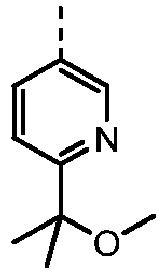
132.5 7 B7 
---CH3 ---H 
126.1 8 B8 
---CH3 ---H 
159 9 B9 
---CH3 ---H 
n.d. 10 B10 

---H 
241.6 11 B11 
---H ---H 
137.8 12 B12 
---OCH3 ---H 
190.7 13 B13 
---CH3 
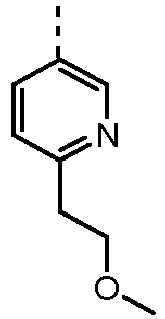
137.2 14 B14 
---CH3 

> 300 Dec. 15 B15 

---CH3 
122.5 16 B16 
---CH3 ---H 
n.d. 17 B17 
---CH3 ---H 
>300 Dec. 18 B18 
---CH3 ---H 
> 300 Dec. 19 B19 
---CH3 ---H 
n.d. 20 B20 
---CH3 ---H 
149.7 21 B21 
---CH3 ---H 
168.7 22 B22 

---H 
111.4 23 B23 
---CH3 ---CH3 
115.4 24 B24 
---CH3 ---CH3 
> 300 Dec. 25 B25 
---CH3 ---H 
n.d. 26 B26 
---CH3 ---H 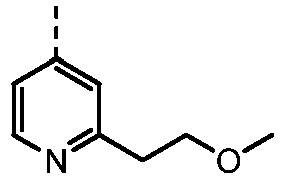
n.d. 27 B27 
---CH3 ---H 
274.4 28 B28 
---CH3 ---H 
130.2 29 B29 
---CH3 ---H 
> 300 Dec. 30 B30 
---CH3 ---H 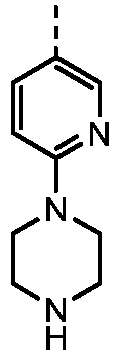
n.d. 31 B31 
---CH3 ---H 
>300 Dec. 32 B35 
---CH3 ---H 
129.3 33 B33 
---CH3 ---H 
142.5 34 B34 
---CH3 ---H 
162 35 B35 
---CH3 ---H 
n.d. 36 B36 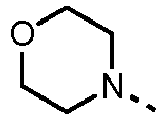
---CH3 ---H 
113.7 37 B37 
---CH3 ---H 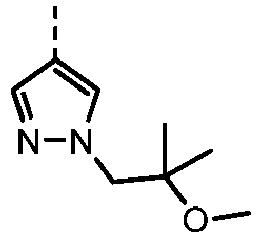
126.1 38 B38 

---H 
n.d. 39 B1 
---CH3 ---H 
176.9 40 B1 
---CH3 

133.9 41 B1 
---CH3 

106.2 42 B1 
---CH3 

108.8 43 B1 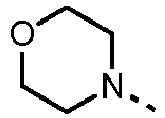
---CH3 

128.5 44 B1 

---H 
146.0 45 B1 

---H 
n.d. 46 B1 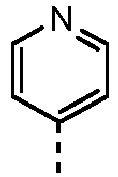

---H 
> 300 Dec. 47 B1 
---CH3 ---CH3 
123.5 48 B1 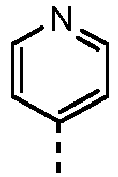
---CH3 ---CH3 
159.0 49 B1 
---CH3 ---CH3 
128.3 50 B1 

---H 
114.1 51 B1 
---H ---H 
143.3 52 B1 
---H ---H 
n.d. 53 B1 

---CH3 
200.9 54 B1 

---H 
n.d. 55 B1 
---CH3 
> 300 Dec. 56 B1 

---CH3 
> 300 Dec. 57 B1 
---H ---H 
142.1 58 B1 
---CH3 

198.1 59 B1 
---CH3 

119.3 60 B1 
---H ---H 
152.1 61 B1 
---H ---H 
167.7 62 B16 
---CH3 ---H 
> 300 Dec. 63 B16 
---CH3 ---H 
n.d. 64 B16 
---CH3 ---CF3 
132.2 65 B16 
---CH3 ---H 
n.d. 66 B16 
---CH3 ---H 
n.d. 67 B16 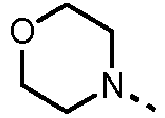
---CH3 ---H 
n.d. 68 B16 
---CH3 ---CH3 
200.5 69 B16 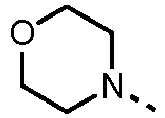
---CH3 ---CH3 
239.4 70 B16 
---CH3 ---CH3 
n.d. 71 B16 

---CH3 
> 300 Dec. 72 B16 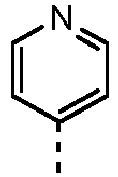

---CH3 
123.1 73 B16 

---H 
n.d. 74 B16 

---CH3 
99.7 75 B16 

---CH3 
183.2 76 B25 
---CH3 ---H 
n.d. 77 B25 
---CH3 ---H 
> 300 Dec. 78 B28 
---CH3 

177.4 79 B28 

---CH3 
196.2 80 B28 

---CH3 
195.4 81 B28 
---CH3 

n.d. 82 B28 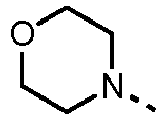
---H ---H 
n.d. 83 B29 
---CH3 ---H 
153.7 84 B29 

---CH3 
147.2 85 B30 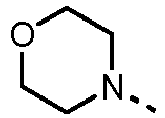

---CF3 
n.d. 86 B30 
---CH3 

> 300 Dec. 87 B30 

---H 
140.3 88 B30 
---CH3 ---CH3 
> 300 Dec. 89 B31 
---CH3 ---H 
174.3 90 B31 
---CH3 ---H 
> 300 Dec. 91 B31 
---CH3 ---H 
200.8 92 B31 
---CH3 ---H 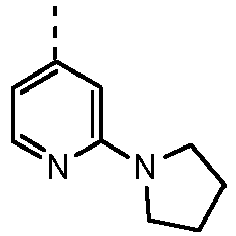
n.d. 93 B31 
---CH3 ---H 
201.2 94 B31 
---CH3 

191.3 95 B31 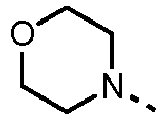

---H 
n.d. 96 B31 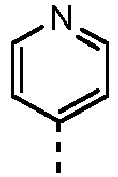
---CH3 ---CH3 
220.2 97 B31 
---CH3 ---H 
> 300 Dec. 98 B31 

---H 
n.d. 99 B31 
---CH3 

> 300 Dec. 100 B31 

---CH3 
200.1 101 B31 

---CH3 
223.2 102 B31 

---H 
212.1 103 B31 
---CH3 ---H 
n.d. 104 B33 
---CH3 ---H 
116.1 105 B33 
---CH3 ---H 
127.0 106 B33 

---H 
118.0 107 B33 
---CH3 

137.4 108 B33 
---CH3 ---CH3 
164.4 109 B33 
---H ---H 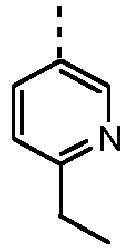
n.d. 110 B34 
---CH3 ---CH3 
154.6 111 B34 
---CH3 ---H 
179.6 112 B34 
---H ---H 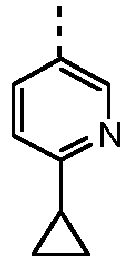
n.d. 113 B35 
---CH3 ---H 
n.d. 114 B36 
---CH3 ---H 
n.d. 115 B36 
---CH3 ---H 
n.d. 116 B36 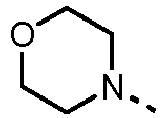
---CH3 ---H 
n.d. 117 B36 
---CH3 ---H 
n.d. 118 B36 
---CH3 ---H 
n.d. 119 B36 

---H 
n.d. 120 B36 

---H 
150.1 121 B36 

---H 
129.8 122 B36 
---CF3 ---H 
n.d. 123 B36 
---CH3 ---H 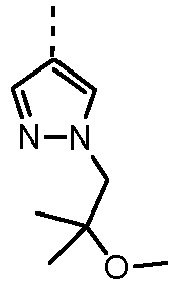
n.d. 124 B36 
---CH3 ---H 
132.6 125 B36 
---CH3 

138.0 126 B36 
---CH3 

130.6 127 B36 
---CH2CH3 ---H 
120.8 128 B36 
---CH3 ---H 
n.d. 129 B36 
---CH3 ---CF3 
165.2 130 B36 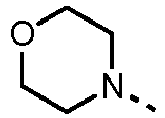
---CH3 ---CF3 
173.7 131 B36 
---CH3 ---H 
n.d. 132 B36 
---CH2CH3 ---H 
174.4 133 B36 
---CH3 ---CH3 
140.3 134 B36 
---CH3 ---CH3 
138.5 135 B36 
---CH3 ---H 
n.d. 136 B39 
---CH3 ---H 
n.d. 137 B39 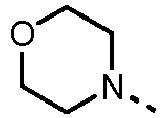
---CH3 ---H 
n.d. 138 B39 

---H 
178.0 139 B39 
---CF3 ---H 
132.6 140 B39 
---OCH3 ---H 
> 300 Dec. 141 B39 

---H 
n.d. 142 B39 
---H 
114.0 143 B39 

---H 
138.0 144 B39 
---H ---H 
190.7 145 B39 
---CF3 ---H 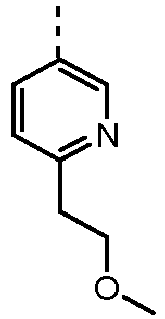
n.d. 146 A69 
---CH3 ---Cl 
n.d. 147 A69 
---CH3 ---Cl 
> 300 Dec. 148 B36 

---H 
191.2 149 B1 
---CH3 ---H 
167.7 150 A69 

---Cl 
n.d. 


- The compounds provided in the present invention are inhibitors of PDE10, particularly, of PDE10A. The behaviour of the PDE10 inhibitors according to Formula (I) in vitro and using an apomorphine induced stereotypy model in vivo is shown in Table 3. The in vitro selectivity towards PDE10A, occupancy, and results using PCP-induced hyperlocomotion, conditioned avoidance response models, SCH-23390-induced hypolocomotion in mice and object recognition test in rats of selected compounds are shown in tables 4 to 7.
- Rat recombinant PDE10A (rPDE10A2) was expressed in Sf9 cells using a recombinant rPDE10A baculovirus construct. Cells were harvested after 48 h of infection and the rPDE10A protein was purified by metal chelate chromatography on Ni-sepharose 6FF . Tested compounds were dissolved and diluted in 100% DMSO to a concentration 100 fold of the final concentration in the assay. Compound dilutions (0.4 µl) were added in 384 well plates to 20 µl of incubation buffer (50 mM Tris pH 7.8, 8.3 mM MgCl2, 1.7 mM EGTA). 10µl of rPDE10A enzyme in incubation buffer was added and the reaction was started by addition of 10 µl substrate to a final concentration of 60 nM cAMP and 0.008 µCi 3H-cAMP. The reaction was incubated for 60 minutes at room temperature. After incubation, the reaction was stopped with 20 µl of of stop solution consisting of 17.8 mg/ml PDE SPA (scintillation proximity assay) beads. After sedimentation of the beads during 30 minutes the radioactivity was measured in a Perkin Elmer Topcount scintillation counter and results were expressed as cpm. For blanc values the enzyme was omitted from the reaction and replaced by incubation buffer. Control values were obtained by addition of a final concentration of 1% DMSO instead of compound. The same assay principle is applied for the measurement of the affinity of the compound for other members of the PDE family with appropriate modifications in incubation buffer, substrate concentration, incubation time and stop solution. An overview of the different protocols is presented in table A. A best fit curve is fitted by a minimum sum of squares method to the plot of % of control value substracted with blanc value versus compound concentration and the half maximal inhibitory concentration (IC50) value is derived from this curve.
Table A: Assay conditions for the Measurement of Phosphodiesterase activity by SPA Enzyme Incubation Buffer Final Concentration Substrate 3H Substrate µCi/well Stop Solution Incubation Time (min) hPDE1B1 B* 1 µM cAMP 0.016 1* 30 hPDE2A A* 10 µM cGMP 0.01 2* 40 hPDE3A A* 0.1 µM cAMP 0.024 2* 60 hPDE4D3 A* 1 µM cAMP 0.008 1* 60 hPDE5A3 A* 1 µM cGMP 0.01 2* 60 hPDE6AB A* 0.1 µM cGMP 0.01 2* 120 hPDE7A1 A* 60 nM cAMP 0.008 1* 60 hPDE8A1 A* 0.3 µM cAMP 0.01 1* 60 hPDE9A C* 60 nM cGMP 0.008 2* 60 rPDE10A2 A* 60 nM cAMP 0.008 1* 60 hPDE11A4 A* 0.3 µM cGMP 0.01 1* 30 A* 50 mM Tris pH7.8, 1.7 mM EGTA, 8.3 mM MgCl2
B* 50 mM Tris pH7.8, 8.3 mM MgCl2
C* 50 mM Tris pH7.8, 5 mM MnCl2
1* 17.8 mg/ml PDE beads
2* 17.8 mg/ml PDE beads + 200 mM ZnCl2 - The compounds of the invention are generally selective for PDE10 compared to other PDEs and there are a few that also have affinity for PDE1B1, 4D3 and 5A3. Table 4 provides data of some compounds according to the invention.
- Apomorphine (1.0 mg/kg, i.v.)-induced stereotypy (compulsive sniffing, licking, chewing) was scored every 5 min over the first hour after injection of apomorphine, following a 1 hour interval pre-treatment with the test compound. The score system was: (3) pronounced, (2) moderate, (1) slight, and (0) absent.Criteria for drug-induced inhibition of stereotypy: fewer than 6 scores of 3 (0.16% false positives), fewer than 6 scores off ≥ 2 (0.0% false positives), or fewer than 7 scores of ≥ 1 (0.81% false positives).
- Dose-response or single dose experiments were performed to measure PDE10 occupancy 1 hour after subcutaneous (s.c.) or oral (p.o.) administration. Male Wistar rats (200 g) were treated by s.c. or p.o. administration of various PDE10 inhibitors. The PDE10 radioligand [3H]-MP-10 (10 µCi/animal) was injected intravenously (i.v.) 30 minutes before sacrifice. Brains were immediately removed from the skull and rapidly frozen. Twenty µm-thick brain sections were cut using a cryostat-microtome, thaw-mounted on microscope slides and loaded in a β-imager to quantify PDE10 occupancy in the striatum.
- Motor activity [horizontal activity (locomotion) and vertical activity (rearing)] was recorded in male Wiga rats (body weight: 175-275 g; housed overnight in groups of 7 rats) using microprocessor-based activity monitors (MED Associates; length x width x height: 43.2 x 43.2 x 41.5 cm) over a period of 30 min. The resolution of the system was set at 100 msec. Total distance was defined as the distance traveled, measured by changes in the number or location of interrupted xy-beams (located in two arrays of 32 infrared light beams (1.25 cm apart) perpendicular to each other in a horizontal plane 2.0 cm above the floor). Vertical activity was defined as the number of periods of continuous breaks reported by an infrared array of 32 light beams in a horizontal plane 13 cm above the floor. The intensity of the light within the activity meters (measured in the centre at floor level) ranged between 110 and 130 LUX.
- Male Wiga rats (200 to 260 g) were pretreated with test compound or solvent (10 ml/kg, s.c.) and placed in individual cages. At a predefined interval thereafter (60 min.), the rats were challenged with PCP (1.25 mg/kg, i.v.) and motor activity was measured over a period of 30 min starting immediately after the PCP challenge. The following all-or-none criteria were adopted for drug-induced effects: (1) inhibition (< 11000 counts; 2.9% false positives in 102 control rats), (2) blockade (< 500 counts; 0.0% false positives). The results of this test are shown in table 5 below.
- The apparatus consisted of an inner box surrounded by an outer box. The inner box was composed of four walls of transparent, synthetic material (length x width x height: 30 x 30 x 30 cm), an open top, and a grid floor made of 15 pairs of iron bars (2 mm diameter; 6 mm inter-bar distance). Odd and even bars were connected with a source of alternative current (1.0 mA; Coulbourn Instruments Solid State Shocker/Distributor), which could be interrupted by a switch. The outer box was composed of the same material (length x width x height: 40 x 40 x 36 cm), also with an open top, with a distance of 5 cm between the inner and outer box on all sides. To decrease the amount of environmental stimuli, three walls of the outer box were made non-transparent. The front wall was left transparent to allow the necessary inspection of the animal during the test. The upper edge of the outer and inner box served as a target for the rats on which to jump with fore- and hind-paws, respectively.
- From their arrival in the laboratory on the experimental day, male Wiga Wistar rats (230 ± 30 g) were housed in individual cages provided with bedding material. The rats received 5 training sessions at 15-min time intervals over a 1-h period during which, the rats were conditioned to avoid an electric shock: the rat was placed on the non-electrified grid floor and the grid was electrified 10 s later for not more than 30 s, if the rat did not jump out of the box. Only rats that showed correct avoidance responses in all the last 3 training sessions were included for further experiments, and received the test compound or solvent immediately after the last training session.
- The rats were tested 3 times, i.e. at 60, 90 and 120 min after the injection of test compound or solvent. Latency to avoidance was recorded. The median avoidance response obtained over the three experimental sessions for each rat were used for further calculations. A median avoidance latency > 8 s was selected as an all-or-none criterion for drug-induced inhibition of avoidance (occurring in only 1.5% of solvent-pretreated control rats; n = 66). The results of this test are shown in table 5 below.
- SCH-23390 (0.08 mg/kg, i.v.)-induced hypolocomotion was evaluated over a 30-min period starting immediately after the SCH-23390 challenge in male NMRI mice pretreated 0.5 h earlier with test compound or solvent. Averaged activity in solvent-treated control mice was 1540 ± 559 counts (mean ± SD; n = 103). Criterion for drug-induced reversal of the SCH-23390-induced hypolocomotion: total distance: > 2500 counts (2.9% false positives in controls).
- 60 female hooded-Lister rats (Charles River, UK) were used as subjects for these studies and weighed 248g ± 20g. Rats were allowed at least a 7-day acclimatization period to the animal unit prior to commencement of experimentation. Rats were housed in groups of 5 under standard laboratory conditions under a 12 h light:dark cycle, lights on at 0700 h. All testing was carried out in the light phase. Food and water were freely provided. All experiments were conducted in accordance with the Animals Scientific Procedures Act, U.K. 1986 and were approved by the University of Bradford ethical review panel.
- 40 mg of test compound was dissolved in 5 ml of 40% hydroxypropyl β-cyclodextrin (HPBC) solution. The solution was sonicated until completely dissolved. 2 ml of sterile water was added and the pH measured and adjusted with NaOH solution (0.1N) to obtain pH ∼4. Finally, sterile water was added to a final volume of 10 ml. This stock solution was then diluted in 20% HPBC to obtain the final concentrations.
- 100 mg of PQ10 was dissolved in a 40% HPBC solution and 8 mg of tartaric acid. The solution was sonicated until completely dissolved. 5 ml of sterile water was added and the pH measured and adjusted with NaOH solution (0.1N) to obtain pH ∼4. Finally sterile water was added to a final volume of 10 ml.
- Test compound was administered at doses of 0.3 and 1.0 mg/kg via the oral route 30 min prior to testing.
- PQ10 was administered at a dose of 1.0 mg/kg via the oral route 30 min prior to testing.
- Certain pre-clinical tests allow the observation of relatively subtle cognitive deficits in the rat that resemble cognitive symptoms in subjects with schizophrenia. The cognitive deficits observed are seen in behaviours such as episodic memory, which can be measured by recognition tasks such as the novel object recognition (NOR) paradigm. A recognition memory task allows the comparison between presented stimuli and previously stored information. Ennaceur, A Delacour, J (1988) A new one-trial test for neurobiological studies of memory in rats Behav Brain Res 31: 47-59 described the NOR test in rats which was based on the differential exploration of familiar and new objects. The NOR test is a non-rewarded, ethologically relevant paradigm based on the spontaneous exploratory behaviour of rats that measures episodic memory. Each session consists of two trials. In the first trial, the rats are exposed to two identical objects in an open field. During the second trial, rats are exposed to two dissimilar objects, one familiar object from the first trial and one new object. Object recognition in rats can be measured as the difference in time spent exploring the familiar and the new object. Rats have been shown to spend more time exploring the new object. It was found that rats are able to discriminate between the familiar and the novel object when the inter-trial interval is between 3 minutes and 1-3 hours, but not when it is greater than 24 hours, although this effect may be sex dependent in the rat. The duration of each trial is also important as a preference for the novel object only lasts during the first 1 or 2 minutes, after which time preference diminishes as both objects become familiar and are explored equally.
- Allocation of Treatment groups
Rats were randomly assigned to the 8 treatment groups - Rats were allowed to habituate to the empty test box and the behavioural test room environment for 1 h on day 1. Prior to behavioural testing on day 2 rats were given a further 3 min habituation.
- Following the 3 min habituation period, the rats were given two 3 min trials (T1 and T2) which were separated by a 1 min inter-trial interval in the home cage during which the objects were changed.
- In this trial, the animals were allowed to explore two identical objects (A1 and A2) for 3 min.
- In this trial, the animals explored a familiar object (A) from T1 and a novel object (B) for 3 min. The familiar object presented during T2 was a duplicate of the object presented in T1 in order to avoid any olfactory trails.
- The object exploration was defined by animals licking, sniffing or touching the object with the forepaws whilst sniffing, but not leaning against, turning around, standing or sitting on the object. The exploration time (s) of each object (A1, A2, A and B) in each trial were recorded using two stopwatches and the following factors were calculated.
- Total exploration time of both objects in the acquisition trial (s).
- Total exploration time of both objects in the retention trial (s).
- Habituation of exploratory activity. The locomotor activity (LMA) included the exploration time, as measured by the number of lines crossed, for both the trials.
- Discrimination index (DI), which was calculated as shown below:

- Behaviour in all trials was recorded on video for subsequent blind scoring.
- If an animal failed to explore one or both of the objects in the acquisition trial, that animal was not included in the final analysis, ie if exploration time was 0 seconds at either object in acquisition that animal was excluded.
- All data are expressed as mean ± SEM, (n = 3 to 10 per group) and were analysed by a two way ANOVA (factors are: drug and exploration time of the two objects) or one way ANOVA (LMA and DI) with further analysis by a post-hoc student's t-test (time spent exploring objects in acquisition and retention trials) or Dunnett's t-test (LMA and DI). When student's t-test was used to analyse time spent exploring objects, significance was based upon the difference in time spent exploring the novel or familiar object, not in comparison to vehicle. For the discrimination index Dunnett's t-tests were used to compare values against PCP/Veh treated group, and against the Veh/Veh group, as appropriate. Results showed that sub-chronic PCP (2 mg/kg ip twice daily for 7 days followed by 7 days drug-free period) produced a selective cognitive deficit in the retention phase of the NOR task in female rats.
- The effects of acute treatment with compound 1 (0.3-1.0 mg/kg) or the comparator PQ10, were selective for the retention phase of the NOR task.


Table 4. In vitro selectivity of compounds according to the invention (expressed as pIC50). Co. No. PDE 10A2 PDE 11A4 PDE 1B1 PDE 2A PDE 3A PDE 4D3 PDE 5A3 PDE 6AB PDE 7A PDE 8A1 PDE 9A 10 7.94 5.85 n.t. 5.18 <5 5.9 5.89 n.t. <5 n.t. <5 50 7.84 n.t. n.t. 5.16 n.t. n.t. n.t. n.t. n.t. n.t. n.t. 142 7.84 5.74 n.t. 5.26 5.29 5.55 5.94 n.t. 5.3 n.t. <5 143 7.76 5.71 n.t. 5.4 5.84 5.29 6.19 n.t. 5.23 n.t. <5 135 7.74 5.23 n.t. <5 5.13 <5 5.59 n.t. <5 n.t. <5 54 7.68 n.t. n.t. <5 n.t. n.t. n.t. n.t. n.t. n.t. n.t. 124 7.65 5.27 n.t. 5.06 5.16 5.13 5.71 n.t. 5.27 n.t. <5 148 7.6 5.72 n.t. 5.36 5.5 5.59 5.91 n.t. 5.54 n.t. <5 7 7.59 n.t. n.t. <5 n.t. n.t. n.t. n.t. n.t. n.t. n.t. 3 7.58 <5 n.t. <5 <5 <5 5.1 n.t. <5 n.t. <5 131 7.46 <5 n.t. <5 <5 <5 5.07 n.t. <5 n.t. <5 35 7.42 <5 n.t. <5 5.13 <5 <5 n.t. <5 n.t. <5 29 7.36 <5 n.t. 5.92 <5 <5 5.35 n.t. <5 n.t. <5 91 7.33 <5 n.t. <5 <5 <5 5.07 n.t. <5 n.t. <5 37 7.3 4.4 n.t. 4.27 4.96 4.51 5.22 n.t. 4.34 n.t. <4 118 7.3 <5 n.t. <5 <5 <5 5 n.t. <5 n.t. <5 146 7.28 <5 n.t. <5 <5 <5 5.72 n.t. 5.07 n.t. <5 1 7.24 4.13 5.28 4.4 4.01 4.51 4.77 4.07 4.16 4.11 <4 22 7.25 5.17 n.t. 5.23 <4.3 5.56 5.46 n.t. 4.55 n.t. <4.3 36 7.25 <5 n.t. <5 <5 <5 <5 <5 <5 <5 <5 147 7.17 5.42 n.t. <5 <5 5.42 5.93 n.t. 5.45 n.t. <5 32 7.11 <5 n.t. <5 <5 <5 <5 n.t. <5 n.t. <5 33 7.11 <5 n.t. <5 <5 <5 <5 n.t. <5 n.t. <5 28 7.08 4.52 n.t. 4.57 4.52 4.88 4.86 n.t. 4.59 n.t. <4 71 7.08 n.t. n.t. 5.64 n.t. n.t. n.t. n.t. n.t. n.t. n.t. 125 7.08 5.35 n.t. 5.07 <5 5.68 5.9 n.t. <5 n.t. <5 133 7.02 <5 n.t. <5 <5 <5 5.62 n.t. <5 n.t. <5 117 7.01 5 n.t. <5 <5 <5 <5 n.t. <5 n.t. <5 21 6.99 <4.3 n.t. 4.32 <4.3 4.55 4.72 n.t. <4.3 n.t. <4.3 30 6.91 <5 n.t. <5 <5 <5 <5 n.t. <5 n.t. <5 134 6.98 5.27 n.t. 5.09 <5 5.26 6.23 n.t. 5.31 n.t. <5 19 6.97 <5 n.t. <5 <5 <5 <5 n.t. <5 n.t. <5 127 6.95 <5 n.t. <5 <5 <5 5.33 n.t. <5 n.t. <5 48 6.94 n.t. n.t. <5 n.t. n.t. n.t. n.t. n.t. n.t. n.t. 16 6.92 <5 n.t. <5 <5 <5 <5 n.t. <5 n.t. <5 72 6.91 n.t. n.t. 5.98 n.t. n.t. n.t. n.t. n.t. n.t. n.t. 68 6.8 n.t. n.t. <5 n.t. n.t. n.t. n.t. n.t. n.t. n.t. 18 6.77 <5 n.t. <5 <5 <5 5 n.t. <5 n.t. <5 144 6.49 n.t. n.t. <5 n.t. n.t. n.t. n.t. n.t. n.t. n.t. 110 6.48 n.t. n.t. <5 n.t. n.t. n.t. n.t. n.t. n.t. n.t. 61 6.47 <5 <5 5.1 <5 <5 5.57 n.t. <5 n.t. <5 84 6.43 n.t. n.t. <5 n.t. n.t. n.t. n.t. n.t. n.t. n.t. 94 6.42 n.t. n.t. <5 n.t. n.t. n.t. n.t. n.t. n.t. n.t. 57 6.37 n.t. n.t. <5 n.t. n.t. n.t. n.t. n.t. n.t. n.t. 112 6.37 n.t. n.t. 5.09 n.t. n.t. n.t. n.t. n.t. n.t. n.t. 75 6.35 n.t. n.t. <5 n.t. n.t. n.t. n.t. n.t. n.t. n.t. 136 6.28 n.t. n.t. <5 n.t. n.t. n.t. n.t. n.t. n.t. n.t. 74 6.23 n.t. n.t. <5 n.t. n.t. n.t. n.t. n.t. n.t. n.t. 85 6.18 n.t. n.t. <5 n.t. n.t. n.t. n.t. n.t. n.t. n.t. 100 6.14 n.t. n.t. <5 n.t. n.t. n.t. n.t. n.t. n.t. n.t. 129 5.58 n.t. n.t. <5 n.t. n.t. n.t. n.t. n.t. n.t. n.t. Table 5. Pharmacological data for compounds according to the invention in the occupancy test. Co. No. PDE10 in vivo Occ. ED50 sc (mg/kg) ED50 po (mg/kg) SD sc % occupancy at 10 mg/kg SD po % occupancy at 10 mg/kg 1 DR sc and po 0.48 1.4 76% n.t. 3 DR sc 2.0 n.t. n.t. n.t. 7 DR sc 1.6 n.t. n.t. n.t. 16 SD sc n.t. n.t. 52% n.t. 18 SD sc n.t. n.t. 46% n.t. 19 SD sc n.t. n.t. 57% n.t. 21 DR sc and po 2.6 14 61% n.t. 22 DR sc 0.94 n.t. n.t. n.t. 28 DR sc 1.1 n.t. n.t. n.t. 30 DR sc >10 (6%)* n.t. n.t. n.t. 35 SD sc n.t. n.t. 67% n.t. 37 DR sc 2.2 n.t. 67% n.t. 48 DR po n.t. 4.3 n.t. n.t. 62 SD po n.t. n.t. n.t. 38% 65 SD sc n.t. n.t. 17% n.t. 66 SD sc n.t. n.t. 29% n.t. 67 SD sc n.t. n.t. 1% n.t. 114 SD sc n.t. n.t. 72% n.t. 118 SD po n.t. n.t. n.t. 4% 121 SD sc n.t. n.t. 0% n.t. 124 DR sc 3.0 n.t. n.t. n.t. 125 DR sc >10 (42%)* n.t. n.t. n.t. 127 SD sc n.t. n.t. 4% n.t. 128 SD sc n.t. n.t. 40% n.t. 130 SD po n.t. n.t. n.t. 6% 131 SD sc n.t. n.t. 59% n.t. 132 SD sc n.t. n.t. 44% n.t. 137 SD po n.t. n.t. n.t. 12% 138 SD po n.t. n.t. n.t. 11% 140 SD po n.t. n.t. n.t. 0% 142 SD sc n.t. n.t. 78% n.t. 147 SD sc n.t. n.t. 22% n.t. 148 SD sc n.t. n.t. 66% n.t. 21a DR sc and po 2.6 14 61% n.t. Occ. means occupancy; ED50 means effective dose; SD means single dose; DR means dose response; sc means subcutaneous administration; po means per os, oral administration; * the data between brackets means the % occupancy at the highest dose tested. Table 6. Pharmacological data for compounds according to the invention in the PCP, CAR and SCH-23390 tests. Co. No. PCP ED50 (mg/kg) CAR ED50 (mg/kg) SCH-23390 ED50 (mg/kg) 1 2.0 4.7 7.1 21 6.1 5.4 5 Table 7. Effects of compound 1 on short-term memory. Vehicle + 20% HPBCD PCP + 20% HPBCD PCP + co. no. 1 (0.3 mg/kg) PCP + co. no. 1 (1.0 mg/kg) PCP + PQ10 (1 mg/kg) T2(A) (seconds) 7.5 (± 1.4395) 17.5 (± 2.1042) 11.8 (± 2.6709) 10.7 (± 1.8622) 7.9 (± 1.6017) T2(B) (seconds) 19.9 (± 3.6346)** 17.4 (± 2.2716) 17.6 (± 2.7899)* 22.3 (± 3.2251)** 19.9 (± 3.247)** DI 0.3748 (± 0.1695) -0.005 (± 0.0357) 0.3014 (± 0.1405) 0.3335 (± 0.0804) 0.4193 (± 0.0772) LMA (no. of lines crossed) 62.8 (± 4.567518) 69.5 (± 5.647517) 56.5 (± 6.107503) 56.4 (± 7.212951) 65.5 (± 5.518152) Day 1: The ability of acute treatment with compound 1 (0.3-1.0 mg/kg, p.o) or PQ10 (1 mg/kg, p.o) to reverse the effect of sub-chronic PCP (2 mg/kg, i.p twice daily for seven days) on the exploration time (s) during the retention trial (T2) of a familiar object and a novel object in the 3 min retention trial in female rats.
Data are expressed as the mean ± s.e.m (n=3-10 per group) and were analysed by ANOVA and post-hoc student's t-test. *P<0.05-* *P<0.01; significant difference between time spent exploring the familiar (A) and novel (B) object. The difference in time exploring the novel and familiar object is analysed by student's t-test. - "Active ingredient" as used throughout these examples relates to a final compound of formula (I), the pharmaceutically acceptable salts thereof, the solvates and the stereochemically isomeric forms thereof.
Typical examples of recipes for the formulation of the invention are as follows: -
Active ingredient 5 to 50 mg Di-calcium phosphate 20 mg Lactose 30 mg Talcum 10 mg Magnesium stearate 5 mg Potato starch ad 200 mg - In this Example, active ingredient can be replaced with the same amount of any of the compounds according to the present invention, in particular by the same amount of any of the exemplified compounds.
- An aqueous suspension is prepared for oral administration so that each 1 milliliter contains 1 to 5 mg of one of the active compounds, 50 mg of sodium carboxymethyl cellulose, 1 mg of sodium benzoate, 500 mg of sorbitol and water ad 1 ml.
- A parenteral composition is prepared by stirring 1.5 % by weight of active ingredient of the invention in 10% by volume propylene glycol in water.
-
Active ingredient 5 to 1000 mg Stearyl alcohol 3 g Lanoline 5 g White petroleum 15 g Water ad 100 g - In this Example, active ingredient can be replaced with the same amount of any of the compounds according to the present invention, in particular by the same amount of any of the exemplified compounds.
Claims (15)
- A compound of formula (I)
 R1 is selected from pyridinyl, morpholinyl and pyrrolidinyl;R2 is selected from hydrogen, methyl, ethyl, cyclopropyl, isopropyl, methoxy and trifluoromethyl ;R3 is selected from hydrogen, chloro, methyl, trifluoromethyl and cyclopropyl ;Het is selected from pyridinyl and pyrazolyl;R4 is selected from hydrogen ; methyl; ethyl; isopropyl ; isobutyl; trifluoromethyl ; 2,2,2-trifluoroethyl ; 2-hydroxy-2-methylpropyl ; (2,2-difluorocyclopropyl)methyl ; 2,2-difluoro-2-cyclopropylethyl ; cyclopropyl ; 2-methoxyethyl ; 2-methoxypropyl ; (2S)-2-methoxypropyl; 2-isopropoxyethyl ; 2-ethoxyethyl ; ethoxymethyl ; 1-methoxy-1-methylethyl ; 1-methoxy-1-methylethyl ; 2-methoxy-1,1-dimethylethyl ; 3-methoxy-3-methylbutyl ; 3-methoxypropyl ; 2-methoxy-2-methyl-propyl ; isopropoxy ; 2,2,2-trifluoroethoxy ; cyclopropylmethoxy ; 2-methoxyethoxy ; 2-methoxy-2-methylpropoxy ; tetrahydro-2H-pyran-4-yl ; (pyridin-3-yl)methyl; 2-(pyrrolidin-1-yl)ethyl ; isopropylamino ; morpholin-4-yl; pyrrolidin-1-yl; piperazin-1-yl; (3R)-3-methoxypyrrolidin-1-yl ; and (3S)-3-methoxypyrrolidin-1-yl; andR5 is hydrogen or methylor a pharmaceutically acceptable salt or a solvate thereof.
 - The compound according to claim 1, or a stereoisomeric form thereof, wherein
R1 is selected from morpholinyl and pyridinyl ;
R2 is selected from hydrogen, methyl, ethyl, methoxy, and cyclopropyl ;
R3 is selected from hydrogen, methyl, and cyclopropyl ;
Het is pyridinyl or pyrazolyl ;
R4 is selected from ethyl; isopropyl; isobutyl; 2,2,2-trifluoroethyl; 2-hydroxy-2-methylpropyl; 2,2-difluoro-2-cyclopropylethyl; cyclopropyl; 2-methoxyethyl; (2S)-2-methoxypropyl; 2-ethoxyethyl; ethoxymethyl; 1-ethoxy-1-methylethyl; 1-methoxy-1-methylethyl; 2-methoxy-1,1-dimethylethyl; 3-methoxy-3-methylbutyl; 3-methoxypropyl; 2-methoxy-2-methyl-propyl; 2-methoxyethoxy; 2-methoxy-2-methyl-propoxy; tetrahydro-2H-pyran-4-yl; morpholin-4-yl; piperazin-1-yl; and (3R)-3-methoxypyrrolidin-1-yl; and
R5 is hydrogen or methyl;
or a pharmaceutically acceptable salt or a solvate thereof. - The compound according to claim 1, or a stereoisomeric form thereof, wherein
R1 is selected from morpholin-4-yl, pyridin-3-yl and pyridin-4-yl ; and
Het is selected from pyridin-3-yl, pyridin-4-yl and 1H-pyrazol-4-yl ;
or a pharmaceutically acceptable salt or a solvate thereof. - The compound according to claim 1, or a stereoisomeric form thereof, wherein
R1 is selected from morpholin-4-yl ; and
Het is pyridin-3-yl or pyridin-4-yl ;
or a pharmaceutically acceptable salt or a solvate thereof. - The compound according to claim 1, or a stereoisomeric form thereof, wherein
R1 is morpholin-4-yl;
R2 is methyl;
R3 is hydrogen;
Het is pyridin-3-yl ;
R4 is 2-methoxyethyl ; and
R5 is hydrogen;
or a pharmaceutically acceptable salt or a solvate thereof. - The compound of formula (I) according to claim 1, wherein the compound is3-[6-(2-methoxyethyl)-3-pyridinyl]-2-methyl-8-(4-morpholinyl)-imidazo[1,2-b]pyridazine (compound 1),3-[6-(2-methoxyethyl)-3-pyridinyl]-2-methyl-8-(4-morpholinyl)-imidazo[1,2-b]pyridazine hydrochloride (compound 1a),3-[6-(2-methoxyethyl)-3-pyridinyl]-2-methyl-8-(4-morpholinyl)-imidazo[1,2-b]pyridazine maleate (compound 1b),3-[6-(2-methoxyethyl)-3-pyridinyl]-2-methyl-8-(4-morpholinyl)-imidazo[1,2-b]pyridazine monohydrate (compound 1c),3-[6-(3-methoxypropyl)-3-pyridinyl]-2-methyl-8-(4-morpholinyl)-imidazo[1,2-b]pyridazine (compound 2),3-[6-(2-methoxy-2-methylpropyl)-3-pyridinyl]-2-methyl-8-(4-morpholinyl)-imidazo[1,2-b]pyridazine (compound 3),3-[6-(2-methoxy-1,1-dimethylethyl)-3-pyridinyl]-2-methyl-8-(4-morpholinyl)-imidazo[1,2-b]pyridazine (compound 4),3-[6-(1-ethoxy-1-methylethyl)-3-pyridinyl]-2-methyl-8-(4-morpholinyl)-imidazo[1,2-b]pyridazine (compound 5),3-[6-(1-methoxy-1-methylethyl)-3-pyridinyl]-2-methyl-8-(4-morpholinyl)-imidazo[1,2-b]pyridazine (compound 6),3-[6-(2-methoxy-2-methylpropyl)-3-pyridinyl]-2-methyl-8-(4-pyridinyl)-imidazo[1,2-b]pyridazine (compound 7),3-[6-(2-methoxyethoxy)-5-methyl-3-pyridinyl]-2-methyl-8-(4-pyridinyl)-imidazo[1,2-b]pyridazine (compound 8),3-[6-(2-methoxyethoxy)-3-pyridinyl]-2-methyl-8-(3-pyridinyl)-imidazo[1,2-b]pyridazine (compound 9),2-cyclopropyl-3-[6-(2-methoxyethyl)-3-pyridinyl]-8-(4-pyridinyl)-imidazo[1,2-b]pyridazine (compound 10),3-[6-(2-methoxyethyl)-3-pyridinyl]-8-(4-morpholinyl)-imidazo[1,2-b]pyridazine (compound 11),2-methoxy-3-[6-(2-methoxyethyl)-3-pyridinyl]-8-(4-morpholinyl)-imidazo[1,2-b]pyridazine (compound 12),6-cyclopropyl-3-[6-(2-methoxyethyl)-3-pyridinyl]-2-methyl-8-(4-morpholinyl)-imidazo[1,2-b]pyridazine (compound 13),6-cyclopropyl-3-[6-(2-methoxyethyl)-3-pyridinyl]-2-methyl-8-(4-pyridinyl)-imidazo[1,2-b]pyridazine (compound 14),2-cyclopropyl-3-[6-(2-methoxyethyl)-3-pyridinyl]-6-methyl-8-(4-morpholinyl)-imidazo[1,2-b]pyridazine (compound 15),3-[6-(2-methoxyethoxy)-3-pyridinyl]-2-methyl-8-(4-morpholinyl)-imidazo[1,2-b]pyridazine (compound 16),3-[6-(ethoxymethyl)-3-pyridinyl]-2-methyl-8-(4-morpholinyl)-imidazo[1,2-b]pyridazine (compound 17),3-[6-(2-methoxy-2-methylpropoxy)-3-pyridinyl]-2-methyl-8-(4-morpholinyl)-imidazo[1,2-b]pyridazine (compound 18),2-methyl-8-(4-morpholinyl)-3-[6-(4-morpholinyl)-3-pyridinyl]-imidazo[1,2-b]pyridazine (compound 19),3-[6-(2-methoxyethyl)-3-pyridinyl]-2-methyl-8-(4-pyridinyl)-imidazo[1,2-b]pyridazine (compound 20),3-[6-(2-methoxyethoxy)-3-pyridinyl]-2-methyl-8-(4-pyridinyl)-imidazo[1,2-b]pyridazine (compound 21),3-[6-(2-methoxyethoxy)-3-pyridinyl]-2-methyl-8-(4-pyridinyl)-imidazo[1,2-b]pyridazine hydrochloride (compound 21a),2-cyclopropyl-3-[6-(2-methoxyethyl)-3-pyridinyl]-8-(4-morpholinyl)-imidazo[1,2-b]pyridazine (compound 22),3-[6-(2-methoxyethyl)-3-pyridinyl]-2,6-dimethyl-8-(4-morpholinyl)-imidazo[1,2-b]pyridazine (compound 23),3-[6-(2-methoxyethyl)-3-pyridinyl]-2,6-dimethyl-8-(4-pyridinyl)-imidazo[1,2-b]pyridazine (compound 24),3-[6-(2-ethoxyethyl)-3-pyridinyl]-2-methyl-8-(4-morpholinyl)-imidazo[1,2-b]pyridazine (compound 25),3-[2-(2-methoxyethyl)-4-pyridinyl]-2-methyl-8-(4-morpholinyl)-imidazo[1,2-b]pyridazine (compound 26),2-methyl-8-(4-morpholinyl)-3-[6-(tetrahydro-2H-pyran-4-yl)-3-pyridinyl]-imidazo[1,2-b]pyridazine (compound 27),3-(6-ethyl-3-pyridinyl)-2-methyl-8-(4-morpholinyl)-imidazo[1,2-b]pyridazine (compound 28),3-[6-(3-methoxy-3-methylbutyl)-3-pyridinyl]-2-methyl-8-(4-morpholinyl)-imidazo[1,2-b]pyridazine (compound 29),2-methyl-8-(4-morpholinyl)-3-[6-(1-piperazinyl)-3-pyridinyl]-imidazo[1,2-b]pyridazine (compound 30),2-methyl-3-[6-(4-morpholinyl)-3-pyridinyl]-8-(4-pyridinyl)-imidazo[1,2-b]pyridazine (compound 31),2-methyl-3-[6-(1-methylethyl)-3-pyridinyl]-8-(4-morpholinyl)-imidazo[1,2-b]pyridazine (compound 32),3-(6-cyclopropyl-3-pyridinyl)-2-methyl-8-(4-morpholinyl)-imidazo[1,2-b]pyridazine (compound 33),3-[6-[(3R)-3-methoxy-1-pyrrolidinyl]-3-pyridinyl]-2-methyl-8-(4-morpholinyl)-imidazo[1,2-b]pyridazine (compound 34),2-methyl-3-[1-(2-methylpropyl)-1H-pyrazol-4-yl]-8-(4-morpholinyl)-imidazo[1,2-b]pyridazine (compound 35),3-[1-(2-methoxyethyl)-1H-pyrazol-4-yl]-2-methyl-8-(4-morpholinyl)-imidazo[1,2-b]pyridazine (compound 36),3-[1-(2-methoxy-2-methylpropyl)-1H-pyrazol-4-yl]-2-methyl-8-(4-morpholinyl)-imidazo[1,2-b]pyridazine (compound 37),2-cyclopropyl-3-[1-(2-methoxy-2-methylpropyl)-1H-pyrazol-4-yl]-8-(4-morpholinyl)-imidazo[1,2-b]pyridazine (compound 38),2-cyclopropyl-3-[6-(2-methoxy-2-methylpropyl)-3-pyridinyl]-8-(4-morpholinyl)-imidazo[1,2-b]pyridazine hydrochloride (compound 45a),2-cyclopropyl-3-[6-(2-methoxy-2-methylpropyl)-3-pyridinyl]-8-(4-morpholinyl)-imidazo[1,2-b]pyridazine (compound 45),3-[6-(2-methoxy-2-methylpropyl)-3-pyridinyl]-2,6-dimethyl-8-(4-pyridinyl)-imidazo[1,2-b]pyridazine (compound 48),2-cyclopropyl-3-[6-(2-methoxy-2-methylpropyl)-3-pyridinyl]-8-(4-pyridinyl)-imidazo[1,2-b]pyridazine (compound 50),5-[2-cyclopropyl-8-(4-morpholinyl)imidazo[1,2-b]pyridazin-3-yl]-α,α-dimethyl-2-pyridineethanol (compound 54),3-[6-(4-morpholinyl)-3-pyridinyl]-8-(4-pyridinyl)-imidazo[1,2-b]pyridazine (compound 61),2,6-dimethyl-8-(4-morpholinyl)-3-[6-(4-morpholinyl)-3-pyridinyl]-imidazo[1,2-b]pyridazine (compound 68),2-cyclopropyl-6-methyl-3-[6-(4-morpholinyl)-3-pyridinyl]-8-(4-pyridinyl)-imidazo[1,2-b]pyridazine (compound 71),2-cyclopropyl-3-[6-(2-methoxyethoxy)-3-pyridinyl]-6-methyl-8-(4-pyridinyl)-imidazo[1,2-b]pyridazine (compound 72),2-methyl-8-(4-morpholinyl)-3-[2-(4-morpholinyl)-4-pyridinyl]-imidazo[1,2-b]pyridazine (compound 91),3-{1-[(2,2-difluorocyclopropyl)methyl]-1H-pyrazol-4-yl}-2-methyl-8-morpholin-4-ylimidazo[1,2-b]pyridazine (compound 118),2-methyl-3-[1-(2-methylpropyl)-1H-pyrazol-4-yl]-8-(4-pyridinyl)-imidazo[1,2-b]pyridazine (compound 124),6-cyclopropyl-3-[1-(2-methoxyethyl)-1H-pyrazol-4-yl]-2-methyl-8-(4-morpholinyl)-imidazo[1,2-b]pyridazine (compound 125),2-ethyl-3-[1-(2-methoxyethyl)-1H-pyrazol-4-yl]-8-(4-morpholinyl)-imidazo[1,2-b]pyridazine (compound 127),3-[1-[(2S)-2-methoxypropyl]-1H-pyrazol-4-yl]-2-methyl-8-(4-morpholinyl)-imidazo[1,2-b]pyridazine (compound 131),3-[1-(2-methoxyethyl)-1H-pyrazol-4-yl]-2,6-dimethyl-8-(4-morpholinyl)-imidazo[1,2-b]pyridazine (compound 133),3-[1-(2-methoxyethyl)-1H-pyrazol-4-yl]-2,6-dimethyl-8-(4-pyridinyl)-imidazo[1,2-b]pyridazine (compound 134),2-methyl-8-(4-pyridinyl)-3-[1-(2,2,2-trifluoroethyl)-1H-pyrazol-4-yl]-imidazo[1,2-b]pyridazine (compound 135),2-cyclopropyl-3-[1-(2-methoxyethyl)-1H-pyrazol-4-yl]-8-(4-pyridinyl)-imidazo[1,2-b]pyridazine (compound 142),2-cyclopropyl-3-[1-(2-methoxy-2-methylpropyl)-1H-pyrazol-4-yl]-8-(4-pyridinyl)-imidazo[1,2-b]pyridazine (compound 143),6-chloro-3-[1-(2-methoxyethyl)-1H-pyrazol-4-yl]-2-methyl-8-(4-pyridinyl)-imidazo[1,2-b]pyridazine (compound 147), or2-cyclopropyl-3-[1-(2-methylpropyl)-1H-pyrazol-4-yl]-8-(4-pyridinyl)-imidazo[1,2-b]pyridazine (compound 148),or a stereoisomeric form, a pharmaceutically acceptable salt or a solvate thereof.
- The compound of Formula (I) according to claim 1, wherein the compound is 3-[6-(2-methoxyethyl)-3-pyridinyl]-2-methyl-8-(4-morpholinyl)-imidazo[1,2-b]pyridazine or a pharmaceutically acceptable salt or a solvate thereof.
- The compound according to claim 7, wherein the compound is the monohydrate thereof.
- A pharmaceutical composition comprising a therapeutically effective amount of a compound according to any one of claims 1 to 8 and a pharmaceutically acceptable carrier or excipient.
- A compound according to any one of claims 1 to 8 for use as a medicament.
- A compound according to any one of claims 1 to 8 or a pharmaceutical composition according to claim 9 for use in the treatment or prevention of a central nervous system disorder selected from the group of psychotic disorders; drug induced psychosis; anxiety disorders; movement disorders; mood disorders; neurodegenerative disorders; disorders or conditions comprising as a symptom a deficiency in attention and/or cognition; drug addiction disorders; pain and metabolic disorders.
- The compound for use according to claim 11, wherein the psychotic disorder is selected from the group consisting of schizophrenia, delusional disorder, schizoaffective disorder, schizophreniform disorder and substance-induced psychotic disorder.
- A compound according to any one of claims 1 to 8 in combination with an additional pharmaceutical agent for use in the treatment or prevention of a condition as cited in any one of claims 11 to 12.
- A process for preparing a pharmaceutical composition as defined in claim 9, characterized in that a pharmaceutically acceptable carrier is intimately mixed with a therapeutically effective amount of a compound as defined in any one of claims 1 to 8.
- A product comprising(a) a compound as defined in any one of claims 1 to 8; and(b) an additional pharmaceutical agent,as a combined preparation for simultaneous, separate or sequential use in the treatment or prevention of a condition as cited in any one of claims 11 to 12.
Priority Applications (1)
| Application Number | Priority Date | Filing Date | Title |
|---|---|---|---|
| EP10768978.8A EP2493889B1 (en) | 2009-10-30 | 2010-10-27 | IMIDAZO[1,2-b]PYRIDAZINE DERIVATIVES AND THEIR USE AS PDE10 INHIBITORS |
Applications Claiming Priority (3)
| Application Number | Priority Date | Filing Date | Title |
|---|---|---|---|
| EP09174711 | 2009-10-30 | ||
| EP10768978.8A EP2493889B1 (en) | 2009-10-30 | 2010-10-27 | IMIDAZO[1,2-b]PYRIDAZINE DERIVATIVES AND THEIR USE AS PDE10 INHIBITORS |
| PCT/EP2010/066264 WO2011051342A1 (en) | 2009-10-30 | 2010-10-27 | IMIDAZO[1,2-b]PYRIDAZINE DERIVATIVES AND THEIR USE AS PDE10 INHIBITORS |
Publications (2)
| Publication Number | Publication Date |
|---|---|
| EP2493889A1 EP2493889A1 (en) | 2012-09-05 |
| EP2493889B1 true EP2493889B1 (en) | 2017-09-06 |
Family
ID=41785825
Family Applications (1)
| Application Number | Title | Priority Date | Filing Date |
|---|---|---|---|
| EP10768978.8A Active EP2493889B1 (en) | 2009-10-30 | 2010-10-27 | IMIDAZO[1,2-b]PYRIDAZINE DERIVATIVES AND THEIR USE AS PDE10 INHIBITORS |
Country Status (19)
| Country | Link |
|---|---|
| US (2) | US20120220581A1 (en) |
| EP (1) | EP2493889B1 (en) |
| JP (1) | JP5641664B2 (en) |
| KR (1) | KR101774035B1 (en) |
| CN (1) | CN102596961B (en) |
| AR (1) | AR078841A1 (en) |
| AU (1) | AU2010311511B2 (en) |
| BR (1) | BR112012010041A2 (en) |
| CA (1) | CA2778949C (en) |
| CL (1) | CL2012001139A1 (en) |
| CO (1) | CO6531468A2 (en) |
| EA (1) | EA020847B1 (en) |
| ES (1) | ES2651296T3 (en) |
| IL (1) | IL219424A (en) |
| MX (1) | MX2012004990A (en) |
| NZ (1) | NZ599597A (en) |
| PH (1) | PH12012500778A1 (en) |
| TW (1) | TW201127840A (en) |
| WO (1) | WO2011051342A1 (en) |
Families Citing this family (26)
| Publication number | Priority date | Publication date | Assignee | Title |
|---|---|---|---|---|
| CA2778949C (en) * | 2009-10-30 | 2018-02-27 | Janssen Pharmaceutica Nv | Imidazo[1,2-b]pyridazine derivatives and their use as pde10 inhibitors |
| WO2011137155A1 (en) * | 2010-04-28 | 2011-11-03 | Bristol-Myers Squibb Company | Imidazopyridazinyl compounds and their uses for cancer |
| CA2799926A1 (en) * | 2010-05-28 | 2011-12-01 | Biocryst Pharmaceuticals, Inc. | Heterocyclic compounds as janus kinase inhibitors |
| MX2013009575A (en) | 2011-02-18 | 2014-10-14 | Exonhit Therapeutics Sa | Substituted 6,7-dialkoxy-3-isoquinolinol derivatives as inhibitors of phosphodiesterase 10 (pde10a). |
| ES2563153T3 (en) * | 2011-04-28 | 2016-03-11 | Janssen Pharmaceutica, N.V. | Salt of an enzyme phosphodiesterase 10 inhibitor |
| BR112013033375B1 (en) | 2011-06-27 | 2022-05-10 | Janssen Pharmaceutica N.V | Derivatives of 1-aryl-4-methyl-[1,2,4]triazolo[4,3-a]quinoxaline, their use, pharmaceutical composition that comprises them, process of preparation thereof, sterile solution and intermediate compound |
| RU2657540C2 (en) * | 2012-06-26 | 2018-06-14 | Янссен Фармацевтика Нв | Combinations comprising pde 2 inhibitors such as 1-aryl-4-methyl- [1,2,4]triazolo[4,3-a]quinoxaline compounds and pde 10 inhibitors for use in treatment of neurological or metabolic disorders |
| EP2869822B1 (en) | 2012-07-09 | 2016-09-14 | Janssen Pharmaceutica, N.V. | Inhibitors of phosphodiesterase 10 enzyme |
| WO2014071044A1 (en) | 2012-11-01 | 2014-05-08 | Allergan, Inc. | Substituted 6,7-dialkoxy-3-isoquinoline derivatives as inhibitors of phosphodiesterase 10 (pde10a) |
| UA112028C2 (en) * | 2012-12-14 | 2016-07-11 | Пфайзер Лімітед | IMIDAZOPYRIDASINE DERIVATIVES AS HAMBA-RECEPTOR MODULATORS |
| AP2015008663A0 (en) | 2013-02-19 | 2015-08-31 | Pfizer | Azabenzimidazole compounds as inhibitors of PDE4 isozymes for the treatment of cns and other disorders |
| TW201512201A (en) * | 2013-03-14 | 2015-04-01 | Forum Pharmaceuticals Inc | Polymorphs and salts of a compound |
| AP2015008843A0 (en) | 2013-05-02 | 2015-11-30 | Pfizer | Imidazo-triazine derivatives as pde10 inhibitors |
| WO2014200882A1 (en) | 2013-06-11 | 2014-12-18 | Janssen Pharmaceutica Nv | PDE10a INHIBITORS FOR THE TREATMENT OF TYPE II DIABETES |
| US9249163B2 (en) | 2013-06-11 | 2016-02-02 | Janssen Pharmaceutica Nv. | PDE10a inhibitors for the treatment of type II diabetes |
| US9453002B2 (en) | 2013-08-16 | 2016-09-27 | Janssen Pharmaceutica Nv | Substituted imidazoles as N-type calcium channel blockers |
| AR097543A1 (en) * | 2013-09-06 | 2016-03-23 | Lexicon Pharmaceuticals Inc | COMPOUNDS BASED ON IMIDAZO [1,2-b] PIRIDAZINE, COMPOSITIONS THAT INCLUDE THEM AND THEIR METHODS OF USE |
| US9200016B2 (en) | 2013-12-05 | 2015-12-01 | Allergan, Inc. | Substituted 6, 7-dialkoxy-3-isoquinoline derivatives as inhibitors of phosphodiesterase 10 (PDE 10A) |
| EP3172210B1 (en) | 2014-07-24 | 2020-01-15 | Pfizer Inc | Pyrazolopyrimidine compounds |
| SG11201700243YA (en) * | 2014-08-06 | 2017-02-27 | Pfizer | Imidazopyridazine compounds |
| EP3565817B1 (en) * | 2017-01-06 | 2023-06-07 | The Johns Hopkins University | Small molecule inhibitors of neutral sphingomyelinase 2 (nsmase2) for the treatment of neurodegenerative diseases |
| EP4616913A3 (en) * | 2018-01-29 | 2025-12-10 | Merck Patent GmbH | Gcn2 inhibitors and uses thereof |
| JP7377207B2 (en) | 2018-01-29 | 2023-11-09 | メルク パテント ゲーエムベーハー | GCN2 inhibitors and their uses |
| US11759466B2 (en) | 2018-03-01 | 2023-09-19 | The Johns Hopkins University | Inhibition of nSMase for the treatment of human immunodeficiency virus infection |
| CN113087673B (en) * | 2021-04-07 | 2023-02-28 | 河南农业大学 | A kind of preparation method of alkyl/alkenyl substituted nitrogen-containing heterocyclic compound |
| EP4458810A4 (en) | 2021-12-28 | 2025-12-17 | Nippon Shinyaku Co Ltd | Indazole compound and pharmaceutical |
Citations (1)
| Publication number | Priority date | Publication date | Assignee | Title |
|---|---|---|---|---|
| WO2007129183A2 (en) * | 2006-05-02 | 2007-11-15 | Pfizer Products Inc. | Bicyclic heteroaryl compounds as pde10 inhibitors |
Family Cites Families (199)
| Publication number | Priority date | Publication date | Assignee | Title |
|---|---|---|---|---|
| US4242513A (en) | 1979-03-05 | 1980-12-30 | Appleton Papers Inc. | Lactone compounds containing a heterocyclic radical |
| EP0226641B1 (en) | 1985-05-25 | 1989-10-18 | Yoshitomi Pharmaceutical Industries, Ltd. | Oxodiazine compounds |
| JPH04506215A (en) | 1989-06-13 | 1992-10-29 | スミスクライン・ビーチャム・コーポレイション | Monokine activity interference |
| WO1991000092A1 (en) | 1989-06-13 | 1991-01-10 | Smithkline Beecham Corporation | Inhibition of interleukin-1 and tumor necrosis factor production by monocytes and/or macrophages |
| AU622330B2 (en) | 1989-06-23 | 1992-04-02 | Takeda Chemical Industries Ltd. | Condensed heterocyclic compounds having a nitrogen atom in the bridgehead for use as fungicides |
| KR910011852A (en) | 1989-12-04 | 1991-08-07 | 폴 디. 매튜카이티스 | Imidazo [1,2-a] pyridinylalkyl compounds for the treatment of neurotoxin disorders |
| AU8205991A (en) | 1990-06-12 | 1992-01-07 | Smithkline Beecham Corporation | Inhibition of 5-lipoxygenase and cyclooxygenase pathway mediated diseases |
| US5137876A (en) | 1990-10-12 | 1992-08-11 | Merck & Co., Inc. | Nucleoside antiviral and anti-inflammatory compounds and compositions and methods for using same |
| ZA919797B (en) | 1990-12-13 | 1992-10-28 | Smithkline Beecham Corp | Bicyclo-5,6-dihydro-7h-pyrrolo-1,20-imidazol-7-ols and 7-ones |
| WO1992010190A1 (en) | 1990-12-13 | 1992-06-25 | Smithkline Beecham Corporation | Novel csaids |
| US5486525A (en) | 1993-12-16 | 1996-01-23 | Abbott Laboratories | Platelet activating factor antagonists: imidazopyridine indoles |
| US5869486A (en) * | 1995-02-24 | 1999-02-09 | Ono Pharmaceutical Co., Ltd. | Fused pyrimidines and pyriazines as pharmaceutical compounds |
| AU5348396A (en) | 1995-05-01 | 1996-11-21 | Fujisawa Pharmaceutical Co., Ltd. | Imidazo 1,2-a pyridine and imidazo 1,2-a pyridezine derivati ves and their use as bone resorption inhibitors |
| US6992188B1 (en) | 1995-12-08 | 2006-01-31 | Pfizer, Inc. | Substituted heterocyclic derivatives |
| EA002274B1 (en) * | 1996-06-25 | 2002-02-28 | Пфайзер Инк. | Substituted indazole derivatives and their use as phosphodiesterase (pde) type iv and tumor necrosis factor (tnf) inhibitors |
| US20010007867A1 (en) | 1999-12-13 | 2001-07-12 | Yuhpyng L. Chen | Substituted 6,5-hetero-bicyclic derivatives |
| AU6279598A (en) | 1997-02-18 | 1998-09-08 | Neurocrine Biosciences, Inc. | Biazacyclic CRF antagonists |
| WO1998039342A1 (en) | 1997-03-07 | 1998-09-11 | Metabasis Therapeutics, Inc. | Novel indole and azaindole inhibitors of fructose-1,6-bisphosphatase |
| WO1999011643A1 (en) | 1997-09-02 | 1999-03-11 | Du Pont Pharmaceuticals Company | Heterocyclyl-substituted ring-fused pyridines and pyrimidines as corticotropin releasing hormone (crh) antagonists, useful for treating cns and stress-related disorders |
| US6248755B1 (en) | 1999-04-06 | 2001-06-19 | Merck & Co., Inc. | Pyrrolidine modulators of chemokine receptor activity |
| JP4032566B2 (en) | 1999-06-21 | 2008-01-16 | 東レ株式会社 | Light emitting element |
| JP2001057292A (en) | 1999-08-20 | 2001-02-27 | Toray Ind Inc | Luminescent element |
| GB9919778D0 (en) | 1999-08-21 | 1999-10-27 | Zeneca Ltd | Chemical compounds |
| CO5271670A1 (en) | 1999-10-29 | 2003-04-30 | Pfizer Prod Inc | ANTIGONISTS OF THE CORTICITROPINE RELEASE FACTOR AND RELATED COMPOSITIONS |
| KR20030016222A (en) | 2000-02-14 | 2003-02-26 | 니뽄 다바코 산교 가부시키가이샤 | Preventives/remedies for postoperative stress |
| EP1149583A3 (en) | 2000-04-13 | 2001-11-14 | Pfizer Products Inc. | Combinations of corticotropin releasing factor antagonists and growth hormone secretagogues |
| US6403588B1 (en) | 2000-04-27 | 2002-06-11 | Yamanouchi Pharmaceutical Co., Ltd. | Imidazopyridine derivatives |
| US6589952B2 (en) | 2000-07-14 | 2003-07-08 | Bristol-Myers Squibb Pharma Company | Imidazo[1,2-a]pyrazines for the treatment of neurological disorders |
| AU2001295992A1 (en) | 2000-10-24 | 2002-05-06 | Sankyo Company Limited | Imidazopyridine derivatives |
| EP1343785A2 (en) | 2000-12-13 | 2003-09-17 | Basf Aktiengesellschaft | Use of substituted imidazoazines, novel imidazoazines, methods for the production thereof, and agents containing these compounds |
| SI1355916T1 (en) | 2001-01-22 | 2007-04-30 | Merck & Co Inc | Nucleoside derivatives as inhibitors of rna-dependent rna viral polymerase |
| TWI312347B (en) | 2001-02-08 | 2009-07-21 | Eisai R&D Man Co Ltd | Bicyclic nitrogen-containing condensed ring compounds |
| GB0103926D0 (en) | 2001-02-17 | 2001-04-04 | Astrazeneca Ab | Chemical compounds |
| BR0207096A (en) | 2001-02-20 | 2004-01-20 | Astrazeneca Ab | Use of a compound, compounds, pharmaceutical formulation, and method of treatment and / or prophylaxis of conditions associated with glycogen synthase kinase-3 inhibition |
| SE0100568D0 (en) | 2001-02-20 | 2001-02-20 | Astrazeneca Ab | Compounds |
| CA2438586A1 (en) | 2001-03-14 | 2002-09-19 | Eli Lilly And Company | Retinoid x receptor modulators |
| JP4310109B2 (en) | 2001-04-26 | 2009-08-05 | エーザイ・アール・アンド・ディー・マネジメント株式会社 | Nitrogen-containing fused ring compound having pyrazolyl group as substituent and pharmaceutical composition thereof |
| JP2004536807A (en) | 2001-05-30 | 2004-12-09 | アルテオン インコーポレイテッド | How to treat glaucoma V |
| US20030027820A1 (en) | 2001-05-30 | 2003-02-06 | Alteon, Inc. | Method for treating fibrotic diseases or other indications V |
| HUP0400266A2 (en) | 2001-06-21 | 2004-08-30 | Smithkline Beecham Corp. | Pharmaceutical compositions containing imidazo[1,2-a]pyridine derivatives, and their use for the prophylaxis and treatment of herpes viral infections |
| CA2450555A1 (en) | 2001-06-25 | 2003-01-03 | Merck & Co., Inc. | (pyrimidyl)(phenyl)substituted fused heteroaryl p38 inhibiting and pkg kinase inhibiting compounds |
| IL159811A0 (en) | 2001-07-13 | 2004-06-20 | Neurogen Corp | Heteroaryl substituted fused bicyclic heteroaryl compounds as gabaa receptor ligands |
| WO2003031446A1 (en) | 2001-10-05 | 2003-04-17 | Smithkline Beecham Corporation | Imidazo-pyridine derivatives for use in the treatment of herpes viral infection |
| AU2003207646C1 (en) | 2002-01-22 | 2008-09-18 | Vanderbilt University | Treating stress response with chemokine receptor CCR5 modulators |
| CA2477967C (en) | 2002-03-05 | 2010-08-10 | Eli Lilly And Company | Purine derivatives as kinase inhibitors |
| JP2003313126A (en) | 2002-04-23 | 2003-11-06 | Sankyo Co Ltd | Medicine comprising imidazopyridine derivative as active ingredient |
| JP2004002826A (en) | 2002-04-24 | 2004-01-08 | Sankyo Co Ltd | High molecular imidazopyridine derivative |
| US20050165232A1 (en) | 2002-05-13 | 2005-07-28 | Richard Beresis | Phenyl substituted imidaopyridines and phenyl substituted benzimidazoles |
| WO2003099840A1 (en) | 2002-05-24 | 2003-12-04 | Isis Pharmaceuticals, Inc. | Oligonucleotides having modified nucleoside units |
| AU2003260345A1 (en) | 2002-07-31 | 2004-02-23 | Smithkline Beecham Corporation | 2-phenylpyridin-4-yl derivatives as alk5 inhibitors |
| GB0217783D0 (en) | 2002-07-31 | 2002-09-11 | Glaxo Group Ltd | Compounds |
| AU2003256297A1 (en) | 2002-08-09 | 2004-02-25 | Eli Lilly And Company | Benzimidazoles and benzothiazoles as inhibitors of map kinase |
| WO2004017950A2 (en) | 2002-08-22 | 2004-03-04 | Piramed Limited | Phosphadidylinositol 3,5-biphosphate inhibitors as anti-viral agents |
| UA80296C2 (en) | 2002-09-06 | 2007-09-10 | Biogen Inc | Imidazolopyridines and methods of making and using the same |
| WO2004022562A1 (en) | 2002-09-09 | 2004-03-18 | Cellular Genomics, Inc. | 6-ARYL-IMIDAZO[1,2-a]PYRAZIN-8-YLAMINES, METHOD OF MAKING, AND METHOD OF USE THEREOF |
| EP1539749A4 (en) | 2002-09-13 | 2007-06-13 | Merck & Co Inc | MODULATORS OF THE METABOTROPIC GLUTAMATE RECEPTOR 5 (MGLUR5) OF PHENYL SUBSTITUTED WITH A FUSED HETEROBICYCLO FRAGMENT |
| DE60317529T2 (en) | 2002-09-19 | 2008-09-25 | Schering Corp. | IMIDAZOPYRIDINES AS INHIBITORS CYCLIN DEPENDENT KINASES |
| DE60317353T2 (en) | 2002-09-23 | 2008-08-28 | Schering Corp. | IMIDAZOPYRAZINES AS CDK INHIBITORS |
| AU2003275031B2 (en) | 2002-09-23 | 2006-08-17 | Schering Corporation | Novel imidazopyrazines as cyclin dependent kinase inhibitors |
| US7576085B2 (en) | 2002-09-23 | 2009-08-18 | Schering Corporation | Imidazopyrazines as cyclin dependent kinase inhibitors |
| AU2003271185A1 (en) | 2002-10-15 | 2004-05-04 | Takeda Pharmaceutical Company Limited | Imidazopyridine derivative, process for producing the same, and use |
| RU2005118421A (en) | 2002-11-15 | 2006-01-20 | Айденикс (Кайман) Лимитед (Ky) | 2'-BRANCHED NUCLEOSIDES AND MUTATION FLAVIVIRIDAE |
| WO2004048363A1 (en) | 2002-11-22 | 2004-06-10 | Takeda Pharmaceutical Company Limited | Imidazole derivative, process for producing the same, and use |
| WO2004063159A1 (en) | 2003-01-10 | 2004-07-29 | Idemitsu Kosan Co., Ltd. | Nitrogenous heterocyclic derivative and organic electroluminescent element employing the same |
| US7160885B2 (en) | 2003-02-10 | 2007-01-09 | Cgi Pharmaceuticals, Inc. | Certain 6, 8-(heteroaryl or aryl) disubstituted imidazo[1,2-a]pyrazines as modulators of Hsp90 complex activity |
| US7186832B2 (en) | 2003-02-20 | 2007-03-06 | Sugen Inc. | Use of 8-amino-aryl-substituted imidazopyrazines as kinase inhibitors |
| US7329668B2 (en) | 2003-02-25 | 2008-02-12 | Bristol-Myers Squibb Company | Pyrazolopurine-based tricyclic compounds and pharmaceutical compositions comprising same |
| PA8595001A1 (en) | 2003-03-04 | 2004-09-28 | Pfizer Prod Inc | NEW CONDENSED HETEROAROMATIC COMPOUNDS THAT ARE INHIBITORS OF THE TRANSFORMING GROWTH FACTOR (TGF) |
| US7041671B2 (en) | 2003-04-02 | 2006-05-09 | Pfizer Inc | Pyrrolo[1,2-b]pyridazine compounds and their uses |
| US20060100235A1 (en) | 2003-04-11 | 2006-05-11 | Novo Nordisk A/S | Pharmaceutical use of substituted 1,2,4-triazoles |
| WO2004089416A2 (en) | 2003-04-11 | 2004-10-21 | Novo Nordisk A/S | Combination of an 11beta-hydroxysteroid dehydrogenase type 1 inhibitor and an antihypertensive agent |
| US20060094699A1 (en) | 2003-04-11 | 2006-05-04 | Kampen Gita Camilla T | Combination therapy using an 11beta-hydroxysteroid dehydrogenase type 1 inhibitor and a glucocorticoid receptor agonist to minimize the side effects associated with glucocorticoid receptor agonist therapy |
| WO2004103991A1 (en) | 2003-05-20 | 2004-12-02 | 'chemical Diversity Research Institute', Ltd. | 2-substituted piperidines, focused library and a pharmaceutical compound |
| WO2005020885A2 (en) | 2003-05-21 | 2005-03-10 | Isis Pharmaceuticals, Inc. | Compositions and methods for the treatment of severe acute respiratory syndrome (sars) |
| EP1630152A4 (en) | 2003-05-30 | 2009-09-23 | Takeda Pharmaceutical | CONNECTION WITH CONDENSED RING |
| WO2005014599A1 (en) | 2003-06-04 | 2005-02-17 | Cellular Genomics, Inc. | Imidazo[1,2-a]pyrazin-8-ylamines and method of inhibition of bruton’s tyrosine kinase by such compounds |
| WO2005005429A1 (en) | 2003-06-30 | 2005-01-20 | Cellular Genomics, Inc. | Certain heterocyclic substituted imidazo[1,2-a]pyrazin-8-ylamines and methods of inhibition of bruton’s tyrosine kinase by such compounds |
| TWI335328B (en) | 2003-07-14 | 2011-01-01 | Arena Pharm Inc | Fused-aryl and heteroaryl derivatives as modulators of metabolism and the prophylaxis and treatment of disorders related hereto |
| US7259164B2 (en) | 2003-08-11 | 2007-08-21 | Cgi Pharmaceuticals, Inc. | Certain substituted imidazo[1,2-a]pyrazines, as modulators of kinase activity |
| KR100553752B1 (en) | 2003-10-13 | 2006-02-20 | 삼성에스디아이 주식회사 | Imidazole ring-containing compound and organic electroluminescent device using same |
| US7148353B2 (en) | 2003-10-28 | 2006-12-12 | Sepracor Inc. | Imidazo[1,2-a] pyridine anxiolytics |
| WO2005047290A2 (en) | 2003-11-11 | 2005-05-26 | Cellular Genomics Inc. | Imidazo[1,2-a] pyrazin-8-ylamines as kinase inhibitors |
| EP1713784A1 (en) | 2004-02-12 | 2006-10-25 | Neurogen Corporation | Imidazo-pyridazines, triazolo-pyridazines and related benzodiazepine receptor ligands |
| US7306631B2 (en) | 2004-03-30 | 2007-12-11 | The Procter & Gamble Company | Keratin dyeing compounds, keratin dyeing compositions containing them, and use thereof |
| JP2005343889A (en) | 2004-05-06 | 2005-12-15 | Taisho Pharmaceut Co Ltd | Imidazopyridine derivatives |
| CA2570073A1 (en) | 2004-06-09 | 2005-12-22 | Oncalis Ag | Protein kinase inhibitors |
| GB0413605D0 (en) | 2004-06-17 | 2004-07-21 | Addex Pharmaceuticals Sa | Novel compounds |
| JP5092402B2 (en) * | 2004-07-05 | 2012-12-05 | アステラス製薬株式会社 | Pyrazolopyridine derivative |
| CA2577947A1 (en) | 2004-08-31 | 2006-03-09 | Banyu Pharmaceutical Co., Ltd. | Novel substituted imidazole derivative |
| AU2005295734A1 (en) | 2004-10-15 | 2006-04-27 | Biogen Idec Ma Inc. | Methods of treating vascular injuries |
| MX2007005125A (en) | 2004-10-28 | 2007-07-04 | Irm Llc | Compounds and compositions as hedgehog pathway modulators. |
| AU2005301568B2 (en) | 2004-11-08 | 2011-06-09 | Msd K.K. | Novel fused imidazole derivative |
| EP1812442A2 (en) | 2004-11-10 | 2007-08-01 | CGI Pharmaceuticals, Inc. | Imidazo[1,2-a]pyrazin-8-ylamines useful as modulators of kinase activity |
| WO2006073610A2 (en) * | 2004-11-23 | 2006-07-13 | Reddy Us Therapeutics, Inc. | Novel bicyclic heterocyclic compounds, process for their preparation and compositions containing them |
| US20080207634A1 (en) | 2004-12-17 | 2008-08-28 | Kristjan Gudmundsson | Chemical Compounds |
| WO2006070943A1 (en) | 2004-12-28 | 2006-07-06 | Takeda Pharmaceutical Company Limited | Condensed imidazole compound and use thereof |
| US7998974B2 (en) | 2005-03-03 | 2011-08-16 | Sirtris Pharmaceuticals, Inc. | Fused heterocyclic compounds and their use as sirtuin modulators |
| PT1869049E (en) * | 2005-03-21 | 2009-05-26 | Lilly Co Eli | Imidazopyridazine compounds |
| US7666880B2 (en) | 2005-03-21 | 2010-02-23 | S*Bio Pte Ltd. | Imidazo[1,2-A]pyridine derivatives: preparation and pharmaceutical applications |
| PE20061110A1 (en) | 2005-03-24 | 2006-10-20 | Glaxo Group Ltd | DERIVATIVES OF IMIDAZOPYRIDINE AS ANTAGONISTS OF THE ACID PUMP (APA) |
| US7557103B2 (en) | 2005-04-05 | 2009-07-07 | Eli Lilly And Company | Imidazopyridazine compounds |
| US7572807B2 (en) | 2005-06-09 | 2009-08-11 | Bristol-Myers Squibb Company | Heteroaryl 11-beta-hydroxysteroid dehydrogenase type I inhibitors |
| GB0513423D0 (en) | 2005-06-30 | 2005-08-03 | Glaxo Group Ltd | Novel compounds |
| PL1904482T3 (en) | 2005-07-11 | 2011-06-30 | Novartis Ag | Indolylmaleimide derivatives |
| JP2009502734A (en) | 2005-07-29 | 2009-01-29 | アステラス製薬株式会社 | Fused heterocycles as Lck inhibitors |
| US20070185063A1 (en) | 2005-08-23 | 2007-08-09 | Idenix Pharmaceuticals, Inc. | Seven-membered ring nucleosides |
| US20070049591A1 (en) | 2005-08-25 | 2007-03-01 | Kalypsys, Inc. | Inhibitors of MAPK/Erk Kinase |
| WO2007028051A2 (en) | 2005-09-02 | 2007-03-08 | Abbott Laboratories | Novel imidazo based heterocycles |
| US7723336B2 (en) | 2005-09-22 | 2010-05-25 | Bristol-Myers Squibb Company | Fused heterocyclic compounds useful as kinase modulators |
| US20070078136A1 (en) | 2005-09-22 | 2007-04-05 | Bristol-Myers Squibb Company | Fused heterocyclic compounds useful as kinase modulators |
| ES2340321T3 (en) | 2005-09-27 | 2010-06-01 | F.Hoffmann-La Roche Ag | OXADIAZOLILPIRAZOLO-PIRIMIDINAS, AS ANGLGIST OF MGLUR2. |
| WO2007036732A1 (en) | 2005-09-30 | 2007-04-05 | Astrazeneca Ab | Imidazo [1,2-a] pyridine having anti-cell-proliferation activity |
| JO2769B1 (en) | 2005-10-26 | 2014-03-15 | جانسين فارماسوتيكا ان. في | Fast Dissociting Dopamine 2 Receptor Antagonists |
| CA2628455A1 (en) | 2005-11-10 | 2007-05-24 | Merck Sharp & Dohme Corp. | Imidazopyrazines as protein kinase inhibitors |
| TW200803863A (en) | 2005-11-10 | 2008-01-16 | Schering Corp | Method for inhibiting protein kinases |
| US7718657B2 (en) | 2005-12-16 | 2010-05-18 | Cytokinetics, Inc. | Certain indanyl urea modulators of the cardiac sarcomere |
| CA2637335A1 (en) | 2006-01-23 | 2007-08-02 | Vertex Pharmaceuticals Incorporated | Thiophene-carboxamides useful as inhibitors of protein kinases |
| WO2007087548A2 (en) | 2006-01-25 | 2007-08-02 | Smithkline Beecham Corporation | Chemical compounds |
| JP2009528388A (en) | 2006-03-02 | 2009-08-06 | スミスクライン・ビーチャム・コーポレイション | Thiazolone used as a PI3 kinase inhibitor |
| US20090175852A1 (en) | 2006-06-06 | 2009-07-09 | Schering Corporation | Imidazopyrazines as protein kinase inhibitors |
| CA2654202A1 (en) | 2006-06-06 | 2007-12-21 | Schering Corporation | Imidazopyrazines as protein kinase inhibitors |
| ITVA20060041A1 (en) | 2006-07-05 | 2008-01-06 | Dialectica Srl | USE OF COMPOUNDS ADMINOTIAZOLIC DERIVATIVES, OF THEIR PHARMACEUTICAL COMPOSITIONS, IN THE TREATMENT OF DISEASES CHARACTERIZED BY THE ABNORMAL REPRESSION OF GENE TRANSCRIPTION, PARTICULARLY THE HUNTINGTON'S DISEASE |
| CA2658764A1 (en) | 2006-07-20 | 2008-01-24 | Mehmet Kahraman | Benzothiophene inhibitors of rho kinase |
| WO2008014219A2 (en) | 2006-07-24 | 2008-01-31 | Smithkline Beecham Corporation | Thiozolidinedione derivatives as p13 kinase inhibitors |
| US7563797B2 (en) | 2006-08-28 | 2009-07-21 | Forest Laboratories Holding Limited | Substituted imidazo(1,2-A)pyrimidines and imidazo(1,2-A) pyridines as cannabinoid receptor ligands |
| US20100144743A1 (en) | 2006-09-05 | 2010-06-10 | Board Of Regents, The University Of Texas System | Compositions and methods for inhibition of tyrosine kinases |
| EP2471529A3 (en) | 2006-09-05 | 2012-10-10 | Emory University | Kinase Inhibitors for Preventing or Treating Pathogen Infection and Method of Use Thereof |
| AU2007292924A1 (en) | 2006-09-07 | 2008-03-13 | Biogen Idec Ma Inc. | IRAK modulators for treating an inflammatory condition, cell proliferative disorder, immune disorder |
| MX2009003650A (en) | 2006-10-06 | 2009-04-22 | Abbott Lab | Novel imidazothiazoles and imidazoxazoles. |
| WO2008053285A1 (en) | 2006-10-30 | 2008-05-08 | Draximage Limited | Methods for preparing 2-methoxyisobutylisonitrile and tetrakis(2-methoxyisobutylisonitrile)copper(i) tetrafluoroborate |
| WO2008057402A2 (en) | 2006-11-02 | 2008-05-15 | Cytovia, Inc. | N-aryl-isoxazolopyrimidin-4-amines and related compounds as activators of caspases and inducers of apoptosis and the use thereof |
| EP2079746A2 (en) | 2006-11-08 | 2009-07-22 | Schering Corporation | Imidazopyrazines as protein kinase inhibitors |
| AU2007321922A1 (en) | 2006-11-20 | 2008-05-29 | Alantos Pharmaceuticals Holding, Inc. | Heterobicyclic matrix metalloprotease inhibitors |
| US7622584B2 (en) | 2006-11-24 | 2009-11-24 | Samsung Mobile Display Co., Ltd. | Imidazopyridine-based compound and organic light emitting diode including organic layer comprising the imidazopyridine-based compound |
| WO2008068470A1 (en) | 2006-12-04 | 2008-06-12 | Astrazeneca Ab | Antibacterial polycyclic urea compounds |
| US7977336B2 (en) | 2006-12-28 | 2011-07-12 | Banyu Pharmaceutical Co. Ltd | Aminopyrimidine derivatives as PLK1 inhibitors |
| US8138197B2 (en) | 2007-01-12 | 2012-03-20 | Msd K.K. | Spirochromanon derivatives |
| US20080242862A1 (en) | 2007-03-27 | 2008-10-02 | Calderwood David J | Novel imidazo based heterocycles |
| CN101679422A (en) | 2007-03-28 | 2010-03-24 | 阵列生物制药公司 | Imidazo[1,2-a]pyridine compounds as receptor tyrosine kinase inhibitors |
| NZ580327A (en) | 2007-04-03 | 2012-02-24 | Array Biopharma Inc | IMIDAZO[1,2-a]PYRIDINE COMPOUNDS AS RECEPTOR TYROSINE KINASE INHIBITORS |
| AU2008236649B2 (en) | 2007-04-10 | 2013-05-02 | H. Lundbeck A/S | Heteroaryl amide analogues as P2X7 antagonists |
| WO2008133192A1 (en) | 2007-04-19 | 2008-11-06 | Takeda Pharmaceutical Company Limited | Fused imidazole compound and use thereof |
| WO2008134553A1 (en) | 2007-04-26 | 2008-11-06 | Xenon Pharmaceuticals Inc. | Methods of using bicyclic compounds in treating sodium channel-mediated diseases |
| PE20090215A1 (en) | 2007-05-09 | 2009-03-30 | Novartis Ag | COMPOUNDS DERIVED FROM IMIDAZOPYRIDAZINE AS KINASE INHIBITORS |
| AU2008251555B2 (en) | 2007-05-10 | 2012-08-30 | Biocryst Pharmaceuticals, Inc. | Tetrahydrofuro [3 4-D] dioxolane compounds for use in the treatment of viral infections and cancer |
| RU2469036C2 (en) | 2007-06-01 | 2012-12-10 | ГЛАКСОСМИТКЛАЙН ЭлЭлСи | Imidazopyridine kinase inhibitors |
| AR066958A1 (en) | 2007-06-14 | 2009-09-23 | Schering Corp | IMIDAZOPIRAZINS AS INHIBITORS OF PROTEIN QUINASA |
| KR101030007B1 (en) | 2007-06-15 | 2011-04-20 | 삼성모바일디스플레이주식회사 | Heteroaromatic cycle containing compound method of preparing the same and an organic light emitting device comprising the same |
| EP2170882A1 (en) | 2007-06-26 | 2010-04-07 | Gilead Colorado, Inc. | Imidazopyridinyl thiazolyl histone deacetylase inhibitors |
| WO2009005675A1 (en) | 2007-06-28 | 2009-01-08 | Abbott Laboratories | Novel triazolopyridazines |
| FR2918061B1 (en) | 2007-06-28 | 2010-10-22 | Sanofi Aventis | 6-CYCLOAMINO-3- (PYRIDIN-4-YL) IMIDAZO-1,2-B1-PYRIDAZINE DERIVATIVES, THEIR PREPARATION AND THEIR THERAPEUTIC USE. |
| FR2918986B1 (en) | 2007-07-19 | 2009-09-04 | Sanofi Aventis Sa | 6-CYCLOAMINO-3- (PYRIDAZIN-4-YL) IMIDAZO [1,2-B] -PYRIDAZINE DERIVATIVES, THEIR PREPARATION AND THEIR THERAPEUTIC USE |
| EP2185512B1 (en) | 2007-07-27 | 2010-12-29 | Actelion Pharmaceuticals Ltd. | Trans-3-aza-bicyclo[3.1.0]hexane derivatives |
| RU2010106878A (en) | 2007-07-31 | 2011-09-10 | Шеринг Корпорейшн (US) | COMBINATION OF ANTIMYTOTIC AGENT AND INHIBITOR AURORA KINASE AS A MEANS FOR TREATING CANCER |
| US20120121540A1 (en) | 2007-08-10 | 2012-05-17 | Franz Ulrich Schmitz | Certain Nitrogen Containing Bicyclic Chemical Entities For Treating Viral Infections |
| DE602008005894D1 (en) | 2007-08-14 | 2011-05-12 | Bayer Schering Pharma Ag | CONDENSED IMIDAZOLE FOR CANCER TREATMENT |
| US9567327B2 (en) | 2007-08-15 | 2017-02-14 | Arena Pharmaceuticals, Inc. | Imidazo[1,2-a]pyridine derivatives as modulators of the 5-HT2A serotonin receptor useful for the treatment of disorders related thereto |
| GB0716292D0 (en) | 2007-08-21 | 2007-09-26 | Biofocus Dpi Ltd | Imidazopyrazine compounds |
| WO2009060197A1 (en) | 2007-11-08 | 2009-05-14 | Centro Nacional De Investigaciones Oncologicas (Cnio) | Imidazopyridazines for use as protein kinase inhibitors |
| CA2704645A1 (en) | 2007-11-09 | 2009-05-14 | The Salk Institute For Biological Studies | Non-nucleoside reverse transcriptase inhibitors |
| CN101952283B (en) | 2007-12-14 | 2013-04-17 | 霍夫曼-拉罗奇有限公司 | Imidazo[1,2-a]pyridine and imidazo[1,2-b]pyridazine derivatives |
| WO2009086130A1 (en) | 2007-12-21 | 2009-07-09 | Wyeth | Imidazo [1,2-b] pyridazine compounds as modulators of liver x receptors |
| JP5355421B2 (en) | 2007-12-21 | 2013-11-27 | 出光興産株式会社 | Organic electroluminescence device |
| BRPI0822237A2 (en) | 2007-12-21 | 2015-06-30 | Wyeth Llc | Imidazo [1,2-a] pyridine compounds |
| FR2926556B1 (en) | 2008-01-22 | 2010-02-19 | Sanofi Aventis | N-AZABICYCLIC CARBOXAMIDE DERIVATIVES, THEIR PREPARATION AND THEIR THERAPEUTIC APPLICATION |
| CA2710929A1 (en) | 2008-01-28 | 2009-08-06 | Schering Corporation | Imidazopyrazines as protein kinase inhibitors |
| EP2257161B1 (en) | 2008-02-26 | 2012-04-25 | Merck Sharp & Dohme Corp. | Ahcy hydrolase inhibitors for treatment of hyper homocysteinemia |
| JP2011515401A (en) | 2008-03-20 | 2011-05-19 | アムジエン・インコーポレーテツド | Aurora kinase modulator and methods of use |
| AU2009233711B2 (en) | 2008-04-09 | 2015-02-12 | Infinity Pharmaceuticals, Inc | Inhibitors of fatty acid amide hydrolase |
| DE102008017853A1 (en) | 2008-04-09 | 2009-10-15 | Merck Patent Gmbh | thienopyrimidines |
| HRP20130048T1 (en) | 2008-04-23 | 2013-02-28 | Gilead Sciences, Inc. | CARBA-NUCLEOSIDE ANALYSIS FOR ANTI-VIRUS THERAPY |
| WO2010036407A2 (en) | 2008-05-15 | 2010-04-01 | Biocryst Pharmaceuticals, Inc. | Antiviral nucleoside analogs |
| EP2300470A2 (en) | 2008-05-19 | 2011-03-30 | Sepracor Inc. | Imidazo[1,2-a]pyridine compounds as gaba-a receptor modulators |
| AR072008A1 (en) | 2008-06-13 | 2010-07-28 | Merck & Co Inc | HETEROBICICLIC COMPOUNDS AS QUINASA P38 INHIBITION AGENTS |
| ES2605815T3 (en) | 2008-07-01 | 2017-03-16 | Ptc Therapeutics, Inc. | Bmi-1 protein expression modulators |
| NZ602832A (en) | 2008-07-14 | 2014-04-30 | Gilead Sciences Inc | Fused heterocyclic hdac inhibitor compounds |
| CN102164604A (en) | 2008-07-24 | 2011-08-24 | 百时美施贵宝公司 | Fused heterocyclic compounds useful as kinase modulators |
| JP5576370B2 (en) | 2008-08-06 | 2014-08-20 | ファイザー・インク | 6-substituted 2-heterocyclylaminopyrazine compounds as CHK-1 inhibitors |
| FR2934994B1 (en) | 2008-08-12 | 2010-09-17 | Sanofi Aventis | DERIVATIVES OF 2-ALKYL-6CYCLOAMINO-3- (PYRIDIN-4-YL) IMIDAZ-1,2-B! PYRIDAZINE, THEIR PREPARATION AND THEIR THERAPEUTIC APPLICATION |
| US8198449B2 (en) | 2008-09-11 | 2012-06-12 | Bristol-Myers Squibb Company | Compounds for the treatment of hepatitis C |
| WO2010033906A2 (en) | 2008-09-19 | 2010-03-25 | President And Fellows Of Harvard College | Efficient induction of pluripotent stem cells using small molecule compounds |
| WO2010048149A2 (en) | 2008-10-20 | 2010-04-29 | Kalypsys, Inc. | Heterocyclic modulators of gpr119 for treatment of disease |
| JP5416944B2 (en) | 2008-10-23 | 2014-02-12 | ユー・ディー・シー アイルランド リミテッド | Organic electroluminescence device |
| WO2010059836A1 (en) | 2008-11-20 | 2010-05-27 | Decode Genetics Ehf | Substituted aza-bridged bicyclics for cardiovascular and cns disease |
| WO2010059838A2 (en) | 2008-11-20 | 2010-05-27 | Decode Genetics Ehf | Pde4 inhibitors selective for the long form of pde4 for treating inflammation and avoiding side effects |
| GB0822981D0 (en) | 2008-12-17 | 2009-01-21 | Summit Corp Plc | Compounds for treatment of duchenne muscular dystrophy |
| JP5210187B2 (en) | 2009-01-22 | 2013-06-12 | ユー・ディー・シー アイルランド リミテッド | Organic electroluminescence device |
| EP2210891A1 (en) | 2009-01-26 | 2010-07-28 | Domain Therapeutics | New adenosine receptor ligands and uses thereof |
| WO2010088518A2 (en) | 2009-01-31 | 2010-08-05 | Kalypsys, Inc. | Heterocyclic modulators of gpr119 for treatment of disease |
| US8367222B2 (en) | 2009-02-27 | 2013-02-05 | Idemitsu Kosan Co., Ltd. | Organic electroluminescent device |
| CA2755285C (en) | 2009-03-20 | 2014-02-11 | Yunxin Y. Bo | Inhibitors of pi3 kinase |
| WO2010110277A1 (en) | 2009-03-24 | 2010-09-30 | 出光興産株式会社 | Organic electroluminescent element |
| NZ596185A (en) | 2009-04-16 | 2013-01-25 | Ct Nac Investigaciones Oncologicas Cnio | Imidazopyrazines for use as kinase inhibitors |
| TW201107329A (en) | 2009-07-30 | 2011-03-01 | Oncotherapy Science Inc | Fused imidazole derivative having ttk inhibitory action |
| CN102482215B (en) | 2009-08-19 | 2015-04-15 | 出光兴产株式会社 | Aromatic amine derivative and organic electroluminescent element using the same |
| CA2778949C (en) * | 2009-10-30 | 2018-02-27 | Janssen Pharmaceutica Nv | Imidazo[1,2-b]pyridazine derivatives and their use as pde10 inhibitors |
| US9278926B2 (en) | 2009-11-16 | 2016-03-08 | Idemitsu Kosan Co., Ltd. | Aromatic amine derivative, and organic electroluminescent element comprising same |
| WO2011089400A1 (en) | 2010-01-22 | 2011-07-28 | Centro Nacional De Investigaciones Oncológicas (Cnio) | Inhibitors of pi3 kinase |
| AR080754A1 (en) | 2010-03-09 | 2012-05-09 | Janssen Pharmaceutica Nv | IMIDAZO DERIVATIVES (1,2-A) PIRAZINA AND ITS USE AS PDE10 INHIBITORS |
-
2010
- 2010-10-27 CA CA2778949A patent/CA2778949C/en active Active
- 2010-10-27 AU AU2010311511A patent/AU2010311511B2/en not_active Ceased
- 2010-10-27 MX MX2012004990A patent/MX2012004990A/en active IP Right Grant
- 2010-10-27 NZ NZ599597A patent/NZ599597A/en not_active IP Right Cessation
- 2010-10-27 ES ES10768978.8T patent/ES2651296T3/en active Active
- 2010-10-27 BR BR112012010041A patent/BR112012010041A2/en not_active IP Right Cessation
- 2010-10-27 WO PCT/EP2010/066264 patent/WO2011051342A1/en not_active Ceased
- 2010-10-27 JP JP2012535810A patent/JP5641664B2/en not_active Expired - Fee Related
- 2010-10-27 EA EA201290244A patent/EA020847B1/en not_active IP Right Cessation
- 2010-10-27 KR KR1020127013919A patent/KR101774035B1/en not_active Expired - Fee Related
- 2010-10-27 PH PH1/2012/500778A patent/PH12012500778A1/en unknown
- 2010-10-27 CN CN201080049652.4A patent/CN102596961B/en not_active Expired - Fee Related
- 2010-10-27 US US13/505,187 patent/US20120220581A1/en not_active Abandoned
- 2010-10-27 EP EP10768978.8A patent/EP2493889B1/en active Active
- 2010-10-29 AR ARP100104008A patent/AR078841A1/en unknown
- 2010-10-29 TW TW099137095A patent/TW201127840A/en unknown
-
2011
- 2011-04-28 US US13/096,545 patent/US8716282B2/en active Active
-
2012
- 2012-04-24 CO CO12067311A patent/CO6531468A2/en not_active Application Discontinuation
- 2012-04-25 IL IL219424A patent/IL219424A/en active IP Right Grant
- 2012-04-30 CL CL2012001139A patent/CL2012001139A1/en unknown
Patent Citations (1)
| Publication number | Priority date | Publication date | Assignee | Title |
|---|---|---|---|---|
| WO2007129183A2 (en) * | 2006-05-02 | 2007-11-15 | Pfizer Products Inc. | Bicyclic heteroaryl compounds as pde10 inhibitors |
Also Published As
| Publication number | Publication date |
|---|---|
| MX2012004990A (en) | 2012-06-12 |
| EA201290244A1 (en) | 2013-01-30 |
| IL219424A0 (en) | 2012-06-28 |
| CA2778949A1 (en) | 2011-05-05 |
| CA2778949C (en) | 2018-02-27 |
| WO2011051342A8 (en) | 2011-07-07 |
| BR112012010041A2 (en) | 2016-05-24 |
| AU2010311511A1 (en) | 2012-05-10 |
| IL219424A (en) | 2015-03-31 |
| HK1170738A1 (en) | 2013-03-08 |
| TW201127840A (en) | 2011-08-16 |
| CN102596961B (en) | 2015-12-02 |
| EA020847B1 (en) | 2015-02-27 |
| CN102596961A (en) | 2012-07-18 |
| ES2651296T3 (en) | 2018-01-25 |
| JP5641664B2 (en) | 2014-12-17 |
| US20110269752A1 (en) | 2011-11-03 |
| PH12012500778A1 (en) | 2012-11-26 |
| US8716282B2 (en) | 2014-05-06 |
| AR078841A1 (en) | 2011-12-07 |
| AU2010311511B2 (en) | 2014-07-17 |
| NZ599597A (en) | 2013-05-31 |
| EP2493889A1 (en) | 2012-09-05 |
| CL2012001139A1 (en) | 2012-08-31 |
| KR101774035B1 (en) | 2017-09-01 |
| CO6531468A2 (en) | 2012-09-28 |
| WO2011051342A1 (en) | 2011-05-05 |
| JP2013509375A (en) | 2013-03-14 |
| KR20120102667A (en) | 2012-09-18 |
| US20120220581A1 (en) | 2012-08-30 |
Similar Documents
| Publication | Publication Date | Title |
|---|---|---|
| CA2778949C (en) | Imidazo[1,2-b]pyridazine derivatives and their use as pde10 inhibitors | |
| EP2545055B1 (en) | Imidazo[1,2-a]pyrazine derivatives and their use for the prevention or treatment of neurological, psychiatric and metabolic disorders and diseases | |
| AU2013289284B2 (en) | Inhibitors of phosphodiesterase 10 enzyme | |
| HK1170738B (en) | Imidazo[1,2-b]pyridazine derivatives and their use as pde 10 inhibitors | |
| HK1176057B (en) | Imidazo [1,2-a] pyrazine derivatives and their use for the prevention or treatment of neurological, psychiatric and metabolic disorders and diseases |
Legal Events
| Date | Code | Title | Description |
|---|---|---|---|
| PUAI | Public reference made under article 153(3) epc to a published international application that has entered the european phase |
Free format text: ORIGINAL CODE: 0009012 |
|
| 17P | Request for examination filed |
Effective date: 20120530 |
|
| AK | Designated contracting states |
Kind code of ref document: A1 Designated state(s): AL AT BE BG CH CY CZ DE DK EE ES FI FR GB GR HR HU IE IS IT LI LT LU LV MC MK MT NL NO PL PT RO RS SE SI SK SM TR |
|
| AX | Request for extension of the european patent |
Extension state: BA ME |
|
| RAX | Requested extension states of the european patent have changed |
Extension state: BA Payment date: 20120530 Extension state: ME Payment date: 20120530 |
|
| 17Q | First examination report despatched |
Effective date: 20150423 |
|
| GRAP | Despatch of communication of intention to grant a patent |
Free format text: ORIGINAL CODE: EPIDOSNIGR1 |
|
| INTG | Intention to grant announced |
Effective date: 20170410 |
|
| GRAS | Grant fee paid |
Free format text: ORIGINAL CODE: EPIDOSNIGR3 |
|
| GRAA | (expected) grant |
Free format text: ORIGINAL CODE: 0009210 |
|
| AK | Designated contracting states |
Kind code of ref document: B1 Designated state(s): AL AT BE BG CH CY CZ DE DK EE ES FI FR GB GR HR HU IE IS IT LI LT LU LV MC MK MT NL NO PL PT RO RS SE SI SK SM TR |
|
| AX | Request for extension of the european patent |
Extension state: BA ME |
|
| REG | Reference to a national code |
Ref country code: GB Ref legal event code: FG4D |
|
| REG | Reference to a national code |
Ref country code: CH Ref legal event code: EP Ref country code: AT Ref legal event code: REF Ref document number: 925766 Country of ref document: AT Kind code of ref document: T Effective date: 20170915 |
|
| REG | Reference to a national code |
Ref country code: FR Ref legal event code: PLFP Year of fee payment: 8 Ref country code: IE Ref legal event code: FG4D |
|
| REG | Reference to a national code |
Ref country code: DE Ref legal event code: R096 Ref document number: 602010045050 Country of ref document: DE |
|
| REG | Reference to a national code |
Ref country code: NL Ref legal event code: MP Effective date: 20170906 |
|
| REG | Reference to a national code |
Ref country code: ES Ref legal event code: FG2A Ref document number: 2651296 Country of ref document: ES Kind code of ref document: T3 Effective date: 20180125 Ref country code: LT Ref legal event code: MG4D |
|
| PG25 | Lapsed in a contracting state [announced via postgrant information from national office to epo] |
Ref country code: LT Free format text: LAPSE BECAUSE OF FAILURE TO SUBMIT A TRANSLATION OF THE DESCRIPTION OR TO PAY THE FEE WITHIN THE PRESCRIBED TIME-LIMIT Effective date: 20170906 Ref country code: FI Free format text: LAPSE BECAUSE OF FAILURE TO SUBMIT A TRANSLATION OF THE DESCRIPTION OR TO PAY THE FEE WITHIN THE PRESCRIBED TIME-LIMIT Effective date: 20170906 Ref country code: SE Free format text: LAPSE BECAUSE OF FAILURE TO SUBMIT A TRANSLATION OF THE DESCRIPTION OR TO PAY THE FEE WITHIN THE PRESCRIBED TIME-LIMIT Effective date: 20170906 Ref country code: NO Free format text: LAPSE BECAUSE OF FAILURE TO SUBMIT A TRANSLATION OF THE DESCRIPTION OR TO PAY THE FEE WITHIN THE PRESCRIBED TIME-LIMIT Effective date: 20171206 Ref country code: HR Free format text: LAPSE BECAUSE OF FAILURE TO SUBMIT A TRANSLATION OF THE DESCRIPTION OR TO PAY THE FEE WITHIN THE PRESCRIBED TIME-LIMIT Effective date: 20170906 |
|
| REG | Reference to a national code |
Ref country code: AT Ref legal event code: MK05 Ref document number: 925766 Country of ref document: AT Kind code of ref document: T Effective date: 20170906 |
|
| PG25 | Lapsed in a contracting state [announced via postgrant information from national office to epo] |
Ref country code: GR Free format text: LAPSE BECAUSE OF FAILURE TO SUBMIT A TRANSLATION OF THE DESCRIPTION OR TO PAY THE FEE WITHIN THE PRESCRIBED TIME-LIMIT Effective date: 20171207 Ref country code: BG Free format text: LAPSE BECAUSE OF FAILURE TO SUBMIT A TRANSLATION OF THE DESCRIPTION OR TO PAY THE FEE WITHIN THE PRESCRIBED TIME-LIMIT Effective date: 20171206 Ref country code: RS Free format text: LAPSE BECAUSE OF FAILURE TO SUBMIT A TRANSLATION OF THE DESCRIPTION OR TO PAY THE FEE WITHIN THE PRESCRIBED TIME-LIMIT Effective date: 20170906 Ref country code: LV Free format text: LAPSE BECAUSE OF FAILURE TO SUBMIT A TRANSLATION OF THE DESCRIPTION OR TO PAY THE FEE WITHIN THE PRESCRIBED TIME-LIMIT Effective date: 20170906 |
|
| PG25 | Lapsed in a contracting state [announced via postgrant information from national office to epo] |
Ref country code: NL Free format text: LAPSE BECAUSE OF FAILURE TO SUBMIT A TRANSLATION OF THE DESCRIPTION OR TO PAY THE FEE WITHIN THE PRESCRIBED TIME-LIMIT Effective date: 20170906 |
|
| PG25 | Lapsed in a contracting state [announced via postgrant information from national office to epo] |
Ref country code: CZ Free format text: LAPSE BECAUSE OF FAILURE TO SUBMIT A TRANSLATION OF THE DESCRIPTION OR TO PAY THE FEE WITHIN THE PRESCRIBED TIME-LIMIT Effective date: 20170906 Ref country code: RO Free format text: LAPSE BECAUSE OF FAILURE TO SUBMIT A TRANSLATION OF THE DESCRIPTION OR TO PAY THE FEE WITHIN THE PRESCRIBED TIME-LIMIT Effective date: 20170906 Ref country code: PL Free format text: LAPSE BECAUSE OF FAILURE TO SUBMIT A TRANSLATION OF THE DESCRIPTION OR TO PAY THE FEE WITHIN THE PRESCRIBED TIME-LIMIT Effective date: 20170906 |
|
| PG25 | Lapsed in a contracting state [announced via postgrant information from national office to epo] |
Ref country code: EE Free format text: LAPSE BECAUSE OF FAILURE TO SUBMIT A TRANSLATION OF THE DESCRIPTION OR TO PAY THE FEE WITHIN THE PRESCRIBED TIME-LIMIT Effective date: 20170906 Ref country code: SM Free format text: LAPSE BECAUSE OF FAILURE TO SUBMIT A TRANSLATION OF THE DESCRIPTION OR TO PAY THE FEE WITHIN THE PRESCRIBED TIME-LIMIT Effective date: 20170906 Ref country code: AT Free format text: LAPSE BECAUSE OF FAILURE TO SUBMIT A TRANSLATION OF THE DESCRIPTION OR TO PAY THE FEE WITHIN THE PRESCRIBED TIME-LIMIT Effective date: 20170906 Ref country code: SK Free format text: LAPSE BECAUSE OF FAILURE TO SUBMIT A TRANSLATION OF THE DESCRIPTION OR TO PAY THE FEE WITHIN THE PRESCRIBED TIME-LIMIT Effective date: 20170906 Ref country code: IS Free format text: LAPSE BECAUSE OF FAILURE TO SUBMIT A TRANSLATION OF THE DESCRIPTION OR TO PAY THE FEE WITHIN THE PRESCRIBED TIME-LIMIT Effective date: 20180106 |
|
| REG | Reference to a national code |
Ref country code: DE Ref legal event code: R097 Ref document number: 602010045050 Country of ref document: DE |
|
| PG25 | Lapsed in a contracting state [announced via postgrant information from national office to epo] |
Ref country code: MC Free format text: LAPSE BECAUSE OF FAILURE TO SUBMIT A TRANSLATION OF THE DESCRIPTION OR TO PAY THE FEE WITHIN THE PRESCRIBED TIME-LIMIT Effective date: 20170906 |
|
| PLBE | No opposition filed within time limit |
Free format text: ORIGINAL CODE: 0009261 |
|
| STAA | Information on the status of an ep patent application or granted ep patent |
Free format text: STATUS: NO OPPOSITION FILED WITHIN TIME LIMIT |
|
| PG25 | Lapsed in a contracting state [announced via postgrant information from national office to epo] |
Ref country code: LU Free format text: LAPSE BECAUSE OF NON-PAYMENT OF DUE FEES Effective date: 20171027 Ref country code: DK Free format text: LAPSE BECAUSE OF FAILURE TO SUBMIT A TRANSLATION OF THE DESCRIPTION OR TO PAY THE FEE WITHIN THE PRESCRIBED TIME-LIMIT Effective date: 20170906 |
|
| 26N | No opposition filed |
Effective date: 20180607 |
|
| PG25 | Lapsed in a contracting state [announced via postgrant information from national office to epo] |
Ref country code: SI Free format text: LAPSE BECAUSE OF FAILURE TO SUBMIT A TRANSLATION OF THE DESCRIPTION OR TO PAY THE FEE WITHIN THE PRESCRIBED TIME-LIMIT Effective date: 20170906 |
|
| REG | Reference to a national code |
Ref country code: FR Ref legal event code: PLFP Year of fee payment: 9 |
|
| PG25 | Lapsed in a contracting state [announced via postgrant information from national office to epo] |
Ref country code: MT Free format text: LAPSE BECAUSE OF NON-PAYMENT OF DUE FEES Effective date: 20171027 |
|
| PG25 | Lapsed in a contracting state [announced via postgrant information from national office to epo] |
Ref country code: HU Free format text: LAPSE BECAUSE OF FAILURE TO SUBMIT A TRANSLATION OF THE DESCRIPTION OR TO PAY THE FEE WITHIN THE PRESCRIBED TIME-LIMIT; INVALID AB INITIO Effective date: 20101027 |
|
| PG25 | Lapsed in a contracting state [announced via postgrant information from national office to epo] |
Ref country code: CY Free format text: LAPSE BECAUSE OF NON-PAYMENT OF DUE FEES Effective date: 20170906 |
|
| PG25 | Lapsed in a contracting state [announced via postgrant information from national office to epo] |
Ref country code: MK Free format text: LAPSE BECAUSE OF FAILURE TO SUBMIT A TRANSLATION OF THE DESCRIPTION OR TO PAY THE FEE WITHIN THE PRESCRIBED TIME-LIMIT Effective date: 20170906 |
|
| PG25 | Lapsed in a contracting state [announced via postgrant information from national office to epo] |
Ref country code: TR Free format text: LAPSE BECAUSE OF FAILURE TO SUBMIT A TRANSLATION OF THE DESCRIPTION OR TO PAY THE FEE WITHIN THE PRESCRIBED TIME-LIMIT Effective date: 20170906 |
|
| PG25 | Lapsed in a contracting state [announced via postgrant information from national office to epo] |
Ref country code: PT Free format text: LAPSE BECAUSE OF FAILURE TO SUBMIT A TRANSLATION OF THE DESCRIPTION OR TO PAY THE FEE WITHIN THE PRESCRIBED TIME-LIMIT Effective date: 20170906 |
|
| PG25 | Lapsed in a contracting state [announced via postgrant information from national office to epo] |
Ref country code: AL Free format text: LAPSE BECAUSE OF FAILURE TO SUBMIT A TRANSLATION OF THE DESCRIPTION OR TO PAY THE FEE WITHIN THE PRESCRIBED TIME-LIMIT Effective date: 20170906 |
|
| PGFP | Annual fee paid to national office [announced via postgrant information from national office to epo] |
Ref country code: CH Payment date: 20210928 Year of fee payment: 12 Ref country code: IE Payment date: 20210923 Year of fee payment: 12 |
|
| PGFP | Annual fee paid to national office [announced via postgrant information from national office to epo] |
Ref country code: BE Payment date: 20210916 Year of fee payment: 12 |
|
| PGFP | Annual fee paid to national office [announced via postgrant information from national office to epo] |
Ref country code: GB Payment date: 20220908 Year of fee payment: 13 |
|
| PGFP | Annual fee paid to national office [announced via postgrant information from national office to epo] |
Ref country code: FR Payment date: 20220908 Year of fee payment: 13 |
|
| PGFP | Annual fee paid to national office [announced via postgrant information from national office to epo] |
Ref country code: IT Payment date: 20220913 Year of fee payment: 13 Ref country code: ES Payment date: 20221104 Year of fee payment: 13 Ref country code: DE Payment date: 20220621 Year of fee payment: 13 |
|
| REG | Reference to a national code |
Ref country code: CH Ref legal event code: PL |
|
| REG | Reference to a national code |
Ref country code: BE Ref legal event code: MM Effective date: 20221031 |
|
| PG25 | Lapsed in a contracting state [announced via postgrant information from national office to epo] |
Ref country code: LI Free format text: LAPSE BECAUSE OF NON-PAYMENT OF DUE FEES Effective date: 20221031 Ref country code: CH Free format text: LAPSE BECAUSE OF NON-PAYMENT OF DUE FEES Effective date: 20221031 |
|
| PG25 | Lapsed in a contracting state [announced via postgrant information from national office to epo] |
Ref country code: BE Free format text: LAPSE BECAUSE OF NON-PAYMENT OF DUE FEES Effective date: 20221031 |
|
| PG25 | Lapsed in a contracting state [announced via postgrant information from national office to epo] |
Ref country code: IE Free format text: LAPSE BECAUSE OF NON-PAYMENT OF DUE FEES Effective date: 20221027 |
|
| REG | Reference to a national code |
Ref country code: DE Ref legal event code: R119 Ref document number: 602010045050 Country of ref document: DE |
|
| GBPC | Gb: european patent ceased through non-payment of renewal fee |
Effective date: 20231027 |
|
| PG25 | Lapsed in a contracting state [announced via postgrant information from national office to epo] |
Ref country code: GB Free format text: LAPSE BECAUSE OF NON-PAYMENT OF DUE FEES Effective date: 20231027 |
|
| PG25 | Lapsed in a contracting state [announced via postgrant information from national office to epo] |
Ref country code: GB Free format text: LAPSE BECAUSE OF NON-PAYMENT OF DUE FEES Effective date: 20231027 Ref country code: FR Free format text: LAPSE BECAUSE OF NON-PAYMENT OF DUE FEES Effective date: 20231031 Ref country code: DE Free format text: LAPSE BECAUSE OF NON-PAYMENT OF DUE FEES Effective date: 20240501 |
|
| PG25 | Lapsed in a contracting state [announced via postgrant information from national office to epo] |
Ref country code: IT Free format text: LAPSE BECAUSE OF NON-PAYMENT OF DUE FEES Effective date: 20231027 |
|
| REG | Reference to a national code |
Ref country code: ES Ref legal event code: FD2A Effective date: 20241209 |
|
| PG25 | Lapsed in a contracting state [announced via postgrant information from national office to epo] |
Ref country code: IT Free format text: LAPSE BECAUSE OF NON-PAYMENT OF DUE FEES Effective date: 20231027 |
|
| PG25 | Lapsed in a contracting state [announced via postgrant information from national office to epo] |
Ref country code: ES Free format text: LAPSE BECAUSE OF NON-PAYMENT OF DUE FEES Effective date: 20231028 |
|
| PG25 | Lapsed in a contracting state [announced via postgrant information from national office to epo] |
Ref country code: ES Free format text: LAPSE BECAUSE OF NON-PAYMENT OF DUE FEES Effective date: 20231028 |