EP2492373B1 - Component and a method of processing a component - Google Patents
Component and a method of processing a component Download PDFInfo
- Publication number
- EP2492373B1 EP2492373B1 EP12156409.0A EP12156409A EP2492373B1 EP 2492373 B1 EP2492373 B1 EP 2492373B1 EP 12156409 A EP12156409 A EP 12156409A EP 2492373 B1 EP2492373 B1 EP 2492373B1
- Authority
- EP
- European Patent Office
- Prior art keywords
- filler
- base metal
- percent
- elongation
- yield strength
- Prior art date
- Legal status (The legal status is an assumption and is not a legal conclusion. Google has not performed a legal analysis and makes no representation as to the accuracy of the status listed.)
- Active
Links
Images
Classifications
-
- B—PERFORMING OPERATIONS; TRANSPORTING
- B23—MACHINE TOOLS; METAL-WORKING NOT OTHERWISE PROVIDED FOR
- B23K—SOLDERING OR UNSOLDERING; WELDING; CLADDING OR PLATING BY SOLDERING OR WELDING; CUTTING BY APPLYING HEAT LOCALLY, e.g. FLAME CUTTING; WORKING BY LASER BEAM
- B23K9/00—Arc welding or cutting
- B23K9/04—Welding for other purposes than joining, e.g. built-up welding
-
- B—PERFORMING OPERATIONS; TRANSPORTING
- B23—MACHINE TOOLS; METAL-WORKING NOT OTHERWISE PROVIDED FOR
- B23K—SOLDERING OR UNSOLDERING; WELDING; CLADDING OR PLATING BY SOLDERING OR WELDING; CUTTING BY APPLYING HEAT LOCALLY, e.g. FLAME CUTTING; WORKING BY LASER BEAM
- B23K35/00—Rods, electrodes, materials, or media, for use in soldering, welding, or cutting
-
- B—PERFORMING OPERATIONS; TRANSPORTING
- B23—MACHINE TOOLS; METAL-WORKING NOT OTHERWISE PROVIDED FOR
- B23K—SOLDERING OR UNSOLDERING; WELDING; CLADDING OR PLATING BY SOLDERING OR WELDING; CUTTING BY APPLYING HEAT LOCALLY, e.g. FLAME CUTTING; WORKING BY LASER BEAM
- B23K35/00—Rods, electrodes, materials, or media, for use in soldering, welding, or cutting
- B23K35/22—Rods, electrodes, materials, or media, for use in soldering, welding, or cutting characterised by the composition or nature of the material
- B23K35/24—Selection of soldering or welding materials proper
- B23K35/30—Selection of soldering or welding materials proper with the principal constituent melting at less than 1550°C
- B23K35/3033—Ni as the principal constituent
-
- B—PERFORMING OPERATIONS; TRANSPORTING
- B23—MACHINE TOOLS; METAL-WORKING NOT OTHERWISE PROVIDED FOR
- B23P—METAL-WORKING NOT OTHERWISE PROVIDED FOR; COMBINED OPERATIONS; UNIVERSAL MACHINE TOOLS
- B23P6/00—Restoring or reconditioning objects
- B23P6/002—Repairing turbine components, e.g. moving or stationary blades, rotors
- B23P6/007—Repairing turbine components, e.g. moving or stationary blades, rotors using only additive methods, e.g. build-up welding
-
- C—CHEMISTRY; METALLURGY
- C23—COATING METALLIC MATERIAL; COATING MATERIAL WITH METALLIC MATERIAL; CHEMICAL SURFACE TREATMENT; DIFFUSION TREATMENT OF METALLIC MATERIAL; COATING BY VACUUM EVAPORATION, BY SPUTTERING, BY ION IMPLANTATION OR BY CHEMICAL VAPOUR DEPOSITION, IN GENERAL; INHIBITING CORROSION OF METALLIC MATERIAL OR INCRUSTATION IN GENERAL
- C23C—COATING METALLIC MATERIAL; COATING MATERIAL WITH METALLIC MATERIAL; SURFACE TREATMENT OF METALLIC MATERIAL BY DIFFUSION INTO THE SURFACE, BY CHEMICAL CONVERSION OR SUBSTITUTION; COATING BY VACUUM EVAPORATION, BY SPUTTERING, BY ION IMPLANTATION OR BY CHEMICAL VAPOUR DEPOSITION, IN GENERAL
- C23C28/00—Coating for obtaining at least two superposed coatings either by methods not provided for in a single one of groups C23C2/00 - C23C26/00 or by combinations of methods provided for in subclasses C23C and C25C or C25D
- C23C28/02—Coating for obtaining at least two superposed coatings either by methods not provided for in a single one of groups C23C2/00 - C23C26/00 or by combinations of methods provided for in subclasses C23C and C25C or C25D only coatings only including layers of metallic material
- C23C28/021—Coating for obtaining at least two superposed coatings either by methods not provided for in a single one of groups C23C2/00 - C23C26/00 or by combinations of methods provided for in subclasses C23C and C25C or C25D only coatings only including layers of metallic material including at least one metal alloy layer
-
- F—MECHANICAL ENGINEERING; LIGHTING; HEATING; WEAPONS; BLASTING
- F01—MACHINES OR ENGINES IN GENERAL; ENGINE PLANTS IN GENERAL; STEAM ENGINES
- F01D—NON-POSITIVE DISPLACEMENT MACHINES OR ENGINES, e.g. STEAM TURBINES
- F01D5/00—Blades; Blade-carrying members; Heating, heat-insulating, cooling or antivibration means on the blades or the members
- F01D5/005—Repairing methods or devices
-
- F—MECHANICAL ENGINEERING; LIGHTING; HEATING; WEAPONS; BLASTING
- F01—MACHINES OR ENGINES IN GENERAL; ENGINE PLANTS IN GENERAL; STEAM ENGINES
- F01D—NON-POSITIVE DISPLACEMENT MACHINES OR ENGINES, e.g. STEAM TURBINES
- F01D5/00—Blades; Blade-carrying members; Heating, heat-insulating, cooling or antivibration means on the blades or the members
- F01D5/12—Blades
- F01D5/28—Selecting particular materials; Particular measures relating thereto; Measures against erosion or corrosion
- F01D5/288—Protective coatings for blades
-
- B—PERFORMING OPERATIONS; TRANSPORTING
- B23—MACHINE TOOLS; METAL-WORKING NOT OTHERWISE PROVIDED FOR
- B23K—SOLDERING OR UNSOLDERING; WELDING; CLADDING OR PLATING BY SOLDERING OR WELDING; CUTTING BY APPLYING HEAT LOCALLY, e.g. FLAME CUTTING; WORKING BY LASER BEAM
- B23K2101/00—Articles made by soldering, welding or cutting
- B23K2101/001—Turbines
-
- F—MECHANICAL ENGINEERING; LIGHTING; HEATING; WEAPONS; BLASTING
- F01—MACHINES OR ENGINES IN GENERAL; ENGINE PLANTS IN GENERAL; STEAM ENGINES
- F01D—NON-POSITIVE DISPLACEMENT MACHINES OR ENGINES, e.g. STEAM TURBINES
- F01D5/00—Blades; Blade-carrying members; Heating, heat-insulating, cooling or antivibration means on the blades or the members
- F01D5/12—Blades
- F01D5/28—Selecting particular materials; Particular measures relating thereto; Measures against erosion or corrosion
-
- F—MECHANICAL ENGINEERING; LIGHTING; HEATING; WEAPONS; BLASTING
- F05—INDEXING SCHEMES RELATING TO ENGINES OR PUMPS IN VARIOUS SUBCLASSES OF CLASSES F01-F04
- F05D—INDEXING SCHEME FOR ASPECTS RELATING TO NON-POSITIVE-DISPLACEMENT MACHINES OR ENGINES, GAS-TURBINES OR JET-PROPULSION PLANTS
- F05D2230/00—Manufacture
- F05D2230/80—Repairing, retrofitting or upgrading methods
-
- F—MECHANICAL ENGINEERING; LIGHTING; HEATING; WEAPONS; BLASTING
- F05—INDEXING SCHEMES RELATING TO ENGINES OR PUMPS IN VARIOUS SUBCLASSES OF CLASSES F01-F04
- F05D—INDEXING SCHEME FOR ASPECTS RELATING TO NON-POSITIVE-DISPLACEMENT MACHINES OR ENGINES, GAS-TURBINES OR JET-PROPULSION PLANTS
- F05D2230/00—Manufacture
- F05D2230/90—Coating; Surface treatment
-
- Y—GENERAL TAGGING OF NEW TECHNOLOGICAL DEVELOPMENTS; GENERAL TAGGING OF CROSS-SECTIONAL TECHNOLOGIES SPANNING OVER SEVERAL SECTIONS OF THE IPC; TECHNICAL SUBJECTS COVERED BY FORMER USPC CROSS-REFERENCE ART COLLECTIONS [XRACs] AND DIGESTS
- Y10—TECHNICAL SUBJECTS COVERED BY FORMER USPC
- Y10T—TECHNICAL SUBJECTS COVERED BY FORMER US CLASSIFICATION
- Y10T428/00—Stock material or miscellaneous articles
- Y10T428/12—All metal or with adjacent metals
- Y10T428/12493—Composite; i.e., plural, adjacent, spatially distinct metal components [e.g., layers, joint, etc.]
-
- Y—GENERAL TAGGING OF NEW TECHNOLOGICAL DEVELOPMENTS; GENERAL TAGGING OF CROSS-SECTIONAL TECHNOLOGIES SPANNING OVER SEVERAL SECTIONS OF THE IPC; TECHNICAL SUBJECTS COVERED BY FORMER USPC CROSS-REFERENCE ART COLLECTIONS [XRACs] AND DIGESTS
- Y10—TECHNICAL SUBJECTS COVERED BY FORMER USPC
- Y10T—TECHNICAL SUBJECTS COVERED BY FORMER US CLASSIFICATION
- Y10T428/00—Stock material or miscellaneous articles
- Y10T428/12—All metal or with adjacent metals
- Y10T428/12493—Composite; i.e., plural, adjacent, spatially distinct metal components [e.g., layers, joint, etc.]
- Y10T428/12771—Transition metal-base component
- Y10T428/12861—Group VIII or IB metal-base component
- Y10T428/12931—Co-, Fe-, or Ni-base components, alternative to each other
-
- Y—GENERAL TAGGING OF NEW TECHNOLOGICAL DEVELOPMENTS; GENERAL TAGGING OF CROSS-SECTIONAL TECHNOLOGIES SPANNING OVER SEVERAL SECTIONS OF THE IPC; TECHNICAL SUBJECTS COVERED BY FORMER USPC CROSS-REFERENCE ART COLLECTIONS [XRACs] AND DIGESTS
- Y10—TECHNICAL SUBJECTS COVERED BY FORMER USPC
- Y10T—TECHNICAL SUBJECTS COVERED BY FORMER US CLASSIFICATION
- Y10T428/00—Stock material or miscellaneous articles
- Y10T428/12—All metal or with adjacent metals
- Y10T428/12493—Composite; i.e., plural, adjacent, spatially distinct metal components [e.g., layers, joint, etc.]
- Y10T428/12771—Transition metal-base component
- Y10T428/12861—Group VIII or IB metal-base component
- Y10T428/12937—Co- or Ni-base component next to Fe-base component
-
- Y—GENERAL TAGGING OF NEW TECHNOLOGICAL DEVELOPMENTS; GENERAL TAGGING OF CROSS-SECTIONAL TECHNOLOGIES SPANNING OVER SEVERAL SECTIONS OF THE IPC; TECHNICAL SUBJECTS COVERED BY FORMER USPC CROSS-REFERENCE ART COLLECTIONS [XRACs] AND DIGESTS
- Y10—TECHNICAL SUBJECTS COVERED BY FORMER USPC
- Y10T—TECHNICAL SUBJECTS COVERED BY FORMER US CLASSIFICATION
- Y10T428/00—Stock material or miscellaneous articles
- Y10T428/12—All metal or with adjacent metals
- Y10T428/12493—Composite; i.e., plural, adjacent, spatially distinct metal components [e.g., layers, joint, etc.]
- Y10T428/12771—Transition metal-base component
- Y10T428/12861—Group VIII or IB metal-base component
- Y10T428/12944—Ni-base component
-
- Y—GENERAL TAGGING OF NEW TECHNOLOGICAL DEVELOPMENTS; GENERAL TAGGING OF CROSS-SECTIONAL TECHNOLOGIES SPANNING OVER SEVERAL SECTIONS OF THE IPC; TECHNICAL SUBJECTS COVERED BY FORMER USPC CROSS-REFERENCE ART COLLECTIONS [XRACs] AND DIGESTS
- Y10—TECHNICAL SUBJECTS COVERED BY FORMER USPC
- Y10T—TECHNICAL SUBJECTS COVERED BY FORMER US CLASSIFICATION
- Y10T428/00—Stock material or miscellaneous articles
- Y10T428/12—All metal or with adjacent metals
- Y10T428/12493—Composite; i.e., plural, adjacent, spatially distinct metal components [e.g., layers, joint, etc.]
- Y10T428/12771—Transition metal-base component
- Y10T428/12861—Group VIII or IB metal-base component
- Y10T428/12951—Fe-base component
-
- Y—GENERAL TAGGING OF NEW TECHNOLOGICAL DEVELOPMENTS; GENERAL TAGGING OF CROSS-SECTIONAL TECHNOLOGIES SPANNING OVER SEVERAL SECTIONS OF THE IPC; TECHNICAL SUBJECTS COVERED BY FORMER USPC CROSS-REFERENCE ART COLLECTIONS [XRACs] AND DIGESTS
- Y10—TECHNICAL SUBJECTS COVERED BY FORMER USPC
- Y10T—TECHNICAL SUBJECTS COVERED BY FORMER US CLASSIFICATION
- Y10T428/00—Stock material or miscellaneous articles
- Y10T428/12—All metal or with adjacent metals
- Y10T428/12493—Composite; i.e., plural, adjacent, spatially distinct metal components [e.g., layers, joint, etc.]
- Y10T428/12771—Transition metal-base component
- Y10T428/12861—Group VIII or IB metal-base component
- Y10T428/12951—Fe-base component
- Y10T428/12958—Next to Fe-base component
Definitions
- the present invention is generally directed to methods of processing gas turbine components and gas turbine components. More specifically, the present invention is directed to methods of processing gas turbine diaphragms and processed gas turbine diaphragms.
- Gas turbine components are subjected to both thermally, mechanically and chemically hostile environments.
- atmospheric air is compressed to 10-25 times atmospheric pressure, and adiabatically heated to 800° - 1250° F (427° C - 677° C) in the process.
- This heated and compressed air is directed into a combustor, where it is mixed with fuel.
- the fuel is ignited, and the combustion process heats the gases to very high temperatures, in excess of 3000° F (1650° C).
- These hot gases pass through the turbine, where airfoils fixed to rotating turbine disks extract energy to drive the fan and compressor of the turbine, and the exhaust system, where the gases provide sufficient energy to rotate a generator rotor to produce electricity.
- combustion temperatures have been raised.
- a method of processing a component includes providing a base metal having a feature, the base metal having a base metal composition, a base metal thermal expansion coefficient, a base metal yield strength, and a base metal elongation, removing the feature to form a processed region, applying a first layer to the processed region, the first layer having a first filler, the first filler having a first filler composition, a first filler thermal expansion coefficient, a first filler yield strength, and a first filler elongation, and applying a second layer to the first layer, the second layer having a second filler, the second filler having a second filler composition, a second filler thermal expansion coefficient, a second filler yield strength, and a second filler elongation.
- the first filler thermal expansion coefficient is less than both the base metal thermal expansion coefficient and the second filler thermal expansion coefficient.
- the first filler yield strength is greater than the base metal yield strength and less than the second filler yield strength.
- the first filler elongation is greater than the base metal elongation and less than the second filler elongation.
- a method of processing a component includes providing a base metal having a feature, the base metal having a base metal composition, a base metal thermal expansion coefficient, a base metal yield strength, and a base metal elongation, removing the feature to form a processed region, applying a first layer to the processed region, the first layer having a first filler, the first filler having a first filler composition, a first filler thermal expansion coefficient, a first filler yield strength, and a first filler elongation, and applying a second layer to the first layer, the second layer having a second filler, the second filler having a second filler composition, a second filler thermal expansion coefficient, a second filler yield strength, and a second filler elongation.
- the first filler composition includes by weight between about 1.0 percent and about 1.5 percent carbon, between about 42.5 percent and about 47.5 percent iron, and a balance of nickel, and wherein the second filler composition includes by weight up to about 0.1 percent carbon, about 20 percent to about 23 percent chromium, about 5.0 percent iron, about 1.0 percent cobalt, between about 8.0 percent and about 10.0 percent molybdenum, and a balance of nickel.
- a processed component includes a base metal having a base metal composition, a base metal thermal expansion coefficient, a base metal yield strength, and a base metal elongation, a processed region, a first layer applied to the processed region, the first layer having a first filler, the first filler having a first filler composition, a first filler thermal expansion coefficient, a first filler yield strength, and a first filler elongation, and a second layer applied to the first layer, the second layer having a second filler, the second filler having a second filler composition, a second filler thermal expansion coefficient, a second filler yield strength, and a second filler elongation.
- the first filler thermal expansion coefficient is less than both the base metal thermal expansion coefficient and the second filler thermal expansion coefficient.
- the first filler yield strength is greater than the base metal yield strength and less than the second filler yield strength.
- the first filler elongation is greater than the base metal elongation and less than the second filler elongation.
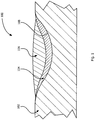
- FIG. 1 schematically shows a processed component according to an embodiment of the disclosure.
- a processed component and a method of processing a component having a weld without cracks inside the weld and/or cracks inside an interface of the weld.
- an exemplary processed component 100 includes a base metal 102, a first layer 104 with a first filler, and a second layer 106 with a second filler.
- layer refers to a filler material deposited through welding.
- the processed component 100 is a metal component.
- the processed component is a gas turbine component such as a blade, rotor, a diaphragm, a bucket, or dovetail.
- the first layer 104 is applied to a surface deformity 108 (for example, a cavity, a crack, a chip, a hole, a fissure, or other suitable surface feature) in the base metal 102 of the component 100.
- the second layer 106 is then applied on the first layer 104.
- the second layer 106 may remain separate from the base metal 102 and/or may partially contact the base metal 102, depending upon the complexity of the weld and the technique utilized by the welder.
- the base metal 102 includes a base metal composition, a base metal thermal expansion coefficient, a base metal yield strength, and a base metal elongation.
- the first layer 104 is positioned proximal to the base metal 102.
- the first layer 104 has a first filler composition, a first filler thermal expansion coefficient, a first filler yield strength, and a first filler elongation.
- the second layer 106 is positioned proximal to the first layer 104.
- the second layer 106 has a second filler composition, a second filler thermal expansion coefficient, a second filler yield strength, and a second filler elongation.
- the first layer 104 and the second layer 106 are selected based upon one or more predetermined properties. For example, in one embodiment, the first layer 104 and the second layer 106 are selected in response to the base metal composition, the base metal thermal expansion coefficient, the base metal yield strength, the base metal elongation, and combinations thereof. For example, in one embodiment, to make the first layer 104, a first filler metal is selected such that the first filler composition includes less carbon content, less iron content, and higher nickel content than a second filler for making the second layer 106.
- the first filler and/or the second filler are selected such that the first filler thermal expansion coefficient is less than both the base metal thermal expansion coefficient and the second filler thermal expansion coefficient. In another embodiment, to make the first layer 104 and/or the second layer 106, the first filler and/or the second filler are selected such that the second filler yield strength is greater than both the base metal yield strength and the first filler yield strength.
- the selection of the first filler to make the first layer 104 and/or the second filler to make the second layer 106 is based upon the specific identifiable and quantifiable relationships and/or differences between the base metal 102 and the first layer 104 and/or the second layer 106.
- the first filler and/or the second filler is selected such that the difference in the thermal expansion range of the first filler and/or the second filler in comparison to the base metal 102 is a predetermined difference of thermal expansion.
- the first filler thermal expansion coefficient is less than the base metal thermal expansion coefficient and the second filler thermal expansion coefficient is greater than the first filler thermal expansion coefficient.
- the predetermined difference of thermal expansion coefficient between the first filler to make the first layer 104 and the base metal 102 is between about 7.0 ⁇ m/m ⁇ K and about 8.0 ⁇ m/m ⁇ K (i.e., the value of the base metal thermal expansion coefficient minus the value of the first filler thermal expansion coefficient), 6.0 ⁇ m/m ⁇ K and about 9.0 ⁇ m/m ⁇ K, 5.0 ⁇ m/m ⁇ K and about 10.0 ⁇ m/m ⁇ K, at about 6.5 ⁇ m/m ⁇ K, at about 7.0 ⁇ m/m ⁇ K, at about 7.5 ⁇ m/m ⁇ K, or at about 8.0 ⁇ m/m ⁇ K.
- the first filler to make the first layer 104 has a thermal expansion coefficient between about 65 percent and about 75 percent lower than the base metal 102 (i.e., the value of the base metal thermal expansion coefficient minus the value of the first filler thermal expansion coefficient and all divided by the value of the base metal thermal expansion coefficient).
- the predetermined difference of the thermal expansion coefficient between the first filler to make the first layer 104 and the second layer 106 is between about 2.3 ⁇ m/m ⁇ K and about 3.3 ⁇ m/m ⁇ K (i.e., the value of the second filler thermal expansion coefficient minus the value of the first filler thermal expansion coefficient), between about 1.3 ⁇ m/m ⁇ K and about 4.3 ⁇ m/m ⁇ K, between about 1.8 ⁇ m/m ⁇ K and about 3.8 ⁇ m/m ⁇ K, at about 2.3 ⁇ m/m ⁇ K, at about 2.6 ⁇ m/m ⁇ K, or at about 2.9 ⁇ m/m ⁇ K.
- the first filler to make the first layer 104 has a thermal expansion coefficient between about 18 percent and about 26 percent lower than the second layer 106 (i.e., the value of the second filler thermal expansion coefficient minus the value of the first filler thermal expansion coefficient and all divided by the value of the second filler thermal expansion coefficient).
- the base metal 102 has a thermal expansion coefficient of about 17.6 ⁇ m/m ⁇ K
- the first filler to make the first layer 104 has a thermal expansion coefficient of about 12.8 ⁇ m/m ⁇ K
- the second filler to make the second layer 106 has a thermal expansion coefficient of about 10.2 ⁇ m/m ⁇ K, and combinations thereof.
- the first filler to make the first layer 104 and/or the second filler to make the second layer 106 is selected such that the difference in elongation of the first layer 104 and/or the second layer 106 in comparison to the base metal 102 is a predetermined difference of elongation.
- elongation refers to the material extension during the tensile strength testing at a constant temperature. For example, elongation is measured extending a metal and comparing a length of the metal prior to being extended to an extended length of the metal at the point the metal fractures.
- the first filler elongation is slightly above or below the base metal elongation and the second filler elongation is greater than the first filler elongation.
- the predetermined difference of elongation between the first layer 104 and the base metal 102 is between a value of about 32 percent and a value of about 36 percent (i.e., the value of the first filler elongation minus the value of the base metal elongation), at a value of about 34.5 percent (i.e., the value of the first filler elongation minus the value of the base metal elongation), between a comparative range of about 75 percent and about 85 percent (i.e., the value of the first filler elongation minus the value of the base metal elongation and all divided by the value of the first filler elongation), and/or at about 81 percent (i.e., the value of the first filler elongation minus the value of the base metal elongation and all divided by the value of the first filler elongation).
- the predetermined difference of elongation between the second filler to make the second layer 106 and the first filler to make the first layer 104 is between a value of about 29.5 percent and a value of about 36.5 percent (i.e., the value of the second filler elongation minus the value of the first filler elongation), at a value of about 33 percent (i.e., the value of the second filler elongation minus the value of the first filler elongation), or between a comparative range of about 69.5 percent and about 86 percent (i.e., the value of the second filler elongation minus the value of the first filler elongation and all divided by the value of the second filler elongation).
- the base metal 102 has an elongation of about 8.0 percent
- the first filler to make the first layer 104 has an elongation between about 6 percent and about 13 percent
- the second filler to make the second layer 106 has an elongation of about 42.5 percent.
- the first filler to make the first layer 104 and/or the second filler to make the second layer 106 is selected such that the difference in the yield strength of the first filler and/or the second filler in comparison to the base metal 102 is a predetermined difference of yield strength.
- yield strength refers to the resistance of a metal to stress at which a material begins to plastically deform.
- the first filler yield strength is greater than the base metal yield strength
- the second filler yield strength is greater than both the first filler yield strength and the base metal yield strength.
- the predetermined difference of yield strength between the first filler to make the first layer 104 and the base metal 102 is between about 103 MPa (15 Ksi) and about 152 MPa (22 Ksi) (i.e., the value of the first filler yield strength minus the value of the base metal yield strength), at about 128 MPa (18.5 Ksi) (i.e., the value of the first filler yield strength minus the value of the base metal yield strength), between about 50 percent and about 73 percent (i.e., the value of the first filler yield strength minus the value of the base metal yield strength and all divided by the value of the base metal yield strength), and/or at about 61.5 percent (i.e., the value of the base metal yield strength minus the value of the base metal yield strength and all divided by the value of the base metal yield strength).
- the predetermined difference of yield strength between the second filler to make the second layer 106 and the first filler to make the first layer 104 is between about 159 MPa Ksi) and about 207 MPa (30 Ksi)(i.e., the value of the second filler yield strength minus the value of the first filler yield strength), at about 183 MPa (26.5 Ksi) (i.e., the value of the second filler yield strength minus the value of the first filler yield strength), between about 30 percent and about 40 percent (i.e., the value of the second filler yield strength minus the value of the first filler yield strength and all divided by the value of the second filler yield strength), and/or at about 35 percent (i.e., the value of the second filler yield strength minus the value of the first filler yield strength and all divided by the value of the second filler yield strength).
- the base metal 102 has a yield strength of about 207 MPa (30 Ksi) the first filler to make the first layer 104 has a yield strength of about 310 MPa (45 Ksi) to about 359 MPa (52 Ksi) and/or the second filler to make the second layer 106 has a yield strength of about 517 MPa (75 Ksi).
- the base metal composition is a nickel-resist cast type D-2 within a composition range by weight of up to about 3.0 percent carbon, about 1.75 percent to about 3.00 percent silicon, about 0.70 percent to about 1.0 percent manganese, about 1.75 percent to about 2.5 percent chromium, about 73.5 percent iron, and a balance of nickel (for example, between about 18 percent to about 22 percent nickel).
- the nickel-resist cast type D-2 provides resistance to corrosion, erosion, and frictional wear up to temperatures of about 1400° F (about 760° C).
- the first filler composition is by weight between about 1.0 percent and about 1.5 percent carbon, between about 50 percent and about 55 percent nickel, and between about 42.5 percent and about 47.5 percent iron. In a further embodiment, the composition is by weight between about 1.2 percent carbon, about 53 percent nickel, and about 45.0 percent iron.
- the second filler composition has a composition range of up to about 0.1 percent carbon, about 20 percent to about 23 percent chromium, about 5.0 percent iron, about 1.0 percent cobalt, between about 8.0 percent and about 10.0 percent molybdenum, and a balance of nickel.
- the base metal composition and the first filler composition include about the same carbon content and nickel content, the first filler thermal expansion coefficient is less than both the base metal thermal expansion coefficient and the second filler thermal expansion coefficient, the first filler yield strength is greater than the base metal yield strength, but less than the second filler yield strength, and the first filler elongation is greater than both the base metal elongation and the second filler elongation.
Landscapes
- Engineering & Computer Science (AREA)
- Mechanical Engineering (AREA)
- Chemical & Material Sciences (AREA)
- Materials Engineering (AREA)
- General Engineering & Computer Science (AREA)
- Plasma & Fusion (AREA)
- Chemical Kinetics & Catalysis (AREA)
- Physics & Mathematics (AREA)
- Metallurgy (AREA)
- Organic Chemistry (AREA)
- Turbine Rotor Nozzle Sealing (AREA)
- Arc Welding In General (AREA)
- Butt Welding And Welding Of Specific Article (AREA)
Priority Applications (1)
| Application Number | Priority Date | Filing Date | Title |
|---|---|---|---|
| PL12156409T PL2492373T3 (pl) | 2011-02-23 | 2012-02-21 | Komponent i sposób przetwarzania komponentu |
Applications Claiming Priority (1)
| Application Number | Priority Date | Filing Date | Title |
|---|---|---|---|
| US13/032,821 US8974865B2 (en) | 2011-02-23 | 2011-02-23 | Component and a method of processing a component |
Publications (2)
| Publication Number | Publication Date |
|---|---|
| EP2492373A1 EP2492373A1 (en) | 2012-08-29 |
| EP2492373B1 true EP2492373B1 (en) | 2019-09-11 |
Family
ID=45656333
Family Applications (1)
| Application Number | Title | Priority Date | Filing Date |
|---|---|---|---|
| EP12156409.0A Active EP2492373B1 (en) | 2011-02-23 | 2012-02-21 | Component and a method of processing a component |
Country Status (6)
| Country | Link |
|---|---|
| US (1) | US8974865B2 (pl) |
| EP (1) | EP2492373B1 (pl) |
| JP (1) | JP2012211580A (pl) |
| CN (1) | CN102649189B (pl) |
| PL (1) | PL2492373T3 (pl) |
| RU (1) | RU2606285C2 (pl) |
Families Citing this family (4)
| Publication number | Priority date | Publication date | Assignee | Title |
|---|---|---|---|---|
| US8726599B2 (en) * | 2010-01-04 | 2014-05-20 | General Electric Company | Fatigue load resistant structures and welding processes |
| US9260788B2 (en) * | 2012-10-30 | 2016-02-16 | General Electric Company | Reinforced articles and methods of making the same |
| CN103658931B (zh) * | 2013-12-30 | 2016-02-10 | 太原重工轨道交通设备有限公司 | 一种车轴型砧双层堆焊的方法 |
| KR102326326B1 (ko) | 2019-12-17 | 2021-11-12 | 주식회사 포스코 | 복사관 장치 및 그 제조 방법 |
Family Cites Families (37)
| Publication number | Priority date | Publication date | Assignee | Title |
|---|---|---|---|---|
| JPS5881566A (ja) * | 1981-11-10 | 1983-05-16 | Mitsubishi Heavy Ind Ltd | 銅または銅合金の肉盛溶接方法 |
| US4561914A (en) * | 1984-10-22 | 1985-12-31 | Wisconsin Alumni Research Foundation | Submerged arc welding flux |
| US4633554A (en) * | 1985-08-08 | 1987-01-06 | Westinghouse Electric Corp. | Method for repairing a steam turbine or generator rotor |
| US4705203A (en) * | 1986-08-04 | 1987-11-10 | United Technologies Corporation | Repair of surface defects in superalloy articles |
| JPS63242408A (ja) * | 1987-03-30 | 1988-10-07 | Hitachi Ltd | 圧延用複合ロ−ル |
| JPH03234364A (ja) * | 1989-10-31 | 1991-10-18 | Isuzu Motors Ltd | エンジンの耐熱性機械要素 |
| US6048586A (en) * | 1996-06-05 | 2000-04-11 | Caterpillar Inc. | Process for applying a functional gradient material coating to a component for improved performance |
| US5823745A (en) * | 1996-08-01 | 1998-10-20 | General Electric Co. | Method of repairing a steam turbine rotor |
| US5762727A (en) * | 1997-04-14 | 1998-06-09 | General Electric Company | Weld repair process and article repaired thereby |
| WO2000020160A1 (fr) * | 1998-10-02 | 2000-04-13 | Sumitomo Metal Industries, Ltd. | Structure soudee constituee d'un alliage a faible coefficient de dilatation thermique, et materiau de soudage |
| JP3462816B2 (ja) * | 1999-11-01 | 2003-11-05 | 三菱重工業株式会社 | タービン用ノズル翼、タービン用ノズル翼の製造方法、及び溶射装置 |
| JP4768919B2 (ja) * | 2001-01-05 | 2011-09-07 | 日立金属株式会社 | 高強度低熱膨張鋳物鋼及び高強度低熱膨張鋳物鋼からなるガスタービンの翼環用及びシールリング保持環用リング形状部品 |
| US6884959B2 (en) * | 2001-09-07 | 2005-04-26 | Electric Power Research Institute, Inc. | Controlled composition welding method |
| EP1312437A1 (en) * | 2001-11-19 | 2003-05-21 | ALSTOM (Switzerland) Ltd | Crack repair method |
| US6902633B2 (en) | 2003-05-09 | 2005-06-07 | General Electric Company | Nickel-base-alloy |
| US7017793B2 (en) * | 2003-06-26 | 2006-03-28 | United Technologies Corporation | Repair process |
| RU2251476C1 (ru) * | 2003-09-17 | 2005-05-10 | Общество с ограниченной ответственностью "Научно-производственное предприятие "Уралавиаспецтехнология" | Способ восстановления лопаток паровых турбин |
| US20050069450A1 (en) | 2003-09-30 | 2005-03-31 | Liang Jiang | Nickel-containing alloys, method of manufacture thereof and articles derived thereform |
| US20100135847A1 (en) | 2003-09-30 | 2010-06-03 | General Electric Company | Nickel-containing alloys, method of manufacture thereof and articles derived therefrom |
| US7775414B2 (en) | 2003-10-04 | 2010-08-17 | Siemens Energy, Inc. | Consumable insert and method of using the same |
| US20050214563A1 (en) | 2004-03-29 | 2005-09-29 | General Electric Company | Modified bond coat for increasing the cyclic spallation life of thermal barrier coating |
| US7367123B2 (en) | 2005-05-12 | 2008-05-06 | General Electric Company | Coated bucket damper pin and related method |
| US20070095441A1 (en) | 2005-11-01 | 2007-05-03 | General Electric Company | Nickel-base alloy, articles formed therefrom, and process therefor |
| US7842402B2 (en) | 2006-03-31 | 2010-11-30 | General Electric Company | Machine components and methods of fabricating |
| US7727318B2 (en) | 2007-01-09 | 2010-06-01 | General Electric Company | Metal alloy compositions and articles comprising the same |
| US7846243B2 (en) | 2007-01-09 | 2010-12-07 | General Electric Company | Metal alloy compositions and articles comprising the same |
| US7931759B2 (en) | 2007-01-09 | 2011-04-26 | General Electric Company | Metal alloy compositions and articles comprising the same |
| US8561298B2 (en) * | 2007-03-01 | 2013-10-22 | Siemens Energy, Inc. | Superalloy component welding at ambient temperature |
| US8262812B2 (en) | 2007-04-04 | 2012-09-11 | General Electric Company | Process for forming a chromium diffusion portion and articles made therefrom |
| US20090266870A1 (en) * | 2008-04-23 | 2009-10-29 | The Boeing Company | Joined composite structures with a graded coefficient of thermal expansion for extreme environment applications |
| US8512808B2 (en) * | 2008-04-28 | 2013-08-20 | The Boeing Company | Built-up composite structures with a graded coefficient of thermal expansion for extreme environment applications |
| DE102008031121A1 (de) * | 2008-05-06 | 2009-11-12 | Daimler Ag | Schweißnietverbindung |
| US20100034692A1 (en) | 2008-08-06 | 2010-02-11 | General Electric Company | Nickel-base superalloy, unidirectional-solidification process therefor, and castings formed therefrom |
| US8087565B2 (en) | 2008-09-08 | 2012-01-03 | General Electric Company | Process of filling openings in a component |
| JP2010201491A (ja) * | 2009-03-05 | 2010-09-16 | Hokkaido Electric Power Co Inc:The | 耐熱鋼品の溶接補修方法及び溶接補修部を有する耐熱鋼品 |
| DE102009016260A1 (de) * | 2009-04-03 | 2010-10-07 | Fraunhofer-Gesellschaft zur Förderung der angewandten Forschung e.V. | Verfahren beim Schweißen und Bauteil |
| US20110062220A1 (en) * | 2009-09-15 | 2011-03-17 | General Electric Company | Superalloy composition and method of forming a turbine engine component |
-
2011
- 2011-02-23 US US13/032,821 patent/US8974865B2/en active Active
-
2012
- 2012-02-13 JP JP2012027904A patent/JP2012211580A/ja active Pending
- 2012-02-21 PL PL12156409T patent/PL2492373T3/pl unknown
- 2012-02-21 RU RU2012106764A patent/RU2606285C2/ru not_active IP Right Cessation
- 2012-02-21 EP EP12156409.0A patent/EP2492373B1/en active Active
- 2012-02-23 CN CN201210053626.XA patent/CN102649189B/zh active Active
Non-Patent Citations (1)
| Title |
|---|
| None * |
Also Published As
| Publication number | Publication date |
|---|---|
| RU2012106764A (ru) | 2013-08-27 |
| US20120214019A1 (en) | 2012-08-23 |
| CN102649189B (zh) | 2015-11-25 |
| JP2012211580A (ja) | 2012-11-01 |
| RU2606285C2 (ru) | 2017-01-10 |
| CN102649189A (zh) | 2012-08-29 |
| PL2492373T3 (pl) | 2020-05-18 |
| EP2492373A1 (en) | 2012-08-29 |
| US8974865B2 (en) | 2015-03-10 |
Similar Documents
| Publication | Publication Date | Title |
|---|---|---|
| Furrer et al. | Ni-based superalloys for turbine discs | |
| US20090071580A1 (en) | Method of heat treating a superalloy component and an alloy component | |
| EP2492373B1 (en) | Component and a method of processing a component | |
| CA2353265C (en) | Metallic article with integral end band under compression and method for making | |
| US11198931B2 (en) | Process for preventing recrystallization of shot peened blade roots during a heat treatment process | |
| CN107735196B (zh) | 用于制造涡轮机的转子的方法 | |
| Miyashita et al. | Development and evaluation of large-scale rotor forging for over 700° C-class A-USC steam turbine | |
| US9174309B2 (en) | Turbine component and a process of fabricating a turbine component | |
| US20110100961A1 (en) | Welding process for producing rotating turbomachinery | |
| Shin et al. | Assessment of the characteristic of thermal barrier coating applied to gas turbine blade by thermo-gradient mechanical fatigue test | |
| US20140199164A1 (en) | Nickel-based alloy and turbine component having nickel-based alloy | |
| US8512485B2 (en) | Alloy | |
| EP2617846A2 (en) | A cast nickel-iron-base alloy component and process of forming a cast nickel-iron-base alloy component | |
| CN106435278B (zh) | 一种铝-钛时效型合金材料及其热处理工艺和应用 | |
| JP5791998B2 (ja) | ニッケル−鉄基合金及びニッケル−鉄基合金を形成する方法 | |
| WO2016111249A1 (ja) | オーステナイト系耐熱鋼およびタービン部品 | |
| JP2015086432A (ja) | オーステナイト系耐熱鋼およびタービン部品 | |
| JP6173956B2 (ja) | オーステナイト系耐熱鋼およびタービン部品 | |
| JP2012172679A (ja) | 爆圧溶接されたガスタービンシュラウド及び爆圧溶接ガスタービンシュラウドを形成する方法 | |
| JPH0978212A (ja) | 単結晶材料の再熱処理による余寿命延長方法 | |
| Seo et al. | Microstructure and Thermomechanical Fatigue Behavior of Directionally Solidified Ni-Based Superalloys in OP Condition | |
| JP2015030873A (ja) | オーステナイト系耐熱鋼およびタービン部品 | |
| US20060280612A1 (en) | Metallic article with integral end band under compression |
Legal Events
| Date | Code | Title | Description |
|---|---|---|---|
| PUAI | Public reference made under article 153(3) epc to a published international application that has entered the european phase |
Free format text: ORIGINAL CODE: 0009012 |
|
| AK | Designated contracting states |
Kind code of ref document: A1 Designated state(s): AL AT BE BG CH CY CZ DE DK EE ES FI FR GB GR HR HU IE IS IT LI LT LU LV MC MK MT NL NO PL PT RO RS SE SI SK SM TR |
|
| AX | Request for extension of the european patent |
Extension state: BA ME |
|
| 17P | Request for examination filed |
Effective date: 20130228 |
|
| GRAP | Despatch of communication of intention to grant a patent |
Free format text: ORIGINAL CODE: EPIDOSNIGR1 |
|
| STAA | Information on the status of an ep patent application or granted ep patent |
Free format text: STATUS: GRANT OF PATENT IS INTENDED |
|
| INTG | Intention to grant announced |
Effective date: 20190320 |
|
| GRAS | Grant fee paid |
Free format text: ORIGINAL CODE: EPIDOSNIGR3 |
|
| GRAA | (expected) grant |
Free format text: ORIGINAL CODE: 0009210 |
|
| STAA | Information on the status of an ep patent application or granted ep patent |
Free format text: STATUS: THE PATENT HAS BEEN GRANTED |
|
| AK | Designated contracting states |
Kind code of ref document: B1 Designated state(s): AL AT BE BG CH CY CZ DE DK EE ES FI FR GB GR HR HU IE IS IT LI LT LU LV MC MK MT NL NO PL PT RO RS SE SI SK SM TR |
|
| REG | Reference to a national code |
Ref country code: GB Ref legal event code: FG4D |
|
| REG | Reference to a national code |
Ref country code: CH Ref legal event code: EP |
|
| REG | Reference to a national code |
Ref country code: AT Ref legal event code: REF Ref document number: 1178550 Country of ref document: AT Kind code of ref document: T Effective date: 20190915 |
|
| REG | Reference to a national code |
Ref country code: DE Ref legal event code: R096 Ref document number: 602012063804 Country of ref document: DE |
|
| REG | Reference to a national code |
Ref country code: IE Ref legal event code: FG4D |
|
| REG | Reference to a national code |
Ref country code: NL Ref legal event code: MP Effective date: 20190911 |
|
| REG | Reference to a national code |
Ref country code: LT Ref legal event code: MG4D |
|
| PG25 | Lapsed in a contracting state [announced via postgrant information from national office to epo] |
Ref country code: HR Free format text: LAPSE BECAUSE OF FAILURE TO SUBMIT A TRANSLATION OF THE DESCRIPTION OR TO PAY THE FEE WITHIN THE PRESCRIBED TIME-LIMIT Effective date: 20190911 Ref country code: LT Free format text: LAPSE BECAUSE OF FAILURE TO SUBMIT A TRANSLATION OF THE DESCRIPTION OR TO PAY THE FEE WITHIN THE PRESCRIBED TIME-LIMIT Effective date: 20190911 Ref country code: SE Free format text: LAPSE BECAUSE OF FAILURE TO SUBMIT A TRANSLATION OF THE DESCRIPTION OR TO PAY THE FEE WITHIN THE PRESCRIBED TIME-LIMIT Effective date: 20190911 Ref country code: BG Free format text: LAPSE BECAUSE OF FAILURE TO SUBMIT A TRANSLATION OF THE DESCRIPTION OR TO PAY THE FEE WITHIN THE PRESCRIBED TIME-LIMIT Effective date: 20191211 Ref country code: FI Free format text: LAPSE BECAUSE OF FAILURE TO SUBMIT A TRANSLATION OF THE DESCRIPTION OR TO PAY THE FEE WITHIN THE PRESCRIBED TIME-LIMIT Effective date: 20190911 Ref country code: NO Free format text: LAPSE BECAUSE OF FAILURE TO SUBMIT A TRANSLATION OF THE DESCRIPTION OR TO PAY THE FEE WITHIN THE PRESCRIBED TIME-LIMIT Effective date: 20191211 |
|
| PG25 | Lapsed in a contracting state [announced via postgrant information from national office to epo] |
Ref country code: RS Free format text: LAPSE BECAUSE OF FAILURE TO SUBMIT A TRANSLATION OF THE DESCRIPTION OR TO PAY THE FEE WITHIN THE PRESCRIBED TIME-LIMIT Effective date: 20190911 Ref country code: LV Free format text: LAPSE BECAUSE OF FAILURE TO SUBMIT A TRANSLATION OF THE DESCRIPTION OR TO PAY THE FEE WITHIN THE PRESCRIBED TIME-LIMIT Effective date: 20190911 Ref country code: ES Free format text: LAPSE BECAUSE OF FAILURE TO SUBMIT A TRANSLATION OF THE DESCRIPTION OR TO PAY THE FEE WITHIN THE PRESCRIBED TIME-LIMIT Effective date: 20190911 Ref country code: AL Free format text: LAPSE BECAUSE OF FAILURE TO SUBMIT A TRANSLATION OF THE DESCRIPTION OR TO PAY THE FEE WITHIN THE PRESCRIBED TIME-LIMIT Effective date: 20190911 Ref country code: GR Free format text: LAPSE BECAUSE OF FAILURE TO SUBMIT A TRANSLATION OF THE DESCRIPTION OR TO PAY THE FEE WITHIN THE PRESCRIBED TIME-LIMIT Effective date: 20191212 |
|
| REG | Reference to a national code |
Ref country code: AT Ref legal event code: MK05 Ref document number: 1178550 Country of ref document: AT Kind code of ref document: T Effective date: 20190911 |
|
| PG25 | Lapsed in a contracting state [announced via postgrant information from national office to epo] |
Ref country code: AT Free format text: LAPSE BECAUSE OF FAILURE TO SUBMIT A TRANSLATION OF THE DESCRIPTION OR TO PAY THE FEE WITHIN THE PRESCRIBED TIME-LIMIT Effective date: 20190911 Ref country code: EE Free format text: LAPSE BECAUSE OF FAILURE TO SUBMIT A TRANSLATION OF THE DESCRIPTION OR TO PAY THE FEE WITHIN THE PRESCRIBED TIME-LIMIT Effective date: 20190911 Ref country code: PT Free format text: LAPSE BECAUSE OF FAILURE TO SUBMIT A TRANSLATION OF THE DESCRIPTION OR TO PAY THE FEE WITHIN THE PRESCRIBED TIME-LIMIT Effective date: 20200113 Ref country code: NL Free format text: LAPSE BECAUSE OF FAILURE TO SUBMIT A TRANSLATION OF THE DESCRIPTION OR TO PAY THE FEE WITHIN THE PRESCRIBED TIME-LIMIT Effective date: 20190911 Ref country code: RO Free format text: LAPSE BECAUSE OF FAILURE TO SUBMIT A TRANSLATION OF THE DESCRIPTION OR TO PAY THE FEE WITHIN THE PRESCRIBED TIME-LIMIT Effective date: 20190911 Ref country code: IT Free format text: LAPSE BECAUSE OF FAILURE TO SUBMIT A TRANSLATION OF THE DESCRIPTION OR TO PAY THE FEE WITHIN THE PRESCRIBED TIME-LIMIT Effective date: 20190911 |
|
| PG25 | Lapsed in a contracting state [announced via postgrant information from national office to epo] |
Ref country code: SM Free format text: LAPSE BECAUSE OF FAILURE TO SUBMIT A TRANSLATION OF THE DESCRIPTION OR TO PAY THE FEE WITHIN THE PRESCRIBED TIME-LIMIT Effective date: 20190911 Ref country code: SK Free format text: LAPSE BECAUSE OF FAILURE TO SUBMIT A TRANSLATION OF THE DESCRIPTION OR TO PAY THE FEE WITHIN THE PRESCRIBED TIME-LIMIT Effective date: 20190911 Ref country code: CZ Free format text: LAPSE BECAUSE OF FAILURE TO SUBMIT A TRANSLATION OF THE DESCRIPTION OR TO PAY THE FEE WITHIN THE PRESCRIBED TIME-LIMIT Effective date: 20190911 Ref country code: IS Free format text: LAPSE BECAUSE OF FAILURE TO SUBMIT A TRANSLATION OF THE DESCRIPTION OR TO PAY THE FEE WITHIN THE PRESCRIBED TIME-LIMIT Effective date: 20200224 |
|
| REG | Reference to a national code |
Ref country code: DE Ref legal event code: R097 Ref document number: 602012063804 Country of ref document: DE |
|
| PLBE | No opposition filed within time limit |
Free format text: ORIGINAL CODE: 0009261 |
|
| STAA | Information on the status of an ep patent application or granted ep patent |
Free format text: STATUS: NO OPPOSITION FILED WITHIN TIME LIMIT |
|
| PG2D | Information on lapse in contracting state deleted |
Ref country code: IS |
|
| PG25 | Lapsed in a contracting state [announced via postgrant information from national office to epo] |
Ref country code: DK Free format text: LAPSE BECAUSE OF FAILURE TO SUBMIT A TRANSLATION OF THE DESCRIPTION OR TO PAY THE FEE WITHIN THE PRESCRIBED TIME-LIMIT Effective date: 20190911 Ref country code: IS Free format text: LAPSE BECAUSE OF FAILURE TO SUBMIT A TRANSLATION OF THE DESCRIPTION OR TO PAY THE FEE WITHIN THE PRESCRIBED TIME-LIMIT Effective date: 20200112 |
|
| 26N | No opposition filed |
Effective date: 20200615 |
|
| PG25 | Lapsed in a contracting state [announced via postgrant information from national office to epo] |
Ref country code: SI Free format text: LAPSE BECAUSE OF FAILURE TO SUBMIT A TRANSLATION OF THE DESCRIPTION OR TO PAY THE FEE WITHIN THE PRESCRIBED TIME-LIMIT Effective date: 20190911 |
|
| REG | Reference to a national code |
Ref country code: CH Ref legal event code: PL |
|
| REG | Reference to a national code |
Ref country code: BE Ref legal event code: MM Effective date: 20200229 |
|
| PG25 | Lapsed in a contracting state [announced via postgrant information from national office to epo] |
Ref country code: MC Free format text: LAPSE BECAUSE OF FAILURE TO SUBMIT A TRANSLATION OF THE DESCRIPTION OR TO PAY THE FEE WITHIN THE PRESCRIBED TIME-LIMIT Effective date: 20190911 Ref country code: LU Free format text: LAPSE BECAUSE OF NON-PAYMENT OF DUE FEES Effective date: 20200221 |
|
| PG25 | Lapsed in a contracting state [announced via postgrant information from national office to epo] |
Ref country code: CH Free format text: LAPSE BECAUSE OF NON-PAYMENT OF DUE FEES Effective date: 20200229 Ref country code: LI Free format text: LAPSE BECAUSE OF NON-PAYMENT OF DUE FEES Effective date: 20200229 |
|
| PG25 | Lapsed in a contracting state [announced via postgrant information from national office to epo] |
Ref country code: IE Free format text: LAPSE BECAUSE OF NON-PAYMENT OF DUE FEES Effective date: 20200221 |
|
| PG25 | Lapsed in a contracting state [announced via postgrant information from national office to epo] |
Ref country code: BE Free format text: LAPSE BECAUSE OF NON-PAYMENT OF DUE FEES Effective date: 20200229 |
|
| PGFP | Annual fee paid to national office [announced via postgrant information from national office to epo] |
Ref country code: FR Payment date: 20210120 Year of fee payment: 10 |
|
| PGFP | Annual fee paid to national office [announced via postgrant information from national office to epo] |
Ref country code: GB Payment date: 20210120 Year of fee payment: 10 |
|
| PG25 | Lapsed in a contracting state [announced via postgrant information from national office to epo] |
Ref country code: TR Free format text: LAPSE BECAUSE OF FAILURE TO SUBMIT A TRANSLATION OF THE DESCRIPTION OR TO PAY THE FEE WITHIN THE PRESCRIBED TIME-LIMIT Effective date: 20190911 Ref country code: MT Free format text: LAPSE BECAUSE OF FAILURE TO SUBMIT A TRANSLATION OF THE DESCRIPTION OR TO PAY THE FEE WITHIN THE PRESCRIBED TIME-LIMIT Effective date: 20190911 Ref country code: CY Free format text: LAPSE BECAUSE OF FAILURE TO SUBMIT A TRANSLATION OF THE DESCRIPTION OR TO PAY THE FEE WITHIN THE PRESCRIBED TIME-LIMIT Effective date: 20190911 |
|
| PG25 | Lapsed in a contracting state [announced via postgrant information from national office to epo] |
Ref country code: MK Free format text: LAPSE BECAUSE OF FAILURE TO SUBMIT A TRANSLATION OF THE DESCRIPTION OR TO PAY THE FEE WITHIN THE PRESCRIBED TIME-LIMIT Effective date: 20190911 |
|
| GBPC | Gb: european patent ceased through non-payment of renewal fee |
Effective date: 20220221 |
|
| PG25 | Lapsed in a contracting state [announced via postgrant information from national office to epo] |
Ref country code: FR Free format text: LAPSE BECAUSE OF NON-PAYMENT OF DUE FEES Effective date: 20220228 |
|
| PG25 | Lapsed in a contracting state [announced via postgrant information from national office to epo] |
Ref country code: GB Free format text: LAPSE BECAUSE OF NON-PAYMENT OF DUE FEES Effective date: 20220221 |
|
| P01 | Opt-out of the competence of the unified patent court (upc) registered |
Effective date: 20230522 |
|
| REG | Reference to a national code |
Ref country code: DE Ref legal event code: R082 Ref document number: 602012063804 Country of ref document: DE Ref country code: DE Ref legal event code: R081 Ref document number: 602012063804 Country of ref document: DE Owner name: GENERAL ELECTRIC TECHNOLOGY GMBH, CH Free format text: FORMER OWNER: GENERAL ELECTRIC COMPANY, SCHENECTADY, NY, US |
|
| PGFP | Annual fee paid to national office [announced via postgrant information from national office to epo] |
Ref country code: PL Payment date: 20250121 Year of fee payment: 14 |
|
| PGFP | Annual fee paid to national office [announced via postgrant information from national office to epo] |
Ref country code: DE Payment date: 20260121 Year of fee payment: 15 |