EP2492258A1 - Method for manufacturing a tricyclodecane mono-methanol monocarboxylic acid derivative - Google Patents
Method for manufacturing a tricyclodecane mono-methanol monocarboxylic acid derivative Download PDFInfo
- Publication number
- EP2492258A1 EP2492258A1 EP10824703A EP10824703A EP2492258A1 EP 2492258 A1 EP2492258 A1 EP 2492258A1 EP 10824703 A EP10824703 A EP 10824703A EP 10824703 A EP10824703 A EP 10824703A EP 2492258 A1 EP2492258 A1 EP 2492258A1
- Authority
- EP
- European Patent Office
- Prior art keywords
- acid derivative
- monocarboxylic acid
- compound
- manufacturing
- methanol
- Prior art date
- Legal status (The legal status is an assumption and is not a legal conclusion. Google has not performed a legal analysis and makes no representation as to the accuracy of the status listed.)
- Withdrawn
Links
- OKKJLVBELUTLKV-UHFFFAOYSA-N methanol Substances OC OKKJLVBELUTLKV-UHFFFAOYSA-N 0.000 title claims abstract description 61
- 238000004519 manufacturing process Methods 0.000 title claims abstract description 49
- 238000000034 method Methods 0.000 title claims abstract description 47
- -1 formic acid compound Chemical class 0.000 claims abstract description 106
- BDAGIHXWWSANSR-UHFFFAOYSA-N methanoic acid Natural products OC=O BDAGIHXWWSANSR-UHFFFAOYSA-N 0.000 claims abstract description 56
- 150000003304 ruthenium compounds Chemical class 0.000 claims abstract description 41
- HECLRDQVFMWTQS-RGOKHQFPSA-N 1755-01-7 Chemical compound C1[C@H]2[C@@H]3CC=C[C@@H]3[C@@H]1C=C2 HECLRDQVFMWTQS-RGOKHQFPSA-N 0.000 claims abstract description 31
- 230000003197 catalytic effect Effects 0.000 claims abstract description 31
- 150000002762 monocarboxylic acid derivatives Chemical class 0.000 claims abstract description 31
- 150000001869 cobalt compounds Chemical class 0.000 claims abstract description 28
- 235000019253 formic acid Nutrition 0.000 claims abstract description 28
- 239000001257 hydrogen Substances 0.000 claims abstract description 15
- 229910052739 hydrogen Inorganic materials 0.000 claims abstract description 15
- 125000000217 alkyl group Chemical group 0.000 claims abstract description 9
- 125000004432 carbon atom Chemical group C* 0.000 claims abstract description 7
- 125000001797 benzyl group Chemical group [H]C1=C([H])C([H])=C(C([H])=C1[H])C([H])([H])* 0.000 claims abstract description 6
- 125000004435 hydrogen atom Chemical group [H]* 0.000 claims abstract description 6
- 125000000391 vinyl group Chemical group [H]C([*])=C([H])[H] 0.000 claims abstract description 6
- 238000006243 chemical reaction Methods 0.000 claims description 81
- 239000002253 acid Substances 0.000 claims description 26
- 238000007037 hydroformylation reaction Methods 0.000 claims description 24
- 150000007514 bases Chemical class 0.000 claims description 14
- 239000003446 ligand Substances 0.000 claims description 14
- 229910052736 halogen Inorganic materials 0.000 claims description 10
- 125000002915 carbonyl group Chemical group [*:2]C([*:1])=O 0.000 claims description 7
- OAICVXFJPJFONN-UHFFFAOYSA-N Phosphorus Chemical compound [P] OAICVXFJPJFONN-UHFFFAOYSA-N 0.000 claims description 4
- 150000004820 halides Chemical class 0.000 claims description 4
- 150000002367 halogens Chemical class 0.000 claims description 4
- 229910052698 phosphorus Inorganic materials 0.000 claims description 4
- 239000011574 phosphorus Substances 0.000 claims description 4
- 150000003242 quaternary ammonium salts Chemical group 0.000 claims description 3
- 239000012327 Ruthenium complex Substances 0.000 claims description 2
- 150000003512 tertiary amines Chemical class 0.000 claims description 2
- 229920000728 polyester Polymers 0.000 abstract description 21
- 239000002994 raw material Substances 0.000 abstract description 14
- 125000002723 alicyclic group Chemical group 0.000 abstract description 11
- 125000002496 methyl group Chemical group [H]C([H])([H])* 0.000 description 46
- 238000004458 analytical method Methods 0.000 description 17
- 230000000694 effects Effects 0.000 description 13
- 230000001737 promoting effect Effects 0.000 description 13
- CURLTUGMZLYLDI-UHFFFAOYSA-N Carbon dioxide Chemical compound O=C=O CURLTUGMZLYLDI-UHFFFAOYSA-N 0.000 description 12
- 150000002500 ions Chemical class 0.000 description 12
- 150000001875 compounds Chemical class 0.000 description 10
- 238000004821 distillation Methods 0.000 description 10
- 239000000203 mixture Substances 0.000 description 10
- 239000002904 solvent Substances 0.000 description 10
- 229910021012 Co2(CO)8 Inorganic materials 0.000 description 9
- UFHFLCQGNIYNRP-UHFFFAOYSA-N Hydrogen Chemical compound [H][H] UFHFLCQGNIYNRP-UHFFFAOYSA-N 0.000 description 9
- YXFVVABEGXRONW-UHFFFAOYSA-N Toluene Chemical compound CC1=CC=CC=C1 YXFVVABEGXRONW-UHFFFAOYSA-N 0.000 description 9
- 239000007789 gas Substances 0.000 description 9
- 230000001965 increasing effect Effects 0.000 description 9
- 150000001768 cations Chemical class 0.000 description 8
- VNWKTOKETHGBQD-UHFFFAOYSA-N methane Chemical compound C VNWKTOKETHGBQD-UHFFFAOYSA-N 0.000 description 8
- UHOVQNZJYSORNB-UHFFFAOYSA-N monobenzene Natural products C1=CC=CC=C1 UHOVQNZJYSORNB-UHFFFAOYSA-N 0.000 description 8
- IWDCLRJOBJJRNH-UHFFFAOYSA-N p-cresol Chemical compound CC1=CC=C(O)C=C1 IWDCLRJOBJJRNH-UHFFFAOYSA-N 0.000 description 8
- RIOQSEWOXXDEQQ-UHFFFAOYSA-N triphenylphosphine Chemical compound C1=CC=CC=C1P(C=1C=CC=CC=1)C1=CC=CC=C1 RIOQSEWOXXDEQQ-UHFFFAOYSA-N 0.000 description 8
- 239000003054 catalyst Substances 0.000 description 7
- 238000004817 gas chromatography Methods 0.000 description 7
- 150000003839 salts Chemical class 0.000 description 7
- VEXZGXHMUGYJMC-UHFFFAOYSA-M Chloride anion Chemical compound [Cl-] VEXZGXHMUGYJMC-UHFFFAOYSA-M 0.000 description 6
- ZMXDDKWLCZADIW-UHFFFAOYSA-N N,N-Dimethylformamide Chemical compound CN(C)C=O ZMXDDKWLCZADIW-UHFFFAOYSA-N 0.000 description 6
- IMNFDUFMRHMDMM-UHFFFAOYSA-N N-Heptane Chemical compound CCCCCCC IMNFDUFMRHMDMM-UHFFFAOYSA-N 0.000 description 6
- NBIIXXVUZAFLBC-UHFFFAOYSA-N Phosphoric acid Chemical compound OP(O)(O)=O NBIIXXVUZAFLBC-UHFFFAOYSA-N 0.000 description 6
- WYURNTSHIVDZCO-UHFFFAOYSA-N Tetrahydrofuran Chemical compound C1CCOC1 WYURNTSHIVDZCO-UHFFFAOYSA-N 0.000 description 6
- ZMANZCXQSJIPKH-UHFFFAOYSA-N Triethylamine Chemical compound CCN(CC)CC ZMANZCXQSJIPKH-UHFFFAOYSA-N 0.000 description 6
- 239000001569 carbon dioxide Substances 0.000 description 6
- 229910002092 carbon dioxide Inorganic materials 0.000 description 6
- 230000000052 comparative effect Effects 0.000 description 6
- TZIHFWKZFHZASV-UHFFFAOYSA-N methyl formate Chemical compound COC=O TZIHFWKZFHZASV-UHFFFAOYSA-N 0.000 description 6
- 150000002896 organic halogen compounds Chemical class 0.000 description 6
- IJGRMHOSHXDMSA-UHFFFAOYSA-N Atomic nitrogen Chemical compound N#N IJGRMHOSHXDMSA-UHFFFAOYSA-N 0.000 description 5
- YMWUJEATGCHHMB-UHFFFAOYSA-N Dichloromethane Chemical compound ClCCl YMWUJEATGCHHMB-UHFFFAOYSA-N 0.000 description 5
- ISWSIDIOOBJBQZ-UHFFFAOYSA-N Phenol Chemical compound OC1=CC=CC=C1 ISWSIDIOOBJBQZ-UHFFFAOYSA-N 0.000 description 5
- 125000003118 aryl group Chemical group 0.000 description 5
- 230000005540 biological transmission Effects 0.000 description 5
- DHCWLIOIJZJFJE-UHFFFAOYSA-L dichlororuthenium Chemical compound Cl[Ru]Cl DHCWLIOIJZJFJE-UHFFFAOYSA-L 0.000 description 5
- 239000000463 material Substances 0.000 description 5
- OSWFIVFLDKOXQC-UHFFFAOYSA-N 4-(3-methoxyphenyl)aniline Chemical compound COC1=CC=CC(C=2C=CC(N)=CC=2)=C1 OSWFIVFLDKOXQC-UHFFFAOYSA-N 0.000 description 4
- MDLVWFOLPOBNAX-UHFFFAOYSA-N C12CC(CO)CC2C2CC(C(=O)OC)C1C2 Chemical compound C12CC(CO)CC2C2CC(C(=O)OC)C1C2 MDLVWFOLPOBNAX-UHFFFAOYSA-N 0.000 description 4
- UGFAIRIUMAVXCW-UHFFFAOYSA-N Carbon monoxide Chemical compound [O+]#[C-] UGFAIRIUMAVXCW-UHFFFAOYSA-N 0.000 description 4
- XTHFKEDIFFGKHM-UHFFFAOYSA-N Dimethoxyethane Chemical compound COCCOC XTHFKEDIFFGKHM-UHFFFAOYSA-N 0.000 description 4
- IAZDPXIOMUYVGZ-UHFFFAOYSA-N Dimethylsulphoxide Chemical compound CS(C)=O IAZDPXIOMUYVGZ-UHFFFAOYSA-N 0.000 description 4
- YNQLUTRBYVCPMQ-UHFFFAOYSA-N Ethylbenzene Chemical compound CCC1=CC=CC=C1 YNQLUTRBYVCPMQ-UHFFFAOYSA-N 0.000 description 4
- QIGBRXMKCJKVMJ-UHFFFAOYSA-N Hydroquinone Chemical compound OC1=CC=C(O)C=C1 QIGBRXMKCJKVMJ-UHFFFAOYSA-N 0.000 description 4
- CTQNGGLPUBDAKN-UHFFFAOYSA-N O-Xylene Chemical group CC1=CC=CC=C1C CTQNGGLPUBDAKN-UHFFFAOYSA-N 0.000 description 4
- URLKBWYHVLBVBO-UHFFFAOYSA-N Para-Xylene Chemical group CC1=CC=C(C)C=C1 URLKBWYHVLBVBO-UHFFFAOYSA-N 0.000 description 4
- OFBQJSOFQDEBGM-UHFFFAOYSA-N Pentane Chemical compound CCCCC OFBQJSOFQDEBGM-UHFFFAOYSA-N 0.000 description 4
- 229910000147 aluminium phosphate Inorganic materials 0.000 description 4
- 229910002091 carbon monoxide Inorganic materials 0.000 description 4
- YCIMNLLNPGFGHC-UHFFFAOYSA-N catechol Chemical compound OC1=CC=CC=C1O YCIMNLLNPGFGHC-UHFFFAOYSA-N 0.000 description 4
- WOWHHFRSBJGXCM-UHFFFAOYSA-M cetyltrimethylammonium chloride Chemical compound [Cl-].CCCCCCCCCCCCCCCC[N+](C)(C)C WOWHHFRSBJGXCM-UHFFFAOYSA-M 0.000 description 4
- 229940011182 cobalt acetate Drugs 0.000 description 4
- SCNCIXKLOBXDQB-UHFFFAOYSA-K cobalt(3+);2-hydroxypropane-1,2,3-tricarboxylate Chemical compound [Co+3].[O-]C(=O)CC(O)(CC([O-])=O)C([O-])=O SCNCIXKLOBXDQB-UHFFFAOYSA-K 0.000 description 4
- QAHREYKOYSIQPH-UHFFFAOYSA-L cobalt(II) acetate Chemical compound [Co+2].CC([O-])=O.CC([O-])=O QAHREYKOYSIQPH-UHFFFAOYSA-L 0.000 description 4
- 230000009477 glass transition Effects 0.000 description 4
- 238000005984 hydrogenation reaction Methods 0.000 description 4
- 125000004029 hydroxymethyl group Chemical group [H]OC([H])([H])* 0.000 description 4
- 229910001410 inorganic ion Inorganic materials 0.000 description 4
- XMBWDFGMSWQBCA-UHFFFAOYSA-M iodide Chemical compound [I-] XMBWDFGMSWQBCA-UHFFFAOYSA-M 0.000 description 4
- 239000002608 ionic liquid Substances 0.000 description 4
- IVSZLXZYQVIEFR-UHFFFAOYSA-N m-xylene Chemical group CC1=CC=CC(C)=C1 IVSZLXZYQVIEFR-UHFFFAOYSA-N 0.000 description 4
- VLKZOEOYAKHREP-UHFFFAOYSA-N n-Hexane Chemical compound CCCCCC VLKZOEOYAKHREP-UHFFFAOYSA-N 0.000 description 4
- 238000000425 proton nuclear magnetic resonance spectrum Methods 0.000 description 4
- 230000009257 reactivity Effects 0.000 description 4
- MFRIHAYPQRLWNB-UHFFFAOYSA-N sodium tert-butoxide Chemical compound [Na+].CC(C)(C)[O-] MFRIHAYPQRLWNB-UHFFFAOYSA-N 0.000 description 4
- 238000005979 thermal decomposition reaction Methods 0.000 description 4
- HAIZAZONHOVLEK-UHFFFAOYSA-N (4-nitrophenyl) octadecanoate Chemical compound CCCCCCCCCCCCCCCCCC(=O)OC1=CC=C([N+]([O-])=O)C=C1 HAIZAZONHOVLEK-UHFFFAOYSA-N 0.000 description 3
- PXELHGDYRQLRQO-UHFFFAOYSA-N 1-butyl-1-methylpyrrolidin-1-ium Chemical compound CCCC[N+]1(C)CCCC1 PXELHGDYRQLRQO-UHFFFAOYSA-N 0.000 description 3
- BOOXKGZZTBKJFE-UHFFFAOYSA-M 1-butyl-1-methylpyrrolidin-1-ium;chloride Chemical compound [Cl-].CCCC[N+]1(C)CCCC1 BOOXKGZZTBKJFE-UHFFFAOYSA-M 0.000 description 3
- QTBSBXVTEAMEQO-UHFFFAOYSA-N Acetic acid Chemical compound CC(O)=O QTBSBXVTEAMEQO-UHFFFAOYSA-N 0.000 description 3
- 229910019891 RuCl3 Inorganic materials 0.000 description 3
- KJTLSVCANCCWHF-UHFFFAOYSA-N Ruthenium Chemical compound [Ru] KJTLSVCANCCWHF-UHFFFAOYSA-N 0.000 description 3
- 229910052783 alkali metal Inorganic materials 0.000 description 3
- 150000001340 alkali metals Chemical class 0.000 description 3
- 229910052784 alkaline earth metal Inorganic materials 0.000 description 3
- WPYMKLBDIGXBTP-UHFFFAOYSA-N benzoic acid Chemical compound OC(=O)C1=CC=CC=C1 WPYMKLBDIGXBTP-UHFFFAOYSA-N 0.000 description 3
- 230000015572 biosynthetic process Effects 0.000 description 3
- 229910017052 cobalt Inorganic materials 0.000 description 3
- 239000010941 cobalt Substances 0.000 description 3
- GUTLYIVDDKVIGB-UHFFFAOYSA-N cobalt atom Chemical compound [Co] GUTLYIVDDKVIGB-UHFFFAOYSA-N 0.000 description 3
- KUMNEOGIHFCNQW-UHFFFAOYSA-N diphenyl phosphite Chemical compound C=1C=CC=CC=1OP([O-])OC1=CC=CC=C1 KUMNEOGIHFCNQW-UHFFFAOYSA-N 0.000 description 3
- 238000002329 infrared spectrum Methods 0.000 description 3
- 125000001160 methoxycarbonyl group Chemical group [H]C([H])([H])OC(*)=O 0.000 description 3
- MEEXGIVWQPBKHB-UHFFFAOYSA-N methyl 3-(hydroxymethyl)tricyclo[5.2.1.02,6]decane-8-carboxylate Chemical compound C12CCC(CO)C2C2CC(C(=O)OC)C1C2 MEEXGIVWQPBKHB-UHFFFAOYSA-N 0.000 description 3
- HOHGZFRLTPBMKO-UHFFFAOYSA-N methyl 5-(hydroxymethyl)tricyclo[5.2.1.02,6]decane-8-carboxylate Chemical compound C12C(CO)CCC2C2CC(C(=O)OC)C1C2 HOHGZFRLTPBMKO-UHFFFAOYSA-N 0.000 description 3
- ZUZLIXGTXQBUDC-UHFFFAOYSA-N methyltrioctylammonium Chemical compound CCCCCCCC[N+](C)(CCCCCCCC)CCCCCCCC ZUZLIXGTXQBUDC-UHFFFAOYSA-N 0.000 description 3
- XKBGEWXEAPTVCK-UHFFFAOYSA-M methyltrioctylammonium chloride Chemical compound [Cl-].CCCCCCCC[N+](C)(CCCCCCCC)CCCCCCCC XKBGEWXEAPTVCK-UHFFFAOYSA-M 0.000 description 3
- 230000003287 optical effect Effects 0.000 description 3
- 150000002894 organic compounds Chemical class 0.000 description 3
- 239000012074 organic phase Substances 0.000 description 3
- 229910052707 ruthenium Inorganic materials 0.000 description 3
- YBCAZPLXEGKKFM-UHFFFAOYSA-K ruthenium(iii) chloride Chemical compound [Cl-].[Cl-].[Cl-].[Ru+3] YBCAZPLXEGKKFM-UHFFFAOYSA-K 0.000 description 3
- 229910001220 stainless steel Inorganic materials 0.000 description 3
- 239000010935 stainless steel Substances 0.000 description 3
- 238000003786 synthesis reaction Methods 0.000 description 3
- YLQBMQCUIZJEEH-UHFFFAOYSA-N tetrahydrofuran Natural products C=1C=COC=1 YLQBMQCUIZJEEH-UHFFFAOYSA-N 0.000 description 3
- CYSGHNMQYZDMIA-UHFFFAOYSA-N 1,3-Dimethyl-2-imidazolidinon Chemical compound CN1CCN(C)C1=O CYSGHNMQYZDMIA-UHFFFAOYSA-N 0.000 description 2
- XUAXVBUVQVRIIQ-UHFFFAOYSA-N 1-butyl-2,3-dimethylimidazol-3-ium Chemical compound CCCCN1C=C[N+](C)=C1C XUAXVBUVQVRIIQ-UHFFFAOYSA-N 0.000 description 2
- IQQRAVYLUAZUGX-UHFFFAOYSA-N 1-butyl-3-methylimidazolium Chemical compound CCCCN1C=C[N+](C)=C1 IQQRAVYLUAZUGX-UHFFFAOYSA-N 0.000 description 2
- REACWASHYHDPSQ-UHFFFAOYSA-N 1-butylpyridin-1-ium Chemical compound CCCC[N+]1=CC=CC=C1 REACWASHYHDPSQ-UHFFFAOYSA-N 0.000 description 2
- LDVVBLGHGCHZBJ-UHFFFAOYSA-N 1-decyl-3-methylimidazolium Chemical compound CCCCCCCCCCN1C=C[N+](C)=C1 LDVVBLGHGCHZBJ-UHFFFAOYSA-N 0.000 description 2
- ILQHIGIKULUQFQ-UHFFFAOYSA-N 1-dodecyl-3-methylimidazolium Chemical compound CCCCCCCCCCCCN1C=C[N+](C)=C1 ILQHIGIKULUQFQ-UHFFFAOYSA-N 0.000 description 2
- IRGDPGYNHSIIJJ-UHFFFAOYSA-N 1-ethyl-2,3-dimethylimidazol-3-ium Chemical compound CCN1C=C[N+](C)=C1C IRGDPGYNHSIIJJ-UHFFFAOYSA-N 0.000 description 2
- OIDIRWZVUWCCCO-UHFFFAOYSA-N 1-ethylpyridin-1-ium Chemical compound CC[N+]1=CC=CC=C1 OIDIRWZVUWCCCO-UHFFFAOYSA-N 0.000 description 2
- FCZZZYZIQDHCIW-UHFFFAOYSA-N 1-heptyl-3-methylimidazol-3-ium Chemical compound CCCCCCC[N+]=1C=CN(C)C=1 FCZZZYZIQDHCIW-UHFFFAOYSA-N 0.000 description 2
- DCLKMMFVIGOXQN-UHFFFAOYSA-N 1-hexadecyl-3-methylimidazol-3-ium Chemical compound CCCCCCCCCCCCCCCCN1C=C[N+](C)=C1 DCLKMMFVIGOXQN-UHFFFAOYSA-N 0.000 description 2
- SWWLEHMBKPSRSI-UHFFFAOYSA-N 1-hexyl-2,3-dimethylimidazol-3-ium Chemical compound CCCCCCN1C=C[N+](C)=C1C SWWLEHMBKPSRSI-UHFFFAOYSA-N 0.000 description 2
- RVEJOWGVUQQIIZ-UHFFFAOYSA-N 1-hexyl-3-methylimidazolium Chemical compound CCCCCCN1C=C[N+](C)=C1 RVEJOWGVUQQIIZ-UHFFFAOYSA-N 0.000 description 2
- AMKUSFIBHAUBIJ-UHFFFAOYSA-N 1-hexylpyridin-1-ium Chemical compound CCCCCC[N+]1=CC=CC=C1 AMKUSFIBHAUBIJ-UHFFFAOYSA-N 0.000 description 2
- JWPBORWCDZAHAU-UHFFFAOYSA-N 1-methyl-1-octylpyrrolidin-1-ium Chemical compound CCCCCCCC[N+]1(C)CCCC1 JWPBORWCDZAHAU-UHFFFAOYSA-N 0.000 description 2
- MMJMYYUZGLJBST-UHFFFAOYSA-N 1-methyl-3-octadecylimidazol-1-ium Chemical compound CCCCCCCCCCCCCCCCCCN1C=C[N+](C)=C1 MMJMYYUZGLJBST-UHFFFAOYSA-N 0.000 description 2
- WVDDUSFOSWWJJH-UHFFFAOYSA-N 1-methyl-3-propylimidazol-1-ium Chemical compound CCCN1C=C[N+](C)=C1 WVDDUSFOSWWJJH-UHFFFAOYSA-N 0.000 description 2
- BMKLRPQTYXVGNK-UHFFFAOYSA-N 1-methyl-3-tetradecylimidazol-1-ium Chemical compound CCCCCCCCCCCCCCN1C=C[N+](C)=C1 BMKLRPQTYXVGNK-UHFFFAOYSA-N 0.000 description 2
- AVFZOVWCLRSYKC-UHFFFAOYSA-N 1-methylpyrrolidine Chemical compound CN1CCCC1 AVFZOVWCLRSYKC-UHFFFAOYSA-N 0.000 description 2
- ZOQOPXVJANRGJZ-UHFFFAOYSA-N 2-(trifluoromethyl)phenol Chemical compound OC1=CC=CC=C1C(F)(F)F ZOQOPXVJANRGJZ-UHFFFAOYSA-N 0.000 description 2
- ISPYQTSUDJAMAB-UHFFFAOYSA-N 2-chlorophenol Chemical compound OC1=CC=CC=C1Cl ISPYQTSUDJAMAB-UHFFFAOYSA-N 0.000 description 2
- QTWJRLJHJPIABL-UHFFFAOYSA-N 2-methylphenol;3-methylphenol;4-methylphenol Chemical compound CC1=CC=C(O)C=C1.CC1=CC=CC(O)=C1.CC1=CC=CC=C1O QTWJRLJHJPIABL-UHFFFAOYSA-N 0.000 description 2
- KDTZBYPBMTXCSO-UHFFFAOYSA-N 2-phenoxyphenol Chemical compound OC1=CC=CC=C1OC1=CC=CC=C1 KDTZBYPBMTXCSO-UHFFFAOYSA-N 0.000 description 2
- WXMVWUBWIHZLMQ-UHFFFAOYSA-N 3-methyl-1-octylimidazolium Chemical compound CCCCCCCCN1C=C[N+](C)=C1 WXMVWUBWIHZLMQ-UHFFFAOYSA-N 0.000 description 2
- QGZKDVFQNNGYKY-UHFFFAOYSA-O Ammonium Chemical compound [NH4+] QGZKDVFQNNGYKY-UHFFFAOYSA-O 0.000 description 2
- XKRFYHLGVUSROY-UHFFFAOYSA-N Argon Chemical compound [Ar] XKRFYHLGVUSROY-UHFFFAOYSA-N 0.000 description 2
- UYWQUFXKFGHYNT-UHFFFAOYSA-N Benzylformate Chemical compound O=COCC1=CC=CC=C1 UYWQUFXKFGHYNT-UHFFFAOYSA-N 0.000 description 2
- CPELXLSAUQHCOX-UHFFFAOYSA-M Bromide Chemical compound [Br-] CPELXLSAUQHCOX-UHFFFAOYSA-M 0.000 description 2
- FERIUCNNQQJTOY-UHFFFAOYSA-N Butyric acid Chemical compound CCCC(O)=O FERIUCNNQQJTOY-UHFFFAOYSA-N 0.000 description 2
- OYPRJOBELJOOCE-UHFFFAOYSA-N Calcium Chemical compound [Ca] OYPRJOBELJOOCE-UHFFFAOYSA-N 0.000 description 2
- LZZYPRNAOMGNLH-UHFFFAOYSA-M Cetrimonium bromide Chemical compound [Br-].CCCCCCCCCCCCCCCC[N+](C)(C)C LZZYPRNAOMGNLH-UHFFFAOYSA-M 0.000 description 2
- XDTMQSROBMDMFD-UHFFFAOYSA-N Cyclohexane Chemical compound C1CCCCC1 XDTMQSROBMDMFD-UHFFFAOYSA-N 0.000 description 2
- VEXZGXHMUGYJMC-UHFFFAOYSA-N Hydrochloric acid Chemical compound Cl VEXZGXHMUGYJMC-UHFFFAOYSA-N 0.000 description 2
- DGAQECJNVWCQMB-PUAWFVPOSA-M Ilexoside XXIX Chemical compound C[C@@H]1CC[C@@]2(CC[C@@]3(C(=CC[C@H]4[C@]3(CC[C@@H]5[C@@]4(CC[C@@H](C5(C)C)OS(=O)(=O)[O-])C)C)[C@@H]2[C@]1(C)O)C)C(=O)O[C@H]6[C@@H]([C@H]([C@@H]([C@H](O6)CO)O)O)O.[Na+] DGAQECJNVWCQMB-PUAWFVPOSA-M 0.000 description 2
- RAXXELZNTBOGNW-UHFFFAOYSA-O Imidazolium Chemical compound C1=C[NH+]=CN1 RAXXELZNTBOGNW-UHFFFAOYSA-O 0.000 description 2
- WHXSMMKQMYFTQS-UHFFFAOYSA-N Lithium Chemical compound [Li] WHXSMMKQMYFTQS-UHFFFAOYSA-N 0.000 description 2
- FXHOOIRPVKKKFG-UHFFFAOYSA-N N,N-Dimethylacetamide Chemical compound CN(C)C(C)=O FXHOOIRPVKKKFG-UHFFFAOYSA-N 0.000 description 2
- SECXISVLQFMRJM-UHFFFAOYSA-N N-Methylpyrrolidone Chemical compound CN1CCCC1=O SECXISVLQFMRJM-UHFFFAOYSA-N 0.000 description 2
- AHVYPIQETPWLSZ-UHFFFAOYSA-N N-methyl-pyrrolidine Natural products CN1CC=CC1 AHVYPIQETPWLSZ-UHFFFAOYSA-N 0.000 description 2
- 238000005481 NMR spectroscopy Methods 0.000 description 2
- PLDSPQWSYWQPND-UHFFFAOYSA-K O.O.C(CC(O)(C(=O)[O-])CC(=O)[O-])(=O)[O-].[Co+3] Chemical compound O.O.C(CC(O)(C(=O)[O-])CC(=O)[O-])(=O)[O-].[Co+3] PLDSPQWSYWQPND-UHFFFAOYSA-K 0.000 description 2
- QPFYXYFORQJZEC-FOCLMDBBSA-N Phenazopyridine Chemical compound NC1=NC(N)=CC=C1\N=N\C1=CC=CC=C1 QPFYXYFORQJZEC-FOCLMDBBSA-N 0.000 description 2
- ZLMJMSJWJFRBEC-UHFFFAOYSA-N Potassium Chemical compound [K] ZLMJMSJWJFRBEC-UHFFFAOYSA-N 0.000 description 2
- RWRDLPDLKQPQOW-UHFFFAOYSA-O Pyrrolidinium ion Chemical compound C1CC[NH2+]C1 RWRDLPDLKQPQOW-UHFFFAOYSA-O 0.000 description 2
- QAOWNCQODCNURD-UHFFFAOYSA-N Sulfuric acid Chemical compound OS(O)(=O)=O QAOWNCQODCNURD-UHFFFAOYSA-N 0.000 description 2
- KKEYFWRCBNTPAC-UHFFFAOYSA-N Terephthalic acid Chemical compound OC(=O)C1=CC=C(C(O)=O)C=C1 KKEYFWRCBNTPAC-UHFFFAOYSA-N 0.000 description 2
- DTQVDTLACAAQTR-UHFFFAOYSA-N Trifluoroacetic acid Chemical compound OC(=O)C(F)(F)F DTQVDTLACAAQTR-UHFFFAOYSA-N 0.000 description 2
- 150000007513 acids Chemical class 0.000 description 2
- 125000001931 aliphatic group Chemical group 0.000 description 2
- QSRFYFHZPSGRQX-UHFFFAOYSA-N benzyl(tributyl)azanium Chemical compound CCCC[N+](CCCC)(CCCC)CC1=CC=CC=C1 QSRFYFHZPSGRQX-UHFFFAOYSA-N 0.000 description 2
- VBQDSLGFSUGBBE-UHFFFAOYSA-N benzyl(triethyl)azanium Chemical compound CC[N+](CC)(CC)CC1=CC=CC=C1 VBQDSLGFSUGBBE-UHFFFAOYSA-N 0.000 description 2
- YOUGRGFIHBUKRS-UHFFFAOYSA-N benzyl(trimethyl)azanium Chemical compound C[N+](C)(C)CC1=CC=CC=C1 YOUGRGFIHBUKRS-UHFFFAOYSA-N 0.000 description 2
- BNQRPLGZFADFGA-UHFFFAOYSA-N benzyl(triphenyl)phosphanium Chemical compound C=1C=CC=CC=1[P+](C=1C=CC=CC=1)(C=1C=CC=CC=1)CC1=CC=CC=C1 BNQRPLGZFADFGA-UHFFFAOYSA-N 0.000 description 2
- 229940006460 bromide ion Drugs 0.000 description 2
- 150000003842 bromide salts Chemical class 0.000 description 2
- NMJJFJNHVMGPGM-UHFFFAOYSA-N butyl formate Chemical compound CCCCOC=O NMJJFJNHVMGPGM-UHFFFAOYSA-N 0.000 description 2
- 229910052792 caesium Inorganic materials 0.000 description 2
- TVFDJXOCXUVLDH-UHFFFAOYSA-N caesium atom Chemical compound [Cs] TVFDJXOCXUVLDH-UHFFFAOYSA-N 0.000 description 2
- 229910052791 calcium Inorganic materials 0.000 description 2
- 239000011575 calcium Substances 0.000 description 2
- NQZFAUXPNWSLBI-UHFFFAOYSA-N carbon monoxide;ruthenium Chemical compound [Ru].[Ru].[Ru].[O+]#[C-].[O+]#[C-].[O+]#[C-].[O+]#[C-].[O+]#[C-].[O+]#[C-].[O+]#[C-].[O+]#[C-].[O+]#[C-].[O+]#[C-].[O+]#[C-].[O+]#[C-] NQZFAUXPNWSLBI-UHFFFAOYSA-N 0.000 description 2
- 150000003841 chloride salts Chemical class 0.000 description 2
- 229910000152 cobalt phosphate Inorganic materials 0.000 description 2
- ZBYYWKJVSFHYJL-UHFFFAOYSA-L cobalt(2+);diacetate;tetrahydrate Chemical compound O.O.O.O.[Co+2].CC([O-])=O.CC([O-])=O ZBYYWKJVSFHYJL-UHFFFAOYSA-L 0.000 description 2
- GAYAMOAYBXKUII-UHFFFAOYSA-L cobalt(2+);dibenzoate Chemical compound [Co+2].[O-]C(=O)C1=CC=CC=C1.[O-]C(=O)C1=CC=CC=C1 GAYAMOAYBXKUII-UHFFFAOYSA-L 0.000 description 2
- ZBDSFTZNNQNSQM-UHFFFAOYSA-H cobalt(2+);diphosphate Chemical compound [Co+2].[Co+2].[Co+2].[O-]P([O-])([O-])=O.[O-]P([O-])([O-])=O ZBDSFTZNNQNSQM-UHFFFAOYSA-H 0.000 description 2
- TZWGXFOSKIHUPW-UHFFFAOYSA-L cobalt(2+);propanoate Chemical compound [Co+2].CCC([O-])=O.CCC([O-])=O TZWGXFOSKIHUPW-UHFFFAOYSA-L 0.000 description 2
- 229930003836 cresol Natural products 0.000 description 2
- RWGFKTVRMDUZSP-UHFFFAOYSA-N cumene Chemical compound CC(C)C1=CC=CC=C1 RWGFKTVRMDUZSP-UHFFFAOYSA-N 0.000 description 2
- DIOQZVSQGTUSAI-UHFFFAOYSA-N decane Chemical compound CCCCCCCCCC DIOQZVSQGTUSAI-UHFFFAOYSA-N 0.000 description 2
- SBZXBUIDTXKZTM-UHFFFAOYSA-N diglyme Chemical compound COCCOCCOC SBZXBUIDTXKZTM-UHFFFAOYSA-N 0.000 description 2
- 229940113088 dimethylacetamide Drugs 0.000 description 2
- XBDQKXXYIPTUBI-UHFFFAOYSA-N dimethylselenoniopropionate Natural products CCC(O)=O XBDQKXXYIPTUBI-UHFFFAOYSA-N 0.000 description 2
- 150000002009 diols Chemical class 0.000 description 2
- 230000002708 enhancing effect Effects 0.000 description 2
- 125000004185 ester group Chemical group 0.000 description 2
- LHGVFZTZFXWLCP-UHFFFAOYSA-N guaiacol Chemical compound COC1=CC=CC=C1O LHGVFZTZFXWLCP-UHFFFAOYSA-N 0.000 description 2
- 150000002430 hydrocarbons Chemical group 0.000 description 2
- 150000002431 hydrogen Chemical group 0.000 description 2
- 125000002887 hydroxy group Chemical group [H]O* 0.000 description 2
- RAXXELZNTBOGNW-UHFFFAOYSA-N imidazole Natural products C1=CNC=N1 RAXXELZNTBOGNW-UHFFFAOYSA-N 0.000 description 2
- 229940006461 iodide ion Drugs 0.000 description 2
- QQVIHTHCMHWDBS-UHFFFAOYSA-N isophthalic acid Chemical compound OC(=O)C1=CC=CC(C(O)=O)=C1 QQVIHTHCMHWDBS-UHFFFAOYSA-N 0.000 description 2
- 239000007788 liquid Substances 0.000 description 2
- 229910052744 lithium Inorganic materials 0.000 description 2
- 238000005259 measurement Methods 0.000 description 2
- 229910021645 metal ion Inorganic materials 0.000 description 2
- 125000001570 methylene group Chemical group [H]C([H])([*:1])[*:2] 0.000 description 2
- 229910052757 nitrogen Inorganic materials 0.000 description 2
- 229940078552 o-xylene Drugs 0.000 description 2
- 125000000962 organic group Chemical group 0.000 description 2
- CMPQUABWPXYYSH-UHFFFAOYSA-N phenyl phosphate Chemical compound OP(O)(=O)OC1=CC=CC=C1 CMPQUABWPXYYSH-UHFFFAOYSA-N 0.000 description 2
- XYFCBTPGUUZFHI-UHFFFAOYSA-O phosphonium Chemical compound [PH4+] XYFCBTPGUUZFHI-UHFFFAOYSA-O 0.000 description 2
- XNGIFLGASWRNHJ-UHFFFAOYSA-N phthalic acid Chemical compound OC(=O)C1=CC=CC=C1C(O)=O XNGIFLGASWRNHJ-UHFFFAOYSA-N 0.000 description 2
- 229920001225 polyester resin Polymers 0.000 description 2
- 239000004645 polyester resin Substances 0.000 description 2
- 229910052700 potassium Inorganic materials 0.000 description 2
- 239000011591 potassium Substances 0.000 description 2
- 239000002243 precursor Substances 0.000 description 2
- 229940070891 pyridium Drugs 0.000 description 2
- 229910052701 rubidium Inorganic materials 0.000 description 2
- IGLNJRXAVVLDKE-UHFFFAOYSA-N rubidium atom Chemical compound [Rb] IGLNJRXAVVLDKE-UHFFFAOYSA-N 0.000 description 2
- YGSDEFSMJLZEOE-UHFFFAOYSA-N salicylic acid Chemical compound OC(=O)C1=CC=CC=C1O YGSDEFSMJLZEOE-UHFFFAOYSA-N 0.000 description 2
- 239000004065 semiconductor Substances 0.000 description 2
- 229910052708 sodium Inorganic materials 0.000 description 2
- 239000011734 sodium Substances 0.000 description 2
- 239000007787 solid Substances 0.000 description 2
- 238000003756 stirring Methods 0.000 description 2
- 229910052712 strontium Inorganic materials 0.000 description 2
- CIOAGBVUUVVLOB-UHFFFAOYSA-N strontium atom Chemical compound [Sr] CIOAGBVUUVVLOB-UHFFFAOYSA-N 0.000 description 2
- 239000000126 substance Substances 0.000 description 2
- DZLFLBLQUQXARW-UHFFFAOYSA-N tetrabutylammonium Chemical compound CCCC[N+](CCCC)(CCCC)CCCC DZLFLBLQUQXARW-UHFFFAOYSA-N 0.000 description 2
- CBXCPBUEXACCNR-UHFFFAOYSA-N tetraethylammonium Chemical compound CC[N+](CC)(CC)CC CBXCPBUEXACCNR-UHFFFAOYSA-N 0.000 description 2
- SZWHXXNVLACKBV-UHFFFAOYSA-N tetraethylphosphanium Chemical compound CC[P+](CC)(CC)CC SZWHXXNVLACKBV-UHFFFAOYSA-N 0.000 description 2
- YFZDLRVCXDBOPH-UHFFFAOYSA-N tetraheptylazanium Chemical compound CCCCCCC[N+](CCCCCCC)(CCCCCCC)CCCCCCC YFZDLRVCXDBOPH-UHFFFAOYSA-N 0.000 description 2
- DTIFFPXSSXFQCJ-UHFFFAOYSA-N tetrahexylazanium Chemical compound CCCCCC[N+](CCCCCC)(CCCCCC)CCCCCC DTIFFPXSSXFQCJ-UHFFFAOYSA-N 0.000 description 2
- QEMXHQIAXOOASZ-UHFFFAOYSA-N tetramethylammonium Chemical compound C[N+](C)(C)C QEMXHQIAXOOASZ-UHFFFAOYSA-N 0.000 description 2
- BXYHVFRRNNWPMB-UHFFFAOYSA-N tetramethylphosphanium Chemical compound C[P+](C)(C)C BXYHVFRRNNWPMB-UHFFFAOYSA-N 0.000 description 2
- CHYBTAZWINMGHA-UHFFFAOYSA-N tetraoctylazanium Chemical compound CCCCCCCC[N+](CCCCCCCC)(CCCCCCCC)CCCCCCCC CHYBTAZWINMGHA-UHFFFAOYSA-N 0.000 description 2
- GJSGYPDDPQRWPK-UHFFFAOYSA-N tetrapentylammonium Chemical compound CCCCC[N+](CCCCC)(CCCCC)CCCCC GJSGYPDDPQRWPK-UHFFFAOYSA-N 0.000 description 2
- USFPINLPPFWTJW-UHFFFAOYSA-N tetraphenylphosphonium Chemical compound C1=CC=CC=C1[P+](C=1C=CC=CC=1)(C=1C=CC=CC=1)C1=CC=CC=C1 USFPINLPPFWTJW-UHFFFAOYSA-N 0.000 description 2
- OSBSFAARYOCBHB-UHFFFAOYSA-N tetrapropylammonium Chemical compound CCC[N+](CCC)(CCC)CCC OSBSFAARYOCBHB-UHFFFAOYSA-N 0.000 description 2
- VXUYXOFXAQZZMF-UHFFFAOYSA-N titanium(IV) isopropoxide Chemical compound CC(C)O[Ti](OC(C)C)(OC(C)C)OC(C)C VXUYXOFXAQZZMF-UHFFFAOYSA-N 0.000 description 2
- IMNIMPAHZVJRPE-UHFFFAOYSA-N triethylenediamine Chemical compound C1CN2CCN1CC2 IMNIMPAHZVJRPE-UHFFFAOYSA-N 0.000 description 2
- YFNKIDBQEZZDLK-UHFFFAOYSA-N triglyme Chemical compound COCCOCCOCCOC YFNKIDBQEZZDLK-UHFFFAOYSA-N 0.000 description 2
- CMPGARWFYBADJI-UHFFFAOYSA-L tungstic acid Chemical compound O[W](O)(=O)=O CMPGARWFYBADJI-UHFFFAOYSA-L 0.000 description 2
- XLYOFNOQVPJJNP-UHFFFAOYSA-N water Substances O XLYOFNOQVPJJNP-UHFFFAOYSA-N 0.000 description 2
- 230000004580 weight loss Effects 0.000 description 2
- JPJGNZQDELRZGE-UHFFFAOYSA-N (phenyl-$l^{2}-phosphanyl)benzene Chemical compound C=1C=CC=CC=1[P]C1=CC=CC=C1 JPJGNZQDELRZGE-UHFFFAOYSA-N 0.000 description 1
- 0 *OC(*1CC(C2)C3C=CCC3C2C1)=* Chemical compound *OC(*1CC(C2)C3C=CCC3C2C1)=* 0.000 description 1
- OTUVLLBGFFIEJO-UHFFFAOYSA-N 1-diethoxyphosphoryl-4-methoxybenzene Chemical compound CCOP(=O)(OCC)C1=CC=C(OC)C=C1 OTUVLLBGFFIEJO-UHFFFAOYSA-N 0.000 description 1
- NJMWOUFKYKNWDW-UHFFFAOYSA-N 1-ethyl-3-methylimidazolium Chemical compound CCN1C=C[N+](C)=C1 NJMWOUFKYKNWDW-UHFFFAOYSA-N 0.000 description 1
- LSFWFJFDPRFPBK-UHFFFAOYSA-N 1-methyl-3-pentylimidazol-1-ium Chemical compound CCCCCN1C=C[N+](C)=C1 LSFWFJFDPRFPBK-UHFFFAOYSA-N 0.000 description 1
- 238000005160 1H NMR spectroscopy Methods 0.000 description 1
- AVMSWPWPYJVYKY-UHFFFAOYSA-N 2-Methylpropyl formate Chemical compound CC(C)COC=O AVMSWPWPYJVYKY-UHFFFAOYSA-N 0.000 description 1
- SKIIKRJAQOSWFT-UHFFFAOYSA-N 2-[3-[1-(2,2-difluoroethyl)piperidin-4-yl]oxy-4-[2-(2,3-dihydro-1H-inden-2-ylamino)pyrimidin-5-yl]pyrazol-1-yl]-1-(2,4,6,7-tetrahydrotriazolo[4,5-c]pyridin-5-yl)ethanone Chemical compound FC(CN1CCC(CC1)OC1=NN(C=C1C=1C=NC(=NC=1)NC1CC2=CC=CC=C2C1)CC(=O)N1CC2=C(CC1)NN=N2)F SKIIKRJAQOSWFT-UHFFFAOYSA-N 0.000 description 1
- AZEQBUFSDPPYAJ-UHFFFAOYSA-N 3-(hydroxymethyl)tricyclo[5.2.1.02,6]decane-8-carboxylic acid Chemical compound C1C2C3C(CO)CCC3C1C(C(O)=O)C2 AZEQBUFSDPPYAJ-UHFFFAOYSA-N 0.000 description 1
- UZXIJHSJEKWJHP-UHFFFAOYSA-N 4-(4-carboxycyclohexyl)cyclohexane-1-carboxylic acid Chemical compound C1CC(C(=O)O)CCC1C1CCC(C(O)=O)CC1 UZXIJHSJEKWJHP-UHFFFAOYSA-N 0.000 description 1
- NXTDOCORQDMSTJ-UHFFFAOYSA-N 5-(hydroxymethyl)tricyclo[5.2.1.02,6]decane-8-carboxylic acid Chemical compound C1C2C3C(CO)CCC3C1CC2C(O)=O NXTDOCORQDMSTJ-UHFFFAOYSA-N 0.000 description 1
- 239000005711 Benzoic acid Substances 0.000 description 1
- FERIUCNNQQJTOY-UHFFFAOYSA-M Butyrate Chemical compound CCCC([O-])=O FERIUCNNQQJTOY-UHFFFAOYSA-M 0.000 description 1
- RBIKUZKSPHSCKA-UHFFFAOYSA-N C12C=CCC2C2CC(C(=O)OC)C1C2 Chemical compound C12C=CCC2C2CC(C(=O)OC)C1C2 RBIKUZKSPHSCKA-UHFFFAOYSA-N 0.000 description 1
- AWGUZOBWLDWOFZ-UHFFFAOYSA-N C12CC=CC2C2CC(C(=O)OC)C1C2 Chemical compound C12CC=CC2C2CC(C(=O)OC)C1C2 AWGUZOBWLDWOFZ-UHFFFAOYSA-N 0.000 description 1
- HECLRDQVFMWTQS-UHFFFAOYSA-N C1C2C=CC1C1C2C=CC1 Chemical compound C1C2C=CC1C1C2C=CC1 HECLRDQVFMWTQS-UHFFFAOYSA-N 0.000 description 1
- OTMSDBZUPAUEDD-UHFFFAOYSA-N Ethane Chemical compound CC OTMSDBZUPAUEDD-UHFFFAOYSA-N 0.000 description 1
- LFQSCWFLJHTTHZ-UHFFFAOYSA-N Ethanol Chemical compound CCO LFQSCWFLJHTTHZ-UHFFFAOYSA-N 0.000 description 1
- 238000001157 Fourier transform infrared spectrum Methods 0.000 description 1
- RMOUBSOVHSONPZ-UHFFFAOYSA-N Isopropyl formate Chemical compound CC(C)OC=O RMOUBSOVHSONPZ-UHFFFAOYSA-N 0.000 description 1
- 239000002841 Lewis acid Substances 0.000 description 1
- OFOBLEOULBTSOW-UHFFFAOYSA-N Malonic acid Chemical compound OC(=O)CC(O)=O OFOBLEOULBTSOW-UHFFFAOYSA-N 0.000 description 1
- CERQOIWHTDAKMF-UHFFFAOYSA-N Methacrylic acid Chemical class CC(=C)C(O)=O CERQOIWHTDAKMF-UHFFFAOYSA-N 0.000 description 1
- AFCARXCZXQIEQB-UHFFFAOYSA-N N-[3-oxo-3-(2,4,6,7-tetrahydrotriazolo[4,5-c]pyridin-5-yl)propyl]-2-[[3-(trifluoromethoxy)phenyl]methylamino]pyrimidine-5-carboxamide Chemical compound O=C(CCNC(=O)C=1C=NC(=NC=1)NCC1=CC(=CC=C1)OC(F)(F)F)N1CC2=C(CC1)NN=N2 AFCARXCZXQIEQB-UHFFFAOYSA-N 0.000 description 1
- GRYLNZFGIOXLOG-UHFFFAOYSA-N Nitric acid Chemical compound O[N+]([O-])=O GRYLNZFGIOXLOG-UHFFFAOYSA-N 0.000 description 1
- DIQMPQMYFZXDAX-UHFFFAOYSA-N Pentyl formate Chemical compound CCCCCOC=O DIQMPQMYFZXDAX-UHFFFAOYSA-N 0.000 description 1
- QLZHNIAADXEJJP-UHFFFAOYSA-N Phenylphosphonic acid Chemical compound OP(O)(=O)C1=CC=CC=C1 QLZHNIAADXEJJP-UHFFFAOYSA-N 0.000 description 1
- XBDQKXXYIPTUBI-UHFFFAOYSA-M Propionate Chemical compound CCC([O-])=O XBDQKXXYIPTUBI-UHFFFAOYSA-M 0.000 description 1
- 230000006750 UV protection Effects 0.000 description 1
- YIMQCDZDWXUDCA-UHFFFAOYSA-N [4-(hydroxymethyl)cyclohexyl]methanol Chemical compound OCC1CCC(CO)CC1 YIMQCDZDWXUDCA-UHFFFAOYSA-N 0.000 description 1
- 239000003513 alkali Substances 0.000 description 1
- 150000004703 alkoxides Chemical class 0.000 description 1
- 125000002947 alkylene group Chemical group 0.000 description 1
- SMWDFEZZVXVKRB-UHFFFAOYSA-N anhydrous quinoline Natural products N1=CC=CC2=CC=CC=C21 SMWDFEZZVXVKRB-UHFFFAOYSA-N 0.000 description 1
- 229910052786 argon Inorganic materials 0.000 description 1
- 239000002585 base Substances 0.000 description 1
- 235000010233 benzoic acid Nutrition 0.000 description 1
- HFLXXTFRXRJQJM-UHFFFAOYSA-N benzyl 3-(hydroxymethyl)tricyclo[5.2.1.02,6]decane-8-carboxylate Chemical compound C12C(CO)CCC2C2CC1CC2C(=O)OCC1=CC=CC=C1 HFLXXTFRXRJQJM-UHFFFAOYSA-N 0.000 description 1
- DMWCYIBGVFCMTR-UHFFFAOYSA-N benzyl 4-(hydroxymethyl)tricyclo[5.2.1.02,6]decane-8-carboxylate Chemical compound C12CC(CO)CC2C(C2)CC1C2C(=O)OCC1=CC=CC=C1 DMWCYIBGVFCMTR-UHFFFAOYSA-N 0.000 description 1
- PAXQWASHONSKDR-UHFFFAOYSA-N benzyl 5-(hydroxymethyl)tricyclo[5.2.1.02,6]decane-8-carboxylate Chemical compound C12C(CO)CCC2C(C2)CC1C2C(=O)OCC1=CC=CC=C1 PAXQWASHONSKDR-UHFFFAOYSA-N 0.000 description 1
- 238000009835 boiling Methods 0.000 description 1
- KGBXLFKZBHKPEV-UHFFFAOYSA-N boric acid Chemical compound OB(O)O KGBXLFKZBHKPEV-UHFFFAOYSA-N 0.000 description 1
- 239000004327 boric acid Substances 0.000 description 1
- NBXGPDIOBTUSPO-UHFFFAOYSA-N butyl 3-(hydroxymethyl)tricyclo[5.2.1.02,6]decane-8-carboxylate Chemical compound C12CCC(CO)C2C2CC(C(=O)OCCCC)C1C2 NBXGPDIOBTUSPO-UHFFFAOYSA-N 0.000 description 1
- BMQYZAZEDZWBTO-UHFFFAOYSA-N butyl 4-(hydroxymethyl)tricyclo[5.2.1.02,6]decane-8-carboxylate Chemical compound C12CC(CO)CC2C2CC(C(=O)OCCCC)C1C2 BMQYZAZEDZWBTO-UHFFFAOYSA-N 0.000 description 1
- KJCMWAFKVJRRQQ-UHFFFAOYSA-N butyl 5-(hydroxymethyl)tricyclo[5.2.1.02,6]decane-8-carboxylate Chemical compound C12C(CO)CCC2C2CC(C(=O)OCCCC)C1C2 KJCMWAFKVJRRQQ-UHFFFAOYSA-N 0.000 description 1
- 125000000484 butyl group Chemical group [H]C([*])([H])C([H])([H])C([H])([H])C([H])([H])[H] 0.000 description 1
- OIQOECYRLBNNBQ-UHFFFAOYSA-N carbon monoxide;cobalt Chemical compound [Co].[O+]#[C-].[O+]#[C-].[O+]#[C-].[O+]#[C-] OIQOECYRLBNNBQ-UHFFFAOYSA-N 0.000 description 1
- 150000005323 carbonate salts Chemical class 0.000 description 1
- BVKZGUZCCUSVTD-UHFFFAOYSA-N carbonic acid Chemical class OC(O)=O BVKZGUZCCUSVTD-UHFFFAOYSA-N 0.000 description 1
- 125000003178 carboxy group Chemical group [H]OC(*)=O 0.000 description 1
- 150000001732 carboxylic acid derivatives Chemical class 0.000 description 1
- 238000006555 catalytic reaction Methods 0.000 description 1
- RLGQACBPNDBWTB-UHFFFAOYSA-N cetyltrimethylammonium ion Chemical compound CCCCCCCCCCCCCCCC[N+](C)(C)C RLGQACBPNDBWTB-UHFFFAOYSA-N 0.000 description 1
- 125000004122 cyclic group Chemical group 0.000 description 1
- 125000000113 cyclohexyl group Chemical group [H]C1([H])C([H])([H])C([H])([H])C([H])(*)C([H])([H])C1([H])[H] 0.000 description 1
- 238000000354 decomposition reaction Methods 0.000 description 1
- 238000000113 differential scanning calorimetry Methods 0.000 description 1
- HANKSFAYJLDDKP-UHFFFAOYSA-N dihydrodicyclopentadiene Chemical class C12CC=CC2C2CCC1C2 HANKSFAYJLDDKP-UHFFFAOYSA-N 0.000 description 1
- 229910001873 dinitrogen Inorganic materials 0.000 description 1
- 150000002148 esters Chemical class 0.000 description 1
- MTWFVFBRPYYKPP-UHFFFAOYSA-N ethenyl 3-(hydroxymethyl)tricyclo[5.2.1.02,6]decane-8-carboxylate Chemical compound C1C2C3C(CO)CCC3C1C(C(=O)OC=C)C2 MTWFVFBRPYYKPP-UHFFFAOYSA-N 0.000 description 1
- SVRUHZVGHOVQLW-UHFFFAOYSA-N ethenyl 4-(hydroxymethyl)tricyclo[5.2.1.02,6]decane-8-carboxylate Chemical compound C=COC(=O)C1CC2CC1C1C2CC(CO)C1 SVRUHZVGHOVQLW-UHFFFAOYSA-N 0.000 description 1
- KVHYXHUOHIBEOJ-UHFFFAOYSA-N ethenyl 5-(hydroxymethyl)tricyclo[5.2.1.02,6]decane-8-carboxylate Chemical compound C1C2C3C(CO)CCC3C1CC2C(=O)OC=C KVHYXHUOHIBEOJ-UHFFFAOYSA-N 0.000 description 1
- GFJVXXWOPWLRNU-UHFFFAOYSA-N ethenyl formate Chemical compound C=COC=O GFJVXXWOPWLRNU-UHFFFAOYSA-N 0.000 description 1
- 125000001495 ethyl group Chemical group [H]C([H])([H])C([H])([H])* 0.000 description 1
- 238000011156 evaluation Methods 0.000 description 1
- 238000002474 experimental method Methods 0.000 description 1
- 239000000835 fiber Substances 0.000 description 1
- WBJINCZRORDGAQ-UHFFFAOYSA-N formic acid ethyl ester Natural products CCOC=O WBJINCZRORDGAQ-UHFFFAOYSA-N 0.000 description 1
- 125000002485 formyl group Chemical class [H]C(*)=O 0.000 description 1
- XMBWDFGMSWQBCA-UHFFFAOYSA-N hydrogen iodide Chemical compound I XMBWDFGMSWQBCA-UHFFFAOYSA-N 0.000 description 1
- 150000004679 hydroxides Chemical class 0.000 description 1
- 239000011261 inert gas Substances 0.000 description 1
- 150000002484 inorganic compounds Chemical class 0.000 description 1
- 229910010272 inorganic material Inorganic materials 0.000 description 1
- 230000010354 integration Effects 0.000 description 1
- XKYICAQFSCFURC-UHFFFAOYSA-N isoamyl formate Chemical compound CC(C)CCOC=O XKYICAQFSCFURC-UHFFFAOYSA-N 0.000 description 1
- 125000001449 isopropyl group Chemical group [H]C([H])([H])C([H])(*)C([H])([H])[H] 0.000 description 1
- 150000007517 lewis acids Chemical class 0.000 description 1
- 239000004973 liquid crystal related substance Substances 0.000 description 1
- 229910052751 metal Inorganic materials 0.000 description 1
- 239000002184 metal Substances 0.000 description 1
- 125000001434 methanylylidene group Chemical group [H]C#[*] 0.000 description 1
- CAAULPUQFIIOTL-UHFFFAOYSA-L methyl phosphate(2-) Chemical compound COP([O-])([O-])=O CAAULPUQFIIOTL-UHFFFAOYSA-L 0.000 description 1
- 238000000465 moulding Methods 0.000 description 1
- 229910017604 nitric acid Inorganic materials 0.000 description 1
- 239000013307 optical fiber Substances 0.000 description 1
- FJKROLUGYXJWQN-UHFFFAOYSA-N papa-hydroxy-benzoic acid Natural products OC(=O)C1=CC=C(O)C=C1 FJKROLUGYXJWQN-UHFFFAOYSA-N 0.000 description 1
- RKNAUWKZCIAWGJ-UHFFFAOYSA-N pentyl 3-(hydroxymethyl)tricyclo[5.2.1.02,6]decane-8-carboxylate Chemical compound C12CCC(CO)C2C2CC(C(=O)OCCCCC)C1C2 RKNAUWKZCIAWGJ-UHFFFAOYSA-N 0.000 description 1
- BTWIDEZZKQXBAD-UHFFFAOYSA-N pentyl 4-(hydroxymethyl)tricyclo[5.2.1.02,6]decane-8-carboxylate Chemical compound C12CC(CO)CC2C2CC(C(=O)OCCCCC)C1C2 BTWIDEZZKQXBAD-UHFFFAOYSA-N 0.000 description 1
- TXFYBXBWGHVXSI-UHFFFAOYSA-N pentyl 5-(hydroxymethyl)tricyclo[5.2.1.02,6]decane-8-carboxylate Chemical compound C12C(CO)CCC2C2CC(C(=O)OCCCCC)C1C2 TXFYBXBWGHVXSI-UHFFFAOYSA-N 0.000 description 1
- 125000001147 pentyl group Chemical group C(CCCC)* 0.000 description 1
- HXITXNWTGFUOAU-UHFFFAOYSA-N phenylboronic acid Chemical compound OB(O)C1=CC=CC=C1 HXITXNWTGFUOAU-UHFFFAOYSA-N 0.000 description 1
- MLCHBQKMVKNBOV-UHFFFAOYSA-N phenylphosphinic acid Chemical compound OP(=O)C1=CC=CC=C1 MLCHBQKMVKNBOV-UHFFFAOYSA-N 0.000 description 1
- 150000003007 phosphonic acid derivatives Chemical class 0.000 description 1
- 229920000642 polymer Polymers 0.000 description 1
- 239000002861 polymer material Substances 0.000 description 1
- 235000019260 propionic acid Nutrition 0.000 description 1
- 125000001436 propyl group Chemical group [H]C([*])([H])C([H])([H])C([H])([H])[H] 0.000 description 1
- JUJWROOIHBZHMG-UHFFFAOYSA-N pyridine Substances C1=CC=NC=C1 JUJWROOIHBZHMG-UHFFFAOYSA-N 0.000 description 1
- UMJSCPRVCHMLSP-UHFFFAOYSA-N pyridine Natural products COC1=CC=CN=C1 UMJSCPRVCHMLSP-UHFFFAOYSA-N 0.000 description 1
- IUVKMZGDUIUOCP-BTNSXGMBSA-N quinbolone Chemical compound O([C@H]1CC[C@H]2[C@H]3[C@@H]([C@]4(C=CC(=O)C=C4CC3)C)CC[C@@]21C)C1=CCCC1 IUVKMZGDUIUOCP-BTNSXGMBSA-N 0.000 description 1
- SBYHFKPVCBCYGV-UHFFFAOYSA-N quinuclidine Chemical compound C1CC2CCN1CC2 SBYHFKPVCBCYGV-UHFFFAOYSA-N 0.000 description 1
- 229920005989 resin Polymers 0.000 description 1
- 239000011347 resin Substances 0.000 description 1
- 229910052703 rhodium Inorganic materials 0.000 description 1
- 239000010948 rhodium Substances 0.000 description 1
- MHOVAHRLVXNVSD-UHFFFAOYSA-N rhodium atom Chemical compound [Rh] MHOVAHRLVXNVSD-UHFFFAOYSA-N 0.000 description 1
- 229960004889 salicylic acid Drugs 0.000 description 1
- 125000001424 substituent group Chemical group 0.000 description 1
- 125000000999 tert-butyl group Chemical group [H]C([H])([H])C(*)(C([H])([H])[H])C([H])([H])[H] 0.000 description 1
- JOXIMZWYDAKGHI-UHFFFAOYSA-N toluene-4-sulfonic acid Chemical compound CC1=CC=C(S(O)(=O)=O)C=C1 JOXIMZWYDAKGHI-UHFFFAOYSA-N 0.000 description 1
- 231100000331 toxic Toxicity 0.000 description 1
- 230000002588 toxic effect Effects 0.000 description 1
- 229910052723 transition metal Inorganic materials 0.000 description 1
- 150000003624 transition metals Chemical class 0.000 description 1
- 125000005270 trialkylamine group Chemical group 0.000 description 1
- ITMCEJHCFYSIIV-UHFFFAOYSA-N triflic acid Chemical compound OS(=O)(=O)C(F)(F)F ITMCEJHCFYSIIV-UHFFFAOYSA-N 0.000 description 1
Images
Classifications
-
- C—CHEMISTRY; METALLURGY
- C07—ORGANIC CHEMISTRY
- C07C—ACYCLIC OR CARBOCYCLIC COMPOUNDS
- C07C67/00—Preparation of carboxylic acid esters
- C07C67/30—Preparation of carboxylic acid esters by modifying the acid moiety of the ester, such modification not being an introduction of an ester group
- C07C67/333—Preparation of carboxylic acid esters by modifying the acid moiety of the ester, such modification not being an introduction of an ester group by isomerisation; by change of size of the carbon skeleton
- C07C67/343—Preparation of carboxylic acid esters by modifying the acid moiety of the ester, such modification not being an introduction of an ester group by isomerisation; by change of size of the carbon skeleton by increase in the number of carbon atoms
- C07C67/347—Preparation of carboxylic acid esters by modifying the acid moiety of the ester, such modification not being an introduction of an ester group by isomerisation; by change of size of the carbon skeleton by increase in the number of carbon atoms by addition to unsaturated carbon-to-carbon bonds
-
- C—CHEMISTRY; METALLURGY
- C07—ORGANIC CHEMISTRY
- C07B—GENERAL METHODS OF ORGANIC CHEMISTRY; APPARATUS THEREFOR
- C07B61/00—Other general methods
-
- C—CHEMISTRY; METALLURGY
- C07—ORGANIC CHEMISTRY
- C07C—ACYCLIC OR CARBOCYCLIC COMPOUNDS
- C07C69/00—Esters of carboxylic acids; Esters of carbonic or haloformic acids
- C07C69/74—Esters of carboxylic acids having an esterified carboxyl group bound to a carbon atom of a ring other than a six-membered aromatic ring
- C07C69/757—Esters of carboxylic acids having an esterified carboxyl group bound to a carbon atom of a ring other than a six-membered aromatic ring having any of the groups OH, O—metal, —CHO, keto, ether, acyloxy, groups, groups, or in the acid moiety
-
- B—PERFORMING OPERATIONS; TRANSPORTING
- B01—PHYSICAL OR CHEMICAL PROCESSES OR APPARATUS IN GENERAL
- B01J—CHEMICAL OR PHYSICAL PROCESSES, e.g. CATALYSIS OR COLLOID CHEMISTRY; THEIR RELEVANT APPARATUS
- B01J2231/00—Catalytic reactions performed with catalysts classified in B01J31/00
- B01J2231/30—Addition reactions at carbon centres, i.e. to either C-C or C-X multiple bonds
- B01J2231/32—Addition reactions to C=C or C-C triple bonds
- B01J2231/321—Hydroformylation, metalformylation, carbonylation or hydroaminomethylation
-
- B—PERFORMING OPERATIONS; TRANSPORTING
- B01—PHYSICAL OR CHEMICAL PROCESSES OR APPARATUS IN GENERAL
- B01J—CHEMICAL OR PHYSICAL PROCESSES, e.g. CATALYSIS OR COLLOID CHEMISTRY; THEIR RELEVANT APPARATUS
- B01J2231/00—Catalytic reactions performed with catalysts classified in B01J31/00
- B01J2231/30—Addition reactions at carbon centres, i.e. to either C-C or C-X multiple bonds
- B01J2231/32—Addition reactions to C=C or C-C triple bonds
- B01J2231/323—Hydrometalation, e.g. bor-, alumin-, silyl-, zirconation or analoguous reactions like carbometalation, hydrocarbation
-
- B—PERFORMING OPERATIONS; TRANSPORTING
- B01—PHYSICAL OR CHEMICAL PROCESSES OR APPARATUS IN GENERAL
- B01J—CHEMICAL OR PHYSICAL PROCESSES, e.g. CATALYSIS OR COLLOID CHEMISTRY; THEIR RELEVANT APPARATUS
- B01J2531/00—Additional information regarding catalytic systems classified in B01J31/00
- B01J2531/80—Complexes comprising metals of Group VIII as the central metal
- B01J2531/82—Metals of the platinum group
- B01J2531/821—Ruthenium
-
- B—PERFORMING OPERATIONS; TRANSPORTING
- B01—PHYSICAL OR CHEMICAL PROCESSES OR APPARATUS IN GENERAL
- B01J—CHEMICAL OR PHYSICAL PROCESSES, e.g. CATALYSIS OR COLLOID CHEMISTRY; THEIR RELEVANT APPARATUS
- B01J2531/00—Additional information regarding catalytic systems classified in B01J31/00
- B01J2531/80—Complexes comprising metals of Group VIII as the central metal
- B01J2531/84—Metals of the iron group
- B01J2531/845—Cobalt
-
- B—PERFORMING OPERATIONS; TRANSPORTING
- B01—PHYSICAL OR CHEMICAL PROCESSES OR APPARATUS IN GENERAL
- B01J—CHEMICAL OR PHYSICAL PROCESSES, e.g. CATALYSIS OR COLLOID CHEMISTRY; THEIR RELEVANT APPARATUS
- B01J31/00—Catalysts comprising hydrides, coordination complexes or organic compounds
- B01J31/02—Catalysts comprising hydrides, coordination complexes or organic compounds containing organic compounds or metal hydrides
- B01J31/0201—Oxygen-containing compounds
- B01J31/0202—Alcohols or phenols
-
- B—PERFORMING OPERATIONS; TRANSPORTING
- B01—PHYSICAL OR CHEMICAL PROCESSES OR APPARATUS IN GENERAL
- B01J—CHEMICAL OR PHYSICAL PROCESSES, e.g. CATALYSIS OR COLLOID CHEMISTRY; THEIR RELEVANT APPARATUS
- B01J31/00—Catalysts comprising hydrides, coordination complexes or organic compounds
- B01J31/02—Catalysts comprising hydrides, coordination complexes or organic compounds containing organic compounds or metal hydrides
- B01J31/0234—Nitrogen-, phosphorus-, arsenic- or antimony-containing compounds
- B01J31/0235—Nitrogen containing compounds
- B01J31/0237—Amines
-
- B—PERFORMING OPERATIONS; TRANSPORTING
- B01—PHYSICAL OR CHEMICAL PROCESSES OR APPARATUS IN GENERAL
- B01J—CHEMICAL OR PHYSICAL PROCESSES, e.g. CATALYSIS OR COLLOID CHEMISTRY; THEIR RELEVANT APPARATUS
- B01J31/00—Catalysts comprising hydrides, coordination complexes or organic compounds
- B01J31/02—Catalysts comprising hydrides, coordination complexes or organic compounds containing organic compounds or metal hydrides
- B01J31/0234—Nitrogen-, phosphorus-, arsenic- or antimony-containing compounds
- B01J31/0235—Nitrogen containing compounds
- B01J31/0239—Quaternary ammonium compounds
-
- B—PERFORMING OPERATIONS; TRANSPORTING
- B01—PHYSICAL OR CHEMICAL PROCESSES OR APPARATUS IN GENERAL
- B01J—CHEMICAL OR PHYSICAL PROCESSES, e.g. CATALYSIS OR COLLOID CHEMISTRY; THEIR RELEVANT APPARATUS
- B01J31/00—Catalysts comprising hydrides, coordination complexes or organic compounds
- B01J31/02—Catalysts comprising hydrides, coordination complexes or organic compounds containing organic compounds or metal hydrides
- B01J31/0234—Nitrogen-, phosphorus-, arsenic- or antimony-containing compounds
- B01J31/0235—Nitrogen containing compounds
- B01J31/0244—Nitrogen containing compounds with nitrogen contained as ring member in aromatic compounds or moieties, e.g. pyridine
-
- B—PERFORMING OPERATIONS; TRANSPORTING
- B01—PHYSICAL OR CHEMICAL PROCESSES OR APPARATUS IN GENERAL
- B01J—CHEMICAL OR PHYSICAL PROCESSES, e.g. CATALYSIS OR COLLOID CHEMISTRY; THEIR RELEVANT APPARATUS
- B01J31/00—Catalysts comprising hydrides, coordination complexes or organic compounds
- B01J31/02—Catalysts comprising hydrides, coordination complexes or organic compounds containing organic compounds or metal hydrides
- B01J31/0234—Nitrogen-, phosphorus-, arsenic- or antimony-containing compounds
- B01J31/0255—Phosphorus containing compounds
- B01J31/0257—Phosphorus acids or phosphorus acid esters
- B01J31/0259—Phosphorus acids or phosphorus acid esters comprising phosphorous acid (-ester) groups ((RO)P(OR')2) or the isomeric phosphonic acid (-ester) groups (R(R'O)2P=O), i.e. R= C, R'= C, H
-
- B—PERFORMING OPERATIONS; TRANSPORTING
- B01—PHYSICAL OR CHEMICAL PROCESSES OR APPARATUS IN GENERAL
- B01J—CHEMICAL OR PHYSICAL PROCESSES, e.g. CATALYSIS OR COLLOID CHEMISTRY; THEIR RELEVANT APPARATUS
- B01J31/00—Catalysts comprising hydrides, coordination complexes or organic compounds
- B01J31/16—Catalysts comprising hydrides, coordination complexes or organic compounds containing coordination complexes
- B01J31/20—Carbonyls
Definitions
- the present invention relates to a method for manufacturing a raw material for high heat-resistant alicyclic polyesters and the like.
- polyester resins can be molded into a film, a sheet, a deformed material, a fiber, a tube, a container or the like by various kinds of molding methods. Thus, they are used in a broad field.
- the most commonly used polyester is an aromatic polyester made from aromatic dicarboxylic acids such as terephthalic acid or isophthalic acid as a raw material and it has excellent heat resistance and toughness because it contains an aromatic group.
- a semiconductor laser source with a low wavelength range is used, and blue laser, UV laser, and the like are used as a light source for light signal. Accordingly, it is required that an optical material or a polymer material used for electronic parts and the like has transparency. However, since the aromatic polyester has poor UV resistance and poor light transmission, it cannot be applied to such fields.
- Polyesters having an alicyclic structure have excellent heat resistance, transparency, and water resistance, and thus some of them are used in the fields in which the transparency is required.
- As a method for manufacturing alicyclic polyesters various methods of using saturated cyclic aliphatic primary diols such as 1,4-cyclohexane dimethanol are suggested (Patent Document 1). Since an alkylene group is inserted between a hydroxyl group and a saturated cyclic aliphatic group in the saturated cyclic aliphatic primary diols, the alicyclic polyester resins obtained therefrom have aliphatic properties and the resins having a cyclohexane ring have low heat resistance. Thus, sufficient properties are not provided for the uses described above.
- (meth)acrylic acid esters having a tricyclodecane skeleton show excellent curability, water resistance, plasticity, and alkali resistance, and therefore various studies have been done regarding them (Patent Documents 3 to 5).
- polyesters having a tricyclodecane skeleton are not known. In this connection, a raw material for alicyclic polyesters having excellent heat resistance has been waited for.
- One embodiment of the invention is (1): a method for manufacturing a tricyclodecane mono-methanol monocarboxylic acid derivative, comprising the steps of reacting a dicyclopentadiene represented by formula (I) with a formic acid compound in the presence of a catalytic system containing a ruthenium compound, a cobalt compound, and a halide salt, to give a tricyclodecene monocarboxylic acid derivative represented by formula (II), and hydroformylating the tricyclodecene monocarboxylic acid derivative to give a tricyclodecane mono-methanol monocarboxylic acid derivative represented by formula (III).
- R represents a hydrogen, an alkyl group having 1 to 5 carbon atoms, a vinyl group, or a benzyl group.
- one embodiment of the invention is (2): the method for manufacturing a tricyclodecane mono-methanol monocarboxylic acid derivative described in above (1), wherein the ruthenium compound is a ruthenium complex having both a carbonyl ligand and a halogen ligand in the molecule.
- one embodiment of the invention is (3): the method for manufacturing a tricyclodecane mono-methanol monocarboxylic acid derivative described in above (1) or (2), wherein the halide salt is a quaternary ammonium salt.
- one embodiment of the invention is (4): the method for manufacturing a tricyclodecane mono-methanol monocarboxylic acid derivative described in any one of above (1) to (3), wherein the reaction between the dicyclopentadiene and formic acid compound is performed in the presence of a basic compound.
- one embodiment of the invention is (5): the method for manufacturing a tricyclodecane mono-methanol monocarboxylic acid derivative described in above (4), wherein the basic compound is a tertiary amine.
- one embodiment of the invention is (6): the method for manufacturing a tricyclodecane mono-methanol monocarboxylic acid derivative described in any one of above (1) to (5), wherein the reaction between the dicyclopentadiene and formic acid compound is performed in the presence of a phenol compound.
- one embodiment of the invention is (7): the method for manufacturing a tricyclodecane mono-methanol monocarboxylic acid derivative described in any one of above (1) to (6), wherein the reaction between the dicyclopentadiene and formic acid compound is performed in the presence of an organic halide.
- one embodiment of the invention is (8): the method for manufacturing a tricyclodecane mono-methanol monocarboxylic acid derivative described in any one of above (1) to (7), wherein the hydroformylation of the tricyclodecene monocarboxylic acid derivative is performed in the presence of a catalytic system containing a ruthenium compound.
- one embodiment of the invention is (9): the method for manufacturing a tricyclodecane mono-methanol monocarboxylic acid derivative described in any one of above (1) to (8), wherein a halide salt is used in combination in the catalytic system for the hydroformylation of the tricyclodecene monocarboxylic acid derivative.
- one embodiment of the invention is (10): the method for manufacturing a tricyclodecane mono-methanol monocarboxylic acid derivative described in any one of above (1) to (9), wherein a cobalt compound is used in combination in the catalytic system for the hydroformylation of the tricyclodecene monocarboxylic acid derivative.
- one embodiment of the invention is (11): the method for manufacturing a tricyclodecane mono-methanol monocarboxylic acid derivative described in any one of above (1) to (10), wherein an acid is used in combination in the catalytic system for the hydroformylation of the tricyclodecene monocarboxylic acid derivative.
- one embodiment of the invention is (12): the method for manufacturing a tricyclodecane mono-methanol monocarboxylic acid derivative described in above (11), wherein the acid is Broensted acid.
- one embodiment of the invention is (13): the method for manufacturing a tricyclodecane mono-methanol monocarboxylic acid derivative described in above (12), wherein the Broensted acid is an acid containing phosphorus.
- one embodiment of the invention is (14): the method for manufacturing a tricyclodecane mono-methanol monocarboxylic acid derivative described in any one of above (1) to (13), wherein the hydroformylation of the tricyclodecene monocarboxylic acid derivative is performed in the presence of a phenol compound.
- one embodiment of the invention is (15): the method for manufacturing a tricyclodecane mono-methanol monocarboxylic acid derivative described in any one of above (1) to (14), wherein the hydroformylation of the tricyclodecene monocarboxylic acid derivative is performed at a reaction temperature of 100 to 200°C and pressure of 1 to 20 MPa.
- the subject matter of the present invention is described in Japanese Patent Application No. 2009-243260 which has been filed on October 22, 2009, and the entire content thereof is incorporated herein by reference.
- a method for manufacturing a tricyclodecane mono-methanol monocarboxylic acid derivative that can be used as a raw material for high heat-resistant alicyclic polyesters and the like is provided.
- One embodiment of the invention relates to a method of manufacturing a tricyclodecane mono-methanol monocarboxylic acid derivative that is represented by the following formula (III).
- the tricyclodecane mono-methanol monocarboxylic acid derivative obtained by the manufacturing method of the invention is tricyclodecane mono-methanol monocarboxylic acid represented by the formula (III) or an ester thereof.
- R represents a hydrogen; an alkyl group having 1 to 5 carbon atoms such as a methyl group, an ethyl group, a propyl group, an isopropyl group, a butyl group, a tert-butyl group, and a pentyl group; a vinyl group; or a benzyl group.
- an alkyl group having 1 to 5 carbon atoms is preferable.
- Methyl group is particularly preferable.
- a binding site of two substituent groups i.e., -C(O)OR and - CH 2 OH, is not particularly limited. However, it is preferable that -C(O)OR binds to position 8 or position 9 of the tricyclodecane group and -CH 2 OH binds to position 3 or position 4 of the tricyclodecane group.
- tricyclodecane mono-methanol monocarboxylic acid and derivative thereof examples include 4-hydroxymethyl-8-carboxy-tricyclo[5.2.1.0 2.6 ]decane, 3-hydroxymethyl-8-carboxy-tricyclo[5.2.1.0 2,6 ]decane, 3-hydroxymethyl-9-carboxy-tricyclo[5.2.1.0 2,6 ]decane, 4-hydroxymethyl-8-methoxycarbonyl-tricyclo[5.2.1.0 2,6 ]decane, 3-hydroxymethyl-8-methoxycarbonyl-tricyclo[5.2.1.0 2,6 ]decane, 3-hydroxymethyl-9-methoxycarbonyl-tricyclo[5.2.1.0 2,6 ]decane, 4-hydroxymethyl-8-butoxycarbonyl-tricyclo[5.2.1.0 2,6 ]decane, 3-hydroxymethyl-8-butoxycarbonyl-tricyclo[5.2.1,0 2 , 6 ]decane, 3-hydroxymethyl-9-butoxycarbonyl-tricyclo[5.2.1.0 2,6 ]decane
- the method for manufacturing the tricyclodecane mono-methanol monocarboxylic acid derivative according to the invention is characterized in that the tricyclodecane mono-methanol monocarboxylic acid derivative represented by the formula (III) is obtained by reacting the dicyclopentadiene represented by the following formula (I) with a formic acid compound in the presence of a catalytic system containing a ruthenium compound, a cobalt compound, and a halide salt, to give a tricyclodecene monocarboxylic acid derivative represented by the following formula (II), and then hydroformylating the tricyclodecene monocarboxylic acid derivative.
- R represents a hydrogen, an alkyl group having 1 to 5 carbon atoms, a vinyl group, or a benzyl group).
- the dicyclopentadiene represented by the following formula (I) is first reacted with a formic acid compound (HCOOR) for adding -C(O)OR in the presence of a catalytic system containing a ruthenium compound, a cobalt compound, and a halide salt to yield a tricyclodecene monocarboxylic acid derivative represented by the following formula (II).
- HCOOR formic acid compound
- a hydrocarboxylation reaction occurs so that a carboxyl group can be added to dicyclopentadiene.
- a formic acid ester wherein R is an alkyl group having 1 to 5 carbon atoms, a vinyl group, or a benzyl group is used, a hydroesterification occurs so that an ester group can be added to dicyclopentadiene.
- a formic acid compound a formic acid compound (HCOOR) corresponding to - C(O)OR of the tricyclodecane mono-methanol monocarboxylic acid derivative is used.
- Examples of the formic acid compound include formic acid, methyl formate, ethyl formate, propyl formate, isopropyl formate, butyl formate, isobutyl formate, amyl formate, isoamyl formate, vinyl formate, benzyl formate, and the like. Of these, from the viewpoint of production cost and reactivity, methyl formate is preferable.
- the reaction between dicyclopentadiene represented by the formula (I) and the formic acid compound is performed in the presence of a catalytic system containing a ruthenium compound, a cobalt compound, and a halide salt.
- the ruthenium compound that can be used in the invention is not specifically limited, as long as it contains ruthenium.
- [Ru(CO) 3 Cl 2 ] 2 and [RuCl 2 (CO) 2 ] n are preferable.
- the ruthenium compound containing both ligands can be produced by using a precursor compound such as RuCl 3 , Ru 3 (CO) 12 , RuCl 2 (C 8 H 12 ), Ru(CO) 3 (C 8 H 8 ), Ru(CO) 3 (C 8 H 12 ), and Ru(C 8 H 10 )(C 8 H 12 ).
- a precursor compound such as RuCl 3 , Ru 3 (CO) 12 , RuCl 2 (C 8 H 12 ), Ru(CO) 3 (C 8 H 8 ), Ru(CO) 3 (C 8 H 12 ), and Ru(C 8 H 10 )(C 8 H 12 ).
- the use amount of the ruthenium compound is preferably 1/10000 to 1 equivalent, and more preferably 1/1000 to 1/50 equivalent compared to 1 equivalent of the dicyclopentadiene as a raw material. From the viewpoint of reaction rate, 1/10000 equivalent or more is preferable. Further, from the viewpoint of production cost, 1 equivalent or less is preferable.
- the cobalt compound that can be used in the invention is not specifically limited, as long as it is a compound containing cobalt.
- Specific examples of the cobalt compound preferably include a cobalt compound having a carbonyl ligand such as Co 2 (CO) 8 , Co(CO) 4 , and Co 4 (CO) 12 , a cobalt compound having a carboxylic acid compound as a ligand such as cobalt acetate, cobalt propionate, cobalt benzoate, and cobalt citrate, and cobalt phosphate.
- Co 2 (CO) 8 cobalt acetate, and cobalt citrate are more preferable.
- the use amount of the cobalt compound is preferably 1/100 to 10 equivalents, and more preferably 1/10 to 5 equivalents compared to 1 equivalent of the ruthenium compound, from the viewpoint of production amount of the tricyclodecene monocarboxylic acid derivative that is represented by the formula (II).
- the halide salt that can be used in the invention is not specifically limited, as long as it is a compound consisting of a halogen ion and a cation.
- the halogen ion include a chloride ion, a bromide ion, and an iodide ion.
- the cation may be any one of an inorganic ion and an organic ion.
- the halide salt may contain one or more halogen ions in the molecule.
- the inorganic ion which constitutes the halide salt may be any one metal ion selected from an alkali metal and an alkali earth metal. Specific examples thereof include lithium, sodium, potassium, rubidium, cesium, calcium, and strontium.
- the organic ion may be an organic group having a valency of 1 or more which is derived from an organic compound. Examples thereof include ammonium, phosphonium, pyrrolidinium, pyridium, imidazolium, and iminium.
- the hydrogen atoms contained in these ions may be substituted with a hydrocarbon group such as alkyl and aryl.
- organic ion preferably include, although not specifically limited, tetramethyl ammonium, tetraethyl ammonium, tetrapropyl ammonium, tetrabutyl ammonium, tetrapentyl ammonium, tetrahexyl ammonium, tetraheptyl ammonium, tetraoctyl ammonium, trioctyl methyl ammonium, benzyl trimethyl ammonium, benzyl triethyl ammonium, benzyl tributyl ammonium, tetramethyl phosphonium, tetraethyl phosphonium, tetraphenyl phosphonium, benzyl triphenyl phosphonium, butyl methyl pyrrolidinium, octyl methyl pyrrolidinium, and bis(triphenylphosphine)iminium.
- tetramethyl ammonium t
- halide salt used in the invention is a solid salt.
- An ionic liquid containing a halide ion which becomes a liquid at near room temperature or the temperature region of 100°C or lower may be also used.
- the cation that is employed in the ionic liquid include an organic ion such as 1-ethyl-3-methylimidazolium, 1-propyl-3-methylimidazolium, 1-butyl-3-methylimidazolium, 1-pentyl-3-methylimidazolium, 1-hexyl-3-methylimidazolium, 1-heptyl-3-methylimidazolium, 1-octyl-3-methylimidazolium, 1-decyl-3-methylimidazolium, 1-dodecyl-3-methylimidazolium, 1-tetradecyl-3-methylimidazolium, 1-hexadecyl-3-methylimidazolium, 1-octadecyl-3-methylimidazol
- preferred halide salt includes a chloride salt, a bromide salt, and an iodide salt, wherein the cation is an organic ion.
- specific examples of the halide salt preferably include butyl methyl pyrrolidinium chloride, bis(triphenylphosphine)iminium iodide, trioctyl methyl ammonium chloride, and the like.
- the addition amount of the halide salt is preferably 1 to 1000 equivalents and more preferably 2 to 50 equivalents compared to 1 equivalent of the ruthenium compound. By adding the salt in an amount of 1 equivalent or more, the reaction rate can be effectively increased. Meanwhile, from the viewpoint of the effect of promoting the reaction, it is preferably 1000 equivalents or less.
- the effect of promoting the reaction by the catalytic system can be further increased by adding, if necessary, at least one kind selected from a basic compound, a phenol compound, and an organic halogen compound to the specific catalytic system containing a ruthenium compound, a cobalt compound, and a halide salt.
- the basic compound used in the invention may be either an inorganic compound or an organic compound.
- the inorganic basic compound include a carbonate salt, a hydrogen carbonate salt, a hydroxide salt, an alkoxide, and the like of an alkali metal and an alkali earth metal.
- the organic basic compound include a primary amine compound, a secondary amine compound, a tertiary amine compound, a pyridine compound, an imidazole compound, and a quinoline compound.
- the tertiary amine compound is preferable.
- Specific examples of the tertiary amine compound that can be preferably used in the invention include trialkylamine, N-alkylpyrrolidine, quinuclidine, triethylene diamine, and the like.
- the addition amount of the basic compound is, although not specifically limited, preferably 1 to 1000 equivalents and more preferably 2 to 200 equivalents compared to 1 equivalent of the ruthenium compound.
- the salt in an amount of 1 equivalent or more, the effect of promoting the reaction tends to be more significant. Further, from the viewpoint of the effect of promoting the reaction, it is preferably 1000 equivalents or less.
- the phenol compound that can be used in the invention is not specifically limited.
- Specific examples of the usable phenol compound include phenol, cresol, alkylphenol, methoxyphenol, phenoxyphenol, chlorophenol, trifluoromethylphenol, hydroquinone, catechol, and the like.
- the addition amount of the phenol compound is, although not specifically limited, preferably 1 to 1000 equivalents and more preferably 2 to 200 equivalents compared to 1 equivalent of the ruthenium compound.
- the addition amount of the phenol compound is, although not specifically limited, preferably 1 to 1000 equivalents and more preferably 2 to 200 equivalents compared to 1 equivalent of the ruthenium compound.
- the organic halogen compound that can be used in the invention is not specifically limited.
- Specific examples of the usable organic halogen compound include methane monohalide, methane dihalide, ethane dihalide, methane trihalide, methane tetrahalide, benzene halide, and the like.
- the addition amount of the organic halogen compound is, although not specifically limited, preferably 1 to 1000 equivalents and more preferably 2 to 200 equivalents compared to 1 equivalent of the ruthenium compound.
- the organic halogen compound is preferably 1000 equivalents or less.
- the reaction between dicyclopentadiene and the formic acid compound according to the invention can be performed without specifically using a solvent.
- a solvent may be used.
- the solvent that can be used is not specifically limited, as long as it can dissolve the compounds that are used as a raw material.
- the solvent that can be preferably used include n-pentane, n-hexane, n-heptane, cyclohexane, benzene, toluene, o-xylene, p-xylene, m-xylene, ethylbenzene, cumen, tetrahydrofuran, N-methyl pyrrolidone, dimethyl formamide, dimethyl acetamide, dimethyl imidazolidinone, ethylene glycol dimethyl ether, diethylene glycol dimethyl ether, triethylene glycol dimethyl ether, and the like.
- the reaction between dicyclopentadiene and the formic acid compound according to the invention is preferably carried out in the temperature range of 80°C to 200°C. More preferably, it is carried out at a temperature of 100°C to 160°C. When the reaction is carried out at a temperature of 80°C or higher, the reaction rate increases so that the efficient reaction can be conducted easily. Further, by controlling the reaction temperature at 200°C or lower, decomposition of the formic acid compound that is used as a raw material can be prevented. When the formic acid compound is decomposed, addition of a carboxylic acid or an ester group to dicyclopentadiene is not achieved, and therefore excessively high reaction temperature is not desirable.
- reaction temperature is above the boiling point of any one of the dicyclopentadiene and formic acid compound to be used as a raw material, it is necessary to carry out the reaction within a pressure resistant vessel. Completion of the reaction can be confirmed by a well-known analytical method such as gas chromatography and NMR. Further, the reaction is preferably carried out in the presence of an inert gas such as nitrogen and argon.
- an inert gas such as nitrogen and argon.
- the tricyclodecene monocarboxylic acid derivative represented by the formula (II), which is obtained by the reaction between dicyclopentadiene represented by the formula (I) and the formic acid compound, is a dicyclopentadiene compound represented y the formula (I) in which -C(O)OR is added, and it has a structure of having -C(O)OR at position 8 or position 9 of the skeleton of tricyclo[5.2.1.0 2,6 ]dec-3-ene.
- the tricyclodecene monocarboxylic acid derivative represented by the following formula (II) obtained by the method described above is subsequently hydroformylated to give the tricyclodecane mono-methanol monocarboxylic acid derivative represented by the following formula (III).
- the hydroformylation reaction of the tricyclodecene monocarboxylic acid derivative represented by the formula (II) can be carried out by a hydroformylation method conventionally known in the field.
- a hydroformylation method a method of adding an aldehyde by reacting carbon monoxide and hydrogen using a transition metal complex catalyst such as cobalt, ruthenium, and rhodium followed by hydrogenation, or a method of directly adding an alcohol by reacting carbon monoxide with hydrogen is disclosed in Catalyst Course, Vol. 7, Catalysis Society of Japan, Kodansha Ltd. (1985 ).
- carbon dioxide and hydrogen may be supplied in the form of a mixture gas, or they may be supplied separately.
- the mixture gas is a mixture gas (raw material gas) which contains carbon dioxide and hydrogen as a main component.
- Content of the carbon dioxide is preferably 10 to 95 vol%, and more preferably 50 to 80 vol%.
- Content of the hydrogen is preferably 5 to 90 vol%, and more preferably 20 to 50 vol%.
- the reaction rate is high. It is not necessary that carbon monoxide is included in a raw material gas. However, it is not a problem even if it is included in a raw material gas.
- the catalytic system for the hydroformylation preferably contains a ruthenium compound.
- the ruthenium compound that can be used is not specifically limited, as long as it is a compound containing ruthenium.
- Specific examples of the ruthenium compound include a ruthenium compound containing both a carbonyl ligand and a halogen ligand in the molecule such as [Ru(CO) 3 Cl 2 ] 2 , [RuCl 2 (CO) 2 ] n (n is an unspecified natural number), [Ru(CO) 3 Cl 3 ] - , [Ru 3 (CO) 11 Cl] - , and [Ru 4 (CO) 13 Cl] - , and the like.
- [Ru(CO) 3 Cl 2 ] 2 and [RuCl 2 (CO) 2 ] n are preferable.
- the ruthenium compound containing both ligands can be produced by using a precursor compound such as RuCl 3 , Ru 3 (CO) 12 , RuCl 2 (C 8 H 12 ), Ru(CO) 3 (C 8 H 8 ), Ru(CO) 3 (C 8 H 12 ), and Ru(C 8 H 10 )(C 8 H 12 ).
- a precursor compound such as RuCl 3 , Ru 3 (CO) 12 , RuCl 2 (C 8 H 12 ), Ru(CO) 3 (C 8 H 8 ), Ru(CO) 3 (C 8 H 12 ), and Ru(C 8 H 10 )(C 8 H 12 ).
- the use amount of the ruthenium compound is preferably 1/10000 to 1 equivalent, and more preferably 1/1000 to 1/50 equivalent compared to 1 equivalent of the tricyclodecene monocarboxylic acid derivative represented by the formula (II). From the viewpoint of production cost, it is preferable to use less amount of the ruthenium compound. However, from the viewpoint of reaction rate, it is preferably 1/10000 equivalent or more. Further, from the viewpoint of the production cost, it is preferably 1 equivalent or less.
- the cobalt compound that can be used as a catalyst for the hydroformylation is not specifically limited, as long as it is a compound containing cobalt.
- the cobalt compound include a cobalt compound containing a carbonyl ligand such as Co 2 (CO) 8 , HCo(CO) 4 , and Co 4 (CO) 12 , a cobalt compound containing a carboxylic acid compound as a ligand such as cobalt acetate, cobalt propionate, cobalt benzoate, and cobalt citrate, cobalt phosphate, and the like.
- Co 2 (CO) 8 cobalt acetate, and cobalt citrate are more preferable.
- the use amount of the cobalt compound is preferably 1/100 to 10 equivalents, and more preferably 1/10 to 5 equivalents compared to 1 equivalent of the ruthenium compound, from the viewpoint of the production amount of the tricyclodecane mono-methanol monocarboxylic acid derivative.
- the halide salt that can be used in the invention is not specifically limited, as long as it is a compound consisting of a halogen ion and a cation.
- the halogen ion include a chloride ion, a bromide ion, an iodide ion, and the like.
- the cation may be any one of an inorganic ion and an organic ion.
- the halide salt may contain one or more halogen ions in the molecule.
- the inorganic ion which constitutes the halide salt may be one kind of metal ion selected from an alkali metal and an alkali earth metal. Specific examples thereof include lithium, sodium, potassium, rubidium, cesium, calcium, and strontium.
- the organic ion may be an organic group having a valency of 1 or more which is derived from an organic compound. Examples thereof include ammonium, phosphonium, pyrrolidinium, pyridium, imidazolium, and iminium.
- the hydrogen atoms contained in these ions may be substituted with a hydrocarbon group such as alkyl and aryl.
- organic ion preferably include, although not specifically limited, tetramethyl ammonium, tetraethyl ammonium, tetrapropyl ammonium, tetrabutyl ammonium, tetrapentyl ammonium, tetrahexyl ammonium, tetraheptyl ammonium, tetraoctyl ammonium, trioctyl methyl ammonium, benzyl trimethyl ammonium, benzyl triethyl ammonium, benzyl tributyl ammonium, hexadecyl trimethyl ammonium, tetramethyl phosphonium, tetraethyl phosphonium, tetraphenyl phosphonium, benzyl triphenyl phosphonium, butyl methyl pyrrolidinium, octyl methyl pyrrolidinium, and bis(triphenylphosphine
- halide salt used in the invention is a solid salt.
- An ionic liquid containing a halide ion which becomes a liquid at near room temperature or the temperature region of 100°C or lower may be also used.
- the cation that is employed in the ionic liquid include an organic ion such as I-ethyl-3-methylimidazolium, 1-propyl-3-methylimidazolium, 1-butyl-3-methylimidazolium, I-pentyl-3-methylimidazolium, 1-hexyl-3-methylimidazolium, 1-heptyl-3-methylimidazolium, 1-octyl-3-methylimidazolium, 1-decyl-3-methylimidazolium, 1-dodecyl-3-methylimidazolium, 1-tetradecyl-3-methylimidazolium, 1-hexadecyl-3-methylimidazolium, 1-octadecyl-3---methyl
- preferred halide salt includes a chloride salt, a bromide salt, and an iodide salt, wherein the cation is an organic ion.
- specific examples of the halide salt preferably include hexadecyl trimethyl ammonium chloride, hexadecyl trimethyl ammonium bromide, and the like.
- the addition amount of the halide salt is preferably 1 to 1000 equivalents and more preferably 2 to 50 equivalents compared to 1 equivalent of the ruthenium compound. By adding the salt in an amount of 1 equivalent or more, the reaction rate can be effectively increased. Meanwhile, from the viewpoint of the effect of promoting the reaction, it is preferably 1000 equivalents or less.
- the phenol compound that can be used in the invention is not specifically limited.
- the usable phenol compound include phenol, cresol, alkylphenol, methoxyphenol, phenoxyphenol, chlorophenol, trifluoromethylphenol, hydroquinone, catechol, and the like.
- the addition amount of the phenol compound is, although not specifically limited, preferably 1 to 1000 equivalents and more preferably 2 to 200 equivalents compared to 1 equivalent of the ruthenium compound.
- the addition amount of the phenol compound is, although not specifically limited, preferably 1 to 1000 equivalents and more preferably 2 to 200 equivalents compared to 1 equivalent of the ruthenium compound.
- Lewis acid As an acid that can be used for the invention, all acids falling within the definition of Lewis acid can be used. According to the definition, when a certain substance "A” receives an electron pair from other substance "B", “A” is defined as an acid and “B” is defined as a base. All acids corresponding to electron pair-receiving "A” can be used.
- an acid in which A is a proton donor i.e., Broensted acid
- the Broensted acid include hydrochloric acid, sulfuric acid, nitric acid, phosphoric acid, methyl phosphoric acid, alkyl phosphoric acid, phenyl phosphoric acid, diphenyl phosphite, phenyl phosphonic acid, 4-methoxyphenyl phosphonic acid, diethyl 4-methoxyphenyl phosphonate, phenylphosphinic acid, boric acid, phenyl boric acid, trifluoromethane sulfonic acid, para toluene sulfonic acid, phenol, tungstic acid, phosphorus tungstic acid, alkyl carboxylic acid represented by formic acid, acetic acid, trifluoro acetic acid, propionic acid, and butyric acid, aromatic carboxylic acid represented by benzoic acid, phthalic acid, and
- the addition amount of the acid is preferably 0.1 to 100 equivalents and more preferably 1 to 10 equivalents compared to 1 equivalent of the ruthenium compound.
- the reaction rate can be effectively increased. Further, from the viewpoint of the effect of promoting the reaction, it is preferably 100 equivalents or less.
- the hydroformylation is preferably carried out in the temperature range of 100°C to 200°C. It is more preferably carried out in the temperature range of 110°C to 180°C. It is particularly preferably carried out in the temperature range of 120°C to 160°C.
- the reaction rate increases so that the reaction can easily progress with high efficiency.
- the reaction temperature controls the reaction temperature to 200°C or lower, hydrogenation of the unsaturated bond contained in the tricyclodecene monocarboxylic acid derivative that is represented by the formula (II) can be prevented.
- the hydroformylation cannot be achieved.
- the reaction is preferably carried out in the reaction pressure range of 1 MPa to 20 MPa. More preferably, it is carried out in the reaction pressure range of 2 MPa to 15 MPa. From the viewpoint of the reaction rate, the pressure is preferably 1 MPa or more. From the viewpoint of the effect of promoting the reaction, it is preferably 20 MPa or less.
- the hydroformylation of the invention may be carried out in the presence of a solvent, if necessary.
- the solvent that can be used is not specifically limited, as long as it can dissolve the tricyclodecene monocarboxylic acid derivative that is represented by the formula (II).
- the solvent that can be preferably used include n-pentane, n-hexane, n-heptane, cyclohexane, benzene, toluene, o-xylene, p-xylene, m-xylene, ethylbenzene, cumen, tetrahydrofuran, N-methyl pyrrolidone, dimethyl formamide, dimethyl acetamide, dimethyl imidazolidinone, ethylene glycol dimethyl ether, diethylene glycol dimethyl ether, triethylene glycol dimethyl ether, and the like.
- preferred use amount thereof is to yield that concentration of the tricyclodecene monocarboxylic acid derivative that is represented by the formula (II) is within the range of 10 to 1000% by weight.
- the tricyclodecane mono-methanol monocarboxylic acid derivative obtained by the manufacturing method of the invention is useful as a raw material for alicyclic polyesters.
- the alicyclic polyesters in which the derivative is used have excellent heat resistance and transparency, and therefore they can be used for an electronic part used for a semiconductor liquid crystal, optical materials represented by optical fiber, optical lens, and the like, and also a material related to a display and a material related to medical use.
- Example 2 The reaction was carried out all in the same manner as Example 1 except that 2.0 mmol of N-methylpyrrolidine was added as a basic compound to the catalytic system used in Example 1. As a result, it was found that 8.21 mmol (yield: 82.1% based on the dicyclopentadiene) of methyl tricyclodecene monocarboxylate is produced.
- the methyl tricyclodecene monocarboxylate obtained was isolated by distillation under reduced pressure.
- Example 2 The reaction was carried out all in the same manner as Example 1 except that 0.5 mmol of sodium t-butoxide was added as a basic compound to the catalytic system used in ExampleExample 1. As a result, it was found that 8.40 mmol (yield: 84.0% based on the dicyclopentadiene) of methyl tricyclodecene monocarboxylate is produced.
- the methyl tricyclodecene monocarboxylate obtained was isolated by distillation under reduced pressure.
- ExampleExample 2 The reaction was carried out all in the same manner as ExampleExample 2 except that 0.5 mmol of p-cresol was added as a phenol compound to the catalytic system used in ExampleExample 2. As a result, it was found that 9.05 mmol (yield: 90.5% based on the dicyclopentadiene) of methyl tricyclodecene monocarboxylate is produced.
- the methyl tricyclodecene monocarboxylate obtained was isolated by distillation under reduced pressure.
- ExampleExample 2 The reaction was carried out all in the same manner as ExampleExample 2 except that 0.5 mmol of methylene chloride was added as an organic halogen compound to the catalytic system used in ExampleExample 2. As a result, it was found that 8.69 mmol (yield: 86.9% based on the dicyclopentadiene) of methyl tricyclodecene monocarboxylate is produced.
- the methyl tricyclodecene monocarboxylate obtained was isolated by distillation under reduced pressure.
- ExampleExample 1 The reaction was carried out all in the same manner as ExampleExample 1 except that the halide salt was replaced with 0.5 mmol of trioctyl methyl ammonium chloride and 2.0 mmol of triethylamine was added as a basic compound to the catalytic system used in ExampleExample 1. As a result, it was found that 9.23 mmol (yield: 92.3% based on the dicyclopentadiene) of methyl tricyclodecene monocarboxylate is produced. The methyl tricyclodecene monocarboxylate obtained was isolated by distillation under reduced pressure.
- ExampleExample 6 The reaction was carried out all in the same manner as ExampleExample 6 except that, in the catalytic system used in ExampleExample 6, the ruthenium compound was replaced with the ruthenium compound [Ru(CO) 2 Cl 2 ] n (0.05 mmol based on Ru metal), which has been prepared in advance with RuCl 3 and formic acid according to the method described in M. J. Cleare and W. P. Griffith (J. Chem. Soc. (A), 1969, 372 ). As a result, it was found that 8.67 mmol (yield: 86.7% based on the dicyclopentadiene) of methyl tricyclodecene monocarboxylate is produced. The methyl tricyclodecene monocarboxylate obtained was isolated by distillation under reduced pressure.
- Example 6 The reaction was carried out all in the same manner as Example 6 except that, in the catalytic system used in Example 6, the cobalt compound was replaced with 0.025 mmol cobalt citrate dihydrate. As a result, it was found that 8.87 mmol (yield: 88.7% based on the dicyclopentadiene) of methyl tricyclodecene monocarboxylate is produced.
- the methyl tricyclodecene monocarboxylate obtained was isolated by distillation under reduced pressure.
- Example 6 The reaction was carried out all in the same manner as Example 6 except that, in the catalytic system used in Example 6, the cobalt compound was replaced with 0.05 mmol cobalt acetate tetrahydrate. As a result, it was found that 8.39 mmol (yield: 83.9% based on the dicyclopentadiene) of methyl tricyclodecene monocarboxylate is produced.
- the methyl tricyclodecene monocarboxylate obtained was isolated by distillation under reduced pressure.
- Example 2 The reaction was carried out all in the same manner as Example 1 except that no cobalt compound is used in the catalytic system of Example 1. As a result, only a trace amount of methyl tricyclodecene monocarboxylate was produced.
- Example 2 The reaction was carried out all in the same manner as Example 1 except that no ruthenium compound is used in the catalytic system of Example 1. As a result, only a trace amount of methyl tricyclodecene monocarboxylate was produced.
- Example 1 The reaction was carried out all in the same manner as Example 1 except that no halide salt is used in the catalytic system of Example 1. As a result, only a trace amount of methyl tricyclodecene monocarboxylate was produced.
- the catalyst composition and the yield for Examples 1 to 9 and Comparative Examples 1 to 3 are shown in the following Table 1.
- methyl tricyclodecane mono-methanol monocarboxylate obtained is a mixture of 4-hydroxymethyl-8-methoxycarbonyl-tricyclo[5.2.1.0 2,6 ]decane, 3-hydroxymethyl-8-methoxycarbonyl-tricyclo[5.2.1.0 2,6 ]decane, and 3-hydroxymethyl-9-methoxycarbonyl-tricyclo[5.2.1.0 2,6 ] decane.
- methyl tricyclodecane mono-methanol monocarboxylate obtained is a mixture of 4-hydroxymethyl-8-methoxycarbonyl-tricyclo[5.2.1.0 2,6 ]decane, 3-hydroxymethyl-8-methoxycarbonyl-tricyclo[5.2.1.0 2,6 ]decane, and 3-hydroxymethyl-9-methoxycarbonyl-tricyclo[5.2.1.0 2,6 ]decane.
- Methyl tricyclodecane mono-methanol monocarboxylate obtained was isolated by distillation under reduced pressure and subjected to measurement of 1 H-NMR spectrum and IR spectrum.
- the IR spectrum is shown in FIG. 2 . Peaks of the methylene group and methine group in the tricyclodecane moiety are found near 800 to 1450 cm -1 , the peak of the methylene group originating from the hydroxy methyl group is found near 1465 cm -1 , the peak of the hydroxy group originating from the hydroxy methyl group is found near 3400 cm -1 (broad), the peak of the carbonyl group originating from the methoxycarbonyl group is found near 1760 cm -1 , and the peak of the methyl group originating from the methoxycarbonyl group is found near 2870 cm -1 and 2960 cm -1 .
- Differential thermal analyzer (trade name: TG-DTA Type 5200, manufactured by Seiko Instruments Inc.).
Landscapes
- Chemical & Material Sciences (AREA)
- Organic Chemistry (AREA)
- Organic Low-Molecular-Weight Compounds And Preparation Thereof (AREA)
- Low-Molecular Organic Synthesis Reactions Using Catalysts (AREA)
- Catalysts (AREA)
Abstract
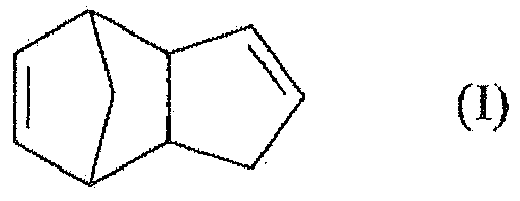
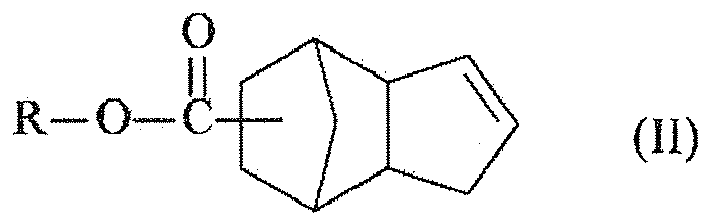
Description
- The present invention relates to a method for manufacturing a raw material for high heat-resistant alicyclic polyesters and the like.
- Various polyester resins can be molded into a film, a sheet, a deformed material, a fiber, a tube, a container or the like by various kinds of molding methods. Thus, they are used in a broad field. The most commonly used polyester is an aromatic polyester made from aromatic dicarboxylic acids such as terephthalic acid or isophthalic acid as a raw material and it has excellent heat resistance and toughness because it contains an aromatic group.
- Recently, a semiconductor laser source with a low wavelength range is used, and blue laser, UV laser, and the like are used as a light source for light signal. Accordingly, it is required that an optical material or a polymer material used for electronic parts and the like has transparency. However, since the aromatic polyester has poor UV resistance and poor light transmission, it cannot be applied to such fields.
- Polyesters having an alicyclic structure have excellent heat resistance, transparency, and water resistance, and thus some of them are used in the fields in which the transparency is required. As a method for manufacturing alicyclic polyesters, various methods of using saturated cyclic aliphatic primary diols such as 1,4-cyclohexane dimethanol are suggested (Patent Document 1). Since an alkylene group is inserted between a hydroxyl group and a saturated cyclic aliphatic group in the saturated cyclic aliphatic primary diols, the alicyclic polyester resins obtained therefrom have aliphatic properties and the resins having a cyclohexane ring have low heat resistance. Thus, sufficient properties are not provided for the uses described above.
- For the purpose of enhancing heat resistance of alicyclic polyesters, alicyclic polyesters consisting of alicyclic diol and dicarboxylic acid component containing 4,4'-bicyclohexyldicarboxylic acid as a main component are suggested (Patent Document 2). However, the heat resistance is still insufficient.
- Meanwhile, (meth)acrylic acid esters having a tricyclodecane skeleton show excellent curability, water resistance, plasticity, and alkali resistance, and therefore various studies have been done regarding them (
Patent Documents 3 to 5). However, polyesters having a tricyclodecane skeleton are not known.
In this connection, a raw material for alicyclic polyesters having excellent heat resistance has been waited for. -
- Patent Document 1: Japanese Patent Application National Publication No.
2007-517926 - Patent Document 2: Japanese Patent Application Laid-Open (JP-A) No.
2006-111794 - Patent Document 3:
JP-A No. 8-311130 - Patent Document 4:
JP-A No. 2002-265886 - Patent Document 5:
JP-A No. 2006-315960 - One embodiment of the invention is (1): a method for manufacturing a tricyclodecane mono-methanol monocarboxylic acid derivative, comprising the steps of reacting a dicyclopentadiene represented by formula (I) with a formic acid compound in the presence of a catalytic system containing a ruthenium compound, a cobalt compound, and a halide salt, to give a tricyclodecene monocarboxylic acid derivative represented by formula (II), and hydroformylating the tricyclodecene monocarboxylic acid derivative to give a tricyclodecane mono-methanol monocarboxylic acid derivative represented by formula (III).


- Further, one embodiment of the invention is (2): the method for manufacturing a tricyclodecane mono-methanol monocarboxylic acid derivative described in above (1), wherein the ruthenium compound is a ruthenium complex having both a carbonyl ligand and a halogen ligand in the molecule.
Further, one embodiment of the invention is (3): the method for manufacturing a tricyclodecane mono-methanol monocarboxylic acid derivative described in above (1) or (2), wherein the halide salt is a quaternary ammonium salt. - Further, one embodiment of the invention is (4): the method for manufacturing a tricyclodecane mono-methanol monocarboxylic acid derivative described in any one of above (1) to (3), wherein the reaction between the dicyclopentadiene and formic acid compound is performed in the presence of a basic compound.
- Further, one embodiment of the invention is (5): the method for manufacturing a tricyclodecane mono-methanol monocarboxylic acid derivative described in above (4), wherein the basic compound is a tertiary amine.
- Further, one embodiment of the invention is (6): the method for manufacturing a tricyclodecane mono-methanol monocarboxylic acid derivative described in any one of above (1) to (5), wherein the reaction between the dicyclopentadiene and formic acid compound is performed in the presence of a phenol compound.
- Further, one embodiment of the invention is (7): the method for manufacturing a tricyclodecane mono-methanol monocarboxylic acid derivative described in any one of above (1) to (6), wherein the reaction between the dicyclopentadiene and formic acid compound is performed in the presence of an organic halide.
- Further, one embodiment of the invention is (8): the method for manufacturing a tricyclodecane mono-methanol monocarboxylic acid derivative described in any one of above (1) to (7), wherein the hydroformylation of the tricyclodecene monocarboxylic acid derivative is performed in the presence of a catalytic system containing a ruthenium compound.
- Further, one embodiment of the invention is (9): the method for manufacturing a tricyclodecane mono-methanol monocarboxylic acid derivative described in any one of above (1) to (8), wherein a halide salt is used in combination in the catalytic system for the hydroformylation of the tricyclodecene monocarboxylic acid derivative.
- Further, one embodiment of the invention is (10): the method for manufacturing a tricyclodecane mono-methanol monocarboxylic acid derivative described in any one of above (1) to (9), wherein a cobalt compound is used in combination in the catalytic system for the hydroformylation of the tricyclodecene monocarboxylic acid derivative.
- Further, one embodiment of the invention is (11): the method for manufacturing a tricyclodecane mono-methanol monocarboxylic acid derivative described in any one of above (1) to (10), wherein an acid is used in combination in the catalytic system for the hydroformylation of the tricyclodecene monocarboxylic acid derivative.
- Further, one embodiment of the invention is (12): the method for manufacturing a tricyclodecane mono-methanol monocarboxylic acid derivative described in above (11), wherein the acid is Broensted acid.
- Further, one embodiment of the invention is (13): the method for manufacturing a tricyclodecane mono-methanol monocarboxylic acid derivative described in above (12), wherein the Broensted acid is an acid containing phosphorus.
- Further, one embodiment of the invention is (14): the method for manufacturing a tricyclodecane mono-methanol monocarboxylic acid derivative described in any one of above (1) to (13), wherein the hydroformylation of the tricyclodecene monocarboxylic acid derivative is performed in the presence of a phenol compound.
- Still further, one embodiment of the invention is (15): the method for manufacturing a tricyclodecane mono-methanol monocarboxylic acid derivative described in any one of above (1) to (14), wherein the hydroformylation of the tricyclodecene monocarboxylic acid derivative is performed at a reaction temperature of 100 to 200°C and pressure of 1 to 20 MPa.
The subject matter of the present invention is described in Japanese Patent Application No.2009-243260 - According to one embodiment of the invention, a method for manufacturing a tricyclodecane mono-methanol monocarboxylic acid derivative that can be used as a raw material for high heat-resistant alicyclic polyesters and the like is provided.
-
-
FIG. 1 is a 1H-NMR spectrum of the methyl tricyclodecane mono-methanol monocarboxylate which is obtained from Example 11. -
FIG. 2 is a FT-IR spectrum of the methyl tricyclodecane mono-methanol monocarboxylate which is obtained from Example 11. - Herein below, the invention is explained more specifically. One embodiment of the invention relates to a method of manufacturing a tricyclodecane mono-methanol monocarboxylic acid derivative that is represented by the following formula (III).
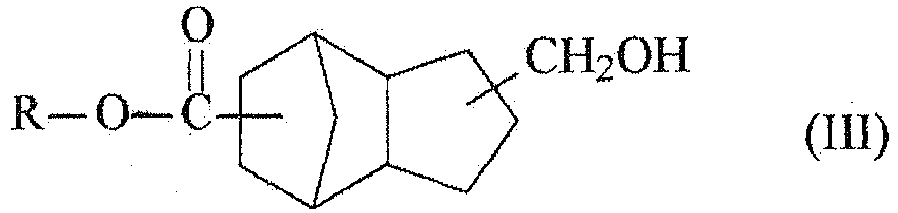
- The tricyclodecane mono-methanol monocarboxylic acid derivative obtained by the manufacturing method of the invention is tricyclodecane mono-methanol monocarboxylic acid represented by the formula (III) or an ester thereof. In the formula (III), R represents a hydrogen; an alkyl group having 1 to 5 carbon atoms such as a methyl group, an ethyl group, a propyl group, an isopropyl group, a butyl group, a tert-butyl group, and a pentyl group; a vinyl group; or a benzyl group. Of these, from the viewpoint of high reactivity and low production cost, an alkyl group having 1 to 5 carbon atoms is preferable. Methyl group is particularly preferable.
In the formula (III), a binding site of two substituent groups, i.e., -C(O)OR and - CH2OH, is not particularly limited. However, it is preferable that -C(O)OR binds to position 8 or position 9 of the tricyclodecane group and -CH2OH binds to position 3 orposition 4 of the tricyclodecane group.
Examples of the tricyclodecane mono-methanol monocarboxylic acid and derivative thereof include 4-hydroxymethyl-8-carboxy-tricyclo[5.2.1.02.6]decane, 3-hydroxymethyl-8-carboxy-tricyclo[5.2.1.02,6]decane, 3-hydroxymethyl-9-carboxy-tricyclo[5.2.1.02,6]decane, 4-hydroxymethyl-8-methoxycarbonyl-tricyclo[5.2.1.02,6]decane, 3-hydroxymethyl-8-methoxycarbonyl-tricyclo[5.2.1.02,6]decane, 3-hydroxymethyl-9-methoxycarbonyl-tricyclo[5.2.1.02,6]decane, 4-hydroxymethyl-8-butoxycarbonyl-tricyclo[5.2.1.02,6]decane, 3-hydroxymethyl-8-butoxycarbonyl-tricyclo[5.2.1,02,6 ]decane, 3-hydroxymethyl-9-butoxycarbonyl-tricyclo[5.2.1.02,6]decane, 4-hydroxymethyl-8-pentoxycarbonyl-tricyclo[5.2.1.02,6]decane, 3-hydroxymethyl-8-pentoxycarbonyl-tricyclo[5.2.1.02,6]decane, 3-hydroxymethyl-9-pentoxycarbonyl-tricyclo[5.2.1.02,6]decane, 4-hydroxymethyl-8-vinyloxycarbonyl-tricyclo[5.2.1.02,6]decane, 3-hydroxymethyl-8-vinyloxycarbonyl-tricyclo[5.2.1.02,6]decane, 3-hydroxymethyl-9-vinyloxycarbonyl-tricyclo[5.2.1.02,6]decane, 4-hydroxymethyl-8-benzyloxycarbonyl-tricyclo[5.2.1.02,6]decane, 3-hydroxymethyl-8-benzyloxycarbonyl-tricyclo[5.2.1.02,6]decane, and 3-hydroxymethyl-9-benzyloxycarbonyl-tricyclo[5.2.1.02,6]decane. - The method for manufacturing the tricyclodecane mono-methanol monocarboxylic acid derivative according to the invention is characterized in that the tricyclodecane mono-methanol monocarboxylic acid derivative represented by the formula (III) is obtained by reacting the dicyclopentadiene represented by the following formula (I) with a formic acid compound in the presence of a catalytic system containing a ruthenium compound, a cobalt compound, and a halide salt, to give a tricyclodecene monocarboxylic acid derivative represented by the following formula (II), and then hydroformylating the tricyclodecene monocarboxylic acid derivative.


- According to the manufacturing method of the invention, the dicyclopentadiene represented by the following formula (I) is first reacted with a formic acid compound (HCOOR) for adding -C(O)OR in the presence of a catalytic system containing a ruthenium compound, a cobalt compound, and a halide salt to yield a tricyclodecene monocarboxylic acid derivative represented by the following formula (II).

As a formic acid compound, a formic acid compound (HCOOR) corresponding to - C(O)OR of the tricyclodecane mono-methanol monocarboxylic acid derivative is used. Examples of the formic acid compound include formic acid, methyl formate, ethyl formate, propyl formate, isopropyl formate, butyl formate, isobutyl formate, amyl formate, isoamyl formate, vinyl formate, benzyl formate, and the like. Of these, from the viewpoint of production cost and reactivity, methyl formate is preferable. - The reaction between dicyclopentadiene represented by the formula (I) and the formic acid compound is performed in the presence of a catalytic system containing a ruthenium compound, a cobalt compound, and a halide salt. The ruthenium compound that can be used in the invention is not specifically limited, as long as it contains ruthenium. Specific examples of the ruthenium compound that can be preferably used in the invention include a ruthenium compound containing both a carbonyl ligand and a halogen ligand in the molecule such as [Ru(CO)3Cl2]2, [RuCb(CO)2]n (n is an unspecified natural number), [Ru(CO)3Cl3]-, [Ru3(CO)11Cl]-, and [Ru4(CO)13Cl]-. Of these, from the viewpoint of increasing reaction ratio, [Ru(CO)3Cl2]2 and [RuCl2(CO)2]n are preferable.
- The ruthenium compound containing both ligands can be produced by using a precursor compound such as RuCl3, Ru3(CO)12, RuCl2(C8H12), Ru(CO)3(C8H8), Ru(CO)3(C8H12), and Ru(C8H10)(C8H12).
- The use amount of the ruthenium compound is preferably 1/10000 to 1 equivalent, and more preferably 1/1000 to 1/50 equivalent compared to 1 equivalent of the dicyclopentadiene as a raw material. From the viewpoint of reaction rate, 1/10000 equivalent or more is preferable. Further, from the viewpoint of production cost, 1 equivalent or less is preferable.
- The cobalt compound that can be used in the invention is not specifically limited, as long as it is a compound containing cobalt. Specific examples of the cobalt compound preferably include a cobalt compound having a carbonyl ligand such as Co2(CO)8, Co(CO)4, and Co4(CO)12, a cobalt compound having a carboxylic acid compound as a ligand such as cobalt acetate, cobalt propionate, cobalt benzoate, and cobalt citrate, and cobalt phosphate. Of these, from the viewpoint of increasing reactivity, Co2(CO)8, cobalt acetate, and cobalt citrate are more preferable.
- The use amount of the cobalt compound is preferably 1/100 to 10 equivalents, and more preferably 1/10 to 5 equivalents compared to 1 equivalent of the ruthenium compound, from the viewpoint of production amount of the tricyclodecene monocarboxylic acid derivative that is represented by the formula (II).
- The halide salt that can be used in the invention is not specifically limited, as long as it is a compound consisting of a halogen ion and a cation. Examples of the halogen ion include a chloride ion, a bromide ion, and an iodide ion. The cation may be any one of an inorganic ion and an organic ion. Further, the halide salt may contain one or more halogen ions in the molecule.
- The inorganic ion which constitutes the halide salt may be any one metal ion selected from an alkali metal and an alkali earth metal. Specific examples thereof include lithium, sodium, potassium, rubidium, cesium, calcium, and strontium.
- Further, the organic ion may be an organic group having a valency of 1 or more which is derived from an organic compound. Examples thereof include ammonium, phosphonium, pyrrolidinium, pyridium, imidazolium, and iminium. The hydrogen atoms contained in these ions may be substituted with a hydrocarbon group such as alkyl and aryl. Specific examples of the organic ion preferably include, although not specifically limited, tetramethyl ammonium, tetraethyl ammonium, tetrapropyl ammonium, tetrabutyl ammonium, tetrapentyl ammonium, tetrahexyl ammonium, tetraheptyl ammonium, tetraoctyl ammonium, trioctyl methyl ammonium, benzyl trimethyl ammonium, benzyl triethyl ammonium, benzyl tributyl ammonium, tetramethyl phosphonium, tetraethyl phosphonium, tetraphenyl phosphonium, benzyl triphenyl phosphonium, butyl methyl pyrrolidinium, octyl methyl pyrrolidinium, and bis(triphenylphosphine)iminium. Of these, from the viewpoint of increasing reaction ratio, butyl methyl pyrrolidinium, bis(triphenylphosphine)iminium, trioctyl methyl ammonium, and the like are more preferable.
- It is not necessary that the halide salt used in the invention is a solid salt. An ionic liquid containing a halide ion which becomes a liquid at near room temperature or the temperature region of 100°C or lower may be also used. Examples of the cation that is employed in the ionic liquid include an organic ion such as 1-ethyl-3-methylimidazolium, 1-propyl-3-methylimidazolium, 1-butyl-3-methylimidazolium, 1-pentyl-3-methylimidazolium, 1-hexyl-3-methylimidazolium, 1-heptyl-3-methylimidazolium, 1-octyl-3-methylimidazolium, 1-decyl-3-methylimidazolium, 1-dodecyl-3-methylimidazolium, 1-tetradecyl-3-methylimidazolium, 1-hexadecyl-3-methylimidazolium, 1-octadecyl-3-methylimidazolium, 1-ethyl-2,3-dimethylimidazolium, 1-butyl-2,3-dimethylimidazolium, 1-hexyl-2,3-dimethylimidazolium, 1-ethylpyridinium, 1-butylpyridinium, 1-hexylpyridinium, 8-methyl-1,8-diazabicyclo[5.4.0]-7-undecene, 8-ethyl-1,8-diazabicyclo[5.4.0]-7-undecene, 8-propyl-1,8-diazabicyclo[5.4.0]-7-undecene, 8-butyl-1,8-diazabicyclo[5.4.0]-7-undecene, 8-pentyl-1,8-diazabicyclo[5.4.0]-7-undecene, 8-hexyl-1,8-diazabicyclo[5.4.0]-7-undecene, 8-heptyl-1,8-diazahicyclo[5.4.0]-7-undecene, and 8-octyl-1,8-diazabicyclo[5.4.0]-7-undecene. According to the invention, the halide salt described in the above may be used either singly or in combination of two or more.
- Among the halide salts described above, preferred halide salt includes a chloride salt, a bromide salt, and an iodide salt, wherein the cation is an organic ion. Although not specifically limited, specific examples of the halide salt preferably include butyl methyl pyrrolidinium chloride, bis(triphenylphosphine)iminium iodide, trioctyl methyl ammonium chloride, and the like.
- The addition amount of the halide salt is preferably 1 to 1000 equivalents and more preferably 2 to 50 equivalents compared to 1 equivalent of the ruthenium compound. By adding the salt in an amount of 1 equivalent or more, the reaction rate can be effectively increased. Meanwhile, from the viewpoint of the effect of promoting the reaction, it is preferably 1000 equivalents or less.
- Regarding the reaction between dicyclopentadiene and the formic acid compound according to the invention, the effect of promoting the reaction by the catalytic system can be further increased by adding, if necessary, at least one kind selected from a basic compound, a phenol compound, and an organic halogen compound to the specific catalytic system containing a ruthenium compound, a cobalt compound, and a halide salt.
- The basic compound used in the invention may be either an inorganic compound or an organic compound. Specific examples of the inorganic basic compound include a carbonate salt, a hydrogen carbonate salt, a hydroxide salt, an alkoxide, and the like of an alkali metal and an alkali earth metal. Specific examples of the organic basic compound include a primary amine compound, a secondary amine compound, a tertiary amine compound, a pyridine compound, an imidazole compound, and a quinoline compound. Among the basic compounds described above, from the viewpoint of an effect of promoting the reaction, the tertiary amine compound is preferable. Specific examples of the tertiary amine compound that can be preferably used in the invention include trialkylamine, N-alkylpyrrolidine, quinuclidine, triethylene diamine, and the like.
- The addition amount of the basic compound is, although not specifically limited, preferably 1 to 1000 equivalents and more preferably 2 to 200 equivalents compared to 1 equivalent of the ruthenium compound. By adding the salt in an amount of 1 equivalent or more, the effect of promoting the reaction tends to be more significant. Further, from the viewpoint of the effect of promoting the reaction, it is preferably 1000 equivalents or less.
- The phenol compound that can be used in the invention is not specifically limited. Specific examples of the usable phenol compound include phenol, cresol, alkylphenol, methoxyphenol, phenoxyphenol, chlorophenol, trifluoromethylphenol, hydroquinone, catechol, and the like.
- The addition amount of the phenol compound is, although not specifically limited, preferably 1 to 1000 equivalents and more preferably 2 to 200 equivalents compared to 1 equivalent of the ruthenium compound. By adding the phenol compound in an amount of 1 equivalent or more, the effect of promoting the reaction tends to be more significant. Further, from the viewpoint of the reaction efficiency, it is preferably 1000 equivalents or less.
- The organic halogen compound that can be used in the invention is not specifically limited. Specific examples of the usable organic halogen compound include methane monohalide, methane dihalide, ethane dihalide, methane trihalide, methane tetrahalide, benzene halide, and the like.
- The addition amount of the organic halogen compound is, although not specifically limited, preferably 1 to 1000 equivalents and more preferably 2 to 200 equivalents compared to 1 equivalent of the ruthenium compound. By adding the organic halogen compound in an amount of 1 equivalent or more, the effect of promoting the reaction tends to be more significant. Further, from the viewpoint of the reaction efficiency, it is preferably 1000 equivalents or less.
- The reaction between dicyclopentadiene and the formic acid compound according to the invention can be performed without specifically using a solvent. However, if necessary, a solvent may be used. The solvent that can be used is not specifically limited, as long as it can dissolve the compounds that are used as a raw material. Specific examples of the solvent that can be preferably used include n-pentane, n-hexane, n-heptane, cyclohexane, benzene, toluene, o-xylene, p-xylene, m-xylene, ethylbenzene, cumen, tetrahydrofuran, N-methyl pyrrolidone, dimethyl formamide, dimethyl acetamide, dimethyl imidazolidinone, ethylene glycol dimethyl ether, diethylene glycol dimethyl ether, triethylene glycol dimethyl ether, and the like.
- The reaction between dicyclopentadiene and the formic acid compound according to the invention is preferably carried out in the temperature range of 80°C to 200°C. More preferably, it is carried out at a temperature of 100°C to 160°C. When the reaction is carried out at a temperature of 80°C or higher, the reaction rate increases so that the efficient reaction can be conducted easily. Further, by controlling the reaction temperature at 200°C or lower, decomposition of the formic acid compound that is used as a raw material can be prevented. When the formic acid compound is decomposed, addition of a carboxylic acid or an ester group to dicyclopentadiene is not achieved, and therefore excessively high reaction temperature is not desirable. When the reaction temperature is above the boiling point of any one of the dicyclopentadiene and formic acid compound to be used as a raw material, it is necessary to carry out the reaction within a pressure resistant vessel. Completion of the reaction can be confirmed by a well-known analytical method such as gas chromatography and NMR. Further, the reaction is preferably carried out in the presence of an inert gas such as nitrogen and argon.
- The tricyclodecene monocarboxylic acid derivative represented by the formula (II), which is obtained by the reaction between dicyclopentadiene represented by the formula (I) and the formic acid compound, is a dicyclopentadiene compound represented y the formula (I) in which -C(O)OR is added, and it has a structure of having -C(O)OR at
position 8 or position 9 of the skeleton of tricyclo[5.2.1.02,6]dec-3-ene. - According to the manufacturing method of the invention, the tricyclodecene monocarboxylic acid derivative represented by the following formula (II) obtained by the method described above is subsequently hydroformylated to give the tricyclodecane mono-methanol monocarboxylic acid derivative represented by the following formula (III).

- The hydroformylation reaction of the tricyclodecene monocarboxylic acid derivative represented by the formula (II) can be carried out by a hydroformylation method conventionally known in the field. As a conventional hydroformylation method, a method of adding an aldehyde by reacting carbon monoxide and hydrogen using a transition metal complex catalyst such as cobalt, ruthenium, and rhodium followed by hydrogenation, or a method of directly adding an alcohol by reacting carbon monoxide with hydrogen is disclosed in Catalyst Course, Vol. 7, Catalysis Society of Japan, Kodansha Ltd. (1985).
- Meanwhile, as highly toxic carbon monoxide is used for conventional hydroformylation method, from the viewpoint of workability, safety, reactivity, and the like, the hydroformylation method using carbon dioxide and hydrogen as described below is preferable. In such case, carbon dioxide and hydrogen may be supplied in the form of a mixture gas, or they may be supplied separately. The mixture gas is a mixture gas (raw material gas) which contains carbon dioxide and hydrogen as a main component. Content of the carbon dioxide is preferably 10 to 95 vol%, and more preferably 50 to 80 vol%. Content of the hydrogen is preferably 5 to 90 vol%, and more preferably 20 to 50 vol%. When the content of the hydrogen is less than 90 vol%, hydrogenation of the raw material may not be easily obtained. On the other hand, when it is more than 5%, the reaction rate is high. It is not necessary that carbon monoxide is included in a raw material gas. However, it is not a problem even if it is included in a raw material gas.
- The catalytic system for the hydroformylation preferably contains a ruthenium compound. The ruthenium compound that can be used is not specifically limited, as long as it is a compound containing ruthenium. Specific examples of the ruthenium compound include a ruthenium compound containing both a carbonyl ligand and a halogen ligand in the molecule such as [Ru(CO)3Cl2]2, [RuCl2(CO)2]n (n is an unspecified natural number), [Ru(CO)3Cl3]-, [Ru3(CO)11Cl]-, and [Ru4(CO)13Cl]-, and the like. Of these, from the viewpoint of increasing reaction ratio, [Ru(CO)3Cl2]2 and [RuCl2(CO)2]n are preferable.
- The ruthenium compound containing both ligands can be produced by using a precursor compound such as RuCl3, Ru3(CO)12, RuCl2(C8H12), Ru(CO)3(C8H8), Ru(CO)3(C8H12), and Ru(C8H10)(C8H12).
- The use amount of the ruthenium compound is preferably 1/10000 to 1 equivalent, and more preferably 1/1000 to 1/50 equivalent compared to 1 equivalent of the tricyclodecene monocarboxylic acid derivative represented by the formula (II). From the viewpoint of production cost, it is preferable to use less amount of the ruthenium compound. However, from the viewpoint of reaction rate, it is preferably 1/10000 equivalent or more. Further, from the viewpoint of the production cost, it is preferably 1 equivalent or less.
- For the hydroformylation of the tricyclodecene monocarboxylic acid derivative represented by the formula (II), by adding, if necessary, at least one selected from a cobalt compound, a halide salt, a phenol compound, and an acid to the reaction system containing the ruthenium compound, the effect of promoting reaction by the reaction system can be enhanced more.
- The cobalt compound that can be used as a catalyst for the hydroformylation is not specifically limited, as long as it is a compound containing cobalt. Specific examples of the cobalt compound include a cobalt compound containing a carbonyl ligand such as Co2(CO)8, HCo(CO)4, and Co4(CO)12, a cobalt compound containing a carboxylic acid compound as a ligand such as cobalt acetate, cobalt propionate, cobalt benzoate, and cobalt citrate, cobalt phosphate, and the like. Of these, from the viewpoint of enhancing reaction ratio, Co2(CO)8, cobalt acetate, and cobalt citrate are more preferable.
- The use amount of the cobalt compound is preferably 1/100 to 10 equivalents, and more preferably 1/10 to 5 equivalents compared to 1 equivalent of the ruthenium compound, from the viewpoint of the production amount of the tricyclodecane mono-methanol monocarboxylic acid derivative.
- The halide salt that can be used in the invention is not specifically limited, as long as it is a compound consisting of a halogen ion and a cation. Examples of the halogen ion include a chloride ion, a bromide ion, an iodide ion, and the like. The cation may be any one of an inorganic ion and an organic ion. In addition, the halide salt may contain one or more halogen ions in the molecule.
- The inorganic ion which constitutes the halide salt may be one kind of metal ion selected from an alkali metal and an alkali earth metal. Specific examples thereof include lithium, sodium, potassium, rubidium, cesium, calcium, and strontium.
- Further, the organic ion may be an organic group having a valency of 1 or more which is derived from an organic compound. Examples thereof include ammonium, phosphonium, pyrrolidinium, pyridium, imidazolium, and iminium. The hydrogen atoms contained in these ions may be substituted with a hydrocarbon group such as alkyl and aryl. Specific examples of the organic ion preferably include, although not specifically limited, tetramethyl ammonium, tetraethyl ammonium, tetrapropyl ammonium, tetrabutyl ammonium, tetrapentyl ammonium, tetrahexyl ammonium, tetraheptyl ammonium, tetraoctyl ammonium, trioctyl methyl ammonium, benzyl trimethyl ammonium, benzyl triethyl ammonium, benzyl tributyl ammonium, hexadecyl trimethyl ammonium, tetramethyl phosphonium, tetraethyl phosphonium, tetraphenyl phosphonium, benzyl triphenyl phosphonium, butyl methyl pyrrolidinium, octyl methyl pyrrolidinium, and bis(triphenylphosphine)iminium. Of these, from the viewpoint of increasing reaction ratio, a quaternary ammonium salt such as hexadecyl trimethyl ammonium chloride and hexadecyl trimethyl ammonium bromide is more preferable.
- It is not necessary that the halide salt used in the invention is a solid salt. An ionic liquid containing a halide ion which becomes a liquid at near room temperature or the temperature region of 100°C or lower may be also used. Examples of the cation that is employed in the ionic liquid include an organic ion such as I-ethyl-3-methylimidazolium, 1-propyl-3-methylimidazolium, 1-butyl-3-methylimidazolium, I-pentyl-3-methylimidazolium, 1-hexyl-3-methylimidazolium, 1-heptyl-3-methylimidazolium, 1-octyl-3-methylimidazolium, 1-decyl-3-methylimidazolium, 1-dodecyl-3-methylimidazolium, 1-tetradecyl-3-methylimidazolium, 1-hexadecyl-3-methylimidazolium, 1-octadecyl-3-methylimidazolium, 1-ethyl-2,3-dimethylimidazolium, 1-butyl-2,3-dimethylimidazolium, 1-hexyl-2,3-dimethylimidazolium, 1-ethylpyridinium, 1-butylpyridinium, 1-hexylpyridinium, 8-methyl-1,8-diazabicyclo[5.4.0]-7-undecene, 8-ethyl-1,8-diazabicyclo[5.4.0]-7-undecene, 8-propyl-1,8-diazabicyclo[5.4.0]-7-undecene, 8-butyl-1,8-diazabicyclo[5.4.0]-7-undecene, 8-pentyl-1,8-diazabicyclo[5.4.0]-7-undecene, 8-hexyl-1,8-diazabicyclo[5.4.0]-7-undecene, 8-heptyl-1,8-diazabicyclo[5.4.0]-7-undecene, and 8-octyl-1,8-diazabicyclo[5.4.0]-7-undecene. According to the invention, the halide salt described in the above may be used either singly or in combination of two or more.
- Among the halide salts described above, preferred halide salt includes a chloride salt, a bromide salt, and an iodide salt, wherein the cation is an organic ion. Although not specifically limited, specific examples of the halide salt preferably include hexadecyl trimethyl ammonium chloride, hexadecyl trimethyl ammonium bromide, and the like.
- The addition amount of the halide salt is preferably 1 to 1000 equivalents and more preferably 2 to 50 equivalents compared to 1 equivalent of the ruthenium compound. By adding the salt in an amount of 1 equivalent or more, the reaction rate can be effectively increased. Meanwhile, from the viewpoint of the effect of promoting the reaction, it is preferably 1000 equivalents or less.
- The phenol compound that can be used in the invention is not specifically limited. Examples of the usable phenol compound include phenol, cresol, alkylphenol, methoxyphenol, phenoxyphenol, chlorophenol, trifluoromethylphenol, hydroquinone, catechol, and the like.
- The addition amount of the phenol compound is, although not specifically limited, preferably 1 to 1000 equivalents and more preferably 2 to 200 equivalents compared to 1 equivalent of the ruthenium compound. By adding the phenol compound in an amount of 1 equivalent or more, the effect of promoting the reaction tends to be more significant. Further, from the viewpoint of the effect of promoting the reaction, it is preferably 1000 equivalents or less.
- As an acid that can be used for the invention, all acids falling within the definition of Lewis acid can be used. According to the definition, when a certain substance "A" receives an electron pair from other substance "B", "A" is defined as an acid and "B" is defined as a base. All acids corresponding to electron pair-receiving "A" can be used.
- As for the acid described above, an acid in which A is a proton donor, i.e., Broensted acid, is preferable. Examples of the Broensted acid include hydrochloric acid, sulfuric acid, nitric acid, phosphoric acid, methyl phosphoric acid, alkyl phosphoric acid, phenyl phosphoric acid, diphenyl phosphite, phenyl phosphonic acid, 4-methoxyphenyl phosphonic acid, diethyl 4-methoxyphenyl phosphonate, phenylphosphinic acid, boric acid, phenyl boric acid, trifluoromethane sulfonic acid, para toluene sulfonic acid, phenol, tungstic acid, phosphorus tungstic acid, alkyl carboxylic acid represented by formic acid, acetic acid, trifluoro acetic acid, propionic acid, and butyric acid, aromatic carboxylic acid represented by benzoic acid, phthalic acid, and salicylic acid, and the like. Of these, preferred is an acid containing phosphorus such as phosphoric acid, alkyl phosphoric acid, phenyl phosphoric acid, diphenyl phosphite, and phosphonic acid derivative.
- The addition amount of the acid is preferably 0.1 to 100 equivalents and more preferably 1 to 10 equivalents compared to 1 equivalent of the ruthenium compound. By adding the acid in an amount of 0.1 equivalents or more, the reaction rate can be effectively increased. Further, from the viewpoint of the effect of promoting the reaction, it is preferably 100 equivalents or less.
- The hydroformylation is preferably carried out in the temperature range of 100°C to 200°C. It is more preferably carried out in the temperature range of 110°C to 180°C. It is particularly preferably carried out in the temperature range of 120°C to 160°C. By carrying out the reaction at the temperature of 100°C or higher, the reaction rate increases so that the reaction can easily progress with high efficiency. Further, by controlling the reaction temperature to 200°C or lower, hydrogenation of the unsaturated bond contained in the tricyclodecene monocarboxylic acid derivative that is represented by the formula (II) can be prevented. When hydrogenation of the unsaturated bond contained in the tricyclodecene monocarboxylic acid derivative that is represented by the formula (II) occurs, the hydroformylation cannot be achieved.
- It is necessary to carry out the hydroformylation within a pressure resistant vessel. The reaction is preferably carried out in the reaction pressure range of 1 MPa to 20 MPa. More preferably, it is carried out in the reaction pressure range of 2 MPa to 15 MPa. From the viewpoint of the reaction rate, the pressure is preferably 1 MPa or more. From the viewpoint of the effect of promoting the reaction, it is preferably 20 MPa or less.
- The hydroformylation of the invention may be carried out in the presence of a solvent, if necessary. The solvent that can be used is not specifically limited, as long as it can dissolve the tricyclodecene monocarboxylic acid derivative that is represented by the formula (II). Specific examples of the solvent that can be preferably used include n-pentane, n-hexane, n-heptane, cyclohexane, benzene, toluene, o-xylene, p-xylene, m-xylene, ethylbenzene, cumen, tetrahydrofuran, N-methyl pyrrolidone, dimethyl formamide, dimethyl acetamide, dimethyl imidazolidinone, ethylene glycol dimethyl ether, diethylene glycol dimethyl ether, triethylene glycol dimethyl ether, and the like. When the solvent is used, preferred use amount thereof is to yield that concentration of the tricyclodecene monocarboxylic acid derivative that is represented by the formula (II) is within the range of 10 to 1000% by weight.
- The tricyclodecane mono-methanol monocarboxylic acid derivative obtained by the manufacturing method of the invention is useful as a raw material for alicyclic polyesters. Further, the alicyclic polyesters in which the derivative is used have excellent heat resistance and transparency, and therefore they can be used for an electronic part used for a semiconductor liquid crystal, optical materials represented by optical fiber, optical lens, and the like, and also a material related to a display and a material related to medical use.
- Herein below, the invention is explained in greater detail in view of Examples. However, the scope of the invention is not limited by the following Examples.
- Examples 1 to 9 and Comparative Examples 1 to 3: Synthesis of methyl tricyclodecene monocarboxylate

- At room temperature, 10.0 mmol of dicyclopentadiene and 5.0 ml of methyl formate were added to a catalytic system in which 0.025 mmol of [Ru(CO)3Cl2]2 as a ruthenium compound, 0.025 mmol Co2(CO)8 as a cobalt compound, and 0.5 mmol of butyl methyl pyrrolidinium chloride as a halide salt are mixed in a high-pressure reaction apparatus made of stainless steel with inside volume of 50 ml. Subsequently, the reaction apparatus was purged with 0.5 MPa nitrogen gas and maintained at 120°C for 8 hours. After that, the inside of the reaction apparatus was cooled to room temperature and depressurized. Part of the remaining organic phase was extracted and analyzed by gas chromatography. According to the results of analysis, 0.95 mmol (yield: 9.5% based on the dicyclopentadiene) of methyl tricyclodecene monocarboxylate represented by the above formula (IV) was produced. As a result of analysis using gas chromatography-mass analysis (GC-MS), it was found that the methyl tricyclodecene monocarboxylate obtained is a mixture of 8-methoxycarbonyl-tricyclo[5.2.1.02,6]dec-3-ene and 9-methoxycarbonyl-tricyclo[5.2.1.02,6]dec-3-ene. The methyl tricyclodecene monocarboxylate obtained was isolated by distillation under reduced pressure.
- The reaction was carried out all in the same manner as Example 1 except that 2.0 mmol of N-methylpyrrolidine was added as a basic compound to the catalytic system used in Example 1. As a result, it was found that 8.21 mmol (yield: 82.1% based on the dicyclopentadiene) of methyl tricyclodecene monocarboxylate is produced. The methyl tricyclodecene monocarboxylate obtained was isolated by distillation under reduced pressure.
- The reaction was carried out all in the same manner as Example 1 except that 0.5 mmol of sodium t-butoxide was added as a basic compound to the catalytic system used in
ExampleExample 1. As a result, it was found that 8.40 mmol (yield: 84.0% based on the dicyclopentadiene) of methyl tricyclodecene monocarboxylate is produced. The methyl tricyclodecene monocarboxylate obtained was isolated by distillation under reduced pressure. - The reaction was carried out all in the same manner as
ExampleExample 2 except that 0.5 mmol of p-cresol was added as a phenol compound to the catalytic system used inExampleExample 2. As a result, it was found that 9.05 mmol (yield: 90.5% based on the dicyclopentadiene) of methyl tricyclodecene monocarboxylate is produced. The methyl tricyclodecene monocarboxylate obtained was isolated by distillation under reduced pressure. - The reaction was carried out all in the same manner as
ExampleExample 2 except that 0.5 mmol of methylene chloride was added as an organic halogen compound to the catalytic system used inExampleExample 2. As a result, it was found that 8.69 mmol (yield: 86.9% based on the dicyclopentadiene) of methyl tricyclodecene monocarboxylate is produced. The methyl tricyclodecene monocarboxylate obtained was isolated by distillation under reduced pressure. - The reaction was carried out all in the same manner as
ExampleExample 1 except that the halide salt was replaced with 0.5 mmol of trioctyl methyl ammonium chloride and 2.0 mmol of triethylamine was added as a basic compound to the catalytic system used inExampleExample 1. As a result, it was found that 9.23 mmol (yield: 92.3% based on the dicyclopentadiene) of methyl tricyclodecene monocarboxylate is produced. The methyl tricyclodecene monocarboxylate obtained was isolated by distillation under reduced pressure. - The reaction was carried out all in the same manner as
ExampleExample 6 except that, in the catalytic system used inExampleExample 6, the ruthenium compound was replaced with the ruthenium compound [Ru(CO)2Cl2]n (0.05 mmol based on Ru metal), which has been prepared in advance with RuCl3 and formic acid according to the method described in M. J. Cleare and W. P. Griffith (J. Chem. Soc. (A), 1969, 372). As a result, it was found that 8.67 mmol (yield: 86.7% based on the dicyclopentadiene) of methyl tricyclodecene monocarboxylate is produced. The methyl tricyclodecene monocarboxylate obtained was isolated by distillation under reduced pressure. - The reaction was carried out all in the same manner as Example 6 except that, in the catalytic system used in Example 6, the cobalt compound was replaced with 0.025 mmol cobalt citrate dihydrate. As a result, it was found that 8.87 mmol (yield: 88.7% based on the dicyclopentadiene) of methyl tricyclodecene monocarboxylate is produced. The methyl tricyclodecene monocarboxylate obtained was isolated by distillation under reduced pressure.
- The reaction was carried out all in the same manner as Example 6 except that, in the catalytic system used in Example 6, the cobalt compound was replaced with 0.05 mmol cobalt acetate tetrahydrate. As a result, it was found that 8.39 mmol (yield: 83.9% based on the dicyclopentadiene) of methyl tricyclodecene monocarboxylate is produced. The methyl tricyclodecene monocarboxylate obtained was isolated by distillation under reduced pressure.
- The reaction was carried out all in the same manner as Example 1 except that no cobalt compound is used in the catalytic system of Example 1. As a result, only a trace amount of methyl tricyclodecene monocarboxylate was produced.
- The reaction was carried out all in the same manner as Example 1 except that no ruthenium compound is used in the catalytic system of Example 1. As a result, only a trace amount of methyl tricyclodecene monocarboxylate was produced.
- The reaction was carried out all in the same manner as Example 1 except that no halide salt is used in the catalytic system of Example 1. As a result, only a trace amount of methyl tricyclodecene monocarboxylate was produced.
The catalyst composition and the yield for Examples 1 to 9 and Comparative Examples 1 to 3 are shown in the following Table 1.[Table 1] Example Comparative Example 1 2 3 4 5 6 7 8 9 1 2 3 Catalyst composition (mmol) Ruthenium compound [Ru(CO)3Cl2]2 0.025 0.025 0.025 0.025 0.025 0.025 0 0.025 0.025 0.025 0 0.025 [Ru(CO)2Cl2]n 0 0 0 0 0 0 0.05 0 0 0 0 0 Cobalt compound Co2(CO)8 0.025 0.025 0.025 0.025 0.025 0.025 0.025 0 0 0 0.025 0.025 Cobalt citrate dihydrate 0 0 0 0 0 0 0 0.025 0 0 0 0 Cobalt acetate tetrahydrate 0 0 0 0 0 0 0 0 0.05 0 0 0 Halide salt Butyl methyl pyrrolidinium chloride 0.5 0.5 0.5 0.5 0.5 0 0 0 0 0.5 0.5 0 Trioctyl methyl ammonium chloride 0 0 0 0 0 0.5 0.5 0.5 0.5 0 0 0 Basic compound N-Methylpyrrolidine 0 2.0 0 2.0 2.0 0 0 0 0 0 0 0 Sodium t-butoxide 0 0 0.5 0 0 0 0 0 0 0 0 0 Triethylamine 0 0 0 0 0 2.0 2.0 2.0 2.0 0 0 0 Phenol compound p-Cresol 0 0 0 0.5 0 0 0 0 0 0 0 0 Organic halide Methylene chloride 0 0 0 0 0.5 0 0 0 0 0 0 0 Yield (%) 9.5 82.1 84.0 90.5 86.9 92.3 86.7 88.7 83.9 trace trace trace - Examples 10 to 14: Synthesis of methyl tricyclodecane mono-methanol monocarboxylate

- At room temperature, 10.0 mmol of methyl tricyclodecene monocarboxylate and 10.0 ml of toluene as solvent were added and stirred to dissolve in a catalytic system in which 0.05 mmol of Ru2(CO)6Cl4 as a ruthenium compound, 2.5 mmol of hexadecyl trimethyl ammonium chloride as a halide salt, and 0.25 mmol of diphenyl phosphite as an acid are mixed, in a high-pressure reaction apparatus made of stainless steel with inside volume of 50 ml. After stirring to dissolve, inside of the reaction system was pressurized with 4 MPa carbon dioxide and 4 MPa hydrogen and maintained at 140°C for 15 hours. After that, the inside of the reaction apparatus was cooled to room temperature and depressurized. Part of the remaining organic phase was extracted and analyzed by gas chromatography. According to the results of analysis, 4.65 mmol (yield: 46.5% based on the methyl tricyclodecene monocarboxylate) of methyl tricyclodecane mono-methanol monocarboxylate represented by the above formula (V) was produced. As a result of analysis using gas chromatography-mass analysis (GC-MS), it was found that the methyl tricyclodecane mono-methanol monocarboxylate obtained is a mixture of 4-hydroxymethyl-8-methoxycarbonyl-tricyclo[5.2.1.02,6]decane, 3-hydroxymethyl-8-methoxycarbonyl-tricyclo[5.2.1.02,6]decane, and 3-hydroxymethyl-9-methoxycarbonyl-tricyclo[5.2.1.02,6] decane.
- The experiment was carried out in the same manner as Example 10 except that 0.05 mmol of Co2(CO)8 was additionally added as a cobalt compound, followed by analysis by gas chromatography. According to the results of analysis, 7.45 mmol (yield: 74.5% based on the methyl tricyclodecene monocarboxylate) of methyl tricyclodecane mono-methanol monocarboxylate represented by the above formula (V) was produced. As a result of analysis using gas chromatography-mass analysis (GC-MS), it was found that the methyl tricyclodecane mono-methanol monocarboxylate obtained is a mixture of 4-hydroxymethyl-8-methoxycarbonyl-tricyclo[5.2.1.02,6]decane, 3-hydroxymethyl-8-methoxycarbonyl-tricyclo[5.2.1.02,6]decane, and 3-hydroxymethyl-9-methoxycarbonyl-tricyclo[5.2.1.02,6]decane.
Methyl tricyclodecane mono-methanol monocarboxylate obtained was isolated by distillation under reduced pressure and subjected to measurement of 1H-NMR spectrum and IR spectrum. For measurement of 1H-NMR spectrum, the sample was dissolved in dimethyl sulfoxide (DMSO-d6) to give a solution, which was then added to a sample tube ofφ 5 mm and measured by 400 MHz nuclear magnetic resonance machine "AV400M" (trade name, manufactured by Bruker). Further, the IR spectrum was measured by using a Fourier-transformed infrared spectrophotometer (trade name: JIR-6500, manufactured by JEOL Ltd.).
The 1H-NMR spectrum obtained is given inFIG. 1 . Each proton was assigned as described below. From the viewpoint of easy interpretation, 4-hydroxymethyl-8-methoxycarbonyl-tricyclo[5.2.1.02,6]decane that is expressed as the following formula, was taken as an example.
As a result of the 1H-NMR analysis (FIG. 1 ), each proton was assigned as follows.
- Proton (1): peak near 2.1 ppm
- Proton (2): peak near 2.4 ppm
- Proton (3): peaks near 1.2 ppm and 1.7 ppm
- Proton (4): peak near 2.3 ppm
- Proton (5): peaks near 1.2 ppm and 1.8 ppm
- Proton (6): peak near 2.6 ppm
- Proton (7): peak near 2.1 ppm
- Proton (8): peak near 1.9 ppm
- Proton (9): peaks near 0.9 ppm and 1.7 ppm
- Proton (10): peaks near 1.4 to 1.5 ppm
- Proton (11): peak near 3.2 ppm
- Proton (12): peak near 4.4 ppm
- Proton (13): peak near 3.6 ppm
- Integration strength ratio among the Proton (1) to (10) of the tricyclodecane moiety/Proton (11) of the hydroxymethyl group / Proton (12) of the hydroxymethyl group/ Proton (13) of the methoxycarbonyl group was found to be 13.93/2.00/1.04/3.08 (theoretical value: 14/2/1/3), and it was confirmed that the methyl tricyclodecane mono-methanol monocarboxylate obtained has the structure represented by the above formula (V).
- Further, the IR spectrum is shown in
FIG. 2 . Peaks of the methylene group and methine group in the tricyclodecane moiety are found near 800 to 1450 cm-1, the peak of the methylene group originating from the hydroxy methyl group is found near 1465 cm-1, the peak of the hydroxy group originating from the hydroxy methyl group is found near 3400 cm-1 (broad), the peak of the carbonyl group originating from the methoxycarbonyl group is found near 1760 cm-1, and the peak of the methyl group originating from the methoxycarbonyl group is found near 2870 cm-1 and 2960 cm-1. - At room temperature, 10.0 mmol of the methyl tricyclodecene monocarboxylate isolated in the above and 10.0 ml of tetrahydrofuran as a solvent were added and stirred to dissolve in a catalytic system in which 0.1 mmol of Ru2(CO)6Cl4 as a ruthenium compound, 0. 1 mmol of Co2(CO)8 as a cobalt compound, 2.0 mmol of butyl methyl pyrrolidium chloride as a halide salt, and 0.5 mmol of 4-methoxyphenyl phosphonic acid as an acid are mixed in a high-pressure reaction apparatus made of stainless steel with inside volume of 50 ml. After stirring to dissolve, the reaction system was pressurized with 2 MPa carbon dioxide and 6 MPa hydrogen and maintained at 140°C for 15 hours. After that, the inside of the reaction apparatus was cooled to room temperature and depressurized. Part of the remaining organic phase was extracted and analyzed by gas chromatography. According to the results of analysis, 5.54 mmol (yield: 55.4% based on the methyl tricyclodecene monocarboxylate) of methyl tricyclodecane mono-methanol monocarboxylate represented by the above formula (V) was produced.
- The reaction was carried out all in the same manner as Example 12 except that the halide salt was replaced with 2.0 mmol of octyl methyl pyrrolidium chloride, followed by analysis by gas chromatography. According to the results of analysis, 6.00 mmol (yield: 60.0% based on the methyl tricyclodecene monocarboxylate) of methyl tricyclodecane mono-methanol monocarboxylate represented by the above formula (V) was produced.
- The reaction was carried out all in the same manner as Example 13 except that 0.5 mmol of p-cresol was further added as a phenol compound, followed by analysis by gas chromatography. According to the results of analysis, 8.96 mmol (yield: 89.6% based on the methyl tricyclodecene monocarboxylate) of methyl tricyclodecane mono-methanol monocarboxylate represented by the above formula (V) was produced.
The catalyst composition and the yield for Examples 10 to 14 are shown in the following Table 2.[Table 2] Example 10 11 12 13 14 Catalyst composition (mmol) Ruthenium compound Ru2(CO)6Cl4 0.05 0.05 0.1 0.1 0.1 Cobalt compound Co2(CO)8 0 0.05 0.1 0.1 0.1 Halide salt Hexadecyl trimethyl ammonium chloride 2.5 2.5 0 0 0 Butyl methyl pyrrolidium chloride 0 0 2.0 0 0 Octyl methyl pyrrolidium chloride 0 0 0 2.0 2.0 Acid Diphenyl phosphorus acid 0.25 0.25 0 0 0 4-Methoxyphenyl phosphonic acid 0 0 0.5 0.5 0.5 Phenol compound p-Cresol 0 0 0 0 0.5 Yield (%) 46.5 74.5 55.4 60.0 89.6 - To a 10 ml flask equipped with a stirrer, a nitrogen inlet tube, and a condenser, 5 g of methyl tricyclodecane mono-methanol monocarboxylate obtained from Example 14 and 0.5 g of titanium tetra isopropoxide were added, and stirred for 6 hours in an oil bath at 130°C. As a result, polyesters having tricyclodecane skeleton with number average molecular weight of 30,000 were obtained.
- Glass transition temperature (Tg) and initial thermal decomposition temperature (temperature at 5% weight loss, Td5) were measured according to the following condition for the polyesters having tricyclodecane skeleton.
Results are given in the Table 1. - Differential scanning calorimetry (trade name: DSC Type 8230, manufactured by Rigaku Corporation).
- Temperature increase rate: 5°C/min
- Atmosphere: air
- Differential thermal analyzer (trade name: TG-DTA Type 5200, manufactured by Seiko Instruments Inc.).
- Temperature increase rate: 5°C/min
- Atmosphere: air
- Further, light transmission ratio at each wavelength was measured for the polyesters having tricyclodecane skeleton obtained by using Type V-570 (trade name, manufactured by JASCO Corporation) UV/VIS spectrophotometer. The evaluation results are summarized and given in the Table 3.
[Table 3] Item Reference example Polymer characteristics Glass transition temperature (°C) 160 Initial thermal decomposition temperature (°C) 417 Light transmission ratio (%) 400nm 100 500nm 100 600nm 100
Claims (15)
- A method for manufacturing a tricyclodecane mono-methanol monocarboxylic acid derivative, comprising the steps of:reacting a dicyclopentadiene represented by formula (I) with a formic acid compound in the presence of a catalytic system containing a ruthenium compound, a cobalt compound, and a halide salt, to give a tricyclodecene monocarboxylic acid derivative represented by formula (II); andhydroformylating the tricyclodecene monocarboxylic acid derivative to give a tricyclodecane mono-methanol monocarboxylic acid derivative represented by formula (III).


- The method for manufacturing a tricyclodecane mono-methanol monocarboxylic acid derivative according to claim 1, wherein the ruthenium compound is a ruthenium complex having both a carbonyl ligand and a halogen ligand in the molecule.
- The method for manufacturing a tricyclodecane mono-methanol monocarboxylic acid derivative according to claim 1 or 2, wherein the halide salt is a quaternary ammonium salt.
- The method for manufacturing a tricyclodecane mono-methanol monocarboxylic acid derivative according to any one of claims 1 to 3, wherein the reaction between the dicyclopentadiene and the formic acid compound is performed in the presence of a basic compound.
- The method for manufacturing a tricyclodecane mono-methanol monocarboxylic acid derivative according to claim 4, wherein the basic compound is a tertiary amine.
- The method for manufacturing a tricyclodecane mono-methanol monocarboxylic acid derivative according to any one of claims 1 to 5, wherein the reaction between the dicyclopentadiene and the formic acid compound is performed in the presence of a phenol compound.
- The method for manufacturing a tricyclodecane mono-methanol monocarboxylic acid derivative according to any one of claims 1 to 6, wherein the reaction between the dicyclopentadiene and the formic acid compound is performed in the presence of an organic halide.
- The method for manufacturing a tricyclodecane mono-methanol monocarboxylic acid derivative according to any one of claims 1 to 7, wherein the hydroformylation of the tricyclodecene monocarboxylic acid derivative is performed in the presence of a catalytic system containing a ruthenium compound.
- The method for manufacturing a tricyclodecane mono-methanol monocarboxylic acid derivative according to any one of claims 1 to 8, wherein a halide salt is used in combination in the catalytic system for the hydroformylation of the tricyclodecene monocarboxylic acid derivative.
- The method for manufacturing a tricyclodecane mono-methanol monocarboxylic acid derivative according to any one of claims 1 to 9, wherein a cobalt compound is used in combination in the catalytic system for the hydroformylation of the tricyclodecene monocarboxylic acid derivative.
- The method for manufacturing a tricyclodecane mono-methanol monocarboxylic acid derivative according to any one of claims 1 to 10, wherein an acid is used in combination in the catalytic system for the hydroformylation of the tricyclodecene monocarboxylic acid derivative.
- The method for manufacturing a tricyclodecane mono-methanol monocarboxylic acid derivative according to claim 11, wherein the acid is Broensted acid.
- The method for manufacturing a tricyclodecane mono-methanol monocarboxylic acid derivative according to claim 12, wherein the Broensted acid is an acid containing phosphorus.
- The method for manufacturing a tricyclodecane mono-methanol monocarboxylic acid derivative according to any one of claims 1 to 13, wherein the hydroformylation of the tricyclodecene monocarboxylic acid derivative is performed in the presence of a phenol compound.
- The method for manufacturing a tricyclodecane mono-methanol monocarboxylic acid derivative according to any one of claims 1 to 14, wherein the hydroformylation of the tricyclodecene monocarboxylic acid derivative is performed at a reaction temperature of 100 to 200°C and a pressure of 1 to 20 MPa.
Applications Claiming Priority (2)
| Application Number | Priority Date | Filing Date | Title |
|---|---|---|---|
| JP2009243260 | 2009-10-22 | ||
| PCT/JP2010/061582 WO2011048851A1 (en) | 2009-10-22 | 2010-07-08 | Method for manufacturing a tricyclodecane mono-methanol monocarboxylic acid derivative |
Publications (2)
| Publication Number | Publication Date |
|---|---|
| EP2492258A1 true EP2492258A1 (en) | 2012-08-29 |
| EP2492258A4 EP2492258A4 (en) | 2013-03-13 |
Family
ID=43900093
Family Applications (1)
| Application Number | Title | Priority Date | Filing Date |
|---|---|---|---|
| EP10824703A Withdrawn EP2492258A4 (en) | 2009-10-22 | 2010-07-08 | METHOD FOR MANUFACTURING TRICYCLODECANE-MONOMETHANOL-MONOCARBOXYLIC ACID DERIVATIVE |
Country Status (7)
| Country | Link |
|---|---|
| US (1) | US20120203026A1 (en) |
| EP (1) | EP2492258A4 (en) |
| JP (1) | JP5586030B2 (en) |
| KR (1) | KR101375496B1 (en) |
| CN (1) | CN102596888A (en) |
| TW (1) | TW201114739A (en) |
| WO (1) | WO2011048851A1 (en) |
Cited By (2)
| Publication number | Priority date | Publication date | Assignee | Title |
|---|---|---|---|---|
| EP2460785A4 (en) * | 2009-07-31 | 2013-02-06 | Hitachi Chemical Co Ltd | PROCESS FOR THE PRODUCTION OF ESTER COMPOUND |
| WO2023166424A1 (en) | 2022-03-01 | 2023-09-07 | Shpp Global Technologies B.V. | Copolymers derived from dicyclopentadiene |
Families Citing this family (5)
| Publication number | Priority date | Publication date | Assignee | Title |
|---|---|---|---|---|
| KR102569041B1 (en) | 2015-05-27 | 2023-08-21 | 미츠비시 가스 가가쿠 가부시키가이샤 | Polyester resin and manufacturing method thereof |
| ES2879827T3 (en) | 2016-07-22 | 2021-11-23 | Prysmian Spa | Fiber optic coated with a polyester coating |
| WO2019142017A1 (en) * | 2018-01-19 | 2019-07-25 | Prysmian S.P.A. | Optical fibre having a crosslinked polyester coating |
| US10767004B1 (en) | 2020-01-13 | 2020-09-08 | Dairen Chemical Corporation | Tricyclodecane dimethanol composition and uses thereof |
| JP7825817B2 (en) * | 2020-10-19 | 2026-03-09 | 株式会社日本触媒 | Carboxylic acid production method |
Family Cites Families (14)
| Publication number | Priority date | Publication date | Assignee | Title |
|---|---|---|---|---|
| JPS5912656B2 (en) * | 1980-03-22 | 1984-03-24 | 三菱瓦斯化学株式会社 | Production method of pentenoic acid ester |
| JPS58110538A (en) * | 1981-12-25 | 1983-07-01 | Japan Synthetic Rubber Co Ltd | Acid chloride of cyclopentadiene oligomer and its preparation |
| FR2659965B1 (en) * | 1990-03-26 | 1992-06-05 | Norsolor Sa | CATALYST AND METHOD FOR THE SYNTHESIS OF SATURATED CARBOXYL ESTERS. |
| JPH08311130A (en) | 1995-05-22 | 1996-11-26 | Toshiba Chem Corp | Photocurable resin composition |
| JP4101346B2 (en) * | 1998-02-18 | 2008-06-18 | ダイセル化学工業株式会社 | Oxidation catalyst system and oxidation method using the same |
| JP3343585B2 (en) * | 2000-02-23 | 2002-11-11 | 独立行政法人産業技術総合研究所 | Hydroformylation method using carbon dioxide |
| JP2002265886A (en) | 2001-03-15 | 2002-09-18 | Nippon Kayaku Co Ltd | Adhesive composition for optical disk, cured product, and article therefrom |
| JP3702343B2 (en) * | 2002-08-29 | 2005-10-05 | 独立行政法人産業技術総合研究所 | Method for producing higher alcohols from carbon dioxide |
| US7169880B2 (en) | 2003-12-04 | 2007-01-30 | Eastman Chemical Company | Shaped articles from cycloaliphatic polyester compositions |
| JP2006111794A (en) | 2004-10-18 | 2006-04-27 | Mitsubishi Chemicals Corp | Alicyclic polyester resin |
| JP2006315960A (en) * | 2005-05-10 | 2006-11-24 | Hitachi Chem Co Ltd | Tricyclodecanediol di(meth)acrylate and method for producing the same |
| JP4960996B2 (en) | 2006-07-03 | 2012-06-27 | 積水化学工業株式会社 | Spatial structure of the building |
| JP5367578B2 (en) * | 2007-09-25 | 2013-12-11 | 日立化成株式会社 | Method for producing alcohol using carbon dioxide as a raw material |
| KR20120036369A (en) * | 2009-09-03 | 2012-04-17 | 히다치 가세고교 가부시끼가이샤 | Tricyclodecane monomethanol monocarboxylic acid and derivatives thereof |
-
2010
- 2010-07-08 CN CN2010800472873A patent/CN102596888A/en active Pending
- 2010-07-08 WO PCT/JP2010/061582 patent/WO2011048851A1/en not_active Ceased
- 2010-07-08 EP EP10824703A patent/EP2492258A4/en not_active Withdrawn
- 2010-07-08 JP JP2011537169A patent/JP5586030B2/en not_active Expired - Fee Related
- 2010-07-08 KR KR1020127009565A patent/KR101375496B1/en not_active Expired - Fee Related
- 2010-07-08 US US13/501,881 patent/US20120203026A1/en not_active Abandoned
- 2010-10-18 TW TW099135443A patent/TW201114739A/en unknown
Cited By (3)
| Publication number | Priority date | Publication date | Assignee | Title |
|---|---|---|---|---|
| EP2460785A4 (en) * | 2009-07-31 | 2013-02-06 | Hitachi Chemical Co Ltd | PROCESS FOR THE PRODUCTION OF ESTER COMPOUND |
| US9295981B2 (en) | 2009-07-31 | 2016-03-29 | Hitachi Chemical Company, Ltd. | Method for producing ester compound by reacting an unsaturated organic compound and a formic acid ester in the presence of a catalyst system containing a ruthenium compound, a cobalt compound and a halide salt |
| WO2023166424A1 (en) | 2022-03-01 | 2023-09-07 | Shpp Global Technologies B.V. | Copolymers derived from dicyclopentadiene |
Also Published As
| Publication number | Publication date |
|---|---|
| CN102596888A (en) | 2012-07-18 |
| US20120203026A1 (en) | 2012-08-09 |
| JP5586030B2 (en) | 2014-09-10 |
| KR20120054095A (en) | 2012-05-29 |
| WO2011048851A1 (en) | 2011-04-28 |
| TW201114739A (en) | 2011-05-01 |
| KR101375496B1 (en) | 2014-03-17 |
| EP2492258A4 (en) | 2013-03-13 |
| JPWO2011048851A1 (en) | 2013-03-07 |
Similar Documents
| Publication | Publication Date | Title |
|---|---|---|
| US20120203026A1 (en) | Method for manufacturing tricyclodecane mono-methanol monocarboxylic acid derivative | |
| JPWO2012035874A1 (en) | Polyester having norbornane skeleton and method for producing the same | |
| US9295981B2 (en) | Method for producing ester compound by reacting an unsaturated organic compound and a formic acid ester in the presence of a catalyst system containing a ruthenium compound, a cobalt compound and a halide salt | |
| US8653301B2 (en) | Tricyclodecane monomethanol monocarboxylic acid and derivatives thereof | |
| WO2012035875A1 (en) | Alicyclic polyester and production method therefor | |
| JP5811753B2 (en) | Method for producing norbornane skeleton-containing polyamide | |
| US20140031579A1 (en) | Method of producing norbornanedicarboxylic acid ester | |
| AU2022294057A1 (en) | Vinylated keto esters with applicability in signal enhanced magnetic resonance imaging and synthesis thereof | |
| US8022241B2 (en) | Processes for producing carbonic ester and producing polycarbonate | |
| JP5790386B2 (en) | Method for producing norbornane skeleton-containing polyamide | |
| JP5590117B2 (en) | Process for producing polyamide having norbornane skeleton and polyamide having norbornane skeleton obtained thereby | |
| JP4022439B2 (en) | Method for producing carbonate ester | |
| JP4140813B2 (en) | Method for producing polycarbonate | |
| WO2002098838A2 (en) | Method for reducing aromatic carbonate decomposition in reaction mixtures | |
| JP2013079350A (en) | Polyamide containing norbornane skeleton having high exo isomer ratio | |
| JPWO2011121847A1 (en) | Method for producing polyamideimide having nadiimide skeleton |
Legal Events
| Date | Code | Title | Description |
|---|---|---|---|
| PUAI | Public reference made under article 153(3) epc to a published international application that has entered the european phase |
Free format text: ORIGINAL CODE: 0009012 |
|
| 17P | Request for examination filed |
Effective date: 20120518 |
|
| AK | Designated contracting states |
Kind code of ref document: A1 Designated state(s): AL AT BE BG CH CY CZ DE DK EE ES FI FR GB GR HR HU IE IS IT LI LT LU LV MC MK MT NL NO PL PT RO SE SI SK SM TR |
|
| DAX | Request for extension of the european patent (deleted) | ||
| A4 | Supplementary search report drawn up and despatched |
Effective date: 20130207 |
|
| RIC1 | Information provided on ipc code assigned before grant |
Ipc: B01J 31/02 20060101ALN20130201BHEP Ipc: C07C 69/24 20060101ALI20130201BHEP Ipc: C07B 61/00 20060101ALI20130201BHEP Ipc: C07C 69/75 20060101ALI20130201BHEP Ipc: C07C 67/38 20060101AFI20130201BHEP Ipc: B01J 31/20 20060101ALI20130201BHEP Ipc: C07C 69/753 20060101ALI20130201BHEP |
|
| STAA | Information on the status of an ep patent application or granted ep patent |
Free format text: STATUS: THE APPLICATION IS DEEMED TO BE WITHDRAWN |
|
| 18D | Application deemed to be withdrawn |
Effective date: 20130910 |