EP2491030B1 - Fused ring analogues of anti-fibrotic agents - Google Patents
Fused ring analogues of anti-fibrotic agents Download PDFInfo
- Publication number
- EP2491030B1 EP2491030B1 EP10824314.8A EP10824314A EP2491030B1 EP 2491030 B1 EP2491030 B1 EP 2491030B1 EP 10824314 A EP10824314 A EP 10824314A EP 2491030 B1 EP2491030 B1 EP 2491030B1
- Authority
- EP
- European Patent Office
- Prior art keywords
- group
- mmol
- alkyl
- compounds
- compound
- Prior art date
- Legal status (The legal status is an assumption and is not a legal conclusion. Google has not performed a legal analysis and makes no representation as to the accuracy of the status listed.)
- Not-in-force
Links
- 230000003510 anti-fibrotic effect Effects 0.000 title description 9
- 150000001875 compounds Chemical class 0.000 claims description 116
- 229910052739 hydrogen Inorganic materials 0.000 claims description 105
- 150000003839 salts Chemical class 0.000 claims description 35
- 206010016654 Fibrosis Diseases 0.000 claims description 20
- 125000003118 aryl group Chemical group 0.000 claims description 19
- 230000004761 fibrosis Effects 0.000 claims description 19
- 208000037265 diseases, disorders, signs and symptoms Diseases 0.000 claims description 18
- 201000010099 disease Diseases 0.000 claims description 17
- 206010061218 Inflammation Diseases 0.000 claims description 10
- 125000003178 carboxy group Chemical group [H]OC(*)=O 0.000 claims description 10
- 125000001072 heteroaryl group Chemical group 0.000 claims description 10
- 230000004054 inflammatory process Effects 0.000 claims description 10
- 125000004169 (C1-C6) alkyl group Chemical group 0.000 claims description 9
- 229910052799 carbon Inorganic materials 0.000 claims description 9
- 125000004404 heteroalkyl group Chemical group 0.000 claims description 9
- 229910052736 halogen Inorganic materials 0.000 claims description 8
- 239000000546 pharmaceutical excipient Substances 0.000 claims description 8
- 150000002367 halogens Chemical class 0.000 claims description 7
- 239000008194 pharmaceutical composition Substances 0.000 claims description 7
- 125000004400 (C1-C12) alkyl group Chemical group 0.000 claims description 6
- 125000006710 (C2-C12) alkenyl group Chemical group 0.000 claims description 6
- 125000006711 (C2-C12) alkynyl group Chemical group 0.000 claims description 6
- 201000011510 cancer Diseases 0.000 claims description 6
- 239000003085 diluting agent Substances 0.000 claims description 6
- 229910052760 oxygen Inorganic materials 0.000 claims description 6
- 125000004191 (C1-C6) alkoxy group Chemical group 0.000 claims description 5
- 125000002252 acyl group Chemical group 0.000 claims description 5
- 208000019622 heart disease Diseases 0.000 claims description 5
- 208000017169 kidney disease Diseases 0.000 claims description 5
- 229910052717 sulfur Inorganic materials 0.000 claims description 5
- 230000003176 fibrotic effect Effects 0.000 claims description 4
- 208000017520 skin disease Diseases 0.000 claims description 4
- 208000019693 Lung disease Diseases 0.000 claims description 3
- 125000004397 aminosulfonyl group Chemical group NS(=O)(=O)* 0.000 claims description 3
- 125000004104 aryloxy group Chemical group 0.000 claims description 3
- 125000005553 heteroaryloxy group Chemical group 0.000 claims description 3
- 229910006074 SO2NH2 Inorganic materials 0.000 claims description 2
- 229910006069 SO3H Inorganic materials 0.000 claims description 2
- MDFFNEOEWAXZRQ-UHFFFAOYSA-N aminyl Chemical compound [NH2] MDFFNEOEWAXZRQ-UHFFFAOYSA-N 0.000 claims description 2
- 125000003917 carbamoyl group Chemical group [H]N([H])C(*)=O 0.000 claims description 2
- 230000002401 inhibitory effect Effects 0.000 claims description 2
- 125000000020 sulfo group Chemical group O=S(=O)([*])O[H] 0.000 claims description 2
- 125000005843 halogen group Chemical group 0.000 claims 1
- 239000000243 solution Substances 0.000 description 79
- OKKJLVBELUTLKV-UHFFFAOYSA-N Methanol Chemical compound OC OKKJLVBELUTLKV-UHFFFAOYSA-N 0.000 description 72
- -1 alkoxyheteroaryl Chemical group 0.000 description 71
- 239000000203 mixture Substances 0.000 description 69
- XEKOWRVHYACXOJ-UHFFFAOYSA-N Ethyl acetate Chemical compound CCOC(C)=O XEKOWRVHYACXOJ-UHFFFAOYSA-N 0.000 description 66
- XLYOFNOQVPJJNP-UHFFFAOYSA-N water Substances O XLYOFNOQVPJJNP-UHFFFAOYSA-N 0.000 description 60
- 229910001868 water Inorganic materials 0.000 description 55
- YMWUJEATGCHHMB-UHFFFAOYSA-N Dichloromethane Chemical compound ClCCl YMWUJEATGCHHMB-UHFFFAOYSA-N 0.000 description 50
- 238000006243 chemical reaction Methods 0.000 description 46
- YXFVVABEGXRONW-UHFFFAOYSA-N Toluene Chemical compound CC1=CC=CC=C1 YXFVVABEGXRONW-UHFFFAOYSA-N 0.000 description 42
- 230000002829 reductive effect Effects 0.000 description 40
- 239000008186 active pharmaceutical agent Substances 0.000 description 38
- 238000004895 liquid chromatography mass spectrometry Methods 0.000 description 38
- 239000002904 solvent Substances 0.000 description 37
- 239000000725 suspension Substances 0.000 description 37
- LFQSCWFLJHTTHZ-UHFFFAOYSA-N Ethanol Chemical compound CCO LFQSCWFLJHTTHZ-UHFFFAOYSA-N 0.000 description 31
- PMZURENOXWZQFD-UHFFFAOYSA-L Sodium Sulfate Chemical compound [Na+].[Na+].[O-]S([O-])(=O)=O PMZURENOXWZQFD-UHFFFAOYSA-L 0.000 description 30
- ZMANZCXQSJIPKH-UHFFFAOYSA-N Triethylamine Chemical compound CCN(CC)CC ZMANZCXQSJIPKH-UHFFFAOYSA-N 0.000 description 30
- 239000007787 solid Substances 0.000 description 30
- 229910052938 sodium sulfate Inorganic materials 0.000 description 29
- RTZKZFJDLAIYFH-UHFFFAOYSA-N Diethyl ether Chemical compound CCOCC RTZKZFJDLAIYFH-UHFFFAOYSA-N 0.000 description 28
- 235000011152 sodium sulphate Nutrition 0.000 description 28
- ZMXDDKWLCZADIW-UHFFFAOYSA-N N,N-Dimethylformamide Chemical compound CN(C)C=O ZMXDDKWLCZADIW-UHFFFAOYSA-N 0.000 description 27
- HEMHJVSKTPXQMS-UHFFFAOYSA-M Sodium hydroxide Chemical compound [OH-].[Na+] HEMHJVSKTPXQMS-UHFFFAOYSA-M 0.000 description 27
- 125000000217 alkyl group Chemical group 0.000 description 27
- VEXZGXHMUGYJMC-UHFFFAOYSA-N Hydrochloric acid Chemical compound Cl VEXZGXHMUGYJMC-UHFFFAOYSA-N 0.000 description 24
- 235000019439 ethyl acetate Nutrition 0.000 description 24
- 102000004887 Transforming Growth Factor beta Human genes 0.000 description 21
- 108090001012 Transforming Growth Factor beta Proteins 0.000 description 21
- ZRKFYGHZFMAOKI-QMGMOQQFSA-N tgfbeta Chemical compound C([C@H](NC(=O)[C@H](C(C)C)NC(=O)CNC(=O)[C@H](CCC(O)=O)NC(=O)[C@H](CCCNC(N)=N)NC(=O)[C@H](CC(N)=O)NC(=O)[C@H](CC(C)C)NC(=O)[C@H]([C@@H](C)O)NC(=O)[C@H](CCC(O)=O)NC(=O)[C@H]([C@@H](C)O)NC(=O)[C@H](CC(C)C)NC(=O)CNC(=O)[C@H](C)NC(=O)[C@H](CO)NC(=O)[C@H](CCC(N)=O)NC(=O)[C@@H](NC(=O)[C@H](C)NC(=O)[C@H](C)NC(=O)[C@@H](NC(=O)[C@H](CC(C)C)NC(=O)[C@@H](N)CCSC)C(C)C)[C@@H](C)CC)C(=O)N[C@@H]([C@@H](C)O)C(=O)N[C@@H](C(C)C)C(=O)N[C@@H](CC=1C=CC=CC=1)C(=O)N[C@@H](C)C(=O)N1[C@@H](CCC1)C(=O)N[C@@H]([C@@H](C)O)C(=O)N[C@@H](CC(N)=O)C(=O)N[C@@H](CCC(O)=O)C(=O)N[C@@H](C)C(=O)N[C@@H](CC=1C=CC=CC=1)C(=O)N[C@@H](CCCNC(N)=N)C(=O)N[C@@H](C)C(=O)N[C@@H](CC(C)C)C(=O)N1[C@@H](CCC1)C(=O)N1[C@@H](CCC1)C(=O)N[C@@H](CCCNC(N)=N)C(=O)N[C@@H](CCC(O)=O)C(=O)N[C@@H](CCCNC(N)=N)C(=O)N[C@@H](CO)C(=O)N[C@@H](CCCNC(N)=N)C(=O)N[C@@H](CC(C)C)C(=O)N[C@@H](CC(C)C)C(O)=O)C1=CC=C(O)C=C1 ZRKFYGHZFMAOKI-QMGMOQQFSA-N 0.000 description 21
- IAZDPXIOMUYVGZ-WFGJKAKNSA-N Dimethyl sulfoxide Chemical compound [2H]C([2H])([2H])S(=O)C([2H])([2H])[2H] IAZDPXIOMUYVGZ-WFGJKAKNSA-N 0.000 description 20
- 239000012267 brine Substances 0.000 description 20
- HPALAKNZSZLMCH-UHFFFAOYSA-M sodium;chloride;hydrate Chemical compound O.[Na+].[Cl-] HPALAKNZSZLMCH-UHFFFAOYSA-M 0.000 description 20
- ONIBWKKTOPOVIA-BYPYZUCNSA-N L-Proline Chemical compound OC(=O)[C@@H]1CCCN1 ONIBWKKTOPOVIA-BYPYZUCNSA-N 0.000 description 19
- ONIBWKKTOPOVIA-UHFFFAOYSA-N Proline Natural products OC(=O)C1CCCN1 ONIBWKKTOPOVIA-UHFFFAOYSA-N 0.000 description 19
- 238000010348 incorporation Methods 0.000 description 18
- 230000005764 inhibitory process Effects 0.000 description 18
- 238000003786 synthesis reaction Methods 0.000 description 18
- NZHGWWWHIYHZNX-CSKARUKUSA-N tranilast Chemical class C1=C(OC)C(OC)=CC=C1\C=C\C(=O)NC1=CC=CC=C1C(O)=O NZHGWWWHIYHZNX-CSKARUKUSA-N 0.000 description 18
- 238000003818 flash chromatography Methods 0.000 description 16
- 125000006239 protecting group Chemical group 0.000 description 16
- 238000010992 reflux Methods 0.000 description 16
- WFDIJRYMOXRFFG-UHFFFAOYSA-N Acetic anhydride Chemical compound CC(=O)OC(C)=O WFDIJRYMOXRFFG-UHFFFAOYSA-N 0.000 description 15
- NQRYJNQNLNOLGT-UHFFFAOYSA-N Piperidine Chemical compound C1CCNCC1 NQRYJNQNLNOLGT-UHFFFAOYSA-N 0.000 description 15
- ZDSSCYCDBASEJQ-UHFFFAOYSA-N N-malonylanthranilic acid Chemical compound OC(=O)CC(=O)NC1=CC=CC=C1C(O)=O ZDSSCYCDBASEJQ-UHFFFAOYSA-N 0.000 description 14
- HEDRZPFGACZZDS-MICDWDOJSA-N Trichloro(2H)methane Chemical compound [2H]C(Cl)(Cl)Cl HEDRZPFGACZZDS-MICDWDOJSA-N 0.000 description 14
- 230000015572 biosynthetic process Effects 0.000 description 14
- 239000003480 eluent Substances 0.000 description 14
- VAMXMNNIEUEQDV-UHFFFAOYSA-N methyl anthranilate Chemical compound COC(=O)C1=CC=CC=C1N VAMXMNNIEUEQDV-UHFFFAOYSA-N 0.000 description 14
- 239000012074 organic phase Substances 0.000 description 14
- 239000003208 petroleum Substances 0.000 description 14
- 239000002244 precipitate Substances 0.000 description 14
- 229960005342 tranilast Drugs 0.000 description 14
- 238000011282 treatment Methods 0.000 description 14
- 238000005160 1H NMR spectroscopy Methods 0.000 description 13
- 238000000132 electrospray ionisation Methods 0.000 description 13
- 238000001914 filtration Methods 0.000 description 13
- 229910052757 nitrogen Inorganic materials 0.000 description 13
- 239000011734 sodium Substances 0.000 description 13
- UIIMBOGNXHQVGW-UHFFFAOYSA-M Sodium bicarbonate Chemical compound [Na+].OC([O-])=O UIIMBOGNXHQVGW-UHFFFAOYSA-M 0.000 description 12
- 238000000034 method Methods 0.000 description 12
- WEVYAHXRMPXWCK-UHFFFAOYSA-N Acetonitrile Chemical compound CC#N WEVYAHXRMPXWCK-UHFFFAOYSA-N 0.000 description 11
- 210000004027 cell Anatomy 0.000 description 11
- 239000002253 acid Substances 0.000 description 10
- 239000003795 chemical substances by application Substances 0.000 description 10
- CTSLXHKWHWQRSH-UHFFFAOYSA-N oxalyl chloride Chemical compound ClC(=O)C(Cl)=O CTSLXHKWHWQRSH-UHFFFAOYSA-N 0.000 description 10
- PEDCQBHIVMGVHV-UHFFFAOYSA-N Glycerine Chemical compound OCC(O)CO PEDCQBHIVMGVHV-UHFFFAOYSA-N 0.000 description 9
- 125000004432 carbon atom Chemical group C* 0.000 description 9
- 239000012043 crude product Substances 0.000 description 9
- IJGRMHOSHXDMSA-UHFFFAOYSA-N nitrogen Substances N#N IJGRMHOSHXDMSA-UHFFFAOYSA-N 0.000 description 9
- 229920006395 saturated elastomer Polymers 0.000 description 9
- 0 *C(C1)=C(*)C=C[C@]1C=C(C(Nc1c2cccc1C(O)=O)=NC2=O)C#N Chemical compound *C(C1)=C(*)C=C[C@]1C=C(C(Nc1c2cccc1C(O)=O)=NC2=O)C#N 0.000 description 8
- FAPWRFPIFSIZLT-UHFFFAOYSA-M Sodium chloride Chemical compound [Na+].[Cl-] FAPWRFPIFSIZLT-UHFFFAOYSA-M 0.000 description 8
- 239000012044 organic layer Substances 0.000 description 8
- BWHMMNNQKKPAPP-UHFFFAOYSA-L potassium carbonate Chemical compound [K+].[K+].[O-]C([O-])=O BWHMMNNQKKPAPP-UHFFFAOYSA-L 0.000 description 8
- 125000002924 primary amino group Chemical group [H]N([H])* 0.000 description 8
- 239000011541 reaction mixture Substances 0.000 description 8
- FYSNRJHAOHDILO-UHFFFAOYSA-N thionyl chloride Chemical compound ClS(Cl)=O FYSNRJHAOHDILO-UHFFFAOYSA-N 0.000 description 8
- NRIVWKGNXMVBRU-VQHVLOKHSA-N 2-[(e)-2-(3,4-dimethoxyphenyl)ethenyl]-1,3-benzoxazole-4-carboxylic acid Chemical compound C1=C(OC)C(OC)=CC=C1\C=C\C1=NC2=C(C(O)=O)C=CC=C2O1 NRIVWKGNXMVBRU-VQHVLOKHSA-N 0.000 description 7
- HJBWJAPEBGSQPR-GQCTYLIASA-N 3,4-dimethoxycinnamic acid Chemical compound COC1=CC=C(\C=C\C(O)=O)C=C1OC HJBWJAPEBGSQPR-GQCTYLIASA-N 0.000 description 7
- DBXDUFJWZYJPLA-CSKARUKUSA-N [2-methoxy-4-[(e)-2-(4-oxo-3,1-benzoxazin-2-yl)ethenyl]phenyl] acetate Chemical compound C1=C(OC(C)=O)C(OC)=CC(\C=C\C=2OC(=O)C3=CC=CC=C3N=2)=C1 DBXDUFJWZYJPLA-CSKARUKUSA-N 0.000 description 7
- 125000003710 aryl alkyl group Chemical group 0.000 description 7
- 239000003814 drug Substances 0.000 description 7
- 150000002148 esters Chemical class 0.000 description 7
- 235000019441 ethanol Nutrition 0.000 description 7
- 239000000284 extract Substances 0.000 description 7
- 125000004446 heteroarylalkyl group Chemical group 0.000 description 7
- 210000001519 tissue Anatomy 0.000 description 7
- NDTIWZSSFKRLCF-CSKARUKUSA-N (e)-1-(2,3-dihydro-1,4-benzoxazin-4-yl)-3-(3,4-dimethoxyphenyl)prop-2-en-1-one Chemical compound C1=C(OC)C(OC)=CC=C1\C=C\C(=O)N1C2=CC=CC=C2OCC1 NDTIWZSSFKRLCF-CSKARUKUSA-N 0.000 description 6
- MHMCBDXJWDNZRB-UHFFFAOYSA-N 2-[(6,7-dimethoxy-3,4-dihydronaphthalene-2-carbonyl)amino]benzoic acid Chemical compound C=1C=2C=C(OC)C(OC)=CC=2CCC=1C(=O)NC1=CC=CC=C1C(O)=O MHMCBDXJWDNZRB-UHFFFAOYSA-N 0.000 description 6
- LSOCRFYTBUHIGW-SOFGYWHQSA-N 2-[(e)-2-[3,4-bis(difluoromethoxy)phenyl]ethenyl]-3,1-benzoxazin-4-one Chemical compound C1=C(OC(F)F)C(OC(F)F)=CC=C1\C=C\C1=NC2=CC=CC=C2C(=O)O1 LSOCRFYTBUHIGW-SOFGYWHQSA-N 0.000 description 6
- QTBSBXVTEAMEQO-UHFFFAOYSA-N Acetic acid Chemical compound CC(O)=O QTBSBXVTEAMEQO-UHFFFAOYSA-N 0.000 description 6
- IAZDPXIOMUYVGZ-UHFFFAOYSA-N Dimethylsulphoxide Chemical compound CS(C)=O IAZDPXIOMUYVGZ-UHFFFAOYSA-N 0.000 description 6
- DNIAPMSPPWPWGF-UHFFFAOYSA-N Propylene glycol Chemical compound CC(O)CO DNIAPMSPPWPWGF-UHFFFAOYSA-N 0.000 description 6
- JUJWROOIHBZHMG-UHFFFAOYSA-N Pyridine Chemical compound C1=CC=NC=C1 JUJWROOIHBZHMG-UHFFFAOYSA-N 0.000 description 6
- RVSOHJGWJCOXIA-CSKARUKUSA-N [2-methoxy-5-[(e)-2-(4-oxo-3,1-benzoxazin-2-yl)ethenyl]phenyl] acetate Chemical compound C1=C(OC(C)=O)C(OC)=CC=C1\C=C\C1=NC2=CC=CC=C2C(=O)O1 RVSOHJGWJCOXIA-CSKARUKUSA-N 0.000 description 6
- 125000001931 aliphatic group Chemical group 0.000 description 6
- 238000002360 preparation method Methods 0.000 description 6
- 238000000746 purification Methods 0.000 description 6
- 229910000030 sodium bicarbonate Inorganic materials 0.000 description 6
- WJUFSDZVCOTFON-UHFFFAOYSA-N veratraldehyde Chemical compound COC1=CC=C(C=O)C=C1OC WJUFSDZVCOTFON-UHFFFAOYSA-N 0.000 description 6
- OEZWUMWNUUOGSG-UHFFFAOYSA-N 2-[(5,6-dimethoxy-1,1-dioxo-1-benzothiophene-2-carbonyl)amino]benzoic acid Chemical compound O=S1(=O)C=2C=C(OC)C(OC)=CC=2C=C1C(=O)NC1=CC=CC=C1C(O)=O OEZWUMWNUUOGSG-UHFFFAOYSA-N 0.000 description 5
- YHKWXHCEGPCGQH-UHFFFAOYSA-N 2-[(5,6-dimethoxy-1h-benzimidazole-2-carbonyl)amino]benzoic acid Chemical compound N1C=2C=C(OC)C(OC)=CC=2N=C1C(=O)NC1=CC=CC=C1C(O)=O YHKWXHCEGPCGQH-UHFFFAOYSA-N 0.000 description 5
- GRAJEUUDGQFACJ-UHFFFAOYSA-N 2-[(5,6-dimethoxy-1h-indene-2-carbonyl)amino]benzoic acid Chemical compound C=1C=2C=C(OC)C(OC)=CC=2CC=1C(=O)NC1=CC=CC=C1C(O)=O GRAJEUUDGQFACJ-UHFFFAOYSA-N 0.000 description 5
- ZWWUBZYDOACBQC-CSKARUKUSA-N 2-[(e)-2-(3,4-dimethoxyphenyl)ethenyl]-3,1-benzoxazin-4-one Chemical compound C1=C(OC)C(OC)=CC=C1\C=C\C1=NC2=CC=CC=C2C(=O)O1 ZWWUBZYDOACBQC-CSKARUKUSA-N 0.000 description 5
- ZEHVSJVGBYMJDV-PKNBQFBNSA-N 2-[(e)-2-(3-methoxy-4-prop-2-ynoxyphenyl)ethenyl]-3,1-benzoxazin-4-one Chemical compound C1=C(OCC#C)C(OC)=CC(\C=C\C=2OC(=O)C3=CC=CC=C3N=2)=C1 ZEHVSJVGBYMJDV-PKNBQFBNSA-N 0.000 description 5
- NGNBDVOYPDDBFK-UHFFFAOYSA-N 2-[2,4-di(pentan-2-yl)phenoxy]acetyl chloride Chemical compound CCCC(C)C1=CC=C(OCC(Cl)=O)C(C(C)CCC)=C1 NGNBDVOYPDDBFK-UHFFFAOYSA-N 0.000 description 5
- LIAKUEQGZOMRTN-YRNVUSSQSA-N 2-[[(2z)-2-(6,7-dimethoxy-1-oxo-2,3-dihydroisoquinolin-4-ylidene)acetyl]amino]benzoic acid Chemical compound C1=2C=C(OC)C(OC)=CC=2C(=O)NC\C1=C/C(=O)NC1=CC=CC=C1C(O)=O LIAKUEQGZOMRTN-YRNVUSSQSA-N 0.000 description 5
- CONBQHKJVFOZDS-CSKARUKUSA-N 4-[(e)-3-(3,4-dimethoxyphenyl)prop-2-enoyl]-1,3-dihydroquinoxalin-2-one Chemical compound C1=C(OC)C(OC)=CC=C1\C=C\C(=O)N1C2=CC=CC=C2NC(=O)C1 CONBQHKJVFOZDS-CSKARUKUSA-N 0.000 description 5
- HBAQYPYDRFILMT-UHFFFAOYSA-N 8-[3-(1-cyclopropylpyrazol-4-yl)-1H-pyrazolo[4,3-d]pyrimidin-5-yl]-3-methyl-3,8-diazabicyclo[3.2.1]octan-2-one Chemical class C1(CC1)N1N=CC(=C1)C1=NNC2=C1N=C(N=C2)N1C2C(N(CC1CC2)C)=O HBAQYPYDRFILMT-UHFFFAOYSA-N 0.000 description 5
- 208000032781 Diabetic cardiomyopathy Diseases 0.000 description 5
- 102000010780 Platelet-Derived Growth Factor Human genes 0.000 description 5
- 108010038512 Platelet-Derived Growth Factor Proteins 0.000 description 5
- 125000003342 alkenyl group Chemical group 0.000 description 5
- 125000003545 alkoxy group Chemical group 0.000 description 5
- 239000003153 chemical reaction reagent Substances 0.000 description 5
- 229940079593 drug Drugs 0.000 description 5
- 239000003937 drug carrier Substances 0.000 description 5
- 238000009472 formulation Methods 0.000 description 5
- 125000005842 heteroatom Chemical group 0.000 description 5
- 125000005885 heterocycloalkylalkyl group Chemical group 0.000 description 5
- 210000003584 mesangial cell Anatomy 0.000 description 5
- 230000004048 modification Effects 0.000 description 5
- 238000012986 modification Methods 0.000 description 5
- 229920001223 polyethylene glycol Polymers 0.000 description 5
- 238000001953 recrystallisation Methods 0.000 description 5
- 125000001424 substituent group Chemical group 0.000 description 5
- HGDZRSNJGRIAKS-GQCTYLIASA-N (e)-3-(3,4-dimethoxyphenyl)prop-2-enoyl chloride Chemical compound COC1=CC=C(\C=C\C(Cl)=O)C=C1OC HGDZRSNJGRIAKS-GQCTYLIASA-N 0.000 description 4
- LMDZBCPBFSXMTL-UHFFFAOYSA-N 1-Ethyl-3-(3-dimethylaminopropyl)carbodiimide Substances CCN=C=NCCCN(C)C LMDZBCPBFSXMTL-UHFFFAOYSA-N 0.000 description 4
- XXTNNBPUEAJONZ-PKNBQFBNSA-N 1-[(e)-3-(3,4-dimethoxyphenyl)prop-2-enoyl]-3-methylbenzimidazol-2-one Chemical compound C1=C(OC)C(OC)=CC=C1\C=C\C(=O)N1C(=O)N(C)C2=CC=CC=C21 XXTNNBPUEAJONZ-PKNBQFBNSA-N 0.000 description 4
- AVHHJLURQYHHDR-VQHVLOKHSA-N 2-[[(e)-3-(3-hydroxy-4-methoxyphenyl)prop-2-enoyl]amino]benzoic acid Chemical compound C1=C(O)C(OC)=CC=C1\C=C\C(=O)NC1=CC=CC=C1C(O)=O AVHHJLURQYHHDR-VQHVLOKHSA-N 0.000 description 4
- CDAWCLOXVUBKRW-UHFFFAOYSA-N 2-aminophenol Chemical compound NC1=CC=CC=C1O CDAWCLOXVUBKRW-UHFFFAOYSA-N 0.000 description 4
- SPKQIKMTTNYPHW-UHFFFAOYSA-N 2-iodo-4,5-dimethoxybenzaldehyde Chemical compound COC1=CC(I)=C(C=O)C=C1OC SPKQIKMTTNYPHW-UHFFFAOYSA-N 0.000 description 4
- YRLORWPBJZEGBX-UHFFFAOYSA-N 3,4-dihydro-2h-1,4-benzoxazine Chemical compound C1=CC=C2NCCOC2=C1 YRLORWPBJZEGBX-UHFFFAOYSA-N 0.000 description 4
- QYVPVGDHCYFBLP-CSKARUKUSA-N 3-[(e)-2-(3,4-dimethoxyphenyl)ethenyl]-4h-1$l^{6},2,4-benzothiadiazine 1,1-dioxide Chemical compound C1=C(OC)C(OC)=CC=C1\C=C\C1=NS(=O)(=O)C2=CC=CC=C2N1 QYVPVGDHCYFBLP-CSKARUKUSA-N 0.000 description 4
- 208000007342 Diabetic Nephropathies Diseases 0.000 description 4
- 108010037362 Extracellular Matrix Proteins Proteins 0.000 description 4
- 102000010834 Extracellular Matrix Proteins Human genes 0.000 description 4
- 206010019280 Heart failures Diseases 0.000 description 4
- GUBGYTABKSRVRQ-QKKXKWKRSA-N Lactose Natural products OC[C@H]1O[C@@H](O[C@H]2[C@H](O)[C@@H](O)C(O)O[C@@H]2CO)[C@H](O)[C@@H](O)[C@H]1O GUBGYTABKSRVRQ-QKKXKWKRSA-N 0.000 description 4
- WMFOQBRAJBCJND-UHFFFAOYSA-M Lithium hydroxide Chemical compound [Li+].[OH-] WMFOQBRAJBCJND-UHFFFAOYSA-M 0.000 description 4
- VYPSYNLAJGMNEJ-UHFFFAOYSA-N Silicium dioxide Chemical compound O=[Si]=O VYPSYNLAJGMNEJ-UHFFFAOYSA-N 0.000 description 4
- QAOWNCQODCNURD-UHFFFAOYSA-N Sulfuric acid Chemical compound OS(O)(=O)=O QAOWNCQODCNURD-UHFFFAOYSA-N 0.000 description 4
- 125000003302 alkenyloxy group Chemical group 0.000 description 4
- 125000005133 alkynyloxy group Chemical group 0.000 description 4
- 125000003277 amino group Chemical group 0.000 description 4
- RWZYAGGXGHYGMB-UHFFFAOYSA-N anthranilic acid Chemical compound NC1=CC=CC=C1C(O)=O RWZYAGGXGHYGMB-UHFFFAOYSA-N 0.000 description 4
- 125000005018 aryl alkenyl group Chemical group 0.000 description 4
- 125000001584 benzyloxycarbonyl group Chemical group C(=O)(OCC1=CC=CC=C1)* 0.000 description 4
- 125000000392 cycloalkenyl group Chemical group 0.000 description 4
- 125000001316 cycloalkyl alkyl group Chemical group 0.000 description 4
- 206010012601 diabetes mellitus Diseases 0.000 description 4
- 208000033679 diabetic kidney disease Diseases 0.000 description 4
- 230000000694 effects Effects 0.000 description 4
- 210000002744 extracellular matrix Anatomy 0.000 description 4
- 125000000592 heterocycloalkyl group Chemical group 0.000 description 4
- NPZTUJOABDZTLV-UHFFFAOYSA-N hydroxybenzotriazole Substances O=C1C=CC=C2NNN=C12 NPZTUJOABDZTLV-UHFFFAOYSA-N 0.000 description 4
- 239000000543 intermediate Substances 0.000 description 4
- 239000011159 matrix material Substances 0.000 description 4
- 230000007246 mechanism Effects 0.000 description 4
- JFZUABNDWZQLIJ-UHFFFAOYSA-N methyl 2-[(2-chloroacetyl)amino]benzoate Chemical compound COC(=O)C1=CC=CC=C1NC(=O)CCl JFZUABNDWZQLIJ-UHFFFAOYSA-N 0.000 description 4
- XWJSKRBETYVARP-UHFFFAOYSA-N methyl 2-[(5,6-dimethoxy-1h-benzimidazole-2-carbonyl)amino]benzoate Chemical compound COC(=O)C1=CC=CC=C1NC(=O)C1=NC2=CC(OC)=C(OC)C=C2N1 XWJSKRBETYVARP-UHFFFAOYSA-N 0.000 description 4
- ZSCSDCJGSDNLKK-XYOKQWHBSA-N methyl 2-[[(2z)-2-(6,7-dimethoxy-1-oxo-2,3-dihydroisoquinolin-4-ylidene)acetyl]amino]benzoate Chemical compound COC(=O)C1=CC=CC=C1NC(=O)\C=C/1C2=CC(OC)=C(OC)C=C2C(=O)NC\1 ZSCSDCJGSDNLKK-XYOKQWHBSA-N 0.000 description 4
- 125000002496 methyl group Chemical group [H]C([H])([H])* 0.000 description 4
- 125000002950 monocyclic group Chemical group 0.000 description 4
- 150000007524 organic acids Chemical class 0.000 description 4
- 125000003367 polycyclic group Chemical group 0.000 description 4
- 229910000027 potassium carbonate Inorganic materials 0.000 description 4
- 239000000741 silica gel Substances 0.000 description 4
- 229910002027 silica gel Inorganic materials 0.000 description 4
- 239000011780 sodium chloride Substances 0.000 description 4
- 239000000126 substance Substances 0.000 description 4
- 238000004809 thin layer chromatography Methods 0.000 description 4
- BVZBEUFWNIQWPC-XVNBXDOJSA-N (2z)-2-(6,7-dimethoxy-1-oxo-2,3-dihydroisoquinolin-4-ylidene)acetic acid Chemical compound O=C1NC\C(=C/C(O)=O)C2=C1C=C(OC)C(OC)=C2 BVZBEUFWNIQWPC-XVNBXDOJSA-N 0.000 description 3
- GEYOCULIXLDCMW-UHFFFAOYSA-N 1,2-phenylenediamine Chemical compound NC1=CC=CC=C1N GEYOCULIXLDCMW-UHFFFAOYSA-N 0.000 description 3
- WMQYVBIRTHPOSX-UHFFFAOYSA-N 2-[(5,6-dimethoxy-1-benzothiophene-2-carbonyl)amino]benzoic acid Chemical compound S1C=2C=C(OC)C(OC)=CC=2C=C1C(=O)NC1=CC=CC=C1C(O)=O WMQYVBIRTHPOSX-UHFFFAOYSA-N 0.000 description 3
- GVIBJOPTSIUIMZ-SOFGYWHQSA-N 2-[(e)-2-(3,4-dimethoxyphenyl)ethenyl]pyrido[2,3-d][1,3]oxazin-4-one Chemical compound C1=C(OC)C(OC)=CC=C1\C=C\C1=NC2=NC=CC=C2C(=O)O1 GVIBJOPTSIUIMZ-SOFGYWHQSA-N 0.000 description 3
- UIWZIDIJCUEOMT-PKNBQFBNSA-N 2-[[(e)-3-(3-methoxy-4-prop-2-ynoxyphenyl)prop-2-enoyl]amino]benzoic acid Chemical compound C1=C(OCC#C)C(OC)=CC(\C=C\C(=O)NC=2C(=CC=CC=2)C(O)=O)=C1 UIWZIDIJCUEOMT-PKNBQFBNSA-N 0.000 description 3
- HLLHFIIJEOARHX-UHFFFAOYSA-N 2-iodo-4,5-dimethoxybenzoic acid Chemical compound COC1=CC(I)=C(C(O)=O)C=C1OC HLLHFIIJEOARHX-UHFFFAOYSA-N 0.000 description 3
- HYTIPJFUWHYQON-UHFFFAOYSA-N 3,4-dihydro-1h-quinoxalin-2-one Chemical compound C1=CC=C2NC(=O)CNC2=C1 HYTIPJFUWHYQON-UHFFFAOYSA-N 0.000 description 3
- PPTVGVBUMJLFPX-CSKARUKUSA-N 3-[(e)-3-(3,4-dimethoxyphenyl)prop-2-enoyl]-1h-benzimidazol-2-one Chemical compound C1=C(OC)C(OC)=CC=C1\C=C\C(=O)N1C(=O)NC2=CC=CC=C21 PPTVGVBUMJLFPX-CSKARUKUSA-N 0.000 description 3
- PKPPALIWMCCRFK-UHFFFAOYSA-N 3-methoxy-4-prop-2-ynoxybenzaldehyde Chemical compound COC1=CC(C=O)=CC=C1OCC#C PKPPALIWMCCRFK-UHFFFAOYSA-N 0.000 description 3
- LIZUZUKHOVUSNS-UHFFFAOYSA-N 5,6-dimethoxy-1-benzothiophene-2-carboxylic acid Chemical compound C1=C(OC)C(OC)=CC2=C1SC(C(O)=O)=C2 LIZUZUKHOVUSNS-UHFFFAOYSA-N 0.000 description 3
- KOBCQTFFXVIYJW-UHFFFAOYSA-N 5,6-dimethoxy-1h-indene-2-carboxylic acid Chemical compound C1=C(OC)C(OC)=CC2=C1C=C(C(O)=O)C2 KOBCQTFFXVIYJW-UHFFFAOYSA-N 0.000 description 3
- AYSRPTHMTBIMOJ-UHFFFAOYSA-N 6,7-dimethoxy-1,2,3,4-tetrahydronaphthalen-1-ol Chemical compound C1CCC(O)C2=C1C=C(OC)C(OC)=C2 AYSRPTHMTBIMOJ-UHFFFAOYSA-N 0.000 description 3
- WIYVVIUBKNTNKG-UHFFFAOYSA-N 6,7-dimethoxy-3,4-dihydronaphthalene-2-carboxylic acid Chemical compound C1CC(C(O)=O)=CC2=C1C=C(OC)C(OC)=C2 WIYVVIUBKNTNKG-UHFFFAOYSA-N 0.000 description 3
- FSKJPXSYWQUVGO-VQHVLOKHSA-N Avenanthramide E Chemical compound C1=C(O)C(OC)=CC(\C=C\C(=O)NC=2C(=CC=CC=2)C(O)=O)=C1 FSKJPXSYWQUVGO-VQHVLOKHSA-N 0.000 description 3
- 239000005711 Benzoic acid Substances 0.000 description 3
- WPYMKLBDIGXBTP-UHFFFAOYSA-N Benzoic acid Natural products OC(=O)C1=CC=CC=C1 WPYMKLBDIGXBTP-UHFFFAOYSA-N 0.000 description 3
- 239000006144 Dulbecco’s modified Eagle's medium Substances 0.000 description 3
- LYCAIKOWRPUZTN-UHFFFAOYSA-N Ethylene glycol Chemical compound OCCO LYCAIKOWRPUZTN-UHFFFAOYSA-N 0.000 description 3
- SIKJAQJRHWYJAI-UHFFFAOYSA-N Indole Chemical compound C1=CC=C2NC=CC2=C1 SIKJAQJRHWYJAI-UHFFFAOYSA-N 0.000 description 3
- KFZMGEQAYNKOFK-UHFFFAOYSA-N Isopropanol Chemical compound CC(C)O KFZMGEQAYNKOFK-UHFFFAOYSA-N 0.000 description 3
- 208000002260 Keloid Diseases 0.000 description 3
- 229910006124 SOCl2 Inorganic materials 0.000 description 3
- 206010039710 Scleroderma Diseases 0.000 description 3
- NINIDFKCEFEMDL-UHFFFAOYSA-N Sulfur Chemical group [S] NINIDFKCEFEMDL-UHFFFAOYSA-N 0.000 description 3
- 102100029152 UDP-glucuronosyltransferase 1A1 Human genes 0.000 description 3
- 101710205316 UDP-glucuronosyltransferase 1A1 Proteins 0.000 description 3
- 230000009471 action Effects 0.000 description 3
- 125000004457 alkyl amino carbonyl group Chemical group 0.000 description 3
- 125000003282 alkyl amino group Chemical group 0.000 description 3
- 125000004644 alkyl sulfinyl group Chemical group 0.000 description 3
- 125000004390 alkyl sulfonyl group Chemical group 0.000 description 3
- 125000000304 alkynyl group Chemical group 0.000 description 3
- WXBLLCUINBKULX-UHFFFAOYSA-N benzoic acid Chemical compound OC(=O)C1=CC=CC=C1.OC(=O)C1=CC=CC=C1 WXBLLCUINBKULX-UHFFFAOYSA-N 0.000 description 3
- 235000010233 benzoic acid Nutrition 0.000 description 3
- XSCHRSMBECNVNS-UHFFFAOYSA-N benzopyrazine Natural products N1=CC=NC2=CC=CC=C21 XSCHRSMBECNVNS-UHFFFAOYSA-N 0.000 description 3
- IOJUPLGTWVMSFF-UHFFFAOYSA-N benzothiazole Chemical compound C1=CC=C2SC=NC2=C1 IOJUPLGTWVMSFF-UHFFFAOYSA-N 0.000 description 3
- 208000027119 bilirubin metabolic disease Diseases 0.000 description 3
- 230000037396 body weight Effects 0.000 description 3
- 239000002775 capsule Substances 0.000 description 3
- 239000011203 carbon fibre reinforced carbon Substances 0.000 description 3
- 230000000747 cardiac effect Effects 0.000 description 3
- 208000019425 cirrhosis of liver Diseases 0.000 description 3
- 238000000576 coating method Methods 0.000 description 3
- 125000000753 cycloalkyl group Chemical group 0.000 description 3
- 125000004786 difluoromethoxy group Chemical group [H]C(F)(F)O* 0.000 description 3
- 239000006185 dispersion Substances 0.000 description 3
- 230000004064 dysfunction Effects 0.000 description 3
- 239000003995 emulsifying agent Substances 0.000 description 3
- VIPRPIHIIYOCMD-WEVVVXLNSA-N ethyl (2z)-2-(6,7-dimethoxy-1-oxo-2,3-dihydroisoquinolin-4-ylidene)acetate Chemical compound COC1=C(OC)C=C2C(=C/C(=O)OCC)/CNC(=O)C2=C1 VIPRPIHIIYOCMD-WEVVVXLNSA-N 0.000 description 3
- GHZUFYFQBWIWQN-WAYWQWQTSA-N ethyl (z)-4-[(2-iodo-4,5-dimethoxybenzoyl)amino]but-2-enoate Chemical compound CCOC(=O)\C=C/CNC(=O)C1=CC(OC)=C(OC)C=C1I GHZUFYFQBWIWQN-WAYWQWQTSA-N 0.000 description 3
- JQXATHCYWZOROI-UHFFFAOYSA-N ethyl 2-[(2-iodo-4,5-dimethoxybenzoyl)amino]acetate Chemical compound CCOC(=O)CNC(=O)C1=CC(OC)=C(OC)C=C1I JQXATHCYWZOROI-UHFFFAOYSA-N 0.000 description 3
- 125000001495 ethyl group Chemical group [H]C([H])([H])C([H])([H])* 0.000 description 3
- 229940093915 gynecological organic acid Drugs 0.000 description 3
- 208000036796 hyperbilirubinemia Diseases 0.000 description 3
- RAXXELZNTBOGNW-UHFFFAOYSA-N imidazole Natural products C1=CNC=N1 RAXXELZNTBOGNW-UHFFFAOYSA-N 0.000 description 3
- 238000011534 incubation Methods 0.000 description 3
- 125000001449 isopropyl group Chemical group [H]C([H])([H])C([H])(*)C([H])([H])[H] 0.000 description 3
- 210000001117 keloid Anatomy 0.000 description 3
- 239000002207 metabolite Substances 0.000 description 3
- NURFXCYYRJFVKJ-UHFFFAOYSA-N methyl 2-[(5,6-dimethoxy-1-benzothiophene-2-carbonyl)amino]benzoate Chemical compound COC(=O)C1=CC=CC=C1NC(=O)C1=CC2=CC(OC)=C(OC)C=C2S1 NURFXCYYRJFVKJ-UHFFFAOYSA-N 0.000 description 3
- OPJGFONUYFAYOI-UHFFFAOYSA-N methyl 2-[(5,6-dimethoxy-1h-indene-2-carbonyl)amino]benzoate Chemical compound COC(=O)C1=CC=CC=C1NC(=O)C1=CC2=CC(OC)=C(OC)C=C2C1 OPJGFONUYFAYOI-UHFFFAOYSA-N 0.000 description 3
- ZNYLWEISLICUEV-UHFFFAOYSA-N methyl 2-[(6,7-dimethoxy-3,4-dihydronaphthalene-2-carbonyl)amino]benzoate Chemical compound COC(=O)C1=CC=CC=C1NC(=O)C1=CC2=CC(OC)=C(OC)C=C2CC1 ZNYLWEISLICUEV-UHFFFAOYSA-N 0.000 description 3
- KTNXIROGKVAZEO-CSKARUKUSA-N methyl 2-[(e)-2-(3,4-dimethoxyphenyl)ethenyl]-1,3-benzoxazole-4-carboxylate Chemical compound N=1C=2C(C(=O)OC)=CC=CC=2OC=1\C=C\C1=CC=C(OC)C(OC)=C1 KTNXIROGKVAZEO-CSKARUKUSA-N 0.000 description 3
- GDIJXOCHGFQHCT-UHFFFAOYSA-N methyl 2-amino-3-hydroxybenzoate Chemical compound COC(=O)C1=CC=CC(O)=C1N GDIJXOCHGFQHCT-UHFFFAOYSA-N 0.000 description 3
- GUZPWUYCMLYIPS-UHFFFAOYSA-N methyl 5,6-dimethoxy-1-benzothiophene-2-carboxylate Chemical compound COC1=C(OC)C=C2SC(C(=O)OC)=CC2=C1 GUZPWUYCMLYIPS-UHFFFAOYSA-N 0.000 description 3
- VKXLSISIPUOXRB-UHFFFAOYSA-N methyl 5,6-dimethoxy-1h-indene-2-carboxylate Chemical compound COC1=C(OC)C=C2CC(C(=O)OC)=CC2=C1 VKXLSISIPUOXRB-UHFFFAOYSA-N 0.000 description 3
- 150000007522 mineralic acids Chemical class 0.000 description 3
- ZRMVIXVAKQKSGW-UHFFFAOYSA-N n-(2-hydroxyethyl)-2-iodo-4,5-dimethoxybenzamide Chemical compound COC1=CC(I)=C(C(=O)NCCO)C=C1OC ZRMVIXVAKQKSGW-UHFFFAOYSA-N 0.000 description 3
- VLKZOEOYAKHREP-UHFFFAOYSA-N n-Hexane Chemical compound CCCCCC VLKZOEOYAKHREP-UHFFFAOYSA-N 0.000 description 3
- 125000004123 n-propyl group Chemical group [H]C([H])([H])C([H])([H])C([H])([H])* 0.000 description 3
- 239000003921 oil Substances 0.000 description 3
- 235000019198 oils Nutrition 0.000 description 3
- 235000005985 organic acids Nutrition 0.000 description 3
- 230000007170 pathology Effects 0.000 description 3
- UYWQUFXKFGHYNT-UHFFFAOYSA-N phenylmethyl ester of formic acid Natural products O=COCC1=CC=CC=C1 UYWQUFXKFGHYNT-UHFFFAOYSA-N 0.000 description 3
- 230000026731 phosphorylation Effects 0.000 description 3
- 238000006366 phosphorylation reaction Methods 0.000 description 3
- 239000006187 pill Substances 0.000 description 3
- 239000000843 powder Substances 0.000 description 3
- 102000004169 proteins and genes Human genes 0.000 description 3
- 108090000623 proteins and genes Proteins 0.000 description 3
- UMJSCPRVCHMLSP-UHFFFAOYSA-N pyridine Natural products COC1=CC=CN=C1 UMJSCPRVCHMLSP-UHFFFAOYSA-N 0.000 description 3
- 125000006413 ring segment Chemical group 0.000 description 3
- 231100000241 scar Toxicity 0.000 description 3
- 239000007909 solid dosage form Substances 0.000 description 3
- 238000001228 spectrum Methods 0.000 description 3
- 239000007858 starting material Substances 0.000 description 3
- 238000003756 stirring Methods 0.000 description 3
- 239000003826 tablet Substances 0.000 description 3
- 125000000999 tert-butyl group Chemical group [H]C([H])([H])C(*)(C([H])([H])[H])C([H])([H])[H] 0.000 description 3
- RIOQSEWOXXDEQQ-UHFFFAOYSA-N triphenylphosphine Chemical compound C1=CC=CC=C1P(C=1C=CC=CC=1)C1=CC=CC=C1 RIOQSEWOXXDEQQ-UHFFFAOYSA-N 0.000 description 3
- 239000000080 wetting agent Substances 0.000 description 3
- PUPZLCDOIYMWBV-UHFFFAOYSA-N (+/-)-1,3-Butanediol Chemical compound CC(O)CCO PUPZLCDOIYMWBV-UHFFFAOYSA-N 0.000 description 2
- JNYAEWCLZODPBN-JGWLITMVSA-N (2r,3r,4s)-2-[(1r)-1,2-dihydroxyethyl]oxolane-3,4-diol Chemical compound OC[C@@H](O)[C@H]1OC[C@H](O)[C@H]1O JNYAEWCLZODPBN-JGWLITMVSA-N 0.000 description 2
- QJUGIDFJJONJNZ-CSKARUKUSA-N (e)-1-(2,3-dihydroindol-1-yl)-3-(3,4-dimethoxyphenyl)prop-2-en-1-one Chemical compound C1=C(OC)C(OC)=CC=C1\C=C\C(=O)N1C2=CC=CC=C2CC1 QJUGIDFJJONJNZ-CSKARUKUSA-N 0.000 description 2
- 125000003088 (fluoren-9-ylmethoxy)carbonyl group Chemical group 0.000 description 2
- FCEHBMOGCRZNNI-UHFFFAOYSA-N 1-benzothiophene Chemical group C1=CC=C2SC=CC2=C1 FCEHBMOGCRZNNI-UHFFFAOYSA-N 0.000 description 2
- VBICKXHEKHSIBG-UHFFFAOYSA-N 1-monostearoylglycerol Chemical compound CCCCCCCCCCCCCCCCCC(=O)OCC(O)CO VBICKXHEKHSIBG-UHFFFAOYSA-N 0.000 description 2
- NZHGWWWHIYHZNX-UHFFFAOYSA-N 2-((3-(3,4-dimethoxyphenyl)-1-oxo-2-propenyl)amino)benzoic acid Chemical compound C1=C(OC)C(OC)=CC=C1C=CC(=O)NC1=CC=CC=C1C(O)=O NZHGWWWHIYHZNX-UHFFFAOYSA-N 0.000 description 2
- GNALNQWGLAPZMY-UHFFFAOYSA-N 2-[(6,7-dimethoxy-1,2,3,4-tetrahydronaphthalene-2-carbonyl)amino]benzoic acid Chemical compound C1C=2C=C(OC)C(OC)=CC=2CCC1C(=O)NC1=CC=CC=C1C(O)=O GNALNQWGLAPZMY-UHFFFAOYSA-N 0.000 description 2
- GQIFVGIZDNGSCZ-CSKARUKUSA-N 2-[(e)-2-(3,4-dimethoxyphenyl)ethenyl]-1h-benzimidazole Chemical compound C1=C(OC)C(OC)=CC=C1\C=C\C1=NC2=CC=CC=C2N1 GQIFVGIZDNGSCZ-CSKARUKUSA-N 0.000 description 2
- ASSKVPFEZFQQNQ-UHFFFAOYSA-N 2-benzoxazolinone Chemical compound C1=CC=C2OC(O)=NC2=C1 ASSKVPFEZFQQNQ-UHFFFAOYSA-N 0.000 description 2
- FIEYHAAMDAPVCH-UHFFFAOYSA-N 2-methyl-1h-quinazolin-4-one Chemical compound C1=CC=C2NC(C)=NC(=O)C2=C1 FIEYHAAMDAPVCH-UHFFFAOYSA-N 0.000 description 2
- FPQQSJJWHUJYPU-UHFFFAOYSA-N 3-(dimethylamino)propyliminomethylidene-ethylazanium;chloride Chemical compound Cl.CCN=C=NCCCN(C)C FPQQSJJWHUJYPU-UHFFFAOYSA-N 0.000 description 2
- WJXSWCUQABXPFS-UHFFFAOYSA-N 3-hydroxyanthranilic acid Chemical compound NC1=C(O)C=CC=C1C(O)=O WJXSWCUQABXPFS-UHFFFAOYSA-N 0.000 description 2
- SKIUVOVOIJBJPN-UHFFFAOYSA-N 4,5-dimethoxybenzene-1,2-diamine Chemical compound COC1=CC(N)=C(N)C=C1OC SKIUVOVOIJBJPN-UHFFFAOYSA-N 0.000 description 2
- VHYFNPMBLIVWCW-UHFFFAOYSA-N 4-Dimethylaminopyridine Chemical compound CN(C)C1=CC=NC=C1 VHYFNPMBLIVWCW-UHFFFAOYSA-N 0.000 description 2
- VUHODSJITIQAHD-UHFFFAOYSA-N 5,6-dimethoxy-1-benzothiophene-2-carbonyl chloride Chemical compound C1=C(OC)C(OC)=CC2=C1SC(C(Cl)=O)=C2 VUHODSJITIQAHD-UHFFFAOYSA-N 0.000 description 2
- XNZUOUUIWHSKDI-UHFFFAOYSA-N 6,7-dimethoxy-3,4-dihydronaphthalene-2-carbaldehyde Chemical compound C1CC(C=O)=CC2=C1C=C(OC)C(OC)=C2 XNZUOUUIWHSKDI-UHFFFAOYSA-N 0.000 description 2
- XYRZMPLUSAZIMF-UHFFFAOYSA-N 6,7-dimethoxy-3,4-dihydronaphthalene-2-carbonyl chloride Chemical compound C1CC(C(Cl)=O)=CC2=C1C=C(OC)C(OC)=C2 XYRZMPLUSAZIMF-UHFFFAOYSA-N 0.000 description 2
- ZCYVEMRRCGMTRW-UHFFFAOYSA-N 7553-56-2 Chemical group [I] ZCYVEMRRCGMTRW-UHFFFAOYSA-N 0.000 description 2
- KDCGOANMDULRCW-UHFFFAOYSA-N 7H-purine Chemical compound N1=CNC2=NC=NC2=C1 KDCGOANMDULRCW-UHFFFAOYSA-N 0.000 description 2
- UJOBWOGCFQCDNV-UHFFFAOYSA-N 9H-carbazole Chemical compound C1=CC=C2C3=CC=CC=C3NC2=C1 UJOBWOGCFQCDNV-UHFFFAOYSA-N 0.000 description 2
- 229920001817 Agar Polymers 0.000 description 2
- GUBGYTABKSRVRQ-XLOQQCSPSA-N Alpha-Lactose Chemical compound O[C@@H]1[C@@H](O)[C@@H](O)[C@@H](CO)O[C@H]1O[C@@H]1[C@@H](CO)O[C@H](O)[C@H](O)[C@H]1O GUBGYTABKSRVRQ-XLOQQCSPSA-N 0.000 description 2
- 102000005862 Angiotensin II Human genes 0.000 description 2
- 101800000733 Angiotensin-2 Proteins 0.000 description 2
- CIWBSHSKHKDKBQ-JLAZNSOCSA-N Ascorbic acid Chemical compound OC[C@H](O)[C@H]1OC(=O)C(O)=C1O CIWBSHSKHKDKBQ-JLAZNSOCSA-N 0.000 description 2
- BPYKTIZUTYGOLE-IFADSCNNSA-N Bilirubin Chemical compound N1C(=O)C(C)=C(C=C)\C1=C\C1=C(C)C(CCC(O)=O)=C(CC2=C(C(C)=C(\C=C/3C(=C(C=C)C(=O)N\3)C)N2)CCC(O)=O)N1 BPYKTIZUTYGOLE-IFADSCNNSA-N 0.000 description 2
- VTYYLEPIZMXCLO-UHFFFAOYSA-L Calcium carbonate Chemical compound [Ca+2].[O-]C([O-])=O VTYYLEPIZMXCLO-UHFFFAOYSA-L 0.000 description 2
- OKTJSMMVPCPJKN-UHFFFAOYSA-N Carbon Chemical compound [C] OKTJSMMVPCPJKN-UHFFFAOYSA-N 0.000 description 2
- 208000032544 Cicatrix Diseases 0.000 description 2
- 102000004127 Cytokines Human genes 0.000 description 2
- 108090000695 Cytokines Proteins 0.000 description 2
- LLQPHQFNMLZJMP-UHFFFAOYSA-N Fentrazamide Chemical compound N1=NN(C=2C(=CC=CC=2)Cl)C(=O)N1C(=O)N(CC)C1CCCCC1 LLQPHQFNMLZJMP-UHFFFAOYSA-N 0.000 description 2
- YLQBMQCUIZJEEH-UHFFFAOYSA-N Furan Chemical compound C=1C=COC=1 YLQBMQCUIZJEEH-UHFFFAOYSA-N 0.000 description 2
- 108010010803 Gelatin Proteins 0.000 description 2
- 241000206672 Gelidium Species 0.000 description 2
- 206010018364 Glomerulonephritis Diseases 0.000 description 2
- WQZGKKKJIJFFOK-GASJEMHNSA-N Glucose Natural products OC[C@H]1OC(O)[C@H](O)[C@@H](O)[C@@H]1O WQZGKKKJIJFFOK-GASJEMHNSA-N 0.000 description 2
- 102000016354 Glucuronosyltransferase Human genes 0.000 description 2
- 108010092364 Glucuronosyltransferase Proteins 0.000 description 2
- DHMQDGOQFOQNFH-UHFFFAOYSA-N Glycine Chemical compound NCC(O)=O DHMQDGOQFOQNFH-UHFFFAOYSA-N 0.000 description 2
- UFHFLCQGNIYNRP-UHFFFAOYSA-N Hydrogen Chemical compound [H][H] UFHFLCQGNIYNRP-UHFFFAOYSA-N 0.000 description 2
- 206010020772 Hypertension Diseases 0.000 description 2
- CZGUSIXMZVURDU-JZXHSEFVSA-N Ile(5)-angiotensin II Chemical compound C([C@@H](C(=O)N[C@@H]([C@@H](C)CC)C(=O)N[C@@H](CC=1NC=NC=1)C(=O)N1[C@@H](CCC1)C(=O)N[C@@H](CC=1C=CC=CC=1)C([O-])=O)NC(=O)[C@@H](NC(=O)[C@H](CCCNC(N)=[NH2+])NC(=O)[C@@H]([NH3+])CC([O-])=O)C(C)C)C1=CC=C(O)C=C1 CZGUSIXMZVURDU-JZXHSEFVSA-N 0.000 description 2
- 241001465754 Metazoa Species 0.000 description 2
- BAPJBEWLBFYGME-UHFFFAOYSA-N Methyl acrylate Chemical compound COC(=O)C=C BAPJBEWLBFYGME-UHFFFAOYSA-N 0.000 description 2
- YNAVUWVOSKDBBP-UHFFFAOYSA-N Morpholine Chemical compound C1COCCN1 YNAVUWVOSKDBBP-UHFFFAOYSA-N 0.000 description 2
- 238000005481 NMR spectroscopy Methods 0.000 description 2
- 229910002651 NO3 Inorganic materials 0.000 description 2
- PCNDJXKNXGMECE-UHFFFAOYSA-N Phenazine Natural products C1=CC=CC2=NC3=CC=CC=C3N=C21 PCNDJXKNXGMECE-UHFFFAOYSA-N 0.000 description 2
- ISWSIDIOOBJBQZ-UHFFFAOYSA-N Phenol Chemical compound OC1=CC=CC=C1 ISWSIDIOOBJBQZ-UHFFFAOYSA-N 0.000 description 2
- NBIIXXVUZAFLBC-UHFFFAOYSA-N Phosphoric acid Chemical compound OP(O)(O)=O NBIIXXVUZAFLBC-UHFFFAOYSA-N 0.000 description 2
- 239000002202 Polyethylene glycol Substances 0.000 description 2
- KYQCOXFCLRTKLS-UHFFFAOYSA-N Pyrazine Chemical compound C1=CN=CC=N1 KYQCOXFCLRTKLS-UHFFFAOYSA-N 0.000 description 2
- KAESVJOAVNADME-UHFFFAOYSA-N Pyrrole Chemical compound C=1C=CNC=1 KAESVJOAVNADME-UHFFFAOYSA-N 0.000 description 2
- SMWDFEZZVXVKRB-UHFFFAOYSA-N Quinoline Chemical compound N1=CC=CC2=CC=CC=C21 SMWDFEZZVXVKRB-UHFFFAOYSA-N 0.000 description 2
- 206010039085 Rhinitis allergic Diseases 0.000 description 2
- CDBYLPFSWZWCQE-UHFFFAOYSA-L Sodium Carbonate Chemical compound [Na+].[Na+].[O-]C([O-])=O CDBYLPFSWZWCQE-UHFFFAOYSA-L 0.000 description 2
- 229920002472 Starch Polymers 0.000 description 2
- CZMRCDWAGMRECN-UGDNZRGBSA-N Sucrose Chemical compound O[C@H]1[C@H](O)[C@@H](CO)O[C@@]1(CO)O[C@@H]1[C@H](O)[C@@H](O)[C@H](O)[C@@H](CO)O1 CZMRCDWAGMRECN-UGDNZRGBSA-N 0.000 description 2
- 229930006000 Sucrose Natural products 0.000 description 2
- DKGAVHZHDRPRBM-UHFFFAOYSA-N Tert-Butanol Chemical compound CC(C)(C)O DKGAVHZHDRPRBM-UHFFFAOYSA-N 0.000 description 2
- YTPLMLYBLZKORZ-UHFFFAOYSA-N Thiophene Chemical group C=1C=CSC=1 YTPLMLYBLZKORZ-UHFFFAOYSA-N 0.000 description 2
- 102000009618 Transforming Growth Factors Human genes 0.000 description 2
- 108010009583 Transforming Growth Factors Proteins 0.000 description 2
- 206010067584 Type 1 diabetes mellitus Diseases 0.000 description 2
- HCHKCACWOHOZIP-UHFFFAOYSA-N Zinc Chemical compound [Zn] HCHKCACWOHOZIP-UHFFFAOYSA-N 0.000 description 2
- 238000010521 absorption reaction Methods 0.000 description 2
- 238000009825 accumulation Methods 0.000 description 2
- 230000002378 acidificating effect Effects 0.000 description 2
- DZBUGLKDJFMEHC-UHFFFAOYSA-N acridine Chemical compound C1=CC=CC2=CC3=CC=CC=C3N=C21 DZBUGLKDJFMEHC-UHFFFAOYSA-N 0.000 description 2
- ORILYTVJVMAKLC-UHFFFAOYSA-N adamantane Chemical compound C1C(C2)CC3CC1CC2C3 ORILYTVJVMAKLC-UHFFFAOYSA-N 0.000 description 2
- 239000002671 adjuvant Substances 0.000 description 2
- 235000010419 agar Nutrition 0.000 description 2
- 150000001299 aldehydes Chemical class 0.000 description 2
- 235000010443 alginic acid Nutrition 0.000 description 2
- 229920000615 alginic acid Polymers 0.000 description 2
- 229910052783 alkali metal Inorganic materials 0.000 description 2
- 150000001340 alkali metals Chemical class 0.000 description 2
- 229910052784 alkaline earth metal Inorganic materials 0.000 description 2
- 125000004453 alkoxycarbonyl group Chemical group 0.000 description 2
- 150000003973 alkyl amines Chemical class 0.000 description 2
- 201000010105 allergic rhinitis Diseases 0.000 description 2
- 239000004411 aluminium Substances 0.000 description 2
- 229910052782 aluminium Inorganic materials 0.000 description 2
- XAGFODPZIPBFFR-UHFFFAOYSA-N aluminium Chemical compound [Al] XAGFODPZIPBFFR-UHFFFAOYSA-N 0.000 description 2
- 229950006323 angiotensin ii Drugs 0.000 description 2
- 230000001028 anti-proliverative effect Effects 0.000 description 2
- 239000008346 aqueous phase Substances 0.000 description 2
- 239000007864 aqueous solution Substances 0.000 description 2
- 125000002102 aryl alkyloxo group Chemical group 0.000 description 2
- 125000001769 aryl amino group Chemical group 0.000 description 2
- 238000003556 assay Methods 0.000 description 2
- 208000006673 asthma Diseases 0.000 description 2
- 125000004429 atom Chemical group 0.000 description 2
- QVGXLLKOCUKJST-UHFFFAOYSA-N atomic oxygen Chemical group [O] QVGXLLKOCUKJST-UHFFFAOYSA-N 0.000 description 2
- 239000002585 base Substances 0.000 description 2
- 239000000440 bentonite Substances 0.000 description 2
- 229910000278 bentonite Inorganic materials 0.000 description 2
- 235000012216 bentonite Nutrition 0.000 description 2
- SVPXDRXYRYOSEX-UHFFFAOYSA-N bentoquatam Chemical compound O.O=[Si]=O.O=[Al]O[Al]=O SVPXDRXYRYOSEX-UHFFFAOYSA-N 0.000 description 2
- SESFRYSPDFLNCH-UHFFFAOYSA-N benzyl benzoate Chemical compound C=1C=CC=CC=1C(=O)OCC1=CC=CC=C1 SESFRYSPDFLNCH-UHFFFAOYSA-N 0.000 description 2
- WQZGKKKJIJFFOK-VFUOTHLCSA-N beta-D-glucose Chemical compound OC[C@H]1O[C@@H](O)[C@H](O)[C@@H](O)[C@@H]1O WQZGKKKJIJFFOK-VFUOTHLCSA-N 0.000 description 2
- 125000002619 bicyclic group Chemical group 0.000 description 2
- 210000001054 cardiac fibroblast Anatomy 0.000 description 2
- 239000000969 carrier Substances 0.000 description 2
- OSASVXMJTNOKOY-UHFFFAOYSA-N chlorobutanol Chemical compound CC(C)(O)C(Cl)(Cl)Cl OSASVXMJTNOKOY-UHFFFAOYSA-N 0.000 description 2
- 238000004587 chromatography analysis Methods 0.000 description 2
- 210000002808 connective tissue Anatomy 0.000 description 2
- 238000001816 cooling Methods 0.000 description 2
- 125000004122 cyclic group Chemical group 0.000 description 2
- 125000000113 cyclohexyl group Chemical group [H]C1([H])C([H])([H])C([H])([H])C([H])(*)C([H])([H])C1([H])[H] 0.000 description 2
- 150000001942 cyclopropanes Chemical class 0.000 description 2
- 125000001559 cyclopropyl group Chemical group [H]C1([H])C([H])([H])C1([H])* 0.000 description 2
- NNBZCPXTIHJBJL-UHFFFAOYSA-N decalin Chemical compound C1CCCC2CCCCC21 NNBZCPXTIHJBJL-UHFFFAOYSA-N 0.000 description 2
- 230000006735 deficit Effects 0.000 description 2
- 238000010511 deprotection reaction Methods 0.000 description 2
- 125000004663 dialkyl amino group Chemical group 0.000 description 2
- 239000002552 dosage form Substances 0.000 description 2
- 239000000839 emulsion Substances 0.000 description 2
- 125000003754 ethoxycarbonyl group Chemical group C(=O)(OCC)* 0.000 description 2
- OAYLNYINCPYISS-UHFFFAOYSA-N ethyl acetate;hexane Chemical compound CCCCCC.CCOC(C)=O OAYLNYINCPYISS-UHFFFAOYSA-N 0.000 description 2
- 210000002950 fibroblast Anatomy 0.000 description 2
- 239000000945 filler Substances 0.000 description 2
- 238000011049 filling Methods 0.000 description 2
- 125000002485 formyl group Chemical group [H]C(*)=O 0.000 description 2
- 239000008273 gelatin Substances 0.000 description 2
- 229920000159 gelatin Polymers 0.000 description 2
- 235000019322 gelatine Nutrition 0.000 description 2
- 235000011852 gelatine desserts Nutrition 0.000 description 2
- 239000008103 glucose Substances 0.000 description 2
- 239000008187 granular material Substances 0.000 description 2
- 208000018578 heart valve disease Diseases 0.000 description 2
- 125000004366 heterocycloalkenyl group Chemical group 0.000 description 2
- 150000004677 hydrates Chemical class 0.000 description 2
- 239000001257 hydrogen Substances 0.000 description 2
- 208000015210 hypertensive heart disease Diseases 0.000 description 2
- 230000001969 hypertrophic effect Effects 0.000 description 2
- 239000003701 inert diluent Substances 0.000 description 2
- 208000030603 inherited susceptibility to asthma Diseases 0.000 description 2
- 238000002347 injection Methods 0.000 description 2
- 239000007924 injection Substances 0.000 description 2
- 230000002452 interceptive effect Effects 0.000 description 2
- 239000011630 iodine Chemical group 0.000 description 2
- 229910052740 iodine Chemical group 0.000 description 2
- 230000000302 ischemic effect Effects 0.000 description 2
- AWJUIBRHMBBTKR-UHFFFAOYSA-N isoquinoline Chemical compound C1=NC=CC2=CC=CC=C21 AWJUIBRHMBBTKR-UHFFFAOYSA-N 0.000 description 2
- JVTZFYYHCGSXJV-UHFFFAOYSA-N isovanillin Chemical compound COC1=CC=C(C=O)C=C1O JVTZFYYHCGSXJV-UHFFFAOYSA-N 0.000 description 2
- 239000008101 lactose Substances 0.000 description 2
- 239000010410 layer Substances 0.000 description 2
- 239000008297 liquid dosage form Substances 0.000 description 2
- HQKMJHAJHXVSDF-UHFFFAOYSA-L magnesium stearate Chemical compound [Mg+2].CCCCCCCCCCCCCCCCCC([O-])=O.CCCCCCCCCCCCCCCCCC([O-])=O HQKMJHAJHXVSDF-UHFFFAOYSA-L 0.000 description 2
- 238000004519 manufacturing process Methods 0.000 description 2
- 239000000463 material Substances 0.000 description 2
- XDEABWGAOREBSR-UHFFFAOYSA-N methyl 2-methyl-1,3-benzoxazole-4-carboxylate Chemical compound COC(=O)C1=CC=CC2=C1N=C(C)O2 XDEABWGAOREBSR-UHFFFAOYSA-N 0.000 description 2
- 208000031225 myocardial ischemia Diseases 0.000 description 2
- 125000004108 n-butyl group Chemical group [H]C([H])([H])C([H])([H])C([H])([H])C([H])([H])* 0.000 description 2
- 231100000252 nontoxic Toxicity 0.000 description 2
- 230000003000 nontoxic effect Effects 0.000 description 2
- 239000004006 olive oil Substances 0.000 description 2
- 239000001301 oxygen Chemical group 0.000 description 2
- RDOWQLZANAYVLL-UHFFFAOYSA-N phenanthridine Chemical compound C1=CC=C2C3=CC=CC=C3C=NC2=C1 RDOWQLZANAYVLL-UHFFFAOYSA-N 0.000 description 2
- 125000001997 phenyl group Chemical group [H]C1=C([H])C([H])=C(*)C([H])=C1[H] 0.000 description 2
- 235000011007 phosphoric acid Nutrition 0.000 description 2
- XHXFXVLFKHQFAL-UHFFFAOYSA-N phosphoryl trichloride Chemical compound ClP(Cl)(Cl)=O XHXFXVLFKHQFAL-UHFFFAOYSA-N 0.000 description 2
- 239000012286 potassium permanganate Substances 0.000 description 2
- 239000003755 preservative agent Substances 0.000 description 2
- 230000002265 prevention Effects 0.000 description 2
- 230000008569 process Effects 0.000 description 2
- 230000000750 progressive effect Effects 0.000 description 2
- 230000035755 proliferation Effects 0.000 description 2
- 238000011321 prophylaxis Methods 0.000 description 2
- 208000005069 pulmonary fibrosis Diseases 0.000 description 2
- 230000004044 response Effects 0.000 description 2
- 230000037387 scars Effects 0.000 description 2
- SQGYOTSLMSWVJD-UHFFFAOYSA-N silver(1+) nitrate Chemical compound [Ag+].[O-]N(=O)=O SQGYOTSLMSWVJD-UHFFFAOYSA-N 0.000 description 2
- 239000008247 solid mixture Substances 0.000 description 2
- 239000012453 solvate Substances 0.000 description 2
- 235000019698 starch Nutrition 0.000 description 2
- 239000012258 stirred mixture Substances 0.000 description 2
- UCSJYZPVAKXKNQ-HZYVHMACSA-N streptomycin Chemical compound CN[C@H]1[C@H](O)[C@@H](O)[C@H](CO)O[C@H]1O[C@@H]1[C@](C=O)(O)[C@H](C)O[C@H]1O[C@@H]1[C@@H](NC(N)=N)[C@H](O)[C@@H](NC(N)=N)[C@H](O)[C@H]1O UCSJYZPVAKXKNQ-HZYVHMACSA-N 0.000 description 2
- 239000005720 sucrose Substances 0.000 description 2
- 239000011593 sulfur Chemical group 0.000 description 2
- 239000000829 suppository Substances 0.000 description 2
- 239000000375 suspending agent Substances 0.000 description 2
- 230000002194 synthesizing effect Effects 0.000 description 2
- 230000001225 therapeutic effect Effects 0.000 description 2
- 230000017423 tissue regeneration Effects 0.000 description 2
- JOXIMZWYDAKGHI-UHFFFAOYSA-N toluene-4-sulfonic acid Chemical compound CC1=CC=C(S(O)(=O)=O)C=C1 JOXIMZWYDAKGHI-UHFFFAOYSA-N 0.000 description 2
- 125000002221 trityl group Chemical group [H]C1=C([H])C([H])=C([H])C([H])=C1C([*])(C1=C(C(=C(C(=C1[H])[H])[H])[H])[H])C1=C([H])C([H])=C([H])C([H])=C1[H] 0.000 description 2
- 208000001072 type 2 diabetes mellitus Diseases 0.000 description 2
- MWOOGOJBHIARFG-UHFFFAOYSA-N vanillin Chemical compound COC1=CC(C=O)=CC=C1O MWOOGOJBHIARFG-UHFFFAOYSA-N 0.000 description 2
- 239000001993 wax Substances 0.000 description 2
- 229910052725 zinc Inorganic materials 0.000 description 2
- 239000011701 zinc Substances 0.000 description 2
- TXTWXQXDMWILOF-UHFFFAOYSA-N (2-ethoxy-2-oxoethyl)azanium;chloride Chemical compound [Cl-].CCOC(=O)C[NH3+] TXTWXQXDMWILOF-UHFFFAOYSA-N 0.000 description 1
- ONIBWKKTOPOVIA-BDYGGWMBSA-N (2S)-2,3,4,5-tetratritiopyrrolidine-2-carboxylic acid Chemical compound N1[C@@](C(C(C1[3H])[3H])[3H])(C(=O)O)[3H] ONIBWKKTOPOVIA-BDYGGWMBSA-N 0.000 description 1
- DDOMCSHYIHJPCL-UHFFFAOYSA-N (4-benzoyloxyphenyl) 4-aminobenzoate Chemical compound C1=CC(N)=CC=C1C(=O)OC(C=C1)=CC=C1OC(=O)C1=CC=CC=C1 DDOMCSHYIHJPCL-UHFFFAOYSA-N 0.000 description 1
- 125000000008 (C1-C10) alkyl group Chemical group 0.000 description 1
- 125000006705 (C5-C7) cycloalkyl group Chemical group 0.000 description 1
- PFNQVRZLDWYSCW-UHFFFAOYSA-N (fluoren-9-ylideneamino) n-naphthalen-1-ylcarbamate Chemical compound C12=CC=CC=C2C2=CC=CC=C2C1=NOC(=O)NC1=CC=CC2=CC=CC=C12 PFNQVRZLDWYSCW-UHFFFAOYSA-N 0.000 description 1
- CSNIZNHTOVFARY-UHFFFAOYSA-N 1,2-benzothiazole Chemical compound C1=CC=C2C=NSC2=C1 CSNIZNHTOVFARY-UHFFFAOYSA-N 0.000 description 1
- QFMZQPDHXULLKC-UHFFFAOYSA-N 1,2-bis(diphenylphosphino)ethane Chemical compound C=1C=CC=CC=1P(C=1C=CC=CC=1)CCP(C=1C=CC=CC=1)C1=CC=CC=C1 QFMZQPDHXULLKC-UHFFFAOYSA-N 0.000 description 1
- PAAZPARNPHGIKF-UHFFFAOYSA-N 1,2-dibromoethane Chemical compound BrCCBr PAAZPARNPHGIKF-UHFFFAOYSA-N 0.000 description 1
- BCMCBBGGLRIHSE-UHFFFAOYSA-N 1,3-benzoxazole Chemical compound C1=CC=C2OC=NC2=C1 BCMCBBGGLRIHSE-UHFFFAOYSA-N 0.000 description 1
- 150000000183 1,3-benzoxazoles Chemical class 0.000 description 1
- 229940058015 1,3-butylene glycol Drugs 0.000 description 1
- SILNNFMWIMZVEQ-UHFFFAOYSA-N 1,3-dihydrobenzimidazol-2-one Chemical compound C1=CC=C2NC(O)=NC2=C1 SILNNFMWIMZVEQ-UHFFFAOYSA-N 0.000 description 1
- ZNGWEEUXTBNKFR-UHFFFAOYSA-N 1,4-oxazepane Chemical compound C1CNCCOC1 ZNGWEEUXTBNKFR-UHFFFAOYSA-N 0.000 description 1
- FLBAYUMRQUHISI-UHFFFAOYSA-N 1,8-naphthyridine Chemical compound N1=CC=CC2=CC=CN=C21 FLBAYUMRQUHISI-UHFFFAOYSA-N 0.000 description 1
- IIZPXYDJLKNOIY-JXPKJXOSSA-N 1-palmitoyl-2-arachidonoyl-sn-glycero-3-phosphocholine Chemical compound CCCCCCCCCCCCCCCC(=O)OC[C@H](COP([O-])(=O)OCC[N+](C)(C)C)OC(=O)CCC\C=C/C\C=C/C\C=C/C\C=C/CCCCC IIZPXYDJLKNOIY-JXPKJXOSSA-N 0.000 description 1
- WJFKNYWRSNBZNX-UHFFFAOYSA-N 10H-phenothiazine Chemical compound C1=CC=C2NC3=CC=CC=C3SC2=C1 WJFKNYWRSNBZNX-UHFFFAOYSA-N 0.000 description 1
- TZMSYXZUNZXBOL-UHFFFAOYSA-N 10H-phenoxazine Chemical compound C1=CC=C2NC3=CC=CC=C3OC2=C1 TZMSYXZUNZXBOL-UHFFFAOYSA-N 0.000 description 1
- 238000001644 13C nuclear magnetic resonance spectroscopy Methods 0.000 description 1
- HYZJCKYKOHLVJF-UHFFFAOYSA-N 1H-benzimidazole Chemical compound C1=CC=C2NC=NC2=C1 HYZJCKYKOHLVJF-UHFFFAOYSA-N 0.000 description 1
- BAXOFTOLAUCFNW-UHFFFAOYSA-N 1H-indazole Chemical compound C1=CC=C2C=NNC2=C1 BAXOFTOLAUCFNW-UHFFFAOYSA-N 0.000 description 1
- YBYIRNPNPLQARY-UHFFFAOYSA-N 1H-indene Natural products C1=CC=C2CC=CC2=C1 YBYIRNPNPLQARY-UHFFFAOYSA-N 0.000 description 1
- UTQNKKSJPHTPBS-UHFFFAOYSA-N 2,2,2-trichloroethanone Chemical group ClC(Cl)(Cl)[C]=O UTQNKKSJPHTPBS-UHFFFAOYSA-N 0.000 description 1
- 125000000453 2,2,2-trichloroethyl group Chemical group [H]C([H])(*)C(Cl)(Cl)Cl 0.000 description 1
- VEPOHXYIFQMVHW-XOZOLZJESA-N 2,3-dihydroxybutanedioic acid (2S,3S)-3,4-dimethyl-2-phenylmorpholine Chemical compound OC(C(O)C(O)=O)C(O)=O.C[C@H]1[C@@H](OCCN1C)c1ccccc1 VEPOHXYIFQMVHW-XOZOLZJESA-N 0.000 description 1
- XNWFRZJHXBZDAG-UHFFFAOYSA-N 2-METHOXYETHANOL Chemical compound COCCO XNWFRZJHXBZDAG-UHFFFAOYSA-N 0.000 description 1
- CHSAZBMOBSHGFV-UHFFFAOYSA-N 2-[4-(2-hydroxyethyl)phenyl]-2-methylpropanoic acid Chemical compound OC(=O)C(C)(C)C1=CC=C(CCO)C=C1 CHSAZBMOBSHGFV-UHFFFAOYSA-N 0.000 description 1
- YAZSBRQTAHVVGE-UHFFFAOYSA-N 2-aminobenzenesulfonamide Chemical compound NC1=CC=CC=C1S(N)(=O)=O YAZSBRQTAHVVGE-UHFFFAOYSA-N 0.000 description 1
- VRVRGVPWCUEOGV-UHFFFAOYSA-N 2-aminothiophenol Chemical compound NC1=CC=CC=C1S VRVRGVPWCUEOGV-UHFFFAOYSA-N 0.000 description 1
- IBBYQNVXKFMSSI-UHFFFAOYSA-N 2-fluoro-4,5-dimethoxybenzaldehyde Chemical compound COC1=CC(F)=C(C=O)C=C1OC IBBYQNVXKFMSSI-UHFFFAOYSA-N 0.000 description 1
- MFROEIZTMRFRFV-UHFFFAOYSA-N 2-methyl-1,3-benzoxazole-4-carboxylic acid Chemical compound C1=CC=C2OC(C)=NC2=C1C(O)=O MFROEIZTMRFRFV-UHFFFAOYSA-N 0.000 description 1
- WMQSKECCMQRJRX-UHFFFAOYSA-N 2-methyl-3,1-benzoxazin-4-one Chemical compound C1=CC=C2C(=O)OC(C)=NC2=C1 WMQSKECCMQRJRX-UHFFFAOYSA-N 0.000 description 1
- GDAZZZLHHSQPOQ-UHFFFAOYSA-N 2-methyl-3-phenyloxaziridine Chemical compound CN1OC1C1=CC=CC=C1 GDAZZZLHHSQPOQ-UHFFFAOYSA-N 0.000 description 1
- 125000000094 2-phenylethyl group Chemical group [H]C1=C([H])C([H])=C(C([H])=C1[H])C([H])([H])C([H])([H])* 0.000 description 1
- 125000003903 2-propenyl group Chemical group [H]C([*])([H])C([H])=C([H])[H] 0.000 description 1
- 125000004105 2-pyridyl group Chemical group N1=C([*])C([H])=C([H])C([H])=C1[H] 0.000 description 1
- 125000000175 2-thienyl group Chemical group S1C([*])=C([H])C([H])=C1[H] 0.000 description 1
- VHMICKWLTGFITH-UHFFFAOYSA-N 2H-isoindole Chemical compound C1=CC=CC2=CNC=C21 VHMICKWLTGFITH-UHFFFAOYSA-N 0.000 description 1
- IPHURZAZBKLMQJ-UHFFFAOYSA-N 3,4-bis(difluoromethoxy)benzaldehyde Chemical compound FC(F)OC1=CC=C(C=O)C=C1OC(F)F IPHURZAZBKLMQJ-UHFFFAOYSA-N 0.000 description 1
- 125000002774 3,4-dimethoxybenzyl group Chemical group [H]C1=C([H])C(=C([H])C(OC([H])([H])[H])=C1OC([H])([H])[H])C([H])([H])* 0.000 description 1
- GNRILTNARVCLOD-UHFFFAOYSA-N 3-(hydroxymethyl)-4-methoxy-2-(3-methylbut-3-en-1-ynyl)phenol Chemical compound COC1=CC=C(O)C(C#CC(C)=C)=C1CO GNRILTNARVCLOD-UHFFFAOYSA-N 0.000 description 1
- XFTWRENMHPVHAY-CSKARUKUSA-N 3-[(e)-3-(3,4-dimethoxyphenyl)prop-2-enoyl]-1,3-benzoxazol-2-one Chemical compound C1=C(OC)C(OC)=CC=C1\C=C\C(=O)N1C(=O)OC2=CC=CC=C21 XFTWRENMHPVHAY-CSKARUKUSA-N 0.000 description 1
- OTGRKQUENHZYSR-UHFFFAOYSA-N 3-amino-2h-pyridine-3-carboxylic acid Chemical compound OC(=O)C1(N)CN=CC=C1 OTGRKQUENHZYSR-UHFFFAOYSA-N 0.000 description 1
- NHQDETIJWKXCTC-UHFFFAOYSA-N 3-chloroperbenzoic acid Chemical compound OOC(=O)C1=CC=CC(Cl)=C1 NHQDETIJWKXCTC-UHFFFAOYSA-N 0.000 description 1
- BMIMNRPAEPIYDN-UHFFFAOYSA-N 3-methyl-2-quinoxalinol Chemical compound C1=CC=C2N=C(O)C(C)=NC2=C1 BMIMNRPAEPIYDN-UHFFFAOYSA-N 0.000 description 1
- 125000001750 3-nitrocinnamoyl group Chemical group 0.000 description 1
- JUUPYFMXANQBND-UHFFFAOYSA-N 3-phenylprop-2-enoyl 2-aminobenzoate Chemical class NC1=CC=CC=C1C(=O)OC(=O)C=CC1=CC=CC=C1 JUUPYFMXANQBND-UHFFFAOYSA-N 0.000 description 1
- 125000003349 3-pyridyl group Chemical group N1=C([H])C([*])=C([H])C([H])=C1[H] 0.000 description 1
- 125000001541 3-thienyl group Chemical group S1C([H])=C([*])C([H])=C1[H] 0.000 description 1
- 125000002103 4,4'-dimethoxytriphenylmethyl group Chemical group [H]C1=C([H])C([H])=C(C([H])=C1[H])C(*)(C1=C([H])C([H])=C(OC([H])([H])[H])C([H])=C1[H])C1=C([H])C([H])=C(OC([H])([H])[H])C([H])=C1[H] 0.000 description 1
- 229960000549 4-dimethylaminophenol Drugs 0.000 description 1
- FJKROLUGYXJWQN-UHFFFAOYSA-N 4-hydroxybenzoic acid Chemical compound OC(=O)C1=CC=C(O)C=C1 FJKROLUGYXJWQN-UHFFFAOYSA-N 0.000 description 1
- 125000000339 4-pyridyl group Chemical group N1=C([H])C([H])=C([*])C([H])=C1[H] 0.000 description 1
- YNNJHKOXXBIJKK-UHFFFAOYSA-N 6,7-dimethoxy-3,4-dihydro-2h-naphthalen-1-one Chemical compound C1CCC(=O)C2=C1C=C(OC)C(OC)=C2 YNNJHKOXXBIJKK-UHFFFAOYSA-N 0.000 description 1
- 239000005995 Aluminium silicate Substances 0.000 description 1
- 235000003276 Apios tuberosa Nutrition 0.000 description 1
- 244000105624 Arachis hypogaea Species 0.000 description 1
- 235000010777 Arachis hypogaea Nutrition 0.000 description 1
- 235000010744 Arachis villosulicarpa Nutrition 0.000 description 1
- 239000004475 Arginine Substances 0.000 description 1
- 241000416162 Astragalus gummifer Species 0.000 description 1
- 238000009010 Bradford assay Methods 0.000 description 1
- WKBOTKDWSSQWDR-UHFFFAOYSA-N Bromine atom Chemical group [Br] WKBOTKDWSSQWDR-UHFFFAOYSA-N 0.000 description 1
- NNJHQCDNPOOAES-PKNBQFBNSA-N C/C(/c(cc1)cc(OC)c1OC)=C\C(O1)=Nc(c(N)ccc2)c2C1=O Chemical compound C/C(/c(cc1)cc(OC)c1OC)=C\C(O1)=Nc(c(N)ccc2)c2C1=O NNJHQCDNPOOAES-PKNBQFBNSA-N 0.000 description 1
- FXZPVJKYZWBPNC-PKNBQFBNSA-N COc(cc(/C=C/c1nc(cccc2)c2[o]1)cc1)c1OCC#C Chemical compound COc(cc(/C=C/c1nc(cccc2)c2[o]1)cc1)c1OCC#C FXZPVJKYZWBPNC-PKNBQFBNSA-N 0.000 description 1
- ALNCPYMRXRNDOF-PKNBQFBNSA-N COc(cc(/C=C/c1nc2ccccc2[s]1)cc1)c1OCC#C Chemical compound COc(cc(/C=C/c1nc2ccccc2[s]1)cc1)c1OCC#C ALNCPYMRXRNDOF-PKNBQFBNSA-N 0.000 description 1
- OCJHYNTYVYJFBK-UHFFFAOYSA-N COc(ccc(C(C1)C1C1=Nc(cccc2)c2NC1=O)c1)c1OC Chemical compound COc(ccc(C(C1)C1C1=Nc(cccc2)c2NC1=O)c1)c1OC OCJHYNTYVYJFBK-UHFFFAOYSA-N 0.000 description 1
- OYPRJOBELJOOCE-UHFFFAOYSA-N Calcium Chemical compound [Ca] OYPRJOBELJOOCE-UHFFFAOYSA-N 0.000 description 1
- 229920002134 Carboxymethyl cellulose Polymers 0.000 description 1
- 208000020446 Cardiac disease Diseases 0.000 description 1
- 241000700199 Cavia porcellus Species 0.000 description 1
- ZAMOUSCENKQFHK-UHFFFAOYSA-N Chlorine atom Chemical group [Cl] ZAMOUSCENKQFHK-UHFFFAOYSA-N 0.000 description 1
- VGCXGMAHQTYDJK-UHFFFAOYSA-N Chloroacetyl chloride Chemical compound ClCC(Cl)=O VGCXGMAHQTYDJK-UHFFFAOYSA-N 0.000 description 1
- 102000008186 Collagen Human genes 0.000 description 1
- 108010035532 Collagen Proteins 0.000 description 1
- FBPFZTCFMRRESA-FSIIMWSLSA-N D-Glucitol Natural products OC[C@H](O)[C@H](O)[C@@H](O)[C@H](O)CO FBPFZTCFMRRESA-FSIIMWSLSA-N 0.000 description 1
- FBPFZTCFMRRESA-KVTDHHQDSA-N D-Mannitol Chemical compound OC[C@@H](O)[C@@H](O)[C@H](O)[C@H](O)CO FBPFZTCFMRRESA-KVTDHHQDSA-N 0.000 description 1
- FBPFZTCFMRRESA-JGWLITMVSA-N D-glucitol Chemical compound OC[C@H](O)[C@@H](O)[C@H](O)[C@H](O)CO FBPFZTCFMRRESA-JGWLITMVSA-N 0.000 description 1
- 208000002249 Diabetes Complications Diseases 0.000 description 1
- 206010012655 Diabetic complications Diseases 0.000 description 1
- 206010052337 Diastolic dysfunction Diseases 0.000 description 1
- 235000019739 Dicalciumphosphate Nutrition 0.000 description 1
- YFPJFKYCVYXDJK-UHFFFAOYSA-N Diphenylphosphine oxide Chemical compound C=1C=CC=CC=1[P+](=O)C1=CC=CC=C1 YFPJFKYCVYXDJK-UHFFFAOYSA-N 0.000 description 1
- LVGKNOAMLMIIKO-UHFFFAOYSA-N Elaidinsaeure-aethylester Natural products CCCCCCCCC=CCCCCCCCC(=O)OCC LVGKNOAMLMIIKO-UHFFFAOYSA-N 0.000 description 1
- 102000018233 Fibroblast Growth Factor Human genes 0.000 description 1
- 108050007372 Fibroblast Growth Factor Proteins 0.000 description 1
- 239000004606 Fillers/Extenders Substances 0.000 description 1
- 238000005033 Fourier transform infrared spectroscopy Methods 0.000 description 1
- 208000009139 Gilbert Disease Diseases 0.000 description 1
- 208000022412 Gilbert syndrome Diseases 0.000 description 1
- 239000004471 Glycine Substances 0.000 description 1
- 239000004705 High-molecular-weight polyethylene Substances 0.000 description 1
- 241000282412 Homo Species 0.000 description 1
- 206010020880 Hypertrophy Diseases 0.000 description 1
- DGAQECJNVWCQMB-PUAWFVPOSA-M Ilexoside XXIX Chemical compound C[C@@H]1CC[C@@]2(CC[C@@]3(C(=CC[C@H]4[C@]3(CC[C@@H]5[C@@]4(CC[C@@H](C5(C)C)OS(=O)(=O)[O-])C)C)[C@@H]2[C@]1(C)O)C)C(=O)O[C@H]6[C@@H]([C@H]([C@@H]([C@H](O6)CO)O)O)O.[Na+] DGAQECJNVWCQMB-PUAWFVPOSA-M 0.000 description 1
- 208000022559 Inflammatory bowel disease Diseases 0.000 description 1
- 102000008070 Interferon-gamma Human genes 0.000 description 1
- 108010074328 Interferon-gamma Proteins 0.000 description 1
- 206010023421 Kidney fibrosis Diseases 0.000 description 1
- ODKSFYDXXFIFQN-BYPYZUCNSA-P L-argininium(2+) Chemical compound NC(=[NH2+])NCCC[C@H]([NH3+])C(O)=O ODKSFYDXXFIFQN-BYPYZUCNSA-P 0.000 description 1
- 239000002211 L-ascorbic acid Substances 0.000 description 1
- 235000000069 L-ascorbic acid Nutrition 0.000 description 1
- 208000007177 Left Ventricular Hypertrophy Diseases 0.000 description 1
- 240000007472 Leucaena leucocephala Species 0.000 description 1
- 235000010643 Leucaena leucocephala Nutrition 0.000 description 1
- WHXSMMKQMYFTQS-UHFFFAOYSA-N Lithium Chemical compound [Li] WHXSMMKQMYFTQS-UHFFFAOYSA-N 0.000 description 1
- 239000012448 Lithium borohydride Substances 0.000 description 1
- FYYHWMGAXLPEAU-UHFFFAOYSA-N Magnesium Chemical compound [Mg] FYYHWMGAXLPEAU-UHFFFAOYSA-N 0.000 description 1
- 240000003183 Manihot esculenta Species 0.000 description 1
- 235000016735 Manihot esculenta subsp esculenta Nutrition 0.000 description 1
- 229930195725 Mannitol Natural products 0.000 description 1
- 238000003820 Medium-pressure liquid chromatography Methods 0.000 description 1
- 206010027476 Metastases Diseases 0.000 description 1
- 229920000168 Microcrystalline cellulose Polymers 0.000 description 1
- 206010028594 Myocardial fibrosis Diseases 0.000 description 1
- 150000001204 N-oxides Chemical class 0.000 description 1
- 239000007832 Na2SO4 Substances 0.000 description 1
- 206010061309 Neoplasm progression Diseases 0.000 description 1
- CTQNGGLPUBDAKN-UHFFFAOYSA-N O-Xylene Chemical compound CC1=CC=CC=C1C CTQNGGLPUBDAKN-UHFFFAOYSA-N 0.000 description 1
- 240000007817 Olea europaea Species 0.000 description 1
- ZCQWOFVYLHDMMC-UHFFFAOYSA-N Oxazole Chemical compound C1=COC=N1 ZCQWOFVYLHDMMC-UHFFFAOYSA-N 0.000 description 1
- KDLHZDBZIXYQEI-UHFFFAOYSA-N Palladium on carbon Substances [Pd] KDLHZDBZIXYQEI-UHFFFAOYSA-N 0.000 description 1
- 229930182555 Penicillin Natural products 0.000 description 1
- JGSARLDLIJGVTE-MBNYWOFBSA-N Penicillin G Chemical compound N([C@H]1[C@H]2SC([C@@H](N2C1=O)C(O)=O)(C)C)C(=O)CC1=CC=CC=C1 JGSARLDLIJGVTE-MBNYWOFBSA-N 0.000 description 1
- 229920003171 Poly (ethylene oxide) Polymers 0.000 description 1
- ZLMJMSJWJFRBEC-UHFFFAOYSA-N Potassium Chemical compound [K] ZLMJMSJWJFRBEC-UHFFFAOYSA-N 0.000 description 1
- WTKZEGDFNFYCGP-UHFFFAOYSA-N Pyrazole Chemical compound C=1C=NNC=1 WTKZEGDFNFYCGP-UHFFFAOYSA-N 0.000 description 1
- CZPWVGJYEJSRLH-UHFFFAOYSA-N Pyrimidine Chemical compound C1=CN=CN=C1 CZPWVGJYEJSRLH-UHFFFAOYSA-N 0.000 description 1
- 235000004443 Ricinus communis Nutrition 0.000 description 1
- KEAYESYHFKHZAL-UHFFFAOYSA-N Sodium Chemical compound [Na] KEAYESYHFKHZAL-UHFFFAOYSA-N 0.000 description 1
- VMHLLURERBWHNL-UHFFFAOYSA-M Sodium acetate Chemical compound [Na+].CC([O-])=O VMHLLURERBWHNL-UHFFFAOYSA-M 0.000 description 1
- DBMJMQXJHONAFJ-UHFFFAOYSA-M Sodium laurylsulphate Chemical compound [Na+].CCCCCCCCCCCCOS([O-])(=O)=O DBMJMQXJHONAFJ-UHFFFAOYSA-M 0.000 description 1
- 235000002595 Solanum tuberosum Nutrition 0.000 description 1
- 244000061456 Solanum tuberosum Species 0.000 description 1
- SSZBUIDZHHWXNJ-UHFFFAOYSA-N Stearinsaeure-hexadecylester Natural products CCCCCCCCCCCCCCCCCC(=O)OCCCCCCCCCCCCCCCC SSZBUIDZHHWXNJ-UHFFFAOYSA-N 0.000 description 1
- 239000005864 Sulphur Substances 0.000 description 1
- FZWLAAWBMGSTSO-UHFFFAOYSA-N Thiazole Chemical compound C1=CSC=N1 FZWLAAWBMGSTSO-UHFFFAOYSA-N 0.000 description 1
- 229920001615 Tragacanth Polymers 0.000 description 1
- 206010052779 Transplant rejections Diseases 0.000 description 1
- OKJPEAGHQZHRQV-UHFFFAOYSA-N Triiodomethane Natural products IC(I)I OKJPEAGHQZHRQV-UHFFFAOYSA-N 0.000 description 1
- 208000027418 Wounds and injury Diseases 0.000 description 1
- 240000008042 Zea mays Species 0.000 description 1
- 235000005824 Zea mays ssp. parviglumis Nutrition 0.000 description 1
- 235000002017 Zea mays subsp mays Nutrition 0.000 description 1
- 239000001089 [(2R)-oxolan-2-yl]methanol Substances 0.000 description 1
- XAKBSHICSHRJCL-UHFFFAOYSA-N [CH2]C(=O)C1=CC=CC=C1 Chemical group [CH2]C(=O)C1=CC=CC=C1 XAKBSHICSHRJCL-UHFFFAOYSA-N 0.000 description 1
- 230000001594 aberrant effect Effects 0.000 description 1
- 230000002159 abnormal effect Effects 0.000 description 1
- 239000002250 absorbent Substances 0.000 description 1
- 230000002745 absorbent Effects 0.000 description 1
- 239000003655 absorption accelerator Substances 0.000 description 1
- HYWVELCSGZINQW-ZWKOTPCHSA-N ac1l4j9n Chemical compound CN([C@@H]1[C@H](O)C2=C(C3=C11)C=CC=C2OC)CCC1=CC1=C3OCO1 HYWVELCSGZINQW-ZWKOTPCHSA-N 0.000 description 1
- WETWJCDKMRHUPV-UHFFFAOYSA-N acetyl chloride Chemical compound CC(Cl)=O WETWJCDKMRHUPV-UHFFFAOYSA-N 0.000 description 1
- 239000012346 acetyl chloride Substances 0.000 description 1
- 125000002777 acetyl group Chemical group [H]C([H])([H])C(*)=O 0.000 description 1
- 150000007513 acids Chemical class 0.000 description 1
- 125000003647 acryloyl group Chemical group O=C([*])C([H])=C([H])[H] 0.000 description 1
- 239000004480 active ingredient Substances 0.000 description 1
- 125000004442 acylamino group Chemical group 0.000 description 1
- 230000006978 adaptation Effects 0.000 description 1
- 239000000783 alginic acid Substances 0.000 description 1
- 229960001126 alginic acid Drugs 0.000 description 1
- 150000004781 alginic acids Chemical class 0.000 description 1
- 125000004183 alkoxy alkyl group Chemical group 0.000 description 1
- 125000004171 alkoxy aryl group Chemical group 0.000 description 1
- 125000005907 alkyl ester group Chemical group 0.000 description 1
- 150000005215 alkyl ethers Chemical class 0.000 description 1
- 208000026935 allergic disease Diseases 0.000 description 1
- HSFWRNGVRCDJHI-UHFFFAOYSA-N alpha-acetylene Natural products C#C HSFWRNGVRCDJHI-UHFFFAOYSA-N 0.000 description 1
- 229910000147 aluminium phosphate Inorganic materials 0.000 description 1
- 235000012211 aluminium silicate Nutrition 0.000 description 1
- 150000001408 amides Chemical group 0.000 description 1
- 230000006229 amino acid addition Effects 0.000 description 1
- 125000004103 aminoalkyl group Chemical group 0.000 description 1
- 150000003863 ammonium salts Chemical class 0.000 description 1
- 238000004458 analytical method Methods 0.000 description 1
- 239000003242 anti bacterial agent Substances 0.000 description 1
- 230000000844 anti-bacterial effect Effects 0.000 description 1
- 230000003466 anti-cipated effect Effects 0.000 description 1
- 229940121363 anti-inflammatory agent Drugs 0.000 description 1
- 239000002260 anti-inflammatory agent Substances 0.000 description 1
- 230000003110 anti-inflammatory effect Effects 0.000 description 1
- 230000000118 anti-neoplastic effect Effects 0.000 description 1
- 239000003429 antifungal agent Substances 0.000 description 1
- 229940121375 antifungal agent Drugs 0.000 description 1
- ODKSFYDXXFIFQN-UHFFFAOYSA-N arginine Natural products OC(=O)C(N)CCCNC(N)=N ODKSFYDXXFIFQN-UHFFFAOYSA-N 0.000 description 1
- 239000012300 argon atmosphere Substances 0.000 description 1
- 125000005135 aryl sulfinyl group Chemical group 0.000 description 1
- 125000004391 aryl sulfonyl group Chemical group 0.000 description 1
- 229960005070 ascorbic acid Drugs 0.000 description 1
- 239000012298 atmosphere Substances 0.000 description 1
- 230000001746 atrial effect Effects 0.000 description 1
- 230000009286 beneficial effect Effects 0.000 description 1
- 150000003935 benzaldehydes Chemical class 0.000 description 1
- RFRXIWQYSOIBDI-UHFFFAOYSA-N benzarone Chemical group CCC=1OC2=CC=CC=C2C=1C(=O)C1=CC=C(O)C=C1 RFRXIWQYSOIBDI-UHFFFAOYSA-N 0.000 description 1
- HUMNYLRZRPPJDN-UHFFFAOYSA-N benzenecarboxaldehyde Natural products O=CC1=CC=CC=C1 HUMNYLRZRPPJDN-UHFFFAOYSA-N 0.000 description 1
- 150000001556 benzimidazoles Chemical class 0.000 description 1
- CYKIHIBNSFRKQP-UHFFFAOYSA-N benzo[f][1]benzothiole Chemical compound C1=CC=C2C=C(SC=C3)C3=CC2=C1 CYKIHIBNSFRKQP-UHFFFAOYSA-N 0.000 description 1
- 125000003236 benzoyl group Chemical group [H]C1=C([H])C([H])=C(C([H])=C1[H])C(*)=O 0.000 description 1
- 229960002903 benzyl benzoate Drugs 0.000 description 1
- 125000001797 benzyl group Chemical group [H]C1=C([H])C([H])=C(C([H])=C1[H])C([H])([H])* 0.000 description 1
- 239000011230 binding agent Substances 0.000 description 1
- 230000004071 biological effect Effects 0.000 description 1
- 230000000903 blocking effect Effects 0.000 description 1
- 230000036760 body temperature Effects 0.000 description 1
- 238000009835 boiling Methods 0.000 description 1
- GDTBXPJZTBHREO-UHFFFAOYSA-N bromine Chemical group BrBr GDTBXPJZTBHREO-UHFFFAOYSA-N 0.000 description 1
- 229910052794 bromium Inorganic materials 0.000 description 1
- 239000000872 buffer Substances 0.000 description 1
- 239000006172 buffering agent Substances 0.000 description 1
- 235000019437 butane-1,3-diol Nutrition 0.000 description 1
- 125000004369 butenyl group Chemical group C(=CCC)* 0.000 description 1
- 125000000484 butyl group Chemical group [H]C([*])([H])C([H])([H])C([H])([H])C([H])([H])[H] 0.000 description 1
- 239000011575 calcium Substances 0.000 description 1
- 229910052791 calcium Inorganic materials 0.000 description 1
- 229910000019 calcium carbonate Inorganic materials 0.000 description 1
- 235000010216 calcium carbonate Nutrition 0.000 description 1
- 239000001506 calcium phosphate Substances 0.000 description 1
- CJZGTCYPCWQAJB-UHFFFAOYSA-L calcium stearate Chemical compound [Ca+2].CCCCCCCCCCCCCCCCCC([O-])=O.CCCCCCCCCCCCCCCCCC([O-])=O CJZGTCYPCWQAJB-UHFFFAOYSA-L 0.000 description 1
- 239000008116 calcium stearate Substances 0.000 description 1
- 235000013539 calcium stearate Nutrition 0.000 description 1
- 239000001768 carboxy methyl cellulose Substances 0.000 description 1
- 235000010948 carboxy methyl cellulose Nutrition 0.000 description 1
- 150000001735 carboxylic acids Chemical class 0.000 description 1
- 239000008112 carboxymethyl-cellulose Substances 0.000 description 1
- 230000009787 cardiac fibrosis Effects 0.000 description 1
- 239000004359 castor oil Substances 0.000 description 1
- 239000003054 catalyst Substances 0.000 description 1
- UOCJDOLVGGIYIQ-PBFPGSCMSA-N cefatrizine Chemical group S([C@@H]1[C@@H](C(N1C=1C(O)=O)=O)NC(=O)[C@H](N)C=2C=CC(O)=CC=2)CC=1CSC=1C=NNN=1 UOCJDOLVGGIYIQ-PBFPGSCMSA-N 0.000 description 1
- 230000004663 cell proliferation Effects 0.000 description 1
- 230000001413 cellular effect Effects 0.000 description 1
- 229960000541 cetyl alcohol Drugs 0.000 description 1
- 238000012512 characterization method Methods 0.000 description 1
- 239000000460 chlorine Chemical group 0.000 description 1
- 229910052801 chlorine Inorganic materials 0.000 description 1
- 125000002668 chloroacetyl group Chemical group ClCC(=O)* 0.000 description 1
- 229960004926 chlorobutanol Drugs 0.000 description 1
- OEYIOHPDSNJKLS-UHFFFAOYSA-N choline Chemical compound C[N+](C)(C)CCO OEYIOHPDSNJKLS-UHFFFAOYSA-N 0.000 description 1
- 229960001231 choline Drugs 0.000 description 1
- 208000037976 chronic inflammation Diseases 0.000 description 1
- 230000006020 chronic inflammation Effects 0.000 description 1
- 125000000490 cinnamyl group Chemical group C(C=CC1=CC=CC=C1)* 0.000 description 1
- WCZVZNOTHYJIEI-UHFFFAOYSA-N cinnoline Chemical compound N1=NC=CC2=CC=CC=C21 WCZVZNOTHYJIEI-UHFFFAOYSA-N 0.000 description 1
- 230000007882 cirrhosis Effects 0.000 description 1
- 239000004927 clay Substances 0.000 description 1
- 239000011248 coating agent Substances 0.000 description 1
- SYTWXWRJCLAZFP-UHFFFAOYSA-L cobalt(2+);2-diphenylphosphanylethyl(diphenyl)phosphane;dichloride Chemical compound Cl[Co]Cl.C=1C=CC=CC=1P(C=1C=CC=CC=1)CCP(C=1C=CC=CC=1)C1=CC=CC=C1 SYTWXWRJCLAZFP-UHFFFAOYSA-L 0.000 description 1
- 229940110456 cocoa butter Drugs 0.000 description 1
- 235000019868 cocoa butter Nutrition 0.000 description 1
- 229920001436 collagen Polymers 0.000 description 1
- 238000004440 column chromatography Methods 0.000 description 1
- 238000002648 combination therapy Methods 0.000 description 1
- 230000002301 combined effect Effects 0.000 description 1
- 238000007796 conventional method Methods 0.000 description 1
- 235000005822 corn Nutrition 0.000 description 1
- 208000029078 coronary artery disease Diseases 0.000 description 1
- 210000004351 coronary vessel Anatomy 0.000 description 1
- 235000012343 cottonseed oil Nutrition 0.000 description 1
- 125000004093 cyano group Chemical group *C#N 0.000 description 1
- 125000004465 cycloalkenyloxy group Chemical group 0.000 description 1
- 125000000000 cycloalkoxy group Chemical group 0.000 description 1
- 125000005356 cycloalkylalkenyl group Chemical group 0.000 description 1
- 125000001995 cyclobutyl group Chemical group [H]C1([H])C([H])([H])C([H])(*)C1([H])[H] 0.000 description 1
- 125000001162 cycloheptenyl group Chemical group C1(=CCCCCC1)* 0.000 description 1
- 125000006622 cycloheptylmethyl group Chemical group 0.000 description 1
- 125000000596 cyclohexenyl group Chemical group C1(=CCCCC1)* 0.000 description 1
- 125000004210 cyclohexylmethyl group Chemical group [H]C([H])(*)C1([H])C([H])([H])C([H])([H])C([H])([H])C([H])([H])C1([H])[H] 0.000 description 1
- 125000002433 cyclopentenyl group Chemical group C1(=CCCC1)* 0.000 description 1
- 125000001511 cyclopentyl group Chemical group [H]C1([H])C([H])([H])C([H])([H])C([H])(*)C1([H])[H] 0.000 description 1
- 125000004851 cyclopentylmethyl group Chemical group C1(CCCC1)C* 0.000 description 1
- 125000004186 cyclopropylmethyl group Chemical group [H]C([H])(*)C1([H])C([H])([H])C1([H])[H] 0.000 description 1
- 230000006378 damage Effects 0.000 description 1
- 230000003111 delayed effect Effects 0.000 description 1
- 229910003460 diamond Inorganic materials 0.000 description 1
- 239000010432 diamond Substances 0.000 description 1
- 230000003205 diastolic effect Effects 0.000 description 1
- NEFBYIFKOOEVPA-UHFFFAOYSA-K dicalcium phosphate Chemical compound [Ca+2].[Ca+2].[O-]P([O-])([O-])=O NEFBYIFKOOEVPA-UHFFFAOYSA-K 0.000 description 1
- 229940038472 dicalcium phosphate Drugs 0.000 description 1
- 229910000390 dicalcium phosphate Inorganic materials 0.000 description 1
- 235000014113 dietary fatty acids Nutrition 0.000 description 1
- ZBCBWPMODOFKDW-UHFFFAOYSA-N diethanolamine Chemical compound OCCNCCO ZBCBWPMODOFKDW-UHFFFAOYSA-N 0.000 description 1
- IJKVHSBPTUYDLN-UHFFFAOYSA-N dihydroxy(oxo)silane Chemical compound O[Si](O)=O IJKVHSBPTUYDLN-UHFFFAOYSA-N 0.000 description 1
- UGMCXQCYOVCMTB-UHFFFAOYSA-K dihydroxy(stearato)aluminium Chemical compound CCCCCCCCCCCCCCCCCC(=O)O[Al](O)O UGMCXQCYOVCMTB-UHFFFAOYSA-K 0.000 description 1
- 238000007865 diluting Methods 0.000 description 1
- ZZVUWRFHKOJYTH-UHFFFAOYSA-N diphenhydramine Chemical group C=1C=CC=CC=1C(OCCN(C)C)C1=CC=CC=C1 ZZVUWRFHKOJYTH-UHFFFAOYSA-N 0.000 description 1
- 230000006806 disease prevention Effects 0.000 description 1
- 208000035475 disorder Diseases 0.000 description 1
- 239000002270 dispersing agent Substances 0.000 description 1
- 238000009826 distribution Methods 0.000 description 1
- 239000008298 dragée Substances 0.000 description 1
- 238000002592 echocardiography Methods 0.000 description 1
- 230000002500 effect on skin Effects 0.000 description 1
- 230000008030 elimination Effects 0.000 description 1
- 238000003379 elimination reaction Methods 0.000 description 1
- 230000001804 emulsifying effect Effects 0.000 description 1
- 239000002702 enteric coating Substances 0.000 description 1
- 238000009505 enteric coating Methods 0.000 description 1
- BEFDCLMNVWHSGT-UHFFFAOYSA-N ethenylcyclopentane Chemical compound C=CC1CCCC1 BEFDCLMNVWHSGT-UHFFFAOYSA-N 0.000 description 1
- 125000001301 ethoxy group Chemical group [H]C([H])([H])C([H])([H])O* 0.000 description 1
- 229940093499 ethyl acetate Drugs 0.000 description 1
- PQJJJMRNHATNKG-UHFFFAOYSA-N ethyl bromoacetate Chemical compound CCOC(=O)CBr PQJJJMRNHATNKG-UHFFFAOYSA-N 0.000 description 1
- LVGKNOAMLMIIKO-QXMHVHEDSA-N ethyl oleate Chemical compound CCCCCCCC\C=C/CCCCCCCC(=O)OCC LVGKNOAMLMIIKO-QXMHVHEDSA-N 0.000 description 1
- 229940093471 ethyl oleate Drugs 0.000 description 1
- 125000006125 ethylsulfonyl group Chemical group 0.000 description 1
- 125000002534 ethynyl group Chemical group [H]C#C* 0.000 description 1
- 230000001747 exhibiting effect Effects 0.000 description 1
- 238000002474 experimental method Methods 0.000 description 1
- 231100000573 exposure to toxins Toxicity 0.000 description 1
- 239000000194 fatty acid Substances 0.000 description 1
- 229930195729 fatty acid Natural products 0.000 description 1
- 229940126864 fibroblast growth factor Drugs 0.000 description 1
- 230000000893 fibroproliferative effect Effects 0.000 description 1
- 239000000706 filtrate Substances 0.000 description 1
- 239000000796 flavoring agent Substances 0.000 description 1
- 239000011737 fluorine Substances 0.000 description 1
- 229910052731 fluorine Inorganic materials 0.000 description 1
- 125000001153 fluoro group Chemical group F* 0.000 description 1
- 125000000524 functional group Chemical group 0.000 description 1
- 150000002244 furazanes Chemical class 0.000 description 1
- 210000001035 gastrointestinal tract Anatomy 0.000 description 1
- 239000007903 gelatin capsule Substances 0.000 description 1
- 230000002068 genetic effect Effects 0.000 description 1
- 235000001727 glucose Nutrition 0.000 description 1
- YQEMORVAKMFKLG-UHFFFAOYSA-N glycerine monostearate Natural products CCCCCCCCCCCCCCCCCC(=O)OC(CO)CO YQEMORVAKMFKLG-UHFFFAOYSA-N 0.000 description 1
- SVUQHVRAGMNPLW-UHFFFAOYSA-N glycerol monostearate Natural products CCCCCCCCCCCCCCCCC(=O)OCC(O)CO SVUQHVRAGMNPLW-UHFFFAOYSA-N 0.000 description 1
- 125000000262 haloalkenyl group Chemical group 0.000 description 1
- 125000001188 haloalkyl group Chemical group 0.000 description 1
- 125000000232 haloalkynyl group Chemical group 0.000 description 1
- 230000036541 health Effects 0.000 description 1
- 125000004447 heteroarylalkenyl group Chemical group 0.000 description 1
- 125000000623 heterocyclic group Chemical group 0.000 description 1
- BXWNKGSJHAJOGX-UHFFFAOYSA-N hexadecan-1-ol Chemical compound CCCCCCCCCCCCCCCCO BXWNKGSJHAJOGX-UHFFFAOYSA-N 0.000 description 1
- 125000006038 hexenyl group Chemical group 0.000 description 1
- 125000004051 hexyl group Chemical group [H]C([H])([H])C([H])([H])C([H])([H])C([H])([H])C([H])([H])C([H])([H])* 0.000 description 1
- 238000004128 high performance liquid chromatography Methods 0.000 description 1
- 239000003906 humectant Substances 0.000 description 1
- 125000004435 hydrogen atom Chemical group [H]* 0.000 description 1
- 125000004356 hydroxy functional group Chemical group O* 0.000 description 1
- 125000002768 hydroxyalkyl group Chemical group 0.000 description 1
- UWYVPFMHMJIBHE-OWOJBTEDSA-N hydroxymaleic acid group Chemical group O/C(/C(=O)O)=C/C(=O)O UWYVPFMHMJIBHE-OWOJBTEDSA-N 0.000 description 1
- 238000003384 imaging method Methods 0.000 description 1
- 238000001727 in vivo Methods 0.000 description 1
- 125000003392 indanyl group Chemical group C1(CCC2=CC=CC=C12)* 0.000 description 1
- 125000003454 indenyl group Chemical group C1(C=CC2=CC=CC=C12)* 0.000 description 1
- PZOUSPYUWWUPPK-UHFFFAOYSA-N indole Natural products CC1=CC=CC2=C1C=CN2 PZOUSPYUWWUPPK-UHFFFAOYSA-N 0.000 description 1
- RKJUIXBNRJVNHR-UHFFFAOYSA-N indolenine Natural products C1=CC=C2CC=NC2=C1 RKJUIXBNRJVNHR-UHFFFAOYSA-N 0.000 description 1
- 208000015181 infectious disease Diseases 0.000 description 1
- 238000001802 infusion Methods 0.000 description 1
- 239000004615 ingredient Substances 0.000 description 1
- 239000003112 inhibitor Substances 0.000 description 1
- 239000007972 injectable composition Substances 0.000 description 1
- 208000014674 injury Diseases 0.000 description 1
- 238000003780 insertion Methods 0.000 description 1
- 230000037431 insertion Effects 0.000 description 1
- 229960003130 interferon gamma Drugs 0.000 description 1
- 238000007918 intramuscular administration Methods 0.000 description 1
- 238000001990 intravenous administration Methods 0.000 description 1
- INQOMBQAUSQDDS-UHFFFAOYSA-N iodomethane Chemical compound IC INQOMBQAUSQDDS-UHFFFAOYSA-N 0.000 description 1
- SUMDYPCJJOFFON-UHFFFAOYSA-N isethionic acid Chemical compound OCCS(O)(=O)=O SUMDYPCJJOFFON-UHFFFAOYSA-N 0.000 description 1
- 125000000959 isobutyl group Chemical group [H]C([H])([H])C([H])(C([H])([H])[H])C([H])([H])* 0.000 description 1
- ZLTPDFXIESTBQG-UHFFFAOYSA-N isothiazole Chemical compound C=1C=NSC=1 ZLTPDFXIESTBQG-UHFFFAOYSA-N 0.000 description 1
- 239000007951 isotonicity adjuster Substances 0.000 description 1
- CTAPFRYPJLPFDF-UHFFFAOYSA-N isoxazole Chemical compound C=1C=NOC=1 CTAPFRYPJLPFDF-UHFFFAOYSA-N 0.000 description 1
- NLYAJNPCOHFWQQ-UHFFFAOYSA-N kaolin Chemical compound O.O.O=[Al]O[Si](=O)O[Si](=O)O[Al]=O NLYAJNPCOHFWQQ-UHFFFAOYSA-N 0.000 description 1
- 239000000787 lecithin Substances 0.000 description 1
- 235000010445 lecithin Nutrition 0.000 description 1
- 229940067606 lecithin Drugs 0.000 description 1
- 239000002502 liposome Substances 0.000 description 1
- 239000007788 liquid Substances 0.000 description 1
- 229910052744 lithium Inorganic materials 0.000 description 1
- 210000004185 liver Anatomy 0.000 description 1
- 239000000314 lubricant Substances 0.000 description 1
- 206010025135 lupus erythematosus Diseases 0.000 description 1
- 239000011777 magnesium Substances 0.000 description 1
- 229910052749 magnesium Inorganic materials 0.000 description 1
- 235000019359 magnesium stearate Nutrition 0.000 description 1
- 238000012423 maintenance Methods 0.000 description 1
- 230000003211 malignant effect Effects 0.000 description 1
- 239000000594 mannitol Substances 0.000 description 1
- 235000010355 mannitol Nutrition 0.000 description 1
- 238000001819 mass spectrum Methods 0.000 description 1
- 238000002483 medication Methods 0.000 description 1
- 239000002609 medium Substances 0.000 description 1
- GXHFUVWIGNLZSC-UHFFFAOYSA-N meldrum's acid Chemical compound CC1(C)OC(=O)CC(=O)O1 GXHFUVWIGNLZSC-UHFFFAOYSA-N 0.000 description 1
- 238000002844 melting Methods 0.000 description 1
- 230000008018 melting Effects 0.000 description 1
- 230000004060 metabolic process Effects 0.000 description 1
- 229910052751 metal Inorganic materials 0.000 description 1
- 239000002184 metal Substances 0.000 description 1
- 230000009401 metastasis Effects 0.000 description 1
- MYWUZJCMWCOHBA-VIFPVBQESA-N methamphetamine Chemical compound CN[C@@H](C)CC1=CC=CC=C1 MYWUZJCMWCOHBA-VIFPVBQESA-N 0.000 description 1
- 125000000956 methoxy group Chemical group [H]C([H])([H])O* 0.000 description 1
- 125000001160 methoxycarbonyl group Chemical group [H]C([H])([H])OC(*)=O 0.000 description 1
- MKIJJIMOAABWGF-UHFFFAOYSA-N methyl 2-sulfanylacetate Chemical compound COC(=O)CS MKIJJIMOAABWGF-UHFFFAOYSA-N 0.000 description 1
- 125000006216 methylsulfinyl group Chemical group [H]C([H])([H])S(*)=O 0.000 description 1
- 125000004170 methylsulfonyl group Chemical group [H]C([H])([H])S(*)(=O)=O 0.000 description 1
- 244000005700 microbiome Species 0.000 description 1
- 235000019813 microcrystalline cellulose Nutrition 0.000 description 1
- 239000008108 microcrystalline cellulose Substances 0.000 description 1
- 229940016286 microcrystalline cellulose Drugs 0.000 description 1
- 239000004005 microsphere Substances 0.000 description 1
- 238000002156 mixing Methods 0.000 description 1
- CQDGTJPVBWZJAZ-UHFFFAOYSA-N monoethyl carbonate Chemical compound CCOC(O)=O CQDGTJPVBWZJAZ-UHFFFAOYSA-N 0.000 description 1
- 201000006417 multiple sclerosis Diseases 0.000 description 1
- 210000003205 muscle Anatomy 0.000 description 1
- KVBGVZZKJNLNJU-UHFFFAOYSA-N naphthalene-2-sulfonic acid Chemical compound C1=CC=CC2=CC(S(=O)(=O)O)=CC=C21 KVBGVZZKJNLNJU-UHFFFAOYSA-N 0.000 description 1
- 125000001624 naphthyl group Chemical group 0.000 description 1
- 230000001613 neoplastic effect Effects 0.000 description 1
- 125000000449 nitro group Chemical group [O-][N+](*)=O 0.000 description 1
- QJGQUHMNIGDVPM-UHFFFAOYSA-N nitrogen group Chemical group [N] QJGQUHMNIGDVPM-UHFFFAOYSA-N 0.000 description 1
- 231100000344 non-irritating Toxicity 0.000 description 1
- 239000012457 nonaqueous media Substances 0.000 description 1
- 125000005187 nonenyl group Chemical group C(=CCCCCCCC)* 0.000 description 1
- 125000004365 octenyl group Chemical group C(=CCCCCCC)* 0.000 description 1
- 239000002674 ointment Substances 0.000 description 1
- 235000008390 olive oil Nutrition 0.000 description 1
- 210000000056 organ Anatomy 0.000 description 1
- 150000007530 organic bases Chemical class 0.000 description 1
- 150000002895 organic esters Chemical class 0.000 description 1
- 238000012261 overproduction Methods 0.000 description 1
- 125000006503 p-nitrobenzyl group Chemical group [H]C1=C([H])C(=C([H])C([H])=C1[N+]([O-])=O)C([H])([H])* 0.000 description 1
- YJVFFLUZDVXJQI-UHFFFAOYSA-L palladium(ii) acetate Chemical compound [Pd+2].CC([O-])=O.CC([O-])=O YJVFFLUZDVXJQI-UHFFFAOYSA-L 0.000 description 1
- QNGNSVIICDLXHT-UHFFFAOYSA-N para-ethylbenzaldehyde Natural products CCC1=CC=C(C=O)C=C1 QNGNSVIICDLXHT-UHFFFAOYSA-N 0.000 description 1
- 239000012188 paraffin wax Substances 0.000 description 1
- 238000007911 parenteral administration Methods 0.000 description 1
- 239000002245 particle Substances 0.000 description 1
- 230000003950 pathogenic mechanism Effects 0.000 description 1
- 230000001575 pathological effect Effects 0.000 description 1
- 229940049954 penicillin Drugs 0.000 description 1
- 125000002255 pentenyl group Chemical group C(=CCCC)* 0.000 description 1
- 239000002304 perfume Substances 0.000 description 1
- 229950000688 phenothiazine Drugs 0.000 description 1
- WVDDGKGOMKODPV-ZQBYOMGUSA-N phenyl(114C)methanol Chemical compound O[14CH2]C1=CC=CC=C1 WVDDGKGOMKODPV-ZQBYOMGUSA-N 0.000 description 1
- DHRLEVQXOMLTIM-UHFFFAOYSA-N phosphoric acid;trioxomolybdenum Chemical compound O=[Mo](=O)=O.O=[Mo](=O)=O.O=[Mo](=O)=O.O=[Mo](=O)=O.O=[Mo](=O)=O.O=[Mo](=O)=O.O=[Mo](=O)=O.O=[Mo](=O)=O.O=[Mo](=O)=O.O=[Mo](=O)=O.O=[Mo](=O)=O.O=[Mo](=O)=O.OP(O)(O)=O DHRLEVQXOMLTIM-UHFFFAOYSA-N 0.000 description 1
- 150000003016 phosphoric acids Chemical class 0.000 description 1
- 229910052698 phosphorus Inorganic materials 0.000 description 1
- LFSXCDWNBUNEEM-UHFFFAOYSA-N phthalazine Chemical compound C1=NN=CC2=CC=CC=C21 LFSXCDWNBUNEEM-UHFFFAOYSA-N 0.000 description 1
- 125000005544 phthalimido group Chemical group 0.000 description 1
- 125000005936 piperidyl group Chemical group 0.000 description 1
- 229920000642 polymer Polymers 0.000 description 1
- 102000054765 polymorphisms of proteins Human genes 0.000 description 1
- 229920005862 polyol Polymers 0.000 description 1
- 150000003077 polyols Chemical class 0.000 description 1
- 235000013855 polyvinylpyrrolidone Nutrition 0.000 description 1
- 239000001267 polyvinylpyrrolidone Substances 0.000 description 1
- 229920000036 polyvinylpyrrolidone Polymers 0.000 description 1
- 229910052700 potassium Inorganic materials 0.000 description 1
- 239000011591 potassium Substances 0.000 description 1
- LPNYRYFBWFDTMA-UHFFFAOYSA-N potassium tert-butoxide Chemical compound [K+].CC(C)(C)[O-] LPNYRYFBWFDTMA-UHFFFAOYSA-N 0.000 description 1
- 230000002335 preservative effect Effects 0.000 description 1
- 238000002203 pretreatment Methods 0.000 description 1
- 230000002035 prolonged effect Effects 0.000 description 1
- BDERNNFJNOPAEC-UHFFFAOYSA-N propan-1-ol Chemical compound CCCO BDERNNFJNOPAEC-UHFFFAOYSA-N 0.000 description 1
- YORCIIVHUBAYBQ-UHFFFAOYSA-N propargyl bromide Chemical compound BrCC#C YORCIIVHUBAYBQ-UHFFFAOYSA-N 0.000 description 1
- 239000003380 propellant Substances 0.000 description 1
- 125000004368 propenyl group Chemical group C(=CC)* 0.000 description 1
- 125000001436 propyl group Chemical group [H]C([*])([H])C([H])([H])C([H])([H])[H] 0.000 description 1
- 229960004063 propylene glycol Drugs 0.000 description 1
- 125000002568 propynyl group Chemical group [*]C#CC([H])([H])[H] 0.000 description 1
- PBMFSQRYOILNGV-UHFFFAOYSA-N pyridazine Chemical compound C1=CC=NN=C1 PBMFSQRYOILNGV-UHFFFAOYSA-N 0.000 description 1
- 125000005344 pyridylmethyl group Chemical group [H]C1=C([H])C([H])=C([H])C(=N1)C([H])([H])* 0.000 description 1
- 150000003856 quaternary ammonium compounds Chemical class 0.000 description 1
- 125000001453 quaternary ammonium group Chemical group 0.000 description 1
- 210000000664 rectum Anatomy 0.000 description 1
- 230000009467 reduction Effects 0.000 description 1
- 239000003340 retarding agent Substances 0.000 description 1
- 230000002441 reversible effect Effects 0.000 description 1
- 206010039073 rheumatoid arthritis Diseases 0.000 description 1
- 238000002390 rotary evaporation Methods 0.000 description 1
- 238000005070 sampling Methods 0.000 description 1
- 230000036573 scar formation Effects 0.000 description 1
- 125000002914 sec-butyl group Chemical group [H]C([H])([H])C([H])([H])C([H])(*)C([H])([H])[H] 0.000 description 1
- 239000008159 sesame oil Substances 0.000 description 1
- 235000011803 sesame oil Nutrition 0.000 description 1
- 230000019491 signal transduction Effects 0.000 description 1
- 238000010898 silica gel chromatography Methods 0.000 description 1
- 150000004760 silicates Chemical class 0.000 description 1
- RMAQACBXLXPBSY-UHFFFAOYSA-N silicic acid Chemical compound O[Si](O)(O)O RMAQACBXLXPBSY-UHFFFAOYSA-N 0.000 description 1
- 235000012239 silicon dioxide Nutrition 0.000 description 1
- 229910001961 silver nitrate Inorganic materials 0.000 description 1
- YPNVIBVEFVRZPJ-UHFFFAOYSA-L silver sulfate Chemical compound [Ag+].[Ag+].[O-]S([O-])(=O)=O YPNVIBVEFVRZPJ-UHFFFAOYSA-L 0.000 description 1
- 229910000367 silver sulfate Inorganic materials 0.000 description 1
- 229910052708 sodium Inorganic materials 0.000 description 1
- 239000001632 sodium acetate Substances 0.000 description 1
- 235000017281 sodium acetate Nutrition 0.000 description 1
- 239000012279 sodium borohydride Substances 0.000 description 1
- 229910000033 sodium borohydride Inorganic materials 0.000 description 1
- 229910000029 sodium carbonate Inorganic materials 0.000 description 1
- 239000001509 sodium citrate Substances 0.000 description 1
- NLJMYIDDQXHKNR-UHFFFAOYSA-K sodium citrate Chemical compound O.O.[Na+].[Na+].[Na+].[O-]C(=O)CC(O)(CC([O-])=O)C([O-])=O NLJMYIDDQXHKNR-UHFFFAOYSA-K 0.000 description 1
- 239000012312 sodium hydride Substances 0.000 description 1
- 229910000104 sodium hydride Inorganic materials 0.000 description 1
- 235000019333 sodium laurylsulphate Nutrition 0.000 description 1
- 238000000638 solvent extraction Methods 0.000 description 1
- 239000004334 sorbic acid Substances 0.000 description 1
- 235000010199 sorbic acid Nutrition 0.000 description 1
- 229940075582 sorbic acid Drugs 0.000 description 1
- 239000000600 sorbitol Substances 0.000 description 1
- 241000894007 species Species 0.000 description 1
- 239000007921 spray Substances 0.000 description 1
- 239000008107 starch Substances 0.000 description 1
- 239000008223 sterile water Substances 0.000 description 1
- 230000001954 sterilising effect Effects 0.000 description 1
- 230000000638 stimulation Effects 0.000 description 1
- 229960005322 streptomycin Drugs 0.000 description 1
- 238000007920 subcutaneous administration Methods 0.000 description 1
- 235000000346 sugar Nutrition 0.000 description 1
- 150000008163 sugars Chemical class 0.000 description 1
- 125000000475 sulfinyl group Chemical group [*:2]S([*:1])=O 0.000 description 1
- BDHFUVZGWQCTTF-UHFFFAOYSA-N sulfonic acid Chemical compound OS(=O)=O BDHFUVZGWQCTTF-UHFFFAOYSA-N 0.000 description 1
- 235000011149 sulphuric acid Nutrition 0.000 description 1
- 239000004094 surface-active agent Substances 0.000 description 1
- 238000001356 surgical procedure Methods 0.000 description 1
- 230000002459 sustained effect Effects 0.000 description 1
- 239000003765 sweetening agent Substances 0.000 description 1
- 208000024891 symptom Diseases 0.000 description 1
- 208000011580 syndromic disease Diseases 0.000 description 1
- 239000006188 syrup Substances 0.000 description 1
- 235000020357 syrup Nutrition 0.000 description 1
- 230000009885 systemic effect Effects 0.000 description 1
- 239000000454 talc Substances 0.000 description 1
- 229910052623 talc Inorganic materials 0.000 description 1
- 235000012222 talc Nutrition 0.000 description 1
- ILMRJRBKQSSXGY-UHFFFAOYSA-N tert-butyl(dimethyl)silicon Chemical group C[Si](C)C(C)(C)C ILMRJRBKQSSXGY-UHFFFAOYSA-N 0.000 description 1
- 238000012360 testing method Methods 0.000 description 1
- 125000003718 tetrahydrofuranyl group Chemical group 0.000 description 1
- BSYVTEYKTMYBMK-UHFFFAOYSA-N tetrahydrofurfuryl alcohol Chemical compound OCC1CCCO1 BSYVTEYKTMYBMK-UHFFFAOYSA-N 0.000 description 1
- 125000001712 tetrahydronaphthyl group Chemical group C1(CCCC2=CC=CC=C12)* 0.000 description 1
- 125000001412 tetrahydropyranyl group Chemical group 0.000 description 1
- QEMXHQIAXOOASZ-UHFFFAOYSA-N tetramethylammonium Chemical class C[N+](C)(C)C QEMXHQIAXOOASZ-UHFFFAOYSA-N 0.000 description 1
- 238000002560 therapeutic procedure Methods 0.000 description 1
- 229930192474 thiophene Natural products 0.000 description 1
- 230000000451 tissue damage Effects 0.000 description 1
- 231100000827 tissue damage Toxicity 0.000 description 1
- 208000037816 tissue injury Diseases 0.000 description 1
- 238000011200 topical administration Methods 0.000 description 1
- 235000010487 tragacanth Nutrition 0.000 description 1
- 239000000196 tragacanth Substances 0.000 description 1
- 229940116362 tragacanth Drugs 0.000 description 1
- DKZBBWMURDFHNE-UHFFFAOYSA-N trans-coniferylaldehyde Natural products COC1=CC(C=CC=O)=CC=C1O DKZBBWMURDFHNE-UHFFFAOYSA-N 0.000 description 1
- 125000000876 trifluoromethoxy group Chemical group FC(F)(F)O* 0.000 description 1
- 125000002023 trifluoromethyl group Chemical group FC(F)(F)* 0.000 description 1
- 125000000026 trimethylsilyl group Chemical group [H]C([H])([H])[Si]([*])(C([H])([H])[H])C([H])([H])[H] 0.000 description 1
- 230000005751 tumor progression Effects 0.000 description 1
- 235000012141 vanillin Nutrition 0.000 description 1
- FGQOOHJZONJGDT-UHFFFAOYSA-N vanillin Natural products COC1=CC(O)=CC(C=O)=C1 FGQOOHJZONJGDT-UHFFFAOYSA-N 0.000 description 1
- 235000015112 vegetable and seed oil Nutrition 0.000 description 1
- 239000008158 vegetable oil Substances 0.000 description 1
- 239000003981 vehicle Substances 0.000 description 1
- PXXNTAGJWPJAGM-UHFFFAOYSA-N vertaline Natural products C1C2C=3C=C(OC)C(OC)=CC=3OC(C=C3)=CC=C3CCC(=O)OC1CC1N2CCCC1 PXXNTAGJWPJAGM-UHFFFAOYSA-N 0.000 description 1
- 125000000391 vinyl group Chemical group [H]C([*])=C([H])[H] 0.000 description 1
- 238000010626 work up procedure Methods 0.000 description 1
- 230000029663 wound healing Effects 0.000 description 1
- 239000008096 xylene Substances 0.000 description 1
Images


Classifications
-
- C—CHEMISTRY; METALLURGY
- C07—ORGANIC CHEMISTRY
- C07D—HETEROCYCLIC COMPOUNDS
- C07D498/00—Heterocyclic compounds containing in the condensed system at least one hetero ring having nitrogen and oxygen atoms as the only ring hetero atoms
- C07D498/02—Heterocyclic compounds containing in the condensed system at least one hetero ring having nitrogen and oxygen atoms as the only ring hetero atoms in which the condensed system contains two hetero rings
- C07D498/04—Ortho-condensed systems
-
- A—HUMAN NECESSITIES
- A61—MEDICAL OR VETERINARY SCIENCE; HYGIENE
- A61P—SPECIFIC THERAPEUTIC ACTIVITY OF CHEMICAL COMPOUNDS OR MEDICINAL PREPARATIONS
- A61P11/00—Drugs for disorders of the respiratory system
-
- A—HUMAN NECESSITIES
- A61—MEDICAL OR VETERINARY SCIENCE; HYGIENE
- A61P—SPECIFIC THERAPEUTIC ACTIVITY OF CHEMICAL COMPOUNDS OR MEDICINAL PREPARATIONS
- A61P13/00—Drugs for disorders of the urinary system
- A61P13/12—Drugs for disorders of the urinary system of the kidneys
-
- A—HUMAN NECESSITIES
- A61—MEDICAL OR VETERINARY SCIENCE; HYGIENE
- A61P—SPECIFIC THERAPEUTIC ACTIVITY OF CHEMICAL COMPOUNDS OR MEDICINAL PREPARATIONS
- A61P15/00—Drugs for genital or sexual disorders; Contraceptives
-
- A—HUMAN NECESSITIES
- A61—MEDICAL OR VETERINARY SCIENCE; HYGIENE
- A61P—SPECIFIC THERAPEUTIC ACTIVITY OF CHEMICAL COMPOUNDS OR MEDICINAL PREPARATIONS
- A61P17/00—Drugs for dermatological disorders
-
- A—HUMAN NECESSITIES
- A61—MEDICAL OR VETERINARY SCIENCE; HYGIENE
- A61P—SPECIFIC THERAPEUTIC ACTIVITY OF CHEMICAL COMPOUNDS OR MEDICINAL PREPARATIONS
- A61P17/00—Drugs for dermatological disorders
- A61P17/02—Drugs for dermatological disorders for treating wounds, ulcers, burns, scars, keloids, or the like
-
- A—HUMAN NECESSITIES
- A61—MEDICAL OR VETERINARY SCIENCE; HYGIENE
- A61P—SPECIFIC THERAPEUTIC ACTIVITY OF CHEMICAL COMPOUNDS OR MEDICINAL PREPARATIONS
- A61P29/00—Non-central analgesic, antipyretic or antiinflammatory agents, e.g. antirheumatic agents; Non-steroidal antiinflammatory drugs [NSAID]
-
- A—HUMAN NECESSITIES
- A61—MEDICAL OR VETERINARY SCIENCE; HYGIENE
- A61P—SPECIFIC THERAPEUTIC ACTIVITY OF CHEMICAL COMPOUNDS OR MEDICINAL PREPARATIONS
- A61P35/00—Antineoplastic agents
-
- A—HUMAN NECESSITIES
- A61—MEDICAL OR VETERINARY SCIENCE; HYGIENE
- A61P—SPECIFIC THERAPEUTIC ACTIVITY OF CHEMICAL COMPOUNDS OR MEDICINAL PREPARATIONS
- A61P43/00—Drugs for specific purposes, not provided for in groups A61P1/00-A61P41/00
-
- A—HUMAN NECESSITIES
- A61—MEDICAL OR VETERINARY SCIENCE; HYGIENE
- A61P—SPECIFIC THERAPEUTIC ACTIVITY OF CHEMICAL COMPOUNDS OR MEDICINAL PREPARATIONS
- A61P9/00—Drugs for disorders of the cardiovascular system
-
- A—HUMAN NECESSITIES
- A61—MEDICAL OR VETERINARY SCIENCE; HYGIENE
- A61P—SPECIFIC THERAPEUTIC ACTIVITY OF CHEMICAL COMPOUNDS OR MEDICINAL PREPARATIONS
- A61P9/00—Drugs for disorders of the cardiovascular system
- A61P9/10—Drugs for disorders of the cardiovascular system for treating ischaemic or atherosclerotic diseases, e.g. antianginal drugs, coronary vasodilators, drugs for myocardial infarction, retinopathy, cerebrovascula insufficiency, renal arteriosclerosis
-
- C—CHEMISTRY; METALLURGY
- C07—ORGANIC CHEMISTRY
- C07C—ACYCLIC OR CARBOCYCLIC COMPOUNDS
- C07C235/00—Carboxylic acid amides, the carbon skeleton of the acid part being further substituted by oxygen atoms
- C07C235/40—Carboxylic acid amides, the carbon skeleton of the acid part being further substituted by oxygen atoms having carbon atoms of carboxamide groups bound to carbon atoms of rings other than six-membered aromatic rings and singly-bound oxygen atoms bound to the same carbon skeleton
-
- C—CHEMISTRY; METALLURGY
- C07—ORGANIC CHEMISTRY
- C07C—ACYCLIC OR CARBOCYCLIC COMPOUNDS
- C07C235/00—Carboxylic acid amides, the carbon skeleton of the acid part being further substituted by oxygen atoms
- C07C235/42—Carboxylic acid amides, the carbon skeleton of the acid part being further substituted by oxygen atoms having carbon atoms of carboxamide groups bound to carbon atoms of six-membered aromatic rings and singly-bound oxygen atoms bound to the same carbon skeleton
- C07C235/44—Carboxylic acid amides, the carbon skeleton of the acid part being further substituted by oxygen atoms having carbon atoms of carboxamide groups bound to carbon atoms of six-membered aromatic rings and singly-bound oxygen atoms bound to the same carbon skeleton with carbon atoms of carboxamide groups and singly-bound oxygen atoms bound to carbon atoms of the same non-condensed six-membered aromatic ring
- C07C235/56—Carboxylic acid amides, the carbon skeleton of the acid part being further substituted by oxygen atoms having carbon atoms of carboxamide groups bound to carbon atoms of six-membered aromatic rings and singly-bound oxygen atoms bound to the same carbon skeleton with carbon atoms of carboxamide groups and singly-bound oxygen atoms bound to carbon atoms of the same non-condensed six-membered aromatic ring having the nitrogen atom of at least one of the carboxamide groups bound to a carbon atom of a six-membered aromatic ring
-
- C—CHEMISTRY; METALLURGY
- C07—ORGANIC CHEMISTRY
- C07D—HETEROCYCLIC COMPOUNDS
- C07D209/00—Heterocyclic compounds containing five-membered rings, condensed with other rings, with one nitrogen atom as the only ring hetero atom
- C07D209/02—Heterocyclic compounds containing five-membered rings, condensed with other rings, with one nitrogen atom as the only ring hetero atom condensed with one carbocyclic ring
- C07D209/04—Indoles; Hydrogenated indoles
- C07D209/08—Indoles; Hydrogenated indoles with only hydrogen atoms or radicals containing only hydrogen and carbon atoms, directly attached to carbon atoms of the hetero ring
-
- C—CHEMISTRY; METALLURGY
- C07—ORGANIC CHEMISTRY
- C07D—HETEROCYCLIC COMPOUNDS
- C07D233/00—Heterocyclic compounds containing 1,3-diazole or hydrogenated 1,3-diazole rings, not condensed with other rings
- C07D233/54—Heterocyclic compounds containing 1,3-diazole or hydrogenated 1,3-diazole rings, not condensed with other rings having two double bonds between ring members or between ring members and non-ring members
- C07D233/64—Heterocyclic compounds containing 1,3-diazole or hydrogenated 1,3-diazole rings, not condensed with other rings having two double bonds between ring members or between ring members and non-ring members with substituted hydrocarbon radicals attached to ring carbon atoms, e.g. histidine
-
- C—CHEMISTRY; METALLURGY
- C07—ORGANIC CHEMISTRY
- C07D—HETEROCYCLIC COMPOUNDS
- C07D235/00—Heterocyclic compounds containing 1,3-diazole or hydrogenated 1,3-diazole rings, condensed with other rings
- C07D235/02—Heterocyclic compounds containing 1,3-diazole or hydrogenated 1,3-diazole rings, condensed with other rings condensed with carbocyclic rings or ring systems
- C07D235/04—Benzimidazoles; Hydrogenated benzimidazoles
- C07D235/06—Benzimidazoles; Hydrogenated benzimidazoles with only hydrogen atoms, hydrocarbon or substituted hydrocarbon radicals, directly attached in position 2
- C07D235/12—Radicals substituted by oxygen atoms
-
- C—CHEMISTRY; METALLURGY
- C07—ORGANIC CHEMISTRY
- C07D—HETEROCYCLIC COMPOUNDS
- C07D235/00—Heterocyclic compounds containing 1,3-diazole or hydrogenated 1,3-diazole rings, condensed with other rings
- C07D235/02—Heterocyclic compounds containing 1,3-diazole or hydrogenated 1,3-diazole rings, condensed with other rings condensed with carbocyclic rings or ring systems
- C07D235/04—Benzimidazoles; Hydrogenated benzimidazoles
- C07D235/24—Benzimidazoles; Hydrogenated benzimidazoles with hetero atoms or with carbon atoms having three bonds to hetero atoms with at the most one bond to halogen, e.g. ester or nitrile radicals, directly attached in position 2
-
- C—CHEMISTRY; METALLURGY
- C07—ORGANIC CHEMISTRY
- C07D—HETEROCYCLIC COMPOUNDS
- C07D235/00—Heterocyclic compounds containing 1,3-diazole or hydrogenated 1,3-diazole rings, condensed with other rings
- C07D235/02—Heterocyclic compounds containing 1,3-diazole or hydrogenated 1,3-diazole rings, condensed with other rings condensed with carbocyclic rings or ring systems
- C07D235/04—Benzimidazoles; Hydrogenated benzimidazoles
- C07D235/24—Benzimidazoles; Hydrogenated benzimidazoles with hetero atoms or with carbon atoms having three bonds to hetero atoms with at the most one bond to halogen, e.g. ester or nitrile radicals, directly attached in position 2
- C07D235/26—Oxygen atoms
-
- C—CHEMISTRY; METALLURGY
- C07—ORGANIC CHEMISTRY
- C07D—HETEROCYCLIC COMPOUNDS
- C07D239/00—Heterocyclic compounds containing 1,3-diazine or hydrogenated 1,3-diazine rings
- C07D239/70—Heterocyclic compounds containing 1,3-diazine or hydrogenated 1,3-diazine rings condensed with carbocyclic rings or ring systems
- C07D239/72—Quinazolines; Hydrogenated quinazolines
- C07D239/86—Quinazolines; Hydrogenated quinazolines with hetero atoms directly attached in position 4
- C07D239/88—Oxygen atoms
- C07D239/91—Oxygen atoms with aryl or aralkyl radicals attached in position 2 or 3
-
- C—CHEMISTRY; METALLURGY
- C07—ORGANIC CHEMISTRY
- C07D—HETEROCYCLIC COMPOUNDS
- C07D241/00—Heterocyclic compounds containing 1,4-diazine or hydrogenated 1,4-diazine rings
- C07D241/36—Heterocyclic compounds containing 1,4-diazine or hydrogenated 1,4-diazine rings condensed with carbocyclic rings or ring systems
- C07D241/38—Heterocyclic compounds containing 1,4-diazine or hydrogenated 1,4-diazine rings condensed with carbocyclic rings or ring systems with only hydrogen or carbon atoms directly attached to the ring nitrogen atoms
- C07D241/40—Benzopyrazines
- C07D241/44—Benzopyrazines with hetero atoms or with carbon atoms having three bonds to hetero atoms with at the most one bond to halogen, e.g. ester or nitrile radicals, directly attached to carbon atoms of the hetero ring
-
- C—CHEMISTRY; METALLURGY
- C07—ORGANIC CHEMISTRY
- C07D—HETEROCYCLIC COMPOUNDS
- C07D263/00—Heterocyclic compounds containing 1,3-oxazole or hydrogenated 1,3-oxazole rings
- C07D263/52—Heterocyclic compounds containing 1,3-oxazole or hydrogenated 1,3-oxazole rings condensed with carbocyclic rings or ring systems
- C07D263/54—Benzoxazoles; Hydrogenated benzoxazoles
- C07D263/56—Benzoxazoles; Hydrogenated benzoxazoles with only hydrogen atoms, hydrocarbon or substituted hydrocarbon radicals, directly attached in position 2
-
- C—CHEMISTRY; METALLURGY
- C07—ORGANIC CHEMISTRY
- C07D—HETEROCYCLIC COMPOUNDS
- C07D265/00—Heterocyclic compounds containing six-membered rings having one nitrogen atom and one oxygen atom as the only ring hetero atoms
- C07D265/04—1,3-Oxazines; Hydrogenated 1,3-oxazines
- C07D265/12—1,3-Oxazines; Hydrogenated 1,3-oxazines condensed with carbocyclic rings or ring systems
- C07D265/14—1,3-Oxazines; Hydrogenated 1,3-oxazines condensed with carbocyclic rings or ring systems condensed with one six-membered ring
- C07D265/20—1,3-Oxazines; Hydrogenated 1,3-oxazines condensed with carbocyclic rings or ring systems condensed with one six-membered ring with hetero atoms directly attached in position 4
- C07D265/22—Oxygen atoms
-
- C—CHEMISTRY; METALLURGY
- C07—ORGANIC CHEMISTRY
- C07D—HETEROCYCLIC COMPOUNDS
- C07D265/00—Heterocyclic compounds containing six-membered rings having one nitrogen atom and one oxygen atom as the only ring hetero atoms
- C07D265/28—1,4-Oxazines; Hydrogenated 1,4-oxazines
- C07D265/34—1,4-Oxazines; Hydrogenated 1,4-oxazines condensed with carbocyclic rings
- C07D265/36—1,4-Oxazines; Hydrogenated 1,4-oxazines condensed with carbocyclic rings condensed with one six-membered ring
-
- C—CHEMISTRY; METALLURGY
- C07—ORGANIC CHEMISTRY
- C07D—HETEROCYCLIC COMPOUNDS
- C07D277/00—Heterocyclic compounds containing 1,3-thiazole or hydrogenated 1,3-thiazole rings
- C07D277/60—Heterocyclic compounds containing 1,3-thiazole or hydrogenated 1,3-thiazole rings condensed with carbocyclic rings or ring systems
- C07D277/62—Benzothiazoles
- C07D277/64—Benzothiazoles with only hydrocarbon or substituted hydrocarbon radicals attached in position 2
-
- C—CHEMISTRY; METALLURGY
- C07—ORGANIC CHEMISTRY
- C07D—HETEROCYCLIC COMPOUNDS
- C07D285/00—Heterocyclic compounds containing rings having nitrogen and sulfur atoms as the only ring hetero atoms, not provided for by groups C07D275/00 - C07D283/00
- C07D285/15—Six-membered rings
- C07D285/16—Thiadiazines; Hydrogenated thiadiazines
- C07D285/18—1,2,4-Thiadiazines; Hydrogenated 1,2,4-thiadiazines
- C07D285/20—1,2,4-Thiadiazines; Hydrogenated 1,2,4-thiadiazines condensed with carbocyclic rings or ring systems
- C07D285/22—1,2,4-Thiadiazines; Hydrogenated 1,2,4-thiadiazines condensed with carbocyclic rings or ring systems condensed with one six-membered ring
- C07D285/24—1,2,4-Thiadiazines; Hydrogenated 1,2,4-thiadiazines condensed with carbocyclic rings or ring systems condensed with one six-membered ring with oxygen atoms directly attached to the ring sulfur atom
-
- C—CHEMISTRY; METALLURGY
- C07—ORGANIC CHEMISTRY
- C07D—HETEROCYCLIC COMPOUNDS
- C07D307/00—Heterocyclic compounds containing five-membered rings having one oxygen atom as the only ring hetero atom
- C07D307/77—Heterocyclic compounds containing five-membered rings having one oxygen atom as the only ring hetero atom ortho- or peri-condensed with carbocyclic rings or ring systems
- C07D307/78—Benzo [b] furans; Hydrogenated benzo [b] furans
- C07D307/82—Benzo [b] furans; Hydrogenated benzo [b] furans with hetero atoms or with carbon atoms having three bonds to hetero atoms with at the most one bond to halogen, e.g. ester or nitrile radicals, directly attached to carbon atoms of the hetero ring
- C07D307/84—Carbon atoms having three bonds to hetero atoms with at the most one bond to halogen
- C07D307/85—Carbon atoms having three bonds to hetero atoms with at the most one bond to halogen attached in position 2
-
- C—CHEMISTRY; METALLURGY
- C07—ORGANIC CHEMISTRY
- C07D—HETEROCYCLIC COMPOUNDS
- C07D311/00—Heterocyclic compounds containing six-membered rings having one oxygen atom as the only hetero atom, condensed with other rings
- C07D311/02—Heterocyclic compounds containing six-membered rings having one oxygen atom as the only hetero atom, condensed with other rings ortho- or peri-condensed with carbocyclic rings or ring systems
- C07D311/04—Benzo[b]pyrans, not hydrogenated in the carbocyclic ring
- C07D311/06—Benzo[b]pyrans, not hydrogenated in the carbocyclic ring with oxygen or sulfur atoms directly attached in position 2
- C07D311/08—Benzo[b]pyrans, not hydrogenated in the carbocyclic ring with oxygen or sulfur atoms directly attached in position 2 not hydrogenated in the hetero ring
- C07D311/16—Benzo[b]pyrans, not hydrogenated in the carbocyclic ring with oxygen or sulfur atoms directly attached in position 2 not hydrogenated in the hetero ring substituted in position 7
-
- C—CHEMISTRY; METALLURGY
- C07—ORGANIC CHEMISTRY
- C07D—HETEROCYCLIC COMPOUNDS
- C07D333/00—Heterocyclic compounds containing five-membered rings having one sulfur atom as the only ring hetero atom
- C07D333/50—Heterocyclic compounds containing five-membered rings having one sulfur atom as the only ring hetero atom condensed with carbocyclic rings or ring systems
- C07D333/52—Benzo[b]thiophenes; Hydrogenated benzo[b]thiophenes
- C07D333/62—Benzo[b]thiophenes; Hydrogenated benzo[b]thiophenes with hetero atoms or with carbon atoms having three bonds to hetero atoms with at the most one bond to halogen, e.g. ester or nitrile radicals, directly attached to carbon atoms of the hetero ring
-
- C—CHEMISTRY; METALLURGY
- C07—ORGANIC CHEMISTRY
- C07D—HETEROCYCLIC COMPOUNDS
- C07D333/00—Heterocyclic compounds containing five-membered rings having one sulfur atom as the only ring hetero atom
- C07D333/50—Heterocyclic compounds containing five-membered rings having one sulfur atom as the only ring hetero atom condensed with carbocyclic rings or ring systems
- C07D333/52—Benzo[b]thiophenes; Hydrogenated benzo[b]thiophenes
- C07D333/62—Benzo[b]thiophenes; Hydrogenated benzo[b]thiophenes with hetero atoms or with carbon atoms having three bonds to hetero atoms with at the most one bond to halogen, e.g. ester or nitrile radicals, directly attached to carbon atoms of the hetero ring
- C07D333/68—Carbon atoms having three bonds to hetero atoms with at the most one bond to halogen
- C07D333/70—Carbon atoms having three bonds to hetero atoms with at the most one bond to halogen attached in position 2
-
- C—CHEMISTRY; METALLURGY
- C07—ORGANIC CHEMISTRY
- C07D—HETEROCYCLIC COMPOUNDS
- C07D335/00—Heterocyclic compounds containing six-membered rings having one sulfur atom as the only ring hetero atom
- C07D335/04—Heterocyclic compounds containing six-membered rings having one sulfur atom as the only ring hetero atom condensed with carbocyclic rings or ring systems
- C07D335/06—Benzothiopyrans; Hydrogenated benzothiopyrans
-
- C—CHEMISTRY; METALLURGY
- C07—ORGANIC CHEMISTRY
- C07D—HETEROCYCLIC COMPOUNDS
- C07D401/00—Heterocyclic compounds containing two or more hetero rings, having nitrogen atoms as the only ring hetero atoms, at least one ring being a six-membered ring with only one nitrogen atom
- C07D401/02—Heterocyclic compounds containing two or more hetero rings, having nitrogen atoms as the only ring hetero atoms, at least one ring being a six-membered ring with only one nitrogen atom containing two hetero rings
- C07D401/12—Heterocyclic compounds containing two or more hetero rings, having nitrogen atoms as the only ring hetero atoms, at least one ring being a six-membered ring with only one nitrogen atom containing two hetero rings linked by a chain containing hetero atoms as chain links
-
- C—CHEMISTRY; METALLURGY
- C07—ORGANIC CHEMISTRY
- C07D—HETEROCYCLIC COMPOUNDS
- C07D403/00—Heterocyclic compounds containing two or more hetero rings, having nitrogen atoms as the only ring hetero atoms, not provided for by group C07D401/00
- C07D403/02—Heterocyclic compounds containing two or more hetero rings, having nitrogen atoms as the only ring hetero atoms, not provided for by group C07D401/00 containing two hetero rings
- C07D403/12—Heterocyclic compounds containing two or more hetero rings, having nitrogen atoms as the only ring hetero atoms, not provided for by group C07D401/00 containing two hetero rings linked by a chain containing hetero atoms as chain links
-
- C—CHEMISTRY; METALLURGY
- C07—ORGANIC CHEMISTRY
- C07D—HETEROCYCLIC COMPOUNDS
- C07D405/00—Heterocyclic compounds containing both one or more hetero rings having oxygen atoms as the only ring hetero atoms, and one or more rings having nitrogen as the only ring hetero atom
- C07D405/02—Heterocyclic compounds containing both one or more hetero rings having oxygen atoms as the only ring hetero atoms, and one or more rings having nitrogen as the only ring hetero atom containing two hetero rings
- C07D405/12—Heterocyclic compounds containing both one or more hetero rings having oxygen atoms as the only ring hetero atoms, and one or more rings having nitrogen as the only ring hetero atom containing two hetero rings linked by a chain containing hetero atoms as chain links
-
- C—CHEMISTRY; METALLURGY
- C07—ORGANIC CHEMISTRY
- C07D—HETEROCYCLIC COMPOUNDS
- C07D471/00—Heterocyclic compounds containing nitrogen atoms as the only ring hetero atoms in the condensed system, at least one ring being a six-membered ring with one nitrogen atom, not provided for by groups C07D451/00 - C07D463/00
- C07D471/02—Heterocyclic compounds containing nitrogen atoms as the only ring hetero atoms in the condensed system, at least one ring being a six-membered ring with one nitrogen atom, not provided for by groups C07D451/00 - C07D463/00 in which the condensed system contains two hetero rings
- C07D471/04—Ortho-condensed systems
-
- C—CHEMISTRY; METALLURGY
- C07—ORGANIC CHEMISTRY
- C07D—HETEROCYCLIC COMPOUNDS
- C07D493/00—Heterocyclic compounds containing oxygen atoms as the only ring hetero atoms in the condensed system
- C07D493/02—Heterocyclic compounds containing oxygen atoms as the only ring hetero atoms in the condensed system in which the condensed system contains two hetero rings
- C07D493/04—Ortho-condensed systems
-
- C—CHEMISTRY; METALLURGY
- C07—ORGANIC CHEMISTRY
- C07D—HETEROCYCLIC COMPOUNDS
- C07D495/00—Heterocyclic compounds containing in the condensed system at least one hetero ring having sulfur atoms as the only ring hetero atoms
- C07D495/02—Heterocyclic compounds containing in the condensed system at least one hetero ring having sulfur atoms as the only ring hetero atoms in which the condensed system contains two hetero rings
- C07D495/04—Ortho-condensed systems
-
- C—CHEMISTRY; METALLURGY
- C07—ORGANIC CHEMISTRY
- C07D—HETEROCYCLIC COMPOUNDS
- C07D513/00—Heterocyclic compounds containing in the condensed system at least one hetero ring having nitrogen and sulfur atoms as the only ring hetero atoms, not provided for in groups C07D463/00, C07D477/00 or C07D499/00 - C07D507/00
- C07D513/02—Heterocyclic compounds containing in the condensed system at least one hetero ring having nitrogen and sulfur atoms as the only ring hetero atoms, not provided for in groups C07D463/00, C07D477/00 or C07D499/00 - C07D507/00 in which the condensed system contains two hetero rings
- C07D513/04—Ortho-condensed systems
-
- C—CHEMISTRY; METALLURGY
- C07—ORGANIC CHEMISTRY
- C07C—ACYCLIC OR CARBOCYCLIC COMPOUNDS
- C07C2602/00—Systems containing two condensed rings
- C07C2602/02—Systems containing two condensed rings the rings having only two atoms in common
- C07C2602/04—One of the condensed rings being a six-membered aromatic ring
- C07C2602/08—One of the condensed rings being a six-membered aromatic ring the other ring being five-membered, e.g. indane
-
- C—CHEMISTRY; METALLURGY
- C07—ORGANIC CHEMISTRY
- C07C—ACYCLIC OR CARBOCYCLIC COMPOUNDS
- C07C2602/00—Systems containing two condensed rings
- C07C2602/02—Systems containing two condensed rings the rings having only two atoms in common
- C07C2602/04—One of the condensed rings being a six-membered aromatic ring
- C07C2602/10—One of the condensed rings being a six-membered aromatic ring the other ring being six-membered, e.g. tetraline
Definitions
- the present invention relates to compounds that may be useful in the treatment of medical conditions associated with tissue fibrosis. More particularly, the present invention relates to fused ring derivatives of 2- ⁇ [(2 E )-3-(3,4-dimethoxyphenyl)prop-2-enoyl]amino ⁇ benzoic acid, pharmaceutical compositions containing these derivative compounds, and uses of the derivative compounds in the treatment of certain conditions associated with tissue fibrosis.
- Fibrosis occurs when excess fibrous connective tissue forms or develops in an organ or tissue. Fibrosis can occur as a part of the wound-healing process following tissue damage resulting from physical injury, inflammation, infection, exposure to toxins, and other causes. Examples of conditions associated with tissue fibrosis include dermal scar formation, keloids, liver fibrosis, kidney fibrosis (including diabetic nephropathy), hepatic cirrhosis, pulmonary interstitial fibrosis, glomerulonephritis, heart failure (ischaemic and non-ischaemic), diabetic nephropathy, scleroderma, excessive scar tissue post surgery or device insertion, progressive kidney disease, hypertension, heart failure due to ischaemic heart disease, valvular heart disease, hypertensive heart disease, and hypertrophic scars.
- fibroblast growth factor FGF family
- TGF- ⁇ transforming growth factor
- PDGF platelet derived growth factor
- Tranilast n-[3,4-dimethoxycinnamoyl] anthranilic acid
- Tranilast is an anti-fibrotic agent used in Japan for the treatment of fibrotic skin disorders such as keloids and scleroderma.
- Tranilast has also been shown to attenuate TGF- ⁇ -induced collagen synthesis in cardiac fibroblasts using an experimental model of diabetic cardiac disease, and to reduce inflammation in allergic diseases, such as allergic rhinitis and bronchial asthma, etc. In addition, tranilast has been shown to have anti-proliferative activity.
- compounds that are based on tranilast have the potential to provide further biologically active compounds that would be expected to have useful, improved pharmaceutical properties with potential anti-fibrotic, anti-inflammatory, and anti-proliferative or anti-neoplastic activity for the treatment or prevention of diseases associated with fibrosis, diseases characterised by inflammation or neoplastic disease (both benign and malignant), and as alternatives/adjuncts to tranilast.
- WO 2008/003141 A1 discloses substituted cinnamoyl anthranilate compounds and pharmaceutically acceptable salts thereof exhibiting anti-fibrotic activity with the proviso that the compound is not tranilast.
- the present invention provides a compound of Formula (IV) or a pharmaceutically acceptable salt thereof, wherein:
- the present invention provides a compound selected from the group consisting of: or a pharmaceutically acceptable salt thereof.
- the present invention also provides a pharmaceutical composition including a compound of any of the aforementioned first or second aspects of the invention, and a pharmaceutically acceptable diluent, excipient or carrier.
- the present invention also provides a compound of the aforementioned first or second aspects of the invention for use in inhibiting fibrosis in a subject.
- the present invention also provides a compound of the aforementioned first or second aspects of the invention for use in treating a disease or condition associated with fibrosis.
- the present invention also provides a compound of the aforementioned first or second aspects of the invention for use in treating a disease or condition characterised by inflammation and/or a benign or malignant neoplastic disease.
- the disease or condition may be selected from the group consisting of fibrotic skin disorders, lung disease, heart disease and kidney disease.
- the term "optionally substituted” as used throughout the specification denotes that the group may or may not be further substituted or fused (so as to form a condensed polycyclic system), with one or more non-hydrogen substituent groups.
- Alkyl as a group or part of a group refers to a straight or branched aliphatic hydrocarbon group, preferably a C 1 -C 14 alkyl, more preferably C 1 -C 10 alkyl, most preferably C 1 -C 6 unless otherwise noted.
- suitable straight and branched C 1 -C 6 alkyl substituents include methyl, ethyl, n-propyl, 2-propyl, n-butyl, sec-butyl, t-butyl, hexyl, and the like.
- the group may be a terminal group or a bridging group.
- Alkylamino includes both mono-alkylamino and dialkylamino, unless specified.
- Mono-alkylamino means a -NH-Alkyl group, in which alkyl is as defined above.
- Dialkylamino means a -N(alkyl) 2 group, in which each alkyl may be the same or different and are each as defined herein for alkyl.
- the alkyl group is preferably a C 1 -C 6 alkyl group.
- the group may be a terminal group or a bridging group.
- Arylamino includes both mono-arylamino and di-arylamino unless specified.
- Mono-arylamino means a group of formula arylNH-, in which aryl is as defined herein
- di-arylamino means a group of formula (aryl) 2 N- where each aryl may be the same or different and are each as defined herein for aryl.
- the group may be a terminal group or a bridging group.
- acyl means an alkyl-CO- group in which the alkyl group is as described herein.
- examples of acyl include acetyl and benzoyl.
- the alkyl group is preferably a C 1 -C 6 alkyl group.
- the group may be a terminal group or a bridging group.
- Alkenyl as a group or part of a group denotes an aliphatic hydrocarbon group containing at least one carbon-carbon double bond and which may be straight or branched preferably having 2-14 carbon atoms, more preferably 2-12 carbon atoms, most preferably 2-6 carbon atoms, in the normal chain.
- the group may contain a plurality of double bonds in the normal chain and the orientation about each is independently E or Z.
- Exemplary alkenyl groups include, but are not limited to, ethenyl, propenyl, butenyl, pentenyl, hexenyl, heptenyl, octenyl and nonenyl.
- the group may be a terminal group or a bridging group.
- Alkoxy refers to an -O-alkyl group in which alkyl is defined herein.
- the alkoxy is a C 1 -C 6 alkoxy. Examples include, but are not limited to, methoxy and ethoxy.
- the group may be a terminal group or a bridging group.
- alkenyloxy refers to an -O- alkenyl group in which alkenyl is as defined herein. Preferred alkenyloxy groups are C 1 -C 6 alkenyloxy groups. The group may be a terminal group or a bridging group.
- Alkynyloxy refers to an -O-alkynyl group in which alkynyl is as defined herein. Preferred alkynyloxy groups are C 1 -C 6 alkynyloxy groups. The group may be a terminal group or a bridging group.
- Alkoxycarbonyl refers to an -C(O)-O-alkyl group in which alkyl is as defined herein.
- the alkyl group is preferably a C 1 -C 6 alkyl group. Examples include, but not limited to, methoxycarbonyl and ethoxycarbonyl.
- the group may be a terminal group or a bridging group.
- Alkylsulfinyl means a -S(O)-alkyl group in which alkyl is as defined above.
- the alkyl group is preferably a C 1 -C 6 alkyl group.
- Exemplary alkylsulfinyl groups include, but not limited to, methylsulfinyl and ethylsulfinyl.
- the group may be a terminal group or a bridging group.
- Alkylsulfonyl refers to a -S(O) 2 -alkyl group in which alkyl is as defined above.
- the alkyl group is preferably a C 1 -C 6 alkyl group. Examples include, but not limited to methylsulfonyl and ethylsulfonyl.
- the group may be a terminal group or a bridging group.
- Alkynyl as a group or part of a group means an aliphatic hydrocarbon group containing a carbon-carbon triple bond and which may be straight or branched preferably having from 2-14 carbon atoms, more preferably 2-12 carbon atoms, more preferably 2-6 carbon atoms in the normal chain.
- Exemplary structures include, but are not limited to, ethynyl and propynyl.
- the group may be a terminal group or a bridging group.
- Alkylaminocarbonyl refers to an alkylamino-carbonyl group in which alkylamino is as defined above.
- the group may be a terminal group or a bridging group.
- Cycloalkyl refers to a saturated or partially saturated, monocyclic or fused or spiro polycyclic, carbocycle preferably containing from 3 to 9 carbons per ring, such as cyclopropyl, cyclobutyl, cyclopentyl, cyclohexyl and the like, unless otherwise specified. It includes monocyclic systems such as cyclopropyl and cyclohexyl, bicyclic systems such as decalin, and polycyclic systems such as adamantane. The group may be a terminal group or a bridging group.
- Cycloalkenyl means a non-aromatic monocyclic or multicyclic ring system containing at least one carbon-carbon double bond and preferably having from 5-10 carbon atoms per ring.
- Exemplary monocyclic cycloalkenyl rings include cyclopentenyl, cyclohexenyl or cycloheptenyl.
- the cycloalkenyl group may be substituted by one or more substituent groups.
- the group may be a terminal group or a bridging group.
- alkyl and cycloalkyl substituents also applies to the alkyl portions of other substituents, such as without limitation, alkoxy, alkyl amines, alkyl ketones, arylalkyl, heteroarylalkyl, alkylsulfonyl and alkyl ester substituents and the like.
- Cycloalkylalkyl means a cycloalkyl-alkyl- group in which the cycloalkyl and alkyl moieties are as previously described.
- Exemplary monocycloalkylalkyl groups include cyclopropylmethyl, cyclopentylmethyl, cyclohexylmethyl and cycloheptylmethyl.
- the group may be a terminal group or a bridging group.
- Halogen represents fluorine, chlorine, bromine or iodine.
- Heterocycloalkyl refers to a saturated or partially saturated monocyclic, bicyclic, or polycyclic ring containing at least one heteroatom selected from nitrogen, sulfur, oxygen, preferably from 1 to 3 heteroatoms in at least one ring. Each ring is preferably from 3 to 10 membered, more preferably 4 to 7 membered.
- heterocycloalkyl substituents include pyrrolidyl, tetrahydrofuryl, tetrahydrothiofuranyl, piperidyl, piperazyl, tetrahydropyranyl, morphilino, 1,3-diazapane, 1,4-diazapane, 1,4-oxazepane, and 1,4-oxathiapane.
- the group may be a terminal group or a bridging group.
- Heterocycloalkenyl refers to a heterocycloalkyl as described above but containing at least one double bond.
- the group may be a terminal group or a bridging group.
- Heterocycloalkylalkyl refers to a heterocycloalkyl-alkyl group in which the heterocycloalkyl and alkyl moieties are as previously described.
- exemplary heterocycloalkylalkyl groups include (2-tetrahydrofuryl)methyl, (2-tetrahydrothiofuranyl) methyl.
- the group may be a terminal group or a bridging group.
- Heteroalkyl refers to a straight- or branched-chain alkyl group preferably having from 2 to 14 carbons, more preferably 2 to 10 carbons in the chain, one or more of which has been replaced by a heteroatom selected from S, O, P and N.
- exemplary heteroalkyls include alkyl ethers, secondary and tertiary alkyl amines, amides, alkyl sulfides, and the like.
- the group may be a terminal group or a bridging group. As used herein reference to the normal chain when used in the context of a bridging group refers to the direct chain of atoms linking the two terminal positions of the bridging group.
- Aryl as a group or part of a group denotes (i) an optionally substituted monocyclic, or fused polycyclic, aromatic carbocycle (ring structure having ring atoms that are all carbon) preferably having from 5 to 12 atoms per ring.
- aryl groups include phenyl, naphthyl, and the like; (ii) an optionally substituted partially saturated bicyclic aromatic carbocyclic moiety in which a phenyl and a C 5-7 cycloalkyl or C 5-7 cycloalkenyl group are fused together to form a cyclic structure, such as tetrahydronaphthyl, indenyl or indanyl.
- the group may be a terminal group or a bridging group.
- Arylalkenyl means an aryl-alkenyl- group in which the aryl and alkenyl are as previously described.
- exemplary arylalkenyl groups include phenylallyl.
- the group may be a terminal group or a bridging group.
- Arylalkyl means an aryl-alkyl- group in which the aryl and alkyl moieties are as previously described. Preferred arylalkyl groups contain a C 1-5 alkyl moiety. Exemplary arylalkyl groups include benzyl, phenethyl and naphthelenemethyl. The group may be a terminal group or a bridging group.
- Heteroaryl either alone or part of a group refers to groups containing an aromatic ring (preferably a 5 or 6 membered aromatic ring) having one or more heteroatoms as ring atoms in the aromatic ring with the remainder of the ring atoms being carbon atoms.
- Suitable heteroatoms include nitrogen, oxygen and sulphur.
- heteroaryl include thiophene, benzothiophene, benzofuran, benzimidazole, benzoxazole, benzothiazole, benzisothiazole, naphtho[2,3-b]thiophene, furan, isoindolizine, xantholene, phenoxatine, pyrrole, imidazole, pyrazole, pyridine, pyrazine, pyrimidine, pyridazine, indole, isoindole, 1H-indazole, purine, quinoline, isoquinoline, phthalazine, naphthyridine, quinoxaline, cinnoline, carbazole, phenanthridine, acridine, phenazine, thiazole, isothiazole, phenothiazine, oxazole, isooxazole
- Heteroarylalkyl means a heteroaryl-alkyl group in which the heteroaryl and alkyl moieties are as previously described. Preferred heteroarylalkyl groups contain a lower alkyl moiety. Exemplary heteroarylalkyl groups include pyridylmethyl. The group may be a terminal group or a bridging group.
- “Lower alkyl” as a group means unless otherwise specified, an aliphatic hydrocarbon group which may be straight or branched having 1 to 6 carbon atoms in the chain, more preferably 1 to 4 carbons such as methyl, ethyl, propyl (n-propyl or isopropyl) or butyl (n-butyl, isobutyl or tertiary-butyl).
- the group may be a terminal group or a bridging group.
- the free amino group and/or the free carboxyl groups of the compounds of Formula (IV) can be liberated either by deprotection of the amino group followed by deprotection of the acid moieties or vice versa.
- suitable amino protecting groups include formyl, trityl, phthalimido, trichloroacetyl, chloroacetyl, bromoacetyl, iodoacetyl, and urethane-type blocking groups such as benzyloxycarbonyl ('CBz'), 4-phenylbenzyloxycarbonyl, 2-methylbenzyloxycarbonyl, 4-methoxybenzyloxycarbonyl, 4-fluorobenzyloxycarbonyl, 4-chlorobenzyloxycarbonyl, 3-chlorobenzyloxycarbonyl, 2-chlorobenzyloxycarbonyl, 2,4-dichlorobenzyloxycarbonyl, 4-bromobenzyloxycarbonyl, 3-bromobenzyloxycarbonyl, 4-nitrobenzyloxycarbonyl, 4cyanobenzyloxycarbonyl, t-butoxycarbonyl ('tBoc'), 2-(4-xenyl)
- amino protecting group employed is not critical so long as the derivatised amino group is stable to the condition of subsequent reaction(s) and can be selectively removed as required without substantially disrupting the remainder of the molecule including any other amino protecting group(s).
- Preferred amino-protecting groups are t-butoxycarbonyl (Boc), and benzyloxycarbonyl (Cbz). Further examples of these groups are found in: Greene, T. W. and Wuts, P. G. M., Protective Groups in Organic Synthesis, Second edition; Wiley-Interscience: 1991; Chapter 7 ; McOmie, J. F. W. (ed.), Protective Groups in Organic Chemistry, Plenum Press, 1973 ; and Kocienski, P. J., Protecting Groups, Second Edition, Theime Medical Pub., 2000 .
- carboxyl protecting groups examples include methyl, ethyl, n-propyl, i-propyl, p-nitrobenzyl, p-methylbenzyl, p-methoxybenzyl, 3,4-dimethoxybenzyl, 2,4-dimethoxybenzyl, 2,4,6-trimethoxybenzyl, 2,4,6-trimethylbenzyl, pentamethylbenzyl, 3,4-methylenedioxybenzyl, benzhydryl, 4,4'-dimethoxybenzhydryl, 2,2'4,4'-tetramethoxybenzhydryl, t-butyl, t-amyl, trityl, 4-methoxytrityl, 4,4'-dimethoxytrityl, 4,4,'4"-trimethoxytrityl, 2-phenylprop-2-yl, trimethylsilyl, t-butyldimethylsilyl, phenacyl, 2,2,2-t
- Preferred carboxyl protecting groups are methyl and t-butyl. Further examples of these groups are found in: Greene, T. W. and Wuts, P. G. M., Protective Groups in Organic Synthesis, Second edition; Wiley-Interscience: 1991 ; McOmie, J. F. W. (ed.), Protective Groups in Organic Chemistry, Plenum Press, 1973 ; and Kocienski, P. J., Protecting Groups, Second Edition, Theime Medical Pub., 2000 .
- Some of the compounds of the disclosed embodiments may exist as single stereoisomers, racemates, and/or mixtures of enantiomers and /or diastereomers. All such single stereoisomers, racemates and mixtures thereof, are intended to be within the scope of the subject matter described and claimed.
- Some of the compounds of the disclosed embodiments are substituted cyclopropanes having the general formula The structure shown is intended to include isomeric forms of the cyclopropanes including diastereoisomers and enantiomers.
- Formula (IV) is intended to cover, where applicable, solvated as well as unsolvated forms of the compounds.
- each formula includes compounds having the indicated structure, including the hydrated as well as the non-hydrated forms.
- the compounds of the various embodiments include pharmaceutically acceptable salts, N-oxides and active metabolites of such compounds, and pharmaceutically acceptable salts of such metabolites.
- pharmaceutically acceptable salts refers to salts that retain the desired biological activity of the above-identified compounds, and include pharmaceutically acceptable acid addition salts and base addition salts.
- Suitable pharmaceutically acceptable acid addition salts of compounds of Formula (IV) may be prepared from an inorganic acid or from an organic acid. Examples of such inorganic acids are hydrochloric, sulfuric, and phosphoric acid.
- Appropriate organic acids may be selected from aliphatic, cycloaliphatic, aromatic, heterocyclic carboxylic and sulfonic classes of organic acids, examples of which are formic, acetic, propionic, succinic, glycolic, gluconic, lactic, malic, tartaric, citric, fumaric, maleic, alkyl sulfonic, arylsulfonic.
- Suitable pharmaceutically acceptable base addition salts of compounds of Formula (IV) include metallic salts made from lithium, sodium, potassium, magnesium, calcium, aluminium, and zinc, and organic salts made from organic bases such as choline, diethanolamine, morpholine.
- organic salts are: ammonium salts, quaternary salts such as tetramethylammonium salt; amino acid addition salts such as salts with glycine and arginine. Additional information on pharmaceutically acceptable salts can be found in Remington's Pharmaceutical Sciences, 19th Edition, Mack Publishing Co., Easton, PA 1995 . In the case of agents that are solids, it is understood by those skilled in the art that the inventive compounds, agents and salts may exist in different crystalline or polymorphic forms, all of which are intended to be within the scope of the present invention and specified formulae.
- treating refer generally to amelioration or elimination of a named condition once the condition has been established.
- prophylaxis refers generally to treatment to prevent the onset of a named condition or of a process that can lead to the condition ("primary" prophylaxis), or the recurrence of symptoms of a condition.
- subject refers generally to any warm blooded animal such as, but not limited to, a mouse, guinea pig, dog, horse, or human. In an embodiment, the subject is human.
- terapéuticaally effective amount or “effective amount” is an amount sufficient to effect beneficial or desired clinical results.
- An effective amount can be administered in one or more administrations.
- An effective amount is typically sufficient to palliate, ameliorate, stabilize, reverse, slow or delay the progression of the disease state.
- pharmaceutically acceptable refers generally to a substance or composition that is compatible chemically and/or toxicologically with the other ingredients including a formulation, and/or the subject being treated.
- compounds of the present invention refers generally to compounds, pharmaceutically acceptable salts of the compounds, and hydrates or solvates of the compounds and salts, as well as all stereoisomers (including diastereoisomers and enantiomers), tautomers and isotopically labelled compounds.
- the compounds of the present invention may exist in unsolvated as well as solvated forms with pharmaceutically acceptable solvents such as water, ethanol, and the like, and it is intended that the invention embrace both solvated and unsolvated forms.
- derivative thereof when used in reference to compounds of the present invention refers generally to pharmaceutically acceptable salts of the compounds, and hydrates or solvates of the compounds,and salts.
- Compounds of the present invention include compounds of Formula (IV) wherein: Z-X-Y, A, T, Z 1 , Z 2 , Z 3 , Z 4 , R 1 , R 2 , R 3 , R 4 , R 5 , R 6 , R 7 , R 8 , R 9 , R 10 , R 11 , R 12 , R 13 , R 14 , R 15 and n are as previously defined in relation to Formula (IV).
- Specific compounds of the invention include the following: or a pharmaceutically acceptable salt thereof.
- compounds of the present invention are fused ring analogues of tranilast (2- ⁇ [(2 E )-3-(3,4-dimethoxyphenyl)prop-2-enoyl]amino ⁇ benzoic acid).
- the compounds of the invention may have the ability to inhibit ERK phosphorylation and, therefore, act as an antifibrotic agent when administered to a subject.
- the compounds of the present invention are not limited to antifibrotic agents that act via inhibition of ERK phosporylation and it is possible for them to have antifibrotic activity via a mechanism that does not involve inhibition of ERK phosphorylation.
- compounds of the invention may find a multiple number of applications in which their ability to prevent, ameliorate or inhibit fibrosis can be utilised.
- compounds of Formula (IV) may be used to treat a disease or condition associated with fibrosis or characterised by inflammation and/or a benign or malignant neoplastic disease.
- the disease or condition associated with fibrosis may be selected from fibrotic skin disorders, such as keloids, hypertrophic scars and scleroderma; lung disease, such as pulmonary fibrosis; heart disease, such as heart failure due to ischaemic heart disease, valvular heart disease and hypertensive heart disease, diabetic cardiomyopathy and hypertension; and kidney disease, such as progressive kidney disease, cirrhosis of the liver, glomerulonephritis and diabetic nephropathy.
- the disease or condition is diabetic heart disease, diabetic kidney disease, or diabetic cardiomyopathy.
- Diabetic cardiomyopathy refers to any one or more cardiac pathology and/or dysfunction in a subject, which is a complication of either Type I or Type II diabetes in the subject.
- the diabetes may be symptomatic or asymptomatic.
- Cardiac pathology which is characteristic of diabetic cardiomyopathy includes myocellular hypertrophy, myocardial fibrosis, and in some cases left ventricular hypertrophy.
- the pathologies which are contemplated arise independently from complications arising from coronary artery disease, although both diabetic complications and coronary artery complications may be present in the same subject.
- Diastolic dysfunction such as an impairment in early diastolic filling, a prolongation of isovolumetric relaxation and increased atrial filling is also characteristic of diabetic cardiomyopathy, and may be identified using Doppler methods such as Doppler 2-dimensional echocardiography (for example Redford MM et al., JAMA (2003) 289:194-203 ) or radionuclide imaging for early or mild dysfunction and by standard echocardiograph testing for more severe dysfunction.
- Doppler 2-dimensional echocardiography for example Redford MM et al., JAMA (2003) 289:194-203
- radionuclide imaging for early or mild dysfunction and by standard echocardiograph testing for more severe dysfunction.
- Cardiac fibrosis refers to the formation of fibrous tissue, including cellular and extracellular components, in the lining and muscle of the heart. If present in sufficient quantities, the fibrous tissue will result in a decrease in the contractility of one or more regions of the heart, resulting in functional deficit in cardiac output.
- the compounds will be useful in the treatment of a disease or condition characterised by inflammation and/or a benign or malignant neoplastic disease.
- the disease or condition characterised by inflammation may be selected from allergic rhinitis, bronchial asthma, rheumatoid arthritis, multiple sclerosis, type I and type II diabetes, systemic lupus, erythematosis, transplant rejection and inflammatory bowel disease.
- the benign or malignant neoplastic disease may be any such disease known to the skilled person.
- the compounds may be used in the preparation of a medicament for treating a disease or condition associated with fibrosis.
- the compounds of the invention may be used in the preparation of a medicament for treating a disease or condition characterised by inflammation and/or a benign or malignant neoplastic disease.
- Administration of compounds of Formula (IV) to humans can be by any of the accepted modes for enteral administration such as oral or rectal, or by parenteral administration such as subcutaneous, intramuscular, intravenous and intradermal routes. Injection can be bolus or via constant or intermittent infusion.
- the active compound is typically included in a pharmaceutically acceptable carrier or diluent and in an amount sufficient to deliver to the patient a therapeutically effective dose.
- the compounds can be administered in any form or mode which makes the compound bioavailable.
- One skilled in the art of preparing formulations can readily select the proper form and mode of administration depending upon the particular characteristics of the compound selected, the condition to be treated, the stage of the condition to be treated and other relevant circumstances. See Remingtons Pharmaceutical Sciences, 19th edition, Mack Publishing Co. (1995 ) for further information.
- the compounds can be administered alone or in the form of a pharmaceutical composition in combination with a pharmaceutically acceptable carrier, diluent or excipient.
- the compounds may be administered as the compounds themselves or in the form of their pharmaceutically acceptable salts or derivatives.
- compositions which are formulated depending on the desired mode of administration.
- the present invention provides a pharmaceutical composition including a compound of Formula (IV) and a pharmaceutically acceptable carrier, diluent or excipient.
- the compositions are prepared in manners well known in the art.
- the compounds may be used or administered in combination with one or more additional drug(s) for the treatment of the disorder/diseases mentioned.
- the components can be administered in the same formulation or in separate formulations. If administered in separate formulations the compounds of the invention may be administered sequentially or simultaneously with the other drug(s).
- the compounds may be used in a combination therapy.
- the compounds are typically administered in combination with each other.
- one or more of the compounds of the invention may be administered either simultaneously (as a combined preparation) or sequentially in order to achieve a desired effect. This is especially desirable where the therapeutic profile of each compound is different such that the combined effect of the two drugs provides an improved therapeutic result.
- compositions of this invention for parenteral injection comprise pharmaceutically acceptable sterile aqueous or nonaqueous solutions, dispersions, suspensions or emulsions as well as sterile powders for reconstitution into sterile injectable solutions or dispersions just prior to use.
- suitable aqueous and nonaqueous carriers, diluents, solvents or vehicles include water, ethanol, polyols (such as glycerol, propylene glycol, polyethylene glycol, and the like), and suitable mixtures thereof, vegetable oils (such as olive oil), and injectable organic esters such as ethyl oleate.
- Proper fluidity can be maintained, for example, by the use of coating materials such as lecithin, by the maintenance of the required particle size in the case of dispersions, and by the use of surfactants.
- compositions may also contain adjuvants such as preservative, wetting agents, emulsifying agents, and dispersing agents. Prevention of the action of microorganisms may be ensured by the inclusion of various antibacterial and antifungal agents, for example, paraben, chlorobutanol, phenol sorbic acid, and the like. It may also be desirable to include isotonic agents such as sugars, sodium chloride, and the like. Prolonged absorption of the injectable pharmaceutical form may be brought about by the inclusion of agents that delay absorption such as aluminium monostearate and gelatin.
- the compounds can be incorporated into slow release or targeted delivery systems such as polymer matrices, liposomes, and microspheres.
- the injectable formulations can be sterilised, for example, by filtration through a bacterial-retaining filter, or by incorporating sterilising agents in the form of sterile solid compositions that can be dissolved or dispersed in sterile water or other sterile injectable medium just prior to use.
- Solid dosage forms for oral administration include capsules, tablets, pills, powders, and granules.
- the active compound is mixed with at least one inert, pharmaceutically acceptable excipient or carrier such as sodium citrate or dicalcium phosphate and/or a) fillers or extenders such as starches, lactose, sucrose, glucose, mannitol, and silicic acid, b) binders such as, for example, carboxymethylcellulose, alginates, gelatin, polyvinylpyrrolidone, sucrose, and acacia, c) humectants such as glycerol, d) disintegrating agents such as agar-agar, calcium carbonate, potato or tapioca starch, alginic acid, certain silicates, and sodium carbonate, e) solution retarding agents such as paraffin, f) absorption accelerators such as quaternary ammonium compounds, g) wetting agents such as, for example, cetyl alcohol and gly
- compositions of a similar type may also be employed as fillers in soft and hard-filled gelatin capsules using such excipients as lactose or milk sugar as well as high molecular weight polyethylene glycols and the like.
- the solid dosage forms of tablets, dragees, capsules, pills, and granules can be prepared with coatings and shells such as enteric coatings and other coatings well known in the pharmaceutical formulating art. They may optionally contain opacifying agents and can also be of a composition that they release the active ingredient(s) only, or preferentially, in a certain part of the intestinal tract, optionally, in a delayed manner. Examples of embedding compositions which can be used include polymeric substances and waxes.
- the active compounds can also be in microencapsulated form, if appropriate, with one or more of the above-mentioned excipients.
- Liquid dosage forms for oral administration include pharmaceutically acceptable emulsions, solutions, suspensions, syrups and elixirs.
- the liquid dosage forms may contain inert diluents commonly used in the art such as, for example, water or other solvents, solubilizing agents and emulsifiers such as ethyl alcohol, isopropyl alcohol, ethyl carbonate, ethyl acetate, benzyl alcohol, benzyl benzoate, propylene glycol, 1,3-butylene glycol, dimethyl formamide, oils (in particular, cottonseed, groundnut, corn, germ, olive, castor, and sesame oils), glycerol, tetrahydrofurfuryl alcohol, polyethylene glycols and fatty acid esters of sorbitan, and mixtures thereof.
- inert diluents commonly used in the art such as, for example, water or other solvents, solubilizing agents and emulsifiers such
- the oral compositions can also include adjuvants such as wetting agents, emulsifying and suspending agents, sweetening, flavouring, and perfuming agents.
- adjuvants such as wetting agents, emulsifying and suspending agents, sweetening, flavouring, and perfuming agents.
- Suspensions in addition to the active compounds, may contain suspending agents as, for example, ethoxylated isostearyl alcohols, polyoxyethylene sorbitol and sorbitan esters, microcrystalline cellulose, aluminium metahydroxide, bentonite, agar-agar, and tragacanth, and mixtures thereof.
- suspending agents as, for example, ethoxylated isostearyl alcohols, polyoxyethylene sorbitol and sorbitan esters, microcrystalline cellulose, aluminium metahydroxide, bentonite, agar-agar, and tragacanth, and mixtures thereof.
- compositions for rectal or vaginal administration are preferably suppositories which can be prepared by mixing the compounds with suitable non-irritating excipients or carriers such as cocoa butter, polyethylene glycol or a suppository wax which are solid at room temperature but liquid at body temperature and therefore melt in the rectum or vaginal cavity and release the active compound.
- suitable non-irritating excipients or carriers such as cocoa butter, polyethylene glycol or a suppository wax which are solid at room temperature but liquid at body temperature and therefore melt in the rectum or vaginal cavity and release the active compound.
- Dosage forms for topical administration of a compound of this invention include powders, patches, sprays, ointments and inhalants.
- the active compound is mixed under sterile conditions with a pharmaceutically acceptable carrier and any needed preservatives, buffers, or propellants which may be required.
- the amount of compound administered will preferably treat and reduce or alleviate the condition.
- a therapeutically effective amount can be readily determined by an attending diagnostician by the use of conventional techniques and by observing results obtained under analogous circumstances. In determining the therapeutically effective amount a number of factors are to be considered including but not limited to, the species of animal, its size, age and general health, the specific condition involved, the severity of the condition, the response of the patient to treatment, the particular compound administered, the mode of administration, the bioavailability of the preparation administered, the dose regime selected, the use of other medications and other relevant circumstances.
- a typical dosage will be a range from about 0.01 to 1000 mg per kilogram of body weight per day. Small doses (0.01-1 mg/kg per day) may be administered initially, followed by increasing doses up to about 1000 mg/kg per day. In the event that the response in a subject is insufficient at such doses, even higher doses (or effective higher doses by a different, more localised delivery route) may be employed to the extent patient tolerance permits.
- a more preferred dosage will be in the range from 0.1 to 300 mg per kilogram of body weight per day, more preferably from 0.1 to 100 mg per kilogram of body weight per day.
- a suitable dose can be administered in multiple sub-doses per day.
- the compounds may be prepared using the reaction routes and synthesis schemes as described below, employing the techniques available in the art using starting materials that are commercially available or can be synthesised using known procedures or adaptations thereof. Whilst the preparation of particular compounds is outlined below, the skilled person will also recognise that the chemical reactions described may be readily adapted to prepare a number of other agents of the various embodiments. For example, the synthesis of non-exemplified compounds may be successfully performed by modifications apparent to those skilled in the art, e.g. by appropriately protecting interfering groups, by changing to other suitable reagents known in the art, or by making routine modifications of reaction conditions. A list of suitable protecting groups in organic synthesis can be found in T.W. Greene's Protective Groups in Organic Synthesis, 3rd Edition, John Wiley & Sons, 1991 . Alternatively, other reactions disclosed herein or known in the art will be recognized as having applicability for preparing other compounds of the various embodiments.
- Reagents useful for synthesizing compounds may be obtained or prepared according to techniques known in the art.
- Compounds of Formula (IV) may be synthesized by condensing 3-methyl-1 H-quinoxalin-2-one, 2-methyl-4H-3,1-benzoxazin-4-one or 2-methyl-3H-quinazolin-4-one with a substituted benzaldehyde to provide fused heterocyclic tranilast derivatives.
- the intermediates can also be synthesized as shown below:
- Substituted benzoxazoles, benzothiazoles, and benzimidazoles can be obtained by reaction of aldehydes with 2-aminophenol, 2-aminothiophenol and o-phenylenediamine, with 4-methoxy-TEMPO radical as the catalyst:
- the compounds of Formula (IV) and intermediates in their synthesis can be isolated from a reaction mixture using standard work-up and purification procedures. Suitable procedures include solvent extraction, chromatography (thin or thick layer chromatography, HPLC, flash chromatography, MPLC, etc.), recrystallisation etc.
- the present invention includes salts of the compounds of Formula (IV).
- the salts may serve as intermediates in the purification of compounds or in the preparation of other, for example pharmaceutically acceptable, acid addition salts, or they may be useful for identification, characterisation or purification.
- the salts can exist in conjunction with the acidic or basic portion of the molecule and can exist as acid addition, primary, secondary, tertiary, or quaternary ammonium, alkali metal, or alkaline earth metal salts.
- acid addition salts are prepared by the reaction of an acid with compounds of Formula (IV).
- the alkali metal and alkaline earth metal salts are generally prepared by the reaction of the hydroxide form of the desired metal salt with compounds of Formula (IV).
- Acid addition salts are preferably the pharmaceutically acceptable, non-toxic addition salts with suitable acids, such as those with inorganic acids, for example hydrochloric, hydrobromic, nitric, sulphuric or phosphoric acids, or with organic acids, such as organic carboxylic acids, for example, glycollic, maleic, hydroxymaleic, fumaric, malic, tartaric, citric, salicyclic, o-acetoxybenzoic, or organic sulphonic, 2-hydroxyethane sulphonic, toluene-p-sulphonic, or naphthalene-2-sulphonic acid.
- suitable acids such as those with inorganic acids, for example hydrochloric, hydrobromic, nitric, sulphuric or phosphoric acids
- organic acids such as organic carboxylic acids, for example, glycollic, maleic, hydroxymaleic, fumaric, malic, tartaric, citric, salicyclic, o-acetoxybenzoic, or
- the present invention also includes esters of the compounds of Formula (IV), such esters being for example aliphatic esters such as alkyl esters.
- the esters of the compounds of Formula (IV) may be pharmaceutically acceptable metabolically labile esters. These are ester derivatives of compounds of Formula (IV) that are hydrolysed in vivo to afford the compound of Formula (IV) and a pharmaceutically acceptable alcohol.
- metabolically labile esters include esters formed with alkanols in which the alkanol moiety may be optionally substituted by an alkoxy group, for example methanol, ethanol, propanol and methoxyethanol.
- the compounds of the various embodiments may be prepared using the reaction routes and synthesis schemes as described above, employing the techniques available in the art using starting materials that are readily available.
- the person skilled in the art will recognise that the chemical reactions described may be readily adapted to prepare a number of other compounds.
- the synthesis of non-exemplified compounds may be successfully performed by modifications apparent to those skilled in the art, e.g. by appropriately protecting interfering groups, by changing to other suitable reagents known in the art, or by making routine modifications of reaction conditions.
- a list of suitable protecting groups in organic synthesis can be found in T.W. Greene's Protective Groups in Organic Synthesis, 3rd Edition, John Wiley & Sons, 1991 .
- Reagents useful for synthesizing compounds may be obtained or prepared according to techniques known in the art.
- Electrospray ionization (ESI) high resolution mass spectra (HRMS) were obtained on a Finnigan hybrid LTQ-FT mass spectrometer (Thermo Electron Corp.).
- Proton nuclear magnetic resonance ( 1 H NMR) and proton decoupled carbon nuclear magnetic resonance ( 13 C NMR) spectra were obtained on Unity 400, Innova 400 or Innova 500 instruments (Melbourne, Australia) operating at 400 or 500 MHz for 1 H and at 100 or 125 MHz for 13 C. All signals were referenced to solvent peaks (CDCl 3 : 7.26 ppm for 1 H and 77.0 ppm for 13 C; DMSO-d 6 : 2.49 ppm for 1 H and 39.5 ppm for 13 C).
- Infrared (IR) spectra were obtained using a PerkinElmer Spectrum One FT-IR spectrometer with zinc selenide/diamond Universal ATR Sampling Accessory. Melting points were obtained using a Reichert-Jung hot stage apparatus and are corrected.
- Analytical thin layer chromatography (TLC) was conducted on 2 mm thick silica gel GF 254 . Compounds were visualised with solutions of 20% w/w phosphomolybdic acid in ethanol, 20% w/w potassium permanganate in water or under UV (365 nm). Flash chromatography was performed with Merck Silica Gel 60. Petrol refers to the fraction boiling at 40-60 °C. All other reagents were used as received.
- Piperidine (0.96 mL, 9.7 mmol) was added to a suspension of 3,4-dimethoxybenzaldehyde (1.6 g, 9.7 mmol) and 2-[(carboxyacetyl)amino]benzoic acid (1.9 g, 8.6 mmol) in toluene (5.0 mL).
- the reaction flask was fitted with a Dean-Stark apparatus and heated to reflux for 4 h, then cooled to rt and the resulting suspension was filtered and washed with toluene.
- the piperidinium salt was dissolved in MeOH (5.0 mL) and water (2.0 mL) at 40 °C and the solution was acidified with concentrated HCl.
- Propargyl bromide (293 mL, 80% w/v, 1.97 mol) was added to a suspension of vanillin (250 g, 1.64 mol) and potassium carbonate (681 g, 4.93 mol) in MeCN (2.0 L). The suspension was heated to reflux for 6 h and the solvent was removed under reduced pressure. Water was added and the aqueous phase was extracted with EtOAc, washed with water, brine and dried.
- Piperidine (158 mL, 1.59 mol) was added to a suspension of 3-methoxy-4propargyloxybenzaldehyde (302 g, 1.59 mol) and 2-[(carboxyacetyl)amino]benzoic acid (322 g, 1.44 mol) in toluene (1.5 L).
- the reaction flask was fitted with a Dean-Stark apparatus and heated to reflux for 30 min. The reaction was then cooled to rt and the resulting suspension was filtered and washed with toluene.
- the piperidinium salt was dissolved in MeOH (4 L) and water (1 L) at 50 °C and the solution was acidified with 50% aqueous AcOH.
- Piperidine (100 ⁇ L, 1.01 mmol) was added to a suspension of 3,4-bis(difluoromethoxy)benzaldehyde (240 mg, 1.01 mmol) and 2-[(carboxyacetyl)amino]benzoic acid (204 mg, 0.92 mmol) in toluene (5.0 mL).
- the reaction flask was fitted with a Dean-Stark apparatus and heated to reflux for 30 min. The reaction was then cooled to rt and the resulting suspension was filtered and washed with toluene.
- the piperidinium salt was dissolved in MeOH (5 mL) and water (2 mL) and the solution was acidified with 50% aqueous AcOH.
- Piperidine (0.50 mL, 5.1 mmol) was added to a suspension of 4-hydroxy-3-methoxybenzaldehyde (0.77 g, 5.1 mmol) and 2-[(carboxyacetyl)amino]benzoic acid (1.0 g, 4.5 mmol) in toluene (5.0 mL).
- the reaction flask was fitted with a Dean-Stark apparatus and heated to reflux for 3 h, then cooled to rt and the resulting suspension was filtered and washed with toluene.
- the piperidinium salt was dissolved in MeOH (12.0 mL) and water (12.0 mL) at 40 °C and the solution was acidified with concentrated HCl.
- Piperidine (0.25 mL, 2.5 mmol) was added to a suspension of 3-hydroxy-4-methoxybenzaldehyde (0.39 g, 2.5 mmol) and 2-[(carboxyacetyl)amino]benzoic acid (0.50 g, 2.2 mmol) in toluene (5.0 mL).
- the reaction flask was fitted with a Dean-Stark apparatus and heated to reflux for 3 h, then cooled to rt and the resulting suspension was filtered and washed with toluene.
- the piperidinium salt was dissolved in MeOH (5.0 mL) and water (2.0 mL) at 40 °C and the solution was acidified with concentrated HCl.
- a well-characterised cloned rat mesangial cell line ( Kakizaki Y, Kraft N, Atkins RC: Differential control of mesangial cell proliferation by interferon-gamma. Clin Exp Immunol 85:157-163, 1991 ) was cultured in DMEM (5mM glucose) with 5% FBS, 100U/mL penicillin, and 100ug/mL streptomycin in humidified 5% CO2 atmosphere at 37C. Cells were used up to passage 40.
- TGF-beta 1 5ng/mL (Peprotech) and tritiated proline (Perkin-Elmer, (2,3,4,5- 3 H)-proline) at 1 uCi/mLwere added and the incubation continued for a further 44 hours. Treatments were performed in triplicate.
- FT 10 ⁇ M 30 ⁇ M 100 ⁇ M Tax. rank (4 non-toxic) 98 30% 70% 70% 4 102 0 0 10%, ppt 4 106 0 0, sick dead 1@100uM 2@30uM 107 0 0 0, ppt 4 (yellow floating patches @ 30 & 100uM) 108 75% 95% 100+% 4 (yellow jellylike patches @ 30 & 100uM) 109 3% 16% 75%, ppt 4 110 0 0 0, ppt 3@100uM (cells elongated) 113 20% 67% 44% 4 121 ⁇ 60% 100+% dead 1@100uM 3@30uM 122 ⁇ 25% ⁇ 80% dead 1@100uM 4@30uM 123 0 0, ppt, sick 0, ppt, dead 1 to 2 124 0, ppt 0, ppt, sick 0, ppt, sick 2 125 0 0, sick 0,
Landscapes
- Chemical & Material Sciences (AREA)
- Organic Chemistry (AREA)
- Health & Medical Sciences (AREA)
- Chemical Kinetics & Catalysis (AREA)
- Pharmacology & Pharmacy (AREA)
- Veterinary Medicine (AREA)
- Public Health (AREA)
- General Health & Medical Sciences (AREA)
- Animal Behavior & Ethology (AREA)
- General Chemical & Material Sciences (AREA)
- Medicinal Chemistry (AREA)
- Nuclear Medicine, Radiotherapy & Molecular Imaging (AREA)
- Life Sciences & Earth Sciences (AREA)
- Engineering & Computer Science (AREA)
- Bioinformatics & Cheminformatics (AREA)
- Dermatology (AREA)
- Urology & Nephrology (AREA)
- Heart & Thoracic Surgery (AREA)
- Cardiology (AREA)
- Rheumatology (AREA)
- Pain & Pain Management (AREA)
- Vascular Medicine (AREA)
- Endocrinology (AREA)
- Reproductive Health (AREA)
- Pulmonology (AREA)
- Pharmaceuticals Containing Other Organic And Inorganic Compounds (AREA)
- Acyclic And Carbocyclic Compounds In Medicinal Compositions (AREA)
- Organic Low-Molecular-Weight Compounds And Preparation Thereof (AREA)
- Heterocyclic Carbon Compounds Containing A Hetero Ring Having Nitrogen And Oxygen As The Only Ring Hetero Atoms (AREA)
- Nitrogen- Or Sulfur-Containing Heterocyclic Ring Compounds With Rings Of Six Or More Members (AREA)
- Nitrogen Condensed Heterocyclic Rings (AREA)
- Nitrogen And Oxygen Or Sulfur-Condensed Heterocyclic Ring Systems (AREA)
- Indole Compounds (AREA)
- Heterocyclic Compounds Containing Sulfur Atoms (AREA)
- Plural Heterocyclic Compounds (AREA)
- Pyrane Compounds (AREA)
- Heterocyclic Carbon Compounds Containing A Hetero Ring Having Oxygen Or Sulfur (AREA)
- Furan Compounds (AREA)
- Other In-Based Heterocyclic Compounds (AREA)
- Quinoline Compounds (AREA)
Description
- The present invention relates to compounds that may be useful in the treatment of medical conditions associated with tissue fibrosis. More particularly, the present invention relates to fused ring derivatives of 2-{[(2E)-3-(3,4-dimethoxyphenyl)prop-2-enoyl]amino}benzoic acid, pharmaceutical compositions containing these derivative compounds, and uses of the derivative compounds in the treatment of certain conditions associated with tissue fibrosis.
- Fibrosis occurs when excess fibrous connective tissue forms or develops in an organ or tissue. Fibrosis can occur as a part of the wound-healing process following tissue damage resulting from physical injury, inflammation, infection, exposure to toxins, and other causes. Examples of conditions associated with tissue fibrosis include dermal scar formation, keloids, liver fibrosis, kidney fibrosis (including diabetic nephropathy), hepatic cirrhosis, pulmonary interstitial fibrosis, glomerulonephritis, heart failure (ischaemic and non-ischaemic), diabetic nephropathy, scleroderma, excessive scar tissue post surgery or device insertion, progressive kidney disease, hypertension, heart failure due to ischaemic heart disease, valvular heart disease, hypertensive heart disease, and hypertrophic scars.
- The elaboration of extracellular matrix also has a role in fibroproliferative tumor progression and metastasis. Accordingly, strategies that reduce the accumulation of extracellular matrix have been advocated as potential therapies for the treatment and prevention of heart failure in both diabetic and nondiabetic states.
- At present the pathogenic mechanism of fibrosis is not completely understood. In general, the proliferation and function of fibroblasts are closely controlled in normal conditions. However, in pathological states in which inflammation or tissue injury is serious or sustained, the tissue repair mechanism goes into overdrive and the control mechanism is abrogated. Excessive tissue repair is caused by over-production of connective tissue protein probably due to abnormal proliferation of fibroblasts and extracellular matrix dysbolism. The cytokines causing such a phenomenon include, fibroblast growth factor (FGF family), transforming growth factor (TGF-β), platelet derived growth factor (PDGF), etc.
- Anti-inflammatory agents have been used to treat fibrosis with the aim of suppressing chronic inflammation, but such treatments can be unsatisfactory in terms of efficacy and side effects. Numerous studies have been performed to obtain substances that inhibit the production or the activity of the cytokines thought to be involved in fibrosis. Tranilast (n-[3,4-dimethoxycinnamoyl] anthranilic acid) is an anti-fibrotic agent used in Japan for the treatment of fibrotic skin disorders such as keloids and scleroderma. Although the precise mechanisms and mode of action of tranilast are incompletely understood, its ability to inhibit ERK phosphorylation, a major intermediate in the TGF-β signalling pathway, may underlie its antifibrotic effects, with known actions of tranilast including the inhibition of TGF-β-induced extracellular matrix production in a range of cell types. Tranilast has also been shown to attenuate TGF-β-induced collagen synthesis in cardiac fibroblasts using an experimental model of diabetic cardiac disease, and to reduce inflammation in allergic diseases, such as allergic rhinitis and bronchial asthma, etc. In addition, tranilast has been shown to have anti-proliferative activity.
- However, it has recently been shown that genetic factors in certain patients may confer susceptibility to tranilast-induced hyperbilirubinemia. One possibility for how this may arise is the presence of Gilbert's syndrome polymorphisms of the glucuronosyltransferase UGT1A1, which leads to increased susceptibility to tranilast-induced hyperbilirubinemia. Such hyperbilirubinemia may result from the low level of UGT1A1 glucuronosyltransferase present in individuals with this syndrome. Tranilast itself, and its major metabolite N3 (4-desmethyl-tranilast), have been shown to be inhibitors of UGT1A1, potentially leading to aberrant metabolism of bilirubin and its accumulation.
- Accordingly, compounds that are based on tranilast have the potential to provide further biologically active compounds that would be expected to have useful, improved pharmaceutical properties with potential anti-fibrotic, anti-inflammatory, and anti-proliferative or anti-neoplastic activity for the treatment or prevention of diseases associated with fibrosis, diseases characterised by inflammation or neoplastic disease (both benign and malignant), and as alternatives/adjuncts to tranilast.
-
WO 2008/003141 A1 discloses substituted cinnamoyl anthranilate compounds and pharmaceutically acceptable salts thereof exhibiting anti-fibrotic activity with the proviso that the compound is not tranilast. - In a first aspect, the present invention provides a compound of Formula (IV)

- Z-X-Y is selected from the group consisting of: -N=C-NH-, -NH-C=N-, -O-C=N-, -S-
C=N-, -N=C-O-, -N=C-S-, -CH=C-NH-, -CH=C-O-, -CH=C-S-, and -C(O)-C=N-; - A is selected from the group consisting of: a bond, SO2, CH2, C=S, C=O, C=NR9,
and NR9; - T is selected from the group consisting of: a double bond and

- Z1, Z2, Z3, and Z4 are each independently selected from the group consisting of CR8 and N;
- R1 is selected from the group consisting of: H and C1-C6 alkoxy;
- R2 is selected from the group consisting of: C1-C12 alkyloxy optionally substituted with one or more halogens, and C2-C12 alkynyloxy;
- R3 is selected from the group consisting of F2HCF2CO, F2HCO, F3CO, and CHCCH2O;
- R4 is selected from the group consisting of: H and C1-C6 alkoxy;
- R5 is H;
- R6 is selected from the group consisting of: H and C1-C6alkyl;
- R7 is selected from the group consisting of: H, CN, NO2, and C1-C6alkyl;
- R8 is selected from the group consisting of: H, halogen, COOH, CONH2, CONHOH, CONHCH3, NH2, SO2CH3, SO2NH2, SONHCH3, and SON(CH3)2;
- R10 and R11 are each independently selected from the group consisting of: H, halogen, OH, NO2, CN, NH2, C1-C12 alkyl, C2-C12alkenyl, C2-C12alkynyl, C1-C10 heteroalkyl, C3-C12 cycloalkyl, C3-C12 cycloalkenyl, C2-C12 heterocycloalkyl, C2-C12 heterocycloalkenyl, C6-C18 aryl, C1-C18 heteroaryl, C1-C12 alkyloxy, C2-C12 alkenyloxy, C2-C12 alkynyloxy, C1-C10 heteroalkyloxy, C3-C12 cycloalkyloxy, C3-C12 cycloalkenyloxy, C1-C12 heterocycloalkyloxy, C1-C12 heterocycloalkenyloxy, C6-C18 aryloxy, C1-C18 heteroaryloxy, C1-C12 alkylamino, SR12, SO3H, SO2NR13R14, SO2R12, SONR13R14, SOR12, COR12, COOH, COOR12, CONR13R14, NR13COR12, NR13COOR12, NR13SO2R12, NR13CONR14R15, NR14R15, and acyl;
- R9, R13, R14, and R15 are each independently selected from the group consisting of: H, an N-protecting group, C1-C12 alkyl, C2-C12 alkenyl, C2-C12 alkynyl, C1-C10 heteroalkyl, C3-C12 cycloalkyl, C3-C12 cycloalkenyl, C1-C12 heterocycloalkyl, C1-C12 heterocycloalkenyl, C6-C18aryl, and C1-C18 heteroaryl; and
- R12 is selected from the group consisting of H, C1-C12 alkyl, C2-C12 alkenyl, C2-C12 alkynyl, C1-C10 heteroalkyl, C3-C12 cycloalkyl, C3-C12cycloalkenyl, C1-C12 heterocycloalkyl, C1-C12 heterocycloalkenyl, C6-C18 aryl, and C1-C18 heteroaryl.
- In a second aspect, the present invention provides a compound selected from the group consisting of:


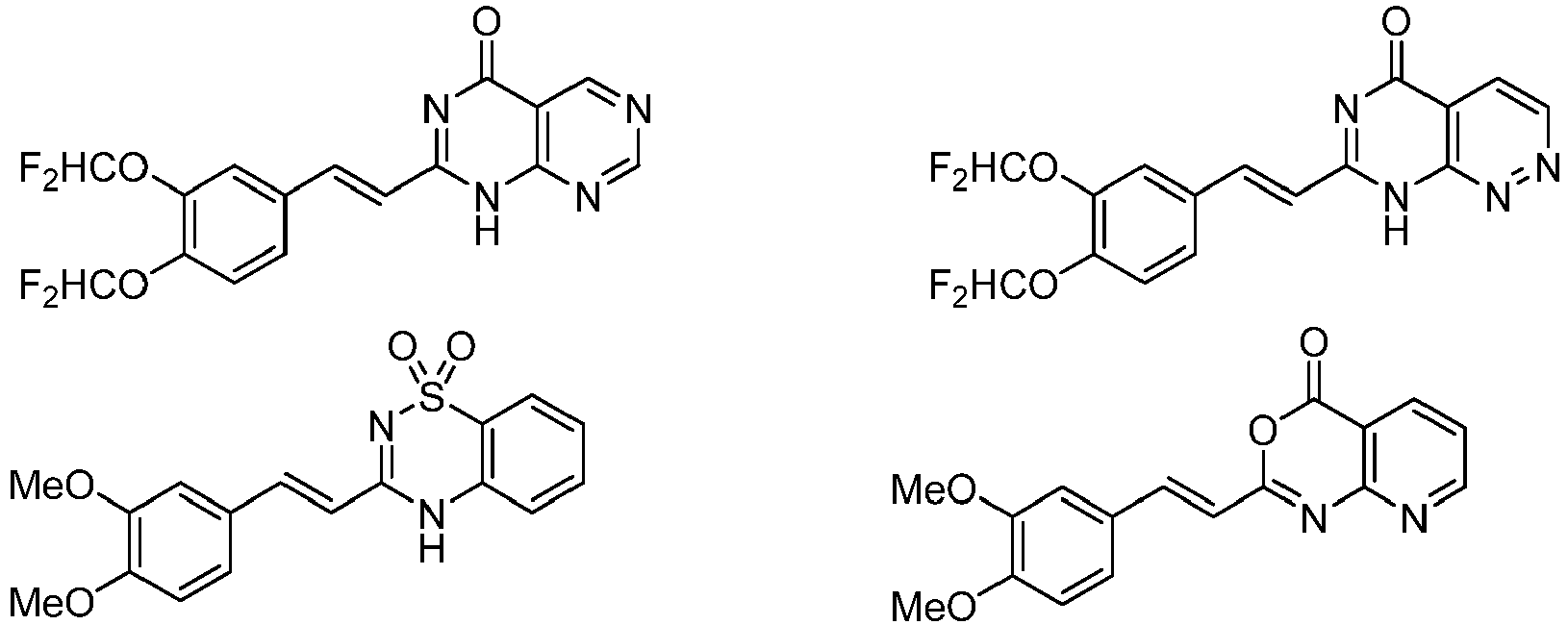
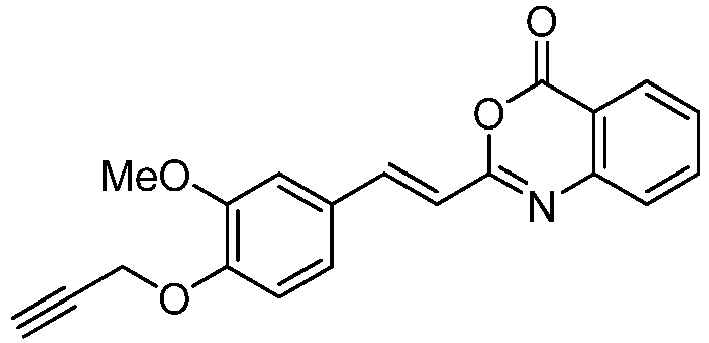

- The present invention also provides a pharmaceutical composition including a compound of any of the aforementioned first or second aspects of the invention, and a pharmaceutically acceptable diluent, excipient or carrier.
- The present invention also provides a compound of the aforementioned first or second aspects of the invention for use in inhibiting fibrosis in a subject.
- The present invention also provides a compound of the aforementioned first or second aspects of the invention for use in treating a disease or condition associated with fibrosis. The present invention also provides a compound of the aforementioned first or second aspects of the invention for use in treating a disease or condition characterised by inflammation and/or a benign or malignant neoplastic disease. The disease or condition may be selected from the group consisting of fibrotic skin disorders, lung disease, heart disease and kidney disease.
- In this specification a number of terms are used which are well known to a skilled addressee. Nevertheless for the purposes of clarity a number of terms will be defined.
- As used herein, the term "unsubstituted" means that there is no substituent or that the only substituents are hydrogen.
- The term "optionally substituted" as used throughout the specification denotes that the group may or may not be further substituted or fused (so as to form a condensed polycyclic system), with one or more non-hydrogen substituent groups. In certain embodiments the substituent groups are one or more groups independently selected from the group consisting of halogen, =O, =S, -CN, -NO2, -CF3, -OCF3, alkyl, alkenyl, alkynyl, haloalkyl, haloalkenyl, haloalkynyl, heteroalkyl, cycloalkyl, cycloalkenyl, heterocycloalkyl, heterocycloalkenyl, aryl, heteroaryl, cycloalkylalkyl, heterocycloalkylalkyl, heteroarylalkyl, arylalkyl, cycloalkylalkenyl, heterocycloalkylalkenyl, arylalkenyl, heteroarylalkenyl, cycloalkylheteroalkyl, heterocycloalkylheteroalkyl, arylheteroalkyl, heteroarylheteroalkyl, hydroxy, hydroxyalkyl, alkoxy, alkoxyalkyl, alkoxycycloalkyl, alkoxyheterocycloalkyl, alkoxyaryl, alkoxyheteroaryl, alkoxycarbonyl, alkylaminocarbonyl, alkenyloxy, alkynyloxy, cycloalkyloxy, cycloalkenyloxy, heterocycloalkyloxy, heterocycloalkenyloxy, aryloxy, phenoxy, benzyloxy, heteroaryloxy, arylalkyloxy, arylalkyl, heteroarylalkyl, cycloalkylalkyl, heterocycloalkylalkyl, arylalkyloxy, amino, alkylamino, acylamino, aminoalkyl, arylamino, sulfonylamino, sulfinylamino, sulfonyl, alkylsulfonyl, arylsulfonyl, aminosulfonyl, sulfinyl, alkylsulfinyl, arylsulfinyl, aminosulfinylaminoalkyl, -COOH, - COR11, -C(O)OR11, CONHR11, NHCOR11, NHCOOR11, NHCONHR11, C(=NOH)R11, -SH, -SR11, -OR11 and acyl.
- "Alkyl" as a group or part of a group refers to a straight or branched aliphatic hydrocarbon group, preferably a C1-C14 alkyl, more preferably C1-C10 alkyl, most preferably C1-C6 unless otherwise noted. Examples of suitable straight and branched C1-C6 alkyl substituents include methyl, ethyl, n-propyl, 2-propyl, n-butyl, sec-butyl, t-butyl, hexyl, and the like. The group may be a terminal group or a bridging group.
- "Alkylamino" includes both mono-alkylamino and dialkylamino, unless specified. "Mono-alkylamino" means a -NH-Alkyl group, in which alkyl is as defined above. "Dialkylamino" means a -N(alkyl)2 group, in which each alkyl may be the same or different and are each as defined herein for alkyl. The alkyl group is preferably a C1-C6 alkyl group. The group may be a terminal group or a bridging group.
- "Arylamino" includes both mono-arylamino and di-arylamino unless specified. Mono-arylamino means a group of formula arylNH-, in which aryl is as defined herein di-arylamino means a group of formula (aryl)2N- where each aryl may be the same or different and are each as defined herein for aryl. The group may be a terminal group or a bridging group.
- "Acyl" means an alkyl-CO- group in which the alkyl group is as described herein. Examples of acyl include acetyl and benzoyl. The alkyl group is preferably a C1-C6 alkyl group. The group may be a terminal group or a bridging group.
- "Alkenyl" as a group or part of a group denotes an aliphatic hydrocarbon group containing at least one carbon-carbon double bond and which may be straight or branched preferably having 2-14 carbon atoms, more preferably 2-12 carbon atoms, most preferably 2-6 carbon atoms, in the normal chain. The group may contain a plurality of double bonds in the normal chain and the orientation about each is independently E or Z. Exemplary alkenyl groups include, but are not limited to, ethenyl, propenyl, butenyl, pentenyl, hexenyl, heptenyl, octenyl and nonenyl. The group may be a terminal group or a bridging group.
- "Alkoxy" refers to an -O-alkyl group in which alkyl is defined herein. Preferably the alkoxy is a C1-C6 alkoxy. Examples include, but are not limited to, methoxy and ethoxy. The group may be a terminal group or a bridging group.
- "Alkenyloxy" refers to an -O- alkenyl group in which alkenyl is as defined herein. Preferred alkenyloxy groups are C1-C6 alkenyloxy groups. The group may be a terminal group or a bridging group.
- "Alkynyloxy" refers to an -O-alkynyl group in which alkynyl is as defined herein. Preferred alkynyloxy groups are C1-C6 alkynyloxy groups. The group may be a terminal group or a bridging group.
- "Alkoxycarbonyl" refers to an -C(O)-O-alkyl group in which alkyl is as defined herein. The alkyl group is preferably a C1-C6 alkyl group. Examples include, but not limited to, methoxycarbonyl and ethoxycarbonyl. The group may be a terminal group or a bridging group.
- "Alkylsulfinyl" means a -S(O)-alkyl group in which alkyl is as defined above. The alkyl group is preferably a C1-C6 alkyl group. Exemplary alkylsulfinyl groups include, but not limited to, methylsulfinyl and ethylsulfinyl. The group may be a terminal group or a bridging group.
- "Alkylsulfonyl" refers to a -S(O)2-alkyl group in which alkyl is as defined above. The alkyl group is preferably a C1-C6 alkyl group. Examples include, but not limited to methylsulfonyl and ethylsulfonyl. The group may be a terminal group or a bridging group.
- "Alkynyl" as a group or part of a group means an aliphatic hydrocarbon group containing a carbon-carbon triple bond and which may be straight or branched preferably having from 2-14 carbon atoms, more preferably 2-12 carbon atoms, more preferably 2-6 carbon atoms in the normal chain. Exemplary structures include, but are not limited to, ethynyl and propynyl. The group may be a terminal group or a bridging group.
- "Alkylaminocarbonyl" refers to an alkylamino-carbonyl group in which alkylamino is as defined above. The group may be a terminal group or a bridging group.
- "Cycloalkyl" refers to a saturated or partially saturated, monocyclic or fused or spiro polycyclic, carbocycle preferably containing from 3 to 9 carbons per ring, such as cyclopropyl, cyclobutyl, cyclopentyl, cyclohexyl and the like, unless otherwise specified. It includes monocyclic systems such as cyclopropyl and cyclohexyl, bicyclic systems such as decalin, and polycyclic systems such as adamantane. The group may be a terminal group or a bridging group.
- "Cycloalkenyl" means a non-aromatic monocyclic or multicyclic ring system containing at least one carbon-carbon double bond and preferably having from 5-10 carbon atoms per ring. Exemplary monocyclic cycloalkenyl rings include cyclopentenyl, cyclohexenyl or cycloheptenyl. The cycloalkenyl group may be substituted by one or more substituent groups. The group may be a terminal group or a bridging group.
- The above discussion of alkyl and cycloalkyl substituents also applies to the alkyl portions of other substituents, such as without limitation, alkoxy, alkyl amines, alkyl ketones, arylalkyl, heteroarylalkyl, alkylsulfonyl and alkyl ester substituents and the like.
- "Cycloalkylalkyl" means a cycloalkyl-alkyl- group in which the cycloalkyl and alkyl moieties are as previously described. Exemplary monocycloalkylalkyl groups include cyclopropylmethyl, cyclopentylmethyl, cyclohexylmethyl and cycloheptylmethyl. The group may be a terminal group or a bridging group.
- "Halogen" represents fluorine, chlorine, bromine or iodine.
- "Heterocycloalkyl" refers to a saturated or partially saturated monocyclic, bicyclic, or polycyclic ring containing at least one heteroatom selected from nitrogen, sulfur, oxygen, preferably from 1 to 3 heteroatoms in at least one ring. Each ring is preferably from 3 to 10 membered, more preferably 4 to 7 membered. Examples of suitable heterocycloalkyl substituents include pyrrolidyl, tetrahydrofuryl, tetrahydrothiofuranyl, piperidyl, piperazyl, tetrahydropyranyl, morphilino, 1,3-diazapane, 1,4-diazapane, 1,4-oxazepane, and 1,4-oxathiapane. The group may be a terminal group or a bridging group.
- "Heterocycloalkenyl" refers to a heterocycloalkyl as described above but containing at least one double bond. The group may be a terminal group or a bridging group.
- "Heterocycloalkylalkyl" refers to a heterocycloalkyl-alkyl group in which the heterocycloalkyl and alkyl moieties are as previously described. Exemplary heterocycloalkylalkyl groups include (2-tetrahydrofuryl)methyl, (2-tetrahydrothiofuranyl) methyl. The group may be a terminal group or a bridging group.
- "Heteroalkyl" refers to a straight- or branched-chain alkyl group preferably having from 2 to 14 carbons, more preferably 2 to 10 carbons in the chain, one or more of which has been replaced by a heteroatom selected from S, O, P and N. Exemplary heteroalkyls include alkyl ethers, secondary and tertiary alkyl amines, amides, alkyl sulfides, and the like. The group may be a terminal group or a bridging group. As used herein reference to the normal chain when used in the context of a bridging group refers to the direct chain of atoms linking the two terminal positions of the bridging group.
- "Aryl" as a group or part of a group denotes (i) an optionally substituted monocyclic, or fused polycyclic, aromatic carbocycle (ring structure having ring atoms that are all carbon) preferably having from 5 to 12 atoms per ring. Examples of aryl groups include phenyl, naphthyl, and the like; (ii) an optionally substituted partially saturated bicyclic aromatic carbocyclic moiety in which a phenyl and a C5-7 cycloalkyl or C5-7 cycloalkenyl group are fused together to form a cyclic structure, such as tetrahydronaphthyl, indenyl or indanyl. The group may be a terminal group or a bridging group.
- "Arylalkenyl" means an aryl-alkenyl- group in which the aryl and alkenyl are as previously described. Exemplary arylalkenyl groups include phenylallyl. The group may be a terminal group or a bridging group.
- "Arylalkyl" means an aryl-alkyl- group in which the aryl and alkyl moieties are as previously described. Preferred arylalkyl groups contain a C1-5 alkyl moiety. Exemplary arylalkyl groups include benzyl, phenethyl and naphthelenemethyl. The group may be a terminal group or a bridging group.
- "Heteroaryl" either alone or part of a group refers to groups containing an aromatic ring (preferably a 5 or 6 membered aromatic ring) having one or more heteroatoms as ring atoms in the aromatic ring with the remainder of the ring atoms being carbon atoms.
- Suitable heteroatoms include nitrogen, oxygen and sulphur. Examples of heteroaryl include thiophene, benzothiophene, benzofuran, benzimidazole, benzoxazole, benzothiazole, benzisothiazole, naphtho[2,3-b]thiophene, furan, isoindolizine, xantholene, phenoxatine, pyrrole, imidazole, pyrazole, pyridine, pyrazine, pyrimidine, pyridazine, indole, isoindole, 1H-indazole, purine, quinoline, isoquinoline, phthalazine, naphthyridine, quinoxaline, cinnoline, carbazole, phenanthridine, acridine, phenazine, thiazole, isothiazole, phenothiazine, oxazole, isooxazole, furazane, phenoxazine, 2-, 3-or 4- pyridyl, 2-, 3-, 4-, 5-, or 8- quinolyl, 1-, 3-, 4-, or 5- isoquinolinyl 1-, 2-, or 3- indolyl, and 2-, or 3-thienyl. The group may be a terminal group or a bridging group.
- "Heteroarylalkyl" means a heteroaryl-alkyl group in which the heteroaryl and alkyl moieties are as previously described. Preferred heteroarylalkyl groups contain a lower alkyl moiety. Exemplary heteroarylalkyl groups include pyridylmethyl. The group may be a terminal group or a bridging group.
- "Lower alkyl" as a group means unless otherwise specified, an aliphatic hydrocarbon group which may be straight or branched having 1 to 6 carbon atoms in the chain, more preferably 1 to 4 carbons such as methyl, ethyl, propyl (n-propyl or isopropyl) or butyl (n-butyl, isobutyl or tertiary-butyl). The group may be a terminal group or a bridging group.
- As would be understood by the skilled person, throughout the synthesis of the compounds of Formula (IV) it may be necessary to employ a protecting group on the amino group and/or on the carboxyl group in order to reversibly preserve a reactive amino or carboxyl functionality while reacting other functional groups on the compound. In such a case, the free amino group and/or the free carboxyl groups of the compounds of Formula (IV) can be liberated either by deprotection of the amino group followed by deprotection of the acid moieties or vice versa.
- Examples of suitable amino protecting groups that may be used include formyl, trityl, phthalimido, trichloroacetyl, chloroacetyl, bromoacetyl, iodoacetyl, and urethane-type blocking groups such as benzyloxycarbonyl ('CBz'), 4-phenylbenzyloxycarbonyl, 2-methylbenzyloxycarbonyl, 4-methoxybenzyloxycarbonyl, 4-fluorobenzyloxycarbonyl, 4-chlorobenzyloxycarbonyl, 3-chlorobenzyloxycarbonyl, 2-chlorobenzyloxycarbonyl, 2,4-dichlorobenzyloxycarbonyl, 4-bromobenzyloxycarbonyl, 3-bromobenzyloxycarbonyl, 4-nitrobenzyloxycarbonyl, 4cyanobenzyloxycarbonyl, t-butoxycarbonyl ('tBoc'), 2-(4-xenyl)-isopropoxycarbonyl, 1,1-diphenyleth-1-yloxycarbonyl, 1,1-diphenylprop-1-yloxycarbonyl, 2-phenylprop-2-yloxycarbonyl, 2-(p-toluyl)-prop-2-yloxycarbonyl, cyclopentanyloxy-carbonyl, 1-methylcyclopentanyloxycarbonyl, cyclohexanyloxycarbonyl, 1-methylcyclohexanyloxycarbonyl, 2-methylcyclohexanyloxycarbonyl, 2-(4-toluylsulfono)-ethoxycarbonyl, 2-(methylsulfono)ethoxycarbonyl, 2-(triphenylphosphino)-ethoxycarbonyl, fluorenylmethoxycarbonyl ("FMOC"), 2-(trimethylsilyl)ethoxycarbonyl, allyloxycarbonyl, 1-(trimethylsilylmethyl)prop-1-enyloxycarbonyl, 5-benzisoxalylmethoxycarbonyl, 4-acetoxybenzyloxycarbonyl, 2,2,2-trichloroethoxycarbonyl, 2-ethynyl-2-propoxycarbonyl, cyclopropylmethoxycarbonyl, 4-(decycloxy)benzyloxycarbonyl, isobornyloxycarbonyl, 1-piperidyloxycarbonlyl and the like; benzoylmethylsulfono group, 2-nitrophenylsulfenyl, diphenylphosphine oxide, and the like. The actual amino protecting group employed is not critical so long as the derivatised amino group is stable to the condition of subsequent reaction(s) and can be selectively removed as required without substantially disrupting the remainder of the molecule including any other amino protecting group(s). Preferred amino-protecting groups are t-butoxycarbonyl (Boc), and benzyloxycarbonyl (Cbz). Further examples of these groups are found in: Greene, T. W. and Wuts, P. G. M., Protective Groups in Organic Synthesis, Second edition; Wiley-Interscience: 1991; Chapter 7; McOmie, J. F. W. (ed.), Protective Groups in Organic Chemistry, Plenum Press, 1973; and Kocienski, P. J., Protecting Groups, Second Edition, Theime Medical Pub., 2000.
- Examples of carboxyl protecting groups that may be used include methyl, ethyl, n-propyl, i-propyl, p-nitrobenzyl, p-methylbenzyl, p-methoxybenzyl, 3,4-dimethoxybenzyl, 2,4-dimethoxybenzyl, 2,4,6-trimethoxybenzyl, 2,4,6-trimethylbenzyl, pentamethylbenzyl, 3,4-methylenedioxybenzyl, benzhydryl, 4,4'-dimethoxybenzhydryl, 2,2'4,4'-tetramethoxybenzhydryl, t-butyl, t-amyl, trityl, 4-methoxytrityl, 4,4'-dimethoxytrityl, 4,4,'4"-trimethoxytrityl, 2-phenylprop-2-yl, trimethylsilyl, t-butyldimethylsilyl, phenacyl, 2,2,2-trichloroethyl, β-(di(n-butyl)methylsilyl)ethyl, p-toluenesulfonoethyl, 4-nitrobenzylsulfonoethyl, allyl, cinnamyl, 1-(trimethylsilylmethyl)prop-1-en-3-yl, and the like. Preferred carboxyl protecting groups are methyl and t-butyl. Further examples of these groups are found in: Greene, T. W. and Wuts, P. G. M., Protective Groups in Organic Synthesis, Second edition; Wiley-Interscience: 1991; McOmie, J. F. W. (ed.), Protective Groups in Organic Chemistry, Plenum Press, 1973; and Kocienski, P. J., Protecting Groups, Second Edition, Theime Medical Pub., 2000.
- It is understood that included in the family of compounds of Formula (IV) are isomeric forms including diastereoisomers, enantiomers, tautomers, and geometrical isomers in "E" or "Z" configurational isomer or a mixture of E and Z isomers. It is also understood that some isomeric forms such as diastereomers, enantiomers, and geometrical isomers can be separated by physical and/or chemical methods and by those skilled in the art.
- Some of the compounds of the disclosed embodiments may exist as single stereoisomers, racemates, and/or mixtures of enantiomers and /or diastereomers. All such single stereoisomers, racemates and mixtures thereof, are intended to be within the scope of the subject matter described and claimed.
- Some of the compounds of the disclosed embodiments are substituted cyclopropanes having the general formula

- Additionally, Formula (IV) is intended to cover, where applicable, solvated as well as unsolvated forms of the compounds. Thus, each formula includes compounds having the indicated structure, including the hydrated as well as the non-hydrated forms.
- In addition to compounds of Formula (IV), the compounds of the various embodiments include pharmaceutically acceptable salts, N-oxides and active metabolites of such compounds, and pharmaceutically acceptable salts of such metabolites.
- The term "pharmaceutically acceptable salts" refers to salts that retain the desired biological activity of the above-identified compounds, and include pharmaceutically acceptable acid addition salts and base addition salts. Suitable pharmaceutically acceptable acid addition salts of compounds of Formula (IV) may be prepared from an inorganic acid or from an organic acid. Examples of such inorganic acids are hydrochloric, sulfuric, and phosphoric acid. Appropriate organic acids may be selected from aliphatic, cycloaliphatic, aromatic, heterocyclic carboxylic and sulfonic classes of organic acids, examples of which are formic, acetic, propionic, succinic, glycolic, gluconic, lactic, malic, tartaric, citric, fumaric, maleic, alkyl sulfonic, arylsulfonic. Suitable pharmaceutically acceptable base addition salts of compounds of Formula (IV) include metallic salts made from lithium, sodium, potassium, magnesium, calcium, aluminium, and zinc, and organic salts made from organic bases such as choline, diethanolamine, morpholine. Other examples of organic salts are: ammonium salts, quaternary salts such as tetramethylammonium salt; amino acid addition salts such as salts with glycine and arginine. Additional information on pharmaceutically acceptable salts can be found in Remington's Pharmaceutical Sciences, 19th Edition, Mack Publishing Co., Easton, PA 1995. In the case of agents that are solids, it is understood by those skilled in the art that the inventive compounds, agents and salts may exist in different crystalline or polymorphic forms, all of which are intended to be within the scope of the present invention and specified formulae.
- The terms "treating", "treat", or "treatment" refer generally to amelioration or elimination of a named condition once the condition has been established. The term "prophylaxis" refers generally to treatment to prevent the onset of a named condition or of a process that can lead to the condition ("primary" prophylaxis), or the recurrence of symptoms of a condition.
- The term "subject" refers generally to any warm blooded animal such as, but not limited to, a mouse, guinea pig, dog, horse, or human. In an embodiment, the subject is human.
- The term "therapeutically effective amount" or "effective amount" is an amount sufficient to effect beneficial or desired clinical results. An effective amount can be administered in one or more administrations. An effective amount is typically sufficient to palliate, ameliorate, stabilize, reverse, slow or delay the progression of the disease state.
- The term "pharmaceutically acceptable" refers generally to a substance or composition that is compatible chemically and/or toxicologically with the other ingredients including a formulation, and/or the subject being treated.
- The term "compounds of the present invention" (unless specifically identified otherwise) refers generally to compounds, pharmaceutically acceptable salts of the compounds, and hydrates or solvates of the compounds and salts, as well as all stereoisomers (including diastereoisomers and enantiomers), tautomers and isotopically labelled compounds. The compounds of the present invention may exist in unsolvated as well as solvated forms with pharmaceutically acceptable solvents such as water, ethanol, and the like, and it is intended that the invention embrace both solvated and unsolvated forms.
- The term "derivative thereof" when used in reference to compounds of the present invention refers generally to pharmaceutically acceptable salts of the compounds, and hydrates or solvates of the compounds,and salts.
- Compounds of the present invention include compounds of Formula (IV)

- Specific compounds of the invention include the following:


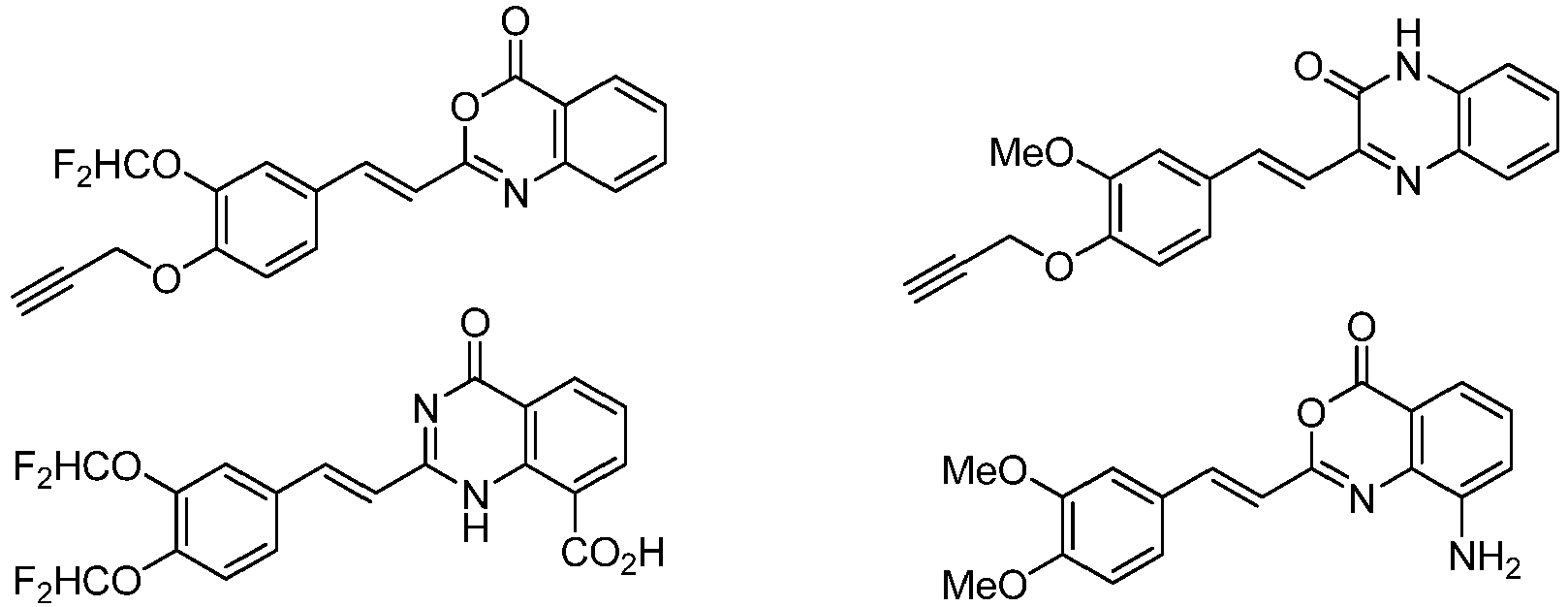


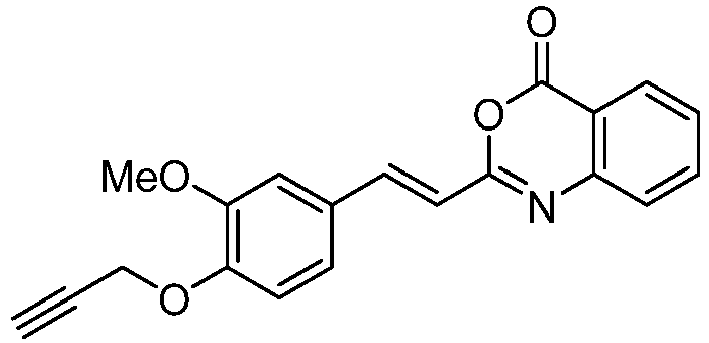


- It will be evident from the foregoing description that compounds of the present invention are fused ring analogues of tranilast (2-{[(2E)-3-(3,4-dimethoxyphenyl)prop-2-enoyl]amino}benzoic acid). As such, the compounds of the invention may have the ability to inhibit ERK phosphorylation and, therefore, act as an antifibrotic agent when administered to a subject. However, the compounds of the present invention are not limited to antifibrotic agents that act via inhibition of ERK phosporylation and it is possible for them to have antifibrotic activity via a mechanism that does not involve inhibition of ERK phosphorylation.
- Accordingly the compounds of the invention may find a multiple number of applications in which their ability to prevent, ameliorate or inhibit fibrosis can be utilised. For example compounds of Formula (IV) may be used to treat a disease or condition associated with fibrosis or characterised by inflammation and/or a benign or malignant neoplastic disease.
- The disease or condition associated with fibrosis may be selected from fibrotic skin disorders, such as keloids, hypertrophic scars and scleroderma; lung disease, such as pulmonary fibrosis; heart disease, such as heart failure due to ischaemic heart disease, valvular heart disease and hypertensive heart disease, diabetic cardiomyopathy and hypertension; and kidney disease, such as progressive kidney disease, cirrhosis of the liver, glomerulonephritis and diabetic nephropathy. In specific embodiments, the disease or condition is diabetic heart disease, diabetic kidney disease, or diabetic cardiomyopathy.
- Diabetic cardiomyopathy refers to any one or more cardiac pathology and/or dysfunction in a subject, which is a complication of either Type I or Type II diabetes in the subject. The diabetes may be symptomatic or asymptomatic. Cardiac pathology which is characteristic of diabetic cardiomyopathy includes myocellular hypertrophy, myocardial fibrosis, and in some cases left ventricular hypertrophy. The pathologies which are contemplated arise independently from complications arising from coronary artery disease, although both diabetic complications and coronary artery complications may be present in the same subject. Diastolic dysfunction, such as an impairment in early diastolic filling, a prolongation of isovolumetric relaxation and increased atrial filling is also characteristic of diabetic cardiomyopathy, and may be identified using Doppler methods such as Doppler 2-dimensional echocardiography (for example Redford MM et al., JAMA (2003) 289:194-203) or radionuclide imaging for early or mild dysfunction and by standard echocardiograph testing for more severe dysfunction.
- Cardiac fibrosis refers to the formation of fibrous tissue, including cellular and extracellular components, in the lining and muscle of the heart. If present in sufficient quantities, the fibrous tissue will result in a decrease in the contractility of one or more regions of the heart, resulting in functional deficit in cardiac output.
- Alternatively, or in addition, it is also anticipated that the compounds will be useful in the treatment of a disease or condition characterised by inflammation and/or a benign or malignant neoplastic disease. The disease or condition characterised by inflammation may be selected from allergic rhinitis, bronchial asthma, rheumatoid arthritis, multiple sclerosis, type I and type II diabetes, systemic lupus, erythematosis, transplant rejection and inflammatory bowel disease. The benign or malignant neoplastic disease may be any such disease known to the skilled person.
- The compounds may be used in the preparation of a medicament for treating a disease or condition associated with fibrosis. Alternatively, the compounds of the invention may be used in the preparation of a medicament for treating a disease or condition characterised by inflammation and/or a benign or malignant neoplastic disease.
- Administration of compounds of Formula (IV) to humans can be by any of the accepted modes for enteral administration such as oral or rectal, or by parenteral administration such as subcutaneous, intramuscular, intravenous and intradermal routes. Injection can be bolus or via constant or intermittent infusion. The active compound is typically included in a pharmaceutically acceptable carrier or diluent and in an amount sufficient to deliver to the patient a therapeutically effective dose.
- In using the compounds they can be administered in any form or mode which makes the compound bioavailable. One skilled in the art of preparing formulations can readily select the proper form and mode of administration depending upon the particular characteristics of the compound selected, the condition to be treated, the stage of the condition to be treated and other relevant circumstances. See Remingtons Pharmaceutical Sciences, 19th edition, Mack Publishing Co. (1995) for further information.
- The compounds can be administered alone or in the form of a pharmaceutical composition in combination with a pharmaceutically acceptable carrier, diluent or excipient. The compounds may be administered as the compounds themselves or in the form of their pharmaceutically acceptable salts or derivatives.
- The compounds are, however, typically used in the form of pharmaceutical compositions which are formulated depending on the desired mode of administration. As such in a further embodiment the present invention provides a pharmaceutical composition including a compound of Formula (IV) and a pharmaceutically acceptable carrier, diluent or excipient. The compositions are prepared in manners well known in the art.
- The compounds may be used or administered in combination with one or more additional drug(s) for the treatment of the disorder/diseases mentioned. The components can be administered in the same formulation or in separate formulations. If administered in separate formulations the compounds of the invention may be administered sequentially or simultaneously with the other drug(s).
- In addition to being able to be administered in combination with one or more additional drugs, the compounds may be used in a combination therapy. When this is done the compounds are typically administered in combination with each other. Thus one or more of the compounds of the invention may be administered either simultaneously (as a combined preparation) or sequentially in order to achieve a desired effect. This is especially desirable where the therapeutic profile of each compound is different such that the combined effect of the two drugs provides an improved therapeutic result.
- Pharmaceutical compositions of this invention for parenteral injection comprise pharmaceutically acceptable sterile aqueous or nonaqueous solutions, dispersions, suspensions or emulsions as well as sterile powders for reconstitution into sterile injectable solutions or dispersions just prior to use. Examples of suitable aqueous and nonaqueous carriers, diluents, solvents or vehicles include water, ethanol, polyols (such as glycerol, propylene glycol, polyethylene glycol, and the like), and suitable mixtures thereof, vegetable oils (such as olive oil), and injectable organic esters such as ethyl oleate. Proper fluidity can be maintained, for example, by the use of coating materials such as lecithin, by the maintenance of the required particle size in the case of dispersions, and by the use of surfactants.
- These compositions may also contain adjuvants such as preservative, wetting agents, emulsifying agents, and dispersing agents. Prevention of the action of microorganisms may be ensured by the inclusion of various antibacterial and antifungal agents, for example, paraben, chlorobutanol, phenol sorbic acid, and the like. It may also be desirable to include isotonic agents such as sugars, sodium chloride, and the like. Prolonged absorption of the injectable pharmaceutical form may be brought about by the inclusion of agents that delay absorption such as aluminium monostearate and gelatin.
- If desired, and for more effective distribution, the compounds can be incorporated into slow release or targeted delivery systems such as polymer matrices, liposomes, and microspheres.
- The injectable formulations can be sterilised, for example, by filtration through a bacterial-retaining filter, or by incorporating sterilising agents in the form of sterile solid compositions that can be dissolved or dispersed in sterile water or other sterile injectable medium just prior to use.
- Solid dosage forms for oral administration include capsules, tablets, pills, powders, and granules. In such solid dosage forms, the active compound is mixed with at least one inert, pharmaceutically acceptable excipient or carrier such as sodium citrate or dicalcium phosphate and/or a) fillers or extenders such as starches, lactose, sucrose, glucose, mannitol, and silicic acid, b) binders such as, for example, carboxymethylcellulose, alginates, gelatin, polyvinylpyrrolidone, sucrose, and acacia, c) humectants such as glycerol, d) disintegrating agents such as agar-agar, calcium carbonate, potato or tapioca starch, alginic acid, certain silicates, and sodium carbonate, e) solution retarding agents such as paraffin, f) absorption accelerators such as quaternary ammonium compounds, g) wetting agents such as, for example, cetyl alcohol and glycerol monostearate, h) absorbents such as kaolin and bentonite clay, and i) lubricants such as talc, calcium stearate, magnesium stearate, solid polyethylene glycols, sodium lauryl sulfate, and mixtures thereof. In the case of capsules, tablets and pills, the dosage form may also comprise buffering agents.
- Solid compositions of a similar type may also be employed as fillers in soft and hard-filled gelatin capsules using such excipients as lactose or milk sugar as well as high molecular weight polyethylene glycols and the like.
- The solid dosage forms of tablets, dragees, capsules, pills, and granules can be prepared with coatings and shells such as enteric coatings and other coatings well known in the pharmaceutical formulating art. They may optionally contain opacifying agents and can also be of a composition that they release the active ingredient(s) only, or preferentially, in a certain part of the intestinal tract, optionally, in a delayed manner. Examples of embedding compositions which can be used include polymeric substances and waxes.
- The active compounds can also be in microencapsulated form, if appropriate, with one or more of the above-mentioned excipients.
- Liquid dosage forms for oral administration include pharmaceutically acceptable emulsions, solutions, suspensions, syrups and elixirs. In addition to the active compounds, the liquid dosage forms may contain inert diluents commonly used in the art such as, for example, water or other solvents, solubilizing agents and emulsifiers such as ethyl alcohol, isopropyl alcohol, ethyl carbonate, ethyl acetate, benzyl alcohol, benzyl benzoate, propylene glycol, 1,3-butylene glycol, dimethyl formamide, oils (in particular, cottonseed, groundnut, corn, germ, olive, castor, and sesame oils), glycerol, tetrahydrofurfuryl alcohol, polyethylene glycols and fatty acid esters of sorbitan, and mixtures thereof.
- Besides inert diluents, the oral compositions can also include adjuvants such as wetting agents, emulsifying and suspending agents, sweetening, flavouring, and perfuming agents.
- Suspensions, in addition to the active compounds, may contain suspending agents as, for example, ethoxylated isostearyl alcohols, polyoxyethylene sorbitol and sorbitan esters, microcrystalline cellulose, aluminium metahydroxide, bentonite, agar-agar, and tragacanth, and mixtures thereof.
- Compositions for rectal or vaginal administration are preferably suppositories which can be prepared by mixing the compounds with suitable non-irritating excipients or carriers such as cocoa butter, polyethylene glycol or a suppository wax which are solid at room temperature but liquid at body temperature and therefore melt in the rectum or vaginal cavity and release the active compound.
- Dosage forms for topical administration of a compound of this invention include powders, patches, sprays, ointments and inhalants. The active compound is mixed under sterile conditions with a pharmaceutically acceptable carrier and any needed preservatives, buffers, or propellants which may be required.
- The amount of compound administered will preferably treat and reduce or alleviate the condition. A therapeutically effective amount can be readily determined by an attending diagnostician by the use of conventional techniques and by observing results obtained under analogous circumstances. In determining the therapeutically effective amount a number of factors are to be considered including but not limited to, the species of animal, its size, age and general health, the specific condition involved, the severity of the condition, the response of the patient to treatment, the particular compound administered, the mode of administration, the bioavailability of the preparation administered, the dose regime selected, the use of other medications and other relevant circumstances.
- A typical dosage will be a range from about 0.01 to 1000 mg per kilogram of body weight per day. Small doses (0.01-1 mg/kg per day) may be administered initially, followed by increasing doses up to about 1000 mg/kg per day. In the event that the response in a subject is insufficient at such doses, even higher doses (or effective higher doses by a different, more localised delivery route) may be employed to the extent patient tolerance permits. A more preferred dosage will be in the range from 0.1 to 300 mg per kilogram of body weight per day, more preferably from 0.1 to 100 mg per kilogram of body weight per day. A suitable dose can be administered in multiple sub-doses per day.
- The compounds may be prepared using the reaction routes and synthesis schemes as described below, employing the techniques available in the art using starting materials that are commercially available or can be synthesised using known procedures or adaptations thereof. Whilst the preparation of particular compounds is outlined below, the skilled person will also recognise that the chemical reactions described may be readily adapted to prepare a number of other agents of the various embodiments. For example, the synthesis of non-exemplified compounds may be successfully performed by modifications apparent to those skilled in the art, e.g. by appropriately protecting interfering groups, by changing to other suitable reagents known in the art, or by making routine modifications of reaction conditions. A list of suitable protecting groups in organic synthesis can be found in T.W. Greene's Protective Groups in Organic Synthesis, 3rd Edition, John Wiley & Sons, 1991. Alternatively, other reactions disclosed herein or known in the art will be recognized as having applicability for preparing other compounds of the various embodiments.
- Reagents useful for synthesizing compounds may be obtained or prepared according to techniques known in the art.
- Compounds of Formula (IV) may be synthesized by condensing 3-methyl-1 H-quinoxalin-2-one, 2-methyl-4H-3,1-benzoxazin-4-one or 2-methyl-3H-quinazolin-4-one with a substituted benzaldehyde to provide fused heterocyclic tranilast derivatives. The intermediates can also be synthesized as shown below:


- Substituted benzoxazoles, benzothiazoles, and benzimidazoles can be obtained by reaction of aldehydes with 2-aminophenol, 2-aminothiophenol and o-phenylenediamine, with 4-methoxy-TEMPO radical as the catalyst:


- The compounds of Formula (IV) and intermediates in their synthesis can be isolated from a reaction mixture using standard work-up and purification procedures. Suitable procedures include solvent extraction, chromatography (thin or thick layer chromatography, HPLC, flash chromatography, MPLC, etc.), recrystallisation etc.
- The present invention includes salts of the compounds of Formula (IV). The salts may serve as intermediates in the purification of compounds or in the preparation of other, for example pharmaceutically acceptable, acid addition salts, or they may be useful for identification, characterisation or purification. The salts can exist in conjunction with the acidic or basic portion of the molecule and can exist as acid addition, primary, secondary, tertiary, or quaternary ammonium, alkali metal, or alkaline earth metal salts. Generally, acid addition salts are prepared by the reaction of an acid with compounds of Formula (IV). The alkali metal and alkaline earth metal salts are generally prepared by the reaction of the hydroxide form of the desired metal salt with compounds of Formula (IV).
- Acid addition salts are preferably the pharmaceutically acceptable, non-toxic addition salts with suitable acids, such as those with inorganic acids, for example hydrochloric, hydrobromic, nitric, sulphuric or phosphoric acids, or with organic acids, such as organic carboxylic acids, for example, glycollic, maleic, hydroxymaleic, fumaric, malic, tartaric, citric, salicyclic, o-acetoxybenzoic, or organic sulphonic, 2-hydroxyethane sulphonic, toluene-p-sulphonic, or naphthalene-2-sulphonic acid.
- The present invention also includes esters of the compounds of Formula (IV), such esters being for example aliphatic esters such as alkyl esters. The esters of the compounds of Formula (IV) may be pharmaceutically acceptable metabolically labile esters. These are ester derivatives of compounds of Formula (IV) that are hydrolysed in vivo to afford the compound of Formula (IV) and a pharmaceutically acceptable alcohol. Examples of metabolically labile esters include esters formed with alkanols in which the alkanol moiety may be optionally substituted by an alkoxy group, for example methanol, ethanol, propanol and methoxyethanol.
- The compounds of the various embodiments may be prepared using the reaction routes and synthesis schemes as described above, employing the techniques available in the art using starting materials that are readily available. The person skilled in the art will recognise that the chemical reactions described may be readily adapted to prepare a number of other compounds. For example, the synthesis of non-exemplified compounds may be successfully performed by modifications apparent to those skilled in the art, e.g. by appropriately protecting interfering groups, by changing to other suitable reagents known in the art, or by making routine modifications of reaction conditions. A list of suitable protecting groups in organic synthesis can be found in T.W. Greene's Protective Groups in Organic Synthesis, 3rd Edition, John Wiley & Sons, 1991. Reagents useful for synthesizing compounds may be obtained or prepared according to techniques known in the art.
- The anti-fibrotic effects of compounds of Formula (IV) can be tested using any of the following methods:
- (i) In a renal cell line by measuring proline incorporation after transforming growth factor-β stimulation;
- (ii) Matrix synthesis may be stimulated by platelet derived growth factor (PDGF). Accordingly, mesangial cells incubated with PDGF can be used to demonstrate proline incorporation, which is an indicator of matrix synthesis and thereby a model for fibrosis; or
- (iii) Matrix synthesis may be stimulated by both angiotensin II or transforming growth factor beta (TGF-β). Accordingly, neonatal cardiac fibroblasts incubated with angiotensin II or TGF-β can be used to demonstrate proline incorporation, which is an indicator of matrix synthesis and thereby a model for fibrosis.
-
-
Figure 1 : Average % inhibition of TGF-β stimulated proline incorporation by compound FT98 at 10µM, 30µM and 100µM (SEM). -
Figure 2 : Average % inhibition of TGF-β stimulated proline incorporation by compound FT108 at 10µM, 30µM and 100µM (SEM). -
Figure 3 : Average % inhibition of TGF-β stimulated proline incorporation by compound FT109 at 10µM, 30µM and 100µM (SEM). -
Figure 4 : Average % inhibition of TGF-β stimulated proline incorporation by compound FT113 at 10µM, 30µM and 100µM (SEM). -
Figure 5 : Average % inhibition of TGF-β stimulated proline incorporation by compound FT121 at 10µM, 30µM and 100µM (SEM). -
Figure 6 : Average % inhibition of TGF-β stimulated proline incorporation by compound FT122 at 10µM, 30µM and 100µM (SEM). -
Figure 7 : Average % inhibition of TGF-β stimulated proline incorporation by compound FT126 at 10µM, 30µM and 100µM (SEM). -
Figure 8 : Average % inhibition of TGF-β stimulated proline incorporation by compound FT128 at 10µM, 30µM and 100µM (SEM). -
Figure 9 : Average % inhibition of TGF-β stimulated proline incorporation by compound FT129 at 10µM, 30µM and 100µM (SEM). -
Figure 10 : Average % inhibition of TGF-β stimulated proline incorporation by compound FT130 at 10µM, 30µM and 100µM (SEM). -
Figure 11 : Average % inhibition of TGF-β stimulated proline incorporation by compound FT132 at 10µM, 30µM and 100µM (SEM). - An average % inhibition of greater than 100% indicates cell stress or death in
figures 5, 6 and9 . - Examples of materials and methods for use with the compounds of the present invention will now be provided. In providing these examples, it is to be understood that the specific nature of the following description is not to limit the generality of the above description.
- Electrospray ionization (ESI) high resolution mass spectra (HRMS) were obtained on a Finnigan hybrid LTQ-FT mass spectrometer (Thermo Electron Corp.). Proton nuclear magnetic resonance (1H NMR) and proton decoupled carbon nuclear magnetic resonance (13C NMR) spectra were obtained on Unity 400, Innova 400 or Innova 500 instruments (Melbourne, Australia) operating at 400 or 500 MHz for 1H and at 100 or 125 MHz for 13C. All signals were referenced to solvent peaks (CDCl3: 7.26 ppm for 1H and 77.0 ppm for 13C; DMSO-d6: 2.49 ppm for 1H and 39.5 ppm for 13C). Infrared (IR) spectra were obtained using a PerkinElmer Spectrum One FT-IR spectrometer with zinc selenide/diamond Universal ATR Sampling Accessory. Melting points were obtained using a Reichert-Jung hot stage apparatus and are corrected. Analytical thin layer chromatography (TLC) was conducted on 2 mm thick silica gel GF254. Compounds were visualised with solutions of 20% w/w phosphomolybdic acid in ethanol, 20% w/w potassium permanganate in water or under UV (365 nm). Flash chromatography was performed with
Merck Silica Gel 60. Petrol refers to the fraction boiling at 40-60 °C. All other reagents were used as received. -

- 2-Aminobenzenesulfonamide (0.25 g, 1.4 mmol) was added to a suspension of (E)-3-(3,4-dimethoxyphenyl)acrylic acid (0.25 g, 1.2 mmol), HBTU (0.55 g, 1.4 mmol) and NEt3 (0.67 mL, 4.8 mmol) in MeCN (5 mL) and the reaction was stirred at rt for 16 h. Extra NEt3 (0.67 mL, 4.8 mmol) in MeCN (5 mL) was added and the reaction was stirred at rt for 64 h. The solution was acidified and the precipitate was collected by filtration. Hot EtOH (15 mL) was added to the crude product and the undissolved solid was collected by hot filtration, providing (E)-3-[2-(3,4-dimethoxyphenyl)ethenyl]-4H-1,2,4-benzothiadiazine-1,1 -dioxide (58 mg, 14%) as a colourless crystalline solid; mp 276-279 °C; δH (500 MHz, DMSO-d 6) 3.81 (s, 3H, OCH 3), 3.83 (s, 3H, OCH 3), 6.75 (d, J = 15.6 Hz, 1 H, CH=CHCO), 7.05 (d, J 5',6' = 8.0 Hz, 1 H, H5'), 7.29 (d, J 5',6' = 8.0 Hz, 1 H, H6'), 7.31 (s, 1 H, H2'), 7.38 (d, J 5,6 = 8.0 Hz, 1 H, H5), 7.45 (t, J 5,6 = J 6,7 = 8.0 Hz, 1 H, H6), 7.68 (t, J 6,7 = J 7,8 = 8.0 Hz, 1 H, H7), 7.80 (d, J 7,8 = 8.0 Hz, 1 H, H8), 7.82 (d, J = 15.6 Hz, 1 H, CH=CHCO), 12.13 (s, 1 H, NH); δC (125 MHz, DMSO-d 6) 55.4, 55.6, 110.3, 111.8, 116.6, 117.6, 122.0, 122.7, 123.3, 126.3, 126.9, 133.0, 135.2, 142.2, 149.0, 151.1, 153.5; HRMS (ESI) calculated for C17H16N2O4S [M+H]+ 345.0904, found 345.0900; νmax 756, 1134, 1263, 1513, 1568, 1600, 3024, 3117, 3163, 3200 cm-1.
-

- A suspension of (E)-3-(3,4-dimethoxyphenyl)acrylic acid (0.25 g, 1.2 mmol) in CH2Cl2 (5 mL) was treated with oxalyl chloride (0.41 mL, 4.8 mmol). The solution was stirred at rt for 1 h and the solvent was removed under reduced pressure to give the acid chloride as a yellow solid. 3-Aminonicotinic acid (0.25 g, 1.4 mmol) was added to a solution of the acid chloride (1.2 mmol) in pyridine (2.0 mL) and the suspension was stirred at rt for 7 d. The solution was diluted with water and the precipitate was collected by filtration providing (E)- 2-(3,4-dimethoxystyryl)-4H-pyrido[2,3-d][1,3]oxazin-4-one (0.16 g, 41%) as a green-yellow solid; mp 228-231 °C; δH (500 MHz, DMSO-d 6) 3.81 (s, 3H, OCH 3), 3.84 (s, 3H, OCH 3), 6.99 (d, J = 16.5 Hz, 1 H, CH=CHCO), 7.02 (d, J 5,6' = 8.0 Hz, 1 H, H5'), 7.37 (d, J 5,6' = 8.0 Hz, 1 H, H6'), 7.49 (s, 1 H, H2'), 7.55 (dd, J 4,5 = 8.0, J 5,6 = 4.0 Hz, 1 H, H5), 7.82 (d, J = 16.5 Hz, 1 H, CH=CHCO), 7.47 (d, J 4,5 = 8.0 Hz, 1 H, H4), 8.95 (d, J 5,6 = 4.0 Hz, 1 H, H6); δC (125 MHz, DMSO-d 6) 55.6, 55.7, 110.5, 111.6, 112.9, 116.5, 123.4, 127.2, 137.3, 143.0, 149.1, 151.3, 157.1, 157.5, 159.4, 160.1; HRMS (ESI) calculated for C17H15N2O4 [M+H]+ 311.1026, found 311.1025; vmax 798, 1024, 1417, 1563, 1757, 2836, 2958 cm-1.
-

- Anthranilic acid (300 g, 2.08 mol) was added to a solution of Meldrum's acid (272 g, 1.98 mol) in toluene (2.0 L). The reaction flask was fitted with a Dean-Stark apparatus and the suspension was heated to reflux for 3 h. The suspension was cooled, filtered, washed with toluene and dried. 2-[(Carboxyacetyl)amino]benzoic acid (381 g, 86%) was obtained as a colourless solid; mp 171-173 °C; δH (500 MHz, DMSO-d 6) 3.45 (br s, 2H, CH 2), 7.16 (t, J 3,4 = J 4,5 = 8.0 Hz, 1 H, H4), 7.59 (td, J 4,5 = J 5,6 = 8.0, J 3,5 = 1.5 Hz, 1 H, H5), 7.97 (dd, J 3,4 = 8.0, J 3,5 = 1.5 Hz, 1 H, H3), 8.44 (d, J 5,6 = 8.0 Hz, 1 H, H6), 11.27 (s, 1 H, NH), 12.83 (br s, 1 H, CO2 H), 13.57 (br s, 1 H, CO2 H); δC (125 MHz, DMSO-d6 ) 45.0, 117.0, 120.3, 123.1, 131.2, 134.1, 140.4, 164.9, 169.1, 169.3; νmax 760, 1234, 1385, 1544, 1684, 1712, 2653, 2964, 3119 cm-1.
-

- Piperidine (0.96 mL, 9.7 mmol) was added to a suspension of 3,4-dimethoxybenzaldehyde (1.6 g, 9.7 mmol) and 2-[(carboxyacetyl)amino]benzoic acid (1.9 g, 8.6 mmol) in toluene (5.0 mL). The reaction flask was fitted with a Dean-Stark apparatus and heated to reflux for 4 h, then cooled to rt and the resulting suspension was filtered and washed with toluene. The piperidinium salt was dissolved in MeOH (5.0 mL) and water (2.0 mL) at 40 °C and the solution was acidified with concentrated HCl. The precipitate was filtered, providing (E)-2-[[3-(3,4-dimethoxyphenyl)-1-oxo-2-propenyl]amino]benzoic acid (tranilast) (2.1 g, 74%) as a yellow crystalline solid; mp 208-209 °C, lit.2 206 °C; δH (500 MHz, DMSO-d 6) 3.79 (s, 3H, OCH 3), 3.82 (s, 3H, OCH 3), 6.79 (d, J = 15.5 Hz, 1 H, CH=CHCO), 6.99 (d, J 5',6' = 8.5 Hz, 1 H, H5'), 7.16 (t, J 3,4 = J 4,5 = 7.9 Hz, 1 H, H4), 7.25 (d, J 5',6' = 8.5 Hz, 1 H, H6'), 7.38 (s, 1 H, H2'), 7.56 (d, J = 15.5 Hz, 1 H, CH=CHCO), 7.61 (t, J 4,5 = J 5,6 = 7.9 Hz, 1 H, H5), 8.00 (d, J 3,4 = 7.9 Hz, 1 H, H3), 8.62 (d, J 5,6 = 7.9 Hz, 1 H, H6), 11.30 (s, 1 H, NH), 13.61 (br s, 1 H, CO2 H).
-

- A solution of of (E)-2-[[3-(3,4-dimethoxyphenyl)-1-oxo-2-propenyl]amino]benzoic acid (0.5 g, 1.5 mmol) in acetic anhydride (3 mL) was heated to reflux and stirred for 3 h. The reaction was cooled to rt and the resulting suspension was diluted with water. The suspension was stirred at rt for 1 h and the precipitate was collected by filtration, providing (E)-2-(3,4-dimethoxystyryl)-4H-benzo[d][1,3]oxazin-4-one (0.41 g, 88 %) as a yellow crystalline solid; mp 175-179 °C; δH (500 MHz, DMSO-d 6) 3.82 (s, 3H, OCH 3), 3.85 (s, 3H, OCH 3), 6.94 (d, J = 16.0 Hz, 1 H, CH=CHCO), 7.02 (d, J 5',6' = 8.0 Hz, 1 H, H5'), 7.35 (dd, J 5',6' = 8.0, J 2',6' = 1.5 Hz, 1 H, H6'), 7.47 (d, J 2,6' = 1.5 Hz, 1 H, H2'), 7.58 (t, J 3,4 = J 4,5 = 8.0 Hz, 1 H, H4), 7.61 (d, J 3,4 = 8.0 Hz, 1 H, H3), 7.73 (d, J = 16.0 Hz, 1 H, CH=CHCO), 7.92 (t, J 4,5 = J 5,6 = 8.0 Hz, 1 H, H5), 8.12 (d, J 5,6 = 8.0 Hz, 1 H, H6); δC (125 MHz, DMSO-d 6) 55.5, 55.6, 110.3, 111.6, 116.6, 122.9, 126.5, 127.4, 128.0, 128.0, 128.1, 136.8, 141.4, 146.8, 149.0, 150.9, 157.3, 158.8; HRMS (ESI) calculated for C18H15NO4 [M+H]+ 310.1074, found 310.1073; vmax 1020, 1254, 1515, 1634, 1755, 2835, 2940 cm-1.
-

- Propargyl bromide (293 mL, 80% w/v, 1.97 mol) was added to a suspension of vanillin (250 g, 1.64 mol) and potassium carbonate (681 g, 4.93 mol) in MeCN (2.0 L). The suspension was heated to reflux for 6 h and the solvent was removed under reduced pressure. Water was added and the aqueous phase was extracted with EtOAc, washed with water, brine and dried. The solvent was removed under reduced pressure to give 3-methoxy-4-propargyloxybenzaldehyde (302 g, 97%) as yellow crystalline solid; mp 95 °C; δH (400 MHz, CDCl3) 2.56 (t, J = 2.5 Hz, 1 H, C≡CH), 3.95 (s, 3H, OCH 3), 4.86 (d, J = 2.5 Hz, 2H, OCH 2), 7.14 (d, J 5,6 = 6.8 Hz, 1 H, H5), 7.44 (d, J 2,6 = 1.4 Hz, 1 H, H2), 7.47 (dd, J 5,6 = 6.8, J 2,6 = 1.4 Hz, 1 H, H6), 9.87 (s, 1 H, CHO); δC (100 MHz, CDCl3) 56.0, 56.6, 77.2, 77.4, 109.4, 112.5, 126.3, 130.9, 150.0, 152.1, 190.9; HRMS (ESI) Calculated for C11H10O3 [M+H]+, 191.0703 found 191.0706; νmax 1006, 1130, 1259, 1586, 1677, 2119, 2845, 2932, 3266 cm-1.
-

- Piperidine (158 mL, 1.59 mol) was added to a suspension of 3-methoxy-4propargyloxybenzaldehyde (302 g, 1.59 mol) and 2-[(carboxyacetyl)amino]benzoic acid (322 g, 1.44 mol) in toluene (1.5 L). The reaction flask was fitted with a Dean-Stark apparatus and heated to reflux for 30 min. The reaction was then cooled to rt and the resulting suspension was filtered and washed with toluene. The piperidinium salt was dissolved in MeOH (4 L) and water (1 L) at 50 °C and the solution was acidified with 50% aqueous AcOH. The precipitate was filtered and the crude product was recrystallised from EtOH (35 mL/g), filtered and washed with cooled EtOH to afford (E)-2-[[3(3-methoxy-4-propargyloxyphenyl)-1-oxo-2-propenyl]amino]benzoic acid (309 g, 61%) as a yellow crystalline solid; mp 201-203 °C; δH (400 MHz, DMSO-d 6) 3.59 (t, J = 2.4 Hz, 1 H, C≡CH), 3.84 (s, 3H, OCH 3), 4.84 (d, J = 2.4 Hz, 2H, OCH 2), 6.81 (d, J = 15.6 Hz, 1 H, CH=CHCO), 7.05 (d, J 5',6' = 8.4 Hz, 1 H, H5'), 7.16 (t, J 3,4 = J 4,5 = 8.0 Hz, 1 H, H4), 7.25 (d, J 5',6' = 8.4 Hz, 1 H, H6'), 7.41 (s, 1 H, H2'), 7.56 (d, J = 15.6 Hz, 1 H, CH=CHCO), 7.61 (t, J 4,5 = J 5,6 = 8.0 Hz, 1 H, H5), 8.00 (d, J 3,4 = 8.0 Hz, 1 H, H3), 8.62 (d, J 5,6 = 8.0 Hz, 1 H, H6), 11.31 (s, 1 H, NH), 13.57 (br s, 1H, CO2 H); δC (100 MHz, DMSO-d 6) 55.6, 55.9, 78.6, 79.1, 110.8, 113.5, 116.6, 120.4, 120.4, 122.2, 122.7, 128.2, 131.2, 134.0, 141.0, 141.5, 148.3, 149.3, 164.1, 169.5; HRMS (ESI) calculated for C20H17NO5 [M+H]+ 352.1179, found 352.1187; νmax 755, 1010, 1140, 1253, 1502, 1582, 1657, 3278, 3522 cm-1.
-

- A solution of of (E)-2-[[3-(3-methoxy-4-propargyloxyphenyl)-1-oxo-2-propenyl]amino]benzoic acid (0.5 g, 1.4 mmol) in acetic anhydride (3 mL) was heated to reflux and stirred for 3 h. The reaction was cooled to rt and the resulting suspension was diluted with water. The suspension was stirred at rt for 1 h and the precipitate was collected by filtration, providing (E)-2-(3-methoxy-4-propargyloxystyryl)-4H-benzo[d][1,3]oxazin-4-one (0.44 g, 93 %) as a yellow crystalline solid; mp 177-178 °C; δH (500 MHz, DMSO-d 6) 3.59 (m, 1 H, C≡CH), 3.85 (s, 3H, OCH 3), 4.85 (s, 2H, OCH 2), 6.96 (d, J = 16.0 Hz, 1 H, CH=CHCO), 7.07 (d, J 5',6' = 8.0 Hz, 1 H, H5'), 7.34 (d, J 5',6' = 8.0, 1 H, H6'), 7.49 (s, 1 H, H2'), 7.57 (t, J 3,4 = J 4,5 = 8.0 Hz, 1 H, H4), 7.60 (d, J 3,4 = 8.0 Hz, 1 H, H3), 7.72 (d, J = 16.0 Hz, 1 H, CH=CHCO), 7.91 (t, J 4,5 = J 5,6 = 8.0 Hz, 1 H, H5), 8.11 (d, J 5,6 = 8.0 Hz, 1H, H6); δC (125 MHz, DMSO-d 6) 55.7, 55.9, 78.5, 79.0, 110.8, 113.6, 117.0, 117.2, 122.3, 126.5, 128.0, 128.1, 128.3, 136.8, 141.2, 146.8, 148.5, 149.4, 157.2, 158.8; HRMS (ESI) calculated for C20H15NO4 [M+H]+ 334.1074, found 334.1074; νmax 970, 1136, 1270, 1471, 1743, 2135, 3268 cm-1.
-

- Piperidine (100 µL, 1.01 mmol) was added to a suspension of 3,4-bis(difluoromethoxy)benzaldehyde (240 mg, 1.01 mmol) and 2-[(carboxyacetyl)amino]benzoic acid (204 mg, 0.92 mmol) in toluene (5.0 mL). The reaction flask was fitted with a Dean-Stark apparatus and heated to reflux for 30 min. The reaction was then cooled to rt and the resulting suspension was filtered and washed with toluene. The piperidinium salt was dissolved in MeOH (5 mL) and water (2 mL) and the solution was acidified with 50% aqueous AcOH. The crude product was collected by filtration and recrystallised from EtOH/water, filtered and washed with water to afford (E)-2-[[3,4-bis(difluoromethoxy)phenyl)-1-oxo-2-propenyl]amino]benzoic acid (259 mg, 71%) as a colourless crystalline solid; mp 190-193 °C; δH (400 MHz, DMSO-d 6) 6.96 (d, J = 15.6 Hz, 1 H, CH=CHCO), 7.18 (t, J 3,4 = J 4,5 = 8.0 Hz, 1 H, H4), 7.27 (t, J = 73 Hz, 2H, OCHF2), 7.38 (d, J 5',6' = 8.0 Hz, 1 H, H5'), 7.61 (d, J = 15.6 Hz, 1 H, CH=CHCO), 7.62 (t, J 4,5 = J 5,6 = 8.0 Hz, 1 H, H5), 7.78 (d, J 2',6' = 1.6 Hz, 1 H, H2'), 7.68 (dd, J 5',6' = 8.0, J 2',6' = 1.6 Hz, 1 H, H6'), 8.00 (d, J 3,4 = 8.0 Hz, 1 H, H3), 8.69 (d, J 5,6 = 8.0 Hz, 1 H, H6), 11.35 (s, 1 H, NH), 13.56 (br s, 1 H, CO2 H); δC (100 MHz, DMSO-d 6) 116.3 (t, J = 258 Hz), 116.5 (t, J = 258 Hz), 117.0, 120.1, 120.5, 120.8, 123.0, 123.8, 126.7, 131.1, 132.8, 133.9, 139.3, 140.7, 141.9, 142.7, 163.5, 169.4; HRMS (ESI) calculated for C18H13F4NO5 [M-H]- 398.0646, found 398.0652; vmax 1034, 1217, 1513, 1604, 1683, 2892, 3466 cm-1.
-

- A solution of of (E)-2-[[3,4-bis(difluoromethoxy)phenyl)-1-oxo-2-propenyl]amino]benzoic acid (0.5 g, 1.2 mmol) in acetic anhydride (3 mL) was heated to reflux and stirred for 3 h. The reaction was cooled to rt and the resulting suspension was diluted with water. The suspension was stirred at rt for 1 h and the precipitate was collected by filtration, providing (E)-2-(3,4-bis(difluoromethoxy)styryl)-4H-benzo[d][1,3]oxazin-4-one (0.41 g, 86 %) as a colourless crystalline solid; mp 113-115 °C; δH (500 MHz, DMSO-d 6) 7.07 (d, J = 16.0 Hz, 1H, CH=CHCO), 7.29 (t, J = 74 Hz, 1H, OCHF2), 7.28 (t, J = 74 Hz, 1 H, OCHF2), 7.39 (d, J 5',6' = 8.0 Hz, 1 H, H5'), 7.60 (t, J 3,4 = J 4,5 = 8.0 Hz, 1 H, H4), 7.62 (d, J 3,4 = 8.0 Hz, 1 H, H3), 7.75 (d, J 5',6' = 8.0, 1 H, H6'), 7.76 (d, J = 16.0 Hz, 1 H, CH=CHCO), 7.87 (s, 1 H, H2'), 7.92 (t, J 4,5 = J 5,6 = 8.0 Hz, 1 H, H5), 8.12 (d, J 5,6 = 8.0 Hz, 1 H, H6); δC (125 MHz, DMSO-d 6) 116.3 (t, J = 258 Hz), 116.4 (t, J = 258 Hz), 116.9, 119.9, 120.6, 120.8, 126.5, 126.7, 128.1, 128.6, 132.9, 136.8, 139.0, 141.2, 142.0, 146.5, 156.5, 158.7; HRMS (ESI) calculated for C18H11F4NO4 [M+H]+ 382.0697, found 382.0696; vmax 969, 1042, 1087, 1123, 1279, 1383, 1472, 1595, 1747 cm-1.
-

- Piperidine (0.50 mL, 5.1 mmol) was added to a suspension of 4-hydroxy-3-methoxybenzaldehyde (0.77 g, 5.1 mmol) and 2-[(carboxyacetyl)amino]benzoic acid (1.0 g, 4.5 mmol) in toluene (5.0 mL). The reaction flask was fitted with a Dean-Stark apparatus and heated to reflux for 3 h, then cooled to rt and the resulting suspension was filtered and washed with toluene. The piperidinium salt was dissolved in MeOH (12.0 mL) and water (12.0 mL) at 40 °C and the solution was acidified with concentrated HCl. The precipitate was filtered, providing (E)-2-[[3-(4-hydroxy-3-methoxyphenyl)-1-oxo-2-propenyl]amino]benzoic acid (1.1 g, 78%) as a yellow crystalline solid; mp 207.5-208.5 °C, lit.5 230-233 °C; δH (500 MHz, DMSO-d 6) 3.83 (s, 3H, OCH 3), 6.71 (d, J = 15.5 Hz, 1 H, CH=CHCO), 6.80 (d, J 5',6' = 8.5 Hz, 1 H, H5'), 7.13 (dd, J 5',6' = 8.5, J 2',6' = 1.5 Hz, 1 H, H6'), 7.15 (t, J 3,4 = J 4,5 = 8.0 Hz, 1 H, H4), 7.34 (d, J 2',6' = 1.5 Hz, 1 H, H2'), 7.52 (d, J = 15.5 Hz, 1 H, CH=CHCO), 7.60 (td, J 4,5 = J 5,6 = 8.0, J 3,5 = 2.0 Hz, 1 H, H5), 8.00 (dd, J 3,4 = 8.0, J 3,5 = 2.0 Hz, 1 H, H3), 8.62 (d, J 5,6 = 8.0 Hz, 1 H, H6), 9.57 (s, 1 H, OH), 11.27 (s, 1 H, NH), 13.61 (br s, 1 H, CO2 H).
-

- A solution of of (E)-2-[[3-(4-hydroxy-3-methoxyphenyl)-1-oxo-2-propenyl]amino]benzoic acid (0.5 g, 1.6 mmol) in acetic anhydride (3 mL) was heated to reflux and stirred for 3 h. The reaction was cooled to rt and the resulting suspension was diluted with water. The suspension was stirred at rt for 1 h and the precipitate was collected by filtration, providing (E)-2-(4-acetoxy-3-methoxystyryl)-4H-benzo[d][1,3]oxazin-4-one (0.52 g, 97 %) as a pale brown solid; mp 185-186 °C; δH (400 MHz, DMSO-d 6) 2.63 (s, 3H, COCH 3), 3.85 (s, 3H, OCH 3), 7.08 (d, J = 16.0 Hz, 1 H, CH=CHCO), 7.17 (d, J 5',6' = 8.0 Hz, 1 H, H5'), 7.38 (d, J 5',6' = 8.0, 1 H, H6'), 7.59 (t, J 3,4 = J 4,5 = 8.0 Hz, 1 H, H4), 7.61 (d, J 3,4 = 8.0 Hz, 1 H, H3), 7.63 (s, 1 H, H2'), 7.76 (d, J = 16.0 Hz, 1 H, CH=CHCO), 7.92 (t, J 4,5 = J 5,6 = 8.0 Hz, 1 H, H5), 8.11 (d, J 5,6 = 8.0 Hz, 1 H, H6); δC (100 MHz, DMSO-d 6) 20.4, 56.0, 111.9, 116.9, 119.5, 121.4, 123.3, 126.6, 128.1, 128.4, 133.5, 136.8, 140.5, 140.9, 146.6, 151.2, 156.8, 168.4; HRMS (ESI) calculated for C19H15NO5 [M+H]+ 338.1023, found 338.1023; νmax 1197, 1214, 1593, 1635, 1748 cm-1.
-

- Piperidine (0.25 mL, 2.5 mmol) was added to a suspension of 3-hydroxy-4-methoxybenzaldehyde (0.39 g, 2.5 mmol) and 2-[(carboxyacetyl)amino]benzoic acid (0.50 g, 2.2 mmol) in toluene (5.0 mL). The reaction flask was fitted with a Dean-Stark apparatus and heated to reflux for 3 h, then cooled to rt and the resulting suspension was filtered and washed with toluene. The piperidinium salt was dissolved in MeOH (5.0 mL) and water (2.0 mL) at 40 °C and the solution was acidified with concentrated HCl. The precipitate was filtered, providing (E)-2-[[3-(3-hydroxy-4-methoxyphenyl)-1-oxo-2-propenyl]amino]benzoic acid (0.53 g, 76%) as a yellow crystalline solid; mp 215-216 °C, lit.5 219-222 °C; δH (500 MHz, DMSO-d 6) 3.81 (s, 3H, OCH 3), 6.59 (d, J = 15.5 Hz, 1 H, CH=CHCO), 6.80 (d, J 5',6' = 8.5 Hz, 1 H, H5'), 7.10-7.13 (m, 2H, H2', H6'), 7.15 (t, J 3,4 = J 4,5 = 8.0 Hz, 1H, H4), 7.47 (d, J = 15.5 Hz, 1H, CH=CHCO), 7.60 (td, J 4,5 = J 5,6 = 8.0, J 3,5 = 1.5 Hz, 1 H, H5), 7.99 (dd, J 3,4 = 8.0, J 3,5 = 1.5 Hz, 1 H, H3), 8.58 (d, J 5,6 = 8.0 Hz, 1 H, H6), 11.25 (s, 1 H, NH), 13.56 (br s, 1 H, CO2 H).
-

- A solution of of (E)-2-[[3-(3-hydroxy-4-methoxyphenyl)-1-oxo-2-propenyl]amino]benzoic acid (0.5 g, 1.6 mmol) in acetic anhydride (3 mL) was heated to reflux and stirred for 3 h. The reaction was cooled to rt and the resulting suspension was diluted with water. The suspension was stirred at rt for 1 h and the precipitate was collected by filtration, providing (E)-2-(3-acetoxy-4-methoxystyryl)-4H-benzo[d][1,3]oxazin-4-one (0.50 g, 93 %) as a yellow solid; mp 187-190 °C; δH (400 MHz, DMSO-d 6) 2.80 (s, 3H, COCH 3), 3.83 (s, 3H, OCH 3), 6.87 (d, J = 16.0 Hz, 1 H, CH=CHCO), 7.19 (d, J 5',6' = 8.0 Hz, 1 H, H5'), 7.68 (d, J 5',6' = 8.0, 1 H, H6'), 7.57 (t, J 3,4 = J 4,5 = 8.0 Hz, 1 H, H4), 7.60 (d, J 3,4 = 8.0 Hz, 1 H, H3), 7.66 (s, 1 H, H2'), 7.71 (d, J = 16.0 Hz, 1 H, CH=CHCO), 7.89 (t, J 4,5 = J 5,6 = 8.0 Hz, 1 H, H5), 8.10 (d, J 5,6 = 8.0 Hz, 1 H, H6); δC (100 MHz, DMSO-d 6) 20.4, 56.1, 112.9, 116.7, 117.6, 122.1, 127.5, 128.0, 128.1, 128.2, 136.8, 139.6, 140.2, 146.7, 152.7, 157.0, 158.8, 168.4; HRMS (ESI) calculated for C19H15NO5 [M+H]+ 338.1023, found 338.1023; vmax 1197, 1268, 1588, 1631, 1752 cm-1.
-

- A suspension of (E)-3-(3,4-dimethoxyphenyl)acrylic acid (0.50 g, 2.4 mmol) in CH2Cl2 (5 mL) was treated with oxalyl chloride (0.80 mL, 9.6 mmol). The solution was stirred at rt for 2 h and the solvent was removed under reduced pressure to give the acid chloride. Indoline (0.27 g, 2.4 mmol) was added to a solution of the acid chloride (2.4 mmol) in CH2Cl2 (5 mL) and NEt3 (0.67 mL, 4.8 mmol). The mixture was stirred at rt for 16 h and concentrated under reduced pressure. The residue was diluted with water and the resulting precipitate was collected by filtration and recrystallised from EtOAc providing (E)-3-(3,4-dimethoxyphenyl)-1-(indolin-1-yl)prop-2-en-1-one (0.15 g, 20%) as a colourless crystalline solid; mp 118-120 °C; δH (500 MHz, DMSO-d 6) 3.18 (t, J = 8.0 Hz, 2H, CH 2), 3.79 (s, 3H, OCH 3), 3.83 (s, 3H, OCH 3), 4.33 (t, J = 8.0 Hz, 2H, NCH 2), 6.98-7.02 (m, 3H, CH=CHCO, H5, H6), 7.16 (t, J 3,4 = J 4,5 = 8.0 Hz, 1 H, H4), 7.25 (d, J 5',6' = 8.0 Hz, 1 H, H5'), 7.26 (dd, J 5'6' = 8.0 Hz, J 2'6' = 2.0 Hz, 1 H, H6'), 7.38 (d, J 2'6' = 2.0 Hz, 1 H, H2'), 7.58 (d, J = 15.5 Hz, 1 H, CH=CHCO), 8.19 (m, 1H, H3); δC (125 MHz, DMSO-d 6) 27.3, 47.7, 55.5, 55.6, 110.6, 111.6, 116.4, 117.5, 122.6, 123.3, 124.8, 126.9, 127.7, 132.2, 142.3, 143.1, 148.9, 150.6, 163.9; HRMS (ESI) calculated for C19H19NO3 [M+H]+ 310.1438, found 310.1437; vmax 1025, 1145, 1262, 1398, 1510, 1646 cm-1.
-

- A mixture of (E)-3-(3,4-dimethoxyphenyl)acrylic acid (416 mg, 2.0 mmol) and o-phenylenediamine.sulfuric acid (412 mg, 2.0 mmol) in ethylene glycol (10 mL) was heated at reflux for three hours. The mixture was then cooled to room temperature and poured into water (50 mL). The pH of the solution was adjusted to >7 with NaHCO3 and extracted with DCM. The organic layer was washed with saturated aqueous NaCl solution and dried over sodium sulfate. The solvent was concentrated under a reduced pressure and the residue was purified by flash chromatography on silica gel using petroleum ether/ethyl acetate 2:1 (v:v) as eluent to give (E)-2-(3,4-dimethoxystyryl)-1 H-benzo[d]imidazole (130 mg, 23%). 1H-NMR (400 MHz, CDCl3) δ 3.78 (s, 3H), 3.88 (s, 3H), 6.80 (d, J = 8.0 Hz, 1 H), 6.96-7.00 (m, 2H), 7.06 (d, J = 16.0 Hz, 1 H), 7.25-7.29 (m, 2H), 7.59 (d, J = 16.0 Hz, 1 H), 7.64 (m, 2H); LC-MS (ES-API); rt 7.55 min; m/z calculated for C17H16N2O2 [M+H]+ 281.1, found 281.1.
-

- To a suspension of 2-aminophenol (1.0 g, 9.2 mmol) and potassium carbonate (6.36 g, 46 mmol) in dry DMF (10 mL) was added 1, 2-dibromoethane (2.59 g, 13.8 mmol). The mixture was then heated at 125°C for 15 hours. After cooling, the mixture was treated with crushed ice and extracted with ethyl acetate. The organic extracts were dried over sodium sulfate and the solvent was removed under reduced pressure. The residue was purified by flash chromatography on silica gel using ethyl acetate/petroleum ether 1:10 (v:v) as eluent to give 3,4-dihydro-2H-benzo[b][1,4]oxazine as reddish oil (0.81 g, 65%). LC-MS (ES-API); rt 7.51 min; m/z calculated for C8H9NO [M+H]+ 136.1, found 136.1.
-

- To a solution of (E)-3-(3,4-dimethoxyphenyl)acrylic acid (0.46 g, 2.22 mmol) and 3,4-dihydro-2H-benzo[b][1,4]oxazine (0.20 g, 1.48 mmol) in DCM (15 mL) was added EDC.HCl (0.71 g, 3.70 mmol), HOBt (0.60 g, 3.70 mmol) and Et3N (0.37 g, 3.70 mmol). The mixture was stirred at room temperature overnight then diluted with water and extracted with DCM. The organic layer was dried over sodium sulfate and the solvent was removed under reduced pressure. The residue was purified by column chromatography on silica gel using petroleum ether/ethyl acetate 5:1 (v:v) as eluent to give (E)-1-(2,3-dihydrobenzo[b][1,4]oxazin-4-yl)-3-(3,4-dimethoxyphenyl)prop-2-en-1-one (230mg, 32%). 1H-NMR (400 MHz, CDCl3) δ 3.88(s, 3H), 3.91 (s, 3H), 4.08 (m, 2H), 4.37 (m, 2H), 6.86 (d, J = 8.4 Hz, 1 H), 6.90 (m, 1 H), 6.92 (d, J = 15.2 Hz, 1 H), 6.96 (dd, J = 8.0, 1.6 Hz, 1 H), 6.99 (d, J = 2.0 Hz, 1 H), 7.08-7.13 (m, 2H), 7.20 (br d, J = 7.6 Hz, 1 H), 7.02 (d, J = 15.6 Hz, 1 H); LC-MS (ES-API); rt 8.72 min; m/z calculated for C19H19NO4 [M+H]+ 326.1, found 326.1.
-

- To a suspension of 3-(3,4-dimethoxyphenyl)acrylic acid (416 mg 2 mmol) in toluene (10 mL) was added thionyl chloride (1.45 mL, 20 mmol). The solution was heated at 50°C for 1 hour and then the solvent was removed under reduced pressure to give (E)-3-(3,4-dimethoxyphenyl)acryloyl chloride, which was used directly in the next step without purification.
-

- To a solution of 1H-benzo[d]imidazol-2(3H)-one (268 mg, 2 mmol) in DMF (10 mL) at 0°C was added 60% oily sodium hydride (88 mg, 2.2 mmol). When hydrogen evolution had ceased, a solution of (E)-3-(3,4-dimethoxyphenyl)acryloyl chloride (240 mg, 0.75mmol) in DMF (3 mL) was added and the reaction mixture allowed to warm to room temperature and stirred for 1 hour. The reaction was quenched by addition of 1N hydrochloric acid, and extracted with DCM. The combined organic phases were washed with brine and dried over sodium sulfate. After concentration under reduced pressure, the residue was purified by flash column (hexane-EtOAc, 25: 10) to give (E)-1-(3-(3,4-dimethoxyphenyl)acryloyl)-1H-benzo[d]imidazol-2(3H)-one (240 mg, 37%). LC-MS (ES-API); rt 9.02 min; m/z calculated for C18H16N2O4 [M+H]+ 325.1, found 325.0 and 347.0 ([M+Na]+).
-

- A mixture of (E)-1-(3-(3,4-dimethoxyphenyl)acryloyl)-1H-benzo[d]imidazol-2(3H)-one (240 mg, 0.75 mmol), iodomethane (68 uL, 1.1 mmol) and K2CO3 (204 mg, 1.5 mmol) in DMF (5 mL) was stirred at room temperature overnight. The reaction was quenched with water and extracted with DCM. The combined organic phases were washed with brine, dried over sodium sulfate and the solvent removed under reduced pressure. The residue was purified by recrystallisation from EtOH to afford (E)-1-(3-(3,4-dimethoxyphenyl)acryloyl)-3-methyl-1 H-benzo[d]imidazol-2(3H)-one (200 mg, 79%). 1H-NMR (400 MHz,CDCl3) δ 3.46 (s, 3H), 3.96 (s, 3H), 3.98 (s, 3H), 6.91 (d, J = 8.4 Hz, 1 H), 7.01 (dd, J = 7.6, 0.8 Hz, 1 H), 7.19-7.28 (m, 4H), 7.98 (d, J = 15.6 Hz, 1 H), 8.15 (d, J = 15.6 Hz, 1 H) 8.32 (dd, J = 8.0, 0.8 Hz, 1 H); LC-MS (ES-API); rt 9.05 min; m/z calculated for C19H18N2O4 [M+H]+ 339.1, found 339.0 and 361.0 ([M+Na]+).
-

- To a solution of (E)-3-(3,4-dimethoxyphenyl)acrylic acid (208 mg, 1.0 mmol) and benzo[d]oxazol-2(3H)-one (162mg, 1.2mmol) in DCM (10 mL) was added EDC.HCl (230 mg, 1.2 mmol), HOBt (196 mg, 1.2 mmol) and Et3N (304 mg, 3.0 mmol). The mixture was stirred at room temperature overnight then diluted with water and extracted with DCM. The organic layer was dried over sodium sulfate and the solvent was removed under reduced pressure. The residue was purified by flash chromatography using petroleum ether/ethyl acetate 3:2 (v:v) to give (E)-3-(3-(3,4-d)acryloyl)benzo[d]oxazol-2(3H)-one (225 mg, 70%). 1H-NMR (400 MHz, DMSO-d6) δ 3.84 (s, 6H), 7.09 (d, J = 8.4 Hz, 1 H), 7.31-7.38 (m, 4H), 7.44-7.46 (m, 1 H), 7.76 (d, J = 15.6Hz, 1 H), 7.95 (d, J = 16Hz, 1 H), 8.03-8.06 (m, 1 H); LC-MS (ES-API); rt 9.08 min; m/z calculated for C18H15NO5 [M+ Na]+ 348.1, found 348.1.
-
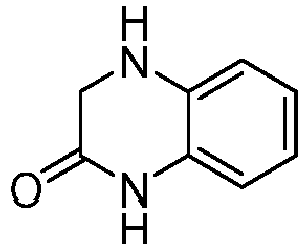
- To a solution of o-phenylenediamine (1.08 g, 10 mmol) in DMF (50 mL) was added Et3N (2.9 mL, 21 mmol), and ethyl 2-bromoacetate (1.2 mL, 11 mmol). The reaction mixture was stirred at room temperature for 16 h, then at 80°C for 3 h. The DMF was evaporated under reduced pressure and the reaction mixture partitioned between H2O and EtOAc. The EtOAc layer was washed with sat. NaHCO3, brine, and dried over Na2SO4. The solvent was evaporated under reduced pressure and the crude residue purified by flash chromatography eluting with petroleum ether/EtOAc (4/1) to give 3,4-dihydroquinoxalin-2(1H)-one (560 mg, 38%) as yellow solid. LC-MS (ES-API); rt 7.40 min; m/z calculated for C8H8N2O [M+H]+ 149.0, found 149.0.
-

- To a stirred solution of 3,4-dihydroquinoxalin-2(1H)-one (142 mg, 0.96 mmol) and triethylamine (0.16 mL, 1.14 mmol) in anhydrous THF (15 mL) at 0°C was added a solution of (E)-3-(3,4-dimethoxyphenyl)acryloyl chloride in THF (2 mL) dropwise. The reaction mixture was allowed to warm to room temperature and stirred for 2 hours. The reaction was quenched by addition of 1N hydrochloric acid, and extracted with DCM. The combined organic phases were washed with brine, dried over sodium sulfate and concentrated under reduced pressure to afford the crude product which was purified by flash chromatography (hexane-EtOAc, 25:10) to give (E)-4-(3-(3,4-dimethoxyphenyl)acryloyl)-3,4-dihydroquinoxalin-2(1H)-one (160 mg, 47%). 1H-NMR (400 MHz,CDCl3) δ 3.86 (s, 3H), 3.90 (s, 3H), 4.63 (br s, 2H), 6.71 (d, J = 15.2 Hz, 1 H), 6.85 (d, J = 8.4 Hz, 1 H), 6.94 (d, J = 2.0 Hz, 1 H), 7.02 (dd, J = 7.6, 1.2 Hz, 1 H), 7.07-7.13 (m, 2H), 7.22 (dd, J = 7.6, 1.2 Hz, 1 H), 7.28 (br d, J = 8.0 Hz, 1 H), 7.76 (d, J = 15.6 Hz, 1H), 8.89 (s, 1H); LC-MS (ES-API); rt 8.14 min; m/z calculated for C19H18N2O4 [M+H]+ 339.1, found 339.0.
-

- To a solution of 3,4-dimethoxybenzaldehyde (2.00 g, 12.0 mmol) in EtOH (100 mL) under nitrogen was added iodine (3.65 g, 14.4 mmol) and silver sulfate (4.49 g, 14.4 mmol) and the mixture was stirred for 3 hours at room temperature. The solvent was removed, water was added and the mixture was extracted with DCM. The organic extracts were washed with brine, dried over sodium sulfate and the solvent was removed under reduce pressure. The residue was purified by flash chromatography using petroleum ether/ethyl acetate 2:1 (v:v) as eluent to give 2-iodo-4,5-dimethoxybenzaldehyde (2.81g, 80%). LC-MS (ES-API); rt 8.52 min; m/z calculated for C9H9IO3 [M+H]+ 293.0, found 293.0.
-

- 2-Iodo-4,5-dimethoxybenzaldehyde (292 mg, 1.0 mmol), CoCl2(dppe) complex (26.4 mg, 0.05 mmol), dppe (19.9 mg, 0.05 mmol) and zinc power (179.8 mg, 2.75 mmol) were placed in a vial, which was sealed with a septum and flushed several times with nitrogen. Acetonitrile (3 mL) and methyl acrylate (172 mg, 2.0 mmol) were then sequentially added and the mixture was heated at 80°C overnight. Water was then added and the mixture was extracted with ethyl acetate. The organic extracts were concentrated under reduced pressure and the residue was purified by flash chromatography using petroleum ether/ethyl acetate 8:1 (v:v) as eluent to give methyl 5,6-dimethoxy-1 H-indene-2-carboxylate (50 mg, 21%). LC-MS (ES-API); rt 7.89 min; m/z calculated for C13H14O4 [M+H]+ 235.1, found 235.1.
-

- To a stirred solution of methyl 5,6-dimethoxy-1H-indene-2-carboxylate (330 mg, 1.41 mmol) in THF (8 mL) and MeOH (4 mL) was added 2 N NaOH solution (3.5 mL) dropwise at room temperature. The resulting mixture was stirred at room temperature for 2 hours and the reaction was quenched with 1N HCl solution. Then mixture was diluted with water and the resulting suspension was filtered and the solid was dried under vacuum to give 5,6-dimethoxy-1H-indene-2-carboxylic acid (150 mg, 48%). LC-MS (ES-API); rt 8.44 min; m/z calculated for C12H12O4 [M-H]- 219.1, found 219.1.
-
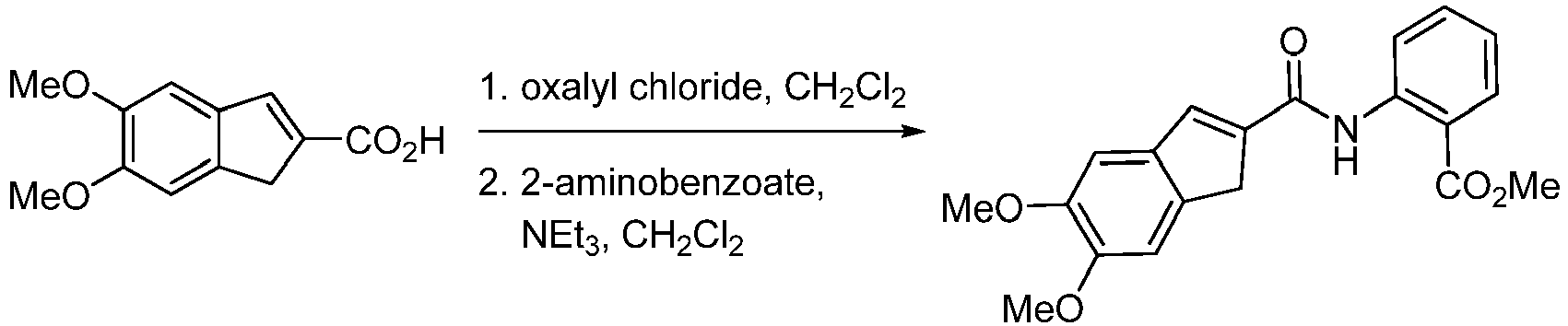
- To a stirred mixture of 5,6-dimethoxy-1H-indene-2-carboxylic acid (230 mg, 1.05 mmol) and DMF (20 µL) in DCM (10 mL) was added oxalyl chloride (267 mg, 2.10 mmol) dropwise at room temperature. The resulting mixture was stirred for 2 hours then concentrated and dried under high vacuum. The resulting acid chloride was then taken up into DCM (10 mL) and added dropwise to a stirred mixture of methyl 2-aminobenzoate (174 mg, 1.16 mmol) and triethylamine (159.1 mg, 1.58 mmol) in DCM (10 mL) 0°C. The mixture was then stirred overnight at room temperature before adding water and extracting with DCM. The organic extracts were dried over sodium sulfate and the solvent was removed under reduced pressure. The residue was purified by silica gel chromatography with petroleum ether/ethyl acetate 5:1 (v:v) as eluent to give methyl 2-(5,6-dimethoxy-1H-indene-2-carboxamido)benzoate (140 mg, 38%). LC-MS (ES-API); rt 9.35 min; m/z calculated for C20H19NO5 [M+H]+ 354.1, found 354.1.
-

- To a stirred solution of methyl 2-(5,6-dimethoxy-1H-indene-2-carboxamido)benzoate (120 mg, 0.34 mmol)in THF (6 mL) and MeOH (3 mL) was added 2 N NaOH solution (0.85 mL) dropwise. The resulting mixture was stirred at room temperature for 2 h, then quenched with 1N HCl solution and extracted with DCM. The organic extracts were washed with a saturated aqueous NaCl solution and dried over sodium sulfate. The solvent was then removed under reduced pressure to give 2-(5,6-dimethoxy-1H-indene-2-carboxamido)benzoic acid (100 mg, 87%). 1H-NMR (400 MHz, DMSO-d6) δ 3.72 (br s, 2H), 3.79 (s, 3H), 3.81 (s, 3H), 7.15 (m, 1 H), 7.24 (s, 1 H), 7.26 (s, 1 H), 7.55-7.66 (m, 2H), 8.04 (dd, J = 8.0, 1.6 Hz, 1 H), 8.70 (dd, J = 8.4, 1.2 Hz, 1 H), 11.91 (s, 1 H); LC-MS (ES-API); rt 9.23 min; m/z calculated for C19H17NO5 [M-H]- 338.1, found 338.1.
-

- To a stirred solution of 2-aminobenzoic acid (2.0 g, 14.59 mmol) in MeOH (70 mL) at 0°C was added SOCl2 (7.4 g, 145.9 mmol) dropwise. The mixture was heated at reflux overnight and was then concentrated under reduced pressure. DCM and saturated aqueous NaHCO3 were added and the aqueous phase extracted with DCM. The combined organic layers were washed with brine, dried over sodium sulfate and concentrated to afford methyl 2-aminobenzoate (2.05 g, 93%). LC-MS (ES-API); rt 8.46 min; m/z calculated for C8H9NO2 [M+H]+ 152.0, found 152.1.
-

- To a stirred solution of methyl 2-aminobenzoate (906 mg, 6.0 mmol) and NaHCO3 (554.4 mg, 6.6 mmol) in THF (12 mL) and water (12 mL) at 0°C was added 2-chloroacetyl chloride (806 mg, 7.2 mmol) dropwise. After 2 hours, the mixture was diluted with water and extracted with ethyl acetate. The organic layer was washed with brine, dried over sodium sulfate and concentrated under reduced pressure to afford the crude product. The residue was purified by flash chromatography to give methyl 2-(2-chloroacetamido)benzoate (1.31 g, 96%). LC-MS (ES-API); rt 8.65 min; m/z calculated for C10H10ClNO3 [M+Na]+ 250.0, found 250.0.
-

- A mixture of 4,5-dimethoxybenzene-1,2-diamine (1.08 g, 4.5 mmol), NaHCO3 (756 mg, 9.0 mmol) methyl 2-(2-chloroacetamido)benzoate (1.03 g, 4.5 mmol) and sulfur (216 mg, 6.75 mmol) in CH3CN (27 mL) was stirred in a microwave reactor for 2 hours at 140°C. The mixture was concentrated and purified by flash column chromatography to give the desired methyl 2-(5,6-dimethoxy-1H-benzo[d]imidazole-2-carboxamido)benzoate (190 mg, 12%). LC-MS (ES-API); rt 9.12 min; m/z calculated for C18Hl7N3O5 [M+Na]+ 378.1, found 378.1.
-

- To a stirred solution of methyl 2-(5,6-dimethoxy-1H-benzo[d]imidazole-2-carboxamido)benzoate (200 mg, 0.56 mmol) in THF (10 mL) and MeOH (5 mL) was added 2N NaOH solution (1.4 mL) dropwise. The resulting mixture was stirred at room temperature for 2 hours. The reaction was quenched by addition of 1 N HCl solution and extracted with DCM. The organic layer was washed with brine, dried over sodium sulfate and concentrated to give 2-(5,6-dimethoxy-1H-benzo[d]imidazole-2-carboxamido)benzoic acid (90 mg, 47.1%). 1H-NMR (400 MHz, DMSO-d6) δ 3.82 (s, 6H), 6.97 (s, 1 H), 7.13-7.34 (m, 2H), 7.64 (m, 1 H), 8.08 (d, J = 9.6 Hz, 1 H), 8.78 (d, J = 7.6 Hz, 1 H), 12.90 (s, 1 H), 13.27 (s, 1 H); LC-MS (ES-API); rt 8.74 min; m/z calculated for C17H15N3O5 [M-H]- 340.1, found 340.1.
-

- To a stirred solution of 2-fluoro-4,5-dimethoxybenzaldehyde (1.10 g, 6 mmol) in DMF (50 mL) was added methyl 2-mercaptoacetate (0.58 mL, 6.6 mmol) and potassium carbonate (2.48 g, 18 mmol). The resulting mixture was then heated at 60°C for 15 hours. The DMF was removed via rotary evaporation and the residue was diluted with water and extracted with DCM. The organic phase was dried over sodium sulfate and the solvent was removed under reduced pressure to afford methyl 5,6-dimethoxybenzo[b]thiophene-2-carboxylate as a light yellow solid (1.0 g, 67%). LC-MS (ES-API); rt 8.48 min; m/z calculated for C12H12O4S [M+Na]+ 275.0, found 275.0.
-

- To a stirred solution of methyl 5,6-dimethoxybenzo[b]thiophene-2-carboxylate (1.0 g, 4 mmol) in MeOH (20 mL) and THF (10 mL) was added 2N NaOH (10 mL) dropwise at room temperature. The resulting mixture was stirred at room temperature for 2 hours before adjusting the pH value to 3 with 1 N HCl and diluting with water. The resulting suspension was filtered and the solid was dried under vacuum to afford 5,6-dimethoxybenzo[b]thiophene-2-carboxylic acid as a white solid (890 mg, 94%). LC-MS (ES-API); rt 8.17 min; m/z calculated for C11H10O4S [M+Na]+ 261.0, found 260.9.
-

- To a stirred solution of 5,6-dimethoxybenzo[b]thiophene-2-carboxylic acid (714 mg, 3 mmol) and DMF (20 µl) in anhydrous DCM (20 mL) was added oxalyl chloride (0.5 mL, 6 mmol) dropwise at 0°C. The mixture was then allowed to warm to room temperature and stirring was continued until the acid was consumed completely (about 1 h). The solvent was removed under reduced pressure and the crude 5,6-dimethoxybenzo[b]thiophene-2-carbonyl chloride was used directly in the next step.To a stirred solution of methyl 2-aminobenzoate (500 mg, 3.3 mmol) and Et3N (1.25 mL, 9 mmol) in anhydrous DCM (20 mL) was added 5,6-dimethoxybenzo[b]thiophene-2-carbonyl chloride in anhydrous DCM (2 mL) dropwise at 0°C. The resulting mixture was stirred at room temperature overnight. The reaction was quenched with water and extracted with DCM. The organic extract was dried over sodium sulfate, the solvent was removed under reduced pressure and the crude product was purified by re-crystallization from EtOH to give methyl 2-(5,6-dimethoxybenzo[b]thiophene-2-carboxamido)benzoate as a white solid (650 mg, 55%). LC-MS (ES-API); rt 9.38 min; m/z calculated for C19H17NO5S [M+H]+ 372.1, found 372.1.
-

- To a stirred solution of methyl 2-(5,6-dimethoxybenzo[b]thiophene-2-carboxamido)benzoate (650 mg, 1.75 mmol) in MeOH (9 mL) and THF (20 mL) was added 2N NaOH (9 mL) dropwise at room temperature. The resulting solution was stirred at room temperature for 2 hours. The reaction was quenched with 1N HCl and diluted with water. The resulting suspension was filtered and the solid was dried under vacuum to afford 2-(5,6-dimethoxybenzo[b]thiophene-2-carboxamido)benzoic acid (550 mg, 88%). LC-MS (ES-API); rt 9.22 min; m/z calculated for C18H15NO5S [M+Na]+ 380.1, found 380.0.
-

- To a stirred solution of 2-(5,6-dimethoxybenzo[b]thiophene-2-carboxamido)benzoic acid (500 mg, 1.4 mmol) in CH3COOH (100 mL), CH3CN (50 mL) and DCM (50 mL) was added m-Chloroperoxybenzoic acid (1.2 g, 7 mmol) at room temperature. The resulting solution was stirred at room temperature for 48 hours until the starting material was consumed completely by TLC analysis. The reaction was quenched with water and extracted with DCM. The combined organic phase was washed with water, brine and dried over sodium sulfate. The solvent was removed under reduced pressure and the residue was purified by flash column using DCM/MeOH (from 30 : 1 to 10 : 1) as eluent. Further purification by re-crystallization from CH3CN provided 2-(1,1-dioxo-5,6-dimethoxybenzo[b]thiophene-2-carboxamido)benzoic acid (220 mg, 40%). 1H-NMR (400 MHz, DMSO-d6) δ 3.89 (s, 3H), 3.92 (s, 3H), 7.26 (app t, J = 7.6 Hz, 1 H), 7.48 (s, 1 H), 7.61 (s, 1 H), 7.67 (m, 1 H), 8.05 (dd, J = 8.0, 1.2 Hz, 1 H), 8.14 (s, 1 H), 8.47 (d, J = 8.4 Hz, 1 H), 11.87 (s, 1 H); LC-MS (ES-API); rt 8.91 min; m/z calculated for C18H15NO7S [M+H]+ 390.1, found 390.1.
-

- To a stirred solution of 6,7-dimethoxy-3,4-dihydronaphthalen-1(2H)-one (3.09 g, 15 mmol) in MeOH (50 mL) was added NaBH4 (680 mg, 18 mmol) portion wise over 0.5 hour. The resulting mixture was stirred at room temperature overnight. The reaction was quenched with 1 N HCl, diluted with water and extracted with DCM. The combined organic phase was washed with brine, dried over sodium sulfate and the solvent was removed under reduced pressure to afford 6,7-dimethoxy-1,2,3,4-tetrahydronaphthalen-1-ol as a yellow oil (2.9 g, 93%). LC-MS (ES-API); rt 7.96 min; m/z calculated for C12H16O3 [M+Na]+ 231.1, found 231.1.
-

- A solution of 6,7-dimethoxy-1,2,3,4-tetrahydronaphthalen-1-ol (208 mg, 1 mmol) in dry DMF (5 mL) was cooled in an ice bath and phosphoryl chloride (0.2 mL, 2.3 mmol) was added dropwise. The reaction mixture was heated at 90°C for 3 hours, then cooled and treated with a cold saturated aqueous solution of sodium acetate (2 mL) and stirred at room temperature for 10 min. Water was added and the mixture was extracted with DCM. The combined organic phase was washed with brine and dried over sodium sulfate The solvent was then removed under reduced pressure to afford 6,7-dimethoxy-3,4-dihydronaphthalene-2-carbaldehydeas white solid (160 mg, 46%). LC-MS (ES-API); rt 8.23 min; m/z calculated for C13H14O3 [M+H]+ 219.1, found 219.0.
-

- A mixture of 6,7-dimethoxy-3,4-dihydronaphthalene-2-carbaldehyde (2.2 g, 10 mmol) in EtOH (30 mL) was treated with a solution of silver nitrate (5.0 g, 30 mmol) in water (16 mL). A solution of NaOH (6.0 g, 150 mmol) in water (50 mL) was then added with continuous stirring and the resulting mixture was stirred at room temperature overnight. The reaction mixture was then extracted with DCM and combined organic phase was washed with brine and dried over sodium sulfate. The solvent was removed under reduced pressure and the residue was purified by flash column using petroleum ether/ethyl acetate (from 6:1 to 3: 1, v:v) as the eluent to give 6,7-dimethoxy-3,4-dihydronaphthalene-2-carboxylic acid (1.8 g, 77%). LC-MS (ES-API); rt 8.23 min; m/z calculated for C13H14O4 [M+H]+ 235.1, found 235.0.
-

- A mixture of 6,7-dimethoxy-3,4-dihydronaphthalene-2-carboxylic acid (476 mg, 2 mmol) and SOCl2 (1.5 mL, 20 mmol) in toluene (20 mL) was heated at 50°C for 1 hour. The solvent was then removed under reduced pressure to give 6,7-dimethoxy-3,4-dihydronaphthalene-2-carbonyl chloride which was used directly in the next step without further purification. To a stirred solution of methyl 2-aminobenzoate (332 mg, 2.2 mmol) and Et3N (0.8 mL, 6 mmol) in anhydrous DCM (20 mL) was added 6,7-dimethoxy-3,4-dihydronaphthalene-2-carbonyl chloride in anhydrous DCM (2 mL) dropwise at 0°C. The resulting mixture was stirred at room temperature overnight. The reaction was quenched with water and extracted with DCM. The combined organic phase was dried over sodium sulfate, the solvent was removed under reduced pressure and the residue was purified by flash column, eluting with petroleum ether/ethyl acetate (10: 1) to give methyl 2-(6,7-dimethoxy-1,2-dihydronaphthalene-3-carboxamido)benzoate (330 mg, 45%). LC-MS (ES-API); rt 9.27 min; m/z calculated for C21H21NO5 [M+Na]+ 390.1, found 390.1.
-

- To a stirred solution of methyl 2-(6,7-dimethoxy-3,4-dihydronaphthalene-2-carboxamido) benzoate (440 mg, 1.2 mmol) in MeOH (6 mL) and THF (3 mL) was added 2N NaOH (3 mL) dropwise at room temperature. The resulting solution was stirred at room temperature for 2 hours, then quenched with 1 N HCl and diluted with water. The resulting suspension was filtered and the solid was dried under vacuum to give 2-(6,7-dimethoxy-1,2-dihydronaphthalene-3-carboxamido)benzoic acid (350 mg, 83%). 1H-NMR (400 MHz, DMSO-d6) δ 2.59 (t, J = 8.4 Hz, 2H), 2.83 (t, J = 8.4 Hz, 2H), 3.75 (s, 3H), 3.79 (s, 3H), 6.90 (s, 1 H), 6.97 (s, 1 H), 7.15 (app t, J = 7.6 Hz, 1 H), 7.39 (s, 1 H), 7.62 (m, 1 H), 8.03 (dd, J = 8.0, 1.6 Hz, 1 H), 8.69 (d, J = 8.4 Hz, 1 H), 11.89 (s, 1 H); LC-MS (ES-API); rt 9.22 min; m/z calculated for C20H19NO5 [M+Na]+ 376.1, found 376.1.
-

-

- To a stirred solution of 2-iodo-4,5-dimethoxybenzaldehyde (1.0 g, 3.42 mmol) in CH3CN (25 mL) was added a solution of KMnO4 (0.76 g, 4.79 mmol) in water (15 mL) dropwise at 0°C. The resulting mixture was stirred at room temperature overnight. After the reaction was complete, the pH was adjusted to <7 with 1 N HCl. The mixture was extracted with DCM and the organic layers combined, washed with brine, dried over sodium sulfate, and evaporated to give 2-Iodo-4,5-dimethoxybenzoic acid (0.89 g, 85%).
-

- To a stirred solution of 2-iodo-4,5-dimethoxybenzoic acid (24.6 g, 80 mmol), ethyl 2-aminoacetate hydrochloride (11 g, 88 mmol), EDCI (17 g, 88 mmol) and HOBt (14 g, 88 mmol) in dry DCM (500 mL) was added Et3N (55 mL, 400 mmol) dropwise at rt. The resulting mixture was stirred at room temperature overnight then the reaction was quenched with water, and thoroughly extracted with DCM. The combined organic phases were washed with brine and dried over sodium sulfate. The solvent was removed under reduced pressure and the residue was purified by flash chromatography using petroleum ether/ethyl acetate 3:1 (v:v) as eluent to give ethyl 2-(2-iodo-4,5-dimethoxybenzamido)acetate (29 g, 95%).
-

- LiBH4 (63 mg, 3 mmol) was added to a stirred solution of ethyl 2-(2-iodo-4,5-dimethoxybenzamido)acetate (379 mg, 1 mmol) in THF (2 mL) at -10°C. The reaction was stirred for 5 min then methanol (0.22 mL) was added dropwise. The reaction mixture was warmed to room temperature, stirred for 30 minutes and quenched by addition of water. The THF was removed under reduced pressure and the aqueous residue was thoroughly extracted with DCM. The combined organic phases were washed with brine, dried over sodium sulphate and evaporated to give the crude product which was purified by re-crystallization from EtOAc and hexane to give N-(2-hydroxyethyl)-2-iodo-4,5-dimethoxybenzamide (280 mg, 80%) LC-MS (ES-API); rt 7.60 min; m/z calculated for C11H14lNO4 [M+H]+ 352.0, found 352.0.
-

- A solution of dry DMSO (0.453 mL, 6.4 mmol) in DCM (2 mL) was added dropwise to a solution of oxalyl chloride (0.338 mL, 4 mmol) in DCM (5 mL) at - 78°C. The reaction was stirred for 30 min at -78°C then a solution of N-(2-hydroxyethyl)-2-iodo-4,5-dimethoxybenzamide (702 mg, 2 mmol) in DCM (3 mL) was added via cannula. The mixture was stirred at -78°C for 1 hour then dry Et3N (1.7 mL, 12 mmol) was added slowly. Stirring was continued at -78°C for 1 hour by which time the formation of the aldehyde was complete (monitored by TLC). Solid Ph3P=CHCOOEt (1.0 g, 3 mmol) was then added and the reaction was allowed to warm slowly to room temperature overnight. The solvent was removed under reduced pressure and the crude product was purified by flash column using petroleum ether/ethyl acetate (from 6:1 to 3:1) as eluent to give (Z)-ethyl 4-(2-iodo-4,5-dimethoxybenzamido)but-2-enoate (280 mg, 34%). LC-MS (ES-API); rt 8.46 min; m/z calculated for C15H18INO5 [M+H]+ 420.0, found 420.0.
-
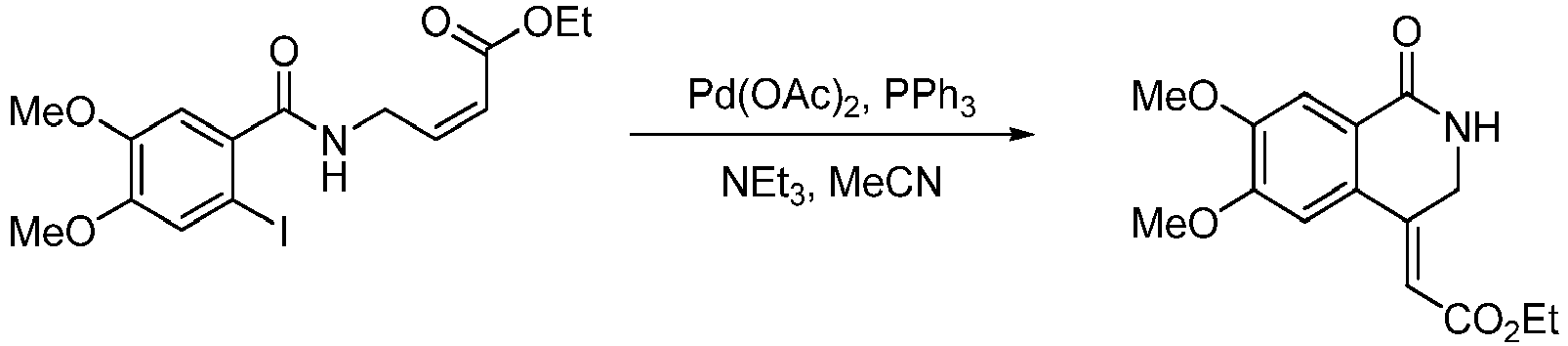
- A stirred solution of Pd(OAc)2 (16 mg, 0.07 mmol), PPh3 (61 mg, 0.23 mmol), Et3N (0.58 mL, 4.2 mmol) and (Z)-ethyl 4-(2-iodo-4,5-dimethoxybenzamido)but-2-enoate (860 mg, 2.1 mmol) in dry CH3CN (20 mL) was heated at 70°C overnight under an argon atmosphere. The reaction was allowed to cool to room temperature and then concentrated under reduced pressure. The residue was purified by flash chromatography using DCM/MeOH 100:1 (v:v) as eluent to give (Z)-ethyl 2-(6,7-dimethoxy-1-oxo-2,3-dihydroisoquinolin-4(1H)-ylidene)acetate (510 mg, 83%). LC-MS (ES-API); rt 7.56 min; m/z calculated for C15Hl7NO5 [M+H]+ 292.1, found 292.1.
-

- To a stirred solution of (Z)-ethyl 2-(6,7-dimethoxy-1-oxo-2,3-dihydroisoquinolin - 4(1H)-ylidene)acetate (1.45 g, 5 mmol) in MeOH (20 mL) and THF (40 mL) was added 2N LiOH (5 mL) dropwise at room temperature and the resulting mixture was stirred at room temperature overnight. The reaction was quenched by addition of 1 N HCl and the solvents were removed under reduced pressure. The mixture was diluted with water and cooled and the precipitate collected by filtration to afford (Z)-2-(6,7-dimethoxy-1-oxo-2,3-dihydroisoquinolin-4(1H)-ylidene)acetic acid (1.0 g, 77%). LC-MS (ES-API); rt 7.21 min; m/z calculated for C13H13NO5 [M-H]- 262.0, found 262.1.
-

- To a stirred solution of (Z)-2-(6,7-dimethoxy-1-oxo-2,3-dihydroisoquinolin-4(1H)-ylidene)acetic acid (789 mg, 3 mmol), methyl 2-aminobenzoate (544 mg, 3.6 mmol), HOBt (587 mg, 3.6 mmol), EDCI (688 mg, 3.6 mmol) and DMAP (439 mg, 3.6 mmol) in dry DMF (30 mL) was added Et3N (2 mL, 15 mmol) dropwise at room temperature. The resulting mixture was stirred at room temperature overnight then the reaction was quenched with water and extracted with DCM. The combined organic phases were washed with brine, dried over sodium sulfate and evaporated to give the crude product which was purified by flash chromatography using DCM/MeOH 40:1 (v:v) as eluent to give (Z)-methyl 2-(2-(6,7-dimethoxy-1-oxo-2,3-dihydroisoquinolin-4(1H)-ylidene)acetamido)benzoate (280 mg, 80%) LC-MS (ES-API); rt 8.39 min; m/z calculated for C21H20N2O6 [M+Na]+ 419.1, found 419.1.
-

- To a stirred solution of (Z)-methyl 2-(2-(6,7-dimethoxy-1-oxo-2,3-dihydroisoquinolin -4(1H)-ylidene)acetamido)benzoate (140 mg, 0.35 mmol) in MeOH (4 mL) and THF (8 mL) was added 2N LiOH (0.7 mL) dropwise at room temperature. The resulting mixture was stirred at room temperature overnight then the reaction was quenched by addition of 1 N HCl and the solvent was removed under reduced pressure. The mixture was diluted with water, cooled and the precipitate collected by filtration to afford (Z)-2-(2-(6,7-dimethoxy-1-oxo-2,3-dihydroisoquinolin-4(1H)-ylidene)acetamido)benzoic acid (125 mg, 93%). 1H-NMR (400 MHz, DMSO-d6) δ 3.80, (s, 3H), 3.84 (s, 2H), 3.85 (s, 3H), 7.00 (s, 1 H), 7.10 (m, 1 H), 7.22 (d, J = 6.0 Hz, 1 H), 7.56 (m, 1 H), 7.61 (s, 1 H), 7.90 (dd, J = 8.0, 1.6 Hz, 1 H), 8.57 (dd, J = 8.4, 0.8 Hz, 1 H), 11.38 (d, J = 5.6 Hz, 1H), 13.54 (br s, 1H); LC-MS (ES-API); rt 8.27 min; m/z calculated for C20H18N2O6 [M+H]+ 383.1, found 383.1.
-

- To a stirred solution of 2-amino-3-hydroxybenzoic acid (1.22 g, 8.0 mmol) in MeOH (80 mL) was added SOCl2 (9.52g, 80.0 mmol) dropwise at 0°C. The mixture was then heated at reflux overnight. Most of the methanol was removed and the residue was partitioned between DCM and saturated aqueous NaHCO3. The organic phase was washed with brine, dried over sodium sulfate and the solvent was removed under reduced pressure to give methyl 2-amino-3-hydroxybenzoate (1.27 g, 95%). LC-MS (ES-API); rt 8.09 min; m/z calculated for C8H9NO3[M+H]+ 168.1, found 168.1.
-

- A solution of methyl 2-amino-3-hydroxybenzoate (167 mg, 1.0 mmol), acetyl chloride (86 mg, 1.1 mmol) and triethylamine (101 mg, 1.1 mmol) in xylene (10 mL) was stirred at 0°C for 2 h. Pyridine (20 mg, 0.25 mmol) and TsOH (43 mg, 0.25 mmol) were then added and the mixture was heated at reflux overnight. The mixture was then cooled to room temperature, diluted with water and extracted with ethyl acetate. The combined organic extracts were washed with water, brine, then dried over sodium sulfate and the solvent was removed under reduced pressure. The residue was purified by flash chromatography using petroleum ether/ethyl acetate 5:1 (v:v) as eluent to give methyl 2-methylbenzo[d]oxazole-4-carboxylate (151 mg, 79%). LC-MS (ES-API); rt 8.08 min; m/z calculated for C10H9NO3 [M+H]+ 192.1, found 192.1.
-

- A solution of methyl 2-methylbenzo[d]oxazole-4-carboxylate (0.63 g, 4.12 mmol) and 3,4-dimethoxybenzaldehyde (0.68 g, 4.12 mmol) in THF (25 mL) and t-BuOH (5 mL) was cooled to -50°C under nitrogen and treated with a solution of t-BuOK in THF (1.0 mol/L, 4.94 mL, 4.94 mmol) at such a rate that the internal reaction temperature did not exceed -46°C. After 2 hours at -50°C, the cooling bath was removed and the mixture was stirred at room temperature for 12 h in the dark. Water was added and the mixture was made slightly acidic by addition of a 1N HCl solution then extracted with DCM. The organic layers were combined, washed with water and brine then dried over sodium sulfate and the solvent was removed under reduced pressure. The residue was purified by flash chromatography using petroleum ether: ethyl acetate 2:1 (v:v) as eluent to give (E)-methyl 2-(3,4-dimethoxystyryl)benzo[d]oxazole-4-carboxylate (0.30g, 27%). LC-MS (ES-API); rt 9.25 min; m/z calculated for C19H17NO5 [M+H]+ 340.1, found 340.1.
-

- To a stirred solution of (E)-methyl 2-(3,4-dimethoxystyryl)benzo[d]oxazole-4-carboxylate (240mg, 0.71 mmol) in THF (10mL) and MeOH (5mL) was added 2 N NaOH solution (1.77mL) dropwise at room temperature. The resulting mixture was stirred at room temperature for two hours then quenched with a 1 N HCl solution. The mixture was then extracted with DCM and the organic phase was washed with saturated aqueous NaCl solution and dried over sodium sulfate. The solvent was then removed under reduced pressure to give (E)-2-(3,4-Dimethoxystyryl)benzo[d]oxazole-4-carboxylic acid (170 mg, 74%). 1H-NMR (400MHz, DMSO-d6) δ 3.81 (s, 3H), 3.85 (s, 3H), 7.03 (d, J = 8.0 Hz, 1 H), 7.33-7.39 (m, 2H), 7.46 (app t, J = 8.0Hz, 1 H), 7.50 (d, J = 2.0Hz, 1 H), 7.80 (d, J = 16.0Hz, 1 H), 7.87 (dd, J = 8.0, 1.2Hz, 1 H), 7.93 (dd, J = 8.0, 1.2Hz, 1 H); LC-MS (ES-API): rt 8.88 min; m/z calculated for C18H15NO5 [M-H]- 324.1, found 324.1.
- A well-characterised cloned rat mesangial cell line (Kakizaki Y, Kraft N, Atkins RC: Differential control of mesangial cell proliferation by interferon-gamma. Clin Exp Immunol 85:157-163, 1991) was cultured in DMEM (5mM glucose) with 5% FBS, 100U/mL penicillin, and 100ug/mL streptomycin in humidified 5% CO2 atmosphere at 37C. Cells were used up to
passage 40. - Cells were plated into 24-well culture dishes in DMEM/5%FBS and allowed to adhere overnight. The subconfluent cells were then starved overnight in DMEM/0.1%FBS and 150uM L-ascorbic acid, prior to pre-treatment with or without FibroTech compounds for 4 hours at 10, 30 or 100uM in 0.1% DMSO, final concentration. TGF-beta 1 at 5ng/mL (Peprotech) and tritiated proline (Perkin-Elmer, (2,3,4,5-3H)-proline) at 1 uCi/mLwere added and the incubation continued for a further 44 hours. Treatments were performed in triplicate.
- After the incubation, cells were placed on ice and washed three times with ice cold PBS. They were then incubated on ice with 10% TCA for 30 minutes, followed by a final wash in cold 10% TCA. The cells were solubilized in 0.75mL of 1M NaOH at 37C for 45 minutes, or overnight at 4C. Aliquots of the solubilized cells were neutralized in an equal amount of 1 M HCl and counted in scintillant in a beta counter. Aliquots of neutralized solubilized cells were assayed for protein using the BioRad Bradford Protein Assay. Proline incorporation was normalized for protein content (cpm 3H-proline incorporated per ug protein).
- In order to compare the results of experiments performed on different days, the percentage inhibition of proline incorporation was calculated for each treatment by setting the TGF treatment at 0% inhibition and the control (incubation with media alone) at 100% inhibition.
-
Percentage reduction of TGF-beta 1 stimulated proline incorporation: FT 10 µM 30 µM 100 µM Tax. rank
(4 = non-toxic)98 30% 70% 70% 4 102 0 0 10%, ppt 4 106 0 0, sick dead 1@100uM 2@30uM 107 0 0 0, ppt 4 (yellow floating patches @ 30 & 100uM) 108 75% 95% 100+% 4 (yellow jellylike patches @ 30 & 100uM) 109 3% 16% 75%, ppt 4 110 0 0 0, ppt 3@100uM (cells elongated) 113 20% 67% 44% 4 121 ~60% 100+% dead 1@100uM 3@30uM 122 ~25% ~80% dead 1@100uM 4@30uM 123 0 0, ppt, sick 0, ppt, dead 1 to 2 124 0, ppt 0, ppt, sick 0, ppt, sick 2 125 0 0, sick 0, sick 2 126 ~55% ~75% ~100% 4 127 0 0 ~50% 4 128 ~20% ~20% ~40% 3@100uM (some death) 129 ~10% ~75% dead 1@100uM 2@30uM 130 ~10% ~30% ~50% 2@100uM 131 ~20% ~10% ~10% 4 132 ~2% ~75%, ppt ~75%, ppt 3@100uM (some death) ppt indicates compound precipitated during assay. - The details of specific embodiments described in this invention are not to be construed as limitations. Various equivalents and modifications may be made without departing from the scope of this invention, and it is understood that such equivalent embodiments are part of this invention.
Claims (6)
- A compound of Formula (IV)
 - Z-X-Y is selected from the group consisting of: -N=C-NH-, -NH-C=N-, -O-C=N-, - S-C=N-, -N=C-O-, -N=C-S-, -CH=C-NH-, -CH=C-O-, -CH=C-S-, and -C(O)-C=N-;- A is selected from the group consisting of: a bond, SO2, CH2, C=S, C=O, C=NR9, and NR9;- T is selected from the group consisting of: a double bond and
 - Z1, Z2, Z3, and Z4 are each independently selected from the group consisting of CR8 and N;- R1 is selected from the group consisting of: H and C1-C6 alkoxy;- R2 is selected from the group consisting of: C1-C12 alkyloxy optionally substituted with one or more halogens, and C2-C12 alkynyloxy;- R3 is selected from the group consisting of F2HCF2CO, F2HCO, F3CO, and CHCCH2O;- R4 is selected from the group consisting of: H and C1-C6 alkoxy;- R5 is H;- R6 is selected from the group consisting of: H and C1-C6alkyl;- R7 is selected from the group consisting of: H, CN, NO2, and C1-C6alkyl;- R8 is selected from the group consisting of: H, halogen, COOH, CONH2, CONHOH, CONHCH3, NH2, SO2CH3, SO2NH2, SONHCH3, and SON(CH3)2;- R10 and R11 are each independently selected from the group consisting of: H, halogen, OH, NO2, CN, NH2, C1-C12 alkyl, C2-C12alkenyl, C2-C12alkynyl, C1-C10 heteroalkyl, C3-C12 cycloalkyl, C3-C12 cycloalkenyl, C2-C12 heterocycloalkyl, C2-C12 heterocycloalkenyl, C6-C18 aryl, C1-C18 heteroaryl, C1-C12 alkyloxy, C2-C12 alkenyloxy, C2-C12 alkynyloxy, C1-C10 heteroalkyloxy, C3-Cl2 cycloalkyloxy, C3-C12 cycloalkenyloxy, C1-C12 heterocycloalkyloxy, C1-C12 heterocycloalkenyloxy, C6-C18 aryloxy, C1-C18 heteroaryloxy, C1-C12 alkylamino, SR12, SO3H, SO2NR13R14, SO2R12, SONR13R14, SOR12, COR12, COOH, COOR12, CONR13R14, NR13COR12, NR13COOR12, NR13SO2R12, NR13CONR14R15, NR14R15, and acyl;- R9, R13, R14, and R15 are each independently selected from the group consisting of: H, an N-protecting group, C1-C12 alkyl, C2-C12 alkenyl, C2-C12 alkynyl, C1-C10 heteroalkyl, C3-C12 cycloalkyl, C3-C12 cycloalkenyl, C1-C12 heterocycloalkyl, C1-C12 heterocycloalkenyl, C6-C18 aryl, and C1-C18 heteroaryl; and- R12 is selected from the group consisting of H, C1-C12 alkyl, C2-C12 alkenyl, C2-C12 alkynyl, C1-C10 heteroalkyl, C3-C12 cycloalkyl, C3-C12cycloalkenyl, C1-C12 heterocycloalkyl, C1-C12 heterocycloalkenyl, C6-C18 aryl, and C1-C18 heteroaryl.
 - A compound selected from the group consisting of:


- A pharmaceutical composition including a compound as claimed in claim 1 or claim 2, and a pharmaceutically acceptable diluent, excipient or carrier.
- A compound as claimed in claim 1 or claim 2 for use in treating a disease or condition associated with fibrosis or characterised by inflammation and/or a benign or malignant neoplastic disease.
- A compound for use as claimed in claim 4, wherein the disease or condition is selected from the group consisting of fibrotic skin disorders, lung disease, heart disease and kidney disease.
- A compound as claimed in claim 1 or claim 2 for use in inhibiting fibrosis in a subject.
Priority Applications (1)
| Application Number | Priority Date | Filing Date | Title |
|---|---|---|---|
| EP15169791.9A EP2947073B1 (en) | 2009-10-22 | 2010-10-21 | Fused ring analogues of anti-fibrotic agents |
Applications Claiming Priority (2)
| Application Number | Priority Date | Filing Date | Title |
|---|---|---|---|
| US25388909P | 2009-10-22 | 2009-10-22 | |
| PCT/AU2010/001398 WO2011047432A1 (en) | 2009-10-22 | 2010-10-21 | Fused ring analogues of anti-fibrotic agents |
Related Child Applications (2)
| Application Number | Title | Priority Date | Filing Date |
|---|---|---|---|
| EP15169791.9A Division EP2947073B1 (en) | 2009-10-22 | 2010-10-21 | Fused ring analogues of anti-fibrotic agents |
| EP15169791.9A Division-Into EP2947073B1 (en) | 2009-10-22 | 2010-10-21 | Fused ring analogues of anti-fibrotic agents |
Publications (3)
| Publication Number | Publication Date |
|---|---|
| EP2491030A1 EP2491030A1 (en) | 2012-08-29 |
| EP2491030A4 EP2491030A4 (en) | 2013-04-17 |
| EP2491030B1 true EP2491030B1 (en) | 2015-07-15 |
Family
ID=43899730
Family Applications (2)
| Application Number | Title | Priority Date | Filing Date |
|---|---|---|---|
| EP15169791.9A Not-in-force EP2947073B1 (en) | 2009-10-22 | 2010-10-21 | Fused ring analogues of anti-fibrotic agents |
| EP10824314.8A Not-in-force EP2491030B1 (en) | 2009-10-22 | 2010-10-21 | Fused ring analogues of anti-fibrotic agents |
Family Applications Before (1)
| Application Number | Title | Priority Date | Filing Date |
|---|---|---|---|
| EP15169791.9A Not-in-force EP2947073B1 (en) | 2009-10-22 | 2010-10-21 | Fused ring analogues of anti-fibrotic agents |
Country Status (7)
| Country | Link |
|---|---|
| US (2) | US9062076B2 (en) |
| EP (2) | EP2947073B1 (en) |
| JP (3) | JP5904944B2 (en) |
| CN (2) | CN105153188B (en) |
| IN (1) | IN2012DN03312A (en) |
| SG (1) | SG10201501272SA (en) |
| WO (1) | WO2011047432A1 (en) |
Families Citing this family (68)
| Publication number | Priority date | Publication date | Assignee | Title |
|---|---|---|---|---|
| DE10164139A1 (en) | 2001-12-27 | 2003-07-10 | Bayer Ag | 2-heteroaryl carboxamides |
| MX352516B (en) | 2006-07-05 | 2017-04-06 | Fibrotech Therapeutics Pty Ltd | Therapeutic compounds. |
| ES2740424T3 (en) | 2009-03-13 | 2020-02-05 | Agios Pharmaceuticals Inc | Methods and compositions for disorders related to cell proliferation |
| CA2758071C (en) | 2009-04-06 | 2018-01-09 | Agios Pharmaceuticals, Inc. | Pyruvate kinase m2 modulators, therapeutic compositions and related methods of use |
| SG10201403696UA (en) | 2009-06-29 | 2014-10-30 | Agios Pharmaceuticals Inc | Therapeutic compounds and compositions |
| EP3064595B1 (en) | 2009-10-21 | 2019-02-27 | Agios Pharmaceuticals, Inc. | Methods for cell-proliferation-related disorders |
| EP2947073B1 (en) | 2009-10-22 | 2019-04-03 | Fibrotech Therapeutics Pty Ltd | Fused ring analogues of anti-fibrotic agents |
| MX357676B (en) | 2010-05-17 | 2018-07-18 | Forum Pharmaceuticals Inc | A crystalline form of (r)-7-chloro-n-(quinuclidin-3-yl)benzo[b]th iophene-2-carboxamide hydrochloride monohydrate. |
| WO2012068612A1 (en) | 2010-11-24 | 2012-05-31 | Fibrotech Therapeutics Pty Ltd | Methods of treating eye diseases associated with inflammation and vascular proliferation |
| CA2821975A1 (en) | 2010-12-17 | 2012-06-21 | Shunqi Yan | N-(4-(azetidine-1-carbonyl)phenyl)-(hetero-) arylsulfonamide derivatives as pyruvate kinase m2 pkm2 modulators |
| WO2012088314A1 (en) | 2010-12-21 | 2012-06-28 | Agios Pharmaceuticals, Inc. | Bicyclic pkm2 activators |
| TWI549947B (en) | 2010-12-29 | 2016-09-21 | 阿吉歐斯製藥公司 | Therapeutic compounds and compositions |
| AU2012250690B2 (en) | 2011-05-03 | 2017-06-08 | Agios Pharmaceuticals, Inc | Pyruvate kinase activators for use in therapy |
| JP6272754B2 (en) | 2011-05-03 | 2018-01-31 | アジオス ファーマシューティカルズ, インコーポレイテッド | Method of using pyruvate kinase activator |
| CN102827073A (en) | 2011-06-17 | 2012-12-19 | 安吉奥斯医药品有限公司 | Therapeutically active compositions and application methods thereof |
| CN102827170A (en) | 2011-06-17 | 2012-12-19 | 安吉奥斯医药品有限公司 | Active treatment compositions and use method thereof |
| US9474779B2 (en) | 2012-01-19 | 2016-10-25 | Agios Pharmaceuticals, Inc. | Therapeutically active compositions and their methods of use |
| US8940742B2 (en) | 2012-04-10 | 2015-01-27 | Infinity Pharmaceuticals, Inc. | Heterocyclic compounds and uses thereof |
| SI3459942T1 (en) | 2012-04-24 | 2021-05-31 | Vertex Pharmaceuticals Incorporated | Dna-pk inhibitors |
| EP3666272A1 (en) | 2012-05-08 | 2020-06-17 | Forum Pharmaceuticals Inc. | Use of encenicline in the treatment of cognitive impairment, alzheimer's disease, memory deficit |
| BR112014032581A8 (en) * | 2012-06-27 | 2018-08-14 | 4Sc Discovery Gmbh | Bifluorodioxalan-amino-benzimidazole kinase inhibitors for the treatment of cancer, CNS disorders and autoimmune inflammation |
| FR2994184B1 (en) | 2012-08-02 | 2017-12-08 | Biomerieux Sa | METHODS OF FUNCTIONALIZATION AND REAGENTS USED IN SUCH METHODS USING AN AZA-ISATOIC ANHYDRIDE OR ONE OF ITS DERIVATIVES, BIOLOGIC MOLECULES SO TREATED AND KITS |
| HUE041544T2 (en) | 2013-03-12 | 2019-05-28 | Vertex Pharma | Dna-pk inhibitors |
| WO2015003355A2 (en) | 2013-07-11 | 2015-01-15 | Agios Pharmaceuticals, Inc. | Therapeutically active compounds and their methods of use |
| US10376510B2 (en) | 2013-07-11 | 2019-08-13 | Agios Pharmaceuticals, Inc. | 2,4- or 4,6-diaminopyrimidine compounds as IDH2 mutants inhibitors for the treatment of cancer |
| WO2015003360A2 (en) | 2013-07-11 | 2015-01-15 | Agios Pharmaceuticals, Inc. | Therapeutically active compounds and their methods of use |
| WO2015010297A1 (en) | 2013-07-25 | 2015-01-29 | Agios Pharmaceuticals, Inc. | Therapeutically active compounds and their methods of use |
| AR097279A1 (en) * | 2013-08-09 | 2016-03-02 | Actelion Pharmaceuticals Ltd | DERIVATIVES OF BENZIMIDAZOLIL-METIL UREA AS ALX RECEIVER AGONISTS |
| US9714240B2 (en) | 2013-09-17 | 2017-07-25 | Pharmakea, Inc. | Vinyl autotaxin inhibitor compounds |
| US9951026B2 (en) | 2013-09-17 | 2018-04-24 | Pharmakea, Inc. | Heterocyclic vinyl autotaxin inhibitor compounds |
| US9751888B2 (en) | 2013-10-04 | 2017-09-05 | Infinity Pharmaceuticals, Inc. | Heterocyclic compounds and uses thereof |
| PE20160685A1 (en) | 2013-10-04 | 2016-07-23 | Infinity Pharmaceuticals Inc | HETEROCYCLIC COMPOUNDS AND USES OF THEM |
| PT3424920T (en) | 2013-10-17 | 2020-07-07 | Vertex Pharma | Co-crystals of (s)-n-methyl-8-(1-((2'-methyl-[4,5'-bipyrimidin]-6-yl)amino)propan-2-yl)quinoline-4-carboxamide and deuterated derivatives thereof as dna-pk inhibitors |
| US9968595B2 (en) | 2014-03-14 | 2018-05-15 | Agios Pharmaceuticals, Inc. | Pharmaceutical compositions of therapeutically active compounds |
| SG10201808053XA (en) | 2014-03-19 | 2018-10-30 | Infinity Pharmaceuticals Inc | Heterocyclic compounds for use in the treatment of pi3k-gamma mediated disorders |
| JP6728061B2 (en) | 2014-05-05 | 2020-07-22 | リセラ・コーポレイションLycera Corporation | Tetrahydroquinoline sulfonamide and related compounds for use as RORγ agonists and treatment of diseases |
| US9708348B2 (en) | 2014-10-03 | 2017-07-18 | Infinity Pharmaceuticals, Inc. | Trisubstituted bicyclic heterocyclic compounds with kinase activities and uses thereof |
| CN104761506B (en) * | 2015-04-10 | 2017-05-03 | 温州大学 | 2-(1-styryl)quinazolone compounds and synthesis method thereof |
| RS64777B1 (en) | 2015-06-11 | 2023-11-30 | Agios Pharmaceuticals Inc | Methods of using pyruvate kinase activators |
| US10160761B2 (en) | 2015-09-14 | 2018-12-25 | Infinity Pharmaceuticals, Inc. | Solid forms of isoquinolinones, and process of making, composition comprising, and methods of using the same |
| DK3362066T3 (en) | 2015-10-15 | 2021-11-22 | Les Laboratoires Servier Sas | COMBINATION THERAPY FOR THE TREATMENT OF MALIGNITIES |
| UA123401C2 (en) | 2015-10-15 | 2021-03-31 | Аджиос Фармасьютікалз, Інк. | Combination therapy for treating malignancies |
| CN105175416B (en) * | 2015-10-20 | 2017-12-22 | 中国药科大学 | A kind of new histon deacetylase (HDAC) inhibitor |
| WO2017161116A1 (en) | 2016-03-17 | 2017-09-21 | Infinity Pharmaceuticals, Inc. | Isotopologues of isoquinolinone and quinazolinone compounds and uses thereof as pi3k kinase inhibitors |
| US10919914B2 (en) | 2016-06-08 | 2021-02-16 | Infinity Pharmaceuticals, Inc. | Heterocyclic compounds and uses thereof |
| JP2019529475A (en) | 2016-09-27 | 2019-10-17 | バーテックス ファーマシューティカルズ インコーポレイテッドVertex Pharmaceuticals Incorporated | Method for treating cancer using a combination of a DNA damaging agent and a DNA-PK inhibitor |
| SG11201907139UA (en) | 2017-02-03 | 2019-09-27 | Certa Therapeutics Pty Ltd | Anti-fibrotic compounds |
| GB201721961D0 (en) * | 2017-12-27 | 2018-02-07 | Bp Oil Int | Methods for preparing fuel additives |
| SG11202007143UA (en) | 2018-01-31 | 2020-08-28 | Heparegenix Gmbh | Protein kinase mkk4 inhibitors for promoting liver regeneration or reducing or preventing hepatocyte death |
| CN110483432A (en) * | 2018-05-14 | 2019-11-22 | 中国科学院上海药物研究所 | A class of acrylic compound and its preparation method, pharmaceutical composition and application |
| US10980788B2 (en) | 2018-06-08 | 2021-04-20 | Agios Pharmaceuticals, Inc. | Therapy for treating malignancies |
| WO2019243315A1 (en) | 2018-06-21 | 2019-12-26 | Heparegenix Gmbh | Tricyclic protein kinase inhibitors for promoting liver regeneration or reducing or preventing hepatocyte death |
| IL279641B2 (en) | 2018-07-16 | 2024-04-01 | Heparegenix Gmbh | Protein kinase inhibitors for promoting liver regeneration or reducing or preventing hepatocytic death |
| ES2974634T3 (en) | 2018-12-21 | 2024-06-28 | Celgene Corp | Thienopyridine inhibitors of RIPK2 |
| CN109705140A (en) * | 2019-01-08 | 2019-05-03 | 荆楚理工学院 | A kind of synthetic method of pyrido[2,3-d][1,3]oxazine derivative |
| JP7639008B2 (en) | 2020-01-15 | 2025-03-04 | ヘパリジェニックス ゲーエムベーハー | Protein kinase inhibitors for promoting liver regeneration or inhibiting or preventing liver cell death - Patents.com |
| US11691971B2 (en) | 2020-06-19 | 2023-07-04 | Incyte Corporation | Naphthyridinone compounds as JAK2 V617F inhibitors |
| WO2021257863A1 (en) | 2020-06-19 | 2021-12-23 | Incyte Corporation | Pyrrolotriazine compounds as jak2 v617f inhibitors |
| WO2022006456A1 (en) | 2020-07-02 | 2022-01-06 | Incyte Corporation | Tricyclic pyridone compounds as jak2 v617f inhibitors |
| BR112023000047A2 (en) | 2020-07-02 | 2023-03-14 | Incyte Corp | TRICYCLIC UREA COMPOUNDS AS JAK2 V617F INHIBITORS |
| US11661422B2 (en) | 2020-08-27 | 2023-05-30 | Incyte Corporation | Tricyclic urea compounds as JAK2 V617F inhibitors |
| WO2022140231A1 (en) | 2020-12-21 | 2022-06-30 | Incyte Corporation | Deazaguaine compounds as jak2 v617f inhibitors |
| CN114831977B (en) * | 2021-02-02 | 2023-12-19 | 北京大学 | Application of benzoic acid derivative as TRPM2 protein inhibitor |
| CN114853684A (en) * | 2021-02-03 | 2022-08-05 | 北京万全德众医药生物技术有限公司 | Purification method of Lomepilon intermediate |
| AR125273A1 (en) | 2021-02-25 | 2023-07-05 | Incyte Corp | SPIROCYCLIC LACTAMS AS JAK2 INHIBITORS V617F |
| KR20240163688A (en) | 2022-03-17 | 2024-11-19 | 인사이트 코포레이션 | Tricyclic urea compounds as JAK2 V617F inhibitors |
| WO2024131942A1 (en) * | 2022-12-23 | 2024-06-27 | 上海深势唯思科技有限责任公司 | Cyclopropane tlr7 and tlr8 inhibitor, preparation method therefor, and use thereof |
| CN118878452B (en) * | 2024-07-08 | 2025-01-24 | 徐州市第一人民医院 | An isoindolinone-derived unsaturated imine compound, its synthesis method and application in antitumor activity |
Family Cites Families (135)
| Publication number | Priority date | Publication date | Assignee | Title |
|---|---|---|---|---|
| JPS5640710B2 (en) | 1973-01-18 | 1981-09-22 | ||
| JPS5830302B2 (en) | 1974-04-16 | 1983-06-28 | キツセイヤクヒンコウギヨウ カブシキガイシヤ | Shinki Hōkōzoku Carbon Sanamide Yudōtai no Seizō Hōhō |
| GB1484413A (en) | 1974-04-18 | 1977-09-01 | Kissei Pharmaceutical | Aromatic amidocarboxylic acid derivatives |
| JPS511440A (en) | 1974-04-18 | 1976-01-08 | Kissei Pharmaceutical | SHINKIHOKOZOKUKARUBONSANJUDOTAI NO SEIZOHOHO |
| JPS5848545B2 (en) | 1974-04-18 | 1983-10-28 | キツセイヤクヒンコウギヨウ カブシキガイシヤ | Shinki Hōkōzoku Carbon Sanamide Yudōtai no Seizō Hōhō |
| JPS5855138B2 (en) * | 1975-12-31 | 1983-12-08 | キツセイヤクヒンコウギヨウ カブシキガイシヤ | Houkozoku carbon sanamide |
| JPS6019738B2 (en) | 1978-03-20 | 1985-05-17 | 久光製薬株式会社 | Novel anthranilic acid derivative |
| JPS5576852A (en) | 1978-12-01 | 1980-06-10 | Hisamitsu Pharmaceut Co Inc | Novel derivative of anthranilic acid |
| JPS5817186B2 (en) | 1981-01-23 | 1983-04-05 | キツセイ薬品工業株式会社 | Method for producing novel aromatic carboxylic acid derivatives |
| US4587356A (en) | 1981-09-01 | 1986-05-06 | Kissei Pharmaceutical Co., Ltd. | Process for the production of nuclear substituted cinnamoylanthranilic acid derivatives |
| JPS6019754A (en) | 1983-07-14 | 1985-01-31 | Kissei Pharmaceut Co Ltd | Production of aromatic carboxylic acid amide derivative |
| JPS60152454A (en) | 1984-01-18 | 1985-08-10 | Terumo Corp | Amide derivative and 5-lipoxigenase inhibitor containing said derivative as active component |
| JPS6191163A (en) * | 1984-10-08 | 1986-05-09 | Fujimoto Seiyaku Kk | Preparation of anthranylic acid derivative |
| DE3505609A1 (en) | 1985-02-19 | 1986-08-21 | Merck Patent Gmbh, 6100 Darmstadt | BENZIMIDAZOLYL PYRIDAZINONE |
| JPS625966A (en) | 1985-07-03 | 1987-01-12 | Nippon Shinyaku Co Ltd | Benzimidazole derivative |
| JPH0692353B2 (en) | 1987-05-26 | 1994-11-16 | マルコ製薬株式会社 | Novel aminobenzoic acid amide derivative and method for producing the same |
| JPS6416755A (en) | 1987-06-23 | 1989-01-20 | Biogal Gyogyszergyar | Manufacture of n-(3',4'-dimethoxycinnamoyl)-aniline derivative |
| JPH01287066A (en) | 1988-05-13 | 1989-11-17 | Fujimoto Seiyaku Kk | Novel anthranilic acid derivative |
| JPH07116029B2 (en) | 1989-04-04 | 1995-12-13 | キッセイ薬品工業株式会社 | Tranilast aqueous solution formulation |
| EP0468054B1 (en) | 1990-02-08 | 1997-05-28 | Eisai Co., Ltd. | Benzenesulfonamide derivative |
| US5248825A (en) | 1990-09-20 | 1993-09-28 | Merrell Dow Pharmaceuticals Inc. | Calcium uptake inhibitors |
| DE4115184A1 (en) | 1991-05-09 | 1992-11-12 | Bayer Ag | BENZOTHIOPHEN-2-CARBOXAMID-S, S-DIOXIDE |
| US5622977A (en) | 1992-12-23 | 1997-04-22 | Celltech Therapeutics Limited | Tri-substituted (aryl or heteroaryl) derivatives and pharmaceutical compositions containing the same |
| ATE167181T1 (en) | 1993-12-09 | 1998-06-15 | Ono Pharmaceutical Co | NAPHTHYLACETIC ACID DERIVATIVES AS PGEZ AGONISTS AND ANTAGONISTS |
| US5665737B1 (en) * | 1994-10-12 | 1999-02-16 | Euro Celtique Sa | Substituted benzoxazoles |
| WO1996011917A1 (en) | 1994-10-12 | 1996-04-25 | Euro-Celtique, S.A. | Novel benzoxazoles |
| JPH08113567A (en) * | 1994-10-17 | 1996-05-07 | Sando Yakuhin Kk | Phenylethenyl derivative and 5-lipoxygenase inhibitor containing the same |
| US6444694B1 (en) * | 1995-06-06 | 2002-09-03 | Wyeth | Styryl benzimidazole derivatives |
| JPH08337523A (en) | 1995-06-14 | 1996-12-24 | Taiho Yakuhin Kogyo Kk | Angiogenesis inhibitors |
| US5783577A (en) * | 1995-09-15 | 1998-07-21 | Trega Biosciences, Inc. | Synthesis of quinazolinone libraries and derivatives thereof |
| ATE222759T1 (en) | 1996-02-07 | 2002-09-15 | Lead Chem Co Ltd | EXTERNUM CONTAINING TRANILAST AND METHOD FOR PRODUCING THE SAME |
| WO1997029744A1 (en) | 1996-02-15 | 1997-08-21 | Kissei Pharmaceutical Co., Ltd. | Neovascularization inhibitor |
| JPH09278653A (en) | 1996-04-05 | 1997-10-28 | Santen Pharmaceut Co Ltd | Retinal disease therapeutic agent |
| DE19624155A1 (en) | 1996-06-18 | 1998-01-08 | Hoechst Ag | Substituted benzoic acid derivatives, process for their preparation and the use of the compounds for the treatment of diseases |
| GB9625913D0 (en) * | 1996-12-13 | 1997-01-29 | Cancer Soc Auckland Div Nz Inc | Novel cyclopropylindoles and their seco precursors,and their use as prodrugs |
| JPH10259129A (en) | 1997-01-16 | 1998-09-29 | Kissei Pharmaceut Co Ltd | Arterialization inhibitor |
| FR2759368B1 (en) | 1997-02-10 | 2001-06-01 | Galderma Rech Dermatologique | BIAROMATIC COMPOUNDS, COMPOSITIONS CONTAINING THEM, AND USES |
| JPH10306024A (en) | 1997-03-07 | 1998-11-17 | Kissei Pharmaceut Co Ltd | Preventive and therapeutic agent against glomerular disease |
| TW591030B (en) * | 1997-03-10 | 2004-06-11 | Janssen Pharmaceutica Nv | Farnesyl transferase inhibiting 1,8-annelated quinolinone derivatives substituted with N- or C-linked imidazoles |
| JPH10330254A (en) | 1997-04-01 | 1998-12-15 | Kissei Pharmaceut Co Ltd | Suppressant for progress of pterygium and postoperative relapse |
| US6127392A (en) | 1997-08-05 | 2000-10-03 | American Home Products Corporation | Anthranilic acid analogs |
| JPH11180952A (en) * | 1997-12-19 | 1999-07-06 | Maruho Co Ltd | 2-oxindole derivative |
| JP3256513B2 (en) * | 1998-02-11 | 2002-02-12 | ファイザー製薬株式会社 | Benzimidazole cyclooxygenase-2 inhibitor |
| WO2000006549A1 (en) * | 1998-07-28 | 2000-02-10 | Nihon Nohyaku Co., Ltd. | Fused-heterocycle dicarboxylic diamide derivatives or salts thereof, herbicides and usage thereof |
| AU1690100A (en) | 1998-12-21 | 2000-07-12 | Takeda Chemical Industries Ltd. | Benzothiepin-anilide derivatives, their production and their use for antagonizing ccr-5 |
| CN1361768A (en) * | 1999-06-02 | 2002-07-31 | Nps药物有限公司 | Metabolic glutamate receptor antagonists and their use in the treatment of central nervous system disorders |
| DE19935219A1 (en) | 1999-07-27 | 2001-02-01 | Boehringer Ingelheim Pharma | Carboxamides, medicines containing these compounds, their use and manufacture |
| WO2001012189A1 (en) | 1999-08-12 | 2001-02-22 | Pharmacia Italia S.P.A. | 3(5)-amino-pyrazole derivatives, process for their preparation and their use as antitumor agents |
| US6921763B2 (en) | 1999-09-17 | 2005-07-26 | Abbott Laboratories | Pyrazolopyrimidines as therapeutic agents |
| US6436939B2 (en) * | 2000-03-31 | 2002-08-20 | Ortho-Mcneil Pharmaceutical, Inc. | Method for using 2-aryloxyalkylaminobenzoxazoles and 2-aryloxyalkylaminobenzothiazoles as H3 antagonists |
| GB0019950D0 (en) * | 2000-08-12 | 2000-09-27 | Smithkline Beecham Plc | Compounds |
| DK1320522T3 (en) * | 2000-09-19 | 2006-04-03 | Moses Lee | Achiral analogs of CC-1065 and of duocarmycins as well as preparations and methods for their use |
| AU2002234236A1 (en) | 2001-01-10 | 2002-07-24 | Smithkline Beecham Corporation | Process and product |
| GB2372986A (en) * | 2001-01-17 | 2002-09-11 | Xenova Ltd | 2-oxo, 4-hydroxy pyrroles and quinolines |
| EP1370558B1 (en) | 2001-01-23 | 2005-08-24 | Eli Lilly And Company | Piperazine- and piperidine-derivatives as melanocortin receptor agonists |
| WO2002066454A1 (en) * | 2001-02-21 | 2002-08-29 | Sankyo Company, Limited | Chromene derivatives |
| JP4171656B2 (en) | 2001-02-28 | 2008-10-22 | テンプル・ユニバーシティ−オブ・ザ・コモンウェルス・システム・オブ・ハイアー・エデュケイション | N- (aryl) -2-arylethenesulfonamide and its pharmaceutical use |
| AR034897A1 (en) * | 2001-08-07 | 2004-03-24 | Hoffmann La Roche | N-MONOACILATED DERIVATIVES OF O-PHENYLENDIAMINS, THEIR HETEROCICLICAL ANALOGS OF SIX MEMBERS AND THEIR USE AS PHARMACEUTICAL AGENTS |
| US7429593B2 (en) | 2001-09-14 | 2008-09-30 | Shionogi & Co., Ltd. | Utilities of amide compounds |
| JP4851671B2 (en) | 2001-10-11 | 2012-01-11 | ニチバン株式会社 | Tranilast transdermal patch and method for producing the same |
| TW200303742A (en) * | 2001-11-21 | 2003-09-16 | Novartis Ag | Organic compounds |
| AU2002349477A1 (en) * | 2001-11-26 | 2003-06-10 | Takeda Chemical Industries, Ltd. | Bicyclic derivative, process for producing the same, and use |
| US6759428B2 (en) * | 2001-12-04 | 2004-07-06 | Roche Palo Alto Llc | Indole nitriles |
| CA2468544A1 (en) | 2001-12-10 | 2003-06-19 | Amgen Inc. | Vanilloid receptor ligands |
| EP1458720B1 (en) * | 2001-12-19 | 2009-03-18 | Janssen Pharmaceutica N.V. | 1,8-annelated quinoline derivatives substituted with carbon-linked triazoles as farnesyl transferase inhibitors |
| IL162533A0 (en) | 2001-12-19 | 2005-11-20 | Atherogenics Inc | Chalcone derivatives and their use to treat diseases |
| PL371468A1 (en) | 2001-12-27 | 2005-06-13 | Taisho Pharmaceutical Co, Ltd. | Carboxylic acid derivative |
| JP4505228B2 (en) | 2002-01-10 | 2010-07-21 | バイエル・シェーリング・ファルマ・アクチェンゲゼルシャフト | Rho-kinase inhibitor |
| JP2004143134A (en) | 2002-02-13 | 2004-05-20 | Takeda Chem Ind Ltd | Jnk inhibitor |
| JP2004075614A (en) * | 2002-08-20 | 2004-03-11 | Sankyo Co Ltd | Pharmaceutical containing chromene derivative |
| US7196078B2 (en) | 2002-09-04 | 2007-03-27 | Schering Corpoartion | Trisubstituted and tetrasubstituted pyrazolopyrimidines as cyclin dependent kinase inhibitors |
| AU2003258491A1 (en) | 2002-09-05 | 2004-03-29 | Neurosearch A/S | Amide derivatives and their use as chloride channel blockers |
| US7351719B2 (en) | 2002-10-31 | 2008-04-01 | Boehringer Ingelheim Pharma Gmbh & Co. Kg | Amide compounds having MCH-antagonistic activity and medicaments comprising these compounds |
| DE10254872A1 (en) | 2002-11-25 | 2004-06-03 | Symrise Gmbh & Co. Kg | Anthranilic acid amides and their derivatives as cosmetic and pharmaceutical active ingredients |
| CN1506359A (en) * | 2002-12-05 | 2004-06-23 | �й�ҽѧ��ѧԺҩ���о��� | Novel coumarin amide derivatives and its preparation method, its pharmaceutical composition and application |
| EP1615667A2 (en) * | 2003-04-11 | 2006-01-18 | Novo Nordisk A/S | Combinations of an 11-beta-hydroxysteroid dehydrogenase type 1 inhibitor and a glucocorticoid receptor agonist |
| ES2392167T3 (en) * | 2003-04-30 | 2012-12-05 | Novartis Ag | Aminopropanol derivatives as sphingosine-1-phosphate receptor modulators |
| EP1643991B1 (en) | 2003-07-11 | 2014-03-12 | Merck Patent GmbH | Benzimidazole carboxamides as raf kinase inhibitors |
| US20050026944A1 (en) | 2003-07-24 | 2005-02-03 | Patrick Betschmann | Thienopyridine and furopyridine kinase inhibitors |
| US7250444B2 (en) | 2003-08-11 | 2007-07-31 | Pfizer Inc. | Pyrrole-based HMG-CoA reductase inhibitors |
| GB0319126D0 (en) | 2003-08-14 | 2003-09-17 | Smithkline Beecham Corp | Chemical compounds |
| CN1882529A (en) * | 2003-09-24 | 2006-12-20 | 梅特希尔基因公司 | Histone deacetylase inhibitors |
| CA2539117A1 (en) * | 2003-09-24 | 2005-04-07 | Methylgene Inc. | Inhibitors of histone deacetylase |
| DE10346913A1 (en) | 2003-10-09 | 2005-05-04 | Merck Patent Gmbh | acylhydrazone |
| US7592373B2 (en) | 2003-12-23 | 2009-09-22 | Boehringer Ingelheim International Gmbh | Amide compounds with MCH antagonistic activity and medicaments comprising these compounds |
| US8143428B2 (en) | 2004-06-08 | 2012-03-27 | Temple University-Of The Commonwealth System Of Higher Education | Heteroaryl sulfones and sulfonamides and therapeutic uses thereof |
| WO2005123089A2 (en) | 2004-06-10 | 2005-12-29 | Kalypsys, Inc. | Multicyclic sulfonamide compounds as inhibitors of histone deacetylase for the treatment of disease |
| AU2005267385B2 (en) | 2004-06-25 | 2011-11-10 | Janssen Pharmaceutica N.V. | Quaternary salt CCR2 antagonists |
| DE102004030987A1 (en) | 2004-06-26 | 2006-01-12 | Merck Patent Gmbh | Ortho-substituted (3-hydroxyphenyl) -acetic acid benzylidene hydrazides |
| US7671077B2 (en) | 2004-07-19 | 2010-03-02 | Leu-Fen Hou Lin | Neuroprotective small organic molecules, compositions and uses related thereto |
| RU2416608C2 (en) | 2004-08-06 | 2011-04-20 | Оцука Фармасьютикал Ко., Лтд. | Aromatic compound |
| JP2008518957A (en) | 2004-11-04 | 2008-06-05 | メルク エンド カムパニー インコーポレーテッド | Niacin receptor agonists, compositions containing such compounds and methods of treatment |
| EP1824469A4 (en) | 2004-11-17 | 2008-07-30 | Nuon Therapeutics Pty Ltd | A method of modulating b cell functioning |
| CA2587207A1 (en) | 2004-11-23 | 2006-06-01 | Merck & Co., Inc. | Niacin receptor agonists, compositions containing such compounds and methods of treatment |
| ITMI20050261A1 (en) | 2005-02-21 | 2006-08-22 | Carlo Ghisalberti | STRUCTURAL ANALOGS OF AVENATRAMIDS THEIR USE IN USEFUL COMPOSITIONS IN THE TREATMENT OF DERMATOLOGICAL DISORDERS |
| US7998974B2 (en) * | 2005-03-03 | 2011-08-16 | Sirtris Pharmaceuticals, Inc. | Fused heterocyclic compounds and their use as sirtuin modulators |
| AU2006226775A1 (en) | 2005-03-24 | 2006-09-28 | Janssen Pharmaceutica, N.V. | Biaryl derived amide modulators of vanilloid VR1 receptor |
| KR101424997B1 (en) | 2005-03-30 | 2014-07-31 | 가부시키가이샤 야쿠르트 혼샤 | Bcrp/abcg2 inhibitor |
| ITMI20050674A1 (en) | 2005-04-15 | 2006-10-16 | Univ Degli Studi Milano | USE OF AMIDID DERIVATIVES AS A TASTING AGENT OF TASTE FLAVORED COMPOSITIONS AND PRODUCTS THAT CONTAIN THEM |
| US7786137B2 (en) * | 2005-05-10 | 2010-08-31 | Vertex Pharmaceuticals Incorporated | Bicyclic derivatives as modulators of ion channels |
| WO2006122353A1 (en) | 2005-05-16 | 2006-11-23 | Angiogen Pharmaceuticals Pty. Ltd. | Methods and compositions for the treatment of pain |
| WO2006134013A1 (en) | 2005-06-14 | 2006-12-21 | Symrise Gmbh & Co. Kg | Mixtures comprising anthranilic acid amides and cooling agents as cosmetic and pharmaceutical compositions for alleviating itching |
| WO2007015744A1 (en) | 2005-07-21 | 2007-02-08 | Incyte Corporation | Disubstituted thienyl compounds and their use as pharmaceuticals |
| US8911795B2 (en) | 2005-11-30 | 2014-12-16 | Symrise Ag | Compositions comprising dihydroavenanthramide D and climbazole as cosmetic and pharmaceutical compositions for alleviating itching |
| US7592461B2 (en) | 2005-12-21 | 2009-09-22 | Bristol-Myers Squibb Company | Indane modulators of glucocorticoid receptor, AP-1, and/or NF-κB activity and use thereof |
| ES2452820T3 (en) * | 2006-04-07 | 2014-04-02 | Methylgene, Inc. | Benzamide derivatives as histone deacetylase inhibitors |
| US20070286892A1 (en) | 2006-06-13 | 2007-12-13 | Uri Herzberg | Compositions and methods for preventing or reducing postoperative ileus and gastric stasis in mammals |
| ES2462925T3 (en) | 2006-06-14 | 2014-05-26 | Symrise Ag | Compounds with antimicrobial effect for the treatment of oral fetidity |
| EP2035405A1 (en) | 2006-07-05 | 2009-03-18 | Merck Patent GmbH | Sulfamate benzothiophene derivatives |
| MX352516B (en) * | 2006-07-05 | 2017-04-06 | Fibrotech Therapeutics Pty Ltd | Therapeutic compounds. |
| KR100832747B1 (en) | 2006-10-27 | 2008-05-27 | 한국화학연구원 | Aminopyrazole derivatives, preparation method thereof and composition for preventing or treating ischemic disease containing the same |
| EP2089355A2 (en) | 2006-11-01 | 2009-08-19 | Brystol-Myers Squibb Company | Modulators of glucocorticoid receptor, ap-1, and/or nf- kappa b activity and use thereof |
| AU2007317349B2 (en) * | 2006-11-03 | 2011-10-20 | Irm Llc | Compounds and compositions as protein kinase inhibitors |
| WO2008073461A2 (en) | 2006-12-11 | 2008-06-19 | Wyeth | Ion channel modulators |
| PE20081581A1 (en) | 2006-12-21 | 2008-11-12 | Plexxikon Inc | PIRROLO [2,3-b] PYRIDINES COMPOUNDS AS KINASE MODULATORS |
| WO2008109238A1 (en) | 2007-03-02 | 2008-09-12 | Janssen Pharmaceutica N.V. | Substituted cyclopentyl piperidine ccr2 antagonists |
| EP1972624A1 (en) | 2007-03-23 | 2008-09-24 | Clariant International Ltd. | Benzoxazinones and their use as ultraviolet light absorbers |
| US20090239982A1 (en) | 2007-03-30 | 2009-09-24 | Fujifilm Corporation | Ultraviolet Absorbent and Heterocyclic Compound |
| AU2008236649B2 (en) | 2007-04-10 | 2013-05-02 | H. Lundbeck A/S | Heteroaryl amide analogues as P2X7 antagonists |
| WO2008156573A1 (en) * | 2007-06-12 | 2008-12-24 | Provid Pharmaceuticals, Inc. | Kinase inhibitors, compositions thereof, and methods of use therewith |
| WO2009006577A2 (en) * | 2007-07-03 | 2009-01-08 | The Regents Of The University Of Michigan | Compositions and methods for inhibiting ezh2 |
| EP2030617A1 (en) | 2007-08-17 | 2009-03-04 | Sygnis Bioscience GmbH & Co. KG | Use of tranilast and derivatives thereof for the therapy of neurological conditions |
| JP5411141B2 (en) | 2007-09-10 | 2014-02-12 | カルシメディカ,インク. | Compounds that regulate intracellular calcium |
| TWI440638B (en) | 2007-10-30 | 2014-06-11 | Otsuka Pharma Co Ltd | Heterocyclic compound and pharmaceutical composition thereof |
| US20090170842A1 (en) * | 2007-11-14 | 2009-07-02 | University Of Kansas | Brca1-based breast or ovarian cancer prevention agents and methods of use |
| US20100292283A1 (en) | 2007-11-28 | 2010-11-18 | Antonio Nardi | Novel phenyl-acetamide and phenyl-propionamide derivatives useful as potassium channel modulators |
| US20110052562A1 (en) * | 2007-12-19 | 2011-03-03 | The Scripps Research Institute | Benzimidazoles and analogs as rho kinase inhibitors |
| US20090163586A1 (en) | 2007-12-20 | 2009-06-25 | Astrazeneca Ab | Bis-(Sulfonylamino) Derivatives in Therapy 205 |
| CA2709937C (en) | 2007-12-21 | 2016-03-22 | Fibrotech Therapeutics Pty Ltd | Halogenated analogues of anti-fibrotic agents |
| CN101481323B (en) | 2008-01-11 | 2013-11-20 | 中国人民解放军军事医学科学院毒物药物研究所 | Benzocycloheptene derivatives, preparation method and medical use thereof |
| CA2734500A1 (en) * | 2008-08-27 | 2010-03-11 | Calcimedica Inc. | Compounds that modulate intracellular calcium |
| EP2179984A1 (en) | 2008-10-27 | 2010-04-28 | Congenia S.r.l. | Acrylamido derivatives useful as inhibitors of the mitochondrial permeability transition |
| CN101423503A (en) * | 2008-12-04 | 2009-05-06 | 上海大学 | 2-(trans-2,3-dihydro-2-aryl-1-cyano-3-carbomethoxyl cyclopropane)-1,3-benzopyrene and synthetic method thereof |
| ES2665277T3 (en) | 2009-03-13 | 2018-04-25 | Katholieke Universiteit Leuven K.U. Leuven R&D | Purine analogues and their use as immunosuppressive agents |
| EP2947073B1 (en) | 2009-10-22 | 2019-04-03 | Fibrotech Therapeutics Pty Ltd | Fused ring analogues of anti-fibrotic agents |
-
2010
- 2010-10-21 EP EP15169791.9A patent/EP2947073B1/en not_active Not-in-force
- 2010-10-21 CN CN201510259423.XA patent/CN105153188B/en not_active Expired - Fee Related
- 2010-10-21 SG SG10201501272SA patent/SG10201501272SA/en unknown
- 2010-10-21 EP EP10824314.8A patent/EP2491030B1/en not_active Not-in-force
- 2010-10-21 WO PCT/AU2010/001398 patent/WO2011047432A1/en not_active Ceased
- 2010-10-21 US US13/503,160 patent/US9062076B2/en not_active Expired - Fee Related
- 2010-10-21 IN IN3312DEN2012 patent/IN2012DN03312A/en unknown
- 2010-10-21 JP JP2012534495A patent/JP5904944B2/en not_active Expired - Fee Related
- 2010-10-21 CN CN201080047294.3A patent/CN102574843B/en not_active Expired - Fee Related
-
2015
- 2015-06-04 US US14/730,753 patent/US9951087B2/en active Active
- 2015-10-15 JP JP2015203785A patent/JP6215890B2/en not_active Expired - Fee Related
-
2017
- 2017-07-28 JP JP2017146253A patent/JP6437060B2/en not_active Expired - Fee Related
Also Published As
| Publication number | Publication date |
|---|---|
| US20130338151A9 (en) | 2013-12-19 |
| HK1217951A1 (en) | 2017-01-27 |
| CN102574843B (en) | 2015-06-17 |
| US20150266893A1 (en) | 2015-09-24 |
| EP2947073B1 (en) | 2019-04-03 |
| US9062076B2 (en) | 2015-06-23 |
| JP2016128401A (en) | 2016-07-14 |
| JP6215890B2 (en) | 2017-10-18 |
| IN2012DN03312A (en) | 2015-10-23 |
| CN105153188B (en) | 2018-06-01 |
| SG10201501272SA (en) | 2015-04-29 |
| CN105153188A (en) | 2015-12-16 |
| US20120270863A1 (en) | 2012-10-25 |
| HK1217480A1 (en) | 2017-01-13 |
| EP2947073A3 (en) | 2016-02-17 |
| CN102574843A (en) | 2012-07-11 |
| EP2491030A1 (en) | 2012-08-29 |
| JP6437060B2 (en) | 2018-12-12 |
| EP2491030A4 (en) | 2013-04-17 |
| EP2947073A2 (en) | 2015-11-25 |
| US9951087B2 (en) | 2018-04-24 |
| JP2018012700A (en) | 2018-01-25 |
| JP2013508306A (en) | 2013-03-07 |
| WO2011047432A1 (en) | 2011-04-28 |
| JP5904944B2 (en) | 2016-04-20 |
Similar Documents
| Publication | Publication Date | Title |
|---|---|---|
| EP2947073B1 (en) | Fused ring analogues of anti-fibrotic agents | |
| US7319163B2 (en) | Thyroid receptor antagonists for the treatment of cardiac and metabolic disorders | |
| EP2021330B1 (en) | Benzimidazole modulators of vr1 | |
| JP5400032B2 (en) | Benzimidazole and pharmaceutical composition thereof | |
| JP2003508380A (en) | Sulfonylcarboxamide derivatives, their preparation and their use as medicaments | |
| WO2012073375A1 (en) | Novel compound, and kinesin spindle protein inhibitor and application thereof | |
| EA010470B1 (en) | NF-kappa B ACTIVATION INHIBITORS | |
| JP2020158520A (en) | Lactam compound derivatives and their applications | |
| WO2010144959A1 (en) | Analogues of anti-fibrotic agents | |
| AU2020424661B2 (en) | Disubstituted adamantyl derivative or pharmaceutically acceptable salt thereof, and pharmaceutical composition for suppressing cancer growth comprising same as active ingredient | |
| US20050107347A1 (en) | Prime ring substituted thyroid receptor antagonists for the treatment of cardiac and metabolic disorders | |
| US6743924B2 (en) | Method for producing 1-substituted-1,2,3-triazole derivative | |
| EP4122923B1 (en) | Oxadiazole derivative | |
| JP2003508381A (en) | Use of bissulfonamide for the manufacture of a medicament for preventing or treating hyperlipidemia | |
| JP7334979B2 (en) | Compounds useful as isoprenylcysteine carboxylmethyltransferase inhibitors | |
| HK1217480B (en) | Fused ring analogues of anti-fibrotic agents | |
| WO2004046123A1 (en) | Benzoxazole, benzthiazole and benzimidazole derivatives useful as heparanase inhibitors | |
| CN105263926B (en) | Benzothienyl compounds | |
| HK1217951B (en) | Fused ring analogues of anti-fibrotic agents | |
| KR20190126525A (en) | Novel sodium channel inhibitor compound, preparation method thereof, and pharmaceutical composition for prevention or treatment of sodium channel related diseases containing the same as an active ingredient | |
| CN102432592A (en) | Aryl urea derivative with anti-tumor effect and preparation method thereof |
Legal Events
| Date | Code | Title | Description |
|---|---|---|---|
| PUAI | Public reference made under article 153(3) epc to a published international application that has entered the european phase |
Free format text: ORIGINAL CODE: 0009012 |
|
| 17P | Request for examination filed |
Effective date: 20120420 |
|
| AK | Designated contracting states |
Kind code of ref document: A1 Designated state(s): AL AT BE BG CH CY CZ DE DK EE ES FI FR GB GR HR HU IE IS IT LI LT LU LV MC MK MT NL NO PL PT RO RS SE SI SK SM TR |
|
| DAX | Request for extension of the european patent (deleted) | ||
| A4 | Supplementary search report drawn up and despatched |
Effective date: 20130319 |
|
| 17Q | First examination report despatched |
Effective date: 20140506 |
|
| GRAP | Despatch of communication of intention to grant a patent |
Free format text: ORIGINAL CODE: EPIDOSNIGR1 |
|
| INTG | Intention to grant announced |
Effective date: 20150129 |
|
| GRAS | Grant fee paid |
Free format text: ORIGINAL CODE: EPIDOSNIGR3 |
|
| GRAA | (expected) grant |
Free format text: ORIGINAL CODE: 0009210 |
|
| AK | Designated contracting states |
Kind code of ref document: B1 Designated state(s): AL AT BE BG CH CY CZ DE DK EE ES FI FR GB GR HR HU IE IS IT LI LT LU LV MC MK MT NL NO PL PT RO RS SE SI SK SM TR |
|
| REG | Reference to a national code |
Ref country code: CH Ref legal event code: EP Ref country code: GB Ref legal event code: FG4D |
|
| REG | Reference to a national code |
Ref country code: IE Ref legal event code: FG4D |
|
| REG | Reference to a national code |
Ref country code: AT Ref legal event code: REF Ref document number: 736709 Country of ref document: AT Kind code of ref document: T Effective date: 20150815 |
|
| REG | Reference to a national code |
Ref country code: DE Ref legal event code: R096 Ref document number: 602010025968 Country of ref document: DE |
|
| REG | Reference to a national code |
Ref country code: FR Ref legal event code: PLFP Year of fee payment: 6 |
|
| REG | Reference to a national code |
Ref country code: AT Ref legal event code: MK05 Ref document number: 736709 Country of ref document: AT Kind code of ref document: T Effective date: 20150715 |
|
| REG | Reference to a national code |
Ref country code: NL Ref legal event code: MP Effective date: 20150715 |
|
| REG | Reference to a national code |
Ref country code: LT Ref legal event code: MG4D |
|
| PG25 | Lapsed in a contracting state [announced via postgrant information from national office to epo] |
Ref country code: FI Free format text: LAPSE BECAUSE OF FAILURE TO SUBMIT A TRANSLATION OF THE DESCRIPTION OR TO PAY THE FEE WITHIN THE PRESCRIBED TIME-LIMIT Effective date: 20150715 Ref country code: GR Free format text: LAPSE BECAUSE OF FAILURE TO SUBMIT A TRANSLATION OF THE DESCRIPTION OR TO PAY THE FEE WITHIN THE PRESCRIBED TIME-LIMIT Effective date: 20151016 Ref country code: NO Free format text: LAPSE BECAUSE OF FAILURE TO SUBMIT A TRANSLATION OF THE DESCRIPTION OR TO PAY THE FEE WITHIN THE PRESCRIBED TIME-LIMIT Effective date: 20151015 Ref country code: LV Free format text: LAPSE BECAUSE OF FAILURE TO SUBMIT A TRANSLATION OF THE DESCRIPTION OR TO PAY THE FEE WITHIN THE PRESCRIBED TIME-LIMIT Effective date: 20150715 Ref country code: LT Free format text: LAPSE BECAUSE OF FAILURE TO SUBMIT A TRANSLATION OF THE DESCRIPTION OR TO PAY THE FEE WITHIN THE PRESCRIBED TIME-LIMIT Effective date: 20150715 |
|
| PG25 | Lapsed in a contracting state [announced via postgrant information from national office to epo] |
Ref country code: PL Free format text: LAPSE BECAUSE OF FAILURE TO SUBMIT A TRANSLATION OF THE DESCRIPTION OR TO PAY THE FEE WITHIN THE PRESCRIBED TIME-LIMIT Effective date: 20150715 Ref country code: RS Free format text: LAPSE BECAUSE OF FAILURE TO SUBMIT A TRANSLATION OF THE DESCRIPTION OR TO PAY THE FEE WITHIN THE PRESCRIBED TIME-LIMIT Effective date: 20150715 Ref country code: AT Free format text: LAPSE BECAUSE OF FAILURE TO SUBMIT A TRANSLATION OF THE DESCRIPTION OR TO PAY THE FEE WITHIN THE PRESCRIBED TIME-LIMIT Effective date: 20150715 Ref country code: PT Free format text: LAPSE BECAUSE OF FAILURE TO SUBMIT A TRANSLATION OF THE DESCRIPTION OR TO PAY THE FEE WITHIN THE PRESCRIBED TIME-LIMIT Effective date: 20151116 Ref country code: ES Free format text: LAPSE BECAUSE OF FAILURE TO SUBMIT A TRANSLATION OF THE DESCRIPTION OR TO PAY THE FEE WITHIN THE PRESCRIBED TIME-LIMIT Effective date: 20150715 Ref country code: SE Free format text: LAPSE BECAUSE OF FAILURE TO SUBMIT A TRANSLATION OF THE DESCRIPTION OR TO PAY THE FEE WITHIN THE PRESCRIBED TIME-LIMIT Effective date: 20150715 Ref country code: HR Free format text: LAPSE BECAUSE OF FAILURE TO SUBMIT A TRANSLATION OF THE DESCRIPTION OR TO PAY THE FEE WITHIN THE PRESCRIBED TIME-LIMIT Effective date: 20150715 |
|
| REG | Reference to a national code |
Ref country code: DE Ref legal event code: R097 Ref document number: 602010025968 Country of ref document: DE |
|
| PG25 | Lapsed in a contracting state [announced via postgrant information from national office to epo] |
Ref country code: DK Free format text: LAPSE BECAUSE OF FAILURE TO SUBMIT A TRANSLATION OF THE DESCRIPTION OR TO PAY THE FEE WITHIN THE PRESCRIBED TIME-LIMIT Effective date: 20150715 Ref country code: CZ Free format text: LAPSE BECAUSE OF FAILURE TO SUBMIT A TRANSLATION OF THE DESCRIPTION OR TO PAY THE FEE WITHIN THE PRESCRIBED TIME-LIMIT Effective date: 20150715 Ref country code: EE Free format text: LAPSE BECAUSE OF FAILURE TO SUBMIT A TRANSLATION OF THE DESCRIPTION OR TO PAY THE FEE WITHIN THE PRESCRIBED TIME-LIMIT Effective date: 20150715 Ref country code: SK Free format text: LAPSE BECAUSE OF FAILURE TO SUBMIT A TRANSLATION OF THE DESCRIPTION OR TO PAY THE FEE WITHIN THE PRESCRIBED TIME-LIMIT Effective date: 20150715 Ref country code: IT Free format text: LAPSE BECAUSE OF FAILURE TO SUBMIT A TRANSLATION OF THE DESCRIPTION OR TO PAY THE FEE WITHIN THE PRESCRIBED TIME-LIMIT Effective date: 20150715 |
|
| PLBE | No opposition filed within time limit |
Free format text: ORIGINAL CODE: 0009261 |
|
| STAA | Information on the status of an ep patent application or granted ep patent |
Free format text: STATUS: NO OPPOSITION FILED WITHIN TIME LIMIT |
|
| PG25 | Lapsed in a contracting state [announced via postgrant information from national office to epo] |
Ref country code: RO Free format text: LAPSE BECAUSE OF FAILURE TO SUBMIT A TRANSLATION OF THE DESCRIPTION OR TO PAY THE FEE WITHIN THE PRESCRIBED TIME-LIMIT Effective date: 20150715 Ref country code: LU Free format text: LAPSE BECAUSE OF FAILURE TO SUBMIT A TRANSLATION OF THE DESCRIPTION OR TO PAY THE FEE WITHIN THE PRESCRIBED TIME-LIMIT Effective date: 20151021 |
|
| REG | Reference to a national code |
Ref country code: CH Ref legal event code: PL |
|
| 26N | No opposition filed |
Effective date: 20160418 |
|
| PG25 | Lapsed in a contracting state [announced via postgrant information from national office to epo] |
Ref country code: IS Free format text: LAPSE BECAUSE OF FAILURE TO SUBMIT A TRANSLATION OF THE DESCRIPTION OR TO PAY THE FEE WITHIN THE PRESCRIBED TIME-LIMIT Effective date: 20150715 Ref country code: MC Free format text: LAPSE BECAUSE OF FAILURE TO SUBMIT A TRANSLATION OF THE DESCRIPTION OR TO PAY THE FEE WITHIN THE PRESCRIBED TIME-LIMIT Effective date: 20150715 |
|
| REG | Reference to a national code |
Ref country code: IE Ref legal event code: MM4A |
|
| PG25 | Lapsed in a contracting state [announced via postgrant information from national office to epo] |
Ref country code: CH Free format text: LAPSE BECAUSE OF NON-PAYMENT OF DUE FEES Effective date: 20151031 Ref country code: LI Free format text: LAPSE BECAUSE OF NON-PAYMENT OF DUE FEES Effective date: 20151031 |
|
| REG | Reference to a national code |
Ref country code: FR Ref legal event code: PLFP Year of fee payment: 7 |
|
| PG25 | Lapsed in a contracting state [announced via postgrant information from national office to epo] |
Ref country code: IE Free format text: LAPSE BECAUSE OF NON-PAYMENT OF DUE FEES Effective date: 20151021 |
|
| PG25 | Lapsed in a contracting state [announced via postgrant information from national office to epo] |
Ref country code: BE Free format text: LAPSE BECAUSE OF FAILURE TO SUBMIT A TRANSLATION OF THE DESCRIPTION OR TO PAY THE FEE WITHIN THE PRESCRIBED TIME-LIMIT Effective date: 20150715 |
|
| PG25 | Lapsed in a contracting state [announced via postgrant information from national office to epo] |
Ref country code: SM Free format text: LAPSE BECAUSE OF FAILURE TO SUBMIT A TRANSLATION OF THE DESCRIPTION OR TO PAY THE FEE WITHIN THE PRESCRIBED TIME-LIMIT Effective date: 20150715 Ref country code: BG Free format text: LAPSE BECAUSE OF FAILURE TO SUBMIT A TRANSLATION OF THE DESCRIPTION OR TO PAY THE FEE WITHIN THE PRESCRIBED TIME-LIMIT Effective date: 20150715 Ref country code: HU Free format text: LAPSE BECAUSE OF FAILURE TO SUBMIT A TRANSLATION OF THE DESCRIPTION OR TO PAY THE FEE WITHIN THE PRESCRIBED TIME-LIMIT; INVALID AB INITIO Effective date: 20101021 |
|
| PG25 | Lapsed in a contracting state [announced via postgrant information from national office to epo] |
Ref country code: CY Free format text: LAPSE BECAUSE OF FAILURE TO SUBMIT A TRANSLATION OF THE DESCRIPTION OR TO PAY THE FEE WITHIN THE PRESCRIBED TIME-LIMIT Effective date: 20150715 Ref country code: NL Free format text: LAPSE BECAUSE OF FAILURE TO SUBMIT A TRANSLATION OF THE DESCRIPTION OR TO PAY THE FEE WITHIN THE PRESCRIBED TIME-LIMIT Effective date: 20150715 |
|
| PG25 | Lapsed in a contracting state [announced via postgrant information from national office to epo] |
Ref country code: SI Free format text: LAPSE BECAUSE OF FAILURE TO SUBMIT A TRANSLATION OF THE DESCRIPTION OR TO PAY THE FEE WITHIN THE PRESCRIBED TIME-LIMIT Effective date: 20150715 Ref country code: TR Free format text: LAPSE BECAUSE OF FAILURE TO SUBMIT A TRANSLATION OF THE DESCRIPTION OR TO PAY THE FEE WITHIN THE PRESCRIBED TIME-LIMIT Effective date: 20150715 Ref country code: MT Free format text: LAPSE BECAUSE OF FAILURE TO SUBMIT A TRANSLATION OF THE DESCRIPTION OR TO PAY THE FEE WITHIN THE PRESCRIBED TIME-LIMIT Effective date: 20150715 |
|
| REG | Reference to a national code |
Ref country code: FR Ref legal event code: PLFP Year of fee payment: 8 |
|
| PG25 | Lapsed in a contracting state [announced via postgrant information from national office to epo] |
Ref country code: MK Free format text: LAPSE BECAUSE OF FAILURE TO SUBMIT A TRANSLATION OF THE DESCRIPTION OR TO PAY THE FEE WITHIN THE PRESCRIBED TIME-LIMIT Effective date: 20150715 |
|
| REG | Reference to a national code |
Ref country code: FR Ref legal event code: PLFP Year of fee payment: 9 |
|
| PG25 | Lapsed in a contracting state [announced via postgrant information from national office to epo] |
Ref country code: AL Free format text: LAPSE BECAUSE OF FAILURE TO SUBMIT A TRANSLATION OF THE DESCRIPTION OR TO PAY THE FEE WITHIN THE PRESCRIBED TIME-LIMIT Effective date: 20150715 |
|
| REG | Reference to a national code |
Ref country code: GB Ref legal event code: 732E Free format text: REGISTERED BETWEEN 20200213 AND 20200219 |
|
| REG | Reference to a national code |
Ref country code: DE Ref legal event code: R081 Ref document number: 602010025968 Country of ref document: DE Owner name: CERTA THERAPEUTICS PTY. LTD., MELBOURNE, AU Free format text: FORMER OWNER: FIBROTECH THERAPEUTICS PTY LTD., MELBOURNE, VIC, AU |
|
| PGFP | Annual fee paid to national office [announced via postgrant information from national office to epo] |
Ref country code: FR Payment date: 20210913 Year of fee payment: 12 |
|
| PGFP | Annual fee paid to national office [announced via postgrant information from national office to epo] |
Ref country code: GB Payment date: 20210915 Year of fee payment: 12 |
|
| PGFP | Annual fee paid to national office [announced via postgrant information from national office to epo] |
Ref country code: DE Payment date: 20210908 Year of fee payment: 12 |
|
| REG | Reference to a national code |
Ref country code: DE Ref legal event code: R119 Ref document number: 602010025968 Country of ref document: DE |
|
| GBPC | Gb: european patent ceased through non-payment of renewal fee |
Effective date: 20221021 |
|
| PG25 | Lapsed in a contracting state [announced via postgrant information from national office to epo] |
Ref country code: FR Free format text: LAPSE BECAUSE OF NON-PAYMENT OF DUE FEES Effective date: 20221031 Ref country code: DE Free format text: LAPSE BECAUSE OF NON-PAYMENT OF DUE FEES Effective date: 20230503 |
|
| PG25 | Lapsed in a contracting state [announced via postgrant information from national office to epo] |
Ref country code: GB Free format text: LAPSE BECAUSE OF NON-PAYMENT OF DUE FEES Effective date: 20221021 |