EP2489337A1 - Prothese und Herstellungsverfahren dafür - Google Patents
Prothese und Herstellungsverfahren dafür Download PDFInfo
- Publication number
- EP2489337A1 EP2489337A1 EP12275017A EP12275017A EP2489337A1 EP 2489337 A1 EP2489337 A1 EP 2489337A1 EP 12275017 A EP12275017 A EP 12275017A EP 12275017 A EP12275017 A EP 12275017A EP 2489337 A1 EP2489337 A1 EP 2489337A1
- Authority
- EP
- European Patent Office
- Prior art keywords
- prosthesis
- apexes
- stent
- stent member
- distal
- Prior art date
- Legal status (The legal status is an assumption and is not a legal conclusion. Google has not performed a legal analysis and makes no representation as to the accuracy of the status listed.)
- Granted
Links
Images


Classifications
-
- A—HUMAN NECESSITIES
- A61—MEDICAL OR VETERINARY SCIENCE; HYGIENE
- A61F—FILTERS IMPLANTABLE INTO BLOOD VESSELS; PROSTHESES; DEVICES PROVIDING PATENCY TO, OR PREVENTING COLLAPSING OF, TUBULAR STRUCTURES OF THE BODY, e.g. STENTS; ORTHOPAEDIC, NURSING OR CONTRACEPTIVE DEVICES; FOMENTATION; TREATMENT OR PROTECTION OF EYES OR EARS; BANDAGES, DRESSINGS OR ABSORBENT PADS; FIRST-AID KITS
- A61F2/00—Filters implantable into blood vessels; Prostheses, i.e. artificial substitutes or replacements for parts of the body; Appliances for connecting them with the body; Devices providing patency to, or preventing collapsing of, tubular structures of the body, e.g. stents
- A61F2/82—Devices providing patency to, or preventing collapsing of, tubular structures of the body, e.g. stents
-
- A—HUMAN NECESSITIES
- A61—MEDICAL OR VETERINARY SCIENCE; HYGIENE
- A61F—FILTERS IMPLANTABLE INTO BLOOD VESSELS; PROSTHESES; DEVICES PROVIDING PATENCY TO, OR PREVENTING COLLAPSING OF, TUBULAR STRUCTURES OF THE BODY, e.g. STENTS; ORTHOPAEDIC, NURSING OR CONTRACEPTIVE DEVICES; FOMENTATION; TREATMENT OR PROTECTION OF EYES OR EARS; BANDAGES, DRESSINGS OR ABSORBENT PADS; FIRST-AID KITS
- A61F2/00—Filters implantable into blood vessels; Prostheses, i.e. artificial substitutes or replacements for parts of the body; Appliances for connecting them with the body; Devices providing patency to, or preventing collapsing of, tubular structures of the body, e.g. stents
- A61F2/82—Devices providing patency to, or preventing collapsing of, tubular structures of the body, e.g. stents
- A61F2/86—Stents in a form characterised by the wire-like elements; Stents in the form characterised by a net-like or mesh-like structure
- A61F2/90—Stents in a form characterised by the wire-like elements; Stents in the form characterised by a net-like or mesh-like structure characterised by a net-like or mesh-like structure
- A61F2/91—Stents in a form characterised by the wire-like elements; Stents in the form characterised by a net-like or mesh-like structure characterised by a net-like or mesh-like structure made from perforated sheets or tubes, e.g. perforated by laser cuts or etched holes
- A61F2/915—Stents in a form characterised by the wire-like elements; Stents in the form characterised by a net-like or mesh-like structure characterised by a net-like or mesh-like structure made from perforated sheets or tubes, e.g. perforated by laser cuts or etched holes with bands having a meander structure, adjacent bands being connected to each other
-
- A—HUMAN NECESSITIES
- A61—MEDICAL OR VETERINARY SCIENCE; HYGIENE
- A61F—FILTERS IMPLANTABLE INTO BLOOD VESSELS; PROSTHESES; DEVICES PROVIDING PATENCY TO, OR PREVENTING COLLAPSING OF, TUBULAR STRUCTURES OF THE BODY, e.g. STENTS; ORTHOPAEDIC, NURSING OR CONTRACEPTIVE DEVICES; FOMENTATION; TREATMENT OR PROTECTION OF EYES OR EARS; BANDAGES, DRESSINGS OR ABSORBENT PADS; FIRST-AID KITS
- A61F2/00—Filters implantable into blood vessels; Prostheses, i.e. artificial substitutes or replacements for parts of the body; Appliances for connecting them with the body; Devices providing patency to, or preventing collapsing of, tubular structures of the body, e.g. stents
- A61F2/82—Devices providing patency to, or preventing collapsing of, tubular structures of the body, e.g. stents
- A61F2/86—Stents in a form characterised by the wire-like elements; Stents in the form characterised by a net-like or mesh-like structure
- A61F2/90—Stents in a form characterised by the wire-like elements; Stents in the form characterised by a net-like or mesh-like structure characterised by a net-like or mesh-like structure
-
- A—HUMAN NECESSITIES
- A61—MEDICAL OR VETERINARY SCIENCE; HYGIENE
- A61F—FILTERS IMPLANTABLE INTO BLOOD VESSELS; PROSTHESES; DEVICES PROVIDING PATENCY TO, OR PREVENTING COLLAPSING OF, TUBULAR STRUCTURES OF THE BODY, e.g. STENTS; ORTHOPAEDIC, NURSING OR CONTRACEPTIVE DEVICES; FOMENTATION; TREATMENT OR PROTECTION OF EYES OR EARS; BANDAGES, DRESSINGS OR ABSORBENT PADS; FIRST-AID KITS
- A61F2/00—Filters implantable into blood vessels; Prostheses, i.e. artificial substitutes or replacements for parts of the body; Appliances for connecting them with the body; Devices providing patency to, or preventing collapsing of, tubular structures of the body, e.g. stents
- A61F2/82—Devices providing patency to, or preventing collapsing of, tubular structures of the body, e.g. stents
- A61F2002/825—Devices providing patency to, or preventing collapsing of, tubular structures of the body, e.g. stents having longitudinal struts
-
- A—HUMAN NECESSITIES
- A61—MEDICAL OR VETERINARY SCIENCE; HYGIENE
- A61F—FILTERS IMPLANTABLE INTO BLOOD VESSELS; PROSTHESES; DEVICES PROVIDING PATENCY TO, OR PREVENTING COLLAPSING OF, TUBULAR STRUCTURES OF THE BODY, e.g. STENTS; ORTHOPAEDIC, NURSING OR CONTRACEPTIVE DEVICES; FOMENTATION; TREATMENT OR PROTECTION OF EYES OR EARS; BANDAGES, DRESSINGS OR ABSORBENT PADS; FIRST-AID KITS
- A61F2/00—Filters implantable into blood vessels; Prostheses, i.e. artificial substitutes or replacements for parts of the body; Appliances for connecting them with the body; Devices providing patency to, or preventing collapsing of, tubular structures of the body, e.g. stents
- A61F2/82—Devices providing patency to, or preventing collapsing of, tubular structures of the body, e.g. stents
- A61F2002/826—Devices providing patency to, or preventing collapsing of, tubular structures of the body, e.g. stents more than one stent being applied sequentially
-
- A—HUMAN NECESSITIES
- A61—MEDICAL OR VETERINARY SCIENCE; HYGIENE
- A61F—FILTERS IMPLANTABLE INTO BLOOD VESSELS; PROSTHESES; DEVICES PROVIDING PATENCY TO, OR PREVENTING COLLAPSING OF, TUBULAR STRUCTURES OF THE BODY, e.g. STENTS; ORTHOPAEDIC, NURSING OR CONTRACEPTIVE DEVICES; FOMENTATION; TREATMENT OR PROTECTION OF EYES OR EARS; BANDAGES, DRESSINGS OR ABSORBENT PADS; FIRST-AID KITS
- A61F2/00—Filters implantable into blood vessels; Prostheses, i.e. artificial substitutes or replacements for parts of the body; Appliances for connecting them with the body; Devices providing patency to, or preventing collapsing of, tubular structures of the body, e.g. stents
- A61F2/82—Devices providing patency to, or preventing collapsing of, tubular structures of the body, e.g. stents
- A61F2/86—Stents in a form characterised by the wire-like elements; Stents in the form characterised by a net-like or mesh-like structure
- A61F2/90—Stents in a form characterised by the wire-like elements; Stents in the form characterised by a net-like or mesh-like structure characterised by a net-like or mesh-like structure
- A61F2/91—Stents in a form characterised by the wire-like elements; Stents in the form characterised by a net-like or mesh-like structure characterised by a net-like or mesh-like structure made from perforated sheets or tubes, e.g. perforated by laser cuts or etched holes
- A61F2/915—Stents in a form characterised by the wire-like elements; Stents in the form characterised by a net-like or mesh-like structure characterised by a net-like or mesh-like structure made from perforated sheets or tubes, e.g. perforated by laser cuts or etched holes with bands having a meander structure, adjacent bands being connected to each other
- A61F2002/91533—Stents in a form characterised by the wire-like elements; Stents in the form characterised by a net-like or mesh-like structure characterised by a net-like or mesh-like structure made from perforated sheets or tubes, e.g. perforated by laser cuts or etched holes with bands having a meander structure, adjacent bands being connected to each other characterised by the phase between adjacent bands
-
- A—HUMAN NECESSITIES
- A61—MEDICAL OR VETERINARY SCIENCE; HYGIENE
- A61F—FILTERS IMPLANTABLE INTO BLOOD VESSELS; PROSTHESES; DEVICES PROVIDING PATENCY TO, OR PREVENTING COLLAPSING OF, TUBULAR STRUCTURES OF THE BODY, e.g. STENTS; ORTHOPAEDIC, NURSING OR CONTRACEPTIVE DEVICES; FOMENTATION; TREATMENT OR PROTECTION OF EYES OR EARS; BANDAGES, DRESSINGS OR ABSORBENT PADS; FIRST-AID KITS
- A61F2/00—Filters implantable into blood vessels; Prostheses, i.e. artificial substitutes or replacements for parts of the body; Appliances for connecting them with the body; Devices providing patency to, or preventing collapsing of, tubular structures of the body, e.g. stents
- A61F2/82—Devices providing patency to, or preventing collapsing of, tubular structures of the body, e.g. stents
- A61F2/86—Stents in a form characterised by the wire-like elements; Stents in the form characterised by a net-like or mesh-like structure
- A61F2/90—Stents in a form characterised by the wire-like elements; Stents in the form characterised by a net-like or mesh-like structure characterised by a net-like or mesh-like structure
- A61F2/91—Stents in a form characterised by the wire-like elements; Stents in the form characterised by a net-like or mesh-like structure characterised by a net-like or mesh-like structure made from perforated sheets or tubes, e.g. perforated by laser cuts or etched holes
- A61F2/915—Stents in a form characterised by the wire-like elements; Stents in the form characterised by a net-like or mesh-like structure characterised by a net-like or mesh-like structure made from perforated sheets or tubes, e.g. perforated by laser cuts or etched holes with bands having a meander structure, adjacent bands being connected to each other
- A61F2002/9155—Adjacent bands being connected to each other
- A61F2002/91575—Adjacent bands being connected to each other connected peak to trough
-
- Y—GENERAL TAGGING OF NEW TECHNOLOGICAL DEVELOPMENTS; GENERAL TAGGING OF CROSS-SECTIONAL TECHNOLOGIES SPANNING OVER SEVERAL SECTIONS OF THE IPC; TECHNICAL SUBJECTS COVERED BY FORMER USPC CROSS-REFERENCE ART COLLECTIONS [XRACs] AND DIGESTS
- Y10—TECHNICAL SUBJECTS COVERED BY FORMER USPC
- Y10T—TECHNICAL SUBJECTS COVERED BY FORMER US CLASSIFICATION
- Y10T29/00—Metal working
- Y10T29/49—Method of mechanical manufacture
- Y10T29/49826—Assembling or joining
Definitions
- the present invention relates to a generally tubular prosthesis, in particular to a prosthesis comprising a plurality of stents, to a method of manufacturing such a prosthesis, and to a method of deploying such a prosthesis.
- Prostheses have been used for many years to treat a number of vascular medical conditions.
- Prostheses in common use comprise at least one stent and are either of the self-expandable type, made for example of a shape memory material, or separately expandable, such as by balloon expansion.
- Such prostheses are designed to fit within the vasculature of the patient and need to be appropriate for the size and shape of the lumen. For this purpose, they must be conformable and must not be of a nature that they can apply against the vessel walls forces which could damage or adversely affect the functionality of the vessel or of other organs nearby.
- such prostheses have a small cross-sectional diameter and/or profile for introducing the prosthesis into the affected body lumen.
- a configuration which is extremely suited for implantation in a body lumen is a generally cylindrical prosthesis which can radially expand from a first, small, collapsed diameter to a second, larger, expanded diameter.
- Such prostheses can be deployed in a body lumen at the desired location by means of an introducer assembly, whereby the prosthesis is placed on a catheter and transported through the lumen to the desired location. The prosthesis is retained in a compressed condition by a sheath. Once the introducer assembly has been transported to the desired deployment position the sheath is withdrawn, thus releasing the prosthesis so that it can expand radially into an expanded condition.
- the prosthesis may be self-expanding or the catheter may be provided with a balloon or another expansion mechanism which exerts a radial outward pressure on the prosthesis so that the prosthesis expands to a larger diameter.
- Lateral deflection in such prostheses can occur during deployment, such as when the prosthesis is longitudinally compressed as it is maneuvered into the desired location in a patient's lumen.
- Such lateral deflection can be problematic during deployment of the prosthesis. For example, this can distort the sheath to cause increased friction between the sheath and the lumen wall, thus hindering deployment. This may particularly be the case when the prosthesis is to be deployed in a curved lumen, such as the aortic arch, and in extreme cases lateral deflection can prevent the prosthesis from being located in the desired position. Further, such lateral deflection can be dangerous for the patient in more delicate applications, such as in smaller and more delicate vessels including, for instance, cerebral vessels.
- Prostheses with various stent arrangements are disclosed in US 7637935 , US 2009/0204201 , WO 98/20810 , US 5776181 , US 2005/0149168 , US 2007/0244543 , US 7534258 and US 6656220 .
- aspects of the present invention seek to provide an improved prosthesis in which the aforementioned problems associated with lateral deflection are substantially reduced or overcome.
- a substantially tubular prosthesis comprising a plurality of stent members positioned longitudinally along the prosthesis, each stent member comprising a plurality of strut elements connected by apexes, the prosthesis being arranged such that the proximal apexes of a first stent member engage the distal apexes of a longitudinally adjacent second stent member when the prosthesis is subjected to longitudinal compression forces, each of the proximal apexes of the first stent member and the distal apexes of the second stent member having a shaped portion which is flat or concave and having a width, so as to present a line of engagement surfaces to the distal apexes of the second stent member and the proximal apexes of the first stent member respectively, wherein the gaps between circumferentially adjacent engagement surfaces are substantially narrower than the widths of the shaped portions when the prosthesis is in
- the shaped portion of the apexes advantageously prevents interdigitation of adjacent stent members when the prosthesis is subjected to longitudinal compression forces.
- the shaped portions are substantially planar, and may be substantially perpendicular to the longitudinal direction of the prosthesis.
- the proximal apexes of the first stent member may be substantially parallel to the distal apexes of the second stent member.
- the strut elements may be substantially straight, and may be substantially parallel when the prosthesis is in a compressed configuration.
- each stent member is spaced apart from an adjacent stent member by at least one connector.
- the stent members may be fastened to a graft material to form a stent graft.
- the stent members may be fastened to the graft such that each stent member is spaced apart from an adjacent stent member.
- the prosthesis advantageously further comprises at least one engagement member located at an end of the prosthesis, the engagement member comprising a lateral extension which extends adjacent the distal apexes of the first stent member such that the lateral extension engages the distal apexes of the first stent member when the prosthesis is subjected to longitudinal compression forces, the lateral extension being shaped to form a substantially planar engagement surface facing the distal apexes of the first stent member.
- This arrangement maximises the potential contact area between the engagement member and the distal apexes of the first stent member, and causes the engagement member to engage the distal apexes of the first stent member.
- the distal apexes are prevented from pushing past the lateral extension, and this arrangement allows a portion of the longitudinal compression force to be distributed to parts of the prosthesis that are not directly connected to the connector.
- a method of manufacturing a substantially tubular prosthesis comprising the steps of: forming a plurality of stent members positioned longitudinally along the prosthesis, wherein each stent member comprises a plurality of strut elements connected by apexes; arranging the prosthesis such that the proximal apexes of a first stent member engage the distal apexes of a longitudinally adjacent second stent member when the prosthesis is subjected to longitudinal compression forces; and forming each of the proximal apexes of the first stent member and the distal apexes of the second stent member to have a shaped portion which is flat or concave and to have a width, so as to present a line of engagement surfaces to the distal apexes of the second stent member and the proximal apexes of the first stent member respectively, wherein the gaps between circumferentially adjacent engagement surfaces
- a generally tubular prosthesis comprising a plurality of stent members positioned longitudinally along the prosthesis, each stent member comprising a plurality of strut elements connected by apexes, the prosthesis being arranged such that the proximal apexes of a first stent member engage the distal apexes of an adjacent second stent member when the prosthesis is subjected to longitudinal compression forces, wherein at least the proximal apexes of the first stent member or the distal apexes of the second stent member have a shaped portion which is flat or concave.
- both the proximal apexes of the first stent member and the distal apexes of the second stent member may have a shaped portion which is flat or concave.
- the shaped portions may be substantially planar.
- the proximal apexes of the first stent member may be arranged to engage the distal apexes of the adjacent second stent member when the longitudinal compression forces are of a predetermined magnitude.
- a method of manufacturing a substantially tubular prosthesis comprising the steps of: forming a plurality of stent members positioned longitudinally along the prosthesis, wherein each stent member comprises a plurality of strut elements connected by apexes; arranging the prosthesis such that the proximal apexes of a first stent member engage the distal apexes of an adjacent second stent member when the prosthesis is subjected to longitudinal compression forces; and forming at least the proximal apexes of the first stent member or the distal apexes of the second stent member to have a shaped portion which is flat or concave.
- the prosthesis may be formed into a stent graft in which the stent members are fastened to a graft material.
- the connectors may be arranged such that the proximal apexes of the first stent member are arranged to engage the distal apexes of the adjacent second stent member when the longitudinal compression forces are of a predetermined magnitude.
- a method of deploying a substantially tubular prosthesis comprising a plurality of stent members positioned longitudinally along the prosthesis, each stent member comprising a plurality of strut elements connected by apexes, the prosthesis being arranged such that the proximal apexes of a first stent member engage the distal apexes of an adjacent second stent member when the prosthesis is subjected to longitudinal compression forces, wherein at least the proximal apexes of the first stent member or the distal apexes of the second stent member have a shaped portion which is flat or concave, the method comprising the step of moving the prosthesis longitudinally through a body lumen of a patient during which the proximal apexes of the first stent member engage or come into engagement with the distal apexes of the second stent member, and longitudinal forces are transmitted via the engaged apexes during further longitudinal movement.
- prosthesis means any replacement for a body part or function of that body part. It can also be used to refer to a device that enhances or adds functionality to a physiological system.
- prosthesis or “stent member” means any device or structure that adds rigidity, expansion force or support to a prosthesis or body lumen.
- stent graft refers to a prosthesis comprising a graft material that forms a lumen through at least a portion of its length and has a number of stent members attached thereto.
- proximal refers to a part or position closest to the patient's heart, that is upstream in the direction of blood flow, when the prosthesis is in situ, while the term “distal” refers to a part or position furthest from the heart.
- prostheses according to the present invention may comprise a plurality of longitudinally spaced apart stents.
- Each stent may be formed from a resilient wire such as Nitinol wire and may be of generally zig-zag shape, comprising a plurality of struts with a bend between each pair of struts.
- Nitinol is a shape memory metal formed from a nickel-titanium (NiTi) alloy that "remembers" its geometry.
- the wire may be formed into the desired zig-zag shape and then heat treated to retain that shape. After cooling, if it is deformed, it will return to the desired zig-zag shape.
- stents formed from such material are able to be radially compressed, for example so as to allow their deployment, and will return to a desired expanded form once the compression forces have been removed.
- the prosthesis 10 comprises a distal end 12 and a proximal end 14, with a plurality of stent members or stents 16 spaced apart along the length of the prosthesis 10.
- Each stent 16 is spaced apart from the adjacent stent(s) 16 in the longitudinal direction of the prosthesis 10 by connectors 18.
- the connectors 18 are flexible enough to allow for curvature of the prosthesis 10 during longitudinal compression such as that experienced during deployment.
- each stent 16 is formed from a plurality of struts 20 with a bend between each pair of struts 20.
- the bends form apexes, and the stents 16 are arranged such that the proximal apexes 22 of one stent 16a are facing the distal apexes 24 of the adjacent stent 16b.
- Adjacent stents 16a, 16b are in a staggered arrangement in which the proximal apexes 22 of one stent 16a are laterally offset from the distal apexes 24 of the adjacent stent 16b.
- the apexes are of generally rounded form.
- stents 16a and 16b Only two stents 16a and 16b are shown in Figure 2 , although this is for clarity purposes only and it will be understood that the prosthesis 10 may in reality comprise more stents 16 spaced apart along the length of the prosthesis 10.
- the prior art prosthesis 10 shown in Figure 2 is in the compressed configuration.
- the prosthesis 10 will be in this configuration during its deployment in a lumen, and will in practice be held in the compressed configuration by means of a sheath (not shown) which forms a part of the introducer assembly.
- the sheath is withdrawn, thus releasing the prosthesis 10 so that it can expand radially into an expanded condition.
- the sheath can then be withdrawn completely from the patient.
- the compressed prosthesis 10 will be pushed longitudinally through the patient's vasculature by the introducer assembly.
- the prosthesis 10 will be subjected to longitudinal compression forces, and will thus experience longitudinal compression.
- the proximal apexes 22 of the stent 16a move towards the distal apexes 24 of the adjacent stent 16b such that the space between adjacent stents diminishes.
- prosthesis may be subjected to longitudinal compression forces other than during deployment.
- One such situation is when the prosthesis is under development and is being tested by a design engineer in a laboratory.
- Another situation in which the prosthesis may be subjected to longitudinal compression forces is when the prosthesis is being tested after manufacture, to establish whether or not the manufactured prosthesis is fit for purpose prior to this prosthesis being made available for installation in a patent.
- the connectors 18 must be flexible enough to allow for curvature of the prosthesis 10 during deployment. As such, the connectors are not stiff enough to prevent engagement of adjacent stents 16a, 16b.
- Figure 3 shows, schematically, a portion of the prosthesis 10 in the compressed configuration, under the influence of longitudinal compression forces.
- the stents 16a, 16b are beginning to interdigitate as described above. Such interdigitation causes lateral deflection of the prosthesis 10. It will be understood that this lateral deflection will be magnified if interdigitation occurs throughout the prosthesis 10.
- Such lateral deflection of the prosthesis 10 during deployment thereof is undesirable, as it can cause the prosthesis 10 to press upon the inner surface of the sheath to cause increased friction between the outer surface of the sheath and the lumen wall, thus hindering deployment. This may particularly be the case when the prosthesis 10 is to be deployed in a curved lumen, such as the aortic arch, and in extreme cases lateral deflection can prevent the stent from being located in the desired position. Further, such lateral deflection can be dangerous for the patient in more delicate applications, such as in smaller and more delicate vessels including, for instance, cerebral vessels.
- This lateral deflection may be compounded by the action of the connectors 18 when subjected to longitudinal compression.
- the connectors 18 deform under longitudinal compression and this deformation could cause at least a portion of the connectors 18 to press upon the inner surface of the sheath to further increase the friction between the outer surface of the sheath and the lumen wall, thus further hindering deployment.
- FIG 4 shows a portion of a prosthesis 110 according to an embodiment of the present invention.
- the prosthesis 110 comprises a distal end 112 and a proximal end 114, with a plurality of stents 116 spaced apart along the length of the prosthesis 110.
- Each stent 116 is spaced apart from the adjacent stent(s) 116 in the longitudinal direction of the prosthesis 110 by connectors 118.
- the connectors 118 are flexible enough to allow for curvature of the prosthesis 110 during deployment.
- Each stent 116 is spaced apart from the adjacent stent(s) 116 in the longitudinal direction of the prosthesis 110 by a distance "d".
- "d" is 0.1 mm.
- the longitudinal length of the stents 116 in this embodiment is 2 mm. As such, the distance "d” is 5% of the longitudinal length of the stents 116.
- each stent 116 is formed into a generally zig-zag shape, and comprises a plurality of struts 120 with an apex 122, 124 between each pair of struts 120.
- the struts 120 are substantially straight.
- the apexes 122, 124 have a generally flat or flattened shape, that is to say that, instead of forming a generally rounded bend, the apexes between pairs of struts 120 form a more flattened, planar shape.
- the connection between pairs of struts 120 is substantially straight.
- the stents 116 are arranged such that the proximal apexes 122 of one stent 116a are facing the distal apexes 124 of the adjacent stent 116b, and the shaped or flat portions of the proximal apexes 122 and distal apexes 124 are substantially parallel. Further, the shaped or flat portions of the proximal apexes 122 and distal apexes 124 are substantially perpendicular to the longitudinal direction of the prosthesis 110.
- Adjacent stents 116a, 116b are in a staggered arrangement in which the proximal apexes 122 of one stent 116a are laterally offset from the distal apexes 124 of the adjacent stent 116b.
- FIG. 5 shows a detailed portion of the prosthesis 110 in the compressed configuration.
- each strut 120 lies substantially parallel in side-by-side relation to each other strut 120 of the same stent 116.
- the prosthesis 110 is in the compressed configuration during its deployment in a lumen, and is in practice held in the compressed configuration by means of a sheath (not shown) which forms a part of the introducer assembly.
- the compressed prosthesis 110 is pushed longitudinally through the patient's vasculature by the introducer assembly.
- the prosthesis 110 is subjected to longitudinal compression forces, and thus experiences longitudinal compression.
- the flat shape of the proximal 122 and distal 124 apexes provides respective abutment surfaces for adjacent stents 116a, 116b, such that when the prosthesis 110 is subjected to such longitudinal compression forces the flat and parallel surfaces of the proximal apexes 122 of the stent 116a engage and abut the flat and parallel surfaces of the distal apexes 124 of the adjacent stent 116b.
- An advantage of the above described arrangement is therefore that the proximal apexes 122 of one stent 116a are prevented from pushing past the distal apexes 124 of the adjacent stent 116b.
- interdigitation of the struts 120 is avoided.
- the avoidance of interdigitation in this way leads in turn to a prevention of lateral deflection of the prosthesis 110 during longitudinal compression, for example during deployment of the prosthesis 110.
- the integrity of the prosthesis 110 shape is therefore maintained during deployment.
- Another advantage of the above described arrangement is that excessive deformation of the connectors 118 is prevented. Deformation of the connectors could in itself lead to lateral deflection of the prosthesis 110.
- a further advantage of the above described arrangement is that the effect of the prosthesis 110 upon the sheath during deployment is substantially reduced or eliminated. As a result, friction between the sheath and the lumen wall, which can be problematic and/or dangerous during deployment of the prosthesis 110, is substantially reduced or eliminated.
- the arrangement described herein will lead to a decrease in the force required to deploy the prosthesis. It is therefore believed that the present invention will find application in drug eluting stents, such as the present applicant's Zilver PTX stents, which are known to cause a significant increase in the force necessary for deployment of the stent. That is to say, the increased force necessary for deployment of a drug eluting stent may be at least partially negated by arranging the stent in accordance with the present invention.
- the stents may be formed from any suitable shape memory alloy.
- the stents may be formed from a metal such as stainless steel, or a suitable plastics material.
- the stents may be stitched or otherwise fastened onto a tubular graft material, thus forming a stent graft.
- connectors are not required to position the stents longitudinally along the prosthesis.
- the stents are spaced apart by a distance "d" of 0.1 mm, in modified arrangements the spacing "d" may be at least zero and may be 0.2 mm or less, and is preferably 0.1 mm or less. As such, the stents could be in contact even when the prosthesis is not subjected to longitudinal compression forces.
- the longitudinal length of the stents is 2 mm in the preferred embodiment, however the stent length may be at least 1 mm, preferably at least 1.4 mm, and may be 3 mm or less, preferably 2.5 mm or less.
- the shaped apexes in the preferred embodiment are flat, in modifications the shaped apexes could take on another form.
- the shaped portion may comprise the whole of, or a part of, the apex.
- the apexes are shaped such that the apexes of one stent engage or abut the apexes of an adjacent stent, and are thus prevented from pushing past the apexes of the adjacent stent, when the prosthesis is subjected to longitudinal compression forces.
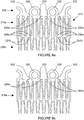
- Examples of alternative forms of shaped apexes are concave (see Figure 6 ), castellated (see Figure 7 ) and undulating (see Figure 8 ). In these alternate forms, at least a portion of the apex is flat or concave.
- apexes of adjacent stents are shown as staggered in the preferred embodiment of Figures 4 and 5 and in the alternative embodiments shown in Figures 6 to 8 , in a modification the apexes of one stent may be in line with the apexes of the adjacent stent in the longitudinal direction.
- the stents could be spaced apart from the neighbouring stent(s) by a spacing "d" which is of the order of between zero and 20% of the longitudinal length of the stents. It will be appreciated that a zero spacing corresponds to the apexes being in contact with each other even before longitudinal compression occurs.
- FIG. 9a shows a portion of a prosthesis 210 according to a second embodiment of the present invention.
- the prosthesis 210 comprises a distal end 212 and a proximal end, with a plurality of stents 216a, 216b spaced apart along the length of the prosthesis 210.
- markers 220 are provided at the proximal and/or distal ends of the prosthesis 210 to assist the physician in positioning the prosthesis during a medical procedure. These markers 220 are also used as engagement members, so as to provide a contact surface at the end(s) of the prosthesis 210 that may be pushed against, for example when the prosthesis 210 is longitudinally compressed, so that the prosthesis 210 structure itself is not directly pushed against.
- the markers/engagement members 220 shown in Figure 9a include lateral extensions 222 which extend from the body of the engagement members 220 such that the lateral extensions 222 are located adjacent the distal apexes 224a of the stent 216a (that is, the apexes which are located at the distal end 212 of the prosthesis 210). These lateral extensions 222 are provided so as to increase the potential contact area between the engagement members 220 and the apexes 224a, and to cause the engagement members 220 to engage the apexes 224a, thus preventing the apexes 224a from pushing past the lateral extensions 222 of the engagement members 220.
- proximal apexes 226a of the stent 216a and the distal apexes 224b of the stent 216b have a generally flat or flattened shape, that is to say that, instead of forming a generally rounded bend, the apexes between pairs of struts form a more flattened, planar shape.
- the stents 216a, 216b are arranged such that the proximal apexes 226a of one stent 216a face the distal apexes 224b of the adjacent stent 216b, and the shaped or flat portions of the proximal apexes 226a and distal apexes 224b are substantially parallel. Further, the shaped or flat portions of the proximal apexes 226a and distal apexes 224b are substantially perpendicular to the longitudinal direction of the prosthesis 210.
- Figure 9b shows a modification of the embodiment shown in Figure 9a . Only those elements which have been modified have been given reference numerals in Figure 9b ; all other elements are similar to those described in connection with Figure 9a .
- the engagement members 320 are modified in that the surfaces of the lateral extensions 322 which face the apexes 324a are planar.
- the distal apexes 324a of the stent 316a are also modified so as to have a generally flat or flattened shape, such that the distal apexes 324a of the stent 316a are similar to the proximal apexes 226a and distal apexes 224b shown in Figure 9a .
- This modification further increases the likelihood of engagement between the planar lateral extensions 322 of the engagement member 320 and the flattened distal apexes 324a of the stent 316a when the prosthesis is subjected to longitudinal compression forces, thus preventing the distal apexes 324a from pushing past the lateral extensions 322.
Landscapes
- Health & Medical Sciences (AREA)
- Engineering & Computer Science (AREA)
- Biomedical Technology (AREA)
- Heart & Thoracic Surgery (AREA)
- Cardiology (AREA)
- Oral & Maxillofacial Surgery (AREA)
- Transplantation (AREA)
- Vascular Medicine (AREA)
- Life Sciences & Earth Sciences (AREA)
- Animal Behavior & Ethology (AREA)
- General Health & Medical Sciences (AREA)
- Public Health (AREA)
- Veterinary Medicine (AREA)
- Optics & Photonics (AREA)
- Physics & Mathematics (AREA)
- Prostheses (AREA)
Applications Claiming Priority (1)
| Application Number | Priority Date | Filing Date | Title |
|---|---|---|---|
| GB1102859.4A GB2488165B (en) | 2011-02-18 | 2011-02-18 | Prosthesis and method of manufacturing the same |
Publications (2)
| Publication Number | Publication Date |
|---|---|
| EP2489337A1 true EP2489337A1 (de) | 2012-08-22 |
| EP2489337B1 EP2489337B1 (de) | 2022-07-06 |
Family
ID=43881325
Family Applications (1)
| Application Number | Title | Priority Date | Filing Date |
|---|---|---|---|
| EP12275017.7A Active EP2489337B1 (de) | 2011-02-18 | 2012-02-17 | Prothese und Herstellungsverfahren dafür |
Country Status (4)
| Country | Link |
|---|---|
| US (1) | US20120215298A1 (de) |
| EP (1) | EP2489337B1 (de) |
| AU (1) | AU2012200935B2 (de) |
| GB (1) | GB2488165B (de) |
Families Citing this family (2)
| Publication number | Priority date | Publication date | Assignee | Title |
|---|---|---|---|---|
| US12263104B2 (en) * | 2021-05-20 | 2025-04-01 | Cook Medical Technologies Llc | Self expanding stents and methods |
| WO2022245435A1 (en) | 2021-05-20 | 2022-11-24 | Cook Medical Technologies Llc | Self expanding stent and method of loading same into a catheter |
Citations (11)
| Publication number | Priority date | Publication date | Assignee | Title |
|---|---|---|---|---|
| GB1102859A (en) | 1965-08-25 | 1968-02-14 | Du Pont | Electrical heating element |
| WO1998020810A1 (en) | 1996-11-12 | 1998-05-22 | Medtronic, Inc. | Flexible, radially expansible luminal prostheses |
| US5776181A (en) | 1995-07-25 | 1998-07-07 | Medstent Inc. | Expandable stent |
| WO2003030786A2 (en) * | 2001-10-09 | 2003-04-17 | William Cook Europe Aps | Cannula stent |
| US6656220B1 (en) | 2002-06-17 | 2003-12-02 | Advanced Cardiovascular Systems, Inc. | Intravascular stent |
| US20050149168A1 (en) | 2003-12-30 | 2005-07-07 | Daniel Gregorich | Stent to be deployed on a bend |
| WO2006105192A1 (en) * | 2005-03-31 | 2006-10-05 | Boston Scientific Limited | Endoprostheses |
| US20070244543A1 (en) | 2006-04-18 | 2007-10-18 | Medtronic Vascular, Inc. A Delaware Corporation | Stent With Movable Crown |
| US7534258B2 (en) | 2001-06-11 | 2009-05-19 | Advanced Cardiovascular Systems, Inc. | Intravascular stent |
| US20090204201A1 (en) | 2006-05-18 | 2009-08-13 | C. R. Bard, Inc. | Bend-capable stent prosthesis |
| US7637935B2 (en) | 2002-05-06 | 2009-12-29 | Abbott Laboratories | Endoprosthesis for controlled contraction and expansion |
Family Cites Families (8)
| Publication number | Priority date | Publication date | Assignee | Title |
|---|---|---|---|---|
| US5755776A (en) * | 1996-10-04 | 1998-05-26 | Al-Saadon; Khalid | Permanent expandable intraluminal tubular stent |
| US5868782A (en) * | 1996-12-24 | 1999-02-09 | Global Therapeutics, Inc. | Radially expandable axially non-contracting surgical stent |
| US6309414B1 (en) * | 1997-11-04 | 2001-10-30 | Sorin Biomedica Cardio S.P.A. | Angioplasty stents |
| AU2891899A (en) * | 1998-03-05 | 1999-09-20 | Boston Scientific Limited | Intraluminal stent |
| US6551351B2 (en) * | 1999-07-02 | 2003-04-22 | Scimed Life Systems | Spiral wound stent |
| US7381217B2 (en) * | 2005-12-23 | 2008-06-03 | Boston Scientific Scimed, Inc. | Serpentine stent pattern |
| US8133268B2 (en) * | 2007-05-30 | 2012-03-13 | Cordis Corporation | Stent/fiber structural combinations |
| CA2714775A1 (en) * | 2008-02-15 | 2009-08-20 | Joseph Michael Thielen | Peripheral overlap stent |
-
2011
- 2011-02-18 GB GB1102859.4A patent/GB2488165B/en active Active
-
2012
- 2012-02-09 US US13/369,922 patent/US20120215298A1/en not_active Abandoned
- 2012-02-17 EP EP12275017.7A patent/EP2489337B1/de active Active
- 2012-02-17 AU AU2012200935A patent/AU2012200935B2/en active Active
Patent Citations (11)
| Publication number | Priority date | Publication date | Assignee | Title |
|---|---|---|---|---|
| GB1102859A (en) | 1965-08-25 | 1968-02-14 | Du Pont | Electrical heating element |
| US5776181A (en) | 1995-07-25 | 1998-07-07 | Medstent Inc. | Expandable stent |
| WO1998020810A1 (en) | 1996-11-12 | 1998-05-22 | Medtronic, Inc. | Flexible, radially expansible luminal prostheses |
| US7534258B2 (en) | 2001-06-11 | 2009-05-19 | Advanced Cardiovascular Systems, Inc. | Intravascular stent |
| WO2003030786A2 (en) * | 2001-10-09 | 2003-04-17 | William Cook Europe Aps | Cannula stent |
| US7637935B2 (en) | 2002-05-06 | 2009-12-29 | Abbott Laboratories | Endoprosthesis for controlled contraction and expansion |
| US6656220B1 (en) | 2002-06-17 | 2003-12-02 | Advanced Cardiovascular Systems, Inc. | Intravascular stent |
| US20050149168A1 (en) | 2003-12-30 | 2005-07-07 | Daniel Gregorich | Stent to be deployed on a bend |
| WO2006105192A1 (en) * | 2005-03-31 | 2006-10-05 | Boston Scientific Limited | Endoprostheses |
| US20070244543A1 (en) | 2006-04-18 | 2007-10-18 | Medtronic Vascular, Inc. A Delaware Corporation | Stent With Movable Crown |
| US20090204201A1 (en) | 2006-05-18 | 2009-08-13 | C. R. Bard, Inc. | Bend-capable stent prosthesis |
Also Published As
| Publication number | Publication date |
|---|---|
| GB201102859D0 (en) | 2011-04-06 |
| EP2489337B1 (de) | 2022-07-06 |
| GB2488165A (en) | 2012-08-22 |
| AU2012200935A1 (en) | 2012-09-06 |
| US20120215298A1 (en) | 2012-08-23 |
| GB2488165B (en) | 2013-08-07 |
| AU2012200935B2 (en) | 2013-08-22 |
Similar Documents
| Publication | Publication Date | Title |
|---|---|---|
| EP2403441B1 (de) | Stent | |
| US6270524B1 (en) | Flexible, radially expansible luminal prostheses | |
| US8016874B2 (en) | Flexible stent with elevated scaffolding properties | |
| EP2961358B1 (de) | Implantierbare medizinische vorrichtungen für reduzierte gewebeentzündung | |
| US8425586B2 (en) | Vascular prosthesis with stress relief slots | |
| KR102197010B1 (ko) | 스텐트 | |
| EP3654878B1 (de) | Intravaskulärer stent | |
| JP2008522757A (ja) | 可変湾曲ステント | |
| EP3632376B1 (de) | Selbstkrümmendes stenttransplantat | |
| KR102195532B1 (ko) | 스텐트 | |
| EP3431052B1 (de) | Stent mit segmenten, die zur entkopplung während der expansion fähig sind | |
| AU2006259293B2 (en) | Intraluminal device with unsymmetric tapered beams | |
| EP2489337B1 (de) | Prothese und Herstellungsverfahren dafür | |
| JP6229051B2 (ja) | 撓みコネクタを備えたステント | |
| EP1895934B1 (de) | Intraluminale vorrichtung mit verbesserten konischen stützen | |
| EP2745806B1 (de) | Stententwürfe für reduzierte Umhüllung von Transplantatmaterial | |
| US20090093869A1 (en) | Medical device with curved struts | |
| JP2008099995A (ja) | ステント及びステントグラフト | |
| JPWO2009118912A1 (ja) | ステント及びステントグラフト |
Legal Events
| Date | Code | Title | Description |
|---|---|---|---|
| PUAI | Public reference made under article 153(3) epc to a published international application that has entered the european phase |
Free format text: ORIGINAL CODE: 0009012 |
|
| AK | Designated contracting states |
Kind code of ref document: A1 Designated state(s): AL AT BE BG CH CY CZ DE DK EE ES FI FR GB GR HR HU IE IS IT LI LT LU LV MC MK MT NL NO PL PT RO RS SE SI SK SM TR |
|
| AX | Request for extension of the european patent |
Extension state: BA ME |
|
| 17P | Request for examination filed |
Effective date: 20120921 |
|
| STAA | Information on the status of an ep patent application or granted ep patent |
Free format text: STATUS: EXAMINATION IS IN PROGRESS |
|
| 17Q | First examination report despatched |
Effective date: 20170206 |
|
| REG | Reference to a national code |
Ref country code: DE Ref legal event code: R079 Ref document number: 602012078441 Country of ref document: DE Free format text: PREVIOUS MAIN CLASS: A61F0002900000 Ipc: A61F0002915000 |
|
| RIC1 | Information provided on ipc code assigned before grant |
Ipc: A61F 2/915 20130101AFI20210504BHEP |
|
| GRAP | Despatch of communication of intention to grant a patent |
Free format text: ORIGINAL CODE: EPIDOSNIGR1 |
|
| STAA | Information on the status of an ep patent application or granted ep patent |
Free format text: STATUS: GRANT OF PATENT IS INTENDED |
|
| INTG | Intention to grant announced |
Effective date: 20220120 |
|
| GRAS | Grant fee paid |
Free format text: ORIGINAL CODE: EPIDOSNIGR3 |
|
| GRAA | (expected) grant |
Free format text: ORIGINAL CODE: 0009210 |
|
| STAA | Information on the status of an ep patent application or granted ep patent |
Free format text: STATUS: THE PATENT HAS BEEN GRANTED |
|
| AK | Designated contracting states |
Kind code of ref document: B1 Designated state(s): AL AT BE BG CH CY CZ DE DK EE ES FI FR GR HR HU IE IS IT LI LT LU LV MC MK MT NL NO PL PT RO RS SE SI SK SM TR |
|
| RBV | Designated contracting states (corrected) |
Designated state(s): AL AT BE BG CH CY CZ DE DK EE ES FI FR GR HR HU IE IS IT LI LT LU LV MC MK MT NL NO PL PT RO RS SE SI SK SM TR |
|
| REG | Reference to a national code |
Ref country code: AT Ref legal event code: REF Ref document number: 1502334 Country of ref document: AT Kind code of ref document: T Effective date: 20220715 Ref country code: CH Ref legal event code: EP |
|
| REG | Reference to a national code |
Ref country code: DE Ref legal event code: R096 Ref document number: 602012078441 Country of ref document: DE |
|
| REG | Reference to a national code |
Ref country code: IE Ref legal event code: FG4D |
|
| REG | Reference to a national code |
Ref country code: LT Ref legal event code: MG9D |
|
| REG | Reference to a national code |
Ref country code: NL Ref legal event code: MP Effective date: 20220706 |
|
| PG25 | Lapsed in a contracting state [announced via postgrant information from national office to epo] |
Ref country code: SE Free format text: LAPSE BECAUSE OF FAILURE TO SUBMIT A TRANSLATION OF THE DESCRIPTION OR TO PAY THE FEE WITHIN THE PRESCRIBED TIME-LIMIT Effective date: 20220706 Ref country code: RS Free format text: LAPSE BECAUSE OF FAILURE TO SUBMIT A TRANSLATION OF THE DESCRIPTION OR TO PAY THE FEE WITHIN THE PRESCRIBED TIME-LIMIT Effective date: 20220706 Ref country code: PT Free format text: LAPSE BECAUSE OF FAILURE TO SUBMIT A TRANSLATION OF THE DESCRIPTION OR TO PAY THE FEE WITHIN THE PRESCRIBED TIME-LIMIT Effective date: 20221107 Ref country code: NO Free format text: LAPSE BECAUSE OF FAILURE TO SUBMIT A TRANSLATION OF THE DESCRIPTION OR TO PAY THE FEE WITHIN THE PRESCRIBED TIME-LIMIT Effective date: 20221006 Ref country code: NL Free format text: LAPSE BECAUSE OF FAILURE TO SUBMIT A TRANSLATION OF THE DESCRIPTION OR TO PAY THE FEE WITHIN THE PRESCRIBED TIME-LIMIT Effective date: 20220706 Ref country code: LV Free format text: LAPSE BECAUSE OF FAILURE TO SUBMIT A TRANSLATION OF THE DESCRIPTION OR TO PAY THE FEE WITHIN THE PRESCRIBED TIME-LIMIT Effective date: 20220706 Ref country code: LT Free format text: LAPSE BECAUSE OF FAILURE TO SUBMIT A TRANSLATION OF THE DESCRIPTION OR TO PAY THE FEE WITHIN THE PRESCRIBED TIME-LIMIT Effective date: 20220706 Ref country code: FI Free format text: LAPSE BECAUSE OF FAILURE TO SUBMIT A TRANSLATION OF THE DESCRIPTION OR TO PAY THE FEE WITHIN THE PRESCRIBED TIME-LIMIT Effective date: 20220706 Ref country code: ES Free format text: LAPSE BECAUSE OF FAILURE TO SUBMIT A TRANSLATION OF THE DESCRIPTION OR TO PAY THE FEE WITHIN THE PRESCRIBED TIME-LIMIT Effective date: 20220706 |
|
| REG | Reference to a national code |
Ref country code: AT Ref legal event code: MK05 Ref document number: 1502334 Country of ref document: AT Kind code of ref document: T Effective date: 20220706 |
|
| PG25 | Lapsed in a contracting state [announced via postgrant information from national office to epo] |
Ref country code: PL Free format text: LAPSE BECAUSE OF FAILURE TO SUBMIT A TRANSLATION OF THE DESCRIPTION OR TO PAY THE FEE WITHIN THE PRESCRIBED TIME-LIMIT Effective date: 20220706 Ref country code: IS Free format text: LAPSE BECAUSE OF FAILURE TO SUBMIT A TRANSLATION OF THE DESCRIPTION OR TO PAY THE FEE WITHIN THE PRESCRIBED TIME-LIMIT Effective date: 20221106 Ref country code: HR Free format text: LAPSE BECAUSE OF FAILURE TO SUBMIT A TRANSLATION OF THE DESCRIPTION OR TO PAY THE FEE WITHIN THE PRESCRIBED TIME-LIMIT Effective date: 20220706 Ref country code: GR Free format text: LAPSE BECAUSE OF FAILURE TO SUBMIT A TRANSLATION OF THE DESCRIPTION OR TO PAY THE FEE WITHIN THE PRESCRIBED TIME-LIMIT Effective date: 20221007 |
|
| REG | Reference to a national code |
Ref country code: DE Ref legal event code: R097 Ref document number: 602012078441 Country of ref document: DE |
|
| PG25 | Lapsed in a contracting state [announced via postgrant information from national office to epo] |
Ref country code: SM Free format text: LAPSE BECAUSE OF FAILURE TO SUBMIT A TRANSLATION OF THE DESCRIPTION OR TO PAY THE FEE WITHIN THE PRESCRIBED TIME-LIMIT Effective date: 20220706 Ref country code: RO Free format text: LAPSE BECAUSE OF FAILURE TO SUBMIT A TRANSLATION OF THE DESCRIPTION OR TO PAY THE FEE WITHIN THE PRESCRIBED TIME-LIMIT Effective date: 20220706 Ref country code: DK Free format text: LAPSE BECAUSE OF FAILURE TO SUBMIT A TRANSLATION OF THE DESCRIPTION OR TO PAY THE FEE WITHIN THE PRESCRIBED TIME-LIMIT Effective date: 20220706 Ref country code: CZ Free format text: LAPSE BECAUSE OF FAILURE TO SUBMIT A TRANSLATION OF THE DESCRIPTION OR TO PAY THE FEE WITHIN THE PRESCRIBED TIME-LIMIT Effective date: 20220706 Ref country code: AT Free format text: LAPSE BECAUSE OF FAILURE TO SUBMIT A TRANSLATION OF THE DESCRIPTION OR TO PAY THE FEE WITHIN THE PRESCRIBED TIME-LIMIT Effective date: 20220706 |
|
| PLBE | No opposition filed within time limit |
Free format text: ORIGINAL CODE: 0009261 |
|
| STAA | Information on the status of an ep patent application or granted ep patent |
Free format text: STATUS: NO OPPOSITION FILED WITHIN TIME LIMIT |
|
| PG25 | Lapsed in a contracting state [announced via postgrant information from national office to epo] |
Ref country code: SK Free format text: LAPSE BECAUSE OF FAILURE TO SUBMIT A TRANSLATION OF THE DESCRIPTION OR TO PAY THE FEE WITHIN THE PRESCRIBED TIME-LIMIT Effective date: 20220706 Ref country code: EE Free format text: LAPSE BECAUSE OF FAILURE TO SUBMIT A TRANSLATION OF THE DESCRIPTION OR TO PAY THE FEE WITHIN THE PRESCRIBED TIME-LIMIT Effective date: 20220706 |
|
| 26N | No opposition filed |
Effective date: 20230411 |
|
| PG25 | Lapsed in a contracting state [announced via postgrant information from national office to epo] |
Ref country code: AL Free format text: LAPSE BECAUSE OF FAILURE TO SUBMIT A TRANSLATION OF THE DESCRIPTION OR TO PAY THE FEE WITHIN THE PRESCRIBED TIME-LIMIT Effective date: 20220706 |
|
| P01 | Opt-out of the competence of the unified patent court (upc) registered |
Effective date: 20230602 |
|
| PG25 | Lapsed in a contracting state [announced via postgrant information from national office to epo] |
Ref country code: SI Free format text: LAPSE BECAUSE OF FAILURE TO SUBMIT A TRANSLATION OF THE DESCRIPTION OR TO PAY THE FEE WITHIN THE PRESCRIBED TIME-LIMIT Effective date: 20220706 |
|
| PG25 | Lapsed in a contracting state [announced via postgrant information from national office to epo] |
Ref country code: MC Free format text: LAPSE BECAUSE OF FAILURE TO SUBMIT A TRANSLATION OF THE DESCRIPTION OR TO PAY THE FEE WITHIN THE PRESCRIBED TIME-LIMIT Effective date: 20220706 |
|
| REG | Reference to a national code |
Ref country code: CH Ref legal event code: PL |
|
| REG | Reference to a national code |
Ref country code: BE Ref legal event code: MM Effective date: 20230228 |
|
| PG25 | Lapsed in a contracting state [announced via postgrant information from national office to epo] |
Ref country code: LU Free format text: LAPSE BECAUSE OF NON-PAYMENT OF DUE FEES Effective date: 20230217 Ref country code: LI Free format text: LAPSE BECAUSE OF NON-PAYMENT OF DUE FEES Effective date: 20230228 Ref country code: CH Free format text: LAPSE BECAUSE OF NON-PAYMENT OF DUE FEES Effective date: 20230228 |
|
| PG25 | Lapsed in a contracting state [announced via postgrant information from national office to epo] |
Ref country code: IT Free format text: LAPSE BECAUSE OF FAILURE TO SUBMIT A TRANSLATION OF THE DESCRIPTION OR TO PAY THE FEE WITHIN THE PRESCRIBED TIME-LIMIT Effective date: 20220706 Ref country code: FR Free format text: LAPSE BECAUSE OF NON-PAYMENT OF DUE FEES Effective date: 20230228 |
|
| PG25 | Lapsed in a contracting state [announced via postgrant information from national office to epo] |
Ref country code: BE Free format text: LAPSE BECAUSE OF NON-PAYMENT OF DUE FEES Effective date: 20230228 |
|
| PG25 | Lapsed in a contracting state [announced via postgrant information from national office to epo] |
Ref country code: BG Free format text: LAPSE BECAUSE OF FAILURE TO SUBMIT A TRANSLATION OF THE DESCRIPTION OR TO PAY THE FEE WITHIN THE PRESCRIBED TIME-LIMIT Effective date: 20220706 |
|
| PG25 | Lapsed in a contracting state [announced via postgrant information from national office to epo] |
Ref country code: BG Free format text: LAPSE BECAUSE OF FAILURE TO SUBMIT A TRANSLATION OF THE DESCRIPTION OR TO PAY THE FEE WITHIN THE PRESCRIBED TIME-LIMIT Effective date: 20220706 |
|
| PGFP | Annual fee paid to national office [announced via postgrant information from national office to epo] |
Ref country code: DE Payment date: 20250226 Year of fee payment: 14 |
|
| PGFP | Annual fee paid to national office [announced via postgrant information from national office to epo] |
Ref country code: IE Payment date: 20250217 Year of fee payment: 14 |
|
| PG25 | Lapsed in a contracting state [announced via postgrant information from national office to epo] |
Ref country code: CY Free format text: LAPSE BECAUSE OF FAILURE TO SUBMIT A TRANSLATION OF THE DESCRIPTION OR TO PAY THE FEE WITHIN THE PRESCRIBED TIME-LIMIT; INVALID AB INITIO Effective date: 20120217 |
|
| PG25 | Lapsed in a contracting state [announced via postgrant information from national office to epo] |
Ref country code: HU Free format text: LAPSE BECAUSE OF FAILURE TO SUBMIT A TRANSLATION OF THE DESCRIPTION OR TO PAY THE FEE WITHIN THE PRESCRIBED TIME-LIMIT; INVALID AB INITIO Effective date: 20120217 |
|
| PG25 | Lapsed in a contracting state [announced via postgrant information from national office to epo] |
Ref country code: TR Free format text: LAPSE BECAUSE OF FAILURE TO SUBMIT A TRANSLATION OF THE DESCRIPTION OR TO PAY THE FEE WITHIN THE PRESCRIBED TIME-LIMIT Effective date: 20220706 |