EP2487152A1 - Process for the preparation of Lacosamide including resolution of O-methyl-DL-serine - Google Patents
Process for the preparation of Lacosamide including resolution of O-methyl-DL-serine Download PDFInfo
- Publication number
- EP2487152A1 EP2487152A1 EP20100191524 EP10191524A EP2487152A1 EP 2487152 A1 EP2487152 A1 EP 2487152A1 EP 20100191524 EP20100191524 EP 20100191524 EP 10191524 A EP10191524 A EP 10191524A EP 2487152 A1 EP2487152 A1 EP 2487152A1
- Authority
- EP
- European Patent Office
- Prior art keywords
- compound
- formula
- pure form
- optically pure
- substantially optically
- Prior art date
- Legal status (The legal status is an assumption and is not a legal conclusion. Google has not performed a legal analysis and makes no representation as to the accuracy of the status listed.)
- Ceased
Links
- 238000000034 method Methods 0.000 title claims abstract description 92
- KNTFCRCCPLEUQZ-UHFFFAOYSA-N O-Methyl-DL-serine Chemical compound COCC(N)C(O)=O KNTFCRCCPLEUQZ-UHFFFAOYSA-N 0.000 title claims abstract description 36
- VPPJLAIAVCUEMN-GFCCVEGCSA-N lacosamide Chemical compound COC[C@@H](NC(C)=O)C(=O)NCC1=CC=CC=C1 VPPJLAIAVCUEMN-GFCCVEGCSA-N 0.000 title claims abstract description 27
- 229960002623 lacosamide Drugs 0.000 title claims abstract description 24
- 238000002360 preparation method Methods 0.000 title claims abstract description 13
- 150000001875 compounds Chemical class 0.000 claims abstract description 155
- WGQKYBSKWIADBV-UHFFFAOYSA-N benzylamine Chemical compound NCC1=CC=CC=C1 WGQKYBSKWIADBV-UHFFFAOYSA-N 0.000 claims abstract description 26
- 238000006640 acetylation reaction Methods 0.000 claims abstract description 24
- KNTFCRCCPLEUQZ-GSVOUGTGSA-N (2r)-2-azaniumyl-3-methoxypropanoate Chemical compound COC[C@@H](N)C(O)=O KNTFCRCCPLEUQZ-GSVOUGTGSA-N 0.000 claims abstract description 20
- 230000021736 acetylation Effects 0.000 claims abstract description 20
- 125000003178 carboxy group Chemical group [H]OC(*)=O 0.000 claims abstract description 11
- 230000003213 activating effect Effects 0.000 claims abstract description 10
- WYURNTSHIVDZCO-UHFFFAOYSA-N Tetrahydrofuran Chemical compound C1CCOC1 WYURNTSHIVDZCO-UHFFFAOYSA-N 0.000 claims description 46
- 238000006243 chemical reaction Methods 0.000 claims description 39
- XLYOFNOQVPJJNP-UHFFFAOYSA-N water Substances O XLYOFNOQVPJJNP-UHFFFAOYSA-N 0.000 claims description 34
- 239000000203 mixture Substances 0.000 claims description 27
- 239000002253 acid Substances 0.000 claims description 23
- YLQBMQCUIZJEEH-UHFFFAOYSA-N tetrahydrofuran Natural products C=1C=COC=1 YLQBMQCUIZJEEH-UHFFFAOYSA-N 0.000 claims description 23
- -1 isobutoxycarbonyloxy Chemical group 0.000 claims description 22
- WFDIJRYMOXRFFG-UHFFFAOYSA-N Acetic anhydride Chemical compound CC(=O)OC(C)=O WFDIJRYMOXRFFG-UHFFFAOYSA-N 0.000 claims description 18
- 238000005886 esterification reaction Methods 0.000 claims description 13
- 150000003839 salts Chemical class 0.000 claims description 11
- 125000004169 (C1-C6) alkyl group Chemical group 0.000 claims description 10
- 125000001424 substituent group Chemical group 0.000 claims description 9
- 150000002148 esters Chemical class 0.000 claims description 8
- 125000001797 benzyl group Chemical group [H]C1=C([H])C([H])=C(C([H])=C1[H])C([H])([H])* 0.000 claims description 6
- XUYPXLNMDZIRQH-LURJTMIESA-N N-acetyl-L-methionine Chemical compound CSCC[C@@H](C(O)=O)NC(C)=O XUYPXLNMDZIRQH-LURJTMIESA-N 0.000 claims description 5
- 125000003118 aryl group Chemical group 0.000 claims description 5
- UFHFLCQGNIYNRP-UHFFFAOYSA-N Hydrogen Chemical compound [H][H] UFHFLCQGNIYNRP-UHFFFAOYSA-N 0.000 claims description 4
- 239000003054 catalyst Substances 0.000 claims description 4
- 230000002255 enzymatic effect Effects 0.000 claims description 4
- 125000001072 heteroaryl group Chemical group 0.000 claims description 4
- 239000012670 alkaline solution Substances 0.000 claims description 3
- 239000001257 hydrogen Substances 0.000 claims description 3
- 229910052739 hydrogen Inorganic materials 0.000 claims description 3
- 238000005984 hydrogenation reaction Methods 0.000 claims description 3
- 239000003929 acidic solution Substances 0.000 claims description 2
- 239000007795 chemical reaction product Substances 0.000 claims description 2
- 238000010791 quenching Methods 0.000 claims 1
- 230000000171 quenching effect Effects 0.000 claims 1
- 125000003047 N-acetyl group Chemical group 0.000 abstract 1
- XEKOWRVHYACXOJ-UHFFFAOYSA-N Ethyl acetate Chemical compound CCOC(C)=O XEKOWRVHYACXOJ-UHFFFAOYSA-N 0.000 description 30
- HEMHJVSKTPXQMS-UHFFFAOYSA-M Sodium hydroxide Chemical compound [OH-].[Na+] HEMHJVSKTPXQMS-UHFFFAOYSA-M 0.000 description 27
- 239000011541 reaction mixture Substances 0.000 description 25
- OKKJLVBELUTLKV-UHFFFAOYSA-N Methanol Chemical compound OC OKKJLVBELUTLKV-UHFFFAOYSA-N 0.000 description 24
- 239000002904 solvent Substances 0.000 description 23
- YMWUJEATGCHHMB-UHFFFAOYSA-N Dichloromethane Chemical compound ClCCl YMWUJEATGCHHMB-UHFFFAOYSA-N 0.000 description 21
- YXFVVABEGXRONW-UHFFFAOYSA-N Toluene Chemical compound CC1=CC=CC=C1 YXFVVABEGXRONW-UHFFFAOYSA-N 0.000 description 21
- VEXZGXHMUGYJMC-UHFFFAOYSA-N Hydrochloric acid Chemical compound Cl VEXZGXHMUGYJMC-UHFFFAOYSA-N 0.000 description 19
- 239000000243 solution Substances 0.000 description 16
- 239000003960 organic solvent Substances 0.000 description 13
- 239000007787 solid Substances 0.000 description 12
- PMZURENOXWZQFD-UHFFFAOYSA-L Sodium Sulfate Chemical compound [Na+].[Na+].[O-]S([O-])(=O)=O PMZURENOXWZQFD-UHFFFAOYSA-L 0.000 description 11
- 239000000126 substance Substances 0.000 description 11
- LFQSCWFLJHTTHZ-UHFFFAOYSA-N Ethanol Chemical compound CCO LFQSCWFLJHTTHZ-UHFFFAOYSA-N 0.000 description 10
- 239000000463 material Substances 0.000 description 10
- 238000004128 high performance liquid chromatography Methods 0.000 description 9
- CSCPPACGZOOCGX-UHFFFAOYSA-N Acetone Chemical compound CC(C)=O CSCPPACGZOOCGX-UHFFFAOYSA-N 0.000 description 8
- CDBYLPFSWZWCQE-UHFFFAOYSA-L Sodium Carbonate Chemical compound [Na+].[Na+].[O-]C([O-])=O CDBYLPFSWZWCQE-UHFFFAOYSA-L 0.000 description 8
- 239000007864 aqueous solution Substances 0.000 description 8
- 230000009466 transformation Effects 0.000 description 8
- FAGHYCIZWXSHFX-SNVBAGLBSA-N (2r)-2-[acetyl(naphthalen-1-yl)amino]propanoic acid Chemical compound C1=CC=C2C(N(C(C)=O)[C@H](C)C(O)=O)=CC=CC2=C1 FAGHYCIZWXSHFX-SNVBAGLBSA-N 0.000 description 6
- 239000004367 Lipase Substances 0.000 description 6
- 108090001060 Lipase Proteins 0.000 description 6
- 102000004882 Lipase Human genes 0.000 description 6
- SJRJJKPEHAURKC-UHFFFAOYSA-N N-Methylmorpholine Chemical compound CN1CCOCC1 SJRJJKPEHAURKC-UHFFFAOYSA-N 0.000 description 6
- UIIMBOGNXHQVGW-UHFFFAOYSA-M Sodium bicarbonate Chemical compound [Na+].OC([O-])=O UIIMBOGNXHQVGW-UHFFFAOYSA-M 0.000 description 6
- KRKNYBCHXYNGOX-UHFFFAOYSA-N citric acid Chemical compound OC(=O)CC(O)(C(O)=O)CC(O)=O KRKNYBCHXYNGOX-UHFFFAOYSA-N 0.000 description 6
- 150000007529 inorganic bases Chemical class 0.000 description 6
- 239000010410 layer Substances 0.000 description 6
- 235000019421 lipase Nutrition 0.000 description 6
- 239000012044 organic layer Substances 0.000 description 6
- BWHMMNNQKKPAPP-UHFFFAOYSA-L potassium carbonate Chemical compound [K+].[K+].[O-]C([O-])=O BWHMMNNQKKPAPP-UHFFFAOYSA-L 0.000 description 6
- 229910052938 sodium sulfate Inorganic materials 0.000 description 6
- 239000000725 suspension Substances 0.000 description 6
- SDNGNSKFWTZCJG-RXMQYKEDSA-N (2r)-2-acetamido-3-methoxypropanoic acid Chemical compound COC[C@H](C(O)=O)NC(C)=O SDNGNSKFWTZCJG-RXMQYKEDSA-N 0.000 description 5
- HBAQYPYDRFILMT-UHFFFAOYSA-N 8-[3-(1-cyclopropylpyrazol-4-yl)-1H-pyrazolo[4,3-d]pyrimidin-5-yl]-3-methyl-3,8-diazabicyclo[3.2.1]octan-2-one Chemical class C1(CC1)N1N=CC(=C1)C1=NNC2=C1N=C(N=C2)N1C2C(N(CC1CC2)C)=O HBAQYPYDRFILMT-UHFFFAOYSA-N 0.000 description 5
- CBQJSKKFNMDLON-SNVBAGLBSA-N N-acetyl-D-phenylalanine Chemical compound CC(=O)N[C@@H](C(O)=O)CC1=CC=CC=C1 CBQJSKKFNMDLON-SNVBAGLBSA-N 0.000 description 5
- 239000002585 base Substances 0.000 description 5
- 239000006227 byproduct Substances 0.000 description 5
- 230000003287 optical effect Effects 0.000 description 5
- 125000006239 protecting group Chemical group 0.000 description 5
- 230000008929 regeneration Effects 0.000 description 5
- 238000011069 regeneration method Methods 0.000 description 5
- 238000000926 separation method Methods 0.000 description 5
- 235000011152 sodium sulphate Nutrition 0.000 description 5
- 108090000790 Enzymes Proteins 0.000 description 4
- 102000004190 Enzymes Human genes 0.000 description 4
- 239000012345 acetylating agent Substances 0.000 description 4
- 150000007513 acids Chemical class 0.000 description 4
- 150000008044 alkali metal hydroxides Chemical class 0.000 description 4
- 108010003977 aminoacylase I Proteins 0.000 description 4
- 150000004292 cyclic ethers Chemical class 0.000 description 4
- 229910052500 inorganic mineral Inorganic materials 0.000 description 4
- 239000007788 liquid Substances 0.000 description 4
- 238000004519 manufacturing process Methods 0.000 description 4
- 238000007069 methylation reaction Methods 0.000 description 4
- 235000010755 mineral Nutrition 0.000 description 4
- 239000011707 mineral Substances 0.000 description 4
- 150000007522 mineralic acids Chemical class 0.000 description 4
- 239000002002 slurry Substances 0.000 description 4
- 229910000029 sodium carbonate Inorganic materials 0.000 description 4
- 239000011343 solid material Substances 0.000 description 4
- DYHSDKLCOJIUFX-UHFFFAOYSA-N tert-butoxycarbonyl anhydride Chemical compound CC(C)(C)OC(=O)OC(=O)OC(C)(C)C DYHSDKLCOJIUFX-UHFFFAOYSA-N 0.000 description 4
- VPPJLAIAVCUEMN-UHFFFAOYSA-N 2-acetamido-n-benzyl-3-methoxypropanamide Chemical compound COCC(NC(C)=O)C(=O)NCC1=CC=CC=C1 VPPJLAIAVCUEMN-UHFFFAOYSA-N 0.000 description 3
- YOETUEMZNOLGDB-UHFFFAOYSA-N 2-methylpropyl carbonochloridate Chemical compound CC(C)COC(Cl)=O YOETUEMZNOLGDB-UHFFFAOYSA-N 0.000 description 3
- QTBSBXVTEAMEQO-UHFFFAOYSA-N Acetic acid Chemical compound CC(O)=O QTBSBXVTEAMEQO-UHFFFAOYSA-N 0.000 description 3
- RTZKZFJDLAIYFH-UHFFFAOYSA-N Diethyl ether Chemical compound CCOCC RTZKZFJDLAIYFH-UHFFFAOYSA-N 0.000 description 3
- 108090000371 Esterases Proteins 0.000 description 3
- WMFOQBRAJBCJND-UHFFFAOYSA-M Lithium hydroxide Chemical compound [Li+].[OH-] WMFOQBRAJBCJND-UHFFFAOYSA-M 0.000 description 3
- NTIZESTWPVYFNL-UHFFFAOYSA-N Methyl isobutyl ketone Chemical compound CC(C)CC(C)=O NTIZESTWPVYFNL-UHFFFAOYSA-N 0.000 description 3
- UIHCLUNTQKBZGK-UHFFFAOYSA-N Methyl isobutyl ketone Natural products CCC(C)C(C)=O UIHCLUNTQKBZGK-UHFFFAOYSA-N 0.000 description 3
- KDLHZDBZIXYQEI-UHFFFAOYSA-N Palladium Chemical compound [Pd] KDLHZDBZIXYQEI-UHFFFAOYSA-N 0.000 description 3
- YGYAWVDWMABLBF-UHFFFAOYSA-N Phosgene Chemical compound ClC(Cl)=O YGYAWVDWMABLBF-UHFFFAOYSA-N 0.000 description 3
- 229910000288 alkali metal carbonate Inorganic materials 0.000 description 3
- 150000008041 alkali metal carbonates Chemical class 0.000 description 3
- 125000003277 amino group Chemical group 0.000 description 3
- 230000003851 biochemical process Effects 0.000 description 3
- 239000012267 brine Substances 0.000 description 3
- 238000007796 conventional method Methods 0.000 description 3
- 239000013058 crude material Substances 0.000 description 3
- 230000036425 denaturation Effects 0.000 description 3
- 238000004925 denaturation Methods 0.000 description 3
- 239000003814 drug Substances 0.000 description 3
- 125000001495 ethyl group Chemical group [H]C([H])([H])C([H])([H])* 0.000 description 3
- 238000000605 extraction Methods 0.000 description 3
- 239000012065 filter cake Substances 0.000 description 3
- 229910052736 halogen Inorganic materials 0.000 description 3
- 150000002367 halogens Chemical class 0.000 description 3
- 150000007524 organic acids Chemical class 0.000 description 3
- 229910000027 potassium carbonate Inorganic materials 0.000 description 3
- 235000011181 potassium carbonates Nutrition 0.000 description 3
- 238000010992 reflux Methods 0.000 description 3
- 238000002390 rotary evaporation Methods 0.000 description 3
- MTCFGRXMJLQNBG-UHFFFAOYSA-N serine Chemical compound OCC(N)C(O)=O MTCFGRXMJLQNBG-UHFFFAOYSA-N 0.000 description 3
- 229910000030 sodium bicarbonate Inorganic materials 0.000 description 3
- 235000017557 sodium bicarbonate Nutrition 0.000 description 3
- 235000017550 sodium carbonate Nutrition 0.000 description 3
- HPALAKNZSZLMCH-UHFFFAOYSA-M sodium;chloride;hydrate Chemical compound O.[Na+].[Cl-] HPALAKNZSZLMCH-UHFFFAOYSA-M 0.000 description 3
- 238000003786 synthesis reaction Methods 0.000 description 3
- 125000004191 (C1-C6) alkoxy group Chemical group 0.000 description 2
- 125000004890 (C1-C6) alkylamino group Chemical group 0.000 description 2
- 125000004750 (C1-C6) alkylaminosulfonyl group Chemical group 0.000 description 2
- NWUYHJFMYQTDRP-UHFFFAOYSA-N 1,2-bis(ethenyl)benzene;1-ethenyl-2-ethylbenzene;styrene Chemical compound C=CC1=CC=CC=C1.CCC1=CC=CC=C1C=C.C=CC1=CC=CC=C1C=C NWUYHJFMYQTDRP-UHFFFAOYSA-N 0.000 description 2
- RYHBNJHYFVUHQT-UHFFFAOYSA-N 1,4-Dioxane Chemical compound C1COCCO1 RYHBNJHYFVUHQT-UHFFFAOYSA-N 0.000 description 2
- SDNGNSKFWTZCJG-UHFFFAOYSA-N 2-acetamido-3-methoxypropanoic acid Chemical compound COCC(C(O)=O)NC(C)=O SDNGNSKFWTZCJG-UHFFFAOYSA-N 0.000 description 2
- 241000228212 Aspergillus Species 0.000 description 2
- WKBOTKDWSSQWDR-UHFFFAOYSA-N Bromine atom Chemical compound [Br] WKBOTKDWSSQWDR-UHFFFAOYSA-N 0.000 description 2
- ZAMOUSCENKQFHK-UHFFFAOYSA-N Chlorine atom Chemical compound [Cl] ZAMOUSCENKQFHK-UHFFFAOYSA-N 0.000 description 2
- PXGOKWXKJXAPGV-UHFFFAOYSA-N Fluorine Chemical compound FF PXGOKWXKJXAPGV-UHFFFAOYSA-N 0.000 description 2
- JUJWROOIHBZHMG-UHFFFAOYSA-N Pyridine Chemical compound C1=CC=NC=C1 JUJWROOIHBZHMG-UHFFFAOYSA-N 0.000 description 2
- VYPSYNLAJGMNEJ-UHFFFAOYSA-N Silicium dioxide Chemical compound O=[Si]=O VYPSYNLAJGMNEJ-UHFFFAOYSA-N 0.000 description 2
- DTQVDTLACAAQTR-UHFFFAOYSA-N Trifluoroacetic acid Chemical compound OC(=O)C(F)(F)F DTQVDTLACAAQTR-UHFFFAOYSA-N 0.000 description 2
- 125000004457 alkyl amino carbonyl group Chemical group 0.000 description 2
- 125000004397 aminosulfonyl group Chemical group NS(=O)(=O)* 0.000 description 2
- PLGIWPZJAPVLTD-SNVBAGLBSA-N benzyl (2r)-2-amino-3-methoxypropanoate Chemical compound COC[C@@H](N)C(=O)OCC1=CC=CC=C1 PLGIWPZJAPVLTD-SNVBAGLBSA-N 0.000 description 2
- PLGIWPZJAPVLTD-UHFFFAOYSA-N benzyl 2-amino-3-methoxypropanoate Chemical compound COCC(N)C(=O)OCC1=CC=CC=C1 PLGIWPZJAPVLTD-UHFFFAOYSA-N 0.000 description 2
- 238000005574 benzylation reaction Methods 0.000 description 2
- GDTBXPJZTBHREO-UHFFFAOYSA-N bromine Substances BrBr GDTBXPJZTBHREO-UHFFFAOYSA-N 0.000 description 2
- 229910052794 bromium Inorganic materials 0.000 description 2
- 125000003917 carbamoyl group Chemical group [H]N([H])C(*)=O 0.000 description 2
- 229910052799 carbon Inorganic materials 0.000 description 2
- 239000003153 chemical reaction reagent Substances 0.000 description 2
- 238000004296 chiral HPLC Methods 0.000 description 2
- 229910052801 chlorine Inorganic materials 0.000 description 2
- 239000000460 chlorine Substances 0.000 description 2
- 238000002425 crystallisation Methods 0.000 description 2
- 238000010511 deprotection reaction Methods 0.000 description 2
- VAYGXNSJCAHWJZ-UHFFFAOYSA-N dimethyl sulfate Chemical group COS(=O)(=O)OC VAYGXNSJCAHWJZ-UHFFFAOYSA-N 0.000 description 2
- 229940079593 drug Drugs 0.000 description 2
- 238000001704 evaporation Methods 0.000 description 2
- 230000008020 evaporation Effects 0.000 description 2
- 229910052731 fluorine Inorganic materials 0.000 description 2
- 239000011737 fluorine Substances 0.000 description 2
- 125000002887 hydroxy group Chemical group [H]O* 0.000 description 2
- 239000003456 ion exchange resin Substances 0.000 description 2
- 229920003303 ion-exchange polymer Polymers 0.000 description 2
- 125000000959 isobutyl group Chemical group [H]C([H])([H])C([H])(C([H])([H])[H])C([H])([H])* 0.000 description 2
- 210000003734 kidney Anatomy 0.000 description 2
- 210000004185 liver Anatomy 0.000 description 2
- 125000002496 methyl group Chemical group [H]C([H])([H])* 0.000 description 2
- 239000012022 methylating agents Substances 0.000 description 2
- 239000012299 nitrogen atmosphere Substances 0.000 description 2
- 239000012074 organic phase Substances 0.000 description 2
- 125000001997 phenyl group Chemical group [H]C1=C([H])C([H])=C(*)C([H])=C1[H] 0.000 description 2
- 229920001467 poly(styrenesulfonates) Polymers 0.000 description 2
- 239000000047 product Substances 0.000 description 2
- 239000000376 reactant Substances 0.000 description 2
- 238000003756 stirring Methods 0.000 description 2
- 125000005931 tert-butyloxycarbonyl group Chemical group [H]C([H])([H])C(OC(*)=O)(C([H])([H])[H])C([H])([H])[H] 0.000 description 2
- JRMUNVKIHCOMHV-UHFFFAOYSA-M tetrabutylammonium bromide Chemical compound [Br-].CCCC[N+](CCCC)(CCCC)CCCC JRMUNVKIHCOMHV-UHFFFAOYSA-M 0.000 description 2
- 125000002023 trifluoromethyl group Chemical group FC(F)(F)* 0.000 description 2
- UCPYLLCMEDAXFR-UHFFFAOYSA-N triphosgene Chemical compound ClC(Cl)(Cl)OC(=O)OC(Cl)(Cl)Cl UCPYLLCMEDAXFR-UHFFFAOYSA-N 0.000 description 2
- KPWKPGFLZGMMFX-VHSXEESVSA-N (-)-camphanic acid Chemical compound C1C[C@]2(C(O)=O)OC(=O)[C@@]1(C)C2(C)C KPWKPGFLZGMMFX-VHSXEESVSA-N 0.000 description 1
- RFMMMVDNIPUKGG-RXMQYKEDSA-N (2r)-2-acetamidopentanedioic acid Chemical compound CC(=O)N[C@@H](C(O)=O)CCC(O)=O RFMMMVDNIPUKGG-RXMQYKEDSA-N 0.000 description 1
- MCRMUCXATQAAMN-OAHLLOKOSA-N (2r)-3-(4-hydroxyphenyl)-2-(phenylmethoxycarbonylamino)propanoic acid Chemical compound C([C@H](C(=O)O)NC(=O)OCC=1C=CC=CC=1)C1=CC=C(O)C=C1 MCRMUCXATQAAMN-OAHLLOKOSA-N 0.000 description 1
- YONLFQNRGZXBBF-ZIAGYGMSSA-N (2r,3r)-2,3-dibenzoyloxybutanedioic acid Chemical compound O([C@@H](C(=O)O)[C@@H](OC(=O)C=1C=CC=CC=1)C(O)=O)C(=O)C1=CC=CC=C1 YONLFQNRGZXBBF-ZIAGYGMSSA-N 0.000 description 1
- 125000004178 (C1-C4) alkyl group Chemical group 0.000 description 1
- 125000004738 (C1-C6) alkyl sulfinyl group Chemical group 0.000 description 1
- 125000004739 (C1-C6) alkylsulfonyl group Chemical group 0.000 description 1
- 125000004845 (C1-C6) alkylsulfonylamino group Chemical group 0.000 description 1
- 125000006700 (C1-C6) alkylthio group Chemical group 0.000 description 1
- IWYDHOAUDWTVEP-SSDOTTSWSA-N (R)-mandelic acid Chemical compound OC(=O)[C@H](O)C1=CC=CC=C1 IWYDHOAUDWTVEP-SSDOTTSWSA-N 0.000 description 1
- VHYFNPMBLIVWCW-UHFFFAOYSA-N 4-Dimethylaminopyridine Chemical compound CN(C)C1=CC=NC=C1 VHYFNPMBLIVWCW-UHFFFAOYSA-N 0.000 description 1
- ZCYVEMRRCGMTRW-UHFFFAOYSA-N 7553-56-2 Chemical group [I] ZCYVEMRRCGMTRW-UHFFFAOYSA-N 0.000 description 1
- 241000981399 Aspergillus melleus Species 0.000 description 1
- 241000194110 Bacillus sp. (in: Bacteria) Species 0.000 description 1
- BVKZGUZCCUSVTD-UHFFFAOYSA-M Bicarbonate Chemical compound OC([O-])=O BVKZGUZCCUSVTD-UHFFFAOYSA-M 0.000 description 1
- MDGOEHCHQPDKSV-GJZGRUSLSA-N CC(N[C@@H](COC)C(N[C@@H](COC)C(NCc1ccccc1)=O)=O)=O Chemical compound CC(N[C@@H](COC)C(N[C@@H](COC)C(NCc1ccccc1)=O)=O)=O MDGOEHCHQPDKSV-GJZGRUSLSA-N 0.000 description 1
- 0 CC(N[C@](COC)C(*)=O)=O Chemical compound CC(N[C@](COC)C(*)=O)=O 0.000 description 1
- 241000905957 Channa melasoma Species 0.000 description 1
- 206010010904 Convulsion Diseases 0.000 description 1
- 241001661345 Moesziomyces antarcticus Species 0.000 description 1
- XUYPXLNMDZIRQH-ZCFIWIBFSA-N N-acetyl-D-methionine Chemical compound CSCC[C@H](C(O)=O)NC(C)=O XUYPXLNMDZIRQH-ZCFIWIBFSA-N 0.000 description 1
- KSMRODHGGIIXDV-YFKPBYRVSA-N N-acetyl-L-glutamine Chemical compound CC(=O)N[C@H](C(O)=O)CCC(N)=O KSMRODHGGIIXDV-YFKPBYRVSA-N 0.000 description 1
- WXNXCEHXYPACJF-ZETCQYMHSA-M N-acetyl-L-leucinate Chemical compound CC(C)C[C@@H](C([O-])=O)NC(C)=O WXNXCEHXYPACJF-ZETCQYMHSA-M 0.000 description 1
- 239000007832 Na2SO4 Substances 0.000 description 1
- IWYDHOAUDWTVEP-UHFFFAOYSA-N R-2-phenyl-2-hydroxyacetic acid Natural products OC(=O)C(O)C1=CC=CC=C1 IWYDHOAUDWTVEP-UHFFFAOYSA-N 0.000 description 1
- 241000235545 Rhizopus niveus Species 0.000 description 1
- 240000005384 Rhizopus oryzae Species 0.000 description 1
- 235000013752 Rhizopus oryzae Nutrition 0.000 description 1
- 238000010521 absorption reaction Methods 0.000 description 1
- WETWJCDKMRHUPV-UHFFFAOYSA-N acetyl chloride Chemical compound CC(Cl)=O WETWJCDKMRHUPV-UHFFFAOYSA-N 0.000 description 1
- 239000012346 acetyl chloride Substances 0.000 description 1
- 125000002777 acetyl group Chemical group [H]C([H])([H])C(*)=O 0.000 description 1
- 230000002378 acidificating effect Effects 0.000 description 1
- 238000011360 adjunctive therapy Methods 0.000 description 1
- 238000013019 agitation Methods 0.000 description 1
- 125000004453 alkoxycarbonyl group Chemical group 0.000 description 1
- 125000004466 alkoxycarbonylamino group Chemical group 0.000 description 1
- 125000005194 alkoxycarbonyloxy group Chemical group 0.000 description 1
- 125000003806 alkyl carbonyl amino group Chemical group 0.000 description 1
- 125000004448 alkyl carbonyl group Chemical group 0.000 description 1
- 125000005196 alkyl carbonyloxy group Chemical group 0.000 description 1
- 125000000217 alkyl group Chemical group 0.000 description 1
- 150000004945 aromatic hydrocarbons Chemical class 0.000 description 1
- 125000003785 benzimidazolyl group Chemical group N1=C(NC2=C1C=CC=C2)* 0.000 description 1
- 125000004618 benzofuryl group Chemical group O1C(=CC2=C1C=CC=C2)* 0.000 description 1
- 125000001164 benzothiazolyl group Chemical group S1C(=NC2=C1C=CC=C2)* 0.000 description 1
- 125000004196 benzothienyl group Chemical group S1C(=CC2=C1C=CC=C2)* 0.000 description 1
- 125000003354 benzotriazolyl group Chemical group N1N=NC2=C1C=CC=C2* 0.000 description 1
- 125000004541 benzoxazolyl group Chemical group O1C(=NC2=C1C=CC=C2)* 0.000 description 1
- AGEZXYOZHKGVCM-UHFFFAOYSA-N benzyl bromide Chemical compound BrCC1=CC=CC=C1 AGEZXYOZHKGVCM-UHFFFAOYSA-N 0.000 description 1
- 230000015572 biosynthetic process Effects 0.000 description 1
- 239000011449 brick Substances 0.000 description 1
- 125000001246 bromo group Chemical group Br* 0.000 description 1
- 239000000872 buffer Substances 0.000 description 1
- 125000000484 butyl group Chemical group [H]C([*])([H])C([H])([H])C([H])([H])C([H])([H])[H] 0.000 description 1
- 239000003795 chemical substances by application Substances 0.000 description 1
- 238000005557 chiral recognition Methods 0.000 description 1
- 125000001309 chloro group Chemical group Cl* 0.000 description 1
- 125000004230 chromenyl group Chemical group O1C(C=CC2=CC=CC=C12)* 0.000 description 1
- 125000000259 cinnolinyl group Chemical group N1=NC(=CC2=CC=CC=C12)* 0.000 description 1
- 230000001143 conditioned effect Effects 0.000 description 1
- 238000001816 cooling Methods 0.000 description 1
- 239000012043 crude product Substances 0.000 description 1
- 125000004093 cyano group Chemical group *C#N 0.000 description 1
- 125000004987 dibenzofuryl group Chemical group C1(=CC=CC=2OC3=C(C21)C=CC=C3)* 0.000 description 1
- 125000004988 dibenzothienyl group Chemical group C1(=CC=CC=2SC3=C(C21)C=CC=C3)* 0.000 description 1
- 125000004786 difluoromethoxy group Chemical group [H]C(F)(F)O* 0.000 description 1
- 125000006263 dimethyl aminosulfonyl group Chemical group [H]C([H])([H])N(C([H])([H])[H])S(*)(=O)=O 0.000 description 1
- 238000004821 distillation Methods 0.000 description 1
- 230000000694 effects Effects 0.000 description 1
- 230000008030 elimination Effects 0.000 description 1
- 238000003379 elimination reaction Methods 0.000 description 1
- 206010015037 epilepsy Diseases 0.000 description 1
- 238000011156 evaluation Methods 0.000 description 1
- 239000012467 final product Substances 0.000 description 1
- 125000001153 fluoro group Chemical group F* 0.000 description 1
- 125000002485 formyl group Chemical group [H]C(*)=O 0.000 description 1
- 125000002541 furyl group Chemical group 0.000 description 1
- 150000008282 halocarbons Chemical class 0.000 description 1
- 125000005843 halogen group Chemical group 0.000 description 1
- 238000010438 heat treatment Methods 0.000 description 1
- 125000002883 imidazolyl group Chemical group 0.000 description 1
- 239000012535 impurity Substances 0.000 description 1
- 125000003453 indazolyl group Chemical group N1N=C(C2=C1C=CC=C2)* 0.000 description 1
- 125000001041 indolyl group Chemical group 0.000 description 1
- 239000007924 injection Substances 0.000 description 1
- 238000002347 injection Methods 0.000 description 1
- 239000000543 intermediate Substances 0.000 description 1
- 238000002955 isolation Methods 0.000 description 1
- 125000001972 isopentyl group Chemical group [H]C([H])([H])C([H])(C([H])([H])[H])C([H])([H])C([H])([H])* 0.000 description 1
- 125000001449 isopropyl group Chemical group [H]C([H])([H])C([H])(*)C([H])([H])[H] 0.000 description 1
- 125000002183 isoquinolinyl group Chemical group C1(=NC=CC2=CC=CC=C12)* 0.000 description 1
- 125000001786 isothiazolyl group Chemical group 0.000 description 1
- 125000000842 isoxazolyl group Chemical group 0.000 description 1
- 238000004895 liquid chromatography mass spectrometry Methods 0.000 description 1
- KYKUTNUWXQVSSU-UHFFFAOYSA-N marcfortine a Chemical compound O1C(C)(C)C=COC2=C1C=CC1=C2NC(=O)C1(C(C)(C)C1C2)CC31CN1CCCCC12C(=O)N3C KYKUTNUWXQVSSU-UHFFFAOYSA-N 0.000 description 1
- 230000001404 mediated effect Effects 0.000 description 1
- 125000006261 methyl amino sulfonyl group Chemical group [H]N(C([H])([H])[H])S(*)(=O)=O 0.000 description 1
- 125000004458 methylaminocarbonyl group Chemical group [H]N(C(*)=O)C([H])([H])[H] 0.000 description 1
- 230000001035 methylating effect Effects 0.000 description 1
- 125000004170 methylsulfonyl group Chemical group [H]C([H])([H])S(*)(=O)=O 0.000 description 1
- 238000012544 monitoring process Methods 0.000 description 1
- 125000004108 n-butyl group Chemical group [H]C([H])([H])C([H])([H])C([H])([H])C([H])([H])* 0.000 description 1
- 125000004123 n-propyl group Chemical group [H]C([H])([H])C([H])([H])C([H])([H])* 0.000 description 1
- 125000001624 naphthyl group Chemical group 0.000 description 1
- 125000004923 naphthylmethyl group Chemical group C1(=CC=CC2=CC=CC=C12)C* 0.000 description 1
- 125000004593 naphthyridinyl group Chemical group N1=C(C=CC2=CC=CN=C12)* 0.000 description 1
- 125000001971 neopentyl group Chemical group [H]C([*])([H])C(C([H])([H])[H])(C([H])([H])[H])C([H])([H])[H] 0.000 description 1
- 125000000449 nitro group Chemical group [O-][N+](*)=O 0.000 description 1
- 150000002895 organic esters Chemical class 0.000 description 1
- 125000001715 oxadiazolyl group Chemical group 0.000 description 1
- 125000002971 oxazolyl group Chemical group 0.000 description 1
- 210000000496 pancreas Anatomy 0.000 description 1
- 125000001147 pentyl group Chemical group C(CCCC)* 0.000 description 1
- 125000000286 phenylethyl group Chemical group [H]C1=C([H])C([H])=C(C([H])=C1[H])C([H])([H])C([H])([H])* 0.000 description 1
- 125000004344 phenylpropyl group Chemical group 0.000 description 1
- 125000004592 phthalazinyl group Chemical group C1(=NN=CC2=CC=CC=C12)* 0.000 description 1
- 239000011736 potassium bicarbonate Substances 0.000 description 1
- 229910000028 potassium bicarbonate Inorganic materials 0.000 description 1
- 235000015497 potassium bicarbonate Nutrition 0.000 description 1
- TYJJADVDDVDEDZ-UHFFFAOYSA-M potassium hydrogencarbonate Chemical compound [K+].OC([O-])=O TYJJADVDDVDEDZ-UHFFFAOYSA-M 0.000 description 1
- 239000002243 precursor Substances 0.000 description 1
- 125000002924 primary amino group Chemical group [H]N([H])* 0.000 description 1
- 125000001436 propyl group Chemical group [H]C([*])([H])C([H])([H])C([H])([H])[H] 0.000 description 1
- 125000001042 pteridinyl group Chemical group N1=C(N=CC2=NC=CN=C12)* 0.000 description 1
- 238000000746 purification Methods 0.000 description 1
- 125000000561 purinyl group Chemical group N1=C(N=C2N=CNC2=C1)* 0.000 description 1
- 125000003373 pyrazinyl group Chemical group 0.000 description 1
- 125000003226 pyrazolyl group Chemical group 0.000 description 1
- 125000002098 pyridazinyl group Chemical group 0.000 description 1
- UMJSCPRVCHMLSP-UHFFFAOYSA-N pyridine Natural products COC1=CC=CN=C1 UMJSCPRVCHMLSP-UHFFFAOYSA-N 0.000 description 1
- 125000004076 pyridyl group Chemical group 0.000 description 1
- 125000000714 pyrimidinyl group Chemical group 0.000 description 1
- 125000000168 pyrrolyl group Chemical group 0.000 description 1
- 125000002294 quinazolinyl group Chemical group N1=C(N=CC2=CC=CC=C12)* 0.000 description 1
- 125000002943 quinolinyl group Chemical group N1=C(C=CC2=CC=CC=C12)* 0.000 description 1
- 125000001567 quinoxalinyl group Chemical group N1=C(C=NC2=CC=CC=C12)* 0.000 description 1
- 230000001105 regulatory effect Effects 0.000 description 1
- 125000002914 sec-butyl group Chemical group [H]C([H])([H])C([H])([H])C([H])(*)C([H])([H])[H] 0.000 description 1
- 239000007858 starting material Substances 0.000 description 1
- 125000000999 tert-butyl group Chemical group [H]C([H])([H])C(*)(C([H])([H])[H])C([H])([H])[H] 0.000 description 1
- 125000003831 tetrazolyl group Chemical group 0.000 description 1
- 125000001113 thiadiazolyl group Chemical group 0.000 description 1
- 125000000335 thiazolyl group Chemical group 0.000 description 1
- 125000001544 thienyl group Chemical group 0.000 description 1
- JOXIMZWYDAKGHI-UHFFFAOYSA-N toluene-4-sulfonic acid Chemical compound CC1=CC=C(S(O)(=O)=O)C=C1 JOXIMZWYDAKGHI-UHFFFAOYSA-N 0.000 description 1
- 125000004306 triazinyl group Chemical group 0.000 description 1
- 125000001425 triazolyl group Chemical group 0.000 description 1
- 125000000876 trifluoromethoxy group Chemical group FC(F)(F)O* 0.000 description 1
Classifications
-
- C—CHEMISTRY; METALLURGY
- C07—ORGANIC CHEMISTRY
- C07C—ACYCLIC OR CARBOCYCLIC COMPOUNDS
- C07C231/00—Preparation of carboxylic acid amides
- C07C231/02—Preparation of carboxylic acid amides from carboxylic acids or from esters, anhydrides, or halides thereof by reaction with ammonia or amines
-
- C—CHEMISTRY; METALLURGY
- C07—ORGANIC CHEMISTRY
- C07C—ACYCLIC OR CARBOCYCLIC COMPOUNDS
- C07C227/00—Preparation of compounds containing amino and carboxyl groups bound to the same carbon skeleton
- C07C227/14—Preparation of compounds containing amino and carboxyl groups bound to the same carbon skeleton from compounds containing already amino and carboxyl groups or derivatives thereof
- C07C227/18—Preparation of compounds containing amino and carboxyl groups bound to the same carbon skeleton from compounds containing already amino and carboxyl groups or derivatives thereof by reactions involving amino or carboxyl groups, e.g. hydrolysis of esters or amides, by formation of halides, salts or esters
-
- C—CHEMISTRY; METALLURGY
- C07—ORGANIC CHEMISTRY
- C07C—ACYCLIC OR CARBOCYCLIC COMPOUNDS
- C07C227/00—Preparation of compounds containing amino and carboxyl groups bound to the same carbon skeleton
- C07C227/30—Preparation of optical isomers
- C07C227/34—Preparation of optical isomers by separation of optical isomers
-
- C—CHEMISTRY; METALLURGY
- C07—ORGANIC CHEMISTRY
- C07C—ACYCLIC OR CARBOCYCLIC COMPOUNDS
- C07C231/00—Preparation of carboxylic acid amides
- C07C231/14—Preparation of carboxylic acid amides by formation of carboxamide groups together with reactions not involving the carboxamide groups
-
- C—CHEMISTRY; METALLURGY
- C07—ORGANIC CHEMISTRY
- C07C—ACYCLIC OR CARBOCYCLIC COMPOUNDS
- C07C237/00—Carboxylic acid amides, the carbon skeleton of the acid part being further substituted by amino groups
- C07C237/02—Carboxylic acid amides, the carbon skeleton of the acid part being further substituted by amino groups having the carbon atoms of the carboxamide groups bound to acyclic carbon atoms of the carbon skeleton
- C07C237/22—Carboxylic acid amides, the carbon skeleton of the acid part being further substituted by amino groups having the carbon atoms of the carboxamide groups bound to acyclic carbon atoms of the carbon skeleton having nitrogen atoms of amino groups bound to the carbon skeleton of the acid part, further acylated
-
- C—CHEMISTRY; METALLURGY
- C12—BIOCHEMISTRY; BEER; SPIRITS; WINE; VINEGAR; MICROBIOLOGY; ENZYMOLOGY; MUTATION OR GENETIC ENGINEERING
- C12P—FERMENTATION OR ENZYME-USING PROCESSES TO SYNTHESISE A DESIRED CHEMICAL COMPOUND OR COMPOSITION OR TO SEPARATE OPTICAL ISOMERS FROM A RACEMIC MIXTURE
- C12P13/00—Preparation of nitrogen-containing organic compounds
- C12P13/04—Alpha- or beta- amino acids
-
- C—CHEMISTRY; METALLURGY
- C12—BIOCHEMISTRY; BEER; SPIRITS; WINE; VINEGAR; MICROBIOLOGY; ENZYMOLOGY; MUTATION OR GENETIC ENGINEERING
- C12P—FERMENTATION OR ENZYME-USING PROCESSES TO SYNTHESISE A DESIRED CHEMICAL COMPOUND OR COMPOSITION OR TO SEPARATE OPTICAL ISOMERS FROM A RACEMIC MIXTURE
- C12P13/00—Preparation of nitrogen-containing organic compounds
- C12P13/04—Alpha- or beta- amino acids
- C12P13/06—Alanine; Leucine; Isoleucine; Serine; Homoserine
-
- C—CHEMISTRY; METALLURGY
- C12—BIOCHEMISTRY; BEER; SPIRITS; WINE; VINEGAR; MICROBIOLOGY; ENZYMOLOGY; MUTATION OR GENETIC ENGINEERING
- C12P—FERMENTATION OR ENZYME-USING PROCESSES TO SYNTHESISE A DESIRED CHEMICAL COMPOUND OR COMPOSITION OR TO SEPARATE OPTICAL ISOMERS FROM A RACEMIC MIXTURE
- C12P41/00—Processes using enzymes or microorganisms to separate optical isomers from a racemic mixture
- C12P41/006—Processes using enzymes or microorganisms to separate optical isomers from a racemic mixture by reactions involving C-N bonds, e.g. nitriles, amides, hydantoins, carbamates, lactames, transamination reactions, or keto group formation from racemic mixtures
- C12P41/007—Processes using enzymes or microorganisms to separate optical isomers from a racemic mixture by reactions involving C-N bonds, e.g. nitriles, amides, hydantoins, carbamates, lactames, transamination reactions, or keto group formation from racemic mixtures by reactions involving acyl derivatives of racemic amines
-
- C—CHEMISTRY; METALLURGY
- C07—ORGANIC CHEMISTRY
- C07B—GENERAL METHODS OF ORGANIC CHEMISTRY; APPARATUS THEREFOR
- C07B2200/00—Indexing scheme relating to specific properties of organic compounds
- C07B2200/07—Optical isomers
Definitions
- the present invention relates to the preparation of a therapeutically active compound. More particularly, the invention concerns an improved process for manufacturing lacosamide.
- Lacosamide i.e. ( R )-2-acetylamino- N -benzyl-3-methoxypropionamide
- FDA US Food and Drug Administration
- EMEA European Medicines Evaluation Agency
- WO 2010/052011 describes a process for manufacturing substantially optically pure lacosamide comprising resolution of 2-acetamido- N -benzyl-3-methoxypropionamide, typically in racemic form, into its (R) and ( S ) enantiomers; racemisation of the ( S ) isomer thereby obtained; and further resolution of the resulting 2-acetamido- N -benzyl-3-methoxypropionamide.
- WO 2006/037574 describes a method of producing lacosamide comprising the O- methylation of a hydroxy precursor.
- the present invention provides an attractive process for manufacturing lacosamide on a commercial scale.
- Lacosamide is obtained from the process in high chemical and optical purity.
- the process in accordance with the invention displays significant economic advantages in that it commences from relatively inexpensive starting materials, as well as providing lacosamide in a short sequence of high yielding steps.
- the present invention provides a process for the preparation of lacosamide of formula (I): in substantially optically pure form; which comprises the following steps:
- substantially optically pure as used herein when referring to a particular compound means that, in any given sample of that compound, at least 95%, preferably at least 96%, more preferably at least 97%, still more preferably at least 98%, most preferably at least 99%, of a specified chiral centre is in the (R) or ( S ) configuration.
- the expression "in substantially optically pure form" in relation to lacosamide means that, in a given sample of lacosamide, at least 95%, preferably at least 96%, more preferably at least 97%, still more preferably at least 98%, most preferably at least 99%, of the 2-acetylamino- N -benzyl-3-methoxypropionamide molecules within the sample are molecules in which the chiral centre is in the (R) configuration.
- the process in accordance with the present invention commences from the known compound O -methyl-D,L-serine of formula (II) above.
- Typical methods for preparing compound (II) are described in J. Biol. Chem., 1936, 793 ; J. Biol. Chem., 1933, 511 ; Org. Synth. Coll., 1955, Vol. 3, 774 ; and references cited therein.
- Compound (II) is commercially available from a variety of suppliers, including Shanghai Hanhong Chemicals (Shanghai, China) and Manus Aktteva (Ahmedabad, India). Of crucial importance for the present purposes, compound (II) is relatively inexpensive, with a purchase price for manufacturing scale quantities (as at mid-2010) being typically in the region of €100 per kilogram.
- Step (i) of the above-described process comprises the resolution of O-methyl-D,L-serine of formula (II) above to provide O -methyl-D-serine of formula (III) above in substantially optically pure form.
- the term "resolution” as used herein refers to the separation of a mixture of enantiomers into its corresponding individual enantiomers.
- the enantiomers may be present in the mixture in various ratios of one enantiomer versus the opposite enantiomer. Typical ratios of enantiomers according to the present invention range from about 3:97 to 97:3, preferably from about 5:95 to 95:5, more preferably from about 30:70 to 70:30, still more preferably from about 40:60 to 60:40, even more preferably from about 45:55 to 55:45.
- the mixture is a racemic mixture, i.e. a mixture comprising 50% of one enantiomer and 50% of the opposite enantiomer.
- Resolution may suitably be accomplished by various conventional methods known from the prior art. Such methods may include conversion to diastereoisomers; differential absorption; chiral recognition; biochemical processes; mechanical separation; kinetic resolution; and deracemization.
- a general description of resolution methods is provided in M.B. Smith & J. March, "March's Advanced Organic Chemistry", fifth edition, Wiley-Interscience, 2001, Chapter 4, pages 125-217 ; in particular pages 151-155.
- a more detailed description of resolution methods with particular reference to lacosamide is provided in WO 2010/052011 .
- diastereomeric derivatives may be produced by reacting the enantiomer mixture of formula (II) with an appropriate chiral compound, e.g. a chiral acid or a chiral base. The resulting mixture of diastereomers may then be separated, followed by regeneration of the desired enantiomer of formula (III).
- the enantiomer mixture of formula (II) is treated with a chiral acid; the resulting mixture of diastereomeric salts is separated; then the desired enantiomer of formula (III) is regenerated.
- suitable chiral acids include the following:
- the chiral acid is N -acetyl-D-phenylalanine or N-acetyl-(R)-naphthylalanine. In one embodiment, the chiral acid is N -acetyl-D-phenylalanine. In another embodiment, the chiral acid is N -acetyl-( R )-naphthylalanine.
- Treatment of the enantiomer mixture of formula (II) with the selected chiral acid is conveniently effected at an elevated temperature, e.g. a temperature in the region of 50°C, in a suitable solvent, e.g. a C 1-4 alkanol such as methanol or ethanol, optionally in admixture with water.
- a suitable solvent e.g. a C 1-4 alkanol such as methanol or ethanol
- the desired enantiomer of formula (III) may then be regenerated in high optical purity and good yield by treatment with an acid, then with a base, at controlled pH.
- the acid is suitably a mineral acid, e.g. hydrochloric acid, and it is added in sufficient quantity to adjust the pH to approximately 1-2.
- the pH is adjusted to approximately 7 by treatment with a base, typically an alkali metal hydroxide such as sodium hydroxide, whereby the desired enantiomer of formula (III) is regenerated.
- compound (III) may be obtained in substantially optically pure form from compound (II) by means of a process which comprises the following steps:
- (C 1-6 )alkyl as used herein is intended to include straight-chained and branched C 1-6 alkyl groups, for example C 1-4 alkyl groups. Typical examples include methyl and ethyl groups, and straight-chained or branched propyl, butyl and pentyl groups. Particular alkyl groups include methyl, ethyl, n-propyl, isopropyl, n-butyl, sec-butyl, isobutyl, tert -butyl, 2,2-dimethylpropyl and 3-methylbutyl.
- Suitable aryl groups include phenyl and naphthyl, preferably phenyl.
- Suitable aryl(C 1-6 )alkyl groups include benzyl, phenylethyl, phenylpropyl and naphthylmethyl, preferably benzyl.
- Suitable heteroaryl groups include furyl, benzofuryl, dibenzofuryl, thienyl, benzothienyl, dibenzothienyl, pyrrolyl, indolyl, pyrazolyl, indazolyl, oxazolyl, benzoxazolyl, isoxazolyl, thiazolyl, benzothiazolyl, isothiazolyl, imidazolyl, benzimidazolyl, purinyl, oxadiazolyl, thiadiazolyl, triazolyl, benzotriazolyl, tetrazolyl, pyridinyl, quinolinyl, isoquinolinyl, pyrrolo[2,3- b ]pyridinyl, pyrrolo[3,2-c]pyridinyl, pyrazolo[1,5- a ]pyridinyl, imidazo[1,2- a ]pyridinyl, imidazo
- R 1 represents aryl(C 1-6 )alkyl, which group may be optionally substituted by one or more substituents. In another embodiment, R 1 represents heteroaryl(C 1-6 )alkyl, which group may be optionally substituted by one or more substituents.
- R 1 represents benzyl, which group may be optionally substituted by one or more substituents.
- R 1 is unsubstituted. In another embodiment, R 1 is substituted by one or more substituents, preferably by one or two substituents. In one aspect of that embodiment, R 1 is monosubstituted. In another aspect of that embodiment, R 1 is disubstituted.
- R 1 independently include halogen, cyano, nitro, C 1-6 alkyl, trifluoromethyl, hydroxy, C 1-6 alkoxy, difluoromethoxy, trifluoromethoxy, C 1-6 alkylthio, C 1-6 alkylsulfinyl, C 1-6 alkylsulfonyl, amino, C 1-6 alkylamino, di(C 1-6 )alkylamino, C 2-6 alkylcarbonylamino, C 2-6 alkoxycarbonylamino, C 1-6 alkylsulfonylamino, formyl, C 2-6 alkylcarbonyl, carboxy, C 2-6 alkoxycarbonyl, aminocarbonyl, C 1-6 alkylaminocarbonyl, di(C 1-6 )alkylaminocarbonyl, aminosulfonyl, C 1-6 alkylaminosulfonyl and di(C 1-6 )alkylaminosulfony
- halogen as used herein is intended to include fluorine, chlorine, bromine and iodine atoms, typically fluorine, chlorine or bromine.
- R 1 independently include fluoro, chloro, bromo, cyano, nitro, methyl, ethyl, trifluoromethyl, hydroxy, methoxy, difluoromethoxy, trifluoromethoxy, methylthio, methylsulfinyl, methylsulfonyl, amino, methylamino, dimethylamino, acetylamino, methoxycarbonylamino, methylsulfonylamino, formyl, acetyl, carboxy, methoxycarbonyl, aminocarbonyl, methylaminocarbonyl, dimethylaminocarbonyl, aminosulfonyl, methylaminosulfonyl and dimethylaminosulfonyl.
- R 1 represents benzyl
- Step (i-A) of the above-described process comprises the conversion of O-methyl-D,L-serine (II) into the ester derivative (VI).
- This transformation may be achieved by reacting O -methyl-D,L-serine (II) with a compound of formula R 1 -L 1 , wherein R 1 is as defined above, and L 1 represents a suitable leaving group.
- the leaving group L 1 is typically a halogen atom, e.g. bromo.
- the reaction is conveniently effected under basic conditions, typically in the presence of an inorganic base, suitably an alkali metal carbonate or bicarbonate, e.g. sodium carbonate, potassium carbonate, sodium bicarbonate or potassium bicarbonate (see, for example, Letters in Organic Chemistry, 2010, 7, 39-44 ).
- an alkali metal carbonate or bicarbonate e.g. sodium carbonate, potassium carbonate, sodium bicarbonate or potassium bicarbonate
- the ester derivative (VI) may be prepared by reacting O-methyl-D,L-serine (II) with a compound of formula R 1 -OH, wherein R 1 is as defined above.
- the reaction is conveniently effected under acidic conditions, i.e. by bringing the reactants together in the presence of a strong acid, optionally at an elevated temperature.
- Suitable acids include p -toluenesulphonic acid (see, for example, European Journal of Medicinal Chemistry, 2010, 45, 1717-1723 ; and Tetrahedron, 2009, 65, 9702-9706 ) and hydrochloric acid (see, for example, Synthesis, 2009, 2184-2204 ).
- Step (i-B) of the above-described process comprises the resolution of compound (VI) to provide compound (VII) in substantially optically pure form.
- resolution may suitably be accomplished by various conventional methods known from the prior art.
- the enantiomer mixture of formula (VI) is treated with a chiral acid; the resulting mixture of diastereomeric salts is separated; then the desired enantiomer of formula (VII) is regenerated.
- suitable chiral acids include N-acetyl-L-leucine, N -acetyl-L-methionine and N -acetyl-L-glutamine.
- the enantiomer mixture of formula (VI) is treated with N -acetyl-L-methionine. Separation of the resulting mixture of diastereomeric salts is then followed by regeneration of the desired enantiomer of formula (VII).
- the reaction between compound (VI) and N -acetyl-L-methionine is conveniently effected by stirring the reactants in a suitable solvent, typically an organic solvent such as 4-methyl-2-pentanone (methyl isobutyl ketone).
- regeneration of the desired enantiomer (VII) may be accomplished by treating an aqueous solution of the material thereby obtained with an alkaline solution, typically an aqueous solution of an inorganic base, e.g. an alkali metal carbonate such as sodium carbonate.
- an alkaline solution typically an aqueous solution of an inorganic base, e.g. an alkali metal carbonate such as sodium carbonate.
- Step (i-C) of the above-described process comprises the de-esterification of compound (VII). This transformation may be accomplished by utilising any conventional de-esterification procedure known from the art.
- the de-esterification of compound (VII) may be effected by treatment with an alkaline solution, typically an aqueous solution of an inorganic base, e.g. an alkali metal hydroxide such as lithium hydroxide or sodium hydroxide.
- an alkaline solution typically an aqueous solution of an inorganic base, e.g. an alkali metal hydroxide such as lithium hydroxide or sodium hydroxide.
- R 1 in compound (VII) represents optionally substituted benzyl
- the de-esterification may suitably be effected by treating compound (VII) with gaseous hydrogen in the presence of a hydrogenation catalyst.
- the catalyst may be any hydrogenation catalyst known from the art, but will suitably be palladium on carbon.
- the reaction will conveniently be carried out under an elevated pressure in a suitable solvent, e.g. a lower alkanol such as methanol.
- the compounds of formula (VI) above may be prepared by means of a process which comprises the following steps:
- Step (i-A- ⁇ ) of the above-described process comprises the protection of the amino group of D,L-serine of formula (VIII) above to provide a compound of formula (IX) above.
- Protection of the amino group of compound (VIII) may be achieved by means of conventional protecting groups, such as those described in Protective Groups in Organic Chemistry, ed. J.F.W. McOmie, Plenum Press, 1973 ; and T.W. Greene & P.G.M. Wuts, Protective Groups in Organic Synthesis, John Wiley & Sons, 3rd edition, 1999 .
- the N -protecting group P 1 is tert -butoxycarbonyl, in which case the preparation of compound (IX) will suitably be effected by treating compound (VIII) with di- tert -butyl dicarbonate, ideally under basic conditions.
- the reaction may conveniently be carried out in a suitable organic solvent, typically an ethereal solvent, e.g. a cyclic ether such as 1,4-dioxane, optionally in admixture with water, in the presence of a base, typically an inorganic base, e.g. an alkali metal hydroxide such as sodium hydroxide.
- Step (i-A- ⁇ ) of the above-described process comprises the O -methylation of compound (IX) to provide compound (X).
- the reaction will generally be mediated by treatment of compound (IX) with a methylating agent. Examples of typical methylating agents are described in prior art publications. Such publications include US patent no. 5,773,475 and WO 2006/037574 .
- the methylating agent is dimethyl sulphate.
- the O- methylation reaction may conveniently be carried out in a suitable organic solvent, e.g. an aromatic hydrocarbon such as toluene, optionally in admixture with water, in the presence of a reagent such as tetrabutylammonium bromide and a base, typically an inorganic base, e.g. an alkali metal hydroxide such as sodium hydroxide.
- Step (i-A- ⁇ ) of the above-described process comprises the conversion of compound (X) into the ester derivative (XI). This transformation may be achieved by utilising reaction conditions analogous to those described above for the conversion of compound (II) into compound (VI). Thus, compound (X) may suitably be reacted with a compound of formula R 1 -L 1 , wherein R 1 and L 1 are as defined above.
- the reaction is conveniently effected under basic conditions, typically in the presence of an inorganic base, suitably an alkali metal carbonate such as potassium carbonate.
- an inorganic base suitably an alkali metal carbonate such as potassium carbonate.
- Step (i-A- ⁇ ) of the above-described process comprises the removal of the N- protecting group P 1 from compound (XI).
- deprotection of compound (XI) may be effected by conventional methodology, including techniques analogous to those described in Protective Groups in Organic Chemistry, ed. J.F.W. McOmie, Plenum Press, 1973 ; and T.W. Greene & P.G.M. Wuts, Protective Groups in Organic Synthesis, John Wiley & Sons, 3rd edition, 1999 .
- the deprotection of compound (XI), i.e. the removal of P 1 may be achieved by treating compound (XI) with an acid, generally an inorganic acid or an organic acid.
- the acid is an inorganic acid. Suitable inorganic acids include mineral acids such as hydrochloric acid.
- the acid is an organic acid. A particular organic acid is trifluoroacetic acid.
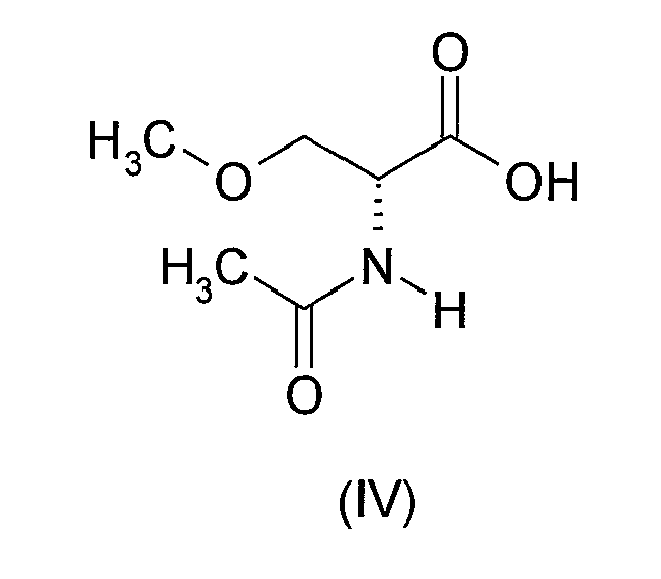
- Step (ii) of the process in accordance with the present invention comprises the acetylation of O -methyl-D-serine (III) to provide compound (IV) in substantially optically pure form.
- This transformation may be accomplished by utilising any conventional acetylation procedure known from the art.
- compound (III) will be treated with an acetylating agent in a suitable organic solvent, optionally in the presence of a reaction promoter.
- a suitable acetylating agent may be acetic anhydride or an acetyl halide, e.g. acetyl chloride.
- Suitable solvents of use in conjunction with the acetylation reaction include halogenated hydrocarbons such as dichloromethane; aromatic heterocycles such as pyridine; and cyclic ethers such as tetrahydrofuran.
- a typical promoter for use in conjunction with the acetylation reaction is 4-(dimethylamino)pyridine.
- the acetylation reaction is effected by treating compound (III) with acetic anhydride in a mixture of tetrahydrofuran and water.
- the ratio of tetrahydrofuran to water will be from 4:1 to 16:1 parts by volume.
- the ratio of tetrahydrofuran to water will be from 5:1 to 12:1 parts by volume.
- the ratio of tetrahydrofuran to water will be from 5:1 to 10:1 parts by volume.
- the ratio of tetrahydrofuran to water will be from 6:1 to 8:1 parts by volume.
- the ratio of tetrahydrofuran to water is in the region of 6:1 parts by volume.
- Step (iii) of the process according to the present invention comprises activating the carboxy group of compound (IV) to provide compound (V) in substantially optically pure form.
- the carboxy activating group Q 1 in the compounds of formula (V) above may suitably represent halogen, C 1-6 alkoxy, (C 1-6 )alkylcarbonyloxy or (C 1-6 )alkoxycarbonyloxy.
- Typical values of Q 1 include chloro, methoxy, ethoxy, tert -butoxy, acetoxy and isobutoxycarbonyloxy.
- Q 1 represents isobutoxycarbonyloxy, i.e. -OC(O)OCH 2 CH(CH 3 ) 2 .
- the reaction typically comprises treating compound (IV) with an isobutyl haloformate, e.g. isobutyl chloroformate.
- an isobutyl haloformate e.g. isobutyl chloroformate.
- the reaction is conveniently effected in a suitable organic solvent, e.g. a cyclic ether such as tetrahydrofuran, advantageously at a low temperature, e.g. a temperature in the region of -20°C, in the presence of a reagent such as 4-methylmorpholine.
- Step (iv) of the process according to the present invention comprises reacting compound (V) with benzylamine.
- the reaction is conveniently effected in a suitable organic solvent, e.g. a cyclic ether such as tetrahydrofuran, or an organic ester such as ethyl acetate.
- a suitable organic solvent e.g. a cyclic ether such as tetrahydrofuran, or an organic ester such as ethyl acetate.
- the reaction will be effected in tetrahydrofuran.
- the reaction will be performed at a low temperature, e.g. a temperature in the region of -20°C.
- the reaction may be performed directly on the reaction mixture from step (iii), without any need for isolation or purification of the material obtained from step (iii).
- reaction mixture is ideally quenched with an acidic solution, suitably an aqueous solution of an inorganic acid, e.g. a mineral acid such as hydrochloric acid, advantageously at a low temperature, e.g. a temperature in the region of -20°C.
- an acidic solution suitably an aqueous solution of an inorganic acid, e.g. a mineral acid such as hydrochloric acid, advantageously at a low temperature, e.g. a temperature in the region of -20°C.
- the present invention provides a process for the preparation of lacosamide of formula (I), as depicted above, in substantially optically pure form, which comprises the following steps:
- Step (a) of the above-described process comprises the acetylation of O-methyl-D,L-serine (II) to provide compound (XII).
- This transformation may be accomplished by utilising any conventional acetylation procedure known from the art.
- compound (II) will be treated with an acetylating agent in a suitable organic solvent, optionally in the presence of a reaction promoter, under reaction conditions analogous to those described above for the acetylation of compound (III).
- Step (b) of the above-described process comprises the resolution of compound (XII) to provide compound (IV) in substantially optically pure form. Resolution may suitably be accomplished by various conventional methods known from the prior art, as described above in relation to step (i).
- the resolution of compound (XII) may be effected by a biochemical process.
- a preferred biochemical process is enzymatic resolution.
- suitable enzymes of use in the enzymatic resolution procedure include the following:
- the enzymatic resolution procedure is conveniently carried out by contacting compound (XII) with the selected enzyme in an aqueous solution of a buffer adjusted to a pH of approximately 7.5-8.0, with subsequent elimination of the enzyme.
- the enzyme will be eliminated by denaturation.
- the denaturation procedure may suitably be effected by treatment with acid, e.g. a mineral acid such as hydrochloric acid, and injection onto an ion exchange resin such as Dowex 50W4-50.
- the denaturation procedure may involve heat treatment in a suitable organic solvent, e.g. a C 1-4 alkanol such as methanol.
- compound (IV) above may be prepared in substantially optically pure form from a compound of formula (VII) as defined above by means of a process which comprises the following steps:
- Step ( ⁇ ) of the above-described process comprises the acetylation of compound (VII) to provide compound of (XIII). This transformation may be accomplished by methods analogous to those described for step (ii) above in relation to the acetylation of compound (III).
- Step ( ⁇ ) of the above-described process comprises the de-esterification of compound (XIII) to provide compound (IV) in substantially optically pure form. This transformation may be accomplished by methods analogous to those described for step (i-C) above in relation to the de-esterification of compound (VII).
- the present invention accordingly provides the reaction product of the above-described process containing a detectable amount of the by-product of formula (XIV) above.
- detectable amount is meant typically up to 1.0%, suitably up to 0.5%, generally up to 0.4%, preferably up to 0.3%, more preferably up to 0.2%, still more preferably up to 0.1%, yet more preferably up to 0.05%, most preferably up to 0.01 %.
- lacosamide (I) can be prepared in substantially optically pure form from compound (III) above by a process which comprises the following steps:
- Step (A) of the above-described process comprises reacting compound (III) with phosgene.
- compound (III) will be reacted with gaseous phosgene or with triphosgene.
- the reaction may conveniently be effected in a suitable organic solvent, typically an ethereal solvent such as tetrahydrofuran or diethyl ether.
- Step (B) of the above-described process is a benzylation reaction, which may suitably be effected by utilising reaction conditions analogous to those described in step (iv) above for the benzylation of compound (V).
- Step (C) of the above-described process comprises the acetylation of compound (XV) to provide lacosamide (I).
- This transformation may be accomplished by utilising any conventional acetylation procedure known from the art.
- compound (XV) will be treated with an acetylating agent in a suitable organic solvent, optionally in the presence of a reaction promoter, under reaction conditions analogous to those described above for the acetylation of compound (III).
- N- acetyl-D-phenylalanine salt of O-methyl-D-serine (3.4 g, 25%) was obtained as a white solid with a chiral purity >90%.
- Regeneration of the title compound could be effected by adjustment of the pH to 1-2 by treatment with HCl, followed by extraction into an organic solvent and subsequent adjustment of the pH to ⁇ 7 with NaOH.
- the aqueous solution was basified with aqueous Na 2 CO 3 solution (1M; 0.28 mol) at 5-10°C.
- the reaction mixture was extracted with dichloromethane (3 x 330 mL) at 25-30°C.
- the organic layer was dried over Na 2 SO 4 and the solvent was evaporated under reduced pressure to afford O- methyl-D-serine benzyl ester as a light brown liquid (32.6 g, 66%).
- Chiral purity 94.6%.
- Chemical purity 98.3%.
- N -acetyl- O -methyl-D,L-serine (3 g) was dissolved in demineralized water (30 mL) and the pH was adjusted to 7.5-8.0 with 5N sodium hydroxide solution.
- Acylase I from Porcine Kidney (EC.3.5.1.14) 50 mg was added and the solution maintained at 25°C under mild agitation overnight.
- the pH was adjusted to 2.7 with concentrated HCl and the aqueous solution injected onto Dowex 50W4-50 ion exchange resin (50 mL) conditioned at pH 3.8.
- the resulting material was eluted with water at pH 2.4.
- the aqueous solution thereby obtained was then evaporated to dryness under vacuum to afford the title compound (1.5 g, 50%) as an offwhite solid.
- Benzylamine (3.39 mL, 31.05 mmol) was added directly into the reaction mixture via a syringe at -20°C over a period of 10 minutes. The temperature of the reaction mixture was maintained at -20°C for a further 20 minutes. The reaction mixture was quenched with aqueous HCl (1M; 21.88 mL). Solvent was removed by evaporation at 45-50°C, and crude material (16 g) was isolated. Ethyl acetate (50 mL) was added, and the reaction mixture was washed with water (2 x 2.5 mL). The organic layer was dried over sodium sulphate and the solvent was completely removed by evaporation to give crude material (5.77 g).
Landscapes
- Chemical & Material Sciences (AREA)
- Organic Chemistry (AREA)
- Chemical Kinetics & Catalysis (AREA)
- Wood Science & Technology (AREA)
- Life Sciences & Earth Sciences (AREA)
- Engineering & Computer Science (AREA)
- Zoology (AREA)
- Biotechnology (AREA)
- Microbiology (AREA)
- General Chemical & Material Sciences (AREA)
- Health & Medical Sciences (AREA)
- Biochemistry (AREA)
- Bioinformatics & Cheminformatics (AREA)
- General Engineering & Computer Science (AREA)
- General Health & Medical Sciences (AREA)
- Genetics & Genomics (AREA)
- Analytical Chemistry (AREA)
- Organic Low-Molecular-Weight Compounds And Preparation Thereof (AREA)
Abstract
The present invention provides a process for the preparation of lacosamide in substantially optically pure form, which in one aspect comprises the following steps:
(i) resolution of O-methyl-D,L-serine to provide O-methyl-D-serine in substantially optically pure form;
(ii) acetylation of O-methyl-D-serine thereby obtained to provide the N-acetyl derivative thereof in substantially optically pure form;
(iii) activating the carboxy group of the compound thereby obtained; and
(iv) reacting the compound thereby obtained with benzylamine.
(i) resolution of O-methyl-D,L-serine to provide O-methyl-D-serine in substantially optically pure form;
(ii) acetylation of O-methyl-D-serine thereby obtained to provide the N-acetyl derivative thereof in substantially optically pure form;
(iii) activating the carboxy group of the compound thereby obtained; and
(iv) reacting the compound thereby obtained with benzylamine.
Description
- The present invention relates to the preparation of a therapeutically active compound. More particularly, the invention concerns an improved process for manufacturing lacosamide.
- Lacosamide, i.e. (R)-2-acetylamino-N-benzyl-3-methoxypropionamide, has been approved for sale as a medicine by regulatory agencies throughout the world. By way of illustration, the US Food and Drug Administration (FDA) and the European Medicines Evaluation Agency (EMEA) have both approved lacosamide as adjunctive therapy in the treatment of partial-onset seizures in patients with epilepsy.
- Various methods for preparing lacosamide are known from the prior art. For example,
WO 2010/052011 describes a process for manufacturing substantially optically pure lacosamide comprising resolution of 2-acetamido-N-benzyl-3-methoxypropionamide, typically in racemic form, into its (R) and (S) enantiomers; racemisation of the (S) isomer thereby obtained; and further resolution of the resulting 2-acetamido-N-benzyl-3-methoxypropionamide. -
WO 2006/037574 describes a method of producing lacosamide comprising the O-methylation of a hydroxy precursor. - The present invention provides an attractive process for manufacturing lacosamide on a commercial scale. Lacosamide is obtained from the process in high chemical and optical purity. The process in accordance with the invention displays significant economic advantages in that it commences from relatively inexpensive starting materials, as well as providing lacosamide in a short sequence of high yielding steps.
- Thus, the present invention provides a process for the preparation of lacosamide of formula (I):

- (i) resolution of O-methyl-D,L-serine of formula (II):


- (ii) acetylation of O-methyl-D-serine of formula (III) thereby obtained to provide the compound of formula (IV):
- (iii) activating the carboxy group of the compound of formula (IV) thereby obtained to provide a compound of formula (V):

- The expression "substantially optically pure" as used herein when referring to a particular compound means that, in any given sample of that compound, at least 95%, preferably at least 96%, more preferably at least 97%, still more preferably at least 98%, most preferably at least 99%, of a specified chiral centre is in the (R) or (S) configuration.
- Therefore, the expression "in substantially optically pure form" in relation to lacosamide means that, in a given sample of lacosamide, at least 95%, preferably at least 96%, more preferably at least 97%, still more preferably at least 98%, most preferably at least 99%, of the 2-acetylamino-N-benzyl-3-methoxypropionamide molecules within the sample are molecules in which the chiral centre is in the (R) configuration.
- The process in accordance with the present invention commences from the known compound O-methyl-D,L-serine of formula (II) above. Typical methods for preparing compound (II) are described in J. Biol. Chem., 1936, 793; J. Biol. Chem., 1933, 511; Org. Synth. Coll., 1955, Vol. 3, 774; and references cited therein. Compound (II) is commercially available from a variety of suppliers, including Shanghai Hanhong Chemicals (Shanghai, China) and Manus Aktteva (Ahmedabad, India). Of crucial importance for the present purposes, compound (II) is relatively inexpensive, with a purchase price for manufacturing scale quantities (as at mid-2010) being typically in the region of €100 per kilogram.
- Step (i) of the above-described process comprises the resolution of O-methyl-D,L-serine of formula (II) above to provide O-methyl-D-serine of formula (III) above in substantially optically pure form.
- The term "resolution" as used herein refers to the separation of a mixture of enantiomers into its corresponding individual enantiomers. The enantiomers may be present in the mixture in various ratios of one enantiomer versus the opposite enantiomer. Typical ratios of enantiomers according to the present invention range from about 3:97 to 97:3, preferably from about 5:95 to 95:5, more preferably from about 30:70 to 70:30, still more preferably from about 40:60 to 60:40, even more preferably from about 45:55 to 55:45.
- In a particular embodiment, the mixture is a racemic mixture, i.e. a mixture comprising 50% of one enantiomer and 50% of the opposite enantiomer.
- Resolution may suitably be accomplished by various conventional methods known from the prior art. Such methods may include conversion to diastereoisomers; differential absorption; chiral recognition; biochemical processes; mechanical separation; kinetic resolution; and deracemization. A general description of resolution methods is provided in M.B. Smith & J. March, "March's Advanced Organic Chemistry", fifth edition, Wiley-Interscience, 2001, Chapter 4, pages 125-217; in particular pages 151-155. A more detailed description of resolution methods with particular reference to lacosamide is provided in
WO 2010/052011 . - By way of example, diastereomeric derivatives, e.g. salts, may be produced by reacting the enantiomer mixture of formula (II) with an appropriate chiral compound, e.g. a chiral acid or a chiral base. The resulting mixture of diastereomers may then be separated, followed by regeneration of the desired enantiomer of formula (III). Typically, the enantiomer mixture of formula (II) is treated with a chiral acid; the resulting mixture of diastereomeric salts is separated; then the desired enantiomer of formula (III) is regenerated. Examples of suitable chiral acids include the following:
- ● N-acetyl-D-phenylalanine
- ● N-acetyl-(R)-naphthylalanine
- ● dibenzoyl-D-tartaric acid
- ● (R)-(-)-mandelic acid
- ● N-acetyl-D-glutamic acid
- ● N-benzyloxycarbonyl-D-tyrosine
- ● N-acetyl-D-methionine
- ● (-)-camphanic acid
- Favourably, the chiral acid is N-acetyl-D-phenylalanine or N-acetyl-(R)-naphthylalanine. In one embodiment, the chiral acid is N-acetyl-D-phenylalanine. In another embodiment, the chiral acid is N-acetyl-(R)-naphthylalanine.
- Treatment of the enantiomer mixture of formula (II) with the selected chiral acid is conveniently effected at an elevated temperature, e.g. a temperature in the region of 50°C, in a suitable solvent, e.g. a C1-4 alkanol such as methanol or ethanol, optionally in admixture with water. Following separation of the resulting mixture of diastereomeric salts, the desired enantiomer of formula (III) may then be regenerated in high optical purity and good yield by treatment with an acid, then with a base, at controlled pH. The acid is suitably a mineral acid, e.g. hydrochloric acid, and it is added in sufficient quantity to adjust the pH to approximately 1-2. Following extraction of the resulting material into an organic solvent, the pH is adjusted to approximately 7 by treatment with a base, typically an alkali metal hydroxide such as sodium hydroxide, whereby the desired enantiomer of formula (III) is regenerated.
- In a particular embodiment, compound (III) may be obtained in substantially optically pure form from compound (II) by means of a process which comprises the following steps:
- (i-A) conversion of O-methyl-D,L-serine of formula (II) as depicted above into an ester derivative of formula (VI):

R1 represents aryl(C1-6)alkyl or heteroaryl(C1-6)alkyl, either of which groups may be optionally substituted by one or more substituents; - (i-B) resolution of the compound of formula (VI) thereby obtained to provide a compound of formula (VII):

- The expression "(C1-6)alkyl" as used herein is intended to include straight-chained and branched C1-6 alkyl groups, for example C1-4 alkyl groups. Typical examples include methyl and ethyl groups, and straight-chained or branched propyl, butyl and pentyl groups. Particular alkyl groups include methyl, ethyl, n-propyl, isopropyl, n-butyl, sec-butyl, isobutyl, tert-butyl, 2,2-dimethylpropyl and 3-methylbutyl.
- Suitable aryl groups include phenyl and naphthyl, preferably phenyl.
- Suitable aryl(C1-6)alkyl groups include benzyl, phenylethyl, phenylpropyl and naphthylmethyl, preferably benzyl.
- Suitable heteroaryl groups include furyl, benzofuryl, dibenzofuryl, thienyl, benzothienyl, dibenzothienyl, pyrrolyl, indolyl, pyrazolyl, indazolyl, oxazolyl, benzoxazolyl, isoxazolyl, thiazolyl, benzothiazolyl, isothiazolyl, imidazolyl, benzimidazolyl, purinyl, oxadiazolyl, thiadiazolyl, triazolyl, benzotriazolyl, tetrazolyl, pyridinyl, quinolinyl, isoquinolinyl, pyrrolo[2,3-b]pyridinyl, pyrrolo[3,2-c]pyridinyl, pyrazolo[1,5-a]pyridinyl, imidazo[1,2-a]pyridinyl, imidazo[4,5-b]pyridinyl, naphthyridinyl, pyridazinyl, cinnolinyl, phthalazinyl, pyrimidinyl, quinazolinyl, pyrazolo[3,4-d]pyrimidinyl, imidazo[1,2-a]pyrimidinyl, pyrazinyl, imidazo[1,2-a]-pyrazinyl, quinoxalinyl, pteridinyl, triazinyl and chromenyl groups.
- In one embodiment, R1 represents aryl(C1-6)alkyl, which group may be optionally substituted by one or more substituents. In another embodiment, R1 represents heteroaryl(C1-6)alkyl, which group may be optionally substituted by one or more substituents.
- Suitably, R1 represents benzyl, which group may be optionally substituted by one or more substituents.
- In one embodiment, R1 is unsubstituted. In another embodiment, R1 is substituted by one or more substituents, preferably by one or two substituents. In one aspect of that embodiment, R1 is monosubstituted. In another aspect of that embodiment, R1 is disubstituted.
- Examples of suitable substituents on R1 independently include halogen, cyano, nitro, C1-6 alkyl, trifluoromethyl, hydroxy, C1-6 alkoxy, difluoromethoxy, trifluoromethoxy, C1-6 alkylthio, C1-6 alkylsulfinyl, C1-6 alkylsulfonyl, amino, C1-6 alkylamino, di(C1-6)alkylamino, C2-6 alkylcarbonylamino, C2-6 alkoxycarbonylamino, C1-6 alkylsulfonylamino, formyl, C2-6 alkylcarbonyl, carboxy, C2-6 alkoxycarbonyl, aminocarbonyl, C1-6 alkylaminocarbonyl, di(C1-6)alkylaminocarbonyl, aminosulfonyl, C1-6 alkylaminosulfonyl and di(C1-6)alkylaminosulfonyl.
- The term "halogen" as used herein is intended to include fluorine, chlorine, bromine and iodine atoms, typically fluorine, chlorine or bromine.
- Examples of particular substituents on R1 independently include fluoro, chloro, bromo, cyano, nitro, methyl, ethyl, trifluoromethyl, hydroxy, methoxy, difluoromethoxy, trifluoromethoxy, methylthio, methylsulfinyl, methylsulfonyl, amino, methylamino, dimethylamino, acetylamino, methoxycarbonylamino, methylsulfonylamino, formyl, acetyl, carboxy, methoxycarbonyl, aminocarbonyl, methylaminocarbonyl, dimethylaminocarbonyl, aminosulfonyl, methylaminosulfonyl and dimethylaminosulfonyl.
- In a particular embodiment, R1 represents benzyl.
- Step (i-A) of the above-described process comprises the conversion of O-methyl-D,L-serine (II) into the ester derivative (VI). This transformation may be achieved by reacting O-methyl-D,L-serine (II) with a compound of formula R1-L1, wherein R1 is as defined above, and L1 represents a suitable leaving group.
- The leaving group L1 is typically a halogen atom, e.g. bromo.
- The reaction is conveniently effected under basic conditions, typically in the presence of an inorganic base, suitably an alkali metal carbonate or bicarbonate, e.g. sodium carbonate, potassium carbonate, sodium bicarbonate or potassium bicarbonate (see, for example, Letters in Organic Chemistry, 2010, 7, 39-44).
- Alternatively, the ester derivative (VI) may be prepared by reacting O-methyl-D,L-serine (II) with a compound of formula R1-OH, wherein R1 is as defined above. The reaction is conveniently effected under acidic conditions, i.e. by bringing the reactants together in the presence of a strong acid, optionally at an elevated temperature. Suitable acids include p-toluenesulphonic acid (see, for example, European Journal of Medicinal Chemistry, 2010, 45, 1717-1723; and Tetrahedron, 2009, 65, 9702-9706) and hydrochloric acid (see, for example, Synthesis, 2009, 2184-2204).
- Step (i-B) of the above-described process comprises the resolution of compound (VI) to provide compound (VII) in substantially optically pure form. As acknowledged above, resolution may suitably be accomplished by various conventional methods known from the prior art.
- Typically, the enantiomer mixture of formula (VI) is treated with a chiral acid; the resulting mixture of diastereomeric salts is separated; then the desired enantiomer of formula (VII) is regenerated. Examples of suitable chiral acids include N-acetyl-L-leucine, N-acetyl-L-methionine and N-acetyl-L-glutamine.
- In a particular embodiment, the enantiomer mixture of formula (VI) is treated with N-acetyl-L-methionine. Separation of the resulting mixture of diastereomeric salts is then followed by regeneration of the desired enantiomer of formula (VII). The reaction between compound (VI) and N-acetyl-L-methionine is conveniently effected by stirring the reactants in a suitable solvent, typically an organic solvent such as 4-methyl-2-pentanone (methyl isobutyl ketone). After separation of the resulting mixture of diastereomeric salts, regeneration of the desired enantiomer (VII) may be accomplished by treating an aqueous solution of the material thereby obtained with an alkaline solution, typically an aqueous solution of an inorganic base, e.g. an alkali metal carbonate such as sodium carbonate. By proceeding in this manner, the desired enantiomer of formula (VII) may be obtained in high yield, and high chemical and optical purity.
- Step (i-C) of the above-described process comprises the de-esterification of compound (VII). This transformation may be accomplished by utilising any conventional de-esterification procedure known from the art.
- In a typical embodiment, the de-esterification of compound (VII) may be effected by treatment with an alkaline solution, typically an aqueous solution of an inorganic base, e.g. an alkali metal hydroxide such as lithium hydroxide or sodium hydroxide.
- Where R1 in compound (VII) represents optionally substituted benzyl, the de-esterification may suitably be effected by treating compound (VII) with gaseous hydrogen in the presence of a hydrogenation catalyst. The catalyst may be any hydrogenation catalyst known from the art, but will suitably be palladium on carbon. The reaction will conveniently be carried out under an elevated pressure in a suitable solvent, e.g. a lower alkanol such as methanol.
- The procedure for obtaining compound (III) in substantially optically pure form from compound (II), as described in steps (i-A), (i-B) and (i-C) above, is a novel process and constitutes a further feature of the present invention.
- Furthermore, the procedure for obtaining compound (III) in substantially optically pure form from compound (VI), as described in steps (i-B) and (i-C) above, is a novel process and constitutes a further feature of the present invention.
- In an alternative procedure, the compounds of formula (VI) above may be prepared by means of a process which comprises the following steps:
- (i-A-α) protection of the amino group of D,L-serine of formula (VIII):


- (i-A-β) O-methylation of the compound of formula (IX) thereby obtained to provide a compound of formula (X):
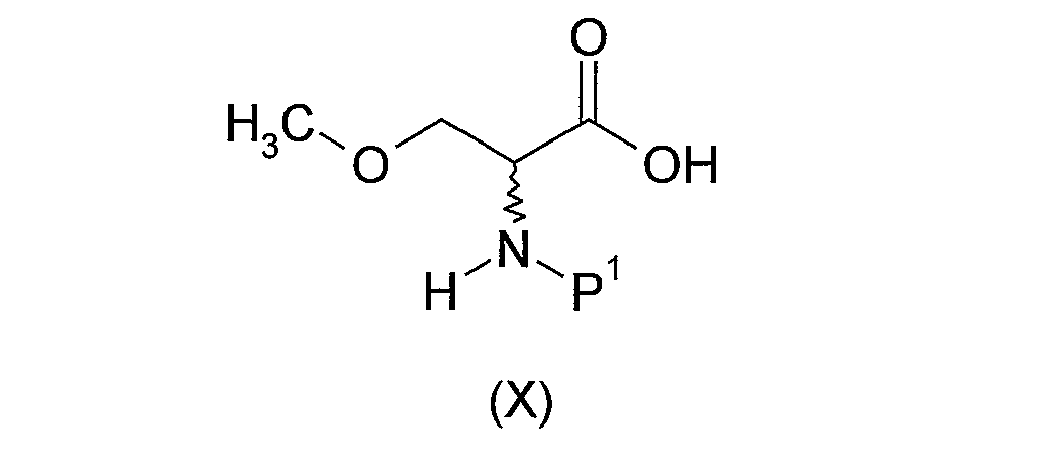
- (i-A-γ) conversion of the compound of formula (X) thereby obtained into an ester derivative of formula (XI):

(i-A-δ) removal of the N-protecting group P1 from the compound of formula (XI) thereby obtained. - Step (i-A-α) of the above-described process comprises the protection of the amino group of D,L-serine of formula (VIII) above to provide a compound of formula (IX) above.
- Protection of the amino group of compound (VIII) may be achieved by means of conventional protecting groups, such as those described in Protective Groups in Organic Chemistry, ed. J.F.W. McOmie, Plenum Press, 1973; and T.W. Greene & P.G.M. Wuts, Protective Groups in Organic Synthesis, John Wiley & Sons, 3rd edition, 1999.
- In a particular embodiment, the N-protecting group P1 is tert-butoxycarbonyl, in which case the preparation of compound (IX) will suitably be effected by treating compound (VIII) with di-tert-butyl dicarbonate, ideally under basic conditions. The reaction may conveniently be carried out in a suitable organic solvent, typically an ethereal solvent, e.g. a cyclic ether such as 1,4-dioxane, optionally in admixture with water, in the presence of a base, typically an inorganic base, e.g. an alkali metal hydroxide such as sodium hydroxide.
- Step (i-A-β) of the above-described process comprises the O-methylation of compound (IX) to provide compound (X). The reaction will generally be mediated by treatment of compound (IX) with a methylating agent. Examples of typical methylating agents are described in prior art publications. Such publications include
US patent no. 5,773,475 andWO 2006/037574 . - In a particular embodiment, the methylating agent is dimethyl sulphate. The O-methylation reaction may conveniently be carried out in a suitable organic solvent, e.g. an aromatic hydrocarbon such as toluene, optionally in admixture with water, in the presence of a reagent such as tetrabutylammonium bromide and a base, typically an inorganic base, e.g. an alkali metal hydroxide such as sodium hydroxide.
- Step (i-A-γ) of the above-described process comprises the conversion of compound (X) into the ester derivative (XI). This transformation may be achieved by utilising reaction conditions analogous to those described above for the conversion of compound (II) into compound (VI). Thus, compound (X) may suitably be reacted with a compound of formula R1-L1, wherein R1 and L1 are as defined above.
- The reaction is conveniently effected under basic conditions, typically in the presence of an inorganic base, suitably an alkali metal carbonate such as potassium carbonate.
- Step (i-A-δ) of the above-described process comprises the removal of the N-protecting group P1 from compound (XI).
- The deprotection of compound (XI) may be effected by conventional methodology, including techniques analogous to those described in Protective Groups in Organic Chemistry, ed. J.F.W. McOmie, Plenum Press, 1973; and T.W. Greene & P.G.M. Wuts, Protective Groups in Organic Synthesis, John Wiley & Sons, 3rd edition, 1999.
- Where P1 represents tert-butoxycarbonyl, the deprotection of compound (XI), i.e. the removal of P1, may be achieved by treating compound (XI) with an acid, generally an inorganic acid or an organic acid. In one embodiment, the acid is an inorganic acid. Suitable inorganic acids include mineral acids such as hydrochloric acid. In an alternative embodiment, the acid is an organic acid. A particular organic acid is trifluoroacetic acid.
- Step (ii) of the process in accordance with the present invention comprises the acetylation of O-methyl-D-serine (III) to provide compound (IV) in substantially optically pure form. This transformation may be accomplished by utilising any conventional acetylation procedure known from the art. Typically, compound (III) will be treated with an acetylating agent in a suitable organic solvent, optionally in the presence of a reaction promoter.
- A suitable acetylating agent may be acetic anhydride or an acetyl halide, e.g. acetyl chloride. Suitable solvents of use in conjunction with the acetylation reaction include halogenated hydrocarbons such as dichloromethane; aromatic heterocycles such as pyridine; and cyclic ethers such as tetrahydrofuran.
- A typical promoter for use in conjunction with the acetylation reaction is 4-(dimethylamino)pyridine.
- In a particularly advantageous embodiment, the acetylation reaction is effected by treating compound (III) with acetic anhydride in a mixture of tetrahydrofuran and water. Generally, the ratio of tetrahydrofuran to water will be from 4:1 to 16:1 parts by volume. Usually, the ratio of tetrahydrofuran to water will be from 5:1 to 12:1 parts by volume. Typically, the ratio of tetrahydrofuran to water will be from 5:1 to 10:1 parts by volume. Suitably, the ratio of tetrahydrofuran to water will be from 6:1 to 8:1 parts by volume. Ideally, the ratio of tetrahydrofuran to water is in the region of 6:1 parts by volume. By application of these reaction conditions, it has been found that compound (IV) may be obtained in high yield, and high chemical and optical purity.
- Step (iii) of the process according to the present invention comprises activating the carboxy group of compound (IV) to provide compound (V) in substantially optically pure form.
- The carboxy activating group Q1 in the compounds of formula (V) above may suitably represent halogen, C1-6 alkoxy, (C1-6)alkylcarbonyloxy or (C1-6)alkoxycarbonyloxy.
- Typical values of Q1 include chloro, methoxy, ethoxy, tert-butoxy, acetoxy and isobutoxycarbonyloxy. In a particular embodiment, Q1 represents isobutoxycarbonyloxy, i.e. -OC(O)OCH2CH(CH3)2.
- Conversion of compound (IV) into compound (V) will typically be accomplished utilising conventional methodology well known from the art.
- Where Q1 represents isobutoxycarbonyloxy, the reaction typically comprises treating compound (IV) with an isobutyl haloformate, e.g. isobutyl chloroformate. The reaction is conveniently effected in a suitable organic solvent, e.g. a cyclic ether such as tetrahydrofuran, advantageously at a low temperature, e.g. a temperature in the region of -20°C, in the presence of a reagent such as 4-methylmorpholine.
- Step (iv) of the process according to the present invention comprises reacting compound (V) with benzylamine. The reaction is conveniently effected in a suitable organic solvent, e.g. a cyclic ether such as tetrahydrofuran, or an organic ester such as ethyl acetate. Advantageously, the reaction will be effected in tetrahydrofuran. Advantageously, the reaction will be performed at a low temperature, e.g. a temperature in the region of -20°C. Ideally, the reaction may be performed directly on the reaction mixture from step (iii), without any need for isolation or purification of the material obtained from step (iii).
- After compound (V) has been allowed to react with benzylamine, the reaction mixture is ideally quenched with an acidic solution, suitably an aqueous solution of an inorganic acid, e.g. a mineral acid such as hydrochloric acid, advantageously at a low temperature, e.g. a temperature in the region of -20°C. By proceeding in this manner, it has been found that lacosamide (I) may be obtained in high yield, and high chemical and optical purity.
- The procedure for obtaining lacosamide (I) in substantially optically pure form from compound (III), as described in steps (ii), (iii) and (iv) above, is a novel process and constitutes a further feature of the present invention.
- In an alternative aspect, the present invention provides a process for the preparation of lacosamide of formula (I), as depicted above, in substantially optically pure form, which comprises the following steps:
- (a) acetylation of O-methyl-D,L-serine of formula (II) as depicted above to provide the compound of formula (XII):

- (b) resolution of the compound of formula (XII) thereby obtained to provide the compound of formula (IV), as depicted above, in substantially optically pure form;
- (c) activating the carboxy group of the compound of formula (IV) thereby obtained, as described for step (iii) above, to provide a compound of formula (V), as depicted above, in substantially optically pure form; and
- (d) reacting the compound of formula (V) thereby obtained with benzylamine, as described for step (iv) above.
- Step (a) of the above-described process comprises the acetylation of O-methyl-D,L-serine (II) to provide compound (XII). This transformation may be accomplished by utilising any conventional acetylation procedure known from the art. Typically, compound (II) will be treated with an acetylating agent in a suitable organic solvent, optionally in the presence of a reaction promoter, under reaction conditions analogous to those described above for the acetylation of compound (III).
- Step (b) of the above-described process comprises the resolution of compound (XII) to provide compound (IV) in substantially optically pure form. Resolution may suitably be accomplished by various conventional methods known from the prior art, as described above in relation to step (i).
- Suitably, the resolution of compound (XII) may be effected by a biochemical process. A preferred biochemical process is enzymatic resolution. Examples of suitable enzymes of use in the enzymatic resolution procedure include the following:
- ● acylase I from Aspergillus melleus
- ● acylase I from porcine kidney
- ● acylase I from Aspergillus specie, immobilised on Eupergit®
- ● esterase from porcine liver
- ● esterase from horse liver
- ● esterase from Bacillus sp.
- ● lipase from Rhizopus arrhizus
- ● lipase from Aspergillus
- ● lipase from Candida antarctica
- ● lipase from Rhizopus niveus
- ● lipase from hog pancreas
- ● lipase from Penicillium roqueforti
- The enzymatic resolution procedure is conveniently carried out by contacting compound (XII) with the selected enzyme in an aqueous solution of a buffer adjusted to a pH of approximately 7.5-8.0, with subsequent elimination of the enzyme. Typically, the enzyme will be eliminated by denaturation. The denaturation procedure may suitably be effected by treatment with acid, e.g. a mineral acid such as hydrochloric acid, and injection onto an ion exchange resin such as Dowex 50W4-50. Alternatively, the denaturation procedure may involve heat treatment in a suitable organic solvent, e.g. a C1-4 alkanol such as methanol.
- The procedure for obtaining compound (IV) in substantially optically pure form from compound (II), as described in steps (a) and (b) above, is a novel process and constitutes a further feature of the present invention.
- In a further procedure, compound (IV) above may be prepared in substantially optically pure form from a compound of formula (VII) as defined above by means of a process which comprises the following steps:
- (α) acetylation of a compound of formula (VII) as defined above to provide a compound of formula (XIII):

- (β) de-esterification of the compound of formula (XIII) thereby obtained.
- Step (α) of the above-described process comprises the acetylation of compound (VII) to provide compound of (XIII). This transformation may be accomplished by methods analogous to those described for step (ii) above in relation to the acetylation of compound (III).
- Step (β) of the above-described process comprises the de-esterification of compound (XIII) to provide compound (IV) in substantially optically pure form. This transformation may be accomplished by methods analogous to those described for step (i-C) above in relation to the de-esterification of compound (VII).
- The procedure for obtaining compound (IV) in substantially optically pure form from compound (VII), as described in steps (α) and (β) above, is a novel process and constitutes a further feature of the present invention.
- Following repeated experimental runs of the process in accordance with the present invention, a characteristic by-product has been detected as an impurity which is produced alongside the desired product lacosamide (I), even after several crystallisations (i.e. at least two crystallisations) of the final product. The chemical structure of the by-product is as depicted in formula (XIV) below:
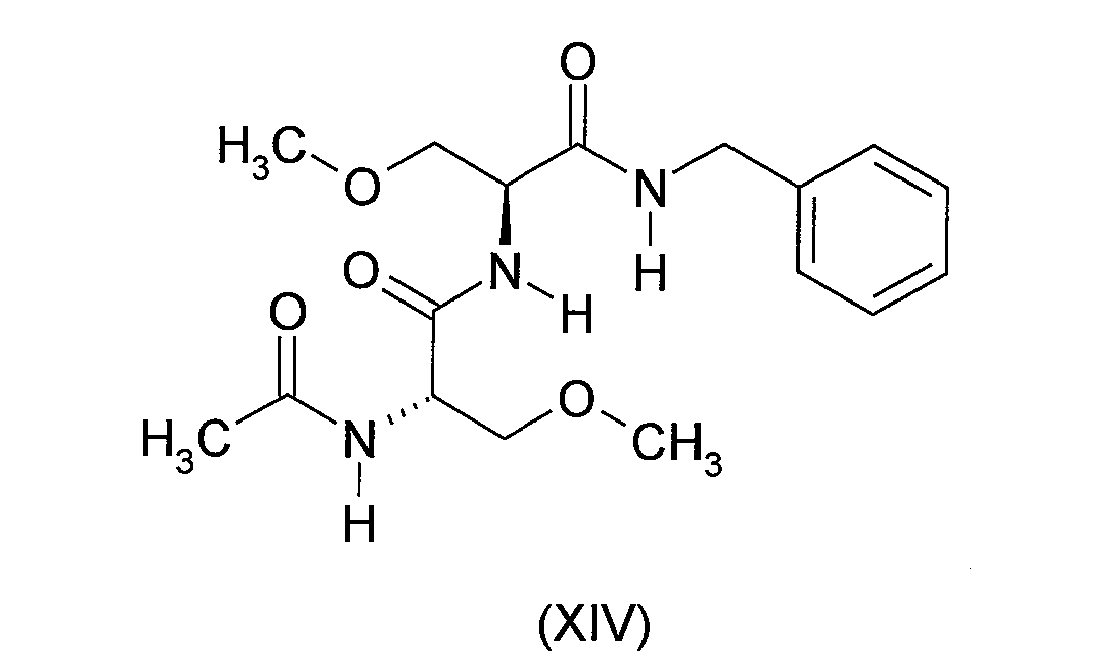
- It is believed that the by-product of formula (XIV) above is formed by dimerisation of certain intermediates present in the reaction vessel under the prevailing reaction conditions.
- The present invention accordingly provides the reaction product of the above-described process containing a detectable amount of the by-product of formula (XIV) above. By "detectable amount" is meant typically up to 1.0%, suitably up to 0.5%, generally up to 0.4%, preferably up to 0.3%, more preferably up to 0.2%, still more preferably up to 0.1%, yet more preferably up to 0.05%, most preferably up to 0.01 %.
- The by-product of formula (XIV) above is a novel compound and constitutes a further feature of the present invention.
- It has also been found that lacosamide (I) can be prepared in substantially optically pure form from compound (III) above by a process which comprises the following steps:
- (A) reaction of O-methyl-D-serine of formula (III), as depicted above, with phosgene;
- (B) reacting the product thereby obtained with benzylamine, to provide the compound of formula (XV):

- (C) acetylation of the compound of formula (XV) thereby obtained.
- Step (A) of the above-described process comprises reacting compound (III) with phosgene. Suitably, compound (III) will be reacted with gaseous phosgene or with triphosgene. The reaction may conveniently be effected in a suitable organic solvent, typically an ethereal solvent such as tetrahydrofuran or diethyl ether.
- Step (B) of the above-described process is a benzylation reaction, which may suitably be effected by utilising reaction conditions analogous to those described in step (iv) above for the benzylation of compound (V).
- Step (C) of the above-described process comprises the acetylation of compound (XV) to provide lacosamide (I). This transformation may be accomplished by utilising any conventional acetylation procedure known from the art. Typically, compound (XV) will be treated with an acetylating agent in a suitable organic solvent, optionally in the presence of a reaction promoter, under reaction conditions analogous to those described above for the acetylation of compound (III).
- The following non-limiting Examples are intended to illustrate the present invention.
- Into a 250 mL round-bottomed flask equipped with a stirrer, reflux condenser and thermometer was added O-methyl-D,L-serine (5 g) in 90:10 methanol/water (25 mL). N-Acetyl-D-phenylalanine (8.70 g) was added in one portion and the mixture heated to 50°C overnight. The suspension was cooled to room temperature and filtered, and the solid was rinsed with 90:10 methanol/water (5 mL) and dried at 40°C under vacuum for 3 h. The N-acetyl-D-phenylalanine salt of O-methyl-D-serine (3.4 g, 25%) was obtained as a white solid with a chiral purity >90%. Regeneration of the title compound could be effected by adjustment of the pH to 1-2 by treatment with HCl, followed by extraction into an organic solvent and subsequent adjustment of the pH to ∼7 with NaOH.
- Into a 250 mL round-bottomed flask equipped with a stirrer, reflux condenser and thermometer was added O-methyl-D,L-serine (5 g) in ethanol (150 mL). N-Acetyl-(R)-naphthylalanine (10.80 g) was added in one portion and the mixture heated to 50°C overnight. The suspension was cooled to room temperature and filtered, and the solid was rinsed with ethanol (5 mL) and dried at 40°C under vacuum for 3 h. Crude N-acetyl-(R)-naphthylalanine salt of O-methyl-D-serine (6.4 g, 40.5%) was obtained as a white solid with a chiral purity >90%. A portion (5 g) of this solid was suspended in ethanol (30 mL), heated to 50°C for 4 h, cooled to room temperature and filtered. The resulting solid was rinsed with ethanol (5 mL) and dried at 40°C under vacuum for 3 h. Pure N-acetyl-(R)-naphthylalanine salt of O-methyl-D-serine (4.6 g, 91.5%) was obtained as a white solid with a chiral purity >95%. Regeneration of the title compound could be effected by adjustment of the pH to 1-2 by treatment with HCl, followed by extraction into an organic solvent and subsequent adjustment of the pH to ∼7 with NaOH.
- To a slurry of D,L-serine (500 g, 4.76 mol) in 1,4-dioxane (2.5 L) at 0-5°C was slowly added a solution of sodium hydroxide (400 g, 10 mol) in water (2.5 L), followed by di-tert-butyl dicarbonate (1639 mL, 7.14 mol). The temperature was then raised to 25-27°C, and the reaction mixture was maintained at that temperature overnight. The solvent was evaporated under reduced pressure to approximately one-third of the total reaction mass, then the reaction mixture was filtered through Celite® to remove the salts. The aqueous layer was washed with ethyl acetate (2 x 2.5 L), cooled to 0-5°C, then acidified with a solution of citric acid (4.4 kg, 23.15 mol) in water (3.6 L), and the pH was adjusted to ∼2. The residue was extracted with ethyl acetate (5 x 2.5 L), then the combined organic layers were washed with brine (1 L) and dried over sodium sulphate. The solvent was evaporated under reduced pressure to afford a pale yellow viscous liquid (925 g, 94.7%). HPLC purity: 78.03%.
- To a mixture of this material (500 g, 2.4 mol) in toluene (2.5 L) was added tetrabutylammonium bromide (39.2 g). The reaction mixture was cooled to 0-5°C, then dimethyl sulphate (946.5 mL, 9.7 mol) and a solution of sodium hydroxide (878 g, 21.9 mol) in water (2.17 L) were simultaneously added at 0-5°C. The reaction mixture was maintained at 0-5°C for 30 minutes, then the temperature was raised to 25-27°C and the reaction mixture was maintained at that temperature overnight. The reaction mixture was allowed to settle, and separated into two layers. The aqueous layer was washed with toluene (2.5 L), cooled to 0-5°C, then acidified with a solution of citric acid (1.85 kg, 9.7 mol) in water (1.34 L), to pH ∼3 at 0-5°C. The residue was extracted with dichloromethane (6 x 2.5 L), then the combined organic layers were washed with brine (1.8 L) and dried over sodium sulphate. The solvent was evaporated under vacuum to afford an offwhite solid (281 g, 52.6%). HPLC purity: 81.1%.
- To a mixture of this material (385 g, 1.75 mol) in acetone (1925 mL) was added potassium carbonate (358 g, 2.6 mol) slowly at 0-5°C, followed by slow addition of benzyl bromide (210 mL, 1.75 mmol). The temperature was maintained at 0-5°C for 30 minutes, then raised to 25-27°C and the reaction mixture was maintained at that temperature overnight. The reaction mass was filtered to remove the inorganic salts, and the salts were then washed with acetone. The solvent was evaporated under reduced pressure and the residue was dissolved in ethyl acetate. The ethyl acetate layer was washed twice with water, followed by brine. The organic layer was dried over sodium sulphate. The solvent was evaporated completely to provide a brick red-coloured liquid (540 g, 98.7%).
- To a mixture of this material (300 g, 0.97 mol) in tetrahydrofuran (1.5 L) at 0-5°C was slowly added a solution of conc. hydrochloric acid (793 mL) in water (1.6 L). The temperature was maintained at 0-5°C for 30 minutes, then raised to 25-27°C and the reaction mixture was maintained at that temperature for 30 h. The solvent was evaporated completely and the aqueous layer was washed five times with dichloromethane. The aqueous layer was basified (pH∼10) with sodium carbonate (700 g) at 0-5°C. The residue was extracted four times into dichloromethane, and the organic layer was dried over sodium sulphate. The solvent was evaporated completely under vacuum to afford the title compound (122 g, 60%) as a pale yellow liquid. HPLC purity: 95.17%.
- To a solution of O-methyl-D,L-serine benzyl ester (50 mg, 0.239 mol) in 4-methyl-2-pentanone (500 mL) was added N-acetyl-L-methionine (45.7 g, 0.239 mol) at 25°C. The reaction mixture was heated to 50°C and stirred for 2 hours, then allowed to cool to 25°C and stirred for 16 hours at 25-30°C. The resulting solid material was filtered and dried at 60°C for 3 hours. The mother liquors were evaporated. The isolated solid material (66 g) was dissolved in water (132 mL) at 25°C. The aqueous solution was basified with aqueous Na2CO3 solution (1M; 0.28 mol) at 5-10°C. The reaction mixture was extracted with dichloromethane (3 x 330 mL) at 25-30°C. The organic layer was dried over Na2SO4 and the solvent was evaporated under reduced pressure to afford O-methyl-D-serine benzyl ester as a light brown liquid (32.6 g, 66%). Chiral purity: 94.6%. Chemical purity: 98.3%.
- Into a Parr hydrogenator under a nitrogen atmosphere was charged a solution of O-methyl-D-serine benzyl ester (30 g, 0.143 mol) in methanol (210 mL). A slurry of 10% Pd-C (50% wet; 3.9 g, 13% w/w) in methanol (90 mL) was slowly added. The equipment was flushed with hydrogen gas, then a 50 psi pressure of hydrogen was maintained for 45 minutes. Water was added into the reaction mass to dissolve the solid material. The reaction mixture was filtered through celite and washed with methanol (150 mL) and water (30 mL). The solvent was evaporated under reduced pressure to afford crude product (16.6 g). A slurry was made from a portion (14 g) of the resulting material in acetone. The slurry was stirred for 2 hours at 25°C, then filtered. The wet filter cake was washed with acetone. The residue was dried at 50°C for 1 hour, to afford the title compound (13 g, 90.2%). Chiral HPLC: 93.5%. Chemical HPLC: 96.8%.
- To a suspension of O-methyl-D-serine (12 g, 0.1 mol) in tetrahydrofuran (72 mL) and water (12 mL) was added acetic anhydride (9.53 mL, 0.1 mol) over a period of 15 minutes at 20°C. The temperature was maintained at 20°C for 4 hours. The solvent was completely evaporated from the reaction mixture at 50°C. The reaction mixture was then subjected to co-distillation with toluene (3 x 60 mL) at 60°C, to afford crude solid material (16 g). Toluene (60 mL) was added and the contents were stirred for 1 hour at 25-27°C, then filtered. The wet filter cake was washed with toluene. The residue was dried under suction for 15 minutes, then dried under vacuum at 50°C to constant weight, to give the title compound (14.7 g, 93.4%). Chiral HPLC: 93.0%. Chemical HPLC: 97.4%.
- Into a vessel, equipped with a mechanical stirrer, was added O-methyl-D,L-serine (1.0 eq.) at 20°C. Tetrahydrofuran (6 volumes) and water (0.65 volume) were added. Acetic anhydride (1.2 eq.) was added dropwise over 5 minutes. The white suspension was stirred mechanically until complete conversion was observed by HPLC monitoring (approximately 16 h), by which time the reaction mixture had become homogeneous. The tetrahydrofuran and water were removed azeotropically. Toluene was added in order to effect complete removal of water and acetic acid (KF and GC control). The wet solid was dried at 40°C under vacuum overnight. The title compound (90% yield) was obtained as a white solid with a chemical purity of >98% as measured by HPLC.
- In a vessel, equipped with a magnetic stirrer and pH controller, N-acetyl-O-methyl-D,L-serine (3 g) was dissolved in demineralized water (30 mL) and the pH was adjusted to 7.5-8.0 with 5N sodium hydroxide solution. Acylase I from Porcine Kidney (EC.3.5.1.14) (50 mg) was added and the solution maintained at 25°C under mild agitation overnight. The pH was adjusted to 2.7 with concentrated HCl and the aqueous solution injected onto Dowex 50W4-50 ion exchange resin (50 mL) conditioned at pH 3.8. The resulting material was eluted with water at pH 2.4. The aqueous solution thereby obtained was then evaporated to dryness under vacuum to afford the title compound (1.5 g, 50%) as an offwhite solid.
- To a suspension of (R)-2-acetylamino-3-methoxypropionic acid (5 g, 31.05 mmol) in tetrahydrofuran (50 mL), under a nitrogen atmosphere at -20°C, was added isobutyl chloroformate (4.04 mL, 31.05 mmol) over a period of 10 minutes. The temperature was maintained at -20°C for 10 minutes. 4-Methylmorpholine (3.42 mL, 31.05 mmol) was added over a period of 10 minutes, and the temperature was maintained for a further 10 minutes. Benzylamine (3.39 mL, 31.05 mmol) was added directly into the reaction mixture via a syringe at -20°C over a period of 10 minutes. The temperature of the reaction mixture was maintained at -20°C for a further 20 minutes. The reaction mixture was quenched with aqueous HCl (1M; 21.88 mL). Solvent was removed by evaporation at 45-50°C, and crude material (16 g) was isolated. Ethyl acetate (50 mL) was added, and the reaction mixture was washed with water (2 x 2.5 mL). The organic layer was dried over sodium sulphate and the solvent was completely removed by evaporation to give crude material (5.77 g). A portion (5.5 g) of this material was dissolved in ethyl acetate (50 mL) at 50-55°C. The temperature was maintained for 10 minutes, before cooling to 25°C. After stirring at this temperature for 2 hours the reaction mixture was filtered. The wet filter cake was washed with ethyl acetate (2.5 mL). The residue was dried under suction for 20 minutes, then dried under vacuum at 40°C to constant weight, to give the title compound (1.38 g, 18.5%). Chiral purity: 99.2%. Chemical HPLC: 96.8%.
- (R)-2-Acetylamino-3-methoxypropionic acid (8.06 g, 0.05 mol) was dissolved in tetrahydrofuran (80 mL). Isobutyl chloroformate (7.8 mL, 0.06 mol) was added at -10°C within 10 minutes, followed by 4-methylmorpholine (6.6 mL, 0.06 mol), and the mixture was stirred at -10°C for 40 minutes. A solution of benzylamine (6.55 mL, 0.06 mol) in tetrahydrofuran (10 mL) was then added at -10°C. The mixture was allowed to warm to room temperature, the solvent evaporated and the residue dissolved in dichloromethane. The solution was successively washed with water (30 mL), 1M HCl (30 mL), 5% sodium hydrogencarbonate solution (30 mL) and again with water (30 mL). The solvent was evaporated and the residue crystallized in ethyl acetate to afford the title compound (7.09 g, 57%). LCMS analysis: 98.0%.
- O-Methyl-D-serine (1.19 g, 0.01 mol) was suspended in tetrahydrofuran (40 mL). The suspension was heated to reflux and treated dropwise with a solution of triphosgene (1.09 g) and tetrahydrofuran (30 mL). The residual cloudiness dispersed into solution. The reaction mixture was stirred overnight at room temperature, then filtered to clarity. The solvent was completely removed by rotary evaporation to afford an oil (1.06 g, 73.7%). This material was dissolved in ethyl acetate (20 mL) and treated with benzylamine (0.78 g) at room temperature. The reaction mixture was stirred for 2 hours and then washed with water (2 x 3 mL). The solvent was completely removed from the organic phase by rotary evaporation to afford an oil (1.12 g). The resulting crude material was dissolved in dichloromethane (25 mL). After the addition of acetic anhydride (0.82 g, 0.08 mol), the reaction mixture was stirred for 2 hours at room temperature. The reaction mixture was successively extracted with water (5 mL), 1M hydrochloric acid (5 mL), 5% aqueous sodium hydrogencarbonate solution (5 mL) and water (5 mL). The solvent was completely removed from the organic phase by rotary evaporation to afford the title compound (1.20 g, 88.9%) as a colourless crystalline solid. HPLC: 93.46% (R) isomer.
Claims (19)
- A process for the preparation of lacosamide of formula (I):
 (i) resolution of O-methyl-D,L-serine of formula (II):
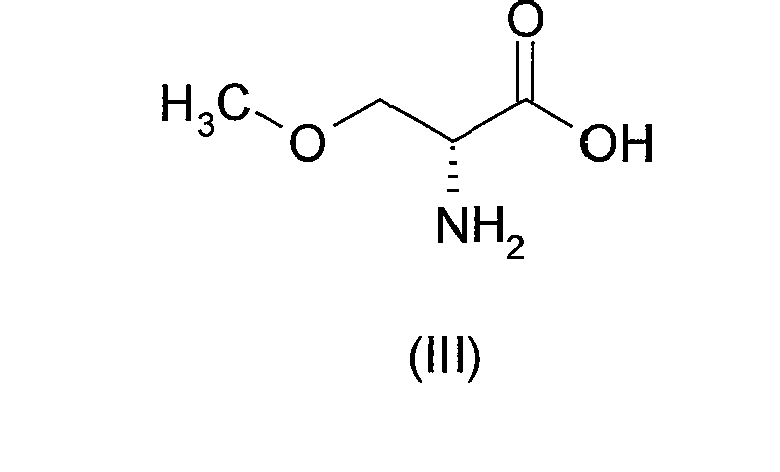 (ii) acetylation of O-methyl-D-serine of formula (III) thereby obtained to provide the compound of formula (IV):
 (iii) activating the carboxy group of the compound of formula (IV) thereby obtained to provide a compound of formula (V):
- A process as claimed in claim 1 wherein, in step (i), the resolution is effected by treating compound (II) with a chiral acid and separating the resulting mixture of diastereomeric salts; followed by treating with an acid, then with a base, at controlled pH, to generate compound (III) in substantially optically pure form.
- A process as claimed in claim 1 wherein, in step (i), compound (III) is obtained in substantially optically pure form from compound (II) by means of a process which comprises the following steps:(i-A) conversion of O-methyl-D,L-serine of formula (II) as depicted in claim 1 into an ester derivative of formula (VI):

R1 represents aryl(C1-6)alkyl or heteroaryl(C1-6)alkyl, either of which groups may be optionally substituted by one or more substituents;(i-B) resolution of the compound of formula (VI) thereby obtained to provide a compound of formula (VII): (i-C) de-esterification of the compound of formula (VII) thereby obtained.
 - A process as claimed in claim 3 wherein, in step (i-B), the resolution is effected by treating compound (VI) with N-acetyl-L-methionine and separating the resulting mixture of diastereomeric salts, followed by treatment with an alkaline solution to generate compound (VII) in substantially optically pure form.
- A process as claimed in claim 3 or claim 4 wherein R1 represents benzyl.
- A process as claimed in claim 5 wherein, in step (i-C), the de-esterification is effected by treating compound (VII) with gaseous hydrogen in the presence of a hydrogenation catalyst.
- A process as claimed in any one of the preceding claims wherein, in step (ii), the acetylation reaction is effected by treating compound (III) with acetic anhydride in a mixture of tetrahydrofuran and water.
- A process as claimed in claim 7 wherein the ratio of tetrahydrofuran to water is in the region of 6:1 parts by volume.
- A process as claimed in any one of the preceding claims wherein Q1 represents isobutoxycarbonyloxy.
- A process as claimed in any one of the preceding claims wherein, in step (iv), the reaction between compound (V) and benzylamine is effected in tetrahydrofuran at a low temperature; followed by quenching with an acidic solution at a low temperature.
- A process for the preparation of lacosamide in substantially optically pure form, which comprises the following steps:(a) acetylation of O-methyl-D,L-serine of formula (II) as depicted in claim 1 to provide the compound of formula (XII):
 (b) resolution of the compound of formula (XII) thereby obtained to provide the compound of formula (IV), as depicted in claim 1, in substantially optically pure form;(c) activating the carboxy group of the compound of formula (IV) thereby obtained to provide a compound of formula (V), as depicted in claim 1, in substantially optically pure form; and(d) reacting the compound of formula (V) thereby obtained with benzylamine.
 - A process as claimed in claim 11 wherein, in step (b), the resolution is effected by enzymatic resolution.
- A process for the preparation of lacosamide of formula (I), which comprises the following steps:(ii) acetylation of O-methyl-D-serine of formula (III), as depicted in claim 1, to provide the compound of formula (IV), as depicted in claim 1, in substantially optically pure form;(iii) activating the carboxy group of the compound of formula (IV) thereby obtained to provide a compound of formula (V), as defined in claim 1, in substantially optically pure form; and(iv) reacting the compound of formula (V) thereby obtained with benzylamine.
- A process for the preparation of O-methyl-D-serine in substantially optically pure form, which comprises the following steps:(i-A) conversion of O-methyl-D,L-serine of formula (II) as depicted in claim 1 into an ester derivative of formula (VI) as defined in claim 3;(i-B) resolution of the compound of formula (VI) thereby obtained to provide a compound of formula (VII), as defined in claim 3, in substantially optically pure form; and(i-C) de-esterification of the compound of formula (VII) thereby obtained.
- A process for the preparation of O-methyl-D-serine in substantially optically pure form, which comprises the following steps:(i-B) resolution of an ester derivative of formula (VI) as defined in claim 3 to provide a compound of formula (VII), as defined in claim 3, in substantially optically pure form; and(i-C) de-esterification of the compound of formula (VII) thereby obtained.
- A process for the preparation of the compound of formula (IV), as depicted in claim 1, in substantially optically pure form; which comprises the following steps:(a) acetylation of O-methyl-D,L-serine of formula (II) as depicted in claim 1 to provide the compound of formula (XII) as depicted in claim 11; and(b) resolution of the compound of formula (XII) thereby obtained.
- A process for the preparation of the compound of formula (IV), as depicted in claim 1, in substantially optically pure form; which comprises the following steps:(α) acetylation of a compound of formula (VII) as depicted in claim 3 to provide a compound of formula (XIII):
 (β) de-esterification of the compound of formula (XIII) thereby obtained.
 - The reaction product of the process as claimed in any one of claims 1 to 13 containing a detectable amount of the compound of formula (XIV):

- The compound of formula (XIV) as depicted in claim 18.
Priority Applications (5)
| Application Number | Priority Date | Filing Date | Title |
|---|---|---|---|
| EP20100191524 EP2487152A1 (en) | 2010-11-17 | 2010-11-17 | Process for the preparation of Lacosamide including resolution of O-methyl-DL-serine |
| US13/988,160 US9139513B2 (en) | 2010-11-17 | 2011-11-09 | Process for preparing lacosamide |
| EP20110779451 EP2640691A1 (en) | 2010-11-17 | 2011-11-09 | Process for preparing lacosamide |
| PCT/EP2011/069721 WO2012065891A1 (en) | 2010-11-17 | 2011-11-09 | Process for preparing lacosamide |
| US14/827,954 US9630908B2 (en) | 2010-11-17 | 2015-08-17 | Process for preparing lacosamide |
Applications Claiming Priority (1)
| Application Number | Priority Date | Filing Date | Title |
|---|---|---|---|
| EP20100191524 EP2487152A1 (en) | 2010-11-17 | 2010-11-17 | Process for the preparation of Lacosamide including resolution of O-methyl-DL-serine |
Publications (1)
| Publication Number | Publication Date |
|---|---|
| EP2487152A1 true EP2487152A1 (en) | 2012-08-15 |
Family
ID=43629349
Family Applications (2)
| Application Number | Title | Priority Date | Filing Date |
|---|---|---|---|
| EP20100191524 Ceased EP2487152A1 (en) | 2010-11-17 | 2010-11-17 | Process for the preparation of Lacosamide including resolution of O-methyl-DL-serine |
| EP20110779451 Withdrawn EP2640691A1 (en) | 2010-11-17 | 2011-11-09 | Process for preparing lacosamide |
Family Applications After (1)
| Application Number | Title | Priority Date | Filing Date |
|---|---|---|---|
| EP20110779451 Withdrawn EP2640691A1 (en) | 2010-11-17 | 2011-11-09 | Process for preparing lacosamide |
Country Status (3)
| Country | Link |
|---|---|
| US (2) | US9139513B2 (en) |
| EP (2) | EP2487152A1 (en) |
| WO (1) | WO2012065891A1 (en) |
Cited By (3)
| Publication number | Priority date | Publication date | Assignee | Title |
|---|---|---|---|---|
| CN103274956A (en) * | 2013-05-29 | 2013-09-04 | 安徽省恒锐新技术开发有限责任公司 | Preparation method of D-serine |
| CN104326943A (en) * | 2014-11-04 | 2015-02-04 | 崇州合瑞科技有限公司 | Method for preparing Boc-L-serine |
| CN105949074A (en) * | 2016-06-03 | 2016-09-21 | 南京红杉生物科技有限公司 | Synthesis method of O-methyl-D-serine |
Families Citing this family (13)
| Publication number | Priority date | Publication date | Assignee | Title |
|---|---|---|---|---|
| CN101466390B (en) * | 2006-06-15 | 2014-03-12 | 优时比制药有限公司 | Peptide compounds for the treatment of refractory status epilepticus |
| EP2487152A1 (en) * | 2010-11-17 | 2012-08-15 | UCB Pharma GmbH | Process for the preparation of Lacosamide including resolution of O-methyl-DL-serine |
| WO2014097137A2 (en) * | 2012-12-18 | 2014-06-26 | Mahesh Kandula | Compositions and methods for the treatment of seizures and neurologic diseases |
| KR101578979B1 (en) * | 2013-11-08 | 2015-12-18 | 에스티팜 주식회사 | A Method for preparing Lacosamide |
| ES2748434T3 (en) | 2014-01-10 | 2020-03-16 | Univ Cornell | Dipeptides as inhibitors of human immunoproteasomes |
| US9772696B2 (en) * | 2014-03-06 | 2017-09-26 | Stmicroelectronics Asia Pacific Pte Ltd | System and method for phase error compensation in synchronized devices |
| EP3193904B1 (en) | 2014-08-18 | 2025-10-01 | Cornell University | Dipeptidomimetics as inhibitors of human immunoproteasomes |
| IN2015CH05001A (en) | 2015-09-18 | 2015-10-16 | Divis Lab Ltd | |
| KR102764027B1 (en) | 2015-10-15 | 2025-02-07 | 코넬 유니버시티 | Proteasome inhibitors and uses thereof |
| EP3659997A1 (en) | 2015-11-13 | 2020-06-03 | API Corporation | Method for producing lacosamide and intermediate thereof |
| US9718765B1 (en) * | 2016-06-21 | 2017-08-01 | Sci Pharmtech, Inc. | Process for preparation of optically pure N-substituted-3-methoxypropionic acid derivatives |
| WO2018159028A1 (en) * | 2017-03-01 | 2018-09-07 | 株式会社エーピーアイ コーポレーション | N-benzyl-2-bromo-3-methoxypropionamide and method for producing intermediate thereof |
| EP3694605A4 (en) | 2017-10-11 | 2021-10-27 | Cornell University | PEPTIDOMIMETIC INHIBITORS OF PROTEASOME |
Citations (4)
| Publication number | Priority date | Publication date | Assignee | Title |
|---|---|---|---|---|
| US5773475A (en) | 1997-03-17 | 1998-06-30 | Research Corporation Technologies, Inc. | Anticonvulsant enantiomeric amino acid derivatives |
| WO2006037574A1 (en) | 2004-10-02 | 2006-04-13 | Schwarz Pharma Ag | Improved synthesis scheme for lacosamide |
| CN101591300A (en) * | 2009-02-19 | 2009-12-02 | 成都伊诺达博医药科技有限公司 | A new method for the synthesis of lacosamide |
| WO2010052011A1 (en) | 2008-11-07 | 2010-05-14 | Ucb Pharma, S.A. | Novel process for the preparation of amino acid derivatives |
Family Cites Families (2)
| Publication number | Priority date | Publication date | Assignee | Title |
|---|---|---|---|---|
| CN101659978A (en) | 2009-09-23 | 2010-03-03 | 南京大学 | D-serine enzymatic conversion preparation method |
| EP2487152A1 (en) * | 2010-11-17 | 2012-08-15 | UCB Pharma GmbH | Process for the preparation of Lacosamide including resolution of O-methyl-DL-serine |
-
2010
- 2010-11-17 EP EP20100191524 patent/EP2487152A1/en not_active Ceased
-
2011
- 2011-11-09 WO PCT/EP2011/069721 patent/WO2012065891A1/en not_active Ceased
- 2011-11-09 EP EP20110779451 patent/EP2640691A1/en not_active Withdrawn
- 2011-11-09 US US13/988,160 patent/US9139513B2/en not_active Expired - Fee Related
-
2015
- 2015-08-17 US US14/827,954 patent/US9630908B2/en not_active Expired - Fee Related
Patent Citations (4)
| Publication number | Priority date | Publication date | Assignee | Title |
|---|---|---|---|---|
| US5773475A (en) | 1997-03-17 | 1998-06-30 | Research Corporation Technologies, Inc. | Anticonvulsant enantiomeric amino acid derivatives |
| WO2006037574A1 (en) | 2004-10-02 | 2006-04-13 | Schwarz Pharma Ag | Improved synthesis scheme for lacosamide |
| WO2010052011A1 (en) | 2008-11-07 | 2010-05-14 | Ucb Pharma, S.A. | Novel process for the preparation of amino acid derivatives |
| CN101591300A (en) * | 2009-02-19 | 2009-12-02 | 成都伊诺达博医药科技有限公司 | A new method for the synthesis of lacosamide |
Non-Patent Citations (11)
| Title |
|---|
| "Protective Groups in Organic Chemistry", 1973, PLENUM PRESS |
| EUROPEAN JOURNAL OF MEDICINAL CHEMISTRY, vol. 45, 2010, pages 1717 - 1723 |
| GREENSTEIN J P ET AL: "L-isoleucine, D-isoleucine, L-alloisoleucine, and D-alloisoleucine", BIOCHEMICAL PREPARATIONS, WILEY, NEW YORK, NY, US, vol. III, 1 January 1953 (1953-01-01), pages 84 - 103, XP009145703, ISSN: 0067-8686 * |
| J BIOL. CHEM., 1933, pages 511 |
| J BIOL. CHEM., 1936, pages 793 |
| JAEGER ET AL: "Enzymatic Resolution of O-Methyl-N-acetyl-DL-serine", CROATICA CHEMICA ACTA, CROATIAN CHEMICAL SOCIETY, ZAGREB, HR, vol. 28, 1 January 1956 (1956-01-01), pages 5 - 8, XP009145593, ISSN: 0011-1643 * |
| M.B. SMITH; J. MARCH: "March's Advanced Organic Chemistry", vol. 4, 2001, WILEY-INTERSCIENCE, pages: 125 - 217 |
| ORG. SYNTH. COLL., vol. 3, 1955, pages 774 |
| SYNTHESIS, 2009, pages 2184 - 2204 |
| T.W. GREENE; P.G.M. WUTS: "Protective Groups in Organic Synthesis", 1999, JOHN WILEY & SONS |
| TETRAHEDRON, vol. 65, 2009, pages 9702 - 9706 |
Cited By (4)
| Publication number | Priority date | Publication date | Assignee | Title |
|---|---|---|---|---|
| CN103274956A (en) * | 2013-05-29 | 2013-09-04 | 安徽省恒锐新技术开发有限责任公司 | Preparation method of D-serine |
| CN103274956B (en) * | 2013-05-29 | 2015-07-01 | 安徽省恒锐新技术开发有限责任公司 | Preparation method of D-serine |
| CN104326943A (en) * | 2014-11-04 | 2015-02-04 | 崇州合瑞科技有限公司 | Method for preparing Boc-L-serine |
| CN105949074A (en) * | 2016-06-03 | 2016-09-21 | 南京红杉生物科技有限公司 | Synthesis method of O-methyl-D-serine |
Also Published As
| Publication number | Publication date |
|---|---|
| EP2640691A1 (en) | 2013-09-25 |
| US9139513B2 (en) | 2015-09-22 |
| WO2012065891A1 (en) | 2012-05-24 |
| US20160039744A1 (en) | 2016-02-11 |
| US9630908B2 (en) | 2017-04-25 |
| US20140018577A1 (en) | 2014-01-16 |
Similar Documents
| Publication | Publication Date | Title |
|---|---|---|
| US9139513B2 (en) | Process for preparing lacosamide | |
| JP7757278B2 (en) | Process for producing acyloxymethyl ester of (4S)-(4-cyano-2-methoxyphenyl)-5-ethoxy-2,8-dimethyl-1,4-dihydro-1,6-naphthyridine-3-carboxylic acid | |
| CN100378091C (en) | Process for the preparation of 2-(6-substituted-1,-3-dioxane-4-yl) acetic acid derivatives | |
| CN102317248A (en) | Process for producing optically active carboxylic acid | |
| JP2022521106A (en) | How to make a highly enantioselective secondary alcohol | |
| CN103228640A (en) | Process for the preparation of nebivolol | |
| US7232925B2 (en) | Process for producing (4E)-5-chloro-2-isopropyl-4-pentenoate and optically active form thereof | |
| US20180297974A1 (en) | Most effective process for base-free preparation of ketone intermediates usable for manufacture of nebivolol | |
| KR101399551B1 (en) | Processes for the preparations of optically active cyclopentenones and cyclopentenones prepared therefrom | |
| JP2006519786A (en) | Chemical methods for making intermediates to obtain N-formylhydroxylamine compounds | |
| CN101003820B (en) | Method for producing optically active cyclopentenones and cyclopentenones produced thereby | |
| JPH06184069A (en) | Production of alpha-hydroxy-beta-aminocarboxylic acid | |
| JP5093248B2 (en) | Process for producing optically active indoline-2-carboxylic acids or derivatives thereof | |
| EP2448916B1 (en) | Production of trans-4-aminocyclopent-2-ene-1-carboxylic acid derivatives | |
| JPH0751090A (en) | Production of optically active 3-aminobutanoic acid and its ester intermediate | |
| JP3491296B2 (en) | Optically active 1,5-disubstituted-2,4-O-isopropylidene-2,4-dihydroxypentane and process for producing the same | |
| JPH0482863A (en) | Production of p-nitrobenzyl alcohol malonic monoester | |
| WO2000056716A1 (en) | Synthesis of 3-amino-3-aryl propanoates | |
| JP2014031372A (en) | Efficient method for preparing high purity mitiglinide | |
| HK40068366A (en) | Process for producing acyloxymethyl esters of (4s)-(4-cyano-2-methoxyphenyl)-5-ethoxy-2,8-dimethyl-1,4-dihydro-1,6-naphthyridin-3-carboxylic acid | |
| JP3011784B2 (en) | New pyridinesulfonic acid ester | |
| JPS60130539A (en) | Preparation of optically active styrene halohydrin | |
| JP3439797B2 (en) | Method for producing amine derivative | |
| JPH06335398A (en) | Cyclohexenediol derivative | |
| JP2003183216A (en) | METHOD FOR PRODUCING CHIRAL alpha-HYDROXYCARBOXYLIC ACID |
Legal Events
| Date | Code | Title | Description |
|---|---|---|---|
| PUAI | Public reference made under article 153(3) epc to a published international application that has entered the european phase |
Free format text: ORIGINAL CODE: 0009012 |
|
| AK | Designated contracting states |
Kind code of ref document: A1 Designated state(s): AL AT BE BG CH CY CZ DE DK EE ES FI FR GB GR HR HU IE IS IT LI LT LU LV MC MK MT NL NO PL PT RO RS SE SI SK SM TR |
|
| AX | Request for extension of the european patent |
Extension state: BA ME |
|
| STAA | Information on the status of an ep patent application or granted ep patent |
Free format text: STATUS: THE APPLICATION HAS BEEN REFUSED |
|
| 18R | Application refused |
Effective date: 20121005 |