EP2483304B1 - Pre-filtration adjustment of buffer solutes for high concentration immunoglobulin preparation - Google Patents
Pre-filtration adjustment of buffer solutes for high concentration immunoglobulin preparation Download PDFInfo
- Publication number
- EP2483304B1 EP2483304B1 EP10745660.0A EP10745660A EP2483304B1 EP 2483304 B1 EP2483304 B1 EP 2483304B1 EP 10745660 A EP10745660 A EP 10745660A EP 2483304 B1 EP2483304 B1 EP 2483304B1
- Authority
- EP
- European Patent Office
- Prior art keywords
- concentration
- immunoglobulin
- buffer
- histidine
- protein
- Prior art date
- Legal status (The legal status is an assumption and is not a legal conclusion. Google has not performed a legal analysis and makes no representation as to the accuracy of the status listed.)
- Active
Links
Images





Classifications
-
- C—CHEMISTRY; METALLURGY
- C07—ORGANIC CHEMISTRY
- C07K—PEPTIDES
- C07K1/00—General methods for the preparation of peptides, i.e. processes for the organic chemical preparation of peptides or proteins of any length
- C07K1/14—Extraction; Separation; Purification
-
- C—CHEMISTRY; METALLURGY
- C07—ORGANIC CHEMISTRY
- C07K—PEPTIDES
- C07K1/00—General methods for the preparation of peptides, i.e. processes for the organic chemical preparation of peptides or proteins of any length
- C07K1/14—Extraction; Separation; Purification
- C07K1/34—Extraction; Separation; Purification by filtration, ultrafiltration or reverse osmosis
-
- C—CHEMISTRY; METALLURGY
- C07—ORGANIC CHEMISTRY
- C07K—PEPTIDES
- C07K16/00—Immunoglobulins [IG], e.g. monoclonal or polyclonal antibodies
- C07K16/06—Immunoglobulins [IG], e.g. monoclonal or polyclonal antibodies from serum
- C07K16/065—Purification, fragmentation
-
- B—PERFORMING OPERATIONS; TRANSPORTING
- B01—PHYSICAL OR CHEMICAL PROCESSES OR APPARATUS IN GENERAL
- B01D—SEPARATION
- B01D61/00—Processes of separation using semi-permeable membranes, e.g. dialysis, osmosis or ultrafiltration; Apparatus, accessories or auxiliary operations specially adapted therefor
-
- B—PERFORMING OPERATIONS; TRANSPORTING
- B01—PHYSICAL OR CHEMICAL PROCESSES OR APPARATUS IN GENERAL
- B01D—SEPARATION
- B01D61/00—Processes of separation using semi-permeable membranes, e.g. dialysis, osmosis or ultrafiltration; Apparatus, accessories or auxiliary operations specially adapted therefor
- B01D61/14—Ultrafiltration; Microfiltration
-
- C—CHEMISTRY; METALLURGY
- C07—ORGANIC CHEMISTRY
- C07K—PEPTIDES
- C07K16/00—Immunoglobulins [IG], e.g. monoclonal or polyclonal antibodies
- C07K16/18—Immunoglobulins [IG], e.g. monoclonal or polyclonal antibodies against material from animals or humans
Definitions
- Polypeptides play an important role in today's medical portfolio. Expression systems for the production of recombinant polypeptides are well-known. For human application every pharmaceutical substance has to meet distinct criteria. To ensure the safety of biopharmaceutical agents to humans, for example, nucleic acids, viruses, and host cell proteins, which would cause severe harm, have to be removed. To meet the regulatory specification one or more purification steps have to follow the manufacturing process. Among other, purity, throughput, and yield play an important role in determining an appropriate purification process.
- downstream processing of immunoglobulins is essential.
- concentrated solutions are required not only for formulated drugs but also for intermediates in downstream processing (DSP) to achieve low volumes for economic handling and application storage.
- DSP downstream processing
- fast concentration processes are favored to ensure smooth processes and short operating times.
- tangential flow filtration (TFF) processes are used.
- One aspect as reported herein is an ultrafiltration method for concentrating an immunoglobulin solution comprising the following steps:
- the buffer substance is histidine and that the second concentration is calculated with equation 2.
- the pH value is of from pH 5.0 to pH 6.0. In a further embodiment the pH value is pH 5.5.
- the first concentration is approximately 20 mM.
- the second concentration is of from 24 mM to 37 mM with a protein concentration of the concentrated solution of from 100 g/l to 300 g/l, respectively.
- the protein concentration is approximately 200 g/l and the second concentration is of from 28 mM to 31 mM.
- the first concentration is approximately 46 mM.
- the second concentration is of from 52 mM to 72 mM with a protein concentration of the concentrated solution of from 100 to 300 g/l, respectively.
- the protein concentration is approximately 200 g/l and the second concentration is of from 59 mM to 62 mM.
- the buffer substance is acetate and the concentration is calculated with equation 3.
- the pH value is of from pH 4.5 to pH 6.0. In a further embodiment the pH value is pH 5.5.
- the first concentration is approximately 20 mM.
- the second concentration is of from 8 mM to 19 mM with a protein concentration of the concentrated solution of from 300 g/l to 100 g/l, respectively.
- the protein concentration is approximately 200 g/l and the second concentration is of from 12 mM to 17 mM.
- the first concentration is approximately 45 mM.
- the second concentration is of from 41 mM to 48 mM with a protein concentration of the concentrated solution of from 300 to 100 g/l, respectively.
- the protein concentration is approximately 200 g/l and the second concentration is of from 43 mM to 47 mM.
- the immunoglobulin is an anti-P-selectin antibody or an anti-A ⁇ antibody.
- Another aspect as reported herein is a method for producing an immunoglobulin in vitro comprising
- cation/neutral pair denotes a buffer substance which provides for a buffer system consisting of the buffer substance in neutral form and the buffer substance in protonated, i.e. positively charge form, as cation.
- a buffer substance which provides for a buffer system consisting of the buffer substance in neutral form and the buffer substance in protonated, i.e. positively charge form, as cation.
- neutral/anion pair denotes a buffer substance which provides for a buffer system consisting of the buffer substance in neutral form and the buffer substance in de-protonated, i.e. negatively charge form, as anion.
- anion acetate.
- tangential flow filtration denotes a filtration process wherein a solution containing a polypeptide to be concentrated flows along, i.e. tangential, to the surface of a filtration membrane.
- the filtration membrane has a pore size with a certain cut off value. In one embodiment the cut off value is in the range of 20 kDa to 50 kDa, in another embodiment of 30 kDa.
- TFF was conducted as ultra filtration.
- cross-flow denotes the flow of the solution to be concentrated tangential to the membrane (retentate flow).
- flux or “permeate flow”, which can be used interchangeably, denotes the flow of fluid through the membrane, i.e.
- the permeate comprises the solvent of the solution to be concentrated on the retentate side as well as molecules with a molecular weight below the cut off value of the employed membrane but not the polypeptide to be concentrated.
- concentrate denotes all components, i.e. ionic and non-ionic, of a solution to be concentrated except the water molecules and the molecules of the polypeptide to be concentrated.
- a solution to be concentrated a polypeptide, water and a buffer salt, and optionally a non-buffer salt, such as sodium chloride.
- a “polypeptide” is a polymer of amino acid residues joined by peptide bonds, whether produced naturally or synthetically. Polypeptides of less than about 20 amino acid residues are referred to as "peptides".
- a “protein” is a macromolecule comprising one or more polypeptide chains or at least one polypeptide chain of more than 100 amino acid residues.
- a polypeptide may also comprise non-peptidic components, such as carbohydrate groups. Carbohydrates and other non-peptidic substituents may be added to a polypeptide by the cell in which the polypeptide is produced, and will vary with the type of cell. Polypeptides are defined herein in terms of their amino acid backbone structures; substituents such as carbohydrate groups are generally not specified, but may be present nonetheless.
- immunoglobulin refers to a protein consisting of one or more polypeptide(s) substantially encoded by immunoglobulin genes.
- the recognized immunoglobulin genes include the different constant region genes as well as the myriad immunoglobulin variable region genes.
- Immunoglobulins may exist in a variety of formats, including, for example, Fv, Fab, and F(ab) 2 as well as single chains (scFv) or diabodies (in general, Hood, L.E., et al., Immunology, The Benjamin N.Y., 2nd edition (1984 )).
- immunoglobulin thus, denotes a complete immunoglobulin consisting of two immunoglobulin heavy chains and two immunoglobulin light chains, as well as an "Immunoglobulin fragment" comprising at least one domain selected from the variable domain, the C H 1 domain, the hinge-region, the C H 2 domain, the C H 3 domain, or the C H 4 domain of a heavy chain, or the variable domain or the C L domain of a light chain and an "immunoglobulin conjugate" comprising at least one domain of an immunoglobulin heavy or light chain conjugated via a peptide bond to a further polypeptide.
- the further polypeptide is a non-immunoglobulin peptide, such as a hormone, or toxin, or growth receptor, or antifusogenic peptide, or complement factor, or the like.
- the final purification step is a so called “polishing step" for the removal of trace impurities and contaminants like aggregated immunoglobulins, residual HCP (host cell protein), DNA (host cell nucleic acid), viruses, or endotoxins.
- polishing step in one embodiment an anion exchange material in a flow-through mode is used.
- affinity chromatography with microbial proteins e.g. protein A or protein G affinity chromatography
- ion exchange chromatography e.g. cation exchange (carboxymethyl resins), anion exchange (amino ethyl resins) and mixed-mode exchange
- thiophilic adsorption e.g. with beta-mercaptoethanol and other SH ligands
- hydrophobic interaction or aromatic adsorption chromatography e.g. with phenyl-sepharose, aza-arenophilic resins, or m-aminophenylboronic acid
- metal chelate affinity chromatography e.g.
- Ni(II)- and Cu(II)-affinity material size exclusion chromatography
- electrophoretical methods such as gel electrophoresis, capillary electrophoresis
- immunoglobulin in monomeric form and grammatical equivalents thereof denotes an immunoglobulin molecule not associated with a second immunoglobulin molecule, i.e. neither covalently nor non-covalently bound to another immunoglobulin molecule.
- immunoglobulin in aggregated form and grammatical equivalents thereof denotes an immunoglobulin molecule which is associated, either covalently or non-covalently, with at least one additional immunoglobulin molecule or fragment thereof, and which is eluted in a single peak from a size exclusion chromatography column.
- an immunoglobulin is essentially in monomeric form, i.e. at least 90% of the immunoglobulin is in monomeric from, in one embodiment at least 95% of the immunoglobulin is in monomeric form, in another embodiment at least 98% of the immunoglobulin is in monomeric form, in a further embodiment at least 99% of the immunoglobulin is in monomeric form, and in a final embodiment more than 99% of the immunoglobulin is in monomeric form determined as peak area of a size exclusion chromatogram of the immunoglobulin preparation.
- HMW high molecular weight
- ion exchange chromatography in flow-through mode is the final chromatographic step in purification processes of monoclonal immunoglobulins to remove residual host cell DNA, endotoxins and retrovirus-like particles.
- the purified ion exchange chromatography pool is in e.g. a phosphate- or tris (hydroxymethyl)-aminomethan buffer.
- the conditions have to be changed to a buffer system for e.g. ensuring stability of the active pharmaceutical ingredient during storage.
- the pH value is slightly acidic e.g. between pH 5 and pH 6 and a conductivity of less than 5 mS/cm is required ( Daugherty, A.L. and Mrsny, R.J., Adv. Drug Deliv. Rev. 58 (2006) 686-706 ).
- the ion exchange pool is the basis buffer for formulation by using/adding different stock solutions of excipients like surfactants and sugars. Therefore, the ion exchange chromatography pool is concentrated and diafiltered into a suitable buffer composition by ultrafiltration to provide a defined composition of protein, buffer solutes, pH and conductivity.
- an immunoglobulin ion exchange chromatography pool was diafiltered against 20 mM histidine buffer (pH 5.5; 1.6 mS/cm) of a 1 to 10-fold diafiltration volume (DV) with respect to the pool volume. Thereafter, the diafiltered pool was concentrated to more than 210 mg/ml protein concentration in a tangential flow filtration. It has been found that even after applying a 10-fold diafiltration volume the predefined conditions for the histidine buffer system concerning pH value and conductivity could not be maintained constant after the complete concentration process. After starting the concentration process the pH value increases to pH 5.7 and conductivity reaches 2.2 mS/cm at a protein concentration of 215 mg/ml in the retentate.
- solute an adjustment at about pH 5.0 to 29.6 mM and 60 mM histidine, respectively, before tangential flow filtration is required to achieve a predefined histidine buffer concentration of 20 mM and 46 mM histidine, respectively, after the tangential flow filtration in the concentration of an immunoglobulin of the IgG 1 and IgG 4 class to 215 mg/ml.
- Table 1 pH values before UF, after UF and for the end product with readjusted pH to 5.0; 0.5 M hydrochloric acid was taken to readjust the pH to pH 5.0 in the end product; mean values of three measurements are presented ⁇ SD. starting conditions pH before UF pH after UF pH end product 20 mM histidine buffer, pH 5.0 4.97 +/- 0.04 5.40 +/- 0.06 4.90 +/- 0.14 32 mM histidine buffer, pH 5.0 5.0 +/- 0.04 5.20 +/- 0.05 -- 20 mM histidine buffer, pH 7.4 7.37 +/- 0.06 7.47 +/- 0.05 4.81 +/- 0.22
- Equation 2 describes the molar concentration in the retentate of positively charged solutes ( S + ) being able to pass the membrane.
- S + depends on the charge of the protein ( z ), the molar concentration ( P ) and the molecular weight ( Mp ) of the protein, as well as on the density of the solution in the retentate ( ⁇ ) and the permeate ( ⁇ ').
- S' is the theoretical molar concentration of the diffusible solute.
- S ⁇ zP + zP 2 + 4 S ⁇ ⁇ ⁇ ⁇ PM P 1000 2 2 2
- Equation 3 describes the molar concentration in the retentate of negatively charged solutes ( S - ) being able to pass the membrane.
- the charge of the immunoglobulin to be concentrated according to example 13 the density of the immunoglobulin solution after the concentration according to example 14, and the concentration of the immunoglobulin in the starting immunoglobulin solution according to example 4 have to be determined experimentally.
- the molar solute concentration was approximated by inserting the actual charge value of the immunoglobulin at the pH value in equations 2 and 3, respectively.
- the overall protein charge was determined by zeta potential measurements (see example 13).
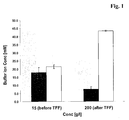
- Two immunoglobulin solutions were concentrated from 15 mg/ml to 200 mg/ml.
- One solution used contained 20 mM histidine at pH 5.0 and one solution used contained 20 mM histidine at pH 5.5 before UF.
- Both immunoglobulin solutions were intended to have 20 mM histidine present at the predefined pH after the concentration process.
- the displacement of histidine was observed, which was quantitatively corrected by employing equation 2 with a protein charge of +11.
- immunoglobulin concentration only 10.8 mM histidine remained without restock prior to the UF.
- the intended histidine concentration of 46 mM at a protein concentration of 200 mg/ml can be achieved by applying an initially higher histidine concentration of 60 mM before UF as calculated by using equation 2'. In this case a protein charge of +7 was applied.
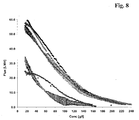
- Immunoglobulin solutions at a concentration of 20 mg/ml were ultrafiltrated up to 200 mg/ml. Buffer systems based on histidine were used. On the one hand, experiments were conducted in a 29.6 mM histidine buffer pH 5.0. On the other hand UF was performed in a 20 mM histidine buffer pH 7.4. Results were compared to experiments conducted in a buffer system containing 20 mM histidine at pH 5.0 (see Figures 6 and 7 ).
- the permeate flux was observed to be significantly reduced during processing compared to the experiments conducted at pH 5.0.
- the process time was more than doubled from 120 ⁇ 2 min. to 300 ⁇ 2 min. when a pH value of pH 7.4 was adjusted before the UF was started. It has been observed, that the addition of histidine prior to the UF step had no influence on the permeate flux.
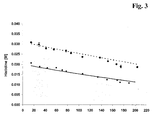
- UF processes are conducted during process and formulation development. Different UF systems, membrane material and operational parameters are applied to concentrate the protein bulk. In order to proof, that the herein presented model is adequately reflecting the experimental values concerning the loss of histidine during UF concentration, different membrane materials, UF systems and operational parameters were tested (see Table 3 and Figure 5 ). Table 3: Different set-ups. histidine concentration [mM] pH value UF membrane material / pore size [kDa] UF system ⁇ p [bar] 20 5.0 RC / 30 stirred cell 2.0 20 5.0 RC / 30 cross flow 0.8 20 5.0 RC / 30 cross flow 1.5 20 5.0 PES / 30 cross flow 1.5
- PES polyethersulfone
- RC regenerated cellulose
- proteins and solutes can interact with the membrane surface based on charge-charge interactions. As a consequence, the outcome of the solute molarity in the concentrates can be influenced by the choice of the membrane material.
- Another exemplary immunoglobulin is an anti-P-Selectin antibody as reported in WO 2005/100402 or US 2005/0226876 .
- histidine base was added to the protein solution and the pH was adjusted to pH 5.5 by adding 0.1 M hydrochloric acid.
- a retentate flow rate of 240 l/m 2 /h and a TMP of 1.25 bars were chosen as the condition at the beginning of the UF process for an immunoglobulin concentration of from 5 mg/ml to 25 mg/ml. From 25 mg/ml to 50 mg/ml the TMP was lowered to 0.85 bars. In addition, the retentate flow rate was increased to 450 l/m 2 /h, bringing the permeate flux from 30 up to 45 l/m 2 /h. For a concentration range of from 50 mg/ml up to target concentration of 140 mg/ml or more a TMP of 0.85 bars and an increased retentate flow rate of 390 l/m 2 /h were set.
- a Sartocon Slice flat sheet cassette with a HydrosartTM membrane of regenerated cellulose, with a nominal molecular weight cutoff (NMWC) of 30 kDa and a membrane area of 0.02 m 2 was used (Sartorius, Göttingen, Germany).
- the total membrane loading was about 400 g/m 2 for each experiment.
- the normalized flux rate for water (NWF) was determined after every cleaning cycle and compared to the obtained value before initial use. The cassette was only applied for the next experiments, if the NWF decline in (1/m 2 /h)/ l bar at 20°C was below 10% of the initial value to ensure complete cleaning and comparable membrane properties.
- Immunoglobulin concentration was determined by using the photometric absorbance at 280 nm and 320 nm after buffer blank subtraction (UV-Vis spectrophotometer Evolution 500, Thermo Fisher Scientific, Waltham, USA). The absorbance at 320 nm was subtracted from the absorbance at 280 nm and this absorbance value was used to calculate the protein content according to the law of Lambert-Beer.
- the pH was determined by using the Microprocessor pH Meter pH 196 equipped with a pH single-rod measuring cell E50-1.5 from WTW (Weilheim, Germany).
- the conductivity was determined by using the ProfiLine Konduktumeter LF 197 equipped with a standard conductivity cell TetraCon 325 from WTW (Weilheim, Germany). All samples were tempered in a water bath to 25°C before measuring pH and conductivity.
- SE-HPLC Size exclusion high pressure liquid chromatography
- HMWs higher molecular weight species
- LMWs lower molecular weight species
- the histidine concentration in the retentate doubled the histidine concentration was determined.
- the samples were diluted to about 100 ⁇ M histidine concentration with purified water (Milli-Q, Millipore, Billerica, USA). Afterward, 500 ⁇ l diluted sample was mixed with 500 ⁇ l perchloric acid (5%) (Fluka, Steinheim, Germany). After 10 min. the sample was centrifuged at 25°C with 13.000 rpm for 10 min. (miniSpin, Eppendorf, Hamburg, Germany). 100 ⁇ l of the supernatant were injected on a MonoS 5/50 GL CEX column (GE Healthcare, Uppsala, Sweden).
- the acetate concentration was determined.
- the samples were diluted to about 25 mM acetate concentration with purified water (Milli-Q, Millipore, Billerica, USA). Afterwards, 500 ⁇ l diluted sample was mixed with 500 ⁇ l perchloric acid (5%) (Fluka, Steinheim, Germany). After 10 min. the sample was centrifuged at 25°C with 13.000 rpm for 10 min. (miniSpin, Eppendorf, Hamburg, Germany). 100 ⁇ l of the supernatant were injected on a LiChrosorb RP C18 4/250 column (Merck KG, Darmstadt, Germany).
- the samples were diluted 1:200 with purified water (Milli-Q, Millipore, Billerica, USA). 10 ⁇ l of the diluted sample was injected on an IonPac AS11-HC 2/250 column (Merck KG, Darmstadt, Germany).
- Turbidity was determined as photometric absorbance of the undiluted concentrates at 350 nm and 550 nm after buffer-blank subtraction, where no intrinsic chromophores of the monoclonal immunoglobulin absorb (UV-Vis spectrophotometer Evolution 500, Thermo Fisher Scientific, Waltham, USA) ( Capelle, M.A.H., et al., Eur. J. Pharm. Biopharm. 65 (2007) 131-148 ). The samples were mixed before measuring. In the presence of suspended particles an increase in UV absorbance at all weave lengths occurs due to scattering effects ( Eberlein, G.A., et al., PDA J of Pharmac. Science and Technol. 48 (1994) 224-230 ).
- the particle counter SVSS-C (PAMAS Prismmess- und Analysesysteme, Rutesheim, Germany) was equipped with a laser diode and a photodiode detector in order to determine the residual photocurrent after particles have passed the course of the beam.
- particle sensor the HCB-LD-25/25 was applied.
- Concentrates of a higher content of particles than 120 000/ml where diluted with buffer to match the specified capacity of the used sensor. Three measurements of a volume of 0.5 ml for each sample were analyzed after an equilibrating flush of 0.3 ml. Results were calculated as mean value of three measurements and referred to a sample volume of 1.0 ml. Before diluting the concentrates the buffer was filtered using Stericup Express plus 0.1 ⁇ m filter devices (Millipore, Billerica, USA) and the particle burden was determined as described before.
- electrophoretic mobility of the protein was determined by performing Laser-Doppler-Velocimetry using the Malvern Zetasizer Nano S (Malvern Instruments, Worcestershire, UK).
- ⁇ e is the electrophoretic mobility
- ⁇ is the dielectric constant of the solution
- k s is the model based constant with a value of 1.5 for a salt concentrations higher than 1 mM
- ⁇ is the viscosity of the solution
- ⁇ is the zeta potential.
- 5 mg/ml mAb solutions were dialyzed into 50 mM acetate buffer pH 5.0 and titrated to a pH of 2.0 afterwards by using 0.2 M hydrochloric acid.
- the samples were titrated with a 0.2 M sodium hydroxide solution from pH 2 to pH 12 by applying the titrator MPT2 (Malvern Instruments, Worcestershire, UK).
- the zeta potential was determined in 15 steps between pH 2 and 12 in a temperature controlled folded capillary cell (Malvern Instruments, Worcestershire, UK) at 25°C. Each measurement was repeated threefold and mean values ⁇ SD are reported. See Figure 9 for an exemplary zeta potential determination of an anti-IL-1R antibody.
- the density ⁇ of the protein solutions was determined at every protein concentration step.
- a pycnometer Schott, Mainz, Germany
- the mass of the unfilled and filled pycnometer was determined by using an analytical balance (MC 210 S, Sartorius, Göttingen, Germany).
Landscapes
- Chemical & Material Sciences (AREA)
- Organic Chemistry (AREA)
- Health & Medical Sciences (AREA)
- General Health & Medical Sciences (AREA)
- Medicinal Chemistry (AREA)
- Life Sciences & Earth Sciences (AREA)
- Biochemistry (AREA)
- Biophysics (AREA)
- Proteomics, Peptides & Aminoacids (AREA)
- Genetics & Genomics (AREA)
- Molecular Biology (AREA)
- Analytical Chemistry (AREA)
- Engineering & Computer Science (AREA)
- Water Supply & Treatment (AREA)
- Immunology (AREA)
- Peptides Or Proteins (AREA)
- Preparation Of Compounds By Using Micro-Organisms (AREA)
Priority Applications (2)
| Application Number | Priority Date | Filing Date | Title |
|---|---|---|---|
| SI201031216A SI2483304T1 (sl) | 2009-09-29 | 2010-08-27 | Predfiltracijsko naravnavanje pufrskih snovi za močno koncentriran imunoglobulinski pripravek |
| EP10745660.0A EP2483304B1 (en) | 2009-09-29 | 2010-08-27 | Pre-filtration adjustment of buffer solutes for high concentration immunoglobulin preparation |
Applications Claiming Priority (3)
| Application Number | Priority Date | Filing Date | Title |
|---|---|---|---|
| EP09012316 | 2009-09-29 | ||
| EP10745660.0A EP2483304B1 (en) | 2009-09-29 | 2010-08-27 | Pre-filtration adjustment of buffer solutes for high concentration immunoglobulin preparation |
| PCT/EP2010/062554 WO2011039012A1 (en) | 2009-09-29 | 2010-08-27 | Pre-filtration adjustment of buffer solutes |
Publications (2)
| Publication Number | Publication Date |
|---|---|
| EP2483304A1 EP2483304A1 (en) | 2012-08-08 |
| EP2483304B1 true EP2483304B1 (en) | 2016-05-04 |
Family
ID=41463102
Family Applications (1)
| Application Number | Title | Priority Date | Filing Date |
|---|---|---|---|
| EP10745660.0A Active EP2483304B1 (en) | 2009-09-29 | 2010-08-27 | Pre-filtration adjustment of buffer solutes for high concentration immunoglobulin preparation |
Country Status (11)
| Country | Link |
|---|---|
| US (1) | US8822655B2 (pl) |
| EP (1) | EP2483304B1 (pl) |
| JP (1) | JP5697268B2 (pl) |
| CN (1) | CN102574912B (pl) |
| CA (1) | CA2772846C (pl) |
| DK (1) | DK2483304T3 (pl) |
| ES (1) | ES2582581T3 (pl) |
| HU (1) | HUE029197T2 (pl) |
| PL (1) | PL2483304T3 (pl) |
| SI (1) | SI2483304T1 (pl) |
| WO (1) | WO2011039012A1 (pl) |
Families Citing this family (3)
| Publication number | Priority date | Publication date | Assignee | Title |
|---|---|---|---|---|
| PL2483304T3 (pl) | 2009-09-29 | 2016-11-30 | Przedfiltracyjne nastawianie substancji rozpuszczonych buforu przy wytwarzaniu immu-noglobuliny o dużym stężeniu | |
| EP2833139A1 (en) | 2013-08-01 | 2015-02-04 | SuppreMol GmbH | In vitro method for determining the stability of compositions comprising soluble Fc gamma receptor(s) |
| JP7419354B2 (ja) * | 2018-10-24 | 2024-01-22 | エフ. ホフマン-ラ ロシュ アーゲー | オリゴヌクレオチドの精製プロセス |
Citations (9)
| Publication number | Priority date | Publication date | Assignee | Title |
|---|---|---|---|---|
| WO1986000239A1 (en) | 1984-06-22 | 1986-01-16 | Veech Richard L | Hemodialysis processes and hemodialysis solutions |
| US6113898A (en) | 1995-06-07 | 2000-09-05 | Idec Pharmaceuticals Corporation | Human B7.1-specific primatized antibodies and transfectomas expressing said antibodies |
| WO2003039486A2 (en) | 2001-11-09 | 2003-05-15 | Idec Pharmaceuticals Corporation | Anti-cd80 antibody having adcc activity for adcc mediated killing of b cell lymphoma cells alone or in combination with other therapies |
| WO2003070760A2 (en) | 2002-02-20 | 2003-08-28 | F. Hoffmann-La Roche Ag | Anti-amyloid beta antibodies and their use |
| WO2004001007A2 (en) | 2002-06-21 | 2003-12-31 | Idec Pharmaceuticals Corporation | Buffered formulations for concentrating antibodies and methods of use thereof |
| WO2005100402A1 (en) | 2004-04-13 | 2005-10-27 | F.Hoffmann-La Roche Ag | Anti-p-selectin antibodies |
| WO2009068282A1 (en) | 2007-11-29 | 2009-06-04 | F. Hoffmann-La Roche Ag | Immunoglobulin aggregates |
| WO2009073569A2 (en) | 2007-11-30 | 2009-06-11 | Abbott Laboratories | Protein formulations and methods of making same |
| WO2011039012A1 (en) | 2009-09-29 | 2011-04-07 | F. Hoffmann-La Roche Ag | Pre-filtration adjustment of buffer solutes |
Family Cites Families (3)
| Publication number | Priority date | Publication date | Assignee | Title |
|---|---|---|---|---|
| US5256294A (en) * | 1990-09-17 | 1993-10-26 | Genentech, Inc. | Tangential flow filtration process and apparatus |
| US20060051347A1 (en) | 2004-09-09 | 2006-03-09 | Winter Charles M | Process for concentration of antibodies and therapeutic products thereof |
| CA2693443C (en) | 2007-07-17 | 2018-02-13 | F. Hoffmann-La Roche Ag | Variable tangential flow filtration |
-
2010
- 2010-08-27 PL PL10745660.0T patent/PL2483304T3/pl unknown
- 2010-08-27 HU HUE10745660A patent/HUE029197T2/en unknown
- 2010-08-27 ES ES10745660.0T patent/ES2582581T3/es active Active
- 2010-08-27 EP EP10745660.0A patent/EP2483304B1/en active Active
- 2010-08-27 DK DK10745660.0T patent/DK2483304T3/en active
- 2010-08-27 JP JP2012530201A patent/JP5697268B2/ja active Active
- 2010-08-27 CA CA2772846A patent/CA2772846C/en active Active
- 2010-08-27 US US13/395,893 patent/US8822655B2/en active Active
- 2010-08-27 WO PCT/EP2010/062554 patent/WO2011039012A1/en not_active Ceased
- 2010-08-27 SI SI201031216A patent/SI2483304T1/sl unknown
- 2010-08-27 CN CN201080042449.4A patent/CN102574912B/zh active Active
Patent Citations (9)
| Publication number | Priority date | Publication date | Assignee | Title |
|---|---|---|---|---|
| WO1986000239A1 (en) | 1984-06-22 | 1986-01-16 | Veech Richard L | Hemodialysis processes and hemodialysis solutions |
| US6113898A (en) | 1995-06-07 | 2000-09-05 | Idec Pharmaceuticals Corporation | Human B7.1-specific primatized antibodies and transfectomas expressing said antibodies |
| WO2003039486A2 (en) | 2001-11-09 | 2003-05-15 | Idec Pharmaceuticals Corporation | Anti-cd80 antibody having adcc activity for adcc mediated killing of b cell lymphoma cells alone or in combination with other therapies |
| WO2003070760A2 (en) | 2002-02-20 | 2003-08-28 | F. Hoffmann-La Roche Ag | Anti-amyloid beta antibodies and their use |
| WO2004001007A2 (en) | 2002-06-21 | 2003-12-31 | Idec Pharmaceuticals Corporation | Buffered formulations for concentrating antibodies and methods of use thereof |
| WO2005100402A1 (en) | 2004-04-13 | 2005-10-27 | F.Hoffmann-La Roche Ag | Anti-p-selectin antibodies |
| WO2009068282A1 (en) | 2007-11-29 | 2009-06-04 | F. Hoffmann-La Roche Ag | Immunoglobulin aggregates |
| WO2009073569A2 (en) | 2007-11-30 | 2009-06-11 | Abbott Laboratories | Protein formulations and methods of making same |
| WO2011039012A1 (en) | 2009-09-29 | 2011-04-07 | F. Hoffmann-La Roche Ag | Pre-filtration adjustment of buffer solutes |
Non-Patent Citations (12)
| Title |
|---|
| ALFORD ET AL.: "high concentration formulations of recombinant human interleukin 1 receptor antagonist: I physical characterization", J PHARM SCI., vol. 97, no. 8, August 2008 (2008-08-01), pages 3035 - 50, XP055350747 |
| ALFORD ET AL.: "High Concentration Formulations of Recombinant Human lnterleukin-1 Receptor Antagonist: I. Physical Characterization", JOURNAL OF PHARMACEUTICAL SCIENCES, vol. 97, no. 8, August 2008 (2008-08-01), pages 3035 - 3050, XP055350747 |
| BOLTON ET AL.: "BIOT 98- Strategies for achieving buffer concentration, protein concentration and pH targets during the ultrafiltration of concentrated therapeutic proteins", ABSTRACTS OF PAPERS AMERICAN CHEMICAL SOCIETY, 17 August 2008 (2008-08-17) |
| GLEN BOLTON: "BIOT 98- Strategies for achieving buffer concentration, protein concentration and pH targets during the ultrafiltration of concentrated therapeutic proteins", 2 September 2016 (2016-09-02), pages 1, XP055350773, Retrieved from the Internet <URL:http://oasys2.confex.com/acs/236nm/techprogram/P1184598.HTM> |
| JOHN RANDOLPH ALFORD: "Physical stability of a therapeutic protein in high protein concentration aqueous formulations", DISSERTATION, 31 December 2007 (2007-12-31), XP055350762 |
| JOHN RANDOLPH ALFORD: "PHYSICAL STABILITY OF A THERAPEUTIC PROTEININ HIGH PROTEIN CONCENTRATION AQUEOUS FORMULATIONS", 2007, pages 2pp, ii-x, 1 - 185, XP055350762 |
| STONER ET AL.: "protein-solute interactions affect the outcome of ultrafiltration/diafiltration operations", J PHARM SCI., vol. 93, no. 9, September 2004 (2004-09-01), pages 2332 - 42, XP055226620 |
| STONER ET AL.: "Protein-solute interactions affect the outcome of ultrafiltration/diafiltration operations", JOURNAL OF PHARMACEUTICAL SCIENCES,, vol. 93, no. 9, September 2004 (2004-09-01), pages 2332 - 2342, XP055226620 |
| SUTER ET AL.: "determination of the donnan effect in equilibrium dialysis and a simple method for its correction", ANALYTICAL BIOCHEMISTRY, vol. 82, 1977, pages 109 - 14, XP024816862 |
| SUTER ET AL.: "Determination of the Donnan effect in equilibrium dialysis and a simple method for its correction", ANALYTICAL BIOCHEMISTRY, vol. 82, no. 1, September 1977 (1977-09-01), pages 109 - 14, XP024816862 |
| TANFORD C., PHYSICAL CHEMISTRY OF MACROMOLECULES., 1961, New York : John Wiley & Sons , Inc., pages 710 |
| TANFORD C.: "Physical chemistry of macromolecules", 1961, JOHN WILEY & SONS , INC., New York, ISBN: 978-0471844471, pages: v, 220 - 239, XP055350758 |
Also Published As
| Publication number | Publication date |
|---|---|
| US20120219990A1 (en) | 2012-08-30 |
| WO2011039012A1 (en) | 2011-04-07 |
| JP5697268B2 (ja) | 2015-04-08 |
| ES2582581T3 (es) | 2016-09-13 |
| CA2772846C (en) | 2020-09-29 |
| JP2013505905A (ja) | 2013-02-21 |
| CN102574912A (zh) | 2012-07-11 |
| CN102574912B (zh) | 2014-12-24 |
| PL2483304T3 (pl) | 2016-11-30 |
| EP2483304A1 (en) | 2012-08-08 |
| SI2483304T1 (sl) | 2016-08-31 |
| CA2772846A1 (en) | 2011-04-07 |
| US8822655B2 (en) | 2014-09-02 |
| HUE029197T2 (en) | 2017-02-28 |
| DK2483304T3 (en) | 2016-05-30 |
Similar Documents
| Publication | Publication Date | Title |
|---|---|---|
| AU2024202299B2 (en) | Process for the preparation of highly concentrated liquid formulations containing biomolecules | |
| AU2012303372A1 (en) | Method for preparing a composition comprising highly concentrated antibodies by ultrafiltration | |
| US8822655B2 (en) | Pre-filtration adjustment of buffer solutes | |
| EP2170949B1 (en) | Variable tangential flow filtration | |
| JP5205470B2 (ja) | 免疫グロブリン凝集物 | |
| US20230303622A1 (en) | Modeling conditions for tangential flow filtration processes for protein purification |
Legal Events
| Date | Code | Title | Description |
|---|---|---|---|
| PUAI | Public reference made under article 153(3) epc to a published international application that has entered the european phase |
Free format text: ORIGINAL CODE: 0009012 |
|
| 17P | Request for examination filed |
Effective date: 20120502 |
|
| AK | Designated contracting states |
Kind code of ref document: A1 Designated state(s): AL AT BE BG CH CY CZ DE DK EE ES FI FR GB GR HR HU IE IS IT LI LT LU LV MC MK MT NL NO PL PT RO SE SI SK SM TR |
|
| DAX | Request for extension of the european patent (deleted) | ||
| 17Q | First examination report despatched |
Effective date: 20140619 |
|
| GRAP | Despatch of communication of intention to grant a patent |
Free format text: ORIGINAL CODE: EPIDOSNIGR1 |
|
| RIC1 | Information provided on ipc code assigned before grant |
Ipc: C07K 1/14 20060101ALI20151203BHEP Ipc: C07K 16/06 20060101AFI20151203BHEP Ipc: B01D 61/00 20060101ALI20151203BHEP Ipc: C07K 1/34 20060101ALI20151203BHEP Ipc: C07K 16/18 20060101ALI20151203BHEP Ipc: B01D 61/14 20060101ALI20151203BHEP |
|
| INTG | Intention to grant announced |
Effective date: 20151218 |
|
| GRAS | Grant fee paid |
Free format text: ORIGINAL CODE: EPIDOSNIGR3 |
|
| GRAA | (expected) grant |
Free format text: ORIGINAL CODE: 0009210 |
|
| RIN1 | Information on inventor provided before grant (corrected) |
Inventor name: ROSENBERG, EVA Inventor name: KUHNE, WOLFGANG Inventor name: HEPBILDIKLER, STEFAN Inventor name: WINTER, GERHARD |
|
| AK | Designated contracting states |
Kind code of ref document: B1 Designated state(s): AL AT BE BG CH CY CZ DE DK EE ES FI FR GB GR HR HU IE IS IT LI LT LU LV MC MK MT NL NO PL PT RO SE SI SK SM TR |
|
| REG | Reference to a national code |
Ref country code: GB Ref legal event code: FG4D |
|
| REG | Reference to a national code |
Ref country code: CH Ref legal event code: EP |
|
| REG | Reference to a national code |
Ref country code: AT Ref legal event code: REF Ref document number: 796842 Country of ref document: AT Kind code of ref document: T Effective date: 20160515 |
|
| REG | Reference to a national code |
Ref country code: DK Ref legal event code: T3 Effective date: 20160529 |
|
| REG | Reference to a national code |
Ref country code: IE Ref legal event code: FG4D |
|
| REG | Reference to a national code |
Ref country code: DE Ref legal event code: R096 Ref document number: 602010033067 Country of ref document: DE |
|
| REG | Reference to a national code |
Ref country code: SE Ref legal event code: TRGR |
|
| REG | Reference to a national code |
Ref country code: FR Ref legal event code: PLFP Year of fee payment: 7 |
|
| REG | Reference to a national code |
Ref country code: NL Ref legal event code: FP |
|
| REG | Reference to a national code |
Ref country code: LT Ref legal event code: MG4D |
|
| REG | Reference to a national code |
Ref country code: ES Ref legal event code: FG2A Ref document number: 2582581 Country of ref document: ES Kind code of ref document: T3 Effective date: 20160913 |
|
| PG25 | Lapsed in a contracting state [announced via postgrant information from national office to epo] |
Ref country code: NO Free format text: LAPSE BECAUSE OF FAILURE TO SUBMIT A TRANSLATION OF THE DESCRIPTION OR TO PAY THE FEE WITHIN THE PRESCRIBED TIME-LIMIT Effective date: 20160804 Ref country code: FI Free format text: LAPSE BECAUSE OF FAILURE TO SUBMIT A TRANSLATION OF THE DESCRIPTION OR TO PAY THE FEE WITHIN THE PRESCRIBED TIME-LIMIT Effective date: 20160504 Ref country code: LT Free format text: LAPSE BECAUSE OF FAILURE TO SUBMIT A TRANSLATION OF THE DESCRIPTION OR TO PAY THE FEE WITHIN THE PRESCRIBED TIME-LIMIT Effective date: 20160504 |
|
| PG25 | Lapsed in a contracting state [announced via postgrant information from national office to epo] |
Ref country code: PT Free format text: LAPSE BECAUSE OF FAILURE TO SUBMIT A TRANSLATION OF THE DESCRIPTION OR TO PAY THE FEE WITHIN THE PRESCRIBED TIME-LIMIT Effective date: 20160905 Ref country code: HR Free format text: LAPSE BECAUSE OF FAILURE TO SUBMIT A TRANSLATION OF THE DESCRIPTION OR TO PAY THE FEE WITHIN THE PRESCRIBED TIME-LIMIT Effective date: 20160504 Ref country code: LV Free format text: LAPSE BECAUSE OF FAILURE TO SUBMIT A TRANSLATION OF THE DESCRIPTION OR TO PAY THE FEE WITHIN THE PRESCRIBED TIME-LIMIT Effective date: 20160504 Ref country code: GR Free format text: LAPSE BECAUSE OF FAILURE TO SUBMIT A TRANSLATION OF THE DESCRIPTION OR TO PAY THE FEE WITHIN THE PRESCRIBED TIME-LIMIT Effective date: 20160805 |
|
| REG | Reference to a national code |
Ref country code: DE Ref legal event code: R026 Ref document number: 602010033067 Country of ref document: DE |
|
| PG25 | Lapsed in a contracting state [announced via postgrant information from national office to epo] |
Ref country code: EE Free format text: LAPSE BECAUSE OF FAILURE TO SUBMIT A TRANSLATION OF THE DESCRIPTION OR TO PAY THE FEE WITHIN THE PRESCRIBED TIME-LIMIT Effective date: 20160504 Ref country code: RO Free format text: LAPSE BECAUSE OF FAILURE TO SUBMIT A TRANSLATION OF THE DESCRIPTION OR TO PAY THE FEE WITHIN THE PRESCRIBED TIME-LIMIT Effective date: 20160504 Ref country code: SK Free format text: LAPSE BECAUSE OF FAILURE TO SUBMIT A TRANSLATION OF THE DESCRIPTION OR TO PAY THE FEE WITHIN THE PRESCRIBED TIME-LIMIT Effective date: 20160504 |
|
| PLBI | Opposition filed |
Free format text: ORIGINAL CODE: 0009260 |
|
| PG25 | Lapsed in a contracting state [announced via postgrant information from national office to epo] |
Ref country code: SM Free format text: LAPSE BECAUSE OF FAILURE TO SUBMIT A TRANSLATION OF THE DESCRIPTION OR TO PAY THE FEE WITHIN THE PRESCRIBED TIME-LIMIT Effective date: 20160504 |
|
| REG | Reference to a national code |
Ref country code: HU Ref legal event code: AG4A Ref document number: E029197 Country of ref document: HU |
|
| 26 | Opposition filed |
Opponent name: BAXALTA GMBH Effective date: 20170130 |
|
| PLAX | Notice of opposition and request to file observation + time limit sent |
Free format text: ORIGINAL CODE: EPIDOSNOBS2 |
|
| PG25 | Lapsed in a contracting state [announced via postgrant information from national office to epo] |
Ref country code: MC Free format text: LAPSE BECAUSE OF FAILURE TO SUBMIT A TRANSLATION OF THE DESCRIPTION OR TO PAY THE FEE WITHIN THE PRESCRIBED TIME-LIMIT Effective date: 20160504 |
|
| PLAF | Information modified related to communication of a notice of opposition and request to file observations + time limit |
Free format text: ORIGINAL CODE: EPIDOSCOBS2 |
|
| REG | Reference to a national code |
Ref country code: FR Ref legal event code: PLFP Year of fee payment: 8 |
|
| PG25 | Lapsed in a contracting state [announced via postgrant information from national office to epo] |
Ref country code: LU Free format text: LAPSE BECAUSE OF NON-PAYMENT OF DUE FEES Effective date: 20160827 |
|
| PLBB | Reply of patent proprietor to notice(s) of opposition received |
Free format text: ORIGINAL CODE: EPIDOSNOBS3 |
|
| PG25 | Lapsed in a contracting state [announced via postgrant information from national office to epo] |
Ref country code: CY Free format text: LAPSE BECAUSE OF FAILURE TO SUBMIT A TRANSLATION OF THE DESCRIPTION OR TO PAY THE FEE WITHIN THE PRESCRIBED TIME-LIMIT Effective date: 20160504 |
|
| PG25 | Lapsed in a contracting state [announced via postgrant information from national office to epo] |
Ref country code: MK Free format text: LAPSE BECAUSE OF FAILURE TO SUBMIT A TRANSLATION OF THE DESCRIPTION OR TO PAY THE FEE WITHIN THE PRESCRIBED TIME-LIMIT Effective date: 20160504 Ref country code: MT Free format text: LAPSE BECAUSE OF NON-PAYMENT OF DUE FEES Effective date: 20160831 Ref country code: IS Free format text: LAPSE BECAUSE OF FAILURE TO SUBMIT A TRANSLATION OF THE DESCRIPTION OR TO PAY THE FEE WITHIN THE PRESCRIBED TIME-LIMIT Effective date: 20160504 |
|
| REG | Reference to a national code |
Ref country code: FR Ref legal event code: PLFP Year of fee payment: 9 |
|
| PG25 | Lapsed in a contracting state [announced via postgrant information from national office to epo] |
Ref country code: BG Free format text: LAPSE BECAUSE OF FAILURE TO SUBMIT A TRANSLATION OF THE DESCRIPTION OR TO PAY THE FEE WITHIN THE PRESCRIBED TIME-LIMIT Effective date: 20160504 |
|
| PG25 | Lapsed in a contracting state [announced via postgrant information from national office to epo] |
Ref country code: AL Free format text: LAPSE BECAUSE OF FAILURE TO SUBMIT A TRANSLATION OF THE DESCRIPTION OR TO PAY THE FEE WITHIN THE PRESCRIBED TIME-LIMIT Effective date: 20160504 |
|
| PLCK | Communication despatched that opposition was rejected |
Free format text: ORIGINAL CODE: EPIDOSNREJ1 |
|
| STAA | Information on the status of an ep patent application or granted ep patent |
Free format text: STATUS: THE PATENT HAS BEEN GRANTED |
|
| REG | Reference to a national code |
Ref country code: DE Ref legal event code: R100 Ref document number: 602010033067 Country of ref document: DE |
|
| PLBN | Opposition rejected |
Free format text: ORIGINAL CODE: 0009273 |
|
| STAA | Information on the status of an ep patent application or granted ep patent |
Free format text: STATUS: OPPOSITION REJECTED |
|
| 27O | Opposition rejected |
Effective date: 20181210 |
|
| REG | Reference to a national code |
Ref country code: AT Ref legal event code: UEP Ref document number: 796842 Country of ref document: AT Kind code of ref document: T Effective date: 20160504 |
|
| PGFP | Annual fee paid to national office [announced via postgrant information from national office to epo] |
Ref country code: NL Payment date: 20250723 Year of fee payment: 16 |
|
| PGFP | Annual fee paid to national office [announced via postgrant information from national office to epo] |
Ref country code: HU Payment date: 20250815 Year of fee payment: 16 |
|
| PGFP | Annual fee paid to national office [announced via postgrant information from national office to epo] |
Ref country code: ES Payment date: 20250901 Year of fee payment: 16 |
|
| PGFP | Annual fee paid to national office [announced via postgrant information from national office to epo] |
Ref country code: DK Payment date: 20250723 Year of fee payment: 16 Ref country code: DE Payment date: 20250724 Year of fee payment: 16 |
|
| PGFP | Annual fee paid to national office [announced via postgrant information from national office to epo] |
Ref country code: PL Payment date: 20250724 Year of fee payment: 16 Ref country code: TR Payment date: 20250730 Year of fee payment: 16 Ref country code: IT Payment date: 20250723 Year of fee payment: 16 |
|
| PGFP | Annual fee paid to national office [announced via postgrant information from national office to epo] |
Ref country code: GB Payment date: 20250724 Year of fee payment: 16 Ref country code: BE Payment date: 20250723 Year of fee payment: 16 |
|
| PGFP | Annual fee paid to national office [announced via postgrant information from national office to epo] |
Ref country code: FR Payment date: 20250725 Year of fee payment: 16 Ref country code: AT Payment date: 20250725 Year of fee payment: 16 |
|
| PGFP | Annual fee paid to national office [announced via postgrant information from national office to epo] |
Ref country code: CH Payment date: 20250901 Year of fee payment: 16 Ref country code: SE Payment date: 20250723 Year of fee payment: 16 |
|
| PGFP | Annual fee paid to national office [announced via postgrant information from national office to epo] |
Ref country code: IE Payment date: 20250725 Year of fee payment: 16 Ref country code: CZ Payment date: 20250730 Year of fee payment: 16 |
|
| PGFP | Annual fee paid to national office [announced via postgrant information from national office to epo] |
Ref country code: SI Payment date: 20250731 Year of fee payment: 16 |