EP2481791B1 - Nucleinsäureextraktionsverfahren - Google Patents
Nucleinsäureextraktionsverfahren Download PDFInfo
- Publication number
- EP2481791B1 EP2481791B1 EP20120153079 EP12153079A EP2481791B1 EP 2481791 B1 EP2481791 B1 EP 2481791B1 EP 20120153079 EP20120153079 EP 20120153079 EP 12153079 A EP12153079 A EP 12153079A EP 2481791 B1 EP2481791 B1 EP 2481791B1
- Authority
- EP
- European Patent Office
- Prior art keywords
- vessel
- nucleic acid
- heating
- cell suspension
- fungal cell
- Prior art date
- Legal status (The legal status is an assumption and is not a legal conclusion. Google has not performed a legal analysis and makes no representation as to the accuracy of the status listed.)
- Active
Links
Images



Classifications
-
- C—CHEMISTRY; METALLURGY
- C12—BIOCHEMISTRY; BEER; SPIRITS; WINE; VINEGAR; MICROBIOLOGY; ENZYMOLOGY; MUTATION OR GENETIC ENGINEERING
- C12Q—MEASURING OR TESTING PROCESSES INVOLVING ENZYMES, NUCLEIC ACIDS OR MICROORGANISMS; COMPOSITIONS OR TEST PAPERS THEREFOR; PROCESSES OF PREPARING SUCH COMPOSITIONS; CONDITION-RESPONSIVE CONTROL IN MICROBIOLOGICAL OR ENZYMOLOGICAL PROCESSES
- C12Q1/00—Measuring or testing processes involving enzymes, nucleic acids or microorganisms; Compositions therefor; Processes of preparing such compositions
- C12Q1/68—Measuring or testing processes involving enzymes, nucleic acids or microorganisms; Compositions therefor; Processes of preparing such compositions involving nucleic acids
- C12Q1/6806—Preparing nucleic acids for analysis, e.g. for polymerase chain reaction [PCR] assay
-
- C—CHEMISTRY; METALLURGY
- C12—BIOCHEMISTRY; BEER; SPIRITS; WINE; VINEGAR; MICROBIOLOGY; ENZYMOLOGY; MUTATION OR GENETIC ENGINEERING
- C12N—MICROORGANISMS OR ENZYMES; COMPOSITIONS THEREOF; PROPAGATING, PRESERVING, OR MAINTAINING MICROORGANISMS; MUTATION OR GENETIC ENGINEERING; CULTURE MEDIA
- C12N1/00—Microorganisms; Compositions thereof; Processes of propagating, maintaining or preserving microorganisms or compositions thereof; Processes of preparing or isolating a composition containing a microorganism; Culture media therefor
- C12N1/06—Lysis of microorganisms
-
- C—CHEMISTRY; METALLURGY
- C12—BIOCHEMISTRY; BEER; SPIRITS; WINE; VINEGAR; MICROBIOLOGY; ENZYMOLOGY; MUTATION OR GENETIC ENGINEERING
- C12N—MICROORGANISMS OR ENZYMES; COMPOSITIONS THEREOF; PROPAGATING, PRESERVING, OR MAINTAINING MICROORGANISMS; MUTATION OR GENETIC ENGINEERING; CULTURE MEDIA
- C12N15/00—Mutation or genetic engineering; DNA or RNA concerning genetic engineering, vectors, e.g. plasmids, or their isolation, preparation or purification; Use of hosts therefor
- C12N15/09—Recombinant DNA-technology
- C12N15/10—Processes for the isolation, preparation or purification of DNA or RNA
- C12N15/1003—Extracting or separating nucleic acids from biological samples, e.g. pure separation or isolation methods; Conditions, buffers or apparatuses therefor
Definitions
- the present invention relates to a nucleic acid extraction method for extracting nucleic acid from a fungal cell.
- a microbe is generally defined as a living organism that is microscopic, or smaller in size, such as a bacterium, archaebacterium, protist, fungus, and so forth.
- the microbes differ in feature from each other, and bacteria fall into two broad categories, that is, gram-negative bacteria, such as Escherichia coli ( E. coli ), and so forth, and gram-positive bacteria, such as Bacillus subtilis ( B. subtilis ), and so forth, on the basis of a difference in the membrane structure of a cell.
- a cell wall of a gram-positive bacterium has a peptidoglycan layer greater in thickness, and higher in density than that of a cell wall of a gram-negative bacterium.
- major constituents of a cell wall thereof is ⁇ -glucan, and chitin, and the fungus differs in composition from the bacteria described as above. Accordingly, in the case of making use of enzymatic or chemical method for cell lysis, different protocol is needed for each type of targeted cell.
- zymolyase is commonly used for fungus in contrast to lysozyme that is commonly used for bacteria.
- lysostaphin is commonly used for lysis of cell wall of Staphylococcus aureus ( S. aureus ) among the gram-positive bacteria because lysostaphin is effective in use.
- Patent Document 4 United States Patent Application Publication No. 4830969 .
- nucleic-acid extraction kit The enzymatic or chemical method for cell lysis has been widely adopted in a commercially available nucleic-acid extraction kit.
- nucleic-acid extraction kits require a lot of time and most of the treatment time is engaged by the lysis process.
- this lysis treatment includes a plurality of process steps such as steps for addition of a reagent, stirring, and so forth, respectively, and is therefore complicated. Accordingly, in the cases where rapid detection is required, including the case of infectious disease control, the case of safe guards against bio-terrorism, and so forth, there is a demand for shortening of the treatment time for the cell lysis, in particular.
- a uniform protocol is not applicable to the enzymatic or chemical method for cell lysis, and there is the need for varying an enzyme, and a protocol according to the type of a cell, which renders the method complicated.
- it is necessary to conduct tests by use of a plurality of protocols.
- long-chain nucleic acid can be obtained in this case, however, as enzyme reaction time is long, the method is therefore lacking in rapidity. For this reason, the enzymatic or chemical method for cell lysis is not suited to an application requiring rapidity.
- Patent Document 3 discloses a micropurification system capable of extracting molecules from a sample at elevated temperatures and pressures.
- spores of Bacillus atrophaeus and Bacillus thuringiensis are lysed in a pressurized superheated chamber for periods of between 5.5 seconds and 49.5 seconds, with an increase in residence time of the bacterial spores in the pressurized superheated chamber resulting in an increased amount of extracted DNA.
- Patent Document 4 discloses a process for the isolation of nucleic acids and peptides from other cellular materials.
- yeast cells are heated in a solution of lysing agent to a temperature of about 100 °c for 60 secondes. The lysed cells are then centrifugated to remove water insoluble and agglomerated materials and the supernatant is precipitated with a water soluble precipitant.
- Exemplary embodiments of the present invention address the above disadvantages and other disadvantages not described above.
- the present invention is not required to overcome the disadvantages described above, and thus, an exemplary embodiment of the present invention may not overcome any disadvantages.
- a nucleic acid extraction method for extracting nucleic acid from a fungal cell comprising the steps of (i) introducing a fungal cell suspension into a vessel, (ii) sealing the vessel, (iii) heating the fungal cell suspension housed in the vessel up to a prescribed highest temperature with the vessel held in a sealed state, wherein the prescribed highest temperature is in a range of 125°C to 160°C, and (iv) blending a cell lysis accelerator with the fungal cell suspension before or after heating the fungal cell suspension.
- Embodiments of a nucleic acid extraction method are described hereinafter.
- Use can be made of a boil-lock type tube (capacity: 0. 6 ml) having a mechanical structure for sealing purposes to serve as a vessel for housing the cell suspension therein. Further, for a heating means, use can be made of an oil bath (temperature range: from room temperature to 200°C). Furthermore, an apparatus for use in carrying out this experiment, and the present invention is not limited thereto.
- a cell suspension in conjunction with setting of a thermocouple in the vessel, a cell suspension, together with 20 ⁇ l of an introduction buffer [20 mM Tris-HCl ⁇ tris (hydroxymethyl) aminomethane hydrochloride ⁇ , and 2% TritonX-100], was introduced into the vessel so as not to include a gas space therein. Further, the vessel was sealed by making use of a mechanical structure.
- the introduction buffer is used for higher efficiency as well as stabilization in extraction of nucleic acid
- Tris-HCl is a buffer solution for inhibiting variation in pH value of the solution, and stably holding nucleic acid as extracted.
- TritonX-100 is a polymer produced by SIGMA Corp., having a composition of ⁇ C 14 H 220 (C 2 H 40 )n ⁇ , the polymer being a surfactant to be added as a cell lysis accelerator.
- the heating means was preheated up to a set temperature.
- the vessel was kept in contact with a heater (for example, oil in the oil bath) of the heating means for 30 seconds to be thereby heated.
- a heater for example, oil in the oil bath
- the vessel was detached from the heater of the heating means.
- step 5 measurement was made on variation in the temperature of the cell suspension, during heating, and after the heating, respectively, by use of a data logger connected to the thermocouple.
- Fig. 1 is a view showing the variation in the temperature, measured by repeating the procedure described as above at the various set value.
- the horizontal axis indicates time during which the vessel was in contact with the heater of the heating means while the vertical axis indicates the temperature measured by use of the data logger. Further, a measurement was made on the temperature of the cell suspension in each case where the temperature of the heater was set to 95°C, 105°C, 115°C, 125°C, 135°C, and 145°C, respectively.
- E. coli DH-5 ⁇ strain was cultured in an LB medium overnight.
- a culture solution of E. coli, and the introduction buffer in two-fold concentrations 40 mM Tris-HCl, and 4% of TritonX-100, in equal proportions, were mixed with each other to prepare a sample.
- step 3 20 ⁇ l of the sample was introduced into the vessel, and the vessel was subsequently sealed.
- the vessel was brought into contact with a heater of a heating means as preheated, thereby heating the vessel for 30 seconds.
- the vessel was detached from the heater.
- the sample after heated was taken out of the vessel to be transferred to a test tube.
- the test tube with the sample introduced therein was centrifuged at 15300 xg for 10 minutes.
- a supernatant liquid was transferred to a new test tube in order to prevent the sample from absorbing yet-to-be-crushed bacteria, as precipitated, and residues.
- step 9 real-time PCR was carried out with the use of a primer capable of amplifying gyrB gene that is present in an E . coli genomic DNA.
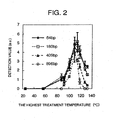
- the samples identical to each other were evaluated with the use of four types (64, 180, 409, and 896, in bp) of primer sets differing in amplification length from each other.
- the experiment was repeatedly conducted three times to find a mean value, and the standard deviation.
- the treatment temperature at the time of heating after 30 seconds obtainable on the basis of results of the experiment according to Embodiment 1, and the preheated temperature of the heating means, are plotted along the horizontal axis while an extracted amount (a detection value) of DNA in the sample, PCR being applicable thereto, as worked out by real-time PCR, was plotted along the vertical axis.
- a detection value a detection value of DNA in the sample, PCR being applicable thereto, as worked out by real-time PCR
- Fig. 2 is a view showing a plot obtained in the step 11, described as above.
- the detection value increased due to application of a heating-treatment whereby the highest treatment temperature reached 100°C or higher, and the detection value reached the maximum value when the highest treatment temperature was at about 115°C. At a temperature in excess of about 115°C, the detection value decreased. The reason for this is presumably because if a treatment temperature is excessively high, progress is made in fragmentation of DNA, and parts of the DNA, have come to fail functioning as a template for PCR amplification. As shown in Fig.
- the test tube with the sample introduced therein was centrifuged at 15300 xg for 10 minutes.
- a supernatant liquid was transferred to the new test tube in order to prevent the sample from absorbing yet-to-be-crushed bacteria, as precipitated, and residues.
- RT-PCR was carried out with the use of a primer capable of amplifying gyrB gene that is present in an E. coli genomic DNA. Samples identical to each other were evaluated with the use of a primer set having an amplification length 180bp.
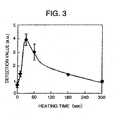
- Fig. 3 is a view showing a relationship between heating time in the step 3, and a DNA amount (a detection value) obtained in the step 7, in which the horizontal axis indicates the heating time while the vertical axis indicates the detection value.
- a genomic DNA to which PCR amplification is applicable was extracted with high efficiency by a treatment applied for about 30 seconds.
- progress was made in decomposition of the DNA due to the heating-treatment applied over long time, thereby rendering the PCR amplification harder to perform.
- a procedure for the experiment comprises the following steps:
- the sterilization treatment was set on the basis of [Rapid simultaneous detection and identification of six species Candida using polymerase chain reaction and reverse line hybridization assay] ⁇ J. Microbiol. Methods. 2007 May; 69 (2): 282 - 7 . ⁇
- Fig. 4 is a view obtained by plotting the highest treatment temperature at the time of heating, grasped on the basis of results of the experiment according to Embodiment 1, and a preheating temperature of the heating means, on the horizontal axis, and by plotting a PCR adaptable DNA amount (a detection value) extracted in the sample, as worked out from real-time PCR, on the vertical axis. For error bars, use is made of the standard deviation.
- DNA was not extracted at 95°C, and DNA was extracted with high efficiency at the time of the treatment at 132°C.
- the sterilization treatment is well known as a treatment similar to the DNA extraction according to the present invention.
- As a condition for sterilization a condition of, for example, heating at 80°C for a time period of 20 minutes, and so forth have since been in use. However, it is not that DNA extraction is enabled by simply meeting this sterilization condition. In order to demonstrate this, the following experiment was conducted. In the experiment, an observation using an optical microscope was made on C.
- albicans species after respective treatments for staining by use of ethidium homodimer as a fluorescent reagent capable of staining a dead cell without staining a live cell, the C. albicans being placed in a bright field, and under irradiation with an excitation light, respectively, thereby having compared photographed images with each other.
- Fig. 5 is a view showing optical microscopic images, and fluoroscopic images, obtained after application of the treatments (the highest treatment temperature: 25°C, 95°C, and 132°C, respectively), the sterilization treatment, and the autoclave sterilization treatment, applied in Embodiment 4, respectively.
- Fig. 6 is a view showing comparison of effects of DNA extraction by the respective treatments with each other.
- a detection value equivalent to the detection value of the sample without heating applied thereto was exhibited from the samples after the sterilization treatment, and the autoclave sterilization treatment, respectively, thereby confirming that DNA was hardly detected.
- DNA was not necessarily detected even under conditions suitable for sterilization.
- Fig. 7 is a view showing DNA extraction effects of high-temperature heating-treatments applied to C. albicans in various cell lysis accelerators (surfactants).
- the DNA extraction effect in the case of using TritonX-100 as a cell lysis accelerator to be added to a sample before the heating is compared with that in the case of using SDS as the cell lysis accelerator.
- Fig. 7 it was possible to extract DNA from C. albicans with higher efficiency in the case of using SDS as the cell lysis accelerator than in the case of using TritonX-100.
- the detection value is found at 300 or more if SDS is added.
- the cell lysis accelerator is selectable according to usage of DNA that is extracted. It need only be sufficient to use SDS, for example, in the case where highly sensitive detection of DNA is required whereas, in the case of using DNA in an enzyme reaction that is interfered with by SDS, it need only be sufficient to use TritonX-100, that is, a surfactant milder than SDS.
- optimal conditions for the DNA extraction such as treatment temperature and treatment time, will vary according to strength of a dissolving power of the cell lysis accelerator.
- a dissolving power of the cell lysis accelerator such as SDS
- sufficient disruption occurs to the membrane structure of a cell at a treatment-temperature lower than the treatment-temperature in the case of using a milder surfactant such as TritonX-100, thereby enabling DNA to be extracted.
- the following step can be selected as a step for temperature-reduction after the high-temperature treatment:
- timing for releasing the vessel from the sealed state the following timing can be selected:
- Timing for adding the cell lysis accelerator includes the following:
- the cell lysis accelerator can include alkali (NaOH, KOH, etc.), acid (HCl, H 2 SO 4 , etc.), enzyme (proteinase K etc, polysaccaride-degrading enzyme: chitinase, lysozyme, zymolyase etc.) a surfactant (anionic: SDS, etc., cationic: CTAB (cetyltrimethylammonium bromide), etc., nonionic: Triton-X, etc., amphipathic: betaine (generic term for compounds having a specific structure, including trimethylglycin, etc.), an oxidation-reduction agent (solution of hydrogen peroxide, ⁇ -mercaptoethanol, dithiothreitol, etc.), an protein denaturant (guanidine hydrochroride, urea, etc.), and a chelating agent ⁇ ETDA (ethylenediamine tetraacetic acid), etc. ⁇ .
- alkali NaOH,
- High-temperature heating heating up to 100°C or higher
- cooling may be repeatedly applied a plurality of times.
- This method is effective for the cell having the hard structure, in particular, such as the gram-positive bacteria, fungi, and so forth,. Specific steps of the method include the following:
- the vessel (a reaction vessel) for use in heating use can be made of, for example, the following:
- Control of an internal state of the vessel can render it possible to speed up transition to a high-temperature pressurized state.
- the following specific methods are available:
- the vessel is mechanically sealed, this will enable the sealed state of the vessel to be prevented from being cancelled at the time of a rise in the internal pressure of the vessel. By so doing, the heating-treatment can be stably applied.
- H-1 as an example of a favorable heating condition for fungi, there can be cited a condition under which heating time is less than one minute, and the highest treatment temperature is in a range of 125°C to 160°C (refer to Fig. 4 ). (provided that TritonX-100 is added as the cell lysis accelerator)
- a cell as the target for the nucleic acid extraction method according to the present invention is a fungal cell.
- the fungus can be selected from Candida species, and Cryptococcus species.
- a plurality of the cells described as above, differing in species from each other, may mixedly present in the target for the treatment according to the present invention.
- the present invention is applicable to a fungus in whatever state a cell thereof may be owing to such a growing condition as described.
- Nucleic acid as the target for the nucleic acid extraction method according to the present invention is primarily a genomic DNA, ribosomal RNA, and plasmid DNA.
- the nucleic acid extraction method according to the present invention can be applied to a raw extraction liquid (for a silica-membrane method, a method using charged particle, a phenol/ chloroform method, etc.) of nucleic acid purification, a template for nucleic acid amplification (PCR, RT-PCR, LAMP, NASBA,etc.), an intended target for nucleic acid detection (real-time PCR detection, microarray detection, hybridization protection assay, nucleic acid sequencing, etc.), and so forth.
- a raw extraction liquid for a silica-membrane method, a method using charged particle, a phenol/ chloroform method, etc.
- nucleic acid extraction method according to the present invention can also be applied to a nucleic acid purification kit.
- a kit making use of a silica-membrane, a charged magnetic particle, and so forth, as a carrier, or one making use of an alcohol precipitation method.
- a nucleic acid can be rapidly extracted by heating the fungal cell suspension up to a temperature in a range of 125°C to 160°C with the vessel held in the sealed state.
Landscapes
- Chemical & Material Sciences (AREA)
- Life Sciences & Earth Sciences (AREA)
- Engineering & Computer Science (AREA)
- Health & Medical Sciences (AREA)
- Organic Chemistry (AREA)
- Wood Science & Technology (AREA)
- Zoology (AREA)
- Genetics & Genomics (AREA)
- Biotechnology (AREA)
- Bioinformatics & Cheminformatics (AREA)
- General Engineering & Computer Science (AREA)
- Biomedical Technology (AREA)
- Analytical Chemistry (AREA)
- General Health & Medical Sciences (AREA)
- Microbiology (AREA)
- Biochemistry (AREA)
- Proteomics, Peptides & Aminoacids (AREA)
- Physics & Mathematics (AREA)
- Biophysics (AREA)
- Molecular Biology (AREA)
- Chemical Kinetics & Catalysis (AREA)
- Immunology (AREA)
- Crystallography & Structural Chemistry (AREA)
- Plant Pathology (AREA)
- Virology (AREA)
- Tropical Medicine & Parasitology (AREA)
- Medicinal Chemistry (AREA)
- Mycology (AREA)
- Measuring Or Testing Involving Enzymes Or Micro-Organisms (AREA)
- Apparatus Associated With Microorganisms And Enzymes (AREA)
Claims (8)
- Nukleinsäure-Extraktionsmethode zum Extrahieren von Nukleinsäure aus einer Pilzzelle, wobei die Methode die folgenden Schritte umfasst:(i) das Zuführen einer Pilzzellsuspension in einen Behälter,(ii) das Versiegeln des Behälters,(iii) das Erwärmen der in dem Behälter aufgenommenen Pilzzellsuspension auf eine vorgeschriebene höchste Temperatur, wobei der Behälter in einem versiegelten Zustand verbleibt und wobei die vorgeschriebene höchste Temperatur in einem Bereich von 125 °C bis 160 °C liegt, und(iv) das Mischen eines Zelllyse-Beschleunigers mit der Pilzzellsuspension vor oder nach Erwärmen der Pilzzellsuspension.
- Nukleinsäure-Extraktionsmethode nach Anspruch 1, wobei die Zeit für das Erwärmen des Behälters während des Schritts des Erwärmens der Pilzzellsuspension weniger als 120 Sekunden beträgt.
- Nukleinsäure-Extraktionsmethode nach einem der vorstehenden Ansprüche, die ferner den Schritt des Kühlens der auf die vorgeschriebene höchste Temperatur erwärmte Pilzzellsuspension umfasst, wobei der Behälter im versiegelten Zustand gehalten wird.
- Nukleinsäure-Extraktionsmethode nach einem der vorstehenden Ansprüche, die ferner den Schritt des Freigebens des Behälters, der bereits dem Schritt des Erwärmens unterzogen wurde, aus dem versiegelten Zustand umfasst, während der Behälter sich in einem Zustand befindet, bei dem sein Innendruck Atmosphärendruck oder höher beträgt.
- Nukleinsäure-Extraktionsmethode nach einem der vorstehenden Ansprüche, die ferner den Schritt des Kühlens der auf die vorgeschriebene höchste Temperatur erwärmten Pilzzellsuspension umfasst, bevor die Pilzzellsuspension erneut erwärmt wird.
- Nukleinsäure-Extraktionsmethode nach einem der vorstehenden Ansprüche, wobei der Behälter versiegelt ist, ohne dass während des Schritts des Versiegelns des Behälters darin ein Gaszwischenraum enthalten ist.
- Nukleinsäure-Extraktionsmethode nach einem der vorstehenden Ansprüche, wobei ein Lösungsmittel, das einen höheren Siedepunkt als die Pilzzellsuspension aufweist, während des Schritts des Versiegeins des Behälters in dem Behälter eingeschlossen wird.
- Nukleinsäure-Extraktionsmethode nach einem der vorstehenden Ansprüche, wobei der Schritt des Erwärmens der Pilzzellsuspension den Schritt des Vorheizens einer Heizvorrichtung auf eine festgelegte Temperatur von mindestens 100 °C und den Schritt des Inkontaktbringens des Behälters mit der auf die festgelegte Temperatur aufgeheizten Heizvorrichtung umfasst.
Applications Claiming Priority (1)
| Application Number | Priority Date | Filing Date | Title |
|---|---|---|---|
| JP2011018172A JP5624487B2 (ja) | 2011-01-31 | 2011-01-31 | 核酸抽出方法 |
Publications (2)
| Publication Number | Publication Date |
|---|---|
| EP2481791A1 EP2481791A1 (de) | 2012-08-01 |
| EP2481791B1 true EP2481791B1 (de) | 2015-05-20 |
Family
ID=45524456
Family Applications (1)
| Application Number | Title | Priority Date | Filing Date |
|---|---|---|---|
| EP20120153079 Active EP2481791B1 (de) | 2011-01-31 | 2012-01-30 | Nucleinsäureextraktionsverfahren |
Country Status (4)
| Country | Link |
|---|---|
| US (1) | US8877918B2 (de) |
| EP (1) | EP2481791B1 (de) |
| JP (1) | JP5624487B2 (de) |
| CN (1) | CN102618530B (de) |
Cited By (2)
| Publication number | Priority date | Publication date | Assignee | Title |
|---|---|---|---|---|
| EP3562576B1 (de) * | 2016-12-29 | 2023-09-06 | Intus Biosciences, LLC | Kombiniertes lyseprotokoll zur umfassenden zelllyse |
| EP4282962A4 (de) * | 2021-01-25 | 2025-05-14 | Yokogawa Electric Corporation | Verfahren zur messung von nukleinsäuresequenzen |
Families Citing this family (19)
| Publication number | Priority date | Publication date | Assignee | Title |
|---|---|---|---|---|
| CA2834113C (en) * | 2011-04-27 | 2017-11-21 | Peking University | Methods of nucleic acid liquid-phase extraction and detection |
| JP6323338B2 (ja) | 2012-12-14 | 2018-05-16 | 日本電気株式会社 | ビット列照合システムと方法とプログラム |
| CN108048453B (zh) * | 2016-03-20 | 2021-08-13 | 北京农学院 | 一种真菌菌丝总dna提取液及提取真菌菌丝总dna的方法 |
| WO2017209990A1 (en) | 2016-05-31 | 2017-12-07 | Exxonmobil Upstream Research Company | METHODS FOR lSOLATING NUCLEIC ACIDS FROM SAMPLES |
| WO2018005514A1 (en) | 2016-07-01 | 2018-01-04 | Exxonmobil Upstream Research Company | Methods to determine conditions of a hydrocarbon reservoir |
| US11149246B2 (en) | 2016-12-29 | 2021-10-19 | Shoreline Biome, Llc | Methods for cell lysis and preparation of high molecular weight DNA from modified cells |
| WO2019043779A1 (ja) * | 2017-08-29 | 2019-03-07 | 横河電機株式会社 | 核酸抽出方法および核酸抽出装置 |
| CN109136407B (zh) * | 2018-09-21 | 2021-11-16 | 青岛农业大学 | 一种快速检测禽腺病毒-i群的pcr方法 |
| JP7463951B2 (ja) | 2020-11-19 | 2024-04-09 | 横河電機株式会社 | 処理装置、核酸抽出システム、核酸分析システム、および処理方法 |
| JP7327360B2 (ja) | 2020-11-19 | 2023-08-16 | 横河電機株式会社 | 熱処理システム、核酸抽出システム、核酸分析システム |
| CN113528508A (zh) * | 2021-08-06 | 2021-10-22 | 广州氧颜医疗科技有限公司 | 一种核酸释放剂、核酸释放的方法 |
| JP7826895B2 (ja) * | 2022-10-20 | 2026-03-10 | 横河電機株式会社 | 核酸抽出方法 |
| JP2024121427A (ja) | 2023-02-27 | 2024-09-06 | 横河電機株式会社 | 状態特定方法 |
| JP2025076806A (ja) | 2023-11-02 | 2025-05-16 | 横河電機株式会社 | 伝熱装置、加熱装置及び処理装置 |
| JP2025103676A (ja) | 2023-12-27 | 2025-07-09 | 横河電機株式会社 | 装置、方法およびプログラム |
| JP2025103643A (ja) | 2023-12-27 | 2025-07-09 | 横河電機株式会社 | 装置および方法 |
| JP2025103634A (ja) | 2023-12-27 | 2025-07-09 | 横河電機株式会社 | 装置および方法 |
| JP2025141472A (ja) | 2024-03-15 | 2025-09-29 | 横河電機株式会社 | 核酸検出の対象となる試料の前処理用試薬及び前処理方法 |
| CN118222565A (zh) * | 2024-04-25 | 2024-06-21 | 青岛立见生物科技有限公司 | 一种家蚕微孢子虫基因组dna提取试剂盒及其应用 |
Family Cites Families (11)
| Publication number | Priority date | Publication date | Assignee | Title |
|---|---|---|---|---|
| US4830969A (en) * | 1981-08-31 | 1989-05-16 | The Research Foundation Of State University Of New York | Process for the rapid and simple isolation of nucleic acids |
| US5334499A (en) * | 1989-04-17 | 1994-08-02 | Eastman Kodak Company | Methods of extracting, amplifying and detecting a nucleic acid from whole blood or PBMC fraction |
| US5512440A (en) * | 1991-12-18 | 1996-04-30 | Becton Dickinson And Company | Process for lysing Mycobacteria |
| CA2176496C (en) | 1993-11-29 | 1999-09-28 | Kathleen A. Clark | Method for extracting nucleic acids from a wide range of organisms |
| AR003122A1 (es) * | 1995-05-19 | 1998-07-08 | Merck & Co Inc | Un proceso para aislacion y purificacion de plasmidos en fermentadores de gran escala y el adn aislado y purificado obtenido mediante dicho proceso. |
| US5942425A (en) * | 1996-03-12 | 1999-08-24 | Walters; Adriann H. | Method to access nucleic acids from cells |
| US6111096A (en) * | 1997-10-31 | 2000-08-29 | Bbi Bioseq, Inc. | Nucleic acid isolation and purification |
| JP2001157584A (ja) * | 1999-11-30 | 2001-06-12 | Shimadzu Corp | 核酸抽出法 |
| JP5382347B2 (ja) * | 2006-10-11 | 2014-01-08 | フルイディウム コーポレーション | 使い捨て可能なマイクロ精製カード、方法、およびそのシステム |
| JP2008167722A (ja) * | 2007-01-15 | 2008-07-24 | Konica Minolta Medical & Graphic Inc | 磁性支持体上での加熱による核酸単離方法 |
| US9017966B2 (en) * | 2007-05-23 | 2015-04-28 | Nature Technology Corporation | E. coli plasmid DNA production |
-
2011
- 2011-01-31 JP JP2011018172A patent/JP5624487B2/ja active Active
-
2012
- 2012-01-30 EP EP20120153079 patent/EP2481791B1/de active Active
- 2012-01-31 CN CN201210021643.5A patent/CN102618530B/zh active Active
- 2012-01-31 US US13/362,373 patent/US8877918B2/en active Active
Cited By (2)
| Publication number | Priority date | Publication date | Assignee | Title |
|---|---|---|---|---|
| EP3562576B1 (de) * | 2016-12-29 | 2023-09-06 | Intus Biosciences, LLC | Kombiniertes lyseprotokoll zur umfassenden zelllyse |
| EP4282962A4 (de) * | 2021-01-25 | 2025-05-14 | Yokogawa Electric Corporation | Verfahren zur messung von nukleinsäuresequenzen |
Also Published As
| Publication number | Publication date |
|---|---|
| CN102618530B (zh) | 2016-06-08 |
| US8877918B2 (en) | 2014-11-04 |
| US20120197008A1 (en) | 2012-08-02 |
| EP2481791A1 (de) | 2012-08-01 |
| CN102618530A (zh) | 2012-08-01 |
| JP5624487B2 (ja) | 2014-11-12 |
| JP2012157265A (ja) | 2012-08-23 |
Similar Documents
| Publication | Publication Date | Title |
|---|---|---|
| US8877918B2 (en) | Nucleic acid extraction method | |
| CA2084533C (en) | Process for lysing mycobacteria | |
| US8314220B2 (en) | Methods compositions, and kits for detection of microRNA | |
| EP3167077B1 (de) | Verfahren zur detektion der abvesenheit von mikroorganismen | |
| EP3562576B1 (de) | Kombiniertes lyseprotokoll zur umfassenden zelllyse | |
| EP1774041A2 (de) | Zusammensetzungen und verfahren zur herstellung von nukleinsäuren aus mikrobiellen proben | |
| CA2169271A1 (en) | In situ extraction of microbial dna | |
| JP4079778B2 (ja) | 好熱性バクテリアからの熱安定性プロテイナーゼ | |
| US5512440A (en) | Process for lysing Mycobacteria | |
| Fatima et al. | Microbial DNA extraction from soil by different methods and its PCR amplification | |
| EP2347013B1 (de) | Verfahren zum spezifischen nachweis von rna-spezies mit geringer häufigkeit in einer biologischen probe | |
| US20240318244A1 (en) | Click-chemistry based barcoding | |
| US20190024076A1 (en) | Semi-dry bead beating method for microbial lysis and device for performing same | |
| Fatima et al. | MICROBIAI, DNA EXTRACTION FR () MI S () II, BY DIFFERENT MIETH () I) S GGGGS GGL GLL GGGGLGGGGGSGGGGSGGS | |
| Singleton | Nucleic Acids (The Essentials); Target Sequences; Choice and Handling of Specimens | |
| Keller et al. | Single‐Cell Genomics | |
| WO2011078807A2 (en) | High-performance isolation of nucleic acids | |
| HK1159692B (en) | Method for the specific detection of low abundance rna species in a biological sample |
Legal Events
| Date | Code | Title | Description |
|---|---|---|---|
| PUAI | Public reference made under article 153(3) epc to a published international application that has entered the european phase |
Free format text: ORIGINAL CODE: 0009012 |
|
| AK | Designated contracting states |
Kind code of ref document: A1 Designated state(s): AL AT BE BG CH CY CZ DE DK EE ES FI FR GB GR HR HU IE IS IT LI LT LU LV MC MK MT NL NO PL PT RO RS SE SI SK SM TR |
|
| AX | Request for extension of the european patent |
Extension state: BA ME |
|
| 17P | Request for examination filed |
Effective date: 20130201 |
|
| 17Q | First examination report despatched |
Effective date: 20140218 |
|
| GRAP | Despatch of communication of intention to grant a patent |
Free format text: ORIGINAL CODE: EPIDOSNIGR1 |
|
| INTG | Intention to grant announced |
Effective date: 20150204 |
|
| GRAS | Grant fee paid |
Free format text: ORIGINAL CODE: EPIDOSNIGR3 |
|
| GRAA | (expected) grant |
Free format text: ORIGINAL CODE: 0009210 |
|
| AK | Designated contracting states |
Kind code of ref document: B1 Designated state(s): AL AT BE BG CH CY CZ DE DK EE ES FI FR GB GR HR HU IE IS IT LI LT LU LV MC MK MT NL NO PL PT RO RS SE SI SK SM TR |
|
| REG | Reference to a national code |
Ref country code: GB Ref legal event code: FG4D |
|
| REG | Reference to a national code |
Ref country code: CH Ref legal event code: EP |
|
| REG | Reference to a national code |
Ref country code: AT Ref legal event code: REF Ref document number: 727763 Country of ref document: AT Kind code of ref document: T Effective date: 20150615 |
|
| REG | Reference to a national code |
Ref country code: IE Ref legal event code: FG4D |
|
| REG | Reference to a national code |
Ref country code: DE Ref legal event code: R096 Ref document number: 602012007352 Country of ref document: DE Effective date: 20150625 |
|
| REG | Reference to a national code |
Ref country code: AT Ref legal event code: MK05 Ref document number: 727763 Country of ref document: AT Kind code of ref document: T Effective date: 20150520 |
|
| REG | Reference to a national code |
Ref country code: LT Ref legal event code: MG4D |
|
| REG | Reference to a national code |
Ref country code: NL Ref legal event code: MP Effective date: 20150520 |
|
| PG25 | Lapsed in a contracting state [announced via postgrant information from national office to epo] |
Ref country code: PT Free format text: LAPSE BECAUSE OF FAILURE TO SUBMIT A TRANSLATION OF THE DESCRIPTION OR TO PAY THE FEE WITHIN THE PRESCRIBED TIME-LIMIT Effective date: 20150921 Ref country code: NO Free format text: LAPSE BECAUSE OF FAILURE TO SUBMIT A TRANSLATION OF THE DESCRIPTION OR TO PAY THE FEE WITHIN THE PRESCRIBED TIME-LIMIT Effective date: 20150820 Ref country code: ES Free format text: LAPSE BECAUSE OF FAILURE TO SUBMIT A TRANSLATION OF THE DESCRIPTION OR TO PAY THE FEE WITHIN THE PRESCRIBED TIME-LIMIT Effective date: 20150520 Ref country code: LT Free format text: LAPSE BECAUSE OF FAILURE TO SUBMIT A TRANSLATION OF THE DESCRIPTION OR TO PAY THE FEE WITHIN THE PRESCRIBED TIME-LIMIT Effective date: 20150520 Ref country code: HR Free format text: LAPSE BECAUSE OF FAILURE TO SUBMIT A TRANSLATION OF THE DESCRIPTION OR TO PAY THE FEE WITHIN THE PRESCRIBED TIME-LIMIT Effective date: 20150520 Ref country code: FI Free format text: LAPSE BECAUSE OF FAILURE TO SUBMIT A TRANSLATION OF THE DESCRIPTION OR TO PAY THE FEE WITHIN THE PRESCRIBED TIME-LIMIT Effective date: 20150520 |
|
| PG25 | Lapsed in a contracting state [announced via postgrant information from national office to epo] |
Ref country code: BG Free format text: LAPSE BECAUSE OF FAILURE TO SUBMIT A TRANSLATION OF THE DESCRIPTION OR TO PAY THE FEE WITHIN THE PRESCRIBED TIME-LIMIT Effective date: 20150820 Ref country code: LV Free format text: LAPSE BECAUSE OF FAILURE TO SUBMIT A TRANSLATION OF THE DESCRIPTION OR TO PAY THE FEE WITHIN THE PRESCRIBED TIME-LIMIT Effective date: 20150520 Ref country code: GR Free format text: LAPSE BECAUSE OF FAILURE TO SUBMIT A TRANSLATION OF THE DESCRIPTION OR TO PAY THE FEE WITHIN THE PRESCRIBED TIME-LIMIT Effective date: 20150821 Ref country code: RS Free format text: LAPSE BECAUSE OF FAILURE TO SUBMIT A TRANSLATION OF THE DESCRIPTION OR TO PAY THE FEE WITHIN THE PRESCRIBED TIME-LIMIT Effective date: 20150520 Ref country code: AT Free format text: LAPSE BECAUSE OF FAILURE TO SUBMIT A TRANSLATION OF THE DESCRIPTION OR TO PAY THE FEE WITHIN THE PRESCRIBED TIME-LIMIT Effective date: 20150520 Ref country code: IS Free format text: LAPSE BECAUSE OF FAILURE TO SUBMIT A TRANSLATION OF THE DESCRIPTION OR TO PAY THE FEE WITHIN THE PRESCRIBED TIME-LIMIT Effective date: 20150920 |
|
| PG25 | Lapsed in a contracting state [announced via postgrant information from national office to epo] |
Ref country code: DK Free format text: LAPSE BECAUSE OF FAILURE TO SUBMIT A TRANSLATION OF THE DESCRIPTION OR TO PAY THE FEE WITHIN THE PRESCRIBED TIME-LIMIT Effective date: 20150520 Ref country code: EE Free format text: LAPSE BECAUSE OF FAILURE TO SUBMIT A TRANSLATION OF THE DESCRIPTION OR TO PAY THE FEE WITHIN THE PRESCRIBED TIME-LIMIT Effective date: 20150520 |
|
| REG | Reference to a national code |
Ref country code: DE Ref legal event code: R097 Ref document number: 602012007352 Country of ref document: DE |
|
| PG25 | Lapsed in a contracting state [announced via postgrant information from national office to epo] |
Ref country code: PL Free format text: LAPSE BECAUSE OF FAILURE TO SUBMIT A TRANSLATION OF THE DESCRIPTION OR TO PAY THE FEE WITHIN THE PRESCRIBED TIME-LIMIT Effective date: 20150520 Ref country code: SK Free format text: LAPSE BECAUSE OF FAILURE TO SUBMIT A TRANSLATION OF THE DESCRIPTION OR TO PAY THE FEE WITHIN THE PRESCRIBED TIME-LIMIT Effective date: 20150520 Ref country code: RO Free format text: LAPSE BECAUSE OF NON-PAYMENT OF DUE FEES Effective date: 20150520 Ref country code: CZ Free format text: LAPSE BECAUSE OF FAILURE TO SUBMIT A TRANSLATION OF THE DESCRIPTION OR TO PAY THE FEE WITHIN THE PRESCRIBED TIME-LIMIT Effective date: 20150520 |
|
| PLBE | No opposition filed within time limit |
Free format text: ORIGINAL CODE: 0009261 |
|
| STAA | Information on the status of an ep patent application or granted ep patent |
Free format text: STATUS: NO OPPOSITION FILED WITHIN TIME LIMIT |
|
| 26N | No opposition filed |
Effective date: 20160223 |
|
| PG25 | Lapsed in a contracting state [announced via postgrant information from national office to epo] |
Ref country code: IT Free format text: LAPSE BECAUSE OF FAILURE TO SUBMIT A TRANSLATION OF THE DESCRIPTION OR TO PAY THE FEE WITHIN THE PRESCRIBED TIME-LIMIT Effective date: 20150520 |
|
| PG25 | Lapsed in a contracting state [announced via postgrant information from national office to epo] |
Ref country code: BE Free format text: LAPSE BECAUSE OF NON-PAYMENT OF DUE FEES Effective date: 20160131 Ref country code: SI Free format text: LAPSE BECAUSE OF FAILURE TO SUBMIT A TRANSLATION OF THE DESCRIPTION OR TO PAY THE FEE WITHIN THE PRESCRIBED TIME-LIMIT Effective date: 20150520 |
|
| PG25 | Lapsed in a contracting state [announced via postgrant information from national office to epo] |
Ref country code: LU Free format text: LAPSE BECAUSE OF FAILURE TO SUBMIT A TRANSLATION OF THE DESCRIPTION OR TO PAY THE FEE WITHIN THE PRESCRIBED TIME-LIMIT Effective date: 20160130 Ref country code: BE Free format text: LAPSE BECAUSE OF FAILURE TO SUBMIT A TRANSLATION OF THE DESCRIPTION OR TO PAY THE FEE WITHIN THE PRESCRIBED TIME-LIMIT Effective date: 20150520 |
|
| REG | Reference to a national code |
Ref country code: CH Ref legal event code: PL |
|
| GBPC | Gb: european patent ceased through non-payment of renewal fee |
Effective date: 20160130 |
|
| PG25 | Lapsed in a contracting state [announced via postgrant information from national office to epo] |
Ref country code: MC Free format text: LAPSE BECAUSE OF FAILURE TO SUBMIT A TRANSLATION OF THE DESCRIPTION OR TO PAY THE FEE WITHIN THE PRESCRIBED TIME-LIMIT Effective date: 20150520 |
|
| REG | Reference to a national code |
Ref country code: FR Ref legal event code: ST Effective date: 20160930 |
|
| PG25 | Lapsed in a contracting state [announced via postgrant information from national office to epo] |
Ref country code: LI Free format text: LAPSE BECAUSE OF NON-PAYMENT OF DUE FEES Effective date: 20160131 Ref country code: CH Free format text: LAPSE BECAUSE OF NON-PAYMENT OF DUE FEES Effective date: 20160131 Ref country code: GB Free format text: LAPSE BECAUSE OF NON-PAYMENT OF DUE FEES Effective date: 20160130 |
|
| REG | Reference to a national code |
Ref country code: IE Ref legal event code: MM4A |
|
| PG25 | Lapsed in a contracting state [announced via postgrant information from national office to epo] |
Ref country code: FR Free format text: LAPSE BECAUSE OF NON-PAYMENT OF DUE FEES Effective date: 20160201 |
|
| PG25 | Lapsed in a contracting state [announced via postgrant information from national office to epo] |
Ref country code: IE Free format text: LAPSE BECAUSE OF NON-PAYMENT OF DUE FEES Effective date: 20160130 |
|
| PG25 | Lapsed in a contracting state [announced via postgrant information from national office to epo] |
Ref country code: NL Free format text: LAPSE BECAUSE OF FAILURE TO SUBMIT A TRANSLATION OF THE DESCRIPTION OR TO PAY THE FEE WITHIN THE PRESCRIBED TIME-LIMIT Effective date: 20150520 Ref country code: SE Free format text: LAPSE BECAUSE OF FAILURE TO SUBMIT A TRANSLATION OF THE DESCRIPTION OR TO PAY THE FEE WITHIN THE PRESCRIBED TIME-LIMIT Effective date: 20150520 |
|
| PG25 | Lapsed in a contracting state [announced via postgrant information from national office to epo] |
Ref country code: MT Free format text: LAPSE BECAUSE OF FAILURE TO SUBMIT A TRANSLATION OF THE DESCRIPTION OR TO PAY THE FEE WITHIN THE PRESCRIBED TIME-LIMIT Effective date: 20150520 |
|
| PG25 | Lapsed in a contracting state [announced via postgrant information from national office to epo] |
Ref country code: CY Free format text: LAPSE BECAUSE OF FAILURE TO SUBMIT A TRANSLATION OF THE DESCRIPTION OR TO PAY THE FEE WITHIN THE PRESCRIBED TIME-LIMIT Effective date: 20150520 Ref country code: SM Free format text: LAPSE BECAUSE OF FAILURE TO SUBMIT A TRANSLATION OF THE DESCRIPTION OR TO PAY THE FEE WITHIN THE PRESCRIBED TIME-LIMIT Effective date: 20150520 Ref country code: HU Free format text: LAPSE BECAUSE OF FAILURE TO SUBMIT A TRANSLATION OF THE DESCRIPTION OR TO PAY THE FEE WITHIN THE PRESCRIBED TIME-LIMIT; INVALID AB INITIO Effective date: 20120130 |
|
| PG25 | Lapsed in a contracting state [announced via postgrant information from national office to epo] |
Ref country code: MT Free format text: LAPSE BECAUSE OF FAILURE TO SUBMIT A TRANSLATION OF THE DESCRIPTION OR TO PAY THE FEE WITHIN THE PRESCRIBED TIME-LIMIT Effective date: 20160131 Ref country code: MK Free format text: LAPSE BECAUSE OF FAILURE TO SUBMIT A TRANSLATION OF THE DESCRIPTION OR TO PAY THE FEE WITHIN THE PRESCRIBED TIME-LIMIT Effective date: 20150520 Ref country code: TR Free format text: LAPSE BECAUSE OF FAILURE TO SUBMIT A TRANSLATION OF THE DESCRIPTION OR TO PAY THE FEE WITHIN THE PRESCRIBED TIME-LIMIT Effective date: 20150520 |
|
| PG25 | Lapsed in a contracting state [announced via postgrant information from national office to epo] |
Ref country code: AL Free format text: LAPSE BECAUSE OF FAILURE TO SUBMIT A TRANSLATION OF THE DESCRIPTION OR TO PAY THE FEE WITHIN THE PRESCRIBED TIME-LIMIT Effective date: 20150520 |
|
| PGFP | Annual fee paid to national office [announced via postgrant information from national office to epo] |
Ref country code: DE Payment date: 20251203 Year of fee payment: 15 |