EP2477789B1 - Structured abrasive article and method of using the same - Google Patents
Structured abrasive article and method of using the same Download PDFInfo
- Publication number
- EP2477789B1 EP2477789B1 EP10723438.7A EP10723438A EP2477789B1 EP 2477789 B1 EP2477789 B1 EP 2477789B1 EP 10723438 A EP10723438 A EP 10723438A EP 2477789 B1 EP2477789 B1 EP 2477789B1
- Authority
- EP
- European Patent Office
- Prior art keywords
- structured abrasive
- abrasive
- abrasive article
- structured
- surfactant
- Prior art date
- Legal status (The legal status is an assumption and is not a legal conclusion. Google has not performed a legal analysis and makes no representation as to the accuracy of the status listed.)
- Active
Links
Images
Classifications
-
- B—PERFORMING OPERATIONS; TRANSPORTING
- B24—GRINDING; POLISHING
- B24D—TOOLS FOR GRINDING, BUFFING OR SHARPENING
- B24D3/00—Physical features of abrasive bodies, or sheets, e.g. abrasive surfaces of special nature; Abrasive bodies or sheets characterised by their constituents
- B24D3/34—Physical features of abrasive bodies, or sheets, e.g. abrasive surfaces of special nature; Abrasive bodies or sheets characterised by their constituents characterised by additives enhancing special physical properties, e.g. wear resistance, electric conductivity, self-cleaning properties
- B24D3/342—Physical features of abrasive bodies, or sheets, e.g. abrasive surfaces of special nature; Abrasive bodies or sheets characterised by their constituents characterised by additives enhancing special physical properties, e.g. wear resistance, electric conductivity, self-cleaning properties incorporated in the bonding agent
- B24D3/344—Physical features of abrasive bodies, or sheets, e.g. abrasive surfaces of special nature; Abrasive bodies or sheets characterised by their constituents characterised by additives enhancing special physical properties, e.g. wear resistance, electric conductivity, self-cleaning properties incorporated in the bonding agent the bonding agent being organic
-
- B—PERFORMING OPERATIONS; TRANSPORTING
- B24—GRINDING; POLISHING
- B24D—TOOLS FOR GRINDING, BUFFING OR SHARPENING
- B24D11/00—Constructional features of flexible abrasive materials; Special features in the manufacture of such materials
- B24D11/001—Manufacture of flexible abrasive materials
-
- B—PERFORMING OPERATIONS; TRANSPORTING
- B24—GRINDING; POLISHING
- B24D—TOOLS FOR GRINDING, BUFFING OR SHARPENING
- B24D11/00—Constructional features of flexible abrasive materials; Special features in the manufacture of such materials
- B24D11/02—Backings, e.g. foils, webs, mesh fabrics
-
- B—PERFORMING OPERATIONS; TRANSPORTING
- B24—GRINDING; POLISHING
- B24D—TOOLS FOR GRINDING, BUFFING OR SHARPENING
- B24D3/00—Physical features of abrasive bodies, or sheets, e.g. abrasive surfaces of special nature; Abrasive bodies or sheets characterised by their constituents
- B24D3/02—Physical features of abrasive bodies, or sheets, e.g. abrasive surfaces of special nature; Abrasive bodies or sheets characterised by their constituents the constituent being used as bonding agent
- B24D3/20—Physical features of abrasive bodies, or sheets, e.g. abrasive surfaces of special nature; Abrasive bodies or sheets characterised by their constituents the constituent being used as bonding agent and being essentially organic
- B24D3/28—Resins or natural or synthetic macromolecular compounds
-
- C—CHEMISTRY; METALLURGY
- C09—DYES; PAINTS; POLISHES; NATURAL RESINS; ADHESIVES; COMPOSITIONS NOT OTHERWISE PROVIDED FOR; APPLICATIONS OF MATERIALS NOT OTHERWISE PROVIDED FOR
- C09G—POLISHING COMPOSITIONS; SKI WAXES
- C09G1/00—Polishing compositions
- C09G1/02—Polishing compositions containing abrasives or grinding agents
Definitions
- Structure abrasive articles that is, those abrasive articles that have a plurality of shaped abrasive composites bonded to a backing, are widely used in the first abrading step.
- a liquid such as water or a cutting fluid is often added to the abrading interface to extend the useful life of the structured abrasive article.
- a surfactant is often used in addition (see for example US-A-2002/0026752 ).
- the present disclosure provides a structured abrasive article comprising:
- the nonionic polyether surfactant is present in an amount of from 1.5 to 2.0 percent by weight based on a total weight of the shaped abrasive composites.
- the shaped abrasive composites are precisely-shaped.
- the crosslinked polymeric binder comprises an acrylic polymer.
- the surfactant comprises a polyethylene oxide segment.
- the surfactant comprises a polypropylene oxide segment.
- the shaped abrasive composites further comprise an anionic phosphate polyether ester, wherein the anionic phosphate polyether ester is present in an amount by weight that is less than that of the nonionic polyether surfactant.
- the backing comprises a polymer film.
- the polymer film comprises and elastomeric polyurethane.
- the backing comprises a polymer foam.
- the structured abrasive article further comprises an attachment interface layer directly bonded to the second major surface.
- the structured abrasive article further comprises a layer of pressure-sensitive adhesive disposed on the second major surface.
- the present disclosure provides a method of abrading a workpiece, the methods comprising:
- structured abrasive articles according to the present disclosure can be used in abrading processes using mere tap water instead of a surfactant solution. Further, at least some of the structured abrasive articles exhibit improved abrading properties (for example, cut rate and product life) as compared to current industry accepted products.
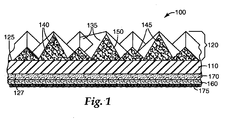
- Fig. 1 is a cross-sectional side view of an exemplary structured abrasive article according to the present disclosure.
- an exemplary structured abrasive article 100 which has abrasive layer 120 disposed on and secured to a first major surface 125 of backing 110.
- Abrasive layer 120 comprises precisely-shaped abrasive composites 135.
- Each precisely-shaped abrasive composite 135 comprises abrasive grains 140, optional grinding aid particles 145, and surfactant (not shown) dispersed in a polymeric binder 150.
- Each precisely-shaped abrasive composite contains from 2.5 to 3.5 percent by weight of a nonionic polyether surfactant based on a total weight of the shaped abrasive composite. As exemplified in Fig.
- optional attachment layer interface 160 is disposed on second major surface 127 of backing 110, and includes optional pressure-sensitive adhesive layer 170 and optional looped fabric 175.
- Optional looped fabric 175 may be bonded to second major surface 127 by optional pressure-sensitive adhesive layer, if present, or through other direct contact bonding methods (for example, heat lamination, stitchbonding, ultrasonic welding).
- shaped abrasive composite refers to a body that comprises abrasive particles and a binder, and is intentionally formed in a non-random shape (for example, a pyramid, ridge, etc.), and typically characterized by regular boundaries. Exemplary forming methods include cast and cure methods, embossing, and molding.
- the shaped abrasive composites may be disposed on the backing according to a predetermined pattern (for example, as an array). In some embodiments, shaped abrasive composites are "precisely-shaped".
- the shape of the abrasive composites is defined by relatively smooth surfaced sides that are bounded and joined by well-defined edges having distinct edge lengths with distinct endpoints defined by the intersections of the various sides.
- the terms "bounded” and “boundary” refer to the exposed surfaces and edges of each composite that delimit and define the actual three-dimensional shape of each abrasive composite. These boundaries are readily visible and discernible when a cross-section of an abrasive article is viewed under a scanning electron microscope. These boundaries separate and distinguish one precisely-shaped abrasive composite from another even if the composites abut each other along a common border at their bases. By comparison, in an abrasive composite that does not have a precise shape, the boundaries and edges are not well defined (for example, where the abrasive composite sags before completion of its curing).
- Precisely-shaped abrasive composites may be of any three-dimensional shape that results in at least one of a raised feature or recess on the exposed surface of the abrasive layer.
- Useful shapes include, for example, cubic, prismatic, pyramidal (for example, square pyramidal or hexagonal pyramidal), truncated pyramidal, conical, frustoconical. Combinations of differently shaped and/or sized abrasive composites may also be used.
- the abrasive layer of the structured abrasive may be continuous or discontinuous.
- the shaped abrasive composites are arranged on the backing according to a predetermined pattern or array, although this is not a requirement.
- the shaped abrasive composites may be arranged such that some of their work surfaces are recessed from the polishing surface of the abrasive layer.
- the density of shaped abrasive composites in the abrasive layer is typically in a range of from at least 1,000, 10,000, or even at least 20,000 abrasive composites per square inch (for example, at least 150, 1,500, or even 7,800 abrasive composites per square centimeter) up to and including 50,000, 70,000, or even as many as 100,000 abrasive composites per square inch (up to and including 7,800, 11,000, or even as many as 15,000 abrasive composites per square centimeter), although greater or lesser densities of abrasive composites may also be used.
- the structured abrasive article may be prepared by coating a slurry comprising a polymerizable binder precursor, surfactant, and abrasive grains through a screen that is in contact with a backing.
- the slurry is typically then further polymerized (for example, by exposure to an energy source) while it is present in the openings of the screen thereby forming a plurality of shaped abrasive composites generally corresponding in shape to the screen openings.
- Further details concerning this type of screen coated structured abrasive may be found, for example, in U.S. Publ. Pat. Appl. No. 2001/0041511 (Lack et al. ).
- a slurry comprising a polymerizable binder precursor, surfactant, abrasive grains, and a silane coupling agent may be deposited on a backing in a patterned manner (for example, by screen or gravure printing), partially polymerized to render at least the surface of the coated slurry plastic but non-flowing, a pattern embossed upon the partially polymerized slurry formulation, and subsequently further polymerized (for example, by exposure to an energy source) to form a plurality of shaped abrasive composites affixed to the backing.
- a patterned manner for example, by screen or gravure printing
- partially polymerized to render at least the surface of the coated slurry plastic but non-flowing
- a pattern embossed upon the partially polymerized slurry formulation and subsequently further polymerized (for example, by exposure to an energy source) to form a plurality of shaped abrasive composites affixed to the backing.
- the structured abrasive article can be any shape, for example, round (for example, a disc), oval, or rectangular (for example, a sheet) depending on the particular shape of any support pad that may be used in conjunction with it, or it may form an endless belt.
- the structured abrasive article may have slots or slits therein and may be provided with perforations (for example, a perforated disc), and/or may have scalloped edges.
- the individual shaped abrasive composites comprise abrasive grains and surfactant dispersed in a polymeric binder.
- any abrasive grain known in the abrasive art may be included in the abrasive composites.
- useful abrasive grains include aluminum oxide, fused aluminum oxide, heat-treated aluminum oxide, ceramic aluminum oxide, silicon carbide, green silicon carbide, alumina-zirconia, ceria, iron oxide, garnet, diamond, cubic boron nitride, and combinations thereof.
- useful abrasive grain sizes typically range from an average particle size of from at least 0.01, 1, 3 or even 5 micrometers up to and including 35, 100, 250, 500, or even as much as 1,500 micrometers, although particle sizes outside of this range may also be used.
- Silicon carbide abrasive particles having an abrasives industry specified nominal grade corresponding to sizes in a range of from 3 and 7 micrometers are typically preferred.
- the abrasive particles are included in the abrasive composites in an amount of from 50 to 70 percent by weight, based on a total weight of the shaped abrasive composites, although other amounts may also be used.
- thermoplastic resins such as for example, polyesters, polyamides, and combinations thereof
- thermosetting resins such as, for example, phenolic resins, aminoplast resins, urethane resins, epoxy resins, acrylic resins, acrylated isocyanurate resins, cyanate resins, urea-formaldehyde resins, isocyanurate resins, acrylated urethane resins, acrylated epoxy resins, glue
- the binder is typically prepared by polymerizing and/or curing a binder precursor.
- a binder precursor is a resin or resin mixture that polymerizes via a free-radical mechanism.
- the polymerization process is initiated by exposing the binder precursor, along with an appropriate catalyst, to an energy source such as thermal energy or radiation energy. Examples of radiation energy include electron beam, ultraviolet light or visible light.
- free-radically curable resins include acrylated urethanes, acrylate epoxies, acrylated polyesters, ethylenically-unsaturated monomers, aminoplast monomers having pendant unsaturated carbonyl groups, isocyanurate monomers having at least one pendant acrylate group, isocyanate monomers having at least one pendant acrylate group and mixtures and combinations thereof.
- (meth)acrylate encompasses acrylates and methacrylates, individually or in combination.
- One exemplary binder precursor comprises a urethane acrylate oligomer, or a blend of a urethane acrylate oligomer and an ethylenically-unsaturated monomer.
- the preferred ethylenically-unsaturated monomers are monofunctional (meth)acrylate monomers, difunctional (meth)acrylate monomers, trifunctional (meth)acrylate monomers or combinations thereof.
- ethylenically-unsaturated monomers include methyl (meth)acrylate, ethyl (meth)acrylate, styrene, divinylbenzene, hydroxyethyl (meth)acrylate, hydroxypropyl (meth)acrylate, hydroxybutyl (meth)acrylate, vinyl toluene, ethylene glycol di(meth)acrylate, polyethylene glycol di(meth)acrylate, hexanediol di(meth)acrylate, triethylene glycol di(meth)acrylate, trimethylolpropane tri(meth)acrylate, glycerol tri(meth)acrylate, pentaerthyitol tri(meth)acrylate, and pentaerythritol tetra(meth)acrylate.
- ethylenically-unsaturated monomers or oligomers include monoallyl, polyallyl, and polymethallyl esters and amides of carboxylic acids, such as diallyl phthalate, diallyl adipate, and N,N-diallyladipamide.
- Still other nitrogen containing compounds include tris(2-acryloxyethyl)isocyanurate, 1,3,5-tri(2-methacryloxyethyl)-s-triazine, acrylamide, methylacrylamide, N-methylacrylamide, N,N-dimethylacrylamide, N-vinylpyrrolidone, and N-vinylpiperidone.
- acrylated urethanes examples include those known by the trade designations: PHOTOMER (for example, PHOTOMER 6010 from Henkel Corp. of Hoboken, NJ; EBECRYL (for example, EBECRYL 220 (a hexafunctional aromatic urethane acrylate of molecular weight 1000), EBECRYL 284 (aliphatic urethane diacrylate of 1200 grams/mole molecular weight diluted with 1,6-hexanediol diacrylate), EBECRYL 4827 (aromatic urethane diacrylate of 1600 grams/mole molecular weight), EBECRYL 4830 (aliphatic urethane diacrylate of 1200 grams/mole molecular weight diluted with tetraethylene glycol diacrylate), EBECRYL 6602 (trifunctional aromatic urethane acrylate of 1300 grams/mole molecular weight diluted with trimethylolpropane ethoxy triacrylate), and
- Acrylated epoxies are acrylate esters of epoxy resins such as, for example, diacrylate esters of bisphenol A epoxy resin.
- Examples of commercially available acrylated epoxies include those available as CMD 3500, CMD 3600, and CMD 3700 from UCB Radcure, and as CN 103, CN104, CN111, CN112, and CN114. from Sartomer Co.
- polyester acrylates include those available as PHOTOMER 5007 and PHOTOMER 5018 from Henkel Corp.
- Aminoplast monomers have at least one pendant alpha, beta-unsaturated carbonyl group. These unsaturated carbonyl groups may be acrylate, methacrylate or acrylamide type groups. Examples of such materials include N-(hydroxymethyl)-acrylamide, N,N'-oxydimethylenebisacrylamide, ortho- and para-acrylamidomethylated phenol, acrylamidomethylated phenolic novolac and combinations thereof.
- the binder precursor may further comprise an effective amount of one or more curing agents (for example, catalyst(s), hardener(s), thermal initiator(s), and/or photoinitiator(s)) to cure the binder precursor, typically in amounts up to about 10 weight percent of the binder precursor).
- curing agents for example, catalyst(s), hardener(s), thermal initiator(s), and/or photoinitiator(s)
- Free-radical curing agents when exposed to an appropriate energy source, they generate a free-radicals that initiate polymerization.
- Free-radical photoinitiators are typically preferred, and are widely known and available from suppliers such as, for example, Sartomer Corp. and Ciba Specialty Chemicals of Tarrytown, NY.
- Exemplary photoinitiators include benzoin and its derivatives such as alpha-methylbenzoin; alpha-phenylbenzoin; alpha-allylbenzoin; alpha-benzylbenzoin; benzoin ethers such as benzil dimethyl ketal (for example, as available as IRGACURE 651 from Ciba Specialty Chemicals), benzoin methyl ether, benzoin ethyl ether, benzoin n-butyl ether; acetophenone and its derivatives such as 2-hydroxy-2-methyl-1-phenyl-1-propanone (for example, as available as DAROCUR 1173 from Ciba Specialty Chemicals), 1-hydroxycyclohexyl phenyl ketone (for example, as available as IRGACURE 184 from Ciba Specialty Chemicals), 2-methyl-1-[4-(methylthio)phenyl]-2-(4-morpholinyl)-1-propanone (for example, as available as IRGACURE 90
- photoinitiators include, for example, pivaloin ethyl ether, anisoin ethyl ether, anthraquinones (for example, anthraquinone, 2-ethylanthraquinone, 1-chloroanthraquinone, 1,4-dimethylanthraquinone, 1-methoxyanthraquinone, or benzanthraquinone), halomethyltriazines, benzophenone and its derivatives, iodonium salts and sulfonium salts, titanium complexes such as bis(eta.sub.5-2,4-cyclopentadien-1-yl)-bis[2,6-difluoro-3-(1H-pyrrol-1-yl-)phenyl]titanium (for example, as available as CGI 784DC from Ciba Specialty Chemicals); halomethylnitrobenzenes (for example, 4-bromomethylnitrobenzen
- One or more sensitizers may be added in combination with the photoinitiator, for example, in order to increase sensitivity of a photoinitiator to a specific source of actinic radiation.
- Another binder precursor comprises an epoxy resin.
- Epoxy resins have oxirane rings that are polymerized by a ring opening reaction.
- Such epoxy resins include monomeric epoxy resins and polymeric epoxy reins.
- examples of some preferred epoxy resins include 2,2-bis-4-(2,3-epoxypropoxy)-phenyl)propane, a diglycidyl ether of bisphenol, as EPON 828, EPON 1004, and EPON 1001F from Resolution Performance Products of Houston, TX, and as DER-331, DER-332, and DER-334 from Dow Chemical Co. of Midland, MI.
- Other suitable epoxy resins include cycloaliphatic epoxies, glycidyl ethers of phenol formaldehyde novolac (for example, DEN-431 and DE0N-428), commercially available from Dow Chemical Co.
- Useful curatives for epoxy resins include, for example, dicyandiamide and/or bisimidazoles.
- a silane coupling agent is included in the slurry of abrasive grains and solidifiable or polymerizable precursor, typically in an amount of from about 0.01 to 5 percent by weight, more typically in an amount of from about 0.01 to 3 percent by weight, more typically in an amount of from about 0.01 to 1 percent by weight, although other amounts may also be used, for example depending on the size of the abrasive grains.
- Suitable silane coupling agents include, for example, gamma-methacryloxy-propyltrimethoxysilane, vinyltriethoxysilane, tris(2-methoxyethoxy)vinylsilane, 3,4-cpoxycyclohexylmethyltrimethoxysilane, gamma-glycidoxypropyltrimethoxysilane, and gamma-mercaptopropyltrimethoxysilane (for example, as respectively available as A-174, A-151, A-172, A-186, A-187, and A-189 from Dow Chemical Co.); allyltriethoxysilane, diallyldichlorosilane, divinyldiethoxysilane, and m,p-styrylethyltrimethoxysilane (for example, as commercially available respectively as A0564, D4050, D6205, and S1588from United Chemical Industries, Bristol, PA); dimethyldiethoxysilane,
- the shaped abrasive composites may optionally contain additional ingredients such as, for example, dispersants, fillers, pigments, grinding aids, photoinitiators, hardeners, curatives, stabilizers, antioxidants, and light stabilizers.
- Suitable optional grinding aids include particulate material, the addition of which has a significant effect on the chemical and physical processes of abrading which results in improved performance.
- a grinding aid may 1) decrease the friction between the abrasive grains and the workpiece being abraded, 2) prevent the abrasive grain from "capping" (that is, prevent metal particles from becoming welded to the tops of the abrasive grains), 3) decrease the interface temperature between the abrasive grains the workpiece, and/or 4) decrease the grinding forces.
- the addition of a grinding aid increases the useful life of the coated abrasive. Grinding aids encompass a wide variety of different materials and can be inorganic- or organic-based.
- grinding aids include waxes, organic halide compounds, halide salts and metals and their alloys.
- the organic halide compounds will typically break down during abrading and release a halogen acid or a gaseous halide compound.
- examples of such materials include chlorinated waxes like tetrachloronaphthalene, pentachloronaphthalene; and polyvinyl chloride.
- halide salts include sodium chloride, potassium cryolite, sodium cryolite, ammonium cryolite, potassium tetrafluoroborate, sodium tetrafluoroborate, silicon fluorides, potassium chloride, magnesium chloride.
- Examples of metals include tin, lead, bismuth, cobalt, antimony, cadmium, iron, and titanium.
- Examples of other grinding aids include sulfur, organic sulfur compounds, graphite, and metallic sulfides. A combination of different grinding aids can also be used. The above mentioned examples of grinding aids are meant to be a representative showing of grinding aids and are not meant to encompass all grinding aids.
- the amount of polyether nonionic surfactant present in the shaped abrasive composites is in a range of from 2.5 to 3.5 percent by weight, based on a total weight of the shaped abrasive composites.
- the amount of polyether nonionic surfactant present in the shaped abrasive composites is in a range of from 2.5 to 3.0 percent by weight, based on a total weight of the shaped abrasive composites.
- the amount of polyether nonionic surfactant present in the shaped abrasive composites is in a range of from 2.8 to 3.2 percent by weight, based on a total weight of the shaped abrasive composites
- the term polyether nonionic surfactant refers to one or more nonionic (that is, not having a permanent charge) surfactant(s) thai has/have a polyether segment, typically forming at least a portion of the backbone of the surfactant
- the polyether nonionic surfactant should not be covalently bound to the crosslinked polymeric binder.
- the polyether nonionic surfactant typically has a molecular weight in a range of from 300 - 1200 grams per mole, although higher and lower molecular weights may be used.
- polyether nonionic surfactants include polyoxyethylene alkyl ethers, polyoxyethylene alkyl-phenyl ethers, polyoxyethylene acyl esters, polyoxyethylene alkylamines, polyoxyethylene alkylamides, polyoxyethylene lauryl ether, polyoxyethylene cetyl ether, polyoxyethylene stearyl ether, polyoxyethylene oleyl ether, polyoxyethylene octylphenyl ether, polyoxyethylene nonylphenyl ether, polyethylene glycol laurate, polyethylene glycol stearate, polyethylene glycol distearate, polyethylene glycol oleate, oxyethylene-oxypropylene block copolymer, polyoxyethylene sorbitan laurate, polyoxyethylene sorbitan stearate, polyoxyethylene sorbitan oleate, and polyoxyethylene laurylamide.
- Useful polyether nonionic surfactants also include, for example, condensation products of a higher aliphatic alcohol with about 3 equivalents to about 100 equivalents of ethylene oxide (for example, those marketed by Dow Chemical Co. under the trade designation TERGITOL 15-S such as, for example, TERGITOL 15-S-20; and those marketed by ICI Americas of Bridgewater, NJ under the trade designation BRIJ such as, for example, BRIJ 58, BRIJ 76, and BRIJ 97).
- BRIJ 97 surfactant is polyoxyethylene (10) oleyl ether
- BRIJ 58 surfactant is polyoxyethylene (20) cetyl ether
- BRIJ 76 surfactant is polyoxyethylene (10) stearyl ether.
- Useful polyether nonionic surfactants also include, for example, polyethylene oxide condensates of an alkyl phenol with about 3 equivalents to about 100 equivalents of ethylene oxide (for example, those marketed by Rhodia of Cranbury, NJ under the trade designations IGEPAL CO and IGEPAL CA).
- IGEPAL CO surfactants include nonylphenoxy poly(ethyleneoxy)ethanols.
- IGEPAL CA surfactants include octylphenoxy poly(ethyleneoxy)ethanols.
- Useful polyether nonionic surfactants also include, for example, block copolymers of ethylene oxide and propylene oxide or butylene oxide (for example, those marketed by BASF Corp. of Mount Olive, NJ under the trade designations PLURONIC (for example, PLURONIC L10) and TETRONIC).
- PLURONIC surfactants may include propylene oxide polymers, ethylene oxide polymers, and ethylene oxide-propylene oxide block copolymers.
- TETRONIC surfactants include ethylene oxide-propylene oxide block copolymers.
- Useful polyether nonionic surfactants also include, for example, polyoxyethylene sorbitan fatty acid esters (for examples, polyoxyethylene sorbitan monooleates, which may have differing degrees of ethoxylation such as, for example, 20 ethylene oxide units per molecule (for example, marketed as TWEEN 60) or 20 ethylene oxide units per molecule (for example, marketed as TWEEN 80)) and polyoxyethylene stearates (for example, those marketed under the trade designations TWEEN and MYRJ by Uniqema of New Castle, DE).
- TWEEN surfactants include poly(ethylene oxide) C 12 -C 18 sorbitan monoesters.
- MYRJ surfactants include poly(ethylene oxide) stearates.
- polyether nonionic surfactant is the only surfactant present in the shaped abrasive composites or in the aqueous fluid during abrading. In some cases, it may be desirable to add lesser quantifiers of anionic surfactant such as an anionic phosphate polyether ester available as TRITON H55 from Dow Chemical Co.
- Useful backings include, for example, film backings and foam backings.
- Suitable film backings include polymeric films and primed polymeric films, especially those used in the abrasive arts.
- Useful polymeric films include, for example, polyester films (for example, an ethylene-acrylic acid copolymer primed polyethylene terephthalate), polyolefin films (for example, polyethylene or polypropylene films), and elastic polyurethane films.
- the film backing may be a laminate of two polymeric films. Examples of elastomeric polyurethanes that may be used to form films include those available under the trade designation ESTANE from B.F. Goodrich and Co. of Cleveland, OH and those described in U.S. Pat. Nos.
- Pressure-sensitive adhesive-coated polyurethane elastomer films are commercially available from 3M Company under the trade designation TEGADERM Useful polymeric films are generally from about 0.02 to about 0.5 millimeters in thickness, for example, from 0.02 millimeter to 0.1 millimeter in thickness; however, this is not a requirement.
- Useful polymeric foams include open cell and closed cell polymeric foams, typically compressible and resilient.
- Useful polymeric foams include elastic foams such as, for example, chloroprene rubber foams, ethylene/propylene rubber foams, butyl rubber foams, polybutadiene foams, polyisoprene foams, EPDM polymer foams, polyurethane foams, ethylene-vinyl acetate foams, neoprene foams, and styrene/butadiene copolymer foams.
- Useful foams also include thermoplastic foams such as, for example, polyethylene foams, polypropylene foams, polybutylene foams, polystyrene foams, polyamide foams, polyester foams, plasticized polyvinyl chloride (that is, pvc) foams.
- thermoplastic foams such as, for example, polyethylene foams, polypropylene foams, polybutylene foams, polystyrene foams, polyamide foams, polyester foams, plasticized polyvinyl chloride (that is, pvc) foams.
- useful open cell foams include polyester polyurethane foams available from Illbruck, Inc. of Minneapolis, MN under the trade designations R 200U, R 400U, R 600U and EF3-700C.
- Useful foam backings are generally from about 1 to about 15 millimeters in thickness; however this is not a requirement.
- the backing can have an attachment interface layer on its back surface to secure the abrasive article to a support pad or back-up pad.
- This attachment system half can be, for example, a pressure-sensitive adhesive or tape, a loop fabric for a hook and loop attachment, a hook structure for a hook and loop attachment, or an intermeshing attachment system. Further details concerning such attachment systems may be found, for example, in U.S. Pat. Nos. 5,152,917 (Pieper et al. ); 5,454,844 (Hibbard et al. ); 5,672,097 (Hoopman ); 5,681,217 (Hoopman ct al.); and U.S. Pat. Appl. Pub. Nos. 2003/0143938 A1 (Braunschweig et al. ) and 2003/0022604 A1 (Annen et al. ).
- Structured abrasive articles may be prepared by forming a slurry of abrasive grains and a solidifiable or polymerizable precursor of the abovementioned binder resin (that is, a binder precursor), contacting the slurry with a backing and solidi fying and/or polymerizing the binder precursor (for example, by exposure to an energy source) in a manner such that the resulting structured abrasive article has a plurality of shaped abrasive composites affixed to the backing.
- energy sources include thermal energy and radiant energy (for example, including electron beam, ultraviolet light, and visible light).
- the slurry may be coated directly onto a production tool having precisely-shaped cavities therein and brought into contact with the backing, or coated on the backing and brought to contact with the production tool.
- the slurry is typically then solidified or cured while it is present in the cavities of the production tool.
- the choice of curing conditions typically depends on the particular binder precursor used, and is within the capability of one of ordinary skill in the art. In general, it is important that a substantially complete cure is obtained to fully realize the benefits of the present disclosure. That is, additional curing at the same temperature and/or wavelengths does not substantially change the abrasive properties. At lesser degrees of curing, the abrasive composites tend to break down more rapidly and less surfactant is generally needed; however, the overall abrasive properties are generally degraded at such lesser degrees of cure.
- a period of time (for example, at least about 24 hours) is allowed to elapse before the structured abrasive article is used in abrading processes, although this is not a requirement.
- abrading performance may be reduced if the structured abrasive article is used in abrading processes prior to such aging.
- the workpiece may comprise any material and may have any form.
- suitable materials include ceramic, paint, thermoplastic or thermoset polymers, polymeric coatings, polycrystalline silicon, wood, marble, and combinations thereof.
- substrate forms include molded and/or shaped articles (for example, optical lenses, automotive body panels, boat hulls, counters, and sinks), wafers, sheets, and blocks.
- Methods according to the present disclosure are particularly useful for repair and/or polishing of polymeric materials such as motor vehicle paints and clearcoats (for example, automotive clearcoats), examples of which include: polyacrylic-polyol-polyisocyanate compositions (for example, as described in U.S. Pat. No. 5,286,782 (Lamb, et al.
- One suitable clearcoat comprises nanosized silica particles dispersed in a crosslinked polymer.
- An example of this clearcoat is available as CERAMICLEAR from PPG Industries of Pittsburgh, PA.
- Suitable materials that may be repaired and/or polished according to the present disclosure include marine gel coats, polycarbonate lenses, countertops and sinks made from synthetic materials, for example, such as those marketed as DUPONT CORIAN by E.I. du Pont de Nemours and Company of Wilmington, DE.
- the abrasive layer is brought into frictional contact with a surface of a workpiece and then at least one of the structured abrasive article or the workpiece is moved relative to the other to abrade at least a portion of the workpiece.
- the process is carried out in the presence of an aqueous fluid.
- aqueous means containing at least 30 percent water by weight).
- the liquid comprises at least 90 or even at least 95 percent by weight of water.
- the liquid may comprise (or consist of) municipal tap water or well water.
- the aqueous liquid will contain nonionic polyether surfactant that dissolves out of the structured abrasive article. Without wishing to be bound by theory, it is believed that this decreases adverse swarf loading (for example, accumulation of swarf between adjacent shaped abrasive composites) of the structured abrasive article and facilitates erosion of the shaped abrasive composites which increases cut life.
- adverse swarf loading for example, accumulation of swarf between adjacent shaped abrasive composites
- the aqueous fluid may contain additional components besides water such as, for example, water miscible organic solvents (for example, alcohols such as ethanol, 2-ethoxy ethanol and including polyols such as propylcnc glycol and/or polycthcrs such as diglyme), surfactants, and grinding aids.
- water miscible organic solvents for example, alcohols such as ethanol, 2-ethoxy ethanol and including polyols such as propylcnc glycol and/or polycthcrs such as diglyme
- surfactants for example, alcohols such as ethanol, 2-ethoxy ethanol and including polyols such as propylcnc glycol and/or polycthcrs such as diglyme
- the aqueous fluid may be free of additional surfactant other than nonionic polyether surfactant, although this is not a requirement.
- the aqueous fluid may be applied to the surface of the workpiece, the abrasive layer, or both.
- the structured abrasive article may be moved relative to the workpiece by hand or by mechanical means such as, for example, an electric or air-driven motor using any method known in the abrasive art.
- the structured abrasive article may be removably fastened to a back up pad (for example, as is common practice with discs) or may be used without a back up pad (for example, in the case of abrasive belts).
- the workpiece is typically rinsed (for example, with water) to remove residue generated during the abrading process.
- the workpiece may be further polished using a polishing compound, for example, in conjunction with a buffing pad.
- a polishing compound typically contains fine abrasive particles (for example, having an average particle size of less than 100 micrometers, less than 50 micrometers, or even less than 25 micrometers) in a liquid vehicle. Further details concerning polishing compounds and processes are described in, for example, U.S. Pat. Appl. Pub. No. 2003/0032368 (Hara ).
- Example 6 and Comparative Examples L-M a hooked attachment member available as the adhesive backed hooked portion of a 3M SCOTCHMATE HOOK AND LOOP RECLOSABLE FASTENER from 3M Company, cut down to a 1.25 inch (3.2 cm) diameter disc, was attached to a back up pad available as 3M STIKIT ROLOC DISC PAD 02727, 1 1/4 inch (3.2 cm) x 5/16 inch (0.8 cm) from 3M Company using the adhesive layer on the adhesive backed hooked portion, and used as a backup pad instead of the 3M FINESSE-IT STIKIT BACKUP PAD.
- 3M STIKIT ROLOC DISC PAD 02727 1 1/4 inch (3.2 cm) x 5/16 inch (0.8 cm) from 3M Company using the adhesive layer on the adhesive backed hooked portion, and used as a backup pad instead of the 3M FINESSE-IT STIKIT BACKUP PAD.
- the abrasive layer of the disc was then misted with water in an amount sufficient to cover the entire surface of the abrasive layer using 1 or 2 squirts of liquid from a 24-ounce (0.71-liter) spray bottle.
- the abrasive layer was manually brought into contact with a clearcoated surface of workpiece TP1, which was then abraded for 3 to 5 seconds at 7,500 revolutions per minute (rpm) at 90 psi (621 kilopascals) and an angle of zero degrees (that is, manually held flat to the surface of the workpiece).
- the misting and abrading steps were repeated on adjacent areas of the test panel until the abrasive disc became clogged with debris, as visually indicated by incomplete clearcoat removal.
- the number of times the abrasive disc could be used without clogging was reported as the cut-life of the abrasive disc.
- Abrasive slurries ABR3 - ABR7 were prepared as follows: 15.8 parts of ACR1, 15.8 parts of ACR2, 0.71 part of DSP1, 1.94 parts of CPA1, 1.1 parts of UVI1, 1.64 parts of FIL, AD1 surfactant in amounts as indicated in Table 1, and 60 parts of MIN1 were homogeneously dispersed for one hour using a mechanical mixer at a temperature not exceeding 30 °C.
- Each slurry was applied via knife coating to a 12 inch (30.5 cm) wide microreplicated polypropylene tooling having uniformly distributed, close packed, alternating 34 degree helical cut, pyramidal arrays having 11 by 11 rows of base width 3.3 mils by 3.3 mils (83.8 by 83.8 micrometers) by 2.5 mils (63.5 micrometers) depth, separated by 3 by 3 rows of the same pyramidal array truncated to a depth of 0.83 mil (21 micrometers), as shown in Fig. 2 of U.S. Pat. No. 7410413 (Woo et al. ).
- the tool was prepared from a corresponding master roll generally according to the procedure of U.S. Pat. No. 5,975,987 (Hoopman et al.
- the slurry filled polypropylene tooling was then laid on a 12-inch (30.5-cm) wide web of ethylene acrylic acid primed polyester film, 3.71 mil (94.2 micrometers) thick, obtained as MA370M from 3M Company, passed through a nip roll (nip pressure of 90 pounds per square inch (psi) (620.5 kilopascals (kPa)) for a 10 inch (25.4 cm) wide web), and irradiated with an ultraviolet (UV) lamp, type "D" bulb, from Fusion Systems Inc., Gaithersburg, Maryland, at 600 Watts/inch (236 Watts/cm) while moving the web at 30 feet/minute (fpm) (9.14 meters/minute).
- UV ultraviolet
- the polypropylene tooling was separated from the ethylene acrylic acid primed polyester film, resulting in a fully cured precisely-shaped abrasive layer adhered to ethylene acrylic acid primed polyester film.
- Pressure-sensitive adhesive was laminated to the backside (opposite that abrasive layer) of the backing. Discs (1.25-inch (3.18-cm) in diameter) were then die cut from the structured abrasive article.
- Abrasive slurries ABR8-ABR10 were prepared as follows: 1.08 parts UVI1, 3.08 parts DSP1, 1.92 parts CPA1, 19.48 parts ACR2, 12.94 ACR1, AD1 surfactant in amounts as indicated in Table 2, and 68.5 parts of MIN2 were homogenously dispersed for approximately 60 minutes using a laboratory mixer with a Cowles blade. This slurry was applied via knife coating to a 12 inch (30.5 cm) wide microreplicated polypropylene tooling having the repeating pattern that is shown in Figs.14 and 15 of U.S. Pat. No. 6,923,840 (Schutz et al. ). The tool was prepared from a corresponding master roll generally according to the procedure of U.S. Pat. No.
- polypropylene tooling, slurry and foam was then passed through a nip roll (nip pressure of 60 pounds per square inch (psi) (413 kilopascals (kPa)) for a 8 inch wide web), and irradiated with an ultraviolet (UV) lamp, type "D" bulb, from Fusion Systems, Inc. of Gaithersburg, Maryland at 600 Watts/inch (236 Watts/cm) while moving the web at 70 feet/minute (fpm) (21.33 meters/minute).
- UV ultraviolet
Landscapes
- Engineering & Computer Science (AREA)
- Mechanical Engineering (AREA)
- Chemical & Material Sciences (AREA)
- Organic Chemistry (AREA)
- Manufacturing & Machinery (AREA)
- Polishing Bodies And Polishing Tools (AREA)
Applications Claiming Priority (2)
| Application Number | Priority Date | Filing Date | Title |
|---|---|---|---|
| US12/560,797 US8348723B2 (en) | 2009-09-16 | 2009-09-16 | Structured abrasive article and method of using the same |
| PCT/US2010/029553 WO2011034635A1 (en) | 2009-09-16 | 2010-04-01 | Structured abrasive article and method of using the same |
Publications (2)
| Publication Number | Publication Date |
|---|---|
| EP2477789A1 EP2477789A1 (en) | 2012-07-25 |
| EP2477789B1 true EP2477789B1 (en) | 2014-07-09 |
Family
ID=42323446
Family Applications (1)
| Application Number | Title | Priority Date | Filing Date |
|---|---|---|---|
| EP10723438.7A Active EP2477789B1 (en) | 2009-09-16 | 2010-04-01 | Structured abrasive article and method of using the same |
Country Status (7)
| Country | Link |
|---|---|
| US (1) | US8348723B2 (OSRAM) |
| EP (1) | EP2477789B1 (OSRAM) |
| JP (1) | JP5739891B2 (OSRAM) |
| KR (1) | KR101643798B1 (OSRAM) |
| CN (1) | CN102481683B (OSRAM) |
| BR (1) | BR112012005697B1 (OSRAM) |
| WO (1) | WO2011034635A1 (OSRAM) |
Families Citing this family (25)
| Publication number | Priority date | Publication date | Assignee | Title |
|---|---|---|---|---|
| JP5555453B2 (ja) * | 2008-07-24 | 2014-07-23 | スリーエム イノベイティブ プロパティズ カンパニー | 研磨材製品、その製造方法及び使用方法 |
| US8348723B2 (en) * | 2009-09-16 | 2013-01-08 | 3M Innovative Properties Company | Structured abrasive article and method of using the same |
| WO2011142986A1 (en) * | 2010-05-11 | 2011-11-17 | 3M Innovative Properties Company | Fixed abrasive pad with surfactant for chemical mechanical planarization |
| US20130065490A1 (en) * | 2011-09-12 | 2013-03-14 | 3M Innovative Properties Company | Method of refurbishing vinyl composition tile |
| CN104114327B (zh) | 2011-12-30 | 2018-06-05 | 圣戈本陶瓷及塑料股份有限公司 | 复合成型研磨颗粒及其形成方法 |
| KR101667943B1 (ko) * | 2012-01-10 | 2016-10-20 | 생-고뱅 세라믹스 앤드 플라스틱스, 인코포레이티드 | 복잡한 형상들을 가지는 연마 입자들 및 이의 성형 방법들 |
| EP2662185A1 (en) * | 2012-05-11 | 2013-11-13 | Cerium Group Limited | A lens surfacing pad |
| RU2014152694A (ru) * | 2012-06-06 | 2016-07-20 | Сен-Гобен Абразивс, Инк. | Режущий инструмент небольшого диаметра |
| EP2866974B1 (en) * | 2012-06-27 | 2017-07-26 | 3M Innovative Properties Company | Abrasive article |
| KR20150058302A (ko) * | 2012-09-21 | 2015-05-28 | 쓰리엠 이노베이티브 프로퍼티즈 컴파니 | 개선된 cmp 성능을 위한 고정 연마 웹으로의 첨가제의 혼입 |
| KR20160007649A (ko) | 2013-05-17 | 2016-01-20 | 쓰리엠 이노베이티브 프로퍼티즈 컴파니 | 세정 용이성 표면 및 그의 제조 방법 |
| US20150059256A1 (en) * | 2013-08-30 | 2015-03-05 | Saint-Gobain Abrasives, Inc. | Abrasive article and method of forming |
| CN103551988A (zh) * | 2013-11-08 | 2014-02-05 | 谢泽 | 一种含网格剑麻背盖的模压成型平面轮的制备方法 |
| CN105722643B (zh) | 2013-11-12 | 2018-06-05 | 3M创新有限公司 | 结构化磨料制品及其使用方法 |
| JP6611414B2 (ja) | 2014-05-27 | 2019-11-27 | スリーエム イノベイティブ プロパティズ カンパニー | 塗装表面の仕上げ方法及び研磨材料 |
| BR112017007263A2 (pt) * | 2014-10-07 | 2017-12-19 | 3M Innovative Properties Co | ?artigo abrasivo texturizado e métodos relacionados? |
| JP6584507B2 (ja) * | 2014-11-07 | 2019-10-02 | スリーエム イノベイティブ プロパティズ カンパニー | 可撓性研磨物品およびその製造方法 |
| EP3224000B1 (en) * | 2014-11-26 | 2020-11-04 | 3M Innovative Properties Company | Abrasive articles, assemblies, and methods with gripping material |
| EP3227054A4 (en) * | 2014-12-04 | 2018-08-08 | 3M Innovative Properties Company | Abrasive belt with angled shaped abrasive particles |
| CN107553312B (zh) * | 2017-10-12 | 2021-04-20 | 河北思瑞恩新材料科技有限公司 | 一种立体磨料及其制备方法 |
| CN108296994A (zh) * | 2018-02-01 | 2018-07-20 | 南京信息工程大学 | 一种高硬耐磨打磨头材料及高效打磨装置 |
| CN114761177B (zh) | 2019-12-06 | 2025-01-07 | 3M创新有限公司 | 网格磨料及其制备方法 |
| EP4188645A1 (en) | 2020-07-30 | 2023-06-07 | 3M Innovative Properties Company | Abrasive article and method of making the same |
| US20230286111A1 (en) | 2020-08-10 | 2023-09-14 | 3M Innovative Properties Company | Abrasive articles and method of making the same |
| CN114227529B (zh) * | 2021-12-06 | 2023-09-15 | 河南联合精密材料股份有限公司 | 一种蓝宝石晶片减薄加工用树脂研磨垫及其制备方法 |
Family Cites Families (53)
| Publication number | Priority date | Publication date | Assignee | Title |
|---|---|---|---|---|
| US2871218A (en) * | 1955-12-01 | 1959-01-27 | Goodrich Co B F | Simulated vulcanizates of polyurethane elastomers |
| NO134790C (no) | 1968-07-09 | 1984-03-22 | Smith & Nephew | Klebende,; trykkfoelsomt, vanndamp-permeabelt produkt for bruk paa hud hos mennesker. |
| US3654835A (en) * | 1970-05-25 | 1972-04-11 | Ato Inc | Regeneration valve |
| DE3361672D1 (en) * | 1982-04-08 | 1986-02-13 | Smith & Nephew Ass | Surgical adhesive dressing |
| USRE33353E (en) * | 1985-01-24 | 1990-09-25 | Minnesota Mining And Manufacturing Company | Thin film surgical dressing with delivery system |
| US5088483A (en) * | 1988-11-04 | 1992-02-18 | Minnesota Mining And Manufacturing Co. | Adhesive frame bandage |
| US5378251A (en) * | 1991-02-06 | 1995-01-03 | Minnesota Mining And Manufacturing Company | Abrasive articles and methods of making and using same |
| US5152917B1 (en) * | 1991-02-06 | 1998-01-13 | Minnesota Mining & Mfg | Structured abrasive article |
| US5354797A (en) * | 1992-08-31 | 1994-10-11 | E. I. Du Pont De Nemours And Company | Coating composition of hydroxy functional acrylic polymer, polyol and polyisocyanate crosslinking agent |
| US5286782A (en) * | 1992-08-31 | 1994-02-15 | E. I. Du Pont De Nemours And Company | Coating composition of an acrylic polymer, polyol and polyisocyanate crosslinking agent |
| US5435816A (en) * | 1993-01-14 | 1995-07-25 | Minnesota Mining And Manufacturing Company | Method of making an abrasive article |
| KR0165625B1 (ko) * | 1993-06-02 | 1999-02-01 | 기타지마 요시토시 | 연마테이프 및 그 제조방법 |
| US5658184A (en) * | 1993-09-13 | 1997-08-19 | Minnesota Mining And Manufacturing Company | Nail tool and method of using same to file, polish and/or buff a fingernail or a toenail |
| RU2124978C1 (ru) * | 1993-09-13 | 1999-01-20 | Миннесота Майнинг Энд Мэнюфекчуринг Компани | Абразивное изделие, способ его производства, способ его использования для чистовой обработки и рабочий инструмент для его производства |
| US5489235A (en) * | 1993-09-13 | 1996-02-06 | Minnesota Mining And Manufacturing Company | Abrasive article and method of making same |
| US5454844A (en) * | 1993-10-29 | 1995-10-03 | Minnesota Mining And Manufacturing Company | Abrasive article, a process of making same, and a method of using same to finish a workpiece surface |
| US5453312A (en) * | 1993-10-29 | 1995-09-26 | Minnesota Mining And Manufacturing Company | Abrasive article, a process for its manufacture, and a method of using it to reduce a workpiece surface |
| US5785784A (en) * | 1994-01-13 | 1998-07-28 | Minnesota Mining And Manufacturing Company | Abrasive articles method of making same and abrading apparatus |
| WO1995022436A1 (en) * | 1994-02-22 | 1995-08-24 | Minnesota Mining And Manufacturing Company | Abrasive article, a method of making same, and a method of using same for finishing |
| KR19980702613A (ko) * | 1995-03-02 | 1998-08-05 | 워렌리차드보비 | 구조적 연마재를 이용하여 기판을 텍스쳐링하는 방법 |
| WO1997006926A1 (en) * | 1995-08-11 | 1997-02-27 | Minnesota Mining And Manufacturing Company | Method of making a coated abrasive article having multiple abrasive natures |
| US5975987A (en) * | 1995-10-05 | 1999-11-02 | 3M Innovative Properties Company | Method and apparatus for knurling a workpiece, method of molding an article with such workpiece, and such molded article |
| EP0868261B1 (en) * | 1995-12-04 | 2000-12-27 | Minnesota Mining And Manufacturing Company | Abrasive article back up pad with foam layer |
| US5700302A (en) * | 1996-03-15 | 1997-12-23 | Minnesota Mining And Manufacturing Company | Radiation curable abrasive article with tie coat and method |
| US6080215A (en) * | 1996-08-12 | 2000-06-27 | 3M Innovative Properties Company | Abrasive article and method of making such article |
| US6475253B2 (en) * | 1996-09-11 | 2002-11-05 | 3M Innovative Properties Company | Abrasive article and method of making |
| US5863306A (en) * | 1997-01-07 | 1999-01-26 | Norton Company | Production of patterned abrasive surfaces |
| US5833724A (en) * | 1997-01-07 | 1998-11-10 | Norton Company | Structured abrasives with adhered functional powders |
| US5851247A (en) * | 1997-02-24 | 1998-12-22 | Minnesota Mining & Manufacturing Company | Structured abrasive article adapted to abrade a mild steel workpiece |
| US5942015A (en) * | 1997-09-16 | 1999-08-24 | 3M Innovative Properties Company | Abrasive slurries and abrasive articles comprising multiple abrasive particle grades |
| DK1054916T3 (da) * | 1998-02-06 | 2006-03-06 | Du Pont | Reaktive siliciumoligomerer og coatingsammensætninger fremstillet deraf |
| US6139594A (en) * | 1998-04-13 | 2000-10-31 | 3M Innovative Properties Company | Abrasive article with tie coat and method |
| US6048375A (en) * | 1998-12-16 | 2000-04-11 | Norton Company | Coated abrasive |
| EP1169396B1 (en) * | 1999-03-17 | 2005-11-02 | E.I. Du Pont De Nemours And Company | High solids clear coating composition |
| US6293980B2 (en) * | 1999-12-20 | 2001-09-25 | Norton Company | Production of layered engineered abrasive surfaces |
| US20010041511A1 (en) * | 2000-01-19 | 2001-11-15 | Lack Craig D. | Printing of polishing pads |
| US6638327B2 (en) * | 2000-03-02 | 2003-10-28 | 3M Innovative Properties Company | Method for repairing and lustering defects on hydrophilic coat surface |
| US20020090901A1 (en) * | 2000-11-03 | 2002-07-11 | 3M Innovative Properties Company | Flexible abrasive product and method of making and using the same |
| US20030022604A1 (en) * | 2001-05-07 | 2003-01-30 | 3M Innovative Properties Company | Abrasive product and method of making and using the same |
| US20030024169A1 (en) * | 2001-03-28 | 2003-02-06 | Kendall Philip E. | Abrasive articles with water soluble particles |
| US7097549B2 (en) * | 2001-12-20 | 2006-08-29 | Ppg Industries Ohio, Inc. | Polishing pad |
| US6846232B2 (en) * | 2001-12-28 | 2005-01-25 | 3M Innovative Properties Company | Backing and abrasive product made with the backing and method of making and using the backing and abrasive product |
| US6838589B2 (en) * | 2003-02-19 | 2005-01-04 | 3M Innovative Properties Company | Conformable wound dressing |
| US20050060942A1 (en) * | 2003-09-23 | 2005-03-24 | 3M Innovative Properties Company | Structured abrasive article |
| US20050060944A1 (en) * | 2003-09-23 | 2005-03-24 | 3M Innovative Properties Company | Method of making a coated abrasive |
| US20050064805A1 (en) * | 2003-09-23 | 2005-03-24 | 3M Innovative Properties Company | Structured abrasive article |
| US20050060945A1 (en) * | 2003-09-23 | 2005-03-24 | 3M Innovative Properties Company | Method of making a coated abrasive |
| US20050060941A1 (en) * | 2003-09-23 | 2005-03-24 | 3M Innovative Properties Company | Abrasive article and methods of making the same |
| US7267700B2 (en) * | 2003-09-23 | 2007-09-11 | 3M Innovative Properties Company | Structured abrasive with parabolic sides |
| EP1697084A1 (en) * | 2003-11-26 | 2006-09-06 | 3M Innovative Properties Company | Method of abrading a workpiece |
| CA2603275C (en) | 2005-04-14 | 2010-07-13 | Saint-Gobain Abrasives, Inc. | Method of forming structured abrasive article |
| US7410413B2 (en) | 2006-04-27 | 2008-08-12 | 3M Innovative Properties Company | Structured abrasive article and method of making and using the same |
| US8348723B2 (en) * | 2009-09-16 | 2013-01-08 | 3M Innovative Properties Company | Structured abrasive article and method of using the same |
-
2009
- 2009-09-16 US US12/560,797 patent/US8348723B2/en active Active
-
2010
- 2010-04-01 JP JP2012529757A patent/JP5739891B2/ja active Active
- 2010-04-01 WO PCT/US2010/029553 patent/WO2011034635A1/en not_active Ceased
- 2010-04-01 CN CN201080037197.6A patent/CN102481683B/zh active Active
- 2010-04-01 EP EP10723438.7A patent/EP2477789B1/en active Active
- 2010-04-01 BR BR112012005697-2A patent/BR112012005697B1/pt active IP Right Grant
- 2010-04-01 KR KR1020127009198A patent/KR101643798B1/ko active Active
Also Published As
| Publication number | Publication date |
|---|---|
| JP5739891B2 (ja) | 2015-06-24 |
| KR101643798B1 (ko) | 2016-07-28 |
| BR112012005697A2 (pt) | 2016-02-23 |
| WO2011034635A1 (en) | 2011-03-24 |
| US20110065362A1 (en) | 2011-03-17 |
| JP2013505145A (ja) | 2013-02-14 |
| CN102481683A (zh) | 2012-05-30 |
| EP2477789A1 (en) | 2012-07-25 |
| CN102481683B (zh) | 2014-10-15 |
| KR20120083398A (ko) | 2012-07-25 |
| US8348723B2 (en) | 2013-01-08 |
| BR112012005697B1 (pt) | 2021-01-05 |
Similar Documents
| Publication | Publication Date | Title |
|---|---|---|
| EP2477789B1 (en) | Structured abrasive article and method of using the same | |
| EP3837086B1 (en) | Structured abrasive article and method of making the same | |
| RU2471609C2 (ru) | Структурированный абразивный материал с верхним слоем и способ его изготовления и использования | |
| EP2470331B1 (en) | Structured abrasive article and method of using the same | |
| EP2012972B1 (en) | Structured abrasive article and method of making and using the same | |
| EP1458524B1 (en) | Method of making an abrasive product | |
| EP2007551A2 (en) | Embossed structured abrasive article and method of making and using the same | |
| EP3068581B1 (en) | Structured abrasive articles and methods of using the same | |
| US20210024799A1 (en) | Structured abrasives containing polishing materials for use in the home |
Legal Events
| Date | Code | Title | Description |
|---|---|---|---|
| PUAI | Public reference made under article 153(3) epc to a published international application that has entered the european phase |
Free format text: ORIGINAL CODE: 0009012 |
|
| 17P | Request for examination filed |
Effective date: 20120321 |
|
| AK | Designated contracting states |
Kind code of ref document: A1 Designated state(s): AT BE BG CH CY CZ DE DK EE ES FI FR GB GR HR HU IE IS IT LI LT LU LV MC MK MT NL NO PL PT RO SE SI SK SM TR |
|
| DAX | Request for extension of the european patent (deleted) | ||
| GRAP | Despatch of communication of intention to grant a patent |
Free format text: ORIGINAL CODE: EPIDOSNIGR1 |
|
| INTG | Intention to grant announced |
Effective date: 20140221 |
|
| GRAS | Grant fee paid |
Free format text: ORIGINAL CODE: EPIDOSNIGR3 |
|
| GRAA | (expected) grant |
Free format text: ORIGINAL CODE: 0009210 |
|
| AK | Designated contracting states |
Kind code of ref document: B1 Designated state(s): AT BE BG CH CY CZ DE DK EE ES FI FR GB GR HR HU IE IS IT LI LT LU LV MC MK MT NL NO PL PT RO SE SI SK SM TR |
|
| REG | Reference to a national code |
Ref country code: GB Ref legal event code: FG4D |
|
| REG | Reference to a national code |
Ref country code: CH Ref legal event code: EP Ref country code: AT Ref legal event code: REF Ref document number: 676393 Country of ref document: AT Kind code of ref document: T Effective date: 20140715 |
|
| REG | Reference to a national code |
Ref country code: IE Ref legal event code: FG4D |
|
| REG | Reference to a national code |
Ref country code: DE Ref legal event code: R096 Ref document number: 602010017355 Country of ref document: DE Effective date: 20140821 |
|
| REG | Reference to a national code |
Ref country code: AT Ref legal event code: MK05 Ref document number: 676393 Country of ref document: AT Kind code of ref document: T Effective date: 20140709 |
|
| REG | Reference to a national code |
Ref country code: NL Ref legal event code: VDEP Effective date: 20140709 |
|
| REG | Reference to a national code |
Ref country code: LT Ref legal event code: MG4D |
|
| PG25 | Lapsed in a contracting state [announced via postgrant information from national office to epo] |
Ref country code: BG Free format text: LAPSE BECAUSE OF FAILURE TO SUBMIT A TRANSLATION OF THE DESCRIPTION OR TO PAY THE FEE WITHIN THE PRESCRIBED TIME-LIMIT Effective date: 20141009 Ref country code: FI Free format text: LAPSE BECAUSE OF FAILURE TO SUBMIT A TRANSLATION OF THE DESCRIPTION OR TO PAY THE FEE WITHIN THE PRESCRIBED TIME-LIMIT Effective date: 20140709 Ref country code: SE Free format text: LAPSE BECAUSE OF FAILURE TO SUBMIT A TRANSLATION OF THE DESCRIPTION OR TO PAY THE FEE WITHIN THE PRESCRIBED TIME-LIMIT Effective date: 20140709 Ref country code: LT Free format text: LAPSE BECAUSE OF FAILURE TO SUBMIT A TRANSLATION OF THE DESCRIPTION OR TO PAY THE FEE WITHIN THE PRESCRIBED TIME-LIMIT Effective date: 20140709 Ref country code: GR Free format text: LAPSE BECAUSE OF FAILURE TO SUBMIT A TRANSLATION OF THE DESCRIPTION OR TO PAY THE FEE WITHIN THE PRESCRIBED TIME-LIMIT Effective date: 20141010 Ref country code: PT Free format text: LAPSE BECAUSE OF FAILURE TO SUBMIT A TRANSLATION OF THE DESCRIPTION OR TO PAY THE FEE WITHIN THE PRESCRIBED TIME-LIMIT Effective date: 20141110 Ref country code: NO Free format text: LAPSE BECAUSE OF FAILURE TO SUBMIT A TRANSLATION OF THE DESCRIPTION OR TO PAY THE FEE WITHIN THE PRESCRIBED TIME-LIMIT Effective date: 20141009 Ref country code: ES Free format text: LAPSE BECAUSE OF FAILURE TO SUBMIT A TRANSLATION OF THE DESCRIPTION OR TO PAY THE FEE WITHIN THE PRESCRIBED TIME-LIMIT Effective date: 20140709 |
|
| PG25 | Lapsed in a contracting state [announced via postgrant information from national office to epo] |
Ref country code: NL Free format text: LAPSE BECAUSE OF FAILURE TO SUBMIT A TRANSLATION OF THE DESCRIPTION OR TO PAY THE FEE WITHIN THE PRESCRIBED TIME-LIMIT Effective date: 20140709 Ref country code: IS Free format text: LAPSE BECAUSE OF FAILURE TO SUBMIT A TRANSLATION OF THE DESCRIPTION OR TO PAY THE FEE WITHIN THE PRESCRIBED TIME-LIMIT Effective date: 20141109 Ref country code: AT Free format text: LAPSE BECAUSE OF FAILURE TO SUBMIT A TRANSLATION OF THE DESCRIPTION OR TO PAY THE FEE WITHIN THE PRESCRIBED TIME-LIMIT Effective date: 20140709 Ref country code: PL Free format text: LAPSE BECAUSE OF FAILURE TO SUBMIT A TRANSLATION OF THE DESCRIPTION OR TO PAY THE FEE WITHIN THE PRESCRIBED TIME-LIMIT Effective date: 20140709 Ref country code: LV Free format text: LAPSE BECAUSE OF FAILURE TO SUBMIT A TRANSLATION OF THE DESCRIPTION OR TO PAY THE FEE WITHIN THE PRESCRIBED TIME-LIMIT Effective date: 20140709 Ref country code: CY Free format text: LAPSE BECAUSE OF FAILURE TO SUBMIT A TRANSLATION OF THE DESCRIPTION OR TO PAY THE FEE WITHIN THE PRESCRIBED TIME-LIMIT Effective date: 20140709 Ref country code: HR Free format text: LAPSE BECAUSE OF FAILURE TO SUBMIT A TRANSLATION OF THE DESCRIPTION OR TO PAY THE FEE WITHIN THE PRESCRIBED TIME-LIMIT Effective date: 20140709 |
|
| REG | Reference to a national code |
Ref country code: DE Ref legal event code: R097 Ref document number: 602010017355 Country of ref document: DE |
|
| PG25 | Lapsed in a contracting state [announced via postgrant information from national office to epo] |
Ref country code: DK Free format text: LAPSE BECAUSE OF FAILURE TO SUBMIT A TRANSLATION OF THE DESCRIPTION OR TO PAY THE FEE WITHIN THE PRESCRIBED TIME-LIMIT Effective date: 20140709 Ref country code: CZ Free format text: LAPSE BECAUSE OF FAILURE TO SUBMIT A TRANSLATION OF THE DESCRIPTION OR TO PAY THE FEE WITHIN THE PRESCRIBED TIME-LIMIT Effective date: 20140709 Ref country code: IT Free format text: LAPSE BECAUSE OF FAILURE TO SUBMIT A TRANSLATION OF THE DESCRIPTION OR TO PAY THE FEE WITHIN THE PRESCRIBED TIME-LIMIT Effective date: 20140709 Ref country code: SK Free format text: LAPSE BECAUSE OF FAILURE TO SUBMIT A TRANSLATION OF THE DESCRIPTION OR TO PAY THE FEE WITHIN THE PRESCRIBED TIME-LIMIT Effective date: 20140709 Ref country code: RO Free format text: LAPSE BECAUSE OF FAILURE TO SUBMIT A TRANSLATION OF THE DESCRIPTION OR TO PAY THE FEE WITHIN THE PRESCRIBED TIME-LIMIT Effective date: 20140709 Ref country code: EE Free format text: LAPSE BECAUSE OF FAILURE TO SUBMIT A TRANSLATION OF THE DESCRIPTION OR TO PAY THE FEE WITHIN THE PRESCRIBED TIME-LIMIT Effective date: 20140709 |
|
| PLBE | No opposition filed within time limit |
Free format text: ORIGINAL CODE: 0009261 |
|
| STAA | Information on the status of an ep patent application or granted ep patent |
Free format text: STATUS: NO OPPOSITION FILED WITHIN TIME LIMIT |
|
| 26N | No opposition filed |
Effective date: 20150410 |
|
| PG25 | Lapsed in a contracting state [announced via postgrant information from national office to epo] |
Ref country code: SI Free format text: LAPSE BECAUSE OF FAILURE TO SUBMIT A TRANSLATION OF THE DESCRIPTION OR TO PAY THE FEE WITHIN THE PRESCRIBED TIME-LIMIT Effective date: 20140709 Ref country code: MC Free format text: LAPSE BECAUSE OF FAILURE TO SUBMIT A TRANSLATION OF THE DESCRIPTION OR TO PAY THE FEE WITHIN THE PRESCRIBED TIME-LIMIT Effective date: 20140709 Ref country code: LU Free format text: LAPSE BECAUSE OF FAILURE TO SUBMIT A TRANSLATION OF THE DESCRIPTION OR TO PAY THE FEE WITHIN THE PRESCRIBED TIME-LIMIT Effective date: 20150401 |
|
| REG | Reference to a national code |
Ref country code: CH Ref legal event code: PL |
|
| REG | Reference to a national code |
Ref country code: IE Ref legal event code: MM4A |
|
| PG25 | Lapsed in a contracting state [announced via postgrant information from national office to epo] |
Ref country code: CH Free format text: LAPSE BECAUSE OF NON-PAYMENT OF DUE FEES Effective date: 20150430 Ref country code: LI Free format text: LAPSE BECAUSE OF NON-PAYMENT OF DUE FEES Effective date: 20150430 |
|
| REG | Reference to a national code |
Ref country code: FR Ref legal event code: PLFP Year of fee payment: 7 |
|
| PG25 | Lapsed in a contracting state [announced via postgrant information from national office to epo] |
Ref country code: IE Free format text: LAPSE BECAUSE OF NON-PAYMENT OF DUE FEES Effective date: 20150401 |
|
| PG25 | Lapsed in a contracting state [announced via postgrant information from national office to epo] |
Ref country code: BE Free format text: LAPSE BECAUSE OF FAILURE TO SUBMIT A TRANSLATION OF THE DESCRIPTION OR TO PAY THE FEE WITHIN THE PRESCRIBED TIME-LIMIT Effective date: 20140709 |
|
| PG25 | Lapsed in a contracting state [announced via postgrant information from national office to epo] |
Ref country code: MT Free format text: LAPSE BECAUSE OF FAILURE TO SUBMIT A TRANSLATION OF THE DESCRIPTION OR TO PAY THE FEE WITHIN THE PRESCRIBED TIME-LIMIT Effective date: 20140709 |
|
| REG | Reference to a national code |
Ref country code: FR Ref legal event code: PLFP Year of fee payment: 8 |
|
| PG25 | Lapsed in a contracting state [announced via postgrant information from national office to epo] |
Ref country code: SM Free format text: LAPSE BECAUSE OF FAILURE TO SUBMIT A TRANSLATION OF THE DESCRIPTION OR TO PAY THE FEE WITHIN THE PRESCRIBED TIME-LIMIT Effective date: 20140709 Ref country code: HU Free format text: LAPSE BECAUSE OF FAILURE TO SUBMIT A TRANSLATION OF THE DESCRIPTION OR TO PAY THE FEE WITHIN THE PRESCRIBED TIME-LIMIT; INVALID AB INITIO Effective date: 20100401 |
|
| PG25 | Lapsed in a contracting state [announced via postgrant information from national office to epo] |
Ref country code: TR Free format text: LAPSE BECAUSE OF FAILURE TO SUBMIT A TRANSLATION OF THE DESCRIPTION OR TO PAY THE FEE WITHIN THE PRESCRIBED TIME-LIMIT Effective date: 20140709 |
|
| REG | Reference to a national code |
Ref country code: FR Ref legal event code: PLFP Year of fee payment: 9 |
|
| PG25 | Lapsed in a contracting state [announced via postgrant information from national office to epo] |
Ref country code: MK Free format text: LAPSE BECAUSE OF FAILURE TO SUBMIT A TRANSLATION OF THE DESCRIPTION OR TO PAY THE FEE WITHIN THE PRESCRIBED TIME-LIMIT Effective date: 20140709 |
|
| P01 | Opt-out of the competence of the unified patent court (upc) registered |
Effective date: 20230530 |
|
| PGFP | Annual fee paid to national office [announced via postgrant information from national office to epo] |
Ref country code: FR Payment date: 20250319 Year of fee payment: 16 |
|
| PGFP | Annual fee paid to national office [announced via postgrant information from national office to epo] |
Ref country code: GB Payment date: 20250319 Year of fee payment: 16 |
|
| PGFP | Annual fee paid to national office [announced via postgrant information from national office to epo] |
Ref country code: DE Payment date: 20250319 Year of fee payment: 16 |