EP2477223A2 - Method of manufacturing semiconductor apparatus, the semiconductor apparatus, and ignitor using the semiconductor apparatus - Google Patents
Method of manufacturing semiconductor apparatus, the semiconductor apparatus, and ignitor using the semiconductor apparatus Download PDFInfo
- Publication number
- EP2477223A2 EP2477223A2 EP11195847A EP11195847A EP2477223A2 EP 2477223 A2 EP2477223 A2 EP 2477223A2 EP 11195847 A EP11195847 A EP 11195847A EP 11195847 A EP11195847 A EP 11195847A EP 2477223 A2 EP2477223 A2 EP 2477223A2
- Authority
- EP
- European Patent Office
- Prior art keywords
- lead frame
- bonding
- solder
- wiring circuit
- semiconductor device
- Prior art date
- Legal status (The legal status is an assumption and is not a legal conclusion. Google has not performed a legal analysis and makes no representation as to the accuracy of the status listed.)
- Granted
Links
Images


Classifications
-
- F—MECHANICAL ENGINEERING; LIGHTING; HEATING; WEAPONS; BLASTING
- F02—COMBUSTION ENGINES; HOT-GAS OR COMBUSTION-PRODUCT ENGINE PLANTS
- F02P—IGNITION, OTHER THAN COMPRESSION IGNITION, FOR INTERNAL-COMBUSTION ENGINES; TESTING OF IGNITION TIMING IN COMPRESSION-IGNITION ENGINES
- F02P3/00—Other installations
- F02P3/02—Other installations having inductive energy storage, e.g. arrangements of induction coils
- F02P3/04—Layout of circuits
- F02P3/045—Layout of circuits for control of the dwell or anti dwell time
- F02P3/0453—Opening or closing the primary coil circuit with semiconductor devices
-
- H—ELECTRICITY
- H10—SEMICONDUCTOR DEVICES; ELECTRIC SOLID-STATE DEVICES NOT OTHERWISE PROVIDED FOR
- H10W—GENERIC PACKAGES, INTERCONNECTIONS, CONNECTORS OR OTHER CONSTRUCTIONAL DETAILS OF DEVICES COVERED BY CLASS H10
- H10W70/00—Package substrates; Interposers; Redistribution layers [RDL]
- H10W70/40—Leadframes
- H10W70/456—Materials
- H10W70/457—Materials of metallic layers on leadframes
-
- H—ELECTRICITY
- H10—SEMICONDUCTOR DEVICES; ELECTRIC SOLID-STATE DEVICES NOT OTHERWISE PROVIDED FOR
- H10W—GENERIC PACKAGES, INTERCONNECTIONS, CONNECTORS OR OTHER CONSTRUCTIONAL DETAILS OF DEVICES COVERED BY CLASS H10
- H10W70/00—Package substrates; Interposers; Redistribution layers [RDL]
- H10W70/40—Leadframes
- H10W70/475—Capacitors in combination with leadframes
-
- H—ELECTRICITY
- H10—SEMICONDUCTOR DEVICES; ELECTRIC SOLID-STATE DEVICES NOT OTHERWISE PROVIDED FOR
- H10W—GENERIC PACKAGES, INTERCONNECTIONS, CONNECTORS OR OTHER CONSTRUCTIONAL DETAILS OF DEVICES COVERED BY CLASS H10
- H10W70/00—Package substrates; Interposers; Redistribution layers [RDL]
- H10W70/40—Leadframes
- H10W70/481—Leadframes for devices being provided for in groups H10D8/00 - H10D48/00
-
- H—ELECTRICITY
- H10—SEMICONDUCTOR DEVICES; ELECTRIC SOLID-STATE DEVICES NOT OTHERWISE PROVIDED FOR
- H10W—GENERIC PACKAGES, INTERCONNECTIONS, CONNECTORS OR OTHER CONSTRUCTIONAL DETAILS OF DEVICES COVERED BY CLASS H10
- H10W74/00—Encapsulations, e.g. protective coatings
- H10W74/10—Encapsulations, e.g. protective coatings characterised by their shape or disposition
- H10W74/111—Encapsulations, e.g. protective coatings characterised by their shape or disposition the semiconductor body being completely enclosed
-
- H—ELECTRICITY
- H10—SEMICONDUCTOR DEVICES; ELECTRIC SOLID-STATE DEVICES NOT OTHERWISE PROVIDED FOR
- H10W—GENERIC PACKAGES, INTERCONNECTIONS, CONNECTORS OR OTHER CONSTRUCTIONAL DETAILS OF DEVICES COVERED BY CLASS H10
- H10W90/00—Package configurations
- H10W90/811—Multiple chips on leadframes
-
- H—ELECTRICITY
- H10—SEMICONDUCTOR DEVICES; ELECTRIC SOLID-STATE DEVICES NOT OTHERWISE PROVIDED FOR
- H10W—GENERIC PACKAGES, INTERCONNECTIONS, CONNECTORS OR OTHER CONSTRUCTIONAL DETAILS OF DEVICES COVERED BY CLASS H10
- H10W72/00—Interconnections or connectors in packages
- H10W72/071—Connecting or disconnecting
- H10W72/073—Connecting or disconnecting of die-attach connectors
-
- H—ELECTRICITY
- H10—SEMICONDUCTOR DEVICES; ELECTRIC SOLID-STATE DEVICES NOT OTHERWISE PROVIDED FOR
- H10W—GENERIC PACKAGES, INTERCONNECTIONS, CONNECTORS OR OTHER CONSTRUCTIONAL DETAILS OF DEVICES COVERED BY CLASS H10
- H10W72/00—Interconnections or connectors in packages
- H10W72/071—Connecting or disconnecting
- H10W72/073—Connecting or disconnecting of die-attach connectors
- H10W72/07331—Connecting techniques
-
- H—ELECTRICITY
- H10—SEMICONDUCTOR DEVICES; ELECTRIC SOLID-STATE DEVICES NOT OTHERWISE PROVIDED FOR
- H10W—GENERIC PACKAGES, INTERCONNECTIONS, CONNECTORS OR OTHER CONSTRUCTIONAL DETAILS OF DEVICES COVERED BY CLASS H10
- H10W72/00—Interconnections or connectors in packages
- H10W72/071—Connecting or disconnecting
- H10W72/075—Connecting or disconnecting of bond wires
-
- H—ELECTRICITY
- H10—SEMICONDUCTOR DEVICES; ELECTRIC SOLID-STATE DEVICES NOT OTHERWISE PROVIDED FOR
- H10W—GENERIC PACKAGES, INTERCONNECTIONS, CONNECTORS OR OTHER CONSTRUCTIONAL DETAILS OF DEVICES COVERED BY CLASS H10
- H10W72/00—Interconnections or connectors in packages
- H10W72/071—Connecting or disconnecting
- H10W72/075—Connecting or disconnecting of bond wires
- H10W72/07551—Connecting or disconnecting of bond wires characterised by changes in properties of the bond wires during the connecting
- H10W72/07552—Connecting or disconnecting of bond wires characterised by changes in properties of the bond wires during the connecting changes in structures or sizes
-
- H—ELECTRICITY
- H10—SEMICONDUCTOR DEVICES; ELECTRIC SOLID-STATE DEVICES NOT OTHERWISE PROVIDED FOR
- H10W—GENERIC PACKAGES, INTERCONNECTIONS, CONNECTORS OR OTHER CONSTRUCTIONAL DETAILS OF DEVICES COVERED BY CLASS H10
- H10W72/00—Interconnections or connectors in packages
- H10W72/30—Die-attach connectors
- H10W72/351—Materials of die-attach connectors
- H10W72/352—Materials of die-attach connectors comprising metals or metalloids, e.g. solders
-
- H—ELECTRICITY
- H10—SEMICONDUCTOR DEVICES; ELECTRIC SOLID-STATE DEVICES NOT OTHERWISE PROVIDED FOR
- H10W—GENERIC PACKAGES, INTERCONNECTIONS, CONNECTORS OR OTHER CONSTRUCTIONAL DETAILS OF DEVICES COVERED BY CLASS H10
- H10W72/00—Interconnections or connectors in packages
- H10W72/50—Bond wires
- H10W72/521—Structures or relative sizes of bond wires
- H10W72/527—Multiple bond wires having different sizes
-
- H—ELECTRICITY
- H10—SEMICONDUCTOR DEVICES; ELECTRIC SOLID-STATE DEVICES NOT OTHERWISE PROVIDED FOR
- H10W—GENERIC PACKAGES, INTERCONNECTIONS, CONNECTORS OR OTHER CONSTRUCTIONAL DETAILS OF DEVICES COVERED BY CLASS H10
- H10W72/00—Interconnections or connectors in packages
- H10W72/50—Bond wires
- H10W72/551—Materials of bond wires
- H10W72/552—Materials of bond wires comprising metals or metalloids, e.g. silver
- H10W72/5524—Materials of bond wires comprising metals or metalloids, e.g. silver comprising aluminium [Al]
-
- H—ELECTRICITY
- H10—SEMICONDUCTOR DEVICES; ELECTRIC SOLID-STATE DEVICES NOT OTHERWISE PROVIDED FOR
- H10W—GENERIC PACKAGES, INTERCONNECTIONS, CONNECTORS OR OTHER CONSTRUCTIONAL DETAILS OF DEVICES COVERED BY CLASS H10
- H10W72/00—Interconnections or connectors in packages
- H10W72/50—Bond wires
- H10W72/59—Bond pads specially adapted therefor
-
- H—ELECTRICITY
- H10—SEMICONDUCTOR DEVICES; ELECTRIC SOLID-STATE DEVICES NOT OTHERWISE PROVIDED FOR
- H10W—GENERIC PACKAGES, INTERCONNECTIONS, CONNECTORS OR OTHER CONSTRUCTIONAL DETAILS OF DEVICES COVERED BY CLASS H10
- H10W72/00—Interconnections or connectors in packages
- H10W72/851—Dispositions of multiple connectors or interconnections
- H10W72/874—On different surfaces
- H10W72/884—Die-attach connectors and bond wires
-
- H—ELECTRICITY
- H10—SEMICONDUCTOR DEVICES; ELECTRIC SOLID-STATE DEVICES NOT OTHERWISE PROVIDED FOR
- H10W—GENERIC PACKAGES, INTERCONNECTIONS, CONNECTORS OR OTHER CONSTRUCTIONAL DETAILS OF DEVICES COVERED BY CLASS H10
- H10W72/00—Interconnections or connectors in packages
- H10W72/90—Bond pads, in general
- H10W72/921—Structures or relative sizes of bond pads
- H10W72/926—Multiple bond pads having different sizes
-
- H—ELECTRICITY
- H10—SEMICONDUCTOR DEVICES; ELECTRIC SOLID-STATE DEVICES NOT OTHERWISE PROVIDED FOR
- H10W—GENERIC PACKAGES, INTERCONNECTIONS, CONNECTORS OR OTHER CONSTRUCTIONAL DETAILS OF DEVICES COVERED BY CLASS H10
- H10W72/00—Interconnections or connectors in packages
- H10W72/90—Bond pads, in general
- H10W72/931—Shapes of bond pads
- H10W72/932—Plan-view shape, i.e. in top view
-
- H—ELECTRICITY
- H10—SEMICONDUCTOR DEVICES; ELECTRIC SOLID-STATE DEVICES NOT OTHERWISE PROVIDED FOR
- H10W—GENERIC PACKAGES, INTERCONNECTIONS, CONNECTORS OR OTHER CONSTRUCTIONAL DETAILS OF DEVICES COVERED BY CLASS H10
- H10W72/00—Interconnections or connectors in packages
- H10W72/90—Bond pads, in general
- H10W72/951—Materials of bond pads
- H10W72/952—Materials of bond pads comprising metals or metalloids, e.g. PbSn, Ag or Cu
-
- H—ELECTRICITY
- H10—SEMICONDUCTOR DEVICES; ELECTRIC SOLID-STATE DEVICES NOT OTHERWISE PROVIDED FOR
- H10W—GENERIC PACKAGES, INTERCONNECTIONS, CONNECTORS OR OTHER CONSTRUCTIONAL DETAILS OF DEVICES COVERED BY CLASS H10
- H10W74/00—Encapsulations, e.g. protective coatings
-
- H—ELECTRICITY
- H10—SEMICONDUCTOR DEVICES; ELECTRIC SOLID-STATE DEVICES NOT OTHERWISE PROVIDED FOR
- H10W—GENERIC PACKAGES, INTERCONNECTIONS, CONNECTORS OR OTHER CONSTRUCTIONAL DETAILS OF DEVICES COVERED BY CLASS H10
- H10W90/00—Package configurations
- H10W90/701—Package configurations characterised by the relative positions of pads or connectors relative to package parts
- H10W90/731—Package configurations characterised by the relative positions of pads or connectors relative to package parts of die-attach connectors
- H10W90/736—Package configurations characterised by the relative positions of pads or connectors relative to package parts of die-attach connectors between a chip and a stacked lead frame, conducting package substrate or heat sink
-
- H—ELECTRICITY
- H10—SEMICONDUCTOR DEVICES; ELECTRIC SOLID-STATE DEVICES NOT OTHERWISE PROVIDED FOR
- H10W—GENERIC PACKAGES, INTERCONNECTIONS, CONNECTORS OR OTHER CONSTRUCTIONAL DETAILS OF DEVICES COVERED BY CLASS H10
- H10W90/00—Package configurations
- H10W90/701—Package configurations characterised by the relative positions of pads or connectors relative to package parts
- H10W90/751—Package configurations characterised by the relative positions of pads or connectors relative to package parts of bond wires
- H10W90/753—Package configurations characterised by the relative positions of pads or connectors relative to package parts of bond wires between laterally-adjacent chips
-
- H—ELECTRICITY
- H10—SEMICONDUCTOR DEVICES; ELECTRIC SOLID-STATE DEVICES NOT OTHERWISE PROVIDED FOR
- H10W—GENERIC PACKAGES, INTERCONNECTIONS, CONNECTORS OR OTHER CONSTRUCTIONAL DETAILS OF DEVICES COVERED BY CLASS H10
- H10W90/00—Package configurations
- H10W90/701—Package configurations characterised by the relative positions of pads or connectors relative to package parts
- H10W90/751—Package configurations characterised by the relative positions of pads or connectors relative to package parts of bond wires
- H10W90/756—Package configurations characterised by the relative positions of pads or connectors relative to package parts of bond wires between a chip and a stacked lead frame, conducting package substrate or heat sink
-
- H—ELECTRICITY
- H10—SEMICONDUCTOR DEVICES; ELECTRIC SOLID-STATE DEVICES NOT OTHERWISE PROVIDED FOR
- H10W—GENERIC PACKAGES, INTERCONNECTIONS, CONNECTORS OR OTHER CONSTRUCTIONAL DETAILS OF DEVICES COVERED BY CLASS H10
- H10W99/00—Subject matter not provided for in other groups of this subclass
Definitions
- the present invention relates to a method of manufacturing a semiconductor apparatus including electronic parts such as a power semiconductor device, a control circuit including a semiconductor device for controlling the power semiconductor device, and a passive device, which are mounted on a lead frame and sealed with a mold resin.
- the present invention relates also to the semiconductor apparatus.
- the present invention relates further to an ignitor using the semiconductor apparatus.
- the ignition coil for igniting an engine e.g. on an automobile, is provided with an ignitor.
- a power semiconductor device is used in the ignitor.
- the power semiconductor device makes a current flow through a primary coil in the ignition coil and interrupts the current flowing through the primary coil to electronically control the ignition timing.
- a hybrid IC In a conventional ignitor, a hybrid IC is used.
- the hybrid IC includes, for obtaining higher functions, a ceramic baseboard, electric circuits formed on the ceramic baseboard by sintering an electrically conductive material, and electronic parts such as an IC and a capacitor mounted on the electric circuits.
- a lead frame is divided into electrical wiring circuit sections, power semiconductor devices are mounted on the respective wiring circuit sections, and electronic parts are mounted on the wiring circuit sections such that the electronic part bridges the gap between the wiring circuit sections.
- Patent Document 2 discloses a technique that mounts electronic parts on both surfaces of a lead frame to reduce the substantial area, on which the electronic parts are mounted.
- the power semiconductor device includes a first main terminal bonded directly to the parts mounting surface of a wiring circuit section.
- the power semiconductor device further includes a second main terminal and a control terminal connected to separate wiring circuit sections with wires.
- the wirings are conducted by directly bonding, for example, an aluminum wire to copper, that is the lead frame material, by ultrasonic bonding.
- a copper-aluminum alloy layer is formed on the bonding plane of copper and aluminum. If exposed to a high temperature, the copper-aluminum alloy layer will grow, causing a brittle layer. Therefore, the copper-aluminum alloy layer will hardly endures the thermal stress caused by temperature change and will be fractured.
- Ni-plating a plating of a metallic material containing nickel (Ni) as the main component thereof (hereinafter referred to as a “nickel plating” or a “Ni-plating”) is formed in advance in the area, in which the wire bonding to the lead frame will be conducted.
- the Ni-plating is formed to prevent defective bonding from causing in the bonding portion between the nickel wire and the copper lead frame.
- the Ni-plating is formed not only in the area, in which the wire bonding to the lead frame is conducted, but also across the bonding areas in the direction, in which lead frames are arranged continuously, such that stripe-shaped Ni-plating films extend in parallel to each other.
- the Ni-plating described above poses the problems as described below.
- the adhesiveness of the Ni-plating to the solder, the adhesiveness thereof to the electrically conductive adhesive, and the adhesiveness thereof to the mold resin are not so good.
- the area, in which the Ni-plating is formed is used for the bonding area.
- the area, in which the Ni-plating is formed is a useless area that can not be used for the area, to which electronic parts are bonded with a solder or with an electrically conductive adhesive. Therefore, the number of the electronic parts mountable on the lead frame will be limited.
- the stripe-shaped plating should be formed so as not to cover the area, on which electronic parts are mounted, the number of the bonding areas with wires is also limited. Due to the poor adhesiveness of the Ni-plating to the mold resin, the difference between the thermal expansion coefficients of the mold resin and the lead frame exerts thermal stresses repeatedly to the wires in the heat cycle caused by the heat generation from the power semiconductor device, finally cutting the wires in the vicinity of the bonded portions thereof.
- the electronic parts may be displaced from the predetermined positions thereof, since it is necessary to tilt or turn over the lead frame in the manufacturing process.
- the electronic parts on one lead frame surface are held temporarily with an insulating film or an insulating resin.
- the other electronic parts are mounted on the other lead frame surface and connected to the other lead frame surface electrically by means of melting a solder and such a bonding material by the reflow technique and such a technique.
- the technique that holds the electronic parts temporarily on one lead frame surface is not applicable to the electronic parts which bridge the gap between the divided wiring circuit sections, since spaces are caused under the electronic parts and since it is impossible to stick any film thereto. Since the technique that holds the electronic parts temporarily with a resin causes many additional steps, the technique that holds the electronic parts temporarily with a resin is not applicable.
- the semiconductor device and the electronic parts, mounted on the lead frame including a lead section and a wiring circuit section divided for forming a wiring circuit are bonded to the lead frame with bonding materials, the bonding temperatures thereof are different from each other.
- the semiconductor device is bonded to the parts mounting plane of the wiring circuit section using a first bonding material and a first electronic part is bonded using the first bonding material such that the first electronic part bridges the gap between the wiring circuit sections.
- a second electronic part is bonded to the second surface of the lead frame using a second bonding material such that the second electronic part bridges the gap between the wiring circuit sections.
- the bonding method employed on the first surface of the lead frame may be employed on the second surface of the lead frame only by lowering the bonding temperature. Therefore, it becomes possible to mount parts on both surfaces of the lead frame without complicating the manufacturing steps.
- the manufacturing method according to the invention is advantageous for mounting parts on both surfaces of a lead frame through the similar manufacturing steps.
- the manufacturing steps are not complicated, since it is unnecessary to temporarily hold parts in bonding the parts to the second surface. Therefore, it is possible to reduce the manufacturing costs of the semiconductor apparatus and the ignitor using the semiconductor apparatus.
- plating films are formed in the areas other than the bonding areas for forming the areas, to which bonding wires are bonded, the lead frame area is narrowed and the semiconductor apparatus is mad to be small in the size thereof, since it is possible to mounts parts on both surfaces of the lead frame.
- FIG . 1(A) is a first cross sectional view of a lead frame describing the step of coating a first solder by the method of manufacturing a semiconductor apparatus according to a first embodiment of the invention.
- FIG . 1(B) is a second cross sectional view of the lead frame describing the step of mounting a chip by the method of manufacturing the semiconductor apparatus according to the first embodiment.
- FIG . 1(C) is a third cross sectional view of the lead frame describing the step of melting the first solder by the method of manufacturing the semiconductor apparatus according to the first embodiment.
- FIG . 1(A) is a first cross sectional view of a lead frame describing the step of coating a first solder by the method of manufacturing a semiconductor apparatus according to a first embodiment of the invention.
- FIG . 1(B) is a second cross sectional view of the lead frame describing the step of mounting a chip by the method of manufacturing the semiconductor apparatus according to the first embodiment.
- FIG . 1(C) is a third cross sectional view of the
- FIG. 1(D) is a fourth cross sectional view of the lead frame describing the step of bonding a wire by the method of manufacturing the semiconductor apparatus according to the first embodiment.
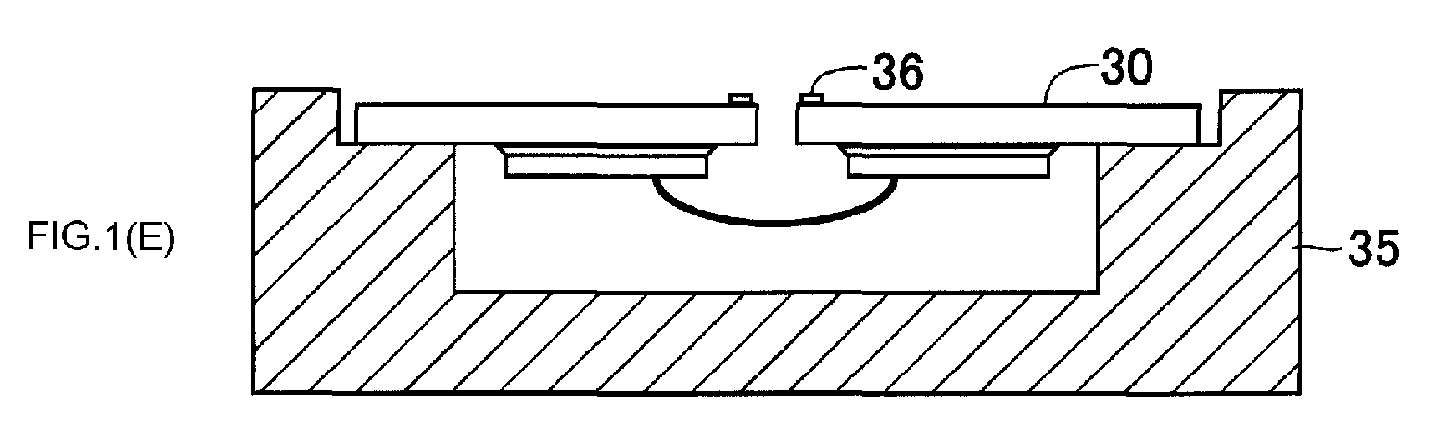
- FIG. 1(E) is a fifth cross sectional view of the lead frame describing the step of coating a second solder by the method of manufacturing the semiconductor apparatus according to the first embodiment.
- FIG. 1(F) is a sixth cross sectional view of the lead frame describing the step of parts mounting by the method of manufacturing the semiconductor apparatus according to the first embodiment.
- FIG . 1(G) is a seventh cross sectional view of the lead frame describing the step of melting the second solder by the method of manufacturing the semiconductor apparatus according to the first embodiment.
- FIG. 2 is the cross sectional views of the semiconductor apparatus manufactured by the method according the first embodiment of the invention.
- the semiconductor apparatus includes power semiconductor device 11 and control IC 12 that controls power semiconductor device 11.
- Power semiconductor device 11 is an ignitor used for driving the primary coil in an ignition coil.
- An IGBT exhibiting an excellent high L-load withstanding capability and an excellent high surge withstanding capability required of the ignitor is used for power semiconductor device 11.
- the lead frame is formed by machining a copper plate.
- the lead frame includes lead sections 13 which form external connection terminals and wiring circuit sections 14 divided for forming wiring circuits. Some of wiring circuit sections 14 have a wide area such that parts mounting surfaces 15a and 15b, on which power semiconductor device 11 and IC 12 are mounted, respectively, are formed.
- wiring circuit sections 14 have a wide area such that parts mounting surfaces 15a and 15b, on which power semiconductor device 11 and IC 12 are mounted, respectively, are formed.
- two Ni-plating sections 16, each shaped with a stripe are illustrated exemplary to form bonding areas. Since plating sections 16 are formed linearly in the direction, in which lead frames are arranged continuously, some plating sections 16 may be formed in the areas which are not the bonding area.
- first electronic parts 17 and 18 are mounted such that first electronic parts 17 and 18 bridge the gaps between wiring circuit sections 14.
- second electronic parts 19 and 20 are mounted such that second electronic parts 19 and 20 bridge the gaps between wiring circuit sections 14.
- These electronic parts 17, 18, 19, and 20 may be a chip capacitor and a chip resistor, each in a surface mounting package.
- Power semiconductor device 11 includes a main terminal connected with bonding wire 21 to plating section 16 formed in wring circuit section 14 in the vicinity of lead section 13 and control terminals connected with bonding wires 22 to the predetermined terminals of IC 12.
- the other terminals of IC 12 are connected with bonding wires 23 to plating sections 16.
- the lead frame which mounts power semiconductor device 11, IC 12, first electronic parts 17, 18, and second electronic parts 19, 20 thereon, is sealed collectively with mold resin 24 for a packaging material.
- first solder 31 is coated on the upper surface of wiring circuit section 14 on lead frame 30.
- a solder paste is printed on the areas, to which power semiconductor device 11 , IC 12, and electronic parts 17 and 18 are bonded.
- Solder 31 is prepared such that the melting point thereof is around 230 °C.
- solders the melting points thereof are different, for solder 31 and solder 36 described later.
- the melting point thereof is higher than the melting point of solder 36 used in the late step, for solder 31 used in the preceding step.
- power semiconductor device 11, IC 12, and electronic parts 17 and 18 are mounted on coated solder 31.
- chip 32 of power semiconductor device 11 and IC 12 is shown.
- the mounting of chip 32 on solder 31 is performed by a chip mounter.
- lead frame 30 is transferred onto hot plate (first heater) 33 and mounted on hot plate 33.
- hot plate 33 is heated initially at a preheating temperature and lead frame 30 preheats solder 31 and chip 32. Then, hot plate 33 is heated at a temperature higher than the solder 31 melting point to melt solder 31. Solder 31 is melted for a short time and, then, cooled to finish the soldering of chip 32.
- the wiring with bonding wire 34 is conducted as shown in FIG. 1(D) .
- the wiring is conducted by bonding wire 34 to the pad of chip 32 such as power semiconductor device 11 and IC 12 and to lead section 13 or wiring circuit section 14.
- the wiring is conducted also by bonding wire 34 to the pads of chips 32.
- the bonding of wire 34 to lead section 13 and wiring circuit section 14 is conducted via plating sections 16 formed on lead section 13 and wiring circuit section 14.
- Lead frame 30, on which the wiring with bonding wire 34 is conducted, is turned upside down, mounted on heating cradle (second heater) 35 as shown in FIG. 1(E) , and second solder 36 is coated on wiring circuit sections 14 of lead frame 30.
- the melting point of second solder 36 is lower than the melting point of first solder 31.
- a lead reflow solder, the melting point of which is around 200 °C, for example, is used for second solder 36.
- Second solder 36 is coated on the wiring circuit section 14 area, to which an electronic part is bonded.
- Heating cradle 35 is shaped with a concavity so that chip 32 and bonding wire 34 may not come in contact with heating cradle 35, when lead frame 30 is mounted thereon.
- Heating cradle 35 supports lead frame 30 in the areas except the areas, on which chip 32 and bonding wire 34 are mounted.
- electronic parts 37 such as electronic parts 19 and 20 are mounted on second solder 36 coated on wiring circuit sections 14 such that electronic parts 37 bridge the gaps between divided wiring circuit sections 14 as shown in FIG. 1(F) .
- the heating temperature of heating cradle 35 is adjusted, second solder 36 is melted by conducting the heat via lead frame 30, and electronic parts 37 are soldered to lead frame 30.
- lead frame 30 supported by heating cradle 35 is put in a high-temperature furnace as shown in FIG. 1(G) , the ambient temperature of lead frame 30 is raised in the preheating and in the heating, and, then, the ambient temperature of lead frame 30 is lowered in cooling lead frame 30.
- lead frame 30 surfaces are sealed with a mold resin, resulting in a semiconductor apparatus.
- the second soldering is conducted employing both the heating in a high-temperature environment and the heating by heating cradle 35.
- the second soldering may be conducted employing the heating in a high-temperature environment or the heating by heating cradle 35 with no problem.
- solder paste is employed. If the flux generated in the step of melting the solder affects the subsequent steps adversely, it will be preferable to add a step of cleaning the flux, if necessary.
- FIG. 3(A) is a first cross sectional view of a lead frame describing the step of coating a solder by the method of manufacturing a semiconductor apparatus according to a second embodiment of the invention.
- FIG. 3(B) is a second cross sectional view of the lead frame describing the step of mounting a chip by the method of manufacturing the semiconductor apparatus according to the second embodiment.
- FIG. 3(C) is a third cross sectional view of the lead frame describing the step of melting the solder by the method of manufacturing the semiconductor apparatus according to the second embodiment.
- FIG. 3(D) is a fourth cross sectional view of the lead frame describing the step of bonding a wire by the method of manufacturing the semiconductor apparatus according to the second embodiment.
- FIG. 3(E) is a fifth cross sectional view of the lead frame describing the step of coating an electrically conductive adhesive by the method of manufacturing the semiconductor apparatus according to the second embodiment.
- FIG. 3(F) is a sixth cross sectional view of the lead frame describing the step of parts mounting by the method of manufacturing the semiconductor apparatus according to the second embodiment.
- FIG. 3(G) is a seventh cross sectional view of the lead frame describing the step of melting the electrically conductive adhesive by the method of manufacturing the semiconductor apparatus according to the second embodiment.
- the same reference numerals as used in FIGS. 1(A) through 1(G) are used to designate the same constituent elements and their duplicated description are omitted for the sake of simplicity.
- solder 31 is coated on the lead frame 30 areas, to which power semiconductor device 11, IC 12, and electronic parts 17 and 18 are bonded, as shown in FIG. 3(A) .
- chip 32 is mounted on coated solder 31 as shown in FIG. 3(B) .
- lead frame 30 with chip 32 mounted thereon is transferred to hot plate 33 and placed thereon.
- Lead frame 30, on which the wiring with bonding wire 34 is conducted, is turned upside down, mounted on cradle 39 as shown in FIG. 3(E).
- Cradle 39 is shaped with a concavity so that chip 32 and bonding wire 34 may not come in contact with cradle 39, when lead frame 30 is mounted thereon.
- Cradle 39 supports lead frame 30 in the areas except the areas, on which chip 32 and bonding wire 34 are mounted.
- thermosetting electrically conductive adhesive 41 the setting temperature of which is lower than the solder 31 melting point, is coated by dispenser 40 on the lead frame 30 areas, to which electronic parts are bonded.
- thermosetting electrically conductive adhesive 41 the setting temperature of which is around 150°C, is employed.
- thermosetting electrically conductive adhesive 41 coated on wiring circuit sections 14 such that electronic parts 37 bridge the gaps between divided wiring circuit sections 14 as shown in FIG. 3(F) .
- thermosetting electrically conductive adhesive 41 coated thereon and mounted on cradle 39
- a high-temperature furnace as shown in FIG. 3(G) to set thermosetting electrically conductive adhesive 41.
- the temperatures of the high-temperature furnace are adjusted to be suitable for the preheating, heating and cooling. Especially for the heating, the ambient temperature is set at the setting temperature of thermosetting electrically conductive adhesive 41.
- lead frame 30 surfaces are sealed with a mold resin, resulting in a semiconductor apparatus.
- the manufacturing methods according to the invention are well sited for manufacturing an ignitor, since the parts are mounted on both surfaces of a lead frame using two kinds of bonding materials, the bonding temperatures thereof are different from each other, in the ignitor.
- the semiconductor apparatus according to the invention is used preferably for an ignitor.
Landscapes
- Engineering & Computer Science (AREA)
- Chemical & Material Sciences (AREA)
- Combustion & Propulsion (AREA)
- Mechanical Engineering (AREA)
- General Engineering & Computer Science (AREA)
- Die Bonding (AREA)
Abstract





Description
- The present invention relates to a method of manufacturing a semiconductor apparatus including electronic parts such as a power semiconductor device, a control circuit including a semiconductor device for controlling the power semiconductor device, and a passive device, which are mounted on a lead frame and sealed with a mold resin. The present invention relates also to the semiconductor apparatus. The present invention relates further to an ignitor using the semiconductor apparatus.
- The ignition coil for igniting an engine, e.g. on an automobile, is provided with an ignitor. In the ignitor, a power semiconductor device is used. The power semiconductor device makes a current flow through a primary coil in the ignition coil and interrupts the current flowing through the primary coil to electronically control the ignition timing.
- In a conventional ignitor, a hybrid IC is used. The hybrid IC includes, for obtaining higher functions, a ceramic baseboard, electric circuits formed on the ceramic baseboard by sintering an electrically conductive material, and electronic parts such as an IC and a capacitor mounted on the electric circuits. In the other conventional ignitor disclosed in the following Patent Document 1, a lead frame is divided into electrical wiring circuit sections, power semiconductor devices are mounted on the respective wiring circuit sections, and electronic parts are mounted on the wiring circuit sections such that the electronic part bridges the gap between the wiring circuit sections.
- In the ignitor that employs a power semiconductor device such as an insulated-gate bipolar transistor (hereinafter referred to as an "IGBT"), it is necessary for the current path to exhibit a high heat capacity, since a high current flows through the IGBT, causing a high heating value. For meeting the demand for obtaining higher functions, it is necessary to mount many electronic parts on the ignitor package. However, if many electronic parts are mounted thereon while securing the required heat capacity, the ignitor package will be inevitably large in the external shape thereof. For solving the problem described above, the following
Patent Document 2 discloses a technique that mounts electronic parts on both surfaces of a lead frame to reduce the substantial area, on which the electronic parts are mounted. - The power semiconductor device includes a first main terminal bonded directly to the parts mounting surface of a wiring circuit section. The power semiconductor device further includes a second main terminal and a control terminal connected to separate wiring circuit sections with wires. Generally, the wirings are conducted by directly bonding, for example, an aluminum wire to copper, that is the lead frame material, by ultrasonic bonding. In the bonding, a copper-aluminum alloy layer is formed on the bonding plane of copper and aluminum. If exposed to a high temperature, the copper-aluminum alloy layer will grow, causing a brittle layer. Therefore, the copper-aluminum alloy layer will hardly endures the thermal stress caused by temperature change and will be fractured. For the general countermeasures against the fracture, a plating of a metallic material containing nickel (Ni) as the main component thereof (hereinafter referred to as a "nickel plating" or a "Ni-plating") is formed in advance in the area, in which the wire bonding to the lead frame will be conducted. The Ni-plating is formed to prevent defective bonding from causing in the bonding portion between the nickel wire and the copper lead frame.
-
- [Patent Document 1] Japanese Unexamined Patent Application Publication No.
2009-129952 - [Patent Document 2] Japanese Unexamined Patent Application Publication No.
2004-119676 - Due to the manufacturing costs, the Ni-plating is formed not only in the area, in which the wire bonding to the lead frame is conducted, but also across the bonding areas in the direction, in which lead frames are arranged continuously, such that stripe-shaped Ni-plating films extend in parallel to each other. The Ni-plating described above poses the problems as described below.
- Generally, the adhesiveness of the Ni-plating to the solder, the adhesiveness thereof to the electrically conductive adhesive, and the adhesiveness thereof to the mold resin are not so good. The area, in which the Ni-plating is formed, is used for the bonding area. However, the area, in which the Ni-plating is formed, is a useless area that can not be used for the area, to which electronic parts are bonded with a solder or with an electrically conductive adhesive. Therefore, the number of the electronic parts mountable on the lead frame will be limited.
- Since the stripe-shaped plating should be formed so as not to cover the area, on which electronic parts are mounted, the number of the bonding areas with wires is also limited. Due to the poor adhesiveness of the Ni-plating to the mold resin, the difference between the thermal expansion coefficients of the mold resin and the lead frame exerts thermal stresses repeatedly to the wires in the heat cycle caused by the heat generation from the power semiconductor device, finally cutting the wires in the vicinity of the bonded portions thereof.
- In the case, in which electronic parts are mounted on both surfaces of the lead frame to prevent the package external shape from enlarging, the electronic parts may be displaced from the predetermined positions thereof, since it is necessary to tilt or turn over the lead frame in the manufacturing process. For preventing the electronic parts from being displaced from the predetermined positions thereof, the electronic parts on one lead frame surface are held temporarily with an insulating film or an insulating resin. Then, the other electronic parts are mounted on the other lead frame surface and connected to the other lead frame surface electrically by means of melting a solder and such a bonding material by the reflow technique and such a technique. The technique that holds the electronic parts temporarily on one lead frame surface is not applicable to the electronic parts which bridge the gap between the divided wiring circuit sections, since spaces are caused under the electronic parts and since it is impossible to stick any film thereto. Since the technique that holds the electronic parts temporarily with a resin causes many additional steps, the technique that holds the electronic parts temporarily with a resin is not applicable.
- In view of the foregoing, it is a first object of the invention to obviate the problems described above. It is a second object of the invention to provide a method of manufacturing a semiconductor apparatus that facilitates mounting semiconductor devices and electronic parts on both surfaces of a lead frame divided to form wiring circuits without through complicated manufacturing steps. It is a third object of the invention to provide the semiconductor apparatus as described above. It is a fourth object of the invention to provide an ignitor using the semiconductor apparatus described above.
- For achieving the objects described above, the semiconductor device and the electronic parts, mounted on the lead frame including a lead section and a wiring circuit section divided for forming a wiring circuit, are bonded to the lead frame with bonding materials, the bonding temperatures thereof are different from each other. In detail, on the first surface of the lead frame, the semiconductor device is bonded to the parts mounting plane of the wiring circuit section using a first bonding material and a first electronic part is bonded using the first bonding material such that the first electronic part bridges the gap between the wiring circuit sections.
A second electronic part is bonded to the second surface of the lead frame using a second bonding material such that the second electronic part bridges the gap between the wiring circuit sections. Especially when the bonding temperature of the second bonding material is lower than the bonding temperature of the first bonding material, the bonding method employed on the first surface of the lead frame may be employed on the second surface of the lead frame only by lowering the bonding temperature. Therefore, it becomes possible to mount parts on both surfaces of the lead frame without complicating the manufacturing steps. - Since the parts are mounted on both surfaces of a lead frame using two kinds of bonding materials, the bonding temperatures thereof are different from each other, in the semiconductor apparatus and the ignitor, the manufacturing method according to the invention is advantageous for mounting parts on both surfaces of a lead frame through the similar manufacturing steps.
- By employing the similar bonding methods on the first and second surfaces of a lead frame, the manufacturing steps are not complicated, since it is unnecessary to temporarily hold parts in bonding the parts to the second surface. Therefore, it is possible to reduce the manufacturing costs of the semiconductor apparatus and the ignitor using the semiconductor apparatus.
- Although plating films are formed in the areas other than the bonding areas for forming the areas, to which bonding wires are bonded, the lead frame area is narrowed and the semiconductor apparatus is mad to be small in the size thereof, since it is possible to mounts parts on both surfaces of the lead frame.
-
-
FIG. 1(A) is a first cross sectional view of a lead frame describing the step of coating a first solder by the method of manufacturing a semiconductor apparatus according to a first embodiment of the invention. -
FIG. 1(B) is a second cross sectional view of the lead frame describing the step of mounting a chip by the method of manufacturing the semiconductor apparatus according to the first embodiment. -
FIG. 1(C) is a third cross sectional view of the lead frame describing the step of melting the first solder by the method of manufacturing the semiconductor apparatus according to the first embodiment. -
FIG. 1(D) is a fourth cross sectional view of the lead frame describing the step of bonding a wire by the method of manufacturing the semiconductor apparatus according to the first embodiment. -
FIG. 1(E) is a fifth cross sectional view of the lead frame describing the step of coating a second solder by the method of manufacturing the semiconductor apparatus according to the first embodiment. -
FIG. 1(F) is a sixth cross sectional view of the lead frame describing the step of parts mounting by the method of manufacturing the semiconductor apparatus according to the first embodiment. -
FIG. 1(G) is a seventh cross sectional view of the lead frame describing the step of melting the second solder by the method of manufacturing the semiconductor apparatus according to the first embodiment. -
FIG. 2 is the cross sectional views of the semiconductor apparatus manufactured by the method according the first embodiment of the invention. -
FIG. 3(A) is a first cross sectional view of a lead frame describing the step of coating a solder by the method of manufacturing a semiconductor apparatus according to a second embodiment of the invention. -
FIG. 3(B) is a second cross sectional view of the lead frame describing the step of mounting a chip by the method of manufacturing the semiconductor apparatus according to the second embodiment. -
FIG. 3(C) is a third cross sectional view of the lead frame describing the step of melting the solder by the method of manufacturing the semiconductor apparatus according to the second embodiment. -
FIG. 3(D) is a fourth cross sectional view of the lead frame describing the step of bonding a wire by the method of manufacturing the semiconductor apparatus according to the second embodiment. -
FIG. 3(E) is a fifth cross sectional view of the lead frame describing the step of coating an electrically conductive adhesive by the method of manufacturing the semiconductor apparatus according to the second embodiment. -
FIG. 3(F) is a sixth cross sectional view of the lead frame describing the step of parts mounting by the method of manufacturing the semiconductor apparatus according to the second embodiment. -
FIG. 3(G) is a seventh cross sectional view of the lead frame describing the step of melting the electrically conductive adhesive by the method of manufacturing the semiconductor apparatus according to the second embodiment. - Now the invention will be described in detail hereinafter with reference to the accompanied drawings which illustrate the preferred embodiments of the invention.
FIG. 1(A) is a first cross sectional view of a lead frame describing the step of coating a first solder by the method of manufacturing a semiconductor apparatus according to a first embodiment of the invention.FIG. 1(B) is a second cross sectional view of the lead frame describing the step of mounting a chip by the method of manufacturing the semiconductor apparatus according to the first embodiment.FIG. 1(C) is a third cross sectional view of the lead frame describing the step of melting the first solder by the method of manufacturing the semiconductor apparatus according to the first embodiment.FIG. 1(D) is a fourth cross sectional view of the lead frame describing the step of bonding a wire by the method of manufacturing the semiconductor apparatus according to the first embodiment.FIG. 1(E) is a fifth cross sectional view of the lead frame describing the step of coating a second solder by the method of manufacturing the semiconductor apparatus according to the first embodiment.FIG. 1(F) is a sixth cross sectional view of the lead frame describing the step of parts mounting by the method of manufacturing the semiconductor apparatus according to the first embodiment.FIG. 1(G) is a seventh cross sectional view of the lead frame describing the step of melting the second solder by the method of manufacturing the semiconductor apparatus according to the first embodiment.
FIG. 2 is the cross sectional views of the semiconductor apparatus manufactured by the method according the first embodiment of the invention. - Referring at first to
FIG. 2 , the semiconductor apparatus according to the invention includespower semiconductor device 11 and control IC 12 that controlspower semiconductor device 11.Power semiconductor device 11 is an ignitor used for driving the primary coil in an ignition coil. An IGBT exhibiting an excellent high L-load withstanding capability and an excellent high surge withstanding capability required of the ignitor is used forpower semiconductor device 11. - The lead frame is formed by machining a copper plate. The lead frame includes
lead sections 13 which form external connection terminals andwiring circuit sections 14 divided for forming wiring circuits. Some ofwiring circuit sections 14 have a wide area such thatparts mounting surfaces power semiconductor device 11 and IC 12 are mounted, respectively, are formed. In each dividedwiring circuit section 14, two Ni-platingsections 16, each shaped with a stripe, are illustrated exemplary to form bonding areas. Since platingsections 16 are formed linearly in the direction, in which lead frames are arranged continuously, some platingsections 16 may be formed in the areas which are not the bonding area. - On the side of the lead frame, on which
power semiconductor device 11 and IC 12 are mounted, electronic parts (first electronic parts) 17 and 18 are mounted such that firstelectronic parts wiring circuit sections 14. On the other side of the lead frame, electronic parts (second electronic parts) 19 and 20 are mounted such that secondelectronic parts wiring circuit sections 14. Theseelectronic parts -
Power semiconductor device 11 includes a main terminal connected withbonding wire 21 to platingsection 16 formed in wringcircuit section 14 in the vicinity oflead section 13 and control terminals connected withbonding wires 22 to the predetermined terminals of IC 12. The other terminals of IC 12 are connected withbonding wires 23 to platingsections 16. - The lead frame, which mounts
power semiconductor device 11, IC 12, firstelectronic parts electronic parts mold resin 24 for a packaging material. - Now the method of manufacturing the semiconductor apparatus according to the first embodiment of the invention will be described below with reference to
FIGS. 1(A) through 1(G) .
Referring now toFIG. 1(A) ,first solder 31 is coated on the upper surface ofwiring circuit section 14 onlead frame 30. In detail, a solder paste is printed on the areas, to whichpower semiconductor device 11, IC 12, andelectronic parts Solder 31 is prepared such that the melting point thereof is around 230 °C. - It is preferable to employ solders, the melting points thereof are different, for
solder 31 andsolder 36 described later. In detail, it is preferable to employ a solder, the melting point thereof is higher than the melting point ofsolder 36 used in the late step, forsolder 31 used in the preceding step. - Referring now to
FIG. 1(B) ,power semiconductor device 11, IC 12, andelectronic parts coated solder 31. (InFIG. 1(B) ,chip 32 ofpower semiconductor device 11 and IC 12 is shown.) The mounting ofchip 32 onsolder 31 is performed by a chip mounter. Then,lead frame 30 is transferred onto hot plate (first heater) 33 and mounted onhot plate 33. - Then, the heating temperature of
hot plate 33 is adjusted andchip 32 is bonded withsolder 31 to leadframe 30 by the reflow technique as shown inFIG. 1(C) . In detail,hot plate 33 is heated initially at a preheating temperature andlead frame 30 preheatssolder 31 andchip 32. Then,hot plate 33 is heated at a temperature higher than thesolder 31 melting point to meltsolder 31.Solder 31 is melted for a short time and, then, cooled to finish the soldering ofchip 32. - Then, the wiring with
bonding wire 34 is conducted as shown inFIG. 1(D) . The wiring is conducted bybonding wire 34 to the pad ofchip 32 such aspower semiconductor device 11 and IC 12 and to leadsection 13 orwiring circuit section 14. The wiring is conducted also by bondingwire 34 to the pads ofchips 32. The bonding ofwire 34 to leadsection 13 andwiring circuit section 14 is conducted via platingsections 16 formed onlead section 13 andwiring circuit section 14. -
Lead frame 30, on which the wiring withbonding wire 34 is conducted, is turned upside down, mounted on heating cradle (second heater) 35 as shown inFIG. 1(E) , andsecond solder 36 is coated onwiring circuit sections 14 oflead frame 30. The melting point ofsecond solder 36 is lower than the melting point offirst solder 31. A lead reflow solder, the melting point of which is around 200 °C, for example, is used forsecond solder 36.Second solder 36 is coated on thewiring circuit section 14 area, to which an electronic part is bonded.Heating cradle 35 is shaped with a concavity so thatchip 32 andbonding wire 34 may not come in contact withheating cradle 35, whenlead frame 30 is mounted thereon.Heating cradle 35 supports leadframe 30 in the areas except the areas, on whichchip 32 andbonding wire 34 are mounted. - Then,
electronic parts 37 such aselectronic parts second solder 36 coated onwiring circuit sections 14 such thatelectronic parts 37 bridge the gaps between dividedwiring circuit sections 14 as shown inFIG. 1(F) . - In the subsequent step of melting the second solder, the heating temperature of
heating cradle 35 is adjusted,second solder 36 is melted by conducting the heat vialead frame 30, andelectronic parts 37 are soldered to leadframe 30. Preferably,lead frame 30 supported byheating cradle 35 is put in a high-temperature furnace as shown inFIG. 1(G) , the ambient temperature oflead frame 30 is raised in the preheating and in the heating, and, then, the ambient temperature oflead frame 30 is lowered incooling lead frame 30. - After
chip 32 andelectronic parts 37 are soldered to the respective surfaces oflead frame 30, thelead frame 30 surfaces are sealed with a mold resin, resulting in a semiconductor apparatus. - In the preferable method of manufacturing a semiconductor apparatus according to the first embodiment, the second soldering is conducted employing both the heating in a high-temperature environment and the heating by
heating cradle 35. Alternatively, the second soldering may be conducted employing the heating in a high-temperature environment or the heating byheating cradle 35 with no problem. - In the above described working example, a solder paste is employed. If the flux generated in the step of melting the solder affects the subsequent steps adversely, it will be preferable to add a step of cleaning the flux, if necessary.
-
FIG. 3(A) is a first cross sectional view of a lead frame describing the step of coating a solder by the method of manufacturing a semiconductor apparatus according to a second embodiment of the invention.FIG. 3(B) is a second cross sectional view of the lead frame describing the step of mounting a chip by the method of manufacturing the semiconductor apparatus according to the second embodiment.FIG. 3(C) is a third cross sectional view of the lead frame describing the step of melting the solder by the method of manufacturing the semiconductor apparatus according to the second embodiment.FIG. 3(D) is a fourth cross sectional view of the lead frame describing the step of bonding a wire by the method of manufacturing the semiconductor apparatus according to the second embodiment.FIG. 3(E) is a fifth cross sectional view of the lead frame describing the step of coating an electrically conductive adhesive by the method of manufacturing the semiconductor apparatus according to the second embodiment.FIG. 3(F) is a sixth cross sectional view of the lead frame describing the step of parts mounting by the method of manufacturing the semiconductor apparatus according to the second embodiment.FIG. 3(G) is a seventh cross sectional view of the lead frame describing the step of melting the electrically conductive adhesive by the method of manufacturing the semiconductor apparatus according to the second embodiment.
InFIGS. 3(A) through 3(G) , the same reference numerals as used inFIGS. 1(A) through 1(G) are used to designate the same constituent elements and their duplicated description are omitted for the sake of simplicity. - In the method of manufacturing a semiconductor apparatus according to the second embodiment,
solder 31 is coated on thelead frame 30 areas, to whichpower semiconductor device 11, IC 12, andelectronic parts FIG. 3(A) . - Then,
chip 32 is mounted oncoated solder 31 as shown inFIG. 3(B) . Then,lead frame 30 withchip 32 mounted thereon is transferred tohot plate 33 and placed thereon. - Then, the heating temperature of
hot plate 33 is adjusted,solder 31 is melted, andchip 32 is soldered to leadframe 30 as shown inFIG. 3(C) .
Then, the wiring withbonding wire 34 is conducted betweenchips 32, betweenchip 32 andlead section 13, and betweenchip 32 andwiring circuit section 14. as shown inFIG. 3(D) . -
Lead frame 30, on which the wiring withbonding wire 34 is conducted, is turned upside down, mounted oncradle 39 as shown inFIG. 3(E). Cradle 39 is shaped with a concavity so thatchip 32 andbonding wire 34 may not come in contact withcradle 39, whenlead frame 30 is mounted thereon.Cradle 39 supports leadframe 30 in the areas except the areas, on whichchip 32 andbonding wire 34 are mounted.
Then, thermosetting electrically conductive adhesive 41, the setting temperature of which is lower than thesolder 31 melting point, is coated bydispenser 40 on thelead frame 30 areas, to which electronic parts are bonded. When the melting point ofsolder 31 is 240 °C, thermosetting electrically conductive adhesive 41, the setting temperature of which is around 150°C, is employed. - Then,
electronic parts 37 such aselectronic parts wiring circuit sections 14 such thatelectronic parts 37 bridge the gaps between dividedwiring circuit sections 14 as shown inFIG. 3(F) . - Then,
lead frame 30, mountingelectronic parts 37 on thermosetting electrically conductive adhesive 41 coated thereon and mounted oncradle 39, is put in a high-temperature furnace as shown inFIG. 3(G) to set thermosetting electricallyconductive adhesive 41. The temperatures of the high-temperature furnace are adjusted to be suitable for the preheating, heating and cooling. Especially for the heating, the ambient temperature is set at the setting temperature of thermosetting electricallyconductive adhesive 41. By employing thermosetting electricallyconductive adhesive 41 for the bonding material ofelectronic parts 37, it is possible to mount parts on both surfaces oflead frame 30 without complicating the manufacturing steps so much. - After
chip 32 andelectronic parts 37 are mounted on the respective surfaces oflead frame 30, thelead frame 30 surfaces are sealed with a mold resin, resulting in a semiconductor apparatus. - The manufacturing methods according to the invention are well sited for manufacturing an ignitor, since the parts are mounted on both surfaces of a lead frame using two kinds of bonding materials, the bonding temperatures thereof are different from each other, in the ignitor. The semiconductor apparatus according to the invention is used preferably for an ignitor.
Features, components and specific details of the structures of the above-described embodiments may be exchanged or combined to form further embodiments optimized for the respective application. As far as those modifications are readily apparent for an expert skilled in the art they shall be disclosed implicitly by the above description without specifying explicitly every possible combination, for the sake of conciseness of the present description.
Claims (7)
- A method of manufacturing a semiconductor apparatus, the method comprising the steps of:making a first surface of a lead frame, comprising a lead section and a
wiring circuit section divided for forming a wiring circuit, face upward;bonding a semiconductor device to a parts mounting plane of the
wiring circuit section using a first bonding material;bonding a first electronic part using the first bonding material for
bridging a gap between the wiring circuit sections;connecting the semiconductor device and the wiring circuit section
with a bonding wire;turning upside down the lead frame for making a second surface of the
lead frame face upward;bonding a second electronic part to the second surface of the lead
frame using a second bonding material at a temperature lower than a temperature, thereat the first electronic part is bonded, for bridging the gap between wiring circuit sections; andsealing both sides of the lead frame with a mold resin. - The method according to Claim 1, whereinthe first bonding material comprises a first solder, which is heated
with a first heater brought into contact with the second surface of the lead frame at a temperature higher than a melting point of the first solder for bonding the semiconductor device and the first electronic part to the first surface of the lead frame;
andthe second bonding material comprises a second solder, a melting point
thereof is lower than the melting point of the first solder, and the second solder is heated with a second heater brought into contact with areas in the first surface of the lead frame other than the areas, on which the semiconductor device and the first electronic part are mounted, at a temperature lower than the melting point of the first solder but higher than the melting point of the second solder for bonding the second electronic part to the second surface of the lead frame. - The method according to Claim 2, whereinthe lead frame, with which the second heater is brought into contact, is
placed in a high-temperature furnace in the bonding using the second solder for setting an ambient temperature to be high in the heating with the second heater. - The method according to at least one of Claims 1 to 3, whereinthe first bonding material comprises a solder, which is heated with a
heater brought into contact with the second surface of the lead frame at a temperature higher than a melting point of the solder for bonding the semiconductor device and the first electronic part to the first surface of the lead frame; andthe second bonding material comprises a thermosetting electrically
conductive adhesive, which is heated at an ambient temperature lower than the melting point of the solder for bonding the second electronic part to the second surface of the lead frame. - A semiconductor apparatus comprising:a lead frame comprising a lead section and a wiring circuit section
divided for forming a wiring circuit;a semiconductor device on a first surface of the lead frame, the
semiconductor device being bonded to a parts mounting plane of the wiring circuit section using a first bonding material, the semiconductor device being connected to the wiring circuit section with a bonding wire;a first electronic part bonded to the first surface of the lead frame
using the first bonding material for bridging a gap between the wiring circuit sections; anda second electronic part bonded to a second surface of the lead frame
using a second bonding material capable of bonding at a temperature lower than that of the first bonding material for bridging the gap between the wiring circuit sections. - The semiconductor apparatus according to Claim 5, wherein the semiconductor apparatus is an ignitor.
- An ignitor comprising:a lead frame comprising a lead section and a wiring circuit section
divided for forming a wiring circuit;a power semiconductor device on a first surface of the lead frame, the
power semiconductor device being bonded to a parts mounting plane of the wiring circuit section using a first bonding material, the power semiconductor device being connected to the wiring circuit section with a bonding wire;an IC that controls the power semiconductor device, the IC being on
the first surface of the lead frame, the IC being bonded to the parts mounting plane of the wiring circuit section using the first bonding material, the IC being connected to the wiring circuit section with a bonding wire;a first electronic part bonded to the first surface of the lead frame
using the first bonding material for bridging a gap between the wiring circuit sections; anda second electronic part bonded to a second surface of the lead frame
using a second bonding material capable of bonding at a temperature lower than that of the first bonding material for bridging the gap between the wiring circuit sections.
Applications Claiming Priority (1)
| Application Number | Priority Date | Filing Date | Title |
|---|---|---|---|
| JP2011003893A JP5582040B2 (en) | 2011-01-12 | 2011-01-12 | Semiconductor device manufacturing method, semiconductor device, and igniter device |
Publications (3)
| Publication Number | Publication Date |
|---|---|
| EP2477223A2 true EP2477223A2 (en) | 2012-07-18 |
| EP2477223A3 EP2477223A3 (en) | 2013-03-06 |
| EP2477223B1 EP2477223B1 (en) | 2018-12-12 |
Family
ID=45440326
Family Applications (1)
| Application Number | Title | Priority Date | Filing Date |
|---|---|---|---|
| EP11195847.6A Not-in-force EP2477223B1 (en) | 2011-01-12 | 2011-12-28 | Method of manufacturing a semiconductor apparatus |
Country Status (4)
| Country | Link |
|---|---|
| US (1) | US8487419B2 (en) |
| EP (1) | EP2477223B1 (en) |
| JP (1) | JP5582040B2 (en) |
| CN (1) | CN102593020B (en) |
Cited By (1)
| Publication number | Priority date | Publication date | Assignee | Title |
|---|---|---|---|---|
| EP4333051A1 (en) * | 2022-08-24 | 2024-03-06 | Littelfuse Semiconductor (Wuxi) Co., Ltd. | Two-in-one lead frame package |
Families Citing this family (8)
| Publication number | Priority date | Publication date | Assignee | Title |
|---|---|---|---|---|
| WO2013065182A1 (en) * | 2011-11-04 | 2013-05-10 | トヨタ自動車株式会社 | Power module, power converter, and electric vehicle |
| JP6017901B2 (en) | 2012-09-14 | 2016-11-02 | ラピスセミコンダクタ株式会社 | Semiconductor device and measuring device |
| JP6065500B2 (en) * | 2012-09-28 | 2017-01-25 | サンケン電気株式会社 | Semiconductor device |
| JP6081229B2 (en) * | 2013-03-01 | 2017-02-15 | 株式会社東芝 | Semiconductor device, wireless device, and storage device |
| JP6256145B2 (en) | 2014-03-26 | 2018-01-10 | 株式会社デンソー | Semiconductor device and manufacturing method thereof |
| JP6463317B2 (en) * | 2016-09-29 | 2019-01-30 | ラピスセミコンダクタ株式会社 | Semiconductor device and measuring device |
| JP6790684B2 (en) | 2016-09-30 | 2020-11-25 | 富士電機株式会社 | Semiconductor device |
| JP2019021944A (en) * | 2018-11-07 | 2019-02-07 | ラピスセミコンダクタ株式会社 | Semiconductor device and measuring device |
Citations (2)
| Publication number | Priority date | Publication date | Assignee | Title |
|---|---|---|---|---|
| JP2004119676A (en) | 2002-09-26 | 2004-04-15 | Sharp Corp | Light emitting and receiving semiconductor device |
| JP2009129952A (en) | 2007-11-20 | 2009-06-11 | Denso Corp | Semiconductor device |
Family Cites Families (11)
| Publication number | Priority date | Publication date | Assignee | Title |
|---|---|---|---|---|
| US4976200A (en) * | 1988-12-30 | 1990-12-11 | The United States Of America As Represented By The United States Department Of Energy | Tungsten bridge for the low energy ignition of explosive and energetic materials |
| US5309841A (en) * | 1991-10-08 | 1994-05-10 | Scb Technologies, Inc. | Zener diode for protection of integrated circuit explosive bridge |
| JPH0661372A (en) * | 1992-08-11 | 1994-03-04 | Toshiba Corp | Hybrid IC |
| US5408127A (en) * | 1994-03-21 | 1995-04-18 | National Semiconductor Corporation | Method of and arrangement for preventing bonding wire shorts with certain integrated circuit components |
| JPH0982879A (en) | 1995-09-20 | 1997-03-28 | Fuji Electric Co Ltd | Resin-sealed semiconductor device |
| US6199484B1 (en) * | 1997-01-06 | 2001-03-13 | The Ensign-Bickford Company | Voltage-protected semiconductor bridge igniter elements |
| US6258629B1 (en) * | 1999-08-09 | 2001-07-10 | Amkor Technology, Inc. | Electronic device package and leadframe and method for making the package |
| EP1122778A3 (en) * | 2000-01-31 | 2004-04-07 | Sanyo Electric Co., Ltd. | Circuit device and manufacturing method of circuit device |
| US7091606B2 (en) * | 2000-01-31 | 2006-08-15 | Sanyo Electric Co., Ltd. | Circuit device and manufacturing method of circuit device and semiconductor module |
| JP3634709B2 (en) * | 2000-02-22 | 2005-03-30 | 三洋電機株式会社 | Semiconductor module |
| US6977431B1 (en) * | 2003-11-05 | 2005-12-20 | Amkor Technology, Inc. | Stackable semiconductor package and manufacturing method thereof |
-
2011
- 2011-01-12 JP JP2011003893A patent/JP5582040B2/en not_active Expired - Fee Related
- 2011-12-21 CN CN201110433708.2A patent/CN102593020B/en not_active Expired - Fee Related
- 2011-12-28 EP EP11195847.6A patent/EP2477223B1/en not_active Not-in-force
-
2012
- 2012-01-11 US US13/347,898 patent/US8487419B2/en not_active Expired - Fee Related
Patent Citations (2)
| Publication number | Priority date | Publication date | Assignee | Title |
|---|---|---|---|---|
| JP2004119676A (en) | 2002-09-26 | 2004-04-15 | Sharp Corp | Light emitting and receiving semiconductor device |
| JP2009129952A (en) | 2007-11-20 | 2009-06-11 | Denso Corp | Semiconductor device |
Cited By (2)
| Publication number | Priority date | Publication date | Assignee | Title |
|---|---|---|---|---|
| EP4333051A1 (en) * | 2022-08-24 | 2024-03-06 | Littelfuse Semiconductor (Wuxi) Co., Ltd. | Two-in-one lead frame package |
| TWI868864B (en) * | 2022-08-24 | 2025-01-01 | 大陸商力特半導體(無錫)有限公司 | Lead frame package and lead frame package assembly method |
Also Published As
| Publication number | Publication date |
|---|---|
| EP2477223B1 (en) | 2018-12-12 |
| CN102593020B (en) | 2015-11-18 |
| JP5582040B2 (en) | 2014-09-03 |
| JP2012146815A (en) | 2012-08-02 |
| CN102593020A (en) | 2012-07-18 |
| EP2477223A3 (en) | 2013-03-06 |
| US20120175757A1 (en) | 2012-07-12 |
| US8487419B2 (en) | 2013-07-16 |
Similar Documents
| Publication | Publication Date | Title |
|---|---|---|
| EP2477223B1 (en) | Method of manufacturing a semiconductor apparatus | |
| KR100544033B1 (en) | Microelectronic component with a sandwich design | |
| US8791564B2 (en) | Method of Manufacturing a semiconductor module and device for the same | |
| CN100394602C (en) | Electronic circuit device and manufacturing method thereof | |
| CN103000559B (en) | The positioning fixture of semiconductor chip and the manufacture method of semiconductor device | |
| JPH0810716B2 (en) | Electronic package | |
| CN106856180A (en) | A kind of method for welding IGBT module | |
| CN103329267B (en) | Semiconductor device and manufacture method thereof | |
| JP4308161B2 (en) | Die mounting method | |
| JP4110513B2 (en) | Manufacturing method of semiconductor power module | |
| WO2016147252A1 (en) | Semiconductor apparatus and manufacturing method of same | |
| JP6201297B2 (en) | Power module substrate with copper plate and method for manufacturing power module substrate with copper plate | |
| JP5763467B2 (en) | Electronic device manufacturing method and electronic device | |
| JP4557804B2 (en) | Semiconductor device and manufacturing method thereof | |
| JPWO2019116910A1 (en) | Semiconductor devices and methods for manufacturing semiconductor devices | |
| JP6304085B2 (en) | Semiconductor device and manufacturing method of semiconductor device | |
| JP7529038B2 (en) | Semiconductor device and method for manufacturing the same | |
| CN110707053B (en) | A chip packaging structure and chip packaging method | |
| KR20140042683A (en) | Semiconductor unit and method for manufacturing the same | |
| JP2014187180A (en) | Assembly for semiconductor device, substrate for power module and power module | |
| JP2001015641A (en) | Connection structure and connection method for electronic components | |
| KR102039791B1 (en) | Mounting method of semiconductor chip and semiconductor chip package | |
| JPH10256259A (en) | Manufacturing method of multi-chip module | |
| JP2006041363A (en) | Resin-sealed semiconductor device | |
| US20250372496A1 (en) | Semiconductor device and method for manufacturing semiconductor device |
Legal Events
| Date | Code | Title | Description |
|---|---|---|---|
| PUAI | Public reference made under article 153(3) epc to a published international application that has entered the european phase |
Free format text: ORIGINAL CODE: 0009012 |
|
| AK | Designated contracting states |
Kind code of ref document: A2 Designated state(s): AL AT BE BG CH CY CZ DE DK EE ES FI FR GB GR HR HU IE IS IT LI LT LU LV MC MK MT NL NO PL PT RO RS SE SI SK SM TR |
|
| AX | Request for extension of the european patent |
Extension state: BA ME |
|
| PUAL | Search report despatched |
Free format text: ORIGINAL CODE: 0009013 |
|
| AK | Designated contracting states |
Kind code of ref document: A3 Designated state(s): AL AT BE BG CH CY CZ DE DK EE ES FI FR GB GR HR HU IE IS IT LI LT LU LV MC MK MT NL NO PL PT RO RS SE SI SK SM TR |
|
| AX | Request for extension of the european patent |
Extension state: BA ME |
|
| RIC1 | Information provided on ipc code assigned before grant |
Ipc: H01L 25/16 20060101ALI20130125BHEP Ipc: H01L 23/16 20060101ALI20130125BHEP Ipc: H01L 23/495 20060101AFI20130125BHEP Ipc: F02P 3/045 20060101ALI20130125BHEP |
|
| 17P | Request for examination filed |
Effective date: 20130906 |
|
| RBV | Designated contracting states (corrected) |
Designated state(s): AL AT BE BG CH CY CZ DE DK EE ES FI FR GB GR HR HU IE IS IT LI LT LU LV MC MK MT NL NO PL PT RO RS SE SI SK SM TR |
|
| STAA | Information on the status of an ep patent application or granted ep patent |
Free format text: STATUS: EXAMINATION IS IN PROGRESS |
|
| 17Q | First examination report despatched |
Effective date: 20170907 |
|
| GRAP | Despatch of communication of intention to grant a patent |
Free format text: ORIGINAL CODE: EPIDOSNIGR1 |
|
| STAA | Information on the status of an ep patent application or granted ep patent |
Free format text: STATUS: GRANT OF PATENT IS INTENDED |
|
| RIC1 | Information provided on ipc code assigned before grant |
Ipc: F02P 3/045 20060101ALN20180607BHEP Ipc: H01L 23/31 20060101ALI20180607BHEP Ipc: H01L 23/495 20060101AFI20180607BHEP |
|
| INTG | Intention to grant announced |
Effective date: 20180619 |
|
| GRAS | Grant fee paid |
Free format text: ORIGINAL CODE: EPIDOSNIGR3 |
|
| GRAA | (expected) grant |
Free format text: ORIGINAL CODE: 0009210 |
|
| STAA | Information on the status of an ep patent application or granted ep patent |
Free format text: STATUS: THE PATENT HAS BEEN GRANTED |
|
| AK | Designated contracting states |
Kind code of ref document: B1 Designated state(s): AL AT BE BG CH CY CZ DE DK EE ES FI FR GB GR HR HU IE IS IT LI LT LU LV MC MK MT NL NO PL PT RO RS SE SI SK SM TR |
|
| REG | Reference to a national code |
Ref country code: GB Ref legal event code: FG4D |
|
| REG | Reference to a national code |
Ref country code: CH Ref legal event code: EP |
|
| REG | Reference to a national code |
Ref country code: AT Ref legal event code: REF Ref document number: 1077108 Country of ref document: AT Kind code of ref document: T Effective date: 20181215 |
|
| REG | Reference to a national code |
Ref country code: DE Ref legal event code: R096 Ref document number: 602011054714 Country of ref document: DE |
|
| REG | Reference to a national code |
Ref country code: IE Ref legal event code: FG4D |
|
| REG | Reference to a national code |
Ref country code: NL Ref legal event code: MP Effective date: 20181212 |
|
| REG | Reference to a national code |
Ref country code: LT Ref legal event code: MG4D |
|
| PG25 | Lapsed in a contracting state [announced via postgrant information from national office to epo] |
Ref country code: ES Free format text: LAPSE BECAUSE OF FAILURE TO SUBMIT A TRANSLATION OF THE DESCRIPTION OR TO PAY THE FEE WITHIN THE PRESCRIBED TIME-LIMIT Effective date: 20181212 Ref country code: LT Free format text: LAPSE BECAUSE OF FAILURE TO SUBMIT A TRANSLATION OF THE DESCRIPTION OR TO PAY THE FEE WITHIN THE PRESCRIBED TIME-LIMIT Effective date: 20181212 Ref country code: HR Free format text: LAPSE BECAUSE OF FAILURE TO SUBMIT A TRANSLATION OF THE DESCRIPTION OR TO PAY THE FEE WITHIN THE PRESCRIBED TIME-LIMIT Effective date: 20181212 Ref country code: BG Free format text: LAPSE BECAUSE OF FAILURE TO SUBMIT A TRANSLATION OF THE DESCRIPTION OR TO PAY THE FEE WITHIN THE PRESCRIBED TIME-LIMIT Effective date: 20190312 Ref country code: LV Free format text: LAPSE BECAUSE OF FAILURE TO SUBMIT A TRANSLATION OF THE DESCRIPTION OR TO PAY THE FEE WITHIN THE PRESCRIBED TIME-LIMIT Effective date: 20181212 Ref country code: NO Free format text: LAPSE BECAUSE OF FAILURE TO SUBMIT A TRANSLATION OF THE DESCRIPTION OR TO PAY THE FEE WITHIN THE PRESCRIBED TIME-LIMIT Effective date: 20190312 Ref country code: FI Free format text: LAPSE BECAUSE OF FAILURE TO SUBMIT A TRANSLATION OF THE DESCRIPTION OR TO PAY THE FEE WITHIN THE PRESCRIBED TIME-LIMIT Effective date: 20181212 |
|
| REG | Reference to a national code |
Ref country code: AT Ref legal event code: MK05 Ref document number: 1077108 Country of ref document: AT Kind code of ref document: T Effective date: 20181212 |
|
| PG25 | Lapsed in a contracting state [announced via postgrant information from national office to epo] |
Ref country code: AL Free format text: LAPSE BECAUSE OF FAILURE TO SUBMIT A TRANSLATION OF THE DESCRIPTION OR TO PAY THE FEE WITHIN THE PRESCRIBED TIME-LIMIT Effective date: 20181212 Ref country code: SE Free format text: LAPSE BECAUSE OF FAILURE TO SUBMIT A TRANSLATION OF THE DESCRIPTION OR TO PAY THE FEE WITHIN THE PRESCRIBED TIME-LIMIT Effective date: 20181212 Ref country code: RS Free format text: LAPSE BECAUSE OF FAILURE TO SUBMIT A TRANSLATION OF THE DESCRIPTION OR TO PAY THE FEE WITHIN THE PRESCRIBED TIME-LIMIT Effective date: 20181212 Ref country code: GR Free format text: LAPSE BECAUSE OF FAILURE TO SUBMIT A TRANSLATION OF THE DESCRIPTION OR TO PAY THE FEE WITHIN THE PRESCRIBED TIME-LIMIT Effective date: 20190313 |
|
| PG25 | Lapsed in a contracting state [announced via postgrant information from national office to epo] |
Ref country code: NL Free format text: LAPSE BECAUSE OF FAILURE TO SUBMIT A TRANSLATION OF THE DESCRIPTION OR TO PAY THE FEE WITHIN THE PRESCRIBED TIME-LIMIT Effective date: 20181212 |
|
| PG25 | Lapsed in a contracting state [announced via postgrant information from national office to epo] |
Ref country code: CZ Free format text: LAPSE BECAUSE OF FAILURE TO SUBMIT A TRANSLATION OF THE DESCRIPTION OR TO PAY THE FEE WITHIN THE PRESCRIBED TIME-LIMIT Effective date: 20181212 Ref country code: PT Free format text: LAPSE BECAUSE OF FAILURE TO SUBMIT A TRANSLATION OF THE DESCRIPTION OR TO PAY THE FEE WITHIN THE PRESCRIBED TIME-LIMIT Effective date: 20190412 Ref country code: IT Free format text: LAPSE BECAUSE OF FAILURE TO SUBMIT A TRANSLATION OF THE DESCRIPTION OR TO PAY THE FEE WITHIN THE PRESCRIBED TIME-LIMIT Effective date: 20181212 Ref country code: PL Free format text: LAPSE BECAUSE OF FAILURE TO SUBMIT A TRANSLATION OF THE DESCRIPTION OR TO PAY THE FEE WITHIN THE PRESCRIBED TIME-LIMIT Effective date: 20181212 |
|
| REG | Reference to a national code |
Ref country code: CH Ref legal event code: PL |
|
| PG25 | Lapsed in a contracting state [announced via postgrant information from national office to epo] |
Ref country code: SK Free format text: LAPSE BECAUSE OF FAILURE TO SUBMIT A TRANSLATION OF THE DESCRIPTION OR TO PAY THE FEE WITHIN THE PRESCRIBED TIME-LIMIT Effective date: 20181212 Ref country code: LU Free format text: LAPSE BECAUSE OF NON-PAYMENT OF DUE FEES Effective date: 20181228 Ref country code: RO Free format text: LAPSE BECAUSE OF FAILURE TO SUBMIT A TRANSLATION OF THE DESCRIPTION OR TO PAY THE FEE WITHIN THE PRESCRIBED TIME-LIMIT Effective date: 20181212 Ref country code: IS Free format text: LAPSE BECAUSE OF FAILURE TO SUBMIT A TRANSLATION OF THE DESCRIPTION OR TO PAY THE FEE WITHIN THE PRESCRIBED TIME-LIMIT Effective date: 20190412 Ref country code: EE Free format text: LAPSE BECAUSE OF FAILURE TO SUBMIT A TRANSLATION OF THE DESCRIPTION OR TO PAY THE FEE WITHIN THE PRESCRIBED TIME-LIMIT Effective date: 20181212 Ref country code: SM Free format text: LAPSE BECAUSE OF FAILURE TO SUBMIT A TRANSLATION OF THE DESCRIPTION OR TO PAY THE FEE WITHIN THE PRESCRIBED TIME-LIMIT Effective date: 20181212 |
|
| REG | Reference to a national code |
Ref country code: DE Ref legal event code: R097 Ref document number: 602011054714 Country of ref document: DE |
|
| REG | Reference to a national code |
Ref country code: IE Ref legal event code: MM4A |
|
| REG | Reference to a national code |
Ref country code: BE Ref legal event code: MM Effective date: 20181231 |
|
| PLBE | No opposition filed within time limit |
Free format text: ORIGINAL CODE: 0009261 |
|
| STAA | Information on the status of an ep patent application or granted ep patent |
Free format text: STATUS: NO OPPOSITION FILED WITHIN TIME LIMIT |
|
| PG25 | Lapsed in a contracting state [announced via postgrant information from national office to epo] |
Ref country code: IE Free format text: LAPSE BECAUSE OF NON-PAYMENT OF DUE FEES Effective date: 20181228 Ref country code: DK Free format text: LAPSE BECAUSE OF FAILURE TO SUBMIT A TRANSLATION OF THE DESCRIPTION OR TO PAY THE FEE WITHIN THE PRESCRIBED TIME-LIMIT Effective date: 20181212 Ref country code: AT Free format text: LAPSE BECAUSE OF FAILURE TO SUBMIT A TRANSLATION OF THE DESCRIPTION OR TO PAY THE FEE WITHIN THE PRESCRIBED TIME-LIMIT Effective date: 20181212 Ref country code: SI Free format text: LAPSE BECAUSE OF FAILURE TO SUBMIT A TRANSLATION OF THE DESCRIPTION OR TO PAY THE FEE WITHIN THE PRESCRIBED TIME-LIMIT Effective date: 20181212 Ref country code: MC Free format text: LAPSE BECAUSE OF FAILURE TO SUBMIT A TRANSLATION OF THE DESCRIPTION OR TO PAY THE FEE WITHIN THE PRESCRIBED TIME-LIMIT Effective date: 20181212 |
|
| 26N | No opposition filed |
Effective date: 20190913 |
|
| GBPC | Gb: european patent ceased through non-payment of renewal fee |
Effective date: 20190312 |
|
| PG25 | Lapsed in a contracting state [announced via postgrant information from national office to epo] |
Ref country code: BE Free format text: LAPSE BECAUSE OF NON-PAYMENT OF DUE FEES Effective date: 20181231 |
|
| PG25 | Lapsed in a contracting state [announced via postgrant information from national office to epo] |
Ref country code: LI Free format text: LAPSE BECAUSE OF NON-PAYMENT OF DUE FEES Effective date: 20181231 Ref country code: CH Free format text: LAPSE BECAUSE OF NON-PAYMENT OF DUE FEES Effective date: 20181231 |
|
| PG25 | Lapsed in a contracting state [announced via postgrant information from national office to epo] |
Ref country code: GB Free format text: LAPSE BECAUSE OF NON-PAYMENT OF DUE FEES Effective date: 20190312 Ref country code: MT Free format text: LAPSE BECAUSE OF NON-PAYMENT OF DUE FEES Effective date: 20181228 |
|
| PG25 | Lapsed in a contracting state [announced via postgrant information from national office to epo] |
Ref country code: FR Free format text: LAPSE BECAUSE OF NON-PAYMENT OF DUE FEES Effective date: 20190212 |
|
| PG25 | Lapsed in a contracting state [announced via postgrant information from national office to epo] |
Ref country code: TR Free format text: LAPSE BECAUSE OF FAILURE TO SUBMIT A TRANSLATION OF THE DESCRIPTION OR TO PAY THE FEE WITHIN THE PRESCRIBED TIME-LIMIT Effective date: 20181212 |
|
| PG25 | Lapsed in a contracting state [announced via postgrant information from national office to epo] |
Ref country code: CY Free format text: LAPSE BECAUSE OF FAILURE TO SUBMIT A TRANSLATION OF THE DESCRIPTION OR TO PAY THE FEE WITHIN THE PRESCRIBED TIME-LIMIT Effective date: 20181212 Ref country code: MK Free format text: LAPSE BECAUSE OF NON-PAYMENT OF DUE FEES Effective date: 20181212 Ref country code: HU Free format text: LAPSE BECAUSE OF FAILURE TO SUBMIT A TRANSLATION OF THE DESCRIPTION OR TO PAY THE FEE WITHIN THE PRESCRIBED TIME-LIMIT; INVALID AB INITIO Effective date: 20111228 |
|
| PGFP | Annual fee paid to national office [announced via postgrant information from national office to epo] |
Ref country code: DE Payment date: 20211102 Year of fee payment: 11 |
|
| REG | Reference to a national code |
Ref country code: DE Ref legal event code: R119 Ref document number: 602011054714 Country of ref document: DE |
|
| PG25 | Lapsed in a contracting state [announced via postgrant information from national office to epo] |
Ref country code: DE Free format text: LAPSE BECAUSE OF NON-PAYMENT OF DUE FEES Effective date: 20230701 |