EP2471771A1 - Organic electroluminescent element and compound having carbazole ring structure - Google Patents
Organic electroluminescent element and compound having carbazole ring structure Download PDFInfo
- Publication number
- EP2471771A1 EP2471771A1 EP10811508A EP10811508A EP2471771A1 EP 2471771 A1 EP2471771 A1 EP 2471771A1 EP 10811508 A EP10811508 A EP 10811508A EP 10811508 A EP10811508 A EP 10811508A EP 2471771 A1 EP2471771 A1 EP 2471771A1
- Authority
- EP
- European Patent Office
- Prior art keywords
- substituted
- unsubstituted
- substituent
- carbon atoms
- atom
- Prior art date
- Legal status (The legal status is an assumption and is not a legal conclusion. Google has not performed a legal analysis and makes no representation as to the accuracy of the status listed.)
- Granted
Links
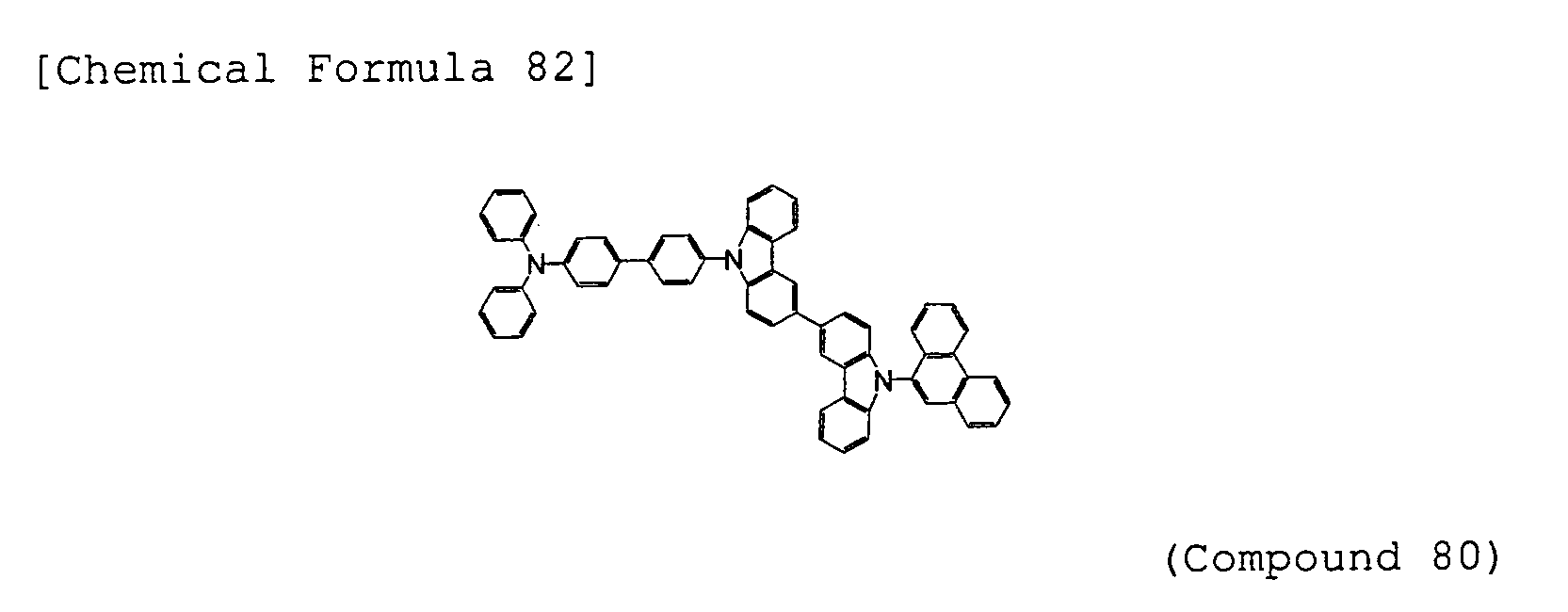
- 0 [*-]c(cc1)ccc1-[n]1c(ccc(-c(cc2)cc3c2c(cccc2)c2[n]3-c(cc2)ccc2-c(cc2)ccc2N(c2ccccc2)c2ccccc2)c2)c2c2ccccc12 Chemical compound [*-]c(cc1)ccc1-[n]1c(ccc(-c(cc2)cc3c2c(cccc2)c2[n]3-c(cc2)ccc2-c(cc2)ccc2N(c2ccccc2)c2ccccc2)c2)c2c2ccccc12 0.000 description 5
- WCNXVIOUHPLGFV-UHFFFAOYSA-N CC1(C)c2cc(N(c(cc3)ccc3-c3ccccc3)c(cc3)ccc3-c(cc3)ccc3-[n]3c(ccc(-c(cc4)cc(c5c6cccc5)c4[n]6-c4cc(C#N)ccc4)c4)c4c4c3cccc4)ccc2-c2ccccc12 Chemical compound CC1(C)c2cc(N(c(cc3)ccc3-c3ccccc3)c(cc3)ccc3-c(cc3)ccc3-[n]3c(ccc(-c(cc4)cc(c5c6cccc5)c4[n]6-c4cc(C#N)ccc4)c4)c4c4c3cccc4)ccc2-c2ccccc12 WCNXVIOUHPLGFV-UHFFFAOYSA-N 0.000 description 1
- ZTALQXASCUYDHW-UHFFFAOYSA-N CC1(C)c2cc(N(c3ccccc3)c(cc3)cc(C(C)(C)c4c5)c3-c4ccc5-[n](c(cccc3)c3c3c4)c3ccc4-c(cc3c4c5cccc4)ccc3[n]5-c3ccccc3)ccc2-c2ccccc12 Chemical compound CC1(C)c2cc(N(c3ccccc3)c(cc3)cc(C(C)(C)c4c5)c3-c4ccc5-[n](c(cccc3)c3c3c4)c3ccc4-c(cc3c4c5cccc4)ccc3[n]5-c3ccccc3)ccc2-c2ccccc12 ZTALQXASCUYDHW-UHFFFAOYSA-N 0.000 description 1
- NYWABLFTONVCRY-UHFFFAOYSA-N Cc(cc(cc1)N(c2ccccc2)c2ccccc2)c1C([N-]C1)=C(C)C=C1[n](c(cccc1)c1c1c2)c1ccc2-c(cc1c2c3cccc2)ccc1[n]3-c(cc1)ccc1-c1ccccc1 Chemical compound Cc(cc(cc1)N(c2ccccc2)c2ccccc2)c1C([N-]C1)=C(C)C=C1[n](c(cccc1)c1c1c2)c1ccc2-c(cc1c2c3cccc2)ccc1[n]3-c(cc1)ccc1-c1ccccc1 NYWABLFTONVCRY-UHFFFAOYSA-N 0.000 description 1
Images


Classifications
-
- H—ELECTRICITY
- H10—SEMICONDUCTOR DEVICES; ELECTRIC SOLID-STATE DEVICES NOT OTHERWISE PROVIDED FOR
- H10K—ORGANIC ELECTRIC SOLID-STATE DEVICES
- H10K85/00—Organic materials used in the body or electrodes of devices covered by this subclass
- H10K85/60—Organic compounds having low molecular weight
- H10K85/631—Amine compounds having at least two aryl rest on at least one amine-nitrogen atom, e.g. triphenylamine
- H10K85/636—Amine compounds having at least two aryl rest on at least one amine-nitrogen atom, e.g. triphenylamine comprising heteroaromatic hydrocarbons as substituents on the nitrogen atom
-
- C—CHEMISTRY; METALLURGY
- C07—ORGANIC CHEMISTRY
- C07D—HETEROCYCLIC COMPOUNDS
- C07D209/00—Heterocyclic compounds containing five-membered rings, condensed with other rings, with one nitrogen atom as the only ring hetero atom
- C07D209/56—Ring systems containing three or more rings
- C07D209/80—[b, c]- or [b, d]-condensed
- C07D209/82—Carbazoles; Hydrogenated carbazoles
- C07D209/86—Carbazoles; Hydrogenated carbazoles with only hydrogen atoms, hydrocarbon or substituted hydrocarbon radicals, directly attached to carbon atoms of the ring system
-
- C—CHEMISTRY; METALLURGY
- C07—ORGANIC CHEMISTRY
- C07D—HETEROCYCLIC COMPOUNDS
- C07D209/00—Heterocyclic compounds containing five-membered rings, condensed with other rings, with one nitrogen atom as the only ring hetero atom
- C07D209/56—Ring systems containing three or more rings
- C07D209/80—[b, c]- or [b, d]-condensed
- C07D209/82—Carbazoles; Hydrogenated carbazoles
- C07D209/88—Carbazoles; Hydrogenated carbazoles with hetero atoms or with carbon atoms having three bonds to hetero atoms with at the most one bond to halogen, e.g. ester or nitrile radicals, directly attached to carbon atoms of the ring system
-
- C—CHEMISTRY; METALLURGY
- C07—ORGANIC CHEMISTRY
- C07D—HETEROCYCLIC COMPOUNDS
- C07D401/00—Heterocyclic compounds containing two or more hetero rings, having nitrogen atoms as the only ring hetero atoms, at least one ring being a six-membered ring with only one nitrogen atom
- C07D401/14—Heterocyclic compounds containing two or more hetero rings, having nitrogen atoms as the only ring hetero atoms, at least one ring being a six-membered ring with only one nitrogen atom containing three or more hetero rings
-
- C—CHEMISTRY; METALLURGY
- C07—ORGANIC CHEMISTRY
- C07D—HETEROCYCLIC COMPOUNDS
- C07D405/00—Heterocyclic compounds containing both one or more hetero rings having oxygen atoms as the only ring hetero atoms, and one or more rings having nitrogen as the only ring hetero atom
- C07D405/02—Heterocyclic compounds containing both one or more hetero rings having oxygen atoms as the only ring hetero atoms, and one or more rings having nitrogen as the only ring hetero atom containing two hetero rings
- C07D405/10—Heterocyclic compounds containing both one or more hetero rings having oxygen atoms as the only ring hetero atoms, and one or more rings having nitrogen as the only ring hetero atom containing two hetero rings linked by a carbon chain containing aromatic rings
-
- C—CHEMISTRY; METALLURGY
- C07—ORGANIC CHEMISTRY
- C07D—HETEROCYCLIC COMPOUNDS
- C07D409/00—Heterocyclic compounds containing two or more hetero rings, at least one ring having sulfur atoms as the only ring hetero atoms
- C07D409/14—Heterocyclic compounds containing two or more hetero rings, at least one ring having sulfur atoms as the only ring hetero atoms containing three or more hetero rings
-
- C—CHEMISTRY; METALLURGY
- C07—ORGANIC CHEMISTRY
- C07D—HETEROCYCLIC COMPOUNDS
- C07D413/00—Heterocyclic compounds containing two or more hetero rings, at least one ring having nitrogen and oxygen atoms as the only ring hetero atoms
- C07D413/14—Heterocyclic compounds containing two or more hetero rings, at least one ring having nitrogen and oxygen atoms as the only ring hetero atoms containing three or more hetero rings
-
- C—CHEMISTRY; METALLURGY
- C07—ORGANIC CHEMISTRY
- C07D—HETEROCYCLIC COMPOUNDS
- C07D417/00—Heterocyclic compounds containing two or more hetero rings, at least one ring having nitrogen and sulfur atoms as the only ring hetero atoms, not provided for by group C07D415/00
- C07D417/14—Heterocyclic compounds containing two or more hetero rings, at least one ring having nitrogen and sulfur atoms as the only ring hetero atoms, not provided for by group C07D415/00 containing three or more hetero rings
-
- C—CHEMISTRY; METALLURGY
- C07—ORGANIC CHEMISTRY
- C07D—HETEROCYCLIC COMPOUNDS
- C07D471/00—Heterocyclic compounds containing nitrogen atoms as the only ring hetero atoms in the condensed system, at least one ring being a six-membered ring with one nitrogen atom, not provided for by groups C07D451/00 - C07D463/00
- C07D471/02—Heterocyclic compounds containing nitrogen atoms as the only ring hetero atoms in the condensed system, at least one ring being a six-membered ring with one nitrogen atom, not provided for by groups C07D451/00 - C07D463/00 in which the condensed system contains two hetero rings
- C07D471/04—Ortho-condensed systems
-
- C—CHEMISTRY; METALLURGY
- C09—DYES; PAINTS; POLISHES; NATURAL RESINS; ADHESIVES; COMPOSITIONS NOT OTHERWISE PROVIDED FOR; APPLICATIONS OF MATERIALS NOT OTHERWISE PROVIDED FOR
- C09K—MATERIALS FOR MISCELLANEOUS APPLICATIONS, NOT PROVIDED FOR ELSEWHERE
- C09K11/00—Luminescent materials, e.g. electroluminescent or chemiluminescent
- C09K11/06—Luminescent materials, e.g. electroluminescent or chemiluminescent containing organic luminescent materials
-
- H—ELECTRICITY
- H05—ELECTRIC TECHNIQUES NOT OTHERWISE PROVIDED FOR
- H05B—ELECTRIC HEATING; ELECTRIC LIGHT SOURCES NOT OTHERWISE PROVIDED FOR; CIRCUIT ARRANGEMENTS FOR ELECTRIC LIGHT SOURCES, IN GENERAL
- H05B33/00—Electroluminescent light sources
- H05B33/12—Light sources with substantially two-dimensional [2D] radiating surfaces
- H05B33/14—Light sources with substantially two-dimensional [2D] radiating surfaces characterised by the chemical or physical composition or the arrangement of the electroluminescent material, or by the simultaneous addition of the electroluminescent material in or onto the light source
-
- C—CHEMISTRY; METALLURGY
- C09—DYES; PAINTS; POLISHES; NATURAL RESINS; ADHESIVES; COMPOSITIONS NOT OTHERWISE PROVIDED FOR; APPLICATIONS OF MATERIALS NOT OTHERWISE PROVIDED FOR
- C09K—MATERIALS FOR MISCELLANEOUS APPLICATIONS, NOT PROVIDED FOR ELSEWHERE
- C09K2211/00—Chemical nature of organic luminescent or tenebrescent compounds
- C09K2211/10—Non-macromolecular compounds
- C09K2211/1018—Heterocyclic compounds
- C09K2211/1025—Heterocyclic compounds characterised by ligands
- C09K2211/1029—Heterocyclic compounds characterised by ligands containing one nitrogen atom as the heteroatom
-
- H—ELECTRICITY
- H10—SEMICONDUCTOR DEVICES; ELECTRIC SOLID-STATE DEVICES NOT OTHERWISE PROVIDED FOR
- H10K—ORGANIC ELECTRIC SOLID-STATE DEVICES
- H10K2101/00—Properties of the organic materials covered by group H10K85/00
- H10K2101/10—Triplet emission
-
- H—ELECTRICITY
- H10—SEMICONDUCTOR DEVICES; ELECTRIC SOLID-STATE DEVICES NOT OTHERWISE PROVIDED FOR
- H10K—ORGANIC ELECTRIC SOLID-STATE DEVICES
- H10K50/00—Organic light-emitting devices
- H10K50/10—OLEDs or polymer light-emitting diodes [PLED]
- H10K50/11—OLEDs or polymer light-emitting diodes [PLED] characterised by the electroluminescent [EL] layers
-
- H—ELECTRICITY
- H10—SEMICONDUCTOR DEVICES; ELECTRIC SOLID-STATE DEVICES NOT OTHERWISE PROVIDED FOR
- H10K—ORGANIC ELECTRIC SOLID-STATE DEVICES
- H10K50/00—Organic light-emitting devices
- H10K50/10—OLEDs or polymer light-emitting diodes [PLED]
- H10K50/14—Carrier transporting layers
- H10K50/15—Hole transporting layers
-
- H—ELECTRICITY
- H10—SEMICONDUCTOR DEVICES; ELECTRIC SOLID-STATE DEVICES NOT OTHERWISE PROVIDED FOR
- H10K—ORGANIC ELECTRIC SOLID-STATE DEVICES
- H10K50/00—Organic light-emitting devices
- H10K50/10—OLEDs or polymer light-emitting diodes [PLED]
- H10K50/18—Carrier blocking layers
-
- H—ELECTRICITY
- H10—SEMICONDUCTOR DEVICES; ELECTRIC SOLID-STATE DEVICES NOT OTHERWISE PROVIDED FOR
- H10K—ORGANIC ELECTRIC SOLID-STATE DEVICES
- H10K50/00—Organic light-emitting devices
- H10K50/10—OLEDs or polymer light-emitting diodes [PLED]
- H10K50/18—Carrier blocking layers
- H10K50/181—Electron blocking layers
Definitions
- the present inventors focused on the high hole transporting ability of an aromatic tertiary amine structure, the excellent electron blocking performance of a carbazole ring structure, and the excellent heat resistance and the thin-film stability of these structures, and produced various test organic electroluminescent devices using compounds designed and chemically synthesized to have a carbazole ring structure.
- the present invention was completed after thorough evaluations of the device characteristics.
- R1 and R2 may be the same or different, and represent a deuterium atom, a fluorine atom, a chlorine atom, cyano, nitro, linear or branched alkyl having 1 to 6 carbon atoms that may have a substituent, cycloalkyl having 5 to 10 carbon atoms that may have a substituent, linear or branched alkenyl having 2 to 6 carbon atoms that may have a substituent, linear or branched alkyloxy having 1 to 6 carbon atoms that may have a substituent, cycloalkyloxy having 5 to 10 carbon atoms that may have a substituent, substituted or unsubstituted aromatic hydrocarbon, a substituted or unsubstituted aromatic heterocyclic group, substituted or unsubstituted condensed polycyclic aromatic, or substituted or unsubstituted aryloxy, and these substituents may bind to each other via a single bond, substituted or unsubstituted
- A1 and A2 may be the same or different, A1 represents a monovalent group of the general formula (2) or (3) below, A2 represents one of the monovalent groups of the general formulae (2) to (7) below, B represents a divalent group of substituted or unsubstituted aromatic hydrocarbon, a divalent group of a substituted or unsubstituted aromatic heterocyclic ring, or a divalent group of substituted or unsubstituted condensed polycyclic aromatic, C represents a single bond, or a divalent group of substituted or unsubstituted aromatic hydrocarbon, a divalent group of a substituted or unsubstituted aromatic heterocyclic ring, or a divalent group of substituted or unsubstituted condensed polycyclic aromatic. Note that A1 and A2 do not simultaneously represent the general formula (2).
- R3 and R4 may be the same or different, and represent a deuterium atom, a fluorine atom, a chlorine atom, cyano, nitro, linear or branched alkyl having 1 to 6 carbon atoms that may have a substituent, cycloalkyl having 5 to 10 carbon atoms that may have a substituent, linear or branched alkenyl having 2 to 6 carbon atoms that may have a substituent, linear or branched alkyloxy having 1 to 6 carbon atoms that may have a substituent, cycloalkyloxy having 5 to 10 carbon atoms that may have a substituent, substituted or unsubstituted aromatic hydrocarbon, a substituted or unsubstituted aromatic heterocyclic group, substituted or unsubstituted condensed polycyclic aromatic, or substituted or unsubstituted aryloxy, and these substituents may bind to each other via a single bond, substituted or unsubstituted
- r3 represents 0 or an integer of 1 to 4
- r4 represents 0 or an integer of 1 to 3
- Ar1 represents substituted or unsubstituted aromatic hydrocarbon, a substituted or unsubstituted aromatic heterocyclic group, or substituted or unsubstituted condensed polycyclic aromatic.
- R5 and R6 may be the same or different, and represent a deuterium atom, a fluorine atom, a chlorine atom, cyano, nitro, linear or branched alkyl having 1 to 6 carbon atoms that may have a substituent, cycloalkyl having 5 to 10 carbon atoms that may have a substituent, linear or branched alkenyl having 2 to 6 carbon atoms that may have a substituent, linear or branched alkyloxy having 1 to 6 carbon atoms that may have a substituent, cycloalkyloxy having 5 to 10 carbon atoms that may have a substituent, substituted or unsubstituted aromatic hydrocarbon, a substituted or unsubstituted aromatic heterocyclic group, substituted or unsubstituted condensed polycyclic aromatic, or substituted or unsubstituted aryloxy, and these substituents may bind to each other via a single bond, substituted or unsubstituted
- r5 represents 0 or an integer of 1 to 4
- r6 represents 0 or an integer of 1 to 5
- Ar2 represents substituted or unsubstituted aromatic hydrocarbon, a substituted or unsubstituted aromatic heterocyclic group, or substituted or unsubstituted condensed polycyclic aromatic.
- R7 and R8 may be the same or different, and represent a deuterium atom, a fluorine atom, a chlorine atom, cyano, nitro, linear or branched alkyl having 1 to 6 carbon atoms that may have a substituent, cycloalkyl having 5 to 10 carbon atoms that may have a substituent, linear or branched alkenyl having 2 to 6 carbon atoms that may have a substituent, linear or branched alkyloxy having 1 to 6 carbon atoms that may have a substituent, cycloalkyloxy having 5 to 10 carbon atoms that may have a substituent, substituted or unsubstituted aromatic hydrocarbon, a substituted or unsubstituted aromatic heterocyclic group, substituted or unsubstituted condensed polycyclic aromatic, or substituted or unsubstituted aryloxy, and these substituents may bind to each other via a single bond, substituted or unsubstituted
- Ar3 and Ar4 may be the same or different, and represent substituted or unsubstituted aromatic hydrocarbon, a substituted or unsubstituted aromatic heterocyclic group, or substituted or unsubstituted condensed polycyclic aromatic, and these groups may bind to each other via a single bond, substituted or unsubstituted methylene, an oxygen atom, or a sulfur atom to form a ring.
- R9 and R10 may be the same or different, and represent a deuterium atom, a fluorine atom, a chlorine atom, cyano, nitro, linear or branched alkyl having 1 to 6 carbon atoms that may have a substituent, cycloalkyl having 5 to 10 carbon atoms that may have a substituent, linear or branched alkenyl having 2 to 6 carbon atoms that may have a substituent, linear or branched alkyloxy having 1 to 6 carbon atoms that may have a substituent, cycloalkyloxy having 5 to 10 carbon atoms that may have a substituent, substituted or unsubstituted aromatic hydrocarbon, a substituted or unsubstituted aromatic heterocyclic group, substituted or unsubstituted condensed polycyclic aromatic, or substituted or unsubstituted aryloxy, and these substituents may bind to each other via a single bond, substituted or unsubstituted
- r9 represents 0 or an integer of 1 to 4
- r10 represents 0 or an integer of 1 to 3
- Ar5 represents substituted or unsubstituted aromatic hydrocarbon, a substituted or unsubstituted aromatic heterocyclic group, or substituted or unsubstituted condensed polycyclic aromatic
- D represents substituted or unsubstituted methylene, an oxygen atom, or a sulfur atom.
- R11 and R12 may be the same or different, and represent a deuterium atom, a fluorine atom, a chlorine atom, cyano, nitro, linear or branched alkyl having 1 to 6 carbon atoms that may have a substituent, cycloalkyl having 5 to 10 carbon atoms that may have a substituent, linear or branched alkenyl having 2 to 6 carbon atoms that may have a substituent, linear or branched alkyloxy having 1 to 6 carbon atoms that may have a substituent, cycloalkyloxy having 5 to 10 carbon atoms that may have a substituent, substituted or unsubstituted aromatic hydrocarbon, a substituted or unsubstituted aromatic heterocyclic group, substituted or unsubstituted condensed polycyclic aromatic, or substituted or unsubstituted aryloxy, and these substituents may bind to each other via a single bond, substituted or unsubstituted
- r11 and r12 may be the same or different, and represent 0 or an integer of 1 to 3
- Ar6 represents substituted or unsubstituted aromatic hydrocarbon, a substituted or unsubstituted aromatic heterocyclic group, or substituted or unsubstituted condensed polycyclic aromatic
- W, X, Y, and Z represent a carbon atom or a nitrogen atom.
- W, X, Y, and Z is a nitrogen atom, and, in this case, the nitrogen atom does not have the substituent R12.
- linear or branched alkyl having 1 to 6 carbon atoms examples include methyl, ethyl, n-propyl, isopropyl, n-butyl, isobutyl, tert-butyl, n-pentyl, isopentyl, neopentyl, n-hexyl, cyclopentyl, cyclohexyl, 1-adamantyl, 2-adamantyl, vinyl
- substituted alkyl having 1 to 6 carbon atoms that has a substituent examples include a deuterium atom, a fluorine atom, a chlorine atom, cyano, nitro, phenyl, phenyl, biphenylyl, terphenylyl, tetrakisphenyl, naphthyl, anthryl, fluorenyl, phenanthryl, indenyl, pyrenyl, and pyridoindolyl. These substituents may be further substituted.
- linear or branched alkyloxy having 1 to 6 carbon atoms and "cycloalkyloxy having 5 to 10 carbon atoms” in the “linear or branched alkyloxy having 1 to 6 carbon atoms that may have a substituent” and "cycloalkyloxy having 5 to 10 carbon atoms that may have a substituent” represented by R1 to R12 in general formulae (1) to (7) include methyloxy, ethyloxy, n-propyloxy, isopropyloxy, n-butyloxy, tert-butyloxy, n-pentyloxy, n-hexyloxy, cyclopentyloxy, cyclohexyloxy, cycloheptyloxy, cyclooctyloxy, 1-adamantyloxy, and 2-adamantyloxy.
- substituted alkyloxy having 1 to 6 carbon atoms that has a substituent and "cycloalkyloxy having 5 to 10 carbon atoms that has a substituent” represented by R1 to R12 in general formulae (1) to (7) include a deuterium atom, a fluorine atom, a chlorine atom, cyano, nitro, phenyl, phenyl, biphenylyl, terphenylyl, tetrakisphenyl, naphthyl, anthryl, fluorenyl, phenanthryl, indenyl, pyrenyl, and pyridoindolyl. These substituents may be further substituted.
- aromatic hydrocarbon aromatic heterocyclic group
- condensed polycyclic aromatic in the "substituted or unsubstituted aromatic hydrocarbon", "a substituted or unsubstituted aromatic heterocyclic group”, or “substituted or unsubstituted condensed polycyclic aromatic” represented by R1 to R12 or Ar1 to Ar6 in general formulae (1) to (7) include phenyl, biphenylyl, terphenylyl, naphthyl, anthryl, phenanthryl, fluorenyl, indenyl, pyrenyl, perylenyl, fluoranthenyl, triphenylenyl, pyridyl, furanyl, pyranyl, thienyl, quinolyl, isoquinolyl, benzofuranyl,benzothienyl, indolyl, carbazolyl, benzooxazolyl, benzothiazolyl, quinox
- substituted aromatic hydrocarbon in the "substituted aromatic hydrocarbon", “substituted aromatic heterocyclic group”, or “substituted condensed polycyclic aromatic” represented by R1 to R12 or Ar1 to Ar6 in general formulae (1) to (7)
- substituents include a deuterium atom, a fluorine atom, a chlorine atom, cyano, trifluoromethyl, nitro, linear or branched alkyl having 1 to 6 carbon atoms, cycloalkyl having 5 to 10 carbon atoms, linear or branched alkenyl having 2 to 6 carbon atoms, linear or branched alkyloxy having 1 to 6 carbon atoms, cycloalkyloxy having 5 to 10 carbon atoms, phenyl, naphthyl, anthryl, styryl, phenoxy, tolyloxy, benzyloxy, and phenethyloxy. These substituents may be further substituted. Further, these substituents may bind
- aryloxy in the "substituted or unsubstituted aryloxy” represented by R1 to R12 in general formulae (1) to (7) include phenoxy, biphenylyloxy, terphenylyloxy, naphthyloxy, anthryloxy, phenanthryloxy, fluorenyloxy, indenyloxy, pyrenyloxy, and perylenyloxy.
- substituted aryloxy represented by R1 to R12 in general formulae (1) to (7)
- substituents include a deuterium atom, a fluorine atom, a chlorine atom, cyano, trifluoromethyl, nitro, linear or branched alkyl having 1 to 6 carbon atoms, cycloalkyl having 5 to 10 carbon atoms, linear or branched alkenyl having 2 to 6 carbon atoms, linear or branched alkyloxy having 1 to 6 carbon atoms, cycloalkyloxy having 5 to 10 carbon atoms, phenyl, naphthyl, anthryl, styryl, phenoxy, tolyloxy, benzyloxy, and phenethyloxy. These substituents may be further substituted. Further, these substituents may bind to each other via a single bond, substituted or unsubstituted methylene, an oxygen atom, or a sulfur atom
- a divalent group of aromatic hydrocarbon in the "divalent group of substituted or unsubstituted aromatic hydrocarbon", "divalent group of a substituted or unsubstituted aromatic heterocyclic ring”, "divalent group of substituted or unsubstituted condensed polycyclic aromatic” represented by B and C in general formula (1)
- substituted aromatic hydrocarbon examples include a deuterium atom, a fluorine atom, a chlorine atom, cyano, trifluoromethyl, nitro, linear or branched alkyl having 1 to 6 carbon atoms, cycloalkyl having 5 to 10 carbon atoms, linear or branched alkenyl having 2 to 6 carbon atoms, linear or branched alkyloxy having 1 to 6 carbon atoms, cycloalkyloxy having 5 to 10 carbon atoms, phenyl, naphthyl, anthryl, styryl, phenoxy, tolyloxy, benzyloxy, and phenethyloxy. These substituents may be further substituted. Further, these substituents may bind to each other via
- the compounds of general formula (1) having a carbazole ring structure are preferably used for an organic electroluminescent device.
- R1, R2, R3 and R4 may be the same or different, and represent a deuterium atom, a fluorine atom, a chlorine atom, cyano, nitro, linear or branched alkyl having 1 to 6 carbon atoms that may have a substituent, cycloalkyl having 5 to 10 carbon atoms that may have a substituent, linear or branched alkenyl having 2 to 6 carbon atoms that may have a substituent, linear or branched alkyloxy having 1 to 6 carbon atoms that may have a substituent, cycloalkyloxy having 5 to 10 carbon atoms that may have a substituent, substituted or unsubstituted aromatic hydrocarbon, a substituted or unsubstituted aromatic heterocyclic group, substituted or unsubstituted condensed polycyclic aromatic, or substituted or unsubstituted aryloxy, and these substituents may bind to each other via a single bond, substituted or unsubstituted
- r1 and r4 may be the same or different, and represent 0 or an integer of 1 to 3
- r2 and r3 may be the same or different, and represent 0 or an integer of 1 to 4
- Ar1, Ar3, and Ar4 may be the same or different, and represent substituted or unsubstituted aromatic hydrocarbon, a substituted or unsubstituted aromatic heterocyclic group, or substituted or unsubstituted condensed polycyclic aromatic.
- Ar3 and Ar4 may bind to each other via a single bond, substituted or unsubstituted methylene, an oxygen atom, or a sulfur atom to form a ring.
- R1, R2, R3 and R4 may be the same or different, and represent a deuterium atom, a fluorine atom, a chlorine atom, cyano, nitro, linear or branched alkyl having 1 to 6 carbon atoms that may have a substituent, cycloalkyl having 5 to 10 carbon atoms that may have a substituent, linear or branched alkenyl having 2 to 6 carbon atoms that may have a substituent, linear or branched alkyloxy having 1 to 6 carbon atoms that may have a substituent, cycloalkyloxy having 5 to 10 carbon atoms that may have a substituent, substituted or unsubstituted aromatic hydrocarbon, a substituted or unsubstituted aromatic heterocyclic group, substituted or unsubstituted condensed polycyclic aromatic, or substituted or unsubstituted aryloxy, and these substituents may bind to each other via a single bond, substituted or unsubstituted
- r1 and r4 may be the same or different, and represent 0 or an integer of 1 to 3
- r2 and r3 may be the same or different, and represent 0 or an integer of 1 to 4
- Ar1, Ar3, and Ar4 may be the same or different, and represent substituted or unsubstituted aromatic hydrocarbon, a substituted or unsubstituted aromatic heterocyclic group, or substituted or unsubstituted condensed polycyclic aromatic.
- Ar3 and Ar4 may bind to each other via a single bond, substituted or unsubstituted methylene, an oxygen atom, or a sulfur atom to form a ring.
- R1, R2, R5 and R6 may be the same or different, and represent a deuterium atom, a fluorine atom, a chlorine atom, cyano, nitro, linear or branched alkyl having 1 to 6 carbon atoms that may have a substituent, cycloalkyl having 5 to 10 carbon atoms that may have a substituent, linear or branched alkenyl having 2 to 6 carbon atoms that may have a substituent, linear or branched alkyloxy having 1 to 6 carbon atoms that may have a substituent, cycloalkyloxy having 5 to 10 carbon atoms that may have a substituent, substituted or unsubstituted aromatic hydrocarbon, a substituted or unsubstituted aromatic heterocyclic group, substituted or unsubstituted condensed polycyclic aromatic, or substituted or unsubstituted aryloxy, and these substituents may bind to each other via a single bond, substituted or unsubstituted
- r1 represents 0 or an integer of 1 to 3
- r2 and r5 may be the same or different, and represent 0 or an integer of 1 to 4
- r6 represents 0 or an integer of 1 to 5
- Ar2, Ar3, and Ar4 may be the same or different, and represent substituted or unsubstituted aromatic hydrocarbon, a substituted or unsubstituted aromatic heterocyclic group, or substituted or unsubstituted condensed polycyclic aromatic.
- Ar3 and Ar4 may bind to each other via a single bond, substituted or unsubstituted methylene, an oxygen atom, or a sulfur atom to form a ring.
- r1 represents 0 or an integer of 1 to 3
- r2 and r5 may be the same or different, and represent 0 or an integer of 1 to 4
- r6 represents 0 or an integer of 1 to 5
- Ar2, Ar3, and Ar4 may be the same or different, and represent substituted or unsubstituted aromatic hydrocarbon, a substituted or unsubstituted aromatic heterocyclic group, or substituted or unsubstituted condensed polycyclic aromatic.
- Ar3 and Ar4 may bind to each other via a single bond, substituted or unsubstituted methylene, an oxygen atom, or a sulfur atom to form a ring.
- the compounds of general formula (1) having a carbazole ring structure of the present invention are novel compounds, and have superior electron blocking ability and a more stable thin-film state compared to the conventional hole transport materials.
- the compounds of general formula (1) having a carbazole ring structure of the present invention can be used as a constituent material of the hole injection layer and/or hole transport layer of an organic electroluminescent device (hereinafter, simply "organic EL device").
- organic EL device With the material having higher hole injectability, higher mobility, higher electron blocking performance and higher electron stability than the conventional materials, the excitons generated in the light emitting layer can be confined, and the probability of hole-electron recombination can be improved. This improves the luminous efficiency, and lowers driving voltage and thus improves the durability of the organic EL device.
- the compound of general formula (1) having a carbazole ring structure of the present invention also can be used as a constituent material of the electron blocking layer of an organic EL device.
- the driving voltage lowers and the current resistance improves while maintaining high luminous efficiency.
- the maximum emission luminance of the organic EL device improves.
- the compound of general formula (1) having a carbazole ring structure of the present invention also can be used as a constituent material of the light emitting layer of an organic EL device.
- the material of the present invention has superior hole transportability and a wider band gap than the conventional materials, and can thus be used as the host material of the light emitting layer in order to form the light emitting layer by carrying a fluorescent material or phosphorescent material called a dopant. In this way, an organic EL device can be realized that has a low driving voltage and improved luminous efficiency.
- the organic EL device of the present invention uses the compound having a carbazole ring structure, wherein the compound has greater hole mobility and superior electron blocking ability than the conventional hole transport materials while having a stable thin-film state. In this way, high efficiency and high durability are realized.
- the compound having a carbazole ring structure of the present invention is useful as a constituent material of the hole injection layer, hole transport layer, electron blocking layer, or the light emitting layer of an organic EL device.
- the compound has an excellent electron blocking ability, and excels in heat resistance while having a stable thin-film state.
- the organic EL device of the present invention has high luminous efficiency and high power efficiency, and can thus lower the actual driving voltage of the device. Further, the turn on voltage can be reduced to improve durability.
- the compounds having a carbazole ring structure of the present invention are novel compounds, and may be synthesized, for example, as follows. First, 3-bromo-9-arylcarbazole is synthesized by the bromination of a carbazole substituted with an aryl group at the corresponding ninth position, using, for example, N-bromosuccinimide (see, for example, Non-Patent Document 3).
- a compound having a carbazole ring structure can then be synthesized by a condensation reaction, such as the Ullmann reaction, between the N-aryl-9'H-carbazol-3'-yl)-9H-carbazole and aryl halides substituted with various diarylamino groups.
- a condensation reaction such as the Ullmann reaction
- the organic EL device of the present invention may have a structure including an anode, a hole transport layer, an electron blocking layer, a light emitting layer, an electron transport layer, and a cathode successively formed on a substrate, optionally with a hole injection layer between the anode and the hole transport layer, or with an electron injection layer between the electron transport layer and the cathode.
- some of the organic layers may be omitted.
- the device may be configured to include an anode, a hole transport layer, a light emitting layer, an electron transport layer, and a cathode successively formed on a substrate.
- Electrode materials with a large work function such as ITO and gold, are used as the anode of the organic EL device of the present invention.
- the hole injection layer may be made of material such as porphyrin compounds as represented by copper phthalocyanine, starburst-type triphenylamine derivatives, various triphenylamine tetramers, and coating-type polymer materials, in addition to the compounds of general formula (1) having a carbazole ring structure of the present invention. These materials may be formed into a thin film by using a vapor deposition method, or other known methods such as spin coating and an inkjet method.
- Examples of the material used for the hole transport layer of the present invention include benzidine derivatives such as N,N ⁇ -diphenyl-N,N'-di(m-tolyl)benzidine (hereinafter, simply "TPD”), N,N'-diphenyl-N,N'-di(a-naphthyl)benzidine (hereinafter, simply "NPD”), and N,N,N',N'-tetrabiphenylylbenzidine, and various triphenylamine trimers and tetramers, in addition to the compounds of general formula (1) having a carbazole ring structure of the present invention.
- TPD N,N ⁇ -diphenyl-N,N'-di(m-tolyl)benzidine
- NPD N,N'-diphenyl-N,N'-di(a-naphthyl)benzidine
- NPD N,N,N',N'-tetrabiphenylylbenzidine
- the light-emitting materials may be phosphorescent materials.
- phosphorescent materials include green phosphorescent materials such as Ir (ppy) 3 , blue phosphorescent materials such as FIrpic and FIr6, and red phosphorescent materials such as Btp 2 Ir(acac).
- the compounds of general formula (1) having a carbazole ring structure of the present invention may be used as the hole injecting and transporting host material, in addition to carbazole derivatives such as 4,4'-di (N-carbazolyl)biphenyl (hereinafter, simply "CBP"), TCTA, and mCP.
- CBP 4,4'-di (N-carbazolyl)biphenyl
- Examples of the electron injection layer of the present invention include alkali metal salts such as lithium fluoride, and cesium fluoride, alkali-earth metal salts such as magnesium fluoride, and metal oxides such as aluminum oxide.
- the structure of the resulting white powder was identified by NMR.
- the 1H-NMR measurement result is presented in FIG. 2 .
- the structure of the resulting white powder was identified by NMR.
- the 1H-NMR measurement result is presented in FIG. 3 .
- the mixture was cooled to 100°C, extracted with toluene (50 ml), concentrated under reduced pressure, and crystallized from n-hexane (10 ml). As a result, a brown crude crystal was obtained.
- Toluene (30 ml) was added to dissolve the crude crystal, and the mixture was subjected to adsorptive purification twice using silica gel (8.7 g) to obtain a dark brown crude product.
- the crude product was dispersed and washed in an ethyl acetate/n-hexane mixed solvent, and then in ethyl acetate, and crystallized with a toluene/methanol mixed solvent to obtain a white powder.
- the structure of the resulting white powder was identified by NMR.
- the 1H-NMR measurement result is presented in FIG. 4 .
- the structure of the resulting pale yellow powder was identified by NMR.
- the 1H-NMR measurement result is presented in FIG. 6 .
- the glass transition points of the compounds of the present invention were determined using a high-sensitive differential scanning calorimeter (DSC 3100S produced by Bruker AXS). Glass transition point Compound of Example 1 of the present invention 137°C Compound of Example 2 of the present invention 144°C Compound of Example 3 of the present invention 158°C Compound of Example 4 of the present invention 152°C Compound of Example 5 of the present invention 126°C Compound of Example 6 of the present invention 137°C
- the compounds of the present invention have glass transition points of 100°C or higher, demonstrating that the compounds of the present invention have a stable thin-film state.
- the compounds of the present invention have desirable energy levels compared to the work function 5.4 eV of common hole transport materials such as NPD and TPD, and thus possess desirable hole transportability.
- the organic EL device as illustrated in FIG. 7 , was fabricated from a hole injection layer 3, a hole transport layer 4, a light emitting layer 5, an electron transport layer 7, an electron injection layer 8, and a cathode (aluminum electrode) 9 successively formed by vapor deposition on a glass substrate 1 that had been provided beforehand with an ITO electrode as a transparent anode 2.
- the glass substrate 1 having ITO (thickness 150 nm) formed thereon was washed with an organic solvent, and subjected to an oxygen plasma treatment to wash the surface.
- the glass substrate with the ITO electrode was then installed in a vacuum vapor deposition apparatus, and the pressure was reduced to 0.001 Pa or less.
- the hole transport layer 4 was then formed on the hole injection layer 3 by forming the compound of Example 1 of the present invention (Compound 8) in a thickness of 40 nm.
- the electron transport layer 7 was then formed on the light emitting layer 5 by forming Alq 3 in a thickness of 30 nm.
- the electron injection layer 8 was formed on the electron transport layer 7 by forming lithium fluoride in a thickness of 0. 5 nm.
- the cathode 9 was formed by vapor depositing aluminum in a thickness of 150 nm. The characteristics of the organic EL device thus fabricated were measured in an atmosphere at ordinary temperature.
- Table 1 summarizes the results of the emission characteristics measurements performed by applying a DC voltage to the organic EL device fabricated with the compound of Example 1 of the present invention (Compound 8).
- An organic EL device was fabricated under the same conditions used in Example 9, except that the compound of Example 4 of the present invention (Compound 22) was used as the material of the hole transport layer 4 of Example 9.
- the characteristics of the organic EL device thus fabricated were measured in an atmosphere at ordinary temperature. Table 1 summarizes the results of the emission characteristics measurements performed by applying a DC voltage to the organic EL device thus fabricated.
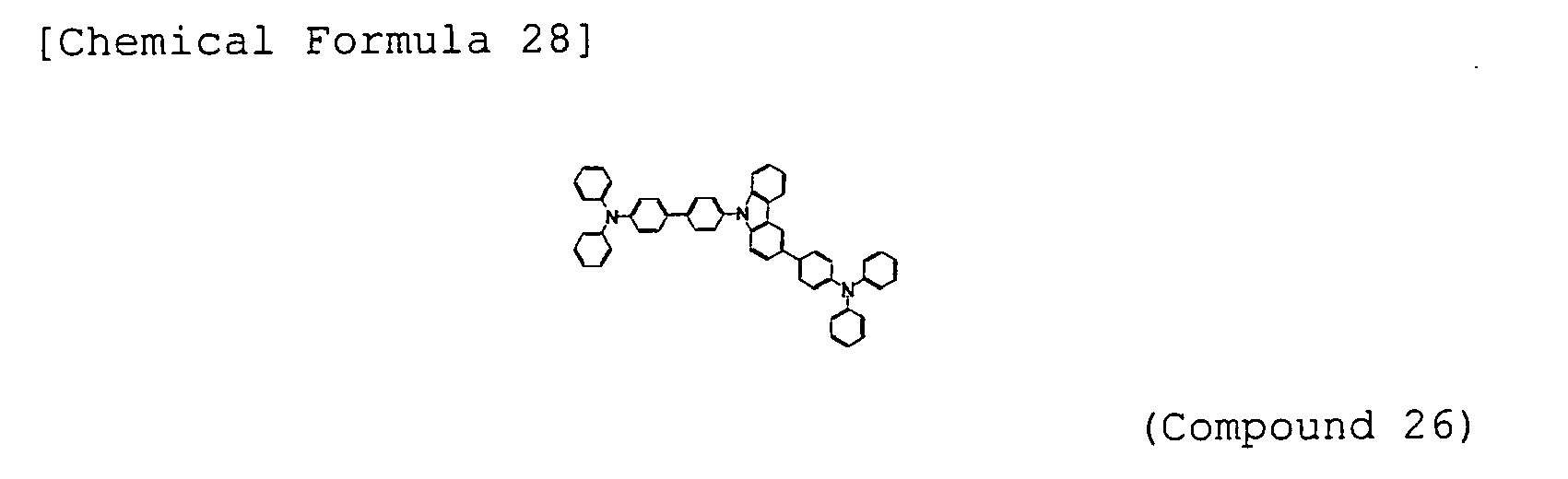
- An organic EL device was fabricated under the same conditions used in Example 9, except that the compound of Example 5 of the present invention (Compound 26) was used as the material of the hole transport layer 4 of Example 9.
- the characteristics of the organic EL device thus fabricated were measured in an atmosphere at ordinary temperature. Table 1 summarizes the results of the emission characteristics measurements performed by applying a DC voltage to the organic EL device thus fabricated.
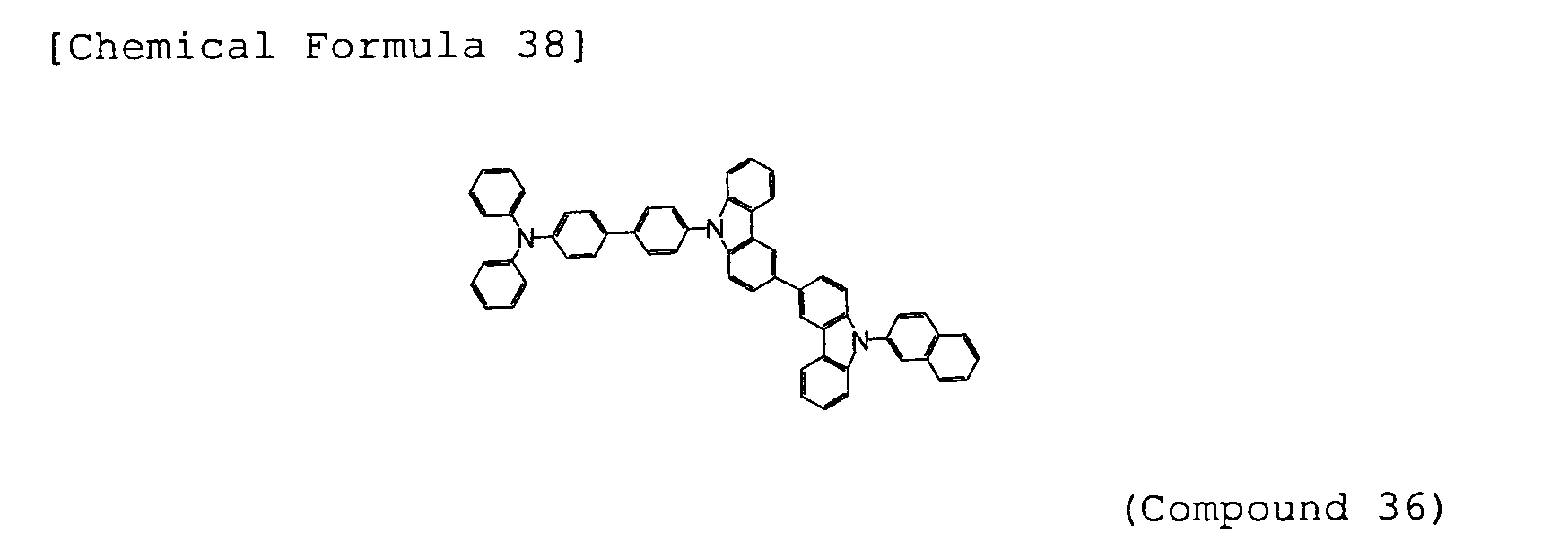
- An organic EL device was fabricated under the same conditions used in Example 9, except that the compound of Example 6 of the present invention (Compound 38) was used as the material of the hole transport layer 4 of Example 9.
- the characteristics of the organic EL device thus fabricated were measured in an atmosphere at ordinary temperature. Table 1 summarizes the results of the emission characteristics measurements performed by applying a DC voltage to the organic EL device thus fabricated.
- Example 9 For comparison, an organic EL device was fabricated under the same conditions used in Example 9, except that the Compound B was used as the material of the hole transport layer 4 of Example 9. The characteristics of the organic EL device thus fabricated were measured in an atmosphere at ordinary temperature. Table 1 summarizes the results of the emission characteristics measurements performed by applying a DC voltage to the organic EL device thus fabricated.
- Example 9 For comparison, an organic EL device was fabricated under the same conditions used in Example 9, except that the compound 89 of the following structural formula was used as the material of the hole transport layer 4 of Example 9. The characteristics of the organic EL device thus fabricated were measured in an atmosphere at ordinary temperature. Table 1 summarizes the results of the emission characteristics measurements performed by applying a DC voltage to the organic EL device thus fabricated.
- the driving voltage upon passing a current with a current density of 10 mA/cmz was 4.70 V with the compound of Example 1 of the present invention (Compound 8), lower than 5.62 V with Compound B and 4. 87 V with Compound 89.
- the compounds of Examples 4 to 6 also had lower voltages than Compound B.
- the compound of Example 1 (Compound 8) of the present invention also had an improved power efficiency of 5. 39 lm/W over 5.06 lm/W (Compound B) and 5.06 Im/W (Compound 89).
- the compounds of Examples 4 to 6 (Compounds 22, 26, 38) had even greater power efficiencies of 5.69 to 6.41 lm/W.
- the organic EL devices using the compounds having a carbazole ring structure of the present invention can have improved power efficiency and lower actual driving voltage compared to the organic EL device using the known Compound B.
- An organic EL device as illustrated in FIG. 8 , was fabricated from a hole transport layer 4, a light emitting layer 5, a hole blocking layer 6, an electron transport layer 7, an electron injection layer 8, and a cathode (aluminum electrode) 9 successively formed by vapor deposition on a glass substrate 1 that had been provided with an ITO electrode as a transparent anode 2.
- the glass substrate 1 having ITO (thickness 150 nm) formed thereon was washed with an organic solvent, and subjected to an oxygen plasma treatment to wash the surface.
- the glass substrate with the ITO electrode was then installed in a vacuum vapor deposition apparatus, and the pressure was reduced to 0.001 Pa or less.
- the light emitting layer 5 was formed on the hole transport layer 4 by forming TPBI and Ir(ppy) 3 in a thickness of 20 nm using dual vapor deposition at a deposition rate that makes the TPBI:Ir(ppy) 3 composition ratio 92:8.
- the hole blocking layer 6 was then formed on the light emitting layer 5 by forming BCP in a thickness of 10 nm.
- the electron injection layer 8 was formed on the electron transport layer 7 by forming lithium fluoride in a thickness of 0.5 nm.
- the cathode 9 was formed by vapor depositing aluminum in a thickness of 150 nm. The characteristics of the organic EL device thus fabricated were measured in an atmosphere at ordinary temperature.
- Table 2 summarizes the results of the emission characteristics measurements performed by passing a current of a 10 mA/cm 2 current density through the organic EL device fabricated with the compound 8 of Example 1 of the present invention.
- An organic EL device was fabricated under the same conditions used in Example 13, except that the compound of Example 6 of the present invention (Compound 38) was used as the material of the hole transport layer 4 of Example 13.
- the characteristics of the organic EL device thus fabricated were measured in an atmosphere at ordinary temperature. Table 2 summarizes the results of the emission characteristics measurements performed by applying a DC voltage to the organic EL device thus fabricated.
- Example 13 For comparison, an organic EL device was fabricated under the same conditions used in Example 13, except that the Compound 89 was used as the material of the hole transport layer 4 of Example 13.
- Table 2 summarizes the results of the emission characteristics measurements performed by passing a current with a current density of 10 mA/cm 2 through the organic EL device thus fabricated.
- the driving voltage upon passing a current with a current density of 10 mA/cm 2 was 5.35 V with the compound of Example 1 of the present invention (Compound 8), and 5.30 V with the compound of Example 6 (Compound 38), lower than 5.89 V with Compound 89.
- the compound of Example 1 of the present invention (Compound 8) and the compound of Example 6 (Compound 38) also had greatly improved power efficiencies of 18.30 lm/W and 16.82 1m/W, respectively, over the power efficiency 10.13 lm/W of Compound 89.
- the phosphorescent organic EL devices using the compounds having a carbazole ring structure of the present invention can have improved power efficiency and lower actual driving voltage compared to the phosphorescent organic EL device using the known Compound 89.
- the compound having a carbazole ring structure of the present invention has good hole transportability, excels in electron blocking ability, and thus has a stable thin-film state.
- the compound is therefore excellent as a compound for organic EL devices.
- the organic EL device fabricated with the compound can have high luminous efficiency and high power efficiency, and can have a low actual driving voltage to improve durability. There are potential applications for, for example, home electronic appliances and illuminations.
Landscapes
- Chemical & Material Sciences (AREA)
- Organic Chemistry (AREA)
- Engineering & Computer Science (AREA)
- Materials Engineering (AREA)
- Physics & Mathematics (AREA)
- Spectroscopy & Molecular Physics (AREA)
- Electroluminescent Light Sources (AREA)
- Indole Compounds (AREA)
- Plural Heterocyclic Compounds (AREA)
Abstract
Description
- The present invention relates to compounds suited for an organic electroluminescent device, a preferred self light-emitting device for various display devices, and to the device. Specifically, the invention relates to compounds having a carbazole ring structure, and organic electroluminescent devices using such compounds.
- The organic electroluminescent device is a self-emitting device, and has been actively studied for their brighter, superior viewability and the ability to display clearer images compared with the liquid crystal device.
- In 1987, C. W. Tang and colleagues at Eastman Kodak developed a laminated structure device using materials assigned with different roles, realizing practical applications of an organic electroluminescent device with organic materials. These researchers laminated tris(8-hydroxyquinoline)aluminum (an electron-transporting phosphor; hereinafter, simply Alq3) and a hole-transporting aromatic amine compound, and injected the both charges into the phosphor layer to cause emission in order to obtain a high luminance of 1,000 cd/m2 or more at a voltage of 10 V or less (see, for example, Patent Documents 1 and 2).
- To date, various improvements have been made for practical applications of the organic electroluminescent device. In order to realize high efficiency and durability, various roles are further subdivided to provide an electroluminescence device that includes an anode, a hole injection layer, a hole transport layer, a light emitting layer, an electron transport layer, an electron injection layer, and a cathode successively formed on a substrate (see, for example, Non-Patent Document 1).
- Further, there have been attempts to use triplet excitons for further improvements of luminous efficiency, and use of phosphorescent materials have been investigated (see, for example, Non-Patent Document 2).
- The light emitting layer can be also fabricated by doping a charge-transporting compound, generally called a host material, with a phosphor or a phosphorescent material. As described in the foregoing lecture preprints, selection of organic materials in an organic electroluminescent device greatly influences various device characteristics, including efficiency and durability.
- In an organic electroluminescent device, the charges injected from the both electrodes recombine at the light emitting layer to cause emission. The probability of hole-electron recombination can be improved and high luminous efficiency can be obtained by improving the hole injectability and the electron blocking performance of blocking the injected electrons from the cathode, and by thus confining the excitons generated in the light emitting layer. The role of the hole transport material is therefore important, and there is a need for a hole transport material that has high hole injectability, large hole mobility, high electron blocking performance, and high durability to electrons.
- The aromatic amine derivatives described in
Patent Documents 1 and 2 are known examples of the hole transport materials used for the organic electroluminescent device. These compounds include a compound known to have an excellent hole mobility of 10-3 cm/Vs or higher. However, the compound is insufficient in terms of electron blocking performance, and some of the electrons pass through the light emitting layer. Accordingly, improvements in luminous efficiency cannot be expected. - Arylamine compounds of the following formulae having a substituted carbazole structure (for example, Compounds A and B) are proposed as improvements over the foregoing compounds (see, for example, Patent Documents 3 and 4).
-
-

- However, while the devices using these compounds for the hole injection layer or hole transport layer have improved luminous efficiency and the like, the luminous efficiency is still insufficient, and the device cannot be said to have a sufficiently low voltage and sufficient current efficiency. Further improvements of luminous efficiency are therefore needed.
-
- Patent Document 1:
JP-A-8-48656 - Patent Document 2: Japanese Patent No.
3194657 - Patent Document 3:
JP-A-2006-151979 - Patent Document 4:
WO2008/6263 -
- Non-Patent Document 1: The Japan Society of Applied Physics, 9th Lecture Preprints, pp. 55 to 61 (2001)
- Non-Patent Document 2: The Japan Society of Applied Physics, 9th Lecture Preprints, pp. 23 to 31 (2001)
- Non-Patent Document 3: Helvetica Chimica Acta., vol.89, 1123 (2006)
- Non-Patent Document 4: J. Org. Chem., 60, 7508 (1995)
- Non-Patent Document 5: Synth. Commun., 11, 513 (1981)
- It is an object of the present invention to provide an organic compound of excellent characteristics that exhibits excellent hole-injecting/transporting performance with electron blocking ability, and that has high stability in the thin-film state and high luminous efficiency, the organic compound being provided as material for an organic electroluminescent device having high efficiency and high durability. The invention also provides a high-efficient, high-durable organic electroluminescent device using the compound.
- Some of the physical properties of the organic compound to be provided by the present invention include (1) good hole injection characteristics, (2) large hole mobility, (3) excellent electron blocking ability, (4) stability in the thin-film state, and (5) excellent heat resistance. Some of the physical properties of the organic electroluminescent device to be provided by the present invention include (1) high luminous efficiency and high power efficiency, (2) low turn on voltage, and (3) low actual driving voltage.
- In order to achieve the foregoing objects, the present inventors focused on the high hole transporting ability of an aromatic tertiary amine structure, the excellent electron blocking performance of a carbazole ring structure, and the excellent heat resistance and the thin-film stability of these structures, and produced various test organic electroluminescent devices using compounds designed and chemically synthesized to have a carbazole ring structure. The present invention was completed after thorough evaluations of the device characteristics.
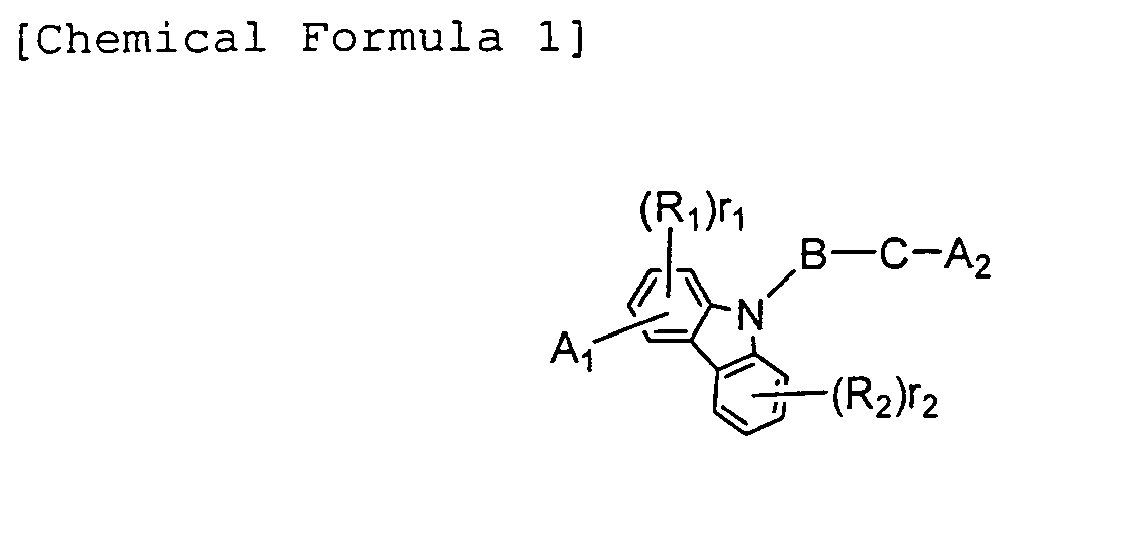
- Specifically, the present invention is a compound of the general formula (1) below having a carbazole ring structure. Further, the present invention is an organic electroluminescent device that includes a pair of electrodes and one or more organic layers sandwiched between the pair of electrodes, wherein the compound is used as a constituent material of at least one organic layer.
-

- In the formula, R1 and R2 may be the same or different, and represent a deuterium atom, a fluorine atom, a chlorine atom, cyano, nitro, linear or branched alkyl having 1 to 6 carbon atoms that may have a substituent, cycloalkyl having 5 to 10 carbon atoms that may have a substituent, linear or branched alkenyl having 2 to 6 carbon atoms that may have a substituent, linear or branched alkyloxy having 1 to 6 carbon atoms that may have a substituent, cycloalkyloxy having 5 to 10 carbon atoms that may have a substituent, substituted or unsubstituted aromatic hydrocarbon, a substituted or unsubstituted aromatic heterocyclic group, substituted or unsubstituted condensed polycyclic aromatic, or substituted or unsubstituted aryloxy, and these substituents may bind to each other via a single bond, substituted or unsubstituted methylene, an oxygen atom, or a sulfur atom to form a ring. r1 represents 0 or an integer of 1 to 3, r2 represents 0 or an integer of 1 to 4, A1 and A2 may be the same or different, A1 represents a monovalent group of the general formula (2) or (3) below, A2 represents one of the monovalent groups of the general formulae (2) to (7) below, B represents a divalent group of substituted or unsubstituted aromatic hydrocarbon, a divalent group of a substituted or unsubstituted aromatic heterocyclic ring, or a divalent group of substituted or unsubstituted condensed polycyclic aromatic, C represents a single bond, or a divalent group of substituted or unsubstituted aromatic hydrocarbon, a divalent group of a substituted or unsubstituted aromatic heterocyclic ring, or a divalent group of substituted or unsubstituted condensed polycyclic aromatic. Note that A1 and A2 do not simultaneously represent the general formula (2).
-

- In the formula, R3 and R4 may be the same or different, and represent a deuterium atom, a fluorine atom, a chlorine atom, cyano, nitro, linear or branched alkyl having 1 to 6 carbon atoms that may have a substituent, cycloalkyl having 5 to 10 carbon atoms that may have a substituent, linear or branched alkenyl having 2 to 6 carbon atoms that may have a substituent, linear or branched alkyloxy having 1 to 6 carbon atoms that may have a substituent, cycloalkyloxy having 5 to 10 carbon atoms that may have a substituent, substituted or unsubstituted aromatic hydrocarbon, a substituted or unsubstituted aromatic heterocyclic group, substituted or unsubstituted condensed polycyclic aromatic, or substituted or unsubstituted aryloxy, and these substituents may bind to each other via a single bond, substituted or unsubstituted methylene, an oxygen atom, or a sulfur atom to form a ring. r3 represents 0 or an integer of 1 to 4, r4 represents 0 or an integer of 1 to 3, and Ar1 represents substituted or unsubstituted aromatic hydrocarbon, a substituted or unsubstituted aromatic heterocyclic group, or substituted or unsubstituted condensed polycyclic aromatic.
-
- In the formula, R5 and R6 may be the same or different, and represent a deuterium atom, a fluorine atom, a chlorine atom, cyano, nitro, linear or branched alkyl having 1 to 6 carbon atoms that may have a substituent, cycloalkyl having 5 to 10 carbon atoms that may have a substituent, linear or branched alkenyl having 2 to 6 carbon atoms that may have a substituent, linear or branched alkyloxy having 1 to 6 carbon atoms that may have a substituent, cycloalkyloxy having 5 to 10 carbon atoms that may have a substituent, substituted or unsubstituted aromatic hydrocarbon, a substituted or unsubstituted aromatic heterocyclic group, substituted or unsubstituted condensed polycyclic aromatic, or substituted or unsubstituted aryloxy, and these substituents may bind to each other via a single bond, substituted or unsubstituted methylene, an oxygen atom, or a sulfur atom to form a ring. r5 represents 0 or an integer of 1 to 4, r6 represents 0 or an integer of 1 to 5, and Ar2 represents substituted or unsubstituted aromatic hydrocarbon, a substituted or unsubstituted aromatic heterocyclic group, or substituted or unsubstituted condensed polycyclic aromatic.
-
- In the formula, R7 and R8 may be the same or different, and represent a deuterium atom, a fluorine atom, a chlorine atom, cyano, nitro, linear or branched alkyl having 1 to 6 carbon atoms that may have a substituent, cycloalkyl having 5 to 10 carbon atoms that may have a substituent, linear or branched alkenyl having 2 to 6 carbon atoms that may have a substituent, linear or branched alkyloxy having 1 to 6 carbon atoms that may have a substituent, cycloalkyloxy having 5 to 10 carbon atoms that may have a substituent, substituted or unsubstituted aromatic hydrocarbon, a substituted or unsubstituted aromatic heterocyclic group, substituted or unsubstituted condensed polycyclic aromatic, or substituted or unsubstituted aryloxy, and these substituents may bind to each other via a single bond, substituted or unsubstituted methylene, an oxygen atom, or a sulfur atom to form a ring. r7 and r8 may be the same or different, and represent 0 or an integer of 1 to 4.
-

- In the formula, Ar3 and Ar4 may be the same or different, and represent substituted or unsubstituted aromatic hydrocarbon, a substituted or unsubstituted aromatic heterocyclic group, or substituted or unsubstituted condensed polycyclic aromatic, and these groups may bind to each other via a single bond, substituted or unsubstituted methylene, an oxygen atom, or a sulfur atom to form a ring.
-

- In the formula, R9 and R10 may be the same or different, and represent a deuterium atom, a fluorine atom, a chlorine atom, cyano, nitro, linear or branched alkyl having 1 to 6 carbon atoms that may have a substituent, cycloalkyl having 5 to 10 carbon atoms that may have a substituent, linear or branched alkenyl having 2 to 6 carbon atoms that may have a substituent, linear or branched alkyloxy having 1 to 6 carbon atoms that may have a substituent, cycloalkyloxy having 5 to 10 carbon atoms that may have a substituent, substituted or unsubstituted aromatic hydrocarbon, a substituted or unsubstituted aromatic heterocyclic group, substituted or unsubstituted condensed polycyclic aromatic, or substituted or unsubstituted aryloxy, and these substituents may bind to each other via a single bond, substituted or unsubstituted methylene, an oxygen atom, or a sulfur atom to form a ring. r9 represents 0 or an integer of 1 to 4, r10 represents 0 or an integer of 1 to 3, Ar5 represents substituted or unsubstituted aromatic hydrocarbon, a substituted or unsubstituted aromatic heterocyclic group, or substituted or unsubstituted condensed polycyclic aromatic, and D represents substituted or unsubstituted methylene, an oxygen atom, or a sulfur atom.
-


- In the formula, R11 and R12 may be the same or different, and represent a deuterium atom, a fluorine atom, a chlorine atom, cyano, nitro, linear or branched alkyl having 1 to 6 carbon atoms that may have a substituent, cycloalkyl having 5 to 10 carbon atoms that may have a substituent, linear or branched alkenyl having 2 to 6 carbon atoms that may have a substituent, linear or branched alkyloxy having 1 to 6 carbon atoms that may have a substituent, cycloalkyloxy having 5 to 10 carbon atoms that may have a substituent, substituted or unsubstituted aromatic hydrocarbon, a substituted or unsubstituted aromatic heterocyclic group, substituted or unsubstituted condensed polycyclic aromatic, or substituted or unsubstituted aryloxy, and these substituents may bind to each other via a single bond, substituted or unsubstituted methylene, an oxygen atom, or a sulfur atom to form a ring. r11 and r12 may be the same or different, and represent 0 or an integer of 1 to 3, Ar6 represents substituted or unsubstituted aromatic hydrocarbon, a substituted or unsubstituted aromatic heterocyclic group, or substituted or unsubstituted condensed polycyclic aromatic, and W, X, Y, and Z represent a carbon atom or a nitrogen atom. Here, only one of W, X, Y, and Z is a nitrogen atom, and, in this case, the nitrogen atom does not have the substituent R12.
- Specific examples of "linear or branched alkyl having 1 to 6 carbon atoms", "cycloalkyl having 5 to 10 carbon atoms", and "linear or branched alkenyl having 2 to 6 carbon atoms" in the "linear or branched alkyl having 1 to 6 carbon atoms that may have a substituent", "cycloalkyl having 5 to 10 carbon atoms that may have a substituent", and "linear or branched alkenyl having 2 to 6 carbon atoms that may have a substituent" represented by R1 to R12 in general formulae (1) to (7) include methyl, ethyl, n-propyl, isopropyl, n-butyl, isobutyl, tert-butyl, n-pentyl, isopentyl, neopentyl, n-hexyl, cyclopentyl, cyclohexyl, 1-adamantyl, 2-adamantyl, vinyl, allyl, isopropenyl, and 2-butenyl.
- Specific examples of "substituent" in the "linear or branched alkyl having 1 to 6 carbon atoms that has a substituent", "cycloalkyl having 5 to 10 carbon atoms that has a substituent", and "linear or branched alkenyl having 2 to 6 carbon atoms that has a substituent" represented by R1 to R12 in general formulae (1) to (7) include a deuterium atom, a fluorine atom, a chlorine atom, cyano, nitro, phenyl, phenyl, biphenylyl, terphenylyl, tetrakisphenyl, naphthyl, anthryl, fluorenyl, phenanthryl, indenyl, pyrenyl, and pyridoindolyl. These substituents may be further substituted.
- Specific examples of "linear or branched alkyloxy having 1 to 6 carbon atoms" and "cycloalkyloxy having 5 to 10 carbon atoms" in the "linear or branched alkyloxy having 1 to 6 carbon atoms that may have a substituent" and "cycloalkyloxy having 5 to 10 carbon atoms that may have a substituent" represented by R1 to R12 in general formulae (1) to (7) include methyloxy, ethyloxy, n-propyloxy, isopropyloxy, n-butyloxy, tert-butyloxy, n-pentyloxy, n-hexyloxy, cyclopentyloxy, cyclohexyloxy, cycloheptyloxy, cyclooctyloxy, 1-adamantyloxy, and 2-adamantyloxy.
- Specific examples of "substituent" in the "linear or branched alkyloxy having 1 to 6 carbon atoms that has a substituent" and "cycloalkyloxy having 5 to 10 carbon atoms that has a substituent" represented by R1 to R12 in general formulae (1) to (7) include a deuterium atom, a fluorine atom, a chlorine atom, cyano, nitro, phenyl, phenyl, biphenylyl, terphenylyl, tetrakisphenyl, naphthyl, anthryl, fluorenyl, phenanthryl, indenyl, pyrenyl, and pyridoindolyl. These substituents may be further substituted.
- Specific examples of "aromatic hydrocarbon", "aromatic heterocyclic group", or "condensed polycyclic aromatic" in the "substituted or unsubstituted aromatic hydrocarbon", "a substituted or unsubstituted aromatic heterocyclic group", or "substituted or unsubstituted condensed polycyclic aromatic" represented by R1 to R12 or Ar1 to Ar6 in general formulae (1) to (7) include phenyl, biphenylyl, terphenylyl, naphthyl, anthryl, phenanthryl, fluorenyl, indenyl, pyrenyl, perylenyl, fluoranthenyl, triphenylenyl, pyridyl, furanyl, pyranyl, thienyl, quinolyl, isoquinolyl, benzofuranyl,benzothienyl, indolyl, carbazolyl, benzooxazolyl, benzothiazolyl, quinoxalyl, benzoimidazolyl, pyrazolyl, dibenzofuranyl, dibenzothienyl, and carbolinyl.
- Specific examples of "substituent" in the "substituted aromatic hydrocarbon", "substituted aromatic heterocyclic group", or "substituted condensed polycyclic aromatic" represented by R1 to R12 or Ar1 to Ar6 in general formulae (1) to (7) include a deuterium atom, a fluorine atom, a chlorine atom, cyano, trifluoromethyl, nitro, linear or branched alkyl having 1 to 6 carbon atoms, cycloalkyl having 5 to 10 carbon atoms, linear or branched alkenyl having 2 to 6 carbon atoms, linear or branched alkyloxy having 1 to 6 carbon atoms, cycloalkyloxy having 5 to 10 carbon atoms, phenyl, naphthyl, anthryl, styryl, phenoxy, tolyloxy, benzyloxy, and phenethyloxy. These substituents may be further substituted. Further, these substituents may bind to each other via a single bond, substituted or unsubstituted methylene, an oxygen atom, or a sulfur atom to form a ring.
- Specific examples of "aryloxy" in the "substituted or unsubstituted aryloxy" represented by R1 to R12 in general formulae (1) to (7) include phenoxy, biphenylyloxy, terphenylyloxy, naphthyloxy, anthryloxy, phenanthryloxy, fluorenyloxy, indenyloxy, pyrenyloxy, and perylenyloxy.
- Specific examples of "substituent" in the "substituted aryloxy" represented by R1 to R12 in general formulae (1) to (7) include a deuterium atom, a fluorine atom, a chlorine atom, cyano, trifluoromethyl, nitro, linear or branched alkyl having 1 to 6 carbon atoms, cycloalkyl having 5 to 10 carbon atoms, linear or branched alkenyl having 2 to 6 carbon atoms, linear or branched alkyloxy having 1 to 6 carbon atoms, cycloalkyloxy having 5 to 10 carbon atoms, phenyl, naphthyl, anthryl, styryl, phenoxy, tolyloxy, benzyloxy, and phenethyloxy. These substituents may be further substituted. Further, these substituents may bind to each other via a single bond, substituted or unsubstituted methylene, an oxygen atom, or a sulfur atom to form a ring.
- Specific examples of "a divalent group of aromatic hydrocarbon", "a divalent group of an aromatic heterocyclic ring", and "a divalent group of condensed polycyclic aromatic" in the "divalent group of substituted or unsubstituted aromatic hydrocarbon", "divalent group of a substituted or unsubstituted aromatic heterocyclic ring", "divalent group of substituted or unsubstituted condensed polycyclic aromatic" represented by B and C in general formula (1) include phenylene, biphenylene, terphenylene, tetrakisphenylene, naphthylene, anthrylene, phenanthrylene, fluorenylene, phenanthrolylene, indenylene, pyrenylene, perylenylene, fluoranthenylene, triphenylenylene, pyridinylene, pyrimidinylene, quinolylene, isoquinolylene, indolylene, carbazolylene, quinoxalylene, benzoimidazolylene, pyrazolylene, naphthyridinylene, phenanthrolinylene, acridinylene, thienylene, benzothienylene, and dibenzothienylene.
- Specific examples of "substituent" in the "divalent group of substituted aromatic hydrocarbon", "divalent group of a substituted aromatic heterocyclic ring", and "divalent group of substituted condensed polycyclic aromatic" represented by B and C in general formula (1) include a deuterium atom, a fluorine atom, a chlorine atom, cyano, trifluoromethyl, nitro, linear or branched alkyl having 1 to 6 carbon atoms, cycloalkyl having 5 to 10 carbon atoms, linear or branched alkenyl having 2 to 6 carbon atoms, linear or branched alkyloxy having 1 to 6 carbon atoms, cycloalkyloxy having 5 to 10 carbon atoms, phenyl, naphthyl, anthryl, styryl, phenoxy, tolyloxy, benzyloxy, and phenethyloxy. These substituents may be further substituted. Further, these substituents may bind to each other via a single bond, substituted or unsubstituted methylene, an oxygen atom, or a sulfur atom to form a ring.
- Among the compounds of general formula (1) having a carbazole ring structure, the compounds of the general formulae (1a), (1b), (1c), and (1d) below having a carbazole ring structure are preferably used for an organic electroluminescent device.
-
-


-

-
- The compounds of general formula (1) having a carbazole ring structure of the present invention are novel compounds, and have superior electron blocking ability and a more stable thin-film state compared to the conventional hole transport materials.
- The compounds of general formula (1) having a carbazole ring structure of the present invention can be used as a constituent material of the hole injection layer and/or hole transport layer of an organic electroluminescent device (hereinafter, simply "organic EL device"). With the material having higher hole injectability, higher mobility, higher electron blocking performance and higher electron stability than the conventional materials, the excitons generated in the light emitting layer can be confined, and the probability of hole-electron recombination can be improved. This improves the luminous efficiency, and lowers driving voltage and thus improves the durability of the organic EL device.
- The compound of general formula (1) having a carbazole ring structure of the present invention also can be used as a constituent material of the electron blocking layer of an organic EL device. With the material having an excellent electron blocking ability and superior hole transportability and higher stability in the thin-film state than the conventional materials, the driving voltage lowers and the current resistance improves while maintaining high luminous efficiency. As a result, the maximum emission luminance of the organic EL device improves.
- The compound of general formula (1) having a carbazole ring structure of the present invention also can be used as a constituent material of the light emitting layer of an organic EL device. The material of the present invention has superior hole transportability and a wider band gap than the conventional materials, and can thus be used as the host material of the light emitting layer in order to form the light emitting layer by carrying a fluorescent material or phosphorescent material called a dopant. In this way, an organic EL device can be realized that has a low driving voltage and improved luminous efficiency.
- The organic EL device of the present invention uses the compound having a carbazole ring structure, wherein the compound has greater hole mobility and superior electron blocking ability than the conventional hole transport materials while having a stable thin-film state. In this way, high efficiency and high durability are realized.
- The compound having a carbazole ring structure of the present invention is useful as a constituent material of the hole injection layer, hole transport layer, electron blocking layer, or the light emitting layer of an organic EL device. The compound has an excellent electron blocking ability, and excels in heat resistance while having a stable thin-film state. The organic EL device of the present invention has high luminous efficiency and high power efficiency, and can thus lower the actual driving voltage of the device. Further, the turn on voltage can be reduced to improve durability.
-
-
FIG. 1 is a 1H-NMR chart of the compound of Example 1 of the present invention (Compound 8). -
FIG. 2 is a 1H-NMR chart of the compound of Example 2 of the present invention (Compound 13). -
FIG. 3 is a 1H-NMR chart of the compound of Example 3 of the present invention (Compound 14). -
FIG. 4 is a 1H-NMR chart of the compound of Example 4 of the present invention (Compound 22). -
FIG. 5 is a 1H-NMR chart of the compound of Example 5 of the present invention (Compound 26). -
FIG. 6 is a 1H-NMR chart of the compound of Example 6 of the present invention (Compound 38). -
FIG. 7 is a diagram illustrating the configuration of the EL devices of Examples 9 to 12 and Comparative Examples 1 and 2. -
FIG. 8 is a diagram illustrating the configuration of the EL devices of Examples 13 and 14 and Comparative Example 3. - The compounds having a carbazole ring structure of the present invention are novel compounds, and may be synthesized, for example, as follows. First, 3-bromo-9-arylcarbazole is synthesized by the bromination of a carbazole substituted with an aryl group at the corresponding ninth position, using, for example, N-bromosuccinimide (see, for example, Non-Patent Document 3). The boronic acid or borate synthesized by the reaction of the resulting bromo compound with compounds such as pinacolborane and bis (pinacolato) diboron (see, for example, Non-Patent Document 4) can then be reacted with various halogeno-9H-carbazoles in a cross-coupling reaction such as Suzuki coupling(see, for example, Non-Patent Document 5) to synthesize N-aryl-9'H-carbazol-3'-yl)-9H-carbazole. A compound having a carbazole ring structure can then be synthesized by a condensation reaction, such as the Ullmann reaction, between the N-aryl-9'H-carbazol-3'-yl)-9H-carbazole and aryl halides substituted with various diarylamino groups.
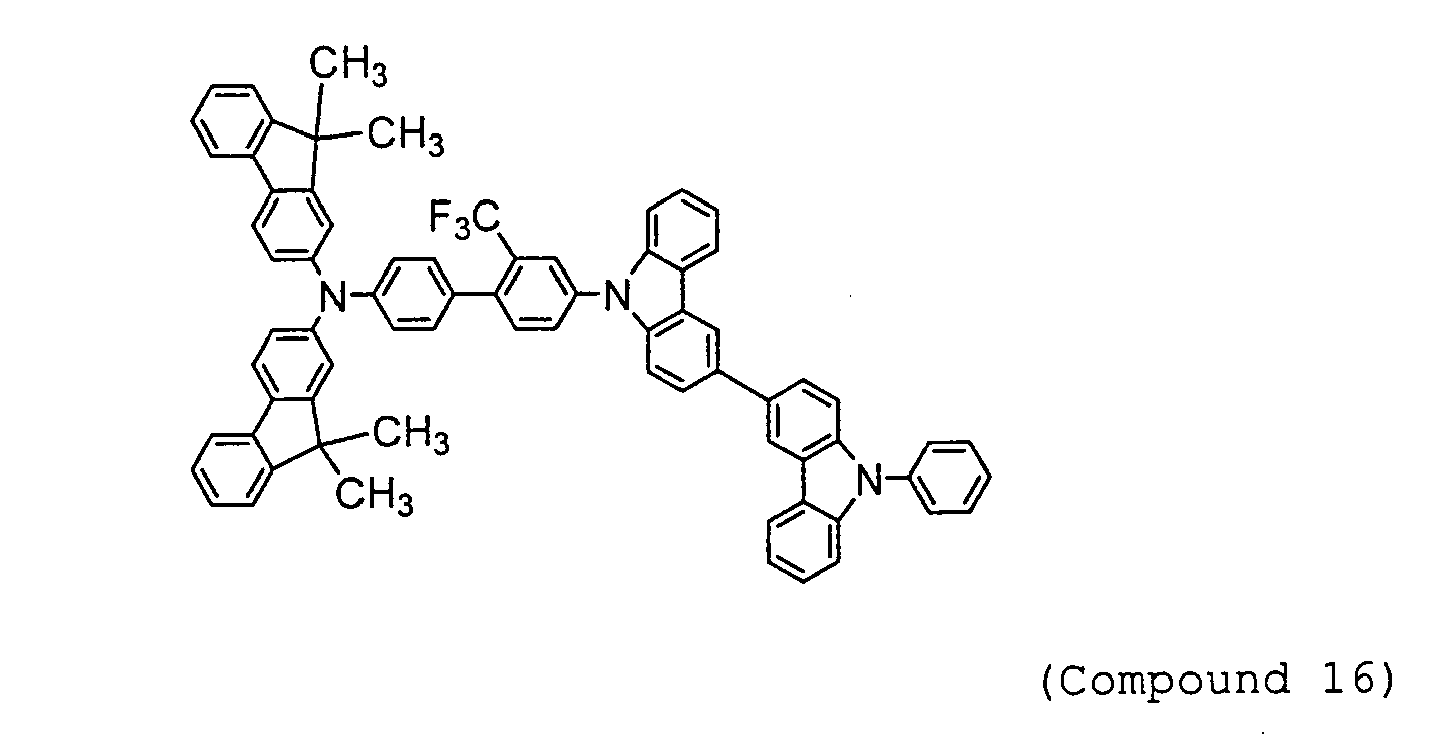
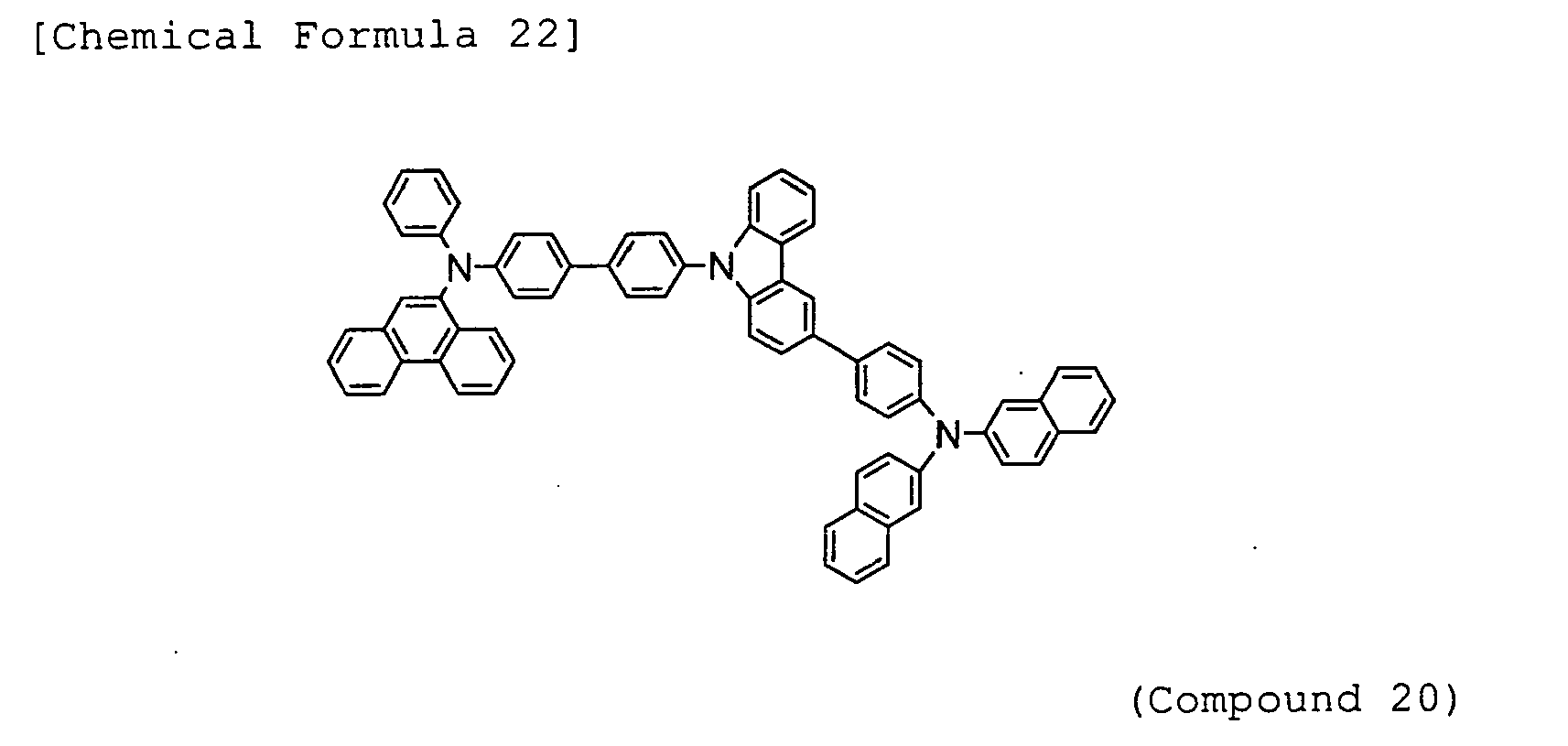
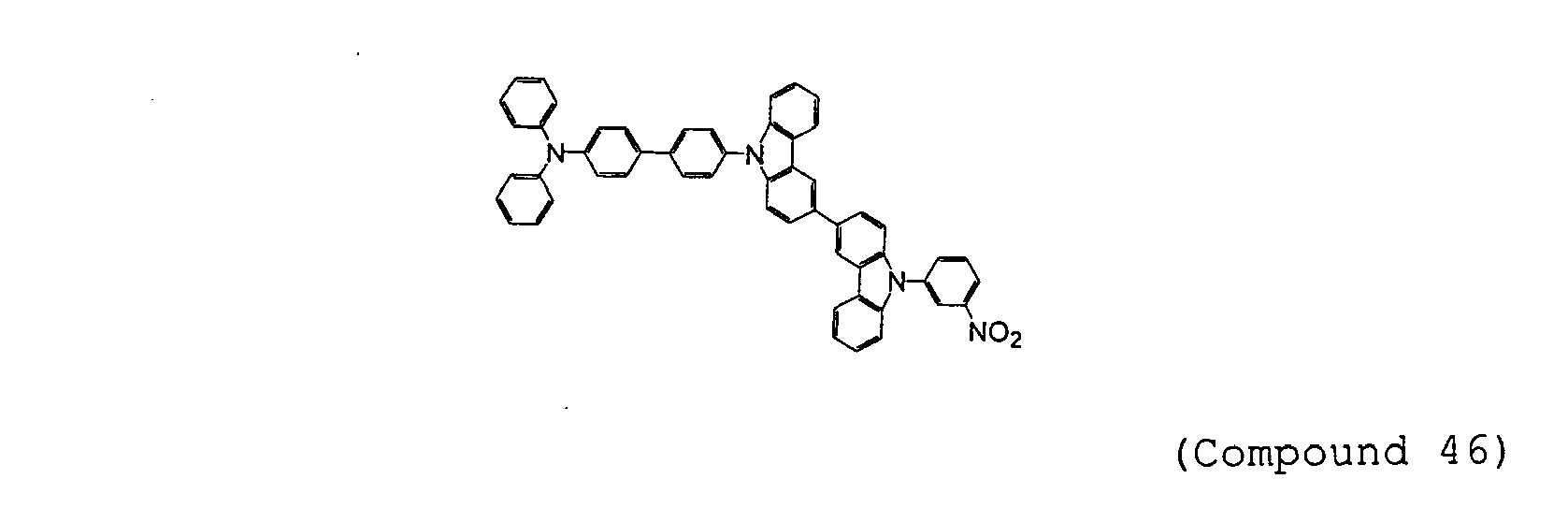
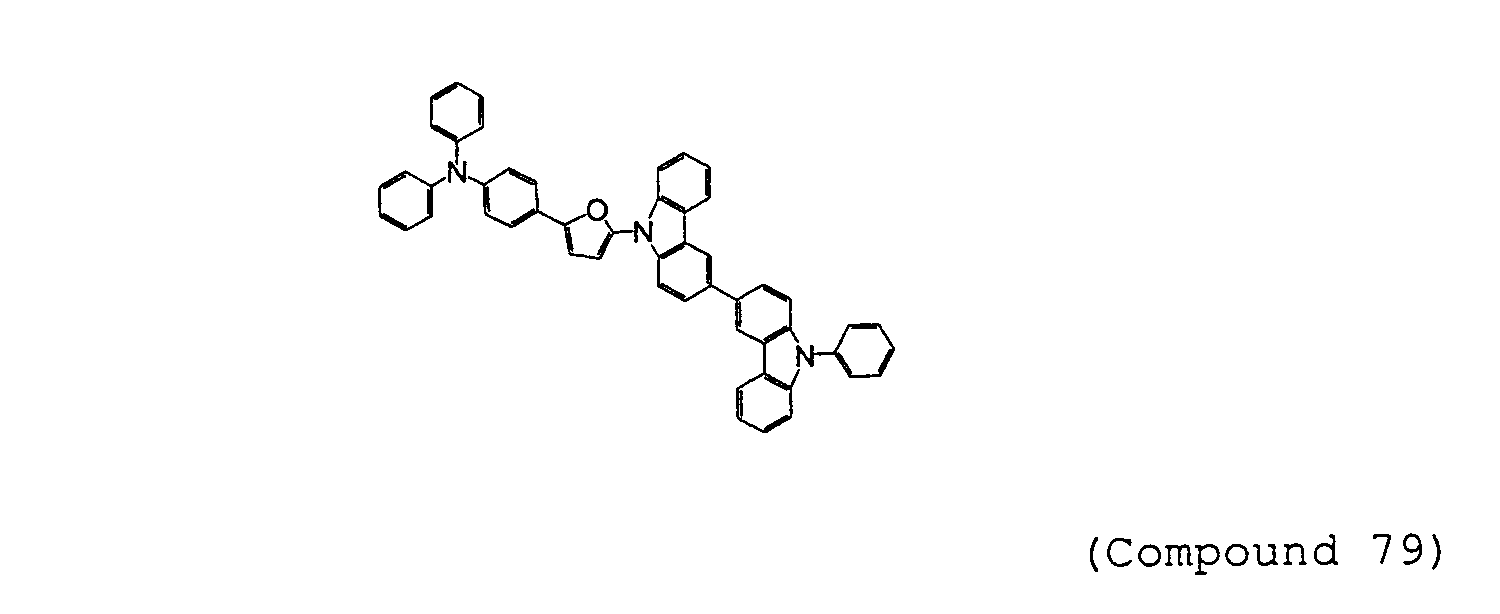
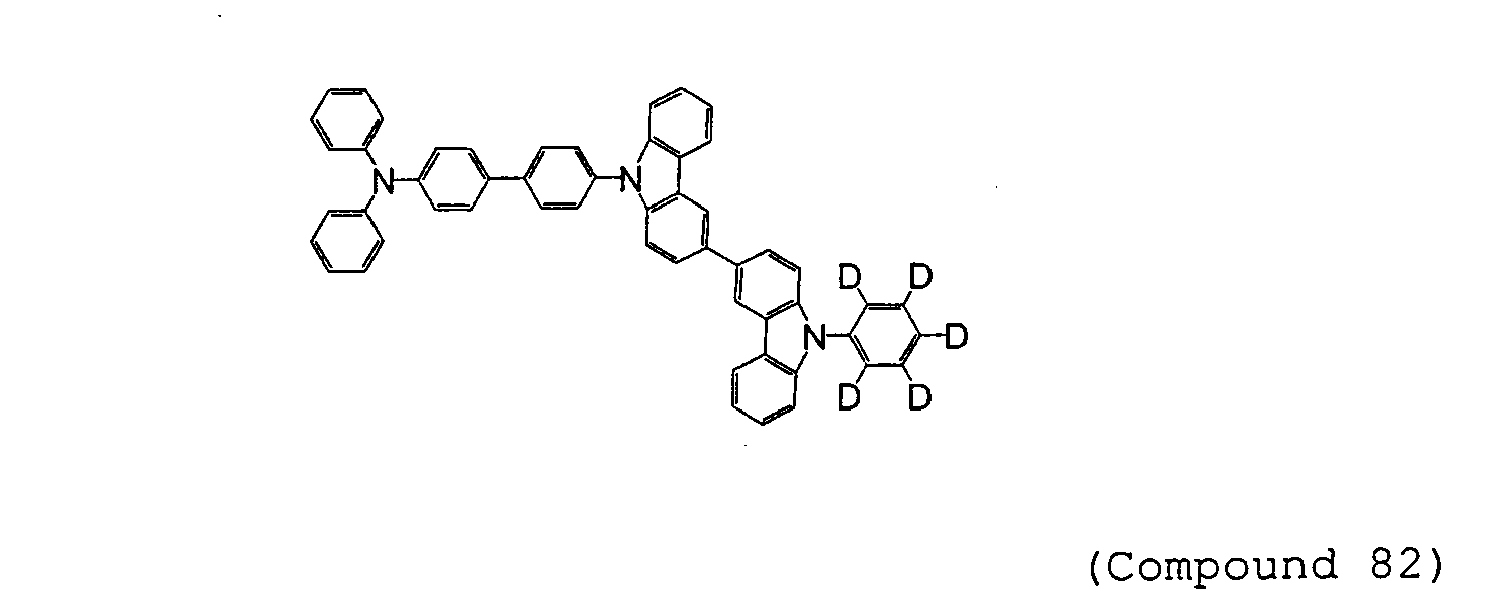
- The following presents specific examples of preferred compounds among the compounds of general formula (1) having a carbazole ring structure. The present invention, however, is not restricted to these compounds.
-

-

-


-

-

-


-

-

-

-

-

-


-
-

-


-

-

-

-
-

-


-
-
-

-

-
-
-
-
-


-

-
-

-

-
-
-

-

-

-

-

-


-

-

-


-

-

-


-

-

-


-

-

-


-

-

-

-

-

-


-
-
-

-

-

-
-

-

-


-
-
-

-
-

-

-

-

-


- These compounds were purified by methods such as column chromatography, adsorption using, for example, a silica gel, activated carbon, or activated clay, and recrystallization or crystallization using a solvent. The compounds were identified by NMR analysis. Glass transition point (Tg) and work function were taken for the measurement of physical properties. Glass transition point (Tg) can be used as an index of stability in the thin-film state, and the work function as an index of hole transportability.
- Glass transition point (Tg) was measured using a powder, using a high-sensitive differential scanning calorimeter (DSC3100S produced by Bruker AXS).
- For the measurement of work function, a 100 nm-thick thin film was fabricated on an ITO substrate, and an atmosphere photoelectron spectrometer AC-3 produced by Riken Keiki Co., Ltd. was used.
- The organic EL device of the present invention may have a structure including an anode, a hole transport layer, an electron blocking layer, a light emitting layer, an electron transport layer, and a cathode successively formed on a substrate, optionally with a hole injection layer between the anode and the hole transport layer, or with an electron injection layer between the electron transport layer and the cathode. In such multilayer structures, some of the organic layers may be omitted. For example, the device may be configured to include an anode, a hole transport layer, a light emitting layer, an electron transport layer, and a cathode successively formed on a substrate.
- Electrode materials with a large work function, such as ITO and gold, are used as the anode of the organic EL device of the present invention. The hole injection layer may be made of material such as porphyrin compounds as represented by copper phthalocyanine, starburst-type triphenylamine derivatives, various triphenylamine tetramers, and coating-type polymer materials, in addition to the compounds of general formula (1) having a carbazole ring structure of the present invention. These materials may be formed into a thin film by using a vapor deposition method, or other known methods such as spin coating and an inkjet method.
- Examples of the material used for the hole transport layer of the present invention include benzidine derivatives such as N,N`-diphenyl-N,N'-di(m-tolyl)benzidine (hereinafter, simply "TPD"), N,N'-diphenyl-N,N'-di(a-naphthyl)benzidine (hereinafter, simply "NPD"), and N,N,N',N'-tetrabiphenylylbenzidine, and various triphenylamine trimers and tetramers, in addition to the compounds of general formula (1) having a carbazole ring structure of the present invention. These may be individually deposited for film forming, or may be used as a single layer deposited as a mixture with other materials, or as a laminate of individually deposited layers, a laminate of layers deposited as a mixture, or a laminate of layers deposited by being mixed with an individually deposited layer. Examples of the material used for the hole injection/transport layer include coating-type polymer materials such as poly(3,4-ethylenedioxythiophene) (hereinafter, simply "PEDOT")/poly(styrene sulfonate) (hereinafter, simply "PSS"). These materials may be formed into a thin-film by using a vapor deposition method, or other known methods such as spin coating and an inkjet method.
- Examples of the material used for the electron blocking layer of the present invention include compounds having an electron blocking effect, including, for example, carbazole derivatives such as 4,4',4' '-tri (N-carbazolyl) triphenylamine (hereinafter, simply "TCTA"), 9,9-bis[4-(carbazol-9-yl)phenyl]fluorene, and 1,3-bis(carbazol-9-yl)benzene (hereinafter, simply "mCP"); and compounds having a triphenylsilyl group and a triarylamine structure, as represented by 9-[4-(carbazol-9-yl)phenyl]-9-[4-(triphenylsilyl)phenyl]-9 H-fluorene, in addition to the compounds of general formula (1) having a carbazole ring structure of the present invention.
- Examples of the material used for the light emitting layer of the present invention include various metal complexes, anthracene derivatives, bis(styryl)benzene derivatives, pyrene derivatives, oxazole derivatives, and polyparaphenylene vinylene derivatives, in addition to quinolinol derivative metal complexes such as Alq3. Further, the light emitting layer may be configured from a host material and a dopant material. Examples of the host material include thiazole derivatives, benzimidazole derivatives, and polydialkyl fluorene derivatives, in addition to the foregoing light-emitting materials, and the compounds of general formula (1) having a carbazole ring structure of the present invention. Examples of the dopant material include quinacridone, coumalin, rubrene, perylene, derivatives thereof, benzopyran derivatives, rhodamine derivatives, and aminostyryl derivatives. These may be individually deposited for film forming, or may be used as a single layer deposited as a mixture with other materials, or as a laminate of individually deposited layers, a laminate of layers deposited as a mixture, or a laminate of layers deposited by being mixed with an individually deposited layer. These materials may be formed into a thin-film by using a vapor deposition method, or other known methods such as spin coating and an inkjet method.
- Further, the light-emitting materials may be phosphorescent materials. Examples of phosphorescent materials include green phosphorescent materials such as Ir (ppy)3, blue phosphorescent materials such as FIrpic and FIr6, and red phosphorescent materials such as Btp2Ir(acac). Here, the compounds of general formula (1) having a carbazole ring structure of the present invention may be used as the hole injecting and transporting host material, in addition to carbazole derivatives such as 4,4'-di (N-carbazolyl)biphenyl (hereinafter, simply "CBP"), TCTA, and mCP. Compounds such as 2,2',2 " -(1,3,5-phenylene)-tris(1-phenyl-1H-benzimidazole) (hereinafter, simply "TPBI") may be used as the electron transporting host material to produce a high-performance organic EL device.
- Examples of the hole blocking layer of the present invention include various rare earth complexes, triazole derivatives, triazine derivatives, and oxadiazole derivatives, in addition to phenanthroline derivatives (such as bathocuproin (hereinafter, simply "BCP")), and quinolinol derivative metal complexes. These materials may also be used as the material of the electron transport layer.
- Examples of the electron transport layer of the present invention include various metal complexes, triazole derivatives, triazine derivatives, oxadiazole derivatives, thiadiazole derivatives, carbodiimide derivatives, quinoxaline derivatives, phenanthroline derivatives, and silole derivatives, in addition to quinolinol derivative metal complexes such as Alq3. These may be individually deposited for film forming, or may be used as a single layer deposited as a mixture with other materials, or as a laminate of individually deposited layers, a laminate of layers deposited as a mixture, or a laminate of layers deposited by being mixed with an individually deposited layer. These materials may be formed into a thin-film by using a vapor deposition method, or other known methods such as spin coating and an inkjet method.
- Examples of the electron injection layer of the present invention include alkali metal salts such as lithium fluoride, and cesium fluoride, alkali-earth metal salts such as magnesium fluoride, and metal oxides such as aluminum oxide.
- The cathode of the present invention may be made of electrode materials having a low work function (such as aluminum), or alloys of electrode materials having an even lower work function (such as a magnesium-silver alloy, a magnesium-indium alloy, and an aluminum-magnesium alloy).
- The following describes an embodiment of the present invention in more detail based on Examples. The present invention, however, is not restricted to the following Examples.
- 3-Bromo-9H-carbazole (3.6 g), 9-phenyl-3-(4,4,5,5-tetramethyl-[1,3,2]dioxabororan-2-yl)-9H-carbazole (6.0 g), toluene (40 ml), ethanol (10 ml), and a 2M potassium carbonate aqueous solution (11 ml) were added to a nitrogen-substituted reaction vessel, and aerated with nitrogen gas for 30 min under ultrasonic waves. The mixture was heated after adding tetrakis(triphenylphosphine)palladium (0.85 g), and stirred at 74°C for 3.5 hours. After adding toluene (100 ml), the mixture was heated, and further stirred at 80°C for 1 hour. The mixture was then cooled to 50°C, and the insolubles were removed by filtration. The filtrate was then concentrated under reduced pressure to obtain a yellowish white crude product. Toluene (300 ml) was added to dissolve the crude product, and the solution was subjected to adsorptive purification with a NH silica gel (16.11 g), and concentrated under reduced pressure to obtain a white powder. The white powder was then purified by being dispersed and washed in ethyl acetate (35 ml) under heat to obtain a white powder of 9-phenyl-9H,9'H-[3,3']bicarbazolyl (1.96 g; yield 32.7%).
- 9-Phenyl-9H,9'H-[3,3']bicarbazolyl (1.80 g), N-(4'-iodo-biphenyl-4-yl)-diphenylamine (1.88 g), sodium bisulfite (0.07 g), a copper powder (0.013 g), 3,5-di (tert-butyl)salicylic acid (0.05 g), potassium carbonate (0.87 g), and dodecylbenzene (20 ml) were added to a nitrogen-substituted reaction vessel, heated, and stirred at 210°C for 4 hours. The mixture was cooled to 90°C, extracted with toluene (30 ml), concentrated under reduced pressure, and crystallized from n-hexane (20 ml). As a result, a pale yellowish white powder was obtained. The pale yellowish white powder was then purified twice by recrystallization using toluene/methanol to obtain a white powder of diphenyl-[4'-(9'-phenyl-9H,9'H-[3,3']bicarbazolyl-9-yl)bip henyl-4-yl]amine (
Compound 8; 2.34 g; yield 76.5%). - The structure of the resulting white powder was identified by NMR. The 1H-NMR measurement result is presented in
FIG. 1 . - 1H-NMR (THF-d8) detected 37 hydrogen signals, as follows. δ(ppm) = 8.56(2H), 8.27(2H), 7.91(2H), 7.82(2H), 7.65-7.71(8H), 7.47-7.65(4H), 7.37-7.42(3H), 7.25-7.29(6H), 7.13-7.17(6H), 7.03(2H).
- 9-(4-Bromophenyl)-9'-phenyl-9H,9'H-[3,3']bicarbazoly 1 (11 g). biphenyl-4-yl-[4-(4,4,5,5-tetramethyl-[1,3,2]dioxabororan-2-yl)phenyl]-phenylamine (9 g), toluene (130 ml), ethanol (30 ml), and a 2M potassium carbonate aqueous solution (30 ml) were added to a nitrogen-substituted reaction vessel, and aerated with nitrogen gas for 30 min under ultrasonic waves. The mixture was heated after adding triphenylphosphine (0.67 g), and stirred at 70°C for 6 hours. The organic layer was collected after cooling the mixture to room temperature, and washed with saturated brine (100 ml), dehydrated with magnesium sulfate, and concentrated under reduced pressure to obtain a crude product. The crude product was then purified by silica gel column chromatography to obtain a white powder of biphenyl-4-yl-[4'-(9'-phenyl-9H,9'H-[3,3']bicarbazolyl-9-yl)biphenyl-4-yl]-phenylamine (Compound 13; 14.6 g; yield 74%).
- The structure of the resulting white powder was identified by NMR. The 1H-NMR measurement result is presented in
FIG. 2 . - 1H-NMR (THF-d8) detected 41 hydrogen signals, as follows. δ(ppm) = 8.57(2H), 8.27(2H), 7.92(2H), 7.83(2H), 7.18-7.72(32H), 7.06(1H).
- 9-(4-Bromophenyl)-9'-phenyl-9H,9'H-[3,3']bicarbazolyl (11 g), bis(biphenyl-4-yl)-[4-(4,4,5,5-tetramethyl-[1,3,2]dioxabor oran-2-yl)phenyl]amine (12 g), toluene (140 ml), ethanol (35 ml), and a 2M potassium carbonate aqueous solution (29 ml) were added to a nitrogen-substituted reaction vessel, and aerated with nitrogen gas for 30 min under ultrasonic waves. The mixture was heated after adding triphenylphosphine (0.68 g), and stirred at 70°C for 8 hours. The organic layer was collected after cooling the mixture to room temperature, washed with saturated brine (150 ml), dehydrated with magnesium sulfate, and concentrated under reduced pressure to obtain a crude product. The crude product was then purified by silica gel column chromatography to obtain a white powder of bis(biphenyl-4-yl)-[4'-(9'-phenyl-9H,9'H-[3,3']bicarbazoly 1-9-yl) biphenyl-4-yl] amine (Compound 14; 12.2 g; yield 71%).
- The structure of the resulting white powder was identified by NMR. The 1H-NMR measurement result is presented in
FIG. 3 . - 1H-NMR (THF-d8) detected 45 hydrogen signals, as follows. δ(ppm) = 8.57(2H), 8.27(2H), 7.92(2H), 7.82(2H), 7.24-7.63(37H).
- 9-Phenyl-9H,9'H-[3,3']bicarbazolyl (1.0 g), N-(2-bromo-9,9-dimethylfluoren-7-yl)-diphenylamine (1.08 g), sodium bisulfite (0.04 g), a copper powder (0.008 g), 3,5-di(tert-butyl)salicylic acid (0.031 g), potassium carbonate (0.51 g), and dodecylbenzene (5 ml) were added to a nitrogen-substituted reaction vessel, heated, and stirred at 215°C for 11 hours. The mixture was cooled to 100°C, extracted with toluene (50 ml), concentrated under reduced pressure, and crystallized from n-hexane (10 ml). As a result, a brown crude crystal was obtained. Toluene (30 ml) was added to dissolve the crude crystal, and the mixture was subjected to adsorptive purification twice using silica gel (8.7 g) to obtain a dark brown crude product. The crude product was dispersed and washed in an ethyl acetate/n-hexane mixed solvent, and then in ethyl acetate, and crystallized with a toluene/methanol mixed solvent to obtain a white powder. The resulting powder was dispersed and washed in ethyl acetate, and then in methanol, and dried under reduced pressure to obtain a white powder of diphenyl-[2-(9'-phenyl-9H,9'H-[3,3']bicarbazolyl-9-yl)9,9-dimethylfluoren-7-yl]amine (Compound 22; 0.87 g; yield 46.3%).
- The structure of the resulting white powder was identified by NMR. The 1H-NMR measurement result is presented in
FIG. 4 . - 1H-NMR (THF-d8) detected 41 hydrogen signals, as follows. δ(ppm) =8.53(2H), 8.23(2H), 7.90(1H), 7.78(2H), 7.67-7.71(2H), 7.60-7.62(4H), 7.33-7.55(8H), 7.26(1H), 7.20-7.24(6H), 7.10(4H), 6.96-7.03(3H), 1.47(6H).
- 3-[(Diphenylamino)phenyl-4-yl]-9H-carbazole (1.5 g), N-(4'-iodo-biphenyl-4-yl)-diphenylamine (1.63 g), sodium bisulfite (0.06 g), a copper powder (0.012 g), 3,5-di(tert-butyl)salicylic acid (0.05 g), potassium carbonate (0.76 g), and dodecylbenzene (10 ml) synthesized in the same manner as in Example 1 were added to a nitrogen-substituted reaction vessel, heated, and stirred at 205°C for 6.5 hours. The mixture was cooled to 90°C, extracted with toluene (50 ml), concentrated under reduced pressure, and crystallized from n-hexane (30 ml). As a result, a pale yellow crude product was obtained. The crude product was recrystallized with an ethyl acetate/n-hexane mixed solvent, dispersed and washed in ethyl acetate, and then in methanol to obtain a white powder of diphenyl-[4'-{3-[(diphenylamino)phenyl-4-yl]-9H-carbazolyl -9-yl}biphenyl-4-yl]amine (Compound 26; 2.16 g; yield 81.2%).
- The structure of the resulting white powder was identified by NMR. The 1H-NMR measurement result is presented in
FIG. 5 . - 1H-NMR (THF-d8) detected 39 hydrogen signals, as follows. δ(ppm) = 8.43(1H), 8.22(1H), 7.89(2H), 7.64-7.68(7H), 7.46-7.53(2H), 7.39(1H), 7.24-7.29(9H), 7.11-7.17(12H), 6.98-7.05(4H)
- 3-[(Diphenylamino)phenyl-4-yl]-9H-carbazole (1.03 g), N-(2-bromo-9,9-dimethylfluoren-7-yl)-diphenylamine (1.1 g), sodium bisulfite (0.04 g), a copper powder (0.008 g), 3,5-di (tert-butyl)salicylic acid (0.031 g), potassium carbonate (0.52 g), and dodecylbenzene (8 ml) synthesized in the same manner as in Example 1 were added to a nitrogen-substituted reaction vessel, heated, and stirred at 210 to 215°C for 26 hours. The mixture was cooled to 90°C, extracted with toluene (30 ml), and concentrated under reduced pressure to obtain a red brown crude product. The crude product was purified by silica gel column chromatography, crystallized with an ethyl acetate/n-hexane mixed solvent, and dispersed and washed in methanol to obtain a pale yellow powder of diphenyl-[2-{3-[(diphenylamino)phenyl-4-yl]-9H-carbazolyl-9-yl}-9,9-dimethylfluoren-7-yl]amine (Compound 38; 1.49 g; yield 77.6%).
- The structure of the resulting pale yellow powder was identified by NMR. The 1H-NMR measurement result is presented in
FIG. 6 . - 1H-NMR (THF-d8) detected 43 hydrogen signals, as follows. δ(ppm) = 8.43(1H), 8.22(1H), 7.93(1H), 7.65-7.73(5H), 7.55(1H), 7.48(1H), 7.45(1H), 7.38(1H), 7.23-7.30(10H), 7.11-7.17(10H), 7.06(1H), 6.98-7.02(4H), 1.50(6H)
- The glass transition points of the compounds of the present invention were determined using a high-sensitive differential scanning calorimeter (DSC 3100S produced by Bruker AXS).
Glass transition point Compound of Example 1 of the present invention 137°C Compound of Example 2 of the present invention 144°C Compound of Example 3 of the present invention 158°C Compound of Example 4 of the present invention 152°C Compound of Example 5 of the present invention 126°C Compound of Example 6 of the present invention 137°C - The compounds of the present invention have glass transition points of 100°C or higher, demonstrating that the compounds of the present invention have a stable thin-film state.
- A 100 nm-thick vapor-deposited film was fabricated on an ITO substrate using the compounds of the present invention, and the work function was measured using an atmospheric photoelectron spectrometer (Model AC-3 produced by Riken Keiki Co., Ltd.).
Work function Compound of Example 1 of the present invention 5.54 eV Compound of Example 2 of the present invention 5.53 eV Compound of Example 3 of the present invention 5.54 eV Compound of Example 4 of the present invention 5.51 eV Compound of Example 5 of the present invention 5.55 eV Compound of Example 6 of the present invention 5.53 eV - As the results show, the compounds of the present invention have desirable energy levels compared to the work function 5.4 eV of common hole transport materials such as NPD and TPD, and thus possess desirable hole transportability.
- The organic EL device, as illustrated in
FIG. 7 , was fabricated from a hole injection layer 3, ahole transport layer 4, a light emitting layer 5, an electron transport layer 7, anelectron injection layer 8, and a cathode (aluminum electrode) 9 successively formed by vapor deposition on a glass substrate 1 that had been provided beforehand with an ITO electrode as atransparent anode 2. - Specifically, the glass substrate 1 having ITO (thickness 150 nm) formed thereon was washed with an organic solvent, and subjected to an oxygen plasma treatment to wash the surface. The glass substrate with the ITO electrode was then installed in a vacuum vapor deposition apparatus, and the pressure was reduced to 0.001 Pa or less. This was followed by formation of the hole injection layer 3 by forming Compound 86 of the structural formula below over the
transparent anode 2 in a thickness of 20 nm. Thehole transport layer 4 was then formed on the hole injection layer 3 by forming the compound of Example 1 of the present invention (Compound 8) in a thickness of 40 nm. Thereafter, the light emitting layer 5 was formed on thehole transport layer 4 by forming Compounds 87 and 88 of the structural formulae below in a thickness of 30 nm using dual vapor deposition at a deposition rate ratio of compound 87:compound 88 = 5:95. The electron transport layer 7 was then formed on the light emitting layer 5 by forming Alq3 in a thickness of 30 nm. Then, theelectron injection layer 8 was formed on the electron transport layer 7 by forming lithium fluoride in a thickness of 0. 5 nm. Finally, thecathode 9 was formed by vapor depositing aluminum in a thickness of 150 nm. The characteristics of the organic EL device thus fabricated were measured in an atmosphere at ordinary temperature. - Table 1 summarizes the results of the emission characteristics measurements performed by applying a DC voltage to the organic EL device fabricated with the compound of Example 1 of the present invention (Compound 8).
-

-


-

- An organic EL device was fabricated under the same conditions used in Example 9, except that the compound of Example 4 of the present invention (Compound 22) was used as the material of the
hole transport layer 4 of Example 9. The characteristics of the organic EL device thus fabricated were measured in an atmosphere at ordinary temperature. Table 1 summarizes the results of the emission characteristics measurements performed by applying a DC voltage to the organic EL device thus fabricated. - An organic EL device was fabricated under the same conditions used in Example 9, except that the compound of Example 5 of the present invention (Compound 26) was used as the material of the
hole transport layer 4 of Example 9. The characteristics of the organic EL device thus fabricated were measured in an atmosphere at ordinary temperature. Table 1 summarizes the results of the emission characteristics measurements performed by applying a DC voltage to the organic EL device thus fabricated. - An organic EL device was fabricated under the same conditions used in Example 9, except that the compound of Example 6 of the present invention (Compound 38) was used as the material of the
hole transport layer 4 of Example 9. The characteristics of the organic EL device thus fabricated were measured in an atmosphere at ordinary temperature. Table 1 summarizes the results of the emission characteristics measurements performed by applying a DC voltage to the organic EL device thus fabricated. - For comparison, an organic EL device was fabricated under the same conditions used in Example 9, except that the Compound B was used as the material of the
hole transport layer 4 of Example 9. The characteristics of the organic EL device thus fabricated were measured in an atmosphere at ordinary temperature. Table 1 summarizes the results of the emission characteristics measurements performed by applying a DC voltage to the organic EL device thus fabricated. - For comparison, an organic EL device was fabricated under the same conditions used in Example 9, except that the compound 89 of the following structural formula was used as the material of the
hole transport layer 4 of Example 9. The characteristics of the organic EL device thus fabricated were measured in an atmosphere at ordinary temperature. Table 1 summarizes the results of the emission characteristics measurements performed by applying a DC voltage to the organic EL device thus fabricated. -


-
Table 1 Compound Voltage [V] (@10 mA/cm2) Luminance [cd/m2] (@10 mA/cm2) Luminous current efficiency [cd/A] (@10 mA/cm2) Power efficiency [lm/W] (@10 mA/cm2) Ex. 9 Compound 84.70 805 8.06 5.39 Ex. 10 Compound 22 4.87 993 9.94 6.41 Ex. 11 Compound 26 5.27 954 9.55 5.69 Ex. 12 Compound 38 5.08 1032 10.34 6.40 Com. Ex. 1 Compounds 5.62 908 9.07 5.06 Com. Ex. 2 Compound 89 4.87 783 7.89 5.06 - As can be seen in Table 1, the driving voltage upon passing a current with a current density of 10 mA/cmz was 4.70 V with the compound of Example 1 of the present invention (Compound 8), lower than 5.62 V with Compound B and 4. 87 V with Compound 89. The compounds of Examples 4 to 6 (Compounds 22, 26, 38) also had lower voltages than Compound B. The compound of Example 1 (Compound 8) of the present invention also had an improved power efficiency of 5. 39 lm/W over 5.06 lm/W (Compound B) and 5.06 Im/W (Compound 89). The compounds of Examples 4 to 6 (Compounds 22, 26, 38) had even greater power efficiencies of 5.69 to 6.41 lm/W.
- As these results clearly demonstrate, the organic EL devices using the compounds having a carbazole ring structure of the present invention can have improved power efficiency and lower actual driving voltage compared to the organic EL device using the known Compound B.
- The results of turn on voltage measurements using the foregoing organic EL devices are presented below.
Organic EL device Compound Turn on voltage [V] Example 9 Compound 82.7 Comparative Example 1 Compound B 2.9 Comparative Example 2 Compound 89 2.8 - An organic EL device, as illustrated in
FIG. 8 , was fabricated from ahole transport layer 4, a light emitting layer 5, ahole blocking layer 6, an electron transport layer 7, anelectron injection layer 8, and a cathode (aluminum electrode) 9 successively formed by vapor deposition on a glass substrate 1 that had been provided with an ITO electrode as atransparent anode 2. - Specifically, the glass substrate 1 having ITO (thickness 150 nm) formed thereon was washed with an organic solvent, and subjected to an oxygen plasma treatment to wash the surface. The glass substrate with the ITO electrode was then installed in a vacuum vapor deposition apparatus, and the pressure was reduced to 0.001 Pa or less. This was followed by formation of the
hole transport layer 4 by forming the compound of Example 1 of the present invention (Compound 8) over thetransparent anode 2 in a thickness of 50 nm. Thereafter, the light emitting layer 5 was formed on thehole transport layer 4 by forming TPBI and Ir(ppy)3 in a thickness of 20 nm using dual vapor deposition at a deposition rate that makes the TPBI:Ir(ppy)3 composition ratio 92:8. Thehole blocking layer 6 was then formed on the light emitting layer 5 by forming BCP in a thickness of 10 nm. This was followed by formation of the electron transport layer 7 by forming Alq3 on thehole blocking layer 6 in a thickness of 30 nm. Then, theelectron injection layer 8 was formed on the electron transport layer 7 by forming lithium fluoride in a thickness of 0.5 nm. Finally, thecathode 9 was formed by vapor depositing aluminum in a thickness of 150 nm. The characteristics of the organic EL device thus fabricated were measured in an atmosphere at ordinary temperature. - Table 2 summarizes the results of the emission characteristics measurements performed by passing a current of a 10 mA/cm2 current density through the organic EL device fabricated with the
compound 8 of Example 1 of the present invention. - An organic EL device was fabricated under the same conditions used in Example 13, except that the compound of Example 6 of the present invention (Compound 38) was used as the material of the
hole transport layer 4 of Example 13. The characteristics of the organic EL device thus fabricated were measured in an atmosphere at ordinary temperature. Table 2 summarizes the results of the emission characteristics measurements performed by applying a DC voltage to the organic EL device thus fabricated. - For comparison, an organic EL device was fabricated under the same conditions used in Example 13, except that the Compound 89 was used as the material of the
hole transport layer 4 of Example 13. Table 2 summarizes the results of the emission characteristics measurements performed by passing a current with a current density of 10 mA/cm2 through the organic EL device thus fabricated. -
Table 2 Compound Voltage [V] (@10 mA/cm2) Luminance [cd/m2] Luminous current efficiency (@10 mA/cm2) Power efficiency [lm/W] (@10 mA/cm2) Ex. 13 Compound 85.35 3112 31.17 18.30 Ex. 14 Compound 38 5.30 2830 28.34 16.82 Com. Ex. 3 Compound 89 5.89 1896 18.98 10.13 - As can be seen in Table 2, the driving voltage upon passing a current with a current density of 10 mA/cm2 was 5.35 V with the compound of Example 1 of the present invention (Compound 8), and 5.30 V with the compound of Example 6 (Compound 38), lower than 5.89 V with Compound 89. The compound of Example 1 of the present invention (Compound 8) and the compound of Example 6 (Compound 38) also had greatly improved power efficiencies of 18.30 lm/W and 16.82 1m/W, respectively, over the power efficiency 10.13 lm/W of Compound 89.
- As these results clearly demonstrate, the phosphorescent organic EL devices using the compounds having a carbazole ring structure of the present invention can have improved power efficiency and lower actual driving voltage compared to the phosphorescent organic EL device using the known Compound 89.
- The compound having a carbazole ring structure of the present invention has good hole transportability, excels in electron blocking ability, and thus has a stable thin-film state. The compound is therefore excellent as a compound for organic EL devices. The organic EL device fabricated with the compound can have high luminous efficiency and high power efficiency, and can have a low actual driving voltage to improve durability. There are potential applications for, for example, home electronic appliances and illuminations.
-
- 1
- Glass substrate
- 2
- Transparent anode
- 3
- Hole injection layer
- 4
- Hole transport layer
- 5
- Light emitting layer
- 6
- Hole blocking layer
- 7
- Electron transport layer
- 8
- Electron injection layer
- 9
- Cathode
Claims (17)
- A compound of the following general formula (1) having a carbazole ring structure


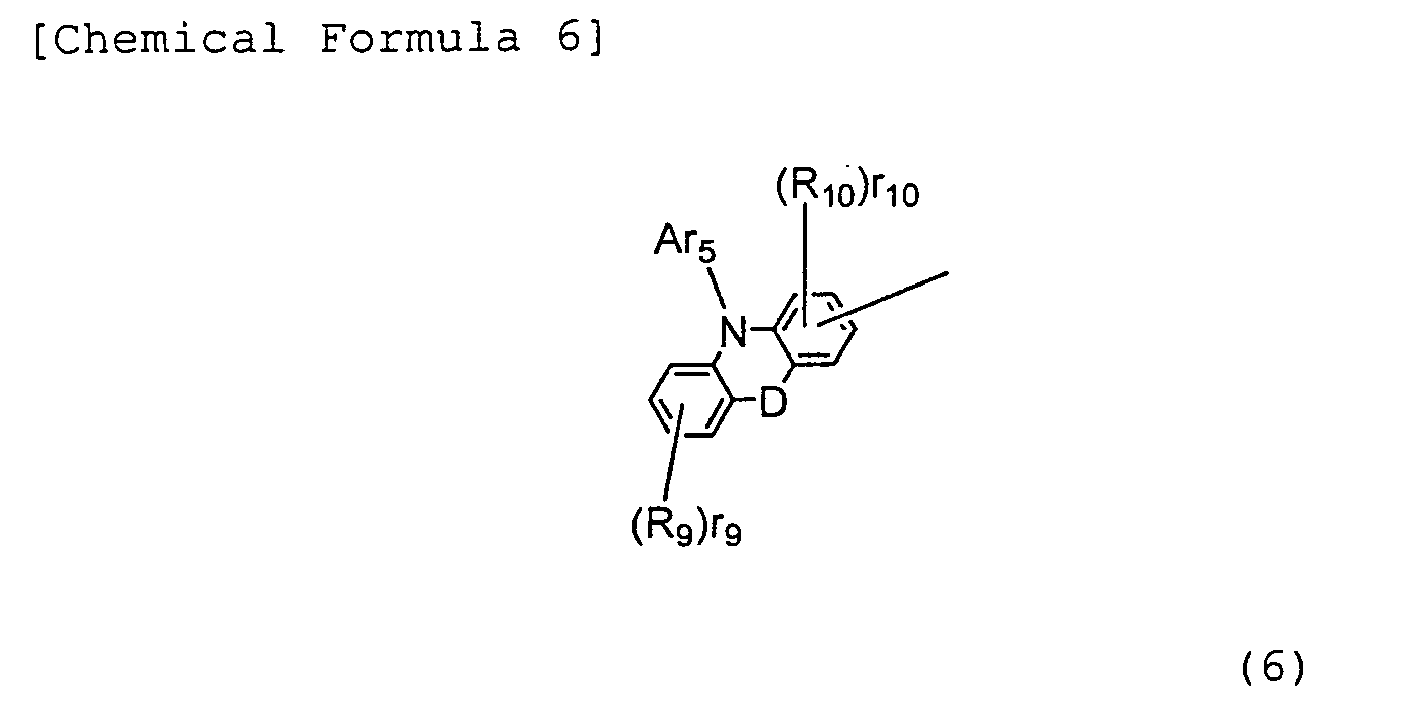

- The compound having a carbazole ring structure according to claim 1, wherein A1 in the general formula (1) is a monovalent group represented by the general formula (2).
- The compound having a carbazole ring structure according to claim 1 or 2, wherein A2 in the general formula (1) is a monovalent group represented by the general formula (2).
- The compound having a carbazole ring structure according to claim 1 or 2, wherein A2 in the general formula (1) is a monovalent group represented by the general formula (3).
- The compound having a carbazole ring structure according to claim 1 or 2, wherein A2 in the general formula (1) is a monovalent group represented by the general formula (4).
- The compound having a carbazole ring structure according to claim 1 or 2, wherein A2 in the general formula (1) is a monovalent group represented by the general formula (5).
- The compound having a carbazole ring structure according to claim 6, wherein the compound is of the following general formula (la)

- The compound having a carbazole ring structure according to claim 6, wherein the compound is of the following general formula (1b)

- The compound having a carbazole ring structure according to claim 1, wherein A1 in the general formula (1) is a monovalent group represented by the general formula (3).
- The compound having a carbazole ring structure according to claim 9, wherein A2 in the general formula (1) is a monovalent group represented by the general formula (5).
- The compound having a carbazole ring structure according to claim 10, wherein the compound is of the following general formula (1c)
- The compound having a carbazole ring structure according to claim 10, wherein the compound is of the following general formula (1d)
- An organic electroluminescent device that comprises a pair of electrodes, and one or more organic layers sandwiched between the pair of electrodes,
characterized in that a compound of the following general formula (1) having a carbazole ring structure is used as a constituent material of at least one organic layer

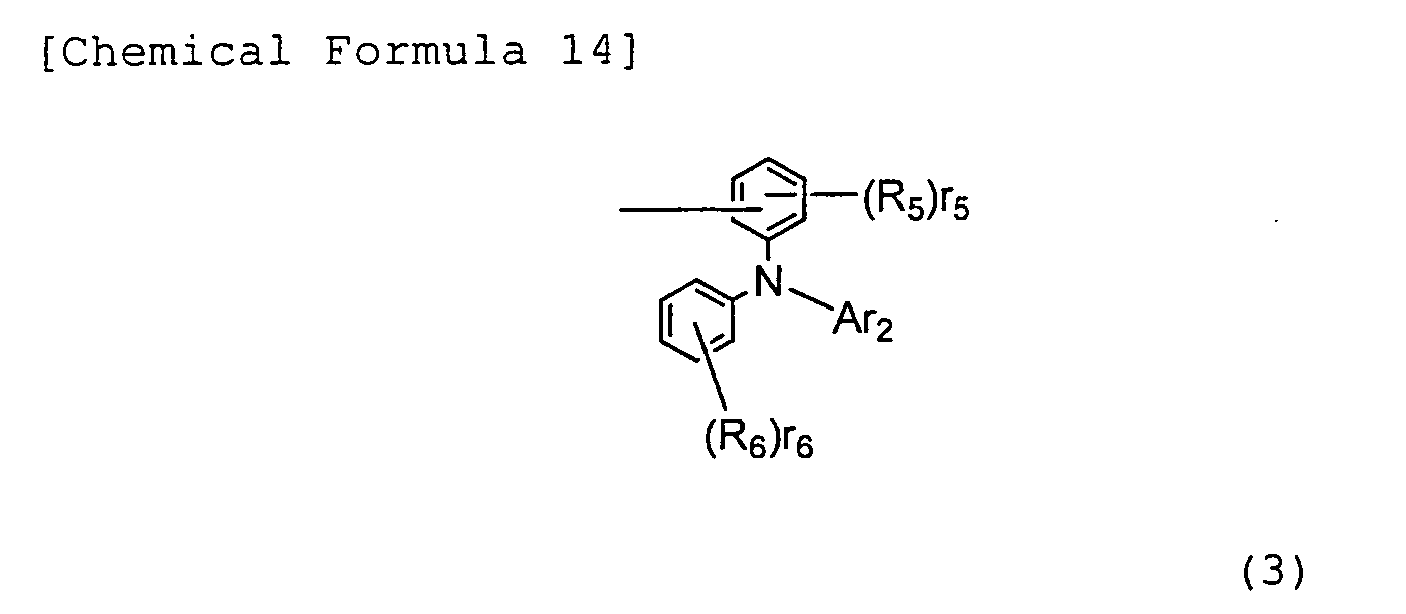


- The organic electroluminescent device according to claim 13, wherein the organic layer is a hole transport layer, and wherein the compound of the general formula (1) is used as at least one constituent material in the hole transport layer.
- The organic electroluminescent device according to claim 13, wherein the organic layer is an electron blocking layer, and wherein the compound of the general formula (1) is used as at least one constituent material in the electron blocking layer.
- The organic electroluminescent device according to claim 13, wherein the organic layer is a hole injection layer, and wherein the compound of the general formula (1) is used as at least one constituent material in the hole injection layer.
- The organic electroluminescent device according to claim 13, wherein the organic layer is a light emitting layer, and wherein the compound of the general formula (1) is used as at least one constituent material in the light emitting layer.
Applications Claiming Priority (2)
| Application Number | Priority Date | Filing Date | Title |
|---|---|---|---|
| JP2009197656 | 2009-08-28 | ||
| PCT/JP2010/005237 WO2011024451A1 (en) | 2009-08-28 | 2010-08-25 | Organic electroluminescent element and compound having carbazole ring structure |
Publications (3)
| Publication Number | Publication Date |
|---|---|
| EP2471771A1 true EP2471771A1 (en) | 2012-07-04 |
| EP2471771A4 EP2471771A4 (en) | 2013-01-16 |
| EP2471771B1 EP2471771B1 (en) | 2016-11-16 |
Family
ID=43627571
Family Applications (1)
| Application Number | Title | Priority Date | Filing Date |
|---|---|---|---|
| EP10811508.0A Active EP2471771B1 (en) | 2009-08-28 | 2010-08-25 | Compound having carbazole ring structure and organic electroluminescent device |
Country Status (7)
| Country | Link |
|---|---|
| US (1) | US9732036B2 (en) |
| EP (1) | EP2471771B1 (en) |
| JP (1) | JP6049998B2 (en) |
| KR (1) | KR101853143B1 (en) |
| CN (1) | CN102482216B (en) |
| TW (1) | TWI469966B (en) |
| WO (1) | WO2011024451A1 (en) |
Cited By (9)
| Publication number | Priority date | Publication date | Assignee | Title |
|---|---|---|---|---|
| EP2492986A4 (en) * | 2009-10-23 | 2013-12-11 | Hodogaya Chemical Co Ltd | ORGANIC ELECTROLUMINESCENT ELEMENT |
| WO2014061991A1 (en) * | 2012-10-17 | 2014-04-24 | Rohm And Haas Electronic Materials Korea Ltd. | Novel organic electroluminescent compounds and organic electroluminescent device containing the same |
| EP2674418A4 (en) * | 2011-02-07 | 2014-07-30 | Idemitsu Kosan Co | BIS-CARBAZOLE DERIVATIVE AND ORGANIC ELECTROLUMINESCENT ELEMENT USING THE SAME |
| EP2790239A4 (en) * | 2011-12-05 | 2015-07-08 | Idemitsu Kosan Co | MATERIAL FOR ORGANIC ELECTROLUMINESCENT ELEMENT AND ORGANIC ELECTROLUMINESCENT ELEMENT |
| US9373802B2 (en) | 2011-02-07 | 2016-06-21 | Idemitsu Kosan Co., Ltd. | Biscarbazole derivatives and organic electroluminescence device employing the same |
| US9530969B2 (en) | 2011-12-05 | 2016-12-27 | Idemitsu Kosan Co., Ltd. | Material for organic electroluminescence device and organic electroluminescence device |
| EP2492985A4 (en) * | 2009-10-23 | 2017-03-29 | Hodogaya Chemical Co., Ltd. | Organic electroluminescent element |
| EP3275969A4 (en) * | 2015-03-23 | 2018-08-15 | Hodogaya Chemical Co., Ltd. | Material for organic electroluminescence element, luminescent material, and organic electroluminescence element |
| CN110088926A (en) * | 2016-11-16 | 2019-08-02 | 保土谷化学工业株式会社 | Organic electroluminescent device |
Families Citing this family (20)
| Publication number | Priority date | Publication date | Assignee | Title |
|---|---|---|---|---|
| KR101957527B1 (en) | 2010-06-24 | 2019-03-13 | 도레이 카부시키가이샤 | Light-emitting device material and light-emitting device |
| EP2589591A4 (en) * | 2010-06-30 | 2013-12-11 | Hodogaya Chemical Co Ltd | COMPOUND HAVING A CARBAZOLE TYPE CYCLIC STRUCTURE AND ORGANIC ELECTROLUMINESCENT ELEMENT |
| KR101478000B1 (en) * | 2010-12-21 | 2015-01-05 | 롬엔드하스전자재료코리아유한회사 | Novel organic electroluminescent compounds and organic electroluminescent device using the same |
| EP2688120B1 (en) | 2011-03-14 | 2017-08-23 | Toray Industries, Inc. | Light-emitting element material and light-emitting element |
| CN103429570A (en) | 2011-03-24 | 2013-12-04 | 出光兴产株式会社 | Biscarbazole derivative and organic electroluminescent device using same |
| KR101354638B1 (en) * | 2011-06-20 | 2014-01-22 | 제일모직주식회사 | MATERIAL for organic OPTOELECTRONIC device, ORGANIC LIGHT EMITTING DIODE INCLUDING THE SAME and DISPLAY INCLUDING THE organic LIGHT EMITTING DIODE |
| KR20130025087A (en) * | 2011-09-01 | 2013-03-11 | 롬엔드하스전자재료코리아유한회사 | Novel organic electroluminescent compounds and organic electroluminescent device using the same |
| WO2013118846A1 (en) | 2012-02-10 | 2013-08-15 | 出光興産株式会社 | Aromatic amine derivative, organic electroluminescent element and electronic device |
| CN104094434B (en) * | 2012-02-15 | 2016-12-28 | 东丽株式会社 | Light emitting element material and light-emitting component |
| US9331287B2 (en) * | 2012-02-27 | 2016-05-03 | Lg Chem, Ltd. | Organic light emitting diode |
| JP5925308B2 (en) | 2012-06-01 | 2016-05-25 | 出光興産株式会社 | Organic electroluminescence device |
| KR101401631B1 (en) * | 2012-07-23 | 2014-06-02 | (주)피엔에이치테크 | Novel compound for organic electroluminescent device and organic electroluminescent device comprising the same |
| JPWO2014024750A1 (en) * | 2012-08-09 | 2016-07-25 | 東レ株式会社 | Light emitting device material and light emitting device |
| KR101497138B1 (en) * | 2012-08-21 | 2015-02-27 | 제일모직 주식회사 | Organic optoelectronic device and display including the same |
| US9966539B2 (en) | 2012-08-31 | 2018-05-08 | Idemitsu Kosan Co., Ltd. | Organic electroluminescence device |
| KR102308903B1 (en) | 2014-06-17 | 2021-10-06 | 삼성디스플레이 주식회사 | Organic light emitting device |
| JP6446254B2 (en) | 2014-12-15 | 2018-12-26 | 三星ディスプレイ株式會社Samsung Display Co.,Ltd. | Carbazole compound, material for organic electroluminescence device, and organic electroluminescence device |
| US12102002B2 (en) * | 2019-02-13 | 2024-09-24 | Hodogaya Chemical Co., Ltd. | Compound having benzazole ring structure, and organic electroluminescent device |
| KR102811855B1 (en) | 2019-10-02 | 2025-05-22 | 엘지디스플레이 주식회사 | Organic light emitting diode and organic light emitting device having the same |
| EP4223743A4 (en) | 2020-09-30 | 2024-11-20 | Idemitsu Kosan Co.,Ltd. | COMPOUND, MATERIAL FOR ORGANIC ELECTROLUMINESCENT ELEMENTS, ORGANIC ELECTROLUMINESCENT ELEMENT AND ELECTRONIC DEVICE |
Family Cites Families (31)
| Publication number | Priority date | Publication date | Assignee | Title |
|---|---|---|---|---|
| JPS6313047A (en) * | 1986-07-04 | 1988-01-20 | Canon Inc | electrophotographic photoreceptor |
| JPS6313048A (en) * | 1986-07-04 | 1988-01-20 | Canon Inc | Electrophotographic sensitive body |
| JP3194657B2 (en) | 1993-11-01 | 2001-07-30 | 松下電器産業株式会社 | EL device |
| JP3828595B2 (en) | 1994-02-08 | 2006-10-04 | Tdk株式会社 | Organic EL device |
| JP3674133B2 (en) * | 1996-03-18 | 2005-07-20 | 東レ株式会社 | Light emitting element |
| JP3792027B2 (en) * | 1997-11-20 | 2006-06-28 | 三井化学株式会社 | Organic electroluminescence device |
| US6660410B2 (en) * | 2000-03-27 | 2003-12-09 | Idemitsu Kosan Co., Ltd. | Organic electroluminescence element |
| JP2003133075A (en) * | 2001-07-25 | 2003-05-09 | Toray Ind Inc | Light emitting element |
| US6750608B2 (en) * | 2001-11-09 | 2004-06-15 | Konica Corporation | Organic electroluminescence element and display |
| JP4177707B2 (en) * | 2003-03-27 | 2008-11-05 | 三井化学株式会社 | Amine compound and organic electroluminescent device containing the compound |
| JP2005267871A (en) * | 2004-03-16 | 2005-09-29 | Seiko Epson Corp | Organic electroluminescence device and electronic device |
| JP5242917B2 (en) * | 2004-03-19 | 2013-07-24 | エルジー・ケム・リミテッド | Novel hole injection or transport material and organic light emitting device using the same |
| KR100787425B1 (en) | 2004-11-29 | 2007-12-26 | 삼성에스디아이 주식회사 | Phenylcarbazole compound and organic electroluminescent device using same |
| JP2007110097A (en) | 2005-09-14 | 2007-04-26 | Konica Minolta Holdings Inc | ORGANIC ELECTROLUMINESCENT ELEMENT, METHOD FOR PRODUCING ORGANIC ELECTROLUMINESCENT ELEMENT, DISPLAY DEVICE AND LIGHTING DEVICE |
| KR100830332B1 (en) | 2005-11-30 | 2008-05-19 | 삼성에스디아이 주식회사 | Organic light-emitting device |
| JP5055818B2 (en) * | 2006-04-19 | 2012-10-24 | コニカミノルタホールディングス株式会社 | ORGANIC ELECTROLUMINESCENT ELEMENT MATERIAL, ORGANIC ELECTROLUMINESCENT ELEMENT, DISPLAY DEVICE AND LIGHTING DEVICE |
| KR101422864B1 (en) | 2006-06-22 | 2014-07-24 | 소니 주식회사 | Organic electroluminescent device using heterocyclic-containing arylamine derivative |
| JP5133259B2 (en) | 2006-11-24 | 2013-01-30 | 出光興産株式会社 | Aromatic amine derivative and organic electroluminescence device using the same |
| JP2008135498A (en) * | 2006-11-28 | 2008-06-12 | Toray Ind Inc | Light emitting element |
| JP5119775B2 (en) * | 2007-07-11 | 2013-01-16 | コニカミノルタホールディングス株式会社 | Organic electroluminescence element, display device and lighting device |
| JP2009076817A (en) * | 2007-09-25 | 2009-04-09 | Sony Corp | Organic electroluminescence device and display device |
| WO2009041635A1 (en) | 2007-09-28 | 2009-04-02 | Idemitsu Kosan Co., Ltd. | Organic el device |
| KR20090048299A (en) * | 2007-11-08 | 2009-05-13 | 주식회사 엘지화학 | New organic light emitting device material and organic light emitting device using same |
| JP5355421B2 (en) | 2007-12-21 | 2013-11-27 | 出光興産株式会社 | Organic electroluminescence device |
| WO2009104488A1 (en) * | 2008-02-20 | 2009-08-27 | コニカミノルタホールディングス株式会社 | White light-emitting organic electroluminescent device |
| KR20090112137A (en) * | 2008-04-23 | 2009-10-28 | 주식회사 이엘엠 | Organic electroluminescent composition and organic electroluminescent device comprising same |
| CN102325751A (en) * | 2009-02-18 | 2012-01-18 | 出光兴产株式会社 | Aromatic amine derivative and organic electroluminescent element |
| KR101506999B1 (en) | 2009-11-03 | 2015-03-31 | 제일모직 주식회사 | Compound for organic photoelectric device and organic photoelectric device including the same |
| JP5261611B2 (en) | 2010-03-31 | 2013-08-14 | 出光興産株式会社 | Material for organic electroluminescence device and organic electroluminescence device using the same |
| KR20110122051A (en) | 2010-05-03 | 2011-11-09 | 제일모직주식회사 | Compound for organic photoelectric device and organic photoelectric device comprising same |
| WO2012077902A2 (en) * | 2010-12-08 | 2012-06-14 | 제일모직 주식회사 | Compound for an organic optoelectronic device, organic light-emitting diode including the compound, and display device including the organic light-emitting diode |
-
2010
- 2010-08-25 EP EP10811508.0A patent/EP2471771B1/en active Active
- 2010-08-25 JP JP2011528645A patent/JP6049998B2/en active Active
- 2010-08-25 WO PCT/JP2010/005237 patent/WO2011024451A1/en not_active Ceased
- 2010-08-25 KR KR1020127007872A patent/KR101853143B1/en active Active
- 2010-08-25 CN CN201080038443.XA patent/CN102482216B/en active Active
- 2010-08-25 US US13/391,956 patent/US9732036B2/en active Active
- 2010-08-27 TW TW99128846A patent/TWI469966B/en active
Cited By (20)
| Publication number | Priority date | Publication date | Assignee | Title |
|---|---|---|---|---|
| US9306175B2 (en) | 2009-10-23 | 2016-04-05 | Hodogaya Chemical Co., Ltd. | Organic electroluminescent device |
| EP2492986A4 (en) * | 2009-10-23 | 2013-12-11 | Hodogaya Chemical Co Ltd | ORGANIC ELECTROLUMINESCENT ELEMENT |
| EP2492985A4 (en) * | 2009-10-23 | 2017-03-29 | Hodogaya Chemical Co., Ltd. | Organic electroluminescent element |
| US9818958B2 (en) | 2011-02-07 | 2017-11-14 | Idemitsu Kosan Co., Ltd. | Biscarbazole derivatives and organic electroluminescence device employing the same |
| US9373802B2 (en) | 2011-02-07 | 2016-06-21 | Idemitsu Kosan Co., Ltd. | Biscarbazole derivatives and organic electroluminescence device employing the same |
| EP2674418A4 (en) * | 2011-02-07 | 2014-07-30 | Idemitsu Kosan Co | BIS-CARBAZOLE DERIVATIVE AND ORGANIC ELECTROLUMINESCENT ELEMENT USING THE SAME |
| US11271171B2 (en) | 2011-02-07 | 2022-03-08 | Idemitsu Kosan Co., Ltd. | Biscarbazole derivative and organic electroluminescent element using same |
| US10147888B2 (en) | 2011-02-07 | 2018-12-04 | Idemitsu Kosan Co., Ltd. | Biscarbazole derivative and organic electroluminescent element using same |
| US10147889B2 (en) | 2011-02-07 | 2018-12-04 | Idemitsu Kosan Co., Ltd. | Biscarbazole derivative and organic electroluminescent element using same |
| US10230057B2 (en) | 2011-02-07 | 2019-03-12 | Idemitsu Kosan Co., Ltd. | Biscarbazole derivatives and organic electroluminescence device employing the same |
| US9306171B2 (en) | 2011-12-05 | 2016-04-05 | Idemitsu Kosan Co., Ltd. | Material for organic electroluminescence device and organic electroluminescence device |
| EP2790239A4 (en) * | 2011-12-05 | 2015-07-08 | Idemitsu Kosan Co | MATERIAL FOR ORGANIC ELECTROLUMINESCENT ELEMENT AND ORGANIC ELECTROLUMINESCENT ELEMENT |
| US9530969B2 (en) | 2011-12-05 | 2016-12-27 | Idemitsu Kosan Co., Ltd. | Material for organic electroluminescence device and organic electroluminescence device |
| WO2014061991A1 (en) * | 2012-10-17 | 2014-04-24 | Rohm And Haas Electronic Materials Korea Ltd. | Novel organic electroluminescent compounds and organic electroluminescent device containing the same |
| EP3275969A4 (en) * | 2015-03-23 | 2018-08-15 | Hodogaya Chemical Co., Ltd. | Material for organic electroluminescence element, luminescent material, and organic electroluminescence element |
| US11239439B2 (en) | 2015-03-23 | 2022-02-01 | Hodogaya Chemical Co., Ltd. | Material for organic electroluminescent device, light-emitting material, and organic electroluminescent device |
| EP3544073A4 (en) * | 2016-11-16 | 2020-11-25 | Hodogaya Chemical Co., Ltd. | ORGANIC ELECTROLUMINESC ELEMENT |
| CN110088926B (en) * | 2016-11-16 | 2021-07-27 | 保土谷化学工业株式会社 | organic electroluminescent element |
| CN110088926A (en) * | 2016-11-16 | 2019-08-02 | 保土谷化学工业株式会社 | Organic electroluminescent device |
| US11594700B2 (en) | 2016-11-16 | 2023-02-28 | Hodogaya Chemical Co., Ltd. | Organic electroluminescent device |
Also Published As
| Publication number | Publication date |
|---|---|
| CN102482216B (en) | 2014-11-19 |
| EP2471771B1 (en) | 2016-11-16 |
| TWI469966B (en) | 2015-01-21 |
| JP6049998B2 (en) | 2016-12-21 |
| US9732036B2 (en) | 2017-08-15 |
| JPWO2011024451A1 (en) | 2013-01-24 |
| US20120175599A1 (en) | 2012-07-12 |
| KR101853143B1 (en) | 2018-04-27 |
| KR20120065372A (en) | 2012-06-20 |
| EP2471771A4 (en) | 2013-01-16 |
| TW201120004A (en) | 2011-06-16 |
| CN102482216A (en) | 2012-05-30 |
| WO2011024451A1 (en) | 2011-03-03 |
Similar Documents
| Publication | Publication Date | Title |
|---|---|---|
| EP2471771B1 (en) | Compound having carbazole ring structure and organic electroluminescent device | |
| US9306175B2 (en) | Organic electroluminescent device | |
| EP2599773B1 (en) | Compound having indenocarbazole ring structure and organic electroluminescent element | |
| US9306174B2 (en) | Organic electroluminescent device | |
| US9818949B2 (en) | Compound having acridan ring structure, and organic electroluminescent device | |
| EP2960958B1 (en) | Organic electroluminescence element | |
| EP3021372B1 (en) | Organic electroluminescent element | |
| EP3291323B1 (en) | Organic electroluminescent element | |
| EP2589591A1 (en) | Compound with carbazole ring structure and organic electroluminescent element | |
| EP2679589A1 (en) | Compounds having indolocarbazole ring structure, and organic electroluminescent elements | |
| EP2894155B1 (en) | Compound having indeno acridan ring structure, and organic electroluminescence element | |
| US9905770B2 (en) | Compound having acridan ring structure, and organic electroluminescent device | |
| US11925107B2 (en) | Organic electroluminescent device | |
| JP2023022389A (en) | Spirobifluorene compound and organic electroluminescent element | |
| EP3163644B1 (en) | Organic electroluminescent element | |
| EP3139423A1 (en) | Compound having acridan ring structure, and organic electroluminescent device |
Legal Events
| Date | Code | Title | Description |
|---|---|---|---|
| PUAI | Public reference made under article 153(3) epc to a published international application that has entered the european phase |
Free format text: ORIGINAL CODE: 0009012 |
|
| 17P | Request for examination filed |
Effective date: 20120301 |
|
| AK | Designated contracting states |
Kind code of ref document: A1 Designated state(s): AL AT BE BG CH CY CZ DE DK EE ES FI FR GB GR HR HU IE IS IT LI LT LU LV MC MK MT NL NO PL PT RO SE SI SK SM TR |
|
| RIN1 | Information on inventor provided before grant (corrected) |
Inventor name: TOGASHI, KAZUNORI Inventor name: NAGAOKA, MAKOTO Inventor name: YOKOYAMA, NORIMASA Inventor name: KUSANO, SHIGERU |
|
| DAX | Request for extension of the european patent (deleted) | ||
| A4 | Supplementary search report drawn up and despatched |
Effective date: 20121219 |
|
| RIC1 | Information provided on ipc code assigned before grant |
Ipc: C09K 11/06 20060101ALI20121213BHEP Ipc: H01L 51/50 20060101ALI20121213BHEP Ipc: C07D 209/86 20060101AFI20121213BHEP |
|
| 17Q | First examination report despatched |
Effective date: 20130820 |
|
| GRAP | Despatch of communication of intention to grant a patent |
Free format text: ORIGINAL CODE: EPIDOSNIGR1 |
|
| INTG | Intention to grant announced |
Effective date: 20160509 |
|
| GRAS | Grant fee paid |
Free format text: ORIGINAL CODE: EPIDOSNIGR3 |
|
| GRAA | (expected) grant |
Free format text: ORIGINAL CODE: 0009210 |
|
| RAP1 | Party data changed (applicant data changed or rights of an application transferred) |
Owner name: HODOGAYA CHEMICAL CO., LTD. |
|
| RIN1 | Information on inventor provided before grant (corrected) |
Inventor name: TOGASHI, KAZUNORI Inventor name: KUSANO, SHIGERU Inventor name: NAGAOKA, MAKOTO Inventor name: YOKOYAMA, NORIMASA |
|
| AK | Designated contracting states |
Kind code of ref document: B1 Designated state(s): AL AT BE BG CH CY CZ DE DK EE ES FI FR GB GR HR HU IE IS IT LI LT LU LV MC MK MT NL NO PL PT RO SE SI SK SM TR |
|
| REG | Reference to a national code |
Ref country code: GB Ref legal event code: FG4D |
|
| REG | Reference to a national code |
Ref country code: CH Ref legal event code: EP |
|
| REG | Reference to a national code |
Ref country code: IE Ref legal event code: FG4D |
|
| REG | Reference to a national code |
Ref country code: AT Ref legal event code: REF Ref document number: 845775 Country of ref document: AT Kind code of ref document: T Effective date: 20161215 |
|
| REG | Reference to a national code |
Ref country code: DE Ref legal event code: R096 Ref document number: 602010038108 Country of ref document: DE |
|
| PG25 | Lapsed in a contracting state [announced via postgrant information from national office to epo] |
Ref country code: LV Free format text: LAPSE BECAUSE OF FAILURE TO SUBMIT A TRANSLATION OF THE DESCRIPTION OR TO PAY THE FEE WITHIN THE PRESCRIBED TIME-LIMIT Effective date: 20161116 |
|
| REG | Reference to a national code |
Ref country code: NL Ref legal event code: MP Effective date: 20161116 |
|
| REG | Reference to a national code |
Ref country code: LT Ref legal event code: MG4D |
|
| REG | Reference to a national code |
Ref country code: AT Ref legal event code: MK05 Ref document number: 845775 Country of ref document: AT Kind code of ref document: T Effective date: 20161116 |
|
| PG25 | Lapsed in a contracting state [announced via postgrant information from national office to epo] |
Ref country code: LT Free format text: LAPSE BECAUSE OF FAILURE TO SUBMIT A TRANSLATION OF THE DESCRIPTION OR TO PAY THE FEE WITHIN THE PRESCRIBED TIME-LIMIT Effective date: 20161116 Ref country code: NO Free format text: LAPSE BECAUSE OF FAILURE TO SUBMIT A TRANSLATION OF THE DESCRIPTION OR TO PAY THE FEE WITHIN THE PRESCRIBED TIME-LIMIT Effective date: 20170216 Ref country code: NL Free format text: LAPSE BECAUSE OF FAILURE TO SUBMIT A TRANSLATION OF THE DESCRIPTION OR TO PAY THE FEE WITHIN THE PRESCRIBED TIME-LIMIT Effective date: 20161116 Ref country code: SE Free format text: LAPSE BECAUSE OF FAILURE TO SUBMIT A TRANSLATION OF THE DESCRIPTION OR TO PAY THE FEE WITHIN THE PRESCRIBED TIME-LIMIT Effective date: 20161116 Ref country code: GR Free format text: LAPSE BECAUSE OF FAILURE TO SUBMIT A TRANSLATION OF THE DESCRIPTION OR TO PAY THE FEE WITHIN THE PRESCRIBED TIME-LIMIT Effective date: 20170217 |
|
| PG25 | Lapsed in a contracting state [announced via postgrant information from national office to epo] |
Ref country code: FI Free format text: LAPSE BECAUSE OF FAILURE TO SUBMIT A TRANSLATION OF THE DESCRIPTION OR TO PAY THE FEE WITHIN THE PRESCRIBED TIME-LIMIT Effective date: 20161116 Ref country code: AT Free format text: LAPSE BECAUSE OF FAILURE TO SUBMIT A TRANSLATION OF THE DESCRIPTION OR TO PAY THE FEE WITHIN THE PRESCRIBED TIME-LIMIT Effective date: 20161116 Ref country code: HR Free format text: LAPSE BECAUSE OF FAILURE TO SUBMIT A TRANSLATION OF THE DESCRIPTION OR TO PAY THE FEE WITHIN THE PRESCRIBED TIME-LIMIT Effective date: 20161116 Ref country code: PL Free format text: LAPSE BECAUSE OF FAILURE TO SUBMIT A TRANSLATION OF THE DESCRIPTION OR TO PAY THE FEE WITHIN THE PRESCRIBED TIME-LIMIT Effective date: 20161116 Ref country code: ES Free format text: LAPSE BECAUSE OF FAILURE TO SUBMIT A TRANSLATION OF THE DESCRIPTION OR TO PAY THE FEE WITHIN THE PRESCRIBED TIME-LIMIT Effective date: 20161116 Ref country code: PT Free format text: LAPSE BECAUSE OF FAILURE TO SUBMIT A TRANSLATION OF THE DESCRIPTION OR TO PAY THE FEE WITHIN THE PRESCRIBED TIME-LIMIT Effective date: 20170316 |
|
| PG25 | Lapsed in a contracting state [announced via postgrant information from national office to epo] |
Ref country code: CZ Free format text: LAPSE BECAUSE OF FAILURE TO SUBMIT A TRANSLATION OF THE DESCRIPTION OR TO PAY THE FEE WITHIN THE PRESCRIBED TIME-LIMIT Effective date: 20161116 Ref country code: SK Free format text: LAPSE BECAUSE OF FAILURE TO SUBMIT A TRANSLATION OF THE DESCRIPTION OR TO PAY THE FEE WITHIN THE PRESCRIBED TIME-LIMIT Effective date: 20161116 Ref country code: DK Free format text: LAPSE BECAUSE OF FAILURE TO SUBMIT A TRANSLATION OF THE DESCRIPTION OR TO PAY THE FEE WITHIN THE PRESCRIBED TIME-LIMIT Effective date: 20161116 Ref country code: EE Free format text: LAPSE BECAUSE OF FAILURE TO SUBMIT A TRANSLATION OF THE DESCRIPTION OR TO PAY THE FEE WITHIN THE PRESCRIBED TIME-LIMIT Effective date: 20161116 Ref country code: RO Free format text: LAPSE BECAUSE OF FAILURE TO SUBMIT A TRANSLATION OF THE DESCRIPTION OR TO PAY THE FEE WITHIN THE PRESCRIBED TIME-LIMIT Effective date: 20161116 |
|
| REG | Reference to a national code |
Ref country code: DE Ref legal event code: R097 Ref document number: 602010038108 Country of ref document: DE |
|
| REG | Reference to a national code |
Ref country code: FR Ref legal event code: PLFP Year of fee payment: 8 |
|
| PG25 | Lapsed in a contracting state [announced via postgrant information from national office to epo] |
Ref country code: SM Free format text: LAPSE BECAUSE OF FAILURE TO SUBMIT A TRANSLATION OF THE DESCRIPTION OR TO PAY THE FEE WITHIN THE PRESCRIBED TIME-LIMIT Effective date: 20161116 Ref country code: BE Free format text: LAPSE BECAUSE OF FAILURE TO SUBMIT A TRANSLATION OF THE DESCRIPTION OR TO PAY THE FEE WITHIN THE PRESCRIBED TIME-LIMIT Effective date: 20161116 Ref country code: BG Free format text: LAPSE BECAUSE OF FAILURE TO SUBMIT A TRANSLATION OF THE DESCRIPTION OR TO PAY THE FEE WITHIN THE PRESCRIBED TIME-LIMIT Effective date: 20170216 Ref country code: IT Free format text: LAPSE BECAUSE OF FAILURE TO SUBMIT A TRANSLATION OF THE DESCRIPTION OR TO PAY THE FEE WITHIN THE PRESCRIBED TIME-LIMIT Effective date: 20161116 |
|
| PLBE | No opposition filed within time limit |
Free format text: ORIGINAL CODE: 0009261 |
|
| STAA | Information on the status of an ep patent application or granted ep patent |
Free format text: STATUS: NO OPPOSITION FILED WITHIN TIME LIMIT |
|
| 26N | No opposition filed |
Effective date: 20170817 |
|
| PG25 | Lapsed in a contracting state [announced via postgrant information from national office to epo] |
Ref country code: SI Free format text: LAPSE BECAUSE OF FAILURE TO SUBMIT A TRANSLATION OF THE DESCRIPTION OR TO PAY THE FEE WITHIN THE PRESCRIBED TIME-LIMIT Effective date: 20161116 |
|
| REG | Reference to a national code |
Ref country code: CH Ref legal event code: PL |
|
| PG25 | Lapsed in a contracting state [announced via postgrant information from national office to epo] |
Ref country code: LI Free format text: LAPSE BECAUSE OF NON-PAYMENT OF DUE FEES Effective date: 20170831 Ref country code: CH Free format text: LAPSE BECAUSE OF NON-PAYMENT OF DUE FEES Effective date: 20170831 |
|
| REG | Reference to a national code |
Ref country code: IE Ref legal event code: MM4A |
|
| PG25 | Lapsed in a contracting state [announced via postgrant information from national office to epo] |
Ref country code: LU Free format text: LAPSE BECAUSE OF NON-PAYMENT OF DUE FEES Effective date: 20170825 |
|
| PG25 | Lapsed in a contracting state [announced via postgrant information from national office to epo] |
Ref country code: IE Free format text: LAPSE BECAUSE OF NON-PAYMENT OF DUE FEES Effective date: 20170825 |
|
| REG | Reference to a national code |
Ref country code: FR Ref legal event code: PLFP Year of fee payment: 9 |
|
| PG25 | Lapsed in a contracting state [announced via postgrant information from national office to epo] |
Ref country code: MT Free format text: LAPSE BECAUSE OF NON-PAYMENT OF DUE FEES Effective date: 20170825 |
|
| PG25 | Lapsed in a contracting state [announced via postgrant information from national office to epo] |
Ref country code: MC Free format text: LAPSE BECAUSE OF NON-PAYMENT OF DUE FEES Effective date: 20161116 Ref country code: HU Free format text: LAPSE BECAUSE OF FAILURE TO SUBMIT A TRANSLATION OF THE DESCRIPTION OR TO PAY THE FEE WITHIN THE PRESCRIBED TIME-LIMIT; INVALID AB INITIO Effective date: 20100825 |
|
| PG25 | Lapsed in a contracting state [announced via postgrant information from national office to epo] |
Ref country code: CY Free format text: LAPSE BECAUSE OF NON-PAYMENT OF DUE FEES Effective date: 20161116 |
|
| PG25 | Lapsed in a contracting state [announced via postgrant information from national office to epo] |
Ref country code: MK Free format text: LAPSE BECAUSE OF FAILURE TO SUBMIT A TRANSLATION OF THE DESCRIPTION OR TO PAY THE FEE WITHIN THE PRESCRIBED TIME-LIMIT Effective date: 20161116 |
|
| PG25 | Lapsed in a contracting state [announced via postgrant information from national office to epo] |
Ref country code: TR Free format text: LAPSE BECAUSE OF FAILURE TO SUBMIT A TRANSLATION OF THE DESCRIPTION OR TO PAY THE FEE WITHIN THE PRESCRIBED TIME-LIMIT Effective date: 20161116 |
|
| PG25 | Lapsed in a contracting state [announced via postgrant information from national office to epo] |
Ref country code: AL Free format text: LAPSE BECAUSE OF FAILURE TO SUBMIT A TRANSLATION OF THE DESCRIPTION OR TO PAY THE FEE WITHIN THE PRESCRIBED TIME-LIMIT Effective date: 20161116 Ref country code: IS Free format text: LAPSE BECAUSE OF FAILURE TO SUBMIT A TRANSLATION OF THE DESCRIPTION OR TO PAY THE FEE WITHIN THE PRESCRIBED TIME-LIMIT Effective date: 20170316 |
|
| PGFP | Annual fee paid to national office [announced via postgrant information from national office to epo] |
Ref country code: GB Payment date: 20240826 Year of fee payment: 15 |
|
| PGFP | Annual fee paid to national office [announced via postgrant information from national office to epo] |
Ref country code: FR Payment date: 20240829 Year of fee payment: 15 |
|
| PGFP | Annual fee paid to national office [announced via postgrant information from national office to epo] |
Ref country code: DE Payment date: 20250820 Year of fee payment: 16 |
|
| GBPC | Gb: european patent ceased through non-payment of renewal fee |
Effective date: 20250825 |
|
| PG25 | Lapsed in a contracting state [announced via postgrant information from national office to epo] |
Ref country code: GB Free format text: LAPSE BECAUSE OF NON-PAYMENT OF DUE FEES Effective date: 20250825 |
|
| PG25 | Lapsed in a contracting state [announced via postgrant information from national office to epo] |
Ref country code: FR Free format text: LAPSE BECAUSE OF NON-PAYMENT OF DUE FEES Effective date: 20250831 |