EP2468362A2 - Kosmetische Zubereitung mit UV-A-Filtersubstanz und Natriumcetearylsulfat - Google Patents
Kosmetische Zubereitung mit UV-A-Filtersubstanz und Natriumcetearylsulfat Download PDFInfo
- Publication number
- EP2468362A2 EP2468362A2 EP11191246A EP11191246A EP2468362A2 EP 2468362 A2 EP2468362 A2 EP 2468362A2 EP 11191246 A EP11191246 A EP 11191246A EP 11191246 A EP11191246 A EP 11191246A EP 2468362 A2 EP2468362 A2 EP 2468362A2
- Authority
- EP
- European Patent Office
- Prior art keywords
- preparation
- cosmetic
- total weight
- cosmetic preparation
- concentration
- Prior art date
- Legal status (The legal status is an assumption and is not a legal conclusion. Google has not performed a legal analysis and makes no representation as to the accuracy of the status listed.)
- Granted
Links
- PFYNCIMNZHMWPP-UHFFFAOYSA-N CC(N(CCOS(O)(=O)=O)C(C)=C1)=CC1=C(C#N)C#N Chemical compound CC(N(CCOS(O)(=O)=O)C(C)=C1)=CC1=C(C#N)C#N PFYNCIMNZHMWPP-UHFFFAOYSA-N 0.000 description 1
Classifications
-
- A—HUMAN NECESSITIES
- A61—MEDICAL OR VETERINARY SCIENCE; HYGIENE
- A61Q—SPECIFIC USE OF COSMETICS OR SIMILAR TOILETRY PREPARATIONS
- A61Q17/00—Barrier preparations; Preparations brought into direct contact with the skin for affording protection against external influences, e.g. sunlight, X-rays or other harmful rays, corrosive materials, bacteria or insect stings
- A61Q17/04—Topical preparations for affording protection against sunlight or other radiation; Topical sun tanning preparations
-
- A—HUMAN NECESSITIES
- A61—MEDICAL OR VETERINARY SCIENCE; HYGIENE
- A61K—PREPARATIONS FOR MEDICAL, DENTAL OR TOILETRY PURPOSES
- A61K8/00—Cosmetics or similar toiletry preparations
- A61K8/02—Cosmetics or similar toiletry preparations characterised by special physical form
- A61K8/04—Dispersions; Emulsions
- A61K8/06—Emulsions
-
- A—HUMAN NECESSITIES
- A61—MEDICAL OR VETERINARY SCIENCE; HYGIENE
- A61K—PREPARATIONS FOR MEDICAL, DENTAL OR TOILETRY PURPOSES
- A61K8/00—Cosmetics or similar toiletry preparations
- A61K8/02—Cosmetics or similar toiletry preparations characterised by special physical form
- A61K8/04—Dispersions; Emulsions
- A61K8/06—Emulsions
- A61K8/062—Oil-in-water emulsions
-
- A—HUMAN NECESSITIES
- A61—MEDICAL OR VETERINARY SCIENCE; HYGIENE
- A61K—PREPARATIONS FOR MEDICAL, DENTAL OR TOILETRY PURPOSES
- A61K8/00—Cosmetics or similar toiletry preparations
- A61K8/18—Cosmetics or similar toiletry preparations characterised by the composition
- A61K8/30—Cosmetics or similar toiletry preparations characterised by the composition containing organic compounds
- A61K8/33—Cosmetics or similar toiletry preparations characterised by the composition containing organic compounds containing oxygen
- A61K8/34—Alcohols
- A61K8/345—Alcohols containing more than one hydroxy group
-
- A—HUMAN NECESSITIES
- A61—MEDICAL OR VETERINARY SCIENCE; HYGIENE
- A61K—PREPARATIONS FOR MEDICAL, DENTAL OR TOILETRY PURPOSES
- A61K8/00—Cosmetics or similar toiletry preparations
- A61K8/18—Cosmetics or similar toiletry preparations characterised by the composition
- A61K8/30—Cosmetics or similar toiletry preparations characterised by the composition containing organic compounds
- A61K8/33—Cosmetics or similar toiletry preparations characterised by the composition containing organic compounds containing oxygen
- A61K8/35—Ketones, e.g. benzophenone
-
- A—HUMAN NECESSITIES
- A61—MEDICAL OR VETERINARY SCIENCE; HYGIENE
- A61K—PREPARATIONS FOR MEDICAL, DENTAL OR TOILETRY PURPOSES
- A61K8/00—Cosmetics or similar toiletry preparations
- A61K8/18—Cosmetics or similar toiletry preparations characterised by the composition
- A61K8/30—Cosmetics or similar toiletry preparations characterised by the composition containing organic compounds
- A61K8/40—Cosmetics or similar toiletry preparations characterised by the composition containing organic compounds containing nitrogen
- A61K8/41—Amines
- A61K8/415—Aminophenols
-
- A—HUMAN NECESSITIES
- A61—MEDICAL OR VETERINARY SCIENCE; HYGIENE
- A61K—PREPARATIONS FOR MEDICAL, DENTAL OR TOILETRY PURPOSES
- A61K8/00—Cosmetics or similar toiletry preparations
- A61K8/18—Cosmetics or similar toiletry preparations characterised by the composition
- A61K8/30—Cosmetics or similar toiletry preparations characterised by the composition containing organic compounds
- A61K8/46—Cosmetics or similar toiletry preparations characterised by the composition containing organic compounds containing sulfur
- A61K8/463—Cosmetics or similar toiletry preparations characterised by the composition containing organic compounds containing sulfur containing sulfuric acid derivatives, e.g. sodium lauryl sulfate
Definitions
- the present invention relates to a cosmetic preparation with Natriumcetearylsulfat, at least one UV-A filter substance, and Ethylhexylglycerin and / or 1,2-pentanediol.
- UVA and UVB filters are summarized in most industrialized countries in the form of positive lists such as Appendix 7 of the EU Cosmetics Regulation.
- the variety of commercially available sunscreens must not obscure the fact that these prior art formulations have a number of disadvantages. For example, it is a problem to prepare UV filter-containing (in particular UV-A filter-containing) compositions that are waterproof on the one hand and have skin-moisturizing performance and, on the other hand, have a pleasant, non-sticky feel on the skin.
- the relatively sticky glycerin is usually used to moisturize the skin;
- polymeric finishers are generally used in conventional products, which also increase the tackiness.
- Sticky sunscreen products lead, in addition to an unpleasant sensor, usually also to the fact that, for example when used on the beach, the adhesion of foreign particles such as sand is promoted, which is also undesirable.
- UVA filters are solid substances that must be dissolved by lipids or kept in solution so that they do not lose their effect. Later, these lipids often appear greasy and shiny on the skin.
- the preparation contains sodium cetearyl sulfate in a concentration of 0.05 to 0.5% by weight, based on the total weight of the preparation.
- the preparation contains sodium cetearyl sulfate in a concentration of 0.1 to 0.3% by weight, based on the total weight of the preparation.
- the preparation according to the invention is free of polyethylene glycol and polyethylene glycol derivatives.
- polyethyleneglycol derivatives according to the invention understood compounds containing one or more polyethylene glycol chains.
- preservatives within the scope of the present disclosure: formaldehyde releasers (such as DMDM hydantoin, which is available, for example, under the trade name Glydant TM from Lonza), iodopropyl butyl carbamates (for example those sold under the trade names Glycacil-L, Glycacil-S available from Lonza and / or Dekaben LMB from Jan Dekker), parabens (ie, p-hydroxybenzoic acid alkyl esters such as methyl, ethyl, propyl and / or butylparaben), phenoxyethanol.
- formaldehyde releasers such as DMDM hydantoin, which is available, for example, under the trade name Glydant TM from Lonza
- iodopropyl butyl carbamates for example those sold under the trade names Glycacil-L, Glycacil-S available from Lonza and
- Embodiments of the present invention which are advantageous according to the invention are characterized in that the preparation contains polyglyceryl-2-caprate, glyceryl caprylates and / or phenylethyl ethanol.
- polyglyceryl-2 caprates are preferably used in a concentration of 0.05 to 5.0% by weight, based on the total weight of the preparation.
- Glyceryl caprylates are preferably used according to the invention in a concentration of 0.05 to 5.0% by weight. %, based on the total weight of the preparation used, and phenyethylethanol according to the invention is preferably used in a concentration of 0.15 to 0.75 wt .-%, based on the total weight of the preparation.
- the preparation according to the invention contains 4- (tert-butyl) -4'-methoxydibenzoylmethane as UV-A filter according to the invention
- the preparation contains 4- (tert-butyl) -4'-methoxydibenzoylmethane in a concentration from 1.5 to 15.0% by weight, based on the total weight of the preparation.
- a use concentration of 2.0 to 5.5 wt .-%, based on the total weight of the preparation is preferred.
- the preparation according to the invention contains 2- (4'-diethylamino-2'-hydroxybenzoyl) -benzoic acid hexyl ester as UV-A filter according to the invention
- the preparation comprises 2- (4'-diethylamino-2'-hydroxybenzoyl) - benzoic acid in a concentration of 1.5 to 15.0 wt .-%, based on the total weight of the preparation contains.
- a use concentration of 2.0 to 5.5 wt .-%, based on the total weight of the preparation is preferred.
- the preparation contains ethylhexylglycerol in a concentration of 0.005 to 5.0% by weight, based on the total weight of the preparation.
- the preparation contains ethylhexylglycerol in a concentration of 0.5 to 1.0% by weight, based on the total weight of the preparation.
- the preparation contains 1,2-pentanediol (also called pentane-1,2-diol) in a concentration of 0.005 to 5.0% by weight, based on the total weight of the preparation.
- 1,2-pentanediol also called pentane-1,2-diol
- the preparation contains 1,2-pentanediol in a concentration of 0.5 to 2.0% by weight, based on the total weight of the preparation.
- Embodiments of the present invention which are advantageous according to the invention are furthermore characterized in that the preparation contains cetearyl alcohol.
- the embodiments according to the invention are characterized in that the preparation contains cetearyl alcohol in a concentration of 0.1 to 10 wt .-%, based on the total weight of the preparation. According to the invention, a use concentration of 0.1 to 3.5 wt .-%, based on the total weight of the preparation is preferred.
- cetearyl alcohol can surprisingly also set the viscosity of the preparation from sprayable to creamy, without having to make any major changes to the recipe composition with regard to the raw materials and use concentrations.
- the preparation according to the invention is present in the form of an emulsion, it being preferred according to the invention if the preparation is in the form of an O / W emulsion.
- the preparation according to the invention comprises one or more further UV filters selected from the group of the compounds phenylene-1,4-bis (2-benzimidazyl) -3,3'-5,5'-tetrasulfonic acid salts; 2-phenylbenzimidazole-5-sulfonic acid salts; 1,4-di (2-oxo-10-sulfo-3-bomylidenemethyl) benzene and its salts; 4- (2-oxo-3-bornylidenemethyl) benzenesulfonic acid; 2-methyl-5- (2-oxo-3-bornylidenemethyl) sulfonic acid salts; 2,2'-methylene-bis- (6- (2H-benzotriazol-2-yl) -4- (1,1,3,3-tetramethylbutyl) -phenol); 2- (2H-benzotriazol-2-yl) -4-methyl-6- [2-methyl-3- [1,3,3,3-tetramethyl-1
- the preparation according to the invention is free of p-methylbenzylidene camphor. It is advantageous according to the invention if the preparation according to the invention contains one or more perfume substances.
- Preferred embodiments according to the invention in the sense of the present invention are characterized in that the preparation contains one or more perfume substances selected from the group consisting of the compounds linalool, benzyl benzoates, hydroxyisohexyl 3-cyclohexenes, carboxaldehyde, hexyl cinnamal, benzyl salicylates, citronellol, coumarin.
- perfume substances selected from the group consisting of the compounds linalool, benzyl benzoates, hydroxyisohexyl 3-cyclohexenes, carboxaldehyde, hexyl cinnamal, benzyl salicylates, citronellol, coumarin.
- the total concentration of perfume substances in the preparation is from 0.00001 to 1.8% by weight, based on the total weight of the preparation.
- Embodiments of the present invention which are advantageous according to the invention are characterized in that the preparation according to the invention contains one or more compounds selected from the group of the alcohols, glycols, glycerol.
- the preparation according to the invention contains humectants such as glycerol, lactic acid and / or lactates, in particular sodium lactate, butylene glycol, propylene glycol, biosaccharide gum-1, glycine soy, glucosylglycerides, pyrrolidonecarboxylic acid, hyaluronic acid, chitosan and / or urea.
- humectants such as glycerol, lactic acid and / or lactates, in particular sodium lactate, butylene glycol, propylene glycol, biosaccharide gum-1, glycine soy, glucosylglycerides, pyrrolidonecarboxylic acid, hyaluronic acid, chitosan and / or urea.
- the cosmetic preparations according to the invention may also advantageously, although not necessarily, contain fillers which are e.g. B. further improve the sensory and cosmetic properties of the formulations and, for example, cause or enhance a velvety or silky feel on the skin.
- Advantageous fillers for the purposes of the present invention are starch and starch derivatives (such as, for example, tapioca starch, distarch phosphate, aluminum or sodium starch, octenylsuccinate and the like), pigments which have neither mainly UV filter nor coloring action (such as, for example, US Pat. B. boron nitride etc.) and / or Aerosils ® (CAS no. 7631-86-9) and / or talc.
- the aqueous phase of the preparations according to the invention may advantageously comprise customary cosmetic auxiliaries, for example alcohols, in particular those of low C number, preferably ethanol and / or isopropanol, diols or polyols of low C number and their ethers, preferably propylene glycol, 2-methylpropane-1, 3-diol, glycerol, ethylene glycol, ethylene glycol monoethyl or monobutyl ether, propylene glycol monomethyl, monoethyl or monobutyl ether, diethylene glycol monomethyl or monoethyl ether and analogous products, polymers, foam stabilizers, electrolytes, self-tanning agents.
- customary cosmetic auxiliaries for example alcohols, in particular those of low C number, preferably ethanol and / or isopropanol, diols or polyols of low C number and their ethers, preferably propylene glycol, 2-methylpropane-1, 3-dio
- Embodiments of the present invention which are advantageous according to the invention are characterized in that the preparation as thickener comprises one or more compounds selected from the group of the compounds acrylate / C 10 -C 30 -alkyl acrylate, xanthan gum, tapioca starch.
- the oil phase of the preparation according to the invention is advantageously selected from the group of polar oils, for example from the group of lecithins and fatty acid triglycerides, namely the triglycerol esters of saturated and / or unsaturated, branched and / or unbranched alkanecarboxylic acids having a chain length of 8 to 24, in particular 12 to 18 C atoms.
- the fatty acid triglycerides can be selected, for example, advantageously from the group of synthetic, semi-synthetic and natural oils, such as.
- Cocoglyceride olive oil, sunflower oil, jojoba oil, soybean oil, peanut oil, rapeseed oil, almond oil, palm oil, coconut oil, castor oil, wheat germ oil, grapeseed oil, thistle oil, evening primrose oil, macadamia nut oil and the like.
- Also advantageous according to the invention are z.
- natural waxes of animal and vegetable origin such as beeswax and other insect waxes and berry wax, shea butter and / or lanolin (wool wax).
- further advantageous polar oil components can furthermore be selected from the group of esters of saturated and / or unsaturated, branched and / or unbranched alkanecarboxylic acids having a chain length of 3 to 30 carbon atoms and saturated and / or unsaturated, branched and / or or unbranched alcohols having a chain length of 3 to 30 carbon atoms and from the group of esters of aromatic carboxylic acids and saturated and / or unsaturated, branched and / or unbranched alcohols having a chain length of 3 to 30 carbon atoms.
- ester oils can then be advantageously selected from the group consisting of phenethyl benzoate, 2-phenylethyl benzoate, isopropyl lauroyl sarcosinate, phenyl trimethicone, cyclomethicone, dibutyl adipate, octyl palmitate, octyl cocoate, octyl isostearate, octyldodeceyl myristate, octyldodecanol, cetearyl isononanoate, isopropyl myristate, isopropyl palmitate, isopropyl stearate, isopropyl oleate, n-butyl stearate , n-hexyl laurate, n-decyl oleate, isooctyl stearate, isononyl stearate, isononyl isononanoate
- the oil phase can be advantageously selected from the group of dialkyl ethers and dialkyl carbonates, advantageous z.
- oil component or components from the group of isoeicosane, neopentyl glycol diheptanoate, propylene glycol dicaprylate / dicaprate, caprylic / capric / diglyceryl succinate, Butylene glycol dicaprylate / dicaprate, C 12-13 alkyl lactate, di-C 12-13 alkyl tartrate, triisostearin, dipentaerythrityl hexacaprylate / hexacaprate, propylene glycol monoisostearate, tricaprylin, dimethyl isosorbide. It is particularly advantageous if the oil phase of the formulations according to the invention comprises or consists entirely of C 12-15 -alkyl benzoate in combination with benzoic acid.
- Advantageous oil components are also z.
- B. Butyloctylsalicylat for example, that available under the trade name Hallbrite BHB at the company. CP Hall
- tridecyl salicylate which is available under the trade name Cosmacol ESI from Fa. Sasol
- C12-C15 alkyl salicylate under the trade name Dermol NS in the Fa Alzo available
- Hexadecylbenzoat and Butyloctylbenzoat and mixtures thereof Hallstar AB ).
- the oil phase can also advantageously contain non-polar oils, for example those which are selected from the group of branched and unbranched hydrocarbons and waxes, in particular mineral oil, Vaseline (petrolatum), paraffin oil, squalane and squalene, polyolefins, hydrogenated polyisobutenes, C13- 16 isoparaffin and isohexadecane.
- non-polar oils for example those which are selected from the group of branched and unbranched hydrocarbons and waxes, in particular mineral oil, Vaseline (petrolatum), paraffin oil, squalane and squalene, polyolefins, hydrogenated polyisobutenes, C13- 16 isoparaffin and isohexadecane.
- non-polar oils for example those which are selected from the group of branched and unbranched hydrocarbons and waxes, in particular mineral oil, Vaseline (petrolatum), paraffin oil, squalane and squal
- the siloxane elastomer (s) are in the form of spherical powders or in the form of gels.
- siloxane elastomers are those with the INCI name dimethicone / vinyl dimethicone crosspolymer, for example that available from DOW CORNING under the trade names DOW CORNING 9506 Powder available.
- siloxane elastomer is used in combination with oils of hydrocarbons of animal and / or vegetable origin, synthetic oils, synthetic esters, synthetic ethers or mixtures thereof.
- Embodiments of the present invention which are particularly preferred according to the invention are characterized in that the preparation contains one or more lipophilic constituents selected from the group of the compounds myristyl myristate, octyldodecanol, C 12 -C 15 -alkyl benzoate + benzoic acid, butylene glycol dicaprylate / dicaprate, cetyl alcohol.
- Further advantageous active ingredients in the context of the present invention are natural active ingredients and / or derivatives thereof, such as.
- alpha-lipoic acid As alpha-lipoic acid, folic acid, phytoene, D-biotin, coenzyme Q10, alpha-glucosylrutin, carnitine, carnosine, natural and / or synthetic isoflavonoids, glyceryl, tocopherol and its derivatives (for example, the acetate or palmitate), vitamin A and its Derivatives, glycyrrhetinic acid, creatine, creatinine, taurine and / or ⁇ -alanine and licochalcone A.
- preparations for the care of the skin are preparations for cosmetic sunscreen, skin care (for example for the prevention and treatment of skin aging) and decorative cosmetics.
- the preparations may be sprayed or presented on a carrier (e.g., cloth).
- a carrier e.g., cloth
- the preparation according to the invention advantageously has a pH of 5 to 8. This can be adjusted by the conventional acids, bases and buffer systems.
- sunscreen or the underlying UV filter is usually determined in biological efficacy tests under standardized conditions.
- the sun protection factor indicates the extension of the sun's rays, which is made possible by using the sunscreen. It is the ratio of erythema threshold with sunscreen and erythema threshold without sunscreen.
- IPD immediate pigment darkening
- a value is determined which indicates how much longer the skin protected with the sunscreen can be irradiated with UV-A radiation until the same pigmentation occurs as with the unprotected skin.
- Another, Europe-wide established testing method is the Australian Standard AS / NZS 2604: 1997. The absorption of the preparation in the UV-A range is measured.
- UV-A wavelength 315-400 nm
- UVA filters are among the chemical sunscreen filters. They penetrate the skin, absorb the high-energy UV radiation there and convert it into heat or light energy, which can no longer cause any damage. Although there is currently no approved test method for the determination of the UVA protective effect (in contrast to the COLIPA method for UVB filters), in practice the so-called UVA / UVB protective balance should apply. This means that UVA filters are used in relation of 1: 3 to UVB filters and thus the UVA protection is raised with increasing light protection.
- the EU recommendation provides 1/3 UVA protection in relation to UVB protection. With the new EU recommendation, each sunscreen should soon also be protected against UVA radiation. Consumers should in future assume that UVA protection is guaranteed, which increases with increasing SPF value. For ethical reasons, she proposes an in vitro method.
- COLIPA Ratio This measurement method is called "COLIPA Ratio".
- the COLIPA ratio must be of the formula ⁇ 3. UVB UVA ⁇ 3
- the COLIPA ratio is the standard for determining UVA protection.
- the improvement of the sun protection performance is understood to be the increase of the in-vitro SPF, UVA-SPF and / or Colipa Ratio measurement values.
- Preparation A is a preparation with corresponding UV filters but without the SPF booster according to the invention ethylhexylglycerol
- B is the same preparation with SPF booster. The differences in shares are each compensated by the share of water.
- a colipa ratio of less than 2.3 means an increase in light protection performance over comparison preparation A.
- an increase in the in-vitro photoprotective power was determined by in-vitro SPF measurements greater than 78.1 and an increased UVA SPF at values greater than 13.7.
- the compounds lead to SPF boosting (increase in sun protection power) by 44%.
Landscapes
- Health & Medical Sciences (AREA)
- Life Sciences & Earth Sciences (AREA)
- Public Health (AREA)
- Veterinary Medicine (AREA)
- Animal Behavior & Ethology (AREA)
- General Health & Medical Sciences (AREA)
- Epidemiology (AREA)
- Birds (AREA)
- Chemical & Material Sciences (AREA)
- Dispersion Chemistry (AREA)
- Emergency Medicine (AREA)
- Oil, Petroleum & Natural Gas (AREA)
- Dermatology (AREA)
- Cosmetics (AREA)
Abstract
Description
- Die vorliegende Erfindung betrifft eine kosmetische Zubereitung mit Natriumcetearylsulfat, mindestens eine UV-A-Filtersubstanz,sowie Ethylhexylglycerin und/oder 1,2-Pentandiol.
- Der Trend weg von der vornehmen Blässe hin zur "gesunden, sportlich braunen Haut" ist seit Jahren ungebrochen. Um diese zu erzielen setzen die Menschen ihre Haut der Sonnenstrahlung aus, da diese eine Pigmentbildung im Sinne einer Melaninbildung hervorruft. Die ultraviolette Strahlung des Sonnenlichtes hat jedoch auch eine schädigende Wirkung auf die Haut. Neben der akuten Schädigung (Sonnenbrand) bei übermäßiger Bestrahlung mit Licht aus dem UVB-Bereich (Wellenlänge: 280-320 nm) treten Langzeitschäden wie ein erhöhtes Risiko an Hautkrebs zu erkranken auf. Die übermäßige Einwirkung der UVB- und UVA-Strahlung (Wellenlänge: 320-400 nm) führt darüber hinaus zu einer Schwächung der elastischen und kollagenen Fasern des Bindegewebes. Darüber hinaus führt UV-Strahlung zu zahlreichen phototoxischen und photoallergischen Reaktionen und hat eine vorzeitige Hautalterung zur Folge.
- Zum Schutz der Haut wurden daher eine Reihe von Lichtschutzfiltersubstanzen entwickelt, die in kosmetischen Zubereitungen eingesetzt werden können. Diese UVA- und UVB-Filter sind in den meisten Industrieländern in Form von Positivlisten wie dem Anlage 7 der EU-Kosmetikverordnung zusammengefasst. Die Vielzahl an kommerziell erhältlichen Sonnenschutzmitteln darf jedoch nicht darüber hinwegtäuschen, dass diese Zubereitungen des Standes der Technik eine Reihe von Nachteilen aufweisen. Beispielsweise stellt es ein Problem dar, UV-Filter-haltige (insbesondere UV-A-Filter-haltige) Zusammensetzungen herzustellen, die einerseits wasserfest sind und eine hautbefeuchtende Leistung aufweisen und auf der anderen Seite ein angenehmes, nicht klebriges Hautgefühl besitzen. Denn zum einen wird zur Hautbefeuchtung in der Regel das relativ klebrige Glycerin verwendet; zur Erhöhung der Wasserfestigkeit finden in herkömmlichen Produkten in der Regel polymere FiImbildner Verwendung, die ebenfalls die Klebrigkeit erhöhen. Klebrige Sonnenschutzprodukte führen, neben einer unangenehmen Sensorik, in der Regel auch dazu, dass, beispielsweise bei Verwendung am Strand, die Anhaftung von Fremdpartikeln wie Sand gefördert wird, was ebenfalls unerwünscht ist.
- Ein weiterer Nachteil des Standes der Technik besteht darin, dass Zubereitungen mit einem hohen UVA-Schutz relativ hohe Mengen an UVA-Filtern enthalten müssen. Die üblicherweise eingesetzten UVA-Filter sind jedoch feste Stoffe, die durch Lipide gelöst bzw. in Lösung gehalten werden müssen, damit sie ihre Wirkung nicht verlieren. Diese Lipide wirken dann später oft fettig und glänzend auf der Haut.
- Generell stellt es einen Mangel des Standes der Technik dar, dass erhöhte Anteile an UV-Filtersubstanzen in kosmetischen Zubereitungen zu hautunfreundlicheren Zubereitungen führen, die sich stumpf und klebrig anfühlen, schwer verreibbar sind, problematischer zu formulieren und nicht langzeitstabil sind. Wünschenswert ist es daher, Zubereitungen zur Verfügung zu stellen, die bei gleichbleibendem UV-Filtergehalt eine verbesserte Lichtschutzleistung erbringen ohne dass Nachteile in anderen Wirkungen der Zubereitungen damit einhergehen.
- Es war daher die Aufgabe der vorliegenden Erfindung, die Mängel des Standes der Technik zu beseitigen und eine kosmetische Zubereitung zu entwickeln, die einerseits eine hohe hautbefeuchtende Leistung aufweist und wasserfest ist und auf der anderen Seite eine angenehme Sensorik auf der Haut hinterlässt. Die Zubereitungen sollten auf der Haut nicht klebrig wirken und die Neigung der Anhaftung von Fremdpartikeln, wie Sand, auf der Haut sollte deutlich reduziert werden.
- Überraschend gelöst wird die Aufgabe durch eine kosmetische Zubereitung enthaltend
- a) Natriumcetearylsulfat,
- b) mindestens eine UV-A-Filtersubstanz,
- c) Ethylhexylglycerin und/oder 1,2-Pentandiol.
- Zwar kennt der Fachmann die
DE 10361202 ,DE 102006061689 ,EP 1837055 undWO 2005077327 , doch konnten dieser Stand der Technik nicht den Weg zur vorliegenden Erfindung weisen. - Es ist erfindungsgemäß vorteilhaft, wenn die Zubereitung Natriumcetearylsulfat in einer Konzentration von 0,05 bis 0,5 Gew.-%, bezogen auf das Gesamtgewicht der Zubereitung, enthält.
- Es ist erfindungsgemäß bevorzugt, wenn die Zubereitung Natriumcetearylsulfat in einer Konzentration von 0,1 bis 0,3 Gew.-%, bezogen auf das Gesamtgewicht der Zubereitung, enthält.
- Es ist erfindungsgemäß vorteilhaft, wenn die erfindungsgemäße Zubereitung frei ist von Polyethylenglycol und Polyethylenglycolderivaten. Unter Polyethylenglycolderivaten werden dabei erfindungsgemäß Verbindungen verstanden, die eine oder mehrere Polyethylenglycol-Ketten enthalten.
- Polyethylenglycol und Polyethylenglycolderivate werden üblicherweise in kosmetischen Zubereitungen dazu verwendet, die hautbefeuchtende Leistung der Zubereitung weiter zu erhöhen und, im Falle dass die Zubereitung in Form einer Emulsion vorliegt, die Stabilität der Emulsion zu verbessern (= zu erhöhen). Es war daher umso überraschender, dass die PEG-freien Zubereitungen eine gleichwertige Hautbefeuchtung und Stabilität aufweisen.
- Es ist erfindungsgemäß von Vorteil, wenn die erfindungsgemäße Zubereitung frei ist von Konservierungsstoffen. Dabei werden als Konservierungsstoffe im Rahmen der vorliegenden Offenbarung die folgenden Verbindungen angesehen: Formaldehydabspalter (wie z. B. DMDM Hydantoin, welches beispielsweise unter der Handelsbezeichnung Glydant ™ von der Fa. Lonza erhältlich ist), lodopropylbutylcarbamate (z. B. die unter den Handelsbezeichnungen Glycacil-L, Glycacil-S von der Fa. Lonza erhältlichen und/oder Dekaben LMB von Jan Dekker), Parabene (d. h. p-Hydroxybenzoesäurealkylester, wie Methyl-, Ethyl-, Propyl- und/oder Butylparaben), Phenoxyethanol.
- Erfindungsgemäß vorteilhafte Ausführungsformen der vorliegenden Erfindung sind dadurch gekennzeichnet, dass die Zubereitung Polyglyceryl-2 Caprate, Glycerylcaprylate und/oder Phenyethylethanol enthält.
- Polyglyceryl-2 Caprate werden dabei erfindungsgemäß bevorzugt in einer Konzentration von 0,05 bis 5,0 Gew.-%, bezogen auf das Gesamtgewicht der Zubereitung eingesetzt, Glycerylcaprylate werden erfindungsgemäß bevorzugt in einer Konzentration von 0,05 bis 5,0 Gew.-%, bezogen auf das Gesamtgewicht der Zubereitung eingesetzt, und Phenyethylethanol wird erfindungsgemäß bevorzugt in einer Konzentration von 0,15 bis 0,75 Gew.-%, bezogen auf das Gesamtgewicht der Zubereitung eingesetzt.
- Es ist erfindungsgemäß vorteilhaft, wenn als UV-A-Filter 4-(tert.-Butyl)-4'-methoxydibenzoylmethan und/oder 2-(4'-Diethylamino-2'-hydoxybenzoyl)-benzoesäurehexylester eingesetzt werden.
- Enthält die erfindungsgemäße Zubereitung 4-(tert.-Butyl)-4'-methoxydibenzoylmethan als erfindungsgemäßen UV-A-Filter, so ist es erfindungsgemäß vorteilhaft, wenn die Zubereitung 4-(tert.-Butyl)-4'-methoxydibenzoylmethan in einer Konzentration von 1,5 bis 15,0 Gew.-%, bezogen auf das Gesamtgewicht der Zubereitung, enthält. Erfindungsgemäß bevorzugt ist eine Einsatzkonzentration von 2,0 bis 5,5 Gew.-%, bezogen auf das Gesamtgewicht der Zubereitung. Enthält die erfindungsgemäße Zubereitung 2-(4'-Diethylamino-2'-hydoxybenzoyl)-benzoesäurehexylester als erfindungsgemäßen UV-A-Filter, so ist es erfindungsgemäß vorteilhaft, wenn die Zubereitung 2-(4'-Diethylamino-2'-hydoxybenzoyl)-benzoesäurehexylester in einer Konzentration von 1,5 bis 15,0 Gew.-%, bezogen auf das Gesamtgewicht der Zubereitung, enthält. Erfindungsgemäß bevorzugt ist eine Einsatzkonzentration von 2,0 bis 5,5 Gew.-%, bezogen auf das Gesamtgewicht der Zubereitung.
- Es ist erfindungsgemäß vorteilhaft, wenn die Zubereitung Ethylhexylglycerin in einer Konzentration von 0,005 bis 5,0 Gew.-%, bezogen auf das Gesamtgewicht der Zubereitung, enthält.
- Es ist erfindungsgemäß bevorzugt, wenn die Zubereitung Ethylhexylglycerin in einer Konzentration von 0,5 bis 1,0 Gew.-%, bezogen auf das Gesamtgewicht der Zubereitung, enthält.
- Es ist erfindungsgemäß vorteilhaft, wenn die Zubereitung 1,2-Pentandiol (auch Pentan-1,2-diol genannt) in einer Konzentration von 0,005 bis 5,0 Gew.-%, bezogen auf das Gesamtgewicht der Zubereitung, enthält.
- Es ist erfindungsgemäß bevorzugt, wenn die Zubereitung 1,2-Pentandiol in einer Konzentration von 0,5 bis 2,0 Gew.-%, bezogen auf das Gesamtgewicht der Zubereitung, enthält.
- Erfindungsgemäß vorteilhafte Ausführungsformen der vorliegenden Erfindung sind darüber hinaus dadurch gekennzeichnet, dass die Zubereitung Cetearylalkohol enthält.
- In einem solchen Falle sind die erfindungsgemäß vorteilhaften Ausführungsformen dadurch gekennzeichnet, dass die Zubereitung Cetearylalkohol in einer Konzentration von 0,1 bis 10 Gew.-%, bezogen auf das Gesamtgewicht der Zubereitung, enthält. Erfindungsgemäß bevorzugt ist eine Einsatzkonzentration von 0,1 bis 3,5 Gew.-%, bezogen auf das Gesamtgewicht der Zubereitung.
- Durch den Zusatz von Cetearylalkohol kann überraschenderweise auch die Viskosität der Zubereitung von sprühbar bis cremeförmig eingestellt werden, ohne dass an der Rezepturzusammensetzung hinsichtlich der Rohstoffe und Einsatzkonzentrationen große Änderungen vorgenommen werden müssten.
- Erfindungsgemäß vorteilhaft liegt die erfindungsgemäße Zubereitung in Form einer Emulsion vor, wobei es erfindungsgemäß bevorzugt ist, wenn die Zubereitung in Form einer O/W-Emulsion vorliegt.
- Es ist erfindungsgemäß vorteilhaft, wenn die erfindungsgemäße Zubereitung einen oder mehrere weitere UV-Filter gewählt aus der Gruppe der Verbindungen Phenylen-1,4-bis-(2-benzimidazyl)-3,3'-5,5'-tetrasulfonsäuresalze; 2-Phenylbenzimidazol-5-sulfonsäuresalze; 1,4-di(2-oxo-10-Sulfo-3-bornylidenmethyl)-Benzol und dessen Salze; 4-(2-Oxo-3-bornylidenmethyl)benzolsulfonsäuresalze; 2-Methyl-5-(2-oxo-3-bornylidenmethyl)sulfonsäuresalze; 2,2'-Methylen-bis-(6-(2H-benzotriazol-2-yl)-4-(1,1,3,3-tetramethylbutyl)-phenol); 2-(2H-benzotriazol-2-yl)-4-methyl-6-[2-methyl-3-[1,3,3,3-tetramethyl-1-[(trimethylsilyl)oxy]disiloxanyl]propyl]-phenol; 3-(4-Methylbenzyliden)campher; 3-Benzylidencampher; Ethylhexylsalicylat; Terephthalidendicamphersulfonsäure; 4-(Dimethylamino)-benzoesäure(2-ethylhexyl)ester; 4-(Dimethylamino)benzoesäure-amylester; 4-Methoxybenzalmalon-säuredi(2-ethylhexyl)ester; 4-Methoxyzimtsäure(2-ethylhexyl)ester; 4-Methoxyzimtsäureisoamylester; 2-Hydroxy-4-methoxybenzophenon, 2-Hydroxy-4-methoxy-4'-methylbenzophenon; 2,2'-Dihydroxy-4-methoxybenzophenon; Homomenthylsalicylat; 2-Ethylhexyl-2-hydroxybenzoat; 2-Ethylhexyl-2-cyano-3,3-diphenylacrylat (Octocrylen); Dimethicodiethylbenzalmalonat; 3-(4-(2,2-bis Ethoxycarbonylvinyl)-phenoxy)propenyl)-methoxysiloxan / Dimethylsiloxan - Copolymer; Dioctylbutylamidotriazon (INCI: Diethylhexyl-Butamidotriazone); 2,4-bis-[5-1(dimethylpropyl)benzoxazol-2-yl-(4-phenyl)-imino]-6-(2-ethylhexyl)-imino-1,3,5-triazin mit der (CAS Nr. 288254-16-0); 4,4',4"-(1,3,5-Triazin-2,4,6-triyltriimino)-tris-benzoësäure-tris(2-ethylhexylester) (auch: 2,4,6-Tris-[anilino-(p-carbo-2'-ethyl-1'-hexyloxy)]-1,3,5-triazin (INCI: Ethylhexyl Triazone); 2,4-Bis-{[4-(2-ethyl-hexyloxy)-2-hydroxy]-phenyl}-6-(4-methoxyphenyl)-1,3,5-triazin (INCI: Bis-Ethylhexyloxyphenol Methoxyphenyl Triazin); 2,4,6-Tris-(biphenyl)-1,3,5-triazin; 2,4-Bis-(4'- Dineopentylaminobenzalmalonat)-6-(4"-butylaminobenzoat)-s-triazin, 4-Dicyanomethylen-2,6-dimethyl-1,4-dihydropyridin-N-(ethyloxysulfatestersalz), Titandioxid, Zinkoxid, Merocyanine, Piperazinderivate enthält.
- Die erfindungsgemäß vorteilhaften Merocyanine werden dabei gewählt aus der Gruppe der Verbindungen


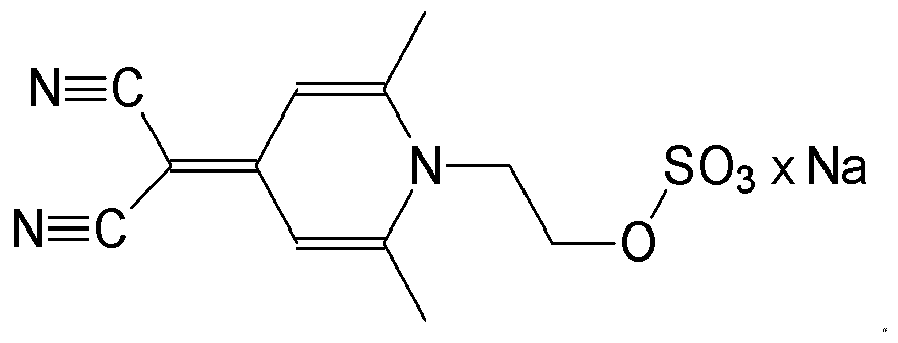
- Als erfindungsgemäß vorteilhaftes Piperazinderivat kann dabei die folgende Verbindung eingesetzt werden:

- Es ist erfindungsgemäß vorteilhaft, wenn die erfindungsgemäße Zubereitung frei ist von p-Methylbenzylidencampher.
Es ist erfindungsgemäß vorteilhaft, wenn die erfindungsgemäße Zubereitung einen oder mehrere Parfümstoffe enthält. - Erfindungsgemäß bevorzugte Ausführungsformen im Sinne der vorliegenden Erfindung sind dadurch gekennzeichnet, dass die Zubereitung einen oder mehrere Parfümstoffe gewählt aus der Gruppe der Verbindungen Linalool, Benzyl Benzoate, Hydroxyisohexyl 3-Cyclohexene Carboxaldehyd, Hexyl Cinnamal, Benzyl Salicylate, Citronellol, Coumarin, enthält.
- Es ist erfindungsgemäß vorteilhaft, wenn die Gesamtkonzentration an Parfümstoffen in der Zubereitung von 0,00001 bis 1,8 Gew.-%, bezogen auf das Gesamtgewicht der Zubereitung, beträgt.
- Erfindungsgemäß vorteilhafte Ausführungsformen der vorliegenden Erfindung sind dadurch gekennzeichnet, dass die erfindungsgemäße Zubereitung ein oder mehrere Verbindungen gewählt aus der Gruppe der Alkohole, Glycole, Glycerin enthält.
- Es ist erfindungsgemäß vorteilhaft, wenn die erfindungsgemäße Zubereitung Feuchthaltemittel wie Glycerin, Milchsäure und/oder Lactate, insbesondere Natriumlactat, Butylenglykol, Propylenglykol, Biosaccaride Gum-1, Glycine Soja, Glucosylglyceride, Pyrrolidoncarbonsäure, Hyaluronsäure, Chitosan und/oder Harnstoff enthält.
- Die erfindungsgemäßen kosmetischen Zubereitungen können ferner vorteilhaft, wenngleich nicht zwingend, Füllstoffe enthalten, welche z. B. die sensorischen und kosmetischen Eigenschaften der Formulierungen weiter verbessern und beispielsweise ein samtiges oder seidiges Hautgefühl hervorrufen oder verstärken. Vorteilhafte Füllstoffe im Sinne der vorliegenden Erfindung sind Stärke und Stärkederivate (wie z. B. Tapiocastärke, Distärkephosphat, Aluminium- bzw. Natrium-Stärke Octenylsuccinat und dergleichen), Pigmente, die weder hauptsächlich UV-Filter- noch färbende Wirkung haben (wie z. B. Bornitrid etc.) und/oder Aerosile® (CAS-Nr. 7631-86-9) und /oder Talkum.
- Die Wasserphase der erfindungsgemäßen Zubereitungen kann vorteilhaft übliche kosmetische Hilfsstoffe enthalten, wie beispielsweise Alkohole, insbesondere solche niedriger C-Zahl, vorzugsweise Ethanol und/oder Isopropanol, Diole oder Polyole niedriger C-Zahl sowie deren Ether, vorzugsweise Propylenglykol, 2-Methylpropan-1,3-diol, Glycerin, Ethylenglykol, Ethylenglykolmonoethyl- oder -monobutylether, Propylenglykolmonomethyl, -monoethyl- oder -monobutylether, Diethylenglykolmonomethyl- oder -monoethylether und analoge Produkte, Polymere, Schaumstabilisatoren, Elektrolyte, Selbstbräuner.
- Erfindungsgemäß vorteilhafte Ausführungsformen der vorliegenden Erfindung sind dadurch gekennzeichnet, dass die Zubereitung als Verdickungsmittel eine oder mehrere Verbindungen gewählt aus der Gruppe der Verbindungen Acrylat/C10-C30-Alkylacrylat, Xanthangummi, Tapiokastärke enthält.
- Die Ölphase der erfindungsgemäßen Zubereitung wird vorteilhaft gewählt aus der Gruppe der polaren Öle, beispielsweise aus der Gruppe der Lecithine und der Fettsäuretriglyceride, namentlich der Triglycerinester gesättigter und/oder ungesättigter, verzweigter und/oder unverzweigter Alkancarbonsäuren einer Kettenlänge von 8 bis 24, insbesondere 12 bis 18 C-Atomen. Die Fettsäuretriglyceride können beispielsweise vorteilhaft gewählt werden aus der Gruppe der synthetischen, halbsynthetischen und natürlichen Öle, wie z. B. Cocoglycerid, Olivenöl, Sonnenblumenöl, Jojobaöl, Sojaöl, Erdnußöl, Rapsöl, Mandelöl, Palmöl, Kokosöl, Rizinusöl, Weizenkeimöl, Traubenkernöl, Distelöl, Nachtkerzenöl, Macadamianußöl und dergleichen mehr.
- Erfindungsgemäß vorteilhaft sind ferner z. B. natürliche Wachse tierischen und pflanzlichen Ursprungs, wie beispielsweise Bienenwachs und andere Insektenwachse sowie Beerenwachs, Sheabutter und/oder Lanolin (Wollwachs).
- Weitere vorteilhafte polare Ölkomponenten können im Sinne der vorliegenden Erfindung ferner gewählt werden aus der Gruppe der Ester aus gesättigten und/oder ungesättigten, verzweigten und/oder unverzweigten Alkancarbonsäuren einer Kettenlänge von 3 bis 30 C-Atomen und gesättigten und/oder ungesättigten, verzweigten und/oder unverzweigten Alkoholen einer Kettenlänge von 3 bis 30 C-Atomen sowie aus der Gruppe der Ester aus aromatischen Carbonsäuren und gesättigten und/oder ungesättigten, verzweigten und/oder unverzweigten Alkoholen einer Kettenlänge von 3 bis 30 C-Atomen. Solche Esteröle können dann vorteilhaft gewählt werden aus der Gruppe Phenethylbenzoat, 2-Phenylethylbenzoat, Isopropyl Lauroyl Sarkosinat, Phenyl Trimethicon, Cyclomethicon, Dibutyladipat, Octylpalmitat, Octylcocoat, Octylisostearat, Octyldodeceylmyristat, Octyldodekanol, Cetearylisononanoat, Isopropylmyristat, Isopropylpalmitat, Isopropylstearat, Isopropyloleat, n-Butylstearat, n-Hexyllaurat, n-Decyloleat, Isooctylstearat, Isononylstearat, Isononylisononanoat, 2-Ethylhexylpalmitat, 2-Ethylhexyllaurat, 2-Hexyldecylstearat, 2-Octyldodecylpalmitat, Stearylheptanoat, Oleyloleat, Oleylerucat, Erucyloleat, Erucylerucat, Tridecylstearat, Tridecyltrimellitat, sowie synthetische, halbsynthetische und natürliche Gemische solcher Ester, wie z. B. Jojobaöl.
- Ferner kann die Ölphase vorteilhaft gewählt werden aus der Gruppe der Dialkylether und Dialkylcarbonate, vorteilhaft sind z. B. Dicaprylylether (Cetiol OE) und/oder Dicaprylylcarbonat, beispielsweise das unter der Handelsbezeichnung Cetiol CC bei der Fa. Cognis erhältliche.
- Es ist ferner vorteilhaft, das oder die Ölkomponenten aus der Gruppe Isoeikosan, Neopentylglykoldiheptanoat, Propylenglykoldicaprylat/dicaprat, Caprylic/Capric/Diglycerylsuccinat, Butylenglykol Dicaprylat/Dicaprat, C12-13-Alkyllactat, Di-C12-13-Alkyltartrat, Triisostearin, Dipentaerythrityl Hexacaprylat/Hexacaprat, Propylenglykolmonoisostearat, Tricaprylin, Dimethylisosorbid. Es ist insbesondere vorteilhaft, wenn die Ölphase der erfindungsgemäßen Formulierungen einen Gehalt an C12-15-Alkylbenzoat in Kombination mit Benzoesäure aufweist oder vollständig aus diesem besteht.
- Vorteilhafte Ölkomponenten sind ferner z. B. Butyloctylsalicylat (beispielsweise das unter der Handelsbezeichnung Hallbrite BHB bei der Fa. CP Hall erhältliche), Tridecylsalicylat (welches unter der Handelsbezeichnung Cosmacol ESI bei der Fa. Sasol erhältlich ist), C12-C15 Alkylsalicylat (unter der Handelsbezeichnung Dermol NS bei der Fa. Alzo erhältlich), Hexadecylbenzoat und Butyloctylbenzoat und Gemische davon (Hallstar AB).
- Auch beliebige Abmischungen solcher Öl- und Wachskomponenten sind vorteilhaft im Sinne der vorliegenden Erfindung einzusetzen.
- Ferner kann die Ölphase ebenfalls vorteilhaft auch unpolare Öle enthalten, beispielsweise solche, welche gewählt werden aus der Gruppe der verzweigten und unverzweigten Kohlenwasserstoffe und -wachse, insbesondere Mineralöl, Vaseline (Petrolatum), Paraffinöl, Squalan und Squalen, Polyolefine, hydrogenierte Polyisobutene, C13-16 Isoparaffin und Isohexadecan. Unter den Polyolefinen sind Polydecene die bevorzugten Substanzen.
- Es ist erfindungsgemäß bevorzugt, wenn die erfindungsgemäße Zubereitung C12-15 Alkylbenzoat in Kombination mit Benzoesäure enthält.
Die erfindungsgemäßen Zubereitungen können ferner vorteilhaft eine oder mehrere Substanzen aus der folgenden Gruppe der Siloxanelastomere enthalten, beispielsweise um die Wasserfestigkeit und/oder den Lichtschutzfaktor der Produkte zu steigern: - (a) Siloxanelastomere, welche die Einheiten R2SiO und RSiO1,5 und/oder R3SiO0,5 und/oder SiO2 enthalten,
wobei die einzelnen Reste R jeweils unabhängig voneinander Wasserstoff, C1-24-Alkyl (wie beispielsweise Methyl, Ethyl, Propyl) oder Aryl (wie beispielsweise Phenyl oder Tolyl), Alkenyl (wie beispielsweise Vinyl) bedeuten und das Gewichtsverhältnis der Einheiten R2SiO zu RSiO1,5 aus dem Bereich von 1 : 1 bis 30 : 1 gewählt wird; - (b) Siloxanelastomere, welche in Silikonöl unlöslich und quellfähig sind, die durch die Additionsreaktion eines Organopolysiloxans (1), das siliciumbebundenen Wasserstoff enthält, mit einem Organopolysiloxan (2), das ungesättigte aliphatische Gruppen enthält, erhältlich sind,
wobei die verwendeten Mengenateile so gewählt werden, dass die Menge des Wasserstoffes des Organopolysiloxans (1) oder der ungesättigten aliphatischen Gruppen des Organopolysiloxans (2)- im Bereich von 1 bis 20 mol-% liegt, wenn das Organopolysiloxan nicht zyklisch ist und
- im Bereich von 1 bis 50 mol-% liegt, wenn das Organopolysiloxan zyklisch ist.
- Vorteilhaft im Sinne der vorliegenden Erfindung liegen das oder die Siloxanelastomere in Form sphärischer Puder oder in Form von Gelen vor.
- Erfindungsgemäß vorteilhafte in Form sphärischer Puder vorliegende Siloxanelastomere sind die mit der INCI-Bezeichnung Dimethicone / Vinyl Dimethicone Crosspolymer, beispielsweise das von DOW CORNING unter der Handelsbezeichnungen DOW CORNING 9506 Powder erhältliche.
- Vorteilhaft ist es, wenn das Siloxanelastomer in Kombination mit Ölen aus Kohlenwasserstoffen tierischer und/oder pflanzlicher Herkunft, synthetischen Ölen, synthetischen Estern, synthetischen Ethern oder deren Gemischen verwendet wird.
- Erfindungsgemäß besonders bevorzugte Ausführungsformen der vorliegenden Erfindung sind dadurch gekennzeichnet, dass die Zubereitung eine oder mehrere lipophile Bestandteile gewählt aus der Gruppe der Verbindungen Myristylmyristat, Octyldodecanol, C12-C15-Alkylbenzoat + Benzoesäure, Butylenglycoldicaprylat/Dicaprat, Cetylalkohol enthält.
Weitere vorteilhafte Wirkstoffe im Sinne der vorliegenden Erfindung sind natürliche Wirkstoffe und/oder deren Derivate, wie z. B. alpha-Liponsäure, Folsäure, Phytoen, D-Biotin, Coenzym Q10, alpha-Glucosylrutin, Carnitin, Carnosin, natürliche und/oder synthetische Isoflavonoide, Glycerylglucose, Tocopherol und seine Derivate (beispielsweise das Acetat oder Palmitat), Vitamin A und seine Derivate, Gylcyrrhetinsäure, Kreatin, Kreatinin, Taurin und/oder β-Alanin sowie Licochalcon A. - Vorteilhaft im Sinne der vorliegenden Erfindung sind Zubereitungen zur Pflege der Haut. Sie können dem kosmetischen Lichtschutz, der Hautpflege (beispielsweise zur Prophylaxe und Behandlung der Hautalterung) und dekorativen Kosmetik dienen.
- Die Zubereitungen können sprühbar oder auf einem Träger (z.B. Tuch) dargereicht werden.
- Erfindungsgemäß vorteilhaft weist die erfindungsgemäße Zubereitung einen pH-Wert von 5 bis 8 auf. Dieser kann durch die herkömmlichen Säuren, Basen und Puffersysteme eingestellt werden.
- Der erfinderische Effekt konnte mit dem folgenden Vergleichsversuch belegt werden:
- Die Wirksamkeit von Sonnenschutzmittel bzw. der ihnen zugrunde liegenden UV-Filter wird in der Regel in biologischen Wirksamkeitsprüfungen unter standardisierten Bedingungen bestimmt.
- Der Lichtschutzfaktor (LSF, oft auch SPF (sun protection factor) genannt) gibt die Verlängerung der Sonnenbestrahlung an, die durch Verwendung des Sonnenschutzmittels ermöglicht wird. Er ist der Quotient aus Erythemschwellenzeit mit Sonnenschutzmittel und Erythemschwellenzeit ohne Sonnenschutzmittel.
Zur Prüfung der UV-A-Schutzleistung wird üblicherweise die IPD-Methode verwendet (IPD ≡ immediate pigment darkening). Hierbei wird - ähnlich der Bestimmung des Lichtschutzfaktors - ein Wert ermittelt, der angibt, um wie viel länger die mit dem Lichtschutzmittel geschützte Haut mit UV-A-Strahlung bestrahlt werden kann, bis die gleiche Pigmentierung auftritt wie bei der ungeschützten Haut.
Eine andere, europaweit etablierte Prüfungsmethode ist der Australische Standard AS/NZS 2604:1997. Dabei wird die Absorption der Zubereitung im UV-A-Bereich gemessen. Um den Standard zu erfüllen, muss die Zubereitung mindestens 90 % der UV-A-Strahlung im Bereich 320 -360 nm absorbieren.
UV-Strahlung verschiedener Frequenz/Wellenlänge dringt unterschiedlich tief ins Gewebe ein. Daher ist auch die Art der Schädigung wellenlängenabhängig.Dem UV-A-Schutz kommt hier eine besondere Bedeutung zu, da diese UV-Strahlung (UV-A (Wellenlänge 315 - 400 nm), im Wesentlichen für die Hautalterung verantwortlich ist - UVA-Filter zählen zu den chemischen Lichtschutzfiltern. Sie dringen in die Haut ein, nehmen dort die energiereiche UV-Strahlung auf und wandeln diese in Wärme- oder Lichtenergie um, welche keine Schäden mehr anrichten kann. Obwohl es für die Bestimmung der Schutzwirkung im UVA-Bereich aktuell kein anerkanntes Prüfverfahren gibt (im Gegensatz zu der COLIPA-Methode für UVB-Filter), sollte in der Praxis die so genannte UVA/UVB-Schutzbalance gelten. Das bedeutet, dass UVA-Filter in Relation von 1:3 zu UVB-Filtern eingesetzt werden und damit der UVA-Schutz mit steigendem Lichtschutz angehoben wird. Die EU-Empfehlung sieht einen UVA-Schutz von 1/3 im Verhältnis zum UVB-Schutz vor. Mit der neuen EU-Empfehlung soll demnächst jedes Sonnenschutzmittel gleichzeitig auch vor UVA-Strahlung schützen. Der Verbraucher soll in Zukunft davon ausgehen, dass ein UVA-Schutz gewährleistet ist, der mit steigendem SPF-Wert ansteigt. Aus ethischen Gründen schlägt sie dazu eine in-vitro-Methode vor.
- Diese Messmethode trägt den Namen "COLIPA Ratio". Die COLIPA Ratio muss der Formel <3 sein.

- Die COLIPA Ratio ist der Standard zur Bestimmung des UVA-Schutzes.
- Erfindungsgemäß wird als Verbesserung der Lichtschutzleistung die Steigerung der in-vitro SPF, UVA-SPF und/oder Colipa Ratio Messwerte verstanden.
- Es wurden folgende Zubereitung A und B hergestellt und deren in-vitro SPF, UVA-SPF und Colipa Ratio gemessen bzw. bestimmt. Zubereitung A ist eine Zubereitung mit entsprechenden UV Filtern aber ohne den erfindungsgemäßen SPF-Booster Ethylhexylglycerin, B ist die gleiche Zubereitung mit SPF Booster. Die Anteilsunterschiede werden jeweils durch den Anteil Wasser ausgeglichen.
INCI/Gew.% A ohne Ethylhexylglycerin B mit Ethylhexylglycerin Methylparaben 0,3 0,3 Trisodium EDTA 1 1 Ethylhexyl Methoxycinnamate 0,5 0,5 Phenoxyethanol 0,6 0,6 Dimethicone 2 2 Hydrogenated Coco-Glycerides 3 3 C12-15 Alkyl Benzoate 6 6 Butyl Methoxydibenzoylmethane 4,5 4,5 Glycerin 4,3 4,3 Sodium Hydroxide 0,185 0,185 Alcohol Denat. 4 4 Xanthan Gum 0,4 0,4 Natriumcetearylsulfat 0,1 0,1 Cetearylalkohol 3 3 Ethylhexylglycerin - 2,5 Bis-Ethylhexyloxyphenol Methoxyphenyl Triazine 1,5 1,5 Butylene Glycol Dicaprylate/Dicaprate 2 2 Aqua 66,515 64,015 Colipa-Ratio (kleiner 3 = sehr gut; je niedriger desto besser) 2,3 2,2 in-vitro-SPF 78,1 112,9 (+44%) UVA-SPF (Spalte UVAPF Colipa nach Bestrahlung) 12,3 13,7 - Die Messungen zu in-vitro-SPF wurden entsprechend den Vorgaben gemäß "METHOD FOR THE IN VITRO DETERMINATION OF UVA PROTECTION PROVIDED BY SUNSCREEN PRODUCTS" Guideline 2007a, Prepared by the COLIPA In vitro Photoprotection Methods Task Force, durchgeführt.
- Ein Colipa-Ratio von weniger als 2,3 bedeutet gegenüber der Vergleichszubereitung A eine Steigerung der Lichtschutzleistung.
In gleicher Weise ist eine Steigerung der in-vitro Lichtschutzleistung festgestellt worden durch in-vitro SPF Messwerte größer 78,1 sowie einem gesteigertem UVA SPF bei Werten größer 13,7.
Erfindungsgemäß führen die Verbindungen zu einem SPF-Boosting (Steigerung der Lichtschutzleistung) um 44%. - Die nachfolgenden Beispiele sollen die vorliegende Erfindung verdeutlichen, ohne sie einzuschränken. Alle Mengenangaben, Anteile und Prozentanteile sind, soweit nicht anders angegeben, auf das Gewicht und die Gesamtmenge bzw. auf das Gesamtgewicht der Zubereitungen bezogen.
-
1 2 3 4 5 Glycerylsterat 1,0 2,75 2,0 3,5 2,5 Cetearylsulfat, Natrium-Salz 0,1 0,2 0,12 0,14 0,075 Cetearylalkohol 0,5 1,5 1,618 0,14 0,75 Silikonöl, linear 0,5 1,3 1,5 1,2 1,75 Butyl Methoxydibenzoylmethan 3,5 4,5 --- 2,5 1,5 Ethylhexylmethoxycinnamat 3,5 9,0 11,0 5,0 4,5 2-(4'-Diethylamino-2'-hydoxybenzoyl)-benzoesäurehexylester 1,5 --- 5,5 --- 0,5 Parfum q,s, q,s, q,s, q,s, q,s, Polyacrylsäure, Natrium-Salz 0,4 0,1 0,15 0,05 0,1 Ethylhexylglycerin 0,3 2,5 3,75 0,15 1,5 Glycerin 5 10 10 15 7,5 Wasser ad 100 ad 100 ad 100 ad 100 ad 100
Claims (14)
- Kosmetische Zubereitung enthaltenda) Natriumcetearylsulfat,b) mindestens eine UV-A-Filtersubstanz,c) Ethylhexylglycerin und/oder 1,2-Pentandiol.
- Kosmetische Zubereitung nach Anspruch 1, dadurch gekennzeichnet, dass die Zubereitung frei ist von Polyethylenglycol und Polyethylenglycolderivaten.
- Kosmetische Zubereitung nach einem der vorhergehenden Ansprüche, dadurch gekennzeichnet, dass die Zubereitung Polyglyceryl-2 Caprate und/oder Glycerylcaprylate und/oder Phenyethylethanol enthält.
- Kosmetische Zubereitung nach einem der vorhergehenden Ansprüche, dadurch gekennzeichnet, dass die Zubereitung frei ist von Konservierungsstoffen.
- Kosmetische Zubereitung nach einem der vorhergehenden Ansprüche, dadurch gekennzeichnet, dass als UV-A-Filter 4-(tert.-Butyl)-4'-methoxydibenzoylmethan und/oder 2-(4'-Diethylamino-2'-hydoxybenzoyl)-benzoesäurehexylester eingesetzt werden.
- Kosmetische Zubereitung nach einem der vorhergehenden Ansprüche, dadurch gekennzeichnet, dass die Zubereitung Natriumcetearylsulfat in einer Konzentration von 0,05 bis 0,5 Gew.-%, bezogen auf das Gesamtgewicht der Zubereitung, enthält.
- Kosmetische Zubereitung nach einem der vorhergehenden Ansprüche, dadurch gekennzeichnet, dass die Zubereitung 4-(tert.-Butyl)-4'-methoxydibenzoylmethan in einer Konzentration von 1,5 bis 15,0 Gew.-%, bezogen auf das Gesamtgewicht der Zubereitung, enthält.
- Kosmetische Zubereitung nach einem der vorhergehenden Ansprüche, dadurch gekennzeichnet, dass die Zubereitung 2-(4'-Diethylamino-2'-hydoxybenzoyl)-benzoesäurehexylester in einer Konzentration von 1,5 bis 15,0 Gew.-%, bezogen auf das Gesamtgewicht der Zubereitung, enthält.
- Kosmetische Zubereitung nach einem der vorhergehenden Ansprüche, dadurch gekennzeichnet, dass die Zubereitung Ethylhexylglycerin in einer Konzentration von 0,005 bis 5,0 Gew.-%, bezogen auf das Gesamtgewicht der Zubereitung, enthält.
- Kosmetische Zubereitung nach einem der vorhergehenden Ansprüche, dadurch gekennzeichnet, dass die Zubereitung 1,2-Pentandiol in einer Konzentration von 0,005 bis 5,0 Gew.-%, bezogen auf das Gesamtgewicht der Zubereitung, enthält.
- Kosmetische Zubereitung nach einem der vorhergehenden Ansprüche, dadurch gekennzeichnet, dass die Zubereitung Cetearylalkohol enthält.
- Kosmetische Zubereitung nach einem der vorhergehenden Ansprüche, dadurch gekennzeichnet, dass die Zubereitung Cetearylalkohol in einer Konzentration 0,1 von bis 10 Gew.-%, bezogen auf das Gesamtgewicht der Zubereitung, enthält.
- Kosmetische Zubereitung nach einem der vorhergehenden Ansprüche, dadurch gekennzeichnet, dass die Zubereitung C12-15 Alkylbenzoat in Kombination mit Benzoesäure enthält.
- Kosmetische Zubereitung nach einem der vorhergehenden Ansprüche, dadurch gekennzeichnet, dass die Zubereitung in Form einer O/W-Emulsion vorliegt.
Applications Claiming Priority (1)
| Application Number | Priority Date | Filing Date | Title |
|---|---|---|---|
| DE102010063745A DE102010063745A1 (de) | 2010-12-21 | 2010-12-21 | Kosmetische Zubereitung mit Natriumcetearylsulfat |
Publications (3)
| Publication Number | Publication Date |
|---|---|
| EP2468362A2 true EP2468362A2 (de) | 2012-06-27 |
| EP2468362A3 EP2468362A3 (de) | 2015-08-12 |
| EP2468362B1 EP2468362B1 (de) | 2018-10-17 |
Family
ID=45093500
Family Applications (1)
| Application Number | Title | Priority Date | Filing Date |
|---|---|---|---|
| EP11191246.5A Active EP2468362B1 (de) | 2010-12-21 | 2011-11-30 | Kosmetische Zubereitung mit UV-A-Filtersubstanz und Natriumcetearylsulfat |
Country Status (3)
| Country | Link |
|---|---|
| EP (1) | EP2468362B1 (de) |
| DE (1) | DE102010063745A1 (de) |
| ES (1) | ES2706373T3 (de) |
Cited By (1)
| Publication number | Priority date | Publication date | Assignee | Title |
|---|---|---|---|---|
| EP3093008B1 (de) | 2015-05-13 | 2019-07-17 | Beiersdorf AG | Octocrylenfreies sonnenschutzmittel enthaltend diethylaminohydroxybenzoylhexylbenzoat |
Citations (4)
| Publication number | Priority date | Publication date | Assignee | Title |
|---|---|---|---|---|
| DE10361202A1 (de) | 2003-12-24 | 2005-07-28 | Beiersdorf Ag | Kosmetische Emulsion |
| WO2005077327A1 (de) | 2004-02-11 | 2005-08-25 | Beiersdorf Ag | Kosmetische und dermatologische selbstbräunungsformulierungen mit dihydroxyaceton und glycerin |
| EP1837055A1 (de) | 2006-02-06 | 2007-09-26 | Bob Hoogenboom | Hautpflegecreme |
| DE102006061689A1 (de) | 2006-12-22 | 2008-06-26 | Beiersdorf Ag | Leichte Lotion |
Family Cites Families (7)
| Publication number | Priority date | Publication date | Assignee | Title |
|---|---|---|---|---|
| US6274124B1 (en) * | 1999-08-20 | 2001-08-14 | Dragoco Gerberding & Co. Ag | Additive for improving the water resistance of cosmetic or dermatological formulations |
| CA2526536C (en) * | 2003-05-29 | 2010-10-12 | Sun Pharmaceuticals Corporation | Sunscreen composition |
| DE102007005186A1 (de) * | 2007-01-29 | 2008-07-31 | Merck Patent Gmbh | Partikuläres UV-Schutzmittel |
| DE102007017434A1 (de) * | 2007-04-11 | 2008-10-16 | Beiersdorf Ag | Emulsion mit Octanoat |
| DE102008016709A1 (de) * | 2008-03-31 | 2009-10-01 | Sebapharma Gmbh & Co. | Sonnenschutzmittel |
| DE102008018787A1 (de) * | 2008-04-11 | 2009-10-15 | Beiersdorf Ag | Zubereitung für die Tagespflege |
| DE102008021631A1 (de) * | 2008-04-25 | 2009-10-29 | Beiersdorf Ag | Lichtschutzfilterkombination mit 2,4,6-Tris-(biphenyl)-1,3,5-triazin |
-
2010
- 2010-12-21 DE DE102010063745A patent/DE102010063745A1/de not_active Withdrawn
-
2011
- 2011-11-30 ES ES11191246T patent/ES2706373T3/es active Active
- 2011-11-30 EP EP11191246.5A patent/EP2468362B1/de active Active
Patent Citations (4)
| Publication number | Priority date | Publication date | Assignee | Title |
|---|---|---|---|---|
| DE10361202A1 (de) | 2003-12-24 | 2005-07-28 | Beiersdorf Ag | Kosmetische Emulsion |
| WO2005077327A1 (de) | 2004-02-11 | 2005-08-25 | Beiersdorf Ag | Kosmetische und dermatologische selbstbräunungsformulierungen mit dihydroxyaceton und glycerin |
| EP1837055A1 (de) | 2006-02-06 | 2007-09-26 | Bob Hoogenboom | Hautpflegecreme |
| DE102006061689A1 (de) | 2006-12-22 | 2008-06-26 | Beiersdorf Ag | Leichte Lotion |
Cited By (1)
| Publication number | Priority date | Publication date | Assignee | Title |
|---|---|---|---|---|
| EP3093008B1 (de) | 2015-05-13 | 2019-07-17 | Beiersdorf AG | Octocrylenfreies sonnenschutzmittel enthaltend diethylaminohydroxybenzoylhexylbenzoat |
Also Published As
| Publication number | Publication date |
|---|---|
| DE102010063745A1 (de) | 2012-06-21 |
| EP2468362A3 (de) | 2015-08-12 |
| EP2468362B1 (de) | 2018-10-17 |
| ES2706373T3 (es) | 2019-03-28 |
Similar Documents
| Publication | Publication Date | Title |
|---|---|---|
| EP2630990B1 (de) | Leichte, wasserfeste kosmetische Zubereitung | |
| DE102014216602A1 (de) | Stabile kosmetische Zubereitung | |
| DE102014206224A1 (de) | Kosmetische Zubereitung mit UV-Schutz | |
| EP1480607A2 (de) | Kosmetische und dermatologische lichtschtzformulierungen mit einem gehalt an hydroxybenzophenonen und alkylnaphthalaten | |
| EP1965870A2 (de) | Sonnenschutzmittel mit merocyaninen und triazinen | |
| EP2438903B1 (de) | Konservierungsmittelfreies Sonnenschutzmittel | |
| EP2485806B1 (de) | Verwendung von cetearylsulfosuccinaten in sonnenschutzmitteln | |
| DE102013209927A1 (de) | Stabile kosmetische Zubereitung | |
| DE102005059741A1 (de) | Pigmenthaltige Sonnenschutzmittel mit Merocyaninen | |
| EP3003260B1 (de) | Kosmetische zubereitung, enthaltend polysilicone-25 und wasserlösliche uv-filter mit einer sulfonsäure-funktion | |
| EP3125860B1 (de) | Kosmetische zubereitung zum uv-schutz auf der basis von acrylat-copolymeren | |
| EP2496309B1 (de) | Cetearylsulfosuccinate enthaltende kosmetische zubereitung mit flüssigen uv-filtern | |
| EP2468362B1 (de) | Kosmetische Zubereitung mit UV-A-Filtersubstanz und Natriumcetearylsulfat | |
| EP2451535B1 (de) | Glycyrrhetinsäure enthaltende kosmetische zubereitung | |
| EP2630947B1 (de) | Duftstabile, wasserfeste kosmetische Zubereitung | |
| EP1958609A1 (de) | Kosmetische Zubereitung mit wasserlöslichem UV-Lichtschutzfilter und Vinylpyrrolidon/Acrylsäure-Copolymer | |
| DE202006011832U1 (de) | Kosmetische Emulsion mit Alpha-Benzoylzimtsäurenitril | |
| DE102007024346A1 (de) | Kosmetische Zubereitung mit ionischem UV-A-Filter und 2-(4'-Diethylamino-2'hydoxybenzoyl)-benzoesäurehexylester | |
| DE102012200072A1 (de) | Wohlriechende kosmetische Zubereitung | |
| DE102014206214A1 (de) | Verfahren zum Schutz der Haut vor UV-Strahlung | |
| EP2451433A2 (de) | Glycyrrhetinsäure enthaltende, parfümierte kosmetische zubereitung |
Legal Events
| Date | Code | Title | Description |
|---|---|---|---|
| AK | Designated contracting states |
Kind code of ref document: A2 Designated state(s): AL AT BE BG CH CY CZ DE DK EE ES FI FR GB GR HR HU IE IS IT LI LT LU LV MC MK MT NL NO PL PT RO RS SE SI SK SM TR |
|
| AX | Request for extension of the european patent |
Extension state: BA ME |
|
| PUAI | Public reference made under article 153(3) epc to a published international application that has entered the european phase |
Free format text: ORIGINAL CODE: 0009012 |
|
| PUAL | Search report despatched |
Free format text: ORIGINAL CODE: 0009013 |
|
| AK | Designated contracting states |
Kind code of ref document: A3 Designated state(s): AL AT BE BG CH CY CZ DE DK EE ES FI FR GB GR HR HU IE IS IT LI LT LU LV MC MK MT NL NO PL PT RO RS SE SI SK SM TR |
|
| AX | Request for extension of the european patent |
Extension state: BA ME |
|
| RIC1 | Information provided on ipc code assigned before grant |
Ipc: A61K 8/06 20060101ALI20150707BHEP Ipc: A61Q 17/04 20060101AFI20150707BHEP Ipc: A61K 8/46 20060101ALI20150707BHEP Ipc: A61K 8/41 20060101ALI20150707BHEP Ipc: A61K 8/34 20060101ALI20150707BHEP Ipc: A61K 8/35 20060101ALI20150707BHEP |
|
| 17P | Request for examination filed |
Effective date: 20160212 |
|
| RBV | Designated contracting states (corrected) |
Designated state(s): AL AT BE BG CH CY CZ DE DK EE ES FI FR GB GR HR HU IE IS IT LI LT LU LV MC MK MT NL NO PL PT RO RS SE SI SK SM TR |
|
| 17Q | First examination report despatched |
Effective date: 20170327 |
|
| GRAP | Despatch of communication of intention to grant a patent |
Free format text: ORIGINAL CODE: EPIDOSNIGR1 |
|
| INTG | Intention to grant announced |
Effective date: 20180620 |
|
| GRAS | Grant fee paid |
Free format text: ORIGINAL CODE: EPIDOSNIGR3 |
|
| GRAA | (expected) grant |
Free format text: ORIGINAL CODE: 0009210 |
|
| AK | Designated contracting states |
Kind code of ref document: B1 Designated state(s): AL AT BE BG CH CY CZ DE DK EE ES FI FR GB GR HR HU IE IS IT LI LT LU LV MC MK MT NL NO PL PT RO RS SE SI SK SM TR |
|
| REG | Reference to a national code |
Ref country code: GB Ref legal event code: FG4D Free format text: NOT ENGLISH |
|
| REG | Reference to a national code |
Ref country code: CH Ref legal event code: EP |
|
| REG | Reference to a national code |
Ref country code: IE Ref legal event code: FG4D Free format text: LANGUAGE OF EP DOCUMENT: GERMAN |
|
| REG | Reference to a national code |
Ref country code: DE Ref legal event code: R096 Ref document number: 502011014865 Country of ref document: DE Ref country code: AT Ref legal event code: REF Ref document number: 1053301 Country of ref document: AT Kind code of ref document: T Effective date: 20181115 |
|
| REG | Reference to a national code |
Ref country code: NL Ref legal event code: MP Effective date: 20181017 |
|
| REG | Reference to a national code |
Ref country code: LT Ref legal event code: MG4D |
|
| REG | Reference to a national code |
Ref country code: ES Ref legal event code: FG2A Ref document number: 2706373 Country of ref document: ES Kind code of ref document: T3 Effective date: 20190328 |
|
| PG25 | Lapsed in a contracting state [announced via postgrant information from national office to epo] |
Ref country code: NL Free format text: LAPSE BECAUSE OF FAILURE TO SUBMIT A TRANSLATION OF THE DESCRIPTION OR TO PAY THE FEE WITHIN THE PRESCRIBED TIME-LIMIT Effective date: 20181017 |
|
| PG25 | Lapsed in a contracting state [announced via postgrant information from national office to epo] |
Ref country code: PL Free format text: LAPSE BECAUSE OF FAILURE TO SUBMIT A TRANSLATION OF THE DESCRIPTION OR TO PAY THE FEE WITHIN THE PRESCRIBED TIME-LIMIT Effective date: 20181017 Ref country code: NO Free format text: LAPSE BECAUSE OF FAILURE TO SUBMIT A TRANSLATION OF THE DESCRIPTION OR TO PAY THE FEE WITHIN THE PRESCRIBED TIME-LIMIT Effective date: 20190117 Ref country code: BG Free format text: LAPSE BECAUSE OF FAILURE TO SUBMIT A TRANSLATION OF THE DESCRIPTION OR TO PAY THE FEE WITHIN THE PRESCRIBED TIME-LIMIT Effective date: 20190117 Ref country code: HR Free format text: LAPSE BECAUSE OF FAILURE TO SUBMIT A TRANSLATION OF THE DESCRIPTION OR TO PAY THE FEE WITHIN THE PRESCRIBED TIME-LIMIT Effective date: 20181017 Ref country code: LV Free format text: LAPSE BECAUSE OF FAILURE TO SUBMIT A TRANSLATION OF THE DESCRIPTION OR TO PAY THE FEE WITHIN THE PRESCRIBED TIME-LIMIT Effective date: 20181017 Ref country code: FI Free format text: LAPSE BECAUSE OF FAILURE TO SUBMIT A TRANSLATION OF THE DESCRIPTION OR TO PAY THE FEE WITHIN THE PRESCRIBED TIME-LIMIT Effective date: 20181017 Ref country code: IS Free format text: LAPSE BECAUSE OF FAILURE TO SUBMIT A TRANSLATION OF THE DESCRIPTION OR TO PAY THE FEE WITHIN THE PRESCRIBED TIME-LIMIT Effective date: 20190217 Ref country code: LT Free format text: LAPSE BECAUSE OF FAILURE TO SUBMIT A TRANSLATION OF THE DESCRIPTION OR TO PAY THE FEE WITHIN THE PRESCRIBED TIME-LIMIT Effective date: 20181017 |
|
| PG25 | Lapsed in a contracting state [announced via postgrant information from national office to epo] |
Ref country code: PT Free format text: LAPSE BECAUSE OF FAILURE TO SUBMIT A TRANSLATION OF THE DESCRIPTION OR TO PAY THE FEE WITHIN THE PRESCRIBED TIME-LIMIT Effective date: 20190217 Ref country code: GR Free format text: LAPSE BECAUSE OF FAILURE TO SUBMIT A TRANSLATION OF THE DESCRIPTION OR TO PAY THE FEE WITHIN THE PRESCRIBED TIME-LIMIT Effective date: 20190118 Ref country code: SE Free format text: LAPSE BECAUSE OF FAILURE TO SUBMIT A TRANSLATION OF THE DESCRIPTION OR TO PAY THE FEE WITHIN THE PRESCRIBED TIME-LIMIT Effective date: 20181017 Ref country code: RS Free format text: LAPSE BECAUSE OF FAILURE TO SUBMIT A TRANSLATION OF THE DESCRIPTION OR TO PAY THE FEE WITHIN THE PRESCRIBED TIME-LIMIT Effective date: 20181017 Ref country code: AL Free format text: LAPSE BECAUSE OF FAILURE TO SUBMIT A TRANSLATION OF THE DESCRIPTION OR TO PAY THE FEE WITHIN THE PRESCRIBED TIME-LIMIT Effective date: 20181017 |
|
| REG | Reference to a national code |
Ref country code: CH Ref legal event code: PL |
|
| REG | Reference to a national code |
Ref country code: DE Ref legal event code: R097 Ref document number: 502011014865 Country of ref document: DE |
|
| PG25 | Lapsed in a contracting state [announced via postgrant information from national office to epo] |
Ref country code: CZ Free format text: LAPSE BECAUSE OF FAILURE TO SUBMIT A TRANSLATION OF THE DESCRIPTION OR TO PAY THE FEE WITHIN THE PRESCRIBED TIME-LIMIT Effective date: 20181017 Ref country code: IT Free format text: LAPSE BECAUSE OF FAILURE TO SUBMIT A TRANSLATION OF THE DESCRIPTION OR TO PAY THE FEE WITHIN THE PRESCRIBED TIME-LIMIT Effective date: 20181017 Ref country code: DK Free format text: LAPSE BECAUSE OF FAILURE TO SUBMIT A TRANSLATION OF THE DESCRIPTION OR TO PAY THE FEE WITHIN THE PRESCRIBED TIME-LIMIT Effective date: 20181017 Ref country code: LU Free format text: LAPSE BECAUSE OF NON-PAYMENT OF DUE FEES Effective date: 20181130 |
|
| REG | Reference to a national code |
Ref country code: BE Ref legal event code: MM Effective date: 20181130 |
|
| REG | Reference to a national code |
Ref country code: IE Ref legal event code: MM4A |
|
| PLBE | No opposition filed within time limit |
Free format text: ORIGINAL CODE: 0009261 |
|
| STAA | Information on the status of an ep patent application or granted ep patent |
Free format text: STATUS: NO OPPOSITION FILED WITHIN TIME LIMIT |
|
| PG25 | Lapsed in a contracting state [announced via postgrant information from national office to epo] |
Ref country code: LI Free format text: LAPSE BECAUSE OF NON-PAYMENT OF DUE FEES Effective date: 20181130 Ref country code: MC Free format text: LAPSE BECAUSE OF FAILURE TO SUBMIT A TRANSLATION OF THE DESCRIPTION OR TO PAY THE FEE WITHIN THE PRESCRIBED TIME-LIMIT Effective date: 20181017 Ref country code: CH Free format text: LAPSE BECAUSE OF NON-PAYMENT OF DUE FEES Effective date: 20181130 Ref country code: SM Free format text: LAPSE BECAUSE OF FAILURE TO SUBMIT A TRANSLATION OF THE DESCRIPTION OR TO PAY THE FEE WITHIN THE PRESCRIBED TIME-LIMIT Effective date: 20181017 Ref country code: EE Free format text: LAPSE BECAUSE OF FAILURE TO SUBMIT A TRANSLATION OF THE DESCRIPTION OR TO PAY THE FEE WITHIN THE PRESCRIBED TIME-LIMIT Effective date: 20181017 Ref country code: SK Free format text: LAPSE BECAUSE OF FAILURE TO SUBMIT A TRANSLATION OF THE DESCRIPTION OR TO PAY THE FEE WITHIN THE PRESCRIBED TIME-LIMIT Effective date: 20181017 Ref country code: RO Free format text: LAPSE BECAUSE OF FAILURE TO SUBMIT A TRANSLATION OF THE DESCRIPTION OR TO PAY THE FEE WITHIN THE PRESCRIBED TIME-LIMIT Effective date: 20181017 |
|
| 26N | No opposition filed |
Effective date: 20190718 |
|
| PG25 | Lapsed in a contracting state [announced via postgrant information from national office to epo] |
Ref country code: IE Free format text: LAPSE BECAUSE OF NON-PAYMENT OF DUE FEES Effective date: 20181130 Ref country code: SI Free format text: LAPSE BECAUSE OF FAILURE TO SUBMIT A TRANSLATION OF THE DESCRIPTION OR TO PAY THE FEE WITHIN THE PRESCRIBED TIME-LIMIT Effective date: 20181017 |
|
| PG25 | Lapsed in a contracting state [announced via postgrant information from national office to epo] |
Ref country code: BE Free format text: LAPSE BECAUSE OF NON-PAYMENT OF DUE FEES Effective date: 20181130 |
|
| REG | Reference to a national code |
Ref country code: AT Ref legal event code: MM01 Ref document number: 1053301 Country of ref document: AT Kind code of ref document: T Effective date: 20181130 |
|
| PG25 | Lapsed in a contracting state [announced via postgrant information from national office to epo] |
Ref country code: MT Free format text: LAPSE BECAUSE OF FAILURE TO SUBMIT A TRANSLATION OF THE DESCRIPTION OR TO PAY THE FEE WITHIN THE PRESCRIBED TIME-LIMIT Effective date: 20181017 Ref country code: AT Free format text: LAPSE BECAUSE OF NON-PAYMENT OF DUE FEES Effective date: 20181130 |
|
| PG25 | Lapsed in a contracting state [announced via postgrant information from national office to epo] |
Ref country code: TR Free format text: LAPSE BECAUSE OF FAILURE TO SUBMIT A TRANSLATION OF THE DESCRIPTION OR TO PAY THE FEE WITHIN THE PRESCRIBED TIME-LIMIT Effective date: 20181017 |
|
| PG25 | Lapsed in a contracting state [announced via postgrant information from national office to epo] |
Ref country code: CY Free format text: LAPSE BECAUSE OF FAILURE TO SUBMIT A TRANSLATION OF THE DESCRIPTION OR TO PAY THE FEE WITHIN THE PRESCRIBED TIME-LIMIT Effective date: 20181017 Ref country code: HU Free format text: LAPSE BECAUSE OF FAILURE TO SUBMIT A TRANSLATION OF THE DESCRIPTION OR TO PAY THE FEE WITHIN THE PRESCRIBED TIME-LIMIT; INVALID AB INITIO Effective date: 20111130 Ref country code: MK Free format text: LAPSE BECAUSE OF NON-PAYMENT OF DUE FEES Effective date: 20181017 |
|
| REG | Reference to a national code |
Ref country code: DE Ref legal event code: R081 Ref document number: 502011014865 Country of ref document: DE Owner name: BEIERSDORF AKTIENGESELLSCHAFT, DE Free format text: FORMER OWNER: BEIERSDORF AG, 20253 HAMBURG, DE |
|
| PGFP | Annual fee paid to national office [announced via postgrant information from national office to epo] |
Ref country code: DE Payment date: 20251130 Year of fee payment: 15 |
|
| PGFP | Annual fee paid to national office [announced via postgrant information from national office to epo] |
Ref country code: GB Payment date: 20251121 Year of fee payment: 15 |
|
| PGFP | Annual fee paid to national office [announced via postgrant information from national office to epo] |
Ref country code: FR Payment date: 20251125 Year of fee payment: 15 |
|
| PGFP | Annual fee paid to national office [announced via postgrant information from national office to epo] |
Ref country code: ES Payment date: 20251229 Year of fee payment: 15 |