EP2464759B1 - Method of applying a metallic alloy overlay using feedstock powder and iron electrode for production of high hardness overlays - Google Patents
Method of applying a metallic alloy overlay using feedstock powder and iron electrode for production of high hardness overlays Download PDFInfo
- Publication number
- EP2464759B1 EP2464759B1 EP10808661.2A EP10808661A EP2464759B1 EP 2464759 B1 EP2464759 B1 EP 2464759B1 EP 10808661 A EP10808661 A EP 10808661A EP 2464759 B1 EP2464759 B1 EP 2464759B1
- Authority
- EP
- European Patent Office
- Prior art keywords
- alloy
- electrode
- powder
- less
- feedstock powder
- Prior art date
- Legal status (The legal status is an assumption and is not a legal conclusion. Google has not performed a legal analysis and makes no representation as to the accuracy of the status listed.)
- Not-in-force
Links
- XEEYBQQBJWHFJM-UHFFFAOYSA-N Iron Chemical compound [Fe] XEEYBQQBJWHFJM-UHFFFAOYSA-N 0.000 title claims description 93
- 239000000843 powder Substances 0.000 title claims description 80
- 229910052742 iron Inorganic materials 0.000 title claims description 47
- 238000000034 method Methods 0.000 title claims description 32
- 229910001092 metal group alloy Inorganic materials 0.000 title claims description 15
- 238000004519 manufacturing process Methods 0.000 title description 2
- 229910052799 carbon Inorganic materials 0.000 claims description 11
- OKTJSMMVPCPJKN-UHFFFAOYSA-N Carbon Chemical compound [C] OKTJSMMVPCPJKN-UHFFFAOYSA-N 0.000 claims description 10
- 229910052710 silicon Inorganic materials 0.000 claims description 9
- XUIMIQQOPSSXEZ-UHFFFAOYSA-N Silicon Chemical compound [Si] XUIMIQQOPSSXEZ-UHFFFAOYSA-N 0.000 claims description 8
- 239000010703 silicon Substances 0.000 claims description 8
- 239000002245 particle Substances 0.000 claims description 7
- 238000001816 cooling Methods 0.000 claims description 5
- 239000011521 glass Substances 0.000 claims description 5
- 229910052748 manganese Inorganic materials 0.000 claims description 5
- 239000011572 manganese Substances 0.000 claims description 5
- PWHULOQIROXLJO-UHFFFAOYSA-N Manganese Chemical compound [Mn] PWHULOQIROXLJO-UHFFFAOYSA-N 0.000 claims description 4
- 239000011651 chromium Substances 0.000 claims description 4
- 239000010949 copper Substances 0.000 claims description 4
- WPBNNNQJVZRUHP-UHFFFAOYSA-L manganese(2+);methyl n-[[2-(methoxycarbonylcarbamothioylamino)phenyl]carbamothioyl]carbamate;n-[2-(sulfidocarbothioylamino)ethyl]carbamodithioate Chemical compound [Mn+2].[S-]C(=S)NCCNC([S-])=S.COC(=O)NC(=S)NC1=CC=CC=C1NC(=S)NC(=O)OC WPBNNNQJVZRUHP-UHFFFAOYSA-L 0.000 claims description 4
- WFKWXMTUELFFGS-UHFFFAOYSA-N tungsten Chemical compound [W] WFKWXMTUELFFGS-UHFFFAOYSA-N 0.000 claims description 4
- 229910052721 tungsten Inorganic materials 0.000 claims description 4
- 239000010937 tungsten Substances 0.000 claims description 4
- ZOXJGFHDIHLPTG-UHFFFAOYSA-N Boron Chemical compound [B] ZOXJGFHDIHLPTG-UHFFFAOYSA-N 0.000 claims description 3
- VYZAMTAEIAYCRO-UHFFFAOYSA-N Chromium Chemical compound [Cr] VYZAMTAEIAYCRO-UHFFFAOYSA-N 0.000 claims description 3
- RYGMFSIKBFXOCR-UHFFFAOYSA-N Copper Chemical compound [Cu] RYGMFSIKBFXOCR-UHFFFAOYSA-N 0.000 claims description 3
- ZOKXTWBITQBERF-UHFFFAOYSA-N Molybdenum Chemical compound [Mo] ZOKXTWBITQBERF-UHFFFAOYSA-N 0.000 claims description 3
- 229910052796 boron Inorganic materials 0.000 claims description 3
- 229910052804 chromium Inorganic materials 0.000 claims description 3
- 229910052802 copper Inorganic materials 0.000 claims description 3
- 238000004455 differential thermal analysis Methods 0.000 claims description 3
- BHEPBYXIRTUNPN-UHFFFAOYSA-N hydridophosphorus(.) (triplet) Chemical compound [PH] BHEPBYXIRTUNPN-UHFFFAOYSA-N 0.000 claims description 3
- 229910052750 molybdenum Inorganic materials 0.000 claims description 3
- 239000011733 molybdenum Substances 0.000 claims description 3
- 239000010955 niobium Substances 0.000 claims description 3
- 229910052758 niobium Inorganic materials 0.000 claims description 3
- GUCVJGMIXFAOAE-UHFFFAOYSA-N niobium atom Chemical compound [Nb] GUCVJGMIXFAOAE-UHFFFAOYSA-N 0.000 claims description 3
- 230000001747 exhibiting effect Effects 0.000 claims description 2
- 238000000151 deposition Methods 0.000 claims 2
- 230000007704 transition Effects 0.000 claims 1
- 229910045601 alloy Inorganic materials 0.000 description 87
- 239000000956 alloy Substances 0.000 description 87
- 238000003466 welding Methods 0.000 description 23
- 238000007496 glass forming Methods 0.000 description 12
- 229910000831 Steel Inorganic materials 0.000 description 10
- 239000010959 steel Substances 0.000 description 10
- 238000005299 abrasion Methods 0.000 description 9
- 238000000635 electron micrograph Methods 0.000 description 9
- 239000000758 substrate Substances 0.000 description 9
- 238000007373 indentation Methods 0.000 description 8
- 239000011230 binding agent Substances 0.000 description 7
- 239000011159 matrix material Substances 0.000 description 6
- 239000000203 mixture Substances 0.000 description 6
- 230000008569 process Effects 0.000 description 6
- 230000004907 flux Effects 0.000 description 5
- 239000007788 liquid Substances 0.000 description 5
- 239000007787 solid Substances 0.000 description 5
- XLYOFNOQVPJJNP-UHFFFAOYSA-N water Substances O XLYOFNOQVPJJNP-UHFFFAOYSA-N 0.000 description 5
- 238000002425 crystallisation Methods 0.000 description 4
- 230000008025 crystallization Effects 0.000 description 4
- 238000000113 differential scanning calorimetry Methods 0.000 description 4
- 230000006911 nucleation Effects 0.000 description 4
- 238000010899 nucleation Methods 0.000 description 4
- 238000004626 scanning electron microscopy Methods 0.000 description 4
- 238000012360 testing method Methods 0.000 description 4
- 229910000859 α-Fe Inorganic materials 0.000 description 4
- 229910000975 Carbon steel Inorganic materials 0.000 description 3
- 238000013459 approach Methods 0.000 description 3
- 238000005520 cutting process Methods 0.000 description 3
- 229910003460 diamond Inorganic materials 0.000 description 3
- 239000010432 diamond Substances 0.000 description 3
- 238000007542 hardness measurement Methods 0.000 description 3
- 238000010438 heat treatment Methods 0.000 description 3
- 238000005259 measurement Methods 0.000 description 3
- 229910052751 metal Inorganic materials 0.000 description 3
- 239000002184 metal Substances 0.000 description 3
- 239000004593 Epoxy Substances 0.000 description 2
- 229910001209 Low-carbon steel Inorganic materials 0.000 description 2
- 229910000954 Medium-carbon steel Inorganic materials 0.000 description 2
- 229910001257 Nb alloy Inorganic materials 0.000 description 2
- PXHVJJICTQNCMI-UHFFFAOYSA-N Nickel Chemical compound [Ni] PXHVJJICTQNCMI-UHFFFAOYSA-N 0.000 description 2
- 229910000979 O alloy Inorganic materials 0.000 description 2
- 238000003991 Rietveld refinement Methods 0.000 description 2
- NINIDFKCEFEMDL-UHFFFAOYSA-N Sulfur Chemical compound [S] NINIDFKCEFEMDL-UHFFFAOYSA-N 0.000 description 2
- 238000005275 alloying Methods 0.000 description 2
- JZQOJFLIJNRDHK-CMDGGOBGSA-N alpha-irone Chemical compound CC1CC=C(C)C(\C=C\C(C)=O)C1(C)C JZQOJFLIJNRDHK-CMDGGOBGSA-N 0.000 description 2
- 239000010962 carbon steel Substances 0.000 description 2
- RKTYLMNFRDHKIL-UHFFFAOYSA-N copper;5,10,15,20-tetraphenylporphyrin-22,24-diide Chemical compound [Cu+2].C1=CC(C(=C2C=CC([N-]2)=C(C=2C=CC=CC=2)C=2C=CC(N=2)=C(C=2C=CC=CC=2)C2=CC=C3[N-]2)C=2C=CC=CC=2)=NC1=C3C1=CC=CC=C1 RKTYLMNFRDHKIL-UHFFFAOYSA-N 0.000 description 2
- 238000005336 cracking Methods 0.000 description 2
- 238000010790 dilution Methods 0.000 description 2
- 239000012895 dilution Substances 0.000 description 2
- 239000012535 impurity Substances 0.000 description 2
- 239000000463 material Substances 0.000 description 2
- 230000009467 reduction Effects 0.000 description 2
- 239000004576 sand Substances 0.000 description 2
- 238000007711 solidification Methods 0.000 description 2
- 230000008023 solidification Effects 0.000 description 2
- 229910001220 stainless steel Inorganic materials 0.000 description 2
- 239000010935 stainless steel Substances 0.000 description 2
- 229910052717 sulfur Inorganic materials 0.000 description 2
- 239000011593 sulfur Substances 0.000 description 2
- 230000009466 transformation Effects 0.000 description 2
- QYEXBYZXHDUPRC-UHFFFAOYSA-N B#[Ti]#B Chemical compound B#[Ti]#B QYEXBYZXHDUPRC-UHFFFAOYSA-N 0.000 description 1
- 229910000531 Co alloy Inorganic materials 0.000 description 1
- 229910000640 Fe alloy Inorganic materials 0.000 description 1
- 229910000990 Ni alloy Inorganic materials 0.000 description 1
- OAICVXFJPJFONN-UHFFFAOYSA-N Phosphorus Chemical compound [P] OAICVXFJPJFONN-UHFFFAOYSA-N 0.000 description 1
- 229910033181 TiB2 Inorganic materials 0.000 description 1
- ATJFFYVFTNAWJD-UHFFFAOYSA-N Tin Chemical compound [Sn] ATJFFYVFTNAWJD-UHFFFAOYSA-N 0.000 description 1
- 238000002441 X-ray diffraction Methods 0.000 description 1
- 229910007948 ZrB2 Inorganic materials 0.000 description 1
- 239000011324 bead Substances 0.000 description 1
- 230000015572 biosynthetic process Effects 0.000 description 1
- VWZIXVXBCBBRGP-UHFFFAOYSA-N boron;zirconium Chemical compound B#[Zr]#B VWZIXVXBCBBRGP-UHFFFAOYSA-N 0.000 description 1
- 239000010941 cobalt Substances 0.000 description 1
- 229910017052 cobalt Inorganic materials 0.000 description 1
- GUTLYIVDDKVIGB-UHFFFAOYSA-N cobalt atom Chemical compound [Co] GUTLYIVDDKVIGB-UHFFFAOYSA-N 0.000 description 1
- 239000002131 composite material Substances 0.000 description 1
- 239000013078 crystal Substances 0.000 description 1
- 210000001787 dendrite Anatomy 0.000 description 1
- 230000001419 dependent effect Effects 0.000 description 1
- 238000009826 distribution Methods 0.000 description 1
- 230000000694 effects Effects 0.000 description 1
- 238000010894 electron beam technology Methods 0.000 description 1
- 238000002149 energy-dispersive X-ray emission spectroscopy Methods 0.000 description 1
- 230000003628 erosive effect Effects 0.000 description 1
- 239000010419 fine particle Substances 0.000 description 1
- 230000009477 glass transition Effects 0.000 description 1
- 150000002500 ions Chemical class 0.000 description 1
- 238000003754 machining Methods 0.000 description 1
- 239000000155 melt Substances 0.000 description 1
- 230000008018 melting Effects 0.000 description 1
- 238000002844 melting Methods 0.000 description 1
- 150000001247 metal acetylides Chemical class 0.000 description 1
- 238000005272 metallurgy Methods 0.000 description 1
- 238000012986 modification Methods 0.000 description 1
- 230000004048 modification Effects 0.000 description 1
- 230000007935 neutral effect Effects 0.000 description 1
- 229910052759 nickel Inorganic materials 0.000 description 1
- 150000004767 nitrides Chemical class 0.000 description 1
- 229910052698 phosphorus Inorganic materials 0.000 description 1
- 239000011574 phosphorus Substances 0.000 description 1
- 238000012545 processing Methods 0.000 description 1
- 230000001681 protective effect Effects 0.000 description 1
- 230000005855 radiation Effects 0.000 description 1
- 230000004044 response Effects 0.000 description 1
- 238000010998 test method Methods 0.000 description 1
- 229910003470 tongbaite Inorganic materials 0.000 description 1
- 238000000844 transformation Methods 0.000 description 1
- 238000009736 wetting Methods 0.000 description 1
Images



Classifications
-
- C—CHEMISTRY; METALLURGY
- C22—METALLURGY; FERROUS OR NON-FERROUS ALLOYS; TREATMENT OF ALLOYS OR NON-FERROUS METALS
- C22C—ALLOYS
- C22C38/00—Ferrous alloys, e.g. steel alloys
- C22C38/18—Ferrous alloys, e.g. steel alloys containing chromium
- C22C38/38—Ferrous alloys, e.g. steel alloys containing chromium with more than 1.5% by weight of manganese
-
- B—PERFORMING OPERATIONS; TRANSPORTING
- B23—MACHINE TOOLS; METAL-WORKING NOT OTHERWISE PROVIDED FOR
- B23K—SOLDERING OR UNSOLDERING; WELDING; CLADDING OR PLATING BY SOLDERING OR WELDING; CUTTING BY APPLYING HEAT LOCALLY, e.g. FLAME CUTTING; WORKING BY LASER BEAM
- B23K9/00—Arc welding or cutting
- B23K9/04—Welding for other purposes than joining, e.g. built-up welding
-
- B—PERFORMING OPERATIONS; TRANSPORTING
- B23—MACHINE TOOLS; METAL-WORKING NOT OTHERWISE PROVIDED FOR
- B23K—SOLDERING OR UNSOLDERING; WELDING; CLADDING OR PLATING BY SOLDERING OR WELDING; CUTTING BY APPLYING HEAT LOCALLY, e.g. FLAME CUTTING; WORKING BY LASER BEAM
- B23K9/00—Arc welding or cutting
- B23K9/16—Arc welding or cutting making use of shielding gas
- B23K9/167—Arc welding or cutting making use of shielding gas and of a non-consumable electrode
-
- B—PERFORMING OPERATIONS; TRANSPORTING
- B23—MACHINE TOOLS; METAL-WORKING NOT OTHERWISE PROVIDED FOR
- B23K—SOLDERING OR UNSOLDERING; WELDING; CLADDING OR PLATING BY SOLDERING OR WELDING; CUTTING BY APPLYING HEAT LOCALLY, e.g. FLAME CUTTING; WORKING BY LASER BEAM
- B23K9/00—Arc welding or cutting
- B23K9/16—Arc welding or cutting making use of shielding gas
- B23K9/173—Arc welding or cutting making use of shielding gas and of a consumable electrode
-
- B—PERFORMING OPERATIONS; TRANSPORTING
- B23—MACHINE TOOLS; METAL-WORKING NOT OTHERWISE PROVIDED FOR
- B23K—SOLDERING OR UNSOLDERING; WELDING; CLADDING OR PLATING BY SOLDERING OR WELDING; CUTTING BY APPLYING HEAT LOCALLY, e.g. FLAME CUTTING; WORKING BY LASER BEAM
- B23K9/00—Arc welding or cutting
- B23K9/18—Submerged-arc welding
-
- B—PERFORMING OPERATIONS; TRANSPORTING
- B23—MACHINE TOOLS; METAL-WORKING NOT OTHERWISE PROVIDED FOR
- B23K—SOLDERING OR UNSOLDERING; WELDING; CLADDING OR PLATING BY SOLDERING OR WELDING; CUTTING BY APPLYING HEAT LOCALLY, e.g. FLAME CUTTING; WORKING BY LASER BEAM
- B23K9/00—Arc welding or cutting
- B23K9/23—Arc welding or cutting taking account of the properties of the materials to be welded
-
- C—CHEMISTRY; METALLURGY
- C22—METALLURGY; FERROUS OR NON-FERROUS ALLOYS; TREATMENT OF ALLOYS OR NON-FERROUS METALS
- C22C—ALLOYS
- C22C38/00—Ferrous alloys, e.g. steel alloys
- C22C38/18—Ferrous alloys, e.g. steel alloys containing chromium
- C22C38/40—Ferrous alloys, e.g. steel alloys containing chromium with nickel
- C22C38/58—Ferrous alloys, e.g. steel alloys containing chromium with nickel with more than 1.5% by weight of manganese
-
- B—PERFORMING OPERATIONS; TRANSPORTING
- B23—MACHINE TOOLS; METAL-WORKING NOT OTHERWISE PROVIDED FOR
- B23K—SOLDERING OR UNSOLDERING; WELDING; CLADDING OR PLATING BY SOLDERING OR WELDING; CUTTING BY APPLYING HEAT LOCALLY, e.g. FLAME CUTTING; WORKING BY LASER BEAM
- B23K2101/00—Articles made by soldering, welding or cutting
- B23K2101/04—Tubular or hollow articles
-
- B—PERFORMING OPERATIONS; TRANSPORTING
- B23—MACHINE TOOLS; METAL-WORKING NOT OTHERWISE PROVIDED FOR
- B23K—SOLDERING OR UNSOLDERING; WELDING; CLADDING OR PLATING BY SOLDERING OR WELDING; CUTTING BY APPLYING HEAT LOCALLY, e.g. FLAME CUTTING; WORKING BY LASER BEAM
- B23K2101/00—Articles made by soldering, welding or cutting
- B23K2101/18—Sheet panels
-
- B—PERFORMING OPERATIONS; TRANSPORTING
- B23—MACHINE TOOLS; METAL-WORKING NOT OTHERWISE PROVIDED FOR
- B23K—SOLDERING OR UNSOLDERING; WELDING; CLADDING OR PLATING BY SOLDERING OR WELDING; CUTTING BY APPLYING HEAT LOCALLY, e.g. FLAME CUTTING; WORKING BY LASER BEAM
- B23K2103/00—Materials to be soldered, welded or cut
- B23K2103/02—Iron or ferrous alloys
- B23K2103/04—Steel or steel alloys
-
- B—PERFORMING OPERATIONS; TRANSPORTING
- B23—MACHINE TOOLS; METAL-WORKING NOT OTHERWISE PROVIDED FOR
- B23K—SOLDERING OR UNSOLDERING; WELDING; CLADDING OR PLATING BY SOLDERING OR WELDING; CUTTING BY APPLYING HEAT LOCALLY, e.g. FLAME CUTTING; WORKING BY LASER BEAM
- B23K2103/00—Materials to be soldered, welded or cut
- B23K2103/02—Iron or ferrous alloys
- B23K2103/04—Steel or steel alloys
- B23K2103/05—Stainless steel
Definitions
- the present disclosure relates to a method of applying a metallic alloy overlay according to the preamble of claim 1 (see, for example, US2007/029295 A1 ), using a iron based feedstock powder which is combined with conventional solid electrode wires in a welding process such as submerged arc and its variations to form relatively high hardness overlays onto various product forms including plate, pipes, and elbows.
- Existing weld overlay materials may often be considered macrocomposites, which may be developed by starting with hard particles that may include carbides (e.g., WC, VC, Cr 3 C 2 , Cr 23 C 6 , TiC, HfC, etc.), borides (e.g., TiB 2 , ZrB 2 , etc.), borocarbides (e.g., M(BC) 2 , M(BC) 3 , M 23 (BC) 6 , etc.), nitrides (e.g., BN, TiN, AlN, etc.), and/or other specific hard phases like diamond, etc. and incorporating the hard particles at various volume fractions (i.e.
- hard particles may include carbides (e.g., WC, VC, Cr 3 C 2 , Cr 23 C 6 , TiC, HfC, etc.), borides (e.g., TiB 2 , ZrB 2 , etc.), borocarbides (e.g., M(BC)
- an appropriate binder which may include a nickel (or nickel alloy) based binder, a cobalt (or cobalt alloy) based binder, or an iron (or iron alloy) based binder.
- the binder may provide a matrix to hold the hard particles by wetting the particle surface sufficiently so that it may be captured while not completely dissolving.
- the binder may also provide a measure of toughness / crack resistance to enable the composite to perform adequately in service.
- the present disclosure relates to an approach of producing relatively high hardness overlays using metallic alloy chemistries that may be considered inherently glass forming. This differs from the 'macrocomposite' approach identified above where hard particles are incorporated into a binder.
- An alloy that is inherently glass forming or exhibits glass forming ability may be understood as one that may exhibit an inherent resistance to nucleation and/or subsequent growth during undercooling (i.e., the ability to cool to below the glass transition temperature at a rate sufficient enough to substantially prevent the formation of crystalline gains) of the alloy from the melting point.
- the alloys may exhibit some degree of nucleation and crystallization upon solidification.
- grain structures i.e., crystallites including atoms, molecules or ions, arranged in an orderly repeating pattern, present in the alloy may be less than 1000 ⁇ m including all values and increments therein, such as less than 1,000 nm, 500 nm, less than 100 nm, less than 50 nm, less than 10 nm.
- the level of undercooling for the alloys disclosed herein achieved during welding may depend on a number of factors including the specific welding parameters and the alloys response to the cooling conditions but, in general, the level of undercooling may be upwards of several hundred degrees. Such undercooling may be relatively greater than non-glass forming chemistries that may experience nucleation and subsequent rapid growth only after a few tens of degrees of undercooling. It is contemplated that the ability to achieve relatively high undercooling may result in relatively significant refinement of the resulting microstructure over conventional alloys solidifying with conventional liquid solidification growth modes. Without being limited to any particular theory, the relatively high level of undercooling may be a result of the increased driving forces for nucleation at lower temperatures combined with a reduction in the temperature dependant diffusional processes which limits growth.
- the inherently glass forming metallic alloys disclosed herein may be formed using a feedstock powder in combination with an iron based wire electrode or other iron based electrode, which may be cored or solid. The feedstock powder and the electrode may be combined during or prior to welding to provide the inherently glass forming metallic alloy as an overlay.
- the iron based feedstock powder includes 22.6 wt % to 62.5 wt % of iron, 0.1 wt % to 5.0 wt % of manganese, 23.1 to 49.4 wt% of chromium, 6.8 to 12.8 wt% of boron, 1.9 to 3.6 wt% of carbon, 0.5 to 0.9 wt% of silicon, 5.0 to 12.8 wt% of niobium, optionally 7.5 to 7.6 wt% molybdenum and optionally 14.2 wt% tungsten.
- the elements, i.e., iron, manganese, etc. may be present at all values therein, at 0.1 wt% increments.
- iron may be present at 22.6wt %, 22.7 wt %, 22.8 wt %, 22.9 wt %, 23.0 wt %, 23.1 wt %, 23.2 wt %, 23.3 wt %, 23.4 wt %, 23.5 wt %, 23.6 wt %, 23.7 wt %, 23.8 wt %, 23.9 wt %, 24.0 wt %, 24.1 wt %, 24.2 wt %, 24.3 wt %, 24.4 wt %, 24.5 wt %, 24.6 wt %, 24.7 wt %, 24.8 wt %, 24.9 wt %, 25.0 wt %, 25.1 wt %, 25.2 wt %, 25.3 wt %, 25.4 wt %, 25.5 wt %, 25.6 wt %, 2
- Manganese may be present at 0.1 wt %, 0.2 wt %, 0.3 wt%, 0.4 wt %, 0.5 wt %, 0.6 wt %, 0.7 wt %, 0.8 wt %, 0.9 wt %, 1.0 wt %, 1.1 wt %, 1.2 wt %, 1.3 wt %, 1.4 wt %, 1.5 wt %, 1.6 wt %, 1.7 wt %, 1.8 wt %, 1.9 wt %, 2.0 wt %, 2.1 wt %, 2.2 wt %, 2.3 wt %, 2.4 wt %, 2.5 wt %, 2.6 wt %, 2.7 wt %, 2.8 wt %, 2.9 wt %, 3.0 wt %, 3.1 wt %, 3.2
- Chromium may be present at 23.1 wt %, 23.2 wt %, 23.3 wt %, 23.4 wt %, 23.5 wt %, 23.6 wt %, 23.7 wt %, 23.8 wt %, 23.9 wt %, 24.0 wt %, 24.1 wt %, 24.2 wt %, 24.3 wt %, 24.4 wt %, 24.5 wt %, 24.6 wt %, 24.7 wt %, 24.8 wt %, 24.9 wt %, 25.0 wt %, 25.1 wt %, 25.2 wt %, 25.3 wt %, 25.4 wt %, 25.5 wt %, 25.6 wt %, 25.7 wt %, 25.8 wt %, 25.9 wt %, 26.0 wt %, 26.1 wt
- Boron may be present at 6.8 wt %, 6.9 wt %, 7.0 wt %, 7.1 wt %, 7.2 wt %, 7.3 wt %, 7.4 wt %, 7.5 wt %, 7.6 wt %, 7.7 wt %, 7.8 wt %, 7.9 wt %, 8.0 wt %, 8.1 wt %, 8.2 wt %, 8.3 wt %, 8.4 wt %, 8.5 wt %, 8.6 wt %, 8.7 wt %, 8.8 wt %, 8.9 wt %, 9.0 wt %, 9.1 wt %, 9.2 wt %, 9.3 wt %, 9.4 wt %, 9.5 wt %, 9.6 wt %, 9.7 wt %, 9.8 wt %,
- Carbon may be present at 1.9 wt %, 2.0 wt %, 2.1 wt %, 2.2 wt %, 2.3 wt %, 2.4 wt %, 2.5 wt %, 2.6 wt %, 2.7 wt %, 2.8 wt %, 2.9 wt %, 3.0 wt %, 3.1 wt %, 3.2 wt %, 3.3 wt %, 3.4 wt %, 3.5 wt %, 3.6 wt %. Silicon may be present at 0.5 wt %, 0.6 wt %, 0.7 wt %, 0.8 wt %, 0.9 wt %.
- Niobium may be present at 5.1 wt %, 5.2 wt %, 5.3 wt %, 5.4 wt %, 5.5 wt %, 5.6 wt %, 5.7 wt %, 5.8 wt %, 5.9 wt %, 6.0 wt %, 6.1 wt %, 6.2 wt %, 6.3 wt %, 6.4 wt %, 6.5 wt %, 6.6 wt %, 6.7 wt %, 6.8 wt %, 6.9 wt %, 7.0 wt %, 7.1 wt %, 7.2 wt %, 7.3 wt %, 7.4 wt %, 7.5 wt %, 7.6 wt %, 7.7 wt %, 7.8 wt %, 7.9 wt %, 8.0 wt %, 8.1 wt %
- Impurities may be present at 5.0 wt% or less, such as 1.0 wt% or less, etc. Impurities may be understood as elements or compositions that may be included in the alloys due to inclusion in the feedstock components, through introduction in the processing equipment, or by reaction of the alloy compositions with the environment.
- the feedstock powder may be formed from multiple feedstocks blended together (i.e., multiple powders) or may include a composition of the above alloys in a single powder.
- the feedstock powder may have a particle size ranging from 1 ⁇ m to 500 ⁇ m, including all values and therein at 1 ⁇ m increments. It may be appreciated that the feedstock powders themselves may not be glass forming, but when combined with, for example, an iron based electrode, discussed further herein, the resulting alloys may include glass forming chemistries.
- the feedstock powder may be combined with an iron based electrode prior to or during welding of the powder and electrode onto a substrate.
- the electrode may be a wire electrode or a stick electrode.
- the electrode may also be solid or cored.
- the iron based electrode includes, according to the present invention, at least 50 wt % of iron.
- the iron based electrode may include in the range of 50 to 99.95 wt% iron, including all values therein at 0.01 wt% increments.
- the iron based electrode may include steel, such as carbon steel, low-carbon steel, medium-carbon steel, low alloy steels, stainless steel, etc.
- the iron based electrode may include by weight percent (wt %) carbon present in the range of 0.05 to 0.15 wt%, manganese present in the range of 0.80 to 1.25 wt %, silicon present in the range of 0.10 to 0.35 wt %, phosphorous present at 0.03 wt % or less, copper present at 0.35 wt % or less, sulfur present at 0.03 wt% or less and a total of any further components at 0.50 wt % or less, the balance being iron.
- the electrode may include by weight percent (wt %) up to and including 0.08 wt % carbon, 0.25 to 0.60 wt % manganese, up to and including 0.04 wt % phosphorus, up to and including 0.05 wt % sulfur, the balance being iron.
- carbon may be present at 0.05 wt %, 0.06 wt %, 0.07 wt %, 0.08 wt %, 0.09 wt %, 0.10 wt %, 0.11 wt %, 0.12 wt %, 0.13 wt %, 0.14 wt %, 0.15 wt %.
- Manganese may be present in the range of 0.80 wt %, 0.81 wt %, 0.82 wt %, 0.83 wt %, 0.84 wt %, 0.85 wt %, 0.86 wt %, 0.87 wt %, 0.88 wt %, 0.89 wt %, 0.90 wt %, 0.91 wt %, 0.92 wt %, 0.93 wt %, 0.94 wt %, 0.95 wt %, 0.96 wt %, 0.97 wt %, 0.98 wt %, 0.99 wt %, 1.00 wt %, 1.01 wt %, 1.02 wt %, 1.03 wt %, 1.04 wt %, 1.05 wt %, 1.06 wt %, 1.07 wt %, 1.08 wt %, 1.09 wt %, 1.10 w
- Silicon maybe present in the range of 0.10 wt %, 0.11 wt %, 0.12 wt %, 0.13 wt %, 0.14 wt %, 0.15 wt %, 0.16 wt %, 0.17 wt %, 0.18 wt %, 0.19 wt %, 0.20 wt %, 0.21 wt %, 0.22 wt %, 0.23 wt %, 0.24 wt %, 0.25 wt %, 0.26 wt %, 0.27 wt %, 0.28 wt %, 0.29 wt %, 0.30 wt %, 0.31 wt %, 0.32 wt %, 0.33 wt %, 0.34 wt %, 0.35 wt %.
- Phosphorous may be present at 0.01 wt %, 0.02 wt %, 0.03 wt %. Copper may be present at 0.01 wt %, 0.02 wt %, 0.03 wt %, 0.04 wt%, 0.05 wt%, 0.06 wt %, 0.07 wt %, 0.08 wt %, 0.09 wt %, 0.10 wt %, 0.11 wt %, 0.12 wt %, 0.13 wt %, 0.14 wt %, 0.15 wt %, 0.16 wt %, 0.17 wt %, 0.18 wt %, 0.19 wt %, 0.20 wt %, 0.21 wt %, 0.22 wt %, 0.23 wt %, 0.24 wt %, 0.25 wt %, 0.26 wt %, 0.27 wt %, 0.28
- the powder to electrode feed ratios is, according to the present invention, in the range of 0.2:1 to 5:1 by weight, including all values and increments therein, such as 0.73:1, 1:1, 1.1:1, 1.2:1, 1.85:1, etc.
- the feedstock powder may be present at levels of 16.0 wt % or greater and up to 84.0 wt %, including all values therein at 0.1 wt % increments.
- the combined feedstock powder and iron based electrode exhibits, according to the present invention, a critical cooling rate which is less than 100,000 K/s, including all values and increments in the range of 100 K/s to 100,000 K/s, such as 1,000 K/s to 10,000 K/s, 500 K/s to 1,500 K/s, etc.
- Various forms of welding may be used to deposit the feedstock and iron based electrode onto the substrate, including, for example, submerged arc welding (SAW), open arc welding, GMAW (gas metal arc welding), etc. While forming the weld overlay, the feedstock and iron based electrode chemistries are blended or mixed to form a metallic alloy, which may be inherently glass forming, exhibiting grain sizes of less than 1,000 ⁇ m. Upon cooling of the metallic alloy, borocarbide phases may form as described further below.
- SAW submerged arc welding
- open arc welding open arc welding
- GMAW gas metal arc welding
- the substrate may include, for example, a wear plate, a pipe (including internal and/or external surfaces), as well as joints or elbows (including internal and/or external surfaces.)
- the substrates may also be formed of, for example steel, including carbon steel, low-carbon steel, medium-carbon steel, low alloy steels, stainless steel, etc. It may be appreciated that the feedstock powder and iron based steel wire or electrode may be welded in a relatively continuous fashion forming a protective surface on the substrate to which it is applied.
- the feedstock powder and iron based electrode may be deposited onto a surface at a thickness in the range of 1 millimeter to 10 millimeters, including all values therein at 1 millimeter increments.
- multiple layers of the feedstock powder and iron based electrode may be deposited on a surface, creating a total thickness in the range of 6 millimeters to 26 millimeters, including all values and increments therein.
- the overlay alloy including the feedstock powder and iron based electrode may exhibit glass to crystallization peak temperatures from 500 °C to 750 °C, including all values and increments therein such as 560 °C to 680 °C, when measured by DSC at a heating rate of 10°C/min.
- the feedstock powder and iron based steel wire or electrode may exhibit glass to crystallization onset temperatures in the range of 550 °C to 680 °C, including all values and increments therein, when measured by DSC at a heating rate of 10°C/min.
- the metallic overlay alloy including the feedstock powder combined with the iron based electrode welded onto a substrate may attain single pass overlay hardness greater than Rc 55.
- the overlay hardness may be in the range of 55 to 75, including all values and increments therein.
- the feedstock powder combined with an iron based electrode may exhibit a double pass overlay hardness of greater than Rc 55.
- the double pass overlay hardness may be in the range of 55 to 75, including all values and increments therein.
- the feedstock powder combined with the iron based electrode and welded onto a substrate may also attain a low stress abrasion resistance less than 0.20 g mass loss when measured using ASTM G-65 Procedure A for both single and double pass.
- the low stress abrasion resistance may be in the range of 0.07 grams to 0.20 grams mass loss for single and double pass, including all values and increments therein.
- the feedstock powder combined with the iron based electrode welded onto a substrate may result in an as-solidified metallic alloy microstructure with a range of borocarbide phases.
- borocarbide phases may include, for example, M 1 (BC) 1 , M 2 (BC) 1 , M 3 (BC) 1 .
- the borocarbide phases may exhibit a largest linear dimension (widths or diameter) less than 1000 ⁇ m.
- the borocarbide phases may be in the range of 0.5 ⁇ m to 1000 ⁇ m, including all values and increments therein.
- Alloy 1 was combined with iron (i.e. EM12K) to simulate a welding chemistry with a powder to wire ratio of 1.25
- Alloy 2 was combined with iron (i.e. EM12K) to simulate a welding chemistry with a powder to wire ratio of 0.73
- Alloy 6 was combined with iron (i.e. EM12K) to simulate a welding chemistry with a powder to wire ratio of 1.85.
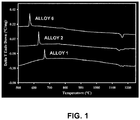
- the characteristics of the alloys that are formed are shown from the differential scanning calorimetry (DSC) data shown in Table 2.
- the glass to crystallization peak occurs from 575 to 669°C depending on chemistry and with relatively high enthalpies of transformation from -90.1 to -124.5 J/g.
- Table 2 DSC Data for Glass to Crystalline Transformations Alloy Peak #1 Onset (°C) Peak #1 Peak (°C) ⁇ H (-J/g) ALLOY 1 665 669 90.1 ALLOY 2 626 631 124.5 ALLOY 6 569 575 97.7
- the powder chemistries listed in Table 1 were welded into a continuous overlay in a submerged arc-process using a plain carbon steel wire electrode (EM12K) under a relatively thick layer of flux, (ESAB 10.72 neutral, bonded aluminate-basic flux). Note that there are a number of possible variations of this technique such as running without flux (i.e., open-arc) and/or incorporating the flux as a powder into the feedstock powder mix.
- the samples were welded at various powder to wire feed ratios onto 572 Grade 50 steel and the 2:1 powder to wire feed ratio was used for further subsequent study. Single pass samples were used to show the effects of weld dilution and double pass samples were additionally welded to show the properties of the overlay where the dilution affect is small. After welding to form a continuous wear plate, samples were cut out using water jet cutting. The resulting samples were then ground flat using a high speed Diemaster grinder.
- Rockwell C hardness testing was performed using a standard diamond indenter. Six hardness measurements were taken on each single pass and double pass samples and the results are shown in Tables 3 and 4 respectively. As shown, relatively high hardness was obtained in all of the resulting weld overlays. In the single pass overlays, hardness was found to vary from 69 to 73 Rc while in the double pass overlays, hardness was found to vary from 66 to 75 Rc. Note that the hardness of the weld overlays shown were in the as-solidified condition and achieved without the need for elevated temperature heat treatment. Table 3.
- the wear resistance of the weld overlays was measured on 1" by 3" coupons cut out of the single and double pass submerged arc overlay plates using the water jet.
- a Falex Friction & Wear Test Machine was used to measure the low stress abrasion resistance following the ASTM G65-04 standard using the Procedure A protocol which involves a test duration of 6000 cycles.
- Table 5 the Procedure A mass loss is shown for the powder feedstock chemistries for both the single and double pass samples made using submerged arc welding. As shown, all samples exhibit relatively high wear resistance with single pass mass losses from 0.07 to 0.14 g and double pass mass losses from 0.07 to 0.15 g. Note that for each measurement after 6,000 cycles, the error bar range is found to be +/-0.02g. Table 5.
- Example #1 ALLOY 6 Submerged-Arc to GMAW Overlay
- the ALLOY 6 feedstock powder was submerged arc-welded using a 1.85 to 1 powder to wire feed ratio using a carbon electrode made up of EM12K.
- a metal powder cored wire was made into a 1/16" diameter wire using Alloy 6 feedstock powder blend and a 1006 steel strip.
- the resulting wire was welded onto a substrate using a conventional Gas Metal Arc Welding (GMAW) process. Note that since flux was put into the wire mixture during manufacturing, the welding could have also been done in the open-arc (i.e., no cover gas) condition with similar results. From the overlays produced both single and double pass samples were cut out using either water jet for submerged arc samples or wire electro discharge machining (EDM) for the GMAW samples.
- EDM wire electro discharge machining
- FIGS. 2 and 3 backscattered electron micrographs are shown of the ALLOY 6 GMAW and submerged arc overlays in both single and double pass samples, respectively.
- the metallurgical structures of both samples are very similar independent of welding technique. This illustrates that a cored wire approach using a plain carbon sheath in GMAW welding or a powder feed with a plain carbon solid wire in submerged-arc welding may result in similar structures and metallurgical behavior.
- Example #2 ALLOY 2 Powder to wire Feed Ratio
- Rockwell C scale hardness was taken on all single and double pass weld overlays after grinding.
- Table 7 the average hardness after six individual measurements is shown as a function of powder to wire feed ratio. As shown all the deposits are relatively hard and the single pass hardness ranges from 67 to 71 Rc while the double pass hardness is found to vary from 69 to 72 Rc.
- Table 7 Hardness as a Function of Powder to Wire Feed Ratio Powder to Wire Feed Ratio Hardness (HRc) Single Pass Double Pass 0.73:1 67.0 69.8 1:1 68.1 69.5 1.1:1 70.2 70.7 1.2:1 69.1 71.6 1.25:1 70.9 69.7
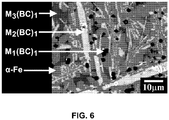
- the M 2 (BC) 1 phase formed first in the liquid and is lathe shaped with widths of 1 to 4 microns and lengths that can be up to a 1 mm in size.
- the alpha iron phase is found to be the matrix and forms through a dendritic growth mode with spherical secondary dendrite arms broken off due to the circulating liquid currents from the welding process.
- the M 1 (BC) 1 borocarbide phase is found to form next and is represented by small cubic phases from 0.2 to 2 microns in size.
- the last liquid to solidify forms the M 3 (BC) 1 phase which is typically from 0.5 to 4 microns in size.
- the distribution of high volume fractions of fine, medium, and coarse borocarbide phases in a ductile matrix appears to be the reason for the relatively exceptional abrasion resistance found in this overlay material.
- the powder to wire feed ratio may be varied to achieve various target chemistries. For example, as the powder to wire feed ratio is reduced, then less powder may be used so the powder must be enriched further in alloying elements. Conversely, as the powder to wire feed ratio is increased, then more powder may be used so the alloying elements in the powder do not need to be enriched as much. This allows for variation in the powder chemistries presented earlier in Table 1.
- Alloy 2 As an example, consider two different powder make-ups for Alloy 2, which are Alloy 2-1 and Alloy 2-2 as shown in Table 10.
- Alloy 2-1 Using an EM12K solid electrode (98.68 wt% Fe, 0.10 wt% C, 0.2 wt% Si, 1.02 wt% Mn), Alloy 2-1 was welded at a 0.73 powder to wire feed ratio using submerged arc welding.
- Alloy 2-2 was welded at a 1.75 powder to wire feed ratio using submerged arc welding.
- the target chemistry in the weld is the same and the weld properties may be relatively similar nonwithstanding the normal variations found in the overlay process.
Landscapes
- Engineering & Computer Science (AREA)
- Mechanical Engineering (AREA)
- Physics & Mathematics (AREA)
- Plasma & Fusion (AREA)
- Chemical & Material Sciences (AREA)
- Materials Engineering (AREA)
- Metallurgy (AREA)
- Organic Chemistry (AREA)
- Battery Electrode And Active Subsutance (AREA)
- Arc Welding In General (AREA)
- Catalysts (AREA)
- Powder Metallurgy (AREA)
Applications Claiming Priority (2)
| Application Number | Priority Date | Filing Date | Title |
|---|---|---|---|
| US23259809P | 2009-08-10 | 2009-08-10 | |
| PCT/US2010/045085 WO2011019761A1 (en) | 2009-08-10 | 2010-08-10 | Feedstock powder for production of high hardness overlays |
Publications (3)
| Publication Number | Publication Date |
|---|---|
| EP2464759A1 EP2464759A1 (en) | 2012-06-20 |
| EP2464759A4 EP2464759A4 (en) | 2017-08-30 |
| EP2464759B1 true EP2464759B1 (en) | 2019-02-13 |
Family
ID=43534050
Family Applications (1)
| Application Number | Title | Priority Date | Filing Date |
|---|---|---|---|
| EP10808661.2A Not-in-force EP2464759B1 (en) | 2009-08-10 | 2010-08-10 | Method of applying a metallic alloy overlay using feedstock powder and iron electrode for production of high hardness overlays |
Country Status (8)
| Country | Link |
|---|---|
| US (1) | US8658934B2 (enExample) |
| EP (1) | EP2464759B1 (enExample) |
| JP (1) | JP6063744B2 (enExample) |
| KR (1) | KR101719018B1 (enExample) |
| CN (1) | CN102498228B (enExample) |
| AU (1) | AU2010282595B2 (enExample) |
| CA (1) | CA2770485C (enExample) |
| WO (1) | WO2011019761A1 (enExample) |
Families Citing this family (24)
| Publication number | Priority date | Publication date | Assignee | Title |
|---|---|---|---|---|
| CN104039483B (zh) | 2011-12-30 | 2017-03-01 | 思高博塔公司 | 涂层组合物 |
| CN103287021A (zh) * | 2012-02-29 | 2013-09-11 | 苏州优霹耐磨复合材料有限公司 | 高硬度耐磨低碳合金钢板 |
| AU2013329190B2 (en) | 2012-10-11 | 2017-09-28 | Scoperta, Inc. | Non-magnetic metal alloy compositions and applications |
| CN102990249A (zh) * | 2012-10-29 | 2013-03-27 | 海门市金易焊接材料有限公司 | 高碳铬铁焊丝 |
| US9802387B2 (en) | 2013-11-26 | 2017-10-31 | Scoperta, Inc. | Corrosion resistant hardfacing alloy |
| CN103639357B (zh) * | 2013-12-25 | 2015-08-05 | 马鞍山市盛磊耐磨合金制造有限公司 | 一种磨煤机磨碗衬板的制备方法 |
| CN103737332A (zh) * | 2014-01-07 | 2014-04-23 | 烟台开发区蓝鲸金属修复有限公司 | 一种硬质高线辊环的生产方法 |
| WO2015176061A1 (en) * | 2014-05-16 | 2015-11-19 | The Nanosteel Company, Inc. | Layered construction of metallic materials |
| CN103990920B (zh) * | 2014-05-23 | 2017-06-09 | 成都海讯科技实业有限公司 | 一种耐磨堆焊焊条 |
| WO2015191458A1 (en) | 2014-06-09 | 2015-12-17 | Scoperta, Inc. | Crack resistant hardfacing alloys |
| EP3234209B1 (en) | 2014-12-16 | 2024-07-24 | Scoperta, Inc. | Tough and wear resistant ferrous alloys containing multiple hardphases |
| JP6999081B2 (ja) | 2015-09-04 | 2022-01-18 | エリコン メテコ(ユーエス)インコーポレイテッド | 非クロム及び低クロム耐摩耗性合金 |
| US10851444B2 (en) | 2015-09-08 | 2020-12-01 | Oerlikon Metco (Us) Inc. | Non-magnetic, strong carbide forming alloys for powder manufacture |
| MX393339B (es) | 2015-11-10 | 2025-03-24 | Scoperta Inc | Materiales de rociado por arco de dos hilos controlado por oxidación. |
| US11279996B2 (en) | 2016-03-22 | 2022-03-22 | Oerlikon Metco (Us) Inc. | Fully readable thermal spray coating |
| CN108359913A (zh) * | 2018-02-08 | 2018-08-03 | 盐城市鑫洋电热材料有限公司 | 一种锰铁铬低碳合金及其制备方法 |
| WO2019191400A1 (en) | 2018-03-29 | 2019-10-03 | Oerlikon Metco (Us) Inc. | Reduced carbides ferrous alloys |
| CN113195759B (zh) | 2018-10-26 | 2023-09-19 | 欧瑞康美科(美国)公司 | 耐腐蚀和耐磨镍基合金 |
| CA3134191A1 (en) | 2019-03-28 | 2020-10-01 | Oerlikon Metco (Us) Inc. | Thermal spray iron-based alloys for coating engine cylinder bores |
| CA3136967A1 (en) | 2019-05-03 | 2020-11-12 | Oerlikon Metco (Us) Inc. | Powder feedstock for wear resistant bulk welding configured to optimize manufacturability |
| MX2022000309A (es) | 2019-07-09 | 2022-03-17 | Oerlikon Metco Us Inc | Aleaciones a base de hierro dise?adas para resistencia al desgaste y la corrosion. |
| CN115379911A (zh) | 2020-02-25 | 2022-11-22 | 欧瑞康美科(美国)公司 | 类球状碳化钨颗粒 |
| JP7287916B2 (ja) | 2020-03-12 | 2023-06-06 | 株式会社神戸製鋼所 | 積層造形物の製造方法、及び積層造形物 |
| EP4588592A1 (en) * | 2024-01-16 | 2025-07-23 | Höganäs AB (publ) | Solid solution held chromium carbides for thermal spraying and method of making the same |
Family Cites Families (7)
| Publication number | Priority date | Publication date | Assignee | Title |
|---|---|---|---|---|
| DE2919477C2 (de) * | 1979-05-15 | 1982-08-05 | Fried. Krupp Gmbh, 4300 Essen | Verschleißfester Verbundwerkstoff, Verfahren zu seiner Herstellung und Verwendung des Verbundwerkstoffes |
| DE3613389A1 (de) * | 1985-05-17 | 1986-11-20 | Roman Francis Houston Tex. Arnoldy | Verfahren zur herstellung einer hartauftragsschweissungs-legierungszusammensetzung |
| US5569395A (en) * | 1992-02-19 | 1996-10-29 | Arnco Technology Trust | Deep coat faced plate and method |
| DE112004000275T5 (de) * | 2003-02-11 | 2006-03-16 | The Nanosteel Co., Maitland | Hochaktive flüssige Schmelzen zur Bildung von Beschichtungen |
| US7361411B2 (en) * | 2003-04-21 | 2008-04-22 | Att Technology, Ltd. | Hardfacing alloy, methods, and products |
| US8704134B2 (en) * | 2005-02-11 | 2014-04-22 | The Nanosteel Company, Inc. | High hardness/high wear resistant iron based weld overlay materials |
| US7553382B2 (en) * | 2005-02-11 | 2009-06-30 | The Nanosteel Company, Inc. | Glass stability, glass forming ability, and microstructural refinement |
-
2010
- 2010-08-10 KR KR1020127005936A patent/KR101719018B1/ko not_active Expired - Fee Related
- 2010-08-10 JP JP2012524793A patent/JP6063744B2/ja not_active Expired - Fee Related
- 2010-08-10 EP EP10808661.2A patent/EP2464759B1/en not_active Not-in-force
- 2010-08-10 CN CN201080040757.3A patent/CN102498228B/zh active Active
- 2010-08-10 WO PCT/US2010/045085 patent/WO2011019761A1/en not_active Ceased
- 2010-08-10 CA CA2770485A patent/CA2770485C/en active Active
- 2010-08-10 US US12/854,103 patent/US8658934B2/en active Active
- 2010-08-10 AU AU2010282595A patent/AU2010282595B2/en active Active
Non-Patent Citations (1)
| Title |
|---|
| None * |
Also Published As
| Publication number | Publication date |
|---|---|
| JP6063744B2 (ja) | 2017-01-18 |
| WO2011019761A1 (en) | 2011-02-17 |
| KR101719018B1 (ko) | 2017-03-23 |
| EP2464759A1 (en) | 2012-06-20 |
| CN102498228A (zh) | 2012-06-13 |
| JP2013501630A (ja) | 2013-01-17 |
| US8658934B2 (en) | 2014-02-25 |
| CA2770485C (en) | 2018-10-30 |
| US20110031222A1 (en) | 2011-02-10 |
| AU2010282595A1 (en) | 2012-03-01 |
| AU2010282595B2 (en) | 2015-03-12 |
| KR20120040735A (ko) | 2012-04-27 |
| EP2464759A4 (en) | 2017-08-30 |
| CN102498228B (zh) | 2014-07-16 |
| CA2770485A1 (en) | 2011-02-17 |
Similar Documents
| Publication | Publication Date | Title |
|---|---|---|
| US8658934B2 (en) | Feedstock powder for production of high hardness overlays | |
| CA2658296C (en) | High hardness/high wear resistant iron based weld overlay materials | |
| EP1848837B1 (en) | Improved glass stability, glass forming ability, and microstructural refinement | |
| Clare et al. | Laser cladding for railway repair and preventative maintenance | |
| DE3152549C2 (de) | Pulverförmiger Beschichtungswerkstoff zum thermischen Beschichten | |
| Chotěborský et al. | Abrasive wear of high chromium Fe-Cr-C hardfacing alloys | |
| WO2011053928A1 (en) | Glass forming hardbanding material | |
| JP2009543699A5 (enExample) | ||
| WO2022223835A1 (en) | Wear and corrosion resistant iron based coating | |
| KR101963472B1 (ko) | 니켈 및 al2o3 표면 코팅을 가지는 텅스텐 초경합금제의 마찰 교반 용접 공구 | |
| Ke et al. | Effect of Vanadium on Microstructure and Mechanical Properties of M2 High‐Speed Steel Prepared by Laser Metal Direct Deposition Forming | |
| DE102016121531B4 (de) | Werkstoff sowie Verwendung eines solchen | |
| Gramajo et al. | Effect of welding parameters on nanostructured Fe-(C, B)-(Cr, Nb) alloys | |
| Schwarz et al. | A new series of Co-based amorphous alloys and their application as cladding materials | |
| Çelik et al. | Spot Welding of AISI 1010 Steel Sheets Coated with WC by ESD Technique | |
| Song et al. | Effect of SiC content on the microstructure and high-temperature tribological properties of laser-cladded AlCoCrFeNi coatings | |
| Paul et al. | Automated laser fabrication of high performance saw blades |
Legal Events
| Date | Code | Title | Description |
|---|---|---|---|
| PUAI | Public reference made under article 153(3) epc to a published international application that has entered the european phase |
Free format text: ORIGINAL CODE: 0009012 |
|
| 17P | Request for examination filed |
Effective date: 20120224 |
|
| AK | Designated contracting states |
Kind code of ref document: A1 Designated state(s): AL AT BE BG CH CY CZ DE DK EE ES FI FR GB GR HR HU IE IS IT LI LT LU LV MC MK MT NL NO PL PT RO SE SI SK SM TR |
|
| DAX | Request for extension of the european patent (deleted) | ||
| RA4 | Supplementary search report drawn up and despatched (corrected) |
Effective date: 20170802 |
|
| RIC1 | Information provided on ipc code assigned before grant |
Ipc: B23K 101/04 20060101ALN20170727BHEP Ipc: B23K 9/04 20060101AFI20170727BHEP Ipc: B23K 103/04 20060101ALN20170727BHEP Ipc: B23K 9/173 20060101ALI20170727BHEP Ipc: B23K 9/167 20060101ALI20170727BHEP Ipc: B23K 9/18 20060101ALI20170727BHEP Ipc: B23K 9/23 20060101ALI20170727BHEP Ipc: B23K 101/18 20060101ALN20170727BHEP |
|
| REG | Reference to a national code |
Ref country code: DE Ref legal event code: R079 Ref document number: 602010056982 Country of ref document: DE Free format text: PREVIOUS MAIN CLASS: C22C0038380000 Ipc: B23K0009040000 |
|
| RIC1 | Information provided on ipc code assigned before grant |
Ipc: B23K 9/173 20060101ALI20180719BHEP Ipc: B23K 101/18 20060101ALN20180719BHEP Ipc: B23K 101/04 20060101ALN20180719BHEP Ipc: B23K 9/167 20060101ALI20180719BHEP Ipc: B23K 9/18 20060101ALI20180719BHEP Ipc: B23K 103/04 20060101ALN20180719BHEP Ipc: B23K 9/04 20060101AFI20180719BHEP Ipc: B23K 9/23 20060101ALI20180719BHEP |
|
| GRAP | Despatch of communication of intention to grant a patent |
Free format text: ORIGINAL CODE: EPIDOSNIGR1 |
|
| STAA | Information on the status of an ep patent application or granted ep patent |
Free format text: STATUS: GRANT OF PATENT IS INTENDED |
|
| RIC1 | Information provided on ipc code assigned before grant |
Ipc: B23K 103/04 20060101ALN20180725BHEP Ipc: B23K 9/18 20060101ALI20180725BHEP Ipc: B23K 9/167 20060101ALI20180725BHEP Ipc: B23K 9/23 20060101ALI20180725BHEP Ipc: B23K 101/18 20060101ALN20180725BHEP Ipc: B23K 9/173 20060101ALI20180725BHEP Ipc: B23K 9/04 20060101AFI20180725BHEP Ipc: B23K 101/04 20060101ALN20180725BHEP |
|
| RIC1 | Information provided on ipc code assigned before grant |
Ipc: B23K 9/04 20060101AFI20180727BHEP Ipc: B23K 9/18 20060101ALI20180727BHEP Ipc: B23K 9/167 20060101ALI20180727BHEP Ipc: B23K 101/04 20060101ALN20180727BHEP Ipc: B23K 103/04 20060101ALN20180727BHEP Ipc: B23K 101/18 20060101ALN20180727BHEP Ipc: B23K 9/173 20060101ALI20180727BHEP Ipc: B23K 9/23 20060101ALI20180727BHEP |
|
| INTG | Intention to grant announced |
Effective date: 20180824 |
|
| GRAS | Grant fee paid |
Free format text: ORIGINAL CODE: EPIDOSNIGR3 |
|
| GRAA | (expected) grant |
Free format text: ORIGINAL CODE: 0009210 |
|
| STAA | Information on the status of an ep patent application or granted ep patent |
Free format text: STATUS: THE PATENT HAS BEEN GRANTED |
|
| AK | Designated contracting states |
Kind code of ref document: B1 Designated state(s): AL AT BE BG CH CY CZ DE DK EE ES FI FR GB GR HR HU IE IS IT LI LT LU LV MC MK MT NL NO PL PT RO SE SI SK SM TR |
|
| REG | Reference to a national code |
Ref country code: GB Ref legal event code: FG4D |
|
| REG | Reference to a national code |
Ref country code: CH Ref legal event code: EP Ref country code: AT Ref legal event code: REF Ref document number: 1095923 Country of ref document: AT Kind code of ref document: T Effective date: 20190215 |
|
| REG | Reference to a national code |
Ref country code: IE Ref legal event code: FG4D |
|
| REG | Reference to a national code |
Ref country code: DE Ref legal event code: R096 Ref document number: 602010056982 Country of ref document: DE |
|
| REG | Reference to a national code |
Ref country code: SE Ref legal event code: TRGR |
|
| REG | Reference to a national code |
Ref country code: LT Ref legal event code: MG4D |
|
| REG | Reference to a national code |
Ref country code: NL Ref legal event code: MP Effective date: 20190213 |
|
| PG25 | Lapsed in a contracting state [announced via postgrant information from national office to epo] |
Ref country code: NO Free format text: LAPSE BECAUSE OF FAILURE TO SUBMIT A TRANSLATION OF THE DESCRIPTION OR TO PAY THE FEE WITHIN THE PRESCRIBED TIME-LIMIT Effective date: 20190513 Ref country code: LT Free format text: LAPSE BECAUSE OF FAILURE TO SUBMIT A TRANSLATION OF THE DESCRIPTION OR TO PAY THE FEE WITHIN THE PRESCRIBED TIME-LIMIT Effective date: 20190213 Ref country code: PT Free format text: LAPSE BECAUSE OF FAILURE TO SUBMIT A TRANSLATION OF THE DESCRIPTION OR TO PAY THE FEE WITHIN THE PRESCRIBED TIME-LIMIT Effective date: 20190613 Ref country code: NL Free format text: LAPSE BECAUSE OF FAILURE TO SUBMIT A TRANSLATION OF THE DESCRIPTION OR TO PAY THE FEE WITHIN THE PRESCRIBED TIME-LIMIT Effective date: 20190213 |
|
| PG25 | Lapsed in a contracting state [announced via postgrant information from national office to epo] |
Ref country code: BG Free format text: LAPSE BECAUSE OF FAILURE TO SUBMIT A TRANSLATION OF THE DESCRIPTION OR TO PAY THE FEE WITHIN THE PRESCRIBED TIME-LIMIT Effective date: 20190513 Ref country code: HR Free format text: LAPSE BECAUSE OF FAILURE TO SUBMIT A TRANSLATION OF THE DESCRIPTION OR TO PAY THE FEE WITHIN THE PRESCRIBED TIME-LIMIT Effective date: 20190213 Ref country code: IS Free format text: LAPSE BECAUSE OF FAILURE TO SUBMIT A TRANSLATION OF THE DESCRIPTION OR TO PAY THE FEE WITHIN THE PRESCRIBED TIME-LIMIT Effective date: 20190613 Ref country code: LV Free format text: LAPSE BECAUSE OF FAILURE TO SUBMIT A TRANSLATION OF THE DESCRIPTION OR TO PAY THE FEE WITHIN THE PRESCRIBED TIME-LIMIT Effective date: 20190213 Ref country code: GR Free format text: LAPSE BECAUSE OF FAILURE TO SUBMIT A TRANSLATION OF THE DESCRIPTION OR TO PAY THE FEE WITHIN THE PRESCRIBED TIME-LIMIT Effective date: 20190514 |
|
| REG | Reference to a national code |
Ref country code: AT Ref legal event code: MK05 Ref document number: 1095923 Country of ref document: AT Kind code of ref document: T Effective date: 20190213 |
|
| PG25 | Lapsed in a contracting state [announced via postgrant information from national office to epo] |
Ref country code: DK Free format text: LAPSE BECAUSE OF FAILURE TO SUBMIT A TRANSLATION OF THE DESCRIPTION OR TO PAY THE FEE WITHIN THE PRESCRIBED TIME-LIMIT Effective date: 20190213 Ref country code: EE Free format text: LAPSE BECAUSE OF FAILURE TO SUBMIT A TRANSLATION OF THE DESCRIPTION OR TO PAY THE FEE WITHIN THE PRESCRIBED TIME-LIMIT Effective date: 20190213 Ref country code: AL Free format text: LAPSE BECAUSE OF FAILURE TO SUBMIT A TRANSLATION OF THE DESCRIPTION OR TO PAY THE FEE WITHIN THE PRESCRIBED TIME-LIMIT Effective date: 20190213 Ref country code: IT Free format text: LAPSE BECAUSE OF FAILURE TO SUBMIT A TRANSLATION OF THE DESCRIPTION OR TO PAY THE FEE WITHIN THE PRESCRIBED TIME-LIMIT Effective date: 20190213 Ref country code: RO Free format text: LAPSE BECAUSE OF FAILURE TO SUBMIT A TRANSLATION OF THE DESCRIPTION OR TO PAY THE FEE WITHIN THE PRESCRIBED TIME-LIMIT Effective date: 20190213 Ref country code: SK Free format text: LAPSE BECAUSE OF FAILURE TO SUBMIT A TRANSLATION OF THE DESCRIPTION OR TO PAY THE FEE WITHIN THE PRESCRIBED TIME-LIMIT Effective date: 20190213 Ref country code: ES Free format text: LAPSE BECAUSE OF FAILURE TO SUBMIT A TRANSLATION OF THE DESCRIPTION OR TO PAY THE FEE WITHIN THE PRESCRIBED TIME-LIMIT Effective date: 20190213 Ref country code: CZ Free format text: LAPSE BECAUSE OF FAILURE TO SUBMIT A TRANSLATION OF THE DESCRIPTION OR TO PAY THE FEE WITHIN THE PRESCRIBED TIME-LIMIT Effective date: 20190213 |
|
| REG | Reference to a national code |
Ref country code: DE Ref legal event code: R097 Ref document number: 602010056982 Country of ref document: DE |
|
| PG25 | Lapsed in a contracting state [announced via postgrant information from national office to epo] |
Ref country code: SM Free format text: LAPSE BECAUSE OF FAILURE TO SUBMIT A TRANSLATION OF THE DESCRIPTION OR TO PAY THE FEE WITHIN THE PRESCRIBED TIME-LIMIT Effective date: 20190213 Ref country code: PL Free format text: LAPSE BECAUSE OF FAILURE TO SUBMIT A TRANSLATION OF THE DESCRIPTION OR TO PAY THE FEE WITHIN THE PRESCRIBED TIME-LIMIT Effective date: 20190213 |
|
| PLBE | No opposition filed within time limit |
Free format text: ORIGINAL CODE: 0009261 |
|
| STAA | Information on the status of an ep patent application or granted ep patent |
Free format text: STATUS: NO OPPOSITION FILED WITHIN TIME LIMIT |
|
| PG25 | Lapsed in a contracting state [announced via postgrant information from national office to epo] |
Ref country code: AT Free format text: LAPSE BECAUSE OF FAILURE TO SUBMIT A TRANSLATION OF THE DESCRIPTION OR TO PAY THE FEE WITHIN THE PRESCRIBED TIME-LIMIT Effective date: 20190213 |
|
| 26N | No opposition filed |
Effective date: 20191114 |
|
| PG25 | Lapsed in a contracting state [announced via postgrant information from national office to epo] |
Ref country code: SI Free format text: LAPSE BECAUSE OF FAILURE TO SUBMIT A TRANSLATION OF THE DESCRIPTION OR TO PAY THE FEE WITHIN THE PRESCRIBED TIME-LIMIT Effective date: 20190213 |
|
| PG25 | Lapsed in a contracting state [announced via postgrant information from national office to epo] |
Ref country code: TR Free format text: LAPSE BECAUSE OF FAILURE TO SUBMIT A TRANSLATION OF THE DESCRIPTION OR TO PAY THE FEE WITHIN THE PRESCRIBED TIME-LIMIT Effective date: 20190213 |
|
| PG25 | Lapsed in a contracting state [announced via postgrant information from national office to epo] |
Ref country code: LU Free format text: LAPSE BECAUSE OF NON-PAYMENT OF DUE FEES Effective date: 20190810 Ref country code: LI Free format text: LAPSE BECAUSE OF NON-PAYMENT OF DUE FEES Effective date: 20190831 Ref country code: CH Free format text: LAPSE BECAUSE OF NON-PAYMENT OF DUE FEES Effective date: 20190831 Ref country code: MC Free format text: LAPSE BECAUSE OF FAILURE TO SUBMIT A TRANSLATION OF THE DESCRIPTION OR TO PAY THE FEE WITHIN THE PRESCRIBED TIME-LIMIT Effective date: 20190213 |
|
| REG | Reference to a national code |
Ref country code: BE Ref legal event code: MM Effective date: 20190831 |
|
| PG25 | Lapsed in a contracting state [announced via postgrant information from national office to epo] |
Ref country code: FR Free format text: LAPSE BECAUSE OF NON-PAYMENT OF DUE FEES Effective date: 20190831 Ref country code: IE Free format text: LAPSE BECAUSE OF NON-PAYMENT OF DUE FEES Effective date: 20190810 |
|
| PG25 | Lapsed in a contracting state [announced via postgrant information from national office to epo] |
Ref country code: BE Free format text: LAPSE BECAUSE OF NON-PAYMENT OF DUE FEES Effective date: 20190831 |
|
| PG25 | Lapsed in a contracting state [announced via postgrant information from national office to epo] |
Ref country code: CY Free format text: LAPSE BECAUSE OF FAILURE TO SUBMIT A TRANSLATION OF THE DESCRIPTION OR TO PAY THE FEE WITHIN THE PRESCRIBED TIME-LIMIT Effective date: 20190213 |
|
| PG25 | Lapsed in a contracting state [announced via postgrant information from national office to epo] |
Ref country code: HU Free format text: LAPSE BECAUSE OF FAILURE TO SUBMIT A TRANSLATION OF THE DESCRIPTION OR TO PAY THE FEE WITHIN THE PRESCRIBED TIME-LIMIT; INVALID AB INITIO Effective date: 20100810 Ref country code: MT Free format text: LAPSE BECAUSE OF FAILURE TO SUBMIT A TRANSLATION OF THE DESCRIPTION OR TO PAY THE FEE WITHIN THE PRESCRIBED TIME-LIMIT Effective date: 20190213 |
|
| PGFP | Annual fee paid to national office [announced via postgrant information from national office to epo] |
Ref country code: FI Payment date: 20210819 Year of fee payment: 12 |
|
| PGFP | Annual fee paid to national office [announced via postgrant information from national office to epo] |
Ref country code: SE Payment date: 20210823 Year of fee payment: 12 Ref country code: DE Payment date: 20210819 Year of fee payment: 12 Ref country code: GB Payment date: 20210824 Year of fee payment: 12 |
|
| PG25 | Lapsed in a contracting state [announced via postgrant information from national office to epo] |
Ref country code: MK Free format text: LAPSE BECAUSE OF FAILURE TO SUBMIT A TRANSLATION OF THE DESCRIPTION OR TO PAY THE FEE WITHIN THE PRESCRIBED TIME-LIMIT Effective date: 20190213 |
|
| REG | Reference to a national code |
Ref country code: DE Ref legal event code: R119 Ref document number: 602010056982 Country of ref document: DE |
|
| REG | Reference to a national code |
Ref country code: SE Ref legal event code: EUG |
|
| GBPC | Gb: european patent ceased through non-payment of renewal fee |
Effective date: 20220810 |
|
| PG25 | Lapsed in a contracting state [announced via postgrant information from national office to epo] |
Ref country code: SE Free format text: LAPSE BECAUSE OF NON-PAYMENT OF DUE FEES Effective date: 20220811 Ref country code: FI Free format text: LAPSE BECAUSE OF NON-PAYMENT OF DUE FEES Effective date: 20220810 |
|
| PG25 | Lapsed in a contracting state [announced via postgrant information from national office to epo] |
Ref country code: DE Free format text: LAPSE BECAUSE OF NON-PAYMENT OF DUE FEES Effective date: 20230301 |
|
| PG25 | Lapsed in a contracting state [announced via postgrant information from national office to epo] |
Ref country code: GB Free format text: LAPSE BECAUSE OF NON-PAYMENT OF DUE FEES Effective date: 20220810 |