EP2463074A1 - Method for manufacturing thermally expandable base material for vehicle interior and method for manufacturing base material for vehicle interior using same - Google Patents
Method for manufacturing thermally expandable base material for vehicle interior and method for manufacturing base material for vehicle interior using same Download PDFInfo
- Publication number
- EP2463074A1 EP2463074A1 EP10806416A EP10806416A EP2463074A1 EP 2463074 A1 EP2463074 A1 EP 2463074A1 EP 10806416 A EP10806416 A EP 10806416A EP 10806416 A EP10806416 A EP 10806416A EP 2463074 A1 EP2463074 A1 EP 2463074A1
- Authority
- EP
- European Patent Office
- Prior art keywords
- thermally expandable
- fiber
- vehicle interior
- base material
- thermoplastic resin
- Prior art date
- Legal status (The legal status is an assumption and is not a legal conclusion. Google has not performed a legal analysis and makes no representation as to the accuracy of the status listed.)
- Granted
Links
Images


Classifications
-
- B—PERFORMING OPERATIONS; TRANSPORTING
- B29—WORKING OF PLASTICS; WORKING OF SUBSTANCES IN A PLASTIC STATE IN GENERAL
- B29C—SHAPING OR JOINING OF PLASTICS; SHAPING OF MATERIAL IN A PLASTIC STATE, NOT OTHERWISE PROVIDED FOR; AFTER-TREATMENT OF THE SHAPED PRODUCTS, e.g. REPAIRING
- B29C44/00—Shaping by internal pressure generated in the material, e.g. swelling or foaming ; Producing porous or cellular expanded plastics articles
- B29C44/02—Shaping by internal pressure generated in the material, e.g. swelling or foaming ; Producing porous or cellular expanded plastics articles for articles of definite length, i.e. discrete articles
- B29C44/08—Shaping by internal pressure generated in the material, e.g. swelling or foaming ; Producing porous or cellular expanded plastics articles for articles of definite length, i.e. discrete articles using several expanding or moulding steps
-
- B—PERFORMING OPERATIONS; TRANSPORTING
- B29—WORKING OF PLASTICS; WORKING OF SUBSTANCES IN A PLASTIC STATE IN GENERAL
- B29C—SHAPING OR JOINING OF PLASTICS; SHAPING OF MATERIAL IN A PLASTIC STATE, NOT OTHERWISE PROVIDED FOR; AFTER-TREATMENT OF THE SHAPED PRODUCTS, e.g. REPAIRING
- B29C43/00—Compression moulding, i.e. applying external pressure to flow the moulding material; Apparatus therefor
- B29C43/02—Compression moulding, i.e. applying external pressure to flow the moulding material; Apparatus therefor of articles of definite length, i.e. discrete articles
-
- B—PERFORMING OPERATIONS; TRANSPORTING
- B29—WORKING OF PLASTICS; WORKING OF SUBSTANCES IN A PLASTIC STATE IN GENERAL
- B29C—SHAPING OR JOINING OF PLASTICS; SHAPING OF MATERIAL IN A PLASTIC STATE, NOT OTHERWISE PROVIDED FOR; AFTER-TREATMENT OF THE SHAPED PRODUCTS, e.g. REPAIRING
- B29C43/00—Compression moulding, i.e. applying external pressure to flow the moulding material; Apparatus therefor
- B29C43/32—Component parts, details or accessories; Auxiliary operations
- B29C43/34—Feeding the material to the mould or the compression means
-
- B—PERFORMING OPERATIONS; TRANSPORTING
- B29—WORKING OF PLASTICS; WORKING OF SUBSTANCES IN A PLASTIC STATE IN GENERAL
- B29C—SHAPING OR JOINING OF PLASTICS; SHAPING OF MATERIAL IN A PLASTIC STATE, NOT OTHERWISE PROVIDED FOR; AFTER-TREATMENT OF THE SHAPED PRODUCTS, e.g. REPAIRING
- B29C44/00—Shaping by internal pressure generated in the material, e.g. swelling or foaming ; Producing porous or cellular expanded plastics articles
- B29C44/34—Auxiliary operations
- B29C44/3484—Stopping the foaming reaction until the material is heated or re-heated
-
- B—PERFORMING OPERATIONS; TRANSPORTING
- B60—VEHICLES IN GENERAL
- B60R—VEHICLES, VEHICLE FITTINGS, OR VEHICLE PARTS, NOT OTHERWISE PROVIDED FOR
- B60R13/00—Elements for body-finishing, identifying, or decorating; Arrangements or adaptations for advertising purposes
- B60R13/02—Internal Trim mouldings ; Internal Ledges; Wall liners for passenger compartments; Roof liners
-
- B—PERFORMING OPERATIONS; TRANSPORTING
- B29—WORKING OF PLASTICS; WORKING OF SUBSTANCES IN A PLASTIC STATE IN GENERAL
- B29C—SHAPING OR JOINING OF PLASTICS; SHAPING OF MATERIAL IN A PLASTIC STATE, NOT OTHERWISE PROVIDED FOR; AFTER-TREATMENT OF THE SHAPED PRODUCTS, e.g. REPAIRING
- B29C43/00—Compression moulding, i.e. applying external pressure to flow the moulding material; Apparatus therefor
- B29C43/32—Component parts, details or accessories; Auxiliary operations
- B29C43/34—Feeding the material to the mould or the compression means
- B29C2043/3405—Feeding the material to the mould or the compression means using carrying means
- B29C2043/3416—Feeding the material to the mould or the compression means using carrying means conveyor belts
-
- B—PERFORMING OPERATIONS; TRANSPORTING
- B29—WORKING OF PLASTICS; WORKING OF SUBSTANCES IN A PLASTIC STATE IN GENERAL
- B29C—SHAPING OR JOINING OF PLASTICS; SHAPING OF MATERIAL IN A PLASTIC STATE, NOT OTHERWISE PROVIDED FOR; AFTER-TREATMENT OF THE SHAPED PRODUCTS, e.g. REPAIRING
- B29C43/00—Compression moulding, i.e. applying external pressure to flow the moulding material; Apparatus therefor
-
- B—PERFORMING OPERATIONS; TRANSPORTING
- B29—WORKING OF PLASTICS; WORKING OF SUBSTANCES IN A PLASTIC STATE IN GENERAL
- B29C—SHAPING OR JOINING OF PLASTICS; SHAPING OF MATERIAL IN A PLASTIC STATE, NOT OTHERWISE PROVIDED FOR; AFTER-TREATMENT OF THE SHAPED PRODUCTS, e.g. REPAIRING
- B29C51/00—Shaping by thermoforming, i.e. shaping sheets or sheet like preforms after heating, e.g. shaping sheets in matched moulds or by deep-drawing; Apparatus therefor
- B29C51/02—Combined thermoforming and manufacture of the preform
-
- B—PERFORMING OPERATIONS; TRANSPORTING
- B29—WORKING OF PLASTICS; WORKING OF SUBSTANCES IN A PLASTIC STATE IN GENERAL
- B29C—SHAPING OR JOINING OF PLASTICS; SHAPING OF MATERIAL IN A PLASTIC STATE, NOT OTHERWISE PROVIDED FOR; AFTER-TREATMENT OF THE SHAPED PRODUCTS, e.g. REPAIRING
- B29C51/00—Shaping by thermoforming, i.e. shaping sheets or sheet like preforms after heating, e.g. shaping sheets in matched moulds or by deep-drawing; Apparatus therefor
- B29C51/08—Deep drawing or matched-mould forming, i.e. using mechanical means only
- B29C51/082—Deep drawing or matched-mould forming, i.e. using mechanical means only by shaping between complementary mould parts
-
- B—PERFORMING OPERATIONS; TRANSPORTING
- B29—WORKING OF PLASTICS; WORKING OF SUBSTANCES IN A PLASTIC STATE IN GENERAL
- B29C—SHAPING OR JOINING OF PLASTICS; SHAPING OF MATERIAL IN A PLASTIC STATE, NOT OTHERWISE PROVIDED FOR; AFTER-TREATMENT OF THE SHAPED PRODUCTS, e.g. REPAIRING
- B29C51/00—Shaping by thermoforming, i.e. shaping sheets or sheet like preforms after heating, e.g. shaping sheets in matched moulds or by deep-drawing; Apparatus therefor
- B29C51/14—Shaping by thermoforming, i.e. shaping sheets or sheet like preforms after heating, e.g. shaping sheets in matched moulds or by deep-drawing; Apparatus therefor using multilayered preforms or sheets
- B29C51/145—Shaping by thermoforming, i.e. shaping sheets or sheet like preforms after heating, e.g. shaping sheets in matched moulds or by deep-drawing; Apparatus therefor using multilayered preforms or sheets having at least one layer of textile or fibrous material combined with at least one plastics layer
-
- B—PERFORMING OPERATIONS; TRANSPORTING
- B29—WORKING OF PLASTICS; WORKING OF SUBSTANCES IN A PLASTIC STATE IN GENERAL
- B29K—INDEXING SCHEME ASSOCIATED WITH SUBCLASSES B29B, B29C OR B29D, RELATING TO MOULDING MATERIALS OR TO MATERIALS FOR MOULDS, REINFORCEMENTS, FILLERS OR PREFORMED PARTS, e.g. INSERTS
- B29K2101/00—Use of unspecified macromolecular compounds as moulding material
- B29K2101/12—Thermoplastic materials
-
- B—PERFORMING OPERATIONS; TRANSPORTING
- B29—WORKING OF PLASTICS; WORKING OF SUBSTANCES IN A PLASTIC STATE IN GENERAL
- B29K—INDEXING SCHEME ASSOCIATED WITH SUBCLASSES B29B, B29C OR B29D, RELATING TO MOULDING MATERIALS OR TO MATERIALS FOR MOULDS, REINFORCEMENTS, FILLERS OR PREFORMED PARTS, e.g. INSERTS
- B29K2105/00—Condition, form or state of moulded material or of the material to be shaped
- B29K2105/06—Condition, form or state of moulded material or of the material to be shaped containing reinforcements, fillers or inserts
- B29K2105/08—Condition, form or state of moulded material or of the material to be shaped containing reinforcements, fillers or inserts of continuous length, e.g. cords, rovings, mats, fabrics, strands or yarns
- B29K2105/0809—Fabrics
-
- B—PERFORMING OPERATIONS; TRANSPORTING
- B29—WORKING OF PLASTICS; WORKING OF SUBSTANCES IN A PLASTIC STATE IN GENERAL
- B29K—INDEXING SCHEME ASSOCIATED WITH SUBCLASSES B29B, B29C OR B29D, RELATING TO MOULDING MATERIALS OR TO MATERIALS FOR MOULDS, REINFORCEMENTS, FILLERS OR PREFORMED PARTS, e.g. INSERTS
- B29K2709/00—Use of inorganic materials not provided for in groups B29K2703/00 - B29K2707/00, for preformed parts, e.g. for inserts
- B29K2709/08—Glass
-
- B—PERFORMING OPERATIONS; TRANSPORTING
- B29—WORKING OF PLASTICS; WORKING OF SUBSTANCES IN A PLASTIC STATE IN GENERAL
- B29L—INDEXING SCHEME ASSOCIATED WITH SUBCLASS B29C, RELATING TO PARTICULAR ARTICLES
- B29L2031/00—Other particular articles
- B29L2031/30—Vehicles, e.g. ships or aircraft, or body parts thereof
- B29L2031/3005—Body finishings
-
- B—PERFORMING OPERATIONS; TRANSPORTING
- B29—WORKING OF PLASTICS; WORKING OF SUBSTANCES IN A PLASTIC STATE IN GENERAL
- B29L—INDEXING SCHEME ASSOCIATED WITH SUBCLASS B29C, RELATING TO PARTICULAR ARTICLES
- B29L2031/00—Other particular articles
- B29L2031/30—Vehicles, e.g. ships or aircraft, or body parts thereof
- B29L2031/3005—Body finishings
- B29L2031/3041—Trim panels
Definitions
- the present invention relates to a production method of a thermally expandable base material for vehicle interior and a production method of a base material for vehicle interior using the same. More specifically, the present invention relates to a method for producing a thermally expandable base material for vehicle interior allowing the production of a vehicle interior material which is lightweight, sufficiently sound absorbable and highly rigid, and to a method for producing a base material for vehicle interior using the thermally expandable base material for vehicle interior. Since the methods of the present invention for producing a thermally expandable base material for vehicle interior and a base material for vehicle interior do not use a medium such as water, and all the processes in the methods are carried out under dry conditions, these base materials can be efficiently produced by simple apparatus and simple operations.
- a base material for a vehicle interior material which is produced by depositing a mixture of an inorganic fiber and a resin fiber, needling the deposit to fabricate a mat, heating the mat at a temperature at which the resin fiber is melt, hot-pressing the mat, and then cold-pressing the mat to mold.
- the base material has good thermal dimensional stability, and thus the rate of the thermal dimensional change is low.
- the base material must have a high basis weight, and thus cannot meet the recent demand for the reduction of vehicle weight.
- a base material for vehicle interior in which a thermally expandable microcapsule is incorporated into a mat obtained depositing a mixture of an inorganic fiber and a resin fiber and/or resin powder.
- the weight of the base material can be readily reduced since the thermally expandable microcapsule is expanded during secondary molding.
- the secondary molded product has a sufficient thickness and high rigidity.
- Such base material may be produced by, for example, incorporating a thermoplastic resin binder and a foamable microsphere into a needled fiber felt which is composed mainly of a glass fiber while being dispersed, and then blowing (for example, in Patent Document 1).
- a production method of an expanded article in which a reinforced fiber, a thermally expandable powder and the like are dispersed in a specific aqueous medium to prepare a bubble solution, and the bubble solution is subjected to forming into a web, the web is heated, compressed, and cooled to fabricate a stampable sheet, the stampable sheet is heated to expand the thermally expandable powder, molded, and then cooled (for example, in Patent Document 2).
- the thermoplastic resin binder is used in the form of a resin emulsion.
- the document discloses the foamable microsphere is preferably mixed with the resin emulsion.
- the method is a wet system using a complicated apparatus, and thus involves complicated operations.
- the web is fabricated by forming. The method requires a complicated apparatus, and involves complicated operations and processes.
- the method uses a costly bubble solution prepared by adding a surfactant, and dispersing a reinforced fiber and a thermally expandable powder therein, and thus is not preferred from the viewpoint of cost efficiency.
- An object of the present invention is to solve the above-mentioned problems and provide a method for producing a thermally expandable base material for vehicle interior that allows the production of a vehicle interior material which is lightweight, sufficiently sound absorbable and highly rigid, and does not use a medium such as water, and wherein all the processes in the methods are carried out under dry conditions.
- another object is to provide a method for producing a base material for vehicle interior by a simple operation and a simple process, in which the thermally expandable base material for vehicle interior is subjected to heating at a specified temperature.
- the present invention is as follows.
- thermoly expandable base material for vehicle interior in which a fiber mat is fabricated under dry conditions, using an inorganic fiber, a thermoplastic resin fiber and a thermally expandable microcapsule
- another aspect of the present invention for the production method of a thermally expandable base material for vehicle interior in which a fiber mat is fabricated under dry conditions using an inorganic fiber, a thermoplastic resin powder and a thermally expandable microcapsule, when a fiber mat obtained by methods in which all the processes in the methods are carried out under dry conditions and a medium such as water is not used, is subjected to simple operations or processes including heating, hot-pressing and cooling, a thermally expandable base material for vehicle interior allowing the production of a vehicle interior material which is lightweight, sufficiently sound absorbable and highly rigid can be readily produced at a low cost.
- the web is fabricated by forming a first web comprising the inorganic fiber and the thermoplastic resin fiber, distributing the thermally expandable microcapsule over the first web, and then laminating a second web comprising the inorganic fiber and the thermoplastic resin fiber to the first web on a side having the thermally expandable capsule
- the thermally expandable microcapsule, or the thermoplastic resin powder and thermally expandable microcapsule, distributed between the first and second webs are uniformly dispersed all over the fiber mat by needling, and a thermally expandable base material for vehicle interior allowing the production of a highly uniform vehicle interior material can be readily produced.
- thermoplastic resin fiber or powder a temperature ranging from a temperature higher than the melting temperature of the thermoplastic resin fiber or powder by 5°C, to a temperature higher than the melting temperature of the thermoplastic resin fiber or powder by 50°C, but a temperature ranging from the thermal expansion starting temperature of the thermally expandable microcapsule, to a temperature lower than the thermal expansion starting temperature of the thermally expandable microcapsule by 50°C
- a thermally expandable base material for vehicle interior can be produced in which the inorganic fibers are partly bound with a thermoplastic resin to be reinforced and the handling after the production is easy.
- thermoplastic resin fiber is a polyolefin resin fiber
- thermoplastic resin powder is a polyolefin resin powder
- thermoplastic resin fiber and the thermally expandable microcapsule are used in amounts of, respectively 20% to 80% by weight, 20% to 80% by weight, and 5% to 20% by weight, based on 100% by weight of the total of the inorganic fiber, the thermoplastic resin fiber and the thermally expandable microcapsule
- thermoplastic resin powder and the thermally expandable microcapsule are used in amounts of, respectively 20% to 80% by weight, 20% to 80% by weight, and 5% to 20% by weight, based on 100% by weight of the total of the inorganic fiber, the thermoplastic resin powder and the thermally expandable microcapsule, thermally expandable base materials for vehicle interior having high strength can be readily produced.
- the base materials When the base materials are used, vehicle interior materials can be readily obtained which have good formability and high strength, and are moderately expanded. Additionally, in the case where the thermally expandable microcapsule are distributed after static electricity removal, the thermally expandable microcapsule is uniformly distributed over the first web without causing flocculation, whereby a thermally expandable base material for vehicle interior allowing the production of a highly uniform vehicle interior material can be readily produced. Furthermore, in the case where the inorganic fiber is a glass fiber, a thermally expandable base material for vehicle interior allowing the production of a vehicle interior material having sufficient insulation and sound-absorbing properties can be readily produced at a low cost. Therefore, the glass fiber achieves cost effectiveness and is readily available.
- thermoly expandable base material for vehicle interior obtained by the one aspect of the present invention, or the thermally expandable base material for vehicle interior obtained by the another aspect of the present invention is subjected to simple operations or processes including heating at a temperature higher than the thermal expansion starting temperature of the thermally expandable microcapsule, a thermally expandable base material for vehicle interior allowing the production of a vehicle interior material which is lightweight, sufficiently sound absorbable and highly rigid can be readily produced.
- a base material for vehicle interior which is moderately expanded and is sufficiently lightweight can be readily produced.
- the method for producing a thermally expandable base material for vehicle interior of the one aspect of the present invention is characterized by needling a web comprising an inorganic fiber, a thermoplastic resin fiber, and a thermally expandable microcapsule to form a fiber mat, heating the fiber mat at a temperature at which the thermoplastic resin fiber is melt but which is lower than the thermal expansion starting temperature of the thermally expandable microcapsule, hot-pressing, and then cooling.
- the method for producing a thermally expandable base material for vehicle interior of another aspect of the present invention is characterized by needling a web comprising an inorganic fiber, a thermoplastic resin powder, and a thermally expandable microcapsule to form a fiber mat, heating the fiber mat at a temperature at which the thermoplastic resin fiber is melt but which is lower than the thermal expansion starting temperature of the thermally expandable microcapsule, hot-pressing, and then cooling.
- a thermally expandable base material for vehicle interior is produced using an inorganic fiber, a thermoplastic resin fiber, and a thermally expandable microcapsule
- apparatus and process for the production of a fiber mat are not particularly limited.
- the fiber mat may be produced using the following apparatus and process (see Fig. 1 ). Two web forming machines of a first web forming machine 54 and a second web forming machine 55 are juxtaposed. Mixed fiber of a fibrillated inorganic fiber and a fibrillated thermoplastic resin fiber are fed to a reserve box 541 in the web forming machine 54, and then conveyed while being unfolded by a spike lattice 542.
- the mixed fiber is conveyed using a feed roller 543, fed using a cylinder blower 544 onto a screw conveyor 545, and then deposited on a front conveyor 547 from a predetermined position, thereby forming a first web 111.
- a predetermined amount of the thermally expandable microcapsule is distributed using a capsule distributor 56 over the first web 111 which is formed on the front conveyor 547 while conveying the first web.
- the first web 111 is conveyed using a front conveyor 557, and unfolded mixed fibers are fed in the same manner as above using the other web forming machine 55, which has the same structure as the above web forming machine, to a side having the thermally expandable microcapsule of the first web 111, thereby depositing the fibers to form a second web 112.
- a web 11 composed of the first web 111, the second web 112, and the thermally expandable microcapsule distributed at the interface therebetween is obtained.
- the web 11 is subjected to needling using a needling machine 58 to fabricate a fiber mat 1 having a predetermined basis weight and thickness.
- the fiber mat 1 is then wound using a mat-winding roll 59, and stored.
- a thermally expandable base material for vehicle interior is produced using an inorganic fiber, a thermoplastic resin powder, and a thermally expandable microcapsule
- apparatus and process for the production of a fiber mat are not particularly limited.
- the fiber mat may be produced using the following apparatus and process (see Fig. 2 ). Two web forming machines of a first web forming machine 54 and a second web forming machine 55 are juxtaposed. Unfolding inorganic fibers are fed to a reserve box 541 in the web forming machine 54, and then conveyed while being further unfolded by a spike lattice 542.
- the mixed fiber is conveyed using a feed roller 543, fed using a cylinder blower 544 onto a screw conveyor 545, and then deposited on a front conveyor 547 from a predetermined position, thereby forming a first web 111.
- a predetermined amount of the thermally expandable microcapsule and a predetermined amount of the thermoplastic resin powder are respectively distributed using a capsule distributor 56 and a resin powder distributor 57 over the first web 111 which is formed on the front conveyor 547 while conveying the first web 111.
- the first web 111 is conveyed using a front conveyor 557, and unfolded inorganic fibers are fed in the same manner as above using a second web forming machine 55, which has the same structure as the above web forming machine, to a side having the thermally expandable microcapsule and the thermoplastic resin powder of the first web 111, thereby depositing the fibers and forming a second web 112.
- a web 11 composed of the first web 111, the second web 112, the thermally expandable microcapsule and thermoplastic resin powder distributed at the interface therebetween is obtained. Subsequently, the web 11 is subjected to needling using a needling machine 58 to fabricate a fiber mat 1 having a predetermined basis weight and thickness. The fiber mat 1 is then wound using a mat-winding roll 59, and stored.
- the thermally expandable microcapsule to be distributed over the first web is preferably subjected to static electricity removal in advance.
- the thermally expandable microcapsule is a minute sphere having a sheath made of a thermoplastic resin. If the microcapsule is distributed without static electricity removal, the microcapsule is charged to cause flocculation. Therefore, the microcapsule preferably is distributed after static electricity removal.
- the method for the static electricity removal is not particularly limited.
- a capsule distributor can be used which is equipped with a container such as a hopper for placing the thermally expandable microcapsule, and a static electricity removing bar disposed immediately above the outlet port at the bottom of the container.
- the thicknesses of the fiber mats fabricated by the methods (1) and (2) are not particularly limited.
- the thickness thereof is preferably in the range from 2 to 15 mm, and more preferably from 2 to 10 mm for the purpose of producing a vehicle interior material which is lightweight and highly rigid.
- the basis weight of the fiber mat is not particularly limited.
- the basis weight thereof is preferably in the range from 200 to 1,000 g/m 2 , and more preferably from 200 to 800 g/m 2 for the purpose of producing a vehicle interior material which is lightweight and highly rigid.
- the thickness and basis weight of the fiber mat are preferably in the range from 3 to 8 mm and in the range from 200 to 600 g/m 2 , respectively, and particularly from 3 to 6 mm and from 200 to 400 g/m 2 , respectively.
- apparatus and process for previously unfolding mixed fiber or inorganic fiber to be fed to the web forming machine are not particularly limited.
- the fibers may be unfolded using the following apparatus and process (see Fig. 3 , the arrow in Fig. 3 shows the flow direction of the fiber).
- Mixed fibers or inorganic fibers charged into a reserve box 511 of a first opener 51 are conveyed while being unfolded by a tube lattice 512, fed to a spike lattice 513, and conveyed while being further unfolded.
- the fibers are conveyed using a feed roller 514, and the unfolded mixed fibers or inorganic fibers are conveyed through air using a cylinder blower 515 and a fan 516.
- the feed track is switched using a switching damper 517, and the fibers are fed to the two juxtaposed second openers 52 and 53.
- the previously-unfolded mixed fibers or inorganic fibers are fed to reserve boxes 521 and 531 of the two second openers 52 and 53, respectively, and they are conveyed by spike lattices 522 and 532 while being further unfolded, and conveyed using feed rollers 523 and 533. Subsequently, the fibers are conveyed through air using cylinder blowers 524 and 534, and fans 525 and 535, and fed to reserve boxes 541 and 551 of the two web forming machines 54 and 55. It is preferable that the mixed fibers or inorganic fibers are fed to the two web forming machines 54 and 55 after unfolding them using the first opener 51 and the two second openers 52 and 53.
- one of the second openers 52 and 53 may be used alone, as long as the fibers are thoroughly unfolded (one of them is used alone).
- the second openers 52 or 53 may be used alone.
- the fiber mat 1 fabricated by the method (1) or (2) is normally heated during passing through a heating furnace.
- the temperature of the heating furnace is set to a higher temperature than the temperature at which the thermoplastic resin fiber or powder is melt.
- the thermoplastic resin fiber or powder is melt in the heating furnace, a part of the inorganic fibers can be bound by the thermoplastic resin.
- the heating means is not particularly limited and example thereof include a heating with hot air, a heater such as an infrared heater and a far-infrared heater, a high-frequency heating, and the like.
- the heating is preferably carried out using hot air.
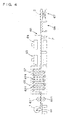
- Fig. 4 when the fiber mat 1 is passed through an air-heating furnace 62, the thermoplastic resin fiber or powder can be more readily melt.
- the temperature of the above-mentioned "heating" is lower than the thermal expansion starting temperature of the thermally expandable microcapsule.
- the heating is carried out preferably at a temperature ranging from a temperature lower than the thermal expansion starting temperature by 5°C, to a temperature lower than the thermal expansion starting temperature by 50°C, and more preferably at a temperature ranging from a temperature lower than the thermal expansion starting temperature by 5°C, to a temperature lower than the thermal expansion starting temperature by 30°C.
- the heating temperature is higher than a temperature at which the thermoplastic resin fiber or powder is melt. A part of the inorganic fibers is bound by the melt thermoplastic resin fiber or powder, and the resultant fiber mat can be reinforced from the inside.
- the heating is carried out preferably at a temperature ranging from a temperature higher than the temperature at which the thermoplastic resin fiber or powder is melt by 5°C, to a temperature ranging from a temperature higher than the temperature at which the thermoplastic resin fiber or powder is melt by 20°C, and more preferably at a temperature ranging from a temperature higher than the temperature at which the thermoplastic resin fiber or powder is melt by 8°C, to a temperature ranging from a temperature higher than the temperature at which the thermoplastic resin fiber or powder is melt by 17°C.
- the heating time is not particularly limited and may be in the range from 1 to 10 minutes, and is preferably from 2 to 7 minutes, depending on the heating temperature.
- the fiber mat After passing the fiber mat through a heating furnace such as the air-heating furnace 62, the fiber mat is subjected to hot-pressing using a hot-pressing machine 63 at a temperature at which the thermoplastic resin fiber or powder is melt but which the thermally expandable microcapsule does not cause thermal expansion, and then cooled using a cold-pressing machine 64 to produce a thermally expandable base material 2 for vehicle interior.
- a hot-pressing machine 63 at a temperature at which the thermoplastic resin fiber or powder is melt but which the thermally expandable microcapsule does not cause thermal expansion
- a cold-pressing machine 64 to produce a thermally expandable base material 2 for vehicle interior.
- the above-mentioned "hot-pressing" is normally conducted by thermal compression molding.
- the hot-pressing is carried out preferably at a temperature ranging from a temperature higher than the temperature at which the thermoplastic resin fiber or powder is melt by 5°C, to a temperature ranging from a temperature higher than the temperature at which the thermoplastic resin fiber or powder is melt by 50°C, more preferably at a temperature ranging from a temperature higher than the temperature at which the thermoplastic resin fiber or powder is melt by 5°C, to a temperature ranging from a temperature higher than the temperature at which the thermoplastic resin fiber or powder is melt by 30°C, and particularly at a temperature ranging from a temperature higher than the temperature at which the thermoplastic resin fiber or powder is melt by 5°C, to a temperature ranging from a temperature higher than the temperature at which the thermoplastic resin fiber or powder is melt by 20°C, and moreover, preferably at a temperature ranging from the thermal expansion starting temperature of the thermally expandable microcapsule, to a temperature lower than the thermal expansion starting temperature of the thermally expandable microcapsule by 50°C, more preferably at a
- the above-mentioned "cooling" is carried out normally by cold-pressing using a compression molding machine or the like in order to obtain a thermally expandable base material for vehicle interior having a specified thickness and overall uniformity.
- the pressing plates may be at room temperature (for example, from 20°C to 35°C), or rapidly cooled by passing a refrigerant such as water therethrough.
- the thermally expandable base material 2 for vehicle interior thus produced is cut using a cutter 65 to a specified size according to the type of the vehicle interior material, and then stored.
- the cut pieces of the thermally expandable base material 2 for vehicle interior are weighed using a weighing machine 66, and stacked on a base material table 67. A specified number of the pieces are packaged and stored as necessary, and fed to the process of producing a base material for vehicle interior.
- the thickness and basis weight of the thermally expandable base material for vehicle interior are not particularly limited and are preferably selected according to the type and the like of the vehicle interior material to be produced using the base material.
- the thickness thereof is preferably in the range from 0.5 to 8 mm, and particularly from 1 to 6 mm for the purpose of producing a vehicle interior material which is lightweight and highly rigid.
- the basis weight thereof is preferably in the range from 300 to 1,200 g/m 2 , and particularly preferably from 300 to 1,000 g/m 2 .
- the thickness and basis weight of the thermally expandable base material for vehicle interior are preferably in the range from 1 to 4 mm and in the range from 300 to 700 g/m 2 , respectively, and particularly from 1 to 3 mm and from 300 to 500 g/m 2 , respectively.
- the one aspect of the present invention for the production method of the thermally expandable base material for vehicle interior includes: (1) a process for mixing and unfolding of an inorganic fiber and a thermoplastic resin fiber; (2) a process for forming a first web; (3) a process for distributing a thermally expandable microcapsule over the first web; (4) a process for laminating a second web to the first web to form a web; (5) a process for fabricating a fiber mat by needling; (6) a process for heating; (7) a process for hot-pressing; and (8) a process for cooling.
- another aspect of the present invention for the production method of the thermally expandable base material for vehicle interior includes: (1) a process for unfolding an inorganic fiber; (2) a process for forming a first web; (3) a process for distributing a thermoplastic resin powder and a thermally expandable microcapsule over the first web; (4) a process for laminating a second web to the first web to form a web; (5) a process for fabricating a fiber mat by needling; (6) a process for heating; (7) a process for hot-pressing; and (8) a process for cooling.
- all the processes are normally continuous, whereby a uniform thermally expandable base material for a vehicle interior material can be efficiently produced.
- the above-mentioned "inorganic fiber” is a material forming a base of the thermally expandable base material for vehicle interior, and has excellent flame retardancy, insulation properties, and the like.
- the inorganic fiber is not particularly limited and may be selected from various inorganic fibers. Examples of the inorganic fiber include a glass fiber, a carbon fiber, a basalt fiber, and the like.
- the inorganic fibers may be used singly or in combination of two or more types thereof.
- a glass fiber is preferred because it is readily available and cost-effective.
- the amount thereof to be used is preferably 80% or more by mass, and particularly 90% or more by mass, taking the total amount of the inorganic fiber as 100% by mass.
- the inorganic fiber may be wholly a glass fiber.
- thermoplastic resin fiber is not particularly limited and may be selected from fibers made of various thermoplastic resins.
- the thermoplastic resin include a polyolefin resin such as polyethylene, polypropylene, and a copolymer of ethylene and propylene; a polyester resin such as polyethylene terephthalate, and polybutylene terephthalate; a polystyrene-based resin such as polystyrene, a copolymeric resin of acrylonitrile and styrene, and a copolymeric resin of acrylonitrile, styrene and butadiene; an acrylic resin such as poly methyl methacrylate; a polyamide resin; a polycarbonate resin; a polyacetal resin; and the like.
- Two or more types of thermoplastic resins may be used in combination as long as they can be spun together into a thread, but only one resin is often used.
- the thermoplastic resin fiber is preferably a polyolefin resin fiber and a polyester resin fiber. Among these, a polyolefin resin fiber is more preferable.
- the polyolefin resin constituting the polyolefin resin fiber may be an unmodified or modified polyolefin resin. When an unmodified polyolefin resin is used, a propylene homopolymer, and a propylene-based copolymer such as an ethylene propylene random copolymer, and an ethylene propylene block copolymer are preferable.
- the preferable is a copolymer composed of propylene, and ethylene and/or an ⁇ -olefin having 4 to 20 carbon atoms such as 1-butene, 1-hexene, 1-octene and 4-methyl-pentene-1.
- a propylene homopolymer is more preferable as a propylene-based polymer.
- an acid-modified polyolefin resin may be used which is modified with an acid such as a carboxylic acid and acid anhydride. The unmodified and modified resins may be used in combination.
- the average fiber length and average fiber diameter of the thermoplastic resin fiber are not particularly limited.
- the average fiber length is preferably 200 mm or shorter (normally 20 mm or longer).
- the average fiber diameter is preferably 50 ⁇ m or shorter (normally 10 ⁇ m or longer).
- the thermoplastic resin fiber may be composed of only a thermoplastic resin, but is more preferably composed of a thermoplastic resin containing additives such as an antioxidant, a plasticizer, an antistatic agent, a flame retardant, an antibacterial agent, a mildewproofing agent and a coloring agent.
- additives such as an antioxidant, a plasticizer, an antistatic agent, a flame retardant, an antibacterial agent, a mildewproofing agent and a coloring agent.
- thermoplastic resin powder examples include various thermoplastic resin powders.
- a polyolefin resin powder is preferred.
- the polyolefin resin powder may be a powder composed of various polyolefin resin such as (1) a high density polyethylene and low density polyethylene; (2) a linear low density polyethylene, and a copolymer of ethylene and other monomer, such as a copolymer of ethylene and propylene, and a copolymer of ethylene and vinyl acetate; (3) a polypropylene; and the like.
- a polypropylene powder and high density polyethylene powder are preferred.
- the thermoplastic resin powders may be used singly or in combination of two or more types thereof, but only one type of resin powder is often used.
- the average particle size of the thermoplastic resin powder is not particularly limited and is preferably in the range from 10 to 200 ⁇ m, more preferably from 20 to 150 ⁇ m, and particularly from 30 to 100 ⁇ m.
- the average particle size of the thermoplastic resin powder can be measured by microscopy, optical transmission particle size measurement, or the like.
- thermally expandable microcapsule normally contain a volatile hydrocarbon such as butane and isobutane, and the sheath is consisting of a copolymer of vinylidene chloride and acrylonitrile, a polyvinyl chloride, a poly(vinylidene chloride), or polyacrylonitrile.
- the contained thermally expandable microcapsule is not particularly limited.
- the hydrocarbon contained in the thermally expandable microcapsule and the material of the sheath may be selected from the exemplified various hydrocarbons above, and the material constituting the sheath, respectively.
- the thermally expandable microcapsule may have other hydrocarbons and a sheath consisting of other polymers.
- the thermally expandable microcapsule is almost spherical having a diameter of 10 to 100 ⁇ m in general, and 20 to 80 ⁇ m in particular.
- the capsule volumetrically expands 4 to 30 times.
- the diameter after volumetric expansion depends on the diameter before volumetric expansion and expansion magnification.
- the diameter after volumetric expansion will be, for example, in the range from 40 to 600 ⁇ m, and particularly from 60 to 400 ⁇ m.
- the thermally expandable microcapsule in the present invention is preferably one before volumetric expansion, which has a diameter of 10 to 100 ⁇ m, and particularly 20 to 80 ⁇ m, and volumetrically expands 4 to 27 times, preferably 8 to 27 times, and particularly 18 to 27 times, and one after volumetric expansion which has a diameter of, for example, 40 to 300 ⁇ m, and particularly 80 to 240 ⁇ m.
- Such thermally expandable microcapsule leads to a thermally expandable base material for vehicle interior allowing the production of a vehicle interior material which is lightweight, sufficiently sound absorbable, and highly rigid.
- the content ratio of the inorganic fiber, thermoplastic resin fiber or powder, and thermally expandable microcapsule is not particularly limited.
- the contents of the inorganic fiber, thermoplastic resin fiber or powder, and thermally expandable microcapsule are, respectively, preferably in the range from 20% to 80% by mass, from 20% to 80% by mass, and from 5% to 20% by mass, and particularly from 35% to 65% by mass, from 35% to 65% by mass, and from 8% to 15% by mass.
- Such ratio leads to a thermally expandable base material for vehicle interior allowing the production of a vehicle interior material which has sufficiently rigidity and flame retardancy.
- the content ratio of the thermoplastic resin fiber or powder, and thermally expandable microcapsule is not particularly limited.
- the contents of the thermoplastic resin fiber or powder and thermally expandable microcapsule are, respectively, preferably in the range from 70% to 90% by mass and from 10% to 30% by mass, and particularly from 75% to 85% by mass and from 15% to 25% by mass.
- Such ratio leads to a thermally expandable base material for vehicle interior allowing the production of a vehicle interior material which is lightweight and sufficiently rigid.
- the content ratio of the inorganic fiber, and thermoplastic resin fiber or powder is not particularly limited.
- the contents of the inorganic fiber and thermoplastic resin fiber or powder are, respectively, preferably in the range from 30% to 70% by mass and from 30% to 70% by mass, and particularly from 40% to 60% by mass and from 40% to 60% by mass.
- Such ratio leads to a thermally expandable base material for vehicle interior allowing the production of a vehicle interior material which has sufficiently rigidity and flame retardancy.
- the fiber mat may contain other components besides the inorganic fiber, thermoplastic resin fiber or powder, and thermally expandable microcapsule.
- a resin-based adhesive fiber or powder may be contained.
- the resin-based adhesive fiber or powder is not particularly limited, as long as the inorganic fiber and the thermally expanded microcapsule are bound when the thermally expandable microcapsule is thermally expanded and the thermally expandable base material for vehicle interior is thermally expanded.
- the resin-based adhesive fiber or powder examples include a fiber or powder of: (1) an acrylic resin such as a copolymer of ethylene and methyl methacrylate, a copolymer of ethylene and ethyl acrylate, and a copolymer of ethylene and acrylic acid; (2) a urethane-based resin; and (3) a vinyl acetate-based resin.
- a fiber or powder of an acrylic resin is preferable. The more preferable are a fiber or powder of an ethylene methyl methacrylate copolymer, and a fiber or powder of an ethylene ethyl acrylate copolymer.
- the average fiber length and average fiber diameter of the resin-based adhesive fiber may be the same as the average fiber length and average fiber diameter of the above-mentioned thermoplastic resin fiber.
- the average particle size of the resin-based adhesive powder is not particularly limited and is preferably in the range from 0.05 to 0.7 ⁇ m, more preferably from 0.05 to 0.4 ⁇ m, and particularly from 0.05 to 0.2 ⁇ m.
- the resin-based adhesive fiber and resin adhesive powder have good dispersibility, and the powder uniformly penetrates into the fiber mat to lead to a thermally expandable base material for vehicle interior having higher uniformity.
- the content ratio thereof is not particularly limited.
- the contents of the thermoplastic resin fiber or powder, thermally expandable microcapsule, and resin-based adhesive fiber or powder are, respectively, preferably in the range from 65% to 85% by mass, from 5% to 18% by mass, and from 6% to 22% by mass, and particularly from 70% to 80% by mass, from 8% to 15% by mass, and from 10% to 18% by mass, based on 100% by mass of the total of the thermoplastic resin fiber or powder, thermally expandable microcapsule, and resin-based adhesive fiber or powder.
- Such ratio leads to a thermally expandable base material for vehicle interior allowing the production of a vehicle interior material which is lightweight and sufficiently rigid.
- a flame retardant is preferably contained in at least one of the thermoplastic resin fiber, thermoplastic resin powder, resin-based adhesive fiber, and resin-based adhesive powder.
- the flame retardant is not particularly limited.
- Example thereof includes a nitrogen-containing compound such as urea and melamine cyanurate; a phosphate compound such as polyphosphoric acid; an organic halogen compound such as a chlorinated paraffin and decabromobiphenyl ether; a hydrated metal oxide such as aluminum hydroxide and magnesium hydroxide; and the like.
- a nitrogen-containing compound and a phosphate compound are preferred, because they will not generate a hazardous gas during burning, and the amount added in the resin is smaller than that of a hydrated metal compound.
- the flame retardant is more preferably a melamine cyanurate as the nitrogen-containing compound, a polyphosphoric acid as the phosphate compound, and is particularly a polyphosphoric acid-nitrogen-containing compound such as melamine polyphosphate and guanidine polyphosphate. These flame retardants may be used singly or in combination of two or more types thereof.
- the content of the flame retardant is not particularly limited and is preferably selected as appropriate according to the type of the flame retardant.
- the flame retardant is, for example, a nitrogen-containing compound or a phosphate compound
- sufficient flame retardancy is achieved with a low dose.
- the flame retardant is a hydrated metal oxide
- a high dose is necessary. If the content of the flame retardant is too little, the vehicle interior material will not be obtained having sufficient flame retardancy. On the other hand, if the content thereof is too much, the flame retardant may be bled out. Therefore, it is preferred that the flame retardant be contained in two or more of the thermoplastic resin fiber and other components. As a result of this, the fiber mat has sufficient flame retardancy and will not cause bleeding out of the flame retardant, and thus the deterioration of the high flame retardancy inherent in the inorganic fiber is sufficiently prevented.
- the method for producing a base material for vehicle interior of the present invention is characterized by heating the thermally expandable base material for vehicle interior obtained by the one aspect of the present method or another aspect of the present method, at a temperature higher than the thermal expansion starting temperature of the thermally expandable microcapsule to thermally expand.
- the apparatus and process for the production of the base material for vehicle interior are not particularly limited.
- the base material for vehicle interior may be produced using the following apparatus and process (see Fig. 5 ).
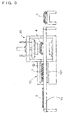
- a thermally expandable base material 2 for vehicle interior which is cut into a specified size, is mounted on a belt conveyor 71, and then accommodated in a heating chamber 72 heated at a temperature higher than the thermal expansion starting temperature of the thermally expandable microcapsule, thereby thermally expanding the thermally expandable microcapsule to produce a base material 3 for vehicle interior.
- the above-mentioned "heating” is normally carried out in the heating chamber 72 heated at a specified temperature, or by hot-pressing using a compression molding machine or the like.
- the heating is preferably carried out, preferably at a temperature ranging from a temperature higher than the thermal expansion starting temperature of the thermally expandable microcapsule by 5°C, to a temperature higher than the thermal expansion starting temperature of the thermally expandable microcapsule by 50°C, more preferably at a temperature ranging from a temperature higher than the thermal expansion starting temperature of the thermally expandable microcapsule by 8°C, to a temperature higher than the thermal expansion starting temperature of the thermally expandable microcapsule by 35°C, and particularly at a temperature ranging from a temperature higher than the thermal expansion starting temperature of the thermally expandable microcapsule by 12°C, to a temperature higher than the thermal expansion starting temperature of the thermally expandable microcapsule by 25°C.
- the thermally expandable microcapsule is sufficiently expanded, and a base material 3 for vehicle interior
- the thickness and basis weight of the base material for vehicle interior are not particularly limited and are preferably selected according to the type and the like of the vehicle interior material to be produced using the base material.
- the thickness thereof is preferably in the range from 3 to 18 mm, and particularly from 3 to 15 mm for the purpose of producing a vehicle interior material which is lightweight and highly rigid.
- the basis weight thereof is preferably in the range from 300 to 1,200 g/m 2 , and particularly preferably from 300 to 1,000 g/m 2 .
- the thickness and basis weight of the thermally expandable base material for vehicle interior are preferably in the range from 5 to 12 mm and in the range from 300 to 700 g/m 2 , respectively, and particularly from 6 to 10 mm and from 300 to 500 g/m 2 , respectively.
- the base material 3 for vehicle interior produced as described above is normally set between the plates of a compression molding machine 73 while the base material is kept at a temperature which allows compression molding, and formed into a vehicle interior material 4 having a specified shape.
- the compression molding is carried out by cold-pressing.
- the plates of the compression molding machine 73 may be at ambient temperature, or may be as necessary forcedly cooled by passing water through the plates.
- the vehicle interior material 4 is preferably produced using the apparatus shown in Fig. 5 , wherein the thermally expandable base material 2 for vehicle interior and the base material 3 for vehicle interior are continuously transferred using a belt conveyor 71 to the heating chamber 72 and compression molding machine 73, respectively.
- the base material 3 for vehicle interior and vehicle interior material 4 are particularly continuously produced using the integral apparatus as shown in Fig. 5 .
- Example 1 Production of thermally expandable base material for vehicle interior using thermoplastic resin fiber
- a glass fiber wound in the form of a continuous roving was cut into pieces of a specified length, and 50% by mass of the glass fiber pieces and 50% by mass of polypropylene resin fibers (the total of them was taken as 100% by mass) were fed to a hopper 511 of a first opener 51, unfolded therein, and fed from a switching damper 517 to a reserve box 521 of the first opener 52 and a reserve box 531 of a second opener 53. They were unfolded again (see Fig. 3 ), fed to the reserve box 541 of a first web forming machine 54 and a reserve box 551 of a second web forming machine 55, respectively, and further unfolded therein (see Fig. 1 ).
- the mixed fibers further unfolded in the first web forming machine 54 were fed onto a screw conveyor 545 using a cylinder blower 544, conveyed using the conveyor, and fed onto the front conveyor 547 from a gauge roller 546 at the edge of the conveyor to deposit, thereby forming a first web 111.
- a thermally expandable microcapsule was distributed using a capsule distributor 56 over the first web 111.
- the distributed amount of the thermally expandable microcapsule was 10% by mass based on 100% by mass of the total of the glass fiber, polypropylene resin fiber, and thermally expandable microcapsule contained in the fiber mat.
- the first web including the capsule was conveyed using a front conveyor 557.
- the mixed fibers further unfolded in the second web forming machine 55 were fed onto a screw conveyor 555 using a cylinder blower 554, conveyed using the conveyor, and fed onto the front conveyor 557 from a gauge roller 556 at the edge of the conveyor to deposit on a side having the thermally expandable microcapsule of the first web 111 and form a second web 112.
- a web 11 composed of the first web 111, second web 112, and thermally expandable microcapsule distributed at the interface therebetween was produced.
- the web 11 was needled using a needling machine 58 to fabricate a fiber mat 1, and the fiber mat was cut into pieces of a specified width and wound using the mat-winding roll 59 (see Fig. 1 ).
- the basis weight of the fiber mat 1 was 350 g/m 2 , and the thickness was 5 mm.
- the fiber mat 1 wound using a winder 61 after the production in the above (1) was fed into a air-heating furnace 62 heated at a temperature of 170°C which was higher than the melting temperature of the polypropylene resin fiber (160°C) by 10°C and conveyed in the furnace over a period of 3 minutes to melt the polypropylene resin fiber.
- the fiber mat was heated and compressed using a hot-pressing machine 63 in which hot plates were heated at a temperature of 170°C that was lower than the thermal expansion starting temperature of the thermally expandable microcapsule by 10°C, under a pressure of 15 MPa for 3 seconds.
- the fiber mat was then cooled using a cold-pressing machine 64 in which a clearance was 2 mm between the cooling plates that were cooled to a temperature of 20°C by passing water through the inside of the cooling plates, thereby producing a thermally expandable base material 2 for vehicle interior having a thickness of 1.8 mm.
- the thermally expandable base material was cut using a cutter 65 into pieces of a specified length, and the pieces were weighed using a weighing machine 66 and mounted on a base material table 67 (see Fig. 4 ).
- a glass fiber used in Example 1 was fed to a hopper 511 of a first opener 51, unfolded therein, and fed from a switching damper 517 to a reserve box 521 of the first opener 52 and a reserve box 531 of a second opener 53. They were unfolded again (see Fig. 3 ), fed to the reserve box 541 of a first web forming machine 54 and a reserve box 551 of a second web forming machine 55, respectively, and further unfolded therein. Then, a first web 111 was formed in the same manner as that in Example 1. Subsequently, a thermally expandable microcapsule was distributed using a capsule distributor 56 over the first web 111.
- a polypropylene resin powder was distributed using a resin powder distributor 57 over the first web 111.
- the mass ratio of the glass fiber to the polypropylene resin powder was the same as the mass ratio of the glass fiber to the polypropylene resin fiber in Example 1, and the mass ratio of the thermally expandable microcapsule to the total amount was the same as that in Example 1.
- the first web 111 having the thermally expandable microcapsule and thermoplastic resin powder was conveyed using a front conveyor 557.
- a second web 112 was formed on the first web 111 on a side having the thermally expandable microcapsule and polypropylene resin powder, in the same manner as in Example 1.
- the web 11 composed of the first web 111, second web 112, and thermally expandable microcapsule and polypropylene resin powder that were distributed at the interface between these webs was produced.
- a fiber mat 1 was fabricated by needling in the same manner as that in Example 1, and the fiber mat was cut into pieces of a specified width and wound using the mat-winding roll 59 (see Fig. 2 ).
- the basis weight of the fiber mat 1 was 350 g/m 2 , and the thickness was 5 mm.
- a thermally expandable base material 2 for vehicle interior having a thickness of 1.8 mm was produced in the same manner as those in the method (2) in Example 1.
- the thermally expandable base material was then cut using a cutter 65 into pieces of a specified length, and the pieces were weighed using a weighing machine 66 and mounted on a base material table 67 (see Fig. 4 ).
- the thermally expandable base material 2 for vehicle interior cut into pieces of a specified length after the production by Example 1 was allowed to stand in a heating chamber 72 heated at a temperature of 230°C for 90 seconds.
- the thermally expandable base material 2 for vehicle interior was heated so as to have a surface temperature of 195°C higher than the thermal expansion starting temperature of the thermally expandable microcapsule by 17°C to thermally expand the thermally expandable microcapsule and produce a base material 3 for vehicle interior.
- the base material 3 was molded while being cooled using a compression molding machine 73 in which a clearance was 8 mm between the cooling plates that were cooled to a temperature of 18°C by passing water through the inside of the cooling plates, thereby producing a vehicle interior material 4 having a thickness of 8 mm (see Fig. 5 ).
- the present invention is applicable to the technical fields of a thermally expandable base material for vehicle interior which allowing the production of a vehicle interior material which is lightweight, sufficiently sound absorbable and highly rigid, and of a base material for vehicle interior using the thermally expandable base material for vehicle interior.
- the present invention is useful for a product such as a ceiling material for vehicle; a door trim; a trunk room lining; a product in a trunk room of a station wagon; and the like.
Landscapes
- Engineering & Computer Science (AREA)
- Mechanical Engineering (AREA)
- Chemical & Material Sciences (AREA)
- Chemical Kinetics & Catalysis (AREA)
- Vehicle Interior And Exterior Ornaments, Soundproofing, And Insulation (AREA)
- Nonwoven Fabrics (AREA)
- Laminated Bodies (AREA)
- Molding Of Porous Articles (AREA)
Abstract
Description
- The present invention relates to a production method of a thermally expandable base material for vehicle interior and a production method of a base material for vehicle interior using the same. More specifically, the present invention relates to a method for producing a thermally expandable base material for vehicle interior allowing the production of a vehicle interior material which is lightweight, sufficiently sound absorbable and highly rigid, and to a method for producing a base material for vehicle interior using the thermally expandable base material for vehicle interior.
Since the methods of the present invention for producing a thermally expandable base material for vehicle interior and a base material for vehicle interior do not use a medium such as water, and all the processes in the methods are carried out under dry conditions, these base materials can be efficiently produced by simple apparatus and simple operations. - Conventionally, a base material for a vehicle interior material is used which is produced by depositing a mixture of an inorganic fiber and a resin fiber, needling the deposit to fabricate a mat, heating the mat at a temperature at which the resin fiber is melt, hot-pressing the mat, and then cold-pressing the mat to mold. The base material has good thermal dimensional stability, and thus the rate of the thermal dimensional change is low. For the purpose of obtaining a vehicle interior material having high rigidity, however, the base material must have a high basis weight, and thus cannot meet the recent demand for the reduction of vehicle weight.
- In order to solve the above problem, proposed is a base material for vehicle interior in which a thermally expandable microcapsule is incorporated into a mat obtained depositing a mixture of an inorganic fiber and a resin fiber and/or resin powder. The weight of the base material can be readily reduced since the thermally expandable microcapsule is expanded during secondary molding. In addition, the secondary molded product has a sufficient thickness and high rigidity. Such base material may be produced by, for example, incorporating a thermoplastic resin binder and a foamable microsphere into a needled fiber felt which is composed mainly of a glass fiber while being dispersed, and then blowing (for example, in Patent Document 1). Additionally, a production method of an expanded article is known in which a reinforced fiber, a thermally expandable powder and the like are dispersed in a specific aqueous medium to prepare a bubble solution, and the bubble solution is subjected to forming into a web, the web is heated, compressed, and cooled to fabricate a stampable sheet, the stampable sheet is heated to expand the thermally expandable powder, molded, and then cooled (for example, in Patent Document 2).
-
- Patent Document 1:
JP-A H02-45135 - Patent Document 2:
JP-A 2006-342437 - According to the formation method of the base material described in
Patent Document 1, the thermoplastic resin binder is used in the form of a resin emulsion. The document discloses the foamable microsphere is preferably mixed with the resin emulsion. The method is a wet system using a complicated apparatus, and thus involves complicated operations. On the other hand, according to the production method described inPatent Document 2, the web is fabricated by forming. The method requires a complicated apparatus, and involves complicated operations and processes. In addition, the method uses a costly bubble solution prepared by adding a surfactant, and dispersing a reinforced fiber and a thermally expandable powder therein, and thus is not preferred from the viewpoint of cost efficiency. - An object of the present invention is to solve the above-mentioned problems and provide a method for producing a thermally expandable base material for vehicle interior that allows the production of a vehicle interior material which is lightweight, sufficiently sound absorbable and highly rigid, and does not use a medium such as water, and wherein all the processes in the methods are carried out under dry conditions. In addition, another object is to provide a method for producing a base material for vehicle interior by a simple operation and a simple process, in which the thermally expandable base material for vehicle interior is subjected to heating at a specified temperature.
- The present invention is as follows.
- 1. A method for producing a thermally expandable base material for vehicle interior, characterized by comprising:
- needling a web comprising an inorganic fiber, a thermoplastic resin fiber, and a thermally expandable microcapsule to form a fiber mat;
- heating the fiber mat at a temperature at which the thermoplastic resin fiber is melt but which is lower than the thermal expansion starting temperature of the thermally expandable microcapsule;
- hot-pressing the fiber mat; and
- cooling the fiber mat.
- 2. The method for producing a thermally expandable base material for vehicle interior according to 1 above,
wherein the web is fabricated by forming a first web comprising the inorganic fiber and the thermoplastic resin fiber, distributing the thermally expandable microcapsule over the first web, and then laminating a second web comprising the inorganic fiber and the thermoplastic resin fiber to the first web on a side having the thermally expandable capsule. - 3. The method for producing a thermally expandable base material for vehicle interior according to 1 or 2 above,
wherein the hot-pressing is carried out at a temperature ranging from a temperature higher than the melting temperature of the thermoplastic resin fiber by 5°C, to a temperature higher than the melting temperature of the thermoplastic resin fiber by 50°C, but a temperature ranging from the thermal expansion starting temperature of the thermally expandable microcapsule, to a temperature lower than the thermal expansion starting temperature of the thermally expandable microcapsule by 50°C. - 4. The method for producing a thermally expandable base material for vehicle interior according to any one of 1 to 3 above,
wherein the thermoplastic resin fiber is a polyolefin resin fiber. - 5. The method for producing a thermally expandable base material for vehicle interior according to any one of 1 to 4 above,
wherein the inorganic fiber, the thermoplastic resin fiber and the thermally expandable microcapsule are used in amounts of, respectively 20% to 80% by weight, 20% to 80% by weight, and 5% to 20% by weight, based on 100% by weight of the total of the inorganic fiber, the thermoplastic resin fiber and the thermally expandable microcapsule. - 6. A method for producing a thermally expandable base material for vehicle interior, characterized by comprising:
- needling a web comprising an inorganic fiber, a thermoplastic resin powder, and a thermally expandable microcapsule to form a fiber mat;
- heating the fiber mat at a temperature at which the thermoplastic resin fiber is melt but which is lower than the thermal expansion starting temperature of the thermally expandable microcapsule;
- hot-pressing the fiber mat; and
- cooling the fiber mat.
- 7. The method for producing a thermally expandable base material for vehicle interior according to 6 above,
wherein the web is fabricated by forming a first web comprising the inorganic fiber, distributing the thermoplastic resin powder and the thermally expandable microcapsule over the first web, and then laminating a second web comprising the inorganic fiber to the first web on a side having the thermoplastic resin powder and the thermally expandable capsule. - 8. The method for producing a thermally expandable base material for vehicle interior according to 6 or 7 above,
wherein the hot-pressing is carried out at a temperature ranging from a temperature higher than the melting temperature of the thermoplastic resin powder by 5°C, to a temperature higher than the melting temperature of the thermoplastic resin powder by 50°C, but a temperature ranging from the thermal expansion starting temperature of the thermally expandable microcapsule, to a temperature lower than the thermal expansion starting temperature of the thermally expandable microcapsule by 50°C. - 9. The method for producing a thermally expandable base material for vehicle interior according to any one of 6 to 8 above,
wherein the thermoplastic resin powder is a polyolefin resin powder. - 10. The method for producing a thermally expandable base material for vehicle interior according to any one of 6 to 9 above,
wherein the inorganic fiber, the thermoplastic resin powder and the thermally expandable microcapsule are used in amounts of, respectively 20% to 80% by weight, 20% to 80% by weight, and 5% to 20% by weight, based on 100% by weight of the total of the inorganic fiber, the thermoplastic resin powder and the thermally expandable microcapsule. - 11. The method for producing a thermally expandable base material for vehicle interior according to any one of 1 to 10 above,
wherein the thermally expandable microcapsule are distributed after static electricity removal. - 12. The method for producing a thermally expandable base material for vehicle interior according to any one of 1 to 11 above,
wherein the inorganic fiber is a glass fiber. - 13. A method for producing a base material for vehicle interior, characterized by heating the thermally expandable base material for vehicle interior obtained by the method according to any one of 1 to 12 above, at a temperature higher than the thermal expansion starting temperature of the thermally expandable microcapsule to thermally expand.
- 14. The method for producing a base material for vehicle interior according to 13 above,
wherein the heating is carried out at a temperature ranging from a temperature higher than the thermal expansion starting temperature of the thermally expandable microcapsule by 5°C, to a temperature higher than the thermal expansion starting temperature of the thermally expandable microcapsule by 50°C. - According to the one aspect of the present invention for the production method of a thermally expandable base material for vehicle interior in which a fiber mat is fabricated under dry conditions, using an inorganic fiber, a thermoplastic resin fiber and a thermally expandable microcapsule, and to the another aspect of the present invention for the production method of a thermally expandable base material for vehicle interior in which a fiber mat is fabricated under dry conditions, using an inorganic fiber, a thermoplastic resin powder and a thermally expandable microcapsule, when a fiber mat obtained by methods in which all the processes in the methods are carried out under dry conditions and a medium such as water is not used, is subjected to simple operations or processes including heating, hot-pressing and cooling, a thermally expandable base material for vehicle interior allowing the production of a vehicle interior material which is lightweight, sufficiently sound absorbable and highly rigid can be readily produced at a low cost.
Additionally, in the case where the web is fabricated by forming a first web comprising the inorganic fiber and the thermoplastic resin fiber, distributing the thermally expandable microcapsule over the first web, and then laminating a second web comprising the inorganic fiber and the thermoplastic resin fiber to the first web on a side having the thermally expandable capsule, and in the case where the web is fabricated by forming a first web comprising the inorganic fiber, distributing the thermoplastic resin powder and the thermally expandable microcapsule over the first web, and then laminating a second web comprising the inorganic fiber to the first web on a side having the thermoplastic resin powder and the thermally expandable capsule, the thermally expandable microcapsule, or the thermoplastic resin powder and thermally expandable microcapsule, distributed between the first and second webs are uniformly dispersed all over the fiber mat by needling, and a thermally expandable base material for vehicle interior allowing the production of a highly uniform vehicle interior material can be readily produced.
Furthermore, in the case where the hot-pressing is carried out at a temperature ranging from a temperature higher than the melting temperature of the thermoplastic resin fiber or powder by 5°C, to a temperature higher than the melting temperature of the thermoplastic resin fiber or powder by 50°C, but a temperature ranging from the thermal expansion starting temperature of the thermally expandable microcapsule, to a temperature lower than the thermal expansion starting temperature of the thermally expandable microcapsule by 50°C, a thermally expandable base material for vehicle interior can be produced in which the inorganic fibers are partly bound with a thermoplastic resin to be reinforced and the handling after the production is easy.
In the case where the thermoplastic resin fiber is a polyolefin resin fiber, and in the case where the thermoplastic resin powder is a polyolefin resin powder, they are melted at a relatively low temperature to readily bind the inorganic fibers, whereby thermally expandable base materials for vehicle interior for readily reinforcing a fiber mat from the inside can be readily produced.
Further, in the case where the inorganic fiber, the thermoplastic resin fiber and the thermally expandable microcapsule are used in amounts of, respectively 20% to 80% by weight, 20% to 80% by weight, and 5% to 20% by weight, based on 100% by weight of the total of the inorganic fiber, the thermoplastic resin fiber and the thermally expandable microcapsule, and in the case where the inorganic fiber, the thermoplastic resin powder and the thermally expandable microcapsule are used in amounts of, respectively 20% to 80% by weight, 20% to 80% by weight, and 5% to 20% by weight, based on 100% by weight of the total of the inorganic fiber, the thermoplastic resin powder and the thermally expandable microcapsule, thermally expandable base materials for vehicle interior having high strength can be readily produced. When the base materials are used, vehicle interior materials can be readily obtained which have good formability and high strength, and are moderately expanded.
Additionally, in the case where the thermally expandable microcapsule are distributed after static electricity removal, the thermally expandable microcapsule is uniformly distributed over the first web without causing flocculation, whereby a thermally expandable base material for vehicle interior allowing the production of a highly uniform vehicle interior material can be readily produced.
Furthermore, in the case where the inorganic fiber is a glass fiber, a thermally expandable base material for vehicle interior allowing the production of a vehicle interior material having sufficient insulation and sound-absorbing properties can be readily produced at a low cost. Therefore, the glass fiber achieves cost effectiveness and is readily available. - According to the method of the present invention for producing a base material for vehicle interior, when the thermally expandable base material for vehicle interior obtained by the one aspect of the present invention, or the thermally expandable base material for vehicle interior obtained by the another aspect of the present invention is subjected to simple operations or processes including heating at a temperature higher than the thermal expansion starting temperature of the thermally expandable microcapsule, a thermally expandable base material for vehicle interior allowing the production of a vehicle interior material which is lightweight, sufficiently sound absorbable and highly rigid can be readily produced.
In addition, in the case where the heating is carried out at a temperature ranging from a temperature higher than the thermal expansion starting temperature of the thermally expandable microcapsule by 5°C, to a temperature higher than the thermal expansion starting temperature of the thermally expandable microcapsule by 50°C, a base material for vehicle interior which is moderately expanded and is sufficiently lightweight can be readily produced. -
-
Fig. 1 schematically illustrates the apparatus and process for producing a fiber mat using a thermoplastic resin fiber. -
Fig. 2 schematically illustrates the apparatus and process for producing a fiber mat using a thermoplastic resin powder. -
Fig. 3 schematically illustrates the apparatus and process used for unfolding mixed fibers or inorganic fibers fed to a web forming machine. -
Fig. 4 schematically illustrates the apparatus and process for producing a thermally expandable base material for vehicle interior. -
Fig. 5 schematically illustrates the apparatus and process for producing a base material for vehicle interior and a vehicle interior material. - The present invention is further described below with reference to
Figs. 1 to 5 . - The method for producing a thermally expandable base material for vehicle interior of the one aspect of the present invention is characterized by needling a web comprising an inorganic fiber, a thermoplastic resin fiber, and a thermally expandable microcapsule to form a fiber mat, heating the fiber mat at a temperature at which the thermoplastic resin fiber is melt but which is lower than the thermal expansion starting temperature of the thermally expandable microcapsule, hot-pressing, and then cooling.
- In addition, the method for producing a thermally expandable base material for vehicle interior of another aspect of the present invention is characterized by needling a web comprising an inorganic fiber, a thermoplastic resin powder, and a thermally expandable microcapsule to form a fiber mat, heating the fiber mat at a temperature at which the thermoplastic resin fiber is melt but which is lower than the thermal expansion starting temperature of the thermally expandable microcapsule, hot-pressing, and then cooling.
- When a thermally expandable base material for vehicle interior is produced using an inorganic fiber, a thermoplastic resin fiber, and a thermally expandable microcapsule, apparatus and process for the production of a fiber mat are not particularly limited. The fiber mat may be produced using the following apparatus and process (see
Fig. 1 ).
Two web forming machines of a firstweb forming machine 54 and a secondweb forming machine 55 are juxtaposed. Mixed fiber of a fibrillated inorganic fiber and a fibrillated thermoplastic resin fiber are fed to areserve box 541 in theweb forming machine 54, and then conveyed while being unfolded by aspike lattice 542. Subsequently, the mixed fiber is conveyed using afeed roller 543, fed using acylinder blower 544 onto ascrew conveyor 545, and then deposited on afront conveyor 547 from a predetermined position, thereby forming afirst web 111. - Next, a predetermined amount of the thermally expandable microcapsule is distributed using a capsule distributor 56 over the
first web 111 which is formed on thefront conveyor 547 while conveying the first web. After that, thefirst web 111 is conveyed using afront conveyor 557, and unfolded mixed fibers are fed in the same manner as above using the otherweb forming machine 55, which has the same structure as the above web forming machine, to a side having the thermally expandable microcapsule of thefirst web 111, thereby depositing the fibers to form asecond web 112. In this manner, aweb 11 composed of thefirst web 111, thesecond web 112, and the thermally expandable microcapsule distributed at the interface therebetween is obtained. Subsequently, theweb 11 is subjected to needling using a needlingmachine 58 to fabricate afiber mat 1 having a predetermined basis weight and thickness. Thefiber mat 1 is then wound using a mat-windingroll 59, and stored. - When a thermally expandable base material for vehicle interior is produced using an inorganic fiber, a thermoplastic resin powder, and a thermally expandable microcapsule, apparatus and process for the production of a fiber mat are not particularly limited. The fiber mat may be produced using the following apparatus and process (see
Fig. 2 ).
Two web forming machines of a firstweb forming machine 54 and a secondweb forming machine 55 are juxtaposed. Unfolding inorganic fibers are fed to areserve box 541 in theweb forming machine 54, and then conveyed while being further unfolded by aspike lattice 542. Subsequently, the mixed fiber is conveyed using afeed roller 543, fed using acylinder blower 544 onto ascrew conveyor 545, and then deposited on afront conveyor 547 from a predetermined position, thereby forming afirst web 111. - Next, a predetermined amount of the thermally expandable microcapsule and a predetermined amount of the thermoplastic resin powder are respectively distributed using a capsule distributor 56 and a resin powder distributor 57 over the
first web 111 which is formed on thefront conveyor 547 while conveying thefirst web 111. After that, thefirst web 111 is conveyed using afront conveyor 557, and unfolded inorganic fibers are fed in the same manner as above using a secondweb forming machine 55, which has the same structure as the above web forming machine, to a side having the thermally expandable microcapsule and the thermoplastic resin powder of thefirst web 111, thereby depositing the fibers and forming asecond web 112. In this manner, aweb 11 composed of thefirst web 111, thesecond web 112, the thermally expandable microcapsule and thermoplastic resin powder distributed at the interface therebetween is obtained. Subsequently, theweb 11 is subjected to needling using a needlingmachine 58 to fabricate afiber mat 1 having a predetermined basis weight and thickness. Thefiber mat 1 is then wound using a mat-windingroll 59, and stored. - In the fiber mat production methods (1) and (2), the thermally expandable microcapsule to be distributed over the first web is preferably subjected to static electricity removal in advance. The thermally expandable microcapsule is a minute sphere having a sheath made of a thermoplastic resin. If the microcapsule is distributed without static electricity removal, the microcapsule is charged to cause flocculation. Therefore, the microcapsule preferably is distributed after static electricity removal. The method for the static electricity removal is not particularly limited. For example, a capsule distributor can be used which is equipped with a container such as a hopper for placing the thermally expandable microcapsule, and a static electricity removing bar disposed immediately above the outlet port at the bottom of the container.
- The thicknesses of the fiber mats fabricated by the methods (1) and (2) are not particularly limited. The thickness thereof is preferably in the range from 2 to 15 mm, and more preferably from 2 to 10 mm for the purpose of producing a vehicle interior material which is lightweight and highly rigid. The basis weight of the fiber mat is not particularly limited. The basis weight thereof is preferably in the range from 200 to 1,000 g/m2, and more preferably from 200 to 800 g/m2 for the purpose of producing a vehicle interior material which is lightweight and highly rigid. Additionally, the thickness and basis weight of the fiber mat are preferably in the range from 3 to 8 mm and in the range from 200 to 600 g/m2, respectively, and particularly from 3 to 6 mm and from 200 to 400 g/m2, respectively.
- Moreover, apparatus and process for previously unfolding mixed fiber or inorganic fiber to be fed to the web forming machine are not particularly limited. The fibers may be unfolded using the following apparatus and process (see
Fig. 3 , the arrow inFig. 3 shows the flow direction of the fiber).
Mixed fibers or inorganic fibers charged into areserve box 511 of afirst opener 51 are conveyed while being unfolded by atube lattice 512, fed to aspike lattice 513, and conveyed while being further unfolded. Subsequently, the fibers are conveyed using afeed roller 514, and the unfolded mixed fibers or inorganic fibers are conveyed through air using acylinder blower 515 and afan 516. The feed track is switched using aswitching damper 517, and the fibers are fed to the two juxtaposedsecond openers - After that, the previously-unfolded mixed fibers or inorganic fibers are fed to reserve
boxes second openers spike lattices feed rollers cylinder blowers fans boxes web forming machines web forming machines first opener 51 and the twosecond openers second openers second openers - The
fiber mat 1 fabricated by the method (1) or (2) is normally heated during passing through a heating furnace. In this case, the temperature of the heating furnace is set to a higher temperature than the temperature at which the thermoplastic resin fiber or powder is melt. When the thermoplastic resin fiber or powder is melt in the heating furnace, a part of the inorganic fibers can be bound by the thermoplastic resin. - The heating means is not particularly limited and example thereof include a heating with hot air, a heater such as an infrared heater and a far-infrared heater, a high-frequency heating, and the like. The heating is preferably carried out using hot air. As shown in
Fig. 4 , when thefiber mat 1 is passed through an air-heating furnace 62, the thermoplastic resin fiber or powder can be more readily melt. - The temperature of the above-mentioned "heating" is lower than the thermal expansion starting temperature of the thermally expandable microcapsule. The heating is carried out preferably at a temperature ranging from a temperature lower than the thermal expansion starting temperature by 5°C, to a temperature lower than the thermal expansion starting temperature by 50°C, and more preferably at a temperature ranging from a temperature lower than the thermal expansion starting temperature by 5°C, to a temperature lower than the thermal expansion starting temperature by 30°C. Additionally, the heating temperature is higher than a temperature at which the thermoplastic resin fiber or powder is melt. A part of the inorganic fibers is bound by the melt thermoplastic resin fiber or powder, and the resultant fiber mat can be reinforced from the inside. Handling of the thermally expandable base material for vehicle interior during subsequent thermoforming is facilitated. In this case, the heating is carried out preferably at a temperature ranging from a temperature higher than the temperature at which the thermoplastic resin fiber or powder is melt by 5°C, to a temperature ranging from a temperature higher than the temperature at which the thermoplastic resin fiber or powder is melt by 20°C, and more preferably at a temperature ranging from a temperature higher than the temperature at which the thermoplastic resin fiber or powder is melt by 8°C, to a temperature ranging from a temperature higher than the temperature at which the thermoplastic resin fiber or powder is melt by 17°C. In addition, the heating time is not particularly limited and may be in the range from 1 to 10 minutes, and is preferably from 2 to 7 minutes, depending on the heating temperature.
- After passing the fiber mat through a heating furnace such as the air-
heating furnace 62, the fiber mat is subjected to hot-pressing using a hot-pressingmachine 63 at a temperature at which the thermoplastic resin fiber or powder is melt but which the thermally expandable microcapsule does not cause thermal expansion, and then cooled using a cold-pressingmachine 64 to produce a thermallyexpandable base material 2 for vehicle interior. The above-mentioned "hot-pressing" is normally conducted by thermal compression molding. The hot-pressing is carried out preferably at a temperature ranging from a temperature higher than the temperature at which the thermoplastic resin fiber or powder is melt by 5°C, to a temperature ranging from a temperature higher than the temperature at which the thermoplastic resin fiber or powder is melt by 50°C, more preferably at a temperature ranging from a temperature higher than the temperature at which the thermoplastic resin fiber or powder is melt by 5°C, to a temperature ranging from a temperature higher than the temperature at which the thermoplastic resin fiber or powder is melt by 30°C, and particularly at a temperature ranging from a temperature higher than the temperature at which the thermoplastic resin fiber or powder is melt by 5°C, to a temperature ranging from a temperature higher than the temperature at which the thermoplastic resin fiber or powder is melt by 20°C, and moreover, preferably at a temperature ranging from the thermal expansion starting temperature of the thermally expandable microcapsule, to a temperature lower than the thermal expansion starting temperature of the thermally expandable microcapsule by 50°C, more preferably at a temperature ranging from the thermal expansion starting temperature of the thermally expandable microcapsule, to a temperature lower than the thermal expansion starting temperature of the thermally expandable microcapsule by 30°C, and particularly at a temperature ranging from the thermal expansion starting temperature of the thermally expandable microcapsule, to a temperature lower than the thermal expansion starting temperature of the thermally expandable microcapsule by 20°C. - The above-mentioned "cooling" is carried out normally by cold-pressing using a compression molding machine or the like in order to obtain a thermally expandable base material for vehicle interior having a specified thickness and overall uniformity. When the cold-pressing is performed, the pressing plates may be at room temperature (for example, from 20°C to 35°C), or rapidly cooled by passing a refrigerant such as water therethrough. The thermally
expandable base material 2 for vehicle interior thus produced is cut using acutter 65 to a specified size according to the type of the vehicle interior material, and then stored. The cut pieces of the thermallyexpandable base material 2 for vehicle interior are weighed using a weighing machine 66, and stacked on a base material table 67. A specified number of the pieces are packaged and stored as necessary, and fed to the process of producing a base material for vehicle interior. - The thickness and basis weight of the thermally expandable base material for vehicle interior are not particularly limited and are preferably selected according to the type and the like of the vehicle interior material to be produced using the base material. The thickness thereof is preferably in the range from 0.5 to 8 mm, and particularly from 1 to 6 mm for the purpose of producing a vehicle interior material which is lightweight and highly rigid. The basis weight thereof is preferably in the range from 300 to 1,200 g/m2, and particularly preferably from 300 to 1,000 g/m2. Additionally, the thickness and basis weight of the thermally expandable base material for vehicle interior are preferably in the range from 1 to 4 mm and in the range from 300 to 700 g/m2, respectively, and particularly from 1 to 3 mm and from 300 to 500 g/m2, respectively.
- The one aspect of the present invention for the production method of the thermally expandable base material for vehicle interior includes: (1) a process for mixing and unfolding of an inorganic fiber and a thermoplastic resin fiber; (2) a process for forming a first web; (3) a process for distributing a thermally expandable microcapsule over the first web; (4) a process for laminating a second web to the first web to form a web; (5) a process for fabricating a fiber mat by needling; (6) a process for heating; (7) a process for hot-pressing; and (8) a process for cooling. Additionally, another aspect of the present invention for the production method of the thermally expandable base material for vehicle interior includes: (1) a process for unfolding an inorganic fiber; (2) a process for forming a first web; (3) a process for distributing a thermoplastic resin powder and a thermally expandable microcapsule over the first web; (4) a process for laminating a second web to the first web to form a web; (5) a process for fabricating a fiber mat by needling; (6) a process for heating; (7) a process for hot-pressing; and (8) a process for cooling. In these producing methods, all the processes are normally continuous, whereby a uniform thermally expandable base material for a vehicle interior material can be efficiently produced.
- The above-mentioned "inorganic fiber" is a material forming a base of the thermally expandable base material for vehicle interior, and has excellent flame retardancy, insulation properties, and the like. The inorganic fiber is not particularly limited and may be selected from various inorganic fibers. Examples of the inorganic fiber include a glass fiber, a carbon fiber, a basalt fiber, and the like. The inorganic fibers may be used singly or in combination of two or more types thereof. Among these inorganic fibers, a glass fiber is preferred because it is readily available and cost-effective. When a glass fiber is used, the amount thereof to be used is preferably 80% or more by mass, and particularly 90% or more by mass, taking the total amount of the inorganic fiber as 100% by mass. The inorganic fiber may be wholly a glass fiber.
- The above-mentioned "thermoplastic resin fiber" is not particularly limited and may be selected from fibers made of various thermoplastic resins. Examples of the thermoplastic resin include a polyolefin resin such as polyethylene, polypropylene, and a copolymer of ethylene and propylene; a polyester resin such as polyethylene terephthalate, and polybutylene terephthalate; a polystyrene-based resin such as polystyrene, a copolymeric resin of acrylonitrile and styrene, and a copolymeric resin of acrylonitrile, styrene and butadiene; an acrylic resin such as poly methyl methacrylate; a polyamide resin; a polycarbonate resin; a polyacetal resin; and the like. Two or more types of thermoplastic resins may be used in combination as long as they can be spun together into a thread, but only one resin is often used.
- The thermoplastic resin fiber is preferably a polyolefin resin fiber and a polyester resin fiber. Among these, a polyolefin resin fiber is more preferable.
The polyolefin resin constituting the polyolefin resin fiber may be an unmodified or modified polyolefin resin. When an unmodified polyolefin resin is used, a propylene homopolymer, and a propylene-based copolymer such as an ethylene propylene random copolymer, and an ethylene propylene block copolymer are preferable. The preferable is a copolymer composed of propylene, and ethylene and/or an α-olefin having 4 to 20 carbon atoms such as 1-butene, 1-hexene, 1-octene and 4-methyl-pentene-1. A propylene homopolymer is more preferable as a propylene-based polymer. Additionally, when a modified polyolefin resin is used, an acid-modified polyolefin resin may be used which is modified with an acid such as a carboxylic acid and acid anhydride. The unmodified and modified resins may be used in combination. - The average fiber length and average fiber diameter of the thermoplastic resin fiber are not particularly limited. The average fiber length is preferably 200 mm or shorter (normally 20 mm or longer). When the thermoplastic resin fiber having an average fiber length of 200 mm or shorter is used, a uniform web containing the thermoplastic resin fiber, inorganic fiber, and thermally expandable microcapsule can be readily formed. Additionally, the average fiber diameter is preferably 50 µm or shorter (normally 10 µm or longer).
- The thermoplastic resin fiber may be composed of only a thermoplastic resin, but is more preferably composed of a thermoplastic resin containing additives such as an antioxidant, a plasticizer, an antistatic agent, a flame retardant, an antibacterial agent, a mildewproofing agent and a coloring agent.
- Examples of the above-mentioned "thermoplastic resin powder" include various thermoplastic resin powders. Among them, a polyolefin resin powder is preferred. The polyolefin resin powder may be a powder composed of various polyolefin resin such as (1) a high density polyethylene and low density polyethylene; (2) a linear low density polyethylene, and a copolymer of ethylene and other monomer, such as a copolymer of ethylene and propylene, and a copolymer of ethylene and vinyl acetate; (3) a polypropylene; and the like. Among these, a polypropylene powder and high density polyethylene powder are preferred. The thermoplastic resin powders may be used singly or in combination of two or more types thereof, but only one type of resin powder is often used.
- The average particle size of the thermoplastic resin powder is not particularly limited and is preferably in the range from 10 to 200 µm, more preferably from 20 to 150 µm, and particularly from 30 to 100 µm. When the average particle size of the thermoplastic resin powder is from 10 to 200 µm, the powder sufficiently binds the inorganic fibers, and the resultant fiber mat can be reinforced from the inside. The average particle size of the thermoplastic resin powder can be measured by microscopy, optical transmission particle size measurement, or the like.
- The above-mentioned "thermally expandable microcapsule" normally contain a volatile hydrocarbon such as butane and isobutane, and the sheath is consisting of a copolymer of vinylidene chloride and acrylonitrile, a polyvinyl chloride, a poly(vinylidene chloride), or polyacrylonitrile. In the present invention, the contained thermally expandable microcapsule is not particularly limited. The hydrocarbon contained in the thermally expandable microcapsule and the material of the sheath may be selected from the exemplified various hydrocarbons above, and the material constituting the sheath, respectively. The thermally expandable microcapsule may have other hydrocarbons and a sheath consisting of other polymers.
- The thermally expandable microcapsule is almost spherical having a diameter of 10 to 100 µm in general, and 20 to 80 µm in particular. When the thermally expandable microcapsule is heated at a temperature higher than the thermal expansion starting temperature, the capsule volumetrically expands 4 to 30 times. The diameter after volumetric expansion depends on the diameter before volumetric expansion and expansion magnification. The diameter after volumetric expansion will be, for example, in the range from 40 to 600 µm, and particularly from 60 to 400 µm. The thermally expandable microcapsule in the present invention is preferably one before volumetric expansion, which has a diameter of 10 to 100 µm, and particularly 20 to 80 µm, and volumetrically expands 4 to 27 times, preferably 8 to 27 times, and particularly 18 to 27 times, and one after volumetric expansion which has a diameter of, for example, 40 to 300 µm, and particularly 80 to 240 µm. Such thermally expandable microcapsule leads to a thermally expandable base material for vehicle interior allowing the production of a vehicle interior material which is lightweight, sufficiently sound absorbable, and highly rigid.
- The content ratio of the inorganic fiber, thermoplastic resin fiber or powder, and thermally expandable microcapsule is not particularly limited. When the total of the inorganic fiber, thermoplastic resin fiber or powder, and thermally expandable microcapsule is 100% by mass, the contents of the inorganic fiber, thermoplastic resin fiber or powder, and thermally expandable microcapsule are, respectively, preferably in the range from 20% to 80% by mass, from 20% to 80% by mass, and from 5% to 20% by mass, and particularly from 35% to 65% by mass, from 35% to 65% by mass, and from 8% to 15% by mass. Such ratio leads to a thermally expandable base material for vehicle interior allowing the production of a vehicle interior material which has sufficiently rigidity and flame retardancy.
- The content ratio of the thermoplastic resin fiber or powder, and thermally expandable microcapsule is not particularly limited. When the total of the thermoplastic resin fiber or powder and thermally expandable microcapsule is 100% by mass, the contents of the thermoplastic resin fiber or powder and thermally expandable microcapsule are, respectively, preferably in the range from 70% to 90% by mass and from 10% to 30% by mass, and particularly from 75% to 85% by mass and from 15% to 25% by mass. Such ratio leads to a thermally expandable base material for vehicle interior allowing the production of a vehicle interior material which is lightweight and sufficiently rigid.
- The content ratio of the inorganic fiber, and thermoplastic resin fiber or powder is not particularly limited. When the total of the inorganic fiber and thermoplastic resin fiber or powder is 100% by mass, the contents of the inorganic fiber and thermoplastic resin fiber or powder are, respectively, preferably in the range from 30% to 70% by mass and from 30% to 70% by mass, and particularly from 40% to 60% by mass and from 40% to 60% by mass. Such ratio leads to a thermally expandable base material for vehicle interior allowing the production of a vehicle interior material which has sufficiently rigidity and flame retardancy.
- The fiber mat may contain other components besides the inorganic fiber, thermoplastic resin fiber or powder, and thermally expandable microcapsule. For example, a resin-based adhesive fiber or powder may be contained. The resin-based adhesive fiber or powder is not particularly limited, as long as the inorganic fiber and the thermally expanded microcapsule are bound when the thermally expandable microcapsule is thermally expanded and the thermally expandable base material for vehicle interior is thermally expanded. Examples of the resin-based adhesive fiber or powder include a fiber or powder of: (1) an acrylic resin such as a copolymer of ethylene and methyl methacrylate, a copolymer of ethylene and ethyl acrylate, and a copolymer of ethylene and acrylic acid; (2) a urethane-based resin; and (3) a vinyl acetate-based resin. Among the resin-based adhesive fiber or powder, a fiber or powder of an acrylic resin is preferable. The more preferable are a fiber or powder of an ethylene methyl methacrylate copolymer, and a fiber or powder of an ethylene ethyl acrylate copolymer.
- The average fiber length and average fiber diameter of the resin-based adhesive fiber may be the same as the average fiber length and average fiber diameter of the above-mentioned thermoplastic resin fiber. The average particle size of the resin-based adhesive powder is not particularly limited and is preferably in the range from 0.05 to 0.7 µm, more preferably from 0.05 to 0.4 µm, and particularly from 0.05 to 0.2 µm. When the average fiber length and average fiber diameter of the resin-based adhesive fiber are within the specified range, or the average particle size of the resin adhesive powder is in the range from 0.05 to 0.7 µm, the resin-based adhesive fiber and resin adhesive powder have good dispersibility, and the powder uniformly penetrates into the fiber mat to lead to a thermally expandable base material for vehicle interior having higher uniformity.
- When the fiber mat contains a resin-based adhesive fiber or powder, the content ratio thereof is not particularly limited. The contents of the thermoplastic resin fiber or powder, thermally expandable microcapsule, and resin-based adhesive fiber or powder are, respectively, preferably in the range from 65% to 85% by mass, from 5% to 18% by mass, and from 6% to 22% by mass, and particularly from 70% to 80% by mass, from 8% to 15% by mass, and from 10% to 18% by mass, based on 100% by mass of the total of the thermoplastic resin fiber or powder, thermally expandable microcapsule, and resin-based adhesive fiber or powder. Such ratio leads to a thermally expandable base material for vehicle interior allowing the production of a vehicle interior material which is lightweight and sufficiently rigid.
- Additionally, a flame retardant is preferably contained in at least one of the thermoplastic resin fiber, thermoplastic resin powder, resin-based adhesive fiber, and resin-based adhesive powder. The flame retardant is not particularly limited. Example thereof includes a nitrogen-containing compound such as urea and melamine cyanurate; a phosphate compound such as polyphosphoric acid; an organic halogen compound such as a chlorinated paraffin and decabromobiphenyl ether; a hydrated metal oxide such as aluminum hydroxide and magnesium hydroxide; and the like. Among these flame retardants, a nitrogen-containing compound and a phosphate compound are preferred, because they will not generate a hazardous gas during burning, and the amount added in the resin is smaller than that of a hydrated metal compound. The flame retardant is more preferably a melamine cyanurate as the nitrogen-containing compound, a polyphosphoric acid as the phosphate compound, and is particularly a polyphosphoric acid-nitrogen-containing compound such as melamine polyphosphate and guanidine polyphosphate. These flame retardants may be used singly or in combination of two or more types thereof.
- The content of the flame retardant is not particularly limited and is preferably selected as appropriate according to the type of the flame retardant. When the flame retardant is, for example, a nitrogen-containing compound or a phosphate compound, sufficient flame retardancy is achieved with a low dose. On the other hand, when the flame retardant is a hydrated metal oxide, a high dose is necessary. If the content of the flame retardant is too little, the vehicle interior material will not be obtained having sufficient flame retardancy. On the other hand, if the content thereof is too much, the flame retardant may be bled out. Therefore, it is preferred that the flame retardant be contained in two or more of the thermoplastic resin fiber and other components. As a result of this, the fiber mat has sufficient flame retardancy and will not cause bleeding out of the flame retardant, and thus the deterioration of the high flame retardancy inherent in the inorganic fiber is sufficiently prevented.
- The method for producing a base material for vehicle interior of the present invention is characterized by heating the thermally expandable base material for vehicle interior obtained by the one aspect of the present method or another aspect of the present method, at a temperature higher than the thermal expansion starting temperature of the thermally expandable microcapsule to thermally expand.
- The apparatus and process for the production of the base material for vehicle interior are not particularly limited. The base material for vehicle interior may be produced using the following apparatus and process (see
Fig. 5 ).
A thermallyexpandable base material 2 for vehicle interior, which is cut into a specified size, is mounted on abelt conveyor 71, and then accommodated in aheating chamber 72 heated at a temperature higher than the thermal expansion starting temperature of the thermally expandable microcapsule, thereby thermally expanding the thermally expandable microcapsule to produce abase material 3 for vehicle interior. - The above-mentioned "heating" is normally carried out in the
heating chamber 72 heated at a specified temperature, or by hot-pressing using a compression molding machine or the like. The heating is preferably carried out, preferably at a temperature ranging from a temperature higher than the thermal expansion starting temperature of the thermally expandable microcapsule by 5°C, to a temperature higher than the thermal expansion starting temperature of the thermally expandable microcapsule by 50°C, more preferably at a temperature ranging from a temperature higher than the thermal expansion starting temperature of the thermally expandable microcapsule by 8°C, to a temperature higher than the thermal expansion starting temperature of the thermally expandable microcapsule by 35°C, and particularly at a temperature ranging from a temperature higher than the thermal expansion starting temperature of the thermally expandable microcapsule by 12°C, to a temperature higher than the thermal expansion starting temperature of the thermally expandable microcapsule by 25°C. As a result of this condition, the thermally expandable microcapsule is sufficiently expanded, and abase material 3 for vehicle interior allowing the production of a vehicle interior material which is lightweight and highly rigid can be readily produced. - The thickness and basis weight of the base material for vehicle interior are not particularly limited and are preferably selected according to the type and the like of the vehicle interior material to be produced using the base material. The thickness thereof is preferably in the range from 3 to 18 mm, and particularly from 3 to 15 mm for the purpose of producing a vehicle interior material which is lightweight and highly rigid. The basis weight thereof is preferably in the range from 300 to 1,200 g/m2, and particularly preferably from 300 to 1,000 g/m2. Additionally, the thickness and basis weight of the thermally expandable base material for vehicle interior are preferably in the range from 5 to 12 mm and in the range from 300 to 700 g/m2, respectively, and particularly from 6 to 10 mm and from 300 to 500 g/m2, respectively.
- The
base material 3 for vehicle interior produced as described above is normally set between the plates of acompression molding machine 73 while the base material is kept at a temperature which allows compression molding, and formed into a vehicleinterior material 4 having a specified shape. The compression molding is carried out by cold-pressing. The plates of thecompression molding machine 73 may be at ambient temperature, or may be as necessary forcedly cooled by passing water through the plates. The vehicleinterior material 4 is preferably produced using the apparatus shown inFig. 5 , wherein the thermallyexpandable base material 2 for vehicle interior and thebase material 3 for vehicle interior are continuously transferred using abelt conveyor 71 to theheating chamber 72 andcompression molding machine 73, respectively. Thebase material 3 for vehicle interior and vehicleinterior material 4 are particularly continuously produced using the integral apparatus as shown inFig. 5 . - Hereinafter, the present invention will be specifically described using Examples.
- A glass fiber wound in the form of a continuous roving was cut into pieces of a specified length, and 50% by mass of the glass fiber pieces and 50% by mass of polypropylene resin fibers (the total of them was taken as 100% by mass) were fed to a
hopper 511 of afirst opener 51, unfolded therein, and fed from a switchingdamper 517 to areserve box 521 of thefirst opener 52 and areserve box 531 of asecond opener 53. They were unfolded again (seeFig. 3 ), fed to thereserve box 541 of a firstweb forming machine 54 and areserve box 551 of a secondweb forming machine 55, respectively, and further unfolded therein (seeFig. 1 ). - After that, the mixed fibers further unfolded in the first
web forming machine 54 were fed onto ascrew conveyor 545 using acylinder blower 544, conveyed using the conveyor, and fed onto thefront conveyor 547 from agauge roller 546 at the edge of the conveyor to deposit, thereby forming afirst web 111. Subsequently, a thermally expandable microcapsule was distributed using a capsule distributor 56 over thefirst web 111. The distributed amount of the thermally expandable microcapsule was 10% by mass based on 100% by mass of the total of the glass fiber, polypropylene resin fiber, and thermally expandable microcapsule contained in the fiber mat. And then, the first web including the capsule was conveyed using afront conveyor 557. Subsequently, the mixed fibers further unfolded in the secondweb forming machine 55 were fed onto ascrew conveyor 555 using acylinder blower 554, conveyed using the conveyor, and fed onto thefront conveyor 557 from agauge roller 556 at the edge of the conveyor to deposit on a side having the thermally expandable microcapsule of thefirst web 111 and form asecond web 112. In this manner, aweb 11 composed of thefirst web 111,second web 112, and thermally expandable microcapsule distributed at the interface therebetween was produced. After that, theweb 11 was needled using a needlingmachine 58 to fabricate afiber mat 1, and the fiber mat was cut into pieces of a specified width and wound using the mat-winding roll 59 (seeFig. 1 ). The basis weight of thefiber mat 1 was 350 g/m2, and the thickness was 5 mm. - The
fiber mat 1 wound using awinder 61 after the production in the above (1) was fed into a air-heating furnace 62 heated at a temperature of 170°C which was higher than the melting temperature of the polypropylene resin fiber (160°C) by 10°C and conveyed in the furnace over a period of 3 minutes to melt the polypropylene resin fiber. After that, the fiber mat was heated and compressed using a hot-pressingmachine 63 in which hot plates were heated at a temperature of 170°C that was lower than the thermal expansion starting temperature of the thermally expandable microcapsule by 10°C, under a pressure of 15 MPa for 3 seconds. The fiber mat was then cooled using a cold-pressingmachine 64 in which a clearance was 2 mm between the cooling plates that were cooled to a temperature of 20°C by passing water through the inside of the cooling plates, thereby producing a thermallyexpandable base material 2 for vehicle interior having a thickness of 1.8 mm. Subsequently, the thermally expandable base material was cut using acutter 65 into pieces of a specified length, and the pieces were weighed using a weighing machine 66 and mounted on a base material table 67 (seeFig. 4 ). - A glass fiber used in Example 1 was fed to a
hopper 511 of afirst opener 51, unfolded therein, and fed from a switchingdamper 517 to areserve box 521 of thefirst opener 52 and areserve box 531 of asecond opener 53. They were unfolded again (seeFig. 3 ), fed to thereserve box 541 of a firstweb forming machine 54 and areserve box 551 of a secondweb forming machine 55, respectively, and further unfolded therein. Then, afirst web 111 was formed in the same manner as that in Example 1. Subsequently, a thermally expandable microcapsule was distributed using a capsule distributor 56 over thefirst web 111. Additionally, a polypropylene resin powder was distributed using a resin powder distributor 57 over thefirst web 111. The mass ratio of the glass fiber to the polypropylene resin powder was the same as the mass ratio of the glass fiber to the polypropylene resin fiber in Example 1, and the mass ratio of the thermally expandable microcapsule to the total amount was the same as that in Example 1. - The
first web 111 having the thermally expandable microcapsule and thermoplastic resin powder was conveyed using afront conveyor 557. After that, asecond web 112 was formed on thefirst web 111 on a side having the thermally expandable microcapsule and polypropylene resin powder, in the same manner as in Example 1. In this manner, theweb 11 composed of thefirst web 111,second web 112, and thermally expandable microcapsule and polypropylene resin powder that were distributed at the interface between these webs was produced. After that, afiber mat 1 was fabricated by needling in the same manner as that in Example 1, and the fiber mat was cut into pieces of a specified width and wound using the mat-winding roll 59 (seeFig. 2 ). The basis weight of thefiber mat 1 was 350 g/m2, and the thickness was 5 mm. Subsequently, a thermallyexpandable base material 2 for vehicle interior having a thickness of 1.8 mm was produced in the same manner as those in the method (2) in Example 1. The thermally expandable base material was then cut using acutter 65 into pieces of a specified length, and the pieces were weighed using a weighing machine 66 and mounted on a base material table 67 (seeFig. 4 ). - The thermally
expandable base material 2 for vehicle interior cut into pieces of a specified length after the production by Example 1 was allowed to stand in aheating chamber 72 heated at a temperature of 230°C for 90 seconds. The thermallyexpandable base material 2 for vehicle interior was heated so as to have a surface temperature of 195°C higher than the thermal expansion starting temperature of the thermally expandable microcapsule by 17°C to thermally expand the thermally expandable microcapsule and produce abase material 3 for vehicle interior. After that, thebase material 3 was molded while being cooled using acompression molding machine 73 in which a clearance was 8 mm between the cooling plates that were cooled to a temperature of 18°C by passing water through the inside of the cooling plates, thereby producing a vehicleinterior material 4 having a thickness of 8 mm (seeFig. 5 ). - The present invention is applicable to the technical fields of a thermally expandable base material for vehicle interior which allowing the production of a vehicle interior material which is lightweight, sufficiently sound absorbable and highly rigid, and of a base material for vehicle interior using the thermally expandable base material for vehicle interior. In particular, the present invention is useful for a product such as a ceiling material for vehicle; a door trim; a trunk room lining; a product in a trunk room of a station wagon; and the like.
- 1: fiber mat, 11: web, 111: first web, 112: second web, 2: thermally expandable base material for vehicle interior, 3: base material for vehicle interior, 4: vehicle interior material, 51: first opener, 511, 521, 531, 541, 551: reserve box, 512: tube lattice, 513, 522, 532, 542: spike lattice, 514, 523, 533, 543: feed roller, 515, 524, 534, 544, 554: cylinder blower, 516, 525, 535: fan, 517: switching damper, 52, 53: second opener, 54: first web forming machine, 55: second web forming machine, 545, 555: screw conveyer, 546, 556: gauge roller, 56: capsule distributor, 57: resin powder distributor, 58: needling machine, 59: mat-winding roll, 61: winder, 611: delivery roller, 62: air-heating furnace, 621: stepped roll, 63: hot-pressing machine, 64: cold-pressing machine, 65: cutter, 66: weighing machine, 67: base material table, 71: belt conveyer, 72: heating chamber, 721: far-infrared heater, 73: compression molding machine.
Claims (14)
- A method for producing a thermally expandable base material for vehicle interior, characterized by comprising:needling a web comprising an inorganic fiber, a thermoplastic resin fiber, and a thermally expandable microcapsule to form a fiber mat;heating said fiber mat at a temperature at which said thermoplastic resin fiber is melt but which is lower than the thermal expansion starting temperature of said thermally expandable microcapsule;hot-pressing said fiber mat; andcooling said fiber mat.
- The method for producing a thermally expandable base material for vehicle interior according to Claim 1,
wherein said web is fabricated by forming a first web comprising said inorganic fiber and said thermoplastic resin fiber, distributing said thermally expandable microcapsule over said first web, and then laminating a second web comprising said inorganic fiber and said thermoplastic resin fiber to said first web on a side having said thermally expandable capsule. - The method for producing a thermally expandable base material for vehicle interior according to Claim 1 or 2,
wherein said hot-pressing is carried out at a temperature ranging from a temperature higher than the melting temperature of said thermoplastic resin fiber by 5°C, to a temperature higher than the melting temperature of said thermoplastic resin fiber by 50°C, but a temperature ranging from said thermal expansion starting temperature of said thermally expandable microcapsule, to a temperature lower than said thermal expansion starting temperature of said thermally expandable microcapsule by 50°C. - The method for producing a thermally expandable base material for vehicle interior according to any one of Claims 1 to 3,
wherein said thermoplastic resin fiber is a polyolefin resin fiber. - The method for producing a thermally expandable base material for vehicle interior according to any one of Claims 1 to 4,
wherein said inorganic fiber, said thermoplastic resin fiber and said thermally expandable microcapsule are used in amounts of, respectively 20% to 80% by weight, 20% to 80% by weight, and 5% to 20% by weight, based on 100% by weight of the total of said inorganic fiber, said thermoplastic resin fiber and said thermally expandable microcapsule. - A method for producing a thermally expandable base material for vehicle interior, characterized by comprising:needling a web comprising an inorganic fiber, a thermoplastic resin powder, and a thermally expandable microcapsule to form a fiber mat;heating said fiber mat at a temperature at which said thermoplastic resin fiber is melt but which is lower than the thermal expansion starting temperature of said thermally expandable microcapsule;hot-pressing said fiber mat; andcooling said fiber mat.
- The method for producing a thermally expandable base material for vehicle interior according to Claim 6,
wherein said web is fabricated by forming a first web comprising said inorganic fiber, distributing said thermoplastic resin powder and said thermally expandable microcapsule over said first web, and then laminating a second web comprising said inorganic fiber to said first web on a side having said thermoplastic resin powder and said thermally expandable capsule. - The method for producing a thermally expandable base material for vehicle interior according to Claim 6 or 7,
wherein said hot-pressing is carried out at a temperature ranging from a temperature higher than the melting temperature of said thermoplastic resin powder by 5°C, to a temperature higher than the melting temperature of said thermoplastic resin powder by 50°C, but a temperature ranging from said thermal expansion starting temperature of said thermally expandable microcapsule, to a temperature lower than said thermal expansion starting temperature of said thermally expandable microcapsule by 50°C. - The method for producing a thermally expandable base material for vehicle interior according to any one of Claims 6 to 8,
wherein said thermoplastic resin powder is a polyolefin resin powder. - The method for producing a thermally expandable base material for vehicle interior according to any one of Claims 6 to 9,
wherein said inorganic fiber, said thermoplastic resin powder and said thermally expandable microcapsule are used in amounts of, respectively 20% to 80% by weight, 20% to 80% by weight, and 5% to 20% by weight, based on 100% by weight of the total of said inorganic fiber, said thermoplastic resin powder and said thermally expandable microcapsule. - The method for producing a thermally expandable base material for vehicle interior according to any one of Claims 1 to 10,
wherein said thermally expandable microcapsule are distributed after static electricity removal. - The method for producing a thermally expandable base material for vehicle interior according to any one of Claims 1 to 11,
wherein said inorganic fiber is a glass fiber. - A method for producing a base material for vehicle interior, characterized by heating said thermally expandable base material for vehicle interior obtained by said method according to any one of Claims 1 to 12, at a temperature higher than the thermal expansion starting temperature of the thermally expandable microcapsule to thermally expand.
- The method for producing a base material for vehicle interior according to Claim 13,
wherein said heating is carried out at a temperature ranging from a temperature higher than said thermal expansion starting temperature of said thermally expandable microcapsule by 5°C, to a temperature higher than said thermal expansion starting temperature of said thermally expandable microcapsule by 50°C.
Applications Claiming Priority (2)
| Application Number | Priority Date | Filing Date | Title |
|---|---|---|---|
| JP2009184838A JP4590483B1 (en) | 2009-08-07 | 2009-08-07 | Manufacturing method of thermally expandable base material for vehicle interior and manufacturing method of base material for vehicle interior using the same |
| PCT/JP2010/063024 WO2011016417A1 (en) | 2009-08-07 | 2010-08-02 | Method for manufacturing thermally expandable base material for vehicle interior and method for manufacturing base material for vehicle interior using same |
Publications (3)
| Publication Number | Publication Date |
|---|---|
| EP2463074A1 true EP2463074A1 (en) | 2012-06-13 |
| EP2463074A4 EP2463074A4 (en) | 2017-09-20 |
| EP2463074B1 EP2463074B1 (en) | 2020-01-01 |
Family
ID=43425683
Family Applications (1)
| Application Number | Title | Priority Date | Filing Date |
|---|---|---|---|
| EP10806416.3A Active EP2463074B1 (en) | 2009-08-07 | 2010-08-02 | Method for manufacturing thermally expandable base material for vehicle interior |
Country Status (5)
| Country | Link |
|---|---|
| US (1) | US8216406B2 (en) |
| EP (1) | EP2463074B1 (en) |
| JP (1) | JP4590483B1 (en) |
| CN (1) | CN102256763B (en) |
| WO (1) | WO2011016417A1 (en) |
Families Citing this family (15)
| Publication number | Priority date | Publication date | Assignee | Title |
|---|---|---|---|---|
| JP5752078B2 (en) | 2012-03-30 | 2015-07-22 | ユニ・チャーム株式会社 | Nonwoven fabric and method for producing nonwoven fabric |
| RU2619711C2 (en) * | 2012-06-26 | 2017-05-17 | Сан Шян Текнолоджи Ко., Лтд. | Manufacture method of nonwoven composite laminated product with different hardness degree |
| JP5912931B2 (en) * | 2012-07-04 | 2016-04-27 | ニチアス株式会社 | Retaining material for gas processing apparatus, gas processing apparatus and manufacturing method thereof |
| GB2511752B (en) | 2013-03-11 | 2015-08-12 | Gurit Uk Ltd | Sealing foam surfaces |
| CN103485073B (en) * | 2013-09-30 | 2015-12-23 | 中国科学院长春应用化学研究所 | Automotive trim panel the sandwich layer system of processing of natural-fiber composite material felt and technique |
| US10239234B2 (en) | 2016-05-26 | 2019-03-26 | Milliken & Company | Moldable uncured nonwoven composite and molded cured composite |
| US10272595B2 (en) * | 2016-05-26 | 2019-04-30 | Milliken & Company | Moldable uncured nonwoven composite and molded cured composite |
| CN108162505A (en) * | 2017-12-28 | 2018-06-15 | 浙江华江科技股份有限公司 | One kind initiates ultralight prepreg composite bed and preparation method thereof for honeycomb card board height |
| CN111526976B (en) * | 2017-12-28 | 2022-04-22 | 卡西欧计算机株式会社 | Resin molded sheet, molded article, method for producing molded article, and product |
| CN108773146B (en) * | 2018-06-01 | 2020-11-03 | 天津正海广润科技有限公司 | Production method of ultra-light PP glass fiber board |
| CN108859325B (en) * | 2018-06-01 | 2020-10-09 | 烟台正海合泰科技股份有限公司 | Production method of ultra-light PP glass fiber board |
| CN112064194A (en) * | 2019-12-06 | 2020-12-11 | 长春博超汽车零部件股份有限公司 | Fiber felt, fiber board and preparation device and method thereof |
| CN112060265A (en) * | 2019-12-06 | 2020-12-11 | 扬州超峰汽车内饰件有限公司 | Decorative board and preparation method thereof |
| CN111733525B (en) * | 2020-06-23 | 2022-03-15 | 浙江华恒复合材料有限公司 | Glass fiber needled felt hot press and using method thereof |
| JP7748851B2 (en) * | 2021-10-28 | 2025-10-03 | 日本特殊塗料株式会社 | Felt manufacturing method |
Family Cites Families (13)
| Publication number | Priority date | Publication date | Assignee | Title |
|---|---|---|---|---|
| JPS62223356A (en) * | 1986-03-20 | 1987-10-01 | 三菱油化バーディッシェ株式会社 | Production of carpet material |
| JPS6335863A (en) * | 1986-07-24 | 1988-02-16 | 積水化学工業株式会社 | Fiber sheet molded body |
| JPH0684055B2 (en) | 1988-08-05 | 1994-10-26 | 積水化学工業株式会社 | Interior material for automobile and method for manufacturing the same |
| US5258089A (en) * | 1988-08-05 | 1993-11-02 | Sekisui Kagaku Kogyo Kabushiki Kaisha | Method for producing interior-finishing material for use in automobiles |
| JP2000265854A (en) * | 1999-03-11 | 2000-09-26 | Pacific Ind Co Ltd | Manufacture of resin molded part for automobile |
| JP2001055671A (en) | 1999-08-10 | 2001-02-27 | Suminoe Textile Co Ltd | Floor material and method of manufacturing the same |
| JP4489259B2 (en) | 2000-07-21 | 2010-06-23 | 中本パックス株式会社 | Interior materials for vehicles |
| JP4920909B2 (en) | 2005-06-07 | 2012-04-18 | ケープラシート株式会社 | WEB, STAMPABLE SHEET, STAMPABLE SHEET EXPANSION MOLDED PRODUCT AND METHOD FOR PRODUCING THEM |
| JP2008018554A (en) * | 2006-07-11 | 2008-01-31 | Toyota Boshoku Corp | Thermally foamable sheet, molded product for vehicle using it and manufacturing method of them |
| JP4983622B2 (en) * | 2008-01-29 | 2012-07-25 | トヨタ紡織株式会社 | Fiber composite and method for producing the same |
| JP5082122B2 (en) * | 2008-01-29 | 2012-11-28 | トヨタ紡織株式会社 | Manufacturing method of fiber composite |
| JP2009179894A (en) * | 2008-01-29 | 2009-08-13 | Toyota Boshoku Corp | Fiber composite and method for producing the same |
| JP4328822B1 (en) * | 2008-03-28 | 2009-09-09 | 中川産業株式会社 | Manufacturing method of thermally expandable base material for vehicle interior and manufacturing method of base material for vehicle interior using the same |
-
2009
- 2009-08-07 JP JP2009184838A patent/JP4590483B1/en active Active
-
2010
- 2010-08-02 EP EP10806416.3A patent/EP2463074B1/en active Active
- 2010-08-02 CN CN201080003602.2A patent/CN102256763B/en active Active
- 2010-08-02 WO PCT/JP2010/063024 patent/WO2011016417A1/en not_active Ceased
-
2011
- 2011-07-11 US US13/180,529 patent/US8216406B2/en active Active
Non-Patent Citations (1)
| Title |
|---|
| See references of WO2011016417A1 * |
Also Published As
| Publication number | Publication date |
|---|---|
| EP2463074A4 (en) | 2017-09-20 |
| JP2011037072A (en) | 2011-02-24 |
| CN102256763B (en) | 2014-04-02 |
| JP4590483B1 (en) | 2010-12-01 |
| EP2463074B1 (en) | 2020-01-01 |
| US20110265939A1 (en) | 2011-11-03 |
| WO2011016417A1 (en) | 2011-02-10 |
| US8216406B2 (en) | 2012-07-10 |
| CN102256763A (en) | 2011-11-23 |
Similar Documents
| Publication | Publication Date | Title |
|---|---|---|
| EP2463074B1 (en) | Method for manufacturing thermally expandable base material for vehicle interior | |
| JP5583277B2 (en) | Manufacturing method of molded body by low pressure molding | |
| EP1675892B1 (en) | Development of thermoplastic composites using wet use chopped strand (wucs) | |
| JP5082122B2 (en) | Manufacturing method of fiber composite | |
| US20210146653A1 (en) | Laminated substrate using fiber-reinforced thermoplastic plastic, and molded product manufacturing method using same | |
| EP0483716B1 (en) | Method of producing fiber-reinforced thermoplastic resin molding material | |
| MX2009001792A (en) | Reinforced acoustical material having high strength, high modulus properties. | |
| CN103476840A (en) | Fiber Reinforced Composites | |
| CN101065526A (en) | Composite thermoplastic sheets including natural fibers | |
| KR20010052096A (en) | Reinforced thermoplastic composite systems | |
| EP2258530B1 (en) | Process for producing heat-expandable base for interior vehicular trim and process for producing base for interior vehicular trim from the same | |
| US20050266757A1 (en) | Static free wet use chopped strands (WUCS) for use in a dry laid process | |
| JP2009527626A (en) | Fiber reinforced foam structure | |
| JPH11105196A (en) | Papermaking method stampable sheet, method for producing the same, and stampable sheet molded product | |
| JP5966676B2 (en) | Manufacturing method of fiber composite | |
| JP6458589B2 (en) | Sheet material, integrated molded product, and integrated molded product manufacturing method | |
| CN111742103A (en) | Meshes, punchable sheets, and expansion molded articles | |
| JPS63120151A (en) | Production of fibrous lightweight molded body | |
| JP2013245424A (en) | Method of manufacturing fiber composite |
Legal Events
| Date | Code | Title | Description |
|---|---|---|---|
| PUAI | Public reference made under article 153(3) epc to a published international application that has entered the european phase |
Free format text: ORIGINAL CODE: 0009012 |
|
| 17P | Request for examination filed |
Effective date: 20110518 |
|
| AK | Designated contracting states |
Kind code of ref document: A1 Designated state(s): AL AT BE BG CH CY CZ DE DK EE ES FI FR GB GR HR HU IE IS IT LI LT LU LV MC MK MT NL NO PL PT RO SE SI SK SM TR |
|
| DAX | Request for extension of the european patent (deleted) | ||
| RA4 | Supplementary search report drawn up and despatched (corrected) |
Effective date: 20170821 |
|
| RIC1 | Information provided on ipc code assigned before grant |
Ipc: D04H 1/48 20120101ALI20170814BHEP Ipc: D04H 1/40 20120101ALI20170814BHEP Ipc: B32B 5/18 20060101ALI20170814BHEP Ipc: B32B 5/22 20060101ALI20170814BHEP Ipc: B29C 44/00 20060101AFI20170814BHEP Ipc: B60R 13/02 20060101ALI20170814BHEP Ipc: B29L 31/58 20060101ALI20170814BHEP |
|
| STAA | Information on the status of an ep patent application or granted ep patent |
Free format text: STATUS: EXAMINATION IS IN PROGRESS |
|
| 17Q | First examination report despatched |
Effective date: 20180315 |
|
| GRAP | Despatch of communication of intention to grant a patent |
Free format text: ORIGINAL CODE: EPIDOSNIGR1 |
|
| STAA | Information on the status of an ep patent application or granted ep patent |
Free format text: STATUS: GRANT OF PATENT IS INTENDED |
|
| INTG | Intention to grant announced |
Effective date: 20190715 |
|
| GRAS | Grant fee paid |
Free format text: ORIGINAL CODE: EPIDOSNIGR3 |
|
| GRAA | (expected) grant |
Free format text: ORIGINAL CODE: 0009210 |
|
| STAA | Information on the status of an ep patent application or granted ep patent |
Free format text: STATUS: THE PATENT HAS BEEN GRANTED |
|
| AK | Designated contracting states |
Kind code of ref document: B1 Designated state(s): AL AT BE BG CH CY CZ DE DK EE ES FI FR GB GR HR HU IE IS IT LI LT LU LV MC MK MT NL NO PL PT RO SE SI SK SM TR |
|
| REG | Reference to a national code |
Ref country code: GB Ref legal event code: FG4D |
|
| REG | Reference to a national code |
Ref country code: CH Ref legal event code: EP Ref country code: AT Ref legal event code: REF Ref document number: 1219225 Country of ref document: AT Kind code of ref document: T Effective date: 20200115 |
|
| REG | Reference to a national code |
Ref country code: IE Ref legal event code: FG4D |
|
| REG | Reference to a national code |
Ref country code: DE Ref legal event code: R096 Ref document number: 602010062640 Country of ref document: DE |
|
| REG | Reference to a national code |
Ref country code: NL Ref legal event code: MP Effective date: 20200101 |
|
| REG | Reference to a national code |
Ref country code: LT Ref legal event code: MG4D |
|
| PG25 | Lapsed in a contracting state [announced via postgrant information from national office to epo] |
Ref country code: PT Free format text: LAPSE BECAUSE OF FAILURE TO SUBMIT A TRANSLATION OF THE DESCRIPTION OR TO PAY THE FEE WITHIN THE PRESCRIBED TIME-LIMIT Effective date: 20200527 Ref country code: CZ Free format text: LAPSE BECAUSE OF FAILURE TO SUBMIT A TRANSLATION OF THE DESCRIPTION OR TO PAY THE FEE WITHIN THE PRESCRIBED TIME-LIMIT Effective date: 20200101 Ref country code: LT Free format text: LAPSE BECAUSE OF FAILURE TO SUBMIT A TRANSLATION OF THE DESCRIPTION OR TO PAY THE FEE WITHIN THE PRESCRIBED TIME-LIMIT Effective date: 20200101 Ref country code: NL Free format text: LAPSE BECAUSE OF FAILURE TO SUBMIT A TRANSLATION OF THE DESCRIPTION OR TO PAY THE FEE WITHIN THE PRESCRIBED TIME-LIMIT Effective date: 20200101 Ref country code: FI Free format text: LAPSE BECAUSE OF FAILURE TO SUBMIT A TRANSLATION OF THE DESCRIPTION OR TO PAY THE FEE WITHIN THE PRESCRIBED TIME-LIMIT Effective date: 20200101 Ref country code: NO Free format text: LAPSE BECAUSE OF FAILURE TO SUBMIT A TRANSLATION OF THE DESCRIPTION OR TO PAY THE FEE WITHIN THE PRESCRIBED TIME-LIMIT Effective date: 20200401 |
|
| PG25 | Lapsed in a contracting state [announced via postgrant information from national office to epo] |
Ref country code: IS Free format text: LAPSE BECAUSE OF FAILURE TO SUBMIT A TRANSLATION OF THE DESCRIPTION OR TO PAY THE FEE WITHIN THE PRESCRIBED TIME-LIMIT Effective date: 20200501 Ref country code: BG Free format text: LAPSE BECAUSE OF FAILURE TO SUBMIT A TRANSLATION OF THE DESCRIPTION OR TO PAY THE FEE WITHIN THE PRESCRIBED TIME-LIMIT Effective date: 20200401 Ref country code: SE Free format text: LAPSE BECAUSE OF FAILURE TO SUBMIT A TRANSLATION OF THE DESCRIPTION OR TO PAY THE FEE WITHIN THE PRESCRIBED TIME-LIMIT Effective date: 20200101 Ref country code: LV Free format text: LAPSE BECAUSE OF FAILURE TO SUBMIT A TRANSLATION OF THE DESCRIPTION OR TO PAY THE FEE WITHIN THE PRESCRIBED TIME-LIMIT Effective date: 20200101 Ref country code: GR Free format text: LAPSE BECAUSE OF FAILURE TO SUBMIT A TRANSLATION OF THE DESCRIPTION OR TO PAY THE FEE WITHIN THE PRESCRIBED TIME-LIMIT Effective date: 20200402 Ref country code: HR Free format text: LAPSE BECAUSE OF FAILURE TO SUBMIT A TRANSLATION OF THE DESCRIPTION OR TO PAY THE FEE WITHIN THE PRESCRIBED TIME-LIMIT Effective date: 20200101 |
|
| REG | Reference to a national code |
Ref country code: DE Ref legal event code: R097 Ref document number: 602010062640 Country of ref document: DE |
|
| PG25 | Lapsed in a contracting state [announced via postgrant information from national office to epo] |
Ref country code: DK Free format text: LAPSE BECAUSE OF FAILURE TO SUBMIT A TRANSLATION OF THE DESCRIPTION OR TO PAY THE FEE WITHIN THE PRESCRIBED TIME-LIMIT Effective date: 20200101 Ref country code: EE Free format text: LAPSE BECAUSE OF FAILURE TO SUBMIT A TRANSLATION OF THE DESCRIPTION OR TO PAY THE FEE WITHIN THE PRESCRIBED TIME-LIMIT Effective date: 20200101 Ref country code: SM Free format text: LAPSE BECAUSE OF FAILURE TO SUBMIT A TRANSLATION OF THE DESCRIPTION OR TO PAY THE FEE WITHIN THE PRESCRIBED TIME-LIMIT Effective date: 20200101 Ref country code: RO Free format text: LAPSE BECAUSE OF FAILURE TO SUBMIT A TRANSLATION OF THE DESCRIPTION OR TO PAY THE FEE WITHIN THE PRESCRIBED TIME-LIMIT Effective date: 20200101 Ref country code: SK Free format text: LAPSE BECAUSE OF FAILURE TO SUBMIT A TRANSLATION OF THE DESCRIPTION OR TO PAY THE FEE WITHIN THE PRESCRIBED TIME-LIMIT Effective date: 20200101 Ref country code: ES Free format text: LAPSE BECAUSE OF FAILURE TO SUBMIT A TRANSLATION OF THE DESCRIPTION OR TO PAY THE FEE WITHIN THE PRESCRIBED TIME-LIMIT Effective date: 20200101 |
|
| PLBE | No opposition filed within time limit |
Free format text: ORIGINAL CODE: 0009261 |
|
| STAA | Information on the status of an ep patent application or granted ep patent |
Free format text: STATUS: NO OPPOSITION FILED WITHIN TIME LIMIT |
|
| REG | Reference to a national code |
Ref country code: AT Ref legal event code: MK05 Ref document number: 1219225 Country of ref document: AT Kind code of ref document: T Effective date: 20200101 |
|
| 26N | No opposition filed |
Effective date: 20201002 |
|
| PG25 | Lapsed in a contracting state [announced via postgrant information from national office to epo] |
Ref country code: AT Free format text: LAPSE BECAUSE OF FAILURE TO SUBMIT A TRANSLATION OF THE DESCRIPTION OR TO PAY THE FEE WITHIN THE PRESCRIBED TIME-LIMIT Effective date: 20200101 |
|
| PG25 | Lapsed in a contracting state [announced via postgrant information from national office to epo] |
Ref country code: SI Free format text: LAPSE BECAUSE OF FAILURE TO SUBMIT A TRANSLATION OF THE DESCRIPTION OR TO PAY THE FEE WITHIN THE PRESCRIBED TIME-LIMIT Effective date: 20200101 Ref country code: PL Free format text: LAPSE BECAUSE OF FAILURE TO SUBMIT A TRANSLATION OF THE DESCRIPTION OR TO PAY THE FEE WITHIN THE PRESCRIBED TIME-LIMIT Effective date: 20200101 |
|
| PG25 | Lapsed in a contracting state [announced via postgrant information from national office to epo] |
Ref country code: MC Free format text: LAPSE BECAUSE OF FAILURE TO SUBMIT A TRANSLATION OF THE DESCRIPTION OR TO PAY THE FEE WITHIN THE PRESCRIBED TIME-LIMIT Effective date: 20200101 |
|
| REG | Reference to a national code |
Ref country code: CH Ref legal event code: PL |
|
| PG25 | Lapsed in a contracting state [announced via postgrant information from national office to epo] |
Ref country code: LI Free format text: LAPSE BECAUSE OF NON-PAYMENT OF DUE FEES Effective date: 20200831 Ref country code: CH Free format text: LAPSE BECAUSE OF NON-PAYMENT OF DUE FEES Effective date: 20200831 Ref country code: LU Free format text: LAPSE BECAUSE OF NON-PAYMENT OF DUE FEES Effective date: 20200802 |
|
| REG | Reference to a national code |
Ref country code: BE Ref legal event code: MM Effective date: 20200831 |
|
| PG25 | Lapsed in a contracting state [announced via postgrant information from national office to epo] |
Ref country code: BE Free format text: LAPSE BECAUSE OF NON-PAYMENT OF DUE FEES Effective date: 20200831 Ref country code: IE Free format text: LAPSE BECAUSE OF NON-PAYMENT OF DUE FEES Effective date: 20200802 |
|
| PG25 | Lapsed in a contracting state [announced via postgrant information from national office to epo] |
Ref country code: TR Free format text: LAPSE BECAUSE OF FAILURE TO SUBMIT A TRANSLATION OF THE DESCRIPTION OR TO PAY THE FEE WITHIN THE PRESCRIBED TIME-LIMIT Effective date: 20200101 Ref country code: MT Free format text: LAPSE BECAUSE OF FAILURE TO SUBMIT A TRANSLATION OF THE DESCRIPTION OR TO PAY THE FEE WITHIN THE PRESCRIBED TIME-LIMIT Effective date: 20200101 Ref country code: CY Free format text: LAPSE BECAUSE OF FAILURE TO SUBMIT A TRANSLATION OF THE DESCRIPTION OR TO PAY THE FEE WITHIN THE PRESCRIBED TIME-LIMIT Effective date: 20200101 |
|
| PG25 | Lapsed in a contracting state [announced via postgrant information from national office to epo] |
Ref country code: MK Free format text: LAPSE BECAUSE OF FAILURE TO SUBMIT A TRANSLATION OF THE DESCRIPTION OR TO PAY THE FEE WITHIN THE PRESCRIBED TIME-LIMIT Effective date: 20200101 Ref country code: AL Free format text: LAPSE BECAUSE OF FAILURE TO SUBMIT A TRANSLATION OF THE DESCRIPTION OR TO PAY THE FEE WITHIN THE PRESCRIBED TIME-LIMIT Effective date: 20200101 |
|
| P01 | Opt-out of the competence of the unified patent court (upc) registered |
Effective date: 20230512 |
|
| PGFP | Annual fee paid to national office [announced via postgrant information from national office to epo] |
Ref country code: DE Payment date: 20240828 Year of fee payment: 15 |
|
| PGFP | Annual fee paid to national office [announced via postgrant information from national office to epo] |
Ref country code: GB Payment date: 20240822 Year of fee payment: 15 |
|
| PGFP | Annual fee paid to national office [announced via postgrant information from national office to epo] |
Ref country code: FR Payment date: 20240821 Year of fee payment: 15 |
|
| PGFP | Annual fee paid to national office [announced via postgrant information from national office to epo] |
Ref country code: IT Payment date: 20240830 Year of fee payment: 15 |
|
| REG | Reference to a national code |
Ref country code: DE Ref legal event code: R119 Ref document number: 602010062640 Country of ref document: DE |