EP2456727B2 - Photovoltaic device comprising a fusion formable, silica and sodium containing glass - Google Patents
Photovoltaic device comprising a fusion formable, silica and sodium containing glass Download PDFInfo
- Publication number
- EP2456727B2 EP2456727B2 EP10737216.1A EP10737216A EP2456727B2 EP 2456727 B2 EP2456727 B2 EP 2456727B2 EP 10737216 A EP10737216 A EP 10737216A EP 2456727 B2 EP2456727 B2 EP 2456727B2
- Authority
- EP
- European Patent Office
- Prior art keywords
- glass
- percent
- weight percent
- sio
- photovoltaic
- Prior art date
- Legal status (The legal status is an assumption and is not a legal conclusion. Google has not performed a legal analysis and makes no representation as to the accuracy of the status listed.)
- Active
Links
Images
Classifications
-
- C—CHEMISTRY; METALLURGY
- C03—GLASS; MINERAL OR SLAG WOOL
- C03C—CHEMICAL COMPOSITION OF GLASSES, GLAZES OR VITREOUS ENAMELS; SURFACE TREATMENT OF GLASS; SURFACE TREATMENT OF FIBRES OR FILAMENTS MADE FROM GLASS, MINERALS OR SLAGS; JOINING GLASS TO GLASS OR OTHER MATERIALS
- C03C17/00—Surface treatment of glass, not in the form of fibres or filaments, by coating
- C03C17/06—Surface treatment of glass, not in the form of fibres or filaments, by coating with metals
- C03C17/09—Surface treatment of glass, not in the form of fibres or filaments, by coating with metals by deposition from the vapour phase
-
- C—CHEMISTRY; METALLURGY
- C03—GLASS; MINERAL OR SLAG WOOL
- C03C—CHEMICAL COMPOSITION OF GLASSES, GLAZES OR VITREOUS ENAMELS; SURFACE TREATMENT OF GLASS; SURFACE TREATMENT OF FIBRES OR FILAMENTS MADE FROM GLASS, MINERALS OR SLAGS; JOINING GLASS TO GLASS OR OTHER MATERIALS
- C03C17/00—Surface treatment of glass, not in the form of fibres or filaments, by coating
- C03C17/34—Surface treatment of glass, not in the form of fibres or filaments, by coating with at least two coatings having different compositions
- C03C17/36—Surface treatment of glass, not in the form of fibres or filaments, by coating with at least two coatings having different compositions at least one coating being a metal
-
- C—CHEMISTRY; METALLURGY
- C03—GLASS; MINERAL OR SLAG WOOL
- C03C—CHEMICAL COMPOSITION OF GLASSES, GLAZES OR VITREOUS ENAMELS; SURFACE TREATMENT OF GLASS; SURFACE TREATMENT OF FIBRES OR FILAMENTS MADE FROM GLASS, MINERALS OR SLAGS; JOINING GLASS TO GLASS OR OTHER MATERIALS
- C03C3/00—Glass compositions
- C03C3/04—Glass compositions containing silica
- C03C3/076—Glass compositions containing silica with 40% to 90% silica, by weight
- C03C3/083—Glass compositions containing silica with 40% to 90% silica, by weight containing aluminium oxide or an iron compound
- C03C3/085—Glass compositions containing silica with 40% to 90% silica, by weight containing aluminium oxide or an iron compound containing an oxide of a divalent metal
-
- C—CHEMISTRY; METALLURGY
- C03—GLASS; MINERAL OR SLAG WOOL
- C03C—CHEMICAL COMPOSITION OF GLASSES, GLAZES OR VITREOUS ENAMELS; SURFACE TREATMENT OF GLASS; SURFACE TREATMENT OF FIBRES OR FILAMENTS MADE FROM GLASS, MINERALS OR SLAGS; JOINING GLASS TO GLASS OR OTHER MATERIALS
- C03C3/00—Glass compositions
- C03C3/04—Glass compositions containing silica
- C03C3/076—Glass compositions containing silica with 40% to 90% silica, by weight
- C03C3/083—Glass compositions containing silica with 40% to 90% silica, by weight containing aluminium oxide or an iron compound
- C03C3/085—Glass compositions containing silica with 40% to 90% silica, by weight containing aluminium oxide or an iron compound containing an oxide of a divalent metal
- C03C3/087—Glass compositions containing silica with 40% to 90% silica, by weight containing aluminium oxide or an iron compound containing an oxide of a divalent metal containing calcium oxide, e.g. common sheet or container glass
-
- C—CHEMISTRY; METALLURGY
- C03—GLASS; MINERAL OR SLAG WOOL
- C03C—CHEMICAL COMPOSITION OF GLASSES, GLAZES OR VITREOUS ENAMELS; SURFACE TREATMENT OF GLASS; SURFACE TREATMENT OF FIBRES OR FILAMENTS MADE FROM GLASS, MINERALS OR SLAGS; JOINING GLASS TO GLASS OR OTHER MATERIALS
- C03C3/00—Glass compositions
- C03C3/04—Glass compositions containing silica
- C03C3/076—Glass compositions containing silica with 40% to 90% silica, by weight
- C03C3/089—Glass compositions containing silica with 40% to 90% silica, by weight containing boron
- C03C3/091—Glass compositions containing silica with 40% to 90% silica, by weight containing boron containing aluminium
-
- C—CHEMISTRY; METALLURGY
- C03—GLASS; MINERAL OR SLAG WOOL
- C03C—CHEMICAL COMPOSITION OF GLASSES, GLAZES OR VITREOUS ENAMELS; SURFACE TREATMENT OF GLASS; SURFACE TREATMENT OF FIBRES OR FILAMENTS MADE FROM GLASS, MINERALS OR SLAGS; JOINING GLASS TO GLASS OR OTHER MATERIALS
- C03C3/00—Glass compositions
- C03C3/04—Glass compositions containing silica
- C03C3/076—Glass compositions containing silica with 40% to 90% silica, by weight
- C03C3/089—Glass compositions containing silica with 40% to 90% silica, by weight containing boron
- C03C3/091—Glass compositions containing silica with 40% to 90% silica, by weight containing boron containing aluminium
- C03C3/093—Glass compositions containing silica with 40% to 90% silica, by weight containing boron containing aluminium containing zinc or zirconium
-
- H—ELECTRICITY
- H10—SEMICONDUCTOR DEVICES; ELECTRIC SOLID-STATE DEVICES NOT OTHERWISE PROVIDED FOR
- H10F—INORGANIC SEMICONDUCTOR DEVICES SENSITIVE TO INFRARED RADIATION, LIGHT, ELECTROMAGNETIC RADIATION OF SHORTER WAVELENGTH OR CORPUSCULAR RADIATION
- H10F10/00—Individual photovoltaic cells, e.g. solar cells
-
- H—ELECTRICITY
- H10—SEMICONDUCTOR DEVICES; ELECTRIC SOLID-STATE DEVICES NOT OTHERWISE PROVIDED FOR
- H10F—INORGANIC SEMICONDUCTOR DEVICES SENSITIVE TO INFRARED RADIATION, LIGHT, ELECTROMAGNETIC RADIATION OF SHORTER WAVELENGTH OR CORPUSCULAR RADIATION
- H10F10/00—Individual photovoltaic cells, e.g. solar cells
- H10F10/10—Individual photovoltaic cells, e.g. solar cells having potential barriers
-
- H—ELECTRICITY
- H10—SEMICONDUCTOR DEVICES; ELECTRIC SOLID-STATE DEVICES NOT OTHERWISE PROVIDED FOR
- H10F—INORGANIC SEMICONDUCTOR DEVICES SENSITIVE TO INFRARED RADIATION, LIGHT, ELECTROMAGNETIC RADIATION OF SHORTER WAVELENGTH OR CORPUSCULAR RADIATION
- H10F10/00—Individual photovoltaic cells, e.g. solar cells
- H10F10/10—Individual photovoltaic cells, e.g. solar cells having potential barriers
- H10F10/16—Photovoltaic cells having only PN heterojunction potential barriers
- H10F10/162—Photovoltaic cells having only PN heterojunction potential barriers comprising only Group II-VI materials, e.g. CdS/CdTe photovoltaic cells
-
- H—ELECTRICITY
- H10—SEMICONDUCTOR DEVICES; ELECTRIC SOLID-STATE DEVICES NOT OTHERWISE PROVIDED FOR
- H10F—INORGANIC SEMICONDUCTOR DEVICES SENSITIVE TO INFRARED RADIATION, LIGHT, ELECTROMAGNETIC RADIATION OF SHORTER WAVELENGTH OR CORPUSCULAR RADIATION
- H10F10/00—Individual photovoltaic cells, e.g. solar cells
- H10F10/10—Individual photovoltaic cells, e.g. solar cells having potential barriers
- H10F10/16—Photovoltaic cells having only PN heterojunction potential barriers
- H10F10/167—Photovoltaic cells having only PN heterojunction potential barriers comprising Group I-III-VI materials, e.g. CdS/CuInSe2 [CIS] heterojunction photovoltaic cells
-
- H—ELECTRICITY
- H10—SEMICONDUCTOR DEVICES; ELECTRIC SOLID-STATE DEVICES NOT OTHERWISE PROVIDED FOR
- H10F—INORGANIC SEMICONDUCTOR DEVICES SENSITIVE TO INFRARED RADIATION, LIGHT, ELECTROMAGNETIC RADIATION OF SHORTER WAVELENGTH OR CORPUSCULAR RADIATION
- H10F19/00—Integrated devices, or assemblies of multiple devices, comprising at least one photovoltaic cell covered by group H10F10/00, e.g. photovoltaic modules
-
- H—ELECTRICITY
- H10—SEMICONDUCTOR DEVICES; ELECTRIC SOLID-STATE DEVICES NOT OTHERWISE PROVIDED FOR
- H10F—INORGANIC SEMICONDUCTOR DEVICES SENSITIVE TO INFRARED RADIATION, LIGHT, ELECTROMAGNETIC RADIATION OF SHORTER WAVELENGTH OR CORPUSCULAR RADIATION
- H10F77/00—Constructional details of devices covered by this subclass
- H10F77/10—Semiconductor bodies
- H10F77/12—Active materials
- H10F77/122—Active materials comprising only Group IV materials
- H10F77/1223—Active materials comprising only Group IV materials characterised by the dopants
-
- H—ELECTRICITY
- H10—SEMICONDUCTOR DEVICES; ELECTRIC SOLID-STATE DEVICES NOT OTHERWISE PROVIDED FOR
- H10F—INORGANIC SEMICONDUCTOR DEVICES SENSITIVE TO INFRARED RADIATION, LIGHT, ELECTROMAGNETIC RADIATION OF SHORTER WAVELENGTH OR CORPUSCULAR RADIATION
- H10F77/00—Constructional details of devices covered by this subclass
- H10F77/10—Semiconductor bodies
- H10F77/12—Active materials
- H10F77/123—Active materials comprising only Group II-VI materials, e.g. CdS, ZnS or HgCdTe
-
- H—ELECTRICITY
- H10—SEMICONDUCTOR DEVICES; ELECTRIC SOLID-STATE DEVICES NOT OTHERWISE PROVIDED FOR
- H10F—INORGANIC SEMICONDUCTOR DEVICES SENSITIVE TO INFRARED RADIATION, LIGHT, ELECTROMAGNETIC RADIATION OF SHORTER WAVELENGTH OR CORPUSCULAR RADIATION
- H10F77/00—Constructional details of devices covered by this subclass
- H10F77/10—Semiconductor bodies
- H10F77/14—Shape of semiconductor bodies; Shapes, relative sizes or dispositions of semiconductor regions within semiconductor bodies
-
- H—ELECTRICITY
- H10—SEMICONDUCTOR DEVICES; ELECTRIC SOLID-STATE DEVICES NOT OTHERWISE PROVIDED FOR
- H10F—INORGANIC SEMICONDUCTOR DEVICES SENSITIVE TO INFRARED RADIATION, LIGHT, ELECTROMAGNETIC RADIATION OF SHORTER WAVELENGTH OR CORPUSCULAR RADIATION
- H10F77/00—Constructional details of devices covered by this subclass
- H10F77/10—Semiconductor bodies
- H10F77/16—Material structures, e.g. crystalline structures, film structures or crystal plane orientations
- H10F77/169—Thin semiconductor films on metallic or insulating substrates
-
- H—ELECTRICITY
- H10—SEMICONDUCTOR DEVICES; ELECTRIC SOLID-STATE DEVICES NOT OTHERWISE PROVIDED FOR
- H10F—INORGANIC SEMICONDUCTOR DEVICES SENSITIVE TO INFRARED RADIATION, LIGHT, ELECTROMAGNETIC RADIATION OF SHORTER WAVELENGTH OR CORPUSCULAR RADIATION
- H10F77/00—Constructional details of devices covered by this subclass
- H10F77/10—Semiconductor bodies
- H10F77/16—Material structures, e.g. crystalline structures, film structures or crystal plane orientations
- H10F77/169—Thin semiconductor films on metallic or insulating substrates
- H10F77/1694—Thin semiconductor films on metallic or insulating substrates the films including Group I-III-VI materials, e.g. CIS or CIGS
-
- H—ELECTRICITY
- H10—SEMICONDUCTOR DEVICES; ELECTRIC SOLID-STATE DEVICES NOT OTHERWISE PROVIDED FOR
- H10F—INORGANIC SEMICONDUCTOR DEVICES SENSITIVE TO INFRARED RADIATION, LIGHT, ELECTROMAGNETIC RADIATION OF SHORTER WAVELENGTH OR CORPUSCULAR RADIATION
- H10F77/00—Constructional details of devices covered by this subclass
- H10F77/30—Coatings
-
- Y—GENERAL TAGGING OF NEW TECHNOLOGICAL DEVELOPMENTS; GENERAL TAGGING OF CROSS-SECTIONAL TECHNOLOGIES SPANNING OVER SEVERAL SECTIONS OF THE IPC; TECHNICAL SUBJECTS COVERED BY FORMER USPC CROSS-REFERENCE ART COLLECTIONS [XRACs] AND DIGESTS
- Y02—TECHNOLOGIES OR APPLICATIONS FOR MITIGATION OR ADAPTATION AGAINST CLIMATE CHANGE
- Y02E—REDUCTION OF GREENHOUSE GAS [GHG] EMISSIONS, RELATED TO ENERGY GENERATION, TRANSMISSION OR DISTRIBUTION
- Y02E10/00—Energy generation through renewable energy sources
- Y02E10/50—Photovoltaic [PV] energy
- Y02E10/541—CuInSe2 material PV cells
-
- Y—GENERAL TAGGING OF NEW TECHNOLOGICAL DEVELOPMENTS; GENERAL TAGGING OF CROSS-SECTIONAL TECHNOLOGIES SPANNING OVER SEVERAL SECTIONS OF THE IPC; TECHNICAL SUBJECTS COVERED BY FORMER USPC CROSS-REFERENCE ART COLLECTIONS [XRACs] AND DIGESTS
- Y02—TECHNOLOGIES OR APPLICATIONS FOR MITIGATION OR ADAPTATION AGAINST CLIMATE CHANGE
- Y02E—REDUCTION OF GREENHOUSE GAS [GHG] EMISSIONS, RELATED TO ENERGY GENERATION, TRANSMISSION OR DISTRIBUTION
- Y02E10/00—Energy generation through renewable energy sources
- Y02E10/50—Photovoltaic [PV] energy
- Y02E10/543—Solar cells from Group II-VI materials
Definitions
- Embodiments relate generally to sodium containing glasses and more particularly to fusion formable silica and sodium containing glasses for photovoltaic applications, for example, thin film photovoltaics.
- thin film photovoltaics manufacturing processes typically require substrates capable of handling elevated temperatures for extended periods of time without warping, making glasses particularly well suited for these applications. Additionally, some thin film photovoltaic processes (such as CIGS) desire sodium to diffuse from the glass into the deposited layers, making sodium-containing glasses even more desirable for particular applications.
- soda lime glass offers a cheap, readily available sodium-containing substrate but its low strain point drastically inhibits its use in the higher temperature process that allow thin film photovoltaic processes to reach their highest efficiencies.
- glasses designed for display applications provides the required high strain point but the coefficient of thermal expansion (CTE) of these glasses is often too low to allow the reliable construction of large photovoltaic panels due to CTE mismatch with the photovoltaic films. Additionally, many glasses designed for display applications are intentionally alkali-free, making them less useful for those thin film photovoltaic applications desiring sodium diffusion from the glass.
- CTE coefficient of thermal expansion
- a sodium-containing glass sheet with a high strain point and a high CTE it would be advantageous to have a sodium-containing glass sheet with a high strain point and a high CTE. Further, it would be advantageous to have a sodium-containing glass with a high strain point and high CTE that is fusion formable to allow processing into a flat sheet with optimal surface characteristics.
- Various glass compositions are described in WO 2009/019965 A1 , WO 2008/149858 A1 , JP 2001-226137 A , JP 2002-003241 A , US 4,298,389 A , JP 2004-131314 A , DE 10005088 C1 , JP 11-135819 A , WO 2008/143999 A1 , EP 2 277839 A1 and US 2003/0092556 A1 .
- a compositional range of fusion-formable, high strain point sodium-containing aluminosilicate and boroaluminosilicate glasses useful, for example, for thin-film photovoltaic applications are described herein. More specifically, these glasses are advantageous materials to be used in copper indium gallium diselenide (CIGS) photovoltaic modules where the sodium required to optimize cell efficiency is to be derived from the substrate glass.
- Current CIGS module substrates are typically made from soda-lime glass sheet that has been manufactured by the float process. However, use of higher strain point glass substrates can enable higher temperature CIGS processing, which is expected to translate into desirable improvements in cell efficiency. Moreover, it may be that the smoother surface of fusion-formed glass sheets yields additional benefits, such as improved film adhesion, etc.
- the sodium-containing glasses described herein can be characterized by strain points ⁇ 540°C, for example, ⁇ 570°C so as to provide advantage with respect to soda-lime glass and/or liquidus viscosity ⁇ 50,000 poise to allow manufacture via the fusion process, for example, a liquidus viscosity of 130,000 poise or greater.
- the inventive glasses are further characterized by a thermal expansion coefficient in the range of from 8 to 9 ppm/°C.
- the invention relates to a photovoltaic device comprising a glass comprising, in weight percent:
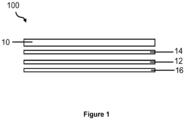
- Figure 1 is an illustration of features of a photovoltaic device according to one embodiment.
- the term "substrate” can be used to describe either a substrate or a superstrate depending on the configuration of the photovoltaic cell.
- the substrate is a superstrate, if when assembled into a photovoltaic cell, it is on the light incident side of a photovoltaic cell.
- the superstrate can provide protection for the photovoltaic materials from impact and environmental degradation while allowing transmission of the appropriate wavelengths of the solar spectrum.
- multiple photovoltaic cells can be arranged into a photovoltaic module. Photovoltaic device can describe either a cell, a module, or both.
- Adjacent can be defined as being in close proximity. Adjacent structures may or may not be in physical contact with each other. Adjacent structures can have other layers and/or structures disposed between them.
- a photovoltaic device comprises a glass comprising, in weight percent:
- the photovoltaic device can comprise any of the described embodiments of the disclosed glasses.
- the glass can be in the form of a sheet and be either the substrate or superstrate or both of the photovoltaic device.
- the glass comprises 50 to 72 weight percent SiO 2 , for example, 51 to 72 weight percent SiO 2 , for example, 52 to 72 weight percent SiO 2 , for example, 53 to 72 weight percent SiO 2 , for example, 54 to 72 weight percent SiO 2 , for example, 55 to 72 weight percent SiO 2 , for example, 56 to 72 weight percent SiO 2 , for example, 57 to 72 weight percent SiO 2 , for example, 58 to 72 weight percent SiO 2 , for example, 59 to 72 weight percent SiO 2 , for example, 60 to 72 weight percent SiO 2 .
- 51 to 72 weight percent SiO 2 for example, 52 to 72 weight percent SiO 2 , for example, 53 to 72 weight percent SiO 2 , for example, 54 to 72 weight percent SiO 2 , for example, 55 to 72 weight percent SiO 2 , for example, 56 to 72 weight percent SiO 2 , for example, 57 to 72 weight percent SiO 2 , for example, 58 to 72 weight percent SiO 2 , for example, 59
- the glass in one embodiment, is rollable.
- the glass in one embodiment, is down-drawable.
- the glass can be slot drawn or fusion drawn, for example.
- the glass can be float formed.
- the glass is free of K 2 O.
- Some embodiments of the disclosed glasses have the advantage of a high Na 2 O content, making them capable of delivering more Na to a deposited CIGS layer during fabrication of photovoltaic cells - which in turn is expected to lead to higher CIGS cell efficiency.
- Na outdiffusion during CIGS deposition/crystallization may possibly be impeded by the presence of another alkali, the fact that some examples are K-free or have substantially reduced K 2 O content may provide yet another advantage.
- the glass can further comprise 3 weight percent or less, for example, 0 to 3 weight percent, for example, greater than 0 to 3 weight percent, for example, 1 to 3 weight percent of TiO 2 , MnO, ZnO, Nb 2 O 5 , MoO 3 , Ta 2 O 5 , WO 3 , ZrO 2 , Y 2 O 3 , La 2 O 3 , HfO 2 , CdO, SnO 2 , Fe 2 O 3 , CeO 2 , As 2 O 3 , Sb 2 O 3 , Cl, Br, or combinations thereof.
- the glass in one embodiment, comprises 3 weight percent or less, for example, 0 to 3 weight percent, for example, greater than 0 to 3 weight percent, for example, 1 to 3 weight percent of TiO 2 or ZrO 2 .
- the glasses comprise 0 to 10 weight percent, for example, 1 to 8 weight percent or for example, greater than 0 to 10 weight percent B 2 O 3 , for example, 0.5 to 10 weight percent B 2 O 3 , for example 1 to 10 weight percent B 2 O 3 .
- B 2 O 3 is added to the glass to reduce melting temperature, to decrease liquidus temperature, to increase liquidus viscosity, and to improve mechanical durability relative to a glass containing no B 2 O 3 .
- the glass is substantially B 2 O 3 free.
- the glass comprises greater than 0 to 25 percent RO, for example, 0.5 to 25 percent RO, for example, 1 to 25 percent RO wherein, R is an alkaline earth metal.
- the glass according to one embodiment, comprises less than 14 percent RO, for example, 13 or less, for example, 12 or less, for example, 11 or less, for example, 10 or less, for example, 9 or less, for example, 8 or less.
- the glass comprises 0.5 to less than 14 percent RO, for example, 0.5 to 13 percent RO.
- the glass according to one embodiment, comprises greater than 2 to 25 percent RO, for example, wherein R is an alkaline earth metal.
- the glass comprises 0.5 to less than 14 percent RO, and the glass has a strain point of 535°C or greater, a coefficient of thermal expansion of 50 x 10 -7 or greater, and has a liquidus viscosity of 130,000 poise or greater, for example, 150,000 poise or greater.
- the glass having these properties in one embodiment, is fusion formable.
- the glass comprises less than 2.5 weight percent MgO, for example, less than 2.0 weight percent MgO.
- the glass can comprise, for example, 0.2 to 2.5 weight percent MgO.
- MgO can be added to the glass to reduce melting temperature and to increase strain point. It can disadvantageously lower CTE relative to other alkaline earths (e.g., CaO, SrO, BaO), and so other adjustments may be made to keep the CTE within the desired range. Examples of suitable adjustments include increase SrO at the expense of CaO, increasing alkali oxide concentration, and replacing a smaller alkali oxide (e.g., Na 2 O) in part with a larger alkali oxide.
- a smaller alkali oxide e.g., Na 2 O
- the glass comprises less than 2.5 weight percent MgO, and the glass has a strain point of 535°C or greater, a coefficient of thermal expansion of 50 x 10 -7 or greater, and has a liquidus viscosity of 130,000 poise or greater, for example, 150,000 poise or greater.
- the glass having these properties in one embodiment, is fusion formable.
- the glass is substantially free of BaO.
- the content of BaO can be 0.05 weight percent or less, for example, zero weight percent.
- the glass is substantially free of Sb 2 O 3 , As 2 O 3 , or combinations thereof, for example, the glass comprises 0.05 weight percent or less of Sb 2 O 3 or As 2 O 3 or a combination thereof.
- the glass can comprise zero weight percent of Sb 2 O 3 or As 2 O 3 or a combination thereof.
- the glasses in some embodiments, comprise 2 to 4 weight percent CaO.
- CaO Relative to alkali oxides or SrO, CaO contributes to higher strain point, lower density, and lower melting temperature. It is a primary component of certain possible devitrification phases, particularly anorthite (CaAl 2 Si 2 O 8 ), and this phase has complete solid solution with an analogous sodium phase, albite (NaAlSi 3 O 3 ). High Na and Ca contents taken alone can cause liquidus temperatures to be unacceptably high.
- the chemical sources for CaO include limestone, a very inexpensive material, so to the extent that high volume and low cost are factors, it is typically useful to make the CaO content as high as can be reasonably achieved relative to other alkaline earth oxides.
- the glasses can comprise, in some embodiments, 0.2 to 4 weight percent SrO, for example, 0.5 to 4 weight percent, for example 1 to 4, for example, 2 to 4 weight percent SrO.
- the glass contains no deliberately batched SrO, though it may of course be present as a contaminant in other batch materials.
- SrO contributes to higher coefficient of thermal expansion, and the relative proportion of SrO and CaO can be manipulated to improve liquidus temperature, and thus liquidus viscosity.
- SrO is not as effective as CaO or MgO for improving strain point, and replacing either of these with SrO tends to cause the melting temperature to increase.
- the glasses include 10 to 25 percent M 2 O, wherein M is one of the alkali cations Li, Na, Rb and Cs.
- the alkali cations raise the CTE steeply, but also lower the strain point and, depending upon how they are added, increase melting temperatures.
- the least effective alkali oxide for CTE is Li 2 O, and the most effective alkali oxide is Cs 2 O.
- sodium can participate in one of the possible devitrification phases of the inventive glasses, and while adjustments in other components can be used to counteract this, e.g., changing the CaO/(CaO+SrO) ratio, this tendency may make it advantageous to replace sodium with other alkalis, or to use a mix of alkalis instead of sodium alone. If high volume and low cost are important, then it is desirable to as much as possible confine the alkali oxides to Na 2 O
- the glass comprises 9 to 17 percent Na 2 O, for example, 10 to 16 percent Na 2 O. In one embodiment, the glass comprises 9 to 12 weight percent Na 2 O.
- the glass is down-drawable; that is, the glass is capable of being formed into sheets using down-draw methods such as, but not limited to, fusion draw and slot draw methods that are known to those skilled in the glass fabrication arts.
- down-draw processes are used in the large-scale manufacture of ion-exchangeable flat glass.
- the glass comprises 20 to 30 weight percent Al 2 O 3 + B 2 O 3 .
- the glass comprises 21 to 25 weight percent Al 2 O 3 .
- the glass comprises 17 to 21 weight percent Al 2 O 3 + B 2 O 3 .
- the glass comprises greater than 15 to 25 weight percent Al 2 O 3 , for example, 16 or greater to 25 weight percent, for example, 16 to 24 weight percent Al 2 O 3 or, for example, 17 to 25 weight percent Al 2 O 3 , for example, 17 to 21 weight percent Al 2 O 3 .
- the glass comprises greater than 15 to 25 weight percent Al 2 O 3 , has a strain point of 535°C or greater, a coefficient of thermal expansion of 50 x 10 -7 or greater, and a liquidus viscosity of 130,000 poise or greater, for example, 150,000 poise or greater.
- the glass having these properties in one embodiment, is fusion formable.
- the glass comprises greater than 15 to 25 percent Al 2 O 3 and comprises 0.5 to less than 14 percent RO.
- the glass comprises greater than 15 to 25 percent Al 2 O 3 , 0.5 to less than 14 percent RO, has a strain point of 535°C or greater, a coefficient of thermal expansion of 50 x 10 -7 or greater, and a liquidus viscosity of 130,000 poise or greater, for example, 150,000 poise or greater.
- the glass having these properties in one embodiment, is fusion formable.
- the fusion draw process uses a drawing tank that has a channel for accepting molten glass raw material.
- the channel has weirs that are open at the top along the length of the channel on both sides of the channel.
- the molten glass overflows the weirs. Due to gravity, the molten glass flows down the outside surfaces of the drawing tank. These outside surfaces extend down and inwardly so that they join at an edge below the drawing tank. The two flowing glass surfaces join at this edge to fuse and form a single flowing sheet.
- the fusion draw method offers the advantage that, since the two glass films flowing over the channel fuse together, neither outside surface of the resulting glass sheet comes in contact with any part of the apparatus. Thus, the surface properties are not affected by such contact.
- the slot draw method is distinct from the fusion draw method.
- the molten raw material glass is provided to a drawing tank.
- the bottom of the drawing tank has an open slot with a nozzle that extends the length of the slot.
- the molten glass flows through the slot/nozzle and is drawn downward as a continuous sheet therethrough and into an annealing region.
- the slot draw process provides a thinner sheet, as only a single sheet is drawn through the slot, rather than two sheets being fused together, as in the fusion down-draw process.
- the aluminoborosilicate glass described herein has a high liquidus viscosity.
- the glass has a liquidus viscosity of 50,000 poise or greater, for example, 150,000 poise or greater, for example, 200,000 poise or greater, for example, 250,000 poise or greater, for example, 300,000 poise or greater, for example, 350,000 poise or greater, for example, 400,000 poise or greater, for example, greater than or equal to 500,000 poise.
- the liquidus viscosities of some exemplary glasses could be closely correlated with the difference between the liquidus temperature and the softening point.
- the glass has a strain point of 535°C or greater, for example, 540°C or greater, for example, a strain point of 560°C or greater, for example, a strain point of 570°C or greater, for example, 580°C or greater.
- the glass has a coefficient of thermal expansion of 50 x 10 -7 or greater, for example, 60 x 10 -7 or greater, for example, 70 x 10 -7 or greater, for example, 80 x 10 -7 or greater.
- the glass has a coefficient of thermal expansion of from 50 x 10 -7 to 90 x 10 -7 .
- the glass has a strain point of 535°C or greater, a coefficient of thermal expansion of 50 x 10 -7 or greater, and has a liquidus viscosity of 150,000 poise or greater.
- the glass having these properties in one embodiment, is fusion formable.
- the glass has a coefficient of thermal expansion of 50 x 10 -7 or greater and a strain point of 535°C or greater. In one embodiment, the glass has a coefficient of thermal expansion of 50 x 10 -7 or greater and a strain point of 540°C or greater. In one embodiment, the glass has a coefficient of thermal expansion of 60 x 10 -7 or greater and a strain point of 560°C or greater. In one embodiment, the glass has a coefficient of thermal expansion of 60 x 10 -7 or greater and a strain point of 580°C or greater. In one embodiment, the glass has a coefficient of thermal expansion of 50 x 10 -7 or greater and a strain point of 570°C or greater.
- the glass has a coefficient of thermal expansion of 70 x 10 -7 or greater and a strain point of 570°C or greater.
- Embodiments of the described glasses can have several combinations of properties within the disclosed ranges. It should be appreciated that all of the possible combinations are not listed herein.
- the glass is ion exchanged, for example in a salt bath comprising one or more salts of alkali ions.
- the glass can be ion exchanged to change its mechanical properties.
- smaller alkali ions such as lithium or sodium
- a molten salt containing one or more larger alkali ions such as sodium, potassium, rubidium or cesium. If performed at a temperature well below the strain point for sufficient time, a diffusion profile will form in which the larger alkali moves into the glass surface from the salt bath, and the smaller ion is moved from the interior of the glass into the salt bath.
- the surface will go under compression, producing enhanced toughness against damage.
- Such toughness may be desirable in instances where the glass will be exposed to adverse environmental conditions, such as photovoltaic grids exposed to hail.
- adverse environmental conditions such as photovoltaic grids exposed to hail.
- a large alkali already in the glass can also be exchanged for a smaller alkali in a salt bath. If this is performed at temperatures close to the strain point, and if the glass is removed and its surface rapidly reheated to high temperature and rapidly cooled, the surface of the glass will show considerable compressive stress introduced by thermal tempering. This will also provide protection against adverse environmental conditions.
- any monovalent cation can be exchanged for alkalis already in the glass, including copper, silver, thallium, etc., and these also provide attributes of potential value to end uses, such as introducing color for lighting or a layer of elevated refractive index for light trapping.
- the glass can be float formed as known in the art of float forming glass.
- the glass is in the form of a sheet.
- the glass in the form of a sheet can be thermally tempered.
- the glass is transparent.
- the glass sheet is transparent.
- a photovoltaic device comprises the glass in the form of a sheet.
- the photovoltaic device can comprise more than one of the glass sheets, for example, as a substrate and/or as a superstrate.
- the photovoltaic device comprises the glass sheet 10 as a substrate and/or superstrate, a conductive material 12 located adjacent to the substrate, and an active photovoltaic medium 16 adjacent to the conductive material.
- the active photovoltaic medium comprises a copper indium gallium diselenide (CIGS) layer.
- the active photovoltaic medium comprises a cadmium telluride (CdTe) layer.
- the active photovoltaic medium is a CIGS layer.
- the active photovoltaic medium is a cadmium telluride (CdTe) layer.
- the photovoltaic device further comprises a barrier layer 14 disposed between the superstrate or substrate and the active photovoltaic medium.
- the photovoltaic device further comprises a barrier layer disposed between or adjacent to the superstrate or substrate and a transparent conductive oxide (TCO) layer, wherein the TCO layer is disposed between or adjacent to the active photovoltaic medium and the barrier layer.
- TCO transparent conductive oxide
- a TCO may be present in a photovoltaic device comprising a CdTe functional layer.
- the barrier layer is disposed directly on the glass. The barrier layer can effect the migration of alkali ions from the glass into other layers of the device, for example, the active photovoltaic medium, for example, increase, decrease, or meter the migration.
- the glass sheet is transparent. In one embodiment, the glass sheet as the substrate and/or superstrate is transparent.
- the glass sheet has a thickness of 4.0mm or less, for example, 3.5mm or less, for example, 3.2mm or less, for example, 3.0mm or less, for example, 2.5mm or less, for example, 2.0mm or less, for example, 1.9mm or less, for example, 1.8mm or less, for example, 1.5mm or less, for example, 1.1mm or less, for example, 0.5mm to 2.0mm, for example, 0.5mmto 1.1mm, for example, 0.7mm to 1.1mm.
- the glass sheet can have a thickness of any numerical value including decimal places in the range of from 0.1mm up to and including 4.0mm.
- the fusion formable glasses of this invention by virtue of their relatively high strain point, represent advantaged substrate materials for CIGS photovoltaic modules. When manufactured by the fusion process, their superior surface quality relative to that of float glass may also result in further improvements to the photovoltaic module making process.
- Advantageous embodiments of this invention are characterized by liquidus viscosity in excess of 400,000 poise, thereby enabling the fabrication of the relatively thick glass sheets that may be advantageous for some module manufacturers.
- the total does not add up to 100%, since certain tramp elements are present at non-negligible concentrations.
- limestone depending on the source can contain tramp elements and/or vary amounts of one or more oxides, for example, MgO and/or BaO.
- the sand is advantageously beneficiated so that at least 80% by mass passes 60 mesh, for example 80 mesh, for example 100 mesh.
- the SnO 2 added, in this example, was pre-mixed with sand at a level of 10% by weight so as to ensure homogeneous mixing with the other components.
- the bottle containing the batch materials was mounted to a tumbler and the batch materials were mixed so as to make a homogeneous batch and to break up soft agglomerates.
- the mixed batch was transferred to a 1800cc platinum crucible and placed into a high-temperature ceramic backer.
- the platinum in its backer was loaded into a glo-bar furnace idling at a temperature of 1630°C. After 16 hours, the crucible+backer was removed and the glass melt was poured onto a cold surface, such as a steel plate, to form a patty, and then transferred to an annealer held at a temperature of 640°C. The glass patty was held at the annealer temperature for 2 hours, then cooled at a rate of 1°C per minute to room temperature.
- Table 3 Table 4, Table 5, Table 6, Table 7, Table 8, Table 9, Table 10, Table 11, and Table 12 show exemplary glasses made according to the above example. Properties data for some exemplary glasses are also shown in Table 3, Table 4, Table 5, Table 6, Table 7, Table 8, Table 9, Table 10, Table 11, and Table 12.
- T str (°C) is the strain point which is the temperature when the viscosity is equal to 10 13.7 Pa•s (10 14.7 P) as measured by beam bending or fiber elongation.
- T ann (°C) is the annealing point which is the temperature when the viscosity is equal to 10 12.8 Pa•s (10 13.18 P) as measured by beam bending or fiber elongation.
- T s (°C) is the softening point which is the temperature when the viscosity is equal to 10 6.6 Pa•s (10 7.6 P) as measured by beam bending or fiber elongation.
- ⁇ (10 -7 /°C) or a(10 -7 /°C) in the Tables is the coefficient of thermal expansion (CTE) which is the amount of dimensional change from either 0 to 300°C or 25 to 300°C depending on the measurement. CTE is typically measured by dilatometry.
- ⁇ (g/cc) is the density which is measured with the Archimedes method (ASTM C693).
- T 200 (°C) is the twenty Pa•s (two-hundred Poise (P)) temperature.
- T liq (°C) is the liquidus temperature. This is the temperature where the first crystal is observed in a standard gradient boat liquidus measurement (ASTM C829-81). Generally this test is 72 hours but can be as short as 24 hours to increase throughput at the expense of accuracy (shorter tests could underestimate the liquidus temperature).
- ⁇ liq (°C) is the liquidus viscosity. This is the viscosity of the melt corresponding to the liquidus temperature.
- Example 7 8 9 10 11 Composition (mol%) Na 2 O 11.32 11.32 11.32 11.09 10.87 K 2 O 4.09 4.09 4.09 4.01 3.93 MgO 3.14 3.14 3.08 3.01 CaO 3.15 3.15 3.09 3.02 SrO 1.56 1.56 1.56 1.53 1.5 Al 2 O 3 11.00 9.00 7.00 12.74 12.48 SiO 2 63.63 63.63 62.36 61.09 SnO 2 0.10 0.10 0.10 0.10 0.10 B 2 O 3 2.00 4.00 6.00 2.00 4.00 (RO+R2O)/Al 2 O 3 2.11 2.58 3.32 1.79 1.79 R 2 O/RO 1.96 1.96 1.96 1.96 1.97 (RO+R 2 O/Al 2 O 3 +B 2 O 3 1.79 1.79 1.79 1.55 1.35 R 2 O/Al 2 O 3 +B 2 O 3 1.19 1.19 1.19 1.02 0.90 Composition (wt%) Na 2 O 10.51 10.61 10.72 10.19 9.98 K 2 O 5.79 5.85 5.
- Example 12 13 14 15 16 17 18 19 Composition (mol%) Na 2 O 10.93 11.06 11.19 11.19 11.06 10.93 10.93 10.93 K 2 O 3.95 3.99 4.04 4.04 3.99 3.95 3.95 3.95 MgO 0 0 0 3.11 3.07 3.03 0 0 CaO 7.59 7.68 7.77 3.11 3.07 3.04 7.59 7.59 SrO 0 0 0 1.55 1.54 1.52 0 0 B 2 O 3 0 0 0 0 0 0 1.00 2.00 Al 2 O 3 16.00 15.00 14.00 14.00 15.00 16.00 16.00 16.00 SiO 2 61.43 62.17 62.9 62.9 62.17 61.43 60.43 59.43 SnO 2 0.10 0.10 0.10 0.10 0.10 0.10 0.10 Composition (wt%) Na 2 O 9.92 10.10 10.30 10.20 10.10 9.88 9.90 9.89 K 2 O 5.46 5.55 5.66 5.63 5.53 5.44 5.46 5.45 MgO 0 0 0 1.86 1.82
- Example 20 21 22 23 24 25 26 27 Composition (mol%) Na 2 O 14.80 12.20 14.80 14.80 14.80 14.80 14.00 14.00 K 2 O 0.90 2.90 0 0 0.50 0 0 0 MgO 3.60 1.30 4.50 3.60 3.60 0 0 CaO 1.90 5.70 1.90 2.80 1.90 1.90 8.00 5.00 SrO 0 0 0 0.40 0.90 0 0 ZnO 0 0 0 0 0 0 0 0 B 2 O 3 0 0 0 0 0 0 0 0 0 Al 2 O 3 10.80 14.20 10.80 10.80 10.80 10.80 10.80 10.00 11.00 TiO 2 0 0 0 0 0 0 0 0 0 ZrO 2 0 0 0 0 0 0 0 0 SiO 2 67.90 63.60 67.90 67.90 67.90 67.90 67.90 67.90 69.90 SnO 2 0.10 0.
- Example 36 37 38 39 40 41 42 43 Composition (mol%) Na 2 O 14.00 16.00 14.00 13.00 13.00 13.00 13.00 K 2 O 0 0 0 0 0 0 0 0 MgO 0 5.00 4.50 4.00 3.50 3.50 3.00 5.90 CaO 0 0 0 4.00 3.50 3.50 3.00 0 SrO 0 0 0 0 0 0 0 ZnO 5.00 0 0 0 0 0 0 0 B 2 O 3 0 0 0 0 0 1.00 0 0 0 Al 2 O 3 11.00 9.00 8.20 10.00 9.00 10.00 9.00 8.08 TiO 2 0 0 0 0 0 0 0 0 0 0 ZrO 2 0 0 0 0 0 0 0 0 SiO 2 69.90 70.00 73.50 69.00 70.00 70.00 72.00 73.00 SnO 2 0.10 0.10 0.10 0.10 0.10 0.10 0.10 0.10 Composition
- Example 44 46 Composition (mol%) Na 2 O 15.00 15.34 11.90 K 2 O 0 0 0 MgO 0 0 5.00 CaO 3.40 0.59 0 SrO 0 0 0 ZnO 0 0 0 B 2 O 3 0 5.00 2.00 Al 2 O 3 11.50 16.03 9.00 TiO 2 0 0 0 ZrO 2 0 0 0 SiO 2 70.00 62.94 72.00 SnO 2 0.10 0.10 0.10 Composition (wt%) Na 2 O 14.23 14.02 11.6 K 2 O 0 0 0 MgO 0 0 3.18 CaO 2.93 0.49 0 SrO 0 0 0 ZnO 0 0 0 B 2 O 3 0 5.15 2.20 Al 2 O 3 18.00 24.17 14.48 TiO 2 0 0 0 ZrO 2 0 0 0 SiO 2 64.57 55.92 68.26 SnO 2 0.23 0.23 0.23 T str (°C) 589 609 5
- Example 47 48 49 50 51 52 Composition (mol%) Na 2 O 14.80 14.85 14.88 14.80 14.80 MgO 3.60 1.38 0.69 3.85 3.60 3.30 CaO 1.90 3.73 4.86 2.05 1.90 1.75 SrO 0.90 0.35 0.18 1.00 0.90 0.85 Al 2 O 3 10.80 13.15 13.58 12.30 12.80 13.30 ZrO 2 1.00 0 0 0 0 SiO 2 66.90 66.44 65.71 65.90 65.90 65.90 SnO 2 0.10 0.10 0 0.10 0.10 0.10 Composition (wt%) Na 2 O 14.00 14.00 14.00 14.00 14.00 13.90 MgO 2.23 0.85 0.42 2.38 2.22 2.03 CaO 1.63 3.19 4.14 1.76 1.63 1.49 SrO 1.43 0.55 0.28 1.59 1.43 1.34 Al 2 O 3 16.90 20.40 21.00 19.20 20.00 20.70 ZrO 2 1.89 0 0 0 0 0 SiO 2 61.60 60.80 59.90
- Example 53 54 55 56 57 58 Composition (mol%) Na 2 O 13.50 14.90 13.19 14.90 15.58 16.93 K 2 O 0 0 0.98 0 0 0 MgO 0 0 5.68 0 0 0 CaO 4.50 6.00 1.17 2.00 4.92 1.60 SrO 0 0 0.38 0 0 0 ZnO 0 0 0 4.00 0 0 Al 2 O 3 12.00 14.00 9.50 14.00 15.34 18.57 ZrO 2 0 0 0 0 0 0 0 SiO 2 70.00 65.00 67.31 65.00 64.09 58.80 SnO 2 0.10 0 0.10 0.10 0.10 0.01 Composition (wt%) Na 2 O 12.77 13.93 12.87 13.73 14.42 15.25 K 2 O 0 0 1.46 0 0 0 MgO 0 0 3.62 0 0 CaO 3.86 5.09 1.04 1.67 4.14 1.31 SrO 0 0 0.62 0 0 0 ZnO
- Example 59 60 61 62 63 64 Composition (mol%) Na 2 O 12.57 12.27 10.77 11.07 10.82 11.58 K 2 O 2.30 2.24 2.24 3.44 2.79 2.30 MgO 4.81 4.69 4.69 3.39 3.64 6.20 CaO 2.60 2.00 3.00 3.15 3.15 0.60 SrO 0 1.00 1.50 1.56 1.56 0 ZnO 0 0 0 0 0 Al 2 O 3 8.70 10.44 10.44 12.15 11.30 7.61 ZrO 2 0 0 0 0 0 0 SiO 2 68.82 67.16 67.16 65.13 66.63 71.51 SnO 2 0.20 0.20 0.20 0.10 0.10 0.20 Composition (wt%) Na 2 O 12.17 11.65 10.20 10.28 10.14 11.32 K 2 O 3.39 3.24 3.24 4.87 3.99 3.43 MgO 3.04 2.91 2.90 2.05 2.23 3.96 CaO 2.28 1.72 2.58 2.66 2.68 0.53 SrO 0 1.59 2.38 2.43
Landscapes
- Chemical & Material Sciences (AREA)
- Life Sciences & Earth Sciences (AREA)
- Engineering & Computer Science (AREA)
- Chemical Kinetics & Catalysis (AREA)
- General Chemical & Material Sciences (AREA)
- Geochemistry & Mineralogy (AREA)
- Materials Engineering (AREA)
- Organic Chemistry (AREA)
- Glass Compositions (AREA)
- Photovoltaic Devices (AREA)
- Surface Treatment Of Glass (AREA)
- Silicates, Zeolites, And Molecular Sieves (AREA)
Description
- Embodiments relate generally to sodium containing glasses and more particularly to fusion formable silica and sodium containing glasses for photovoltaic applications, for example, thin film photovoltaics.
- Recent interest in the higher efficiencies offered by thin film photovoltaics has spawned considerable efforts into the development of new glass substrates and superstrates tailored to the needs of this new market. The thin film photovoltaics manufacturing processes typically require substrates capable of handling elevated temperatures for extended periods of time without warping, making glasses particularly well suited for these applications. Additionally, some thin film photovoltaic processes (such as CIGS) desire sodium to diffuse from the glass into the deposited layers, making sodium-containing glasses even more desirable for particular applications.
- Existing glasses (such as soda lime or display compositions) have been used to demonstrate extremely high efficiencies in this field but the use of any glasses designed for other applications is wrought with problems. For example, soda lime glass offers a cheap, readily available sodium-containing substrate but its low strain point drastically inhibits its use in the higher temperature process that allow thin film photovoltaic processes to reach their highest efficiencies.
- The use of glasses designed for display applications provides the required high strain point but the coefficient of thermal expansion (CTE) of these glasses is often too low to allow the reliable construction of large photovoltaic panels due to CTE mismatch with the photovoltaic films. Additionally, many glasses designed for display applications are intentionally alkali-free, making them less useful for those thin film photovoltaic applications desiring sodium diffusion from the glass.
- In some thin film photovoltaic applications, it would be advantageous to have a sodium-containing glass sheet with a high strain point and a high CTE. Further, it would be advantageous to have a sodium-containing glass with a high strain point and high CTE that is fusion formable to allow processing into a flat sheet with optimal surface characteristics.
Various glass compositions are described inWO 2009/019965 A1 ,WO 2008/149858 A1 ,JP 2001-226137 A JP 2002-003241 A US 4,298,389 A ,JP 2004-131314 A DE 10005088 C1 ,JP 11-135819 A WO 2008/143999 A1 ,EP 2 277839 A1 andUS 2003/0092556 A1 . - A compositional range of fusion-formable, high strain point sodium-containing aluminosilicate and boroaluminosilicate glasses useful, for example, for thin-film photovoltaic applications are described herein. More specifically, these glasses are advantageous materials to be used in copper indium gallium diselenide (CIGS) photovoltaic modules where the sodium required to optimize cell efficiency is to be derived from the substrate glass. Current CIGS module substrates are typically made from soda-lime glass sheet that has been manufactured by the float process. However, use of higher strain point glass substrates can enable higher temperature CIGS processing, which is expected to translate into desirable improvements in cell efficiency. Moreover, it may be that the smoother surface of fusion-formed glass sheets yields additional benefits, such as improved film adhesion, etc.
- Accordingly, the sodium-containing glasses described herein can be characterized by strain points ≥ 540°C, for example, ≥ 570°C so as to provide advantage with respect to soda-lime glass and/or liquidus viscosity ≥ 50,000 poise to allow manufacture via the fusion process, for example, a liquidus viscosity of 130,000 poise or greater. In order to avoid thermal expansion mismatch between the substrate and CIGS layer, the inventive glasses, according to some embodiments, are further characterized by a thermal expansion coefficient in the range of from 8 to 9 ppm/°C.
- The invention relates to a photovoltaic device comprising a glass comprising, in weight percent:
- 50 to 72 percent SiO2;
- greater than 15 to 25 percent Al2O3;
- 0 to 10 percent B2O3;
- Less than 2.5 percent MgO;
- 10 to 25 percent total M2O; and
- greater than 0 to 25 percent total RO;
- Additional features and advantages of the invention will be set forth in the detailed description which follows, and in part will be readily apparent to those skilled in the art from the description or recognized by practicing the invention as described in the written description and claims hereof, as well as the appended drawings.
- It is to be understood that both the foregoing general description and the following detailed description are merely exemplary of the invention, and are intended to provide an overview or framework to understanding the nature and character of the invention as it is claimed.
- The accompanying drawings are included to provide a further understanding of the invention, and are incorporated in and constitute a part of this specification. The drawings illustrate one or more embodiment(s) of the invention and together with the description serve to explain the principles and operation of the invention.
- The invention can be understood from the following detailed description either alone or together with the accompanying drawings.
-
Figure 1 is an illustration of features of a photovoltaic device according to one embodiment. - Reference will now be made in detail to various embodiments of the invention.
- As used herein, the term "substrate" can be used to describe either a substrate or a superstrate depending on the configuration of the photovoltaic cell. For example, the substrate is a superstrate, if when assembled into a photovoltaic cell, it is on the light incident side of a photovoltaic cell. The superstrate can provide protection for the photovoltaic materials from impact and environmental degradation while allowing transmission of the appropriate wavelengths of the solar spectrum. Further, multiple photovoltaic cells can be arranged into a photovoltaic module. Photovoltaic device can describe either a cell, a module, or both.
- As used herein, the term "adjacent" can be defined as being in close proximity. Adjacent structures may or may not be in physical contact with each other. Adjacent structures can have other layers and/or structures disposed between them.
- A photovoltaic device comprises a glass comprising, in weight percent:
- 50 to 72 percent SiO2;
- greater than 15 to 25 percent Al2O3;
- 0 to 10 percent B2O3;
- less than 2.5 percent MgO
- 10 to 25 percent total M2O; and greater than 0 to 25 percent total RO;
- wherein, M is an alkali metal selected from Na, Li, Rb,
- The photovoltaic device can comprise any of the described embodiments of the disclosed glasses. The glass can be in the form of a sheet and be either the substrate or superstrate or both of the photovoltaic device.
- The glass comprises 50 to 72 weight percent SiO2, for example, 51 to 72 weight percent SiO2, for example, 52 to 72 weight percent SiO2, for example, 53 to 72 weight percent SiO2, for example, 54 to 72 weight percent SiO2, for example, 55 to 72 weight percent SiO2, for example, 56 to 72 weight percent SiO2, for example, 57 to 72 weight percent SiO2, for example, 58 to 72 weight percent SiO2, for example, 59 to 72 weight percent SiO2, for example, 60 to 72 weight percent SiO2.
- The glass, in one embodiment, is rollable. The glass, in one embodiment, is down-drawable. The glass can be slot drawn or fusion drawn, for example. According to another embodiment the glass can be float formed.
- The glass is free of K2O.
- Some embodiments of the disclosed glasses have the advantage of a high Na2O content, making them capable of delivering more Na to a deposited CIGS layer during fabrication of photovoltaic cells - which in turn is expected to lead to higher CIGS cell efficiency. Finally, as Na outdiffusion during CIGS deposition/crystallization may possibly be impeded by the presence of another alkali, the fact that some examples are K-free or have substantially reduced K2O content may provide yet another advantage.
- The glass can further comprise 3 weight percent or less, for example, 0 to 3 weight percent, for example, greater than 0 to 3 weight percent, for example, 1 to 3 weight percent of TiO2, MnO, ZnO, Nb2O5, MoO3, Ta2O5, WO3, ZrO2, Y2O3, La2O3, HfO2, CdO, SnO2, Fe2O3, CeO2, As2O3, Sb2O3, Cl, Br, or combinations thereof. The glass, in one embodiment, comprises 3 weight percent or less, for example, 0 to 3 weight percent, for example, greater than 0 to 3 weight percent, for example, 1 to 3 weight percent of TiO2 or ZrO2.
- As mentioned above, the glasses comprise 0 to 10 weight percent, for example, 1 to 8 weight percent or for example, greater than 0 to 10 weight percent B2O3, for example, 0.5 to 10 weight percent B2O3, for example 1 to 10 weight percent B2O3. B2O3 is added to the glass to reduce melting temperature, to decrease liquidus temperature, to increase liquidus viscosity, and to improve mechanical durability relative to a glass containing no B2O3. In one embodiment, the glass is substantially B2O3 free.
- The glass comprises greater than 0 to 25 percent RO, for example, 0.5 to 25 percent RO, for example, 1 to 25 percent RO wherein, R is an alkaline earth metal. The glass, according to one embodiment, comprises less than 14 percent RO, for example, 13 or less, for example, 12 or less, for example, 11 or less, for example, 10 or less, for example, 9 or less, for example, 8 or less. In one embodiment, the glass comprises 0.5 to less than 14 percent RO, for example, 0.5 to 13 percent RO. The glass, according to one embodiment, comprises greater than 2 to 25 percent RO, for example, wherein R is an alkaline earth metal.
- According to one embodiment, the glass comprises 0.5 to less than 14 percent RO, and the glass has a strain point of 535°C or greater, a coefficient of thermal expansion of 50 x 10-7 or greater, and has a liquidus viscosity of 130,000 poise or greater, for example, 150,000 poise or greater. The glass having these properties, in one embodiment, is fusion formable.
- The glass comprises less than 2.5 weight percent MgO, for example, less than 2.0 weight percent MgO. The glass can comprise, for example, 0.2 to 2.5 weight percent MgO. MgO can be added to the glass to reduce melting temperature and to increase strain point. It can disadvantageously lower CTE relative to other alkaline earths (e.g., CaO, SrO, BaO), and so other adjustments may be made to keep the CTE within the desired range. Examples of suitable adjustments include increase SrO at the expense of CaO, increasing alkali oxide concentration, and replacing a smaller alkali oxide (e.g., Na2O) in part with a larger alkali oxide.
- According to one embodiment, the glass comprises less than 2.5 weight percent MgO, and the glass has a strain point of 535°C or greater, a coefficient of thermal expansion of 50 x 10-7 or greater, and has a liquidus viscosity of 130,000 poise or greater, for example, 150,000 poise or greater. The glass having these properties, in one embodiment, is fusion formable.
- According to another embodiment, the glass is substantially free of BaO. For example, the content of BaO can be 0.05 weight percent or less, for example, zero weight percent.
- In some embodiments, the glass is substantially free of Sb2O3, As2O3, or combinations thereof, for example, the glass comprises 0.05 weight percent or less of Sb2O3 or As2O3 or a combination thereof. For example, the glass can comprise zero weight percent of Sb2O3 or As2O3 or a combination thereof.
- The glasses, in some embodiments, comprise 2 to 4 weight percent CaO. Relative to alkali oxides or SrO, CaO contributes to higher strain point, lower density, and lower melting temperature. It is a primary component of certain possible devitrification phases, particularly anorthite (CaAl2Si2O8), and this phase has complete solid solution with an analogous sodium phase, albite (NaAlSi3O3). High Na and Ca contents taken alone can cause liquidus temperatures to be unacceptably high. However, the chemical sources for CaO include limestone, a very inexpensive material, so to the extent that high volume and low cost are factors, it is typically useful to make the CaO content as high as can be reasonably achieved relative to other alkaline earth oxides.
- The glasses can comprise, in some embodiments, 0.2 to 4 weight percent SrO, for example, 0.5 to 4 weight percent, for example 1 to 4, for example, 2 to 4 weight percent SrO. In certain embodiments, the glass contains no deliberately batched SrO, though it may of course be present as a contaminant in other batch materials. SrO contributes to higher coefficient of thermal expansion, and the relative proportion of SrO and CaO can be manipulated to improve liquidus temperature, and thus liquidus viscosity. SrO is not as effective as CaO or MgO for improving strain point, and replacing either of these with SrO tends to cause the melting temperature to increase.
- Also as mentioned above, the glasses include 10 to 25 percent M2O, wherein M is one of the alkali cations Li, Na, Rb and Cs. The alkali cations raise the CTE steeply, but also lower the strain point and, depending upon how they are added, increase melting temperatures. The least effective alkali oxide for CTE is Li2O, and the most effective alkali oxide is Cs2O. As noted above, sodium can participate in one of the possible devitrification phases of the inventive glasses, and while adjustments in other components can be used to counteract this, e.g., changing the CaO/(CaO+SrO) ratio, this tendency may make it advantageous to replace sodium with other alkalis, or to use a mix of alkalis instead of sodium alone. If high volume and low cost are important, then it is desirable to as much as possible confine the alkali oxides to Na2O
- The glass comprises 9 to 17 percent Na2O, for example, 10 to 16 percent Na2O. In one embodiment, the glass comprises 9 to 12 weight percent Na2O.
- The glass, according to some embodiments, is down-drawable; that is, the glass is capable of being formed into sheets using down-draw methods such as, but not limited to, fusion draw and slot draw methods that are known to those skilled in the glass fabrication arts. Such down-draw processes are used in the large-scale manufacture of ion-exchangeable flat glass.
- The glass, according to one embodiment, comprises 20 to 30 weight percent Al2O3 + B2O3.
- The glass, according to one embodiment, comprises 21 to 25 weight percent Al2O3.
- The glass, according to one embodiment, comprises 17 to 21 weight percent Al2O3 + B2O3.
- The glass comprises greater than 15 to 25 weight percent Al2O3, for example, 16 or greater to 25 weight percent, for example, 16 to 24 weight percent Al2O3 or, for example, 17 to 25 weight percent Al2O3, for example, 17 to 21 weight percent Al2O3.
- According to one embodiment, the glass comprises greater than 15 to 25 weight percent Al2O3, has a strain point of 535°C or greater, a coefficient of thermal expansion of 50 x 10-7 or greater, and a liquidus viscosity of 130,000 poise or greater, for example, 150,000 poise or greater. The glass having these properties, in one embodiment, is fusion formable.
- The glass, according to one embodiment, comprises greater than 15 to 25 percent Al2O3 and comprises 0.5 to less than 14 percent RO. In one embodiment, the glass comprises greater than 15 to 25 percent Al2O3, 0.5 to less than 14 percent RO, has a strain point of 535°C or greater, a coefficient of thermal expansion of 50 x 10-7 or greater, and a liquidus viscosity of 130,000 poise or greater, for example, 150,000 poise or greater. The glass having these properties, in one embodiment, is fusion formable.
- The fusion draw process uses a drawing tank that has a channel for accepting molten glass raw material. The channel has weirs that are open at the top along the length of the channel on both sides of the channel. When the channel fills with molten material, the molten glass overflows the weirs. Due to gravity, the molten glass flows down the outside surfaces of the drawing tank. These outside surfaces extend down and inwardly so that they join at an edge below the drawing tank. The two flowing glass surfaces join at this edge to fuse and form a single flowing sheet. The fusion draw method offers the advantage that, since the two glass films flowing over the channel fuse together, neither outside surface of the resulting glass sheet comes in contact with any part of the apparatus. Thus, the surface properties are not affected by such contact.
- The slot draw method is distinct from the fusion draw method. Here the molten raw material glass is provided to a drawing tank. The bottom of the drawing tank has an open slot with a nozzle that extends the length of the slot. The molten glass flows through the slot/nozzle and is drawn downward as a continuous sheet therethrough and into an annealing region. Compared to the fusion draw process, the slot draw process provides a thinner sheet, as only a single sheet is drawn through the slot, rather than two sheets being fused together, as in the fusion down-draw process.
- In order to be compatible with down-draw processes, the aluminoborosilicate glass described herein has a high liquidus viscosity. In one embodiment, the glass has a liquidus viscosity of 50,000 poise or greater, for example, 150,000 poise or greater, for example, 200,000 poise or greater, for example, 250,000 poise or greater, for example, 300,000 poise or greater, for example, 350,000 poise or greater, for example, 400,000 poise or greater, for example, greater than or equal to 500,000 poise. The liquidus viscosities of some exemplary glasses could be closely correlated with the difference between the liquidus temperature and the softening point.
- In one embodiment, the glass has a strain point of 535°C or greater, for example, 540°C or greater, for example, a strain point of 560°C or greater, for example, a strain point of 570°C or greater, for example, 580°C or greater. In some embodiments, the glass has a coefficient of thermal expansion of 50 x 10-7 or greater, for example, 60 x 10-7 or greater, for example, 70 x 10-7 or greater, for example, 80 x 10-7 or greater. In one embodiment, the glass has a coefficient of thermal expansion of from 50 x 10-7 to 90 x 10-7.
- In one embodiment, the glass has a strain point of 535°C or greater, a coefficient of thermal expansion of 50 x 10-7 or greater, and has a liquidus viscosity of 150,000 poise or greater. The glass having these properties, in one embodiment, is fusion formable.
- In one embodiment, the glass has a coefficient of thermal expansion of 50 x 10-7 or greater and a strain point of 535°C or greater. In one embodiment, the glass has a coefficient of thermal expansion of 50 x 10-7 or greater and a strain point of 540°C or greater. In one embodiment, the glass has a coefficient of thermal expansion of 60 x 10-7 or greater and a strain point of 560°C or greater. In one embodiment, the glass has a coefficient of thermal expansion of 60 x 10-7 or greater and a strain point of 580°C or greater. In one embodiment, the glass has a coefficient of thermal expansion of 50 x 10-7 or greater and a strain point of 570°C or greater. In one embodiment, the glass has a coefficient of thermal expansion of 70 x 10-7 or greater and a strain point of 570°C or greater. Embodiments of the described glasses can have several combinations of properties within the disclosed ranges. It should be appreciated that all of the possible combinations are not listed herein.
- The glass is ion exchanged, for example in a salt bath comprising one or more salts of alkali ions. The glass can be ion exchanged to change its mechanical properties. For example, smaller alkali ions, such as lithium or sodium, can be ion-exchanged in a molten salt containing one or more larger alkali ions, such as sodium, potassium, rubidium or cesium. If performed at a temperature well below the strain point for sufficient time, a diffusion profile will form in which the larger alkali moves into the glass surface from the salt bath, and the smaller ion is moved from the interior of the glass into the salt bath. When the sample is removed, the surface will go under compression, producing enhanced toughness against damage. Such toughness may be desirable in instances where the glass will be exposed to adverse environmental conditions, such as photovoltaic grids exposed to hail. A large alkali already in the glass can also be exchanged for a smaller alkali in a salt bath. If this is performed at temperatures close to the strain point, and if the glass is removed and its surface rapidly reheated to high temperature and rapidly cooled, the surface of the glass will show considerable compressive stress introduced by thermal tempering. This will also provide protection against adverse environmental conditions. It will be clear to one skilled in the art that any monovalent cation can be exchanged for alkalis already in the glass, including copper, silver, thallium, etc., and these also provide attributes of potential value to end uses, such as introducing color for lighting or a layer of elevated refractive index for light trapping.
- According to another embodiment, the glass can be float formed as known in the art of float forming glass.
- In one embodiment, the glass is in the form of a sheet. The glass in the form of a sheet can be thermally tempered.
- The glass, according to one embodiment, is transparent. The glass sheet, according to one embodiment, is transparent.
-
Figure 1 is an illustration offeatures 100 of a photovoltaic device according to one embodiment. In one embodiment, a photovoltaic device comprises the glass in the form of a sheet. The photovoltaic device can comprise more than one of the glass sheets, for example, as a substrate and/or as a superstrate. In one embodiment, the photovoltaic device comprises theglass sheet 10 as a substrate and/or superstrate, a conductive material 12 located adjacent to the substrate, and an active photovoltaic medium 16 adjacent to the conductive material. In one embodiment, the active photovoltaic medium comprises a copper indium gallium diselenide (CIGS) layer. In one embodiment, the active photovoltaic medium comprises a cadmium telluride (CdTe) layer. In one embodiment, the active photovoltaic medium is a CIGS layer. In one embodiment, the active photovoltaic medium is a cadmium telluride (CdTe) layer. - The photovoltaic device, according to one embodiment, further comprises a
barrier layer 14 disposed between the superstrate or substrate and the active photovoltaic medium. In one embodiment, the photovoltaic device further comprises a barrier layer disposed between or adjacent to the superstrate or substrate and a transparent conductive oxide (TCO) layer, wherein the TCO layer is disposed between or adjacent to the active photovoltaic medium and the barrier layer. A TCO may be present in a photovoltaic device comprising a CdTe functional layer. In one embodiment, the barrier layer is disposed directly on the glass. The barrier layer can effect the migration of alkali ions from the glass into other layers of the device, for example, the active photovoltaic medium, for example, increase, decrease, or meter the migration. - In one embodiment, the glass sheet is transparent. In one embodiment, the glass sheet as the substrate and/or superstrate is transparent.
- According to some embodiments, the glass sheet has a thickness of 4.0mm or less, for example, 3.5mm or less, for example, 3.2mm or less, for example, 3.0mm or less, for example, 2.5mm or less, for example, 2.0mm or less, for example, 1.9mm or less, for example, 1.8mm or less, for example, 1.5mm or less, for example, 1.1mm or less, for example, 0.5mm to 2.0mm, for example, 0.5mmto 1.1mm, for example, 0.7mm to 1.1mm. Although these are exemplary thicknesses, the glass sheet can have a thickness of any numerical value including decimal places in the range of from 0.1mm up to and including 4.0mm.
- The fusion formable glasses of this invention, by virtue of their relatively high strain point, represent advantaged substrate materials for CIGS photovoltaic modules. When manufactured by the fusion process, their superior surface quality relative to that of float glass may also result in further improvements to the photovoltaic module making process. Advantageous embodiments of this invention are characterized by liquidus viscosity in excess of 400,000 poise, thereby enabling the fabrication of the relatively thick glass sheets that may be advantageous for some module manufacturers.
- The following is a reference example of how t0 fabricate a sample of a glass. This composition corresponds to Example number 1 shown in Table 3. This glass does not fall within the scope of claim 1 and is provided for reference purposes.
Table 1. oxide mol% SiO2 63.64 Al2O3 13.00 MgO 3.14 CaO 3.15 SrO 1.56 Na2O 11.32 K2O 4.09 SnO2 0.10 - In some embodiments, the total does not add up to 100%, since certain tramp elements are present at non-negligible concentrations.
- Batch materials, as shown in Table 2 were weighed and added to a 4 liter plastic container:
Table 2. Batch Components batch weight sand 1322.67 alumina 473.03 Magnesia 45.22 Limestone 115.32 Strontium carbonate 83.32 Soda ash 425.20 Potassium carbonate 202.74 10% SnO2 and 90% sand 52.8 - It should be appreciated that in the batch, limestone, depending on the source can contain tramp elements and/or vary amounts of one or more oxides, for example, MgO and/or BaO. The sand is advantageously beneficiated so that at least 80% by mass passes 60 mesh, for example 80 mesh, for example 100 mesh. The SnO2 added, in this example, was pre-mixed with sand at a level of 10% by weight so as to ensure homogeneous mixing with the other components. The bottle containing the batch materials was mounted to a tumbler and the batch materials were mixed so as to make a homogeneous batch and to break up soft agglomerates. The mixed batch was transferred to a 1800cc platinum crucible and placed into a high-temperature ceramic backer. The platinum in its backer was loaded into a glo-bar furnace idling at a temperature of 1630°C. After 16 hours, the crucible+backer was removed and the glass melt was poured onto a cold surface, such as a steel plate, to form a patty, and then transferred to an annealer held at a temperature of 640°C. The glass patty was held at the annealer temperature for 2 hours, then cooled at a rate of 1°C per minute to room temperature.
- Table 3, Table 4, Table 5, Table 6, Table 7, Table 8, Table 9, Table 10, Table 11, and Table 12 show exemplary glasses made according to the above example. Properties data for some exemplary glasses are also shown in Table 3, Table 4, Table 5, Table 6, Table 7, Table 8, Table 9, Table 10, Table 11, and Table 12. In the Tables Tstr(°C) is the strain point which is the temperature when the viscosity is equal to 1013.7 Pa•s (1014.7 P) as measured by beam bending or fiber elongation. Tann(°C) is the annealing point which is the temperature when the viscosity is equal to 1012.8 Pa•s (1013.18 P) as measured by beam bending or fiber elongation. Ts(°C) is the softening point which is the temperature when the viscosity is equal to 106.6 Pa•s (107.6 P) as measured by beam bending or fiber elongation. α(10-7/°C) or a(10-7/°C) in the Tables is the coefficient of thermal expansion (CTE) which is the amount of dimensional change from either 0 to 300°C or 25 to 300°C depending on the measurement. CTE is typically measured by dilatometry. ρ(g/cc) is the density which is measured with the Archimedes method (ASTM C693). T200(°C) is the twenty Pa•s (two-hundred Poise (P)) temperature. This is the temperature when the viscosity of the melt is 20 Pa•s (200P) as measured by HTV (high temperature viscosity) measurement which uses concentric cylinder viscometry. Tliq(°C) is the liquidus temperature. This is the temperature where the first crystal is observed in a standard gradient boat liquidus measurement (ASTM C829-81). Generally this test is 72 hours but can be as short as 24 hours to increase throughput at the expense of accuracy (shorter tests could underestimate the liquidus temperature). ηliq(°C) is the liquidus viscosity. This is the viscosity of the melt corresponding to the liquidus temperature. In the following tables only examples 23, 25-31, 34-36, 39, 41, 47-54 and 56-58 fall within the scope of claim 1. All other examples are provided for reference purposes only.
Table 3 Example 1 2 3 4 5 6 Composition (mol%) Na2O 11.32 10.30 12.30 11.32 11.32 11.32 K2O 4.09 5.11 3.11 3.09 2.09 4.09 MgO 3.14 3.14 3.14 3.54 3.94 3.94 CaO 3.14 3.14 3.14 3.54 3.94 3.94 SrO 1.57 1.57 1.57 1.77 1.97 1.97 Al2O3 13.00 13.00 13.00 13.00 13.00 12.00 SiO2 63.63 63.63 63.63 63.63 63.63 62.63 SnO2 0.10 0.10 0.10 0.10 0.10 0.10 Composition (wt%) Na2O 10.40 9.43 11.40 10.50 10.50 10.50 K2O 5.74 7.13 4.38 4.36 2.96 5.78 MgO 1.89 1.88 1.89 2.14 2.39 2.38 CaO 2.63 2.62 2.64 2.98 3.33 3.32 SrO 2.42 2.41 2.43 2.75 3.07 3.06 Al2O3 19.70 19.60 19.80 19.80 19.90 18.30 SiO2 56.90 56.60 57.20 57.20 57.50 56.40 SnO2 0.22 0.22 0.23 0.23 0.23 0.23 Tstr (°C) 595 591 583 593 603 570 Tann (°C) 644 642 635 646 656 621 α (10-7/°C) 87.9 90.2 88.2 83.6 80.5 89.8 p (gm/cc) 2.513 2.509 2.512 2.519 2.527 2.534 T200(°C) 1630 Tliq (°C) 1025 1045 1025 1055 1090 1040 Tliq (kPa•s (kp)) 54.6 (546) Table 4. Example 7 8 9 10 11 Composition (mol%) Na2O 11.32 11.32 11.32 11.09 10.87 K2O 4.09 4.09 4.09 4.01 3.93 MgO 3.14 3.14 3.14 3.08 3.01 CaO 3.15 3.15 3.15 3.09 3.02 SrO 1.56 1.56 1.56 1.53 1.5 Al2O3 11.00 9.00 7.00 12.74 12.48 SiO2 63.63 63.63 63.63 62.36 61.09 SnO2 0.10 0.10 0.10 0.10 0.10 B2O3 2.00 4.00 6.00 2.00 4.00 (RO+R2O)/Al2O3 2.11 2.58 3.32 1.79 1.79 R2O/RO 1.96 1.96 1.96 1.96 1.97 (RO+R2O/Al2O3+B2O3 1.79 1.79 1.79 1.55 1.35 R2O/Al2O3+B2O3 1.19 1.19 1.19 1.02 0.90 Composition (wt%) Na2O 10.51 10.61 10.72 10.19 9.98 K2O 5.79 5.85 5.91 5.62 5.51 MgO 1.90 1.92 1.94 1.85 1.80 CaO 2.66 2.68 2.71 2.58 2.52 SrO 2.43 2.45 2.48 2.36 2.31 Al2O3 16.86 13.93 10.94 19.32 18.91 SiO2 57.47 58.04 58.61 55.73 54.55 SnO2 0.23 0.23 0.23 0.22 0.22 B2O3 2.09 4.23 6.41 2.07 4.14 Tstr (°C) 550 539 537 566 550 Tann(°C) 595 582 579 614 595 α (10-7/°C) 90.4 87.7 83.6 90.2 87.5 p (gm/cc) 2.503 2.500 2.494 2.507 2.494 T200 (°C) 1574 1583 Tliq (°C) η liq (kPa-s (kp)) 38.9 (389) 32.3 (323) Table 5. Example 12 13 14 15 16 17 18 19 Composition (mol%) Na2O 10.93 11.06 11.19 11.19 11.06 10.93 10.93 10.93 K2O 3.95 3.99 4.04 4.04 3.99 3.95 3.95 3.95 MgO 0 0 0 3.11 3.07 3.03 0 0 CaO 7.59 7.68 7.77 3.11 3.07 3.04 7.59 7.59 SrO 0 0 0 1.55 1.54 1.52 0 0 B2O3 0 0 0 0 0 0 1.00 2.00 Al2O3 16.00 15.00 14.00 14.00 15.00 16.00 16.00 16.00 SiO2 61.43 62.17 62.9 62.9 62.17 61.43 60.43 59.43 SnO2 0.10 0.10 0.10 0.10 0.10 0.10 0.10 0.10 Composition (wt%) Na2O 9.92 10.10 10.30 10.20 10.10 9.88 9.90 9.89 K2O 5.46 5.55 5.66 5.63 5.53 5.44 5.46 5.45 MgO 0 0 0 1.86 1.82 1.79 0 0 CaO 6.25 6.36 6.47 2.58 2.53 2.49 6.24 6.23 SrO 0 0 0 2.38 2.35 2.30 0 0 B2O3 0 0 0 0 0 0 1.02 2.04 Al2O3 23.90 22.60 21.20 21.10 22.50 23.90 23.90 23.90 SiO2 54.20 55.20 56.10 55.90 55.00 54.00 53.20 52.30 SnO2 0.22 0.22 0.22 0.22 0.22 0.22 0.22 0.22 Tstr (°C) 630 618 604 602 615 628 607 588 Tann (°C) 684 669 655 653 669 683 659 639 α (10-7/°C) 85.9 87.9 89 86.7 85.5 85.2 86.2 86.7 p (gm/cc) 2.502 2.505 2.504 2.513 2.513 2.515 2.496 2.499 T200 (°C) 1622 1622 1646 1645 1659 1613 1604 Tliq (°C) 1055 1085 1035 1075 1120 1035 1025 hliq (kPa•s (kP)) 44.8 (448) 19.4 (194) 72.9 (729) 33.9 (339) 23.7 (237) 53.9 (539) 42.7 (427) Table 6. Example 20 21 22 23 24 25 26 27 Composition (mol%) Na2O 14.80 12.20 14.80 14.80 14.80 14.80 14.00 14.00 K2O 0.90 2.90 0 0 0.50 0 0 0 MgO 3.60 1.30 4.50 3.60 3.60 3.60 0 0 CaO 1.90 5.70 1.90 2.80 1.90 1.90 8.00 5.00 SrO 0 0 0 0 0.40 0.90 0 0 ZnO 0 0 0 0 0 0 0 0 B2O3 0 0 0 0 0 0 0 0 Al2O3 10.80 14.20 10.80 10.80 10.80 10.80 10.00 11.00 TiO2 0 0 0 0 0 0 0 0 ZrO2 0 0 0 0 0 0 0 0 SiO2 67.90 63.60 67.90 67.90 67.90 67.90 67.90 69.90 SnO2 0.10 0.10 0.10 0.10 0.10 0.10 0.10 0.10 Composition (wt%) Na2O 14.20 11.30 14.30 14.30 14.20 14.20 13.50 13.30 K2O 1.32 4.09 0 0 0.73 0 0 0 MgO 2.25 0.78 2.83 2.26 2.25 2.25 0 0 CaO 1.65 4.78 1.67 2.45 1.65 1.65 6.98 4.33 SrO 0 0 0 0 0.64 1.44 0 0 ZnO 0 0 0 0 0 0 0 0 B2O3 0 0 0 0 0 0 0 0 Al2O3 17.10 21.70 17.20 17.20 17.10 17.10 15.90 17.30 TiO2 0 0 0 0 0 0 0 0 ZrO2 0 0 0 0 0 0 0 0 SiO2 63.30 57.20 63.70 63.60 63.20 63.20 63.50 64.80 SnO2 0.23 0.23 0.24 0.23 0.23 0.23 0.23 0.23 Tstr (°C) 582 604 586 581 579 578 573 583 Tann(°C) 632 658 639 632 629 629 622 636 Ts α (10-7/°C) 84.6 86.6 82.3 83 80.1 83.8 81 78.9 p (gm/cc) 2.451 2.489 2.45 2.452 2.461 2.469 2.489 2.455 T200(°C) 1652 1646 1633 1623 1631 1635 1656 Tliq (°C) 990 1025 1040 1040 985 1010 1130 1070 hliq (kPa•s (kP)) 76.5 (765) 77.1 (771) 36.0 (360) 26.1 (261) 55.8 (558) 55.2 (552) 15.7(157) Table 7. Example 28 29 30 31 32 33 34 35 Composition (mol%) Na2O 14.00 14.80 14.00 14.00 11.50 12.50 14.80 14.00 K2O 0 0 0 0 3.9 3.9 0 0 MgO 2.00 2.75 0 2.00 0 0 3.60 0 CaO 2.00 1.45 4.00 2.00 7.60 7.60 1.90 0 SrO 1.00 0.70 0 1.00 0 0 0.90 5.00 ZnO 0 0 0 0 0 0 0 0 B2O3 0 0 0 0 0 0 0 0 Al2O3 11.00 12.30 12.00 11.00 16.00 16.00 10.80 11.00 TiO2 0 0 0 2.00 0 0 0 0 ZrO2 0 0 0 0 0 0 1.50 0 SiO2 69.90 67.90 69.90 67.90 60.90 59.90 66.40 69.90 SnO2 0.10 0.10 0.10 0.10 0.10 0.10 0.10 0.10 Composition (wt%) Na2O 13.30 14.00 13.30 13.20 10.40 11.30 14.00 12.90 K2O 0 0 0 0 5.39 5.39 0 0 MgO 1.24 1.70 0 1.23 0 0 2.22 0 CaO 1.73 1.25 3.44 1.72 6.26 6.26 1.63 0 SrO 1.59 1.11 0 1.58 0 0 1.42 7.70 ZnO 0 0 0 0 0 0 0 0 B2O3 0 0 0 0 0 0 0 0 Al2O3 17.30 19.20 18.70 17.20 24.00 23.90 16.80 16.70 TiO2 0 0 0 2.44 0 0 0 0 ZrO2 0 0 0 0 0 0 2.82 0 SiO2 64.60 62.50 64.30 62.40 53.70 52.80 60.90 62.40 SnO2 0.23 0.23 0.23 0.23 0.22 0.22 0.22 0.22 Tstr (°C) 585 602 599 595 626 624 614 570 Tann(°C) 639 656 654 641 678 669 662 618 Ts α (10-7/°C) 77.6 79.6 77.8 78.4 88.9 91.4 79 79.1 p (gm/cc) 2.458 2.455 2.44 2.479 2.51 2.516 2.516 2.536 T200(°C) 1681 1682 1725 1605 Tliq (°C) 1030 1040 1040 1035 1080 1110 1010 1060 hliq (kPa•s (kP)) 53.6 (536) 79.0 (790) 84.8 (848) 91.0 (910) Table 8. Example 36 37 38 39 40 41 42 43 Composition (mol%) Na2O 14.00 16.00 14.00 13.00 13.00 13.00 13.00 13.00 K2O 0 0 0 0 0 0 0 0 MgO 0 5.00 4.50 4.00 3.50 3.50 3.00 5.90 CaO 0 0 0 4.00 3.50 3.50 3.00 0 SrO 0 0 0 0 0 0 0 0 ZnO 5.00 0 0 0 0 0 0 0 B2O3 0 0 0 0 1.00 0 0 0 Al2O3 11.00 9.00 8.20 10.00 9.00 10.00 9.00 8.08 TiO2 0 0 0 0 0 0 0 0 ZrO2 0 0 0 0 0 0 0 0 SiO2 69.90 70.00 73.50 69.00 70.00 70.00 72.00 73.00 SnO2 0.10 0.10 0.10 0.10 0.10 0.10 0.10 0.10 Composition (wt%) Na2O 13.10 15.61 13.70 12.60 12.64 12.58 12.64 12.81 K2O 0 0 0 0 0 0 0 0 MgO 0 3.18 2.87 2.53 2.22 2.21 1.9 3.81 CaO 0 0 0 3.52 3.09 3.08 2.65 0 SrO 0 0 0 0 0 0 0 0 ZnO 6.16 0 0 0 0 0 0 0 B2O3 0 0 0 0 1.11 0 0 0 Al2O3 17.00 14.49 13.24 16.00 14.44 15.97 14.44 13.14 TiO2 0 0 0 0 0 0 0 0 ZrO2 0 0 0 0 0 0 0 0 SiO2 63.50 66.43 69.92 65.06 66.22 65.87 68.08 69.95 SnO2 0.23 0.24 0.24 0.24 0.24 0.24 0.24 0.24 Tstr (°C) 617 570 580 600 572 594 578 592 Tann(°C) 671 621 634 650 620 646 631 650 Ts 854 886 880 851 888 878 915 α(10-7/°C) 82.9 76.6 74.3 75.8 74.1 73 71.5 p (gm/cc) 2.497 2.429 2.392 2.457 2.443 2.445 2.432 2.404 T200(°C) 1641 1731 1641 1637 1664 1678 1687 Tliq (°C) 1010 970 985 1105 1050 1090 1050 1030 hliq (kPa•s (kP)) 122.3 (1223) 212.7 (2127) 10.4 (104) 17.7 (177) 17.8 (178) 33.8 (338) 66.8 (668) Table 9. Example 44 45 46 Composition (mol%) Na2O 15.00 15.34 11.90 K2O 0 0 0 MgO 0 0 5.00 CaO 3.40 0.59 0 SrO 0 0 0 ZnO 0 0 0 B2O3 0 5.00 2.00 Al2O3 11.50 16.03 9.00 TiO2 0 0 0 ZrO2 0 0 0 SiO2 70.00 62.94 72.00 SnO2 0.10 0.10 0.10 Composition (wt%) Na2O 14.23 14.02 11.6 K2O 0 0 0 MgO 0 0 3.18 CaO 2.93 0.49 0 SrO 0 0 0 ZnO 0 0 0 B2O3 0 5.15 2.20 Al2O3 18.00 24.17 14.48 TiO2 0 0 0 ZrO2 0 0 0 SiO2 64.57 55.92 68.26 SnO2 0.23 0.23 0.23 Tstr(°C) 589 609 591 Tann(°C) 638 668 645 Ts 876 954 918 α (10-7/°C) 80 80.7 68.1 p (gm/cc) 2.445 2.405 2.395 T200(°C) Tliq(°C) 1010 none 1110 hliq (kPa•s (kP)) Table 10. Example 47 48 49 50 51 52 Composition (mol%) Na2O 14.80 14.85 14.88 14.80 14.80 14.80 MgO 3.60 1.38 0.69 3.85 3.60 3.30 CaO 1.90 3.73 4.86 2.05 1.90 1.75 SrO 0.90 0.35 0.18 1.00 0.90 0.85 Al2O3 10.80 13.15 13.58 12.30 12.80 13.30 ZrO2 1.00 0 0 0 0 0 SiO2 66.90 66.44 65.71 65.90 65.90 65.90 SnO2 0.10 0.10 0 0.10 0.10 0.10 Composition (wt%) Na2O 14.00 14.00 14.00 14.00 14.00 13.90 MgO 2.23 0.85 0.42 2.38 2.22 2.03 CaO 1.63 3.19 4.14 1.76 1.63 1.49 SrO 1.43 0.55 0.28 1.59 1.43 1.34 Al2O3 16.90 20.40 21.00 19.20 20.00 20.70 ZrO2 1.89 0 0 0 0 0 SiO2 61.60 60.80 59.90 60.70 60.50 60.30 SnO2 0.23 0.23 0.23 0.23 0.23 0.23 Tstr (°C) 607 612 616 606 621 623 Tann (°C) 654 663 666 657 670 675 Ts α (10-7/°C) 79.8 80.5 81.3 79.4 78.8 79.6 ρ (gm/cc) 2.501 2.474 2.479 2.482 2.476 2.474 T200 (°C) 1628 1641 1668 Tliq (°C) 1015 1050 1045 1060 1070 1080 ηliq (kPa•s (kp)) 81.7(817) 35.8(358) 47.5 (475) Table 11. Example 53 54 55 56 57 58 Composition (mol%) Na2O 13.50 14.90 13.19 14.90 15.58 16.93 K2O 0 0 0.98 0 0 0 MgO 0 0 5.68 0 0 0 CaO 4.50 6.00 1.17 2.00 4.92 1.60 SrO 0 0 0.38 0 0 0 ZnO 0 0 0 4.00 0 0 Al2O3 12.00 14.00 9.50 14.00 15.34 18.57 ZrO2 0 0 0 0 0 0 SiO2 70.00 65.00 67.31 65.00 64.09 58.80 SnO2 0.10 0 0.10 0.10 0.10 0.01 Composition (wt%) Na2O 12.77 13.93 12.87 13.73 14.42 15.25 K2O 0 0 1.46 0 0 0 MgO 0 0 3.62 0 0 0 CaO 3.86 5.09 1.04 1.67 4.14 1.31 SrO 0 0 0.62 0 0 0 ZnO 0 0 0 4.85 0 0 Al2O3 18.72 21.60 15.29 21.28 23.44 27.6 ZrO2 0 0 0 0 0 SiO2 64.38 59.10 63.87 58.23 57.67 51.5 SnO2 0.23 0.23 0.23 0.23 0.23 0.23 Tstr (°C) 613 619 588 623 636 617 Tann (°C) 666 669 637 675 686 675 Ts 911 899 872 924 919 937 α (10-7/°C) 75.6 81.6 80.1 79.4 82.4 83.1 ρ (gm/cc) 2.449 2.484 2.549 2.519 2.482 2.442 T200 (°C) 1744 1641 1679 1634 Tliq (°C) 1040 1050 1000 1035 1040 1050 ηliq (kPa•s (kp)) 98.5 52.1 192.7 127.9 (985) (521) (1927) (1279) Table 12. Example 59 60 61 62 63 64 Composition (mol%) Na2O 12.57 12.27 10.77 11.07 10.82 11.58 K2O 2.30 2.24 2.24 3.44 2.79 2.30 MgO 4.81 4.69 4.69 3.39 3.64 6.20 CaO 2.60 2.00 3.00 3.15 3.15 0.60 SrO 0 1.00 1.50 1.56 1.56 0 ZnO 0 0 0 0 0 0 Al2O3 8.70 10.44 10.44 12.15 11.30 7.61 ZrO2 0 0 0 0 0 0 SiO2 68.82 67.16 67.16 65.13 66.63 71.51 SnO2 0.20 0.20 0.20 0.10 0.10 0.20 Composition (wt%) Na2O 12.17 11.65 10.20 10.28 10.14 11.32 K2O 3.39 3.24 3.24 4.87 3.99 3.43 MgO 3.04 2.91 2.90 2.05 2.23 3.96 CaO 2.28 1.72 2.58 2.66 2.68 0.53 SrO 0 1.59 2.38 2.43 2.45 0 ZnO 0 0 0 0 0 0 Al2O3 13.88 16.36 16.32 18.62 17.48 12.27 ZrO2 0 0 0 0 0 0 SiO2 64.73 62.01 61.86 58.80 60.74 67.97 SnO2 0.47 0.46 0.46 0.23 0.23 0.48 Tstr(°C) 560 584 598 592 593 571 Tann(°C) 610 634 648 642 644 622 Ts 837.6 866.1 876.6 871.8 876.8 866.8 α (10-7/°C) 86.5 85.2 81.2 88.3 84.9 82.4 ρ (gm/cc) 2.459 2.483 2.498 2.507 2.500 2.428 T200 (°C) 1629 1641 1650 1630 1663 1677 Tliq (°C) 1005 1040 1090 1040 1070 915 ηliq (kPa•s (kp)) 37.0(370) 38.4 (384) 14.3 (143) 33.8 (338) 28.2 (282) 480.0 (4800)
Claims (2)
- A photovoltaic device comprising a glass comprising, in weight percent:50 to 72 percent SiO2;greater than 15 to 25 percent Al2O3;0 to 10 percent B2O3;less than 2.5 percent MgO;10 to 25 percent total M2O; andgreater than 0 to 25 percent total RO;wherein, M is an alkali metal selected from Na, Li, Rb,
and Cs and wherein the glass comprises 9 to 17 weight percent Na2O, and wherein, R is an alkaline earth metal selected from Mg, Ca, Ba, and Sr, wherein the glass comprises no K2O, and wherein the glass is ion exchanged. - The photovoltaic device according to claim 1, wherein the glass is in the form of a sheet and is a substrate or a superstrate, the photovoltaic device comprising a conductive material located adjacent to the substrate, and an active photovoltaic medium adjacent to the conductive material, the active photovoltaic medium comprising copper indium gallium diselenide or cadmium telluride adjacent to the substrate or superstrate.
Applications Claiming Priority (5)
| Application Number | Priority Date | Filing Date | Title |
|---|---|---|---|
| US22829009P | 2009-07-24 | 2009-07-24 | |
| US26393009P | 2009-11-24 | 2009-11-24 | |
| US34758910P | 2010-05-24 | 2010-05-24 | |
| US12/840,754 US8647995B2 (en) | 2009-07-24 | 2010-07-21 | Fusion formable silica and sodium containing glasses |
| PCT/US2010/043027 WO2011011667A1 (en) | 2009-07-24 | 2010-07-23 | Fusion formable silica and sodium containing glasses |
Publications (3)
| Publication Number | Publication Date |
|---|---|
| EP2456727A1 EP2456727A1 (en) | 2012-05-30 |
| EP2456727B1 EP2456727B1 (en) | 2021-05-26 |
| EP2456727B2 true EP2456727B2 (en) | 2025-02-12 |
Family
ID=43496239
Family Applications (1)
| Application Number | Title | Priority Date | Filing Date |
|---|---|---|---|
| EP10737216.1A Active EP2456727B2 (en) | 2009-07-24 | 2010-07-23 | Photovoltaic device comprising a fusion formable, silica and sodium containing glass |
Country Status (13)
| Country | Link |
|---|---|
| US (2) | US8647995B2 (en) |
| EP (1) | EP2456727B2 (en) |
| JP (2) | JP5686801B2 (en) |
| KR (1) | KR101426174B1 (en) |
| CN (2) | CN107285624A (en) |
| AU (1) | AU2010275513B2 (en) |
| CA (1) | CA2769014A1 (en) |
| IN (1) | IN2012DN00690A (en) |
| MX (1) | MX2012001054A (en) |
| RU (1) | RU2012106650A (en) |
| SG (1) | SG178099A1 (en) |
| TW (1) | TWI534115B (en) |
| WO (1) | WO2011011667A1 (en) |
Families Citing this family (63)
| Publication number | Priority date | Publication date | Assignee | Title |
|---|---|---|---|---|
| US7593154B2 (en) * | 2005-10-11 | 2009-09-22 | Sage Electrochromics, Inc. | Electrochromic devices having improved ion conducting layers |
| US8341976B2 (en) | 2009-02-19 | 2013-01-01 | Corning Incorporated | Method of separating strengthened glass |
| FR2948356B1 (en) | 2009-07-22 | 2011-08-19 | Saint Gobain | ELECTROCHROME DEVICE |
| US8647995B2 (en) * | 2009-07-24 | 2014-02-11 | Corsam Technologies Llc | Fusion formable silica and sodium containing glasses |
| DE102009044142A1 (en) * | 2009-09-30 | 2011-03-31 | Saint-Gobain Sekurit Deutschland Gmbh & Co. Kg | Thin-film component on glass, a process for its production and its use |
| JPWO2011049146A1 (en) * | 2009-10-20 | 2013-03-14 | 旭硝子株式会社 | Glass plate for Cu-In-Ga-Se solar cell and solar cell using the same |
| US9302937B2 (en) | 2010-05-14 | 2016-04-05 | Corning Incorporated | Damage-resistant glass articles and method |
| CN102892722B (en) * | 2010-05-19 | 2015-01-21 | 旭硝子株式会社 | Glass for chemical strengthening and glass plate for display device |
| KR20130098877A (en) * | 2010-06-03 | 2013-09-05 | 아사히 가라스 가부시키가이샤 | Glass substrate and method for producing same |
| DE102010023366B4 (en) * | 2010-06-10 | 2017-09-21 | Schott Ag | Use of glasses for photovoltaic applications |
| JP2012036074A (en) * | 2010-07-12 | 2012-02-23 | Nippon Electric Glass Co Ltd | Glass plate |
| US8492297B2 (en) * | 2010-08-25 | 2013-07-23 | Sage Electrochromics, Inc. | Silica soda lime glass composition and use thereof |
| JP5909937B2 (en) * | 2010-09-09 | 2016-04-27 | 日本電気硝子株式会社 | Cover glass for semiconductor package and manufacturing method thereof |
| US9434644B2 (en) * | 2010-09-30 | 2016-09-06 | Avanstrate Inc. | Cover glass and method for producing cover glass |
| JP5834793B2 (en) * | 2010-12-24 | 2015-12-24 | 旭硝子株式会社 | Method for producing chemically strengthened glass |
| JP5612233B1 (en) * | 2010-12-24 | 2014-10-22 | 旭硝子株式会社 | Glass for chemical strengthening |
| FR2972446B1 (en) * | 2011-03-09 | 2017-11-24 | Saint Gobain | SUBSTRATE FOR PHOTOVOLTAIC CELL |
| EP2692706B1 (en) * | 2011-03-31 | 2016-03-30 | Nippon Sheet Glass Company, Limited | Glass composition suitable for chemical strengthening and chemically strengthened glass article |
| TWI572480B (en) | 2011-07-25 | 2017-03-01 | 康寧公司 | Laminated and ion-exchanged strengthened glass laminates |
| US11707408B2 (en) | 2011-10-25 | 2023-07-25 | Corning Incorporated | Delamination resistant pharmaceutical glass containers containing active pharmaceutical ingredients |
| US9517966B2 (en) | 2011-10-25 | 2016-12-13 | Corning Incorporated | Glass compositions with improved chemical and mechanical durability |
| US10350139B2 (en) | 2011-10-25 | 2019-07-16 | Corning Incorporated | Pharmaceutical glass packaging assuring pharmaceutical sterility |
| MX366947B (en) | 2011-10-25 | 2019-07-30 | Corning Inc | Alkaline earth alumino-silicate glass compositions with improved chemical and mechanical durability. |
| EP3305737B1 (en) | 2011-10-25 | 2020-02-12 | Corning Incorporated | Glass compositions with improved chemical and mechanical durability |
| WO2013065489A1 (en) * | 2011-10-31 | 2013-05-10 | 旭硝子株式会社 | Glass substrate and method for producing same |
| WO2013073685A1 (en) * | 2011-11-18 | 2013-05-23 | 旭硝子株式会社 | Glass for chemical reinforcement and chemically reinforced glass |
| US9701580B2 (en) * | 2012-02-29 | 2017-07-11 | Corning Incorporated | Aluminosilicate glasses for ion exchange |
| US9868664B2 (en) | 2012-02-29 | 2018-01-16 | Corning Incorporated | Low CTE, ion-exchangeable glass compositions and glass articles comprising the same |
| US8746010B2 (en) * | 2012-03-12 | 2014-06-10 | Corning Incorporated | Methods for reducing zirconia defects in glass sheets |
| US10273048B2 (en) | 2012-06-07 | 2019-04-30 | Corning Incorporated | Delamination resistant glass containers with heat-tolerant coatings |
| WO2014055840A2 (en) | 2012-10-04 | 2014-04-10 | Corning Incorporated | Compressively stressed laminated glass article via photosensitive glass and method of making the article |
| KR102129504B1 (en) * | 2012-10-04 | 2020-07-06 | 코닝 인코포레이티드 | Article with Glass Layer and Glass-Ceramic Layer and Method of Making the Article |
| US11352287B2 (en) | 2012-11-28 | 2022-06-07 | Vitro Flat Glass Llc | High strain point glass |
| US20140238481A1 (en) * | 2013-02-28 | 2014-08-28 | Corning Incorporated | Sodium out-flux for photovoltaic cigs glasses |
| US9707153B2 (en) | 2013-04-24 | 2017-07-18 | Corning Incorporated | Delamination resistant pharmaceutical glass containers containing active pharmaceutical ingredients |
| US9839579B2 (en) | 2013-04-24 | 2017-12-12 | Corning Incorporated | Delamination resistant pharmaceutical glass containers containing active pharmaceutical ingredients |
| US9707155B2 (en) | 2013-04-24 | 2017-07-18 | Corning Incorporated | Delamination resistant pharmaceutical glass containers containing active pharmaceutical ingredients |
| US9603775B2 (en) | 2013-04-24 | 2017-03-28 | Corning Incorporated | Delamination resistant pharmaceutical glass containers containing active pharmaceutical ingredients |
| US9700485B2 (en) | 2013-04-24 | 2017-07-11 | Corning Incorporated | Delamination resistant pharmaceutical glass containers containing active pharmaceutical ingredients |
| US9700486B2 (en) | 2013-04-24 | 2017-07-11 | Corning Incorporated | Delamination resistant pharmaceutical glass containers containing active pharmaceutical ingredients |
| US9717648B2 (en) | 2013-04-24 | 2017-08-01 | Corning Incorporated | Delamination resistant pharmaceutical glass containers containing active pharmaceutical ingredients |
| US9717649B2 (en) | 2013-04-24 | 2017-08-01 | Corning Incorporated | Delamination resistant pharmaceutical glass containers containing active pharmaceutical ingredients |
| US9849066B2 (en) | 2013-04-24 | 2017-12-26 | Corning Incorporated | Delamination resistant pharmaceutical glass containers containing active pharmaceutical ingredients |
| US9707154B2 (en) | 2013-04-24 | 2017-07-18 | Corning Incorporated | Delamination resistant pharmaceutical glass containers containing active pharmaceutical ingredients |
| US9713572B2 (en) | 2013-04-24 | 2017-07-25 | Corning Incorporated | Delamination resistant pharmaceutical glass containers containing active pharmaceutical ingredients |
| KR102225583B1 (en) | 2013-04-29 | 2021-03-10 | 코닝 인코포레이티드 | Photovoltaic module package |
| US9257585B2 (en) * | 2013-08-21 | 2016-02-09 | Siva Power, Inc. | Methods of hermetically sealing photovoltaic modules using powder consisting essentially of glass |
| US9670326B2 (en) | 2013-09-20 | 2017-06-06 | Lintec Corporation | Curable composition, curing product, and method for using curable composition |
| DE102013019003A1 (en) * | 2013-11-13 | 2015-05-13 | Taiwan Glass Ind. Corp. | Alkali-aluminosilicate glass |
| CN106414358B (en) * | 2013-11-20 | 2021-08-13 | 康宁股份有限公司 | Scratch-resistant boroaluminosilicate glass |
| CN115504681A (en) | 2014-10-07 | 2022-12-23 | 康宁股份有限公司 | Glass article with defined stress distribution and method for its production |
| WO2016196752A1 (en) * | 2015-06-05 | 2016-12-08 | Shell Oil Company | System and method for superior performance with respect to best performance values in model predictive control applications |
| DE102015116097B4 (en) * | 2015-09-23 | 2017-09-21 | Schott Ag | Chemically resistant glass and its use |
| KR20180067577A (en) * | 2015-10-14 | 2018-06-20 | 코닝 인코포레이티드 | Laminated glass article with determined stress profile and method of making same |
| CN108139058B (en) | 2015-10-22 | 2021-03-23 | 康宁股份有限公司 | high transmission glass |
| CN105565647A (en) * | 2015-12-14 | 2016-05-11 | 厦门博恩思应用材料科技有限公司 | Incompletely-fused glass group and making method thereof |
| US10899653B2 (en) | 2017-01-09 | 2021-01-26 | Corning Incorporated | Ion-exchangeable glass with low coefficient of thermal expansion |
| CN109928641B (en) | 2017-12-19 | 2022-11-15 | 欧文斯科宁知识产权资产有限公司 | High Performance Glass Fiber Composition |
| GB201806356D0 (en) * | 2018-04-18 | 2018-05-30 | Alzahrani Ali Saleh A | Chemically strengthened glass-ceramics |
| WO2020100834A1 (en) | 2018-11-14 | 2020-05-22 | Agc株式会社 | Glass substrate for high frequency device, liquid crystal antenna and high frequency device |
| WO2021119750A1 (en) * | 2019-12-18 | 2021-06-24 | Macquarie University | Aluminosilicate glass |
| JPWO2023022074A1 (en) * | 2021-08-17 | 2023-02-23 | ||
| WO2025263298A1 (en) * | 2024-06-17 | 2025-12-26 | 日本電気硝子株式会社 | Glass for reinforcement, reinforced glass and method for producing same, and flexible cover member and electronic device using same |
Citations (20)
| Publication number | Priority date | Publication date | Assignee | Title |
|---|---|---|---|---|
| US228290A (en) † | 1880-06-01 | otto teaun | ||
| US263930A (en) † | 1882-09-05 | Fire proof safe | ||
| US347589A (en) † | 1886-08-17 | Automatic electric liquid-level indicator and controller | ||
| US840754A (en) † | 1906-04-04 | 1907-01-08 | Mark N Davis | Elevator-door-opening device. |
| US4156755A (en) † | 1978-04-19 | 1979-05-29 | Ppg Industries, Inc. | Lithium containing ion exchange strengthened glass |
| US5674790A (en) † | 1995-12-15 | 1997-10-07 | Corning Incorporated | Strengthening glass by ion exchange |
| JPH10158038A (en) † | 1996-11-27 | 1998-06-16 | Nippon Sheet Glass Co Ltd | Production of glass substrate with texture for magnetic disk |
| JPH10241134A (en) † | 1996-12-26 | 1998-09-11 | Hoya Corp | Glass substrate for information-recording medium and magnetic recording medium using the same |
| US5972460A (en) † | 1996-12-26 | 1999-10-26 | Hoya Corporation | Information recording medium |
| EP1038845A1 (en) † | 1999-03-25 | 2000-09-27 | Central Glass Company, Limited | Glass composition, ion exchange strengthened glass article produced from same and process for its production |
| JP2002174810A (en) † | 2000-12-08 | 2002-06-21 | Hoya Corp | Glass substrate for display, manufacturing method for the same and display using the same |
| US20030064196A1 (en) † | 1999-05-13 | 2003-04-03 | Nippon Sheet Glass Co., Ltd. | Glass substrate for information recording medium, manufacturing method thereof, and information recording medium |
| US20040242396A1 (en) † | 2002-01-25 | 2004-12-02 | Yoichi Hachitani | Matrix glass for cathode ray tube panel, panel for cathode ray tube, and process for the production of the panel |
| US20050233889A1 (en) † | 2002-07-24 | 2005-10-20 | Nippon Sheet Glass Company, Limited | Glass capable of being machined by laser |
| EP2036867A1 (en) † | 2006-06-08 | 2009-03-18 | Hoya Corporation | Glass for use as substrate for information recording medium, substrate for information recording medium, information recording medium, and their production methods |
| WO2009076690A2 (en) † | 2007-12-18 | 2009-06-25 | Plansee Metall Gmbh | Thin-film solar array having molybdenum-containing rear electrode layer |
| US20090197088A1 (en) † | 2007-08-03 | 2009-08-06 | Nippon Electric Glass Co., Ltd. | Tempered glass substrate and method of producing the same |
| JP2010059038A (en) † | 2008-08-04 | 2010-03-18 | Nippon Electric Glass Co Ltd | Reinforced glass and method of manufacturing the same |
| WO2011022639A2 (en) † | 2009-08-21 | 2011-02-24 | Corning Incorporated | Zircon compatible glasses for down draw |
| EP2578550A1 (en) † | 2010-06-03 | 2013-04-10 | Asahi Glass Company, Limited | Glass substrate and method for producing same |
Family Cites Families (65)
| Publication number | Priority date | Publication date | Assignee | Title |
|---|---|---|---|---|
| US4298389A (en) * | 1980-02-20 | 1981-11-03 | Corning Glass Works | High transmission glasses for solar applications |
| JP2743333B2 (en) | 1989-10-31 | 1998-04-22 | 日本電気硝子株式会社 | Glass for substrates |
| US5631195A (en) * | 1994-09-14 | 1997-05-20 | Asahi Glass Company Ltd. | Glass composition and substrate for plasma display |
| JP3831957B2 (en) | 1994-09-14 | 2006-10-11 | 旭硝子株式会社 | Glass composition and substrate for plasma display |
| JPH0936400A (en) * | 1995-07-25 | 1997-02-07 | Asahi Glass Co Ltd | Glass substrate for solar cell and manufacturing method thereof |
| JPH10152339A (en) * | 1996-09-27 | 1998-06-09 | Nippon Sheet Glass Co Ltd | Heat-resistant class composition |
| US6060168A (en) | 1996-12-17 | 2000-05-09 | Corning Incorporated | Glasses for display panels and photovoltaic devices |
| FR2758550B1 (en) | 1997-01-17 | 1999-02-12 | Saint Gobain Vitrage | SILICO-SODO-CALCIUM GLASS COMPOSITIONS AND THEIR APPLICATIONS |
| JPH11135819A (en) | 1997-10-31 | 1999-05-21 | Matsushita Electric Ind Co Ltd | Compound thin film solar cell |
| JPH11180727A (en) | 1997-12-22 | 1999-07-06 | Central Glass Co Ltd | Substrate glass composition for display device |
| JPH11180728A (en) | 1997-12-22 | 1999-07-06 | Central Glass Co Ltd | Substrate glass composition for display device |
| JP4320823B2 (en) | 1998-02-27 | 2009-08-26 | 旭硝子株式会社 | Substrate glass composition |
| JPH11302032A (en) * | 1998-04-17 | 1999-11-02 | Nippon Sheet Glass Co Ltd | Glass composition and substrate for information recording medium using same |
| JPH11310433A (en) | 1998-04-27 | 1999-11-09 | Central Glass Co Ltd | Substrate glass for display device |
| JPH11335133A (en) | 1998-05-27 | 1999-12-07 | Central Glass Co Ltd | Substrate glass for display device |
| CN1275889C (en) * | 1998-11-30 | 2006-09-20 | 康宁股份有限公司 | Glasses for flat panel displays |
| US6207603B1 (en) * | 1999-02-05 | 2001-03-27 | Corning Incorporated | Solar cell cover glass |
| DE19934072C2 (en) * | 1999-07-23 | 2001-06-13 | Schott Glas | Alkali-free aluminoborosilicate glass, its uses and processes for its manufacture |
| DE19939789A1 (en) * | 1999-08-21 | 2001-02-22 | Schott Glas | Alkali-free aluminoborosilicate glasses and their uses |
| DE19942259C1 (en) * | 1999-09-04 | 2001-05-17 | Schott Glas | Alkaline earth aluminum borosilicate glass and its uses |
| DE10000836B4 (en) | 2000-01-12 | 2005-03-17 | Schott Ag | Alkali-free aluminoborosilicate glass and its uses |
| DE10005088C1 (en) | 2000-02-04 | 2001-03-15 | Schott Glas | Aluminoborosilicate glass used e.g. as substrate glass in thin layer photovoltaic cells contains oxides of silicon, boron, aluminum, sodium, potassium, calcium, strontium, barium, tin, zirconium, titanium and zinc |
| JP2002003241A (en) | 2000-06-19 | 2002-01-09 | Central Glass Co Ltd | Glass for press molding and glass substrate for information recording media |
| JP2002025762A (en) | 2000-07-04 | 2002-01-25 | Nippon Electric Glass Co Ltd | Glass board for inorganic el display |
| JP2002053340A (en) | 2000-08-09 | 2002-02-19 | Nippon Electric Glass Co Ltd | Glass substrate of inorganic el display |
| JP2002175844A (en) * | 2000-12-07 | 2002-06-21 | Seiko Epson Corp | Solar cell |
| DE10064804C2 (en) * | 2000-12-22 | 2003-03-20 | Schott Glas | Alkali-free aluminoborosilicate glasses and their use |
| JP3702360B2 (en) | 2001-01-04 | 2005-10-05 | 日本板硝子株式会社 | Method for producing glass base plate for chemical strengthening |
| JP4785274B2 (en) * | 2001-05-29 | 2011-10-05 | 日本板硝子株式会社 | Glass article and glass substrate for magnetic recording medium using the same |
| JP3995902B2 (en) * | 2001-05-31 | 2007-10-24 | Hoya株式会社 | Glass substrate for information recording medium and magnetic information recording medium using the same |
| JP4863580B2 (en) * | 2001-07-25 | 2012-01-25 | 京セラ株式会社 | Glass composition, insulating film, and silicon device |
| US6753279B2 (en) * | 2001-10-30 | 2004-06-22 | Corning Incorporated | Glass composition for display panels |
| JP2003261352A (en) | 2002-03-08 | 2003-09-16 | Asahi Techno Glass Corp | Glass for display and glass part for display |
| US7309671B2 (en) | 2002-05-24 | 2007-12-18 | Nippon Sheet Glass Co., Ltd. | Glass composition, glass article, glass substrate for magnetic recording media, and method for producing the same |
| JP4446683B2 (en) * | 2002-05-24 | 2010-04-07 | Hoya株式会社 | Glass substrate for magnetic recording media |
| US6992030B2 (en) * | 2002-08-29 | 2006-01-31 | Corning Incorporated | Low-density glass for flat panel display substrates |
| JP2004131314A (en) | 2002-10-09 | 2004-04-30 | Asahi Glass Co Ltd | Chemically tempered glass substrate with transparent conductive film and method for producing the same |
| JP4320772B2 (en) | 2003-02-13 | 2009-08-26 | 日本電気硝子株式会社 | Glass substrate for flat panel display |
| US7273668B2 (en) | 2003-06-06 | 2007-09-25 | Hoya Corporation | Glass composition including zirconium, chemically strengthened glass article, glass substrate for magnetic recording media, and method of producing glass sheet |
| JP4656863B2 (en) * | 2003-06-06 | 2011-03-23 | Hoya株式会社 | Zirconium-containing glass composition, chemically strengthened glass article, glass substrate for magnetic recording medium, and method for producing glass plate |
| JP2006083045A (en) * | 2004-09-17 | 2006-03-30 | Hitachi Ltd | Glass member |
| WO2006053128A2 (en) * | 2004-11-10 | 2006-05-18 | Daystar Technologies, Inc. | Pallet based system for forming thin-film solar cells |
| CN1298644C (en) * | 2005-02-28 | 2007-02-07 | 常熟市幸福玻璃建材有限公司 | Process for processing cover plate glass of solar photovoltaic battery module |
| JP4977965B2 (en) | 2005-05-02 | 2012-07-18 | 旭硝子株式会社 | Alkali-free glass and method for producing the same |
| US8389852B2 (en) * | 2006-02-22 | 2013-03-05 | Guardian Industries Corp. | Electrode structure for use in electronic device and method of making same |
| JP5232362B2 (en) * | 2006-04-17 | 2013-07-10 | 株式会社カネカ | A manufacturing method of an integrated thin film photoelectric conversion device, and an integrated thin film photoelectric conversion device obtainable by the manufacturing method. |
| DE102006042620B4 (en) | 2006-09-04 | 2012-01-26 | Schott Ag | Use of an aluminoborosilicate glass as a substrate glass |
| JP5071878B2 (en) | 2006-09-12 | 2012-11-14 | 日本電気硝子株式会社 | Alkali-free glass and alkali-free glass substrate using the same |
| JP5808069B2 (en) * | 2007-02-16 | 2015-11-10 | 日本電気硝子株式会社 | Glass substrate for solar cell |
| KR20080079058A (en) | 2007-02-26 | 2008-08-29 | 엘지전자 주식회사 | Thin-film solar cell module and its manufacturing method |
| JP5483821B2 (en) * | 2007-02-27 | 2014-05-07 | AvanStrate株式会社 | Glass substrate for display device and display device |
| US7666511B2 (en) * | 2007-05-18 | 2010-02-23 | Corning Incorporated | Down-drawable, chemically strengthened glass for cover plate |
| US8349454B2 (en) * | 2007-06-07 | 2013-01-08 | Nippon Electric Glass Co., Ltd. | Strengthened glass substrate and process for producing the same |
| JP5234387B2 (en) | 2007-06-12 | 2013-07-10 | 日本電気硝子株式会社 | Alkali-free glass, alkali-free glass substrate and method for producing the same |
| US20080308146A1 (en) * | 2007-06-14 | 2008-12-18 | Guardian Industries Corp. | Front electrode including pyrolytic transparent conductive coating on textured glass substrate for use in photovoltaic device and method of making same |
| JP5339173B2 (en) * | 2007-09-27 | 2013-11-13 | 日本電気硝子株式会社 | Tempered glass substrate, glass and method for producing tempered glass substrate |
| JP5103145B2 (en) * | 2007-11-15 | 2012-12-19 | シャープ株式会社 | Substrate for photoelectric conversion device and photoelectric conversion device using the same |
| EP3138822B1 (en) * | 2008-02-26 | 2023-07-26 | Corning Incorporated | Fining agents for silicate glasses |
| US8232218B2 (en) * | 2008-02-29 | 2012-07-31 | Corning Incorporated | Ion exchanged, fast cooled glasses |
| CN102007079A (en) * | 2008-04-21 | 2011-04-06 | 旭硝子株式会社 | Glass plate for display panel, manufacturing method thereof, and manufacturing method of TFT panel |
| WO2009154314A1 (en) | 2008-06-17 | 2009-12-23 | 日本電気硝子株式会社 | Substrate for solar cell and oxide semiconductor electrode for dye-sensitized solar cell |
| JP5867953B2 (en) * | 2008-06-27 | 2016-02-24 | 日本電気硝子株式会社 | Tempered glass and tempered glass |
| JP5644043B2 (en) | 2008-11-26 | 2014-12-24 | 横河電機株式会社 | Wavelength calibration device |
| US8647995B2 (en) * | 2009-07-24 | 2014-02-11 | Corsam Technologies Llc | Fusion formable silica and sodium containing glasses |
| JP2011226137A (en) | 2010-04-19 | 2011-11-10 | Okabe Co Ltd | Reinforcing metallic material for internal corner part |
-
2010
- 2010-07-21 US US12/840,754 patent/US8647995B2/en active Active
- 2010-07-22 TW TW099124063A patent/TWI534115B/en active
- 2010-07-23 MX MX2012001054A patent/MX2012001054A/en not_active Application Discontinuation
- 2010-07-23 CA CA2769014A patent/CA2769014A1/en not_active Abandoned
- 2010-07-23 EP EP10737216.1A patent/EP2456727B2/en active Active
- 2010-07-23 KR KR1020127004756A patent/KR101426174B1/en active Active
- 2010-07-23 RU RU2012106650/03A patent/RU2012106650A/en not_active Application Discontinuation
- 2010-07-23 IN IN690DEN2012 patent/IN2012DN00690A/en unknown
- 2010-07-23 SG SG2012005161A patent/SG178099A1/en unknown
- 2010-07-23 CN CN201710691512.0A patent/CN107285624A/en active Pending
- 2010-07-23 WO PCT/US2010/043027 patent/WO2011011667A1/en not_active Ceased
- 2010-07-23 AU AU2010275513A patent/AU2010275513B2/en not_active Expired - Fee Related
- 2010-07-23 CN CN2010800382665A patent/CN102639454A/en active Pending
- 2010-07-23 JP JP2012521823A patent/JP5686801B2/en not_active Expired - Fee Related
-
2014
- 2014-02-10 US US14/176,500 patent/US9530910B2/en active Active
-
2015
- 2015-01-20 JP JP2015008530A patent/JP6193280B2/en active Active
Patent Citations (20)
| Publication number | Priority date | Publication date | Assignee | Title |
|---|---|---|---|---|
| US263930A (en) † | 1882-09-05 | Fire proof safe | ||
| US347589A (en) † | 1886-08-17 | Automatic electric liquid-level indicator and controller | ||
| US228290A (en) † | 1880-06-01 | otto teaun | ||
| US840754A (en) † | 1906-04-04 | 1907-01-08 | Mark N Davis | Elevator-door-opening device. |
| US4156755A (en) † | 1978-04-19 | 1979-05-29 | Ppg Industries, Inc. | Lithium containing ion exchange strengthened glass |
| US5674790A (en) † | 1995-12-15 | 1997-10-07 | Corning Incorporated | Strengthening glass by ion exchange |
| JPH10158038A (en) † | 1996-11-27 | 1998-06-16 | Nippon Sheet Glass Co Ltd | Production of glass substrate with texture for magnetic disk |
| JPH10241134A (en) † | 1996-12-26 | 1998-09-11 | Hoya Corp | Glass substrate for information-recording medium and magnetic recording medium using the same |
| US5972460A (en) † | 1996-12-26 | 1999-10-26 | Hoya Corporation | Information recording medium |
| EP1038845A1 (en) † | 1999-03-25 | 2000-09-27 | Central Glass Company, Limited | Glass composition, ion exchange strengthened glass article produced from same and process for its production |
| US20030064196A1 (en) † | 1999-05-13 | 2003-04-03 | Nippon Sheet Glass Co., Ltd. | Glass substrate for information recording medium, manufacturing method thereof, and information recording medium |
| JP2002174810A (en) † | 2000-12-08 | 2002-06-21 | Hoya Corp | Glass substrate for display, manufacturing method for the same and display using the same |
| US20040242396A1 (en) † | 2002-01-25 | 2004-12-02 | Yoichi Hachitani | Matrix glass for cathode ray tube panel, panel for cathode ray tube, and process for the production of the panel |
| US20050233889A1 (en) † | 2002-07-24 | 2005-10-20 | Nippon Sheet Glass Company, Limited | Glass capable of being machined by laser |
| EP2036867A1 (en) † | 2006-06-08 | 2009-03-18 | Hoya Corporation | Glass for use as substrate for information recording medium, substrate for information recording medium, information recording medium, and their production methods |
| US20090197088A1 (en) † | 2007-08-03 | 2009-08-06 | Nippon Electric Glass Co., Ltd. | Tempered glass substrate and method of producing the same |
| WO2009076690A2 (en) † | 2007-12-18 | 2009-06-25 | Plansee Metall Gmbh | Thin-film solar array having molybdenum-containing rear electrode layer |
| JP2010059038A (en) † | 2008-08-04 | 2010-03-18 | Nippon Electric Glass Co Ltd | Reinforced glass and method of manufacturing the same |
| WO2011022639A2 (en) † | 2009-08-21 | 2011-02-24 | Corning Incorporated | Zircon compatible glasses for down draw |
| EP2578550A1 (en) † | 2010-06-03 | 2013-04-10 | Asahi Glass Company, Limited | Glass substrate and method for producing same |
Non-Patent Citations (7)
| Title |
|---|
| Document de Priorité JP 2010-127709 de D16 † |
| Document de Priorité US 61/235762 de D17 † |
| Traduction de D11 † |
| Traduction de D19 † |
| Traduction de D20 † |
| Traduction de D7 † |
| Traduction de D8 † |
Also Published As
| Publication number | Publication date |
|---|---|
| AU2010275513B2 (en) | 2015-07-02 |
| KR20120049296A (en) | 2012-05-16 |
| TWI534115B (en) | 2016-05-21 |
| EP2456727B1 (en) | 2021-05-26 |
| SG178099A1 (en) | 2012-03-29 |
| JP2015129083A (en) | 2015-07-16 |
| AU2010275513A1 (en) | 2012-03-01 |
| RU2012106650A (en) | 2013-08-27 |
| CA2769014A1 (en) | 2011-01-27 |
| US20110017297A1 (en) | 2011-01-27 |
| JP5686801B2 (en) | 2015-03-18 |
| JP6193280B2 (en) | 2017-09-06 |
| CN107285624A (en) | 2017-10-24 |
| US20140150867A1 (en) | 2014-06-05 |
| KR101426174B1 (en) | 2014-08-01 |
| US9530910B2 (en) | 2016-12-27 |
| CN102639454A (en) | 2012-08-15 |
| MX2012001054A (en) | 2012-06-12 |
| WO2011011667A1 (en) | 2011-01-27 |
| JP2013500229A (en) | 2013-01-07 |
| US8647995B2 (en) | 2014-02-11 |
| EP2456727A1 (en) | 2012-05-30 |
| IN2012DN00690A (en) | 2015-06-19 |
| TW201118054A (en) | 2011-06-01 |
Similar Documents
| Publication | Publication Date | Title |
|---|---|---|
| EP2456727B1 (en) | Fusion formable silica and sodium containing glasses | |
| US10173919B2 (en) | Fusion formable sodium free glass | |
| US9637408B2 (en) | Fusion formable sodium containing glass | |
| EP2349938B1 (en) | Intermediate thermal expansion coefficient glass |
Legal Events
| Date | Code | Title | Description |
|---|---|---|---|
| PUAI | Public reference made under article 153(3) epc to a published international application that has entered the european phase |
Free format text: ORIGINAL CODE: 0009012 |
|
| 17P | Request for examination filed |
Effective date: 20120223 |
|
| AK | Designated contracting states |
Kind code of ref document: A1 Designated state(s): AL AT BE BG CH CY CZ DE DK EE ES FI FR GB GR HR HU IE IS IT LI LT LU LV MC MK MT NL NO PL PT RO SE SI SK SM TR |
|
| DAX | Request for extension of the european patent (deleted) | ||
| RAP1 | Party data changed (applicant data changed or rights of an application transferred) |
Owner name: CORSAM TECHNOLOGIES LLC |
|
| 17Q | First examination report despatched |
Effective date: 20160527 |
|
| STAA | Information on the status of an ep patent application or granted ep patent |
Free format text: STATUS: EXAMINATION IS IN PROGRESS |
|
| GRAP | Despatch of communication of intention to grant a patent |
Free format text: ORIGINAL CODE: EPIDOSNIGR1 |
|
| STAA | Information on the status of an ep patent application or granted ep patent |
Free format text: STATUS: GRANT OF PATENT IS INTENDED |
|
| RIC1 | Information provided on ipc code assigned before grant |
Ipc: C03C 3/087 20060101ALI20201113BHEP Ipc: C03C 3/085 20060101AFI20201113BHEP Ipc: C03C 3/091 20060101ALI20201113BHEP Ipc: H01L 31/0392 20060101ALI20201113BHEP |
|
| INTG | Intention to grant announced |
Effective date: 20201207 |
|
| GRAS | Grant fee paid |
Free format text: ORIGINAL CODE: EPIDOSNIGR3 |
|
| GRAA | (expected) grant |
Free format text: ORIGINAL CODE: 0009210 |
|
| STAA | Information on the status of an ep patent application or granted ep patent |
Free format text: STATUS: THE PATENT HAS BEEN GRANTED |
|
| AK | Designated contracting states |
Kind code of ref document: B1 Designated state(s): AL AT BE BG CH CY CZ DE DK EE ES FI FR GB GR HR HU IE IS IT LI LT LU LV MC MK MT NL NO PL PT RO SE SI SK SM TR |
|
| REG | Reference to a national code |
Ref country code: GB Ref legal event code: FG4D |
|
| REG | Reference to a national code |
Ref country code: CH Ref legal event code: EP |
|
| REG | Reference to a national code |
Ref country code: AT Ref legal event code: REF Ref document number: 1396084 Country of ref document: AT Kind code of ref document: T Effective date: 20210615 |
|
| REG | Reference to a national code |
Ref country code: DE Ref legal event code: R096 Ref document number: 602010067040 Country of ref document: DE |
|
| REG | Reference to a national code |
Ref country code: IE Ref legal event code: FG4D |
|
| REG | Reference to a national code |
Ref country code: LT Ref legal event code: MG9D |
|
| REG | Reference to a national code |
Ref country code: AT Ref legal event code: MK05 Ref document number: 1396084 Country of ref document: AT Kind code of ref document: T Effective date: 20210526 |
|
| PG25 | Lapsed in a contracting state [announced via postgrant information from national office to epo] |
Ref country code: LT Free format text: LAPSE BECAUSE OF FAILURE TO SUBMIT A TRANSLATION OF THE DESCRIPTION OR TO PAY THE FEE WITHIN THE PRESCRIBED TIME-LIMIT Effective date: 20210526 Ref country code: FI Free format text: LAPSE BECAUSE OF FAILURE TO SUBMIT A TRANSLATION OF THE DESCRIPTION OR TO PAY THE FEE WITHIN THE PRESCRIBED TIME-LIMIT Effective date: 20210526 Ref country code: BG Free format text: LAPSE BECAUSE OF FAILURE TO SUBMIT A TRANSLATION OF THE DESCRIPTION OR TO PAY THE FEE WITHIN THE PRESCRIBED TIME-LIMIT Effective date: 20210826 Ref country code: AT Free format text: LAPSE BECAUSE OF FAILURE TO SUBMIT A TRANSLATION OF THE DESCRIPTION OR TO PAY THE FEE WITHIN THE PRESCRIBED TIME-LIMIT Effective date: 20210526 Ref country code: HR Free format text: LAPSE BECAUSE OF FAILURE TO SUBMIT A TRANSLATION OF THE DESCRIPTION OR TO PAY THE FEE WITHIN THE PRESCRIBED TIME-LIMIT Effective date: 20210526 |
|
| REG | Reference to a national code |
Ref country code: NL Ref legal event code: MP Effective date: 20210526 |
|
| PG25 | Lapsed in a contracting state [announced via postgrant information from national office to epo] |
Ref country code: NO Free format text: LAPSE BECAUSE OF FAILURE TO SUBMIT A TRANSLATION OF THE DESCRIPTION OR TO PAY THE FEE WITHIN THE PRESCRIBED TIME-LIMIT Effective date: 20210826 Ref country code: PT Free format text: LAPSE BECAUSE OF FAILURE TO SUBMIT A TRANSLATION OF THE DESCRIPTION OR TO PAY THE FEE WITHIN THE PRESCRIBED TIME-LIMIT Effective date: 20210927 Ref country code: PL Free format text: LAPSE BECAUSE OF FAILURE TO SUBMIT A TRANSLATION OF THE DESCRIPTION OR TO PAY THE FEE WITHIN THE PRESCRIBED TIME-LIMIT Effective date: 20210526 Ref country code: GR Free format text: LAPSE BECAUSE OF FAILURE TO SUBMIT A TRANSLATION OF THE DESCRIPTION OR TO PAY THE FEE WITHIN THE PRESCRIBED TIME-LIMIT Effective date: 20210827 Ref country code: LV Free format text: LAPSE BECAUSE OF FAILURE TO SUBMIT A TRANSLATION OF THE DESCRIPTION OR TO PAY THE FEE WITHIN THE PRESCRIBED TIME-LIMIT Effective date: 20210526 Ref country code: IS Free format text: LAPSE BECAUSE OF FAILURE TO SUBMIT A TRANSLATION OF THE DESCRIPTION OR TO PAY THE FEE WITHIN THE PRESCRIBED TIME-LIMIT Effective date: 20210926 Ref country code: SE Free format text: LAPSE BECAUSE OF FAILURE TO SUBMIT A TRANSLATION OF THE DESCRIPTION OR TO PAY THE FEE WITHIN THE PRESCRIBED TIME-LIMIT Effective date: 20210526 |
|
| PG25 | Lapsed in a contracting state [announced via postgrant information from national office to epo] |
Ref country code: NL Free format text: LAPSE BECAUSE OF FAILURE TO SUBMIT A TRANSLATION OF THE DESCRIPTION OR TO PAY THE FEE WITHIN THE PRESCRIBED TIME-LIMIT Effective date: 20210526 |
|
| PG25 | Lapsed in a contracting state [announced via postgrant information from national office to epo] |
Ref country code: EE Free format text: LAPSE BECAUSE OF FAILURE TO SUBMIT A TRANSLATION OF THE DESCRIPTION OR TO PAY THE FEE WITHIN THE PRESCRIBED TIME-LIMIT Effective date: 20210526 Ref country code: CZ Free format text: LAPSE BECAUSE OF FAILURE TO SUBMIT A TRANSLATION OF THE DESCRIPTION OR TO PAY THE FEE WITHIN THE PRESCRIBED TIME-LIMIT Effective date: 20210526 Ref country code: DK Free format text: LAPSE BECAUSE OF FAILURE TO SUBMIT A TRANSLATION OF THE DESCRIPTION OR TO PAY THE FEE WITHIN THE PRESCRIBED TIME-LIMIT Effective date: 20210526 Ref country code: SK Free format text: LAPSE BECAUSE OF FAILURE TO SUBMIT A TRANSLATION OF THE DESCRIPTION OR TO PAY THE FEE WITHIN THE PRESCRIBED TIME-LIMIT Effective date: 20210526 Ref country code: SM Free format text: LAPSE BECAUSE OF FAILURE TO SUBMIT A TRANSLATION OF THE DESCRIPTION OR TO PAY THE FEE WITHIN THE PRESCRIBED TIME-LIMIT Effective date: 20210526 Ref country code: RO Free format text: LAPSE BECAUSE OF FAILURE TO SUBMIT A TRANSLATION OF THE DESCRIPTION OR TO PAY THE FEE WITHIN THE PRESCRIBED TIME-LIMIT Effective date: 20210526 Ref country code: ES Free format text: LAPSE BECAUSE OF FAILURE TO SUBMIT A TRANSLATION OF THE DESCRIPTION OR TO PAY THE FEE WITHIN THE PRESCRIBED TIME-LIMIT Effective date: 20210526 |
|
| REG | Reference to a national code |
Ref country code: DE Ref legal event code: R026 Ref document number: 602010067040 Country of ref document: DE |
|
| PLBI | Opposition filed |
Free format text: ORIGINAL CODE: 0009260 |
|
| REG | Reference to a national code |
Ref country code: CH Ref legal event code: PL |
|
| PLAX | Notice of opposition and request to file observation + time limit sent |
Free format text: ORIGINAL CODE: EPIDOSNOBS2 |
|
| 26 | Opposition filed |
Opponent name: SAINT-GOBAIN GLASS FRANCE Effective date: 20220224 |
|
| PG25 | Lapsed in a contracting state [announced via postgrant information from national office to epo] |
Ref country code: MC Free format text: LAPSE BECAUSE OF FAILURE TO SUBMIT A TRANSLATION OF THE DESCRIPTION OR TO PAY THE FEE WITHIN THE PRESCRIBED TIME-LIMIT Effective date: 20210526 |
|
| REG | Reference to a national code |
Ref country code: BE Ref legal event code: MM Effective date: 20210731 |
|
| PG25 | Lapsed in a contracting state [announced via postgrant information from national office to epo] |
Ref country code: LI Free format text: LAPSE BECAUSE OF NON-PAYMENT OF DUE FEES Effective date: 20210731 Ref country code: CH Free format text: LAPSE BECAUSE OF NON-PAYMENT OF DUE FEES Effective date: 20210731 |
|
| PG25 | Lapsed in a contracting state [announced via postgrant information from national office to epo] |
Ref country code: IS Free format text: LAPSE BECAUSE OF FAILURE TO SUBMIT A TRANSLATION OF THE DESCRIPTION OR TO PAY THE FEE WITHIN THE PRESCRIBED TIME-LIMIT Effective date: 20210926 Ref country code: LU Free format text: LAPSE BECAUSE OF NON-PAYMENT OF DUE FEES Effective date: 20210723 Ref country code: AL Free format text: LAPSE BECAUSE OF FAILURE TO SUBMIT A TRANSLATION OF THE DESCRIPTION OR TO PAY THE FEE WITHIN THE PRESCRIBED TIME-LIMIT Effective date: 20210526 |
|
| PG25 | Lapsed in a contracting state [announced via postgrant information from national office to epo] |
Ref country code: IT Free format text: LAPSE BECAUSE OF FAILURE TO SUBMIT A TRANSLATION OF THE DESCRIPTION OR TO PAY THE FEE WITHIN THE PRESCRIBED TIME-LIMIT Effective date: 20210526 Ref country code: IE Free format text: LAPSE BECAUSE OF NON-PAYMENT OF DUE FEES Effective date: 20210723 Ref country code: BE Free format text: LAPSE BECAUSE OF NON-PAYMENT OF DUE FEES Effective date: 20210731 |
|
| PLBB | Reply of patent proprietor to notice(s) of opposition received |
Free format text: ORIGINAL CODE: EPIDOSNOBS3 |
|
| PG25 | Lapsed in a contracting state [announced via postgrant information from national office to epo] |
Ref country code: HU Free format text: LAPSE BECAUSE OF FAILURE TO SUBMIT A TRANSLATION OF THE DESCRIPTION OR TO PAY THE FEE WITHIN THE PRESCRIBED TIME-LIMIT; INVALID AB INITIO Effective date: 20100723 Ref country code: CY Free format text: LAPSE BECAUSE OF FAILURE TO SUBMIT A TRANSLATION OF THE DESCRIPTION OR TO PAY THE FEE WITHIN THE PRESCRIBED TIME-LIMIT Effective date: 20210526 |
|
| PG25 | Lapsed in a contracting state [announced via postgrant information from national office to epo] |
Ref country code: MK Free format text: LAPSE BECAUSE OF FAILURE TO SUBMIT A TRANSLATION OF THE DESCRIPTION OR TO PAY THE FEE WITHIN THE PRESCRIBED TIME-LIMIT Effective date: 20210526 |
|
| PG25 | Lapsed in a contracting state [announced via postgrant information from national office to epo] |
Ref country code: MT Free format text: LAPSE BECAUSE OF FAILURE TO SUBMIT A TRANSLATION OF THE DESCRIPTION OR TO PAY THE FEE WITHIN THE PRESCRIBED TIME-LIMIT Effective date: 20210526 |
|
| PLAB | Opposition data, opponent's data or that of the opponent's representative modified |
Free format text: ORIGINAL CODE: 0009299OPPO |
|
| R26 | Opposition filed (corrected) |
Opponent name: SAINT-GOBAIN GLASS FRANCE Effective date: 20220224 |
|
| REG | Reference to a national code |
Ref country code: CH Ref legal event code: PK Free format text: TITEL |
|
| PUAH | Patent maintained in amended form |
Free format text: ORIGINAL CODE: 0009272 |
|
| STAA | Information on the status of an ep patent application or granted ep patent |
Free format text: STATUS: PATENT MAINTAINED AS AMENDED |
|
| 27A | Patent maintained in amended form |
Effective date: 20250212 |
|
| AK | Designated contracting states |
Kind code of ref document: B2 Designated state(s): AL AT BE BG CH CY CZ DE DK EE ES FI FR GB GR HR HU IE IS IT LI LT LU LV MC MK MT NL NO PL PT RO SE SI SK SM TR |
|
| REG | Reference to a national code |
Ref country code: DE Ref legal event code: R102 Ref document number: 602010067040 Country of ref document: DE |
|
| PGFP | Annual fee paid to national office [announced via postgrant information from national office to epo] |
Ref country code: GB Payment date: 20250612 Year of fee payment: 16 |
|
| PGFP | Annual fee paid to national office [announced via postgrant information from national office to epo] |
Ref country code: FR Payment date: 20250612 Year of fee payment: 16 |
|
| PGFP | Annual fee paid to national office [announced via postgrant information from national office to epo] |
Ref country code: DE Payment date: 20250616 Year of fee payment: 16 |
|
| PG25 | Lapsed in a contracting state [announced via postgrant information from national office to epo] |
Ref country code: TR Free format text: LAPSE BECAUSE OF FAILURE TO SUBMIT A TRANSLATION OF THE DESCRIPTION OR TO PAY THE FEE WITHIN THE PRESCRIBED TIME-LIMIT Effective date: 20210526 |