EP2453034A1 - Process for production of roughly shaped material for engine piston - Google Patents
Process for production of roughly shaped material for engine piston Download PDFInfo
- Publication number
- EP2453034A1 EP2453034A1 EP10794250A EP10794250A EP2453034A1 EP 2453034 A1 EP2453034 A1 EP 2453034A1 EP 10794250 A EP10794250 A EP 10794250A EP 10794250 A EP10794250 A EP 10794250A EP 2453034 A1 EP2453034 A1 EP 2453034A1
- Authority
- EP
- European Patent Office
- Prior art keywords
- mass
- shaped material
- additive amount
- primary
- roughly shaped
- Prior art date
- Legal status (The legal status is an assumption and is not a legal conclusion. Google has not performed a legal analysis and makes no representation as to the accuracy of the status listed.)
- Withdrawn
Links
- 239000000463 material Substances 0.000 title claims abstract description 127
- 238000004519 manufacturing process Methods 0.000 title claims abstract description 19
- 238000000034 method Methods 0.000 title description 9
- 230000008569 process Effects 0.000 title description 4
- 238000005242 forging Methods 0.000 claims abstract description 76
- 238000009749 continuous casting Methods 0.000 claims abstract description 46
- 239000000203 mixture Substances 0.000 claims abstract description 17
- 229910052748 manganese Inorganic materials 0.000 claims abstract description 13
- 238000005266 casting Methods 0.000 claims abstract description 12
- 229910052804 chromium Inorganic materials 0.000 claims abstract description 12
- 229910052742 iron Inorganic materials 0.000 claims abstract description 11
- 229910052782 aluminium Inorganic materials 0.000 claims abstract description 8
- XAGFODPZIPBFFR-UHFFFAOYSA-N aluminium Chemical compound [Al] XAGFODPZIPBFFR-UHFFFAOYSA-N 0.000 claims abstract description 8
- 229910052802 copper Inorganic materials 0.000 claims abstract description 7
- 239000012535 impurity Substances 0.000 claims abstract description 6
- 229910052726 zirconium Inorganic materials 0.000 claims abstract description 6
- 239000000654 additive Substances 0.000 claims description 96
- 230000000996 additive effect Effects 0.000 claims description 96
- 239000013078 crystal Substances 0.000 claims description 68
- 229910052751 metal Inorganic materials 0.000 claims description 52
- 239000002184 metal Substances 0.000 claims description 52
- 238000000265 homogenisation Methods 0.000 claims description 24
- 229910000838 Al alloy Inorganic materials 0.000 abstract description 18
- 239000000956 alloy Substances 0.000 abstract description 11
- 229910045601 alloy Inorganic materials 0.000 abstract description 10
- 230000000052 comparative effect Effects 0.000 description 27
- 239000000047 product Substances 0.000 description 26
- 230000005496 eutectics Effects 0.000 description 21
- 238000005204 segregation Methods 0.000 description 19
- 238000012545 processing Methods 0.000 description 15
- 238000004458 analytical method Methods 0.000 description 12
- 238000010438 heat treatment Methods 0.000 description 12
- 230000032683 aging Effects 0.000 description 11
- 239000011777 magnesium Substances 0.000 description 11
- 238000002425 crystallisation Methods 0.000 description 10
- 230000008025 crystallization Effects 0.000 description 10
- 238000009721 upset forging Methods 0.000 description 9
- 238000012360 testing method Methods 0.000 description 8
- 229910000765 intermetallic Inorganic materials 0.000 description 7
- 229910018125 Al-Si Inorganic materials 0.000 description 6
- 229910018520 Al—Si Inorganic materials 0.000 description 6
- 230000000694 effects Effects 0.000 description 6
- 230000001976 improved effect Effects 0.000 description 6
- 239000000498 cooling water Substances 0.000 description 5
- 238000011156 evaluation Methods 0.000 description 5
- 238000010191 image analysis Methods 0.000 description 5
- 238000004220 aggregation Methods 0.000 description 4
- 230000002776 aggregation Effects 0.000 description 4
- 238000001816 cooling Methods 0.000 description 4
- 239000006185 dispersion Substances 0.000 description 4
- 238000007689 inspection Methods 0.000 description 4
- 230000002093 peripheral effect Effects 0.000 description 4
- 238000007711 solidification Methods 0.000 description 4
- 230000008023 solidification Effects 0.000 description 4
- 238000005728 strengthening Methods 0.000 description 4
- 238000005299 abrasion Methods 0.000 description 3
- 230000015572 biosynthetic process Effects 0.000 description 3
- 238000001514 detection method Methods 0.000 description 3
- 230000006866 deterioration Effects 0.000 description 3
- 238000009661 fatigue test Methods 0.000 description 3
- 230000006872 improvement Effects 0.000 description 3
- 230000035882 stress Effects 0.000 description 3
- 229910018182 Al—Cu Inorganic materials 0.000 description 2
- 229910019580 Cr Zr Inorganic materials 0.000 description 2
- 238000004891 communication Methods 0.000 description 2
- 238000005520 cutting process Methods 0.000 description 2
- 230000007423 decrease Effects 0.000 description 2
- 230000007547 defect Effects 0.000 description 2
- 238000009826 distribution Methods 0.000 description 2
- 230000004907 flux Effects 0.000 description 2
- 230000014759 maintenance of location Effects 0.000 description 2
- 238000002844 melting Methods 0.000 description 2
- 230000008018 melting Effects 0.000 description 2
- 238000012986 modification Methods 0.000 description 2
- 230000004048 modification Effects 0.000 description 2
- 238000003825 pressing Methods 0.000 description 2
- 238000004445 quantitative analysis Methods 0.000 description 2
- 229920006395 saturated elastomer Polymers 0.000 description 2
- 238000010183 spectrum analysis Methods 0.000 description 2
- 229910021364 Al-Si alloy Inorganic materials 0.000 description 1
- 229910018580 Al—Zr Inorganic materials 0.000 description 1
- TWRXJAOTZQYOKJ-UHFFFAOYSA-L Magnesium chloride Chemical compound [Mg+2].[Cl-].[Cl-] TWRXJAOTZQYOKJ-UHFFFAOYSA-L 0.000 description 1
- 206010040844 Skin exfoliation Diseases 0.000 description 1
- 229910000831 Steel Inorganic materials 0.000 description 1
- 206010044565 Tremor Diseases 0.000 description 1
- 230000006978 adaptation Effects 0.000 description 1
- 230000004075 alteration Effects 0.000 description 1
- 238000005452 bending Methods 0.000 description 1
- 150000001875 compounds Chemical class 0.000 description 1
- 238000007730 finishing process Methods 0.000 description 1
- 239000000446 fuel Substances 0.000 description 1
- 230000006870 function Effects 0.000 description 1
- 230000014509 gene expression Effects 0.000 description 1
- 230000003993 interaction Effects 0.000 description 1
- 239000000314 lubricant Substances 0.000 description 1
- 238000005461 lubrication Methods 0.000 description 1
- 238000003754 machining Methods 0.000 description 1
- 229910052749 magnesium Inorganic materials 0.000 description 1
- 238000003801 milling Methods 0.000 description 1
- 229920001296 polysiloxane Polymers 0.000 description 1
- 239000002244 precipitate Substances 0.000 description 1
- 238000001556 precipitation Methods 0.000 description 1
- 239000007787 solid Substances 0.000 description 1
- 239000002904 solvent Substances 0.000 description 1
- 238000005563 spheronization Methods 0.000 description 1
- 239000010959 steel Substances 0.000 description 1
- 238000011179 visual inspection Methods 0.000 description 1
Images




Classifications
-
- C—CHEMISTRY; METALLURGY
- C21—METALLURGY OF IRON
- C21D—MODIFYING THE PHYSICAL STRUCTURE OF FERROUS METALS; GENERAL DEVICES FOR HEAT TREATMENT OF FERROUS OR NON-FERROUS METALS OR ALLOYS; MAKING METAL MALLEABLE, e.g. BY DECARBURISATION OR TEMPERING
- C21D7/00—Modifying the physical properties of iron or steel by deformation
- C21D7/13—Modifying the physical properties of iron or steel by deformation by hot working
-
- B—PERFORMING OPERATIONS; TRANSPORTING
- B21—MECHANICAL METAL-WORKING WITHOUT ESSENTIALLY REMOVING MATERIAL; PUNCHING METAL
- B21J—FORGING; HAMMERING; PRESSING METAL; RIVETING; FORGE FURNACES
- B21J1/00—Preparing metal stock or similar ancillary operations prior, during or post forging, e.g. heating or cooling
- B21J1/04—Shaping in the rough solely by forging or pressing
-
- B—PERFORMING OPERATIONS; TRANSPORTING
- B21—MECHANICAL METAL-WORKING WITHOUT ESSENTIALLY REMOVING MATERIAL; PUNCHING METAL
- B21J—FORGING; HAMMERING; PRESSING METAL; RIVETING; FORGE FURNACES
- B21J5/00—Methods for forging, hammering, or pressing; Special equipment or accessories therefor
-
- B—PERFORMING OPERATIONS; TRANSPORTING
- B21—MECHANICAL METAL-WORKING WITHOUT ESSENTIALLY REMOVING MATERIAL; PUNCHING METAL
- B21K—MAKING FORGED OR PRESSED METAL PRODUCTS, e.g. HORSE-SHOES, RIVETS, BOLTS OR WHEELS
- B21K1/00—Making machine elements
- B21K1/18—Making machine elements pistons or plungers
-
- B—PERFORMING OPERATIONS; TRANSPORTING
- B22—CASTING; POWDER METALLURGY
- B22D—CASTING OF METALS; CASTING OF OTHER SUBSTANCES BY THE SAME PROCESSES OR DEVICES
- B22D11/00—Continuous casting of metals, i.e. casting in indefinite lengths
-
- B—PERFORMING OPERATIONS; TRANSPORTING
- B22—CASTING; POWDER METALLURGY
- B22D—CASTING OF METALS; CASTING OF OTHER SUBSTANCES BY THE SAME PROCESSES OR DEVICES
- B22D11/00—Continuous casting of metals, i.e. casting in indefinite lengths
- B22D11/001—Continuous casting of metals, i.e. casting in indefinite lengths of specific alloys
- B22D11/003—Aluminium alloys
-
- C—CHEMISTRY; METALLURGY
- C22—METALLURGY; FERROUS OR NON-FERROUS ALLOYS; TREATMENT OF ALLOYS OR NON-FERROUS METALS
- C22C—ALLOYS
- C22C21/00—Alloys based on aluminium
- C22C21/02—Alloys based on aluminium with silicon as the next major constituent
-
- C—CHEMISTRY; METALLURGY
- C22—METALLURGY; FERROUS OR NON-FERROUS ALLOYS; TREATMENT OF ALLOYS OR NON-FERROUS METALS
- C22F—CHANGING THE PHYSICAL STRUCTURE OF NON-FERROUS METALS AND NON-FERROUS ALLOYS
- C22F1/00—Changing the physical structure of non-ferrous metals or alloys by heat treatment or by hot or cold working
- C22F1/04—Changing the physical structure of non-ferrous metals or alloys by heat treatment or by hot or cold working of aluminium or alloys based thereon
- C22F1/043—Changing the physical structure of non-ferrous metals or alloys by heat treatment or by hot or cold working of aluminium or alloys based thereon of alloys with silicon as the next major constituent
-
- F—MECHANICAL ENGINEERING; LIGHTING; HEATING; WEAPONS; BLASTING
- F02—COMBUSTION ENGINES; HOT-GAS OR COMBUSTION-PRODUCT ENGINE PLANTS
- F02F—CYLINDERS, PISTONS OR CASINGS, FOR COMBUSTION ENGINES; ARRANGEMENTS OF SEALINGS IN COMBUSTION ENGINES
- F02F3/00—Pistons
-
- F—MECHANICAL ENGINEERING; LIGHTING; HEATING; WEAPONS; BLASTING
- F02—COMBUSTION ENGINES; HOT-GAS OR COMBUSTION-PRODUCT ENGINE PLANTS
- F02F—CYLINDERS, PISTONS OR CASINGS, FOR COMBUSTION ENGINES; ARRANGEMENTS OF SEALINGS IN COMBUSTION ENGINES
- F02F2200/00—Manufacturing
- F02F2200/04—Forging of engine parts
-
- Y—GENERAL TAGGING OF NEW TECHNOLOGICAL DEVELOPMENTS; GENERAL TAGGING OF CROSS-SECTIONAL TECHNOLOGIES SPANNING OVER SEVERAL SECTIONS OF THE IPC; TECHNICAL SUBJECTS COVERED BY FORMER USPC CROSS-REFERENCE ART COLLECTIONS [XRACs] AND DIGESTS
- Y10—TECHNICAL SUBJECTS COVERED BY FORMER USPC
- Y10T—TECHNICAL SUBJECTS COVERED BY FORMER US CLASSIFICATION
- Y10T428/00—Stock material or miscellaneous articles
- Y10T428/12—All metal or with adjacent metals
- Y10T428/12229—Intermediate article [e.g., blank, etc.]
Definitions
- the present invention relates to a production method of a roughly shaped material for an engine piston made of aluminum alloy excellent in wear resistance and high-temperature characteristics, and also relates to the roughly shaped material for an engine piston.
- An engine piston for use in an engine to be mounted to a vehicle such as an automobile is required to have lightweight property to reduce the inertia force as much as possible, high-temperature strength at a raised maximum temperature, durability at the raised maximum temperature, low thermal expansibility to reduce clearance fluctuations due to thermal expansion, and wear resistance to reduce abrasion of ring grooves due to sliding of piston rings and/or abrasion of a skirt portion due to contact with a cylinder surface.
- the present invention was made in view of the aforementioned technical background, and aims to provide a production method of a roughly shaped material for an engine piston made of aluminum alloy excellent in wear resistance and high-temperature characteristics, and to provide the roughly shaped material for an engine piston.
- the present invention provided the following means.
- a production method of a roughly shaped material for an engine piston comprising:
- a roughly shaped material for an engine piston produced by the production method of a roughly shaped material for an engine piston as recited in the aforementioned Item 1 or 2, wherein, at least in a skirt portion corresponding portion and a piston ring groove portion corresponding portion in the roughly shaped material, primary Si exists, and wherein, in an entirety of the roughly shaped material, no primary Si having a maximum grain diameter of 50 ⁇ m or larger exists and no Al-Fe-Cr-Mn series giant crystal having a maximum grain diameter of 50 ⁇ m or larger exists.
- a roughly shaped material for an engine piston produced by forging wherein a composition of the roughly shaped material consists of Si: 11.0 to 13.0 mass%, Fe: 0.6 to 1.0 mass%, Cu: 3.5 to 4.5 mass%, Mn: 0.25 mass% or less; Mg: 0.4 to 0.6 mass%, Cr: 0.15 mass% or less, Zr: 0.07 to 0.15 mass%, P: 0.005 to 0.010 mass%, Ca: 0.002 mass% or less, and the balance being Aluminum and inevitable impurities.
- the present invention by adjusting the compositional elements of the molten metal so as to fall within predetermined ranges and producing a roughly shaped material for an engine piston according to the production method of the present invention, a roughly shaped material for an engine piston made by aluminum alloy excellent in wear resistance and high-temperature characteristics can be obtained. Therefore, in the engine piston produced by the aforementioned roughly shaped material, the performance efficiency of the engine can be improved, and the fuel usage in automobiles and motorcycles can be reduced.
- an engine piston produced by the roughly shaped material can control abrasion of at least the skirt portion and the piston ring groove.
- excellent in high-temperature characteristics means “excellent in strength at 250 °C,” in other words, “at 250 °C, the tensile strength (i.e., high-temperature tensile strength) is 110 MPa or more and the fatigue strength (i.e., high-temperature fatigue strength) is 60 Mpa or more.”
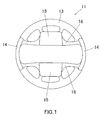
- the numeral "11" denotes a roughly shaped material for an aluminum alloy engine piston according to an embodiment of the present invention.
- the numeral "1" denotes an aluminum alloy engine piston made from the roughly shaped material 11.
- the top-and-bottom direction denotes a "fore-and-aft direction" and the right-and-left direction denotes a "right-and-left direction", and on a plane of a paper showing Figs. 2 and 3 , the top and-bottom direction is an "up-and-down direction".
- the engine piston 1 is integrally provided with a crown surface portion 2 having a circular-shape as seen from the above, a land portion 3 formed below the crown surface portion 2, a pair of skirt portions 4, a pair of pin boss portions 5, and a pair of side wall portions 6, wherein the pair of skirt portions 4, the pair of pin boss portions 5, and the pair of side wall portions 6 are each disposed below the land portion 3 so as to oppose with each other.
- a plurality of piston ring groove portions 7 in which a plurality of piston rings (example: pressure rings, oil rings) are to be mounted are formed.
- a roughly shaped material 11 for an engine piston is made by forging, and, in the same manner as in the engine piston 1, is integrally provided with a portion corresponding to the crown surface portion 2 (crown surface portion corresponding portion 12), a land portion corresponding portion 13 formed below the crown surface portion 2, a pair of skirt portion corresponding portions 14 and 14, a pair of pin boss portion corresponding portions 15 and 15, and a pair of side wall portions corresponding portions 16 and 16.
- the pair of skirt portions corresponding portions 14 and 14, the pair of pin boss portions corresponding portions 15 and 15, and the pair of side wall portions corresponding portions 16 and 16 are disposed below the land portion corresponding portion 13 so as to oppose with each other.
- the outer circumferential surface of the land portion corresponding portion 13 and the inner vicinity thereof is a portion where a plurality of piston ring groove portions 7 are formed at the time of the finishing process, or a portionwhich constitutes the piston ring groove portion corresponding portion 17.
- the roughly shaped material 11 there exists a primary Si at least in the skirt portion corresponding portion 14 and the piston ring groove portion corresponding portion 17. Furthermore, in the entire roughly shaped material, there exists no primary Si having a maximum grain diameter of 50 ⁇ m or larger and no A1-Fe-Cr-Mn series giant crystal having a maximum grain diameter of 50 ⁇ m or larger. Further, in the entire roughly shaped material, there exists no segregation of primary Si.
- "there exists primary Si” specificallymeans that, for example, when a sample is mirror polished and then the mirror polished surface of the sample is subjected to a microstructure analysis under a metallurgical microscope, there exists a gray-brown block-shaped crystal.
- the maximum diameter of the primary Si denotes a diameter measured at a portion where the primary Si has a maximum size.
- the maximum diameter of the Al-Fe-Cr-Mn series giant crystal denotes a diameter measured at a portion where the giant crystal has a maximum size.
- the following method can be exemplified.
- a sample is mirror polished and then the mirror polished surface of the sample is subjected to a microstructure analysis under a metallurgical microscope, a gray-brown block-shaped crystal is considered to be primary Si, and by measuring the maximum length of the crystal using an image analysis device, the maximum diameter of the primary Si can be obtained.
- an image analysis device a device named "LUZEX" manufactured by Nireco Corporation can be used, for example.
- the following method can be exemplified.
- a sample is mirror polished and then the mirror polished surface of the sample is subjected to a microstructure analysis under a metallurgical microscope, a light gray crystal is considered to be an Al-Fe-Cr-Mn series giant crystal, and by measuring the maximum length of the giant crystal using an image analysis device, the maximum diameter of the Al-Fe-Cr-Mn series giant crystal can be obtained.
- an image analysis device a device named "LUZEX" manufactured by Nireco Corporation can be used, for example.
- an A1-Fe-Cr-Mn series crystal having a maximum diameter of 50 ⁇ m or larger is especially called an Al-Fe-Cr-Mn series giant crystal.
- the Al-Fe-Cr-Mn series giant crystal is also called an Al-Fe-Cr-Mn series giant intermetallic compound (giant compound).
- the criterion for judging whether or not there exists segregationof primary Si is not especially limited.
- the criterion of judgment is that when 5 or more primary Si (preferably 3 or more) are gathered to form primary crystal Si aggregation and there exists primary crystal Si aggregation in which at least one of the distances between primary Si is smaller than the grain diameter of the primary Si, it is judged that there exists segregation of primary Si, and when there exists no such primary Si aggregation, it is judged that there exists no segregation of primary Si.
- a production method of the roughly shaped material 11 includes a continuous casting step of obtaining a cast bar by continuously casting a molten metal having a predetermined composition, and a forging step of obtaining a roughly shapedmaterial by forging a forging material obtained by subjecting the cast bar to a homogenization treatment.
- the molten metal temperature before pouring into a continuous casting mold is set to 720 °C or higher to continuously cast the molten metal. Furthermore, the diameter of the cast bar obtained with the continuous casting step should be 85 mm or less.
- the composition of the molten metal includes Si: 11.0 to 13.0 mass%, Fe: 0.6 to 1.0 mass%, Cu: 3.5 to 4.5 mass%, Mn: 0.25 mass% or less; Mg: 0.4 to 0.6 mass%, Cr: 0.15 mass% or less, Zr: 0.07 to 0.15 mass%, P: 0.005 to 0.010 mass%, Ca: 0.002 mass% or less, and the balance being Aluminum and inevitable impurities.
- the forging material should be a cast bar homogenized at a temperature of 370 to 500 °C.
- Si is an element that controls thermal expansion of aluminum alloy to keep small and improves the wear resistance.
- the wear resistance can be improved by appropriately controlling the crystallization of primary Si.
- the appropriate thermal expansion coefficient is determined by the material of an opposing member of the engine piston 1, i.e., the material of a cylinder block (e.g., steel, aluminum) .
- the material of a cylinder block e.g., steel, aluminum
- the thermal expansion coefficient is as smaller as possible.
- the engine piston 1 and selecting the piston ring they are each designed based on a size when they reached a high temperature.
- the additive amount of Si is as large as possible in terms of reducing the thermal expansion.
- the preferable thermal expansion coefficient is 19 to 21 x 10 -6 /K in the range of 25 to 250 °C, and the additive amount of the Si that can obtain such thermal expansion coefficient is 11.0 to 13.0 mass%.
- the present inventors could find specific alloy composition and specific production conditions capable of attaining high temperature strength and high temperature fatigue strength while maintaining wear resistance, even in cases where an additive amount of Si was around the eutectic point, and completed the present invention.
- the composition of the molten metal according to the present invention by adding Ca and P which will be explained later, even when an additive amount of Si is around the eutectic point, primary Si is crystallized stably by interaction with them, which improves wear resistance. It is more preferable that the additive amount of Si exceeds 12.0 mass %.
- the additive amount of Si is less than 11.0 mass%, it is not preferable because the thermal expansion becomes large, and crystallization of primary Si is controlled to decrease wear resistance.
- the additive amount of Si exceeds 13 mass%, such additive amount causes segregation of crystallized primary Si, forming an origin of fatigue fracture, which causes deterioration of high temperature fatigue strength, and therefore it is not preferable.
- Fe is crystallized as an Al-Fe-Cr-Mn series intermetallic compound, and the crystal becomes a dispersion strengthening phase which is stable even at high temperatures, which contributes to improvement of high temperature strength.
- the additive amount of Fe is less than 0.6 mass%, the amount of the dispersion strengthening phase becomes small, resulting in less improved high temperature strength, and therefore it is not preferable.
- Cu is precipitated as an Al-Cu (-Mg) series intermetallic compound, and the existence improves the strength and the fatigue strength under 150 °C (hereinafter referred to as "normal temperature strength” and “normal temperature fatigue strength, respectively) .
- the additive amount of Cu is less than 3.5 mass%, the precipitation amount of Al-Cu (-Mg) series intermetallic compound becomes small, which less improves the normal temperature strength and the normal temperature fatigue strength, and therefore it is not preferable.
- Mn is an element which will be crystallized as an intermetallic compound together with Fe and/or Cr to become a dispersion strengthening phase, which contributes to improvement of high temperature strength.
- Mn more likely forms Al-Fe-Cr-Mn series giant crystals. Therefore, the additive amount of Mn is set to 0.25 mass% or less.
- the additive amount of Mn is preferred to be as small as possible, especially preferable to be below the detection limit.
- the most preferable additive amount of Mn is 0 mass%.
- Mg is an element which improves the normal temperature strength and the normal temperature fatigue strength by coexisting with Si and/or Cu. If the additive amount of Mg is less than 0.4 mass%, the aforementioned effects can be less expected, which is not preferable. However, even if Mg is added so as to exceed 0.6 mass%, the aforementioned effects will be saturated. Therefore, the additive amount of Mg is set to 0.4 to 0.6 mass%.
- Cr is an element which will be crystallized as an intermetallic compound together with Fe and Mn to become a dispersion strengthening phase, which contributes to improvement of high temperature strength.
- the additive amount of Cr is set to 0.15 mass% or less.
- the additive amount of Cr is preferred to be as small as possible, especially preferable to be below the detection limit.
- the most preferable additive amount of Cr is 0 mass%.
- Zr is an element which that precipitates Al-Zr series intermetallic compound at 350 °C or above to improve the high temperature strength of the alloy material. If the additive amount of Zr is below 0.07 mass%, the aforementioned effects can be less expected, and therefore it is not preferable. Even if the additive amount of Zr exceeds 0.15 mass%, the aforementioned effects will be saturated. Therefore, the additive amount of Zr is set to 0.07 to 0.15 mass%.
- P is an element which shifts the lower limit of the additive amount of Si at which primary Si is crystallized toward a lower Si amount side, and refines the grain diameter of the primary Si crystal.
- the additive amount of Si is relatively large, no addition of P causes coarse primary Si.
- the additive amount of P is below 0.005 mass%, the aforementioned defects can be less expected, and therefore it is not preferable.
- the additive amount of P exceeding 0.010 mass% causes saturation of the aforementioned effects, and also accelerates formation of needle-shaped eutectic Si to deteriorate toughness, and therefore it is not preferable. Therefore, the additive amount of P is set to 0.005 to 0.010 mass%. This additive amount can result in the maximum diameter of primary Si of 50 ⁇ m or less.
- the additive amount of P satisfies the following formula (1). Satisfying the formula makes it possible to assuredly stabilize crystallization of primary Si by continuous casting. This assuredly results in existence of primary Si in the entire roughly shaped material, assuredly prevents segregation of primary Si, and further assuredly causes spheroidized eutectic Si. As a result, a roughly shaped material for an engine piston excellent in wear resistance and high temperature characteristics can be assuredly obtained.
- the melting amount of P i.e., the additive amount of P
- the additive amount of P into a molten metal
- Ca is an element which hinders refinement and hardening of primary Si due to P. Therefore, flux including magnesium chloride (MgCl 2 ) is added to the molten metal and agitated to thereby control so that the amount of Ca in the molten metal decreases and the additive amount of Ca becomes 0.002 mass% or less. More preferably, the additive amount of Ca and P (unit: mass%) is set to P > 6 x Ca, so that even in cases where an additive amount of Si is around the eutectic point, P is not depleted by Ca. As a result, AlP is created, and the AlP effectively works as a nucleus for forming heterogeneous nucleus of primary Si, which causes minute and even crystallization of primary Si. In this way, the wear resistance can be improved.
- the additive amount of Ca is preferably as small as possible, especially below the detection limit. The most preferable additive amount of Ca is 0 mass%.
- the reason for setting the temperature of the molten metal to 720 °C or above is as follows.
- the casting temperature is set to 720 °C or higher. This can be realized by setting the molten metal temperature before pouring into a continuous casting mold to 720 °C or higher.
- the preferable molten metal temperature is 740 °C or higher.
- the molten metal temperature By setting the molten metal temperature to 720 °C or higher, when forging a forging material obtained by homogenizing the cast bar into a roughly shaped material for an engine piston, the crystallization state of primary Si on an outer circumferential portion of the cast bar corresponding to the skirt portion 4 and the piston ring grove portion 7 of the engine piston 1 can be refined and evenly.
- the upper limit of the molten metal temperature is not especially limited, and can be, for example, 850 °C (preferably 750 °C).
- the reason for setting the diameter of the cast bar to 85 mm or less is as follows.
- the diameter of the cast bar (casting diameter) becomes larger, the cooling rate of the center portion of the ingot becomes low, which readily causes Al-Fe-Cr-Mn series giant crystals, and furthermore disturbs refinement and even distribution of primary Si in the center portion of the cast bar.
- the diameter of the cast bar is 85 mm or smaller, the difference between the cooling rate of the center portion of the cast bar and that of the outer circumferential portion of the cast bar can be kept small. This preferably makes the cooling rate difference to be 200 °C/s or less, which in turn can control formation of Al-Fe-Cr-Mn series giant crystals. Therefore, the diameter of the cast bar is set to 85 mm or less.
- the crystallization state of primary Si can be refined such as less than 50 ⁇ m in maximum diameter and evenly distributed.
- the lower limit of the diameter of the cast bar is not especially limited, and can be, for example, 20 mm.
- the reason for homogenizing the cast bar at 370 to 500 °C is as follows.
- the Al-Fe-Cr-Mn series crystals resist plastic deformation at a high temperature, which results in hard plastic deformation at a high temperature. As a result, the high temperature strength and the high temperature fatigue strength are improved.
- a homogenization treatment generally performed at immediately below the solidus temperature to improve forging performance is high in processing temperature, which causes decoupling and spheroidizing of Al-Si series crystals and/or Al-Fe-Cr-Mn series crystals to reduce the area of the boundary surface.
- the upper limit of the processing temperature is set to a temperature at which no decoupling and spheroidizing of Al-Si series crystals and/or Al-Fe-Cr-Mn series crystals occur.
- the homogenization treatment temperature is too low, deformability becomes insufficient, causing cracks during forging.
- the homogenization treatment temperature is set between 370 to 500 °C, more preferably set to be as low as possible within a range in which no cracks are generated in the material at the time of forging the material into the engine piston shape.
- the retention time of the homogenization treatment is preferably 4 hours or longer.
- the continuous casting device As a continuous casting device, as long as a cast bar having a diameter of 85 mm or less can be obtained in a state in which the molten metal temperature is maintained at 720 °C or above, the continuous casting device is not limited in type, and can be, for example, a vertical semi-continuous casting device, a hot top continuous casting device, a horizontal continuous casting device, and a gas pressurizing type continuous casting device.
- Fig. 5 is a cross-sectional view showing one example of a horizontal continuous casting device for performing horizontal continuous casting.
- This continuous casting device 20A is provided with a molten metal receptor 21 that stores aluminum alloy molten metal 30 and a solidification continuous casting water-cooling mold (water-cooled mold) 22 having a molten metal passage 22a.
- the mold 22 is arranged horizontally and in communication with the molten metal receptor 21 via the molten metal pouring inlet 23.
- the reference numeral "24" denotes a cooling water passage formed in the mold 22.
- the mold 22 and the cast bar 31 drawn through the mold 22 are cooled by the cooling water 25 discharged from the cooling water passage 24.
- Fig. 6 is a cross-sectional view showing one example of a hot top continuous casting device.
- the continuous casting device 20B is provided with a molten metal receptor 21 and a solidification continuous casting water-cooled mold (water-cooled mold) 22 having a molten metal passage 2 2a and arranged below the molten metal receptor 21.
- the mold 22 is arranged in communication with the molten metal receptor 21 via the molten metal pouring inlet 23 so that the outlet of the molten metal passage 22a faces downward.
- the aluminum alloy molten metal 30 in the molten metal receptor 21 is introduced into the cooled mold 22 through the molten metal pouring inlet 23 from above.
- the molten metal 30 introduced into the mold 22 is, at the portion contacting the mold 22, is drawn downward from the mold 22 while forming a solidified shell.
- the cast bar 31 drawn from the mold 22 is cooled by the cooling water 25 discharged from the cooling water passage 24.
- the temperature at the position C immediately before pouring the molten metal 30 into the mold 22 is defined as a molten metal temperature, and the temperature is preferably set to 720 °C or higher.
- the temperature of the molten metal 30 at the position C is defined as a molten metal temperature.
- the furnace can accommodate the cast bar and conduct a homogenization treatment thereof at a temperature of 370 to 500 °C, and can be any conventional widely used furnace.
- the furnace in the case of a circulating hot air furnace, the furnace can be either a direct heating furnace or a radiant tube furnace, and in the case of a carrier system furnace, the furnace can be either a continuous furnace or a batch furnace.
- the device As a forging device, it is sufficient as long as the device is equipped with a forging mold for forging a forging material into an engine piston shaped roughly shaped material. It is particularly desirable that the device is further equipped with a preliminary heating device and a lubricant applying device. Furthermore, it is preferred that the forging mold is a closed forging mold. More specifically, as the forging device, a knuckle joint press, a crank press, a friction press, a hydraulic press, and a servo press, can be used.
- the production method of a roughly shaped material of this embodiment is performed as follows.
- a molten metal having a predetermined composition is continuously cast into a cast bar having a diameter of 85 mm or less [Continuous casting step] .
- the cross-sectional shape of the cast bar is a circle shape. In other words, it is preferable that the cast bar is in a cylindrical bar shape.
- the cast bar is subjected to a homogenization treatment at a temperature of 370 to 500 °C to thereby obtain a forging material.
- the outer circumferential surface of the material is subjected to a peeling treatment (i.e., the outer circumferential surface cutting treatment).
- this material is cut in the longitudinal direction to have a predetermined length (thickness) into a disk or cylinder shape.
- the cross-sectional surface of the cast bar becomes an upper or lower surface of the material, and the outer circumferential surface or the inner side vicinity of the cast bar becomes an outer circumferential surface of the material.
- the material is subj ected to upset processing, lubrication processing, and preheating processing.
- the material is forged into a roughly shaped material of an engine piston shape with a forging device [Forging step] .
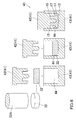
- Figs. 7 and 8 are drawings that show forging steps for forging the material with the respective forging devices.
- the molds 41 of the forging devices 40 shown in Figs. 7 and 8 include an upper die 42 and a lower die 43.
- a disk-shaped or cylinder-shaped material 32 is forged in a sealed forming space 44, and a roughly shaped material 11 for an engine piston is obtained.
- the reference numeral "32A" is a long bar shaped forging material 32A obtained by subjecting the cast bar 31 to a homogenization treatment.
- the disk-shaped or cylinder-shaped material 32 obtained by cutting the bar-shaped material 32A into a predetermined length (thickness) is disposed in the lower die 43 of the forging device 40, and then, by being pressed in the axial direction of the material 32 by the upper die 42 fitted into the lower die 43, the material 32 is forged into a predetermined shape in the sealed forming space 44 and the roughly shaped material 11 for an engine piston is obtained.
- the mold 41 of this forging device 40 shown in Fig. 7 is structured so that the skirt portion corresponding portions (not shown) and the pin boss portion corresponding portions 15 and 15 are forwardly extruded.
- Fig. 8 the material 32 is forged in the same manner as in the forging method shown in Fig. 7 , and a roughly shaped material 11 for an engine piston is obtained.
- the mold 41 of the forging device 40 shown in Fig. 8 is structured so that the skirt portion corresponding portions (not shown) and the pin boss portion corresponding portions 15 and 15 are backwardly extruded.
- the material 32 is disposed in the lower die 43 in such a manner that the upper surface or the lower surface of the material 32 becomes a crown surface portion corresponding portion 12 of the roughly shaped material 11 and the outer circumferential portion of the material 32 becomes a piston ring groove portion corresponding portion 17 and the skirt portion corresponding portions (not shown).
- the processing temperature for the preheating process to be performed immediately before forging and the material temperature during the forging are preferably 470 °C or lower in as a short time period as possible. It is more preferred to be a temperature lower than the homogenization treatment temperature.
- the heating time can be the shortest amount of time during which the material temperature can be raised to the processing temperature (i.e., 470 °C or below).
- the roughly shaped material 11 obtained in this manner is subj ected to a solution treatment or an aging treatment.
- the solution treatment temperature is preferably set to be the same as or lower than the solidus temperature because the state of Al-Si series crystals or Al-Fe-Cr-Mn series crystals after the homogenization treatment can be maintained.
- the aging treatment temperature and the aging treatment time it is preferable that slight over aging is performed by adjusting the temperature and the time. Such adjustment enables controlling of the dimensional growth due to the aging during the use of the product.
- the roughly shaped material 11 is subjected to a final finish processing, such as,, e.g., machining processing. Thereafter, other members, such as, e. g. , piston rings, are attached to the roughly shaped material to obtain an engine piston.
- a final finish processing such as,, e.g., machining processing.
- other members such as, e. g. , piston rings, are attached to the roughly shaped material to obtain an engine piston.
- an engine piston 1 produced using the roughly shaped material 11 is excellent in wear resistance, and also excellent in normal temperature tensile characteristics, high temperature characteristics (i.e., high temperature tensile characteristics and high temperature fatigue characteristics).
- Si Fe Cu Mn Mg Cr Zr P Ca Invention range 11.0-13.0 0.6-1.0 3.5-4.5 ⁇ 0.25 0.4-0.6 ⁇ 0.15 0.07-0.15 0.005-0.010 ⁇ 0.002
- Example 1 11.86 0.81 4.46 0.00 0.60 0.00 0.11 0.009 0.001
- Example 2 12.85 0.95 4.43 0.24 0.55 0.1 0.14 0.009 0.000
- Example 3 11.2 0.64 3.64 0 0.41 0 0.08 0.006 0.000
- Example 4 11.86 0.81 4.46 0.00 0.60 0.00 0.11 0.009 0.001
- Example 5 11.86 0.81 4.46 0.00 0.60 0.00 0.11 0.009 0.001
- Example 6 11.86 0.81 4.46 0.00 0.60 0.00 0.11 0.009 0.001
- Example 7 11.86 0.81 4.46 0.00 0.60 0.00 0.11 0.009 0.001
- the unit of the Aluminum alloy composition in Table 1 is "mass%.”
- a round bar-shaped cast bar was obtained by continuously casting the aluminum alloy molten metal having the composition shown in Table 1 using a hot top continuous casting device (see Fig. 6 ) .
- the molten metal temperatures before pouring into the continuous casting mold were set as shown in the "Temp. of molten metal” column of Table 2.
- the diameters of the obtained cast bars are described in the "Diameter of cast bar” column.
- the molten metal was casted in a mold according to JIS Z 2611 to obtain an analysis sample 50 of an approximately disk-shape as shown in Fig. 9 .
- quantitative analysis of the compositional element of the motel metal was performed by emission spectral analysis in conformity to JIS H 1305.
- the reference numeral "51" denotes an analysis portion of the analysis sample 50.
- This analysis portion 51 was analyzed after being cut into a thickness of 0.5 mm (0.3-0.6 mm) with a milling machine.
- the cast bar was cut into a length of 6,000 mm. Then, the cut cast bar was subjected to a homogenization treatment.
- the treatment temperature was set as shown in the "Homogenization treatment temperature" column of Table 2. The treatment time was 7 hours for each case.
- the outer circumference of the cast bar was cut out to have a diameter of 50 mm, and further, the cast bar was cut into a length of 60 mm to thereby obtain a cylindrical forging material.
- the material was upset forged into a thickness of 10 mm by pressing the material from its end surface in the axial direction.
- the upset forging corresponds to the forging in the forging step of the present invention, and the forging was conducted at the forging processing rate corresponding to the forging processing rate of actually forging the material into the roughly shaped material for an engine piston.
- the upset forged product was subjected to a T6 heat treatment.
- the upset forged product was subjected to a solution treatment at a temperature of 495 °C, and thereafter an artificial aging treatment was conducted under the conditions of aging temperature of 200 °C and aging time of 6 hours.
- the upset forged product to which the T6 heat treatment was executed was subjected to a visual inspection to check whether or not there exists cracks and hole defects on the surface of the upset forged product by a solvent removable penetrant testing method (color check) . Thereafter, the upset forged product was cut, and the cut surface was mirror-polished. The mirror polished surface was subjected to a microscopic inspection to inspect the structure from the center portion to the outer circumferential portion of the upset forged product using a metallurgical microscope to check whether or not there exists primary Si, primary Si having a maximum diameter of 50 ⁇ m or larger, Al-Fe-Cr-Mn series giant crystals, and segregation of primary Si.
- the metallographic structure photograph of Example 1 is shown in Fig. 10 as a representative example of the metallographic structure photographs of Examples 1 to 7 photographed during the microscopic inspection.
- the metallographic structure photograph of Comparative Example 3 is shown in Fig. 11 as a representative example of the metallographic structure photographs of Comparative Examples 1 to 14 photographed during the microscopic inspection.
- an image analysis device analyzing the image of the metallographic structure photograph a device named "LUZEX" manufactured by Nireco Corporation was used.
- the Al-Fe-Cr-Mn series crystal is shown as a light gray colored crystal
- the primary Si is shown as a gray-brown colored block-shaped crystal
- the eutectic Si is shown as a gray-brown colored crystal smaller than the primary Si and having an average grain diameter of about 5 ⁇ m.
- a number of eutectic Si existed in a dispersed manner and the average grain diameter was about 5 ⁇ m.
- a number of primary Si existed in a distributed manner, and the maximum diameter was about 25 ⁇ m, and the average diameter is about 20 ⁇ m. However, there existed no primary Si having a maximum diameter of 50 ⁇ m or more.
- a number of Al-Fe-Cr-Mn series crystals existed in a dispersed manner, and the average grain diameter was about 5 ⁇ m. However, there existed no Al-Fe-Cr-Mn series giant crystals having a maximum diameter of 50 ⁇ m or more.
- a number of eutectic Si existed in a dispersed manner and the average grain diameter was about 5 ⁇ m.
- the primary Si were unevenly distributed, the maximum diameter was about 35 ⁇ m, and the average diameter was about 20 ⁇ m.
- the other type was a block-shaped crystal having an average grain diameter of about 60 ⁇ m, and there existed Al-Fe-Cr-Mn series giant crystals having a maximum diameter of 50 ⁇ m or larger.
- the evaluation method of the normal temperature tensile characteristics was as follows.
- the evaluation method of the high temperature tensile property was as follows.
- the evaluation method of the high temperature fatigue property was as follows.
- Examples 1-7 satisfy all of requirements of the present invention, and therefore it was confirmed that no cracks were generated, there existed primary Si along the entire upset forged product, there existed no primary Si having a maximum diameter of 50 ⁇ m or more, there existed no Al-Fe-Cr-Mn series giant crystals having a maximum diameter of 50 ⁇ m or more, and there existed no segregation of primary Si. Further, it was confirmed that they were excellent in normal temperature tensile property, high temperature tensile property and high temperature fatigue property.
- Fig. 12 is a drawing showing the relationship between the additive amount of P and the additive amount of Si in Examples 8-11 and Comparative Examples 15-22.
- [P] denotes an additive amount of P (unit: mass%)
- [Si] denotes an additive amount of Si (unit: mass%).
- the cast bar was cut into a length of 6,000 mm. Then, the cut cast bar was homogenized under the conditions of the temperature of 470 °C and the holding time of 7 hours.
- the outer periphery of the cast bar was cut to have a diameter of 50 mm and then cut into a length of 60 mm to thereby obtain a columnar forging material.
- This upset forging corresponds to the forging of the forging step of the present invention, and was performed at the forging processing rate corresponding to the forging processing rate for actually forging the material into a roughly shaped material for an engine piston.
- the upset forging product was subjected to a T6 heat treatment. That is, the upset forged product was subj ected to a solution treatment at 495 °C, and then artificial aging was performed under the conditions of the aging temperature of 200 °C and the aging time of 6 hours.
- the upset forged product to which T6 heat treatment was performed was cut, and the cut surface was mirror polished.
- the polished surface was subjected to a microscopic inspection from the center portion to the outer peripheral portion of the upset forged product using a metallurgical microscope to investigate whether there exists primary Si at the center portion and the peripheral portion of the upset forged product, whether there exists segregation of primary Si, and to investigate the shape of eutectic Si.
- Eutectic Si is a gray-brown coloredblock-shaped crystal smaller than primary Si. By measuring the size of the crystal, it was judged that the eutectic Si was formed into a needle-shape when the "maximum length/minimum length" was 3 or more, and it was judged that the eutectic Si was formed into a spherical shape when the "maximum length/minimum length” was less than 3.
- ⁇ indicates that it can be preferably used as a roughly shaped material for an engine piston, and " ⁇ ” indicates that it cannot be used as a roughly shaped material for an engine piston.
- the additive amount of Si was within the range of 11.0 to 13.0 mass%, and the additive amount of P was within the range of 0.005 to 0.010 mass%. Furthermore, the additive amount of P satisfies the aforementioned formula (1). Therefore, the crystallization of primary Si by continuous casting was stabilized. As a result, primary Si existed along the entire region from the center portion to the outer peripheral portion of the upset forged product, and there existed no segregation of primary Si. Further, eutectic Si was formed into a spherical shape. Therefore, a good microstructure was obtained.
- the term "preferably” is non-exclusive and means “preferably, but not limited to.”
- means-plus-function or step-plus-function limitations will only be employed where for a specific claim limitation all of the following conditions are present in that limitation: a) "means for” or “step for” is expressly recited; b) a corresponding function is expressly recited; and c) structure, material or acts that support that structure are not recited.
- the terminology "present invention” or “invention” may be used as a reference to one or more aspect within the present disclosure.
- the present invention can be applicable to a production method of a roughly shaped material for producing an engine piston for an engine to be mounted on a vehicle such as an automobile or a motorcycle, and also can be applicable to a roughly shaped material for an engine piston.
Landscapes
- Engineering & Computer Science (AREA)
- Chemical & Material Sciences (AREA)
- Mechanical Engineering (AREA)
- Materials Engineering (AREA)
- Metallurgy (AREA)
- Organic Chemistry (AREA)
- Crystallography & Structural Chemistry (AREA)
- Physics & Mathematics (AREA)
- Thermal Sciences (AREA)
- General Engineering & Computer Science (AREA)
- Combustion & Propulsion (AREA)
- Pistons, Piston Rings, And Cylinders (AREA)
- Forging (AREA)
Abstract
Description
- The present invention relates to a production method of a roughly shaped material for an engine piston made of aluminum alloy excellent in wear resistance and high-temperature characteristics, and also relates to the roughly shaped material for an engine piston.
- An engine piston for use in an engine to be mounted to a vehicle such as an automobile is required to have lightweight property to reduce the inertia force as much as possible, high-temperature strength at a raised maximum temperature, durability at the raised maximum temperature, low thermal expansibility to reduce clearance fluctuations due to thermal expansion, and wear resistance to reduce abrasion of ring grooves due to sliding of piston rings and/or abrasion of a skirt portion due to contact with a cylinder surface.
- For these reasons, in an engine piston produced by forging, as an aluminum alloy constituting the piston, in the case of giving greater importance to wear resistance, an alloy in which an additive amount of Si is equal to or more than the eutectic point has been used (see, e.g., Patent Document 1). On the other hand, in the case of giving greater importance to high temperature strength or high temperature fatigue strength, an alloy in which an additive amount of Si is equal to or less than the eutectic point has been used (see, e.g., Patent Document 2).
-
- Patent Document 1: Japanese Unexamined Laid-open Patent Application Publication No.
H06-279904 JP-A-06-279904 - Patent Document 2: Japanese Unexamined Laid-open Patent Application Publication No.
2001-181769 JP-A-2001-181769 - In an aluminum alloy engine piston, however, in order to improve the engine efficiency, it is preferable to enhance both the high-temperature strength and the high-temperature fatigue strength while maintaining the wear resistance.
- The present invention was made in view of the aforementioned technical background, and aims to provide a production method of a roughly shaped material for an engine piston made of aluminum alloy excellent in wear resistance and high-temperature characteristics, and to provide the roughly shaped material for an engine piston.
- Other objects and advantages of the present invention will be apparent from the following preferred embodiments.
- The present invention provided the following means.
- [1] A production method of a roughly shaped material for an engine piston, comprising:
- a continuous casting step for obtaining a cast rod having a diameter of 85 mm or less by continuously casting a molten metal consisting of Si: 11.0 to 13.0 mass%, Fe: 0.6 to 1.0 mass%, Cu: 3.5 to 4.5 mass%, Mn: 0.25 mass% or less; Mg: 0.4 to 0.6 mass%, Cr: 0.15 mass% or less, Zr: 0.07 to 0.15 mass%, P: 0.005 to 0.010 mass%, Ca: 0.002 mass% or less, and the balance being Aluminum and inevitable impurities with a temperature of the molten metal before pouring into a continuous casting mold set to 720 °C or higher; and
- a forging step for obtaining a roughly shaped material for an engine piston by forging a forging material obtained by subj ecting the cast rod to a homogenization treatment at a temperature of 370 to 500 °C.
- [2] The production method of a roughly shaped material for an engine piston as recited in the
aforementioned Item 1, wherein an additive amount of P in a composition of the molten metal satisfies the following formula:
- [3] A roughly shaped material for an engine piston produced by the production method of a roughly shaped material for an engine piston as recited in the
aforementioned Item
wherein, at least in a skirt portion corresponding portion and a piston ring groove portion corresponding portion in the roughly shaped material, primary Si exists, and
wherein, in an entirety of the roughly shaped material, no primary Si having a maximum grain diameter of 50 µm or larger exists and no Al-Fe-Cr-Mn series giant crystal having a maximum grain diameter of 50 µm or larger exists. - [4] A roughly shaped material for an engine piston produced by forging, wherein a composition of the roughly shaped material consists of Si: 11.0 to 13.0 mass%, Fe: 0.6 to 1.0 mass%, Cu: 3.5 to 4.5 mass%, Mn: 0.25 mass% or less; Mg: 0.4 to 0.6 mass%, Cr: 0.15 mass% or less, Zr: 0.07 to 0.15 mass%, P: 0.005 to 0.010 mass%, Ca: 0.002 mass% or less, and the balance being Aluminum and inevitable impurities.
- [5] The roughly shaped material for an engine piston as recited in the
aforementioned Item 4, wherein an additive amount of P in the composition of the roughly shaped material satisfies the following formula:
- [6] The roughly shaped material for an engine piston as recited in the
aforementioned Item
wherein, at least in a skirt portion corresponding portion and a piston ring groove portion corresponding portion in the roughly shaped material, primary Si exists, and
wherein, in an entirety of the roughly shaped material, no primary Si having a maximum grain diameter of 50 µm or larger exists, and no Al-Fe-Cr-Mn series giant crystal having a maximum grain diameter of 50 µm or larger exists. - According to the present invention, by adjusting the compositional elements of the molten metal so as to fall within predetermined ranges and producing a roughly shaped material for an engine piston according to the production method of the present invention, a roughly shaped material for an engine piston made by aluminum alloy excellent in wear resistance and high-temperature characteristics can be obtained. Therefore, in the engine piston produced by the aforementioned roughly shaped material, the performance efficiency of the engine can be improved, and the fuel usage in automobiles and motorcycles can be reduced.
- Furthermore, in the roughly shaped material, since primary Si exists at least in a skirt portion corresponding portion and a piston ring groove portion corresponding portion in the roughly shaped material, at least these portions are excellent in wear resistance. Therefore, an engine piston produced by the roughly shaped material can control abrasion of at least the skirt portion and the piston ring groove.
-
- [
Fig. 1] Fig. 1 is a bottom view of a roughly shaped material for an engine piston according to an embodiment of the present invention. - [
Fig. 2] Fig. 2 is a front view of the roughly shaped material. - [
Fig. 3] Fig. 3 is a cross-sectional view taken along the line X-X inFig. 2 . - [
Fig. 4] Fig. 4 is a front view of the engine piston produced by the roughly shaped material. - [
Fig. 5] Fig.5 is a schematic cross-sectionalviewofahorizontal continuous casting device. - [
Fig. 6] Fig. 6 is a schematic cross-sectional view of a hot top continuous casting device. - [
Fig. 7] Fig. 7 is a cross-sectional view of a mold of a forging device showing one example of a step of forging a forging material using the forging device. - [
Fig. 8] Fig. 8 is a cross-sectional view of a mold of a forging device showing another example of a step of forging a forging material using the forging device. - [
Fig. 9] Fig. 9 is a perspective view of an analysis sample of a molten aluminum alloy. - [
Fig. 10] Fig. 10 is a compositional picture of Example 1 photographed under microstructure observation. - [
Fig. 11] Fig. 11 is a compositional picture of Comparative Example 3 photographed under microstructure observation. - [
Fig. 12] Fig. 12 is a drawing showing a relation between the additive amount of P and the additive amount of Si in Examples 8 to 11 and Comparative Examples 15 to 22. - Next, an embodiment of the present invention will be explained with reference to drawings.
- In this embodiment, "excellent in high-temperature characteristics" means "excellent in strength at 250 °C," in other words, "at 250 °C, the tensile strength (i.e., high-temperature tensile strength) is 110 MPa or more and the fatigue strength (i.e., high-temperature fatigue strength) is 60 Mpa or more."
- In
Figs. 1 to 3 , the numeral "11" denotes a roughly shaped material for an aluminum alloy engine piston according to an embodiment of the present invention. - In
Fig. 4 , the numeral "1" denotes an aluminum alloy engine piston made from the roughlyshaped material 11. - In the following explanation, the explanation will be made by defining that on a plane of a paper showing
Fig. 1 , the top-and-bottom direction denotes a "fore-and-aft direction" and the right-and-left direction denotes a "right-and-left direction", and on a plane of a paper showingFigs. 2 and 3 , the top and-bottom direction is an "up-and-down direction". - As shown in
Fig. 4 , theengine piston 1 is integrally provided with acrown surface portion 2 having a circular-shape as seen from the above, aland portion 3 formed below thecrown surface portion 2, a pair ofskirt portions 4, a pair ofpin boss portions 5, and a pair ofside wall portions 6, wherein the pair ofskirt portions 4, the pair ofpin boss portions 5, and the pair ofside wall portions 6 are each disposed below theland portion 3 so as to oppose with each other. On the outer circumferential surface of theland portion 3, a plurality of pistonring groove portions 7 in which a plurality of piston rings (example: pressure rings, oil rings) are to be mounted are formed. - As shown in
Figs. 1 to 3 , a roughlyshaped material 11 for an engine piston is made by forging, and, in the same manner as in theengine piston 1, is integrally provided with a portion corresponding to the crown surface portion 2 (crown surface portion corresponding portion 12), a land portioncorresponding portion 13 formed below thecrown surface portion 2, a pair of skirt portioncorresponding portions portion corresponding portions portions corresponding portions portions corresponding portions portions corresponding portions portions corresponding portions corresponding portion 13 so as to oppose with each other. The outer circumferential surface of the land portioncorresponding portion 13 and the inner vicinity thereof is a portion where a plurality of pistonring groove portions 7 are formed at the time of the finishing process, or a portionwhich constitutes the piston ring groove portioncorresponding portion 17. - In the roughly
shaped material 11, there exists a primary Si at least in the skirt portioncorresponding portion 14 and the piston ring groove portioncorresponding portion 17. Furthermore, in the entire roughly shaped material, there exists no primary Si having a maximum grain diameter of 50 µm or larger and no A1-Fe-Cr-Mn series giant crystal having a maximum grain diameter of 50 µm or larger. Further, in the entire roughly shaped material, there exists no segregation of primary Si. - In this embodiment, "there exists primary Si" specificallymeans that, for example, when a sample is mirror polished and then the mirror polished surface of the sample is subjected to a microstructure analysis under a metallurgical microscope, there exists a gray-brown block-shaped crystal.
- The maximum diameter of the primary Si denotes a diameter measured at a portion where the primary Si has a maximum size. The maximum diameter of the Al-Fe-Cr-Mn series giant crystal denotes a diameter measured at a portion where the giant crystal has a maximum size.
- As a specific measuring method of the maximum diameter of primary Si, the following method can be exemplified. For example, when a sample is mirror polished and then the mirror polished surface of the sample is subjected to a microstructure analysis under a metallurgical microscope, a gray-brown block-shaped crystal is considered to be primary Si, and by measuring the maximum length of the crystal using an image analysis device, the maximum diameter of the primary Si can be obtained. As an image analysis device, a device named "LUZEX" manufactured by Nireco Corporation can be used, for example.
- As a specific measuring method of the maximum diameter of the Al-Fe-Cr-Mn series giant crystal, the following method can be exemplified. For example, when a sample is mirror polished and then the mirror polished surface of the sample is subjected to a microstructure analysis under a metallurgical microscope, a light gray crystal is considered to be an Al-Fe-Cr-Mn series giant crystal, and by measuring the maximum length of the giant crystal using an image analysis device, the maximum diameter of the Al-Fe-Cr-Mn series giant crystal can be obtained. As an image analysis device, a device named "LUZEX" manufactured by Nireco Corporation can be used, for example.
- In this embodiment, among Al-Fe-Cr-Mn series crystals of various sizes, an A1-Fe-Cr-Mn series crystal having a maximum diameter of 50 µm or larger is especially called an Al-Fe-Cr-Mn series giant crystal. The Al-Fe-Cr-Mn series giant crystal is also called an Al-Fe-Cr-Mn series giant intermetallic compound (giant compound).
- In the present invention, the criterion for judging whether or not there exists segregationof primary Si is not especially limited. In this embodiment, the criterion of judgment is that when 5 or more primary Si (preferably 3 or more) are gathered to form primary crystal Si aggregation and there exists primary crystal Si aggregation in which at least one of the distances between primary Si is smaller than the grain diameter of the primary Si, it is judged that there exists segregation of primary Si, and when there exists no such primary Si aggregation, it is judged that there exists no segregation of primary Si.
- Next, as a production method of a roughly shaped material for an engine piston according to one embodiment of the present invention, a production method of the roughly shaped
material 11 will be explained below. - A production method of the roughly shaped
material 11 includes a continuous casting step of obtaining a cast bar by continuously casting a molten metal having a predetermined composition, and a forging step of obtaining a roughly shapedmaterial by forging a forging material obtained by subjecting the cast bar to a homogenization treatment. - At the continuous casting step, it is necessary that the molten metal temperature before pouring into a continuous casting mold is set to 720 °C or higher to continuously cast the molten metal. Furthermore, the diameter of the cast bar obtained with the continuous casting step should be 85 mm or less.
- The composition of the molten metal includes Si: 11.0 to 13.0 mass%, Fe: 0.6 to 1.0 mass%, Cu: 3.5 to 4.5 mass%, Mn: 0.25 mass% or less; Mg: 0.4 to 0.6 mass%, Cr: 0.15 mass% or less, Zr: 0.07 to 0.15 mass%, P: 0.005 to 0.010 mass%, Ca: 0.002 mass% or less, and the balance being Aluminum and inevitable impurities.
- At the forging step, the forging material should be a cast bar homogenized at a temperature of 370 to 500 °C.
- Hereinafter, the reason for adding compositional elements of the aluminum alloy molten metal, the reason for limiting the additive amount (additive density) thereof, and the reason for limiting the production condition of the roughly shaped
material 11 will be explained. - Si is an element that controls thermal expansion of aluminum alloy to keep small and improves the wear resistance. In other words, the wear resistance can be improved by appropriately controlling the crystallization of primary Si.
- The appropriate thermal expansion coefficient is determined by the material of an opposing member of the
engine piston 1, i.e., the material of a cylinder block (e.g., steel, aluminum) . However, although the cylinder block partially rises in temperature to a high temperature, the cylinder block does not entirely rise in temperature to a high temperature (and it takes a time to rise in temperature to a high temperature) . Therefore, it is preferable that the thermal expansion coefficient is as smaller as possible. Generally, in designing theengine piston 1 and selecting the piston ring, they are each designed based on a size when they reached a high temperature. For that reason, if the thermal expansion is too large, the diameter of theskirt portion 4 reduces at low temperatures, which readily causes shakiness of theengine piston 1 at the time of the start-up. Therefore, it is preferable that the additive amount of Si is as large as possible in terms of reducing the thermal expansion. The preferable thermal expansion coefficient is 19 to 21 x 10-6/K in the range of 25 to 250 °C, and the additive amount of the Si that can obtain such thermal expansion coefficient is 11.0 to 13.0 mass%. - On the other hand, with such additive amount of the Si, conventionally, crystallization of primary Si by continuous casting was unstable. That is, since the eutectic point of Al-Si alloy is usually 11.7 mass%, the primary Si will not be crystallized at 11.0 mass% which is lower than 11.7 mass%. Therefore, when an additive amount of Si was around the eutectic point, continuous casting could not be conducted in a manner such that primary Si is stably crystallized. In other words, in cases where the additive amount of Si was, for example, within the range of 11.7 ± 0.5 mass%, the crystallization of primary Si by continuous casting was conventionally unstable.
- However, the present inventors could find specific alloy composition and specific production conditions capable of attaining high temperature strength and high temperature fatigue strength while maintaining wear resistance, even in cases where an additive amount of Si was around the eutectic point, and completed the present invention.
- In other words, with the composition of the molten metal according to the present invention, by adding Ca and P which will be explained later, even when an additive amount of Si is around the eutectic point, primary Si is crystallized stably by interaction with them, which improves wear resistance. It is more preferable that the additive amount of Si exceeds 12.0 mass %.
- If the additive amount of Si is less than 11.0 mass%, it is not preferable because the thermal expansion becomes large, and crystallization of primary Si is controlled to decrease wear resistance.
- If the additive amount of Si exceeds 13 mass%, such additive amount causes segregation of crystallized primary Si, forming an origin of fatigue fracture, which causes deterioration of high temperature fatigue strength, and therefore it is not preferable.
- In particular, when forging the forging material obtained by homogenizing a cast bar at a predetermined temperature into a roughly shaped material for an engine piston, it is preferable that primary Si is in an evenly distributed state and primary Si is minute in size at an outer circumferential portion of the cast bar corresponding to the
skirt portion 4 and the pistonring groove portion 7 of theengine piston 1. - Along with Cr, Mn, etc., Fe is crystallized as an Al-Fe-Cr-Mn series intermetallic compound, and the crystal becomes a dispersion strengthening phase which is stable even at high temperatures, which contributes to improvement of high temperature strength.
- If the additive amount of Fe is less than 0.6 mass%, the amount of the dispersion strengthening phase becomes small, resulting in less improved high temperature strength, and therefore it is not preferable.
- On the other hand, if the additive amount of Fe exceeds 1.0 mass%, a needle-shaped Al-Fe-Cr-Mn series giant crystal will be crystallized, forming an origin of fatigue fracture, which causes deterioration of high temperature fatigue strength, and therefore it is not preferable.
- Generally, if Fe, Cr and Mn are added in large quantity, Al-Fe-Cr-Mn series giant crystals will be crystallized, which causes deterioration of high temperature fatigue strength. In the present invention, however, even if the total additive amount of Fe, Cr and Mn is large, by adding Cr and Mn so that the additive amount becomes 40 mass% or less with respect to the additive amount of Fe, crystallization of giant crystals can be controlled even in cases where the additive amount of Fe is large.
- Cu is precipitated as an Al-Cu (-Mg) series intermetallic compound, and the existence improves the strength and the fatigue strength under 150 °C (hereinafter referred to as "normal temperature strength" and "normal temperature fatigue strength, respectively) .
- If the additive amount of Cu is less than 3.5 mass%, the precipitation amount of Al-Cu (-Mg) series intermetallic compound becomes small, which less improves the normal temperature strength and the normal temperature fatigue strength, and therefore it is not preferable.
- Since Cu is a heavy element, a larger additive amount of Cu causes hindrance of the inherent lightweight characteristics of aluminum alloy. The solid solubility limit of Cu is 5.65 mass%, but the additive amount of Cu exceeding 4.5 mass% results in less improved effect of the normal temperature strength and normal temperature fatigue strength, and therefore the upper limit of the additive amount of Cu is set to 4.5 mass%.
- Mn is an element which will be crystallized as an intermetallic compound together with Fe and/or Cr to become a dispersion strengthening phase, which contributes to improvement of high temperature strength. However, as compared with Fe, Mn more likely forms Al-Fe-Cr-Mn series giant crystals. Therefore, the additive amount of Mn is set to 0.25 mass% or less. The additive amount of Mn is preferred to be as small as possible, especially preferable to be below the detection limit. The most preferable additive amount of Mn is 0 mass%.
- Mg is an element which improves the normal temperature strength and the normal temperature fatigue strength by coexisting with Si and/or Cu. If the additive amount of Mg is less than 0.4 mass%, the aforementioned effects can be less expected, which is not preferable. However, even if Mg is added so as to exceed 0.6 mass%, the aforementioned effects will be saturated. Therefore, the additive amount of Mg is set to 0.4 to 0.6 mass%.
- Cr is an element which will be crystallized as an intermetallic compound together with Fe and Mn to become a dispersion strengthening phase, which contributes to improvement of high temperature strength. However, as compared with Fe, Cr more likely forms Al-Fe-Cr-Mn series giant crystals. Therefore, the additive amount of Cr is set to 0.15 mass% or less. The additive amount of Cr is preferred to be as small as possible, especially preferable to be below the detection limit. The most preferable additive amount of Cr is 0 mass%.
- Zr is an element which that precipitates Al-Zr series intermetallic compound at 350 °C or above to improve the high temperature strength of the alloy material. If the additive amount of Zr is below 0.07 mass%, the aforementioned effects can be less expected, and therefore it is not preferable. Even if the additive amount of Zr exceeds 0.15 mass%, the aforementioned effects will be saturated. Therefore, the additive amount of Zr is set to 0.07 to 0.15 mass%.
- P is an element which shifts the lower limit of the additive amount of Si at which primary Si is crystallized toward a lower Si amount side, and refines the grain diameter of the primary Si crystal. In cases where the additive amount of Si is relatively large, no addition of P causes coarse primary Si. In cases where the additive amount of P is below 0.005 mass%, the aforementioned defects can be less expected, and therefore it is not preferable. On the other hand, the additive amount of P exceeding 0.010 mass% causes saturation of the aforementioned effects, and also accelerates formation of needle-shaped eutectic Si to deteriorate toughness, and therefore it is not preferable. Therefore, the additive amount of P is set to 0.005 to 0.010 mass%. This additive amount can result in the maximum diameter of primary Si of 50 µm or less.
- In particular, it is preferable that the additive amount of P satisfies the following formula (1). Satisfying the formula makes it possible to assuredly stabilize crystallization of primary Si by continuous casting. This assuredly results in existence of primary Si in the entire roughly shaped material, assuredly prevents segregation of primary Si, and further assuredly causes spheroidized eutectic Si. As a result, a roughly shaped material for an engine piston excellent in wear resistance and high temperature characteristics can be assuredly obtained.

wherein a unit of the additive amount of P and that of Si are "mass%" , respectively. - With respect to P, in the case of P alone, the melting amount of P (i.e., the additive amount of P) into a molten metal is small, and it is troublesome to handle P alone. Therefore, in order to increase the additive amount of P and attain easier handling, it is preferable to add P to a molten metal in the form of P-Cu (8 mass% of P and 92 mass% of mother alloy of Cu).
- Ca is an element which hinders refinement and hardening of primary Si due to P. Therefore, flux including magnesium chloride (MgCl2) is added to the molten metal and agitated to thereby control so that the amount of Ca in the molten metal decreases and the additive amount of Ca becomes 0.002 mass% or less. More preferably, the additive amount of Ca and P (unit: mass%) is set to P > 6 x Ca, so that even in cases where an additive amount of Si is around the eutectic point, P is not depleted by Ca. As a result, AlP is created, and the AlP effectively works as a nucleus for forming heterogeneous nucleus of primary Si, which causes minute and even crystallization of primary Si. In this way, the wear resistance can be improved. The additive amount of Ca is preferably as small as possible, especially below the detection limit. The most preferable additive amount of Ca is 0 mass%.
- In the continuous casting step, the reason for setting the temperature of the molten metal to 720 °C or above is as follows.
- Casting while maintaining molten metal before starting solidification in a high temperature state controls formation of Al-Fe-Cr-Mn series giant crystals during the solidification process and also contributes to refinement and even distribution of primary Si crystallized in a cast bar. Therefore, the casting temperature is set to 720 °C or higher. This can be realized by setting the molten metal temperature before pouring into a continuous casting mold to 720 °C or higher. The preferable molten metal temperature is 740 °C or higher. By setting the molten metal temperature to 720 °C or higher, when forging a forging material obtained by homogenizing the cast bar into a roughly shaped material for an engine piston, the crystallization state of primary Si on an outer circumferential portion of the cast bar corresponding to the
skirt portion 4 and the pistonring grove portion 7 of theengine piston 1 can be refined and evenly. The upper limit of the molten metal temperature is not especially limited, and can be, for example, 850 °C (preferably 750 °C). - At the continuous casting step, the reason for setting the diameter of the cast bar to 85 mm or less is as follows.
- When the diameter of the cast bar (casting diameter) becomes larger, the cooling rate of the center portion of the ingot becomes low, which readily causes Al-Fe-Cr-Mn series giant crystals, and furthermore disturbs refinement and even distribution of primary Si in the center portion of the cast bar. When the diameter of the cast bar is 85 mm or smaller, the difference between the cooling rate of the center portion of the cast bar and that of the outer circumferential portion of the cast bar can be kept small. This preferably makes the cooling rate difference to be 200 °C/s or less, which in turn can control formation of Al-Fe-Cr-Mn series giant crystals. Therefore, the diameter of the cast bar is set to 85 mm or less. By setting so, when forging a forging material obtained by homogenizing the cast bar into a roughly shaped material for an engine piston, there will be no existence of Al-Fe-Cr-Mn series giant crystals at the center portion of the cast bar corresponding to the
crown surface portion 2 of theengine piston 1, and the crystallization state of primary Si can be refined such as less than 50 µm in maximum diameter and evenly distributed. The lower limit of the diameter of the cast bar is not especially limited, and can be, for example, 20 mm. - The reason for homogenizing the cast bar at 370 to 500 °C is as follows.
- As the area of the boundary surface between Al-Si series crystals or Al-Fe-Cr-Mn series crystals and aluminum base increases, the Al-Fe-Cr-Mn series crystals resist plastic deformation at a high temperature, which results in hard plastic deformation at a high temperature. As a result, the high temperature strength and the high temperature fatigue strength are improved.
- However, a homogenization treatment generally performed at immediately below the solidus temperature to improve forging performance is high in processing temperature, which causes decoupling and spheroidizing of Al-Si series crystals and/or Al-Fe-Cr-Mn series crystals to reduce the area of the boundary surface. In the present invention, the upper limit of the processing temperature is set to a temperature at which no decoupling and spheroidizing of Al-Si series crystals and/or Al-Fe-Cr-Mn series crystals occur. However, if the homogenization treatment temperature is too low, deformability becomes insufficient, causing cracks during forging. Therefore, the homogenization treatment temperature is set between 370 to 500 °C, more preferably set to be as low as possible within a range in which no cracks are generated in the material at the time of forging the material into the engine piston shape. The retention time of the homogenization treatment is preferably 4 hours or longer. By subjecting the cast bar to a homogenization treatment under the aforementioned treatment conditions, it becomes possible to retain a state in which no decoupling or spheroidizing of Al-Si series crystals and/or Al-Fe-Cr-Mn series crystals occurs. The upper limit of the retention time of the homogenization treatment is not specifically limited, and can be within 24 hours, for example.
- Next, the continuous casting device used for continuously casting a molten metal will be explained.
- As a continuous casting device, as long as a cast bar having a diameter of 85 mm or less can be obtained in a state in which the molten metal temperature is maintained at 720 °C or above, the continuous casting device is not limited in type, and can be, for example, a vertical semi-continuous casting device, a hot top continuous casting device, a horizontal continuous casting device, and a gas pressurizing type continuous casting device.
-
Fig. 5 is a cross-sectional view showing one example of a horizontal continuous casting device for performing horizontal continuous casting. Thiscontinuous casting device 20A is provided with amolten metal receptor 21 that stores aluminumalloy molten metal 30 and a solidification continuous casting water-cooling mold (water-cooled mold) 22 having amolten metal passage 22a. Themold 22 is arranged horizontally and in communication with themolten metal receptor 21 via the moltenmetal pouring inlet 23. The reference numeral "24" denotes a cooling water passage formed in themold 22. Themold 22 and thecast bar 31 drawn through themold 22 are cooled by the coolingwater 25 discharged from the coolingwater passage 24. -
Fig. 6 is a cross-sectional view showing one example of a hot top continuous casting device. Thecontinuous casting device 20B is provided with amolten metal receptor 21 and a solidification continuous casting water-cooled mold (water-cooled mold) 22 having amolten metal passage 2 2a and arranged below themolten metal receptor 21. Themold 22 is arranged in communication with themolten metal receptor 21 via the moltenmetal pouring inlet 23 so that the outlet of themolten metal passage 22a faces downward. In thiscontinuous casting device 20B, the aluminumalloy molten metal 30 in themolten metal receptor 21 is introduced into the cooledmold 22 through the moltenmetal pouring inlet 23 from above. Themolten metal 30 introduced into themold 22 is, at the portion contacting themold 22, is drawn downward from themold 22 while forming a solidified shell. Thecast bar 31 drawn from themold 22 is cooled by the coolingwater 25 discharged from the coolingwater passage 24. - According to the present invention, in each of the aforementioned
continuous casting devices molten metal 30 into themold 22 is defined as a molten metal temperature, and the temperature is preferably set to 720 °C or higher. In the following columns of [Example], the temperature of themolten metal 30 at the position C is defined as a molten metal temperature. - Next, a homogenization treatment furnace used for homogenizing the forged bar will be explained.
- As the homogenization heat treatment furnace, it is sufficient as long as the furnace can accommodate the cast bar and conduct a homogenization treatment thereof at a temperature of 370 to 500 °C, and can be any conventional widely used furnace. For example, in the case of a circulating hot air furnace, the furnace can be either a direct heating furnace or a radiant tube furnace, and in the case of a carrier system furnace, the furnace can be either a continuous furnace or a batch furnace.
- Next, a forging device used for forging a forging material is explained.
- As a forging device, it is sufficient as long as the device is equipped with a forging mold for forging a forging material into an engine piston shaped roughly shaped material. It is particularly desirable that the device is further equipped with a preliminary heating device and a lubricant applying device. Furthermore, it is preferred that the forging mold is a closed forging mold. More specifically, as the forging device, a knuckle joint press, a crank press, a friction press, a hydraulic press, and a servo press, can be used.
- The production method of a roughly shaped material of this embodiment is performed as follows.
- Using a continuous casting device, at a molten metal temperature of 720 °C or higher, a molten metal having a predetermined composition is continuously cast into a cast bar having a diameter of 85 mm or less [Continuous casting step] . It is preferable that the cross-sectional shape of the cast bar is a circle shape. In other words, it is preferable that the cast bar is in a cylindrical bar shape.
- Next, the cast bar is subjected to a homogenization treatment at a temperature of 370 to 500 °C to thereby obtain a forging material. After the homogenization treatment, as needed, the outer circumferential surface of the material is subjected to a peeling treatment (i.e., the outer circumferential surface cutting treatment). Thereafter, this material is cut in the longitudinal direction to have a predetermined length (thickness) into a disk or cylinder shape. At this stage, the cross-sectional surface of the cast bar becomes an upper or lower surface of the material, and the outer circumferential surface or the inner side vicinity of the cast bar becomes an outer circumferential surface of the material. Furthermore, as needed, the material is subj ected to upset processing, lubrication processing, and preheating processing.
- Next, the material is forged into a roughly shaped material of an engine piston shape with a forging device [Forging step] .
-
Figs. 7 and8 are drawings that show forging steps for forging the material with the respective forging devices. - The
molds 41 of the forgingdevices 40 shown inFigs. 7 and8 include anupper die 42 and alower die 43. By fitting the upper and lower dies 42 and 43 with each other, a disk-shaped or cylinder-shapedmaterial 32 is forged in a sealed formingspace 44, and a roughly shapedmaterial 11 for an engine piston is obtained. - In
Fig. 7 , the reference numeral "32A" is a long bar shaped forgingmaterial 32A obtained by subjecting thecast bar 31 to a homogenization treatment. The disk-shaped or cylinder-shapedmaterial 32 obtained by cutting the bar-shapedmaterial 32A into a predetermined length (thickness) is disposed in thelower die 43 of the forgingdevice 40, and then, by being pressed in the axial direction of thematerial 32 by theupper die 42 fitted into thelower die 43, thematerial 32 is forged into a predetermined shape in the sealed formingspace 44 and the roughly shapedmaterial 11 for an engine piston is obtained. Themold 41 of this forgingdevice 40 shown inFig. 7 is structured so that the skirt portion corresponding portions (not shown) and the pin bossportion corresponding portions - In
Fig. 8 , thematerial 32 is forged in the same manner as in the forging method shown inFig. 7 , and a roughly shapedmaterial 11 for an engine piston is obtained. Themold 41 of the forgingdevice 40 shown inFig. 8 is structured so that the skirt portion corresponding portions (not shown) and the pin bossportion corresponding portions - As shown in
Figs. 7 and8 , thematerial 32 is disposed in thelower die 43 in such a manner that the upper surface or the lower surface of thematerial 32 becomes a crown surfaceportion corresponding portion 12 of the roughly shapedmaterial 11 and the outer circumferential portion of thematerial 32 becomes a piston ring grooveportion corresponding portion 17 and the skirt portion corresponding portions (not shown). - The processing temperature for the preheating process to be performed immediately before forging and the material temperature during the forging are preferably 470 °C or lower in as a short time period as possible. It is more preferred to be a temperature lower than the homogenization treatment temperature. The heating time can be the shortest amount of time during which the material temperature can be raised to the processing temperature (i.e., 470 °C or below). By processing at a low temperature for a short time, the state of Al-Si series crystals and Al-Fe-Cr-Mn series crystals after the homogenization treatment can be maintained even after forging.
- As needed, the roughly shaped
material 11 obtained in this manner is subj ected to a solution treatment or an aging treatment. - The solution treatment temperature is preferably set to be the same as or lower than the solidus temperature because the state of Al-Si series crystals or Al-Fe-Cr-Mn series crystals after the homogenization treatment can be maintained.
- As to the aging treatment temperature and the aging treatment time, it is preferable that slight over aging is performed by adjusting the temperature and the time. Such adjustment enables controlling of the dimensional growth due to the aging during the use of the product.
- The roughly shaped
material 11 is subjected to a final finish processing, such as,, e.g., machining processing. Thereafter, other members, such as, e. g. , piston rings, are attached to the roughly shaped material to obtain an engine piston. - In the roughly shaped
material 11 produced in accordance with the production method of a roughly shaped material according to this embodiment explained above, there exists no cracks in the crown surfaceportion corresponding portion 12 during the forging processing, adequate amount of primary Si at least in the skirtportion corresponding portion 14 and the piston ring grooveportion corresponding portion 17, no primary Si having a maximum diameter of 50 µm or larger. Further, there exists no segregation of primary Si, and no Al-Fe-Cr-Mn series giant crystals having a maximum diameter of 50 µm or larger. Therefore, anengine piston 1 produced using the roughly shapedmaterial 11 is excellent in wear resistance, and also excellent in normal temperature tensile characteristics, high temperature characteristics (i.e., high temperature tensile characteristics and high temperature fatigue characteristics). - Although the embodiment of the present invention has been explained above, it should be noted that the present invention is not limited to the aforementioned embodiment, and can be changed variously within a range not deviating from the gist of the present invention.
- Next, concrete Examples of the present invention and Comparative Examples will be described. It shouldbe noted, however, that the present invention is not limited the following Examples.
-
[Table 1] Si Fe Cu Mn Mg Cr Zr P Ca Invention range 11.0-13.0 0.6-1.0 3.5-4.5 ≦0.25 0.4-0.6 ≦0.15 0.07-0.15 0.005-0.010 ≦0.002 Example 1 11.86 0.81 4.46 0.00 0.60 0.00 0.11 0.009 0.001 Example 2 12.85 0.95 4.43 0.24 0.55 0.1 0.14 0.009 0.000 Example 3 11.2 0.64 3.64 0 0.41 0 0.08 0.006 0.000 Example 4 11.86 0.81 4.46 0.00 0.60 0.00 0.11 0.009 0.001 Example 5 11.86 0.81 4.46 0.00 0.60 0.00 0.11 0.009 0.001 Example 6 11.86 0.81 4.46 0.00 0.60 0.00 0.11 0.009 0.001 Example 7 11.86 0.81 4.46 0.00 0.60 0.00 0.11 0.009 0.001 Comp. Ex. 1 10.2 0.81 4.46 0.00 0.60 0.00 0.11 0.009 0.001 Comp. Ex. 2 15.1 0.81 4.46 0.00 0.60 0.00 0.11 0.009 0.001 Comp. Ex. 3 11.86 1.82 4.46 0.00 0.60 0.00 0.11 0.009 0.001 Comp. Ex. 4 11.86 0.81 4.46 0.26 0.60 0.20 0.11 0.009 0.001 Comp. Ex. 5 11.86 0.81 2.80 0.00 0.25 0.00 0.11 0.009 0.001 Comp. Ex. 6 11.86 0.81 4.46 0.00 0.60 0.00 0.04 0.009 0.001 Comp. Ex. 7 11.86 0.43 4.46 0.00 0.60 0.00 0.11 0.009 0.001 Comp. Ex. 8 11.00 0.81 4.46 0.00 0.60 0.00 0.11 0.000 0.001 Comp. Ex. 9 12.80 0.81 4.46 0.00 0.60 0.00 0.11 0.000 0.001 Comp. Ex. 10 11.86 0.81 4.46 0.00 0.60 0.00 0.11 0.009 0.010 Comp. Ex. 11 11.86 0.81 4.46 0.00 0.60 0.00 0.11 0.009 0.001 Comp. Ex. 12 11.86 0.81 4.46 0.00 0.60 0.00 0.11 0.009 0.001 Comp. Ex. 13 11.86 0.81 4.46 0.00 0.60 0.00 0.11 0.009 0.001 Comp. Ex. 14 11.86 0.81 4.46 0.00 0.60 0.00 0.11 0.009 0.001 -
Table 2 Temp. of molten metal (°C) Diameter of cast bar (mm) Homogenization treatment temperature (°C) Cracks Presence or absence of primary Si Presence or absence of Primary Si of 50 µm or larger Presence or absence of giant crystals Presence or absence of segregation of primary Si Normal temp. tensile property High temp. tensile property High temp. fatigue property Invention range ≧720 ≦85 370-500 Example 1 750 55 470 Nil Presence Absence Absence Absence Good Good Good Example 2 750 55 470 Nil Presence Absence Absence Absence Good Good Good Example 3 750 55 470 Nil Presence Absence Absence Absence Good Good Good Example 4 720 55 470 Nil Presence Absence Absence Absence Good Good Good Example 5 750 85 470 Nil Presence Absence Absence Absence Good Good Good Example 6 750 55 370 Nil Presence Absence Absence Absence Good Good Good Example 7 750 55 500 Nil Presence Absence Absence Absence Good Good Good Comp. Ex. 1 750 55 470 Nil Absence Absence Absence Absence Good Good Good Comp. Ex. 2 750 55 470 Occurred - - - - - - - Comp. Ex. 3 750 55 470 Occurred - - - - - - - Comp. Ex. 4 750 55 470 Nil Presence Absence Presence Absence Good Good Poor Comp. Ex. 5 750 55 470 Nil Presence Absence Absence Absence Poor Good Good Comp. Ex. 6 750 55 470 Nil Presence Absence Absence Absence Good Poor Poor Comp. Ex. 7 750 55 470 Nil Presence Absence Absence Absence Good Poor Poor Comp. Ex. 8 750 55 470 Nil Absence Absence Absence Absence Good Good Good Comp. Ex. 9 750 55 470 Nil Presence Presence Absence Absence Good Good Good Comp. Ex. 10 750 55 470 Nil Presence Presence Absence Absence Good Good Good Comp. Ex. 11 680 55 470 Nil Presence Absence Absence Presence Good Good Good Comp. Ex. 12 750 120 470 Nil Presence Presence Absence Absence Good Good Good Comp. Ex. 13 750 55 350 Occurred - - - - - - - Comp. Ex. 14 750 55 550 Occurred - - - - - - - - The unit of the Aluminum alloy composition in Table 1 is "mass%."
- A round bar-shaped cast bar was obtained by continuously casting the aluminum alloy molten metal having the composition shown in Table 1 using a hot top continuous casting device (see
Fig. 6 ) . In the continuous casting, the molten metal temperatures before pouring into the continuous casting mold were set as shown in the "Temp. of molten metal" column of Table 2. The diameters of the obtained cast bars are described in the "Diameter of cast bar" column. - In casting, the molten metal was casted in a mold according to JIS Z 2611 to obtain an
analysis sample 50 of an approximately disk-shape as shown inFig. 9 . Using thisanalysis sample 50, quantitative analysis of the compositional element of the motel metal was performed by emission spectral analysis in conformity to JIS H 1305. InFig. 9 , the reference numeral "51" denotes an analysis portion of theanalysis sample 50. Thisanalysis portion 51 was analyzed after being cut into a thickness of 0.5 mm (0.3-0.6 mm) with a milling machine. The sizes of each of the portions of theanalysis sample 50 were: A=50 mm, B=30 mm, C=18 mm, D=5 mm, E=5 mm, and F=35 mm. - Next, the cast bar was cut into a length of 6,000 mm. Then, the cut cast bar was subjected to a homogenization treatment. In the homogenization treatment, the treatment temperature was set as shown in the "Homogenization treatment temperature" column of Table 2. The treatment time was 7 hours for each case.
- Thereafter, the outer circumference of the cast bar was cut out to have a diameter of 50 mm, and further, the cast bar was cut into a length of 60 mm to thereby obtain a cylindrical forging material.
- Next, after preheating the material at 420 °C, the material was upset forged into a thickness of 10 mm by pressing the material from its end surface in the axial direction. The upset forging corresponds to the forging in the forging step of the present invention, and the forging was conducted at the forging processing rate corresponding to the forging processing rate of actually forging the material into the roughly shaped material for an engine piston.
- Thereafter, the upset forged product was subjected to a T6 heat treatment. In other words, the upset forged product was subjected to a solution treatment at a temperature of 495 °C, and thereafter an artificial aging treatment was conducted under the conditions of aging temperature of 200 °C and aging time of 6 hours.
- The upset forged product to which the T6 heat treatment was executed was subjected to a visual inspection to check whether or not there exists cracks and hole defects on the surface of the upset forged product by a solvent removable penetrant testing method (color check) . Thereafter, the upset forged product was cut, and the cut surface was mirror-polished. The mirror polished surface was subjected to a microscopic inspection to inspect the structure from the center portion to the outer circumferential portion of the upset forged product using a metallurgical microscope to check whether or not there exists primary Si, primary Si having a maximum diameter of 50 µm or larger, Al-Fe-Cr-Mn series giant crystals, and segregation of primary Si. These results are shown in the column of "Presence or absence of primary Si," "Presence or absence of primary Si of 50 µm or larger," "Presence or absence of giant crystals," and "Presence or absence of segregation of primary Si" in Table 2, respectively. Primary Si was present in the entirety of the upset forged product of all of Examples 1 to 7. For the upset forged product to which T6 heat treatment was executed, the normal temperature tensile characteristics, the high temperature tensile characteristics and the high-temperature fatigue characteristics were evaluated.
- The metallographic structure photograph of Example 1 is shown in
Fig. 10 as a representative example of the metallographic structure photographs of Examples 1 to 7 photographed during the microscopic inspection. Further, the metallographic structure photograph of Comparative Example 3 is shown inFig. 11 as a representative example of the metallographic structure photographs of Comparative Examples 1 to 14 photographed during the microscopic inspection. As an image analysis device analyzing the image of the metallographic structure photograph, a device named "LUZEX" manufactured by Nireco Corporation was used. - In the metallographic structure photograph, the Al-Fe-Cr-Mn series crystal is shown as a light gray colored crystal, the primary Si is shown as a gray-brown colored block-shaped crystal, and the eutectic Si is shown as a gray-brown colored crystal smaller than the primary Si and having an average grain diameter of about 5 µm.
- In
Fig. 10 (Example 1), a number of eutectic Si existed in a dispersed manner and the average grain diameter was about 5 µm. A number of primary Si existed in a distributed manner, and the maximum diameter was about 25 µm, and the average diameter is about 20 µm. However, there existed no primary Si having a maximum diameter of 50 µm or more. A number of Al-Fe-Cr-Mn series crystals existed in a dispersed manner, and the average grain diameter was about 5 µm. However, there existed no Al-Fe-Cr-Mn series giant crystals having a maximum diameter of 50 µm or more. - In
Fig. 11 (Comparative Example 3), a number of eutectic Si existed in a dispersed manner and the average grain diameter was about 5 µm. The primary Si were unevenly distributed, the maximum diameter was about 35 µm, and the average diameter was about 20 µm. There existed two types of Al-Fe-Cr-Mn series crystals. Among them, one type was a crystal having an average grain diameter of about 5 µm and a number of the crystals were located in a dispersed manner. The other type was a block-shaped crystal having an average grain diameter of about 60 µm, and there existed Al-Fe-Cr-Mn series giant crystals having a maximum diameter of 50 µm or larger. - The evaluation method of the normal temperature tensile characteristics was as follows.
- From the upset forged product to which a T6 heat treatment was executed, a JIS 14A proportional test piece was obtained. The tensile strength of the test piece was measured at 25 °C. It was evaluated as "Good" when the tensile strength was 350 MPa or above, and evaluated as "Poor" when the tensile strength was less than 350 MPa. The results are shown in the column of "Normal temp. tensile property" in Table 2.
- The evaluation method of the high temperature tensile property was as follows.
- After holding the upset forged product to which a T6 heat treatment was executed at 250 °C for 100 hours, a JIS 14A proportional test piece with a flange was obtained from the upset forged product. At the time of a strength test, after holding the test piece again at 250 °C for 15 minutes, the tensile strength of the test piece was measured at 250 °C. It was evaluated as "Good" when the tensile strength was 110 MPa or above, and evaluated as "Poor" when the tensile strength was less than 110 MPa. The results are shown in the column of "High temp. tensile property" in Table 2.
- The evaluation method of the high temperature fatigue property was as follows.
- After holding the upset forged product to which a T6 heat treatment was executed at 250 °C for 100 hours, a fatigue test piece was obtained from the upset forged product. A fatigue test of the test piece was performed at 250 °C using a Ono-type rotary bending fatigue testing machine. A stress value at which no breakage occurs at 10,000,000 cycles was defined as fatigue strength, and it was evaluated as "Good" when the stress value was 60 MPa or above and evaluated as "Poor" when the stress value was less than 60 MPa. The results are shown in the column of "High temp. fatigue property" in Table 2.
- Examples 1-7 satisfy all of requirements of the present invention, and therefore it was confirmed that no cracks were generated, there existed primary Si along the entire upset forged product, there existed no primary Si having a maximum diameter of 50 µm or more, there existed no Al-Fe-Cr-Mn series giant crystals having a maximum diameter of 50 µm or more, and there existed no segregation of primary Si. Further, it was confirmed that they were excellent in normal temperature tensile property, high temperature tensile property and high temperature fatigue property.
- In Comparative Example 1, since the additive amount of Si was small, there existed no primary Si.
- In Comparative Example 2, the additive amount of Si was too large, there existed segregation of primary Si and the grain diameter of the primary Si was large, which caused cracks starting from the primary Si at the time of the upset forging.
- In Comparative Example 3, since the additive amount of Fe was too large, Al-Fe-Cr-Mn series giant crystals were generated, which caused cracks starting from the giant crystals at the time of the upset forging.
- In Comparative Example 4, since the additive amount of Mn and Cr was too large, Al-Fe-Cr-Mn series giant crystals were generated, which caused cracks starting from the giant crystals at the time of the upset forging.
- In Comparative Example 5, since the additive amount of Cu and Mg was too small, the normal temperature tensile strength was deteriorated.
- In Comparative Example 6, since the additive amount of Zr was too small, the high temperature tensile strength property and the high temperature fatigue property were deteriorated.
- In Comparative Example 7, since the additive amount of Fe was too small, the high temperature tensile strength property and the high temperature fatigue property were deteriorated.
- In Comparative Example 8, since the additive amount of Si was relatively small and no P was added, there existed no primary Si.
- In Comparative Example 9, since the additive amount of Si was relatively large and no P was added, primary Si was coarsened.
- In Comparative Example 10, since the additive amount of Ca was not reduced by flux, primary Si was roughened.
- In Comparative Example 11, since the molten alloy temperature was too low, segregation of primary Si occurred.
- In Comparative Example 12, since the diameter of the cast bar was too large, the primary Si in the middle portion of the upset forged product was roughened.
- In Comparative Example 13, since the temperature for the homogenization treatment was too low, spheronization of eutectic Si, etc. , was insufficient, which caused cracks at the time of upset forging.
- In Comparative Example 14, since the temperature for the homogenization treatment was too high, eutectic melting occurred by preheating before the upset forging, which caused cracks starting from the molten portion at the time of the upset forging.
-
Table 3 Si Fe Cu Mn Mg Cr Zr P Ca Invention range 11.0-13.0 0.6-1.0 3.5-4.5 ≦0.25 0.4-0.6 ≦0.15 0.07-0.15 0.005-0.010 ≦0.002 Example 8 11.20 0.64 3.64 0.00 0.41 0.00 0.08 0.005 0.000 Example 9 12.55 0.81 4.46 0.00 0.60 0.00 0.11 0.007 0.001 Example 10 12.85 0.82 4.45 0.00 0.61 0.00 0.10 0.010 0.000 Example 11 11.20 0.64 3.64 0.00 0.41 0.00 0.08 0.007 0.000 Comp. Ex. 15 10.20 0.81 4.46 0.00 0.60 0.00 0.11 0.001 0.001 Comp. Ex. 16 11.86 0.81 4.46 0.00 0.60 0.00 0.11 0.003 0.001 Comp. Ex. 17 14.30 0.81 4.46 0.00 0.60 0.00 0.11 0.006 0.001 Comp. Ex. 18 14.30 0.81 4.46 0.00 0.60 0.00 0.11 0.010 0.001 Comp. Ex. 19 14.30 0.81 4.46 0.00 0.60 0.00 0.11 0.015 0.001 Comp. Ex. 20 11.86 0.81 4.46 0.00 0.60 0.00 0.11 0.015 0.001 Comp. Ex. 21 10.20 0.81 4.46 0.00 0.60 0.00 0.11 0.007 0.001 Comp. Ex. 22 10.20 0.81 4.46 0.00 0.60 0.00 0.11 0.004 0.001 -
Table 4 Existence or on-existence of Primary Si Existence or non-existence of segregation of primary Si Shape of eutectic Si Evaluation Central portion Peripheral portion Ex. 8 Existed Existed Not existed Sphere ○ Ex. 9 Existed Existed Not existed Sphere ○ Ex. 10 Existed Existed Not existed Sphere ○ Ex. 11 Existed Existed Not existed Sphere ○ Comp. Ex. 15 Not existed Not existed - Sphere × Comp. Ex. 16 Existed Not existed Not existed Sphere × Comp. Ex. 17 Existed Existed Existed Sphere × Comp. Ex. 18 Existed Existed Existed Sphere × Comp. Ex. 19 Existed Existed Existed Sphere × Comp. Ex. 20 Existed Existed Not existed Needle × Comp. Ex. 21 Not existed Not existed - Sphere × Comp. Ex. 22 Not existed Not existed - Sphere × - In Table 3, the unit of Al alloy composition is "mass%."
-
Fig. 12 is a drawing showing the relationship between the additive amount of P and the additive amount of Si in Examples 8-11 and Comparative Examples 15-22. The equations in this figure, [P] denotes an additive amount of P (unit: mass%), and [Si] denotes an additive amount of Si (unit: mass%). - By continuously casting the molten Al alloy having the composition shown in Table 3 using a hot top continuous casting device (see
Fig. 6 ), a cast bar having a round bar shape was obtained. In this continuous casting, the temperature of the molten alloy before pouring into the continuous casting mold was set to 750 °C, and the diameter of the cast bar was 55 mm. - In casting, molten alloy was casted into a mold in accordance with JIS Z 2611 to obtain an
analysis sample 50 having a roughly disk-shape as shown inFig. 9 . Using thisanalysis sample 50, quantitative analysis of the composition elements was performed by emission spectral analysis in accordance with JIS H 1305. - Next, the cast bar was cut into a length of 6,000 mm. Then, the cut cast bar was homogenized under the conditions of the temperature of 470 °C and the holding time of 7 hours.
- Thereafter, the outer periphery of the cast bar was cut to have a diameter of 50 mm and then cut into a length of 60 mm to thereby obtain a columnar forging material.
- Next, after preheating this material at 420 °C, the material was upset forged into a thickness of 10 mm by pressing the material from the end face in the axial direction. This upset forging corresponds to the forging of the forging step of the present invention, and was performed at the forging processing rate corresponding to the forging processing rate for actually forging the material into a roughly shaped material for an engine piston.
- Thereafter, the upset forging product was subjected to a T6 heat treatment. That is, the upset forged product was subj ected to a solution treatment at 495 °C, and then artificial aging was performed under the conditions of the aging temperature of 200 °C and the aging time of 6 hours.
- The upset forged product to which T6 heat treatment was performed was cut, and the cut surface was mirror polished. The polished surface was subjected to a microscopic inspection from the center portion to the outer peripheral portion of the upset forged product using a metallurgical microscope to investigate whether there exists primary Si at the center portion and the peripheral portion of the upset forged product, whether there exists segregation of primary Si, and to investigate the shape of eutectic Si.
- As to the existence or non-existence of primary Si, it was judged based on whether or not there existed a gray-brown colored block-shaped crystal under microstructure observation.
- As to the existence or non-existence of segregation of primary Si, it was judged that there existed segregation of primary Si when there existed primary Si aggregation formed by three or more primary Si and having at least one of distances between primary Silicones smaller than the grain diameter of primary Si, and judged that there existed no segregation of primary Si when there existed no such primary Si.
- Eutectic Si is a gray-brown coloredblock-shaped crystal smaller than primary Si. By measuring the size of the crystal, it was judged that the eutectic Si was formed into a needle-shape when the "maximum length/minimum length" was 3 or more, and it was judged that the eutectic Si was formed into a spherical shape when the "maximum length/minimum length" was less than 3.
- In the evaluation column in
Figure 12 , "○" indicates that it can be preferably used as a roughly shaped material for an engine piston, and "×" indicates that it cannot be used as a roughly shaped material for an engine piston. - As shown in Table 4 and
Fig. 12 , in Examples 8-11, the additive amount of Si was within the range of 11.0 to 13.0 mass%, and the additive amount of P was within the range of 0.005 to 0.010 mass%. Furthermore, the additive amount of P satisfies the aforementioned formula (1). Therefore, the crystallization of primary Si by continuous casting was stabilized. As a result, primary Si existed along the entire region from the center portion to the outer peripheral portion of the upset forged product, and there existed no segregation of primary Si. Further, eutectic Si was formed into a spherical shape. Therefore, a good microstructure was obtained. - In Comparative Examples 15, 21, and 22, since the content of Si was too small, primary Si partially existed in the upset forged product, or primary Si did not exist along the entire upset forged product.
- In Comparative Examples 16, although the content of Si was within the range of the present invention, since the additive amount of P was too small, primary Si existed only at the center portion of the upset forged product, and no primary Si existed at the periphery thereof.
- In Comparative Examples 17, 18, and 19, since the additive amount of Si was too large, segregation of primary Si occurred.
- In Comparative Examples 20, although the content of Si was within the present invention, since the additive amount of P wastoo large,eutectic Siwasformedinto a needle-shape. Therefore, the toughness of the upset forged product was poor.
- This application claims priority to Japanese Patent Application No.
2009-158954 filed on July 3, 2009 - It should be understood that the terms and expressions used herein are used for explanation and have no intention to be used to construe in a limited manner, do not eliminate any equivalents of features shown and mentioned herein, and allow various modifications falling within the claimed scope of the present invention.
- While the present invention may be embodied in many different forms, a number of illustrative embodiments are described herein with the understanding that the present disclosure is to be considered as providing examples of the principles of the invention and such examples are not intended to limit the invention to preferred embodiments described herein and/or illustrated herein.
- While illustrative embodiments of the invention have been described herein, the present invention is not limited to the various preferred embodiments described herein, but includes any and all embodiments having equivalent elements, modifications, omissions, combinations (e.g., of aspects across various embodiments), adaptations and/or alterations as would be appreciated by those in the art based on the present disclosure. The limitations in the claims are to be interpreted broadly based on the language employed in the claims and not limited to examples described in the present specification or during the prosecution of the application, which examples are to be construed as non-exclusive. For example, in the present disclosure, the term "preferably" is non-exclusive and means "preferably, but not limited to." In this disclosure and during the prosecution of this application, means-plus-function or step-plus-function limitations will only be employed where for a specific claim limitation all of the following conditions are present in that limitation: a) "means for" or "step for" is expressly recited; b) a corresponding function is expressly recited; and c) structure, material or acts that support that structure are not recited. In this disclosure and during the prosecution of this application, the terminology "present invention" or "invention" may be used as a reference to one or more aspect within the present disclosure. The language present invention or invention should not be improperly interpreted as an identification of criticality, should not be improperly interpreted as applying across all aspects or embodiments (i.e., it should be understood that the present invention has a number of aspects and embodiments), and should not be improperly interpreted as limiting the scope of the application or claims. In this disclosure and during the prosecution of this application, the terminology "embodiment" can be used to describe any aspect, feature, process or step, any combination thereof, and/or any portion thereof, etc. In some examples, various embodiments may include overlapping features. In this disclosure and during the prosecution of this case, the following abbreviated terminology may be employed: "e.g." which means "for example;" and "NB" which means "note well."
- The present invention can be applicable to a production method of a roughly shaped material for producing an engine piston for an engine to be mounted on a vehicle such as an automobile or a motorcycle, and also can be applicable to a roughly shaped material for an engine piston.
-
- 1:
- engine piston
- 2:
- crown surface portion
- 4:
- skirt portion
- 7:
- piston ring groove portion
- 11:
- roughly shaped material for an engine piston
- 12:
- crown surface portion corresponding portion
- 14:
- skirt portion corresponding portion
- 17:
- piston ring portion corresponding portion
- 20A:
- horizontal continuous casting device
- 20B:
- hot top continuous casting device
- 22:
- continuous casting mold
- 30:
- molten alloy
- 31:
- cast bar
- 32:
- forging material
- 40:
- forging device
Claims (6)
- A production method of a roughly shaped material for an engine piston, comprising:a continuous casting step for obtaining a cast rod having a diameter of 85 mm or less by continuously casting a molten metal consisting of Si: 11.0 to 13.0 mass%, Fe: 0.6 to 1.0 mass%, Cu: 3.5 to 4.5 mass%, Mn: 0.25 mass% or less; Mg: 0.4 to 0.6 mass%, Cr: 0.15 mass% or less, Zr: 0.07 to 0.15 mass%, P: 0.005 to 0.010 masts% Ca: 0.002 mass% or less, and the balance being Aluminum and inevitable impurities with a temperature of the molten metal before pouring into a continuous casting mold set to 720 °C or higher; anda forging step for obtaining a roughly shaped material for an engine piston by forging a forging material obtained by subj ecting the cast rod to a homogenization treatment at a temperature of 370 to 500 °C.
- The production method of a roughly shaped material for an engine piston as recited in claim 1, wherein an additive amount of P in a composition of the molten metal satisfies the following formula:

where a unit of the additive amount of P and that of Si are "mass%", respectively. - A roughly shaped material for an engine piston produced by the production method of a roughly shaped material for an engine piston as recited in claims 1 or 2,
wherein, at least in a skirt portion corresponding portion and a piston ring groove portion corresponding portion in the roughly shaped material, primary Si exists, and
wherein, in an entirety of the roughly shaped material, no primary Si having a maximum grain diameter of 50 µm or larger exists and no Al-Fe-Cr-Mn series giant crystal having a maximum grain diameter of 50 µm or larger exists. - A roughly shaped material for an engine piston produced by forging, wherein a composition of the material consists of Si: 11.0 to 13.0 mass%, Fe: 0.6 to 1.0 mass%, Cu: 3.5 to 4.5 mass%, Mn: 0.25 mass% or less; Mg: 0.4 to 0.6 mass%, Cr: 0.15 mass% or less, Zr: 0.07 to 0.15 mass%, P: 0.005 to 0.010 mass%, Ca: 0.002 mass% or less, and the balance being Aluminum and inevitable impurities.
- The roughly shaped material for an engine piston as recited in claim 4, wherein an additive amount of P in the composition of the roughly shaped material satisfies the following formula:

- The roughly shaped material for an engine piston as recited in claim 4 or 5,
wherein, at least in a skirt portion corresponding portion and a piston ring groove portion corresponding portion in the roughly shaped material, primary Si exists, and
wherein, in an entirety of the roughly shaped material, no primary Si having a maximum grain diameter of 50 µm or larger exists, and no Al-Fe-Cr-Mn series giant crystal having a maximum grain diameter of 50 µm or larger exists.
Applications Claiming Priority (2)
| Application Number | Priority Date | Filing Date | Title |
|---|---|---|---|
| JP2009158954 | 2009-07-03 | ||
| PCT/JP2010/061329 WO2011002082A1 (en) | 2009-07-03 | 2010-07-02 | Process for production of roughly shaped material for engine piston |
Publications (2)
| Publication Number | Publication Date |
|---|---|
| EP2453034A1 true EP2453034A1 (en) | 2012-05-16 |
| EP2453034A4 EP2453034A4 (en) | 2017-08-23 |
Family
ID=43411150
Family Applications (1)
| Application Number | Title | Priority Date | Filing Date |
|---|---|---|---|
| EP10794250.0A Withdrawn EP2453034A4 (en) | 2009-07-03 | 2010-07-02 | Process for production of roughly shaped material for engine piston |
Country Status (6)
| Country | Link |
|---|---|
| US (1) | US20120100385A1 (en) |
| EP (1) | EP2453034A4 (en) |
| JP (1) | JP5526130B2 (en) |
| KR (1) | KR101362645B1 (en) |
| CN (1) | CN102482752B (en) |
| WO (1) | WO2011002082A1 (en) |
Cited By (1)
| Publication number | Priority date | Publication date | Assignee | Title |
|---|---|---|---|---|
| EP3263880A4 (en) * | 2015-02-27 | 2018-03-28 | Yamaha Hatsudoki Kabushiki Kaisha | Internal combustion engine for saddled vehicle, and saddled vehicle |
Families Citing this family (15)
| Publication number | Priority date | Publication date | Assignee | Title |
|---|---|---|---|---|
| DE102011078145A1 (en) * | 2011-06-27 | 2012-12-27 | Mahle International Gmbh | Forging method for producing a piston or piston skirt |
| KR101258499B1 (en) * | 2012-11-16 | 2013-04-26 | 세원금속 (주) | Mold apparatus for vehicle piston rod and its manufacturing methold |
| GB2522024B (en) * | 2014-01-09 | 2017-05-10 | Rolls Royce Plc | A Forging Apparatus |
| GB2522716B (en) * | 2014-02-04 | 2016-09-14 | Jbm Int Ltd | Method of manufacture |
| JP6417133B2 (en) * | 2014-07-04 | 2018-10-31 | 昭和電工株式会社 | Aluminum alloy for continuous casting and method for producing continuous cast material |
| CN105648286A (en) * | 2016-03-02 | 2016-06-08 | 柳州正高科技有限公司 | Steam cylinder special for rotary cultivator |
| CN105755332A (en) * | 2016-03-02 | 2016-07-13 | 柳州正高科技有限公司 | Gear special for rotary cultivator |
| CN105734359A (en) * | 2016-03-02 | 2016-07-06 | 柳州正高科技有限公司 | Special heavy-duty bearing for rotary cultivator |
| CN105723828A (en) * | 2016-03-02 | 2016-07-06 | 柳州正高科技有限公司 | Special bent blade for rotary tiller |
| EP3470655B1 (en) * | 2017-10-10 | 2020-04-22 | Lombardini S.r.l. | Piston and method of manufacturing thereof |
| CN107937767B (en) * | 2017-12-28 | 2019-07-26 | 苏州仓松金属制品有限公司 | A kind of novel high-performance aluminum alloy materials and preparation method thereof |
| JP2020100863A (en) * | 2018-12-21 | 2020-07-02 | 昭和電工株式会社 | Aluminum alloy for compressor slide component, forging product of compressor slide component and production method thereof |
| JP7517080B2 (en) * | 2020-10-30 | 2024-07-17 | 株式会社レゾナック | Aluminum alloys for sliding parts and sliding parts |
| JP7669663B2 (en) * | 2020-10-30 | 2025-04-30 | 株式会社レゾナック | Aluminum alloy for automobile wheels and automobile wheels |
| CN113433153B (en) * | 2021-05-18 | 2023-04-25 | 中国工程物理研究院材料研究所 | Detection device and method for gradient deformation sample dispersion strengthening phase |
Family Cites Families (13)
| Publication number | Priority date | Publication date | Assignee | Title |
|---|---|---|---|---|
| JPH01147039A (en) * | 1987-12-02 | 1989-06-08 | Kobe Steel Ltd | Wear-resistant aluminum alloy and its manufacture |
| JPH06279904A (en) | 1993-03-30 | 1994-10-04 | Nippon Light Metal Co Ltd | Production of hyper-eutectic al-si alloy for forging and forging stock |
| JP3335732B2 (en) * | 1993-10-12 | 2002-10-21 | 日本軽金属株式会社 | Hypoeutectic Al-Si alloy and casting method thereof |
| JPH08104937A (en) * | 1994-10-03 | 1996-04-23 | Nippon Light Metal Co Ltd | Aluminum alloy for internal combustion engine piston excellent in high temperature strength and manufacturing method |
| JP3552565B2 (en) * | 1999-01-11 | 2004-08-11 | 日本軽金属株式会社 | Manufacturing method of die-cast piston excellent in high temperature fatigue strength |
| JP3552577B2 (en) * | 1999-03-16 | 2004-08-11 | 日本軽金属株式会社 | Aluminum alloy piston excellent in high temperature fatigue strength and wear resistance and method of manufacturing the same |
| JP4253414B2 (en) | 1999-12-27 | 2009-04-15 | 昭和電工株式会社 | Aluminum alloy material for engine piston and method of manufacturing aluminum alloy automobile engine piston |
| JP2003035198A (en) * | 2001-07-23 | 2003-02-07 | Showa Denko Kk | Piston for internal combustion engine and method of manufacturing the same |
| US7069897B2 (en) * | 2001-07-23 | 2006-07-04 | Showa Denko K.K. | Forged piston for internal combustion engine and manufacturing method thereof |
| JP4359231B2 (en) * | 2003-12-18 | 2009-11-04 | 昭和電工株式会社 | Method for producing aluminum alloy molded product, and aluminum alloy molded product |
| FR2875817B1 (en) * | 2004-09-23 | 2007-05-25 | Pechiney Aviat Soc Par Actions | FORGED PISTON IN ALUMINUM ALLOY |
| JP4733498B2 (en) * | 2005-10-28 | 2011-07-27 | 昭和電工株式会社 | FORGED MOLDED PRODUCT, ITS MANUFACTURING METHOD, FORGED MOLDING DEVICE AND FORGED PRODUCT MANUFACTURING SYSTEM |
| CN101522935B (en) * | 2006-08-01 | 2012-09-26 | 昭和电工株式会社 | Manufacturing method of aluminum alloy formed product, aluminum alloy formed product, and production system |
-
2010
- 2010-07-02 KR KR1020117028926A patent/KR101362645B1/en not_active Expired - Fee Related
- 2010-07-02 US US13/381,423 patent/US20120100385A1/en not_active Abandoned
- 2010-07-02 EP EP10794250.0A patent/EP2453034A4/en not_active Withdrawn
- 2010-07-02 WO PCT/JP2010/061329 patent/WO2011002082A1/en not_active Ceased
- 2010-07-02 CN CN2010800392046A patent/CN102482752B/en not_active Expired - Fee Related
- 2010-07-02 JP JP2011520995A patent/JP5526130B2/en not_active Expired - Fee Related
Non-Patent Citations (1)
| Title |
|---|
| See references of WO2011002082A1 * |
Cited By (1)
| Publication number | Priority date | Publication date | Assignee | Title |
|---|---|---|---|---|
| EP3263880A4 (en) * | 2015-02-27 | 2018-03-28 | Yamaha Hatsudoki Kabushiki Kaisha | Internal combustion engine for saddled vehicle, and saddled vehicle |
Also Published As
| Publication number | Publication date |
|---|---|
| JP5526130B2 (en) | 2014-06-18 |
| JPWO2011002082A1 (en) | 2012-12-13 |
| EP2453034A4 (en) | 2017-08-23 |
| WO2011002082A1 (en) | 2011-01-06 |
| KR20120023742A (en) | 2012-03-13 |
| CN102482752A (en) | 2012-05-30 |
| CN102482752B (en) | 2013-09-11 |
| US20120100385A1 (en) | 2012-04-26 |
| KR101362645B1 (en) | 2014-02-12 |
Similar Documents
| Publication | Publication Date | Title |
|---|---|---|
| EP2453034A1 (en) | Process for production of roughly shaped material for engine piston | |
| EP1716265B1 (en) | Method for producing shaped article of aluminum alloy and shaped aluminum alloy articl | |
| EP2085491B1 (en) | Wear-resistant aluminum alloy material with excellent workability and method for producing the same | |
| EP2048259A1 (en) | Process for production of aluminum alloy formings, aluminum alloy formings and production system | |
| US7682469B2 (en) | Piston made of aluminum cast alloy and method of manufacturing the same | |
| CN101220431A (en) | Aluminum alloy for engine components | |
| JP4359231B2 (en) | Method for producing aluminum alloy molded product, and aluminum alloy molded product | |
| CN119220870A (en) | Aluminum alloy forgings | |
| JP5689423B2 (en) | Manufacturing method of engine piston profile | |
| JP5175470B2 (en) | Magnesium alloy material and method for producing the same | |
| JP2001020047A (en) | Stock for aluminum alloy forging and its production | |
| JP2003277868A (en) | Aluminum alloy forging having excellent stress corrosion cracking resistance and stock for the forging | |
| JP5588884B2 (en) | Magnesium alloy forged piston manufacturing method and magnesium alloy forged piston | |
| JP4328321B2 (en) | Piston for internal combustion engine | |
| JP7840305B2 (en) | Manufacturing method for aluminum alloy forgings | |
| EP1522600B1 (en) | Forged aluminium alloy material having excellent high temperature fatigue strength | |
| KR102076800B1 (en) | Method for manufacturing aluminum-silicon alloy extruded material and aluminum-silicon alloy extruded material manufactured using the same | |
| JP6875795B2 (en) | Internal combustion engine piston and its manufacturing method | |
| JP3920988B2 (en) | Semi-molten forging method | |
| US20080230032A1 (en) | Method for the production of a cylinder crankcase, and cylinder crankcase produced according to said method | |
| Fujii et al. | Development of Lightweight Forged Piston Material by Optimizing Size of Needle-type Intermetallic Compound |
Legal Events
| Date | Code | Title | Description |
|---|---|---|---|
| PUAI | Public reference made under article 153(3) epc to a published international application that has entered the european phase |
Free format text: ORIGINAL CODE: 0009012 |
|
| 17P | Request for examination filed |
Effective date: 20111229 |
|
| AK | Designated contracting states |
Kind code of ref document: A1 Designated state(s): AL AT BE BG CH CY CZ DE DK EE ES FI FR GB GR HR HU IE IS IT LI LT LU LV MC MK MT NL NO PL PT RO SE SI SK SM TR |
|
| DAX | Request for extension of the european patent (deleted) | ||
| RA4 | Supplementary search report drawn up and despatched (corrected) |
Effective date: 20170725 |
|
| RIC1 | Information provided on ipc code assigned before grant |
Ipc: B21J 5/00 20060101ALI20170719BHEP Ipc: B22D 11/00 20060101ALI20170719BHEP Ipc: C22F 1/043 20060101AFI20170719BHEP Ipc: C22C 21/02 20060101ALI20170719BHEP Ipc: F02F 3/00 20060101ALI20170719BHEP Ipc: B21K 1/18 20060101ALI20170719BHEP Ipc: F16J 1/01 20060101ALI20170719BHEP |
|
| 17Q | First examination report despatched |
Effective date: 20170811 |
|
| STAA | Information on the status of an ep patent application or granted ep patent |
Free format text: STATUS: THE APPLICATION IS DEEMED TO BE WITHDRAWN |
|
| 18D | Application deemed to be withdrawn |
Effective date: 20180222 |