EP2450974A1 - Polymerschichtenverbund mit Ferroelektret-Eigenschaften und Verfahren zu dessen Herstellung - Google Patents
Polymerschichtenverbund mit Ferroelektret-Eigenschaften und Verfahren zu dessen Herstellung Download PDFInfo
- Publication number
- EP2450974A1 EP2450974A1 EP20100189897 EP10189897A EP2450974A1 EP 2450974 A1 EP2450974 A1 EP 2450974A1 EP 20100189897 EP20100189897 EP 20100189897 EP 10189897 A EP10189897 A EP 10189897A EP 2450974 A1 EP2450974 A1 EP 2450974A1
- Authority
- EP
- European Patent Office
- Prior art keywords
- polymer layer
- layer structure
- polymer
- cavities
- continuous
- Prior art date
- Legal status (The legal status is an assumption and is not a legal conclusion. Google has not performed a legal analysis and makes no representation as to the accuracy of the status listed.)
- Withdrawn
Links
Images
Classifications
-
- H—ELECTRICITY
- H10—SEMICONDUCTOR DEVICES; ELECTRIC SOLID-STATE DEVICES NOT OTHERWISE PROVIDED FOR
- H10N—ELECTRIC SOLID-STATE DEVICES NOT OTHERWISE PROVIDED FOR
- H10N30/00—Piezoelectric or electrostrictive devices
- H10N30/80—Constructional details
- H10N30/85—Piezoelectric or electrostrictive active materials
- H10N30/857—Macromolecular compositions
-
- B—PERFORMING OPERATIONS; TRANSPORTING
- B32—LAYERED PRODUCTS
- B32B—LAYERED PRODUCTS, i.e. PRODUCTS BUILT-UP OF STRATA OF FLAT OR NON-FLAT, e.g. CELLULAR OR HONEYCOMB, FORM
- B32B27/00—Layered products comprising a layer of synthetic resin
- B32B27/06—Layered products comprising a layer of synthetic resin as the main or only constituent of a layer, which is next to another layer of the same or of a different material
- B32B27/08—Layered products comprising a layer of synthetic resin as the main or only constituent of a layer, which is next to another layer of the same or of a different material of synthetic resin
-
- B—PERFORMING OPERATIONS; TRANSPORTING
- B32—LAYERED PRODUCTS
- B32B—LAYERED PRODUCTS, i.e. PRODUCTS BUILT-UP OF STRATA OF FLAT OR NON-FLAT, e.g. CELLULAR OR HONEYCOMB, FORM
- B32B3/00—Layered products comprising a layer with external or internal discontinuities or unevennesses, or a layer of non-planar shape; Layered products comprising a layer having particular features of form
- B32B3/10—Layered products comprising a layer with external or internal discontinuities or unevennesses, or a layer of non-planar shape; Layered products comprising a layer having particular features of form characterised by a discontinuous layer, i.e. formed of separate pieces of material
- B32B3/18—Layered products comprising a layer with external or internal discontinuities or unevennesses, or a layer of non-planar shape; Layered products comprising a layer having particular features of form characterised by a discontinuous layer, i.e. formed of separate pieces of material characterised by an internal layer formed of separate pieces of material which are juxtaposed side-by-side
- B32B3/20—Layered products comprising a layer with external or internal discontinuities or unevennesses, or a layer of non-planar shape; Layered products comprising a layer having particular features of form characterised by a discontinuous layer, i.e. formed of separate pieces of material characterised by an internal layer formed of separate pieces of material which are juxtaposed side-by-side of hollow pieces, e.g. tubes; of pieces with channels or cavities
-
- H—ELECTRICITY
- H10—SEMICONDUCTOR DEVICES; ELECTRIC SOLID-STATE DEVICES NOT OTHERWISE PROVIDED FOR
- H10N—ELECTRIC SOLID-STATE DEVICES NOT OTHERWISE PROVIDED FOR
- H10N30/00—Piezoelectric or electrostrictive devices
- H10N30/01—Manufacture or treatment
- H10N30/08—Shaping or machining of piezoelectric or electrostrictive bodies
- H10N30/084—Shaping or machining of piezoelectric or electrostrictive bodies by moulding or extrusion
-
- H—ELECTRICITY
- H10—SEMICONDUCTOR DEVICES; ELECTRIC SOLID-STATE DEVICES NOT OTHERWISE PROVIDED FOR
- H10N—ELECTRIC SOLID-STATE DEVICES NOT OTHERWISE PROVIDED FOR
- H10N30/00—Piezoelectric or electrostrictive devices
- H10N30/01—Manufacture or treatment
- H10N30/09—Forming piezoelectric or electrostrictive materials
- H10N30/098—Forming organic materials
-
- Y—GENERAL TAGGING OF NEW TECHNOLOGICAL DEVELOPMENTS; GENERAL TAGGING OF CROSS-SECTIONAL TECHNOLOGIES SPANNING OVER SEVERAL SECTIONS OF THE IPC; TECHNICAL SUBJECTS COVERED BY FORMER USPC CROSS-REFERENCE ART COLLECTIONS [XRACs] AND DIGESTS
- Y10—TECHNICAL SUBJECTS COVERED BY FORMER USPC
- Y10T—TECHNICAL SUBJECTS COVERED BY FORMER US CLASSIFICATION
- Y10T428/00—Stock material or miscellaneous articles
- Y10T428/249921—Web or sheet containing structurally defined element or component
- Y10T428/249953—Composite having voids in a component [e.g., porous, cellular, etc.]
- Y10T428/24996—With internal element bridging layers, nonplanar interface between layers, or intermediate layer of commingled adjacent foam layers
Definitions
- the present invention relates to a polymer layer structure having ferroelectret properties with a first continuous polymer layer and a second continuous polymer layer, wherein the first and the second polymer layer are connected to each other by connecting portions arranged inclined to the continuous polymer layers to form cavities. Furthermore, the present invention relates to a method for producing a polymer layer composite according to the invention and a piezoelectric element comprising a polymer layer composite according to the invention.
- polymers and polymer composites are used in a variety of commercial applications. They are used for example as packaging material for food or other goods, as construction or insulation materials, for example in construction or in vehicle construction. Functional polymers are increasingly gaining in importance as active components in sensor or actuator applications.
- Piezoelectric materials are capable of converting a mechanical pressure into an electrical voltage signal. Conversely, an electric field applied to the piezoelectric material can be transformed into a change in transducer geometry.
- Piezoelectric materials are already being integrated as active components in a variety of applications. These include, for example, structured pressure sensors for keyboards or touchpads, acceleration sensors, microphones, loudspeakers, ultrasonic transducers for applications in medical technology, marine technology or materials testing.
- WO 2006/053528 A1 For example, an electroacoustic transducer based on a piezoelectric element of polymer films is described.
- ferroelectrets are polymer materials with a void structure that can store electrical charges for long periods of time.
- the previously known ferroelectrets have a cellular cavity structure and are formed either as foamed polymer films or as multilayer systems of polymer films or polymer fabrics.
- the ferroelectrets can exhibit a piezoelectric activity comparable to that of other piezoelectrics.
- Ferroelectrets continue to be of increasing interest to commercial applications such as sensor, actuator and generator systems. For economy, an applicability of a manufacturing process on an industrial scale is essential.
- One method of making foamed ferroelectret polymer films is to directly physically foam a homogenous film with supercritical fluids, such as carbon dioxide.
- supercritical fluids such as carbon dioxide.
- Gerhard L Circle Cellular Polyethylenenaphthalate Ferroelectrets: Foaming in Supercritical Carbon Dioxide, Structural and Electrical Preparation, and Resulting Piezoelectricity "is this process using polyester materials as well as Applied Physics A: Materials Science & Processing 90, 615-618 (2008), O. Voronina, M. Wegener, W. Wirges, R. Gerhard, L. Zirkel and H.
- the foamed polymer films have the disadvantage that a broad distribution of the bubble size can result. As a result, not all bubbles can be charged equally well in the subsequent charging step.
- the layer systems with a porous or perforated middle layer often have larger piezo constants than the systems described above.
- the middle layers can not be reliably laminated with the solid outer layers.
- the perforation of the middle layer is usually very time consuming.
- a production method for ferroelectrete with tubular cavities of homogeneous size and structure was by RAP Altafim, X. Qiu, W. Wirges, R. Gerhard, RAC Altafim, HC Basso, W. Jenninger, and J. Wagner in the article "Template-based fluoroethylene propylene piezoelectrets with tubular channels for transducer applications," Journal of Applied Physics 106, 014106 (2009 ).
- a sandwich arrangement of two FEP films and a PTFE mask film inserted between them is first provided.
- the formed film stack is laminated, the FEP films are bonded together, and subsequently the mask film is removed to release the voids.
- WO 2010/066348 A2 finally discloses a method for producing two- or multi-layer ferroelectrets with defined voids by patterning at least a first surface of a first polymer film to form a height profile, applying at least one second polymer film to the structured surface of the first polymer film formed in a first step, joining the Polymer films to a polymer film composite to form cavities and the electrical charging of the inner surfaces of the formed cavities with opposite electrical charges.
- Subject of the Patent application are further ferroelectret multi-layer composites, optionally prepared by the novel processes comprising at least two superimposed and interconnected polymer films, wherein between the polymer films cavities are formed.
- the patent application relates to a piezoelectric element comprising a ferroelectret multi-layer composite according to the invention.
- the invention is therefore based on the object to provide a Ferroelektret polymer layer structure and a method for producing Ferroelekannet, with which defined Ferroelektret cavity structures can be produced, the method should be particularly simple and inexpensive to be carried out on a large scale and industrial scale.
- the present invention thus relates to a polymer layer structure with ferroelectret properties.
- the polymer layer structure comprises a continuous first polymer layer and a continuous second polymer layer, wherein the first and the second polymer layer are connected to each other by connecting portions arranged between the continuous polymer layers to form cavities.
- the polymer layer structure is characterized in that it is designed as an integral extrusion component.
- an "integral extrusion component” in the sense of the present invention means those components which obtain their design required for the respective application directly by the extrusion step, without, apart from any necessary post-processing to ensure a consistently high product quality, further molding steps or joining steps are necessary.
- an integral extrusion component requires no connection of individual component components following the extrusion.
- ferroelectret properties mean that within electric cavities opposite electric charges are arranged on opposite surfaces of the cavity. As already stated, each cavity thus constitutes an electric dipole. When the cavity is deformed, the dipole size changes and an electric current can flow between correspondingly connected external electrodes.
- the particular advantage of the polymer layer structure according to the invention is that it can be produced in a cost-effective manner with a high degree of automation using a well-established production process, namely by means of extrusion.
- the extrusion allows a high degree of design freedom.
- a large number of cross-sectional geometries can be realized with a corresponding nozzle shape.
- the cavities are due to the process over the entire extent of the extruded polymer layer structure tunnel-like with a constant cross section, so as arranged in parallel, linear, continuous channels formed.
- the first and the second polymer layer of the polymer layer structure may be formed with variable thickness, in particular with periodically varying thickness.
- the thicknesses d1 and d2 of the first and second polymer layers are constant.
- the term "constant" is to be understood in accordance with the invention that the thickness varies by no more than ⁇ 10% due to unavoidable fluctuations, with variations of at most ⁇ 5% of the thickness being preferred.
- the cross sections of the cavities can assume different geometric shapes. Conceivable are round as well as polygonal cross sections, here especially square, in particular square cross sections.
- the cavities at least partially have a trapezoidal cross-section, in particular a symmetrical trapezoidal cross-section with legs of equal length. It is preferred that all cavities have a, in particular symmetrical, trapezoidal cross-section, wherein in horizontally arranged polymer layer structure in each case the longer base side of a trapezoidal cross-section is arranged alternately above and below the associated shorter base side.
- the trapezoidal cross sections of respectively adjacent cavities can be converted into one another by a point mirroring. This allows the two continuous polymer layers Connecting connecting portions are formed with a thin wall thickness, as the legs of adjacent Trapezqueritese can be aligned parallel to each other. This contributes to the desired structure softness of the polymer layer structure.
- the thickness d1 of the first polymer layer is > 10 ⁇ m to ⁇ 250 ⁇ m and the thickness d2 of the second polymer layer is ⁇ 10 ⁇ m to ⁇ 250 ⁇ m.
- the width defined as the length of the longer base side of a trapezoidal cross-section is a ⁇ 10 ⁇ m to ⁇ 5 mm, preferably ⁇ 100 ⁇ m to ⁇ 3 mm.
- the width b defined as the width of the trapezoidal cross section at half the height is preferably ⁇ 10 ⁇ m to ⁇ 5 mm, preferably ⁇ 100 ⁇ m to ⁇ 3 mm.
- the height h of the trapezoidal cross section is preferably > 10 ⁇ m to ⁇ 500 ⁇ m.
- the included between the longer base side of the trapezoidal cross-section and a leg angle ⁇ is preferably ⁇ 5 ° to ⁇ 80 °.
- the polymer layer structure comprises a material selected from the group comprising polycarbonate, perfluorinated or partially fluorinated polymers and copolymers, polytetrafluoroethylene, fluorinated ethylene propylene, perfluoroalkoxyethylene, polyester, polyethylene terephthalate, polyethylene naphthalate, polyimide, polyetherimide, polyethers, especially polyphenylene ethers (PPE), polymethyl (meth) acrylate, cyclo-olefin polymers, cyclo-olefin copolymers, polyolefins, especially polypropylene, polystyrene and / or mixtures thereof.
- the mixtures can be homogeneous or phase-separated.
- the inventively wide selection of materials can advantageously also allow adaptation to certain applications.
- the tunnel-like cavities of the polymer layer structure produced by extrusion are filled with gases which are selected from the group comprising nitrogen (N 2 ), nitrous oxide (N 2 O) and / or sulfur hexafluoride (SF 6 ).
- gases which are selected from the group comprising nitrogen (N 2 ), nitrous oxide (N 2 O) and / or sulfur hexafluoride (SF 6 ).
- N 2 nitrogen
- N 2 O nitrous oxide
- SF 6 sulfur hexafluoride
- significantly higher piezo constants can advantageously be achieved by poling in the case of the polymer layer composites according to the invention.
- the tunnel-like cavities are to close the front side.
- the polymer layer structure furthermore comprises one or more electrodes.
- the polymer layer structure according to the invention may have at least partially a conductive coating on the outwardly directed surfaces of the polymer films. These conductive areas can be used as electrodes.
- the conductive coating that is to say the electrodes, can be applied in a planar and / or structured manner.
- a patterned conductive coating may be configured as an application in stripes or in lattice form. In this way, in addition, the sensitivity of the polymer layer composite can be influenced and adapted to specific applications.
- the selected electrode materials may be conductive materials known to those skilled in the art.
- metals, metal alloys, conductive oligo- or polymers such as polythiophenes, polyanilines, polypyrroles, conductive oxides, such as mixed oxides such as ITO, or polymers filled with conductive fillers come into question.
- suitable fillers for polymers filled with conductive fillers are metals, conductive carbon-based materials, such as, for example, carbon black, carbon nanotubes (CNTs) or, in turn, conductive oligomers or polymers.
- the filler content of the polymers is above the percolation threshold, so that the conductive fillers form continuous electrically conductive paths.
- the electrodes can be prepared by methods known per se, for example by metallization of the surfaces, by sputtering, vapor deposition, chemical vapor deposition (CVD), printing, knife coating, spin coating, gluing or pressing a conductive layer in prefabricated form or by a spray electrode made of a conductive plastic can be realized.
- the electrodes can be structured, for example in stripes or in lattice form, be configured.
- the electrodes may also be structured in such a way that the polymer layer structure has active and passive regions as an electromechanical transducer.
- the electrodes may be structured in such a way that, in particular in a sensor mode, the signals are detected spatially resolved and / or, in particular in an actuator mode, the active regions can be specifically controlled. This can be achieved, for example, by providing the active regions with electrodes, whereas the passive regions have no electrodes.
- two or more polymer layer structures can be connected to the same polarized conductive layer, that is to say electrode.
- an intermediate electrode can be formed, which can be switched against the two electrodes on the then outer surfaces.
- the polymer layer structures according to the invention preferably contain two electrodes. Electro-mechanical transducers with more than two electrodes may, for example, be stacked constructions of a plurality of polymer layer structure systems, preferably produced according to the invention.
- the application of electrodes to the outer surfaces of the polymer layer structure can take place before and / or after the electrical charging of the inner surfaces of the cavities in step (C).
- the provision of a conductive Surface coating understood in at least a portion, in particular on the outwardly facing surfaces of the polymer layer composite.
- the electrical charging takes place in step (C) by means of direct charging or corona discharge.
- the charging can be carried out by a two-electron corona arrangement.
- the needle tension can be ⁇ 20 kV, ⁇ 25 kV and especially ⁇ 30 kV.
- the charging time can be ⁇ 20 s, ⁇ 25 s and especially ⁇ 30 s.
- direct charging is meant charging when, after the application of electrodes to the outer surfaces of the polymer layer structure, a direct charging takes place by application of an electrical voltage.
- a polarity of the opposite sides of the cavities can be realized by a corona discharge.
- a corona treatment is advantageously also suitable for large-scale use. According to the invention, it is also possible first to provide a conductive surface coating on one surface, then to charge the polymer layer structure and finally to apply a second electrode on the opposite outer surface.
- the cavities are filled with gases which are selected from the group comprising nitrogen, nitric oxide and / or sulfur hexafluoride.
- gases which are selected from the group comprising nitrogen, nitric oxide and / or sulfur hexafluoride.
- Another object of the present invention is a piezoelectric element comprising a polymer layer structure according to the invention.
- This piezoelectric element may particularly preferably be a sensor, actuator or generator element.
- the invention in a variety of different applications in the electro-mechanical and electro-acoustic field, in particular in the field of energy from mechanical vibrations (energy harvesting), acoustics, ultrasound, medical diagnostics, acoustic microscopy, mechanical sensors, in particular pressure - Force and / or strain sensors, robotics and / or communication technology can be realized.
- Typical examples include pressure sensors, electroacoustic transducers, microphones, loudspeakers, vibration transducers, light deflectors, diaphragms, optical fiber modulators, pyroelectric detectors, capacitors and control systems, and "smart" floors.
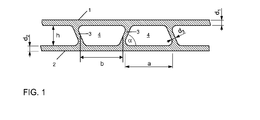
- FIG. 1 shows for better understanding, in particular the dimensioning, a polymer layer structure with ferroelectret properties in cross section.
- the polymer layer structure of FIG. 1 comprises a continuous first polymer layer 1, arranged here above, and a continuous second polymer layer 2. Both polymer layers 1,2 have a substantially constant thickness d1, d2, for example 50 microns, on.
- the two continuous polymer layers 1, 2 are interconnected by angled connecting sections 3 arranged to the continuous polymer layers. Its thickness d3 is preferably also 50 microns.
- tunnel-like cavities 4 are formed according to the manufacturing method, wherein the connecting sections 3 connecting the two polymer layers 1, 2 are arranged at an acute angle to the polymer layers 1, 2 and to each other such that the cavities 4 each have a cross section in the form of a symmetrical trapezoid.
- the longer base side of a trapezoidal cross-section is alternately arranged above and below the associated shorter base side, so that each adjacent arranged trapezoidal cross-sections are aligned with each other spot-reflected.
- the angle ⁇ enclosed between the longer base side (base) of each trapezoidal cross section and the adjacent connecting sections can assume values between 5 and 80 °. In the present case, the angle is about 60 °.
- FIG. 1 Shown is an embodiment in which several of the in FIG. 1 shown polymer layer structures are stacked to form a stack, wherein each facing continuous polymer layers of adjacent stacked polymer layer structures are charged with the same polarization.
- electrode layers are arranged between the individual polymer layer structures, which are contacted by the continuous polymer layers of the same polarization.
Landscapes
- Engineering & Computer Science (AREA)
- Manufacturing & Machinery (AREA)
- Physics & Mathematics (AREA)
- Spectroscopy & Molecular Physics (AREA)
- Laminated Bodies (AREA)
- Extrusion Moulding Of Plastics Or The Like (AREA)
Priority Applications (8)
| Application Number | Priority Date | Filing Date | Title |
|---|---|---|---|
| EP20100189897 EP2450974A1 (de) | 2010-11-03 | 2010-11-03 | Polymerschichtenverbund mit Ferroelektret-Eigenschaften und Verfahren zu dessen Herstellung |
| TW100138200A TW201231284A (en) | 2010-11-03 | 2011-10-21 | Polymer layer composite with ferroelectret properties, and process for the production thereof |
| US13/883,286 US20140009039A1 (en) | 2010-11-03 | 2011-10-28 | Polymer layer composite with ferroelectret properties and method for producing said composite |
| KR1020137014034A KR20130108409A (ko) | 2010-11-03 | 2011-10-28 | 페로일렉트릿 특성을 갖는 중합체 층 복합체 및 그의 제조 방법 |
| CN2011800533532A CN103460423A (zh) | 2010-11-03 | 2011-10-28 | 具有铁电驻极体特性的聚合物复合层及其制造方法 |
| EP11776786.3A EP2636084A1 (de) | 2010-11-03 | 2011-10-28 | Polymerschichtenverbund mit ferroelektret-eigenschaften und verfahren zu dessen herstellung |
| JP2013537088A JP2013543273A (ja) | 2010-11-03 | 2011-10-28 | フェロエレクトレット特性を有するポリマー層複合体およびその製造方法 |
| PCT/EP2011/069043 WO2012059437A1 (de) | 2010-11-03 | 2011-10-28 | Polymerschichtenverbund mit ferroelektret-eigenschaften und verfahren zu dessen herstellung |
Applications Claiming Priority (1)
| Application Number | Priority Date | Filing Date | Title |
|---|---|---|---|
| EP20100189897 EP2450974A1 (de) | 2010-11-03 | 2010-11-03 | Polymerschichtenverbund mit Ferroelektret-Eigenschaften und Verfahren zu dessen Herstellung |
Publications (1)
| Publication Number | Publication Date |
|---|---|
| EP2450974A1 true EP2450974A1 (de) | 2012-05-09 |
Family
ID=43750603
Family Applications (2)
| Application Number | Title | Priority Date | Filing Date |
|---|---|---|---|
| EP20100189897 Withdrawn EP2450974A1 (de) | 2010-11-03 | 2010-11-03 | Polymerschichtenverbund mit Ferroelektret-Eigenschaften und Verfahren zu dessen Herstellung |
| EP11776786.3A Withdrawn EP2636084A1 (de) | 2010-11-03 | 2011-10-28 | Polymerschichtenverbund mit ferroelektret-eigenschaften und verfahren zu dessen herstellung |
Family Applications After (1)
| Application Number | Title | Priority Date | Filing Date |
|---|---|---|---|
| EP11776786.3A Withdrawn EP2636084A1 (de) | 2010-11-03 | 2011-10-28 | Polymerschichtenverbund mit ferroelektret-eigenschaften und verfahren zu dessen herstellung |
Country Status (7)
| Country | Link |
|---|---|
| US (1) | US20140009039A1 (https=) |
| EP (2) | EP2450974A1 (https=) |
| JP (1) | JP2013543273A (https=) |
| KR (1) | KR20130108409A (https=) |
| CN (1) | CN103460423A (https=) |
| TW (1) | TW201231284A (https=) |
| WO (1) | WO2012059437A1 (https=) |
Cited By (2)
| Publication number | Priority date | Publication date | Assignee | Title |
|---|---|---|---|---|
| DE102015224778A1 (de) * | 2015-12-10 | 2017-06-14 | Bayerische Motoren Werke Aktiengesellschaft | Druckbolzen einer Presse sowie Presse mit Druckbolzen |
| JP2022545857A (ja) * | 2019-08-30 | 2022-11-01 | メタ プラットフォームズ テクノロジーズ, リミテッド ライアビリティ カンパニー | 構造化アクチュエータ:成形電気活性ポリマー |
Families Citing this family (8)
| Publication number | Priority date | Publication date | Assignee | Title |
|---|---|---|---|---|
| JP2014037451A (ja) * | 2012-08-10 | 2014-02-27 | Sekisui Chem Co Ltd | エレクトレットシート |
| WO2014193493A2 (en) * | 2013-02-15 | 2014-12-04 | The Florida State University Research Foundation, Inc. | Polymer foam-based piezoelectric materials and method of manufacture |
| WO2019008921A1 (ja) * | 2017-07-06 | 2019-01-10 | ソニー株式会社 | トランスデューサ装置、関節装置、並びにアクチュエータ装置 |
| US10962791B1 (en) | 2018-03-22 | 2021-03-30 | Facebook Technologies, Llc | Apparatuses, systems, and methods for fabricating ultra-thin adjustable lenses |
| US11245065B1 (en) | 2018-03-22 | 2022-02-08 | Facebook Technologies, Llc | Electroactive polymer devices, systems, and methods |
| US10914871B2 (en) | 2018-03-29 | 2021-02-09 | Facebook Technologies, Llc | Optical lens assemblies and related methods |
| US20220350063A1 (en) * | 2021-04-29 | 2022-11-03 | Meta Platforms Technologies, Llc | High surface quality optical film |
| WO2022231825A1 (en) * | 2021-04-29 | 2022-11-03 | Meta Platforms Technologies, Llc | High surface quality optical film |
Citations (2)
| Publication number | Priority date | Publication date | Assignee | Title |
|---|---|---|---|---|
| WO2006053528A1 (de) | 2004-11-22 | 2006-05-26 | Technische Universität Darmstadt | Elektroakustischer wandler |
| WO2010066348A2 (de) | 2008-12-13 | 2010-06-17 | Bayer Materialscience Ag | Ferroelektret-zwei- und mehrschichtverbund und verfahren zu dessen herstellung |
Family Cites Families (5)
| Publication number | Priority date | Publication date | Assignee | Title |
|---|---|---|---|---|
| JPH0661817B2 (ja) * | 1989-12-05 | 1994-08-17 | 大日本プラスチックス株式会社 | 中空成形品及びその製造方法 |
| EP0988329B1 (de) * | 1997-06-13 | 2002-11-06 | Ticona GmbH | Elektrete |
| US20080003869A1 (en) * | 2006-06-30 | 2008-01-03 | Inteplast Group, Ltd. | Extruded thermoplastic boards having enhanced mechanical strength |
| DE602007014165D1 (de) * | 2006-11-03 | 2011-06-09 | Danfoss As | Dielektrischer Verbundwerkstoff und Verfahren zur Herstellung eines dielektrischen Verbundwerkstoffs |
| JP5567030B2 (ja) * | 2009-07-15 | 2014-08-06 | バイエル・マテリアルサイエンス・アクチェンゲゼルシャフト | フェロエレクトレット2層および多層コンポジットおよびその製造方法 |
-
2010
- 2010-11-03 EP EP20100189897 patent/EP2450974A1/de not_active Withdrawn
-
2011
- 2011-10-21 TW TW100138200A patent/TW201231284A/zh unknown
- 2011-10-28 US US13/883,286 patent/US20140009039A1/en not_active Abandoned
- 2011-10-28 CN CN2011800533532A patent/CN103460423A/zh active Pending
- 2011-10-28 WO PCT/EP2011/069043 patent/WO2012059437A1/de not_active Ceased
- 2011-10-28 KR KR1020137014034A patent/KR20130108409A/ko not_active Withdrawn
- 2011-10-28 JP JP2013537088A patent/JP2013543273A/ja active Pending
- 2011-10-28 EP EP11776786.3A patent/EP2636084A1/de not_active Withdrawn
Patent Citations (2)
| Publication number | Priority date | Publication date | Assignee | Title |
|---|---|---|---|---|
| WO2006053528A1 (de) | 2004-11-22 | 2006-05-26 | Technische Universität Darmstadt | Elektroakustischer wandler |
| WO2010066348A2 (de) | 2008-12-13 | 2010-06-17 | Bayer Materialscience Ag | Ferroelektret-zwei- und mehrschichtverbund und verfahren zu dessen herstellung |
Non-Patent Citations (12)
| Title |
|---|
| "Breakdown-induced polarization buildup in porous fluoropolymer sandwiches: A thermally stable piezoelectret", JOURNAL OF APPLIED PHYSICS, vol. 99, 2006, pages 024102 |
| ADVANCED FUNCTIONAL MATERIALS, vol. 17, 2007, pages 324 - 329 |
| ALTAFIM R A P ET AL: "Dielectric resonance spectroscopy of piezoelectrets with tubular channels: Channel dimensions control resonances", SOLID DIELECTRICS (ICSD), 2010 10TH IEEE INTERNATIONAL CONFERENCE ON, IEEE, PISCATAWAY, NJ, USA, 4 July 2010 (2010-07-04), pages 1 - 4, XP031750637, ISBN: 978-1-4244-7945-0 * |
| DANIEL RODRIGO FALCONI ET AL: "Piezoelectric sensor based on electret thermoforming technology", SOLID DIELECTRICS (ICSD), 2010 10TH IEEE INTERNATIONAL CONFERENCE ON, IEEE, PISCATAWAY, NJ, USA, 4 July 2010 (2010-07-04), pages 1 - 3, XP031750632, ISBN: 978-1-4244-7945-0 * |
| H.C. BASSO; R.A.P. ALTAFILM; R.A.C. ALTAFILM; A. MELLINGER; PENG FANG; W. WIRGES; R. GERHARD: "Three-layer ferroelectrets from perforated Teflon-PTFE films fused between two homogeneous Teflon -FEP films", IEEE, 2007 ANNUAL REPORT CONFERENCE ON ELECTRICAL INSULATION AND DIELECTRIC PHENOMENA, 2007, pages 1 - 4244,1482-2,07,453-456 |
| JINFENG HUANG; XIAOQING ZHANG; ZHONGFU XIA; XUEWEN WANG: "Piezoelectrets from laminated sandwiches of porous polytetrafluoroethylene films and nonporous fluoroethylenepropylene films", JOURNAL OF APPLIED PHYSICS, vol. 103, 2008, pages 084111 |
| O. VORONINA; M. WEGENER; W. WIRGES; R. GERHARD; L. ZIRKEL; H. MÜNSTEDT: "Physical foaming of fluorinated ethylene-propylene (FEP) copolymers in supercritical carbon dioxide: single film fluoropolymer piezoelectrets", FLUORINATED ETHYLENE-PROPYLENE COPOLYMER |
| P. FANG; M. WEGENER; W. WIRGES; R. GERHARD; L. ZIRKEL: "Cellular polyethylenenaphthalate ferroelectrets: Foaming in supercritical carbon dioxide, structural and electrical preparation, and resulting piezoelectricity", APPLIED PHYSICS A: MATERIALS SCIENCE & PROCESSING, vol. 90, 2008, pages 615 - 618 |
| R. A. P. ALTAFIM; X. QIU; W. WIRGES; R. GERHARD; R. A. C. ALTAFIM; H.C. BASSO; W. JENNINGER; J. WAGNER: "Template-based fluoroethylenepropylene piezoelectrets with tubular channels for transducer applications", JOURNAL OF APPLIED PHYSICS, vol. 106, 2009, pages 014106 |
| R. KACPRZYK; A. DOBRUCKI; J. B. GAJEWSKI: "Double-layer electret transducer", JOURNAL OF ELECTROSTATICS, vol. 39, 1997, pages 33 - 40 |
| WERNER WIRGES; MICHAEL WEGENER; OLENA VORONINA; LARISSA ZIRKEL; REIMUND GERHARD-MULTHAUPT: "Optimized preparation of elastically soft, highly piezoelectric, cellular ferroelectrets from nonvoided poly(ethylene terephthalate) films", APPLIED PHYSICS LETTERS, vol. 90, 2007, pages 192908 |
| Z. HU; H. VON SEGGERN: "Air-breakdown charging mechanism offibrous polytetrafluoroethylene films", JOURNAL OF APPLIED PHYSICS, vol. 98, 2005, pages 014108 |
Cited By (3)
| Publication number | Priority date | Publication date | Assignee | Title |
|---|---|---|---|---|
| DE102015224778A1 (de) * | 2015-12-10 | 2017-06-14 | Bayerische Motoren Werke Aktiengesellschaft | Druckbolzen einer Presse sowie Presse mit Druckbolzen |
| DE102015224778B4 (de) * | 2015-12-10 | 2021-03-11 | Bayerische Motoren Werke Aktiengesellschaft | Druckbolzen einer Presse sowie Presse mit Druckbolzen |
| JP2022545857A (ja) * | 2019-08-30 | 2022-11-01 | メタ プラットフォームズ テクノロジーズ, リミテッド ライアビリティ カンパニー | 構造化アクチュエータ:成形電気活性ポリマー |
Also Published As
| Publication number | Publication date |
|---|---|
| WO2012059437A1 (de) | 2012-05-10 |
| CN103460423A (zh) | 2013-12-18 |
| JP2013543273A (ja) | 2013-11-28 |
| US20140009039A1 (en) | 2014-01-09 |
| KR20130108409A (ko) | 2013-10-02 |
| TW201231284A (en) | 2012-08-01 |
| EP2636084A1 (de) | 2013-09-11 |
Similar Documents
| Publication | Publication Date | Title |
|---|---|---|
| EP2450974A1 (de) | Polymerschichtenverbund mit Ferroelektret-Eigenschaften und Verfahren zu dessen Herstellung | |
| EP2339869A1 (de) | Ferroelektret-Zwei- und Mehrschichtverbund und Verfahren zu dessen Herstellung | |
| WO2010066348A2 (de) | Ferroelektret-zwei- und mehrschichtverbund und verfahren zu dessen herstellung | |
| EP2448030A1 (de) | Elektromechanischer Wandler mit einem zweischichtigen Basiselement und Verfahren zur Herstellung eines solchen elektromechanischen Wandlers | |
| EP2507848A1 (de) | Piezoelektrisches polymerfilmelement, insbesondere polymerfolie, und verfahren zu dessen herstellung | |
| EP2705549B1 (de) | Elektromechanische wandlereinrichtung | |
| EP2376278B1 (de) | Ferroelektret-mehrschichtverbund und verfahren zur herstellung eines ferroelektret-mehrschichtverbunds mit parallelen röhrenförmigen kanälen | |
| Kierzewski et al. | Adding an electroactive response to 3D printed materials: Printing a piezoelectret | |
| WO2011161052A2 (de) | Elektromechanischer wandler, verfahren zu dessen herstellung und verwendung desselben | |
| EP2506325A1 (de) | Elektromechanischer Wandler, Verfahren zu dessen Herstellung und Verwendung desselben | |
| DE202007018898U1 (de) | Piezokeramischer Flächenaktuator | |
| US20120248942A1 (en) | Electromechanical converter, method for its production and use thereof | |
| WO2014111327A1 (de) | Verfahren zum herstellen eines mehrschichtigen elektromechanischen wandlers | |
| EP2159857A1 (de) | Elektromechanischer Wandler | |
| DE102013223979A1 (de) | Elektroaktive Schallwandlerfolie mit strukturierter Oberfläche | |
| EP2439000A1 (de) | Polymerschichtenverbund mit Ferroelektret-Eigenschaften und Verfahren zu dessen Herstellung | |
| EP2009950A1 (de) | Elektrostatischer Folienschallwandler und Verfahren zu dessen Herstellung | |
| EP3257148B1 (de) | Elektrostatischer mikrogenerator und verfahren zur erzeugung elektrischer energie mittels eines elektrostatischen mikrogenerators | |
| EP2894684A1 (de) | EAP-Vorrichtung, Verwendung einer EAP-Endloshybridfolie sowie Verfahren zur Herstellung der EAP-Vorrichtung | |
| EP0971557B1 (de) | Ultraschall-Folien-Wandler | |
| DE102013204258A1 (de) | Schallwandler |
Legal Events
| Date | Code | Title | Description |
|---|---|---|---|
| PUAI | Public reference made under article 153(3) epc to a published international application that has entered the european phase |
Free format text: ORIGINAL CODE: 0009012 |
|
| AK | Designated contracting states |
Kind code of ref document: A1 Designated state(s): AL AT BE BG CH CY CZ DE DK EE ES FI FR GB GR HR HU IE IS IT LI LT LU LV MC MK MT NL NO PL PT RO RS SE SI SK SM TR |
|
| AX | Request for extension of the european patent |
Extension state: BA ME |
|
| STAA | Information on the status of an ep patent application or granted ep patent |
Free format text: STATUS: THE APPLICATION HAS BEEN WITHDRAWN |
|
| 18W | Application withdrawn |
Effective date: 20120815 |